Plaindealer
Friday, February 23, 1900
Topeka, Kansas
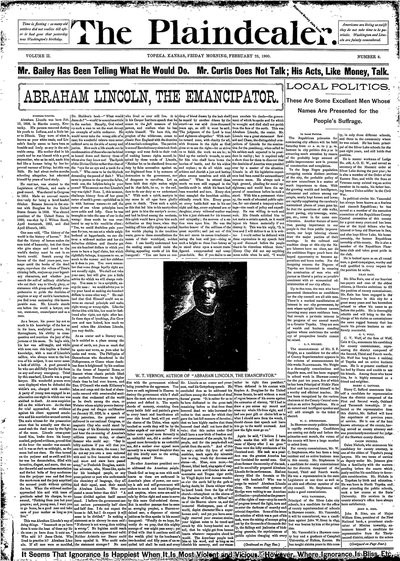
Page text (machine-generated)
Mr. Bailey Has Been Telling What He Would Do. Mr. Curtis Does Not Talk; His Acts, Like Money, Talk.
It Seems That Ignorance Is Happiest When It Is Most Violent and Vicious. However, Where Ignorance Is Bliss, Etc,
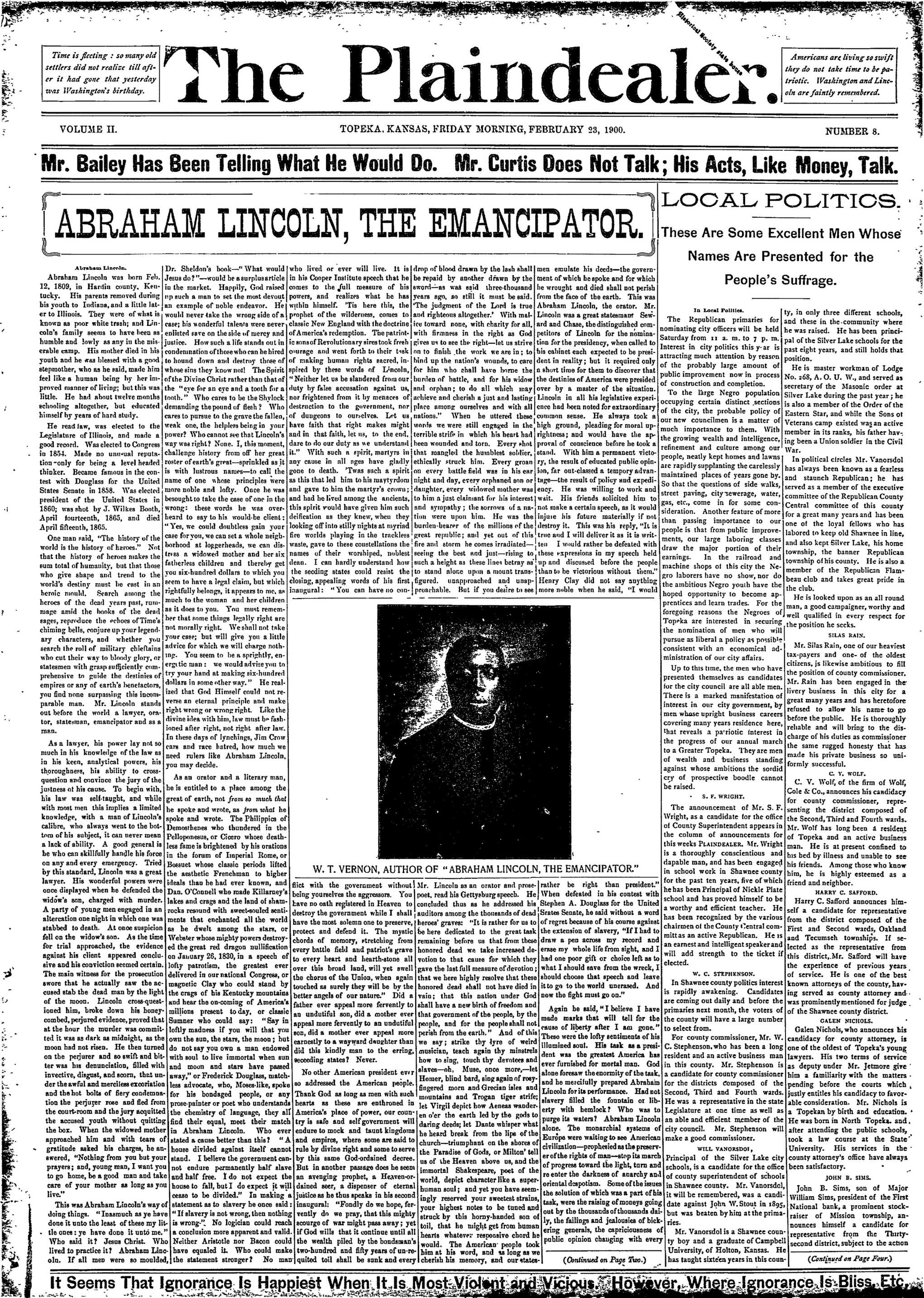
ABRAHAM LINCOLN, THE EMANCIPATOR.
Time is fleeting : so many old settlers did not realize till after it had gone that yesterday was Washington's birthday.
VOLUME II.
Akraham Lincoln:
Abraham Lincoln was born Feb. 12, 1809, in Hardin county, Kentucky. His parents removed during his youth to Indiana, and a little later to Illinois. They were of what is known as poor white trash; and Lincoln's family seems to have been as humble and lowly as any in the miserable camp. His mother died in his youth and he was blessed with a good stepmother, who as he said, made him feel like a human being by her improved manner of living; but this was little. He had about twelve months schooling altogether, but educated himself by years of hard study.
He read law, was elected to the Legislature of Illinois, and made a good record. Was elected to Congress in 1854. Made no unusual reputation only for being a level headed thinker. Became famous in the contest with Douglass for the United States Senate in 1858. Was elected president of the United States in 1860; was shot by J. Wilkes Booth, April fourteenth, 1865, and died April fifteenth, 1865.
One man said, "The history of the world is the history of heroes." Not that the history of heroes makes the sum total of humanity, but that those who give shape and trend to the world's destiny must be cast in an heroic mould. Search among the heroes of the dead years past, runmage amid the books of the dead eagles, reproduce the echoes of Time's chiming bells, conjure up your legendary characters, and whether you search the roll of military chiefsains who cut their way to bloody glory, or statesmen with grasp sufficiently comprehensive to guide the destinies of empires or any of earth's benetactors, you find none surpassing this incomparable man. Mr. Lincoln stands out before the world a lawyer, orator, statesman, emancipator and as a man.
As a lawyer, his power lay not so much in his knowledge of the law as in his keen, analytical powers, his thoroughness, his ability to cross-question and convince the jury of the justness of his cause. To begin with, his law was self-taught, and while with most men this implies a limited knowledge, with a man of Lincoln's calibre, who always went to the bottom of his subject, it can never mean a lack of ability. A good general is he who can skillfully handle his force on any and every emergency. Tried by this standard, Lincoln was a great lawyer. His wonderful powers were once displayed when he defended the widow's son, charged with murder. A party of young men engaged in an altercation one night in which one was stabbed to death. At once suspicion fell on the widow's son. As the time for trial approached, the evidence against his client appeared conclusive and his conviction seemed certain. The main witness for the prosecution swore that he actually saw the accused stab the dead man by the light of the moon. Lincoln cross-questioned him, broke down his honeycombed, perjured evidence, proved that at the hour the murder was committed it was as dark as midnight, as the moon had not risen. He then turned on the perjurer and so swift and bitter was his denunciation, filled with invective, disgust, and scorn, that under the awful and merciless exorcitation and the hot bolts of fiery condemnation the perjurer rose and fled from the court-room and the jury acquitted the accused youth without quitting the box. When the widowed mother approached him and with tears of gratitude asked his charges, he an swered, "Nothing from you but your prayers; and, young man, I want you to go home, be a good man and take care of your mother as long as you live."
This was Abraham Lincoln's way of doing things. "Inasmuch as ye have done it unto the least of these my little ones: ye have done it unto me." Who said it? Jesus Christ. Who lived to practice it? Abraham Lincoln. If all men were so moulded.
The Plaindealer.
Dr. Sheldon's book—"What would Jesus do?"—would be a surplus article in the market. Happily, God raised up such a man to set the most devout an example of noble endeavor. He would never take the wrong side of a case; his wonderful talents were never enlisted save on the side of mercy and justice. How such a life stands out in condemnation of those who can be hired to hound down and destroy those of whose sins they know not! The Spirit of the Divine Christ rather than that of the "eye for an eye and a tooth for a tooth." Who cares to be the Shylock demanding the pound of flesh? Who cares to pursue to the grave the fallen, weak one, the helpless being in your power? Who cannot see that Lincoln's way was right? None. I, this moment, challenge history from off her great roster of earth's great—sprinkled as it is with lustrous names—to call the name of one whose principles were more noble and lofty. Once he was besought to take the case of one in the wrong: these words he was overheard to say to his would-be client: "Yes, we could doubtless gain your case for you, we can set a whole neighborhood at loggerheads, we can distress a widowed mother and her six fatherless children and thereby get you six-hundred dollars to which you seem to have a legal claim, but which rightfully belongs, it appears to me, as much to the woman and her children as it does to you. You must remember that some things legally right are not morally right. We shall not take your case; but will give you a little advice for which we will charge nothing. You seem to be a sprightly, energetic man: we would advise you to try your hand at making six-hundred dollars in some other way." He realized that God Himself could not reverse an eternal principle and make right wrong or wrong right. Like the divine idea with him, law must be fashioned after right, not right after law. In these days of lynchings, Jim Crow cars and race hatred, how much we need rulers like Abraham Lincoln, you may decide.
As an orator and a literary man, he is entitled to a place among the great of earth, not from so much that he spoke and wrote, as from what he spoke and wrote. The Philippics of Demosthenes who thundered in the Pelloponeus, or Cicero whose deathless fame is brightened by his orations in the forum of Imperial Rome, or Bossuet whose classic periods lifted the aesthetic Frenchman to higher ideals than he had ever known, and Dan. O'Connell who made Killarney's lakes and crags and the land of shamrocks resound with sweet-souled sentiments that enchanted all the world as he dwelt among the stars, or Webster whose mighty powers destroyed the great red dragon nullification on January 26, 1830, in a speech of lofty patronism, the greatest ever delivered in our national Congress, or magnetic Clay who could stand by the crags of his Kentucky mountains and hear the on-coming of America's millions present to day, or classic Sumner who could say: "Say in lofty madness if you will that you own the sun, the stars, the moon; but do not say you own a man endowed with soul to live immortal when sun and moon and stars have passed away," or Frederick Douglass, matchless advocate, who, Moses-like, spoke for his bondaged people, or any prose-painter or poet who understands the chemistry of language, they all find their equal, meet their match in Abraham Lincoln. Who ever stated a cause better than this? "A house divided against itself cannot stand. I believe the government cannot endure permanently half slave and half free. I do not expect the house to fall, but I do expect it will cease to be divided." In making a statement as to slavery he once said: "If slavery is not wrong, then nothing is wrong." No logician could reach a conclusion more apparent and valid. Neither Aristotle nor Bacon could have equaled it. Who could make the statement stronger? No man
TOPEKA, KANSAS, FRIDAY MORNING, FEBRUARY 23, 1900.
P.
W. T. VERNON, AUTHOR OF "ABRAHAM LINCOLN, THE EMANCIPATOR."
who lived or ever will live. It is in his Cooper Institute speech that he comes to the full measure of his powers, and realizes what he has within himself. 'Tis here this, the prophet of the wilderness, comes to classic New England with the doctrine of America's redemption. The patricintic sons of Revolutionary sires took fresh courage and went forth to their task of making human rights sacred, inspired by these words of Lincoln, "Neither let us be slandered from our duty by false accusation against us, nor frightened from it by menaces of destruction to the government, nor of dungeons to ourselves. Let us have faith that right makes might and in that faith, let us, to the end, dare to do our duty as we understand it." With such a spirit, martyrs in any cause in all ages have gladly gone to death. 'Twas such a spirit as this that led him to his maytyrdion and gave to him the martyr's crown; and had he lived among the ancients, this spirit would have given him such defication as they knew, when they looking off into stillly nights at myriad fire worlds playing in the trackless waste, gave to these constellations the names of their worshiped, noblest dean. I can hardly understand how the seeding states could resist the closing, appealing words of his first inaugural: "You can have no con-
W. T. VERNON, AUTHOR
flict with the government without being yourselves the aggressors. You have no oath registered in Heaven to destroy the government while I shall have the most solemn one to preserve, protect and defend it. The mystic chords of memory, stretching from every battle field and patriot's grave to every heart and hearth-stone all over this broad land, will yet swell the chorus of the Union, when again touched as surely they will be by the better angels of our nature." Did a father ever appeal more fervently to an undutiful son, did a mother ever appeal more fervently to an undutiful son, did a mother ever appeal more earnestly to a wayward daughter than did this kindly man to the erring seceeding states? Never.
No other American president ever so addressed the American people. Thank God as long as men with such hearts as these are enthroned in America's place of power, our country is safe and self government will endure to mock and taunt kingdoms and empires, where some are said to rule by divine right and some to serve by this same God-ordained decree. But in another passage does he seem an avenging prophet, a Heaven-ordained seer, a dispenser of eternal justice as he thus speaks in his second inaugural: "Fondly do we hope, fervently do we pray, that this mighty scourge of war might pass away; yet if God wills that it continue until all the wealth piled by the bondsman's two-hundred and fifty years of un-requited toil shall be sunk and every
drop of blood drawn by the lash shall be repaid by another drawn by the sword—as was said three-thousand years ago, so still it must be said. 'The judgment of the Lord is true and righteous altogether.' With malice toward none, with charity for all, with firmness in the right as God gives us to see the right—let us strive on to finish the work we are in; to bind up the nation's wounds, to care for him who shall have borne the burden of battle, and for his widow and orphan; to do all which may achieve and cherish a just and lasting place among ourselves and with all nations." When he uttered these words we were still engaged in the terrible strife in which his heart had been wounded and torn. Every shot that mangled the humblest soldier, ethically struck him. Every groan on every battle field was in his ear night and day, every orphaned son or daughter, every widowed mother was to him a just claimant for his interest and sympathy; the sorrows of a nation were upon him. He was the burden-bearer of the millions of the great republic; and yet out of this fire and storm he comes irradiated—seeing the best and just—rising to such a height as these lines betray as to stand alone upon a mount transfigured. unapproached and unapproachable. But if you desire to see
OR OF "ABRAHAM LINCOLN
Mr. Lincoln as an orator and prosepoet, read his Gettysburg speech. He concluded thus as he addressed his auditors among the thousands of dead heroes' graves: "It is rather for us to be here dedicated to the great task remaining before us that from these honored dead we take increased devotion to that cause for which they gave the last full measure of devotion; that we here highly resolve that these honored dead shall not have died in vain; that this nation under God shall have a new birth of freedom and that government of the people, by the people, and for the people shall not perish from the earth." And of this we say; strike thy lyre of weird musician, teach again thy minstrels how to sing, touch thy devotees and slaves—oh, Muse, once more—let Hom, blind bard, sing again of rosy-fingered morn and Grecian isles and mountains and Trogan tiger strife; let Virgil depict how Aeneas wanderen o'er the earth led by the gods to daring deeds; let Dante whisper what he heard break from the lips of the church—triumphant on the shores of the Paradise of Gods, or Milton' tell us of the Heaven above us, and the immortal Shakespeare, poet of the world, depict character like a superhuman soul; and yet you have seemingly reserved your sweetest strains, your highest notes to be tuned and struck by this horny-handed son of toil, that he might get from human hearts whatever responsive chord he would. The American people took him at his word, and as long as we cherish his memory, and our states
men emulate his deeds—the government of which he spoke and for which he wrought and died shall not perish from the face of the earth. This was Abraham Lincoln, the orator. Mr. Lincoln was a great statesman. Seward and Chase, the distinguished competitors of Lincoln for the nomination for the presidency, when called to his cabinet each expected to be president in reality; but it required only a short time for them to discover that the destinies of America were presided over by a master of the situation. Lincoln in all his legislative experience had been noted for extraordinary common sense. He always took a high ground, pleading for moral uprightness; and would have the approval of conscience before he took a stand. With him a permanent victory, the result of educated public opinion, far out-classed a temporary advantage—the result of policy and expediency. He was willing to work and wait. His friends solicited him to not make a certain speech, as it would injure his future materially if not destroy it. This was his reply, "It is true and I will deliver it as it is written. I would rather be defeated with these expressions in my speech held up and discussed before the people than to be victorious without them." Henry Clay did not say anything more noble when he said, "I would
N, THE EMANCIPATOR."
rather be right than president." When defeated in his contest with Stephen A. Douglass for the United States Senate, he said without a word of regret because of his course against the extension of slavery, "If I had to draw a pen across my record and erase my whole life from sight, and I had one poor gift or choice left as to what I should save from the wreck, I should choose that speech and leave it to go to the world unerased. And now the fight must go on."
Again he said, "I believe I have made marks that will tell for the cause of liberty after I am gone." These were the lofty sentiments of his illumined soul. His task as a president was the greatest America has ever furnished for mortal man. God alone foresaw the enormity of the task, and he mercifully prepared Abraham Lincoln for its performance. Had not slavery filled the fountain or liberty with hemlock? Who was to purge its waters? Abraham Lincoln alone. The monarchial systems of Europe were waiting to see American civilization—prophesied as the preserver of the rights of man—stop its march of progress toward the light, turn and re enter the darkness of anarchy and oriental despotism. Some of the issues the solution of which was a part of his task, were the raising of moneys going out by the thousands of thousands daily, the failings and jealousies of bickering generals, the capriciousness of public opinion changing with every
(Continued on Page Two.)
LOCAL POLITICS.
People's Suffrage.
The Republican primaries for nominating city officers will be held Saturday from 11 a.m. to 7 p.m. Interest in city politics this y-ar is attracting much attention by reason of the probably large amount of public improvement now in process of construction and completion.
To the large Negro population occupying certain distinct sections of the city, the probable policy of our new councilmen is a matter of much importance to them. With the growing wealth and intelligence, refinement and culture among our people, neatly kept homes and lawns are rapidly supplanting the carelessly maintained places of years gone by. So that the questions of side walks, street paving, city sewerage, water, gas, etc., come in for some consideration. Another feature of more than passing importance to our people is that from public improvements, our large laboring classes draw the major portion of their earnings. In the railroad and machine shops of this city the Negro laborers have no show, nor do the ambitious Negro youth have the hoped opportunity to become apprentices and learn trades. For the foregoing reasons the Negroes of Topeka are interested in securing the nomination of men who will pursue as liberal a policy as possible consistent with an economical administration of our city affairs.
Up to this time, the men who have presented themselves as candidates for the city council are all able men. There is a marked manifestation of interest in our city government, by men whose upright business careers covering many years residence here, that reveals a patriotic interest in the progress of our annual march to a Greater Topeka. They are men of wealth and business standing against whose ambitions the sordid city of prospective boodle cannot be raised.
· S. F. WRIGHT.
The announcement of Mr. S. F. Wright, as a candidate for the office of County Superintendent appears in the column of announcements for this weeks PLAINDEALER. Mr. Wright is a thoroughly conscientious and dapable man, and has been engaged in school work in Shawnee county for the past ten years, five of which he has been Principal of Nickle Plate school and has proved himself to be a worthy and efficient teacher. He has been recognized by the various chairmen of the County Central committ as an active Republican. He is an earnest and intelligent speaker and will add strength to the ticket if elected.
W. C. STEPHENSON.
In Shawnee county politics interest is rapidly awakening. Candidates are coming out daily and before the primaries next month, the voters of the county will have a large number to select from. For county commissioner, Mr. W. C. Stephenson, who has been a long resident and an active business man in this county. Mr. Stephenson is a candidate for county commissioner for the districts composed of the Second, Third and Fourth wards. He was a representative in the state Legislature at one time as well as an able and efficient member of the city council. Mr. Stephenson will make a good commissioner.
WILL VANORSDOI.
Principal of the Silver Lake city schools, is a candidate for the office of county superintendent of schools in Shawnee county. Mr. Vanorsdol, it will be remembered, was a candidate against John W. Stout in 1895, but was beaten by him at the primaries. Mr. Vanorsdol is a Shawnee county boy and a graduate of Campbell University, of Holton, Kansas. He has taught sixteen years in this coun-
In Local Politics.
Americans are living so swift they do not take time to be patriotic. Washington and Lincoln are faintly remembered.
Money, Talk. POLITICS. excellent Men Whose sented for the
ty, in only three different schools, and these in the .community where he was raised. He has been principal of the Silver Lake schools for the past eight years, and still holds that position.
He is master workman of Lodge No. 268, A. O. U. W., and served as secretary of the Masonic order at Silver Lake during the past year; he is also a member of the Order of the Eastern Star, and while the Sons of Veterans camp existed was an active member in its ranks, his father having been a Union soldier in the Civil War.
In political circles Mr. Vanorsdol has always been known as a fearless and staunch Republican; he has served as a member of the executive committee of the Republican County Central committee of this county for a great many years and has been one of the loyal fellows who has labored to keep old Shawnee in line, and also kept Silver Lake, his home township, the banner Republican township of his county. He is also a member of the Republican Flambeau club and takes great pride in the club.
He is looked upon as an all round man, a good campaigner, worthy and well qualified in every respect for the position he seeks.
Mr. Silas Rain, one of our heaviest tax-payers and one- of the oldest citizens, is likewise ambitious to fill the position of county commissioner, Mr. Rain has been engaged in the livery business in this city for a great many years and has heretofore refused to allow his name to go before the public. He is thoroughly reliable and will bring to the discharge of his duties as commissioner the same rugged honesty that has made his private business so uniformly successful.
C. V. Wolf, of the firm of Wolf, Cole & Co., announces his candidacy for county commissioner, representing the district composed of the Second, Third and Fourth wards. Mr. Wolf has long been a resident of Topeka and an active business man. He is at present confined to his bed by illness and unable to see his friends. Among those who know him, he is highly esteemed as a friend and neighbor.
HARRY C. SAFFORD.
Harry C. Safford announces himself a candidate for representative from the district composed of the First and Second wards, Oakland and Tecumseh townships. If selected as the representative from this district, Mr. Safford will have the experience of previous years of service. He is one of the best known attorneys of the county, having served as county attorney and was prominently mentioned for judge of the Shawnee county district.
Galen Nichols, who announces his candidacy for county attorney, is one of the oldest of Topeka's young lawyers. His two terms of service as deputy under Mr. Jetmore give him a familiarity with the matters pending before the courts which justly entitles his candidacy to favorable consideration. Mr. Nichols is a Topekan by birth and education. He was born in North Topeka. and, after attending the public schools, took a law course at the State University. His services in the county attorney's office have always been satisfactory.
John B. Sims, son of Major William Sims, president of the First National bank, a prominent stockraiser of Mission township, announces himself a candidate for representative from the Thirty-second district, subject to the action (Continued on Page Four.)
NUMBER 8.
SILAS RAIN.
C. Y. WOLF.
GALEN NICHOLS.
JOHN B. SIMS.
Se a eS eee eae ee ee ee eee eee eee Oe eS Sone - 7 ee
a
—_—=_a_ee———————— ——————————— lO
> 7
The Plaindealer.
—_—_—_—X—X—"X€—_—_
‘Published at Topeka, Kansas, Shawnee county,
rates tine be Tee Pandealer PO
tentog cc mrany, 114 B. Seventh street.
pace
Poveda te posttice at Tones Tamas
armed Rpt oud sn mal ater
ee
SOBSCRIFTION BATES ¢
‘Ope year, by mal... asec seneemenseee SE OD
Biz months. by Mall..sseswevcvecnree ceeere TE
See pedis cocccecoes Me
aaah
Niox Cures, - > Bosiners Maneger
3.H.Caupes, - = * Editor.
Wine Haru, - Managing Editor.
FRIDAY. FEB. 23, 1900.
{Un order to insure publication of
matter in the current ‘issue, cor-
respondence must be in thie office no
later than Tuesday.
—————
ANNOUNCEMENTS.
ae ee
Uhereby announce myself = candidate forJudse of
the Duariet Court of Shawoee county, subject tofthe
Republnan prmancs. ZT. Mares,
a
Soun T. Chaney.
‘Joho T. Chabey announcer humelf a candidate for
‘Suite Senator.
ae
wee hen.
'W.E. Fagan ansounces bis candidacy for Probate
lige. Subject to Republican prmanet |
—_
Thomas F. Doran.
“Thomas F, Pecan #3 candidate for County Attor
ovy, nbject to the Republican primancs to bebeld
‘pel 14, 19%
ee
Galen Nichols,
Gates Nichols announces himself » candidate for
County Auorvey of Shasuee county, subject tothe
Republican prmanct,
_—_—
©. ¥. Wolt,
©. ¥, Wolf announces himself a candudate for
‘Couaty Comaisroner forthe éisinct composed ol the
‘0d, jrdand ath wards
—_————
NP. Wright.
Tama candidate foe County Superintendent, sub-
ecitothe Repablnan primery elevton, 0 be held on
Ape 14. 1900 SE. Wricnt.
WHI Vanormdol.
Tam a candedate for County Superintendent of pab-
ic inetrueuon, subject tothe Republean primanes, to
beheld April 14.1900. Wan Vanoxsbot.
John C.Tutloch
Joba C. Tulloch #2 candidate for councilman from
the Surth ward, slject to the Republican ny po
smarica Fet. 24 1900.
———eE
Ls. Dolman,
We are authonred to announce the candidacy ot
LS Dolman be Probate Judgessubjectto the Repsbe
kien pres:
Ed. McKeever.
‘We are authored to announce Ed McKeever for
Representative from the Thirty seventh dint, sub
ject tothe Republican pomancs.
eee
i einen
‘Weare authonzed to annoume the candidacy of
M. Snatunger for Councilman from the Third ward,
‘sabject to the Republican pnmnanes
——
P. HL. Forbes,
We are authonsed iosnncunce P. H, Fortes at
seandidate for Third ward Councilman, subject to
the Repathieas prmanes.
Joba B. Sims,
T hereby announce myself a candidate for Repre-
sentative from the Thirty-seventh distnet, subject to
the Republican primaries, Sous B, Sie.
Silas Rain
Silat Raw Pereby announces bw candidacy for
County Commusioner from the district compoved of
the 204, srd and qth wards, subject to the Republican
primaries,
W. Stephenson,
WLC. Stephenton hereoy aonounces his caudidacy
foe County Commusioner for the distnct containing
the and, 3rd and qth wards, subject tothe Republican
prmanes,
ML. J. Bevelle.
Thereby annevace myself a candidate for the
office of Probate Judge of Shawnee county, Kansas.
‘Sebject to the Republican prmanes when beld this
ong HJ. Beveux,
Harry ©. Safford.
Therety ansounce myself a candidate for Repre-
seatauve from the dumnct composed of the rst and
aad wards, Oabland and Tecomsch towoships, sub,
Jjectto the Republican pnmanes. H.C. Sarvoro.
‘Witn the close of this week,
the spirited struggle for Cong-
ressional representative in the
First district, will be over. The
campaign has been entirely free
from that kind of political prac-
tice—mud-slinging—which was
the predominating characteristic
of campaigns in years past. The
very admirable records of Hon.
Charles Curtis, both as a private
citizen and as a public servant,
are so clean and above reproach,
that his bitterest opponents have
been unableto find a fault with
him. And the only ground up.
‘on which the opposition have
sought to displace Mr. Curtis, is
that they might make a place
for Mr. Bailey. It has never
been charged that Mr. Curtis
should be retired because he had
been untrue toa friend, that he
lacked in ability and energy to
properly represent this district,
ad that Mr. Bailey possessed su-
‘petior qualifications for the posi-
tion, combined with a deeper in-
sight into the conditions and
needs of his constituency. Mr.
Bailey has been urged for the
position solely upon a hypothet-
ical ‘Horton agreement,” and
that Mr. Curtis is a political in-
terloper in this district. It
might be well to call the atten-
tion of our people of whom, no
doubt, there will be a number of
delegates in the Congressional
convention, to a few facts rel-
ative to the two candidates. Mr.
Curtis has made this canvass by
his personal friends, and upon
his records he shows fruits of his
years of success in Congress. Mr.
Bailey makes his appeal to the
voters of the First district, and
to the Negroes in particular, up
on what he will do. In his re-
cent letter appealing to the Ne-
gro voters of this district to stanc
by him, is an appeal to rac
prejudice, which is scarcely ex
pected in” an aspirant for suct
high honors. There is no need
at this time, for any man to seel
promotion by working on th
passions of his constituents rath:
er than their reason. We dc
not doubt, for a moment, tha
the bill against lynching te
be presented by Representative
White, will need every vote ob
tainable. But it should be born:
in mind that the effect of anti
lynching legislation will be ben
eficial to the entire human fam
ily, and should, for that reason
receive the hearty and unstinte:
support of all representatives
THE PLAINDEALER has no hes
itancy in pledging Charlie Cus
tis a hearty support to ever.
measure looking to the better
ment ot the condition of the Ne
groin the South, or anywher
on God's foot-stool. The Ne
groes of this district have know:
both these gentlemen for years
and yield to no race in admira
tion of their noble, manly qual
ities. Andit is unquestionabl
the sentiment of the many c
our people that the Congressior
al representation should remai
unchanged.
Get reedy to pay your poll-
tax,
Topeka is growing larger ev-
ery time the city council meets.
The latest addition is the Tope-
ka ‘* strip”
The Rising Sun stole John
Phillips Sousa’s cut and put it up
for the weather man. Come up
here, Brother Cole, and we
will loan you our “glover.”*
Vote for the-man next Satur-
day whom you honestly believe to
be best fiited to fill the position
under our city government, and
you will have discharged your
full duty.
| County Crerk John M.
‘Wright is president of the Coun-
ty Clerk's association of Kansas.
This is the first time a Negro ev-
er held this position, and is a
compliment to the race as well
as Mr. Wright.
Tue amusing feature of the
First district campaign is to sce
D. R. Anthony and Doc. Neeley,
of Leavenworth, hobnobbing. Mr.
Curtis has done some good for
that city, if he only accom-
plishes this much.
FRANK GRIMES, state treasur-
er, whose caricaturethe cartoon-
ists of the Populist party, sent
broadcast over the state during
the last state campaign, has
proven himself one of the most
popular state officers.
Helmick.
Epitor Pi.ainpeacer :—Al-
low me space ‘in your valuable
paper to state a few facts in re-
gard to our beloved brother, G.
a eee
| . . |
Missouri |
: es Pacific
Scu
i ae Route
THE GREAT,
SOUTHWEST SYSTEM,
‘Traveling the States of Kansas, Missouri, Nebraska,
Colorado,Cansas, and the Indian Territory.
| Five (5) Daily Passenger Trains are run on this line
in each direction, between Kansas City and St. Louis.
The Famous
Hot Springs
: Of Arkansas ~
Are reached ONLY by this LNE==—===
1 H.C. TOWNSEND, G.P.aT.A., |
! ST. LOUIS, MO.
| F.E. NIPPS, Agent, |
i TOPEKA, KAS. ios |
F. Bowles, andwife who passed
away some months ago, which
occurred quite unexpectedly, al-
though we all must die soon or
late. They both were members
of the Knights and Ladies of
Honor of the World. The death
of G. F. Bowles brought a sad-
ness to us, and we, the Queen of
the West of the Knights of La-
dies of Honor of the World, do
feel the weight and loss of his
advice. As we were the only or-
der of the kind in Kansas, it
caused somewhat of a standsiill
to us fora while, but I believe
we will be alright ina few days.
Wefeel that it is the very order for
the Negro race. They must ac-
cumulate respect for one another
jand acquire education and prop-
erty, if not great wealth, both in
the Southeast and Northwest.
It isn't necessary for us to live in
cities in order to become society
members, ‘nor in town to
keep up a society, just because
we belong to it. We car
own fagms and still be good so-
ciety members, but if we have
property in town it is alright:
but education is preferred, in or.
der that we may be able to hol
our property with the mean:
which we have earned. We
havenoble women and men it
our race as well as any othe:
Jrace. We appreciate the read
Jing of your paper, because it i
published in the interest o
|the race. Now, I want to say
Jas our order—Queen of thi
West, Knights and Ladies o
'|Honor of the World No. 150-
|would have been one year ol
|January, 1900. In the time o
|Jits working order, we lost
member by the name of Mrs
{Savannah Bnrns, who was one o
the youngest members in the or
Jer. She leaves a husband an
four little children. They wil
‘|receive $300; have already re
‘|ceived $100, and will get th
}balance on installment. Wh
Jshould we not appreciate suc!
Jan order ?. The supreme lodg
{has a charter from Washington
'|D. C., soit is alright.
You wish to see a beautiful display
of Fine ewelry, look into J. A. Wit-
oN sshow window,
If you want bargains in Wa1cHEs,
Ciocks or Jewetry of any sort for
your own use or to make Christmas
Presents of, step inside and buy at
prices to suit your pocket.
REMEMBER
‘That J. A. Wilson is Kansas City's
Pioneer Negro Jeweler, is known as
‘The Reliable Jeweler" and is found
at 116 West Ninth Street,
Kansas City, Mo.
Opposite old Cable Power Mouse
Two blocks from Armour's Packing Hous
Watches, Clocks and Jewelry
Repaired Correctly.
BARGAINS IN EVERYTHING
Persons from a distance will hav
their car fare refunded if purchase i:
made.
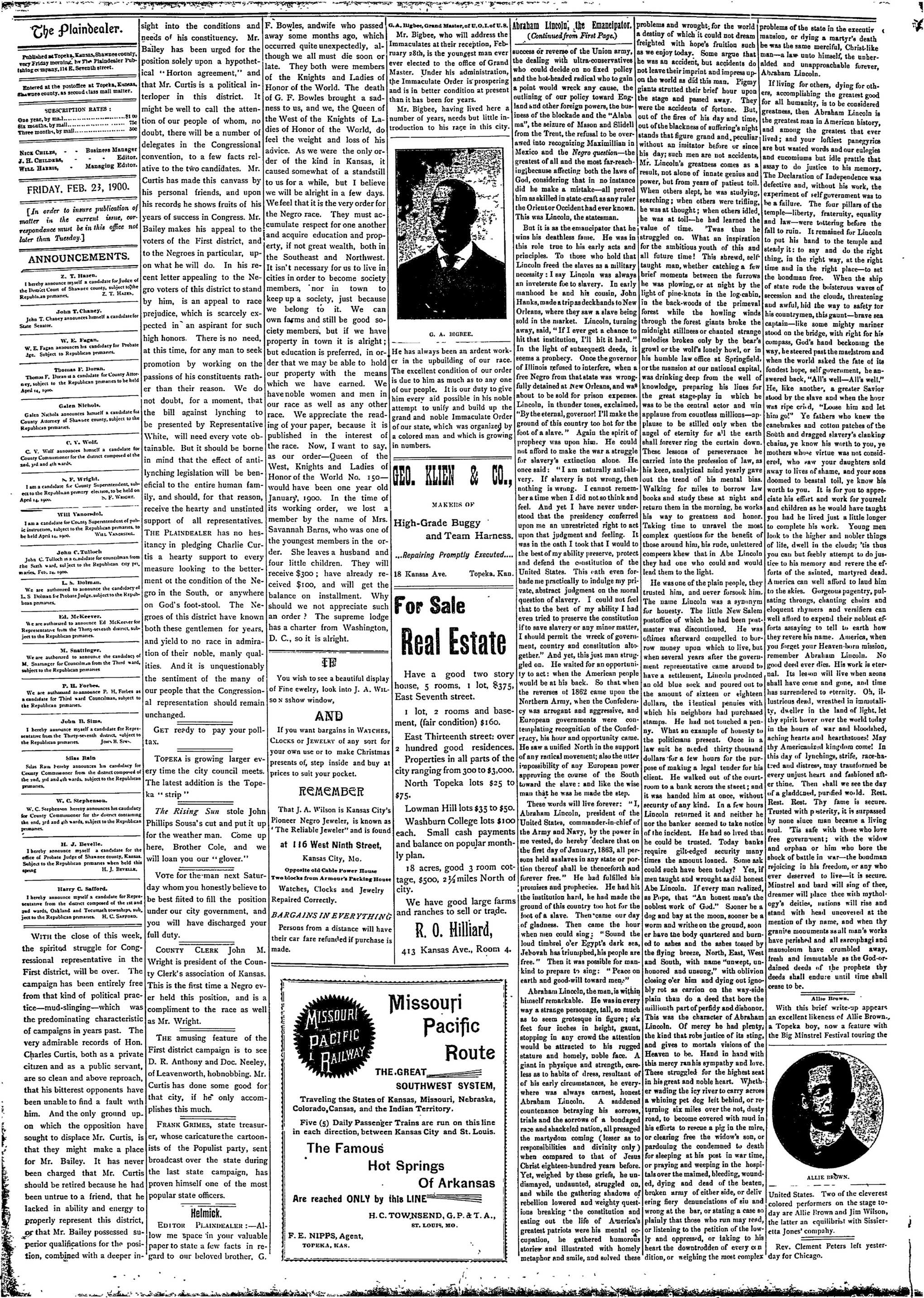
G. A, Ligbee, Grand Master, of U.O,1.of U.8.
Mr, Bigbee, who will address the
Immaculates at their reception, Feb-
ruary 28th, is the youngest man ever
ever elected to the office of Grand
Master. Under his administration,
the Immaculate Order is prospering
and is in better condition at presen!
than it has been for years.
Mr. Bigbee, having lived here ¢
‘number of years, needs but little in
troduction to his race in this city
ee ET
at: ease
ba MSs
eS
a =
Se fate Shes!
eee Bon
: gy peg
Poo eam
eres . Be
Fi ‘e,
N
He has always been an ardent work-
er in the upbuilding of our race.
The excellent condition of our order
is due to him as much as to any one
of our people. It is our duty to give
him every aid possible in his noble
attempt to unify and build up the
grand and noble Immaculate Order
ofour state, which was organized by
a colored man and which is growing
in numbers,
Gn, BURY & Ol,
MAKERS OF
High-Grade Buggy ~
and Team Harness.
wwRepairing Promptly Executed...
18 Kansas Ave. Topeka, Kan,
For Sale
Real Estate
Have a good two story
house, 5 rooms, 1 lot, $375,
East Seventh street.
1 lot, 2 rooms and base-
ment, (fair condition) $160.
East Thirteenth street: over
2 hundred good residences.
_ Properties in all parts of the
city ranging from 300 to $3,000.
North Topeka lots $25 to
$75-
Lowman Hill lots $35 to $50.
Washburn College lots $10
each, Small cash payment:
and balance on popular month:
ly plan.
18 acres, good 3 room cot
tage, $500, 2¥%miles North o
city.
We have good large farm:
and ranches to sell or trade.
R. 0. Hilliard,
413 Kansas Ave., Room 4.
Abraham Lincoja, the Emaneipator
(Continued from Firat Page.)
SUCCESS OF TEVETES OF LHe WDIOn army,
the dealing with ultra-conservatives
who could decide on no fixed policy
and the hot-headed radical who to gain
a point would wreck any cause, the
outlining of our policy toward Eng-
Jand and other foreign powers, the bus-
iness of the blockade and the “Alaba
ma”, the seizure of Mason and Slidell
from the Trent, the refusal to be over-
awed into recognizing Maximillian in
Mexico and the Negro question—the
greatest of all and the most far-reach-
ingjbecause affecting both the laws of
God, considering that in no instance
did he make a mistake—all proved
him asskilled in atate-craft as any ruler
the Orieutor Occidenthad ever known.
This was Lincolo, the statesman.
But it is as the emaucipator that he
wins his deathless fame. He was in
this role true to his early acts and
principles. To those who hold that
Lincoln freed the slaves as 9 military
necessity : Tsay Lincoln was always
‘an inveterate fue to slavery. In early
manhood he and his cousin, Jobn
Hanks, madea tripasdeckhands to New
Orleans, where they saw a slave being
sold in the market. Lincoln, turning
away, eaid, “If I ever get a chance to
hit that institution, I'll hit it hard.”
In the light of subsequent deeds, it
eeems a prophecy. Once the governor
of Illinois refused to interfere, when
free Negro from thatetate was wrong.
fully detained at New Orleans, and wat
about to be sold for prison expenses
Lincola, in thunder tones, exclaimed
“By the eternal, governor! I’ll make the
ground of this country too hot for the
| foot of a slave.” Again the spirit of
| prophecy was upon him. He coulé
not afford to make the war a struggle
for slavery’s extinction alone. He
once said: “Iam naturally anti-sla
very. If slavery is not wrong, ther
nothing is wrong. I cannot remem
beratime when I did notso think anc
feel. And yet I have never under
stood that the presidency conferres
upon me an unrestricted right to ac
,Jupon that judgment and feeling. I
was in the oath I took that I would t
,|the best of my ability preserve, protec
and defend the cvnstitution of th
.| United States. This cath even for
"| bade me practically to indulge my pri
“| vate, abstract judgment on the mora
question of slavery. I could not fee
that to the beet of my ability I hac
leven tried to preserve the constitutior
ifto save slavery or any minor matter
I should permit the wreck of govern
ment, country and constitution alto
gether.” And yet, this just man strug
gled on. He waited for an opportuni
y|ty to act: when the American peopl
would be at bis back. So that whe
"Ithe reverses ot 1862 came upow th
Northern Army, when the Confedera
-|cy was arrogant and aggressive, an
European governments were con
templating recoguition of the Confed
r|eracy, his hour and opportunity came
. |He saw a unified North in the suppor
2 |of any radical movement; also the utte
"| impossibility of avy European powe
"|approving the course of the Soutl
>}toward the slave: and like the wis
man that he was he made the step.
| _ These words will live forever: “1
“| Abraham Lincoln, president of th
>| United States, commander-in-chief
s|the Army and Navy, by the power i
.| me vested, do hereby “declare that o
the firet day of January, 1863, all per
syns held asslaves in any state or pot
{tion thereof shall be thenceforth ap
{|furever free.” He had fulfilled bi
{protaiues aud prophecies. He had hi
| the institution hard, he had made th
ground of this country too hot for th
foot ofa slave. Then*came our da
of gladness. Then came the hou
when mien could sing: “Sound th
loud timbrel o'er Egypt's dark ses
Jebovah has triumphed, his people at
free.” Then it was possible for mat
kind to prepare to sing: “ Peace o
earth and good-will toward mens”
Abrabam Lincoln, the man, is withi
| |himeelf remarkable. He wasinever
way a strange personage, tall, so muc
problems and wrought; for the world |)
a destiny of which it could not dream |
freighted with hope’s froition such
a8 we enjoy today. Some argue that
be was an accident, but accidents do
not leave their imprint and impress up-
on the world as did this man, Pigmy
giants strutted their brief hour upon
the stage and passed away. They
were the accidents of fortune. But,
out of the fires of his day and time,
out of the blackness of auffering’s night
stands that figure grand and, peculiar
without an imitator before or since
his day; such men are not accidents,
/Mr. Lincoln's greatness comes as a
result, not alone of innate genius and
power, but from years of patieut toil.
When others slept, he was studying,
searching; when others were trifling,
be wast thought; when others idled,
he was at toil—he had learned the
value of time. 'Twas thus he
struggled on. What an inspiration
for the ambitious youth of this and
Jall future time! This shrewd, self
|taught man, whether catching few
||brief moments between the furrows
|he was plowing,or at night by the
||light of pine-knots in the log-cabin,
Jin the back-woods of the primeval
;|forest while the howling winds
through the forest giants broke the
| midnight stillness or chanted strange
'|melodies broken only by the bear's
| growl or the wolf's lonely howl, or in
-|his humble law office at Springfield,
jor the mansion at our national capital,
-|was drinking deep from the well of
s|knowledge, preparing his lines fix
.|the great stageplay in which he
»| was to be the central actor and win
2| applause from countless millions—ap
,|plause to be stilled only when the
[angel of eternity for a!l the earth
| {shall forever ring the curtain down
»|These lessons of perseverance he
e|carried into the profession of law, a:
-|his keeo, analytical mind yearly gavi
nlout the trend of his mental bias
| Walking for miles to borrow lav
1} booka and study these at night anc
-|return them in the morning, he work:
I]his way to greatness acd honor
t|Taking time to unravel the mos
tlcomplex questions for the benefit o
0| those around him, his rude, unletterec
t|compeers khew that in Abe Lincol
e|they had one who could and wouk
~|Tead them to the light.
| He wasone of the plain people, the;
Ierusted him, and never forsook him
1)The name Liucola was a eynonyn
U}for bouesty. The little New Salen
2| pustoftice of which he had been post
'jmaster was discontinued. He wa:
“oftimes afterward compelled to bur
-|row money upon which to live, bu
{when several years after the govern
| ment representative came around t
elhavea settlement, Lincolu prodncec
Blan old blue eock and poured out t
€lthe amount of sixteen or cighteer
“Idollars, the itentical penuies wit!
d}which his neighbors had purchase
“}stamps. He had not touched a pen
+ Iny. What sn example of honesty t
-Ithe politicians present. Once in
tHlaw euit he meded thirty thousanc
¥}dollars ‘fur a few hours for the pur
T | pose of making a legal tender for hi
hlclient. He walked out of the cvurt
©! room to a bank across the staeet ; anc
it was handed him at once, withou
i, |security of any kind. In a few hour
@) Lincoln returned it and neither h
f/ nor the banker seemed to take notic
njof the incident. He had eo lived tha
nlhe could be trusted. Today bank
-lrequire gilt-edged security man:
r-{times the amount loaned. Some asl
d|could euch have been today? Yes, i
is| men taught avd wrought as did honea
it] Abe Lincoln, If every man realized
e|as Pupe, that “An honest mao’s th
e|noblest work of Gud.” Svoner be 1
y |dog and bay at the moon, sooner be
1r| worm and writhe on the ground, soon
e ler have the body quartered and burn
8, ed to ashes and the ashes tossed b:
e|the flying breeze, North, East, Wes
y-|and South, with name “unwept, ut
n|honored and unsung,” with oblivioi
closing o'er him and dying out ign
honored and unsung,” with oblivion
closing o'er him and dying out igno
bly rot as carrion on the way-side
plaia than do a deed that bore the
millionth partof perfidy and dishonor.
‘This was the character of Abraham
Lincoln. Of mercy he had plenty,
the kind that robs justice of its sting
‘snd gives to mortals visions of the
Heaven to be. Hand in hand with
this mercy ranhis sympathy and love
These struggled for the highest seal
in his great and noble heart. Wyheth
jer wading the icy river to carry acrot
a whining pet dog leit behind, or re
turning six miles over the not, dusty
road, to become covered with mud in
his efforts to rescue a pig in the mire
or clearing free the widow's son, o
pardoning the condemned to death
for sleeping at his post in war time
or praying and weeping in the hospi:
tals over the maimed, bleedig, wound
ed, dying and dead of the beaten,
broken army of either side, or deliv
ering fiery denunciations of eiu and
wrong at the bar, or stating a case ea
plainly that those who run may read
or listening to the petition of the low-
ly and oppressed, or taking to his
heart the downtrodden of every on
dition, or weighing the moet complex
Se ae
problems of the state in the executiv ¢
mansion, or dying a martyr’s death
he was the same merciful, Christlike
man—a law unto himself, the unher-
alded and unapproachable furever,
Abrabam Lincoln.
If living for others, dying for oth-
ere, accomplishing the greatest good
for all humanity, is to be coosidered
greatness, then Abraham Lincoln is
the greatest man in American bistory,
and among the greatest that ever
lived; and your foftiest panegyrice
are but wasted words and our eulogies
and encomiums but idle prattle that
assay to do justice to his memory.
‘The Declaration of Independence was
defective and, without his work, the
experiment of self government was to
he afuilure. The four pillars of the
temple—liberty, fraternity, equality
and law—were tottering befure the
fall to ruin. It remained for Lincoln
to put his hand to the temple and
steady it: to say and do the right
thing, in the right way, at the right
time and in the right place—to set
the Londman free. When the ship
of state rode the boisterous waves of
secession and the clouds, threatening
avd awful, hid the way to safety tor
his countrymen, this gaunt—brave sea,
captain—like some mighty mariner
||stood on the bridge, with right for his
Jcompass, God’s hand beckoning the
|| way, he steered past the maelstrom and
} when the world asked the fate of its
,|fondest hope, self government, he an-
|| swered back, “All's well—All’s well.”
'|He, like another, a greater Savior
'jatuod by the slave and when the hour
'| was ripe criid, “Loose him and let
‘}him go!” Ye fathers who knew the
jcanebrakes and cotton patches of the
|| Soath and dragged slavery’s clanking
-| chains, ye know his worth to you, ye
| mothers whore virtue was not consid-
sJered, who saw your daughters sold
>| away to lives of shame, and your sons
-|doomed to beastal toil, ye know his
‘| worth tu you. It is for you to appre-
1} ciate his effort and work for youreels
$}and children as he would have taught
-|you had he lived just # little longer
t|to complete his work. Young men
Fook to the higher and nobler things
1/of lite, dwell in the clouds; ’tis thus
1| you can but feebly attempt to do jus-
1| tice to his memory and revere the ef:
forts of the ssinted, martyred dead.
| America can well afford to laud him
_|to the skies. Gorgeous pagentry, pul-
,|sating throngs, chanting choirs and
{eloquent rhymers and versifiers can
«| well afford to expend their noblest ef-
s|forts assaying to tell to earth how
-| they revere his name. America, when
.| you forget your Heaven-born mission,
-[remember Abraham Lincoln. No
»| good deed ever dies. His work is eter-
j,nal. Its lesson wiil live when aeons
»|shall have come and gone, and time
{has surrendered to eternity. Oh, il-
| lustrious dead, wreathed ia immotali-
j|ty, dweller in the land of light, let
-| thy spirit hover over the world today
sin the hours of war and bloodshed,
,Jaching hearts and hearthstoves! May
thy Americanized kingdom come! In
_| this day of lynchings, strife, race-ha-
,|tzed and distress, may traueformed be
every unjust heurt and fasbioned aft-
jjer thine, Then chall we see the day
ofa gladdcaed, purified world. Rest
Rest. Rest. Thy fame is secure.
,| Trusted with p sterity, it is surpassed
z|by none since man became a living
_|seul. "Tis safe with thuee who love
s|free government; with the widow
and orphan or him who bore the
7) shock of battle in war—the bondman
{| rejoicing in his freedom, or any who
plever deserved to live—it is secure.
,| Minstrel and bard will sing of thee,
;]dreamer will place thee with mythol-
sJogy’s deities, nations will rise and
,|etand with head uncovered at the
_| mention of thy name, and when thy
_| granite monuments ssall man’s works
have perished and all enrcopbagi and
{{mausoleum have crumbled away,
[fresh and immutable as the God-or
;|dained deeds af the prophets tby
-|deeds shall endure until time shall
| oease to be.
_ Allie Brown, =~
With this brief write-up appears
an excellent likeness of Allie Brown.,
a Topeka boy, now a feature with
the Big Minstrel Festival touring the
ae
4 wD
on
& ae
pa 2:5: g
- | eee
Es
ke
ALU nedws.
— oe ee
United States. Two of the cleverest
colored performers on the stage to-
day are Allie Brown and Jim Witson,
the latter an equilibrist with Sissier-
eta Jones’ compahy.
| Rev, Clement Peters left yester-
day for Chicago.
PERSONAL NOTES.
Mr. Robt. Keith has been quite ill for several days.
The Arden club will meet Thursday, with Mrs. Young.
Mrs. Jennie Moore-Scott is visiting friends in the city.
Miss Eleanor Brashear is ill at her home, 1323 Van Buren street.
Anderson Chiles is ill at his home on Washington street.
Irs. James Huddleson is very ill at her home on Crane street.
The Imperial Art club met with Mrs. J. M. Ferguson last Saturday.
Mrs. Rebecca Harland is quite ill at her home on Washington street.
Otto Bennett, of THE PLAINDEALER, has gone to the Hall Printing company.
Mrs. I. Moore Fitchue, who has been visiting Mrs. Keith, has returned to Lawrence.
Thomas Dilhert is ill at his home in Lowman Hill and would be glad to see his friends.
Ike James, of Kansas City, is in the city attending the Union Pacific case now being heard in the District court.
Miss Jeannette Rogers, of St. Charles, Mo., has returned to Toukea, where she will make her future home.
Rev. Shaffer has removed his family to their beautiful home between Fifth and Sixth on Taylor street.
The Ivv club celebrated Washington's birthday with a party at 618 Kansas Ave. A pleasant time was reported.
The Owl club will give its closing ball at Metropolitan hall, about Easter. It will be the grandest event of the season.
Rev. Geo. H. Shaffer has removed his family from McLouth and will be at home to his friends on Taylor street, soon.
Mrs. William Page and Miss Minnie Page have returned from St. Joseph, where they have been visiting the past week.
The Owl club party was a success in every particular, though either the lack of money, clothes or escorts kept some of the high-toned girls away.
THE PLAINDEALER is in receipt of an invitation to attend the initial party of the Auto-Pleasure club, an Atchison organization, the prominent members of which are Misses Loreno Lawson, Sadie Stone, Zora Rucker, Bertha Johnson and Lula Brown.
The Ne Plus Ultra club met last Saturday at the home of Mrs. King in Brooks's Addition. All of the club being present, a delightful time is reported. Refreshments were served, after which they adjourned to meet at the home of Mrs. George Smith, the Lane street.
Prof. Walter E. Gray, of Lawrence, Kas., was married in Atchison Wednesday to Miss Annabel Spurlock, of Ripley, O., a teacher in the Atchison public schools, and formerly a teacher in Prof. W. H. Councill's industrial school at Normal, Ala. Prof. Walt. Gray is a brother to the famous Gray brothers—Spurlock and Arthur. Walt. Gray got an excellent wife and helpmeet and Miss Spurlock got a very good husband. THE PLAINDEALER sincerely trusts that they will meet success at every turn in the road.
Mrs. Robert Buckner entertained at a "thimble party" Saturday at 3 p.m., complimentary to Mrs. Jennie Moore Fitchue, of Durango, Colo.
She was formerly one of Lawrence's favorite schoolteachers. Owing to sickness, Mrs. Keith was unable to be present with Mrs. Fitchue. The color scheme of pink and white was carried out in the decorations. The souvenirs were pink hatchets with white bows in commemoration of Washington's birthday. The ladies derived considerable amusement by guessing the contents of bundles brought by different persons. It was decided that Mrs. Young's was the most unique. She was crocheting a bath towel. Those in attendance were Mesdames Dora Watkins, Henry King, Jennie Vernella, Lucy Davis, C. F. Clinkscale, John Ferguson, O. A. Taylor, W. W. Buckner, G. W. Guy, J. H. Guy, Henry Dillard, Clarence Moss, Kate Wilson, W. Grant, J. Page, A. M. Thomas, W. I. Jamison, Fred. Ratley, Clay Odell, Lizzie Washington, Reuben Wade, Ezekiel Ridley, A. Kuykendall, F. Richardson, M. E. Young; Misses Nora Sexton, Ida Wright and Hattie Freeman.
The regular monthly Union meeting of the t ree Masonic Lodges was held last Monday evening with Euclid Lodge. After the regular order of business, the hundred and twenty-five "brothers" were entertained in a royal manner. Deputy Grand Master Sol. G. Watkins made an interesting talk on "What the Grand Lodge Will Do" and very carefully outlined much of the matter which will be considered by the Grand Lodge when it convenes in this city, next August. Past Master S. P Hawkins, chairman of the Board of Trustees, reviewed the financial condition of the lodges and showed the steps being taken to secure new furniture and fixtures. The joint obligations are constantly being reduced and the outlook for the future is very promising. "A Lawyer's View of Masonry" was considered by Hrother W. I. Jamison in an eloquent and interesting talk on the importance of a thorough knowledge of the ethics of Masonry in order that the world may realize that we in a measure live up to its sublime principles. He urged the importance of exercising great care over our conduct outside our lodges, with a view of improving those about us. "The Christian Mason" by Rev. J. M. Brown was a strong presentation of the duty of Masons to live near to Christ, thereby enabling them to be better Masons. Rev. George H. Shaffer, who was to have talked on the same question was unavoidably detained, but promises an address at a later date. Other brief talks were made by various brothers present, after which the stewards committee served refresments. The next meeting will be with Kaw Valley Lodge No. 18 next month.
The Grand Lodge.
Hold the fort, we are coming! District Grand Lodge No. 17, Grand United Order of Odd Fellows of Kansas, paid through its grand treasurer, the following widows: Mrs. Julia Bassett, Chetopa, $300; Mrs. Lottie Murdock, Topeka, $300; James Murdock, a young man and a member of St. John's A. M. E. church and of Shawnee Lodge No. 1923, of Topeka, and carrying an endowment of $300, payable to his mother. When the call was made for the Twenty-third Kansas, James answered the call and went with them to Cuba. While there the captain of his salvation in calling the death roll called James Murdock. His mother lost a dear son and St. John A. M. E. church a faithful Christian and Shawnee Lodge one of the links of "Friendship, Love and Truth." Young men, remember your old mothers as James did his. James L. Harper, district grand master, Wichita, Kas.; S. P. Johnson, district grand secretary, Emporia, Kas.; D. D. Hope, district grand treasurer, Topeka, Kas.
North Toneka.
Mrs. Dovie Easley who has been stopping with Mrs. Ida M. Jordan, left Sunday afternoon for Lawrence, to visit her aunt, after which she will join her husband in Kansas City, where they will make their future home. She highly appreciated her staywith Mrs. Jordan. She said, "I don't know that I was ever more highly entertained than since I have been here. A more gentle, noble lady and gentleman I never met. I don't believe that Topeka affords a more esteemed lady and gentleman."
Mrs. Ida M. Jordan is soliciting money to buy a carpet for St. Mark's A. M. F. church; Rev. Wooten, pastor.
Atchison.
Rev. Henry Morris has secured in his own name 160 acres of land near the river on the Atchison and Leav
Look around you and see if the most viperous slanderer that has ever bitten you or your family is not a church member. In she sneaks and says: "Don't say anything about it, for Heaven's sake!" Why don't you turn the lying serpent out? For, remember, the same dose she gives you about others, she will surely give others about you.
Walter E. Gray, principal of Lincoln school, joined Wednesday in holy wedlock Miss Annabel Spurlock, also a teacher in the same building.
W. R. Fletcher, collector for the national bank, has not been caught yet. Oh, when he strikes the right one, he, too, will surrender like wheat before a sickle!
Winfield.
R. W. Ross has returned from Oswego, where he went to attend the funeral of his sister-in-law.
Rev. Bandy came up from Arkansas City and preached at the Baptist church Sunday before last.
Mr. and Mrs. Johnson, formerly of Newton, but lately of Anthony, are in the city. Mr. Johnson is a cook, and expects to make this his home if he can procure a situation. We hope he will have success.
Miss Sadie Shaw has returned to Kansas City.
Miss Jessie Hicks has gone to Kansas City to visit her mother.
Charles Fleming is slightly improved.
Valentine Day was a great medium through which one's enemies had a chance to convey to one what they would like to say, but were not brave enough to say.
If a certain married lady in this city could see her actions in church and other public places as other people see them, we think that she would get ashamed and act differently.
Mrs. Maddox has gone to Manhattan to visit her daughter, Mrs. John Duncan, and family.
Rev. Brooks held quarterly meeting at the A. M. E. church Sunday.
Owing to the bad weather, only a few of our people attended the entertainment at Arkansas City week before last. They report a grand time.
Emporia.
There are many cases of smallpox in our city; there are 30 cases at the peasthouse.
Miss Pearl Henderson is ill at her home on Cottonwood street, with the smallpox.
Miss Reeves, of Topeka, and Miss Coney, of Junction City, are the new colored students at the Normal.
Miss Schrader, of Ottawa, Kas, was here Sunday of last week lecturing at the St. James Baptist church.
Clarence, son of Mr. and Mrs. David Tipton, met with a father serious accident Saturday evening of last week. While returning from town, he made a misstep, and fell, falling on the coal oil can which he carried, cutting a gash in his forehead to the bone. He is resting easy.
Miss Alice Lyle, who has been very ill, is better.
Winfield.
Emporia.
Kingman.
Mr. Perry Allen and family, of Wichita removed here last week, and will make this their home at present. Mr. Allen lived here several years ago
Fort Scott.
Iantha Olges is quite sick.
Fred. Hays has been quite sick, but is now improving.
Della Black, of Kansas City, Mo., is in the city visiting friends.
M. Simmons, formerly of this city, but now of the I. T., is in the city viting relatives.
Rev. B. R. Gny, who has been visiting his family, returned Saturday of last week to his charge in Ottawa.
Mrs. Reeves has two children quite sick with the whooping cough.
Presiding Elder Brooks, who has been conducting a revival here in the A.M.E. church, returned to his home in Kansas City Saturday of last week.
Little Gertrude, infant daughter of Mr. and Mrs. C. M. Maxwell, died Wednesday of last week with the whooping cough, after a short illness.
L. Taylor was down from Fulton week before last.
The Social Hour club met at Mr. and Mrs. A. Johnson's Thursday evening of last week. All members of the club were present except Mesdames McLennore and Oliver, whose absence was caused by sickness. The Poet Bryant was discussed.
Ida Green is quite sick in Mercy hospital.
Oak Mills.
Joseph and Robert Mitchell, of Kickapoo, Kas., was the guest of the Wallingford boys Sunday before last. Charlie Ferguson made a flying trip to St. Joseph Saturday of last week.
Rev. J. H. T. Ross was in Leavenworth last week, on business.
Mr. John Cooper will go to the National Home in Leavenworth as soon as there is a vacancy in the Home.
The Bailey-Curtis "breeze" has struck Oak Mills.
We move that Atchison county shall send two colored delegates to the state convention the 16th of May—one from the city and one from the county.
There will be an entertainment at the Mount Zion Baptist church in the near future, to raise funds for the painting of the church.
Quite a number of our young men attended Black Patti's show in Atchison last week.
The Dickey brothers lost a very valuable horse last week.
When you are in Atchison, and want a good, wholesome meal, call at Mrs. Maria Scott's new restaurant.
Mr. D. D. Bell has bought a new buggy, and intends to make Effingham his objective point, on Sundays, when the weather gets warm.
While the weather is cold and bad, Dave and Charlie Wallingford are 25 feet down in the ground, blasting rock from their new well.
School Board of District 20 met in regular session the other night, and paid off their teacher and other incidental expenses up to date.
Gardeu Cltv
The Second Baptist church of this place is in progressive meeting, under the pastoral care of Rev. J. A. Wright, who began the meeting, and after a few days continuance he secured the assistance of Rev. A. L. Voorhies, who is pastoring at Manhattan and Perry, Kas.
I am sorry to say that Rev. Wright got sick a few days after Rev. Voorhies arrived, and has not been able to attend the meetings. Rev. Voorhies has been conducting the meetings very successfully, and his able sermons we have enjoyed very much. It will depend on the success of the meetings as to how long Rev. Voorhies shall be with us. We hope the meetings will be of such a nature that we can be able to hold him quite a while yet. Rev. Voorhies's sermons are very enthusiastic and soul-stirring, and they are greatly appreciated by us.
Jefferson City.
JEFFERSON CITY—The young men at Jefferson City have recently organized a Negro Flory Republican club for the purpose of getting all the
THE STAR GROCERY.
Nicodemus.
It continues to storm.
The Masons have their store building repaired in a nice style.
Mrs. Vaughn has gone to Stockton this week for a short stay.
W. L. Sayers was up from Lawrence a few days ago looking after his cases in court.
The Daughters of Ruth were "set up" this week. G. W. Jones was down from Hill City assisting in the work.
G. M. Sayers has purchased the Wilson building. We expect to see quite an improvement in the near future.
R. B. Scruggs engaged eighteen teams to haul goods from Bogne, Kas., to Nicodemus for the new enterprise. The car did not arrive for some unknown cause.
The subject which was discussed on the 14th in the Douglass Literary society was "Resolved, That the Negro should divide in politics." Negative, B. J. Smith, Joseph Wilson; affirmative, James Kuttley and John Clark. Decisions were in favor of the negative.
The subject to be discussed in the Teachers' association in Hill City March 3, will be, "Resolved, That the expansion policy of the United States is not detrimental to her best interest." Affirmative, E. M. Geyer; negative, G. W. Ellis.
G. W. Ellis has given such satisfaction to the district as a teacher that they will continue the school two months longer. Nicodemus has the largest school in the county and the best teacher. It also has lots of energetic young men like Mr. Ellis.
Wamego.
H. Chenault is sick with small-pox.
Wamego.
George Allen was over to Wabaunsee to see his father, who has been very sick since last
$200,000 Worth of Property
Has been placed in my hand for disposal, for sale; and of which part has been taken under foreclosure. It principally is owned by Eastern Firms who are very anxious to sell on reasonable terms. I have beautiful h uses and lots in all parts of the city, which can be bought almost at your own price. As this property has been placed in my hands for sale recently, I wish to wind it up in short order. House r rage from $500. to $1,000. each on easy terms; also I have beautiful residences ranging from $1,000 to $7,000 situated in the most beautiful part of the city, residences which you might desire.
We have a number of large and small farms near the city of Topeka, and farms to dispose of in all parts of the state.
KANSAS PACKING HOUSE MARKET, Whoelsale and Retail. Fresh and sugar cured Meats. SCHMIDT BRO'S : : : 306 E. SECOND ST.
Salina.
Lucinda Hawk is quite rapidly.
Susan Rhodes, inducing a series past week, will be tonight.
Stone is quite North Second.
Brown, of Me too underwent a few weeks a nicely. He exp a few days.
Mary Henderson last week, where permanently.
Eliza Wilson is home on North Nin
A Correction.
Statement.
Plandeealer:
r: I noticed in
The State Ledger
manufactured a
uses my name f
influencing the colo
县 county. I wi
is absolutely no
for his statement
story is solely
's fancy.
Yours very tr
JOHN W. PAT
Notice.
West Lodge No. 1 a
port No. 1, U. O.
an invitation to all
mammaculates and
dwives, to attend
in honor of
february 28, 1900
FFICE HOURS:
7010 9 A.M.
12 TO 2 P.M.
I. A. SHIELDS, M. D.
Office, 1331 Van Buren.
Special Attention to Ladies.
J. M. KNIGHT,
UNDERTAKER AND EMBALMER.
406 Kansas
MRS LU
FIAN
At Home,
9 to 10 a
ting bette
town today
He says the
it now.
406 Kansas Avenue. 'Phone 52.
MRS LUCY MESSER-DAVIS,
PIANO LESSONS.
At Home, 116 East 7th St
9 to 10 a. m. 6 to 7 p. m.
The Chicago Cafe,
Located at
706 EAST 12th STREET,
KANSAS CITY, -- MISSOURI,
is one of the best Restaurants
in the city.
OFFICE HOURS:
8 to 10 A. M.
3 to 5 P. M.
O. A. TAYLOR, M. D.
PHYSICIAN AND SURGEON
Calls answered day and night.
Telephone, 696. 226¢ Kansas Ave
OFFICE HOUSES:
9 to 11 A. M.
3 to 5 P. M.
7 to 9 P. M.
WM. E. JACKSON, M. D.
PHYSICIAN AND SURGEON.
Office, 117 West Fifth St
Shampooing and Face Massage.
Mrs. Hattie E. Van Vleck,
Hair Dresser and
Manufacturer.....
Hair to match all Complexions.
SWITCHIES AND HAIR JEWELRY
220 East Fifth Street, TOPKEA, KANAS
Practices in all courts. Special attention given criminal cases.
W. I. JAMISON,
ATTORNEY-AT-LAW.
Office. 117 W. Fifth St.
truly,
MATTERTON.
and Queen
O. I., hereby
all Immacul
and their hus-
attend a re-
of the Grand
ooo, at their
ett. By order
GAN, N. C.
ward
was eating
burant at 554
when a
all of dishes
as an old
George Old-
She told her
ham stabbed
pocket-knife.
iss. Oldham
in my hand for disposal,
for foreclosure. It prince-
y anxious to sell on rea-
in all parts of the city, v.
As this property has be-
to wind it up in short ord-
easy terms; also I have
7,000 situated in the mos-
you might desire.
of large and small farm-
se of in all parts of the st
A.
A
Phone, 2
Rooms 4
OFFICE HOUSE
8 to 10 A.M.
310 5 P.M.
C. SUN
PHYSIO
Calls Pro-
Tele
FRA-
ATT
Room 313,
515 Main St
A. M. THOMAS,
ATTORNEY-AT-LAW,
'Phone, 299.
413 Kansas Avenue,
Rooms 4 and 5. 'Topeka, Kan
OFFICE HOURS:
8 10 30 A.M.
3 10 5 P.M.
C. SUMNER SUNDAY.
PHYSICIAN AND SURGEON
Calls Promptly Answered,
Telephone 558.
FRANK HERALD,
ATTORNEY-AT-LAW.
Room 313, Long Building,
515 Main Street, KANSAS CITY, MO
Path of Property
or disposal, for sale; and of which
e. It principally is owned by Eas-
sell on reasonable terms. I have
of the city, which can be bought al-
erty has been placed in my hands
in short order. House renter from
also I have beautiful residences
in the most beautiful part of the
ire.
Small farms near the city of To-
arts of the state.
J. H. B. TAYLOR,
Avenue, TO
680.
PACKING HOUSE
Hoelsale and Re
and sugar cure
O'S :: : 306 E.
Kansas Avenue
School Rooms
TOPEKA, KANSAS.
HOUSE MARKET,
and Retail.
r cured Meats.
E. 306 E. SECOND ST.
Avenue.
The third Oxford reception was given at the Vendome academy Friday evening, January 9; it was the most fashionable reception ever given in Kansas City; the members of the club wore badges of pink silk and gold fringe. The officers are as follows: Charles Blake, president; Ernest Lee, vice-president; Lee Merrell, secretary; Alonzo Montgomery, D. M.; Edw. Brown, sergeant-at-arms; members, William Watson, Frank Scott, Dr. T. C. Unthank, Marshall Lewis, George Love, William Hughes, Sam. Jones, Sr., Wallace Dean, W. Fairfax, V. Harris, Fred. Moore, F. Bufkins, F. Wilson; the ladies are Mesdames R. T. Coles, John Hill, Annis Garrett, Callie Edwards, Mattie Dean, Addie Wilson, Lange, Jordan, Lena Jordan; Miss Kneppie Rucker, of Atchison; Misses Anna and Lulu Jones and J. and G. Minor, and Mr. Pannell and wife and J. Cummings and wife.
Mittie Smith is much better, after a severe vaccination. The Episcopal church is preparing the program of a concert to be given after Easter.
Hutchinson.
Pinkie Anthony has returned home, after a pleasant visit in Strong City.
A few words to the idle married men of our community, to the men who have families that have suffered this winter because their providers could not get a job: Be as the little ant; provide in the summer for the winter. If you cannot get a job in town, just as soon as spring opens up, take yourself and family on a farm and make something in the main to support them with the next, coming winter. There are too many people in town already trying to make a living; there are so many whites in town that a colored man stands a poor show for a living. Get out on a farm, where you can raise your own vegetables, meat, make your own butter, and have just what you need, provided you are industrious and are willing to work. To the younger men without families: Will you please stop standing around before the doors of low resorts and stop insulting ladies as they pass along the streets? The younger men should go to work and make a decent living for themselves. This is to the idlers alone, to those who cannot find an occupation, so they claim. But you are wrong; there is a way for everyone if he will only seek it. We hope the idlers will take this hint, and that it will not have to be repeated.
Troy.
tits, of Kara-
ding a fewew
at White C
mning, of
y in Troy.
Gavis return
after spendi
Joseph with
Meilians, Mar-
feld, rende
usic Sunday
night.
Smith, o
spent S
LECTURE.
R. Smith
orator or
delivered an
ductive lecti
the 17th in t
subject, "Mr. Sm
the great
We wish
whole speech
temperance
institutions
trolling the
ment, corr
political
morals,
general and so
man; it bam
the heart
timent, hoo
ble virtue;
man's i
akens our
and decency
been the
more king
government
damage and
than the l
peece, with
achievement
ties of the
glory with
s. Rome.
Hills with
felt in her
stone of l
all. Will
morning-s
shall we pr
of the old e
munkeness
Prof. John R. Smith, the silver-tongued orator of Kansas City, Kas., delivered an interesting and instructive lecture on the evening of the 17th in the Christian church; subject, "The Curse of the Age." Mr. Smith dwelt at length on the great evils of intemperance. We wish we could insert his whole speech; he stated that "intemperance is an enemy to free institutions, a potent factor in controlling the affairs of the government, corrupting the fountains of political power, affecting public morals, public order, the general and social conditions of man; it banishes and crushes from the heart every endearing sentiment, hope, aspiration and noble virtue; it destroys and maims man's intellectual powers, weakens our ideas of morality and decency. Intemperance has been the cause of the fall of more kingdoms, empires and governments, more murder, carnage and the loss of more lives than the hoary hand of war. Greece, with all her victories and achievements, revealed in the follies of the East and stained her glory with the shadows of ages. Rome, sitting on her Seven Hills with great warlike pride, felt in her latter day the cornerstones of her empire sway and fall. Will this be the fate of this morning-star America? Or shall we profit by the examples of the old empires that died in drunkenness and revelry?"
Lawrence.
mid-annual ex
are over
have success
ept one Ch
bilene, wh
ate, seems to
the ice, a
where it
and now pass
Hoyt sp
Wichita.
of L. House,
being her sister,
man is back agen
where he he
months.
of M. Coffey,
the past week
5 N. Mosely.
pernacle Baptist
revival meeting
will be assisted
the New Hope
W. Phelps is
several days.
Lennie Robi
ity, is visiting
Robinson.
Johnson is on
Anthia Smith in
home on N. Top
second Baptist cl
meetings.
. Robinson,
being her sister,
on N. Mosely
her home in
urrell Taylor,
arrived in the
will make qui
osit with her s
R. Dunson.
Mexico, Mo.
There is more sickness among the colored people at present than there has been for sometime; the people certainly have been blessed so far, but in the past few weeks many are reported on the sick list; also quite a number of sufferers who haven't sufficient clothing, food and fuel to keep them comfortable, and are appealing to the city for help. We would say this to many of our poor people who enjoy the summer season sporting about, taking in all excursions, keeping up with the very latest summer styles and amusements: they do not think of the future season when the dime and dollar will be of great use to them; they seem to think that money certainly grows on trees and that they can find it whenever they please, but this is a mistake. Work is not as plentiful in winter as it is in warmer seasons of the year, and they should think more about this subject. Prepare for the future, men; save the money you spend at the bar; women, save the money you spend picnicking and having what you call a "good time;" boys and girls, save the money you throw away foolishly, and help your parents, so that when another cold wave blows over telling us winter has come, be ready, be like the little ant, which works faithfully in the warmer seasons, and when winter has come it is ready for it. We
this more sickened people a
he has been for
certainly h
far, but in the
any are reports
Garden City.
Garden City. America Fantroy was over in Olathe last week, on missions business. Nath. McCormick is on the sick list, and his case has been quite serious. Rev. J. A. Wright is better; we hope to see him out again soon. Rev. Voorhies left for Kansas City Saturday afternoon. Joe Johnson removed out on the farm the first of the week. Will Berry has bought a new buggy, and has just been "killing it" with the ladies. We are glad to know that the colored voters have taken a stand for Curtis, as we too believe in supporting a man that would benefit the Negro.
a Fantroy was on last week, on mi-
McCormick is on and his case has ous.
A. Wright is b to see him out
Voorhies left for K day afternoon.
Johnson removed on the first of the wo Berry has bought and has just been with the ladies.
He glad to know the boters have taken a as, as we too bel- ing a man that the Negro.
Ottawa.
Collins, of Parsons,
high town Tuesday
from route to Coventry
He stopped over
served a sermon at
church.
Dixon is in town
day.
Stokes is in the
st of Mrs. A. Scott.
Lillard returned to
with her husband
last week.
Bington Lewis has
to work the last
st of a sore throat.
Garrett, of The
Saturday, February 11,
being for a long time
and 82 years.
Wooten and woot
at 6 o'clock dinner
february 11, Rev. W.
Rev. B. R. Guy;
Moybourne and L.
Lettie and Berth
the latter part of last
Island, the guest of
Philp Lillard, of W.
city.
Logan, of The
sick.
Scott of the Thin
church closed his
Sunday.
Lillard, of The
Sunday, February 11;
the deceased had
only a week. She
of the St. Paul A.
having been a p
tast 35 years; she l
er and seven sons to
th.
Glaspie has been
the last week.
Green, son of
has started out to
diverse his first t
the first of the mon
Kansas City, Kas.
Russell, who died Friday evening Monday afternoon Zion church. Frederick Douglass exercises were held olitan Baptist church street and Was Tuesday night. The program was reses, Mrs, J. S. Yatt v. and W. T.
The Frederick Douglass memorial exercises were held at the Metropolitan Baptist church, corner Ninth street and Washington avenue, Tuesday night. The following program was rendered : Addresses, Mrs. J. S. Yates, Kansas City, and W. T. Vernon, Quindaro; papers, Phillip Brooks and Bessie Turner; original poem on Douglass, Tilfort Davis, Jr.
Newton.
Holliday.
Fate Ae hm Sent et mh ae Hs te ee ey, at em tem oe
ae
F| y
WS