Plaindealer
Friday, March 23, 1900
Topeka, Kansas
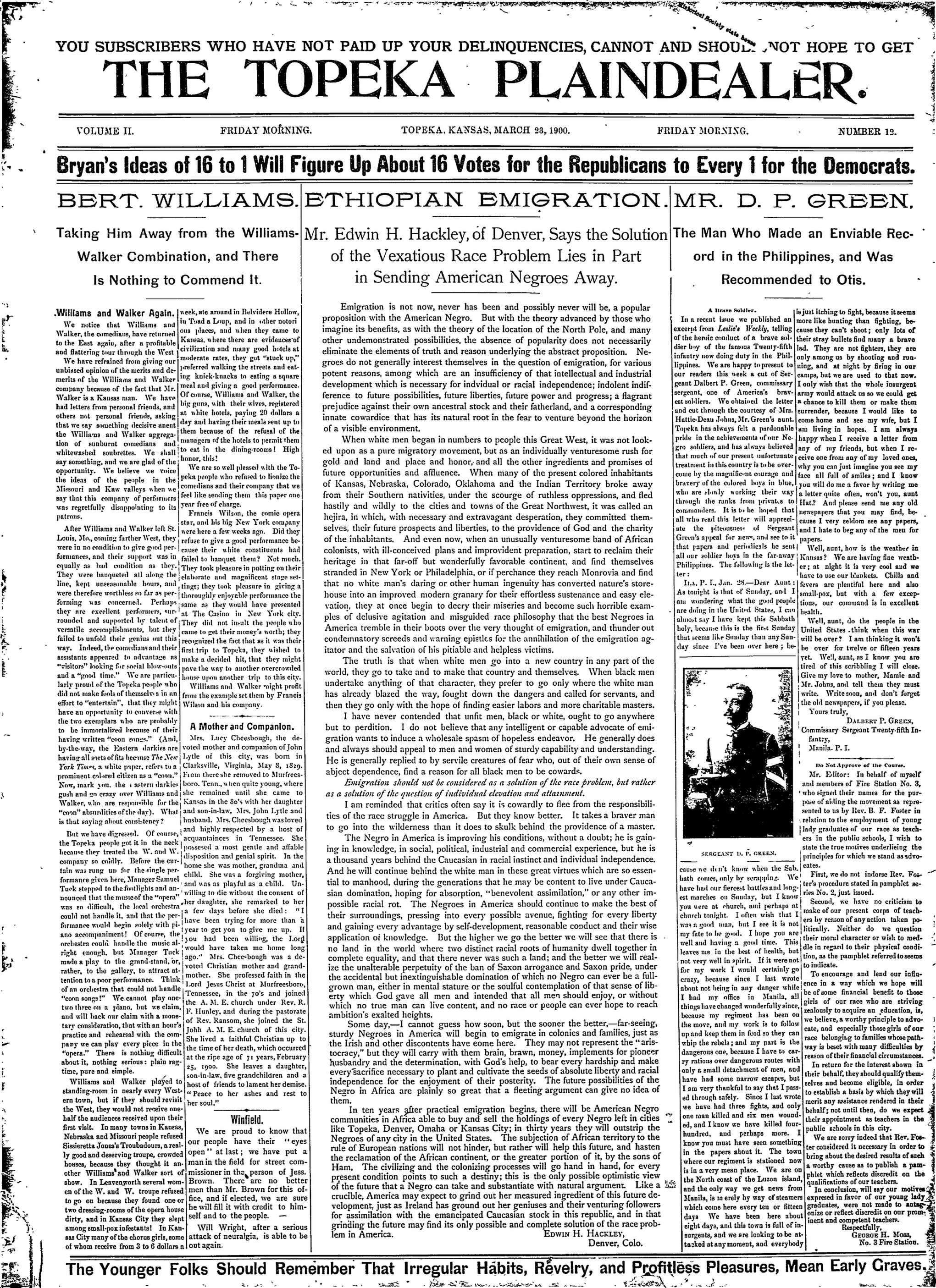
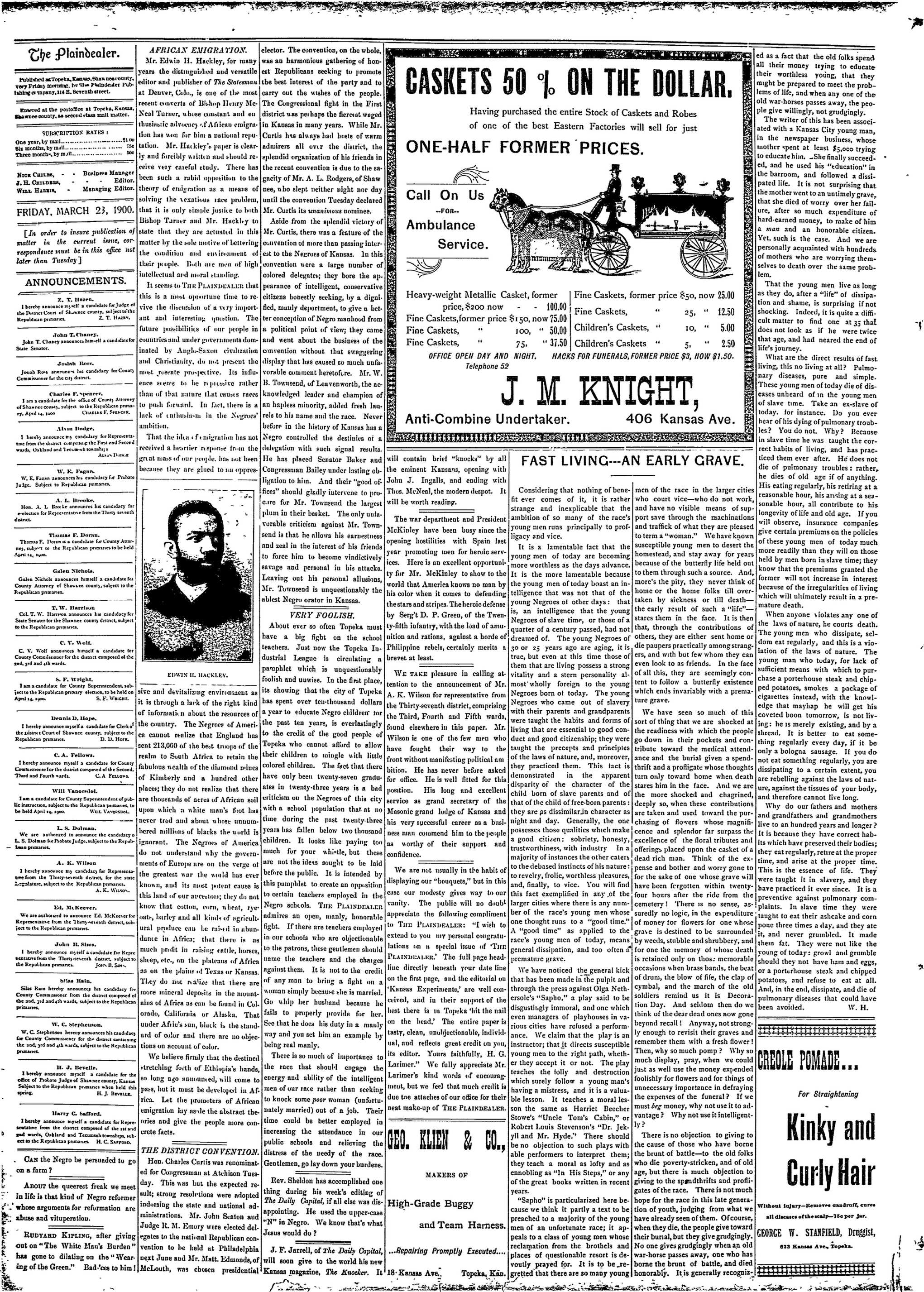
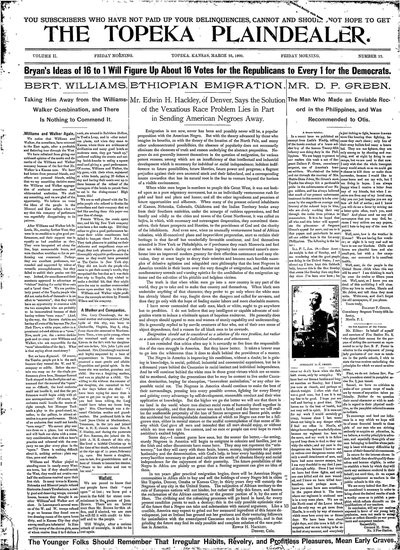
Page text (machine-generated)
YOU SUBSCRIBERS WHO HAVE NOT PAID UP YOUR DELINQUENCIES, CANNOT AND SHOULD NOT HOPE TO GET THE TOPEKA PLAINDEALER.
Bryan's Ideas of 16 to 1 Will Figure Up About 16 Votes for the Republicans to Every 1 for the Democrats.
Taking Him Away from the Williams- Walker Combination, and There Is Nothing to Commend It.
VOLUME II.
Bryan's Ideas of
BERT. WI
Taking Him Away from
Walker Combina
Is Nothing to
.Williams and Walker Again.
We notice that Williams and Walker, the comedians, have returned to the East again, after a profitable and flattering tour through the West
We have refrained from giving our unbiased opinion of the merits and demerits of the Williams and Walker company because of the fact that Mr. Walker is a Kansas man. We have had letters from personal friends, and others not personal friends, asking that we say something decisive anent the Williams and Walker aggregation of sunburn comedians and whitewashed soubrettes. We shall say something, and we are glad of the opportunity. We believe we voice the ideas of the people in the Missouri and Kaw valleys when we say that this company of performers was regretfully disappointing to its patrons.
After Williams and Walker left St. Louis, Mo., coming farther West, they were in no condition to give good performances, and their support was in equally as bad condition as they. They were banqueted all along the line, kept unseasonable hours, and were therefore worthless so far as performing was concerned. Perhaps they are excellent performers, surrounded and supported by talent of versatile accomplishments, but they failed to unfold their genius out this way. Indeed, the comedians and their assistants appeared to advantage as "visitors" looking for social blow-outs and a "good time." We are particularly proud of the Topeka people who did not make fools of themselves in an effort to "entertain", that they might have an opportunity to converse with the two exemplars who are probably to be immortalized because of their having written "coon songs." (And, by-the-way, the Eastern darkies are having all sorts of fits because The New York Times, a white paper, refers to a prominent colored citizen as a "coon." Now, mark you, the eastern darkies gush and go crazy over Williams and Walker, who are responsible for the "coon" absurdities of the day). What is that saying about consistency?
But we have digressed. Of course, the Topeka people got it in the neck because they treated the W. and W. company so coldly. Before the curtain was rung up for the single performance given here, Manager Samuel Tuck stepped to the footlights and announced that the music of the "opera" was so difficult, the local orchestra could not handle it, and that the performance would begin solely with piano accompaniment! Of course, the orchestra could handle the music alright enough, but Manager Tuck made a play to the grand-stand, or, rather, to the gallery, to attract attention to a poor performance. Think of an orchestra that could not handle "coon songs!" We cannot play one two three on a piano, but we claim and will back our claim with a monetary consideration, that with an hour's practice and rehearsal with the company we can play every piece in the "opera." There is nothing difficult about it, nothing serious: plain ragtime, pure and simple.
Williams and Walker played to standing-room in nearly every Western town, but if they should revisit the West, they would not receive one half the audiences received upon their first visit. In many towns in Kansas, Nebraska and Missouri people refused Sissieretta Jones's Troubadours, a really good and deserving troupe, crowded houses, because they thought it another Williams and Walker sort of show. In Leavenworth several women of the W. and W. troupe refused to go on because they found one on two dressing-rooms of the opera house dirty, and in Kansas City they slept among small-pox infestations! In Kansas City many of the chorus girls, some of whom receive from 3 to 6 dollars a
of 16 to 1 Will Fig
WILLIAMS.
from the Williams-
ation, and There
Commend It.
week, ate around in Belvidere Hollow, in Toad a Loup, and in other notorious places, and when they came to Kaneas, where there are evidences of civilization and many good hotels at moderate rates, they got "stuck up," preferred walking the streets and eating knick-knacks to eating a square meal and giving a good performance. Of course, Williams and Walker, the big guns, with their wives, registered at white hotels, paying 20 dollars a day and having their meals sent up to them because of the refusal of the managers of the hotels to permit them to eat in the dining-rooms! High honor, this!
We are so well pleased with the Topeka people who refused to lionize the comedians and their company that we feel like sending them this paper one year free of charge.
Francis Wilson, the comic opera star, and his big New York company were here a few weeks ago. Did they refuse to give a good performance because their white constituents had failed to banquet them? Not much. They took pleasure in putting on their elaborate and magnificent stage settings; they took pleasure in giving a thoroughly enjoyable performance the same as they would have presented at The Casino in New York city. They did not insult the people who came to get their money's worth; they recognized the fact that as it was their first trip to Topeka, they wished to make a decided hit, that they might pave the way to another overcrowded house upon another trip to this city. Williams and Walker might profit from the example set them by Francis Wilson and his company.
A Mother and Companion.
Mrs. Lucy Cheesbough, the devoted mother and companion of John Lytle of this city, was born in Clarksville, Virginia, May 8, 1829. From there she removed to Murfreesboro. Tenn., when quite young, where she remained until she came to Kansas in the 80's with her daughter and son-in-law, Mrs. John Lytle and husband. Mrs. Cheesbough was loved and highly respected by a host of acquaintances in Tennessee. She possessed a most gentle and affable disposition and genial spirit. In the home she was mother, grandma and child. She was a forgiving mother, and was as playful as a child. Unwilling to die without the consent of her daughter, she remarked to her a few days before she died: "I have been trying for more than a year to get you to give me up. If you had been willing, the Lord would have taken me home long ago." Mrs. Cheesbough was a devoted Christian mother and grandmother. She professed faith in the Lord Jesus Christ at Murfreesboro, Tennessee, in the 70's and joined the A. M. E. church under Rev. R. F. Hunley, and during the pastorate of Rev. Ransom, she joined the St Johh A. M. E. church of this city. She lived a faithful Christian up to the time of her death, which occurred at the ripe age of 71 years, February 25, 1900. She leaves a daughter son-in-law, five grandchildren and a host of friends to lament her demise "Peace to her ashes and rest to her soul."
Winfield.
We are proud to know that our people have their "eyes open" at last; we have put a man in the field for street commissioner in the person of Jess. Brown. There are no better men than Mr. Brown for this office, and if elected, we are sure he will fill it with credit to himself and to the people. —
Will Wright, after a serious attack of neuralgia, is able to be out again.
TOPEKA, KANSAS, MARCH 23, 1900.
Mr. Edwin H. Hackley, of Denver, Says the Solution of the Vexatious Race Problem Lies in Part in Sending American Negroes Away.
Emigration is not now, never has been and possibly never will be, a popular proposition with the American Negro. But with the theory advanced by those who imagine its benefits, as with the theory of the location of the North Pole, and many other undemonstrated possibilities, the absence of popularity does not necessarily eliminate the elements of truth and reason underlying the abstract proposition. Negroes do not generally interest themselves in the question of emigration, for various potent reasons, among which are an insufficiency of that intellectual and industrial development which is necessary for individual or racial independence; indolent indifference to future possibilities, future liberties, future power and progress; a flagrant prejudice against their own ancestral stock and their fatherland, and a corresponding innate cowardice that has its natural root in the fear to venture beyond the horizon of a visible environment.
When white men began in numbers to people this Great West, it was not looked upon as a pure migratory movement, but as an individually venturesome rush for gold and land and place and honor, and all the other ingredients and promises of future opportunities and affluence. When many of the present colored inhabitants of Kansas, Nebraska, Colorado, Oklahoma and the Indian Territory broke away from their Southern nativities, under the scourge of ruthless oppressions, and fled hastily and wildly to the cities and towns of the Great Northwest, it was called an hejira, in which, with necessary and extravagant desperation, they committed themselves, their future prospects and liberties, to the providence of God and the charity of the inhabitants. And even now, when an unusually venturesome band of African colonists, with ill-conceived plans and improvident preparation, start to reclaim their heritage in that far-off but wonderfully favorable continent, and find themselves stranded in New York or Philadelphia, or if perchance they reach Monrovia and find that no white man's daring or other human ingenuity has converted nature's storehouse into an improved modern granary for their effortless sustenance and easy elevation, they at once begin to decry their miseries and become such horrible examples of delusive agitation and misguided race philosophy that the best Negroes in America tremble in their boots over the very thought of emigration, and thunder out condemnatory screeds and warning epistles for the annihilation of the emigration agitator and the salvation of his pitiable and helpless victims.
The truth is that when white men go into a new country in any part of the world, they go to take and to make that country and themselves. When black men undertake anything of that character, they prefer to go only where the white man has already blazed the way, fought down the dangers and called for servants, and then they go only with the hope of finding easier labors and more charitable masters.
I have never contended that unfit men, black or white, ought to go anywhere but to perdition. I do not believe that any intelligent or capable advocate of emigration wants to induce a wholesale spasm of hopeless endeavor. He generally does and always should appeal to men and women of sturdy capability and understanding. He is generally replied to by servile creatures of fear who, out of their own sense of abject dependence, find a reason for all black men to be cowards.
Emigration should not be considered as a solution of the race problem, but rather as a solution of the question of individual elevation and attainment.
I am reminded that critics often say it is cowardly to flee from the responsibilities of the race struggle in America. But they know better. It takes a braver man to go into the wilderness than it does to skulk behind the providence of a master.
The Negro in America is improving his conditions, without a doubt; he is gaining in knowledge, in social, political, industrial and commercial experience, but he is a thousand years behind the Caucasian in racial instinct and individual independence. And he will continue behind the white man in these great virtues which are so essential to manhood, during the generations that he may be content to live under Caucasian domination, hoping for absorption, "benevolent assimilation," or any other impossible racial rot. The Negroes in America should continue to make the best of their surroundings, pressing into every possible avenue, fighting for every liberty and gaining every advantage by self-development, reasonable conduct and their wise application of knowledge. But the higher we go the better we will see that there is no land in the world where two distinct racial roots of humanity dwell together in complete equality, and that there never was such a land; and the better we will realize the unalterable perpetuity of the ban of Saxon arrogance and Saxon pride, under the accidental but inextinguishable domination of which no Negro can ever be a full-grown man, either in mental stature or the soulful contemplation of that sense of liberty which God gave all men and intended that all men should enjoy, or without which no true man can live content, and no race or people can ever hope to reach ambition's exalted heights.
Some day,—I cannot guess how soon, but the sooner the better,—far-seeing, sturdy Negroes in America will begin to emigrate in colonies and families, just as the Irish and other discontents have come here. They may not represent the "aristocracy," but they will carry with them brain, brawn, money, implements for pioneer husbandry and the determination, with God's help, to bear every hardship and make every sacrifice necessary to plant and cultivate the seeds of absolute liberty and racial independence for the enjoyment of their posterity. The future possibilities of the Negro in Africa are plainly so great that a fleeting argument can give no idea of them.
In ten years after practical emigration begins, there will be American Negro communities in Africa able to buy and sell the holdings of every Negro left in cities like Topeka, Denver, Omaha or Kansas City; in thirty years they will outstrip the Negroes of any city in the United States. The subjection of African territory to the rule of European nations will not hinder, but rather will help this future, and hasten the reclamation of the African continent, or the greater portion of it, by the sons of Ham. The civilizing and the colonizing processes will go hand in hand, for every present condition points to such a destiny; this is the only possible optimistic view of the future that a Negro can take and substantiate with natural argument. Like a crucible, America may expect to grind out her measured ingredient of this future development, just as Ireland has ground out her geniuses and their venturing followers for assimilation with the emancipated Caucasian stock in this republic, and in that grinding the future may find its only possible and complete solution of the race problem in America. EDWIN H. HACKLEY,
Denver. Colo.
The Man Who Made an Enviable Record in the Philippines, and Was Recommended to Otis.
FRIDAY MORNING.
s to Every 1 for th
I. MR. D. P.
on The Man Who Made
ord in the Philipp
Recommende
In a recent issue we published an excerpt from Leslie's Weekly, telling of the heroic conduct of a brave soldier boy of the famous Twenty-fifth infantry now doing duty in the Philippines. We are happy to present to our readers this week a cut of Sergeant Dalbert P. Green, commissary sergeant, one of America's bravest soldiers. We obtained the letter and cut through the courtesy of Mrs. Hattie-Deau Johns, Mr. Green's aunt. Topeka has always felt a pardonable pride in the achievements of our Negro soldiers, and has always believed that much of our present unfortunate treatment in this country is to be overcome by the magnificent courage and bravery of the colored boys in blue, who are slowly working their way through the ranks from privates to commanders. It is to be hoped that all who read this letter will appreciate the pitheousness of Sergeant Green's appeal for news, and see to it that papers and periodicals be sent all our soldier boys in the far-away Philippines. The following is the letter:
ILA, P. I., Jan. 28.—Dear Aunt: As tonight is that of Sunday, and I am wondering what the good people are doing in the United States, I can almost say I have kept this Sabbath holy, because this is the first Sunday that seems like Sunday than any Sunday since I've been over here; be
1920
SERGEANT D. P. GREEN.
cause we don't know when the Sab. bath comes, only by scrapping. We have had our fiercest battles and longest marches on Sunday, but I know you were at church, and perhaps at church tonight. I often wish that I was a good man, but I see it is not my fate to be good. I hope you are well and having a good time. This leaves me in the best of health, but not very well in spirit. If it were not for my work I would certainly go crazy, because since I last wrote about not being in any danger while I had my office in Manila, all things have changed wonderfully since, because my regiment has been on the move, and my work is to follow up and keep them in food so they can whip the rebels; and my part is the dangerous one, because I have to carry rations over dangerous routes with only a small detachment of men, and have some narrow escapes, but I am very thankful to say that I passed through safely. Since I last wrote we have had three fights, and only one man killed and six men wounded, and I know we have killed four hundred, and perhaps more. I know you must have seen something in the papers about it. The town where our regiment is stationed now is in a very mean place. We are or the North coast of the Luzon island and the only way we get news from Manila, is in erely by way of steamer which come here every ten or fifteen days. We have been here about eight days, and this town is full of in surgents, and we are looking to be at tasked at any moment, and everybody
NUMBER 12.
the Democrats.
GREEN.
be an Enviable Rec-
pines, and Was
led to Otis.
is just itching to fight, because it seems more like hunting than fighting, because they can't shoot; only lots of their stray bullets find many a brave lad. They are not fighters, they are only among us by shooting and running, and at night by firing in our cannips, but we are used to that now. I only wish that the whole insurgent army would attack us so we could get a chance to kill them or make them surrender, because I would like to come home and see my wife, but I am living in hopes. I am always happy when I receive a letter from any of my friends, but when I receive one from any of my loved ones, why you can just imagine you see my face all full of smiles; and I know you will do me a favor by writing me a letter quite often, won't you, aunt Hat?. And please send me any old newspapers that you may find, because I very seldom see any papers, and I hate to beg any of the men for papers.
Well, aunt, how is the weather in Kansas? We are having fine weather; at night it is very cool and we have to use our blankets. Chills and fevers are plentiful here and also small-pox, but with a few exceptions, our command is in excellent health.
Well, aunt, do the people in the United States think when this war will be over? I am thinking it won't be over for twelve or fifteen years yet. Well, aunt, as I know you are tired of this scribbling I will close. Give my love to mother, Mamie and Mr. Johns, and tell them they must write. Write soon, and don't forget the old newspapers, if you please.
DALBERT P. GREEN,
Commissary Sergeant Twenty-fifth Infantry,
Manila. P. I.
Do Not Approve of the Course.
Mr. Editor: In behalf of myself and members of Fire Station No. 3, who signed their names for the purpose of aiding the movement as represented to us by Rev. B. F. Foster in relation to the employment of young lady graduates of our race as teachers in the public schools, I wish to state the true motives underlie the principles for which we stand as advocates.
First, we do not indorse Rev. Foster's procedure stated in pamphlet series No. 2, just issued.
Second, we have no criticism to make of our present corps of teachers by reason of any action taken politically. Neither do we question their moral character or wish to middle in regard to their physical condition, as the pamphlet referred to seems to indicate.
To encourage and lend our influence in a way which we hope will be of some financial benefit to those girls of our race who are striving zealously to acquire an education, is, we believe, a worthy principle to advocate, and especially those girls of our race belonging to families whose pathway is beset with many difficulties by reason of their financial circumstances.
In return for the interest shown in their behalf, they should qualify themselves and become eligible, in order to establish a basis by which they will merit any assistance rendered in their behalf; not until then, do we expect their appointment as teachers in the public schools in this city.
We are sorry indeed that Rev. Foster considered it necessary in order to bring about the desired results of such a worthy cause as to publish a pamphlet which reflects discredit on the qualifications of our teachers.
In conclusion, will say our motives expressed in favor of our young lady graduates, were not made to antagonize or reflect discredit on our prominent and competent teachers.
respectively,
GEORGE H. Moss,
No. 3 Fire Station.
The Plaindealer.
Published at Topeka, Kansas, Sunflower county
very Friday morning, be the Palmdaleer Pub-
lishing or company, 114 E. Seventh street.
Entered at the postoffice at Topeka, Kansas
Shawnee county, as second class mail matter.
SUBSCRIPTION RATES :
One year, by mail.....$1 00
Six months, by mail.....$75c
Three months, by mail.....$50c
NIOK CHILLS, - - Business Manager
J. H. CHILDERS, - - Editor.
WILL HARRIS, - - Managing Editor.
FRIDAY, MARCH 23, 1900.
[In order to insure publication of matter in the current issue, correspondence must be in this office not later than Tuesday]
ANNOUNCEMENTS.
Z. T. Hiren.
I hereby announce my self a candidate for Judge of the District Court of Shawnee county, subject to the Republican primaries.
Z. T. HAZEN.
John T. Chaney.
John T. Chaney announces himself a candidate for State Senator.
Josiah Ross.
Josiah Ross announces his candidacy for County Commissioner for the city district.
Charles F. Spencer.
I am a candidate for the office of County Attorney of Shawnee county, subject to the Republican primary, April 14, 2000
CHARLES F. SPEACER.
Alain Dodge.
I hereby announce my candidacy for Representative from the district composing the First and Second wards, Oakland and Tecomah townships.
ALAIN DUKE
W. E. Pagan.
W. E. Facan announces his candidacy for Probate
Judge. Subject to Republican primaries.
A. L. Brooke.
Hon. A. L. Brooke announces his candidacy for
e-election for Representative from the Thirty-seventh
district.
Thomas F. Dornan.
Thomas F. Dornan is a candidate for County Attorneys, subject to the Republican primaries to be held April 14, 1900.
Galen Nichols announces himself a candidate for County Attorney of Shawnee count), subject to the Republican primaries.
T. W. Harrison
Col. T. W. Harrison announces his candidacy for State Senator for the Shawnee county district, subject to the Republican primaries.
C. Y. Wolf.
C. V. Wolf announces himself a candidate for County Commissioner for the district composed of the 2nd, 3rd and 4th wards.
S. F. Wright.
I am a candidate for County Superintendent, subject to the Republican primary election, to be held on April 14, 1900.
S. F. Wright.
Dennis D. Hope.
I hereby announce myself a candidate for Clerk of the district Court of Shawnee county, subject to the Republican primaries.
D. D. Horn.
C. A. Fellows.
I hereby announce myself a candidate for County Commissioner for the district composed of the Second, Third and Fourth wards.
C. A. Fellows.
Will Vanorsdol.
I am a candidate for County Superintendent of public instruction, subject to the Republican primaries, to be held April 14, 1900.
Will Vanorsdol.
L. S. Dolman.
We are authorized to announce the candidacy o L. S. Dolman for Probate Judge, subject to the Republican primaries.
A. K. Wilson
I hereby announce my candidacy for Representative from the Thirty-seventh district, for the state Legislature, subject to the Republican primaries.
A. K. Wilson.
Ed. McKeever.
We are authored to announce Ed. McKeever for Representative from the thirty-seventh district, subject to the Republican primaries.
John B. Sims.
I hereby announce myself a candidate for Representative from the Thirty-seventh district, subject to the Republican primaries.
Silas Rain.
Silas Rain hereby announces his candidacy for County Commissioner from the district composed of the and, 3rd and 4th wards, subject to the Republican primaries.
W. C. Stephenson.
W. C. Stephenson hereby announces his candidacy for County Commissioner for the district containing the and, 3rd and 4th wards, subject to the Republican primaries.
H. J. Bevelle.
I hereby announce myself a candidate for the office of Prolate Judge of Shawnee county, Kansas Subject to the Republican primaries when held this spring.
H. J. Bevelle.
I hereby announce myself a candidate for Representative from the district composed of the 1st and 2nd wards, Oakland and Tecumsh townships, subject to the Republican primaries. H. C. SAFFORD.
CAN the Negro be persuaded to go on a farm?
ABOUT the queerest freak we meet in life is that kind of Negro reformer whose arguments for reformation are abuse and vituperation.
RUDYARD KIPLING, after giving out on "The White Man's Burden" has gone to dilating on the "Wearing of the Green." Bad-oes to him
AFRICAN EMIGRATION. Mr. Edwin H. Hackley, for many years the distinguished and versatile editor and publisher of The Stateman at Denver, Colo., is one of the most recent converts of Bishop Henry McNeal Turner, whose constant and enthusiastic advocacy of African emigration has won for him a national reputation. Mr. Hackley's paper is clearly and forcibly written and should receive very careful study. There has been such a rabid opposition to the theory of emigration as a means of solving the vexatious race problem, that it is only simple justice to both Bishop Turner and Mr. Hackley to state that they are actuated in this matter by the sole motive of bettering the condition and environment of their people. Both are men of high intellectual and moral standing.
It seems to THE PLAINDEALER that this is a most opportune time to revive the discussion of a very important and interesting question. The future possibilities of our people in countries and under governments dominated by Anglo-Saxon civilization and Christianity, do not present the most rosette prospective. Its influence seems to be repressive rather than of that nature that causes races to push forward. In fact, there is a lack of enthusiasm in the Negroes' ambition.
That the idea of migration has not received a heartier response from the great mass of our people, has not been because they are glued to our oppress-
JOHN H. HARRIS
EDWIN H. HACKLEY.
sive and devitalizing environment as it is through a lack of the right kind of information about the resources of the country. The Negroes of America cannot realize that England has sent 213,000 of the best troops of the realm to South Africa to retain the fabulous wealth of the diamond mines of Kimberly and a hundred other places; they do not realize that there are thousands of acres of African soil upon which a white man's foot has never trod and about whose unnumbered millions of blacks the world is ignorant. The Negroes of America do not understand why the governments of Europe are on the verge of the greatest war the world has ever known, and its most potent cause is this land of our ancestors; they do not know that cotton, corn, wheat, rye oats, barley and all kinds of agricultural produce can be raised in abundance in Africa; that there is as much profit in raising cattle, horses, sheep, etc., on the plateaus of Africa as on the plains of Texas or Kansas. They do not realize that there are more mineral deposits in the mountains of Africa as can be found in Colorado, California or Alaska. That under Africa's sun, black is the standard of color and there are no objections on account of color.
We believe firmly that the destined stretching forth of Ethiopia's hands, so long ago announced, will come to pass, but it must be developed in Africa. Let the promoters of African emigration lay aside the abstract theories and give the people more concrete facts.
THE DISTRICT CONVENTION.
Hon. Charles Curtis was renominated for Congressman at Atchison Tuesday. This was but the expected result; strong resolutions were adopted indorsing the state and national administrations. Mr. John Seaton and Judge R. M. Emory were elected delegates to the national Republican convention to be held at Philadelphia next June and Mr. Matt. Edmonds, of McLouth, was chosen presidential
elector. The convention, on the whole, was an harmonious gathering of honest Republicans seeking to promote the best interest of the party and to carry out the wishes of the people. The Congressional fight in the First district was perhaps the fiercest waged in Kansas in many years. While Mr. Curtis has always had hosts of warm admirers all over the district, the splendid organization of his friends in the recent convention is due to the sagacity of Mr. A. L. Rodgers, of Shawnee, who slept neither night nor day until the convention Tuesday declared Mr. Curtis its unanimous nominee.
Aside from the splendid victory of Mr. Curtis, there was a feature of the convention of more than passing interest to the Negroes of Kansas. In this convention were a large number of colored delegates; they bore the appearance of intelligent, conservative citizens honestly seeking, by a dignified, manly deportment, to give a better conception of Negro manhood from a political point of view; they came and went about the business of the convention without that swaggering display that has caused so much unfavorable comment heretofore. Mr. W. B. Townsend, of Leavenworth, the acknowledged leader and champion of an hapless minority, added fresh laurels to his name and the race. Never before in the history of Kansas has a Negro controlled the destinies of a delegation with such signal results. He has placed Senator Baker and Congressman Bailey under lasting obligation to him. And their "good offices" should gladly intervene to procure for Mr. Townsend the largest plum in their basket. The only unfavorable criticism against Mr. Townsend is that he allows his earnestness and zeal in the interest of his friends to force him to become vindictively savage and personal in his attacks. Leaving out his personal allusions, Mr. Townsend is unquestionably the ablest Negro orator in Kansas.
VERY FOOLISH.
About ever so often Topeka must have a big fight on the school teachers. Just now the Topeka Industrial League is circulating a pauphtet which is unquestionably foolish and uuwise. In the first place, its showing that the city of Topeka has spent over ten-thousand dollars a year to educate Negro children for the past ten years, is everlastingly to the credit of the good people of Topeka who cannot afford to allow their children to mingle with little colored children. The fact that there have only been twenty-seven graduates in twenty-three years is a bad criticism on the Negroes of this city with a school population that at no time during the past twenty-three years has fallen below two thousand children. It looks like paying too much for your whistle, but these are not the ideas sought to be laid before the public. It is intended by this pamphlet to create an opposition to certain teachers employed in the Negro schools. THE PLAINDEALER admires an open, manly, honorable fight. If there are teachers employed in our schools who are objectionable to the patrons, these gentlemen should name the teachers and the charges against them. It is not to the credit of any man to bring a fight on a woman simply because she is married. Go whip her husband because he fails to properly provide for her. See that he does his duty in a manly way and you set him an example by being real manly.
There is so much of importance to the race that should engage the energy and ability of the intelligent men of our race rather than seeking to knock some poor woman (unfortunately married) out of a job. Their time could be better employed in increasing the attendance in our public schools and relieving the distress of the needy of the race. Gentlemen, go lay down your burdens.
Rev. Sheldon has accomplished one thing during his week's editing of The Daily Capital, if all else was disappointing. He used the upper-case "N" in Negro. We know that's what Jesus would do?
J. F. Jarrell, of The Daily Capital, will soon give to the world his new Kansas magazine. The Knocker. It
CASKETS 50 % ON THE DOLLAR.
Having purchased the entire Stock of Caskets and Robes of one of the best Eastern Factories will sell for just ONE-HALF FORMER PRICES.
Heavy-weight Metallic Casket, former price, $200 now - - 100.00
Fine Caskets, former price $150, now 75.00
Fine Caskets, " 100, " 50.00
Fine Caskets, " 75, " 37.50
Anti-Combine Undertaker. 406 Kansas Ave.
Ambulance Service.
Heavy-weight Metallic C
price, $200 now
Fine Caskets, former price
Fine Caskets, "
Fine Caskets, "
OFFICE OPEN DAY AND
Telephone 52
Anti-Combine U
will contain brief "knocks" by all the eninent Kansans, opening with John J. Ingalls, and ending with Thus. McNeal, the modern despot. It will be worth reading.
The war department and President McKinley have been busy since the opening hostilities with Spain last year promoting men for heroic services. Here is an excellent opportunity for Mr. McKinley to show to the world that America knows no man by his color when it comes to defending the stars and stripes. The heroic defense by Serg't D. P. Green, of the Twenty-fifth infantry, with the load of ammunition and rations, against a horde of Philippine rebels, certainly merits a brevet at least.
WE TAKE pleasure in calling attention to the announcement of Mr. A. K. Wilson for representative from the Thirty-seventh district, comprising the Third, Fourth and Fifth wards, found elsewhere in this paper. Mr. Wilson is one of the few men who have fought their way to the front without manifesting political ambition. He has never before asked for office. He is well fitted for this position. His long and excellent service as grand secretary of the Masonic grand lodge of Kansas and his very successful career as a business man commend him to the people as worthy of their support and confidence.
We are not usually in the habit of displaying our "bouquets," but in this case our modesty gives way to our vanity. The public will no doubt appreciate the following compliment to THE PLAINDEALER: "I wish to extend to you my personal congratulations on a special issue of 'THE PLAINDEALER.' The full page headline directly beneath your date line on the first page, and the editorial on 'Kansas Experiments,' are well conceived, and in their support of the best there is in Topeka 'hit the nail on the head.' The entire paper is tasty, clean, unobjectionable, individual, and reflects great credit on you, its editor. Yours faithfully, H. G. Larimer." We fully appreciate Mr. Larimer's kind words of encouragement, but we feel that much credit is due the attaches of our office for their neat make-up of THE PLAINDEALER.
GEO. KLIEN & CO.,
MAKERS OF
High-Grade Buggy and Team Harness.
...Repairing Promptly Executed...
M
J. M. KNIGHT.
FAST LIVING---AN EARLY GRAVE.
Considering that nothing of benefit ever comes of it, it is rather strange and inexplicable that the ambition of so many of the race's young men runs principally to profligacy and vice.
It is a lamentable fact that the young men of today are becoming more worthless as the days advance. It is the more lamentable because the young men of today boast an intelligence that was not that of the young Negroes of other days: that is, an intelligence that the young Negroes of slave time, or those of a quarter of a century passed, had not dreamed of. The young Negroes of 30 or 25 years ago are aging, it is true, but even at this time those of them that are living possess a strong vitality and a stern personality almost wholly foreign to the young Negroes born of today. The young Negroes who came out of slavery with their parents and grandparents were taught the habits and forms of living that are essential to good conduct and good citizenship; they were taught the precepts and principles of the laws of nature, and, moreover, they practiced them. This fact is demonstrated in the apparent disparity of the character of the child born of slave parents and of that of the child of free-born parents: they are as dissimilar in character as night and day. Generally, the one possesses those qualities which make a good citizen: sobriety, honesty, trustworthiness, with industry. In a majority of instances the other caters to the debased instincts of his nature: to revelry, frolic, worthless pleasures, and finally, to vice. You will find this fact exemplified in any of the larger cities where there is any number of the race's young men whose one thought runs to a "good time." A "good time" as applied to the race's young men of today, means general dissipation, and too often a premature grave.
We have noticed the general kick that has been made in the pulpit and through the press against Olga Nethersole's "Sapho," a play said to be disgustingly immoral, and one which even managers of playhouses in various cities have refused a performance. We claim that the play is an instructor; that it directs susceptible young men to the right path, whether they accept it or not. The play teaches the folly and destruction which surely follow a young man's having a mistress, and it is a valuable lesson. It teaches a moral lesson the same as Harriet Beecher Stowe's "Uncle Tom's Cabin," or Robert Louis Stevenson's "Dr. Jekyll and Mr. Hyde." There should be no objection to such plays with able performers to interpret them; they teach a moral as lofty and as ennobling as "In His Steps," or any of the great books written in recent years.
"Sapho" is particularized here because we think it partly a text to be preached to a majority of the young men of an unfortunate race; it appeals to a class of young men whose reclamation from the brothels and places of questionable resort is devoutly prayed for. It is to be_regretted that there are so many young
406 Kansas Ave.
men of the race in the larger cities who court vice—who do not work, and have no visible means of support save through the machinations and traffick of what they are pleased to term a "woman." We have known susceptible young men to desert the homestead, and stay away for years because of the butterfly life held out to them through such a source. And, more's the pity, they never think of home or the home folks till overtaken by sickness or till death—the early result of such a "life"—stares them in the face. It is then that, through the contributions of others, they are either sent home or die paupers practically among strangers, and with but few whom they can even look to as friends. In the face of all this, they are seemingly content to follow a butterfly existence which ends invariably with a premature grave.
We have seen so much of this sort of thing that we are shocked at the readiness with which the people go down in their pockets and contribute toward the medical attendance and the burial given a spendthrift and a profligate whose thoughts turn only toward home when death stares him in the face. And we are the more shocked and chagrined, deeply so, when these contributions are taken and used toward the purchasing of flowers whose magnificence and splendor far surpass the excellence of the floral tributes and offerings placed upon the casket of a dead rich man. Think of the expense and bother and worry gone to for the sake of one whose grave will have been forgotten within twenty-four hours after the ride from the cemetery! There is no sense, assuredly no logic, in the expenditure of money for flowers for one whose grave is destined to be surrounded by weeds, stubble and shrubbery, and for one the memory of whose death is retained only on those memorable occasions when brass bands, the beat of drum, the blow of life, the clap of cymbal, and the march of the old soldiers remind us it is Decoration Day. And seldom then do we think of the dear dead ones now gone beyond recall! Anyway, not strongly enough to revisit their graves and remember them with a fresh flower! Then, why so much pomp? Why so much display, pray, when we could just as well use the money expended foolishly for flowers and for things of unnecessary importance in defraying the expenses of the funeral? If we must beg money, why not use it to advantage? Why not use it intelligently?
There is no objection to giving to the cause of those who have borne the brunt of battle—to the old folks who die poverty-stricken, and of old age, but there is much objection to giving to the spandthrifts and profligates of the race. There is not much hope for the race in this late generation of youth, judging from what we have already seen of them. Of course, when they die, the people give toward their burial, but they give grudgingly. No one gives grudgingly when an old war-horse passes away, one who has borne the brunt of battle, and died honorably. It is generally recogniz-
ed as a fact that the old folks spend all their money trying to educate their worthless young, that they might be prepared to meet the problems of life, and when any one of the old war-horses passes away, the people give willingly, not grudgingly.
The writer of this has been associated with a Kansas City young man, in the newspaper business, whose mother spent at least $5,000 trying to educate him. She finally succeeded, and he used his "education" in the barroom, and followed a dissipated life. It is not surprising that the mother went to an untimely grave, that she died of worry over her failure, after so much expenditure of hard-earned money, to make of him a man and an honorable citizen. Yet, such is the case. And we are personally acquainted with hundreds of mothers who are worrying themselves to death over the same problem.
That the young men live as long as they do, after a "life" of dissipation and shame, is surprising if not shocking. Indeed, it is quite a difficult matter to find one at 35 that does not look as if he were twice that age, and had neared the end of life's journey.
What are the direct results of fast living, this no living at all? Pulmonary diseases, pure and simple. These young men of today die of diseases unheard of in the young men of slave time. Take an ex-slave of today, for instance. Do you ever hear of his dying of pulmonary troubles? You do not. Why? Because in slave time he was taught the correct habits of living, and has practiced them ever after. He does not die of pulmonary troubles: rather, he dies of old age if of anything. His eating regularly, his retiring at a reasonable hour, his arising at a seasonable hour, all contribute to his longevity of life and old age. If you will observe, insurance companies give certain premiums on the policies of these young men of today much more readily than they will on those held by men born in slave time; they know that the premiums granted the former will not increase in interest because of the irregularities of living which will ultimately result in a premature death.
When anyone violates any one of the laws of nature, he courts death. The young men who dissipate, seldom eat regularly, and this is a violation of the laws of nature. The young man who today, for lack of sufficient means with which to purchase a porterhouse steak and chipped potatoes, smokes a package of cigarettes instead, with the knowledge that mayhap he will get his coveted boon tomorrow, is not living: he is merely existing, and by a thread. It is better to eat something regularly every day, if it be only a bologna sausage. If you do not eat something regularly, you are dissipating to a certain extent, you are rebelling against the laws of nature, against the tissues of your body, and therefore cannot live long.
Why do our fathers and mothers and grandfathers and grandmothers live to an hundred years and longer? It is because they have correct habits which have preserved their bodies; they eat regularly, retreat at the proper time, and arise at the proper time. This is the essence of life. They were taught it in slavery, and they have practiced it ever since. It is a preventive against pulmonary complaints. In slave time they were taught to eat their ashcake and corn pone three times a day, and they ate it, and never grumbled. It made them fat. They were not like the young of today: growl and grumble should they not have ham and eggs, or a porterhouse steak and chipped potatoes, and refuse to eat at all. And, in the end, dissipate, and die of pulmonary diseases that could have been avoided. W. H.
```markdown
```
CREOLE POMADE...
For Straightening
Kinky and Curly Hair
Without injury-Removes dandruff, cures all diseases of the scalp-75c per jar.
GEORGE W. STANFIELD, Druggist,
623 Kansas Ave., Topeka.
PERSONAL NOTES.
WANTED—A first-class cook at once. Apply to J. Willis Gleed, 1263 Western avenue.
About the funniest thing in the world is addressing a politician as Hon.
When a man begins quoting poetry in his letters to his girl, he's got it bad.
In some families there are boys better looking than the girls. Why this condition of affairs?
To hear some little men talk, when they cannot be seen, would make believe that they weighed a ton.
Every Sir Knight should be present at Cyrene Commandery's "smoker next Wednesday evening at 8 p.m.
Miss Inez Roberts was up from Kansas City. Mo., this week, to be with her sick nephew, Harry Rickman.
The Owl club will give its closing ball in Metropolitan hall, about Easter. It will be the swellest event of the season.
A PLAINDEALER man wrote five solid columns for the paper this week, and they were inspected and accepted by the business manager.
The Household of Ruth gave a very pleasant masked festival at 618 Kansas avenue, last Wednesday evening. They will have another next week.
Consecration meeting of the First African Baptist C. E. society, will be led by Clarence Bradshaw Sunday evening. Subject, "The Glory of Obedience."
The Oriental Art club met with Mrs. Emma Gaines, March 10. After election of officers, lunch was served. The club will hold its next meeting at Mrs. Hannah North's.
The infant son of Mr. and Mrs. Wayman Williams died Monday. Funeral services were held at the residence, 318 E. First street, Tuesday afternoon, by Rev. G. D. Olden.
Some folks do not know enough to stay away from a newspaper office during working hours, particularly when they do not come on business. We shall say more on this subject
Mrs. J. M. Brown and Master Merrill Everett, returned Wednesday evening from Eskridge, where they enjoyed a pleasant week's visit with Mrs. Brown's sister, Mrs. Alice Page.
Some folks have a wrong idea of intelligence or "education;" it inflates them. It does not carry them within ten yards of a friend, or it at least carries them ten yards beyond, before they recognize him.
Rev. J. Middleton, pastor of the New Hope Baptist church, has returned from Edwardsville, where he has been assisting Rev. G. W Burdette in a revival meeting. During Rev. Middleton's stay they had twenty-three conversions.
The Ne Plus Ultra club met with Mrs. J. J. Clark Saturday afternoon. All members present. The club devoted on hour to work; lunch was served. The club then adjourned to meet with Mrs. J. White, 1164 Buchanan street tomorrow afternoon.
Look out! The Ex-Slaves are yet marching, and on March 26, at the old court house at 8 p. m., they will hold a meeting at which time the following program will be rendered: Meeting called to order by President George Charles; devotional exercises by chaplain; song, "We know the other world's not like this;" remarks by the president; reading of the Ex-Slaves' pension bill by the secretary; statements from presidents of city auxiliaries; song, "Camp on the enemy." G. W. Charles, president; A. D. De Frantz, secretary.
The Oak Leaf club met with Mrrs. G. A. Bigbee Wednesday afternoon. Mrs. William Hatcher visited the culb and made some favorable remarks. Having noticed in your last issue that you published the Imperial club's accepting the circular concerning the convention, we wish to say that all other clubs of the city that have been organized any time, have accepted. We wish to correct an error concerning the president, Mrs. E. Drane being our present president. Done by order of the Oak Leaf club. Mrs. E.Drane, president; Mrs. J. T. Small, secretary.
The average ignorant woman will not permit a man to treat her with respect; she does not know how to accept respect in the same spirit it is given; to be sure, her intelligence is too narrow and too limited for that. She imagines that if a man respects her, he is dead crazy about her, and can never "get over it."
Whenever the curbstone politicians and loafers have no other issue to discuss, they hold a caucus on the street-corners and think it their duty to abuse the schoolteachers. The schoolteachers are really martyrs; they are a target for the insults of a great many parents of the children they teach and for the arrows of dislike thrust at them by unscrupulous politicians who, in many instances, are so successful in poisoning the minds of unthinking parents against a class of people who are doing more good for humanity in their respective communities than all the politicians in christendom. If you have no one to abuse, no one on whom to vent your vituperation and spleen, castigate the teachers. Everyone, even the most ignorant and vicious, seems to have a special privilege to abuse the teachers. If you cannot find anything else at
which to fire a rock, pick it up and hurl it at the teachers. It is your duty, your privilege, your opportunity. Take advantage of it. The teachers will never grumble; they can stand such insults.
There are too many unhappy and unsuccessful marriages, as a result of unthinking folks marrying for the sake of convenience. To be sure, convenience is a pretty fair sort of article: it brings temporary comfort, but not happiness. For instance, a girl observes that a friend, a confidante, marries what is commonly called a "good provider," a pretty nice sort of man who wishes that his wife live well, and employs every effort and energy that she might. Well, the observant girl concludes that as soon as another "good provider" with liberal inducements comes along, and proposes, she will give him her hand whether her heart is in the contract or not. She is simply influenced to marriage through her belief that her friend has "married well." She believes it because her friend and confidante reports in every letter that she has "married well." But has she? The reports that she has "married well," and is happy, are generally circulated before the novelty of the thing has worn off; before the honeymoon has waned. Outside appearances count a great deal, therefore people seldom learn the true condition of affairs. The fact is, the girl who marries a "good provider," who gives her hand without consulting her heart, never lives happily with her husband matters not how inexhaustible his provisions. It is doubtful if there is a girl who has married a man simply because he is a "good provider" that has not had something happen her conscience; that has not had it rent time and again by the mockery of the vows solemnly sworn at the altar.
Gone to Rest.
We are very sorry to note the death of Miss H. Harlston, who died at her home on Lincoln and Drexal Monday, March 12, about 12:30 p.m. She was an honored member of the A. M. E. church. Miss Harlston was loved by all who knew her: she was a favorite among the young people. Her father and mother are both gone to join the silent host. She leaves two brothers and a sister to follow after her. She died in the full triumph of faith. Her funeral was conquered by Rev. Abbington, (her pastor) at the A. M. E. church, Tuesday last. his text was 1 Cor. 15th chapter and 19th verse.—The Oklahoma Guide.
Newton.
The members of the Second Baptist church gave a birthday party to raise money to pay the pastor's first quarter's salary and it was a great success. All present had a good time.
Mrs. Williams, who has been sick for some time, is able to be out again.
A. L. Farmer, who has been employed at the Arcade Barber shop for some time, has gone to parts unknown.
J. S. Faulkner's wife has been quite ill for some time, but is somewhat better.
C. R. Lee and family and Ed. Mason and family spent Sunday in the country at the home of Harvey Manning's.
The C. M. E. church will have a sacred concert Sunday evening, March 25th.
Wichita.
M. Andrews has returned from a pleasant two weeks visit at her former home in Springfield, Mo.
Mrs. W. H. Jones, who has been indisposed for several days, is up again.
Newton.
Wichita.
J. F. Phelps was up from Caldwell last week, visiting his family. He returned Tuesday morning.
Wallace Bernal has returned home. He has been traveling with a concert company.
Ed. Clay, a former member of the Whitman Concert company, who has resided in this city some time, died Saturday at his home, 205 N. Water street. The funeral services were held Sunday at the Second Baptist church, conducted by Rev. Copeland.
The A. M. E. church has closed a very successful series of revival meetings. Little Anna Smith was tendered a most pleasant surprise party Saturday, by a number of her friends.
We are going to have a brand new street car system. Seven new cars have already arrived. The colored foreman is pushing things to the front. The white and colored men are all working together, but it is killing the white men to have a colored boss over them.
Peter Bowen was taken very sick and had to be taken home to Parsons last week. At the latest report, he was improving.
John Boatwright, of Parsons, was taken sick and went home. We are sorry to learn of his death.
Johnnie Dotson, who has been sick with the so-called small-pox, is again at his post at the Hotel Carey.
George Johnston prefaced a for the New Hope Mission circle Thursday evening. The subject was "John the Baptist's Mission." It was alright.
Ben. Ross has returned from Parson, after a severe attack of rheumatism.
Coffeyville.
Wednesday evening, February 28, Miss Hattie Buckner and Robert Martin were united in sacred matrimony by Rev. D. D. Payne, at the Sarder's Baptist church, in the presence of a large number of their friends. The couple looked pleasant, and have the wishes of their friends for a long, happy and prosperous life. The names of those who presented presents are as follows: 1 set of plates, cups and saucers, A. Garner and wife; set white cups and saucers, Millie Thurman and Horace Bledsoe; pair of towels and center piece; Klisa Redden; white linen table cloth, Malvera Goodyn; towel, George Fitzpatrick and wife; pair towels, Joe Smith and wife; fruit plate, Lottie Smith; pair towels, T. H. Parent and wife; platter, E. Morgan and wife; center set, C. L. Long and wife; table cloth, Josie and Ethel Bledsoe and Napoleon Gilbert; powder box, Jessie Brown; jewel case, Sadie and Jessie Martin; large cut-glass fruit dish, Mrs. Jarboe; large cut-glass cracker dish, Lida Counce; fine bowls, Addie Donley and Ida Henry; salt and pepper box, Martha Burton; set of plates, W. H. Lewark and family; glass water pitcher, Lizzie Ware; cake plate, R. L. Wells and wife; white china pitcher, Madeline Swan Wells; cup and saucer, Rebecca Burton; cup and saucer, Margaret Anderson; salt and pepper box, William Owens and wife; vinegar bottle, L. Phillips; set of glasses, Mrs. Hixon and daughters; $2.00, Linnie Stewart; set of pie plates, Jane Maddux; set of ice cream dishes, Willie Wells; fruit dish, Angie Stokes; fruit dish and six sauce dishes, Mrs. J. P. Simpson; pickle dish, Ada White; glass pickle dish, — Yokum and wife; set of silver spoons, Louise Reid.
Winfield. George Smothers, of Bolton
THE STAR GROCERY J. S. SPROAT, Prop.,
Ottawa.
WONDERFUL DISCOVERY Curly Hair Made Straight By
```markdown
```
This wonderful hair pomade is the only safe preparation in the world that makes kinky hair grow. It prevents the hair from falling out and makes it grow. Sold over 40 years and used by thousands. Quest. It was the first preparation ever sold for the original Original OX Marrow, and the genuine first to keep to the hair pallible and gentlemen. Elegantly perfumed. The great advantage is that it works with your own hair. You can strighten your own hair at home. Owing to its superior and lasting quality it is the perfect preparation to produce a preparation equal to it. Full directions with every step. $8.49. OX Formal or Express Money Order for 3 bottles, express paid. Write your name and address plainly to
CZONIZED OX MARROW CO.
74 Wabesah Ave, Chicago, IL.
.25 Columbia Oats, per pkg.....
.25 Monarch Pumpkin, 3 lb canns.....
.25 Baked Beans, Tomato Sauce per can.....
.25 1 lbs Rio Coffee.....
.25 Pure Santos Coffee, per lb.....
.25 13 bars Laundry Soap.....
.25 7 lbs Gloss Starch.....
.25 3 pkgs Elastic Starch.....
.25 Quart battle best Blueing.....
.25 No. 1 and No. 2. Lamp Chimneys.....
.25 2 pkgs Grape Nuts.....
.25 Shredded Wheat Biscuit, per pkg
.25 pkgs Caromel Cereal.....
.2½ Cream of Wheat, per pkg.....
.25 Vitos, per pkg.....
.30 50 lb sack Straight Patent Flour.....
.30 Box fancy Toilet Soap.....
.30 Cheese Straws, per pkg.....
.30 City Soda Crackers, per pkg.....
.30 3 lbs garden Beets, 2 cans
.30 Sweet Oranges, per dozen
Person's Concentrated Soups. Them, at THE STAR GROCERY.
Week. Children Cassas Solle in left wing. Their
The acted Mo. James for his name to Hay- moved ment build- kan-own find
Dollie Baldwin is expected home from Argentine this week.
Lititia Clark, of Quenemo, has been visiting her sister, Mrs. Belle Green, in the city.
Rev. B. R. Guy left for Fort Scott Monday, where he will spend the week with his family.
A. Strodder and wife have resumed housekeeping.
The entertainment given on Thursday of week before last by the Daughters of the Tabernacle, was largely attended.
Charles Wright, who has been in the city visiting his relatives the last two months, returned to Chicago a few days ago.
Owing to the snowstorm many were prevented from attending the reception given by the Immaculates February 28. It has been decided to give another reception March 28, at their hall, 118 west Eighth street Ex-Immaculates and their husbands are most cordially invited to be present. R. J. Morgan, N. C.
Three room house, $250;
$25 cash, balance, $5 per
month.
Four room house, 1 lot,
$350; $25 cash, balance,
5 per month.
Two room house, $322;
$25 cash, balance $5
per month.
Scott & Scott,
315 Kansas Avenue.
$200,00 Wor-
Has been placed in my hand f
part has been taken under foreclosu-
tern Firms who are very anxious to
beautiful hues and lots in all parts
most at your own price. As this pro-
for sale recently, I wish to wind it up
$500. to $1,000. each on easy terms
ranging from $1,000 to $7,000 situate
city, residences which you might des-
We have a number of large an
peka, and farms to dispose of in all p
$200,00 Worth of Property
Has been placed in my hand for disposal, for sale; and of which part has been taken under foreclosure. It principally is owned by Eastern Firms who are very anxious to sell on reasonable terms. I have beautiful hues and lots in all parts of the city, which can almost at your own price. As this property has been placed in my hands for sale recently, I wish to wind it up in short order. Houses range from $500, to $1,000, each on easy terms; also I have beautiful residences ranging from $1,000 to $7,000 situated in the most beautiful part of the city, residences which you might desire.
We have a number of large and small farms near the city of Topeka, and farms to dispose of in all parts of the state.
J. H. B. TAYLOR,
115 West Fifth Avenue,
PHONE NO. 680.
KANSAS PACKING
Whoelsale
Fresh and sugar
SCHMIDT BRO'S : :
KANSAS PACKING HOUSE MARKET,
Whoelsale and Retail.
Fresh and sugar cured Meats.
SCHMIDT BRO'S : : : 306 E. SECOND ST.
711 Kansas
City and County School
Kellam Book &
711 Kansas Avenue. City and County School Books and Supplies.
FOR
SALE
Kellam's,
J. F. OFFICE HOURS
0 9 A. M.
12 TO 2 P. M.
I. A. SHIELDS, M. D.
Office, 1331 Van Buret
Special Attention to Ladies.
J. M. KNIGHT,
UNDERTAKER AND EMBALMER.
The Chicago Cafe,
—Located at—
706 EAST 12TH STREET,
KANSAS CITY, -- MISSOURI,
is one of the best Restaurants
in the city.
OFFICE HOURS:
3 to 10 A.M.
3 to 5 P.M.
O. A. TAYLOR, M. D.
PHYSICIAN AND SURGEON
Calls answered day and night.
Telephone, 696. 226} Kansas Ave
OFFICE HOUSES:
9 to 11 A. M.
3 to 5 P. M.
7 to 9 P. H.
WM. E. JACKSON, M. D.
PHYSICIAN AND SURGEON.
Office, 117 West Fifth St.
OFFICE HOURS: Telephone, 454
7 to 10 a. m., 12 to 10 a. p. m.
7 to 10 p. m.
J. M. JAMISON, M. D.,
PHYSICIAN AND SURGEON,
Special attention to diseases of Women and
private diseases.
Office, 506 4th. - Ret. 405 Madison.
Shampooing and Face Massage.
Mrs. Hattie E. Van Vleck,
Hair Dresser and
Manufacturer.....
Hair to match all Complexions.
SWITCHES AND HAIR JEWELRY.
220 East Fifth Street, TOPKEA, KANSAE
Practices in all courts. Special attention given criminal cases.
W. I. JAMISON,
ATTORNEY-AT-LAW.
Office, 117 W. Fifth St.
A. M. THOMAS,
ATTORNEY-AT-LAW,
'Phone, 299.
413 Kansas Avenue,
Rooms 4 and 5. 'Topeka, Kan.
OFFICE HOURS:
8 10 10 A. M.
3 10 5 P. M.
C. SUMNER SUNDAY.
PHYSICIAN AND SURGEON
Calls Promptly Answered.
Telephone 558.
FRANK HERALD,
ATTORNEY-AT-LAM.
Room 313, Long Building,
515 Main Street, KANSAS CITY, Mo.
Birth of Property
for disposal, for sale; and of which
are. It principally is owned by Eas-
so to sell on reasonable terms. I have
of the city, which can be bought al-
ptery has been placed in my hands
in short order. Houses range from
; also I have beautiful residences
d in the most beautiful part of the
city.
d small farms near the city of To-
parts of the state.
TOPEKA, KANSAS.
HOUSE MARKET,
and Retail.
r cured Meats.
: 306 E. SECOND ST.
Avenue.
Books and Supplies.
Fleming.
The people of Fleming, upon
the whole, are in a prosperous
condition. /
* Dr. C. H. Lane. the colored
doctor, is one of the coming race
men of Kansas. Formerly of
West Virginia. His wife, a com-
petent teacher of St. Augustine's
Episcopal school of Raleigh, N.
C., 1s an ideal housewife, polish-
ed conversationalist, the proud
mother of a promising son of
seven summers.
John S. Lewis, attorney at law,
is one of the race leaders of Flem-
ing.
We have two flourishing con-
gregations here, an A. M. E. and
a Baptist. The writer's business
is to look after the spiritual needs
of the Methodists, while Revs.
Goodwin and Harts look well to
the Baptists.
There are about 350 or 400
Negroes here, imported from the
South by the Big Four coal com-
pany, and the Negroes here in
the main are intelligent, with bus-
iness ability to spare. We are
glad to say that these people are
contented and happy, and prom-
ise to be a great factor in Craw-
ford county politics.
There wi!l be a grand eman-
cipation held here April 9, under
the auspices of the churches.
See program later.
Dr. Lane has a large and Iu-
crative practice here.
We are sorry to note that we
have no Masonic craft here, but
we will have one soon.
The Pythian Knights have a
lodge here in good working order.
If certain women knew how
disgraceful they uppeared on pay
day with their heads filled with
whisky, they would stop now.
Fleming is a coal lamp in the
big Crawford county coal fields.
Rev. G. W. Harts, of the Weir
City Eagl, gave us a pleasant
call.
The trustees are preparing a
comfortable home for Rev. Ross
and wife.
The revival, so far, has beena
success to the A. M. E. church.
Thirteen persons have united
therewith.
Mound City.
Mrs. Moore, who has been ill
for two weeks, is improving.
Rev. T. W. Greene, Sr., being
absent last Sunday, his pulpit
was filled by his son, T. W.
Greene, Jr.
Rev. Mitchell of the A. M. E.
church preached his farewell ser-
mon last Sunday night. He has
wound up his conference year
here, with much success.
Hattie Pritchett, of Pleasanton,
is visiting her uncle, T. J. Bask.
erville, this week.
Scott Martin has rented a part
of his grandfather's farm, and
will farm for himself this summer.
Uncle Ben. Bransom has beer
ill for sometime, but is slows
improving.
Hutchinson.
Joe Wilhams has returned,
The Masons’ supper last Tues-
day night was a real success,
Grown people should not act
like children when they are out.
If they do not know how to con-
duct themselves, they should just
pattern after those that they try
to censure.
S. J. Kirk is making some fly
trips to and from the city, and
is only seen by a few.
Mr. Burbridge and wife have
removed in from the country and
are now living on E. G street.
Thomas McCalep and Jessie
Gardner were united in sacred
“matrimony Monday evening at
4:300'clock. Their many friends
Gish them great success.
_ The wife of L. Davis, one of
the first cf Hutchinson's colored
citizens, died Sunday night. She
leaves a husband, two children
and many friends to mourn her
death. The funeral services
“were held at the A. M. E. church
Tuesday afternoon.
Do not forget the Republican
club meets next Tuesday, March
27. Do not fail to come out.
| Itis very strange that people
who call themselves intelligent
always make it a point to attend
public affairs, so as to display
their ignorance and imagine they
are acting cute.
There is reported a case of
small-pox in the South part of
town.
| There are quite a number of
light hearts since the wedding.
The wife of Rev. Gamble is on
the sick list.
Annie Moore has returned from
her visit in Colorado.
Garnett.
Mary Tyler returned home Sat-
a from a few days business
trip in Burlington and Waverly.
| Eli Lonian, of Glenlock, spent
‘Sunday with relatives.
John Embree and family re-
moved to Mount Ida, Tuesday.
Joe Cruse and wife, of Ottawa,
are visiting in our city.
Mrs. Andrew Manley left Tues-
day morning to join her husband
in Oklahoma.
| The wife of Thomas Shepherd
is still quite ill.
Mrs. William Green has return-
ed from Missouri, where she has
been visiting.
Carrie Hurn, daughter of Mat-
tie Hura, of this city, had a nar-
row escape from death at her
home in Kansas City, where the
house caught fire and she was
forced to jump from a third sto-
ty window. Her many friends
will be pleased to learn that she
is speedily recovering.
Rev. Wilson’ is still holding
protracted meetings at his church
which are very successful. Nine-
teen persons have been converted,
five of whom are young men,
This is quite encouraging, and we
hope more of our boys will fol-
low the example.
Bertha Hurn left Sunday for
Kansas City, where she will spend
the summer.
Rev. James Wilson returned
from Osawatomie Monday.
Effie Wright, of Paola, is vis-
iting friends.
William Whitfield, of Missouri,
has removed his family here.
Paul Grant returned from
Greeley last week, quite sick.
Mrs. Dave Hicks is seriously
illather home, West Third street.
Rev. Wilson closed his series
of meetings last Tuesday evening.
A Baptist Young People’s so-
ciety was organized Monday ev-
ening by the pastor, Rey. C. H.
Tones.
Leavenworth.
| Elder Braxton, of Kansas City,
Kas., was the guest of Rev. H.
AW. King Wednesday of last
week.
| Bethel A. M. E. church ren-
dered som= beautiful music Sun-
day morning.
| The Juvenile club, made up of
young converts, gave a candy
social Thursday night of last
week.
Joseph B. Phillip, of Topeka,
and Sarah B, Johnson were
quictly married at the home of
the bride’s mother, on Kickapoo
street, Rev. H. W. King, offi-
ciating. Only the immediate
friends of the family were present.
Josie Hawkins, of Lexington,
Mo., who has been visiting in
Atchison the past two weeks, is
now the guest of Mrs. B. Sharp,
on Prospect street.
They never ‘talk ;"? no, they
never do.
Little Eddie Harrold, a bright
little pupil in Ollie Henderson's
Toom, has shown such a decided
talent for drawing, that Miss
Leal, the art teacher, has taken
him in charge and is giving him
instructions and material free of
charge.
Lee, the little daughter of
George Johnson and wife, fell
over a rug at the home of her
grandmother, Mrs Gwin, Thurs-
day night of last week, and dis-
located one of her knees.
Mrs, W. H. Dillard, of San
Francisco, California, is visiting
her mother, L. Harris, on Wal-
nut street.
| Mrs. J. H. Taylor, of Atchison,
was in the city Saturday and
Suntlay, the guest of her sister,
F. Crawford.
Albert Maduska, (white) who
has been preparing for West
Point the last eight or nine
months, under Prof. B. K.
Bruce, passed in his examination,
and has received word from
Washington to report there April
18, 1900. This is as much a
victory for Prof. B. K. Bruce as
for young Maduska, as against
overwhelming odds he has suc-
cessfully prepared for West Point
a boy who has never spent a day
in High school.
| Misses Lizzie Turner and Lau-
ra J. Anderson spent Saturday
afternoon sight-seeing in Lan-
sing.
A man by the name of Wood,
from Lawrence, is confined at
the home of Mrs. Johnson, on
South street, with small-pox.
Nineteen-Hundred Art club
meets with Mrs. John Hardin,
on Middle street, Saturday, from
2:30 to 4:30 p. m.
A pleasant and agreeable sur-
prise was tendered Rev. A. H.
King Friday evening the gthyinst.,
by friends and members of his
church. |
The infant child of B, Sharp
and wife has been dangerously:
ill. |
Mrs, B, K. Bruce gave a very
interesting lesson to the Nine-
teen-Hundred Art club Saturday
before last on the parts of How-
ers. |
Oliver Russell went to Atch-
ison Friday of week before last
with the intention of remaining
all the spring, but owing to the
magnetism in Leavenworth, wel
expect him home ina few days.
That there is a tempest in a
teapot brewing, is evident from
the way she quictly slipped away
from the crowd Sunday night!
before last, and he lashed his
horses and sailed by the show
here, he didn't care; but we!
know he did. |
Mrs. NX. Gouch, who has been |
in Chillicothe, Mo., the past two
months, returned Friday, the oth
inst., much improved in health.
Rev. W. C. Stewart, of the C.
M. E. church, has been visiting
in Topeka.
Kansas City. Kas.
John Redmon is in the city vis-
iting his parents.
The city has been somewhat
excited over the brutal assault
and robbery that were committed
Saturday night on Washington
avenue.
The house party given by D,
B. Taylor, was well attended,
and everyone enjoyed the unique
program rendered,
James Talbert gave a birthday
dinner to his friends Friday, the
16th inst., and the ‘ fattest”?
hen was slain by the host for the
occasion.
The nuptials of Miss Jessie
Skinner and Louis Basset were
solemnized at high noon Tues-
day, the 20th inst. The bride
was handsomely gowned in pale
blue, trimmed with white, and car-
ried the customary ‘ bridets
roses.”’ The bridal couple march-
ed up the aisle to the strain of
the wedding march from Tohenfi-
grin, played by Mrs. I. Fy
Bradley. The happy pair left at
2:30 for Emporia, the home of
the groom.
Salina.
Rev. J. L. Dudley preached
Wednesday night in{the Baptist
church.
Lucinda Hawkins is able to be
out again, after a longillness,
Delia Kipper, of Kansas City,
is visiting relatives here.
Jacob Stone is still on the sick
list.
Theodore Jordan was baptized
Sunday by Rev. Vanlue.
Mr. Brumon, of McPherson, is
in the city.
Will Buchanan, of Topeka, ie
in the city. |
Rev. Vanlue preached a soul- ,
stirring sermon Sunday, and the
rally proved a success.
ess 9S “Oa -— ee eee re
ee
ARR IR SC ISP
ooo nt Pee HEH
¢ 1900.... $1900...
: THE PLAINDEALER for t ; Give a cash yearly sub-
z this year hag begun 8 scriptlon--Get the benefit
£ series of features, : of them.
PEPE EPH EEE ett ebb Ht Heber bette
. z
ea eS eR 2S SSS
: . Ey
: Wants ,
e Bune E
f You to be good, Fl
| ; You to live a good Christian, H
ae You to quit wagging a gossip’s tongue,
You to stand by your friends,
E You to “turn down ” your enemies, |
3 You to be industrious,
SD ¥
g You to work hard, a
if You to save your money, and, finally, H
x =
Be ra
5 \ ants REHOB 5
; :
i. You to pay usayearly subscription, not
A with your mouth, but with your pocketbook. 1
: H
Our :
| aang
ae
Will please of send the names of any more
“subscribers” to this paper unless they F
send a money order with each name. We f
don’t want mouth subscribers that talk Ey
“a naner to death. fod
PLAINDEALER.
pets HHH) ~ SEPERATE REE EEE
¢ 1900... : . ¢ 1900... i
THE PLAINDEALER for + Give a cash yearly sub- £
: this year has begun aE : q scription.-Get the benefit =
i serles of features. f of them. By :
PEELE HEHE etter
MB ihe ee Ree ee ak Ut eee te Lite its On pe Soros