Plaindealer
Friday, April 13, 1900
Topeka, Kansas
Page text (machine-generated)
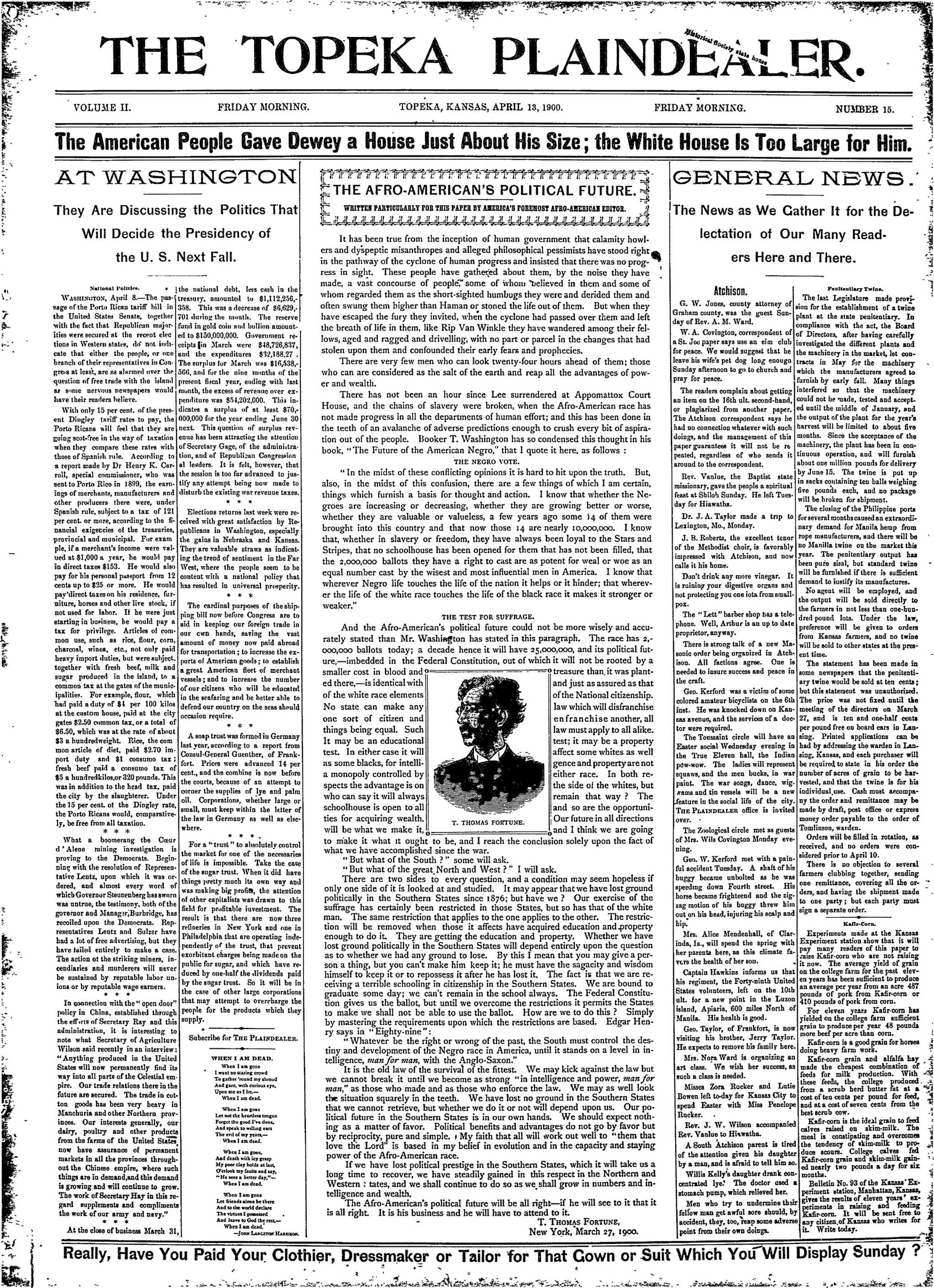
THE TOPEKA PLAINDEALER.
The American People Gave Dewey a House Just About His Size; the White House Is Too Large for Him.
Really, Have You Paid Your Clothier, Dressmaker or Tailor for That Gown or Suit Which You Will Display Sunday
The American People AT WASHING They Are Discussing the Po Will Decide the President the U. S. Next Fall.
National Politics.
WASHINGTON, April 8.-The passage of the Porto Rican tariff bill in the United States Senate, together with the fact that Republican majorities were secured at the recent elections in Western states, do not indicate that either the people, or one branch of their representatives in Congress at least, are as alarmed over the question of free trade with the island as some nervous newspapers would have their readers believe.
With only 15 per cent. of the present Dingley tariff rates to pay, the Porto Ricans will feel that they are going scot-free in the way of taxation when they compare these rates with those of Spanish rule. According to a report made by Dr Henry K. Carroll, special commissioner, who was sent to Porto Rico in 1899, the earnings of merchants, manufacturers and other producers there were, under Spanish rule, subject to a tax of 121 per cent. or more, according to the financial exigencies of the treasuries, provincial and municipal. For example, if a merchant's income were valued at $1,000 a year, he would pay in direct taxes $153. He would also pay for his personal passport from 12 cents up to $25 or more. He would pay direct taxes on his residence, furniture, horses and other live stock, if not used for labor. If he were just starting in business, he would pay a tax for privilege. Articles of common use, such as rice, flour, corn, charcoal, wine, etc., not only paid heavy import duties, but were subject, together with fresh beef, milk and sugar produced in the island, to a common tax at the gates of the municipalities. For example, flour, which had paid a duty of $4 per 100 kilos at the custom house, paid at the city gates $2.50 common tax, or a total of $6.50, which was at the rate of about $3 a hundredweight. Rice, the common article of diet, paid $2.70 import duty and $1 consumo tax of $5 a hundredkilos, or 320 pounds. This was in addition to the head tax, paid the city by the slaughterer. Under the 15 per cent. of the Dingley rate the Porto Ricans would, comparatively, be free from all taxation.
What a boomerang the Court'd Alene mining investigation is proving to the Democrats. Beginning with the resolution of Representative Lentz, upon which it was ordered, and almost every word of which Governor Steunenberg has sworn was untrue, the testimony, both of the governor and Manager, Burbridge, has recoiled upon the Democrats. Representatives Lentz and Sulzer have had a lot of free advertising, but they have failed entirely to make a case. The action of the striking miners, incendiaries and murderers will never be sustained by reputable labor unions or by reputable wage earners.
In connection with the "open door" policy in China, established through the efforts of Secretary Ray and this administration, it is interesting to note what Secretary of Agriculture Wilson said recently in an interview: "Anything produced in the United States will now permanently find its way into all parts of the Celestial empire. Our trade relations there in the future are secured. The trade in cotton goods has been very heavy in Manchuria and other Northern provinces. Our interests generally, our dairy, poultry and other products from the farms of the United States, now have assurance of permanent markets in all the provinces throughout the Chinese empire, where such things are in demand, and this demand is growing and will continue to grow. The work of Secretary Hay in this regard supplements and compliments the work of our army and navy."
Really, Have Yo
VOLUME II.
* * *
People Gave De HINGTON g the Politics That Presidency of
the national debt, less cash in the treasury, amounted to $1,112,256,-358. This was a decrease of $6,629,-701 during the month. The reserve fund in gold coin and bullion amounted to $150,000,000. Government receipts in March were $48,726,837, and the expenditures $32,188,27. The surplus for March was $16,538,-566, and for the nine months of the present fiscal year, ending with last month, the excess of revenue over expenditure was $54,202,000. This indicates a surplus of at least $70,000,000 for the year ending June 30 next. This question of surplus revenue has been attracting the attention of Secretary Gage, of the administration, and of Republican Congress al leaders. It is felt, however, that the session is too far advanced to justify any attempt being now made to disturb the existing war revenue taxes.
Elections returns last week were received with great satisfaction by Republicans in Washington, especially the gains in Nebraska and Kansas. They are valuable straws as indicating the trend of sentiment in the Far West, where the people seem to be content with a national policy that has resulted in universal prosperity.
The cardinal purposes of the shipping bill now before Congress are to aid in keeping our foreign trade in our cwn hands, saving the vast amount of money now paid abroad for transportation; to increase the exports of American goods; to establish a great American fleet of merchant vessels; and to increase the number of our citizens who will be educated in the seafaring and be better able to defend our country on the seas should occasion require.
A soap trust was formed in Germany last year, according to a report from Consul-General Guenther, of Frankfort. Prices were advanced 14 per cent., and the combine is now before the courts, because of an attempt to corner the supplies of lye and palm oil. Corporations, whether large or small, must keep within the letter of the law in Germany as well as elsewhere.
For a "trust" to absolutely control the market for one of the necessaries of life is impossible. Take the case of the sugar trust. When it did have things pretty much its own way and was making big profits, the attention of other capitalists was drawn to this field for profitable investment. The result is that there are now three refineries in New York and one in Philadelphia that are operating independently of the trust, that prevent exorbitant charges being made on the public for sugar, and which have reduced by one-half the dividends paid by the sugar trust. So it will be in the case of other large corporations that may attempt to overcharge the people for the products which they supply.
Subscribe for THE PLAINDEALER.
WHEN I AM DEAD.
When I am gone
I want no staring crowd
To gather 'round my shroud
And gaze, with curious eye,
Upon me as I am.
When I am dead.
ou Paid Your Cloth
FRIDAY MORNING.
\* \* \*
***.
When I am gone
Let not the heartless tongue
Forget the good I've done,
And speak to willing ears
The evil of my years.—
When I am dead.
When I am gone,
And death with icy grasp
My poor clay holds at last,
'O'erlook my faults and say,
"He sees a better day."—
When I am dead.
When I am gone
Let friends alone be there
And to the world declare
The virtues I possessed
And leave to God the rest.—
When I am dead.'
—JOHN LANEGSTON HARRISON
TOPEKA, KANSAS, APRIL 13, 1900.
THE AFRO-AMERICAN'S POLITICAL FUTURE.
WRITTEN PARTICULARLY FOR THIS PAPER BY AMERICA'S FOREMOST AFRO-AMERICAN EDITOR.
It has been true from the inception of human government that calamity howlers and dyspeptic misanthropes and alleged philosophical pessimists have stood right in the pathway of the cyclone of human progress and insisted that there was no progress in sight. These people have gathered about them, by the noise they have made, a vast concourse of people; some of whom believed in them and some of whom regarded them as the short-sighted humbugs they were and derided them and often swung them higher than Haman or stoned the life out of them. But when they have escaped the fury they invited, when the cyclone had passed over them and left the breath of life in them, like Rip Van Winkle they have wandered among their fellows, aged and ragged and drivelling, with no part or parcel in the changes that had stolen upon them and confounded their early fears and prophecies.
There are very few men who can look twenty-four hours ahead of them; those who can are considered as the salt of the earth and reap all the advantages of power and wealth.
There has not been an hour since Lee surrendered at Appomattox Court House, and the chains of slavery were broken, when the Afro-American race has not made progress in all the departments of human effort; and this has been done in the teeth of an avalanche of adverse predictions enough to crush every bit of aspiration out of the people. Booker T. Washington has so condensed this thought in his book, "The Future of the American Negro," that I quote it here, as follows:
"In the midst of these conflicting opinions it is hard to hit upon the truth. But, also, in the midst of this confusion, there are a few things of which I am certain, things which furnish a basis for thought and action. I know that whether the Negroes are increasing or decreasing, whether they are growing better or worse, whether they are valuable or valueless, a few years ago some 14 of them were brought into this country and that now those 14 are nearly 10,000,000. I know that, whether in slavery or freedom, they have always been loyal to the Stars and Stripes, that no schoolhouse has been opened for them that has not been filled, that the 2,000,000 ballots they have a right to cast are as potent for weal or woe as an equal number cast by the wisest and most influential men in America. I know that wherever Negro life touches the life of the nation it helps or it hinder; that wherever the life of the white race touches the life of the black race it makes it stronger or weaker."
And the Afro-American's political future could not be more wisely and accurately stated than Mr. Washington has stated in this paragraph. The race has 2,000,000 ballots today; a decade hence it will have 25,000,000, and its political future,—imbedded in the Federal Constitution, out of which it will not be rooted by a
to make it what it ought to be, and I reach the conclusion solely upon the fact of what we have accomplished since the war.
"But what of the South ?" some will ask.
"But what of the great North and West ?" I will ask.
There are two sides to every question, and a condition may seem hopeless if only one side of it is looked at and studied. It may appear that we have lost ground politically in the Southern States since 1876; but have we? Our exercise of the suffrage has certainly been restricted in those States, but so has that of the white man. The same restriction that applies to the one applies to the other. The restriction will be removed when those it affects have acquired education and property enough to do it. They are getting the education and property. Whether we have lost ground politically in the Southern States will depend entirely upon the question as to whether we had any ground to lose. By this I mean that you may give a person a thing, but you can't make him keep it; he must have the sagacity and wisdom himself to keep it or to repossess it after he has lost it. The fact is that we are receiving a terrible schooling in citizenship in the Southern States. We are bound to graduate some day; we can't remain in the school always. The Federal Constitution gives us the ballot, but until we overcome the restrictions it permits the States to make we shall not be able to use the ballot. How are we to do this? Simply by mastering the requirements upon which the restrictions are based. Edgar Henry says in "Eighty-nine":
"Whatever be the right or wrong of the past, the South must control the destiny and development of the Negro race in America, until it stands on a level in intelligence, man for man, with the Anglo-Saxon."
It is the old law of the survival of the fittest. We may kick against the law but we cannot break it until we become as strong "in intelligence and power, man for man," as those who made and as those who enforce the law. We may as well look the situation squarely in the teeth. We have lost no ground in the Southern States that we cannot retrieve, but whether we do it or not will depend upon us. Our political future in the Southern States is in our own hands. We should expect nothing as a matter of favor. Political benefits and advantages do not go by favor but by reciprocity, pure and simple. My faith that all will work out well to "them that love the Lord" is based in my belief in evolution and in the capacity and staying power of the Afro-American race.
If we have lost political prestige in the Southern States, which it will take us a long time to recover, we have steadily gained in this respect in the Northern and Western states, and we shall continue to do so as we shall grow in numbers and intelligence and wealth.
The Afro-American's political future will be all right—if he will see to it that it is all right. It is his business and he will have to attend to it.
smaller cost in blood and ed there,—is identical with of the white race elements No state can make any one sort of citizen and things being equal. Such It may be an educational test. In either case it will as some blacks, for intellia monopoly controlled by spects the advantage is on who can say it will always schoolhouse is open to all ties for acquiring wealth. will be what we make it.
THE NEGRO VOTE.
conflicting opinions it is hard to
confusion, there are a few thi-
sis for thought and action. I have
decreasing, whether they are
not or valueless, a few years ago
and that now those 14 are no
for freedom, they have always be
he has been opened for them thi-
have a right to cast are as po-
wisest and most influential men-
ses the life of the nation it help-
t touches the life of the black m
THE TEST FOR SUFFRAGE.
lan's political future could no washington has stated in this pa decade hence it will have 25.0 liberal Constitution, out of which
T. THOMAS FORTUNE.
T. THOMAS FORTUNE.
to be, and I reach the conclu
d since the war.
th ?” some will ask.
t. North and West ?” I will as
to every question, and a cone
treasure than, it was plant- and just as assured as that of the National citizenship. law which will disfranchise enfranchise another, all law must apply to all alike. test; it may be a property affect some whites as well gence and property are not either race. In both re the side of the whites, but remain that way? The and so are the opportuni- Our future in all directions and I think we are going
will ask.
A condition may seem hopeless if my appear that we have lost ground have we? Our exercise of the states, but so has that of the white applies to the other. The restric- acquired education and property and property. Whether we have depend entirely upon the question I mean that you may give a per-ist have the sagacity and wisdom it. The fact is that we are re-thern States. We are bound to always. The Federal Constitu- restrictions it permits the States How are we to do this? Simply restrictions are based. Edgar Hen-
the South must control the desa, until it stands on a level in in-
We may kick against the law but intelligence and power, man for the law. We may as well look no ground in the Southern States not will depend upon us. Our po- hands. We should expect noth- advantages do not go by favor but will work out well to "them that in and in the capacity and staying
ern States, which it will take us a this respect in the Northern and we shall grow in numbers and in-
will right—if he will see to it that it attend to it.
T. THOMAS FORTUNE New York, March 27, 1900. That Gown or Su
The News as We Gather It for the Delectation of Our Many Readers Here and There.
FRIDAY MORNING.
White House Is Too L
GENERAL
The News as We Gave
lectation of Our
ers Here a
Atchison.
Atchison.
G. W. Jones, county attorney of Graham county, was the guest Sunday of Rev. A. M. Ward.
W. A. Covington, correspondent of a St. Joe paper says use an elm club for peace. We would suggest that he leave his wife's pet dog long enough Sunday afternoon to go to church and pray for peace.
The readers complain about getting an item on the 16th ult. second-hand, or plagiarized from another paper. The Atchison correspondent says he had no connection whatever with such doings, and the management of this paper guarantees it will not be repeated, regardless of who sends it around to the correspondent.
Rev. Vanlue, the Baptist state missionary, gave the people a spiritual feast at Shilob Sunday. He left Tuesday for Hiawatha.
Dr. J. A. Taylor made a trip to Lexington, Mo., Monday.
J. B. Roberts, the excellent tenor of the Methodist choir, is favorably impressed with Atchison, and now calls it his home.
Don't drink any more vinegar. It is ruining your digestive organs and not protecting you one iota from small-pox.
The "Lett" barber shop has a telephone. Well, Arthur is an up to date proprietor, anyway.
There is strong talk of a new Masonic order being organized in Atchison. All factions agree. One is needed to insure success and peace in the craft. Geo. Kerford was a victim of some colored amateur bicyclists on the 6th inst. He was knocked down on Kansas avenue, and the services of a doctor were required.
The Toussaint circle will have an Easter social Wednesday evening in the True Eleven hall, the Indian pow-wow. The ladies will represent squaws, and the men bucks, in war paint. The war songs, dance, wigwams and tin vessels will be a new feature in the social life of the city. THE PLAINDEALER office is invited over.
The Zoological circle met as guests of Mrs. Wils Covington Monday evening.
Gen. W. Kerford met with a painful accident Tuesday. A shaft of his buggy became unbolted as he was speeding down Fourth street. His horse became frightened and the zigzag motion of his buggy threw him out on his head, injuring his scalp and hip.
Mrs. Alice Mendenhall, of Clarinda, Ia., will spend the spring with her parents here, as this climate favors the health of her son.
Captain Hawkins informs us that his regiment, the Forty-ninth United States volunteers, left on the 10th ult. for a new point in the Luzon island, Apiaria, 600 miles North of Manila. His health is good.
Geo. Taylor, of Frankfort, is now visiting his brother, Jerry Taylor. He expects to remove his family here. Mrs. Nora Ward is organizing an art class. We wish her success, as such a class is needed. Misses Zora Rucker and Lutie Bowen left to-day for Kansas City to spend Easter with Miss Penelope Rucker. Rev. J. W. Wilson accompanied Rev. Vanlue to Hiwatha.
A South Atchison parent is tired of the attention given his daughter by a man, and is afraid to tell him so.
Willis Kelly's daughter drank concentrated lye.' The doctor used a stomach pump, which relieved her.
Men who try to undermine their fellow man get awful sore should, by accident, they, too, reap some adverse point from their own doings.
NUMBER 15.
Large for Him.
L NEWS.
ather It for the De-
ur Many Read-
and There.
Penitentiary Twine.
The last Legislature made provision for the establishment of a twine plant at the state penitentiary. In compliance with the act, the Board of Directors, after having carefully investigated the different plants and the machinery in the market, let contracts in May for the machinery which the manufacturers agreed to furnish by early fall. Many things interfered so that the machinery could not be made, tested and accepted until the middle of January, and the output of the plant for the year's harvest will be limited to about five months. Since the acceptance of the machinery, the plant has been in continuous operation, and will furnish about one million pounds for delivery by June 15. The twine is put up in sacks containing ten balls weighing five pounds each, and no package will be broken for shipment.
The closing of the Philippine ports for several months caused an extraordinary demand for Manila hemp from rope manufacturers, and there will be no Manilla twine on the market this year. The penitentiary output has been pure sisal, but standard twine will be furnished if there is sufficient demand to justify its manufactures. No agent will be employed, and the output will be sold directly to the farmers in not less than one-hundred pound lots. Under the law, preference will be given to orders from Kansas farmers, and no twine will be sold to other states at the present time.
The statement has been made in some newspapers that the penitentiary twine would be sold at ten cents; but this statement was unauthorized. The price was not fixed until the meeting of the directors on March 27, and is ten and one-half cents per pound free on board cars in Lansing. Printed applications can be had by addressing the warden in Lansing, Kansas, and each purchaser will be required to state in his order the number of acres of grain to be harvested, and that the twine is for his individual use. Cash must accompany the order and remittance may be made by draft, post office or express money order payable to the order of Tomlinson, warden.
Orders will be filled in rotation, as received, and no orders were considered prior to April 10. There is no objection to several farmers clubbing together, sending one remittance, covering all the orders, and having the shipment made to one party; but each party must sign a separate order.
Kaflr-Corn.
Experiments made at the Kansas Experiment station show that it will pay many readers of this paper to raise Kafir-corn who are not raising it now. The average yield of grain on the college farm for the past eleven years has been sufficient to produce an average per year from an acre 487 pounds of pork from Kafir-corn or 410 pounds of pork from corn. For eleven years Kafir-corn has yielded on the college farm sufficient grain to produce per year 48 pounds more beef per acre than corn. Kafir-corn is a good grain for horses doing heavy farm work.
Kafir-corn grain and alfalfa hay made the cheapest combination of feeds for milk production. With these feeds, the college produced from a scrub herd butter fat at a cost of ten cents per pound for feed, and at a cost of seven cents from the best scrub cow.
Kafir-corn is the ideal grain to feed calves raised on skim-milk. The meal is constipating and overcomes the tendency of skim-milk to produce scours. College calves fed Kafir-corn grain and skim-milk gained nearly two pounds a day for six months.
Bulletin No. 93 of the Kansas' Experiment station, Manhattan, Kansas, gives the results of eleven years' experiments in raining and feeding Kafir-corn. It will be sent free to any citizen of Kansas who writes for it. Write today.
Display Sunday ?
Published at Topeta, Kansas, Shawnee county,
every Friday morning, by the Paintdealer Pub-
lishing or company, 114 E. Seventh street.
Entered at the postoffice at Topeta, Kansas,
Shawnee county, as second class mail matter.
SUBSCRIPTION RATES :
One year, by mail. $100
Six months, by mail. 75¢
Three months, by mail. 50¢
NICK CHILPS, - - Business Manager
J. H. CHILDREN, - - Editor.
WILL HARRIS, - - Managing Editor.
FRIDAY, APRIL 13, 1900.
[In order to insure publication of matter in the current issue, correspondence must be in this office not later than Tuesday ]
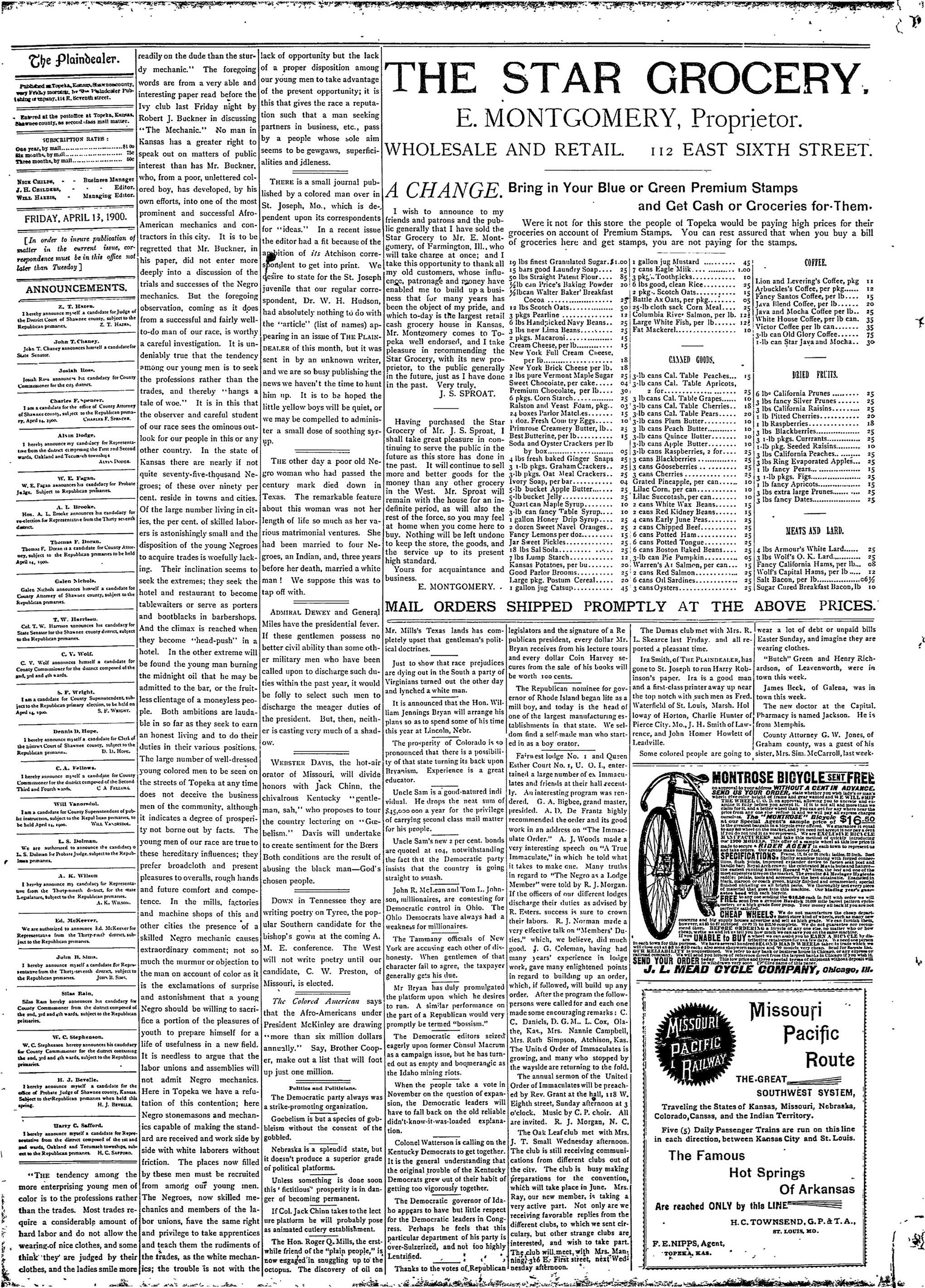
"The tendency among the more enterprising young men of color is to the professions rather than the trades. Most trades require a considerable amount of hard labor and do not allow the wearing of nice clothes, and some think 'they' are judged by their clothes, and the ladies smile more
readily on the dude than the sturdy mechanic." The foregoing words are from a very able and interesting paper read before the Ivy club last Friday night by Robert J. Buckner in discussing "The Mechanic." No man in Kansas has a greater right to speak out on matters of public interest than has Mr. Buckner, who, from a poor, unlettered colored boy, has developed, by his own efforts, into one of the most prominent and successful Afro-American mechanics and contractors in this city. It is to be regretted that Mr. Buckner, in his paper, did not enter more deeply into a discussion of the trials and successes of the Negro mechanics. But the foregoing observation, coming as it does from a successful and fairly well-to-do man of our race, is worthy a careful investigation. It is undeniably true that the tendency among our young men is to seek the professions rather than the trades, and thereby "hangs a tale of woe." It is in this that the observer and careful student of our race sees the ominous outlook for our people in this or any other country. In the state of Kansas there are nearly if not quite seventy-five-thousand Negroes; of these over ninety per cent. reside in towns and cities. Of the large number living in cities, the per cent. of skilled laborers is astonishingly small and the disposition of the young Negroes to acquire trades is woefully lacking. Their inclination seems to seek the extremes; they seek the hotel and restaurant to become tablewaiters or serve as porters and bootblacks in barbershops. And the climax is reached when they become "head-push" in a hotel. In the other extreme will be found the young man burning the midnight oil that he may be admitted to the bar, or the fruitless clientage of a moneyless people. Both ambitions are laudable in so far as they seek to earn an honest living and to do their duties in their various positions. The large number of well-dressed young colored men to be seen on the streets of Topeka at any time does not deceive the business men of the community, although it indicates a degree of prosperity not borne out by facts. The young men of our race are true to these hereditary influences; they prefer broadcloth and present pleasures to overalls, rough hands and future comfort and competence. In the mills, factories and machine shops of this and other cities the presence of a skilled Negro mechanic causes extraordinary comment; not so much the murmur or objection to the man on account of color as it is the exclamations of surprise and astonishment that a young Negro should be willing to sacrifice a portion of the pleasures of youth to prepare himself for a life of usefulness in a new field. It is needless to argue that the labor unions and assemblies will not admit Negro mechanics. Here in Topeka we have a refutation of this contention; here Negro stonemasons and mechanics capable of making the standard are received and work side by side with white laborers without friction. The places now filled by these men must be recruited from among our young men. The Negroes, now skilled mechanics and members of the labor unions, have the same right and privilege to take apprentices and teach them the rudiments of the trades, as the white mechanics; the trouble is not with the
lack of opportunity but the lack of a proper disposition among our young men to take advantage of the present opportunity; it is this that gives the race a reputation such that a man seeking partners in business, etc., pass by a people whose sole aim seems to be gewgaws, superficialities and idleness.
THERE is a small journal published by a colored man over in St. Joseph, Mo., which is dependent upon its correspondents for "ideas." In a recent issue the editor had a fit because of the ambition of its Atchison correspondent to get into print. We desire to state for the St. Joseph juvenile that our regular correspondent, Dr. W. H. Hudson, had absolutely nothing to do with the "article" (list of names) appearing in an issue of THE PLAIN-DEALER of this month, but it was sent in by an unknown writer, and we are so busy publishing the news we haven't the time to hunt him up. It is to be hoped the little yellow boys will be quiet, or we may be compelled to administer a small dose of soothing syrup.
The other day a poor old Negro woman who had passed the century mark died down in Texas. The remarkable feature about this woman was not her length of life so much as her various matrimonial ventures. She had been married to four Negroes, an Indian, and, three years before her death, married a white man! We suppose this was to tap off with.
ADMIRAL DEWEY and General Miles have the presidential fever. If these gentlemen possess no better civil ability than some other military men who have been called upon to discharge such duties within the past year, it would be folly to select such men to discharge the meager duties of the president. But, then, neither is casting very much of a shadow.
WEBSTER DAVIS, the hot-air orator of Missouri, will divide honors with Jack Chinn, the chivalrous Kentucky "gentleman, sah," who proposes to tour the country lecturing on "Gobelism." Davis will undertake to create sentiment for the Bers Both conditions are the result of abusing the black man—God's chosen people.
Down in Tennessee they are writing poetry on Tyree, the popular Southern candidate for the bishop's gown at the coming A. M. E. conference. The West will not write poetry until our candidate, C. W. Preston, of Missouri, is elected.
The Colored American says that the Afro-Americans under President McKinley are drawing "more than six million dollars annually." Say, Brother Cooper, make out a list that will foot up just one million.
Goebelism is but a species of gobbleism without the consent of the gobbled.
Unless something is done soon this 'fictitious' prosperity is in danger of becoming permanent.
If Col. Jack Chinn takes to the lecture platform he will probably pose as animated cutley establishment.
The Hon. Roger Q. Mills, the erstwhile friend of the "plain people," is now engaged in snuggling up to the octopus. The discovery of oil on
THE STAR GROCERY. E. MONTGOMERY, Proprietor.
WHOLESALE AND RETAIL. 112 EAST SIXTH STREET.
A CHANGE. Bring in Your Blue or Green Premium Stamps
I wish to announce to my friends and patrons and the public generally that I have sold the Star Grocery to Mr. E. Montgomery, of Farmington, Ill., who will take charge at once; and I take this opportunity to thank all my old customers, whose influence, patronage and money have enabled me to build up a business that for many years has been the object of my pride, and which-to-day is the largest retail cash grocery house in Kansas, Mr. Montgomery comes to Topeka well endorsed, and I take pleasure in recommending the Star Grocery, with its new proprietor, to the public generally in the future, just as I have done in the past. Very truly,
J. S. SPROAT.
Having purchased the Star Grocery of Mr. J. S. Sproat, I shall take great pleasure in continuing to serve the public in the future as this store has done in the past. It will continue to sell more and better goods for the money than any other grocery in the West. Mr. Sproat will remain with the house for an indefinite period, as will also the rest of the force, so you may feel at home when you come here to buy. Nothing will be left undone to keep the store, the goods, and the service up to its present high standard. Yours for acquaintance and business.
E. MONTGOMERY.
Mr. Mills's Texas lands has completely upset that gentleman's political doctrines.
Just to show that race prejudices are dying out in the South a party of Virginians turned out the other day and lynched a white man.
It is announced that the Hon. William Jennings Bryan will arrange his plans so as to spend some of his time this year at Lincoln, Nebr.
The prosperity of Colorado is so pronounced that there is a possibility of that state turning its back upon Bryanism. Experience is a great educator.
Uncle Sam is a good-natured individual. He drops the neat sum of $45,000,000 a year for the privilege of carrying second class mail matter for his people.
Uncle Sam's new 2 per cent. bonds are quoted at 104, notwithstanding the fact that the Democratic party insists that the country is going straight to smash.
John R. McLean and Tom L. Johnson, millionaires, are contesting for Democratic control in Ohio. The Ohio Democrats have always had a weakness for millionaires.
The Tammany officials of New York are accusing each other of dishonesty. When gentlemen of that character fail to agree, the taxpayer generally gets his due.
Mr Bryan has duly promulgated the platform upon which he desires to run. A similar performance on the part of a Republican would very promptly be termed "bossism."
The Democratic editors seized eagerly upon former Consul Macrum as a campaign issue, but he has turned out as empty and boomerangic as the Idaho mining riots.
When the people take a vote in November on the question of expansion, the Democratic leaders will have to fall back on the old reliable didn't-know-it-was-loaded explanation.
Colonel Watterson is calling on the Kentucky Democrats to get together. It is the general understanding that the original trouble of the Kentucky Democrats grew out of their habit of getting too vigorously together.
The Democratic governor of Idaho appears to have but little respect for the Democratic leaders in Congress. Perhaps he feels that this particular department of his party is over-Sulzerized, and not too highly Lentzified.
Were it not for this store the people of Topeka would be paying high prices for their groceries on account of Premium Stamps. You can rest assured that when you buy a bill of groceries here and get stamps, you are not paying for the stamps.
19 lbs finest Granulated Sugar. $1.00
15 bars good Laundry Soap... 25
50 lbs Straight Patent Flour... 85
½ lb can Price's Baking Powder 20
½ lb can Walter Baker' Breakfast Cocoa... 25
12 lbs Scotch Oats... 50
3 pkgs Pearline... 12
6 lbs Handpicked Navy Beans... 25
3 lbs new Lima Beans... 25
2 pkgs. Macaroni... 15
Cream Cheese, per lb... 15
New York Full Cream Cheese,
1 gallon jug Mustard ... 45
7 cans Eagle Milk... 1.00
3 pkgs. Toothpicks... 10
6 lbs good, clean Rice... 25
2 pkg. Scotch Oats... 15
Battle Ax Oats, per pkg... 05
25-lb cloth sack Corn Meal... 25
Columbia River Salmon, per lb... 124
Large White Fish, per lb... 124
Fat Mackerel... 10
COFFEE.
Lion and Levering's Coffee, pkg 11
Arbuckles's Coffee, per pkg... 12
Fancy Santos Coffee, per lb... 15
Java Blend Coffee, per lb... 20
Java and Mocha Coffee per lb... 25
White House Coffee, per lb can. 35
Victor Coffee per lb can. 35
3-lb can Old Glory Coffee... 75
1-lb can Star Java and Mocha... 30
per lb..... New York Brick Cheese per lb.
2 lbs pure Vermont Maple Sugar
Sweet Chocolate, per cake.
Premium Chocolate, per lb.
6 kgs. Corn Starch.
Ralston and Yeast Foam, pkg.
24 boxes Parlor Matches.
1 doz. Fresh Country Eggs.
Primrose Creamery Butter, lb.
Best Buttering, per lb.
Soda and Oyster Crackers per lb
by box..... 4 lbs fresh baked Ginger Snaps
3 1-lb pkgs. Graham Crackers...
3-lb pkgs. Oat Meal Crackers.
Ivory Soap, per bar...
5-lb bucket Apple Butter...
5-lb bucket Jelly.
Quart can Maple Syrup.
3-lb can fancy Table Syrup.
1 gallon Honey, Drip Syrup.
2 dozen Sweet Navel Oranges.
Fancy Lemons per doz.
Jar Sweet Pickles.
18 lbs Sal Soda.
7 lbs Lump Starch.
Kansas Potatoes, per bu.
Good Parlor Brooms.
Large pkg. Postm Cereal.
1 gallon jug Catsup.
legislators and the signature of a Re
publican president, every dollar Mr.
Bryan receives from his lecture tours
and every dollar Coin Harvey secures
from the sale of his books will
be worth 100 cents.
The Republican nominee for governor of Rhode Island began life as a mill boy, and today is the head of one of the largest manufacturing establishments in that state. We seldom find a self-made man who started in as a boy orator.
Fairwest lodge No. 1 and Queen Esther Court No. 1, U. O. I., entertained a large number of ex Immaculates and friends at their hall recently. An interesting program was rendered. G. A. Bigbee, grand master, presided. A. D. De Frantz highly recommended the order and its good work in an address on "The Immaculate Order." A. J. Woods made a very interesting speech on "A True Immaculate," in which he told what it takes to make one. Many truths in regard to "The Negro as a Lodge Member" were told by R. J. Morgan. If the officers of our different lodges discharge their duties as advised by R. Esters, success is sure to crown their labors. R. J. Norman made a very effective talk on "Members' Duties," which, we believe, did much good. J. G. Coleman, having had many years' experience in loire work, gave many enlightened points in regard to building up an order, which, if followed, will build up any order. After the program the followpersons were called for and each one made some encouraging remarks: C. C. Daniels, D. G. M., L. Cox, Olathe, Kas., Mrs. Nannie Campbell, Mrs. Ruth Simpson, Atchison, Kas. The United Order of Immaculates is growing, and many who stopped by the wayside are returning to the fold.
The annual sermon of the United Order of Immaculates will be preached by Rev. Grant at the hall, 118 W. Eighth street, Sunday afternoon at 3 o'clock. Music by C. P. choir. All are invited. R. J. Morgan, N. C. The Oak Leaf club met with Mrs. J. T. Small Wednesday afternoon. The club is still receiving communications from different clubs out of the city. The club is busy making preparations for the convention, which will take place in June. Mrs. Ray, our new member, is taking a very active part. Not only are we receiving favorable replies from the different clubs, to which we sent circulars, but other strange clubs are interested, and wish to take part. The club will meet, with Mrs. Manning, 316 E. First street, next Wednesday afternoon.
and Get Cash or Groceries for Them.
The Dumas club met with Mrs. R. L. Skarece last Friday, and all reported a pleasant time. Ira Smith, of THE PLAINDEALER, has gone to St. Joseph to run Harry Robinson's paper. Ira is a good man and a first-class printer away up near the top notch with such men as Fred. Waterfield of St. Louis, Marsh. Holloway of Horton, Charlie Hunter of Pierce City. Mo., J. H. Smith of Lawrence, and John Homer Howlett of Leadville. Some colored people are going to
MONTRÉ
on approval to you,
SEND US YOUR
wheels, or
THE WHEEL
amine it fully,
amuse it half,
price from any
ourselves. IT
are
is the present,
to any 80 whee
if it is
MANFACTURE
our 1300 MON
and take order
SPECIFICA
tions, flush poli
the easiest run
most expensive
black, maroon,
blue, or white
of material th
antee be wi
FREE send
seen in
matter, or a big
CHEAP W
concerns and big supply houses
however, at 80 to 81 stripped, or 82
wound this order.
cheap, write us as and let us tell you
If you UNABLE to BUY
in each town for this purpose. We have several hundred
ONE RELIABILITY is unquestioned. We refer to
railroad company. We will send your letters of reference
SEND YOUR ORDER be wisdown very soon.
J. L. MEAD CYCLE
Traveling the States of K
Colorado, Cansas, and the K
Five (5) Daily Passenger
in each direction, between
The Famous
Hot
Are reached ONLY by t
Traveling the States of Kansas, Missouri, Nebraska Colorado,Cansas, and the Indian Territory.
1 gallon jug Mustard ..... 20
7 cans Eagle Miik ..... 25
3 pkg.. Toothpicks ..... 26
6 lbs good, clean Rice ..... 2
2 pkg.. Scotch Oats ..... 25
Battle Ax Oats, per pkg ..... 25
15 lb cloth sack Corn Meal ..... 26
Columbia River Salmon, per lb.
Large White Fish, per lb.
Fat Mackerel.
CANNED GOODS.
MISSOURI
PACIFIC
RAILWAY
10
25 Lion and Levering's Coffee, pkg
15 Arbuckles's Coffee, per pkg....
15 Fancy Santos Coffee, per lb....
05 Java Blend Coffee, per lb....
25 Java and Mocha Coffee per lb....
White House Coffee, per lb can.
10 Victor Coffee per lb can....
3-lb can Old Glory Coffee....
1-lb can Star Java and Mocha...
DRIED FRUITS.
6 lbs California Prunes ..... 25
3 lbs fancy Silver Prunes ..... 25
3 lbs California Raisins ..... 25
1 lb Pitted Cherries ..... 20
1 lb Raspberries ..... 18
3 lbs Blackberries ..... 25
3 1-lb pkgs. Currrants ..... 25
1-lb pkg. Seeded Raisins ..... 10
3 lbs California Peaches ..... 25
3 lbs Ring Evaporated Apples ..... 25
1 lb fancy Pears ..... 15
1-lb pkgs. Figs ..... 25
1 lb fancy Apricots ..... 15
3 lbs extra large Prunes ..... 25
3 lbs fancy Dates ..... 25
MEATS AND LARD.
MEATS AND LARD.
4 lbs Armour's White Lard..... 25
3 lbs Wolf's O. K. Lard..... 25
Fancy California Hams, per lb..... 08
Wolf's Capital Hams, per lb..... 12
Salt Bacon, per lb..... c6½
Sugar Cured Breakfast Bacon, lb 10
R. we wear a lot of debt or unpaid bills Easter Sunday, and imagine they are wearing clothes.
has b an "Butch" Green and Henry Richardson, of Leavenworth, were in town this week.
an ear James Beck, of Galena, was in town this week.
ed. The new doctor at the Capital. Pharmacy is named Jackson. He is from Memphis.
of w County Attorney G. W. Jones, of Graham county, was a guest of his to Mrs. Sim. McCarroll, last week-
Hot Springs
Of A
Y by this LINE
H. C. TOWNSEND,
ST. LOUIS.
Of Arkansas
this LINE
C. TOWNSEND, G.P. & T.A.,
ST. LOUIS, MO.
COFFEE.
DRIED FRUITS.
The Dyson restaurant, located at 440 Minnesota avenue, Kansas City, Kas., is the best restaurant in that city.
The Dyson restaurant, located at 440 Minnesota avenue, Kansas City, Kas., is the best restaurant in that city.
NOTICE—All correspondents for THE PLAINDEALER will kindly collect all subscriptions in their respective cities, and kindly remit same to the office.
PERSONAL NOTES.
Rev. W. L. Grant spent Sunday in Kansas City.
Miss Mary Jordan will spend Easter in Kansas City.
Ike Jeans, of Lawrence, spent a few days in the city.
Mrs. Andrew Holloway is ill at her home on Quincy street.
The Ivy club will have its post-Lenten party April 20.
In the death of Mrs. Chrisman the race loses a warm friend.
Miss Byanna Smith returned home Wednesday from Kansas City.
John Chiles, of Denver, Colo., was in the city, en route to Chicago.
The Odd Fellows will go to Kansas City the first Sunday in May.
Fred. Overr, of Kansas City, spent last week as a visitor in our city.
Try this year and see how much grass you can grow on your lawns.
Mrs. F. D. Ratley left for La Junta, Colo., last Friday, to join her husband.
Lawyer A. M. Thomas spent a few days in Lawrence and Oskalorsa, attending to business.
Several of our young ladies and gentlemen attended the opera, "Quo Vadis," Tuesday night.
Dr. F. F. Davis, wife and son, Messer, have gone to Washington, D. C., where they will reside.
Mrs. Drusilla Merritt is the new president of the Imperial Art club, succeeding Mrs. L. M. Jamison.
The Ladies' Imperial Art club will meet with Mrs. W. L. Grant, on Buchanan street, Saturday afternoon.
Lawyers W. B. Townsend, D. A. Jones and T. W. Bell, of Leavenworth, spent Tuesday in the city, on business.
The Owl club will give its closing ball in Metropolitan hall, about Easter. It will be the swellest event of the season.
The Ladies' Sewing circle of the A. M. E. church met Weilnesday after ernoon with Mrs. Lovelady on West Ninth street.
The Ivy club's post-Lenten party will be held at 118 West Eighth street on the 20th inst. The members will take notice.
Rev. J. Leonard, of St. Joseph, passed through this city, en route to Kansas City, where he will preside at Clarke chapel.
St. John A M. E. church is to have a big rally the first Sunday in June. So be ready to see the collectors when they come.
L. Parks is the authorized agent for THE PLAINDEALFR at Holton, Kas. All correspondence for this paper must be handed to him.
The Golden Rod club was delightfully entertained by Miss Lena Thompson last Friday afternoon. It will meet April 20 with Miss Nellie Hicks.
The Rosebud club met Wednesday afternoon with Mrs. J. L. Brashears. After a dainty repast was served, the club adjourned to meet next Wednesday afternoon with Mrs. James Parks.
A number of Topeka society young men have organized a private club, known as the "Manus Magnium Sex Hommorum" club. They expect to entertain a few of their friends in future.
L. Parks, of Holton, was a caller of THE PLAINDEALER this week, and brought in the names of several cash subscribers. They say in Holton that THE PLAINDEALER is the best paper circulated in that county.
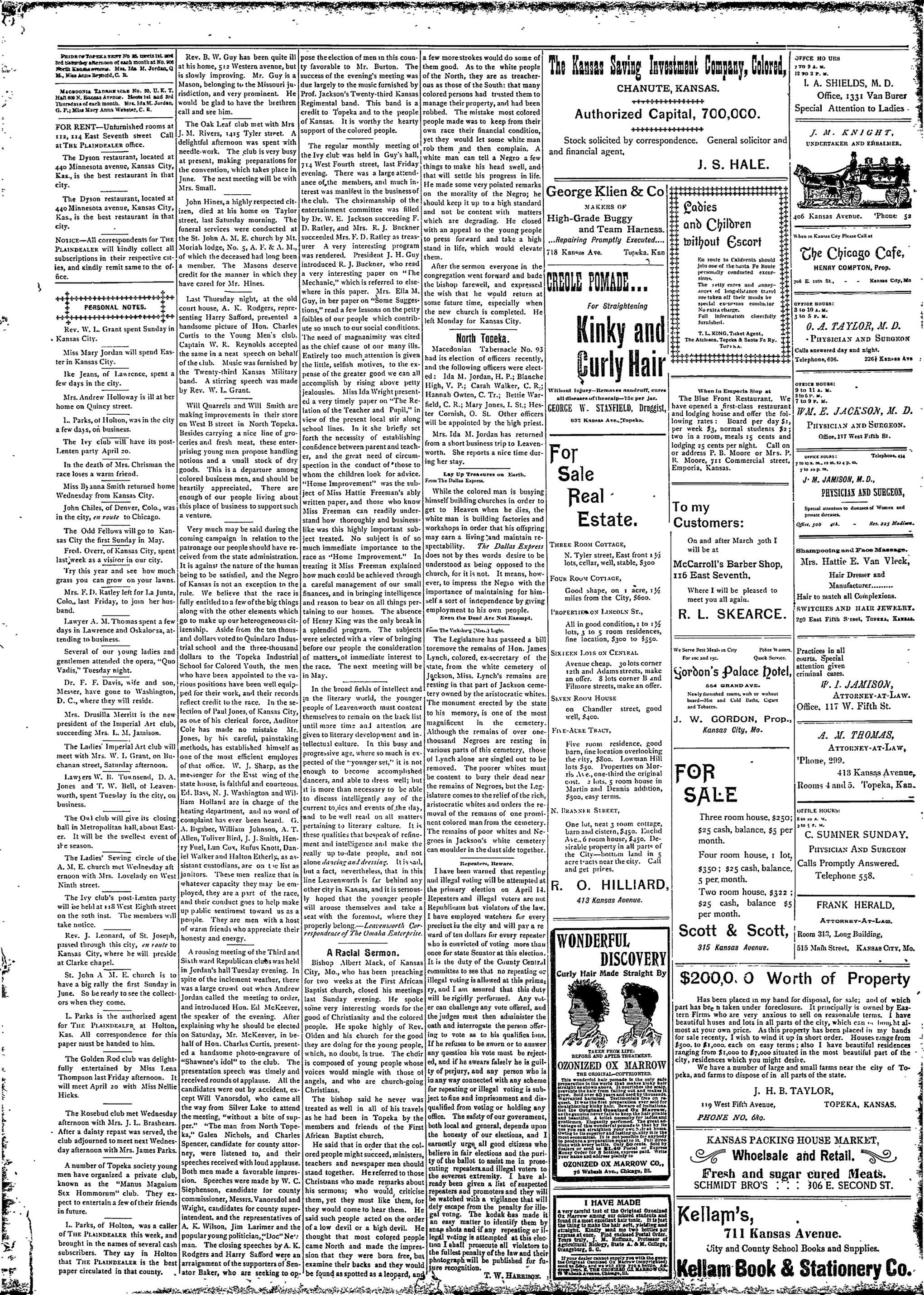
Rev. B. W. Guy has been quite ill at his home, 512 Western avenue, but is slowly improving. Mr. Guy is a Mason, belonging to the Missouri jurisdiction, and very prominent. He would be glad to have the brethren call and see him.
The Oak Leaf club met with Mrs J. M. Rivers, 1415 Tyler street. A delightful afternoon was spent with needle-work. The club is very busy at present, making preparations for the convention, which takes place in June. The next meeting will be with Mrs. Small.
John Hines, a highly respected citizen, died at his home on Taylor street, last Saturday morning. The funeral services were conducted at the St. John A. M. E. church by Mt. Moriah lodge, No. 5, A. F. & A. M., of which the deceased had long been a member. The Masons deserve credit for the manner in which they have cared for Mr. Hines.
Last Thursday night, at the old court house, A. K. Rodgers, representing Harry Safford, presented a handsome picture of Hon. Charles Curtis to the Young Men's club. Captain W. R. Reynolds accepted the same in a neat speech on behalf of the club. Music was furnished by the Twenty-third Kansas Military band. A stirring speech was made by Rev. W. L. Grant.
Will Quarrels and Will Smith are making improvements in their store on West B street in North Topeka. Besides carrying a nice line of groceries and fresh meat, these enterprising young men propose handling notions and a small stock of dry goods. This is a departure among colored business men, and should be heartily appreciated. There are enough of our people living about this place of business to support such a venture.
Very much may be said during the coming campaign in relation to the patronage our people should have received from the state administration. It is against the nature of the human being to be satisfied, and the Negro of Kansas is not an exception to the rule. We believe that the race is fully entitled to a few of the big things along with the other elements which go to make up our heterogeneous citizenship. Aside from the ten thousand dollars voted to Quindaro Industrial school and the three-thousand dollars to the Topeka Industrial School for Colored Youth, the men who have been appointed to the various positions have been well equipped for their work, and their records reflect credit to the race. In the selection of Paul Jones, of Kansas City, as one of his clerical force, Auditor Cole has made no mistake Mr. Jones, by his careful, painstaking methods, has established himself as one of the most efficient employees of that office. W. J. Sharp, as the messenger for the East wing of the state house, is faithful and courteous. Ed. Bass, N. J. Washington and William Holland are in charge of the heating department, and no word of complaint has ever been heard. G. A. Bigsbee, William Johnson, A. T. Allen, Toliver Bird, J. J. Smith, Henry Fuel, Lun Gov, Rufus Knott, Daniel Walker and Halton Etherly, as assistant custodians, are on the list as janitors. These men realize that in whatever capacity they may be employed, they are a part of the race, and their conduct goes to help make up public sentiment toward us as a people. They are men with a host of warm friends who appreciate their honesty and energy.
A rousing meeting of the Third and Sixth ward Republican clubs was held in Jordan's hall Tuesday evening. In spite of the inclement weather, there was a large crowd out when Andrew Jordan called the meeting to order, and introduced Hon. Ed McKeever, the speaker of the evening. After explaining why he should be elected on Saturday, Mr. McKeever, in behalf of Hon. Charles Curtis, presented a handsome photo-engravure of "Shawnee's idol" to the club. The presentation speech was timely and received rounds of applause. All the candidates were out by accident, except Will Vanorsdol, who came all the way from Silver Lake to attend the meeting, "without a bite of supper." "The man from North Topeka," Galen Nichols, and Charles Spencer, candidate for county attorney, were listened to, and their speeches received with loud applause. Both men made a favorable impression. Speeches were made by W. C. Siephenson, candidate for county commissioner, Messrs. Vanorsdol and Wright, candidates for county superintendent, and the representatives of A. K. Wilson, Jim Larimer and the popular young politician, "Doc" Ne'vman. The closing speeches by A. K. Rodgers and Harry Safford were an arraignment of the supporters of Senator Baker, who are seeking to op-
pose the election of men in this county favorable to Mr. Burton. The success of the evening's meeting was due largely to the music furnished by Prof. Jackson's Twenty-third Kansas Regimental band. This band is a credit to Topeka and to the people of Kansas. It is worthy the hearty support of the colored people.
The regular monthly meeting of the Ivy club was held in Guy's hall, 714 West Fourth street, last Friday evening. There was a large attendance of the members, and much interest was manifest in the business of the club. The chairmanship of the entertainment committee was filled by Dr. W. E. Jackson succeeding F. D. Ratley, and Mrs. R. J. Buckner succeeded Mrs. F. D. Ratley as treasurer. A very interesting program was rendered. President J. H. Guy introduced R. J. Buckner, who read a very interesting paper on "The Mechanic," which is referred to elsewhere in this paper. Mrs. Ella M. Guy, in her paper on "Some Suggestions," read a few lessons on the petty foibles of our people which contribute so much to our social conditions. The need of magnanimity was cited as the chief cause of our many ills. Entirely too much attention is given the little, selfish motives, to the expense of the greater good we can all accomplish by rising above petty jealousies. Miss Ida Wright presented a very timely paper on "The Relation of the Teacher and Pupil," in view of the present local stir along school lines. In it she briefly set forth the necessity of establishing confidence between parent and teacher, and the great need of circumspection in the conduct of those to whom the children look for advice. "Home Improvement" was the subject of Miss Hattie Freeman's ably written paper, and those who know Miss Freeman can readily understand how thoroughly and business-like was this highly important subject treated. No subject is of so much immediate importance to the race as "Home Improvement." In treating it Miss Freeman explained how much could be achieved through a careful management of our small finances, and in bringing intelligence and reason to bear on all things pertaining to our homes. The absence of Henry King was the only break in a splendid program. The subjects were selected with a view of bringing before our people the consideration of matters of immediate interest to the race. The next meeting will be in May.
In the broad fields of intellect and in the literary world, the younger people of Leavenworth must content themselves to remain on the back list until more time and attention are given to literary development and intellectual culture. In this busy and progressive age, where so much is expected of the "younger set," it is not enough to become accomplished dancers, and able to dress well; but it is more than necessary to be able to discuss intelligently any of the current topics and events of the day, and to be well read on all matters pertaining to literary culture. It is these qualities that bespeak of refinement and intelligence and make the really up-to-date people, and not alone dancing and dressing. It is sad, but a fact, nevertheless, that in this line Leavenworth is far behind any other city in Kansas, and it is seriously hoped that the younger people will arouse themselves and take a seat with the foremost, where they properly belong.—Leavenworth Correspondence of The Omaha Enterprise
A Racial Sermon.
Bishop Albert Mack, of Kansas City, Mo., who has been preaching for two weeks at the First African Baptist church, closed his meetings last Sunday evening. He spoke some very interesting words for the good of Christianity and the colored people. He spoke highly of Rev. Olden and his church for the good they are doing for the young people, which, no doubt, is true. The choir is composed of young people whose voices would mingle with those of angels, and who are church-going Christians.
The bishop said he never was treated as well in all of his travels as he had been in Topeka by the members and friends of the First African Baptist church.
He said that in order that the colored people might succeed, ministers, teachers and newspaper men should stand together. He referred to those Christians who made remarks about his sermons; who would, criticise them, yet they must like them, for they would come to hear them. He said such people acted on the order of a low devil or a high devil. He thought that most colored people came North and made the impression that they were born free, but examine their backs and they would be found as spotted as a leopard, and
a few more strokes would do some of them good. As to the white people of the North, they are as treacherous as those of the South: that many colored persons had trusted them to manage their property, and had been robbed. The mistake most colored people made was to keep from their own race their financial condition, yet they would let some white man rob them and then complain. A white man can tell a Negro a few things to make his head swell, and that will settle his progress in life. He made some very pointed remarks on the morality of the Negro; he should keep it up to a high standard and not be content with matters which are degrading. He closed with an appeal to the young people to press forward and take a high stand in life, which would elevate them.
After the sermon everyone in the congregation went forward and bade the bishop farewell, and expressed the wish that he would return at some future time, especially when the new church is completed. He left Monday for Kansas City.
North Topeka.
Macedonian Tabernacle No. 93 had its election of officers recently, and the following officers were elected: Ida M. Jordan, H. P.; Blanche High, V. P.; Carah Walker, C. R.; Hannah Owten, C. Tr.; Bettie Warfield, C. R.; Mary Jones, I. St.; Hester Cornish, O. St. Other officers will be appointed by the high priest.
Mrs. Ida M. Jordan has returned from a short business trip to Leavenworth. She reports a nice time during her stay.
While the colored man is busying himself building churches in order to get to Heaven when he dies, the white man is building factories and workshops in order that his offspring may earn a living and maintain respectability. The Dallas Express does not by thes words desire to be understood as being opposed to the church, for it is not. It means, however, to impress the Negro with the importance of maintaining for himself a sort of independence by giving employment to his own people.
From The Vicksburg (Miss.) Light.
The Legislature has passeed a bill to move the remains of Hon. James Lynch, colored, ex-secretary of the state, from the white cemetery of Jackson, Miss. Lynch's remains are resting in that part of Jackson cemetery owned by the aristocratic whites. The monument erected by the state to his memory, is one of the most magnificent in the cemetery. Although the remains of over one-thousand Negroes are resting in various parts of this cemetery, those of Lynch alone are singled out to be removed. The poorer whites must be content to bury their dead near the remains of Negroes, but the Legislature comes to the relief of the rich, aristocratic whites and orders the removal of the remains of one prominent colored man from the cemetery. The remains of poor whites and Negroes in Jackson's white cemetery can moulder in the dust side together.
Repeaters, Heare.
I have been warned that repeating and illegal voting will be attempted at the primary election on April 14. Repeaters and illegal voters are not Republicans but violators of the law. I have employed watchers for every precinct in the city and will pay a reward of ten dollars for every repeater who is convicted of voting more than once for state Senator at this election. It is the duty of the County Central committee to see that no repeating or illegal voting is allowed at this primary, and I am assured that this duty will be rigidly performed. Any voter can challenge any vote offered, and the judges must then administer the oath and interrogate the office offering to vote as to his qualifica ions. If he refuses to be sworn or to answer any question his vote must be rejected, and if he swears falsely he is guilty of perjury, and any person who is in any way connected with any scheme for repeating or illegal voting is subject to fine and imprisonment and disqualified from voting or holding any office. The safety of our government, both local and general, depends upon the honesty of our elections, and I earnestly urge all good citizens who believe in fair elections and the purity of the ballot to assist me in prosecuting repeaters and illegal voters to the severest extremity. I have already been given a list of suspected repeaters and promoters and they will be watched with a vigilance that will defy escape from the penalty for illegal voting. The kodak has made it an easy matter to identify them by snap shots and if any repeating or illegal voting is attempted at this election I shall prosecute all violators to the fullest penalty of the law and their photograph will be published for future recognition.
T. W. HARRISON.
Authorized Capital, 700,000. Stock solicited by correspondence. General solicitor and and financial agent,
CREOLE POMADE...
For Straightening
Kinky and
Curly Hair
Without Injury—Removes nandruff, cures
all diseases of the scalp—75c per jar.
GEORGE W. STANFIELD, Druggist,
633 Kansas Ave., Topeka.
For Sale Real Estate.
N. Tyler street, East front 1 1/2
lots, cellar, well, stable, $300
FOUR ROOM COTTAGE,
Good shape, on 1 acre, 1 1/2
miles from the City, $600.
All in good condition, 1 to 1½
lots, 3 to 5 room residences,
fine location, $300 to $550.
SIXTEEN LOTS ON CENTRAL
Avenue cheap. 30 lots corner
12th and Adams streets, make
an offer. 8 lots corner B and
Filmore streets, make an offer.
SEVEN ROOM HOUSE
on Chandler street, good
well, $400.
Five room residence, good barn, fine location overlooking the city, $800. Lowman Hill lots $50. Properties on Morris Ave., one-third the original cost. 2 lots, 5 room house in Martin and Dennis addition, $500, easy terms.
One lot, neat 3 room cottage, barn and cistern, $450. Euclid Ave., 6 room house, $450. Desirable property in all parts of the City—bottom land in 5 acre tracts near the city. Call and get prices.
R. O. HILLIARD,
413 Kansas Avenue.
WONDERFUL DISCOVERY Curly Hair Made Straight By
TAKEN FROM LIFE:
BEFORE AND AFTER TREATMENT.
OZONIZED OX MARROW
THE ORIGINAL-COPYRIGHTED.
This woven fabric is made for safe preparation in the world that makes skiny hair straight as shown above. In nourishes the scalp, moistens the hair, and grows. Sold over 40 years and used by thousands, it is the first preparation ever sold for straightening. It is the first preparation ever sold for straightening. The original Ozonized Ox Marrow, as the genuine never fails to keep the hair pliable and moistens the hair, is the best gentlemen. Elegantly performed. The great advantage of the Ozonized Ox Marrow is that you can straighten your own hair at home. Owing to its superior and lasting quality for anybody to produce a preparation equal to it. Full delivery to dealers or send us $1.40 Postal or Express Money Order for your address paid. Write your hand and address pliable.
OZONIZED OX MARROW CO.,
76 Wabash Ave., Chicago, IL
I HAVE MADE
a very careful text of the Original Oxonized Ox Marrow among our colored students and found it is most excellent hair tonic. It is just the thing to make the hair soft, yelking and straight. Kindly send me two bottles per express at once and J. M. Hoffman, Professor of Agricultural Biology, State A. & M. College, Orangeburg, S. C.
If your dealer cannot apply you with the genuine Original Oxonized Ox Marrow (copyrighted) send us S.C., and we will ship you a bottle. As for W. Wahnsen Ave., MARROW CO., Wahnsen Ave., Chicago, IL.
Ladies
and Children
without Escort
En route to California should
join one of the Santa Fe Route
personally conducted excursions.
The retly cares and annoyances of long-distance travel
are taken off their minds by special excursion conductor
No extra charge.
Full information cheerfully furnished.
T. L. KING, Ticket Agent,
The Atchison, Topeka & Santa Fe Ry.
TORRALA.
When in Emporia Stop at
The Blue Front Restaurant. We have opened a first-class restaurant and lodging house and offer the following rates: Board per day $1,
per week $3, normal students $2
two in a room, meals 15 cents and lodging 25 cents per night. Call on
address P. B. Moore or Mrs. P.
B. Moore, 711 Commercial street,
Emporia, Kansas.
On and after March 30th I will be at
McCarroll's Barber Shop,
116 East Seventh,
Where I will be pleased to meet you all again.
R. L. SKEARCE.
We Serve Best Meals in City Polite Watters.
For 10c and 15c. Quick Service.
Gordon's Palace Hotel,
554 GRAND AVE.
Newly furnished rooms, with or without
board-Hot and Cold Baths, Cigars
and Tobacco.
J. W. GORDON, Prop.,
Kansas City, Mo.
Three room house, $250;
$25 cash, balance, $5 per
month.
Four room house, 1 lot;
$350; $25 cash, balance,
5 per month.
Two room house, $322;
$25 cash, balance $5
per month.
Scott & Scott,
315 Kansas Avenue.
$200,0.0 Won
Has been placed in my hand
part has been n taken under foreclosure
tern Firms who are very anxious to
beautiful huses and lots in all parts
most at your own price. As this pro-
for sale recently, I wish to wind it up
$500, to $1,000, each on easy term
ranging from $1,000 to $7,000 situat-
city, residences which you might de-
We have a number of large
peka, and farms to dispose of in all
$200,0.0 Worth of Property
Has been placed in my hand for disposal, for sale; and of which part has been taken under foreclosure. It principally is owned by Eastern Firms who are very anxious to sell on reasonable terms. I have beautiful hues and lots in all parts of the city, which can be bought almost at your own price. As this property has been placed in my bands for sale recently, I wish to wind it up in short order. Houses range from $500, to $1,000, each on easy terms; also I have beautiful residences ranging from $1,000 to $7,000 situated in the most beautiful part of the city, residences which you might desire.
We have a number of large and small farms near the city of Topeka, and farms to dispose of in all parts of the state.
J. H. B. TAYLOR.
119 West Fifth Avenue,
PHONE NO. 689.
KANSAS PACKING
Whoelsale
Fresh and sugar
SCHMIDT BRO'S :
KANSAS PACKING HOUSE MARKET,
Whoelsale and Retail.
Fresh and sugar cured Meats.
SCHMIDT BRO'S : : : 306 E. SECOND ST.
711 Kansas City and County School Kellam Book &
J. S. HALE.
To my
Customers:
FOR SALE
Kellam's,
OFFICE HO URS
7 TO 9 A. M.
12 TO 2 P. M.
I. A. SHIELDS, M. D.
Office, 1331 Van Burer
Special Attention to Ladies .
J. M. KNIGHT,
UNDERTAKER AND EMBALMER.
406 Kansas Avenue. 'Phone 52
When in Kansas City Please Call at
The Chicago Cafe,
HENRY COMPTON, Prop.
706 E. 12th St., - Kansas City, Mo
OFFICE HOURS:
3 to 10 A.M.
3 to 5 P.M.
O. A. TAYLOR, M. D.
· PHYSICIAN AND SURGEON
Calls answered day and night.
Telephone, 696. 226| Kansas Ave
OFFICE HOUSES:
9 to 11 A. M.
3 to 5 P. M.
7 to 9 P. M.
W.M. E. JACKSON, M. D.
PHYSICIAN AND SURGEON.
Office, 117 West Fifth St.
OFFICE HOUSES:
Telephone, 454
7 to 10 a. m., 12 m. to 14 p. m.
7 to 10 p. m.
J. M. JAMISON, M. D.,
PHYSICIAN AND SURGEON,
Special attention to diseases of Women and
private diseases.
Office, 506 4th. - Ret. 223 Madison.
Shampooling and Face Message.
Mrs. Hattie E. Van Vleck,
Hair Dresser and
Manufacturer.....
Hair to match all Complexions.
SWITCHES AND HAIR JEWELRY.
220 East Fifth Street, TOPKIA, KANSAS.
Practices in all courts. Special attention given criminal cases.
W. I. JAMISON,
ATTORNEY-AT-LAW.
Office, 117 W. Fifth St.
A. M. THOMAS,
ATTORNEY-AT-LAW,
'Phone, 299.
413 Kansas Avenue,
Rooms 4 and 5. 'Topeka, Kan.
OFFICE HOURS:
8 to 10 A. M.
3 to 5 P. M.
C. SUMNER SUNDAY.
PHYSICIAN AND SURGEON
Calls Promptly Answered.
Telephone 558.
FRANK HERALD,
ATTORNEY-AT-LAM.
Room 313, Long Building,
515 Main Street, KANSAS CITY, Mo.
Birth of Property
for disposal, for sale; and of which
ure. It principally is owned by Eas-
so sell on reasonable terms. I have
of the city, which can be bought al-
property has been placed in my hands
in short order. Houses range from
; also I have beautiful residences
ed in the most beautiful part of the
isle.
and small farms near the city of To-
parts of the state.
TOPEKA, KANSAS.
HOUSE MARKET,
and Retail.
car cured Meats.
: 306 E. SECOND ST.
Avenue.
Books and Supplies