Plaindealer
Friday, June 22, 1900
Topeka, Kansas
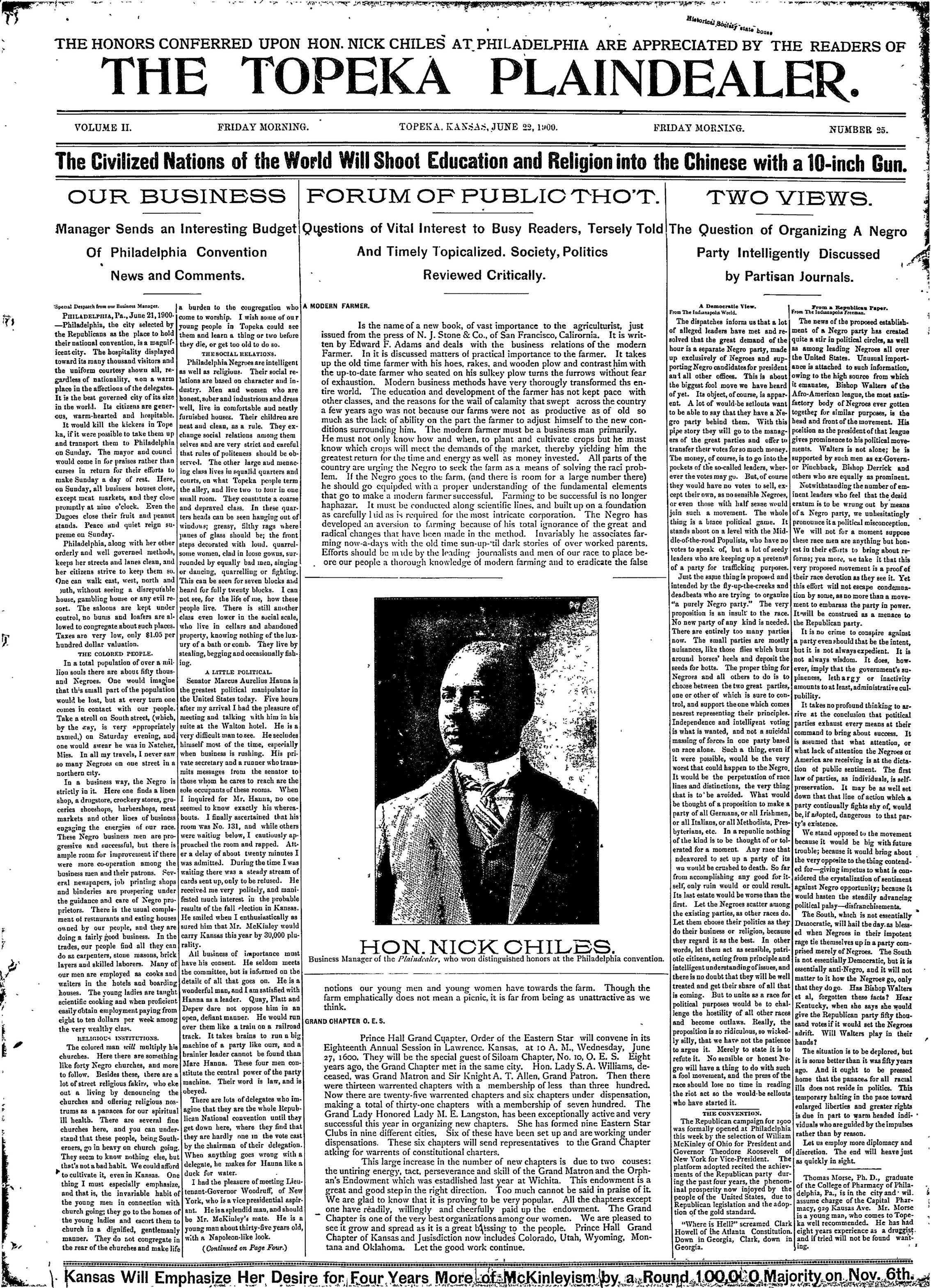
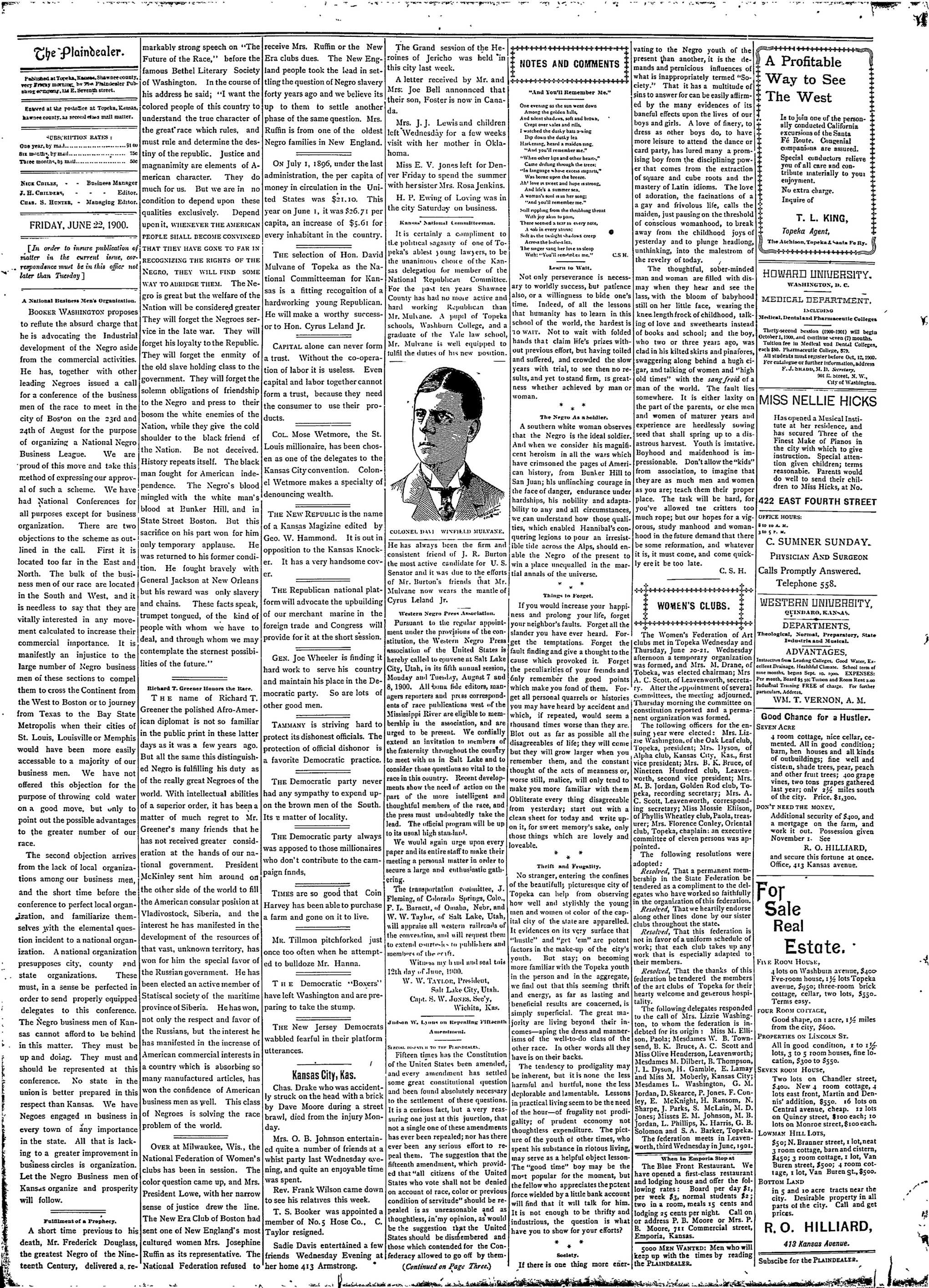
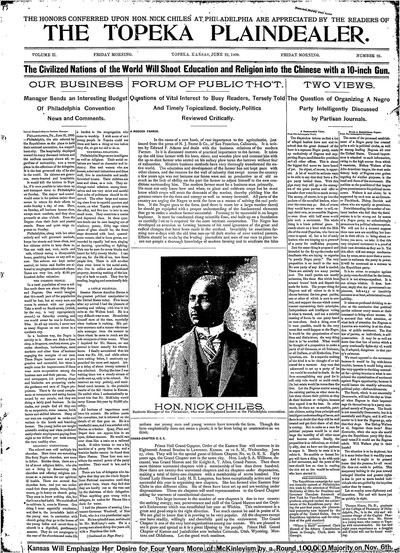
Page text (machine-generated)
THE HONORS CONFERRED UPON HON. NICK CHILES AT PHILADELPHIA ARE APPRECIATED BY THE READERS OF THE TOPEKA PLAINDEALER.
The Civilized Nations of the World Will Shoot Education and Religion into the Chinese with a 10-inch Gun.
OUR BUSINESS
VOLUME II.
The Civilized Na
OUR BU
Manager Sends an
Of Philadelphia
News and
Special Despatch from our Business Manager.
Special Departure from our business manager.
PHILADELPHIA, Pa., June 21, 1900
—Philadelphia, the city selected by the Republicans as the place to hold their national convention, is a magnificent city. The hospitality displayed toward its many thousand visitors and the uniform courtesy shown all, regardless of nationality, won a warm place in the affections of the delegates. It is the best governed city of its size in the world. Its citizens are generous, warm-hearted and hospitable.
It would kill the kickers in Topeka, if it were possible to take them up and transport them to Philadelphia on Sunday. The mayor and council would come in for praises rather than curses in return for their efforts to make Sunday a day of rest. Here, on Sunday, all business houses close, except meat markets, and they close promptly at nine o'clock. Even the Dagoes close their fruit and peanut stands. Peace and quiet reign supreme on Sunday.
Philadelphia, along with her other orderly and well governed methods, keeps her streets and lanes clean, and her citizens strive to keep them so. One can walk east, west, north and south, without seeing a disreputable house, gambling house or any evil resort. The saloons are kept under control, no buns and loafers are allowed to congregate about such places. Taxes are very low, only $1.05 per hundred dollar valuation.
THE COLORED PEOPLE.
In a total population of over a million souls there are about fifty thousand Negroes. One would imagine that this small part of the population would be lost, but at every turn one comes in contact with our people. Take a stroll on South street, (which, by the way, is very appropriately named,) on Saturday evening, and one would swear he was in Natchez, Miss. In all my travels, I never saw so many Negroes on one street in a northern city.
In a business way, the Negro is strictly in it. Here one finds a linen shop, a drugstore, crockery stores, groceries shoeshops, barbershops, meat markets and other lines of business engaging the energies of our race. These Negro business men are progressive and successful, but there is ample room for improvement if there were more co-operation among the business men and their patrons. Several newspapers, job printing shops and binderies are prospering under the guidance and care of Negro proprietors. There is the usual complement of restaurants and eating houses owned by our people, and they are doing a fairly good business. In the trades, our people find all they can do as carpenters, stone masons, brick layers and skilled laborers. Many of our men are employed as cooks and waiters in the hotels and boarding houses. The young ladies are taught scientific cooking and when proficient easily obtain employment paying from eight to ten dollars per week among the very wealthy class.
RELIGIOUS INSTITUTIONS. The colored man will multiply his churches. Here there are something like forty Negro churches, and more to follow. Besides these, there are a lot of street religious fakirs, who eke out a living by denouncing the churches and offering religious nostrums as a panacea for our spiritual ill health. There are several fine churches here, and you can understand that these people, being Southerners, go in heavy on church going. They seem to know nothing else, but that's not a bad habit. We could afford to cultivate it, even in Kansas. One thing I must especially emphasize, and that is, the invariable habit of the young men in connection with church going; they go to the homes of the young ladies and escort them to church in a dignified, gentlemanly manner. They do not congregate in the rear of the churches and make life
FRIDAY MORNING.
ations of the World
BUSINESS
Interesting Budget
ia Convention
Comments.
a burden to the congregation who come to worship. I wish some of our young people in Topeka could see them and learn a thing or two before they die, or get too old to do so.
Philadelphia Negroes are intelligent as well as religious. Their social relations are based on character and industry. Men and women who are honest, sober and industrious and dress well, live in comfortable and neatly furnished houses. Their children are neat and clean, as a rule. They exchange social relations among them selves and are very strict and careful that rules of politeness should be observed. The other large and menacing class lives in squalid quarters and courts, on what Topeka people term the alley, and live two to four in one small room. They constitute a coarse and depraved class. In these quarters heads can be seen hanging out of windows; greasy, filthy rags where panes of glass should be; the front steps decorated with loud. quarrelsome women, clad in loose gowns, surrounded by equally bad men, singing or dancing, quarrelling or fighting. This can be seen for seven blocks and heard for fully twenty blocks. I can not see, for the life of me, how these people live. There is still another class even lower in the social scale, who live in cellars and abandoned property, knowing nothing of the luxury of a bath or comb. They live by stealing, begging and occasionally fishing.
A LITTLE POLITICAL
Senator Marcus Aurelius Hauna is the greatest political manipulator in the United States today. Five hours after my arrival I had the pleasure of meeting and talking with him in his suite at the Walton hotel. He is a very difficult man to see. He secludes himself most of the time, especially when business is rushing. His private secretary and a runner who transmits messages from the senator to those whom he cares to reach are the sole occupants of these rooms. When I inquired for Mr. Hanna, no one seemed to know exactly his whereabouts. I finally ascertained that his room was No. 131, and while others were waiting below, I cautiously approached the room and rapped. After a delay of about twenty minutes I was admitted. During the time I was waiting there was a steady stream of cards sent up, only to be refused. He received me very politely, and manifested much interest in the probable results of the fall election in Kansas. He smiled when I enthusiastically as sured him that Mr. McKinley would carry Kansas this year by 30,000 plurality.
All business of importance must have his consent. He seldom meets the committee, but is informed on the detail of all that goes on. He is a wonderful man, and I am satisfied with Hanna as a leader. Quay, Platt and Depew dare not oppose him in an open, defiant manner. He would run over them like a train on a railroad track. It takes brains to run a big machine of a party like ours, and a brainier leader cannot be found than Marc Hanna. These four men constitute the central power of the party machine. Their word is law, and is obeyed.
There are lots of delegates who imagine that they are the whole Republican National convention until they get down here, where they find that they are hardly one in the vote cast by the chairman of their delegation. When anything goes wrong with a delegate, he makes for Hauna like a duck for water.
I had the pleasure of meeting Lieutenant-Governor Woodruff, of New York, who is a vice presidential aspirant. He is a splendid man, and should be Mr. McKinley's mate. He is a young man about thirty-five years old, with a Napoleon-like look.
(Continued on Page Four.)
TOPEKA, KANSAS, JUNE 22, 1900.
A MODERN FARMER.
Is the new issued from the pen ten by Edward H Farmer. In it is up the old time for the up-to-date fact of exhaustion. It tire world. The other classes, and a few years ago much as the lacks ditions surroundi He must not only know which crop greatest return for country are urgin lem. If the Neg he should go eq that go to make haphazar. It mu as carefully tid developed an av radical changes t ming now-a-day Efforts should be ore our people a
HO Business Manager of t
notions our yo farm emphatical think.
Is the name of a new book, of vast importance to the agriculturist, just issued from the press of N. J. Stone & Co., of San Francisco, Calirornia. It is written by Edward F. Adams and deals with the business relations of the modern Farmer. In it is discussed matters of practical importance to the farmer. It takes up the old time farmer with his hoes, rakes, and wooden plow and contrast him with the up-to-date farmer who seated on his sulkey plow turns the furrows without fear of exhaustion. Modern business methods have very thoroughly transformed the entire world. The education and development of the farmer has not kept pace with other classes, and the reasons for the wail of calamity that swept across the country a few years ago was not because our farms were not as productive as of old so much as the lack of ability on the part the farmer to adjust himself to the new conditions surrounding him. The modern farmer must be a business man primarily. He must not only know how and when, to plant and cultivate crops but he must know which crops will meet the demands of the market, thereby yielding him the greatest return for the time and energy as well as money invested. All parts of the country are urging the Negro to seek the farm as a means of solving the raci problem. If the Negro goes to the farm, (and there is room for a large number there) he should go equiped with a proper understanding of the fundamental elements that go to make a modern farmer successful. Farming to be successful is no longer haphazar. It must be conducted along scientific lines, and built up on a foundation as carefully laid as is required for the most intricate corporation. The Negro has developed an aversion to farming because of his total ignorance of the great and radical changes that have been made in the method. Invariably he associates farming now-a-days with the old time sun-up-til dark stories of over worked parents. Efforts should be made by the leading journalists and men of our race to place before our people a thorough knowledge of modern farming and to eradicate the false
J. H.
notions our young men and young women have towards the farm. Though the farm emphatically does not mean a picnic, it is far from being as unattractive as we think.
GRAND CHAPTER O. E. S.
Prince Hall Grand Cquapter, Order of the Eastern Star will convene in its Eighteenth Annual Session in Lawrence. Kansas, at 10 A. M., Wednesday, June 27, 1600. They will be the special guest of Siloam Chapter, No. 10, O. E. S. Eight years ago, the Grand Chapter met in the same city. Hon. Lady S. A. Williams, deceased, was Grand Matron and Sir Knight A. T. Allen, Grand Patron. Then there were thirteen warranted chapters with a membership of less than three hundred. Now there are twenty-five warranted chapters and six chapters under dispensation, making a total of thirty-one chapters with a membership of seven hundred. The Grand Lady Honored Lady M. E. Langston, has been exceptionally active and very successful this year in organizing new chapters. She has formed nine Eastern Star Clubs in nine different cities. Six of these have been set up and are working under
Prince Hall Grand Cquapter, Order of the Eastern Star will convene in its Eighteenth Annual Session in Lawrence. Kansas, at 10 A. M., Wednesday, June 27, 1600. They will be the special guest of Siloam Chapter, No. 10, O. E. S. Eight years ago, the Grand Chapter met in the same city. Hon. Lady S. A. Williams, deceased, was Grand Matron and Sir Knight A. T. Allen, Grand Patron. Then there were thirteen warranted chapters with a membership of less than three hundred. Now there are twenty-five warranted chapters and six chapters under dispensation, making a total of thirty-one chapters with a membership of seven hundred. The Grand Lady Honored Lady M. E. Langston, has been exceptionally active and very successful this year in organizing new chapters. She has formed nine Eastern Star Clubs in nine different cities. Six of these have been set up and are working under dispensations. These six chapters will send representatives to the Grand Chapter atking for warrants of constitutional charters.
This large increase in the number of new chapters is due to two couses: the untiring energy, tact, perseverance and skill of the Grand Matron and the Orphan's Endowment which was established last year at Wichita. This endowment is a great and good step in the right direction. Too much cannot be said in praise of it. We are glad to know that it is proving to be very popular. All the chapters except one have readily, willingly and cheerfully paid up the endowment. The Grand Chapter is one of the very best organizations among our women. We are pleased to see it grow and spread as it is a great blessing to the people. Prince Hall Grand Chapter of Kansas and Jusisdiction now includes Colorado, Utah, Wyoming, Montana and Oklahoma. Let the good work continue.
TWO VIEWS.
The Question of Organizing A Negro Party Intelligently Discussed by Partisan Journals.
FRIDAY MORNING.
the Chinese with
T. TWO V
Id The Question of Or
Party Intelligen
by Partisan
The dispatches inform us that a lot of alleged leaders have met and resolved that the great demand of the hour is a separate Negro party, made up exclusively of Negroes and supporting Negro candidates for president and all other offices. This is about the biggest fool move we have heard of yet. Its object, of course, is apparent. A lot of would-be sellouts want to be able to say that they have a Negro party behind them. With this pipe story they will go to the managers of the great parties and offer to transfer their votes for so much money. The money, of course, is to go into the pockets of the so-called leaders, wherever the votes may go. But, of course they would have no votes to sell, except their own, as no sensible Negroes, or even those with half sense would join such a movement. The whole thing is a brace political game. It stands about on a level with the Middle-of-the-road Populists, who have no votes to speak of, but a lot of seedy leaders who are trying to organize "a purely Negro party." The very proposition is an insult to the race. No new party of any kind is needed. There are entirely too many parties now. The small parties are mostly nuisances, like those flies which buzz around horses' heels and deposit the seeds for botts. The proper thing for Negroes and all others to do is to choose between the two great parties, one or other of which is sure to control, and support the one which comes nearest representing their principles. Independence and intelligent voting is what is wanted, and not a suicidal massing of forces in one party based on race alone. Such a thing, even if it were possible, would be the very worst that could happen to the Negro. It would be the perpetuation of race lines and distinctions, the very thing that is to be avoided. What would be thought of a proposition to make a party of all Germans, or all Irishmen, or all Italians, or all Methodists, Pressbyterians, etc. In a republic nothing of the kind is to be thought of or tolerated for a moment. Any race that endeavored to set up a party of its own would be crushed to death. So far from accomplishing any good for itself, only ruin would or could result. Its last estate would be worse than the first. Let the Negroes scatter among the existing parties, as other races do. Let them choose their politics as they do their business or religion, because they regard it as the best. In other words, let them act as sensible, patriotic citizens, acting from principle and intelligent understanding of issues, and there is no doubt that they will be well treated and get their share of all that is coming. But to unite as a race for political purposes would be to challenge the hostility of all other races and become outlaws. Really, the proposition is so ridiculous, so wickedly silly, that we have not the patience to argue it. Merely to state it is to refute it. No sensible or honest Negro will have a thing to do with such a fool movement, and the press of the race should lose no time in reading the riot act so the would-be sellouts who have started it.
THE CONVENTION.
The Republican campaign for 1900 was formally opened at Philadelphia this week by the selection of William McKinley of Ohio for President and Governor Theodore Roosevelt of New York for Vice-President. The platform adopted recited the achievements of the Republican party during the past four years, the phenomenal prosperity now enjoyed by the people of the United States, due to Republican legislation and the adoption of the gold standard.
"Where is Hell?" screamed Clark Howell of the Atlanta Constitution. Down in Georgia, Clark, down in Georgia.
NUMBER 25.
a 10-inch Gun.
VIEWS.
Organizing A Negro
ntly Discussed
n Journals.
From a Republicau Paper.
From The Indianapolis Freeman.
The news of the proposed establishment of a Negro party has created quite a stir in political circles, as well as among leading Negroes all over the United States. Unusual importance is attached to such information, owing to the high source from which it emanates, Bishop Walters of the Afro-American league, the most satisfactory body of Negroes ever gotten together for similar purposes, is the head and front of the movement. His position as the president of that league gives prominence to his political movements. Walters is not alone; he is supported by such men as ex-Governor Pinchback, Bishop Derrick and others who are equally as prominent
Notwithstanding the number of eminent leaders who feel that the dead eratum is to be wring out by means of a Negro party, we unhesitatingly pronounce it a political misconception. We will not for a moment suppose these race men are anything but honest in their efforts to bring about reforms; yea more, we take it that this very proposed movement is a proof of their race devotion as they see it. Yet this effort will not escape condemnation by some, as no more than a movement to embarrass the party in power. Itwill be construed as a menace to the Republican party.
It is no crime to conspire against a party even should that be the intent, but it is not always expedient. It is not always wisdom. It does, however, imply that the government's suspineness, lethargy or inactivity amounts to at least, administrative culpability.
It takes no profound thinking to arrive at the conclusion that political parties exhaust every means at their command to bring about success. It is assumed that what attention, or what lack of attention the Negroes or America are receiving is at the dictation of public sentiment. The first law of parties, as individuals, is self-preservation. It may be as well set down that that line of action which a party continually fights shy of, would be, if adopted, dangerous to that party's existence.
We stand opposed to the movement because it would be big with future trouble; because it would bring about the very opposite to the thing contended for—giving impetus to what is considered the crystalization of sentiment against Negro opportunity; because it would hasten the steadily advancing political palsy—disfranchisements.
The South, which is not essentially Democratic, will hail the day as blessed when Negroes in their impotent rage tie themselves up in a party comprised merely of Negroes. The South is not essentially Democratic, but it is essentially anti-Negro, and it will not matter to it how the Negroes go, only that they do go. Has Bishop Walters et al, forgotten these facts? Hear Kentucky, when she says she would give the Republican party fifty thousand votes if it would set the Negroes adrift. Will Walters play in their hands?
The situation is to be deplored, but it is some better than it was fifty years ago. And it ought to be pressed home that the panacea for all racial ills does not reside in politics. This temporary halting in the pace toward enlarged liberties and greater rights is due in part to warm headed individuals who are guided by the impulses rather than by reason. Let us employ more diplomacy and discretion. The end will heave just as quickly in sight.
Thomas Morse, Ph. D., graduate of the College of Pharmacy of Philadelphia, Pa., is in the city and will assume charge of the Capital Pharmacy, 929 Kausas Ave. Mr. Morse is a young man, who comes to Topeka well recommended. He has had eight years experience as a druggist and if tried will not be found wanting.
[In order to insure publication of matter in the current issue, correspondence must be in this office not later than Tuesday]
BOOKER WASHINGTON proposes to reflute the absurd charge that he is advocating the Industrial development of the Negro aside from the commercial activities. He has, together with other leading Negroes issued a call for a conference of the business men of the race to meet in the city of Boston on the 23rd and 24th of August for the purpose of organizing a National Negro Business League. We are proud of this move and take this method of expressing our approval of such a scheme. We have had National Conferences for all purposes except for business organization. There are two objections to the scheme as outlined in the call. First it is located too far in the East and North. The bulk of the business men of our race are located in the South and West, and it is needless to say that they are vitally interested in any movement calculated to increase their commercial importance. It is manifestly an injustice to the large number of Negro business men of these sections to compel them to cross the Continent from the West to Boston or to journey from Texas to the Bay State Metropolis when their cities of St. Louis, Louisville or Memphis would have been more easily accessible to a majority of our business men. We have not offered this objection for the purpose of throwing cold water on a good move, but only to point out the possible advantages to the greater number of our race.
The second objection arrives from the lack of local organizations among our business men, and the short time before the conference to perfect local organization, and familiarize themselves with the elemental question incident to a national organization. A national organization presupposes city, county and state organizations. These must, in a sense be perfected in order to send properly equipped delegates to this conference. The Negro business men of Kansas cannot afford to be behind in this matter. They must be up and doing. They must and should be represented at this conference. No state in the union is better prepared in this respect than Kansas. We have Negoes engaged in business in every town of any importance in the state. All that is lacking to a greater improvement in business circles is organization. Let the Negro Business men of Kansas organize and prosperity will follow.
Enfilment of a Prophecy.
A short time previous to his death, Mr. Frederick Douglass, the greatest Negro of the Nineteenth Century, delivered a re-
markably strong speech on "The Future of the Race," before the famous Bethel Literary Society of Washington. In the course of his address he said; "I want the colored people of this country to understand the true character of the great race which rules, and must rule and determine the destiny of the republic. Justice and magnanimity are elements of American character. They do much for us. But we are in no condition to depend upon these qualities exclusively. Depend upon it, WHENEVER THE AMERICAN PEOPLE SHALL BECOME CONVINCED THAT THEY HAVE GONE TO FAR IN RECOGNIZING THE RIGHTS OF THE NEGRO, THEY WILL FIND SOME WAY TO ABRIDGE THEM. The Negro is great but the welfare of the Nation will be considered greater They will forget the Negroes service in the late war. They will forget his loyalty to the Republic. They will forget the enmity of the old slave holding class to the government. They will forget the solemn obligations of friendship to the Negro and press to their bosom the white enemies of the Nation, while they give the cold shoulder to the black friend of the Nation. Be not deceived. History repeats itself. The black man fought for American independence. The Negro's blood mingled with the white man's blood at Bunker Hill, and in State Street Boston. But this sacrifice on his part won for him only temporary applause. He was returned to his former condition. He fought bravely with General Jackson at New Orleans but his reward was only slavery and chains. These facts speak, trumpet tongued, of the kind of people with whom we have to deal, and through whom we may contemplate the sternest possibilities of the future."
Richard T. Greener Honors the Race.
THE name of Richard T. Greener the polished Afro-American diplomat is not so familiar in the public print in these latter days as it was a few years ago. But all the same this distinguished Negro is fulfilling his duty as of the really great Negroes of the world. With intellectual abilities of a superior order, it has been a matter of much regret to Mr. Greener's many friends that he has not received greater consideration at the hands of our national government. President McKinley sent him around on the other side of the world to fill the American consular position at Vladivostock, Siberia, and the interest he has manifested in the development of the resources of that vast, unknown territory, has won for him the special favor of the Russian government. He has been elected an active member of Statiscal society of the maritime province of Siberia. He has won, not only the respect and favor of the Russians, but the interest he has manifested in the increase of American commercial interests in a country which is absorbing so many manufactured articles, has won the confidence of American business men as well. This class of Negroes is solving the race problem of the world.
OVER at Milwaukee, Wis., the National Federation of Women's clubs has been in session. The color question came up, and Mrs. President Lowe, with her narrow sense of justice drew the line. The New Era Club of Boston had sent one of New England's most cultured women Mrs. Josephine Ruffin as its representative. The National Federation refused to
receive Mrs. Ruffin or the New Era clubs dues. The New England people took the lead in settling the question of Negro slavery forty years ago and we believe its up to them to settle another phase of the same question. Mrs. Ruffin is from one of the oldest Negro families in New England.
ON July 1, 1896, under the last administration, the per capita of money in circulation in the United States was $21.10. This year on June 1, it was $26.71 per capita, an increase of $5.61 for every inhabitant in the country.
THE selection of Hon. David Mulvane of Topeka as the National Committeeman for Kansas is a fitting recognition of a hardworking young Republican. He will make a worthy successor to Hon. Cyrus Leland Jr.
CAPITAL alone can never form a trust. Without the co-operation of labor it is useless. Even capital and labor together cannot form a trust, because they need the consumer to use their products.
Col. Mose Wetmore, the St. Louis millionaire, has been chosen as one of the delegates to the Kansas City convention. Colonel Wetmore makes a specialty of denouncing wealth.
THE NEW REPUBLIC is the name of a Kansas Magazine edited by Geo. W. Hammond. It is out in opposition to the Kansas Knocker. It has a very handsome cover.
The Republican national platform will advocate the upbuilding of our merchant marine in the foreign trade and Congress will provide for it at the short session.
GEN. Joe Wheeler is finding it hard work to serve his country and maintain his place in the Democratic party. So are lots of other good men.
TAMMANY is striving hard to protect its dishonest officials. The protection of official dishonor is a favorite Democratic practice.
The Democratic party never had any sympathy to expend upon the brown men of the South. Its v matter of locality.
The Democratic party always was apposed to those millionaires who don't contribute to the campaign fnnds,
TIMES are so good that Coin Harvey has been able to purchase a farm and gone on it to live.
Mr. Tillmon pitchforked just once too often when he attempted to bulldoze Mr. Hanna.
THE Democratic "Boxers" have left Washington and are preparing to take the stump.
THE New Jersey Democrats wobbled fearful in their platform utterances.
Kansas City, Kas.
Chas. Drake who was accidently struck on the head with a brick by Dave Moore during a street brawl, died from the injury Monday.
Mrs. O. B. Johnson entertained quite a number of friends at a whist party last Wednesday evening, and quite an enjoyable time was spent.
Rev. Frank Wilson came down to see his relatives this week.
T. S. Booker was appointed a member of No.5 Hose Co., C. Taylor resigned.
Sadie Davis entertained a few friends Wednesday Evening at her home 413 Armstrong.
The Grand session of the Heroines of Jericho was held in this city last week.
A letter received by Mr. and Mrs. Joe Bell announced that their son, Foster is now in Canada.
Mrs. J. J. Lewis and children left Wednesday for a few weeks visit with her mother in Oklahoma.
Miss E. V. Jones left for Denver Friday to spend the summer with her sister Mrs. Rosa Jenkins.
H. P. Ewing of Loving was in the city Saturday on business.
Kansas' National Committeeman.
It is certainly a compliment to the political sagasity of one of Topeka's ablest young lawyers, to be the unanimous choice of the Kansas delegation for member of the National Republican Committee. For the past ten years Shawnee County has had no more active and hard working Republican than Mr. Mulvane. A pupil of Topeka schools, Washburn College, and a graduate of the Yale law school, Mr. Mulvane is well equipped to fulfil the duties of his new position.
J. H.
He has always been the firm and consistent friend of J. R. Burton the most active candidate for U. S. Senator and it was due to the efforts of Mr. Burton's friends that Mr. Mulvane now wears the mantle of Cyrus Leland Jr.
Western Negro Press Association.
Pursuant to the regular appointment under the provisions of the constitution, the Western Negro Press association of the United States is hereby called to convene at Salt Lake City, Utah, in its fifth annual session, Monday and Tuesday, August 7 and 8, 1900. All bona fide editors, managers reporters and press correspondents of race publications west of the Mississippi River are eligible to membership in the association, and are urged to be present. We cordially extend an invitation to members of the fraternity throughout the country to meet with us in Salt Lake and to consider those questions so vital to the race in this country. Recent developments show the need of action on the part of the more intelligent and thoughtful members of the race, and the press must undoubtedly take the lead. The official program will be up to its usual high standard.
We would again urge upon every paper and its entire staff to make their meeting a personal matter in order to secure a large and enthusiastic gathering.
The transportation committee, J. Fleming, of Colorado Springs, Colo,
F. L. Barnett, of Omaha, Nebr., and W. W. Taylor, of Salt Lake, Utah,
will appraise all western railroads of the convention, and will request them to extend courtesy to publishers and members of the craft.
Witness my hand and seal this 12th day of June, 1900.
Amendment.
Fifteen times has the Constitution of the United States been amended, and every amendment has settled some great constitutional question and been found absolutely necessary to the settlement of these questions. It is a curious fact, but a very reassuring one just at this junction, that not a single one of these amendments has ever been repealed; nor has there ever been any serious effort to repeal them. The suggestion that the fifteenth amendment, which provided that "all citizens of the United States who vote shall not be denied on account of race, color or previous condition of servitude" should be repealed is as unreasonable and as thoughtless, in my opinion, as would be the suggestion that the United States should be dismembered and those which contended for the Confederacy allowed to go off by them-
(Continued on Page Three.)
NOTES AND COMMENTS
One evening as the sun went down
Among the golden hills,
And silent shadows, soft and brown,
Creep over vales and rills,
I watched the dusky bats a-wing
Dip down the dusky lea
Harkening, heard a maiden sing,
"And you'll remember me."
"When other hips and other heart,"
Came drifting through the trees;
"In language who excess imparts,
Was borne upon the breeze.
Ah! love is sweet and hope is strong,
And life is a summer sea,
A woman's soul is in her song;
"And you'll remember me."
Still rippling from the throbbling throat
With joy akin to pain.
There seemed a tear in every note,
A sol in every stream;
Soft as the twintight shadows creep
Across the hills-lea.
The singer sang her love to sleep
With "You'll remember me." CS1
Learn to Wait.
Not only perseverance is necessary to worldly success, but patience also, or a willingness to bide one's time. Indeed, of all the lessons that humanity has to learn in this school of the world, the hardest is to WAIT. Not to wait with folded hands that claim life's prizes without previous effort, but having toiled and suffered, and crowded the slow years with trial, to see then no results, and yet to stand firm, is greatness whether achieved by man or woman.
\* \* \*
The Negro As a soldier.
A southern white woman observes that the Negro is the ideal soldier. And when we consider his magnificent heroism in all the wars which have crimsoned the pages of American history, from Bunker Hill to San Juan; his unfinishing courage in the face of danger, endurance under hardships, his nobility and adaptability to any and all circumstances, we can understand how those qualities, which enabled Hannibal's conquering legions to pour an irresistible tide across the Alps, should enable the Negro of the present to win a place uncqualled in the martial annals of the universe.
Things to Forget
If you would increase your happiness and prolong your life, forget your neighbor's faults. Forget all the slander you have ever heard. Forget the temptations. Forget the fault finding and give a thought to the cause which provoked it. Forget the peculiarities of your friends and only remember the good points which make you fond of them. Forget all personal quarrels or histories you may have heard by accident and which, if repeated, would seem a thousand times worse than they are. Blot out as far as possible all the disagreeables of life; they will come but they will grow larger when you remember them, and the constant thought of the acts of meanness or, worse still, malice, will only tend to make you more familiar with them Obliterate every thing disagreeable from yesterday; start out with a clean sheet for today and write upon it, for sweet memory's sake, only those things which are lovely and loveable.
* *
Thrift and Frugality
No stranger, entering the confines of the beautifully, picturesque city of Topeka can help from observing how well and stylishly the young men and women of color of the capital city of the state are apparelled. It evidences on its very surface that "hustle" and "get 'em" are potent factors in the make-up of the city's youth. But stay; on becoming more familiar with the Topeka youth in the person and in the aggregate, we find out that this seeming thrift and energy, as far as lasting and beneficial results are concerned, is simply superficial. The great majority are living beyond their incomes—aping the dress and manners of the well-to-do class of the other race. In other words all they have is on their backs.
The tendency to prodigality may be inherent, but it is none the less harmful and hurful, none the less deplorable and lamentable. Lessons in practical living seem to be the need of the hour—of frugality not prodigality; of prudent economy not thoughtless expenditure. The picture of the youth of other times, who spent his substance in riotous living, may serve as a helpful object lesson. The "good time" boy may be the most popular for the moment, but the fellow who appreciates the potent force wielded by a little bank account will find that it will talk for him. It is not enough to be thrifty and industrious, the question is what have you to show for your efforts?
vating to the Negro youth of the present than another, it is the demands and pernicious influences of what is inappropriately termed "Society." That it has a multitude of sins to answer for can be easily affirmed by the many evidences of its baneful effects upon the lives of our boys and girls. A love of finery, to dress as other boys do, to have more leisure to attend the dance or card party, has lured many a promising boy from the disciplining power that comes from the extraction of square and cube roots and the mastery of Latin idioms. The love of adoration, the facinations of a a gay and frivolous life, calls the maiden, just pausing on the threshold of conscious womanhood, to break away from the childhood joys of yesterday and to plunge headlong, unthinking, into the malestrom of the revelry of today.
The thoughtful, sober-minded man and woman are filled with dismay when they hear and see the lass, with the bloom of babyhood still on her little face, wearing the knee length frock of childhood, talking of love and sweethearts instead of books and school; and the boy, who two or three years ago, was clad in his kilted skirts and pinafores, swaggering along behind a hugh cigar, and talking of women and "high old times" with the sang froid of a man of the world. The fault lies somewhere. It is either laxity on the part of the parents, or else men and women of maturer years and experience are heedlessly sowing seed that shall spring up to a disastrous harvest. Youth is imitative. Boyhood and maidenhood is impressionable. Don't allow the "kids" from association, to imagine that they are as much men and women as you are; teach them their proper place. The task will be hard, for you've allowed the critters too much rope; but our hopes for a vigorous, study manhood and womanhood in the future demand that there be some reformation, and whatever it is, it must come, and come quickly ere it be too late.
The Women's Federation of Art clubs met in Topeka Wednesday and Thursday, June 20-21. Wednesday afternoon a meeting organization was formed, and Mrs. M. Drane, of Tobeka, was elected chairman; Mrs A. C. Scott, of Leavenworth, secretary. Alter the appointment of several committee the meeting adjourned. Thursday morning the committee on constitution reported and a permanent organization was formed.
The following officers for the ensuing year were elected: Mrs. Lizzie Washington, of the Oak Leaf club, Topeka, president; Mrs. Dyson, of Alpha club, Kansas City, Kas., first vice president; Mrs. B. K. Bruce, of nineteen Hundred club, Leavenworth, second vice president; Mrs. M. B. Jordan, Golden Rod club, Topeka, recording secretary; Mrs. A. C. Scott, Leavenworth, corresponding secretary; Miss Mossie Ellison, of Phyllis Wheatley club, Paola, treasurer; Mrs. Florence Conley, Oriental club, Topeka, chaplain: an executive committee of eleven persons was appointed.
The following resolutions were adopted:
Resolved, That a permanent membership in the State Federation be tendered as a compliment to the delegates who have worked so faithfully in the organization of this federation.
Resolved, That we heartily endorse along other lines done by our sister clubs throughout the state.
Resolved, That this federation is not in favor of a uniform schedule of work; that each club takes up any work that is especially adapted to their members.
Resolved, That the thanks of this federation be tendered to the members of the art clubs of Topeka for their hearty welcome and generous hospitality.
The following delegates responded to the call of Mrs. Lizzie Washington, to whom the federation is indebted for its origin: Miss M. Ellison, Paola; Mesdames W. B. Townsend, B. K. Bruce, A. C. Scott and Miss Olive Henderson, Leavenworth; Mesdames M. Dilbert, B. Thompson, J. L. Dyson, H. Gamble, E. Lamay and Miss M. Moberly, Kansas City; Mesdames L. Washington, G. M. Jordan, D. Skeare, P. Jones, F. Conley, E. McKnight, H. Ransom, N. Sharpe, J. Parks, S. McLain, M. D Jones; Misses E. M. Johnson, M. B Jordan, L. Phillips, K. Harris, G. B Solomon and S. A. Barker, Topeka
The federation meets in Leaven-
When in Emporia Stop at
The Blue Front Restaurant. We have opened a first-class restaurant and lodging house and offer the following rates: Board per day $1,
per week $3, normal students $2;
two in a room, meals 15 cents and lodging 25 cents per night. Call on or address P. B. Moore or Mrs. P. B. Moore, 711 Commercial street,
Emporia, Kansas.
5000 MEN WANTED: Men who will keep up with the times by reading the PLAINDEALER.
In to join one of the personally conducted California excursions of the Santa Fé Route. Congenial companions are assured.
Special conductors relieve you of all care and contribute materially to your enjoyment.
No extra charge.
Inquire of
T. L. KING,
Topeka Agent,
The Atchison, Topeka & Santa Fe Ry.
HOWARD UNIVERSITY.
WASHINGTON, D. C.
MEDICAL DEPARTMENT.
Thirty-second Session (1900-1901) will begin October 1, 1900, and continue seven (7) months, Tuition fee in Medical and Dental Colleges, each $30. Pharmacuretle College, $79. All students must register before Oct. 12, 1900. For catalogue or further information, address F. J. SHADD, M. D. Secretary, 901 E. Street, N. W., City of Washington.
MISS NELLIE HICKS
Has opened a Musical Institute at her residence, and has secured Three of the Fineest Make of Pianos in the city with which to give instruction. Special attention given children; terms reasonable. Parents would do well to send their children to Miss Hicks, at No.
422 EAST FOURTH STREET
OFFICE HOURS:
8 to 10 A.M.
3 to 5 P.M.
C. SUMNER SUNDAY.
PHYSICIAN AND SURGEON
Calls Promptly Answered.
Telephone 558.
WESTERN UNIVERSITY,
QUINDARO, KANSAS.
DEPARTMENTS,
Theological, Normal, Preparatory, State
Industria and Musical.
ADVANTAGES.
Instructor from Leading Colleges, Good Water, Excellent Drainage, Healthful Climate. School term of nine months, begins Sept. 10. 1900. EXPENSES: Per month, Board $5 tuition and Room Rent 2,000 Industrial Training FREE of charge. For further particulars, Address.
WM. T. VERNON, A. M.
Good Chance for a Hustler.
SEVEN ACRE
4 room cottage, nice cellar, cemented. All in good condition; barn, hen houses and all kinds of outbuildings; fine well and cistern, shade trees, pear, peach and other fruit trees; 400 grape vines, two tons grapes gathered last year; only 2½ miles south of the city. Price. $1,300.
Additional security of $400, and a mortgage on the farm, and work it out. Possession given November 1. See
R. O. HILLIARD,
and secure this fortune at once.
Office, 413 Kansas avenue.
For Sale Real Estate.
FIVE ROOM HOUSE,
4 lots on Washburn avenue, $400
Fve-room house, 1½ lots Topea
avenue, $550; three-room brick
cottage, cellar, two lots, $550-
Terms easy.
FOUR ROOM COTAGE,
Good shape, on 1 acre, 1½ miles
from the city, $600.
PROPERTIES ON LINCOLN St.
All in good condition, 1 to 1½
lots, 3 to 5 room houses, fine
location, $300 to $550.
SEVEN ROOM HOUSE,
Two lots on Chandler street,
$400. New 4 room cottage, 4
lots east front, Martin and Dennis'
addition, $550. 16 lots on
Central avenue, cheap. 12 lots
on Quincy street, $100 each; 10
lots on Monroe street, $100 each.
LOWMAN HILL LOTS.
$50; N. Branner street, 1 lot, neat
3 room cottage, barn and cistern,
$450; 3 room cottage, 1 lot, Van
Buren street, $500; 4 room cottage,
1 lot, Van Buren St., $500.
BOTTOM LAND
in 5 and 10 acre tracts near the
city. Desirable property in all
parts of the city. Call and get
prices.
R. O. HILLIARD,
413 Kansas Avenue.
Subscribe for the PLAINDEALER.
De o =. & c& BERS SSI Pesce "Seer Nggiamees: sumer: SRN ER
SS ————————————————————————EE—E———EE_——————————————— eee
Paieor Fores rest No.36, meets ist. and] The little 7-year-old daughter of! * 18 Appeal. of welcome; response, Rev. J. A. Go-}'sident of the United States, Repre-jought to be done. Ibelievet
griSaturdy afternoon ofeach mosthat0-#| nies, Anna Miner, 1322 Quincy|T the executive boards of various| ree, N. Lawrence: 8:20, sermon, Rev.| sentatives in Congress, etc., is denied| pendulum bas been pushed a
Mesamenqeda Blas fatally burned with gasoline at| district associations, Sunday schools | George McNeal; 9, report of commit-|to any of the male inhabitants of such|far in the other direction as
—— —_____________|a neighboring grocery store Mon-|the state of Kansas ne | tees. State, if 21 years of age, and citizens| safely be pushed. I believe t
Ranson EVeanr Aye | ate Ue w.}day night at 8:30 P. M. The gro-| pyethren : SATURDAY MORNING. of the United States, or in any way|interests in all classes deman
ueefech ens Sere ee Banal the fluid was You are hereby notified to meet in ‘ a heredoh Bn T. ie as eee es in os iy alen lease contin
G.P.; lay Mary Anna WotateC. criminally catless.” es :30, miscellaneous business; 11, ser-| rebellion of other crime, the repre-| deal wit sensible mei
—_—____— __ eee a ee eae mon, Rev. H, V. Plummer, Kansas! sentation shall be reduced in propor- |ing in mind the fact that eve
aikSmutavourensetsistanta.wecssee-| ‘The Ladies Coterie picnicked at| Hebron Baptist church, Pittsburg, City, alternate, Rev. TW. Greene | ton the number of such malecitizens ia this country who is a citize
nd apd Fnday evcames of xcbnenht8|Garfield Park Saturday afternoon)! Kas, June 28, 29 and 30,at 10 v'elock | NONE HY: = ‘ aie ce eee ete ialntke cutederate
fansarealeayseeloome, W.EJactsoy, Chiet, [aS a closing up of their work for the |. m9, AFTERNOON. male citizens 21 years of agein said] that it is no man’s right, whe
Auur Lawson, Kecording Sec, wear. The Coterle enjoys the de-| rss. - tes wncite, 200... 04.| 2, devotionals, Revs. R. Turner and | State.’ be white or black, to seck to
PERSONAL NOTES.
Rey, Banks of Leavenwortn was
in the City.
Eddie Hamilton feft Wednesday
for California.
Jobn M. Wright will spend Sunday
in Kansas City.
Geo. Moss is spending his vaca-
tion in Kansas City.
Mesdames Hamilton and Shuck
have returned from Chicago.
Mrs. Julia Brown has moved from
qro Jackson to 133 Jackson St.
Ella Page left Wednesday to visit
her sister Mrs. Pegg in Omaha.
Are you going away for the sum-
mer? Then notify Tue PLAINDEAL-
ER.
Miss Willa Johnson of Bonner
Springs is the guest of Mrs. Kircha-
vale.
Lenius Stewart of Omahg is the
guest of her sister Mrs. G.W. Ham-
jlton.
Jno. and Sam’l Fields of Carrol-
ton Mo. are visiting friends in the
City.
Jno. L. Harrison left Wednesday
tovisit freinds in Washington and
Ohio.
Mr. Oscar Overr of Galena is
visiting his parents and freinds in
the City.
Mrs. Clara Edwards-Kirk of
Crestline, Ohio is visiting friends in
the City.
The 23rd Regiment band gave
one of its popular concerts Mon-
day night.
‘The Ladies Imperial Art club
has adjourned for the season until
September.
Robt. S. Sims, the popular Santa
Fe cook, is with a special car at Al-
Duquerque, N. M.
E. A. Williamson, who has been
attending the State University, has
returned home.
Dr. Moss of Philadelphia is in
the City and will take charge of the
Capital Drug Store.
Tue PLatwpeater is the great
race paper of Kinsas. Only $1 per
year. Are you a subscriber?
FOR RENT—Unturnisbed rooms at
112, 114 East Seventh street Call
at Tne Prawnester office.
‘The Dyson restaurant, located at
440 Minnesota avenue, Kansas City,
Kas, is the best restaurant in that
city.
The Dyson restaurant, located at
440 Minnesota avenue, Kansas City,
Kas, is the best restaurant in that
city.
Rev. R. C. Leoof Holton and
Rev. Hl. H. Jones of Quindaro
paid ae Puarspeatrr a pleasant
call.
Quite a number of our colored
people went to St. Joseph on the
Sante Fe employee's excursion
Saturday,
‘Mrs. M. E. Langston has returned
home from Denver where she has
been in the interest of the Grand
Chapter. ,
Rev. J. R. Ransom returned to
the city Monday after a very inter-
esting and profitable tour over his
district.
Mesdames Townsend, Bruce,
Scott and Misses Henderson and
Anderson of Jeavenworth are in
attendance on the Club Convention.
Nouice—All correspondents for THe
PLAINDEALER will kindly collect all
subscriptions in their respective cit-
ies, and kindly remit same to the of-
fice.
‘The Golden Rod Club met last
Friday with Miss Kate Harris. A
delightful time was had by all. The
Club adjourned to meet Friday
June 2oth. with Miss Lizzie Cooper.
A colored man named Johanson,
employed in Cutlbert and Sargent’
Stone yards, was painfully injured
Monday noon by a 700 pound stone
derrick, falling upon bis leg. It ha
since been reported that his injuries
peoved fatal.
‘The little 7-year-old daughter of
Mrs. Anna Miner, 1322 Quincy
was fatally burned with gasoline at
a neighboring grocery store Mon-
day night at 8:30 P. M. The gro-
ceryman handling the fluid was
criminally carless. ~
‘The Ladies Coterie picnicked at
Garfield Park Saturday afternoon,
as a closing up of their work for the
year. The Coterie enjoys the de-
stinction of being the oldeet club in
Topeka having had an uninterrupted
organiza.ion since 1888.
There willbe a meeting at the
Commercial on next Monday even-
ing, of all who are interested in the
musical feature of the Auditorium
dedication. We want a Negro cho-
rus of two hundred voices. Let every
colored man interested in the suc-
cess of the affair turn out.
‘The District Sunday School con:
vention of th: A. M. E. Churct
will be held at Junction City, Kan:
sas, June, 27 and 28. The seventl
street church elected the followin
to represent it at the convention
Delegates, Prot. R. H. Wade an
Mayme Joknson; Alternates, Mar
Jordan and Chas. S. Hunter.
‘The International Order of Twelv
Knights of Taber of the Topek
jurisdiction assembled at the Hal
oneast Sixth street, Sunday after
noon at 2 o'clock to march to th
Shiloh Baptist church to join th
Daughters of the ‘Tabernacle an
listen to their annual sermon. Res
Ooten, assisted by Rev. W,L. Grant
the paster, officiated. Sir Geo. W
Jackson, C. O. for the day. Th
parade to the church was headed by
Jackson's famous Twenty-third regi
meat band:
District Conference and Sunday
school convention of the Omaha
District assembled in St. Marks
church Tuesday morning. According
to programme, Rev. J. R. Ransome
presiding and the eletion of Rev. W
H, Jones of Quindaro as secretary.
several very excellent papers were
read and discussed by various mem:
bers. At the conclusion Rev. Ran
‘some was tendered a vote of thanks
for his fairness as a presjding office
Rey. W. T. Vernon of Quindaro an¢
Rev. Brooks of Ft. Scott were amon;
the visitors.
On Thursday evening, June 11, a
joint meeting of Euclid, No. 2, Mt
Moriah, No. 5 and Kaw Valley, No.
18 was held at the Masonic hall, 618
Kansas avenue, for the purpose of
iustalling officers. S. G. Watkins,
deputy Grand Master, acted as in-
stalling officer, and Ed. Jones as mar
shal. The ceremonies of installing
were elaborately carried out. After
the ceremonies were over, Past Mas:
ter A. T. Allen, of Euclid No. 2, in
|a very witty and appropriate address,
presented J. H. Childers, the retir
ing Master, a solid gold past Mas
'ter's jewel.
Sunday was Rally Day at St
John’s A. M. E. church, and al-
though their beloved pastor, Dr. G.
H. Shaffer, was confined to his home
by illness, the friends of the church
responded nobly to the appeals of
the burdened congregation and
substantially aided them in this
their hour ofneed. Rev. A. Hen:
ry Attaway, of Lawrence, who wa:
acting pastor in charge for the day,
‘fully sustained his reputation as
pulpit orator in two masterful efforts
morning and evening. ‘The text 0
his morning's discourse was “Why
halt ye between two opinions”, from
which he preached a magnificen’
practical sermon on the needs o
our people. While he deplored the
social and political conditions as
existing, he assured his hearers “tha
the stars of hope are still shining in
our constellation,” and adjurec
them to trust in God, who wouk
fight for them. Financially, th
rally was a marked success, anc
while we are not authorized to mak
‘a positive statement, we judge a
full thous-nd dollars was realizes
from the day's efforts.
Mrs. O. A. Taylor returned from |
pleasant visit in Leavenworti las
week.
Quindaro Kans.
The Board of Regents o!
Western University and the
the State Industrial School se-
lected its faculty for the ensuing
year. Prof. W. Tecumseh Ver.
non B, S. D., A. M.; Chas. S.
Bowman; Jno. C. Wood; Aman.
da F. Moore; Mrs. Lula Cunning:
ham, teacher of instrumental
music; Mrs. M. A. Morris, Ma:
tron; two teacher are yet to be
selected, One in the Universit
Department andonein the Dress
Making Department =the In.
dustrial Schoo 4) @)
A Lpat Appeal.
Ts the executive boards of various
district, associations, Suuday schools
and women’s conventious throughout
the state of Kansas:
You are hereby notified to meet in
joint eession with the executive board
of the State convention with the Mt.
Hebron Baptist church, Pittsburg,
Kas, June 28, 29 and 30, at 10 v’clock
a.m.
‘This is our last meeting before the
State convention which convenes in
Topeka the first Tuesday in October.
It requires $200 to carry on our work
every quarter. At this time we are
$42.50 indebted to the Home Mission
society, besides salary due missionary.
To meet our obligations for this and
past quarters we must raise $250.
Last quarter we asked every church
to send$5.00. Only a few responded.
‘The names of those churches that have
responded to the appeals since the
convention in Evoporia, September,
1899, will appear in print with the
amount given and what is due state
Tn order to understand our state work
please read the little pamphlet which
wesend you. This explains to you
the state work in full:
“Dear church: Will you remem-
her that the great work which must
be done in this state depends greatly
upon you? The churches have been
behind with their pro rata for years.
We call upon you to send us no tess
than 84.00 at this meeting. The large
churches are asked to send more.
‘Our state minutes will not be printed
this year because of limited finance.
Dear church, if you would do your
part in answering these appeals every
quarter, the work would be in
a more flourishing condition. Do the
best you can when thie notice comes
to you. Brother Pastor, try to be
present at the Pittsburg meeting.
After June 25, send all money from
churches for state work to me, care
Mt. Hebron Baptist church, Pittsburg,
Kansas. Until that time, address
E. Artixctox Witsox,
Financial Sec'y.
1505N, Eighth St., Kansas City, Kas
The following program will be ren
dered at Pittsburg June 28, 29 and 30:
WEDNESDAY MORNING.
Sunday Schoo] Work—10:00 devo
tionals, Vice President G. W. Harts
| Weir City; 10:30, calling the roll anc
appointment of committees; 10:4(
report of corresponding secretary; 11
preaching, Rey. J.S King, Wei
City.
AFTERNOON.
2, Devotionals, Rev. J. A. Duncan
| Chetopa; 2:20, reading of minutes; 2:3
The Relation of the District Sunday
‘School Conventions to the State Sun
'|day School Convention,” Prof. Ford
'| Weir City; 3, miscellaneous business
'|3:30, “Duties of Pastors to Stato Mis
'|sion Work,” Rev. J. D. Morrow, Yale
'|4, sermon, Rev. A. J. Rogers, Yale
i EVENING.
'| 7:30, devotionals, pastor of Mt. He
bron Baptist chnrch; 8, address o
"| welcome, Mr. Jackeon; response, Rev
'|E. Arlington Wilson, Kaneas City
Kas.; 8:30, sermon, Rev. C. Teal, Cot
feyville; 9:30; reports of all commit
"| tees.
THURSDAY NORNING.
| Women’s Home and Foreign Mis
sion convention—9, devotional exer
¢|cises, appointment ot committees o
| | business and finance, five-minute talk:
, condition of the field; paper, “Wor
"lof the Negro Baptist Publishing con
, | pany,” Mrs. Nannie Dunlap, Junctio
paper, Mre. Amanda Jamison, Buxte
'|Springs; essay, Mrs, Emily Gouc!
,|Girard; 11, preaching, Rev. J. I
;| Dudley, Ft. Scott.
. AFTERNOON.
| 2, devotional exercises; paper, Mi
t| Millie Thurman, Coffeyville; misce
¢|laneous business, reports; special a
, | ress, Mrs. M.D. Jones, N. Topek
, |epecial address, Mrs. Carrie Whit
| Pareons; ezsay, “The Ecumenical Co
"| ference of Missions,” Mrs. E. A. Wi
1|son, Kansas City; address, “Wh:
j}ean bedone to Improve the Youn
e|People,” Miss Eita Schrader; preac
j|ing, Rev. C. H. Jones, M. D., Paol
EVENING.
| 7.20 aonsecration meetine: nreacl
2, devotional exercises; paper, Mis
Millie Tharman, Coffeyville; miscel-
Janeous business, reports; epecial ad.
dress, Mrs. M.D. Jones, N. Topeka:
special address, Mrs. Carrie White
Parsons; essay, “The Ecumenical Con-
ference of Missions,” Mrs. E. A. Wil
son, Kansas City; address, “What
can be done to Improve the Young
People,” Miss Eita Schrader; preach
ing, Rev. C. H. Jones, M. D., Paola
EVENING,
7:30, consecration meeting: preach
ing, Rev. R. A. Goree, alternate, Dr
MM. L. Copeland.
FRIDAY MORNING.
State Board Proper—9, devotionals
Rev. A. L. Voorbees, J. M. Middle
ton, Topeka; 8:30, reading of journal
app.intment of committees, miscella
neous business; 10:30, topic, “Th
Ministry of the Holy Spirit,” Rev. A
Fairfax, Parsons; 11, sermon, Rev. N
C. Robinson, Oswego, alternate, Rev
J. L. Dudley, Ft. Scott; collection
benediction.
AFTERNOON.
2, devotionals, Reve. E. P. Green
A.D. Jamison, Kansas City; 2:30 mis
cellaneous business; 3:20, topic, “Th
True Element of Prayer,” Rev. W
L, Grant, Topeka; 4, sermon, Rev. F
D. Skinner, D. D., Lawrence, alter
nate, Rev. H. W. Scott, Ottawa.
EVENING.
7:80, devotionals, Revs. J. W. Pric
W.H. Pollett, Emporia; 8, addres
of welcome; response, Rev. J. A. Go
ree, N. Lawrence: 8:20, sermon, Rev
George McNeal; 9, report of commit
tees.
SATURDAY MORNING.
9, devotionals, Rev. T. E. Pierce
9:30, miscellaneous business; 11, ser
soon, Rey. H, V. Plummer, Kansas
city, alternate, Rev. T, W. Greene
‘Mound City. ©
AFTERNOON. *
2, devotionals, Revs, R. Turner and
HLF. Frazier, Wichita; 2:30, Bible
institute, “The Way to be Saved,”
Rev. H. E. Strickland, Rosedale; 3:30,
miscellaneous business; 4, sermon,
Rev. R. P. Banks, Junction City.
EVENING.
Literary Program,
SUNDAY MORNING.
9:30, Sunday School Mass Meeting.
11,sermon, Rev. W.S. Blake, Olathe,
alternate, Rev. G. W. Burdette, Eu-
dora; 3, sermon, Rev. J. H. Vanlue,
Wichita; 8, sermon, Rey. J. R. Rich:
ardson, Kansas City, Kas.
Rev. J. R. Ricuarpson,
President,
| E. Arurxton Witsox,
Corresponding and Financial See’y.
Judson W.Ly om on Repealing, Ete.
(LOntued from Lage £0.)
selves and organize an independent
government. The war settled that
question foreyer and this great a-
mendment to the Constitution with
the question it involves has become
absolutely essential to the well being
of the country.
The eolored people of the South
have never, since they were given the|
great boon of the clective franchise,
stiown their unfitness to use it by or-
ganizing themselves in opposition to
established authority. Onthe con-
trary they have been the most law-
abiding American citizens. Indeed
it has been said, and I believe au-
thoritatively, that the best Americans
‘on the Continent to-day are the col-
cored Americans. They have no
“isms” and theories that were not
‘born and legitimately born,in the
body politic of America; they have
been enemies to strikes, enemies to
riots, enemies to all manner of law-
lessness, and have been the strongest
and firmest supporters of the supre-
macy of the law. In some districts
‘of the South, andin factin some
States of the South, they far outnum-
ber all other classes of citizens, yet,
in spite of the fact that the idea of
our government is based upon the
choice of the majority of the people,
they have, because of their love o
law and order submitted, and pacifi
cally, to all elections which have in
many cases gone contrary to the
‘wishes of a majority of the people
I do not think that any one in thi:
country who is familiar with these
facts wonld hesitate to say that thi
is a fair and trnthful statement, no:
\do E believe anyone who is familia
‘with the Southern side of the ques
'|tion will think that there is any con
certed movement in the South to re
|pealthe fifteenth amendment. 4
few gentleman at the Montgomery}
|conference took that view and the}
were supported in it by Mr. Bourk
Cochran of New York, whois ;
stranger to Southern conditions, ‘anc
who is foreign born. But those gen
|| tlemen generaliy have a selfish reas
Jon for their utterances. Perhap
they would have eliminated the Ne
|| gro at the ballot-box because Eby s
| doing their chances for office woul
-]be improved, and Mr. Burke Coch
,|ran went to their support, doubtless
.| because he concluded it would be:
popular thing to say something a
the guest of those gentlemen tha
,| would be palatable to them. But th
.|speeches that will live and whic
.| showed real statesmanship were th
; addresses delivered by ex-Governo
,| McCorkle, of West Virginia, and th
.|timely, considerate and thoughtfe
| address of Hilary A. Herbert.
1| Those who are clamoring in th
.|South for the repeal of this amend
ment, I fear do not consider the e
_|fect it will have upon the South pol
tically. Those who are calling fo
-| the removal of the colored man a3
.| factor in the South, fail to realize th
result of their agitation, When the
succeed, if they do, they‘ will find th
,|South minus thirty-six votes in th
|Electoral College and thirty-fiv
,|members in the house of Congres
| That I regard as inevitable under th
.|Fourteenth Amendment, which say
. | that “All persons born or naturalize
{in the United States and subject
.|the jurisdiction thereof, are citizer
;|of the United States andof the ci
wherein they reside, NoState sha
make or enforce any law which sha
abridge the prilileges or immuniti
| of citizens in the United States, n
e|shall any State deprive any persc
| of life, iberty and property witho
>,|due process of law. Representatic
--| shall be apportioned among tne se
eral States according to their respe
tive numbers, but when the right
9 vote at aiy eledtion forthe choice
3 electots, for Pr{ \dent or Vice-Pr
a \
wf t. .. Ped cy |
Se ne are gE ee nee Eee nena ae
to any of the male inhabitants of such
State, if 21 years of age, and citizens
of the United States, or in any way
abridged except for participating in
rebellion of other crime, the repre-
sentation shall be reduced in propor-
tion the number of such male citizens
shall bear tothe whole number of
male citizens 21 years of agein said
State.”
‘The colored man has played a
most important part in the general
development of the South; he consti-
tutes in the sixteen confederate states
very nearly half ofthe population
and contributes by his industry fully
half or more to the products of that
section. I think it safe to say that
his share in the cotton crop amounts
to $340,000,000 per annum. Can
anyone imagine how important 8,500,
000 bales of cotten are to the factory
operatives of New England, England
France and Germany? Drive away
the Negro, destroy his hopes, leave
him without a prospect in life, and
why should he be interested to keep
up the present commercial and in-
dustrial conditions in his section of
the country?
Educationally he is growing. At
the close of the war perhaps not
more than 5 per cent, of the colored
people could read and write; to-day
I think the census now being taken
will disclose the gratifying fact that
58 per cent, of them can read their
own Bibles, and, if they cannot draft
their own contracts, they can at least
sign them. They area religious
people, worshiping the Lord and ob-
serving the Christian Sabbath. They
have contributed millions to good
order and good government in the
direction of erecting churches and
school houses since the war. In
every clash which the nation has en:
countered the Negroes have been
| foremost in doing their part to sustain
| the prestige and glory of the Ameri.
Jcan‘arms, No braver men ever
|marched to the field of battle than
| were those ‘composing the colored
|| regiments that took part in the mag
|| nificent fighting around Santiago jus
|two years ago. Indeed, from whict
| ever point you regard them, the Ne
| groes have been good citizens, worthy
‘| citizens, trusting for the better an
_| doing all they can to hasten the da;
when the better will come.
| It may be true that now and ther
,|the colored man has commited ;
"| crime, but it ought to be remember
;|ed that other people are also occas
_| sionally found guilty of crime. Wha
,| thoughtful colored men ask is tha
;| when these miscreants are discover
"Jed they be punished—punished a
,| the law prescribes without favor anc
z|if needs be, without mercy. Ther
;| Was a time in the South when lawles
| Ress was excused on the ground tha
;|the judiciary of the country was i
| the hands of Negroes and socaile
.| “carpetbaggers,” but thatday ha
“|long since passed. The judiciar
, | there now is absolutely in the hand
y of the native-born white people, an
y those men should see to it that an)
~ | one charged with crime be tried b
, |the courts and iffound guilty be pur
| ished according to law, because ther
[is now no chance for the criminal
Jescape on the ground of favoritisn
| even if there ever was one,
*| ‘This is what ought to be broug!
j|about: Let the white men of th
South and the colored men of th
"| South who must of necessity liv
,,| there and die there come togethe
zjand reason about these matters.
| think that when such a gathering |
| convened it will be found that ever
[one is agreed upon the important
1, of upholding the law of the countr
{Ido not believe that any sensib
| Man seriously takes the extreme vie
fof Mr. Bourke Cochron. Now ar
ii then I hear of some one giving utte
ance to some such sentiments as!
¢[did at Montgomery, but as a_rul
{_Jupon inquiry, it is found that th
AT sistem enue trae abla’ teeth
‘ 9,
Extra Specials At Barnum’s..
“FOR THE FOURTH”
1000 yards Rosedale Lawns in the very latest paterms...cscssssen2¥%e yd
00 yards bleaches? towelling.ccscscssersessesese sveeecssene sonnseessn eG ya
2000 yards Bleached Muslin. soft finish and very fine,.....+0+0+--934€ Yd
1500 yards extra fine Indea Lawn, wort’: all of zee, ‘short length’..11c yu
A limit of 10 yards on all above,
‘Aline of real 75c Shirt waists, each one perfect.....seruseeee.- age \
Our $1.00, $1.23 and $2.00 waists in thissale at 73c, 88c, $1.39 and $1.48
. A Fourth Off On All Hammocks. *
‘The $1.25 quality will be $1.00 The $2.25 quality will be $1.75
| ~ Same reductions on the other grades.
A late purchase of Japanese Fans enables us to make the
lowest prices of the year in this line 3c, se, 7¢, roc, 13¢ and upwards.
MEN AND BOYSSWEATERG......00000 sescseee sreve sees 206 and upwards.
Good quality sevs oveRALLS, well made and well looking........s00.25C
‘Mens overalls in heavier material....ssssscsessssessseceeseeengecssesseneeses39C
An excellent Percale Dress shirt of faultless make and perfect fit . @48¢
7 Limit—z2 to a customer.
See out low prices on ribbons, belts, waist sets, etc. st.»
| SPECIAL FOR THE FOURTH
: :
Barnum’s Dry Goods Co. “12, Kansss Ave.
The Kensas Saving Investment Company, Clee,
- CHANUTE, KANSAS.
Peete ett
Authorized Capital, 700,000.
Stock solicited Byineamuicte General solicitor and
and financial agent,
J. S. HALE.
THE CAPITAL LOAN OFFICE
M. MANSON, Proprietor.
Will remove to 316 Kansas Avenue, May 1, with a Big
Line of , .
Gents’ Furnishing Goods,
New and Second-Hand
Misfit Clothing.
M. MANSON, 316 KANSAS AVE.
Kellam’s,
711 Kansas Avenue.
Uity and County School Books and Supplies.
(Kellam Book & Stationery Co.
A. C. L. COAL COMPANY
Is Headquarters for the Cheapest Prices, the Best Goods, the Quickest
Sales, the Smallest Profits and the Promotest Deliveries.
Get their Prices on
Coal, Wood, Feed, Flour,
‘ Building-Stone and Water.
WHOLESALE AND RETAIL. Office 402 Minnesota Avenue.
Telephone 152 West. Yard and Storage gt7 and gtg North Third Street.
- F. HENDERSON, Manager, Kansas City, Kansas,
"KANSAS PACKING HOUSE MARKET,
CE Wholesale and Retail. S 2
Fresh and sugareured Meats.
SCHMIDT BRO'S : = : 306 E. SECOND ST.
Oe eee
— Missouri |
sigue Pacific |
E paciric |
1 rie Route
THE GREAT___—===
: SOUTHWEST SYSTEM,
Traveling the States of Kansas, Missouri, Nebraska,
Colorado,Canses, and the Indian Territory. |
| Five (5) Daily Passenger Trains are run on thisline |
in each direction, between Kansas City and St. Louis.
The Famous
Hot Springs
Of Arkansas
Are reached ONLY by this LNE ===>
H.C. TOWNSEND, G.P.&T.A.,
ST, LOUIS, MO.
E. NIPPS, Agent,
‘TOPEKA, KAS. . .
ought to be done. believe that the
pendulum has been pushed about as
far in the other direction as it can
safely be pushed. I believe that the
interests in all classes demand now
that we recognize conditions and
deal with them as sensible men, bear-
ing in mind the fact that every man
in this country who is a citizen is en-
titled to all acitizen’s rights, and
that it is no man’s right, whether he
be white or black, to seck to take a-
way from another what he possesses
under the laws of the his country.
Jadson W. Lyons.
.
Wonderful Discavery;
ae:
2
Ae?
Ca AM:
OZONIZED OX MARROW |
Bese rece 8 te ret ot
Tover folk, "wade euty by ine Oeoatsed On|
Berens
Kansas City, Mo.
The most brilliant social success of the season was undoubtedly the celebration, in the form of a wooden wedding, of their fifth anniversary by Wallace Dean, Tuesday, June 12, at 1228 and 1230 Walnut street; hours from 2 p. m. to 11. The decoration of the two houses exemplified in a most charming way the exquisite taste of the hostess. A subdued light caused by candles and lamps with rose tinted globes gave the spacious rooms an appearance of delightful simplicity. Roses, ferns, smilax and palms in beautiful abundance were to be found in every available place, as well as being tastily festooned across the windows, while the snowy curtains formed a charming background for the same. From a daintily decorated corner, punch was served by Jennie Montgomery and Myrtle Harris. Refreshments were appropriately dispensed to all by Mesdames Johnson, Colbert and Ward. The hostess, clad in a beautiful dress of white silk foulard, with brocade and dashes of black velvet, gracefully entertained her many callers and received congratulations by the side of the host, who wore the conventional attire. The ladies who assisted in receiving were Misses J. Washington, who wore white over pink; Myrtle Harris, white swiss with dainty valenciennes lace; Mesdames Baldwin, in a violet silk foulard; S. Booker, white swiss, turquoise blue trimmings; Anna C. Thomas, sheer white organdie, with accordion pleating trimmings; J. Montgomery, white organdie with lace bodice over taffeta; W. Fairfax; foulard evening waist, blue skirt; D. Willis, novelty dress, tailor effect and Annie Garrett, who wore a brocaded waist with yellow fringe trimming and skirt with yellow accordion pleating under a tunic. Many valuable presents were received. Among them were a spice cabinet from Hattie Morgan; potato slicers, J. Francis Cole; Indian stool; Nannie Morris; tub, rollingpin and spoon, B. Brooks and L. Lonson; Indian stool, Oscar, Johnson and wife; mahogany writing desk, Mesdames Woodfork and A. Cox; dining-room picture, Robert Wiley and wife; music cabinet, William Thomas and wife; picture and frame, Grant Venerable and wife; Indian stool, Mr. Greathouse; towel rings, S. J. Highower; parlor table, Ella Day; bowl and lemon-squeezer, Mrs. J. H. Molton of St. Joseph; salad fork and spoon. C. H. Ward; coffee mill, Ophelia Watts; decorated baskets, W. Burnett; hall tree, S. Jordan and Josie Rivers; candle holder, John Hill and wife; Indian stool, W. W. Waters and wife; chopping-bowl, Mrs. J. F. Breckinridge; scrap paper basket, Sallie Tindall; table, tea tray, Hattie Fouchee; stand table, J. W. Mozee and wife; chopping-bowl and knife, Mr. Teeters and wife; Indian stool, Mesdames Love and Downing; ironing-board, Lula, Maud and Anna Jones; book cabinet and toy chair, L. J. Cowden and wife; umbrella stand, K. Jordan, M. Nero, E. Tilman, S. Booker, V. Herndon; salt box and spoon, George Bennett and wife; lemon-squeezer, Mrs. Rus. Scales; bowl and chopper, Mr. Dawley; towel rack, knife and fork tray, wooden spoon, James A. Baker; handsome parlor table, J. W. Johnson and wife and Pete Finney; picture and frame, Mrs. H. B. Parks, of Kansas City, Kas.; porch mats, Mrs. John Stimity; salad fork and spoon, G. N. Grisham; salad fork and spoon, John Minor; refrigerator, twenty ladies bowl, lemon-squeezer, rollingpin, biscuit-board, comb case and doll, James Patterson and wife; bread knife and mallet, W. Montgomery and wife; tqwel rings, Belle Watkins; photograph on butter mallet, Nellie Smithson of Howell, Mich.; Holland wooden slippers, Sam Jones, Sr.; decorated wooden tan, Eliza Dickman
Holton.
day night o'c
own person
Baptist o'c
the books in th
and afterwarm
with coal-
set fire to
damage wai
would not
All effort
and the guil
down is visit
tt preached
day.
e lectured
day.
Wt Walker o'c
the A. M.
convention a
accompanied
and Daniel W
n is on th
Ford is slow
er illness.
was in th
business.
Hiley has retre
n part of th
nold is enjoy
nephew, fri
he has r
nolas, of O'c
sister, Julie
in our city
pew, of S
last week
nished with h
several days.
Gbee is qui
or some time
bomb is still
niels is w
Plumb, of
Pittsburg.
boster has ta
aurant here
been tra
take his pla
business.
tbell has
clerk in F
Garnett.
Charter left Week
for St. Louis
mer.
d. Johnson,
i., arrived M.
brother, J.
lives.
Gunther, of I.
Wednesday of I.
the funeral of
Well Gunther.
Parks, having
us waiter on the
left Tuesday
other places.
Smith and dau-
ited Rev. C.
last week.
Martin, who ha-
kansas City th
burned home
died by her s
seen attending.
Skiles Gun-
ter morning of
general services
E. church,,
J. W. Wils-
was one of our
men, having
high school in
score of fri-
loss.
Tyler left
eastern part of
Mexico, Mo.
Bena Mason, watching at the also the Bapt morning for S noble records remembered by D. D. Jackson City Wednesday Tuesday for Kas also visit in City, City, Kas. lives for a v Frankfort, to J. Cloud t er. Whaley, o is the guerner, Hannah
Newton.
Love, who is
gege's barber s
me in Emporia
mother, who
a picnic or
y schools of
arrangements a
We know when
he is strength
Eudora.
R. H. Graham, with us Su two very able and evening. us next Sunday ing.
Wichita.
Oodore Adam wi
amas City last
the funeral of
rams, has returne
Second Babtist
a grand concern
on the Fourth o
option was given
Friday evene
of young men
Winfield whi
all game here.
E. Patten and
nown left Tuesday
spend the Sun
ree Anderson
ern Phelps left
umbus Saturday
lonzo Miller dur
fer funeral was
babtist chu
moon conducte
. She left a la
latives and f
er loss.
Huff left Mo
Mo., where
future home.
d Mrs. G. W.
again from Nell
s trip.
a number o
the city Friday
ball game.
lover has return
visit to Arkau
Junction City.
Banks went t to preach t of the Knights fighters of Tabo C. O. Smith oent two days preached at th
Beauchamp's Wizard Linement
Cures all aches and pains such as rheumatic neuralgia, sprains, bruises, lame back, crick in the back, backache, lumbago, contracted muscles, stiff joints, corn huskers sprained wrists, and all inflamations known to human flesh.
Ladies and Children without Escort
En route to California should join one of the Santa Fe Route personally conducted excursions.
The petty cares and annoyances of long-distance travel are taken off their minds by spec excursion conductor No extra charge.
Full information cheerfully furnished.
T. L. KING, Ticket Agent,
The Archison, Topeka & Santa Fe Ry.
TOPKA.
"The people of Topeka, the capital city, should not forget what it means to her. Moral and financial support should not be withheld for what benefits Kansas benefits us. Omaha admitted 2,600,000 persons to her exposition. We should have 3,000,000 nor should we forget that the balance of Kansas will gauge its enthusiasm and support by what Topeka does."
M. M. S. POULTRY FENCING.
M.M.S.
Feb. July 21, 1894. [Trade Mark]. Feb. July 6, 1894.
The colored Republican club gave a banquet to the visitors on Tuesday. It was a gorgeous affair. This club is to the Negroes of Philadelphia what the Topeka club is to the citizens of Topeka. It is a swell club. It occupies four floors, all elegantly fitted up with fine piano, sofas, chairs, tables and bathing department. The floors are all covered with the finest Brussels carpets. You may know they are right, for all they know is McKinley and the Republican party. No Demo-Pop need apply.
To my
OFFICE HOURS:
9 to 11 A. M.
3 to 5 P. M.
7 to 9 P. M.
WM, E. JACKSON, M. D.
* PHYSICIAN AND SURGEON.
Office, 117 West Fifth St.
"A large number of the people who would visit us that year would start for Kansas rather than the exposition, although a visit to the show would be the excuse for the trip. In order to make this affair what it should be a large amount of money will be needed and it is not worth while to disguise that fact. Stock subscription should be secured easily in all parts of the state, and in addition to this I am in favor of Legislation this winter which will enbale cities and counties to make a tax levy for that purpose. A fraction of a mill for three or four years will raise a great deal of money and the people will not feel that they have been oppressed. In this manner the burden will be equalized.
X
3 Sapssoseeeaeeras
S| SSS SS
/ paeninetes
| Sia
4
=:
-
4
1