Plaindealer
Friday, December 7, 1900
Topeka, Kansas
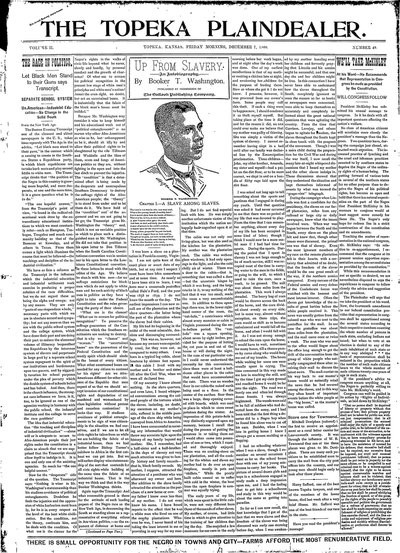
Page text (machine-generated)
THE TOPEKA PLAINDEALER.
VOLUME II.
Let Black Men Stand to their Guns says Transcript.
SEPARATE SCHOOL SYSTEM
Un.American--Industrial Education-No Change in the Solid South
From the New York Age.
The Boston Evening Transcript one of the cleanest and ablest newspapers in the U. S., takes issue squarely with The Age in the advice, "Let black men stand to their guns," in the contest which is coming to create in the Southern States a Republican party, in which black republicans are to take back seats and play second fiddle to white men. The Transcript thinks that "the position of the Negro in this country is growing more hopeful, and more desperate, at one and the same time, It is a grave question what he is to do."
"The one hopeful answer," from the Transcript's point of view, "is found in the radical educational work done by the extraordinary educational institutions to which we must constantly refer—such as Hampton, Tuskegee, Tougaloo and souch community building as that of the Bensons at Kowaliga, and of others in Texas. From them comes a light which illumines the course that must be followed—the teachings and discipline of the industrial civilization."
We have as firm a reliance as the Transcript in the influence which the industrial education and industrial settlement work exercise in producing a proper solution of the race difficulties, but we do not regard these as being the alpha and omega; not by any means. They are only "parts of one stupendous whoIe," necessary parts with which we are in absolute accord and sympathy; but not any more so than we are with the public school system and the college system, which have done their part and are doing their part to reduce the abnormal volume of illiteracy bequeathed the Republican by the intamous system of slavery and perpetuate in large part by a separate school system repugnant to the spirit of our institutions and burdensome upon tax-payers, and by niggardly taxation for school purposes under the plea of poverty which the double system of schools belies and has belied. And then, there is the church influence, the strongest race influence we have, is it, too, to be ignored as one of the agencies working in harmony with the public school, the industrial institute and the college to serve the race problem?
The idea that industrial education "the teaching and discipline of industrial civilization" —alone will or is adequate to secure to Afro-American people their just rights under the constitution is a claim so absorb that we are surprised that the Transcript should allow itself to indulge in it. It is one and only one of the assisting agencies. So much for "the one helpful answer."
Now for the "desperate" side of the question. The Transcript says: "Nothing is wiser in Mr. Washington's statesmanship than his studious avoidance of political entanglements. Doubtless he feels the injustice and the oppression of white barbarism most keenly, for he is in every respect on the level of the best white civilization. But the condition, not the theory, confronts him, and he deals with the condition. Of what use is the clamor for the
Negro's rights in the walks of civic life beyond what he earns, slowly and hardly, by personal conduct and the growth of character? Of what use to scream for political recognition in the present low stage of white men's principles and white men's action? Assert the even right, no doubt, but act on ascertained bases. It is industrially that the fabric of the black man's house must be builted."
Because Mr. Washington may consider it wise to keep himself and his educational work out of "political entanglements" is no reason why other Afro-Americans as wise as he, but unhampered as he is, should sit idly by and allow their political rights to be slaughtered by the vile Tillmans and Waddells and the likes of them, scum and fungi of American politics as they are, without fighting in the open and into the last ditch to prevent the injustice. The "condition" is that a determined effort is being made by the desperate and unscrupulous Southern Democracy to destroy the suffrage rights of the Afro-American people; the "theory" is to stand from under and to let them do it. We have hold of the "condition" end of the argument and we are not going to let go; the Transcript gives Mr. Washington the "theory" end, which is not an enviable position in which to place such a distinguished man as Mr. Washington. He did not take that position in his open letter to Ben Tillman when the South Carolina Constitutional convention was in session nor in his open letter to the Louisiana Constitutional convention. In these letters he stood with the editor of the Age. We believe he stan. ls with him now—for no suffrage restrictions for black men which do not apply to white men and for such activity of black men in politics as they have a right to take under the Federal Constitution and the rules governing the party of their choice.
"What use is the clamor? "What use to scream for political recognition?" To preserve the suffrage guarantees of the Constitution which the Southern reactionists are seeking to destroy. that is why we "clamor" and "scream." The "ascertained bases" are the guarantees of the Federal Constitution and the manly spirit which should abide in the breast of every citizen. What other ascertained bases are needed for any citizen to contend for his rights? Are we Afro-Americans different for other citizens of the Republic that men expect of us that we should accept invasion of our constitutional rights and degradation of our manhood and womanhood by class legislation without protest and ceaseless contention? It looks that way. If studious avoidance of political entanglements to be sign of wise citizenship in the situation we find ourselves, and if we are to let all civic rights be taken from us while we are building the fabric of an industrial house, then we had better follow Bishop Turner's rainbow to Africa in the first catboat we can get into. But we will rather display wise statesmanship of the sort that contends for all civic rights while building at the same time the fabric of an industrial house. That is the way we think and that is the way Booker Washington thinks.
Again says the Transcript: And what reasonable ground is there for the attitude of such leading papers of the Negro race as the New York Age, in denouncing the South as standing alone as a representative of everything odious in American politics,—as the exponent of dishonor at home and (Continued on Page Two.)
TOPEKA, KANSAS, FRIDAY MORNING, DECEMBER 7, 1300.
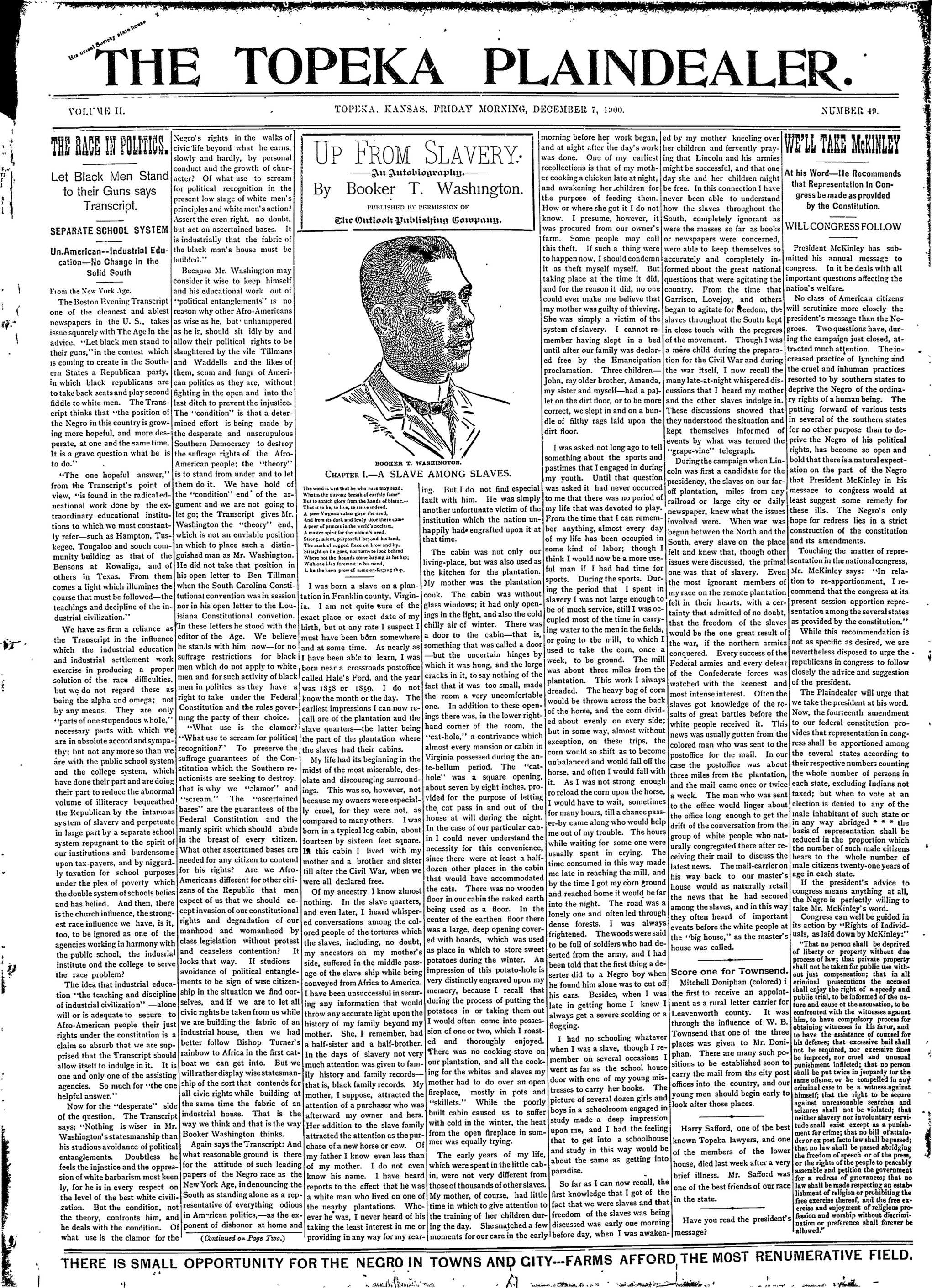
BOOKER T. WASHINGTON.
CHAPTER I. A SLAVE AMONG SLAVES.
The word is wit that he who runs may read. What is the passing breath of earthly fame? But to snatch glory from the hands of blame,—That is to be, to live, to strive ended, to be the sacrifice can be the need. And from its data, and lowly door there came a peer of princes in the world's acclaim, a master spirit for the nation's need. Strong, silent, purposeful beyond his kind, the mark of rugged force on brow and lip, Straight on he goes, nor turn to look behind Where hot the hounds come by his hip; With one idea foremost in his mind, Like the keen prow of some on-forging ship.
ing. But I do not find fault with him. He was another unfortunate victim institution which the nai happily had engrafted up that time.
The cabin was not of living-place, but was also the kitchen for the pla
I was born a slave on a plantation in Franklin county, Virginia. I am not quite sure of the exact place or exact date of my birth, but at any rate I suspect I must have been born somewhere and at some time. As nearly as I have been able to learn, I was born near a crossroads postoffice called Hale's Ford, and the year was 1858 or 1859. I do not know the month or the day. The earliest impressions I can now recall are of the plantation and the slave quarters—the latter being the part of the plantation where the slaves had their cabins.
My life had its beginning in the midst of the most miserable, desolate and discouraging surroundings. This was so, however, not because my owners were especially cruel, for they were not, as compared to many others. I was born in a typical log cabin, about fourteen by sixteen feet square. In this cabin I lived with my mother and a brother and sister till after the Civil War, when we were all declared free.
Of my ancestry I know almost nothing. In the slave quarters, and even later, I heard whispered conversations among the colored people of the tortures which the slaves, including, no doubt, my ancestors on my mother's side, suffered in the middle passage of the slave ship while being conveyed from Africa to America. I have been unsuccessful in securing any information that would throw any accurate light upon the history of my family beyond my mother. She, I remember, had a half-sister and a half-brother. In the days of slavery not very much attention was given to family history and family records—that is, black family records. My mother, I suppose, attracted the attention of a purchaser who was afterward my owner and hers. Her addition to the slave family attracted the attention as the purchase of a new horse or cow. Of my father I know even less than of my mother. I do not even know his name. I have heard reports to the effect that he was a white man who lived on one of the nearby plantations. Whoever he was, I never heard of his taking the least interest in me or providing in any way for my rear-
ing. But I do not find especial fault with him. He was simply another unfortunate victim of the institution which the nation unhappily had engrafted upon it at that time.
The cabin was not only our living-place, but was also used as the kitchen for the plantation. My mother was the plantation cook. The cabin was without glass windows; it had only openings in the light, and also the cold chilly air of winter. There was a door to the cabin—that is, something that was called a door—but the uncertain hinges by which it was hung, and the large cracks in it, to say nothing of the fact that it was too small, made the room a very uncomfortable one. In addition to these openings there was, in the lower right-hand corner of the room, the "cat-hole," a contrivance which almost every mansion or cabin in Virginia possessed during the ante-bellum period. The "cat-hole" was a square opening, about seven by eight inches, provided for the purpose of letting the cat pass in and out of the house at will during the night. In the case of our particular cabin I could never understand the necessity for this convenience, since there were at least a half-dozen other places in the cabin that would have accommodated the cats. There was no wooden floor in our cabin the naked earth being used as a floor. In the center of the earthen floor there was a large, deep opening covered with boards, which was used as place in which to store sweet potatoes during the winter. An impression of this potato-hole is very distinctly engraved upon my memory, because I recall that during the process of putting the potatoes in or taking them out I would often come into possession of one or two, which I roasted and thoroughly enjoyed. There was no cooking-stove on our plantation, and all the cooking for the whites and slaves my mother had to do over an open fireplace, mostly in pots and "skilllets." While the poorly built cabin caused us to suffer with cold in the winter, the heat from the open fireplace in summer was equally trying.
The early years of my life, which were spent in the little cabin, were not very different from those of thousands of other slaves. My mother, of course, had little time in which to give attention to the training of her children during the day. She snatched a few moments for our care in the early
morning before her work began, and at night after the day's work was done. One of my earliest recollections is that of my mother cooking a chicken late at night, and awakening her children for the purpose of feeding them. How or where she got it I do not know. I presume, however, it was procured from our owner's farm. Some people may call this theft. If such a thing were to happen now, I should condemn it as theft myself myself. But taking place at the time it did, and for the reason it did, no one could ever make me believe that my mother was guilty of thieving. She was simply a victim of the system of slavery. I cannot remember having slept in a bed until after our family was declared free by the Emancipation proclamation. Three children—John, my older brother, Amanda, my sister and myself—had a pallet on the dirt floor, or to be more correct, we slept in and on a bundle of filthy rags laid upon the dirt floor.
I was asked not long ago to tell something about the sports and pastimes that I engaged in during my youth. Until that question was asked it had never occurred to me that there was no period of my life that was devoted to play. From the time that I can remember anything, almost every day of my life has been occupied in some kind of labor; though I think I would now be a more useful man if I had had time for sports. During the sports. During the period that I spent in slavery I was not large enough to be of much service, still I was occupied most of the time in carrying water to the men in the fields, or going to the mill, to which I used to take the corn, once a week, to be ground. The mill was about three miles from the plantation. This work I always dreaded. The heavy bag of corn would be thrown across the back of the horse, and the corn divided about evenly on every side; but in some way, almost without exception, on these trips, the corn would so shift as to become unbalanced and would fall off the horse, and often I would fall with it. As I was not strong enough to reload the corn upon the horse, I would have to wait, sometimes for many hours, till a chance passer-by came along who would help me out of my trouble. The hours while waiting for some one were usually spent in crying. The time consumed in this way made me late in reaching the mill, and by the time I got my corn ground and reached home it would be far into the night. The road was a lonely one and often led through dense forests. I was always frightened. The woods were said to be full of soldiers who had deserted from the army, and I had been told that the first thing a serter did to a Negro boy when he found him alone was to cut off his ears. Besides, when I was late in getting home I knew I always get a severe scolding or a flogging.
I had no schooling whatever when I was a slave, though I remember on several occasions I went as far as the school house door with one of my young mistresses to carry her books. The picture of several dozen girls and boys in a schoolroom engaged in study made a deep impression upon me, and I had the feeling that to get into a schoolhouse and study in this way would be about the same as getting into paradise.
So far as I can now recall, the first knowledge that I got of the fact that we were slaves and that freedom of the slaves was being discussed was early one morning before day, when I was awaken-
ed by my mother kneeling over her children and fervently praying that Lincoln and his armies might be successful, and that one day she and her children might be free. In this connection I have never been able to understand how the slaves throughout the South, completely ignorant as were the masses so far as books or newspapers were concerned, were able to keep themselves so accurately and completely informed about the great national questions that were agitating the country. From the time that Garrison, Lovejoy, and others began to agitate for freedom, the slaves throughout the South kept in close touch with the progress of the movement. Though I was a mere child during the preparation for the Civil War and during the war itself, I now recall the many late-at-night whispered discussions that I heard my mother and the other slaves indulge in. These discussions showed that they understood the situation and kept themselves informed of events by what was termed the "grape-vine" telegraph.
During the campaign when Lincoln was first a candidate for the presidency, the slaves on our far-off plantation, miles from any railroad or large city or daily newspaper, knew what the issues involved were. When war was begun between the North and the South, every slave on the place felt and knew that, though other issues were discussed, the primal one was that of slavery. Even the most ignorant members of my race on the remote plantation felt in their hearts, with a certainty that admitted of no doubt, that the freedom of the slaves would be the one great result of the war, if the northern armies conquered. Every success of the Federal armies and every defeat of the Confederate forces was watched with the keenest and most intense interest. Often the slaves got knowledge of the results of great battles before the white people received it. This news was usually gotten from the colored man who was sent to the postoffice for the mail. In our case the postoffice was about three miles from the plantation, and the mail came once or twice a week. The man who was sent to the office would linger about the office long enough to get the drift of the conversation from the group of white people who naturally congregated there after receiving their mail to discuss the latest news. The mail-carrier on his way back to our master's house would as naturally retail the news that he had secured among the slaves, and in this way they often heard of important events before the white people at the "big house," as the master's house was called.
Score one for Townsend. Mitchell Doniphan (colored) i the first to receive an appointment as a rural letter carrier for Leavenworth county. It was through the influence of W. B. Townsend that one of the three places was given to Mr. Doniphan. There are many such positions to be established soon to carry the mail from the city post offices into the country, and our young men should begin early to look after those places.
Harry Safford, one of the best known Topeka lawyers, and one of the members of the lower house, died last week after a very brief illness. Mr. Safford was one of the best friends of our race in the state.
Have you read the president's message?
NUMBER 49.
WE'LL TAKE McKINLEY
At his Word—He Recommends that Representation in Congress be made as provided by the Constitution.
WILL CONGRESS FOLLOW
President McKinley has submitted his annual message to congress. In it he deals with all important questions affecting the nation's welfare.
No class of American citizens will scrutinize more closely the president's message than the Negroes. Two questions have, during the campaign just closed, attracted much attention. The increased practice of lynching and the cruel and inhuman practices resorted to by southern states to deprive the Negro of the ordinary rights of a human being. The putting forward of various tests in several of the southern states for no other purpose than to deprive the Negro of his political rights, has become so open and bold that there is a natural expectation on the part of the Negro that President McKinley in his message to congress would at least suggest some remedy for these ills. The Negro's only hope for redress lies in a strict construction of the constitution and its amendments.
Touching the matter of representation in the national congress, Mr. McKinley says: "In relation to re-apportionment, I recommend that the congress at its present session apportion representation among the several states as provided by the constitution." While this recommendation is not as specific as desired, we are nevertheless disposed to urge the republicans in congress to follow closely the advice and suggestion of the president.
The Plaindealer will urge that we take the president at his word. Now, the fourteenth amendment to our federal constitution provides that representation in congress shall be apportioned among the several states according to their respective numbers counting the whole number of persons in each state, excluding Indians not taxed; but when to vote at an election is denied to any of the male inhabitant of such state or in any way abridged * * * the basis of representation shall be reduced in the proportion which the number of such male citizens bears to the whole number of male citizens twenty-one years of age in each state.
If the president's advice to congress means anything at all, the Negro is perfectly willing to take Mr. McKinley's word. Congress can well be guided in its action by "Rights of Individuals, as laid down by McKinley:"
"That no person shall be deprived of liberty or property without due process of law; that private property shall not be taken for public use without just compensation; that in all criminal prosecutions the accused shall enjoy the right of a speedy and public trial, to be informed of the nature and cause of the accusation, to be confronted with the witnesses against him, to have compulsory process for obtaining witnesses in his favor, and to have the assistance of counsel for his defense; that excessive bail shall not be required, nor excessive fines be imposed, nor cruel and unusual punishment inflicted; that no person shall be put twice in jeopardy for the same offense, or be compelled in any criminal case to be a witness against himself; that the right to be secure against unreasonable searches and seizures shall not be violated; that neither slavery nor involuntary servitude small exist except as a punishment for crime; that no bill of attainment or ex post facto law shall be passed; that no law shall be passed abridging the freedom of speech or of the press, or the rights of the people to peaceably assemble and petition the government for a redress of grievances; that no law shall be made respecting an establishment of religion or prohibiting the free exercise thereof, and the free exercise and enjoyment of religious profession and worship without discrimination or preference shall forever be allowed."
Entered at the postoffice at Topeka, Kansas,
hawnee county, as second class mail matter.
SUBSCRIPTION RATES:
One year, by mail ..... $100
Six months, by mail ..... 750
Three months, by mail ..... 500
NICK CHILES, - - Business Manager
J. H. CHILDRENS, - - Editor.
FRIDAY, DEC. 7, 1900.
[In order to insure publication of
matter in the current issue, correspondence must be in this office not
later than Tuesday.]
KANSAS
SEMI CENTRAL
EXPOSITION
TOPEKA
1905
Every time those hot-headed southerners run against Tom Fortune's buzsaw something happens. Here is what he says about the editor of the Atlanta Constitution in the last issue of New York Age:
The Hon. Clark Howell is a mighty man in Georgia politics of the rank southern sort, which has long been a menace to the national honor and credit. He is also editor of the Atlanta Constitution, the most influential and dangerous newspaper in the southern states.
By virtue of his position in the Constitution Howell controls virtually the Southern Press association, which is a feeder for the Associated Press, which furnishes the news to the great newspapers of the northern and western states. The censorship which Howell is enabled to exercise over all news matter originating in the southern states can readilly be perceived. For a great many years it has been a notorious scandal in the journalism of the republic, that the Southern Press association has been engaged in a deliberate conspiracy to falsify the position in every particular of the Afro-American people in the southern states, and through the Associated Press to create a sentiment of distrust and antagonism to the Afro-American people by the people of the northern and western states. How far this conspiracy has succeeded is so well known to those on the inside that it is not necessary to enlarge upon it, here and now. But it must always stand in the annals of journalism as one of the most gigantic crimes that ever went unwhipped of justice. In how far Clark Howell and the Atlanta Constitution have been responsible for this conspiracy against the rights and liberties of a people, who have not been in a position to defend themselves, it would be hard to say; but that their responsibility has been great our close observation of the situation for 24 years enables us to declare without fear of successful contradiction.
It will never be possible by criminal process to punish Clark Howell and the Southern Press association for the long and systematic perversion of the news and opinions bearing upon Afro-Americans, with the studied purpose to degrade them in their manhood, and to justify robbery of their civil and political rights, and the mobocratic practices of the southern white men.
But their is a higher court than that instituted and presided over by human agencies. The judge of this higher court has declared: "Vengeance is mine; I will repay." He will take his time. When the united press of the south, with some unchronicled Clark Howell as censor of its news undertook to justify and to perpetuate slavery and the nameless horrors which naturally existed under it, in due course of time, God had his vengeance and he did repay, in the thunders of war where vast loss of life and devastation of property led to the
emancipation and enfranchisement of the slave. Clark Howell and his fellow conspirators may not see the hand of God in this consummation, although they profess to be christians and to believe that God deals directly in the affairs of men; we firmly believe that in the goodness and fullness of time there will come a reckoning of the account that the Afro-American people have against Clark Howell and his fellow conspirators.
It is conceivable to us that Howell as the mouthpiece of the Southern Press association could request of the managers of the papers of northern and western states, that they say as little as possible in their news and editorial columns about the relations of the blacks and whites in the south; but it is not conceivable to us that the managers of the northern and western papers would do otherwise than resent with scorn any such presumptuous censorship. Such request was made by Clark Howell, and it goes without saying that in a vast number of cases it was granted.
There is no way to perpetuate wrong. No conspiracy against justice and fair play can ever permanently hitch itself upon the wheels of evolution. No suppression of honest news and no manufacture of false opinion will ever be successful in the end, simply because through all of nature there runs a controlling force which makes all things work together for what is right in the orderly progress of human development.
"UP FROM SLAVERY."
The many readers of the Plain-dealer may congratulate themselves on the special privilege of reading the latest work of Mr. Booker T. Washington, the great race educator. We are enabled to present this series of articles to our readers through the kindness and courtesy of the Outlook company. No one Negro in America at this time is doing more to solve the race problem than Mr. Washington. There is about his work an utter absence of selfishness. While other leaders, equally as sincere, have sought to benefit the race by creating new desires and aspirations, drawing the young element of the race away from the ordinary walks of life, Mr. Washington on the other hand, has sought to teach the dignity of labor be it ever so humble. He is striving earnestly to instill into the minds of the young people of the race the necessity of being able to do something and being able to do it well. His success is the result of his own efforts. He has not sought to attain success through a superabundance of Greek and Latin. He urges the importance of a classical education, but reminds us that we are a struggling race, and that our greatest need is a practical knowledge of every day affairs.
The story of Mr. Washington's struggles as told by himself will form an interesting chapter in the race's history. It is with a feeling of deep appreciation for the kindness of the publishers of the Outlook that we present these excerpts to our readers.
Brother Rivers of the Colorado Statesman had a nightmare the other night and here is what he said in his sleep:
Our contemporary, the Statesman, has been "ensmalled." It is now down to handbill size, and celebrates the event by resorting to small criticisms. We shall go right on printing the truth and publishing the biggest and best race newspaper in the West. We advise the young man to take a squint along his gun barrel at the Omaha Progress, the Enterprise, and then take a look at. We're-modest.
Mr. and Mrs. E. J. Davis were guests of relatives in Topeka Thanksgiving.
Rev. Scott was in Holton last week on business.
Mrs. L. Parks and daughter spent Thanksgiving in Horton with relatives and friends.
Mrs. Fleming of Horton is visiting her mother-in-law and other relatives in Lexington, Mo.
Mr. Plumb and family spent Thanksgiving with his sister Mrs. Daniels.
An entertainment was given by the A. M. E. members Thaksgiving day and a grand success was reported.
Rev. Brown preached at the Methodist church Sunday as usual.
The literary will have an entertainment Dec. 13.
Rev. Tutt has been conducting a protracted meeting the past week.
The literary has been reorganized. All are invited to attend.
Wm. Davis and Birdie Holton were joined in wedlock Thursday, Nov. 29, 1900, by Rev. Spealand, at the home of the bride's parents. The house was beautifully decorated with lights, chrysanthemums, carnation pinks and ivory vines. At 8:30 promt the wedding march was played on the guitar and mandolin by Prof. Mack and Hughes of Troy, Ks., when the bride was given away by her father. The bride was dressed in a beautiful white cashmere, trimmed in white silk lace, and carried a bouquet of carnations. The groom was dressed in conventional black. After the ceremony the guests were invited in to partake of all such good things that Thanksgiving could afford, after which a number of beautiful and useful presents were given the happy couple.
JOPLIN, MO.
Miss Ethel Murray left for Vinita, I T, Sunday morning, where she will remain indefinitely. She will be much missed in the social circles here.
Mrs. Kelso entertained at dinner Thanksgiving. Those present were Mr. Deane and wife, Mr. Sears and wife, Mrs. Murray and daughter, Ethel; the dinner was a very elaborate affair consisting of all the delicacies of the season.
Mrs. Stewart, who has been very ill at her home on Missouri avenue, is improving.
The Tableaux given Wednesday evening under the management of Madames Cunningham and Kelso was a great success; the children were well drilled and the musical part of the program was excellent; the entertainment reflected much credit upon the ladies.
Mrs. Curtis and daughters, Lulu and Stella, spent Tnauksgiving in the city.
Mrs. Touy Williams and little daughter are visiting her parents in Phoenix, Arizona
Mrs Mary S Laugston of Lawrence, Kas arrived in Joplin Saturday last to visit her daughter, Mrs C M Hughes.
Nannie Ewing is visiting in Please anton, Kas.
The Baptist church held its rally Sunday, December 2. The members are striving to erect a new building on their lot. Total amount raised in rally by clubs, $78 19; by general collection, $7 95, making total of $84 14. It is a very good start towards the new church.
Pearl Merritt-Scott of Kansas City, spent Thanksgiving in the city, the guest of her mother, Mrs Kelso.
There will be a grand sacred concert given at the Union Baptist church Sunday night, December 9, under the WCT U, of which Mrs Knave is the president
The weekly meetings of the "Home Mission" are very interesting; the programs are usually good, the debates and mock trials create a great deal of
Mr and Mrs Gamble have returned from Mexico, Mo, where they have been for the last two or three months
Mr McNeal has returned to Kansas City
Mfs Cox is very ill at her home on Wall street
There were four "swell" balls given Thanksgiving night: a masquerade ball, a fancy dress ball, a concert and ball combined, and last, but not least, a little dance—which may not reach the dignity of being a ball
Mrs Payne of Guthrie, Okla is in the city for a few weeks
The colored school, under the efficient principalship of Prof N Smith, is progressing very nicely; they have an enrollment of about 120 pupils, seven of whom are in the finishing class, which will be the largest class ever "turned out" here The "Mason" restaurant on Second street is doing a flourishing business; when in the city, give them a call
EMPORIA.
David Watson of Atchison is attending normal.
The banquet given at Perley's hall Friday evening was among the swellest things of the season among the young people. The Misses Tipton served lunch, while Belle Guy of Ft. Scott and Enola Lacy of Lawrence composed the orchestra.
Mr. Stovall of Neosha Falls visited with us this week.
Birdie Council and Carrie Phenix are home from Parsons where they spent Thanksgiving.
Hester Hawkins and Felicia Davis attended the Jolly Four banquet.
Anna Stafford entertained at her home down the lane Thanksgiving day, After the big dinner the evening was spent in various games until about 7:30, when all attended the show Quo-Vadis.
Martin Hooker of Council Grove attended the Jolly 4.
Quarterly meeting was held at the C M. E, church Sunday.
Leslie Harrison and wife have the sympathy of their many friends in their bereavement, the loss of their little one.
A surprise party was given on Rev. W. Pollet's wife Saturday in honor of her birthday.
Thomas Starkey is slowly recovering from a broken leg.
Rev. C.C. Mitchell and family have moved to Oklahoma City, Okla., where he has charge of a church.
The ladies of the Eastern Star gave a banquet in the Masonic hall Friday evening which was greatly enjoyed. A sumptuous supper was served.
The Afro-American league met in regular session Monday November 26, with J. B. Olair in chair. Enthusiasm ran high and a very interesting meeting was held. Two new members were added and P. F. Lewis was elected corresponding secretary. After several very encouraging speeches the meeting adjourned to meet again the second Monday in December, and with this there is to be a very interesting program. Prof. William Hayt made a flying business trip to Newton Saturday.
The party given in Perley's hall by the Jolly Four was one of the grandest affairs we have witnessed this season and was highly enjoyed. The out of town people were Misses Enola Lacy and Delia Tipton, Mes-rs. E. J. Hawkins, Ft. Scott and W. S. Watson, Plymouth.
Mrs. Belle Shakespeare returned to her home in Winfield after a few weeks visit with relatives and friends.
John Odair sold his restaurant to Messra. Boyd and Campbell of Iola.
Miss Hattie Walton and D. E. Henderson were elected delegates to represent the Educational Literary society at the Inter-State association in St. Joseph during holidays.
HIAWATHA
Quite a number of Sabetha people were down to spend their Thanksgiving with friends in the city and to attend the entertainment.
The club entertained Thursday night. All who attended report one of the pleasantest times they have attended for quite awhile.
Much to the surprise of all Roscoe Calvin of Powhattan and
Rosetta Ellington of Hiawatha were married Friday afternoon. Emery Alexander of Hiawatha and Retta Murphy of Sabetha were married Friday afternoon. It is whispered that another couple of our young people will soon be married. Rome Wilson of Falls City, Nebr. spent Sunday in Hiawatha, the guest of Chas. Banks. Thanksgiving services were observed at each of the churchea Thursday. Miss Gertie Gambols spent Sunday in town.
Mr. and Mrs. Porter Barnett of Kansas City Mo.. will make Hiawatha their home for the present.
Ray Calvin has returned to his home at Powhattan to assist his parents with the work on the farm.
Rev. House pastor of the A. M. E. church is quite well pleased with Hiawatha and its people.
John Ferril and Minnie Banks of Quindaro spent Thanksgiving with Emma Hughes.
Mrs. Sam Robinson of Falls City is the guest of her parents, G. Banks and wife.
Mrs. Frank Williams of Oak Mills is visiting her daughter, Mrs. Bellew.
Mr. Ellington and wife entertained in honor their daughter, Mrs. Roscoe Calvin.
Mr. Bertha Murray is visiting in Topeka.
Mr. Otis Graves furnished some very commendable violin music to the students of the High School at morning exercises last week. It was well appreciated by all.
NORTH TOPEKA.
Miss Lizzie Hatton and Willie Wimms were united in the happy bonds of wedlock Thanksgiving evening at the residence of the bride's parents, J. L. Hatton and wife, 1410 Van Buren street. Rev. J. E. Wilson performed the ceremony. Miss Inez Forte and Samuel Payne were the attendants. The bride wore a cream colored cashmere dress trimmed in white taffeta; she wore bridal rosea in her hair and carried a bouquet of bridal roses. Miss Forte was dressed in gray ladies' cloth with trimming of white satin. She carried chrysanthemums and wore a circle of crystals.
Mrs. Eppie Winnis played the wedding march they marched down stairs and stood under the arch of flowers which was neatly arranged in the south bay window. The rooms were decorated with palms and ferns. Many nice and useful presents were received. After the ceremony supper was served. Following is a letter of regret written to the bride and groom: "My Dear Young Friends: I regret that I will be unable to be present this evening on the joyous occasion of your marriage, so I send my sincerest congratulations, wishing you all the good that a long and useful life may have in store for you. May you ever be happy in each other's love is the wish of your friend, Mrs. A. J. Arnold."
Mesdames J. L. Hatton, Spencar,
Forte and Kerchival are on the sick
list this week.
John Henery of Lawrence spent a
few days in the city.
Misses Gertrude Winnus and Belle
Forte left Monday for Emporia to
attend the Normal.
Mrs. Eppie Small will leave soon
for Chicago.
Rev, P, D, Skinner is carrying on
a series of meetings at B street Baptist church.
Rosebud club No. 3 of St. Mark's
church raised $18.80. Mrs. H. Carnish is president.
Miss Rebecca Bledsoe is quite ill
at her home on N. Taylor street.
Mrs. Eliza Lyman has returned from Kansas City, Mo.
The rally at St. Mark's church Sunday was a success, $112.80 being raised. Rev. Wilson, pastor.
Dt Sarah Thomas, who departed this life September 5, 1900, was a member of Macedonia Tabernacle No 93 and of B street Baptist church; she was cared for by the members of both the lodge and the church; she was a faithful member of both church and lodge, and whenever their doors were open, Dt Thomas if able, was always found waiting to fill her place Dt Thomas' endowment will be paid off in 90 days from her death The members of the lodge want it distinctly understood to the relatives and outsiders of the Tabernacle that when time comes due for the endowment o our deceased Dt to be paid, it will be paid by our C G M of Kansas and Nebraska jurisdiction Outsiders who run their tongues faster as a light-
ning express car should join the order so that they would know the law of the order Busybodies who say the endowment of our deceased Dt should have been paid long ago should place a red hot sticking plaster over their mouths or a hot biscuit in their mouths so that they can mind their own business by cleaning up their houses, smoothing their mustaches and beard over, and the lodge can trausact its own business
The Race in Politics.
abroad? The solid South stands as a slave of Bryanism, says the the Age. Now if there is anything clear in the conduct of the South in the last election, it is that there was no heart in their support of the Democratic ticket, that in truth there is a manifest change going on which will bring about a new alignment of parties and the old aristocratical element of the slaveocracy is drifting toward its natural alliance with the aristocratical and imperialistic element of the whole country, and that there the new basis for political parties is to be found. The Age sees it, and does not appreciate its significance. It devotes its efforts to show to the Republican party that it has been making a mistake in conciliating the South.
We see nothing of the sort. We see that the South is solid and has been solid since 1876, as the Macon Telegraph has pointed out. We see no sign disposition on the part of the South through all the vista of the past to break away from the Democratic anchorage. Border States like Maryland. West Virginia, Kentucky and Missouri have done it and will do it again; but the South proper remains as solid as a brickbat. And our characterization stands unshaken by the record that the South stands alone as the representative of every thing odious to American politics—as the exponent of dishonor at home and dishonor abroad,—for did it not support Bryan and the Chicago platform in 1896? Did it not support Bryan and the Kansas City platform in 1900? Verily, it did. And do not these two platforms embody everything odious in American politics? The American people have so declared emphatically in two presidential elctions.
The Transcript says further: Has the Republican party shown any disposition to maintain the Negro in his rights? Has the republican administration through any, even the least of its members uttered a word in remonstrance against the disfranchisement of the Negro? Much savage criticism was visited upon Mr. Bryan in the just closed campaign because he did not utter such word. The New York Age was most severe. But why should more have been asked of this Democratic candidate for the presidency, than of the other candidate, himself president, and head of the Republican party, who yet had nothing whatever to say on this mater?
The Republican party has left us alone since 1876 in affirmative legislation, it is true, but it has resisted every effort of the Democratic party in congress to abridge our rights. It could not interfere in the disfranchisement action of the Southern States, because we have established judicial tribunals to adjudicase such State action. The administration has made no pronouncement upon the disfranchising schemes of the South because the question is a judicial and not an executive one, and such a pronouncement would have been gratuitous. We wanted Bryan to declare himself as he had never put himself on record. McKinley had declared himself as a major in the war of the Rebellion, as a member of congress, as governor of Ohio and as president of the United States. We know his record, and that of his party. Bryan had no record of the Democratic party, with Ben Tillman as the framer and interpreter, of the Kansas City platform.
Australian Institute Notes.
The young men in the carpentry and paint department are making rapid progress, Mr. J. L. Buckner the instructor is thoroughly competent and his departments show signs of considerable advancement.
The literary and musical concert Monday night surpassed the expectations of the most sanguine persons. Quite a neat sum was realized and it will be used to turnish the reception.
Prof. Geo W. Jackson of the musical department requestf all of the young men of the band to meet in the assembly hall at 4 o'clock Monday afternoon.
Miss Jessie Coleman of the 1st Normal has been sick for the past week. Her many friends wish for her speedy recovery.
Views have been taken of Christman and Industrial balls, the students will be pleased to furnish them to the friends of the work, they are thirty-five cents a piece.
We hope to hear from more parents relative to placing their children in school after the holidays. Superior advantages are offered; write to the principal at once.
The printing department has been doing considerable job work this month, our work and prices always please.
We take this means of thanking the ladies and gentlemen who so kindly participated in the recital at Monday night. we feel very grateful to all who contributed in any way towards the success of the evening.
FIRE ENGINE
406 Kansas Avenue. Phone 52
Shampooing and Face Massage.
Mrs. Hattie E. Van Vleck,
Hair Dresser and
Manufacturer.....
Hair to match all Complexions.
WITCHES AND HAIR JEWFLRY
220 East Fifth Street, Poeka, Kansas
Topeka Educational
and Industrial
Institute.
Non sectarian. co educational, practical education of the Negro youth. Courses: English, normal, industrial, music and business. Tuition $1.00 per month each department, $1.50 per month literary and industrial courses combined; board, room, light, fuel and tuition, $7.50 per month. For further information, address W.R. CARTER. Principal.
Great Rock Island Route
OFFICE OF ASST. GEN.L'PASS, AND TKT
AGT C R I & P K.
Cheap Excursion rates to Colorado.
BEST LINE TO DENVER
ONLY DIRECT LINE TO COLORADO
SPRINGS AND MANITOU.
Take advantage of these cheap rates and spend the vacation in Colorado. Sleeping car reservations may be made now for any of the excursions Write for full information and the beautiful book "COLORADO THE MAGNIFICFNT"—ent free.
JNO. NEBERIAN,
G P & I A. Chaco, III
E. W. THOMPSON,
A G P. & T A. Topoka, Kas.
NELSONS
STRAIGHTINE
THE
LATEST DISCOVERY
FOR MAKING
KNOTTY, KINNY, CURLY HAIR STRAIGHTE
BEFORE
AFTER
STRAIGHTINE is a safe, certain, safe
stable preparation. It is also in free
from all injurious chemicals and cannot
straighten all the hair, but it should be
stimulate the roots of the hair at it from
falling out, and produce a rich, long, and
luxurious head of hair, and all kinds of
fur, and is used for all purposes.
Fumed, and is in every way an excellent
attache to the toilet. It has been tested by the
sands with the unmanicured vera that it is
absorbed by. It is also used for drug stores or sent by mail to any address
for 30 cents in stamp. Address: NELSON
MANUFACTURING CO. Richmond, Va.
Agents wanted. Write for terms.
PRIDE OF TOPEKA TENT No. 36, meets 1st and 3rd Saturday afternoon of each month at No. 900- North Kanasa avenue. Mrs. Ida M. Jordan, Q. M., Miss Anna Reynold, C. R.
Mrs J. Scott is improving.
Mrs. Jordan is visiting relatives in Perry Kans.
Rev. Brown of Troy Kan., is visiting his wife.
Prof. Johnson is suffering from spinal trouble.
Melissa Murdock on Topeka avenue is very low.
Miss Carrie Scott returned home last Friday from Chicago.
Augustus Bell of Wathena spent Thanksgiving in the city.
Mrs. Amanda Parks is quite ill at her home in the country.
A. J. Johnson and wife of Ft. Scott are in the city on business.
Mrs. Maggie Adams and her mother Mrs. Lewis are quite ill.
Miss Kate Harris is visiting relatives and friends in Ft. Scott.
Prof. Vernon of Quindaro was in the city last week on business.
Miss Laura Anderson of Leaven worth will visit Miss Willa Smith.
Miss Gertrude Moody is visiting Mr. and Mrs. Holloway of Holton.
Mrs. Julia McVey of Craue and Monroe is seriously ill with stomach troubles.
Mrs. Geo. Buford and little daughter have returned from a visit to Chicago.
Mr. Ike James of Kansas City Kan spent a few hours in the city Thursday.
A. R. Eagleson, F. A. Moss and P. Burnett will spend the holidays in the city.
Mrs. Henry Fuel and Mrs. Hopkins of Lawrence spent Thanksgiving Day in the city.
C. McNary of Nashville Tonn, is visiting sister, Mrs Tellis, and brother Chas McNary.
Mrs. Fanny Grey of Leavenworth was the guest last week of Mr. and Mrs. Charles Morton.
The Rosebud club will meet Saturday afternoon with Mrs. J. S. Banks 1323 Van Buren street.
Mrs. Kate Jones is ill at the home of her sister Mrs. Lou Jefferson, who is not expected to live.
Mr George Everitt of Independence Kana, was in the city a few days the guest of Miss Grace Hines.
Mrs. Lou Bailey was painfully scalded last week while engaged in her duties at Crystal steam laundry.
Mrs. Jacobs and grandson Chas. of Kansas City Mo., are the guests of daughter and mother Mrs. J. M. Wright
Chas., John and D. E. Overs and of Kansas City spent Thanksgiving in the city visiting relatives and friends. Mrs. James Turner returned last Thursday from Kansas City, having spent several months very pleasantly in that city.
Mr and Mrs J M Wright and Miss Willa Smith were sponsors for a very delightful party given at Masonic hall Friday Nov. 30; those present were such as delight in those gentle and graceful exercises that are inspired by music especially music written in waltz time, march-time ragtime or any old time suitable to such occasion The refreshme ns consisted of light conversation and making "goo goo" eyes Guy's orchestra furnished the music
The Ladies Aid society, of the Second Christian church have been entertained by the following ladies who served very profitable luncheons: Miss Susie Thompson, Mrs Jas. Brown Mrs. A. M. Thomas, Mrs. J. Sharp and Mrs. J. E. Jeltz. Rev. B. C. Duke and congregation wish to extend their thanks to the many friend- who so liberally contributed to their rally. The amount raised was $74 31 The city Sunday School union have elected the following officers for the ensuing year; B. C. Duke Pres; Mrs. R. H. Wade, Vice Pres; Mrs. Julia Abbott, Soc.; W. W. Buckner, Treas.
The musical and literary concert given at the Industrial Institute, Monday evening, was a smoot splendid success. The attendance was large beyond all expectations and showed that the people of Topeka are deeply interested in this school. Less than one half of the audience found seats, and quite a large part was forced to remain in the halls, the dining room; and even the kitchen was utilized in taking care of the crowds. The program represented some of Topeka's best musical and literary talent and each number received generous applause from an appreciative audience. Prof. Carter and those who assisted him are to be congratulated upon the success of the entertainment.
THE TEMPLAR'S DAY
Thankgiving day was very fittingly celebrated by the Missouri Valley Templars in Topeka last week. Visitors began arriving the day before and by noon of Thankgiving day, nearly one hundred and fifty guests had been registered at the Templars headquarters 618 Kansas avenue dinner for the visiting Knights was prepared and served by the Ladies sewing circle of the A M E church It was sumptuous and toothsome From 2 p m an informal reception was held at the Asylum of Cyrene Commandry Promptly at 3 p m the Templars headed by the Twenty-third Kansas Military band paraded through our principal streets They made an imposing spectacle Capt Reynolds as marshall of the oay deserves much credit for the orderly manner in which the parade was handled
It was 5 30 p m when the doors of the banquet room were thrown open and the Sir Knights headed by the Grand officers of both Kansas and Missouri marched in The banquet room was a thing of beauty and reflects great credit upon the ladies who decorated it and spread the tables Scattered about in appropriate places were profusions of palms, potted plants and cut flowers. The alter presented a beautiful scene draped in white and lighted with wax candles Sir J H Childers as chairman of the executive committee introduced Sir S H Thompson Grand commander of Prince Hall Grand commandery of Kansas, who very gracefully filled the position of master of cermones Sir Geo Smith D G C Kansas delivered in his usual happy manner the address of welcome which was responded to by Sir J H Green of St Joe Mo; with but two exceptions the program of the banquet was carried out; we take pleasure in referring to the responses of Sir M O Ricketts of Omaha to "The Craft and my People" Sir H Jones and Sir A P Smith of Topeks on "What we can do?"
Music during the banquet was furnished by Guy's orchestra. The exhibition drill at the Auditorium in the evening was witnessed by a large crowd, three drill corps competed for the prize which was awarded to drill corp representing Emanuel Commandry No. 25 of Kansas City Mo, commanded by Sir John L Miner. The drilling of Northwest No. 6 under Sir Gentry Carpenter was most excellent and deserves much praise Cyrene Commandry under Sir James Mason presented an unique appearance clad in ancient Templar dress.
Cyrene Commandery is under many obligations to the ladies who so kindly gave their services that the banquet room might be a scene not to be forgotton.
The executive committee will meet in St Joeph Mo on January 15th 1901 to arrange for the next place of meeting. Leavenworth and St Joseph are asking for the conclave.
Sir L W Jolly and H H Hill represented Passion Cross No. 1 of Leavenworth. They are a jolly pair. Sir W Jones of St Joseph, J. L Miner, and J M Mason of Topeka are a trio of drill masters hard to beat. Their teams will meet any in the country.
There were representatives present from Ivanhoe No 9 Omaha; Northwest No 6 St Joseph; Far west No 3, and Emmanuel No 25 Kansas City, Royal Path No 2 of Kansas City Kan; Passion Cross No 1 Leavenworth and Antioch No 8 of Ft Scott.
Major Geo Ford makes a good after dinner speaker.
where shall we meet November 28th 1901?
The Oak club met with Mrs, J. M. Rivers 1415 Tyler; a very pleasant afternoon was spent in needle work; the current topic was discussed by Mrs Washington and quite interesting the next meeting will be with Mrs Ware 119G Lane street.
The marriage of Mrs. Celia Clark and N. C. Anderson took place Thanks giving at 10 o'clock a.m. at the home of the bride's parents, Mr. and Mrs Geo. Clark on Logan. The arrangements were exceedingly simple and pretty, the parlor was decorated with palms and ferns a bank of them forming a back ground for the bridal party The bride and groom entered together preceded by the best man and matron of honor, Mr. and Mrs. R. P. Jones. The ceremony was performed by the Rev. T. J. Moppins. The bride wore a tailored suit of mode with tailor hat to match. She carried a single long stem white rose. Those present were; Rev. Moppins and wife, Rev. Stoner and wife; R. P. Jones and wife; Mesdames Manson, Sneed, Jones and Misses Thompson, Norman, Manson, and Stoner; Mr. F. Thomas. The happy couple left on the noon train for their beautiful home at Rossville Kan. They will be at home to their friends after Dec. 10.
Miss Anna Cantrell is quite ill at her home. Mrs. A. Kuykendall has been ill for several days but is improving.
Rev Moppins will represent his literary society on the program at St Joseph
Mesdames J. Hayes and Slaughter were callers at the Plaindealer Tuesday afternoon.
H. D. Johns of Wimbledon, N. D. have come to our city, where he and his wife will reside.
The Ladies' sewing circle of St John's A M E church met with Mrs J Bennett Wednesday
Hon. McMullen of Waco, Texas, and editor of the Dallas Express, returned home Tuesday.
Rev, J M, Brown was a caller at the Plaindealer office Tuesday and paid a years subscription,
Major Ford of Ft. Scott spent Thanksgiving in the city in attendance to the Masons' banquet.
Mrs. Sallie Releford, familiary known as "Aunt Sallie" is quite ill at her home in Tennesseeetown.
Miss Mamie Johnson, who is attending the State Normal, spent Thanksgiving in the city visiting her parents.
Rev, Brown Presiding Elder of the C, M, E church returned this week from a western trip on his first quarterly visit from the new conference year and reports that part of his work visited in a hopeful condition. He says the Plaindealer is a welcome visitor in many of the western homes
M. C. Holman announces his candidacy for representative from the 38th legislative district Mr Holman is a business man of high standing and is one of our most public-spirited citizens, has always championed any cause which aimed at the upbuilding of our city His election would be a fortunate thing for his district and the people of Topeka
Rev P D Skinner D D of Lawrence Kans, has been in the city for two weeks conducting a series of meetings with the B street Baptist church North Topeka. The attendance has been good and interest growing from the beginning, the meetings last Lord's day were largely attended and the sermon on men on "The importance of true manliness, was a forcible and logical presentation of practical truths, peculiarly suited to men, and the effort was visible upon the countenance of all present. The Shiloh Baptist church choir rendered the music. After the sermon Sunday evening Dr. Olden conducted the communion services. The services next Lord's day will be a supreme effort, the subject Sunday morning "The Three Phrases of Iniquity, and at 8 p.m "The Manifestation of Divine wisdom." The services at 3 30 p.m will be for the benefit of women, every body is invited to attend these meetings.
Mrs. Ollie Royce, who is so well known in Kansas as the bright and forceful associate ed of her hu-band's paper, the Phillipsburg Dispatch writes interestingly in a late issue of that journal as follows, of what she designates as Kansas' golden wedding in 1904 A good many years ago Miss Willard said our sun-kissed state, "Kansas is away out in the picket line of progress where mortal commonwealth has never gone before. It may be called, with entire propriety, the state of first things, the pleasant garden plot on which God tries experiments with humanity to see how large and free we are capable of growing Kansas is all that has been prophesied for her; she is in the lead in educational matters and has experimented enough so that she is satisfied she knows what she wants at least for a time. But there is no doubt Kansas is not just like all other states; there is an individuality, a zest and a spirit of discovery and loyalty about her that is not so noticeable about any other state We want, at the anniversary of her "golden wedding" to the United States, to show the world her glory and her progress and promise for the future, in a manner befitting the occasion This can and will be done if her sons and daughters begin now to prepare for the great event Let each individual decide now to take personal interest in making a display in 1904 that will astonish the world There isn't a family in Kansas who cannot do something towards this exposition Think about it and then act
Eagle's "Rose Tint" Loads all Others.
BE NOT DECEIVED
TO THE COLORED PEOPLE OF AMERICA.
King of all Hair Tonics,
"OZONO."
BEFORE. AFTER.
Recognizing the fact that there are many SO-CALLED hair-growers and hair-straighteners now on the market, and knowing to a certainty that many of these are frauds pure and simple, we wish to make a straight-forward, honest statement to the colored race through this great paper. In the year 1871 our late secretary, Mrs. S. M. Moore, through a fortunate circumstance, acquired the receipt for OZONO. It was not offered for sale or purchase to any extent until 1875 when it was put upon the market and met with marked success. After a thorough test by the colored people of that time it was pronounced an honest- t, legitimate remedy, true to all that was claimed for it, and worthy in every respect of the confidence of every member of the colored race, because they found it to cause the hair to grow long and straight, soft and fine, and as beautiful as an April morning. Now, whenever a genuine article appears upon the market there are always a number of people who imitate and make capital out of the merits of other people's goods. Seeing our marked success, numerous firms have entered the market, offering hair growers and hair straighteners, many of which are worthless, causing the hair to fall out and doing great damage to the hair and scalp, and the colored people are buying these spurious compounds, which are filled with animal fats, and do the hair more harm than good. To these let us sound a warning—be careful what you use on your hair. Do not be deceived by flaring advertisements and big words. Buy the King of all Hair Tonics.
OZONO.
which is sold with an iron-clad guarantee to do all that is claimed for it, or we will forfeit $50.00. Now, we ask you a plain question—would we absolutely agree to forfeit $50.00 if you are dissatisfied with our preparations, if they were not true to all we claim for them? We have advertised for several years under this guarantee, and we are glad to say that every one who has used Ozono has been satisfied in every respect.
20,000 people are to-day using our preparations, and every purchaser recommends Ozono as the King of all Hair Tonics. Ozono will positively take the Kinks out of Knotty, Kinky, Harsh, Curly, Refractory, Troublesome Hair. It will make short, harsh hair long and straight. It will cure your head of all itching, worrying scalp diseases. Itch, Eczema, Dandruff, and Scurf can not live after Ozono has been applied. It will stop your hair from falling out. It will restore gray hair to its natural color. making the hair long and soft.
Now, right here, let us make a statement. Many firms are advertising remedies to straighten hair, but when they send the preparation they tell you to use hot irons. Friends, do not use hot irons; they will burn up the hair, and use them to drop out. Ozono straightens without any outside assistance. Nothing else works. The hair stays straight forever. You can stop the use at any time. The good effects on the hair are seen in a day or two after the first application.
The price of Ozone is 50c, a bottle -4 boxes do the work. We make this liberal offer, which is good at any time: Cut out this coupon and send us, enclosing with it the sum of One Dollar, and we will forward to you four large boxes of Ozone and one large bottle of Electrical Skin Refiner, which makes black skin bright, rough skin soft and pliant, and cures all skin diseases. Also removes all facial imperfections, and actually removes small-pox pits. We will also include one fancy jar of our Electrical Skin Food-Nature's great beautifier—removes wrinkles, moth patches, freckles, and all facial blemishes; makes the old look young and the young look younger.
you need to use our package of our celebrated Scalp Soap, which is
We will also include one package of our celebrated Scalp Soap, which is
absolutely HEMICALLY PURE, and no soap but a pure soap should ever
when you send your or her.
THE GREAT SOUTHWEST SYSTEM, States of Kansas, Missouri, Nebraska, and the Indian Territory. Passenger Trains are run on this line, between Kansas City and St. Louis. mous Hot Springs Of Arkansas ONLY by this LINE
Traveling the States of Kansas, Missouri, Nebraska, Colorado, Cansas, and the Indian Territory. Five (5) Daily Passenger Trains are run on this line in each direction, between Kansas City and St. Louis.
Are reached ONLY by this LINE
PACKING HOUSE MARKET, wholesale and Retail.
UNION LOCK POULTRY FENCE For Poultry, Rabbits, Orchards, Gardens, etc.
All main strands are two wires twisted together.
UNION
FELLOW MARK
Palmetto July 15, 1899
and April 28, 1899.
Stronger and closer spacing than any other make.
Our Union Lock Hog, Field and Cattle Fence, Union Lawn Fence Gates, etc., guaranteed first class.
Your dealer should handle this line—if not, write us for catalogue free.
MISSOURI
PACIFIC
RAILWAY
Traveling the States
Colorado, Cansas, and the
Five (5) Daily Passes
in each direction, between
The Famous
H
Are reached ONLY HERE
NIPPS, Agent,
TOPEKA, KAS.
KANSAS PACK
All main strands are two
wires twisted together.
Missouri Pacific Route
H.C. TOWNSEND, G.P. & T.A.,
ST. LOUIS, MO.
BEFORE. AFTER.
be used on the scalp. And, lastly, to prove our liberality, we will put in a pint package of Anti-Olor, a positive cure for Sore Throat or Mouth, all forms of Womb Diseases, Chiblains, Sore and Frosted Feet; also removes all smells and odors arising from the human body, such as feet, arm pits, etc.
The actual value of this Grand Aggregation is $400, but we let you have it for $1.00, simply to introduce honest goods. In order to protect the public in general from imitations of our goods, and to avoid mistakes, we have placed upon our coupon our Trade-Mark, one head showing Short Hair and the other head Long Hair. The U.S. Government has granted us this trade-mark, and it is registered in the Patent Office at Washington; so if the coupon has this trade-mark on it, you will make no mistake. Use only the coupon having the two heads on it. As to our responsibility, we refer you to the Editor of this paper or to the M-tropolitan Bank of Richmond, Va. We have thou-sands of testimonials we have not space to publish. Here is a sample of one:
Boston Chemical Company:
Dear Sirs,--You are at liberty to state in any newspaper that I have need OZONO, and give it my most hearty recommendation. I have been fooled so often, it does me good to recommend honest goods.
Gentlemen.--After using OZONO a short while only, I am glad to say that my hair is already straight and growing finely.
MISS BESSIE POWERS,
333 Missouri street, Toledo, O.
A last word. OZONO is absolutely guaranteed to straighten hair and cause a beautiful and luxurious growth. If your hair is already straight, you can use it to secure a glossy long growth. Buy only the genuine "OZONO." Send us $1.00 at once, and the goods will be sent the same day we receive your order.
MARY Z
APRIL
1920
the following goods
4 Boxes of C
worth £60. I
(1 pint) Ant
Total, £4.00.
Name.....
Street .....
County
If you want 4 let
no coupon, let her
when you send you
A. C.
Is:Headquarters
Sales, the
Coal, Wor
WHOLESAID
Telephone 152 W
E. F.
the following goods:
4 Boxes of Ozono. worth $2.00. 1 Bottle E
worth 50c. 1 Bottle Electrical Skin Food,
(1 pint) Anti-Odor, worth 50c. 1 Package S
Total, $4.00.
Name..... House
Street..... City.....
County..... State.....
If you want 4 lots like above, send $3.00. If you
no coupon, let her write her name on a piece of paper
when you send your or her.
A. C. L. COAL CO.
1st: Headquarters for the Cheapest Prices, the Best
Sales, the Smallest Profits and the Proust
Get their Prices on
Coal, Wood, Feed, Flour,
Building-Stone
WHOLESALE AND RETAIL. Office 40
Telephone 152 West. Yard and Storage 917 and
E. F. HENDERSON, Manager,
4 Boxes of Ozone, worth $2.00. 1 Bottle Electrical Skin Refiner
worth 50c. 1 Bottle Electrical Skin Food, worth 50c. 1 Package
(1 pint) Anti-Odor, worth 50c. 1 Package Scalp Soap, worth 50c.
Total, $4.00.
If you want 4 lots like above, send $3.00. If you have a friend who has no coupon, let her write her name on a piece of paper and pin to coupon when you send your or her.
A. C. L. COAL COMPANY
Is:Headquarters for the Cheapest Prices, the Best Goods, the Quickest Sales, the Smallest Profits and the Promotest Deliveries. Get their Prices on Coal, Wood, Feed, Flour,
WHOLESALE AND RETAIL. Office 402 Minnesota Avenue. Telephone 152 West. Yard and Storage 917 and 919 North Third Street. E. F. HENDERSON, Manager, Kansas City, Kansas. Try a Bottle of - - - -
Ko
Co
So
Pric
Scho
Kohl's Cough M
FOR
Coughs, Colds, Ho
Sore Throat, Etc.
Price 25 Cents. per
School Book
Tablets, Pens, N
School Supplies
Kellam's,
LARGEST AND MOST COMPLETE BUGGY FACTORY
OUR GOODS ARE THE BEST
OUR PRICE THE LOWEST
PARRY MFG.@ Indianapolis, Ind.
Kohl's Cough Mixture
FOR
Coughs, Colds, Hoarseness,
Sore Throat, Etc.
Price 25 Cents. per Bottle.
School Books
ST.
CE.
c.
LARGEST AND MORE
Pickets 3 in. apart. Cables
1 1/4 in. apart at bottom.
OUR GOODS
OUR
PARRY M
LARGEST AND MOST COMPLETE BUGGY FACTORY ON EARTH WRITE FOR PRICES AND CATALOGUE
OUR GOODS ARE THE BEST OUR PRICE THE LOWEST
PARRY M.F.G. © Indianapolis, Ind.
What do You Know
About the Race's Progress? Write the Plaindealer, Topeka, Ks.
us for A. Al Write the
About the Race Write the,Plaindealer,
TRADE-MARK.
+
Pickles in, apart. Cables
1% in, apart at bottom.
1% in, apart at bottom.
er using OZONO a short while only, I am glad to say
body straight and growing finely.
MISS BESSIE POWERS,
383 Missouri street, Toledo, O.
ZONO is absolutely guaranteed to straighten hair and
luxurious growth. If your hair is already straight,
secure a glossy long growth. Buy only the genuine
is $1.00 at once, and the goods will be sent the same
order.
BOSTON CHEMICAL CO.,
310 E. Broad St., Richmond, Ya.
Boston Chemical Co.,
310 East Bread Street, RICHMOND, VA.
I enclose you $1.00, for which please send nt once
Rono, worth $2.00. 1 Bottle Electrical Skin Refiner,
Bottle Electrical Skin Food, worth 50c. 1 Package
Odor, worth 50c. 1 Package Scalp Soap, worth 50c.
House, No.
City.
State.
Is like above, send $3.00. If you have a friend who has
written her name on a piece of paper and pin to coupon
or her.
L. COAL COMPANY
For the Cheapest Prices, the Best Goods, the Quick
Smallest Profits and the Promutest Deliveries.
Get their Prices on
Food, Feed, Flour,
Building-Stone and Water
E AND RETAIL. Office 402 Minnesota Avenue
St. Yard and Storage 917 and 919 North Third S
HENDERSON, Manager, Kansas City, Kansas
Ehl's Cough Mixture
FOR
oughs, Colds, Hoarseness,
are Throat, Etc.
e 25 Cents. per Bottle.
Col Books
tablets, Pens, Inks and
school Supplies at
Willam's, 711
Kansas Ave.
BEST COMPLETE BUGGY FACTORY ON EARTH WRITE FOR
PRICES A
CATALOG
RE THE BEST
PRICE THE LOWEST
FG. © Indianapolis, Ind.
Tablets, Pens, Inks and all School Supplies at
out the Race's Progress Plaindealer, Topeka, Ks.
MAGGIE B. PROCTOR,
Box 114, Fairfield, Texas.
ATCHISON.
There is some talk of taking the conductors off the street cars to lower expense. Yes, this will cause less people to ride, as the motormen will fail to see a great many people. Rev. Sims is taking very nicely with the Shiloh Baptist congregation.
The sympathy of the whole people here is with Ben Parrott in his troubles. There is a smoldering feeling that may soon break and expose the whole truth. His character here stands above reproach. The white people as well as the black people vie with each other in high praise of his good name. He will receive a cordial welcome from the hands of christians as well as sinners when he returns home.
Mrs. America Hawkins, mother of Capt. Hawkins, is visiting with her daughters in Topeka.
Eight literary societies of the city met last week at the A. M. E. church and named Misses Hattie Legram and Mary Fisher and W. E. Gray as their representatives on program at Interstate L. A. at St. Joseph and Dr. W. H. Hudson was elected as their leader. Atchison will be well represented in the musical part of the program.
The Methodist Sunday school has been reorganized. The outlook is bright. Mrs. Amelia Shaw and J. D. Roberts have been added to the list of teachers. They will ignore the little opposition and proceed with the good work of building and training the school.
Rev. Majors is pastor of the Christian church now.
J. L. Nelson of Chicago was a guest last week of Capt. Hawkins' relatives.
Mr. and Mrs. Jerry Shackelford celebrated their fifteenth marriage anniversary under auspices of the Anniversary club who presented them two nice rocking chairs.
Harve Brown has an eight-pounder at his house. He had an army already.
J. D. Roberts has taken up the study of pharmacy in real earnest.
Nick Chiles of the Plaindealer made a business trip here last week. He was very nervous to get back home for some cause. Clide Briggs pierced his foot with a nail. He is getting along without any serious consequences. Toussaint circle had a very large meeting at the residence of Miss Hannah Holmes Sunday afternoon. Mrs. Nancy McDowell plays whist well. Well, the women are the best players in the city. They win most games and most of the games and the prizes. Andy Irvin died Tuesday of last week after a protracted illness.
Mrs. Mattie Edwards and Wilson Coverton are in Omaha visiting their sick mother.
Our Henry Trubart came home for a visit Tuesday. He looks well.
Crescent Tabernacle No. 5 of Atchison, Kas. is progressing rapidly, notwithstanding we have had sick daughters continually for the past six months. Crescent Tabernacle has at present a membership of 72 financial members, with several awaiting initiation. We have a competent H. P. and a good corps of officers, and hope to rank foremost by the next annual session.
CHANKSGIVING DAY.
Thanksgiving Day is celebrated alter the harvest is gathered. It occurs in November on a date fixed on each year. This year it will occur on the 29th of November, and services are held in all the churches and thanks are offered up to Almighty God for the blessing of the year, every one tries to have a large dinner on that day, and people are visiting from house to house and from city to city. All the schools have a holiday on Thanksgiving Day. If the schools are going to have exercises or a concert they have it a day before Thanksgiving day. All the business houses close on Thanksgiving Day.
Thanksgiving Day in the United States lies in the consumption of roast turkey and pumpkin pie. The dinner is the chief celebration of the day, it is the winding up of the football game, and several important matches take place on that day.
BERNICE BUTLER, aged 13 yrs.
709 Washington st., Atchison, Kasa
Mr. Editor: I have just returned from Harrodsburg, Kentucky, and while there was requested to make some inquiries upon my return home, as to the whereabouts of Scott Cunningham and Ike McAfee. They have a mother and a sister in Harrodsburg, who are anxious to hear from them. I was also requested to inquire for John Tompston, Shep Tompston, Charley Houston, Thaddeus Houston America Houston, Lucy Hall, Samuel Tompston, all from Harrodsburg. When last heard of they were living
in Atchison, Kansas. These inquiries were made by Sarah Bours and Martha Bivens, sister to John Tompston, Samuel Tompston. Scott Cunningham and Ike McFee are sons of Sarah Bours. Yours truly,
Dennis D. Hope.
First Nat. Bank, Topka, Kas.
MANHATTAN.
Manhattan is not dead yet; we are still alive.
Rev. H. A. Brooks delivered a very able sermon at the Second Baptist church on Thanksgiving morning.
Rev. R. Watson spent Thanksgiving in St. Marys, Ks.
C. Weddington of Topeka was among our Thanksgiving visitors. The Nashville Jubilee singers were in town Thursday night and the program was out of sight. It can't be spoken of too highly; we wish the students would come again. Mrs. Albert Cruise is on the sick list. Her sister Miss Rose Jones of Kansas City is here with her. Born—To Mr. and Mrs. Thos. Johnson a fine boy.
Rev. R. P. Banks is expected to preach at Mt. Zion Tuesday evening.
There are certain parties here who contemplate making Chicago their future home.
Tom Ashby's brother of Lawrence is here visiting.
Mrs. E. A. Allen and Misses Nancy and Margaret spent an enjoyable Thanksgiving in Topeka.
WESTERN UNIVERSITY. Mrs. Lulu Cunningham has organized her music class with a host of beginners and a number of advanced students. Everyone is delighted to have the opportunity of studying under her, the recognized musician of the West. Personally she is very entertaining which makes it all the more pleasant for the girls and boys. Her days for teaching are Tuesdays and Thursdays to which all her students ook forward to with eagerness.
The James A. Handy literary society organized this school term with Mr. Lee Wright, a member of the senior class and resident of Kansas City Mo., as president. The programs have been very interesting and entertaining and every one has gone away well pleased with the growth and development of the school. Every student labors zealously to make the Society an honor to the race and school. The society has elected two proficient delegates to go to St. Joseph, Mo., to the meeting of the Inter-State Literary society, which convenes during Christmas holidays. Both will appear on program.
The State Industrial board met Wednesday Nov., 22d 1900 at Stanley Hall. Each member visited the various industrial departments and was well pleased with the progress the students were making.
Mr. Joseph Brooks member of last years senior class and a graduate of W. U. from the Normal department is now at the "U" taking an industrial course, we wish him success.
Messars Dennis Mathews and Walter Ross are among the visitors of the J.A.H. Literary a few Friday nights ago which was delightful to some of the young Misses of W. U. They are also members of last years graduating class.
The citizens of Quindaro township and the boys of the U. are engaged in the work of laying a stone walk from the Quindaro store to Stanley Hall. This is an excellent move and is endorsed by every one.
A few Thursdays ago the students received a very noteworthy lecture from Dr. S. H. Thompson relating to air, water and ventilation. His lecture was deep yet explained in such a clear way that a mere child could catch the substance and profit thereof. He gave the different components of air and their uses. The ingredients of water its uses and told how to have proper ventilation which was necessary to the purity and heathfulness of the various buildings. The lecture was extremely appreciated by teacher and students.
OSWEGO.
Dt. Brodice entertained a few friends at the marriage of her neice Bortha Simpson.
The husband of Dt. Sarah Moore is some better from an illness of a few days.
Dr. Mary Hughes made a visit to her friends in Oswego a few days.
Dt. Mary Welch's daughter Mattie will be joined in holy wedlock to Mr.
Do you want to Save Money?
Thats what purchasers will do who inspect the BRAND NEW STOCK of Gents Furnishing Goods displayed by
There is a Cold Wave Coming
Our well selected stock of Gentlemens Underwear—Stock and Shirts are selected to keep the wearer warm. Our Made to Order Department is prepared to show you an exquisite line of Winter goods from which to select. We guarantee a perfect fit, from the best goods, at the lowest cash price. Give us a trial order.
Our Cleaning and Repairing Department
is better than ever. We will call for your clothes, clean, press and deliver them. If you cannot buy new—let us fix up your old one.
THE HOWARD TAILORING CO. Reynolds & Childers Prop.
J. A. Harwell of Neutral Kan., Wednesday 28 inst. They will reside in Galena Kan. Quite an up-to-date affair is anticipated.
Dt. Mary Floyd's husband who has been quite ill for a couple of months is slowly improving.
The memberseip of Silver Leaf Tabernacle No. 16 is increasing somewhat recently, also the members are in a healthy condition at the present time.
Rev. Sir Frank Wilson C. G·M. will pay the endowment left to L. L. Dade by his deceased wife Dt. M. E. Dade in the near future.
Dt. Mattie Boatwright is able to be up and attend to her important duties again.
Dt. Jennie Smith's son James A. Smith was married to Miss Florence Wheaton of Baxter Springs, Kan., a short time ago. A reception was given in honor of the couple at the home of Sir Geo Smith.
Dt. Vina Glass lose her only son Albert Harris by death a month ago after a serious illness of several months contracted in Cuba while a comrade in service as private.
Dt. Angeline Harwell has the position as matron at the Katy station.
Miss Mattie Hamlets is visiting relatives in Chicago.
Dt. Maria Page had the illfortune of her home and household goods partially destroyed by fire a few weeks ago.
Miss Bertha Simpson was wedded to Mr. J. Nero of Osage last week and left for their home in Oswego.
NEVADA. MO.
Rev. O. D. Bend of Baxter Springs, Kas. was called to the pastoral charge of St. Paul Baptist church of Nevada last Friday night.
Mrs. Sherman Lindley has moved to Joplin, Mo. to make her future home.
J. A. Ward and Mr. Wiley Kelsey have opened up a first-class restaurant and barbershop, the first of the kind in the city. They are both hustlers and deserve the support of the public.
GARNETT.
Rev. Reece of Council Bluffs, Ia. preached at the Baptist church Sunday.
Rev. J. Wilson of the A. M. E. church attended quarterly meeting at Paola Sunday.
Lee Shepherd of Missouri, who has been visiting relatives, returned home Monday.
Mrs. Mattie Shepherd, wife of Thos. Shepherd, departed this life Thursday, Nov. 15, after an illness of two years. She leaves a husband and five children to mourn her loss, and their many friends extend sympathy to the bereaved family.
Jos. Reece of this city died Saturday, Nov. 10. Mrs. Reece being very ill at the time of the death of her husband, funeral services were deferred until Sunday December 2.
Paul Shepherd and wife of Iola attended the funeral of his mother.
Rev. Scott of Ottawa preached at
REYNOLDS & CHILDERS, 810 Kansas Ave.
Walter Toliver of Osawatomie spent Thanksgiving with friends here.
Mrs. Johnson of Ft. Scott is visiting her neice Mrs. Hattie Powers.
Mrs. Belle Pankey of Fayette, Mo., after a pleasant visit with her mother Mrs. Lon Tolson returned home Friday.
Mrs. Geo. Powers entertained Saturday evening in honor of her guest Mrs, Johnson of Fort Scott.
Chas. King is quite ill at his home on 7th st.
The Ladies club of this city gave a Thanksgiving dinner and supper in the Citizens' hall which proved a success.
HUTCHINSON.
All the churches of the city are contemplating a series of meetings which will commence soon.
Father Gothard is improving slowly.
Messrs Brady and Harding have commenced a business course at the Hutchison Business College.
Rev. Brown of the C. M. E. church held Quarterly meeting last Sunday.
Mr. Henry Wright of McPherson was in the city last week.
Mrs. Riley Hurston will depart for Omaha this week to visit relatives and friends.
Mrs. T.T. Thomas of 227 East Second street is very ill.
Miss Dora Reed and Mr. Thomas Johnson was united in holy bonds of wedlock last Saturday evening.
The reception given by Messrs G. M. Harrison and John Cunningham last Thursday evening Nov. 22d in honor of Mrs. G. L. Merrineather was one of the grandest affair ever was given in the city. All enjoyed themselves in myrthful gossip and gains until 11:00 o'clock, then a nutritious luncheon was served, after which the Mandolin auchestra sounded their melodious strains their many were ready and off with a merry glide until all were contented to repair, then all departed thinking of a delightful time spent with their many friends.
Boys don't bother the Post Mistress to death about a letter from your girl. If she does'nt write every day just content yourself until she does write, for she says the Hand Carrier is not employed by Uncle to carry mail. Governor Stanley's letter to the members of the legislature advising economy is timely. There are entirely too many unnecessary employees about the state house during the legislature.
Beauchamp's
Cream of Roses
Is the most exquisite and elegant preparation for chapped hands or lips, and all abrasions of the skin. It possesses ten times the healing properties of glycerine.
PURE AS SNOW . . .
DELICATE AS A ROSE
Gentlemen will find it an agreeable preparation to prevent "zorar pimples" and the very annoying disagreeable rough skin which so frequently follows shaving.
Many People are attempting to.....
Imitate Beauchamp's Cream of Roses
Imitators and imitations are generally poor. Remember, 'tis the best that is imitated. Take no other, 25c a bottle.
ALL DRUGCISTS.
Subscribe for the PLAINDEALER
it is the best weekly paper published
in the west.
OFFICE HOURS: Telephone, 454
7 to 10 a. m., 12 m. 10 4 p. m.
10 to 10 p. m.
J. M. JAMISON, M. D.,
PHYSICIAN AND SURGEON,
Special attention to diseases of Women and
private diseases.
Office 507 4th. - Ret. 225 Madison
PUBLICATION NOTICE.
In the District Court, Shawnee county, Kansas
Walter H. Bryant, plaintiff, 94
Mattie E. Bryant, defendant
(20581)
To the above named defendant, Mattie E. Bry
ant, greeting:
You, the above named defendant, Mattie E.
Bryant, are hereby notified that you have been
sued in the above entitled court, by your husband
Walter B. Bryant, for a divorce; to the petition
of the said plaintiff was filed in the office of the
clerk of the district court of said county and
state, on the 16th of October, 1900, and unless you
answer said petition on or before the 7th day of
January, 1901, said petition will taken as true,
and a judgment will be rendered against you
annualing the boids of matrimony heretofore
existing between you and the said plaintiff and
divorcing the said plaintiff, and for such other
and further relief as may be just and equitable.
WALKER B. BRYANT,
By GALEN NICHOLS, Atty for plaintiff.
Attest: A. M. CAVLAHAM, clerk dist. court.
(First published Nov. 15, 1900.)
Ladies and Children without Escort
En route to California should join one of the Santa Fe Route personally conducted excursions. The petty cares and annoyances of long-distance travel are taken off their minds by spec excursion conductor No extra charge. Full information cheerfully furnished
T. L. KING, Ticket Agent.
The Atchison, Topeka & Santa Fe Ry.
TOPKA.
PUBLICATION NOTICE
NOTICE SETTLEMENT
To all creditors and others Interested in the estate
of Emma Richardson decreased:
of Emma Richardson deceased:
You and each of you are hereby notified that I will make full and final settlement of the above estate and the administration thereon—and that you must appear in the probate court of Shawnee County on or before the 59th day of December 1900 and present objections if any you have or said estate will be closed and the Administrator will be discharged and his bondsmen released according to law.
That the undersigned Administrator will apply to the said Probate Court for said order on the above said date.
Albert Hall,
Administrator of said estate.
(First published December 9th 1900.)
THE KANSAS SAVING INVETMENT COMPANY, COLORED. CHANUTE, KANSAS. Authorized Capital, 700,000. Stock solicited by correspondence. General solicitor and and financial agent, J. S. HALE
OFFICE HOURS:
to 10 A.M.
to 5 P.M.
O. A. TAYLOR, M. L
PHYSICIAN AND SURGEON
Calls answered day and night.
Tele hone, 696. 226½ Kansas Ave
George Klien & Co
MAKERS OF
High-Grade Buggy
and Team Harness.
...Repairing Promptly Executed....
718 Kansas Ave. Topeka, Kan
WONDERFUL
```markdown
```
TAKEN FROM LITT;
DEFORE AND AFTER THE TREATMENT
OZONIZED OX MARROW
THE ORIGINAL COPYRIGHTED.
This wonderful hair pomade is the only safe pomade for straight hair shown above. It nourishes the really present in hair from falling out and makes it straight as shown above. It nourishes the really present in hair from falling out and makes it straight as shown above. It warrants harmless Testimonial free on request. It was the first preparation ever sold for the grooming of the groomer. It gives the Original Ozonized Ox Marrow, on the groomer over fails to keep the hair pliable and gentlemen. Legally performed. The great ad advantage of this wonderful pomade is that by its use you can keep your hair in superior and fasting quality it is the most economical. It is not possible for any body Money may be spent in conjunction with every bottle. Only 60 cents. Sold by donkeys or send it. Postal or Express Money may be paid. Write your name and address plainly to
OZONIZED OX MARROW CO.,
76 Wabush Ave., Chicago, Ill.
BLACK SKIN REMOVER.
REGISTERED
IN
PATENT OFFICE
U.S.
BEFORE AFTER
A Wonderful Face Bleach.
AND HAIR STRAIGHTENER
both in a box for $1, or three boxes for $2.
Guaranteed to do what we say and to be the
"best in the world." One box is all that is
required if used as directed.
A WONDER OF FACE BEACH
A PEACH-LIME complex obtained if used directed. Will turn the skin of a black or brown face into a peach-like color with a mattoal person perfect white. In forty-eight hours a shade or two lighter will be noticeable. It does not turn the skin in spots but bleaches out white, the skin remaining beautiful without continual use. Will remove wounds, freckles, darkspots, pimples or bumps on the face. Will not cause skin to become smooth. Small pox pits, can liver scars removed without harm to the skin. When you get the color you wish, stop using the preparation.
THE HAIR STRAIGHTENER
that goes in every one dollar box is enough to make anyone's hairgrow long and straight and keeps it from falling out. Highly perfumed and makes the hair soft and easy to comb. Customers say one of our curler boxes is worth ten dollars, yet we sell it for one dollar a box.
Any person sending us one dollar in a letter of money or a check or a credit card we will send it through the mail postage prepaid; or if you want it sent C O. D., it will come by express. $c. extra. In any case, if it is not sent we claim, we will return the money or send a late free-of-charge. Packed so that no one will know contents except receiver.
THOS. B. CRANE.
122 West Broad St.
RICHMOND, VA.
GLAZING.
B C Duke,
Practical glazier. Glass cutting and fitting a specialty, Estimate given on colored, Plain and bent glass. Leave orders with the A. B. Whiting, Paint and Glass Co., 521 Quincy St, Topeka, Ks.
The----
Kaw Valley
brand of
MINCE
MEAT
MANUFACTURED BY
Chas. Wolff
Packing Co.
Is made of the very best and strictly pure and - - - healthful ingredients. Your Grocer keeps it; - buy some; it will make the best MINCE PIES you ever tasted. - - -
When in Kansas City Please Call a The Chicago Cafe,
HENRY COMPTON, Prop.
706 E. 12 St., Kansas City, M
HOWARD UNIVERSITY WASHINGTON, D. C.
MEDICAL DEPARTMENT
INCLUDING
Medical, Dental and Pharmaceutical Colleges
Thirty-second Session (1900-1901) will begin
October 1, 1900, and continue seven (7) months.
Tuition fee in Medical end Dental Colleges,
each $30. Pharmaceutical College, $79.
All students must register before Oct. 12, 1900.
For catalogue or further information, address
F. J. SHADD, M. D. Secretary,
901 R. Street, N. W.
City of Washington.
WESTERN UNIVERSITY
Theological, Normal, Preparatory, State Industrial and Musical.
ADVANTAGES.
Instructors from Leading Colleges, Good Water, Excellent Drainage, Healthful Climate. School term of nine months, begins Sept. 10, 1900. EXPENSES:—Per month, Board 50, Tuition and Room Rent 2 Industrial Training FREE of charge. For further particulars and Catalogue, Address,
WM. TECUMSEH VERNON, A. M.
QUINDARO, KANSAS.
OFFICE HOURS:
9 to 11 A. M.
3 to 5 P. M.
7 to 9 P. M.
WM. E. JACKSON, M. D.
PHYSICIAN AND SURGEON.
Office, 117 West Fifth St.
When in Emporia Stop at
The Blue Front Restaurant. We have opened a first-class restaurant and lodging house and offer the following rates: Board per day $1, per week $3, normal students $2; two in a room, meals 15 cents and lodging 25 cents per night. Call on or address P. B. Moore or Mrs. P. B. Moore, 711 Commercial street, Emporia, Kansas.
Practices in all courts. Special attention given criminal cases.
W. I. JAMISON
ATTORNEY-at-LAW
Office, 117 W. Fifth St.
A Profitable Way to See The West
Is to join one of the personally conducted California excursions of the Santa Fé Route. Congenial companions are assured. Special conductors relieve you of all care and contribute materially to your enjoyment. No extra charge. Inquire of
T. L. KING,
Topeka Agent,
The Atchison, Topeka & Santa Fe Ry.
Snow's Pine
Will be at all the Drug Stores and Dealers' all this winter.
GET A LITTLE
It will knock that cold in a minute.
MANUFACTURED IN TOPEKA BY
F. A. Snow & Co.
OFFICE HOURS
OFFICE HOURS:
8 to 10 A. M.
3 to 5 P. M.
C. SUMNER SUNDAY.
PHYSICIAN AND SURGEON
Calls Promptly Answered.
Telephone 558.
MRS. R. P. TYLER. . . .
First-class rooming House
For NICE, CLEAN Rooms,
Rooms by The day or Week.
505 BLUFF ST. KANSAS CITY, MO.
Don't forget to ask your friend to subscribe for the PLAINDEALER.
OFFICE HOURS
7 TO 9 A. M.
12 TO 2 P. M.
I. A. SHIELDS, M. D.
Office, 1331 VanBuren
Special Attention to Ladies
A. M. THOMAS,
ATTORNEY-AT-LAW,
'Phone, 299.
413 Kansas Avenue,
Rooms 4 and 5 Topeka, Kan.
RUBBER STAMPS, SEALS,
STENCILS ETC.
Largest and Best Equipped
Stamp Works in the State.
Send for Circulars and Prices
J. C. DARLING, Topeka, Kansas
F
fe
=
=
8
aes