Plaindealer
Friday, February 22, 1901
Topeka, Kansas
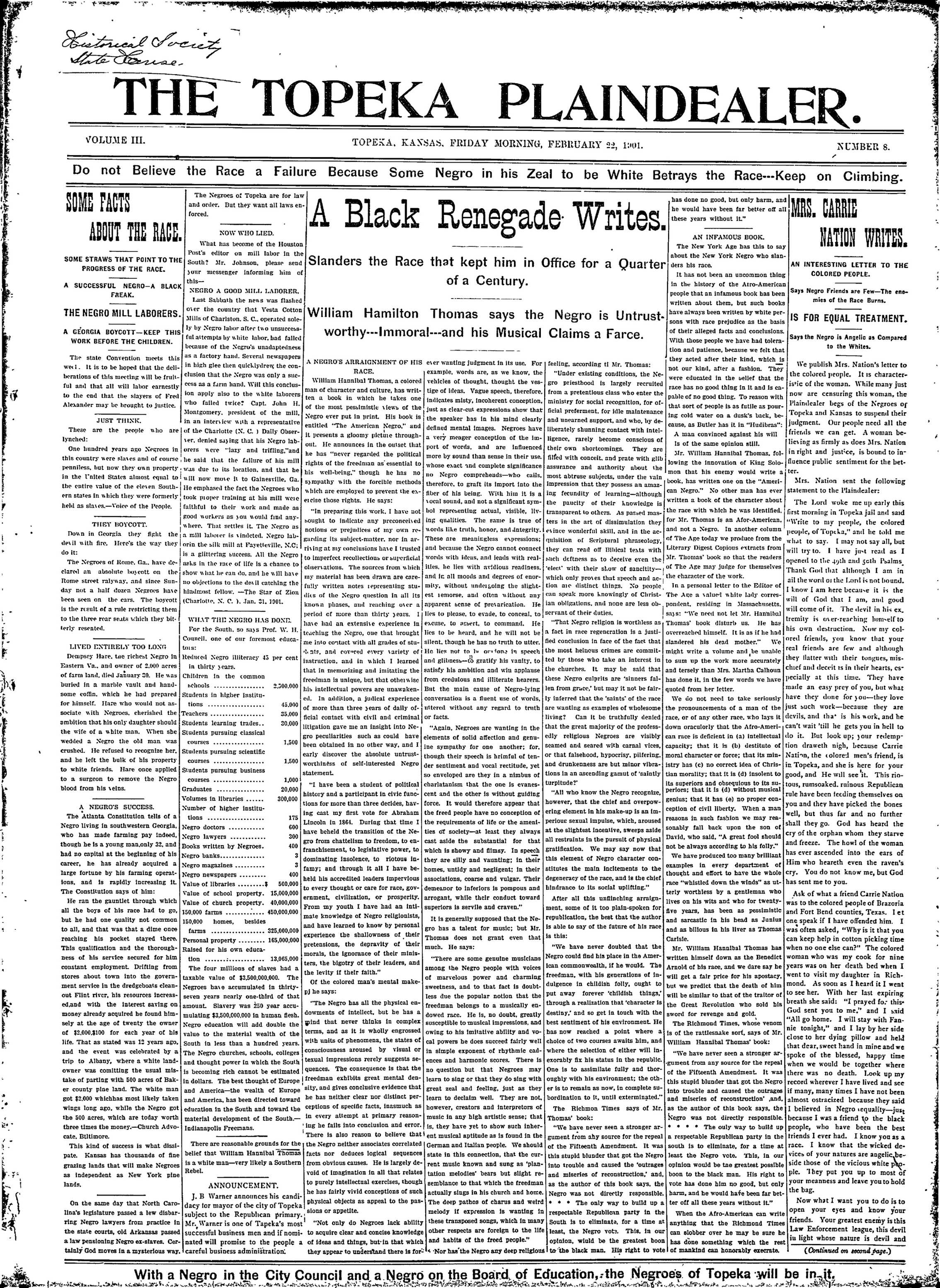
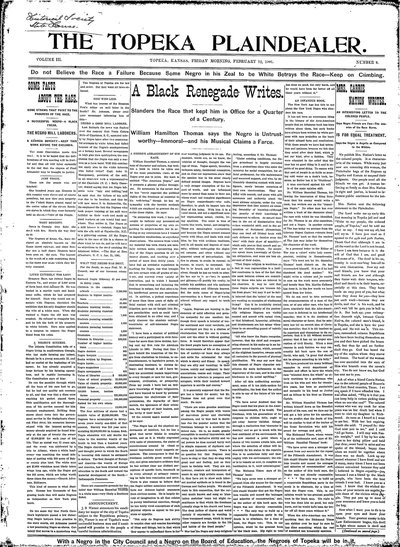
Page text (machine-generated)
THE TOPEKA PLAINDEALER.
With a Negro in the City Council and a Negro on the Board of Education, the Negroes of Topeka will be in it.
Historical Society
VOLUME III.
Do not Believe
SOME FACTS
ABOUT THE RACE.
SOME STRAWS THAT POINT TO THE
PROGRESS OF THE RACE.
A SUCCESSFUL NEGRO-A BLACK FREAK.
THE NEGRO MILL LABORERS.
A GÉORGIA BOYCOTT—KEEP THIS WORK BEFORE THE CHILDREN.
The state Convention meets this week. It is to be hoped that the deliberations of this meeting will be fruitful and that all will labor earnestly to the end that the slayers of Fred Alexander may be brought to justice.
These are the people who are lynched:
One hundred years ago Negroes in this country were slaves and of course penniless, but now they own property in the United States almost equal to the entire value of the eleven Southern states in which they were formerly held as slaves.—Voice of the People.
THEY BOYCOTT.
The Negroes of Rome, Ga., have declared an absolute boycott on the Rome street rallyway, and since Sunday not a half dozen Negroes have been seen on the cars. The boycott is the result of a rule restricting them to the three rear seats which they bitterly resented.
LIVED ENTIRELY TOO LONG
Dempsey Hare, the richest Negro in Eastern Va., and owner of 2,000 acres of farm land, died January 30. He was buried in a marble vault and handsome coffin, which he had prepared for himself. Hare who would not associate with Negroes, cherished the ambition that his only daughter should the wife of a white man. When she wedded a Negro the old man was crushed. He refused to recognize her, and he left the bulk of his property to white friends. Hare once applied to a surgeon to remove the Negro blood from his veins.
A NEGRO'S SUCCESS.
The Atlanta Constitution tells of a Negro living in southwestern Georgia, who has made farming pay indeed, though he is a young man only 32, and had no capital at the beginning of his career, he has already acquired a large fortune by his farming operations, and is rapidly increasing it. The Constitution says of him:
He ran the gauntlet through which all the boys of his race had to go, but he had one quality not common to all, and that was that a dime once reaching his pocket stayed there. This qualification and the thoroughness of his service secured for him constant employment. Drifting from stores about town into the government service in the dredgeboats cleanup Flint river, his resources increased, and with the interest saving on money already acquired he found himself at the age of twenty the owner of $2,000,$100 for each year of his life. That as stated was 12 years ago, and the event was celebrated by a trip to Albany, where a white landowner was comitting the usual mistake of parting with 500 acres of Baker county pine land. The white man got $2,000 which has most likely taken wings long ago, while the Negro got the 500 acres, which are today worth three times the money.—Church Advocate, Baltimore.
This kind of success is what dissipate. Kansas has thousands of fine grazing lands that will make Negroes as independent as New York pine lands.
On the same day that North Carolina's legislature passed a lew disbarring Negro lawyers from practice in the state courts, old Arkansas passed a law pennsioning Negro ex-slaves. Certainly God moves in a mysterious way.
The Negroes of Topeka are for law and order. But they want all laws enforced.
NOW WHO LIED
What has become of the Houston Post's editor on mill labor in the South? Mr. Johnson, please send your messenger informing him of this-
NEGRO A GOOD MILL LABORER.
Last Sabbath the news was flashed over the country that Vesta Cotton Mills of Charleston, S. C., operated solely by Negro labor after two unsuccessful attempts by white labor, had failed because of the Negro's unadaptedness as a factory hand. Several newspapers in high glee then quickly drew the conclusion that the Negro was only a success as a farm hand. Will this conclusion apply also to the white laborers who failed twice? Capt. John H. Montgomery, president of the mill, in an interview with a representative of the Charlotte (N. C.) Daily Observer, denied saying that his Negro laborers were "lazy and trifling," and he said that the failure of his mill was due to its location, and that he will now move it to Gainesville, Ga. He emphased the fact the Negroes who took proper training at his mill were faithful to their work and made as good workers as you would find anywhere. That settles it. The Negro as a mill laborer is vindeted. Negro laborin the silk mill at Fayetteville, N.C.; is a glittering success. All the Negro asks in the race of life is a chance to show what he can do, and he will have no objections to the devil catching the hindmost fellow. —The Star of Zion (Charlotte, N. C. ), Jan. 31, 1901.
WHAT THE NEGRO HAS DONE.
For the South, so says Prof. W. H.
Council, one of our foremost educators:
Reduced Negro illiteracy 45 per cent in thirty years.
Children in the common schools ... 2,500,000
Students in higher institutions ... 45,000
Teachers ... 35,000
Students learning trades ... 20,000
Students pursuing classical courses ... 1,500
Students pursuing scientific courses ... 1,500
Students pursuing business courses ... 1,000
Graduates ... 20,000
Volumes in libraries ... 300,000
Number of higher institutions ... 175
Negro doctors ... 600
Negro lawyers ... 300
Books written by Negroes. ... 400
Negro banks ... 3
Negro magazines ... 3
Negro newspapers ... 400
Value of libraries ... $ 500,000
Value of school property. 15,000,000
Value of church property. 40,000,000
150,000 farms ... 450,000,000
150,000 homes, besides farms ... 325,000,000
Personal property ... 165,000,000
Raised for his own education ... 13,065,000
The four millions of slaves had a taxable value of $3,500,000,000. The Negroes have accumulated in thirty-seven years nearly one-third of that amount. Slavery was 250 year accumulating $3,500,000,000 in human flesh. Negro education will add double the value to the material wealth of the South in less than a hundred years.
The Negro churches, schools, colleges and thought power in which the South is becoming rich cannot be estimated in dollars. The best thought of Europe and America—the wealth of Europe and America, has been directed toward education in the South and toward the material development of the South.—Indianapolis Freemans.
There are reasonable grounds for the belief that William Hannibal Thomas is a white man—very likely a Southern Rebel.
ANNOUNCEMENT.
J. B Warner announces his candidacy for mayor of the city of Topeka subject to the Republican primary. Mr. Warner is one of Tapeka's most successful business men and if nominated will promise to the people a careful business administration.
TOPEKA, KANSAS, FRIDAY MORNING, FEBRUARY 22, 1901.
A Black Renegade Writes.
Slanders the Race that kept him in Office for a Quarter of a Century.
William Hamilton Thomas says the Negro is Untrustworthy---Immoral---and his Musical Claims a Farce.
William Hannibal Thomas, a colored man of character and culture, has written a book in which he takes one of the most pessimistic views of the Negro ever put in print. His book is entitled "The American Negro," and it presents a gloomy picture throughout. He announces in the outset that he has "never regarded the political rights of the freedman as essential to his well-being," though he has no sympathy with the forcible methods which are employed to prevent the exercise those rights. He says:
"In preparing this work, I have not sought to indicate any preconceived notions or prejudices of my own regarding its subject-matter, nor in arriving at my conclusions have I trusted to imperfect recollections or superficial observations. The sources from which my material has been drawn are carefully written notes representing studies of the Negro question in all its known phases, and reaching over a period of more than thirty years. I have had an extensive experience in teaching the Negro, one that brought me into contact with all grades of students, and covered every variety of instruction, and in which I learned that in memorizing and imitating the freedman is unique, but that otherwise his intellectual powers are unawakened. In addition, a judicial experience of more than three years of daily official contact with civil and criminal litigation gave me an insight into Negro peculiarities such as could have been obtained in no other way, and I early discover the absolute untrustworthiness of self-interested Negro statement.
"I have been a student of political history and a participant in civic functions for more than three decides, having cast my first vote for Abraham Lincoln in 1864. During that time I have beheld the transition of the Negro from chattelism to freedom, to enfranchisement, to legislative power, to dominating insolence, to riotous infamy; and through it all I have beheld his accredited leaders impervious to every thought or care for race, government, civilization, or prosperity. From my youth I have had an intimate knowledge of Negro religionists, and have learned to know by personal experience the shallowness of their pretensions, the depravity of their morals, the ignorance of their ministers, the bigotry of their leaders, and the levity if their faith."
"The Negro has all the physical endowments of intellect, but he has a mind that never thinks in complex terms, and as it is wholly engrossed with units of phenomena, the states of consciousness aroused by visual or textual impressions merely suggests sequences. The consequence is that the freedman exhibits great mental density, and gives conclusive evidence that he has neither clear nor distinct perceptions of specific facts, inasmuch as in every attempt at primary reasoning he fails into conclusion and error. There is also reason to believe that the Negro neither associates correlated facts nor deduces logical sequences from obvious causes. He is largely devoid of imagination in all that relates to purely intellectual exercises, though he has fairly vivid conceptions of such physical objects as appeal to the passions or appetite.
"Not only do Negroes lack ability to acquire clear and concise knowledge of ideas and things, but in that which they appear to understand there is for-
ever wanting judgment in its use. For example, words are, as we know, the vehicles of thought, thought the vestige of ideas. Vague speech, therefore, indicates misty, incoherent conception, just as clear-cut expressions show that the speaker has in his mind clearly defined mental images. Negroes have a very meager conception of the import of words, and are influenced more by sound than sense in their use, whose exact and complete significance no Negro comprehends—who cails, therefore, to graft its import into the fiber of his being. With him it is a vocal sound, and not a significant symbol representing actual, visible, living qualities. The same is true of words like truth, honor, and integrity. These are meaningless expressions; and because the Negro cannot connect words with ideas, and leads with realities, he lies with avidious readiness, and in all moods and degrees of enormity, without undergoing the slightest remorse, and often without any apparent sense of prevarication. He lies to please, to evade, to conceal, to excuse, to assert, to command. He lies to be heard, and he will not be silent, though he has no truth to utter. He lies not to be outdone in speech and glibness—to gratify his vanity, to satisfy his ambition and win applause from credulous and illiterate hearers. But the main cause of Negro-lying conversation is a fluent use of words, uttered without any regard to truth or facts.
"Again, Negroes are wanting in the elements of solid affection and genuine sympathy for one another; for, though their speech is hirmful of tender sentiment and vocal rectitude, yet so enveloped are they in a nimbus of charlatanism that the one is evanescent and the other is without guiding force. It would therefore appear that the freed people have no conception of the requirements of life or the amenities of society—at least they always cast aside the substantial for that which is showy and flimsy. In speech they are silly and vaunting; in their homes, untidy and negligent; in their associations, coarse and vulgar. Their demeanor to inferiors is pompous and agorant, while their conduct toward superiors is servile and craven."
It is generally supposed that the Negro has a talent for music; but Mr. Thomas does not grant even that much. He says:
"There are some genuine musicians among the Negro people with voices of marvelous power and charming sweetness, and to that fact is doubtless due the popular notion that the freedman belongs to a musically endowed race. He is, no doubt, greatly susceptible to musical impressions, and owing to his imitative ability and vocal powers he does succeed fairly well in simple exponent of rhythmic cadences and harmonic scores. There is no question but that Negroes may learn to sing or that they do sing with great zeal and feeling, just as they learn to declaim well. They are not, however, creators and interpretors of music in any high artistic sense; that is, they have yet to show such inherent musical aptitude as is found in the German and Italian people. We should state in this connection, that the current music known and sung as 'plantation melodies' bears but slight resemblance to that which the freedman actually sings in his church and home. The deep pathos of charus and weird melody if expression is wanting in these transposed songs, which in many other respects are foreign to the life and habits of the freed people."
feeling, according ti Mr. Thomas: "Under existing conditions, the Negro priesthood is largely recruited from a pretentious class who enter the ministry for social recognition, for official preferment, for idle maintenance and unearned support, and who, by deliberately shunning contact with intelligence, rarely become conscious of their own shortcomings. They are flipped with conceit, and prate with glib assurance and authority about the most abtruse subjects, under the vain impression that they possess an amazing fecundity of learning—although the paucity of their knowledge is transparent to others. As passed masters in the art of dissimulation they evince wonderful skill, and in the acquisition of Scriptural phraseology, they can read off Biblical texts with such deftness as to deceive even the 'elect' with their show of sanctity—which only proves that speech and action are distinct things. No people can speak more knowingly of Christian obligations, and none are less observant of their duties.
"That Negro religion is worthless as a fact in race regeneration is a justified conclusion in face of the fact that the most helnous crimes are committed by those who take an interest in the churches. It may be said that these Negro culprits are 'sinners fallen from grace,' but may it not be fairly inferred that the 'saints' of the race are wanting as examples of wholesome living? Can it be truthfully denied that the great majority of the professedly religious Negroes are visibly scamed and seared with carnal vices, or that falsehood, hypocrisy, pilfering, and drunkenness are but minor vibrations in an ascending gamut of 'saintly turpitude?'
"All who know the Negro recognize, however, that the chief and overpowering element in his make-up is an imperious sexual impulse, which, aroused at the slightest incentive, sweeps aside all restraints in the pursuit of physical gratification. We may say now that this element of Negro character constitutes the main incitements to the degeneracy of the race, and is the chief hindrance to its social uplifting."
After all this unfilching arraignment, some of it too plain-spoken for republication, the best that the author is able to say of the future of his race is this:
"We have never doubted that the Negro could find his place in the American commonwealth, if he would. The freedman, with his generations of indulgence in childish folly, ought to put away forever 'childish things,' through a realization that 'character is destiny,' and so get in touch with the best sentiment of his environment. He has now reached a point where a choice of two courses awalts him, and where the selection of either will inexorably fix his status in the republic. One is to assimilate fully and thoroughly with his environment; the other is to remain as now, in complete subordination to it, until exterminated."
The Richmon Times says of Mr. Thomas' book:
"We have never seen a stronger argument from any source for the repeal of the Fifteenth Amendment. It was this stupid blunder that got the Negro into trouble and caused the 'outrages and miseries of reconstruction,' and, as the author of this book says, the Negro was not directly responsible. * * * The only way to build up a respectable Republican party in the South is to eliminate, for a time at least, the Negro votes. This, in our opinion, would be the greatest boon to the black man. His right to vote
has done no good, but only harm, and he would have been far better off all these years without it"
AN INFAMOUS BOOK.
AN INFAMOUS BOOK.
The New York Age has this to say about the New York Negro who slanders his race.
It has not been an uncommon thing in the history of the Atro-American people that an infamous book has been written about them, but such books have always been written by white persons with race prejudice as the basis of their alleged facts and conclusions. With those people we have had toleration and patience, because we felt that they acted after their kind, which is not our kind, after a fashion. They were educated in the belief that the race has no good thing in it and is capable of no good thing. To reason with that sort of people is as futile as pouring cold water on a dusk's back, because, as Butler has it in "Hudibras":
Mr. William Hannibal Thomas, following the innovation of King Solomon that his enemy would write a book, has written one on the "American Negro." No other man has ever written a book of the character about the race with which he was identified, for Mr. Thomas is an Afor-American, and not a Negro. In another column of The Age today we produce from the Literary Digest Copious extracts from Mr. Thomas' book so that the readers of The Age may judge for themselves the character of the work.
In a personal letter to the Editor of The Age a valued white lady correspondent, residing in Massachusetts, says: "We need not let Mr. Hannibal Thomas' book disturb us. He has overreached himself. It is as if he had slandered his dead mother." We might write a volume and be unable to sum up the work more accurately and tersely than Mrs. Martha Calhoun has done it, in the few words we have quoted from her letter.
We do not need to take seriously the pronouncements of a man of the race, or of any other race, who lays it down oracularly that the Afro-American race is deficient in (a) intellectual capacity; that it is (b) destitute of moral character or force; that its ministry has (c) no correct idea of Christian morality; that it is (d) insolent to its superiors and obsequious to its superiors; that it is (d) without musical genius; that it has (e) no proper conception of civil liberty. When a man reasons in such fashion we may reasonably fall back upon the son of David, who said, "A great fool should not be always according to his folly."
We have produced too many brilliant examples in every department of thought and effort to have the whole race "whistled down the winds" as utterly worthless by a gentleman who lives on his wits and who for twenty-five years, has been as pessimistic and sarcastic in his head as Junius and as billous in his liver as Thomas Carlsle.
Mr. William Hannibal Thomas has written himself down as the Benedict Arnold of his race, and we dare say he will get a fair price for his apostacy, but we predict that the death of him will be similar to that of the traitor of the Great Revolution who sold his sword for revenge and gold.
The Richmond Times, whose venom is of the rattlesnake sort, says of Mr. William Hannibal Thomas' book:
"We have never seen a stronger argument from any source for the repeal of the Fifteenth Amendment. It was this stupid blunder that got the Negro into trouble and caused the outrages and miseries of reconstruction' and, as the author of this book says, the Negro was not directly responsible. * * * * The only way to build up a respectable Republican party in the south is to eliminate, for a time at least the Negro vote. This, in our opinion would be the greatest possible boon to the black man. His right to vote has done him no good, but only harm, and he would have been far better off all these years without it."
When the Afro-American can write anything that the Richmond Times can slobber over he may be sure he has done something which the rest of mankind can honorably execute.
NUMBER 8.
MRS. CARRIE NATION WRITES.
AN INTERESTING LETTER TO THE COLORED PEOPLE.
Says Negro Friends are Few—The enemies of the Race Burns.
Says the Negro is Angelic as Compared to the Whites.
We publish Mrs. Nation's letter to the colored people. It is characteristic of the woman. While many just now are censuring this woman, the Plaindealer begs of the Negroes of Topeka and Kansas to suspend their judgment. Our people need all the friends we can get. A woman believing as firmly as does Mrs. Nation in right and justice, is bound to influence public sentiment for the better.
Mrs. Nation sent the following statement to the Plaindealer:
The Lord woke me up early this first morning in Topeka jail and said "Write to my people, the colored people, of Topeka," and he told me what to say. I may not say all, but will try to. I have just read as I opened to the 49th and 50th Psalms. Thank God that although I am in all the world or the Lord is not bound. I know I am here because it is the will of God that I am, and good will come of it. The devil in his extremity is over-reaching himself to his own destruction. Now my colored friends, you know that your real friends are few and although they flatter with their tongues, mischief and deceit is in their hearts, especially at this time. They have made an easy prey of you, but what have they done for you—they love just such work—because they are devils, and that is his work, and he can't wait 'till he gets you in hell to do it. But look up; your redemption draweth nigh, because Carrie Nation, the colored men's friend, is in Topeka, and she is here for your good, and He will see it. This riotous, rumsoaked, ruinous Republican rule have been feeding themselves on you and they have picked the bones well, but thus far and no further shall they go. God has heard the cry of the orphan whom they starve and freeze. The howl of the woman has ever ascended into the ears of Him who heareth even the raven's cry. You do not know me, but God has sent me to you.
Ask of what a friend Carrie Nation was to the colored people of Brazoria and Fort Bend counties, Texas. I let one speak if I have offended him. I was often asked, "Why is it that you can keep help in cotton picking time when no one else can?" The colored woman who was my cook for nine years was on her death bed when I went to visit my daughter in Richmond. As soon as I heard it I went to see her. With her last expiring breath she said: "I prayed fo: this God sent you to me." and I said "All go home. I will stay with Fannie tonight," and I lay by her side close to her dying pillow and held that dear, sweet hand in mine and we spoke of the blessed, happy time when we would be together where there was no death. Look up my record wherever I have lived and see if many, many times I have not been almost ostracized because they said I believed in Negro equality—just because I was a friend to the black people, who have been the best friends I ever had. I know you as a race. I know that the wicked devices of your natures are angelic, beside those of the vicious white people. They put you up to most of your meanness and leave you to hold the bag.
Now what I want you to do is to open your eyes and know your friends. Your greatest enemy is this Law Enforcement league, this devil iu light whose nature is devil and
(Continued on second page.)
Topeka Plaindealer.
Published at Topeka, Shaunce county, Ks., every
fr day morning by the Plaindealer
Publishing Co., 114 E. 17th st.
One year by mail ..... 41
Six months by mail ..... 750
Three months by mail ..... 100
Entered at the post office at 1796 as second class
mail attor
[In order to insure publication of matter in the current issue, our responders must be in this office not later than Tuesday]
It's alright to talk law and order, but the action of the large crowd of tax payers falls short of a realization of the moral utopia so deroutly honored for.
Brother H. B. Parks is an able successor to Dist. Turner as managing editor of the "Notice of the Mission." It's an able paper and deserves of liberal patronage.
The Phaladaler fully appreciates the kindly remarks of the Daily Capital about the colored candidate for councilman. Mr. Ridley is deserving of all the good words said of him.
Representative John W. Jones, of Chicago, has introduced a bill into the Illinois legislature covering lynching and mob violence. It is high time that such a law he introduced in Kansas. This state has had a John Brown, a Mrs. Nation, and now is time to take up one of the Jones family.
Phil. Eastman, the owl-like reporter on the Daily Journal has evidently had a raise in his salary from five to six dollars a week. We urge this for the method employed in reporting the conversation between Nick Chiles and Mrs. Nation last Sunday. This paper will offer him enough to keep the grease of his clothes if he will agree to report the truth at all times.
Kansas, and Topka especially, has just gone through a scige of mob violence. Much of it has been caused by the mal functiism of a lot of cranks. It passes understanding that a lot of men will allow themselves to be worked into a fine treason by a poor half demoted woman, and then desert her in the hour of trial. Here is a rare chance for the Committee of one thousand to contribute two dollars each and secure the release of Mrs. Naito who is suffering in "durance tile" for the part she played in a righteous crusade.
OUR COLORID CANDIDATES.
In the present Republican era the colored people of this city are asking representation in a substantial way. The candidate o. Mr. P. M. Stonestreet for marshal of the city court has been announced for some time. He has made an exemplary officer. His long service in various capacities has proven his sterling worth. No one can question Mr. Stonestreet's honesty and ability in discharging the duties of his position. He is always corteous and obliquing. Mr. Rilley, the young man aspiring to succeed Mr. Roundture as Counselman from the Fifth Ward, has the confidence of his people and it is believed will make a most excellent member of that body. Mr. W. G. Williams has been solicited by a large number of his friends and voters of the Fifth Ward to announce himself for Member of the Board of Education. Topeka has a large colored population and many children in the public schools. Certainly no one will question the propriety of placing one of our race on this very important board. This is a matter that goes beyond Ward lines. Let every Negro interest himself in seeing that these men are nominated.
SAVE OUR BOYS.
Mr. Editor: Having observed that at very nearly every term of our district court one or more of our young men are sentenced to imprisonment for some petty crime, and that these young men are from a class which our Sunday School and churches cannot or do not reach. Mr. Childers Reynolds and myself (with any others who chose to assist) propose to organize a Young Men's Sunday Club, for the purpose of elevating and ameliorating the condition of our young men in this community,
We wish it distinctly understood that this movement is not to interfear with any Sunday School, churches or organization of any kind for the betterment of the youth but auxiliary to them.
Therefore we ask the corporation and influence of all Christian ministers and Lay Christian workers in the city for their aid and support. We propose to open our meeting on the first Sunday in March, that being the 3rd day of the month at 3:00 o'clock for this purpose in a hall at 429 Kansas Avenue-Christian workers and young men to meet there and devise a plan of work and affect a permanent organization.
Corteously.
G. W. GUY.
The Plaindealer takes pleasure in endorsing the above letter and suggestion by Rev. Guy, and earnestly requests the hearty co-operation of all classes of citizens. The work should not be sectarian. It belongs to all of our people and should have their support.
We are convinced more and more every day that in order to take a part in the progress of the Twentieth century, we must, as a race, show ourselves capable of doing every kind of work done by the white race. We must do everything that human hapds and minds can do with as great rapidity, accuracy, polish and strength as other nations.
We must enter into every profession of life, have our inventors, mechanics, philosophers, astronomers, architects, lawyers, doctors, merchants, philanthropists, scholars, musicians and artists.
The aesthetic taste of our race seems to have received less development than any other faculty.
Art is a divine gift and race should have a high appreciation for it. It is a large field in which are some seeds of moral, intellectual, philosophic culture and which, by careful cultivation, grows, blooms and ripens into that high culture.
Of all the arts, the art of molding character is the greatest. Choosing fairly for ideal and mooding a character like into his. The art of music is purely attitude, telling to the sense of meaning and emotion. Needle painting or brush work when caperly directed toward beauty of form and color have a pure intellectual appeal to the sense of beauty because of the suggestions of external nature. Prose or poetry by the use of word or pen is the robbest way to express and excite emotion.
The art of cloquence gives high pleasure to the hearts by the dignity and beauty of the thoughts expressed and the language in which they are clothed. Physical attitude as a consequence of a graceful attitude or tass body is certainly a work of art.
To develop a round full of mind each faculty should receive an equal share of development. In each race there should be local characters, musicians, orators, painters, and poets. It is true, art does not always serve the daily needs of the race in the way of food and comfort, but it supplies ideals of beauty ... emotion and love.
What is life without character, music, pictures, thoughts, eloquently expressed, or without form or beauty? Should we close our hearts and try to sain out all the pleasures occasioned to art, there would be a resulting within for fear they might be lost forever. The soul is endowed with a knowledge and appreciation of art, that must be developed in the race in its infancy. The inspiration must come from the mothers in the individual home of the race.
The moter or who possesses, the capability of molding the character of her child; of installing, a love for music, books, needle or brush, grace and cloquence, will inclure a love and desire which will be transmitted from our generation to the other; thus creating high ideals, pure thought the ability to separate the craft from the wheat, to see something good in every thing, to choose the good, to be happy and make others happy.
As the civilization of all races is judged by the intellectual status of its women, representatives from the local art clubs from over the state met in Tokyo last June, 1900, and organized a state Federation of Art clubs.
Its object is to promote the development and create a love for fine art throughout the state of Kansas among the women of car race.
Mrs. G. W. Washington, a very estimable lady of Topeka, who is particularly interested in this work, while perhaps not the first to know the great good that might be accomplished in this broad field of work, was first to act, and succeeded in securing an organization which bids fair to lift the standard of the higher education among our women. The ladies of the various clubs are working shoulder to shoulder to make this Federation a prime factor toward elevating women and girls.
Since this organization, women who were positively unacquainted with a needle, who could not use a thimble, and who have hired all their sewing done from the hemming of a napkin up, are now not only using a thimble, but are hemming and hem-stitching their own napkins, pillow-cases, etc. Several have undertaken to make their own garments.
It is the aim of this Federation to create a desire to work for one's self and by so doing become adherents to the law of economy.
One lady made several 'Xmas. gifts which required the sewing on of buttons. She acknowledges she could not sew on buttons, as they should be, until her practice on these little gifts. What gentleman has not a high regard for a lady who loves to sew on buttons? This proficiency was acquired at an art club. Had she not been a member of an art club she would have spent her hard earned cash for the gifts and would not know how to sew on buttons. Another result comes to my notice that a great many ladies having never had their attention called to the study of art did not appreciate pictures unless they were colored or flashy. I feel safe in saying nine out of ten ladies who are members of some art club know the production and history of the most famous artists, and would not purchase without a knowledge of what she is purchasing.
It is the aim of our clubs to create a dislike for pictures which are valueless and profane, and decorate our home with the best or none. The same interest is manifested in a desire for good literature. In our
reading clubs the ladies learn the value of good books. For, art without books is equivalent to a brush or chisel without a handle.
These clubs are a feast to the ladies who have devoted their time and energy to domestic duties six and a half days in the week. Their minds are diverted from the worry of these duties to the more pleasant study of how to make home inviting to the thought of love not as a work shop, but as a place of rest and comfort.
The majority of our women study too much about beautifying themselves and not enough about beautifying their homes. In these clubs there is at least one hour of thought concerning some corner in our home which needs dressing up. In the courses of time home will mean to our race just what it means to the white race. A place we desire to go above all others; a place where others like to come; a place our children love to be loved to ask questions of life; a place where you had good pictures, good books, durability, order and harmony. It these classes some instrumental in nishing home culture in every family of our race in Kansas, there will be less crime and vice among our people for those who love their homes are those who make good citizens.
Many of our wayward boys and girls whose home environments are everything but good, are those mothers have used th. in space time in gossip, systeme, make, house a refuge from a vice for their children.
We have a touch of refinement, it is true, but we need to be enveloped in it. The broader field of work an our women will be the vital subject for discussion at the annual meeting of the federation next June. A message will be brought to hear to open our door to welcome all women clubs that are enraged in either kind of intellectual or aesthetic devel operatet and has unite in one grand sisterhood for the elevation of the woroe on Knesses.
AN INFAMOUS SLANDERER.
It was the late amended Frederick Douglas who said in one of his many speeches in behalf of the Negro that the race should not be judged from the heights attained by the white man, but by the deaths from whence he came. "The present condition of the Negro in America needs no apology, and especially none from Negroes. A Mr. William Hammel Thomas, who is referred to as "a colored man of character and culture," his written a book entitled "The American Negro." In this book (a copious except from the Literary Digest appears in this issue) Mr. Thomas chronologically sets his views of his race, and incidentally sets him down as a jacchus eighteen cannars. We have had the pleasure of reading many books by Negroes and white commenting upon the present condition and outlining the future of our people, and nowhere have we not with such a disastrous assault upon a strugging people as this. It will be observed that Mr. Thomas apologizes for the fact that he is of black parents, and that he "at the outset" sought to eradicate from his mind any preconceived notions of race prejudice—Great God will wonders never cease. Just think of such an intelligent monstrosity as a Negro who has been in office all his life because God in wisdom planted a few Negroes in America, revolving in luxury of prejudice against himself. It is hardly to be expected that such a man would be able to express himself in a colder manner.
Mr. Thomas belongs to a peculiar class of Negroes who have been, and are, a fungus growth on the race. We refer to that class of Negroes who want to be white and toy to the white man, who justly despises them. He takes pleasure in his ape-like conceit "to refer to his observations of the Negro in litigation" and to pronounce him an untrustworthy litigant. Mr. Thomas should have consulted a mirror before making, and he would have realized that such a statement was a reflection upon his "three years of judicial experience" over which he gloats with such supreme satisfaction.
His reference to the religion of our people is absolutely untrue, though in keeping with the man. He seems to have shut his eyes to salient events in the world's history. We would remind him of the thirty-years' war in the Netherlands, of the history of France in the years immediately prior to the Great Revolution of 1793, of the thousand and one instances in the history of the world, where manifestations of religious shallness and depravity are so bold and revolting that the directions the Negro slave of yesterday slinks into insignificance. But Negro religionist needs no excuse or apology by comparison. The moral and religious development of the Negro, in view of his abject ignorance at emancipation, is the marvel of the age. The negro preacher may not always have possessed that proound knowledge of theology and homolitties, nor maintained that lofty moral standard held up by Jesus Christ, but they have honestly sought to lift their people to a higher standard, and they are succeeding. The Negro world is growing brighter. His thousands of educated and refined ministers, and laymen; his million of dollars worth of church property, are telling a story to the world that stamps Mr. Thomas' utterances as a religious and shameful life.
He next turns his attention to the mental and musical capacity of the race, which he treats with the rare ignorance only to be found in an author who is prejudiced against himself. Here is the most egregious exhibition of assassine affection to be found on record. The greatest Danish musical citic and scholar spent some time in this country studying carefully the music of the Negro, and pronounced it good. From the days that the plantation melodies of the Southern Negroes began to charm New England Endowments for Southeastern Colleges for the education of Negro boys and girls, the Negro musicians have been a powerful factor in the music of the world. No individuals may have their minds rattling around in the windy corridors of time, but the entire race has sang itself into eternal glory and renouna. As to the mental ability of the Negro, his own achievements are a refutation to the charge that the Negro can not think in complex terms. With the Negro students at Nashville, Tennessee, making technical instruments for the Kansas college laboratories, with a Negro boy stirring and perfecting a telephone system, with a Negro Mr. Dalibois conducting sociological investigations for the Atlantic university and Booker Wash ington ***** forming the educational system of America the Negros have no need to hang their beats in shame. The Negro race possesses the same elements for success that belongs to any people God has created. He is tabulating to better his condition. He may not always have come up to the white men's standard but his approximations have been and are a source of trouble to the white man.
AFRO-AMERICAN GIRL IN EUROPE.
BY CORA C. COLE.
Sancho my letters were begun not where I should have left off, but not at the beginning When we sailed for Europe, our port was Hamburg and our final destination Sweden, not Holland.
We bearded the steamer Patria one of the Hamburg Amorium line on the closing of Dec. 25th, so that when we woke next morning we were well under way.
We had a jolly lot of passengers, most of them returning to the Fatherland, and the rest Americans.
The attitude of the latter toward a Negro going abad is really amusing. He most likely has seen the passer list with your name, but it does not occur to him that you are colored, consequently you are very surprised when you appear on deck, and he halfway feels that there has been some mistake, however, finally he will condescend?) to speak to you; meanwhile every other passenger has recognized your right to be there except your own companion. The fee once back he will be very pleasant, but is a question with him how you managed to get so far away from home. Once in Europe he has only smiles for you on the return voyage, he freezes gradually as he nears this glorious republic in just the same manner that he thawed on leaving it. After he leaves America he will stoutly deny the ontrages that are being perpetrated on our people.
To return to the voyage. Considering the time of year, it was particu-
larly pleas-ant. Even I was not ill
longer than one day; the sea was
not rough, but we had heavy fogs.
How grand is the ocean! Those who know something of the wild delight in a gallop over the unfenced plains, can appreciate the sweeping view over a tranquil sea. There is something awe-inspiring in the approach of a fog, and it appeals to the poetic side of one's nature. But it is in a storm that one realizes "old ocean's awful grandeur. The waves dash seemingly miles high, the lightning flashes, playing all about the ship; the bow buries itself in the water until the snip seems to stand on end; then up and back again with a sudden bound. There is an indescribable feeling comes over one. You seem to be in another world, cut off entirely from the old one, seeing only a broad expanse of water and no living thing, except a whale or a school of porpoises. It is a carefree existence, too.
We spent New Year's eve in true German fashion. After reaching Hamburg, we journeyed to Copenhagen, then to Stockholm. It was then Jan. 11, about 8:30 when we arrived; it was as dark as it is with us many hour earlier; nor did it begin to be light for nearly an hour later, and at 3 o'clock it begun to grow dark again, making in all about five and one-half hours of daylight.
What a delicious country for sleepy heads! We were told, however, that it would be very different in summer, and sure enough it was light all the time. Lamps were put away just as we put away stoves in the spring; and in small towns the supply of gas is entirely cut off, and it is not possible to buy oil.
One can hardly this condition until he has lived in it. Light
I have seen little girls walking in the streets and playing at 10 o'clock at night. One never really feels that it is time to retire, he only goes to bed because it is customary. This condition lasted from May until September. In June we went up to the most northerly point in Sweden, Gellivara, at the foot of Daddtet, a mountain from whose summit the midnight sun was visible. This is Laptand. We journeyed a distance of more than 109 miles, within the Attic circle, and reached Gellivara at about 5 o'clock. After supper we started up the mountains, a climb of about 31 miles.
At first we were afraid that we would not be able to see the sun, because it had been raining all day, and although in bad then stopped, it was cloudy. However, we started up with a crowd of maries in our train. We had to wear a protection of mo-quote matting over our legs, because of having to pass through swarms of mosquitoes, compared with which the New Jersey article sinks into insignifican-
It was a laborious climb and at times I felt that I could have it give it up, but I did not, and reached the top a few minutes before 12 o'clock.
At last we could only see a bright golden patch between the clouds, then gradually the clouds, parted and the entire sun was visible. Like a great gleaming all of fire. My first thought was "the heavens debased the glory of God and the firmament showeth his maniwork." I is the same sight that all of us have seen—a beautiful sunset at the close of a clear summer day; but when you think that it is midnight and that the sun will not sink below the horizon, but rise immediately, then the truth of the text comes to you.
We were photographed up there, for even the midnight sun is not sacred to the ubiquitous camera field. We descended the mountain and the midnight sun was only a memory, but a very precious one.
The noon night sun on the mountain day,
And blue blooded sun blue.
Two rest at night, one to it day,
But watched out at the two.
OUTRAGE IN TEXAS.
An Instance which "Points a Moral and Adorns a Tale."
Houston, Texas, Feb. 4.—Whenever a Southern statesman or newspaper attempts to palliate, or opologize for the frequent lynching of Negroes, they talk and write as if none committed tape but Negroes, and that only for tape are Negroes lynched. Never was a more pernicious fashal school palmed off. The worst cases of proven assault upon women in this country have been by white men, and then if we could add to this proven list, the number of those disguised as Negroes who have assulted women, the number of proven cases against Negroes would be materially less. On the other hand, the published record clearly shows that a majority of Negroes lynched, suffer for alleged crimes other than rape or attempt to rape.
The different in procedure wi
whites and blacks charged with bea
ous offences is striking; the white .
is given the benefit of every pos
doubt and simple opportunity to j
himself innocent in the courts, wi
everything is readily taken for granted
in the case of a Negro. Perhaps one
reason why the Southern white man so
really and so generally believes the
Negro capable of forcing women,
is the recollection of the horrible
object lesson in this crime they gave the
Negro in slavery times, coupled with
the knowledge that, in the prevailing
order of things, it is next to impossible
to bring a white man to account
for forcing a colored woman. In last
Sunday's papers we find the following
which is only an instance:
"Amite City, La., Feb. 2.—Two unprovoked murders were perpetrated near Arcela last night, the vultains being an old Argen named Arthur Nickerson and his5-year-old daughter. The perpetrators of the outrage were white men. After killing the old man and his child, they shot his grown daughter, who was endeavoring to escape, but she was only slightly wounded. After this they caught another girl, aged 13, took her into an adjoining room and outraged her.
The officers have clews to the murderers and will follow them up."
Our word for it, this is the last we shall hear of it; whereas if the accused had been Negroes, and the victims of their criminal lusts had been whites, the officers with blood hounds and a numerous posse would rest neither day nor night till they could yield up to flames one more victim. Try how we will, we cannot escape the conviction that alleged Negro criminals are lynched chiefly because they are Negroes, and this as a studied criminal purpose to terrorize, appress and degrade the race in this country.
HENRY CLAY GRAY.
WANTED.—Capable, reliable person in every county to represent large company of solid financial reputations $936 salary per year, payable weekly; $3 per day absolutely sure and all expenses; straight, bona-fide, definite salary, no commission; salary paid each Saturday and expense money advanced each week. STANDARD HOUSE, 34 Dearborn Stree, Chicago.
HAVE BEEN PRIVATE."
(A plano recital by Mrs. R. G. Jackson.)
Lawrence, Kans., Feb. 11.—The manner in which Mrs. R. G. Jackson entertained the Harmonica Club last Friday evening is long to be remembered.
The members of the club has known for some time that Mrs. Jackson would entertain them and had looked forward to the event with great anticipation, but did not expect a guest so soon.
The entertainment took place at the home of Miss Wallace in Mississippi street and special credit is due for assisting, participating, with the refreshments.
The entertainment was primarily a social one although it ended with reenactments and games. Some idea of the high order of the entertainer and did not be gained by means the following program:
1. "Marche de nuit" ..... Gott chalks
2. "Zonata Op. 36, No. 6" ..... Clementi
3. a. "Avalanche" |
b. "Tue Warrior" )..... K. Eler
c. "Swing Song" |
.. Soag—"A Warrior Bell, ....Alams Mr. L. A. Grac.
5. "Fifth Nocturne" ... Leybach
6. "Ballet des Papillons" ... Codard
7. "Song—Candle Song" ... Trunbull Dignin Wood).
8. "The Delitanee" ... Plant von Blont
Every member of the club poses especially obliged to Mr. Jackson for such a finally inver. The Gubb's a little as though it had acted sensibly, however, by prizily enjoying such a treat at the hands of its most talented member. It was due to Mr. Jackson's modesty that only three or four outliers were allowed to attend Gis recital. The club is justly proud of Mr. Jackson. The masterly perform in which he rendered the above program was simply another demonstration of his rare talent as a musician.
The ropes were tautly decorated with the portraits of not only the composers represented, but of most of the old masters as well as many modern composers. He had his programs nicely mounted on squares of dark cardboard which were effectively tied in all corners with white and lavender ribbons, the club's colors. These cards were passed out as souvenirs to the members.
Just at 8 o'clock, with his usual promptness and ease, Mr. Jackson seated himself at the piano and for 30 or 40 minutes held complete swag over his listeners. When he had finished all present were ready to say that he had enjoyed the best musical treat given by home talent for some seasons.
Mr. Jackson is this year doing work along the line of music in the school of fine arts in the university here. He is the only representative of color who has ventured into this department for some time. The race and especially the instrumental club should feel proud of him. He is a Young man of sterling character, possessing such push and determination as to win.
We are sorry to say that owing to business relations Mr. Green
did not he present, but all who had
card him sing know that his appearance
on any program will not detard
he bit from it. His place however
as able filled by Master Elgin Woody
who also had a place on the above
program. Little Elgin Woods is the
"Infant" vocal soloist under the
instruction of Mr. Jackson and he bids
fair to be a star singer some day. He
has one of the musical voices which
we have ever heard. The members of
the "Harmonic" all join in congratulating Mr. Jackson upon giving him a place on his program.
HOLTON ITEMS
Miss Mae Martin has gone to Atchison to visit her sister Ora.
Mr. Alex Plumb and wife are in town at the bed side of his sister Mrs. Henry Daniels who is very sick.
Mr. and Mrs. John Martin are the happy parents of a daughter born February 10.
Mrs. Abble Henry W. Plumb is visiting her parents Mr. and Mrs. Plumb at Pearidge.
The concert given by the children of the A. M. E. Sunday School last Thursday evening was a success all around.
Mrs. Nellie Marsh of Whiting is spending a few days in the city.
Mrs. S. S. Scott was called to Omaha last week on account of the illness of her daughter-in-law.
Mr. Albert Parks came up from Topeka to spend a few days with his family last week.
Rev. Brown made a flying trip to Horton Monday.
For once in years Holton is a dry town. The three joints in the city were visited by a mob of temperance people last Saturday. In the Hicks joint they destroyed everything in the shape or form of liquor, demalished the furniture so that the place was a total wreck when they left. The other two places were visited and the proprietors were ordered to desist in selling the vile stuff which they promptly did.
Mrs. Parks and daughter Eva returned from Horton where they were called upon the death of Mrs. Parks' father the Mr. Browning.
The Hatchet
—AT—
BARNUM'S
619 KANSAS AVE.
It has been wielded with powerful effect on all classes of Winter Goose, Ouds and Ends and Broken sides.
The edge of our hatchet was keen—the following clean cut prices will best 'attest' that fact. No such cutting ever attempted no other concerns claim to approach it.
But note these prices:
Our $7.75 quality 10-4 Union Blankets of superior quality, have been selling at $7.75—"good values at that"—cut price ... $1.88
Toppea Woolen Mills' best quality 11-4 Blankets, cut
price.....82 63
12 pairs White Blankets,
sightly soiled by handling, oxt.
third oil.
The Best Quality Table Oil
Cloth, full 5-4 wide, cut
price.....13c
A splendid three back Wrapper
of very latest patterns and
colorings—has deep flounce—
ruffle and braid trimm—fits
beautifully—cut price 69e. It
would cost that much for the
making alone.
A line of 56 inch Percale of
one of the standard 122c
gracles—all we have let of them
are in dark colorings—cut price
77c.
Yard wide Lonsdale Muslim
—Hope brand—9c value—cut
price 524c.
The two for 5c Pencils—cut to 0 for 5c.
The 64c Curtain Serim—cut to 32c.
The 64c and 72c Dress Prints (mill ends) run from 2 to 10 yard—cut to 4c.
The 122c Ladies' Seamless and Ladies' Hose—42 guage fine—cut to 8c.
The 122c Children's Hose—seamless, ladies, 128 rib—fine combed yarn—a splendid value at 122c cut to 8c.
To explain this almost incredible cutting on the above goods, we desire to say that the quantity is either limited, or certain sizes sold out.
15c and 18c India Linen—(Remnants) 91c.
Use quality Feather Ticking
—(the very best) 11.12c.
Muslin Underwear Sale.
You Shall have a Benefit Week.
The order has gone to our sales-people to price them to you for this week. OAT at exact invoice cost—to those who have not yet laid in their supply we would simply say, you are welcome to inspect this line—you're welcome to purchase on APPROVAL—if you can match our values—quality of material and excellency of make considered—return ours and receive your money back.
CARRIE NATION WRITES
Continued from first page.
whose livery is heaven. Did they make your yoke easy or your burden light?
Now the Home Defenders are going to put a clean man in for mayor, and to a man and woman you stand solid for him. He will be a minister for good to you, not a raging lion, and God defend the right.
(Signed) CARRIE NATION.
An Act
Be it enacted by the 3rd legislature of the state of Kansas.
lature of the state of Kansas,
That it shall be unlawful for
any employee of this house to
wear, during the session of the
leislature, abnormal and anti-
qated trousers, commonly called
balloon or umbrella pantaloons.
All pantaloons or trousers with
wheat sack dimensions, having
bottoms of 24 inches circum-
ference or more shall be included
in this act.
Any person violating this act
shall be fined in a sum not ex-
ceeding $25 for the first offense,
and for the second offense $50
and forfeit his office.
This act shall become a law
after its publication in the state
paper, the Topeka Plaindealer.
Our correspondents should send in their communications not later than Tuesday evening to insure their insertion the same week.
Topeka Plaindealer.
LODGES AND SOCIETIES
PRIDFOP TAPKATNT NO. 3 meets 1st. and 3rd Natural aftermoon of each month of No. 906 North Kain's Avenue, Mrs. Ida M. Jordan, Q. M. Miss Anna Reynolds, C. R.
M.J.S.P.T. TAPK.C.P. No. 2, U.K.T. Hall 09 N. Kansas Avenue. Meet 1st. and 3rd Thursdays at 1st. March. Miss Ida M. Jordan, C. P. Miss North Walker, C. R.
MACHOON LADGE No. 1, GODSMARTIAN and DAUGLIPERS of SMITH, meets second and fourth Frids evenings of each month at 3 o'clock, at 1st Last seventh street. Visitors, tourists are always welcome. W.E. Jackson, Chief Allie Lawson, Recording Sec.
PEARLY RID: Tabernacle No. 77, meets 1st and third Weinمنdel afternoons at 3 o'clock at 1st Last Sixth street Miss A. O'Neill, C. R. Mrs. W. G. Kesterviall, H.P.
PRID STONSTRUTT FOR CHA
MARSHAL.
LOCAL AND PERSONAL
"We tell it as 'the told to us.'
Important Notice!
Prof. G. N. Grisham, principal of the Lincoln High School, Kansas City, Me. will lecture in Topeka, March 8, under the auspices of Cyrne Commissary No. 34. Proceeds of the lecture to be used to buy pictures and decorations for the various colored school buildings of the city.
Mrs. McSimpson of 1207 Lane st., has eleven little chickens just hatched Mrs. Simpson you are rather early but she always has good luck with her fowls any way she raised over two hundred last year.
The Rose Bud club met at the residence of Mrs. A. E. Williams, the club spent a very pleasant afternoon discussing art work after which a dainty lunch was served. The club adjourned to meet at the residence of Mrs. M. E. Young, next Saturday.
Mr. Shelby one of the employees at the State house is visiting his family in Paola.
N. J. Washington is visiting his family in Speed, Kansas.
Capt. Roberts of Parsons spent Sunday in the city.
Rev. Ransom left Saturday for Atchison Kansas.
Mrs. Cornelia Harper announces the marriage of her daughter Carrie, to Allen Bentley. March 14, 1901, Oklahoma City.
Mesdames M. Langston, M. E. Johns and Miss Lela Langston attended the reception in Lawrence in honor of Williams and Walker.
Mr. and Mrs. James A. Parks wishes to thank the many friends who so kindly assisted them during the illness of their mother Mrs. Amanda Parks who died last week.
Mr. Dock Parks of Toluca Ill. attended the funeral of his mother Mrs. Amanda Parks.
The Pleasant Hour literary will have a special program Saturday night, Feb. 22, which will contain some very unique features. Each person is pledged to perform something new. J. Ward Allen will be a phrenologist and examine bumps, Fred Roundtree will read an original poem, Gather Page will pose, Chas. A. Whitney will lecture on Mrs. Nation's work and character, James A. Page will sing. Miss Hester Hawkins and others will participate in the program.
The Ne Plus Ultra club met with Mrs. J. Purkins Saturday afternoon. All members present enjoyed a pleasant afternoon. lunch was served. The club adjourned to meet with Mrs. Jones 900 Spruce st., Sat, Feb 23.
McKEEN-GRAHAM.
Mrs. Ida M. Banks Mc Keen was married in Kansas City Kansas Monday Feb. 18, at 6:30 p.m. to William H. Graham, Rev. W. L. Grant officiated. Mrs. Graham is well and favorably known here where she has many friends. For the past year she has lived in Lincoln·Neb, her former home. William Graham is an old Topeka boy having been raised in this city. They will make their future home in K. C. K. at 1847 north Sseventh st., where they have a cosily furnished little home. Their many friends wish them prosperity and happiness through life.
Admission to the Auditorium Thursday night. 15 cts; two for 25 cts.
INDUSTRIAL INSTITUTE Night school is now being taught every Monday, Wednesday and Friday nights. This is an opportunity for everybody to secure an education.
It is hoped that every colored person in Shawnee county will demonstrate their race pride by attending the benefit concert at the auditorium next Thursday night. Jackson's 23rd Regiment band, assisted by some of our best talent will render a program that will be a credit to the race. In order that more interest may be manifested, three months' scholarship will be given to every one who disposes of 100 tickets; so that every ticket bought will assist some boy or girl in securing an education. Let every Negro boy and girl, man and woman be present. Admission only 15 cts; two for 25 cts.
HOLTON.
EDITOR OF PLAINDALE.
Dear Sir,—May I have a special space in your paper to explain my individual opinion of the burning of the Nigro, Alexander, in Leavenworth.
After sixty three years past, I have been thirty-six years in the religious nurture. The burial of the man alive is one of the most disgraceful things I ever witnessed. I am in hope every colored minister of the gospel in the state of Kansas will exhert from this to their congregation; every father and mother who are thinking people, get an understanding of the matter and be ready to sustain matters when the time comes. I am told by one of the listeners of the white Methodist church in North Topeka, that he never heard a discussion in his life, that the minister spoke against the Leavenworth mob, as he did there. After the adjournment of the Legislature, if they don't do nothing in regards to it, it matters. I am ready to put up $10 or more when everything is agreed upon and in its proper manner by the best leaders and figures of the colored people of the state of Kansas. You may have my $10 or more.
I hope you will print this and let
the people see my idea; that I wont
rest until $10,000 is for that
body and $5,000 for the fingers, tots
and ears. This is my view to the
reading colored people of the state.
I hope no man will flinch from it—I
wont if all the rest do.
I am here in Topeka, from Horton on business and will return to my home tomorrow. Another thought came to me: I have all the Legi-lature men's decisions who are in favor of burning, they will never get my ballot to take them back any more. I hope the leading colored people of this state will investigate all office seekers and see whether he is in favor of burning or not; if he finds it to be so, ignore him. What makes me interested in this matter is, I have three sons and four daughter-, if the law is not amended to hang I don't know how soon it might take out one of my sons.
I hope every father and mother will look up to this matter.
JEFFERSON DAVIS,
Holton, Kansas.
Reduced Prices
to Churches and Societies on Watches and Jewelry
Mr. Wilson begs to inform his friends and the public that he has a large stock with a complete assortment of watches, chains, rings, pins, etc., at bargain prices. Diamond pins from $15 up. Gold filled watches from $7.50 up. Watch, clock and jewelry repairing a specialty. Brign work early. 1616 west 9th St., Kansas City, Mo.
On Feb. 19, the Missouri Pacific Ry., in connection with the Iron Mountain Route will sell tickets to following points in Texas at the rate of $15 for the round trip:
Houston, Galveston, San Antonia, Beaumont and Port Arthur, Tex., and Lake Charles, Louisiana.
HERE'S THE WAY SORROW DOES.
A mass meeting was held under the auspices of the Afro-American council at the Y. M. C. A. auditorium last Tuesday night in memory of Lincoln's birthday also to condemn the lynching of Fred Alexander. About 8:12 the baton of Prof. F. G. Giggins was seen to wave and the Brotherhood Band started to playing, after which the meeting was called to order by C. B. Woods, president of the local council. Prayer was then offered by Rev. Patterson, after which the object of the meeting was stated by the president, who introduced the first speaker of the evening, Rev. L. J. Phillips, who in a very concise manner impressed upon his hearers some salient facts that should long be remembered by those who heard them. Rev. Father Nugout, of the church of Vistation, was the next speaker and it is a well known fact that he is one of the good friends of our race in this city, and above all things he is not afraid to speak in ear acchaly, not only in private but through the press and from the pulpit. A hearty applause greeted him. Among other things he said: "The race problem affects not only the colored race but the white race as well, and mob rule is worse than anarchy, and unless it stopped it will soon involve the country in chaos. You must not expect some other race to solve the question for you, but do it yourself and above all things, let your motto be, 'United we stand; divided we fail.' and surely the day is not far distant until the race problem is solved."
Attorney George Woodson, of Mukakinecke was the next speaker. After paying a glowing tribute to Father Nugent (which he had meted), Mr. Woodson then turned to the subject and in a forcible manner he impressed upon the audience that the time isipe that as a race we must become more united and seek some method to stop the burning of our fellow man
Do you realize that Cotton is bringing the highest price that it has done for over ten years. Do you realize that in the Northwest industries are springing up, factories are running wages are increasing and peace, happiness, and prosperity is with us, and money is going to be plentiful and abundant—North, South, East and West. In every pocket you will hear the chink of coin, and every pocket-book will be fat with greenbacks. Our agents are already coining money—some of them making as high as $80.00 weekly. Our laboratory is running today to fill orders. Our goods are giving such decided satisfaction, every one is pleased. My friend, don't waste time for time is money; but sit right down and write to us, and we will tell you how to make money every minute in the day, if you will only be our agent. It does not matter whether or not you are at work. You can work in spare time. Our agents are all prospering and rising in the world. Write for full particulars to—
Boston Chemical Co.,
310 E. Broad St.
Richmond, Va.
WANTED.—Capable, reliable person in every county to represent large company of solid financial reputation; $89.6 salary per year, payable weekly; 83 per day absolutely sure and all expenses; straight, bona-fide, definate salary, no commission; salary paid each Saturday and expense money advanced each week. STANFORD HOUSE, 334 Dearborn Street, Chicago.
FOR RENT—Unturnished rooms a 112, 114 East Seventh street. Call at THE PLAINBEAER office.
1 000 ACTIVE AGENTS WANTED.
At once—in fact, one or more is wanted in each town, city and neighborhood in the United States. A great chance for good agents to make big money—very little work, but good pay; $2.50 to $5 a day.
For particulars address
CAPT. THOS. L. LEATHERWOOD,
1612 5th st., N W, Washington, D. C
SANTA FE ROUTE.
Commencing Tuesday, Feb. 12, and each Tuesday following to April 30, 1901, the Santa Fe Route will sell second-class colonist tickets to common points in California at the extremely low rate of
All main strands are two wires twisted together.
$25
This also includes all intermediate points enroute where the rate is higher than $25. Through tourist sleepers to Los Angeles and San Francisco daily; also through chair cars free. Send for illustrated book on California; sent free on application.
BEFORE. AFTER.
$ \mathrm{O Z O N D}_{2} $
which is sold with no from-chal guarantee to do all that is claimed for it, or
we will pay $100.00. We weak you a claim question—would we
obviously agree to sell it at $5.00 if you are satisfied with our preparations,
if they were not true or we did not for them? We have adverts of for
several years under the guarantee, and we are glad to say that every one
who has used Ozmail has been satisfied in every respect.
20,000 people are today using our preparations, and every purchaser or recorder is bound to the King of g. Hair isss. Osmum will positively take the Kinks out of Knotty, Kipka, Hailsh, Calth, Regency, Trendy, some Hair. It will take Shant, it will tan long and straight. It will carry your head of all things, covering your diseases. Teh, Eosm, Dudalah, and Seuri can not live, after Osmum has been applied. It will stop your hair from falling out. It will restore gray hair to its natural color, making the hair long and soft.
Now, it there, it must make a statement. Many firms are advertising
sometimes to try to sell it when the sound the preparation tells you to use it tries. Friends, no one uses it more; they will burn up the life of the man, and cause it to burn out. Or on straights without any outside assistance. Nottingham City is necessary, and the hair (stay) in it is not. It is protection to use at the time. The good safety on the hair is essential, so you should use the hair at all time.
We will also have one out of four celebrated Scalp Soap, which is
usually CH3COOH. We will also have soap for a pure soap should ever
Missouri
Pacific
Route
THE GREAT
SOUTHWEST SYSTEM,
Traveling the States of Kansas, Missouri, Nebraska,
Colorado, Cansas, and the Indian Territory.
Five (5) Daily Passenger Trains are run on this line
in each direction, between Kansas City and St. Louis.
The Famous
Hot Springs
Of Arkansas
Are reached ONLY by this LINE
H.C. TOWNSEND, G.P. & T.A.,
ST. LOUIS, MO.
NIPPS, Agent,
TOPEKA, KAS.
UNION LOCK POULTRY FENCE For Poultry, Rabbits, Orchards, Gardens, etc.
All main strands are two wires twisted together.
UNION
TRADE MARK
Published July 11, 1876
and April 24, 1879.
Pickets 3 in. apart. Cables 1/2 in. apart at bottom.
Stronger and closer spacing than any other make. Our Union Lock Hog, Field and Cattle Fence, Union Lawn Fence Gates, etc., guaranteed first class.
Your dealer should handle this line—if not, write us for prices. Catalogue free.
TRADE-MARK.
BEFORE.
AFTER.
A last word. GZOXO is absolutely guaranteed to perfection hair care a beautiful and invigorating growth. If your hair is already dry you can use it to secure a glossy long hair. Our advice is to "GZOXO." Send us $1.00 at once, and the goods will be delivered day we receive your order.
A. C. L. COAL COMPANY
Is Headquarters for the Cheapest Prices, the Best Goods, the Quickest Sales, the Smallest Profits and the Promptest Deliveries. Get their Prices on Coal, Wood, Feed, Flour, Building-Stone and Water. WHOLESALE AND RETAIL. Office 402 Minnesota Avenue. Telephone 152 West. Yard and Storage 917 and 919 North Third Street. E. F. HENDERSON, Manager, Kansas City, Kansas.
Kohl's Cough Mixture
FOR
Coughs, Colds, Hoarseness,
Sore Throat, Etc.
Price 25 Cents per Bottle.
CARY SAFE COMPANY
BUFFALO, N. Y., U. S. A.
...Manufacturers...
Fire and Burglar Proof Safes VAULTS, LOCKS, ETC. Contracts to United States Government.
APDITIONAL LOCAL.
F. M, STONESTREET
is a candidate for re-election as mar-
shal of the City Court. His service as
an officer in this city, and his honesty
and Integrity, combine to make him
one of the strongest men in the city.
‘He will add strength to the ticket if
elected.
. ——:
GEO. E. STOKER
announces his candidacy for City At-
torney. Mr. Stoker Is a Topeka young
man, who has built himself among
his friends. A graduate of our Kan-
sas law school, he is thoroughly {n-
terested in the prosperity of the state
and the honest administration of all
laws. He is well qualified and if nom-
Imated by the party will add much
strength to the ticket.
EZEKisL RIDLEY
Js a candidate to succeed Mr, Round-
tree as member of the city council
from the Fifth ward. Mr. Ridley is
@ worthy young man and should re-
celve the hearty support cf all the col-
ored voters of his district. He has
been a teacher in the public schoot for
a number of years and has made a
splendid record. ‘The Negroes are en-
titled to a representative in the city
council.
L. D, Eversole
promises the voters of the Secord ward
that if entrusted with the care of
their business in the City Council for
the neat term, Mr, Eversole las had
service in the council and made a rep-
utation as a paintaking, careful mem-
ber devoted to the Interest of his con-
stituenes.
YALE HAPPENINGS.
Our colored school is progressing
nicely. Parents should see to it that
the ehitdren attend regularly.
D, J. T. Whittaker was called away
Monday to nis home in Louistille,
Ky.. to the sick bed of bis mother.
‘We are enjoying a quiet since we
have a constable in the person of Mr.
Jobn Yarbor who discharges his duty
so faithfully,
‘A very serious accident occured in
the home of Mrs. F. P. Mann. Monday
she went to the postoffice and before
she could get back her little girl Lorine
lighted a match ani set the bed afire
and burned the baby so that it dled
from its injuries Tuesday morning.
The Literary is progressing all right
Come oyt and take an active part.
Call cn Mr. Timothy Jackson, let
Bim see your feet and he will fix your
shoes up alright for the weather.
Mrs. P. F. Mana is very ill with
heart trouble since the sad occurance
fn her home.
Mr. T. 1. Williams and Mr. Walker
gave a swell party in honor of a few
friends from Pittsburg.
Rev. J. C. Gratten spent a few days
in Pittsburg.
Mrs. J. P. Morrow has returned from
an extensive visit In Texas.
Messrs. A. Williams pastor of Girard
and J. A. Young visited Yale this week.
ARDUSIRIAL INSELEULE NOTES.
Our enrollment continues to Increase.
‘The people are gradually finding out
that practieat education is what Is
needed and are taking advantage of
the opportunities offered at the fnsti-
tute. Send us some more of your boys
and girls.
The services conducted by Misses
Jamison and Solomon last Sabbath
were very inspiring. The service will
‘be Jong remembered for its reltglous
fervor. This Sabbath Miss Felicta
Davis and Dr. W. E. Cottrell will have
charge. You have a cordial Invitation
to be present at 3 o'clock.
All persons desiring to enter the
band are requested to meet in the As-
sembly hall at 3:30 o'clock, Monday
afternoon.
Do not forget that night schoo! fs
taught erery Monday, Wednesday and
Friday night,
Miss Nanette Fox, of Pratt, Kans.
resumed ber studies Monday. We are
pleased to have her with us galt
after a briet absence.
‘The students of the Normal depart
ment celebrated Washington's birth
day today. The exerelses were of 3
very high order and reflected credit oF
both teachers and students.
‘We are prepared to accomodate «
few more boarding pupils. ‘The entir
expense: board, furnished room, anc
tuition is only sfx dillars per month
‘We will be pleased to correspond wit)
parents. Do not neglect the trainin
of your children. It {s your duty t
sive them a thorough practical educa
tion. For further Information, addres:
. ‘Wm. R. CARTER, Principa
‘Topeka, Kansa:
GARNETT.
E.G. Green, of Fremont, Nebrosks
stopped in our city a few days en-
route to Osawatomia.
‘Mrs. Ia Henry, of Coffeyville i
sisiting her mother, Mrs. Beli Huro
Willis Turk, of Nawsta, I. T,, is
visiting his brother, S. Rogers.
Mire, Mary Tolson who has bea
visiting in Missouri, has returned
home. :
iss Mary-Tyler is very ill at he
hge ot Bust Fifth street
‘Rev. Gordon, of Kaniis City, whe
a Rat, the, Baptist church Sun
, the, Rep eh &
ae a she esta phe 30 rvices, shot
WIER CITY.
Housebold of Ruth, No. 1211
Grand United Order of Odd Fellows
us represented at Wier City. Kaneaa,
the following resolution was adopted :
Wuereas, It has pleased the Suv
[prerme Ruler to call from labor to re-
ward, our esteemed and beloved sister
Emma Coker, on January 30, 1901,
therefore, be it
Resolve, That in her death, the
Household of Ruth, No. 1211, hae
lost one of its moet valuable members,
and beit further
Resotced, That while we bow in
submission to the will of God, we also
extend our sympathy to her beloved
husband and children, be it still fur-
ther s
Resolved, That a copy of these res-
olutigns be seut to the family and to
the press for pablication.
Sister Coker was a faithful chris-
tian and much beloved in the church.
We believe that cister Coker is now
at rest in the Household on high.
By the committee,
L. Moseley,
C. Joiner,
S. Whiteker,
L. F. Taylor.
‘Mrs, Jas. Fourd, of Parsons, Kan-
ais, was the guest of Mrs. Belle John-
ton, this week.
Mr. David Flemming attended the
masquerade ball in Parsons, Monday
night.
Quitea number of Small-pox cases
are in the city.
Born to Mr. and Mrs. D. L, Bor-
ders, Feb. 11, a fine girl. Mother
and daughter are doing well.
Miss Josephine Pratt, of Pittsburg,
pased through the city Monday, en-
tutte fie Parana:
ABILENE, KANS.
‘There was x meeting of the colored
citizens of Abilene, held for the pur-
pose of electing a delegate to Topeka,
on the 22, to consult the interest of
the race. Rev. Alexander was elected:
‘The Senior Library Society organ’
wea Thurslay evening. Mr. J. B,
Lewis, president; Rev. Alexander,
vice-president; Mr. Hall. secretury;
Van Hampton, corresponding secre-
tary. Meeting Thursday nights.
Scienerona Taterary inembers has
began to diaplay their literary talent.
Mr. Richard Bell is on the sick
list. Mra. Jennie Simpson is recover
sug. Mrs. Surah Veale is better.
Miss Mary Bell is the belle of the
town.
Mr. Buzz Mecklin is running a
barber shop of his own at his home in
Elsworth.
Rev. W. W. Steward is out of town
on a visit.
In the mass meeting held here Mon-
day evening, there was some interest.
ing speeches. Oue of the most noted
was delivered by Miss Fannie Toles,
a graduate from our high school. She
said that the young cvlored men were
not enough interested in the virtue
wellfare and protection of the young
ladies of to-day. There was much en-
thusiasm in the me-ting,
EMPORIA.
Mr. Peter Duncan and Mrs,
John S. Wilson are on the
sick list.
A call meeting of the Afro
American republican league was
held Monday evening to appoint
a representative to the state call
meeting in Topeka.
Emanuel Ray is improving in
health, he was able to be on the
street Monday.
Rey. W. L. Grant spoke on
the burning of Fred Alexander
at the Masonic hall last Thursday
evening; after the meeting a
collection of $6.00 was taken
and $40.00 more promised.
Mr. Frank Williams of Strong
City spent a few days in town
last week.
Messrs. Harl Irving and Geo.
White bought themselves a fine
‘team apiece at the Lebo sale last
Friday.
Mr. James Stafford of Kansas
City spent a few days home with
his family last week.
| Miss Bertha ‘Tipton gave
sleigh party ride during our re.
‘cent big snow.
| Mr. Henry Williams has retur:
-{ned home after a few month:
Jemployment as a cook for th
Orient railroad surveyors.
,) Rev. W.H. Pollett assiste:
Rev. John Price in his revival a
,/Dunlap a few days last week.
i] Mr. William Irving transactes
business in town Saturday. -
r -
A birthday party was giver
,| Mrz Thomas White _ livin,
"|northeast of town Monday even
alten catia) tintin Smee S32 r
Campbell and Boydd sold out
their resturant business last week.
Mr. J. S. Wilson, guardian of
Charlie Cross children received
a nice large money order from the
charity fund of Prince Hall Grand
Lodge A. F. and A. M. for their
benefit. Mr. Cross was a mem-
ber of the St. John’s Lodge No
14 A. F. and A. M. of this city.
Mr. J.L. Campbell who is also a
member of this order received
some money because of his blind-
ness. This speakes well for the
Masonic order and also goes to
prove that the secret societies
will aid their orphan and widows
and sick.
To the Editor of The Plaindealer:
SPT co eee pe eee ie Pon doer
print. I have just arrived from
Mississippi, my old home on a visit,
Sorry indeed of the burning of Fred
Alexander in broad daylight. Oh,
shame on the city and stxte. A
crime worse than any burning or
mobding in the south,for their victims
usually have confessed their guilt;
but this man never confessed to any
one. I am not in sympathy with any
mau who willintrude on the rights
of any woman whiteorcolored. And.
any man who will commit such a
crime as Alexander was charged with
and if proved true, should die but not
atthe stake, The majority of the
white people of this city were in favor
of theburning of Alexander. The
officers of this city and county whose
duty isto protect life, liberty and
property, were in eympathy with the
mob, hence the burning was not pre-
vented.That Alexander was burned
at the stuke in Leavenworth by a
lawless mob, and that one Forbes
lighted the match, to the inflamatory
material piled shout him, is unques-
tioned. The question now arises what
isgoing to be donz abont it? ‘The
governor of this state intimated at
one time that he would offer a reward
of five hundred collars for the eapture
and consietion of thase who commited
this rime but now it seems that the
governor has experienced a change of
heart if not that he is rather tardy in
seeing that the laus of the state are
upheld. Reviewing the history of
Kansas more than forty years one
would scarcely believe that this is the
state whence came Jno. Brown and
was a battle ground of liberty for
mankind. Kansas has been disgraced
if not degenerated to the days of yore. |
Tell you coloted citizens you must
stiffen your vertebrae, You must noz
depend too largely upon the white
man in this country tot defend you
and yours, but must show a deter-
mined spirit todefend yourselves even
though it requires force to meet force.
You could not burn en Indian in this
country unless some others than
Indians were killed’ You could not
chain a white mans dog to a stake
and burn him unless you would meet
with opposition. {t is certainly true
that if the owners of thedog did not
protest, you would be prosecuted by
thehumane society, for cruelty to
avimals. Iam ready togive up my
life in tha interest of my race when
justice and right defends it. I do
not advocate miecegenetion, but
Tam an example of that condition’
over which I had no control My
mother’s master was my father. It is
euough to melt the hgart of a atone to
hear her tell me how she was treated
before she submitted by force to his
hellish lust. My case is not the only
one for the race is spotted by this
unlawful mixture on the part of the
white man. This proves how low
the white man is. We must rise up in
‘a solid body and protect our race. No
political party will not do for us what
we will not do for our selyes. Re-
member,” God helps him who helps
hiuoself.” The price of liberty is
eternal yigilence. Always remember-
ing that white man is a white man,
be he in the north or south. In
politics there is nothiug'for the color-
ed man. The colored man who will
allow his wife to vote at the
approaching city election of this city
is not worthy to be called members of
the race. They shouid have nothing
todo with the electioa. I am going to
put all of my force, ower and
influence from now until election to
prevent my people from taking a
part in the city election. Further
mote they say that Mr. W. B. Town-
send has been driven from home and
is afraid to return. He has committed
po crime unless it be the crime in,the
eyes of the white man to defend -his
irace. Townsend can return home any
time he desires and to colored peo-
ple women and men of Leavenworth
will defend him. We must protect
Jour lives when in the right. Jesus
Christ had to die to eave the world
jand some of us will have to die to
THE CRITERION,
‘The best illustrated monthly mag-
azine of ihe kind published. Its
pages are filled by a brilliant array
of writers and artists. Its authorita
tive and independent reviews of
books, plays, music and art, its clev-
er stories, strong special articles hu-
mor and verse, with fine illustrations
make ita necessity in every intelli-
gent home. The very low subscrip-
tion price—$1.00—puts it within the
reach of all. A trial subscription
will prove it. Sample copies and
particulars sent free. Write today.
Criterion Publication Co., Subscrip-
tion Department, 4r East 21st St.,
New York City.
Be Sure to Read
Bee eet cet re
Sermonettes shortly to be pub-
lished. “This series of articles will
be prepared by some of our ablest
young men and women and will
deal with our race foibles. Every
family should have the Plaindealer
Some Suort Stories
Will be published this winter.
thousands of Negroes who bore
burden of slavery are passing rap-
idly away another decade will find
them aTRest. ‘These people have
had thrilling experiences. Some
have tried to escape from slavery.
Some have sacrificed freedom to
protect their masters and mis-
tresses. The Plaindealer will pub-
lish some of these stories.
ARE you A READER
of Kansis' greatest Negro jour-
nal of opinion? We want 5,00¢
more subscribers by the opening
of the century. We are going to
give an elegant copy uf Charles
W. Chestnutt’s beautiful story,
“The Wife of my Youth,” one of
the most thrilling race stories ever
written by a Negro. ‘This book
gocs to the person sending us the
largest list of cash subscribers by
the ts€ of July.
AT RUBBER STAMPS, SEALS
: Ve srexcens En.
FA Largest and Best Eomppes
fan Stam Works in the State
Sed Sena tor Crculars and Pucet
£2. 3) C-DARIIMB, Topeka, Kansas
OFFICE HOURS,
770 9AM.
2202.
1. A. SHIELDS, M. D.
Office, 1331 VanBuren
Special Attention to Ladies
orzive Zoune:
ols. m. sonpar vovns
ToS, 7to9P. w. iro ru
WU, BE. JACKSON, M. D.
Pursictay anv SurcEon.
‘Ofice, 404 Kansas Ave.
cover Wallace's Drog Store.
receenoss 635. ‘TOPEKA, KAM.
OFFICE HOLRS ‘Telephone, 454
oma m412m.194 pm,
torop
UM, JAMISON, M. D.,
PHYSICIAN AND SURGEON,
Specal attenvoato dueasesof Women and
phate dveaen,
Omice 507 sth. «Ree. 225 Madison
rYouCan Get
fa,
Cough
Cold.
;
‘You can get rid of it if you
: get a bottle of 2
— 3
E Balsam of Pine
E You are cared while yon |
E sleep or are on duty. ;
f Your Money Back :
if tt does not do all we
E claim for it, Sold by deal- :
: ers everywhere. F
eg ee ee ee ee ee ee
The----
_ Kaw Valley
| brand of
| MEAT
rs
- Chas. Wolff
- Packing Co.
; Is made of the very best
- and strictly pure and - -
| == healthful ingredients.
- Your Grocer keeps it;- =
/ buy some; it ‘will: make ,
| fhe best MINCE. PIES
, yousevery tasted Heh
HOWARD UNIVERSITY.
WASIINOTON, D. ©.
MEDICAL DEPARTMENT.
stetleal.Dentaland Pharmnceule College
‘Thirty-second Session (1900-1901) will begin’
October,1, 1900, and continue seven (7) months,
Talo tee in Ment wot Dew Cale,
cxeno, Patmaceti Cats, #2
“i teens mat reter etre Ot, 1 190-
far cunege cetera ietreatonnaaree
Pods Suavo.di De sreteny
Dit haueet H.W
City of Washington
Whea ia Kebsas Cy Please Callat J
— :
The Chicago Cafe,
HENRY COMPTON, Prop.
pe
MRS. R. P, TYLER... ..
ft 1
Ta rvoming nut
| War NICE, CLEAN Banos,
Rooms by the day or Week.
505 BLUFF 81. KANSAS CITY, 20
‘Shumpooing and Face Massage.
Mrs. Hattie E. Van Vleck,
Hair Dresser and
Manufacturer...sese-
Hair to atch all Complexions,
SWITCHES AND ITAIR JEWELRY.
220 East Fifth Street, Torzxa, Kansas
orrice nouns:
to 10 a.m.
to 5 po.
0. A. TAYLOR, M. D
Puysictay axp Suroron
Calls answered day and night.
Tele hone, 696. 226} Kansas Ave
WESTERN UNIVERSITY
QUINDARO, KANSAS,
DEPARTMENTS,
Theological, Norm}, Preparatory, State
Andustrlat and Masteal.
ADVANTAGES,
Tostucters from Leading Colleges, Good Water, Ex
cellent Drainage, Healthful Chmate School term of
fine months, begins Sept 10, 1960 EXPENSES.
Per month, Hor s s0,Tashon and Room Rest 2 eo
Tndustnal Teasing FREE. of charge. For further
parculargand Catalogue, Address,
Wa. Tecumsen Vernon, A.M.
QUINDARO, KANSAS.
M. Manson,
REMOVED rROM—
316 TO 408 KANSAS AVE
At the old place. Money to loan
on Valuables, Clothes, ect. Cleaning
and Repairing Clothes. Buy and sell
Second Hand goods
Snow’s Pine
Expectorant
Will be at all the Drug
Stores and Dealers’ all
this winter.
GET A LITTLE
Tt will knock that cold
in a minute.
MANUFACTURED IN TOPEKA BY
F.A..Snow & Co
A. dM. THOMAS,
Artorney-at-Law,
"Phone, 299.
413 Kansas Avenue
Rooms 4and5 ‘Topeka, Kan.
Wht IN EMPOnIA,.
——sTOP AT——
‘The Blue Front Restaurant. We
have opened a first-class restaurant
and lodging house and offer the fol-
lowing rates: Board per day $1,
per week $3, normal students $2;
two ina room, meals 15 cents and
lodging 25 cents per night. Call on
or address P. B. Moore or Mrs. P.
B, Moore, 711 Commercial street,
Emporia, Kansas.
- —TOPEKA—
Educational and
Industrial Institute.
Non-sectarian, co-educational, prac-
tical education of the Negro youth.
Courses: English, normal, industrial,
music and business. Tuition $1.00
per month each department, $1.50
per month literary and industrial
coursescombined; board, room, light,
fuel and tuition, $7.50 per month.
For further information, address
W. R. CARTER,
Principal.
EAGLE’S
“Rose Tint”
Leads All Others.
George Klien & Co
High-Grade Buggy
. wand Team Harness.
‘Repairing Promptly Executed...
Rees eae
THE KANSAS SAVING INVETMENT COMPANY, COLORED.
| CANUTE, KANSAS.
Authorized Capital, 700,000.
Stock solicited by correspondence. General solicitor and
andfinancial agent, J. S. HALE
LaRGESTanoMosTCoMPLETEBUGGYTACTORY oNEARTH WRITE FOR
= aie - pee
YT a = a" ATALOGUE
Tema > « SZ
ene) SS SAS
Coy SaaS
_ oie BS Coven Ee
Parry MeGG-baercts,, — Lets
‘What Tua Ourtooe does Isto give the first; the most unbiased, the cleatest conception of the many.
morgen actin whe ag te woe Sar toay The welcomes x tens
atte fonts ss
In Ghe OUTLOOK
LYMAN ABBOTT & HAMILTON W. MABIE, EDITORS
during the months of November, December, and January
will appear a series of ten autobiographical papers from
Booker T. Washington
telling the romantic story of his life, from birth ina Virginia
slave cabin to the eminent position which he holds as the
builder and head of Tuskegee Institute and the honored
and trusted leader of the colo.ed race in this country.
Every Reader of This Paper
will surely be interested in Mr. Washingt... ory, and a» 4 spectal offer in order to intro~
duce Tue Outioox to new se ‘we will send THe Outtoox for the three months above
mentioned at the spectil price of twenty-five certs (resular price, seventy-five cents),
ding the nams of this paper is mentioned THs Ocrtooc tells the story of world
Tappa every week in short, clear, labor-saving paragraphs. Address:
‘© Subscnption Department B, Tha Ourio ., 287 Fourth Avenue, ‘New York Cty.
A Profitable |
) A Profitable |!
:
; Way to See;
;
|The West ;
‘ ;
‘ ;
F Te tojuin one of the person- 3
E ally conducted California 3
- excursions of the Santa 4
¢ Fé Route. Congenial 3
: companions are assured. 3
: , 4
- Speci conductors relieve 3
, —- you ofall care and con- 3
f tribute materially to your 3
E enjoyment. 3
; a 3
; -Noestra charge. 3
: Inquire of ;
: T. L. KING, :
; Topeka Agent, 3
‘The Atchison, Topeka &Santa Fe Ry. f
ee ee
JM. ENIGHT,
UNDERTAKER AND EMPALMER,
ft
&>, << Fee a
UE
LEONE aire
622-636 Quincy Street. Topeka, Ks.
Don't forget toask your friend
to subscribe for the
PLAINDEALER
OFFICE OF ASST. GEN’L PASS. AND TKT
AGT. C. R. 1. & P. R'Y,
«CHEAP...
—RATES TO—
COLORADO.
Oe ia-t-1
BEST LINE TO DENVER
ONLY DIRECT LINE TO COLORADO
‘SPRINGS AND MANITOU.
Take advantage ot these cheap rates
aud spend the vacation in Colorado.
Sleeping car reservations may be
made now for any of the excursions
Write for full information and the
beaytiful book “COLORADO THE
MAGNIFICENT”—sent free.
INO. SEBASTIAN,
G.P-eT. Aches fi
E,W. THOMPSON,
AGIP-RT A, Topeka, Kas
ASK YOUR GROCER FOR, Z
SEE
The 5 Miaute Food.
Purina Health Flour
or Makes se
“BRAIN BREAD.”
332°: PIDDIA Multec cr ites MO”
_ <<
ONS
Sages
NELSON aa
G Tre
7] Gcesrtscorese
nity, CURLY Hz 5p,
fe een
ey : “e
OEE,
re
We ges, = N
tigen, Be
y Try 7
eee.
Wee ay’
+ keegge ane Ot
ESTitne rateag HS aS Nee
Pees eee
Stratzhtens the have, fnt voy = Lenieak
Lice ea
fain ene Sed teats Rel Toa nek
lesuris ead ihe ees ina
ere ee nee Seat eee
famabndivin cety nay at ch 0 toric
Feabaeetecs pases oor
Stal eit tke tecere ee Date
iene ceewae “fat rule
Perec iasnteta el Ane eet
fee cols ee poe "auteee KeteON
SARGEREEC RIG ES , Bctinosas var
‘dpapaisansted. Weitene eeess
BLACK SKIN REMOVER,
So
F OR
4,4
=
:
rer ened
oS ae
pAibore atin ©
‘A Wonderfur Face Bleach.
AND HAIR STRAIGHTENER.
both tn oz tor doe tune ages fr #2
Betas oo weatcte gts fo Ee
Sit y the wend oas tae eal aid
redueed Posed so dinee
‘2 WONDERYOL Face BLzAcz.
A PEACH-LIKE complyzion obtained if used
oe cess Tmehen biter sock
Sort pon tur rtate napa
SOLES ence peep ee ane
Siithoorfatseate: Went wih ve
Sesto Fates tee are eae at Sey
Bests oat his mene aunppeee!
wraleniwenie patito teere
neal pat of fe
crblack Dende foating ueaktn Fry volt aad
Sonic eal! bot phas tonic? setae
Bored wunontaROe Disa a. testo py
BeGoryes wat npatty epee
THE HalD eTaatonrewan
tne peda orey eae dollar bos enough to
sissy sasrecene cela baz icone tg
epithe inleg saceeaiateeeeaed
iF mer asta cod Ea ee
fend eon its Diiatvates caliente
dollars box. a
nF beige sendlg ue onedolarin ee
od racine trea daer st
dircrregtinin nile arrhitta niece
i Selleoetpeprenta ature saat
Sor untetarssra rarest
1G dap cata Cae HDS as tI we
oar dail satin deta aatase®
feces Fubar eT See Sil
Esse Shalt etecpttciae
THOS. 3. CRANE,
aes Bross,
Seamer:
Cini wai
a eo
ra:
Fe SS
Ata. tits
WONDERFUL DISCOVERY
OZONIZED OX MARROW
Weissiharawsaace da
ingrandmater the hair Tialdorer forty
‘Years. Warranted harmless. Testimonials free
PER eee
Se atiaecaein Meacreraee
Say intra See ees
Sage Gaece eras
iSesiargleocekad sare ce
Eeeslas tots 3
ie cae a