Plaindealer
Friday, January 10, 1902
Topeka, Kansas
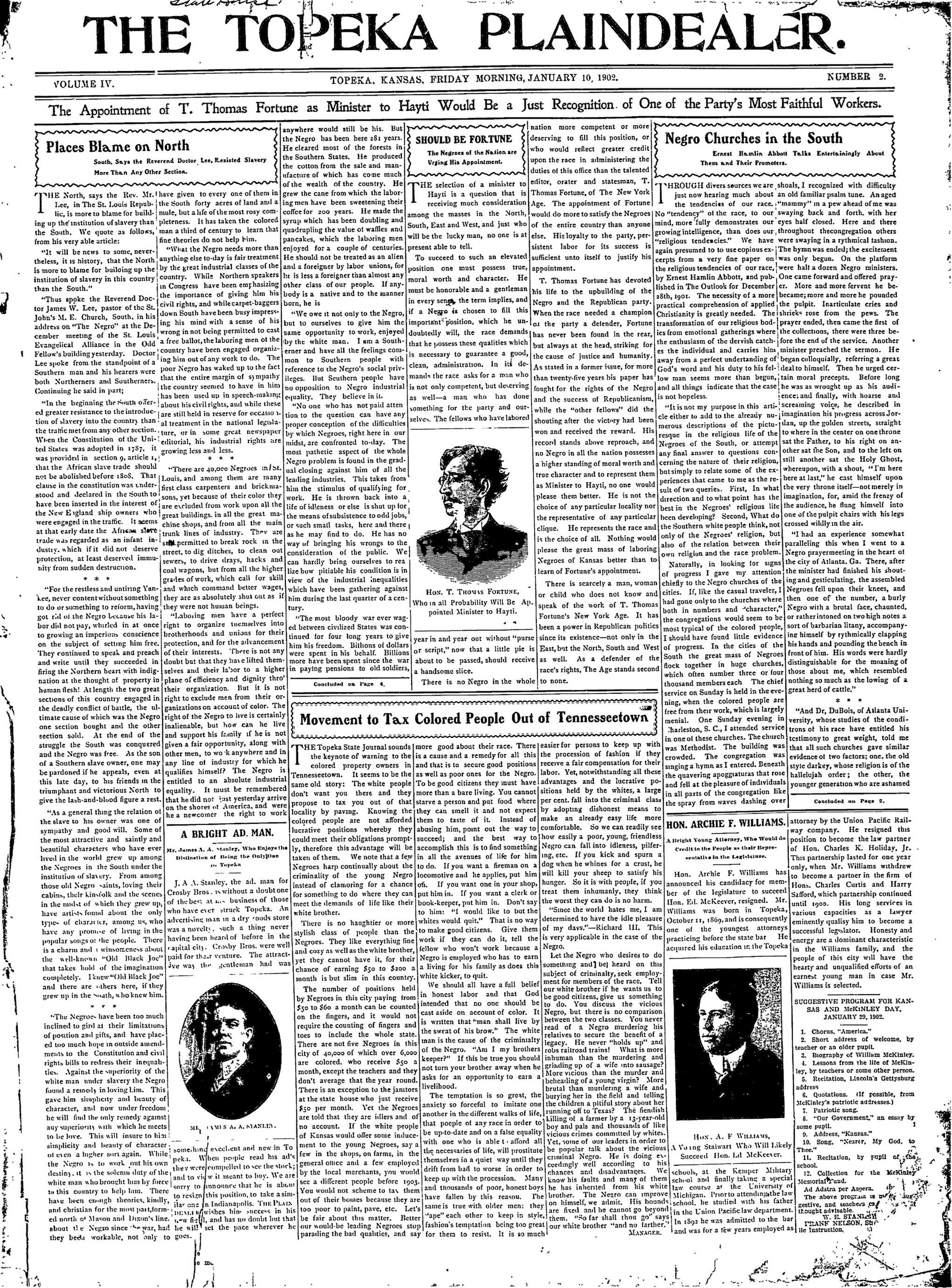
Page text (machine-generated)
THE TOPEKA PLAINDEALER.
Places Blame on North
South, Says the Reverend Doctor Lee, Resisted Slavery More Than Any Other Section.
Says the Rev. Mr. have given to every one of them in the St. Louis Republ the South forty acres of land and a to blame for build mule, but a life of the most rosy com-ition of slavery than completeness. It has taken the colored quote as follows, man a third of century to learn that article; fine theories do not help him.
"What the Negro needs more than anything else-to-day is fair treatment by the great industrial classes of the country. While Northern speakers in Congress have been emphasizing the importance of giving him his civil rights, and while carpet-baggers down South have been busy impressing his mind with a sense of his wrong in not being permitted to cast a free ballot, the laboring men of the country have been engaged organizing him out of any work to do. The poor Negro has waked up to the fact that the entire margin of sympathy the country seemed to have in him has been used up in speech-making about his civil rights, and while these are still held in reserve for occasional treatment in the national legislature, or in some great newspaper editorial, his industrial rights are growing less and less.
VOLUME IV.
hic, is more to blame for building up the institution of slavery than the South. We quote as follows, from his very able article:
"It will be news to some, nevertheless, it is history, that the North is more to blame for building up the institution of slavery in this country than the South."
"Thus apoke the Reverend Doctor James W. Lee, pastor of the St. John's M. E. Church, South, in his address on "The Negro" at the December meeting of the St. Louis Evangelical Alliance in the Odd Fellow's building yesterday. Doctor Lee spoke from the standpoint of a Southern man and his hearers were both Northerners and Southerners. Continuing he said in part;
"In the beginning the South offered greater resistance to the introduction of slavery into the country than the traffic met from any other section. When the Constitution of the United States was adopted in 1787, it was provided in section 9, article 1, that the African slave trade should not be abolished before 1808. That clause in the constitution was understood and declared in the South to have been inserted in the interest of the New England ship owners who were engaged in the traffic. It seems at that early date the African slave trade was regarded as an infant industry, which if it did not deserve protection, at least deserved immunity from sudden destruction.
* * *
"For the restless and untiring Yankee, never content without something to do or something to reform, having got rid of the Negro because his labor did not pay, whirled in at once to growing an imperious conscience on the subject of setting him free. They continued to speak and preach and write until they succeeded in firing the Northern heart with indignation at the thought of property in human flesh! At length the two great sections of this country engaged in the deadly conflict of battle, the ultimate cause of which was the Negro one section bought and the other section sold. At the end of the struggle the South was conquered and the Negro was free. As the son of a Southern slave owner, one may be pardoned if he appeals, even at this late day, to his friends in the triumphant and victorious North to give the lash-and-blood figure a rest.
"As a general thing the relation of the slave to his owner was one of sympathy and good will. Some of the most attractive and saintly and beautiful characters who have ever lived in the world grew up among the Negroes in the South under the institution of slavery. From among those old Negro saints, loving their cabins, their kinsfolk and the scenes in the midst of which they grew up, have artists found about the only types of character, among us, who have any promise of living in the popular songs of the people. There is a charm and a winsorzeness about the well-known "Old Black Joe" that takes hold of the imagination completely. I knew "Old Black Joe" and there are others here, if they grew up in the south, who knew him.
* * *
"The Negroes have been too much inclined to gird at their limitations of position and gifts, and have placed too much hope in outside amendments to the Constitution and civil rights bills to redress their inequabilities. Against the superiority of the white man under slavery the Negro found a remedy in loving Lim. This gave him simplicity and beauty of character, and now under freedom he will find the only remedy against any superiority with which he meets to be love. This will insure to him simplicity and beauty of character of even a higher sort again. While the Negro is to work out his own destiny, it is the solemn duty of the white man who brought him by force to this country to help him. There have been enough theories, kindly and Christian for the most part, formed north of Mason and Dixon's line about the Negro since the war, has they been workable, not only to
"There are 40,000 Negroes in St. Louis, and among them are many first class carpenters and brickmasons, yet because of their color they are excluded from work upon all the great buildings, in all the great machine shops, and from all the main trunk lines of industry. They are still permitted to break rock in the street, to dig ditches, to clean out sewers, to drive drays, hacks and coal wagons, but from all the higher grades of work, which call for skill and which command better wages, they are absolutely shut out as if they were not human beings.
"Laboring men have a perfect right to organize themselves into brotherhoods and unions for their protection, and for the advancement of their interests. There is not any doubt but that they have lifted themselves and their labor to a higher plane of efficiency and dignity thro' their organization. But it is not right to exclude men from their organizations on account of color. The right of the Negro to live is certainly inalienable, but how can he live and support his family if he is not given a fair opportunity, along with other men, to work anywhere and in any line of industry for which he qualifies himself? The Negro is entitled to an absolute industrial equality. It must be remembered that he did not just yesterday arrive on the shores of America, and were he a newcomer the right to work
A BRIGHT AD. MAN.
Mr. James A. A. Stanley. Who Enjoys the Distinction of Being the OnlyOne Topeka
J. A. A. Stanley, the ad. man for Crosby Bros. is without a doubt one of the best at his business of those who have ever struck Topeka. An advertising man in a dry goods store was a novelty, such a thing never having been heard of before in the capital city. Crosby Bros. were well paid for their venture. The attractive way the gentleman had was
[Name]
something excellent and new in Topeka. When people read his ads they were compelled to see the stock; and to view it meant to buy. We are sorry to announce that he is about to resign this position, to take a similar one in Indianapolis. THE PLAIN DEALER wishes him success in his new field, and has no doubt but that he will set the pace wherever he goes.
TOPEKA, KANSAS, FRIDAY MORNING, JANUARY 10, 1902.
anywhere would still be his. But the Negro has been here 281 years. He cleared most of the forests in the Southern States. He produced the cotton from the sale and manufacture of which has come much of the wealth of the country. He grew the cane from which the laboring men have been sweetening their coffee for 200 years. He made the syrup which has been doubling and quadrupling the value of waffles and pancakes, which the laboring men enjoyed for a couple of centuries. He should not be treated as an alien and a foreigner by labor unions, for he is less a foreigner than almost any other class of our people. If anybody is a native and to the manner born, he is
"We owe it not only to the Negro, but to ourselves to give him the same opportunity to work, enjoyed by the white man. I am a Southerner and have all the feelings common to Southern people with reference to the Negro's social privileges. But Southern people have no opposition to Negro industrial equality. They believe in it.
"No one who has not paid attention to the question can have any proper conception of the difficulties by which Negroes, right here in our midst, are confronted to-lay. The most pathetic aspect of the whole Negro problem is found in the gradual closing against him of all the leading industries. This takes from him the stimulus of qualifying for work. He is thrown back into a life of idleness or else is shut up for the means of subsistence to odd jobs, or such small tasks, here and there as he may find to do. He has no way of bringing his wrongs to the consideration of the public. We can hardly bring ourselves to realize how pitiable his condition is in view of the industrial inequalities which have been gathering against him during the last quarter of a century.
"The most bloody war ever waged between civilized States was continued for four long years to give him his freedom. Billions of dollars were spent in his behalf. Billions more have been spent since the war in paying pensions to old soldiers,
Concluded on Page 4.
the keynote of warning to the colored property owners in Tennesseetown. It seems to be the same old story: The white people don't want you there and they propose to tax you out of that locality by paving. Knowing the colored people are not afforded lucrative positions whereby they could meet their obligations promptly, therefore this advantage will be taken of them. We note that a few Negroes harp continually about the criminality of the young Negro instead of clamoring for a chance for something to do where they can meet the demands of life like their white brother.
There is no haughtier or more stylish class of people than the Negroes. They like everything fine and cozy as well as the white brother, yet they cannot have it, for their chance of earning $50 to $200 a month is but slim in this country.
The number of positions held by Negroes in this city paying from $50 to $60 a month can be counted on the fingers, and it would not require the counting of fingers and toes to include the whole state. There are not five Negroes in this city of 40,000 of which over 6,000 are colored, who receive $50 a month, except the teachers and they don't average that the year round. There is an exception to the janitors at the state house who just receive $50 per month. Yet the Negroes are told that they are idlers and of no account. If the white people of Kansas would offer some inducement to the young Negroes, say a few in the shops, on farms, in the general office and a few employed by the local merchants, you would see a different people before 1903. You would not scheme to tax them out of their homes because they are too poor to paint, pave, etc. Let's be fair about this matter. Better our would-be leading Negroes stop parading the bad qualities, and say
SHOULD BE FORTUNE
THE selection of a minister to Hayti is a question that is receiving much consideration among the masses in the North, South, East and West, and just who will be the lucky man, no one is at present able to tell.
To succeed to such an elevated position one must possess true, moral worth and character. He must be honorable and a gentleman in every sense, the term implies, and if a Negro is chosen to fill this important position, which he undoubtedly will, the race demands that he possess these qualities which is necessary to guarantee a good, clean, administration. In its demands the race asks for a man who is not only competent, but devering as well—a man who has done something for the party and ourselves. The fellows who have labored
HON. T. THOMAS FORTUNE,
Who in all Probability Will Be Ap.
pointed Minister to Hayti.
year in and year out without "purse or script," now that a little pie is about to be passed, should receive a handsome slice. There is no Negro in the whole
more good about their race. There is a cause and a remedy for all this and that is to secure good positions as well as poor ones for the Negro. To be good citizens they must have more than a bare living. You cannot starve a person and put food where they can smell it and not expect them to taste of it. Instead of abusing him, point out the way to succeed; and the best way to accomplish this is to find something in all the avenues of life for him to do. If you want a fireman on a locomotive and he applies, put him on. If you want one in your shop, put him in. If you want a clerk or book-keeper, put him in. Don't say to him: "I would like to but the whites would quit." That is no way to make good citizens. Give them work if they can do it, tell the fellow who won't work because a Negro is employed who has to earn a living for his family as does this white kicker, to quit.
We should all have a full belief in honest labor and that God intended that no one should be cast aside on account of color. It is written that "man shall live by the sweat of his brow." The white man is the cause of the criminality of the Negro. "Am I my brothers keeper?" If this be true you should not turn your brother away when he asks for an opportunity to earn a livelihood.
The temptation is so great, the anxiety so forceful to initiate one another in the different walks of life, that people of any race in order to be up-to-date and on a false equality with one who is able to afford all the necessaries of life, will prostitute themselves in a quiet way until they drift from bad to worse in order to keep up with the procession. Many and thousands of poor, honest boys have fallen by this reason. The same is true with older men: they "ape" each other to keep in style, fashion's temptation being too great for them to resist. It is so much
nation more competent or more deserving to fill this position, or who would reflect greater credit upon the race in administering the duties of this office than the talented editor, orater and statesman, T. Thomas Fortune, of The New York Age. The appointment of Fortune would do more to satisfy the Negroes of the entire country than anyone else. His loyalty to the party, persistent labor for its success is sufficient unto itself to justify his appointment.
T. Thomas Fortune has devoted his life to the upbuilding of the Negro and the Republican party. When the race needed a champion on the party a defender, Fortune has never been found in the rear, but always at the head, striking for the cause of justice and humanity. As stated in a former issue, for more than twenty-five years his paper has fought for the rights of the Negro and the success of Republicanism, while the "other fellows" did the shouting after the victory had been won and received the reward. His record stands above reproach, and no Negro in all the nation possesses a higher standing of moral worth and true character and to represent them as Minister to Hayti, no one would please them better. He is not the choice of any particular locality nor the representative of any particular clique. He represents the race and is the choice of all. Nothing would please the great mass of laboring Negroes of Kansas better than to learn of Fortune's appointment.
There is scarcely a man, woman or child who does not know and speak of the work of T. Thomas Fortune's New York Age. It has been a power in Republican politics since its existence—not only in the East, but the North, South and West as well. As a defender of the race's rights, The Age stands second to none.
easier for persons to keep up with the procession of fashion if they receive a fair compensation for their labor. Yet, notwithstanding all these advantages and the lucrative positions held by the whites, a large per cent. fall into the criminal class by adopting dishonest means to make an already easy life more comfortable. So we can readily see how easily a poor, young, friendless Negro can fall into idleness, pilfering, etc. If you kick and spurn a dog when he whines for a crust, he will kill your sheep to satisfy his hunger. So it is with people, if you treat them inhumanly, they think the worst they can do is no harm.
"Since the world hates me, I am determined to have the idle pleasure of my days."—Richard III. This is very applicable in the case of the Negro.
Let the Negro who desires to do something and be heard on this subject of criminality, seek employment for members of the race. Tell our white brother if he wants us to be good citizens, give us something to do. You discuss the vicious Negro, but there is no comparison between the two classes. You never read of a Negro murdering his relatives to secure the benefit of a legacy. He never "holds up" and robs railroad trains! What is more inhuman than the murdering and grinding up of a wife into sausage? More vicious than the murder and beheading of a young virgin? More brutal than murdering a wife and burying her in the field and telling the children a pitiful story about her running off to Texas? The fendish killing of a farmer by a 13-year-old boy and palms and thousands of like vicious crimes committed by whites. Yet, some of our leaders in order to be popular talk about the vicious criminal Negro. He is doing exceedingly well according to his chances and disadvantages. We know his faults and many of them he has inherited from his white brother. The Negro can improve on himself, we admit. His bounds are fixed and he cannot go beyond them. "So far shall thou go" say our white brother "and no farther." MANAGER.
Negro Churches in the South
Ernest Hamlin Abbott Talks Entertainingly About Them and Their Promoters.
just now hearing much about the tendencies of our race. No "tendency" of the race, to our mind, more fully demonstrates our growing intelligence, than does our "religious tendencies." We have again presumed to use copious excerpts from a very fine paper on the religious tendencies of our race, by Ernest Hamlin Abbott, and published in The Outlook for December 28th, 1901. The necessity of a more practical comprehension of applied Christianity is greatly needed. The transformation of our religious bodies from emotional gatherings where the enthusiasm of the dervish catches the individual and carries him away from a perfect understanding of God's word and his duty to his fellow man seems more than begun, and all things indicate that the case is not hopeless.
"It is not my purpose in this article either to add to the already numerous descriptions of the picturesque in the religious life of the Negroes of the South, or attempt any final answer to questions concerning the nature of their religion, but simply to relate some of the experiences that came to me as the result of two queries. First, In what direction and to what point has the best in the Negroes' religious life been developing? Second, What do the Southern white people think, not only of the Negroes' religion, but also of the relation between their own religion and the race problem
Naturally, in looking for signs of progress I gave my attention chiefly to the Negro churches of the cities. If, like the casual traveler, I had gone only to the churches where both in numbers and "character," the congregations would seem to be most typical of the colored people, I should have found little evidence of progress. In the cities of the South the great mass of Negroes flock together in huge churches, which often number three or four thousand members each. The chief service on Sunday is held in the evening, when the colored people are free from their work, which is largely menial. One Sunday evening in Charleston, S. C., I attended service in one of these churches. The church was Methodist. The building was crowded. The congregation was singing a hymn as entered. Beneath the quavering apogogiaturas that rose and fell at the pleasure of individuals in all parts of the congregation like the spray from waves dashing over
HON. ARCHIE F. WILLIAMS.
A Bright Young Attorney, Who Would do Credit to the People as their Representative in the Legislature.
Hon. Archie F. Williams has announced his candidacy for member of the legislature to succeed Hon. Ed. McKeever, resigned. Mr. Williams was born in Topeka, October 11, 1869, and is consequently one of the youngest attorneys practicing before the state bar. He acquired his education in the Topeka
M. H.
HON. A. F WILLIAMS,
A Young Stalwart Who Will Likely
Succeed Hon. Ld McKeever.
schools, at the Kemper Military
school and finally taking a special
law course at the University of
Michigan. Prior to attending the law
school, he studied with his father
in the Union Pacific law department.
In 1892 he was admitted to the bar
and was for a few years employed as
NUMBER 2.
shoals, I recognized with difficulty an old familiar psalm tune. An aged "mammy" in a pew ahead of me was swaying back and forth, with her eyes half closed. Here and there throughout the congregation others were swaying in a rythmic fashion. The hymn was ended; the excitement was only begun. On the platform were halt a dozen Negro ministers. One came forward and offered prayer. More and more servent he bebecame; more and more he pounded the pulpit. Inarticulate cries and shrieks rose from the pews. The prayer entered, then came the first of the collections, there were three before the end of the service. Another minister preached the sermon. He began colloquially, referring a great deal to himself. Then he urged certain moral precepts. Before long he was wrought up as his audience: and finally, with hoarse and screaming voice, he described in imagination his progress across Jordan, up the golden streets, straight to where in the center on one throne sat the Father, to his right on and other sat the Son, and to the left or still another sat the Holy Ghost whereupon, with a shout, "I'm here here at last," he cast himself upon the very throne itself—not merely in imagination, for, amid the frenzy of the audience, he flung himself into one of the pulpit chairs with his leg crossed wildly in the air.
"I had an experience somewhat paralleling this when I went to a Negro prayermeeting in the heart of the city of Atlanta, Ga. There, after the minister had finished his shouting and gesticulating, the assembled Negroes fell upon their knees, and then one of the number, a burly Negro with a brutal face, chaunded, or rather intoned on two high notes a sort of barbarian litany, accompanying himself by rhythmically clapping his hands and pounding the bench in front of him. His words were hardly distinguishable for the moaning of those about me, which resembled nothing so much as the lowing of a great herd of cattle."
* * *
"And Dr, DuBois, of Atlanta University, whose studies of the conditions of his race have entitled his testimony to great weight, told me that all such churches gave similar evidence of two factors; one, the old style darkey, whose religion is of the hallelujah order; the other, the younger generation who are ashamed
Concluded on Page 2.
attorney by the Union Pacific Railway company. He resigned this position to become the law partner of Hon. Charles K. Holiday, Jr. This partnership lasted for one year only, when Mr. Williams withdrew to become a partner in the firm of Hons. Charles Curtis and Harry Safford, which partnership continued until 1900. His long services in various capacities as a lawyer eminently qualify him to become a successful legislator. Honesty and energy are a dominant characteristic in the Williams family, and the people of this city will have the hearty and unqualified efforts of an earnest young man in case Mr. Williams is selected.
SUGGESTIVE PROGRAM FOR KANSAS AND McKINLEY DAY,
JANUARY 29, 1902.
1. Chorus, "America."
2. Short address of welcome, by teacher or an older pupil.
3. Biography of William McKinley.
4. Lessons from the life of McKinley, by teachers or some other person.
5. Recitation, Lincoln's Gettysburg address
6. Quotations. (If possible, from McKinley's patriotic addresses.)
7. Patriotic song.
8. "Our Government," an essay by some pupil.
9. Address, "Kansas."
10. Song, "Nearer, My God, to Thee."
11. Recitation, by pupil of the school.
12. Collection for the McKinley Memorial fund.
Ad Adatra per Aspera.
The above program is more gestive, and teachers can thought admissible.
W. E. STANLEY
ITLANK NELSON, Stirling Instruction.
Honesty is the best policy. This runs in school matters as in business affairs.
No Negro has thus far shied his castor into the game of state politics this year. We wonder why?
Recognition for Kansas Negroes is one of the good things to come this year from the National administration. May be!
The ability of the Negro to "butt" into the game is seen in the multitude of Negroes out for a ministership. Some surely ought to come in out of the rain.
The people who are so rabid on the Negro's criminal tendencies, will do a heap towards reducing the number of arrests if they will provide some employment for the Negro boy and girl.
We note with much pleasure that our highly esteemed friend, Hon. J. E. Latimer, assistant state librarian, has been admitted to the bar, and is now a full-fledged lawyer. Mr. Latimer's time as librarian expires in March and as yet he has not decided the exact course he will pursue. 'Gene is a first-class fellow and during his four years stay in Topeka has made many warm friends who will hate to see him leave. He may return to "Historic Linn" and resume the publication of his paper, The Pleasanton Herald. Wherever he may shy his castor, he has the best wishes of a host of friends and among them, THE PLAIN-DEALER.
A committee of the representative colored men and taxpayers of the Sixth ward waited on the Board of Education at the last meeting, and filed a protest against the action of the board in moving the worn out old structure from Third and Polk streets and locating it on the old school site in Loman Hill. When the proposition was up last spring for a new school house out there, the member of the board from that district agreed with others that the old location was unhealthy and not centrally located for the children. Since the new building has been put up and the board has decided to permanently separate the black and white children the member cannot recollect that the locality is unhealthy. Since the old building was burned, we are informed that the old foundation has been used as a receptacle for filth and offal. The member of the board remarked that the people must put up with what they can get. So mote it be.
Prompt, Clean
White Work
Collars.....2c
Cuffs.....4c
Shirts.....8c
dies's and Gent's Woolen
garments laundried with-
out shrinkage.
AL HAND LAUNDRY
EAST THIRD ST.
phone 790 and the wagon
or your bundle.
Published at Toppea, Shawnee county, Ks., every
Friday morning by the Plaindealer
Publishing Co., 124 E 9th st.
ICK CHILES - BUSINESS MANAGER
H. CHILDERS - EDITOR
stored at the postoffice at Topeka as second class
.1 matter.
FRIDAY, JAN. 10, 1902.
T.
crcity
EI
---
EXTRA.
5c Soap, marred in the window trim, cake.....1c
Men
Powder
Rem
'Embro
Rem
bons f
Bea
ings f
will will
FRIDAY.
Mennen's Talcum Powder.....12c
Remnants of Laces and Embroideries for.....1-2
Remnants of Ribbons for.....1-2
Beautiful Dress Trimings for.....1-2
will will be held. If you are I
FRIDAY, JANUARY 10, 1902.
Negro Churches In the South.
Concluded from Page 1.
of these emotional outbreaks. The younger element is, of course, going finally to control.
"At Tougaloo, Miss., where there is a 'university' for Negroes, the influence of wise religious education was very perceptible. In that country community, where still Negroes ask of their Northern teachers assurance that the earth is not round in order to keep their iaith in the Bible that speaks of the 'corners of the earth,' where still many Negroes, young and old, are strongly confirmed in their belief that before getting religion a person must feel the devil depart from some one or the definite part of his anatomy, where still a young Negro man recently did not know it was wrong for his pastor to have two wives, I attended services in two colored churches, both Baptist. In each the service was perfectly orderly and devout. The preacher in one church, with rich Negro dialect, made a very thoughtful and appealing address. The course of his thought was something like this: God i. love. If you are a Christian and have religion, you have God in your heart: therefore you have love in your heart. But if you love one another you would not be dishonest; we could trust you with our daughters and our wives. The colored people need to love one another, especially because they have no leaders.
"In the movement away from an emotional religion unrelated to conduct, the churches I have mentioned were evidently not leaders but followers. They therefore represent a much larger number of the colored people than the churches I shall describe in the rest of this article. These, I think, may roughly be divided into two classes: those which believe that the emotional character of the Negro ought not to be suppressed, but educated and guided; and those who believe that the emotional character should be minimized by the magnifying of the intellectual and ethical.
"As a rule, the Episcopalians of the South do not favor the ordination of colored men to the priesthood, thou there is a strong minority that desires it. In the course of my trip I personally met two colored rectors. One, the rector of a small ritualist church in Charteston, S. C., I found getting ready for a rehearsal; he teaches his choir the Gregorian music by ear. The other I met in Baltimore, where he is rector of a church neither high nor ritualistic.
"In further search for the colored rector of St. James' (Baltimore,) I called first at the rectory, which bore no such obtrusively assertive marks of race-consciousness that I had noted in the house of the colored Methodist minister; then at the printing-office where this rector prints with his own hands what is a combined parish paper and church calendar, and also the circulars and a weekly paper for his church orphanage; then at St James Church, a small church, smudgy within and without, on a sunless side street: finally at the orphanage, where I found him. He was small, clean-shaven; his face was full of sparkle and animation; his mind was overflowing with ideas and schemes. In this Home of Colored Orphan Children was tangible evidence that his energy was efficient. He showed me over the building—an ordinary city house adapted for
* * *
\* \* \*
CROSBY BROS. GREAT PRE-INVENTORY SALE!
One of the most sweeping reductions in the annals of the history of this store's business career will be made on all merchandise, in view of preparation for inventory. The fact is widely known that in this store no surplus or dead stock is allowed to accumulate, and the reason for this is very evident, for upon such occasions, it is, that a crowded line is trimmed consistent to a system which keeps our stock clean and fresh at all times.
The reductions are radical and to the extreme, so beginning TODAY and while they last, this
The children, some of them picked up from the ash heaps and gutters, were in charge of a colored kindergartner; they showed clearly the fruits of discipline and good care. In the meanwhile he talked with great animation, not only about his own work, but as well about the practical problems of the race. The fact of the Episcopalian church among the colored people being composed of the better-paid and better-educated class made it difficult, he said, to reach 'the masses,' for the Negroes have very well defined class distinctions among themselves. At the same time this fact does not bring specially vigorous financial support to the church. He illustrated it thus: Eliza gets twelve dollars a month, and then gives her one dollar to the church. She jumps into a position yielding thirty dollars a month. At once she finds herself in a new circle of life; she knows more about balls and parties, more of the requirements of dress, of reading, of a vast multitude of things she never had before. So she still pays one dollar to the church. Her rise seems to be away from religion; it seems so because her life now radiates in so many more directions. He believed thoroughly in colored ministers for colored churches, colored teachers for colored pupils, colored leaders for colored people. The existence of white ministers over colored congregations encourages the already too great characteristic of dependence in the Negro race, he maintained, and it should be recognized by Northerners who are doing religious and charitable work among the Negroes. As he put it, 'We want their advice, not because it is white, but because it is right.' He was frank enough to say in giving a further reason for this that colored people under white supervision feel irresponsible, and often prefer white supervision in order to be relieved of responsibility, for 'no colored man finds it possible to speak with the unreserved friendliness to a white man that he would use in speaking to one of his own race.'"
When in Leavenworth ...Call at...
"THE CHOCTAW"
Joe Lacey,
Proprietor.
He is always at home
to his friends.
826 Choctaw Street.
Parisian Parlors
For the latest in dress cutting and fitting. All work strictly up-to-date.
524 5TH AVE. LEAVENWORTH.
MUSICAL STUDIO
Miss Hicks is teaching music and singing at her studio, 422
E. 4th st. Terms reasonable.
Will teach at the homes if desired. It will pay you to see her before making terms.
A great school for our youth. Now a part of our State's Interests—Negroes should here train their children for the work of life and its duties.
THEOLOGICAL DEPARTMENT to prepare tor the ministry, desiring to fulfil the demands in our pulpits today.
NORMAL DEPARTMENT, preparing or the work of teaching in the public schools and giving a higher training to those desiring the same.
PREPARATORY DEPARTMENT, fitting students for the Normal department and giving an opportunity for education to those deprived of such in childhood.
MUSICAL DEPARTMENT, for furnishing an opportunity for proficiency in that finest of fine arts—music.
STATE INDUSTRIAL DEPARTMENT. It is the intention of this department to give our youth training, fitting them for the work of life in the industrial world. We are opinioned that in this day of competition and labor unions and stern demands nothing will so aid the Negro as to prepare his child to compete with any in the world of skilled labor. With such training no man need fear for the future of his children or the future of his race.
COURSES, Architectural or Mechanical drawing and Carpentry. Printing, both job and journeyman. Tailoring, Bookkeeping, Business Course and Stencgraphy, Dressmaking and plain sewing.
FACULTY—The faculty is composed of graduates from Lincoln, Wilberforce, Fiske, Tuskegee and Hampton: the best schools of the country maintained by our people. Following is the faculty. Rev. William Tecumseh Vernon, B S D, Am. Pres. Lecturer in Philosophy and Logic. Charles S.
George Klien & Co
MAKERS OF
High-Grade Buggy
and eam Harness
...Repairing Promptly Executed...
718 Kansas Ave. Topeka, Kan
I. M. KNIGHT,
UNDERTAKER AND EMBALMER.
32-636 Quincy Street. Topeka, Kas
NIVERSITY
QUINDARO. KANSAS T th. Now a part of our State's Intere work of life and its duties.
For State's Interests—Negroes should here
ties.
MENTS!
Howman, Tuskegee, instructor in Mechanical
Drawing and Carpentry; John Charles Wood, in-
ductor in printing; Joseph Nelson Garret, of Wil-
force, instructor in business course and sten-
ophy; James T. Edwards of Hampton, teacher of
coloring: E. J. Vernon, professor of mathematics;
F. Moore of Fiske, professor of language and
literature; S. L. Grosk, teacher of dressmaking;
Mrs. Lulu Cunningham, piano music; Mrs. M. A.
Morris, matron, teacher of science. In addition,
acturers on various topics have been secured.
Opportunities—These teachers and officers
constantly labor for the betterment of the young
people under their care and gladly lend a helpin-
d to the same. No student is made to feel the
ing of poverty, but merit alone tells. The most
reserving are given credit for the same.
Expenses—Board per month, $5.50; tuition per
month, $1; room rent, $1; incidental fee on en-
ance, $1.
It is not necessary that extravagent habits be
encouraged here; students are advised to bring
strong substantial clothing, but expensive apparel
not needed by one struggling for an education.
School opened Sept. 9, 1901. All arrangements
or entrance can be made by writing Pres. W. T.
Cernon, Quindaro, Kas. He will send one of the
latest complete catalogues giving full information
regarding the same. Write at once for informa-
tion or catalogue to
DEPARTMENTS'
to prepare for the fine demands in our pul-
separing or the work schools and giving aiding the same.
or, fitting students for giving an opportunity need of such in child-
furnishing an oppor-
fessive of fine arts—
MENT. It is the in-
give our youth train-
ing of life in the indus-
nished that in this day of its and stern demands so as to prepare his in the world of skilled no man need fear for the future of his race.
or Mechanical drawing both job and journey-
ing, Business Courseing and plain sewing.
composed of graduates, Fiske, Tuskegee and of the country main-
Bowman, Tuskegee drawing and Carper's structor in printing; herforce, instructor of graphic; James T. Ec tailoring: E. J. Vernon A. F. Moore of Fisk literature; S. L. G. Mrs. Lulu Cunningham Morris, matron, teach lecturers on various.
OPPORTUNITIES—constantly labor for people under their hand to the same. sting of poverty, bus deserving are given.
EXPENSES—Board month, $1; room rent, $1.
It is not necessary, encouraged here; strong substantial cis is not needed by our School opened Sept for entrance can be Vernon. Quindaro, latest complete cata regarding the same, tion or catalogue to
Bowman, Tuskegee, instructor in Mechanical drawing and Carpentry; John Charles Wood, instructor in printing; Joseph Nelson Garret, of Wilberforce, instructor in business course and stenography; James T. Edwards of Hampton, teacher of tailoring: E. J. Vernon, professor of mathematics; A. F. Moore of Fiske, professor of language and literature; S. L. Grosh, teacher of dressmaking; Mrs. Lulu Cunningham, piano music; Mrs. M. A. Morris, matron, teacher of science. In addition, lecturers on various topics have been secured.
OPPORTUNITIES—These teachers and officers constantly labor for the betterment of the young people under their care and gladly lend a helping hand to the same. No student is made to feel the sting of poverty, but merit alone tells. The most deserving are given credit for the same.
EXPENSES—Board per month, $5.50; tuition per month, $1; room rent, $1; incidental fee on entrance, $1.
It is not necessary that extraagent habits be encouraged here; students are advised to bring strong substantial clothing, but expensive apparel is not needed by one struggling for an education. School opened Sept. 9, 1901. All arrangements for entrance can be made by writing Pres. W. T. Vernon, Quindaro, Kas. He will send one of the latest complete catalogues giving full information regarding the same. Write at once for information or catalogue to
WILLIAM T. VERNON
PIANO AND ORGAN MINIATURES FREE
THE KANSAS SAVING INVESTMENT CHENUTE,
Authorized Capital Stock solicited by correspondent financial agent.
TO EVERY PERSON
mentioning this magazine we will send absolutely free set of Cornish Pan-American Exposition models of pianos and organs in miniature. This illustration is a reproduction of one. If you intend buying now or in the near future we will gladly send this embosed set to you. These miniatures have been produced at a great cost. They constitute the most expensive advertising matter ever used by us. They enable you to make a satisfactory selection of piano or organ as to exact appearance and color in your own home. With the plates WE WILL SEND OUR NEW SOUVENIR CATALOGUE
It accurately represents all the latest styles in Cornish American organs and pianos. It is a work of art you will appreciate and it is yours for the asking. It fully explains our unique Cornish Flush of selling on ONE YEAR'S FREE TRIAL.
This method has commended itself to Over a Quarter of a Million satisfied Purchasers. WRITE FOR FULL INFORMATION. Allress.
CORNISH CO.
WASHINGTON, NEW JERSEY.
ESTABLISHED
50 YEARS.
VING INVESTMENT COMPANY (COLORED)
CHENUTE, KANSAS.
ized Capital $700,000
ted by correspondence. General solicitor a
PIANO AND ORGAN MINIATURES FREE
TO EVERY PERSON
mentioning this magazine we will send absolutely free set of Cornish Pan-American Exposition models of pianos and organ in miniature.
This illustration is a reproduction of one. If you intend buying now or in the near future we will gladly send this embossed set to you. These miniatures have been produced at a great cost. They constitute the most expensive advertising matter ever used by us. They enable you to make a satisfactory selection of a piano or organ as to exact appearance and color in your own home. With the plates WE WILL SEND OUR NEW SOUVENIR CATALOGUE.
It accurately represents all the latest styles in Cornish American organs and pianos. It is a work of art you will appreciate and it is yours for the asking. It fully explains our unique Cornish Plain of selling on ONE YEAR'S FREE TRIAL.
This method has commended itself to Over a Quarter of a Million satisfied Purchasers. WRITE FOR FULL INFORMATION. Allress.
CORNISH CO.
WASHINGTON, NEW JERSEY.
ESTABLISHED
50 YEARS.
THE KANSAS SAVING INVESTMENT COMPANY (COLORED) CHENUTE, KANSAS.
Stock solicited by correspondence. General solicitor and financial agent.
Missouri Pacific Route
THE GREAT SOUTHWEST SYSTEM,
the States of Kansas, Missouri, Nebraska,
Traveling the States of Kane Colorado,Cansas, and the Indian Five (5) Daily Passenger Tra in each direction, between K
The Famous Hot S
Are reached ONLY by this
MISSOURI
PACIFIC
RAILWAY
Christmas Stationery,
slightly soiled, for.....1-2
5c Envelopes, package.....3c
20c Bond-tinted Writing Paper, box.....10c
Long-Waisted Corsets,
ranging in price from $1
to $3.75—for
50c, 75c, $1.00
```markdown
```
J. S. HALE
The Chicago Cafe,
HENRY COMPTON, Prop.
E. 12 St. - - Kansas City Mo.
WHEN IN LEAVENWORTH, CALL AT JOHN BAKER'S FIRST CLASS, Restaurant. Ice Cream, and Lunch at all hours 408 5th. ST. LEAVENWORTH, KAN
WONDERFUL
DISCOVERY
Curly Hair Made Straight By
TAKEN FROM LIPE:
BEFORE AND AFTER TREATMENT.
ORIGINAL
OZONIZED OX MARROW
(Coprigrated.)
This wonderful hair pomade is the only safe preparation in the world that makes kinky or curly hair look straight. It lays the scalp and prevents the hair from falling out or breaking off. Cures dandruff and it is safe for all hair types. For forty years and used by thousands. Warranted harmless. Testimonials free on request. It is also straightening kinky hair. Beware of imitations. Get the Original Ozonized Ox hair straight, soft and beautiful. A toilet necessity for ladies, gentlemen and children. It is the best hair pomade that is wonderful hair pomade is that by its use you can straighten your own hair as home. Giving it a best and most economical. It is not possible for anybody to produce a preparation equal to this wonderful hair pomade. Sold by druggists and desiaries send us 60 cents for one bottle or 1.40 for three bottles. Mail your order to postal or express money order. Write your name and address plainly to
OZONIZED OX MARROW CO.,
76 Wabash Avenue, Chicago, Illinois
...CHEAP..
Excursion
Great Rock Island Route
—RATES TO—
COLORADO.
ONLY DIRECT LINE TO COLORADO SPRINGS AND MANITOU.
Take advantage of these cheap rates and spend the vacation in Colorado. Sleeping car reservations may be made now for any of the excursions Write for full information and the beautiful book "COLORADO THE MAGNIFICENT"—sent free.
JNO. SEBASTIAN,
G. P, & T. A, Chicago, Ill.
E. W. THOMPSON,
G. P. & T. A. Topeka, Kas.
BLACK SKIN REMOVER:
REGISTERED
IN
PATENT OFFICE
U.S.
BEFORE
AFTER
both in a box for $1, or three boxes for $2. Guaranteed to do what we want and to say the "best in the world." One box is all that is required if used as directed.
A WONDERFUL FACE BLEACH.
A PEAK-LEAK complexions obtained if used as directed. Will turn the skin of a black or brown person four or five shades lighter, and a mutilated person perfectly white. In forty-eight hours shade or two will be noticeable. It does not turn the skin in spots but bleaches out white, the skin remaining beautiful and continues. Will remain beautiful and continues. Freed from bleaching, pimples or bumps or black heads, makes the skin very soft and smooth. Small pox pits, tan, liver spots removed without harm to the skin. When you get the color you wish, stop using the preparation.
THE HAIR SKRAFTENER
that goes in every one dollar box is enough to
make anyone hair grow long and straight, and
makes the hair soft and easy to comb. Many
of our customers say one of our dollar boxes is
worth ten dollars, yet we sell it for one dollar a
box. THE NO-SHELL thrown in free
Any person sending us one dollar in a letter or
a card, or a letter in order or
registered letter, we will send it the mr'
postage please; or if you want it sent C. O
it will come by express, Zc. extra.
In any case where it fails to do what we c
we will return the money or send a box fr
charge. Puted so that no one will know
tons except receiver.
CRANE AND CO.
122 west Broad Street,
RICHMOND, VA
LOCAL AND PERSONAL
The best place to buy drugs is at Lee's.
Mr. Gall Bass left New Years' day for Ellsworth, Kan.
Mrs. J. S. Brashears has removed to 516 Taylor street.
Ed Hamilton spent last week in Kansas City.
Miss Willa Smith is in Leavenworth in the interest of the Plaindealer.
Miss Carrie Johnson returned home Sunday after a week's visit in Leavenworth.
Mr. and Mrs. Oscar Over have returned from their visit in Leavenworth.
Miss Gertrude Wins left Saturday afternoon for Chicago to visit her sister, Mrs. Small.
See E. S. Lee, the druggist, at 112 West Eighth street.
Mrs. Robt. Buckner entertained last Tuesday evening complimentary to Miss Lillian Dickenson of Omaha.
Cards are out announcing the marriage of Miss Bessie Sned to John Johnson January 14, 1902.
The colored people of the Fifth ward endorsed D. D. Hope for councilman at Chiles' hall last Monday night.
Colonel James Beck of Lawrence came up to attend the meeting of the veterans of the Spanish-American war.
It has been discovered that Topeka has natural gas. There has been more than a thousand cubit yards escaped since the shooting affray at 118.
Messrs. James Williams, Fred Stone-street and Willie McConnell were among those who spent New Years' in Lawrence.
Mesdames Sarah Recves and Mary Silvers of Emporia were the guests of Mr. and Mrs. W. F. W. Stafford during the holidays.
Miss Lillian Dickenson, who has been the guest of Mrs. Robt. Buchner, returned to her home in Omaha Sunday.
On Thursday evening last Mrs. Jas. Page entertained a few friends complimentary to Miss Dickenson of Omaha.
Have your prescriptions filled at E. S. Lee's, 112 W. Eighth street.
Chairman Albaugh issued a call for a meeting of the state central committee January 29 at 10 a. m., in the Copeland hotel.
Mr. and Mrs. Robt. Roland of La Junta, Col., are visiting in the city, the guests of parents, Mr. and Mrs. Jno. Buckner.
The Arden club met last Thursday night with Miss Lena Thompson, and will meet this week with Mrs. R. H. Wade.
The Rosebud Club will meet with Mrs. Paul Jones, 1211 Filmore street, next Thursday, January 9. All members are requested to attend.
M. E. YOUNG.
Mr. and Mrs. J. M. Wright, Mr. and Mrs. S. P. Jordan, Misses Willa Smith, Cora Bennett and Galtha Page attended the Oxford party last Monday in Kansas City.
For Nelson's Hair Straightener a harmless pomade for the hair, go to E. S. Lee's Drug Store, 111 West Eighth street
The Ladies' Colored Orphan's Home Association will give a social Wednesday evening. January 15, at the residence of Rev. Clark, 1157 Lane street, to which the public is kindly invited.
Misses Estelle Shackleford and Daisy Holloway left last Thursday for their respective homes in Hutchinson and Horton. The best wishes of the many friends which they made during their sojourn in the city go with them.
Miss Hattie Harper entertained a few of her friends last Wednesday in honor of Misses Munnie Lewis and Verleter McClain of Kansas City, Mo. The evening was spent in merry chat and music, a dainty three course lunch was served, after which the guests departed for the different halls to complete their enjoyment and pleasure.
A new dancing academy, the Douglas Club, every Friday, beginning Friday, December 10, 1902, at 118 West Eighth street. Special attention will be given to those who desire to learn, and Henderson will see that perfect order is kept. S. V. VAUGHN, Manager. S. B. DOUGLAS, President.
The members of the City Federation are notified that the first monthly meeting will be held at the Shiloh Baptist church Monday, January 13, 1902, at 2 o'clock. MRS. A. M. MATLEY, president.
Dumas Club met with Mrs. Washington in Lowman Hill last Friday. After the routine of business, a delicious lunch was served. Mrs. Craiger of Chicago was a pleasant visitor. The club adjourned to meet with Mrs. Bradshaw in South Topeka, Friday, January 10, 1902.
The Oriental Club was entertained last Friday afternoon by Mrs. Emma Galnes at her home 1170 Filmore st. After business was over a dalty four course lunch was served. The club adjourned to meet Friday afternoon January 10th with Mrs. S. E. McCarroll, 114 East 7th street, room 10.
The Ivy Club danced at 429 Kansas avenue, on Friday evening, 3rd inst., complimentary to Miss Lillian Dickinson of Omaha. This club's parties are always pleasant affairs, and this was no exception. From 8:30 to 12 o'clock dancing was indulged. Refreshments were served. Mr. Roy Williams of Lawrence was also a guest of the club. The annual reception of the Ivy Club will be given the first Friday in February.
The Western Star Club issued invitations for about 200 of their friends to spend a "Merry Friday evening with them at 118 West Sth street." A large number responded to the invitations. Cards and dancing being the principal amusements in which all freely indulged until all departed in the "wee sma' hours," having had a delightful time.
The Ne Plus Ultra Art Club met with Mrs. B. C. Duke Saturday afternoon. All reported a nice time The pleasant visitors Mrs. J. W. Brown, Miss M. A. Jamison. A dainty two course lunch was served after the club spent an hour in work. After the regular form of business the hostess presented each member and visitor a neat little souvenir. Club adjourned to meet with Mrs. J. W. Jones Saturday, January 11, 1902, 924 Spruce street.
Mrs. W. I. Jamison gave a delightful thimble party at her residence Thursday afternoon. The rooms were fragrant with carnations and other seasonable flowers. The chandellers were wound with red ribbons and brought to the four corners of the table. The center piece being jewelled embroidery, on which rested a huge jar of carnations and ferns. Lunch was served in three courses. The souvenirs were dainty affairs, appropriate to the season. The music by Mrs. Ferguson, Miss Foster and Miss Dickinson added much to the pleasure of the evening.
LANE CHAPEL NOTES.
Mrs. Simpson, mother of Mrs. Rev. Brown, who has been sick for some time at the parsonage, died last Saturday night at 10:15. Funeral was held at the church Monday 2 p. m., conducted by Rev. A. M. Ward, assisted by Rev. Helm.
Union revival services were started last Monday evening. Opening sermon was preached by Rev. Ward. Great interest is being manifested.
Mr. Jas. Simpson and wife of Kansas City, Mo., Mrs. Joseph Page of Eshridge and Mesdames Bradley and Davis of Maple Hill, attended the funeral of their mother and auntie, Mrs. Simpson.
The holidays passed off harmoniously and the new year opens with marked aggressiveness upon the part of the entire church, which amply bespeaks a progressive year.
Rev. B. B. R. Guy ably filled the pulpit Sunday evening owing to death in pastor's family. All were pleased with the discourse. Usual service Sunday.
SHILOH JOTTINGS.
Christmas has passed, New Year has come, bringing its joys and sorrows to millions. The reception committee of the fair, made up of several young men of the church and their friends, presented a handsome gold watch to Rev. Helm. The following are the members: F. M. Ware, chairman; Albert Link, secretary; H. W. Washington, G. A. Page, John Vaugh, Ed Doame, J. R. Martin, E. Malory, E. Conley, R. Gains, W. A. Jordan, W. Solomon and several others whose names will be given in next issue. Shiloh was blessed in her effort during holidays in raising $145.
The ladies of the church gave to Mrs. R. L. Helm, in consideration of the work she has done here, a handsome tallormade suit. Mrs. Emma Gains was the prime mover in the affair and
A grand ball and reception will be given in honor of the Williams and Walker company after their performance at the Crawford Theatre Monday evening January 13, at 118 West Eighth street, by the Twilight Dancing Academy of Kansas City, Mo. W. H. Tucker, floor manager; W. D. Foster, pianoist. Admission 25 cents.
made the presentation speech. Mrs. Helm will go to Chicago Ill., soon to visit her parents and to Peoria, Ill., to visit Rev. Helm's mother and relatives.
The church gave Pastor Helm a donation party last Wednesday morning at 1 a. m. Come again, dear friends.
Shiloh raised last year $1,787.17, and it was one of her most successful years. We will give in next writing a full report for 1901's finances.
BUCHANAN-FANCHER.
Miss Elnora Buchanan and Mr. Israel Fancher were married Monday evening, December 23, 1901, at the home of the bride's parents. The decorations were of palms and pink roses, which made the parlors look beautiful. Promptly at half past eight o'clock Miss Mary Jamison took her position at the plano and began to play the wedding march. The bride's sister came in bearing Mr. Fancher on her right arm, followed by Mr. Robert Simms with the bride. They stood in the doorway between the two parlors and the ceremony was performed by Rev. A. M. Ward. The bride looked extremely beautiful, being attired in white satin and carried a bunch of white carnations. The groom wore a suit of black. Miss Buchanan is quite an accomplished young lady, having attended the Industrial Institute for some years. Mr. Fancher is a very wealthy farmer of Great Bend, Kan. There were about fifty persons present. The out-of-town guests were Miss Jones and Mr. Whecler, both of Great Bend, Kan. Mr. and Mrs Fancher left for Great Bend Thursday. January 2, 1902, where they will make their future home. They carry with them our best wishes for their success in life.
THE IMPERIAL'S RECEPTION.
THE IMPERIAL'S RECEPTION.
One hundred and fifty ladies responded to the invitation of the Ladies' Imperial Art Club to call on New Years' day at 429 Kansas avenue. The large and spacious hall was a dream of beauty. The ladies of the club labored earnestly transforming bare walls and floors. White canvass, liberally strewn with lovely bright colored rugs, covered the floor, while festoons of Christmas green and smilax, holly wreaths, terns and handsome pictures adorned every nook and corner. The reception committee gracefully received their many guests, and conducted them to the art exhibit. The art exhibit was one of the most beautiful ever shown in Topeka. Handsome center pieces of Roman and Venetian cut work and in Mexican drawn work, embroidered dolls, battenburg and tattian center pieces were tastefully displayed and elicited much admiration. Interwoven in all the decorations was a profusion of pink and green, the club colors, while here and there pink carnations, the club flower, were seen. In the evening the ladies entertained their husbands. The following ladies compose the club: Mesdames Drusilla Merritt, D. F. Mallory, I. A. Shields, J. M. Ferguson, O. A. Taylor, C. D. Moss, henry King, J. H. Childers, W. F. W. stafford, Samuel Higgins, H. W. Dillard, E. Ridley, M. Owens, J. D. Barker, J. H. Guy and Miss Nora Sexton.
INDUSTRIAL INSTITUTE NOTES.
The regular Sunday afternoon praise service will be held next Sunday at 3 p. m. Prof. Albert Ross and Miss Minnie Howell will lead, the subject being, "Things Which Come First." The public is invited.
The boys in the carpentry department are putting in partitions in the north basement for the new laundry and bath rooms.
The printing office is prepared to do little jobs, as calling cards, letter heads, statements and posters.
Saturday evening the Dooker Washington Literary Society will meet. A good program will also be rendered.
The students in the cooking department are making rapid progress in this useful art. Miss Minnie Howell, the instructor in this department, thoroughly understands her work. The young women of the city who desire better positions in the culinary art should take advantage of this course. All of the colored ministers of the city are putting forth strenuous efforts to double our already large enrollment. We appreciate their assistance and hope that their congregation will continue to manifest their increasing interest. We have made room for several more young men and young ladies and we hope that mothers and fathers who desire to rear useful, as well as intelligent children, will make use of the advantages of our institution.
Go 'Way Back
...AND TRY....
Snow's Pine Expectorant
Young Colored Gentlemen..
Edwin R.
GEORGE
R. G. MARTIN.
R.
Mines, M.
COMPANIES
ANY MERITORIAL
PROPOSITION
OUR
Correspondent
600
Edwin Ray Snyder, P.
GEORGE R. SMITH COLLEGE
R. G. MARTIN.
R. G. MARTIN
Brokers
Mines, Mining Stock. Bonds.
TOPEKA, KANS.
COMPANIES CHARTERED—
ANY MERITORIOUS
PROPOSITION
SUCCESS
OUR FACILITIES FOR H
Correspondences solicited.
600 KANSAS AVENUE
GEORGE R. SMITH COLLEGE, SEDALIA, MO
Brokers
Mines, Mining Stock. Bonds, and Investments.
TOPEKA, KANSAS.
COMPANIES CHARTERED IN ALL STATES AND
TERRITORIES
ANY MERITORIOUS
PROPOSITION SUCCESSFULLY PROMOTED.
OUR FACILITIES FOR HANDLING STOCK
ARE UNEXCEELLED
Correspondencesolicited. R.G.MARTIN & CO
600 KANSAS AVENUE TOPEKA, KAS.
ARE YOU DEAF?
DEAFNE by our m HEAD
ALL CASES
DEAFNESS OR HA
ARE NOW C
by our new invention. Only those
HEAD NOISES GEASE
F. A. WERMAN, OF BALT
by our new invention. Only those born deaf are incurable.
HEAD NOISES CEASE IMMEDIATELY.
F. A. WERMAN, OF BALTIMORE, SAYS:
BALTIMORE, Md, March 30, 1901.
Gentlemen:—Being entirely cured of deafness, thanks to your treatment, I will now give you a full history of my case, to be used at your discretion.
Dr. Dean to sing, and this kept on getting worse, until I lost
I then saw your advertisement accidentally in a New York paper, and ordered it. After I had used it only a few days according to your direction, the business ceased, and to-day, after five weeks, my hearing in the year has been restored. I thank you heartily and keep to remain. Very truly yours.
F. A. WERMAN, 730 S. Broadway, Baltimore, Md.
Our treatment does not interfere with your usual occupation.
Examination and YOU CAN CURE YOURSELF AT HOME. At nominal advice free.
INTERNATIONAL AURAL CURIC, 590 S. LALE AVE., CHICAGO, ILL.
Who sing bass and tenor well, and who desire a College education, will learn how they may attend College without paying board and tuition by addressing. IMMEDIATELY,
Day Snyder, DIRECTOR SCHOOL OF MUSIC.
R. SMITH COLLEGE, SEDALIA, MO.
FRANK BRASILI
G. MARTIN & CO.,
Brokers
Finning Stock. Bonds, and Investments.
TOPEKA, KANSAS.
CHARTERED — IN ALL STATES AND TERRITORIES
SUCCESSFULLY PROMOTED
FACILITIES FOR HANDLING STOCK ARE UNEXCELLED
Indences solicited. R.G.MARTIN & CO.
KANSAS AVENUE TOPEKA, KAS.
ANY HE NOIS
ALL CASES OF
BLESS OR HARD HEAR
ARE NOW CURABLE
new invention. Only those born deaf are incurable.
NOISES CEASE IMMEDIATELY
BE WARNED
SCHOOL OF
PUBLIC.
MA, MO. ]
BANK BRASIEN
restments.
STATES AND
TERRITORIES
PROMOTED.
BLOCK
FLED
MARTIN & CO
TEXAS.
ANY HEAD NOISES?
EARING
incurable.
CARY SAFE COMPANY
BUFFALO, N. Y., U. S. A. ..Manufacturers.... Fire and Burglar Proof Safes VAULTS, LOCKS, ETC. Contracts to United States Government.
Kohl's Cough Mixture
For Coughs, Colds, Hoarseness, Sore Throat, Etc. Price 25 Cents per Bottle.
MACPEDONIA TABFHNACLF No. SG. U.K. T
Halloum N. Kabaya Avenue. Mrs. al-1
hours of each month Mrs. Idam M Jordan
Embalming and CasketCo.
Owned and controlled by Negroes—Capital Stock $2,000.
OFFICE HOURS:
to 10 A.M.
t. t. t.
v. A. TAYLOR, M. D.
PHYSICIAN AND SURGEON
Calls answered day and night.
Stone Quarries
The finest Building Stone in the state. Prepared to ship on short notice. Correspondence solicited.
H. C. RICHARDSON, Proprietor
HELMICK, KANSAS.
WM. E. JACKSON, M. D.
PHYSICIAN AND SURGEON.
Office 404 Kansas Ave.
over Wallace's DrugStore.
TELEPHONE 635.
TOPEKA, KAN
CAPITAL...
These Hams are the product of carefully selected, healthy, corn-fed Kansas Hogs.
CURED AND PREPARED
BY THE
Chas. Wolff
Ask your Grocer and Butcher for "Capital" Hams, no others "just as good.
ASK YOUR GROCER FOR
Ralston
The 5 Minute Breakfast Food.
Purina Health Flour
Makes
"BRAIN BREAD." PURINA MILLS, St. Louis, MO.
= ~~ «4 oS on a” £02 Seale FO es wi . — Ue SS q
“ : .
ty (<i
3} Ffom Our Correspondents
5 @& Weeldy Paragraphs :
To our CORRESPONDENTS AND SuBScRIBERS: What'is most
needed at this time is money. Each week we receive more news
than we have room to publish, which necessitates the carrying over
to the next issue. We would like to enlarge the paper, but cannot
for the reason that a majority of our subscribers don’t pay. If
our correspondents would send a small money order each week
with their news, it would enconrage and assist us in accomplishing
our aim to enlarge the paper. If you want your news published,
pay up Subscribe and pay for the paper and get your neighbor to
do the same. Our Correspondents should wake up and make a
little cash for themselves as well as greatly assisting us.
WICHITA, KXAN.
Mrs. Bettie Davis cf K'ngman is vis-
iting in the city.
Mr. J. E. Whitted, who bas been vis-
iting In the city, has returned to his
home in Chicago.
Elijah Drain, the 11-year-old son of
Mr, and Mrs. E. D, Drala, died Thurs-
day at the home of his parents. The
funeral services were hel from the A.
M. BE. church Friday xfternoon. A
large number of friends eatend their
sympathies to the bereaved parents.
Rev. M. L. Jones of Garden City has
Deen visiting friends for several days.
Miss Lela Crouch entertained a num-
ber of her friends in the afternoon cn
New Years day.
Mr. Jerry Chinnezh cf Brenham,
Tes. is visiting bis son J. T. Chin-
neth.
Mrs M. Fov is spending the holidays
visiting friends in Newton.
Mr. J. E. Whitted wes entertained
at the home of his parents Friday ev-
ening of last week. A pleasant time
was had by those present. The guests
were: Misses S. Rawles, G. Baker, M.
Whitted, L. Covington, Mesdames S.
W. Jones, M. Glover, G. Daniels,
Messrs. Thos. Parks, C. Hall, Geo. Ste-
yenson, A T. Glover, C. Rawles, J.
Fositt and F. Garrett.
‘The last Sabbath in the old year
was a memorable event in the history
of the A. M. E. church, who succeeded
fn removing the last of the indebted-
ness on their church. Much credit is
due to their pastor, Rev. A. C. Terrlil,
who, by persistent efferts, aided py
the members and friends, has removed
the encumbrance which has so long
burdened the church.
The most pleasant social event of
the season was the party given on
New Years’ eve at the residence of Mr.
and Mrs. W. N. Miller. There were
about forty-five participauts In the de-
lightful affair, and with the varlous
games and other amusements the ele-
gant Iuncheon was highly enjoyed by
all of those present.
OSAGE COUNTY NOTES.
Editor the Plaindealer: Find en-
closed $2. Please apply on my sub-
scription to your paper for 1901 and
1902, and accept my Wiskes for the fu-
ture continuance of the paper.
We are glad to note that the Rev. J.
H. Howard is able to resume his work
at Carbondale the frst Sunday. The
church is working nicely, the trustees
have succeeded in getting the deeds to
the two lots and soon the buzz of the
saw and ring of the hammer will be
heard.
William Foster. one of our prosper-
ous farmers, had the misfortune to
love seven head of horses, and Tom
Johnson two head. This is pretty hard
for struggling farmers.
‘Mrs. C. V. Hoard 2s on the sick list.
‘Mrs. Lock of Kansas City is down
on a visit.
3. 1. Hoard sold six head of hoss
which brought $90.14 Swine are food
property at present.
A. J. Mitchell, one of Osage county’s
sadustrious farmers and Zrult growers
will clear about $409 on his fruit last
year.
Tequat rights to atl and special privi.
eges to none on the farm,
Masters Clarence and George W
Uoard spent Christmas with thelt
grandma in Kansas City.
JUNCTION CITY.
Rey. Bunks preached his farewell
sermon here Sunday niche to a crowd-
ed house. He will engage in revival
work. making his seadquarters at
Manhattan,
Mr. Irving Williams of St. Paul,
Minr.. is here visiting his mother and
sisters.
Mr. John Young of Ch'cago is spend-
"ing the holidays with ins father and
mother
Mrs. Clews returned Lome to Clay
Center after spending Xmas here with
her husband.
The members of the second Baptist
church gave a reception last week in
honor of Rev, Banks, their departing
pastor,
S Me ae ot 2Sy as Ss eS: .
| Mrs. Cuvens of l.oulsviile, Ky., 1s
here making her home with her moth-
er.
| The deacons and their wives gave a
reception Monday night {n honor of
Rev. Banks, showing iueir high esteem
for bis three years of labor among
them,
MEXICO, MISSOURI.
| Isabelle Watkins has gone to Chi-
cago to visit friends.
| Miss Ella Drane passed through
Sunday from Iowa enroute to O'Fallon,
Mo.
Mr. Samuel G, Taylor of Montgomery
Fra a few hours Sanday with friends.
Mrs. Jane Wrighbstell is yet on the
sick list.
Mrs. Lucey Tolbart is at home from
Lonisana where she visited relatives
ein the holidays,
| Mrs. Maria Willams is seriously ill.
Elder J. William Jackson will hold
‘his fourth quarterly conference in St.
Tuke’s M. E. churen January 10. Rev.
Ww. C. Ellis, pastor 'n charge.
| Rev Johnson, pastor of the Second
Baptist church, is having quite a suc-
cess in his revival. Rey, Adam S.
Green delivered eloquent sermons Sun-
day.
Miss Fannie Cooper of Martinsburg,
is the guest of her sister, Mrs. Mary
1. Ball.
KANSAS CITY, KANSAS.
A most enjoyable reception sul
given New Years’ cvening at the res-
Idence of Mrs. Cora Penix by the Aly
pha Art Club. The ladies of the club |
had their art work cn exhibition, A
Pleasant time was bad by about 70
guests until a late hour,
KANSAS CITY, MISSOURI.
During all the bistory of Oxford
balls and swell affairs, no event has
occured that can ev!pse or even equal
that of last Monday evening. The oc-
casion being the Tenth Anniversary
ball of the “Oxford Club.” Nothing
happened, nothing could have hap-
pened, to mar or detract from the mag-
nificence of this, the most pleasant
evening of the holidays. Indeed there
prevailed one continual round of pleas-
ure from the inciptency of the pro-
gramme to the last sweet strains of
“Home, Sweet Horae.” Much credit
is due the Oxford Club for their good
judgment. Young's orchestra, which
has heretofore made itself conspicuous
by its absence. was in great evidence.
and covered itself with undying fame.
Many present who had not been able
to appreciate a two-step or a waltz,
‘were lifted unconsciously into the
realm whele reign supreme the trip-
is of the light fantastic toe,
NORTH TOPRKA, KANSAS.
Mis. Ida M. Jordon has heen quite ill
at her home 903 Western avenue, but
is considerable better now. Doctor 0.
A. Taylor is the attending phystcian.
‘The members of the Macedonia Tab-
ernacle No, 93, are requested to come
out on time at the W. K. T. hall, 609
N. Kansas avenue, the 3rd Thursday,
January 16, 1902. at 3 o'clock,
Mrs. Ida M. Jordon returned from
Atchison December 29, 1901.
Pride cf Topeka Tent No. 5, the
members are all requested to he out
the third Monday night, January 1902,
ATCHISON, KAN.
The following persons attended the
Inter-State Literary Society at Kansas
City, Kan: Misses Lutie and Mai
Bowen, Mai Eligin, Myrtle Penet, Ethel
Penn, Mthel Porter, Hattie mgram.
Birtha Johnson: Mesdames Ida Mac-
Mosley, M. Glover, 4, A, Taylor ang W,
1. Gray. Most of them report a good
time, Lut some report a dry time. that
the greater attraction was the Missouri
Colmed Teacher's St2te Association.
Mr, William Balbridge and Mrs. Sal-
lie Lee of Birt, la, spent a few days
during holidays as rnests of Dr. J. A.
Taylor and wife. ‘Trey are related to
Mrs. Taylor as brother and cousin, Af-
ter taking in the Inter-State Mrs. Tay-
lor accompanied them to their old
home, Lexington, Mo. *
Atchison is developing a large coal
mine. Several of the wealthiest white
men are at the head of tae company.
Two of Atchison’s colored men are
shareholders in th's promising enter-
prise, and if the white men get rich so
will these colored men have a alice.
Lay right in their ribs, boys, you can
only be kicked vy standing behind
something.
Captain W, H. Hawkins, who Js prac-
ticing law and a tobacco merchant in
the Philippines, speaks In high pralse
of the islands and the people. There
ig wealth awaiting the enterprising
American Negro in agricultural pur-
sults. Immense wealth everywhere in
the precious metals of the earth. Mon-
ey is free and easy. No burning at the
stake. The Captaia says he has had
enough of army life vniess his country
is assailed by some other nation. He
is due home now on a visit.
The Shiloh Baptist church people
have bought the church on the corner
of Eighth and Division streets, and
ate now holding crowded services.
Murrah for Peter Barnett, who has the
just credit of seeing that every dollar
went into the property. The misston-
urles, Rey, Johnston and Vanier, gave
much encouragement, Now the people
are to select a minister and the pro-
fiessive element say they want as well
educated a minister and gentleman as
ean be found in any of the other
churches. The True Eleven will help
thom in thelr final payment.
Miss Hattie Ingram and parents
have moveil to North Atchison.
Miss Sarah Kerford has made the
hest and finest bedspread made by any
colored woman here. The art work
thereon makes it worth at least $75.
There ts nothing !ihe marrying a girl
with taste that everybody can see.
Mrs. Sofa Stephenson and Mfrs. Sal-
Me Brown receivel valuable boxes
from the express offices sent by their
goad out-of-town children.
EMPORIA, KAN.
Miss Mande Reeves and Mr. William
Canafax are still on the sick Hst, but
reported much better at this writing.
Presiding Elder J, W. Braxton held
quarterly meeting here Sunday and the
weather being very favorable he
preached a very able sermon. His sub-
Ject in the afternoon was “Increase In
Faith.” and In the evening “Give to
Ceasar that that is his and to God that
that belongs to God.”
Mr. Elijah Walker was {nitiated Into
the St. Johns lodge No, 14, A. F. & A,
M,, Tuesday evening.
Messrs. Elijah Walker of Kansas
Clty and William Renfroe of Salina
spent holldays with friends and rela-
tives of this city.
Mr, and Mrs. D. Wicks entertained
in honor of Mr. Eigar Wicks, an em-
ploye of the Insane asylum at Topeka,
who ts visiting relatives and friends,
‘Thursday evening.
A fine baby girl nut In her appear-
ance at the home of Mr. and Mrs. John
Bains, at 1028 Cottonwood street, last
week. Mother and baby doing nicely.
The students hive returned after
spending the holidays with parents
and friends at their several homes,
and with refreshed 1inds and a great-
er determination, have again resumed
their school work.
Mr. Arthur Buckner received as a
Christmas present a fine wheel.
| Mr. J.B. Lestie and wife spent hol
days with his mother and friends in
Fort Scott and Pittsburg,
William (Dicy) Adair and sister o!
Indian Territory spent holidays here
with relatives and friends.
The Adair Lady Band gave a spell.
ing match Tuesday evening of last
week, which proved a success in every
respect.
10-1128 4tbSt, *Phone 167
Troy eam Lenny
Dunton @ Murphy, Props
Prompt Service—Clean
White work.
ATcuisox, -:- -:- Kansas
a ce
:
;
Geo. M. Hammel :
E .
: .
; Merchant
: Bons
F ailor atest
G ef ed
f SPRICTLY HIGH ART
: TAILORING :
- . ;
500 Kansas Ave Topeka |
Places Blame on North
Concluded from Page 1°
who fought to give him his freedom.
The Grand Army of the Republic
holds its reunion every year, and
thé most thrilling and inspiring
thought that comes ‘to them on these
great occasions is, that they knocked
the shackles trom the limbs of four
millions of slaves. And yet this man
who has cost the country more lives
and more money thanany other man
ever cost any country in any age,
stands among us in the _pitiable
plight of being debarred from every
great line of handicraft.
“There is not a Pole or Scandena-
vian, just landedin America yester-
day, however full his head may be of
anarchy and his heart of enmity to
Government, but enjoys opportuni-
ties we deny to our Negroes, who
naturally love the government, who
have been here three hundred years,
and who have never produced an
anarchist in all history. The glory
‘of freaing the slaves will depart from
the Grand Army of the Republic,
and from the states which remained
true to the Union, if they permit
them for want of fair opportunities
to work enjoyed by others, to en.
slave themselves again by vices,
cradled in idleness, into which the)
have been unjustly driven.”
ASNAP IN GARDEN LAND.
* Do you want to make money? I
so write to this office, or to D
Chiles, Oakland, Kansas. He ha:
placed on the market seven fine acre
tracts of good garden land and a 2c
acre tractone mile east of Oakland
four miles from the P. O., at sixty
dollars per acre; $100 cash, balance
one and two years at 6 per cent
You can make your money back the
first year in sweet potatoes.
PUBLICATION NOTICE.
In the District Court of Shawnee
County, Kansas. No, ——.
John A. Booth, plaintiff, vs. Kate
E. Means, alias Kate E. Booth, and
Orley Means, defendants.
To the above named defendants:
You and each of you will take notice,
that you have been sued in the above
entitled Court, by the said John A,
Booth, and that you must answer his
Petition, on or before the 2ist day of
January, 1902, or sald petition will be
taken as true and judgment will be
rendered according to the prayer there-
of, for the partition of the following
described real estate, situated in the
County of Shawnee, State of Kansas,
to wit: Lot numbered, one hundred
twenty-one (121) on Harrison street, ia
Curtis addition to the City of Topeka,
in accordance with the plat on file in
the office of the Register of Deeds of
said County and State, according to
the respective rights of the parties in-
terested therein, or if the same can not
be equitably divided, for the sale there-
of, and a division of the proceeds
among the parties, according to thelr
respective rights, and for such other
relief as equity may require.
W. I. JAMISON,
Attorney for Plaintiff,
JOHN A, BOOTH.
Attest: A. M. CALLAHAN, Clerk of
the District Court.
JM Grerv Manager. *Electne Lights.
Mrs. Gextrt pe Porrs, Prop. Steam Heat
The Hotel Imperial
perial,
107 Feu st, St Josern, Mo.
First-class In all of its appomtments, 4
moderw place fur the accommodation of the
travehng pabhe When im St Joseph, mabe iz
a.
W estern.
‘
Baptist Colleges
Macox, Missouri.
A School of Christlan and
Ministerial Culture.
ELEMENTARY,
Norma,
AcapEsic.
Strong musical department, Com-
plete facalty, Healthful location,
Splendid influence.
8% Terss:—For board and
tuition at reasonable rates. For
Catalogue and particulars, write to
ENOS LARKIN SCRUGGS, A. ¥., Pres
W. M. COLEMAN, M. D.,
SPECIALIST
in diseases of women
and children.......
FMPORIA, = = KANSAS
The rich Klostermeter Bros, Hard-
ware Co. is the headquarters for first
class and durable supplies. Their chi-
raware, stoves and lamps will bear
handling and your big profit is in the
long use they give you.
ARM Tne ULM aTLSL
t =|
e BGO Nh ————
oe
ee SEs =
Sy A ee acca
oe ‘int nd i ah
& Ae au ih
CUT BM AAAI V ENN ;
OF eels, CY Be!
PEA VAR Pen
x <3 (l JH MK a i
ces a IG :
A a a ase “
a LAM A Di iy
e 7 FS a net pea Ht
ah
AS OAR Y) qe
WRAPPER
4 vee inl {
Pie
2 Et Ginga ny
4 ential igh
Yeh Es arae ms
4 rem mara vbe ata!
A.
‘J ‘THERE IS A TRIPLE ECONO-
i NY IN USING DIAMOND «C"
SOAP... . THE ECONOX
‘4 OF BETTER SOAP FOR YOUR
=a MONEY. ‘THE ECONOMY OF
@ LESS WORK, AN
YA ECONOMY OF SECURING
SOMETHING OF USE AND
if] VALUE FOR YOUR WRAP-
PERS... eee ee
‘4 —=
24 Complete catalogue showing
+ grea pesmi that ol
Tbe secured by saving the ff
fa wrappers, furnished free up=
Py, on request. Send yournsme
34 one pont card, and we will
34 mail you the catalogue,
: ‘Address
i PREMIUM DEPT.,
= THE CUDAHY PAGKING
4 COMPANY,
SOUTH OMAHA, NEB.
B Diamond °C" Soap for sale by all Grocers
NS 7
NELso 6 oy THE MOST PERFECT
st LATEST OScoveRr e ©
FOR MAKING
Sixtus Hale Dressing
a a EVER DISCOVERED.
fr si —
ee) Suse Patel Ha
ae waranteed Perfectly Harmless,
fi an By ey ELEGANTLY PERFUMED.
aes I —
¥ Sey, : Do not ruin your hatr by using dangerous
Ceacee’' ~ @nd worthless preparations when you can
7 fe ad get this reliadie remedy. @ FY Ee
9 Not only straightens the hair, but, 3
Nelson's Straightine ishing the roots, prevents 4f rot tating
ont, removes dandruff, cures itching, irritating ‘scalp diseases, and gives a
long and beautiful head of hair. It is used and highly endorsed by the best
people in all sections of this country, We guarantee Straightine to be free
rom all injurious chemicals, and cannot injure the hair, Stralghtine does not
make the hair sticky or gummy, and will not become rancid. “Straightine is
sold at all drug stores. Price, 25 cents a can (one month’s treatment). If:
your druggist does not keep it he will get it for you, or we will send it by mail,
securely wrapped, on receipt of 30c. in stamps, Address,
NELSON MANUFACTURING CO., Richmond, Va.
3 47 Agents can make big money. Write for terms.
> hed beth bt OOS:
UNION Lock POULTRY FENCE.
For Poultry, Rabbits, 4 Orchards, Gardens, etc.
Po y So _ =
z. Coy CSE =o
<2 a, HHH &
2S boroooy e NO ss
Sh Be i ANH = we
22 Fae INUON apoE 3 =
=z s Choy Sia) i S43 Nitti BF
82 fii ad pnt yy a ae
32 Hts SS ACI RE
go HEN pee tere CT 3 F
— ees SG
Paactiey inion NAY sins
+ thi ny other make,
Oue Unoe tose Hoo hala. Cad. Cautle Fence, Union Lawn
Fence Gates, etc., guaranteed first class. -
* “Your dealer should handle this line—if not, write us for
prices. Catalogue free. *
UNION. FENCE CO., DE KALB, ILL., U. S. A.
The _— Negro Journe
| Of the West
THE TOPEKA
PLAINDEALER
Wants YourPatronage
And Job Work.