Plaindealer
Friday, May 1, 1903
Topeka, Kansas
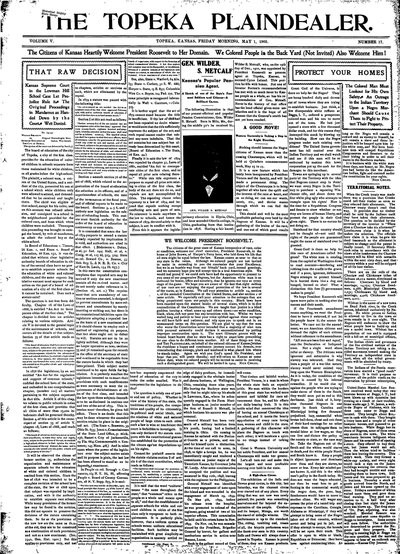
Page text (machine-generated)
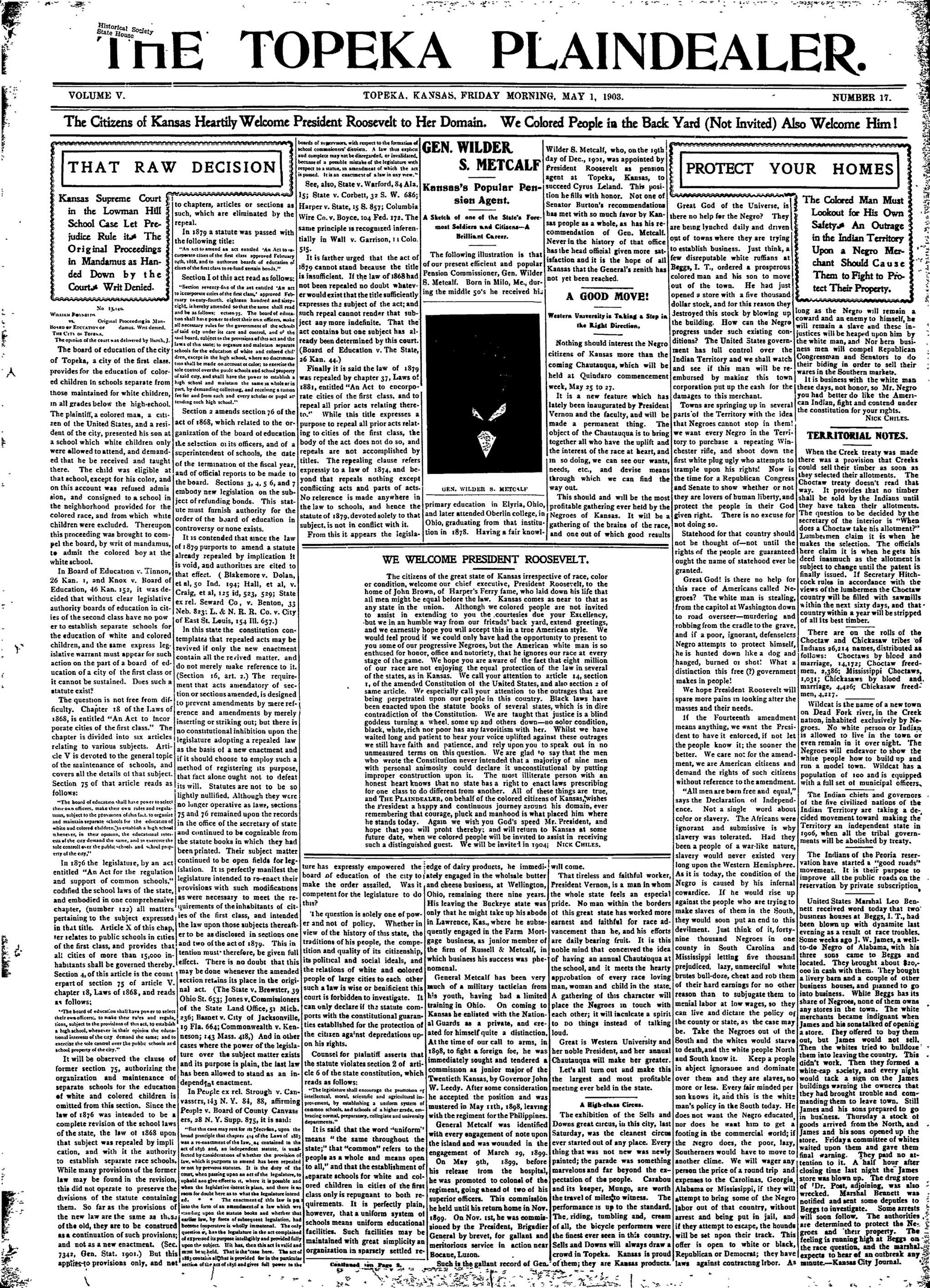
THE TOPEKA PLAINDEALER.
THAT RAW DECISION
VOLUME V.
Kansas Supreme Court in the Lowman Hill School Case Let Prejudice Rule it The Original Proceedings in Mandamus as Handed Down by the Court Writ Denied.
WILLIAM FOUNDING
vs.
Original Proceeding in Man-
board of EDUCATION of
damus. Writ denied.
THE CITY OF TOPAHA.
The board of education of the city of Topeka, a city of the first class, provides for the education of colored children in schools separate from those maintained for white children, in all grades below the high-school. The plaintiff, a colored man, a citizen of the United States, and a resident of the city, presented his son at a school which white children only were allowed to attend, and demanded that he be received and taught there. The child was eligible at that school, except for his color, and on this account was refused admission, and consigned to a school in the neighborhood provided for the colored race, and from which white children were excluded. Thereupon this proceeding was brought to compel the board, by writ of mandamus, to admit the colored boy at the white school.
In Board of Education v. Tinnon, 26 Kan. 1, and Knox v. Board of Education, 46 Kan. 152, it was decided that without clear legislative authority boards of education in cities of the second class have no power to establish separate schools for the education of white and colored children, and the same express legislative warrant must appear for such action on the part of a board of education of a city of the first class or it cannot be sustained. Does such a statute exist?
The question is not free from difficulty. Chapter 18 of the Laws of 1868, is entitled "An Act to incorporate cities of the first class." The chapter is divided into six articles relating to various subjects. Article V is devoted to the general topic of the maintenance of schools, and covers all the details of that subject. Section 75 of that article reads as follows:
"The board of education shall have power to select their own officers, make their own rules and regulations, subject to the provisions of this fact, to organize and maintain separate schools for the education of white and colored children. To establish a high school whenever, in their opinion, the educational interests of the city demand the same, and in exercise the sole control over the public schools and school property of the city."
In 1876 the legislature, by an act entitled "An Act for the regulation and support of common schools," codified the school laws of the state, and embodied in one comprehensive chapter, (number 122) all matters pertaining to the subject expressed in that title. Article X of this chapter relates to public schools in cities of the first class, and provides that all cities of more than 15,000 inhabitants shall be governed thereby. Section 4, of this article is the count erpart of section 75 of article V. chapter 18, Laws of 1868, and reads as follows:
"The board of education shall have power to select their own officers; to make their rules and regulations, subject to the provisions of this act, to establish a high school, whenever in their opinion the educational interests of the city demand the same; and to exercise the sole control over the public schools and school property of the city."
It will be observed the clause of former section 75, authorizing the organization and maintenance of separate schools for the education of white and colored children is omitted from this section. Since the law of 1876 was intended to be a complete revision of the school laws of the state, the law of 1868 upon that subject was repealed by implication, and with it the authority to establish separate race schools. While many provisions of the former law may be found in the revision, this did not operate to preserve the divisions of the statute containing them. So far as the provisions of the new law are the same as those of the old, they are to be construed as a continuation of such provisions; and not as a new enactment. (Sec. 7342, Gen. Stat. 1901.) But this applies to provisions only, and not
to chapters, articles or sections as such, which are eliminated by the repeal.
"An act to amend an act entitled 'An Act to incorporate cities of the first class approved February 24th, 1868, and to authorize boards of education of cities of the first class to re-fund certain bonds."
Section I of this act read as follows:
"Section seventy-five of the act entitled 'An act to incorporate cities of the first class,' approved February twenty-fourth, eighteen hundred and sixty-eight, be hereby amended so that the same shall read and be as follows: section 75. The board of education shall have power to elect their own officers, make all necessary rules for the government of the schools of said city under its care and control, and of the said board, subject to the provisions of this act and the laws of this state; to organise and maintain separate schools for the education of white and colored children, except in the high school, where no discrimination shall be made on account of color; to exercise the sole control over the public schools and school property of said city, and shall have the power to establish a high school and maintain the same in whole or in part, by demanding collecting, and receiving a tuition fee for and from each and every school or pupil attending such high school."
Section 2 amends section 76 of the act of 1868, which related to the organization of the board of education the selection on its officers, and of a superintendent of schools, the date of the termination of the fiscal year, and of official reports to be made to the board. Sections 3, 4, 5, 6, and 7 embody new legislation on the subject of refunding bonds. This statute must furnish authority for the order of the board of education in controversy or none exists.
It is contended that since the law of 1879 purports to amend a statute already repealed by implication It is void, and authorities are cited to that effect. ( Blakemore v. Dolan, et al, 50 Ind. 194; Hall, et al, v. Craig, et al, 125 id, 523, 529; State ex rel. Seward Co, v. Benton, 33 Neb. 823; L. & N. R. R. Co. v. City of East St. Louis, 154 Ill. 657.)
In this state the constitution contemplate that repealed acts may be revived if only the new enactment contain all the received matter, and do not merely make reference to it. (Section 16, art. 2.) The requirement that acts amendatory of section or sections amended, is designed to prevent amendments by mere reference and amendments by merely inserting or striking out; but there is no constitutional inhibition upon the legislature adopting a repealed law as the basis of a new enactment and if it should choose to employ such a method of registering its purpose, that fact alone ought not to defeat its will. Statutes are not to be so lightly nullified. Although they were no longer operative as laws, sections 75 and 76 remained upon the records in the office of the secretary of state and continued to be cognizable from the statute books in which they had been printed. Their subject matter continued to be open fields for legislation. It is perfectly manifest the legislature intended to re-enact their provisions with such modifications as were necessary to meet the requirements of the inhabitants of cities of the first class, and intended the law upon those subjects thereafter to be as disclosed in sections one and two of the act of 1879. This intention must therefore, be given full effect. There is no doubt that this may be done whenever the amended section retains its place in the original act. (The State v. Brewster, 39 Ohio St. 653; Jones v. Commissioners of the State Land Office, 51 Mich. 236; Basnet v. City of Jacksonville, 19 Fla. 664; Commonwealth v. Kenneson; 143 Mass. 418.) And in other cases where the power of the legislature over the subject matter exists and its purpose is plain, the last law has been allowed to stand as an independent enactment.
In People ex rel. Strough v. Canvassters, 143 N. Y. 84, 88, affirming People v. Board of County Canvasers, 28 N. Y. Supp. 875, it is said:
"But this case may rest for its decision, upon the broad principle that chapter 414 of the Laws of 1883 was a re-enactment of the law, as contained in the act of 1856 and, an independent statute, is unaffected by considerations of whether the provision of law, which it purports to amend has been repealed or not by previous statutes. It is the duty of the court, when passing upon an act of the legislature, to uphold and give effect to it, where it is possible and when the legislative intent is plan, and there is no room for doubt here as to what the legislature intended.
* * * The enactment of this law is put into the form of an amendment of a law which was standing upon the statute books and whether that earlier law, by force of subsequent legislation, had become imperative is wholly immaterial. The only question $v$ has the legislature in the act complained of expressed its purpose intelligibly and provided fully upon the subject. It has, then this act is valid and must be held. That is the case here. The act of 1883 contains all that is provided for in the particular section of the act of 1856 and gives full power to the
TOPEKA, KANSAS, FRIDAY MORNING, MAY 1, 1903.
WE WELCOME PRESIDENT ROOSEVELT.
The citizens of the great state of Kansas irrespective of race, color or condition, welcome our chief executive, President Roosevelt, to the home of John Brown, of Harper's Ferry fame, who laid down his life that all men might be equal before the law. Kansas comes as near to that as any state in the union. Although we colored people are not invited to assist in extending to you the courtesies due your Excellency, but we in an humble way from our friends' back yard, extend greetings, and we earnestly hope you will accept this in a true American style. We would feel proud if we could only have had the opportunity to present to you some of our progressive Negroes, but the American white man is so enthused for honor, office and notoriety, that he ignores our race at every stage of the game. We hope you are aware of the fact that eight million of our race are not enjoying the equal protection of the law in several of the states, as in Kansas. We call your attention to article 14, section 1, of the amended Constitution of the United States, and also section 2 of same article. We especially call your attention to the outrages that are being perpetrated upon our people in this country. Black laws have been enacted upon the statute books of several states, which is in dire contradiction of the Constitution. We are taught that justice is a blind goddess turning a wheel. some up and others down—no color condition, black, white, rich nor poor has any favoritism with her. Whilst we have waited long and patient to hear your voice uplifted against these outrages we still have faith and patience, and rely upon you to speak out in no unmeasured terms on this question. We are glad to say that the men who wrote the Constitution never intended that a majority of nine men with personal animosity could declare it unconstitutional by putting improper construction upon it. The most illiterate person with an honest heart knows that no state has a right to enact laws prescribing for one class to do different from another. All of these things are true, and THE PLAINDEALER, on behalf of the colored citizens of Kansas, wishes the President a happy and continuous journey around his domain, ever remembering that courage, pluck and manhood is what placed him where he stands today. Again we wish you God's speed Mr. President, and hope that you will proft thereby: and will return to Kansas at some future date, when we colored people will be invited to assist in receiving such a distinguished guest. We will be invited in 1904. NICK CHILES.
boards of supervisors, with respect to the formation of school commissioners' districts. A law thus explicit and complete may not be disregarded, or invalidated, because of a possible mistake of the legislature with respect to a status, in amendment of which the act is passed. It is an enactment of a law in any view.
See, also, State v. Warford, 84 Ala. 15; State v. Corbett, 32 S. W. 686; Harper v. State, 15 S. 857; Columbia Wire Co. v. Boyce, 104 Fed. 172. The same principle is recognized inferentially in Wall v. Garrison, 11 Colo. 515.
It is farther urged that the act of 1879 cannot stand because the title is insufficient. If the law of 1868 had not been repealed no doubt whatever would exist that the title sufficiently expresses the subject of the act; and such repeal cannot render that subject any more indefinite. That the act contains but one subject has already been determined by this court. (Board of Education v. The State, 26 Kan. 44.)
Finally it is said the law of 1879 was repealed by chapter 37, Laws of 1881, entitled "An Act to incorporate cities of the first class, and to repeal all prior acts relating thereto." While this title expresses a purpose to repeal all prior acts relating to cities of the first class, the body of the act does not do so, and repeals are not accomplished by titles. The repealing clause refers expressly to a law of 1874, and beyond that repeals nothing except conflicting acts and parts of acts. No reference is made anywhere in the law to schools, and hence the statute of 1879, devoted solely to that subject, is not in conflict with it.
From this it appears the legisla-
WE WELCOME
The citizen or condition, welcoming home of John Brown, all men might be any state in the u. to assist in extinct but we in an humble and we earnestly b would feel proud if you some of our proud enthused for honour stage of the game. of our race are no of the states, as in 1, of the amended same article. We being perpetrated been enacted upon contradiction of the goddess turning a black, white, rich n waited long and pa we still have faith in unmeasured terms who wrote the Co with personal and improper constru honest heart know for one class to do and THE PLAINDE the President a ha remembering that he stands today. hope that you will future date, when such a distinguishe
ture has expressly empowered the board of education of the city to make the order assailed. Was it competent for the legislature to do this?
The question is solely one of power and not of policy. Whether in view of the history of this state, the traditions of his people, the competition and quality of its citizenship, its political and social ideals, and the relations of white and colored people of large cities to each other such a law is wise or benficient this court is forbidden to investigate. It can only declare if the statute comports with the constitutional guarantees established for the protection of the citizen against depredations upon his rights. Counsel for plaintiff asserts that the statute violates section 2 of article 6 of the state constitution, which reads as follows:
"The legislature shall encourage the promotion of intellectual, moral, scientific and agricultural improvement, by establishing a uniform system of common schools, and schools of a higher grade, embracing normal, preparatory, collegiate and university departments."
It is said that the word "uniform" means "the same throughout the state;" that "common" refers to the people as a whole and means open to all," and that the establishment of separate schools for white and colored children in cities of the first class only is repugnant to both requirements. It is perfectly plain, however, that a uniform system of schools means uniform educational facilities. Such facilities may be maintained with great simplicity an organization in sparsely settled re-
GEN. WILDER
S. METCALF
Kansas's Popular Pension Agent.
A Sketch of one of the State's Foremost Soldiers and Citizens-A Brilliant Career.
The following illustration is that of our present efficient and popular Pension Commissioner, Gen. Wilder S. Metcalf. Born in Milo, Me., during the middle 50's he received his
GEN. WILDER S. METCALF
primary education in Elyria, Ohio, and later attended Oberlin college, in Ohio, graduating from that institution in 1878. Having a fair knowl-
WELCOME PRESIDENT ROOSE
Ass of the great state of Kansas irrespectively come our chief executive, President Brown, of Harper's Ferry fame, who laid equal before the law. Kansas comes to union. Although we colored people attending to you the courtesies due to a stable way from our friends' back yard, hope you will accept this in a true America if we could only have had the opportunity to progress Negroes, but the American poor, office and notoriety, that he ignores.
We hope you are aware of the fact that not enjoying the equal protection of in Kansas. We call your attention to a Constitution of the United States, and are especially call your attention to the aid upon our people in this country. On the statute books of several states the Constitution. We are taught that a wheel, some up and others down—nor poor has any favoritism with her. Patient to hear your voice uplifted again and patience, and rely upon you to us on this question. We are glad to constitution never intended that a major animosity could declare unconstitution upon it. The most illiterate laws that no state has a right to enact do different from another. All of the REALER, on behalf of the colored citizens happy and continuous journey around courage, pluck and manhood is what Again we wish you God's speed We will proft thereby; and will return to we colored people will be invited to a named guest. We will be invited in 1904.
edge of dairy products, he immediately engaged in the wholesale butter and cheese business, at Wellington, Ohio, remaining there nine years. His leaving the Buckeye state was only that he might take up his abode in Lawrence, Kas., where he subsequently engaged in the Farm Mortgage business, as junior member of the firm of Russell & Metcalf, in which business his success was phenomenal.
General Metcalf has been very much of a military tactician from his youth, having had a limited training in Ohio. On coming to Kansas he enlisted with the National Guards as a private, and created for himself quite a distinction. At the time of our call to arms, in 1898, to fight a foreign foe, he was immediately sought and tendered a commission as junior major of the Twentieth Kansas, by Governor John W. Leedy. After some consideration he accepted the position and was mustered in May 11th, 1898, leaving with the regiment for the Phillippines. General Metcalf was identified with every engagement of note upon the island and was wounded in the engagement of March 29, 1899. On May 9th, 1899, before his release from the hospital, he was promoted to colonel of the regiment, going ahead of two of his superior officers. This commission he held until his return home in Nov. 1899. On Nov. 1st, he was commissioned by the President, Brigadier General by brevet, for gallant and meritorious service in action near Bocaue, Luzon.
Wilder S. Metcalf, who, on the 19th day of Dec., 1901, was appointed by President Roosevelt as pension agent at Topeka, Kansas, to succeed Cyrus Leland. This position he fills with honor. Not one of Senator Burton's recommendations has met with so much favor by Kansas people as a whole, as has his recommendation of Gen. Metcalf. Never in the history of that office has the head official given more satisfaction and it is the hope of all Kansas that the General's zenith has not yet been reached.
A GOOD MOVE!
Western University is Taking a Step in the Right Direction,
Nothing should interest the Negro citizens of Kansas more than the coming Chautauqua, which will be held at Quindaro commencement week, May 25 to 27.
It is a new feature which has lately been inaugurated by President Vernon and the faculty, and will be made a permanent thing. The object of the Chautauqua is to bring together all who have the uplift and the interest of the race at heart, and in so doing, we can see our wants, needs, etc., and devise means through which we can find the way out.
This should and will be the most profitable gathering ever held by the Negroes of Kansas. It will be a gathering of the brains of the race, and one out of which good results
ROSEVELT.
A collective of race, color and down his life that as near to that as male are not invited to your Excellency, and extend greetings, American style. We community to present to men white man is so our race at every that eight million of the law in several article 14, section and also section 2 of the outrages that are Black laws have cases, which is in dire but justice is a blind no color condition, Whilst we have insist these outrages to speak out in no say that the men majority of nine men institutional by putting the person with an act laws prescribing these things are true, of Kansas, wishes at his domain, ever replaced him where Mr. President, and to Kansas at some assist in receiving Nick Chiles.
That tireless and faithful worker, President Vernon, is a man in whom the whole state feels an especial pride. No man within the borders of this great state has worked more earnest and faithful for race advancement than he, and his efforts are daily bearing fruit. It is this noble mind that conceived the idea of having an annual Chautauqua at the school, and it meets the hearty approbation of every race loving man, woman and child in the state. A gathering of this character will place the Negroes in touch with each other; it will inculcate a spirit to do things instead of talking loud.
Great is Western University and her noble President, and her annual Chautauqua will make her greater. Let's all turn out and make this the largest and most profitable meeting ever held in the state.
A High-class Circus.
The exhibition of the Sells and Downs great circus, in this city, last Saturday, was the cleanest circus ever started out of any place. Every thing that was not new was newly painted; the parade was something marvelous and far beyond the expectation of the people. Carabou and its keeper, Mungo, are worth the travel of miles to witness. The performance is up to the standard. The, riding, tumbling and, cream of all, the bicycle performers were the finest ever seen in this country. Sells and Downs will always draw a crowd in Topeka. Kansas is proud
PROTECT YOUR HOMES
Great God of the Universe, is there no help for the Negro? They are being lynched daily and driven out of towns where they are trying to establish business. Just think, a few disreputable white ruffians at Beggs, I. T., ordered a prosperous colored man and his son to move out of the town. He had just opened a store with a five thousand dollar stock, and for this reason they destroyed this stock by blowing up the building. How can the Negro progress under such existing conditions? The United States government has full control over the Indian Territory and we shall watch and see if this man will be reimbursed by making this town corporation put up the cash for the damages to this merchant.
Towns are springing up in several parts of the Territory with the idea that Negroes cannot stop in them! we want every Negro in the Territory to purchase a repeating Winchester rifle, and shoot down the first white plug ugly who attempts to trample upon his rights! Now is the time for a Republican Congress and Senate to show whether or not they are lovers of human liberty, and protect the people in their God given right. There is no excuse for not doing so.
Statehood for that country should not be thought of—not until the rights of the people are guaranteed ought the name of statehood ever be granted.
Great God! is there no help for this race of Americans called Negroes? The white man is stealing, from the capitol at Washington down to road overseer—murdering and robbing from the cradle to the grave, and if a poor, ignorant, defenseless Negro attempts to protect himself, he is hunted down like a dog and hanged, burned or shot! What a distinction this free (?) government makes in people!
We hope President Roosevelt will spare more pains in looking after the masses and their needs.
If the Fourteenth amendment means anything, we want the President to have it enforced, if not let the people know it; the sooner the better. We care not for the amendment, we are American citizens and demand the rights of such citizens without reference to the amendment. "All men are born free and equal," says the Declaration of Independence. Not a single word about color or slavery. The Africans were ignorant and submissive is why slavery was tolerated. Had they been a people of a war-like nature, slavery would never existed very long upon the Western Hemisphere. As it is today, the condition of the Negro is caused by his infernal cowardice. If he would rise up against the people who are trying to make slaves of them in the South, they would soon put an end to this devilment. Just think of it, forty-nine thousand Negroes in one county in South Carolina and Mississippi letting five thousand prejudiced, lazy, unmerciful white brutes bull-doze, cheat and rob them of their hard earnings for no other reason than to subjugate them to menial labor at low wages, so they can live and dictate the policy of the county or state, as the case may be. Take the Negroes out of the South and the whites would starve to death, and the white people North and South know it. Keep a people in abject ignorance and dominate over them and they are slaves, no more or less. Every fair minded person knows it, and this is the white man's policy in the South today. He does not want the Negro educated, nor does he want him to get a footing in the commercial world; if the Negro does, the poor, lazy, Southerners would have to move to another clime. We will wager any person the price of a round trip and expenses to the Carolinas, Georgia, Alabama or Mississippi, if they will attempt to bring some of the Negro labor out of that country, without arrest and being put in jail, and if they attempt to escape, the hounds will be set upon their track. This offer is open to white or black, Republican or Democrat; they have laws against contracting labor. As
NUMBER 17.
The Colored Man Must Lookout for His Own Safety An Outrage in the Indian Territory Upon a Negro Merchant Should Cause Them to Fight to Protect Their Property.
long as the Negro will remain a coward and an enemy to himself, he will remain a slave and these injustices will be heaped upon him by the white man, and Nor bern business men will compel Republican Congressman and Senators to do their biding in order to sell their wares in the Southern markete.
It is business with the white man these days, not honor, so Mr. Negro you had better do like the American Indian, fight and contend under the constitution for your rights.
TERRITORIAL NOTES.
When the Creek treaty was made there was a provision that Creeks could sell their timber as soon as they selected their allotments. The Choctaw treaty doesn't read that way. It provides that no timber shall be sold by the Indians until they have taken their allotments. The question to be decided by the secretary of the interior is "When does a Choctaw take his allotment?" Lumbermen claim it is when he makes the selection. The officials here claim it is when he gets his deed inasmuch as the allotment is subject to change until the patent is finally issued. If Secretary Hitchcock rules in accordance with the views of the lumbermen the Choctaw country will be filled with sawmills within the next sixty days, and that country within a year will be stripped of all its best timber.
There are on the rolls of the Choctaw and Chickasaw tribes of Indians 26,214 names, distributed as follows: Choctaws by blood and marriage, 14,172; Choctaw freedmen, 14,172; Mississippi Choctaws, 1,031; Chickasaws by blood and marriage, 4,426; Chickasaw freedmen, 4,217.
Wildcat is the name of a new town on Dead Fork river, in the Creek nation, inhabited exclusively by Negroes. No white person or Indian is allowed to live in the town or even remain in it over night. The Negroes will endeavor to show the white people how to build up and run a model town. Wildcat has a population of 100 and is equipped with a full set of municipal officers,
The Indian chiefs and governors of the five civilized nations of the Indian Territory are taking a decided movement toward making the Territory an independent state in 1906, when all the tribal governments will be abolished by treaty.
The Indians of the Peoria reservation have started a "good roads" movement. It is their purpose to improve all the public roads on the reservation by private subscription.
United States Marshal Leo Bennett received word today that two business houses at Beggs, I. T., had been blown up with dynamite last evening as a result of race troubles. Some weeks ago J. W. James, a well-do Negro of Alabama, with his three sons came to Beggs and located. They brought about $20,000 in cash with them. They bought a livery barn and a couple of other business houses, and panned to go into business. White Beggs has its share of Negroes, none of them owns any stores in the town. The white merchants became indignant when James and his sons talked of opening a store. They offered to buy them out, but James would not sell. The whites tried to bulldoze them into leaving the country. This didn't work. Then they formed a white-cap society, and every night would tack a sign on the James buildings warning the owners that they had brought trouble and commanding them to leave town. Still James and his sons prepared to go in business. Thursday a stock of goods arrived from the North, and James and his sons opened up the store. Fridays committee of whites waited upon them and gave them final warning. They paid no attention to it. A half hour after closing time last night the James store was blown up. The drug store of 'Dr. Post, adjoining, was also wrecked. Marshal Bennett was notified and sent some deputies to Beggs to investigate. Some arrests will soon follow. The authorities are determined to protect the Negroes and their property. The feeling is running high at Beggs on the race question, and the marshal expects to hear of an outbreak any minute—Kansas City Journal.
Good morning "Teddy," Topeka is glad to see you. Have a good time, and keep out of Governor Bailey's radish patch.
Kansas crops are looking well as usual at this season of the year. Negro farmers are very busy now, putting in crops.
The Kansas City Forum has been spending two years trying to find some way to solve the race problem. We advise the study of moral depravity in Kansas and how to prevent it. It would be interesting to say the least.
Down in Kansas City the Negro boss gets his pay from the Democratic administration, not in lucrative positions, but in the protected privilege of running a disreputable dive where Negro manhood and womanhood are destroyed. A pretty good price for recognition, we think.
Kansas City, Mo., has a Negro population of about thirty thousand, and has thirty club houses and saloons operated by Negroes, one grocery store, one drug store one undertaking establishment, and not a single dry goods, notion or gents' furnishing store. Why not close up some of the club rooms and can resorts and open a small dry goods store? Talk of this at the Forum.
Mr Carnegie's Latest Gift.
"Mr. Carnegie recognized the importance of what is known as the "race problem" and in making this large gift (to Tuskegee Institute) accepts the Booker Washington idea of its final solution. That the future of the Negro in the South depends upon his elevation to a position of intelligent self-support is the theory upon which the president of Tuskegee has dwelt in all his work and in every practical effort he has made for the betterment of his people. Only a little while ago ex-President Cleveland indorsed and emphasized this view on a platform upon which was seated Andrew Carnegie. The result is shown in this gift of half a million dollars. It is an important and far reaching act of benificence and its fruit will be seen in a great forward movement of the colored race in the South."
The above, from the Pittsburg Chronicle, gives some idea of the trend of public sentiment towards the Booker Washington theory of a solution for the so-called race problem. THE PLAIN-DEALER has the highest appreciation for the generous beneficence of such noble hearted men as Mr. Carnegie, and many others, who during the past decade have given so liberally to the moral and intellectual uplift of our people. But educational institutions alone will not solve the problem. Behind the splendid institutions reared through the energy and good judgment of such men as Washington, there must be ranged the enthusiastic support of the farsighted leaders of our people; leaders who rise above the petty bickering of local political offices, who canlay aside personal preferment, who are keenly alive to the allimportant question of how can employment be provided for the graduates of these and other schools. What we need now, is not men
who find racial progress only in political recognition, but men as leaders who can devise some way to increase the Negro's financial importance and recognition in America. When will we have a Negro able to give $600,000 for a Negro school?
Quindaro Chautauqua.
To THE PUBLIC:After much consideration with the best thinkers, and leaders of the west, and in accordance with thier opinions and desires we have decided to hold annually at Western University a Chautauqua Assembly, to discuss problems affecting the welfare of the race. The purpose of the movement will be to assist in securing and promoting "The unity and uplift of the race."
The Chautauqua will comprehend the following departments: Educational, professional, woman's club, business, industrial and agricultural.
Individuals successful in any walk of life are requested to be present and to participate in the discussions of the session. A synopsis of the program will be published later.
The first annual session will be held on the university grounds, Commencement week, May 25, 26 and 27, 1903.
It is desired that we may have the hearty co-operation and support of all people in this effort to secure the advancement of the cause of the Negro. For further information write, W. T. VERNON, Chair. Ex. Com. J. N. GARREIT, Sec.
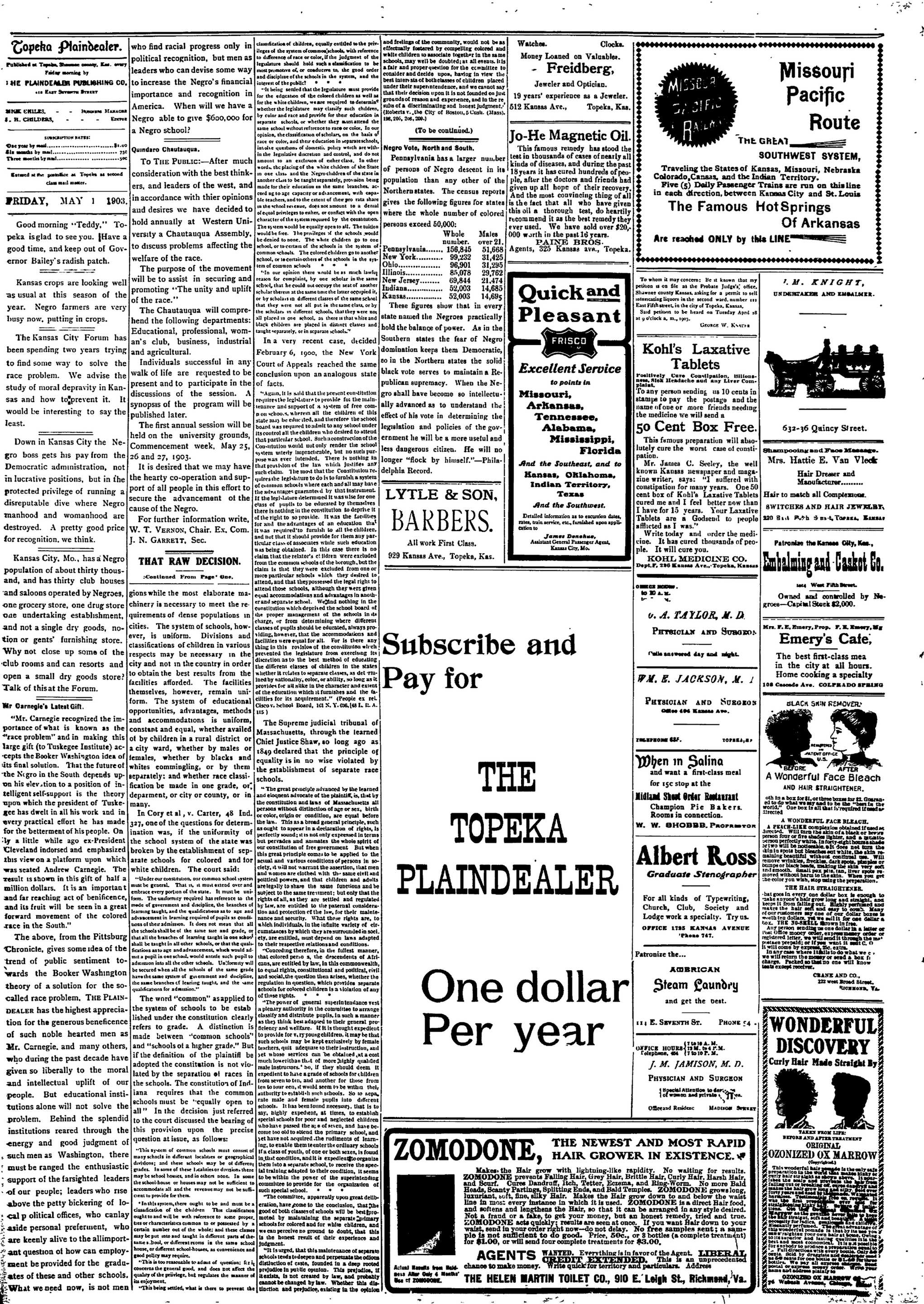
THAT RAW DECISION.
:Continued From Page ' One.
gions while the most elaborate machinery is necessary to meet the requirements of dense populations in cities. The system of schools, however, is uniform. Divisions and classifications of children in various respects may be necessary in the city and not in the country in order to obtain the best results from the facilities afforded. The facilities themselves, however, remain uniform. The system of educational opportunities, advantages, methods and accommodations is uniform, constant and equal, whether availed of by children in a rural district or a city ward, whether by males or females, whether by blacks and whites commingling, or by them separately; and whether race classification be made in one grade, or department, or city or county, or in many.
In Cory et al, v. Carter, 48 Ind. 327, one of the questions for determination was, if the uniformity of the school system of the state was broken by the establishment of separate schools for colored and for white children. The court said:
"Under our constitution, our common school system must be general. That is, it must extend over and embrace every portion of the state. It must be uniform. The uniformity has required reference to the mode of government and discipline, the branches of learning taught, and the qualifications as to age and advancement in learning required of pupils as conditions of their admission. It does not mean that all the schools shall be of the same size and grade, or that all the branches of learning taught in one school shall be taught in all other schools, or that the qualifications as to age and advancement, which would admit a pupil in one school, would antite such pupil to admission into all the other schools. Uniformity will be secured when all the schools of the same grade have the same system of government and discipline, the same branches of learning taught, and the same qualifications for admission."
The word "common" as applied to the system of schools to be established under the constitution clearly refers to grade. A distinction is made between "common schools" and "schools of a higher grade." But if the definition of the plaintiff be adopted the constitution is not violated by the separation of races in the schools. The constitution of Indiana requires that the common schools must be "equally open to all". In the decision just referred to the court discussed the bearing of this provision upon the precise question at issue, as follows:
"This system of common schools must consist of many schools in different localities or geographical divisions; and these schools may be of different grades. In some of these localities or divisions there may be school houses, and in others none. In some the school-house or houses may not be sufficient to accommodate all and the revenue may not be sufficient to provide for them.
In this system, there ought to be and must be a classification of the children. This classification ought to and will be with reference to some proper ties or characteristics common to or postposed by a certain number out of the whole; and these classes may be put into and taught in different parts of the same school, or different rooms in the same school house, or different school-houses, as convenience and good policy may require.
"This is too reasonable to admit of question; it is concerns the general good, and does not affect the quality of the privilege, but regulates the manner of its enjoyment.
"This being settled, what is there to prevent the
classification of children, equally entitled to the privileges of the system of common schools, with reference to difference of race or color, if the judgment of the legislature should hold such a classification to be most promotive of, or conductive to, the good order and discipline of the schools in the system, and the interest of the public? \*
"It being settled that the legislature must provide for the education of the colored children as well as for the white children, we are required to determine whether the legislature may classify such children, by color and race and provide for their education in separate schools, or whether they must attend the same school without reference to race or color. In our opinion, the classification of schools, on the basis of race or color, and their education in separate schools, involve questions of domestic policy which are within the legislative discretion and control, and do not amount to an exclusion of other class. In other words, the placing of the white children of the State in one class, and the Negro children of the state in another class to be taught separately, provision being made for their education in the same branches, according to age capacity or advancement, with cap share in the school revenue, does not amount to a denial of equal privileges to either, or conflict with the open character of the system required by the constitution. The system would be equally open to all. The tuition would be free. The privileges of the schools would be denied to none. The white children go to one school, or to certain of the schools in the system of common schools. The colored children go to another school, or to certain others of the schools in the system of common schools \* \* \* \*
"In our opinion there would be as much lawful reason for complaint, by one scholar in the same school, that he could not occupy the seat of another scholar there at the same time the latter occupied it, or by scholars in different classes of the same school that they were not all put in the same class, or by the scholars in different schools, that they were not all placed in one school, as there that white and black children are placed in distinct classes and taught separately, or in separate schools."
In a very recent case, decided February 6, 1900, the New York Court of Appeals reached the same conclusion upon an analogous state of facts.
"Again, it is said that the present constitution requires the legislature to provide for the maintenance and support of a system of free common schools, wherein all the children of this state may be educated, and therefore the school board was required to admit to any school under its control all the children who desired to attend that particular school. Such an construction of the Constitution would not only render the school system utterly impracticable, but no such purpose was ever intended. There is nothing in that provision of the law which justifies and such claim. The most that the Constitution requires the legislature to do is to furnish a system of common schools where each and all may have the advantages guaranteed by that instrument. If the legislature determined it was wise for one class of pupils to be educated by themselves there is nothing in the constitution to deprive it of the right to so provide. It was the facilities for and the advantages of an education that it was required to furnish to all the children, and not that it should provide for them any particular class of associates while such education was obtained. In this case there is no claim that the relator's children were excluded from the common schools of the borough, but the claim is that they were excluded from one or more particular schools which they desired to attend, and that they possessed the legal right to attend those schools, although they were given equal accommodations and advantages in another and separate school. We nothing about the constitution which depended the school board of the proper management of the schools in charge, or from determining where different classes of pupils should be educated, always providing, however, that the accommodations and facilities were equal for all. For is there any thing in this resolution of the constitution which prevented the legislature from exercising its discretion as to the best method of educating the different classes of children in the states whether it relates to separate classes, as detrined by nationality, color, or ability, so long as it provides for all alike in the character and extent of the education which it furnishes and the facilities for its acquirement." (People ex rel. Cisco v. school Board, 101 N. Y. 696, [48 I. R. A. 115])
The Supreme judicial tribunal of Massachusetts, through the learned Chief Justice Shaw, so long ago as 1849 declared that the principle of equality is in no wise violated by the establishment of separate race schools.
"The great principle advanced by the learned and eloquent advocate of the plaintiff, is that by the constitution and laws of Massachusetts all persons without distinction of age or sex, birth or color, origin or condition, are equal before the law. This as a broad general principle, such as ought to appear in a declaration of rights, is perfectly sound; it is not only expressed in terms but pervades and animates the whole spirit of our constitution of free government. But when this great principle comes to be applied to the actual and various conditions of persons in society, it will not warrant the assertion, that men and women are clothed with the same civil and political powers, and that children and adults are legally to share the same functions and be subject to the same treatment; but only that the rights of all, as they are settled and regulated by law, are entitled to the paternal consideration and protection of the law, for their maintenance and security. What those rights are, to which individuals, in the infinite variety of circumstances by which they are surrounded in society, are entitled, must depend on laws adapted to their respective relations and conditions.
"Conceding therefore, in the fullest manner, that colored person s, the descendants of Africans, are entitled by law, in this commonwealth, to equal rights, constitutional and political, civil and social, the question then arises, whether the regulation in question, which provides separate schools for colored children is a violation of any of those rights.
"The power of general superintendance rests a plenary authority in the committee to arrange classify and distribute pupils, in such a manner as they think best adapted to their general proficiency and welfare. If it is thought expedient to provide for very young children, it may be that such schools may be kept exclusively by female teachers, quit adequate to their instruction, and yet whose services can be obtained at a cost much lower than that of more highly qualified instructors." So, if they should deem it expedient to have a grade of schools for children from seven to ten, and another for those from ten to ten four, it would seem to be within their authority to establish such schools. So to separate rate and female pupils into different schools. It has been found necessary, that is to say, highly expedient, at times, to establish special schools for poor and neglected children who have passed the age of seven, and have become too old to attend the primary school, and yet have not acquired the rudiments of learning, to enable them to enter the ordinary schools if a class of youth, of one or both sexes, is found in that condition, and it is expedient to organize them into a separate school, to receive the special training adapted to their condition, it seems to be within the power of the superintending committee to provide for the organization of such special school.
"The committee, apparently upon great deliberation, have come to the conclusion, that the good of both classes of schools will be best promoted by maintaining the separate primary schools for colored and for white children, and we can perceive no ground to doubt, that this is the honest result of their experience and judgment.
"It is urged, that this malinance of separate schools tends to deepen and perpetuate the odious distinction of caste, founded in a deep rooted prejudice in public opinion. This prejudice, if it exists, is not created by law, and probably cannot be changed by law. Whether this distinction and prejudice, existing in the codition
Subscribe and Pay for
One dollar Per year
Makes the Hair grow with lightning-like rapidity. No waiting for results. ZOMODONE prevents Falling Hair, Grey Hair, Brittle Hair, Curly Hair, Harsh Hair, and Sourf. Cures Dandruff, Itch, Tetter, Eczema, and Ring-Worm. No more Bald Heads, Scanty Partings, Splitting Ends, and Bald Temples. ZOMODONE grows long, luxuriant, soft, fine, silky Hair. Makes the Hair grow down to and below the waist line in most every instance in which it is used. ZOMODONE is a direct Hair food, and softens and lengthens the Hair, so that it can be arranged in any style desired. Not a fraud or a fake, to get your money, but an honest remedy, tried and true. ZOMODONE acts quickly; results are seen at once. If you want Hair down to your waist, send in your order right now—do not delay. No free samples sent; a sample is not sufficient to do good. Price, 50c., or 8 bottles (a complete treatment) for $1.00, or will send four complete treatments for $3.00.
AGENTS WANTED. Everything is in favor of the Agent. LIBERAL CREDIT EXTENDED. This is an unprecedented chance to make money. Write quick for territory and particular. Address
THE HELEN MARTIN TOILET CO., 910 E. Leigh St., Richmond, Va.
and feelings of the community, would not be as effectually fostered by compelling colored and white children to associate together in the same schools, may well be doubled; at all events, it is a fair and proper question for the committee to consider and decide upon, having in view the best interset of both classes of children placed under their superintendence, and we cannot say that their decision upon it is not founded on just grounds of reason and experience, and in the results of a discriminating and honest judgment." (Robertsv. v., the City of Boston, 5 Cush. (Mass.), 198, 265, 206, 209.)
(To be continued.)
Negro Vote, North and South.
Pennsylvania has a larger number of persons of Negro descent in its population than any other of the Northern states. The census reports gives the following figures for states where the whole number of colored persons exceed 50,000:
Whole number. Males over 21.
Pennsylvania.....156,845 51,668
New York.....99,232 31,425
Ohio.....96,901 31,295
Illinois.....85,078 29,762
New Jersey.....69,844 21,474
Indiana.....52,003 14,685
Kansas.....52,003 14,695
These figures show that in every state named the Negroes practically hold the balance of power. As in the Southern states the fear of Negro domination keeps them Democratic, so in the Northern states the solid black vote serves to maintain a Republican supremacy. When the Negro shall have become so intellectually advanced as to understand the effect of his vote in determining the legislation and policies of the government he will be a more usetul and less dangerous citizen. He will no longer "flock by himself."—Philadelphia Record.
LYTLE & SON,
BARBERS.
All work First Class.
929 Kansas Ave., Topeka, Kas.
Subscribe
Pay for
THE
TOP
PLAIND
One
Per
ZOMODON
Actual Results from Baldness After Only 4 Months Use of ZOMOONE.
THE NEWEST AND MOST RAPID HAIR GROWER IN EXISTENCE.
19 years' experience as a Jeweler. 512 Kansas Ave., Topeka, Kas
Jo-He Magnetic Oil
This famous remedy has stood the test in thousands of cases of nearly all kinds of diseases, and during the past 18 years it has cured hundreds of people, after the doctors and friends had given up all hope of their recovery. And the most convincing thing of all is the fact that all who have given this oil a thorough test, do heartily recommend it as the best remedy they ever used. We have sold over $20,000 worth in the past 16 years. PAINE BROS.
Quick and
Pleasant
FRISCO
Excellent Service
to points in
Missouri,
Arkansas,
Tennessee,
Alabama,
Mississippi,
Florida
And the Southeast, and to
Kansas, Oklahoma,
Indian Territory,
Texas
And the Southwest.
Detailed information as to excursion dates,
rates, train service, etc., furnished upon appli-
cation to
James Donahus,
Assistant General Passenger Agent,
Kansas City, Mo.
Traveling the States of Kansas, Missouri, Nebraska Colorado, Canaas, and the Indian Territory. Five (5) Daily Passenger Trains are run on this line in each direction, between Kansas City and St. Louis
MISSOUR
PACIFIC
RAILWAY
Traveling the States of K
Colorado, Canaas, and the In
Five (5) Daily Passenger
in each direction, between
The Famous I
Are reached ONLY by th
To whom it may concern: Be it known that my
petition is on file at the Probate Judge's, office,
Shawnes county Kansas, asking for a permit to sell
intoxicating liquors in the second ward, number 111
East Fifth street, in the city of Topeka, Kansas,
Said petition to be heard on Tuesday April 28
at 9 o'clock a, m., 1909.
GEORGE W. KNAPER
Kohl's Laxative Tablets
Positively Cure Constipation, Billions,
Sick Headache and any Liver Complaint.
To any person sending us 10 cents in
stamps to pay the postage and the
name of one or more friends needing
the medicine we will send a
This famous preparation will absolutely cure the worst case of constipation.
Mr. James C. Seeley, the well known Kansas newspaper and magazine writer, says: "I suffered with constipation for many years. One 50 cent box of Kohl's Laxative Tablets cured me and I feel better now than I have for 15 years. Your Laxative Tablets are a Godsend to people afflicted as I was."
Write today and order the medicine. It has cured thousands of people. It will cure you.
KOHL MEDICINE CO.
Dept.F. 296 Kansas Ave., Topeka, Kansas
v. A. TAYLOR, M. D.
PHYSICIAN AND SUBGROOM
Calls answered day and night.
W.M. E. JACKSON, M. I
PHYSICIAN AND SURGEON
Office 404 Kenske Ave.
When in Salina and want a first-class meal for 15c stop at the Midland Short Order Restaurant Champion Pie Bakers. Rooms in connection. W. W. SHOBBB. PROPRIETOR
Albert Ross
Graduate Stenographer
For all kinds of Typewriting,
Church, Club, Society and
Lodge work a specialty. Try us.
OFFICE 1795 KAN4AS AVENUE
'Fhone 747.
AMERICAN
Steam Laundry
and get the beat.
111; E. SEVENTH ST. PHONE 54
OFFICE HOUSES
7 to 10 A.M.
13 M. to 4 P.M.
Tolephone, 654
7 to 10 P.M.
J. M. JAMISON, M. D.
PHYSICIAN AND SURGEON
Special Attention to dev
of women and private
men.
Office and Residence MADISON SQUARE
AND MOST RAPID
HAIR IN EXISTENCE.
pidity. No waiting for results.
Little Hair, Curly Hair, Harsh Hair,
and Ring-Worm. No more Bald
samples. ZOMODONE grows long,
row down to and below the waist
ZOMODONE is a direct Hair food,
to be arranged in any style desired.
In honest remedy, tried and true.
If you want Hair down to your
No free samples sent; a sam-
or 8 bottles (a complete treatment)
$3.00.
flavor of the Agent. LIBERAL
ED. This is an unprecedented
and particulars. Address
Missouri Pacific Route
GREAT
SOUTHWEST SYSTEM,
Kansas, Missouri, Nebraska
Indian Territory.
Trains are run on this line
Kansas City and St. Louis
Hot Springs
Of Arkansas
LINE
J. M. KNIGHT,
UNDERTAKER AND EMPALMER.
```markdown
```
632-36 Quincy Street.
Shampooing and Face Massage.
Mrs. Hattie E. Van Vleck
Hair Dresser and
Manufacturer.....
Hair to match all Complexions.
SWITCHES AND HAIR JEWELRY.
220 St. F. Fifth Street, TOPKEA, KANSAS
Patronize the Kansas City, Ks.,
Embalming and Casket Co.
1014 West Fifth Street.
Owned and controlled by Negroes—Capital Stock $2,000.
Mrs. F. E. Emery, Prop. P. K. Emery, Mg
Emery's Cafe;
The best first-class mea
in the city at all hours.
Home cooking a specialty
108 Cassade Ave. COLFRAD SPRING
BLACK SKIN REMOVER
REMOVED
AT PATENT OFFICE
U.S.
BEFORE AFTER
oth in a box for $1, or three boxes for $3. Guaranteed to do what we say and to be the "best in the world." One box is all that is required if used directed
A WONDERFUL FACE BLEACH
A WONDERFUL FACE BLEACH.
A PEACH-LIKE COMPLEX OBTAINED if used as skin cream, it makes a black or beaver person four or five shades darker than person perfectly white. In forty-five hours a house set will be noticeable. It does not turn the skin red, but out white, the skin remains beautiful without wrinkles, freckles, dark spots, pimples or bumps or black bands, making the skin very soft and smooth. The skin spot is removed without harm to the skin. When the color you wish, stop using the preparation.
THE HAIR STRAIGHTENER
that goes in every one dollar box is enough to make anyone's hair grow long and straight, and keep it from falling out. Highly perfumed and fragrant, it is one of our customers may one of our dollar boxes in worth ten dollars, yet we sell it for one dollar a box. THE NO-SELLBIRD thrown in free. You may buy one dollar in a letter or not. Office money may be paid in order or registered letter. we will send it through the me* postage prepaid; or if you want it sent C. it come by exp. duty. In any case we are liable to that we c. we will return the money or send a box f. charge. Packed so that no one will know tests except receive.
CRANE AND CO., 122 west Broad Street.
RICHMOND, Va.
WONDERFUL
DISCOVERY
Curly Hair Made Straight By
TAKEN FROM LIFE:
BEFORE AND AFTER TREATMENT
ORIGINAL
OZONIZED OX MARROW
(Copyrighted)
This wonderful hair permade is the only safe preparation for curly hair straight as shown above. It curly hair straight as shown above. It makes the scalp and prevents the hair from falling off. It makes the hair grow long and silky. It gives ever-makes the hair grow long and silky. Warned that hair straightening is not recommended by a professional. Warned that hair straightening is not recommended by a professional. Warned that hair straightening is not recommended by a professional. One of the greatest benefits of this permade is the gentle, smooth and shiny appearance of the hair as the premature hairstyle has been removed. Secondly for judic, gentlemen and ladies, it is easily perfumed. The great advantage of this permade is that it does not cause any hair tightness your own hair at all. You can straighten your own hair at all. You can to its superior and lasting qualities like the hair straightening. It is possible for anybody to produce a preparation for their hair. Five directions with every bottle. Only one bottle is required. $50 per bottle. $50 per bottle. We pay all express charges. Send your name and address plainly to
OZONIZED OX MARROW
95 Wesbach Avenue, Chicago, Illinois
"Fordy" Branford, "Mac" Harlan Dold Geston, "Eph" Wiley and "Bill" the Police Editor claim that there was no truth in the report that they were at swords points about that $30 auit drawing at Lese. We cheerfully retract and beg the gentlemen's pardon.
Mr. W. H. Gleaves of Okmulgce, is authorized by the PLAINDEALER Publishing Co. to solicit and collect for this company in that city.
The Cumberland Band will give a concert in North Topeka Tuesday evening, May 5, at Price's Chapel just across the river on Jackson st.
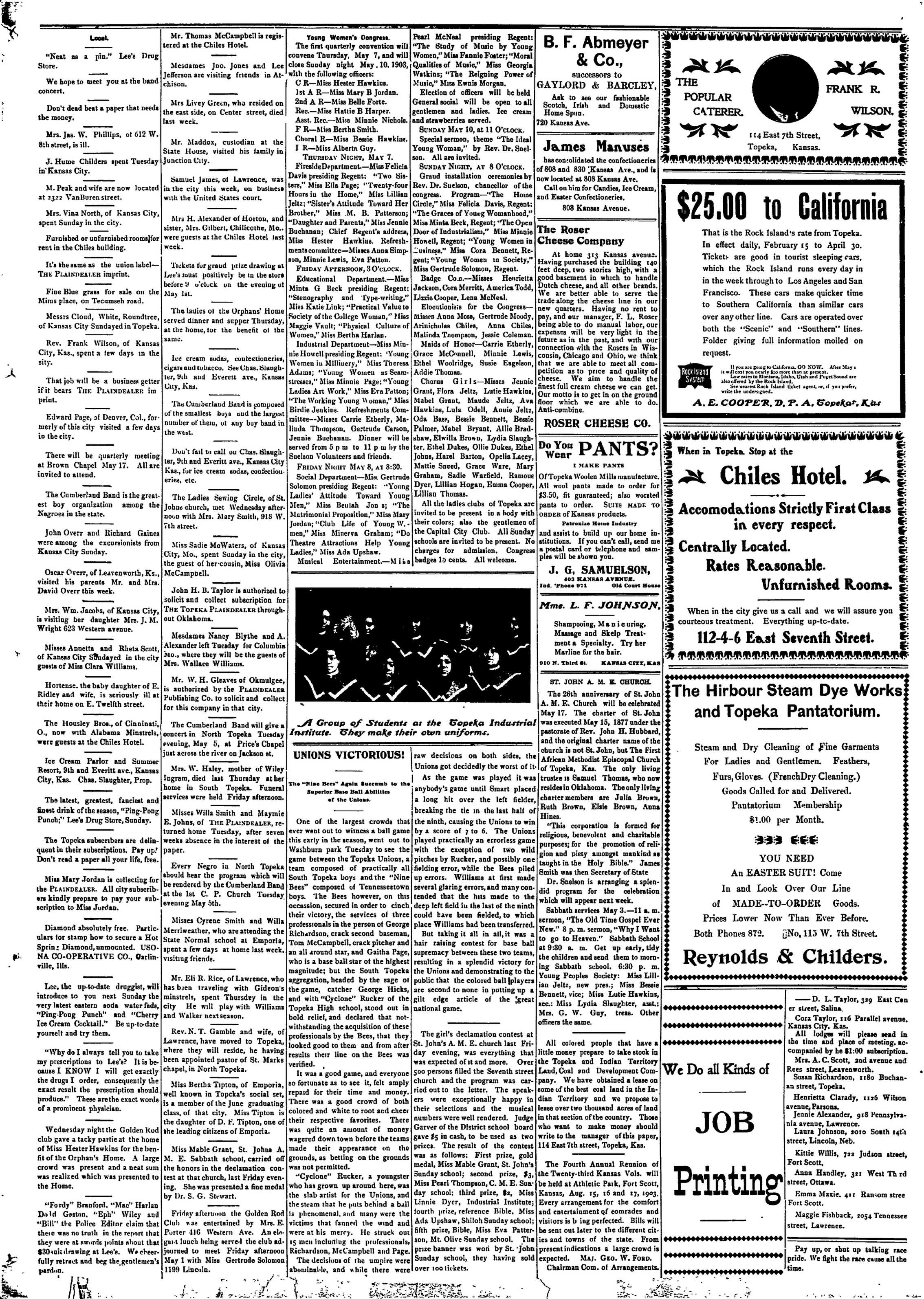
A Group of Students at the Topeka Industrial Institute. They make their own uniforms.
THURSDAY NIGHT, MAY 7.
FiresideDepartment.—Miss Felicia Davis presiding Regent: "Two Sisters," Miss Ella Page; "Twenty-four Hours in the Home," Miss Lillian Jeltz; "Sister's Attitude Toward Her Brother," Miss M. B. Patterson; "Daughter and Parents," Miss Jennie Buchanan; Chief Regent's address, Miss Hester Hawkius. Refreshments committee—Misses Anna Simpson, Minnie Lewis, Eva Patton.
FRIDAY AFTERNOON, 3 O'CLOCK.
Educational Department.—Miss Minta G Beck presiding Regent;
"Stenography and Type-writing," Miss Katie Link; "Practical Value to Society of the College Woman," Miss Maggie Vault; "Physical Culture of Women," Miss Bertha Harlan.
Industrial Department—Miss Minnie Howell presiding Regent: 'Young Women in Millinery,' Miss Theresa Adams; "Young Women as Seamstresses," Miss Minnie Page; "Young Ladies Art Work," Miss Eva Patton; "The Working Young Woman," Miss Birdie Jenkins. Refreshments Committee---Misses Carrie Etherly, Malinda Thompson, Gertrude Carson, Jennie Buchanau. Dinner will be served from 5 p.m to 11 p.m by the Snelson Volunteers and friends.
FRIDAY NIGHT MAY 8, AT 8:30.
Social Department—Misa Gertrude Solomon presiding Regent: "Young Ladies' Attitude Toward Young Men," Miss Beulah Jon s; "The Matrimonial Proposition," Miss Mary Jordan; "Club Life of Young W. men," Miss Minerva Graham; "Do Theatre Attractions Help Young Ladie," Miss Ada Upshaw.
Musical Entertainment.—Miba
A Group of Students Institute. They make the
UNIONS VICTORIOUS!
The "Nine Bees" Again Succumb to the Superior Base Ball Abilities of the Unions.
One of the largest crowds that ever went out to witness a ball game this early in the season, went out to Washburn park Tuesday to see the game between the Topeka Unions, a team composed of practically all South Topeka boys and the "Nine Bees" composed of Tennessee town boys. The Bees however, on this occasion, secured in order to cinch their victory, the services of three professionals in the person of George Richardson, crack second baseman, Tom McCampbell, crack pitcher and an all around star, and Gaitha Page, who is a base ball star of the highest magnitude; but the South Topeka aggregation, headed by the sage of the game, catcher George Hicks, and with "Cyclone" Rucker of the Topeka High school, stood out in bold relief, and declared that notwithstanding the acquisition of these professionals by the Bees, that they looked good to them and from after results their line on the Bees was verified.
It was a good game, and everyone so fortunate as to see it, felt amply repaid for their time and money. There was a good crowd of both colored and white to root and cheer their respective favorites. There was quite an amount of money wagered down town before the teams made their appearance on the grounds, as betting on the grounds was not permitted. "Cyclone" Rucker, a youngster who has grown up around here, was the slab artist for the Unions, and
Pearl McNeal presiding Regent: "The Study of Music by Young Women," Miss Fannie Foster; "Moral Qualities of Music," Miss Georgia Watkins; "The Reigning Power of Music," Miss Ewnis Morgan. Election of officers will be held General social will be open to all gentlemen and ladies. Ice cream and strawberries served. SUNDAY MAY 10, at 11 O'CLOCK. Special sermon, theme "The Ideal Young Woman," by Rev. Dr. Snelson. All are invited.
SUNDAY NIGHT, AT 8 O'CLOCK.
Graud installation ceremonies by Rev. Dr. Snelson, chancellor of the congress. Program—"The Home Circle," Miss Felicia Davis, Regent; "The Graces of Young Womanhood," Miss Minta Beck, Regent; "The Open Door of Industrialism," Miss Minnie Howell, Regent; "Young Women in Business," Miss Cora Bennett, Regent; "Young Women in Society," Miss Gertrude Solomon, Regent.
Badge Con.—Misses Henrietta Jackson, Cora Merritt, America Todd, Lizzie Cooper, Lena McNeal.
Elocutionists for the Congress—Misses Anna Moss, Gertrude Moody, Arinicholas Chiles, Anna Chiles, Malinda Tumpson, Jessie Coleman. Maids of Honor—Carrie Etherly, Grace McConnell, Minnie Lewis, Ethel Woolridge, Susie Eagelson, Addie Thomas.
Chorus Girls—Misses Jeunie Grant, Flora Jeltz, Lutie Hawkins, Mabel Grant, Maude Jeltz, Ava Hawkins, Lula Odell, Anuie Jeltz, Oda Bass, Bessie Bennett, Bessie Palmer, Mabel Bryant, Allie Bradshaw, Elwilla Brown, Lydia Slaughter, Ethel Dukes, Ollie Dukes, Ethel Jobsn, Hazel Barton, Opelia Lacey, Mattie Sneed, Grace Ware, Mary Graham, Sadie Warfield, Ramous Dyer, Lillian Hogan, Emma Cooper, Lillian Thomas.
All the ladies clubs of Topeka are invited to be present in a body with their colors; also the gentlemen of the Capital City Club. All Sunday schools are invited to be present. No charges for admission. Congress badges 15 cents. All welcome.
as the Topeka Industrial
ir own uniforms.
raw decisions on both sides, the Unions got decidedly the worst of it. As the game was played it was anybody's game until Smart placed a long hit over the left fielder, breaking the tie in the last half of the ninth, causing the Unions to win by a score of 7 to 6. The Unions played practically an errorless game with the exception of two wild pitches by Rucker, and possibly one fielding error, while the Bees piled up errors. Williams at first made several glaring errors, and many contended that the hits made to the deep left field in the last of the ninth could have been fielded, to which place Williams had been transferred. But taking it all in all, it was a hair raising contest for base ball supremacy between these two teams, resulting in a splendid victory for the Unions and demonstrating to the public that the colored ball players are second to none in putting up a gilt edge article of the great national game.
The girl's declamation contest at St. John's A. M. E. church last Friday evening, was everything that was expected of it and more. Over 500 persons filled the Seventh street church and the program was carried out to the letter. The speakers were exceptionally happy in their selections and the musical numbers were well rendered. Judge Garver of the District school board gave $5 in cash, to be used as two prizes. The result of the contest was as follows; First prize, gold medal, Miss Mable Grant, St. John's Sunday school; second prize, $3, Miss Pearl Thompson, C. M. E. Sunday school; third prize, $2, Miss Linnie Dyer, Industrial Institute; fourth prize, reference Bible. Miss Ada Upshaw, Shiloh Sunday school; fifth prize, Bible, Miss Eva Patterson, Mt. Olive Sunday school. The prize banner was won by St. John Sunday school, they having sold over 100 tickets.
$25.00 to California
Accomodations Strictly First Class in every respect.
When in the city give us a call and we will assure you courteous treatment. Everything up-tc-date.
The Hirbour Steam Dye Works and Topeka Pantatorium.
D. L. Taylor, 329 East Center street, Salina.
Cora Taylor, 116 Parallel avenue, Kansas City, Kas.
All lodges will please send in the time and place of meeting, accompanied by he $1:00 subscription.
Mrs. A. C. Scott, 2nd avenue and Rees street, Leavenworth.
Susan Richardson, 1180 Buchanan street, Topeka.
Henrietta Clarady, 1126 Wilson avenue, Parsons.
Jennie Alexander, 918 Pennsylvania avenue, Lawrence.
Laura Johnson, 2010 South 14th street, Lincoln, Neb.
Kittie Willis, 722 Judson street, Fort Scott.
Anna Handley, 321 West Third street, Ottawa.
Emma Maxie, 411 Ransom stree Fort Scott.
Maggie Fishback, 2054 Tennessee street, Lawrence.
Pay up, or shut up talking race pride. We fight the race cause all the time.
The Roser Cheese Company
At home 313 Kansas avenue. Having purchased the building 140 feet deep, two stories high, with a good basement in which to handle Dutch cheese, and all other brands. We are better able to serve the trade along the cheese line in our new quarters. Having no rent to pay, and our manager, F. L. Roser being able to do manual labor, our expenses will be very light in the future as in the past, and with our connection with the Rosers in Wisconsin, Chicago and Ohio, we think that we are able to meet all competition as to price and quality of cheese. We aim to handle the finest full cream cheese we can get. Our motto is to get in on the ground floor which we are able to do. Anti-combine.
Rock Island System
ROSER CHEESE CO.
Do You Wear PANTS?
I MAKE PANTS
Of Topeka Woolen Mills manufacture.
All wool pants made to order for $3.50, fit guaranteed; also worsted pants to order. SUITS MADE TO ORDER of Kansas products.
Patronize Home Industry and assist to build up our home institutions. If you can't call, send me a postal card or telephone and samples will be shown you.
J. G, SAMUELSON,
403 KANSAS AVENUE.
Ind. 'Phone 971 Old Court House
Mme. L. F. JOHNSON.
Shampooing, Manicuring, Massage and Skelp Treatment a Specialty. Try her Marline for the hair.
ST. JOHN A. M. E. CHURCH
The 26th anniversary of St. John A. M. E. Church will be celebrated May 17. The charter of St. John was executed May 15, 1877 under the pastorate of Rev. John H. Hubbard, and the original charter name of the church is not St. John, but The First African Methodist Episcopal Church of Topeka, Kas. The only living trustee is Samuel Thomas, who now resides in Oklahoma. The only living charter members are Julia Brown, Ruth Brown, Elsie Brown, Anna Hines.
"This corporation is formed for religious, benevolent and charitable purposes; for the promotion of religion and piety amongst mankind as taught in the Holy Bible." James Smith was then Secretary of State Dr. Snelson is arranging a splendid program for the celebration which will appear next week.
Sabbath services May 3.—11 a. m. sermon, "The Old Time Gospel Ever New." 8 p. m. sermon, "Why I Want to go to Heaven." Sabbath School at 9:30 a. m. Get up early, tidy the children and send them to morning Sabbath school. 6:30 p. m. Young Peoples Society: Miss Lillian Jeltz, new pres.; Miss Beasie Bennett, vice; Miss Lutie Hawkins, sec.; Miss Lydia Slaughter, asst.; Mrs. G. W. Guy, treas. Other officers the same.
All colored people that have a little money prepare to take stock in the Topeka and Indian Territory Land, Coal and Development Company. We have obtained a lease on some of the best coal land in the Indian Territory and we propose to lease over two thousand acres of land in that section of the country. Those who want to make money should write to the manager of this paper, 114 East 7th street, Topeka, Kas.
The Fourth Annual Reunion of the Twenty-third Kansas Vols. will be held at Athletic Park, Fort Scott, Kansas, Aug. 15, 16 and 17, 1903. Every arrangement for the comfort and entertainment of comrades and visitors is being perfected. Bills will be sent out later to the different cities and towns of the state. From present indications a large crowd is expected. MAJ. GEO. W. FORD. Chairman Com. of Arrangements.
That is the Rock Island's rate from Topeka. In effect daily, February 15 to April 30. Tickets are good in tourist sleeping cars, which the Rock Island runs every day in in the week through to Los Angeles and San Francisco. These cars make quicker time to Southern California than similar cars over any other line. Cars are operated over both the "Scenic" and "Southern" lines. Folder giving full information moiled on request.
If you are going to California, GO NOW. After May it will cost you nearly 200 more than at present. Low rates to Montana, Idaho, Utah and Puget Sound are also offered by the Rock Island. See nearest Rock Island ticket agent, or, if you prefer, write the undersigned.
A. E. COOPER, D. P. A. Gopekar, Kas
Steam and Dry Cleaning of Fine Garments For Ladies and Gentlemen. Feathers, Furs, Gloves. (FrenchDry Cleaning.) Goods Called for and Delivered. Pantatorium Membership $1.00 per Month.
YOU NEED An EASTER SUIT! Come In and Look Over Our Line of MADE--TO-ORDER Goods. Prices Lower Now Than Ever Before. Both Phones 872. No,115 W. 7th Street.
Reynolds & Childers.
WOODMEN HALO 013
PROTECTION
== n=
=
5
: