Plaindealer
Friday, June 26, 1903
Topeka, Kansas
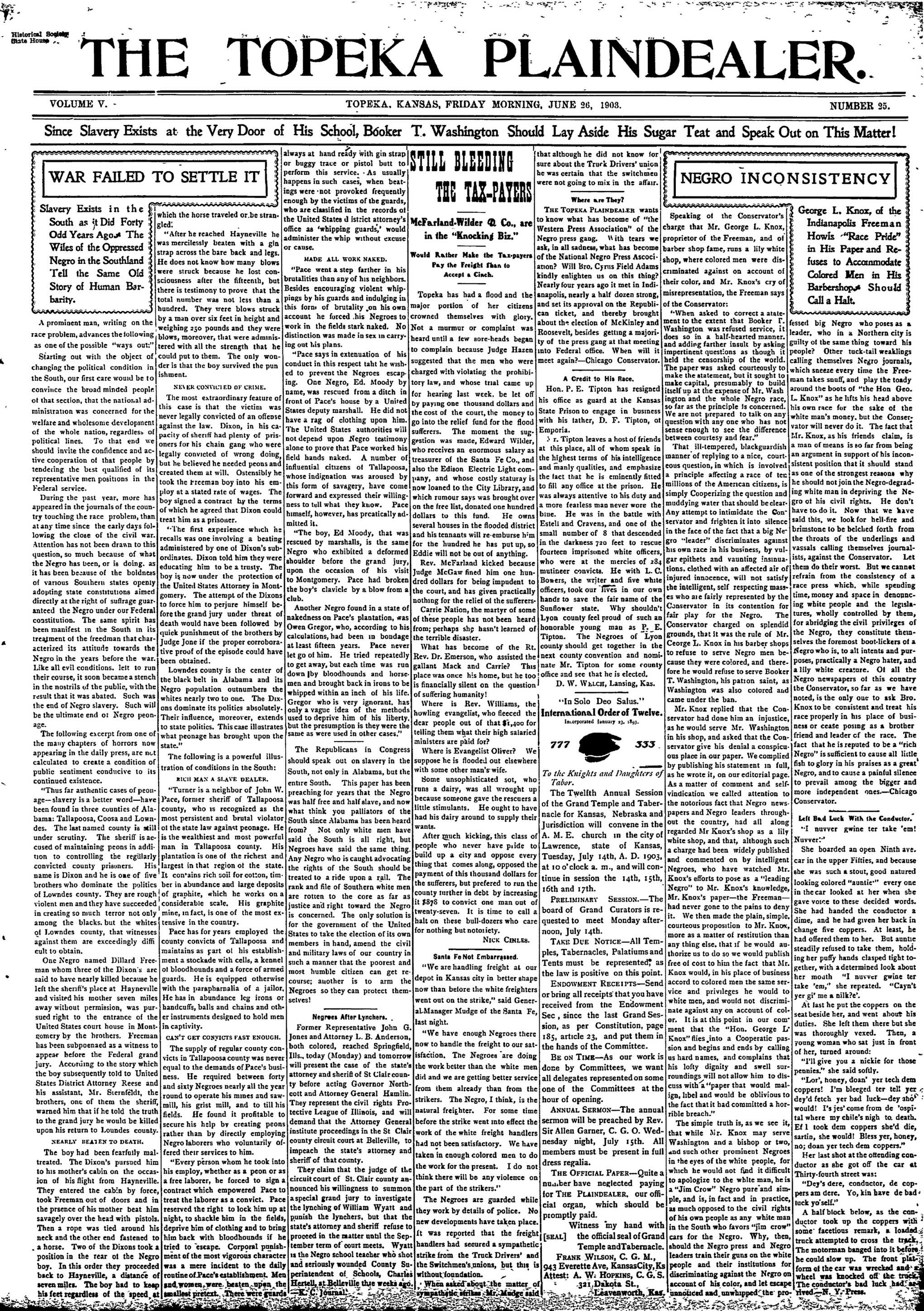
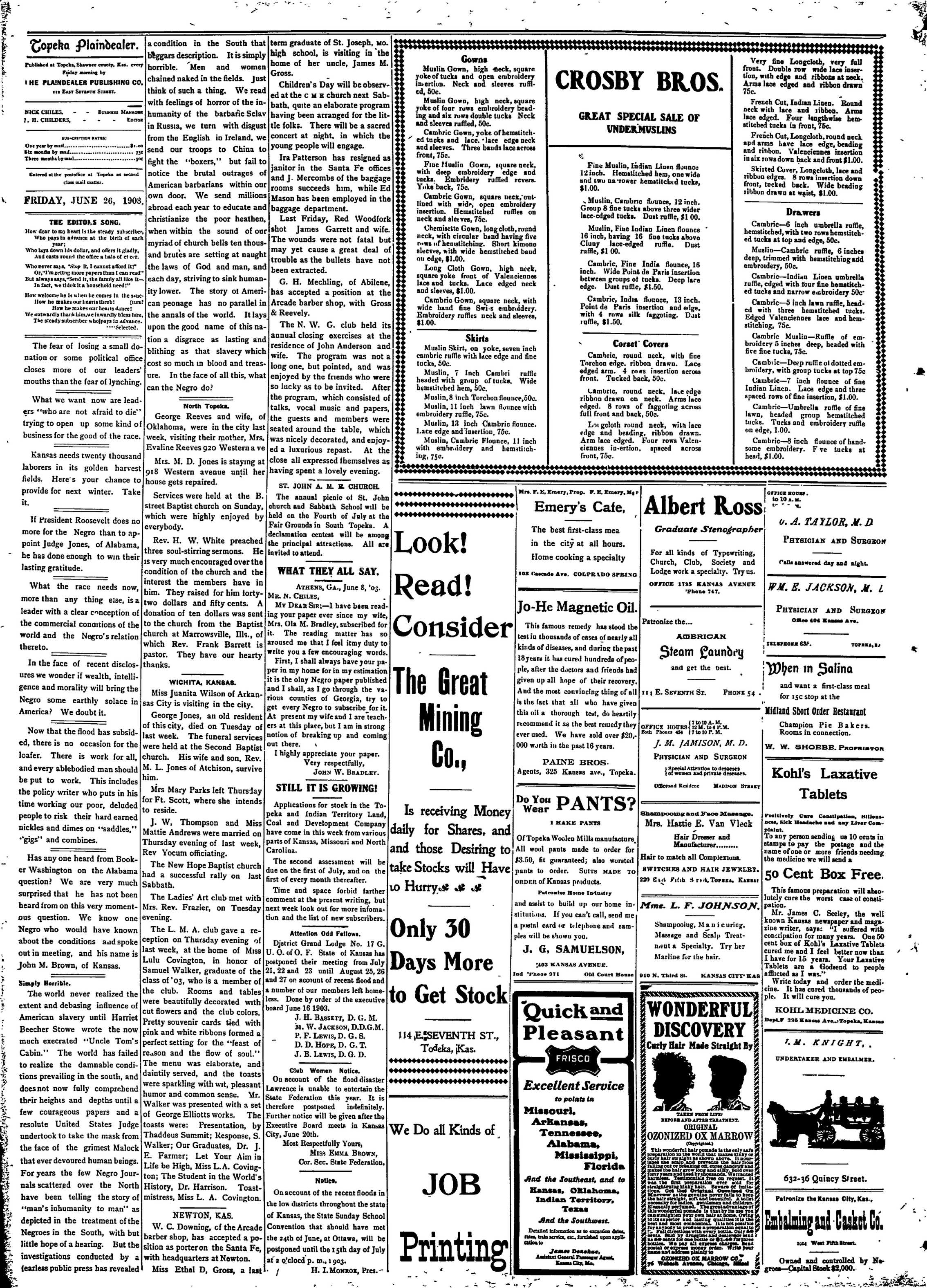
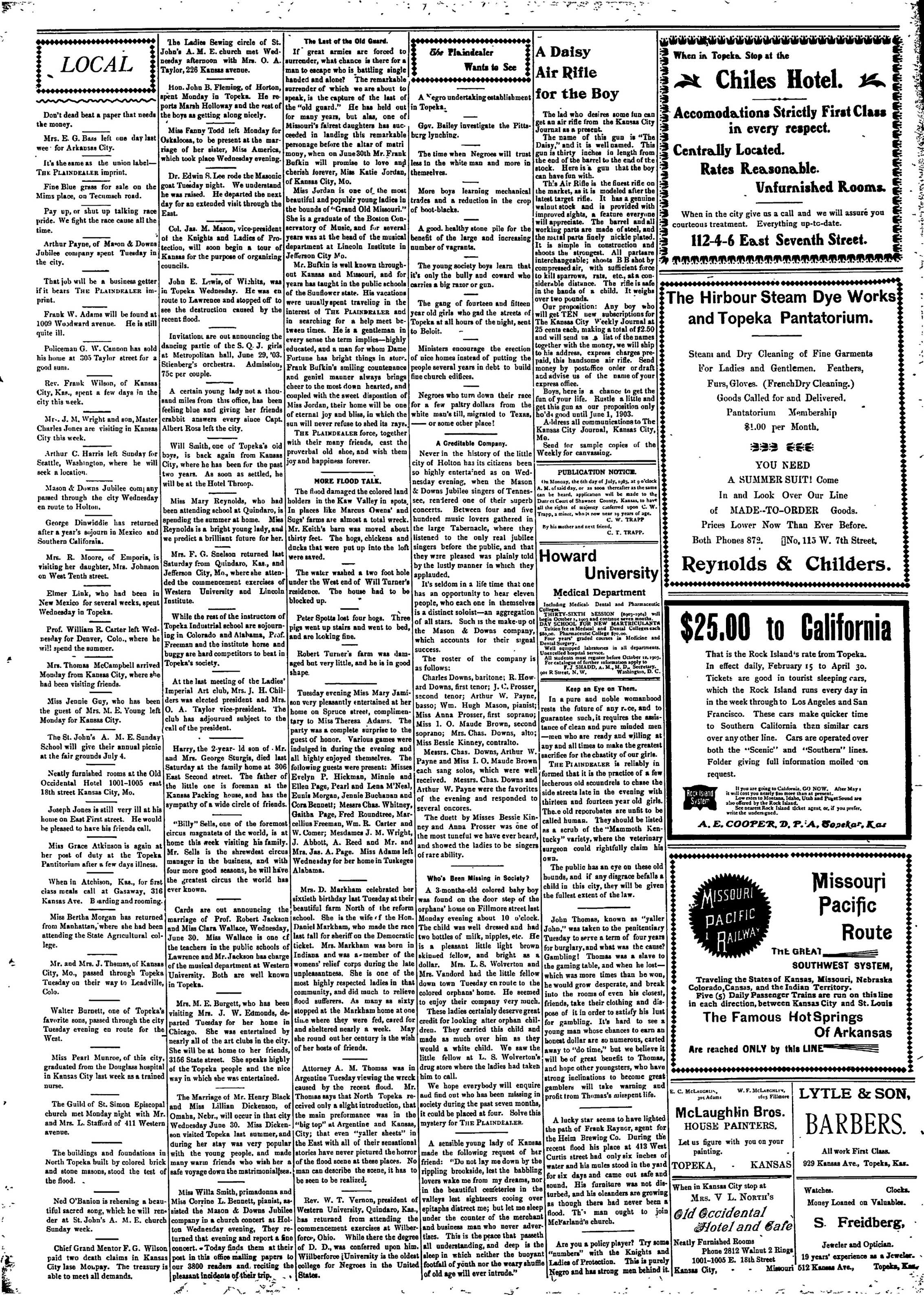
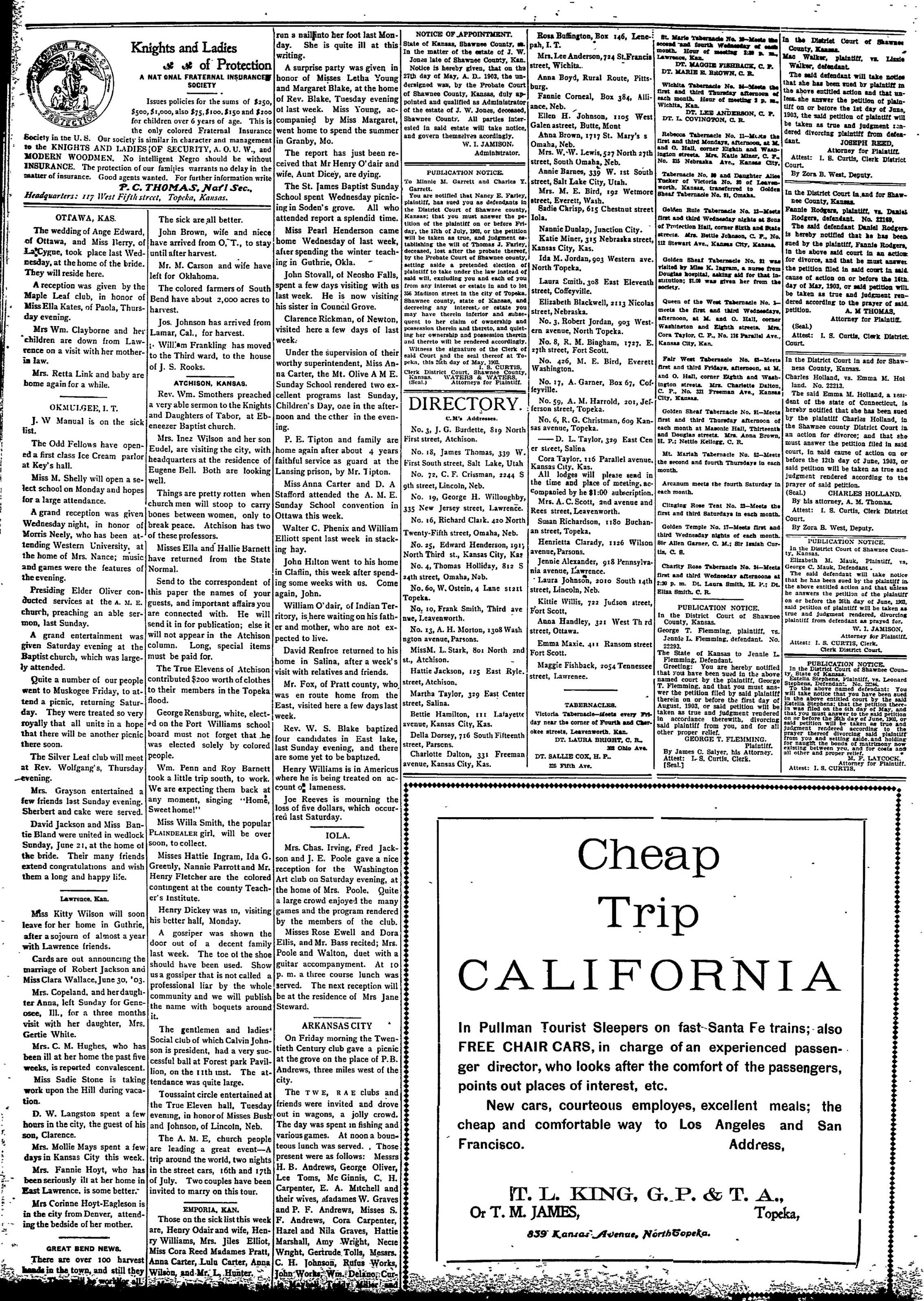
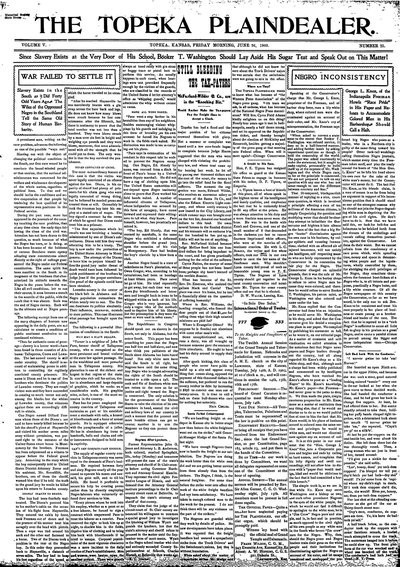
Page text (machine-generated)
THE TOPEKA PLAINDEALER.
Historical Society
State House
VOLUME V.
Since Slavery Exists
WAR FAILED T
Since Slavery Exists WAR FAILED T
Slavery Exists in the South as it Did Forty Odd Years Ago The Wiles of the Oppressed Negro in the Southland Tell the Same Old Story of Human Barbarity.
A promise
race problem
as one of f
A prominent man, writing on the race problem, advances the following as one of the possible "ways out."
Starting out with the object of changing the political condition in the South, our first care would be to convince the broad minded people of that section, that the national administration was concerned for the welfare and wholesome development of the whole nation, regardless of political lines. To that end we should invite the confidence and active cooperation of that people by tendering the best qualified of its representative men positions in the Federal service.
During the past year, more has appeared in the journals of the country touching the race problem, than at any time since the early days following the close of the civil war. Attention has not been drawn to this question, so much because of what the Negro has been, or is doing, as it has been because of the boldness of various Southern states openly adopting state constitutions aimed directly at the right of suffrage guaranteed the Negro under our Federal constitution. The same spirit has been manifest in the South in its treatment of the freedman that characterized its attitude towards the Negro in the years before the war. Like all evil conditions, left to run their course, it soon became a stench in the nostrils of the public, with the result that it was abated. Such was the end of Negro slavery. Such will be the ultimate end of Negro peonage.
The following excerpt from one of the many chapters of horrors now appearing in the daily press, are not calculated to create a condition of public sentiment conducive to its continued existence.
"Thus far authentic cases of peonage—slavery is a better word—have been found in three counties of Alabama: Tallapoosa, Coosa and Lowndes. The last named county is still under scrutiny. The sheriff is accused of maintaining peons in addition to controlling the regularly convicted county prisoners. His name is Dixon and he is one of five brothers who dominate the politics of Lowndes county. They are rough violent men and they have succeeded in creating so much terror not only among the blacks, but the whites of Lowndes county, that witnesses against them are exceedingly difficult to obtain.
One Negro named Dillard Freeman whom three of the Dixon's are said to have nearly killed because he left the sheriff's place at Hayneville and visited his mother seven miles away without permission, was pursued right to the entrance of the United States court house in Montgomery by the brothers. Freeman has been subpoenaed as a witness to appear before the Federal grand jury. According to the story which the boy subsequently told to United States District Attorney Reese and his assistant, Mr. Sternfeldt, the brothers, one of them the sheriff, warned him that if he told the truth to the grand jury he would be killed upon his return to Loundes county.
The boy had been fearfully maltreated. The Dixon's pursued him to his mother's cabin on the occasion of his flight from Hayneville. They entered the cabin by force, took Freeman out of doors and in the presence of his mother beat him savagely over the head with pistols. Then a rope was tied around his neck and the other end fastened to a horse. Two of the Dixons took a position in the rear of the Negro boy. In this order they proceeded back to Hayneville, a distance of seven miles. The boy had to keep his feet regardless of the speed at
"After he reached Hayneville he was mercilessly beaten with a gin strap across the bare back and legs. He does not know how many blows were struck because he lost consciousness after the fifteenth, but there is testimony to prove that the total number was not less than a hundred. They were blows struck by a man over six feet in height and weighing 250 pounds and they were blows, moreover, that were administered with all the strength that he could put to them. The only wonder is that the boy survived the punishment.
NEVER CONVICTED OF CRIME.
The most extraordinary feature of this case is that the victim was never legally convicted of an offense against the law. Dixon, in his capacity of sheriff had plenty of prisoners for his chain gang who were legally convicted of wrong doing, but he believed he needed peons and created them at will. Ostensibly he took the freeman boy into his employ at a stated rate of wages. The boy signed a contract by the terms of which he agreed that Dixon could treat him as a prisoner.
"The first experience which he recalls was one involving a beating administered by one of Dixon's subordinates. Dixon told him they were educating him to be a trusty. The boy is now under the protection of the United States Attorney in Montgomery. The attempt of the Dixons to force him to perjure himself before the grand jury under threat of death would have been followed by quick punishment of the brothers by Judge Jone if the proper corroborative proof of the episode could have been obtained.
Lowndes county is the center of the black belt in Alabama and its Negro population outnumbers the whites nearly two to one. The Dixons dominate its politics absolutely. Their influence, moreover, extends to state politics. This case illustrates what peonage has brought upon the state." The following is a powerful illustration of conditions in the South:
"Turner is a neighbor of John W. Pace, former sheriff of Tallapoosa county, who is recognized as the most persistent and brutal violator of the state law against peonage. He is the wealthiest and most powerful man in Tallapoosa county. His plantation is one of the richest and largest in that region of the state. It contains rich soil for cotton, timber in abundance and large deposits of graphite, which he works on a considerable scale. His graphite mine, in fact, is one of the most extensive in the country.
Pace has for years employed the county convicts of Tallapoosa and maintains as part of his establishment a stockade with cells, a kennel of bloodhounds and a force of armed guards. He is equipped otherwise with the parapharnalia of a jailor, He has in abundance leg irons or handcuffs, balls and chains and other instruments designed to hold men in captivity.
CAN'T GET CONVICTS FAST ENOUGH.
The supply of regular county convicts in Tallapoosa county was never equal to the demands of Pace's business. He required between forty and sixty Negroes nearly all the year round to operate his mines and sawmill, his grist mill, and to till his fields. He found it profitable to secure his help by creating peons rather than by directly employing Negro laborers who voluntarily offered their services to him.
"Every person whom he took into his employ, whether as a peon or as a free laborer, he forced to sign a contract which empowered Pace to treat the laborer as a convict. Pace reserved the right to lock him up at night, to shackle him in the fields, deprive him of clothing and to bring him back with bloodhounds if he tried to escape. Corporal punishment of the most vigorous character was a mere incident to the daily routine of Pace's establishment. Men and women were beaten upon the smallest pretext. There were guards
TOPEKA, KANSAS, FRIDAY MORNING, JUNE 26, 1903.
always at hand ready with gin strap or buggy trace or pistol butt to perform this service. As usually happens in such cases, when beatings were not provoked frequently enough by the victims of the guards, who are classified in the records of the United States district attorney's office as 'whipping guards,' would administer the whip without excuse or cause.
MADE ALL WORK NAKED.
"Pace went a step farther in his brutalities than any of his neighbors. Besides encouraging violent whippings by his guards and indulging in this form of brutality on his own account he forced his Negroes to work in the fields stark naked. No distinction was made in sex in carrying out his plans.
"Pace says in extenuation of his conduct in this respect tait he wished to prevent the Negroes escaping. One Negro, Ed. Moody by name, was rescued from a ditch in front of Pace's house by a United States deputy marshall. He did not have a rag of clothing upon him. The United States authorities will not depend upon Negro testimony alone to prove that Pace worked his field hands naked. A number of influential citizens of Tallapoosa, whose indignation was aroused by this form of savagery, have come forward and expressed their willingness to tell what they know. Pace himself, however, has precatically admitted it.
"The boy, Ed Moody, that was rescued by marshalls, is the same Negro who exhibited a deformed shoulder before the grand jury, upon the occasion of his visit to Montgomery. Pace had broken the boy's clavicle by a blow from a club.
Another Negro found in a state of nakedness on Pace's plantation, was Owen Gregor, who, according to his calculations, had been in bondage at least fifteen years. Pace never let go of him. He tried repeatedly to get away, but each time was run down by bloodhounds and horsemen and brought back in irons to be whipped within an inch of his life. Gregor who is very ignorant, has only a vague idea of the methods used to deprive him of his liberty, but the presumption is they were the same as were used in other cases."
The Republicans in Congress should speak out on slavery in the South, not only in Alabama, but the entire South. This paper has been preaching for years that the Negro was half free and half slave, and now what think you palliators of the South since Alabama has been heard from? Not only white men have said the South is all right, but Negroes have said the same thing. Any Negro who is caught advocating the rights of the South should be treated to a ride upon a rail. The rank and file of Southern white men are rotten to the core as far as justice and right toward the Negro is concerned. The only solution is for the government of the United States to take the election of its own members in hand, amend the civil and military laws of our country in such a manner that the poorest and most humble citizen can get recourse; another is to arm the Negroes so they can protect themselves!
Negroes After Lynchers.
Former Representative John G. Jones and Attorney L. B. Anderson, both colored, reached Springfield, Ills., today (Monday) and tomorrow will present the case of the state's attorney and sheriff of St Clair county before acting Governor Northcott and Attorney General Hamlin. They represent the civil rights Protective League of Illinois, and will demand that the Attorney General institute proceedings in the St Clair county circuit court at Belleville, to impeach the state's attorney and sheriff of that county.
They claim that the judge of the circuit court of St. Clair county announced his willingness to summon a special grand jury to investigate the lynching of William Wyatt and punish the lynchers, but that the state's attorney and sheriff refuse to proceed in the matter until the September term of court meets. Wyatt is the Negro school teacher who shot and seriously wounded County Superintendent of Schools, Charles Hertell, at Belleville the weeks ago.
STILL BLEEDING THE TAX-PAYERS
McFarland-Wilder Q. Co., are in the "Knocking Biz."
Would Rather Make the Tax-payers Pay the Freight Shan to Accept a Cinch.
Topeka has had a flood and the major portion of her citizens crowned themselves with glory. Not a murmur or complaint was heard until a few bore-heads began to complain because Judge Hazen suggested that the men who were charged with violating the prohibitory law, and whose trial came up for hearing last week, be let off by paying one thousand dollars and the cost of the court, the money to go into the relief fund for the flood sufferers. The moment the suggestion was made, Edward Wilder, who receives an enormous salary as treasurer of the Santa Fe Co., and also the Edison Electric Light company, and whose costly statury is now loaned to the City Library, and which rumour says was brought over on the free list, donated one hundred dollars to this fund. He owns several houses in the flooded district and his tenants will re-emburse him for the hundred he has put up, so Eddie will not be out of anything.
Rev. McFarland kicked because Judge McGaw fined him one hundred dollars for being impudent to the court, and has given practically nothing for the relief of the sufferers-Carrie Nation, the martyr of some of these people has not been heard from; perhaps she hasn't learned of the terrible disaster. What has become of the Rt. Rev. Dr. Emerson, who assisted the gallant Mack and Carrie? This place was once his home, but he too is financially silent on the question of suffering humanity!
Where is Rev. Williams, the howling evangelist, who fleeced the dear people out of that $1,400 for telling them what their high salaried ministers are paid for?
Where is Evangelist Oliver? We suppose he is flooded out elsewhere with some other man's wife.
Some unsophisticated sot, who runs a dairy, was all wrought up because someone gave the rescuers a little stimulants. He ought to have had his dairy around to supply their wants.
After much kicking, this class of people who never have pide to build up a city and oppose every thing that comes along, opposed the payment of this thousand dollars for the sufferers, but preferred to run the county further in debt by increasing it $878 to convict one man out of twenty-seven. It is time to call a halt on these bull-dozers who care for nothing but notoriety.
Santa Fe Not Embarrassed.
"We are handling freight at our depot in Kansas city in better shape now than before the white freighters went out on the strike," said General-Manager Mudge of the Santa Fe, last night.
"We have enough Negroes there now to handle the freight to our satisfaction. The Negroes are doing the work better than the white men did and we are getting better service from them already than from the strikers. The Negro, I think, is the natural freighter. For some time before the strike went into effect the work of the white freight handlers had not been satisfactory. We have taken in enough colored men to do the work for the present. I do not think there will be any violence on the part of the strikers."
The Negroes are guarded while they work by details of police. No new developments have taken place. It was reported that the freight handlers had secured a sympathetic strike from the Truck Drivers' and the Switchmen's unions, but this is without foundation.
that although he did not know for sure about the Truck Drivers' union he was certain that the switchmen were not going to mix in the affair.
Where are They?
THE TOPEKA PLAINDEALER wants to know what has become of "the Western Press Association" of the Negro press gang. With tears we ask, in all sadness, what has become of the National Negro Press Association? Will Bro. Cyrus Field Adams kindly enlighten us on this thing? Nearly four years ago it met in Indianapolis, nearly a half dozen strong, and set its approval on the Republican ticket, and thereby brought about the election of McKinley and Roosevelt, besides getting a majority of the press gang at that meeting into Federal office. When will it meet again?—Chicago Conservator.
A Credit to His Race.
Hon. P. E. Tipton has resigned his office as guard at the Kansas State Prison to engage in business with his father, D. F. Tipton, of Emporia.
Mr. Tipton leaves a host of friends at this place, all of whom speak in the highest terms of his intelligence and manly qualities, and emphasize the fact that he is eminently fitted to fill any office at the prison. He was always attentive to his duty and a more fearless man never wore the blue. He was in the battle with Estell and Cravens, and one of the small number of 8 that descended in the darkness 720 feet to rescue fourteen imprisoned white officers, who were at the mercies of 284 mutineer convicts. He with L. C. Bowers, the writer and five white officers, took our lives in our own hands to save the fair name of the Sunflower state. Why shouldn't Lyon county feel proud of such an honorable young man as P. E. Tipton. The Negroes of Lyon county should get together in the next county convention and nominate Mr. Tipton for some county office and see that he is elected.
D. W. WELCH, Lansing, Kas.
"In Solo Deo Salus."
International Order of Twelve.
Incorporated January 23, 1893.
777 333
To the Knights and Daughters of
Tabor.
The Twelfth Annual Session of the Grand Temple and Tabernacle for Kansas, Nebraska and Jurisdiction will convene in the A. M. E. church in the city of Lawrence, state of Kansas, Tuesday, July 14th, A. D. 1903, at 10 o'clock a. m., and will continue in session the 14th, 15th, 16th and 17th.
PRELIMINARY SESSION.—The board of Grand Curators is requested to meet Monday afternoon, July 14th. TAKE DUE NOTICE—All Temples, Tabernacles, Palatiums and Tents must be represented, as the law is positive on this point. ENDOWMENT RECEIPTS—Send or bring all receipts that you have received from the Endowment
Speaking of the Conservator's charge that Mr. George L. Knox, proprietor of the Freeman, and of barber shop fame, runs a lily white shop, where colored men were discriminated against on account of their color, and Mr. Knox's cry of misrepresentation, the Freeman says of the Conservator:
"When asked to correct a statement to the extent that Booker T. Washington was refused service, it does so in a half-hearted manner, and adding farther insult by asking impertinent questions as though it held the censorship of the world. The paper was asked courteously to make the statement, but it sought to make capital, presumably to build itself up at the expense of Mr. Washington and the whole Negro race, so far as the principle is concerned. We are not prepared to talk on any question with any one who has not sense enough to see the difference between courtesy and fear."
That jill-tempered, blackguardish manner of replying to a nice, courteous question, in which is involved a principle affecting a race of ten millions of the American citizens, is simply Cooperizing the question and muddying water that should be clear. Any attempt to intimidate the Conservator and frighten it into silence in the face of the fact that a big Negro "leader" discriminates against his own race in his business, by vulgar epithets and vaunting insinuations, clothed with an affected air of injured innocence, will not satisfy the intelligent, self respecting masses who are fairly represented by the Conservator in its contention for fair play for the Negro. The Conservator charged on splendid grounds, that it was the rule of Mr. George L. Knox in his barber shops to refuse to serve Negro men because they were colored, and therefore he would refuse to serve Booker T. Washington, his patton saint, as Washington was also colored and came under the ban.
Mr. Knox replied that the Conservator had done him an injustice, as he would serve Mr. Washington in his shop, and asked that the Conservator give his denial a conspicuous place in our paper. We complied by publishing his statement in full, as he wrote it, on our editorial page. As a matter of comment and self-indication we called attention to the notorious fact that Negro newspapers and Negro leaders throughout the country, had all along regarded Mr Knox's shop as a lily white shop, and that, although such a charge had been widely published and commented on by intelligent Negroes, who have watched Mr. Knox's efforts to pose as a "leading Negro" to Mr. Knox's knowledge, Mr. Knox's paper—the Freeman—had never gone to the pains to deny it. We then made the plain, simple, courteous proposition to Mr. Knox, more as a matter of restitution than any thing else, that if he would authorize us to do so we would publish free of cost to him the fact that Mr. Knox would, in his place of business accord to colored men the same service and privileges he would to white men, and would not discriminate against any on account of color. It is at this point in our comment that the "Hon. George L Knox" flies into a Cooperatic passion and begins and ends by calling us hard names, and complains that his lofty dignity and swell surroundings will not allow him to discuss with a "paper that would malign, libel and would be oblivious to the fact that it had committed a horrible breach."
The simple truth is, as we see it, that while Mr. Knox may serve Washington and a bishop or two, and such other prominent Negroes in the eyes of the white people, for which he would not find it difficult to apologize to the white man, he is a "Jim Crow" Negro pure and simple, and is, in fact and in practice, as much opposed to the civil rights of his own people as any white man in the South who favors "jim crow" cars for the Negro. Why, then, should the Negro press and Negro leaders train their guns on the white people and their institutions for discriminating against the Negro on account of his color, and let escape unnoticed and unwhipped the pro-
NUMBER 25.
George L. Knox, of the Indianapolis Freeman Howis "Race Pride" in His Paper and Refuses to Accommodate Colored Men in His Barbershop Should Call a Halt.
fessed big Negro who poses as a leader, who in a Northern city is guilty of the same thing toward his people? Other tuck-tail weaklings calling themselves Negro journals, which sneeze every time the Freeman takes snuff, and play the toady around the boots of "the Hon Geo. L. Knox" as he lifts his head above his own race for the sake of the white man's money, but the Conservator will never do it. The fact that Mr. Knox, as his friends claim, is a man of means is so far from being an argument in support of his inconsistent position that it should stand as one of the strongest reasons why he should not join the Negro-degrading white man in depriving the Negro of his civil rights. He don't have to do it. Now that we have said this, we look for hell-fire and brimstone to be belcled forth from the throats of the underlings and vassals calling themselves journalists, against the Conservator. Let them do their worst. But we cannot refrain from the consistency of a race press which, while spending time, money and space in denouncing white people and the legislatures, wholly controlled by them, for abridging the civil privileges of the Negro, they constitute themselves the foremost boot-lickers of a Negro who is, to all intents and purposes, practically a Negro hater, and a lily white creature. Of all the Negro newspapers of this country the Conservator, so far as we have noted, is the only one to ask Bro. Knox to be consistent and treat his race properly in his place of business or cease posing as a brother friend and leader of the race. The fact that he is reputed to be a "rich Negro" is sufficient to cause a little fish to glory in his praises as a great Negro, and to cause a painful silence to prevail among the bigger and more independent ones.—Chicago Conservator.
She boarded an open Ninth ave. car in the upper Fifties, and because she was such a stout, good natured looking colored "auntie" every one in the car looked at her when she gave voice to these decided words. She had handed the conductor a dime, and he had given her back in change five coppers. At least, he had offered them to her. But auntie steadily refused to take them, holding her puffy hands clasped tight together, with a determined look about her mouth "I nuver gwine ter take 'em," she repeated. "Cayn't yer gi'me a nilk?e."
At last he put the coppers on the seat beside her, and went about his duties. She left them there but she was thoroughly vexed. Then, a young woman who sat just in front of her, turned around:
"I'll give you a nickie for those pennies." she said softly.
"Lor', honey, doan' yer tech dem coppers! I'm bleeged ter tell yer dey'd fetch yer bad luck—dey sho' would! Its jes' come from de 'ospital where my chile's nigh to. death. Ef I took dem coppers she'd die, sartin, she would! Bless yer, honey, no; doan yer tech dem coppers."
Her last shot at the offending conductor as she got off the car at Thirty-fourth street was:
"Dey's dere, conductor, de coppers am dere. Yo, kin have de bad tuck yo self."
A half block below, as the conductor took up the coppers with some facetious remark, a loaded truck attempted to cross the track. The motorman banged into it before he could slow up. The front platform of the car was wrecked and a wheel was knocked off the truck. The conductor's bad luck had arrived N. Y. Press.
Kansas needs twenty thousand laborers in its golden harvest fields. Here's your chance to provide for next winter. Take it.
If President Roosevelt does no more for the Negro than to appoint Judge Jones, of Alabama, he has done enough to win their lasting gratitude.
What the race needs now, more than any thing else, is a leader with a clear conception of the commercial conditions of the world and the Negro's relation thereto.
In the face of recent disclosures we wonder if wealth, intelligence and morality will bring the Negro some earthly solace in America? We doubt it.
Now that the flood has subsided, there is no occasion for the loafer. There is work for all, and every ablebodied man should be put to work. This includes the policy writer who puts in his time working our poor, deluded people to risk their hard earned nickles and dimes on "saddles," "gigs" and combines.
Has any one heard from Booker Washington on the Alabama question? We are very much surprised that he has not been heard from on this very momentous question. We know one Negro who would have known about the conditions and spoke out in meeting, and his name is John M. Brown, of Kansas.
Simply Horrible.
The world never realized the extent and debasing influence of American slavery until Harriet Beecher Stowe wrote the now much execrated "Uncle Tom's Cabin." The world has failed to realize the damnable conditions prevailing in the south, and does not now fully comprehend their heights and depths until a few courageous papers and a resolute United States Judge undertook to take the mask from the face of the grimest Malock that ever devoured human beings. For years the few Negro Journals scattered over the North have been telling the story of "man's inhumanity to man" as depicted in the treatment of the Negroes in the South, with but little hope of a hearing. But the investigations conducted by a fearless public press has revealed
a condition in the South that beggars description. It is simply horrible. Men and women chained naked in the fields. Just think of such a thing. We read with feelings of horror of the inhumanity of the barbaric Sclav in Russia, we turn with disgust from the English in Ireland, we send our troops to China to fight the "boxers," but fail to notice the brutal outrages of American barbarians within our own door. We send millions abroad each year to educate and christianize the poor heathen, when within the sound of our myriad of church bells ten thousand brutes are setting at naught the laws of God and man, and each day, striving to sink humanity lower. The story of American peonage has no parallel in the annals of the world. It lays upon the good name of this nation a disgrace as lasting and blithing as that slavery which cost so much in blood and treasure. In the face of all this, what can the Negro do?
North Topeka
George Reeves and wife, of Oklahoma, were in the city last week, visiting their mother, Mrs. Evaline Reeves 920 Western a ve Mrs. M. D. Jones is staying at 918 Western avenue until her house gets repaired. Services were held at the B. street Baptist church on Sunday, which were highly enjoyed by everybody.
Rev. H. W. White preached three soul-stirring sermons. He is very much encouraged over the condition of the church and the interest the members have in him. They raised for him forty-two dollars and fifty cents. A donation of ten dollars was sent to the church from the Baptist church at Marrowsville, Ills., of which Rev. Frank Barrett is pastor. They have our hearty thanks.
WICHITA, KANSAS.
Miss Juanita Wilson of Arkansas City is visiting in the city.
George Jones, an old resident of this city, died on Tuesday of last week. The funeral services were held at the Second Baptist church. His wife and son, Rev. M. L. Jones of Atchison, survive him.
Mrs Mary Parks left Thursday for Ft. Scott, where she intends to reside.
J. W, Thompson and Miss Mattie Andrews were married on Thursday evening of last week, Rev Yocum officiating. The New Hope Baptist church had a successful rally on last Sabbath. The Ladies' Art club met with Mrs. Rev. Frazier, on Tuesday evening.
The L. M. A. club gave a reception on Thursday evening of last week, at the home of Miss Lulu Covington, in honor of Samuel Walker, graduate of the class of '03, who is a member of the club. Rooms and tables were beautifully decorated with cut flowers and the club colors. Pretty souvenir cards tied with pink and white ribbons formed a perfect setting for the "feast of reason and the flow of soul." The menu was elaborate, and daintily served, and the toasts were sparkling with wit, pleasant humor and common sense. Mr. Walker was presented with a set of George Elliotts works. The toasts were: Presentation, by Thaddeus Summit; Response, S. Walker; Our Graduates, Dr. J. E. Farmer; Let Your Aim in Life be High, Miss L. A. Covington; The Student in the World's History, Dr. Harrison. Toastmistress, Miss L. A. Covington.
NEWTON, KAS.
W. C. Downing, of the Arcade barber shop, has accepted a position as porter on the Santa Fe, with headquarters at Newton. Miss Ethel D. Gross, a last
Ira Patterson has resigned as janitor in the Santa Fe offices and J. Mercombs of the baggage rooms succeeds him, while Ed Mason has been employed in the baggage department.
Last Friday, Red Woodfork shot James Garrett and wife. The wounds were not fatal but may yet cause a great deal of trouble as the bullets have not been extracted.
G. H. Mechling, of Abilene, has accepted a position at the Arcade barber shop, with Gross & Reevely.
The N. W. G. club held its annual closing exercises at the residence of John Anderson and wife. The program was not a long one, but pointed, and was enjoyed by the friends who were so lucky as to be invited. After the program, which consisted of talks, vocal music and papers, the guests and members were seated around the table, which was nicely decorated, and enjoyed a luxurious repast. At the close all expressed themselves as having spent a lovely evening.
The annual picnic of St. John church and Sabbath School will be held on the Fourth of July at the Fair Grounds in South Topeka. A declamation centest will be among the principal attractions. All are invited to attend.
WHAT THEY ALL SAY.
ATHENS, GA., June 8, '03.
MR. N. CHILES.
My DEAR SIR;—I have been reading your paper ever since my wife, Mrs. Ola M. Bradley, subscribed for it. The reading matter has so aroused me that I feel itmy duty to write you a few encouraging words. First, I shall always have your paper in my home for in my estimation it is the olny Negro paper published and I shall, as I go through the various counties of Georgia, try to get every Negro to subscribe for it. At present my wife and I are teachers at this place, but I am in strong notion of breaking up and coming out there.
STILL IT IS GROWING!
Applications for stock in the Topeka and Indian Territory Land, Coal and Development Company have come in this week from various parts of Kansas, Missouri and North Carolina.
The second assessment will be due on the first of July, and on the first of every month thereafter.
Time and space forbid farther comment at the present writing, but next week look out for more infomation and the list of new subscribers.
Attention Odd Fellows.
Djstrict Grand Lodge No. 17 G. U. O. of O. F. State of Kausas has postponed their meeting from July 21, 22 and 23 until August 25, 26 and 27 on account of recent flood and a number of our members left homeless. Done by order of the executive board June 16 1903.
J. H. BASSETT, D. G. M.
M. W. JACKSON, D.D.G.M.
P. F. LEWIS, D. G. S.
D. D. HOPE, D. G. T.
J. B. LEWIS, D. G. D.
Club Women Notice.
On account of the flood disaster Lawrence is unable to entertain the State Federation this year. It is therefore postponed indefinitely. Further notice will be given after the Executive Board meets in Kansas City, June 20th.
Most Respectfully Yours,
MISS EMMA BROWN,
Cor. Sec. State Federation.
Notice.
Notice.
On account of the recent floods in the low districts throughout the state of Kansas, the State Sunday School Convention that should have met the 24th of June, at Ottawa, will be postponed until the 15th day of July at 2 q'clocd p. m., 1903.
Cambric Gown, yoke of hemstitched tucks and lace. -lace edge neck and sleeves. Three bands lace across front, 75c.
Fine Muslin Gown, square neck, with deep embroidery edge and tucks. Embroidery ruffled revers. Yoke back, 75c.
Cambric Gown, square neck, outlined with wide, open embroidery insertion. Hemstitched ruffles on neck and sleeves, 75c.
Chemisette Gown, long cloth, round neck, with circular band having five rows of hemstitching. Short kimono sleeves, with wide hemstitched band on edge, $1.00.
Long Cloth Gown, high neck, square yoke front of Valenciennes lace and tucks. Lace edged neck and sleeves, $1.00.
Cambric Gown, square neck, with wide band fine Swis embroidery. Embroidery ruffles neck and sleeves, $1.00.
Skirts
Muslin Skirt, on yoke, seven inch cambric ruffle with lace edge and fine tucks, 50c.
Muslin, 7 Inch Cambri ruffle headed with group of tucks. Wide hemstitched hem, 50c.
Muslin, 8 inch Torchon flounce, 50c.
Muslin, 11 inch lawn flounce with embroidery ruffle, 75c.
Muslin, 13 inch Cambric flounce. Lace edge and insertion, 75c.
Muslin, Cambric Flounce, 11 inch with embroidery and hemstitching, 75c.
Look!
Read!
Consider
The Great Mining Co.,
Skirts
Is receiving Money daily for Shares, and and those Desiring to take Stocks will Have to Hurry.
Only 30 Days More to Get Stock
114 E. SEVENTH ST.,
Todeka, Kas.
We Do all Kinds of JOB
CROSBY BROS.
Muslin, Cambric flounce, 12 inch. Group 8 fine tucks above three wider lace-edged tucks. Dust ruffle, $1 00.
Muslin, Fine Indian Linen flounce 16 inch, having 16 fine tucks above Cluny lace-edged ruffle. Dust ruffle, $1 00.
Cambric, Fine India flounce, 16 inch. Wide Point de Paris insertion between groups of tucks. Deep lace edge. Dust ruffle, $1.50.
Cambric, India flounce, 13 inch. Point de Paris insertion and edge, with 4 rows silk faggoting. Dust ruffle, $1.50.
Corset Covers
Cambric, round neck, with fine Torchon edge, ribbon drawn. Lace edged arm. 4 rows insertion across front. Tucked back, 50c.
Cambric, round neck, lace edge ribbon drawn on neck. Arms lace edged. 8 rows of fagging across full front and back, 50c.
Longcloth round neck, with lace edge and beading, ribbon drawn. Arm lace edged. Four rows Valenciennes in-ertion, spaced across front, 75c.
Mrs. F. E, Emery, Prop. F. E, Emery, M
Emery's Cafe,
---
The best first-class mea in the city at all hours. Home cooking a specialty 108 Cascade Ave. COLPRADO SPRING
Jo-He Magnetic Oil.
This famous remedy has stood the test in thousands of cases of nearly all kinds of diseases, and during the past 18 years it has cured hundreds of people, after the doctors and friends had given up all hope of their recovery. And the most convincing thing of all is the fact that all who have given this oil a thorough test, do heartily recommend it as the best remedy they ever used. We have sold over $20,000 worth in the past 16 years.
PAINE BROS.
Agents, 325 Kansas ave., Topeka.
Do You Wear PANTS?
Of Topeka Woolen Mills manufacture. All wool pants made to order for $3.50, fit guaranteed; also worsted pants to order. Suits MADE TO ORDER of Kansas products.
Patronize Home Industry and assist to build up our home institutions. If you can't call, send me a postal card or telephone and samples will be shown you.
J. G, SAMUELSON,
403 KANSAS AVENUE.
Ind 'Phone 971 Old Court House
AVENUE.
Old Court House
910 N. Third St.
WONDER
DISCOV
Curly Hair Made
TAKES FROM
BEFORE AND AFTER
ORIGIN
OZONIZED OXIDE
(Oprah)
I MAKE PANTS
---
Albert Ross
For all kinds of Typewriting,
Church, Club, Society and
Lodge work a specialty. Try us.
OFFICE 1795 KANJAS AVENUE
'Phone 747.
Patronize the...
AMERICAN
Steam Laundry
and get the best.
114 E. SEVENTH ST. PHONE 54.
OFFICE HOURS {7 to 10 A. M.
12 M. to 4 P.M.
Both Phones 454 {7 to 10 P. M.
J. M. JAMISON, M. D.
PHYSICIAN AND SURGEON
Special Attention to diseases
of women and private diseases.
Office and Residenc MADISON STREET
Shampooing and Face Massage.
Mrs. Hattie E. Van Vleck
Hair Dresser and
Manufacturer.....
Hair to match all Complexions.
SWITCHES AND HAIR JEWKLBY.
220 East Fifth Street, TOPHEA, KANSAS
Mme. L. F. JOHNSON
Shampooing, Manicuring,
Massage and Scalp Treatment a Specialty. Try her Marline for the hair.
910 N. Third St. KANSAS CITY KAS
WONDERFUL
DISCOVERY
Curly Hair Made Straight By
TAKEN FROM LIFE:
BEFORE AND AFTER TREATMENT.
ORIGINAL
OZONIZED OX MARROW
(Copyrighted.)
This wonderful hair pomade is the only safe preparation in the world that makes tinker or only hair stright as shown above. It nourishes hair and helps it fall out or break off, cures dandruff and makes the hair grow long and silky. Bold over color and a great hair care product that is hardest. Testimonials free on request. It was the first preparation ever sold for purposes. Get the Original Guaranteed Ox Marrow as the genuine never fails to keep hair healthy and provides the necessity for ladies, gentlemen and children. Kerrigan performed. The great advantage of this wonderful pomade is that by its use you can keep your hair superior and lasting qualities it is the best and most economical. It is not possible without it. Full directions with every bottle. Only 80 cents. Sold by dragsters and dealers and sold by the best and most economical bottles. We pay all express charges. Read your name and address plainly to OZONIZED OX MARROW CO.
Very fine Longcloth, very full front. Double row wide lace insertion, with edge and ribbons at neck. Arms lace edged and ribbon drawn 75c.
French Cut, Indian Linen. Round neck with lace and ribbon. Arms lace edged. Four lengthwise hemstitched tucks in front, 75c.
French Cut, Longcloth, round neck and arms have lace edge, beading and ribbon. Valenciennes insertion in six rows down back and front $1.00.
Skirted Cover, Longcloth, lace and ribbon edges. 8 rows insertion down front, tucked back. Wide beading ribbon drawn at waist, $1.00.
Drawers
Cambric—6 inch umbrella ruffle, hemstitched, with two rows hemstitched tucks at top and edge, 50c. Muslin—Cambric ruffle, 6 inches deep, trimmed with hemstitching and embroidery, 50c.
Cambric—Indian Linen umbrella ruffle, edged with four fine hemstitched tucks and narrow embroidery 50c
Cambric—5 inch lawn ruffle, headed with three hemstitched tucks. Edged Valenciennes lace and hemstitching, 75c.
Cambric Muslim—Ruffle of embroidery 5 inches deep, headed with five fine tucks, 75c.
Cambric—Deep ruffle of dotted embroidery, with group tucks at top 75c
Cambric—7 inch flounce of fine Indian Linen. Lace edge and three spaced rows of fine insertion, $1.00.
Cambric—Umbrella ruffle of fine lawn, headed group hemstitched tucks. Tucks and embroidery ruffle on edge, 1.00.
Cambric—8 inch flounce of handsome embroidery. Five tucks at head, $1.00.
OFFICE HOURS.
to 10 A.M.
to 7 P.M.
V. A. TAYLOR, M. D
PHYSICIAN AND SURGEON
Calls answered day and night.
WM. E. JACKSON, M. L
PHYSICIAN AND SURGEON
Office 404 Kansas Ave.
ISLEPHONE 635. TOPHEA, B.
When in Salina
and want a first-class meal for 15c stop at the
Midland Short Order Restaurant
Champion Pie Bakers.
Rooms in connection.
W. W. SHOEBE. PROFRISTOR
Kohl's Laxative
Tablets
Positively Cure Constipation, Hilienness, Sick Headache and any Liver Complaint.
To any person sending us 10 cents in stamps to pay the postage and the name of one or more friends needing the medicine we will send a
This famous preparation will absolutely cure the worst case of constipation.
Mr. James C. Seeley, the well known Kansas newspaper and magazine writer, says: "I suffered with constipation for many years. One 50 cent box of Kohl's Laxative Tablets cured me and I feel better now than I have for 15 years. Your Laxative Tablets are a Godsend to people afflicted as I was."
Write today and order the medicine. It has cured thousands of people. It will cure you.
KOHL MEDICINE CO.
Dept.F 226 Kansas Ave., Topeka, Kansas
J. M. KNIGHT,.
UNDERTAKER AND EMBALMER.
632-36 Quincy Street.
Patronize the Kansas City, Kas..
Embalming and Casket Co.
1014 West Fifth Street.
Owned and controlled by Negroes—Capital Stock $2,000.
Miss Jordan is one of the most beautiful and popular young ladies in the bounds of "Grand Old Missouri." She is a graduate of the Boston Conservatory of Music, and for several years was at the head of the musical department at Lincoln Institute in Jefferson City Mo.
Mr. Bufkin is well known throughout Kansas and Missouri, and for years has taught in the public schools of the Sunflower state. His vacations were usuallyspent traveling in the interest of THE PLAINDEALER and in searching for a help meet between times. He is a gentleman in every sense the term implies—highly educated, and a man for whom Dame Fortune has bright things in store. Frank Bufkin's smiling countenance and geniel manner always brings cheer to the most down hearted, and coupled with the sweet disposition of Miss Jordan, their home will be one of eternal joy and bliss, in which the sun will never refuse to shed its rays.
THE PLAINDEALER force, together with their many friends, cast the proverbal old shoe, and wish them joy and happiness forever.
MORE FLOOD TALK.
The flood damaged the colored land holders in the Kaw Valley in spots. In places like Marcus Owens' and Suga' farms are almost a total wreck. Mr. Keith's barn was moved about thirty feet. The hogs, chickens and ducks that were put up into the loft were saved.
The water washed a two foot hole under the West end of Will Turner's residence. The house had to be blocked up.
Peter Spotts lost four hogs. Three pigs went up stairs and went to bed, and are looking fine.
Robert Turner's farm was damaged but very little, and he is in good shape.
Tuesday evening Miss Mary Jamison very pleasantly entertained at her home on Spruce street, complimentary to Miss Theresa Adams. The party was a complete surprise to the guest of honor. Various games were indulged in during the evening and all highly enjoyed themselves. The following guests were present: Misses Evelyn P. Hickman, Minnie and Ellen Page, Pearl and Lena M'Neal, Eunis Morgan, Jennie Buchanan and Cora Bennett; Messrs Chas. Whitney, Gaitha Page, Fred Roundtree, Marcellius Freeman, Wm. R. Carter and W. Comer; Mesdames J. M. Wright, J. Abbott, A. Reed and Mr. and Mrs. Jas. A. Page. Miss Adams left Wednesday for her home in Tuskegee Alabama.
Mrs. D. Markham celebrated her sixtieth birthday last Tuesday at their beautiful farm North of the reform school. She is the wife of the Hon. Daniel Markham, who made the race last fall for sheriff on the Democratic ticket. Mrs. Markham was born in Indiana and was a member of the womens' relief corps during the late unpleasantness. She is one of the most highly respected ladies in that community, and did much to relieve flood sufferers. As many as sixty stopped at the Markham home at one time where they were fed, cared for and sheltered nearly a week. May she round out her century is the wish of her hosts of friends.
Attorney A. M. Thomas was in Argentine Tuesday viewing the wreck caused by the recent flood. Mr. Thomas says that North Topeka received only a slight introduction, that the main performance was in the "big top" at Argentine and Kansas, City; that even "yaller sheets" in the East with all of their sensational stories have never pictured the horror of the flood scene at these places. No man can describe the scene, it has to be seen to be realized.
Rev. W. T. Vernon, president of Western University, Quindaro, Kas., has returned from attending the commencement exercises at Wilberforce, Ohio. While there the degree of D. D., was conferred upon him. Willberforce University is the oldest college for Negroes in the United States.
A Creditable Company.
Never in the history of the little city of Holton has its citizens been so highly entertained as on Wednesday evening, when the Mason at Downs Jubilee singers of Tennessee, renamed one of their superb concerts. Between four and five hundred music lovers gathered in the large Tabernacle, where they listened to the only real jubilee singers before the public, and that they were pleased was plainly told by the lustly manner in which they applauded.
It's seldom in a life time that one has an opportunity to hear eleven people, who each one in themselves is a distinct soloist—an aggregation of all stars. Such is the make-up of the Mason & Downs company, which accounts for their signal success.
The roster of the company is as follows:
Charles Downs, baritone; R. Howard Downs, first tenor; J. C. Prosser, second tenor; Arthur W. Payne, basso; Wm. Hugh Mason, pianist; Miss Anna Prosser, first soprano; Miss I. O. Maude Brown, second soprano; Mrs. Chas. Downs, alto; Miss Bessie Kinney, contralto.
Messrs. Chas. Downs, Arthur W. Payne and Miss I. O. Maude Brown each sang solos, which were well received. Messrs. Chas. Downs and Arthur W. Payne were the favorites of the evening and responded to several oncores.
The duett by Misses Bessie Kinney and Anna Prosser was one of the most tuneful we have ever heard, and showed the ladies to be singers of rare ability.
Who's Been Missing in Society?
A 3-months-old colored baby boy was found on the door step of the orphans' home on Fillmore street last Monday evening about 10 o'clock. The child was well dressed and had two bottles of milk, nipples, etc. He is a pleasant little light brown skinned fellow, and bright as a dollar. Mrs. L. S. Wolverton and Mrs. Vandord had the little fellow down town Tuesday en route to the colored orphans' home. He seemed to enjoy their company very much.
These ladies certainly deserve great credit for looking after orphan children. They carried this child and made as much over him as they would a white child. We saw the little fellow at L. S. Wolverton's drug store where the ladies had taken him to call. We hope everybody will enquire and find out who has been missing in society during the past seven months, it could be placed at four. Solve this mystery for THE PLAINDEALER.
A sensible young lady of Kansas made the following request of her friend: "Do not lay me down by the rippling brookside, lest the babbling lovers wake me from my dreams, nor in the beautiful cemeteries in the valleys least sightseers cooing over epitaphs distract me; but let me sleep under the counter of the merchant and business man who never advertises. This is the peace that passeth all understanding, and deep is the sleep in which neither the buoyant footfall of youth nor the weary shuffle of old age will ever intrude."
PUBLICATION NOTICE.
On Monday, the 6th day of July, 1903, at 9 o'clock
A. M. of said day, or as soon thereafter as the same
can be heard, application will be made to the
District Court of Shawnee County, Kansas, to have
all the rights of majority conferred upon C. W.
Trapp, a minor, who is now near 19 years of age.
C. W. TRAPP
By his mother and next friend,
C. T. TRAPP.
Howard
University
Medical Department
Including Medical- Dental and Pharmaceutical
Colleges.
THIRTY-SIXTH SESSION (1903-1904) will
begin October 2, 1903 and continue seven months.
DAY SCHOOL FOR NEW MARTRICULANT
Tuition fee in Medical and Dental Colleges each
$80.00. Pharmaceutic College $70.00.
Four graded courses in Medicine and
Dental Surgery.
Well equipped laboratories in all departments.
Unsecured hospital service.
All students must register before October 12, 1903.
For catalogue of further information apply
F. J. SHADD, A. M., Secretary,
901 R Street, N, W.
Washington, D.C.
Keep an Eye on Them.
In a pure and noble womanhood rests the future of any race, and to guarantee such, it requires the assistance of clean and pure minded men—men who are ready and willing at any and all times to make the greatest sacrifice for the chastity of our girls.
THE PLAINDEALER is reliably in formed that it is the practice of a few lecherous old scoundrels to chase the side streets late in the evening with thirteen and fourteen year old girls. The old reporobates are unfit to be called human. They should be listed as a scrub of the "Mammoth Kentucky" variety, where the veterinary surgeon could rightfully claim his own.
The public has an eye on these old hounds, and if any disgrace befalls a child in this city, they will be given the fullest extent of the law.
John Thomas, known as "yaller John," was taken to the penitentiary Tuesday to serve a term of four years for burglary, and what was the cause? Gambling! Thomas was a slave to the gaming table, and when he lost—which was more times than he won, he would grow desperate, and break into the rooms of even his closest, friends, take their clothing and dispose of it in order to satisfy his lust for gambling. It's hard to see a young man whose chances to earn an bonest dollar are so numerous, carted away to "do time," but we believe it will be of great benefit to Thomas, and hope other youngsters, who have strong inclinations to become great gamblers will take warning and profit from Thomas's misspent life.
A lucky star seems to have lighted the path of Frank Raynor, agent for the Heim Brewing Co. During the recent flood his place at 413 West Curtis street had only six inches of water and his mules stood in the yard for six days and came out safe and sound. His furniture was not disturbed, and his oleanders are growing as though there had never been a flood. Tha man ought to join McFarland's church.
Are you a policy player? Try some "numbers" with the Knights and Ladies of Protection. This is purely Negro and has strong men behind it
When in Topeka. Stop at the
Accomodations Strictly First Class in every respect.
The Hirbour Steam Dye Works and Topeka Pantatorium.
Steam and Dry Cleaning of Fine Garments For Ladies and Gentlemen. Feathers, Furs, Gloves. (FrenchDry Cleaning.) Goods Called for and Delivered. Pantatorium Membership $1.00 per Month.
```markdown
```
YOU NEED
A SUMMER SUIT! Come
on and Look Over Our Line
MADE--TO-ORDER Goods.
to Lower Now Than Ever Before
phones 872. [No. 115 W. 7th St]
Holds & Childs
100 to California
This is the Rock Island's rate from Topeka
affect daily, February 15 to April 30
sets are good in tourist sleeping cars
with the Rock Island runs every day in
the week through to Los Angeles and San
Cisco. These cars make quicker time
Southern California than similar cars
any other line. Cars are operated over
the "Scenic" and "Southern" lines
ever giving full information moiled on
rest.
YOU NEED
A SUMMER SUIT! Come
In and Look Over Our Line
of MADE--TO-ORDER Goods.
Prices Lower Now Than Ever Before.
Both Phones 872. [No, 115 W. 7th Street.
Reynolds & Childers.
$25.00 to California
That is the Rock Island's rate from Topeka. In effect daily, February 15 to April 30. Tickets are good in tourist sleeping cars, which the Rock Island runs every day in the week through to Los Angeles and San Francisco. These cars make quicker time to Southern California than similar cars over any other line. Cars are operated over both the "Scenic" and "Southern" lines. Folder giving full information moiled on request.
Rock Island System
If you are going to California, GO NOW. After May's it will cost you nearly $60 more than at present.
Low rates to Montana, Idaho, Utah and Puget Sound are also offered by the Rock Island.
See nearest Rock Island ticket agent, or, if you prefer, write the undersigned.
A. E. COOPER, D. P. A. Gopekar.
COOPER, D. P. A, Gopekar,
A. E. COOPER, D. P. A. Gopekar, Kas
MISSOURI
PACIFIC
RAILWAY
SOUTHWEST SY
Bringing the States of Kansas, Missouri, Nebraska, and the Indian Territory.
Daily Passenger Trains are run on the direction, between Kansas City and Saskatchewan.
The Famous Hot Springs Of Arkansas
Hed ONLY by this LINE
W. F. McLARGHLIV,
1615 Fillmore
Eighth Bros.
PAINTERS.
with you on your
LYTLE &
BARB
Traveling the States of Kansas, Missouri, Nebraska Colorado, Cansas, and the Indian Territory. Five (5) Daily Passenger Trains are run on this line in each direction, between Kansas City and St. Louis The Famous Hot Springs Of Arkansas
City stop at
L. NORTH's
Residental
Hotel and Cafe
Bed Rooms
2812 Walnut 2 Rings
5 E. 18th Street
Missouri
Watches.
Money Loaned o
S. Frei
Jeweler and
19 years' experience
512 Kansas Ave.,
Rock Island
System
A, Gopekas, Kas
Missouri Pacific Route
GREAT
SOUTHWEST SYSTEM,
Tennessee, Missouri, Nebraska
an Territory.
Bains are run on this line
Tennessee City and St. Louis
Hot Springs
Of Arkansas
LINE
LYTLE & SON,
BARBERS.
All work First Class.
929 Kansas Ave., Topeka, Kas.
Watches. Clocks.
Money Loaned on Valuables.
S. Freidberg.
WOMEN K.3.L.03
PROTECTION
Society in the U.S. Our society is to the KNIGHTS AND LADIES MODERN WOODMEN. No insURANCE. The protection of o matter of insurance. Good agents w P.C. Headquarters: 117 West Fifth st
OTTAWA, KAS.
The wedding of Ange Edward, of Ottawa, and Miss Berry, of LaCygne, took place last Wednesday, at the home of the bride. They will reside here.
A reception was given by the Maple Leaf club, in honor of Miss Ella Kates, of Paola, Thursday evening.
Mrs Wm. Clayborne and her children are down from Lawrence on a visit with her mother-in law.
Mrs. Retta Link and baby are home again for a while.
OKMULGEE, I. T.
J. W Manual is on the sick list.
The Odd Fellows have opened a first class Ice Cream parlor at Key's hall.
Miss M. Shelly will open a select school on Monday and hopes for a large attendance.
A grand reception was given Wednesday night, in honor of Morris Neely, who has been attending Western University, at the home of Mrs. Nance; music and games were the features of the evening.
Presiding Elder Oliver conducted services at the A. M. E. church, preaching an able sermon, last Sunday.
A grand entertainment was given Saturday evening at the Baptist church, which was largely attended.
Quite a number of our people went to Muskogee Friday, to attend a picnic, returning Saturday. They were treated so very royally that all unite in a hope that there will be another picnic there soon.
The Silver Leaf club will meet at Rev. Wolfgang's, Thursday evening.
Mrs. Grayson entertained a few friends last Sunday evening. Sherbert and cake were served.
David Jackson and Miss Bantie Bland were united in wedlock Sunday, June 21, at the home of the bride. Their many friends extend congratulations and wish them a long and happy life.
Lawrence. Kan.
Miss Kitty Wilson will soon leave for her home in Guthrie, after a sojourn of almost a year with Lawrence friends. Cards are out announcing the marriage of Robert Jackson and Miss Clara Wallace, June 30, '03.
Mrs. Copeland, and her daughter Anna, left Sunday for Geneosce, Ill., for a three months visit with her daughter, Mrs. Gertie White.
Mrs. C. M. Hughes, who has been ill at her home the past five weeks, is reported convalescent.
Miss Sadie Stone is taking work upon the Hill during vacation.
D. W. Langston spent a few hours in the city, the guest of his son, Clarence.
Mrs. Mollie Mays spent a few days in Kansas City this week.
Mrs. Fannie Hoyt, who has been seriously ill at her home in East Lawrence, is some better.
Mrs Corinne Hoyt-Eagleson is in the city from Denver, attending the bedside of her mother.
There are over 100 harvest hands in the town, and still they move. There will be worker all.
ATCHISON, KANSAS.
Rev. Wm. Smothers preached a very able sermon to the Knights and Daughters of Tabor, at Ebeneezer Baptist church.
Mrs. Inez Wilson and her son Eudel, are visiting the city, with headquarters at the residence of Eugene Bell. Both are looking well.
Things are pretty rotten when church men will stoop to carry bones between women, only to break peace. Atchison has two of these professors.
Misses Ella and Hallie Barnett have returned from the State Normal.
Send to the correspondent of this paper the names of your guests, and important affairs you are connected with. He will send it in for publication; else it will not appear in the Atchison column. Long, special items must be paid for.
The True Elevens of Atchison contributed $200 worth of clothes to their members in the Topeka flood.
George Rensburg, white, elected on the Port Williams school board must not forget that he was elected solely by colored people.
Wm. Penn and Roy Barnett took a little trip south, to work. We are expecting them back at any moment, singing "Home, Sweet home!"
Miss Willa Smith, the popular PLAINDEALER girl, will be over soon, to collect.
Misses Hattie Ingram, Ida G. Greenly, Nannie Parrott and Mr. Henry Fletcher are the colored contingent at the county Teacher's Institute.
Henry Dickey was in, visiting his better half, Monday.
A gossiper was shown the door out of a decent family last week. The toe of the shoe should have been used. Show us a gossiper that is not called a professional liar by the whole community and we will publish the name with boquets around it.
The gentlemen and ladies' Social club of which Calvin Johnson is president, had a very successful ball at Forest park Pavilion, on the 11th inst. The attendance was quite large.
Toussaint circle entertained at the True Eleven hall, Tuesday evening, in honor of Misses Bush and Johnson, of Lincoln, Neb.
The A. M. E, church people are leading a great event—A trip around the world, two nights in the street cars, 16th and 17th of July. Two couples have been invited to marry on this tour.
EMPORIA. KAN.
Those on the sick list this week are, Henry Odair and wife, Henry Williams, Mrs. Jiles Elliot, Miss Cora Reed Madames Pratt, Anna Carter, Lulu Carter, Anna Wilson, and Mr. L, Hunter.
IOLA.
ARKANSAS CITY
On Friday morning the Twentieth Century club gave a picnic at the grove on the place of P.B. Andrews, three miles west of the city.
The TWE, RAE clubs and friends were invited and drove out in wagons, a jolly crowd. The day was spent in fishing and various games. At noon a bounteous lunch was served. Those present were as follows: Messrs H. B. Andrews, George Oliver, Lee Toms, Mc Ginnis, C. H. Carpenter, E. A. Mitchell and their wives, Madames W. Graves and P. F. Andrews, Misses S. F. Andrews, Cora Carpenter, Hazel and Nila Graves, Hattie Marshall, Amy Wright, Necie Wright, Gertrude Tolls, Messrs. C. H. Johnson, Rufus Works, John Works, Wm. Delano, Curra
In Pullman Tourist Sleepers on fast Santa Fe trains; also FREE CHAIR CARS, in charge of an experienced passenger director, who looks after the comfort of the passengers, points out places of interest, etc. New cars, courteous employes, excellent meals; the cheap and comfortable way to Los Angeles and San Francisco. Address,
T. L. KING, G. P. & T. A. Or T. M. JAMES, Topeka, 839 Kansas Avenue, North Gopeka.
DIRECTORY.
C.M's Addresses.
TABERNACLES.
GEORGE T. FLEMMING.
Plaintiff.
By James C. Salyer, his Attorney.
Attest: I. S. Curtis, Clerk.
[Seal.]
The said Emma M. Holland, a resident of the state of Connecticut, is hereby notified that she has been sued by the plaintiff Charles Holland, in the Shawnee county District Court in an action for divorce; and that she must answer the petition filed in said court, in said cause of action on or before the 12th day of June, 1903, or said petition will be taken as true and judgment rendered according to the prayer of said petition.
Attest: I. S. Curtis, Clerk District Court.
By Zora B. West, Deputy.
PUBLICATION NOTICE.
In the District Court of Shawnee County, Kansas.
Elizabeth M. Mauk, Plaintiff, vs.
George C. Mauk, Defendant.
The said defendant will take notice that he has been sued by the plaintiff in the above entitled action and that unless he answers the petition of the plaintiff on or before the 26th day of June, 1903, said petition of plaintiff will be taken as true and judgment rendered, divorcing plaintiff from defendant as prayed for.
W. I. JAMISON.
Attorney for Plaintiff.
Attest: I. S. CURTIS, Clerk District Court.
PUBLICATION NOTICE
In the District Court of Shawnee County, State of Kansas.
Estella Stephens, Plaintiff, vs. Leonard Stephens, Defendant. No. 22248.
To the above named defendant: You will take notice that you have been sued in the above entitled court by the said Estella Stephens; that the petition therein was made against you and that you must answer to the said petition on or before the 28th day of June, 1903, or said petition will be taken as true and judgment rendered according to the prayer thereof divorcing said plaintiff from you and setting aside, and holding for naught the bonds of matrimony now existing between you, and for coats and all other and proper relief.
M. F. LAYCOCK.
Attorney for Plaintiff.
Attest: I. S. CURTIS
---
==
“e"
2
=e