Plaindealer
Friday, August 7, 1903
Topeka, Kansas
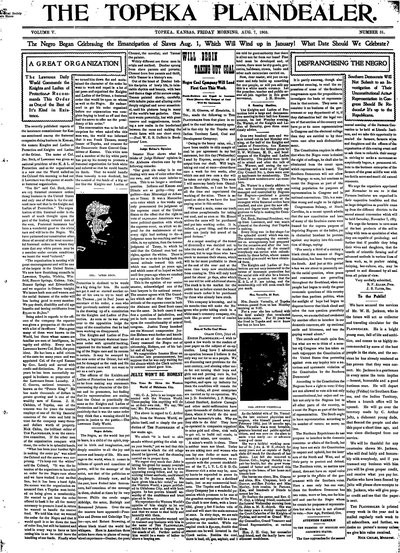
Page text (machine-generated)
THE TOPEKA PLAINDEALER.
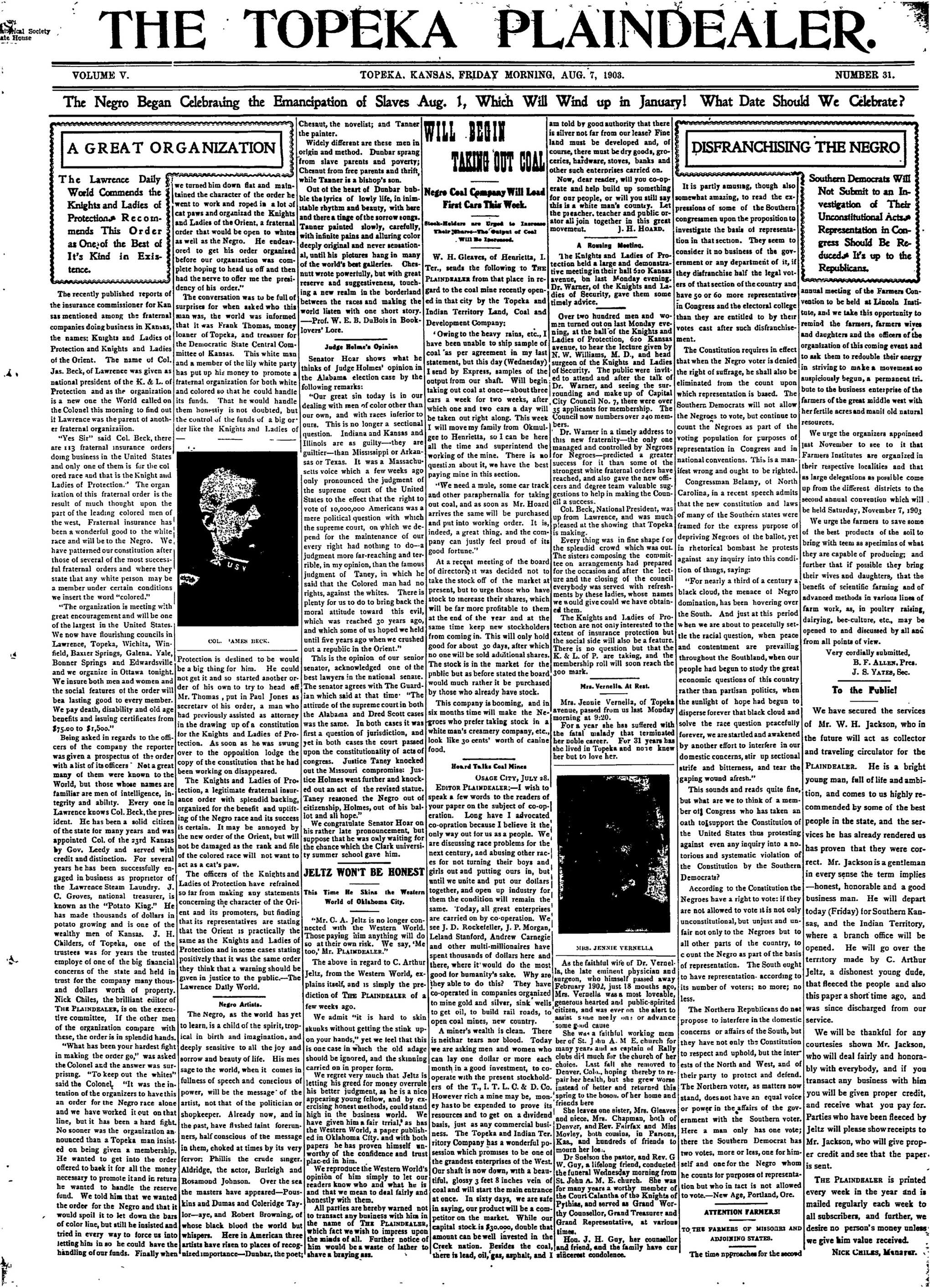
A GREAT ORGANIZATION
VOLUME V.
The Lawrence Daily World Commends the Knights and Ladies of Protection Recommends This Order as One of the Best of It's Kind in Existence.
The recently published reports of the insurance commissioner for Kansas mentioned among the fraternal companies doing business in Kansas, the names: Knights and Ladies of Protection and Knights and Ladies of the Orient. The name of Col. Jas. Beck, of Lawrence was given as national president of the K. & L. of Protection and as the organization is a new one the World called on the Colonel this morning to find out if Lawrence was the parent of another fraternal organization.
"Yes Sir" said Col. Beck, there are 113 fraternal insurance orders doing business in the United States and only one of them is for the colored race and that is the Knight and Ladies of Protection." The organization of this fraternal order is the result of much thought upon the part of the leading colored men of the west. Fraternal insurance has been a wonderful good to the white race and will be to the Negro. We have patterned our constitution after those of several of the most successful fraternal orders and where they state that any white person may be a member under certain conditions we insert the word "colored."
"The organization is meeting with great encouragement and will be one of the largest in the United States. We now have flourishing councils in Lawrence, Topeka, Wichita, Winfield, Baxter Springs, Galena, Yale, Bonner Springs and Edwardsville and we organize in Ottawa tonight. We insure both men and women and the social features of the order will bea lasting good to every member. We pay death, disability and old age benefits and issuing certificates from $75.00 to $1,500."
Being asked in regards to the officers of the company the reporter was given a prospectus of the order with a list of its officers. Not a great many of them were known to the World, but those whose names are familiar are men of intelligence, integrity and ability. Every one in Lawrence knows Col. Beck, the president. He has been a solid citizen of the state for many years and was appointed Col. of the 23rd Kansas by Gov. Leedy and served with credit and distinction. For several years he has been successfully engaged in business as proprietor of the Lawrence Steam Laundry. J. C. Groves, national treasurer, is known as the "Potato King." He has made thousands of dollars in potato growing and is one of the wealthy men of Kansas. J. H. Childers, of Topeka, one of the trustees was for years the trusted employee of one of the big financial concerns of the state and held in trust for the company many thousand dollars worth of property. Nick Chiles, the brilliant editor of THE PLAINDEALER, is on the executive committee. If the other men of the organization compare with these, the order is in splendid hands
"What has been your hardest fight in making the order go," was asked the Colonel and the answer was surprising. "To keep out the whites" said the Colonel. "It was the intention of the organizers to have this an order for the Negro race alone and we have worked it out on that line, but it has been a hard fight. No sooner was the organization announced than a Topeka man insisted on being given a membership. He wanted to get into the order offered to back it for all the money necessary to promote it and in return he wanted to handle the reserve fund. We told him that we wanted the order for the Negro and that it would spoil it to let down the bars of color line, but still he insisted and tried in every way to force us into letting him in so he could have the handling of our funds. Finally when
we turned him down flat and maintained the character of the order he went to work and roped in a lot of cat paws and organized the Knights and Ladies of the Orient, a fraternal order that would be open to whites as well as the Negro. He endeavored to get his order organized before our organization was complete hoping to head us off and then had the nerve to offer me the presidency of his order."
The conversation was to be full of surprises for when asked who this man was, the world was informed that it was Frank Thomas, money loaner of Topeka, and treasuer for the Democratic State Central Committee of Kansas. This white man and a member of the lily white party has put up his money to promote a fraternal organization for both white and colored so that he could handle its funds. That he would handle them honestly is not doubted, but the control of the funds of a big order like the Knights and Ladies o
USY
COL. 'AMES BECK
Protection is deslined to be would be a big thing for him. He could not get it and so started another order of his own to try to head off Mr. Thomas, put in Paul Jones as secretary of his order, a man who had previously assisted as attorney in the drawing up of a constitution for the Knights and Ladies of Protection. As soon as he was swung over to the opposition lodge the copy of the constitution that he had been working on disappeared.
The Knights and Ladies of Protection, a legitimate fraternal insurance order with splendid backing, organized for the benefit and uplifting of the Negro race and its success is certain. It may be annoyed by the new order of the Orient, but will not be damaged as the rank and file of the colored race will not want to act as a cat's paw.
The officers of the Knights and Ladies of Protection have refrained so far from making any statements concerning the character of the Orient and its promoters, but finding that its representatives are stating that the Orient is practically the same as the Knights and Ladies of Protection and in some cases stating positively that it was the same order they think that a warning should be given in justice to the public.—The Lawrence Dally World.
Nedro Artista.
The Negro, as the world has yet to learn, is a child of the spirit, tropical in birth and imagination, and deeply sensitive to all the joy and sorrow and beauty of life. His message to the world, when it comes in fullness of speech and conscious of power, will be the message of the artist, not that of the politician or shopkeeper. Already now, and in the past, have flashed faint forerunners, half conscious of the message in them, choked at times by its very fervor. Phillis the crude singer. Aldridge, the actor, Burleigh and Rosamond Johnson. Over the sea the masters have appeared—Pouskins and Dumas and Coleridge Taylor—aye, and Robert Browning, of whose black blood the world but whispers. Here in American three artists have risen to places of recognized importance—Dunbar, the poet
TOPEKA, KANSAS, FRIDAY MORNING, AUG. 7, 1903.
Chesaut, the novelist; and Tanner the painter.
Widely different are these men in origin and method. Dunbar sprang from slave parents and poverty; Chesnut from free parents and thrift, while Tanner is a bishop's son.
Out of the heart of Dunbar bubble the lyrics of lowly life, in inimitable rhythm and beauty, with here and there tinge of the sorrow songs. Tanner painted slowly, carefully, with infinite pains and alluring color deeply original and never sensational, until his pictures hang in many of the world's best galleries. Chesnutt wrote powerfully, but with great reserve and suggestiveness, touching a new realm in the borderland between the races and making the world listen with one short story. —Prof. W. E. B. DuBois in Book-Iovers' Lore.
Judge Holme's Opinion
Senator Hoar shows what he thinks of Judge Holmes' opinion in the Alabama election case by the following remarks:
"Our great sin today is in our dealing with men of color other than our own, and with races inferior to ours. This is no longer a sectional question. Indiana and Kansas and Illinois are as guilty—they are guiltier—than Mississippi or Arkansas or Texas. It was a Massachusetts voice which a few weeks ago only pronounced the judgment of the supreme court of the United States to the effect that the right to vote of 10,000,000 Americans was a mere political question with which the supreme court, on which we depend for the maintenance of our every right had nothing to do—a judgment more far-reaching and terrible, in my opinion, than the famous judgment of Taney, in which he said that the Colored man had no rights, against the whites. There is plenty for us to do to bring back the moral attitude toward this evil, which was reached 30 years ago, and which some of us hoped we held until five years ago when we crushed out a republic in the Orient."
This is the opinion of our senior senator, acknowledged one of the best lawyers in the national senate. The senator agrees with The Guardian which said at that time "The attitude of the supreme court in both the Alabama and Dred Scott cases was the same. In both cases it was first a question of jurisdiction, and yet in both cases the court passed upon the constitutionality of acts of congress. Justice Taney knocked out the Missouri compromise: Justice Holmes went further and knocked out an act of the revised statue. Taney reasoned the Negro out of citizenship, Holmes, out of his ballot and all hope."
We congratulate Senator Hoar on his rather late pronouncement, but suppose that he was only waiting for the chance which the Clark university summer school gave him.
JELTZ WON'T BE HONEST
This Time He Skins the Western World of Oklahoma City.
"Mr. C. A. Jeltz is no longer connected with the Western World. Those paying him anything will do so at their own risk. We say, 'Me too,' Mr. PLAINDEALER."
The above in regard to C. Arthur Jeltz, from the Western World, explains itself, and is simply the prediction of THE PLAINDEALER of a few weeks ago.
We admit "it is hard to skin skunks without getting the stink upon your hands," yet we feel that this is one case in which the old adage should be ignored, and the skinning carried on in proper form.
We regret very much that Jeltz is letting his greed for money overrule his better judgment, as he is a nice appearing young fellow, and by exercising honest methods, could stand high in the business world. We have given him a fair trial, as has the Western World, a paper published in Oklahoma City, and with both papers he has proven himself unworthy of the confidence and trust placed in him.
We reproduce the Western World's opinion of him simply to let our readers know who and what he is and that we mean to deal fairly and honestly with them.
All parties are hereby warned not to transact any business with him in the name of THE PLAINDEALER, which fact we wish to impress upon the minds of all. Further notice of him would be a waste of lather to shave a braying ass.
Negro Coal Company Will Lead First Care This Week.
Stock-Holders are Urged to Increase Their Shares--The Output of Coal Will Be Increased.
W. H. Gleaves, of Henrietta, I. Ter., sends the following to THE PLAINDEALER from that place in regard to the coal mine recently opened in that city by the Topeka and Indian Territory Land, Coal and Development Company:
'Owing to the heavy rains, etc., I have been unable to ship sample of coal 'as per agreement in my last statement, but this day (Wednesday) I send by Express, samples of the output from our shaft. Will begin taking out coal at once--about three cars a week for two weeks, after which one and two cars a day will be taken out right along. This week I will move my family from Okmulgee to Henrietta, so I can be here all the time and superintend the working of the mine. There is no question about it, we have the best paying mine in this section.
"We need a mule, some car track and other paraphernalia for taking out coal, and as soon as Mr. Hoard arrives the same will be purchased and put into working order. It is, indeed, a great thing, and the company can justly feel proud of its good fortune."
At a recent meeting of the board of directors, it was decided not to take the stock off of the market at present, but to urge those who have stock to increase their shares, which will be far more profitable to them at the end of the year and at the same time keep new stockholders from coming in. This will only hold good for about 30 days, after which no one will be sold additional shares. The stock is in the market for the public but as before stated the board would much rather it be purchased by those who already have stock.
This company is booming, and in six months time will make the Negroes who prefer taking stock in a white man's creamy company, etc., look like 30 cents' worth of canine food.
Hoard Talks Coal Mines
EDITOR PLAINDEALER: I wish to speak a few words to the readers of your paper on the subject of co-operation. Long have I advocated co-operation because I believe it the only way out for us as a people. We are discussing race problems for the next century, and abusing other races for not turning their boys and girls out and putting ours in, but until we unite and put our dollars together, and open up industry for them the condition will remain the same. Today, all great enterprises are carried on by co-operation. We see J. D. Rockefeller, J. P. Morgan, Leland Stanford, Andrew Carnegie and other multi-millionaires have spent thousands of dollars here and there, where it would do the most good for humanity's sake. Why are they able to do this? They have co-operated in companies organized to mine gold and silver, sink wells to get oil, to build rail roads, to open coal mines, new country.
A miner's wealth is clean. There is neithar tears nor blood. Today we are asking men and women who can lay one dollar or more each month in a good investment, to cooperate with the present stockholders of the T., I. T. L. C. & D. Co. However rich a mine may be, money has to be expended to prove its resources and to get on a dividend basis, just as any commercial business. The Topeka and Indian Territory Company has a wonderful possession which promises to be one of the grandest enterprises of the West. Our shaft is now down, with a beautiful, glossy 3 feet 8 inches vein of coal and will start the main entrance at once. In sixty days, we are safe in saying, our product will be a competitor on the market. While our capital stock is $30,000, double that amount can be well invested in the Creek nation. Besides the coal, there is lead, oil, gas, asphalt, and I
am told by good authority that there is silver not far from our lease? Fine land must be developed and, of course, there must be dry goods, groceries, hardware, stoves, banks and other such enterprises carried on. Now, dear reader, will you co-operate and help build up something for our people, or will you still say this is a white man's country. Let the preacher, teacher and public orator all join together in this great movement. J. H. HOARD.
A Rousing Meeting.
The Knights and Ladies of Protection held a large and demonstrative meeting in their hall 620 Kansas avenue, on last Monday evening. Dr. Warner, of the Knights and Ladies of Security, gave them some timely advice.
Over two hundred men and women turned out on last Monday evening, at the hall of the Knights and Ladies of Protection, 620 Kansas avenue, to hear the lecture given by N. W. Williams, M. D., and head surgeon of the Knights and Ladies of Security. The public were invited to attend and after the talk of Dr. Warner, and seeing the surrounding and make up of Capital City Council No. 7, there were over 35 applicants for membership. The Council now numbers over 240 members.
Dr. Warner in a timely address to this new fraternity—the only one managed and controlled by Negroes for Negroes—predicted a greater success for it than some of the strongest white fraternal orders have reached, and also gave the new officers and degree team valuable suggestions to help in making the Council a success.
Col. Beck, National President, was up from Lawrence, and was much pleased at the showing that Topeka is making.
Every thing was in fine shape for the splendid crowd which was out. The sisters composing the committee on arrangements had prepared for the occasion and after the lecture and the closing of the council everybody was served with refreshments by these ladies, whose names we would give could we have obtained them. The Knights and Ladies of Protection are not only interested to the extent of insurance protection but the social side will also be a feature. There is no question but that the K. & L. of P. are taking, and the membership roll will soon reach the 300 mark.
Mrs. Vernella At Rest.
Mrs. Jennie Vernella, of Topeka avenue, passed from us last Monday morning at 9:20. For a year she has suffered with the fatal malady that terminated her noble career. For 31 years has she lived in Topeka and now knew her but to love her.
MRS. JENNIE VERNELLA
As the faithful wife of Dr. Vernella, the late eminent physician and surgeon, who himself passed away February 1902, just 18 months ago, Mrs. Vernella was a most loveable, generous hearted and public-spirited citizen, and was ever on the alert to assist some neely one or advance some good cause. She was a faithful working member of St. John A. M. E. church for many years and as captain of Rally clubs did much for the church of her choice. Last fall she removed to Denver, Colo., hoping thereby to repair her health, but she grew worse instead of better and returned this spring to the bosom of her home and friends here
She leaves one sister, Mrs. Gleaves and niece, Mrs. Chapman, both of Denver, and Rev. Fairfax and Miss Moyley, both cousins, in Parsons, Kass, and hundreds of friends to mourn her los..
Dr Suelson the pastor, and Rev. G W. Guy, a lifelong friend, conducted the funeral Wednesday morning from St. John A. M. E. church. She was for many years a worthy member of the Court Calantha of the Knights of Pythias, and served as Grand Worthy Counsellor, Grand Treasurer and Grand Representative, at various times.
Hou. J. H. Guy, her counsellor and friend, and the family have cur sincereest condolence.
It is partly amusing, though also somewhat amazing, to read the expressions of some of the Southern congressmen upon the proposition to investigate the basis of representation in that section. They seem to consider it no business of the government or any department of it, if they disfranchise half the legal voters of that section of the country and have 50 or 60 more representatives in Congress and the electoral college than they are entitled to by their votes cast after such disfranchisement.
The Constitution requires in effect that when the Negro voter is denied the right of suffrage, he shall also be eliminated from the count upon which representation is based. The Southern Democrats will not allow the Negroes to vote, but continue to count the Negroes as part of the voting population for purposes of representation in Congress and in national conventions. This is a manifest wrong and ought to be righted.
Congressman Belamy, of North Carolina, in a recent speech admits that the new constitution and laws of many of the Southern states were framed for the express purpose of depriving Negroes of the ballot, yet in rhetorical bombast he protests against any inquiry into this condition of things, saying:
"For nearly a third of a century a black cloud, the menace of Negro domination, has been hovering over the South. And just at this period when we are about to peacefully settle the racial question, when peace and contentment are prevailing throughout the Southland, when our people had begun to study the great economic questions of this country rather than partisan politics, when the sunlight of hope had begun to disperse forever that black cloud and solve the race question peacefully forever, we are startled and awakened by another effort to interfere in our domestic concerns, stir up sectional strife and bitterness, and tear the gaping wound afresh."
This sounds and reads quite fine, but what are we to think of a member of Congress who has taken an oath to support the Constitution of the United States thus protesting against even any inquiry into a notorious and systematic violation of the Constitution by the Southern Democrats?
According to the Constitution the Negroes have a right to vote: if they are not allowed to vote it is not only unconstitutional, but unjust and unfair not only to the Negroes but to all other parts of the country, to count the Negro as part of the basis of representation. The South ought to have representation according to its number of voters; no more; no less.
The Northern Republicans do not propose to interfere in the domestic concerns or affairs of the South, but they have not only the Constitution to respect and uphold, but the interests of the North and West, and of their party to protect and defend. The Northern voter, as matters now stand, does not have an equal voice or power in the affairs of the government with the Southern voter. Here a man only has one vote; there the Southern Democrat has two votes, more or less, one for himself and one for the Negro whom he counts for purposes of representation but who in tact is not allowed to vote—New Age, Portland, Ore.
TO THE FARMERS OF MISSOURI AND ADJOINING STATES.
The time approaches for the second
NUMBER 31.
Southern Democrats Will Not Submit to an Investigation of Their Unconstitutional Acts. Representation in Congress Should Be Reduced. It's up to the Republicans.
annual meeting of the Farmers Convention to be held at Lincoln Institute, and we take this opportunity to remind the farmers, farmers wives and daughters and the officers of the organization of this coming event and to ask them to redouble their energy in striving to make a movement so auspiciously begun, a permanent tribute to the business enterprise of the farmers of the great middle west with her fertile acres and manit old natural resources.
We urge the organizers appoined just November to see to it that Farmers Institutes are organized in their respective localities and that as large delegations as possible come up from the different districts to the second annual convention which will be held Saturday, November 7, 1903. We urge the farmers to save some of the best products of the soil to bring with teem as specimens of what they are capable of producing; and further that if possible they bring their wives and daughters, that the benefit of scientific farming and of advanced methods in various lines of farm work, as, in poultry raising, dairying, bee-culture, etc., may be opened to and discussed by all and from all points of view.
Very cordially submitted,
B. F. ALLEN, Pres.
J. S. YATES, Sec.
To the Public!
We have secured the services of Mr. W. H. Jackson, who in the future will act as collector and traveling circulator for the PLAINDEALER. He is a bright young man, full of life and ambition, and comes to us highly recommended by some of the best people in the state, and the services he has already rendered us has proven that they were correct. Mr. Jackson is a gentleman in every sense the term implies—honest, honorable and a good business man. He will depart today (Friday) for Southern Kansas, and the Indian Territory, where a branch office will be opened. He will go over the territory made by C. Arthur Jeltz, a dishonest young dude, that fleeced the people and also this paper a short time ago, and was since discharged from our service.
We will be thankful for any courtesies shown Mr. Jackson, who will deal fairly and honorably with everybody, and if you transact any business with him you will be given proper credit, and receive what you pay for. Parties who have been fleeced by Jeltz will please show receipts to Mr. Jackson, who will give proper credit and see that the paper is sent.
THE PLAINDEALER is printed every week in the year and is mailed regularly each week to all subscribers, and further, we desire no person's money unless we give him value received. NICK CHILES, Manager.
THE MUSEUM
Pay for
The image provided is too blurry to accurately recognize any text. It appears to be a blank or heavily pixelated screen with no discernible content. Therefore, no text can be extracted from this image.
---
```markdown
```
TOPEKA
---
```markdown
```
PLAINDEALER
One dollar
THE
FRISCO System
On this date the St. Louis & San Francisco Railroad Company assumes charge of the line formerly known as the Ozark & Cherokee Central Railway, extending westwardly from Fayetteville, Ark., to Okmulgee, I. T., distance of 143.9 miles. As will be noted by reference to the map, this line forms a connecting link between our central Division and the Red River District. Aside, however, from the convenience of this connection, the road penetrates section offering excellent opportunities to those in search of a new location, either from a commercial or farming standpoint. Fayetteville, its starting point, is located in one of the best portions of the Ozarkruit belt, and the line will open to the west of that place, a country whose ability to produce apples, peaches and other fruits has already been demonstrated, and whose prosperity and rapid development is, since the establishment of railway communications, assured.
Passing through the "Land of the Big Red Apple," the line enters the Indian Territory, near Westville, crossing the Cherokee Station, and traversing the Creek Nation, a country that has laterly attracted attention all over the United States by reason of Congressional legislation permitting the acquirement therein, by outsiders, of Indian allotments. The Creek Nation is known to possess as great (if not greater) proportion of available land to square mile as any other of the Indian reservations that have been opened to white settlement. The character of its soil and climate is almost identical with that of Oklahoma. Wheat, corn and cotton grow side by side, and all yield crops calculated to astonish, by their abundance and excellence, farmers from the older states.
A number of the towns shown in the appended list are of recent birth, and all are in a condition of rapid and substantial development. Business openings of all ports are to be encountered on every hand, for the man with large or small capital—in many cases for the man with no capital.
Business Opportunities.
To the Public: Owing to other business, I shall retire from the hotel business on or before January 1904. I will rent the building to the right parties, and sell the hotel furniture and fixtures for the continuation of the business. Parties who can cook and manage well can earn money. Topeka has good schools, colleges, churches and society, which makes it an ideal city in which to live and conduct business. This hotel is located in the heart of the city, and within 100 feet of the Auditorium, the pride of Kansas, and the new Vinewood electric line passes the door. It is also handy to the State House and theatres. Remember, if this hotel closes, it means a loss to our people who need a public place to stop. This hotel has been conducted in first-class order, and if a person cannot continue it, we advise them to save stamps. For further information, address.
NICK CHILES,
Mg'r Plaindealer.
Quick and Pleasant FRISCO
Excellent Service
to points in
Missouri,
Arkansas,
Tennessee,
Alabama,
Mississippi,
Florida
And the Southeast, and to
Kansas, Oklahoma,
Indian Territory,
Texas
And the Southwest.
Detailed information as to excursion dates.
For all kinds of Typewriting, Church, Club, Society and Lodge work a specialty. Try us. OFFICE 1725 KANMAS AVENUE 'Phone 747.
Shampooing and Face Massage.
Mrs. Hattie E. Van Vleck
Hair Dresser and
Manufacturer.....
Hair to match all Complexions.
SWITCHES AND HAIR JEWRLEY.
220 East Fifth Street, TOPHEA, KANSAS
Patronize the...
AMERICAN
Steam Laundry
and get the best.
114 E. SEVENTH St. PHONE 541,
OFFICE HOURS 7 to 10 A. M.
12 M. to 4 P. M.
Beth Phones 454 7 to 10 P. M.
J. M. JAMISON, M. D.
PHYSICIAN AND SURGEON
Special Attention to demasses
of women and private demasses.
Office and Residenc Madison Street
OFFICE HOURS:
to 10 A.M.
v. A. TAYLOR, M. D.
PHYSICIAN AND SURGEON
Calls answered day and night.
WM. E. JACKSON, M. L
PHYSICIAN AND SURGEON
Office 404 Kansas Ave.
TELEPHONE 63F. TOPKEA, KA
I. M. KNIGHT,
UNDERTAKER AND EMBALMER.
```markdown
```
632-36 Quincy Street.
Patronize the Kansas City, Kas..
Embalming and Casket Co.
1014 West Fifth Street.
Owned and controlled by Negroes—Capital Stock $2,000.
WONDERFUL DISCOVERY
Curly Hair Made Straight By
TAKEN FROM LIFE!
BEFORE AND AFTER TREATMENT.
ORIGINAL
OZONIZED OX MARROW
(Copyright.)
This wonderful hair pomade is the only safe preparation in the world that makes kinky or curly hair sr tight as shown above. It nourishes and protects hair from falling out or breaking off, cuts dandruff and makes the hair grow long and silky. Sold over forty years and used by thousands. Warranted harmless. Testimonial free on request. It is the best hair pomade for straightening kinky hair, safe of mutations. Get the Original Goodness Ox Marrow as the genuine never fails to keep the hair straight, soft and beautiful. A toilet cleaner. A straightening cream. A straightening kinky hair, safe of mutations. The great advantage of this wonderful pomade is that by use you can straighten your own hair at home. Owing to its superior and lasting qualities it is the best hair pomade for anybody to produce a preparation equal to full directions with every bottle. Only 50 cents. Sold by draperie and dealer and us 50 cents for one bottle or $1.40 for three. Postal or express money order. Write your name and address plainly to
OZONIZED OX MARROW CO.
76 Wakehill Avenue, Chicago, Illinois.
Knights and Ladies of Protection A NAT ONAL FRATERNAL INSURANCE SOCIETY
Issues policies for the sums of $250,
$500, $1,000, also $75, $100, $150 and $200
for children over 6 years of age. This is
the only colored Fraternal Insurance
policy is similar in character and management
DIES OF SECURITY, A. O. U. W., and
No intelligent Negro should be without
of our famiies warrants no delay in the
events wanted. For further information write
C. THOMAS, Nail Sec.,
Fifth street, Topeka, Kansas.
Society in the U.S. Our society is similar in character and management to the KNIGHTS AND LADIES [OF SECURITY, A. O. U. W., and MODERN WOODMEN. No intelligent Negro should be without INSURANCE. The protection of our families warrants no delay in the matter of insurance. Good agents wanted. For further information write P.C. THOMAS, Natl Sec. Headquarters: 117 West Fifth street, Topeka, Kansas.
were
and
nowall,
order.
me, she
separed
Miss E.
read a
wing."
ul-stir-
te and
With
stested
enter-
the pa-
when
strong
Mr. Watkins, of Topeka, spent a few days in the city.
Riley Rogersand Fred Drew spent Tuesday in Topeka.
John Price will report for duty a the University Thursday.
W. C. Brown is in Topeka for a few days.
Mrs. Woody has moved back to her old place on Vermont St.
Miss Ethel Woolridge of Topeka was the guest of Miss Chlora Polk last week.
Col. James Beck spent Tuesday in Topeka.
Miss Leona Strode is visiting in Topeka the guest of Miss Grace Huddleson.
waterpiece able in elements produce publish or rule the means can on, the them-ertained, ons with the work in the vis- The Temple and Tabernacle are doing fairly well. Only one sick member, Dt Yacum who is still sick. Monroe Walker has returned to his work after a week's illness. Deacon Thompson and Thurman have returned from Weir City. Mrs. Buckner returned from Pittsburg.last week. Thomas Teal of Cherryvale Sundayed with us.
PROTECTION
KANSAS CITY, KAS.
The Adelphi Art club gave the annual picnic last Wednesday, at the home of Mrs. H. A. Dandridge. A more enjoyable outdoor affair has not been experienced in the history of the club.
Rugs, pillows, chairs, lawn benches and other conveniences were plentiful, and scattered over the yard were groups of picnickers, every one happy and in fine spirits. At the proper time the ladies were invited from the lawn in front to a more spacious one at the side of the cottage, where, under a new and neat tent, arranged with tables and chairs, a committee consisting of Madames S. Dilbert, T.L. Jones, F. Brooks and M. Long, had prepared an abundance of good things to serve. 'Twas a most beautiful sight to view this part of the day's pleasures for the arrangement was so unique. The gaily dressed ladies, seated under the large white tent scalloped with red and stretched on a pretty green lawn overshadowed by spreading walnut and oak trees, presented a veritable sylvan scene.
Fried chicken, tomato salad, ham sandwiches, cakes, ices, fruit punch and other delicacies were there in abundance.
A promenade followed, and the president, Mrs J. M. Stovall, then called the ladies to order. Seating them in a semicircle, she announced a specialty prepared from the literary field. Miss E. Brown was presented and read a paper on "The Art of Living."
It was an inspiring, soul-stirring message, so appropriate and pleasing to her hearers. With rapt attention the ladies listened to every word she uttered, entering into the full spirit of the paper until it was finished, when the swelling applause gave strong evidence of the appreciation of the commendable effort. Several visitors and club women spoke on the paper. Among the number was Mrs. E. B. Braxton, President of City Federation, also, of the Council of Women's Clubs, who commented upon special features of the production and drew the writer out on the strong hope she aroused in the minds of those present, in the face of the dark conditions we are actually undergoing.
Miss Brown's reply was satisfactory. She said that "Out of chaos God commanded light and it came, and in His development of the day and night, we must remember that the darkest hour is before the dawn, and that the same God, if we trust and model our lives after the masterpiece He gave us, His Son, is able in the face of all opposing elements —demons and foes—to produce of us a people and establish o us a nation, destined to rule the world, which no other means can effect."
The evening drawing on, the crowd, after expressing themselves as highly entertained, went their several directions with renewed energy for the work awaiting them. Among the visitors during the day were Rev. C. C. Owens, and Madames H. G. Dwiggins, Georgia Freeman Johnson, O. Garrett of Kansas City, mo., M. Oliver and Emanuel of Denver, Colo.
Lawrence, Kan.
The Annual Grand Session of the Benevolent Society met at Lawrence, July 29-30, with G.
P., George Craig presiding. All reports show one of the most business-like sessions in the history of the organization. On Thursday evening July 30, the Ladies Branch Lodge No. 2 of Lawrence, tendered the visiting delegates and grand officers a reception in their hall. The committee spared no pains in decorating the tables and hall with the flowers of the season. Toasts were given by a number of the ladies and gentlemen.
Owing to the business-like rulings of G. P. Craig, the session wound up Friday noon by electing the following Grand Officers: George Craig. Grand Pres.: Mrs. M. Fishback, G. V. P.; Miss M. B. Jordan, G. R. S.; Mrs. L. Carter, A. G. R. S. T. L. Scott, G. Chaplain; Mrs. M. Bryant, G. Treas.; Mrs E. Scott G. Marshall. Father E. T. Bradford and C. Kuntz installed the officers and administered the oath of office, after which the Grand Body adjourned to meet at Topeka, Kas., July 1904.
George King left Saturday for Kansas City and Leavenworth. The funeral services of Mr. Thomson was held last Sunday at Warren street Baptist Church. He was an old soldier and highly respected.
TABORIAN NOTES
O88AWATOMIE, KANS.
I wish to turn my most sincere thanks to Sir Frank Wilson C. G. M and Sir John Wilson D. G. M. and all that were concerned in the matter of paying off a claim for us that had stood for seven years and was forgotten but through the will of the Lord it was brought to their remembrance and they came to our relief we, the Dts. of Bærsheba Tabernacle Mo 22. Sir Frank Wilson came down from Kansas City and paid the claim of Dt Claricy Sherfield to her mother, Julia Ann Sherfield July 30, 1903. we feel to praise the grand order more than we have language to express.
I remain yours for Christ and for Tabor,
COFFEYVILLE.
Thomas Johnson and wife would like some good woman to make her home with them. Only two in a family. A girl or woman would be blessed if they would accept. If you wish a home write Thomas Johnson 418 Spring St Coffeyville, Ks. Golden Gate Temple No 17 meets every first and third Wednesday nights of each month.
YOU
That When a Man Gets Old and the Days Grow Cold
He Will Need
A FEW DOLLARS to Prolong His Life.
In Order to Give All a Chance
The Topeka and Indian Territory Land, Coal and Development Co.
Have extended the time in which you may purchase shares thereby making it possible for you prepare for those cold days. Buy before it is too late.
Buy Ere it be too Late.
ST JOE, MO.
The entertainment given for the benefit of the Hospital was a success and a neat sum was realized.
Rev. E. M. Cohron was presented with a rubber-tired $150 buggy and $25 set of harness on his twelfth anniversary as pastor of Francis St Church. This was from the Sunday School, B. Y. P. U. and friends of the church.
Mrs. Will Holmes is spending a few days in Savannah, Mo.
A barbecue was held at South St Joseph Tuesday to celebrate the opening of the ex-slave grocery. Quite a crowd was in attend once.
A program was rendered at A. M. E. Church Sunday evening.
PERRY. KANS.
Henry Harrison Bryant of Perry, Kans. died Wednesday morning July 29 at 2 oclock of typhoid fever. Prof. Bryant's native home was Missouri City, Mo. He moved with his parents to Perry in 1885, where he worked on a farm. Having completed the common school course, he accepted a position as teacher in his native home. He was also a successful teacher in the public schools of Jefferson coun-
He worked his way through Kansas State Normal completing the course in 1901. He was the first and only Negro that ever participated in a debate contest that occurs between the Literary Societies annually. While in Emporia his home was with Mr. Stafford, now of Kansas City.
In September 1901, he accepted the position as principal of the Cherokee National High School, which position he retained until his death. He leaves a mother, brother, two sisters nephew and a host of relatives and friends to mourn his loss.
WICHITA NOTES.
OTTAWA, KAS.
Rev. P. D. Skinner who took charge of the pastoral work of the Third Baptist Church in Sept 1901 has offered resignation after a very successful term of work. When he took charge of the church its indebtedness wae $950 which has all been paid except $150 besides the building has undergone much repair. We have raised $2500, increased the membership of the church and he leaves it in good condition in every respect. The moral and intellectual aspiration of the church and people have been greatly improved by his influence and teaching whereas he has proved to be a Christian minister, an able preacher of the gospel, a true exponent of the doctrine and teachings of the Baptist denomination. We confidently recommend him to the public as the same. Therefore we pray that God's blessing may crown his future work with success and happiness. Mrs. Wooten and Ida Clayborn are attending Convention in Leavenworth.
PUBLICATION NOTICE.
Notice is hereby given to above named defendant, H. E. Jones, that he has been sued by the above named plaintiff, in the said court of Topeka, in the city of Topeka, Shawnee county, Kansas, for the sum of $37.21 and costs, and that an order of garnishment has been issued in said action and served on the Chicago Rock Island & Pacific Railway Company, and that said action is set for hearing on the 10th day of August, 1903, at 9 o'clock, a. m. of said day in said court, and that the said Chicago Rock Island and Pacific Railway Company has answered in the said action that the said railway company is indebted to the defendant in the sum of $20.44, and that said amount of $20.44 is now due and owing to the said defendant, H. E. Jones, by said railway company, and upon hearing of said action as aforesaid, said sum of $20.44 will be applied on the payment of plaintiff's claim and a judgment rendered in said action. A. J. M'CABE,
STRONG CITY
DIRECTORY.
PUBLICATION NOTICE
To Minnie M. Garrett and Charles F. Garrett.
You are notified that Nancy M. Farley, plaintiff, has sued you as defendants in the District Court of Shawnee county, Kansas; that you must answer the petition of the plaintiff on or before Friday, the 11th of July, 1908, or the petition will be taken as true, and judgment establishing the will of Thomas J. Farley, deceased, lost after the probate thereof, by the Probate Court of Shawnee county, setting aside a pretended election of plaintiff to take under the law instead of said will, excluding you and each of you from any interest or estate in and to let $56 Madison street in the city of Tupoka. Shawnee county, state of Kansas, and decreeing any interest or estate you may have therein inferior and subsequent to her claim of ownership and possession therein and therein, and guiding her ownership and possession therein and thereto will be rendered accordingly.
Witness the signature of the Clerk of said Court and the seal thereof at Tupaka, this 10th day of May, 1908.
I. S. CURTIS,
Clerk District Court, Shawnee County,
Kansas. WATERS & WATERS.
(Seal) Alternary for Fidelity.
SS
=