Plaindealer
Friday, October 16, 1903
Topeka, Kansas
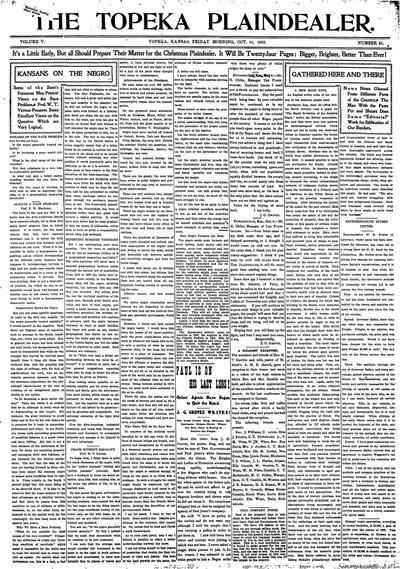
Page text (machine-generated)
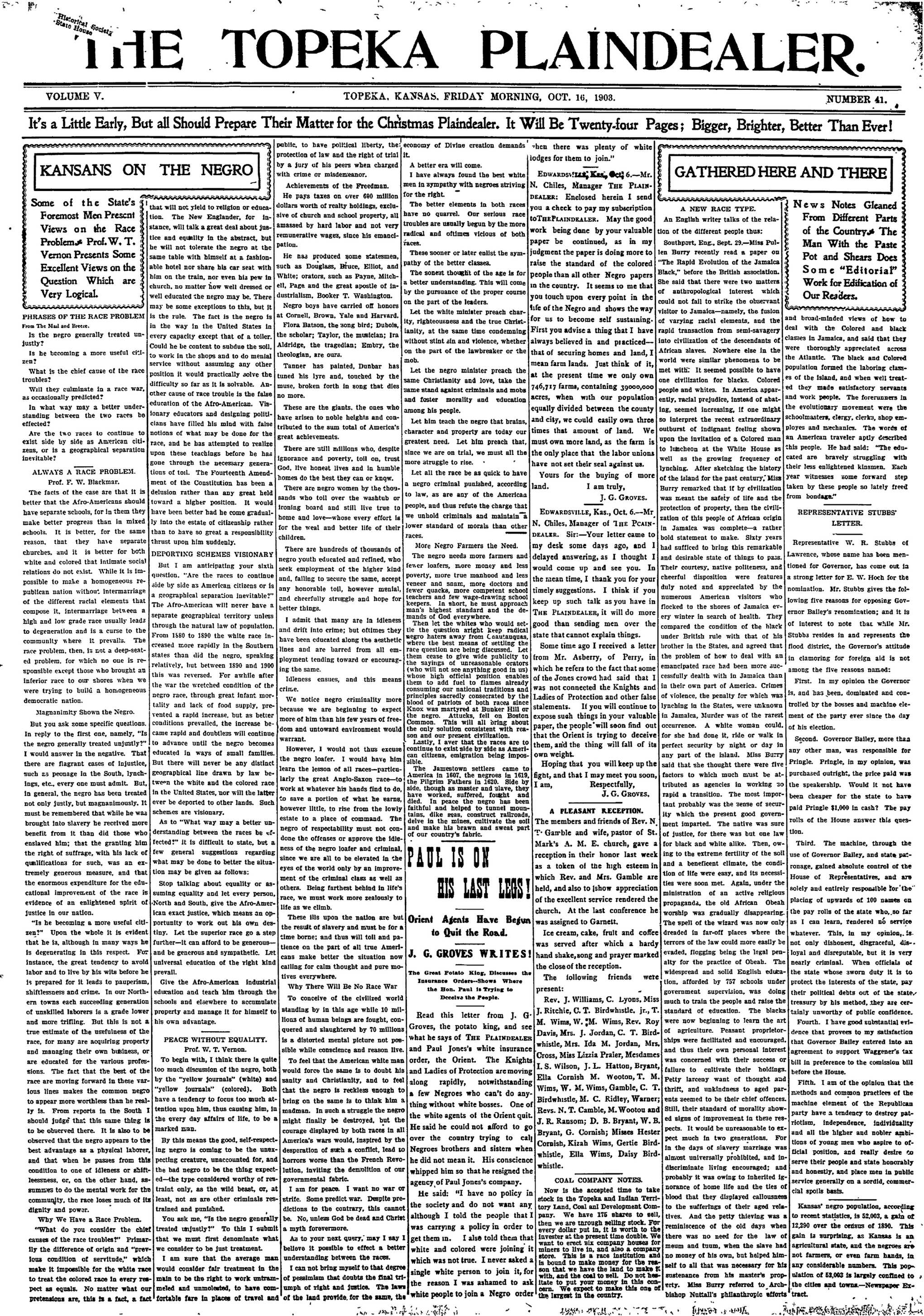
THE TOPEKA PLAINDEALER.
VOLUME V.
It's a Little Early, But
KANSANS ON
Some of the State's Foremost Men Present Views on the Race Problem. Prof.W.T. Vernon Presents Some Excellent Views on the Question Which are Very Logical.
PHRASES OF THE RACE PROBLEM
From The Mail and Breeze.
Is the negro generally treated unjustly?
Is he becoming a more useful citizen?
What is the chief cause of the race troubles?
Will they culminate in a race war, as occasionally predicted?
In what way may a better understanding between the two races be effected?
Are the two races to continue to exist side by side as American citizens, or is a geographical separation inevitable?
ALWAYS A RACE PROBLEM.
Prof. F. W. Blackmar.
The facts of the case are that it is better that the Afro-Americans should have separate schools, for in them they make better progress than in mixed schools. It is better, for the same reason, that they have separate churches, and it is better for both white and colored that intimate social relations do not exist. While it is impossible to make a homogeneous republican nation without intermarriage of the different racial elements that compose it, intermarriage between a high and low grade race usually leads to degeneration and is a curse to the community where it prevails. The race problem, then, is not a deep-seated problem, for which no one is responsible except those who brought an inferior race to our shores when we were trying to build a homogeneous democratic nation.
Magnanimity Shown the Negro.
But you ask some specific questions. In reply to the first one, namely, "Is the negro generally treated unjustly?" I would answer in the negative. That there are flagrant cases of injustice, such as peonage in the South, lynchings, etc., every one must admit. But, in general, the negro has been treated not only justly, but magnanimously. It must be remembered that while he was brought into slavery he received more benefit from it than did those who enslaved him; that the granting him the right of suffrage, with his lack of qualifications for such, was an extremely generous measure, and that the enormous expenditure for the educational improvement of the race is evidence of an enlightened spirit of justice in our nation.
"Is he becoming a more useful citizen?" Upon the whole it is evident that he is, although in many ways he is degenerating in this respect. For instance, the great tendency to avoid labor and to live by his wits before he is prepared for it leads to pauperism, shiftlessness and crime. In our Northern towns each succeeding generation of unskilled laborers is a grade lower and more trifling. But this is not a true estimate of the usefulness of the race, for many are acquiring property and managing their own business, or are educated for the various professions. The fact that the best of the race are moving forward in these various lines makes the common negro to appear more worthless than he really is. From reports in the South I should judge that this same thing is to be observed there. It is also to be observed that the negro appears to the best advantage as a physical laborer, and that when he passes from this condition to one of idleness or shiftlessness, or, on the other hand, assumes to do the mental work for the community, the race loses much of its dignity and power.
Why We Have a Race Problem.
"What do you consider the chief causes of the race troubles?" Primarily the difference of origin and "previous condition of servitude," which make it impossible for the white race to treat the colored race in every respect as equals. No matter what our pretensions are, this is a fact, a fact
that will not yield to religion or education. The New Englander, for instance, will talk a great deal about justice and equality in the abstract, but he will not tolerate the negro at the same table with himself at a fashionable hotel nor share his car seat with him on the train, nor even his pew in church, no matter how well dressed or well educated the negro may be. There may be some exceptions to this, but it is the rule. The fact is the negro is in the way in the United States in every capacity except that of a toiler. Could he be content to subdue the soil, to work in the shops and to do menial service without assuming any other position it would practically solve the difficulty so far as it is solvable. Another cause of race trouble is the false education of the Afro-American. Visionary educators and designing politicians have filled his mind with false notions of what may be done for the race, and he has attempted to realize upon these teachings before he has gone through the necessary generations of toil. The Fourteenth Amendment of the Constitution has been a delusion rather than any great held toward a higher position. It would have been better had he come gradually into the estate of citizenship rather than to have so great a responsibility thrust upon him suddenly.
DEPORTING SCHEMES VISIONARY
But I am anticipating your sixth question. "Are the races to continue side by side as American citizens or is a geographical separation inevitable?" The Afro-American will never have a separate geographical territory unless through the natural law of population. From 1580 to 1890 the white race increased more rapidly in the Southern states than did the negro, speaking relatively, but between 1890 and 1900 this was reversed. For awhile after the war the wretched condition of the negro race, through great infant mortality and lack of food supply, prevented a rapid increase, but as better conditions prevailed, the increase became rapid and doubtless will continue to advance until the negro becomes educated in ways of small families. But there will never be any distinct geographical line drawn by law between the white and the colored race in the United States, nor will the latter ever be deported to other lands. Such schemes are visionary.
As to "What way may a better understanding between the races be effected?" it is difficult to state, but a few general suggestions regarding what may be done to better the situation may be given as follows:
Stop talking about equality or assuming equality and let every person, North and South, give the Afro-American exact justice, which means an opportunity to work out his own destiny. Let the superior race go a step further—it can afford to be generous—and be generous and sympathetic. Let universal education of the right kind prevail.
Give the Afro-American industrial education and teach him through the schools and elsewhere to accumulate property and manage it for himself to his own advantage.
To begin with, I think there is quite too much discussion of the negro, both by the "yellow journals" (white) and "yellow journals" (colored). Both have a tendency to focus too much attention upon him, thus causing him, in the every day affairs of life, to be a marked man.
By this means the good, self-respecting negro is coming to be the unexpected creature, unaccounted for, and the bad negro to be the thing expected—the type considered worthy of restraint only, as the wild beast, or, at least, not as are other criminals restrained and published.
You ask me, "Is the negro generally treated unjustly?" To this I submit that we must first denominate what we consider to be just treatment. I am sure that the average man would consider fair treatment in the main to be the right to work untrammeled and unmolested, to have comfortable fare in places of travel and
TOPEKA, KANSAS, FRIDAY MORNING, OCT. 16, 1903.
public, to have political liberty, the protection of law and the right of trial by a jury of his peers when charged with crime or misdemeanor.
Achievements of the Freedman.
He pays taxes on over 600 million dollars worth of realty holdings, exclusive of church and school property, all amassed by hard labor and not very remunerative wages, since his emancipation.
He has produced some statesmen, such as Douglass, Bruce, Elliot, and White; orators, such as Payne, Mitchell, Page and the great apostle of industrialism, Booker T. Washington.
Negro boys have carried off honors at Cornell, Brown, Yale and Harvard. Flora Batson, the song bird; Dubois, the scholar; Taylor, the musician; Ira Aldridge, the tragedian; Embry, the theologian, are ours.
Tanner has painted, Dunbar has tuned his lyre and, touched by the muse, broken forth in song that dies no more.
These are the giants, the ones who have arisen to noble heights and contributed to the sum total of America's great achievements.
There are still millions who, despite ignorance and poverty, toll on, trust God, live honest lives and in humble homes do the best they can or know.
There are negro women by the thousands who toll over the wastub or ironing board and still live true to home and love—whose every effort is for the weal and better life of their children.
There are hundreds of thousands of negro youth educated and refined, who seek employment of the higher kind and, failing to secure the same, accept any honorable toll, however menial, and cheerfully struggle and hope for better things.
I admit that many are in idleness and drift into crime; but oftimes they have been educated along the aesthetic lines and are barred from all employment tending toward or encouraging the same.
Idleness ensues, and this means crime.
We notice negro criminality more because we are beginning to expect more of him than his few years of freedom and untoward environment would warrant.
However, I would not thus excuse the negro loafer. I would have him learn the lesson of all races—particularly the great Anglo-Saxon race—to work at whatever his hands find to do, to save a portion of what he earns, however little, to rise from the lowly estate to a place of command. The negro of respectability must not condone the offenses or approve the idleness of the negro loafer and criminal, since we are all to be elevated in the eyes of the world only by an improvement of the criminal class as well as others. Being farthest behind in life's race, we must work more zealously to life as we climb.
These ills upon the nation are but the result of slavery and must be for a time borne; and thus will toll and patience on the part of all true Americans make better the situation now calling for calm thought and pure motives everywhere.
Why There Will Be No Race War
To conceive of the civilized world standing by in this age while 10 millions of human beings are fought, conquered and slaughtered by 70 millions is a distorted mental picture not possible while conscience and reason live.
To feel that the American white man would force the same is to doubt his sanity and Christianity, and to feel that the negro is reckless enough to bring on the same is to think him a madman. In such a struggle the negro might finally be destroyed, but the courage displayed by both races in all America's wars would, inspired by the desperation of such a conflict, lead to horrors worse than the French Revolution, inviting the demolition of our governmental fabric.
I am for peace. I want no war or strife. Some predict war. Despite predictions to the contrary, this cannot be. No, unless God be dead and Christ a myth forevermore.
At As to your next query, may I say I believe it possible to effect a better understanding between the races.
In I can not bring myself to that degree of pessimism that doubts the final triumph of right and justice. The laws of the land provide for the same, the
Let all the race be as quick to have a negro criminal punished, according to law, as are any of the American people, and thus refute the charge that we unhold criminals and maintain a lower standard of morals than other races.
More Negro Farmers the Need.
The negro needs more farmers and fewer loafers, more money and less poverty, more true manhood and less veneer and snam, more doctors and fewer quacks, more competent school teachers and few wage-drawing school keepers. In short, he must approach man's highest standard and the demands of God everywhere.
Then let the whites who would settle the question aright keep radical negro haters away from Coautaugans, where the best means of settling the race question are being discussed. Let them cease to give wide publicity to the sayings of unreasonable orators (who will not see anything good in us) whose high official position enables them to add fuel to flames already consuming our national traditions and principles sacredly consecrated by the blood of patrols of both races since Knox was martyred at Bunker Hill or the negro. Attucks, fell on Boston Common. This will all bring about the only solution consistent with reason and our present civilization.
The Jamestown settlers came to America in 1607, the negroes in 1619, the Pilgrim Fathers in 1620. Side by side, though as master and slave, they have worked, suffered, fought and died. In peace the negro has been faithful and helped to tunnel mountains, dike seas, construct railroads, delve in the mines, cultivate the soil and make his brawn and sweat part of our country's fabric.
PAUL IS ON
HIS LAST LEGS!
Orient Agents Have Begun
to Quit the Road.
J. G. GROVES WRITES!
The Great Potato King, Discusses the
Insurance Orders-Shows Where
the Hon. Paul is Trying to
Decelva the People.
Read this letter from J. G-Groves, the potato king, and see what he says of THE PLAINDEALER and Paul Jones's white insurance order, the Orient. The Knights and Ladies of Protection are moving along rapidly, notwithstanding a few Negroes who can't do anything without white bosses. One of the white agents of the Orient quit. He said he could not afford to go over the country trying to calp Negroes brothers and sisters when he did not mean it. His conscience whipped him so that he resigned the agency of Paul Jones's company.
He said: "I have no policy in the society and do not want any although I told the people that I was carrying a policy in order to get them in. I also told them that white and colored were joining it which was not true. I never asked a single white person to join it, for the reason I was ashamed to ask white people to join a Negro order
EDWARDSVILLE, Kan., Oct. 6.—Mr. N. Chiles, Manager THE PLAINDEALER: Enclosed herein I send you a check to pay my subscription to THE PLAINDEALER. May the good work being done by your valuable paper be continued, as in my judgment the paper is doing more to raise the standard of the colored people than all other Negro papers in the country. It seems to me that you touch upon every point in the life of the Negro and shows the way for us to become self sustaining. First you advise a thing that I have always believed in and practiced—that of securing homes and land, I mean farm lands. Just think of it, at the present time we only own 746,717 farms, containing 39000,000 acres, when with our population equally divided between the county and city, we could easily own three times that amount of land. We must own more land, as the farm is the only place that the labor unions have not set their seal against us.
Yours for the buying of more land. I am truly,
J. G. GROVES.
EDWARDSVILLE, Kas., Oct. 6.—Mr.
N. Chiles, Manager of THE PCAIN-
DEALER. Sir:—Your letter came to
my desk some days ago, and I
delayed answering, as I thought I
would come up and see you. In
the mean time, I thank you for your
timely suggestions. I think if you
keep up such talk as you have in
THE PLAINDEALER, it will do more
good than sending men over the
state that cannot explain things.
Some time ago I received a letter from Mr. Asberry, of Perry, in which he refers to the fact that some of the Jones crowd had said that I was not connected the Knights and Ladies of Protection and other false stalements. If you will continue to expose such things in your valuable paper, the people will soon find out that the Orient is trying to deceive them, and the thing will fall of its own weight.
Hoping that you will keep up the fight, and that I may meet you soon, I am, Respectfully,
A PLEASANT RECEPTION.
The members and friends of Rev. N.
T. Gamble and wife, pastor of St.
Mark's A. M. E. church, gave a reception in their honor last week as a token of the high esteem in which Rev. and Mrs. Gamble are held, and also to show appreciation of the excellent service rendered the church. At the last conference he was assigned to Garnett.
Ice cream, cake, fruit and coffee was served after which a hardy hand shake, song and prayer marked the close of the reception.
The following friends were present:
Rev. J. Williams, C. Lyons, Miss J. Ritchie, C. T. Birdwhistle, jr., T. M. Wims, W. M. Wims, Rev. Roy Davis, Mrs. J. Jordan, C. T. Birdwhistle, Mrs. Ida M. Jordan, Mrs. Cross, Miss Lizzia Praier, Mesdames I. S. Wilson, J. L. Hatton, Bryant, Ella Cornish M. Wooton, T. M. Wims, W. M. Wims, Gamble, C. T. Birdwhistle, M. C. Ridley, Warner; Revs. N. T. Camble, M. Wootou and J. R. Ransom; D. B. Bryant, W. B. Bryant, G. Cornish; Misses Hester Cornish, Kizah Wims, Gertie Birdwhistle, Ella Wims, Daisy Birdwhistle.
COAL COMPANY NOTES.
Now is the accepted time to take stock in the Topeka and Indian Territory Land, Coal and Development Company. We have 175 shares to sell, then we are through selling stock. For every dollar put in, it is worth to the investor at the present time double. We want to erect six company houses for miners to live in, and also a company store. This is a race institution and is bound to make money for the reason that we have the land to make it with, and the coal to sell. Do not hesitate to put your money in this concern. We expect to make this one of the largest in the country.
GATHERED HERE AND THERE
A NEW RACE TYPE.
An English writer talks of the relation of the different people thus:
Southport, Eng., Sept. 29.—Miss Pullen Burry recently read a paper on "The Rapid Evolution of the Jamaica Black," before the British association. She said that there were two matters of anthropological interest which could not fall to strike the observant visitor to Jamaica—namely, the fusion of varying racial elements, and the rapid transaction from semi-savagery into civilization of the descendants of African alaves. Nowhere else in the world were similar phenomena to be met with. It seemed possible to have one civilization for blacks. Colored people and whites. In America apparently, racial prejudice, instead of abating, seemed increasing, if one might so interpret the recent extraordinary outburst of indignant feeling shown upon the invitation of a Colored man to luncheon at the White House as well as the growing frequency of lynching. After sketching the history of the island for the past century, Miss Burry remarked that if by civilization was meant the safety of life and the protection of property, then the civilization of this people of African origin in Jamaica was complete—a rather bold statement to make. Sixty years had sufficed to bring this remarkable and desirable state of things to pass. Their courtesy, native politeness, and cheerful disposition were features duly noted and appreciated by the numerous American visitors who flocked to the shores of Jamaica every winter in search of health. They compared the condition of the black under British rule with that of his brother in the States, and agreed that the problem of how to deal with an emancipated race had been more successfully death with in Jamaica than in their own part of America. Crimes of violence, the penalty for which was lynching in the States, were unknown in Jamaica, Murder was of the rarest occurrence. A white woman could, for she had done it, ride or walk in perfect security by night or day in any part of the island. Miss Burry said that she thought there were five factors to which much must be attributed as agencies in working so rapid a transition. The most important probably was the sense of security which the present good government imparted. The native was sure of justice, for there was but one law for black and white alike. Then, owing to the extreme fertility of the soil and a beneficient climate, the condition of life were easy, and its necessities were soon met. Again, under the administration of an active religious propaganda, the old African Obeah worship was gradually disappearing. The spell of the wizard was now only dreaded in far-off places where the terrors of the law could more easily be evaded, flogging being the legal penalty for the practice of Obeah. The widespread and solid English education, afforded by 757 schools under government supervision, was doing much to train the people and raise the standard of education. The blacks were now beginning to learn the art of agriculture. Peasant proprietorships were facilitated and encouraged, and thus their own personal interest was concerned with their success or failure to cultivate their holdings. Petty larceny want of thought and thrift, and unkindness to aged parents seemed to be their chief offences. Still, their standard of morality showed signs of improvement in these respects. It would be unreasonable to expect much in two generations. For in the days of slavery marriage was almost universally prohibited, and indiscriminate living encouraged; and probably it was owing to inherited ignorance of home life and the ties of blood that they displayed callousness to the sufferings of their aged relatives. And the petty thieving was a reminiscence of the old days when there was no need for the law of meum and tuum, when the slave had no money of his own, but helped himself to all that was necessary for his sustenance from his master's property. Miss Burry referred to Archbishop Nuttall's philanthropic efforts.
NUMBER 41.
News Notes Gleaned From Different Parts of the Country. The Man With the Paste Pot and Shears Does Some "Editorial" Work for Edification of Our Readers.
and broad-minded views of how to deal with the Colored and black classes in Jamaica, and said that they were thoroughly appreciated across the Atlantic. The black and Colored population formed the laboring classes of the island, and when well treated they made satisfactory servants and work people. The forerunners in the evolutionary movement were the schoolmasters, clergy, clerks, shop employees and mechanics. The words of an American traveler aptly described this people. He had said: "The educated are bravely struggling with their less enlightened kinsmen. Each year witnesses some forward step taken by these people so lately freed from bondage."
REPRESENTATIVE STUBBS'
LETTER.
Representative W. R. Stubbs of Lawrence, whose name has been mentioned for Governor, has come out in a strong letter for E. W. Hoch for the nomination. Mr. Stubbs gives the following five reasons for opposing Governor Bailey's renomination; and it is of interest to note that while Mr. Stubbs resides in and represents the flood district, the Governor's attitude in clamoring for foreign aid is not among the five reasons named:
First. In my opinion the Governor is, and has been, dominated and controlled by the bosses and machine element of the party ever since the day of his election.
Second. Governor Bailey, more than any other man, was responsible for Pringle. Pringle, in my opinion, was purchased outright, the price paid was the speakership. Would it not have been cheaper for the state to have paid Pringle $1,000 in cash? The payrolls of the House answer this question.
Third. The machine, through the use of Governor Bailey, and state patronage, gained absolute control of the House of Representatives, and are solely and entirely responsible for the placing of upwards of 100 names on the pay rolls of the state who, so far as I can learn, rendered no service whatever. This, in my opinion, is not only dishonest, disgraceful, disloyal and disreputable, but it is very nearly criminal. When officials of the state whose sworn duty it is to protect the interests of the state, pay their political debts out of the state treasury by his method, they are certainly unworthy of public confidence. Fourth. I have good substantial evidence that proves to my satisfaction that Governor Bailey entered into an agreement to support Waggener's tax bill in preference to the comission bill before the House.
Fifth. I am of the opinion that the methods and common practices of the machine element of the Republican party have a tendency to destroy patriotism, independence, individuality and all the higher and nobler ambitions of young men who aspire to official position, and really desire to serve their people and state honorably and honestly, and place men in public service generally on a sordid, commercial spoils basis.
Kansas' negro population, according to recent statistics, is 52,003, a gain of 12,290 over the census of 1890. This gain is surprising, as Kansas is an agricultural state, and the negroes are not farmers, or even farm hands, in any considerable numbers. This population of 52,003 is largely confined to the cities and towns.-Newspaper Ex-
Topeka Plaindealer.
Published at Topkea, Shawnee county, Kas, every
Friday morning by
THE PLAINDEALER PUBLISHING CO.
112 EAST SEVENTH STREET.
MICK CHILES, - BUSINESS MANAGER
J. H. CHILDERS, - EDITOR
SUBSCRIPTION RATES:
One year by mail.....£1.00
Six months by mail.....75¢
Three months by mail.....50¢
Eatered at the postoffice at Topkea as second
class mail matter.
FRIDAY, OCT., 16, 1903.
POLITICAL NOTES!
Capt. H. N. Phillips retired as treasurer of Shawnee county last Tuesday and left everything correct to a cent. Brank C. Bowen was installed as his successor. The county funds are in first-class shape.
The mayor and city attorney seem to differ as to how the joints shall be operated.
Our correspondent, W. H. Jackson, will be in St. Joe next week. We hope our subscribers who are indebted to us will settle their accounts.
We do not hear much on the Shawnee county state senator. We presume that something is being done to harmonize matters.
We would like to see a colored man go to the national convention next year and one on the electoral ticket. In all probability we may be able to land two or three clerks to positions that will pay a fair salary in some portion of the state. Probably one or two at the State house.
We hope the colored Republicans of Kansas will use enough common sense to place one on the State Central Committee.
Shawnee county officials seem to be working in perfect harmony and can be relied upon to work for the interest of the people.
Hon. Chas. Curtis does not seem to have any opposition for congressman for next year. The decision of the Supreme court last Saturday made it absolutely certain.
A. K. Rogers, the present assistant postmaster, will succeed Judge Guthrie, present postmaster, when his term expires.
National Committeeman D. A. Mulvane will have no opposition for committeeman next year. As he stands high in his own camp and the other wing of the party can't find anyone to oppose him. So it is a walk-away for him.
HUTCHINSON, KAN.
The Womans' Christian Association for Missouri and Kansas jurisdiction has just closed the grandest and most successful session of its history.
The supreme grand session was called to order by Mrs. R. B. Parkerson, president of Ruth No. 6. Hutchinson, who introduced the supreme grand president, Mrs. J. A. Rohe, Kansas City, Kan., who assumed the chair and directed that song service and praises to God for past blessings be indulged; whereupon a soul-stirring covenant and prayer meeting was conducted. By all the reports coming up from the various fields shows a wonderful work is being prosecuted by this association; its motto being to care for both soul and body. They delight in pointing one to the Lamb of God; who take away the sins of the world. They also care for the sick, poor and emergent Their deliberation has left a lasting impression for good. The meeting Saturday closed with the installation of the following officers:
Mrs. R. B. Parkeman, Hutchinson, grand supreme vice president.
Mrs. Anna Holley, Kansas City, Mo., second grand supreme vice president.
Miss Nancy Crow, grand supreme secretary, Hutchinson.
Mrs. A. B. Cummings, Kansas City, assistant grand supreme secretary.
Mrs. I. M. Davis, Kansas City, Mo., grand supreme treasurer
Mrs. Elsie Wright, Hutchinson, grand supreme chaplain.
Mrs. H. B. Owens, grand supreme conductor.
Mrs. Phoebe McQuary, supreme deputy.
Rev. J. McClain, assistant deputy.
Rev. J. J. Adams, Kansas City, Mo., supreme grand orator.
Rev. R. B. Ross, Hutchinson, assistant orator.
Increased in membership during the session, 25.
Monies collected during year, $517.89.
Businessa Opportunities.
TO THE PUBLIC: Owing to other business, I shall reture from the hotel business on or before January 1, 1904. I will rent the building to the right parties, and sell the hotel furniture and fixtures for the continuance of the business. Parties who can cook and manage well can earn money. Topeka has good schools, colleges, churches and society, which makes it an ideal city in which to live and conduct business. This hotel is located in the heart of the city, and within 100 feet of the Auditorium, the pride of Kansas, and the new Vinewood electric line passes the door. It is also handy to the State House and theatres. Remember, if this hotel closes, it means a loss to our people who need a public place to stop. This hotel has been conducted in first-class order, and if a person cannot continue it, we advise them to save stamps. For further information, address.
NICK CHILES,
Mg'r Plaindealer.
THE TWENTIETH CENTURY WONDER
Where the Negro Came From 1
Just what you want to know. A book that appeals toevery one. The result of the latest scientific research. Sent post paid 25c. Address, Spott's Scientific Research Bureau, Lock Box 702, N. Tupeka, Kas.
NOTICE OF EXTENSION AND CONTINUANCE OF LIMITED PARTNERSHIP.
NOTICE is hereby given as Lafayette Beard and Carl Stahl have extended and continued the limited partnership heretofore, to-wit: On September 1, 1900, entered into between them, which said limited partnership ended on September 1, 1903, under the name and style of L. Beard, for the purpose of carrying on and conducting a Wholesale and Dry Goods, and Furnishing Goods, and Notion Business, at the City of Topeka, in the State of Kansas, and in the limited partnership thus renewed and continued the Lafayette Beard shall be a general partner, and the said Carl Stahl shall be a special partner. The said Carl Stahl, as such special partner, contributes to the capital stock of the business the sum of Twenty-nine Thousand ($29,000) Dollars, in merchandise, notes, accounts and money, of the cash value of Twenty-nine Thousand ($29,000) Dollars, and the same has been actually, and in good faith contributed and applied to the business, and that the limited partnership thus extended and continued begins on the first day of September A. D., 1903, and shall end on the first day of September A. D., 1906.
NOTICE OF APPOINTMENT.
State of Kansas, Shawnee County, ss.
In the matter of the estate of Mary J.
Anderson, late of Shawnee County,
Kansas.
Notice is hereby given, that on the
8th day of October, A. D. 1903, the
undersigned was, by the Probate Court
of Shawnee County, Kansas, duly
appointed and qualified as administratrix
of the estate of Mary J. Anderson, late
of Shawnee County, deceased. All
parties interested in said estate will
take notice, and govern themselves
accordingly.
BIDDIE MANSON,
Administratrix.
DIRECTORY.
Far West Tabernacle No. 32-Meets first and third Fridays, afternoon, at M. and O. Hall, corner Eighth and Washington streets. Mrs. Charlotte Dalton, C. P., No. 31 Freeman Ave., Kansas City, Kansas.
Golden Sheaf Tabernacle No. 31-Meets first and third Thursday afternoon of each month at Maronie Hall, Thirteenth and Douglas streets. Mrs. Anna Brown, H. P.; Nettie Kellogg, C. R.
Mt. Mariah Tabernacle No. 32-Meets the second and fourth Thursdays in each month.
Arcanum meets the fourth Saturday in each month.
Clinging Rose Tent No. 23—Meets the first and third Saturdays in each month. Golden Temple No. 17—Meets first and third Wednesday nights of each month. Sir Allen Garner. C. M.; Sir Isaiah Curtis, C. S.
Charity Rose Tabernacle No. 24—Meets first and third Wednesday afternoons at 2:30 p. m. Dt. Laura Smith, H. P.; Dt. Ellisa Smith, C. B.
PUBLICATION NOTICE.
In the District court of Shawnee County, Kansas.
No. 22.425
William A. Miller, Plaintiff,
vs.
Nettie W. Miller, Defendant,
To Nettie W. Miller;
Nettie W. Miller.
You, said defendant Nettie W. Miller, that you have sued in the District Court of Shawnee County, Kansas, by your husband, William A. Miller, whose petition was filed in said court and cause Saturday, September the 12th, 1903, and that unless you answer said petition so filed on or before the 31st day of October, 1903, the same will be taken as true and a judgment will be rendered in said cause against you granting to said plaintiff a divorce and declaring the bonds of matrimony existing between you and said plaintiff null and void; that the above entitled cause is brought by said plaintiff to obtain an annulment of the marriage contract existing between said plaintiff and defendant and for a divorce.
Attest: WILLIAM A. MILLER,
Plaintiff.
HUNTER, Fork.
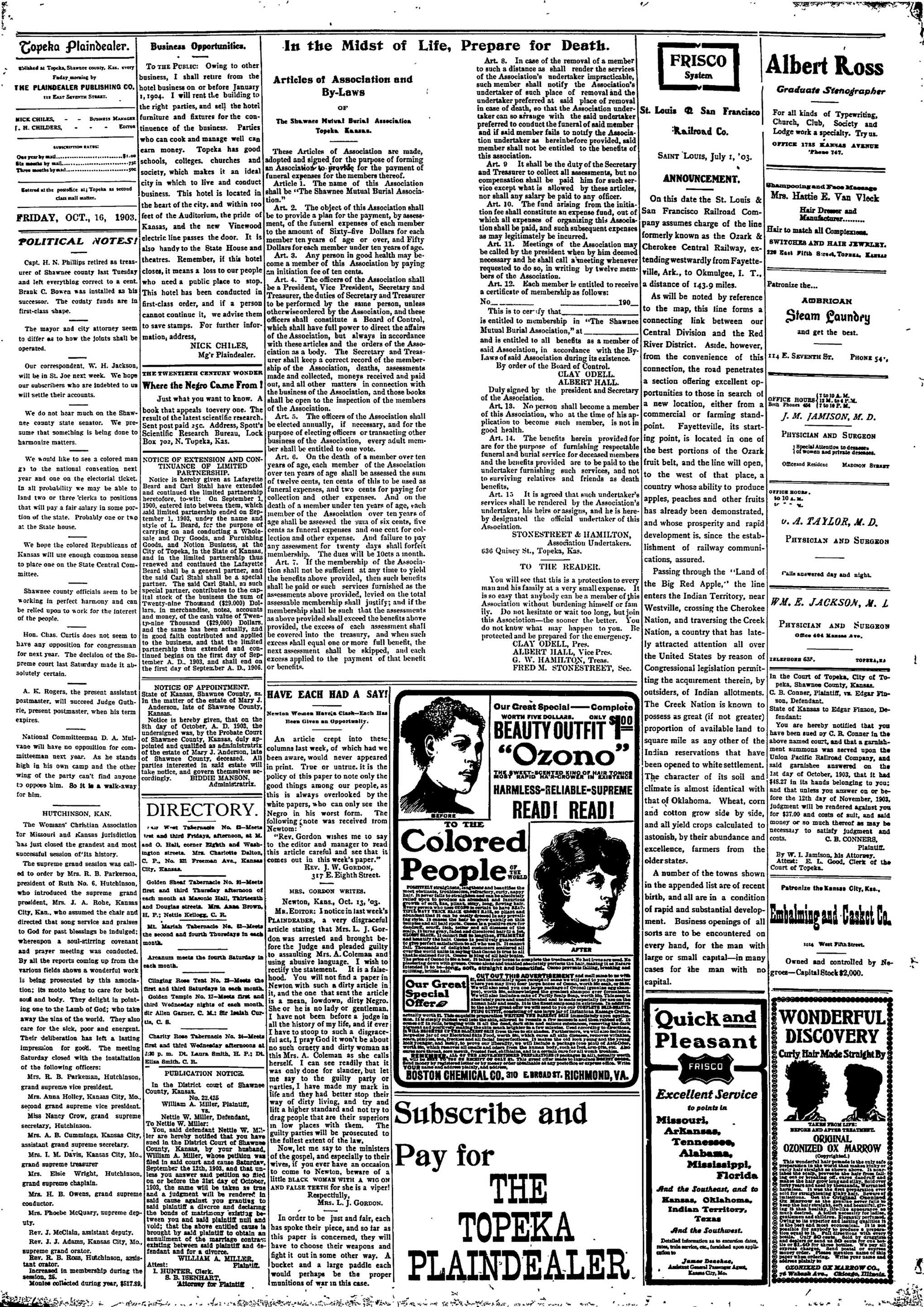
In the Midst of Life, Prepare for Death.
Articles of Association and By-Laws
OF
The Shawnee Mutual Burial Association
Topka Kansas.
These Articles of Association are made, adopted and signed for the purpose of forming an Association to provide for the payment of funeral expenses for the members thereof.
Article 1. The name of this Association shall be "The Shawnee Mutual Burial Association."
Art. 2. The object of this Association shall be to provide a plan for the payment, by assessment, of the funeral expenses of each member to the amount of Sixty-five Dollars for each member ten years of age or over, and Fifty Dollars for each member under ten years of age.
Art. 3. Any person in good health may become a member of this Association by paying an initiation fee of ten cents.
Art. 4. The officers of the Association shall be a President, Vice President, Secretary and Treasurer, the duties of Secretary and Treasurer to be performed by the same person, unless otherwise ordered by the Association, and these officers shall constitute a Board of Control, which shall have full power to direct the affairs of the Association, but always in accordance with these articles and the orders of the Association as a body. The Secretary and Treasurer shall keep a correct record of the membership of the Association, deaths, assessments made and collected, monies received and paid out, and all other matters in connection with the business of the Association, and those books shall be open to the inspection of the members of the Association.
Art. 5. The officers of the Association shall be elected annually, if necessary, and for the purpose of electing officers or transacting other business of the Association, every adult member shall be entitled to one vote.
Art. 6. On the death of a member over ten years of age, each member of the Association over ten years of age shall be assessed the sum of twelve cents, ten cents of this to be used as funeral expenses, and two cents for paying for collection and other expenses. And on the death of a member under ten years of age, each member of the Association over ten years of age shall be assessed the sum of six cents, five cents as funeral expenses and one cent for collection and other expense. And failure to pay any assessment for twenty days shall forfeit membership. The dues will be 10cts a month.
Art. 7. If the membership of the Association shall not be sufficient at any time to yield the benefits above provided, then such benefits shall be paid or such services furnished as the assessments above provided, levied on the total assessable membership shall justify; and if the membership shall be such that the assessments as above provided shall exceed the benefits above provided, the excess of each assessment shall be covered into the treasury, and when such excess shall equal one or more full benefit, the next assessment shall be skipped, and each excess applied to the payment of that benefit or benefits.
HAVE EACH HAD A SAY!
Newton Women Have a Clash-Each Has Been Given an Opportunity.
An article crept into these columns last week, of which had we been aware, would never appeared in print. True or untrue. it is the policy of this paper to note only the good things among our people, as this is always overlooked by the white papers, who can only see the Negro in his worst form. The following note was received from Newton:
"Rev. Gordon wishes me to say to the editor and manager to read this article careful and see that it comes out in this week's paper."
MRS. GORDON WRITES.
Newton, Kans., Oct. 13, '63. MR. EDITOR: I notice in last week's PLAINDEADER, a very disgraceful article stating that Mrs. L. J. Gordon was arrested and brought before the Judge and pleaded guilty to assaulting Mrs. A. Coleman and using abusive language. I wish to rectify the statement. It is a falsehood. You will not find a paper in Newton with such a dirty article in it, and the one that sent the article is a mean, lowdown, dirty Negro. She or he is no lady or gentleman. I have not been before a judge in all the history of my life, and if ever I have to stoop to such a disgraceful act, I pray God it won't be about no such ornery and dirty woman as this Mrs. A. Coleman as she calls herself. I can see readily that it was only done for slander, but let me say to the guilty party or parties, I have made my mark in life and they had better stop their way of dirty living, and try and lift a higher standard and not try to drag people that are their superiors in low places with them. The guilty parties will be prosecuted to the fullest extent of the law.
Now, let me say to the ministers of the gospel, and especially to their wives, if you ever have an occasion to come to Newton, beware of a little BLACK WOMAN WITH A WIG ON AND FALSE TEERH for she is a viper!
In order to be just and fair, each has spoke their piece, and so far as this paper is concerned, they will have to choose their weapons and fight it out in some other way. A bucket and a large paddle each would perhaps be the proper munitions of war in this case.
Art. 8. In case of the removal of a member to such a distance as shall render the services of the Association's undertaker impracticable, such member shall notify the Association's undertaker of such place of removal and the undertaker preferred at said place of removal in case of death, so that the Association undertaker can so arrange with the said undertaker preferred to conduct the funeral of said member and if said member fails to notify the Association undertaker as hereinbefore provided, said member shall not be entitled to the benefits of this association.
Art. 9 It shall be the duty of the Secretary and Treasurer to collect all assessments, but no compensation shall be paid him for such service except what is allowed by these articles, nor shall any salary be paid to any officer.
Art. 10. The fund arising from the initiation fee shall constitute an expense fund, out of which all expenses of organizing this Association shall be paid, and such subsequent expenses as may legitimately be incurred.
Art. 11. Meetings of the Association may be called by the president when by him deemed necessary and he shall call a meeting whenever requested to do so, in writing by twelve members of the Association.
Art. 12. Each member is entitled to receive a certificate of membership as follows:
No _____ _____ 190
This is to certify that _____
is entitled to membership in "The Shawnee Mutual Burial Association," at _____
and is entitled to all benefits as a member of said Association, in accordance with the By-Laws of said Association during its existence.
Duly signed by the president and Secretary of the Association.
Art. 13. No person shall become a member of this Association, who at the time of his application to become such member, is not in good health.
Art. 14. The benefits herein provided for are for the purpose of furnishing respectable funeral and burial service for deceased members and the benefits provided are to be paid to the undertaker furnishing such services, and not to surviving relatives and friends as death benefits.
Art. 15. It is agreed that such undertaker's services shall be rendered by the Association's undertaker, his heirs or assigns, and he is hereby designated the official undertaker of this Association.
STONESTREET & HAMILTON,
Association Undertakers.
636 Quincy St., Topeka, Kas.
TO THE READER.
You will see that this is a protection to every man and his family at a very small expense. is so easy that anybody can be a member of the Association without burdening himself or family. Do not hesitate or wait too long, but join this Association—the sooner the better. You do not know what may happen to you. I protected and be prepared for the emergency.
You will see that this is a protection to every man and his family at a very small expense. It is so easy that anybody can be a member of this Association without burdening himself or family. Do not hesitate or wait too long, but join this Association—the sooner the better. You do not know what may happen to you. Be protected and be prepared for the emergency.
CLAY ODELL, Pres.
ALBERT HALL, Vice Pres.
G. W. HAMILTON, Treas.
FRED M. STONESTREET, Sec.
Pay for THE TOPEKA PLAINDEALER
FRISCO
System
St. Louis @ San Francisco
Railroad Co.
SAINT LOUIS, July 1, '03.
ANNOUNCEMENT.
On this date the St. Louis & San Francisco Railroad Company assumes charge of the line formerly known as the Ozark & Cherokee Central Railway, extending westwardly from Fayetteville, Ark., to Okmulgee, I. T., a distance of 143.9 miles.
As will be noted by reference to the map, this line forms a connecting link between our Central Division and the Red River District. Aside, however, from the convenience of this connection, the road penetrates a section offering excellent opportunities to those in search of a new location, either from a commercial or farming standpoint. Fayetteville, its starting point, is located in one of the best portions of the Ozark fruit belt, and the line will open, to the west of that place, a country whose ability to produce apples, peaches and other fruits has already been demonstrated, and whose prosperity and rapid development is, since the establishment of railway communications, assured.
Passing through the "Land of the Big Red Apple," the line enters the Indian Territory, near Westville, crossing the Cherokee Nation, and traversing the Creek Nation, a country that has lately attracted attention all over the United States by reason of Congressional legislation permitting the acquirement therein, by outsiders, of Indian allotments. The Creek Nation is known to possess as great (if not greater) proportion of available land to square mile as any other of the Indian reservations that have been opened to white settlement. The character of its soil and climate is almost identical with that of Oklahoma. Wheat, corn and cotton grow side by side, and all yield crops calculated to astonish, by their abundance and excellence, farmers from the older states.
A number of the towns shown in the appended list are of recent birth, and all are in a condition of rapid and substantial development. Business openings of all sorts are to be encountered on every hand, for the man with large or small capital—in many cases for the man with no capital.
Quick and
Pleasant
FRISCO
Excellent Service
to points in
Missouri,
Arkansas,
Tennessee,
Alabama,
Mississippi,
Florida
And the Southeast, and to
Kansas, Oklahoma,
Indian Territory,
Texas
And the Southwest.
Detailed information as to excursion dates,
rates, train service, etc., furnished upon appli-
cation to
James Desahue,
Assistant General Passenger Agent,
Kansas City, Mo.
Albert Ross
Graduate Stenographer
For all kinds of Typewriting, Church, Club, Society and Lodge work a specialty. Try us.
OFFICE 1725 KANAS AVENUE
'Phone 747.
Shampooing and Face Message
Mrs. Hattie E. Van Vleck
Hair Dresser and
Manufacturer.....
Hair to match all Complexions.
SWITCHES AND HAIR JEWELRY.
228 East Fifth Street, TOPEAK, KANLA
Patronize the...
AWBRIOAN
Steam Laundry
and get the best.
114 E. SEVENTH ST. PHONE 54'.
OFFICE HOURS 7 to 10 A.M.
12 M. to 4 P.M.
Both Phones 454 7 to 10 P.M.
J. M. JAMISON, M. D.
PHYSICIAN AND SURGEON
Special Attention to diseases
of women and private diseases.
Officeand Residence MADISON STREET
OFFICE HOURS.
to 10 A.M.
to 7 P.M.
v. A. TAYLOR, M. D.
PHYSICIAN AND SURGEON
Calls answered day and night.
W.M. E. JACKSON, M. L
PHYSICIAN AND SURGEON
Office 404 Kansas Ave.
ISLEPHONE 63F. TOPHEA, KS
In the Court of Topeka, City of Topeka, Shawnee County, Kansas.
C. B. Conner, Plaintiff, vn. Edgar Finson, Defendant.
State of Kansas to Edgar Finson, Defendant:
TOPZRA, KS
You are hereby notified that you have been sued by C. B. Conner in the above named court, and that a garnishment summons was served upon the Union Pacific Railroad Company, and said garnishee answered on the 1st day of October, 1903, that it had $48.27 in its hands belonging to you; and that unless you answer on or before the 12th day of November, 1903, judgment will be rendered against you for $37.00 and costs of suit, and said money or so much thereof as may be necessary to satisfy judgment and costs. C. B. CONNERS, Plaintiff. By W. I. Jamison, his Attorney. Attest: E. L. Good, Clerk of the Court of Topeka.
Patronize the Kansas City, Kss..
Embalming and Casket Co.
1014 West Fifth Street.
Owned and controlled by Negroes—Capital Stock $2,000.
Don't dead beat a paper that needs the money.
It's the same as the union label—THE PLAINDEALER imprint.
Miss Gertrude Hardin is visiting in Kansas City.
Dr. Kenna of Lawrence is among the guests at Chiles' Hotel.
William Solomon Sundayed in Kansas City. He reports a good time.
Mrs. F. A. Moss has returned from a visit with relatives in Burlingame.
Blind Boone will be in Topeka on the 9th, 10th and 11th of November.
Miss Pauline Jones, who is now at the Stormont hospital, is doing nicely.
Mr. Frank Smith of Denver is now running in Topeka on the Rock Island.
Abe Henderson is attending the State Baptist Association in Emporia.
Henry Wilson has improved his eating house, making same much larger.
Rev. W. P. Banks is attending the State Baptist Convention in Emporia.
Mr. Joseph B. Bass has returned from a visit in Jefferson City and St. Louis, Mo.
Mrs. O. Overr has returned from Leavenworth where she has spent the past year.
Mrs. Jno. Dandridge was called to Miami, Mo., on account of the illness of her father.
Miss Katherine Harris of Lawrence spent Sunday the guest of her mother, Mrs. A. Harris.
Fred Newman returned Monday to Colorado Springs after a visit with his mother, Mrs. Sales.
Master Earl Beck of Wamego spent Saturday and Sunday with his sister, Miss Arminta Beck.
The "Smart Set" will dance Thursday night at the Capital City Club. Steinberg's orchestra.
Rev. M. S. Bryant is visiting his brother, D. B. Bryant, P. E. of the Columbia, Mo., district.
St. Luke Temple No. 5 had a fine session at their last meeting at their hall on West B. street.
Mrs. R. L. Skearce is attending maneuvers at Ft. Riley in charge of the officers' wives department.
Mrs. A. A. Kuykendall has gone to Omaha, Neb., to visit her mother whom she has not seen for five years.
B. M. Drelsbach of Silver Lake is a probable candidate for the legislature for the north district, to succeed J. B. Bass.
Cyrene Commandery will give a banquet on Thanksgiving Day to the visiting Commanderies of Missouri and Kansas.
Mrs. Wm. Toler of Chicago, who has been the guest of Mrs. M. Woods of 415 West Sixth street, returned to her home Tuesday.
Dr. McGee and son of Oklahoma City, arrived in the city last Sunday. Dr. McGee has his son in the Topeka Industrial Institute.
Bro. Paul Jones will pay the debt. As the gentleman found a large council in running order and deserted the Orients for lying.
Miss Minta Beck entertained Saturday afternoon a number of girls and boys in honor of her brother, Master Earl Beck of Wamego.
Misses Maud Richardson, Dora Wilson and Anna Bell Radford returned home Monday from Kansas City where they attended the Carnival.
Mrs. Jno. Pegg and two children, who have been the guests of her parents, Mr. and Mrs. J. D. Page, returned Saturday to their home in Omaha, Neb.
Irene, the little 2-year-old daughter of Mr. and Mrs. Frank Jackson, died Sunday at the family home in Park Place. Interment in the Topeka cemetery.
Capt. Albert Ross, one of the teachers of the Industrial Institute, arrived in the city Sunday from Colorado, bringing with him 18 students for the school.
The Cyrene Drill Corps under Capt. Reynolds is drilling every night in anticipation of winning the cup during the contest Thanksgiving evening at the Auditorium.
Everybody prepare for the Auditorium on Thanksgiving night to meet all of St. Joe, Kansas City, Lawrence and other towns who will come in great numbers to enjoy Thanksgiving.
WANTED--A printer. Man or woman. One who can set straight matter. No "job artist" need apply. Cards are out announcing the marriage of Miss Ostella Fleming to Mr. John S. Holerman of Chicago, October 25. Mr. and Mrs. Holerman will leave immediately for Chicago where they will reside.
The financial secretary of the Knights and Ladies of the Orient is indebted to a member of the Knights and Ladies of Protection of Perry, Kansas, a suit of clothes which he promissed if he could find a council of the Protection in working order in Topeka.
About forty girls and boys very pleasantly surprised Miss Evelyn Vance at her home, 10 miles northeast of the city last Saturday evening. Dancing and card playing were indulged in until a late hour. After which the party partook of a bounteous repast which had been prepared by Mrs. Vance.
The many friends of Rev. J. C. Owens; and wife of Kansas City, Kan., will I sad to learn of the death of their daughter, Miss Alberta, which occurred last Tuesday. Miss Owens died after a brief illness with pneumonia. Funeral services were held Thursday afternoon from their residence, 809 Throop avenue.
The following are the new stewardess board of St. Johns A. M. E. Church:
Laura Adams, president.
Mattie Richardson, vice president.
Mary Jordan, secretary.
Jessie Bass, assistant secretary.
Mary Bennett, treasurer.
Elsie Brown, chaplain.
Malisia Simpson.
Annie Farris.
Georgia Carson.
Alice Parks.
A most pleasant surprise was given Rev. J. M. Pope by his many friends on last Friday evening, October 9. It was the occasion of his forty-fifth birthday and a crowd of friends gathered at the home of Mr. J. S. Chiles and from there they proceeded to the parsonage, where refreshments were served and a good time in general was had. Rev. Pope received many valuable presents for which he kindly expressed his thanks. Rev. and Mrs. Banks and many of his members were among the surprisers.
The City Federation opened October 12th. Quite a number of the ladies were present. One hour was devoted to business, after which Mrs. G. W. Guy made quite an interesting talk which was highly appreciated. Officers elected: Mrs. M. Clark, president; Miss E. Phillips, vice president; Miss M. Jordan, secretary; Miss J. Jones, assistant secretary; Mrs. Carpenter, treasurer; Mrs. Galnes, chaplain; Mrs. P. Jones, reporter. They adjourned to meet the second Monday in November at the Congregational church.
Saturday afternoon Mrs. M. Woods and Miss Eliza Britt entertained at a reception complimentary to Mrs. Wm. Toler of Chicago at the home of the former, 415 West Sixth st. The parlors and reception hall were decorated with palms, ferns and boquets of carnations. From 2 to 6 p. m., two hundred and fifty ladies called. Mesdames, J. S. Brasher, S. R. McClain, H. Johns, M. E. Langston, Miss Felicia Davis, assisted the hostess in receiving. Misses Helen McClain and Bessie Bennett presided at the punch bowl. Misses Maud and Flora Jeltz assisted in the dining room. Miss Alberta Guy presided at the plano.
The Ladies Shamrock Club met with Mrs. Anna Tyler, Tuesday, October 6th. The following officers were elected: Anna Edmond, president; Lizzie Mitchell, vice president; Maggie Leonard, secretary; Mattie Slaughter, assistant secretary; Carrie Flumb, treasurer; Ida Stewart, chaplain; Maggie Brown, lecturer. The club adjourned to meet Tuesday, October 20, with Mrs. J. M. Brown, 622 Filmore street.
NOTICE.
All members of the Pleasant Hour Literary Society and all persons interested in literary work, are requested to meet on Saturday eve, October 24, at 429 Kansas avenue, for the purpose of reorganizing the society for the ensuing year. N. SAWYER.
LEAVENWORTH, KAN.
The pupils of the Seventh and Eighth grades accompanied by their teacher, Prof. A. M. Wilson, very pleasantly surprised Mrs. Gertrude Overr on last Thursday evening at the home of her parents, Mr. and Mrs. H. Taylor. The evening was spent in games and music, after which they presented her a very dalnty gift. Mrs. Overr has been for the past year substitute teacher in the Lincoln school.
ST. JOSEPH. MO.
Rev. Cohron, Mesdames Patrick and Williams are attending the Baptist State Convention at Lexington this week.
Johnson Smothers of Superior, Wla. is expected in the city Friday to visit with Mr. and Mrs. Jos. Smothers.
Dr. Ricketts returned from Omaha where he has been attending his sick wife.
Mr. and Mrs. Will Hill will reside in Leavenworth in the future.
Mr. John Smith will make a visit to Lawrence, Kansas, in a few days to "see her."
The Churches.
THIRD BAPISTIST CHURCH.
Friday evening, October 2, the members and friends of the church very pleasantly surprised their pastor, Rev. W. P. Banks. Many good things were brought by everyone and his table was laden with eatables of the season, which were thankfully received.
On last Sunday the church had a very successful rally under the leadership of their pastor. The sum of $70 was raised during the day. Rev. W. P. Banks is marshalling his forces and doing a good work. In short he is the right man in the right place.
Mrs. G. Thompson of 1033 Grand avenue, entertained East Hill Mission Circle Saturday, Oct. 3. The circle will meet with Mrs. J. Jennings, 715 Locust street, October 31. All sister churches are invited to meet with us.
ANOTHER OPPORTUNITY FOR HOMESEEKERS TO HOME-SEEK
The Frisco System again announces that it will sell tickets from St. Loula and Kansas City to points in Oklahoma, Indian Territory, Kansas and Texas, at the very low round-trip rate of $15.00. Opportunities for homes in the Southwest are still plentiful, and the best lands are by no means all taken up. Excursion tickets sold at this extremely low rate will be good on any of the Frisco regular traina leaving St. Louis at 2:30 p. m., 8:35 p. m., and 10:00 p. m., October 20, and leaving Kansas City 7:15 p. m., and 11:30 p. m., on the same date. If you are looking to the Southwest for a future home, this excursion of October 20th is an excellent opportunity to investigate the country.
Your own home ticket agent will be able to give you full information as to rates and limits of tickets. Write for our interesting booklet entitled "New Lands Along the Frisco System," by Ryan Snyder, and for detailed information to R. S. Lemon, Secretary Frisco Immigration Bureau, St. Louis.
A PLEASANT OUTING.
A party composed of the following ladies: Misses Corinne Bennett, Arnicholas Chiles, Willa Smith and Evalyn Hickman spent last Sunday at the home of Mrs. Jas. Parks, five miles southeast of the city.
We had long since heard of the unusual generosity and hospitality of Mr. and Mrs. Parks, but not until last Saturday evening and Sunday was the fact fully realized. Sunday was generally spent in exploring the beautiful farm of Mrs. Parks, which is to be classed among the ideal country homes of not only Shawnee county, but even of the state of Kansas.
And indeed we would not fall to mention the palatable vlands of which it was our pleasure to partake; and we felt like exclaiming as one of old, "It is good for us to be here."
PROGRESSO
Rubbed into the hair every night and morning will take the curl out of kinky hair, will make short, stubby hair grow and will stop the hair from falling out. Our remedy is the best in the world. Nothing like it. No irons used; just your fingers and our Progresso. Other Remedies have failed to do what was claimed for them but Progresso never fails. Directions on every bottle. Price 50cts.; money order or stamps. Five hundred agents wanted. Big money. PROGRESSO M'E'G CO.
FROM DAILY NEWS.
Troop E of the Tenth cavalry has been ordered to march from Fort Russell to Fort Logan a distance of 116 miles. The order specifies that Troop E must arrive at Fort Logan not later than October 11. It is to take the place of the Second infantry, which goes to Fort Riley to be absent about two weeks.
Army officers estimate that the cavalry will require about four days to come from Fort Russell. All the supplies will be transported in wagons, just as in time of war, and each cavalryman will have the same accountments as he would have in war time. Camps at night will be made in the open country and not adjacent to any towns along the route.
Troop E is said to have some of the finest cavalry horses to be found in the service and the troop is subject to the strictest kind of discipline. To all intents and purposes residents along the route will be a troup of Uncle Sam's cavalrymen going to war.
Major E. F. Gardner, surgeon at Ft. Russell, was in Denver yesterday.
Topeka. Industrial and Educational Institute.
Five teachers from that famous institution. The ONLY NON-SECTARIAN school for the Negroes of the West. A school of Christian Culture.
DEPARTMENTS
Normal, Normal Preparatory
ness, Music and Milrtary Science
TRADES
Carpentry, Painting, Printin
ing, Dress making, Laundrying,
riculture in its varied phases, Ste
tual and Mechanical Drawing.
Normal Preparatory, Agricultural, In and Miltrary Science.
TRADES TAUGHT
Painting, Printing, Book-binding, T
taking, Laundrying, Basketry, Domestic
varied phases, Stenography, Type-writ
manical Drawing.
Normal, Normal Preparatory, Agricultural, Industrial, Business, Music and Milrtary Science.
Carpentry, Painting, Printing, Book-binding, Tailoring, Sewing, Dress making, Laundrying, Basketry, Domestic Science, Agriculture in its varied phases, Stenography, Type-writing, Architectual and Mechanical Drawing.
ADVANTAGES:
Expenses reasonable. Self attention given home training of maintained. Form of 105 acres very best. Endorsed by minister. The Fall Term begins Tuesday the opening day. For further int
WM. R. CA
reasonable. Self help encouraged; in home training of young women. R
Form of 105 acres. Location and
adorsed by ministers of every denomina-
tion. Term begins Tuesday Oct. 13. Try
day. For further information address
WM. R. CARTER, Prec
Topel
Ronestreet.
G. W.
westreet & Hamil
Expenses reasonable. Self help encouraged. Very careful attention given home training of young women. Rigid discipline maintained. Form of 105 acres. Location and sanitation the very best. Endorsed by ministers of every denomination.
The Fall Term begins Tuesday Oct. 13. Try to be present the opening day. For further information address
WM. R. CARTER, President.
Topeka, Kansas.
Fred M. Stonestreet. Stonestreet
Successors to J. M. Knight.
Undertakers and
takers and Funeral Dir
Undertakers and Funeral Directors
We carry one of the finest lines of Undertaking good Topeka. Join our "Burial Association." It only costs per week.
erry one of the finest lines of Undertell on our "Burial Association." It oakk.
We carry one of the finest lines of Undertaking goods in Topeka. Join our "Burial Association." It onty costs ten cents per week.
Corner 7th and Quincy Sis. Topeka, Kansas.
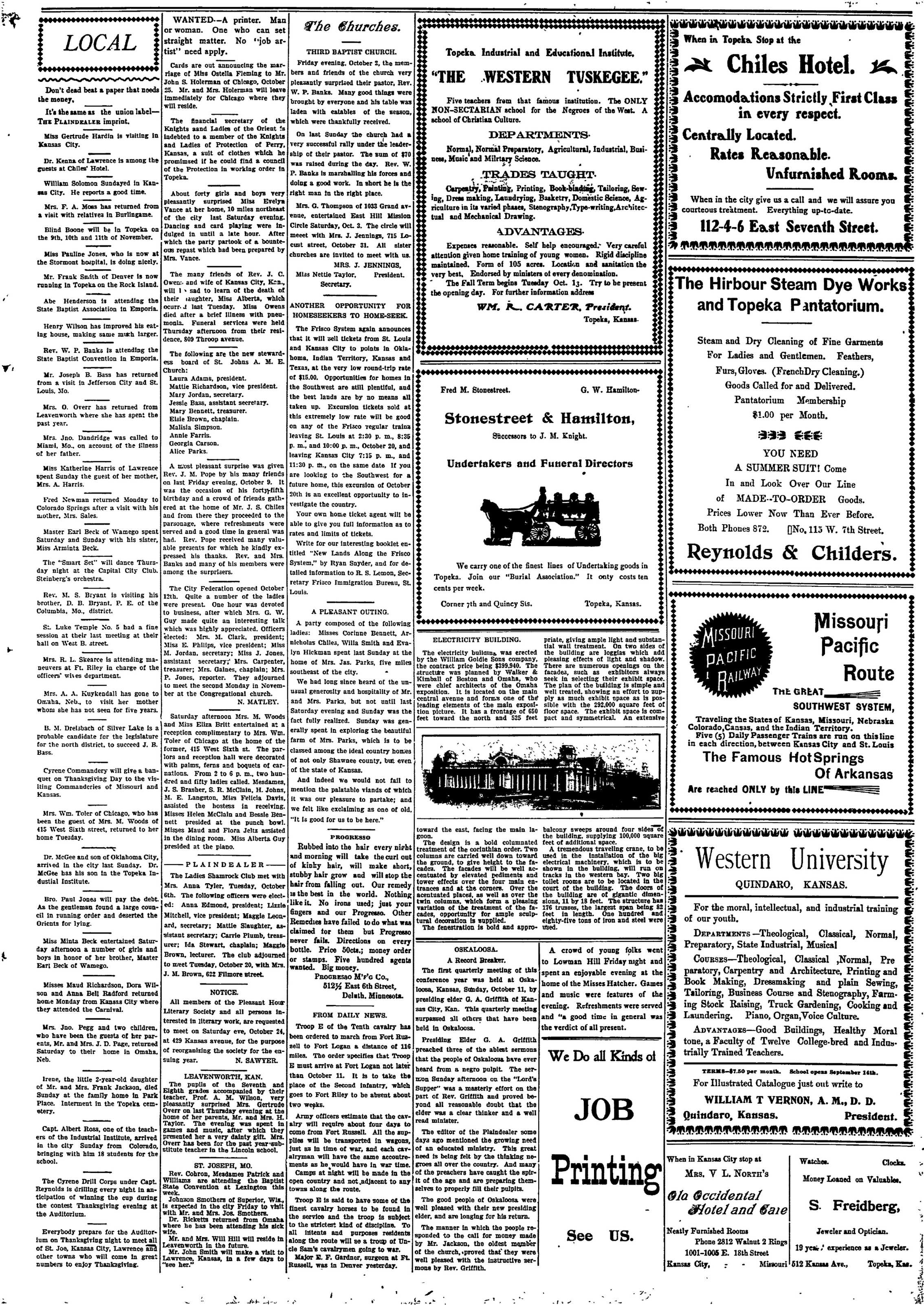
ELECTRICITY BUILDING.
The electricity buildings was erected by the William Goldie Sons company, the contract price being $399,940. The structure was planned by Walker & Kimball of Boston and Omaha, who were chief architects of the Omaha exposition. It is located on the main central avenue and forms one of the leading elements of the main exposition picture. It has a frontage of 650 feet toward the north and 525 feet
```markdown
```
1
toward the east, facing the main la- balcony sweeps around four sides of goon. the building, supplying 100,000 squar
The design is a bold columnated treatment of the corinthian order. Two columns are carried well down toward the ground, to give height to the facades. The facades will be well accentuated by elevated pediments and tower effects over the four main entrances and at the corners. Over the accentuated placed, as well as over the twin columns, which form a pleasing variation of the treatment of the facades, opportunity for ample sculptural decoration is supplied.
The fenestration is bold and appro-
A Record Breaker.
The first quarterly meeting of this conference year was held at Oskaloosa, Kansas, Sunday, October 11, by presiding elder G. A. Griffith of Kansas City, Kan. This quarterly meeting surpassed all others that have been held in Oskaloosa.
Presiding Elder G. A. Griffith preached three of the ablest sermons that the people of Oskaloosa have ever heard from a negro pulpit. The sermon Sunday afternoon on the "Lord's Supper" was a masterly effort on the part of Rev. Griffith and proved beyond all reasonable doubt that the elder was a clear thinker and a well read minister.
The editor of the Plaindealer some days ago mentioned the growing need of an educated ministry. This great need is being felt by the thinking negroes all over the country. And many of the preachers have caught the spirit of the age and are preparing themselves to properly fill their pulpits.
The good people of Oskaloosa were well pleased with their new presiding elder, and are longing for his return.
The manner in which the people responded to the call for money made by Mr. Jackson, the oldest member of the church, proved that they were well pleased with the instructive sermons by Rev. Griffith.
OSKALOOSA.
TAUGHT
g, Book-binding, Tailoring, Sew-
Basketry, Domestic Science, Ag-
mography, Type-writing, Architec-
help encouraged: Very careful young women. Rigid discipline. Location and sanitation the area of every denomination. Day Oct. 13. Try to be present information address
ARTER, President.
Topeka, Kansas.
& Hamilton,
J. M. Knight.
Funeral Directors
est lines of Undertaking goods in Association." It only costs ten
primate, giving ample light and substantial wall treatment. On two sides of the building are loggias which add pleasing effects of light and shadow. There are numerous openings on the facades, such as exhibitors always seek in selecting their exhibit space. The plan of the building is simple and well treated, showing an effort to supply as much exhibit space as is possible with the 292,000 square feet of floor space. The exhibit space is compact and symmetrical. An extensive
balcony sweeps around four sides of the building, supplying 100,000 square feet of additional space.
A tremendous traveling crane, to be used in the installation of the big electrical machinery, which is to be shown in the building, will run on tracks in the western bay. Two big toilet rooms are to be located in the court of the building. The doors of the building are of gigantic dimensions, 11 by 18 feet. The structure has 176 trusses, the largest span being 82 feet in length. One hundred and eighty-five tons of iron and steel were used.
A crowd of young folks went to Lowman Hill Friday night and spent an enjoyable evening at the home of the Misses Hatcher. Games and music were features of the evening. Refreshments were served and "a good time in general was the verdict of all present.
We Do all Kinds of
JOB
Printing
See US.
G. W. Hamilton-
Topeka, Kansas.
Accomodations Strictly First Class in every respect.
the city give us a call and we will
ment. Everything up-tc-date.
6 East Seventh St
Labour Steam Dye
Topeka Pantatorium
And Dry Cleaning of Fine
Cottonies and Gentlemen. Feel
Gloves. (FrenchDry Cleaning
foods Called for and Delivered
Pantatorium Membership
$1.00 per Month.
YOU NEED
A SUMMER SUIT! Comes
and Look Over Our Lif
MADE--TO-ORDER Go
Lower Now Than Ever
phones 872. []No. 115 W. 7
Holds & Child
When in the city give us a call and we will assure you courteous treatment. Everything up-tc-date.
The Hirbour Steam Dye Works and Topeka Pantatorium.
Steam and Dry Cleaning of Fine Garments For Ladies and Gentlemen. Feathers, Furs, Gloves. (FrenchDry Cleaning.) Goods Called for and Delivered. Pantatorium Membership $1.00 per Month.
YOU NEED
A SUMMER SUIT! Come
In and Look Over Our Line
of MADE--TO-ORDER Goods.
Prices Lower Now Than Ever Before.
Both Phones 872. []No.115 W. 7th Street.
Reynolds & Childers.
MISSOURI
PACIFIC
RAILWAY
Traveling the States Colorado, Cansas, and the Five (5) Daily Passes in each direction, between The Famous Are reached ONLY the Western
In the States of Kansas, Missouri, Kansas, and the Indian Territory, Daily Passenger Trains are run section, between Kansas City and Famous Hot Springs Of Art and ONLY by this LINE
Eastern University
Traveling the States of Kansas, Missouri, Nebraska Colorado, Cansas, and the Indian Territory. Five (5) Daily Passenger Trains are run on this line in each direction, between Kansas City and St. Louis
Are reached ONLY by this LINE
QUINDARO, KANSAS.
For the moral, intel of our youth.
Roral, intellectual, and industrial. ENTS—Theological, Classical State Industrial, Musical THEological, Classical ,New carpentry and Architecture. ing, Dressmaking and pl Business Course and Stenogr
For the moral, intellectual, and industrial training of our youth.
DEPARTMENTS—Theological, Classical, Normal, Preparatory, State Industrial, Musical
COURSES—Theological, Classical ,Normal, Preparatory, Carpentry and Architecture. Printing and Book Making, Dressmaking and plain Sewing, Tailoring, Business Course and Stenography, Farming Stock Raising, Truck Gardening, Cooking and Laundering. Piano, Organ, Voice Culture.
ADVANTAGES—Good Buildings, Healthy Moral tone, a Faculty of Twelve College-bred and Industrially Trained Teachers.
TERMS-$7.50 per month. School opens September 14th. For Illustrated Catalogue just out write to
Unfurnished Rooms.
We us a call and we will assure you
Everything up-tc-date.
Last Seventh Street.
Steam Dye Work
aka Pantatorium.
Cleaning of Fine Garments
and Gentlemen. Feathers,
(FrenchDry Cleaning.)
Called for and Delivered.
Rium Membership
100 per Month.
YOU NEED
SUMER SUIT! Come
Look Over Our Line
TO-ORDER Goods.
Now Than Ever Before.
[No, 115 W. 7th Street.
s & Childers.
Missouri
Pacific
Route
THE GREAT
SOUTHWEST SYSTEM.
States of Kansas, Missouri, Nebraska and the Indian Territory. Passenger Trains are run on this line between Kansas City and St. Louis. Hot Springs Of Arkansas by this LINE
Intellectual, and industrial training Theological, Classical, Normal, Industrial, Musical Logical, Classical ,Normal, Pre and Architecture, Printing and Lessmaking and plain Sewing, Course and Stenography, Farm-
Society in the U.S. Our society is similar in character and management to the KNIGHTS AND LADIES [OF SECURITY, A. O. U. W., and MODERN WOODMEN. -No intelligent Negro should be without INSURANCE. The protection of our families warrants no delay in the matter of insurance. Good agents wanted. For further information write P.C. THOMAS, Natl Sec. Headquarters: 117 West Fifth street, Topeka, Kansas.
WOODMEN K.S.L. OILS
PROTECTION
COFFEYVILLE, KAS.
EDITOR PLAINDEALER:
Being a constant reader of the PLAINDEALER, knowing at the same time that it has always advocated the rights and privileges of the colored man at the right time and in the right place, will yon allow me space in its columns to speak a few words in regard to the "Jim Crow" school they are trying to force upon us here without our consent. The board of education from the advice of the superintendent some two or three months ago, passed a resolution separating the colored and white children, but said at the same time it could not be done this scholastic year on account of the school facilities being insufficient, but hired four colored teachers to teach in the Jim Crow school at the same time. When school started several parents carried their children to the school where their respective grade was, but was politely met by the superintendent who said that the colored children could not be taught by white teachers any longer. Then the board said they were doing this because a majority of the colored citizens wanted it. Then we made a canvass over the city and found 150 colored citizens opposed the move while only 11 favored it, including one doctor and one merchant. The doctor has no children but his wife is one of the teachers, so that accounts for him. Since then a suit was instituted in the district court at Independence, Kas., against the school board and superintendent by the best colored citizens here in the name of James Moor for his four children. Our attorney, R. K. Karashival has done his duty. He forced them to a trial yesterday and the judge dismissed the case from his court and referred it to the higher court for a decision. Now in the name of common decency it behooves the colored citizens of the state of Kansas to start a campaign fund to fight every wolf in the Republican party. I have been reliably informed that this separation in the public schools is being done on account of an undercurrent in politics in this part of the state. It is true that there are a good many rebels scattered all over the state from Texas, Arkansas, Kentucky, Tennessee and Mississippi. Is it possible that the good citizens of Kansas will allow that undercurrent or rebel spirit to predominate over any party in this state and change the policy they have been following the last thirty odd years? Save a few days under the populist misrule. Now the question is shall we hold the Republican party of the state responsible for this undercurrent or shall we hold that faction of Republicans who are drifting with the current responsible? It has been admitted by the best thinkers of the race, since the Democratic misrule under Cleveland that the
of Protection
A NAT ONAL FRATERNAL INSURANCE
SOCIETY
Issues policies for the sums of $250,
$500, $1,000, also $75, $100, $150 and $200
for children over 6 years of age. This is
the only colored Fraternal Insurance
city is similar in character and management
DIES OF SECURITY, A. O. U. W., and
o intelligent Negro should be without
of our famiies warrants no delay in the
ents wanted. For further information write
C. THOMAS, Natl Sec.
with street, Topeka, Kansas.
principals of the Republican party as taught by Lincoln, Grant, Garfield, Harrison, McKinley and Roosevelt is the only teachings that the black man could conscientiously and consistently follow. Lincoln taught that this country could not exist half slave and half free no more than it could exist with the status of a free slave, when the very foundation of this government is that all men are equal before the law. Does any man have the right to discriminate against another in the common public schools where all are trying to educate themselves for better American citizens, when all are trying to learn how to run this government for the best of all cancerned and when we are all equally taxed in proportion by law to run the schools and the government in which we live? A. L. DAVIS.
WINFIELD.
but crimin-
color-bought
enger. were
city of
and it. over
observed
while one
The
at his
s, so
since in the
ince,
board the best
name
child-
Kara-
He
Sunday
case it to
session.
mon
dored
as to
fight
dican
day in-
ion in
done
current
of the
e are
ed all,
Ar-
nessee
Rev. A. Ramsey, of the A. M.
E. church, preached in Welling-
ton last Sunday.
Rev. Garnett, of Arkansas
City, preached at Second Baptist
church last Sunday.
Mrs. Pete Clements passed
through last Sunday enroute to
Guthrie.
Mrs. Carry Franklin, Misses
Lula Franklin, Myra Franklin,
Lula Morgan, Etta and Emma
Dixon and John Jackson. Wm.
Hamilton and Jesse Banks were
among the excursionists to Oklahoma City Sunday.
Henry Evans was brought up
from Arkansas City last Saturday
and put in the county jail for
beating his wife.
Mrs. Thomas Campbell and
children Ernest and Nora return-
from Arkansas City last Monday.
Sterling Simpson, Arthur
Nichols, Green Walker and
Geo. Caldwell gave a ball at
Dug Burdett's hall last Wednesday. Among those in attendance from Arkansas City were Marion Fowler, Governor Williams, Scott Taylor.
Green Walker taken three degrees in Masonry last Thursday. The work was put on in first class style and Green says he can ride any goat now.
Grant McFarlaad came up from the South Monday.
John Funkhouser was up from Arkansas City Monday.
CHETOPA, KANS.
At the home of Mr. and Mrs. P. H. Bassett last Monday evening was celebrated their tenth anniversary wedding, which was one of the nicest affairs for some years. The ladies spent their time in shooting with bow and arrow arranged by Prof. Greene, in order to gain an escort for lunch. Music was furnished by the Owl Orchestra. After a brief announcement the party passed from the parlors, which were tastefully decorated in pink flowers and smilax, to the dining room where a lunch of cake, cream, coffee and cheese rarebit
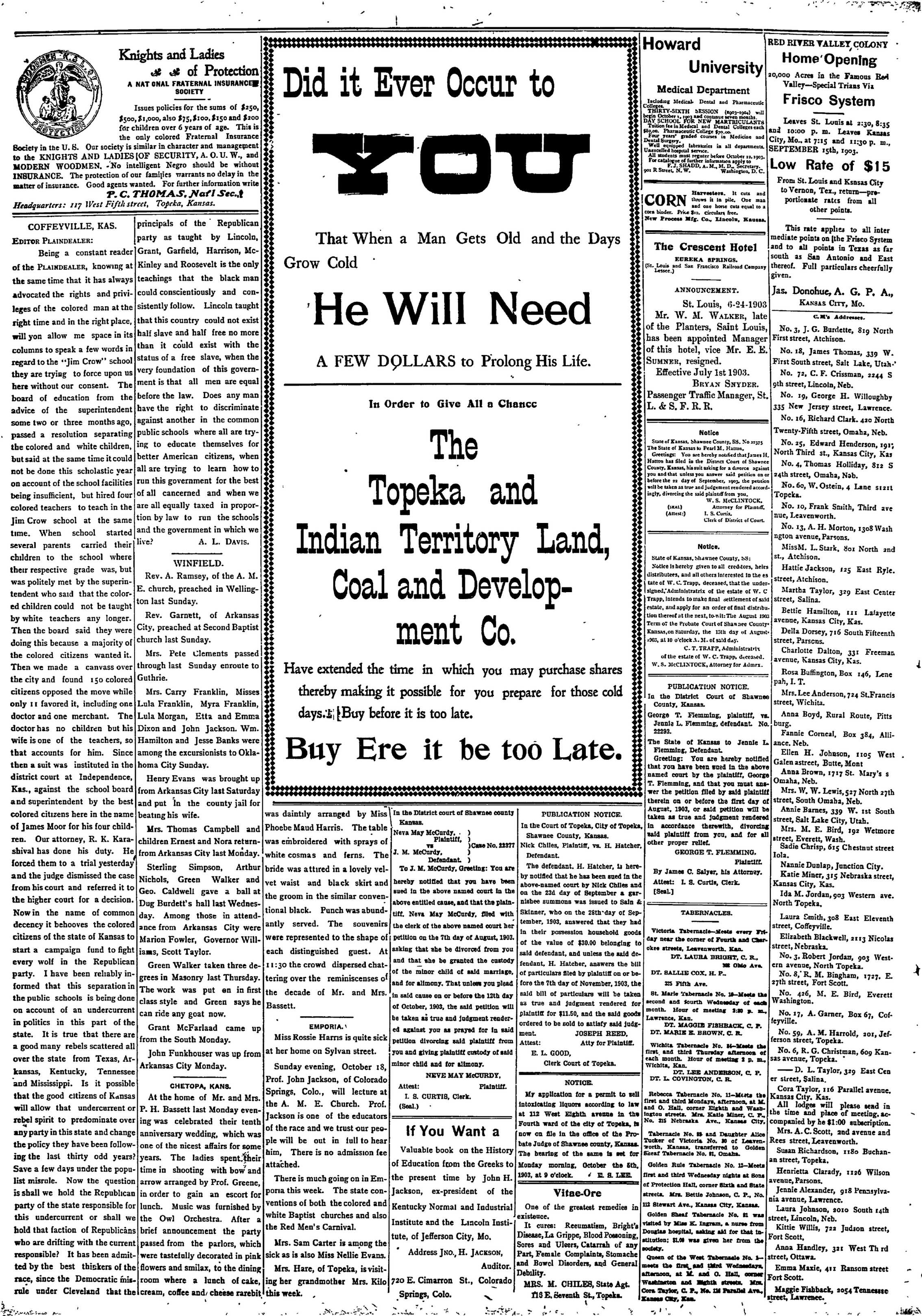
Did it Ever Occur to
YOU
That When a Man Gets Old and the Days Grow Cold
He Will Need
A FEW DQLLARS to Prolong His Life.
The Topeka and Indian Territory Land, Coal and Development Co.
Have extended the time in which you may purchase shares thereby making it possible for you prepare for those cold days. Buy before it is too late.
Buy Ere it be too Late.
was daintily arranged by Miss Phoebe Maud Harris. The table was embroidered with sprays of white cosmas and ferns. The bride was attired in a lovely velvet waist and black skirt and the groom in the similar conventional black. Punch was abundantly served. The souvenirs were represented to the shape of each distinguished guest. At 11:30 the crowd dispersed chattering over the reminiscenses of the decade of Mr. and Mrs. Bassett.
EMPORIA. \
In Order to Give All a Chance
If You Want a
In the Court of Topeka, City of Topeka, Shawnee County, Kansas.
Nick Chiles, Plaintiff, vs. H. Hatcher, Defendant.
The defendant, H. Hatcher, is hereby notified that he has been sued in the above-named court by Nick Chiles and on the 23d day of September a garnishee summons was issued to Sain & Skinner, who on the 28th day of September, 1903, answered that they had in their possession household goods of the value of $30.00 belonging to said defendant, and unless the said defendant, H. Hatcher, answers the bill of particulars filed by plaintiff on or before the 7th day of November, 1903, the said bill of particulars will be taken as true and judgment rendered for plaintiff for $11.50, and the said goods ordered to be sold to satisfy said judgment.
JOSEPH REED.
Attest: Atty for Plaintiff.
E. L. GOOD,
Clerk Court of Topeka.
NOTICE.
My application for a permit to sell intoxicating liquors according to law at 112 West Eighth avenue in the Fourth ward of the city of Topeka, is now on file in the office of the Probate Judge of Shawnee county, Kansas. The hearing of the same is set for Monday morning, October the 5th, 1903, at 9 o'clock. E. L. LEE.
NOTICE
Vitae-Ore
One of the greatest remedies in existence. It cures: Reeumatism, Bright's Disease, La Grippe, Blood Poisoning, Sores and Ulcers, Catarrah of any Port Female Complaints Strokes
Including Medical, Dental and Pharmaceutical
Colleges.
THIRTY-SIXTH SESSION (1903-1904) will
begin October 1, 1903 and continue seven months.
DAY SCHOOL FOR NEW MARTICULANTS
Tuition fee in Medical and Dental Colleges each
$80.00.
Four years' graded courses in Medicine and
Dental Surgery.
Well equipped laboratories in all departments.
Unacquired hospital services.
All students must register before October 12, 1903.
For catalogue of further information apply to
F. J. SHADD, A. M., M. D., Secretary.
901 R Street, N. W.
Washington, D. C.
CORN
Harvesters. It cuts and
throws it in pile. One man
and one horse cuts equal to a
corn binder. Price $12. Circular free.
New Process Mfg. Co., Lincoln, Kansas.
The Crescent Hotel
EUREKA SPRINGS.
(St. Louis and San Francisco Railroad Company
Lessee.)
ANNOUNCEMENT.
St. Louis, 6-24-1903
Mr. W. M. WALKER, late
of the Planters, Saint Louis,
has been appointed Manager
of this hotel, vice Mr. E. E.
Sumner, resigned.
Effective July 1st 1903.
BRYAN SNYDER.
Passenger Traffic Manager, St.
L. & S. F. R. R.
Notice
State of Kansas, Shawnee County, SS. No 22375
The State of Kansas to Pearl M. Hatton.
Greetings: You are hereby notified that James H.
Hatton has filed in the District Court of Shawnee
County, Kansas, his suit asking for a divorce against
you and that unless you answer said petition on
before the 22 day of September, 1903, the petition
will be taken as true and judgement reordered accord-
ingly, divorcing the said plaintiff from you.
W. S. McCLLINTOCK,
(SHALE)
Attorney for Plaintiff.
(Attest:)
I. S. Curtis.
Clerk of District of Court.
Notice.
State of Kansas, Shawnee County, SS:
Notice is hereby given to all creditors, heirs
distributees, and all others interested in the estate
of W. C. Trapp, deceased, that the undersigned,
Administratrix of the estate of W. C.
Trapp, intends to make final settlement of said
estate, and apply for an order of final distribution
thereof at the next, to-wit: The August 1903
Term of the Probate Court of Shawnee County
Kansas, on Saturday, the 13th day of August
1903, at 10 o'clock A.M. of said day.
C. T. TRAPP, Administratrix
of the estate of W. C. Trapp, deceased.
W. S. McCLINTOCK, Attorney for Admrx.
PUBLICATION NOTICE.
PUBLICATION NOTICE.
In the District Court of Shawnee County, Kansas.
George T. Flemming, plaintiff, vs. Jennia L. Flemming, defendant. No. 22293.
The State of Kansas to Jennie L. Flemming, Defendant.
Greeting: You are hereby notified that you have been sued in the above named court by the plaintiff, George T. Flemming, and that you must answer the petition filed by said plaintiff therein on or before the first day of August, 1903, or said petition will be taken as true and judgment rendered in accordance therewith, divorcing said plaintiff from you, and for all other proper relief.
GEORGE T. FLEMMING.
Plaintiff.
By James C. Salyer, his Attorney.
Attest: L. S. Curtis, Clerk.
[Seal.]
Victoria Tabernacle—Meets every Friday near the corner of Fourth and Charles streets, Leavenworth, Kan.
DT. LAURA BRIGHT, C. R.,
328 Ohio Ave.
DT. SALLIE COX, H. P.,
325 Fifth Ave.
St. Marie Tabernacle No. 18—Meets the second and fourth Wednesday of each month. Hour of meeting 2:00 p. m., Lawrence, Kan.
DT. MAGGIE FISHBACK, C. P.
DT. MARIE E. BROWN, C. R.
Wichita Tabernacle No. 24—Meets the first and third Thursday afternoon of each month. Hour of meeting 2 p. m., Wichita, Kan.
DT. LEE ANDERSON, C. P.
DT. L. COVINGTON, C. R.
Rebecca Tabernacle No. 11—Meets the first and third Mondays, afternoon at M. and O. Hall, corner Eighth and Washington streets. Mrs. Katie Miner, C. P., No. 315 Nebraska Ave., Kansas City,
Tabernacle No. 33 and Daughter Alice Tucker of Victoria No. 30 of Leavenworth, Kansas, transferred to Golden Sheaf Tabernacle No. 31, Omaha.
Golden Rule Tabernacle No. 12—Meets first and third Wednesday nights at Sons of Protection Hall, corner Sixth and State streets. Mrs. Bettie Johnson, C. P., No. 112 Stewart Ave., Kansas City, Kansas.
Golden Sheaf Tabernacle No. 11 was visited by Miss K. Ingram, a nurse from Douglas hospital, asking aid for that institution; $1.00 was given her from the society.
Queen of the West Tabernacle No. 1—Meets the first and third Wednesdays, afternoon at M. and O. Hall, corner Washington and Eighth streets. Mrs. Cora Taylor, C. P., No. 114 Parallel Ave., Kansas City, Kan.
RED RIVER VALLEY COLONY
Home'Opening
20,000 Acres in the Famous Red
Valley—Special Trians Via
Frisco System
Leaves St. Louis at 2:30, 8:35
and 10:00 p. m. Leaves Kansas
City, Mo. at 7:15 and 11:30 p. m.,
SEPTEMBER 15th, 1903.
From St. Louis and Ksnsas City to Vernon, Tex., return—preportionate rates from all other points.
This rate applies to all intermediate points on [the Frisco System and to all points in Texas as far south as San Antonio and East thereof. Full particulars cheerfully given.
Jas. Donohue, A. G. P. A.,
KANSAS CITY, Mo.
No. 3, J. G. Burdette, 819 North First street, Atchison.
No. 18, James Thomas, 339 W. First South street, Salt Lake, Utah.
No. 72, C. F. Crissman, 2244 S 9th street, Lincoln, Neb.
No. 19, George H. Willoughby 335 New Jersey street, Lawrence.
No. 16, Richard Clark. 420 North Twenty-Fifth street, Omaha, Neb.
iat
But
Se