Plaindealer
Friday, December 18, 1903
Topeka, Kansas
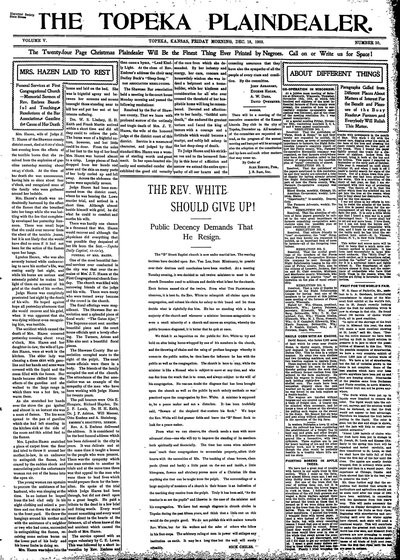
Page text (machine-generated)
THE TOPEKA PLAINDEALER.
MRS. HAZEN LAID TO REST
Historical Society State House
VOLUME V.
Funeral Services at First Congregational Church Memorial Sermon of Rev. Embree Beautiful and Touching Resolutions of the Bar Association Gasoline the Cause of Her Death
Mrs. Hazen, wife of Judge Z. T. Hazen of the Shawnee county district court, died at 6:20 o'clock last evening from the effects of the terrible burns that she received from the explosion of gasoline yesterday morning about 10:45 o'clock. At the time of her death she was unconscious, having lain so since about four o'clock, and recognized none of the family who were gathered around her bedside.
Mrs. Hazen's death was undoubtedly hastened by the effect of the flames that she breathed into her lungs while she was battling with the fire that completelp enveloped her yesterday forenoon. There was small hope that she could ever recover from the effect of the terrible .burns, but it is not likely that she would have died so soon if it had not been for the action of the flames upon her lungs.
Lyndon Hazen, who was also severely burned while endeavoring to save his mother's life, was resting easily last night, and while his burns are serious and extremely painful he makes but light of them on account of his grief at the death of his mother.
Judge Hazen was completely prostrated last night by the death of his wife. He hoped against hope all yesterday afternoon that she would recover and his grief, when it was apparent that she was dying without even recognizing him, was terrible.
The accident which caused the death of Mrs. Hazen occurred yesterday morning about 10:45 o'clock, Mrs. Hazen and her daughter-in-law, the wife of Lyndon Hazen, were at work in the kitchen. The elder lady was cleaning a dress skirt with gasoline and her hands and arms were covered with the liquid and the room filled with the fumes. Her hands became chilled from the effects of the gasoline and she walked to the large range in which there was a hot fire, to warm them.
As she stretched her hands over the stove the gas ignited and almost in an instant she was a mass of flames. The fire soon spread to the pan of gasoline which she had left standing in the kitchen sink at the side of the room and this added fuel to the flames.
Mrs. Lyndon Hazen snatched a piece of carpet from the floor and tried to throw it around her mother.in-law, in an endeavor to extinguish the flames, but crazed by the sudden shock and excruciating pain the unfortunate woman ran out of the house into the open air.
The young woman ran upstairs to procure the assistance of her husband, who was sleeping at the time. In an instant he leaped from the bed clad only in his night clothing and seized a portiere and ran down the stairs into the front yard. He threw the hangings around his mother and with the assistance of a neighbor or two who had come, succeeded in extinguishing the flames, receiving some serious burns on the lower part of his body and his lower limbs in doing so.
house and laid on the bed. She was in frightful agony and between her screams and moans besought those standing near to kill her and put her out of her intense suffering.
Drs. W. S. Lindsey, H. H. Keith and Frank Martin arrived within a short time and did all they could to relieve the pain. The burns were of a frightful nature, however, and but little could be done. From the soles of her feet to the top of her head Mrs. Hazen was burned almost to a crisp. Large pieces of flesh dropped from her hands and arms and the skin on many parts of her body curled up and fell away. Across the abdomen the burns were especially severe.
Judge Hazen had been summoned from the district court, where he was hearing the Lowe murder trial, and arrived in a short time. Although almost beside himself with grief, he did what he could to comfort and soothe his wife. There was hardly one chance in a thousand that Mrs. Hazen would recover and although the physicians did everything that was possible they despaired of her life from the first.—Topeka Daily Capital, 12-12-'03.
One of the most beautiful funeral services ever conducted in the city was that over the remains of Mrs. Z.T. Hazen at the First Congregational church Sunday. The church was filled with sorrowing friends of the judge and his wife. There were many who were turned away because of the crowd in the church.
The floral offerings were magnificent. The Shawnee Bar association sent a splendid piece of floral work: "The Gates Ajar," The Supreme court sent another beautiful piece and the court house officials sent a lovely offering. The Turners, Arions and Elks also sent a beautiful floral pieces.
The Shawnee County Bar association occupied seats to the right of the pulpit. The court house officials were there in a body. The friends of the family occupied the rest of the church. The attendance of the Bar association was an example of the sympathy of the men who have been working with Judge Hazen for twenty years.
The pall bearers were Otis E. Hungate, Richard Hayden, Dr. J. P. Lewis, Dr. H. H. Keith, Dr. J. P. Ashton, Will Moeser, Otto Kuehne and A. Steinberg. EMBREE'S BEAUTIFUL SERMON. Rev. A. S. Embree delivered the address. It is considered to be the best funeral address which has been delivered in the city in years. It was delicate and at the same time it taught a lesson to the people who were present. There was the sympathy which one man extends to another in trials and at the same time there was that appeal to the men who were there to lead lives which would prepare them for the hereafter. He spoke of the trial which Judge Hazen had been through, but did not dwell upon to a great length. He paid a tribute to the dead in a few brief and fitting words. Every word meant something and every word went direct to the hearts of the listeners, all of whom knew of the sad accident which caused the death of Mrs. Hazen.
The service opened with an organ voluntary by C. E. Lewis. This was followed by a short invocation by Rev. Embree and
TOPEKA, KANSAS, FRIDAY MORNING, DEC. 18, 1903.
THE REV. WHITE SHOULD GIVE UP!
The "B" Street Baptist church is now under martial law. The warring factions have decided upon Rev. Van Lue, State Missionary, to preside over their destines until conclusions have been reached. At a meeting Tuesday evening, it was decided to call twelve ministers to meet in the church December 22nd to arbitrate and decide what is best for the church. Each faction named six of the twelve. From what THE PLAINDEALER observes, it is best fo. the Rev. White to relinquish all claims upon the congregation, and submit his claim for salary to this board and let them decide what is rightfully due him. He has no standing with a large majority of the church and whenever a minister becomes antagonistie to even a small minority of a church and causes an eruption, whereby the public becomes disgusted, it is better that he quit at once.
We think it an imposition on the public for Rev. White to try and hold on after being horse-whipped by one of his members in the church, and the throwing of chairs and the using of profane language whereby it comes to the public notice, he then loses the influence he has with the public as well as the congregation. The church is here to stay, while the minister is like a Nomad who is subject to move at any time, and who can flee from the wrath that is to come, and always subject to the will of his congregation. No one can doubt the disgrace that has been brought upon the church as well as the public by such unholy methods as was practiced upon the congregation by Rev. White. A minister is supposed to be a peace maker and not a disturber. It has been truthfully said, "Beware of the shepherd that scatters his flock." We hope the Rev. White will find greener fields and leave the "B" Street flock to look for a peace maker.
From what we can observe, the church needs a man with more advanced ideas—one who will try to improve the standing of its members both spiritually and financially. The time has come when ministers must teach their congregations to accumulate property, adorn their homes with the necessities of life. The teaching of clean houses, clean yards (front and back) a little paint on the out and inside, a little blue-grass, flowers and shrubery proves more of a Christian life than anything else that can be taught from the pulpit. The surroundings of a large majority of members of a church in their homes is an indication of the teaching they receive from the pulpit. Truly it has been said, "As the teacher is so are the pupils" and likewise is the case of the minister and his congregation. We have had enough disgrace in church circles in Topeka during the past fifteen years, and think that a little rest on this would do the people good. We do not publish this with malace towards Rev. White, but for his welfare and the sake of others who follow in his foot-steps. The arbitrary ruling of men in power will collapse any institution on earth. It may be a long time but the wall will surely crumble.
then came a hymn, "Lead Kindly Light. At the close of Rev. Embree's address the choir sang Dudley Buck's "Sleep Song." BAR ASSOCIATION RESOLUTIONS. The Shawnee Bar association held a meeting in the court house Monday morning and passed the following resolutions:
Resolved by the Bar of Shawnee county, That we learn with profound sorrow of the untimely and tragic death of Mrs. Z. T. Hazen, the wife of the honored judge of the district court of this district. Service is a measure of character, and judged by that standard Mrs. Hazen was a woman of sterling worth and great merit. In her open-hearted sincerity and unstudied candor she exhibited the good old veracity
of the race from which she descended. By her industry and energy, her care, concern and housewifely wisdom she was indeed a helpmeet and a homebuilder, while her kindness and consideration for all who ever crossed the threshold of her hospitable home will long be remembered. Devoted and affectionate to her family, "faithful unto death," she endured the greatest torture and faced the king of terrors with a courage and a fortitude which would become a martyr, and softly fell asleep in the last deep sleep of death.
To Judge Hazen and his stricken son and to the bereaved family in this hour of affliction and sorrow we extend the entire sympathy of all our hearts and the
consoling assurance that they have also the sympathy of all the people of every class and condition. By the committee.
JOHN ABRAHAMS,
EUGENE HAGAN,
A. W. DANA,
DAVID OVERMYER.
NOTICE.
NOTICE.
There will be a meeting of the executive committee of the Kansas Lincoln Day club in the city of Topeka, December 29. All members of the committee are requested attend, as the program of the annual meeting and banquet will be arranged also the adoption of the constitution and by-laws and such other matters that may come up.
By Order of
ALEX REEVES, Pres.,
J. B. BASS, Sec.
At a jubilee mass meeting of farmers at Ellsworth, Wisconsin, Thursday, November 19th, 1903, at which two hundred and eighteen of the most influential farmers of Pierce county were present, the question of how to successfully organize co-operative associations was discussed, and at the close of the meeting resolution No. 1 was passed unanimously.
RESOLUTION NO. 1
Resolved: That the publishers of "Farm, Stock & Home," be and they hereby are requested to publish, in some one issue, as news of exceptional importance to farmers, the Right Relationship League's complete report of how the Pierce county, Wis., Farmers Co-operative Mercantile company was organized, so that farmers everybody may have their attention called to the wisdom of organizing on the unselfish plan of "equal" ownership of shares.
RESOLUTION NO. 2
RESOLUTION NO. 2
Resolved, That the publishers of the papers mentioned in this resolution be and they hereby are extended a vote of thanks for having already printed the Right Relationship League's report of how the Pierce county, Wis. Farmers Co-operative company was organized.
RESOLUTION NO. 4
Resolved. That editors friendly to "true" co-operation, the "real" thing, be, and they hereby are requested to publish, as an important item of news to farmers—all of the foregoing resolutions.
RESOLUTION NO. 5.
Resolved. That the cordial greetings of the members of the Pierce County Farmers Co-operative Mercantile company be sent through the Right Relationship League to the citizens of Fulton county, Ohio, also to the citizens of Lenawee, Jackson, Eaton and St. Clair counties, Michigan, and Manitowoc county, Wisconsin, who are organizing to practice "true" cooperation on the plan of equal ownership.
RESOLUTION NO. 6.
RESOLUTION NO. 8.
Resolved, That a vote of thanks be extended to the Right Relationship League for having sent one of its members to be present at this jubilee mass meeting of the farmers of Pierce county, Wisconsin.
Signed by: Wm. Oltman, president, Ellsworth, Wls.; Lawton Peterson, secretary, Ellsworth, Wls.; Albert Barg, Beldenville, Wls.; T. M. Carnichael, One, Wls.; Thomas Nimlos, Ellsworth, Wls.; M. J. Thom, Prescott, Wls.; G. F. Campbell, Ellsworth, Wls.; Knute Rannum, Beldenville, Wls.; S. P. Roostch, Herbert, Wls.; A. P. Peterson, Hager, Wls.
HAULS CORN WITH AN ENGINE.
HAULS CORN WITH AN ENGINE.
David Sanner, who farms 2,500 acres of land which he owns near Prairie Home, in Shelby county, Illinois, is now engaged in hauling his corn to Dalton City. This he does in a unique manner. He owns two corn shellers and two threshing machines, and uses two traction engines to operate them. These engines he uses in the fall and winter to haul his corn to market, thereby getting double the work that the ordinary farmer realizes from this adjunct to the farm machinery. He hauls his wagons in trains of seven, each holding eighty-five bushels of shelled corn. The roads have been somewhat slippery since the cold weather set in, and on some occasions he was forced to use both engines as a double-header.
The wagons are handled without tongues and are coupled up closely like a train of freight cars. A tongue can be attached when necessary, and he keeps a team of horses at the elevator for pulling each wagon up the ascent to the dump. Mr. Sanner has six sons and gets along without additional help in the operation of the big farm.
In western Nebraska a town 12 miles from the railroad has been considering the establishment of a freight line to haul coal and grain and other freight with a 25 horse-power traction engine, geared like a locomotive, with two cylinders. These engines are in use for heavy hauling of ore and for other similar work, and it would seem as though the plan would be perfectly feasible in a locality where hills are not too steep.
FIGHTING BORERS IN APPLE TREES.
We have had a great deal of trouble with borers in our apple trees in this section. When I came on the farm, now almost fifteen years ago, I set out sixty thrifty trees from a state nursery. Not one of the trees died the year of setting them out, but it is wonderful how soon the borers began to work on them. I followed the instructions of the old fruit growers and waged a fierce warfare against them with the knife, cutting so deep and so far around the trunk at times that it seemed as if we were doing more injury to the trees than the borers themselves. Then we began to think of other expedients. I painted the trunks. I wrapped them with tarred paper. I used a wire instead of the blade of the knife, but with every recurring season I found that one or more of our pretty trees would be ruined. Sometimes they would be so girdled that the trees would blow over in one of the winds that swept across the country. I began to get discouraged, and yet I did want to get my orchard started. I spent a good many dollars setting in trees where they had been destroyed. Finally I tried wrapping the
NUMBER 50.
Paragraphs Culled from Different Places About Matters of Interest For the Benefit and Pleasure of the Busy Reader Farmers and Everybody Will Relish This Matter.
trunks with newspapers in the month of May. This work I did with the utmost care, digging away the earth at the base of the tree and pressing the paper closely about the lower part of the trunk. Then I wound the paper tightly around the trunk for a distance of eighteen inches from the ground, tying it both at the top and the bottom. This paper I removed in September or the early part of October. This year it remained on until about October 15, and when I took it off I made a careful search for signs of the borers. Out of a dozen trees thus prepared not one had been attacked by the worm. This is a repetition of the story of last year, so that I am encouraged with this way of protecting trees. The theory of it is, that the miller which does the mischief can not get into the tree at the season when she is busy about her destructive work, and so the tree escapes.
I am not alone in my efforts in trying to resist the attacks of the borer, and this is passed along for the encouragement of all who are trying to fight the pest. It is only a little while ago that I heard a man say in a most discouraged tone: "I never shall try to set out any more trees. I love them, but I can not keep the borers out." I could thoroughly sympathize with him, and I hope he will not give up the battle until he has tried the expedient here noted.—E. L. Vincent, Malne, N. Y., in New York Tribune.
This writer and scores more will be glad to learn that a much more convenient method is available. It has been used successfully in large Missouri orchards. The "Moth Trap" or moth catcher, as it is sometimes called, catches the "miller" or borer-beetle, for it is a nocturnal insect and lights attract it. The department of agriculture classes it thru, and the experience of orchardists who have tried Moth Traps in the season when the beetles are flying is favorable to those devices.
FRUIT FOR THE WORLD'S FAIR.
W. G. Gano of Parkville, Mo., assistant to L. A. Goodman, horticultural commissioner in charge of the Missouri fruit exhibit at the world's fair, was in St. Joseph recently looking after the fruit for exhibition which is now in storage in that city. He found about 100 barrels of choice winter fruit, all in good condition.
"In spite of the shortage of the fruit crop in Missouri this year, the state will make a most excellent showing at St. Louis," said Mr. Gano. "During the entire summer we have been putting up fruit in liquid solution to preserve it in jars to show the possibilities of Missouri in this line. With the possible exception of strawberries, we have a very complete exhibit of about 1,800 jars of various kinds of fruit. We have a lot of strawberries, but the list of varieties grown in the state is not complete. Some of the best peaches which have ever been grown anywhere have been put up and they are keeping nicely. Nine-tenths of the peaches came from Buchanan and Platte counties, in north Missouri, and better fruit can not be grown anywhere.
"The fruits which were put up in liquids were bleached to remove the color. The liquid would take the color out, anyway, and the solution would then be darkened, so that the fruit would not appear to best advantage. Therefore we bleached the fruit before putting in the liquid. The color is gone, but the size and shape is shown, and the jars will help to render our exhibit attractive."
"About 1,000 barrels of choice winter fruit have been put in storage in St. Joseph, St. Louis and Kansas City. Early in the spring this fruit will be repacked and sorted carefully, and then transferred to St. Louis, so that we shall have the table full of fruit from the first day of the fair until the close. The apples are mostly double wrapped, first in ordinary white newspaper and then in a waxed paper. Our experience at Chicago, Omaha and Paris showed that this is the best way to preserve the fruit."
Mr. Gano further said that the exposition had decided that awards in horticulture and agriculture should not be made until after the crops of 1904 have been exhibited, in connection with the specimens from this year's crop. This will make necessary the keeping on display throughout the entire summer the fruits as they ripen. Beginning with strawberries and continuing until ever the winter apples have ripened, each state will need a continual supply. This will contribute to make the greatest fruit exhibit the world has ever seen, and Missouri fruit growers are now arranging to supply the state exhibit with the choicest specimens of all kinds of fruit next year, from the first that ripens until the last are some in autumn.
ad . - we a ae ' es & = a
a eet 8, Tp ae Tees GSA
Topeka Plaindealer.
abiched at Topebs Shawnee cooaty, Eas. eve”
Tidy mae by ;
3.HE PLAINDEALER PUBLISHING co,
sve Easy Sever Sr
wick cranes, == Bones Miguoes
I, H.cHEpEs, - - - Fors
ea retty attnercncennessnnnB
Seiya
ewe meth tyanicnsoacnne
Gaewed tte proves oth Tipe ws ed
——_
FRIDAY, DEC. :8, 1903.
Ir now seems a possibility that
war will’ result between the
United States and Columbia
over Panama, unless one or
the other takes back water.
If Columbia goes to war with the
United States it will be the hope
of aid from some other power
beside her own, for Columbis
certainly realizes that she alone
would last about as long as 2
snowball wouid in Hades.
Tue fight being waged against
United States Senator-elect Reed
Smoot of Utah is but a repetition
of the senseless crusade made
against Mr. Roberts. ~The peo-
ple of Utah have the prerogative
of setection and election of ther
representatives in Congress, and
if they are satisfied, the outside
world ought to tickled to death.
If the outsiders are so particulat
as Lo who shall bé the accredited
represedtatives from other state:
and all the time raising old Cain
in defense of their actions, it i
awonder to us why they don’!
make snch an assault upon some
those southern hell-hounds whe
prance through the nation’s leg:
islative halls with the blood-
stained banner of lawlessness
floating above their heads and
the sword of defiance, dripping
with the blood of the innocent,
dangling at their sides.
Tue action of Judge Holdom
of Chicago, in imposing a fine of
$1,000 upon Franklin Union No.
4» press feeders, is a new move
toward putting a quietus upon
lawlessness from labor strikes.
It is a serious proposition for
conrts to get at justice in these
strikes, and Judge Holdom has
taken a whack at the base of the
tree instead of climbing up
among the leaves and branches
tocut out a twig. This action
of Judge Holdom, following as it
does the words of two con-
tractors in Chicago denouncing
the advice of Mitchell, Gompus
and other labor leaders and
refusing to toast the stars and
stripes as an emblem of liberty
as long as hirelings shall dictate
terms of hire, seems to indicate
that there is a deep-rooted move
on foet to overthrow all labor
organizations that are based
upon anarchistic principles.
Tug railroad corporations
which have such strict rules gov-
eming the use of tobacco and
intoxicating liquors by their em-
ployes do not comprehend how
useless such restrictions are.
Any man who cares two snaps of
his finger for his life knows that
he isin more danger of losing
that life if he is intoxicated than
ifsober. Ifhe wasa wise man
be would refrain from dnnk
without restrictive rules, but
“there are thousands of men in
the railway train service who in-
_dulge in drinkiag while on duty
and yet keep on their runs from
year to year. They take a long
chance; are well acquainted with
whom they drink and the careful
ones know how much to drink,
Sif they should take too much they’
leave matters to others to see.
that orders are obeyed. While
these conditions exise, still we
seldom hear of wrecks being the
result of drunken train crews;
most ofthem being caused by
accidents or by the mistakes of
over-worked dispatcher, and this
for the reason that not one case
in a hundred will all the-crew be
drunk. Therefore, it seems to
us that all restrictive orders tc
train service men are dead letters.
Rev. Mr. Taylor, formerly of
Pueblo,Col., preached his saluta-
tory sermon at St. Jobn A.M.E.
Church last Sunday morning as
the successor to Rev. F.G. Snel-
son. There isa wide difference
between Rev. Snelson and Rev.
Taylor; the quiet earnest dignity
of Rev. Taylor is as much in evi-
dence as the bustling energy and
infectious enthusiasm of Rev.
Snelson. Rev. Taylor facesavery
difficult proposition at St. John,
although devoid of the unpleasant
feature that confronted his prede-
cessor. Through the energic ef-
orts of Dr. Snelson the floating
and the bonded indebtedness of
the church was greatly reduced.
To do this, it has required the
applying of every dollar raised in
the past eighteen months to this
account. The problem facing
Rev. Taylor is the sadly dilapi-
dated condition of the church
property. It will require at least
five hundred dollars to pay ac-
cumulated interest and the float-
ing debts. It will require an-
other five hundred dollars tc
make the necessary improve.
ments about the parsonage and
place itin a suitable condition
in whith to live. The churct
building proper will require an
other five hundred dollars to be
expended in cleaning, painting
and the putting in of a new heat.
ing apparatus. It is not to be
expected that people can worshij
God in a run-down church build.
ing any more than it is to be ex
pected that people can give goo
service without being properis
cared for. To accomplish thes:
things will require the same
hearty, energetic work of th
congregation that has character.
ized them the past year, This
beng accomplished, it will give
‘Topeka the best church property
1m the diosese.
PUBLICATION NOTICE.
In the District Court of Shawnee coun-
ty, Kanaas.
Mae Taylor, Platatift, va. W. Taylor,
Defendant. No. 22545.
‘To the above named defendant, W.
Taylor: You will take notice that you
have been sued in the above entitled
court by the sald plaintitt above
named; that the petition therein was
filed on the 30th day of November,
1903; that the said sult ts for a divorce
from you; that you must answer the
sald petition on or before the 17th day
of January, 1904, or the safa petition
will be taken as true and judgment
Tendered according to the prayer theze-
of divorcing sald plaintiff from you
and setting aside and holding for
naught the bonds of matrimony now
existing between you, and for costa
and all other and proper relief,
W. L JAMISON,
Attorney for Platntit.
Attest: LS. Curtis, Clerk of the
District Court.
{Seal}
NOTICE.
| ‘The executice committee of the In-
terstate Literary association will hold
its annua] meeting soon, to transact
business relative to the session which
‘will be held fn Ft Scott, Kan,, during
‘the holidays, All literary societies
‘will please select their delegates and
send names of same to E. J. Hawking
12 Hendrick street, Ft. Scott, Kan, or
‘E. G, Stafford, 505 Washington avenue,
Kansas City, Kan.
Enrollment fee for new socleties,
‘$1.50; for old ones, $1.00. Please at-
tend to this at once, as all clubs who
wish to be represented on the pro-
gramme must report on or before No-
vember 21, 1903.
‘T. W. BELL,
President.
E. G. STAFFORD,
Corresponding Secretary.
SPECIAL LAND BUYERS’ EX-
CURSIONS
Will run to the new lands of Greer
County, Oklahoma, and other sections
of the great Southwest in November
and December, via the ‘Frisco System.
‘Are you looking for rich and fertile
farming lands in the-Southwest which
you can buy for from one-fourth to
one-tenth the cost of lands of the Kast
Sod North? {They produce;as much
acte for acre.‘ Herp is a chance to
better your condition and‘sd@ = Ib-
eral amount to your pocket book.
- For toll particulars gu@ special raf
road rates apply at once to R. 8. Lem-
on, Secretary ‘Prisco System Immigrs:
tion Bureau, St. Louis, Ma,
HOW TO GROW BEEF ATA
; LOWER-CosT.
‘The problem which the farmers of|
the west must solve in the next two|
or three years is how to lower the cost|
of the production of beef. The world|
will continue to eat beef as it always
has when st can get it but will demand
It at lower prices than have prevailed
for the last three or four years. Fall-
ing to get it at lower prices, it will
consume leas, which will speedily low-
er the price. " Farmers in different nec-
tloaa are striving to solve this prob-
lem in different ways.
Jowa and Iltnols farmers on high
priced land are aiming to feed cattle
At lower cost by-the use of silage and
balancing up thelr corn with the by-
Products of the factories. ‘These farm-
fers generally buy thelr feeding stock
from sections which have not the corn
‘with which to finish thelr cattle.
Farmers tn the cut-over timber sec:
tions belleve that they have an advan.
tage because of the wonderful capacity
of their solls to grow the grasses, anc
that having land when well seeded t
{grass costing them from $20 to $30 pe
acre, they can keep a cow for the
chance of 2 calf.
Farmers In other secttons are re
sorting to dairying for the dual pur
Lose cow, believing that the butter an
milk will pay all the cost and laba
‘and give them the calf as profit, thu
cheapening the production at that end
FARMERS’ INSTITUTES.
Nebraska farmers’ institutes for
rinter of 1903-1904, 20 far as sche:
d, aro:
‘York, December 15-16.
Carroll, December 15-16.
Hartington, December 16.
Glitner, December 17.
Laurel, December 17-18,
Gibbon, Decenber 18-19.
Dakota City, December 18-19.
‘Weeping Water, December 29-20,
Wescott, January 6-6.
St. Paul, January 6-7,
Archer, January 7-8.
Marquette, January 8,
Arlington, January 8-9.
Palmyra, January 11-12,
Brock, January 12-13,
Jobnson, January 13-15,
Lelgh, January 26-27,
Albion, January 26-27.
Elgin, January 27.
Monroe, January 28.
Fullerton, January 28-29.
Columbus, January 29-30,
Kennard, February 1-2,
Herman, February 2-3.
Davenport, February 2-3.
Cralg, February 3-4.
Hebron, February 3-5.
‘Wayne, February 5-6.
Fairbury, February 5-6.
Pawnee City, February 9-10.
‘Tecumseh, February 10-11,
Auburn, February 11-12.
Falls City, February 12-13,
Ord, February 16-17.
Nozth Loup, February 18,
Aurora, February 19-20.
‘The Connecticut peach crop is re-
Ported a failure, though the apple croy
will be fine.
‘The total estimated acreage for po
tatoes. exclusive of sweets, for the en
tire United States, is 2,916,855 acres
‘or 49,000 acres less than last year.
Mr. S, W. Fletcher, of Cornell Unt-
versity, ‘who has made a thorough fn
vestigation of fruit crop fallures in
favorable years, states that the causes
of trees dropping thelr fruit {a exces:
sive vegetable vigor, unfavorable
weather previous to and during the
Blooming season and self-sterility.
Cultivation 1s manure—at least {
behaves like it.
For fruitfulness tn an orchard tre
trim tn June; if June was skipped, do
ft now. Shorten all the branches
tne.
| If Ben Davis orchards will persist
in producing big crops, and consumers
will persist In buying Ben Davis ap-
ples, isn’t It a good business propost-
ton’ for orchardists to grow what they
can expect with reasonable certainty
and what the people will take? That
la the way the mafority of commercial
growers Inok at It.
‘This has been a hard season tn many
parts of the country for newly trans-
Planted trees, etc, owing to prolonged
drought. Tt is not too late to mulch
such trees and plants with a few fork-
tals of partly rotted manure,
‘The underlying principle for the suc-
cessful management of an apple or-
chard Hes io Keeping the soll loose and
Porous, so that alr and roots can pen-
etrate ‘deeply. The soll will thus be
filled with humus to hold molsture and
maintain bacterial actfon.
‘When trees are raised from seeds
there Is no certainty that the same
identical variety will be reproduced.
HORTICULTURAL NOTES.
‘To get rid of moss and lnchens ad.
hering to the bark of trees, give ar
application of whitewash.
As soon as the trees ia an orchard
‘come Into bearing all other crops ex.
cept grass should be discontinued.
Clover {3 the best plant for ‘the or-
chard. It keeps the ground loose and
moist and at the same time enriches
and shades it
‘The growing of fruit trees is the
growing of a valuable crop and the
trees deserve and should gave rich
‘soll, care and any needed fertilization
‘The only certain cure for “yellows”
‘in the peach orchard fs to cut out the
{infected trees. In some peach growing
states this f@ required by law.
Every farm should bave a good or-
chard of choice fruits of different kinds
and varieties, at least ample to supply
the needs of the family,
Manure and plow the patch intend-
ed for early spring vegetables,
Gather and destroy all the wormy
fruit. It will pay.
Be up-to-date and very careful in
Packing fruit for market.
Dig the spuds. If they are ripe they
will keep better in the cellar than in
the itl
If not yet done, clear out the old
raspberry Wood.
aad ‘the celery will soon be in
order.
Go o¥er the young orchard and re-
move the water sprouts and young
Umbs that chafe.
Never ceasing care in narketing ts
required. It Is a great thing to grow
a crop. But it requires a higher or
der of all to sell it well
‘Topeka. apple ‘growers lost 20
heavily by the foods that they will
have but little for the winter trade.
The Southern cantaloupe growers
have been enjoying considerable prow
perity. i
ORGANIZED AGRICULTURE.
‘The following organisations’ will |
hold thelr meetings at the University
of Nebraska Farm during the week of
January 18,1804: aS
‘The State Board of Agriculture.
State Swine Bresders’ Assoetation.
Nebraska Improved Stock Breeder
Association, os
Nebraska Dairymen’s Asgociation.
qq nebraska Veterinary Medical: Asso-
on.
Duroc-Jersey Breeders’ Associations
‘Association of Agricultural Students.
Nebraska State Horticultural. So-
State Farmers’ Institute.
Nebraska Shorthorn Breeders’ Asso-
elation.
Nebraska Corn Improvers’ Associa-
‘Nebraska Bee Keepers’ Association.
Nebraska Irrigation Association.
Nebraska Stock Growers” Assocte
on.
Nebraska Park and Forestry Asso
tation,
‘The Farmers’ Co-operative Grat
and Live Stock State Association,
|| ‘The practice of holding the meet
ings of all the state agricultural or
| ganizations during the samo week ha
| been pronounced a success, This win
|ter they will meet in the buildings a
| the University Farm during the weel
of January 18, Ths offleers of thes
| azsoclations would be pleased to hav
|] you meet with them and discuss {m
| portant subjects relative to agricul
|ture. ‘The following are the speaker
|| from abroad, who will adddress th
| various associations. Can you not ar
s|range your work so that you can at
tend these meetings and thereby mak
,| them success?
"| _ Dean W. A. Henry of the Wisconst
|| Experiment Station.
‘| Prof. John Hamilton, Farmers’ In
;|stitute Specialist, United States De
*| partment of Agriculture.
emt BH. Webster, Manhatta
rn.
Prof. J. H. Skinner of the Indlan
| Experiment Station.
-| Mr. Joseph E. Wing of Obio.
Prof. C. G, Hopkins of the Iilino
Experiment Station.
Dr. H. P. Miller of Sunbury, Obio.
Dr. J. H, McNeall of the fowa E
periment Station.
‘Mr. C. A. Shamel, Chicago, Mlinots
At various new places an interest is
awakening in The Farmers Co-opera-
tive Shipping Association, and active
work 1s being done to secure a co-
operative elevator in line with the
merger. Friends of the movement
should actively push the work every-
where.
GIVE MORE GRASS TO THE KOG.
en shdress Demos te sae
meeting of the Kansas atate board of
agriculture, Frank Hobart of Colum-
bus, Kan., made the following state-
ment:
“T need not go into detail over the
grains that can be raised on a Kansas
farm to be used as a balancer for corn,
‘but I can not let this opportunity pass
without saylng a word for grass. Grass
Is one of the best balancers of the
corn ration. The farmer figures, may-
‘be, on all the condiments and high-
priced feed advertised and forgets that
the green carpets of Kansas, on which
he looks and treads so often, are the
best ‘condiments known, and careful
experiments have shown will save him
In feed 20 to 30 per cent.
“The two men who have made the
most money out of hogs in Cherokee
county have grasa in abundance. Why
will we keep our cows knee deep in
grass and our hogs knee deep in mud’
In a drive of nearly fifty miles last
spring over a good portion of two cl
our southeastern counties 1 was aston.
Ished to see but one farmer that had
|adequate pasture for his herd of hogs.
Corn haa been cultivated 200 years
and its possibilities are just being dis-
covered. Without it our Puritan fore-
fathers would have perished, and we
might have had no New England.
“Now corn culture is much discussed
jand corn breeding aesoclations are in
‘vogue. When will the grass growers
form an azsoclation and lay before the
world the possibilities of gtass? Such
2 varlety of grasses 03 grow in Kan-
sas! Such a world of feed going to
waste! The day of grass needs to be
hastened.””
If farmers are sufficiently clanish to
‘stick together, liberal enough to co-
operate with others and have nerve
enough to back their own company
‘with sufflctent cash to conduct. thelr
own grain and live stock business,
they Will become a power for good in
the business, and commercial world.
‘The sooner we get rid of the idea
that ‘our own ‘peculiar notions are
eternally right amd those of the other
fellow wrong, the sooner we will have
@ proper degree of charity for those
who differ wkh us. It will be that
form of charity which vaunteth not
itself and is not easily puffed up.
‘Tho winter cop of public wales ts
tipening up. We are not going to
condema the public male. People al-
ways have and probably always will,
change locations with a view to bet-
tering their condition and the public
sale is usually the moat practical and
satisfactory method of disposing of
property they do not wish to take
long.
“Be thorough and you will succeed.”
Thoroughness is one of the things
which go far toward insuring success
in whatever calllag one may engage.
The farmer who is thorough and pains-
taking in bis work is the one who ts
making the most money from bis farm,
If he goes out to plow a field, the fur-|
rows will be straight, and even io
width and depth. If be strikes a rock
it will be taken out and hauled off out
of the way of future thorougk work.
The spirit of thoroughness pervades
the farm, the home and all the sur-
roundinga. The crops are well tended)
and indolence is not permitted to in-
terfere in the gathering of crops at the
proper ‘ime. In fact, indolence and
profiigacy have no place on the farm,
but industry and true economy go
hand in band. In the feeding and care
of live stock, in tillage and the main-|
tenance of fertility it has been demon-
strated that thoroughness pays. There
a one point that the farmers of east-|
ero Kausas have come to understand |
Quite well within the past dozen years
or wo, and thet is that thorough prep-|
aration of the soll is necessary to the!
production of maximum crops of|
wheat. Thoronghness does not yet]
provide to the extent we should like to}
see it, even In eastern Kansas, but}
careless, slipshod methods are going}
and the time ts coming when Kansss|
mill be above them.
‘Ht may be safely said, I think that)
9 out of every 100 accidents due to
he use of kerosene oll are brought
sbout by careloemess in one form or}
nother. Pouring the oll directly ont]
of the can on a fire is criminal care-|
esmoms, Many explosions have o¢-|
vurred in this way. One time I was,
mally ieft Home ous wresiae, faving
ete home one ered
he regular hired man and myself at
ome. From some couse or other the
ire would not burn'well and I bad fhe|
er vie ww
RE yo Sm abate
ents oe cue AO LRAT Ae Sse h
ardest kind of-work to keep that man|t
rom getting 4he-ofl-can snd: pouring |r
i om the Sire. He sald the folie often |
a it” Perhaps thay poured the ‘sil t
ato meup;then ontothe fia’ «|
Sil we elt
‘This morning T-went to ses’a care]
enter about Atting some storm saah.|,
fast, winter we bad the sash on the|
jorthi and west” of” the living "rooms, |
snd this winter will have them on the}
oath abo, , We know that some good
peopla.condemn these storm saa
double windows, but we have found|
hat there 1s real comfort in them. We|
pave a good house, but the big tarnado}.
of "97 Facked it @ little to the east
The naxin cloud did not reach us,-this|
slight damage having been done by}
one of the little twistera which con-
stantly came down around the outer
edge of the big, destructive clond. To|
this day the house fa very slightly out
of plumb and doors and windows do
not ft as well as they once did, and we
believe the use of the storm’ sesh is
the cheapest and most practical way,
to make all snug and clove fitting. If
this Louse and hundreds of others In
this locality, were new and all fitted
up perfectly, it would then do to con-
domn the use of storm sash or double
windows. I am aware that ventilation,
te essential, but take a majority of!
Kansas houses and storm saah fs not|
golng to make them too close and un-|
Realthful. As I look back at this mat-|
ter it Js the cold, open houses that are|
the most unbealthful ones.
Thad quite a talk with the carpen-
ter referred to above, in regard to
Kansas houses. He sald he bed
house that he build about twenty years,
ago, and the “come and go” has been
much that doors and windows no long-
er fit as they should. Last spring ne
said he put three new doors In the
house, ftting them up close, and now
they do not fi at all. He sald it was
something he could not understand. I
asked him about the foundation and
he said it was a rock foundation and
that a trench was dug and filled with
atone before the wall proper was laid.
A part of the house sets on the wall of
‘the cellar which ts elght feed deep.
‘We have the same trouble in ou:
howe. A certain door will begin to
bind so that it opena and sbuts bard
By and by thls door will work like a
‘charm and another one will bind, and
so it goes. I belleve the porow na-
ture of our ground and the fact that
| very few foundations are put in deer
enough, has much to do with It, A
| few years ago an Oblo man was visit
Jing us and he insisted that a doo
| which would not shut should be plan
ed off. It was finally done and fn three
months It just needed the atrip that
had been planed off, You see in Obi
| where he lived they have got to x
||below ‘the frost line because th
'| ground heaves in wlater. The aubsol
'|is compact clay and once a door i
fitted, It stays "At"
| Husking has progressed so far tha
}| not a few farmers now have their cat
,|tle in the stalk fields. And we hav
}| not as yet learned of any losses fron
s|the so-called stalk disease, althougl
»|in some years there are many animal
-}ost trom this cause. This {s one 0
-| the cases where care makes luck, ver
t|targely. We never kept a3 latge 1
iJherd a3 many do, and possitly tht
»| may have something to do with ou
1] comparative exemption from loss 1
1|the stalk fields. A yearling heifer 1
the extent of loss, and st was even §
2] question as to whether her death wa
2| due to the stalk disease. With a smal
"| herd, averaging about twenty animal
.| we could handle them with greater fa
2/cllity than a large herd, getting then
tJ out of the field within an hour or tw
t| after turning them in at first. If th
-Istock is then turned to water, thei
\Jabout noon let them in again ‘for :
-|couple of hours, watching them close
s|iy, letting them run to a straw staci
-Jor on tame grass pasture betwee
-| times, I belleve the danger will be les
+| sened to say the least. Some say tha
cattle should have no salt when run
ning in the stalk flelds; others wa;
to salt as usual, and this is the wal
| we have always done,
,| ‘There have been in years past, num
.Jerous losses of horses in this section
|from a disease which has come to be
)| known locally as “‘blind staggers.” A
few yeara ago there were many colts
lost that were running in the stalk
|fields. The disease seems to be muck
more’ prevalent some seasons than
others, experiments having demon:
strated that losses are heaviest when
there is the most wormy, moldy corn
Jin the fields. Last year there were
| heavy losses in this state, and now we
[would hardiy consider ft safe to turn
‘horses into the stalk flelds, at Teast un-
til the cattle tave gleaned most of the
moldy corn. When the disease is once
Jeontracted there ia but small hope for
the horse. When unloading corn Into
the erib we long made it « rule to
throw the moldy ears out as we came
]to them, so there was but littls cor
of this ‘kind that entered the crib.
However, when we had hired help the
‘ease was different, for they wanted to
gat as many bushels In a day 23 pos-
sible and a moldy ear would count in
‘the Wagon same as a sound one. The
moldy corn which we threw out was
gathered up later and used as fuel In
‘the kitchen stove. It is surprising
what a hot fire It makes. Our experl-
ment station Is my authority for say-
Ing that “blind staggers in horses 1s
due to thelr eating moldy corn.” Cat-
tle and hogs are not injured by it,
‘The writer visited Chicago Novem-
Me ak dae A paps elope tea eda i
ber 30, and of course called on the
great Milwaukee Avenue Co-operative
Store at the corner of Milwaukee ave-
nue and Carpenter streets.
Next to the Arlington at Lawrence,
Mass, this Is the most ambitious and
extensive Rochdale store in the United
‘States.
‘They started March 28, 1903, in a
large five-story building, five stores
wide, on one of the principal retail
streets of Chicago, with a capital of
half a million in $10 shares; conducted
‘on the strict Rochdale aystem.
‘They are doing @ fine business—have
a large and growing membership.
Thelr store is crammed trom cellar to
garret with No. 1 goods. Two hun-
dred and twenty-five clerks under,
Manager Holdt are kept busy. They,
fusue 2 25,000 edition of a weekly paper)
styled “The People’s Paper” and are)
going at business with the characteris-|
tle Chicago push.
T spent an hour pleasantly with Bro,
Keyes and the Mixed Stocks people at|
237 Fitth avenue. ‘They are hustling}
the organization of co-operative stores,
They report a dozen or more already’
organized and many more belng ar-|
ranged for. Success to then.
‘Also visited the Cash Buyers Union
thai hes been advertising so widely in
literary, religions, agricultaral and
dally papers. Found most clever peo-
ple and working up a big mall order
business, and they seem to be offering
customers a Uberal proposition. But
they are not co-operative in the sense)
Rochdale people use the term. Simply;
profit sharing.
T am {n Milwaukee at this writing
azaisting in the organisation of a co-
operative department store. Shaves)
are limited to 1,000 and are placed at
$25 each. Stock draws 1 per cent in-'
terest aot profits ane Teturned to!
mewnbese-te: proportion to thelr~pur.
chases. They will start business whom
they have raised $375,000, which they
expect to ¢¢ by March 1. Fully one-
her wil operate. & edger
“1 a big
‘store similar to the Milwaukee Avenue
Store of Chicago and a mail order bus-
theas 2s well.” Letters will reach me
as ae Hermen Bullding, Milwaukee,
During the week requests have come
for assistance in organizing stores in
Virginia, Texas, Oxiahoma and Den-
ver,
Mixed Stocks for December tells of
new stores at Palmyra, Mich.,-Fayette,
Ohio, and The Jackson County Co-op-
eration association, the Jatter with
$100,000 capital. “They also report nice
growth in the Adrian, Mich, store.
‘Bro, Keyes and the Right Relation
ship League are doing nice work. He
tells me they have a dozen or more
stores ‘already and many more wait
|ing. Thefr plan is copled after the
Califorina system—equal shares an¢
Jonly one to a member. A very good
| idea though a little harder to work ant
‘jas there ts no principle involve
| (though they pretend to think then
jis) I see no necessity for it. Editoi
‘Roop of the Co-operative _Journa
| writes of a new atore with 150 mem
"| bers and soveral other stores projected
| NO RELIEF IN SIGHT.
Fitty-car wheat trains are rushing
through Kansas to Kansas City and no
relief to the grain blockade is in sight,
says the American Banker. Without
actually visiting the western stations
one can have little comprehension of
she difficulties under which the farn:-
ers have labored during the summer
or of the trials that have beset the
elevator men in autumn, the result
of the unprecedented yields of wheat.
Eleven new million ‘bushel counties
were added to the wheat belt this year.
They were Rawlins, Decatur, Norton,
Phillips, running within one county
of the Colorado line; Sheridan, Gra.
ham, Trego, Ness, Ford, Edwards, in
the central ‘and southwestern portion
Some of these counties have only 2,00¢
to 6,000 inhabitants, and there ‘has
‘been ‘a production of 250 to 400 bushel
per capita. ‘The elevators heve beer
for the most part small structures un
equipped for the great stress brough
to them this season. ‘They soon be
came full to the roots and hundred
of loads of wheat that came rollin:
fn the from the farms were dampe
on the buffalo grass. In cne Iitth
own, Belpre, more than 60,000 bushel
were thus placed, and the red brow
piles made a remarkable sight for th
travellers on the transcontinenta
trains.
‘There are many good people In the
world. Some are good in one way,
some in another, and some are good in
allways.
Amongst the latter 1s August Good
of Madizon postottice.
Five years ago this month @ repre-
sentative of a stock Insurance com-
pany called on Mr. Good and wrote
bis insurance for him. He wrote ft
on the installment plan, and charged
Mr. Good 5 per cent. ‘This means that
on a $2,000 combined policy, the cost
would be $100, $20 in cash ‘when the
insurance was ‘written, and four prem-
tom notes of $20 each, one being pay-
able one year front the time the in-
surance was written, and one each
year thereafter, so that the last pey-
ment was made ona year prior to the
expiration of the policy,
In course of time a’ representative
of the co-operative plan met Mr. Good,
‘and quite naturally the conversation
tured to Insurance. Then Mr. Good
learned that he was paying nearly dou-
ble to the stock company, what the
same amount of insurance, on practi-
cally the same plan, would have cost
im in the co-operative. Quite natuz-
ally, this good man was somewhat
wroth at “Mr. Sly,” the stock com-
pany agent, who had victimized bim to
the tune of nearly fitty dollars.
Sequel—A few days ago, the co-op-
erative man already alluded to re-
ceived a letter from Mr. Good from
which the following ts an extract.
Madison, Kan., Dee. 1, 1903.
Mr. —— ———, Agent Co-ope-ative
Insurance Co.
Dear Sir:—I am plessed to say that
your policy was received in due time
and that I find its conditions quite 1{b-
eral In comparison with the iron-clad
policles issued by the old line com-
panies. You certainly did me a great
favor when you induced me to become:
a member of your co-operative com-
pany.
Mr. Sly, that old line agent who
wrote my insurance at that 5 per cent
rate fire years ago came down a fow
days since for the purpose of renew-
ing the same. I waa not at home, but
my family was, and they Informed Mr.
Sly that our insurance was already|
renewed In a good safe cheap home
company. The old fellow was very
much disappointed, and gave your
company particular fits. The folks
fold him that they were not scared by.
his rantings, as they knew that the
co-operative ‘pald its losses promptly
and fairly, and that was the kind of 2,
company fo insure fo.
Tt was one of the coldest days this
winter when he came down, and after
the way he skinned me, i just say
"good for him” that he had bis trip
for nothing. Again thankiog you, I
remaln your friend. |
MACARONI WHEAT SHOWS WELL
Wheat growers of the Northwest are
totensely interested In the recent tests
and experiments made with macaroni
wheat. It 1s atoutly claimed that it
Dossesses many qualities superior to
the famous hard ‘fife wheat of Minne-
sota and the Dakotas, and will in time
take ita place as a bigh-grade milling
wheat. Professor Ladd, pure food
commissioner of North Dakota, has re-
cently made an analysis of this wheat,
which shows it to be a stronger and
more highly nitrogenous food product
than the average of the best Ameri-
can flours, The following shows the
comparative composition of the two
flows:
thet west
Water veescsentseeneece BO Ba
Raison eae
Fee coves ea
Proeid (elitaeensia ES
Carbonydrates ners ean Tee
a eS
2ne Valine Of wheel Sour for bread-
making depends upon the smount of
giuten contained in the protelds and
the relative proportion of gliadin con-
tained in the gluten. ‘The total gluten
in the macaroni flour is 12 per cent.
which is about one-fifth higher than
the average of good hard wheat flour.
‘From 60 to 65 per cent of the total
gluten should be in the form of gita-
din, and in the macaron! wheat 61
per cent existed as glisdin and 39 per
cent a8 glatenin. This axsures a dough
wi from the. yea oF Batiag powder,
8 or er,
and will rise well. mr
ays Profemor Snyder of Minnesota:
"The most valuable heats for bread-
making are those composed of 60 to 65
per ceat of glisdin and 25 to 40 per
cent glutenin” We have jost this
condition in. the. sample of-macarcnd
flour from the Milnor mill.
Loaves of brea-eade by the Vienna
bakery of; Fargostrom patent hard
wheat fiGdr, straight macaroni flour
and! a bletd of three-fourths macaroni
and one-fourth patent Sour
Sse SNe Pas oc
nent, tntelligent grain dealers ani
other"business men who had io mind
that macaronf bread ‘should’ be “of”
in color, favor and powstbly tn. other
points, and the majority of then so-
lected’ the loaf made from a three
quarter macaroni flour of the number
could point out the loaf made from
pure macaroal flour and the ome from
the patent flour, all of which is evl-
dence that ‘even a emall tocal ‘North
Dakota mill can turn cut reasonably
flow from macaroal wheat, ~ _
In the District’ Court’of Shawnee coun
fy, Kansas. 1
Rows M. Inman, plaintiff, va, James
Toman, defendant. :
-To James Inman, the Above Named
Defendant:—You are hereby notified
that you have been sued in the above
‘mamed court by the plaintiff, Boss M.
Toman, and that you must answer the
| petition filed therein on or before the
17th day of December, 1903, or the al-
Tegatlons therein contained will be
taken 2s true, and jodgment will be
[fendered against you, divorcing this
Dlaiatif’ trom you, and for all other
Droper rellet. “ROSA M. INMAN.
By Her Attorney, W. I, Jamison.
| Attest: 1 @ Curtis, Clerk District
| Court.
| “By Anna M. Tilson, Deputy.
t] {Seal}
Lithograph Picture of Booker T.
Washington, 22x28 inches, sent to any-
one on receipt of 25 cents. Persone
Wishing to act as selling agents, send
price for picture and termm—T. T.
Attwell, General Sales Agent, Tuske-
gee, Alabama. (P. O. meney or express
order.)
Tn the District Court of Shawnee
‘County, State of Kansas.
‘Margaret Warren. plaintiff, va. F. To
‘Warren, defendant,
F, L.” Warren, defendant above
named, will take notice that he has
‘deen sued by plaintiff, Margaret War~
yen, and that he must on or before
tha 12th day of December, 1903, an-
swer the petition filed by plalntigr i
above entitled action in safd court, or
the sald petition will be taken as true
and Judgment divorcing the platatif
from defendant rendered accordingly.
MARGARET WARREN,
Plaine,
‘Sin 9: te - Sede Stee eno
In the District Court of Shawnee
County, Kansas.
EMie M. Lobrman, Pla{otift, vs.
Harry W, Lohrman, Defendant.
PUBLICATION NOTICE.
HARRY W. LOHRMAN, the above
named defendant, you are hereby notl~
fied that you have been Sued In the
above named Court, by the plaintiff,
‘Effie M. Lohrman, and that you must
answer the petition filed therein on or
before the 27th day of December, 1903,
or the allegations contained therein
will be taken as true and jadgment
divorcing the plalatiff trom you, and
for the custody of Minor Child will
be rendered accordingly.
EFFIE M. LOHRMAN,
By J. R. McNay.
ss
Patronize the...
AMBRICAN
Steam Caundry
and get the vest.
11 E.SeventuSr. Puonr sar
Quick and
Pleasant
Excellent Service
to polats in
Missouri,
Arkansas,
Tennessee,
Alabama,
Mississippi,
Florida
Aad the Southeast, and to
Hansas, Oklahoma,
Indian Territory,
Texas
Aad the Southwest.
Detailed fformation as to excrion dates,
sg tin seo fred wp so
James Donohue,
‘Asien General Pasenge Age,
‘Kana Gy, Mor
: WONDERFUL:
3 DISCOVERY
Curly Hair Made Straight By
OTONIZED OX. MARROW
Eee ee Soe
enone
Een een aes
ef ee steers
Becta Were
re Wekaah dre Cadena Becig
Wesley Brown who has been ill at his home on Lincoln street is much better.
Clay Odell's children who have been ill with scarlet fever are rapidly recovering.
We are pleased to report that Miss Corine Lytle, who has been seriously ill is improving.
Wm. Core's son, who has been ill during the past few weeks is greatly improved in health.
Mrs. Leon Jordan of Kansas City, Mo. is the guest of her sister. Mrs. J. M. Wright of this city.
Messrs. A. M. Thomas and E. S. Lee will attend the Oxford ball at Kansas City, Mo, December 29th.
An exclusive grocery store has been opened in St. Joseph. Mr. John Jeltz, of that city, is manager.
Mrs. G. L. Jefferson leaves Friday for Vicksburg, Miss., where she will make a visit of some length with relatives.
Misses Cora Bennett and Willa Smith and Mrs. Simeon Jordan will attend the Oxford ball in Kansas City on the 29th.
Miss Grace Hines has returned from Colorado, where she has been visiting her aunt, Mrs. Ware, for the past few months.
Miss Bessie Hawkins left last Saturday for Kansas City and other points in Missouri, where she will no doubt spend the winter.
Rev. J. R. Ransom returned home Wednesday from the southern part of the state where he has been holding quarterly meetings.
Mrs. Remey is quite ill at her home, 424 Filmore street. Miss Senora Saunders, her sister, of Kansas City, is at her bedside.
Misses Inez Woods and Lela Ford left Friday for Kansas City and Burlingame, Kan., respectively, to visit friends' and relatives during the holidays.
Rev. Geo. McNeal, of Kansas City, is in the city this week looking ing after the "B" Street Baptist church and trying to adjust the differences.
State Missionary Rev. J. H. Van Lue, of the Northwestern Baptist association, is in charge of the "B" Street church during the ratification of the "peace treaty."
A. W. Hopkins, of Leavenworth, chief grand scribe of the grand lodge of the Knights and Daughters, was in the city Monday and Tuesday on business concerning the Order.
Cards are out announcing the marriage of Miss Lutie Bowen and Dr. Grant Gratz Brown, of Atchison, at the Ebenezer Baptist church, Wednesday evening, December 23, 1903, at eight o'clock.
R. C. Cannon killed three hogs for home use, each weighing 225; and two for the packing house weighing 800 pounds. Mr. Cannon is looking at a fair widow in the West port of the city.
Lewis C. North, one of Topeka's jolly good boys, who is now working in the Pullman service out of Kansas City, spent Monday and Tuesday in the city shaking hands with his many friends.
WANTED—Elderly lady or elderly man and wife to look after the home of a widower and grandson, to attend to chickens, cow, etc. Money and good home to right party. Address, THE PLAINDEALER.
Dr. Porter, formerly of Pittsburg, is now located at 406 Kansas avenue, where he will be glad to meet his old friends and make new ones. Dr. Porter is one of the best physicians in the state and we would be pleased to see him do well.
The Young Ladies' congress met last Monday night with Miss Minerva Graham. The Rev. C. G. Fishback and Rev. J. F. C. Taylor were appointed as chancellors. The congress will meet with Miss Cora Benett on Monday night, January 4, '04.
The supper furnished the Ladies' Sewing circle of St. John A. M. E. church by Mr. S. P. Hawkins Wednesday of last week was more thoroughly enjoyed by members and visitors present than any of the season. The circle meets Wednesday afternoon of this week at the parsonage.
The Myra chapter met in North Topeka last week, and the following officers were elected: Matron, Mrs. R. V. Ridley; patron, M. W. Radford; associate matron, Miss Ford; secretary, Miss Pearl Rease; treasurer, Mr. M. W. Radford. The officers were installed on last Friday night.
Miss Lela Feunell, of Kansas City, Missouri, died at her home on East Twelfth street last Saturday and was buried the following Tuesday. She was a very popular young lady and leaves a mother, brother and a host of friends to mourn her loss. She will be remembered as being the young lady who visited Miss Beulah Tolbert with Miss Verleater McClain last September. The bereaved family has the sympathy of her many friends which she won while here.
Jerry White was the only known victim of the slippery sidewalks Saturday. Early that night he slipped and fell on the sidewalk between Kansas avenue and Jackson street on Fifth street. He suffered a compound fracture of the left forearm, one of the broken bones protruding through the skin. Dr. H. H. Keith dressed the man's injuries. As White is an old man, probably sixty years of age, it is probable that his recovery will be slow and painful.
A certain esteemed trustee of the A. M. E. church named David, desires a frow to share his pleasures and sorrows, but he is a little backward in breaking over the track of love to make his heart's desire known to some fair damsel on the shady side of forty and he is now waiting for leap year, that the women may take the initiative, and when they have all said their say, he can make a selection and brave the storm of love serene.
Mrs Emma Gaines lost her purse one day last week in which was over one hundred dollars, and recovered it after two hours visit to her friends and church. She did not discover the loss until she was about to return home. As it is with most ladies, they forget everything when they get to talking, which accounts for her not missing it sooner. She found it on one of the thoroughfares near Twelfth and Clay Streets. Mrs. Gaines should congratulate herself upon being one of the most lucky persons living.
The musical concert given by the choir of the First African Baptist church was a social and financial success, and much credit is due the managers and participants in the affair. Mrs. O. A. Taylor and Mr. Clarence Bradshaw had the supervision of the affair. The choir sang some splendid selections and were ably assisted by Mrs. J. M. Wright, who sang a beautiful selection, Mr. Ned O'Banion, who rendered one of his ever-pleasing tenor solos, and Mr. Clarence Bradshaw, who delighted the audience by a splendid rendition of a baritone solo. The duet by the Misses Raymos Dyer and Mattie Sneed was most excellent for two young girls. Mr. J. W. Johnson was master of ceremonies and acted well his part.
Perhaps one of the handsomest churches in the city is the new Lane chapel just completed and opened for service last Sunday. It is a large and commodious edifice, located on the corner of Fourteenth and Van Buren streets. Its finish, internally and externally, does great credit to our Charles Whitney, contractor. Mr. Whitney is one of our carpenters and builders. He has during the past year built several dwellings besides this church. He gives steady employment to young colored boys. A colored man himself, he realizes the necessity of our young men learning trades. The work on the church is now about complete, and the church when turned over by the contractors will cost about $4,500.
Ladies, we are closing out some goods for walking skirts; we have it in three shades of grey, 32 in. wide, worth 75c yard. We close it out at 25c per yard. Reynolds and Childers, 115 W. Seventh, tailors, cleaners and dyers.
Mrs. Georgia Waters, of Kansas City, Mo., who has been visiting her mother, Mrs. Garrett, 1109 Pine, returned to her home last week. Mrs. Garrett entertained last Saturday evening in honor of Mrs. Waters the following ladies: Mesdames John Stamps, Link, Thompson and Miss Barker.
CARD OF THANKS.
I desire to express my free appreciation of the generous assistance and sympathy tendered me by my many friends during the illness and death of my beloved wife, and especially to the pastor of Lane chapel and its members. JOSEPH JOHNS
Mrs. Priscilla Wisdom, wife of Charles Wisdom, died at her home, 401 E. Crane street last Friday morning. She leaves a loving husband, four daughters and three sons to mourn her loss. Mrs. Wisdom was born in Clarksville, Tenn. in 1840, and came to Kansas in 1879. Her funeral was held at First African Baptist church Saturday and was conducted by Rev. G. D. Olden.
The following ministers have been chosen to participate in council to be held in near future at B. street Baptist church for the purpose of adjusting the late church eruption: Revs. Geo. McNeal, Kansas City, Kas., Ramey, Hutchinson, E. A. Wilson, Kansas City, J. H. Vanlue, Wichita; C. G. Fishback, Topeka, D. B. Jackson and J. R. Richardson, Kansas City, Goree, Leavenworth, J. W. Price, Emporia, William Smothers, Atchison; Ewing, Kansas City, Mo., Copeland, Atchison.
The following gentlemen will receive calls New Year's day: Chas. Whitney, J. Hume Childers, James H. Guy, W. I. Jamison, Dr. O. A. Taylor, Ira and Roscoe Guy, Dr. W. E. Jackson and H. Dillard at the Capital City parlors. John L. Harrison, J. M. Wright, E. S. Lee, and Fred Roundtree at the home of J. M. Wright, 623 Western avenue. Ned O'Banion, Simon Jordan, Will Solomon, Robert Martin at the home of Simon Jordan. 1175 Lincoln street. Burton, Oscar and Albert Alexander John and William Odell and Elijah Nelson at the home of Burton Alexander, 1216 Lincoln street. Edward Drane, Fred Ware, Robert Sims, William Reynolds and Henry Monroe at the home of Edward Drane, 1219 Buchanan street. Sylvester Vaughn, Frank Eagleson, Will McConnell, Frank Harris and Fred Stonestreet at 620 Kansas avenue. A. P. Smith, James Mason, A. M. Thomas and other Knights Templar at their hall, 618 Kansas. A more complete list will be given in the next issue of THE PLAINDEALER.
AMONG THE CHURCHES
Lane chapel C. M. E. church worshipped in the new church Sunday. A fair crowd attended, and the amount raised was $277.70. We thank the members and friends for their good work and assistance. We are yet behind; will we have another rally soon. Club reports: No. 1, Mrs. Anica Pickens, captain, $116.20 No. 2, Mrs. W. S. Eagleson, $85; No. 3, Mrs. C. Pillows, $59.50. Many thanks to the ladies.
Next Sunday is the quarterly meeting. Rev. J. M. Pope will preach at 3 p. m. Rev. Rivers, P. E., will preach the rest of the day. Revival every night. A. BERRY, Pastor,
"God's greatest gilt" will be the subject of the Xmas sermon to be delivered by Rev. C. G. Fishback at Shiloh Baptist church Christmas day at 11 a.m. At 7:30 p.m. the holiday entertainment will begin and continue each evening during the holidays until Watch meeting evening, when the old mortgage will be burned in the presence of the audience. Just before the burning a special offering will be taken, and the person in the audience giving the largest amount in that special offering will be permitted to light the mortgage. Admission fee, 10c each evening on 35c for season tickets. Some of the best talent in the city will appear each evening with solos, duetts, quartets and choruses, recitations, papers, comic papers, addresses, dramas, etc. Door open at 7:30 p.m. each evening.
THE LATEST CRAZE
Something New
The Goo Goo Winkling eye is the latest made to wear on your coat or vest. A wonderful holiday novelty. Don't fail to order one at once. Will send by mail on receipt of 25.cents. W. M. Jonza, Mfg Advertiser.
GRAND "HAM SMILE" SOCIAL!
Given by the Knights and Ladies of Protection At their hall, 620 Kansas Ave., Monday Eve, Dec. 28, '03. Hon. J. G. Groves, the "Potato King," and treasurer of the Knights and Ladies of Protection, will be present and make an address. There will be musical selections and short recitations by some of the best talent in the city.
The Ladies will provide their tables with all kinds of eatables: Chitterlings, O'possum, etc.
GENERAL ADMISSION 10 CTS.
WM. E. JACKSON, M. 1
PHYSICIAN AND SURGEON
Office 404 Kansas Ave.
When in Salina, call on the MAN
FROM IOWA at the
Salina Club Room
LUNCH AND GROCERIES
TEL. 918 IND. TOPEKA, KANSAS
THOS. SMITH, 501 N. Third St
Successors to J. M. Knight. takers and Funeral Directors
Undertakers and Funeral Directors
```markdown
```
We carry one of the Topeka. Join our "Burri cents per monrh.
Corner 7th and Quincy S
very one of the finest lines of Undertaking goods in
on our "Burial Association." It only costs ten
earth.
and Quincy Sts. . Topeka, Kansas.
We carry one of the finest lines of Undertaking goods in Topeka. Join our "Burial Association." It onty costs ten cents per monrh. Corner 7th and Quincy Sts. Topeka, Kansas.
Society in the U. S. Our society to the KNIGHTS AND LADIES MODERN WOODMEN. NO INSURANCE. The protection matter of insurance. Good age. P. Headquarters: 117 West Fifth
S. Our society is similar in character and management AND LADIES OF SECURITY, A. O. U. W., and ADMEN. No intelligent Negro should be without the protection of our famijies warrants no delay in the e. Good agents wanted. For further information write P. C. THOMAS, Natl Sec. 17 West Fifth street, Topeka, Kansas.
Society in the U. S. Our society is similar in character and management to the KNIGHTS AND LADIES [OF SECURITY, A. O. U. W., and MODERN WOODMEN. No intelligent Negro should be without INSURANCE. The protection of our famijies warrants no delay in the matter of insurance. Good agents wanted. For further information write
MISSOURI
PACIFIC
RAILWAY
Traveling the States
olorado,Cansas, and t
Five (5) Daily Passe
n each direction, betwe
The Famou
ing the States of Kansas, Missouri, Nebraska Kansas, and the Indian Territory. Daily Passenger Trains are run on this line erection, between Kansas City and St. Louis Famous HotSprings Of Arkansas
Traveling the States of Kansas, Missouri, Nebraska colorado, Cansas, and the Indian Territory. Five (5) Daily Passenger Trains are run on this line in each direction, between Kansas City and St. Louis
Are reached ONLY by this LINE.
WOODMEN K.L.O.V.
PROTECTION
Knights and Ladies
of Protection
A NATIONAL FRATERNAL INSURANCE
SOCIETY
Issues policies for the sums of $250,
$500, $1,000, also $75, $100, $150 and $200
for children over 6 years of age. This is
the only colored Fraternal Insurance
Missouri Pacific Route
SOUTHWEST SYSTEM.
512 Kansas Ave., Topeka, Kas.
FREE! FREE! FREE!
Saturday, November 14, a child's
ocker with one can of Baking Pow-
der. One day only.
GRAND UNION TEA CO.
614 Kansas avenue.
WESTERN TUSKEGEE
teachers from that famous institution. The
ECTARIAN school for the Negroes of the W
Christian Culture.
Educational Institute. N TUSKEGEE." famous institution. The ONLY the Negroes of the West. A
Topeka. Industrial and Educational Institute.
"THE WESTERN TVSKEGEE."
Five teachers from that famous institution. The ONLY NON-SECTARIAN school for the Negroes of the West. A school of Christian Culture.
DEPARTMENTS:
Normal, Normal Preparatory, Agricultural, Industrial, Business, Music and Milrtary Science.
TRADES TAUGHT:
Pentry, Painting, Printing, Book-binding, Tailor-
ess making, Laundrying, Basketry, Domestic Scien-
ture in its varied phases, Stenography, Type-writing, A
d Mechanical Drawing.
g, Book-binding, Tailoring, Sew-
Basketry, Domestic Science, Ag-
nography, Type-writing, Architec-
Carpentry, Painting, Printing, Book-binding, Tailoring, Sewing, Dress making, Laundrying, Basketry, Domestic Science, Agriculture in its varied phases, Stenography, Type-writing, Architectual and Mechanical Drawing.
ADVANTAGES
expenses reasonable. Self help encouraged. Verbal given home training of young women. Rigid dress. Form of 105 acres. Location and sanitary. Endorsed by ministers of every denomination. Fall Term begins Tuesday Oct. 13. Try to be coming day. For further information address
WM. R. CARTER, President
Topeka, K.
Southwest Excursion
DATE: December 8, 1903.
CHECK: Round-trip first-class.
MIT: Three weeks.
TESTS: Less than the regular one-way fare.
; All points in Indian and Oklahoma Territory.
Many points in Kansas, Texas and Mexico.
RUTE; Atchison, Topeka & Santa Fe Ry. Do this chance get by. It will not come again after. Visit the Southwest and SEE FOR YOURSELF. Rich-talked-of progress and development of nation. We have some straightforward literature on homeseeker and investor which we will gladly send you wish it. Tell us what section interests you.
help encouraged. Very careful
young women. Rigid discipline
s. Location and sanitation the
s of every denomination.
Day Oct. 13. Try to be present
information address
ARTER, President.
Topeka, Kansas.
Excursion
t-class.
regular one-way fare.
and Oklahoma Territories.
Kansas, Texas and New
Ka & Santa Fe Ry. Don't
will not come again this
t and SEE FOR YOURSELF the
and development of that
straightforward literature for
which we will gladly send,
section interests you.
Expenses reasonable. Self help encouraged. Very careful attention given home training of young women. Rigid discipline maintained. Form of 105 acres. Location and sanitation the very best. Endorsed by ministers of every denomination.
The Fall Term begins Tuesday Oct. 13. Try to be present the opening day. For further information address
WM. R. CARTER, President.
Topeka, Kansas.
10
Southwest Excursion
TO: All points in Indian and Oklahoma Territories. Many points in Kansas, Texas and New Mexico.
ROUTE; Atchison, Topeka & Santa Fe Ry. Don't let this chance get by. It will not come again this winter. Visit the Southwest and SEE FOR YOURSELF the much-talked-of progress and development of that section. We have some straightforward literature for the homeseeker and investor which we will gladly send, if you wish it. Tell us what section interests you.
T. L. KING, TICKET AGENT,
ATCHISON, TOPEKA AND SANTA FE RAILWAY,
TOPEKA, KANSAS.
ANTA F
Western Universi
A FE. University
SANTA FE.
Western University
QUINDARO, KANSAS.
In the moral, intellectual, and industrial the
youth.
DEPARTMENTS—Theological, Classical, In
doratory, State Industrial, Musical
CURSES—Theological, Classical ,Normal
ory, Carpentry and Architecture, Print
Making, Dressmaking and plain S
ing, Business Course and Stenography,
Cock Raising, Truck Gardening, Cook
ual, and industrial training
ical, Classical, Normal,
cial, Musical
Classical ,Normal, Pre
Architecture, Printing and
king and plain Sewing,
e and Stenography, Farm-
Gardening, Cooking and
For the moral, intellectual, and industrial training of our youth.
DEPARTMENTS—Theological, Classical, Normal, Preparatory, State Industrial, Musical
COURSES—Theological, Classical, Normal, Preparatory, Carpentry and Architecture, Printing and Book Making, Dressmaking and plain Sewing, Tailoring, Business Course and Stenography, Farming Stock Raising, Truck Gardening, Cooking and Laundering. Piano, Organ, Voice Culture.
ADVANTAGES—Good Buildings, Healthy Moral tone, a Faculty of Twelve College-bred and Industrially Trained Teachers.
TERMS-$7.50 per month. School opens September 16th. For Illustrated Catalogue just out write to WILLIAM T VERNON, A. M., D. D. Quindaro, Kansas. President.
WINFIELD, KAN
Rev. A. Ramsey of the A.M.E. church has moved into the new parsonage on So. Meener street, which the church recently purchased.
Rev. Garnett of Arkansas City, was at the 2nd Baptist church last Sunday.
A fine boy was born to Mr. and Mrs. Wm. Fowler Thursday of last week. Mother and child both doing nicely.
Mr. and Mrs. A. R. Simpson entertained a few friends on the 4th and games were the pleasure of the evening. Refreshments were served.
Bob Davis, one of the jurors in the district court, spent Sunday at his home in Ark City.
Geo. King, from New Kirk, spent a few days at home last week.
Johnson and Jackson's mandolin club played at Sedan last Thursday and they report a nice time.
Wesley Giffen returned from the South last week.
Guy Solomon came up from El Reno, Okla., last week to attend his father's funeral. Mr. and Mrs. John Solomon of Fredonia and Henry Solomon of Chanute were also in attendance.
Walnut Valley Lodge No. 55 elected officers Thursday night for the ensuing year,
King Solomon, one of the oldest citizens of Winfield was killed in the Santa Fe yards on Tuesday, the 8th while picking up waste coal along the track. The switchman called to him to look out, but the warning was not heard. The funeral was held last Thursday from the Second Baptist church, Rev. Ramsey officiating.
Messrs. Bandy and Jackson tendered a pleasant surprise to Mr. Bob Davis on Thursday eve of last week at the home of Mr. and Mrs. J. W. Wood. Music was the feature of the evening. Refreshments were served in two courses. All present enjoyed a fine time.
Rev. A. Ramsey was in Wellington last Sunday.
The Novelty Concert company gave a successful performance at the 2d Baptist church last Tuesday. All present enjoyed it.
NEWTON NOTES
Rev. J. W. Gordon, pastor of the 2d Baptist church, was taken very sick last week and has been confined to bed since, but is improving, though yet quite sick.
C. R. Lee of this city and Miss Nellie Tipton of Emporia, were united in the bonds of holy wedlock last Monday in this city.
Miss Lulu Webb spent Sunday in the country at the home of Mr. and Mrs. Perkins and she reports a fine time.
F. R. Jordan of Guthrie,O.T., has accepted a position at the Arcade barbershop. His family will follow him soon. The revival meeting at the C. M. E. church has closed for the holidays, though it was doing nicely, having added one convert and one joined by experience.
ST. JOSEPH NOTES.
Mrs. Henry Taylor left last Wednesday for Iowa to visit her son.
John Smith has gone to Kansas City to spend the winter.
Thieves entered the home of Mrs. Thos. Morris last week and stole $10 during the absence of the family.
Presiding Elder Beal was at the A. M. E. church Sunday.
Mrs. Mollie Phillips who died suddenly last Saturday was buried Tuesday from the A. M. E. church.
Zelma Peterson was painfully, though not seriously, injured by the street cars last week.
Mr. George Allen returned last Saturday night from Denver with his bride, formerly Miss Blanche Smith of that city. She was a
visttor in St. Joseph last spring and made many friends while here, and withal, captured the heart of one. William Younger and Myrtle Peyton, and Archie Carter and Cordelia Lyons were united in marriage last week.
OTTAWA- NOTES.
The grand rally last Sunday was a splendid success. Rev.W H. V. B. Taylor who has been with us for the past two months, preached three eloquent and soul-stirring sermons. It is likely that the church will call Rev. Taylor as pastor. If so, we hope to start a meeting soon.
Pueblo, Colo., Dec. 14th,'03. EDITOR PLAINDEALER:— I am now located here and like the outlook. Rev. Taylor left everything in good condition. I think my wife is feeling some better already. We hope to gain full health out here. Business is expected to resume in full blast here by the first of the year. We hope our old friends in Topeka will stand by Rev. Taylor and make his work a success. Yours respectfully, J. C. C. OWENS.
FARM TELEPHONES.
Anybody who may have supposed that the farmers of the Middle West, in taking advantages of the lapse of the fundamental telephone patents to rig up their own telephones, got ahead of the farmers of New York state, doesn't know the up-staters.
A recent number of a telephone magazine published in Chicago gives the number of independent telephone exchanges in this state as 292, most of them used by small country communities. Ohio, where the independent telephone movement is strongest, has only 367 and Indiana 350. New Hampshire has only 24, Massachusetts 36 and New Jersey but 60.
Now a movement is under way to unite these independent exchanges by building a long distance trunk line from Buffalo to New York City, establishing connections with each and at this end with an independent company which professes to have secured already contracts for 75,000 telephones in a partial canvass of the city and expects by the low rates it will offer to secure twice that number.
The plan is to organize the village independent telephone exchanges into county systems with a 10-cent rate for all villages and cities within a county, whether they be one or 100 miles apart, and a correspondingly low rate for long distance calls outside of the county. It is argued that with a rate so low telephoning will very largely take the place of letter writing, and that so large will be the number of subscribers that the large expense of installing the system will quickly be made up despite the low rate.
To carry out this plan a canvass of counties is now being made. The people of each hamlet and village are being invited to pledge a certain amount of patronage conditional on the line being built. Where a sufficient amount is pledged to warrant installing the system, its projectors issue coupons for the amount of pledges, the coupons to be redeemed at the 10-cent rate when the line is built.
That hasn't worked very well with some of the cautious farmers who want to see just what the telephone company can do for them before pledging themselves to pay for its service. So this plan is being adopted:
The men who want to build the trunk line through the state, with county systems connecting with it, are offering to let the farmers build their own telephone lines, for which directions are furnished, and to supply to them in each village a switchboard large enough to connect all the lines. The operator of the county lines is to take care of the village board, and the farmer, owning his own telephone and lines, is to pay only his share in the cost of operating this switchboard. He can be connected with any other subscriber in any other village in the county at the 10-cent rate, but in his own village he has unlimited service at nominal cost. The company will even carry the farmers' lines on its poles. It contends that under this system the farmer willing to build his own lines can have telephone service at lower than postage rates.
The cost of equipment, including labor, is figured out at $17 each for thirty-six telephones within a mile of the central office and the cost of maintenance at a dollar a month each. That, the promoters of the scheme say, is practically all that will be required. All this is in the air yet, but the promoters are confident that they can carry out their plans in time and that before very long. In five years the farmers' telephone lines in Indiana have grown from a few hundred to more than 20,000 instruments. Ohio has about 18,000 Michigan about 12,000, and other states are falling into line. These things, it is argued, all show that the American farmer appreciates advantages when they come his way.
As an awful warning against the older companies it is pointed out that here in New York it costs 20 cents to send a message from Manhattan to the Bronx. Street car service over the same route is only 5 cents. So that it costs four times as much to send the voice between the borough as it does to send a message. New York City
Saturday evening the debate, "Resolved that man has done more for the uplift of humanity than woman," between the boys and girls of the third year Normals was won by the girls after a hard fought battle against the eloquence and enthusiasm of the boys. Principal Carter spent a few days in the western part of the state. "Fixedness-of Purpose" was the subject of Sunday night's talk to the students by Mrs. Bessie R. Taylor, matron.
Miss Mabel Hall, of Colorado Springs, with a record of 96.25 per cent led the entire school in the first quarterly examinations last week. Miss Alice Majors of Atchison, Miss Bertha Monday of Denver, and Miss Linnie Dyer of Merriam followed closely in the order named on the Honor soll. Invincible Kansas at the institute thus bows her proud head in recognition to Colorado.
Colored boys and girls become criminals, and so many colored men have to be supported by their wives and mothers because they have not received industrial training in their young days, and, consequently have nothing to look forward to but hard, poorly-paid drudgery, from which they shrink and rebel. Western parents must change this condition by giving their boys an industrial education along with their literary branches.
Rev. Fishback, of Shiloh church visited the institute last week. His impressions from the work viewed are very favorable and flattering indeed.
The following contestants for the Gold Medal Contest given by the Institute Cadet Company next month have already been elected: George Lee from Montana representing Topeka Industrial Institute; Albert Conley, Shiloh Baptist Sunday school; Joshua Rice, C. M. E. Sunday school; Amos Booker, Asbury Sunday school; Willis Jenkins, 1st African Baptist Sunday school; and Samuel Cary, Cumberland Presbyterian Sunday school.
SPECIAL HOMESEEKERS' EXCURSION
VIA FRISCO SYSTEM
To Texas, Arkansas, Oklahoma
and Indian Territories
NOV. 24-1903.
$15.00 Kansas City to Amarillo, Quanah, Vernon, Ft. Worth, Brownwood, Brady, San Angelo, Waco, San Antonio, Houston, Galveston, Corpus Christi and all points in Texas, East and North. Also to all points in Oklahoma and Indian Territories and Arkansas, except within sixty miles of Hot Springs.
$26.50 Kansas City to El Paso, Tex., and return, and all intermediate points where regular homeseekers rate is higher.
Tickets limited to Dec. 9 on going trip and for return passage to December 15.
Stop-overs will be allowed on going trip up to Dec. 9 at any point south of Clinton, Mo., or Pleasanton, Kan.
For further information, write J. C. LOVRIEN,
Ass't Gen'l Pass'r Agent,
Kansas City, Mo.
OFFICE HOUSES {7 to 10 A.M.
12 M. to 6 P.M.
Both Phones 464 {7 to 10 P.M.
J. M. JAMISON, M. D.
PHYSICIAN AND SURGEON
Examining Physician of the Knights and Ladies of Protection.
Special Attention to deceases
If You Want a
Valuable book on the History of Education from the Greeks to the present time by John H. Jackson, ex-president of the Kentucky Normal and Industrial Institute and the Lincoln Institute, of Jefferson City, Mo.
Address JNO. H. JACKSON,
Author.
720 E. Cimarron St., Coloradc Springs, Colo.
OFFICE HOURS:
to 10 a.m.
v. A. TAYLOR, M. D.
PHYSICIAN· AND SURGEON
Calls answered day and night.
We Do all Kinds of
JOB
Printing
LET ME PLAN YOUR TRIP WEST
LET ME PLAN YOUR TRIP WEST
Write-or call-and I will tell you whot the cost of a ticket is to any point east, west, southwest or northwest. I will also let you know the best way to reach it, when you will arrive, whether or not a change of cars is necessary, and why you should take the Rock ISLAND SYSTEM to Colorado, Utah, California, New Mexico, Texas, Gklahoma or Arizona.
actually worth $1. This exquisite preparation WRITES THE BARRETT BIKI immediately upon application. It is made in a rolls-bag, bringing it with it all the dues, dark skin and edible substances, removing the dark pigment and positively making the skin much brighter in a few minutes. Used according to directions, it is applied to the face and neck, leaving the skin slightly large and jar of our electrical Skin Food, worth $6, which causes all skin diseases, removes wrinkles, scars, pimples, ban, freckles and all facial imperfections. It makes the old look young and the young look beautiful. It is applied to the face and neck, leaving the skin which removes all acne and odors from the human body, such as face, arm-pin, etc. Also covers sweep, sore mouth, footed feet, chinlabs, and is a certain cure for all womb problems. It will be WORTH $10 OR YOU REQUEST OF GALLY $1. This great offer made to introduce HOSPITAL GOODS.
THE GREATEST HAIR DRESSING
NELSON'S Straightine
Makes
Kinky, Curly
Hair Straight
It is not only the BEST DRESSING made for the Hair, but
THE MOST WONDERFUL
HAIR GROWER
NELSON'S STRAIGHTINE is unlike any of the other Hair preparations on the market. It contains no powerful or dangerous chemicals, and is therefore absolutely harmless. It works directly upon the scalp and roots of the Hair, removes dandruff and other diseases of the scalp and skin, nourishing and stimulating the roots of the Hair, thereby causing it to grow rich, long and luxurious, at the same time stopping it from splitting, breaking off or falling out. STRAIGHTINE keeps the Hair soft and pliable, making it easy to do up in any style. Delightfully perfumed.
NELSON'S STRAIGHTINE is sold by druggists and agents everywhere. PRICE: 25 CENTS A CAT. If you cannot get it from your druggist or one of our agents, SEND US 25 CENTS. In storage, allow or Money Order, and we will send you one large can (one month's treatment) by mail, securely wrapped, together with our great FREE BRUSH OFFER. Address:
AGENTS WANTED
Write for Terms and Particulars
NELSON M'F'G CO., Richmond, Va.
A. E. COOPER.
RECOVERY
PRIORITY
ROGERS 279
D. P.
Our Great
WORTH H
BEAU
THE SWEET
MOST RAK
HARMLE
RE
BEFORE
TO THE
Colored
People
OF THE WORLD
POSITIVELY straightens, lengthens and beautifies the most obstinate, toughens, refractory curly, nappy hair of soft, fine, pliant, silky, long, flowing hair. It is highly effective, and is used in all hair treatments, raled upon to produce an abundant and inurious growth of soft, fine, pliant, silky, long, flowing hair. TIPPLE WAVE THICK BLAKE GLOSSY BLAKE, so pliant and abundant that it can be easily dressed in any prevailing hair style. It is highly effective and is used in all temples and all bald spots. Ozone is a positive cure for dandruff, scurf, itch, sorter and disease of the hair. TIPPLE WAVE THICK BLAKE GLOSSY BLAKE. It cannot fall to lengthen. STRAIGHTENED HAIR IS not given to give perfect satisfaction to all who use it. It cannot fall. Thousands of delighted customers scattered all over the world have given it great quality and that is claimed for it. Ozone is being of all hair tonics.
Our Great
Special
Offer
actually worth $1. This season, conditioning it is simply rubbed well into the skin, allowed to come off in rolls, bringing with it all the dead, dark, and preserved and positive moisture the skin from three large-sleeve jar of our Electrical Bain Food, worth $60, which is simple, fast, and all natural imperfection, looks younger, and laxity, to prove our inherent, we worth $60, which removes all impurities and odor, causes ove throbb, one month, turgid feet, obliteration, ALL OF THE ABOVE-RETAILED PRODUCTS. Send money by registered letter or by money order obtain YOUR name and address plainly, and address.
BOSTON CHEMICAL CO. 310 E.
THE GREATEST H
NELSON'S St
REST HAIR
THE
NELSON'S STRAIGHTINE is unlike any other market. It contains chemicals, and is therefore absolutely harmless and roots of the Hair recover as daily, poisons and stimulating the roots of the Hair long and luxurious, at the same time stopping falling out. STRAIGHTINE keeps the Hair soft in any of its lightly perfumed.
NELSON'S STRAIGHTINE is sold by druggist CENTS A CAR. If you cannot get it from your US 30 CENTS, in stamp, silver or Money Order, (one month's treatment) by mail, securely FREE BRUSH OFFER. Address:
AGENTS WANTED
Write for Terms and Particulars
NELSON
777. NOTICE!
To the Knights and Daughters of
Tabor Greeting:
I am truly glad to tell you that the Jurisdiction is doing nicely and growing slowly but firmer; its good work is felt more for good and its benefits are broadening as time passes. We are pleased to say that we have one new Temple, one new Tabernacle and one Tent since the Grand Session. This shows that our deputies are still organizing and pushing the order to the front. While the order is on its onward march we must remember that as long as we stand by the rules of the order we will succeed. Yet we bow in humble submission to Him that death all things for good for those that put their trust in Him. Death has visited the following Tabernacles and taken from us our much beloved members and left relatives.
AFTER
complete the treatment. No hot irons are used. No
adhesion absolutely perfect the hair, making it as hea-
tiful and beautiful. Onoo prevents falling, breaking and
this ADVERTISMENT and mall会 use to us with
by upon receipt of same we will send to you (no matter
if you have large box of Onoo, world for each of
you one large box of Onoo, world for each of
the body must feel smoother. In addition
offer we will send to you our COMPLETE SIP-BREATHE-
ing of one large jar of Instantaneous Massage Cream,
and to remain a few moments and then rubbed off. It
skin and other diseases, removing it to grow thick,
to six inches. Furthermore, we will also include a
direction. It makes the old look young and the
we will include a package (one pint) of Anti-Odor,
and other diseases of the scalp and skin,
and the thereby causing it to grow thick,
stopping it from splitting, breaking off or
soft and pliable, making it easy to do up
druggets and agents everywhere. PRICE: 24
your druggirl or one of our agents. SEND
Order, and we will send you one large can
curly wrapped, together with our great
E. BROAD ST. RICHMOND, VA.
BEST HAIR DRESSING
Straightine
Makes
Kinky, Curly
Hair Straight
It is not only the BEST DRESSING
made for the Hair, but
THE MOST WONDERFUL
HAIR GROWER
any of the other Hair preparations on the
It contains no powerful or dangerous
HARMLESS. It works directly upon the scalp
and other diseases of the scalp and skin,
and the thereby causing it to grow thick,
stopping it from splitting, breaking off or
soft and pliable, making it easy to do up
druggets and agents everywhere. PRICE: 24
your druggirl or one of our agents. SEND
Order, and we will send you one large can
curly wrapped, together with our great
and the members to mourn their loss: Tabernacle No. 10, Lawrence; Tabernacle No. 77, Topeka; Tabernacle No. 15, Weir City; Tabernacle No. 37, Atchison all of Kansas; and TabernacleNo. 91, of Omaha Nebraska, and Temple No. 3. of Atchison Kansas. Yet we say praise God from whom all blessings flow. I am glad to tell you that we have ordered each claim paid at $75 each. The above speaks for itself.
The Grand Temple and Tabernacle at its last session asked that each member give as a free donation from each member of this Jurisdiction 15 cents and the money thus collected to be divided with our members that lost their earthly possessions in the flood last May. To this date only a few have responded to the request, and those numbers with whom the money is to be divided only two Temples have an
be time for the Boardof Grand Curators to meet and divide this money between our distressed members, and we want all Temples and Tabernacles to give something before we publish the names of those Numbers that give to help our needy members. The attention of the C. M's. and C. P's. is called to the manual page 137, and you will see that your quarterly reports must be sent to the C. G. M. on time as they are needed the first of December Please state on your reports the amount of money paid on property. The Jurisdiction is in a good healthy condition. Yours for Christ and Tabor. REV. FRANK, WILSON, C. G. M.
Shampooing and Face Massage.
MRS. HATTIE E. VAN VLECK,
Hair Dresser and
Manufacturer.....
HAIR TO MATCH ALL COMPLEXIONS.
Doll Wigs—New Pompadours,
Pompadour Combs, and other
Toilet Combs, Switches and
—Hair Jewelry.....
220 E. 5th St. TOPEKA, KANS-
CORN Harvesters. It cuts and throws it in pile. One man and one horse cuts equal to a corn binder. Price $12. Circular free. New Process Mfg. Co., Lincoln, Kaucas.
The Official Tent Houses
```markdown
```
Of the International Order of Twelve of Knights and Daughters of Tabor can be bought reasonable by sending to the office of D. L. TAYLOR, P. P. V. G. M., 329 East Center St., Salina, Kas.
C. P.'s ADDRESSES.
1. Mrs. Lula Buford. 2509 North Sixth, St., Kanzas City, Kan.
3. Mrs. Flora Thompson, 36 North Main St. Council Bluffs, Iowa.
5. Mrs. Mollie Spencer, 502 Vine St. Atchison, Kan.
6. Mrs. Mary Curry, Ottawa, Kan.
7. Mrs Sarah Henderson, 815 Walnut, St. Salina, Kan.
10. Mrs. Maggie Fishback, 198 Massachusetts St., Lawrence, Kan.
11. Mrs. Jennie Floyd, 408 Oakland Ave., Kansas City, Kan.
12. Mrs. Bettie Johnson, 211 Stewart Ave., Kansas City, Kan.
13. Mrs. Nannie Dunlap, Junction City, Kan.
15. Mrs. Ida King, Box 1054, Weld City, Kan.
16. Mrs. Nancy Preston, No. 1507, Clarke St., Parsons, Kan.
17. Mrs. Kitty Willis, 722 Judson St., Ft. Scott, Kan.
24. Mrs. Emma Maxie, 411 Ransom St. Ft. Scott, Kan.
24. Mrs. Laura Smith, 308 East Eleventh St., Coffeyville, Kan.
27. Mrs. A. E. Anderson, Box 71, Lenapah, I. T.
28. Mrs. Della Dorsey, 716 South Fifteenth St., Parsons, Kan.
29. Mrs. Annie Coleman, 727 Miami St., Leavenworth, Kan.
30. Mrs. Amanda Lott, 424 Maple St., Leavenworth, Kan.
32. Mrs. Ida B. Willis, 1036 Iowa Ave., Butte, Mont.
33. Mrs. Phannie Corneal, Box 384, Alliance, Neb.
34. Mrs. Lee Anderson, 724 St. Francis St., Wichita, Kan.
35. Mrs. Gracy Davis, 115 North Twenty-fifth St., South Omaha, Neb.
37. Mrs. Susie Green, Box 460, Atchison, Kan.
38. Mrs. P. B. Gooding, Box 338, Weir City, Kan.
52. Miss Jennie, Alexander, 918 Pennsylvania St., Lawrence, Kan.
63. Mrs. Charlotte Dalton, 1228 Barnett, Ave., Kansas City, Kan.
77. Mrs. Susie Richardson, 1180 Buchannan St., Topeka, Kan.
85. Mrs. Jennie B. Taylor, — Topaka, Kan.
91. Mrs. Annie Brown, 1717 St. Mary St., Omaha, Neb.
89. Mrs. Maggie Brown, 1108 Capitol St, Omaha, Neb.
92. Mrs. Laura Johnson, 2010 South Fourteenth St, Lincoln, Neh.
92. Mrs. Ida M. Jordan, 903 Western Ava., North Topeka, Kan.
C. M.'s ADDRESSES
Sir D. L. Bordum, Weir City, Kan.
Sir Geo. W. Taylor, 111 Mount
Leaves St. Louis at 2:30, 8:35 and 10:00 p. m. Leaves Kansas City, Mo., at 7:15 and 11:30 p. m., SEPTEMBER 15th, 1903.
Low Rate of $15
From St. Louis and Kansas City to Vernon, Tex., return—proportionate rates from all other points.
This rate applies to all intermediate points on [the Frisco System and to all points in Texas as far south as San Antonio and East thereof. Full particulars cheerfully given.
Jas. Donohue, A. G. P. A.,
KANSAS CITY, Mo.
4. Sir Geo. G. Tucker, 904 South Twenty-seventh St., Omaha, Neb.
5. Sir E. H. Walker, 133 Yau.
8. Sir R. M. Bingham, 1727 East Oak St., Ft. Scott, Kan.
10. Sir John H. Meknnis, 217 Sherman St., Leavenworth, Kan.
11. Sir A. H. Morton, Parsons, Kan.
15. Sir W. W. Shobe, 336 North Santa Fe St., Salina, Kan.
16. Sir Richard Clark, 420 North Twenty-fifth St., South Omaha, Neb.
17. Sir Allen Garner, 704 East Twelfth St., Coffeyville, Kan.
19. Sir C. Parris, 918 Pennsylvania St., Lawrence, Kan.
25. Sir Ed Henderson, 1917 North Third St., Kansas City, Kan.
59. Sir S. A. Ewing, 1300 Quincy St., Topeka, Kan.
60. Sir Wesley Ostein, 1214 Lane St.
Topeka, Kan.
72. Sir John L. Wright, Lincoln
Neb.
436. Sir J. W. Barbee, C. M., 660%
Main St., Deadwood, S. Dak.
Queen of the West Tabernacle No.
1, meets the first and third Wednesday
afternoons at M. and O. hall, corner of Eighth and Washington St.
Kansas City, Kan—Dt. Lulu Buford,
C. P., 2509 North Sixth St., Kansas
City, Kan.
Rebecca Tabernacle No. 11 meets the
first and third Monday afternoons at
M. and O. hall, corner Eighth and
Washington St—Dt. Jennie Floyd, C.
P., 408 Oakland Ave., Kansas City,
Kan.
Golden Rule Tabernacle No. 12, meets the first and third Friday afternoons at Sons of Protection hall, corner of Sixth and State Sts., Kansas City, Kan.-Dt. Bettie Johnson, C. P., No. 311 Freeman Ave., Kansas City, Kan.
Fair West Tabernacle No. 63, meets the first and third Friday afternoons at M. and O. hall, corner Eighth and Washington Sts.-Dt. Charlotte Dalton, C. P., No. 1228 Barnett, St., Kansas City, Kan.
Victoria Tabernacle No. 30, meets the first and third Friday afternoons at Taborian hall, corner Third and Delaware Sts.-Dt. Amanda Lott, C. P., No. 424 Maple St., Leavenworth, Kan.
St. Marie Tabernacle No. 10, meets the second and fourth Wednesday of each month, at 2:30 o'clock—Dt. Maggie Flahback, C. P., No. 1795 Massachusetts St., Lawrence, Kan.
Wichita Tabernacle No. 34, meets the first and third Thursday afternoons of each month, at 2 o'clock—Dt. Willmoth Anderson, C. P., No. 724 St. Francis St., Wichita, Kan.
Mt. Maria Tabernacle No. 52, meets the second and fourth Thursdays of each month, at 2 p. m.—Dt. Jennie Alexander, C. P., 918 Pennsylvania St., Lawrence, Kan.
Silver Leaf Tabernacle No. 16, meets the first and third Wednesdays of each month, at 2 o'clock p. m.—Dt. Nancy Preston, C. P., 1507 Clark St., Parsons, Kan.
Modern Tabernacle No. 28, meets the first and third Thursday afternoons, at 2 o'clock.-Dt. Della Dorsey, C. P., No. 716 South Fifteenth St., Parsons, Kan.
TEMPLES
Moses Dickson Temple No. 13, meets the first and third Thursday nights at their hall, at 7:30 p.m.—Sir. A. H. Morton, C. M., Parsons, Kan.
Mt. Tabor Temple No. 19, meets the first and third Thursday nights, at 7:30 o'clock—Sir C. Parris, C. M., No. 913 Pennsylvania St., Lawrence, Kan.
Mt. Hoard Temple No. 10, meets every Monday night, at 7:30 at Taborian hall, corner Third and Delaware Sts.—Sir J H. McKinnis, C. M.
No. 217 Sherman Ave., Leavenworth, Kan.
Washington Temple No. 25, meets each Friday night at Sons of Protection hall, corner of Sixth and State Sts.—Sir Edward Henderson, C. M.
No. 1917 North Third St., Kansas City, Kan.
Vitae-Ore
One of the greatest remedies in existence.
It cures: Recumatism, Bright's Disease, La Grippe, Blood Possoning, Sores and Ulsers, Catarrah of any Part, Female Complaints, Stomache and Bowel Disorders, and General Debility.
Soames ES
THE REV. WHITE
SHOULD GIVE UPI
Pe Dey Dem Ta
eke
+ REV
su
WH
LD
TE.
GIVE
wet