Plaindealer
Friday, April 8, 1904
Topeka, Kansas
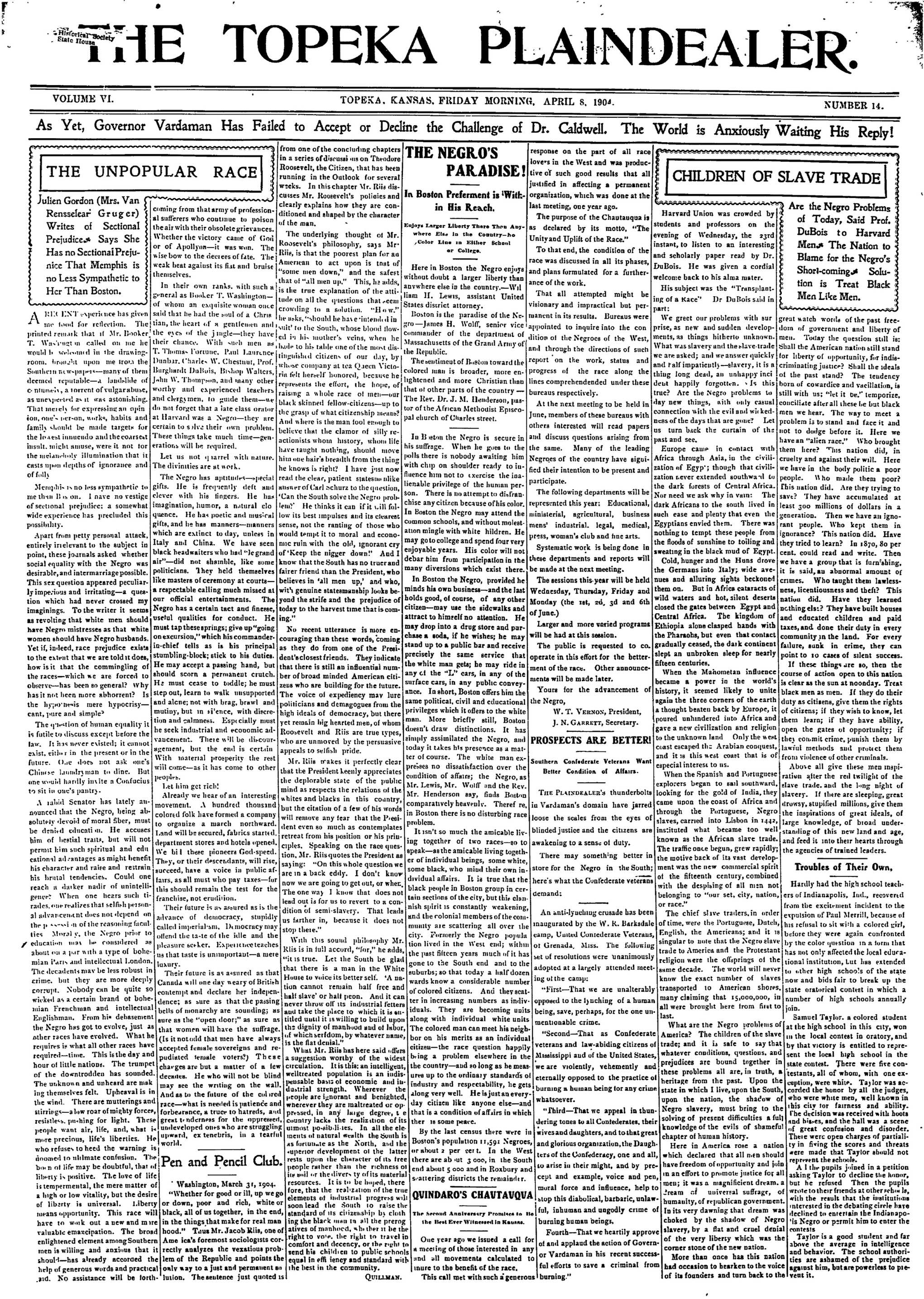
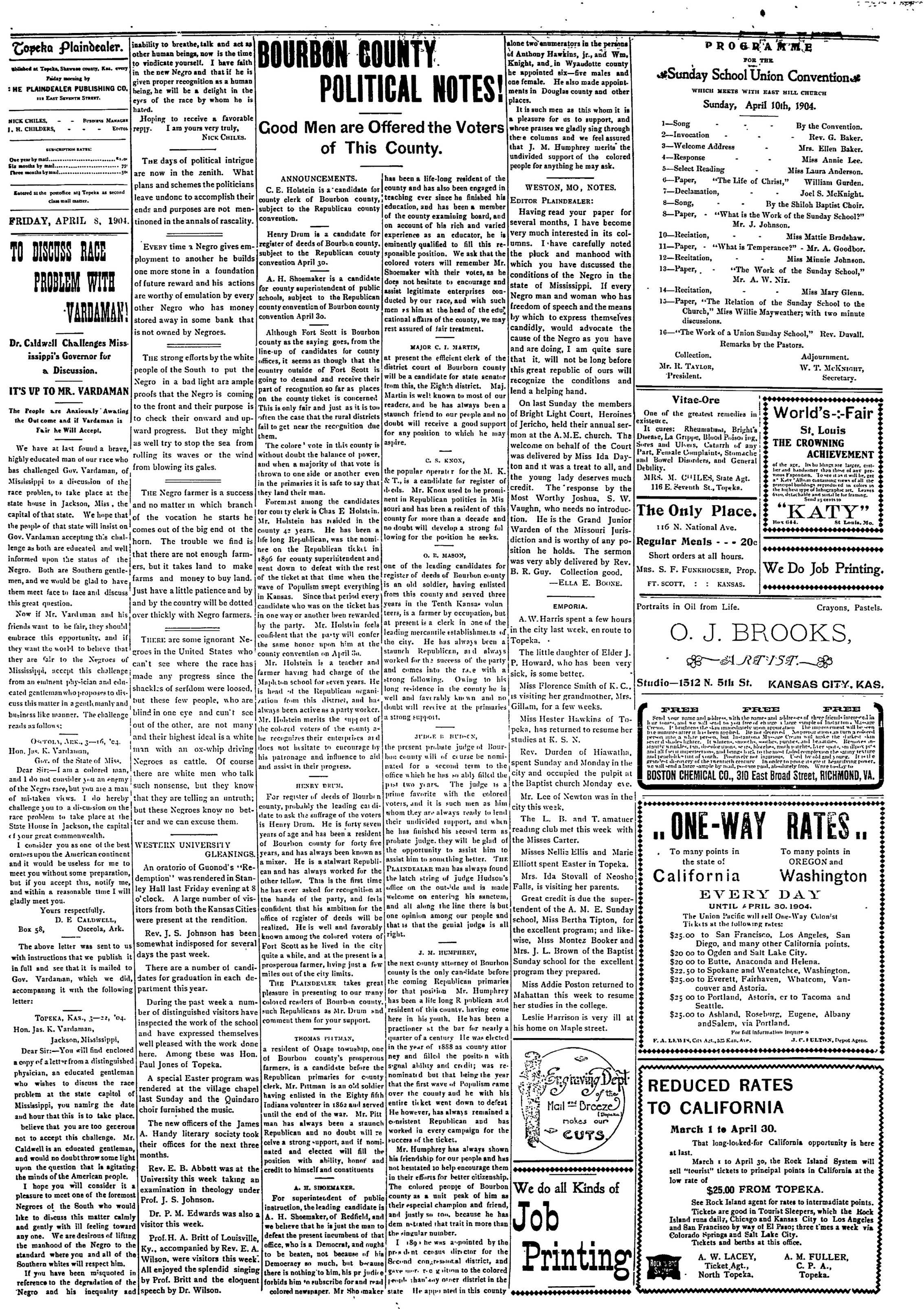
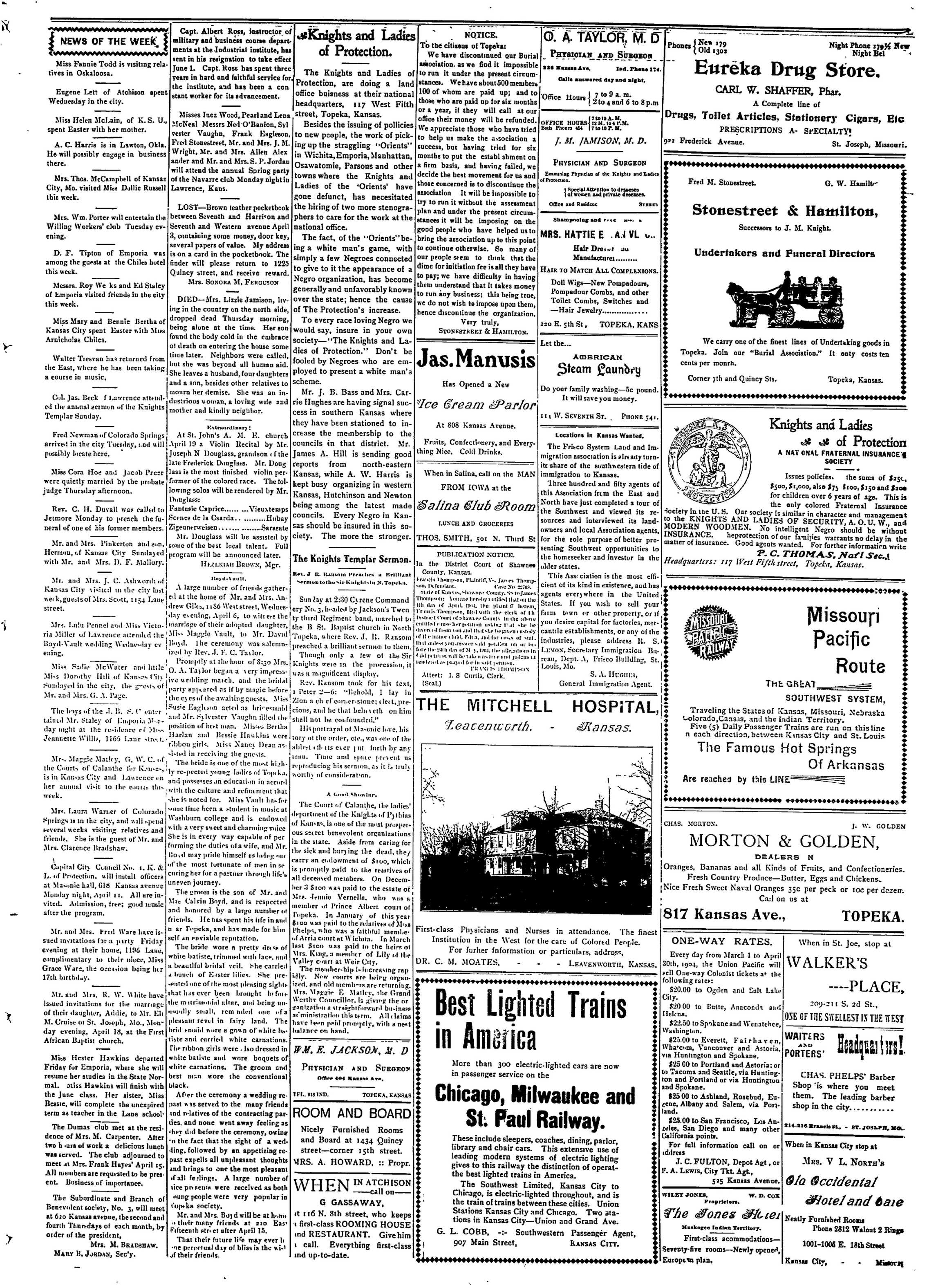
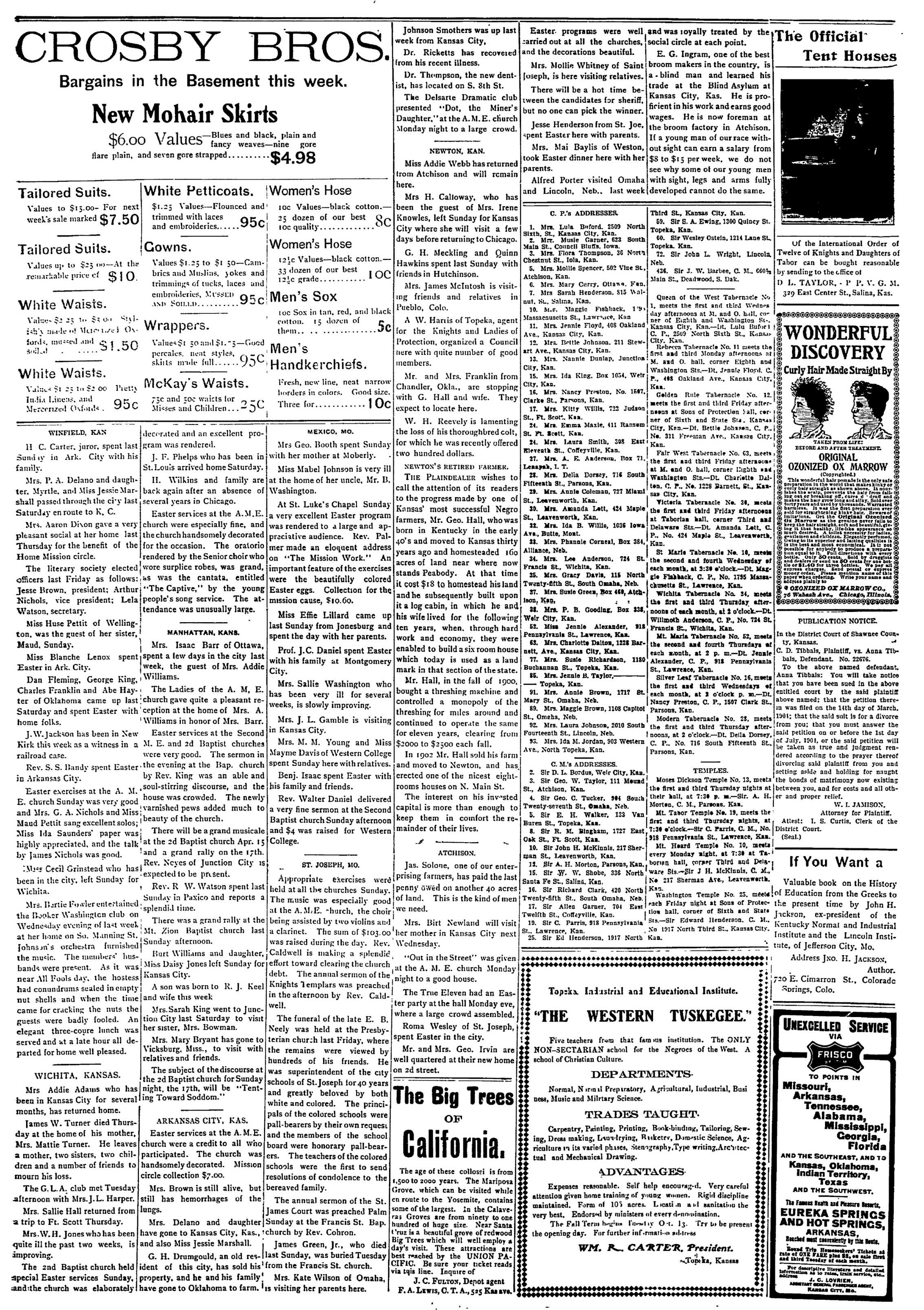
Page text (machine-generated)
THE TOPEKA PLAINDEALER.
Apart from petty personal attack, entirely irrelevant to the subject in point, these journals asked whether social equality with the Negro was desirable, and intermarriage possible. This sex question appeared peculiarly imperious and irritating—a question which had never crossed my imaginings. To the writer it seems as revolting that white men should have Negro mistresses as that white women should have Negro husbands. Yet if, indeed, race prejudice exists to the extent that we are told it does, how is it that the commingling of the races—which we are forced to observe—has been so general? Why has it not been more abhorrent? Is the hypothesis mere hypocrisy—cant, pure and simple?
Arabid Senator has lately announced that the Negro, being absolutely devoid of moral fiber, must be denied education. He accuses him of bestial traits, but will not permit him such spiritual and educational advantages as might benefit his character and raise and restrain his brutal tendencies. Could one reach a darker nadir of unintelligence? When one hears such tirades, one realizes that selfish personal advancement does not depend on the possession of the reasoning faculties. Moral v. the Negro prior to
education may be considered as about on a par with a type of bohemian Paris and intellectual London. The decadents may be less robust in crime, but they are more deeply corrupt. Nobody can be quite so wicked as a certain brand of bohemian Frenchman and intellectual Englishman. From his debasement the Negro has got to evolve, just as other races have evolved. What he requires is what all other races have required—time. This is the day and hour of little nations. The trumpet of the downtrodden has sounded. The unknown and unheard are making themselves felt. Upheaval is in the wind. There are murterings and stirrings—a low roar of mighty forces, resistless, pushing for light. These people want air, life, and, what is more precious, life's liberties. He who refuses to heed the warning is doomed to ultimate confusion. The born of life may be doubtful, that of liberty is positive. The love of life is tempermental, the mere matter of a high or low vitality, but the desire of liberty is universal. Liberty means opportunity. This race will have to work out a new and more valuable emancipation. The broad enlightened element among Southern men is willing and anxious that it should—has already accorded the help of generous words and practical aid. No assistance will be forth-
In their own ranks, with such a general as Booker T. Washington—of whom an exquisite woman once said that he had the soul of a Christian, the heart of a gentlemen and the eyes of the jungle—they have their chance. With such men as T. Thomas Fortune, Paul Lawrence Dunbar, Charles W. Chestnut, Prof. Burghardt Dubois, Bishop Walters, John W. Thompson, and many other worthy and experienced teachers and clergymen, to guide them—we do not forget that a late class orator at Harvard was a Negro—they are certain to solve their own problem. These things take much time—generations will be required.
The Negro has aptitudes—special gifts. He is frequently deft and clever with his fingers. He has imagination, humor, a natural eloquence. He has poetic and musical gifts, and he has manners—manners which are extinct to day, unless in Italy and China. We have seen black headwaiters who had "be grand air"—did not shamble, like some politicians. They held themselves like masters of ceremony at courts—a respectable calling much missed at our official entertainments. The Negro has a certain tact and finesse, useful qualities for conduct. He must tap these springs; give up "going on excursion," which his commander-in-chief tells as is his principal stumbling-block; stick to his duties. He may accept a passing hand, but should scorn a permanent crutch. He must cease to toddle; he must step out, learn to walk unsupported and alone; not with brag, brawl and mutiny, but in silence, with discretion and calmness. Especially must he seek industrial and economic advancement. There will be dis-couragement, but the end is certain. With material prosperity the rest will come—as it has come to other peoples.
Let him get rich!
Already we hear of an interesting movement. A hundred thousand colored folk have formed a company to organize a march northward. Land will be secured, fabrics started, department stores and hotels opened. We bill these pioneers God-speed. They, or their descendants, will rise, succeed, have a voice in public affairs, as all must who pay taxes—for this should remain the test for the franchise, not erudition.
Their future is as assured as is the advance of democracy, stupidly called imperialism. Democracy may offend the taste of the idle and the pleasure seeker. Experience teaches us that taste is unimportant—a mere luxury.
Their future is as assured as that Canada will one day weary of British contempt and declare her independence; as sure as that the passing bells of monarchy are sounding; as sure as the "open door;" as sure as that women will have the suffrage. (Is it not odd that men have always accepted female sovereigns and repudiated female voters?) These changes are but a matter of a few decades. He who will not be blind may see the writing on the wall. And as to the future of the colored race—what is needed is patience and forbearance, a truce to hatreds, and great tenderness for the oppressed, undeveloped ones who are struggling upward, ex tenebris, in a tearful world.
Pen and Pencil Club.
Washington, March 31, 1904. "Whether for good or ill, up we go or down, poor and rich, white or black, all of us together, in the end, in the things that make for real manhood." Thus Mr. Jacob Kiis, one of Ameica's foremost sociologists correctly analyzes the vexatious problem of the Republic and points the only way to a just and permanent solution. The sentence just quoted is
TOPEKA, KANSAS, FRIDAY MORNING, APRIL 8, 1904.
The underlying thought of Mr. Roosevelt's philosophy, says Mr. Riis, is that the poorest plan for an American to act upon is that of "some men down," and the safest that of "all men up." This, he adds, is the true explanation of the attitude on all the questions that seem crowding to a solution. "How." he asks, "should he have intended in suit' to the South, whose blood flowed in his mother's veins, when he had to his table one of the most distinguished citizens of our day, by whose company at tea Queen Victoria felt herself honored, because he represents the effort, the hope, of raising a whole race of men—our black skinned fellow-citizens—up to the grasp of what citizenship means? And where is the man tool enough to believe that the clamor of silly reactionists whom history, whom life have taught nothing, should move him one hair's breadth from the thing he knows is right? I have just now read the clear, patient statesmen like answer of Carl Schurz to the question, 'Can the South solve the Negro problem?' He thinks it can if it will follow its best impulses and its clearest sense, not the ranting of those who would tempt it to moral and economic ruin with the old, ignorant cry of 'Keep the nigger down.' And I know that the South has no truer and fairer friend than the President, who believes in 'all men up,' and who, with genuine statesmanship looks beyond the strife and the prejudice of today to the harvest time that is coming."
No recent utterance is more encouraging than these words, coming as they do from one of the President's closest friends. They indicate that there is still an influential number of broad minded American citizens who are building for the future. The voice of expediency may lure politicians and demagogues from the high ideals of democracy, but there yet remain big hearted men, of whom Roosevelt and Riis are true types, who are unmoved by the persuasive appeals to selfish pride.
Mr. Riis makes it perfectly clear that the President keenly appreciates the deplorable state of the public mind as respects the relations of the whites and blacks in this country, but the citation of a few of his words will remove any fear that the President even so much as contemplates retreat from his position or his principles. Speaking on the race question, Mr. Riis quotes the President as saying: "On this whole question we are in a back eddy. I don't know now we are going to get out, or when. The one way I know that does not lead out is for us to revert to a condition of semi-slavery. That leads us farther in, because it does not stop there."
With this sound philosophy Mr. Riis is in full accord, "for," he adds, "it is true. Let the South be glad that there is a man in the White House to voice its better self. 'A nation cannot remain half free and half slave' or half peon. And it can never throw off its industrial fetters and take the place to which it is entitled until it is willing to build upon the dignity of manhood and of labor, of which serfdom, by whatever name, is the flat denial."
What Mr. Riia has here said offers a suggestion worthy of the widest circulation. It is this: an intelligent, welltreated population is an indispensable basis of economic and industrial strength. Wherever the people are ignorant and benighted, wherever they are maltreated or oppressed, in any large degree, the country lacks the realization of its unimost possibilities. In all the elements of natural wealth the South is as fortunate as the North, and the superior development of the latter rests upon the character of its free people rather than the richness of its soil or the diversity of its material resources. It is to be hoped, therefore, that the realization of the true elements of industrial progress will soon lead the South to raise the standard of its citizenship by clothing the black man in all the prerogatives of manhood, whether it be the right to vote, the right to travel in comfort and decency, or the right to send his children to public schools equal in efficiency and standard with the best in the community.
OUILLMAN.
THE NEGRO'S PARADISE!
In Boston Preferment is Within His Reach.
Enjoys Larger Liberty There Then Anywhere Else in the Country-ho, Color Line in Either School or College.
Here in Boston the Negro enjoys without doubt a larger liberty than anywhere else in the country.—William H. Lewis, assistant United States district attorney.
Boston is the paradise of the Negro—James H. Wolff, senior vice commander of the department of Massachusetts of the Grand Army of the Republic.
The sentiment of Boston toward the colored man is broader, more enlightened and more Christian than that of other parts of the country—The Rev. Dr. J. M. Henderson, pastor of the African Methodist Episcopal church of Charles street.
In Boston the Negro is secure in his suffrage. When he goes to the polls there is nobody awaiting him with chip on shoulder ready to influence him not to exercise the inalienable privilege of the human person. There is no attempt to disfranchise any citizen because of his color. In Boston the Negro may attend the common schools, and without molestation mingle with white children. He may go to college and spend four very enjoyable years. His color will not debar him from participation in the many diversions which exist there.
In Boston the Negro, provided he minds his own business—and the last holds good, of course, of any other citizen—may use the sidewalks and attract to himself no attention. He may drop into a drug store and purchase a soda, if he wishes; he may stand up to a public bar and receive precisely the same service that the white man gets; he may ride in any of the "L" cars, in any of the surface cars, in any public conveyance. In short, Boston offers him the same political, civil and educational privileges which it offers to the white man. More briefly still, Boston doesn't draw distinctions. It has simply assimilated the Negro, and today it takes his presence as a matter of course. The white man expresses no dissatisfaction over the condition of affairs; the Negro, as Mr. Lewis, Mr. Wolff and the Reva Mr. Henderson say, finds Boston comparatively heavenly. Theref re in Boston there is no disturbing race problem.
It isn't so much the amicable living together of two races—so to speak—as the amicable living together of individual beings, some white, some black, who mind their own individual affairs. It is true that the black people in Boston group in certain sections of the city, but this clanish spirit is constantly weakening, and the colonial members of the community are scattering all over the city. Formerly the Negro population lived in the West end; within the past fifteen years much of it has gone to the South end and to the suburbs; so that today a half dozen wards know a considerable number of colored citizens. And they scatter in increasing numbers as individuals. They are becoming units along with individual white units. The colored man can meet his neighbor on his merits as an individual citizen—the race question happily being a problem elsewhere in the country—and so long as he measures up to the ordinary standards of industry and respectability, he gets along very well. He is just an everyday day citizen like anyone else—and that is a condition of affairs in which ther is some peace.
By the last census there were in Boston's population 11,591 Negroes, or about 2 per cent. In the West there are about 3000, in the South end about 5000 and in Roxbury and scattering districts the remainder.
QVINDARO'S CHAUTAUQVA
The Second Anniversary Promises to Be
the Best Ever Witnessed in Kauga.
One year ago we issued a call for
a meeting of those interested in any
and all movements calculated to
inure to the benefit of the race.
This call met with such a generous
NUMBER 14.
SLAVE TRADE
Are the Negro Problems of Today, Said Prof. DuBois to Harvard Men. The Nation to Blame for the Negro's Short-coming Solution is Treat Black Men Like Men.
Great watch words of the past freedom of government and liberty of men. Today the question still is: shall the American nation still stand for liberty of opportunity, for indiscriminating justice? Shall the ideals of the past stand? The tendency born of cowardice and vacillation, is still with us; "let it be," temporize, conciliate after all these be but black men we hear. The way to meet a problem is to stand and face it and not to dudge before it. Here we have an "alien race." Who brought them here? This nation did, in cruelty and against their will. Here we have in the body politic a poor people. Who made them poor? This nation did. Are they trying to have? They have accumulated at least 300 millions of dollars in a generation. Then we have an ignorant people. Who kept them in ignorance? This nation did. Have they tried to learn? In 1870, 80 per cent, could read and write. Then we have a group that is formishing, it is said, an abnormal amount of crimes. Who taught them lawlessness, licentiousness and theft? This nation did. Have they learned anything else? They have built houses and educated children and paid taxes, and done their duty in every community in the land. For every failure, sank in crime, they can point to 10 cases of silent success.
If these things are so, then the course of action open to this nation is clear as the sun at noonday. Treat black men as men. If they do their duty as citizens, give them the rights of citizens; if they wish to know, let them learn; if they have ability, open the gates of opportunity; if they commit crime, punish them by lawful methods and protect them from violence of other criminals.
Above all give these men inspiration after the red twilight of the slave trade, and the long night of slavery. If there are sleeping, great drowsy, stupified millions, give them the inspirations of great ideals, of large knowledge, of broad understanding of this new land and age, and feed it into their hearts through the agencies of trained leaders.
Troubles of Their Own,
Hardly had the high school teachers of Indianapolis, Ind., recovered from the excitement incident to the expulsion of Paul Merrill, because of his refusal to sit with a colored girl, before they were again confronted by the color question in a form that has not only affected the local educational institution, Lut has extended to other high schools of the state now and bids fair to break up the state oratorical contest in which a number of high schools annually join.
Samuel Taylor, a colored student at the high school in this city, won in the local contest in oratory, and by that victory is entitled to represent the local high school in the state contest. There were five contestants, all of whom, with one exception, were white. Taylor was accorded the honor by all the judges, who were white men, well known in this city for fairness and ability. The decision was received with hoots and bites, and the hall was a scene of great confusion and disorder. There were open charges of partiality in fiving the scores and threats were made that Taylor should not represent the schools.
A l the pupils joined in a petition asking Taylor to decline the honor, but he refused. Then the pupils wrote to their friends at other schools, with the result that the institutions interested in the debating circle have declined to entertain the Indianapolis Negro or permit him to enter the contests. Taylor is a good student and far above the average in intelligence and behavior. The school authorities are ashamed of the prejudice against him, but are powerless to prevent it.
Topeka Plaindealer.
Published at Topeka, Shawnee county, Kus., every
Friday morning by
: HE PLAINDEALER PUBLISHING CO,
112 EAST SEVENTH STREET.
NICK CHILES, - - BUSINESS MANAGER
J. H. CHILDERS, - - EDITOR
SUBSCRIPTION RATES:
One year by mail.....£1.00
Six months by mail.....75£
Three months by mail.....50£
Entered at the postoffice at Topeka as second class mail matter.
FRIDAY, APRIL S. 1904.
TO DISCUSS RACE PROBLEM WITH VARDAMAN!
Dr. Caldwell Challenges Mississippi's Governor for a Discussion.
IT'S UP TO MR. VARDAMAN
The People are Anxiously Awating the Outcome and if Vardaman is Fair he Will Accept.
We have at last found a brave, highly educated man of our race who has challenged Gov. Vardaman, of Mississippi to a discussion of the race problem, to take place at the state house in Jackson, Miss, the capital of that state. We hope that the people of that state will insist on Gov. Vardaman accepting this challenge as both are educated and well informed upon the status of the Negro. Both are Southern gentlemen, and we would be glad to have them meet face to face and discuss this great question.
Now if Mr. Vardiman and his friends want to be fair, they should embrace this opportunity, and if they want the world to believe that they are fair to the Negroes of Mississippi, accept this challenge from an eminent physician and educated gentleman who proposes to discuss this matter in a gentlemanly and business like manner. The challenge reads as follows:
Oscotly, Aek., 3-16, 'c4.
Hon. Jas, K. Vardaman.
Gov. of the State of Miss.
Dear Sir:—I am a colored man, and I do not consider you an enemy of the Negro race, but you are a man of mi-taken views. I do hereby challenge you to a discussion on the race problem to take place at the State House in Jackson, the capital of your great commonwealth.
I consider you as one of the best orators upon the American continent and it would be useless for me to meet you without some preparation, but if you accept this, notify me, and within a reasonable time I will gladly meet you.
Yours respectfully.
The above letter was sent to us with instructions that we publish it in full and see that it is mailed to Gov. Vardaman, which we did, accompanying it with the following letter:
TOPEKA, KAS., 3-22, '04.
Hon. Jas. K. Vardaman,
Jackson, Mississippi.
Dear Sir: You will find enclosed a copy of a letter from a distinguished physician, an educated gentleman who wishes to discuss the race problem at the state capitol of Mississippi, you naming the date and hour that this is to take place. believe that you are too gervous not to accept this challenge. Mr. Caldwell is an educated gentleman, and would no doubt throw some light upon the question that is agitating the minds of the American people.
I hope you will consider it a pleasure to meet one of the foremost Negroes of the South who would like to discuss this matter calmly and gently with ill feeling toward any one. We are desirous of lifting the manhood of the Negro to the standard where you and all of the Southern whites will respect him. If you have been misquoted in reference to the degradation of the Negro and his inequality and
inability to breathe, talk and act as other human beings, now is the time to vindicate yourself. I have faith in the new Negro and that if he is given proper recognition as a human being, he will be a delight in the eyes of the race by whom he is hated.
Hoping to receive a favorable reply. I am yours very truly,
NICK CHILES.
The days of political intrigue are now in the zenith. What plans and schemes the politicians leave undone to accomplish their ends and purposes are not mentioned in the annals of rascality.
EVERY time a Negro gives employment to another he builds one more stone in a foundation of future reward and his actions are worthy of emulation by every other Negro who has money stored away in some bank that is not owned by Negroes.
THE strong efforts by the white people of the South to put the Negro in a bad light are ample proofs that the Negro is coming to the front and their purpose is to check their onward and upward progress. But they might as well try to stop the sea from rolling its waves or the wind from blowing its gales.
THE Negro farmer is a success and no matter in which branch of the vocation he starts he comes out of the big end of the horn. The trouble we find is that there are not enough farmers, but it takes land to make farms and money to buy land. Just have a little patience and by and by the country will be dotted over thickly with Negro farmers.
---
THERE are some ignorant Negroes in the United States who can't see where the race has made any progress since the shackles of serfdom were loosed, but these few people, who are blind in one eye and can't see out of the other, are not many and their highest ideal is a white man with an ox-whip driving Negroes as cattle. Of course there are white men who talk such nonsense, but they know that they are telling an untruth; but these Negroes know no better and we can excuse them.
An oratorio of Guonod's "Redemption" was rendered in Stanley Hall last Friday evening at 8 o'clock. A large number of visitors from both the Kansas Cities were present at the rendition.
Rev. J. S. Johnson has been somewhat indisposed for several days the past week.
There are a number of candidates for graduation in each department this year.
During the past week a number of distinguished visitors have inspected the work of the school and have expressed themselves well pleased with the work done here. Among these was Hon. Paul Jones of Topeka.
A special Easter program was rendered at the village chapel last Sunday and the Quindaro choir furnished the music.
The new officers of the James A. Handy literary society took their offices for the next three months.
Rev. E. B. Abbott was at the University this week taking an examination in theology under Prof. J. S. Johnson.
Dr. P. M. Edwards was also a visitor this week.
Prof. H. A. Britt of Louisville, Ky., accompanied by Rev. E. A. Wilson, were visitors this week. All enjoyed the splendid singing by Prof. Britt and the eloquent speech by Dr. Wilson.
BOURBON COUNTY POLITICAL NOTES!
Good Men are Offered the Voters of This County.
ANNOUNCEMENTS.
C. E. Holstein is a candidate for county clerk of Bourbon county, subject to the Republican county convention.
Henry Drum is a candidate for register of deeds of Bourbon county, subject to the Republican county convention April 30.
A. H. Shoemaker is a candidate for county superintendent of public schools, subject to the Republican county convention of Bourbon county convention April 30.
Although Fort Scott is Bourbon county as the saying goes, from the line-up of candidates for county offices, it seems as though that the country outside of Fort Scott is going to demand and receive their part of recognition so far as places on the county ticket is concerned. This is only fair and just as it is too often the case that the rural districts fail to get near the recognition due them.
The colore vote in this county is without doubt the balance of power, and when a majority of that vote is thrown to one side or another even in the primaries it is safe to say that they land their man.
Foremost among the candidates for county clerk is Chas E Holstein. Mr. Holstein has resided in the county 42 years. He has been a life long Republican, was the nominee on the Republican ticket in 1896 for county superintendent and went down to defeat with the rest of the ticket at that time when the wave of Populism swept everything in Kansas. Since that period every candidate who was on the ticket has in one way or another been rewarded by the party. Mr. Holstein feels confident that the party will confer the same honor upon him at the county convention on April 30.
Mr. Holstein is a teacher and farmer having had charge of the Mapleton school for seven years. He is head of the Republican organization from this district, and has always been active as a party worker. Mr. Holstein merits the support of the colored voters of the county as he recognizes their enterprises and does not hesitate to encourage by his patronage and influence to aid and assist in their progress.
HENRY DRUM.
For register of deeds of Bourbon county, probably the leading candidate to ask the suffrage of the voters is Henry Drum. He is forty seven years of age and has been a resident of Bourbon county for forty five years, and has always been known as a mixer. He is a stalwart Republican and has always worked for the other fellow. This is the first time he has ever asked for recognition at the hands of the party, and feels confident that his ambition for the office of register of deeds will be realized. He is well and favorably known among the colored voters of Fort Scott as he lived in the city quite a while, and at the present is a prosperous farmer, living just a few miles out of the city limits.
THE PLAINDEALER takes great pleasure in presenting to our many colored readers of Bourbon county, such Republicans as Mr. Drum and comment them for your support.
THOMAS PUTMAN.
a resident of Osage township, one of Bourbon county's prosperous farmers, is a candidate before the Republican primaries for county clerk. Mr. Pittman is an old soldier having enlisted in the Eighty fifth Indiana volunteer in 1862 and served until the end of the war. Mr. Pittman has always been a staunch Republican and no doubt will receive a strong support, and if nominated and elected will fill the position with ability, honor and credit to himself and constituents
A. H. SHOEMAKER.
For superintendent of public instruction, the leading candidate is A. H. Shoemaker, of Redfield, and we believe that he is just the man to defeat the present incumbent of that office, who is a Democrat, and ought to be beaten, not because of his Democracy so much, but because there is nothing to him, his pr justice forbids him to subscribe for and read colored newspaper. Mr Shoemaker
has been a life-long resident of the county and has also been engaged in teaching ever since he finished his education, and has been a member of the county examining board, and on account of his rich and varied experience as an educator, he is eminently qualified to fill this responsible position. We ask that the colored voters will remember Mr. Shoemaker with their votes, as he does not hesitate to encourage and assist legitimate enterprises conducted by our race, and with such men as him at the head of the educational affairs of the county, we may rest assured of fair treatment.
MAJOR C. I. MARTIN.
at present the efficient clerk of the district court of Bourborn county will be a candidate for state senator from this, the Eighth district. Maj. Martin is well known to most of our readers, and he has always been a staunch friend to our people and no doubt will receive a good support for any position to which he may aspire.
C. S. KNOX.
the popular operator for the M. K. & T., is a candidate for register of deds. Mr. Knox used to be prominent in Republican politics in Missouri and has been a resident of this county for more than a decade and no doubt will develop a strong following for the position he seeks.
O. E. MASON.
one of the leading candidates for register of deeds of Bourbon county is an old soldier, having enlisted from this county and served three years in the Tenth Kansas volunteers, is a farmer by occupation, but at present is a clerk in one of the leading mercantile establishments of the city. He has always been a staunch Republican, and always worked for the success of the party and comes into the race with a strong following. Owing to his long residence in the county he is well and favorably known and no doubt will receive at the primaries a strong support.
JUDGE B HUD-CN.
the present probate judge of Bourbon county will of course be nominated for a second term to the office which he has so ably filled the past two years. The judge is a prime favorite with the colored voters, and it is such men as him whom they are always ready to lend their undivided support, and when he has finished his second term as probate judge, they will be glad of the opportunity to assist him to assist him to something better. THE PLAINDEALER man has always found the latch string of judge Hudson's office on the out-side and is made welcome on entering his sanctum, and all along the line there is but one opinion among our people and that is that the genial judge is all right.
J. M. HUMPHREY.
the next county attorney of Bourbon county is the only candidate before the coming Republican primaries for that position Mr. Humphrey has been a life long Republican and resident of this county, having come here in his youth. He has been a practitioner at the bar for nearly a quarter of a century. He was elected in the year of 1888 as county attorney and filled the position with signal ability and credit; was renominated but that being the year that the first wave of Populism came over the county and he with his entire ticket went down to defeat. He however, has always remained a consistent Republican and has worked in every campaign for the success of the ticket.
Mr. Humphrey has always shown his friendship for our people and has not hesitated to help encourage them in their efforts for better citizenship. The colored people of Bourbon county as a unit peak of him as their especial champion and friend, and justly so, because he has demonstrated that trait in more than the singular number. I 1890 he was appointed by the president census director for the Second congressional district, and gave more recognition to the colored people than any other district in the state. He appointed in this county
alone two enumerators in the persons of Anthony Hawkins, jr., and Wm. Knight, and in Wyaudotte county he appointed six-five males and one female. He also made appointments in Douglas county and other places. It is such men as this whom it is a pleasure for us to support, and whose praises we gladly sing through these columns and we feel assured that J. M. Humphrey merits the undivided support of the colored people for anything he may ask.
Having read your paper for several months, I have become very much interested in its columns. I have carefully noted the pluck and manhood with which you have discussed the conditions of the Negro in the state of Mississippi. If every Negro man and woman who has freedom of speech and the means by which to express themselves candidly, would advocate the cause of the Negro as you have and are doing, I am quite sure that it, will not be long before this great republic of ours will recognize the conditions and lend a helping hand.
On last Sunday the members of Bright Light Court, Heroines of Jericho, held their annual sermon at the A.M.E. church. The welcome on behalf of the Court was delivered by Miss Ida Dayton and it was a treat to all, and the young lady deserves much credit. The response by the Most Worthy Joshua, S. W. Vaughn, who needs no introduction. He is the Grand Junior Warden of the Missouri Jurisdiction and is worthy of any position he holds. The sermon was very ably delivered by Rev. B. R. Guy. Collection good.
EMPORIA.
A.W. Harris spent a few hours in the city last week, en route to Topeka.
The little daughter of Elder J. P. Howard, who has been very sick, is some better.
Miss Florence Smith of K. C., is visiting her grandmother, Mrs. Gillam, for a few weeks.
Miss Hester Hawkins of Topeka, has returned to resume her studies at K. S. N.
Rev. Durden of Hiawatha, spent Sunday and Monday in the city and occupied the pulpit at the Baptist church Monday eve.
Mr. Lee of Newton was in the city this week.
The L. B. and T. amatuer reading club met this week with the Misses Carter.
Misses Nellie Ellis and Marie Elliott spent Easter in Topeka.
Mrs. Ida Stovall of Neosho Falls, is visiting her parents.
Great credit is due the superendent of the A. M. E. Sunday school, Miss Bertha Tipton, for the excellent program; and likewise, Miss Montez Booker and Mrs. J. L. Brown of the Baptist Sunday school for the excellent program they prepared.
Miss Addie Poston returned to Mahattan this week to resume her studies in the college.
Leslie Harrison is very ill at his home on Maple street.
Engraving Dept.
of the
Mail and Dreeze
(Dopaka)
makes our
CUTS.
We do all Kinds of Job Printing
1—Song By the Convention.
2—Invocation Rev. G. Baker.
3—Welcome Address Mrs. Ellen Baker.
4—Response Miss Annie Lee.
5—Select Reading Miss Laura Anderson.
6—Paper, "The Life of Christ," William Gurden.
7—Declamation, Joel S. McKnight.
8—Song, By the Shiloh Baptist Choir.
8—Paper, "What is the Work of the Sunday School?"
Mr. J. Johnson.
10—Reciation, Miss Mattie Bradshaw.
11—Paper, "What is Temperance?" Mr. A. Goodbor.
12—Recitation, Miss Minnie Johnson.
13—Paper, "The Work of the Sunday School," Mr. A. W. Nix.
14—Recitation, Miss Mary Glenn.
15—Paper, "The Relation of the Sunday School to the Church," Miss Willie Mayweather; with two minute discussions.
16—"The Work of a Union Sunday School," Rev. Duvall. Remarks by the Pastors.
World's--Fair
St. Louis
THE CROWNING
ACHIEVEMENT
of the age. Its buildings are larger, costlier and handsomer than those of any previous Exposition. To see it as it will be, get a "Katy" Album containing views of all the principal buildings reproduced in colors in the highest type of lithographic art. Leaves 6x10, detachable and suitable for framing.
Send 25 cents to
"KATY"
Box 644. St Louis, Mo.
We Do Job Printing.
O. J. BROOK ARTIST.
ROOKS,
IST.
KANSAS CITY, KAS.
FREE FREE
Send your name and address, with the names and addresses of three
hair tones, and we will send to you free of charge a large sample of
Cream. It lengthens the skin immediately upon application. The impor-
tive minutes output will be applied. He not discharged. Naparazin
person into a white person, but. Instantona Massage Cream will take
several shades lighter. It whitens, smooths, soothes, purifies, and beads
stainly wrinkles, tan, discolorations, scars, blotches, much purifies. Lever
and all four imperfections, and brings back to the most faded comple-
pe and peach-like tint of youth. Positively not injurious. Used by old a
grandest discovery of the twentieth century. In order to prove it great
we will send a large sample by mail, postage paid, absolutely free. Writ-
BOSTON CHEMICAL CO., 310 East Broad Street, R
FREE
and addresses of three friends interested in
charge a large sample of Instanton Massage
in application. The improvement will be seen
designed. Apparitions in turn a refined
Massage Cream will make the darkest skin
mothers, purifiers, and beauties. Removes
nails, much patches, layer sprays, small pumps
the most faded completeness the satiny texture
nurseries. Used by old and young. It is the
in order to prove it a great beauty lifting power,
and absolutely free. Write to-ly to
First Broad Street, RICHMOND, VA.
Send your name and address, with the names and addresses of three friends interested in your honeys, and we will send to you free of charge a large sample of Instantan, a lasagne sauce, and a large sample of Instantan's cream. For two minutes after it has been applied. No preparation an turn a colored person into a white person, but Instantan's Masque Cream will make the darkest skin several shades lighter. It whites, smooths, smears, purifies, and beautifies. Removes instantly wrinkles, ran, discolorations, scars, blanches, moth patches, liver spots, amoil pads, and all their imperfections, and bangs back to the most faded completion of the same texture. Instantan's masque cream is a wonderful grandiose discovery of the twentieth century. In order to prove its great beautifying power, we will send a large sample by mail, post paid, absolutely free. Write to us at BOSTON CHEMICAL CO., 310 East Broad Street, RICHMOND, VA.
RATES.
To many points in OREGON and Washington
EVERY DAY
UNTIL APRIL 30. 1904.
The Union Pacific will sell One-Way Color
Tickets at the following rates:
$25.00 to San Francisco, Los Angeles,
Diego, and many other Californias.
$20.00 to Ogden and Salt Lake City.
$20.00 to Eutte, Anaconda and Helena.
$22.50 to Spokane and Wenatchee, Wash.
$25.00 to Everett, Fairhaven, Whatcom,
couver and Astoria.
$25.00 to Portland, Astoria, or to Tacom
Seattle.
$25.00 to Ashland, Roseburg, Eugene,
and Salem, via Portland.
For full information inquire o
F. A. LEWIS, Ct. Apt. 525 Kan. Ave.
J. C. BULTO
AY DAY
APRIL 30. 1904.
Kell One-Way Colonist
rates:
Cisco, Los Angeles, San
other California points.
St Lake City.
Odda and Helena.
Wenatchee, Washington.
Haven, Whatcom, Van-
oria, or to Tacoma and
Burg, Eugene, Albany
Portland.
Information Inquire o
J. C. HULTON, Depot Agent.
STES
NIA
30.
California opportunity is here
to, the Rock Island System will
principal points in California at the
EVERY DAY
UNTIL APRIL 30. 1904.
The Union Pacific will sell One-Way Colonist
Tickets at the following rates:
$25.00 to San Francisco, Los Angeles, San
Diego, and many other California points.
$20 00 to Ogden and Salt Lake City.
$20 00 to Eutte, Anaconda and Helena.
$22.50 to Spokane and Wenatchee, Washington.
$25.00 to Everett, Fairhaven, Whatcom, Vancou-
ver and Astoria.
$25 00 to Portland, Astoria, or to Tacoma and
Seattle.
$25.00 to Ashland, Roseburg, Eugene, Albany
and Salem, via Portland.
For full information Inquire o
A. LEWIN, City Apt., 325 Kan. Ave.
REDUCED RATES TO CALIFORNIA
That long-looked-for California oppo at last.
March 1 to April 30, the Rock Island sell "tourist" tickets to principal points in C low rate of
That long-looked-for California opportunity is here at last.
March 1 to April 30, the Rock Island System will sell "tourist" tickets to principal points in California at the low rate of
$25.00 FROM TOPEKA.
See Rock Island agent for rates to intermediate points.
Tickets are good in Tourist Sleepers, which the Rock Island runs daily, Chicago and Kansas City to Los Angeles and San Francisco by way of El Paso; three times a week via Colorado Springs and Salt Lake City.
Tickets and berths at this office.
at for rates to intermediate points. Tourist Sleepers, which the Rock and Kansas City to Los Angeles of El Paso; three times a week via Lake City. At this office.
See Rock Island agent for rates to intermediate points.
Tickets are good in Tourist Sleepers, which the Rock Island runs daily, Chicago and Kansas City to Los Angeles and San Francisco by way of El Paso; three times a week via Colorado Springs and Salt Lake City.
Tickets and berths at this office.
A. W. LACEY,
Ticket Agt.,
A. M. FULLER,
C. P. A.,
North Topeka.
Topeka.
Collection. Mr. R. TAYLOR President.
Vitae-Ore
One of the greatest remedies in existence.
It cures: Rheumatism, Bright's Disease, La Gruppe, Blood Poisoning, Sores and Ulcers, Catarrh of any Part, Female Complaints, Stomache and Bowel Disorders, and General Debility.
MRS. M. C'HILES, State Agt.
116 E. Seventh St., Topeka.
The Only Place.
116 N. National Ave.
Regular Meals --- 20c
Short orders at all hours.
MRS. S. F. FUNKHOUSER, Prop.
FT. SCOTT, : : KANSAS.
Portraits in Oil from Life.
Studio-1512 N. 5th St.
FREE
FREE
ONE-WAY
To many points in the state of California
March 1 to April 30.
A. W. LACEY,
Ticket.Agt.,
North Topeka.
Rock and
System
Adjournment. W. T. McKnight, Secretary.
Crayons, Pastels.
Miss Fannie Todd is visiting relatives in Oskaloosa.
Eugene Lett of Atchison spent Wednesday in the city.
Miss Helen McLain, of K. S. U., spent Easter with her mother.
A. C. Harris is in Lawton, Okla. He will possibly engage in business there.
Mrs. Thos. McCampbell of Kansaz City, Mo. visited Miss Dollie Russell this week.
Mrs. Wm. Porter will entertain the Willing Workers' club Tuesday evening.
D. F. Tipton of Emporia was among the guests at the Chiles hotel this week.
Messrs. Roy We ks and Ed Staley of Emporia visited friends in the city this week.
Miss Mary and Bennie Bertha of Kansas City spent Easter with Miss Arnicholas Chiles.
Walter Tresvan has returned from the East, where he has been taking a course in music.
Col. Jas. Beck of Lawrence attended the annual sermon of the Knights Templar Sunday.
Fred Newman of Colorado Springs arrived in the city Tuesday, and will possibly locate here.
Miss Cora Hoe and Jacob Preer were quietly married by the probate judge Thursday afternoon.
Rev. C. H. Duvall was called to Jetmore Monday to preach the funeral of one of his former members.
Mr. and Mrs. Pinkerton and son, Hermon, of Kansas City Sundayed with Mr. and Mrs. D. F. Mallory.
Mr. and Mrs. J. C. Ashworth of Kansas City visited in the city last week, guests of Mrs. Scott, 1154 Lane street.
Mrs. Lulu Pennel and Miss Victoria Miller of Lawrence attended the Boyd-Vault wedding Wednesday evening.
Miss Sadie McWater and little Miss Dorothy Hill of Kansas City Sundayed in the city, the greets of Mr. and Mrs. G. A. Page.
The boys of the J. B. S. Centertained Mr. Staley of Emporia Monday night at the residence of Miss Jeannette Willis, 1165 Lane street.
Mrs. Maggie Matley, G. W. C. of the Courts of Calanthe for Kansas, is in Kansas City and Lawrence on her annual visit to the courts this week.
Mrs. Laura Warner of Colorado Springs is in the city, and will spend several weeks visiting relatives and friends. She is the guest of Mr. and Mrs. Clarence Bradshaw.
Capital City Council No. 1, K. & L. of Protection, will install officers at Masonic hall, 618 Kansas avenue Monday night, April 11. All are invited. Admission, free; good music after the program.
Mr. and Mrs. Fred Ware have issued invitations for a party Friday evening at their home, 1196 Lane, complimentary to their niece, Miss Grace Ware, the occasion being her 17th birthday.
Mr. and Mrs. R. W. White have issued invitations for the marriage of their daughter, Addie, to Mr. Elm M. Cruise or St. Joseph, Mo., Monday evening, April 18, at the First African Baptist church.
Miss Hester Hawkins departed Friday for Emporia, where she will resume her studies in the State Normal. Miss Hawkins will finish with the June class. Her sister, Miss Bessie, will complete the unexpired term as teacher in the Lane school. The Dumas club met at the residence of Mrs. M. Carpenter. After two hours of work a delicious lunch was served. The club adjourned to meet at Mrs. Frank Hayes' April 15. All members are requested to be present. Business of importance.
The Subordinate and Branch of Benevolent society, No. 3, will meet at 620 Kansas avenue, the second and fourth Thurdays of each month, by order of the president,
Mrs. M. BRADSHAW.
MARY B. JORDAN, Sec'y.
Capt. Albert Ross, instructor of military and business course departments at the Industrial institute, has sent in his resignation to take effect June 1. Capt. Ross has spent three years in hard and faithful service for the institute, and has been a constant worker for its advancement.
Misses Inez Wood, Pearland Lena McNeal Messrs Ned'O'Banion, Sylvester Vaughn, Frank Eagleson, Fred Stonestreet, Mr. and Mrs. J. M. Wright, Mr. and Mrs. Allen Alex ander and Mr. and Mrs. S. P. Jordau will attend the annual Spring party of the Navarre club Monday night in Lawrence, Kans.
LOST—Brown leather pocketbook between Seventh and Harrison and Seventh and Western avenue April 3, containing some money, door key, several papers of value. My address is on a card in the pocketbook. The finder will please return to 1225 Quincy street, and receive reward.
DIED—Mrs. Lizzie Jamison, living in the country on the north side, dropped dead Thursday morning, being alone at the time. Her son found the body cold in the embrace of death on entering the house some time later. Neighbors were called, but she was beyond all human aid. She leaves a husband, four daughters and a son, besides other relatives to mourn her demise. She was an industrious woman, a loving wife and mother and kindly neighbor.
Extraordinary!
At St. John's A. M. E. church
April 19 a Violin Recital by Mr.
Joseph N Douglass, grandson of the
late Frederick Douglass. Mr. Douglass is the most finished violin performer of the colored race. The following solos will be rendered by Mr. Douglass:
Fantasie Caprice.....Vieuxtemps
Scenes de la Csarda.....Hubay
Zigeunerweisen.....Sarasate
Mr. Douglass will be assisted by some of the best local talent. Full program will be announced later.
Boyd-Vault.
A large number of friends gathered at the home of Mr. and Mrs. Andrew Giles, 1186 West street, Wednesday evening, April 6, to witness the marriage of their adopted daughter, Miss Maggie Vault, to Mr. David Boyd. The ceremony was solemnized by Rev. J. E. C. Taylor.
Promptly at the hour of 8:30 Mrs. O. A. Taylor began a very impressive wedding match, and the bridal party appeared as if by magic before the eyes of the awaiting guests. Miss Susie Eagleson acted as bridesmaid and Mr. Sylvester Vaughn filled the position of host man. Misses Bertha Harlan and Bessie Hawkins were ribbon girls. Miss Nancy Dean assisted in receiving the guests.
The bride is one of the most highly respected young ladies of Topkas, and possesses an education in accord with the culture and refinement that she is noted for. Miss Vault has for some time been a student in music at Washburn college and is endowed with a very sweet and charming voice. She is in every way capable of performing the duties of a wife, and Mr. Bood may pride himself as being one of the most fortunate of men in securing her for a partner through life's uneven journey.
The groom is the son of Mr. and Mrs Calvin Boyd, and is respected and honored by a large number of friends. He has spent his life in and in ar Tepeka, and has made for himself an enviable reputation.
The bride wore a pretty dress of white batiste, trimmed with lace, and a beautiful bridal veil. She carried a bunch of Easter lilies. She presented one of the most pleasing sights that has ever been brought before the matrimonial altar, and being unusually small, reminded one of a pleasant revel in fairy land. The brid email wore a gown of white batiste and carried white carnations. The ribbon girls were. Also dressed in white batiste and wore boquets of white carnations. The groom and best man wore the conventional black.
After the ceremony a wedding reast was served to the many friends and relatives of the contracting parties, and none went away feeling as they did before the ceremony, owing to the fact that the sight of a wedding, followed by an appetizing reast expells all unpleasant thoughts and brings to one the most pleasant of all feelings. A large number of nice presents were received as both young people were very popular in Gopeka society. Mr. and Mrs. Boyd will be at home in their many friends, at 210 East Fifteenth street after April 15.
That their future life may ever be one perpetual day of bliss is the wish of their friends.
The Knights and Ladies of Protection, are doing a land office business at their national headquarters, 117 West Fifth street, Topeka, Kansas.
Besides the issuing of policies to new people, the work of picking up the straggling "Orients" in Wichita, Emporia, Manhattan, Osawatomie, Parsons and other towns where the Knights and Ladies of the 'Orients' have gone defunct, has necessitated the hiring of two more stenographers to care for the work at the national office.
The fact, of the "Orients" being a white man's game, with simply a few Negroes connected to give to it the appearance of a Negro organization, has become generally and unfavorably known over the state; hence the cause of The Protection's increase. To every race loving Negro we would say, insure in your own society—"The Knights and Ladies of Protection." Don't be fooled by Negroes who are employed to present a white man's scheme.
Mr. J. B. Bass and Mrs. Carrie Hughes are having signal success in southern Kansas where they have been stationed to increase the membership to the councils in that district. Mr. James A. Hill is sending good reports from north-eastern Kansas, while A. W. Harris is kept busy organizing in western Kansas, Hutchinson and Newton being among the latest made councils. Every Negro in Kansas should be insured in this society. The more the stronger.
The Knights Templar Sermon.
Rev. J. R. Ransom preaches a Brilliant
Sermon to the Sir Knight-in N. Topeka.
Sunday at 2:30 Cyrene Command
ery No. 3, headed by Jackson's Twenty
third Regiment band, marched to
the B St. Baptist church in North
Topeka, where Rev. J. R. Ransom
preached a brilliant sermon to them.
Though only a few of the Sir
Knights were in the procession, it
was a magnificent display.
Rev. Ransom took for his text,
1 Peter 2—6: "Behold, I lay in
Zion a ch of corner-stone; elect, precious,
and he that behalveth on him
shall not be confounded."
His portrayal of Masonic love, his story of the order, etc., was one of the ablest efforts ever put forth by any man. Time and space prevent us reproducing his sermon, as it is truly worthy of consideration.
A Good Showing.
The Court of Calanthe, the ladies' department of the Knights of Pythias of Kansas, is one of the most prosperous secret benevolent organizations in the state. Aside from caring for the sick and burying the dead, they carry an endowment of $100, which is promptly paid to the relatives of all deceased members. On December 3 $100 was paid to the estate of Mrs. Jennie Vernella, who was a member of Prince Albert court of Popeka. In January of this year $100 was paid to the relatives of Miss Phelps, who was a faithful member of Arria court at Wichita. In March last $100 was paid to the heirs of Mrs. King, a member of Lily of the Valley court at Weir City.
The member-hip is increasing rapidly. New courts are being organized, and old members are returning. Mrs. Maggie E. Matley, the Grand Worthy Councillor, is giving the organization a straightforward business administration this term. All claims have been paid promptly, with a nest balance on hand.
PHYSICIAN AND SURGEON
Office 404 Kansas Ave.
ROOM AND BOARD
Nicely Furnished Rooms and Board at 1434 Quincy street-corner 15th street. MRS. A. HOWARD, :: Propr
WHEN IN ATCHISON
call on
at 116 N. 8th street, who keeps first-class ROOMING HOUSE and RESTAURANT. Give him a call. Everything first-class and up-to-date.
THE MUSEUM
First-class Physicians and Nurses in attendance. The finest Institution in the West for the care of Colored People. For further information or particulars, address,
Best Lighted Trains in America
More than 300 electric-lighted cars are now in passenger service on the
These include sleepers, coaches, dining, parlor, library and chair cars. This extensive use of leading modern systems of electric lighting gives to this railway the distinction of operatethe best lighted trains in America.
The Southwest Limited, Kansas City to Chicago, is electric-lighted throughout, and is the train of trains between these cities. Union Stations Kansas City and Chicago. Two stations in Kansas City-Union and Grand Ave.
G. L. COBB, :- Southwestern Passenger Agent, 907 Main Street, KANSAS CITY.
We have discontinued our Burial association, as we find it impossible to run it under the present circumstances. We have about 500 members, 100 of whom are paid up; and to those who are paid up for six months or a year, if they will call at our office their money will be refunded. We appreciate those who have tried to help us make the association a success, but having tried for six months to put the establ shment on a firm basis, and having failed, we decide the best movement for us and those concerned is to discontinue the association. It will be impossible to try to run it without the assessment plan and under the present circumstances it will be imposing on the good people who have helped us to bring the association up to this point to continue otherwise. So many of our people seem to think that the dime for initiation fee is all they have to pay; we have difficulty in having them understand that it takes money to run any business; this being true, we do not wish to impose upon them, hence discontinue the organization.
Very truly,
STONESTREET & HAMILTON.
Jas.Manusis
Has Opened a New Ice Cream Parlor At 808 Kansas Avenue. Fruits, Confectionery, and Everything Nice. Cold Drinks. When in Salina, call on the MAN FROM IOWA at the
Salina Club Room
LUNCH AND GROCERIES
THOS, SMITH, 501 N. Third St
In the District Court of Shawnee County, Kansas.
Francis Thompson, Plaintiff, Vs. James Thompson, Defendant.
Case No 22708.
State of Kansas, Shawnee County, Vs. James Thompson: You are hereby notified that on the 6th day of April, 1934, the plant of herein, Francis Thompson, filed with the clerk of the District Court of Shawnee County in the above certified notice petition asking that she be divorced from you and that she be given custody of the minor child, Felia, and for cases of suit, that unless you answer said petition on or before the 22nd day of May, 1934, the allegations in said petition will be taken as true and justified tendered as prayed for in said petition.
FRANÇIS THOMPSON
Attest: I. S. Curtis, Clerk.
(Seal.)
THE MITCHELL
Leacenworth.
MRS. HATTIE E. AN VL D...
Hair Dress
Manufacture1......
HAIR TO MATCH ALL COMPLEXIONS.
Doll Wigs—New Pompadours,
Pompadour Combs, and other
Toilet Combs, Switches and
—Hair Jewelry......
220 E. 5th St, TOPEKA, KANS
AMERICAN Steam Laundry
Do your family washing—5c pound.
It will save you money.
111 W. SEVENTH ST. PHONE 541
Locations in Kansas Wanted.
The Frisco System Land and Immigration association is already turn its share of the southwestern tide of immigration to Kansas. Three hundred and fifty agents of this Association from the East and North have just completed a tour of the Southwest and viewed its resources and interviewed its landowners and local Association agents, for the sole purpose of better presenting Southwest opportunities to the homeseeker and investor in the older states.
This Association is the most efficient of its kind in existence, and has agents everywhere in the United States. If you wish to sell your farm town or other property, or if you desire capital for factories, mercantile establishments, or any of the industries, please address R. S. LEMON, Secretary Immigration Bureau, Dept. A, Frisco Building, St. Louis, Mo.
S. A. HUGHES,
General Immigration Agent.
CARL W. SHAFFER, Phar.
A Complete line of
Drugs, Toilet Articles, Stationery
PRESCRIPTIONS A- SPECIALT
922 Frederick Avenue. St.
A Complete line of
Wilet Articles, Stationery Cigars, Eic
PRESCRIPTIONS A- SPECIALTY!
Avenue. St. Joseph, Missouri.
G. Stonestreet. G. W. Hamilton
Monstreet & Hamilton,
Successors to J. M. Knight.
Bertakers and Funeral Directors
Drugs, Toilet Articles, Stationery Cigars, Efc PRESCRIPTIONS A- SPECIALTY! 922 Frederick Avenue. St. Joseph, Missouri
Fred M. Stonestreet.
Stonestreet
Successors to
Undertakers and
Stonestreet & Hamilton, Successors to J. M. Knight.
Undertakers and Funeral Directors
We carry one of the finest lines of Undertaking good Topeka. Join our "Burial Association." It only costs cents per monrh.
carry one of the finest lines of Undertaking goods in Join our "Burial Association." It onty costs ten monrh.
We carry one of the finest lines of Undertaking goods in Topeka. Join our "Burial Association." It onty costs ten cents per monrh.
Corner 7th and Quincy Sts. Topeka, Kansas.
Society in the U.S. Our society is s to the KNIGHTS AND LADIES OF MODERN WOODMEN. No into INSURANCE. heprotection of our matter of insurance. Good agents w P.C.T Headquarters: 117 West Fifth str
Society in the U.S. Our society is similar in character and management to the KNIGHTS AND LADIES OF SECURITY, A. O. U. W., and MODERN WOODMEN. No intelligent Negro should be without INSURANCE. heprotection of our famiies warrants no delay in the matter of insurance. Good agents wanted. For further information write P.C. THOMA Nell St.
U.S. Our society is similar in character and management
HTS AND LADIES OF SECURITY, A. O. U. W., and
GOODMEN. No intelligent Negro should be without
heprotection of our families warrants no delay in the
unce. Good agents wanted. For further information write
P. C. THOMAS, Natl Sec.,
: 117 West Fifth street, Topeka, Kansas.
Headquarters: 117 West Fifth street, Topeka, Kansas.
Traveling the States of K
Colorado, Cansas, and the In
Five (5) Daily Passenger T
n each direction, between
The Famous H
Are reached by this LIN
CHAS. MORTON.
MORTON &
DEALER
Oranges, Bananas and all Kinds
Fresh Country Produce—B
Nice Fresh Sweet Naval Oranges
Call on
SOUTHWEST SYSTEM,
Bringing the States of Kansas, Missouri, Nebraska,
Cansas, and the Indian Territory.
(2) Daily Passenger Trains are run on this line
direction, between Kansas City and St. Louis
The Famous Hot Springs
Of Arkansas
purchased by this LINE
J. W. GOLDEN
ORTON & GOLDEN,
DEALERS N
Kansas and all Kinds of Fruits, and Confectioneries.
Country Produce—Butter, Eggs and Chickens.
Sweet Naval Oranges 35c per peck or 10c per dozen.
Call on us at
Traveling the States of Kansas, Missouri, Nebraska Colorado, Cansas, and the Indian Territory. Five (5) Daily Passenger Trains are run on this line in each direction, between Kansas City and St. Louis The Famous Hot Springs Of Arkansas Are reached by this LINE
DEALERS N Oranges, Bananas and all Kinds of Fruits, and Confectioneries. Fresh Country Produce—Butter, Eggs and Chickens. Nice Fresh Sweet Naval Oranges 35c per peck or 10c per dozen. Call on us at
817 Kansas Ave.,
ONE-WAY RATES.
Every day from March 1 to April 30th, 1904, the Union Pacific will sell One-way Colonist tickets at the following rates:
$20.00 to Ogden and Salt Lake City.
$20.00 to Butte, Anaconda and Hekna.
$22.50 to Spokane and Wenatchee, Washington.
$25.00 to Everett, Fairhaven,
AY RATES.
From March 1 to April Union Pacific will colonist tickets at the Ogden and Salt Lakeatte, Anaconda and kane and Wenatchee,
When in St. Joe, stop at WALKER'S ----PLACE,
209-211 S. 2d St.,
ONE OF THE SWELLEST IN THE WEST
Francisco, Los An-
do and many other
formation call on or
TON, Depot Agt, or
y Tkt. Agt.
525 Kansas Avenue.
W. D. COX
pretiers.
214-216 Francis St., - ST. JOSLPH, MO.
When in Kansas City stop at
MRS. V L. NORTH'S
Ola Occidental
Hotel and Care
WOODMEN K. K. O. I.
PROTECTION
MISSOURI
RAILWAY
Night Phone 179% New Night Bel
G. W. Hamilton
Topeka, Kansas.
Knights and Ladies
of Protection
A NAT ONAL FRATERNAL INSURANCE
SOCIETY
Issues policies. the sums of $250,
$500, $1,000, also $75 $100, $150 and $200
for children over 6 years of age. This is
the only colored Fraternal Insurance
Missouri Pacific Route
THE GREAT____
TOPEKA.
WAITERS AND ORTERS' Headquarters! CHAS. PHELPS' Barber Shop is where you meet them. The leading barber shop in the city.
MRS. V L. NORTH'S
Neatly Furnished Rooms
Phone 2812 Walnut 2 Rings
1001-1005 E. 18th Street
Kansas City, Missou
CROSBY BROS Bargains in the Basement this week. New Mohair Skirts
New Mohair Skirts
$6.00 Values—Blues and black, plain and fancy weaves—nine gore flare plain, and seven gore strapped.....$4.98
Tailored Suits.
Values up to $25 000-At the
remarkable price of $10.
White Waists. Values $2.25 to $3.00 Stylishly made of Mercerized Oyfords, mussed and soiled. $1.50
White Waists.
Valnes $1.25 to $2.00 Pretty
India Linens, and
Mercerized Oxfords. 95c
WINFIELD, KAN
H C. Carter, juror, spent last
Sunday in Ark. City with his
family.
Mrs. P. A. Delano and daugh-
ter, Myrtle, and Miss Jessie Mar-
shall passed through the city last
Saturday en route to K. C.
Mrs. Aaron Divon gave a very pleasant social at her home last Thursday for the benefit of the Home Mission circle.
The literary society elected officers last Friday as follows: Jesse Brown, president; Arthur Nichols, vice president; Lela Watson, secretary.
Miss Huse Pettit of Wellington, was the guest of her sister, Maud, Sunday.
Dan Fleming, George King, Charles Franklin and Abe Hayter of Oklahoma came up last Saturday and spent Easter with home folks. J.W. Jackson has been in New Kirk this week as a witness in a railroad case. Rev. S. S. Bandy spent Easter in Arkansas City.
Easter exercises at the A. M. E. church Sunday was very good and Mrs. G. A. Nichols and Miss Maud Pettit sang excellent solos; Miss Ida Saunders' paper was highly appreciated, and the talk by James Nichols was good. Miss Cecil Grinstead who has been in the city, left Sunday for Wichita.
Mrs. Bartie Fowler entertained the Booker Washington club on Wednesday evening of last week at her home on So. Manning St. Johnson's orchestra furnished the music. The members' husbands were present. As it was near All Fools day, the hostess had conundrums sealed in empty nut shells and when the time came for cracking the nuts the guests were badly fooled. An elegant three-copre lunch was served and at a late hour all departed for home well pleased.
WICHITA, KANSAS.
Mrs Addie Adams who has been in Kansas City for several months, has returned home.
James W. Turner died Thursday at the home of his mother, Mrs. Mattie Turner. He leaves a mother, two sisters, two children and a number of friends to mourn his loss.
Mrs. Sallie Hall returned from a trip to Ft. Scott Thursday.
Mrs.W.H. Jones who has been quite ill the past two weeks, is improving.
The 2nd Baptist church held special Easter services Sunday, and the church was elaborately
Wrappers.
Values $1.50 and $1.75—Good
percales, neat styles,
skirts made full.....95¢
McKay's Waists.
75¢ and 50¢ waists for
Misses and Children...25¢
decorated and an excellent program was rendered. J. F. Phelps who has been in St.Louis arrived home Saturday. H. Wilkins and family are back again after an absence of several years in Chicago.
Easter services at the A.M.E. church were especially fine, and the church handsomely decorated for the occasion. The oratorio rendered by the Senior choir who wore surplice robes, was grand, as was the cantata, entitled "The Captive," by the young people's song service. The attendance was unusually large.
MANHATTAN, KANS.
Mrs. Isaac Barr of Ottawa, spent a few days in the city last week, the guest of Mrs. Addie Williams.
The Ladies of the A. M, E. church gave quite a pleasant reception at the home of Mrs. A. Williams in honor of Mrs. Barr.
Easter services at the Second M. E. and 2d Baptist churches were very good. The sermon in the evening at the Bap. church by Rev. King was an able and soul-stirring discourse, and the house was crowded. The newly varnished pews added much to beauty of the church.
There will be a grand musicale at the 2d Baptist church Apr. 15 and a grand rally on the 17th. Rev. Neyes of Junction City is expected to be present.
Rev. R W. Watson spent last Sunday in Paxico and reports a splendid time.
There was a grand rally at the Mt. Zion Baptist church last Sunday afternoon.
Burt Williams and daughter, Miss Daisy Jones left Sunday for Kansas City.
A son was born to R. J. Keel and wife this week.
Mrs. Sarah King went to Junction City last Saturday to visit her sister, Mrs. Bowman.
Mrs. Mary Bryant has gone to Vicksburg. Miss., to visit with relatives and friends.
The subject of the discourse at the 2d Baptist church for Sunday night, the 17th, will be "Tenting Toward Soddom."
ARKANSAS CITY, KAS.
Easter services at the A.M.E. church were a credit to all who participated. The church was handsomely decorated. Mission circle collection $7.00. Mrs. Brown is still alive, but still has hemorrhages of the lungs. Mrs. Delano and daughter have gone to Kansas City, Kas., and also Miss Jessie Marshall.
G. H. Drumgould, an old resident of this city, has sold his property, and he and his family have gone to Oklahoma to farm.
Men's Sox
toc Sox in tan, red, and black cotton. 15 dozen of them. 5c
Men's
Handkerchiefs.
Fresh, new line, neat narrow borders in colors. Good size.
Three for.....10c
MEXICO, MO.
Mrs Geo. Booth spent Sunday with her mother at Moberly. Miss Mabel Johnson is very ill at the home of her uncle, Mr. B. Washington.
At St. Luke's Chapel Sunday a very excellent Easter program was rendered to a large and appreciative audience. Rev. Palmer made an eloquent address on "The Mission Work." An important feature of the exercises were the beautifully colored Easter eggs. Collection for the mission cause, $10.60.
Miss Effie Lillard came up last Sunday from Jonesburg and spent the day with her parents.
Prof. J.C. Daniel spent Easter with his family at Montgomery City.
Mrs. Sallie Washington who has been very ill for several weeks, is slowly improving.
Mrs. J. L. Gamble is visiting in Kansas City.
Mrs. M. M. Young and Miss Mayme Davis of Western College spent Sunday here with relatives.
Benj. Isaac spent Easter with his family and friends.
Rev. Walter Daniel delivered a very fine sermon at the Second Baptist church Sunday afternoon and $4 was raised for Western College.
ST. JOSEPH, MO.
Appropriate exercises were held at all the churches Sunday. The music was especially good at the A.M.E. church, the choir being assisted by two violins and a clarinet. The sum of $103.00 was raised during the day. Rev. Caldwell is making a splendid effort toward clearing the church debt. The annual sermon of the Knights Templars was preached in the afternoon by Rev. Caldwell.
The funeral of the late E. B. Neely was held at the Presbyterian church last Friday, where the remains were viewed by hundreds of his friends. He was superintendent of the city schools of St. Joseph for 40 years and greatly beloved by both white and colored. The principals of the colored schools were pall-bearers by their own request and the members of the school board were honorary pall-bearers. The teachers of the colored schools were the first to send resolutions of condolence to the bereaved family.
The annual sermon of the St. James Court was preached Palm Sunday at the Francis St. Bap. church by Rev. Cohron. James Green, Jr., who died last Sunday, was buried Tuesday from the Francis St. church. Mrs. Kate Wilson of Omaha, is visiting her parents here.
NEWTON, KAN.
Miss Addie Webb has returned from Atchison and will remain here.
Mrs H. Calloway, who has been the guest of Mrs. Irene Knowles, left Sunday for Kansas City where she will visit a few days before returning to Chicago.
G. H. Meckling and Quinn Hawkins spent last Sunday with friends in Hutchinson.
Mrs. James McIntosh is visiting friends and relatives in Pueblo, Colo.
A W. Harris of Topeka, agent for the Knights and Ladies of Protection, organized a Council here with quite number of good members.
Mr. and Mrs. Franklin from Chandler, Okla., are stopping with G. Hall and wife. They expect to locate here.
W. H. Reevely is lamenting the loss of his thoroughbred colt, for which he was recently offered two hundred dollars.
THE PLAINDEALER wishes to call the attention of its readers to the progress made by one of Kansas' most successful Negro farmers, Mr. Geo. Hall, who was born in Kentucky in the early 40's and moved to Kansas thirty years ago and homesteaded 160 acres of land near where now stands Peabody. At that time it cost $18 to homestead his land and he subsequently built upon it a log cabin, in which he and his wife lived for the following ten years, when, through hard work and economy, they were enabled to build a six room house which today is used as a land mark in that section of the state.
Mr. Hall, in the fall of 1900, bought a threshing machine and controlled a monopoly of the threshing for miles around and continued to operate the same for eleven years, clearing from $2000 to $2500 each fall.
In 1902 Mr. Hall sold his farm and moved to Newton, and has erected one of the nicest eight-rooms houses on N. Main St.
The interest on his invested capital is more than enough to keep them in comfort the remainder of their lives.
ATCHISON.
Jas. Solone, one of our enterprising farmers, has paid the last penny owed on another 40 acres of land. This is the kind of men we need.
Mrs. Birt Newland will visit her mother in Kansas City next Wednesday.
"Out in the Street" was given at the A. M. E. church Monday night to a good house.
The True Eleven had an Easter party at the hall Monday eve, where a large crowd assembled. Roma Wesley of St. Joseph, spent Easter in the city. Mr. and Mrs. Geo. Irvin are well quartered at their new home on 2d street.
The Big Trees OF California.
The age of these collossi is from 1,500 to 2000 years. The Mariposa Grove, which can be visited while en route to the Yosemite, contains some of the largest. In the Calaveras Groves are from ninety to one hundred of huge size. Near Santa Cruz is a beautiful grove of redwood Big Trees which will well employ a day's visit. These attractions are best reached by the UNION PACIFIC. Be sure your ticket reads via tqis line. Inquire of J. C. FULTON, Depot agent F. A. LEWIS, C. T. A., 525 Kaaava.
C. P.'s ADDRESSES
Mrs. Lula Buford, 2500 St., Kansas City, Kan.
Mrs. Musie Garner, 620 St., Council Bluffs, Iowa.
Mrs. Flora Thompson, 31 St. Iola, Kan.
Mrs. Mollie Spencer, 502 St., Iola, Kan.
Mrs. Mary Curry, Ottawa
Mrs. Sarah Henderson, 3 St., Salina, Kan.
Mrs. Maggie Fishback
Mrs. St. Lawrence, Mrs. Jennie Floyd, 408 Kansas City, Kan.
Mrs. Bottle Johnson, 21 Kansas City, Kan.
Mrs. Nannie Dunlap, Kan.
Mrs. Ida King, Box 100 Kan.
Mrs. Nancy Preston, 10 St., Parsons, Kan.
Mrs. Kitty Willis, 722 Scott, Kan.
Mrs. Emma Maxle, 411 Scott, Kan.
Mrs. Laura Smith, 31 St., Coffeyville, Kan.
Mrs. A. E. Anderson, I. T.
Mrs. Delia Dorsey, 71 St., Parsons, Kan.
Mrs. Annie Coleman, 721 Stevenworth, Kan.
Mrs. Amanda Lett, 421 Stevenworth, Kan.
Mrs. Ida B. Willis, 10uttle, Mont.
Mrs. Phanie Corneal, I, Neb.
Mrs. Lee Anderson, 10 St., Wichita, Kan.
Mrs. Gracy Davis, 111 Fifth St., South Omaha
Mrs. Susie Green, Box 410, Kan.
Mrs. P. B. Gooding, 10 City, Kan.
Mrs. Jennie Alexander
Mrs. St. Lawrence, Mrs. Charlotte Dalton, 10 Ave., Kansas City, Kan.
Mrs. Susie Richardson
Mrs. Topeka, Kan.
Mrs. Jennie B. Taylor,—Topeka, Kan.
Mrs. Annie Brown, 10 St., Omaha, Neb.
Mrs. Maggie Brown, 110 Zebra, Neb.
Mrs. Laura Johnson, 200th St., Lincoln, Neb.
Mrs. Ida M. Jordan, 903 North Topeka, Kan.
C. M.'s ADDRESSES.
C. D. L. Bordus, Weir C.
C. G. W. Taylor, 111 Johnson, Kan.
C. G. C. Tucker, 904 Seventh St., Omaha, Neb.
C. E. H. Walker, 11 St., Topeka, Kan.
C. R. M. Bingham, 17 St. Ft. Scott, Kan.
C. John H. McKinnis, 21 Leavenworth, Kan.
C. A. H. Morton, Parson, W. W. Shobe, 330 St. Salina, Kan.
C. Richard Clark, 421 Fifth St., South Omaha
C. Allen Garner, 70 St., Coffeyville, Kan.
C. C. Parris, 918 Pennance, Kan.
C. Ed Henderson, 1917
TOPEKA INDUSTRY
THE WEST
Five teachers from UN-SECTARIAN school of Christian Culture
Industrial and Educational
WESTERN TVSE
era from that famous institution
BRIAN school for the Negroes of
Culture.
```markdown
```
Topeka Industrial and Educational Institute.
"THE WESTERN TVSKEGEE."
Five teachers from that famous institution. The ONLY NON-SECTARIAN school for the Negroes of the West. A school of Christian Culture.
DEPARTMENTS
Normal, Normal Preparatory, Agricultural, Industrial, Business, Music and Milrtary Science.
TRADES TAUGHT
Carpentry, Painting,
Dress making, Launch
ture in its varied phas
and Mechanical Dra
ADV
Expenses reasonable
ation given home train
tained. Form of 10
best. Endorsed by m
The Fall Term begin
opening day. For furt
WM. R
Painting, Printing, Book-binding,
ing, Laundrying, Rasketry, Domest
varied phases, Stenography, Type wi
chanical Drawing.
Carpentry, Painting, Printing, Book-binding, Tailoring, Sewing, Dress making, Laundrying, Raketry, Domestic Science, Agriculture in its varied phases, Stenography, Type writing, Architectural and Mechanical Drawing.
ADVANTAGES
reasonable. Self help encouraged by home training of young women. In form of 105 acres. Location and housed by ministers of every denomination. Term begins Tuesday Oct. 13. T. For further information address
WM. R. CARTER, P.
Expenses reasonable. Self help encouraged. Very careful attention given home training of young women. Rigid discipline maintained. Form of 105 acres. Location and sanitation the very best. Endorsed by ministers of every denomination.
The Fall Term begins Tuesday Oct. 13. Try to be present the opening day. For further information address
WM. R. CARTER. President.
> Topeka, Kansas
and was royally treated by the social circle at each point.
E. G. Ingram, one of the best broom makers in the country, is a blind man and learned his trade at the Blind Asylum at Kansas City, Kas. He is proficient in his work and earns good wages. He is now foreman at the broom factory in Atchison. If a young man of our race without sight can earn a salary from $8 to $15 per week, we do not see why some of our young men with sight, legs and arms fully developed cannot do the same.
Mt. Tabor Temple No. 19, meets the first and third Thursday nights, at 7:30 o'clock.-Sir C. Parris, C. M., No. 918 Pennsylvania St., Lawrence, Kan.
Mt. Heard Temple No. 10, meets every Monday night, at 7:30 at Taborian hall, corner Third and Delaware Sts.-Sir J H. McKinnis, C. M., No 217 Sherman Ave., Leavenworth, Kan.
Washington Temple No. 25, meets each Friday night at Sons of Protection hall, corner of Sixth and State Sts.-Sir Edward Henderson, C. M., No 1917 North Third St., Kansas City, Kan.
Educational Institute.
N TVSKEGEE."
amous institution. The ONLY
the Negroes of the West. A
, Book-binding, Tailoring, Sew-
nasketry, Domestic Science, Ag-
graphy, Type writing, Architecture
help encouraged. Very careful young women. Rigid discipline in Location and sanitation the of every denomination.
May Oct. 13. Try to be present information address
RTER, President.
> Topeka, Kansas
TEMPLES.
1
Of the International Order of Twelve of Knights and Daughters of Tabor can be bought reasonable by sending to the office of D L. TAYLOR, - P P. V. G. M. 329 East Center St., Salina, Kas.
WONDERFUL
DISCOVERY
Curly Hair Made Straight By
TAKEN FROM LIFE:
BEFORE AND AFTER TREATMENT.
ORIGINAL
OZONIZED OX MARROW
(Copyrighted.)
This wonderful hair pomade is the only safe pomade for curly hair straight as shown above. It nourishes the scalp, prevents the hair from falling, and makes the hair grow long and silky. Sold over forty years and used by thousands. Warranted forty years and used by thousands. Warranted the first preparation ever sold for straightening hair with few limitations. Get the Original Ozonized Ox Marrow as the genuine never fails to curly hair straight as shown above. Making it that healthy, life-like appearance so much desired. A toilet necessity for ladies. Ozonized Ox Marrow to its superior and lasting qualities is the best and most economical. It is not possible for anybody to produce a preparation of this hair pomade. Only 50 cents. Sold by draggists and dealers or send us 50 cents for one bottle. Express charges. Send postal or express money order. Please mention name of this address plumbing. Write your name and address plumbing to
@ OZONIZED OX MARROW CO.,
76 Wabash Ave., Chicago, Illinois.
PUBLICATION NOTICE.
In the District Court of Shawnee County, Kansas.
C. D. Tibbals, Plaintiff, vs. Anna Tibbals, Defendant. No. 22676.
To the above named defendant, Anna Tibbals: You will take notice that you have been sued in the above entitled court by the said plaintiff above named; that the petition therein was filed on the 14th day of March, 1901; that the said suit is for a divorce from you; that you must answer the said petition on or before the 1st day of July, 1901, or the said petition will be taken as true and judgment rendered according to the prayer thereof divorcing said plaintiff from you and setting aside and holding for naught the bonds of matrimony now existing between you, and for costs and all other and proper relief.
W. I. JAMISON,
Attorney for Plaintiff.
Attest: I. S. Curtis, Clerk of the
District Court.
(Seal.)
If You Want a
Valuable book on the History of Education from the Greeks to the present time by John H. Jackson, ex-president of the Kentucky Normal and Industrial Institute and the Lincoln Institute, of Jefferson City, Mo.
Address JNO. H. JACKSON,
Author.
720 E. Cimarron St., Colorado Springs, Colo.
UNEXCELLED SERVICE
VIA
FRISCO
ST. M.
TO POINTS IN
Missouri,
Arkansas,
Tennessee,
Alabama,
Mississippi,
Georgia,
Florida
AND THE SOUTHEAST, AND TO
Kansas, Oklahoma,
Indian Territory,
Texas
AND THE SOUTHWEST.
The Famous Health and Pleasure Resorts,
EUREKA SPRINGS
AND HOT SPRINGS,
ARKANSAS,
Reached most conveniently by this Route.
Round Trip Homework! Tickets at
rate of ONE FARE plus $2, on sale first
and third Tuesday of each month.
For descriptive literature and detailed
information as to rates, train service, etc.
address
J. C. LOVRIER,
ASSISTANT GENERAL FOREIGN AGENT,
KANSAS CITY, MO.