Plaindealer
Friday, January 20, 1905
Topeka, Kansas
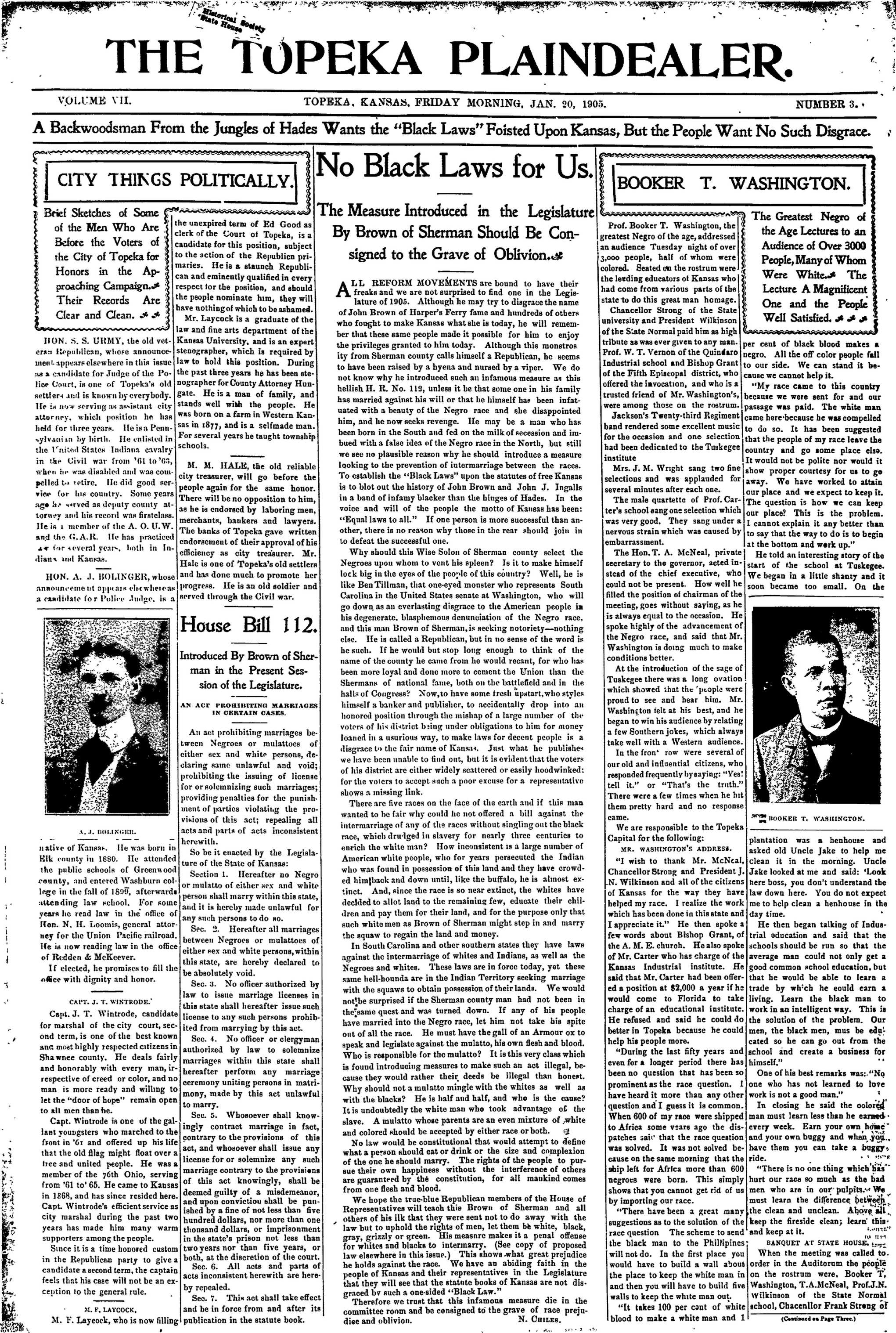
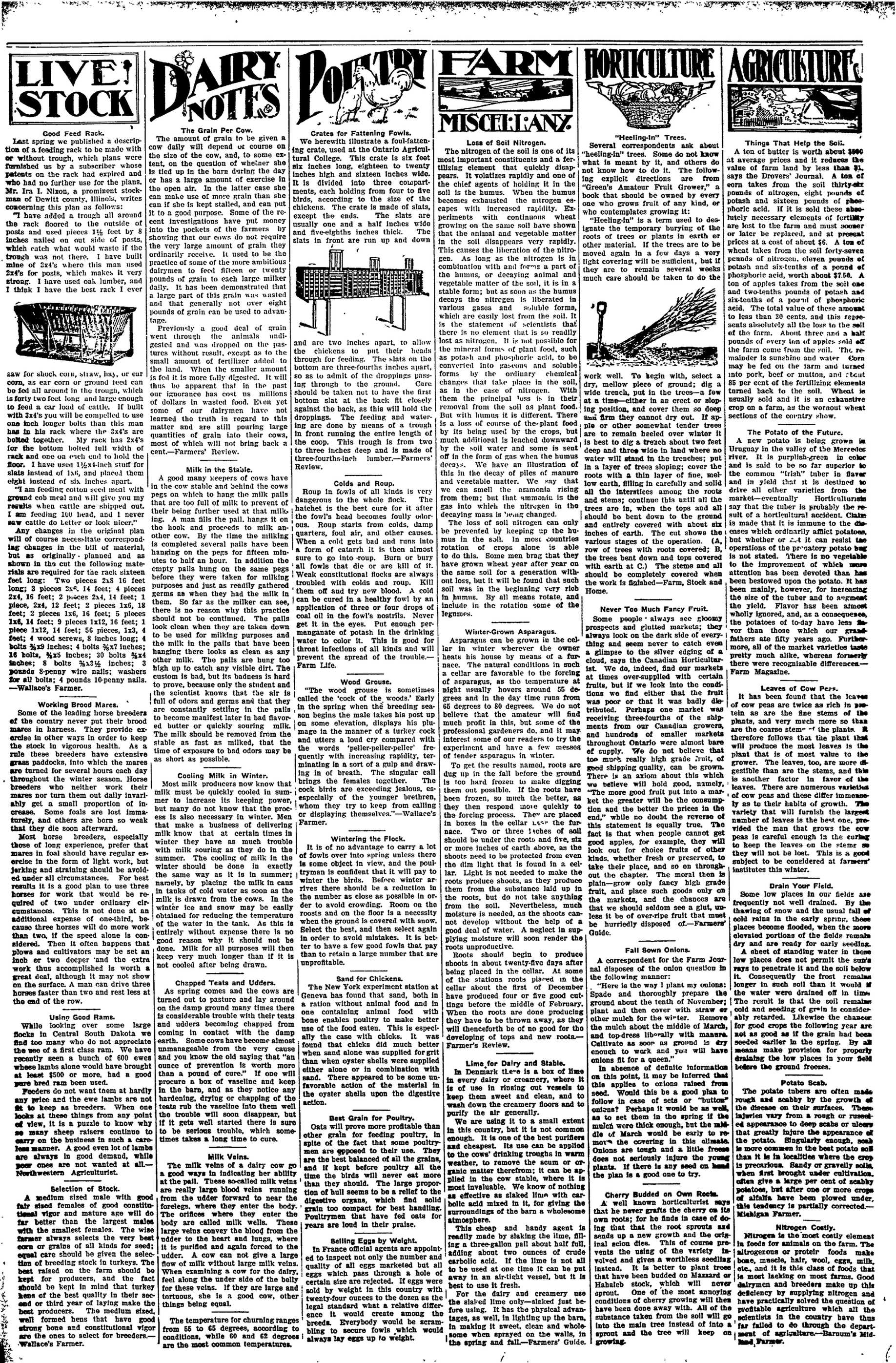
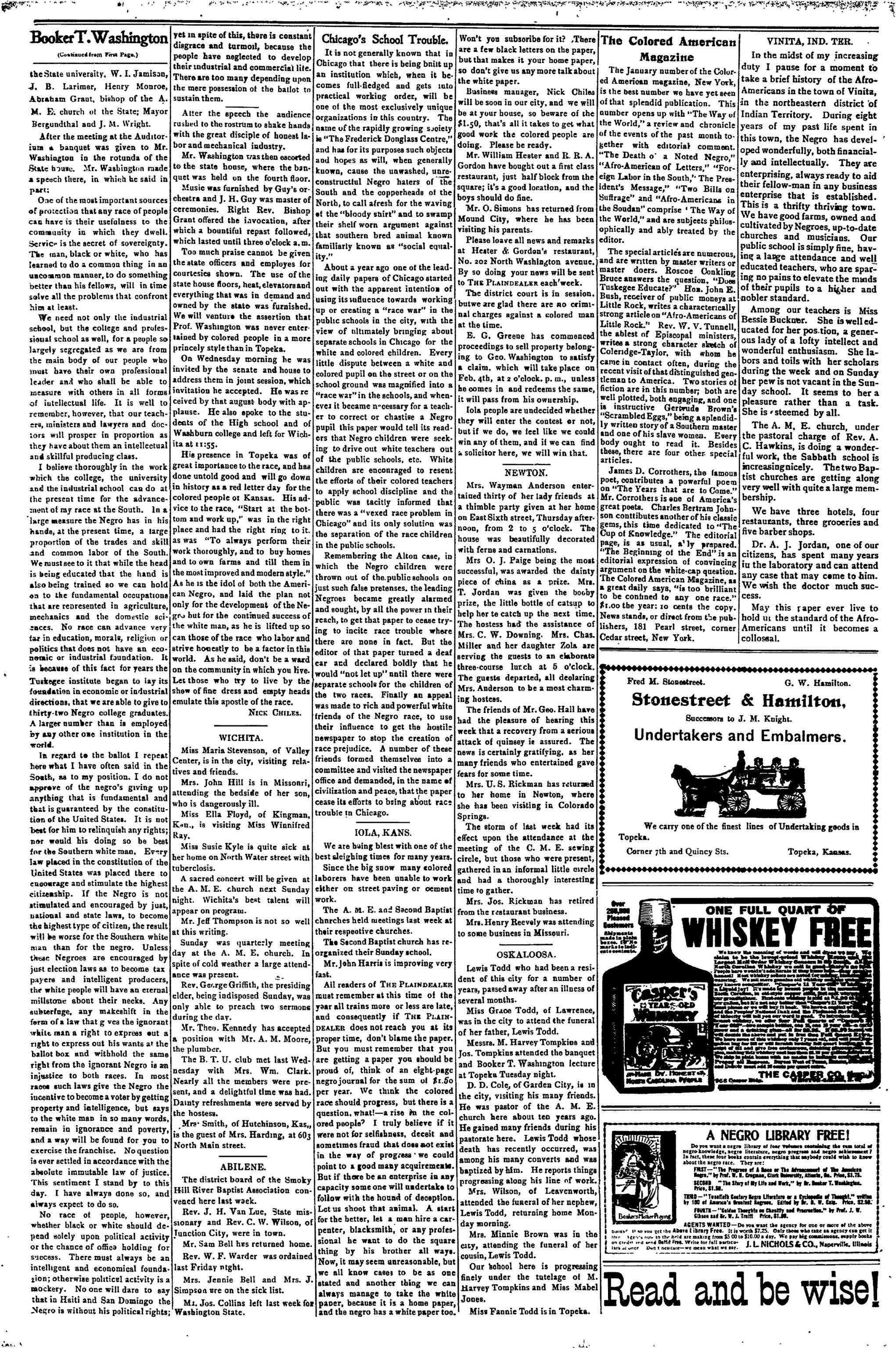
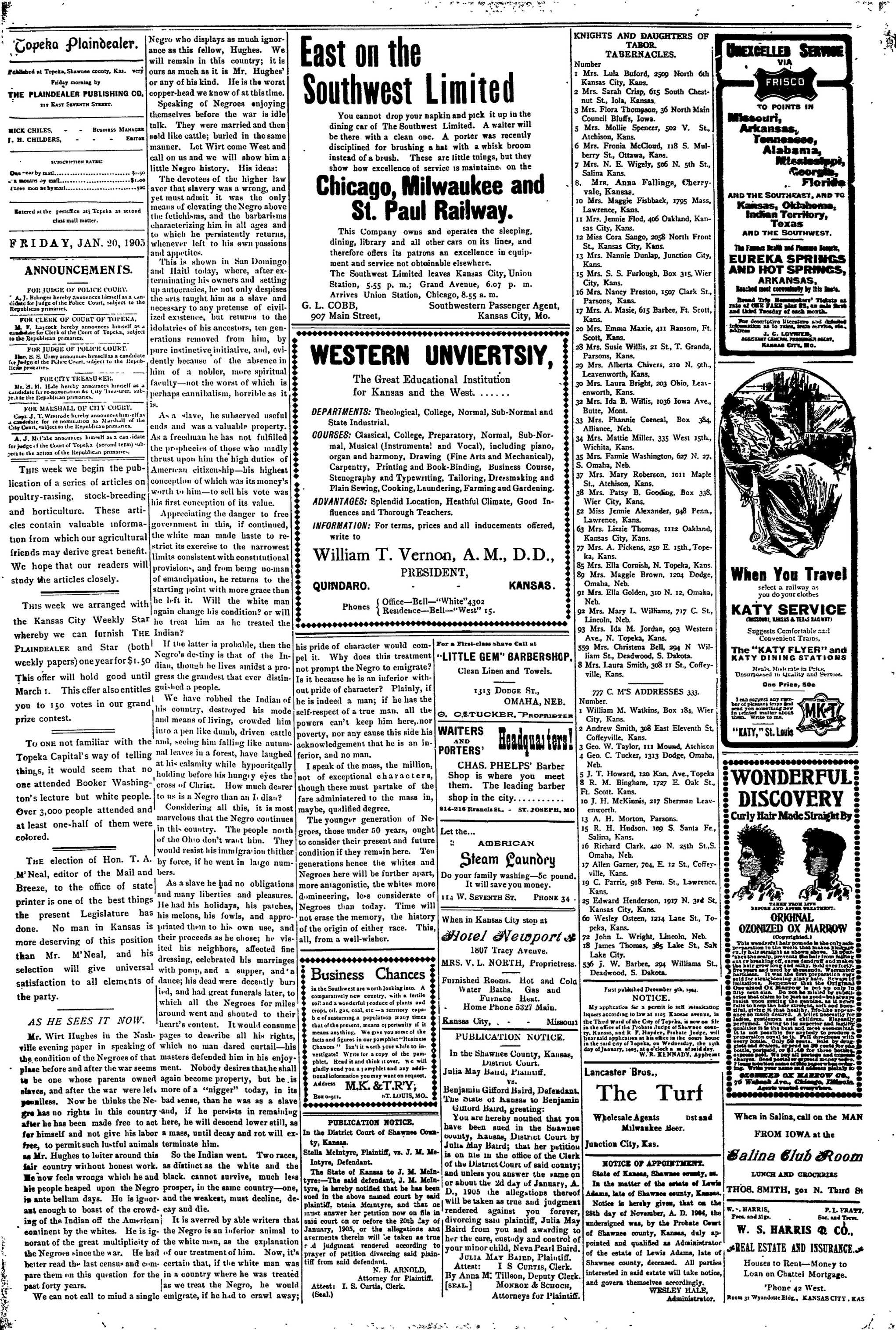
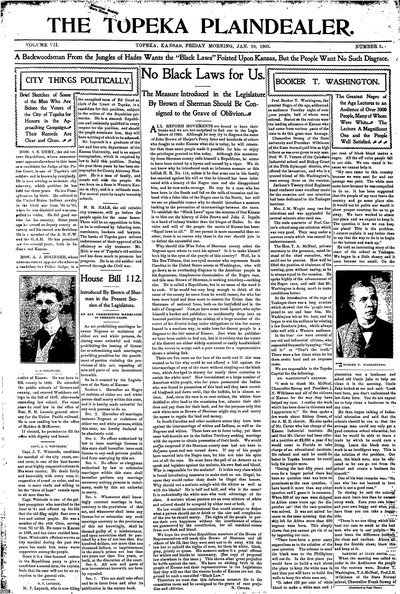
Page text (machine-generated)
THE TOPEKA PLAINDEALER.
A Backwoodsman From the Jungles of Hades Wants the "Black Laws" Foisted Upon Kansas, But the People Want No Such Disgrace.
VOLUME VII.
Brief Sketches of Some of the Men Who Are Before the Voters of the City of Topeka for Honors in the Approaching Campaign. Their Reeords Are Clear and Clean.
HON. S. S. URMY, the old veteran Republican, whose announcement appears elsewhere in this issue as a candidate for Judge of the Police Court, is one of Topeka's old settlers and is known by everybody. He is now serving as assistant city attorney, which position he has held for three years. He is a Pennsylvania by birth. He enlisted in the United States Indiana cavalry in the Civil war from '61 to '63, when he was disabled and was compelled to retire. He did good service for his country. Some years ago he served as deputy county attorney and his record was firstclass. He is a member of the A. O. U.W. and the G.A.R. He has practiced for several years, both in Indiana and Kansas.
HON. A. J. BOLINGER, whose announcement appears elsewhere as a candidate for Police Judge, is a
J. H.
native of Kansas. He was born in Elk county in 1880. He attended the public schools of Greenwood county, and entered Washburn college in the fall of 1895, afterwards attending law school. For some years he read law in the office of Hon. N. H. Loomis, general attorney for the Union Pacific railroad. He is now reading law in the office of Redden & McKeever. If elected, he promises to fill the office with dignity and honor.
CAPT. J. T. WINTRODE.
Capt. J. T. Wintrode, candidate for marshal of the city court, second term, is one of the best known and most highly respected citizens in Shawnee county. He deals fairly and honorably with every man, irrespective of creed or color, and no man is more ready and willing to let the "door of hope" remain open to all men than he.
Capt. Wintrode is one of the gallant youngsters who marched to the front in '61 and offered up his life that the old flag might float over a free and united people. He was a member of the 76th Ohio, serving from '61 to'65. He came to Kansas in 1868, and has since resided here. Capt. Wintrode's efficient service as city marshal during the past two years has made him many warm supporters among the people.
Since it is a time honored custom in the Republican party to give a candidate a second term, the captain feels that his case will not be an exception to the general rule.
TOPEKA, KANSAS, FRIDAY MORNING, JAN. 20. 1905.
No Black Laws for Us.
The Measure Introduced in the Legislature By Brown of Sherman Should Be Consigned to the Grave of Oblivion.
the unexpired term of Ed Good as clerk of the Court of Topeka, is a candidate for this position, subject to the action of the Republican primaries. He is a staunch Republican and eminently qualified in every respect for the position, and should the people nominate him, they will have nothing of which to be ashamed.
ALL REFORM MOVEMENTS are bound to have their freaks and we are not surprised to find one in the Legislature of 1905. Although he may try to disgrace the name of John Brown of Harper's Ferry fame and hundreds of others who fought to make Kansas what she is today, he will remember that these same people made it possible for him to enjoy the privileges granted to him today. Although this monstrosity from Sherman county calls himself a Republican, he seems to have been raised by a hyena and nursed by a viper. We do not know why he introduced such an infamous measure as this hellish H. R. No. 112, unless it be that some one in his family has married against his will or that he himself has been infatuated with a beauty of the Negro race and she disappointed him, and he now seeks revenge. He may be a man who has been born in the South and fed on the milk of secession and imbued with a false idea of the Negro race in the North, but still we see no plausible reason why he should introduce a measure looking to the prevention of intermarriage between the races. To establish the "Black Laws" upon the statutes of free Kansas is to blot out the history of John Brown and John J. Ingalls in a band of infamy blacker than the hinges of Hades. In the voice and will of the people the motto of Kansas has been: "Equal laws to all." If one person is more successful than another, there is no reason why those in the rear should join in to defeat the successful one.
Mr. Laycock is a graduate of the law and fine arts department of the Kansas University, and is an expert stenographer, which is required by law to hold this position. During the past three years he has been stenographer for County Attorney Hungate. He is a man of family, and stands well with the people. He was born on a farm in Western Kansas in 1877, and is a selfmade man. For several years he taught township schools.
M. M. HALE, the old reliable city treasurer, will go before the people again for the same honor. There will be no opposition to him, as he is endorsed by laboring men, merchants, bankers and lawyers. The banks of Topeka gave written endorsement of their approval of his efficiency as city treasurer. Mr. Hale is one of Topeka's old settlers and has done much to promote her progress. He is an old soldier and served through the Civil war.
Why should this Wise Solon of Sherman county select the Negroes upon whom to vent his spleen? Is it to make himself lock big in the eyes of the people of this country? Well, he is like Ben Tillman, that one-eyed monster who represents South Carolina in the United States senate at Washington, who will go down as an everlasting disgrace to the American people in his degenerate, blasphemous denunciation of the Negro race, and this man Brown of Sherman, is seeking notoriety—nothing else. He is called a Republican, but in no sense of the word is he such. If he would but stop long enough to think of the name of the county he came from he would recant, for who has been more loyal and done more to cement the Union than the Shermans of national fame, both on the battlefield and in the halls of Congress? Now, to have some fresh upstart, who styles himself a banker and publisher, to accidentally drop into an honored position through the mishap of a large number of the voters of his district being under obligations to him for money loaned in a usurious way, to make laws for decent people is a disgrace to the fair name of Kansas. Just what he publishes we have been unable to find out, but it is evident that the voters of his district are either widely scattered or easily hoodwinked: for the voters to accept such a poor excuse for a representative shows a missing link.
House Bill 112.
House Bill 112.
Introduced By Brown of Sherman in the Present Session of the Legislature. AN ACT PROHIBITING MARRIAGES IN CERTAIN CASES.
An act prohibiting marriages between Negroes or mulattoes of either sex and white persons, declaring same unlawful and void; prohibiting the issuing of license for or solemnizing such marriages; providing penalties for the punishment of parties violating the provisions of this act; repealing all acts and parts of acts inconsistent herewith. So be it enacted by the Legislature of the State of Kansas:
Section 1. Hereafter no Negro or mulatto of either sex and white person shall marry within this state, and it is hereby made unlawful for any such persons to do so.
Sec. 2. Hereafter all marriages between Negroes or mulattoes of either sex and white persons, within this state, are hereby declared to be absolutely void.
Sec. 3. No officer authorized by law to issue marriage licenses in this state shall hereafter issue such license to any such persons prohibited from marrying by this act.
Sec. 4. No officer or clergyman authorized by law to solemnize marriages within this state shall hereafter perform any marriage ceremony uniting persons in matrimony, made by this act unlawful to marry.
Sec. 5. Whosoever shall knowingly contract marriage in fact, contrary to the provisions of this act, and whosoever shall issue any license for or solemnize any such marriage contrary to the provisions of this act knowingly, shall be deemed guilty of a misdemeanor, and upon conviction shall be punished by a fine of not less than five hundred dollars, nor more than one thousand dollars, or imprisonment in the state's prison not less than two years nor than five years, or both, at the discretion of the court. Sec. 6. All acts and parts of acts inconsistent herewith are hereby repealed.
We hope the true-blue Republican members of the House of Representatives will teach this Brown of Sherman and all others of his ilk that they were sent not to do away with the law but to uphold the rights of men, let them be white, black, gray, grizzly or green. His measnre makes it a penal offense for whites and blacks to intermarry. (See copy of proposed law elsewhere in this issue.) This shows what great prejudice he holds against the race. We have an abiding faith in the people of Kansas and their representatives in the Legislature that they will see that the statute books of Kansas are not disgraced by such a one-sided "Black Law."
Sec. 7. This act shall take effect and be in force from and after its publication in the statute book.
Prof. Booker T. Washington, the greatest Negro of the age, addressed an audience Tuesday night of over 3,000 people, half of whom were colored. Seated on the rostrum were the leading educators of Kansas who had come from various parts of the state to do this great man homage.
Chancellor Strong of the State university and President Wilkinson of the State Normal paid him as high tribute as was ever given to any man. Prof. W. T. Vernon of the Quindaro Industrial school and Bishop Grant of the Fifth Episcopal district, who offered the invocation, and who is a trusted friend of Mr. Washington's, were among those on the rostrum. Jackson's Twenty-third Regiment band rendered some excellent music for the occasion and one selection had been dedicated to the Tuskegee institute
Mrs. J. M. Wright sang two fine selections and was applauded for several minutes after each one. The male quartette of Prof. Carter's school sang one selection which was very good. They sang under a nervous strain which was caused by embarrassment.
The Hon. T. A. McNeal, private secretary to the governor, acted instead of the chief executive, who could not be present. How well he filled the position of chairman of the meeting, goes without saying, as he is always equal to the occasion. He spoke highly of the advancement of the Negro race, and said that Mr. Washington is doing much to make conditions better.
At the introduction of the sage of Tuskegee there was a long ovation which showed that the 'people were proud to see and hear him. Mr. Washington felt at his best, and he began to win his audience by relating a few Southern jokes, which always take well with a Western audience. In the front row were several of our old and influential citizens, who responded frequently by saying: "Yes! tell it." or "That's the truth." There were a few times when he hit them pretty hard and no response came.
There are five races on the face of the earth and if this man wanted to be fair why could he not offered a bill against the intermarriage of any of the races without singling out the black race, which drudged in slavery for nearly three centuries to enrich the white man? How inconsistent is a large number of American white people, who for years persecuted the Indian who was found in possession of this land and they have crowded him back and down until, like the buffalo, he is almost extinct. And, since the race is so near extinct, the whites have decided to allot land to the remaining few, educate their children and pay them for their land, and for the purpose only that such white men as Brown of Sherman might step in and marry the squaw to regain the land and money.
We are responsible to the Topeka Capital for the following:
MR. WASHINGTON'S ADDRESS.
"I wish to thank Mr. McNeal, Chancellor Strong and President J. N. Wilkinson and all of the citizens of Kansas for the way they have helped my race. I realize the work which has been done in this state and I appreciate it." He then spoke a few words about Bishop Grant, of the A. M. E. churoh. He also spoke of Mr. Carter who has charge of the Kansas Industrial institute. He said that Mr. Carter had been offered a position at $2,000 a year if he would come to Florida to take charge of an educational institute. He refused and said he could do better in Topeka because he could help his people more.
In South Carolina and other southern states they have laws against the intermarriage of whites and Indians, as well as the Negroes and whites. These laws are in force today, yet these same hell-hounda are in the Indian Territory seeking marriage with the squaws to obtain possession of their lands. We would not be surprised if the Sherman county man had not been in the same quest and was turned down. If any of his people have married into the Negro race, let him not take his spite out of all the race. He must have the gall of an Armour ox to speak and legislate against the mulatto, his own flesh and blood. Who is responsible for the mulatto? It is this very class which is found introducing measures to make such an act illegal, because they would rather their deeds be illegal than honest. Why should not a mulatto mingle with the whites as well as with the blacks? He is half and half, and who is the cause? It is undoubtedly the white man who took advantage of the slave. A mulatto whose parents are an even mixture of white and colored should be accepted by either race or both.
"During the last fifty years and even for a longer period there has been no question that has been so prominent as the race question. I have heard it more than any other question and I guess it is common. When 600 of my race were shipped to Africa some years ago the dispatches said that the race question was solved. It was not solved because on the same morning that the ship left for Africa more than 600 negroes were born. This simply shows that you cannot get rid of us by importing our race.
No law would be constitutional that would attempt to define what a person should eat or drink or the size and complexion of the one he should marry. The rights of the people to pursue their own happiness without the interference of others are guaranteed by the constitution, for all mankind comes from one flesh and blood.
"There have been a great many suggestions as to the solution of the race question The scheme to send the black man to the Phillipines will not do. In the first place you would have to build a wall about the place to keep the white man in and then you will have to build five walls to keep the white man out.
Therefore we trust that this infamous measure die in the committee room and be consigned to the grave of race prejudice and oblivion. N. CHILES.
"It takes 100 per cent of white blood to make a white man and 1
NUMBER 3. .
The Greatest Negro of the Age Lectures to an Audience of Over 3000 People, Many of Whom Were White. The Lecture A Magnificent One and the People Well Satisfied. per cent of black blood makes a negro. All the off color people fall to our side. We can stand it because we cannot help it.
"My race came to this country because we were sent for and our passage was paid. The white man came here because he was compelled to do so. It has been suggested that the people of my race leave the country and go some place else. It would not be polite nor would it show proper courtesy for us to go away. We have worked to attain our place and we expect to keep it. The question is how we can keep our place? This is the problem. I cannot explain it any better than to say that the way to do is to begin at the bottom and work up."
He told an interesting story of the start of the school at Tuskegee. We began in a little shanty and it soon became too small. On the
J. B.
plantation was a henhouse and asked old Uncle Jake to help me clean it in the morning. Uncle Jake looked at me and said: 'Look here boss, you don't understand the law down here. You do not expect me to help clean a henhouse in the day time.
He then began talking of Industrial education and said that the schools should be run so that the average man could not only get a good common school education, but that he would be able to learn a trade by which he could earn a living. Learn the black man to work in an intelligent way. This is the solution of the problem. Our men, the black men, mus be educated so he can go out from the school and create a business for himself."
One of his best remarks was: "No one who has not learned to love work is not a good man."
In closing he said the colored man must learn less than he earned every week. Earn your own home and your own buggy and when you have them you can take a buggy ride.
"There is no one thing which has hurt our race so much as the bad men who are in our pulpits. We must learn the difference between the clean and unclean. Above all keep the fireside clean; learn this and keep at it.
BANQUET AT STATE HOUSE
When the meeting was called to
order in the Auditorium the people
on the rostrum were, Booker T.
Washington, T.A.McNeal, Prof.J.N.
Wilkinson of the State Normal
school, Chacenllor Frank Strong of
(Continued on Page Three.)
7
Good Feed Rack.
Last spring we published a descrip-
tion of a feeding rack to be made with
or without trough, which plans were
furnished us by a subscriber whose
patents on the rack had expired and
who had no further use for the plans.
Mr. Ira I. Nixon, a prominent stock-
man of Dewitt county, Ilinols, writes
concerning this plan as folloxs:
"I have added a trough all around
the rack floored to the outside of
Posts and used pieces 11% feet by 8
{inches nailed on out side of posts,
which catch what would waste if the
trough was not there. I have built
mine of 2x4’s where this man used
2x4’s for posts, which makes it very
strong. I have used oak lumber, and
I think 1 have the best rack I ever
j a ET FF e
Saw for shoch coin, straw, hay, or ear
coma, as ear corn or ground teed can
be fed all around in the trough, whieh
is forty two feet long and large enough
to feed a car load of cattle. If built
with 3x4's you will be compelled to use
one inch longer bolts than this man
hag tn bis rack where the 2x¢’s are
boMed together. My rack has 2x4's
for the bottom bolted tull width of
rack and one oa eich end to hold the
floor, I have used 16xt-inch stuif for
slats instead of 1,6, and placed them
elght instead of six inches apart.
“T am feeding cotton xeed meal with
ground cob meal and will give you my
Teguiis when cattle are shipped out.
I am feeding 100 head, and 1 never
saw cattle do Letter or look nicer.”
Any changes in the original plan
‘will of course necessitate correspond:
jag changes in the Dill of material,
but as originally- planned and as
shown in tho cut the following mate-
vials are required for tae rack sixteen
feet long: Two pieces 2.8 16 feet
Tong; 3 pleces 2x6. 14 feet; 4 pleces
2x4, 16 feet; 2 yrsces 2a4, 14 feet; 1
plece, 2x4, 12 feet; 2 pieces 1x6, 18
feet; 2 pieces 1x6, 16 feet; 5 pieces
1x6, 14 feet; 9 pleces 1x12, 16 feet; 1
Plece 1212, 14 feet; 56 pieces, 1x3, 4
feet; 4 wood screws, 8 inches long; 4
bolts 3x9 Inches; 4 bolts 34x? Inches;
46 bolts, %x5 inches; 30 bolts %x!
faches; 8 bolts %a8% inches;
pounds S-penny wire nails; washer:
for all bolts; 4 pounds 10-penny nails
—Wallace’s Farmer.
Workina Brood Mares.
Some of the leading horse breeders
ef the country never put their brood
mares in harness. They provide ex-
ercise in other ways in order to keep
the stock in vigorous health. As a
role these breeders have extensive
grass paddocks, into which the mares
are turned for several hours cach day
throughout the winter season. Horse
Dreeders who neither work their
mares nor turn them out dally invarl-
ably get a small proportion of in-
crease. Some foals are lost imma-
torely, and others are born so weak
that they die soon afterward.
Most horse breeders, especially
those of long experience, prefer that
mares in foal should have regular ex-
ereise in the form of light work, but
Jerking and straining should be avoid-
ed under all circumstances. For best
results It is a good plan to use three
horses for work that would be re
quired of two under ordinary cir
gumstances. This {s not done at an
gdditional expense of onethird, be-
causo three horses will do more work
than two, if the speed alone is con-
sidered. Then it often happens that
plows and cultivators may be set an
fach or two deeper ‘and the extra
work thus accomplished is worth s
great deal, although it may not show
‘on the surface. A man can drive three
horses faster than two and rest less al
the end of the row.
Usine Good Rams.
While looking over some large
flocks In Central South Dakota we
find too many who do not appreciate
the nee of a first class ram. We have
recently seen a bunch of 600 ewes
whese lambs alone would have brought
at least $500 or more, had 2 good
pare bred ram been used.
Feeders do not want them at hardly
any price ard the ewe lambs are not
Mt to keep as breeders. When one
Jooks at these things from any point
ef view, It is a puzzle to know wh7
se many sheep raisers continue to
‘earry on the business in such a care
Yeas manner. A good even lot of lamba
are always In good demand, while
oor ones are not wanted at all—
Northwestern Agriculturist.
Belection of Btock.
A medium sized male with good
fatr sized females of good constite-
tiene! vigor and mature age will do
far better than the largest males
with the smallest females. The wise
farmer always selects the very best
earn or grains of all kinds for seed;
equal care should be given the selec.
tion of breeding stock in turkeys. The
Dest raised on the farm should be
kept for producers, and the fact
should be kept In mind that turkey
hens of the best quality in their sec:
ead or third year of laying make the
Dest producers. Tho medium sized
well formed hens that have good
gtrong bone and constitutional vigor
are the ones to select for breeders.—
Wallace's Farmer.
pe orks
She amount of grain to be given &
cow daily will depend ut course on
the size of the cow, and, to some ex-
tent, on the question of whetner she
4s tied up In the barn during, the day
or has a large amount of exercise in
the open air. In the latter case she
can make use of more grain than she
can if she is kept stalled, and can put
it to a good purpose. Some of the ro-
cent investigations have put money
into the pockets of the farmers by
showing that our cows do not require
the very large amount of grain they
ordinarily receive. It used to be the
practice of some of the more ambitious
dairymen to fecd fifteen or twenty
pounds of grain to each large milker
daily, It has been demonstrated that
a large part of this grain was wasted
and that generally not over eight
pounds of grain can be used to advan-
tage.
Previously a vod deal of grain
went through the animals undi-
gested and was dropped on the pas-
tures without result, exeept as to the
small amount of fertilizer added to
the land, When the smaller amount
is foi it is more fully digested, It will
thus be apparent that in the past
our ignorance has cost us millions
of dollars In wasted food, Even yet
some of our dairymen have not
learned the truth in regard to this
matter and ere still pouring large
quantities of grain iato their cows,
most of which will not bring back a
_cent.—Farmers’ Review.
Milk in the Stable.
A good many xeepers of cows have
in the cow stable and dehind the cows
pegs on which to hang the milk pails
that are too full of milk to prevent of
their being further used at that mills
ing. A man fills the pail. hangs it on
tho hook and proceeds to milk an-
other cow. By the time the milking
is completed several pails have been
hanging on the pegs for fifteen min-
utes to half an hour. In addition the
empty pails hung on the same pegs
before they were taken for milking
purposes and just as readily gathered
germs as when they had the milk in
them. So far as the milker can see,
there is no reason why this practics
should not bo continued. The pails
look clean when they are taken down
to be used for milking purposes and
the milk in the pails that have been
hanging there looks as clean as any
other milk, The pails are bung toc
high up to catch any visible dirt. The
custom Is bad, but its badness is hard
to prove, because only the student and
jthe scientist knows that the alr ts
full of odors and germs and that they
are constantly settling in the pall
to become manifest later in bad flavor
ed butter or quickly souring milk
The milk should be removed from the
stable as fast as milked, that the
time of exposure to bad odors may be
as short as possible.
Cooling Milk in Winter.
Most milk producers now know that
milk must be quickly cooled in sum-
mer to increase Its keeping power,
but many do not know that the proc-
ess 1s also necessary in winter. Men
that make a business of delivering
milk know that at certain times in
winter they have as much trouble
with milk souring as they do in the
summer. The cooling of milk in the
winter should be done in exactly
the same way as it is In summer;
namely, by placing the milk in cans
in tanks of cold water as soon as the
milk is drawn from the cows. In the
winter ice and snow may be easily
obtained for reducing the temperature
of the water in the tank, As this ig
jentirely without expense there Is no
good reason why It should not be
done. Milk for all purposes will ther
keep very much longer than If it is
not cooled after being drawn.
Chepped Teats and Udders.
As spring comes and the cows are
turned out to pasture and lay around
on the damp ground many times there
is considerable trouble with thelr teats
and udders becoming chapped from
coming In contact with the damp
earth. Some cows have become almost
unmanageable from the very cause
and you know the old saying that “an
ounce of prevention fs worth more
than a pound of cure.” If one will
procure a box of vaseline and keep
in the barn, and as they notice any
hardening, drying or chapping of the
‘teats rub the vaseline Into them well
the trouble will soon disappear, but
4 it gets well started there is sure
to be serious trouble, which some
times takes a long time to cure.
Milk Veins.
The milk veins of a dairy cow go
& good ways in indicating her ability
at the pall. These socalled milk veins
are really large blood veins running
from the udder forward to near the
forelegs, where they enter the body.
‘The orifices where they enter the
body are called milk wells. These
large velns convey the bloog from the
udder to the heart and lungs, where
it fs purified and again forced to the
‘udder, A cow can not give a large
flow of milk vithout large milk veins.
‘When examining a cow for the dairy,
feel along the under side of the belly
for these velns. If they are large and
tortuous, she is a good cow, other
things belng equal.
‘The temperature for churning ranges
from 65 to 65 degrees, according to
conditions, while 60 and 62 degrees
are the most common temperatures,
Be
A } 4
Cc; a
; NE
YS
Gon mw ne
- © fm
Crates for Fattening Fowls.
We herewith illustrate a foul-fatten-
ing crate, used at the Ontario Agricul-
tural College. This crate Is six feet
six inches long, eighteen to twenty
inches high and sixteen inches wide.
It is divided into three cowwpart-
ments, each holding from four to five
birds, according to the size of the
chickens. The crate is made of slats,
except the ends. The slats are
usually one and a half inches wide
and fiveefghths inches thick. The
slats in tront are run up and down
at
|
ea z iy i
bees Ng seg i
See! te is
tof]
and are two inches apart, to allow
the chickens to put their heads
through for feeding. The slats on the
bottom are three-fourths inches apart,
60 as to admit of the droppings pass-
fog throngh to the ground, Care
should be taken not to have the first
bottom slat at the back fit closely
against the back, as this will hold the
droppings. The feeding and water-
ing are done by means of a trough
in front running the entire length of
the coop. This trough is from two
to three inches deep and is made of
three-fourths-incl lumber.—Farmers'
Review.
alin “ak Maile
Roup in fowls of all kinds is very
dangerous to the whole flock. The
hatchet is the best cure for it after
the fowl's head becomes foully otor-
ous. Roup starts from colds, damp
quarters, fout air, and other causes.
When a col gets bad and runs Into
a form of catarrh it is then almost
sure to go into -roup. Burn or bury
all fowls that dic or are kill of it.
‘Weak constitutional flocks are always
troubled with colds and roup. Kill
them off and try new blood. A cold
jean be cured in a healthy fowl by an
application of three or four drops of
coal of! in the fow!'s nostrils. Never
get it in the eyes. Put enough per
manganate of potash in the drinking
|water to color ft. This Is good for
|throat infections of all Kinds and will
prevent the spread of the trouble—
Farm Life.
| Weed Grouse.
“The wood grouse is sometimes
called the ‘cock of the. woods.’ Early
in the spring when thé breeding sea-
son begins the male takes his post up
on some elevation, displays his plu-
mage in the manner of a turkey cock
and utters a loud cry compared with
the words ‘peller-pellerpeller’ fre-
quently with increasing rapidity, ter-
minating in a sort of a gulp and draw-
ing in of breath. The singular call
brings the females together. The
‘cock birds are exceeding jealous, es-
especially of the younger brethren,
|whom they try to keep from calling
or displaying themselves.”—Wallace's
Farmer.
Wintering the Flock.
It is of no advantage to carry a lot
of fowls over into spring unless there
1s some object in view, and the poul
|tryman is confident that it will pay to
winter the birds. Before winter ar
rives there should be a reduction in
the number as close as possible in or-
6er to avoid crowding. Room on the
roosts and on the floor s a necessity
when the ground Is covered with snow.
Select the best, and then select again
in order to avold mistakes. It is bet-
ter to have a few good fowls that pay
than to retain a large number that are
{| unprofitable.
Sand for Chickens.
‘The New York experiment station at
Geneva bas found that sand, both in
a ration without animal food and in
one containing animal food with
bone enables poultry to make better
use of the food eaten. This is espect-
ally the case with chicks. It was
found that chicks did much better
when sand alone was supplied for grit
than when oyster shells were supplied
either alone or in combination with
sand. There appeared to be some un-
favorable action of the material in
‘the oyster shells upon the digestive
action.
Best Grain for Poultry.
Oats will prove more profitable than
other grain for feeding poultry, in
spite of the fact that some poultry
mem are @ppored to their use. They
are the best balanced of ail the grains,
and if kept befcre poultry all the
time the birds will never eat more
than they should, The large propor
tion of hull seems to be a rellef to the
Aigestive organs, which find solid
' grain too compact for best handling.
Poultrymen that have fed oats for
\ are lond in thelr praise.
Rellina Eane by Weight.
In France official agents are appoint-
ed to inspect not only the number and
quality of all eggs marketed bat all
eggs which pass through a hole of
certain size are rejected. If eggs were
sold by weight in this country with
twenty-four ounces to the dozen as the
legal standard what a relative differ
ence it would create among the
breeds. Everybody would be scram-
Bling to secure fowls which would
always lay eggs up to weight.
FARPI
peach ar apatstins, intial
The nitrogen of the soil is one of its
most Important constituents and a fer-
tilizing element that quickly disap-
pears, It yolatizes rap{dly and one of
the chief agents of holding it in the
soll is the humus, When the humus
becomes exhausted the mitrogen es-
capes with Increased rapidity. Ex:
periments with continuons wheat
growing on the same soil bave shown
that the animal and vegetable matter
in the soll disappears very rapidly.
This causes the liberation of the nitro-
gev. As long as the nitrogen fs in
combination with and forme a part of
the humus, or decaying animal and
vegetable matter of the sotl, it is in a
stable form; but as soon as the humus
decays the nitregen is liberated in
various gases and suluble forms,
which are easily lost from the soil. It
is the statement of scientists that
there Is no element that is so readily
lost as nitrozen. It is not possible for
the mincral forms of plant food, such
as potash and phosphoric acid, to be
converted into zaseous and soluble
forms by the ordinary chemical
changes that take place in the soil,
as in the case of nitrogen. With
them the principal tuss is in thelr
removal from the soll as plant food.
But with humus it is different. There
is a loss of course of the-plant food
by its being used by the crops, but
‘much additioral ts leached downward
by the soil water and some is seu!
‘off in the form of gas when the humus
‘decays, We have an illustration of
this in the decay of piles of manure
and vegetable matter. We say thal
we can smell the ammonia rising
from them; but that ammonia is the
gas into which the nitrugen in the
decaying mass is emg changed.
The loss of soil nitrogen can onls
be prevented by keeping up the bu
mus in the soll. In most countries
rotation of crops alone is abl
to do this. Some men brag that thes
have grown wheat year after year o1
the same soil for a generation with
out loss, but It will be found that sucl
soil was in the beginning very riol
fn humus. By all means rotate, ant
j include in the rotation some of th
I Sererncs:
Winter-Grown Asparagus.
Asparagus can be grown in the cer
lar in winter wherever the owner
heats his house by means of a furs
nace, The natural conditions in such
a cellar are favorable to the forcing
of asparagus, as tho temperature at
night usually hovers around 55 de
grees and in the day time runs from
65 degrees to 80 degrees. We do not
believe that the amateur will find
much profit in this, but some of the
professional gardeners do, and it may
interest some of our readers to try the
experiment and have a few messes
of tender asparagus in winter.
To get the results named, roots are
dug up in the fall before the ground
1s too hard frozeu to make digging
| them out possible. If the roots have
been frozen, so much the better, ag
they then respond imore quickly to
the forcing process. The” are placed
in boxes In the cellar 1s«r the fur
nace. Two or three taches of sail
should be under the roots and five, siz
or more inches of earth above, as the
shoots need to be protected from even
the dim light that is found in a cel:
lar. Light is not needed to make the
roots produce shoots, as they produce
them from the substance laid up fr
the roots, but do not take anything
from the soll. Nevertheless, much
moisture is needed, as the shoots can
not develop without the help of
good deal of water. A neglect in sup
plying moisture will soon render the
Toots unproductive.
Roots should begin to produc
shoots in about twenty-five days after
being placed in the cellar. At some
of the stations roots piseed m thé
cellar about the first of Decembe
have produced four or five good cut
tings before the middle of February
‘When tho roots are done producing
they have to be thrown away, as the)
‘will thenceforth be of no good for th
developing of tops and new roots—
| Farmer’s Review.
Lime for Dairy and Stable.
Im Denmark tLere is a box of Hme
in every dairy or creamery, where it
is of use in rinsing out vessels to
keep them aweet and clean, and to
wash down the creamery floors and to
porify the alr generally.
We are using it to 8 small extent
in this country, but it is not common
enough. It is one of the best purifiers
aud cheapest. Its use can be applied
to the cows’ drinking troughs in warm
weather, to remove the scum or on
ganic matter therefrom; it can be ap-
plied in the cow stable, where it fs
most Invaluable. We know of nothing
as effective as slaked lime with car
bolic acid mixed in it, for giving the
surroundings of the barn a wholesome
atmosphere.
‘This cheap and handy agent is
readily made by slaking the ime, fill
ing a three-gallon pall about half full,
adding about two ounces of crude
earbolic acid. If the lime {s not all
to be used at one time it can be put
away in an airticht vessel, but it ff
best to use it fresh.
| For the dairy and creamery use
the slaled lime only—slaked just be
fore using. It has the physical advan
tages, as well, in lighting up the barn
In making it sweet, clear and whole
jsome when sprayed on the walls, i
the epring and fall.—Farmere’ Guide
H | r| | ]
SS PII Gh FI
GREY
“Heeling-In” Trees.
Several correspondents ask about
“heeling-in” trees. Some do not kaow
what is meant by it, and others do
not know how to do it. The follow-
ing explicit directions are from
“Green’s Amateur Fruit Grower,” a
book that should be owned by every
one who grows fruit of any kind, or
who contemplates growing it:
“Heeling-In” is a term used to des-
ignate the temporary burying of the
roots of trees or plants in earth or
other material. If the trees are to be
moved again In a few days a very
Hight covering will be sufficient, but if
they are to remain several woeks
much care should be taken to do the
LZ
on ge
) LZ
ie
4 go”
Bi A saver
LeRoi eae
Ce eke oe LE Pe
work well. To begin with, select a
dry, mellow pleco of ground; dig a
wide trench, put in the trees—a fow
at a time—either in an erect or slop-
ing position, and cover them 30 deep
‘ani firm they cannot dry out. If ap-
ple or other somewhat tender trees
are to remain heeled over winter it
is best to dig a treach about two feet
deep and three wide in land where no
water will stand in the trenches; put
in a layer of trees sloping; cover the
roots with a thin layer of fine, mel
low earth, filling In carefully and solid
all the interstices among the roots
and stems; continue this untit all the
trees are fn, when the tops and all
should be bent down to the ground
and entirety covered with sbout stx
inches of earth. The cut shows the
various stages of the operation. (A,
row of trees with roots covered; B,
the trees bent down and tops covered
with earth at C.) The stems and al
should be completely covered when
the work {s fatshed—Farm, Stock and
Home.
Never Too Much Fancy Fruit.
Some people’ always see shoomy
prospects and glutted markets; they
always look on the dark side of every-
thing and seem never to catch even
@ glimpse to the silver edging of a
cloud, says the Canadian Horticultar-
ist. We do, indeed, find our markets
at times over-supplied with certain
fruits, but if we look into the condi-
tions we find either that the frait
was poor or that it was badly dle
tributed. Perhaps one market was
receiving threefourths of the ship-
ments from our Canadian growers,
and hundreds of smaller markets
throughout Ontario were almost bare
of supply. We do not believe that
too much really high grade <ruit, of
geod shipping quality, can be grown.
There is an axiom about this which
wo petieve will hold good, namely,
“The more good fruit put into a mar
ket the greater will be the consump
tion and the better the prices in the
end,” while no doubt the reverse of
this statement is equally true. The
fact is that when people cannot get
good apples, for example, they will
look out for choice fruits of other
kinds, whether fresh or preserved, to
take their place, and so on throngh-
out the chapter. The moral then is
plain—grow only fancy bish srade
frait, and place such goods only on
the markets, and the chances are
that we should seldom see a glut, um
Tess it be of over-ripe fruit that moet
be hurriedly disposed of.—Farmers
Guide.
Fall Sown Onions.
A correspondent for the Farm Jour
nal disposes of the onfon question in
the following manner:
.. “Here is the way I plant my onions:
Spade and thoroughly prepare the
ground about the tenth of November;
plant and then cover with straw or
other mulch for the winter. Remove
the mulch about the middle of March,
and topdress liberally with manera
Caltivate as soor as grovnd is éry
enough to work and yu will have
‘onlons fit for a queen.”
In absence of definite lnformation
on this point, it may be inferred that
this applies to onions raised from
seed. Would this be a good plan to
follow in case of sets or “button”
coisas? Perhaps it would be as well,
aa to set them in the spring if the
mulch were thick cnough, but the mM
dle of March would be early to re
mor’ the covering in this climate
Onions are tough and a little freese
does not seriously injure the young
plants. If there is any seed on hand
the plan is a good one to try.
Cherry Budded on Own Roots.
& well known horticulturist says
that he never grafts the cherry on its
own roots; for he finds in case of do-
ing that that the root sprouts axd
sends up a new growth and the orig
inal scion dies. This of course pre-
vents the using of the variety im
volved and gives a worthless seedling
Instead. It {s better to plant troes
that have been budded on Masxard or
Hahaled stock, which will never
sprout. One of the most annoying
conditions of cherry growing will the
have been done away with. All of the
substance taken from the soll will go
‘Into the main tree instead of into a
‘sprout and the tree will keep on
growing.
NGRICUMTURE
ee oe
Er Hie —t
‘Things That Help the Soii.
A ton of butter is worth about $500
at average prices and it reduces the
value of farm land by less tham $1,
says the Drovers’ Journal. A tom of
corn takes from the soil thirty-ebr
pounds of nitrogen, eight pounds of
potash and sixteen pounds of phee-
phoric acid. If it is sold these abeo-
Iutely necessary elements of fertility
are Jost to the farm and must sooaer
or later be replaced, and at proseat
prices at a cost of about $6. A tom of
wheat takes from the soil forty-seven
peunds of nitrogen. cloven pounds of
potash and six-tenths of a pound ef
phosphoric acid, worth about $7.58. A
ton of apples takes from the soit ome
and twotenths pounds of potash asd
sixteaths of a pour of phosphoric
aeid. The total value of these amowat
to less than 30 cents. and this repre-
sents absolutely all the loss to the seit
of the farm. Abont three and a kaif
pounds of every ton of apples sald ef
the farm come frum the voil. ‘The re
mainder Is sunshine and water €orn
may be fed on the tarm und turned
into pork, beef or mutton, and ztcut
85 per cent of the fertilizing elements
tnmed back to the soil. Wheat ie
usually sold and it is an cxhaustive
crop an a farm, ay the wornout wheat
sections of the covatry show.
‘The Potato of the Future.
A new potato is being grown im
Uruguay in the valley of the Mercetes
river. It is purplish-green in color
and js said to bo so far superior to
the common “trish” tuber in flaver
and in yield that st is doatined to
@rive all other varieties from the
market—eventually —_‘Horticullurists
say that the tuber is probably the re-
sult of a horticultural accident. Clate
ig made that it is immune to the de
eases which ordinarily afflict potatoes,
bat whether or c.t it can resist tee
operations of the pr-satory potato bag
{3 not stated. There is no vegetable
to the improvement of which more
attention has been devoted than has
been bestowed upon the potato. It has
been mainly, however, for increasing
the size of the tuber and to angmeat
the yleld. Flavor has been atmost
‘wholly ignored, and, as a consequence,
the potatoes of to-day have less fiw
Yor than those which our sramé
fathers ate fifty years ago. Further
more, all of the market varletios taste
pretty much alike, whereas formerky
there were recognizable differencea—
|Farm Magazine.
Knees of Cares Bese.
It bas been found that the Icaves
of cow peas are twice as rich in pre
tein as are the fine stems of the
plants, and very much more so than
are the coarse stems -f the plants.
therefore follows that tae plant that
will produce the most leaves 1s the
plant that is of most value ta the
grower. The leaves, too, are more d+
gestible than are the stems, and this
is another factor in favor of the
leaves. There are numerous varletha
of cow peas and these differ immense-
ly a9 to their habits of growth. The
variety that will furnish the largest
number of leaves is the best. one, pre-
vided the man that grows the cow
peas is careful enough ia the curing
to keep the leaves on the steme se
they will not be lost. This is a good
subject to be considered at farmern’
institutes this winter.
Drain Your Field.
Some low places in our fields are
frequently not well drained. By the
thawing of snow and the usual fall of
cold rains In the early spring, these
places become flooded, when the more
elevated portions of the fields remam
ary and are ready for early seeding.
A sheet of standing water in these
low places does not permit the sun’e
rays to penetrate it and the coli below
it. Consequently the frost remaina
Jonger in such soil than it would #
the water were drained off in timm
‘The result is that the coil remaien
cold and seeding of grein is consider
ably retarded. Likewise the chanew:
for good erops the following year are
not as good as if the grain had besa
seeded earifer in the apring. By all
means make provision for properly
@raining the low places In your fel
before the ground freezes.
Potato Scab.
‘The potato tobers are often made
rough and scabby by the growth of
the disease on their surfaces. These
injuries vary from a rough or ruseet-
ea appearance to deep scabs or uleery
that greatly injure the appearance of
the potata, Singularly enough, noad
js more commen in the best potato sas
than it be in localities where the erep.
is precarious. Sandy or gravelly solie,
when first brovght under cultivation.
often give a large per cent of scabby
potatoes, but after one or more crops
of alfatia have been plowed under,
this tendency is partially corrected—
Mighigam Farmer,
Nitrogen Costly.
‘Nitrogen ts the most costly elemest
Im feeds for animals on the farm. The
jaltrogenous or proteir foods make
‘bom, masele, hair, wool, esse, milk,
ete, and it 1s this class of foods that
[te most Ineking on most farms. Good
@airymen and breeders make up this
deficiency by supplying nitrogen and
have practically solved the question of
profttable agriculture which all the
sefentists in the couatry have thus
far failed to do through the depart-
jment of agricultere—Baroum’s Mid-
lead FParee.
the State university, W. I. Jamison, J. B. Larimer, Henry Monroe, Abraham Grant, bishop of the A. M. E. church of the State; Mayor Bergundthal and J. M. Wright. After the meeting at the Auditorium a banquet was given to Mr. Washington in the rotunda of the State house. Mr. Washington made a speech there, in which he said in part:
One of the most important sources of protection that any race of people can have is their usefulness to the community in which they dwell. Service is the secret of sovereignty. The man, black or white, who has learned to do a common thing in an uncommon manner, to do something better than his fellows, will in time solve all the problems that confront him at least.
We need not only the industrial school, but the college and professional school as well, for a people so largely segregated as we are from the main body of our people who must have their own professional leader and who shall be able to measure with others in all forms of intellectual life. It is well to remember, however, that our teachers, ministers and lawyers and doctors will prosper in proportion as they have about them an intellectual and skillful producing class.
I believe thoroughly in the work which the college, the university and the industrial school can do at the present time for the advancement of my race at the South. In a large measure the Negro has in his hands, at the present time, a large proportion of the trades and skill and common labor of the South. We must see to it that while the head is being educated that the hand is also being trained so we can hold on to the fundamental occupations that are represented in agriculture, mechanics and the domestic sciences. No race can advance very far in education, morals, religion or politics that does not have an economic or industrial foundation. It is because of this fact for years the Tuskegee institute began to lay its foundation in economic or industrial directions, that we are able to give to thirty-two Negro college graduates. A larger number than is employed by any other one institution in the world.
In regard to the ballot I repeat here what I have often said in the South, as to my position. I do not approve of the negro's giving up anything that is fundamental and that is guaranteed by the constitution of the United States. It is not best for him to relinquish any rights; nor would his doing so be best for the Southern white man. Every law placed in the constitution of the United States was placed there to encourage and stimulate the highest citizenship. If the Negro is not stimulated and encouraged by just national and state laws, to become the highest type of citizen, the result will be worse for the Southern white man than for the negro. Unless these Negroes are encouraged by just election laws as to become tax payers and intelligent producers, the white people will have an eternal millstone about their necks. Any subterfuge, any makeshift in the form of a law that gives the ignorant white man a right to express out a right to express out his wants at the ballot box and withhold the same right from the ignorant Negro is an injustice to both races. In most races such laws give the Negro the incentive to become a voter by getting property and intelligence, but says to the white man in so many words, remain in ignorance and poverty, and a way will be found for you to exercise the franchise. No question is ever settled in accordance with the absolute immutable law of justice. This sentiment I stand by to this day. I have always done so, and always expect to do so.
No race of people, however, whether black or white should depend solely upon political activity or the chance of office holding for success. There must always be an intelligent and economical foundation; otherwise politicel activity is a mockery. No one will dare to say that in Haiti and San Domingo the Negro is without his political rights:
yet in spite of this, there is constant disgrace and turmoil, because the people have neglected to develop their industrial and commercial lite. There are too many depending upon the mere possession of the ballot to sustain them.
Atter the speech the audience rushed to the rostrum to shake hands with the great disciple of honest labor and mechanical industry.
Mr. Washington was then escorted to the state house, where the banquet was held on the fourth floor.
Music was furnished by Guy's orchestra and J. H. Guy was master of ceremonies. Right Rev. Bishop Grant offered the invocation, after which a bountiful repast followed, which lasted until three o'clock a.m. Too much praise cannot be given the state officers and employees for courtesies shown. The use of the state house floors, heat, elevators and everything that was in demand and owned by the state was furnished. We will venture the assertion that Prof. Washington was never entertained by colored people in a more princely style than in Topeka.
On Wednesday morning he was invited by the senate and house to address them in joint session, which invitation he accepted. He was received by that august body with applause. He also spoke to the students of the High school and of Washburn college and left for Wichita at 11:55.
His presence in Topeka was of great importance to the race, and has done untold good and will go down in history as a red letter day for the colored people or Kansas. His advice to the race, "Start at the bottom and work up," was in the right place and had the right ring to it. as was "To always perform their work thoroughly, and to buy homes and to own farms and till them in the most improved and modern style." As he is the idol of both the American Negro, and laid the plan not only for the development of the Negro but for the continued success of the white man, as he is lifted up so can those of the race who labor and strive honestly to be a factor in this world. As he said, don't be a ward on the community in which you live. Let those who try to live by the show of fine dress and empty heads emulate this apostle of the race.
NICK CHILES.
WICHITA.
Miss Maria Stevenson, of Valley Center, is in the city, visiting relatives and friends.
Mrs. John Hill is in Missonri, attending the bedside of her son, who is dangerously ill.
Miss Ella Floyd, of Kingman, Kan., is visiting Miss Winnifred Ray.
Miss Susie Kyle is quite sick at her home on North Water street with tuberclosis.
A sacred concert will be given at the A. M. E. church next Sunday night. Wichita's best talent will appear on program.
Mr. Jeff Thompson is not so well at this writing.
Sunday was quarterly meeting day at the A. M. E. ohurch. In spite of cold weather a large attendance was present.
Mr. Theo. Kennedy has accepted a position with Mr. A. M. Moore, the plumber.
Mrs. Smith, of Hutchinson, Kas, is the guest of Mrs. Harding, at 603 North Main street.
ABILENE.
The district board of the Smoky Hill River Baptist Association convened here last week.
Rev. J. H. Van Lue, State missionary and Rev. C. W. Wilson, of Junction City, were in town.
Mr. Sam Bell has returned home.
Rev. W. F. Warder was ordained last Friday ntight.
Chicago's School Trouble. It is not generally known that in Chicago that there is being built up an institution which, when it becomes full-fledged and gets into practical working order, will be one of the most exclusively unique organizations in this country. The name of the rapidly growing society is "The Frederick Donglass Centre," and has for its purposes such objects and hopes as will, when generally known, cause the unwashed, unreconstructful Negro haters of the South and the copperheads of the North, to call afresh for the waving of the "bloody shirt" and to swamp their shelf worn argument against that southern bred animal known familiarly known as "social equality."
About a year ago one of the leading daily papers of Chicago started out with the apparent intention of using its influence towards working up or creating a "race war" in the public schools in the city, with the view of ultimately bringing about separate schools in Chicago for the white and colored children. Every little dispute between a white and colored pupil on the street or on the school ground was magnified into a "race war" in the schools, and whenever it became necessary for a teacher to correct or chastise a Negro pupil this paper would tell its readers that Negro children were seeking to drive out white teachers out of the public schools, etc. White children are encouraged to resent the efforts of their colored teachers to apply school discipline and the public was tacitly informed that there was a "vexed race problem in Chicago" and its only solution was the separation of the race children in the public schools.
Remembering the Alton case, in which the Negro children were thrown out of the public schools on just such false pretenses, the leading Negroes became greatly alarmed and sought, by all the power in their reach, to get that paper to cease trying to incite race trouble where there are none in fact. But the editor of that paper turned a deaf ear and declared boldly that he would "not let up" until there were separate schools for the children of the two races. Finally an appeal was made to rich and powerful white friends of the Negro race, to use their influence to get the hostile newspaper to stop the creation of race prejudice. A number of these friends formed themselves into a committee and visited the newspaper office and demanded, in the name of civilization and peace, that the paper cease its efforts to bring about race trouble in Chicago.
IOLA. KANS.
We are being blest with one of the best sleighing times for many years. Since the big snow many colored laborers have been unable to work either on street paving or cement work. The A. M. E. and Second Baptist churches held meetings last week at their respective churches. The Second Baptist church has reorganized their Sunday school. Mr. John Harris is improving very fast.
All readers of THE PLAINDEALER must remember at this time of the year all trains more or less are late, and consequently if THE PLAINDEALER does not reach you at its proper time, don't blame the paper. But you must remember that you are getting a paper you should be proud of, think of an eight-page negro journal for the sum of $1.50 per year. We think the colored race should progress, but there is a question, what!—a rise in the colored people? I truly believe if it were not for selfishness, deceit and sometimes fraud that does not exist in the way of progress we could point to a good many acquirements. But if there be an enterprise in any capacity some one will undertake to follow with the hound of deception. Let us shoot that animal. A start for the better, let a man hire a carpenter, blacksmith, or any professional he want to do the square thing by his brother all ways. Now, it may seem unreasonable, but we all know cases to be as one stated and another thing we can always manage to take the white paper, because it is a home paper, and the negro has a white paper too.
Won't you subscribe for it? .There are a few black letters on the paper, but that makes it your home paper, so don't give us any more talk about the white paper.
Business manager, Nick Chiles will be soon in our city, and we will be at your house, so beware of the $1.50, that's all it takes to get what good work the colored people are doing. Please be ready.
Mr. William Hester and R. R. A. Gordon have bought out a first class restaurant, just half block from the square; it's a good location, and the boys should do fine.
Mr. O. Simons has returned from Mound City, where he has been visiting his parents. Please loave all news and remarks at Heater & Gordon's restaurant, No. 202 North Washington avenue. By so doing your news will be sent to THE PLAINDEALER each'week. The district court is in session, butwe are glad there are no criminal charges against a colored man at the time.
E. G. Greene has commenced proceedings to sell property belonging to Geo. Washington to satisfy a claim, which will take place on Feb. 4th, at 2 o'clock. p. m., unless he comes in and redeems the same, it will pass from his ownership.
Iola people are undecided whether they will enter the contest or not, but if we do, we feel like we could win any of them, and if we can find a solicitor here, we will win that.
NEWTON.
Mrs. Wayman Anderson entertained thirty of her lady friends at a thimble party given at her home on East Sixth street, Thursday afternoon, from 2 to 5 o'clock. The house was beautifully decorated with ferns and carnations.
Mrs O. J. Paige being the most successful, was awarded the dainty piece of china as a prize. Mrs. T. Jordan was given the booby prize, the little bottle of catsup to help her to catch up the next time. The hostess had the assistance of Mrs. C. W. Downing. Mrs. Chas. Miller and her daughter Zola are serving the guests to an elaborate three-course lurch at 5 o'clock. The guests departed, all deolaring Mrs. Anderson to be a most charming hostees.
The friends of Mr. Geo. Hall have had the pleasure of hearing this week that a recovery from a serious attack of quinsey is assured. The news is certainly gratifying, as her many friends who entertained gave fears for some time. Mrs. U. S. Rickman has returned to her home in Newton, where she has been visiting in Colorado Springs.
The storm of last week had its effect upon the attendance at the meeting of the C. M. E. sewing circle, but those who were present, gathered in an informal little circle and had a thoroughly interesting time to gather.
Mrs. Jos. Rickman has retired from the restaurant business.
Mrs. Henry Reevely was attending to some business in Missouri.
OSKALOOSA.
Lewis Todd who had been a resident of this city for a number of years, passed away after an illness of several months. Miss Grace Todd, of Lawrence, was in the city to attend the funeral of her father, Lewis Todd. Messrs. M. Harvey Tompkins and Jos. Tompkins attended the banquet and Booker T. Washington lecture at Toneka Tuesday night.
D. D. Cole, of Garden City, is in the city, visiting his many friends. He was pastor of the A. M. E. church here about ten years ago. He gained many friends during his pastorate here. Lewis Todd whose death has recently occurred, was among his many converts and was baptized by him. He reports things progressing along his line of work. Mrs. Wilson, of Leavenworth, attended the funeral of her nephew, Lewis Todd, returning home Monday morning.
Mrs. Minnie Brown was in the city, attending the funeral of her cousin, Lewis Todd.
Our school here is progressing finely under the tutelage of M. Harvey Tompkins and Miss Mabel Jones.
Miss Fannie Todd is in Toneka.
The Colored American Magazine
The January number of the Colored American magazine, New York, is the best number we have yet seen of that splendid publication. This number opens up with "The Way of the World," a review and chronicle of the events of the past month together with editorial comment. "The Death o' a Noted Negro," "Afro-American of Letters," "Foreign Labor in the South," The President's Message," "Two Bills on Suffrage" and "Afro-Americans in the Soudan" comprise 'The Way of the World," and are subjects philosophically and ably treated by the editor.
The special articles are numerous, and are written by master writers or master doers. Roscoe Conkling Bruce answers the question, "Doe Tuskegee Educate?" Hon. John E. Bush, receiver of public moneys at Little Rock, writes a characterically strong article on "Afro-Americans of Little Rock." Rev. W. V. Tunnell, the ablest of Episcopal ministers, writes a strong character sketch of Coleridge-Taylor, with whom he came in contact often, during the recent visit of that distinguished gentleman to America. Two stories of fiction are in this number; both are well plotted, both engaging, and one is instructive Gertrude Brown's "Scrambled Eggs," being a splendidly written story of a Southern master and one of his slave women. Every body ought to read it. Besides these, there are four other special articles.
James D. Corrothers, the famous poet, contributes a powerful poem on "The Years that are to Come." Mr. Corrothers is one of America's great poets. Charles Bertram Johnson contributes another of his classic gems, this time dedicated to "The Cup of Knowledge." The editorial page, is as usual, a lly prepared. "The Beginning of the End" is an editorial expression of convincing argument on the white-cap question. The Colored American Magazine, as a great daily says, "is too brilliant to be confined to any one race." $1.00 the year: 10 cents the copy. News stands, or direct from the publishers, 181 Pearl street, corner Cedar street, New York.
Fred M. Stone street. Stonestreet Successors to Undertakers a
```markdown
```
We carry one of the finest
Topeka.
Corner 7th and Quincy Sts.
Over
290,000
Pleased
Customers
shipments
made in plain
ware. We
markets to indi-
cate contents.
CASPER'S
12 YEARS OLD
WHISKEY
AT HOME BY HONEST OF
NORTH CAROLINA PEOPLE
ONE
WHISK
We know
shallow to
Largest
People he
honest!
wining!
may Un-
sure
a Liquid
Booth On
our grim
palm plan
and the P
lumber
and we
are 80
miles away
from
We have
million
people
who make
We also
Proper
and Deliver
A NEGRO LIBRARY FREE!
AGENTS WANTED
bookies! If so you get the Above Library Free. It is
free. Agent's now in the field are making from $ 50
on credit and send Baffil Free. Write for fall parties
lots of advice. Don't hesitate—we mean what we say.
Read and
Read and be wise!
Bookers Muster Playing
VINITA. IND. TER.
In the midst of my increasing duty I pause for a moment to take a brief history of the Afro-Americans in the town of Vinita, in the northeastern district of Indian Territory. During eight years of my past life spent in this town, the Negro has developed wonderfully, both financially and intellectually. They are enterprising, always ready to aid their fellow-man in any business enterprise that is established. This is a thrifty thriving town. We have good farms, owned and cultivated by Negroes, up-to-date churches and musicians. Our public school is simply fine, having a large attendance and well educated teachers, who are sparing no pains to elevate the minds of their pupils to a higher and nobler standard.
Among our teachers is Miss Bessie Buckner. She is well educated for her position, a generous lady of a lofty intellect and wonderful enthusiasm. She labors and toils with her scholars during the week and on Sunday her pew is not vacant in the Sunday school. It seems to her a pleasure rather than a task. She is steemed by all.
The A. M. E. church, under the pastoral charge of Rev. A. C. Hawkins, is doing a wonderful work, the Sabbath school is increasing nicely. The two Baptist churches are getting along very well with quite a large membership. We have three hotels, four restaurants, three groceries and five barber shops.
Dr. A. J. Jordan, one of our citizens, has spent many years in the laboratory and can attend any case that may come to him. We wish the doctor much success. May this paper ever live to hold up the standard of the Afro-Americans until it becomes a collossal.
Entered at the postoffice at Tepeka as second class mail matter.
FRIDAY, JAN. 20, 1905
ANNOUNCEMENTS.
This week we begin the publication of a series of articles on poultry-raising, stock-breeding and horticulture. These articles contain valuable information from which our agricultural friends may derive great benefit. We hope that our readers will study the articles closely.
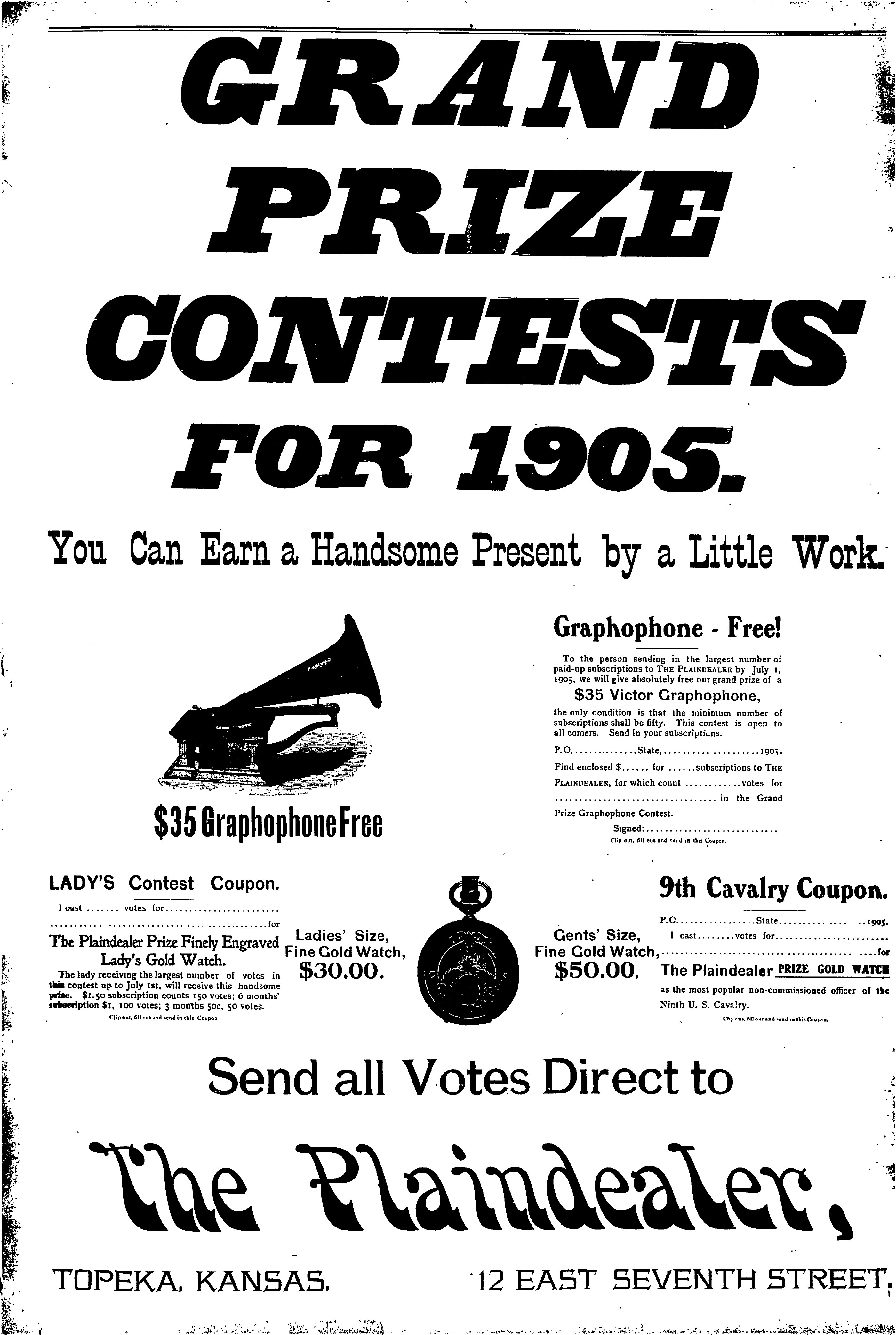
This week we arranged with the Kansas City Weekly Star whereby we can furnish THE PLAINDEALER and Star (both weekly papers) one year for $1.50 This offer will hold good until March 1. This offer also entitles you to 150 votes in our grand prize contest.
To one not familiar with the Topeka Capital's way of telling things, it would seem that no one attended Booker Washington's lecture but white people. Over 3,000 people attended and at least one-half of them were colored.
The election of Hon. T. A. M'Neal, editor of the Mail and Breeze, to the office of state printer is one of the best things the present Legislature has done. No man in Kansas is more deserving of this position than Mr. M'Neal, and his selection will give universal satisfaction to all elements of the party.
AS HE SEES IT NOW.
Mr. Wirt Hughes in the Nashville evening paper in speaking of the condition of the Negroes of that place before and after the war seems to be one whose parents owned slaves, and after the war were left penniless. Now he thinks the Negro has no rights in this country after he has been made free to act for himself and not give his labor free, to permit such lustful animals as Mr. Hughes to loiter around this fair country without honest work. He now feels wrongs which he and his people heaped upon the Negro in ante bellum days. He is ignorant enough to boast of the crowding of the Indian off the American
continent by the whites. He is ignorant of the great multiplicity of the Negroes since the war. He had better read the last census and compare them on this question for the past forty years. We can not call to mind a single
Negro who displays as much ignorance as this fellow, Hughes. We will remain in this country; it is ours as much as it is Mr. Hughes' or any of his kind. He is the worst copper-head we know of at this time. Speaking of Negroes enjoying themselves before the war is idle talk. They were married and then sold like cattle; buried in the same manner. Let Wirt come West and call on us and we will show him a little Negro history. His ideas:
The devotees of the higher law aver that slavery was a wrong, and yet must admit it was the only means of elevating the Negro above the fetichisms, and the barbarisms characterizing him in all ages and to which he persistently returns, whenever left to his own passions and appetites.
This is shown in San Domingo and Haiti today, where, after exterminating his owners and setting up autocracies, he not only despises the arts taught him as a slave and necessary to any pretense of civilized existence, but returns to the idolatries of his ancestors, ten generations removed from him, by pure instinctive initiative, and, evidently because of the absence in him of a nobler, more spiritual faculty—not the worst of which is perhaps cannibalism, horrible as it is.
As a slave, he subserved useful ends and was a valuable property. As a freedman he has not fulfilled the prophecies of those who madly thrust upon him the high duties of American citizenship—his highest conception of which was its money's worth to him—to sell his vote was his first conception of its value.
Appreciating the danger to free government in this, if continued, the white man made haste to restrict its exercise to the narrowest limits consistent with constitutional provisions, and from being no-man of emancipation, he returns to the starting point with more grace than he left it. Will the white man again change his condition? or will he treat him as he treated the Indian?
If the latter is probable, then the Negro's destiny is that of the Indian, though he lives amidst a progress the grandest that ever distinguished a people.
We have robbed the Indian of his country, destroyed his mode and means of living, crowded him into a pen like dumb, driven cattle and, seeing him falling like autumnal leaves in a forest, have laughed at his calamity while hypocritically holding before his hungry eyes the cross of Christ. How much dearer to us is a Negro than an Indian?
Considering all this, it is most marvelous that the Negro continues in this country. The people north of the Ohio don't want him. They would resist his immigration thither by force, if he went in large numbers.
As a slave he had no obligations and many liberties and pleasures. He had his holidays, his patches, his melons, his fowls, and appropriated them to his own use, and their proceeds as he chose; he visited his neighbors, affected fine dressing, celebrated his marriages with pomp, and a supper, and a dance; his dead were decently buried, and had great funerals later, to which all the Negroes for miles around went and shouted to their heart's content. It would consume pages to describe all his rights, which no man dared curtail—his masters defended him in his enjoyment. Nobody desires that he shall again become property, but he is more of a "nigger" today, in its bad sense, than he was as a slave and, if he persists in remaining here, he will descend lower still, as a mass, until decay and rot will exterminate him.
So the Indian went. Two races, as distinct as the white and the black. cannot survive, much less prosper, in the same country—one, and the weakest, must decline, decay and die.
It is averred by able writers that the Negro is an inferior animal to the white man, as the explanation of our treatment of him. Now, it's certain that, if the white man was in a country where he was treated as we treat the Negro, he would emigrate, if he had to crawl away;
East on the Southwest Limited
You cannot drop your napkin and pick it up in the dining car of The Southwest Limited. A waiter will be there with a clean one. A porter was recently disciplined for brushing a hat with a whisk broom instead of a brush. These are little things, but they show how excellence of service is maintaine on the
Chicago, Milwaukee and St. Paul Railway.
This Company owns and operates the sleeping, dining, library and all other cars on its lines, and therefore offers its patrons an excellence in equipment and service not obtainable elsewhere. The Southwest Limited leaves Kansas City, Union Station, 5.55 p. m.; Grand Avenue, 6.07 p. m. Arrives Union Station, Chicago, 8.55 a. m.
WESTERN U
WESTERN UNVIERTSIY.
WESTERN UNVIERTSIY.
The Great Educational Institution for Kansas and the West. .....
DEPARTMENTS: Theological, College State Industrial.
COURSES: Classical, College, Premal, Musical (Instrumental) organ and harmony, Drawing Carpentry, Printing and Book Stenography and Typewriting Plain Sewing, Cooking, Laund
ADVANTAGES: Splendid Location fluences and Thorough Teach
INFORMATION: For terms, prices write to
William T. Vernon
PRESIDI
DEPARTMENTS: Theological, College, Normal, Sub-Normal and State Industrial.
COURSES: Classical, College, Preparatory, Normal, Sub-Normal, Musical (Instrumental and Vocal), including piano, organ and harmony, Drawing (Fine Arts and Mechanical), Carpentry, Printing and Book-Binding, Business Course, Stenography and Typewriting, Tailoring, Dreesmaking and Plain Sewing, Cooking, Laundering, Farming and Gardening.
ADVANTAGES: Splendid Location, Heathful Climate, Good Influences and Thorough Teachers.
INFORMATION: For terms, prices and all inducements offered, write to
William T. Vernon, A. M., D.D.,
PRESIDENT,
Phones { Office—Bell—"White"4302 Residence—Bell—"West" 15.
his pride of character would compel it. Why does this treatment not prompt the Negro to emigrate? Is it because he is an inferior without pride of character? Plainly, if he is indeed a man; if he has the self-respect of a true man, all the powers can't keep him here, nor poverty, nor any cause this side his acknowledgement that he is an inferior, and no man.
I speak of the mass, the million, not of exceptional characters, though these must partake of the fare administered to the mass in, maybe, qualified degree.
The younger generation of Negroes, those under 50 years, ought to consider their present and future condition if they remain here. Ten generations hence the whites and Negroes here will be further apart, more antagonistic, the whites more domineering, less considerate of Negroes than today. Time will not erase the memory, the history of the origin of either race. This, all, from a well-wisher.
Business Chances
in the Southwest are worth looking into. A comparatively new country, with a fertile soil! and a wonderful produce of plants and crops, oil, gas, coal, etc.—a territory capable of sustaining a population many times that of the present, means or portunity if it means anything. We give you some of the facts and figures in our pamphlet "Business Chances!" Isn't it worth your while to investigate! Write for a copy of the pamphlet. Read it and think it over. We will gladly send you a pamphlet and any additional information you may want on request.
Address M.K. & T.RY;
Box 0-912. ST. LOUIS, MO.
PUBLICATION NOTICE.
In the District Court of Shawnee County, Kansas.
Stella McIntyre, Plaintiff, vs. J. M. McIntyre, Defendant.
The State of Kansas to J. M. McIntyre:—The said defendant, J. M. McIntyre, is hereby notified that he has been sued in the above named court by said plaintiff, Stella McIntyre, and that we must answer her petition now on file in said court on or before the 20th day of January, 1905, or the allegations and averages therein will be taken as true and judgment rendered according to prayer of petition divorcing said plaintiff from said defendant.
N. B. ARNOLD,
Attorney for Plaintiff.
Attest: I. S. Curtis, Clerk.
(Seal.)
G. L. COBB,
907 Main Street,
QUINDARO.
Southwestern Passenger Agent Kansas City, Mo.
KANSAS
"LITTLE GEM" BARBERSHOP,
Clean Linen and Towels.
1313 Dodge St.,
OMAHA, NEB.
G. C. STUCKER, PROPRIETER
WAITERS
AND
PORTERS' Headquasters!
WAITERS AND PORTERS' Headquarters CHAS. PHELPS' Barber Shop is where you meet them. The leading barber shop in the city..... 214-216 Francis St. - ST. JOSEPH, M
Do your family washing—5c pound.
It will save you money.
Hotel Newport
1807 Tracy Avenue.
MRS. V. L. NORTH, Proprietress.
Furnished Rooms. Hot and Cold
Water Baths. Gas and
Furnace Heat.
Home Phone 5327 Main.
Kansas City, Missouri
In the Shawnee County, Kansas District Court.
Benjamin Gifford Baird, Defendant. The State of Kansas to Benjamin Gifford Baird, greeting:
You are hereby notified that you have been sued in the Snawnee county, Kansas, District Court by Julia May Baird; that her petition is on file in the office of the Clerk of the District Court of said county; and unless you answer the same on or about the 2d day of January, A.D., 1905 the allegations thereof will be taken as true and judgment rendered against you forever, divorcing said plaintiff, Julia May Baird from you and awarding to her the care, custody and control of your minor child, Neva Pearl Baird.
JULIA MAY BAIED, Plaintiff.
Attest: I S CURTIS, Clerk.
By Anna M: Tillson, Deputy Clerk.
[SEAL.] MONROE & SCHOCH,
Attorneys for Plaintiff.
KNIGHTS AND DAUGHTERS OF
TABOR.
TABERNACLES.
Number
1 Mrs. Lula Buford, 2509 North 6th
Kansas City, Kansas.
2 Mrs. Sarah Crisp, 615 South Chestnut
St., Iola, Kansas.
3 Mrs. Flora Thompson, 36 North Main
Council Bluffs, Iowa.
5 Mrs. Mollie Spencer, 502 V. St.,
Atchison, Kansas.
6 Mrs. Fronia McCloud, 118 S. Mulberry St.,
Ottawa, Kansas.
7 Mrs. N. E. Wigely, 506 N. 5th St.,
Salina Kans.
8. Mrs. Anna Fallings, Cherryvale, Kansas.
10 Mrs. Maggie Fishback, 1795 Mass,
Lawrence, Kans.
11 Mrs. Jennie Flod, 406 Oakland, Kansas City, Kans.
12 Miss Cora Sango, 2058 North Front St.,
Kansas City, Kans.
13 Mrs. Nannie Dunlap, Junction City, Kans.
15 Mrs. S. S. Furlough, Box 315, Wier City, Kans.
16 Mrs. Nancy Preston, 1507 Clark St.,
Parsons, Kans.
17 Mrs. A. Masie, 615 Barbee, Ft. Scott, Kans.
20 Mrs. Emma Maxie, 411 Ransom, Ft. Scott, Kans.
28 Mrs. Susie Willis, 21 St., T. Granda, Parsons, Kans.
29 Mrs. Alberta Chivers, 210 N. 9th., Leavenworth, Kans.
30 Mrs. Laura Bright, 203 Ohio, Leavenworth, Kans.
32 Mrs. Ida B. Willis, 1036 Iowa Ave., Butte, Mont.
33 Mrs. Phannie Corneal, Box 384, Alliance, Neb.
34 Mrs. Mattie Miller, 335 West 15th., Wichita, Kans.
35 Mrs. Fannie Washington, 627 N. 27. S. Omaha, Neb.
37 Mrs. Mary Roberson, 1011 Maple St., Atchison, Kans.
38 Mrs. Patsy B. Gooding, Box 338, Wier City, Kans.
52 Miss Jennie Alexander, 948 Penn., Lawrence, Kans.
63 Mrs. Lizzie Thomas, 1112 Oakland, Kansas City, Kans.
77 Mrs. A. Pickens, 250 E. 15th., Topeka, Kans.
85 Mrs. Ella Cornish, N. Topeka, Kans.
89 Mrs. Maggie Brown, 1204 Dodge, Omaha, Neb.
91 Mrs. Ella Golden, 310 N. 12, Omaha, Neb.
92 Mrs. Mary L. Williams, 717 C. St., Lincoln, Neb.
93 Mrs. Ida M. Jordan, 903 Western Ave., N. Topeka, Kans.
559 Mrs. Christena Bell, 294 N William St., Deadwood, S. Dakota.
8 Mrs. Laura Smith, 308 11 St., Coffeyville, Kans.
777 C. M'S ADDRESSES 333.
Number.
1 William M. Watkins, Box 184, Wier City, Kans.
2 Andrew Smith, 308 East Eleventh St, Coffeyville, Kans.
3 Geo. W. Taylor, 111 Mound, Atchison
4 Geo. C. Tucker, 1313 Dodge, Omaha, Neb.
5 J. T. Howard, 120 Kan. Ave., Topeka
8 R. M. Bingham, 1727 E. Oak St., Ft. Scott. Kans.
10 J. H. McKinnis, 217 Sherman Leavenworth.
13 A. H. Morton, Parsons.
15 R. H. Hudson. 109 S. Santa Fe., Salina, Kans.
16 Richard Clark, 420 N. 25th St., S. Omaha, Neb.
17 Allen Garner, 704, E. 12 St., Coffeyville, Kans.
19 C. Parris, 918 Penn. St., Lawrence, Kans.
25 Edward Henderson, 1917 N. 3rd St, Kansas City, Kans.
60 Wesley Osteen, 1214 Lane St., Topeka, Kans.
72 John L. Wright, Lincoln, Neb.
18 James Thomas, 385 Lake St., Salt Lake City.
536 J. W. Barbee, 294 Williams St., Dearborn, Dekota.
First published December 6th, 2004.
NOTICE.
My application for a permit to sell siting establishments according to law at 12125 Kansas avenue, in the Third ward of the City of Topka, is now on file in the office of the Probate Judge of Sharyn county, Kansas, and R. F. Hayden, Probate Judge, will hear said application at his office in the court house in the said city of Topka, on Wednesday, the 13th day of January, 1905, at 9 o'clock a.m. of said day. W. R. K. NNADY, Apphema
Lancaster Brus.,
The Turf
Wholesale Agents Dst and Milwaukee Beer. Junction City, Kas.
NOTICE OF APPOINTMENT.
State of Kansas, Shawnee county, N.
In the matter of the estate of Lewis
Adams, late of Shawnee county, Kansas.
Notice is hereby given, that on the
29th day of November, A. D. 1904, the
undersigned was, by the Probate Court
of Shawnee county, Kansas, duly
appointed and qualified as Administrator
of the estate of Lewis Adams, late of
Shawnee county, deceased. All parties
interested in said estate will take notice,
and govern themselves accordingly.
WESLEY HALE,
Administrator.
UNEXCELLED SERVICE
VIA
FRISCO
TO POINTS IN
Missouri,
Arkansas,
Tennessee,
Alabama,
Mississippi,
Georgia,
Florida
AND THE SOUTHEAST, AND TO
Kansas, Oklahoma,
Indian Territory,
Texas
AND THE SOUTHWEST.
The Famous Health and Pamela Resorts,
EUREKA SPRINGS
AND HOT SPRINGS,
ARKANSAS,
Reached most conveniently by this route.
Round Trip Homesweller' Tickets as
rate of GRE FARE plus $1, on sale first
and third Tuesday of each month.
For descriptive literature and detailed
information as to trades, train service, etc.
address
J. C. LOVWHEE,
ASSISTANT GENERAL, PRESSING AGENT,
KANSAS CITY, MO.
A
KATY SERVICE
(MISSISSippi, KANSAS & TELAS RAILWAY)
THE
MK-T
NEW YORK
I can ask any am-
mong you, and send you something new
in printed matter about them.
Write to me.
"KATY," St. Louis
WONDERFUL DISCOVERY Curly Hair Made Straight By
TAKEN FROM LIFE
BEFORE AND AFTER TREATMENT.
ORIGINAL
OZONIZED OX MARROW
This wonderful hair pomade is the only safe preparation in the world that makes hair longer, only hair straight as shown above. It is placed out or breaking off, eases dandruff and makes the hair grow long and silky. Sold over forty-five years and used by thousands. Warranted for all hair types. Sold for straightening gray hair. Revised by imitations. Remember that the Original One used Ox Marrow is put up only in states that claim to be just as good—not always insist upon getting the groomed, as it never satisfies. It is not possible for anybody to produce a preparation equal to it. Fall direction with glove and Gator, or as per $1.49 for bottle, postcard, or $1.49 for three bottles, expense paid. We pay all postage and expenses. Gator is the name of the paper company. Write your name and address plainly to: KONNED OX MARROW CO., 76 Washburn Ave, Chicago, Illinois. Agents wanted everywhere.
When in Salina, call on the MAN FROM IOWA at the
Salina Club Room
LUNCH AND GROCERIES
THOS, SMITH, 501 N. Third St
ete
Tp. "rmown 996 2.
orvace roms SS =
Sondaye's owen,
DR. A. C. BRISCOE.
DBATIST.
+31 Bam Sisth Street,
‘Opposite Shawaee Grocery. - TOPEKA, KAS
WM. E. JACKSON, M. D
PuysiciaN aND Surexon
Office 404 Kansas Ave,
L, as DD, TOPEKA, KANSAS
Tto10 A. M,
OFFICE xouss| 12M. tod P.M.
Ind. Phone 900. [7 to 10 P. M.
J. M, JAMISON, M.D.,
PuysiciaAN AND SURGEON
Kzamiaing Physician of the Knights and Laces
of Protection.
epecial tention to desaese:
{ omen and private deveases.
Ogice and Residence, 307 Mavison Stexer,
_————
O. A. TAYLOR, M. D.
PuysioIAN anv Surexon
326 Mantas Ave. Ind, Phone 774
Calle suswered day anid aight.
7to9 a.m.
Office Hours | 2to 4 and 6 to 8 p.m.
; NEWS OF THE WEEK, ;
PAPPPPIISPLNIPPSEPPEINSSFS
P.E. Tipton of Emporia wasin
the city Tuesday.
Miss Ethel Woldridge is ill at her
home in North Topeka.
Mrs. Lizzie Jones is ill at her
home in North Topeka.
Rey. J. M. Harris of Kansas City
isthe guest of Rev. D, Smith.
W. C. Brown and Dr. Kenny were
here Tuesday from Lawrence,
Tae P.ainpeaLER and Kansas
City Weekly Star one year for only
£1.50.
Br. W. H. Hudson and Rev.
Jones of Atchison visited in Topeka
last Tuesday.
Mr. Fielding Webb of Leaven-
worth attended the Booker T. Wash-
ington lecture.
W.M Guy of Oklahoma attended
the banquet and heard Booker T.
Washington.
J. H. Jones of Coffeyville attend-
ed the Booker T. Washington lec-
ture Tuesday evening.
Mr. M, Harvey Tempkina of Os-
kaleosa was in the city to hear
Booker T, Washington.
Miss Josephine Mason was in
Oskaloosa laat Monday attending to
business and visiting friends.
J. A. Tompkins of Oskaloosa
came down Tuesday evening to hear
Booker T. Washington.
Mr, Sam’! D. Russell of Frankfort,
Kans. was in the city visiting friends
and attending the lecture.
Several people from out of town
were in the city attending the Book-
er F. Washington lecture.
Mr. and Mrs. James Bertha have
removed from 603 Vinona, Kansas
City, Kan. to 614 Troup ave.
Mrs. Roscoe A. Bass returned
Tuesday from Arkansas City to visit
her parents, Mr. and Mrs. Gay.
Mrs. John Dandridge has returned
from Miami, Mo., where she went
to atteod the funeral of her father,
Mrs. Martha Powell, who was
stricken with paralysis several weeka
sipce, remains in a serious condition,
Mr. B. Moore of Emporia is in
the city, the guest of his relatives,
Ms, and Mrs. E.J Johnson of Low-
masa Bill.
M. W. Guy of Ann Arbor, Mich.
is in the city, the guest of his parents,
Rey. and Mrs. G. W. Guy ot West-
eve ayenue.
The Ne Plus Ultra Art club was
entertained last Friday afternoon by
Mrs. B.C. Duke. Miss Lelia Nor-
man is the club’s hostess this after-
noon.
Mr. J. B. Rice of Frankfort, Kans.
one of the prosperous farmers of
that vicinity, wae in the city attend-
ing the Booker T. Washington lec-
ture Tuesday.
Prof. Vernon is in the city shak-
ing hands with his many friends.
ee a a Se ae:
Rev. J. R. Ransom returned home
Tuesday from Pittsburg, Kans.
Messra. Benj. James and Siras
Jeffries of Maple Hilt were visitors
in the city this week.
G. W. Jones of Oslaloosa was in
the city Tuesday to hear Booker T.
Washington and to visit relatives.
Messrs. Logan, Coffee and Reed
Harding of Frankfort, Kans. were ip
the city to hear Booker T. Washing-
ton.
Mr. W. G. Curtis of Abilene, Kas.
was in the oity attending the Wash-
ington lecture. While here he made
this office a pleasant call.
ns
R.N, Taylor of Lawrence was
among those who heard the Wash-
ington lecture Tuesday evening.
He made this office a pleasant call.
Mr. Nolaa Clardy of Rossville,
Kan. was in tho city to attend the
Washington lecture. While here he
subscribed for THE PLAINDFALER.
The Executive Board of the State
Baptist convention met at Shiloh
Baptist church this week. Rev. E.
A. Wilson of Kansas City, Kans. is
presiding officer.
Mrs. Cora Jordan and Miss Jessie
Harlan of Leavenworth were in the
city this week to attend the Washing-
ton lectureand banquet. They were
guests of their sister, Mra. O. A.
Taylor.
The following ladies from Law-
rence were in the city to attend the
Booker T. Washington lecture: Mes-
dames Ophelia Hawkins, Mack
Brown, Neely Henderson, Johnson
and Miss Johnson.
Mr. Ed, Williams, head waiter at
he Copeland hotel, took his fellow
waiters to St. John’a A. M. E. church,
where they greatly enjoyed the ser-
vices. This is a commandabie act,
and others should follow Mr. Wil-
ams’ example.
A dispatch came to Mrs. Frankie
Sprigzs, 1320 Van Buren street, in-
forming her of the death of her
brother, Mr. Samuel Henderson of
New Orleans,La. He carried insur-
ancein the Metropolitan Life In-
surance Co., which is left to Mrs.’
Spriggs.
G.S.‘Scales of Mustang, Okla. is
visiting relatives in Topeka. He
has been in Kansas City, Kansas,
where he was called to tho bedside
of his son, U. F. Scales, who has
been very ill. Mr. Scales is one of
Topeka’s old citizens. He lived in
Oklahoma City for several years, but
has now removed to his eighty acre
farm near Mustang.
Rev. J. M. Harris, pastor of the
M, E. church of Kansas City, Mo.,
was inthe city. While here he de-
livered an address at Asbury chapel,
North Topeka, which was well re-
ceived. After the lecture the ladies
of the Bishop Hamilton sewing cir-
cle gave alunch «hich cleared them
$4.25. This circle is quite an ac-
quisition to the church, having now
in the treasury $42.25.
The Oriental Art club met last
Friday with Mrs, L E. Clarke. ee
teen minutes were given to the liter-
arv denartment of the club which
a tas. .. de RRR at:
* In the case of R. J, Henderson
in the district court where he was
arrested for disturbing the peace of
Mrs. Preddy, was thrown out of
court. Mr. Henderson is one of the
leading farmers in Richland and
there was no cause for the arrest.
It was only a neighborhood quarrel.
The Golden Rod club is to meet
this afternoon at the residence of
Miss Lizzie Cooper.
Hester Hawkins, Pres.
Felicia Davis, Sec’y.
The City Federation will meet
thie afternuon at two o’clock at the
Congregational church, corner King
and Lincoln streets. All members
are expected to be present.
Loula B. Hartis, Pres.
Mary B. Jordan, Sec’y.
Mr. and Mrs. C. Mukes gavea
birthday party for their niece, Miss
Clifford Roach, last Saturday. A
dainty four course luncheon was
served, and the young folks enjoyed
themselves very much. Those pres-
ent were Pearl Rhodes, Georgia
Rhodes, Daisy Stonestreet, Jessie
Payne, Helen Forbes, Freda Bran-
ford, Viola Relcher, Master Johnnie
Ferguson, Harry Dillard, Charles
Wright, Harold Harris, Albert
Glenn, George Hamilton, Freddie
Jamison. Music was furnished by
Pearl Rhodes and Viola Belcher, and
a solo was given by Jobn J. Jones.
Shampnoing and Face Massxge
MRS. HATTIE E. VAN VLECK
Hair Dresser and
Manufacturer... ....
Hair To Matcu ALL ComPLexions.
Doll Wigs—New Pompadoura,
Pompadour Combs, and other
Toilet Combs, Switches and
—Hair Jewelry........p.0.000+
220 E.sth St. TOPEKA, KANS
Florida Sleeper
On November 15th, and daily
thereafter, until the summer season
of 1905, the Frisco System, in eon-
nection with the Southern Railway,
will operate through Pullman Sleep-
ers between Kansas City, Mo. and
Jacksonville, Fla. These sleeping
cars will be placed 1n service as part
of the equipment of the Popular
“Southeastern Limited,” scheduled
to leave Kansas City 6:30 P,M. A
modernly equipped train, electric
lighted cafe observation car, etc—
the route of which carries the travel-
er through the populous cities of the
southeast.
| Berth reservations may be made
through representatives of Frisco
‘System or connecting lines.
PassENGER TRAFFIC DEPARTMENT,
Saint Louts.
Do You Know
will be eight pages from this week.
'
| DURING THE NEXT SIX MONTHS THERE WILL BE NUMEROUS
PRIZES AWARDED FOR DIFFERENT THINGS. SEE PARTICULARS IN
BIG “AD” ON PAGE SEVEN. Now is your opportunity. -
TWO FOR ONE!
_ The Topeka Plaindealer
Kansas City Star
One Year — $1.50.
Don’t Miss This Chance!
Lincoln Day Banquet.
BOLE Y 9 I. T.
The Colored Town and
_ Home of the Negro.
One Year Old and 600 Inhabitants!
8000 Acres of Land Surrounding Boley has Already been
Leased and Bought by Negroes. 20,000 Acres of the Best
Land in the Creek Nation Surrounding Boley to be Leased
and Bought by Negroea.
T. M. HAYNES, Local Townsite Mgr., BOLEY, 3. T.
Bishop Abram Grant to Be
Speaker of the Evening.
The great Lincoln Day club will
on Monday evening, February 13th
hold their usual aunual exercises in
honor of the great emancipator.
The club has procured for the
speaker of the evening that great
race leader and eminent divine, Rt.
Rev. Bishop Abram Grant. The
exercises will he held in the Jouse
of Representatives, after which the
banquet will be held. ‘This year’s
exercises bid fair to excell anything
which this organizatiou has hereto-
fore attempted, and parties deriring
to attend the banquet should com-
rounicate at once with the secretary,
J.B. Bass, care Toe PuainpeaLer.
SUA miniciisiaiaiaiae
S : }
= A NEW FAST TRAIN, The Katy Flyer §
Z Leaves Kansas City at 2:20 A. M. daily, arriving atal ©
u principal Oklahoma, Indian Territory and Texae pointe €
= the same day. &
Ss 3 Daily Trains from Kansas City Southwest. s
= 2:20 __A. M, 12:35 P.M, :
S 9:00 P. M. &
2 --——- z
= Ark the Agent or Write KATY” s
2 €
= Saint Louie. s
BARLEY ULLUUALLDUUULUAUPLATUR UALR:
For Sale &% kekrine
Quincy—6 rooms, $1300.
Van Buren—4 rooms, #700.
Van Buren—3 rooms, #600.
Harrison—3 rooms, £550—¢75
cash,
Topeka Ave.—5 rooms, $#1100—
$100 cash.
Topeka Ave.—4 roome, $700.
Topeka Ave.—7 rooms, $1200.
Acre property, $150—#50 cash.
Lots on Kansas avenue, £100,
Lots om Kansas avenue, €25.
DAY MIXER, : NIGHT MOXER,
JIM NICKOLS. HORACE BURKE.
tt
#“THE ONLY WAY".
SALOON ae POOL HALL,
FURNISHED ROOMS.
Open Day and Night. Fine Wines, Liquors and Cigars.
1215-1217 East 18th St, _KansasCity, Mo.
Home Phone 2544. Lige Hendricks, Prop.
WH EN IN ATCHISON
—call on——
Mrs. Anna Lemons
at 116 N. 8th street, who keeps
a first-class ROOMING HOUSE
and RESTAURANT. Givehim
a call. Everything first-class
and up-to-date.
To know where to get the best of everything. She knows that, especially in drugs, medicines, toilet articles and stationery, there's never anything gained and frequently much lost by using something cheap and inferior. We have quite a crowd around our place, but there's always room for more, and our clerks are of the spry kind. They don't keep a customer hanging around half a day before being waited upon.
ARMACY, 732 Kansas Avenue.
KOHL'S PHARMACY,732 Kansas Avenue.
of Protection
A NATIONAL FRATERNAL INSURANCE
SOCIETY
our society is similar in character and management AND LADIES OF SECURITY, A. O. U. W., and EN. No intelligent Negro should be without protection of our famiies warrants no delay in the Good agents wanted. For further information write
Society in ne U.S. Our society is similar in character and management to the KNIGHTS AND LADIES OF SECURITY, A. O. U. W., and MODERN WOODMEN. No intelligent Negro should be without INSURANCE. heprotection of our families warrants no delay in the matter of insurance. Good agents wanted. For further information write
J. H. CHILDERS, Natl Sec. Headquarters: 413 Kausas Avenue, Topeka, Kansas.
Local and Personal.
Mrs. John Smith is numbered among the sick this week.
Rev. David Overr of Garnett, Kan., is in the city.
D. W. White of Kansas City was a visitor in the city this week.
The minutes of the K. P. Grand Lodge have been sent out from this office.
Messrs. H. C. Rice and A. Johnson, of Centralia, Kan., were in the city.
Rt. Rev. Bishop Abraham Grant of Kansas City, attended the Booker T. Washington lecture.
Mrs. Ellen Slaughter had the honor of serving the Washington banquet at the State House.
"Marsh" G. Holloway, an old time "print," of Herton, was in the city Tuesday to attend the lecture.
Booker T. Washington was the distinguished guest of Mr. and Mrs. Wright during his stay in this city.
Carl W. Shaffer, the popular druggist of St. Joe, should be liberally patronized by the colored people of that city.
The Dumas club met at the residence of Mrs. Geo. Carpenter and adjourned to meet with Mrs. Porter Friday, Jan. 27th.
Mr. J. R. Cox is traveling secretary for Prof. B. T. Washington and is a very affable young man, a Kentnckian by birth.
The National Rescue Home Association will meet at the Second C. P. church, corner 15th and Quincy, Monday night, Jan. 23d.
Miss Evelyn P. Hickman is expected to arrive from Frankfort Sunday, and will resume her duties as stenographer in this office.
It is rumored that Mr. Joseph Johns, the popular tonsorial artist, will ere long lead to the altar one of our prominent young ladies.
Headquarters
Open day and nigh..
Refreshments of all kinds.
416 Cherokee Street.
Hon. Freeman L. Martin and Miss Nettie Penix of Kansas City, were in attendance at the Booker T. Washington lecture Tuesday.
All the proceeds of the Booker T. Washington lecture will be donated to the Topeka Industrial Institute, of which Prof. Carter is principal.
Dr. J. Edward Dibble of Kansas City, Mo. is in the city visiting some of his patients. He made this office a pleasant call while here.
"Prescriptions a Specialty."
WOODMER HELLOY
PROTECTION
Trust a Wellbred Woman
Knights and Ladies
Issues policies. the sums of $250 $500,$1,000,also $75 $100,$150 and $200 for children over 6 years of age. This is the only colored Fraternal Insurance
Business Manager Nick Chiles left yesterday for the Indian Territory. He will return about Tuesday.
Miss Lillian Weatherspool, of Salina, Kan., attended the Booker Washington lecture and was the guest of Mrs. M. J. Smiley.
Mrs. W. L. Grant, the successful winner in the contest for the most popular lady teacher of the Kansas City schools, was in the city this week.
At the conclusion of Mr. Washington's lecture at the Auditorium Tuesday evening the waiters of the Copeland hotel presented him with a box of beautiful flowers.
According to the St. Joseph, (Mo.) Radical, Prof. W. H. Jones has been appointed head janitor at the court house. Prof. Jones is a nice gentleman, highly educated, and it is a disgrace to Republicanism to place a man of his ability at the head of a broom brigade. Jones has more brains and ability than half the men in the court house who are holding office. If this is the kind of recognition the Negro Republicans receive in "Imperial Miesouri," we beg to be excused.
Mrs. Merriitt and daughter, Miss Cora, entertained a candy pulling in honor of Misses Viola and Josephine Martin of Garnett, Kan. The evening was pleasantly spent in music and social conversation. Among those present were: Misses Arnicholrs Chiles, Pearl McNeal, Willa Smith, Hester Hawkins, Bessie Hawkins, Alberta Guy, Minta Beck, Georgia Watkins, Corrine Buckner, Bertha Harlan of Leavenworth and Mrs. Gaitha Page, Messrs. Frank Harris, Richard Harris, Glen Watkins. Clarence Olden, George Olden, Carl Harris, Roscoe Guy, Dean Buckner, Ira Guv, Milton Guy of Ann Arbor, Mich., Walter Caldwall, Robert DeFrantz and Ned O'Bunion.
When in Leavenworth call on these gentlemen at
WHEN IN TOPEKA
Neatly Furnished Rooms-Board by the Day or Week. Lunch Counterin Connection. Open from 6 a.m. 108 Kansas Ave. Near R.I. Depot. -TOPEKA.
Character Building. A BOOK REVIEW.
BY RAYMOND R. JAMISON, TOPEKA.
"Character Building," as our ington, is an excellent indication he recommends to his race. It has its merit, and especially its bearable appeal to all students. It consists of lectures which Mr. Washington liver to the students of the Tuition evenings.
As Mr. Washington himself the book, he wished to speak to students and instructors and, by their manifold responsibilities, selfes with greater zeal and interest confronted them in their every co-couraging was their reception to continue them for a more extended intended, and finally, at their ease them in book form, so that all so helpful and practical suggestion.
The lectures are comparatively so replete with wisdom and good they cannot fail to make an impact as they do the beauty of pure, consistent Christian life, a high ideal and actually striving setting forth the individual respect.
The specific subjects treated home life, student life in particular life and spiritual life. For instance," "The Virtue of Simplification," "To Would-Be Teachers," "In The Importance of Being Shadow," and scores of other subjects.
The peculiar fact that the person as if the author were directors it all the more forceful words employed are of the simple clearly and explicitly.
In plain but serious sentiments to so conduct themselves that the institution to which they belong may be influenced for good by that they must not only refrain also do good. One talk in part to Do," lays special stress upon. And after all, this doing one's monplace it may appear, embolden and character. For, in the long character of a person which unless or failure. For the nation one indispensable requisite is care and dares as well as endures, or in the doing of good as it is first thing that is evil or degrading.
The foregoing interesting Booker T. Washington's magazine Building," is from the pen of Judge W. I. Jamison, assistant student in Washburn College at Washburn Review young James leading features. He is one of college and his budding genius the front ranks of our for youth, he is a deep thinker and bitious and will never surrender upon his banner.
THE PLAINDEALER feels Jamison and we predict a bright
character Building," as outlined by Bookman, an excellent indication of the high idem regards to his race. It is a book which, and especially its bearing on scholastic all students. It consists of a series of which Mr. Washington was accustomed to the students of the Tuskegee Institute.
Mr. Washington himself says in the introduction he wished to speak straight to the head and instructors and, by making them of fold responsibilities, cause them to be a greater zeal and interest to the priests them in their every day life. So here was their reception that he was induced for a more extended period than he had finally, at their earnest solicitation, to form, so that all students might provide practical suggestions.
Pictures are comparatively short in them, with wisdom and good sound common not fail to make an impression on the minds they do the beauty and importance of consistent Christian life, commending the real and actually striving to approach it with the individual responsibilities of all specific subjects treated vary greatly, and student life in particular, social life, spiritual life. For instance: "Influence The Virtue of Simplicity," "On Getting Child-Be Teachers," "Individual Respect of Being Reliable," "Sand scores of other suggestives topics," peculiar fact that the book is written if the author were directly addressing all the more forceful and emphatic, and employed are of the simplest they express explicitly.
Again but serious sentences he exhorts to instruct themselves that they will be a part to which they belong, that their feelings influenced for good by their example, and must not only refrain from doing evil good. One talk in particular, "What always special stress upon the performance all, this doing one's duty, no matter it may appear, embodies the highestacter. For, in the long run, it is the result of a person which ultimately determines failure. For the nation and the individual requisite is character—character as well as endures, character that is being of good as it is firm in the refusal it is evil or degrading.
Beforegoing interesting and well written, Mr. Washington's magnificent book on "Is from the pen of Raymond R. James, I. Jamison, assistant county attorney in Washburn College and in the last ten Review young Jamison's article was features. He is one of the brightest sons and his budding genius will some day ranks of our foremost men. There is a deep thinker and, like his father, and will never surrender until victorious banner.
PLAINDEALER feels an especial pride and we predict a bright future for his
"Character Building," as outlined by Booker T. Washington, is an excellent indication of the high ideals which he recommends to his race. It is a book which by reason of its merit, and especially its bearing on scholastic life, should appeal to all students. It consists of a series of short talks or lectures which Mr. Washington was accustomed to deliver to the students of the Tuskegee Institute on Sunday evenings.
As Mr. Washington himself says in the introduction to the book, he wished to speak straight to the hearts of his students and instructors and, by making them conscious of their manifold responsibilities, cause them to apply themselves with greater zeal and interest to the problems that confronted them in their every day life. So hearty and encouraging was their reception that he was induced to continue them for a more extended period than he had originally intended, and finally, at their earnest solicitation to publish them in book form, so that all students might profit by their helpful and practical suggestions.
The lectures are comparatively short in themselves, but so replete with wisdom and good sound common sense that they cannot fail to make an impression on the reader, emphasizing as they do the beauty and importance of living a pure, consistent Christian life, commending the adoption of a high ideal and actually striving to approach it, and clearly setting forth the individual responsibilities of all persons.
The specific subjects treated vary greatly, bearing on home life, student life in particular, social life, business life and spiritual life. For instance: "Influencing by Example," "The Virtue of Simplicity," "On Getting a Home," "To Would-Be Teachers," "Individual Responsibilities," "The Importance of Being Reliable," "Substance vs. Shadow," and scores of other suggestives topics.
The peculiar fact that the book is written in the first person as if the author were directly addressing the reader, renders it all the more forceful and emphatic, and while the words employed are of the simplest they express his ideas clearly and explicitly.
In plain but serious sentences he exhorts his students to so conduct themselves that they will be a credit to the institution to which they belong, that their fellow students may be influenced for good by their example, and above all, that they must not only refrain from doing evil but must also do good. One talk in particular, "What You Ought to Do," lays special stress upon the performance of duty. And after all, this doing one's duty, no matter how commonplace it may appear, embodies the highest ideal of life and character. For, in the long run, it is the individual character of a person which ultimately determines his success or failure. For the nation and the individual alike the one indispensable requisite is character—character that does and dares as well as endures, character that is just as active in the doing of good as it is firm in the refusal to do anything that is evil or degrading.
The foregoing interesting and well written review of Booker T. Washington's magnificent book on "Character Building," is from the pen of Raymond R. Jamison, son of Judge W. I. Jamison, assistant county attorney. He is a student in Washburn College and in the last issue of the Washburn Review young Jamison's article was one of the leading features. He is one of the brightest students in the college and his budding genius will some day place him in the front ranks of our foremost men. Though a mere youth, he is a deep thinker and, like his father, is very ambitious and will never surrender until victory is perched upon his banner.
THE PLAINDEALER feels an especial pride in Raymond Jamison and we predict a bright future for him.
WHAT DOES VAR-
DAMAN MEAN?
What does Vardaman mean?
Does he mean to insult the president and thereby degrade the nation?
He should remember that the people made Theodore Roosevelt president, and as such he is entitled to as much respect and honor as any European sovereign.
The following are a few of the reasons that one Garrard Harris, a writer of considerable ability, gives for Vardaman sending his peculiar telegram to President Francis of the Louisiana Purchase Exposition Nov. 30th, to-wit: Because Mr. Roosevelt was not a worshiper of the late Hon. Jefferson Davis, and desired no communications with him, so says the Commercial-Appeal of Dec. 1. I did not know Mr. Davis personally, and it is not my object to say one word against the great Confederate chieftian, who was honored by all the Confederacy and especially by the old proud state of Virginia, but I don't see how a man who sincerely loves the Union could sincerely love Jefferson Davis, because he fought to destroy the Union.
Another excuse offered by the writer was that President Roosevelt dined with a Negro in open violation of all southern traditions.
"I am president of all the people and not a part of the people."—Theodore Roosevelt.
And if such be the case is he to respect southern traditions or
outlined by Booker T. Washington of the high ideals which is a book which by reason of being on scholastic life, should consist of a series of short talks on was accustomed to de-keegee Institute on Sunday of says in the introduction to straight to the hearts of his making them conscious of because them to apply them-arest to the problems that lay life. So hearty and en-what he was induced to con-period than he had originally earnest solicitation to publish students might profit by their-nessly short in themselves, but sound common sense that expression on the reader, em- and importance of living a recommending the adoption of going to approach it, and clearly responsibilities of all persons. And vary greatly, bearing on circular, social life, businessance: "Influencing by Ex-entity," "On Getting a Home," individual Responsibilities," Reliable," "Substance vs. suggestives topics. Book is written in the first directly addressing the reader, and emphatic, and while the oldest they express his ideas. Hence he exhorts his students they will be a credit to the ing, that their fellow students their example, and above all, from doing evil but must particular, "What You Ought to the performance of duty. duty, no matter how com-dies the highest ideal of life long run, it is the individual ultimately determines his suc- and the individual alike the character—character that does character that is just as active in the refusal to do any-
and well written review of sufficient book on "Character Raymond R. Jamison, son of it county attorney. He is a sound in the last issue of the nation's article was one of the brightest students in the will some day place him in the most men. Though a mere like his father, is very am-mer until victory is perched
an especial pride in Raymond R. Jamison future for him.
American traditions? He says that Roosevelt forced another Negro down the throats of the Charleston people as collector and representative of the Port of Charleston. In reply, Dr. Crum was and is an American citizen, and there is no duty, however humble or exalted that an American citizen may not be called upon to perform, if he is found worthy.
Now, again, as to southern traditions, the president should not bow to sectional sentiment, cast or west, north or south, but it is the American sentiment that he must uphold, because he is president of the United States. The South must learn to give up some of her traditions and be lost in the sentiment of the American people.
The sentiment of America is that all men are free and equal and that every man is a man and that the president has as much right to honor a black gentleman or lady as a white one. And the South must learn to have colored men in the jury box when necessary. She must learn to respect a Negro governor, and now and then to behold a Negro sheriff; in fact, she must drop the race issue and strive for the promotion and elevation of all her citizens. Is this what Governor Vardaman means to do?
D. E. CALDWELL, M. D.
Box 95, Osceola, Ark.
Yours respectfully,
Entertains Booker T. Washington.
Mr. and Mrs. J. H. Guy entertained at 5 o'clock dinner Tuesday in honor of Prof. Booker T. Washington at their beautiful residence at 224 Topeka avenue. The rooms were beautifully decorated with palms and blooming plants which presented a pleasing array to the assembled guests. The following were present to meet the distinguished guest, and to partake of the hospitalities of Mr. and Mrs. Guy: Bishop Grant, Kansas City; J M. Wright, city; J.G.Groves, Edwardsville, Kan.; W. R. Carter, Western
All members of the Washington literary are requested to be present next Wednesday night, Jan. 25th. Business of importance to be transacted.
Mrs. Mayme Smith of Manhattan, attended the lecture Tuesday night, and while here was the guest of her sister, Miss Minnie Howell, teacher in the Industrial institute.
H. C. Davis of McFarland, and J. K. Kruthers and W. T. Wallace of Alma, attended the Washington lecture Tuesday, and they made this office an agreeable call.
Mrs. Margaret Smi h died at her home, at 8z2 Clay street last Sunday morning. Her funeral was held at St. John's A. M. E. church. She was 80 years of age and had been a member of the Daughters of Liberty for fifteen years.
As we go to press news comes to this office that our fellow townsman, Clarence Long, was dangerously injured by a street car while attempting to cross the tracks in a buggy. His head was badly cut and the skull fractured. This morning Dr. Kieth reports him as being better but that his condition is dangerous. The Porters' and Waiters' club is the name of a new social organiza
v8 29051
M. L. Freeman and Jesse Powers
and Mrs. Jesse Powers defendants.
To the above named defendant, M. L. Freeman, you are hereby notified that you have been sued in the District Court of Shawnee County, Kansas, by the above named plaintiff, F. R. Hesser, and that said F. R. Hesser filed her petition in the above entitled court on the 26th day of November 1904, and that unless you answer said petition on or before the 27th day of February 1905, said petition will be taken as true and judgment will be rendered against you barring, foreclosing and excluding you and all other persons claiming by, through or under you from any claim of title or interest you may have, or from ever setting up or claiming any right, title or interest in, or lein upon the following described real estate situated in Shawnee County, Kansas, to-wit: Lots ten [10] and twelve [12] on Highland Ave., in South West Sub-division. And judgment will be rendered against you quieting said plaintiff's title in and to said premises and for such other and further relief to which said plaintiff may be entitled and for costs of this suit.
F. R. HESSER, Plaintiff.
D. H. BRANAMAN, Atty. for Pl'tff.
Attest, I. S. CURTIS, Clerk.
Will Hill, Al. Rodgers.
Manager. Proprietor.
The "ZANZIBAR"
SALOON AND HOTEL.
Hotel on European Plan. 12 elegantly
furnished rooms. Gas and Steam heat.
Fine Wines, Liquor sand Cigars
POOL AND WHIST ROOMS
IN CONNECTION.
208 Independence Avenue.
KANSAS CITY, - - MO.
Tuskegee, city; R. J. Buckner, city; Dr. O. A. Taylor, city; Milton Guy, Ann Arbor, Mich.; J. H. Childers, city. Mr. and Mrs. Guy proved themselves equal to the occasion from the manner in which they entertained their guests and every one was made to feel perfectly at home. To say that the dinner which was served in courses, was a success, would be stating it mildly. It was certainly the most elegant repast it has been our privi ege to enjoy.
tion recently launched by our young men, and is highly appreciated. It affords its members a nice place to spend their time between working hours. Heretofore, the colored man has had no place to go, and this club is a much needed thing.
At the solicitation of the physicians and leading citizens of Atchison, Dr. Briscoe has decided to open a branch dental office in that city. Dr. Briscoe will spend one day (Wednesday) of each week in Atchison, but will be found every day except Wednesday in his Topeka office, 111 E. Sixth street.
JUDGE A. J. M'CABE.
A. J. McCabe, judge of the court of Topeka, is a candidate for reelection subject to the Republican primaries. He is one of the best known attorneys in the city, and filled the position which he now seeks in a manner that has placed him close to the people, and endear'd him to the hearts of a large circle of friends, both in and out of the party. He has always been a staunch Republican, and has always labored for the success of the party in and out of season, and should he be nominated. It will be a fair and just recognition of one of the party's foremost workers.
ATCHISON.
The Petronian club party at True Eleven hall Thursday evening was well attended. The boys had the hall beautifully decorated and Paof. Davies' orchestra rendered fine music. President Carter Highbeau is all smiles. Messrs. C. I. Montgomery, Wm. Porter, and Lay have opened a grocery store on Division street.
George Taylor has just returned from Missouri where he has been visiting his sick father. One of his cousins, a lady, returned with him.
People seem glad to know that Oscar Smith and Andy Willis have accepted Christ. They praise Rev. Howard's sermons.
Mrs. William Rice spent ten days pleasant visit with her relatives in Centralia, Kans.
Dr. A. C. Briscoe, Topeka's colored dentist, will be in Atchison every Wednesday, beginning January 25. He will be in the office of Dr. W. H. Hudson and will bring his entire working equipment. He will be prepared to insert gold, silver and cement fillings, make gold and white crowns, gold and porcelain bridges, make and repair plates. clean and extract teeth. Those wishing to make engagements should call early, as he will spend only one day in Atchison.
NEWPORT RESTAURANT.
TIBB STARNES. PROF.
Everything First-class—Short Orders a Specialty.
1315 Dudge St.,
OMAHA, NEBRASKA
The Boysall go to
The Oregon,
Hams Place,
Junction City, Kas.
GRAND PRIZE CONTESTS FOR 1905.
You Can Earn a Handsome Present by a Little Work.
Send all Votes Direct to The Plaindealer,
Gramophone
$35GraphophoneFree
---
LADY'S Contest Coupon.
I oast ..... votes for......
.....for
I oast votes for....for The Plaindealer Prize Finely Engraved Lady's Gold Watch. Ladies' Size Fine Gold Wat
The lady receiving the largest number of votes in this contest up to July 1st, will receive this handsome prize. $1.50 subscription counts 150 votes; 6 months' subscription $1, 100 votes; 3 months 50c, 50 votes. Clip out, fill out and send in this Coupon
The
Send all
TOPEKA, KANSAS.
---
```markdown
```
Ladies' Size, Fine Gold Watch, $30.00.
and all
---
12 EAST SEVENTH STREET.
S
S
Graphophone - Free!
To the person sending in the largest number of paid-up subscriptions to THE PLAINDEALER by July 1, 1905, we will give absolutely free our grand prize of a
the only condition is that the minimum number of subscriptions shall be fifty. This contest is open to all comers. Send in your subscriptions.
P.O. State, 1905.
Find enclosed $ for subscriptions to THE
PLAINDEALER, for which count votes for
in the Grand
Prize Graphophone Contest.
Signed: ...
(Clip out, fill out and send in this Coupon.
---
9th Cavalry Coupon.
Gents' Size, P.O.State I cast...votes for...
P.O. State ..1905.
I cast...votes for.....
Gents' Size,
Fine Gold Watch,
$50.00. The Plaindealer PRIZE GOLD WATCH
as the most popular non-commissioned officer of the
Ninth U. S. Cavalry.
LEAVENWOBTH NEWS.
Miss Nellie Glass of Parsons, spent the Christmas holidays in the city, visiting her aunt, Mrs. Wm Mitchell.
Fred Richardson of Lawrence, on his way from attending the Inter-State Literary at Topeka, spent a few in the city.
Dr. Geo. Sharpe of Vian, l. T., vieited parents and friends during the holidays. Dr. Sharpe was reared here, and graduated from the medical department of Meharry College.
Mrs. R. Covington of Omaha, an experienced nurse, after visiting her son, W. A. Covington, and her daughters, Mesdames Harper, Edwards and Jones, of Atchison, is in the city visiting Miss Minnie Richardson, one of the nurses at the Mitchell Hospital.
Mrs. Wooten, wife of Rev. M. Wooten, is quite ill and the Daughters of Victoria Tabernacle No. 30, have discharged their duties faithfully.
Rev. J. A. Gorce, pastor of the Independent Baptist church, is doing an excellent work. He is greeted by a crowded house at each service. The church officials and congregation are clated over his success as pastor and financier.
The annual dinner given by the members of Troop E 9th Cavalry, on Christmas day was grand in every phase and excelled all previous efforts in the history of Fort Leavenworth. The invited guests consisted of the ministers of the several churches, seventy-five of the beat citizens of this city and several others from Kansas City. MENU. Colery, Oyster Soup, Pickles, Roast Pig, Apple Sauce, Olives, Sweet Potatoes, Green Peas Punch au Clare,
Turkey, Oyster Dressing,
Cranberry Sauce,
Potatoes au Gratin, Sugar Corn,
Roast Goose, hunter style,
Currant Jelly, Hot Slaw,
Macaroni Italienne;
Orchard Wine,
Boiled Ham, Spiced Permento,
Shrimp Salad,
Wafors, Apple Pie, Mince Pie,
Plum Pudding, hard sauce,
Asserted Cake, Assorted Fruit
Assorted Cake, Assorted Fruit,
Candy, Cheese Wafers,
Mixed Nuts, Coffee.
Colonial Punch, Cavalry Cake.
DECORATIONS.
The dining hall was elaborately
decorated, the one feature deserving
special mention being the supply
table which stood in the center
of the hall and contained three
Christmas trees, a large white cake
six layers high, upon the upper
layer being a white steed mounted
by an officer, who held upright
in right hand an unfurled flag.
The melodious strains of music by the orchestra added to the enchantment of the day. At 5 o'clock the guests departed, wishing the genial troop many returns of such happy events, and carrying with them, as souvenirs, small United States flags, with the emblems and colors of the troop.
The members of the 9th Cavalry are to be complimented for their gallantry and manly bearing in the social gatherings, also for their punctuality at church services.
WICHITA.
Mr. Jerry Chinneth of Bonham, Texas, is in the city visiting his son, John T. Chinneth.
The "Jolly Three" club gave a delightful party on Jan. 5 at the residence of Miss Sallie Rawles, the evening being spent in music and games. Mr. Rob Floyd sang several selections, after which refreshments were served, and at a late hour all departed.
Mr. Thompson of Lawrence, was a recent visitor in the city.
Mr. Jeff Thompson, one of our efficient police officers, was under the weather a few days.
Mrs. Maggie Wilkins, who has been sick for several weeks, is able to be up again.
Mr. Chas. Anderson who was on the sick list for a week, is up again.
The G. L. A. C. club entertained their husbands Tuesday evening of last week at the residence of Mrs. A. Fox. Music was furnished by Miss Alexander. A delightful time was had. Mrs. Estella Patton entertained the club the next evening. Rev. Hall, the able pastor of the Second Baptist church, was very ill for a few days. Mr. Jas. Jackson is in Topeka where he has secured a janitorship during the legislature.
Chas. Miller of Newton, was a recent visitor in the city, guest of Mr. and Mrs. Ed. Landrum. Mr. Dave Beatty has purchased a neat cottage on N. Wichita street.
YALE ITEMS.
Stanley Talbot has returned from Georgia where he spent the holidays with his parents.
Mrs. Hallie Bell of Nelson, was a recent visitor in the city, guest of Mrs. L. M. Ward.
Last Sunday was quarterly meeting at the A.M.E. church and Rev. J. R. Ransom, P. E., was here.
The piano which was raffled off at Minden on New Years was won by Mrs. John Jackson, and as she already had a piano, there probably will be another raffle soon.
Mrs. John Yarbough is home from Leavenworth where she spent two weeks visiting with her aunt. Mrs. John Jackson attended a swell reception at Ft. Scott Friday evening, the 6th, at the home of her aunt, Mrs. J. Johnson.
Lawrence, Kan.
The Lawrence forum has been so interesting for the past few weeks that there has scarcely been seating room in the church. The forum members and visitors are aware that they will listen to the excellent programs each week. A series of programs have been made out for the following Sundays: January 22, teachers' day; January 29, housekeepers' day; February 5, students' day; February 12, Lincoln day; February 19, Fred Douglas day, etc. An interesting feature this week was the many excellent quotations given. An interesting paper was read by Mr. Herbert Glead, which was followed by discussions. A clarionet solo by Mr. George King conoluded our program for the day.
Miss Inzy Jeans entertained a few friends Tuesday evening in honor of Miss Salena Brown, of Denver. A pleasant time is reported by all.
The forum will give a literary entertainment at the A. M. E. church Thursday, January 26 All are invited.
Mr. Camel Seymore who has been ill for some time, died at his home on South Tennessee street Monday morning, at 11:15. He leaves a mother, father, two brothers and a host of friends.
ST. JOSEPH, MO.
Mr. Scott, of Lathrop, Mo., was in the city last week.
Rev. Thomas was assisting Rev. Caldwell in revival services.
Dr. Skinner, of Lawrence, Kan., is conducting revival meetings for Rev. Scott in South St. Joe.
Rev. Cohren left Monday for Macon to attend a meeting of the official board of Macon college.
Mrs. J. A. Hamlin who has been visiting Mrs. Sam Stanton for several months, left Saturday for her home in St Louis.
N. S. Hayden was sent to the State Hospital for the insane Monday morning.
Philip Bell is now representing Webster Brothers' tea and coffee house.
Mrs. Lulu McGee died of heart trouble Monday morning at her home, on South 16th street. She was buried by the tabernacle society, of which she was a member.
Mrs. Wm. Harris is still on the sick list.
The following are the officers of the Odd Fellows lodge for the next quarter; J. A. Smothers, N. G.; S. Lee, V. G.; T. J. Nelson, P. S.; T. Butts, E. S.; H. Armstrong, Treas; H. Harris, N. F.; Wm. Holmes, P. V. F.; Dr. Carrion, Judge Advocate; I. Brassfield, P. N. G.; W. Gassway, Chaplain.
PUBLICATION NOTICE. In the District Court of Shawnee 'County, Kansas.
Adolph Bailey alias Adolph Gogall, Mr. Beahan, Mr. Beehan, and Mr. Beehan, whose christian names are unknown and who are brothers of Hattie Roberts nee Hattie Beehan deceased; Beehan, Beehan, and Beehan, whose christian names are unknown, and who are sisters of the said Hattie Roberts nee Hattie Beehan deceased; the unknown heirs and devisees, and the unknown executors, administrators and trustees of the aforesaid Adolph Bailey alias Adolph Gogall and of the aforesaid brothers and sisters of the said Hattie Roberts nee Hattie Beehan deceased; the several persons who would, under the laws of the state of Kansas have been heirs at law of the said Hattie Roberts nee Hattie Beehan deceased; had she been at the time of her death a feme sole, and whose real names are unknown, and Lillie A. Fagan Administratrix of the estate of Said Hattie Roberts deceased.
The above named defendants and each of them will take notice that they have been sued in the aforesaid court in the above entitled action and must answer the plaintiff's petition heretofore filed in said cause on or before the 18th day of February, 1905 or said petition will be taken as true and a judgment rendered against them and each of them as prayed for therein, vacating, setting aside and holding for naught a certain judgment rendered in said District Court on or about the 16th day of June, 1902, whereby the aforesaid Hattie Roberts was adjudged and decreed to be divorced from the said plaintiff herein and adjudging the said plaintiff to be the sole heir at law of the said Hattie Roberts deceased and enjoining and barring the said defendants and each of them from asserting any claim adverse to said plaintiff in or to the real or personal property belonging to the estate of the said Hattie Roberts deceased consisting of a certain piece or parcel of real estate lying and situated in the said County of Shawnee State of Kansas described as lot number 132 on Buchanan street in Horne's addition to the City of Topeka and of certain monies and household goods, and enjoining the said defendants from refusing to recognize the said plaintiff as the sole heir at law of the said Hattie Roberts, deceased. Monroe & Schoch. [SEAL] Attorneys for Plaintiff. Attest.
Clerk of the District Court.
No. 23032.
Zepaniah J. Florence, Plaintiff,
vs.
Mary Jane Florence, Defendant.
State of Kansas,
Shawnee County. } 88.
To Mary Jane Florence, greeting: You are hereby notified that you have been sued by Zephaniah J. Florence in the District Court of Shawnee county, State of Kansas; that on the 15th day of November, 1904, the said plaintiff filed his petition with the clerk of the District Court in said county and State praying for a divorce from you, and unless you answer such petition on or before the 31st day of December, 1904, said petition will be taken as true and judgment rendered against you, divorcing said plaintiff from you, as prayed for in said petition.
Attest. Plaintiff.
I. S. CURTIS, Clerk. [SEAL.]
Is There AnyHarm In Dancing?
A book for men, maids and mothers. By Ex-Dancing Master T. A. Faulkner, Ex-President of the Dancing Masters' Association. Facts are facts. Endorsed by pulpit and press. Should be read by all Christians. Paper bound copy, postpaid 25c; cloth bound, postpaid 50c. Send to
Kansas City, Ks.
Revival services for a period of six weeks have begun in the churches of two Kansas Cities. 127 churches comprising 17 denominations are united and working daily to convert the unbeliever and to make the city and state a better place to live in. R. C. Clark, Wyandotte county representative of the colored man's part in the session of theState Legislature, spent Sunday at home with his family and friends, returning to his duties Monday.
Mr. U. F. Seales, a well known citizen, has been dangerously ill with congestion of brain, but through the expert nursing of Mrs. L. Ashton Woods, our popular trained nurse, he has been snatched from the jaws of death and is on a fair way to recovery.
A number of delegates from our city attended the Baptist Sunday School convention in Topeka this week.
Miss Emma Brown, State organizer for the B. Y. P. U., departed Tuesday upon a tour of the principal societies of the State.
Bishop Grant addressed a large congregation of people at Allen Chapel Sunday afternoon. Several converts came forward and were received into the church. Kansas City is fast growing to be a city of great importance, and the colored population is getting in on the ground floor and getting good homes paid for and made beautiful. The population is expected to double within the next five years.
OTTAWA, KANS
A delightful surprise party was held at the home of Mr. and Mrs. A. J. Rodgers, on Mulberry street, Jan. 7, in honor of Mrs. Arlena Winsett of Perry, Oklahoma. Mr. Wm. Sims toastmaster. Delightful refreshments were served. All enjoyed a pleasant evening. Mrs. Winsett will leave Monday to spend a week, after which she will return home.
Mrs. D. Richardson, 132 Mulberry street, gave a dinner Jan'y 2 in honor of her brother, Mr E. Wicks of Topeka. Mr. Wicks has returned to his work at the asylum in Topeka. Mr. and Mrs. J. Price gave a surprise party in honor of Miss Victoria Garner of Kansas City Jan'y 8 at the home of her sister, Mrs. D. E. Over. Dainty refreshments were served. A delightful time was reported.
Henry Hutchinson,
ROOMS—BOARD—LUNCH.
Open Day and Night.
212 Delaware St. —Leavenworth.
Wm. Waters.
504 KANSAS AVE.
Clothes Cleaned & pressed.
OLD PHONE 357.
PUBLICATION NOTICE
No. 22994.
State of Kansas,
Shawnee county. }
ss.
In the District Court of Shawnee
county, Kansas.
Mabel Wiscombe, Plaintiff,
vs.
Walter H. Wiscombe, Defendant.
The State of Kansas to Walter
H. Wiscombe, greeting:
You are hereby notified, that the above-named plaintiff has filed a petition in the above entitled Court and case against you, in which she prays that she may be granted a divorce and the custody of the children, and that unless you answer her said petition on or before the 30th day of December, 1904, the said petition will be taken as true and judgment will be rendered accordingly, granting the plaintiff a divorce. Hereof you will take due notice. I. S. CURTIS,
Clerk of the District Court.
[SEAL.] W. S. McCLINTOCK,
Attorney for Plaintiff.
For Sale or Lease.
I will sell or lease my barbershop and billiard hall to any responsible colored man. It is the most elegant place for colored trade in Kansas City, Mo. Has four chairs, bath rooms, laundry office, four pool tables, two cash registerf, and cigar stand. Good location and good trade. A splendid opportunity for a hustler.
ONE FARE
PLUS $2.00
COLORADO
AND RETURN
ENVER, OOLORADO SPRINGS OR PUECLO.
Tickets on sale January 7, 8 and 9, with final
return limit January 31st, 1905. Be sure
your ticket reads via
-UNION PACIFIC-
The Popular Route to Colorado.
Shortest Line. Fastest Time.
INQUIRE OF
THE NFAIEST U.N. JACIJOINT.
Leavenworth, Kansas.
THE HOME OF THE MAYOR
First class Physicians and Nurses in attendance. The finest Institution in the West for the care. of Colored People. For further information or particulars, address. DR C. M. MOATES. Leavenworth, Kansas.
For Sale
I will sell or lease my barber responsible colored man. It is colored trade in Kansas City rooms, laundry office, four pool cigar stand. Good location and portunity for a hustler.
Reason for selling--other business.
NELSON C. CREWS,
Clerk of Police Court.