Plaindealer
Friday, January 27, 1905
Topeka, Kansas
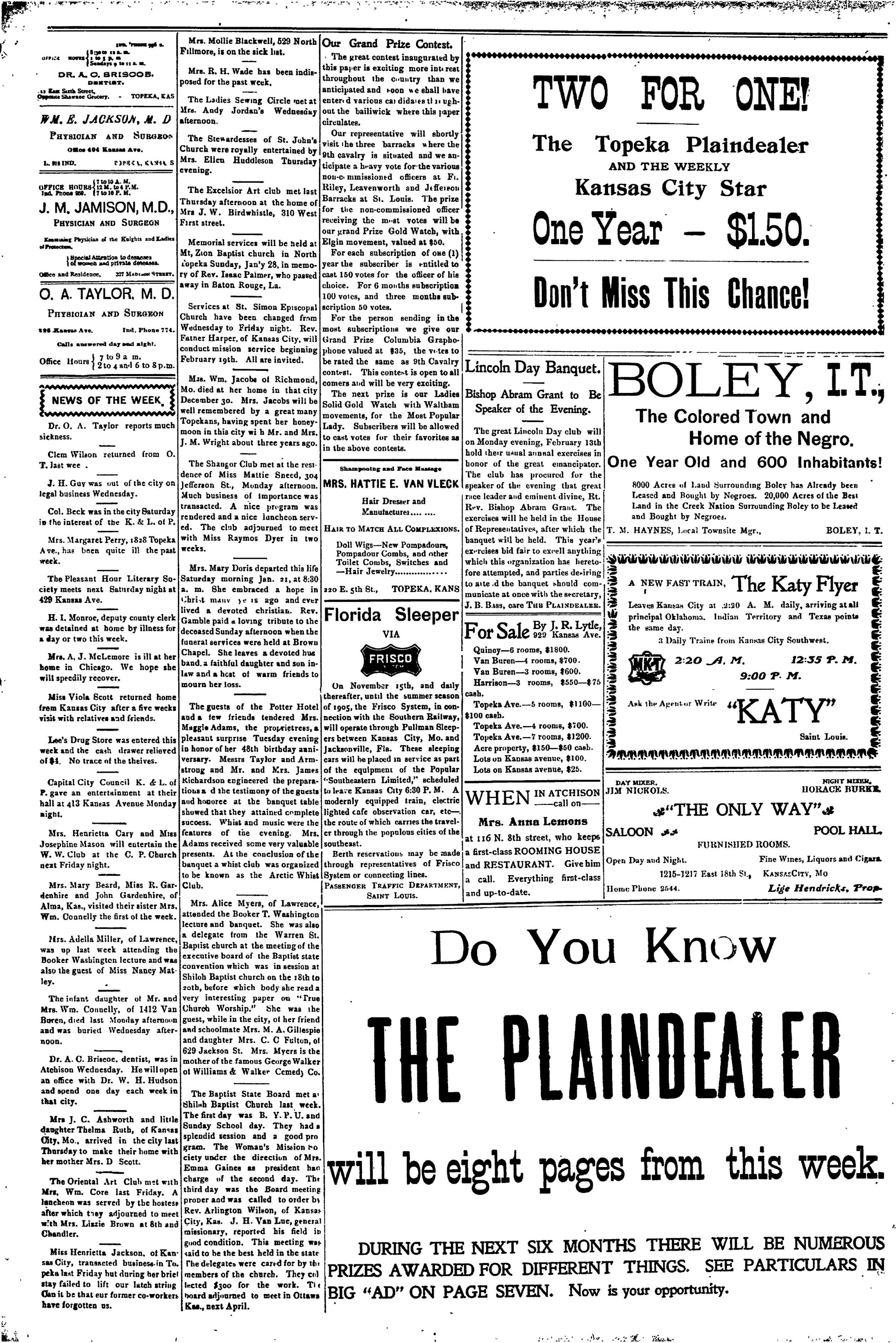
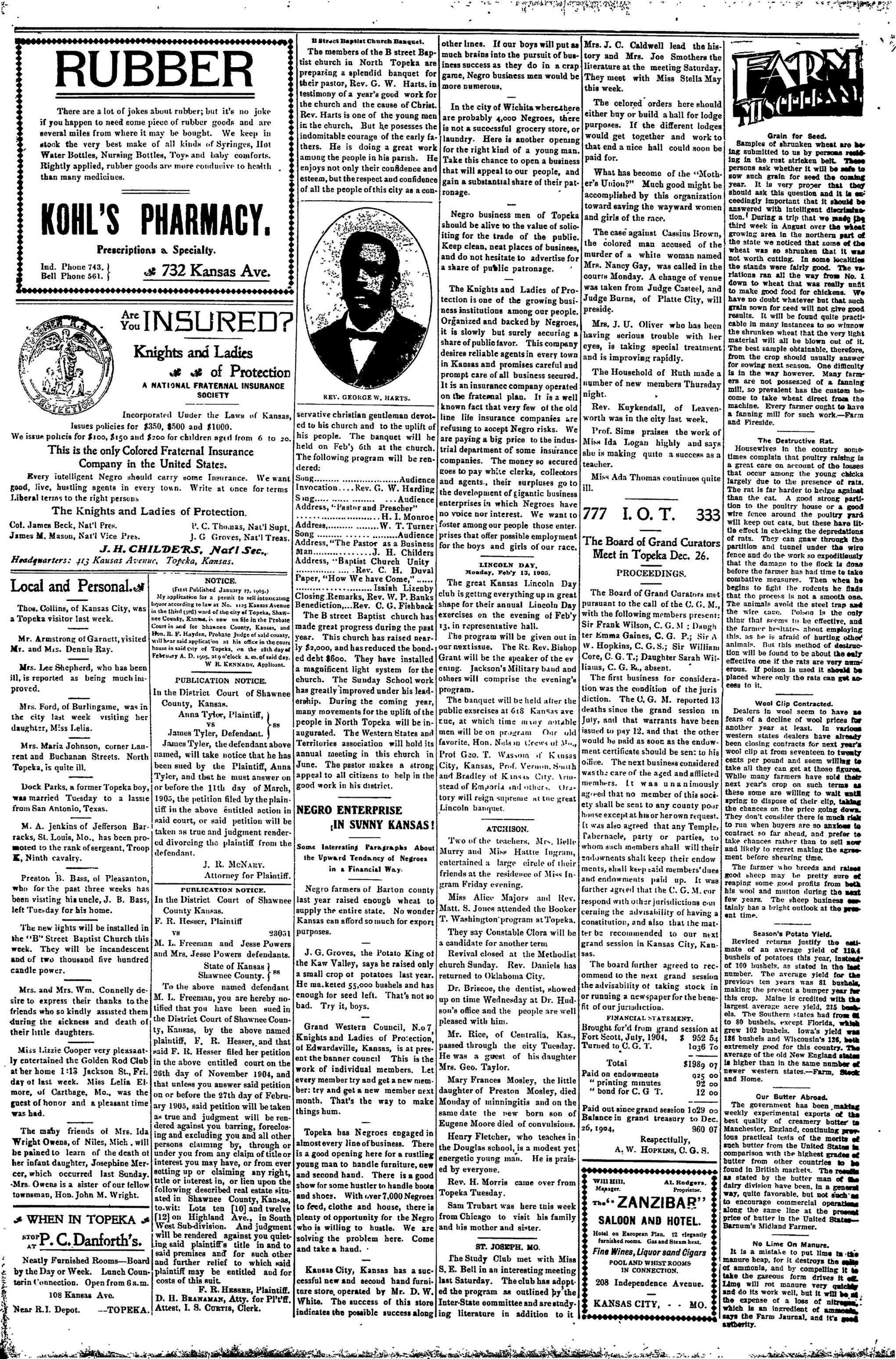
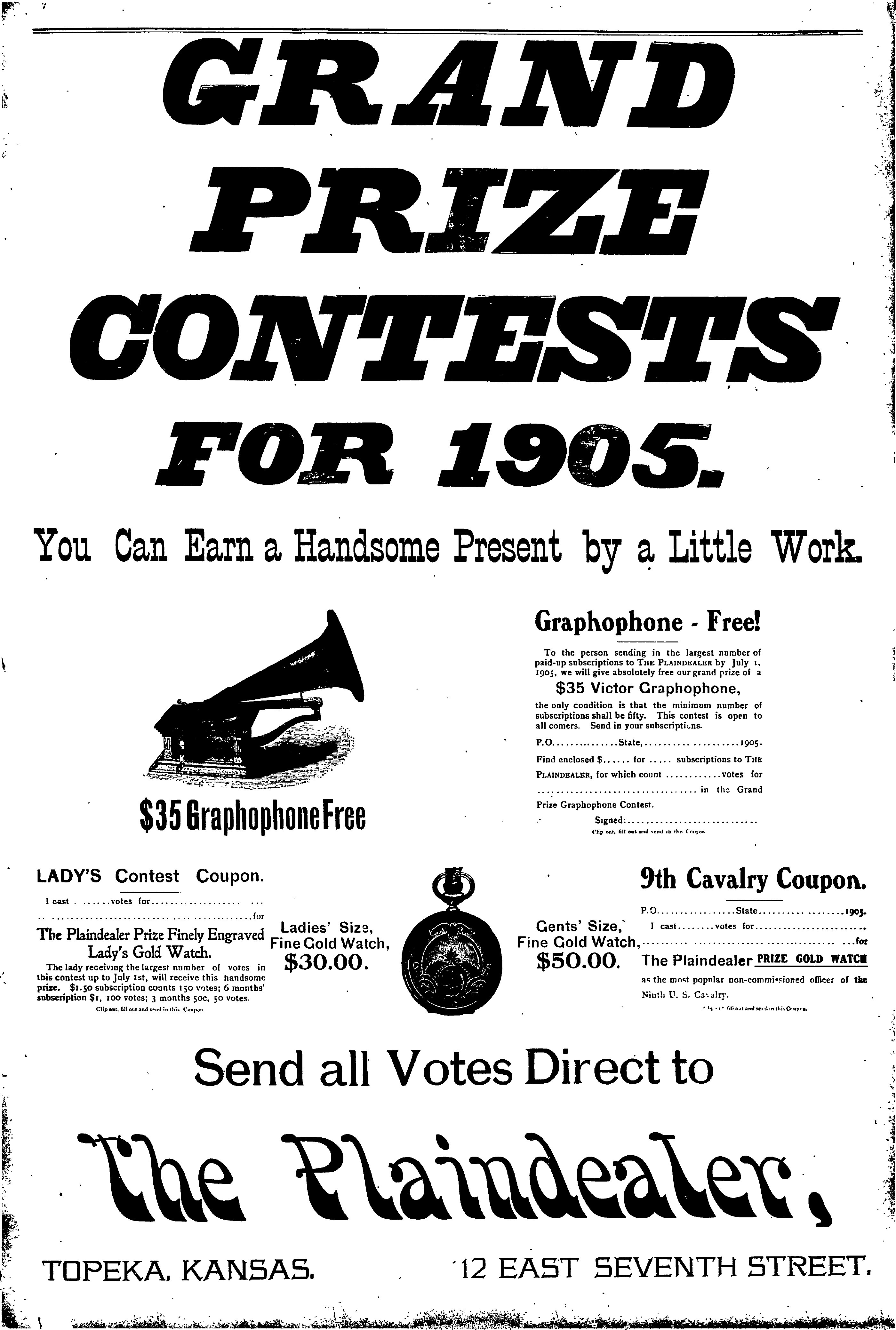
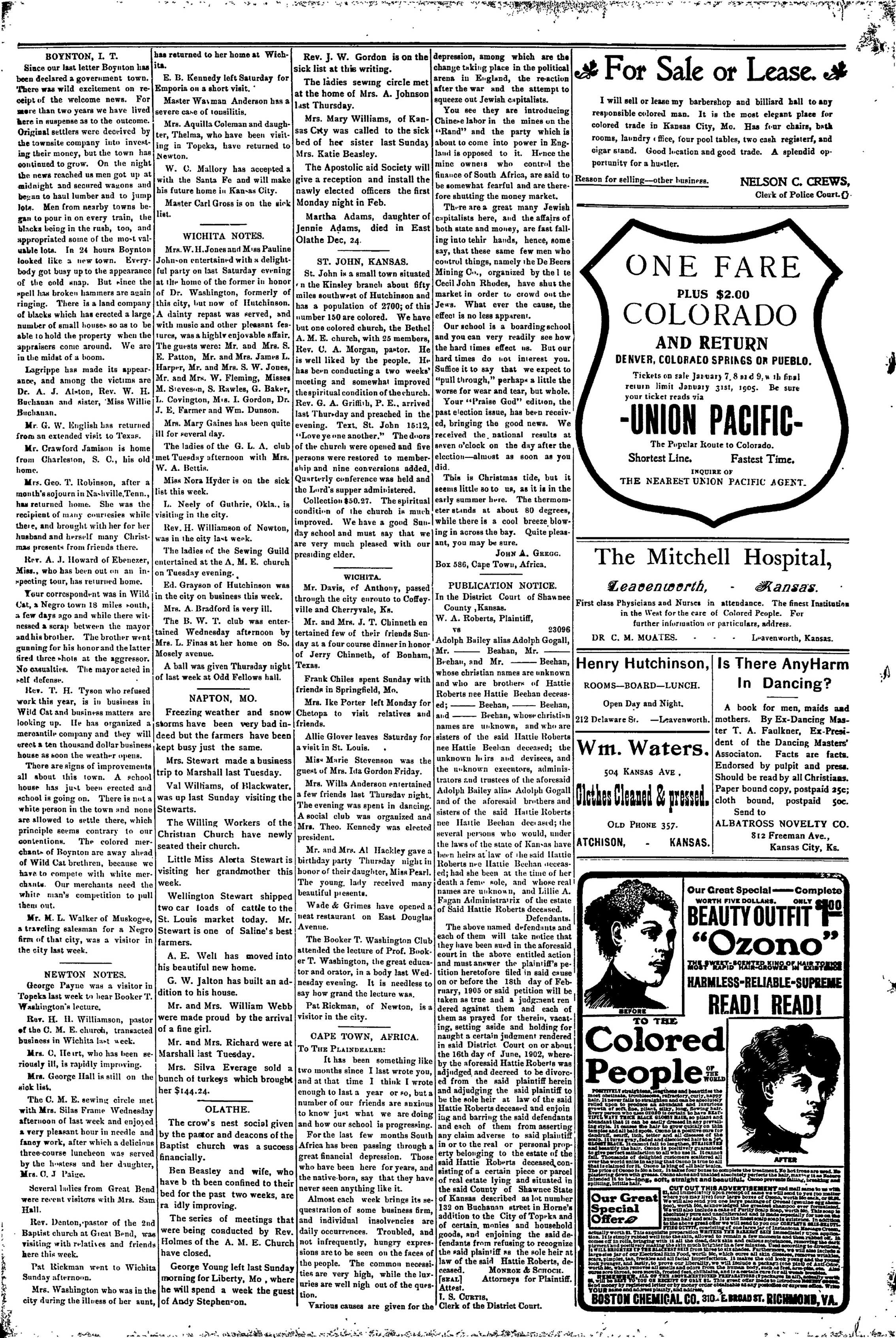
Page text (machine-generated)
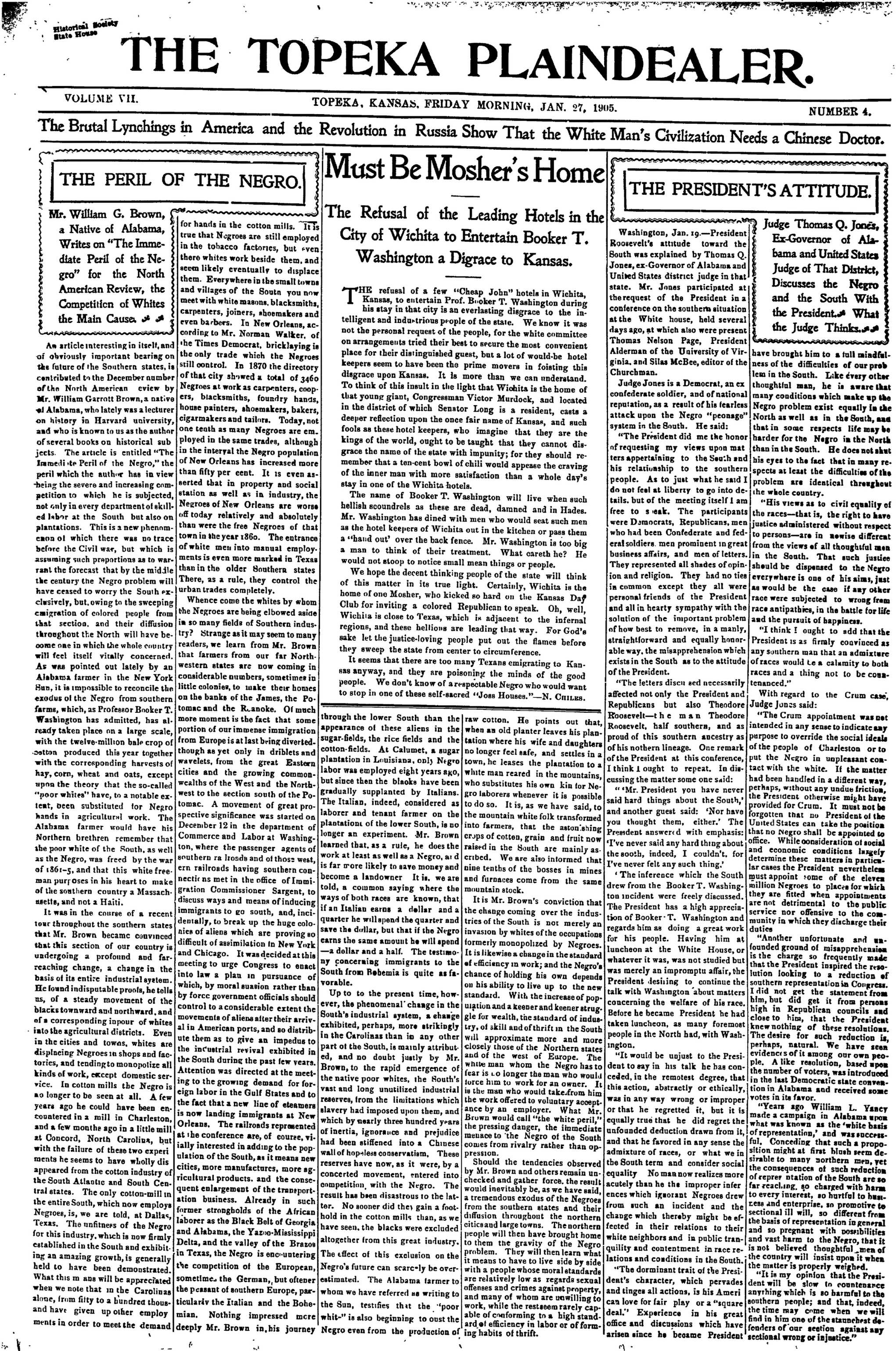
THE TOPEKA PLAINDEALER.
VOLUME VII.
The Brutal Lynchings
THE PERIL O
Mr. William G. Brown a Native of Alabama, Writes on "The Immediate Peril of the Negro" for the North American Review, the Competition of Whites the Main Cause.
An article interesting in itself, and of obviously important bearing on the future of the Southern states, is contributed to the December number of the North American view by Mr. William Garrott Brown, a native of Alabama, who lately was a lecturer on history in Harvard university, and who is known to us as the author of several books on historical subjects. The article is entitled "The Immediate Peril of the Negro," the peril which the author has in view being the severe and increasing competition to which he is subjected, not only in every department of skilled labor at the South but also on plantations. This is a new phenomenon of which there was no trace before the Civil war, but which is assuming such proportions as to warrant the forecast that by the middle century the Negro problem will have ceased to worry the South exclusively, but owing to the sweeping emigration of colored people from that section, and their diffusion throughout the North will have become one in which the whole country will feel itself vitally concerned. As was pointed out lately by an Alabama farmer in the New York Sun, it is impossible to reconcile the exodus of the Negro from southern farms, which, as Professor Booker T. Washington has admitted, has already taken place on a large scale, with the twelve-million bale crop of cotton produced this year together with the corresponding harvests of hay, corn, wheat and oats, except upon the theory that the so-called "poor whites" have, to a notable extent, been substituted for Negro hands in agricultural work. The Alabama farmer would have his Northern brethren remember that the poor white of the South, as well as the Negro, was freed by the war of 1861-5, and that this white freeman purposes in his heart to make of the southern country a Massachusetts, and not a Haiti.
It was in the course of a recent tour throughout the southern states that Mr. Brown became convinced that this section of our country is undergoing a profound and farreaching change, a change in the basis of its entire industrial system. He found indisputable proofs, he tells us, of a steady movement of the blacks townward and northward, and of a corresponding inpour of whites
into the agricultural districts. Even in the cities and towns, whites are displacing Negroes in shops and factories, and tending to monopolize all kinds of work, except domestic service. In cotton mills the Negro is no longer to be seen at all. A few years ago he could have been encountered in a mill in Charleston, and a few monthe ago in a little mill at Concord, North Carolina, but with the failure of these two experiments he seems to have wholly disappeared from the cotton industry of the South Atlantic and South Central states. The only cotton-mill in the entire South, which now employs Negroes, is, we are told, at Dallas, Texas. The unfitness of the Negro for this industry, which is now firmly established in the South and exhibiting an amazing growth, is generally held to have been demonstrated. What this man will be appreciated when we note that in the Carolinas alone, from fifty to a hundred thousand have given up other employments in order to meet the demand
for hands in the cotton mills. It is true that Negroes are still employed in the tobacco factories, but even there whites work beside them, and seem likely eventually to displace them. Everywhere in the small towns and villages of the South you now meet with white masons, blacksmiths, carpenters, joiners, shoemakers and even barbers. In New Orleans, according to Mr. Norman Walker, of the Times Democrat, bricklaying is the only trade which the Negroes still control. In 1870 the directory of that city showed a total of 3460 Negroes at work as carpenters, coopers, blacksmiths, foundry hands, house painters, shoemakers, bakers, cigarmakers and tailors. Today, not one tenth as many Negroes are employed in the same trades, although in the interval the Negro population of New Orleans has increased more than fifty per cent. It is even asserted that in property and social station as well as in industry, the Negroes of New Orleans are worse off today relatively and absolutely than were the free Negroes of that town in the year 1860. The entrance of white men into manual employments is even more marked in Texas than in the older Southern states There, as a rule, they control the urban trades completely.
Whence come the whites by whom the Negroes are being elbowed aside in so many fields of Southern industry? Strange as it may seem to many readers, we learn from Mr. Brown that farmers from our far Northwestern states are now coming in considerable numbers, sometimes in little colonies, to make their homes on the banks of the James, the Potomac and the Ranoke. Of much more moment is the fact that some portion of our immense immigration from Europe is at last being diverted though as yet only in driblets and wavelets, from the great Eastern cities and the growing commonwealths of the West and the Northwest to the section south of the Potomac. A movement of great prospective significance was started on December 12 in the department of Commerce and Labor at Washington, where the passenger agents of southern railroads and of those west, ern railroads having southern connections met in the office of Immigration Commissioner Sargent, to discuss ways and means of inducing immigrants to go south, and, incidentally, to break up the huge colonies of aliens which are proving so difficult of assimilation in New York and Chicago. It was decided at this meeting to urge Congress to enact into law a plan in pursuance of which, by moral suasion rather than by force government officials should control to a considerable extent the movements of aliens after their arrival in American ports, and so distribute them as to give an impedus to the industrial revival exhibited in the South during the past few years. Attention was directed at the meeting to the growing demand for foreign labor in the Gulf States and to the fact that a new line of eteamers is now landing immigrants at New Orleans. The railroads represented at the conference are, of course, vially interested in adding to the population of the South, as it means new cities, more manufactures, more agricultural products, and the consequent enlargement of the transportation business. Already in such former strongholds of the African laborer as the Black Belt of Georgia and Alabama, the Yazoo-Mississippi Delta, and the valley of the Brazos in Texas, the Negro is encountering the competition of the European, sometimes the German, but oftener the peasant of southern Europe, particularly the Italian and the Bohemian. Nothing impressed more deeply Mr. Brown in his journey
TOPEKA, KANSAS, FRIDAY MORNING, JAN. 27, 1905.
Must Be Mosher's Home
Must Be Mosher's Home
The Refusal of the Leading Hotels in the City of Wichita to Entertain Booker T. Washington a Digrace to Kansas.
The vaults of a few "Cheap John" hotels in Wichita, Kansas, to entertain Prof. Bucker T. Washington during his stay in that city is an everlasting disgrace to the intelligent and industrious people of the state. We know it was not the personal request of the people, for the white committee on arrangements tried their best to secure the most convenient place for their distinguished guest, but a lot of would-be hotel keepers seem to have been the prime movers in foisting this disgrace upon Kansas. It is more than we can understand. To think of this insult in the light that Wichita is the home of that young giant, Congressman Victor Murdock, and located in the district of which Senator Long is a resident, casts a deeper reflection upon the once fair name of Kansas, and such fools as these hotel keepers, who imagine that they are the kings of the world, ought to be taught that they cannot disgrace the name of the state with impunity; for they should remember that a ten-cent bowl of chili would appease the craving of the inner man with more satisfaction than a whole day's stay in one of the Wichita hotels.
The name of Booker T. Washington will live when such hellish scoundrels as these are dead, damned and in Hades. Mr. Washington has dined with men who would seat such men as the hotel keepers of Wichita out in the kitchen or pass them a 'hand out' over the back fence. Mr. Washington is too big a man to think of their treatment. What careth he? He would not stoop to notice small mean things or people.
We hope the decent thinking people of the state will think of this matter in its true light. Certainly, Wichita is the home of one Mosher, who kicked so hard on the Kansas Day Club for inviting a colored Republican to speak. Oh, well, Wichita is close to Texas, which is adjacent to the infernal regions, and these hellions are leading that way. For God's sake let the justice-loving people put out the flames before they sweep the state from center to circumference.
It seems that there are too many Texans emigrating to Kansas anyway, and they are poisoning the minds of the good people. We don't know of a respectable Negro who would want to stop in one of these self-sacred "Joss Houses."—N. Culles.
through the lower South than the appearance of these aliens in the sugar-fields, the rice fields and the cotton-fields. At Calumet, a sugar plantation in Louisiana, only Negro labor was employed eight years ago, but since then the blacks have been gradually supplanted by Italians. The Italian, indeed, considered as laborer and tenant farmer on the plantation of the lower South, is no longer an experiment. Mr. Brown learned that, as a rule, he does the work at least as well as a Negro, and is far more likely to save money and become a landowner. It is, we are told, a common saying where the ways of both races are known, that if an Italian earns a dollar and a quarter he will spend the quarter and save the dollar, but that if the Negro earns the same amount he will spend—a dollar and a half. The testimony concerning immigrants to the South from Bohemia is quite as favorable.
Up to to the present time, however, the phenomenal change in the South's industrial system, a change exhibited, perhaps, more strikingly in the Carolinas than in any other part of the South, is mainly attributed, and no doubt justly by Mr. Brown, to the rapid emergence of the native poor whites, the South's vast and long unutilized industrial reserves, from the limitations which slavery had imposed upon them, and which by nearly three hundred years of inertia, ignorance and prejudice had been stiffened into a Chinese wall of hopeless conservatism. These reserves have now, as it were, by a concerted movement, entered into competition, with the Negro. The result has been disastrous to the latter. No sooner did they gain a foothold in the cotton mills than, as we have seen, the blacks were excluded altogether from this great industry. The effect of this exclusion on the Negro's future can scarcely be overestimated. The Alabama farmer to whom we have referred as writing to the Sun, testifies that the "poor whit-" is also beginning to oust the Negro even from the production of
raw cotton. He points out that, when an old planter leaves his plantation where his wife and daughters no longer feel safe, and settles in a town, he leases the plantation to a white man reared in the mountains, who substitutes his own kin for Negro laborers whenever it is possible to do so. It is, as we have said, to the mountain white folk transformed into farmers, that the astonishing crops of cotton, grain and fruit now raised in the South are mainly ascribed. We are also informed that nine tenths of the bosses in mines and furnaces come from the same mountain stock.
It is Mr. Brown's conviction that the change coming over the industries of the South is not merely an invasion by whites of the occupations formerly monopolized by Negroes. It is likewise a change in the standard of efficiency in work; and the Negro's chance of holding his own depends on his ability to live up to the new standard. With the increase of population and a keener and keener struggle for wealth, the standard of industry, of skill and of thrift in the South will approximate more and more closely those of the Northern states and of the west of Europe. The white man whom the Negro has to fear is no longer the man who would force him to work for an owner. It is the man who would take from him the work offered to voluntary acceptance by an employer. What Mr. Brown would call "the white peril," the pressing danger, the immediate menace to the Negro of the South comes from rivalry rather than oppression.
Should the tendencies observed by Mr. Brown and others remain unchecked and gather force, the result would inevitably be, as we have said, a tremendous exodus of the Negroes from the southern states and their diffusion throughout the northern citics and large towns. The northern people will then have brought home to them the gravity of the Negro problem. They will then learn what it means to have to live side by side with a people whose moral standards are relatively low as regards sexual offenses and crimes against property, and many of whom are unwilling to work, while the rest seem ravely capable of conforming to a high standard of efficiency in labor or of forming habits of thrift.
Washington, Jan. 19. President Roosevelt's attitude toward the South was explained by Thomas Q. Jones, ex-Governor of Alabama and United States district judge in that state. Mr. Jones participated at the request of the President in a conference on the southern situation at the White house, held several days ago, at which also were present Thomas Nelson Page, President Alderman of the University of Virginia, and Silas McBee, editor of the Churchman.
Judge Jones is a Democrat, an ex confederate soldier, and of national reputation, as a result of his fearless attack upon the Negro "peonage" system in the South. He said:
"The President did me the honor of requesting my views upon matters appertaining to the South and his relationship to the southern people. As to just what he said I do not feel at liberty to go into details, but of the meeting itself I am free to speak. The participants were Democrats, Republicans, men who had been Confederate and federal soldiers, men prominent in great business affairs, and men of letters. They represented all shades of opinion and religion. They had no ties in common except they all were personal friends of the President and all in hearty sympathy with the solution of the important problem of how best to remove, in a manly, straightforward and equally honorable way, the misapprehension which exists in the South as to the attitude of the President.
"The letters discusd necessarily affected not only the President and Republicans but also Theodore Roosevelt—the man Theodore Roosevelt, half southern, and as proud of this southern ancestry as of his northern lineage. One remark of the President at this conference, I think I ought to repeat. In discussing the matter some one said:
"Mr. President you have never said hard things about the South,' and another guest said: 'Nor have you thought them, either.' The President answered with emphasis: 'I've never said any hard thing about the sooth, indeed, I couldn't. for I've never felt any such thing.'
The inference which the South drew from the Booker T. Washington incident were freely discussed. The President has a high appreciation of Booker T. Washington and regards him as doing a great work for his people. Having him at luncheon at the White House, or whatever it was, was not studied but was merely an impromptu affair, the President desiring to continue the talk with Washington about matters concerning the welfare of his race. Before he became President he had taken luncheon, as many foremost people in the North had, with Washington.
"It would be unjust to the President to say in his talk he has conceded, in the remotest degree, that this action, abstractly or ethically, was in any way wrong or improper or that he regretted it, but it is equally true that he did regret the unfounded deduction drawn from it, and that he favored in any sense the admixture of races, or what we in the South term and consider social equality No man now realizes more acutely than he the improper inferences which ignorant Negroes drew from such an incident and the change which thereby might be effected in their relations to their white neighbors and in public tranquility and contentment in race relations and conditions in the South.
"The dorminant trait of the President's character, which pervades and tinges all actions, is his American love for fair play or a "square deal." Experience in his great office and discussions which have arisen since he became President
NUMBER 4.
Judge Thomas Q. Jones, Ex-Governor of Alabama and United States Judge of That District, Discusses the Negro and the South With the President. What the Judge Thinks.
have brought him to a full mindfulness of the difficulties of our problem in the South. Like every other thoughtful man, he is aware that many conditions which make up the Negro problem exist equally in the North as well as in the South, and that in some respects life may be harder for the Negro in the North than in the South. He does not shut his eyes to the fact that in many respects at least the difficulties of the problem are identical throughout the whole country.
"His views as to civil equality of the races—that is, the right to have justice administered without respect to persons—are in nowise different from the views of all thoughtful men in the South. That such justice should be dispensed to the Negro everywhere is one of his aims, just as would be the case if any other race were subjected to wrong from race antipathies, in the battle for life and the pursuit of happiness.
"I think I ought to add that the President is as firmly convinced as any southern man that an admixture of races would be a calamity to both races and a thing not to be countenanced."
With regard to the Crum case, Judge Jones said:
"The Crum appointment was not intended in any sense to indicate any purpose to override the social ideals of the people of Charleston or to put the Negro in unpleasant contact with the white. If the matter had been handled in a different way, perhaps, without any undue friction, the President otherwise might have provided for Crum. It must not be forgotten that no President of the United States can take the position that no Negro shall be appointed to office. While consideration of social and economic conditions largely determine these matters in particular cases the President nevertheless must appoint some of the eleven million Negroes to places for which they are fitted when appointments are not detrimental to the public service nor offensive to the community in which they discharge their duties
"Another unfortunate and unfounded ground of misapprehension is the charge so frequently made that the President inspired the resolution looking to a reduction of southern representation in Congress. I did not get the statement from him, but did get it from persons high in Republican councils and close to him, that the President knew nothing of these resolutions. The desire for such reduction is, perhaps, natural. We have seen evidences of it among our own people. A like resolution, based upon the number of voters, was introduced in the last Democratic state convention in Alabama and received some votes in its favor.
"Years ago William L. Yancy made a campaign in Alabama upon what was known as the 'white basis of representation,' and was successful. Conceding that such a proposition might at first blush seem desirable to many northern men, yet the consequences of such reduction of representation of the South are so far reaching, so charged with harm to every interest, so hurtful to business and enterprise, so promotive to sectional ill will, so different from the basis of representation in general and so pregnant with possibilities and vast harm to the Negro, that it is not believed thoughtful men of the country will insist upon it when the matter is properly weighed.
"It is my opinion that the President will be slow to countenance anything which is so harmful to the southern people; and that, indeed, the time may come when we will find in him one of the staunchest defenders of our section against any sectional wrong or injustice."
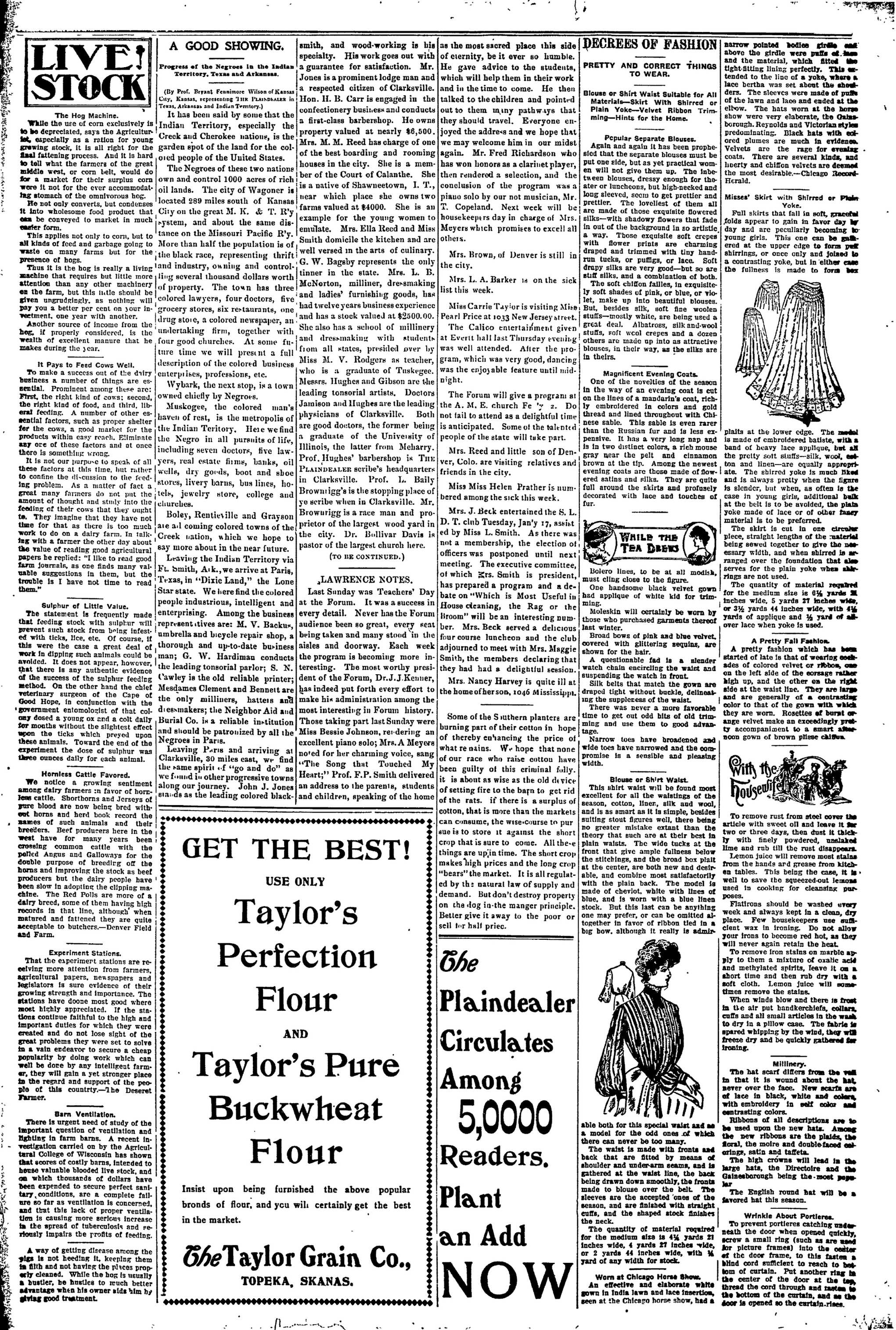
LIVE! STOCK
The Hog Machine.
While the use of corn exclusively is to be depreciated, says the Agriculturist, especially as a ration for young growing stock, it is all right for the final fattening process. And it is hard to tell what the farmers of the great middle west, or corn belt, would do for a market for their surplus corn were it not for the ever accommodating stomach of the omnivorous hog.
He not only converts, but condenses it into wholesome food product that can be conveyed to market in much easier form.
This applies not only to corn, but to all kinds of feed and garbage going to waste on many farms but for the presence of hogs.
Thus it is the hog is really a living machine that requires but little more attention than any other machinery on the farm, but this little should be given ungrudgingly, as nothing will pay you a better per cent on your investment, one year with another.
Another source of income from the hog, if properly considered, is the wealth of excellent manure that he makes during the year.
It Pays to Feed Cows Well.
To make a success out of the dairy business a number of things are essential. Prominent among these are: First, the right kind of cows; second, the right kind of food, and third, liberal feeding. A number of other essential factors, such as proper shelter for the cows, a good market for the products within easy reach. Eliminate any one of these factors and at once there is something wrong.
It is not our purpose to speak of all these factors at this time, but rather to confine the discussion to the feeding problem. As a matter of fact a great many farmers do not put the amount of thought and study into the feeding of their cows that they ought to. They imagine that they have not time for that as there is too much work to do on a dairy farm. In talking with a farmer the other day about the value of reading good agricultural papers he replied: "I like to read good farm journals, as one finds many valuable suggestions in them, but the trouble is I have not time to read them."
Sulphur of Little Value.
The statement is frequently made that feeding stock with sulphur will prevent such stock from being infested with ticks, lice, etc. Of course, if this were the case a great deal of work in dipping such animals could be avoided. It does not appear, however, that there is any authentic evidence of the success of the sulphur feeding method. On the other hand the chief veterinary surgeon of the Cape of Good Hope, in conjunction with the government entomologist of that colony dosed a young ox and a colt daily for months without the slightest effect upon the ticks which preyed upon these animals. Toward the end of the experiment the dose of sulphur was three ounces daily for each animal.
Hornless Cattle Favored.
We notice a growing sentiment among dairy farmers in favor of horrilec cattle. Shorthorns and Jerseys of pure blood are now being bred without horns and herd book record the names of such animals and their breeders. Beef producers here in the west have for many years been crossing common cattle with the polled Angus and Galloways for the double purpose of breeding off the horns and improving the stock as beef producers but the dairy people have been slow in adopting the clipping machine. The Red Polls are more of a dairy breed, some of them having high records in that line, although when matured and fattened they are quite acceptable to butchers.—Denver Field and Farm.
Experiment Stations.
That the experiment stations are receiving more attention from farmers, agricultural papers, newspapers and legislators is sure evidence of their growing strength and importance. The stations have done most good where most highly appreciated. If the stations continue faithful to the high and important duties for which they were created and do not lose sight of the great problems they were set to solve in a vain endeavor to secure a cheap popularity by doing work which can well be done by any intelligent farmer, they will gain a yet stronger place in the regard and support of the people of this country.—The Deseret Farmer.
Barn Ventilation.
There is urgent need of study of the important question of ventilation and lighting in farm barns. A recent investigation carried on by the Agricultural College of Wisconsin has shown that scores of costly barns, intended to house valuable blooded live stock, and on which thousands of dollars have been expended to secure perfect sanitary conditions, are a complete failure so far as ventilation is concerned, and that this lack of proper ventilation is causing more serious increase in the spread of tuberculosis and seriously impairs the profits of feeding.
A way of getting disease among the pigs is not heeding it, keeping them in flith and not having the places properly cleaned. While the hog is usually a bustler, he hustles to much better advantage when his owner sids him by giving good treatment.
GET THE BEST!
USE ONLY
Taylor's
Perfection
Flour
AND
Taylor's Pure
Buckwheat
Flour
Insist upon being furnished the above popular bronds of flour, and you will certainly get the best in the market.
The Taylor Grain Co., TOPEKA, SKANAS.
---
A GOOD SHOWING.
Progress of the Negroes in the Indian Territory, Texas and Arkansas.
(By Prof. Bryant Fennimore Wilson of Kansas City, Kansas, representing THE PLANDEALER in Texas, Arkansas and Indian Territory.)
It has been said by some that the Indian Territory, especially the Creek and Cherokee nations, is the garden spot of the land for the colored people of the United States.
The Negroes of these two nations own and control 1000 acres of rich oil lands. The city of Wagoner is located 289 miles south of Kansas City on the great M. K. & T. R'y system, and about the same distance on the Missouri Pacific R'y. More than half the population is of the black race, representing thrift and industry, owning and controlling several thousand dollars worth of property. The town has three colored lawyers, four doctors, five grocery stores, six restaurants, one drug store, a colored newspaper, an undertaking firm, together with four good churches. At some future time we will present a full description of the colored business enterprises, professions, etc.
Wybark, the next stop, is a town owned chiefly by Negroes. Muskogee, the colored man's haven of rest, is the metropolis of the Indian Teritory. Here we find the Negro in all pursuits of life, including seven doctors, five lawyers, real estate firms, banks, oil wells, dry goods, boot and shoe stores, livery barns, bus lines, hotels, jewelry store, college and churches. Boley, Rentieville and Grayson are all coming colored towns of the Greek nation, which we hope to say more about in the near future.
Leaving the Indian Territory via Ft. Smith, Ak., we arrive at Paris, Texas, in "Dixie Land," the Lone Star state. We here find the colored people industrious, intelligent and enterprising. Among the business representatives are: M. V. Backus, umbrella and bicycle repair shop, a thorough and up-to-date business man; G. W. Hardiman conducts the leading tonsorial parlor; S. N. Cawley is the old reliable printer; Mesdames Clement and Bennett are the only milliners, hatters and dressmakers; the Neighbor Aid and Burial Co. is a reliable institution and should be patronized by all the Negroes in Paris.
Leaving Paris and arriving at Clarksville, 30 miles cast, we find the same spirit of "go and do" as we found in other progressive towns along our journey. John J. Jones stands as the leading colored black
smith, and wood-working is his specialty. His work goes out with a guarantee for satisfaction. Mr. Jones is a prominent lodge man and a respected citizen of Clarksville. Hon. H. B. Carr is engaged in the confectionery business and conducts a first-class barbershop. He owns property valued at nearly $6,500. Mrs. M. M. Reed has charge of one of the best boarding and rooming houses in the city. She is a member of the Court of Calanthe. She is a native of Shawneetown, I. T., near which place she owns two farms valued at $4000. She is an example for the young women to enulate. Mrs. Ella Reed and Miss Smith domicile the kitchen and are well versed in the arts of culinary. G. W. Bagsby represents the only tinner in the state. Mrs. L. B. McNorton, milliner, dressmaking and ladies' furnishing goods, has had twelve years business experience and has a stock valued at $2500.00. She also has a school of millinery and dressmaking with students from all states, presided over by Miss M. V. Rodgers as teacher, who is a graduate of Tuskegee. Messrs. Hughes and Gibson are the leading tonsorial artists. Doctors Jamison and Hughes are the leading physicians of Clarksville. Both are good doctors, the former being a graduate of the University of Illinois, the latter from Meharry. Prof. Hughes' barbershop is THE PLAINDEALER scribe's headquarters in Clarksville. Prof. L. Baily Brownrigg's is the stopping place of ye scribe when in Clarksville. Mr. Browurigg is a race man and proprietor of the largest wood yard in the city. Dr. Bollivar Davis is pastor of the largest church here.
(TO BE CONTINUED.)
LAWRENCE NOTES.
Last Sunday was Teachers' Day at the Forum. It was a success in every detail. Never has the Forum audience been so great, every seat being taken and many stood in the aisles and doorway. Each week the program is becoming more interesting. The most worthy president of the Forum, Dr.J.J.Kenner, has indeed put forth every effort to make his administration among the most interesting in Forum history. Those taking part last Sunday were Miss Bessie Johnson, rendering an excellent piano solo; Mrs. A Meyers noted for her charming voice, sang "The Song that Touched My Heart;" Prof. F.P. Smith delivered an address to the parents, students and children, speaking of the home
as the most sacred place this side of eternity, be it ever so humble. He gave advice to the students, which will help them in their work and in the time to come. He then talked to the children and pointed out to them many pathways that they should travel. Everyone enjoyed the address and we hope that we may welcome him in our midst again. Mr. Fred Richardson who has won honors as a clarinet player, then rendered a selection, and the conclusion of the program was a piano solo by our not musician, Mr. T. Copeland. Next week will be housekeepers day in charge of Mrs. Meyers which promises to excell all others.
Mrs. Brown, of Denver is still in the city.
Mrs. L. A. Barker is on the sick list this week.
Miss Carrie Taylor is visiting Miss Pearl Price at 1033 New Jersey street.
The Calico entertainment given at Everitt hall last Thursday evening was well attended. After the program, which was very good, dancing was the enjoyable feature until midnight.
The Forum will give a program at the A. M. E. church Fe 'y 2. Do not fail to attend as a delightful time is anticipated. Some of the talented people of the state will take part. Mrs. Reed and little son of Denver, Colo. are visiting relatives and friends in the city. Miss Miss Helen Prather is numbered among the sick this week.
Mrs. J. Beck entertained the S. L. D. T. club Tuesday, Jan'y 17, assisted by Miss L. Smith. As there was not a membership, the election of officers was postponed until next meeting. The executive committee, of which Mrs. Smith is president, has prepared a program and a debate on "Which is Most Useful in House cleaning, the Rag or the Broom" will be an interesting number. Mrs. Beck served a delicious four course luncheon and the club adjourned to meet with Mrs. Maggie Smith, the members declaring that they had had a delightful session.
Mrs. Nancy Harvey is quite ill at the home of her son, 1046 Mississippi.
Some of the Southern planters are burning part of their cotton in hope of thereby enhancing the price of what remains. We hope that none of our race who raise cotton have been guilty of this criminal folly. it is about as wise as the old device of setting fire to the barn to get rid of the rats. if there is a surplus of cotton, that is more than the markets can consume, the wise-course to pursue is to store it against the short crop that is sure to come. All the things are up in time. The short crop makes high prices and the long crop "bears" the market. It is all regulated by the natural law of supply and demand. But don't destroy property on the dog in the manger principle. Better give it away to the poor or sell for half price.
The Plaindealer Circulates Among 5,0000 Readers. Plant an Add NOW
PRETTY AND CORRECT THINGS TO WEAR.
Blouse or Shirt Waist Suitable for All Materials—Skirt With Shirred or Plain Yoke—Velvet Ribbon Trimming—Hints for the Home.
Pcpular Separate Blouses
Popular Separate Blouses.
Again and again it has been prophesied that the separate blouses must be put one side, but as yet practical women will not give them up. The inbetween blouses, dressy enough for the theater or luncheons, but high-necked and long sleeved, seem to get prettier and prettier. The loveliest of them all are made of those exquisite flowered silks—with shadowy flowers that fade in out of the background in so artistic a way. Those exquisite soft crepes with flower prints are charming draped and trimmed with tiny hand-run tucks, or puffs, or lace. Soft drapy silks are very good—but so are stiff silks, and a combination of both
The soft chiffon failles, in exquisitely soft shades of pink, or blue, or violet, make up into beautiful blouses. But, besides silk, soft fine woolen stuffs—mostly white, are being used a great deal. Albatross, silk and wool stuffs, soft wool crepes and a dozen others are made up into attractive blouses, in their way, as the silks are in theirs.
Magnificent Evening Coats
One of the novelties of the season in the way of an evening coat is cut on the lines of a mandarin's coat, richly embroidered in colors and gold thread and lined throughout with Chinese sable. This sable is even rarer than the Russian fur and is less expensive. It has a very long nap and is in two distinct colors, a rich mouse gray near the pelt and cinnamon brown at the tip. Among the newest evening coats are those made of flowered satins and silks. They are quite full around the skirts and profusely decorated with lace and touches of fur.
WHILE THE TEA DREWS
Bolero lines, to be at all modish, must cling close to the figure.
One handsome black velvet gown had applique of white kid for trimming.
Moleskin will certainly be worn by those who purchased garments thereof last winter.
Broad bows of pink and blue velvet, covered with glittering sequins, are shown for the hair.
A questionable fad is a slender watch chain encircling the waist and suspending the watch in front.
Silk belts that match the gown are draped tight without buckle, delineating the suppleness of the waist. There was never a more favorable time to get out odd bits of old trimming and use them to good advantage. Narrow toes have broadened and wide toes have narrowed and the compromise is a sensible and pleasing width.
Blouse or Shirt Waist
This shirt waist will be found most excellent for all the waiststings of the season, cotton, liner, silk and wool, and is as smart as it is simple, besides suiting stout figures well, there being no greater mistake extant than the theory that such are at their best in plain waists. The wide tucks at the front that give ample fullness below the stitchings, and the broad box plait at the center, are both new and desirable, and combine most satisfactorily with the plain back. The model is made of cheviot, white with lines of blue, and is worn with a blue linen stock. But this last can be anything one may prefer, or can be omitted altogether in favor of ribbon tied in a big bow, although it really is admir-
1
able both for this special waist and as a model for the odd ones of which there can never be too many. The waist is made with fronts and back that are fitted by means of shoulder and under-arm seams, and is gathered at the waist line, the back being drawn down smoothly, the fronts made to blouse over the belt. The sleeves are the accepted ones of the season, and are finished with straight cuffs, and the shaped stock finishes the neck. The quantity of material required for the medium size is 4 1/4 yards 21 inches wide, 4 yards 27 inches wide, or 2 yards 44 inches wide, with 1/4 yard of any width for stock.
Worn at Chicago Horse Show. An effective and elaborate white gown in India lawn and lace insertion, seen at the Chicago horse show, had a
narrow pointed bodice girdle and above the girdle were puffs of hair and the material, which fitted the tight-fitting lining perfectly. This extended to the line of a yoke, where a lace bertha was set about the shoulders. The sleeves were made of puffs of the lawn and lace and ended at the elbow. The hats worn at the horse show were very elaborate, the Gainsborough, Reynolds and Victorian styles predominating. Black hats with colored plumes are much in evidence. Velvets are the rage for evening coats. There are several kinds, and liberty and chiffon velvets are deemed the most desirable.—Chicago Record-Herald.
Misses' Skirt with Shirred or Plain Yoke.
Full skirts that fall in soft, graceful folds appear to gain in favor day by day and are peculiarly becoming to young girls. This one can be gathered at the upper edge to form peel shirrings, or once only and joined to a contrasting yoke, but in either case the fullness is made to form her
```markdown
```
plaits at the lower edge. The model is made of embroidered batiste, with a band of heavy lace appliqué, but all the pretty soft stuffs—silk, wool, cotton and linen—are equally appropriate. The shirred yoke is much liked and is always pretty when the figure is slender, but when, as often is the case in young girls, additional bulk at the belt is to be avoided, the plain yoke made of lace or of other fancy material is to be preferred.
The skirt is cut in one circular piece, straight lengths of the material being sewed together to give the necessary width, and when shirred is arranged over the foundation that also serves for the plain yoke when shirrings are not used.
The quantity of material required for the medium size is 6½ yards 21 inches wide, 5 yards 27 inches wide, or 3½ yards 44 inches wide, with 4½ yards of applique and ½ yard of all over lace when yoke is used.
A Pretty Fall Fashion
A pretty fashion which has been started of late is that of wearing cochades of colored velvet or ribbon, one on the left side of the corsage rather high up, and the other on the right side at the waist line. They are large and are generally of a contrasting color to that of the gown with which they are worn. Rosettes of burnt orange velvet make an exceedingly pretty accompaniment to a smart afternoon gown of brown plisse chiffon.
With the Housewife
To remove rust from steel cover the article with sweet oil and leave it for two or three days, then dust it thickly with finely powdered, unslaked lime and rub till the rust disappear. Lemon juice will remove most stains from the hands and grease from kitchen tables. This being the case, it is well to save the squeezed-out lemons used in cooking for cleansing purposes. Flatirons should be washed every week and always kept in a clean, dry place. Few housekeepers use sufficient wax in ironing. Do not allow your irons to become red hot, as they will never again retain the heat.
To remove iron stains on marble apply to them a mixture of oxalic acid and methylated spirits, leave it on a short time and then rub dry with a soft cloth. Lemon juice will sometimes remove the stains.
When winds blow and there is frost in the air put handkerchiefs, collars, cuffs and all small articles in the wash to dry in a pillow case. The fabric is spared whipping by the wind, they will freeze dry and be quickly gathered for ironing.
Millinery
The hat scarf differs from the veil in that it is wound about the hat, never over the face. New scarfs are of lace in black, white and colors, with embroidery in self color and contrasting colors. Ribbons of all descriptions are to be used upon the new hats. Among the new ribbons are the plaids, the floral, the moire and double-faced colorings, satin and taffeta. The high crowns will lead in the large hats, the Directoire and the Gainesborough being the most popular. The English round hat will be a favored hat this season.
Wrinkle About Portieres
To prevent portieres catching underneath the door when opened quickly, screw a small ring (such as are used for picture frames) into the center of the door frame, to this fasten a blind cord sufficient to reach to bottom of curtain. Put another ring in the center of the door at the top, thread the cord through and fasten to the bottom of the curtain, and as the door is opened so the curtain closes.
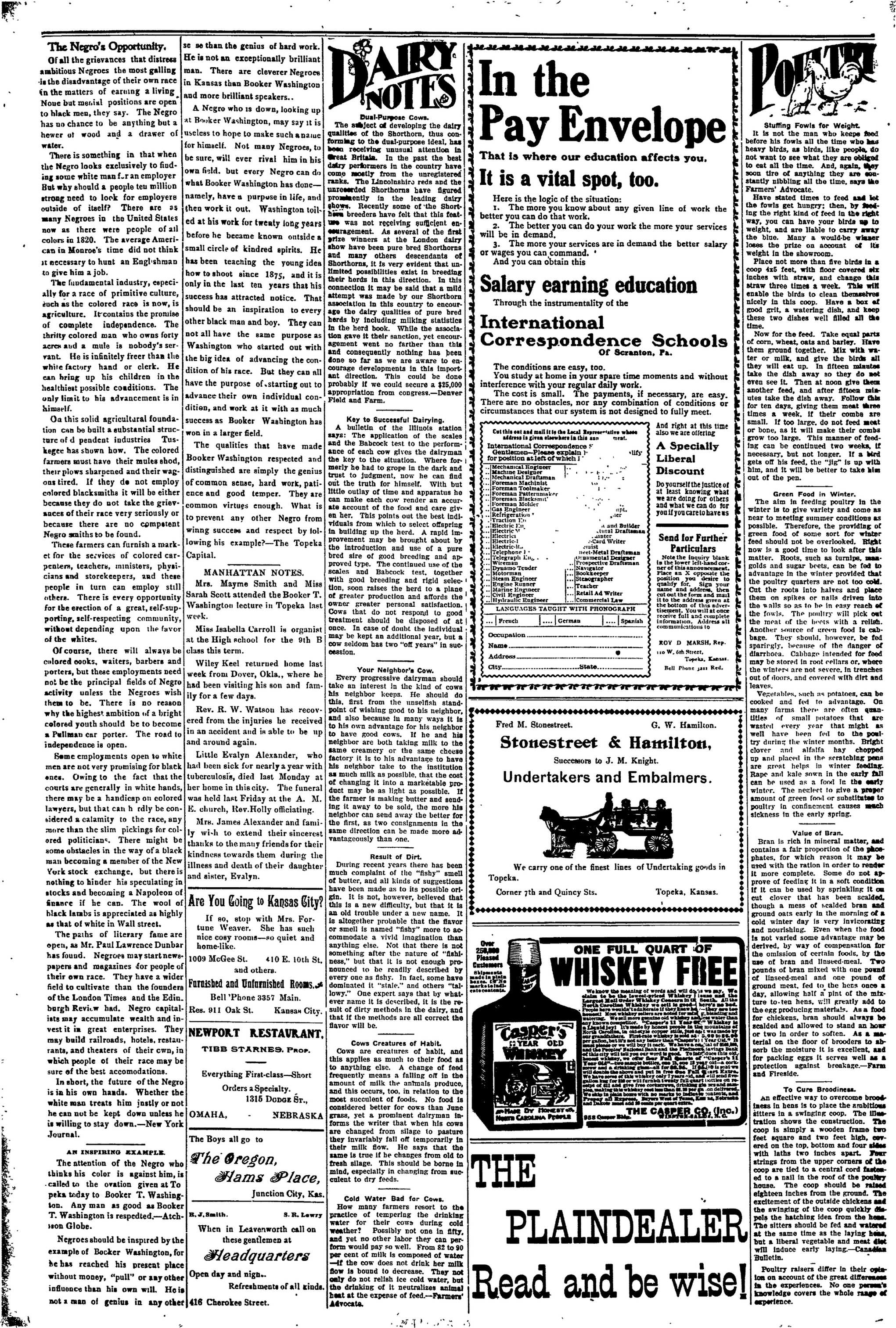
The Negro's Opportunity.
Of all the grievances that distress ambitious Negroes the most galling is the disadvantage of their own race in the matters of earning a living. None but menial positions are open to black men, they say. The Negro has no chance to be anything but a hewer of wood and a drawer of water.
There is something in that when the Negro looks exclusively to finding some white man for an employer But why should a people ten million strong need to look for employers outside of itself? There are as many Negroes in the United States now as there were people of all colors in 1820. The average American in Monroe's time did not think it necessary to hunt an Englishman to give him a job.
The fundamental industry, especially for a race of primitive culture, such as the colored race is now, is agriculture. It contains the promise of complete independence. The thrirty colored man who owns forty acres and a mule is nobody's servant. He is infinitely freer than the white factory hand or clerk. He can bring up his children in the healthiest possible conditions. The only limit to his advancement is in himself.
On this solid agricultural foundation can be built a substantial structure of dependent industries Tuskegee has shown how. The colored farmers must have their mules shod, their plows sharpened and their wagons tired. If they do not employ colored blacksmiths it will be either because they do not take the grievances of their race very seriously or because there are no competent Negro smiths to be found.
These farmers can furnish a market for the services of colored carpenters, teachers, ministers, physicians and storekeepers, and these people in turn can employ still others. There is every opportunity for the erection of a great, self-supporting, self-respecting community, without depending upon the favor of the whites.
Of course, there will always be colored cooks, waiters, barbers and porters, but these employments need not be the principal fields of Negro activity unless the Negroes wish them to be. There is no reason why the highest ambition of a bright colored youth should be to become a Pullman car porter. The road to independence is open.
Some employments open to white men are not very promising for black ones. Owing to the fact that the courts are generally in white hands, there may be a handicap on colored lawyers, but that can hardly be considered a calamity to the race, any more than the slim pickings for colored politicians. There might be some obstacles in the way of a black man becoming a member of the New York stock exchange, but there is nothing to hinder his speculating in stocks and becoming a Napoleon of finance if he can. The wool of black lambs is appreciated as highly as that of white in Wall street.
The paths of literary fame are open, as Mr. Paul Lawrence Dunbar has found. Negroes may start newspapers and magazines for people of their own race. They have a wider field to cultivate than the founders of the London Times and the Edinburgh Review had. Negro capitalists may accumulate wealth and invest it in great enterprises. They may build railroads, hotels, restaurants, and theaters of their own, in which people of their race may be sure of the best accommodations.
In short, the future of the Negro is in his own hands. Whether the white man treats him justly or not he can not be kept down unless he is willing to stay down.—New York Journal.
AN INSPIRING EXAMPLE.
The attention of the Negro who thinks his color is against him, is called to the ovation given at Topeka today to Booker T. Washington. Any man as good as Booker T. Washington is respedted.—Atchison Globe.
Negroes should be inspired by the example of Bocker Washington, for he has reached his present place without money, "pull" or any other influence than his own will. He is not a man of genius in any other
se so than the genius of hard work. He is not an exceptionally brilliant man. There are cleverer Negroes in Kansas than Booker Washington and more brilliant speakers..
A Negro who is down, looking up at Booker Washington, may say it is useless to hope to make such a name for himself. Not many Negroes, to be sure, will ever rival him in his own field. but every Negro can do what Booker Washington has done—namely, have a purpose in life, and then work it out. Washington toiled at his work for twenty long years before he became known outside a small circle of kindred spirits. He has been teaching the young idea how to shoot since 1875, and it is only in the last ten years that his success has attracted notice. That should be an inspiration to every other black man and boy. They can not all have the same purpose as Washington who started out with the big idea of advancing the condition of his race. But they can all have the purpose of starting out to advance their own individual condition, and work at it with as much success as Booker Washington has won in a larger field.
The qualities that have made Booker Washington respected and distinguished are simply the genius of common sense, hard work, patience and good temper. They are common virtues enough. What is to prevent any other Negro from winng success and respect by following his example?—The Topeka Capital.
MANHATTAN NOTES
Mrs. Mayme Smith and Miss Sarah Scott attended the Booker T. Washington lecture in Topeka last week.
Miss Isabella Carroll is organist at the High school for the 9th B class this term.
Wiley Keel returned home last week from Dover, Okla., where he had been visiting his son and family for a few days.
Rev. R. W. Watson has recovered from the injuries he received in an accident and is able to be up and around again.
Little Evalyn Alexander, who had been sick for nearly a year with tuberculosis, died last Monday at her home in this city. The funeral was held last Friday at the A. M. E. church, Rev.Holly officiating. Mrs. James Alexander and family wi-h to extend their sincerest thanks to the many friends for their kindness towards them during the illness and death of their daughter and sister, Evalyn.
Are You Going to Kansas City?
If so, stop with Mrs. Fortune Weaver. She has such nice cosy rooms—so quiet and home-like.
DAIRY NOTES
Dual-Purpose Cows.
The subject of developing the dairy qualities of the Shorthorn, thus conforming to the dual-purpose ideal, has been receiving unusual attention in Great Britain. In the past the best dairy performers in the country have come mostly from the unregistered ranks. The Lincolnshire reds and the unregistered Shorthorns have figured prominently in the leading dairy shows. Recently some of the Shorthorn breeders have felt that this feature was not receiving sufficient encouragement. As several of the first prize winners at the London dairy show have been pure bred Shorthorns and many others descendants of Shorthorn, it is very evident that unlimited possibilities exist in breeding their herds in this direction. In this connection it may be said that a mild attempt was made by our Shorthorn association in this country to encourage the dairy qualities of pure bred herds by including milking statistics in the herd book. While the association gave it their sanction, yet encouragement went no farther than this and consequently nothing has been done so far as we are aware to encourage developments in this important direction. This could be done probably if we could secure a $25,000 appropriation from congress.—Denver Field and Farm.
Key to Successful Dairying.
A bulletin of the Illinois station says: The application of the scales and the Babcock test to the performance of each cow gives the dalryman the key to the situation. Where formerly he had to grope in the dark and trust to judgment, now he can find out the truth for himself. With but little outlay of time and apparatus he can make each cow render an accurate account of the food and care given her. This points out the best individuals from which to select offspring in building up the herd. A rapid improvement may be brought about by the introduction and use of a pure bred sire of good breeding and approved type. The continued use of the scales and Babcock test, together with good breeding and rigid selection, soon raises the herd to a plane of greater production and affords the owner greater personal satisfaction. Cows that do not respond to good treatment should be disposed of at once. In case of doubt the individual may be kept an additional year, but a cow seldom has two "off years" in succession.
Your Neighbor's Cow.
Every progressive dairyman should take an interest in the kind of cows his neighbor keeps. He should do this, first from the unselfish standpoint of wishing good to his neighbor, and also because in many ways it is to his own advantage for his neighbor to have good cows. If he and his neighbor are both taking milk to the same creamery or the same cheese factory it is to his advantage to have his neighbor take to the institution as much milk as possible, that the cost of changing it into a marketable product may be as light as possible. If the farmer is making butter and sending it away to be sold, the more his neighbor can send away the better for the first, as two consignments in the same direction can be made more advantageously than one.
Result of Dirt.
During recent years there has been much complaint of the "fishy" smell of butter, and all kinds of suggestions have been made as to its possible origin. It is not, however, believed that this is a new difficulty, but that it is an old trouble under a new name. It is altogether probable that the flavor or smell is named "fishy" more to accommodate a vivid imagination than anything else. Not that there is not something after the nature of "fishiness," but that it is not enough pronounced to be readily described by every one as fishy. In fact, some have dominated it "stale." and others "tallowy." One expert says that by whatever name it is described, it is the result of dirty methods in the dairy, and that if the methods are all correct the flavor will be.
Cows Creatures of Habit.
Cows are creatures of habit, and this applies as much to their food as to anything else. A change of feed frequently means a falling off in the amount of milk the animals produce, and this occurs, too, in relation to the most succulent of foods. No food is considered better for cows than June grass, yet a prominent dairyman informs the writer that when his cows are changed from silage to pasture they invariably fall off temporarily in their milk flow. He says that the same is true if he changes from old to fresh silage. This should be borne in mind, especially in changing from succulent to dry feeds.
Cold Water Bad for Cows.
How many farmers resort to the practice of tempering the drinking water for their cows during cold weather? Possibly not one in fifty, and yet no other labor they can perform would pay so well. From 82 to 90 per cent of milk is composed of water —if the cow does not drink her milk flow is bound to decrease. They not only do not relish ice cold water, but the drinking of it neutralizes animal heat at the expense of feed.—Farmers' Advocate.
In the Pay Envelope
That is where our education affects you.
Here is the logic of the situation:
Here is the logic of the situation:
1. The more you know about any given line of work the better you can do that work.
1. The more you know about any give better you can do that work.
2. The better you can do your work the will be in demand.
3. The more your services are in deman or wages you can command.
are you know about any given line do that work. After you can do your work the more hand. Are your services are in demand the an command.
2. The better you can do your work the more your services will be in demand.
3. The more your services are in demand the better salary or wages you can command. ' And you can obtain this
And you can obtain this
Through the instrumentality of the International Correspondence Of Scrantor
International Correspondence Schools Of Scranton, Pa. The conditions are easy, too. You study at home in your spare time moments and without interference with your regular daily work.
You study at home in your spare time my interference with your regular daily work. The cost is small. The payments, if n There are no obstacles, nor any combinatic circumstances that our system is not designed
at home in your spare time moment with your regular daily work. small. The payments, if necesa obstacles, nor any combination of what our system is not designed to f
The cost is small. The payments, if necessary, are easy. There are no obstacles, nor any combination of conditions or circumstances that our system is not designed to fully meet.
Cut this out and mail it to the Local Representative whose address is given elsewhere in this ann
ment.
International Correspondence
Gentlemen—Please explain!
lify
for position at left of which I
Mechanical Engineer
Machine Designer
Mechanical Draftsman
Foreman Machinist
Foreman Toolmaker
Foreman Patternmaker
Foreman Blacksmith
Foreman Molder
Gas Engineer
Refrigeration
Traction Lift
Electric Lift
Electric Wagon
Electrical
Electric I
Electric K.
Telephone I
Telegraph Lin.
Wireman
Dynamo Weeder
Boltorman
Steam Engineer
Engine Runner
Marine Engineer
Civil Engineer
Hydraulic Engineer
meet-Metal Draftsman
Ornamental Designer
Prospective Draftsman
Navigator
Bookkeeper
Stenographer
Teacher
Retail Ad Writer
Commercial Law
LANGUAGES TAUGHT WITH PHONOGRAPH
French
German
Spanish
Occupation
Name
Address
City
State
Fred M. Stonestreet.
Stonestreet & Ha
Successors to J. M. Knig
Undertakers and Em
onestreet. G. W.
estreet & Hamil
Successors to J. M. Knight.
ertakers and Embal
Stonestreet & Hamilton,
Successors to J. M. Knight.
Undertakers and Embalmers.
We carry one of the finest lines of U
Topeka.
Corner 7th and Quincy Sts.
very one of the finest lines of Undertaking
and Quincy Sts. Tope
ONE FULL QUAR
We carry one of the finest lines of Undertaking goods in Topeka.
ONE FULL QUART OF WHISKEY FREE
We know the meaning of words and will do so we say. We claim to be the lowest-priced Whiskey issue and the Largest Mall Order Whiskey Conserves in the South. All the North Carolina Whiskey we will sell will be good. People have wouldn't mind it if they have beer -- they are too beersweet. We sell more genuine old whiskey and less water than any other whiskey. (Gage's I & II Whiskey is Liquid lager!) It's made by honest people in the mountains of North Carolina, in old-style copper still, just up its was made by our grandfather. First-rate whiskey is made at 5.00 to 8.00 per gallon, better than most places or we will buy it neck. We have a total of 600,000 and the People National Bank and the Fledgrove savings Bank of this city will tell you our word is good. To back does this old whiskey cost more than the old whiskey we sell? (Year old?—two sample bottles, one is 18 years old—a cock-scove and a drinking glass—for $9.95. If $9.10 is put two doubles the above and put in free One Full Quart Extra. We will sell this whiskey for $12 or will furnish twenty full quart bottles on receipt of $11 and give free corticose, drinking glass and samples, making this whiskey cost less than $8.30 per gallon. Delivery is free. Please call Express, Bayou West of Texas, Kusca, Nebraska and Dakota must add 18 coins per quart extra.
THE CASPER CO. (Inc.)
958 Casper Bldg.
WINSTON-SALISON, N.C.
PLAINDEALER Read and be wise!
A Specially
Liberal
Discount
Do yourself the justice of
at least knowing what
we are doing for others
and what we can do for
you if you care to have us
Send for Further Particulars
Note the inquiry blank in the lower left-hand corner of this announcement. Place an X opposite the position you desire to qualify for. Sign your name and address, then cut out the form and mail it to the address given at the bottom of this advertisement. You will at once receive full and complete information. Address all communications to
ROY D MARSH, Rep.
110 W. 6th Street,
Topeka, Kansas.
Bell Phone 225 Red.
POWTRY Stuffing Fowls for Weight
It is not the man who keeps feed before his fowls all the time who has heavy birds, as birds, like people, do not want to see what they are obliged to eat all the time. And, again, they soon tire of anything they are constantly nibbling all the time, says the Farmers' Advocate.
Have stated times to feed and let the fowls get hungry; then, by feeding the right kind of feed in the right way, you can have your birds up to weight, and are liable to carry away the blue. Many a would-be winner loses the prize on account of its weight in the showroom.
Place not more than five birds in a coop 4x5 feet, with floor covered six inches with straw, and change this straw three times a week. This will enable the birds to clean themselves nicely in this coop. Have a box of good grit, a watering dish, and keep these two dishes well filled all the time.
Now for the feed. Take equal parts of corn, wheat, oats and barley. Have them ground together. Mix with water or milk, and give the birds all they will eat up. In fifteen minutes take the dish away so they do not even see it. Then at noon give them another feed, and after fifteen minutes take the dish away. Follow this for ten days, giving them meat three times a week. If their combs are small. If too large, do not feed meat or bone, as it will make their combs grow too large. This manner of feeding can be continued two weeks, if necessary, but not longer. If a bird gets off his feed, the "jig" is up with him, and it will be better to take him out of the pen.
Green Food in Winter-
The aim in feeding poultry in the winter is to give variety and come as near to meeting summer conditions as possible. Therefore, the providing of green food of some sort for winter feed should not be overlooked. Right now is a good time to look after this matter. Roots, such as turnips, mangolds and sugar beets, can be fed to advantage in the winter provided that the poultry quarters are not too cold. Cut the roots into halves and place them on spikes or nails driven into the walls so as to be in easy reach of the fowls. The poultry will pick out the meat of the beets with a relish. Another source of green food is cabbage. They should, however, be fed sparingly, because of the danger of diarrhoea. Cabbage intended for feed may be stored in root cellars or, where the winters are not severe, in trenches out of doors, and covered with dirt and leaves.
Vegetables, such as potatoes, can be cooked and fed to advantage. On many farms there are often quantities of small potatoes that are wasted every year that might as well have been fed to the poultry during the winter months. Bright clover and alfalfa hay chopped up and placed in the scratching penn are great helps in winter feeding. Rape and kale sown in the early fall can be used as a food in the early winter. The neglect to give a proper amount of green food or substitutes to poultry in confinement causes much slickness in the early spring.
Value of Bran
Bran is rich in mineral matter, and contains a fair proportion of the phocephates, for which reason it may be used with the ration in order to render it more complete. Some do not approve of feeding it in a soft condition if it can be used by sprinkling it out cut clover that has been scalded, though a mess of scalded bran and ground oats early in the morning of a cold winter day is very invigorating and nourishing. Even when the food is not varied some advantage may be derived, by way of compensation for the omission of certain foods, by the use of bran and linseed-meal. Two pounds of bran mixed with one pound of linseed-meal and one pound of ground meat, fed to the hens once a day, allowing half a pint of the mixture to ten hens, will greatly add to the egg producing materials. As a food for chickens, bran should always be scalded and allowed to stand an hour or two in order to soften. As a material on the floor of brooders to absorb the moisture it is excellent, and for packing eggs it serves well as a protection against breakage.—Farm and Fireside.
To Cure Broodiness.
An effective way to overcome broodiness in hens is to place the ambitious sitters in a swinging coop. The illustration shows the construction. The coop is simply a wooden frame two feet square and two feet high, covered on the top, bottom and four sides with laths two inches apart. Four strings from the upper corners of the coop are tied to a central cord fastened to a nail in the roof of the poultry house. The coop should be raised eighteen inches from the ground. The excitement of the outside chickens and the swinging of the coop quickly dispels the hatching idea from the hens. The sitters should be fed and watered at the same time as the laying hens, but a liberal vegetable and meat diet will induce early laying.—Canadian Bulletin.
Poultry raises differ in their opinion on account of the great differences in the experiences. No one person's knowledge covers the whole range of experience.
---
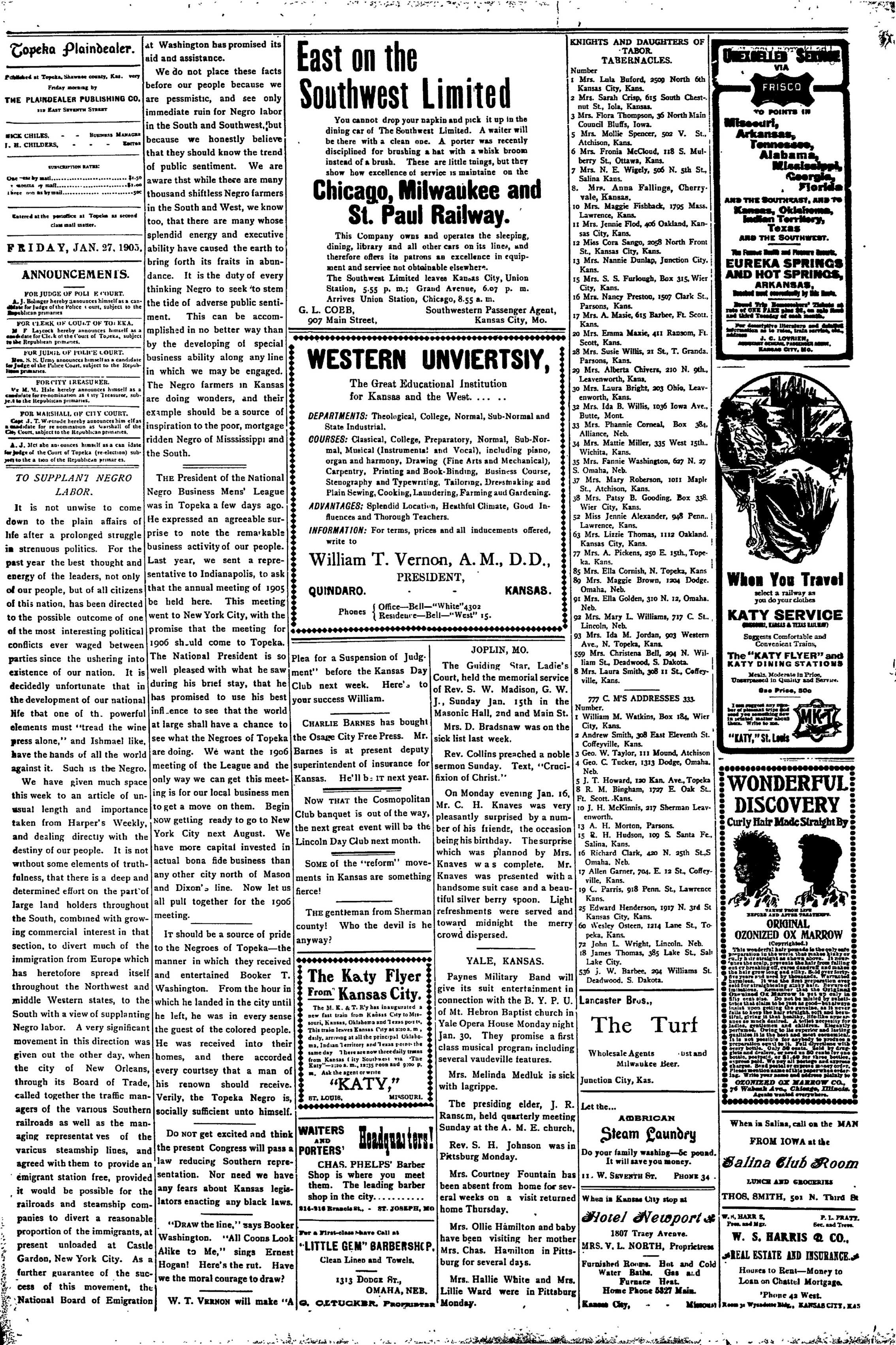
Topeka Plaindealer.
Published at Topeka, Shawnee county, Kas. very
Friday morning by
THE PLAINDEALER PUBLISHING CO.
212 EAST SEVENTH STREET
NICK CHILES, - BUSINESS MANAGER
J. H. CHILDERS, - EDITOR
SUBSCRIPTION RATES:
One ear by mail..... $1.50
five months by mail..... $1.00
three non-ear by mail..... $5.00
Entered at the postoffice at Topekan as second class mail matter.
FRIDAY, JAN. 27, 1905.
ANNOUNCEMENTS.
A. J. Met abe an-ounces himself as a candidate for judge of the Court of Topeka (re-election) sub-ject to the a tion of the Republican primaries.
TO SUPPLANT NEGRO
LABOR.
It is not unwise to come down to the plain affairs of life after a prolonged struggle in strenuous politics. For the past year the best thought and energy of the leaders, not only of our people, but of all citizens of this nation, has been directed to the possible outcome of one of the most interesting political conflicts ever waged between parties since the ushering into existence of our nation. It is decidedly unfortunate that in the development of our national life that one of th. powerful elements must "tread the wine press alone," and Ishmael like, have the hands of all the world against it. Such is the Negro
We have given much space this week to an article of unusual length and importance taken from Harper's Weekly, and dealing directly with the destiny of our people. It is not without some elements of truthfulness, that there is a deep and determined effort on the part of large land holders throughout the South, combined with growing commercial interest in that section, to divert much of the immigration from Europe which has heretofore spread itself throughout the Northwest and middle Western states, to the South with a view of supplanting Negro labor. A very significant movement in this direction was given out the other day, when the city of New Orleans, through its Board of Trade, called together the traffic managers of the various Southern railroads as well as the managing representatives of the varicus steamship lines, and agreed with them to provide an emigrant station free, provided it would be possible for the railroads and steamship companies to divert a reasonable proportion of the immigrants, at present unloaded at Castle Garden, New York City. As a further guarantee of the success of this movement, the National Board of Emigration
at Washington has promised its aid and assistance.
We do not place these facts before our people because we are pessmistic, and see only immediate ruin for Negro labor in the South and Southwest, but because we honestly believe that they should know the trend of public sentiment. We are aware that while there are many thousand shiftless Negro farmers in the South and West, we know too, that there are many whose splendid energy and executive ability have caused the earth to bring forth its fraits in abundance. It is the duty of every thinking Negro to seek to stem the tide of adverse public sentiment. This can be accomplished in no better way than by the developing of special business ability along any line in which we may be engaged. The Negro farmers in Kansas are doing wonders, and their example should be a source of inspiration to the poor, mortgage ridden Negro of Misssissippi and the South.
THE President of the National Negro Business Mens' League was in Topeka a few days ago. He expressed an agreeable surprise to note the remarkable business activity of our people. Last year, we sent a representative to Indianapolis, to ask that the annual meeting of 1905 be held here. This meeting went to New York City, with the promise that the meeting for 1906 should come to Topeka. The National President is so well pleased with what he saw during his brief stay, that he has promised to use his best influence to see that the world at large shall have a chance to see what the Negroes of Topeka are doing. We want the 1906 meeting of the League and the only way we can get this meeting is for our local business men to get a move on them. Begin now getting ready to go to New York City next August. We have more capital invested in actual bona fide business than any other city north of Mason and Dixon's line. Now let us all pull together for the 1906 meeting.
It should be a source of pride to the Negroes of Topeka—the manner in which they received and entertained Booker T. Washington. From the hour in which he landed in the city until he left, he was in every sense the guest of the colored people. He was received into their homes, and there accorded every courtsey that a man of his renown should receive. Verily, the Topeka Negro is, socially sufficient unto himself.
Do not get excited and think the present Congress will pass a law reducing Southern representation. Nor need we have any fears about Kansas legislators enacting any black laws.
"Draw the line," says Booker Washington. "All Coons Look Alike to Me," sings Ernest Hogan! Here's the rut. Have we the moral courage to draw?
W. T. VERNON will make "A
East on the Southwest Limited
You cannot drop your napkin and pick it up in the dining car of The Southwest Limited. A waiter will be there with a clean one. A porter was recently disciplined for brushing a hat with a whisk broom instead of a brush. These are little things, but they show how excellence of service is maintaine on the
Chicago, Milwaukee and St. Paul Railway.
This Company owns and operates the sleeping, dining, library and all other cars on its lines, and therefore offers its patrons an excellence in equipment and service not obtainable elsewhere. The Southwest Limited leaves Kansas City, Union Station, 5.55 p. m.; Grand Avenue, 6.07 p. m. Arrives Union Station, Chicago, 8.55 a. m.
WESTERN UNVIERTSIY.
The Great Educational Institution for Kansas and the West. . . .
College, Normal, Sub-Normal and Preparatory, Normal, Sub-Nor- and Vocal), including piano, Sing (Fine Arts and Mechanical), Book-Binding, Business Course, Sing, Tailoring, Dreestaking and Diering, Farming and Gardening. on, Heathful Climate, Good In- ers and all inducements offered, on, A. M., D.D., DENT,
DEPARTMENTS: Theological, College, Normal, Sub-Normal and State Industrial.
COURSES: Classical, College, Preparatory, Normal, Sub-Normal, Musical (Instrumental and Vocal), including piano, organ and harmony, Drawing (Fine Arts and Mechanical), Carpentry, Printing and Book-Binding, Business Course, Stenography and Typewriting, Tailoring, Dressmaking and Plain Sewing, Cooking, Laundering, Farming and Gardening.
ADVANTAGES: Splendid Location, Heathful Climate, Good Influences and Thorough Teachers.
INFORMATION: For terms, prices and all inducements offered, write to
William T. Vernon, A.M., D.D., PRESIDENT,
Phones { Office—Bell—"White"4302 Residence—Bell—"West" 15.
The Guiding Star, Ladie's Court, held the memorial service of Rev. S. W. Madison, G. W. J., Sunday Jan. 15th in the Masonic Hall, 2nd and Main St. Mrs. D. Bradsnaw was on the sick list last week. Rev. Collins preached a noble sermon Sunday. Text, "Crucifixion of Christ."
On Monday evening Jan. 16, Mr. C. H. Knaves was very pleasantly surprised by a number of his friends, the occasion being his birthday. The surprise which was planned by Mrs. Knaves was complete. Mr. Knaves was presented with a handsome suit case and a beautiful silver berry spoon. Light refreshments were served and toward midnight the merry crowd dispersed.
Paynes Military Band will give its suit entertainment in connection with the B. Y. P. U. of Mt. Hebron Baptist church in Yale Opera House Monday night Jan. 30. They promise a first class musical program, including several vaudeville features. Mrs. Melinda Medluk is sick with lagrippe.
The presiding elder, J. R. Ransom, held quarterly meeting Sunday at the A. M. E. church,
Rev. S. H. Johnson was in Pittsburg Monday.
Mrs. Courtney Fountain has been absent from home for several weeks on a visit returned home Thursday.
Mrs. Ollie Hamilton and baby have been visiting her mother Mrs. Chas. Hamilton in Pittsburg for several days.
Mrs. Hallie White and Mrs. Lillie Ward were in Pittsburg Monday.
G. L. COEB,
907 Main Street,
QUINDARO.
Plea for a Suspension of Judgment" before the Kansas Day Club next week. Here's to your success William.
CHARLIE BARNES has bought the Osage City Free Press. Mr. Barnes is at present deputy superintendent of insurance for Kansas. He'll be it next year.
Now that the Cosmopolitan Club banquet is out of the way, the next great event will be the Lincoln Day Club next month.
Some of the "reform" movements in Kansas are something fierce!
The gentleman from Sherman county! Who the devil is he anyway?
The Katy Flyer From Kansas City.
The M. K. & T. R'y has inaugurated a new fast train from Kansas City to Missouri, Kansas, Oklahoma and Texas ports. This train leaves Kansas City at 2:20 a.m. daily, arriving at all the principal Oklahoma, Indian Territory and Texas points the same day. There are now three daily trans from Kansas city Southwest via "The Katy"—2:20 a.m., 12:35 noon and 9:00 p.m. Ask the agent or write
"KATY,"
ST. LOUIS. MI SOURI.
CHAS. PHELPS' Barber Shop is where you meet them. The leading barber shop in the city....... 914-316 Brancis St., ST. JOSKPH, MO
OLTUCKER, PROPRIETER
KANSAS.
JOPLIN, MO.
YALE, KANSAS.
Number
1 Mrs. Lula Buford, 2509 North 6th Kansas City, Kans.
2 Mrs. Sarah Crisp, 615 South Chestnut St., Iola, Kansas.
3 Mrs. Flora Thompson, 36 North Main Council Bluffs, Iowa.
5 Mrs. Mollie Spencer, 502 V. St., Atchison, Kans.
6 Mrs. Fronia McCloud, 118 S. Mulberry St., Ottawa, Kans.
7 Mrs. N. E. Wigely, 506 N. 5th St., Salina Kans.
8. Mrs. Anna Fallings, Cherryvale, Kansas.
10 Mrs. Maggie Fishback, 1795 Mass. Lawrence, Kans.
11 Mrs. Jennie Flod, 406 Oakland, Kansas City, Kans.
12 Miss Cora Sango, 2058 North Front St., Kansas City, Kans.
13 Mrs. Nannie Dunlap, Junction City, Kans.
15 Mrs. S. S. Furlough, Box 315, Wier City, Kans.
16 Mrs. Nancy Preston, 1507 Clark St., Parsons, Kans.
17 Mrs. A. Masie, 615 Barbee, Ft. Scott, Kans.
20 Mrs. Emma Maxie, 411 Ransom, Ft. Scott, Kans.
28 Mrs. Susie Willis, 21 St., T. Granda. Parsons, Kans.
29 Mrs. Alberta Chivers, 210 N. 9th., Leavenworth, Kans.
30 Mrs. Laura Bright, 203 Ohio, Leavenworth, Kans.
32 Mrs. Ida B. Willis, 1036 Iowa Ave., Butte, Mont.
33 Mrs. Phannie Corneal, Box 384, Alliance, Neb.
34 Mrs. Mattie Miller, 335 West 15th., Wichita, Kans.
35 Mrs. Fannie Washington, 627 N. 27 S. Omaha, Neb.
37 Mrs. Mary Roberson, 1011 Maple St., Atchison, Kans.
38 Mrs. Patsy B. Gooding, Box 338. Wier City, Kans.
52 Miss Jennie Alexander, 948 Penn., Lawrence, Kans.
63 Mrs. Lizzie Thomas, 1112 Oakland. Kansas City, Kans.
77 Mrs. A. Pickens, 250 E. 15th., Topeka, Kans.
85 Mrs. Ella Cornish, N. Topeka, Kans
89 Mrs. Maggie Brown, 1204 Dodge. Omaha, Neb.
91 Mrs. Ella Golden, 310 N. 12, Omaha. Neb.
92 Mrs. Mary L. Williams, 717 C. St., Lincoln, Neb.
93 Mrs. Ida M. Jordan, 903 Western Ave., N. Topeka, Kans.
559 Mrs. Christena Bell, 294 N. William St., Deadwood, S. Dakota.
8 Mrs. Laura Smith, 308 11 St., Coffeyville, Kans.
777 C. M'S ADDRESSES 333
Number.
1 William M. Watkins, Box 184, Wier City, Kans.
2 Andrew Smith, 308 East Eleventh St. Coffeyville, Kans.
3 Geo. W. Taylor, 111 Mound, Atchison
4 Geo. C. Tucker, 1313 Dodge, Omaha, Neb.
5 J. T. Howard, 120 Kan. Ave., Topeka
8 R. M. Bingham, 1727 E. Oak St.
Ft. Scott, Kans.
10 J. H. McKinnis, 217 Sherman Leavenworth.
13 A. H. Morton, Parsons.
15 R. H. Hudson, 109 S. Santa Fe, Salina, Kans.
16 Richard Clark, 420 N. 25th St., S Omaha, Neb.
17 Allen Garner, 704, E. 12 St., Coffeyville, Kans.
19 C. Parris, 918 Penn. St., Lawrence Kans.
25 Edward Henderson, 1917 N. 3rd St. Kansas City, Kans.
60 Wesley Osteen, 1214 Lane St., Topeka, Kans.
72 John L. Wright, Lincoln, Neb.
18 James Thomas, 385 Lake St., Salin Lake City.
536 j. W. Barbee, 294 Williams St. Deadwood, S. Dakota.
Lancaster Brus.,
The Turf
The Turf
Wholesale Agents ust and Milwaukee Beer. Junction City, Kas.
Let the...
Do your family washing----5c pound. It will save you money.
When in Kansas City stop at Hotel Newport 1807 Tracy Avenue. MRS. V. L. NORTH, Proprietress
UNEXCELLED SERVICE
VIA
FRISCO
TO POINTS IN
Missouri,
Arkansas,
Tennessee,
Alabama,
Mississippi,
Georgia,
Florida
AND THE SOUTHEAST, AND TO
Kansas, Oklahoma,
Indian Territory,
Texas
AND THE SOUTHWEST.
The Famous South and Pressure Reports,
EUREKA SPRINGS
AND HOT SPRINGS,
ARKANSAS,
Reserved and conveniently by this Invoice.
Broad Triple Missourians' Tickets at
rate of ONE FARE plus $8, on sale on
first and third Tuesday of each month.
For descriptive literature and detailed
information as to rules, trax service, etc.
address
J. C. LOVRIEN,
ADMINISTRATIVE SCHOOL, PASSENGER ABBIN,
KANSAS CITY, MO.
[Illustration of a figure in a robe, holding a sword, with a crown and a shield, set against a background of a cityscape with buildings and a river.]
KATY SERVICE
(MISSOURI, KANSAS & TEXAS RAILWAY)
Suggests Comfortable and
Convenient Trains,
The "KATY FLYER" and
KATY DINING STATIONS
Meals, Moderate in Price,
Unsurpassed in Quality and Service.
One Price, 50c
I can suggest any number of pleasant trips and meals in printed matter about them. Write to me.
"KATY," St. Louis
I can suggest any number of pleasant trips and send you something new in printed matter about them. Write to me.
"KATY." St. Louis
```markdown
```
REPORT AND AFTER TREATMENT.
ORIGINAL
OZONIZED OX MARROW
(Copyrighted.)
This wonderful hair pomade is the only care preparation in the world that makes hair or curly hair straight as shown above. It nourishes the scalp, prevents the hair from falling and provides the hair long and silky. Sold over forty-five years and used by thousands. Warranted harmless. It was the first preparation ever sold for straightening anily hair. Beware of the OXNIZED OX Marrow is put up only in fifty cent size. Do not be miled by substitution that claim to be just as good—but always insist upon getting the pomade, as is never better than the OXNIZED OX Marrow. It is not harmful, dying is that healthy, life-like appearance so much desired. A toilet necessity for ladies, gentlemen and children. Elegantly portended. Owing to the superior and lasting qualities of the OXNIZED OX Marrow it is not possible for anybody to produce a preparation equal to it. Full daytime with over bottle. Only 50 cents. Sold by druggists and dealers, or as sold 50 cents for one hundred dollars. Expense paid. We pay all postage and express charges. Send postal or express money order. Please mention name of this paper when ordering. Write your name and address plainly to OXONIZED OX MARROW CO., 76 Wabank Ave., Chicago, Illinois. Agents wanted everywhere.
When in Salina, call on the MAN
FROM IOWA at the
Salina Club Room
LUNCH AND GROCERIES
THOS, SMITH, 501 N. Third St
W. H. HARR S. P. L. PRATT.
Press. and Mgr. Sec. and Treas.
W. S. HARRIS @ CO.,
REAL ESTATE AND INSURANCE.
Houses to Rent—Money to
Loan on Chattel Mortgage.
'Phone 42 West.
Se eeeeneeeneneneianehdfeneeeeneennnnennnEnehneeeeeEEEEEEeEEEEEEneoEneREE
Jwe, ‘rues gg6 2.
{253 nam
OFFce MOCES G2 OS Rm
Sendays 9 terra m,
: DR, A. ©. BRISCOE.
DEETisT.
ens Grocery, - TOPEKA, KAS
WM. &. JACKSON, M. D
Paysioian anp Surazos
Office 404 Kausas Ave.
L, as IND, epeRta, Kanga S
OFFICE ours iste outa.
Ind, Poooe 950. (7t010P. M.
J. M, JAMISON, M.D.,
PHYSICIAN AND SURGEON
Xzesnaieg Pirysician of the Kvights and Ladies
of Protechos,
{pect Aieation todesacsey
women aad privsie deseases.
Olfice and Residence, BOT Maprsow VTaaeT.
Ean ————_—_-==
O. A. TAYLOR. M. D.
Prysroran anD Surexon
3296 Kansas Ave. Ind, Phone 774.
Calis answered day aad aight,
7to9a m
Office Hours | 2to 4and 6 to 8 p.m.
i NEWS OF THE WEEK, ;
Dr. O. A. Taylor reports much
siekness.
Clem Wilson returned from O.
T. Jast wee .
J. H. Guy was out of the city on
legal busineas Wednesday.
Col. Beck was in the city Saturday
in the interest of the K. & L. of P.
Mrs. Margaret Perry, 1828 Topeka
Ave., has been quite ill the past
week.
The Pleasant Hour Literary So-
ciety meets next Saturday night at
420 Kansas Ave.
H. I. Monroe, deputy county clerk
was detained at home by illness for
2 day or two this week,
Mrs, A, J. McLemore is ill at her
home in Chicago. We hope she
will speedily recover.
Miss Viola Scott returned home
from Kansas City after a five weeks
visit with relatives and friends.
Lee’s Drug Store was entered this
week and the cash drawer relieved
of $4. No trace of the theives.
Capital City Council K. & L. of
P. gave an entertainment at their
hall at 413 Kansas Avenue Monday
night,
Mrs. Henrietta Cary and Miss
Josephine Mason will entertain the
W.W. Club at the ©. P. Church
neat Friday night.
Mrs. Mary Beard, Miss R. Gar-
denhire and John Gardenhire, of
Alma, Kas., visited their sister Mrs,
Wm. Connelly the first of the week.
Mrs. Adella Miller, of Lawrence,
was up last week attending the
Booker Washingten lecture and was
also the guest of Miss Nancy Mat-
ley. :
The infant daughter of Mr. and
Mrs. Wm. Connelly, of 1412 Van
Buren, died last Mouday afternoon
and was buried Wednesday after-
noon.
Dr. A.C. Briscoe, dentist, was in
Atchison Wednesday. He willopen
an office with Dr. W. H. Hudson
and spend one day each week in
that city.
Mrs J. C. Ashworth and little
daughter Thelma Ruth, of Kansas
Oity, Mo., arrived in the city last
Thursday to make their home with
her mother Mrs. D Scott.
The Oriental Art Club met with
Mrs, Wm. Core last Friday. A
lancheon was served by the hostese
after which trey adjourned to meet
with Mrs. Liszie Brown at 8th and
Chandler.
Miss Henrietta Jackson, of Kan:
sas City, transacted businese-in To.
peka last Friday hut during her brie!
stay failed to lift our latch string
Gan it be that eur former co-workers
have forgotten us.
Mrs. Mollie Blackwell, 529 North
Fillmore, is on the sick lat.
The Excelsior Art club met last
Thursday afternoon at the home of
Mrs J. W. Birdwhistle, 310 West
First street.
Memorial services will be neld at
Mt, Zion Baptist church in North
topeka Sunday, Jan’y 28, in memo-
ty of Rev. Isaac Paimer, who pasted
away in Baton Rouge, La.
Services at St. Simon Episcopal
Church have been changed from
Wednesday to Friday night. Rev.
Fatner Harper, of Kansas City, will
conduct mission service beginning
February roth. All are invited.
_ Mas. Wm, Jacobse of Richmond,
‘Mo. died at her home in that city
‘December 30. Mrs. Jacobs will be
well remembered by a great many
Topckans, having spent her honey-
moon in this city wi h Mr. and Mrs,
J. M. Wright about three years ago.
The Shangor Club met at the resi-
dence of Miss Mattie Sneed, 304
Jefferson 8t., Monday afternoon.
Much business of importance was
transacted. A nice pregram was
rendered and a nice luncheon serv-
ed. The club adjourned to meet
with Miss Raymos Dyer in two
weeks,
Mrs. Mary Doris departed this life
Saturday morning Jan. 21, at 8:30
a. m. She embraced a hope in
Ubrist manv ye 18 aga and ever
lived a devoted christian. Rev.
Gamble paid a loving tribute to the
deceased Sunday afternoon when the
funerat services were held at Brown
Chapel. She leaves a devoted hus
band. a faithful daughter and son in-
law anda hcet of warm friends to
‘mourn her loss.
The guests of the Potter Hotel
anda few friends tendered Mrs.
Maggie Adams, the proprietress, a
pleasant surprise Tuesday evening
in honor of her 48th birthday anni-
versary. Messrs Taylor and Arm-
strong and Mr. and Mrs. James
Richardson engineered the prepara-
tiousa d the testimony of the guests
aud honoree at the banquet table
showed that they attained complete
sucoess. Whist and music were the
features of tne evening. Mrs,
Adams received some very valuable
presents. Atthe conclusion of the
banquet a whist club was organized
tobe known as the Arctic Whist
Club.
Mrs. Alice Myers, of Lawrence,
attended the Booker T. Washington
lecture and banquet. She was also
a delegate trom the Warren St.
Baptist church at the meeting of the
execative board of the Baptist state
convention which was in session at
Sula Baptist church on the 18th to
2oth, before which body she read a
very interesting paper on ‘True
Church Worship.” She was the
guest, while in the city, of her friend
and schoolmate Mrs. M. A. Gillespie
and daughter Mrs. C. C Fulton, of
629 Jackson St. Mrs. Myers is the
mother of the famous George Walker
ot Williams & Walker Ccmedy Co.
The Baptist State Board met a:
Shileh Baptist Church last week.
The firet day was B. Y.P.U. and
Sunday School day. They hada
splendid session and a good pro
gram. The Woman's Mission bo
ciety under the direction of Mrs.
Emma Gaines as president han
charge of the second day. The
third day was the Board meeting
proper and was called to order by
Rev. Arlington Wilson, of Kansas
City, Kas. J. H. Van Lue, genera!
missionary, reported his field ir
guod condition, This meeting was
said to be the best held in the state
The delegates were cared for by the
members of the church. They co}
lected $300 for the work. Tie
board adjourned to meet in Ottaws
Kas., next April.
Do You Know ©
will be eight pages from this week.
DURING THE NEXT SIX MONTHS THERE WILL BE NUMEROUS
PRIZES AWARDED FOR DIFFERENT THINGS. SEE PARTICULARS IN
BIG “AD” ON PAGE SEVEN. Now is your opportunity. .
Our Grand Prize Contest,
» The great contest inaugurated by
this payer is exciting more int rest
throughout the country than we
anticipated and soon we shall have
enterd various ca: didaies tha: ugh-
out the bailiwick where this paper
circulates,
Our representative wiil shortly
visit ihe three barracks where the
‘oth cavalry is situated and we an-
ticipate a heavy vote for-the various
nou-c: mmissioned officers at Fi,
Riley, Leavenworth and Jefferson
Barracks at Si. Louis. The prize
for the non-commissioned officer
reveiving the must votes will be
ur xrand Prize Gold Watch, with
Elgin movement, valued at $50.
For each subscription of one (1)
year the subscriber is entitled to
cast 150 votes for the ofticer of his
choice. For 6 months subscription
100 votes, and three months sub-
scription 50 votes.
For the person sending in the
most subscriptions we give our
Grand Prize Columbia Grepho-
phone valued at $35, the v-tes to
be rated the same as 9th Cavalry
contest, This contest is open to all
comers and will be very exciting.
The next prize is our Ladies
Solid Gold Watch with Waltham
movements, for the Most Popular
Lady. Subscribers will be allowed
to cast votes for their favorites as
in the above contests.
Shampnoing and Fuce Mussage
MRS. HATTIE E. VAN VLECK
Hair Dresser and
Manufacturer... ....
Hair To Matce ALt CoMPLEXIONS.
Doll Wigs—New Pompadours,
Pompadour Combs, and other
Toilet Combs, Switches and
—Hair Jewelry............0666+
220 E.sth8t. TOPEKA, KANS
Florida Sleeper
VIA
aa
On November 15th, and datly
thereafter, until the summer season
of 1905, the Frisco System, in con-
nection with the Southern Railway,
will operate through Pullman Sleep-
ers between Kansas City, Mo. and
Jacksonville, Fla. These sleeping
cars will be placed in service as part
of the equipment of the Popular
“Southeastern Limited,” scheduled
to leave Kansas City 6:30P,M. A
modernly equipped train, electric
lighted cafe observation car, etc—
‘the route of which carries the travel-
er through the populous cities of the
southeast.
Berth reservations may be made
wove representatives of Frisco
System or connecting lines.
| PASSENGER TRaFFic DgpaRtMENT,
| Saint Louts.
TWO FOR ONE!
The Topeka Plaindeater
Kansas City Star
| One Year - $150.
Don’t Miss This Chance!
Lincoln Day Banquet.
Bishop Abram Grant to Be
Speaker of the Evening.
The great Lincoln Day club will
on Monday evening, February 13th
hold their usual annnal exercises in
honor of the great emancipator.
The club has procured for the
speaker of the evening that great
race leader and eminent divine, Rt.
Rev. Bishop Abram Grant. The
exercises will he held in the House
of Representatives, after which the
banquet will be held. This year’s
exercises bid fair to excell anything
which this organization hae hereto-
fore attempted, and parties deriring
to atte.d the banquet should com-
municate at once with the secretary,
J. B. Bass, care Tas Prainpeatzr.
By J. R. Lytle,
For Sale 929 Kansas ‘Ave.
Quinoy—6 rooms, $1800.
Van Buren—4 rooms, $700.
Van Buren—3 rooms, $600.
Harrison—3 rooms, $550—$75
cash.
Topeka Ave.—5 rooms, ¢1100—
$100 cash.
Topeka Ave.—4 rooms, $700.
Topeka Ave.—7 rooma, $1200.
Acre property, $150—850 cash.
Lots on Kansas avenue, $100.
Lots on Kansas avenue, $25.
ae
WHEN IN ATCHISON
——call on——
Mrs. Anna Lemons
at 116 N. 8th street, who keeps
a first-class ROOMING HOUSE
and RESTAURANT. Give him
a call. Everything first-class
and up-to-date,
goatee? cathe, ee He Beene
The Colored Town and
Home of the Negro.
One Year Old and 600 Inhabitants!
8000 Acres of Land Surrounding Boley has Already been .
Leased and Bought by Negroes. 20,000 Acres of the Best
Land in the Creek Nation Surrounding Roley to be Leased
and Bought by Negroes.
T. M. HAYNES, Local Townsite Mgr., BOLEY, |. T.
SW ees
2 A NEW FAST TRAIN, The Katy Flyer §
2 Leaves Kansas City at .2:20 A. M. daily, arriving at all &
7 principal Oklahoma. Indian Territory and Texas points €&
2 the same day. &
: 2 Daily Traine from Kansas City Southwest. b
2 2:20 A.M. 12:35 P.M. e
3 9:00 P. M. €
% oe
2 Ark the Apentor Write “KATY” *
2 &
; Saint Louis. &
PATA MUTUAL UTTAR URE
—
DAY MIXER, NIGHT MIXER,
JIM NICKOLS. HORACE BURER,
tt
w#"THE ONLY WAY”
SALOON + POOL HALL,
FURNISHED ROOMS.
Open Day and Night. Fine Wines, Liquors and Cigara,
1215-1217 East 18th Si, KansasCirv, Mo
Home Phone 2544. Lige Hendricks, Prop-
s i "yee eah Tae ape *
Nee ee SSOP ST SPSS PSCC SOC OO
There are a lot of jokes about rubber; but it’s no joke
_ if you happen to need come piece of rubber goods and are
several miles from where it may be bought. We keep in
, stock the very best make of all kinds of Syringes, Hot ‘
| Water Bottles, Nursing Bottles, ‘Toys and baby comforts. ‘
| Rightly applied, rubber goods are more conducive to heath | |
| than many medicines. ‘
Prescriptions a Specialty.
Ind, Phone 743,
Ball Phone geist 732 Kansas Ave.
ry INSURED?
ce CEEBD - You '
48 ans
ay % ea
be” ie Knights and Ladies
tr ogo jl w & of Protection
ees A NATIONAL FRATERNAL INSURANCE
Raa Wi SOCIETY |
NSS REO —_———
SLE GN Incorporated Under the Laws of Kansas,
Issues policies for $350, $500 and $1000.
We issue policis for $100, $150 and $200 for children aged fram 6 to 20,
This is the only Colored Fraternal Insurance
Company in the United States.
very intelligent Negro should carry some Insurance. We want
good, live, hustling agents in every town. Write at once for terms
Liberal terms to the right persons
The Knights and Ladies of Protection.
Col. James Beck, Nat'l Pres. V.C. Thomas, Nav'l Supt,
James M. Masou, Nat'l Vice Pres. J.G Groves, Nat'l Treas.
J.H. CHILDERS, Naf Sec.,.
Headquarters: 13 Kausas Avenuc, Topcka, Kansas.
Local and Personal.
Thos, Collins, of Kansas City, was
a Topeka visitor last week.
Mr. Armstrong of Garnett, yisited
Mr. and Mis. Dennis Ray.
Mrs. Lee Shepherd, who has been
ill, is reported as being muchim-
proved.
Mrs. Ford, of Burlingame, was in
the city last week visiting her
daughter, Miss Lelia.
Mrs. Maria Johnson, corner Lau-
rentand Buchanan Streets. North
Topeka, is quite ill,
Dock Parks, a former Topeka boy,
was married Tuesday to a lassie
from San Antonio, Texas.
M. A. Jenkins of Jefferson Bar-
racks, St. Louis, Mo., has been pro-
moted to the rank of sergeant, Troop
K, Ninth cavalry.
Preston RB. Bass, of Pleasanton,
who forthe past three weeks has
besn visiting hisuncle, J. B. Bass,
left Tuesday for his home.
‘The new lights will be installed in
the **B" Street Baptist Church this
week. They will be incandescent
and of two thousand five hundred
candle power.
Mrs. aad Mrs. Wm, Connelly de-
sire to express their thanks tothe
friends who so kindly assisted them
during the sickness and death of
their httle daughters.
Miss Lizzie Cooper very pleasaat-
ly entertained the Golden Rod Clab
ather home 1:13 Jackson St., Fri.
day of last week. Miss Lelia El
more, of Carthage, Mo., was the
guest of honor and a pleasant time
was had.
The mahy friends of Mrs. Ida
Wright Owens, of Niles, Mick , will
be painedto learn of the death ot
her infant daughter, Josephine Mer-
cer, which occurred last Sunday.
-Mrs. Owens is a sister of our fellow
townsman, Hon. John M. Wright.
—_—_$——_____._____
# WHEN IN TOPEKA
FP, C, Danforth’s.
Neatly Farnished Rooms—Board
by the Day or Week. Lunch Coun-
terin Connection. Open from 6a.m.
108 Kansas Ave.
Near R.J. Depot. --TOPEKA.
NOTICE.
(Furst Published January 27, 1405.)
My application for a permit fo sell intoncatmg
liquor according to law at No. a125 Kansas Avenue
in the third (5rd) ward of the city ef Topeka, Shaw
nec County, Kansas, is now on fie in the Probate
Court in and for Shawnee County, Kansas, and
Hon. R. B. Hayden, Probate Judge of sald county,
Will heat said application at his office in the coure
house in said euty of Topeka, on the 28th dayef
February A. D. 10s, atgo'elock a. a. of said day.
WR. Kexwapy, Applicant.
PUBLICATION NOTICE.
Inthe District Court of Shawnee
County, Kansas.
Anna Tyier, Plaintiff,
vB 88
James Tyler, Defendant. t
James Tyler, the defendant above
named, will take notice that he has
been sued by the Plaintiff, Anna
Tyier, and that he must answer on
or before the 11th day of March,
1905, the petition filed by the plain-
tiff inthe above éntitled action in
said court, or said petition will be
taken a true and judgment render-
ed divorcing the plaintiff from the
defendant.
J. R. McNary.
Attorney for Plaintiff.
oa oe.
In the District Court of Shawnee
County Kansas.
Fe R. Hesser, Plaintiff
ns 23051
M.I.. Freeman and Jesse Powers
and Mrs, Jesse Powers defendants.
State of Kansas
Shawnee County. fas
‘To the above named defendant
M. L. Freeman, you are hereby no-
tified that you have been sued in
the District Court of Shawnee Coun-
ty, Kansas, by the above named
plaintiff, F, R. Hesser, and that
said F. R. Hesser filed her petition
in the above entitled court on the
26th day of November 1904, and
that unless you answer said petition
on or before the 27th day of Febru-
ary 1905, said petition will be taken
ax true and judgment will be ren-
dered against you barring, foreclos-
ing and excluding you and all other
persons claiming by, through or
under you from any claim of title or
interest you may have, or from ever
setting up or claiming any right,
ttle or interest in, or lien upon the
following described real estate situ-
ated in Shawnee County, Kaneas,
to-wit: Lots ten [10] and twelve
[12] on Highland Ave., in South
West Subdivision. And judgment
will be rendered against you quiet
ing said plaintiffs title in and to
said premises and for such other
sad further relief to which said
plaintiff may be entitled and for
costs of this suit.
F. R. Hesaxg, Plaintiff.
> H. Beanaman, Atty. for PI't'f,
| Attest, I. 8. Conris, Clerk.
B Strect Baptist Church Banquet.
The members of the B street Bap-
tist church in North Topeka are
preparing a splendid banquet for
their pastor, Rev. G. W. Harts, in
testimony of a year’s good work for
the church and the cause of Christ.
Rev. Harts is one of the young men
inthe church, But he posesses the
indomitable courage of the early fa-
thers. He is doing a great work
amoung the people in his parish. He
enjoys not only their confidence and
esteem, but the respect and confidence
of all the people of this city as acon-
7 ee
hm ES PN ee
“ah otis: ESSN
Yi See
a Saez
sod ot , sham
th, wane
779 PT P. ae,
__ at
5 7 Spite
. 4a mt
en :
See =
sods be
REY. GEOKGE W, HARTS.
servative christian gentleman devot-
ed tu his church and to the uplift of
his people. The banquet will he
held on Feb'y 6th at the church.
The following program will be ren-
dered:
SONQ..eeeee cereesseeeene senses Audience
Invocation....Rev. G. W. Harding
S mgeic. cece vesceeee «+ Atdience
Address, “Pastorand Preacher”
stseee sessereeeoneseees He I. Monroe
Address,......0. see We T. Turner
SONG o.oo e eee seeeesee Audience
Address, “The Pastor as a Business
Man.......0.+-.-...d. H. Childers
Address, Baptist Church Unity
sessseseeseere eee Rev. C. H, Duval
Paper, “How We have Come,” ......,
serssessee esos eceseeeees ISaiah Lizenby
Closing Remarks, Rev. W. P. Banks
Benediction,...Rev. C. G. Fishback
The B street Baptist church has:
made great progress during the past
year. This church has raised near-
ly $2,000, and has reduced the bond-
ed debt $600. They have installed
a magnificent light system for the
church. The Sunday School work
has greatly improved under his Jead-
ership. During the coming year,
many movements for the uplift of the
people in North Topeka will be in-
augurated. The Western States and
Territories association will hold its
annual meeting in this ehurch in
June. The pastor makes a strong
appeal to all citizens to help in the
good work in his district.
NEGRO ENTERPRISE
IN SUNNY KANSAS!
Some Interesting Paragraphs About
the Upward Tendancy of Negroes
in a Financial Way.
Negro farmers of Barton county
last year raised enough wheat to
supply the entire state. No wonder
Kansas can afford so much for export
purposes.
J.G. Groves, the Potato King ot
the Kaw Valley, says he raised only
a small crop ot potatoes last year.
He ma.keted 55,000 bushels and has
enough for seed left. That’s not so
bad. Try it, boys.
Grand Western Council, N.o 7.
Knights and Ladies of Pro:ection,
of Edwardsville, Kansas, is at pres-
ent the banner council! This is the
work of individual members. Let
every member try and get anew mem-
ber: try and get a new member next
month, That’s the way to make
things hum.
Topeka has Negroes engaged in
almostevery lineofbusiness. There
is a good opening here for a rustling
young man to handle furniture, cew
and second hand. There is a good
show for some hustler to handle boote
and shoes. With «ver7,000 Negroes
to feed, clothe and house, there is
pleaty of opportunity for the Negro
who is willing to hustle. We are
solving the problem here. Come
and take a hand. +
Kansas City, Kansas has a suc-
cessful new and second hand furni-
ture store, operated by Mr. D, W.
White. The auccess of this store
indicates the possible success along
iness success as they do in a crap
game, Negro business men would be
more numerous,
In the city of Wichita wherethere
are probably 4,000 Negroes, there
is not a successful grocery store, o1
laundry. Here is another opening
for the right kind of a young man.
Take this chance to open a busines:
that will appeal to our people, and
gain a substantial share of their pat-
ronage. .
Negro business men of Topeka
should be alive to the value of solio-
iting for the trade of the public.
Keep clean, neat places of business,
and do not hesitate to advertise for
ashare of public patronage. °
The Knights and Ladies of Pro-
tection is one of the growing busi-
ness institutions among our people.
Organized and backed by Negroes,
it is slowly but surely securing a
share of publicfavor. This company
desires reliable agents in every town
in Kansas and promises careful and
Prompt care of all business secured.
It is an insurance company operated
on the fratemal plan. It is a well
known fact that very few of the old
line life insurance companies are
refusing to accept Negro risks. We
are paying a big price to the indus-
trial department of some instirance
companies. The money so secured
goes to pay white clerks, collectors
and agents., their surpluses go to
the development of gigantic business
enterprises in which Negroes have
no voice nor interest. We want to
foster among our people those enter.
prises that offer possible employment
for the boys and girls of our race.
‘LINCOLN Day,
Monday, Feb'y 13, 1906,
The great Kansas Lincoln Day
club is gettmg everything up in great
shape for their anoual Lincoln Day
exercises on the evening of Feb’y
13, in representative hall.
Lhe program will be given out in
ournextissue, The Rt. Rev. Bishop
Grant will be the speaker of the ev
ening. Jackson’s Military band and
others will comprise the evening’
program.
The banquet will be held after the
public exarcises at 618 Kansas ave
tue, at which time miny antable
men will be on program Our old
favorite, Hon. Nu!son Crews of Muy,
Prof Geo. T. Wasson at K unsas
City, Kansas, Prof. Veraun, Suuth
and Bradley of Kansas City. \rin-
stead of Emyoria and others. Ora-
tory will reign supreme ac toe great
Lincoln banquet.
ATCHISON.
— Two of the teachers, Mrs. Belle
Murry aud Mise Hattte Ingram,
entertained a large cirele of their
friends at the residence of Miss [n-
gram Friday evening.
Miss Alice Majors and Rev.
Matt. S. Jones attended the Booker
T. Washington’ program at Topeka,
They say Constable Clora will be
a candidate for another term
Revival closed at the Methodist
church Sunday. Rev. Daniels has
returned to Oklahoma City.
Dr. Briscoe, the dentist, showed
up on time Wednesday at Dr. Hud.
son’s office and the people are well
pleased with him.
Mr. Rice, of Centralis, Kas.,
passed through the city Tuesday.
He was a guest of his daughter
Mrs. Geo. Taylor.
Mary Frances Mosley, the little
daughter of Preston Mosley, died
Monday of minningitis and on the
samedate the new born son of
Eugene Moore died of convulsions.
Henry Fletcher, who teaches in
the Douglas school, is a modest yet
energetic young man. He is prais-
ed by everyone.
Rev. H. Morris came over from
Topeka Tuesday.
Sam Trubart was here tnis week
from Chicago to visit his family
and his mother and sister.
ST. JOSEPH. MO.
The Study Club met with Miss
S.E. Bell in an interesting meeting
last Saturday. Theclub has adopt-
ed the program as ontlined by'the
Inter-State committee and arestudy-
ing literature in addition to it
Mrs. J.C. Caldwell lead the his-
tory and Mrs. Joe Smothers the
literature at the meeting Saturday.
They meet with Miss Stella May
this week.
‘The celored orders here should
either buy or build ahall for lodge
purposes. If the different lodges
would get together and work to
that end a nice hall could soon be
paid for.
What has become of the «‘Moth-
er’s Union?” Much good might be
accomplished by this organization
toward saving the wayward women
and girls of the race.
The casé against Cassius Brown,
the colored man accused of the
murder of a white woman named
Mrs. Nancy Gay, was called in the
courts Monday. A change of venue
was taken from Judge Casteel, and
Judge Burns, of Platte City, will
preside.
| Mra, J. U. Oliver who bas been
having serious trouble with her
eyes, is taking special treatment
and is improving rapidly.
The Household of Ruth made a
number of new members Thursday
night. ‘
Rev. Kuykendall, of Leaven-
worth was in the city last week.
Prof. Sims praises the work of
Miss Ida Logan highly and says
she is making quite a success as a
teacher.
Miss Ada Thomas continues quite
ill.
777 1.0.T. 333
The Board of Grand Curators
Meet in Topeka Dec. 26.
PROCEEDINGS.
The Board of Grand Curators inet
pursuant to the call of the C. G. M.,
with the following members present:
Sir Frank Wilson, C.G. I; Daugh
ter Emma Gaines, C.G. P.; Sir A
| W. Hopkins, C.G.S.; Sir William
Core, C. G. T.; Daughter Sarah Wil-
liams, C. G. B., absent. .
| The first business for considera-
son was the condition of the juris
diction. The U,G. M. reported 13
deaths since the grand session in
Jaty, and that warrants have been
‘issued to pay 12. and that the other
would he paid as soor as the endow-
mene certificate should be sen: to his
oifive. The next business considered
‘was the care of the aged and afflicted
members, Lt was unanimously
agived that no member of thia socé-
ety shall be sent to any county pour
honse except at his or her own request.
(i was alvo agreed that any Temple,
fabernacle, party or parties, to
whom such members shall will their
enduwnents shalt keep their endow
ments, shall keep said members’ dues
and endowments paid up. It was
further agreed that the C. G. Me cor
respond with other jurisdictions can
cerning the advisability of having a
conatitution, and also that the mat-
ter be recommended to our next
grand session in Kansas City, Kan-
sas.
The board further agreed to rec-
ommend to the next grand session
the advisability of taking stock in
or running a newspaper for the bene-
fit of our jurisdiction.
FINANCIAL STATEMENT.
Brought for'd from grand session at
Fort Scott, July, 1904, $ 952 54
Turned to C. G.T. 1036 To
Total $1989 07
Paid on endowments 925 00
“ printing minutes 92 00
“bond forC.G T. 12 00
Paid out since grand session 1029 00
Balance in grand treasury to Dec.
26, 904, 960 07,
Respecttully, |
A, W. Hopkins, 0.G.8. |
OSSD OOG S090 90000000000004
Win Hin, AL Rodgers.
Magager. Proprietor.
mm ZANZIBAR”
SALOON AND HOTEL.
Hotel on European Plan. 12 slegantly
furnished rooms. Gas and Steam heat,
Fine Wines, Liquor sand Cigars
POOL AND WHIST ROOMS:
IN CONNECTION,
208 Independence Avenue.
KANSAS CITY, - - MO.
ee
TI
mun
TW a ANE
Samples of shrunken wheat are be
ing submitted to us by persons resid
ing in the rust stricken belt. These
Persons ask whether ft will be safe to
sow such grain for seed the commg
year. It is very prover that they
should ask this question and it is ex
ceedingly important that it should be
answered with Intelligent discrimina
tion! During a trip that we madg the
third week in Angust over the wheat
growing area in the northern part of
the state we noticed that some of the
wheat was so shrunken that it was
Rot worth cutting. In some localities
the stands were fairly good. The va
rations ran all the way from No. 1
down to wheat that was really unfit
to make good food for chickens. We
have no doubt whatever but that such
grain sown for ceed will not give good.
results. It will be found quite practi>
cable in many instances to so winnow
the shrunken wheat that the very light
material will all be blown out of it.
The best sample obtainable, therefore,
from the crop should usually anawer
for sowing next season. One difficulty
fg in the way however. Many farm
ers are not possessed of a fanning
mill, so prevalent has the custom be-
come to take wheat direct from the
machine. Every farmer ought to have
a fanning mill for such work—Farm
and Fireside.
‘The Destructive Rat.
Housewives tn the country some
times complain that poultry raising is
& great care on account of the losses
that occur among the young chicks
largely due to the presence of rats.
‘The rat is far harder to hedge againat
than the cat. A good strong partl-
tion to the poultry house or a good
wire fence around the poultry yard
will keep out cats, but these have lit
tle effect in checking the depredations
of rats. They can gnaw through the
partition and tunnel under the wire
fence and do the work so expeditiously
that the damage to the flock is dora
before the farmer has had time to take
combative measures. Then whea he
begins to fight the rodents he fads
that the process is not a smooth one.
The animals avoid the steel trap and
the wire caze. olson is the only
thing that seems tv be effective, and
the farmer hesitate. ahout employing
this, us he is afraid of hurting other
animals. Dut this method of destruc
tion will be found to be about the ealy
effective one if the rats are very num
erous. If poison is used it showld be
placed where only the rats can get ao
cess to it,
Wool Clip Contracted.
Dealers {n wool seem to have ae
fears of a decline of wool prices for
another year at least. In various
western states dealers have already
been closing contracts for next year’s
wool clip at from seventeen to tweaty
cents per pound and seem willing te
take all they can get at those figures,
While many farmers have sold their
next year’s crop on such terme as
these some are willing to wait enti
spring to dispose of their clip, taking
the chances on the price going dows,
They don’t consider there fs much riek
to run when buyers are so anxious te
contract so far ahead, and prefer te
take chances rather than to sell sow
and likely to rerret making the agree
ment before shearing time.
The farmer who breeds and raises
good shecp may be pretty sure ef
reaping some gol profits from beth
his wool and mutton during the mext
few years. The sheep business eam
tainly has a bright outlook at the pres
ent time.
Season's Potato Yield.
Revised returns justify the sath
mate of an average yleld of 114
bushels of potatoes this year, instead
of 100 bushels. as stated in the teat
number. Tho averuge yield for the
Previous ten years was 81 bushels,
making the present a bumper year fer
this crop. Maine is credited with the
largest averaze acre yleld, 215 baste
els. The Southern states had from @&
to 80 bushels, except Florida, whtea
grew 102 bushels. Iowa's yield was
186 bushels and Wisconsin's 126, beth
extremely good for this country. The
average of the old New England states
is higher than in the same number ef
newer western states.—Farm, Steck
and Home.
Our Butter Abroad.
The government has been _maktag
weekly experimental exports of the
best quality of creamery butter te
Manchester, England, continuing prow
fous practical tests of the merite @f
such butter from the United States fe
comparison with the highest grades ef
Dutter from other countries to be
found in British markets. The resets
as stated by the butter man of the
dairy division have been, in a general
‘way, quite favorable, but not sach’as
to encourage commercial operations
along the same line at the preseat
price of butter In the United States—
Barnum’s Midland Farmer.
No Lime On Manure.
It 1s a mistahe to put lime tm-the
manure heap, for it destroys the spite
‘Of ammonia, and by compelling it te
take the gaseous form drives it o@
Limg will rot manure very quickly
and do its work well, but it will be,
the expense of a loss of nitreges,
which Is an ingredient of ammoata,
says the Farm Jaurnal, and it’s goed
avtberity.
GRAND PRIZE CONTESTS FOR 1905.
You Can Earn a Handsome Present by a Little Work.
Send all Votes Direct to The Plaindealer,
Gramophone
$35 GraphophoneFree
---
LADY'S Contest Coupon.
I cast . . . votes for......
... for
I cast ..... votes for ..... for
The Plaindealer Prize Finely Engraved Lady's Gold Watch.
The lady receiving the largest number of votes in this contest up to July 1st, will receive this handsome prize. $1.50 subscription counts 150 votes; 6 months' subscription $1, 100 votes; 3 months 50c, 50 votes.
Ladies' Size
Fine Gold Watch
$30.00
The
Send all
TOPEKA, KANSAS.
---
.
Ladies' Size, Fine Gold Watch, $30.00.
and all
---
12 EAST SEVENTH STREET.
10
Graphophone - Free!
To the person sending in the largest number of paid-up subscriptions to THE PLAINDEALER by July 1, 1905, we will give absolutely free our grand prize of a $35 Victor Graphophone, the only condition is that the minimum number of subscriptions shall be fifty. This contest is open to all comers. Send in your subscriptions.
P.O. State, 1905.
Find enclosed $ for subscriptions to THE PLAINDEALER, for which count votes for in the Grand Prize Graphophone Contest.
Signed:
9th Cavalry Coupon.
Gents' Size,
Fine Gold Watch,
$50.00. The Plaindealer PRIZE GOLD WATCH
as the most popular non-commissioned officer of the
Ninth U. S. Cavalry.
BOYNTON, I. T.
Since our last letter Boynton has been declared a government town. There was wild excitement on receipt of the welcome news. For more than two years we have lived here in suspense as to the outcome. Original settlers were deceived by the townsite company into investing their money, but the town has continued to grow. On the night the news reached us men got up at midnight and secured wagons and began to haul lumber and to jump lots. Men from nearby towns began to pour in on every train, the blacks being in the rush, too, and appropriated some of the most valuable lots. In 24 hours Boynton looked like a new town. Everybody got busy up to the appearance of the cold snap. But since the spell has broken hammers are again ringing. There is a land company of blacks which has erected a large number of small houses so as to be able to hold the property when the appraisers come around. We are in the midst of a boom.
Lagrippe has made its appearance, and among the victims are Dr. A. J. Alston, Rev. W. H. Buchanan and sister, Miss Willie Buchanan.
Mr. G. W. English has returned from an extended visit to Texas.
Mr. Crawford Jamison is home from Charleston, S. C., his old home.
Mrs. Geo. T. Robinson, after a month's sojourn in Nashville, Tenn., has returned home. She was the recipient of many courses while there, and brought with her for her husband and herself many Christmas presents from friends there.
Rev. A. J. Howard of Ebenezer, Miss., who has been out on an inspecting tour, has returned home.
Your correspondent was in Wild Cat, a Negro town 18 miles south, a few days ago and while there witnessed a scrap between the mayor and his brother. The brother went gunning for his honor and the latter fired three shots at the aggressor. No casualties. The mayor acted in self defense.
Rev. T. H. Tyson who refused work this year, is in business in Wild Cat and business matters are looking up. He has organized a mercantile company and they will erect a ten thousand dollar business house as soon the weather opens.
There are signs of improvements all about this town. A school house has just been erected and school is going on. There is not a white person in the town and none are allowed to settle there, which principle seems contrary to our contentions. The colored merchants of Boynton are away ahead of Wild Cat brethren, because we have to compete with white merchants. Our merchants need the white man's competition to pull them out.
Mr. M. L. Walker of Muskogee, a traveling salesman for a Negro firm of that city, was a visitor in the city last week.
NEWTON NOTES.
George Payne was a visitor in Topeks last week to hear Booker T. Washington's lecture.
Rev. H. H. Williamson, pastor of the C. M. E. church, transacted business in Wichita last week.
Mrs. C. Heart, who has been seriously ill, is rapidly improving.
Mrs. George Hall is still on the sick list.
The C. M. E. sewing circle met with Mrs. Silas Frame Wednesday afternoon of last week and enjoyed a very pleasant hour in needle and fancy work, after which a delicious three-course luncheon was served by the hostess and her daughter, Mrs. C. J. Paige. Several ladies from Great Bend were recent visitors with Mrs. Sam Hall.
Rev. Denton, pastor of the 2nd Baptist church at Great Bend, was visiting with relatives and friends here this week.
Pat Rickman went to Wichita Sunday afternoon.
Mrs. Washington who was in the city during the illness of her aunt.
has returned to her home at Wichita.
E. B. Kennedy left Saturday for Emporia on a short visit.
Master Wayman Anderson has a severe case of tonsilitis.
Mrs. Aquilla Coleman and daughter, Thelma, who have been visiting in Topeka, have returned to Newton.
W. C. Mallory has accepted a with the Santa Fe and will make his future home in Kansas City.
Master Carl Gross is on the sick list.
WICHITA NOTES.
Mrs. W. H. Jones and Miss Pauline John-on entertained with a delightful party on last Saturday evening at the home of the former in honor of Dr. Washington, formerly of this city, but now of Hutchinson. A dainty repast was served, and with music and other pleasant features, was a highly enjoyable affair. The guests were: Mr. and Mrs. S. E. Patton, Mr. and Mrs. James L. Harper, Mr. and Mrs. S. W. Jones, Mr. and Mrs. W. Fleming, Misses M. Steveson, S. Rawles, G. Baker, L. Covington, Mrs. I. Gordon, Dr. J. E. Farmer and Wm. Dunson.
Mrs. Mary Gaines has been quite ill for several day.
The ladies of the G. L. A. club met Tuesday afternoon with Mrs. W. A. Bettis.
Miss Nora Hyder is on the sick list this week.
L. Neely of Guthrie, Okla., is visiting in the city.
Rev. H. Williamson of Newton, was in the city last week.
The ladies of the Sewing Guild entertained at the A. M. E. church on Tuesday evening.
Ed. Grayson of Hutchinson was in the city on business this week.
Mrs. A. Bradford is very ill.
The B. W. T. club was entertained Wednesday afternoon by Mrs. L. Finas at her home on So. Mosely avenue.
A ball was given Thursday night of last week at Odd Fellows hall.
NAPTON, MO.
Freezing weather and snow storms have been very bad indeed but the farmers have been kept busy just the same.
Mrs. Stewart made a business trip to Marshall last Tuesday.
Val Williams, of Blackwater, was up last Sunday visiting the Stewarts.
The Willing Workers of the Christian Church have newly seated their church.
Little Miss Alerta Stewart is visiting her grandmother this week.
Wellington Stewart shipped two car loads of cattle to the St. Louis market today. Mr. Stewart is one of Saline's best farmers.
A. E. Well has moved into his beautiful new home.
G. W. Jalton has built an addition to his house.
Mr. and Mrs. William Webb were made proud by the arrival of a fine girl.
Mr. and Mrs. Richard were at Marshall last Tuesday.
Mrs. Silva Everage sold a bunch of turkeys which brought her $144.24.
OLATHE.
The crow's nest social given by the pastor and deacons of the Baptist church was a sucoess financially.
Ben Beasley and wife, who have b th been confined to their bed for the past two weeks, are radly improving.
The series of meetings that were being conducted by Rev. Holmes of the A. M. E. Church have closed.
George Young left last Sunday morning for Liberty, Mo, where he will spend a week the guest of Andy Stephenson.
Rev. J. W. Gordon is on the sick list at this writing.
The ladies sewing circle met at the home of Mrs. A. Johnson last Thursday.
Mrs. Mary Williams, of Kansas City was called to the sick bed of her sister last Sunday Mrs. Katie Beasley.
The Apostolic aid Society will give a reception and install the newly elected officers the first Monday night in Feb.
Martha Adams, daughter of Jennie Adams, died in East Olathe Dec. 24.
ST. JOHN, KANSAS.
St. John is a small town situated on the Kinsley branch about fifty miles southwest of Hutchinson and has a population of 2700; of this number 150 are colored. We have but one colored church, the Bethel A. M. E. church, with 25 members, Rev. C. A. Morgan, pastor. He is well liked by the people. He has been conducting a two weeks' meeting and somewhat improved the spiritual condition of the church. Rev. G. A. Griffith, P. E., arrived last Thursday and preached in the evening. Text. St. John 15:12, "Love ye one another." The doors of the church were opened and five persons were restored to membership and nine conversions added. Quarterly conference was held and the Lord's supper administered.
Collection $50.27. The spiritual condition of the church is much improved. We have a good Sunday school and must say that we are very much pleased with our presiding elder.
WICHITA
Mr. Davis, of Anthony, passed through the city enroute to Coffeyville and Cherryvale, Ks.
Mr. and Mrs. J. T. Chinneth entrained few of their friends Sunday at a four course dinner in honor of Jerry Chinneth, of Bonham, Texas.
Frank Chiles spent Sunday with friends in Springfield, Mo.
Mrs. Ike Porter left Monday for Chetopa to visit relatives and friends.
Allie Glover leaves Saturday for a visit in St. Louis.
Miss Marie Stevenson was the guest of Mrs. Ida Gordon Friday.
Mrs. Willa Anderson entertained a few friends last Thursday night. The evening was spent in dancing. A social club was organized and Mrs. Theo. Kennedy was elected president.
Mr. and Mrs. Al Hackley gave a birthday party Thursday night in honor of their daughter, Miss Pearl. The young lady received many beautiful presents. Wade & Grimes have opened a neat restaurant on East Douglas Avenue. The Booker T. Washington Club attended the lecture of Prof. Booker T. Washington, the great educator and orator, in a body last Wednesday evening. It is needless to say how grand the lecture was.
Pat Rickman, of Newton, is a visitor in the city.
CAPE TOWN, AFRICA.
It has been something like two months since I last wrote you, and at that time I think I wrote enough to last a year or so, but a number of our friends are anxious to know just what we are doing and how our school is progressing. For the last few months South Africa has been passing through a great financial depression. Those who have been here for years, and the native-born, say that they have never seen anything like it.
Almost each week brings its sequestration of some business firm, and individual insolvencies are daily occurrences. Troubled, and not infrequently, hungry expressions are to be seen on the faces of the people. The common necessities are very high, while the luxuries are well nigh out of the question. Various causes are given for the
depression, among which are the change taking place in the political arena in England, the re-action after the war and the attempt to squeeze out Jewish capitalists. You see they are introducing Chinese labor in the mines on the "Rand" and the party which is about to come into power in England is opposed to it. Hence the mine owners who control the finance of South Africa, are said to be somewhat fearful and are therefore shutting the money market.
There are a great many Jewish capitalists here, and the affairs of both state and money, are fast falling into tehir hands, hence, some say, that these same few men who control things, namely the De Beers Mining Co., organized by the lte Cecil John Rhodes, have shut the market in order to crowd out the Jews. What ever the cause, the effect is no less apparent.
Our school is a boarding school and you can very readily see how the hard times effect us. But our hard times do not interest you. Suffice it to say that we expect to "pull through," perhaps a little the worse for wear and tear, but whole. Your "Praise God" edition, the past election issue, has been received, bringing the good news. We received the national results at seven o'clock on the day after the election—almost as soon as you did.
This is Christmas tide, but it seems little so to us, as it is in the early summer here. The thermometer stands at about 80 degrees, while there is a cool breeze blowing in across the bay. Quite pleasant, you may be sure.
JOHN A. GREGG.
Box 586, Cape Town, Africa.
PUBLICATION NOTICE.
In the District Court of Shawnee County, Kansas.
Adolph Bailey alias Adolph Gogall, Mr. Beahan, Mr. Beehan, and Mr. Beehan, whose christian names are unknown and who are brothers of Hattie Roberts nee Hattie Beehan deceased; Beehan, Beehan, and Beehan, whose christian names are unknown, and who are sisters of the said Hattie Roberts nee Hattie Beehan deceased; the unknown heirs and devisees, and the unknown executors, administrators and trustees of the aforesaid Adolph Bailey alias Adolph Gogall and of the aforesaid brothers and sisters of the said Hattie Roberts nee Hattie Beehan deceased; the several persons who would, under the laws of the state of Kansas have been heirs at law of the said Hattie Roberts nee Hattie Beehan deceased; had she been at the time of her death a feme sole, and whose real names are unknown, and Lillie A. Fagan Administratrix of the estate of Said Hattie Roberts deceased.
The above named defendants and each of them will take notice that they have been sued in the aforesaid court in the above entitled action and must answer the plaintiff's petition heretofore filed in said cause on or before the 18th day of February, 1905 or said petition will be taken as true and a judgment rendered against them and each of them as prayed for therein, vacating, setting aside and holding for naught a certain judgment rendered in said District. Court on or about the 16th day of June, 1902, whereby the aforesaid Hattie Roberts was adjudged and decreed to be divorced from the said plaintiff herein and adjudging the said plaintiff to be the sole heir at law of the said Hattie Roberts deceased and enjoining and barring the said defendants and each of them from asserting any claim adverse to said plaintiff in or to the real or personal property belonging to the estate of the said Hattie Roberts deceased consisting of a certain piece or parcel of real estate lying and situated in the said County of Shawnee State of Kansas described as lot number 132 on Buchanan street in Horne's addition to the City of Topeka and of certain monies and household goods, and enjoining the said defendants from refusing to recognize the said plaintiff as the sole heir at law of the said Hattie Roberts, deceased. Monroe & Schoch. [SEAL] Attorneys for Plaintiff. Attest.
For Sale or Lease.
I will sell or lease my barbershop and billiard hall to any responsible colored man. It is the most elegant place for colored trade in Kansas City, Mo. Has four chairs, bath rooms, laundry office, four pool tables, two cash registerf, and cigar stand. Good location and good trade. A splendid opportunity for a hustler.
ONE FARE
PLUS $2.00
COLORADO
AND RETURN
DENVER, COLORADO SPRINGS OR PUEBLO.
Tickets on sale January 7, 8 and 9, with final
return limit January 31st, 1905. Be sure
your ticket reads via
-UNION PACIFIC-
The Popular Route to Colorado.
Shortest Line. Fastest Time.
INQUIRE OF
THE NEAREST UNION PACIFIC AGENT.
The Mitchell Hospital,
Leavenworth, Kansas. First class Physicians and Nurses in attendance. The finest Institution in the West for the care of Colored People. For further information or particulars, address. DR C. M. MOATES. Leavenworth, Kansas.
Our Great Special — Complete
WORTH FIVE DOLLARS. ONLY $1.00
BEAUTY OUTFIT
"Ozono"
THE SWEET-SOENTED KING OF HAIR TONOS
MOST RAPID HAIR-GROWER IN EXISTENCE
HARMLESS-RELIABLE-SUPREME
READ! READ!
TO THE
Colored
People
OF THE WORLD
POSITIVELY straighten, lengthen and beautifies the most obesous, toughen, texture, curly, hair. It never fails to straighten and makes absolutely relied upon to produce an abundant and luxurious growth of soft, fine, pliant, silky, long, flowing hair. Every person who uses OZONO is certain to have BEAUTY OUTFIT BEAUTY OUTFIT GLOBE HAIR, so pliant and abundant that it can be easily dressed in any prevailing style. It can cause the hair to grow quickly on thin temples and all bald spots. Ozono is a positive care for dandruff, seurk, itch, better and all diseases of the scalp, and dislodged hair to get GLOSS BLACK. It cannot fail to lengthen, STRAIGHTEN and beautify the hair. Ozono is positively guaranteed to give perfect satisfaction to all who use it. It cannot fail. Thousands of delighted customers scattered all over the world make that Ozono is true to all that is claimed for it. Ozono is king of all hair tonics.
The price of Ozono is $50 a box. It takes four boxes to complete the treatment. No hot truss are used. No plastering down with grease. Ozono alone and unaided absolutely perfects the hair, making it as Reserve intended to be—long, soft, straight and beautiful. Ozono prevents falling, breaking and splitting, brittle hair.
AFTER
Our Great Special Offer
CUT OUT THIS ADVERTISEMENT and mail same to us with $1, and immediately upon receipt of same we will send to you (no matter where you may live) four large boxes of Ozono, worth $50 each, or $50. We will send you one large package of Ozono (genuine egg shampoo, worth $50), one large package of Ozono (genuine egg shampoo, worth $50), one large package of Ozono (genuine egg shampoo, worth $50). We will also include a cake of Furry Soap Soap, worth $50. This is absolutely pure and unadulterated and is made especially for use on the human hair and scalp. It is the finest scalp soap in existence. In addition to the best great offer, we will send to you our COMPLETE SKIN-RELUTION. THE BEST SKIN-RELUTION OF LONG LASTING CREAM. CREAM. CREAM.
Actually worth $1. This acquires preparation WHITENES THE BARENSTE SKIN immediately upon application. It is simply rubbed well into the skin, allowed to remain a few moments and then rubbed off. It comes off in rolls, bringing with it all the dead, dark skin and callous substances, removing the dark plumpness it removes. It will brighten UP THE BARENSTE SKIN from three to six shades. Furthermore, we will also include a large-size jar of our Electrical Skin Food, worth $50, which cures all skin diseases, removes wrist scars, pimples, tan, freckles and all facial imperfections. It makes the old look young and the young look younger, and lastly, to prove our liberality, we will include a package (one pint) of Anti-Odor, worth $10, which removes smells and odors from the body, such as feet, arm, palm, etc. Also our creamy moistening cream inhibits, and is a continual preparation. ALL OF THE ABOVE-INFORMED PREPARATIONS (8 packages in all), actually worth $1. Will be SENT TO YOU OR RECEIT OF ONLY $1. This great offer made to introduce BOSTON CREAM. Send money by registered letter or by money order obtainable as any postoffice or express office. Write YOUR name and address plainly, and address.
BOSTON CHEMICAL CO. 310 E. BROAD ST. RICHMOND, VA.
Reason for selling—other business.
ONE
PLUS
COLOUR
AND R
DENVER, COLORADO
Tickets on sale Janu-
return limit January
your ticket reads via
-UNION
The Popular R
Shortest Line.
INQU
THE NEAREST UNI
The Mitche
Leavenworth,
First class Physicians and Nurses i
in the West for the care
further information
DR C. M. MOATES.
Henry Hutchinson,
ROOMS—BOARD—LUNCH.
Open Day and Night.
212 Delaware St. —Leavenworth.
Wm. Waters.
504 KANSAS AVE.
Clothes Cleaned & pressed.
OLD PHONE 357.
ATCHISON. KANSAS.
NELSON C. CREWS,
Clerk of Police Court.
FARE
$2.00
RADO
RETURN
SPRINGS OR PUEBLO.
July 7, 8 and 9, with final
31st, 1905. Be sure
PACIFIC-
ute to Colorado.
Fastest Time.
RE OF
ON PACIFIC AGENT.
Well Hospital,
Kansas.
a attendance. The finest Institution
of Colored People. For
particulars, address.
Leavenworth, Kansas.
Is There AnyHarm
In Dancing?
A book for men, maids and mothers. By Ex-Dancing Master T. A. Faulkner, Ex-President of the Dancing Masters' Association. Facts are facts. Endorsed by pulpit and press. Should be read by all Christians. Paper bound copy, postpaid 25c; cloth bound, postpaid 50c. Send to ALBATROSS NOVELTY CO. 812 Freeman Ave., Kansas City, Ks.
Great Special Complete
WITH FIVE DOLLARS. ONLY $1.00
AUTY OUTFIT
Ozono"