Plaindealer
Friday, May 19, 1905
Topeka, Kansas
Page text (machine-generated)
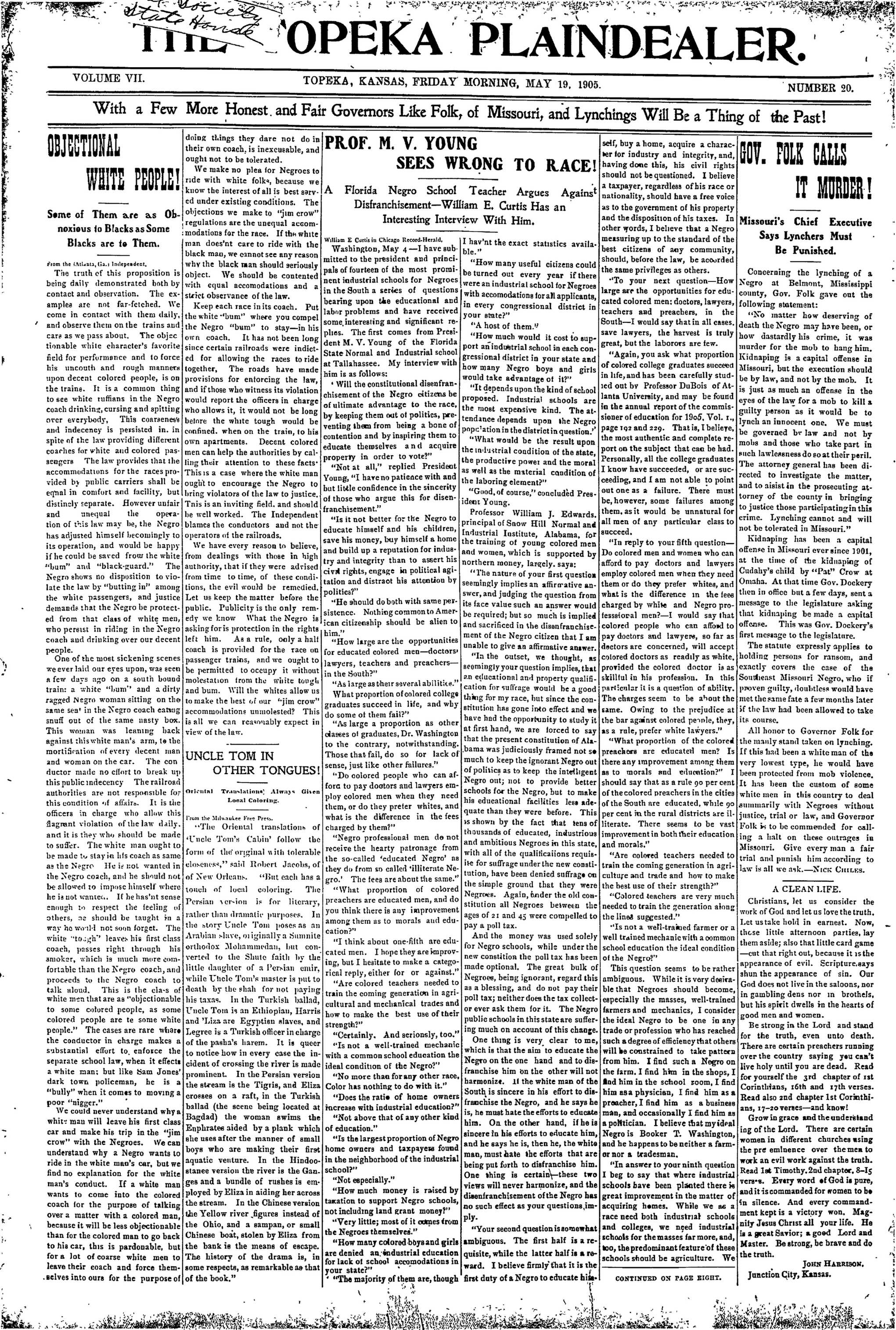
THE OPEKA PLAINDEALER.
VOLUME VII.
Some of Them are as Obnoxious to Blacks as Some Blacks are to Them.
From the (Atlanta, Ga.) Independent,
The truth of this proposition is being daily demonstrated both by contact and observation. The examples are not far-fetched. We come in contact with them daily, and observe them on the trains and care as we pass about. The objectionable white character's favorite field for performance and to force his uncouth and rough manners upon decent colored people, is on the trains. It is a common thing to see white ruffians in the Negro coach drinking, cursing and spitting over everybody. This coarseness and indecency is persisted in. in spite of the law providing different coaches for white and colored passengers. The law provides that the accommodations for the races provided by public carriers shall be equal in comfort and facility, but distinctly separate. However unfair and unequal the operation of this law may be, the Negro has adjusted himself becomingly to its operation, and would be happy if he could be saved from the white "bum" and "black-guard." The Negro shows no disposition to violate the law by "butting in" among the white passengers, and justice demands that the Negro be protected from that class of white men, who persist in riding in the Negro coach and drinking over our decent people.
One of the most sickening scenes we ever laid our eyes upon, was seen a few days ago on a south bound train: a white "bum" and a dirty ragged Negro woman sitting on the same seat in the Negro coach eating snuff out of the same nasty box. This woman was leaning back against this white man's arm, to the mortification of every decent man and woman on the car. The conductor made no effort to break up this public indecency. The railroad authorities are not responsible for this condition of affairs. It is the officers in charge who allow this flagrant violation of the law daily, and it is they who should be made to suffer. The white man ought to be made to stay in his coach as same as the Negro. He is not wanted in the Negro coach, and he should not be allowed to impose himself where he is not wanted. If he hasn't sense enough to respect the feeling of others, he should be taught in a way he would not soon forget. The white "toough" leaves his first class coach, passes right through his smoker, which is much more comfortable than the Negro coach, and proceeds to the Negro coach to talk aloud. This is the class of white men that are as "objectionable to some colored people, as some colored people are to some white people." The cases are rare where the conductor in charge makes a substantial effort to enforce the separate school law, when it effects a white man; but like Sam Jones' dark town policeman, he is a "bully" when it comes to moving a poor "nigger."
We could never understand why a white man will leave his first class car and make his trip in the "jim crow" with the Negroes. We can understand why a Negro wants to ride in the white man's car, but we find no explanation for the white man's conduct. If a white man wants to come into the colored coach for the purpose of talking over a matter with a colored man, because it will be less objectionable than for the colored man to go back to his car, this is pardonable, but for a lot of coarse white men to leave their coach and force themselves into ours for the purpose of
doing things they dare not do in their own coach, is inexcusable, and ought not to be tolerated.
We make no plea for Negroes to ride with white folks, because we know the interest of all is best served under existing conditions. The objections we make to "jim crow" regulations are the unequal accommodations for the race. If the white man doesn't care to ride with the black man, we cannot see any reason why the black man should seriously object. We should be contented with equal accommodations and a strict observance of the law.
Keep each race in its coach. Put the white "bum" where you compel the Negro "bum" to stay—in his own coach. It has not been long since certain railroads were indicted for allowing the races to ride together. The roads have made provisions for enforcing the law, and if those who witness its violation would report the officers in charge who allows it, it would not be long before the white tough would be confined, when on the train, to his own apartments. Decent colored men can help the authorities by calling their attention to these facts. This is a case where the white man ought to encourage the Negro to bring violators of the law to justice. This is an inviting field, and should be well worked. The Independent blames the conductors and not the operators of the railroads.
We have every reason to believe, from dealings with those in high authority, that if they were advised from time to time, of these conditions, the evil would be remedied. Let us keep the matter before the public. Publicity is the only remedy we know What the Negro is asking for is protection in the rights left him. As a rule, only a half coach is provided for the race on passenger trains, and we ought to be permitted to occupy it without molestation from the white tough and bum. Will the whites allow us to make the best of our "jim crow" accommodations unmolested? This is all we can reasonably expect in view of the law.
UNCLE TOM IN
OTHER TONGUES!
Oriental Translations) Always Given Local Coloring.
"The Oriental translations of 'Uncle Tom's Cabin' follow the form of the original with tolerable closeness," said Robert Jacobs, of New Orleans. "But each has a touch of local coloring. The Persian version is for literary, rather than dramatic purposes. In the story Uncle Tom poses as an Arabian slave, originally a Sumnite orthodox Mohammedan, but converted to the Shute faith by the little daughter of a Persian emir, while Uncle Tom's master is put to death by the shah for not paying his taxas. In the Turkish ballad, Uncle Tom is an Ethiopian, Harris and 'Liza are Egyptian slaves, and Legree is a Turkish officer in charge of the pasha's harem. It is queer to notice how in every case the incident of crossing the river is made prominent. In the Persian version the stream is the Tigris, and Eliza crosses on a raft, in the Turkish ballad (the scene being located at Bagdad) the woman swims the Enphrates aided by a plank which she uses after the manner of small boys who are making their first aquatic venture. In the Hindooostanee version the river is the Ganges and a bundle of rushes is employed by Eliza in aiding her across the stream. In the Chinese version the Yellow river figures instead of the Ohio, and a sampan, or small Chinese boat, stolen by Eliza from the bank is the means of escape. The history of the drama is, in some respects, as remarkable as that of the book."
TOPEKA, KANSAS, FRIDAY MORNING, MAY 19. 1905.
PROF. M. V. YOUNG SEES WRONG TO RACE!
A Florida Negro School Teacher Argues Against Disfranchisement—William E. Curtis Has an Interesting Interview With Him.
William E. Curtis in Chicago Record-Herald, Washington, May 4 I have submitted to the president and principals of fourteen of the most prominent industrial schools for Negroes in the South a series of questions bearing upon the educational and labor problems and have received some interesting and significant replies. The first comes from President M. V. Young of the Florida State Normal and Industrial school at Tallahassee. My interview with him is as follows:
' Will the constitutional disenfranchisement of the Negro citizens be of ultimate advantage to the race, by keeping them out of politics, preventing them from being a bone of contention and by inspiring them to educate themselves and acquire property in order to vote?'
"Not at all," replied President Young, "I have no patience with and but little confidence in the sincerity of those who argue this for disenfranchisement."
"Is it not better for the Negro to educate himself and his children, save his money, buy himself a home and build up a reputation for industry and integrity than to assert his civil rights, engage in political agitation and distract his attention by politics?"
"He should do both with same persistence. Nothing common to American citizenship should be alien to him."
"How large are the opportunities for educated colored men—doctors, lawyers, teachers and preachers—in the South?"
"As large as their several abilities."
What proportion of colored college graduates succeed in life, and why do some of them fail?
"As large a proportion as other classes of graduates, Dr. Washington to the contrary, notwithstanding. Those that fail, do so for lack of sense, just like other failures."
"Do colored people who can afford to pay doctors and lawyers employ colored men when they need them, or do they prefer whites, and what is the difference in the fees charged by them?"
"Negro professional men do not receive the hearty patronage from the so-called 'educated Negro' as they do from so called 'illiterate Negro.' The fees are about the same."
"I think about one-fifth are educated men. I hope they are improving, but I hesitate to make a categorical reply, either for or against." "Are colored teachers needed to train the coming generation in agricultural and mechanical trades and how to make the best use of their strength?" "Certainly. And seriously, too." "Is not a well-trained mechanic with a common school education the ideal condition of the Negro?"
I haven't the exact statistics available."
"How many useful citizens could be turned out every year if there were an industrial school for Negroes with accommodations for all applicants, in every congressional district in your state?"
"A host of them."
"How much would it cost to support an industrial school in each congressional district in your state and how many Negro boys and girls would take advantage of it?"
"It depends upon the kind of school proposed. Industrial schools are the most expensive kind. The attendance depends upon the Negro population in the district in question." "What would be the result upon the industrial condition of the state, the productive power and the moral as well as the material condition of the laboring element?" "Good, of course," concluded President Young.
Professor William J. Edwards, principal of Snow Hill Normal and Industrial Institute, Alabama, for the training of young colored men and women, which is supported by northern money, largely, says:
"The nature of your first question seemingly implies an affirmative answer, and judging the question from its face value such an answer would be required; but so much is implied and sacrificed in the disenfranchisement of the Negro citizen that I am unable to give an affirmative answer.
"In the outset, we thought, as seemingly your question implies, that an educational and property qualification for suffrage would be a good thing for my race, but since the constitution has gone into effect and we have had the opportunity to study it at first hand, we are forced to say that the present constitution of Alabama was judiciously framed not so much to keep the ignorant Negro out of politics as to keep the intelligent Negro out; not to provide better schools for the Negro, but to make his educational facilities less adequate than they were before. This is shown by the fact that tens of thousands of educated, industrious and ambitious Negroes in this state, with all of the qualifications requisite for suffrage under the new constitution, have been denied suffrage on the simple ground that they were Negroes. Again, under the old constitution all Negroes between the ages of 21 and 45 were compelled to pay a poll tax.
And the money was used solely for Negro schools, while under the new constitution the poll tax has been made optional. The great bulk of Negroes, being ignorant, regard this as a blessing, and do not pay their poll tax; neither does the tax collector ever ask them for it. The Negro public schools in this state are suffering much on account of this change.
One thing is very clear to me, which is that the aim to educate the Negro on the one hand and to disfranchise him on the other will not harmonize. If the white man of the South is sincere in his effort to disfranchise the Negro, and he says he is, he must hate the efforts to educate him. On the other hand, if he is sincere in his efforts to educate him, and he says he is, then he, the white man, must hate the efforts that are being put forth to disfranchise him. One thing is certain—these two views will never harmonize, and the disenfranchisement of the Negro has no such effect as your questions imply.
"Your second question is somewhat ambiguous. The first half is a requisite, while the latter half is a reward. I believe firmly that it is the first duty of a Negro to educate him-
self, buy a home, acquire a character for industry and integrity, and, having done this, his civil rights should not be questioned. I believe a taxpayer, regardless of his race or nationality, should have a free voice as to the government of his property and the disposition of his taxes. In other words, I believe that a Negro measuring up to the standard of the best citizens of any community, should, before the law, be accorded the same privileges as others.
"To your next question—How large are the opportunities for educated colored men: doctors, lawyers, teachers and preachers, in the South—I would say that in all cases, save lawyers, the harvest is truly great, but the laborors are few.
"Again, you ask what proportion of colored college graduates succeed in life, and has been carefully studied out by Professor DuBois of Atlanta University, and may be found in the annual report of the commissioner of education for 1905. Vol. 1, page 192 and 229. That is, I believe, the most authentic and complete report on the subject that can be had. Personally, all the college graduates I know have succeeded, or are succeeding, and I am not able to point out one as a failure. There must be, however, some failures among them, as it would be unnatural for all men of any particular class to succeed.
"In reply to your fifth question—Do colored men and women who can afford to pay doctors and lawyers employ colored men when they need them or do they prefer whites, and what is the difference in the fees charged by white and Negro professional men?—I would say that colored people who can afford to pay doctors and lawyers, so far as doctors are concerned, will accept colored doctors as readily as white, provided the colored doctor is as skillful in his profession. In this particular it is a question of ability. The charges seem to be about the same. Owing to the prejudice at the bar against colored people, they, as a rule, prefer white lawyers."
"What proportion of the colored preachers are educated men? Is there any improvement among them as to morals and education?" I should say that as a rule 90 per cent of the colored preachers in the cities of the South are educated, while 90 per cent in the rural districts are illiterate. There seems to be vast improvement in both their education and morals."
"Are colored teachers needed to train the coming generation in agriculture and trade and how to make the best use of their strength?"
"Colored teachers are very much needed to train the generation along the lines suggested." "Is not a well-trained farmer or a well trained mechanic with a common school education the ideal condition of the Negro?"
This question seems to be rather ambiguous. While it is very desirable that Negroes should become, especially the masses, well-trained farmers and mechanics, I consider the ideal Negro to be one in any trade or profession who has reached such a degree of efficiency that others will be constrained to take pattern from him. I find such a Negro on the farm. I find him in the shops, I find him in the school zoom, I find him as a physician, I find him as a preacher, I find him as a business man, and occasionally I find him as a politician. I believe that my ideal Negro is Booker T. Washington, and he happens to be neither a farmer nor a tradesman.
"In answer to your ninth question I beg to say that where industrial schools have been planted there is great improvement in the matter of acquiring hemes. While we as a race need both industrial schools and colleges, we need industrial schools for the masses far more, and, too, the predominant feature of these schools should be agriculture. We
CONTINUED ON PAGE EIGHT.
NUMBER 20.
GOV. FOLK CALLS IT MURDER!
Concerning the lynching of a Negro at Belmont, Mississippi county, Gov. Folk gave out the following statement:
"No matter how deserving of death the Negro may have been, or how dastardly his crime, it was murder for the mob to hang him. Kidnaping is a capital offense in Missouri, but the execution should be by law, and not by the mob. It is just as much an offense in the eyes of the law for a mob to kill a guilty person as it would be to lynch an innocent one. We must be governed by law and not by mobs and those who take part in such lawlessness do so at their peril. The attorney general has been directed to investigate the matter, and to assist in the prosecuting attorney of the county in bringing to justice those participating in this crime. Lynching cannot and will not be tolerated in Missouri."
Kidnaping has been a capital offense in Missouri ever since 1901, at the time of the kidnaping of Cudahy's child by "Pat" Crow at Omaha. At that time Gov. Dockery then in office but a few days, sent a message to the legislature asking that kidnaping be made a capital offense. This was Gov. Dockery's first message to the legislature.
The statute expressly applies to holding persons for ransom, and exactly covers the case of the Southeast Missouri Negro, who if proven guilty, doubtless would have met the same fate a few months later if the law had been allowed to take its course.
All honor to Governor Folk for the manly stand taken on lynching. If this had been a white man of the very lowest type, he would have been protected from mob violence. It has been the custom of some white men in this country to deal summarily with Negroes without justice, trial or law, and Governor Folk is to be commended for calling a halt on these outrages in Missouri. Give every man a fair trial and punish him according to law is all we ask.—NICK CHILES.
A CLEAN LIFE.
Christians, let us consider the work of God and let us love the truth. Let us take hold in earnest. Now, those little afternoon parties, lay them aside; also that little card game —cut that right out, because it is the appearance of evil. Scripture.says shun the appearance of sin. Our God does not live in the saloons, nor in gambling dens nor in brothels, but his spirit dwells in the hearts of good men and women.
Be strong in the Lord and stand for the truth, even unto death. There are certain preachers running over the country saying you can't live holy until you are dead. Read for yourself the 3rd chapter of 1st Corinthians, 16th and 17th verses. Read also 2nd chapter 1st Corinthians, 17-20 verses—and know!
Grow in grace and the understand ing of the Lord. There are certain women in different churches using the pre eminence over the men to work an evil work against the truth. Read 1st Timothy, 2nd chapter, 8-15 verses. Every word of God is pure, and it is commanded for women to be in silence. And every commandment kept is a victory won. Magnify Jesus Christ all your life. He is a great Savior; a good Lord and Master. Be strong, be brave and do the truth.
JOHN HARRISON.
Junction City, Kansas.
YALE NOTES.
There will be a social at the A. M. E. Church Saturday night. Also at the Baptist church.
Several people were in Pittsburg Monday.
Rev. S. H. Johnson is able to be about the house.
Sister Brown is very ill. Rev. Green administered sacrament to her Wednesday.
J. D. Watson is here on a visit but is expected to leave soon for Illinois.
Rev. R. F. Green and wife dined with Mr. and Mrs. Hudson last Sunday.
The Band Club met at the Opera House Sunday evening and rendered some excellent music was rendered.
Mt. Hebrew Baptist church have beautified their building with a fine new bell in the belfry.
Mrs. Mattie Bevly spent several days on the farm this week.
Rev. Rogers will preach his farewell sermon tomorrow night.
Mesdames Giles and Bond spent Wednesday in Pittsburg.
Rev. Middleton is preaching every night at the school house.
J. D. Watson and Miss Vina Galloway were in Pittsburg Tuesday.
Mrs. Green is on the sick list.
LEAVENWORTH.
TABORIAN NOTES.
Victoria Tabernacle, No. 30, is doing nicely. We are having a few sick members. On April 29th Dtrs. Laura Bright, Eliza Scott, and Amanda Lott went to Waldron, Mn. and brought back Dtr. Clara Hamilton, who was very sick, and is still very sick, but she is where the order can give her better attention. We received word that Dtr. Jennie Davy is very sick in Huron, S. D. Dtrs. Mary Massey and Eliza Scott G. Q. M., are on the sick list at this writ-
ing. We regret to state that the angel, Death, has visited our Tabernacle and severed our chain and has taken Dtr. Sallie Johnson, a true member, and one whom all loved. She died in full triumph of faith. We bow in humble submission to Almighty God, and say in our hearts, "Thy will be done." Wealso regret to state that fire did great damage to the residence of Sir Knight and Daughter Richard Nichols' home on the night of the 11th.
Very Respectfully,
LAURA BRIGHT, H. P.
PUBLICATION NOTICE.
In the District Court of Shawnee County, Kansas.
Amanda C. Shepard, Plaintiff
vs
Ira D. Shepard, defendant.
Ira D. Shepard, the defendant above named, will take notice that he has been sued by the plaintiff, Amanda C. Shepard, and that the said Ira Shepard must on or before April 22d, 1905, answer the petition filed by the plaintiff in the above entitled action in said court, or the matters and things set forth in the said petition will be taken as true, and judgment divorcing the plaintiff from the defendant and for the custody of their minor children.
AMAMDA C. SHEFVRD,
By J. R. McNARY, Her Attorney.
NOTICE OF SUMMONS.
No. 23213.
Christopher Otten will take notice
that he has been sued in the District
Court of Shawnee County, Kansas,
by Clara M. Otten, and that unless
he answers the petition on or before
the 19th day of May, 1905, the same
will be taken as true, and a decree
rendered divorcing plaintiff from
defendant.
J. T. WARD,
Attorney for Plaintiff.
(Attest:) I. S. CURTIS,
Clerk of District Court.
By ANNA M. TILLSON, Dep'ty Clerk
"THE KEYSTONE," RESTAURANT AND CAFE
First-class service. Short orders a specialty. When in Kansas City, call and see me. If you're pleased pleased tell your friends,if not tell me. S. STEET, Proprieter 1024 E. EIGHTH ST.
Is the Negro going to sit idly by and see a business out of which he has made money pass into the hands of a people who are not only unskilled in the art but cannot utter a sentence of English correctly? Well, it seems that we are, and the young, thoughtless, shiftless Negro has no one to blame but himself. In Topeka the Negro boot black is a thing of the past, he is succeeded by the Greeks and Italians, who were more thoughtful, and are fitting up neat shining parlors for ladies and gentlemen in every available place along Kansas avenue. The Negro is the best boot black, but he was too well pleased with his old highchair and foot rest. He studied too much about base ball, policy, craps, etc., and not enough about the comfort of his patrons. He was earning enough to make him feel as though the people who patronized him were under obligations to him and he would quit working on a customer to "jolly" with a bystander as quickly as he would offer to serve him! On the other hand, our Grecian brothers knew they didn't understand the art of polishing a shoe as does the colored man, but they could see that the public was willing to swap the difference for a nice place in which to be served, and immediate steps were taken to supply this long felt want, and the venture has proven so profitable, that as fast as rooms can be secured they import another brother or cousin and place him in charge of a new place. Thus has the Negro let a business slip from his grasp out of which he has earned thousands of dollars and could have owned much finer places than the ones conducted by the Greeks. Perhaps some day the Negro will awake, but if he is as slow in doing so as he has been in the barber and boot black business, it will be too late. he might as well continue his sleeping.
In order to keep posted on the doings of the race you should read this great paper.
In the Shawnee County, Kansas District Court.
Fannie Seymore, plaintiff,
vs
Alma B. Davis and —— Davis,
husband of Alma B. Davis; the unknown heirs and devisees and the unknown administrators, executors and trustees of the said Alma B.
Davis and —— Davis, husband of Alma B. Davis, detendants.
The a. ove named defendants, Alma B. Davis and Davis, husband of Alma B. Davis and the unknown heirs and devisees and the unknown administrators, executors and trustees of the said Alma B. Davis and Davis, her husband will take notice that they have been sued in the aforesaid court by the said plaintiff and must answer plaintiff's petition filed in the above entitled action on or before the 5th day of June, A.D. 1905 or said petition will be taken as true and judgment rendered against them as therein prayed quieting the title of the plaintiff to the following described real estate, to-wit:
Lots numbered Thirty-one (31) Thirty-three (33) and Thirty-five (35) on Seabrook Ave., in Seabrook's sub-division, as the same is platted and located on lots three (3) and four (4) of the southeast quarter of section three (3) in Township Twelve south of Range Fifteen, (15) East of the Sixth principal meridian, in Shawnee County, Kansas and adjudging that the said plaintiff is the absolute owner thereon in fee simple; that none of the said defendants nor none of the said unknown heirs, devisees, administrators, executors and trustees have any estate or interest therein or any valid lien or claim against the same and enjoining and forever barring them and each of them from asserting any claim whatsoever in or to said premises adverse to the plaintiff.
FANNIE SEYMORE. plaintiff.
By MONROE and SCHOCH,
[Attest:] her attorneys.
I. S. CURTIS, Cl'k Dist. Court.
By ANNA M. TILLSON, deputy.
CUTS
Engraving Dept
of the
Mail and Breeze
(makes our
CUTS
MUSIC FREE!!
AFY ONE can obtain a practical knowledge of Music. Complete instruction in all the fundamental elements. A Thirty-two page Pamphlet sent FREE to Music Teachers and Organizers of Singing Classes. We also have a PLAN which has been demonstrated as entirely practical, for persons who have the ability to Organize Singing Classes, to conduct that line of business that will produce eminently successful results financially and otherwise. It does not necessarily require expert MUSICAL knowledge. This PLAN will be submitted FREE OF CHARGE to any one who may be interested in this direction and are in a position to prosecute the business energetically.
8i4 Walnut Street.
Miss Estella
Stenog
Typew
Letters, addresses,
manuscripts accurately
able. ALL WORK G
ADDRESS: THE
East on the
Southwest
You cannot drop y
dining car of The S
be there with a clea
disciplined for brus
instead of a brush.
show how excellence
Chicago, I
St. Pa
This Company o
dining, library and
therefore offers its
ment and service not
The Southwest Lim
Station, 5.55 p. m.
Arrives Union State
Estelle Shackler
Stenographer and
Typewriter. . . .
letters, addresses, legal documents and all kind
scripts accurately and neatly copied. Prices are
ALL WORK GUARANTEED.
PRESS: THE PLAINDEA
on the
Southwest Limited
You cannot drop your napkin and pick it up in
the running car of The Southwest Limited. A waiter will
there with a clean one. A porter was recent
disciplined for brushing a hat with a whisk broom
stead of a brush. These are little things, but the
how excellence of service is maintained on
Chicago, Milwaukee and
St. Paul Railway.
This Company owns and operates the sleep-
ning, library and all other cars on its lines, and
therefore offers its patrons an excellence in equi-
ment and service not obtainable elsewhere.
The Southwest Limited leaves Kansas City, U.
Station, 5.55 p. m.; Grand Avenue, 6.07 p.
Arrives Union Station, Chicago, 8.55 a. m.
DBB,
Southwestern Passeng
Main Street,
Kansas C
ESTERN UNIVERSITY
Letters, addresses, legal documents and all kinds of manuscripts accurately and neatly copied. Prices reasonable. ALL WORK GUARANTEED.
ADDRESS: THE PLAINDEALER.
East on the Southwest Limited
You cannot drop your napkin and pick it up in the dining car of The Southwest Limited. A waiter will be there with a clean one. A porter was recently disciplined for brushing a hat with a whisk broom instead of a brush. These are little things, but they show how excellence of service is maintained on the
This Company owns and operates the sleeping, dining, library and all other cars on its lines, and therefore offers its patrons an excellence in equipment and service not obtainable elsewhere. The Southwest Limited leaves Kansas City, Union Station, 5.55 p. m.; Grand Avenue, 6.07 p. m. Arrives Union Station, Chicago, 8.55 a. m.
G. L. COBB,
907 Main Street,
WESTERN
WESTERN UNIVERSITY,
The Great Educational Institution for Kansas and the West. .....
DEPARTMENTS: Theologi
State Industrial.
COURSES: Classical, Colle
mal, Musical (Instrur
organ and harmony,
Carpentry, Printing
Stenography and Typ
Plain Sewing, Cookin
ADVANTAGES: Splendid I
fluences and Thorough
INFORMATION: For term
write to
William T. V
TIMENTS: Theological, College, Normal, Sub-North
State Industrial.
TAGES: Classical, College, Preparatory, Normal, S
ural, Musical (Instrumental and Vocal), including
organ and harmony, Drawing (Fine Arts and Mecc
arpentry, Printing and Book-Binding, Business
genography and Typewriting, Tailoring, Dressma
ain Sewing, Cooking, Laundering, Farming and G
TAGES: Splendid Location, Heathful Climate, C
ences and Thorough Teachers.
MATION: For terms, prices and all inducements
site to
William T. Vernon, A. M., D.
PRESIDENT,
DARO.
DEPARTMENTS: Theological, College, Normal, Sub-Normal and State Industrial.
COURSES: Classical, College, Preparatory, Normal, Sub-Normal, Musical (Instrumental and Vocal), including piano, organ and harmony, Drawing (Fine Arts and Mechanical), Carpentry, Printing and Book-Binding, Business Course, Stenography and Typewriting, Tailoring, Dressmaking and Plain Sewing, Cooking, Laundering, Farming and Gardening.
ADVANTAGES: Splendid Location, Heathful Climate, Good Influences and Thorough Teachers.
INFORMATION: For terms, prices and all inducements offered, write to
William T. Vernon, A. M., D.D., PRESIDENT.
Phones Office—Bell—"White"4302 Residence—Bell—"West"15.
A NEW FAST TRAIN, The Katy
Leaves Kansas City at 2:20 A. M. daily, principal Oklahoma, Indian Territory and the same day.
NEW FAST TRAIN, The Katy FI Kansas City at 2:20 A. M. daily, arriving in Capital Oklahoma, Indian Territory and Texas same day.
A NEW FAST TRAIN, The Katy Flyer
Leaves Kansas City at 2:20 A. M. daily, arriving at all principal Oklahoma, Indian Territory and Texas points the same day.
3 Daily Trains from Kansas City Southwest.
2:20 A.M. 12:35
9:00 P.M.
the Agent or Write "KATY"
Saint L
2:20 A.M. 12:35 P.M.
9:00 P.M.
Ask the Agent or Write
QUINDARO.
MKT
, Sub-Normal and Normal, Sub-Nor- including piano, and Mechanical), Business Course, Dressmaking and Gardening. Climate, Good In- ucements offered, M., D.D.,
KANSAS.
City Flyer
y, arriving at all
d Texas points
2:35 P.M.
"Y"
Saint Louis.
SEVEN WONDERS
of the American Continent:
Yellowstone National Park;
The Great Shoshone Falls; The Columbia River; Mount Hood; The Big Trees of California; The Yosemite; Lucin "Cut Off," across Great Salt Lake
CAN ALL BE SEEN ON A TRIP OVER THE
-UNION 'PACIFIC-
AND CONNECTIONS TO 'THE
LEWIS & CLARK EXPOSITION
PORTLAND, OREGON, June 1 to Oct 16, '05. Nearest U. P. Agent.
In the Pay Envelope
That is where our education affects you.
Here is the logic of the situation:
1. The more you know about any given line of work the better you can do that work.
2. The better you can do your work the more your services will be in demand.
3. The more your services are in demand the better salary or wages you can command.
And you can obtain this
The conditions are easy, too. You study at home in your spare time moments and without interference with your regular daily work. The cost is small. The payments, if necessary, are easy. There are no obstacles, nor any combination of conditions or circumstances that our system is not designed to fully meet.
We do PRINTING
```markdown
```
Do yourself the justice of at least knowing what we are doing for others and what we can do for you if you care to have us
Send for Further Particulars
Note the inquiry blank in the lower left-hand corner of this announcement.
Place an X opposite the position you desire to qualify for. Sign your name and address, then cut out the form and mail it to the address given at the bottom of this advertisement. You will at once receive full and complete information. Address all communications to
An address delivered on Fisk Day during the Louisiana Purchase Exhibition:
[BY MRS. BOOKER T. WASHINGTON.]
From the Colored American Magazine.
The children of Israel, carried away captive, could not sing their songs in a strange land. When those that wasted them required of them mirth, they hung their harps upon the willows, and by the river of Babylon, there they sat and wept: they cried vengeance, death and destruction upon their oppressors.
The children of Ethiopia, bowed by the weight of centuries of toil and contumely, and wrongs and woes, of hopelessness and despair, bent to their tasks, and with the rise and stoop of their bodies, poured out their rhythmic cadence of
faith, hope and charity throughout all. And, it is from these songs of our fathers, that their children of past generation, the children of Fisk and her children, children, have received the inspiration that has imbued them with courage to have faith that right may win, hope that right will prevail, and charity for all those deep-rooted impediments that divide man from man and make him unmerciful to his brother.
These are critical days in the history of the Negro race in America. We seem to have come to the parting of the ways and a crucial test is imminent. The question is what shall the end be for a race that within a year has been called "a menace to the republic," "a race with a minimum progress and a maximum regress," and "a cancerous blot in a fair land." So persistent is the onslaught, that history seems repeating itself, and the weary days of the reconstruction and anti-slavery period revive, when the discouraged workers faltered in their attempts to pave the way for the heipless freedmen. Well nigh hopeless, they bitterly voiced the despair that momentarily seemed to be crushing their hope for the future.
Frederick Douglass, "the noblest Roman of them all," wavered in his purpose, and was only spurred to renew effort and reawaken hope by the ringing voice of the sainted Quakeress, when she asked. "Frederick, is God dead?"
Awed by the implied reproof for his lack of faith, Mr. Douglass' mind reverted to youthful days—back over the full days of freedom, over the days of escape, the days of enslavement, the days of faint and despair, when an unlettered boy, hope first dawned at the singing of the slave song, "Run to Jesus." Like a flash, came the re-echoing song, with its old inspiriting influence— "Run to Jesus.
He will be your dearest friend, And will help us to the end "— the song that was destined to wield so much encouragement to the pioneers who labored so devotedly to lay the foundations of the oldest institution of learning for the sons and daughters of freedmen in America.
Thirty-eight years ago, in the abandoned hospital barracks of the Union Army on the outskirts of the city of Nashville, Tenn., a University was opened for the emancipated slaves who had been forbidden to learn how to read on write. A University for newly freed slaves! Ah, ye do well to pause, stop, ye sons and daughters of freedmen, and in awed gratitude, in hushed and bowed solemnity, think deeply of those four men of sainted memory; Rev. E. P. Smith, John Ogdon, Gen. Clinton B. Fisk, and our own beloved President Cravath, who had the courage to project such an enterprise, meet so many formidable difficulties and then in the face of all, give this silent, cheering, soul lifting prophecy of the possibilities of the newly unshackled slave, by founding a University.
And there in the old hospital barracks where many of the brave soldiers had passed on to reward, began the light and light of thousands. As has been said, "The
officers' quarters became the home of an earnest band of teachers; the sick wards were filled with hundreds of eager children; the dead house was turned into a store room of supplies for the naked and hungry. And there was almost pathetic romance in the work, when a pile of rusty handeuffs and fetters from the abandoned slave pen of the city came into the possession of the school, and was sold as old iron and the money invested in the purchase of Testaments and spelling books."
The number of pupils in daily attendance the first year average over one thousand. Some who began the first term never ceased attendance until they were graduated ten years afterwards from a fulll collegiate course
The time came when the buildings constructed for temporary uses began to decay and the imperative necessity of obtaining funds for the purchase of a new site and new buildings was a perplexing problem. In this hour of depression, Mr. Geo. L. White, treasurer of the University; organized a band of ex slave students and trained them to sing with all the ardor of their souls the old songs of the plantation. The broken, plaintive minor strains that had been poured out with pleas for strength, courage for better days, for mother, home and heaven received added sweetness and pathos when strengthened by the harmonious blending of the rich voices under the training of their teacher and it was supremely fitting that these songs of our fathers should be the means of bringing to Fisk University the aid so tervantly prayed for.
The freed slave-singers faced hunger, want, suspicion, predjudice, discouragements with their faithful leader during the first dark months of 1871, when they sang to incredulous audiences. But the time came when they won. They had been witnesses of the "year of jubilee" long hoped and prayed. "The year of Jubilee had come," and, undaunted, what wonder that the songs they sang reached the hearts of their hearers in this and other lands? What wonder that the fountain of tears long ice-bound became unfettered, or that strong men, statesmen and crowned heads listened entranced? How much to the dusky-hued singers had these songs meant in the old days! How much did these songs still mean when they sang them and were carried back to to the old life! The days of wretched misery were lived over again, as they sang tor your sake and mine, the songs of tribulation with the longdrawn chords of plaintive woe. With every note came the remembrance of the bitter cup that each one had drunk to the dregs:
"I'm troubled, I'm troubled, I'm troubled in mind,
If Jesus don't help me I surely will die."
And again with the song that melted the stoniest heart:
"Nobody knows the trouble I see, Lord,
Nobody knows like Jesus."
When the last note of these songs of tribulation was borne away, the voices of the singers told the hearts that faith, deeply rooted, had vanished the despair of the first refrain.
When the song "I've just come from the fountain." sung in quicker lighter note, lifted the singers out into into radiant light of hope renewed, hope strengthened, hope realized, hope borne into glad fruition rang out with victorious note in "Children we shall all be free," "Wait a little while, then we'll sing the new song," and "Walk together, children, don't you get weary." Then the hushed song of whispering comfort, advice, succor under affliction—one that seemed to breath the spirit of a time of distress and woe:
"Steal away, steal away, steal away to Jesus."
The deeper prayers for aid seemed to spur each hearer to unite with the sufferer's plea for help under the burden, when they sang with touching melody, "Save me, Lord, save me," "Show me the way" and "Keep me from s.uking down." Never was more doleful cry, more pathetic wail, or sadder entreaty made of a despairing soul in its plea for help than in the opening line of the last named song, "Oh, Lord," the heart
rending appeal to a higher power, then—"Oh, my Lord"—that emphasizes the almost despairing belief in a personal Savior, and "Oh, my good Lord" showing the Father in his righteous justice—then the out burst of the pent up soul in the cry, "Keep me from sinking down."
What encouragement to the patiently waiting slaves had been the faith songs that had banished the sight of the auction block, the separation of mother and child, father and mother, sister and brother, as they toiled and chanted of the old deliverance of the Jewish children.
"Issac a ransom while lay Upon the altar bound, Moses an infant cast away By Pharaoh's daughter found.
Didn't old Pharaoh get lost, get lost?
Didn't old Pharaoh get lost in the Red Sea?"
Then listen to the answer given to
the cavilling soul—
"Didn't my Lord deliver Daniel?
Deliver Daniel, deliver Daniel?
Didn't my Lord deliver Daniel,
And why not every man?
He delivered Daniel from the
Lion's den
Jonah from the body of the whale
And the Hebrew children from
the fiery furnage
How I wish it was possible to give the peculiar musical annotation that accompanied the expressive words of the song that seemed to consider the long years of waiting and toiling before the promised year of jubilee; but to hold out the hope of the promise of relief.
"Keep a-inching along;
Jesus will come by'n bye—
Keep a-inching along like a poor inch worm;
Jesus will come by'n bye.
We'll inch and inch and inch along.
Jesus will come by'n bye;
And inch and inch till we get home,
Jesus will come by'n and bye.'
One song of victory told of the passing out from the wanderings in the wilderness into the land of freedom. It had long been sung by the slave fathers and mothers who gave God the glory for the day they believed would dawn—their sons and daughters on their mission of love that made possible the education of others of the race, sang the song of victory to the people of America and Europe in full realization;
glory, glory,
Rise and shine and give God
the glory,
For the year of Jubilee."
The Fisk Jubilee Singers gave to the world the songs of our fathers, and for seven years interpreted these soul melodies that had been pent up and had burst forth during two hundred and forty years of captivity. There were few songs of despair that awakened the smoldering sympathy of the world, but the larger number were the songs of hope and faith that reached the heart of two continents and poured into the treasury of Fisk University $150,000 that erected Jubilee Hall, the largest monument of brick and mortar that has been raised in honor of those pioneer sons and daughters of freedom.
Up in Conneticut on the banks of Long Island Sound stands a magnificent country home. Every morning, noon and sunset from a tower near by you may hear clear, sweet notes of chimes ringing one after another the Scottish airs that come rapturously to the ears of the gray haired man who deeply cherished in his memory the songs of the blue bells and heather of old Scotland, his native home. Many years ago he came to America penniless, friendless and home. By thrift and economy he is today one of the multi-millionaires of our country, but the songs of his fatherland that rang in his youthful memory and inspired him to success, those he has perpetuated in the silver chimes that ring out over the greensward of his adopted country.
The Italian or Swede, the German or Irish alien receives a sweet solace for the rebuffs that he meets in the hurry and bustle of his new beginning in America, if he perchance hears on the steet a song of his native land.
Among the sacred records of the world are the treasured songs of faith, songs of deliverance, songs of victory, songs of thanksgiving of the chosen people of God, who not alone were captives, but a scattered race. "A hissing and a by word among nations." If, in the wisdom of the Most High, nature has so constituted the civilized races of the world that the music of the fatherland moves many to their best effort in the lands of their adoption. that the strains of their nativitiy inspires resolutions, fortitude, courage under difficulties, what the sons and daughters of freedmen should be the songs of our fathers?
To them they sustained trust, confidence, hope—life itself. When they were sung in those weary days every note gave utterance to unborn thought. It was natures expression. Majors and minors came as despair and hope rose or fell in the singe.'s mind. The peculiar reversion of accent in the measures came simply. Words and music voiced together the deepest feeling. That was soul music. It lives today remodled to suit the popular aires, the success of which lies possibly in the fact that that singular turns of the beautiful catching melodies had their origin in closd touch with nature's heart.
Some of these ex slaves, repeating these songs the world, lived over again the old life and its associations; but coupled with the thanksgiving for freedom was the purpose of obtaining means for educating thousands of their fellows, and there was a hallowed power in the songs.
To those who first sat under the spell of the songs within the walls of Fisk University and who sang them under new influences and new impulses, amid new surroundings, they told a wondrous story, not only of past adversities, but of new born opportunities made possible through the efforts of the Jubilee Singers out among strangers.
In later years, the young recruits entered upon their life work bearing the standard of a better life among the waiting millions. The seed had been sowed that perpetuated the spirit of the songs in their labors as they faced ignorance and superstition, so closely allied to the enslaved bodies and minds of former years, and the songs of our fathers had still a measage of hope to bring for final deliverance.
Year after year Fisk University has sent out her messengers inspired by the spirit songs, rich with added significance, that has entered into the varying conditions attendant upon the status of the race in this country. Four hundred and eighty one young men and women have entered the ranks of workers under the profound conviction that, "He hath sounded forth the trumpet that shall never call retreat." Some have taken the message as ministers of the gospel, two hundred and seventy teachers are settled over the South; doctors, lawyers, farmers, business men are measuring up to their opportunities of educating, helpers others wherever their lot is cast, believing the old song that they must "Rise and shine for Thy light is a'coming."
Fisk University, standing today the oldest school in America for the eduction of the Negro, is still pleading for means to meet her expenses in affording greater advantages to young men and women, so much needed all over the Southland to respond to the cry of the helpless ones still asking, "Brother, have you come to show us the way?"
Many of the first band of singers who put into the brick and mortar of Fisk one hundred and fifty thousand dollars, have long ago joined the heavenly choir, but the four hundred and eighty-one graduates of the University who have entered the warfare are perpetuating the spirit of the old songs in their lives, and in the Great Beyond will bring home the priceless souls, trophies won from the bondage of sin and ignorance.
One hundred years ago the United State paid France, or Napoleon Bonaparte, two and one-half cents an acre for six hundred million acres of land. Today fifteen million inhabit the valleys and mountains, and fourteen states and territories have part in the National Government where France gave
GET THE BEST!
USE ONLY
Taylor's
Perfection
Flour
AND
Taylor's Pure
Buckwheat
Flour
Insist upon being furnished the above popular bronds of flour, and you will certainly get the best in the market.
over to the United States herds of buffaloes and cities of prairie dogs for fifteen million dollars. This St. Louis Exposition, this World's Fair commemorates Thomas Jefferson's purchase one hundred years ago, and all the nations of the earth have come to celebrate the creation of fourteen commonwealths. Says Mr. Stedman in his "Hymn of the West,"
"Thou whose high archways shine most clear,
Land of the new and lovlier race." One hundred years ago Tennessee was wrapped in the hazy mists of the Southwest territory. The founders of Fisk University were unborn but the mothers and fathers of the sons and daughters of Fisk were toiling, patiently toiling and enduring: hoping and praying for the year of Jubilee.
Fisk University Day! Looking back thirty years, what does it commemorate? The sacrifices, loving devotion and belief in the possibilities of a despised people of four sons of the West. Then the perpetuation of the work through the songs created from the life's blood or our forefathers. How have they helped us to interpret the soul stirring strains of the masters? What to us would mean these grand, sweet songs, if nature's simpler strains had been unsung? Singing out of the past, what a helpful message the songs have brought us in our struggles for an education! What hope they have stored within us when we have been ready to falter and shrink from the conflict! What inspiration they have been to us in directing others to a better way.
In recent days, when pulpit and press seem to be vicing with each other in depicting the darker side of the shield in the progress of the race, to those of us who have been working and trusting for a wide spread dissemination of the principles of right living, the old songs still ring true—
"Fight on and you shall gain the victory.
Fight on and you shall win the the day." When Fisk University commemorates the one hundredth anniversary of her founding, the voices of the passing thousands will be hushed.
PUBLICATION OF SUMMONS.
No 23184.
Maude Roberson will take notice that she has been sued in the district court of Shawnee County, Kansas, by Arthur B. Roberson and that unless she answers the petition of Plaintiff on or before the 5th day of May, 1905, the same will be taken as true and a decree rendered divorcing plaintiff from defendant.
J. T. WARD.
Clerk Dist. Court.
SHERIFF'S SALE.
In the District Court of Shawnee County, Kansas. E. H. Martin. Plaintiff
Mrs. T. Kimball, Defendant,
By virtue of an execution issued to me, out of said District Court, in the above-entitled action, I will, on Wednesday, the 5th day of April, A. D. 1905, at 10 o'clock A. M. of said day, at the east front door of the Court House in the City of Topeka, in the County of Shawnee, in the State of Kansas, offer at public sale, and sell to the highest and best bidder, for cash in hand, all the following-described real estate, to wit: Lot No. 685 on Lincoln street in Martin and Dennis' addition to the City of Topeka lying and situate in the County of Shawnee in the State of Kansas.
The above-described real estate is taken as the property of said defendant, and is directed by said execution to be sold without appraisement, to satisfy said execution.
A. T. Lucas,
Sheriff of Shawnee County, Kansas.
By J. A. OSTRAND, Deputy.
W. S. McClintock, Attorney.
One Dollar for 20 Names and Addresses.
Purely a business proposition; one that will make you an actual, clear profit of 75 cents. Wanted, refined colored ladies for business correspondents in every town in U. S. Make $100 a month simply mailing postal cards from your own home, no matter where located. Nothing to buy, sell or canvass. No capital required. Enclose 2c stamp for particulars, Addreses,
JOHN SPOTTS,
Department A, Topeka, Kans.
WAITERS AND PORTERS' Headquarters CHAS. PHELPS' Barber Shop is where you meet them. The leading barber shop in the city.....
214-216 Francis St. - ST. JOSEPH, M
E BEST!
ONLY
FRIDAY, MAY 19, 1905.
DR. BOWEN
AT QUINDARO.
Dr. J. W. E Bowen, L. L., D. D., dean of the Theological department at the Gammon Seminary, of Atlanta, Georgia, one of the most scholarly men of the race, gave an excellent address to the student body. He said in part:
"I am surprised beyond expectation. I did not think the school so large, although I knew there was a large man at the helm. I did not know you had such a splendid outlook I am delighted, pleased and thrilled at what I see.
"I cannot express one atom of my pleasure. If I were Hebrew, I would say thus: 'With desire have I desired to see you.' I have heard of the institution and have known the president, respecting him for what he has done and is going to do.
"Your president has been very cordial to me, and I assure you that I have not been lacking in appreciation. When I found that I was coming, I put this institution on my list immediately upon settling my business, and dictated a letter to my stenographer, saying that I would be round Prof. Vernon's digging.
"I can see things in a bare wall or a platform,' I say to the young men in theology in our school. I see something they oannot see because I read white ink. They cannot I can see things in this wall of which you boys and girls do not dream. As a school man, I can see something in an old chair, a desk, a lamp, and old map, a blackboard, as I told the music professor. And I can see something in you, though some of you do not see much yourselves, (and I fear you are the greater prophet of the two.)
"I sat and looked at you, and thought a little. I am given to thinking once in a while.
"I sit in the rear in the seminary sometimes, and several asked why—and I said, "Because I want to see what is behind you. I can read things back of you that few men can read. I am studying your pedigree through the eye of reason, faith and common sense, and see what God has written in the distant years to come.
"In the presence of your president I feel something like that old bard felt who stood upon the highways of Rome Caesar came back. Crowds were there to welcome the general and an old bard of a wonderful company of old men, battle-scarred, stepped out and said: "These men be praised for what they have done;" and another company came with a tread of vigorous manhood, and their cheeks were flushed and hearts beating; when the people clapped, the old bard stepped out and said: "These be praised for what they are doing;" presently the young men came who had not gone into battle, and they had colors, and marched with cheets abreast; the people clapped and the old bard stepped out and said: "These men be praised for what they are going to do."
"When I look into the face of your president, I say, "Such men be praised for what they are doing," and take off my hat to him, then I say, "Such men be praised for what they are going to do."
"When I look around at these hills and plateaus, I say, not only for what he is doing, but for what he is going to do.
"I congratulate myself on what I see. I take up your live that you call probably of no service, and I see things in the future that God has for you, if you are only faithful, and if you should forget my name, which is natural in the course of events and
developments of life, just remember one thing I say, that is remember one word-accuracy You think of science of mathematics when I say this. God blocked out the heavens on the basis that "two times two are four." John Mills said in a jocular way, in another world, perhaps two times two make five. If that were possible tomorrow morning the sun would rise in the north, instead of the east. God cannot tie. He, himself, argued that two apples and two apples make four apples. Remember that all education is to have a broader view than the discipline that you learn in one certain system of learning. A young man graduated in the South and went back home in the summer and his father said he had a piece of ground shaped like a rhomboid, and asked how to sell it, and the young man said, "You can not find that out."
"And you have been studying geography and geometry and can't tell that? If books do away with plotting ground, then away with books. If books unfit you to become cooks, then away with books and take cookery." And the old man pushed his son aside and sold his ground by the square foot.
I want you to be practical, I want you to be practical; I want you to accurate; I want you to apply your knowledge. The world has a place for the man who is learned and who can apply his learning. Such a man will fill a big place in life. Do not be in a hurry to come out; make yourself thorough, prepare for the place God has in store for you, and He lead you to it.
I want to thank you for your attention, and to say that I predict a great future for your institution."
Rock is being hauled on the ground and things are beginning to look quite lively towards Commencement time.
Mr. Warrick, a graduate of the Sedalia High school, visited the school and recited a number of dialect pieces which the students enjoyed.
The students attended the services at the Quindaro Baptist church Sunday evening. This was quite a treat for the students, since a number of them are of Baptist belief as well as of other denominations.
The psychology class, accompanied by their instructor, Prof. Gregg, made a trip to the city for the purpose of gaining some information on the "instinct of animals."
A meeting of the university building committee was held Saturday morning at the Episcopal residence to advertise for bids for the completion of Ward hall. This will give us three times as much room for our young ladies and will also furnish accommodation for our lady teachers.
Mr. Thompson, a teacher of Crawford county, visited the institution.
Eugene Fitchue spent Sunday at the university visiting his sister, Miss Ethel. Miss V. L. Muse, the university bookkeeper, spent Sunday at Columbia.
ST. JOE. MO.
Mrs. Lena Moore was painfully injured about the face and eyes last week. Agasoline stove exploded in her home. The annual sermon of the Odd Fellows and Household of Ruth was preached at Francis street church Sunday afternoon by Rev. Cohren.
Ocie Burns left last week for Africa, where he will be a teachin the Egyptian Soudan. He is a graduate of the St. Joseph High school and subsequently attended the Tuskegee Institute.
Mrs. Cassie Thompson left Sunday night for Denver to visit one month.
Mrs. Joe Smothers returned from Atchison, where she was called by the death of her brother.
Queen Esther Branch of the Daughters of Tabor held a public installation at their hall last Tuesday evening. Mrs. Dayton was installed as high priestess for another year.
What the Negroes Expected!
Not Considered Murder in Iola to Kill a Negro —Frederickson Turned Loose.
IOLA, Kans., May 13.—[Special.] Late this afternoon a jury in the district court brought in a verdict of not guilty in the case of the state against James Frederickson, charged with the shooting of Richard Boles, a Negro, in Bassett, March 20 last. Frederickson was marshal of the town, and was trying to arrest Boles for an assault on Dan Lang, a foreman at the cement works. Boles resisted, and in a scuffle which followed Frederickson fired twice. The second time the bullet went through Boles' heart. The case has occupied the attention of the court for the past three days. The jury took but two battots.
This is no more than the Negroes of Iola expected. The officer who killed this man usurped more authority than was needed to arrest the man. The poor white stringer, who is half starved, naked and of a very meagre education, and devoid of right and intelligence, committed this offense inhumanly and in almost cold blood, being possessed of the fury of hell because his victim had a dark skin. We commend the colored people of Iola for employing an attorney to assist in the prosecution of this culprit, who is still serving on the force. Right and justice will previal and Frederickson is sure to get his portion. —Nick Chiles.
Work Among the Negroes.
Work Among the Negroes.
Report of Committee From Southern Baptist Convention on Proposed Co-Operation Plan.
The report of the commission appointed at the last annual convention of the Southern Baptist church, at Nashville, Tenn., for the purpose of devising some means of cooperation on the plan of work among the Negroes in the South, was read at the night session of the convention in St. Louis, Mo., but was somewhat different from what had been anticipated by the delegates.
When the subject came up at the Nashville convention it was then thought advisable and to be more effective to have a separate board appointed to look after this work. So great was the discussion and such a diversion of opinions on the matter that it was finally left in the hands of a specially appointed commission, of which Dr. L.O.Dawson, of Birmingham, Ala., was made chairman. This committee was given the entire year in which to devise and work out some plans for the caring of this great problem. To that end they have dilligently studied the subject over and the conclusion reached was that it was a matter that could better be cared for under the advice and jurisdiction of the home missionary board, which board had control of the matter previous to the discussion.
One of the plans suggested by the commission is the cooperation of work among the Negroes through their own organizations, the committees arguing that more could be accomplished in this manner than by the appointment of a special board and special missionaries to look after the work. "It is a matter that requires considerable thought," said Dr. Dawson, "and one that the committee hardly felt that they were entirely clear on, yet from the most stringent investigation, has found that it would be to the advantage of both the church and the Negro to leave this work in the hands of the home mission board."
This work among the Negroes has been accomplished by this board along with its other regular work and by the same missionaries that were looking after the other work of the board. While the work has not been to the entire satisfaction of the church, the establishment of a private mission for this purpose did not present itself as entirely feasible. However, one of the plans will be for eliciting the co-operation of the Negro organizations in co-operative work with the missionaries among their own race.
If the white Baptist church would appoint white men of their church to work among their own members to civilize and Christianize them that they might treat the Negro who tries to make an honest living as a human being, and to respect those of us who respect ourselves, the Southern Baptists would find a great work to accomplish. The Southern Baptists owe more to the Negro than they can or ever will pay for the labor performed by the Negroes for more than two hundred years. The white professed Christians ought to get right with God and the Negro race before they pass to the judgment bar. If they don't, we fear that there will be great times in the fiery realms of the hereafter.
STRIKERS AND "SLUGGERS."
One of the men arrested for participating in the riots of Chicago has confessed that he was hired by the officers of the Wagon and Carriage Workers' union to "slug" strike breakers, and that in pursuance of this employment he killed at least one man. What is more, two of the officers of the union have also confessed that they hired the man to attack non-union workmen.
It is scarcely necessary to say anything for the public in such a case as this. It is conspiracy to molest and injure men in the pursuit of honest employment, and in this instance the conspiracy has resulted fatally. Mob violence must not rule, and the men who take the law into their own hands must suffer the consequences. Strikers cannot afford to permit any of their number to beat and bruise and kill their opponents. Public sentiment is safe on this issue. Strikes and the causes of strikes no not justify murder; nor do they justify assault. The Chicago men who have confessed to their crimes in this respect should be given the severest punishment the law will permit.
And if the Chicago unions, as a great body, want only justice they will do all in their power to assist the prosecution of these confessed murderers.—K. C. Times.
```markdown
```
Messrs. A. A. Glass, Jackson and McNear left last week for Las Angeles, California.
Mr. Nick Chiles, business manager of THE PLAINDEALER, was in the city last week on business.
Quite a crowd from here and the surrounding towns attended the Odd Fellows' annual sermon at Iola last Sunday.
Invitations have been received in the city announcing the wedding of Miss Emma Fields of Iola to Mr. J. Wilson of Burlington.
Mr. Jack Christian of St. Louis, passed through the city Monday.
Miss Jessie Brown and mother spent Sunday in the city, guests of Mr. and Mrs. P. R. Hogan.
Mrs. Mary Harris and daughter, Reta, of Vinita, I. T., passed through the city last week en route to Chanute.
Miss Elmira Carl returned from Iola Tuesday morning.
OTTAWA NOTES:
The Mission circle gave a strawberry social at the Third Baptist church Tuesday night.
Sunday School Class No. 1 gave a birthday surprise party on their teacher, Mr. Washington Lewis, a good time being bad by all.
Mr. Charles Logan went to Baldwin last Saturday.
Miss Ethel Rogers of Princeton, visited relatives and friends here.
The band carnival starts May 29 and lasts until June 3.
Clubs No. 2 and 3 will give a social at the A. M. E. church.
Miss Mary McCloria came in last Sunday from Peoria and remained until Monday evening.
The Mission circle met last with Mrs. F. Edwards, on the Island, three miles from town and a fine time was reported. The meeting next Thursday will be with Miss Luella Page.
Those on the sick list are all reported as improving.
WINFIELD NEWS.
Rev. J. R. Richardson of Kansas City, Kas., was with us last Sunday and preached the dedicatory sermon at 3 o'clock p. m. The service was a grand success. The program for the day was one of interest. The collection was $10.25.
Rev. Richardson went from here to Wichita. While here he was the guest of Mr. and Mrs. S. Johnson.
The pastor of the M. E. church preached at the 2nd Baptist church Tuesday evening.
Quite a number of people from Arkansas City spent Sunday here. Mrs. Josephine Thomas will soon leave for Paducah, Ky., to make her future home. En route she will stop at Newton to visit her parents, Mr. and Mrs. J. S. Faulkner. The M. E. church gave an ice cream social last Friday evening, which was a success.
WICHITA NEWS.
A. Fox visited in Valley C entr last Sunday.
M. F. Fowler who left May 10th for El Reno, Okla., to attend the funeral of his brother, has returned.
Mrs. P. Clemens has returned from a visit to Winfield.
Mrs. N. E. Smith of Oklahoma City, is in the city in the interest of the Children's home.
Roscoe Fields of Chicago, and A. G. Hill of Washington, D. C., are visitors in the city, the guests of E. Grayson.
The ladies of the G. L. A. club were entertained Tuesday afternoon at the home of Mrs. S. W. Jones.
Thomas Mason who has been in city for several weeks, has taken his departure for Pueblo, Col.
The annual sermon of the Odd Fellows and Household of Ruth was preached at the A.M.E. church last Sunday. A pleasant house social was given Wednesday evening at the home of Mrs. F. Baker.
Mrs. F. C. Shaffer of Kansas City if the guest of Miss F. A. Hayes. She has organized a class in millinery here and a large number have applied for instruction.
Rev. Bowren, pastor of the Shiloh Baptist church, is wrapped in smiles since the arrival of his wife and baby from Battle Creek, Mich. last Wednesday.
Rev, J. Y. Meadows of Kansas City, pastor of the A. M. E, church at Nevada, Mo. is engaged in revival services at Wayman chapel. Rev. W. P. Green, the pastor, is very much encouraged by the present conditions. A large party left last Sunday on an excursion to Iola, Kans. The occasion was the preaching of the annual sermon of the Odd Fellows' lodge at that.
Mrs. Millie Talbert, who has been the guest of Mrs. L. A. Hancock. left last Friday for her home in Ardmore, Ind. Ter. Mrs. Myra Thornton, who has been visiting her sister, Mrs. Wiley Sexton, left last Friday for her home in Denver, Colorado.
Mrs. Julia Tinsley has been suffering intensely with one of her eyes. A large cataract has been slowly forming over her eye, and about two weeks ago, she became entirely blind it this eye. An operation was performed on this eye, and it is now getting along nicely.
Mr. Harrison Fouse has disposed of his property in this city and has joined his family in Los Angeles, California, where he intends to reside permanently. He disposed of his Leavenworth property for the neat little sum of $350, upon which was a mortgage of $222.60, including two years' taxes with a penalty.
MEET ME IN GALVESTON
And hear what Texas has to offer.
If you are not satisfied with your present location and want to better your condition, you should attend the
Convention Northern Settlers
At Galveston, Texas, April 21-23.
Every Northern man looking for a home is invited to come—hear what is offered, and choose for himself.
The First and Last Opportunity of the Kind.
On April 18th, round trip tickets will be sold via the M. K. & T. K'ry at less than one fare for the round trip. Ask the agent or write
George Morton,
G. P. & T. A.,
Box 912.
St. Louis, Mo.
HEMORLINE
FOR
CATARRH.
LEGZEMA.
JOSEE/BURN
FOR THE MILLIONS
THE WORLD ROUND
THE ONLY PERFECTED ABSORption
CURE
BRENT SC
NO COMPARISON
It is good, better, best, yet better still
The next best thing to a rich uncle will
You are glad gladder, gladder for gladder still
When you know it will cure every local ill.
Phenomenal absorbing power, the active
Principle of HENORLINE is taken from tropical
Fruits, opening a new in Pharmaceutical
Science, Extraily Original.
Lenders, Doctors, Ministers, Merchants, and
Monstro of all walks of life, are a, und in
Proclaiming it the great Clanax of Remedies.
Send for our booklet of the most remarkable Testimonials ever published We will over-
When you with unquestionable evidence.
Sold by all first-class Druggists if your Dealer cannot supply you, send us $35c.
And your Druggists' name and address—
We will mail you a $5c box.
Demand HEMORLINE: take no other there
Is no substitute it alone aurea.
ADDRESS: THE HEMORLINE CO.
MARSHALL, MO, U.S.A.
W. S. HARRIS,
Puec. and Mgr.
P. L. PRATT,
Sec. and Treas.
W. S. HARRIS & CO.,
REAL ESTATE AND INSURANCE.
Houses to Rent—Money to
Loan on Chattal Mortgage.
'Phone 42 West.
Room 31 Wyndendale Mdg., KANSAS CITY, KS
PHYSICIAN AND SURGEON
826, Kansas Ave. Ind. Phone 774
Calls answered day and night.
Office Hours } 7 to 9 a.m.
2 to 4 and 6 to 8 p.m.
F. Wims, Confectionery and Lunch Room,
523 N. KANSAS AVE.
As you pass by stop in Ice Cream Soda and be and get a 5 or 10 cent refreshed VISITING AND BUSINESS CARD CO.
Call or Phone us your order. Fing work. Prompt Service. All work guaranteed.
Bell Phone 2102 Red. NORTH TOPEKA.
NEWS OF THE WEEK.
Mrs. M. E. Matley is visiting in Atchison this week.
Miss Vera Lindsay, of Lawrence, visited Miss Inez Woods.
A number of Atchison people attended the Metropole party.
Miss Anna Wellingham, of Emporia, is visiting friends in the city.
Roscoe Guy spent several days visiting his parents in this city last week.
Messrs. Carl and Arthur Spears and Will Henderson have returned from an extended visit in Omaha.
Miss Hattie Ingram, of Atchison, was the guest of Miss Hester Hawkins last Friday and Saturday.
Miss Kate Harris, of Lawrence, visited her mother last week. She came up to attend the Metropole party.
Miss S. Angelene Barker spent Sunday with friends in Kansas City, Mo., returning home Tuesday evening.
Mrs. Cieveland, of Saint Joseph, Mo., was the guest of Miss Eva Phillips Sunday. She was en route to California.
Mrs. Charles White, who has been visiting relatives for several weeks, departed last Thursday for her home in Denver.
Arthur Pullum, of Kansas City, Mo., attended the party last Friday evening. He was the guest of Mr. and Mrs. Gaitha Page.
Miss Gertrude Busey, of Saint Joseph, Mo, private secretary to Hon. Jerry Grider, was among the excursionists that visited the Capital City Sunday.
Mrs. Isaac Miller and Miss Clora Polk, of Lawrence, were guests of Mrs. M. E. Matley last week. While here they attended the Metropole party.
Miss Evelyn P. Hickman, of Frankfort, a prominent member of T. I. I. Alumni association, is expected in the the city this week to attend the annual meeting of the association.
Otto Bennett, a private car chef, is visiting relatives and friends in the city this week. He is one of our best young men, steady and reliable and a bright future awaits him.
On last Saturday evening the pastor and members of the Asbury M. E. church tendered a reception to the Rev. Dr. J. W. E. Bowen at the church, which was well attended. The program, though not as arranged, was a very creditable one, and the audience seemed to appreciate it.
Dr. A. C. Briscoe acted as master of ceremonies. Rev. J. M. Harris of Kansas City invoked the divine blessings of the Creator upon the meeting. The Hon. Milton Guy then followed with a short address upon the topic "Young Me", Their Opportunities and Responsibilities," and his remarks were timcly and to the point.
Dr. Bowen was then introduced and he was so well pleased with the remarks of Mr. Guy that he based his remarks along the same line, giving some most excellent advice to the young men of the race. His advice is to cut out the driftwood and riffraff and leave off all evil; to be concerted in action'and united in purpose. He said it was impossible to draw lines religiously, educationally or financially, but that we could and ought to draw lines on character; to put ourselves in a position where the other race would not judge the race by the acts of this individual; to select the best and set up a standard; to not be discouraged, as the doors of hope are open and there is a chance for all; to educate the boys and girls that where there is a will there is a way. He said if we did not do this thatthe Negro boys and girls of the North far in the rear.
Dr. Bowen said that the Negro is the only man that can get happy and shout on an empty stomach and an empty purse, in concluding that the average Negro cared only to get enough of this world's goods to live from day to day; also that the Negro is the only man that can live in any part of the globe.
In speaking of the Jim Crow cars and his travels, Dr. Bowen stated that he would not only ride in such a car, but that he would ride on a cow-catcher or hand-car to reach his people that he might carry light unto them, and from here Dr. Bowen will swing through the swamps of Arkansas, the mud puddles of the Yazoo and the "Black Belt" of Alabama.
As a subject for thought Dr. Bowen made this assertion: The Negro of the North does not secure his increase in population in the natural way, but depends on the immigration of the Negro from the South to keep up the rate of population, and invited us to put that in our pipes and smoke it. The church was handsomely decorated and the ladies had prepared all sorts of good things to attract the attention of the hungry.
Prof. W. T. Vernon attended the lecture last Friday evening.
Claude Mallory, of Lawrence, visited Topeka friends one day last week.
Rev. C. H. Duvall spent a part of last week in Wichita attending to business.
Elijah Edwards who is now working in Lawrence, Sundayed with his wife and friends.
Mrs. Enola Wade left Tuesday afternoon for Chicago to join her husband, who is in the employ of the Santa Fe company.
Messrs. M. A. G. Martin, R. Brooks and H. H. Williams, of Holton, attended the annual ser mon of the Odd Fellows last Sunday.
Miss Cora Bennett, of this city, enjoys the proud destination of being the first colored student to enter the State Manual Training school at Pitisburg. She is considered as being one of the brightest students in attendance at the school.
J. ORLANDO MITCHELL, Pres't & Mgr. MILTON C. SIMMONS, Secretary and Treasurer. JOHN DREW, Vice President.
Freedmen's Land & Trust Co.,
INCORPORATED.—AUTHORIZED CAPITAL $25,000. PAID UP $18,000. SHARES $25. Rooms 5,6 and 7, Churchill Building,
INVEST your savings with us in stock and receive tenfold. It is a Gilt-Edged Investment. The management is sound and conservative. The company is making money. Get in on the Ground Floor. Invest your capital with us in Farms or City Property. We have improved and unimproved farms in any size tracts. PRAIRIE AND BOTTOM LANDS. Write for circulars and information. When in Muskogee come to see us.
A grand musical and literary entertainment will be given by the Good Samaritans and Daughters of Samaria, May 23 at 618 Kansas avenue. The grand lecturer of the order will be present and deliver an address. The public is cordially invited to attend.
Mrs. C. Meaux and Mr. James Clayborne en ertained a number of friends at the home of the former on Fourth and Madison streets Monday evening, complimentary to Mrs. George Moss, of Kansas City. Progressive whist and music, instrumental and vocal were the chief amusements of the evening. At a late hour, the daintiest of luncheons was served and the guests departed, declaring Mrs. Meaux and Mr. Clayborne delightful entertainers.
The annual sermon of the Odd Fellows was preached Sunday at Saint John's A. M. E. church by the Rev. Geo. W. Harts, pastor of the B Street Baptist church. They marched in a body from their hall to the church headed by Jackson's Twenty-third Regiment band. It was one of the finest turn outs ever made on the streets of Topeka by any society. At the church Rev. Harts delivered an excellent sermon which was enjoyed and appreciated by all who heard it.
TWO FOR ONE!
A Very Rare Chance!
On November 15th, and daily thereafter, until the summer season of 1905, the Frisco System, in connection with the Southern Railway, will operate through Pullman Sleepers between Kansas City, Mo. and Jacksonville, Fla. These sleeping cars will be placed in service as part of the equipment of the Popular Southeastern Limited," scheduled to leave Kansas City 6:30 P.M. A modernly equipped train, electric lighted cafe observation car, etc—the route of which carries the traveler through the populous cities of the southeast.
Berth reservations may be made through representatives of Frisco System or connecting lines. PASSENGER TRAFFIC DEPARTMENT, SAINT LOUIS.
Hotel Newport
1807 Tracy Avenve.
MRS. V. L. NORTH, Proprietress.
Furnished Rooms. Hot and Cold
Water Baths. Gas and
Furnace Heat.
R. ONE!
Plaindealer
WEEKLY
City Star
WEEKLY
Journal
— $1.50.
More Chance!
LEY, I
Colored Town and
Home of the Negro
Old and 600 Inhale
Of Land Surrounding Boley has Already
Bought by Negroes. 20,000 Acres of the
Creek Nation Surrounding Boley to be
by Negroes.
Local Townsite Mgr.,
NEW HORA
THE ONLY WAY"
FURNISHED ROOMS.
St. Fine Wines, Liquor
1217 East 18th St., Kansas City, Mo.
Lige Hendris
MMONS, Secretary and Treasurer.
Trust Co.,
$18,000. SHARES $25.
Building,
ONE!
dealer
car
real
$1.50.
nance!
EY, I.T.,
Town and
of the Negro.
d 600 Inhabitants!
Bounding Boley has Already been
roes. 20,000 Acres of the Best
Surrounding Boley to be Leased.
8000 Acres of Land Surrounding Boley has Already been Leased and Bought by Negroes. 20,000 Acres of the Best Land in the Creek Nation Surrounding Boley to be Leased and Bought by Negroes.
NIGHT MIXER.
HORACE BURKE.
ONLY WAY" POOL HALL. FIED ROOMS. Fine Wines, Liquors and Cigars. St., KANSAS CITY, Mo. Lige Hendricks, Prop. secretary and Treasurer. st Co., SHARES $25. g,
IND. TER.
a Gilt-Edged Investment. saving money. or City Property. We have im- LANDS. gee come to see us. Trust Company.
edged Investment.
property. We have im-
ee us.
Company.
BOLEY, I. T.
Local and Personal.
P. E. Tipton, of Emporia, was a pleasant caller yesterday.
Miss Alice Dotson has been ill of rheumatism during the past week.
Business Manager Nick Chiles returned yesterday from a trip to Southern Kansas.
The Saint John Sewing circle held their meeting Wednesday afternoon at the church.
Tonight about forty of the best young men in the city will be initiated into the order of Elks.
Mrs. Emma Hughes left Tuesday for Chicago, where she expects to make an extended visit with her daughters.
The Golden Rod club will be entertained by Mrs. Nellie Hicks-Johns to-morrow afternoon from 3 o'clock till 5.
Rev. Howard preached at Saint John Tuesday evening. He is an excellent speaker and the people of Topeka always enjoy haaring him. We are in receipt of an invitation to attend the commencement exercises of the Tuskegee Normal and Industrial Institute at Tuskegee, Ala.
Mrs. Al Watts, sister of Mrs. Mattie Slaughter, left Monday for Baltimore. Md., where she will join her husband en route to their home in New York.
Mrs. Stella Robinson, of Colorado Springs, and Miss Evelyn Vance were the guests of Mrs. J. A. Park near Vinewood this week. They report a pleasant time.
Rev. Eli Ridley, of Kansas City, made his monthly visit to the Primitive Baptist church corner of King and Buchanan streets. He preached three good sermons and the meetings were highly enjoyed.
We teach you Shorthand and Typewriting at your home. Typewriting machines furnished: no tuition until we have secured you a position. Write Lee and Edwards' Shorthand School, 600 W. 47th street, Dpt. B. Chicago, Ill.
Comfort in the
Depends on many little things what is wanted—an atomizer to spray the room and making; a thermometer, fresh water bottle—a dozen little.
The doctors and nurses like things and others, in the We take this means of letti
KOHL'S P
Comfort in the Sick Room.
Depends on many little things. Trained nurses know what is wanted—an atomizer, with a mild disinfectant, to spray the room and make the air clean and refreshing; a thermometer, fresh absorbent cotton, a hot water bottle—a dozen little things that help the patient. The doctors and nurses know that we have all these things and others, in the most dependable qualities. We take this means of letting you know it.
KOHL'S PHARMACY.
Prescriptions a Speciaty.
WOODMER BROTHERS
PROTECTION
Issues policies for $ We issue policis for $100, $150 and
This is the only Color Company in the Every intelligent Negro should good, live, hustling agents in every Liberal terms to the right persons.
The Knights and L
Col. James Beck, Nat'l Pres.
James M. Mason, Nat'l Vice Pres.
J. H. CH
Headquarters: 413 Kausas Avenue
Every intelligent Negro should carry some Insurance. We want good, live, hustling agents in every town. Write at once for terms. Liberal terms to the right persons.
Ind. Phone 743.}
Bell Phone 561.}
A reception and camp fire was held last night at the High School auditorium by the old soldiers of the city complimentary to the old soldier delegates to the U. B. Conference. A delightful time was had by the "old boys."
The Excelsior Art club met last Thursday afternoon with Mrs. Jas. Williams, 310 West First street. An hour was spent in needle work after which a nice luncheon was served. The club met yesterday with Mrs. Daniels at 1110 East Eighth street.
The City Mission will meet at Shiiloh Baptist church Sunday afternoon at 3 o'clock. The members from all the Baptist churches are requested to be present as the annual election of officers will take place and there will also be a nice program rendered.—Mrs. A. Howard, president; Mrs. S. Malone, secretary.
The Rosebud Art club met yesterday at the residence of Mrs. Walter McCain on Lincoln street. A goodly number of members were present, and all were highly entertained. The Rosebud is one of the leading clubs of the city and their display at the State Federation will be one of the finest ever placed on exhibition.
Robert Mattox, one of the janitors at the state house has resigned and will return to his home in Junction City, where he has secured a position held by him several years ago. No man that ever worked at the state house is liked better than Mr. Mattox, and his many friends are sorry to see him leave Topeka. He is a gentlemen in every sense the term implies and is held in the highest esteem by both white and colored.
NORTH TOPEKA.
Macedonia Tabernacle No. 93 will give a public installation next Thursday, May 25. The installation will take place at 9 o'clock sharp, Dt. Emma Gaines, G. II. P., officiating. Everybody is cordially invited. Admission 10c. 508 W. B street. Other Tabernacles are invited to turn out with in us full dress regalia. Supper served. Mrs. Ida M. Jordan, H. P. Sarah McElroy C. R.
things. Trained nurses know
anizer, with a mild disinfectant,
make the air clean and refresh-
fresh absorbent cotton, a hot
things that help the patient.
is know that we have all these
the most dependable qualities.
letting you know it.
PHARMACY.
732 Kansas Ave.
INSURED?
Knights and Ladies
of Protection
A NATIONAL FRATERNAL INSURANCE
SOCIETY
Corporated Under the Laws of Kansas,
$350, $500 and $1000.
and $200 for children aged from 6 to 20.
Fored Fraternal Insurance
the United States.
should carry some Insurance. We want
every town. Write at once for terms.
Ladies of Protection.
P. C. Thomas, Nat'l Supt.
J. G Groves, Nat'l Treas.
HILDERS, Nat'l Sec.,
Venue, Topeka, Kansas.
A STEP HIGHER.
The Florence Crittendon Mission recently organized by the ladies of Topeka met at Guy's hall May 11. Enthusiasm among our good women was aroused as never before, and they left the meeting zealously affected for good work. We have co-operated with the Florence Crittendon Mission of Washington, D.C., and are on a firm basis. The officers are as follows:
Mrs. S. F. Malone, president; Mrs. M. J. Cox, vice president; Mrs. J. W. Jacobs, secretary; Mrs. E. M. Guy, treasurer; Mrs. P. W. Wilson, corresponding secretary; executive board:—Mrs. S. W. M. Tellose, chr., Mrs. E. D. Woods, Mrs. Van Cleve, Rev. Fishback, Rev. J. W. Jacobs, Rev. D. Smith, J. H. Guy, Rev. W. P. Banks, Rev. J. F. C. Taylor, Rev. J. S. Byrton, Dr. J. M. Jamison.
The board meets the second and fourth Thursdays afternoon in each month. Mrs. S. F. Malone, Pres. Mrs. J. W. Jacobs, Sec.
MORGAN-TIPTON.
There was quite a surprise in society yesterday when it was announced that at high noon, Mr. P. E. Tipton, of Emporia, had led Miss Eunice Morgan to the altar where they both promised to share each others joys and sorrows till death. The marriage took place at the home of the bride on Kansas avenue, Rev. J. E. Carey, pastor of Cumberland Presbyterian church officiating. Only the immediate family were present, and after the ceremony they departed at 1:30 for Emporia, where they will make their future home.
The bride was one of Topeka's most highly cultured and refined young ladies, having completed a course at the State Normal of Emporia, and it was at this place that Cupid's arrow pierced the hearts of these young people.
Mr. Tipton is one of the leading young men of Kansas. He was honored by his party in '04 by being placed on the Republican ticket as one of the presidential electors, and has served as guard at the state penitentiary. He is one of the largest house-movers and contractors in the West. He is in partnership with his father, D. F. Tipton, one of the leading politicians and business men of the state. Mr. Tipton and his bride have the best wishes of THE PLAIN DEALER and a host of friends.
Dr. Bowen delivered an able address to a large and appreciative audience at the Industrial Institute Sunday afternoon. We hope some day to have an opportunity to hear him again.
The following are a few lines of a spring poem published in The Sabetha Tribune: "I would like to be a druggist with a large prescription case and a pair of long side whiskers lending grandeur to my face. Then I'd sit and watch my hirelings raking in the ringing dough, while the people came for nostrums to alleviate their woe. Oh, the druggist is a daisy, and I envy such a chap; for the miseries of others are the basis of his snap. 'He's a public benefactor,' so the dope consumers cry, and they take his dizzy mixtures, go and curl themselves and die. And the gaudy soda fountain which the druggist keeps in view—it is opened up for business when the springtime skies are blue. And it's charged with wind and water and the people go and drink, and they get the wind and whiter and the druggist gets the chink."
William Thomas, member of troop "M," Tenth Cavalry, enlisted at Memphis, Tenn. in 1867 and served three years. He was at Fort Gibson, Fort Rilev. Fort Arbuckle and Fort Cobb. Was discharged August 9th, 1870. He wants to find two comrades who know him, and wishes to make proof of claim in order to get back money due him. Mr. Thomas resides at Junction City, is 5 feet, 4 inches high, weighs 136 pounds and is fifty-eight years of age.
Thomas White, chef at Bethany college is on the sick list.
Miss Harris entertained a few friends last Saturday evening in honor of her sister, Miss Katherine of Lawrence.
Miss E. M. Hunter, of Pomona, is transacting business in Topeka this week. She is a relative of Major and Mrs. J. M. Brown.
The Alumni of the Topeka Industrial Institute held its session Tuesday evening in the reception room. After transacting some very important business, the following officers were elected: H. I. Monroe, president; Miss Lulu B.Harris, first vice-president; Miss Bertha Monday, of Denver, Colo., second vice-president; Miss Mary Jordan, corresponding secretary; Mr. Semon, Helena, Montana, treasurer. Twenty-one names were enrolled from last years' membership. Miss Howell, the domestic science teacher and pupils served them to a delightful supper which was enjoyed by all.
Mr. Frank R. Wilson, one of the best known and most popular caterers in the state, will open a delightful summer resort at East Hill May 30th. The grounds are beautiful with plenty of good shade and water, which makes it a delightful place to spend a day. Everything will be free, and good orators have been secured to speak on this occasion. Take your baskets, Mr. Wilson will furnish plenty of barbecued meats of all kinds free of charge. Remember the place-one block East of where the car stops at the cemetery.
Race progress is dailey more exemplified through the Negro in business than by any other agency, and that the Negro in business is a blessing to his race is clearly shown by Mr Thomas H. Hayes, of Memphis, Tenn. When the news was spread abroad in this city that Mr Andrew Williams, the artist, had died in that city, the people thought he would be buried in a strange land as his father had just preceded him a few days and the grief struck mother could not bear the expense of bringing him here and pay the undertaker for his trouble. Rev Williams went to Memphis, wee later to satisfy his mother, thinking that his brother was buried but like a true gentleman that he is, Mr. Hayes still had the body and when Rev. Williaus explained, he said, "I do not charge you one penny. Take the remains of your brother back to his mother." The Williams family rank among the best people in the state and their acquaintance throughout Kansas highly appreciate Mr. Hayes' generosity.
IOLA NEWS.
Over 1,000 Old Fellows and their friends were entertained in this city Sunday, the occasion being the sixty-second anniversary. An interesting program was rendered at the hall in the afternoon.
Iola lodge has for the past two years held the banner as the best uniformed lodge in this district. This was the grandest celebration ever witnessed. It was an intelligent and orderly crowd. No kind of disturbance was made. Lodges from various cities over the state were represented. The visitors were cared for by the local lodge.
The sermon was delivered by the Rev. J, R Ransom of Topeka, from the text: "Entreat me not to leave thee." Addresses were made by the mayor and the different pastors of Iola.
Do your family washing—5c pound.
It will save you money.
114 W. SEVENTH ST. PHONE 34 .
For a First-class Shave Call at
"LITTLE GEM" BARBERSHOP,
Clean Linen and Towels.
1313 DODGE ST.,
OMAHA, NEB.
G. C. TUCKER, PROPRIETER
The Albatross The Colored Mall Order House of Kansas City.....
Goods shipped direct from the factory to the consumer We save you traveling salesman's and merchant's expense and profits on General Merchandise, Household Novelties and Supplies. We sell the sell the newest inventions before they reach your home dealer Our goods are all reliable, and manufactured by one of the largest and most responsible manufacturing establishments in the West. Our goods save you labor, time and money Every day a Sale day. If you believe in saving your husband's, brother's or father's earning's you will send 2 cents today for our illustrated 32 page Catalogue. "Not to surprise you would surprise us."
The Albatross Supply Go., or. Smith and Freeman Ate., Kansas City, Ks
If you want to keep posted on the doings of the race and see what advancement the race is making read THE PLAINDEALER.
In the District Court of Shawnee County, Kansas.
M. L. Wagner, Plaintiff,
vs
Purl M. Wagner, Defendant.
The said defendant will take notice that she has been sued by plaintiff in the above entitled action, and that unless she answers the petition of plaintiff on or before June 27th,
A. D. 1905, the said petition of plaintiff will be taken as true, and judgment rendered divorcing plaintiff from defendant, on the ground of abandonment.
[SEAL.] Joseph Reed,
Plaintiff's Att'y.
Attest:
I. S. Curtis, Clerk.
In the Court of Topeka, Shawnee County, Kansas.
Eli Ulamperl, Plaintiff,
The State of Kansas to H. O. Johnson. Greeting:
You are hereby notified that the plaintiff has filed the above suit in the above court against you, asking for judgment upon an account for $14.00 and therein a garnishment has been issued to The Atchison Topeka & Santa Fe Railroad Co., and said Railroad Co. have answered that they are indebted to you in the sum of $14.00 and that unless you answer herein, on or before the 27th day of February, 1905, the bill of particulars filed will be taken as true and judgment rendered accordingly and an order issued to said garnishee, directing them to pay said sum into court to be applied upon the plaintiff's claim.
Whereof: You will take due notice. M. F. LAYCOCK.
Are You Going to Kansas City?
If so, stop with Mrs. Fortune Weaver. She has such nice cosy rooms—so quiet and home-like.
1009 McGee St. 410 E. 10th St.
and others.
Furnished and Unfurnished Rooms.
Bell 'Phone 3357 Main.
Res. 911 Oak St. Kansas City.
R. J. Smith. R. Lowry
Ex-SLAVES
Edgar L. Carhart, Defendant. The State of Kansas to Edgar L. Carhart, Defendant, Greeting: You will take notice that you have been sued by the above named plaintiff in the above named court, for a divorce and custody of child, and that unless you answer the petition filed therein by the 10th day of June, 1905, the petition will be taken as true, and judgment will be entered for the plaintiff accordingly.
[SEAL] I. S. CURTIS. Clerk District Court.
KNIGHTS AND DAUGHTERS OF TABOR. TABERNACLES.
1 Mrs. Lula Buford, 2509 North 6th Kansas City, Kans.
2 Mrs. Sarah Crisp, 615 South Chestnut St., Iola, Kansas.
3 Mrs. Flora Thompson, 36 North Main Council Bluffs, Iowa.
5 Mrs. Mollie Spencer, 502 V. St., Atchison, Kans.
6 Mrs. Fronia McCloud, 118 S. Mulberry St., Ottawa, Kans.
7 Mrs. N. E. Wigely, 506 N. 5th St., Salina Kans.
8. Mrs. Anna Fallings, Cherryvale, Kansas.
10 Mrs. Maggie Fishback, 1795 Mass, Lawrence, Kans.
11 Mrs. Jennie Flod, 406 Oakland, Kansas City, Kans.
12 Miss Cora Sango, 2058 North Front St., Kansas City, Kans.
13 Mrs. Nannie Dunlap, Junction City, Kans.
15 Mrs. S. S. Furlough, Box 315, Wier City, Kans.
16 Mrs. Nancy Preston, 1507 Clark St., Parsons, Kans.
17 Mrs. A. Masie, 615 Barbee, Ft. Scott, Kans.
20 Mrs. Emma Maxie, 411 Ransom, Ft. Scott, Kans.
28 Mrs. Susie Willis, 21 St., T. Granda, Parsons, Kans.
29 Mrs. Alberta Chivers, 210 N. 9th., Leavenworth, Kans.
30 Mrs. Laura Bright, 203 Ohio, Leavenworth, Kans.
32 Mrs. Ida B. Willis, 1036 Iowa Ave., Butte, Mont.
33 Mrs. Phannie Corneal, Box 384, Alliance, Neb.
34 Mrs. Mattie Miller, 335 West 15th., Wichita, Kans.
35 Mrs. Fannie Washington, 627 N. 27, S. Omaha, Neb.
37 Mrs. Mary Roberson, 1011 Maple St., Atchison, Kans.
38 Mrs. Patsy B. Gooding, Box 338, Wier City, Kans.
52 Miss Jennie Alexander, 948 Penn., Lawrence, Kans.
63 Mrs. Lizzie Thomas, 1112 Oakland, Kansas City, Kans.
77 Mrs. A. Pickens, 250 E. 15th., Topeka, Kans.
85 Mrs. Ella Cornish, N. Topeka, Kans.
89 Mrs. Maggie Brown, 1204 Dodge, Omaha, Neb.
91 Mrs. Ella Golden, 310 N. 12, Omaha, Neb.
92 Mrs. Mary L. Williams, 717 C. St., Lincoln, Neb.
93 Mrs. Ida M. Jordan, 903 Western Ave., N. Topeka, Kans.
559 Mrs. Christena Bell, 294 N. William St., Deadwood, S. Dakota.
8 Mrs. Laura Smith, 308 11 St., Coffeyville, Kans.
777 C. M'S ADDRESSES 335-
Number.
1 William M. Watkins, Box 184, Wier City, Kans.
2 Andrew Smith, 308 East Eleventh St, Coffeyville, Kans.
3 Geo. W. Taylor, 111 Mound, Atchison
4 Geo. C. Tucker, 1313 Dodge, Omaha, Neb.
5 J. T. Howard, 120 Kan. Ave., Topeka
8 R. M. Bingham, 1727 E. Oak St.
Ft. Scott. Kans.
10 J. H. McKinnis, 217 Sherman Leavenworth.
13 A. H. Morton, Parsons.
15 R. H. Hudson, 109 S. Santa Fe, Salina, Kans.
16 Richard Clark, 420 N. 25th St,S. Omaha, Neb.
17 Allen Garner, 704, E. 12 St., Coffeyville, Kans.
19 C. Parris, 918 Penn. St., Lawrence, Kans.
25 Edward Henderson, 1917 N. 3rd St, Kansas City, Kans.
60 Wesley Osteen, 1214 Lane St., Topeka, Kans.
72 John L. Wright, Lincoln, Neh.
18 James Thomas, 385 Lake St., Salt Lake City.
536 J. W. Barbee, 294 Williams St. Deadwood, S. Dakota.
You Can Earn a Handsome Present by a Little Work.
Send all Votes Direct to
The Plaindealer,
THE GRAMMOPHON
$35GraphophoneFree
.
LADY'S Contest Coupon.
I cast .....votes for......
.....for
I cast ...votes for... for
The Plaindealer Prize Finely Engraved Lady's Gold Watch.
The lady receiving the largest number of votes in this contest up to July 1st, will receive this handsome prize. $1.50 subscription counts 150 votes; 6 months' subscription $1, 100 votes; 3 months 50c, 50 votes.
Ladies' Size, Fine Gold Watch
$30.00.
The P
Send all
TOPEKA. KANSAS.
---
```markdown
```
Ladies' Size, Fine Gold Watch, $30.00.
and all
---
10
Graphophone - Free!
To the person sending in the largest number of paid-up subscriptions to THE PLAINDEALER by July 1, 1905, we will give absolutely free our grand prize of a $35 Victor Graphophone, the only condition is that the minimum number of subscriptions shall be fifty. This contest is open to all comers. Send in your subscriptions.
P.O. State, 1905.
Find enclosed $ for subscriptions to THE
PLAINDEALER, for which count votes for
in the Grand
Prize Graphophone Contest.
Signed:
Clip out, fill out and send in this Coupon.
---
---
9th Cavalry Coupon.
Gents' Size, P.O.....State I cast.....votes for...
P.O.....State.....1905.
I cast.....votes for.....
Gents' Size,
Fine Gold Watch,
$50.00.
P.O. State 1905.
I cast votes for.
for
The Plaindealer PRIZE GOLD WATCH
as the most popular non-commissioned officer of the
Ninth U. S. Cavalry.
---
have in our state about five industrial schools for Negroes. Three of these receive about $18000 a year from the state altogether, while the others are supported principally by private subscriptions and what the colored people themselves are able to give.
These five schools accommodate about 2,800 Negro pupils, boys and girls. We have in Alabama a school population of 338,980. I believe about 100,000 of these, or one-third, should be in some industrial school, but we are accommodating only 2800. Thus you can see that there are something over 100,000 boys and girls who are really denied industrial education."
"How much would it cost to support an industrial school in each congressional district and how many Negro boys and girls would take advantage of them?"
"I would say that from $15,000 to $20,000 would be necessary to the support of a fairly equipped industrial school, and as there are nine congressional districts in the state, it would need only from $135,000 to $225,000 a year to support a school in each congressional district of Alabama. I believe that the result of such an educational scheme upon the industrial condition of the state would increase tenfold the value and efficiency of labor, the productive power and the moral as well as the material condition of the laboring element."
LAWRENCE NEWS.
The program rendered at the Forum last Sunday was one of the best this season and was quite beneficial and interesting to all. After quotations, the time was given to George King of the K. U., who delivered an excellent lecture on liquid air, demonstrating a number of uses Do not fail to attend the Forum next Sunday, as it will be the last session of the season.
About twenty young people of Lawrence attended the party last Friday evening given by the Metropole club of Topeka. A pleasant time is reported by all. On last Friday evening Rev. House of the St. James A. M. E, church of North Lawrence gave a banquet for the Forum. After listening to an excellent program the guests were served with delicious refreshments. V. G. Drew has returned to the city for an indefinite length of time.
R. De Frantz of Topeka spent last Sunday in the city.
Miss Ruth Prather, who has been very ill for the past six weeks, is improving.
Miss Eila Bryant of Kansas City, who is the guest of Mrs. I. Miller, spent Friday and Saturday in Topeka.
Miss Mattala Smith returned to her home in Lawrence last Sunday evening, after a six week visit in Topeka.
A telegram was received in Lawrence Tuesday morning of last week announcing the death of Thomas McWilliams at Monrovia, Liberia, South Africa. He was a Lawrence boy, a graduate of Kansas University, afterwards a member of the faculty of the University of New Orleans and more recently transferred to Liberia and placed in charge of a leading educational institute there.
The supper given by the Jadies of the A. M. E. church last Monday night was quite successful. The young choir of the Warren street Baptist church, under the management of Miss Eva Ellis, is rendering excellent service. The Paul Laurence Dunbar Dramatic club presented the drama, "The Last Loaf," at the Baptist church last Thursday and entertained a large audience.
The Mission Circle met last week with Mrs. E. A. Miller.
The Willing Workers Aid society had a splendid meeting last week with Mrs. L. D. Mason.
Harry Foraman of the I. T. came home Friday to visit his sck brother, Dennis.
Dr. Knight left for Topeka Monday afternoon. He expects to return in the near future. He had very successful business while in our city and won a number of warm friends.
Rev. Jackson was the recipient of a nice new hat, solicited and presented by Dr. Knight. It was an agreeable surprise to the Rev.
The rally at A. M. E. Church last Sunday was a grand success. Twenty four dollars was raised. Rev. Jones of Junction City was in the cily.
Miss Jennie Howe and brother Charlie, are visiting in Topeka.
The Allen cream parlor will be open from May 21 on through the summer. You remember how you enjoyed your cream.
There is reported six or seven cases of small-pox it the city among the whites. This is quite different from the statement made by a teacher in the public schools. She said that all contagious diseases, such as small-pox, scarlet fever, and others come from untidy colored people keeping their homes so filthy. Now I wonder if there isn't just about as much filth among the white as among the colored. Who is causing the small-pox now?
JUNCTION CITY
The A. M. E. church regrets losing the service of A. E Strode whose run has been changed to Salina.
The Afro-American Advancement club have moved to their hall at 912 N. Washington.
An entertainment was given at the Baptist church Thursday evening.
Rev. G. A. Griffith held a very successful quarterly meeting at A. M. E. Church Sunday.
Rev. Gordon of Manhattan preached at the Baptist church Friday night.
Mesdames Johnson and Dooley and Williams were in the city last week.
We hope only to see the day when the race will support the things that make us a people and a nation and not cater to the whimsical notions of Southern predjudice of the Tillman and Vardiman type, but be men.
SPRINGFIELD, MO.
Mrs V Willene Jackson, the notable soprano soloist of Sedalto gave a recital at the C. P. Church Monday night for the benefit of M. E. and C. P. Churches.
Mrs. Victoria Herndon after a sojourn of four weeks returned to Kansas City Sunday.
Dr. J. W. E. Bowen spent a couple hours here Monday morning on his way to the South.
The Ritts Chapel M. E. Church ralley is Sunday, May 23. Rev. Abbott expects success toward the building of a new church. Dr. Snelson has paid every cent of indebtedness at the A. M. E. Church amounting to $415 which covers street improvement, sewerage tax, insurance for five years, parsonage repair, curbstone and many
sundry bills, leaving a nice balance in the treasury.
Clifford Murphy and Watson Allen have recovered sufficiently to be up and about.
Mrs. Cornelia Clayton, superintendent of A. M. E. Sunday School will give a social at her home Friday night.
Mr. and Mrs. John Haywood have moved into their handsome new home and will welcome their many friends again.
Dr. Snelson left Tuesday for St. Louis to participate in the silver jubilee of the election of Bishop Henry M. Turner to the Bishopric of the A. M. E. Church.
ATCHISON.
Miss Lula Rice of Frankfort is visiting relatives in the city.
Miss Cynthia Johnson has returned from the State Normal where she spent a very successful school year.
Miss Winifred Morton of K. U. has been elected to succeed Mrs. M. E. Copeland in the public schools.
The following attended the Post-Lenten party in Topeka Friday evening: Misses Penn, Roy. Matthews, Ingram, Cunningham, and Messrs. Barnett, Smith, Mosley and Highbaugh. Each report a very delightful time. They were the guests of Miss Hester Hawkins Saturday.
Spurgeon Gray, who has been following his profession in pharmacy in Texas, visited his brother, Prof, W. E. Gray, one week ago. He is now in Washington D. C. with his brother, Arthur, and he will likely open a drug store there. We all were glad to see Spurgeon. He has the good wishes of everybody. The Odd Fellows carried five coach loads to Kansas City Sunday, All report a good time.
The installation of the Masonic court at the True Eleven Hall Wednesday was a creditable affair. Atchison will have a good delegation to the State Meeting of race men and women at Topeka on Decoration day.
BOYNTON, I. T.
Messrs. Stewart and Brown, attorneys of, Guthrie, Okla. were here for a few days last week and have decided to come to the Territory in the near future. Mr. Stewart has invested in land in Creek nation.
Mrs. G. T. Robinson attended the commencement of Sango Baptist College in Muskogee last week.
Rev, J. S. Grayson preached for the Baptist Church Sunday night.
One Dr. E, P. Darden, claiming to hail from Walden University, Nashville, has departed to parts unknown to the people of this town, leaving some unpaid bills. He is at large and the public may be confronted by him at any time.
A number of neat cottages are going up in Kernel addition. They are nearly all owned by colored people.
Our people of Muskogee know a good thing when they see it. Several have already invested in Boynton dirt.
Boynton can boast of a Negro Commercial Club.
B. A. Makins has returned from extend trip through Creek Nation.
Miss Lula McDesmond, a graduate of Tatedigo College of Alabama, has moved to this town. She will teach as substitute for the remainder of May.
Our farmers are gettting crops in fine shape in spite of the frequent rains. Wheat, oats and corn are looking nicely.
Mrs. Maggie Matley G. W. C. of Kansas, paid her annual visit to Arria Court No. 7 I. O. O. C. the largest court in the jurisdiction of Kansas, last Monday afternoon. After lecturing the court, G. W. C. made a short talk that was enjoyed by all. Mrs. L. Ford, a Calanthian sister of Little Rock, Ark. is seriously ill at the home of her mother, Mrs. McAfee.
Mrs Letitia Morris is very ill at her home on North Wichita street.
J. E. Lewis has just returned from Cherryvale where he set up a lodge of K. of P.
Mrs. Lee Anderson W. E. accompanied the G. W. C. to Wellington.
PUBLICATION NOTICE.
In the District Court of Shawnee County Kansas.
E. W. Treadwell, Defendant.
E. W. Treadwell, the above named defendant, will take notice that he has been sued by the plaintiff, Sophia M. Treadwell, and that the defendant, E. W. Treadwell, must, on or before the 22nd day of May, 1905, answer the petition filed by the plaintiff in the above entitled action in said court or the matter and things set forth in said petition will be taken as true and judgment rendered divorcing the plaintiff from the defendant, custody of children, and alimony.
SOPHIA M TREADWELL
By J. R. McNARY, her Attorney.
WONDERFUL DISCOVERY Curly Hair Made Straight By
TAKEN FROM LIFE
BEFORE A LUNCH BREAK
This wonderful hair pomade is the only safe preparation in the world that makes kinky or curly hair straight as shown above. It nourishes hair straightness and out or breaking off, cures dandruff and makes the hair grow long and silky. Sold over a counter or on a rack, it is guaranteed harmless. It was the first preparation sold for straightening kinky hair. Beware of Ozonized OX Marrow Co. words Origin! fifty cent size, made only in Chicago and by us. Ozonized OX Marrow Co., Chicago, U.S. $19.99. Be misled by substitutes that claim to be just as good—but always insist upon getting the hair straight, soft and beautiful, giving it that healthy, life-like appearance, ladies, gentlemen and children. Elegantly perturbed. Owing to its superior and lasting qualities, host and most economical. It is not possible to prepareation equal to it. Full directions with preparation equal to it. Only 50 cents. Sold by drugstalls and dealers, or by mail, or postpaid, or $1.49 for three bottles, express gals. We pay all postage and express charges. Mention name of this paper when ordering. Write your name and address plainly to OZONIZED OX MARROW CO.,
76 Wabash Ave., Chicago, Illinois.
Agents wanted everywhere.
A
--- THE --- COSMOPOLITAN MUTUAL BENEFIT ASSOCIATION!
THE COSMOPOLITAN MUTUAL BENEFIT ASSOCIATION will furnish you substantial aid and assistance in the way of a funeral benefit or the small sum of ONE-HALF CENT a day or FIFTEEN CENTS a month. For full information call at their offices. Rooms 20-21-22 Central National Bank Building, TOPEKA, KANSAS.
No race has ever succeeded without unity of purpose and action. This is to inform you that a meeting under the auspices of the Kansas Equal Rights Association. (The Leauge, not the one signed by one H. Guy) will take place at Topeka, Kans., Tuesday, May 30, 1905. Decoration Day. This Association was organized at St. John A. M. E. Church, Dec. 7, 1904. and did much to keep any general black laws from passing at the last Legislature.
The objects of this great gathering of race men are to confide in each other the important and grave problems which now confront us in the state; to reorganize, rename, adopt, and have printed a system which will put every handlet, city and county in the state in active touch with each other; to arrange it so that the real will of the colored people of the state of Kansas can at all times be expressed and safeguarded; to inaugurate a feasible plan to better protect our boys from the hands of the tough and vicious and inspire in them their duties to themselves and to their race; to place colored men in such a position they will command better respect from the political party which should or may expect their suffrage; to eliminate from the executive trust, known grafters; to prevent further enactment of any black laws regardless of what ever political party should attempt it.
Now it behooves every liberty-loving woman and man of the race to be present at this meeting on the above named date.
Never in the history of Kansas was there a greater necessity for the Negroes to come together, and understand each other and look the truth in the face, that we can the better preserve the liberty and rights for which our fathers fought, bled and died.
Shad we sit idly by in stupidity
and invite the criticism of all other races of the world? Shall we offer no resistance while the politicians apply their cunning craftiness to barter and rob us of all that is dear and sacred?
We have a mighty weapon left. Let us use it wisely. Write to Nick Chiles, the chairman of the reception committee as to how large a committee to expect from your city. Arrangements will be made for 500.
The place of meeting at Topeka will be at the Shiloh Baptist church, Rev. Fishback, pastor. Morning session will open at 11 a.m. and there will likely be a night session to properly transact the serious business before us. All true members of the race are members of this meeting. Reduced rates on all roads. All race loving pastors are hereby requested to give this call a reading and encouragement in their churches. Yours in the interest of an oppressed and persecuted race,
E. ARLINGTON WILSON, Sec'y Kansas City, Kans.
Miss Marie A. Gilmore
Graduate
Trained Nurse
Of Freedman's Hospital, Washington,DC
—Will nurse by the week
in Leavenworth or abroad.
624 Fifth Ave., Leavenworth, Ks.
WHEN IN TOPEKA
STOP AT P.C. Danforth's.
Neatly Furnished Rooms—Board by the Day or Week. Lunch Counterin Connection. Open from 6 a.m.
108 Kansas Ave.
Near R.I. Depot. --TOPEKA.
If you want to keep posted on the doings of the race and see what advancement the race is making read THE PLAINDEALER.
HE ---
TAN MUTUAL
SSOCIATION!
=