Plaindealer
Friday, October 6, 1905
Topeka, Kansas
Page text (machine-generated)
VOLUME VII.
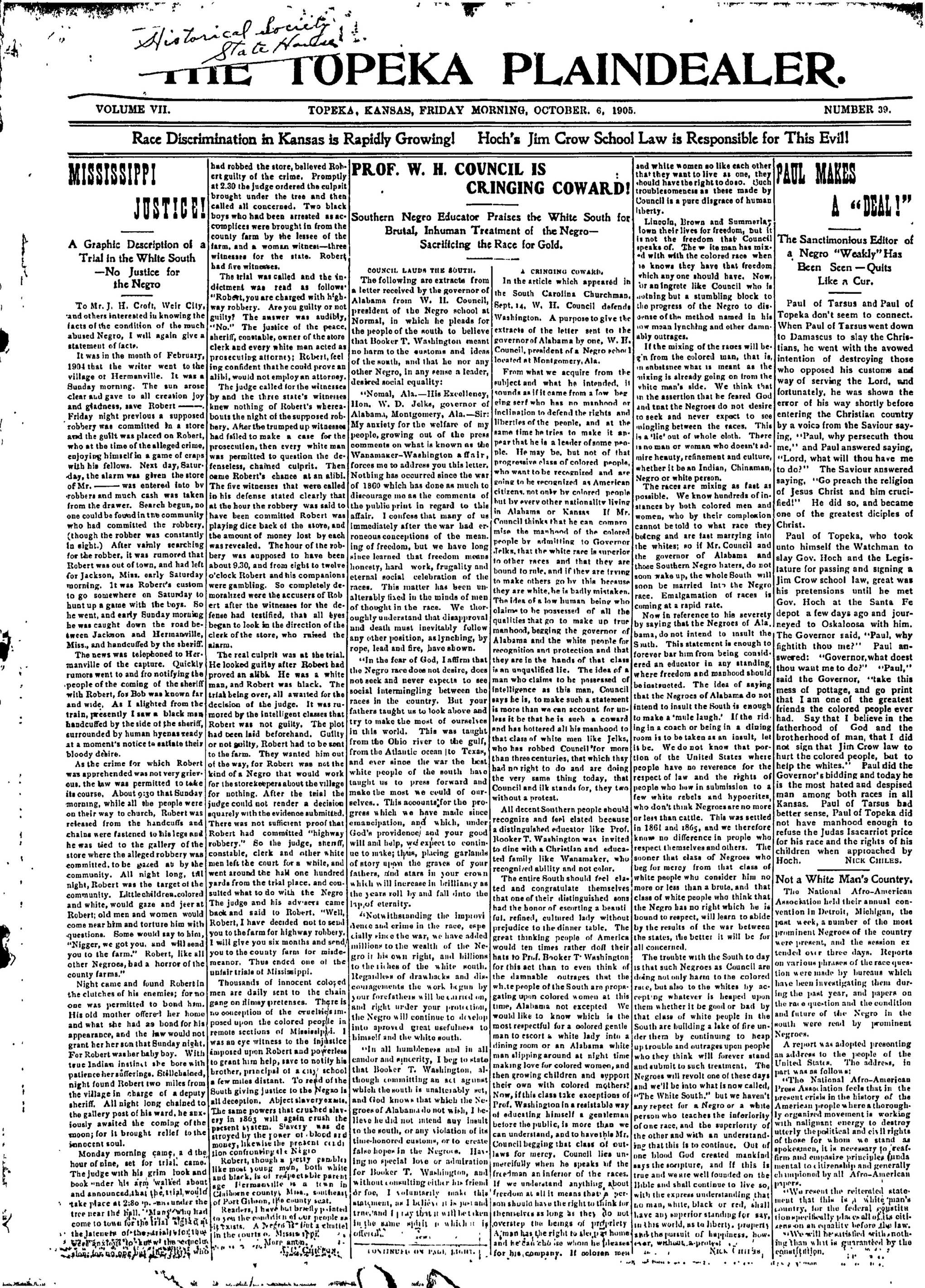
A Graphic Description of a Trial in the White South
—No Justice for the Negro
To Mr. J. H. Croft, Weir City,
and others interested in knowing the facts of the condition of the much abused Negro, I will again give a statement of facts.
It was in the month of February, 1904 that the writer went to the village of Hermanville. It was a Sunday morning. The sun arose clear and gave to all creation joy and gladness, save Robert —. Friday night previous a supposed robbery was committed in a store and the guilt was placed on Robert, who at the time of the alleged crime, enjoying himself in a game of craps with his fellows. Next day, Saturday, the alarm was given the store of Mr. —. was entered into by robbers and much cash was taken from the drawer. Search begun, no one could be found in the community who had committed the robbery, (though the robber was constantly in sight.) After vainly searching for the robber, it was rumored that Robert was out of town, and had left for Jackson, Miss. early Saturday morning. It was Robert's custom to go somewhere on Saturday to hunt up a game with the boys. So he went, and early Sunday morning he was caught down the road between Jackson and Hermanville, Miss., and handcuffed by the sheriff.
The news was telephoned to Hermanville of the capture. Quickly rumors went to and fro notifying the people of the coming of the sheriff with Robert, for Bob was known far and wide. As I alighted from the train, presently I saw a black man handcuffed by the side of the sheriff, surrounded by human hyenas ready at a moment's notice to satiate their bloody desire.
As the crime for which Robert was apprehended was not very grievous, the law was permitted to take its course. About 9:30 that Sunday morning, while all the people were on their way to church, Robert was released from the handcuffs and chains were fastened to his legs and he was tied to the gallery of the store where the alleged robbery was committed, to be gazed at by the community. All night long, till night, Robert was the target of the community. Little children, colored and white, would gaze and jeer at Robert; old men and women would come near him and torture him with questions. Some would say to him, "Nigger, we got you, and will send you to the farm." Robert, like all other Negroes, had a horror of the county farms."
Night came and found Robert in the clutches of his enemies; for no one was permitted to bond him. His old mother offered her home and what she had as bond for his appearance, and the law would not grant her her son that Sunday night. For Robert washer baby boy. With true Indian instinct she bore with patience her sufferings. Stilled chained, night found Robert two miles from the village in charge of a deputy sheriff. All night long chained to the gallery post of his ward, he anxiously awaited the coming of the moon; for it brought relief to the innocent soul.
Monday morning came, a d the hour of nine, set for trial, came. The judge with his grim look and book under his arm walked about and announced, that the trial, would take place at 2:80 p.m. under the tree near the hall. Many who had come to town for the trial sight at the lateness of the trial, for the late and for how the apelure stood, no one in the world who
TOPEKA, KANSAS, FRIDAY MORNING, OCTOBER. 6. 1905.
had robbed the store, believed Robert guilty of the crime. Promptly at 2.30 the judge ordered the culpait brought under the tree and then called all concerned. Two black boys who had been arrested as accomplices were brought in from the county farm by the lessee of the farm, and a woman witness—three witnesses for the state. Robert had five witnesses.
The trial was called and the indictment was read as follows: "Robert, you are charged with highway robbery. Are you guilty or not guilty? The answer was audibly, "No." The justice of the peace, sheriff, constable, owner of the store clerk and every white man acted as prosecuting attorney; Robert, feeling confident that he could prove an alibi, would not employ an attorney.
The judge called for the witnesses by and the three state's witnesses knew nothing of Robert's whereabouts the night of the supposed robbery. After the trumped up witnesses had failed to make a case for the prosecution, then every white man was permitted to question the defenseless, chained culprit. Then came Robert's chance at an alibi. The five witnesses that were called in his defense stated clearly that at the hour the robbery was said to have been committed Robert was playing dice back of the store, and the amount of money lost by each was revealed. The hour of the robbery was supposed to have been about 9.30, and from eight to twelve o'clock Robert and his companions were gambling. So completely demoralized were the accusers of Robert after the witnesses for the defense had testified, that all eyes began to look in the direction of the clerk of the store, who raised the alarm.
The real culprit was at the trial. He looked guilty after Robert had proved an alibh. He was a white man, and Robert was black. The trial being over, all awaited for the decision of the judge. It was rumored by the intelligent classes that Robert was not guilty. The plot had been laid beforehand. Gulty or not guilty, Robert had to be sent to the farm. They wanted him out of the way, for Robert was not the kind of a Negro that would work for the storekeepers about the village for nothing. After the trial the judge could not render a decision squarely with the evidence submitted. There was not sufficient proof that Robert had committed "highway robbery." So the judge, shenff, constable, clerk and other white men left the court for a while, and went around the hall one hundred yards from the trial place, and consulted what to do with the Negro The judge and his advisers came back and said to Robert. "Well, Robert, I have decided not to send you to the farm for highway robbery. I will give you six months and send you to the county farm for misdemeanor. Thus ended one of the unfair trials of Mississippi.
Thousands of innocent colored men are daily sent to the chain gang on filmay pretenses. There is no conception of the cruelties imposed upon the colored people in remote sections of Mississippi. I was an eye witness to the injustice imposed upon Robert and powerless to grant him help, save to notify his brother, principal of a city school a few miles distant. To read of the South giving justice to the Negro is all deception. Abject slavery exists. The same powers that crushed slavery in 1863 will again crush the present system. Slavery was destroyed by the power of blood and money, likewise the present condition confronting the Negro
Robert, though a pretty gambler like most young men, both white and black, is of respectable parent age. Hermanville is a town in Claiborne county, Miss., southeast of Port Gibson, the county seat.
PROF. W. H. COUNCIL IS CRINGING COWARD!
Southern Negro Educator Praises the White South for Brutal, Inhuman Treatment of the Negro—Sacrificing the Race for Gold.
COUNCIL LAUDS THE SOUTH.
The following are extracts from a letter received by the governor of Alabama from W. H. Council, president of the Negro school at Normal, in which he pleads for the people of the south to believe that Booker T. Washington meant no harm to the customs and ideas of the south, and that he nor any other Negro, in any sense a leader, desired social equality:
A CRINGING COWARD.
In the article which appeared in the South Carolina Churchman, Sept. 14, W. H. Council defends Washington. A purpose to give the extracts of the letter sent to the governor of Alabama by one, W. H. Council, president of a Negro school located at Montgomery, Ala.
From what we acquire from the subject and what he intended, it
"Nomal, Ala.—His Excellency, Hon. W. D. Jelks, governor of Alabama, Montgomery, Ala.—Sir: My anxiety for the welfare of my people, growing out of the press comments on what is known as the Wanamaker-Washington affair, forces me to address you this letter. Nothing has occurred since the war of 1860 which has done as much to discourage me as the comments of the public print in regard to this affair. I confess that many of us immediately after the war had erroneous conceptions of the meaning of freedom, but we have long since learned that freedom means honesty, hard work, frugality and eternal social celebration of the races. This matter has been unalterably fixed in the minds of men of thought in the race. We thoroughly understand that disapproval and death must inevitably follow any other position, as lynching, by rope, lead and fire, have shown.
"In the fear of God, I affirm that the Negro race does not desire, does not seek and never expects to see social intermingling between the races in the country. But your fathers taught us to look above and try to make the most of ourselves in this world. This was taught from the Ohio river to the gulf, from the Atlantic ocean to Texas, and ever since the war the best white people of the south have taught us to press forward and make the most we could of ourselves. This accounts for the progress which we have made since emancipation, and which, under God's providence, and your good will and help, we expect to continue to make; thus, placing garlands of story upon the graves of your fathers, and stars in your crown which will increase in brilliancy as the years roll by and fall into the lap of eternity.
Notwithstanding the improviidence and crime in the race, especially since the war, we have added millions to the wealth of the Negro in his own right, and billions to the riches of the white south. Regardless of drawbacks and discontagements the work begun by your forefathers will be carried on, and right under your protection, the Negro will continue to develop into approved great usefulness to himself and the white south.
In all humbleness and in all candor and sincerity, I beg to state that Booker T. Washington, although committing an act against which the south is unalterably set, and God knows that which the Negroes of Alabama do not wish, I believe he did not intend any insult to the south, or any violation of its time-honored customs, or to create false hopes in the Negroes. Having no special love or admiration for Booker T. Washington, and without consulting either his friend or foe, I voluntarily make this statement, as I believe it is just and true, and I pray that it will be taken in the same spirit in which it is offered.
A CRINGING COWARD.
In the article which appeared in the South Carolina Churchman, Sept. 14, W. H. Council defends Washington. A purpose to give the extracts of the letter sent to the governor of Alabama by one, W. H. Council, president of a Negro school located at Montgomery, Ala.
From what we acquire from the subject and what he intended, it sounds as if it came from a low beging serf who has no manhood or inclination to defend the rights and liberties of the people, and at the same time he tries to make it appear that he is a leader of some people. He may be, but not of that progressive class of colored people, who want to be recognized and are going to be recognized as American citizens, not only by colored people but by every other nationality living in Alabama or Kansas If Mr. Council thinks that he can compromise the manhood of the colored people by admitting to Governor Jelks, that the white race is superior to other races and that they are bound to rule, and if they are trying to make others go by this because they are white, he is badly mistaken. The idea of a low human being who claims to be possessed of all the qualities that go to make up true manhood, begging the governor of Alabama and the white people for recognition and protection and that they are in the hands of that class is an unqualified lie. The idea of a man who claims to be possessed of intelligence as this man, Council says he is, to make such a statement is more than we can account for unless it be that he is such a coward and has hottered all his manhood to that class of white men like Jelks, who has robbed Council for more than three centuries, that which they had no right to do and are doing the very same thing today, that Council and ilk stands for, they two without a protest.
All decent Southern people should recognize and feel elated because a distinguished educator like Prof. Rooker T. Washington was invited to dine with a Christian and educated family like Wanamaker, who recognized ability and not color.
The entire South should feel elated and congratulate themselves that one of their distinguished sons had the honor of escorting a beautiful, refined, cultured lady without prejudice to the dinner table. The great thinking people of America would ten times rather doff their hats to Prof. Booker T. Washington for this act than to even think of the damnable outrages that the white people of the South are propagating upon colored women at this time, Alabama not excepted. We would like to know which is the most respectful for a colored gentleman to escort a white lady into a dining room or an Alabama white man slipping around at night time making love for colored women, and then growing children and support their own with colored mothers! Now, if this class take exceptions of Prof. Washington in a resistable way of educating himself a gentleman before the public, is more than we can understand, and to have this Mr. Council begging that class of outlaws for mercy. Council lies unmercifully when he speaks of the freedman an inferior of the races. If we understand anything about freedom at all it means that a person should have the right to think for themselves as long as they do not overstep the beings of propriety. A man has the right to sleep at home and he can choose whom he pleases for his company. If colored men
and white women so like each other that they want to live as one, they should have the right to doso. Such troublesomeness as these made by Council is a pure disgrace of human liberty.
Lincoln, Brown and Summerlay down their lives for freedom, but it is not the freedom that Council speaks of. The w ite man has mixed with with the colored race when he knows they have that freedom which any one should have. Now, for an ingrete like Council who is nothing but a stumbling block to the progress of the Negro to dispense of the method named in his now mean lynching and other damnably outrages.
If the mixing of the races will begin from the colored man, that is, an abstinence what is meant as the mixing is already going on from the white man's side. We think that in the assertion that he feared God and that the Negroes do not desire to seek and never expect to see mingling between the races. This is a 'lie' out of whole cloth. There is no man or woman who doesn't admire beauty, refinement and culture, whether it be an Indian, Chinaman, Negro or white person.
The races are mixing as fast as possible. We know hundreds of instances by both colored men and women, who by their complexion cannot be told to what race they boiling and are fast marrying into the whites; so if Mr. Council and the governor of Alabama and those Southern Negro haters, do not soon wake up, the whole South will soon be married into the Negro race. Emalgamation of races is coming at a rapid rate.
Now in reference to his severity by saying that the Negroes of Alabama, do not intend to insult the South. This statement is enough to forever bar him from being considered an educator in any standing, where freedom and manhood should be instructed. The idea of saying that the Negroes of Alabama do not intend to insult the South is enough to make a 'mule laugh.' If the riding in a coach or being in a dining room is to be taken as an insult, let it be. We do not know that portion of the United States where people have no reverence for the respect of law and the rights of people who how in submission to a few white rebels and hypocrites, who don't think Negroes are no more or less than cattle. This was settled in 1861 and 1865, and we therefore know no difference in people who respect themselves and others. The sooner that class of Negroes who beg for mercy from that class of white people who consider him no more or less than a brute, and that class of white people who think that the Negro has no right which he is bound to respect, will learn to abide by the results of the war between the states, the better it will be for all concerned.
The trouble with the South to day is that such Negroes as Council are doing not only harm to the colored race, but also to the whites by accepting whatever is heaped upon them whether it be good or bad by that class of white people in the South are building a lake of fire under them by continuing to heap up trouble and outrages upon people who they think will forever stand and submit to such treatment. The Negroes will revolt one of these days and we'll be into what is now called, "The White South." but we haven't any respect for a Negro or a white person who teaches the inferiority of one race, and the superiority of the other and with an understanding that this is to continue. Out of one blood God created mankind says the scripture, and if this is true and we are well founded on the Bible and shall continue to live so, with the express understanding that no man, white, black or red, shall have any superior standing for say, in this world, as to liberty, property and the pursuit of happiness, however, without a protest.
NUMBER 39.
The Sanctimonious Editor of a Negro "Weakly"Has Been Seen—Quits Like a Cur.
Paul of Tarsus and Paul of Topeka don't seem to connect. When Paul of Tarsus went down to Damascus to slay the Christians, he went with the avowed intention of destroying those who opposed his customs and way of serving the Lord, and fortunately, he was shown the error of his way shortly before entering the Christian country by a voice from the Saviour saying, "Paul, why persecuth thou me," and Paul answered saying, "Lord, what will thou have me to do?" The Saviour answered saying, "Go preach the religion of Jesus Christ and him crucified!" He did so, and became one of the greatest dicibles of Christ.
Paul of Topeka, who took unto himself the Watchman to slay Gov. Hoch and the Legislature for passing and signing a Jim Crow school law, great was his pretensions until he met Gov. Hoch at the Santa Fe depot a few days ago and journeyed to Oskaloosa with him. The Governor said, "Paul, why sightith thou me?" Paul answered: "Governor, what doesest thou want me to do?" "Paul," said the Governor, "take this mess of pottage, and go print that I am one of the greatest friends the colored people ever had. Say that I believe in the fatherhood of God and the brotherhood of man, that I did not sign that Jim Crow law to hurt the colored people, but to help the whites." Paul did the Governor's bidding and today he is the most hated and despised man among both races in all Kansas. Paul of Tarsus had better sense, Paul of Topeka did not have manhood enough to refuse the Judas Isacarriot price for his race and the rights of his children when appoached by Hoch. NICK CHILES.
Not a White Man's Country. The National Afro-American Association held their annual convention in Detroit, Michigan, the past week, a number of the most prominent Negroes of the country were present, and the session extended over three days. Reports on various phrases of the race question were made by bureaus which have been investigating them during the past year, and papers on the race question and the condition and future of the Negro in the south were read by prominent Negroes.
A report was adopted presenting an address to the people of the United States. The address, in part was as follows:
"The National Afro-American Press Association feels that in the present crisis in the history of the American people where a thoroughly organised movement is working with nalignant energy to destroy utterly the political and civil rights of those for whom we stand as spokesmen, it is necessary to realise and emasize principles fundamental to citizenship and generally championed by all Afro-American powers.
We present the reiterated statement that this is a white man's country, for the federal constitution specifically places all of its citizens on an equality before the law. We will be satisfied with nothing than what is guaranteed by the constitution.
ae “ee * ee Tee SEY ee eee” Cm * ners Ee eee
x .
Aa
Ae
. to ar ae) A on a pI
AGRIEUMTURT:
a
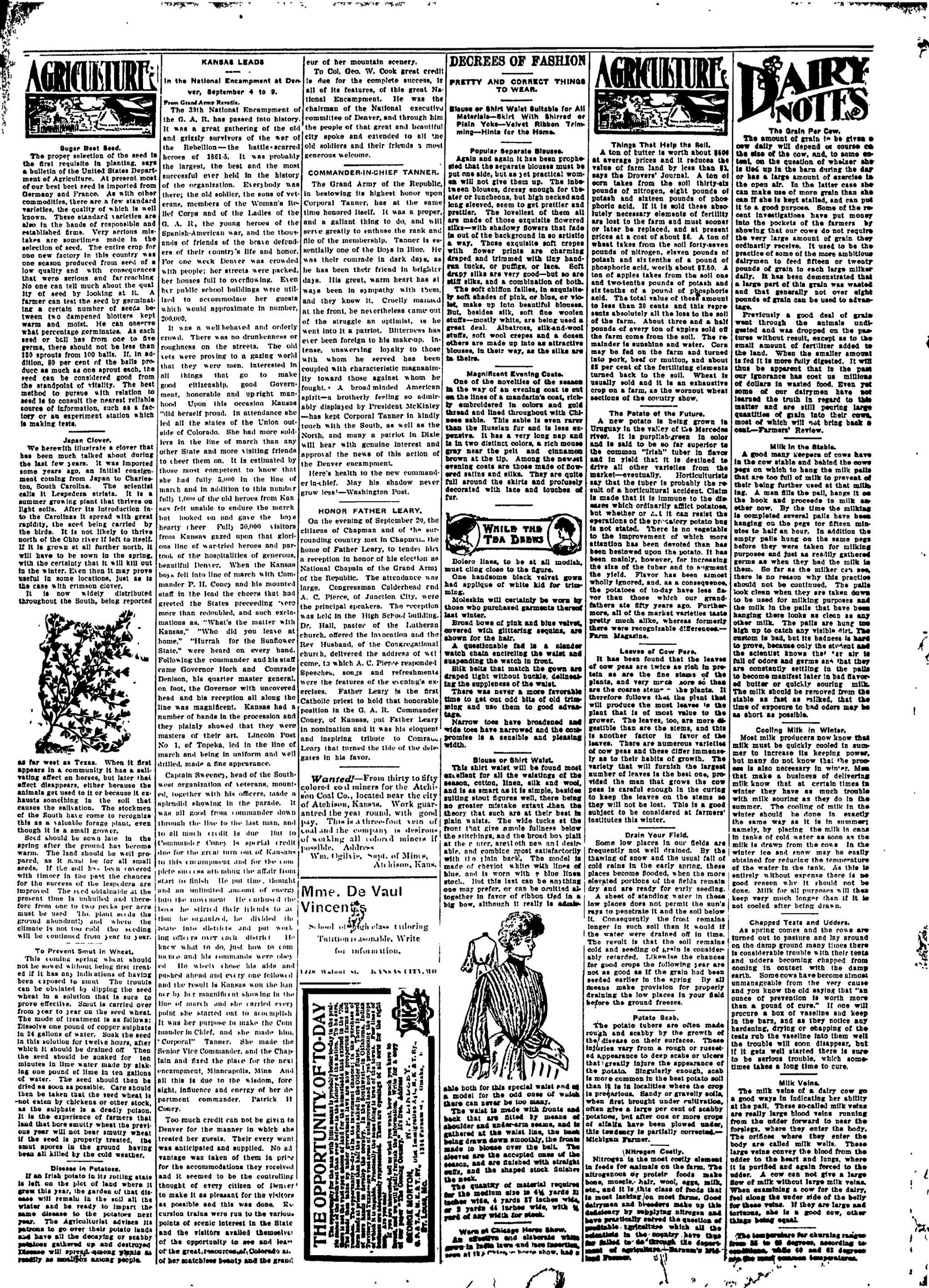
Gucare Beet Seed.
‘The proper selection of the seed Ie
the first requisite !n planting, says
@ bulletin of the United States Depart-
ment of Agriculture. At present most
of our best beet seed 1s imported from
Germany and France, As with othor
commodities, there are a few atandard
varieties, the quality of which fs well
known. These standard varieties are
also In the hands of responsible and
established firme. Very serious mis-
takes are sometimes made In the
selection of seed. The entire crop for
one new factory In this country was
one season produced from seed of @
low quality and with consequences
that were serious and far reaching
No one can tell much about the qual
Mty of seed by looking at It A
farmer can test the seed by germinat-
ing a certain numher of seeda be-
tween two dampened blotters kept
warm and moist. He can observe
what percentage Kerminates, As cach
seed or ball has from one to fire
germs, there should not be lese than
180 sprouts from 100 balls. Jf, in ad-
Aition, 80 per cent of the balls pre
duce as much aa one sprout each, the
reed can be considered good from
the standpoint of vitality. The best
method to pursue with rejation to
need 1a to consult the nearest reliable
source of information, such as & fac
tory or au experiment station which
fe making teste,
Japan Clover,
‘We herewith {lustrate a clover that
has been much talked about during
the last few ;ears. 3t was imported
tome years ago, an initial consign-
ment coming from Japan to Charies-
ton, South Carolina, The aclentist
calle It Lespedera striata. [t 19 @
summer growing plant that thrives ou
Ught soils. After its introduction tn-
to the Carolinas {t spread with great
rapidity, the sced being carried by
the birds, 3t ts not likely to thrive
north of the Obto river If left to itself.
If It Js grown et all further north, It
will have to be sown {to the spring,
with the certainty that st will kill out
ja the winter, Even then it may prove
useful fn some locations, just as Is
‘the case with crimson clover.
1 ts now widely distributed
‘throughout the South, being reported
Pes
Ve yr
as far west as Texas. When it first
Sppears In a community It has a aall-
vating effect on horses, but later thai
effect disappears, either because the
animals get used to it or because It ex-
hausts something In the soll that
causes the salivation, The stockmen
of the South have come to recognize
this as a valuable forage plant, even
though it fe a smal} grower,
Seed should be sown laic in the
spring after the ground has become
warm, The land should be well pro-
pared, as it must be for all small
seeds, If the soll has been covered
with timoce in tie past the chances
for the success of the leapcilera are
improved The teed obtalnubte at the
present time fs unbulled and there:
fore from one to two pechs per acre
must be used ‘The plant suds the
growd abundant!) und where the
climate fs not too culd the seceding
will be continued frum year to year,
To Prevent Smut in Wheat.
This coming spring wheat whould
not be suwed without being first treat:
ed If ft has any indications of having
been exposed to smut The trouble
can be obviated by dipping the seed
wheat In a solution that is sure to
prove effective, Smut is carried over
from oer to year on the seed wheat.
The mode of treatment fs as follows:
Dissolve one pound of copper sulphate
in 24 gallons of water, Soak the seed
in this solution for twelve hours, after
which it sbould be drained of “Then
the seed should be soaked for ten
minutes in Ime water made by slak:
tng one pound of Ime in ten gallons
of water. The seed should then be
dried as sovn as possible, Care should
then be taken that the seed wheat fa
“not eaten by chickens or other stock,
aa the sulpbate a a deadly polaon,
It In the experience of farmers that
lend that bore smutty wheat the previ:
ous yeer will not bear smutty wheat
it the seed is properly treated, the
smut spores in the ground baving
bean all killed by the cold weather,
Diseses in Potatoce.
If an Irish potato fo its rotting state
is left on tbe plot of land where it
Grow this year, the garden of that dis-
ease will remain in the soil all the
winter and be ready to impart the
mame disease to the potators next
year. The Agricolturist advises its
patrons to go over their potato luada
aud have all the decaying or scabby
potatoes gathered up and destroyed
Disease will sprees. qmong yipnis as
peagily no amalipis ances people
KANSAS LEADS
In the National Encampment at Den
wer, September 4 to 8.
the G. A, R, hae passed into history
It was a great gathering of the oté
and grizely survivors of the wer o
the Rebellion—the battle+ scarred
heroes of 1861-5, It was probabl)
the largest, the best and the mort
successful ever held fn the history
of the organization. Everybody wag
there; the old soliler, the sons of vet
ernns, members of the Woman's Re
Hef Corps and of the Ladies of the
GA. R, the young heroes of the
Spanish-American war, and the thous:
ands of friends of the brave defend:
ers of thelr country's Ife and honor.
For che weck Denver was crowded
with people; her streets were packed,
her houses full to overflowing. Even
her public school buildings wete utit-
lzed to occommodace her guests
which wottld approximate in number,
200,000,
it was a well behaved and orderly
crowd, There was no drunkenness or
roughness on the streets, The old
vets were proving fo a gazing world
that they were men, interested In
all things that go to make
goo citizenship, geod ~~ Govern-
ment, honorable and upright man-
hood Upon this occasion Kansas
“did herself proud. In attendance she
Jed all the states of the Union out:
side of Colorado, She had more xvld-
jers In the Hine of march than any
other State and more visiting friends
to cheer them on, It Is estimated by
thuze most competent to know that
she had fully 5.000 In the Hne of
march and In addition to this number
fully 1.0uw of the old heroes from Kan
sas felt unable to endure the merch
but looked on and gave the boys
hearty cheer Fully 30,000 visitors.
from Kansas gnzed upon that glorl-
ous line of Wartried heroes and par
took of the hospltalities of generous,
beautiful Denver, When the Kansas
bos» fell Into Ine of march with Com-
mander P, If, Concy and his mounted
staff in the lead the cheers that had
greeted the States preceeding vere
more than redoubled, and such excla-
mations as, “What's the matter with
Kansas," “Who did you leave at
home,” “Hurrah for the Sunflower
State" were heard on every hand.
Following the commander and tis staff
came Governor Hoch and Comrade
Denison, his quarter master general,
on foot, the Governor with uncovered
head and bis reception all along the
line was magnificent. Kansas had a
number of hands in the procession and
they plainly showed that they were
masters of thelr art, Lincoln Post
No 1, of Topeka, led In the line of
march and being in uniform and well
drilled, made a fine appearance.
Captain Sweeney, head of the South-
west organization of veterans, mount:
ed, tugether with his officers, rande a
splendid showing in the parade, It
was all Road from commander down
through the Hine to the last man, and
to all much edit fy due But to
Commander Cones ts xpeetal credit,
due for the great ture out of Kansans
ta this cncampment aut for the con
plete success attending the affair fom
dtart to finish Tle pat thine, thought
amt an unlimited amount of were)
Hite the aumvement He enthused the]
hove he stirted their tiicnds to ac |
Hon he arganteed, he divteled the |
diate inte distilets and gut work
lng oMerre over cach district The
knew what ta do, Just how to com
metee and hi commands were obey
ed He wirely chone his alds and
pushed ahem aud every one followed
and the result fs Kansas won the ban
ner by her magnificent showing In the
Mune of march and she carried every
point she started ont to acocmplish
It was her purpose ta inake the Cony
mander in Chief, and she made bin,
‘Corporal” Tanner, She made the
Senlor Vice Commander, und (he Chay
fain and fixed the place for the next
encampment, Minncapolis, Minn And
Bolero lnes, to be at all modish,
must cling closo to the figure,
One handsome black velvet gown
had applique of white kid for trim
ming.
Moleskin will certainly be worn by
those who purchased garments thereof
last winter.
Broad bows of pink and blue velvet,
covered with gilttering sequins, are
shown for the hair,
A questionable fa is a slender
Watch chain encircling the waist and
Suspending the watch in front
Bik belts that match the gown are
@raped tight without buckle, delincat
ing the suppleness of the waist,
There was never & more favorable
time to get out odd bits of old trim
wing and uso them to good sive»
tage.
Narrow toes bave broadened an@
‘wide toes have narrowed and the con
Dromise ie a sensible and pleasing
width.
‘This shirt walet will be found most
exellent for all the walstings of the
Beason, cotton, linen, silk and wool,
and {s as smart as it {s almple, beaides
suiting stout figures well, there being
Bo greater mistake extant than the
thoory that such are at thelr best tm
plain waists. The wide tucks at the
front that give amole fullness below
the stitchings, and the broad box plait
at the c ner, aretloth new ant desir
able, and combice zpost satisfactorily
with to yinin back, The model is
made of cheriot white with ines of
blue, and fs worn with ¢ blue Ines
stoch, Jint this last can be anything
‘one may prefer, or can be omitted ab
together in favor of ribbon tied in a
big bow, although it really 1s adcfe
me
owe ;
>
fae
ag AW
i \ \ N
3
BW )
f iN Mi)
N Ny NSS
oes /:/! ISS
4 .
Aart My)
able both for this special walst and ag
& model for the odd ones of wulok
there can never be too many.
‘The waist is mde with fronts and
beck that are Sited by means of
adoulder ang underarm seams, and fs
gathered af the wast line, the bask
being draws dows smoothly, the froate
msde to Mouse over the belt The
sleeves are the accupted ones of the
seasco, and are Calshed with straight
gafs, and the shaped stock foiehes
the neck.
‘Phe quastmy of material requires
ter the roedinm size is 4% yards 0
techee wile, 4 yards 87 inches wits,
ar 3 yards 44 lorhes wile, with &
york of any Width for ptock,
—
Worn ot Cricage Herve Show,
| gm efesttve and slsborate whine
| vee in Tnéta Lawn and luce tasertion,
eee thy Phten nm breve show, had s
eur of her mountain scenery.
To Col, Geo, W. Cook great credit
te due for the complete success, tr
all of its features, of this great Na:
tional Encampment. We was the
chairman of the National executive
committee of Denver, and through him
the people of that great and beautiful
elty spoke and extended to all the
old soldiers and thelr friends 2 most
gencrous welcome.
COMMANDER-IN-CHIEF TANNER.
The Grand Army of the Kepubdlic
in bestowing {ts highest honor upor
Corporal Tanner, has at the eame
time honored itself, It was a proper
and a gallant thing to do, and will
serve greatly to enthuse the rank anc
Mie of the membership. Tanner Is es
sentlally one of the Boys In Blue, He
was thelr comrade in dark days, a
he has been their friend In brighter
days, His great, warm heart has el
ways been in sympathy with them,
and they know it, Cruelly maimed
At the front, he nevertheless came out
of the struggle an optiniist, is he
went Into It a patriot, Bitterness has
ever been foreign to his makeup. In-
tense, unswerving loyalty to those
with whom he served has been
coupled with characteristic magnanim-
ity toward thoxe against whom he
fought.* A broad minded American
spirlt—a brotherly feeling so adimir-
ably displayed by President McKinley
—has kept Corporal Tanner in kindly
touch with the South, as well as the
North, and many a patriot in Dixle
witl hear with genuine interest and
Approval the news of this action of
ihe Denver encampment,
Here's health to the new command:
erinxhief. May his shadow never
grow less'—Washington Post.
HONOR FATHER LEARY.
On the evening of September 29, the
citizens of Chapman and of *he sur
rounding country met In Chapnrit., the
home of Father Leary, to tender hin
a reception in honor of his election as
National Chapaln of the Grand Arm)
of the Republic, The attendance way
large. Congressman Calderhead end
'A. C. Plerce, of Junction City, were
‘the principal speakers. The rceeption
was Lelé in the High Schou? Duihding.
Dr. Hall, pastor of the JLutheran
church, offered the invocation and the
Rey Husband, of the Congregattonal
church, delivered the address of wet
come, t2 which A. C, Pierse responded
Speeches, songs and refreshments
Were the features of the evening's ex-
erclses, Father Leary ft the first
Catholic priest to hold that honorable
position in the G, A, R. Commander
Coney, of Kanvas, put Father Leary
In nomination and ft was his eloquent
and inspiring tribute to Comrau.
Leary that turned the thie of the dele
gates In his favor,
Wanted!—F rom thirty to fifty
colored coal miners for the Atchi+
von Coal Co., located near the city
of Atchison, Kaneas, Work guar:
anteed the yea! round, with good
pay. Thin athree-foot vein of
coaland the company im desirous
of working all colored miners if
possible, Addrens
Win. Ogilvie, Sept of Mince,
Atchison, Kans,
—
Mme. De Vaul
Vincents
sthool Sf elas tuloring
Tutiton reasonable, Write
for snformition,
122k Walnut st. I ANN AS CITE, HO
nes &
aut
PUREE £
Spain bye}
Eee
Zhai
Eieay a
Sub
Soe
Shae
Ualpiipeie ose
ris
DECREES OF FASHION
PRETTY AND CORRECT THINGS
‘TO WEAR.
Blouse or Shirt Walst Suitable for All
Materlale—Skirt With Shirred oF
Plain Yoke—Veivet Ribbon Trim
ming—Hinte for the Home.
Popular Separate Blouses.
Again and again it bas been prophe
ied that the separate blouses must de
put one side, but as yet practical wom-
ea will not give them up. The inde
tween blouses, dressy enough for the
ater or luncheons, but high necked and
jong sleeved, seem to get prettier and
prettier, The loveliest of them all
are made of those exquisite flowered
silks—-with shadowy flowers that fade
im out of the background in ao artistic
& way. Thorne exquisite soft crepes
with flower prints are charming
draped and trimmed with tiny band-
fun tucks, or puMfgs, or lace. Soft
Gztpy silke are very good—but so are
stiff ulike, and a combination of both.
‘The soft chiffon fallles, In exquisite
ty soft shades of pink, or blue, or vio»
Jet, make tp into beautiful blouses,
But, besides silk, soft fine woolen
stuffe—mostly white, are being used a
great deal. Albatross, silk-and-wool
stuffs, soft wool crepes and a doxen
ethers are made up into as attractive
diouses, in their way, ae the slike are
te theirs.
Magnificent Eventng Coates.
One of the novelties of the season
tm the way of an eventng coat ie cut
em the lines of a mandarin’s coat, rich-
ty embroidered in colora and golé
thread and lined throughout with Chi
mese sable. This sable is even rarer
than the Russian fur and ts less ex
pensive, It has a very long nap and
4s in two distinct colors, a rich mouse
gray near the pelt and cinnamon
brown at the tip, Among the newsst
evening coats are those made of fow
ered satine and ellke, They are quite
full around the skirts and profusely
Gecorated with Iace and touches of
tur,
P\WAILe THe 7
mi | TEA Deews | 74
A CaS
2.
Ware THe
Tea Daevws
Blouse or Shirt Walet.
i
uy, Wine whe
Seer ne vere eee aoe cee
A ton of butter !s worth about 9604
at average prices and It reduces the
value of farm land by leas than §2,
saya the Drovers’ Journal. A ton of
corn takes from the soll thirty-stz
pounds of nitrogen, elght pounds of
potash and sixteen pounds of phos
phoric acid. If it Is sold these abso
Vately necessary elements of fertility
are lost to the farm and must sooner
or later be replaced, and at present
prices at a cost of about $@. A ton of
wheat takes from the oll forty-seven
pounds of nitrogen, eleven pounds of
potash and sixtenths of a pound of
phosphoric acid, worth about §7.60. A
ton of apples takes from the soll one
and twotenths pounds of potash and
siztenths of a pound of bapspborie
acid, The total value of thess amount
to leas than 30 conts and this repre
seats absolutely all the loss to the sol!
of the farm, About three and a halt
pounds of every ton of apples sold off
the farm come from the soll, The re
matnder is sunshine and water. Corn
may be fed on the farm and turned
into pork, beef or mutton, and about
48 per cent of the fertilizing elements
turned back to the soll. Wheat i
usually sold and it ts an exhaustive
crop on @ farm, as the wornout wheat
sections of the corntry show,
‘The Potato of the Future.
A new potato is being grown ip
Uruguay fn the vatey of the Mercedes
viver. It 1s purplish-green {n oolor
and Je said to be so far supertor te
te common “Irish” tuber in flavor
aud fo yield that it Is destined te
drive all other varietles from the
merket—eventually, | Horttculturists
say that the tuber fs probably the re
sult of @ horticultural accident. Clatm
{a made that It 1s Immune to the dip
eases which ordinarily affict potatosa,
but whether or 2.t it can resist the
eperations of the pre<atery potato bug
fe not stated. There is no vegetable
to the improvement of which more
attention has been devoted than has
been bestowed upon the potato. It has
been mainly, however, for increasing
the aize of the tuber and to angment
the yield. Flavor has been simost
wholly fgnored, and, as 2 consequence,
the potatoes of to-day have lese fia
vor than those which our grand
fathers ate fifty yeara ago. Further
more, all of the market varietics taste
pretty much allke, whereas formerly
there were recognizable ¢!ferences.—
Farm Magazine.
Leaves of Cow Pers.
Tt has been found that the leaves
of cow peas are twice as rich tn pre
tein as are the fine stems of the
Plants, and very mrca sore so thas
are the coarse stems ~ she plants, It
therefore follows that the pleat thet
will produce the most leaves '» the
Plast that js of most value to the
rower, The leaves, too, are more @&
geatible than are the stems, and this
ts another factor In favor of the
leaves, There are numerous varieties
of cow peas and these differ immense
ly an to their babite of growth. The
variety that will furnish the largest
aumber of leaves is the best one, pro
vided the man that grows the cow
peas {a careful enough in the curing
to keep the leaves on the stems so
they will not be lost, Tals is a good
subject to be considered at farmers’
Jnstitutes this winter,
Deain Your Field.
Some low places in our fields are
frequently not well drained, By the
thawing of snow and the usual fall of
cold rains tn the early spring. these
places become flooded, when the more
elevated portions uf the fields remain
dry and are ready for early seeding.
‘A sheet of standing water in these
low places does not permit the sun's
rays to penetrate It and the soll below
{t Consequently the frost remains
longer in such soil than ft sould ff
the water were drained off in time.
Tho result 1a that tho soil remains
cold and seeding of grein {8 consider
ably reterded. Likent{se tho chances
for good crops the following year are
uot as good as if the grain had been
aeeded earlier in the apring By all
treans make provision for properly
draining the low places in your fold
before the ground freezes,
Potato Scab,
‘The potatoe tubers are often made
rough and scabby by the growth of
thefaeaae on their surfaces. These
injuries vary from a rough or russet-
4 appearance to deep ecabs oF ulcers
that greatly injure the appearance of
the potato, Singularly enough, scab
{a more common in the best potato sol}
than {f fe in localities where the crop
is petielean Sandy or gravelly solls,
when first brought under cultivation,
often etve a large per cent of scabby
potatoes, bnt after one or more crope
of alfaife have been plowed under,
this tewdency Je partially corrected —
Michisam Farmer,
\Nitregen Costly.
Nitrogen ta the most costly element
in feode for maimals on the farm, The
aitrogenous Of proteir foods make
Done, muscle. halr, wool, exes, mith,
jete., and it 1e.this clase of foods that
te most lacking Jon most farms, Coot
Geirymen and bheeders make up this
Getelency by webplying nitrogen and
have practically setved the question of
peodtadie. teviesitaze which al) the
etestio’s ta the: contry have thye
eet ere os hers
ment of Baraum's Wie
tent Fesener, oy)
‘The amount of grain te be gives @
cow dally will depend ot course ca
the size of the cow, and, to some om
tent, on the question of wheiser she
ts Wed up ia the barn during the day
or has @ large amount of exercise im
the open alr. In the latter case she
can make use of more grain than she
can ff she fe kept stalled, and can put
it to a good purpose, Some of the re
cent investigations have put money
into the pockets of the farmers by
showing that our cows do not require
the very large amount of grain they
ordinarily receive, It used to be the
practice of some of the more ambitious
dairymen to feed fifteen or twenty
pounds of grain to each large milker
dally, % has bees demonstrated that
a large part of this grain was wasted
and that generally not over eight
pounds of grain can be used to advaa-
Previously a good deal of graim
went through the animals und}
gested and was dropped on the pam
turee without result, except as to the
small amount of fertilizer added te
the land. When the smaller amount
1s fed tt is more fully digested. Jt witt
thus be apparent that in the past
our ignorance has cost us millicne
of Collars in wasted food. Even yet
some of our dairymen have not
learned the truth In regard to thie
matter and are still peuring large
quantities of grain into their cows,
most of which will not bring back @
ceat—Farmere’ Review.
Mille In the Stable.
A good many keepers of cows Rave
in the cow stable and dehind the cows
pegs on which to hang the milk palle
‘that are too full of milk to prevent of
their being further used at that milly
ing. A roan fills the pail, hangs It os
the hook and proceeds to milk am
ether cow, By the time the milking
Je completed several pails have beea
hanging on the pegs for fifteen min-
utes to halfan hour, In eddition the
empty palis hung on the same pegs
before they were taken for milking
Purposes and just as realily gathered
germs ae when they had the milk ta
them. So far as the milker can seq,
there fe no reason why this practice
should not be continued, The pails
jook clean when they are taken Gown
to be used for milking purposes and
the milk tn the pails that have bees
hanging there looks as clean as any
other milk, The patis are hung toe
igh up to catch any visible tirt, The
custom is bad, but its badness is hard
to prove, because only the atient and
the scientist Knows the? ‘sr air is
full of odors and germs an4 that they
are constantly settling in the palls
to become manifest Jater In bad flavor
e@ butter or quichiy souring milk
The milk should be removed from the
stable as fast as roliked, that the
time of exposure to bad odors may be
as short as possible.
Cooling Milk In Winter.
Most milk producers now know that
milk must be quickly cooled in sum
mer to Increase {ts keeping power,
bat many do not know thal the prow
ess Is also necessary In win'er, Mom
thet make a business of delivering
milk know that at certain times im
winter they have as much trouble
with milk souring as they do {n the
summer, The coollng of mitk In the
winter should be done tn exactly
the same way aa It fs {n summery
namely, by placing the milk In cans
fn tanks of cold water se soon as the
milk Is drawn from the cous In the
winter ico and snow may he easily
obtained for reducing the temnerature
of the water In the tank, As this ip
entirely without expense there {s no
food reason why it rhould not be
done, Milk for all purposes will thes
keep very much longer than if It te
not cooled after being drawn.
Chapped Teats and Udders.
AB spring comes and the cous are
turned out to pasture and Iny around
on the damp ground many tinea there
fs considerable trouble with their teats
and udders becoming chapped from
coming in contact with the damp
earth. Some cows have become olmom
unmanageable from the very cause
and you know the old saying that “an
ounce of prevention is worth more
than a pound of cure.” If one will
procure ® box of vaseline aud keep
fn the barn, and as they notice any
hardening, Grying or obapping of the
teats rub the vaseline Into them weit
the trouble will soon disappear, but
if it gets well started there is sure
to be serious trouble, which some
times takes a long time to cure,
Milk Veing
‘The milk velne of a dairy cow go
&@ good ways in {ndicating her ability
at the pail, These socalled milk veins
are really large blood veins running
from the udder forward to near the
forslegs, where they enter the body,
‘The orifices where they enter the
body are called milk wells. These
large veins convey the blood from the
udder to the Beart and lungs, where
it fs purified and egein forced to the
udder, A cow can not give a large
Sow of milk without large milk veins,
‘When examining a cow for the dairy,
fee! along the weder side of the belly
for theae veins. If they are large and
torteses, she fs a good cow, other
things betag equal.
Bho temperatare for churning ranges
from BS te @ degrees, aosording to
contitians, WhSe ¢0 and 63 degrees
ate (he vees| gemmes (en paalaren
WESIERN UNIVERSITY.
Mrs. Moten, wife of Prof. Mo:
ten of Lincoln institute, visited
Western Universay last Friday.
The James A. Handy literary
society met and organized last
Friday evening for this year's
work. The Christian Endeavor
society was organized Sunday
evening for the work of winning
students to adopt christianity.
Bishop and Mrs. Abram Grant
visited Western University last
week. Mrs, Grant seems to be
on the upward trend in regain-
ing her health,
The Western University foot
ball team has received a chal-
lenge to play a game with the
colored football team of Kansas
University at Lawrence,
A great appreciative audience
crowded Allen Chapel Kansas
City, Mo. last Friday evening to
see the rustic garb and antique
costumes of The Haymakers,
and to listen to their melodious
voices in operaticcantata. Nor
were they disappointed. For
two long hours they held the
great audience spell-bound by
clever acting and beautiful song.
The prima donna, Miss Edmonia
Hubble, was faultless and pos-
sesses asweet, entrancing voice.
Misses Emma Collins, Emma
Thomas and Albert Phillips dis-
played their talents in excellent
style. Misses Daisy D. Foster,
Sarah Hammett and Nettie Pen-
nix, and T, L. Walker, J. D.
Roberts and A. W. Fox deserve
special mention for their promi-
nent parts well executed, as wel!
asthe other twenty or thirty
voices in the chorus. Prof. R.
G. Jackson of Western Univers-
ity, has received many praises
and congratulations for his in-
defatigable energy and skill in
working out such a_ splendid
success. He has brought addi-
tional laurels to his credit and
great-honor to the institution of
which he isa part, The people
of Kansas City are awakening to
the great progress and uplift that
Western University is destined
to lead them to attain, not only
along the lines of music, but
business and morals as well.
The Donor club of Allen Chapel,
under the management of W. C,
Houston, is to be congratulated
for this unbounded success.
The school Glee song has een
composed by and will be set to
music by Prof, R. G, Jackson,
and later published in sheet mu-
es
VINITA, I, T.
Prof. L. T, Brown of Musko-
gee, I, T, was in town Wednes.
day of last week on business.
Joe Curry and James Davis
have ceturned from Denver, Col:
and reports a pleasant trip.
Garfield Blackwell and wile
have left the farm and are now
livingin town.
Will Fogg and Miss Bessie
Buckner visited her parents in
the vicinity of Lightning Creek,
Sunday,
George Blackwell left fou Caf-
feyville Sunday and may remain
there,
Rev, H. H. Jones of Baxter
Springs, Kans, while touring
the West, stopped over to visit
Rev. A. H. Hawkins. He lec-
tured to the Sunday school ‘and
was retponded to by the district
superintendent, Mrs, F, M. John-
son, and at 7:30 o'clock he de-
livered a noble sermoa, His
theme was ‘*Prayer,"’
Dennis Bolers, who has suffere
ed forthe Jast six or eight months
with consumption, died Sunday
evening,
Lewis Foster of Parsons, Kant
spent last Sunday’ in ‘the’ city
-with friends: 4 5
tome Fecdtp ce BRiee
Arthur Thompsqn\of Osweroy
Kaos. is visiting relatives and is
contemplating spending a few
deya in the country.
A. Rider spent several daysin
the country on business.
Miss Cora Atten has returned
from her ‘visit in the Tember
hillvicinity, Miss Golden Hu-
bardof Welch, I. T, accompa-
nied her.
Mrs, Virgie Thompson of Os-
wego, Kansas wat the guest of
Mrs. M. A. Sorrell Jast week.
Misses Libbie Martin, Année
Belle Martin, and Mrs. Ida B.
Lewis left for Kansas City, Mon-
day evening to attend the Priests
of Pallas parade.
| The Olive club wasentertained
last Thursday evening at the
home of Mrs. Eaues and a very
pleasant evening was passed,
It is said that the electric light
people propose to rebuild bigger
and better than ever if they can
get along term of franchise.
There was a good attendance
Monday in the United States
court room when Judge J-seph
A, Gill opened the October term
of court. Wade S. Standfield,
who succeeded Pliny L. Soper,
made his first appearance as
peosecuting attorney for the
northern district of the Indian
Territory. |
Mesdames Mary Yaungblood
and Sarah Hinkles of Fort Smith,
Ark. were heze attending court.
There are children that have
not yet begun attending school,
and it the fault of the parents.
It is strength, not weakness that
children love. It is the joy of
winning against adversity that
makes boys love zoodness, not
the portrayal of characters that
are good because they can't be
anythingelse. Itis powertodo,
to be, no matter what the battle
that youth loves; and when this
is edited out of the literature o
the boys and girls, all interest,
all enthusiasm, all sympathy, aly
of the ethioal value is lost.
ROVYNTON. IY. T.
King and Bnoh struck the
town with a splendid minstrel]
troup on Friday and played three
nights with Saturday matinee to
crowded houses, one half being
white, At the close of the per
formance the first night, our
young people joined them ina
free social dance, and onthe
second and third nights the
whites held forth after the per-
formance. Itis the first troop
to visit the town, There are 15
in number, male and female,
Their being colored, under col-
ored managememt, cut no figure
with the whites. The troop pa-
raded the streets each day,
| The ladies’ three days fair was
a financial suacess, and the
building fund was greatly aug-
mented, The fancy handwork
of the ladies brought good prices
and about everything was sold.
Work on the church building is
retarded on account of the slow-
ness of the lumber hauling. In
the meantime the building fund
grows, The last quarterly con-
ference wilh be held next week,
The latest business enterprise
launched here is the Boynton
Realty company, with a capital
stock of $10,000, The company
whichis composed of professional
and business men and farmers,
will do a general real estate and
banking business.
At the last meeting of Boyn-
ton Light todge 6377, G, U, O.
O. F,, William’Buchanan be-
came N.G., Paul J. Merriwether
V. G., and Lewis Rentie was
elected E. S. The treasury is
getting in a healthy condition.
The Howard Brotbers have
recessed another consigninent of
buggies They have rented and
iL pa. a, A660 Ruy LOUSE, ty atn,
commodate their growing trade.
John Grayson has become pro-
prictorof the West Kenefick ave-
nue livery barn, and has puta
drayin the service. He abso
conducts a grocery and a res-
taurant. Mr, Grayson is a
native. +
B.C. Makins is on the sick
list this week.
A. B. F, Lake was in Musko-
ge last week on business.
Miss Lulu McDurmid has ac-
cepted the position of assistant
to the postmaster at Ridge.
She left this week to begin her
duties,
Jack H. Howard, postmaster
at Ridge, wasin town last week.
W. A, Rentie pulled his sepa-
rate state convention off at Ok-
mulgee on the 2sthult, There
was a split, and it is said a large
majocity held a separate con-
vention and endorsed the senti-
ments promulgated by the col-
ored men's joint territory con-
vention held in Muskogee, Aug.
21-22, W. A. Rentie’s name
appears asa signerof the reso-
lution favoring single statehood.
If his idea was carried out, the
new state, Sequoyah, would be
thoroughly southernized, and
Brother Rentie would be made
to bite the dust as the pest of us
blacks. Jim Crow cars and Jim
Crow everything, together with
lynch law—which is no Law at
all—would beintroducedin order
to make the ‘‘nigger’’ know his
place, I wonderif Brother Ren-
tre and his followers have thought
ofthe reign of terror they are aid-
ing the southerners to fasten on
this country! ©, ambition,
beware of thy folly. Boynton
gave Rentie's convention the
ccld shoulder.
T. I. NOTES.
| The students of the business
‘course department are making
very rapid progress. There are
moro openings in the business
werld thanany other avenue. At
present, we have applications for
competent stenographers and
business men.
Still they come. Quite a few
new students have enrolled since
last week.
The rhetoricals for the year
last Saturday evening and the
program was rendered by the
sensor class. . a
Our musical department un-
der the direction of Mrs. J. D.
Balentine, is getting in some
very solid work. All pupils in
the institution are required to
pu.sue spstematic work in vocal
music. In addition to this, the
regular choir, glee club male
quartette and female sextette are
maintained. The musical life
of the institution is the best in
its history.
ee
Let the...
AMBRICAN
Steam Laundry
Do your family washing—5e pound
| It will save you money,
ri4 W, Seventu 81, PHONE 341,
——$ ee
aJ. W. RYAN,
Times Bldg , Leaveaworth, Kansas,
AGENT Fou
Heim’s Famous Beer,
Sample Room ia Conmaction,
Orders bhipped to All Parte of the Country
APECILL BLEW —Ky Mauser, the Best on the Market
ree
For » First-class Shave Call at
LITTLE GEM” BARBERSHOP,
Clean Linen and Towels,
1313 Dooce &r.,
OMAHA, NEB
Oo, ©, TUCKER, "Prornieten
———————_—
When in AICHISON «don’t forget
Dt.ROBINSON'S RESTAURANT
é 623 Main Street,
Just three blocks (rom Union Depot
Mesls 20c. ‘
Mrs, Mary Robinson, + »°. Prope
DMR
: Che Cosmopolitan Cafe §
2 . is the place to 40 when you want €
= Me SOMETHING NICE TO EAT. F-
2 | 3 * &
2 ; a FINEST AND CHEAPEST CAFE €
= | — IN THE UNITED STATES. é
= . os €
= " Well Ventilated, rurxisnry Rooms
= Lv in connection. z
Ss GIVE US A CALI. ;
2 G W., SMITH, Proe, €
S343 Beale Street. MEMPHIS, TENN. §
DANAE NATL TUT
PPLE SSOSSOS OP OSSSS SSO FOSS OS OOOO OSS PT OS OOOO OS OES OES:
Ws. McKNIGAT, Mee, J.T, MORELAND, Bec. 4
: T. N. COLLINS, Head Barber. ;
> ‘
} Waiters Catering Association, ;
: 1223 BALTIMORL AVB.
, —_—- ‘
> WAITERS, PORTES AND ALL STRAINGERS
; When in Kansas City are invited to visit the 3
i Asssociation. Neatly furnished Roomy, Baths ‘
a Specialty. :
: BUFFET, LICBNSED BARBERS ‘
i a
| GET THE BEST!
: USE ONLY
: Taylor’s
| Perfection
| Flour
: AND
- Taylor’s Pure |
Buckwheat _
Flour |
bogie ‘eHow aed you wit sty ga] beak
GfeTaylor Grain 60,,
. , TOPEKA, KANSAS: 2.)
PONT BRAT THR FRINTAR,
The {ying subsoriber le a vampire
who kille any Negro paper. He
lien about hia pay dayand then
slandere the paper when he is cut
off for not paying his aubscription.
We have a number of dude fellows
claiming to be paying their girl's
jnubsoription, and we sre going to
show their ladies what dead boots
they mix with.—Exohange.
HOUSES to RENT,
Neatly Furnished and Unfurnished
looms. Also Rooms for
Light Housekeeping.
1107 N, 6ru Sz,
S. M. POWELL, 'PROP.,
Kenas City, Kas,
{ AGOLDEN OPPORTUNITY,
T want a housekeeper not over
40 years of age, Five children.
Good place. Anyone wanting euch
a place write to mo and get full
Information, Addrean
B, E. MoFarland,
Frankfort, Kanane,
———
Newport Restaurant
TIBB STARNBS, Pro.
Everything First-class—Short
i Orderea Specialty.
1315 Dovag 8r.,
OMAHA, NEBRASKA
“THE KEYSTONE,"
RESTAVRANT AND AFE
First-class service. Short
orders a specialty, When
in Kaneas City, oall and
seome. If you're ploased
tell your friende, ifnot tell
me,
R_ S STREET, Prop.
1204 &. RIGUTEENTIE BT.
When in Lawrence Stop at the
King Hotel
ing Hote
Viret-Class Board and Lodging—
TceCream and Cigars.
D. Waddington,
Proprietor.
The Little
Gem Restaurant,
106 KANHAR AVENUK
fa ftiret-claas place for o
aquare mealor lunch. Ice
orcam and cigars,
W. H. Henderson,
PROPRIETOR.
ar he ; P Pi
ee 2 a
Pos
Sy Se
\ , Ss a cao
Te eT
a a +4
SS " Ble q
Ay ‘a
ay
When You Travel
select a rallway as
you do your clothes
KATY SERVICE
GrnS00R, CAKLAS & TELAS RALWAT)
Suggests Comfortable and
Convenient Trans,
The “KATY FLYER" and
KATY DENING STATIONS
Meals Moderate tn Priog,
Dosurpessed ia Quality end Berrion
Ono Price, B00
setts
"KATY," SL Louls
WAITERS q tl | !
AXD i
moving. uoadguarters!
CHAS. PHELPS’ Barber
Shop is where you meet
them. The leading barber
shop in the city. ceseesseee
914-916 Resocis ht, - RT. JOURPH, wo
Wilham Thomas, member of troop
“M," Tenth Cavatry, enlisted at
Memphis, ‘Tenn, in 1867 and served
three years. Ie was at Fort Gibson,
Fort Rilev, Fort Arbuckle and Fort
Cobb. Was discharged Auguet ath,
1870, He wants to find two com:
tades who know him, and wishes to
make proot of claim in order to get
back money due him. Mr, Thomas
resides at Junction City, is § feet, 4
inches hgh, weighs 436 pounds and
is fifty-eight years of a 0.
In the District Court of Shawnee
County, Kanras.
Stella K. Jouve, Plaintiff,
va.
Ilerbert W. Jones, Defendant,
PUNLICATION NOTICE,
Ierbert W. Jones, the defendant
above named, will take notice that
lie has been sued by the plaintiff,
Stella E, Jones, and that said
Herbert W. Jones must, on or
before the 2ith day of Aug. 1905,
answer to the petition tiled by
plaintiff in the shove entitled
action in said court, or the matters
and things set forth in said petition
will be taken as true and judgment
rendered divorcing the plaintiff
from the defendant,
{Seal} W I, Jamisox,
Attorney for Plaintiff.
Attest: IS, Curtis,
Clerk of the Diatrict Court,
By Anna M, Trttson,
Deputy Clerk.
MS
Wy NOS,
an J Ups
f) aa ooo A
er
J, ota
gn HEM " 0 r
XO)
ener ao
rm
i QUES
dis gerd. better, best yes beter st
Preaert dest (hing fo arich wncter att
Dare glad gladder glsbdactyna gladder stilt
Menyoa knew tt will eure evteyloal Ul
Plemerenal ebseriung power the octire
Drinetple of HEMORLINE Is baka freee Lraplcad
Pralls.qponing a newere wn Pharmecrehcal
ekieace, Lalirely Orgaal,
Lariees Doctors, Haier, Merchsals, and
Metron oll walls of Ideare 2 waitin
Prclaning d the goal Cross dalt enedist,
end Ar oat beak it of he mest remartsN¢
Tellneniels vt published Wa will otro
HAdian yew with uaqueshenaWeatéence,
Sed by all Arst-chses Dreggishe Uj
Gee tant ciphpyea ceed ar
Aadywur Drugglilt name and wldresso
Howl mallyoue Ste ber,
Demand !QVERLI bike ne athe there
Ler eebinnites tale care
ae dsc THEHEMORUNEQO, =
ak MARSHALL.MO.U SA
PUBLISHED at Topaka, Shawaea county, Ks. very Friday morning by THE PLAINDEALER PUBLISHING CO. 112 EAST SEVENTH STREET.
One year by mail.....$1.50
Six months by mail.....$1.00
Three months by mail.....$0.50
Entered at the postoffice at Topeka as second
class mail matter.
FRIDAY, OCT 6, 1905.
"Battlesnake Pete," one of the
biggest bores fighters in Parsons,
was in the city last week urging
the governor to stop the sale of
liquor in drug stores in that city.
We see in the Christian Index where Rev. T. J. Moppins of Kansas City, is a member of the Governor's Council of Kansas, and that "there are only three colored members of the council." The council of Kansas is composed of the governor, secretary of state, attorney general, treasurer, auditor and superintendent of public instruction. This constitutes the executive council which transacts the business of the state and meets monthly. No one of the above mentioned officers is colored and there has not been a colored man elected to office in the state since the days of Hon. E. P. McCabe, and we fail to see how this brother could become a member of said council. The Index has been badly misinformed, and for the benefit of the public we do not want it understood that Kansas has a colored man holding an elective office when there is not. This answers the inquiry sent to this office relative to this matter.
It seems that Rev. Moppins has been holding forth some where in the South, and from the drift of the article it appears that he has been trying to make himself a much larger man than God or nature created him in the eyes of his southern brethren, and they were delighted to greet such an honored man. But we hope this report is not true, but whoever put out the same, whether Rev. Moppins or not, is certainly the king of liars, and deserves a medal. Why would a same person put out such a report? Rev. Moppins has undoubtedly seen the report in the Index and unless he gave out this news(?) he should have corrected it immediately. We hope this will set things right, but if Rev. Moppins is guilty of putting circulation such in uncalled for, absurd and ridiculous lie he should be ousted from the ministry, thus giving him an opportunity to join hands and associate with his class.
Negroes Can't Have White Wives!
Mississippi has again shown to the world that it has the poison of the adder. Recently a white woman was sentenced to the penitentiary for ten years for marrying a Negro. A dispatch from Magnolia, Miss Sept. 2 is as follows:
"Bessie Perkins, a white woman, was sentenced yesterday to ten years in the penitentiary for marrying and living with a Negro named Robert Brown. Judge Wilkinson in passing sentence said he regretted that he could make the punishment no heavier. The woman declared that she did not know Brown was a Negro. Brown has left the country."
It is indeed a crime in the sight of the Mississippi whites for a white woman to live with a Negro man, legally married according to the laws of the land, but for a white man to live illegally with conubines contrary to both the laws of God and man is a superior virtue, condoned by the white women of the South. Judge Wilkinson should charge the jury to bring before him all white men in Magnolia, and surrounding
The Western Tuskegee,
Normal, Preparatory, Industrial, Agricultural, Business, Music, Elocution and Dramatic Art. THE TRADES
ADVAN
Local and Long
Dist. 'Phone 747
ADVANTAGES
Local and Long PRINCIPAL, Dist. Phone 747 WM. R. CARTER. Topeka, Kas
neighborhood, who build homes for Negro concubines, live with them, and clothe and feed them. These these things are not hidden from the judge, and probably he, too would have to keep company with the woman sentenced to serve ten years for marrying the man of her choice.
ute for said child or children.
Sec. 3. That whenever it can be established by proof in any court record by the evidence of the mother conroborated by two creditable witnesses that the defendant is a white man and father of her child or children, this shall be sufficient proof to legitimate said child or children.
and use their best offices to make her "alma mater" the peer of all like institutions. When compared with larger institutions in the South, the facilities of Lincoln are second to none and if the management of the school is accorded its dessewell support, in the next few years Lincoln Institute will be in a class to
denials that Hon. W. F. H. United States Minister to Haiti soon to resign. The truth of rumors cannot be definitely lea at Washington. Should Mr. I decide to leave the post which has filled so creditably under administrations, the question successor suggests itself at
The world would think, if it was not otherwise informed that Mississippi is desirous of ridding herself of the spirit of amalgamation. We venture the assertion that there are white men in Mississippi who would rather forsake their wives and children than be separated from their Negro concubines. We know of a case in Greenville where a justice of the peace did forsake his wife and children for the love he bore a Negro prostitute, and his name is Harry Smith. We know of many others who are equally guilty of the crime for which the white woman was sentenced to penal servitude for ten years.
Is there justice in Mississippi for the Negro? If there be, we hope the sentenco imposed for the crime mentioned is but the beginning of better days for the poor, defenseless Negro homes in the South, too often ravished by the intrusion of white men. We know of hundreds of homes in Mississippi where the life of the home has been destroyed with impunity. If there be a state desomed to hell for such crimes, Mississippi is.
Ravished Negro womanhood is crying to God for succor. Negro homes insulted and ravished pray for a better day. Go on, Judge Walkerson, and purify yourself and the rest of your kind, and fill the penitentiary with the white men who cry "nigger, nigger," in the day, and at night like vultures seek the companionship of Negro women. O' Shade of consistency'
To the governor of Mississippi, the judges and representatives and all white men of Mississippi and the entire South, we respectfully submit to you for recommendation and indorsement the following prepared bill for the immediate consideration of the next legislature:
Be it enacted by the general assembly of the state of Mississippi:
Sec. 1. That on and after the passage of this act, all children of Negro women, who shall be begotten by white fathers shall hereby be declared heirs of said father and shall share equally with all other children in the distribution of all the property of said white father.
Sec. 2. That said father shall provide for the maintenance of the child or children during its or their minority shall provided in the stat-
Topeka Industrial and Educational Institute. A School of Practical and Christian Training.
Mechanical and Architectural binding and Tailoring. Se Sciences—Cooking, Laundry Raising. The Only
NTAGES
All graduates find ready em used. Special attention g Ministers of EVERY de helped FALL GERM
For further information ad
WM. R. C
Mechanical and Architectual Drawing, Carpentry, Painting, Printing, Book binding and Tailoring. Sewing-plain and advanced Dressmaking. Domestic Sciences-Cooking, Laundrying, Housekeeping, Market Gardening and Poultry Raising. The Only Undenominational School in the West
All graduates find ready employment. Only the best and most approved methods used. Special attention given to home and religious training. Endorsed by Ministers of EVERY denomination. Terms reasonable. Worthy students helped FALL GERM BEGINS SEPT.12 Send for Catalogue. For further information address,
ute for said child or children.
Sec. 3. That whenever it can be established by proof in any count record by the evidence of the mother contaborated by two creditable witnesses that the defendant is a white man and father of her child or children, this shall be sufficient proof to legitimate said child or children.
Sec. 4. Be it further enacted that in default of said white father to provide a support and to give a common school education to any child begotten upon the body of a Negro woman that the said Negro mother may sue and maintain an action without bond or security for non-support of said child or children as is now provided by the statute for non-support of legitimate children.
Sec. 5. That this act shall take effect and be in force from and after its passage.
SOME OLD STUDENTS.
In reply to the petition signed "Some Old Students" relative to the removal of the picture of Prof. Inman E. Page from the auditorium of the main building of Lincoln Institute, to the study hall of same building. I wish to say that to my mind, the petition was in no wise a credit to those who wrote it. To accomplish a given aim rational methods must be persued. That petition should have been signed by the writers.
Since reading the petition, I wrote President Allen of Lincoln Institute, asking information concerning the removal of the picture in question. His reply: "No one here now had anything to do with the picture mentioned by you. I have been informed that one of my predecessors moved it and that there was no sinister move behind it either. Since I have been at the head of the school, I have not moved it."
I was a member of the committee appointed by the Exoelsior Literary Society to purchase this picture of President Page and the committee selected Mr. Ollie Brooks, a student of Lincoln to make the picture. The picture was delivered and placed on the walls of the Page Auditorium.
This picture should be hung in its original place, but there is a proper way to have it done. I am quite positive that should any members of the committee that purchased the picture in question, write President Allen that it is the sense of those students and graduates who were the donors of this picture, to have it placed on the walls of the Page Auditorium, he would comply with that request.
Unjust agitation will never bear good results and I think the alumni and former students should rally to the support of Lincoln Institute.
L. M. Penwell,
Undertaker.
First-class in every particular. Prompt service.
Both Phones 192 511 Quincy Street
Fred M. Stonestreet. G. W. Hamilton.
Stonestreet & Hamilton,
Successors to J. M. Knight.
Undertakers and Embalmers.
We carry one of the finest lines of Undertaking goods in Topeka.
Corner 7th and Quincy Sts. Topeka, Kansas.
and use their best offices to make her "alma mater" the peer of all like institutions. When compared with larger institutions in the South, the facilities of Lincoln are second to none and if the management of the school is accorded its dessewell support, in the next few years Lincoln Institute will be in a class to herself. Those of us who graduated when Prof. Page was the chief executive, all cheerish his memory, and the writer is among those who think he (Page) has few peers, but since he is in another field of labor building another lasting monument for himself, let us not relinguish our loyalty to Lincoln, but give his successor our hearty support and remember that there is a worthy successor to every man, who occupies or who has occupied a public position.
Feeling that the picture will be placed in the Page Auditorium, I again ask those who are interested in their "alma mater" to increase their interest by giving their support and not be the sowers of discord. A.C.Brisco, D.D.S.,'98, Topeka, Kan.
Special From the Wash-
ington News Syndicate. Considerable interest attaches to the continued rumors and repeated
denials that Hon. W. F. Powell, United States Minister to Hayti, is soon to resign. The truth of these rumors cannot be definitely learned at Washington. Should Mr. Powell decide to leave the post which he has filled so creditably under two administrations, the question of his successor suggests itself at once. If the course pursued in the appointment of the minister to San Domingo be followed, a white man would fill the place. It is alleged (whether truthfully or not) that San Domingo asked for a white man at that time, but much alleged reason will not serve in this instance for. Hayti not only is content, but prefers that a colored man be accredited to her. There is an abundance of capable material in the race and numerous applications are now on file for the Haytian post. In considering this prospective vacancy it is fortunate that the administration inclined to promote worthy men from within the diplomatic and consular service rather to appoint from without. Should Mr. Powell's post at any time become vacant it is natural to expect that a colored man would succeed him, and it might be well to focus the strength of the race on a worthy man already in the service. Among those who have been mentioned Dr. L. W.
Livingston seems to have the advantage, having served as consul at Port Haytian for about seven years. He is on friendly terms with the President of HaytI and enjoys the confidence of the American who have interests in the Republic.
○○○
The regular session of Howard University began September 20th. President John Gordon, against whom there has recently been so much opposition, made the opening address which was listened to with outany demonstration. There are a large number of new entries, and this is encouraging in view of the dissatisfaction attending the President's past administration. The colored people of this country love Howard Uqivessity, her gallant and illustrious founder, and her grand and glorious traditions, and notwithstanding the feeling that has been displayed against the present head of the institution, they continue to send their boys and girl's to this school, at the same time praying that the board appointed to investigate the institution will relieve the university of its burden. The board has not yet begun its work as Dr. Galludet, its chairman, is now in Europe and no action is expected until he returns, about the 15th of October. The faculty has undergone a few changes and several new instructors have been added
The "Charities," a weekly magazine published by the Charactis Society of New York, will contain a special article on Negroes in Northern cibies in an issue which will appear early in October. The appearance or this magazine is looked forward to with keen anticipation. Interest heretofore has centered on the condition of the colored man in the South and little or no attention has been paid to his status in the North, and it is concerning the general tendency to migrate to the North, the part he played in the municipal government of Northern cities in which he lives, the kind of houses occupied, the streets inhabited, lodges, schools, churches, and other important questions relative to the situation of the people in the North, that this special article will discuss elaborately
$ \mathrm{O O}_{2} $
The Bethel Literary and Historical Society, probably the best known and most cultured literary organization among colored people in this country, will reopen for the season of 1905-'06, Tuesday evening, October 3, in the auditorium of the Metropolitan A. M. E. Church. The opening of the society is always an important event in literary circles. Dr Norman, formerly instructor of Theology at Shaw University, now pastor of the Metropolitan Baptist Church of this city, will address the opening session. Dr. Nor an is a man of letters and an orator of ability.
000
Hon. Judson W Lyons, Register of the United States Treasury, was ovator of the day at Tri-State Emancipation Celebration at Huntington, W Va, Friday, September 22. His address on Emancipation was enthusiastically received by a tremendous audience composed of citizens from Kentuckey, Ohio, and West Virginia. After a very creditable industrial paradad and the address of Mr. Lyons and others, the celebration was brought to a close by an enjoyable banquet in the evening.
000
Detective Sergeant Lacy, a well known member of the detective force and the only colored man in the service in the city, was suspended September 25 pending investigation of charges preferred.
vOo
Mr. George W. Ellis, Secretary of the Legation at Monrovia, Liberia, is now on a visit to this country. He arrived in Washington, September 26th and will shortly give out atatatement to the Syndicate in regard to conditions in the Liberian Republic.
00
Miss Cora Hawkins of Chicago, Illinois, has been appointed to a positions in the department of agriculture. Miss Hawkins is an expert stenographer and typewriter and owes her appointment to the excellent average made in a competitive examination.
fe cow ee FO ge ROS es Se 3 om me Sl %EETEge Sarg ee,
ee ‘ '
z BT. JOSEPH, MO. TiceBirMieion ty attend knnnil odtese aace due Plancka: Uecclosacl SHERIFF'S SALE. T cececeecgemeeeens penton I cnanhwnan Kanban acacwcn aman
Misses Etbel Gross, Lula Bell,
mma Dayton, Leola Burns anc
Edna Lee, graduates of our high
school, left during the past week
for Lincoln Institute at Jeffersor
City.
Miss Mildred Jackson went tc
Spellman Seminary at Atlanta,
Ga.; Charles Lewis to study
medicine at Shaw University,
Raleigh, N.C., and Robert Wil.
son is on the point of leaving for
lowa University. All of these
are recent graduates of the Bart-
lett High school,
Father I. P. Daniels, priest
of the St. Matthias colored Epis-
copal mission of St. Joseph
opened a parochial school at his
church Monday, October 2nd.
The Frahcis street Baptist
church gave a benefit to Charles
Lewis last Thursday night under
the direction of W. Gassway.
Mr Lewis had been church
clerk and this was an e\pression
of appreciation for his good pur-
pose in going higher in educa-
tion, and also for his good work
as church clerk,
Miss Zelma Endicott, who
was transferred (rom the Lincoln
school to South Park school,
reports an increased enrollment.
A very fine exercise was held
at the Bartlett High school last
Friday in honor of the memory
of Edna Steele, who died recent-
ly. Mr, and Mes, Samuel Mont.
gomery, the foster parents of
Miss Steele, denated to the
school a valuable collection of
song books.
Principal J. H. Sims of the
qualifications of his new teacher
of manual training, Mr. McGee,
and he feels sure of being able
to turn his patrons of the north
end to a strong and firm belief
in industrial education in which
he himsell sc firmly believes.
Rev. J. C. Caldwell did not
get off to conference last week
because it was postponed on ac-
couut of Kansas and Missouri
floods,
The Tennis players lined up
for a finalty on last Saturday.
Dr. W. S. Carrion and A. E.
Sims each beat the other a set.
Alex Lyons and his partner in
doubles beat Charles Lewis and
Dr. Carrion 6-2; 6-3 and won
out as champions for the season
of 1905,
T. J. Edwards, teacher and
field secretary of Topeka Indus-
trial and Educational Institute,
has been in the city for the past
week in the interest of that
school. He has made several
public addresses and reportsa
splendid reception by several of
our most wealthy people, includ.
ing the mayos, whom all our
people respect very highly. Mr.
Edwards left for Wathena, Kas.
hast Monday,
WEIR CITY, KANS,
Kev. W. EB. stewart, who is
cloning the conferenve year's work
herein the CG. M.E. church, and
Presuling Elder Rivers, left: Mon.
—_—_————____.__.
LETTER OF INQUIRY,
To Tie Pratyoxanen;
Thereby write thie letter of in.
quiry inan endeavor to find the
whereaboute of my brother, Win,
Crowell, called inwbort “Will.” ]
heard from him about a year ago at
New Orleans, La, ince that time
1 have written several Jetters to
him, but have heard nothing from
hiu, my letters returning. So, if
there are any readers of thie paper
who know anything of him they
will confer a great favor upon the
undersigned by communicating to
him the desired information,
John 3. Crowell,
Dox 127, Onlande, Okla.
When you desire tu Invest $1.50
in a race enterprise that will bring
you a hundred fold in happiness and
comfort try Tie Paatnpearen, Se
per week is all wo ask tor this great
weapon of our race's defense
day for Newton to attend annual
conference,
Several of the colored boys left
here Iset week for Hunteville, Mo.,
to work inthe miocs, and several
more left Wednesday for Migsby,
Mo., for the same purpose,
Rey, A. J. Rogers stopped in the
oity bast Friday en route to the Ind,
Ter. to preach,
Nev, P.J, Jackson of Memphis,
Tenn,, has accepted the pastorate
of St. Jobn Baptist church. We
feel proud of euch able men as he
and we hope him great success in
our city.
Mra, 8, Brown's father, who has
Jen quite sick here, is better and
returned to his home in Columbus
last Friday.
st. Johu Baptist church elected
Rev. P. J. Jackson, J. A. Moore
and Mra, 8, A. Kinnell asdelegates
to the State convention which met
Tuontay at Coffeyville,
St John Baptist church members
are prepating for agraud rally for
Nov. 12. Itisexpeeted to he the
greatest effort in the history of the
church, as #400 fs needed to beautify
and improve the chureh editice.
Any peron in Weir City who
subscribed for Tuk Pratnogat hn
and does not receive it should drop
aeard tod, A, Mome and inform
him of the fact.
Our peopleare doing nicely. Dr.
Lane saya some are sick, but none
serbous.
We were sorry to know that the
A.M. E. conference #iw fit to send
Rev. Fletcher to another field, but
hope Rev. Allen will prove himeelf
a worthy successor,
SALINA. KANS.
‘The colored people in Salina are
progressing mecly.
W, Wy Shobe, the popular and
energetic groceryman, ia doing 3
good business, He bas purchased
another lot and a fine Duilding and
is having it painted up. Shobe it
a huatler,
The N.U.G, club met with Mrs.
Henry Jocdan tase Thuraday eve
and a pleasant time washad, Mrs.
Rosie Smith was gladly received
as a member,
The St. Joln Baptist church is
doing well under the leaderrhip of
Rev. W. P. Banks, the pastor.
They are prepaving to have a great
revival, commencing next Sunday.
Pastor Banks is preaching o pure
gospel and ia carrying great crowds.
The A. M. E. church is doing
nicely, but they have no paetor at
proaent,
Mr, Virgil Smith is doing a good
business with hia restaurant and
barbershop.
Geo, Smith of Brookville, wane
visitor in the city last week,
The Dunbar Art club met with
Mra. Henderson on Uhurnday of
Jant week, and it wax a very pleas
ant gathering,
LEAVENWORTH, KAS.
Mre. Sina Long of Omaha, Neb.,
enroute home from the A. M, E.
conference at Kannas City, visited
Mrs, Laura Bright last week, She
was entertained laxt Thursday eve
at the residence of Mre, HR. 2,
Nicholas, other guests being Rev.
M, Wooten and wife, 10.5, Bright
and wife and Miss Lucy Clay, On
Friday morning Mrs. John Harden
entertainal Mra, Long and Mra,
Bright at breakfast. Mra, Long
teft for Atchison and from there
went to Muscotah w here she visited
with her mother before returning
to Omaha,
Mt. Morel Temple No. 10, Vic*
toria Tabernacle No, 30 and Crystal
‘Tabernacle No, 29 willgivea grand
entertainmenton Thankegiving eve
for the beuefit of Taborian park,
The publio is cordially invited to
attend,
KANSAS CITY, MO,
‘The Doner club, au organization
of the ALM K.church young peuple,
of which Misa Ophelia Watts is
prevident, rendcecd a production
of “The May Makers,” a cantats,
atthe church last Friday night and
it wax a bnilliant affair,
Galtha Page of Topeka was iv
the oity punday
Mies Portla Tillman left Iriday
of last week for Lincoln Institute
to reaume ber studies. She is a
bright and amiable young lady ana
a brilllant future fe predicted for
her,
Mesdames L. Beard and Minnie
Brown and Misalrene Beard wore
in the city last Thursday, guests of
Mrs, LuluBuchanan. Mins Beard
entered Weatern University to take
athorough literary and musical
course,
Koaueas City in making very rapid
strides inthe business world, snd
several new enterprises have been
opened, with more to follow.
To the Public:
To the Readers of Tus Torsxs
Pratxpratenr, Memphis, Tenn.
Greetinut
Mr. Joe A. J, Cockrell, No, 146
Meachei ave,, Memphis, Tenn,, is
role agent for Tue Pratsnrannn
in your city and he isduly author.
ized to solicit and collect money
forthe mime. Pleie report all
irregularities in the receipt of the
paper to bint xo that he may notify
this office; also report to your post-
master if there ix any trouble, The
paper is mailed regularly from this
offive each Week oa Friday. We
try to keep abreast of thetimes and
let the people know whatia doing
in the social and business world.
We shall cover the southern ter-
ritory thoroughly and will write
that which we think best for the
betterment of the race. We are
trying toeduante the white man
not to dote on his color because he
is white, but to reepect all men of
merit, regardlees of color, and that
an industrious Negro is ax good as
an industrious white man. God
created all forms of man, beast and
fowl, and all nations of the carth
are of one blood, and we cannot ace
why the white man should expect
any special privileges over the
Diack man because one is whiteand
the other is black. We want an
equal show in the race of life and
that in all weask; to be regarded
with the eame opinion as the white
manwhon of the same standard,
whether he be a gentleman, a tramp
or aconvict. We want fair play,
jure and an equal show in all
things and such shall be our motto,
—Nick Cuines.
PUBLICATION NOTICE
In the District Court of Shawnee
County, Kansas.
Anna Burson, Plaintift,
vs
William Burson, Defendant.
To William Burson;
You are hereby {notiffed that you
have been sued by the above named
plaintiff, iu the above named court,
fora divorce.ard that untees you
answer the petition filed sn the said
courton ur before the 26th day of
Ocaober, tyos, the petition will be
takenastrue,and Judgment entered
accordingly,
[exar] Anna Burson,
By her Att'y, W. I. Jasson,
Attest: 1I,S. Curres,Clerk,
——_
PUBLICATION NOTICE.
In the district Court of Shawnee
County, Kansas.
RSL Miles, Plaintiff,
vs No, 23471,
Dora Miles, Defendant,
‘The State of Kan+an to Dora Miles,
Greeting: You are hereby notified
that you have been sued for divorce
by said plaintiff, R. H. Miles, in the
Dietrict Court of Shawnee County,
Kanaas, and that you must answer
the petition filed py said plaineiff in
said court, on or before the 27th
day of October, 1905, or the petition
will be taken as true and judgment
for divorce will be rendered against
you accordingly,
A. B,Caum ano ©, A, Macaw,
Attorneve for Plaintiff,
Attest: 1,8, Cunris, Clerk of
the District, Court of shawnee
County, Kanens,
[sarc]
Lampkin Hotel,
210 Lasirxin Br,
Pueblo Colo,
Nevr the Union Depoat—
Roome veatly turnished—
Enquireat dapat, bd
B. W. Shelton,
F Proprietor, , a
MIA FR, PUL Yun PUPAL
A Howard University y
e
6 Medical Department j
Including Medical, Dente! and Pharm a-
coutic Colleges.
INCORPORATED 1867.
Thirty cighth session will begin October 2, 1905,
and continue eight months. Students matriculated
for day instruction only.
Four-jears' Graded Course in Medicine,
Three-years' Graded Coursein Dental Surgery,
¢ Three-years' Graded Course in Pharmacy. y
Instructions are given by didactic lectures, quizzes,
clinics and practical laboratory demonstrations. Well-
equipped laboratories in all departments Une xcelled
hospital facilities. All students must register before
October 14, 1905.
For further information or Catalogue, apply to
A F. J. SHADD, A. M., M. D., y
SECRETARY.
uf QOIR St., Northwost. WASHINGTON, D. C. y
MOL AAR SH AAR
a vo. INSURED?
gs Se You
EYP ARN) Knights and Ladies
‘ S
of w of Protection
IN tees * A NATIONAL FRATERNAL INSURANOE
Ge h SOCIETY
aTemcs —-.
a Incorporated Unier the Laws of Kaneas,
Issues policies for $350, $500 aud $3000,
We Issue policis for $100, $150 aud $2c0 tor children wged trem 6 to 20,
[This is the only Colored Fraternal Insurarce
Company in the United States.
Every inteHigent Negro enould carry some Insurance, We want
good, live, hustling ageuts in every town, Write at once for terms
Liberal terms to the right persons
The Knights and Ladies of Protection.
Col, James Beck, Nat't Pres. " C, Tho vag, Navl Rupt
Tames M. Maton,Natl Vige Pres J (% Gieqves, Nat'l Treas
’ So PM GHILDERS, Nel Scout
Headquarters: 413 Kausas Atunue, Logika, Kansus. \ i
- . of “
ye an Sg oe goa ce BBA ak Do
SHERIEE SD JAlee
No, 23,204,
In the Distelet Court of Shawnee
County, Kansaa.
E. T. Bureows Company
Plamtif.
vs
Dr. J.M. Amis, Defendant
By virtue uf an execution issued
to me vut of said District Court, in
the above catitled actian, I will, on
Monday, the 23rd day of October,
A.D, t90$, at ten o'clocts a, m, uf
said day, at the east tront door of
the Count Ef suse Ia the Lity of fo-
peks. inthe County ot Shawnee, in
the State of Kaisas, offer at pa slic
sale,artsebl to the heghest and bast
bidder, forcish in hand, all the tole
lowing described raal estate, to ait,
Lot No. 92 on “fain street ia the
City of Rossville lying ant situate
'n the Qoamy of Shawnee in the
State of Kansas,
The above described real estate
istakenasthe p-marty of seid de
feudant, and is dira:tod by said exe-
cution to be sold without appeaise-
ment, to aatisly said execution,
A,T. Lueas,
Sheriff of Shawnee Cramity, Kamszs,
By J. A. Osrnann, Deputy,
AW, S. McUtavroca, Attorney,
The Waitere and Caterers’ axso-
ciation at 1223 Baltimore avenue,
Kanens City, Mo., ia prepared to
serve first-class meals, Firat-clasa
roons. First-class Larberahop and
bath rooms in connection.
| Wm. McKnight, Businoss Mgr,
ee
s,
Don’t Buy Your
Fall Hat
Until you see my nice
new FALL STOCK.
Every hat up-to-date,
and in all the latest
shapes, Iam sure that
you will find something
to suit you.
Mrs. L. H. Slaughter,
115 West Seventh St.
LIVE!
STOCK
The Record-Stockman of Denver ts
authority for the statement that about
5,000 sheep are being fattened at Gree
ley, Colo, by the Greeley Sugar com:
pany. They are divided up In pens of
700 to 800 sheep each, each pen being
Im charge of a feeder whose business
{t te to watch them closely. Oct, 11,
at the time they were put on feed,
they averaged seventy four pounde
each, and daring the first three weeks
made a gein of two and a half pounds
per head per week. The ration {s ten
pourds of pulp to onehalf pound of
alfalfa hay per day per head. To this
Tation It !¢ expected to add a small re
tlon of sugar beet molasses, Expert:
ments last year Indicated that the mo
lasses tended to make a firmer flesh,
and that sheep fed with it as part of
the ration sbrunk less in shipping.
The sugar company expects to feed
during the scason approximately 15,000
head of sheep and 500 to 600 head of
cattle. The results last year were a
profit of 90 cents per hend for the
pulp feed sheep. Experiments were
conducted last year in feeding pulp
and alfalfa and corn, with the result
that tho pulp and alfalfa fed sheep
gained from 15 to 23 per cent more
than those which received the corm in
addition—Wallace’s Farmer,
Care of the Bull.
In the caro of the bull gentleness
{a the first consideration. Ife learae
that no one ja going to abuse him
and be does not look for trouble.
Firstly, a bul} should be raised right,
then there Is no trouble It takes
many months to tame a badly raised
bull and our advice is to let such «
Dull alone. Have a small stable or
pen by the barn or other convenient
place where the bull may be kept.
An exercising Jot ts essential to ble
health, Brush him off daily and feed
him a little grain. Feed only clean
hay, and salt should alnays he before
him. Water him regularly, Good ser
viee from him {s only had by getving
him good care, When a bull fe kept
ap and a record {s made of each cow
bred, all the calves may be saved
that bad weather would hill if they
came at such times, Have a sort of
system avout things In the care of
See us for job printing.
0090 9000000060000000 0000
WONDERFUL.
DISCOVERY |
Tiatr Made Straight By
:
;
FORD'S ORIGINAL,
OZONIZED OX MARROW
arate rte
Sri heatiegry saarisnar eg et
agree nes
viet cine ine geet
Seat arte One
eft aerate etinrias at, nesters
Bese Sanetr ei tice hire
Rinse ees te
RRS LA arta oe oie
AEs 3ah ie ne aaa
rere bite nay ara
ahrallertataaagrees coms
Waiomerciizie sung
Cae rrnudee waent mp newanoo
Chars Ford Bask
7a Wabash ae, Chicago, eed
Agente wanted everywhere.
OH 9OOSOOEOCOHOO:
PUBL VMION NOTICE.
| Inthe Cnt of Cepek, ue and
tor the {fy of Tep ha, Sbaenee
County, Kar ane
Maygie Adame, Plaintiff
vs
Thad somuson, Delendant,
‘Tue said defendant, Thad Simpeon,
whereby noted and required to
ta take notice that he has been eued
hy the ahove said plaintiff before
Hon. A. J. McCabe, judge of the
above named court for the sum of
$20 Sonim fis woges attachea for
thatsum, interest and costs; and
thathe, the enid detendant, Thad
Stmpson, aust euswer soit cause of
action end claim otserd plenuffen
or betore the 16th day et Sept, t905,
orsaid claim will be taken as tene
ana judgment rendered egainst him
jor eaid sum according to law.
MacalEe Abanma,
Plaintiff,
By her attorrey, -A. M. ‘lHoMAs.
| Before A. J. McCane, Juage.
PUBLICATION NOTICE.
In the Court of Topcka, Shawnce
County, Kaneas,
Frank Lefty, as trusiee
bankruptcy of A, Kear, bankrupt,
Plamtiff.
vs
W.R Case and Sun Cutlery Company,
Defendant,
Btute of Kansas to W, R, Case and
Bon Cutlery Cx,
Greeting: Yeuare hereby notified
thatthe above plaintiff tne filed in
the above court his bill of particu-
lara egainst you, claiming that you
are indebted to plainttfl in the eum
of $86.16 with 6 per cent interest
from January 8 1903 on account or
preference received in the matter of
A Bear, bankrupt, and in said action
has caused a garnishment summons
to be iesued to C. E. Hubbard, who
has answered said garnishmenc that
he is indebted to you in the
gum of 8140 00,
Now you are hereby notified that
unless you anewer the bill of partic-
ulars filed herein on or before the
agth day September, 1905, atg a.
m , that said bill of particulars will
be taken as true and finding made
accordingly, directing satd garnishee
to pay into court in xccord with the
said avewer, such sums ae may be
necersary to pay the amount claimed
herein and the costs ot this ection.
Hereoi you will take due notice,
L. H, Greenwoop,
Judge pro tem,
W.8. McCutxtock,
Attorney tor Plaintifl.
Ep O' Nei, Clerk.
‘The Colored
The Albatross Mail Order
esti
- Sypply Co., d5::":
Goods shipped direct from the factoryto the com
sumer We seve you usvaling saleomen’s aad
aaarchauts expense aod profite on General Mare
thandise, Household Movelues and Supplies, We
tell the sell the newest tnventions betose they reach
your bome dealer Clug goodssre all rehable, and
moeulactured by oon of the largest and most re-
spoanble manufacturing establuh@euteis the Wea
(Que goods save you labor, time ani macey Every
day 4 Male dav [f you believe i saving your
Wasbaw ts, beathers ur lainee's earaing’s you will
send @ cowie today for our illustrated ys pace
Cattlogue “Not eo surprise you wontd surprise ua”
The Albatross Sopply Go, Ag out fret
reece enorme ms
READ Tar Pédjnveaceit'you
would know whatdhe race isdothg, .
---
$5,000 Reward will be paid to any person who can find one atom of opium, chloral, morphine, cocaine, ether or chloroform in any form in any of Dr. Miles' Remedies. This reward is offered because certain unscrupulous persons make false statements about these remedies. It is understood that this reward applies only to goods purchased in the open market, which have not been tampered with in any way
Dr. Miles' remedies cure by their soothing, nourishing, strengthening and invigorating effects upon the nervous system, and not by paralyzing and weakening the nerves as would be the case if these drugs were used.
For this reason Dr. Miles' Anti-Pain Pills are universally considered the best pain remedy "I have suffered for 25 years with severe pains in my head, heart and brain. I could get and could not find any relief until I got a box of Dr. Miles Anti-Pain Pills. I suffered as long as 12 hours at a time with such severe pains that I feared I would lose my mind. The Anti-Pain Pills gave me relief in from 10 to 20 minutes. I do not have to use Morphine any more. I wish you would publish this so that other sufferers may be relieved." A. WALKER, R. F. D. No. 5, Salem, Ind. Dr. Miles' Anti-Pain Pills are sold by your druggist, who will guarantee that the first package will benefit. If it fails he will return your money. 25 doses, 25 cents. Never in bulk. Miles Medical Co., Elkhart, Ind
JULE8 LUMBARD
From Grand Army Revilla.
Five thousand men were crowded into the old courthouse square in Chicago on a summer's afternoon in 1862. From a platform in the square a man was speaking, his discourse filled with the fire and eloquence of patriotism. He was urging the men before him to enlist for the war, and the excitement of the multitude was at fever heat. As he talked, a man in his prime, big, erect, handsome, pushed his way toward the platform. As he started up the steps, George F. Root handed him a piece of paper. Words and music were written on the paper, and the ink was not yet dry. "Sing it!" cried Root, eagerly. "Sing it! It is just written."
"I will," responded the stalwart young man as he elbowed himself to the front. The speaker finished and the young man stepped into his place. He glanced at the simple words and music of the song, then flinging aside his hat and tossing back his luxuriant hair sang in powerful and resonant tones. "The Battle Cry of Freedom."
When he concluded the chorus he raised his hands and cried, "Now everybody sing the chorus," and led by him 5,000 voices were raised in mighty melody:
"For we'll rally around the flag, boys,
"We'll rally once again,
"Shouting the battle cry of freedom." That day a new patriotic song was born. That night the recruiting station was full to overflowing. George F. Root, author, and Jules Lumbard, singer, were National characters.
In the Coliseum at Chicago, more than a quarter of a century later, a vast throng was gathered. It was the occasion of the Root memorial services. The songs which had come from the pen of the man—songs which had inspired the souls of marching thousands—had been sung, all the songs save one, and the people wondered why the "Battle Cry of Freedom" had been omitted from the program. Then a man of giant stature stepped forward with the elastic head of a soldier, but the great head of shaggy hair was silvery. Suddenly he began to sing, and a voice which contained all the power and resonance of 1862 gave forth the old song.
"For well rally round the flag, boys," began the chorus, but the great voice of the old singer was drowned in the answering shout as men, women and children sprang to their feet and joined him. Over and over again was the chorus repeated and then the great building shook with applause as the old man stood and bowed before the tumult of an ovation which would have made glad the heart of a king. It was Jules Lumbard singing the song of a friend in memory of him who had written it.
And then a bush fell upon the assemblage, for the white-haired singer began "Just Before the Battle, Mother," and tears came into the eyes of men who recalled the days in '62 when Jules Lumbard had sang the same song. They went back in memory to the times when the old man had led the singing in the old wigwam when Lincoln was nominated for the presidency; they recalled the voice that inspired young men to don the blue, the voice that translated the arguments of patriotic orators into music; they remembered the man in the midat of vast throngs of other men stirring them with this melody and they could not forget that day when this same singer stood at the bier of the emancipator and sang his requiem.
In Omaha, Neb., there is soon to be a primary election. For twenty years Jules Lumbard has been a resident of that city. There, as in Chicago, he has sung himself into the hearts of the people. He has sung at banquets and the diners have enclosed "Maggie" and "The Low-Backed Chair." He has sung at Trinity Cathedral and adorned the solemnity of the service. He has sung at the funerals of the loved ones of his friends.
His art has never been his vocation. Great hearted, generous, a gentleman of the old school, he has given away his music and used his voice to make the world better. And because of all this a considerable number of the people of Omaha have concluded that he is eminently fitted to serve them as their magistrate. At the primary election the Democrats of Omaha propose to nominate Jules Lumbard for police judge. Republicans and independents in large numbers say that the nominating formality will be all that is required to make his election unanimous because Jules Lumbard's friends comprise almost the entire electorate and that no politician would have the hardihood to contest with him for the place.
Jules Lumbard was born at Honneyoose Falls, N. Y., April 18, 1830. When n had he was printer's devil on the Ashtabula Sentinel, the organ of that fearless partisan, Joshua R. Giddings. But he had begun to sing before that, and in the days when he worked in the shop of the old abolitionist he would sing street songs to his associates. He was 7 years old when he took his first singing lessons. He was living with a married sister at Jackson, Mich., and walked three miles barefooted to singing school. He practiced his scales as he drove the cows from pasture. When he was apprenticed as a printer his first year's salary was $40; the next year he received $55 and the third $75. When his time was up he was $20 in debt and worked at a case in the Sentinel office until he paid the money.
The first telegraph line from Buffalo to Detroit was during Lumbard's last year in Ashtabula and the office adjoining the Sentinel building. The boy printer and the telegrapher became warm friends, and Jules learned to use the key. In a book on telegraphy by J. D. Reed, of Philadelphia, Lumbard's name is mentioned as an exceptionally expert operator and as a tutor of John Van Horn, for many years vice president of the Western Union Telegraph Company. Because of his proficiency, Lumbard was sent to Tuscumbia, Ala., then an important repeating station between Louisville and the East and New Orleans
In the little Southern town Jules Lumbard sang He was cultivating his musical taste, and he sang "Oft in the Stilly Night" and "Rocked in the Cradle of the Deep" as they had never been sung before. Near by—the town of Sheffield stands there now—was a great plantation owned by the Elliots. In this fine old Southern home Lumbard was frequently a guest; the daughter, Miss Mary Elliott, liked the singing of the young man from the North. When Jules finally went away from Tuscumbia he told Mary Elliott that he would be back in three years. He did, and when he again went away she was with him as his bride.
Those who knew them will ever remember the stately couple and the charm of their society. They lived together for half a century, Mrs. Lumbard dying a few years ago.
For a time Jules Lumbard traveled for a picture house in Sandusky, Ohio. He was in Chicago when Sumter was fired upon. Immediately he arranged to go to the front as adjutant of the Eighth Illinois Cavalry. Then came to him a terrible fact. His wife's kinsfolk were all in the army of the Confederacy. She was torn with emotion and said that his going would kill her. He believed and surrendered his commission.
Engaging with Root and Cady, he became the editor of their musical journal. During this time he and his brother, Frank, began to assist in the raising of troops by singing war songs at all the big meetings. In Chicago and throughout the Northwest they sang, and their singing was greeted with enthusiasm. They came to know immediately all the distinguished public men of the time Lincoln knew them well, and cherished them with high regard. In the fall of 1863 the brothers visited the army at Vicksburg, as the guests of Captain Osbomn, who commanded Grant's bodyguard McPherson Sherman and Logan entertained them at their head quarters and they sang nightly for the soldiers. Here Frank Lumbard learned "Old Shandy" from a negro—the song which John Hubbard, assistant postmaster of Chicago, still sings. Hubbard sang in those days with the Lumbards, and he and Jules are the last of those old singers—Church, Charles Smith, Rob Howard and Yates—who helped to make the war songs famous.
In the days of the oil excitement in Pennsylvania, Julie Lumbard went to the Keystone State. He accumulated a fortune of $300,000 and went with his wife to live in New York. His splendid voice charmed all who heard it, and the beauty, wit and vivacity of Mrs. Lumbard made them the center of a rare society. He sang "Elijah" with Parepa and he sang with Emma Thursby, Whitney, Julia Northall, Castle, Campbell and Tagliopton. And his music was free. He never sold his voice Harry Ward Beecher said from his pulpit that Jules Lumbard did more for charity than any other man in New York or Brooklyn. And because of this his fortune disappeared.
Compelled to resume work, he returned to Chicago and engaged to do concert work for Major Pond, but he did not relish singing for money, and soon after engaged as agent for the Pennsylvania Railroad. He went to Omaha for the company and worked for the corporation until a few years ago, when he retired on a small pension.
Out of active employment, Jules Lumbard remembered that he had been admitted to the bar in Illinois in
Rising Sun Fire Insurance Co. Muskogee, Indian Territory.
1854. He determined to take up the practice of the profession once more, and so on the 16th of February, 1903, he went before the Supreme Court at Lincoln, Neb., and was admitted to the bar of that State. Then he opened an office in Omaha and is now in practice.
Less than two months ago Jules Lumbard sang in concert at Davenport, Iowa. There was a benefit for his friend, Wallace Moody, and the old man volunteered his services. The same fine, old voice was his, and when he sang the old songs he commanded the same measure of applause accorded him in wartime. John E. McWade, of Chicago—member of a younger generation of singers who made the Chicako Church Choir Company famous in the days when Gilbert and Sullivan were at the height of their popularity—was there, too, and he and Will J Davis conspired together to arrange a benefit for the grand old man whose entire life has been given to benefiting others.
And so, some time in the fall, there is to be a war concert in Chicago John McWade will sing and John Hubbard will give "Old Shady," then, perhaps, Jules Lumbard will ask some one to help him with "Larboard Watch, Ahoy." But the ending of the program will be a song which will bring the people to their feet as they are "shouting the battle cry of freedom," led by the man who sang it first—Jules Lumbard
One Daniel Ryan, a railroad laborer in Missouri, robbed Patrick, Ford of $8 and plead guilty in court. He was sentenced to two years in the State's prison. One Senator Mitchell, from Oregon, stole thousands of acres from the Government then denied it. He was tried and convicted and sentenced to six months. Another Migh up thief embezzled $11,000 and was convicted and sentenced to two years in the pen.
Notice the difference between the treatment "justice" and the American spirit of "fair dealing" motes out to the small thief and the big thief. And this difference is universal.
Would it be so if the press and pulpit did their duty?
DRINK
GOETZ
Standard
Beer
THE BEER
WITHOUT
A HEADACHE.
"Come out!" they cried, with jeer and shout,
"Come out with club and gun!
We'll bluff the rooster from his perch
And see Tom Kelley run!"
The yelling lines rush madly on,
A howling host they come;
But, ah, they stop with sudden shock—
Tom Kelley wouldn't run.
They waver first, and next give back—
For pluck a mob will stun—
Then ble them to their homes again
Since Kelley wouldn't run.
There may be truth in what they say—
It may be only fun—
He'd hug the post or do his time,
But don't you b'lieve he'd run.
In after years they'll tell the tale
Of how the chase begun.
And how it ended in a rout
When Kelley wouldn't run.
LAS VEGAS, N. M.
Our new minister, Rev. Smith, has taken charge of Rice chapel for the ensuing year, and we wish him success in bringing many souls to God. Las Vegas needs some noble hearted Christians to uphold the banner.
Rev. Franklin, our ev pastor, was transferred to the Illinois conference. We wish him God's speed.
Mrs. Lou Butler entertained Mr. and Mrs. J. M. Gross and family of Newton, Kans., who visited in the city Mrs. Gross is a sister to Miss Jessie Clemmons.
Mrs. Laura Rimson has taken a position at Rometonville for the winter.
Mrs. Mary Parsons and some visited with Mrs. Lou Butler during the fair.
Mrs. Tillie Jackson visited with her sister, Mrs. Lydia Houston, during the fair.
Miss Annie Thomas, after a visit with her parents at Lawrence, Kas., is expected to return tomorrow.
Mrs. Maggie Burns has returned from Oklahoma where she visited with her daughter.
Mrs. Florence Taylor has returned from her vacation feeling and looking much improved.
KALLITHRIX PARLOR.
HAIR GOODS, HAIR ORNAMENTS, NEW POMPA-DOURS, SWITCHES, WIGS, TAPES, FRIZZES AND BANGS
MRS. M. L. FIELD,
819 BANS AVE. IND PHONE 640
East on the Southwest Limited
You cannot drop your napkin and pick it up in the dining car of The Southwest Limited. A waiter will be there with a clean one. A porter was recently disciplined for brushing a hat with a whisk broom instead of a brush. These are little things, but they show how excellence of service is maintained on the
This Company owns and operates the sleeping, dining, library and all other cars on its lines, and therefore offers its patrons an excellence in equipment and service not obtainable elsewhere.
The Southwest Limited leaves Kansas City, Union Station, 5.55 p. m.; Grand Avenue, 6.07 p. m. Arrives Union Station, Chicago, 8.55 a. m.
G. L. COBB,
907 Main Street,
Southwestern Passenger
Kansas City,
WESTERN UNIVERSIT
ESTERN UNIVERS
WESTERN UNIVERSITY,
The Great Educational Institution for Kansas and the West. .....
DEPARTMENTS: The
State Industrial
COURSES: Classical
mal, Musical (I
organ and harm
Carpentry, Pro
Stenography and
Plain Sewing, C
ADVANTAGES: Spleen
fluences and The
INFORMATION: For
write to
William T
QUINDARO.
MENTS: Theological, College, Normal, Sub-Mate Industrial.
AGES: Classical, College, Preparatory, Normal, Musical (Instrumental and Vocal), include Organ and harmony, Drawing (Fine Arts and Music), Printing and Book-Binding, Business Geography and Typewriting, Tailoring, Dressmaking Sewing, Cooking, Laundering, Farming and
TAGES: Splendid Location, Heathful Climate,ences and Thorough Teachers.
MATION: For terms, prices and all inducementate to
William T. Vernon, A. M., PRESIDENT,
DARO.
DEPARTMENTS: Theological, College, Normal, Sub-Normal and State Industrial.
COURSES: Classical, College, Preparatory, Normal, Sub-Normal, Musical (Instrumental and Vocal), including piano, organ and harmony, Drawing (Fine Arts and Mechanical), Carpentry, Printing and Book-Binding, Business Course, Stenography and Typewriting, Tailoring, Dressmaking and Plain Sewing, Cooking, Laundering, Farming and Gardening.
ADVANTAGES: Splendid Location, Heathful Climate, Good Influences and Thorough Teachers.
INFORMATION: For terms, prices and all inducements offered, write to William T. Vernon, A. M., D.D., PRESIDENT.
Phones { Office—Bell—"White"4302
Residence—Bell—"West" 15.
Comfort i
Depends on man
what is wanted—
to spray the roo
ing; a thermom
water bottle—a d
The doctors are
things and other
We take this me
KOHL'S
Pre
comfort in the Sick Room
ends on many little things. Trained nurses is wanted—an atomizer, with a mild disinfect the room and make the air clean and a thermometer, fresh absorbent cotton or bottle—a dozen little things that help the doctors and nurses know that we have aids and others, in the most dependable way make this means of letting you know it.
DHL'S PHARMACY
Comfort in the Sick Room.
Depends on many little things. Trained nurses know what is wanted—an atomizer, with a mild disinfectant, to spray the room and make the air clean and refreshing; a thermometer, fresh absorbent cotton, a hot water bottle—a dozen little things that help the patient. The doctors and nurses know that we have all these things and others, in the most dependable qualities. We take this means of letting you know it.
Phone 743. Phone 561. 732 Kansas
Ind. Phone 743.
Bell Phone 561.
Southwestern Passenger Agent, Kansas City, Mo. UNIVERSITY,
College, Normal, Sub-Normal and Preparatory, Normal, Sub-Normal and Vocal), including piano, singing (Fine Arts and Mechanical), Book-Binding, Business Course, singing, Tailoring, Dressmaking and handering, Farming and Gardening. Hon, Heathful Climate, Good Inchers. and all inducements offered, Hon, A. M., D.D., IDENT,
Sick Room.
ings. Trained nurses know
izer, with a mild disinfectant,
like the air clean and refresh-
sh absorbent cotton, a hot
things that help the patient.
know that we have all these
the most dependable qualities.
ing you know it.
PHARMACY,
Prescriptions a. Specialty. 732 Kansas Ave.
KANSAS.
Rev. A. A. Cosey, editor of the Journal, Clarkedale, Miss., and corresponding secretary of the National Baptist Benefit association, Helena, Ark., spent a few in the city on important business, going from here to Nashville.
Ebb Howard, employed at the Douglas gin on President Island, met with a serious accident, getting his left arm badly crushed, which necessitated amputation.
N. F. Clawer, a successful business man of Etbers, was in the city recently buying his supply for the fall season.
J. W. Posey, who conducts a boarding house at 384 Mulberry street, has been suffering with the rheumatism, but he is now slowly improving.
G. W. Smith, head janitor at the Peabody high school, Little Rock, Ark., was in the city to meet his wife who is en route home from Elliott Springs, Va., where she has been for the benefit of her health. Mr. Smith shows his appreciation of the Press speaker by paying his subscription and wishing the paper unbounded success.
HOWE INSTITUTE NOTES.
The Have Institute opened last Monday with most flattering prospects for a successful season, and President T. C. Fuller and his able corps of assistants are in high spirits. Students are in from various parts of the country and all departments opened up well. E. D. Smith, a successful business man of Ettern, was in the city recently on business.
Miss Annie Harris of Berclair, will no doubt be at a loss to know why this paper comes to her each week without her authorizing it to be sent, but she can easily solve the problem by looking over her list of correspondents and see what friend she has in Memphis likely to make her such a valuable present.
CORNER STONE LAYING.
There will be a corner stone laying at the Mount Zion Baptist church, Rev. M. H. House, pastor, Sunday, Oct. 15th. Rev. W. H. Noard, moderator of the West Tennessee, East Arkansas and North Mississippi general association, will be master of ceremonies. The representative of this journal has been invited to be present on that occasion.
Miss Josephine Flanigan has returned from a visit with her sister, Miss M. Flanigan, at Hollywood, Mississippi.
J. D. Rolwell has opened up a grocery on South Main street, near Kerr avenue. Watch for his "ad" as he is for the advancement of the race.
The City Conquest of the B. Y. P. U. held its monthly board meeting at Howe Institute last Monday night with L. C. Moore chairman, and Mrs. M. L. Lake, secretary. The meeting was a success and the excellent program arranged for the meeting at Sulem Baptist church, Row. J. M. Booker, pastor, for the fifth Sunday in October, will be a rare event. One of the important works done at this meeting was the organization of what might be called the B. Y. P. U. Missionary band, composed of members of the various unions of the city. Its purpose is to assist the two recent appointed in ministries, Messrs. T. Hutchins and W. D. Ward, in the organization of these unions in all the Baptist churches of the city.
Miss Lemmie Johnson of Charleston, Mr., visited her mother, Mrs. Maggie Ellison, last week; also Miss Altah Johnson of Springfield, Mo., niece of Mrs. Ellison, was a visitor. These young ladies added a great deal of pleasure to the Ellison home during their short stay. They are readers of this paper.
The Salem Baptist church has just closed a rally conducted for a week by the able divine, Rev.J.M. Booker, pastor, and it was a grand success, raising $62,400.
Mrs. Katie Johnson has returned from her summer trip to Chicago and St. Louis and is much improved in her health. A reception was placed her by Ms. E. Gione
B. Burks, which was an enjoyable affair. Subscribe for this great journal and keep abreast of the times and the doings of the race.
KANSAS CITY, KAS.
C. W. White, foreman of the White Lime Kiln works at Ash Grove, Mo., is visiting in the city this week, guest of Mr. and Mrs. Thaddeus Hulsey, 2421 N. 6th St., and Elwyn Woodard of Ash Grove, nephew of Mr. Hulsey is also in the city taking in the festivities.
LINCOLN, NEB.
John Williams and Carl Mallory are in Deadwood, S. D.
Mrs. Frank Williams returned last Thursday from an extended visitat Deadwood, S. D.
F. D. Houston arrived in the city Sunday from Deadwood.
Miss Florence Hawkins has returned to the city and is attending the State University.
W. Matthew Sterling and wife are the happy parents of an eight pound baby boy, born last Sunday. Babe and mother doing well.
A sidewalk has been completed around the Mt Zion Baptist church.
Mrs. Ross, mother of Mrs. J. C. Collins, leaves tomorrow for Saint Joseph, Mo.
Trogo McWilliams returned from Lead, S. D., Monday.
Stonemasons have begun work on the foundation of the African Methodist church.
Rv. W. T. Biggers has returned from conference and is now ready for his arduous work of erecting a church building.
T.W. Coleman and wife received friends last Wednesday evening in honor of Mr. and Mrs. J. Clemens, recently married, and a good number was in attendance and enjoyed the affair immensely. The bride and groom will leave next week for California to reside. Mrs. George Sellers is in receipt of the sad news of the death of her sister, Mrs. Andy Summerfield, in California.
Rev. J. Thomas and his attendants at the camp meeting at Tecumseh, which lasted ten days, arrived home Monday.
MANHATTAN, KAS.
Mrs. Davis and little con spent a few days in the city visiting with friends.
Mrs. C. S. Gordon spent a week in Dunlap visiting her husband's church and friends and reports a delightful visit.
Will Austin and wife of Osage City, visited in the city this week, guests of Rev. B. F. Naindell and wife, the latter being a sister of Mr. Austin's.
Mrs. H. White and family and Eli Cruise and family have moved to Topeka.
Mrs. Sarah Simms-Jackson of Pittsburg, Kas., was called here by telegram on account of the serious illness of her father, Oliver Simms. He is somewhat improved at this writing.
Messames Lucy May Haywood and L. Hines went to Kansas City to the Priests of Pallis parade this week.
Miss Chirinda Alexander went to Lexington, Mo., this week to visit relatives and friends, and expect to be gone a month.
There will be a grand silver coin entertainment at the 2nd Baptist church Oct. 25 by the Woman's Home and Foreign Mission circle and everybody is cordially invited to remember the date and attend. The committees have promised to spare no pains to make this one of the grandest affairs of the season. Give your news to Mrs. E. E. Allen and she will send it in for publication in this paper.
FRANKFORT, KANS.
Roy, W. A. Migett and Mr. J. Rice left Tuesday night for Coffeyville to attend the Baptist State convention.
Miss Nona Gunn who has been visiting her parents at Circleville returned home Saturday.
Mrs. S. G. Irvine who has been on the sick list for several days is improving. Logan Coffey, one of our prosperous farmers, shipped a car load of cattle to market Monday.
About forty of the friends of Mrs. Cornelia Taliafero gathered at the home of her parents, Logan Coffey and wife, ten miles south of the city, last Friday evening, the occasion being a surprise on the lady. A number of valuable and useful presents were presented to her, which were only a slight token of the great esteem in which she is held. The crowd left at a late hour, all reporting as having had a fine time. Mrs. Taliafero left for her home at Muskogee, I.T., Tuesday after a pleasant visit.
A large number of our people attended the picnic at Bigelow last Saturday and the picnic proved a grand success. This paper contains all things good of the race and if you are not a reader thereof you cannot realize the loss sustained.
SPRINGFIELD, MO.
Mrs. Bruce pleasantly entertained the Music and Literary club last Wednesday afternoon at her elegant home on Summit ave., assisted by her daughters, Misses Edith and Mabel. The regular musical and literary program was rendered and a piano solo by Miss Lena Hall and a vocal solo by Miss Edith Bruce as special features were very much enjoyed. The house was beautifully decorated in cut flowers. A dainty and delicious repast was served. The club will meet next week with Mrs. John McCracken on Cherry street.
W. H. McAdams was called to Greenfield Sunday on account of the illness of his mother.
The Blue Ribbon club met at Palace hall Sunday afternoon and elected the following officers: Harry Johnson, president; T.S. Hardy, vice president; B. A. Hardrick, secretary and treasurer; Roy Calloway, Hazel Higgs, James Hardrick, Joe Massey, Woody Bird, Frank Garrett, Jesse Rolin, Wm. Hightower and U. R. Smith, directors.
Henry McClure is still with the Holland Banking Co.
Quite a number of the town folk and guests took their Sunday dinner at the Parker House.
The sacred concert at the C. P. church Sunday evening under the management of Miss Pearl Crawford, was a grand success.
Mr. and Mrs. McCraty left for Kansas City last Wednesday.
Prof. E. Penn left Monday for
PUBLICATION NOTICE.
Inthe Court of Topeka, Shawnee County, Kansas.
Frank Lofty, as Trustee in Bankruptcy of the estate of A. Bear, bankrupt, Plaintiff
The State of Kausas to Gille Mfg.
Co. Greeting:
You are hereby notified that the above plaintiff has filed in the above entitled court his bill of particulars against you claiming that you are indebted to the plaintiff in the sum of $161 36, with six per cent interest from January 8, 1903, on account of preference received in the matter of A, B ear, bankrupt, and in said action has caused a garnishment summons to be issued to M. S. Marple, who has answered said garnishment that he is indebted to you in the sum of about $140, more or less. Now, you are hereby notified that unless you answer the bill of particulars filed herein on or before the 30th day of September, 1905, at 9 a.m., that said bill of particulars will be taken as true and finding made accordingly, directing said garnishee to pay into court, in accord with said answer, such sums as may be necessary, so far as the same may apply to pay the amount, claimed herein and the costs of this action. (Hereof y) will take due notice.
Mr. and Mrs. Abernathy returned to Kansas City last Saturday after a visit with relatives.
OMAHA, NEB.
Mrs. J. H. Taylor and little son, Gulou, have returned from Chicago where they have been visiting with relatives.
Mrs. Thos. Reece left Sunday morning for Leavenworth, Kansas, on a two weeks' visit with her daughter, Mrs. Melvin McCall.
Mrs. Sam Cook of Burlington, Iowa, spent Friday in the city, the guest of Mrs. R. W. Workcuff. She was en route home from a visit of eight weeks in Denver with her parents.
Miss Pearle Ross of Lincoln, is in the city for an indefinite stay. She is the guest of Miss Mayme Kellogg. Mr. John Smith of Pocatello, Idaho, is in the city on business. Mrs. Williams, aunt of Mrs. Lessie Phillips, left Wednesday for her home in Atlanta, Ga. Mrs. Escott W. Powers quite pleasantly entertained a few friends Sunday evening for her husband who has returned from a tour of five months in the West.
Mr. Orville J. Brown of Sheridan, Wyo, is visiting with relatives and friends in the city.
Mrs. Alice Tucker returned last Monday from a month's visit in Denver.
Mrs. Frank Jacobs, who has been quite ill the past three months, is slowly improving.
Attorney Fred L. Smith will visit the Portland Fair the last of the month.
Rev. J. W. Wilson has been returned as pastor of Saint John's African Methodist Episcopal church for another year.
Mrs. O. R. Ricketts of St. Joe, is in the city on a visit to her daughter, Geraldine, who is here attending school.
J. H. Johns of Cincinnati, Ohio, passed through Omaha Thursday en route to Portland and California.
Rev. J. R. Rinson, presiding elder of the Ft. Scott district, filled the pulpit at the St. John church last Sunday.
COLUMBUS, KANS.
Grandmother Hobson returned last week from Ft. Scott where she visited several weeks.
Clayton Wilson of Independence was a visitor here Sunday.
Rev. Rogers preached a very able sermon at the Mt. Zion Baptist church last Sunday.
Miss Cora Hobson is home from Joplin, Mo., on a short visit with the home folk.
We are all still on earth and so far none of us have been shown to the city limits on a time order "to move hence."
To be up with the progressive times our Columbus citizens should read THE PLAINDEVIL. Only 30 per week for this great newspaper. Wont you join the list of readers?
WICHITA, KANS.
Rev. H. W. King, the able and efficient pastor of the A. M. E. church, was returned by the annual conference for another year.
Robert Whitted and Jno. Dodson of Chicago, who have been visiting relatives for the past month, left last Friday for their homes.
Mrs. G. H. Young, who has been quite ill, is improving.
John Gilbert of Chicago is in the city visiting relatives.
Mr. and Mrs. William Whitted tendered a grand reception in honor of Merrys. Robert Whitted and John Dodson on Wednesday evening of last week. Cards and dancing were the chief amusements.
Mrs. J. L. Harper is on the sick list.
Mendainy Ed Laintrum, Sandy E. Patton, Al Fox, Sam Collins, and Miss Bess Bartlett have returned.
James Brown, an old resident of the city, died last week, leaving a wife and children to mourn his loss. Rev. G. T. Wooten conducted the funeral services at the residence of Mrs. Wims, sister of the deceased.
Thirty-five of our citizens left last Friday for the Indian Territory to work in the cotton fields.
Mrs. Dora L. Tutt, Misses Eliza Minifield and Ludia Johnson were visitors in Parsons last week.
Mrs. H. C. Richardson, who has been sick, is able to be out again.
Mesdames Belle Hughes, Sarah Williams and Miss Ellen King visited in Joplin, Mo., recently.
Our Groat Special — Complete
WORTH FIVE DOLLARS. ONLY $1.00
BEAUTY OUTFIT 1
"Ozono"
THE SWEET-SOFT-HAIR-GROWER OF FAIR TONISE
HARMLESS-RELIABLE-SUPREME
READ1 READ1
ed
e OF THE WORLD
and beautifies the
w, curly, happy
be absolutely
in appearance, in
moving hair,
to have shape
on pilosal and
in any prevel-
sibly on thin
positive cure for
disease of the
and hair to a jet,
in STAINLESS
guarantees
Miss Sallie Rowles entertained last Friday afternoon and evening in honor of Misses Mablet Kind and Winifred Ray and Messrs. Robert Whittell, John Dodson and Robert Floyd.
Mrs. Frank Wilkins entertained at dinner last Sunday Rev. H. W. King and family.
Rev. P. D. Yochum was in the city last week shaking hands with old friends.
E. D. Drain of Enid, Okla., is visiting with his family for a few days.
Mrs. E. Whitfield and brother, Edward Wade, of Denver, Colo., were the guests of their aunt, Mrs. V. Covington, last week.
A basket ball game was played at the G.A.R. hall last Friday eve by the girls of the W.T.P.S. club.
Mrs. M. E. Banks is visiting in Chicago.
Mr. and Mrs. Thos. Fine have purchased a nice home at 1215 N. 5th street.
Rev. J. E. Fletcher visited in the city last week on his return from the annual conference.
LAS VEGAS, N. M.
Mr. Harry Kensworthy, our popular and oldest in the service train porter, will leave about the 20th on an extended visit in New York.
Now that the fair is over we will again get back to business and get ready the old stove.
Mr. Robert Burton, an old resident, arrived in time for the fair.
We regret to lose our old and esteemed friends, Mr. and Mrs. A. Duvall who have sold out their business for a consideration of $850 after an experience of twenty years.
WANTED—A good housekeeper for a family of six. Good wages and a good home to right person. For further particulars apply to ROBERT MADDOX,
635 W. Elighth Street,
Junction City, Kas.
H. J. Smith R. Lowry
When in Leavenworth call on these gentlemen at
Headquarters
Open day and night.
Refreshments of all kinds.
316 Cherokee Street.
"The industrial, religious and intellectual advancement of the Negroes of Alabama, and of the entire south, and the peace and good will between the whites and blacks of our section is of too great importance to admit of any disturbance brought on by pressing worthless and foundationless claims of social equality. I know Booker T. Washington, and I do not believe that down in his heart he has any less regard for the time-honored customs of the south than any man in it. I believe his mistake was the error of the moment and of the circumstances; and could not be repeated. Therefore, I beg that you and the white people of Alabama will guarantee to him that recognition and protection which he has hitherto received at your hands, and thereby not only favor Booker T. Washington, but the nearly 1,000,000 Negroes of Alabama. We are completely in your hands in all respects, as bahea in the hands of powerful giants."
OSWEGO, KANS.
Miss Olivia Porter, Messrs. Bruco Easter and C. G. Tutt are getting along nicely with their schools. It now requires four years to finish the high school course. There are now several pupils in the high school.
Rev. A. Gamble and family have gone to Nebraska City, Neb., where he has been assigned as pastor of the A. M. E. church.
Rev. A. H. Daniels has been assigned as pastor of the A. M. E. church of this city.
Henry Smiley attended the A.M. E. conference at Kansas City, but returned home sick, but he is some better.
Charles Parks of Coffeyville, was in the city last week.
Miss Olivia Porter visited in Coffeyville last week.
Three of the colored churches held rallies last Sunday.
Rev. Frank Durden visited with his family here last week.
=
sot
so
ate