Plaindealer
Friday, October 27, 1905
Topeka, Kansas
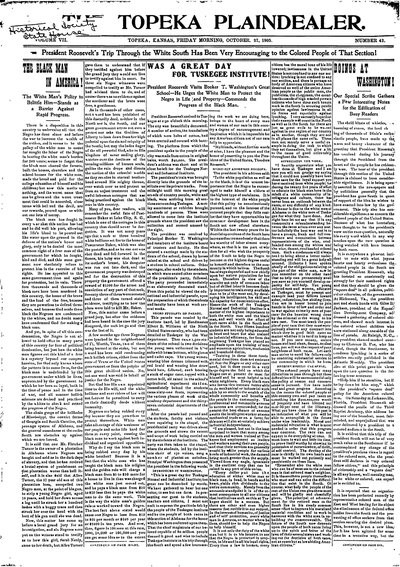
Page text (machine-generated)
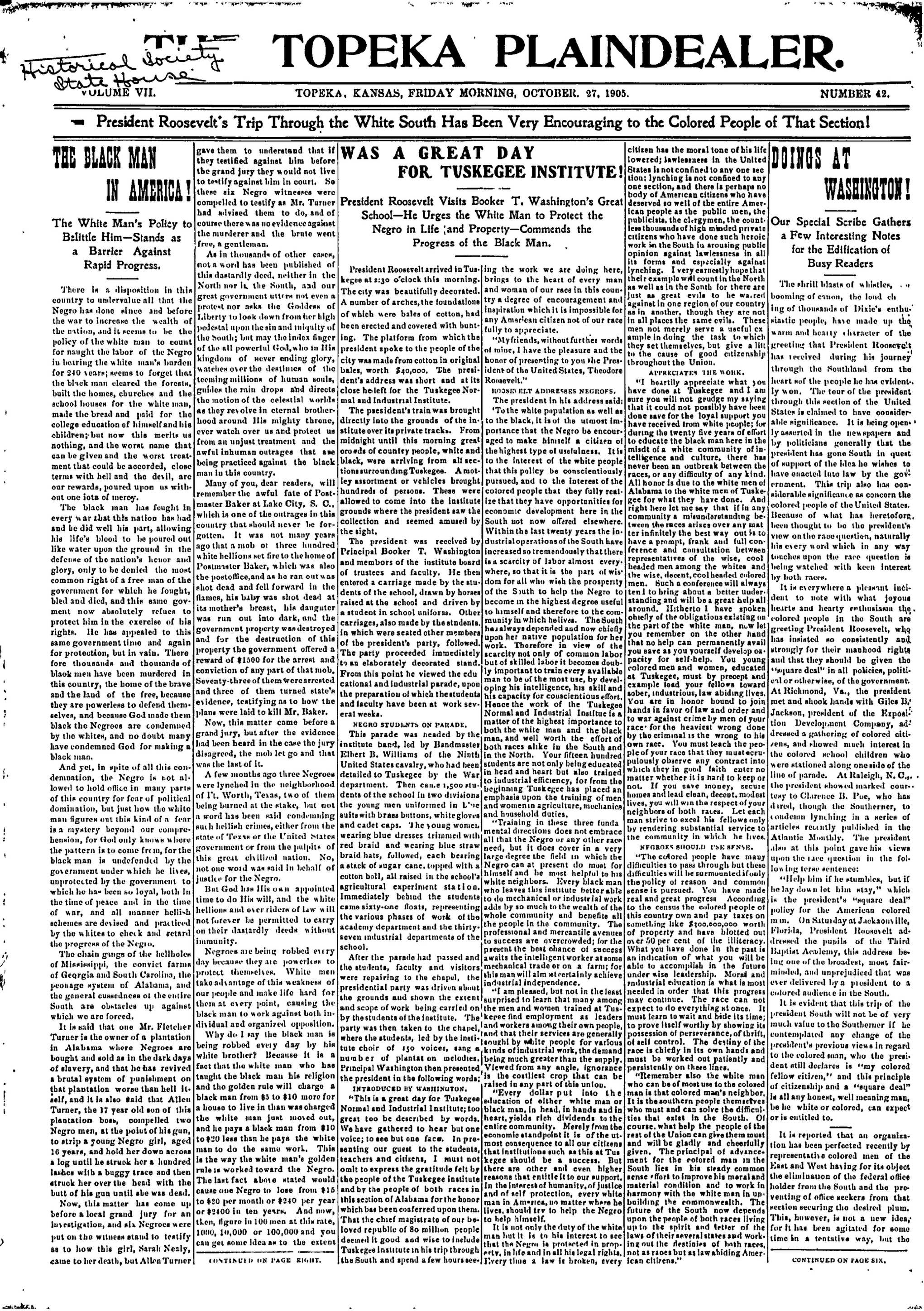
TOPEKA PLAINDEALER.
President Roosevelt's Trip Through the White South Has Been Very Encouraging to the Colored People of That Section!
Historical Society State House VOLUME VII.
THE BLACK MAN IN AMERICA!
The White Man's Policy to Belittle Him-Stands as a Barrier Against Rapid Progress,
There is a disposition in this country to undervalue all that the Negro has done since and before the war to increase the wealth of the nation, and it seems to be the policy of the white man to count for naught the labor of the Negro in bearing the white man's burden for 240 years; seems to forget that the black man cleared the forests, built the homes, churches and the school houses for the white man, made the bread and paid for the college education of himself and his children; but now this merits us nothing, and the worst name that can be given and the worst treatment that could be accorded, close terms with hell and the devil, are our rewards, poured upon us without one lota of mercy.
The black man has fought in every war that this nation has had and he did well his part, allowing his life's blood to be poured out like water upon the ground in the defense of the nation's honor and glory, only to be denied the most common right of a free man of the government for which he fought, bled and died, and this same govement now absolutely refuses to protect him in the exercise of his rights. He has appealed to this same government time and again for protection, but in vain. There fore thousands and thousands of black men have been murdered in this country, the home of the brave and the land of the free, because they are powerless to defend themselves, and because God made them black the Negroes are condemned by the whites, and no doubt many have condemned God for making a black man.
And yet, in spite of all this condemnation, the Negro is not allowed to hold office in many parts of this country for fear of political domination, but just how the white man figures out this kind of a fear is a mystery beyond our comprehension, for God only knows where the pattern is to come from, for the black man is undefended by the government under which he lives, unprotected by the government to which he has been so loyal, both in the time of peace and in the time of war, and all manner hellish schemes are devised and practiced by the whites to check and retard the progress of the Negro.
The chain gangs of the hellholes of Mississippi, the convict farms of Georgia and South Carolina, the peonage system of Alabama, and the general cussness of the entire South are obstacles up against which we are forced.
It is said that one Mr. Fletcher Turner is the owner of a plantation in Alabama where Negroes are bought and sold as in the dark days of slavery, and that he has revived a brutal system of punishment on that plantation worse than hell itself, and it is also said that Allen Turner, the 17 year old son of this plantation boss, compelled two Negro men, at the point of his gun, to strip a young Negro girl, aged 16 years, and hold her down across a log until he struck her a hundred lashes with a buggy trace and then struck her over the head with the butt of his gun until she was dead.
Now, this matter has come up before a local grand jury for an investigation, and six Negroes were put on the witness stand to testify as to how this girl, Sarah Nealy, came to her death, but Allen Turner
TOPEKA, KANSAS, FRIDAY MORNING, OCTOBER. 27, 1905.
gave them to understand that if they testified against him before the grand jury they would not live to testify against him in court. So these six Negro witnesses were compelled to testify as Mr. Turner had advised them to do, and of course there was no evidence against the murderer and the brute went free, a gentleman.
As in thousands of other cases, not a word has been published of this dastardly deed, neither in the North nor in the South, and our great government utters not even a protest nor asks the Goddess of Liberty to look down from her high pedestal upon the sin and iniquity of the South; but may the index finger of the all powerful God, who in His kingdom of never ending glory, watches over the destines of the teeming millions of human souls, guides the rain drops and directs the motion of the celestial worlds as they revolve in eternal brotherhood around His mighty throne, ever watch over us and protect us from an unjust treatment and the awful inhuman outrages that are being practiced against the black man in this country.
Many of you, dear readers, will remember the awful fate of Postmaster Baker at Lake City, S. C., which is one of the outrages in this country that should never be forgotten. It was not many years ago that a mob of three hundred white hellions set fire to the home of Postmaster Baker, which was also the postoffice, and as he ran out was shot dead and fell forward in the flames, his baby was shot dead at its mother's breast, his daughter was run out into dark, and the government property was destroyed and for the destruction of this property the government offered a reward of $1500 for the arrest and conviction of any part of that mob. Seventy-three of them were arrested and three of them turned state's evidence, testifying as to how the plans were laid to kill Mr. Baker.
Now, this matter came before a grand jury, but after the evidence had been beard in the case the jury disagreed, the mob let go and that was the last of it.
A few months ago three Negroes were lynched in the neighborhood of It. Worth, Texas, two of them being burned at the stake, but not a word has been said condemning such hellish crimes, either from the state of Texas or the United States government or from the pulpits of this great civilized nation. No, not one word was said in behalf of justice for the Negro.
But God has His own appointed time to do His will, and the white hellions and over riders of law will not forever be permitted to carry on their dastardly deeds without immunity. Negroes are being robbed every day because they are powerless to protect themselves. White men take advantage of this weakness of our people and make life hard for them at every point, causing the black man to work against both individual and organized opposition.
Why do I say the black man is being robbed every day by his white brother? Because it is a fact that the white man who has taught the black man his religion and the golden rule will charge a black man from $5 to $10 more for a house to live in than was charged the white man just moved out, and he pays a black man from $10 to $20 less than he pays the white man to do the same work. This is the way the white man's golden rule is worked toward the Negro. The last fact above stated would cause one Negro to lose from $15 to $20 per month or $240 per year or $2400 in ten years. And now, then, figure in 100 men at this rate, 1000, 10,000 or 100,000 and you can get some idea as to the extent
CONTINUED ON PAGE EIGHT.
WAS A GREAT DAY FOR TUSKEGEE INSTITUTE!
WAS A GREAT DAY FOR TUSKEGEE INSTITUTE!
President Roosevelt Visits Booker T. Washington's Great School—He Urges the White Man to Protect the Negro in Life and Property—Commends the Progress of the Black Man.
President Roosevelt arrived in Tuskegee at 2:30 o'clock this morning. The city was beautifully decorated. A number of arches, the foundations of which were bales of cotton, had been erected and covered with bunting. The platform from which the president spoke to the people of the city was made from cotton in original bales, worth $40,000. The president's address was short and at its close he left for the Tuskegee Normal and Industrial Institute.
The president's train was brought directly into the grounds of the institute over its private tracks. From midnight until this morning great orrows of country people, white and black, were arriving from all sections surrounding Tuskegee. Amotley assortment or vehicles brought hundreds of persons. These were allowed to come into the institute grounds where the president saw the collection and seemed amused by the sight.
The president was received by Principal Booker T. Washington and members of the institute board of trustees and faculty. He then entered a carriage made by the students of the school, drawn by horses raised at the school and driven by a student in school uniform. Other carriages, also made by the students, in which were seated other members of the president's party, followed. The party proceeded immediately to an elaborately decorated stand. From this point he viewed the educational and industrial parade, upon the preparation of which the students and faculty have been at work several weeks.
NEGRO STUDENTS ON PARADE.
This parade was headed by the institute band, led by Bandmasters Elbert B. Williams of the Ninth United States cavalry, who had been detailed to Tuskegee by the War department. Then came 1,500 students of the school in two divisions the young men uniformed in Lime suits with brass buttons, white gloves and cadet caps. The young women wearing blue dresses trimmed with red braid and wearing blue straw braid hats, followed, each bearing a stack of sugar cane, topped with a cotton boll, all raised in the school's agricultural experiment station. Immediately behind the students came sixty-one floats, representing the various phases of work of the academy department and the thirty-seven industrial departments of the school.
After the parade had passed and the students, faculty and visitors were repairing to the chapel, the presidential party was driven about the grounds and shown the extent and scope of work being carried on by the students of the institute. The party was then taken to the chapel, where the students, led by the institute choir of 150 voices, sang a number of plantat on melodies. Principal Washington then presented the president in the following words:
"This is a great day for Tuskegee Normal and Industrial Institute; too great too be described by words. We have gathered to hear but one voice; to see but one face. In presenting our guest to the students, teachers and citizens, I must not omit to express the gratitude felt by the people of the Tuskegee institute and by the people of both races in this section of Alabama for the honor which has been conferred upon them. That the chief magistrate of our beloved republic of 80 million people deemed it good and wise to include Tuskegee institute in his trip through the South and spend a few hours see-
ing the work we are doing here, brings to the heart of every man and woman of our race in this country a degree of encouragement and inspiration which it is impossible for any American citizen not of our race fully to appreciate.
"My friends, without further words of mine, I have the pleasure and the honor of presenting to you the President of the United States, Theodore Roosevelt."
The president in his address said: 'To the white population as well as to the black, it is of the utmost importance that the Negro be encouraged to make himself a citizen of the highest type of usefulness. It is to the interest of the white people that this policy be conscientiously pursued, and to the interest of the colored people that they fully realize that they have opportunities for economic development here in the South not now offered elsewhere. Within the last twenty years the industrial operations of the South have increased so tremendously that there is a scarcity of labor almost everywhere, so that it is the part of wisdom for all who wish the prosperity of the South to help the Negro to become in the highest degree useful to himself and therefore to the community in which helives. The South has always depended and now chiefly upon her native population for her work. Therefore in view of the scarcity not only of common labor but of skilled labor it becomes doubly important to train every available man to be of the most use, by developing his intelligence, his skill and his capacity for conscientious effort. Hence the work of the Tuskegee Normal and Industrial Institute is a matter of the highest importance to both the white man and the black man, and well worth the effort of both races alike in the South and in the North. Your fifteen hundred students are not only being educated in head and heart but also trained to industrial efficiency, for from the beginning Tuskegee has placed an emphasis upon the training of men and women in agriculture, mechanics and household duties.
"Training in these three fundamental directions does not embrace all that the Negro or any other race need, but it does cover in a very large degree the field in which the Negro can at present do most for himself and be most helpful to his white neighbors. Every black man who leaves this institute better able to do mechanical or industrial work adds by so much to the wealth of the whole community and benefits all the people in the community. The professional and mercantile avenues to success are overcrowded; for the present the best chance of success awaits the intelligent worker at some mechanical trade or on a farm; for this man will almst certainly achieve industrial independence.
"I am pleased, but not in the least surprised to learn that many among the men and women trained at Tuskegee find employment as leaders and workers among their own people, and that their services are generally sought by white people for various kinds of industrial work, the demand being much greater than the supply. Viewed from any angle, ignorance is the costliest crop that can be raised in any part of this union.
"Every dollar put into the education of either white man or black man, in head, in hands and in heart, yields rich dividends to the entire community. Merely from the economic standpoint it is of the utmost consequence to all our citizens that institutions such as this at Tuskegee should be a success. But there are other and even higher reasons that entitle it to our support. In the interest of humanity, of justice and of self protection, every white man in America, no matter where he lives, should try to help the Negro to help himself.
It is not only the duty of the white man but it is to his interest to see that the Negro is protected in property, in life and in all his legal rights. Every time a law is broken, every
citizen has the moral tone of his life lowered; lawlessness in the United States is not confined to any one section; lynching is not confined to any one section, and there is perhaps no body of American citizens who have deserved so well of the entire American people as the public men, the publicists, the clergymen, the countless thousands of high minded private citizens who have done such heroic work in the South in arousing public opinion against lawlessness in all its forms and especially against lynching. I very earnestly hope that their example will count in the North as well as in the South for there are just as great evils to be warded against in one region of our country as in another, though they are not in all places the same evils. These men not merely serve a useful example in doing the task to which they set themselves, but give a lift to the cause of good citizenship throughout the Union.
APPRECIATES THE WORK.
"I heartily appreciate what you have done at Tuskegee and I am sure you will not grudge my saying that it could not possibly have been done save for the loyal support you have received from white people; for during the twenty five years of effort to educate the black man here in the misdt of a white community of intelligence and culture, there has never been an outbreak between the races, or any difficulty of any kind. All honor is due to the white men of Alabama to the white men of Tuskegee for what they have done. And right here let me say that if in any community a misunderstanding between the races arises over any matter infinitely the best way out is to have a prompt, frank and full conference and consultation between representatives of the wise, cool headed men among the whites and the wise, decent, cool headed colored men. Such a conference will always ten I to bring about a better understanding and will be a great help all around. Hitherto I have spoken oftenly of the obligations existing on the part of the white man, now let you remember on the other hand that no help can permanently avail you save as you yourself develop capacity for self-help. You young colored men and women, educated at Tuskegee, must by precept and example lead your fellows toward sober, industrious, law abiding lives. You are in honor bound to join hands in favor of law and order and to war against crime by men of your race for the heaviest wrong done by the criminal is the wrong to his own race. You must teach the people of your race that they must acutipulously observe any contract into which they in good faith enter no matter whether it is hard to keep or not. If you save money, secure homes and lead clean, decent, modest lives, you will win the respect of your neighbors of both races. Let each man strive to excel his fellows only by rendering substantial service to the community in which he lives.
"The colored people have many difficulties to pass through but these difficulties will be surmounted if only the policy of reason and common sense is pursued. You have made real and great progress. According to the census the colored people of this country own and pay taxes on something like $100,000,000 worth of property and have blotted out over 50 per cent of the illiteracy. What you have done in the past is an indication of what you will be able to accomplish in the future under wise leadership. Moral and industrial education is what is most needed in order that this progress may continue. The race can not expect to do everything at once. It must learn to wait and bide its time; to prove itself worthy by showing its possession of perseverance, of thrift, of self control. The destiny of the race is chiefly in its own hands and must be worked out patiently and persistently on these lines.
"Remember also the white man who can be of most use to the colored man is that colored man's neighbor. It is the southern people themselves who must and can solve the difficulties that exist in the South. Of course, what help the people of the rest of the Union can give them must and will be gladly and cheerfully given. The principal of advancement for the colored man in the South lies in his steady common sense short to improve his moral and material condition and to work in harmony with the white man in upbuilding the commonwealth. The future of the South now depends upon the people of both races living up to the spirit and letter of the laws of their several states and working out the destinies of both races, not as races but as law abiding American citizens."
NUMBER 42.
DOINGS AT WASHINGTON!
Our Special Scribe Gathers a Few Interesting Notes for the Edification of Busy Readers
The shrill blasts of whistles, booming of canon, the loud ching of thousands of Dixie's enthusiastic people, have made up the warm and hearty character of the greeting that President Roosevelt has received during his journey through the Southland from the heart of the people he has evidently won. The tour of the president through this section of the United States is claimed to have considerable significance. It is being openly asserted in the newspapers and by politicians generally that the president has gone South in quest of support of the idea he wishes to have enacted into law by the government. This trip also has considerable significance as concern the colored people of the United States. Because of what has heretofore been thought to be the president's view on the race question, naturally his every word which in any way touches upon the race question is being watched with keen interest by both races.
It is everywhere a pleasant incident to note with what joyous hearts and hearty enthusiasm the colored people in the South are greeting President Roosevelt, who has insisted no consistently and strongly for their manhood rights and that they should be given the "square deal" in all policies, political or otherwise, of the government. At Richmond, Va., the president met and shook hands with Giles B. Jackson, president of the Exposition Development Company, addressed a gathering of colored citizens, and showed much interest in the colored school children who were stationed along one side of the line of parade. At Raleigh, N. C., the president showed marked courtesy to Clarence B. Poe, who has dared, though the Southerner, to condemn lynching in a series of articles recently published in the Atlantic Monthly. The president also at this point gave his views upon the race question in the following terse sentence:
"Help him if he stumbles, but if he lay down let him stay," which is the president's "square deal" policy for the American colored man. On Saturday at Jackaonville, Florida, President Roosevelt addressed the pupils of the Third Baptist Academy, this address being one of the broadest, most fair-minded, and unprejudiced that was ever delivered by a president to a colored audience in the South.
It is evident that this trip of the president South will not be of very much value to the Southerner if he contemplated any change of the president's previous views in regard to the colored man, who the president still declares is "my colored fellow citizen," and this principle of citizenship and a "square deal" is all any honest, well meaning man, be he white or colored, can expect or is entitled to.
It is reported that an organization has been perfected recently by representative colored men of the East and West having for its object the elimination of the federal office holder from the South and the preventing of office seekers from that section securing the desired plum. This, however, is not a new idea, for it has been agitated for some time in a tentative way, but the
CONTINUED ON PAGE SIX.
Local and Personal.
Mr. Geo. Braunford is seriously ill at his home on Lane street.
John Hoe of Kansas City spent a few days with his parents last week.
The sewing circle of St. John's A. M. E. church met with Mrs. Mary Smith this week.
Miss Tooley of Chicago will give a recital at the Asbury cbapel in North Topeka tonight.
The City Federation of Women's Clubs is in session this afternoon at the Congregational church.
We are very much in need of money. We hope the subscribers will remember whether they have paid or not.
Mrs. U. F. Scales, who has been visiting Mr. and Mrs. Andrew Jordan, left last Friday for her home in Kansas City.
Mrs. J. L. Ratley is here from Denver to spend the winter with her two daughters, Mrs. G. W. Bryant and Mrs. Hill.
The churches of the city are all in a prosperous condition and this year bids fare to find them more prosperous than ever.
Mrs. G. B. Gallon, wife of the traveling auditor of the Santa Fe, undorwent a surgical operation last Thursday for peritonitis.
Miss Minnie Howel will leave next week for her home in Manhattan, where she will accept a position as teacher in the public school.
The funeral of Miss Jessie Orendorff was held at the First African Baptist church Wednesday. The remains were brought here from Kansas City.
The Masonic celebration by the three lodges and three chapters of O. E. S., last night was a brilliant success, and a large appreciative audience enjoyed the evenings entertainment.
This week our job department completed the minutes for the Prince Hall Grand Lodge, A. F. and A. M. Secretary Childers says that it is the smoothest piece of mechanical work the organization ever had.
The Elks have issued invitations for their first annual ball which will take place Nov. 28. This organization, which is composed of the city's best young men, is sparing neither time nor money to make it a brilliant success.
The Excelsior Art Club met at the residence of Mrs. James Johnson last Thursday afternoon. One hour was spent in needle work, after which a dainty lunch was served. There were two visitors present. The society adjourned to meet at Mrs. Arms.
Mrs. Joseph Bass and niece departed yesterday to join her husband in Helena, Mont., where they will make their future home. Mrs. Bass is a member of St. John's A, M. E. church, and of Prince Albert Court of Calanthe. She will be greatly missed in lodge and church circles.
The Missouri Valley Templars' association will hold their annual conclave in Topeka on Thanksgiving day. A banquet will be served to the three hundred odd Knight Templars. After which a competitive bill will be held for the prize cup which is now held by Cyrene Commanday No.3 of Topeka. This will no doubt be the grandest event in the history of the association, and elaborate preparations are being made for the event.
Jake Lacey, an old Topeka boy has the principal attraction at the street fair in North Topeka this week. He has a good clean show, which is evidenced by the throng that flocks daily to witness each performance. Jake is a hustler and an all-round good fellow, and some day he will be one of the leaders in the amusement world. At the close of the fair tomorrow night he will store his stuff away and winter in Topeka among his friends, who are glad to welcome him back.
When your head aches, there is a storm in the nervous system, centering in the brain. This irritation produces pain in the head, and the turbulent nerve current sent to the stomach causes nausea, vomiting. This is sick headache, and is dangerous, as frequent and prolonged attacks weaken the brain, resulting in loss of memory, inflammation, epilepsy, fits, dizziness, etc. Allay this stormy, irritated, aching condition by taking Dr. Miles' Anti-Pain Pills.
They stop the pain by soothing, strengthening and relieving the tension upon the nerves—not by paralyzing them, as do most headache remedies. Dr. Miles' Anti-Pain Pills do not contain opium, morphine, chloral, cocaine or similar drugs: "Sick headache is hereditary in my family. My father suffered a great deal and for many years I have had spells that were so severe that I was unable to attend to my business affairs for a day or so at a time. During a very severe attack of headache, I took Dr. Miles' Anti-Pain Pills and they relieved me almost immediately. Since then I take them when I feel the spell coming on and it stops it at once."
JOHN J. McELLAN,
Pres. S. B. Eng. Co. South Bend, Ind.
Dr. Miles' Anti-Pain Pills are sold by
your drugseller, who will guarantee that
the first package will benefit. If it
fails he will return your money.
15 doses. 20 cents. Never sold in bulk.
Miles Medical Co., Elkhart, Ind
We are preparing for our great "Holiday Edition" and all who desire to be "in the push" should write now for terms.
Captain Lewis Knott of Fire Station No. 3, while at a fire Sunday morning at the C. M. Chase Shoe company's store, stepped on a nail which penetrated through his foot, causing him to suspend his duties, and J. W. Washington has acted as captain in his stead.
Mr. C. J. Devlin is now in New York and will land in Topeka in a few days. The report that he would never return has been proven false, and in a few months he will pay out every cent due the creditors of the First National bank. Mr. Devlin is a tail and square man and all attempts to prove him otherwise will be knocked into a cocked hat.
Walter Jones, one of our brightest and most energetic young men is taking a course at the Washburn school of fine arts. He is one of the best musicians in the city, and when he completes his course will stand high in the ranks of the best musicians of the country. He is a gentleman in every respect, and enjoys the best wishes of a host of friends among young and old.
The "Colonel," a highly esteemed friend of this force, writes from a prosperous village in Kansas as follows: "I am just feeling fine. I have learned to ride horseback and go out every evening for a ride. I weighed only about 115 pounds when I was there, and now I tip the beam at 172 pounds. It would do that old, dried up crowd good to be here." Mrs. James Wilson of Houston, Texas attended the funeral of her brother, Mr. Lee Shepard, Friday.
Assistant County Attorney W. I. Jamison was in Independence, Kas. last week, and defended the Coffeyville riot cases. Only one case was tried, that of Jack Crouch, who was charged with felonious assault on the chief of police. He was convicted of simple assault. Mr. Jamison was assisted by attorney A. B. Clark. A motion for a new trial will be filed. We think that the chief of police and his henchmen should drop this tomfoolery. The colored men were right in defending their homes.
The night school recently started by the Y. M. C. A. is proving a success and supplying a long felt want. Young men from fourteen years up are given an opportunity to attend. From the number now enrolled, the idea is meeting with popular favor among them. Prof. E. Ridley and Robert DeFrantz, two of the best educators in the city, have been installed as instructors. THE PLANDEALER heartily commends the idea, and we hope to see more of our young men take advantage of the splendid opportunity to improve their education.
Rising Sun Fire Insurance Co. Muskogee, Indian Territory.
Wach This Space NEXT WEEK AGENTS
MANIIATTAN, KANS. [Cut off by mistake.]
Monday from Kansas City with his bride, formerly a Mrs. Washington. This was quite a surprise to most of the Manhattan citizens, as Mr. Williams has been a widower for several years and but few of his friends knew of his absence from the city. Success to them.
Mrs. Maria Mitchell, who has been ill with rheumatism for some time, is somewhat improved and was able to accompany her mother, Mrs. McCrutchen, home Sunday.
FOR RENT-A three room cottage, nice location on Railroad avenue. For particulars, address Mrs. Lydia Huston, Las Vegas, New Mexico.
When you desire to invest $1.50 in a race enterprise that will bring you a hundred fold in happiness and m fort try THE PLAINDEALER.
NOTICE OF PUBLICATION.
In the District Court of Shawnee County, Kansas.
Ceoile Terry, Plaintiff.
The above named defendant will take notice that he has been sued by the plaintiff, Cecile Terry, for a divorce upon the grounds of abandonment and gross neglect of duty; and that he must on or before December 9, 1905, plead or answer the petition filed by the plaintiff in the above entitled action in said court, or the allegations in said petition will taken as true and judgment rendered, divorcing plaintiff from the defendant.
CICILI. TERRY, Plaintiff. By J. R. McNARY, Attorney for Plaintiff.
DRINK
GOETZ
Standard
Beer
THE BEER WITHOUT A HEADACHE.
Established 1859, Saint Joseph, Mo. M. K. GOETZ BREWING CO.
The Inter-State Literary association of Kansas and the West will convene in annual session at Kansas City. Mo. Dec. 26, 27, 28. Each literary societo is entitled to representation by three delegates (one of whom may have a place on the program) and three alternates.
New societies and those not having been enrolled at the last session of the association, will be required to pay a fee of $150. Societies enrolled at last session will pay $1 membership fee.
The executive committee will convene in November for purpose of making up the program. Any society may become a member of the association by application to the president or corresponding secretary on or before the first day of December, sending therewith the required fee.
429 Kansas avenue, Topekh, Kans. Miss A. F. MOORE, Cor. Sec'y, 1214 Vine Street, Kansas City, Mo. I. M, HORTON, Ch'mn Ex. Com. 1608 E. 13th Kansas City, Mo.
WANTED—A good situation for a first class barber wanting to leave the Indian Territory. Married man. Address Walter Petoreon, Vinita, I. T. Box 41.
WE WANT HIM—Must find him—Rev. E, Roey, who was pastor of the Baptist church at Ratoon, New Mexico. Will pay for the information. Addaess Lock Box 1173, Weir City, Kansas.
A Game of Bluff.
From The State Record.
BY ARCHIMEDES.
"Come out!" they cried, with jeer and shout,
"Come out with club and gun!
We'll bluff the rooster from his perch
And see Tom Kelley run."
The yelling lines rush madly on,
A howling host they come;
But, ah, they stop with sudden shock
Tom Kelley wouldn't run.
They waver first, and next give back—
For pluck a mob will stun—
Then he them to their homes again
Since Kelley wouldn't run.
There may be truth in what they say—
It may be only fun—
He'd bug the post or do his time,
But don't you believe he'd run.
In after years they'll tell the tale
Of how the chase begun,
And how it ended in a out
When Kelley wouldn't run.
- HOMEK WILKARD;
East on the Southwest Limited
You cannot drop your napkin and pick it up in the dining car of The Southwest Limited. A waiter will be there with a clean one. A porter was recently disciplined for brushing a hat with a whisk broom instead of a brush. These are little things, but they show how excellence of service is maintained on the
This Company owns and operates the sleeping, dining, library and all other cars on its lines, and therefore offers its patrons an excellence in equipment and service not obtainable elsewhere. The Southwest Limited leaves Kansas City, Union Station, 5.55 p. m.; Grand Avenue, 6.07 p. m. Atrives Union Station, Chicago, 8.55 a. m.
G. L. COBB, Southwestern Passenger 907 Main Street, Kansas City.
WESTER
ESTERN UNIVERS
WESTERN UNIVERSITY,
The Great Educational Institution for Kansas and the West. .....
DEPARTMENTS: THE
State Industrial
COURSES: Classical
mal, Musical (M
organ and harp
Carpentry, Pr
Stenography and
Jain Sewing, C
AGES: Spl
quences and T
ORMATION: For
write to
William T
QUINDARO.
MENTS: Theological, College, Normal, Sub-M
state Industrial.
AGES: Classical, College, Preparatory, Normal,
Musical (Instrumental and Vocal), include
organ and harmony, Drawing (Fine Arts and M
arpentry, Printing and Book-Binding, Busi
tenography and Typewriting, Tailoring, Dreesn
ain Sewing, Cooking, Laundering, Farming and
AGES: Splendid Location, Heathful Climate,
ences and Thorough Teachers.
MATION: For terms, prices and all inducemen
ite to
William T. Vernon, A. M.,
PRESIDENT,
DARO.
DEPARTMENTS: Theological, College, Normal, Sub-Normal and State Industrial.
COURSES: Classical, College, Preparatory, Normal, Sub-Normal, Musical (Instrumental and Vocal), including piano, organ and harmony. Drawing (Fine Arts and Mechanical), Carpentry, Printing and Book-Binding, Business Course, Stenography and Typewriting, Tailoring, Dreesmaking and Iain Sewing, Cooking, Laundering, Farming and Gardening.
AGES: Splendid Location, Heathful Climate, Good Inuences and Thorough Teachers.
ORMATION: For terms, prices and all inducements offered, write to
William T. Vernon, A.M., D.D., PRESIDENT,
Phones { Office—Bell—"White"4302 Residence—Bell—"West" 15.
Comfort i
Depends on man
what is wanted—
to spray the room
ing; a thermom
water bottle—a d
The doctors are
things and other
We take this me
KOHL'S
Pre
comfort in the Sick Room
ends on many little things. Trained nurses is wanted—an atomizer, with a mild disinfect the room and make the air clean and a thermometer, fresh absorbent cotton a bottle—a dozen little things that help the doctors and nurses know that we have aids and others, in the most dependable qi make this means of letting you know it.
DHL'S PHARMACY
Comfort in the Sick Room.
Depends on many little things. Trained nurses know what is wanted—an atomizer, with a mild disinfectant, to spray the room and make the air clean and refreshing; a thermometer, fresh absorbent cotton, a hot water bottle—a dozen little things that help the patient. The doctors and nurses know that we have all these things and others, in the most dependable qualities. We take this means of letting you know it.
KOHL'S PHARMACY,
Phone 743. }
Phone 561. } 732 Kansas
Ind. Phone 743.
Bell Phone 561.
Southwestern Passenger Agent,
Kansas City, Mo.
College, Normal, Sub-Normal and Preparatory, Normal, Sub-Nor- and Vocal), including piano, singing (Fine Arts and Mechanical), Book-Binding, Business Course, Tailoring, Dreesmaking and Handering, Farming and Gardening.ion, Heathful Climate, Good In-cheers.ices and all inducements offered,ion, A. M., D.D.,IDENT,
Sick Room.
ngs. Trained nurses know better, with a mild disinfectant, use the air clean and refresh- h absorbent cotton, a hot things that help the patient. know that we have all these most dependable qualities. ng you know it.
PHARMACY,
Prescriptions a Specialty. 732 Kansas Ave.
KANSA8.
The quarantine has been raised and all business is in a progressive mood.
Mrs. W. J. Yetby has gone to Chicago to spend the winter.
Mrs. Emma Roddy is very ill.
Miss Kate W. Fields has entered Walden university, Nashville.
The rally at the New Bethel Baptist church was a grand success. The members should be proud of their faithful pastor, Rev. J. W. Shaw. Collection during the day amounted to $60.
Mrs. Rose Cox has been on the sick list the past two weeks.
Do not forget J. L. Fisher, 307 Battle street, when you are hungry. He has everything nice to eat.
Square Brown is confined to his bell, being injured in an accident at No. 7 compress.
Rev. A. P. Sims, the successful pastor of the New Hope Baptist church, speaks favorably of The Plaindealer and wishes it much success. Rev. Sims has accumulated considerable property since he has been in this city.
II. L. Fields, who conducts a meat market on Horace avenue, has opened a first-class grocery store on Johnson avenue. Rev. W. L. Petty, a young minister of this city, has gone to Saint Elmore. Dr. Sadie F. Porter has returned from Crawfordsville, Ark. She lectured at two of the leading churches while there. A large delegation of the Baptist ministers left for Chicago to attend the National Baptist convention.
LINCOLN. NEB.
Miss Sirah Williams returned last Friday from Oklahoma where she had been visiting her mother and other relatives.
Mrs. J. L. Brown returned last week from Duluth, Minn.
Miss Bertha Saunders is quite ill at her home on Rose street.
C. R. Bennett who was injured some time ago by falling from a street car, is able to be out.
Grand rally at the Newman next Sunday. Your presence and finance earnestly solicited.
There will be quarterly meeting at the A.M.E. church next Sunday. Presiding Elder J. W. Braxton will conduct the services. The Newman Methodist church communed last Sunday. The Nebraska football team arrived home Monday from Ann Arbor, Mich., and was received enthusiastically in spite of their defeat by the Michigan team; but the boys played a great game and are to be commended. W. N. Johnson was the star of the team, on left end.
Dr. Jenkins preached an interesting sermon Sunday night at the Mount Zion Baptist church.
J. T. Wright returned to work this week after two week's vacation.
Read The PLAINHEALER.
FRANKFORT, KAS.
Rev. L. F. Byron, now pastor of the C.M.E. church, arrived in the city last Saturday to take charge of the work. He comes to our city highly recommended and his work with us will be a success.
Rev. Wm. Lee, ex pastor of the C.M.E. church, was in the city this week shaking hands with friends.
Rev. W. A. Magette left Tuesday for Fairbury, Neb.
Miss Mary E. Bennett is on the sick list.
C. M. Hickman has gone to Topeka to remain indefinitely.
William, R. C., J. C. and M. G. Harris of Kansas City and Saint Louis respectively, were in the city last week, being called here by the death of their sister, Emma, who was accidentally killed by an cast bound train Wednesday. She was the daughter of Mrs. H. C. Harris and was one of our most highly respected young ladies and the community mourns her untimely demise.
```markdown
```
The entertainment last Saturday night under the auspices of the ladies of the O. E. S. was quite a success. Chester Harris of Blu Rapids came down last Thursday to attend the funeral of his sister. Julian and Robert Harris left Tuesday for Kansas City.
FARM
MISCELLANY
The nitrogen of the soil is one of its most important constituents and a fertilizing element that quickly disappears. It volatizes rapidly and one of the chief agents of holding it in the soil is the humus. When the humus becomes exhausted the nitrogen escapes with increased rapidity. Experiments with continuous wheat growing on the same soil have shown that the animal and vegetable matter in the soil disappears very rapidly. This causes the liberation of the nitrogen. As long as the nitrogen is in combination with and forms a part of the humus, or decaying animal and vegetable matter of the soil, it is in a stable form; but as soon as the humus decays the nitrogen is liberated in various gases and soluble forms, which are easily lost from the soil. It is the statement of scientists that there is no element that is so readily lost as nitrogen. It is not possible for the general forms of plant food, such as potash and phosphoric acid, to be converted into gaseous and soluble forms by the ordinary chemical changes that take place in the soil, as in the case of nitrogen. With them the principal loss in their removal from the soil as plant food. But with humus it is different. There is a loss of course of the plant food by its being used by the crops, but much additional is leached downward by the soil water and some is sent off in the form of gas when the humus decays. We have an illustration of this in the decay of piles of manure and vegetable matter. We say that we can smell the ammonia rising from them; but that ammonia is the gas into which the nitrogen in the decaying mass is being changed.
The loss of soil nitrogen can only be prevented by keeping up the humus in the soil. In most countries rotation of crops alone is able to do this. Some men brag that they have grown wheat year after year on the same soil for a generation without loss, but it will be found that such soil was in the beginning very rich in humus. By all means rotate, and include in the rotation some of the legumes
Winter-Grown Asparagus.
Winter-grown Asparagus.
Asparagus can be grown in the cellar in winter wherever the owner heats his house by means of a furnace. The natural conditions in such a cellar are favorable to the forcing of asparagus, as the temperature at night usually hovers around 55 degrees and in the day time runs from 65 degrees to 80 degrees. We do not believe that the amateur will find much profit in this, but some of the professional gardeners do, and it may interest some of our readers to try the experiment and have a few messes of tender asparagus in winter
To get the results named, roots are dig up in the fall before the ground is too hard frozen to make digging them out possible. If the roots have been frozen, so much the better, as they then respond more quickly to the forcing process. They are placed in boxes in the cellar near the surface. Two or three inches of soil should be under the roots and five, six or more inches of earth above, as the shoots need to be protected from even the dim light that is found in a cellar. Light is not needed to make the roots produce shoots, as they produce them from the substance laid up in the roots, but do not take anything from the soil. Nevertheless, much moisture is needed, as the shoots cannot develop without the help of a good deal of water. A neglect in supplying moisture will soon render the roots unproductive
Roots should begin to produce shoots in about twenty-five days after being placed in the cellar. At some of the stations roots placed in the cellar about the first of December have produced four or five good outings before the middle of February. When the roots are done producing they have to be thrown away, as they will thenceforth be of no good for the developing of tops and new roots. Farmer's Review.
Lime for Dairy and Stable.
In Denmark there is a box of time in every dairy or creamery, where it is of use in rinsing out vessels to keep them sweet and clean, and to wash down the creamery floors and to purify the air generally.
We are using it to a small extent in this country, but it is not common enough. It is one of the best purifiers and cheapest. Its use can be applied to the cows' drinking troughs in warm weather, to remove the scum or organic matter therefrom; it can be applied in the cow stable, where it is most invaluable. We know of nothing as effective as slaked lime with carolic acid mixed in it, for giving the surroundings of the barn a wholesome atmosphere.
This cheap and handy agent is readily made by slaking the lime, filling a three gallon pail about half full, adding about two ounces of, crude carbolic acid. If the lime is not all to be used at one time it can be put away in an air-tight vessel, but it is best to use it fresh.
For the dairy and creamery use the slaked lime only—slaked just before using. It has the physical advantages, as well, in lighting up the barn, making it sweet, clean and wholesome when sprayed on the walls, in the spring and fall—Farmers' Guide
The ONLY exclusive Art Studio West of the Mississippi. 1512 North Fifth Street, Kansas City, Kan. Send your small Pictures to us, we will enlarge them in
Pastel, Seepier,
You pay nothing in advance,the pictures are subject to your approval.
Artist O. J. Brooks will come to any town in these United States and decorate in Oil on the panels of your walls any pictures you wish in your homes, halls or churches. We endeavor to please all, but like Christ, we cannot, so we content ourselves in pleasing some. Give us a trial and see if we can't add you among our list of plased.
O. J. Brooks, The Artist.
Meats and all kinds of Produce. Home'Phone 784 West.
If You Want to Buy
---
a property or a business
of any kind any
where in the United
States, write us a postal
card for my Free Call-
ing bag everywhere and can save
you money. Don't wait
Writeto day,
A.P. Tone Wilson, Jr.
REAL STATE SPECIALIST
413 Kannam Ave.,
Gentlemen's Buffet.
Wines and Liquors.
JACKSON
301 Independence Ave. KANSAS CITY, : MISSOURI.
THE OPPORTUNITY OF TO-DAY
The opportunity for the man with little means is probably better to-day in the private states of the South west than ever, close in the history of the nation. To be sure, there is not the worst open choice of land for the homesteads that existed in the 70s. The lands then take up under government laws are now prosperous farms and ranches. The opportunity to-day is in the investment chance; in the purchase of farm lands at prices less than half the prices asked in the Old State of Ohio, Indian territory to develop the ordinance of Oklahoma. Indian Territory has to develop the ordinance of Oklahoma. Producing the crops of which it can be, practically the same thing is the work. Few lines of business are adequately represented. There are openings of all sorts for the right man. Are you one?
If you are interested, tell us what you want, how much you have to travel, and we will gladly furnish the information. Write for a copy of our paper "The Coming Country." It's free. Address
W. P. LINDSEY.
GEORGE MORTON,
Q.P. & T.A., M.K. & T.R.,
ST. LOUIS, MO.
The lying subscriber is a vampire who kills any Negro paper. He lies about his pay day and then slanders the paper when he is cut off for not paying his subscription. We have a number of dude fellows claiming to be paying their girl's subscription, and we are going to show their ladies what dead boots they mix with.—Exchange.
Board #3 Per Week. Regular Meals 150
HOUSES to RENT.
Neatly Furnished and Unfurnished Rooms. Also Rooms for Light Housekeeping.
S. M. POWELL, 'PROP. Kanae City, Kas.
I want a housekeeper not over 40 years of age. Five children. Good place. Anyone wanting such a place write to me and get full information. Address
B. E. McFarland,
Frankfort, Kansas.
Newport Restaurant
TIBB STARNBS. Pro .
Everything First-class—Short
Orders a Specialty.
1315 Dodge St.,
OMAHA, NEBRASKA
```markdown
```
```markdown
```
The Cosmopolitan Cafe is the place to go when you want SOMETHING NICE TO EAT.
FINEST AND CHEAPEST CAFE IN THE UNITED STATES.
Well Ventilated, FURNISHED ROOMS in connection.
] GIVE US A CALL.
```markdown
```
G. W. SMITH, Prior.
343 Beale Street.
Wm. McKNIGAT, Mgr.
T. N. COLLIN
Waiters Catering
1223 BALT
WAITERS, PORTES A
When in Kansas City
Association. Neatly
a Specialty.
BUFFET.
KNIGAT, Mgr. J. T. MORELAND, Sec.
T. N. COLLINS, Head Barber.
Caters Catering Association,
1223 BALTIWCRL AVB.
Caters, PORTES AND ALL STRAINGERS
when in Kansas City are invited to visit the
association. Neatly furnished Rooms. Baths
Specialty.
ET. LICENSED BARBERS
GET THE BEST!
Waiters Catering Association, 1223 BALTIWORL AVE. WAITERS, PORTES AND ALL STRAINGERS When in Kansas City are invited to visit the Asssociation. Neatly furnished Rooms. Baths a Specialty.
GET THE BEST!
USE ONLY Taylor's Perfection Flour
Taylor Buck F1
AND aylor's Pure Buckwheat Flour
Insist upon being furnished the above popular bronds of flour, and you will certainly get] the best in the market.
First-class service. Short orders a specialty. When in Kansas City, call and see me. If you're pleased tell your friends, if not tell me.
King Hotel
First-Class Board Land Lodging Ice Cream and Cigars. D. Waddington,
The Little Gem Restaurant,
100 KANSAS AVENUE
a first-class place for a
square meal or lunch. Ice
cream and cigars.
W. H. Henderson,
PROPRIETOR.
MEMPHIS, TENN.
```markdown
```
When You Travel
select a railway as
you do your clothes
KATY SERVICE
(MISSOURI, KAISAK & TEXAS RAILWAY)
Suggests Comfortable and
Convenient Trains,
The "KATY FLYER" and
KATY DINING STATIONS
Meals Moderate in Price,
Unsurpassed in Quality and Service
One Price, 80c
MK-7
I am respect any number of pleasant trips and send you something new to printed matter about them. Write to me.
"KATY." "St. Louis"
WAITERS AND PORTERS'
Headquarters!
CHAS. PHELPS' Barber Shop is where you meet them. The leading barber shop in the city. .....
William Thomas, member of troop "M," Tenth Cavalry, enlisted at Memphis, Tenn. in 1867 and served three years. He was at Fort Gibson, Fort Rilev. Fort Arbuckle and Fort Cobb. Was discharged August 0th, 1870. He wants to find two comrades who know him, and wishes to make proof of claim in order to get back money due him. Mr. Thomas resides at Junction City, is 5 feet, 4 inches high, weighs 136 pounds and is fifty-eight years of age.
In the District Court of Shawnee County, Kansas.
Stella E. Jones, Plaintiff,
vs.
Herbert W. Jones, Defendant.
PUBLICATION NOTICE.
Herbert W. Jones, the defendant above named, will take notice that he has been sued by the plaintiff, Stella E. Jones, and that said Herbert W. Jones must, on or before the 25th day of Aug. 1905, answer to the petition filed by plaintiff in the above entitled action in said court, or the matters and things set forth in said petition will be taken as true and judgment rendered divorcing the plaintiff from the defendant.
[Seal] W I. JAMISON,
Attorney for Plaintiff.
Attent: I S. CURTIS,
Clerk of the District Court.
By ANNA M. TITHON,
t Deputy Clerk.
HEMORLINE
FOR PILES
FOR THE MILLIONS
THE WORLD ROUND
THE ONLY PERFECTED ABSORBENT
CURE
NO COMPARISON
It is good, better best you better still
the most best thing to a rich water will
you glad, gladder gladder than gladder still
when you know it will cure every local ill.
Pharmaceutical sharbing power, the active
Principle of HEMORLINE is taken from tropical
Bruts, opening a new route in Pharmaceutical
Science, entirely Original.
Lensers Dusters, Mounters, Machines, and
Humidum all walks of life are a useful in
Proclaiming if the great Climes of All Remarks.
Send for our booklet of the most remarkable
Trialmials ever published We will extend
when you with unguessable evidence.
Sold by all first-class Druggists if your
Dealer cannot supply you send us S.C.
And your Druggists name and address.
We will mail you a S.O.C. box.
Demand HEMORLINE Like no other there
is no substitute it alone sucres
ADDRESS THE HEMORLINE CO.
MARSHALL, MO. U.S.A.
---
PUBLISHED at Topkah, Shawnee county, Ks. very
Friday morning by
THE PLAINDEALER PUBLISHING CO.
910 EAST SEVENTH STREET.
WICK CHILES. BUSINESS MANAGER
J. M. CHILDERS. EDITOR
One year by mail..... $1 50
His months by mail..... $1 00
Five months by mail..... $500
FRIDAY, OCT 27, 1903.
The 51st annual session of the Missouri conference convened at Higginsville, Mo, last week. Bishop A. Grant presided. There were eight five ministers who are members of this conference. The reports showed great gains over 1904 both in membership and finance. The session was held at St. James chapel of which Rev. A. H. Brooks is pastor. Much credit is due him for the success of the entertainment of the ministers and visitors. His estimable wife ably assisted him. Rev. Brooks has developed into a hog raiser. He has over $200 worth of young hogs on hand. Higginsville is a mining town and has a colored population of about from five hundred to seven hundred. They own two harbershops, a restaurant and two churches. They own their homes and seem to be getting along nicely, although there is room for improvement; if the people would take on a little hustling quality they could do much better. We did not wait for the adjournment of the conference, but were promised the list of appointments which has not reached us yet. It will appear next week.
LINCOLNINSTITUTE.
The first term of the scholastic year of 1905-06 has thus far proved a record breaker in the history of the institution. The enrollment to date, October 18, is 344, and every day adds to the number. Already it is has become necessary to divide classes because of their size and in some of them it will soon be necessary to make subdivisions.
Students are here from California on the West, the Gulf of Mexico on the South, from Iowa and the Great Lakes on the North. The college department has enrolled more. One finds among the students of the college department John W. Allen, recently of Clark University, Atlanta, Georgia. Mr. Allen comes to Lincoln Institute through the advice of Mrs. Alice D. Carey of the Morris Brown college. Mrs. Carey was formerly a teacher in the Kansas City system of schools, and after visiting Lincoln Institute last year, was so favorably impressed with the management and character of the work that she determined to send here from time young men whom she thought of more than ordinary ability. Thus far there are five young men placed to her credit as members of the institute.
Among the graduates of the class of '05, well placed as teachers, we find Miss Mildred Williams employed at home in Columbia. At Fulton one finds Homer Wilburn, valedictorian of his class. At Carbondale, Ills., William Thomas, principal with several assistants. Mr. Thomas' letter was of such high character that his Missouri state diploma exempted him from examinations.
A recent issue of the New York School Journal contains an item, an excellent tribute to the character of the work that is being accomplished in Lincoln Institute.
The Western Tuskegee,
DEPARTMENTS Normal, Preparatory, Industrial, Agricultural, Business, Music, Elocution and Dramatic Art. THE GRADES
ADVANTAGES
Local and Long WM. R. CARTER. PRINCIPAL TOpeka, Kas Dist. Phone 747
THE PRESIDENT
The presidential party arrived at Jacksonville, Fla. Saturday morning, and was greeted by thousands of cheering citizens. After driving through the principal streets the party was driven to the Seminole club, where he made a brief address on good citizenship. He was then driven to the Negro Baptist academy, where he delivered a short address. Preceding his speech there was a brief ceremony in the assembly hall in which the students participated. They consisted in the singing of a number of songs written for the occasion. The last one, entitled "You Are Right, Teddy," caused the President to smile broadly. The president spoke as follows:
"My friends, let me say what a pleasure it has been in driving along the streets to have the governor point out to me house after house owned by colored citizens, who by their own industry, energy and thrift had accumulated a small fortune and are spending it wisely.
"Every good American must be interested in seeing every other good American citizen rise, help himself upward, so as to be better able to do his duty by himself and those dependent upon him, and by the state at large.
"It seems to me that it is true of all of us that our duties are even more important than our rights. If we do our duty faithfully, in spite of the difficulties that o ercome, then sooner or later the rights will take care of themselves. What I say to this body of colored fellow citizens is just what I would say to any body of my white citizens.
"What we need in this country is typified by what I have been shown today as having been done by people of your race.
"We need education, morality, industry; we need intelligence, clean living and the power to work hard and effectually. No man interested, as every president must be in the welfare of all his fellow Americans could be otherwise than deeply pleased not only at the evidences of thrift and prosperity among what must be many hundreds of our numbers here in this city as shown by the homes that I have seen, but interested also in seeing an educational institute like this carried on as this institute evidently is carried on. The costliest crop for any community is the crop of ignorance. It is perfectly true that education in mind alone will not make a good citizen; but it is equally true that you cannot get the best citizen without education. "We need to have our people of every race educated as the principal said in his words of introduction, in
Topeka Industrial and Educatio A School of Practical and Christian Training.
Mechanical and Architectual Drawing, Carpentry, Painting, Printing, Book binding and Tailoring. Sewing—plain and advanced Dressmaking. Domestic Sciences—Cooking, Laundrying, Housekeeping, Market Gardening and Poultry Raising. The Only Undenminatonal School in the West.
All graduates find ready employment. Only the best and most approved methods used. Special attention given to home and religious training. Endorsed by Ministers of EVERY denomination. Terms reasonable. Worthy students helped FALL GERM BEGINS SEPG.12 Send for Catalogue. For further information address,
heart, mind and hands; educated so that heads, hands and hearts, can do their several tasks and have behind head and hand, also the heart, the conecience, the sense of clean and just living which makes the foundation of all good citizens. That is just as true for the white man as for the colored man.
"It is true of every man. I was very glad to listen to the singing today. I like it all, including the last song. I wish I could have had a chance to listen to some of your educational exercises. I want to say a special word of acknowledgement to the school teachers, men and women alike, who are doing the work of education, and in saying that word I also want to point out this, it is absolutely essential that we should have people to do well in the professions but there is only a limited amount of room in the professions and there is almost an unlimited amount of room for men in agriculture and in the mechanical trades.
"Do your very best to develop good teachers, to develop good preachers; preachers who shall preach to the colored man as it should be preached to the white man, that by their fruits you shall know them, and that the truly religious man is the man who is decent and clean in his private life; who is orderly and law-abiding; the man who hunts down the criminal and does all he can to stop crime and wrongdoing; the man who treats his neighbor well; who is a good man in his own family, and therefore a good man in the state. That is what we have a right to expect from the Christian leadership which we see in the churches. All honor to the teacher, all honor to the preacher, but remember it is perfectly impossible that the bulk of any people shall be teachers or preachers.
"The bulk have got to be men engaged in the trades as mechanics, as wage workers, as farmers. Every man who is a good farmer, a thrifty, progressive, saving mechanic who owns his own house which is free from debt; who is bringing up his children well and keeping his wife as she should be kept, is not only a first-class citizen, but is doing a mighty good work in helping to uplift his race."
Read and be wise, and above all read THE PLAINDEALER.
THE GREATEST HAIR DRESSING
NELSON'S Straightine
Makes
Kinky, Curly
Hair Straight
It is not only the BEST DRESSING made for the Hair, but
THE MOST WONDERFUL HAIR GROWER
NELSON'S STRAIGHTINE is unlike any of the other Hair preparations on the market. It contains no powerful or dangerous chemicals, and in therefore absolutely HARMLESS. It works directly upon the scalp and roots of the Hair, removes dandruff and other diseases of the scalp and skin, nourishes and stimulating the roots of the Hair, thereby causing it to grow rich, lusting and lazierous. At the same time stopping it from splitting, breaking off or falling out, STRAIGHTINE keeps the Hair soft and pliable, making it easy to do up in any style. Delightfully perfumed.
NELSON'S STRAIGHTINE is sold by druggists and agents everywhere. PRICE: 25 CENTS A CAN. If you cannot get it from your druggist or one of our agents, SEND US 50 CENTS, in stamps, silver or Money Order, and we will send you one large can (one month's treatment) by mail, securely wrapped, together with our great FREE BRUSH OFFER. Address:
AGENTS WANTED
Write for Terms and Particulars
NELSON M'F'O CO., Richmond, Va.
First-class in every particular. Prompt service.
Phones 192 511 Quincy 2
. Stonestreet. G. W. H.
Monstreet & Hamilton
Succesors to J. M. Knight.
dertakers and Embalme
Fred M. Stone street. G. W. Hamilton.
Stonestreet & Hamilton,
Succe mors to J. M. Knight.
Undertakers and Embalmers.
carry one of the finest lines of Undertaking
uth and Quincy Sta. Toncka.
LIVE! STOCK
Good Feed Rack.
Last spring we published a description of a feeding rack to be made with or without trough, which plane were furnished us by a subscriber whose patents on the rack had expired and who had no further use for the plan. Mr. Ira I. Nixon, a prominent stockman of Dowitt county, Illinois, writes
concerning this plan as follows:
"I have added a trough all around the rack floored to the outside of posts and used pieces 1½ feet by 8 inches nailed on out side of posts, which catch what would waste if the trough was not there. I have built mine of 3x4's where this man used 3x4's for posts, which makes it very strong. I have used oak lumber, and I think I have the best rack I ever
new for shock corn, straw, hay, or ear corn, as ear corn or ground feed can be fed all around in the trough, which is forty two feet long and large enough to feed a car load of cattle. If built with 3x4's you will be compelled to use one inch longer bolts than this man has in his rack where the 3x4's are bolted together. My rack has 2x4's for the bottom bolted full width of rack and one on each end to hold the floor. I have used 1½x4-inch stuff for slats instead of 1x6, and placed them eight instead of six inches apart.
"I am feeding cotton seed meal with ground cob meal and will give you my results when cattle are shipped out. I am feeding 100 head, and I now new cattle do better or look nicer."
Any changes in the original plan will of course necessitate corresponding changes in the bill of material, but as originally planned and as shown in the cut the following materials are required for the rack sixteen feet long: Two pieces 2x8 16 feet long; 3 pieces 2x4, 14 feet; 4 pieces 2x4, 16 feet; 3 pieces 2x4, 14 feet; 1 piece, 2x4, 13 feet; 2 pieces 1x6, 18 feet; 2 pieces 1x6, 18 feet; 5 pieces 1x6, 14 feet; 9 pieces 1x13, 16 feet; 1 piece 1x13, 14 feet; 56 pieces, 1x8, 4 feet; 4 wood screws, 8 inches long; 4 bolts %x9 inches; 4 bolts %x7 inches; 16 bolts, %x5 inches; 18 bolts %x4 inches; 8 bolts %x7 inches; 8 pounds 8-penny wire nails; washers for all bolts; 4 pounds 10-penny nails. —Wallace's Farmer.
Working Brood Mares.
Some of the leading horse breeders of the country never put their brood mares in harness. They provide an exercise in other ways in order to keep the stock in vigorous health. As a rule these breeders have extensive grass paddocks, into which the mares are turned for several hours each day throughout the winter season. Horse breeders who neither work their mares nor turn them out daily invariably get a small proportion of increase. Some foals are lost immaturely, and others are born so weak that they die soon afterward.
Most horse breeders, especially those of long experience, prefer that mares in foal should have regular exercise in the form of light work, but forking and straining should be avoided under all circumstances. For best results it is a good plan to use three horses for work that would be required of two under ordinary circumstances. This is not done at an additional expense of one-third, because three horses will do more work than two, if the speed alone is considered. Then it often happens that plows and cultivators may be set on an inch or two deeper and the extra work thus accomplished is worth a great deal, although it may not show on the surface. A man can drive three horses faster than two and rest less at the end of the row.
Uaing Good Rams.
While looking over some large flocks in Central South Dakota we find too many who do not appreciate the use of a first class ram. We have recently seen a bunch of 600 ewes whose lambs alone would have brought at least $500 or more, had a good pure bred ram been used.
Feeders do not want them at hardly any price and the ewe lambs are not fit to keep as breeders. When one looks at these things from any point of view, it is a puzzle to know why so many sheep raises continue to carry on the business in such a careless manner. A good even lot of lambs are always in good demand, while poor ones are not wanted at all—Northwestern Agriculturist.
Selection of Stock.
A medium sized male with good fair sized females of good constitutional vigor and mature age will do far better than the largest males with the smallest females. The wise farmer always selects the very best corn or grales of all kinds for seed; equal care should be given the selection of breeding stock in turkeys. The best raised on the farm should be kept for producers, and the fact should be kept in mind that turkey hems of the best quality in their second or third year of laying make the best producers. The medium sized, well formed hems that have good strong bones and constitutional vigor are the ones to select for breeders. — Wendell's Farmer.
BALL PHONE 1001 MAIN
OFFICE HOURS 7 to 20 A.M.
12 M. to 4 P.M.
Ind. Phone 100. 7 to 10 P.M.
J. M. JAMISON, M.D.,
PHYSICIAN AND SURGEON
Examining Physician of the Knights and Knights
1 Protection.
O. A. TAYLOR, M. D.
PHYSICIAN AND SURGEON
826 Manns Ave. Ind. Phone 774.
Office Hours {7 to 8 a.m.
2 to 4 and 6 to 8 p.m.
NEWS OF THE WEEK.
The Ladies' Guild of St. Simon's church met with Miss Hattie Freeman last week.
Mr. and Mrs. E. J. Freeman left for their home in California Wednesday.
Mr. John Thompson, the tinner, and one of most successful celery growers in Kansas, has a fine crop of celery this year.
Miss Sylvia Robinson of Kansas City, Kans., princess and national organizer of the U. B. F. and S.M. T., was in Leavenworth last week in the interest of that order.
Dr. J. A. Taylor, of Columbia, Mo., formerly of Atchison, is enjoying a fine practice and is accumulating property. We are always glad to hear of our Kansas boys coming to the front.
J. G. Groves of Edwardsville, Kans. passed through Topeka Sunday with a party of gentlemen en route to Western Kansas. Mr. Groves is preparing to purchase a large tract of Western land.
The Atheneum Art club will meet Tuesday with Mrs. Hick Norman. All members are requested to be at Garfield Park at 1 o'clock sharp. There will be a hay rack to convey them to Mrs. Norman's residence.
Mrs. John S. Holerman and baby son of Chicago are visiting her mother, T. Hughes. Mrs. Holerman was formerly Miss Stella Fleming
WANTED—An educated young lady or gentleman, good position. Address, 625 Lane street, Topeka.
Mr. and Mrs. G. D, Raimey entertained at their home, 1406 Quincy at a ribbon party in honor of Miss Ella Jefferson of Osage City. At a wee hour a two-course lunch was served. Lvery body reported a fine time.
Mrs. L. H. Slaughter will remove her millinery establishment from 115 W. 7th street to 431 Kansas avenue, where she will reside. She will be open at her new stand about November 1. Mrs. Slaughter is conducting one of the best hat making establishments in the West, none excepted. She will be pleased to see her customers at all times and will give them the best goods at reasonable prices.
Hon. W. C. Wassom of Kansas City, a prominent attorney at law, was in Topeka Tuesday on business before the governor. Mr. Wassom is one of the best literary and historical men in the West and it is a source of pleasure to be in company with him and have him narrate his experiences in the South.
The Ivy club will hold its regular monthly meeting on Friday, Nov. 3, at 429 Kansas avenue. All members are requested to be present. A special program has been arranged for the evening. At the last meeting the following officers were elected: J. H. Childers, president; Mrs. D. H. Watkins, vice president, Mrs. B. M. Guy, secretary; Miss Lana Thompson, assistant secretary; Mrs F. E. Bucknor, treasurer. The club is preparing for its annual party.
---
Mrs. C. H. Richardson is visiting her sister in Chicago.
Miss Martha Donley is ill of diptheria at the home of her father, Dou Donley.
Mrs. Lou Gooch is ill with inflammatory rheumatism at her home on East First street.
Messers. Lloyd Bailer and Dean Buckner of K. U., spent Sunday in the city.
Mr. Albert Phillips was a visitor in the city Sunday.
Mrs. Edward Pell of St. Joseph, Mo., after a pleasant visit of a week in the city with Mrs. II. Brown, returned home Wednesday.
Mr. II. G. Brown and wife are the proud parents of a fine baby girl.
Mrs. Susan Tullose left Tuesday for Chicago, where she will attend the National Baptist Convention.
Rev. A. E. Reynolds of Cripple Creek, Colo. was in the city a few days last week. He preached at the First African Baptist church Sunday evening.
Mrs. J. F. C. Taylor left Monday evening for Leavenworth, whereshe will join her husband, who has been transferred to the pastorate of the A. M. E. church in that city.
Mrs. J. H. Hayden leaves today for her home in Hennessy, O. T., after being royally entertained by her old friends in this city. She wishes to thank her many for their sincere sentiments and kindness.
Miss Lizzie Cooper entertained Mr. and Mrs. C. Meaum and Dr. W. E. Jackson and mother at dinner Friday. A very pleasant time was spent.
Mrs. M. M. Greer entertained in honor of Mrs. J. W. Jacobs and Mrs. Pearle Nelson of Denver at a three o'clock dinner Wednesday.
There will be a musical service program at Brown's chapel A.M.E. church Sunday evening, Oct. 29th. Everybody cordially invited.
N. T. Gamble, Pastor.
Mrs. Corinne Eagleson left last Sunday for her home in Lawrence after a pleasant visit of two weeks, the guest of Meadames Eagleson and Robt. Buckner. She came up to attend the Eagleson-Bennett wedding and Eames concert.
J. S. Peak of this city visited his old home at Paola, where his wife and son are also visiting. His father was in the Indian Territory several days and was very highly impressed with that country and may make that his future home.
The Arden club met last week with Miss Beck and a most enjoyable and instructive evening was spent in the history lesson in connection with the play, "Anthony and Cleopatra." The next meeting will be with Mrs. F.E. Buckner Nov. 2. The club is getting out a year book for this season's work.
On Friday evening of last week a jolly crowd of young people, invited by Miss Mary Bertha, very pleasantly surprised Miss Luhu Odell at her home, 630 Western ave., the occasion being the young lady's 16th birthday anniversary. She was the recipient of quite a number of dainty presents. The young people spent a most enjoyable evening in games and music.
Hon. John R. Lynch, of Omaha, paymaster in the United States army, department of the Missouri, will lecture at the Shiloh Baptist church on the evening of Nov. 24, under auspices of the Cosmopolitan club. His subject will be "Cuba and Porto Rico." Major Lynch is one of the best informed men of the race on that subject, as he was on the islands several months. Major Lynch was for several years leader of politics in Mississippi and has done untold good for the progress of the race. Everybody should hear him on this occasion.
The night school continues to grow. It is the purpose of the board of managers to give all old and young men a chance to advance and review in the common school branches.
One convert was the harvest of last Sunday's meeting.
Mr. R. C. Squier will address the meeting Sunday, subject: "Power." Come and enjoy the spirited services beginning at 3 o'clock.
Mr. Thos. G. Morton of Atchison spent Sunday visiting friends.
The "Ne Plus Ultra" Art Club will be entertained Nov. 3 by Miss Jessie Jones, 1119 N. Jefferson St.
Mrs. G. Bryant entertained a 8 o'clock dinner in honor of Mr. Morton of Atchison.
Mrs. Bell, mother of Rev. J. D. Bell, is ill at her home on Twelfth street.
Mrs. M. E. Langston spent Saturday and Sunday with friends in Arkansas City.
Messrs. Ben Adams and Clarence Jackson have gone to Chicago to spend the winter.
Mrs. Dennis Ray returned home last Friday after a pleasant visit of several days with her mother at Fort Scott, Kansas.
Rev.T. J. Carr, Rev. C. G. Fishback, Rev. J. B. Bell, Mrs. Emma Gaines, Mrs. Jennie Smith and Miss M. Graham left Monday for Chicago to attend the annual session of the National Baptist convention.
Mrs. Hayden was the guest of honor last Friday evening at a party given by Mrs. J. Smith, 1117 Lane street. The members of the "Ne Plus Ultra" Art Club and about forty other guests were present. A dainty four-course lunch was served at a late hour. Mrs. Smith was assisted by her sister, Mrs. Alexander, Mrs. Oliver and Miss Lelia Norman.
On last Friday night between ten and eleven o'clock, about 28 or 3 members of St. Mark's A. M. E. church gave their pastor, Rev. C. A. Woods, and his wife a surprise party. The minister and his wife were trying to stay awake to entertain one of their members who came ahead of the crowd, who announced their presence by singing. As Rev. Woods opened the door he found a host of friends rushing in to bring himself and wife something good to eat. A few of the number entered the kitchen and prepared to serve ice cream and cake, which they had brought. Just before the crowd left Rev. Woods made a few remarks thanking all for their kindness.
AT RST
Mr. Leonidas Shepard died last Tuesday night at 11.05 of consumption. He was born in Houston, Texas thirty-four year ago. He came to Topeka two years ago, and has not been well since his first arrival. He contracted colds the first fall of his stay in this city which culminated in his death. His funeral was held this morning from the Church of the Assumption. The Rev. Father Boncini officiated. His remains were interred in the Catholic cemetery. He was a member of Wright Cuney lodge, K. of P. in Galveston, Texas. He was a shipping clerk for A. T. and S. F. until he became unable to work, which was several months ago. A wife, mother, sister, and two brothers survive him.
In the short time that he was in this city, Mr. Shepard made many friends among the best people, and was a highly respected citizen. His wife. Cora Bee Shepard, has devoted her untiring energies to his welfare during his illness, and was never away from him while he was sick, but with remarkable devotion has proven that only God could separate her husband from her care and affection.
The pallbearers were Jos. Butler, J. M. Wright, Dr. A. C. Briscoe, John Armstrong.
TWO FOR ONE!
A Very Rare Chance!
BOLEY, I.T. The Colored Town and Home of the Negro.
One Year Old and 600 Inhabitants! 8000 Acres of Land Surrounding Boley has Already been Leased and Bought by Negroes. 20,000 Acres of the Best Land in the Creek Nation Surrounding Boley to be Leased and Bought by Negroes.
BAXTER SPRINGS, KAS.
Rev. A. II. Daniels of Oklahoma City was in the city last Saturday en route to Oswego, where he will reside for the next year.
Mrs. Sena Smith visited with her brother in Columbus on Thursday end Friday of last week.
George Bond of Yale, spent a few days in the city with relatives.
Mack Kinney who has been absent from the city for five weeks, returned home last Friday.
Mrs. Kate Young is reported quite ill.
Mrs. Elnora Cox was a visitor in Joplin, Mo., last week.
Miss Daisy Cole is home after a few weeks stay in Joplin, Mo.
W. J. I. Norman and wife, Jas. Smith and wife and D. W. Hurt spent Sunday in the Ind. Ter., the guest of Nat McClelland.
Mrs. James Smith is visiting relatives in Galena.
Fleet Ezell of Columbus was in Baxter Springs Tuesday transacting business.
Mrs. Amanda Lytle and William Love visited in Galena Monday.
Mrs. McElmore is visiting her children in Joplin, Mo.
PITTSBURG, KAN.
Mr. Louis Jones of Salina, Kan., was in the city this week.
Rev. W. II. H. Jones is pastor of the A. M. E. church of this city and is stopping at the Clyde Hotel.
You can read the "Plaindealer" at the Clyde Hotel and several other colored newspapers every Saturday.
Mrs. N. Pierce spent a few days in Joplin, Mo., this week, reports a nice time.
Quite a crowd went to Yale Monday night.
Debate at the Mt. Hebron Baptist church every Monday night. Come out and hear the talent of Pittsburg.
Mr. George Anderson was badly burned Monday in mine 4.
Mrs. R. Heath became the happy mother of some twin girls last week. All are getting along nicely.
Prof. Payne is now in Iola, Kan., where he has charge of two bands there. Luck to the professor.
TWO
The To
Kans
Kans
One Ye
A Very
CUTS
Engraving Dept.
of the
Mail = Drozeze
makes fine
CUTS
BOLE
The Colored To
Home of
One Year Old and 6
8000 Acres of Land Surrounding
Leased and Bought by Negroes.
Land in the Creek Nation Surrou
and Bought by Negroes.
T. M. HAYNES, Local Townsite Mgr.,
---
Mrs. S. E. Hall has been called to Hutchinson on account of the illness of her sister, Mrs. James.
Mrs. J. II. McLean is on the sick list.
Mrs. Pearl Harding has gone to Winfield.
The entertainment given at the Second Baptist church by the ladies of the N. B. O. C. Club was a grand success. Supper was served by Misses Edith Fife and Naomi Madison of the B. B. Club. Mr. Moses Madison presided at the confectionery table and J. H. McLean as cashier.
Miss Marie Smith returned from an extended visit in Hutchinson and other Eastern points.
Miss Catherine Perry has been ill this week.
Mr. and Mrs. Hughes have gone to Topeka to reside.
Miss Ellra Perry was home visiting her parents, Mr. and Mrs. C. E. Perry.
The Clyde Hotel! PITTSBURG KAS.
Rooms, Board or Lunch Open! Day and Night.
R
Everything First-class.
S. E. HOLTON, Manager
116 West Third Street.
For Sale. Real Estate
Will take horses
cattle, hogs, pianos, bicycles, bug
gies, wagons, harness, cultivators,
hay, corn, feed of all kinds, shoes,
clothing—both men's and women's.
J. R. Lytle & Son, 020 Kansas Av
FRED WHITE, Pres. J. B. WHITE, Mgr
Kansas Credit Co.,
Money to Loan
On Household Goods, Live Stock
and Jewelry.
1010 N. 4th St. KANSAS CITY, KAB
FOR C
Topeka Plain
AND THE WEEKLY
Kansas City St
OR THE WEEKLY
Kansas City Journ
Year - $
ery Rare Ch
Are You Going to Kansas City?
If so, stop with Mrs. Fortune Weaver, she has such nice copy rooms—so quiet and home-like
1009 McGee St. 410 E. 10th St. and others.
Furnished and Unfurnished Rooms.
Bell'Phone 3357 Main.
Res. 1911 Oak St. Kansas City.
EY, I.T.,
Town and
of the Negro.
and 600 Inhabitants!
Funding Boley has Already been
pros. 20,000 Acres of the Best
Surrounding Boley to be Leased
Mgr. BOLEY, I. T.
---
In the District Court of Shawnee County, State of Kansas. C. W. Douglass and Co.,
T. E. De Put. Defendant.
By virtue of an execution issued to me out of said District Court, in the above-entitled action, I will, on Wednesday, the 8th day of November, A. D. 1905, at 10 o'clock, a.m. of said day, at the east front door of the court house in the city o Topeka, in the county of Shawnee, in the state of Kansas, offer at public sale, and sell to the highest and best bidder, for cash in hand, at the following-described real estate, to wit: Lot 486 and the south half of lot 484 on Lane street in the city of Topeka, lying and situate in the county of Shawnee in the state of Kansas.
The above-described real estate is taken as the property of said defendant, and is directed by said execution to be sold, and will be sold without appraisement, to satisfy said execution.
A. T. Lucas,
Sheriff of Shawnee County
By J. A. Ostrand, Deputy.
W. S. McClintock, Attorney.
BUTTONS. PORTRAITS.
W. H. LUCAS,
Photographer.
BUTTONS.
The price at my Studio is cheap, but the work is of the highest class. Why pay such an enormous price when the same careful work can be secured for ONE-HALF? Stop and see me. Kansas Ave. TOPEKA.
123 Kansas Ave. TOPEKA.
Meals and Short Orders. Cigars and Tobacco.
Cummings & Butler.
Porter Exchange
Restaurant
1009 St. Louis Ave. Kansas City, Mo.
Send me your names at once. Your Agen
ten Master's name and your postoffice address.
Send two-cent stamp for reply and I will
send you some REJUICING INFOR-
MATION. Write
STANLEY P. MITCHELL, Bemple, Texas
P. S - Want Agents to handle my work. Big
Pay.
ONE!
dealer
tar
nal
$1.50.
nance!
VIA
FRISCO
TFM
On November 15th, and daily thereafter, until the summer season of 1905, the Frisco System, in connection with the Southern Railway, will operate through Pullman Sleepers between Kansas City, Mo. and Jacksonville, Fla. These sleeping cars will be placed in service as part of the equipment of the Popular Southeastern Limited," scheduled to leave Kansas City 6.30 F.M. A modernly equipped train, electric lighted case observation car, etc—the route of which carries the traveler through the populous cities of the southeast.
Berth reservations] may be made through representatives of Frisco System or connecting lines.
PASSENGER TRAFFIC DEPARTMENT SAINT LOUIS.
LIVE STOCK
Good Feed Rack.
Last spring we published a description of a feeding rack to be made with or without trough, which plants were furnished us by a subscriber whose patents on the rack had expired and who had no further use for the plants. Mr. Lee I. Nixon, a prominent stockman of Denitltt county, Illinois, writes concerning this plan as follows:
"I have added a trough all around the rack floored to the outside of posts and used places 11 feet by 8 inches nailed on out side of posts, which catch what would waste if the trough was not there. I have built mind of 3x1's where this man used 3x1's for posts that makes it very strong. I have used oak lumber, and I think I have the best rack I ever
saw to shock corn, straw, hay, or ear corn. As ear corn or ground feed can be fed all around in the though which is forty two feet long and large enough to fee, a car load of cattle. If built with 3x4s you will be compelled to use one inch longer bolts than this man has in his rack where the 3x4s are bolted together. 3x4 rack has 3x4s for the bottom belved and width of rack and one on each end to hold the floor. I have used 1x4 inch stool for slats instead of 1x7, and placed them eight instead of six inches apart.
"I am feeding cotton seed meal with ground cob meal and will give you my results when cattle are shipped out I am feeding 100 head, and I newswear cattle do better or look nicer."
Any changes in the original plan will of course necessitate corresponding changes in the bill of material, but as originally planned and as shown in the cut the following materials are required for the rack sixteen feet long. Two pieces 2x8 16 feet long; 3 pieces 7x14 feet, 4 pieces 2x4, 16 feet; 2 pieces 2x4, 14 feet; 1 piece, 4, 12 feet, 2 pieces 16, 18 feet, 2 pieces 16, 16 feet, 5 pieces 2x6, 14 feet; 9 pieces 1x12, 16 feet; 1 piece 1x12, 14 feet; 56 pieces, 1x3, 4 feet; 4 wood screws, 8 inches long; 4 bolts 1x9 inches; 4 bolts 4x7 inches; 16 bolts, 3x5 inches; 9 bolts 4x6 inches; 8 bolts 3x4 inches; 8 pounds 8 penny wire nails, washers for all bolts; 4 pounds 10 penn) nails. Wallace's Farmer
Working Brood Mares.
Some of the leading horse breeders of the country never put their brood mares in harness. They provide exercise in other ways in order to keep the stock in vigorous health. As a rule these breeders have extensive grass outdocks, into which the mares are fitted for several hours each day throughout the winter season. Horse breeders who neither work their mares nor turn them out daily invariably get a small proportion of increase. Some foals are lost immature, and others are born so weak that they die soon afterward.
Most horse breeders, especially those of long experience, prefer that mares in foal should have regular exercise in the form of light work, but forking and straining should be avoided under all circumstances. For best results it is a good plan to use three horses for work that would be required of two under ordinary circumstances. This is not done at an additional expense of one-third, because three horses will do more work than two, if the speed alone is considered. Then it often happens that plows and cultivators may be set on each or two deeper and the extra work thus accomplished is worth a great deal, although it may not show on the surface. A man can drive three horses faster than two and rest less at the end of the row.
Using Good Rams.
While looking over some large
locks in Central South Dakota we
and too many who do not appreciate
the use of a first class ram. We have
recently seen a bunch of 600 ewes
whose lambs alone would have brought
at least $500 or more, had a good
pure bred ram beer used.
Fooders do not want them at hardly
any price and the ewe lambs are not
at it to keep as breeders. When one
books at these things from any point
of view, it is a puzzle to know why
so many sheep raisers continue
to carry on the business in such a careless manner. A good even lot of lambs are always in good demand, while poor ones are not wanted at all—Northwestern Agriculturist.
Selection of Stock.
A medium sized male with good fair sized females of good constitutional vigor and mature age will do far better than the largest males with the smallest females. The wise farmer always selects the very best born or grazed of all kinds for seed; equal care should be given the selection of breeding stock in turkeys. The best raised on the farm should be kept for producers, and the fact should be kept in mind that turkey hems of the best quality is their second or third year of laying make the best producers. The medium sized, well formed hems that have good strong bone and constitutional vigor are the ones in select for breeders — Wallace's Farmer
DOINGS AT WASHINGTON.
[CONCLUDED FROM FIRST PAGE.]
perfection of the organization as it now stands has but recently been reached. It is stated that protest will be made to the president against the reappointment of Southern men and to defeat the aspirations of those who are candidates for places. It is claimed that these gentlemen will have the support of a good many white politicians and several senators and representatives west of the Mississippi river. A number of colored men are now holding ourive offices who, it is claimed, do not deserve them because they represent practically a disfranchised voting population which does not and in bringing about pretty success. Further, it is argued, that should colored men be accustomed to fill federal offices, they should be appointed from states where the colored man's vote counts for something in Republican victories. There are a number of prominent and influential colored men who it is claimed are connected with this movement, among them being G. N. Grisham, principal of the colored high school of Kansas City, Mo.; J. Milton Turner of St. Louis, former minister to Liberia; Arthur Lingston, a well known educator of St. Louis; Prof. Vernon, president of the industrial school at Quindaro, Kansas, and Harry Cummings, ex councilman of Baltimore.
J. Milton Turner, who wishes to be Recorder of Deeds of the District of Columbia, is about the only man who is a candidate for any public office. In fact, it is stated that it is not the purpose of these gentlemen to advocate the appointment of any particular candidate at this time, but it is their purpose only to place before the president the reason why no further offices should be given to colored men from Southern states, since these men are of little or no service to the Republican party. The claim that the political obligations of President McKinley's administration have been paid, and that the present Chief Executive is incumbered with no such obligation.
It is known that Mr. Roosevelt is not insensible to the active part the colored man took during the last campaign, especially in Missouri, and that he wants to reward these services in some tangible way. He also expressed himself to Representative Burtholdt shortly after the election, but just what course he will pursue in the present situation is a matter of conjecture.
This organization is claiming a victory for the East and West in the appointment of Harry D. Furniss of Indiana as minister to Hayt. They are also encouraged by the attitude of Postmaster General Cortelyou who, as chairman of the National Committee, is thought to be in record with the purposes of this organization.
There is great rejoicing in the Republic in camp in Maryland because of the bolt of lavore Rayner, junior senator from that state, who, over a signed statement, declares that he will not support the infamous Poe amendment, and bitterly denounces Senator Arthur Pue Gorman, who he claims is using the amendment as a means to a personal end. With this recent withdrawal of Senator Rayner and the attitude of Governor Warfield on the question, the Republican party in Maryland is beginning to see victory dawning upon the horizon which has heretofore looked dark and discouraging. The respectable Democrats in Maryland are beginning to realize that "social equality" and Negro "domination" cry is a bugaboo of the the Gorman machine, held up to scare ignorant and prejudiced white men into the camp, and that the statement made by Secretary Bonaparte as to the white as well as to the colored men of the state was the logical and inevitable outcome of the Poe amendment if it was adopted by the state. A large class of the more intelligent element of the Democratic party
in Maryland has abandoned the party and will support the Republicans on account of the Gorman machine, which they claim is overriding the good conscience and good principles of every respectable Democrat in the state. This and other instances of similar character are aiding the Republicans materially in carry forward the whirlwind campaign which Chairman Bonaparte is now engaged in in Maryland, and the result for the Republicans seems very encouraging at this time.
Too much praise cannot be given to Mrs. Mary Church Terrell of this city for the forcible and eloquent appeal she made for the colored women in the South, in an address before the National Purity Convention which has been in session in Milwaukee during the past week. Mrs. Terrell is one of the most progressive and influential women among the colored people and her remarks before the convention are receiving universal praise. Mrs. Terrell said:
"The Southern white woman has never lifted a finger to save the colored woman from vice, and the courts do not protect the colored women from the white men who ruin them. Southern judges hold that it is preferable to ruin colored girls than to marry them."
Mrs. Terrell also spoke of the diabolical convict labor system, and the contract labor system, by which colored people who cannot read and write are often induced to put their marks to contracts calling for pay as low as a penny a day, with the proviso that if they run away the cost of their recapture is to come out their wages, thus condemning them to veritable slavery.
It is gratifying to note that the white people of the South are not indorsing Thomas Dixon's "Clansman," which has been dramatized and is being produced on the stage. The play and the author were roundly hissed during the past week at Columbia, S. C. The only effect the presentation of a play of this character can have is to keep alive the fires of sectionalism and race antagonism, while, in truth, every effort should be in the direction of stifling this feeling by the conscientious and well-meaning citizens of the country.
The case of Henry Jamison, argued before the Supreme Court of the United States, mention of which was made in last week's "Syndicate Letter," was decided adversely to the defendant. We understand that the case will again be brought before the Supreme Court, this time on a writ of error instead of a habeas corpus, and it is hoped that Jamison will win his case.
The case of Reuben Hodges and fourteen other residents of Arkansas against the United States was submitted to the Supreme Court this week. Hodges and his associates are under indictment in the Federal Court on the charge of compiring to compel some colored men, who had secured a labor contract, to abandon the work. The charge is that the compulsion is on account of color of the contractors, and the involves the civil rights of colored men. The outcome of the case will be watched with interest.
Secretary of War W. H. Taft has declined to send the 24th Infantry, now stationed at Fort Houston, Texas, to the Phillipines, this being the second service of the colored regiment in the Islands.
WESTERN UNIVERSITY
Chapel services at 8:30 which last half hour every morning is a kind of a prelude to the day's work and is helpful beyond measure, great care being taken both as to music and scripture, as the occasion may suggest, the whole closing with some pointed remarks by the president or some one selected. The service is very religious and beautiful and always attracts the visitors. The speech of Theodore Roosevelt to Negroes at Jacksonville,
Fla., last Saturday, and which defined exactly the Western university spirit, was read to the students in chapel Monday. President Wm. T. Vernon and Irev. E. R. Vaughn of the faculty, attended the Missouri conference at Higginsville last week.
The choirs of every denomination in this city, as well as Kansas City, Mo., Independence, Rosedale, Argentine and Bonner Springs have been invited to be present at "The Prodigal Son" Friday evening at Allen chapel. Indications point to an immense audience upon that occasion. Bishop Abram Grant and President Wm. T. Vernon will make short remarks. Profs. R. G. Jackson and Albert Ross are promoting the entertainment.
The remarkable record of Dr. A. Lyman Phey before the Kansas State Board of Medical examiners was exploited before the students at chapel Wednesday morning. It reveals to Negro students the great capacity and ability of their fertile brains when developed and concentrated as in case of this able doctor. We have an abundance of such men in the rough in all the professions, trades and sciences. All they need is the opportunity, as was the fact in this case, and they will lead all the races of the world. The Negro has not yet begun to show the world what he can do in inventions, and deep and profound studies. The youth should be encouraged to dig on and wring out from nature and a fertile brain the great truths of the handiwork of God.
Facts, results are what show the great progress of Western university. School has been in session seven weeks and the enrollment to date is 160—ten more than the total of last year's enrollment. Still, they come daily.
The Kansas conference visited the institution and were so favorably impressed that inside of twenty-one minutes they appropriated the sum of $315. The North Missouri conference followed soon after by appropriating $800, and last week the old Missouri conference broke all existing records by raising the great, sum of $1350 for the advancement of Western university. This means more improvements, better accommodations and additional studies and industries for the youth of the intelligent Western Negro. Bishop Abram Grant is the great power behind church, school and state, who is stirring onward these forces for good in this western section.
Rev. E R. Vaughn has been assigned to Quin laro A. M.E. church as pastor, besides being instructor of Latin at the university. He will look after the spiritual needs of the residents and students.
J. W. RYAN.
Times Hildg. Leavenworth, Kansas,
AGENT FOR
Heim's Famous Beer.
Sample Room in Connection,
Orders Shipped to All Parts of the Country
SPECIAL BREW—Kyffhaster, the Best on the Market
When in ACHISON don't forget
Dt.ROBINSON'S RESTAURANT
623 Main Street,
Just three blocks from Union Depot.
Meals 20c.
Mrs. Mary Robinson, - - Propr.
WANTED—A good housekeeper for a family of six. Good wages and a gook home to right person. For further particulars apply to ROBERT MADDOX,
635 W.Eighth Street,
Junction City,Kas.
H.J.Smith H. Lowry.
When in Leavenworth call on these gentlemen at Headquarters
Open day and night.
Refreshments of all kinds. 416 Cherokee Street.
ARM
ISCHELAN
Samples of shrunken wheat are being submitted to us by persons residing in the rust stricken belt. These persons ask whether it will be safe to sow such grain for seed the coming year. It is very proper that they should ask this question and it is exceedingly important that it should be answered with intelligent discrimination. During a trip that we made the third week in August over the wheat growing area in the northern part of the state we noticed that some of the wheat was so shrunken that it was not worth cutting. In some localities the stands were fairly good. The variations ran all the way from No. 1 down to wheat that was really unfit to make good food for chickens. We have no doubt whatever but that such grain sown for seed will not give good results. It will be found quite practicable in many instances to so winnow the shrunken wheat that the very light material will all be blown out of it. The best sample obtainable, therefore, from the crop should usually answer for sowing next season. One difficulty is in the way however. Many farmers are not possessed of a fanning mill, so prevalent has the custom become to take wheat direct from the machine. Every farmer ought to have a fanning mill for such work — Farm and Fireside.
The destructive Rat.
Housewives in the country sometimes complain that poultry raising is a great care on account of the losses that occur among the young chicks largely due to the presence of rats. The rat is far harder to hege against than the cat. A good strong partition to the poultry house or a good wire fence around the poultry yard will keep out cats, but these have little effect in checking the depredations of rats. They can gnaw through the partition and tunnel under the wire fence and do the work so expeditiously that the damage to the flock is done before the farmer has had time to take combative measures. Then when he begins to fight the rode-tis he finds that the process is not a smooth one. The animals avoid the steel trap and the wire cage. Poison is the only thing that seems to be effective, and the farmer healties about employing this, as he is afraid of hurting other animals. But this method of destruction will be found to be about the only effective one if the rats are very numerous. If poison is used it should be placed where only the rats can get access to it.
Wool Clip Contracted.
Dealers in wool seem to have no fears of a decline of wool prices for another year at least. In various western states dealers have already been closing contracts for next year's wool clip at from seventeen to twenty cents per pound and seem willing to take all they can get at those figures. While many farmers have sold their next year's crop on such terms as these some are willing to wait until spring to dispose of their clip, taking the chances on the price going down. They don't consider there is much risk to run when buyers are so anxious to contract so far ahead, and prefer to take chances rather than to sell now and likely to regret making the agreement before shearing time.
The farmer who breeds and raises good sheep may he pretty sure of resping some good profits from both his wool and mutton during the next few years. The sheep business certainly has a bright outlook at the present time.
Season's Potato Yield.
Revised returns justify the estimate of an average yield of 110.6 bushels of potatoes this year, instead of 100 bushels, as stated in the last number. The average yield for the previous ten years was 81 bushels, making the present a bumper year for this crop. Maline is credited with the largest average acre yield, 215 bushels. The Southern states had from 61 to 80 bushels, except Florida, which grow 102 bushels Iowa's yield was 166 bushels and Wisconsin's 128, both extremely good for this country. The average of the old New England states is higher than in the same number of newer western states—Farn, Stock and Home.
Cur Butter Abroad.
The government has been making weekly experimental exports of the best quality of creamy butter to Manchester, England, continuing previous practical tests of the merits of such butter from the United States in comparison with the highest grades of butter from other countries to be found in British markets. The results as stated by the butter man of the dairy division have been, in a general way, quite favorable, but not such as to encourage commercial operations along, the same line at the present price of butter in the United States—Barnum's Midland Farmer.
Ne Lime On Manure.
It is a mistake to put time in the manure heap, for it destroys the salts of ammonia, and by connecning it to take the gaseous form drives it off. Lime will rot manure very quickly and do its work well, but it will be at the expense of a loss of nitrogen, which is an ingredient of ammonia, says the Farm Journal, and it's good authority.
CRUCULTURE
On the subsoil depends a great deal. The tree that is planted over an impervious subsoil may do well if it is on a side-hill that will permit the water to run off through the soil that lies above the subsoil. But on other kinds of land the subsoil, if impervious, will cause the trees to grow slowly and bear fruit lightly. Bad drainage and impervious subsols larges go together. We have seen land that was friable on top and down a little way was composed of a layer of stone and clay so closely intermixed that it almost seemed that a great fire had melted them and they had run together. If such subsoil cannot be improved it is better to put the fruit trees in some other place.
The most way to improve the sub soil is by drainage. That lowers the water table in the soil in winter and lets the frost in to pulverize the ground! Where the land is undrained the water table protects all the soil below it from the action of frost. We have known of clay soils through which the drains were dug to a depth of four feet. For a year or two it did not seem to make much differences with the general character of the soil, for the frost had not had time to work. But after the frost for two or three winters had got in to the soil the whole character of the ground seemed to be changed.
For the growing of apple trees especially it is best to select land where the subsoll is already in right condition, so that the roots may go down several feet if necessary. This makes it easy for the tree to send its roots deeply and to get down into a moist layer of soil. Trees in such locations stand drouth well and show green leaf when all things else seem to be being brown with drouth
Leaving the Tree to Nature
Every once in awhile we find a man that believes in leaving fruit trees alone, permitting nature to do as she wishes to with them. He generally says that the sprouts on trees, especially the water sprouts should not be cut off. We think that if this man had to raise grapes he would get very few of them.
Nature does not have to be fed and clothed, and therefore is not concerned with increasing the fruitfulness of trees and plants beyond the point where they will propagate themselves. But man has greater needs and forces the tree and plants to stop producing in one direction and go to producing in another. The great fruitfulness of trees cared for by man is merely due to the diversion of growth forces from one direction to another. A tree that is planted and cared for by man does not take in more nourishment than does another tree that is left to the direction of nature. But the nourishment that is taken in is made to go into the formation of things that can eat rather than into the formation of wood and loaves, which he cannot eat.
The Creator has placed in the hands of man the power of directing the processes of nature to a considerable extent. Man prunes a tree only to make it expend its energies in the fruit buds and so gives him more fruit. We should not leave things to nature, for in the main nature cares nothing for us. There is no moral reason why man should follow the leadings of nature. His own intelligence is not a thing to be lightly set aside.
Garden Pointers.
In removing the tops before storing be careful not to cut too closely. Decay might result.
Put the beets, parsnips, carrots, etc. in a cool cellar in boxes with sand and moist earth between them.
The above way is especially suited for cabbage and turnips. Apples, too, can be kept well by the method.
Calery in process of blanching is less likely to decay if the leaves are exposed to the air and sunlight in mild weather. Loss frequently occurs from too close covering.
A mulch of manure on the raspberry patch is good for next season's crop, but it should not be so heavy near the plants as to furnish a harbor for field mice, beneath which they can dig down and eat the roots.
This is a good time to sow some lettuce seed in the cold frame and start a few bunches of parsley in the frame or the kitchen window. It will not be much trouble to arrange for a good supply of fresh vegetables in the window.
Bees Useful to Farmers.
The great value and usefulness of the common honey bee on the farm has been tersely put by Prof. W. P. Hedrick of the agricultural college of Michigan. He says: The fruit grower who complains of bees is an ungrateful wretch. At best fair exchange is no robbery, but the bees take nothing. A crop of honey removes no fertility from the soil, no substance nor flavor from the fruit, nor even the fragrance from the flower. Multitudes of bees may store their hives with "cholesty sulled sweets" from your orchard, and you may take it and feast yourself on the apple-blossom flavored honey, so you may sell it for dollars and cents, yet neither your trees nor your farm is the loser by one penny's worth. If the bees take a little toll from the fruit, what of it? Should they not be repaid for officiating at the nuptials of your fruit blossoms. But do they take toll?
we are being robbed, and when you have figured a result the half will not have been told, for this kind of business has been going on among our millions for forty years, and our white brothers regard this as just, fair and right treatment.
The white man laughed at the Negro's poor and wretched condition and says the reason for it is that the black man is worthless and shiftless, knowing too that all the avenues of industry are barred against our people. Many white men have the gall to claim that the Negro has had a fair chance and should have done better, but we are willing that the Christian's God sit in judgment in this matter.
The half of the black man's suffering in this country has never been told; that is, the world knows nothing of it. The pulpits of the country are locked against anything condemnatory of these inhuman and damnable outrages to which we are subjected, and there are not three preachers out a thousand who would stand up and publicly condemn the hellish deeds which are practiced almost daily against us, a defenseless but most loyal race.
Can anyone convince me that Spain ever treated her subjects any worse? Never! No other country this side of the circle of the sun can boast of such a criminal record as our own country.
But our "golden rule" white brothers preached against Spain's tyrannical treatment of the Cubans and then declared war in defense of Spain's persecuted subjects, but all the reign of Weyler, termed by our white brothers "The Butcher," is as nothing in comparison to the treatment accorded the black man under the stars and stripes.
The white people will preach against every sin in the world but the sin of the American man against the American black man. Now I do not wish to misrepresent anybody not the condition of the black man in this country, and neither would I make appear that the Negroes are all perfect saints, for we have our tramps and our criminals just as other people, but in no greater proportion than other races.
In many parts of this country when Negroes are arrested on any charge they are not allowed a chance to prove whether he is innocent or guilty, but a jury of white men, filled with prejudice from birth, renders a "deed-made" verdict of guilty and the black man is hurried off to prison or strung up to a tree or barbeued in a bon fire, without the last proof of guilt.
In cases of lynchings and burnings the mob returns from its awful work proclaiming to the world that the Negro confessed his crime, and this they tell in justification of their dastardly deed while yet their hands are covered with human blood and the small of death is still upon their garments, and yet the American white people take their statement as a matter of fact, and that is the end of it.
You may see an account of the affair in the papers the next day but you seldom see a word of condemnation of this barbaric custom of this country.
Preachers will tell you that the dance is a sin, but of this the commandments are silent; they preach that it is a sin to attend a theatre; they preach against going to the sea shores on Sundays for a little rest and recreation, things of which our Lord has not spoken against, but never a word in a sermon is heard against the act of a mob of bellions dragging a black man out of his bed in the dark hours of midnight and murdering him before the eyes of his wife and children, a thing condemned by the Lord's commandments. Yes, it is done without law, without judge and without jury, and not one word is said against it.
Senator Benjamin Tillman of South Carolina, says that the Negro is a rapist and that that is why the
whites have to lynch and burn him in these unlawful ways in order that they may protect the virtue of their women. Well I would not say anything against any man for protecting his wife and daughters from an outrage, and would have but little respect for any man who would not protect his family from scoundrels, whether they be black or white, but it has been proven beyond successful contradiction that there have been less than one to the million per annum of our race who have attempted rape from the end of the Civil war up to the end of the year 1903. So you can see that the charge made against him is absolutely false, but on the other hand, it has been the Negro women who have been wronged by the white men, and if one white man had been murdered for every time a Negro woman has been wronged I fear that the land would be depopulated to an extent equal to the War of the Rebellion, and would make a string of funerals long enough to reach around the world, and the march would never cease, but the black man has availed himself of the law which, so far as the black man is concerned against the white man, is a dead letter, and he has no redress. I believe in protecting the virtue of all women, be they white or black, for they are entitled to the respect of every man and anything short of this is downright hypocrisy.
Now I do not make these charges against all white men, for the black man has many staunch friends both in the North and in the South, and to them we acknowledge our gratitude for what they have done and are still doing for us, but when we look and see so many millions who are opposed to us having the rights of enjoyment that belong to every man we are bound to speak out in strong words of condemnation against all wrong and in the highest for the right.
Yours for right and justice,
A. H. HENDERSON.
VINITA. I. T.
Mr. Overton, a traveling man of Kansas City, Kas., carrying a fine line of cigars, was in the city last week.
Though a week of unpropitious weather the Corn carnival was a success. What it would have been had fair weather prevailed is beyond the ken of man, but it is sure that we would have had the largest crowd ever assembled in the city. A few mistakes was made, but much is always the case and we see these things after they have passed. On the whole the carnival was ably planned and faithfully executed. Much credit is due the various committees for their earnest labor. The carnival passed off quietly and all who attended had a good time.
Mr. and Mrs. Henry Swain, the newly married couple of Grand River vicinity, were in town last week.
Master Emery Finley who was taken seriously ill at Fort Gibson, was able to come home last Saturday and is improving nicely.
Mrs. M. A. Sorrell who has been visiting relatives at Hayden, has returned home.
Will Fogg is now located on N. First street.
James Davis, a popular young man of the city, made a flying trip to Coffeyville and other points in Kansas last week.
Rolen Naves, who was shot some time ago, is doing nicely.
Attorney Lewis Brown of Muskoges, was in the city last week on business.
Miss Annie Allen has returned from Saint Louis, Mo., where she visited for several weeks.
Charles Humes was on the sick last week.
Chester Williams is here from Bartlesville visiting his wife.
William Vann and wife returned home Monday after attending the marriage of Mrs.Vann's sister, Miss Bean.
Miss Arthur Thompson who visited relatives in Lightning Creek vicinity, has returned home, being compelled to return earlier than she expected, on account of the illness
of her baby.
Mr. and Mrs.B. Beck have moved to the west part of town.
Quite a crowd spent last Sunday out on Lightning Creek where there were twenty-two persons baptized.
Mrs. Ella Hill has opened her boarding house on Illinois avenue and will be glad to meet her friends at all times.
It is said that D. Hicks has traded his home place for a house and lot on Illinois avenue, known as the Oak Leaf hotel, the subsidy being $1500. It was a good trade and Mr. Hicks will likely close out his restaurant and stock of groceries and go into the hotel business altogether, as he has had some experience in that line. We wish him much success.
There will be a Sunday school feast soon.
PUERLO, COLO
The revival services which have been going on at St. Paul church closed last Sunday night. Many precious souls have been brought to Christ. Rev.A.Wagner of Phoenix, Ariz., and Rev.G.M. Tullman of Colorado Springs, assisted the pastor, Rev.H. Franklin Bray, in the meeting. Rev.J.C.C.Owens, pastor of St. John A. M.E. church went to Kansas City, Mo., last week on business. J.W.Young and wife have moved to 900 E. Abrendo ave.
Rev. A. Wagner left last Wednesday for Phoenix, Ariz., where he has charge of the A.M.E. church.
St. John church is preparing for a three days fair beginning Nov. 29th.
The ladies of the Modiste Art club are preparing to celebrate their anniversary Nov. 4th.
Bethlehem Baptist church will have a rally Nov. 19th.
Rev. D. A. Jefferson is attending the National Baptist convention at Chicago this week.
Rev. N. L. Bray of Kentucky, father of Rev. Bray, pastor of St. Paul church, is in the city to remain. We welcome him. Mrs. Noel Curtis and daughter, Miss Emma, of Courtland, Ala., are in the city, the guests of their daughter and sister, Mrs. Henry Nelson, 1221 Beulah ave. Rev.J.P. Watson, presiding elder of the Colorado Springs districts, is in New Mexico points.
SPRINGFIELD, MO.
The Blue Ribbon club held its social session Wednesday evening. Forty couples were present and enjoyed the grand march to "Home Sweet Home." At 11:30 luncheon was served by Mr. Wm Hightower. The punch bowl was in charge of
PUBLICATION NOTICE.
Inthe Court of Topeka, Shawnee County, Kansas.
Frank Lofty, as Trustee in Bankruptcy of the estate of A. Bear, bankrupt, Plaintiff
vs
Gille Mfg. Co., Defendant.
The State of Kausas to Gille Mfg.
Co., Greeting:
You are hereby notified that the above plaintiff has filed in the above entitled court his bill of particulars against you claiming that you are indebted to the plaintiff in the sum of $16136, with sixper cent interest from January 8, 1903, on account of preference received in the matter of A. B. av, bankrupt, and in said action has caused a garnishment summons to be issued to M. S. Marple, who has answered said garnishment that he is indebted to you in the sum of about $140, more or less. Now, you are hereby notified that unless you answer the bill of particulars filed herein ou or before the 30th day of September, 1905, at 9 a.m., that said bill of particulars will be taken as true and finding made accordingly, directing said garnishee to pay into court, in accord with said answer, such sums so may be necessary, so far as the same may apply to pay the amount claimed herein and the costs of this action. Hereof you will take due notice.
ED O'NEILL, Clerk.
Mr. Millard Casa. Music was furnished for the occasion by Prof. P'ayton of Lebanon.
Mrs. James Hardrick returned from Chicago last Saturday.
Mrs. U. R. Smith left Sunday for Chetopa on a visit with her parents.
Harry Mitchell, buyer for the firm of Osborne & Co., is in the city.
Quite a number attended "Forbidden Land" at Baldwin theatre Monday night.
Rev. Debre filled the pulpit last Sunday morning and evening at Pitt's chapel M. E. church.
Ike Thomas returned Thursday of last week from Kansas City. The entertainment at K. P. Hall last Friday night was a success.
Hinkle & Smith, tailors, arrived in the city last week from Poplar Bluff, Aik., and have opened a tailoring establishment at Philips and Boonville avenues. We hope to see them prosper.
For hot or cold lunches visit Dr. Scales' new restaurant.
Quite a number of visitors registered at the Parker last week.
J. A. Galloway, better known as "Judge," is holding his own in the courts of Springfield.
MANHATTAN, KAS.
Mrs. Maggie Cassidy returned last week from a month's visit in Denver with her brothers, Isaao and John Hickman and families.
A quiet wedding took place at the beautiful home of Mr. and Mrs. Green B. Jones Oct. 10 when their daughter, Miss Hattie, was joined in marriage to Mr. E.W. Robinson, of Arkansas City, formerly a student in the K. S. A. college here, and was highly respected while in this community. The bride is of one of the best families and is much beloved by a wide circle of friends who wish her much happiness in her new home. We wish the couple a prosperous life.
Rev. Henry King of Wichita was in the city last week and officiated at the Robinson-Jones wedding. Rev. King is a brother of the bride.
Mrs. Julia Cowan is enjoying a visit from her mother from Kansas City.
John X. Williams returned last
Steam Laundry
Do your family washing----5c pound
It will save you money.
114 W. SEVENTH ST. PHONE 341.
J. W. RYAN.
Times Bldg, Leavenworth, Kansas,
AGENT FOR
Orders shipped to All Parts of the Country
PRESIDENT BREW - Kyjftherest, the Best on the Market.
LITTLE GEM" BARBERSHOP Clean Linen and Towels.
G. C. TUCKBR. PROPRIETER
When in AICHISON don't forget
Dt.ROBINSON'S RESTAURANT
623 Main Street,
Just three blocks from Union Depot.
Meals 20c.
Mrs. Mary Robinson, . . Propr.
WANTED—A good housekeeper
for a family of six. Good wages
and a gook home to right person.
For further particulars apply to
ROBERT MADDOX,
635 W.Eighth Street,
Junction City, Kas.
R. J. Smith R. Lowry When in Loavenworth call on these gentlemen at
Headquarters
Open day and nign..
Refreshments of all kinds.
416 Cherokee Street.
DECREES OF FASHION
PRETTY AND CORRECT THINGS TO WEAR.
Blouse or Shirt Waist Suitable for All Materials—Skirt With Shirred or Plain Yoke—Velvet Ribbon Trimming—Hints for the Home.
Popular Separate Bloomer.
Popular separate blouses.
Again and again it has been prophesied that the separate blouses must be put one side, but as yet practical women will not give them up. The inbetween blouses, dressy enough for the theater or luncheons, but high-necked and long sleeved, seem to get prettier and prettier. The loveliest of them all are made of those exquisite flowered silks—with shadowy flowers that fade in out of the background in so artistic a way. Those exquisite soft crepes with flower prints are charming draped and trimmed with tiny hand-raun tucks, or puffs, or lace. Soft drapy silks are very good—but so are stiff silks, and a combination of both.
The soft chiffon fallies, in exquisitely soft shades of pink, or blue, or violet, make up into beautiful blouses. But, besides silk, soft fine woolen stuffs—mostly white, are being used a great deal. Albatross, silk and wool stuffs, soft wool crepes and a dozen others are made up into attractive blouses, in their way, as the silks are in theirs.
Magnificent Evening Coat
One of the novelties of the season in the way of an evening coat is cut on the lines of a mandarin's coat, richly embroidered in colors and gold thread and lined throughout with Chinese sable. This sable is even rarer than the Russian fur and is less expensive. It has a very long nap and is in two distinct colors, a rich mouse gray near the pelt and cinnamon brown at the tip. Among the newest evening coats are those made of flowered satins and silks. They are quite full around the skirts and profusely decorated with lace and touches of fur.
WHILE THE TEA DEBNS
Boloer lines, to be at all modish,
must cling close to the figure.
One handsome black velvet gown had appliqué of white kid for trimming. Moleskin will certainly be worn by those who purchased garments thereof last winter. Broad bows of pink and blue velvet, covered with glittering sequins, are shown for the hair. A questionable fad is a slender watch chain encircling the waist and suspending the watch in front. Silk belts that match the gown are draped tight without buckle, delineating the suppleness of the waist. There was never a more favorable time to get out odd bits of old trimming and use them to good advantage. Narrow toes have broadened and wide toes have narrowed and the compromise is a sensible and pleasing width.
Blouse or Shirt Waist.
This shirt waist will be found most excellent for all the waistatings of the season, cotton, linen, silk and wool, and is as smart as it is simple, besides suiting stout figures well, there being no greater mistake extant than the theory that such are at their best in plain waists. The wide tucks at the front that give ample fullness below the stitchings, and the broad box plait at the center, are both new and desirable, and combine most satisfactorily with the plain back. The model is made of cheviot white with lines of blue, and is worn with a blue lines stock. But this last can be anything one may prefer, or can be omitted altogether in favor of ribbon tied in a big bow, although it really is admirable.
```markdown
```
table both for this special waist and as a model for the odd ones of which there can never be too many.
The waist is made with fronts and back that are fitted by means of shoulder and under-arm seams and is gathered at the waist line, the back being drawn down smoothly, the front made to blouse over the belt. The sleeves are the accepted ones of the season, and are finished with straight cuffs, and the shaped stock inlaces the neck.
The quantity of material required for the medium size is 4½ yards 21 inches wide, 4 yards 27 inches wide, or 3 yards 44 inches wide, with 14 yard of any width for stock.
Worn at Chicago Horse Show.
An effective and elaborate white gown in India lawn and lace insertion, seen at the Chicago horse show, had a
narrow pointed bodice girdle and above the girdle were palls of fins and the material, which fitted the tight fitting lining perfectly. This extended to the line of a poke, where a lace bertha was set abrupt the shoulders. The sleeves were made of puff of the lawn and lace and ended at the elbow. The hats worn at the horse show were very elaborate, the Gaimborough, Reynolds and Victorian styles predominating. Black hats with colored plumes are much in evidence. Velvets are the rage for evening coats. There are several kinds, and liberty and chiffon velvets are deemed the most desirable.—Chicago Record Herald.
Misses' Skirt with Shirred or Pink Yoke.
Full skirts that fall in soft, graceful folds appear to gain in favor day by day and are peculiarly becoming to young girls. This one can be gathered at the upper edge to form puff shirrings, or once only and joined to a contrasting yoke, but in either case the fullness is made to form best
```markdown
```
plaits at the lower edge. The model is made of embroidered batiste, with a band of heavy lace appliqué, but all the pretty soft stuff—silk, wool, cotton and linen—are equally appropriate. The shirred yoke is mucl liked and is always pretty when the figure is slender, but when, as often is the case in young girls, additions built at the belt is to be avoided, the plain yoke made of lace or of other fancy material is to be preferred. The skirt is cut in one circular piece, straight lengths of the material being sewed together to give the necessary width, and when shirred is arranged over the foundation that also serves for the plain yoke when shirring are not used.
The quantity of material required for the medium size is 6½ yards 21 inches wide, 5 yards 27 inches wide or 3½ yards 44 inches wide, with 4½ yards of applique and ½ yard of all over lace when joke is used.
A Pretty Fall Fashion.
A pretty fashion which has been started of late is that of wearing cochades of colored velvet or ribbon, once on the left side of the corriage rather high up, and the other on the right side at the waist line. They are large and are generally of a contrasting color to that of the gown with which they are worn. Rosettes of burnt orange velvet make an exceedingly pretty accompaniment to a smart afternoon gown of brown plisse chion.
With the Housewife
To remove rust from steel cover the article with sweet oil and leave it for two or three days, then dust it thickly with finely powdered, uralsaline and rub till the rust disappears. Len on juice will remove most stains from the hands and grease from kitchen tables. This being the case, it is well to save the squeezed-out lemons used in cooking for cleansing purposes. Flatirons should be washed every week and always kept in a clean, dry place. Few housekeepers use and silent wax in ironing. Do not allow your irons to become red hot, as they will never again retain the heat. To remove iron stains on marble apply to them a mixture of oxalic acid and methylated spirits, leave it on a short time and then rub dry with a soft cloth. Lemon juice will sometimes remove the stains.
When winds blow and there is froze in the air put handkerchiefs, collars, cuffs and all small articles in the wash to dry in a pillow case. The fabric is spared whipping by the wind, they will freeze dry and be quickly gathered for frozing.
Millinery.
The hat scarf differs from the veil in that it is wound about the hat, never over the face. New scarfs are of lace in black, white and colors with embroidery in self color and contrasting colors. Ribbons of all descriptions are to be used upon the new hats. Among the new ribbons are the plaids, the floral, the motte and double-faced curries, satin and taffeta. The high crowns will lead in the large hats, the Directoire and the Gainesborough being the most popular. The English round hat will be a favored hat this season.
Wrinkle About Portlases.
To prevent portieres catching underneath the door when opened quickly, screw a small ring (such as are used for picture frames) into the center of the door frame, to this fasten a blind cord sufficient to reach to bottom of curtain. Put another ring in the center of the door at the top, thread the cord through and fasten to the bottom of the curtain, and as the door is opened so the curtain rises.
See eee
Stee eee
See
ie
=
ee