Plaindealer
Friday, November 17, 1905
Topeka, Kansas
Page text (machine-generated)
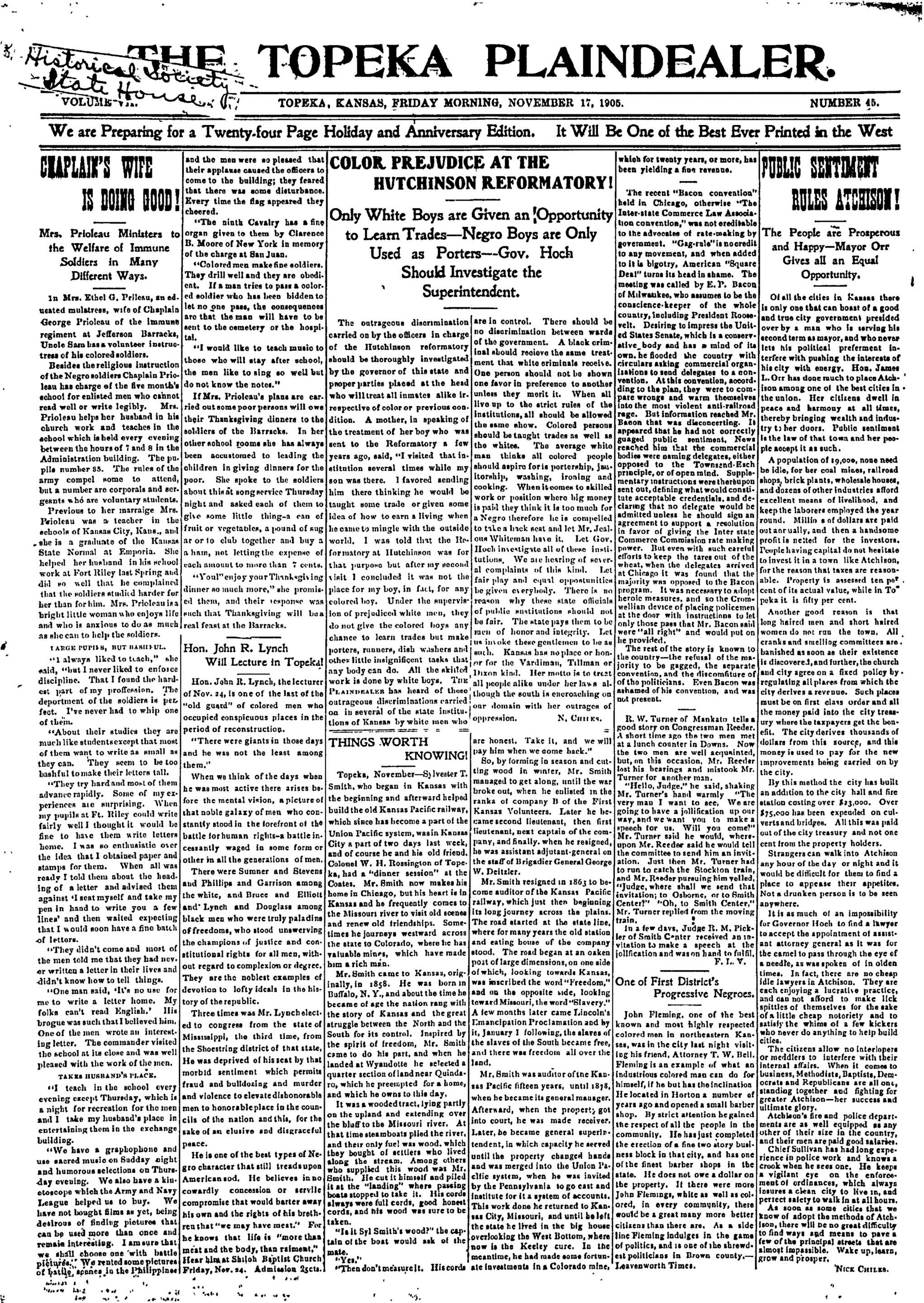
THE TOPEKA PLAINDEALER.
We are Preparing for a Twenty-four Page Holiday and Anniversary Edition. It Will Be One of the Best Ever Printed in the West
Historical Society State House VOLUME VIII
CHAPLAIK'S WIFE IS DOING GOOD!
Mrs. Prioleau Ministers to the Welfare of Immune Soldiers in Many Different Ways.
In Mrs. Ethel G. Prioleau, an educated mulatress, wife of Chaplain George Prioleau of the immune regiment at Jefferson Barracks, Unole Sam has a volunteer instructress of his colored soldiers.
Besides the religious instruction of the Negro soldiers Chaplain Prioleau has charge of the five month's school for enlisted men who cannot read well or write legibly. Mrs. Prioleau helps her husband in his church work and teaches in the school which is held every evening between the hours of 7 and 8 in the Administration building. The pupila number 35. The rules of the army compel some to attend, but a number are corporals and sergeants who are voluntary students.
Previous to her marrage Mrs. Prioleau was a teacher in the schools of Kansas City, Kansas., and she is a graduate of the Kansas State Normal at Emporia. She helped her husband in his school work at Fort Riley last Spring and did so well that he complained that the soldiers studied harder for her than for him. Mrs. Prioleau is a bright little woman who enjoys life and who is anxious to do as much as she can to help the soldiers.
"I always liked to teach," she said, "but I never liked to enforce discipline. That I found the hardest part of my profession. The deportment of the soldiers is perfect. I've never had to whip one of them.
"About their studies they are much like students except that most of them want to write as small as they can. They seem to be too bashful to make their letters tall.
"They try hard and most of them advance rapidly. Some of my experiences are surprising. When my pupils at Ft. Riley could write fairly well I thought it would be fine to have them write letters home. I was so enthusiastic over the idea that I obtained paper and stamps for them. When all was ready I told them about the heading of a letter and advised them against 'I seat myself and take my pen in hand to write you a few lines' and then waited expecting that I would soon have a fine batch of letters.
"They didn't come and most of the men told me that they had never written a letter in their lives and didn't know how to tell things.
"One man said, 'It's no use for me to write a letter home. My folks can't read English.' Ilis brogue was such that I believed him. One of the men wrote an interesting letter. The commander visited the school at its close and was well pleased with the work of the men.
"I teach in the school every evening except Thursday, which is a night for recreation for the men and I take my husband's place in entertaining them in the exchange building.
"We have a graphophone and use sacred music on Sudday night and humorous selections on Thursday evening. We also have a kinetoscope which the Army and Navy League helped us to buy. We have not bought films as yet, being desirous of finding pictures that can be used more than once and remain interesting. I assure that we shall choose one with battle pictures." We rented some pictures of battle scenes in the Philippines
TOPEKA, KANSAS, FRIDAY MORNING, NOVEMBER 17, 1905.
and the men were so pleased that their applause caused the officers to come to the building; they feared that there was some disturbance. Every time the flag appeared they cheered.
"The ninth Cavalry has a fine organ given to them by Clarence B. Moore of New York in memory of the charge at San Juan.
"Colored men make fine soldiers. They drill well and they are obedient. If a man tries to pass a colored soldier who has been bidden to let no one pass, the consequences are that the man will have to be sent to the cemetery or the hospital.
"I would like to teach music to those who will stay after school, the men like to sing so well but do not know the notes."
If Mrs. Prioleau's plans are carried out some poor persons will owe their Thanksgiving dinners to the soldiers of the Barracks. In her other school rooms she has always been accustomed to leading the children in giving dinners for the poor. She spoke to the soldiers about this at song service Thursday night and asked each of them to give some little thing-a can of fruit or vegetables, a pound of sugar or to club together and buy a ham, not letting the expense of each amount to more than 7 cents. "Youl" enjoy your Thanksgiving dinner so much more," she promised them, and their response was such that Thanksgiving will be a real feast at the Barracks.
Hon. John R. Lynch
Hon. John R. Lynch, the lecturer of Nov. 24, is one of the last of the "old guard" of colored men who occupied conspicuous places in the period of reconstruction. "There were giants in those days and he was not the least among them."
When we think of the days when he was most active there arises before the mental vision, a picture of that noble galaxy of men who constantly stood in the forefront of the battle for human rights-a battle incessantly waged in some form or other in all the generations of men.
There were Sumner and Stevens and Phillips and Garrison among the white, and Bruce and Elliott and Lynch and Douglass among black men who were truly paladins of freedoms, who stood unswerving the champions of justice and constitutional rights for all men, without regard to complexion or degree. They are the noblest examples of devotion to lofty ideals in the history of the republic.
Three times was Mr. Lynchelected to congress from the state of Mississippi, the third time, from the Shoestring district of that state. He was deprived of his seat by that morbid sentiment which permits fraud and bulldozing and murder and violence to elevate dishonorable men to honorable place in the councils of the nation and this, for the sake of an elusive and disgraceful peace.
He is one of the best types of Negro character that still treads upon American sod. He believes in no cowardly concession or servile compromise that would barter away his own and the rights of his brotheren that "we may have meat." For he knows that life is "more than meat and the body, than raiment." Hear him at Shiloh Baptist Church Friday, Nov. 24. Admission 25cts.
COLOR PREJUDICE AT THE HUTCHINSON REFORMATORY!
Only White Boys are Given an Opportunity to Learn Trades—Negro Boys are Only Used as Porters-Gov. Hoch Should Investigate the Superintendent.
The outrageous discrimination carried on by the officers in charge of the Hutchinson reformatory should be thoroughly investigated by the governor of this state and proper parties placed at the head who will treat all inmates alike irrespective of color or previous condition. A mother, in speaking of the treatment of her boy who was sent to the Reformatory a few years ago, said, "I visited that institution several times while my son was there. I favored sending him there thinking he would be taught some trade or given some idea of how to earn a living when he came to mingle with the outside world. I was told that the Reformatory at Hutchinson was for that purpose but after my second visit I concluded it was not the place for my boy, in fact, for any colored boy. Under the supervision of prejudiced white men, they do not give the colored boys any chance to learn trades but make porters, runners, dish washers and other little insignificant tasks that any body can do. All the skilled work is done by white boys. The PLAINDEALER has heard of those outrageous discriminations carried on in several of the state institutions of Kansas by white men who
THINGS WORTH
Topeka, November—Sylvester T. Smith, who began in Kansas with the beginning and afterward helped build the old Kansas Pacific railway, which since has become a part of the Union Pacific system, was in Kansas City a part of two days last week, and of course he and his old friend, Colonel W. H. Rossington of Topeka, had a "dinner session" at the Coates. Mr. Smith now makes his home in Chicago, but his heart is in Kansas and he frequently comes to the Missours river to visit old scenes and renew old friendships. Sometimes he journeys westward across the state to Colorado, where he has valuable mines, which have made him a rich man.
Mr. Smith came to Kansas, originally, in 1858. He was born in Buffalo, N. Y., and about the time he became of age the nation rang with the story of Kansas and the great struggle between the North and the South for its control. Inspired by the spirit of freedom, Mr. Smith came to do his part, and when he landed at Wyandotte he selected a quarter section of land near Quindaro, which he preempted for a home, and which he owns to this day.
It was a wooded tract, lying partly on the upland and extending over the bluff to the Missouri river. At that time steamboats plied the river, and their only fuel was wood, which they bought of settlers who lived along the stream. Among others who supplied this wood was Mr. Smith. He cut it himself and piled it at the "landing" where passing boats stopped to take it. His cords always were full cords, good honest cords, and his wood was sure to be taken.
"Is it Syl Smith's wood?" the captain of the boat would ask of the mate.
"Yes."
"Then don't measure it. His cords
are in control. There should be no discrimination between wards of the government. A black criminal should receive the same treatment that white criminals receive. One person should not be shown one favor in preference to another unless they merit it. When all live up to the strict rules of the institutions, all should be allowed the same show. Colored persons should be taught trades as well as the whites. The average white man thinks all colored people should aspire for is portership, janitorship, washing, ironing and cooking. When it comes to skilled work or position where big money is paid they think it is too much for a Negro therefore he is compelled to take a back seat and let Mr. Jealous Whiteman have it. Let Gov. Hoch investigate all of these institutions. We are hearing of several complaints of this kind. Let fair play and equal opportunities be given everybody. There is no reason why these state officials of public institutions should not be fair. The state pays them to be men of honor and integrity. Let us invoke these gentlemen to be as such. Kansas has no place or honor for the Vardiman, Tillman or Dixon kind. Her motto is to treat all people alike under her laws although the south is encroaching on our domain with her outrages of oppression. N. Curtles.
are honest. Take it, and we will pay him when we come back." So, by forming in season and cutting wood in winter, Mr. Smith managed to get along, until the war broke out, when he enlisted in the ranka of company B of the First Kansas Volunteers. Later he became second lieutenant, then first lieutenant, next captain of the company, and finally, when he resigned, he was assistant adjutant-general on the staff of Brigadier General George W. Deitzler.
Mr. Smith resigned in 1863 to become auditor of the Kansas Pacific railway, which just then beginning its long journey across the plains. The road started at the state line, where for many years the old station and eating house of the company stood. The road began at an oaken post of large dimensions, on one side of which, looking towards Kansas, was inscribed the word "Freedom," and on the opposite side, looking toward Missouri, the word "Slavery." A few months later came Lincoln's Emancipation Proclamation and by it, January I following, the slaves of the slaves of the South became free, and there was freedom all over the land.
Mr. Smith was auditor of the Kansas Pacific fifteen years, until 1878, when he became its general manager. Afterward, when the property, got into court, he was made receiver. Later, he became general superintendent, in which capacity he served until the property changed hands and was merged into the Union Pacific system, when he was invited by the Pennsylvania to go east and institute for it a system of accounts. This work done he returned to Kansas City, Missouri, and until he left the state he lived in the big house overlooking the West Bottom, where now is the Keeley cure. In the meantime, he had made some fortunate investments in a Colorado mine,
which for twenty years, or more, has been yielding a fine revenue.
The recent "Bacon convention" held in Chicago, otherwise "The Inter-state Commerce Law Association convention," was not creditable to the advocates of rate-making by government. "Gag-rule" is no credit to any movement, and when added to it is bigotry, American "Square Deal" turns its head in shame. The meeting was called by E. P. Bacon of Milwaukee, who assumes to be the conscience-keeper of the whole country, including President Roosevelt. Desiring to impress the United States Senate, which is a conservative body and has a mind of its own, he flooded the country with circulars asking commercial organisations to send delegates to a convention. At this convention, according to the plan, they were to compare wrongs and warm themselves into the most violent anti-railroad rage. But information reached Mr. Bacon that was disconcerting. It appeared that he had not correctly guaged public sentiment. News reached him that the commercial bodies were naming delegates, either opposed to the Townsend-Each principle, or of open mind. Supplementary instructions were thereupon sent out, defining what would constitute acceptable credentials, and declaring that no delegate would be admitted unless he should sign an agreement to support a resolution in favor of giving the Inter state Commerce Commission rate making power. But even with such careful efforts to keep the tares out of the wheat, when the delegates arrived at Chicago it was found that the majority was opposed to the Bacon program. It was necessary to adopt heroic measures, and so the Cromwellian device of placing policemen at the door with instructions to let only those pass that Mr. Bacon said "all right" and would put on he provided.
The rest of the story is known to the country—the refusal of the majority to be gagged, the separate convention, and the discomfiture of the politicians. Even Bacon was ashamed of his convention, and was not present.
R. W. Turner of Mankato tells a good story on Congressman Reeder. A short time ago the two men met at a lunch counter in Downs. Now the two men are well acquainted, but, on this occasion, Mr. Reeder lost his bearings and mistook Mr. Turner for another man.
"Hello, Judge," he said, shaking Mr. Turner's hand warmly "The very man I want to see. We are going to have a jollification up our way, and we want you to make a speech for us. Will you come!" Mr. Turner said he would, whereupon Mr. Reeder said he would tell the committee to send him an invitation. Just then Mr. Turner had to run to catch the Stockton train, and Mr. Reeder pursuing him yelled, "Judge, where shall we send that invitation; to Osborne, or to Smith Center?" "Oh, to Smith Center," Mr. Turner replied from the moving train.
In a few days, Judge R. M. Pickler of Smith Center received an invitation to make a speech at the jollification and was on hand to fulfil. F. L. V.
One of First District's Progressive Negroes.
John Fleming, one of the best known and most highly respected colored men in northeastern Kansas, was in the city last night visiting his friend, Attorney T. W. Bell. Fleming is an example of what an industrious colored man can do for himself, if he but has the inclination. He located in Horton a number of years ago and opened a small barber shop. By strict attention he gained the respect of all the people in the community. He has just completed the erection of a fine two story business block in that city, and has one of the finest barber shops in the state. He does not owe a dollar on the property. If there were more John Flemings, white as well as colored, in every community, there would be a great many more better citizens than there are. As a side line Fleming indulges in the game of politics, and is one of the shrewdest politicians in Brown county.—Leavenworth Times.
NUMBER 45.
The People are Prosperous and Happy—Mayor Orr Gives all an Equal Opportunity.
Of all the cities in Kansas there is only one that can boast of a good and true city government presided over by a man who is serving his second term as mayor, and who never lets his political preferment interfere with pushing the interests of his city with energy. Hon. James L. Orr has done much to place Atchison among one of the best cities in the union. Her citizens dwell in peace and harmony at all times, thereby bringing wealth and industry to her doors. Public sentiment is the law of that town and her people accept it as such.
A population of 19,000, none need be idle, for her coal mines, railroad shops, brick plants, wholesale houses, and dozens of other industries afford excellent means of livelihood, and keep the laborers employed the year round. Millions of dollars are paid out annually, and then a handsome profit is netted for the investors. People having capital do not hesitate to invest it in a town like Atchison, for the reason that taxes are reasonable. Property is assessed ten percent of its actual value, while in Topeka it is fifty per cent.
Another good reason is that long haired men and short haired women do not run the town. All cranks and smelling committees are banished as soon as their existence is discover3, and further, the church and city agree on a fixed policy by regulating all places from which the city derives a revenue. Such places must be on first class order and all the money paid into the city treasury where the taxpayers get the benefit. The city derives thousands of dollars from this source, and this money is used to pay for the new improvements being carried on by the city.
By this method the city has built an addition to the city hall and fire station costing over $23,000. Over $75,000 has been expended on culverts and bridges. All this was paid out of the city treasury and not one cent from the property holders. Strangers can walk into Atchison any hour of the day or night and it would be difficult for them to find a place to appease their appetites. Not a drunken person is to be seen anywhere.
It is as much of an impossibility for Governor Hoch to find a lawyer to accept the appointment of assistant attorney general as it was for the camel to pass through the eye of a needle, as was spoken of in olden times. In fact, there are no cheap idle lawyers in Atchison. They are each enjoying a lucrative practice, and can not afford to make lick spittles of themselves for the sake of a little cheap notoriety and to satisfy the whims of a few kickers who never do anything to help build cities.
The citizens allow no interlopers or meddlers to interfere with their internal affairs. When it comes to business, Methodists, Baptists, Democrats and Republicans are all one, standing together and fighting for greater Atchison—her success and ultimate glory.
Atchison's fire and police departments are as well equipped as any other of their size in the country, and their men are paid good salaries.
Chief Sullivan has had long experience in police work and knows a crook when he sees one. He keeps a vigilant eye on the enforcement of ordinances, which always insures a clean city to live in, and perfect safety to walk in at all hour.
As soon as some cities that we know of adopt the methods of Atchison, there will be no great difficulty to find ways and means to pave a few of the principal streets that are almost impassible. Wake up, learn, grow and prosper.
NICK CHILES.
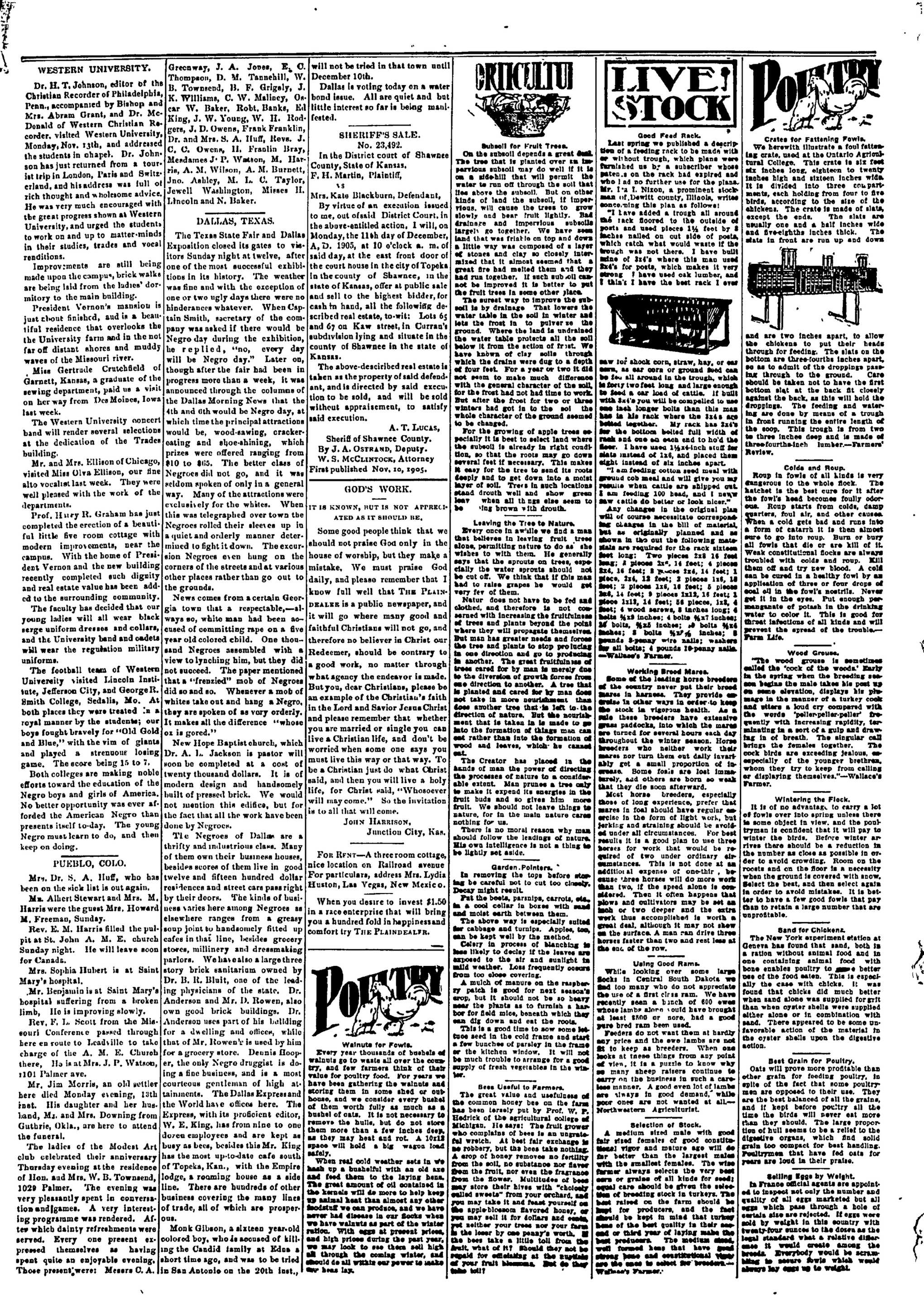
WESTERN UNIVERSITY.
Dr. H. T. Johnson, editor of the Christian Recorder of Philadelphia, Penn., accompanied by Bishop and Mrs. Abram Grant, and Dr. McDonald of Western Christian Recorder, visited Western University, Monday, Nov. 13th, and addressed the students in chapel. Dr. Johnson has just returned from a tourist trip in London, Paris and Switzerland, and his address was full of rich thought and wholesome advice. He was very much encouraged with the great progress shown at Western University, and urged the students to work on and up to matter-minds in their studies, trades and vocal renditions.
Improvements are still being made upon the campus, brick walks are being laid from the ladies' dormitory to the main building. President Vernon's mansion is just about finished, and is a beautiful residence that overlooks the the University farm and in the not far off distant shores and muddy waves of the Missouri river. Miss Gertrude Crutchfield of Garnett, Kansas, a graduate of the sewing department, paid us a visit on her way from Des Moines, Iowa last week.
The Western University concert band will render several selections at the dedication of the Trades building. Mr. and Mrs. Ellison of Chicago, visited Miss Olva Ellison, our fine alto vocalist last week. They were well pleased with the work of the departments.
Prof. Harry R. Graham has just completed the erection of a beautiful little five room cottage with modern improvements, near the campus. With the home of President Vernon and the new building recently completed such dignity and real estate value has been added to the surrounding community. The faculty has decided that our young ladies will all wear black serge uniform dresses and collars, and the University band and cadets will wear the regulation military uniforms.
The football team of Western University visited Lincoln Institute, Jefferson City, and George R. Smith College, Sedalia, Mo. At both places they were treated in a royal manner by the students; our boys fought bravely for "Old Gold and Blue," with the vim of giants and played a strenuous losing game. The score being 15 to 7.
Both colleges are making noble efforts toward the education of the Negro boys and girls of America. No better opportunity was ever afforded the American Negro than presents itself to-day. The young Negro must learn to do, and then keep on doing.
PUEBLO, COLO.
Mrs. Dr. S. A. Huff, who has been on the sick list is out again.
Mr. Allert Stewart and Mrs. M. Harris were the guest Mrs. Howard M. Freeman, Sunday.
Rev. E. M. Harris filled the pulpit at St. John A. M. E. church Sunday night. He will leave soon for Canada.
Mrs. Sophia Hubert is at Saint Mary's hospital.
Mr. Benjamin is at Saint Mary's hospital suffering from a broken limb. He is improving slowly.
Rev, F. L. Scott from the Missouri Conference passed through here en route to Leadville to take charge of the A. M. E. Churob there. He is at Mrs. J. P. Watson, 1101 Palmer ave.
Mr. Jim Morris, an old settler here died Monday evening, 13th inst. His daughter and her husband, Mr. and Mrs. Downing from Guthrie, Okla., are here to attend the funeral.
The ladies of the Modest Art club celebrated their anniversary Thursday evening at the residence of Hon. and Mrs. W. B. Townsend, 1029 Palmer. The evening was very pleasantly spent in conversation and games. A very interesting programme was rendered. After which dainty refreshments were served. Every one present expressed themselves as having spent quite an enjoyable evening. Those present were: Messrs C. A.
Greenway, J. A. Jones, E. C. Thompson, D. M. Tannehill, W. B. Townsend, B. F. Grigaly, J. K. Williams, C. W. Malincy, Oscar W. Baker, Robt. Banks, Ed King, J. W. Young, W. H. Rodgers, J. D. Owens, Frank Franklin, Dr. and Mrs. S. A. Huff, Revs. J. C. Owens, II. Franlin Bray, Meadames J. P. Watson, M. Harris, A. M. Wilson, A. M. Burnett, Jno. Ashley, M. L. C. Taylor, Jewell Washington, Misses H. Lincoln and N. Baker.
DALLAS, TEXAS.
The Texas State Fair and Dallas Exposition closed its gates to visitors Sunday night at twelve, after one of the most successful exhibitions in its history. The weather was fine and with the exception of one or two ugly days there were no hinderances whatever. When Captain Smith, secretary of the company was asked if there would be Negro day during the exhibition, he replied, "no, every day will be Negro day." Later on, though after the fair had been in progress more than a week, it was announced through the columns of the Dallas Morning News that the 4th and 6th would be Negro day, at which time the principal attractions would be, wood-sawing, cracker-eating and shoe-shining, which prizes were offered ranging from $10 to $65. The better class of Negroes did not go, and it was seldom spoken of only in a general way. Many of the attractions were exclusively for the whites. When this was telegraphed over town the Negroes rolled their sleeves up in a quiet and orderly manner determined to fight it down. The excursion Negroes even hung on the corners of the streets and at various other places rather than go out to the grounds.
News comes from a certain Georgia town that a respectable, always so, white man had been accused of committing rape on a five year old colored child. One thousand Negroes assembled with a view to lynching him, but they did not succeed. The paper mentioned that a "frenzied" mob of Negroes did so and so. Whenever a mob of whites take out and hang a Negro, they are spoken of as vory orderly. It makes all the difference "whose ox is gored."
New Hope Baptist church, which Dr. A. L. Jackson is pastor will soon be completed at a cost of twenty thousand dollars. It is of modern design and handsomely built of pressed brick. We would not mention this edifice, but for the fact that all the work have been done by Negroes.
The Negroes of Dallas are a thrifty and industrious class. Many of them own their business houses, besides scores of them live in good twelve and fifteen hundred dollar residences and street cars pass right by their doors. The kinds of business varies here among Negroes as elsewhere ranges from a greasy soup joint to handsomely fitted up cafes in that line, besides grocery stores, millinery and dressmaking parlors. We have also a large three story brick sanitarium owned by Dr. B. I. Bluit, one of the leading physicians of the state. Dr. Anderson and Mr. D. Rowen, also own good brick buildings. Dr. Anderson uses part of his building for a dwelling and offices, while that of Mr. Rowen's is used by him for a grocery store. Dennis Hooper, the only Negro druggist is doing a fine business, and is a most courteous gentleman of high attainments. The Dallas Express and the World have offices here. The Express, with its proficient editor, W. E. King, has from nine to one doreen employees and are kept as busy as bees, besides this Mr. King has the most up-to-date cafe south of Topeka, Kan., with the Empire lodge, a rooming house as a side line. There are hundreds of other business covering the many lines of trade, all of which are prosperous.
Monk Gibson, a sixteen year-old colored boy, who is accused of killing the Candid family at Edena a short time ago, and was to be tried in San Antonio on the 20th inst..
will not be tried in that town until December 10th.
Dallas is voting today on a water bond issue. All are quiet and but little interest so far is being manifested.
In the District court of Shawnee County, State of Kansas. F. H. Martin, Plaintiff.
Mrs. Kate Blackburn, Defendant,
By virtue of an execution issued to
me, out of said District Court, in
the above-antitled action, I will, on
Monday, the 11th day of December,
A. D. 1905, at 10 o'clock a. m. of
said day, at the east front door of
the court house in the city of Topeka
in the county of Shawnee, in the
state of Kansas, offer at public sale
and sell to the highest bidder, for
cash in hand, all the following
described real estate, to-wit: Lots 65
and 67 on Kaw street, in Curran's
subdivision lying and situate in the
county of Shawnee in the state of
Kansas.
The above-described real estate is taken as the property of said defendant, and is directed by said execution to be sold, and will be sold without appraisement, to satisfy said execution.
A. T. LUCAS,
Sheriff of Shawnee County.
By J. A. OSTRAND, Deputy.
W. S. McCLINTOCK, Attorney
First published Nov. 10, 1905.
GOD'S WORK.
IT IS KNOWN, BUT IS NOT AFFRECIATED AS IT SHOULD BE.
Some good people think that we should not praise God only in the house of worship, but they make a mistake. We must praise God daily, and please remember that I know full well that THE PLAINDEALER is a public newspaper, and it will go where many good and faithful Christians will not go, and therefore no believer in Christ our Redeemer, should be contrary to a good work, no matter through what agency the endeavor is made. But you, dear Christians, please be an example of the Christian's faith in the Lord and Savior Jesus Christ and please remember that whether you are married or single you can live a Christian life, and don't be worried when some one says you must live this way or that way. To be a Christian just do what Christ said, and then you will live a holy life, for Christ said, "Whosoever will may come." So the invitation is to all that will come.
JOHN HARRISON.
Junction City, Kas.
FOR RENT—A three room cottage, nice location on Railroad avenue For particulars, address Mrs. Lydia Huston, Las Vegas, New Mexico o.
When you desire to invest $1.50 in a race enterprise that will bring you a hundred fold in happiness and comfort try THE PLAINDEALER.
POULTRY
Every year thousands of bushels of walnuts go to wasts all over the country, and few farmers think of their value for poultry food. For years we have been gathering the walnuts and storing them in some shed or outhouse, and we consider every bushel of them worth fully as much as a bushel of oats. It is not necessary to remove the hulls, but do not store them more than a few inches deep, as they may heat and rot. A 10x12 space will hold a big wagon load safely.
When real cold weather sets in we hash up a bushelful with an old axe and feed them to the laying hens. The great amount of oil contained in the kernels will do more to help keep up animal heat than almost any other foodstuff we can produce, and we have never had disease in our stocks when we have walnuts as part of the winter ration. With eggs at present prices, and high prices during the past year, we may look to see them sell high all through the coming winter, and should do all within our power to make our hens lay.
CRICULTUR
Bubsoil for Fruit Trees.
On the subsoil depends a great deal. The tree that is planted over an impervious subsoil may do well if it is on a side-hill that will permit the water to run off through the soil that lies above the subsoil. But on other kinds of land the subsoil, if impervious, will cause the trees to grow slowly and bear fruit lightly. Bad drainage and impervious subsols largely go together. We have seen land that was friable on top and down a little way was composed of a layer of stones and clay so closely intermixed that it almost seemed that a great fire had melted them and they had run together. If such subsoil cannot be improved it is better to put the fruit trees in some other place.
The surent way to improve the subsoil is by drainage. That lowers the water table in the soil in winter and lets the frost in to pulverize the ground. Where the land is undrained the water table protects all the soil below it from the action of frost. We have known of clay soils through which the drains were dug to a depth of four feet. For a year or two it did not seem to make much difference with the general character of the soil, for the frost had not had time to work. But after the frost for two or three winters had got in to the soil the whole character of the ground seemed to be changed.
For the growing of apple trees especially it is best to select land where the subsoll is already in right condition, so that the roots may go down several feet if necessary. This makes it easy for the tree to send its roots deeply and to get down into a moist layer of soil. Trees in such locations stand drouth well and show green leaf when all things else seem to be being brown with drouth.
Leaving the Tree to Nature
Every once in awhile we find a man that believes in leaving fruit trees alone, permitting nature to do as she wishes to with them. He generally says that the sprouts on trees, especially the water sprouts should not be cut off. We think that if this man had to raise grapes he would get very few of them.
Natur does not have to be fed and clothed, and therefore is not conserved with increasing the fruitfulness of trees and plants beyond the point where they will propagate themselves. But man has greater needs and forces the tree and plants to stop producing in one direction and go to producing in another. The great fruitfulness of trees cared for by man is merely due to the diversion of growth forces from one direction to another. A tree that is planted and cared for by man does not take in more nourishment than does another tree that is left to the direction of nature. But the nourishment that is taken in is made to go into the formation of things man can eat rather than into the formation of wood and leaves, which he cannot eat.
The Creator has placed in the hands of man the power of directing the processes of nature to a considerable extent. Man prune a tree only to make it expend its energies in the fruit buds and so gives him more fruit. We should not leave things to nature, for in the main nature cares nothing for us. There is no moral reason why man should follow the leadings of nature. His own intelligence is not a thing to be lightly not aside.
Garden, Pointers.
In removing the tops before storing be careful not to cut too closely. Decay might result.
Put the beets, parsnips, carrots, etc. in a cool cellar in boxes with sand and moist earth between them.
The above way is especially suited for cabbage and turnips. Apples, too, can be kept well by the method.
Colery in process of blanching is best likely to decay if the leaves are exposed to the air and sunlight in mild weather. Loss frequently occurs from too close covering.
A mulch of manure on the raspberry patch is good for next season's crop, but it should not be so heavy near the plants as to furnish a harbor for fold mice, beneath which they can dig down and eat the roots.
This is a good time to sow some lettuce seed in the cold frame and start a few bunches of parsley in the frame or the kitchen window. It will not be much trouble to arrange for a good supply of fresh vegetables in the winter.
Bees Useful to Farmers
The great value and usefulness of the common honey bee on the farm has been terribly put by Prof. W. P. Hedrick of the agricultural college of Michigan. He says: The fruit grower who complains of bees is an ungrateful wretch. At best fair exchange is no robbery, but the bees take nothing. A crop of honey removes no fertility from the soil, no substance nor flavor from the fruit, nor even the fragrance from the flower. Multitudes of bees may store their hives with "cholestly called sweets" from your orchard, and you may take it and feast yourself on the apple-blossom flavored honey, or you may sell it for dollars and cents, yet neither your trees nor your farm is the loser by one penny's worth. If the bees take a little toll from the fruit, what of it? Should they not be repaid for officiating at the cupids of your fruit blossoms. But do they take toll?
LIVE STOCK
Good Feed Rack.
Last spring we published a description of a feeding rack to be made with or without trough, which plans were furnished us by a subscriber whose paten.s on the rack had expired and who had no further use for the plans. Mr. Ia I. Nixon, a prominent stockman of Dewitt county, Illinois, writes concerning this plan as follows:
I have added a trough all around this rack floored to the outside of posts and used pieces 1½ foot by 8 inches nailed on out side of posts, which catch what would waste if the trough was not there. I have built mine of 3x4's where this man used 3x4's for posts, which makes it very strong I have used oak lumber, and I thin's I have the best rack I ever
new for shook corn, straw, hay, or ear corn, as ear corn or ground feed can be for all around in the trough, which is forty two feet long and large enough to feed a car load of cattle. If built with 3x4's you will be compelled to use one inch longer bolts than this man has in his rack where the 3x4's are bolted together. My rack has 3x4's for the bottom bolts full width of rack and one on each end to ho'd the floor. I have used 1½x4-inch stuff for slats instead of 1x6, and placed them eight instead of six inches apart.
"I am feeding cotton seed meal with ground corn meal and will give you my results when cattle are shipped out. I am feeding 100 head, and I neww new cattle do better or look nicer."
Any changes in the original plan will of course necessitate corresponding changes in the bill of material, but as originally planned and as shown in the out the following materials are required for the rack sixteen feet long; Two pieces 2x8 16 feet long; 4 pieces 2x4, 14 feet; 4 pieces 2x6, 16 feet; 8 pieces 2x4, 14 feet; 1 piece, 2x4, 12 feet; 2 pieces 1x6, 18 feet; 3 pieces 1x6, 16 feet; 5 pieces 2x6, 14 feet; 9 pieces 1x12, 16 feet; 1 piece 1x18, 14 feet; 56 pieces, 1x3, 4 feet; 4 wood serrows, 8 inches long; 4 bolts %x2 inches; 4 bolts %x7 inches; 26 bolts, %x5 inches; 9 bolts %x6 inches; 8 bolts %x4 inches; 8 pounds 8-penny wire nails; washers for all bolts; 4 pounds 10-penny nails. —Wallace's Farmer.
Workina Brood Mara.
Some of the leading horse breeders of the country never put their breed mares in harness. They provide care in other ways in order to keep the stock in vigorous health. As a rule these breeders have extensive grass paddocks, into which the mares are turned for several hours each day throughout the winter season. Horse breeders who neither work their mares nor turn them out daily invariably get a small proportion of increase. Some foals are lost immediately, and others are born so weak that they die soon afterward.
Most horse breeders, especially those of long experience, prefer that mares in foal should have regular exercise in the form of light work, but jerking and straining should be avoided under all circumstances. For best results it is a good plan to use three horses for work that would be required of two under ordinary circumstances. This is not done at an additional expense of one-third, because three horses will do more work than two, if the speed alone is considered. Then it often happens that plows and cultivators may be set on both or two deeper and the extra work thus accomplished is worth a great deal, although it may not show on the surface. A man can drive three horses faster than two and rest less at the end of the row.
Using Good Rams
While looking over some large Socks in Central South Dakota we and too many who do not appreciate the use of a first class ram. We have recently seen a binch of 600 ewes whose lambs alone could have brought at least 8000 or more, had a good pure bred ram been used.
Feeders do not want them at hardly any price and the ewe lambs are not fit to keep as breeders. When one books at these things from any point of view, it is a puzzle to know why so many sheep ralers continue to carry on the business in such a careless manner. A good even lot of lambs are always in good demand, while poor ones are not wanted at all. Northwestern Agriculturist.
Selection of Stock.
A medium sized male with good fair sized females of good constitutional vigor and mature age will do far better than the largest males with the smallest females. The wise farmer always selects the very best corn or grains of all kinds for seed; equal care should be given the selection of breeding stock in turkeys. The best raised on the farm should be kept for producers, and the fast should be kept in mind that turkey home of the best quality in their second or third year of laying make the best producers. The medium sized, well formed hens that have good strong home and constitutional vigor are the ones to select for brooders.
POULTRY
We herewith illustrate a foul fattening crate, used at the Ontario Agricultural College. This crate is six feet six inches long, eighteen to twenty inches high and sixteen inches wide. It is divided into three compartments, each holding from four to five birds, according to the size of the chickens. The crate is made of slats, except the ends. The slats are usually one and a half inches wide and five-eighths inches thick. The slats in front are run up and down
```markdown
```
and are two inches apart, to allow the chickens to put their heads through for feeding. The slats on the bottom are three-fourths inches apart, so as to admit of the droppings passing through to the ground. Care should be taken not to have the first bottom slat at the back fit closely against the back, as this will hold the droppings. The feeding and watering are done by means of a trough in front running the entire length of the soop. This trough is from two to three inches deep and is made of three-fourths-inch lumber.—Farmers' Review.
Golds and Beams
Roup in fowls of all kinds is very dangerous to the whole flock. The hatchet is the best cure for it after the fowl's head becomes fouly odorous. Roup starts from colds, damp quarters, foul air, and other causes. When a cold gets bad and runs into a form of catarrh it is then almost sure to go into roup. Burn or bury all fowls that die or are kill of it. Weak constitutional flocks are always troubled with colds and roup. Kill them off and try new blood. A cold can be cured in a healthy fowl by an application of three or four drops of coal oil in the fowl's nostrils. Never get it in the eyes. Put enough per manganate of potash in the drinking water to color it. This is good for threat infections of all kinds and will prevent the spread of the trouble. Farm Life.
Wood Grouse.
"The wood grouse is sometimes called the 'cock of the woods.' Early in the spring when the breeding season begins the male takes his post up on some elevation, displays his plumage in the manner of a turkey cook and utter a loud cry compared with the words 'peller-peller-peller' frequently with increasing rapidity, terminating in a sort of a gulp and drawing in of breath. The singular call brings the females together. The cock birds are exceeding jealous, especially of the younger brothren, whom they try to keep from calling or displaying themselves."—Wallace's Farmer.
Wintering the Flock.
It is of no advantage to carry a lot of fowls over into spring unless there is some object in view, and the poultryman is confident that it will pay to winter the birds. Before winter arrives there should be a reduction in the number as close as possible in order to avoid crowding. Room on the roosts and on the floor is a necessity when the ground is covered with snow. Select the best, and then select again in order to avoid mistakes. It is better to have a few good fowls that pay than to retain a large number that are unprofitable.
Band for Chickenz
The New York experiment station at Geneva has found that sand, both in a ration without animal food and in one containing animal food with bone enables poultry to better use of the food eaten. This is especially the case with chicks. It was found that chicks did much better when sand alone was supplied for grit than when oyster shells were supplied either alone or in combination with sand. There appeared to be some unfavorable action of the material in the oyster shells upon the digestive action.
Best Grain for Poultry.
Oats will prove more profitable than other grain for feeding poultry, in spite of the fact that some poultrymen are opposed to their use. They are the best balanced of all the grains, and if kept before poultry all the time the birds will never eat more than they should. The large proportion of hull seems to be a relief to the digestive organs, which find solid grain too compact for best handling. Poultrymen that have fed oats for years are loud in their praise.
Selling Eggs by Weight.
In France official agents are appointed to inspect not only the number and quality of all eggs marketed but all eggs which pass through a hole of curtains size are rejected. If eggs were sold by weight in this country with twenty-four ounces to the dozers as the legal standard what a relative difference it would create among the breeds. Everybody would be scrambling to secure fowls which would always lay eggs up to weight.
CENTRALIA, NOTES.
These items are to inform the public that Centralia is yet on the map. There are few of our people here but that few strive to keep the road which leads to progress by their honesty and industry.
Last Sunday, Bible Day, the members and friends of the First Baptist Cdurch held a successful rally. At the morning service, all were favorably impressed and spiritually revived by a sermon which the pastor, Dr. M. L. Copeland, delivered. In the evening the Sunday School gave a grand Sacred Concert, The superintendent, H. C. Rice had just cause to feel proud of his pupile who were trained by Mrs. M. L. Copeland. The offerings amounted to sixty-five dollars and five cents. Sister Irene Arnold a noted church worker and noble Christian, solicited $35.51. The choir furnished beautiful music for the day. Our white friends, who are always generous to us, contributed largely in our rally.
KANSAS CITY, KANS.
Mrs. Stella Roberts is the newly elected president of the Willing Workers.
Little Cornell Woods is among the sick this week.
C. Patterson was in Leavenworth last Tuesday on business.
Kansas City, Kans. expects to be well represented at Interstate as there are a large number of new literaries organized.
Comrade Jerry Smiley is very sick and was taken to the Soldier's Home at Leavenworth last Tuesday.
Little Miss Josephine Drake was given a grand surprise on her thirteenth birthday.
The contents of the home of Mr. and Mrs. T. K. Douglas was damaged by the last Monday morning caused by the explosion of a kerosene lamp.
Mrs. B. S. Smith is among the sick.
Virgil Spencer writes from Rose man, Calo. that he likes life on the ranch and he will make the west his future home.
Mrs. Alice Booker who has been visiting in Chicago, returned to her home Monday.
VINITA. I. T.
Miss Lizzie Davis, after attending the Texas State Fair returned home last week and reported a pleasant trip.
Miss Annie Allen made a business trip to the Timberhill vicinity last week.
Mrs. Cullins, of Parsons, Kans., is in the city visiting her husband.
Rev. Privett, an evangelist of the Missionary Baptist church, preached to a large congregation last Thursday night at the Sunrise Baptist church.
Phil Buford has opened a first class barber shop on Illinois Ave. that will be of great credit to the Negroes of this city. It is strange to nav that but ninety per cent of the Negro shops do not use proper towels and don't know what a finger bowl is. They will shave nearly all day out of one basin of water and you will seldom find a clean hair cloth. They will put a set of towel on the chair Monday and the next Monday you will find these same towels. Mr. Buford has promised to keep every thing neat and clean. Success to him.
The foundation was built, last week, for Dr. A. J. Jordan's building on Ill. Ave. which will consist of two store rooms and office rooms up stairs.
There was a good crowd out last Friday evening to see the first pas. sengers arrive at the Katy depot.
Geo. Buchner of Lightning creek was the guest of Will Togg last Sunday.
Quite a number of our people attended the Annual Conference at Waggoner Sunday.
Miss Ester Owens is still on the
How Is YourHeart?
Is your pulse weak, too slow, too fast, or does it skip a beat?
too fast, or does it skip a beat?
Do you have shortness of breath, weak or hungry spells, fainting, smothering or choking spells, palpitation, fluttering, pains around the heart, in side and shoulder; or hurt when lying on left side?
If you have any of these symptoms your heart is weak or diseased, and cannot get better without assistance.
Dr. Miles' Heart Cure strengthens weak hearts, and rarely ever fails to cure heart disease. Try it, and see how quickly you will find relief.
"About January 1st, 1901, I took down with weakness and droopy, and gradually grew worse. I was told by my family physician that my case was hopeless. My neighbors and family had given me up to die. My limbs and body were swollen to one-third of their normal size and water had collected around my heart. For at least three months I had to sit propped up in bed to keep from anothering. I sent for five bottles of Dr. Miles' Heart Cure, and by the time I had taken them all I was entirely cured. I feel better than I have for my feet. I am able to do any kind of work on my feet. I attending physician told me that if it hadn't been for Dr. Miles' Heart Cure I would now be in my grave"
L. T. CURD, Wilmore, Ky.
Dr. Miles' Heart Cure is sold by your druggist, who will guarantee that the first bottle will benefit. If it fails he will refund your money.
Miles Medical Co., Elkhart, Ind
sick list.
Rev. and Mrs. Hicks and son came up from conference to visit relatives.
Rev. Hawkins was reappointed to Vinita. This makes his third year as pastor of the A. M. E. Church and it is hoped that this year will be the greatest of all as he is a Christian gentleman and well thought of by everybody.
William Rea, of Kansas, enroute for points in Texas, stopped over to visit his brother in law.
Mrs. Mollie Shepard of Sedalia, Mo. is in the city visiting relatives.
EDWARDSVILLE, KAS.
The reception give in honor of Rev. Wm. Jackson at the home of Mr. and Mrs Combs last Monday evening was a success.
Misses Ida and Lillian Groves visited the Misses Sarah and Clara Porter Sunday. They report a delightful time.
Wm. Hodges who has been ill for some time is able to be out again.
Mr. and Mrs. Alex Gribay spent Sunday the guest of Mrs. J. Porter.
J. G. Groves after spending several days in the west, seems to be pleased with the country and purchased 1760 acres of land.
The Ladies Home and Foreign Mission anticipate having a Thanksgiving dinner and supper at the P. H. Baptist Church.
Mrs. Nancy Douglas, after spending several days in Kansas City, Mo, returned home Tuesday.
FT. SCOTT. KANS.
Miss Frances Hays, who has been a teacher in the public schools of this city for fifteen years has resigned and will take a position in the public schools of Kansas City. In the creation of this vacancy the school and the faculty lose one of the best friends the community ever had. She took the interest of the school to heart promoting everyfort tending to the up building of that institution. She was also a very active worker in the church being a member of Shiloh Baptist church and superintendent of the Sunday school. Profs. Hawkins and Watson paid her a very high
A Special Holiday Gift.
AS TO THE LEOPARD'S SPOTS
By KEILLY MILLER, Howard University,
Washington D. C.
An able answer and rebuke to the
slurs of Thomas Dixon, Jr., Jupon
the Negro race. Every Negro man,
woman and child should read it.
Mailed copy 15c. Send to
ALBATROSS SUPPLY CO.,
QUINCARO, KANS.
Rising Sun Fire Insurance Co.,
OF THE INDIAN TERRITORY.
OFFICE: 18 West Okmulgee Avenue,
Muskogee, Indian Territory.
SAFE BUSINESS backed by men who have proven their ability to succeed in business, and conducted on a sound business basis according to the regular business customs applicable to that particular business is about all that any THINKING MAN would wish.
WE write Insurance against FIRE and LIGHTNING on Houses, Household Goods, Office Furniture, Libraries, Merchandise, Live Stock, Farm Implements, Grain, Buggies, Wagons, Harness, Saddles and Musical Instruments.
R. H. WATERFORD, President. H. N. JOHNSON, Secretary. J. E. JOHNSON, Gen. Mgr.
tribute wishing her untold success to any position which she may aspire.
Rev. A. D. Bright's solo at the B. Y. P. U. was a rare treat to the junior members many of them wishing that they could do so well.
It has been hinted that Prof. E. J. Hawkins is likely to become a lawyer of renoun.
Dr. Brookins attended the funeral of the late Mr. Oliver in Kansas City last week.
Ft Scott is enjoying the luxuries of some of her sister cities. They are excavating for the paving of the business portion of the city. Several new brick buildings are in construction. The moving picture show at the various churches last week given by the white brothren was a decided frost.
H: BROWN,
The Grocer
Fine' Groceries—Just Opened—
Everything Fresh—Give us
a Trial.
HOME 'PHONE 1282.
531 Joplin St JOPLIN, MG.
Times Bldg, Leavenworth, Kansas.
AGENT FOR
Heim's Famous Beer.
Sample Room in Connection.
Order Shipped to All Parts of the Country.
SPECIAL BREW—Syndassus, the Best on the Market.
When 'n AICHISON don't forget Dt.ROBINSON'S RESTAURANT
Just three blocks from Union Depot Meals 20c. Mrs. Mary Robinson, - - Propr.
WE WANT HIM—Must find him—Rev. E, Roey, who was pastor of the Baptist church at Ratoon, New Mexico. Will pay for the information. Addaess Lock Box 1173, Weir City, Kansas.
READ THE PLAINDEALER if you would know what the race is doing.
WANTED-A good situation for a first class barber wanting to leave the Indian Territory. Married man, Address Walter Peterson, Vinita, I, T. Box 41.
To be posted and keep posted keep an eye on THE PLAINDEALER, the most progressive race journal of the country. It contains all the news of interest to the race. Read it and be wise.
CAPITAL, $100,000.
NESS backed by men who have pounded business basis according to the all that any THINKING MAN would be.
Rising Sun F
EXACTLY FILLS THE face against FIRE and LIGHTNING rise, Live Stock, Farm Implementies.
ORD, President. H. N. JOHN
NOTICE.
by men who have proven their ability to
basis according to the regular business cus
THINKING MAN would wish:
Big Sun Fire Insur
EXACTLY FILLS THE PRESCRIPTION
FIRE and LIGHTNING on Houses, Hous
ck, Farm Implements, Grain, Buggies,
ent. H. N. JOHNSON, Secretary.
NOTICE.
EXACTLY FILLS THE PRESCRIPTION.
NOTICE.
The Inter-State Literary association of Kansas and the West will convene in annual session at Kansas City. Mo. Dec. 26, 27, 28. Each literary societo is entitled to representation by three delegates (one of whom may have a place on the program) and three alternates.
New societies and those not having been enrolled at the last session of the association, will be required to pay a fee of $150. Societies enrolled at last session will pay $1 membership fee.
The executive committee will convene in November for purpose of making up the program. Any society may become a member of the association by application to the president or corresponding secretary on or before the first day of December, sending therewith the required fee.
419 Kansas avenue, Topeka, Kans.
Miss A. F. Moore, Cor. Sec'y,
1214 Vine Street, Kansas City, Mo.
I. M. HORTON, Ch'mn'n Ex. Com.
1608 L. 13th Kansas City, Mo.
GKEAT BEND.
Rev. K. P. Bond visited friends in Hutchinson last week. He reports a pleasant time.
The concert given by the young people of the A. M. E. Church was the best ever given in Great Bend. The military drill by the young men and the house of industry by the young ladies were both very good.
Miss Pollie Stewart and sister were up from Sterling this week.
Paul Lewis was in Sterling this week.
Mr. Lewis took the book agent to the country today. Sister Fannie Times, a sister of James Wheeler and a member of the A. M. E. Church, departed this life Nov. 3, leaving a splendid testimony about the other world. Sister Times was born Georgia and lived the greater part in Mississippi. She was 51 years, 11 months, 9 days old.
The Willing Workers club will be entertained at Mrs, Bell Micheal Friday evening.
A number of young people were over from Larned to the concert.
The literary is very interesting every Tuesday evening.
HOTEL WILKARD.
100p St. Louis Avenue,
North of Viduct and Union St.,
KANSAS CITY, MISSOURI.
W. M. AILSTOOK, Prop.
Rates: $1.00, $1.30 and $2.00 per Day.
NICE BOOMS. Ice Cream and Soda Water
St. Louis Avenue,
Indust and Union St.
MISSOURI.
MILSTOOK, Prop.
$1.50 and $2.00 per Day.
Ice Cream and Soda Water
even their ability to
regular business cust
ish.
RE INSURANCE
THE PRESCRIPTION
on Houses, House
Grain, Buggies.
DN, Secretary.
East on
Southw
You cannot
dining car of
be there with
disciplined for
instead of a b
show how ex
Chicago
St.
This Comp
dining, library
therefore offer
ment and serv
The Southw
Station, 5.55
Arrives Uni
East on the Southwest Limited
You cannot drop your napkin and pick it up in the dining car of The Southwest Limited. A waiter will be there with a clean one. A porter was recently disciplined for brushing a hat with a whisk broom instead of a brush. These are little things, but they show how excellence of service is maintained on the
This Company owns and operates the sleeping, dining, library and all other cars on its lines, and therefore offers its patrons an excellence in equipment and service not obtainable elsewhere.
The Southwest Limited leaves Kansas City, Union Station, 5.55 p. m.; Grand Avenue, 607 p. m. Arrives Union Station, Chicago, 8.55 p. m.
G. L. COBB,
907 Main Street,
Southwestern Passenger
Kansas City,
WESTERN UNIVERSIT
ESTERN UNIVERS
WESTERN UNIVERSITY,
DEPARTMENTS: The
State Industrial
COURSES: Classical,
mal, Musical (Q
organ and harp
Carpentry, P
Stenography and
lain Sewing,
AGES: Spl
uences and T
ORMATION: For
write to
William T
QUINDARO.
PARTMENTS: Theological, College, Normal, Sub-State Industrial.
AGES: Classical, College, Preparatory, Normal, Musical (Instrumental and Vocal), include Organ and harmony, Drawing (Fine Arts and Musical, Printing and Book-Binding, Business Photography and Typewriting, Tailoring, Dressmaking, Sewing, Cooking, Laundering, Farming audits.
AGES: Splendid Location, Heathful Climate, Sciences and Thorough Teachers.
MATION: For terms, prices and all inducementite to William T. Vernon, A. M., PRESIDENT,
DARO.
DEPARTMENTS: Theological, College, Normal, Sub-Normal and State Industrial.
COURSES: Classical, College, Preparatory, Normal, Sub-Normal, Musical (Instrumental and Vocal), including piano, organ and harmony, Drawing (Fine Arts and Mechanical), Carpentry, Printing and Book-Binding, Business Course, Stenography and Typewriting, Tailoring, Dreesmaking and lain Sewing, Cooking, Laundering, Farming and Gardening.
AGES: Splendid Location, Heathful Climate, Good Inuences and Thorough Teachers.
FORMATION: For terms, prices and all inducements offered, write to William T. Vernon, A. M., D.D., PRESIDENT,
Phones Office—Bell—"White"4302 Residence—Bell—"West" 15.
Comfort in the Sick Room
Depends on many little things. Trained m what is wanted—an atomizer, with a mild to spray the room and make the air clean ing; a thermometer, fresh absorbent co
comfort in the Sick Room
ends on many little things. Trained nurses is wanted—an atomizer, with a mild disinfecter the room and make the air clean and a thermometer, fresh absorbent cotton in bottle—a dozen little things that help the doctors and nurses know that we have aids and others, in the most dependable way make this means of letting you know it.
DHL'S PHARMACY
Comfort in the Sick Room.
Depends on many little things. Trained nurses know what is wanted—an atomizer, with a mild disinfectant, to spray the room and make the air clean and refreshing; a thermometer, fresh absorbent cotton, a hot water bottle—a dozen little things that help the patient. The doctors and nurses know that we have all these things and others, in the most dependable qualities. We take this means of letting you know it.
KOHL'S PHARMACY,
Phone 743.}
Phone 561.} 732 Kansas
Ind. Phone 743. Bell Phone 561. 732 Kansas Ave.
The Great Educational Institution for Kansas and the West. .....
Southwestern Passenger Agent,
Kansas City, Mo.
UNIVERSITY,
College, Normal, Sub-Normal and Preparatory, Normal, Sub-Normal and Vocal), including piano, singing (Fine Arts and Mechanical), Book-Binding, Business Course, Tailoring, Dreesmaking and tending, Farming and Gardening. Hon, Heathful Climate, Good Inchers.ences and all inducements offered, Hon, A. M., D.D., IDENT,
Sick Room.
ngs. Trained nurses know
er, with a mild disinfectant,
be the air clean and refresh-
h absorbent cotton, a hot
things that help the patient.
know that we have all these
most dependable qualities.
ing you know it.
PHARMACY,
Prescriptions a Specialty. 732 Kansas Ave.
KAN8A8.
Published at Topeka, Shawnee county, Ks. very
Friday morning by
THE PLAINDEALER PUBLISHING CO.
the East Sewitt Street.
The railroads seem to have gained the attention of the people at this time. We are not in favor of any railroad legislation until Congress acts on Senator Platt's bill making congressional appointments according to the legal voters. Let the suffrage and rights of the people be considered first, then all other good things will follow.
A GOOD SHOWING.
H. I. Monroe, assistant county clerk, has just completed a statement of the taxes levied and a financial statement of Shawnee county made annually to the state auditor. The showing is an exceptionally fine one and shows that Shawnee county has gained $282,358 in the valuation of taxable property in the county over last year's statement. Last year the county had $8,024,35 in outstanding warrants, while this year there are no outstanding warrants. In 1904 the total indebtedness of the county was $489,000. This year the total indebtedness is but $445,000 or $43,000 less than last year. The total amount of taxes collected last year was $865,896,97, while there is due this year in taxes to the county $915,896,97 making a gain of $60,707,56 of taxes which are due the county on its assessed valuation. The taxes are divided as follows;
State taxes.....$86,463,06
County taxes.....173,585,68
City taxes.....344,816,95
Township taxes.....31,818,62
Levee and drainage tax.....3,744,73
School district tax.....276,367,98
Total taxes year 1905 $915,896,97
The rate per cent on each $100 is
5-9-100 mills. The state board of
railroad assessors, who have the
assessing of the railroads, telephone
and telegraph companies, have filed
their statement of the assessed valuation
of these properties in Shawnee
county with the county clerk. In
1904 the assessed valuation of
these properties in this county was
$5,218,195. The board's report
this year shows that the valuation is
$5,575,080 or an increase of $256,
885.
LINCOLN INSTITUTE
The fourth annual Farmers' convention at Lincoln Institute was called to order at 9 A.M. November 10 by Dr. B, F. Allen, president. "America" with piano accompaniment was sung with enthusiasm by the large audience of students and visiting friends from the city. The newly organized but already famous Lincoln Institute band played stirring patriotic airs: "Stars and Stripes," Uncle Sam," etc.
The annual address was then delivered by Dr. Allen. As a preliminary remark he stated that one of the main objects of the convention was to show the students assembled the value of farm life; the dignity of labor; and to correct erroneous impressions relative to working in the soil. During the address the president referred to the wonderful resources of Missouri, the value of its land per acre; and urged the students to look forward to the purchase of some of that land and work upon it. He urged the study of political economy that they might learn the laws of wealth; the laws of profit; of production and consumption, and enlisted them to become producers as well as consumers. He spoke of the necessity of building up excellent communities in various parts of the state; of putting brains into
one's work; and emphasized the fact that the Negro must learn to have something that other people need if he hopes to demand proper respect from the world at large. He deplored the mortgage system which so many seem to invite, and urged the improvement of home life in every way. With literature at reduced rates, rural delivery, telephone connection, etc., there is today no excuse for ignorance on the part of the farmer.
The speaker did not wish to be understood as telling every boy to go to the farm, but the race must have its quota of intelligent farmers working with up to-date implements and labor-saving devices, if it is to be able to stand the competition of American life.
He thought the Negro should acquire stability and the desire to accumulate, that he should not change his position too frequently without knowing a good reason for making the change, and that in everything we undertake we should strive to measure up to the best; in other words should give intelligent service and the best that is within us in every line of work.
He impressed the fear that the Negro boy is not keeping up with the Negro girl in any line of work and urged the boys to put forth greater efforts. After the song, "Columbia" had been sung by the audience, with characteristic energy, President Allen cafted for speakers from the student body representing various counties of the state and states of the union. Among the responses were the following:
Buchanan—Percy Robinson.
Cole—Jeanette Horrell.
Howard—Richard Jackson.
Jackson—Howard Hickerson.
Johnson—Grant Tayes.
Marion—Alice Shropshire.
Randolph—Walter Viley.
Ray—Lawrence Kimbrough.
St. Frances—Kitsy Townsend.
St Louis—Lealie Ford.
Saline—Morton Henderson.
Southwest Missouri—Messrs, C.
Shackleford and Rucker.
Texas had and interesting and humorous speaker in William Scott, and Kansas in James Saunders of the college department. College yells enlivened the various speeches and the intervals.
"The Star Spangled Banner" was rendered by the school in an artistic manner, and after the closing remarks, in which President Allen cordially thanked all who had helped to make the session a success, the convention adjourned to meet at an early date (hereafter to be specified) in November, 1906.
Dr. B. F. ALLEN, President, JOSSEPHINE S. YATES, Sec'y.
LAWRENCE, KANS.
The football game played on McCook field between the Western University and K. U. last Friday was called at 2:30 o'clock. K. U. first kicked off to W. U., the ball falling beyond the ten yard line and was caught by Escoe, K. U.'s star right half, who went terrifically through W. U. fortification making ten yards more. From then until Escoe made the first touchdown, K. U. made their fast gains by plunging through W. U.'s tackles.
K. U. finding their opponents' weak spot in their tackles, continued to hammer on them until their noted full back, McNutt, went over for the second touch down. De Frantz failed to kick goal and at the end of the first half the score. K. U. 11; W. U. o. The second half was opened by Fishback kicking off to K. U.
Crouch, K. U.'s strong left half, received the ball and returred five yards. As K. U. was struggling for a third touch down, Jacobs, the powerful quarter back was taken from the field on account of a sprained ankle. Everyone then thou got the game would go to pieces, but Elgin Woodie, the extra quarter back, was soon on the field and the game went on as if no change had been made. McNutt finally got the ball and went over for a second touchdown. Do Frants kicked an easy goal, making the score 17 to 0 in favor of K. U. Struggling on K. U.'s left half attempted to make an end run when he was tackled by two of W. U.'s men and carried backwards over the line, giving W. U. 2 for a touch back.
Time was called, leaving the score K. U. 1;; W. U. 2.
By W. U.'s fumbles K. U. managed to keep the ball, through the greater part of the game, although when W. U. did not have the ball they made it interesting for K. U.
There was never a better game played from a standpoint of conduct. The boys from both universities are to be complimented for their gentle manly bearing.
Mrs. Robert King entertained the "Sierra Leone" club last Tuesday afternoon.
The literary is very interesting at the A. M. E. church every Friday evening.
Mr. and Mrs. C. C. James will leave soon to spend the winter in California.
Mrs. Waddlington of the King hotel is reported very ill.
Miss Dora Polk, who has been confined to her home for several days, is able to be out, and her many friends hope that she will rapidly recover.
Among the most charming social events of the season was the social for the Terpsichorean club Wednesday evening at the home of Miss Mabel Gleed. Mrs. William Hawkins and Mrs. John Payne assisted the hostess. Miss Evelyn Smothers of Arksusas City, Kansas was the guest of honor. The house was tastefully decorated with terns and cut flowers. There were guests for seven tables of whist. A light luncheon was served, after which the delighted guests departed for their homes.
Prof. R. G. Jackson and wife and their daughter, Marie, and also Prof. Spurlock of the Western University attended the football game Friday.
BAXTER SPINGS.
William Miller, of Galena, spent Wednesday and Thursday in the city.
Mrs. Scales, of Pittsburg, spent the week with Mrs. Susan Hurst.
Rev. H. H. Jones spent several drys of last week in Columbus looking after the interest or the church.
Mrs. Anna Estes returned home Sunday from Vinita, where she visited her son for a few days.
The many friends of Mrs. Sandy Love were shocked to hear of her death at the home of her daughter, Mrs Wickware, of Girard, Kans.
Mrs. Mollie Bond, of Columbus, visited relatives last week.
Mrs Amanda Lytle and William Love were quietly married one day lastweek.
The ladies of the A M E church met Wednesday evening and organized the society of "Willing Workers," which we hope will be of great benefit to the church.
Mrs Dan Owens is on the sick list.
Anderson Cheatum of Lowell, was in the city Saturday, en route to Ossawatomie on business.
Alonzo Adams, of Joplin, spent Sunday with friends.
The Masonic order of this city entertained about fifty guests at a social session Saturday eve. The evening was very pleasantly spee and all report a good time. The out of town guests were: Mr and Mrs William Smith, Silas Cross, Jas. Officer Hect Ezell and William Officers, of Columbus, and Joseph Lark of Galena.
Mrs C. M. McMurray, of Galena, is attending the bedside of Mrs Jennie Norman, who is quite ill.
Mrs Phillis Burnett, who visited her son in Kansas City, Mo., for the past two months, returned home on Monday night.
Walter McCoy, of Joplin, is at home for a few days with his wife, who is reported quite sick.
Mrs Louisa Martin is again on the sick list.
Rev. H. Goodwin, of Pittsburg, preached at the Baptist Church on Sunday night.
CUTS
Engraving Dept
of the
Mail = Droeze
makes our
CUTS
Rev. A. M. Ward was in the city Monday. The Forum at Ebenezer Baptist church is progressing nicely. Two very interesting paers were read last week by Prof. Gray and Mrs. B. Murray.
Mrs. Mary Fletcher departed this life last Thursday. She was a devout member of Ebenezer church, and her presence will be missed. She was a member of the King's Sons and Daughters, and of the Tabernacle, which societies conducted the funeral services. Though she suffered long, she was patient to the end. A host of friends mourn her departure.
Mrs. Elizabeth Logan died Tuesday morning. She was a member of Mary's Temple of the True Eleven and was a faithful worker. She left two sons and three daughters and other relatives to miss her presence.
Messrs. Thos. Morton and Gosnold Hudson will open a grocery and meat markets at Sixth and Santa Fe shortly. The young men are industrious and they should be encouraged by the colored people of the city.
Miss Emma McSpadden returned Saturday from a pleasant visit in Centralia with her grandmother.
PITTSBURG, KAN.
Mr. Smith Barker of Fort Scott was in the city this week. Mr. Epp writes a very interesting letter from the South in which he says that the colored people are prospering in some localities and in some they are just living, as you may say. Mr. J. R. Jones, steward of the Elks club, had a very narrow escape Monday, as a store building burned next door to his house, but the fire was under control before it got to the side in which he lives.
Mr. Alph McCalipon is getting up and around again, after his long spell of sickness.
Mr. George Roach of Kansas City, Mo. is now working at the Kansas City Southern as baggage man and is stopping at Clyde hotel.
Mr. John Malone is now working at the Kansas City Southern round house as porter.
Rev. W. H. H. Jones, pastor of the A. M. E. church, has returned to the city.
Mr. Joseph Bradley of Parsons, has returned, and is now giving piano lessons at the Clyde hotel. Mr. Bradley is an expert on the piano.
Rev. Britt went to Red Bird, Territory Tuesday as inspector of Red Bird Town Site agency, doing business in this city.
Mr. John Guthrie of St. Joseph Mo. and Miss Mona Peobles were married recently at the home of the bride's parents in this city. Also Mr. George, Reddick and Miss Cora Coleman.
The literary society of the Baptist church is succeeding both intellectually and numerically. The debate of last week, "Resolved, That the Negro has the right to change his vote" was ably represented.
J. R. Swisher, of Gypsum City, has has been exploited in the newspapers as being the father of twenty children, eight by his first wife and twelve by his second. George W. Ross, formerly a well known Leavenworth colored man, but who now lives in the Port Williams settlement, north of Leavenworth, is the father of twenty one children by one wife and prospeots are still bright.
Mr. Rose is a man of great physical strength and endurance although small in statue. It is claimed that no man in his community has ever been able to throw him in a wrestling match. He is an enthusiastic hunter and when he goes hunting he will run all night, keeping up with his hounds in their long chases after the wily raccoons.
FARM
MISCELLANY
The nitrogen of the soil is one of its most important constituents and a fortifying element that quickly disappears. It volatizes rapidly and one of the chief agents of holding it in the soil is the humus. When the humus becomes exhausted the nitrogen escapes with increased rapidity. Experiments with continuous wheat growing on the same soil have shown that the animal and vegetable matter in the soil disappears very rapidly. This causes the liberation of the nitrogen. As long as the nitrogen is in combination with and forms a part of the humus, or decaying animal and vegetable matter of the soil, it is in a stable form; but as soon as the humus decays the nitrogen is liberated in various gases and soluble forms, which are easily lost from the soil. It is the statement of scientists that there is no element that is so readily lost as nitrogen. It is not possible for the mineral forms of plant food, such as potash and phosphoric acid, to be converted into gaseous and soluble forms by the ordinary chemical changes that take place in the soil, as in the case of nitrogen. With them the principal loss in their removal from the soil as plant food. But with humus it is different. There is a loss of course of the plant food by its being used by the crops, but much additional is leached downward by the soil water and some is sent off in the form of gas when the humus decays. We have an illustration of this in the decay of pieces of manure and vegetable matter. We say that we can smell the ammonia rising from them; but that ammonia is the gas into which the nitrogen in the decaying mass is being changed.
The loss of soil nitrogen can only be prevented by keeping up the humus in the soil. In most countries rotation of crops alone is able to do this. Some men brag that they have grown wheat year after year on the same soil for a generation without loss, but it will be found that such soil was in the beginning very rich in humus. By all means rotate, and include in the rotation some of the legumes.
Winter-Grown Asparagus.
Asparagus can be grown in the cooler in winter wherever the owner heats his house by means of a furnace. The natural conditions in such a cellar are favorable to the forcing of asparagus, as the temperature of might usually hovers around 55 degrees and in the day time runs from 55 degrees to 30 degrees. We do not believe that the amateur will find much profit in this, but some of the professional gardeners do, and it may interest some of our readers to try the experiment and have a few messages of tender asparagus in winter.
To get the results named, roots are dig up in the fall before the ground is too hard frozen to make digging them out possible. If the roots have been frozen, so much the better, so they then respond more quickly to the forcing process. They are placed in boxes in the cellar as the funnace. Two or three inches of soil should be under the roots and five, six or more inches of earth above, as the shoots need to be protected from even the dim light that is found in a cellar. Light is not needed to make the roots produce shoots, as they produce them from the substance laid up in the roots, but do not take anything from the soil. Nevertheless, much moisture is needed, as the shoots cannot develop without the help of a good deal of water. A neglect in supplying moisture will soon render the roots unproductive.
Roots should begin to produce shoots in about twenty-five days after being placed in the cellar. At some of the stations roots placed in the cellar about the first of December have produced four or five good cuttings before the middle of February. When the roots are done producing they have to be thrown away, as they will thenceforth be of no good for the developing of tops and new roots—Farmer's Review.
Lime for Dairy and Stable.
In Denmark there is a box of time in every dairy or creamery, where it is of use in rinsing out vials to keep them sweet and clean, and to wash down the creamery floors and to purify the air generally.
We are using it to a small extent in this country, but it is not common enough. It is one of the best purifiers and cheapest. Its use can be applied to the cow's drinking troughs in warm weather, to remove the scum or organic matter therefrom; it can be applied in the cow stable, where it is most invaluable. We know of nothing as effective as slaked lime with carbolic acid mixed in it, for giving the surroundings of the barn a wholesome atmosphere.
This sheep and bandy arrest is readily made by slaking the lime, filling a three-gallon pail about half full, adding about two ounces of crumble carbolis acid. If the lime is not all to be used at one time it can be put away in an air-tight vessel, but it is best to use it fresh.
For the dairy and creamery use the slaked lime only—slaked just before baking. This is the most practical advantage, as well in lighting up the barn, in making it frothy, clean and whisky some when sprayed on the walls, in the spring and fall—Framery Guide
FARM
ITS HEART.
Samples of shrunken wheat are being submitted to us by persons residing in the rust stricken belt. These persons ask whether it will be safe to sow such grain for seed the coming year. It is very proper that they should ask this question and it is so coolely important that it should be answered with intelligent discrimination. During a trip that we made the third week in August over the wheat growing area in the northern part of the state we noticed that some of the wheat was so shrunken that it was not worth cutting. In some localities the stands were fairly good. The variations ran all the way from No. 1 down to wheat that was really unfit to make good food for chickens. We have no doubt whatever but that such grain sown for seed will not give good results. It will be found quite practicable in many instances to so winnow the shrunken wheat that the very light material will all be blown out of it. The best sample obtainable, therefore, from the crop should usually answer for sowing next season. One difficulty is in the way however. Many farms are not possessed of a fanning mill, so prevalent has the custom become to take wheat direct from the machine. Every farmer ought to have a fanning mill for such work.—Farm and Fireside.
The Destructive Rat.
Housewives in the country sometimes complain that poultry raising is a great care on account of the losses that occur among the young chicks largely due to the presence of rats. The ra is far harder to hege against than the cat. A good strong partition to the poultry house or a good wire fence around the poultry yard will keep out cats, but these have little effect in checking the depredations of rats. They can gnaw through the partition and tunnel under the wire fence and do the work so expeditiously that the damage to the stock is done before the farmer has had time to take combative measures. Then when he begins to fight the rodents he finds that the process is not a smooth one. The animals avoid the steel trap and the wire cage. Poison is the only thing that seems to be effective, and the farmer hesitates about employing this, as he is afraid of hurting other animals. But this method of destruction will be found to be about the only effective one if the rats are very numerous. If poison is used it should be placed where only the rats can get access to it.
Wool Clip Contracted.
Dealers in wool seem to have no fears of a decline of wool prices for another year at least. In various western states dealers have already been closing contracts for next year's wool clip at from seventeen to twenty cents per pound and seem willing to take all they can get at those figures. While many farmers have sold their next year's crop on such terms as these some are willing to wait until spring to dispose of their clip, taking the chances on the price going down. They don't consider there is much risk to run when buyers are so anxious to contract so far ahead, and prefer to take chances rather than to sell now and likely to regret making the agreement before shearing time.
The farmer who breeds and raises good sheep may be pretty sure of keeping some good profits from both his wool and mutton during the next few years. The sheep business certainly has a bright outlook at the present time.
---
Season's Potato Yield.
Revised returns justify the estimate of an average yield of 110.6 bushels of potatoes this year, instead of 100 bushels, as stated in the last number. The average yield for the previous ten years was 81 bushels, making the present a bumper year for this crop. Maine is credited with the largest average acre yield, 215 bushels. The Southern states had from 61 to 80 bushels, except Florida, which grew 103 bushels. Iowa's yield was 186 bushels and Wisconsin's 128, both extremely good for this country. The average of the old New England states is higher than in the same number of newer western states.—Farm, Stock and Home.
Our Butter Abroad.
The government has been making weekly experimental exports of the best quality of creamery butter to Manchester, England, continuing previous practical tests of the merits of such butter from the United States in comparison with the highest grades of butter from other countries to be found in British markets. The results as stated by the butter man of the dairy division have been, in a general way, quite favorable, but not such as to encourage commercial operations along the same line at the present price of butter in the United States—Barnum's Midland Farmer.
No Lime On Manure.
It is a mistake to put Hime in the measure heap, for it destroys the malt of ammonia, and by compiling it we take the gaseous form drives it on. Kame will rot measure very quickly and do its work well, but it will be at the expense of a loss of nitrogen, which is an ingredient of ammonia, says the Farm Journal, and its good authority.
Mrs. Tillie Renfro of Kansas City, arrived in the city Sunday on a visit with her brother, Mr. William Ham, other relatives and friends. She returns home today. While in the city she was the guest of Miss Saidee Barker, 905 N. Taylor St.
MARRIED:—At Colby, Kansas,
Mr. Minor E. Hiokman of Topeka,
to Miss Lizzie Reed of Denver,
Colo., on Saturday, November 11.
The couple expect to visit their parents, Mr. and Mrs. D. Hiokman,
of this city, in the near future.
CARD OF THANKS.—We wish to thank the neighbors and friends for their kindness during the illness and death of our beloved wife, mother and sister, also for the beautiful floral offerings.
Find out how you are measured by hearing Rev. J. E. Edwards, of St. John's A. M. E. church, who will address the association Sunday, Nov. 10, 3 p. m., at 406 Kansas avenue, subject: "God's Measurement of Man." Solo by Mr. Isaiah Lisenby. Singing begins promptly at three o'clock.
The "Sock" social, the latest in church entertainments, given Wednesday evening at the residence of Miss Nannie Marshall, 900 Topeka avenue, North Topeka, by Misses S. A. Barker and Florence Smith, for the benefit of the B St. Baptist church, was a glowing success, both socially and financially. During the evening many visited the scene of action and left pennies in proportion to the size of their sock worn doubled. The evening was pleasantly spent in social amusements and in the hiding away of fried chicken, ice cream, cake, etc. $17.80 was the sum realized, $14 being the net profit from the social. The most pleasant event of the evening came when the managers of this affair presented this neat sum to Mr. Washington Tolliver, the faithful janitor of the church, who acknowledged his appreciation of the kindness of the ladies in a few well chosen words, and when he departed for home he went with a light heart and a heavy pocket, for many a penny bore his. Every one present shared with Mr./Tolliver in the happiness attending.
Messrs. Bailer, Bowsfield and Elliott of the State University were guests of Dean Buckner Saturday. While in the city they were entertained at Guy's hall by the young men of the city.
Prot. and Mrs. Jackson entertained a few friends Friday evening at lunch; the principal dish served was orabs on the half shell which had been shipped to the professor by his sister. Mrs. Jennie Sloan of Princeton, N. J.
Miss Cornie Cross of Kansas City and Mrs. M. O. Cross of Moberly, Mo. spent Sunday in Topoka with their aunt, Mrs. J. Richardson, 1315 Jackson street. They were royally entertained at dinner by Mesdames Brantley and Richardson. Mr. James Bailey and Mr. Haskell of Chicago were present.
Mrs, Mattie Cook, formerly Miss Mattie Hicks, died Wednesday at the home of her father on West Laurent street, of pneumonia. Besides her father, she leave two small children, a brother and other relatives. Herfuneral will be held this afternoon from St. John's A. M. E. church, of which she was a member.
Coming Soon! The boy preacher—a wonder of the twentieth century, James L. Washington will be in Topeka about Sunday, Nov. 19. The St. Joseph Daily Gazette says he is a wonder, and knows almost the entire Bible. He has preached since he was five years old. He is said to be a natural orator, never having attended school a day.
Sheriff Lucas returned last Thursday from Vancouver, B. C., with Dave Brown, who jumped his bond almost a year ago. He was in hiding at Lady Smith, B. C., when captured, going under an assumed name. The sheriff was accompanied on the trip by his wife and daughter. Dave came without requisition papers. The sheriff has the document, which he will always keep as a souvenir, as he is the first officer known to be so lucky as to bring a prisoner from a foreign country without producing papers. This is the greatest capture ever made in Shawnee county from the fact that it is the first time an officer of this county has captured a prisoner out of the United States.
This week our jobrooms completed the Minutes for the A. M. E. Kansas Conference. It is one of the best jobs ever turned out for the conference and all are highly pleased with the work, and the neat and accurate manner in which they were compiled by Secretary B. R. Guy.
Mrs. A. Williams and daughter, Bessie, returned Thursday from Oklahoma City, after spending four weeks visiting her son. Mr. R. B Williams. She found the colored people of that city prospering. Mrs. R. B. Williams and four other ladies have established a millinery store, and are doing a fine business.
Remember the free kindergarten in Tennessee town by donating a five cent piece to the city federation on Nov. 25 at their regular monthly meeting. Is there a better plan for laying a solid foundation for good citizenship than this worthy institution that is being carried on for the good of our people? Help it, and you will not regret it.
Persons desiring to secure suggestive program for William Lloyd Garrison Centennial exercises, December 10th, 1905, can secure same without charge, except for postage, by addressing Mr. Hugh M. Browne, Cheney, Pa. This program has been prepared by Hon. Archibald H. Grimke, of Boston, with the help and co-operation of Mr. Garrison's son's. Messrs. William Lloyd, Jr. and Francis J. Garrison.
The Shamrock club met with Mrs. B. Burton, 1916 Harrison street. A very delightful time was spent in needlework and conversation, after which an elegant repast was served by the hostess. Immediately after lunch the following officers were elected President, Mrs. Toliver Bird; vice President, Mrs. T. Burns; secretary, Mrs. W. W. Plumb; treasures, Mrs. C. Meaux; chaplain, Mrs. W. Meaux. The club adjourned to meet with Mrs. J. M. Brown, soo Spring street, Nov. st.
The commemoration of the life of Wm. Lloyd Garrison is to be celebrated by the people who believe in promoting liberty and justice. It is the proper movement and should receive the hearty support of every colored person in the United States. We credit Prof. B. T. Washington and the Boston Guardian for the interest manifested by them in this noble work.
We visited Rev. J. F. C. Tayor and family, of Leavenworth, last week, and are glad to know that they are so comfortably situated in the 6 room brick parsonage. Leavenworth has one of the best churches built in Kansas, with very little debt, and Rev. Taylor will make a topnotcher in a short time. The people of Leavenworth should congratulate themselves on securing such a man.
Mrs. G. W. Watson died at her home, 919 West B Street last Sunday morning, of heart trouble. She had just finished her breakfast, and while walking in the yard, suddenly collapsed. Mrs. Watson was born in Christian county, Ky. fifty-three years ago, and came to Kansas in April, 1882. She leaves a husband, three girls and two sons to mourn her loss. She was a devout Christian, a member of B street Baptist church, where her funeral was held Tuesday afternoon. The remains were interred in the family lot in Rochester cemetery.
BEST FOR THE HAIR
NOT new or experimental, but an old, reliable preparation of proven merit.
Nelson's *Straightening* is not only the best Dressing for the Hair, but the most powerful HAIR GROWTH known to women! It is Nature's own remedy, containing no strong, dangerous chemicals that can in any way injure the hair. It can be applied to the top of the hair at any time without bad effects. Straightening does not affect the color of the hair.
No matter how harsh, stubborn or refractory the hair is, Nelson's Straightline film will make it soft and plant, so that you may do it up in any of the prevailing styles, at the same time giving it that waxy, rich, gloss look so much desired.
As a hair Grower Nelson's Straightline is without an equal; it makes the hair grow in places, renews it, restores it and breaking off old hairs in places, long and tumulous head of beautiful hair.
Straightline course all kinds of soil diseases, such as letter, fisking and scaling of the scalp, dandruff, etc.
Straightline is no new, untreated experiment, but an old, reliable preparation, backed by years of successful use and hundreds of testimonials.
Nelson's Straightline film is used in cut, and sold everywhere by drugstore and agents at 95 cents a box. If you cannot get it in your town, send us 30 cents in stamps and we will mail you a full size box, securely wrapped, postage paid.
NELBON MANUFACTURING CO., Richmond, Va.
We want good agents. Write for price, terms and testimonials.
For Sale by J. P. ROWLEY, Sixth and Kansas Avenue.
Rev. C. C. Crockett is now in charge of the New Hope Baptist church and will conduct special religious services every Sunday at Guy's hall, 420 Kansas avenue, opposite postoffice. The subject for Sunday, November 19, at 11 a.m. m.: "Human Stability Rests on Soul Architecture;" text—1 Kings 7:12. For 7:30 p. m.: "Persistence as a Factor in Success;" text—Gal. 5:1. You are invited to come and participate heartily with us in these services.
We made our first visit to Weston Mo., last week and found it a thriving little town. Mr. Jesse Parker conducts a nice restaurant and confectionery. There are several colored people who own their own homes. Ameng them is Mr. S. W. Vaughn, Den. Grand Master of the Masons. Mr. Guilford owns a nice home and is prosperous. Rev. Rogers, Sec. of the N. Mo. conference, is doing much to build up the people of that portion of Missouri, and is pastoring a new church which will add much to the value of the church property of the North Mo. conference.
OTTAWA, KANS.
Miss Martha Clayborne is visiting in Lawrence this week.
A. Clayborne is going to Mound City to attend Deacon's Union,
N. Wilson has returned to his home at La Cygne.
Mrs. L. Lyons went to Lawrence to visit her daughter, Mrs. Black, who has been very ill.
Mrs. T. W. Green died Monday evening of consumption and was buried Tuesday. Services were held the A. M. E. Church.
Mr. W. Lee died last Saturday af consumption and was buried Monday. Services were conducted at the Third Baptist church.
Rev. N. J. Stokes preached the Mission Circle sermon Sunday evening.
Messrs. Price, Wilson, and Johnson went to Kansas City Sunday on business.
YALE, KANS.
The entertainment atthe hall last Monday was a success.
Mesdames Beasly and Lewis visited in Pittsburg Monday.
When in Yale call at Marbraughs restaurant.
Mesdames Bond and Grayson spent Friday in Pittsburg.
Wm. Hurley is on the sick list.
Mrs. Nettie Hudson has returned from Kentucky where she has been visiting relatives and friends.
Jessie Beaton is on the sick list.
Yale farmers are busy getting in corn.
STRAIGHTINE T HAIR DRESSING
mental, but an old, reason of proven merit.
the best Dressing for the Hair, but the most lice it is Nature's own remedy, contain-rain in any way isure the hair. It can be time without bad effects. Straightline factory the hair is, Nelson's Straight-jeous may do up in any of the prevailing fish, gish, or other diseases, without a qualifier, in makes the stops the hair from spitting, and breaking various head of beautiful hair, diseases, such as letter, itching and scalingiment, but an old, reliable preparation, brads of testimonials.
perfumed, put up in handsome tounsold everywhere by druggists and agents in your town, and send us 30 events in stamps merely wrapped, postage paid. Address
NG CO., Richmond, Va.
for price, terms and testimonials.
Sixth and Kansas Avenue.
---
NOTICE OF PUBLICATION. In the District Court of Shawnee County, Kansas.
Cecile Terry, Plaintiff.
The above named defendant will take notice that he has been sued by the plaintiff, Cecile Terry, for a divorce upon the grounds of abandonment and gross neglect of duty and that he must on or before December 9, 1905, plead or answer the petition filed by the plaintiff in the above entitled action in said court, or the allegations in said petition will taken as true and judgment rendered, divorcing plaintiff the from defendant.
CECILE TERRV, Plaintiff.
By J. R. McNARY, Attorney for Plaintiff.
The Albatross Mall Order House
Supply Co., City,.....
Goods shipped direct from the factory to the consumer. We save you traveling salamans' and merchant's expense and profits on General Marmalade, Household Novelties and Supplies. We sell the self the newest laventions before they reach your home dealer. Our goods are all reliable, and manufactured by one of the largest and most responsible manufacturing establishments in the West. Our goods save you labor, time and money. Every day a Sale day. If you believe in saving your husband's, brother's or father's savings you will send a cents sale for our illustrated as page Catalogue. "Not to surprise you would surprise us." The Albatross Supply Co., St. Albans and Froemans
Let the...
Steam Laundry
Do your family washing—5c pound.
It will save you money.
114 W. SEVENTH ST. PHONE 341.
BUTTONS. PORTRAITS.
W. H. LUCAS,
Photographer.
The price at my Studio is cheap, but the work is of the highest class. Why pay such an enormous price when the same careful work can be secured for ONE-HALF? Stop and see me.
123 Kansas Ave. TOPEKA.
Meals and Short Orders. Cigars and Tobacco.
Cummings & Butler.
Porter Exchange Restaurant
1009 St. ouis ve: Kansas City, Mo.
Hotel PITTSBURG,
KAS.
Rooms, Board or Lunch
Open Day and
Night.
Rooms, Board or Lunch
Open Day and
Night.
Everything First-class.
S.' E. HOLTON, Manager
115 West Third Street.
FRED WHITF, Pres. J. S. WHITF, Mgr.
Kansas Credit Co.,
Money to Loan!
On Household Goods, Live Stock
and Jewelry.
1010 N. 4th St. KANSAS CITY, KA 6
Florida Sleeper
VIA
FRISCO
On November 15th, and daily thereafter, until the summer season of 1905, the Frisco System, in connection with the Southern Railway, will operate through Pullman Sleepers between Kansas City, Mo. and Jacksonville, Fla. These sleeping cars will be placed in service as part of the equipment of the Popular Southeastern Limited," scheduled to leave Kansas City 6.30 P.M. A modernly equipped train, electric lighted cafe observation car, etc. the route of which carries the traveler through the populous cities of the southeast.
Berth reservations may be made through representatives of Frisco System or connecting lines.
TRAFFIC DEPARTMENT,
SAINT LOUIS.
---
Probably the greatest wonder of the Twentieth century is the silver tongued orater, J. L. Washington, the boy preacher and lectueer, who is perfection as a scholar of the Bible. He is now at the age of seventeen, and not having attended school a day in his life is able to recite verbatim 536 chapters of the Bible. He has been at the work since the age of five. This wonderful boy will be in this city with his course of Biblical lectures, for a weeek or more, commencing Monday, Nov. 20th. Hon. Booker T. Washington says: "I know James Washington. He is the world's wonder."
JONES' LAST STRUGGLE!
He Raised Thirty Cents in Leavenworth.
A special dispatch from Leavenworth, Kans., to the Topeka Herald says that Paul Jones and another colored man of Topeka were circulating a paper there trying to raise sufficient means with which to fight the Topeka Plaindealer. Among the names on the list was that of Governor Hoch, who subscribed $5.00. The dispatch further states that at the court house they succeeded in raising 30 cents. Right will always prevail, and Gov. Hoch, Jone & Company might as well halt. The Negroes of this state are going to stand up for their rights and nothing can stop us until we get a square deal. Gov. Hoch no doubt sees his finish, and is like a man drowning, grabbing at straws in a vain effort to save himself
STRONG CITY, KAN.
Rev. Lee Hurts of Gurnett was in the city a few days shaking girl hands with old acquaintances.
Mrs. J. Dobbins spent a few days here on business.
Little Frankie Levell received quite a gush in the forehead while playing last week.
Mr. Robert Wook is again in the city.
The banquet served by the King hotel in honor of Hon. G. W. Ethes is the talk of the town. Since Mr. Wadlington took charge of this hostelry new life has been put into it. He is the only caterer in town.
Mrs. Inez Jackson who has been sick, is improving slowly.
Miss Ora Carter who has been ill several weeks, is out again.
LIVE STOCK
The Record Stockman of Denver is authority for the statement that about 5,000 sheep are being fattened at Greeley, Colo., by the Greeley Sugar company. They are divided up in pens of 700 to 600 sheep each, each pen being in charge of a feeder whose business it is to watch them closely. Oct. 11, at the time they were put on feed, they averaged seventy four pounds each, and during the first three weeks made a gain of two and a half pounds per head per week. The ration is ten pounds of pulp to one half pound of alfalfa hay per day per head. To this ration it is expected to add a small ration of sugar beet molasses. Experiments last year indicated that the molasses tended to make a firmer flesh, and that sheep fed with it as part of the ration shrunk less in shipping. The sugar company expects to feed during the season approximately 15,000 head of sheep and 500 to 600 head of cattle. The results last year were a profit of 90 cents per head for the pulp feed sheep. Experiments were conducted last year in feeding pulp and alfalfa and corn, with the result that the pulp and alfalfa fed sheep gained from 15 to 25 per cent more than those which received the corn in addition—Wallace's Farmer.
SIR ALLEN PETER SMITH, 330 One of the "Old Guard" Who Will B: Strongly in Evidence.
Care of the Bull.
In the care of the bull gentleness is the first consideration. He learns that no one is going to abuse him and he does not look for trouble. Firstly, a bull should be raised right, then there is no trouble. It takes many months to tame a badly raised bull and our advice is to let such a bull alone. Have a small stable or pen by the barn or other convenient place where the bull may be kept. An exercising lot is essential to his health. Brush him off daily and feed him a little grain. Feed only clean hay, and salt should always be before him. Water him regularly. Good service from him is only had by giving him good care. When a bull is kept up and a record is made of each cow bred, all the calves may be saved that bad weather would kill if they came at such times. Have a sort of system about things in the care of
A Very Rare Chance!
WILL BE A GRAND TIME
ARM
ISCHEAN
The Meeting of the Templars Association Will Be the Largest and Best in the History of the Conclave.
Samples of shrunken wheat are being submitted to us by persons residing in the rust stricken belt. These persons ask whether it will be safe to sow such grain for seed the coming year. It is very proper that they should ask this question and it is especially important that it should be answered with intelligent discrimination. During a trip that we made the third week in August over the wheat growing area in the northern part of the state we noticed some of the wheat was so shrunken that it was not worth cutting. In some localities the stands were fairly good. The variations ran all the way from No. 1 down to wheat that was really until to make good food for chickens. We have 10 doubt whatever but that such grain sown for seed will not give good results. It will be found quite practicable in many instances to so winnow the shrunken wheat that the very light material will all be blown out of it. The best sample obtainable, therefore, from the crop should usually answer for sowing next season. One difficulty is in the way however. Many farmers are not possessed of a fanning mill, so prevalent has the custom become to take wheat direct from the machine. Every farmer ought to have a fanning milk for such work.—Farm and Fireside.
300 KNIGHTS TEMPLAR
Will Be in Attendance---A Banquet and Contest Drill for the Prize Cup Now Held by Cyrene Commandery.
The image provided is too blurry to accurately recognize any text. It appears to be a grayscale photograph of a person holding a rifle, but the details are not clear.
The Destructive Rat.
Housewives in the country sometimes complain that poultry raising is a great care on account of the losses that occur among the young chicks largely due to the presence of rats. The ra is far harder to hedge against than the cat. A good strong partition to the poultry house or a good wire fence around the poultry yard will keep out cats, but these have little effect in checking the depredations of rats. They can gnaw through the partition and tunnel under the wire fence and do the work so expeditiously that the damage to the flock is done before the farmer has had time to take combative measures. Then when he begins to fight the rodents he finds. Let the process is not a smooth one. The animals avoid the steel trap and the wire cage. Poison is the only thing that seems to be effective, and the farmer hesitates about employing this, as he is afraid of hurting other animals. But this method of destruction will be found to be about the only effective one if the rats are very numerous. If poison is used it should be placed where only the rats can get access to it.
Wool Clip Contracted.
Dealers in wool seem to have no years of a decline of wool prices for another year at least. In various western states dealers have already been closing contracts for next year's wool clip at from seventeen to twenty cents per pound and seem willing to take all they can get at those figures. While many farmers have sold their next year's crop on such terms as these some are willing to wait until spring to dispose of their clip, taking the chances on the price going down. They don't consider there is much risk to run when buyers are so anxious to contract so far ahead, and prefer to take chances rather than to sell now and likely to regret making the agreement before shearing time.
The farmer who breeds and raises good sheep may be pretty sure of reaping some good profits from both his wool and mutton during the next few years. The sheep business certainly has a bright outlook at the present time.
Beason's Potato Yield.
Revised returns justify the estimate of an average yield of 110.6 bushels of potatoes this year, instead of 100 bushels, as stated in the last number. The average yield for the previous ten years was 81 bushels making the present a bumper year for this crop. Maine is credited with the largest average acre yield, 215 bushels. The Southern states had from 61 to 80 bushels, except Florida, which grew 102 bushels Iowa's yield was 186 bushels and Wisconsin's 126, both extremely good for this country. The average of the old New England states is higher than in the same number of newer western states.—Farm, Stock and Home.
Our Butter Abroad.
The government has been making weekly experimental exports of the best quality of creamery butter to Manchester, England, continuing previous practical tests of the merits of such butter from the United States in comparison with the highest grades of butter from other countries to be found in British markets. The results as stated by the butter man of the dairy division have been, in a general way, quite favorable, but not such as to encourage commercial operations along the same line at the present price of butter in the United States—Barnum's Midland Farmer.
No Lime On Manure.
It is a mistake to put time in the manure heap, for it destroys the rules of armoris, and by comparing it to take the gaseous form drives it off. Lime will rot manure very quickly and do its work well, but it will be at the expense of a loss of nitrogen, which is an ingredient of ammonia, says the Farm Journal, and its good authority.
DECREES OF FASHION
PRETTY AND CORRECT THINGS TO WEAR.
Blesses or Shirt Waist Suitable for All
Materials—Skirt With Shirred or
Plaid Yoke—Velvet Ribbon Trimming—Hints for the Home.
Popular Separate Bleuces
Again and again it has been prophesied that the separate blouses must be put one side, but as yet practical women will not give them up. The labe-
tween blouses, dressy enough for the theater or lunachions, but high-necked and long sleeved, seem to get prettier and prettier. The loveliest of them all are made of those exquisite flowered silks—with shadowy flowers that fade in out of the background in so arti-
tle a way. Those exquisite soft crepes with flower prints are charming draped and trimmed with tiny hand-
run tucks, or puffs, or lace. Soft drapy silks are very good—but so are stiff silks, and a combination of both.
The soft chiffon failles, in exquisitely soft shades of pink or blue, or violet, make up into beautiful blouses. But, besides silk, soft fine woolen stuffs—mostly white, are being used a great deal. Albatross, silk-and-wool stuffs, soft wool crepes and a dozen others are made up into as attractive blouses, in their way, as the silks are in theirs.
Magnificent Evening Conta-
One of the novelties of the season in the way of an evening coat is cut on the lines of a mandarin's coat, richly embroidered in colors and gold thread and lined throughout with Chinese sable. This sable is even rarer than the Russian fur and is less expensive. It has a very long cap and is in two distinct colors, a rich mouse gray near the pelt and cinnamon brown at the tip. Among the newest evening coats are those made of flowered satins and silks. They are quite full around the skirts and profusely decorated with lace and touches of fur.
WHILE THE TEA DRESS
Boleto lines, to be at all modish, must cling close to the figure.
One handsome black velvet gown had applique of white kid for trimming.
Moleskin will certainly be worn by those who purchased garments thereof last winter.
Brond bows of pink and blue velvet, covered with glittering sequins, are shown for the hair.
A questionable fad is a slender watch chain encircling the wrist and suspending the watch it front.
Silk belts that match the gown are draped tight without it buckle delineating the suppleness of the waist. There was never a more favorable time to get out old bits of old trimming and use them to good advantage. Narrow toes have broadened and wide toes have narrowed and the compromise is a sensible and pleasing width.
Blouse or shirt Waist
This shirt waist will be found most excellent for all the waltings of the season, cotton, linen, silk and wool, and is as smart as it is simple, besides suiting stout figures well, there being no greater mistake extant than the theory that such are at their best in plain waists. The wide tucks at the front that give ample fullness below the stitchings, and the broad box plait at the center, are both new and desirable, and combine most satisfactorily with the plain back. The model is made of cheviot, white with lines of blue, and is worn with a blue lines stock. But this last can be anything one may prefer, or can be omitted altogether in favor of ribbon tied in a big bow, although it really is admi
1
able both for this special waist and as a model for the odd ones of which there can never be too many.
The waist is made with fronts and back that are fitted by means of shoulder and under-arm seams, and is gathered at the waist line, the back being drawn down smoothly, the fronts made to blouse over the belt. The sleeves are the accepted ones of the season, and are finished with straight cuff, and the shaped stock snishes the neck.
The quantity of material required for the medium size is 44 yards 31 inches wide, 4 yards 27 inches wide, or 2 yards 46 inches wide, with 14 yard of any width for stock.
Worn at Chicago Horse Show.
An effective and elaborate white
gown in India laws and lace insertion,
seen at the Chicago horse show, had a
marrow pointed bodies girdles and above the girdle were puffs of feathers and the material, which fitted the tight-fitting lining perfectly. This extended to the line of a yoke, where a knee berta was set about the shoulders. The sleeves were made of puffs of the lawn and lace and ended at the elbow. The hats worn at the hose show were vory elaborate, the Columborough, Reynolds and Victorian styles predominating. Black hats with colored plumes are much in evidence. Velvets are the rage for evening coats. There are several kinds, and liberty and chiffon velvets are deemed the most desirable.—Chicago Record Herald.
Herald.
Misses' Skirt with Shirred or Plain Yoke.
Full skirts that fall in soft, graceful folds appear to gain in favor day by day and are peculiarly becoming to young girls. This one can be gathered at the upper edge to form puff shirrings, or once only and joined to a contrasting yoke, but in either case the fullness is made to form best.
```markdown
```
plaits at the lower edge. The model is made of embroidered batiste, with a band of heavy lace appliqué, but all the pretty soft stuffs—silk, wool, cotton and linen—are equally appropriate. The shirred yoke is muol liked and is always pretty when the figure is slender, but when, as often is the case in young girls, additions bulk at the belt is to be avoided, the plain yoke made of lace or of other fancy material is to be preferred.
The shirt is cut in one circular piece, straight lengths of the material being sewed together to give the necessary width, and when shirrers is arranged over the foundation that also serves for the plain yoke when shirrings are not used.
The quantity of material required for the medium size is 6½ yards 28 inches wide, 5 yards 27 inches wide or 3½ yards 44 inches wide, with 4½ yards of applique and ½ yard of all over face when yoke is used.
A Pretty Fall Fashion.
A pretty fashion which has been started of late is that of wearing coats of colored velvet or ribbon, on the left side of the corsage rather high up, and the other on the right side at the waist line. They are large and are generally of a contrasting color to that of the gown with which they are worn. Rosettes of burnt orange velvet make an exceedingly pretty accompaniment to a smart afternoon gown of brown plisse chiffon.
With the Housewife
To remove rust from steel cover the article with sweet oil and leave it for two or three days, then dust it thickly with finely powdered, ursiahed lime and rub till the rust disappears. Len on juice will remove most stains from the hands and grease from kitchen tables. This being the case, it is well to save the squeezed-out lemons used in cooking for cleansing purposes. Flatirons should be washed every week and always kept in a clean, dry place. Few housekeepers useudent wax in ironing. Do not allow your irons to become red hot, as they will never again retain the heat.
To remove iron stains on mable apply to them a mixture of oxalic acid and methylated spirits, leave it on short time and then rub dry with a soft cloth. Lemon juice will sometimes remove the stains.
When winds blow and there is frost in the air put handkerchiefs, collars, cuffs and all small articles in the wash to dry in a pillow case. The fabric is spared whipping by the wind, they will freeze dry and be quickly gathered for brewing.
Millinery.
The hat scarf differs from the veil in that it is wound about the hat never over the face. New scarfs are of lace in black, white and colors with embroidery in self color and contrasting colors. Ribbons of all descriptions are to be used upon the new hats. Among the new ribbons are the plaids, the floral, the moire and double faced colorings, satin and taffeta. The high crowns will lead in the large hats, the Directoire and the Gainesborough being the most popular. The English round hat will be a favored hat this season.
Wrinkle About Portieres.
To prevent portieres catching underneath the door when opened quickly, narrow a small ring (such as are used for picture frames) into the center of the door frame, to this fasten a blind cord sufficient to reach to bottom of curtain. Put another ring in the center of the door at the top, thread the cord through and fasten to the bottom of the curtain, and as the door is opened so the curtain rises.
OMAHA, NEB.
Mr. and Mrs. James Allen quite pleasantly entertained the members of the Fort Nightly social club last Wednesday evening at their home on N. 25th street.
Presiding Elder J. W. Braxton of the Omaha district, held his first quarterly meeting of this conference year at St. John's A. M. K. church last Sunday and it was attended with a spiritual awakening among the members.
The Ladies' Art class will meet with Mrs. Griswold Wednesday afternoon.
Mrs. Lou Catlett is visiting with friends in Deadwood, S. D.
Mr. Ben Payne is quite ill at his home on N. 27th street.
Mrs. John G. Pegg and children will leave next week for Topeka to visit with Mrs. Page's parents, Mr. and Mrs. J. D. Page. She was accompanied by her sister, Miss Minnie Page, who spent several weeks visiting here.
Mrs. Elliston of Des Moines, Ia., formerly of this city, is here visiting friends.
Mr. William Deveny of 2317 N. 37th street, is on the sick list.
Mr. and Mrs. G. R. Reynolds quite pleasantly entertained at dinner Sunday Messrs. Simpson and Hopkins of the Heushaw.
Mr. and Mrs. Fred Emery have gone to Minneapolis, Minn., to reside. Mrs. Emery was formerly Miss Benul Bell, daughter of Mr. Cyrus D. Bell.
Many visitors from out of the city will attend the full dress ball at Creighton hall Nov. 28. With Desdunes' full orchestra this promises to be one of the swellest affairs of the season.
Mrs. Priscilla Hook, at this time, is quite ill. She is one of Omaha's oldest and most respected citizens.
Mrs. E. S. Clemans entertained Monday afternoon complimentary to Mrs. Elliston of Des Moines.
Paymaster Lynch and his private secretary, Mr. M. M. McCary, were away last week paying off troops.
James G. Jewell is confined at home with typhoid fever.
Mr. Lee Allen is contemplating moving his family to the state of Washington to establish a permanent home.
Mr. and Mrs. Smallwood of Washington, D. C., have come to the city to reside permanently.
G. M. Smith of Pueblo, Colo., is in the city.
Rev. J. W. Wilson will make a business trip to Parsons, Kansas, next week.
Miss Mayme Wilson, daughter ol Rev. J. W. Wilson, will leave Monday for St. Louis to make her home with her grandmother, Mrs. M. Wallace.
The young boys of the Northside have organized a whist club.
Mr. Thos. Reece after a few days illness, is able to be up and at his duties again.
Some of the young matrons of the city have organized a class for historical research.
R. W. Workcuff has accepted a position with the U. P. Ry.
Guy Overall has had his headquarters changed to Salt Lake City, Utah. While we regret his removal from our midst, we congratulate him on his promotion.
Mrs. II. V. Plummer completes her course in domestic science and elocution from the Anna Morgan college of Chicago on the 20th.
Mrs. Graves of Decatur street, is on the sick list.
Mrs. Luoy Paxton has gone to Chicago for an indefinite stay.
The Entro Nous club held a special meeting at the residence of T. P. Mahammitt Wednesday eve. Mrs. Frank Jacobs' condition remains unchanged.
LINCOLN, NEB.
R. W. Mitchell was elected as one of the constables of Lincoln, We feel honored. Mrs Mollie Moseby and Mr Joseph Scott, of Omaha, were united in marriage at the conclusion of the services at the A M E church, last
Sunday night. Rev Biggers officiated.
William Estelle was overcome by gas while taking a bath at the Waiter's club, Sunday afternoon, and was rendered unconscious. He was removed to his room at G. A. Boston's home, where medical aid was given and he was able to be about his work Monday.
Rev Taylor, en route from Topeeka to his home in Butte, Mont., stopped over in the city for several days and preached for Mt. Zion, Sunday; also, Monday night. On Tuesday night he lectured, his subject being "Awake and Shake Yourself." It was very interesting. Rev Taylor left Tuesday night for his home.
Mr Douglas Houston, of Dead wood, S. Dak., has entered the Lincoln Medical College, to study medicine.
The members of the AME laid the cornerstone of their new church on last Sunday afternoon. A very appropriate program was carried out. As the day was an ideal one for out door service, the choir rendered music and an audience of about two hundred attended. A collection of $114.56 was announced with other donations.
Mrs Lirsie Bratcher received the glad tidings from her son, Fred, last week, after two years absence, that he is the Philippines, well, and expecting to be home soon.
It is rumored that a colored hotel and restaurant will be opened up here in the near future. We trust it will mature.
Rev W. II. Vandergee will celebrate the opening of his church, Christian, at 23rd and P. streets, December 10th.
COLUMBTS, KAS.
Quite a number attended the banquet at Baxter Springs last Saturday night, given by the Masonico lodge.:
Rev Gunter and Mr Frank Fagan of Mineral, were here Sunday.
Mr. Ernest Woodard was up from Joplin Saturday night, visiting the home folks.
Quite a number of colored workmen are here, laying gas mains in East Columbus.
A young white man by the name of Robert Jones, head clerk in the largest dry goods and grocery store here, was shot Sunday night by J. N. Lynch, another white man, for trying to break into the latter's house. oJnes, however, was drunk at the time, and his wound is not fatal One of the newspapers, the Advocate, says: "On account of the request of intimate friends we leave out of the paper all mention of it, not knowing the true story o it." Well and good; but if Jones had been a Negro who was shot breaking into a white man's house this same paper would have had it in glaring headlines, praising the white man, and condemning the "Black Brute," whether he heard the true story or not. Now, if the editor of that paper, and all other editors of white publications, will be just as particular in publishing things against the Negro as in this case they would show some degree of fairness. We think all public happenings should be published in the newspapers for they are relied upon to give the correct account of all public occurrences, which puts a stop to public gossip. We all know there is more harm done in indiscriminate talk than by the papers.. There may be a few exceptions, but not in this case.
PUBLICATION NOTICE.
No. 23533.
In the District Court of Shawnee
County, Kansas.
Mattie Williams, Plaintiff.
vs
Henry Williams, Defendant.
The said defendant will take notice that he has been sued by plaintiff in the above entitled action and that unless he answers the position of plaintiff on or before the 26th day of December, 1905, said petition will be taken as true and judgment rendered divorcing plaintiff from defendant, and giving her the custody of their minor child, Dwight Williams. (SEAL) JOHNPE REED, Att'y for Plaintiff (ATTEST) I.S.CURTIS, Clerk. First published November 10, '05.
FARM MISCELLANY
Loss of Soil Nitrogen.
The nitrogen of the soil is one of its most important constituents and a far tilting element that quickly disappears. It volatizes rapidly and one of the chief agents of holding it in the soil is the humus. When the humus becomes exhausted the nitrogen escapes with increased rapidity. Experiments with continuous wheat growing on the same soil have shown that the animal and vegetable matter in the soil disappears very rapidly. This causes the liberation of the nitrogen. As long as the nitrogen is in combination with and forms a part of the humus, or decaying animal and vegetable matter of the soil, it is in a stable form; but as soon as the humus decays the nitrogen is liberated in various gases and soluble forms, which are easily lost from the soil. It is the statement of scientists that there is no element that is so readily lost as nitrogen. It is not possible for the mineral forms of plant food, such as potash and phosphoric acid, to be converted into gaseous and soluble forms by the ordinary chemical changes that take place in the soil as in the case of nitrogen. With them the principal loss is in their removal from the soil as plant food. But with humus it is different. There is a loss of course of the plant food by its being used by the crops, but much additional is leached downward by the soil water and some is sent off in the form of gas when the humus decays. We have an illustration of this in the decay of piles of manure and vegetable matter. We say that we can smell the ammonia rising from them; but that ammonia is the gas into which the nitrogen in the decaying mass is being changed.
The loss of soil nitrogen can only be prevented by keeping up the humus in the soil. In most countries rotation of crops alone is able to do this. Some men brag that they have grown wheat year after year on the same soil for a generation without loss, but it will be found that such soil was in the beginning very rich in humus. By all means rotate, and include in the rotation some of the legumes.
Winter-Grown Asparagus
Asparagus can be grown in the cabar in winter wherever the owner heats his house by means of furnace. The natural conditions in such a cabar are favorable to the forcing of asparagus, as the temperature might usually hovers around 65 degrees and in the day time runs from 65 degrees to 80 degrees. We do not believe that the amateur will find much profit in this, but some of the professional gardeners do, and it may interest some of our readers to try the experiment and have a few means of tender asparagus in winter.
To get the results named, roots are dig up in the fall before the ground is too hard frozen to make digging them out possible. If the roots have been frozen, so much the better, as they then respond more quickly to the forcing process. There are places in boxes in the cellar after the funnace. Two or three inches of soil should be under the roots and five, or more inches of earth above, as the shoots need to be protected from even the dim light that is found in a cellar. Light is not needed to make the roots produce shoots, as they produce them from the substance laid up in the roots, but do not take anything from the soil. Nevertheless, much moisture is needed, as the shoots can not develop without the help of a good deal of water. A neglect in supplying moisture will soon render the roots unproductive
Roots should begin to produce shoots in about twenty-five days after being placed in the cellar. At some of the stations roots placed in the cellar about the first of December have produced four or five good cuttings before the middle of February. When the roots are done producing they have to be thrown away, as they will thenceforth be of no good for the developing of tops and new roots. Farmer's Review.
Lime for Dairy and Stable.
In Denmark there is a box of Home in every dairy or creamery, where it is of use in rinsing out vessels to keep them sweet and clean, and to wash down the creamery floors and to purify the air generally.
We are using it to a small extent in this country, but it is not common enough. It is one of the best purifiers and cheapest. Its use can be applied to the cow's drinking troughs in warm weather, to remove the scum or organic matter therefrom; it can be applied in the cow stable, where it is most invaluable. We know of nothing as effective as slaked lime with carbolic acid mixed in it, for giving the surroundings of the barn a wholesome atmosphere.
This cheap and handy agent is readily made by slaking the lime, allowing a three-gallon pail about half full, adding about two ounces of crude carbolic acid. If the lime is not all to be used at one time it can be put away in an air-tight vessel, but it is best to use it fresh.
For the dairy and creamery use the slaked lime only—slaked just before using. It has the physical advantage, as well, in lighting up the barn, making it sweet, clean and wholesome when sprayed on the wall, in the cooking and fall—Formerly Guide
KALLITHRIX PARLOR.
HAIR GOODS, HAIR ORNAMENTS, NEW POMPA-DOORS, SWITCHES, WIGS, TAPES, FRIZZES AND BANGS
819 KANSAS AVE.
Mme. De Vaut Vincent's
School of high class tailoring
Tutition easonable. Write
for information.
1828 Walnut St. KANSAS (131).MO
T
When You Travel
select a railway as
you do your clothes
KATY SERVICE
(MISSISSippi & Texas Railway)
Suggests Comfortable and
Convenient Trains,
The "KATY FLYER" and
KATY DINING STATIONS
Meals, Moderate In Price,
Unsurpassed in Quality and Service.
One Price, 20c
MKT
I am required all day
and I am sure you something
and you something new
in printed matter about
them. Write to me.
"KATY," St. Louis
DRINK GOETZ
Standard
Beer
THE BEER
WITHOUT
A HEADACHE.
Established 1859, Saint
Joseph, Mo.
M. K. GOETZ
BREWING CO.
WONDERFUL
DISCOVERY
Curly Hair Made Straight By
TARBEN FROM LIPE
DEPARTMENT OF HAIR MARROW.
FORD'S ORIGINAL
OZONIZED OX MARROW
(Copyrighted)
This wonderful hair pomade is the only safe preparation in the world that makes hair softer than the scalp, presents the hair from falling out or breaking off, serves dandruff and makes hair more shiny, mildly irritated and made by thousands. Warranted harmless. It was the first preparation ever paid for straightening hairy hair. Sowing of make hair pomade is only the first organised On Marrow is pos up only in fifty cents also, made only in Chicago
If so, stop with Mrs. Fortune Weaver. She has such nice cosy rooms—so quiet and home-like.
1009 McGee St. 410 E. 10th St. and others.
Furnished and Unfurnished Rooms. Bell'Phone 3357 Main.
Kansas City.
I.T.,
I
gro.
habitants!
had been
the Best
be Leased
BOLEY, I.T.'
The Colored Town and Home of the Negro. One Year Old and 600 Inhabitants!
8000 Acres of Land Surrounding Boley has Already been Leased and Bought by Negroes. 20,000 Acres of the Best Land in the Creek Nation Surrounding Boley to be Leased and Bought by Negroes.
BOLEY, IT.
The Colored Town and Home of the Negro.
One Year Old and 600 Inhabitants!
8000 Acres of Lard Surrounding Boley has Already been Leased and Bought by Negroes. 20,000 Acres of the Best Land in the Creek Nation Surrounding Boley to be Leased and Bought by Negroes. HAYNES. Local Townsite Mgr.. BOLEY, I. T.
Street
L. M. Penwell,
Undertaker.
Both Phones 192 511 Quincy Street
---
A fine corn and cotton farm, 7 1/2 miles from Guthrie, 90 acres in cultivation, balance good timber land. A 2-room house and a stable. The timber on this farm will pay for it. 1 1/2 miles to a colored church. Price $2500. Will accept a payment of $500 down and give liberal terms on the balance. For further information address
A fine corn and cotton farm, 7½ miles from Guthrie, 90 acres in cultivation, balance good timber land. A 2-room house and a stable. The timber on this farm will pay for it. 1½ miles to a colored church. Price $2500. Will accept a payment of $500 down and give liberal terms on the balance. For further information address
C. S. FOWLER,
GUTHRIE, OKLA.
RED7
Radies
Protection
NAL INSURANCE
---
Incorporated Under the Laws of Kansas,
for $350, $500 and $1000.
50 and $200 for children aged from 6 to 20.
Colored Fraternal Insurance
in the United States.
You should carry some Insurance. We want
in every town. Write at once' for terms
persons.
We issue policies for $100, $150 and $200 for children aged from 6 to 20.
This is the only Colored Fraternal Insurance Company in the United States.
Every intelligent Negro should carry some Insurance. We want good, live, hustling agents in every town. Write at once' for terms Liberal terms to the right persons.
The Knights and Ladies of Protection.
Col. James Beck, Nat'l Pres. P. C. Thomas, Nat'l Supt.
J. G. Groves, Nat'l Treas.
We issue policies for $100, $150 and $200 for children aged from 6 to 20.
This is the only Colored Fraternal Insurance Company in the United States.
Every intelligent Negro should carry some Insurance. We want good, live, hustling agents in every town. Write at once' for terms. Liberal terms to the right persons.
THE OPPORTUNITY OF TO-DAY
210 LAMPKIN ST. Pueblo Colo.
Nerr the Union Depot— Rooms neatly furnished— Enquire depot.
Send me your names at once Your Aga
ex blaster's name and your postoffice address
Send two-cent stamp lot reply and I will
send you some REJOICING INFORM
MATION Write
T. M. HAYNES, Local Townsite Mgr.,
First-class in every particular. Prompt service.
FOR SALE
STOODRE AND FLOVES
PROTZALDE
Iasues policies for $350, $500 and $1000.
Mrs. Addie Williams who went to Hutchinson a week ago to visit her niece, Mrs. A. Davis, left there last Saturday for Great Bend to visit her son, Mr. Fred Williams and family.
Little Aldridge Hunter received a very serious injury Wednesday of last week by falling from the cowcatcher of a moving engine, which happened, however to be going backward. He had been in the habit of jumping on and off the engine, but this time he lost his balance, fell, struck his head on the rail and fractured his skull.
Mr. Andy Wilkerson is the victim of a second paralytic stroke which he had last Tuesday. He has been in poor health for some time, and is now quite ill.
The rally at the Mt. Zion Baptist church last Sunday was a success.
Miss Pearl Stephens of Topeka came up Sunday evening to attend the bedside of her little cousin, Aldridge Hunter.
Mr. and Mrs. Tom Pride are visiting relatives in the city this week.
The Second Baptist church is preparing for the beating rains and flying snows by recovering the building. Revs. B. F. Swindell and C. L. Holly are doing the carpentry work.
Mrs. Emma Hamilton of Junction City spent a few days in the city last week.
Miss Millie Hoffer of Alma is in the city this week, the guest of Miss Jennie Howell.
Father Goodwin has had his house moved across the street on William Whittaker's lot and will handle a line confectio series, fruits, peanuts and soh water.
Mr. Fisher who has very recently moved his family here from Birmingham, Ala., has started two of his children to school.
Father Goodwin was told by the city marshal that he would have to move his shack back across Main street, but this he refused to do, so on the night of the 9th some one set fire to the building, but the fire boys put out the flames before very much damage was done.
Natural gas was turned on in the city this week.
New buildings are still going up and things look prosperous. A handsome new brick building was erected on Main street last summer and another is now going up and the white Baptists are building a handsome new church edifice on Main street.
Rev. P. J. Jackson, pastor of St. John Baptist church, returned last Friday from Chicago via St. Louis.
M. E. Jackson and J. M. Belknap are trying to raise a club of 25 to buy lots in the Red Bird Land Co. of the Indian Territory, but seem to meet with poor success. Rev. R. E. Lewis of Higbee, Mo., is in the city trying to get men to go there to dig coal, and no fir he has failed and is down and out.
Rev. J. R. Richardson of Kansas City, preached three able sermons last Sunday at St. John Baptist church, which were soul stirring to saint and sinner; text: "For it was to all the world at a time when they were in trouble."—Isaiah 6.9.
S. D. Warden visited in our city last Sunday.
Mrs. Dollie Carter of Clanton, Ala., arrived in the city last Sunday to make her home with her daughter, Mrs. Mattie Starr.
R. C. Chatman surprised the boys on the 8th by a brand new rubber tired rig.
Several of the business men have automobiles, but Dr. Bass and G. W. Austin seem to have the bulge on the boys.
A. C. Glascox's father left last Sunday for Alabama where he has several other children.
The musical and recital given by the Richarson sisters Monday night was a success from every point of view. They left Tuesday for Cherryvale, accompanied by Rev. P. J. Jackson, who went to Wichita. The rally at Saint John Baptist
church last Sunday was a success, both spiritually and financially. Club No. 1, A. Johns, captain, raised $120.03; Club No. 1, O. S. Stewart, captain, raised $94; public collection $18.05, making a total of $212.08.
II. A. Williams has just returned from Minden, Mo., where his company is preparing to open up a coal mine.
If you don't read this paper you can't realize what you miss.
NEWTON, KANS.
Jeneva L., infant daughter of Rev. and Mrs. II. II. Williamson, died Friday, Nov. 10, at 2 p.m., and was buried last Sunday. The bereaved parents have the sympathy of their many friends. Rev. Williamson was called home from his new field of labor at Richmond Mo. He preached Tuesday night at the C. M. E. church and returned Wednesday to his charge. Rev. J. M. Rivers held quarterly conference here last Sunday and left Tuesday for Topeka.
Rev. W. H. Nance of Atlanta, Ga., has assumed charge of the C. M. E. church here. He is an able divine and we are well pleased with him and bid him success. J. Hart is still on the sick list.
Mrs. A. Coleman will make a business trip West next week.
MEMPHIS, TENN.
New students continue to arrive and seven states are represented. The printing, sewing and music departments are rapidly filling up. —Principal Fuller was delighted with his trip to Chicago. —Grand jubilee and rally was held in the chapel last Friday night and gold medals were awarded to Misses Mind Rudd, Carrie Greene and Onida Moody, who raised the largest amounts of money. —Dr. Atkison, a former student, now practicing at Somerville, Tenn., visited us this week. —Rev. E. L. Tomlison, chairman of the educational board of the American Baptist Home Mission society, of New York, visited us recently. —Mrs. V. W. Broughton, representing the John C. Martin movement, visited us this week. —Howe is regarded as one of the best schools of its kind in the South. Stenography and basketry will begin soon.
Rev. J. J. Totten, pastor of the First Baptist church at Tunica, Minn., reports a very successful revival, adding fifty-six to the roll of the church and raised $207.
Minn. Manie Herron has gone to Huntsville, Ala., to attend school.
Mrs. Jennie Powell has been very ill for the past three months, but is now slowly improving.
Mrs. Maggie Hogan has gone to Blinkley, Ark., to visit her mother who is very sick.
Mrs. Cecelia Harris has recovered after a two months' illness.
Mrs. Jeniie Brown has returned from Mariana, Ark., where she visited her brother, L. Caldwell.
Miss Georgia R. Hallowell of Eddyville, Ky., is stopping with her sister, Mrs. Cecelia Harris, and is a student at Howe.
Rev. J. K. Parker, pastor of the Pleasant Green Baptist church, St. Louis, Mo., preached at the Salem Baptist church last Sunday at 11 o'clock and at St. Stephen Baptist church Sunday night. His sermons were impressive and inspiring and will long be remembered by those who heard him. Before leaving the city he subscribed for the great TOPERA PLAINDEALER.
Messars, A. A. White and H. W. Doney, two of the most prominent business men of Holly Springs, Miss., were in the city recently on business, and were guests of Mrs. N. E. Bims and W. M. Dalton. W. M. Allbright is doing a successful stone and marble cutting business at 888 Dane avenue. Dr. Sadio F. Porter has returned from Chicago where she attended the National Baptist convention.
E. J. Echols, one of our successful barbers, made a flying trip to Hollywood, Miss., visiting with his mother. The City Conquest B. Y. P. U.
held its regular monthly board meeting at Howe Institute Monday night, L. C. Moore chairman. The meeting was as usual a success and the several unions of the city were represented. The work of the missionary band recently organized was the most important feature. The election of Miss LuoyCampbell, one of our city teachers, as organist of the missionary band met with a hearty co-operation of all the unions of the city. The arrangement of the program to be rendered at the St. Paul Baptist church, Rev. J.II. Roberts, pastor, Sunday, Nov. 26, was considered.
Mrs. Luoy Tarpley of Macon, Tenn., is visiting her daughter, Mrs. Ellen Mills, 056 Ohio ave.
Mrs. Cora Taylor, neo Alphin, formerly of Topeka, Kas., who is now located at 857 Lane ave., this city, would like to hear from all of her many friends in Topeka, and other cities. She is still following her work as hair dresser.
Mrs. Alice Cochran has returned after a visit of two months with her sister, Mrs. J. Winter, in Chicago. She attended the National Baptist convention.
Mrs. J. Tillman has returned from a visit at Millington with Mrs. J. F. Stewart.
Misses Julia Stamford and Katie Wright and Messrs. W. Stamford and John Wright were the guests of Mrs. Carrie Sidney, 321 Brinkly avenue.
Miss Irene Petts and Mr. Moses Beasley were united in the bonds of holy wedlock last Sunday, Rev. J. C. Martin officiating.
Mrs James of New York, is in the city visiting her mother, Mrs. Burley on Washington street.
To be posted and keep posted keep an eye on THE, PLAINDEALER, the most progressive race journal of the country. It contains all the news of interest to the race. Read it and be wise."
LARNED, KANS.
Mrs. A. J. Jones is on the sick list.
Squire Simpson has returned and reports his mother convalescent.
Mrs. Bertha Raimey has returned to Great Bend.
Mrs. Will Jones is visiting in Garfield.
Andy McNeal made a business trip to Hutchinson this week.
Rev. Turner of Great Bend was in our city this week repainting the Second Baptist Church.
Miss Lula Hawkins who has been very ill is improving.
Mrs. W. M. Smith has wholly recovered.
Miss Georgia Perry was up from Great Bend on account of the illness of her mother, Mrs. C. Perry.
Owing to the health of Miss Minta Smith she will not be able to resume her studies at K. S. N.
Rev. Lightfoot arrived in the city Friday enroute to Kinsley.
W. V. Smith visited in Great Bend Sunday.
Thomas Byzer has returned to Hutchinson.
Burgess Pully is building an addition to his residence on the east side, which, when completed will be one of the noatest little cottages owned by colored people in the city.
Miss Marie Smith and neice, Willa MrLean, were guests at the Eque home Sunday.
STRONG CITY.
Mrs. Richardson of Paola, is here visiting her husband who has employment in the city.
Rev. Banks of Salina, preached at the Second Baptist church Wednesday and Thursday nights.
Mrs. A. McLean is still on the sick list.
The C. M. E. Church will give an entertainment in the Masonic hall Thanksgiving.
Mrs. Lizzie Williams has returned home after several weeks absence.
The lying subscriber is a vampire who kills any Negro paper. He lies about his pay day and then slanders the paper when he is out off for not paying his subscription. We have a number of dude fellows claiming to be paying their girl's subscription, and we are going to show their ladies what dead boots they mix with.—Exchange.
BOARD $3 For Week. Regular Meals 150
HOUSES to RENT.
Nectly Furnished and Unfurnished
Rooms. Also Rooms for
Light Housekeeping.
1107 N. 6TH St.
S. M. POWELL, 'PROP.,
Kansas City, Kas.
A GOLDEN OPPORTUNITY.
ed and Unfurnished
also Rooms for
ousekeeping.
N. 6TH St.
When in Lawren
King
I want a housekeeper not over 40 years of age. Five children. Good place. Anyone wanting such a place write to me and get full information. Address B. E. MoFarland, Frankfort, Kansas.
Newport Restaurant
:TIBB STARNBS. PRO.
Everything First-class—Short Orders a Specialty.
1315 Dodge St.,
OMAHA, NEBRASKA
Fred M. Stonestreet.
Stonestreet
Successors to
Undertakers a
Stonestreet. G. W
nstreet & Ham
Successors to J. M. Knight.
ertakers and Emba
Fred M. Stonestreet. G. W. Hamilton.
Stonestreet & Hamilton,
Successors to J. M. Knight.
Undertakers and Embalmers.
We carry one of the finest Topeka.
Corner 7th and Quincy Sts.
Wm. McKNIGAT, Mgr.
T. N. COLLINS,
Waiters Catering
12238 BALTIC
WAITERS, PORTES AND
When in Kansas City a
Asssociation. Neatly fun
a Specialty.
BUFFET.
GET THE
USE OF
Taylor
Perfect
Flo
AND
Taylor''
Buckw
Flo
Insist upon being furnish
bronds of flour, and you wi
in the market.
The Taylor
AT THE BEAT
USE ONLY
Taylor's
Perfection
Flour
AND
Taylor's Pure
Buckwheat
Flour
on being furnished the above
flour, and you will certainly get
ket.
Taylor Grain
We carry one of the finest lines of Undertaking goods in Topeka.
Corner 7th and Quincy Sts. Topeka, Kansas.
Wm. McKNIGAT, Mgr. J. T. MORELAND, Sec.
T. N. COLLINS, Head Barber.
Waiters Catering Association,
1222 BALTIMORL AVB.
WAITERS, PORTES AND ALL STRAINGERS
When in Kansas City are invited to visit the
Association. Neatly furnished Rooms. Baths
a Specialty.
BUFFET. LICENSED BARBERS
GET THE BEST!
USE ONLY
Taylor's
Perfection
Flour
AND
Taylor's Pure
Buckwheat
Flour
Insist upon being furnished the above popular bronds of flour, and you will certainly get the best in the market.
TOPEKA, KANSAS.
First-class service. Short orders a specialty. When in Kansas City, call and see me. If you're pleased tell your friends, if not tell me.
R. S. STREET, Prop.
1264 R. EIGHTBENTH ST.
When in Lawrence Stop at the King Hotel
First-Class Board and Lodging—
Ice Cream and Cigars.
D. Waddington,
Proprietor.
The Little
Gem Restaurant,
106 KANSAS AVENUE a first-class place for a square meal or lunch. Ice cream and cigars. W. H. Henderson, PROPRIETOR.
G. W. Hamilton.
& Hamilton,
N. M. Knight.
nd Embalmers.
J. T. MORELAND, Sec.
Head Barber.
Bing Association,
MOCRL AVE.
D ALL STRAINGERS
are invited to visit the
finished Rooms. Baths
LICENSED BARBERS
E BEST!
ONLY
Dor's
ction
our
s Pure
wheat
our
ed the above popular
certainly get the best
Grain Co.,
---
a property or a business
of any kind any
where in the United
States, witness a postal
message or a postal
legogue. I have bargained
everywhere and can save
you money. Don't wait.
Write to day.
413 Kansas Ave., TOPEKA, KS.
Fraternal
Headquarters
3
Gentlemen's
Wines and
Liquors.
ED. BRADFORD,
301 Independence Ave.,
KANSAS CITY, : MISSOURI.
WAITERS
AND
PORTERS'
Headquarters!
CHAS. PHELPS' Barber Shop is where you meet them. The leading barber shop in the city.
L. J. Maddux,
Staple and Fancy...
Groceries
Meats and all kinds of
Produce. Home'Phone
784 West.
R.J.Smith. R. Lowry. When in Leavenworth call on these gentlemen at
Open day and nigh..
Refreshments of all kinds.
416 Cherokee Street.
For Sale. Real Estate
Will take horses
cattle, hogs, pianos, bicycles, bug
gios, wagons, harness, cultivators,
hay, corn, feed of all kinds, shoes,
clothing—both men's and women's.
J.R. Lytle & Son, 020 Kansas Av.
FOR RENT—A three room cottage, nice location on Railroad avenue For particulars, address Mrs. Lydia Huston, Las Vegas, New Mexico. When you desire to invest $1.50 in a race enterprise that will bring you a hundred fold in happiness and comfort try THE PLAINDEALER.
HEMORLINE
AND
PILES
CATARRH,
BOZEMA.
FOR THE MILLIONS
THE WORLD ROUND
THE ONLY PERFECTED ASSOCIATION
CURRENCY
NO COMPARISON
It is good, better, best, you better still
The next best thing to a rich under will
be your glad gladder glodder you gladder still
When you know it will cure every local ill
Pharmaceutical charming power, the active
Principle of HEMORLINE is taken from tropical
Bells, sparing a narrow on Pharmaceutical
Science, entirely Original.
Lungs, Borders, Ministers, Marchials, and
Neurons all walks of life, are a unit in
Prescribing if the great Climax of all Knores.
Sold for our booklet of the most remarkable
Testimonials ever published Mr will enter
where you with anyone desirable arrives.
Sold by all first-class Druggists if your
Border sound supply you send us. Sale.
And your Druggists name and address.
We will mail you a $0.0c bar.
Broadband HEMORLINE takes no other there
do no subs. Whatever it shows.
AMERICA THE HEMORLINE CO.
MARSHALL, M.O.U.S.A.