The Professional World
Friday, November 1, 1901
Columbia, Missouri
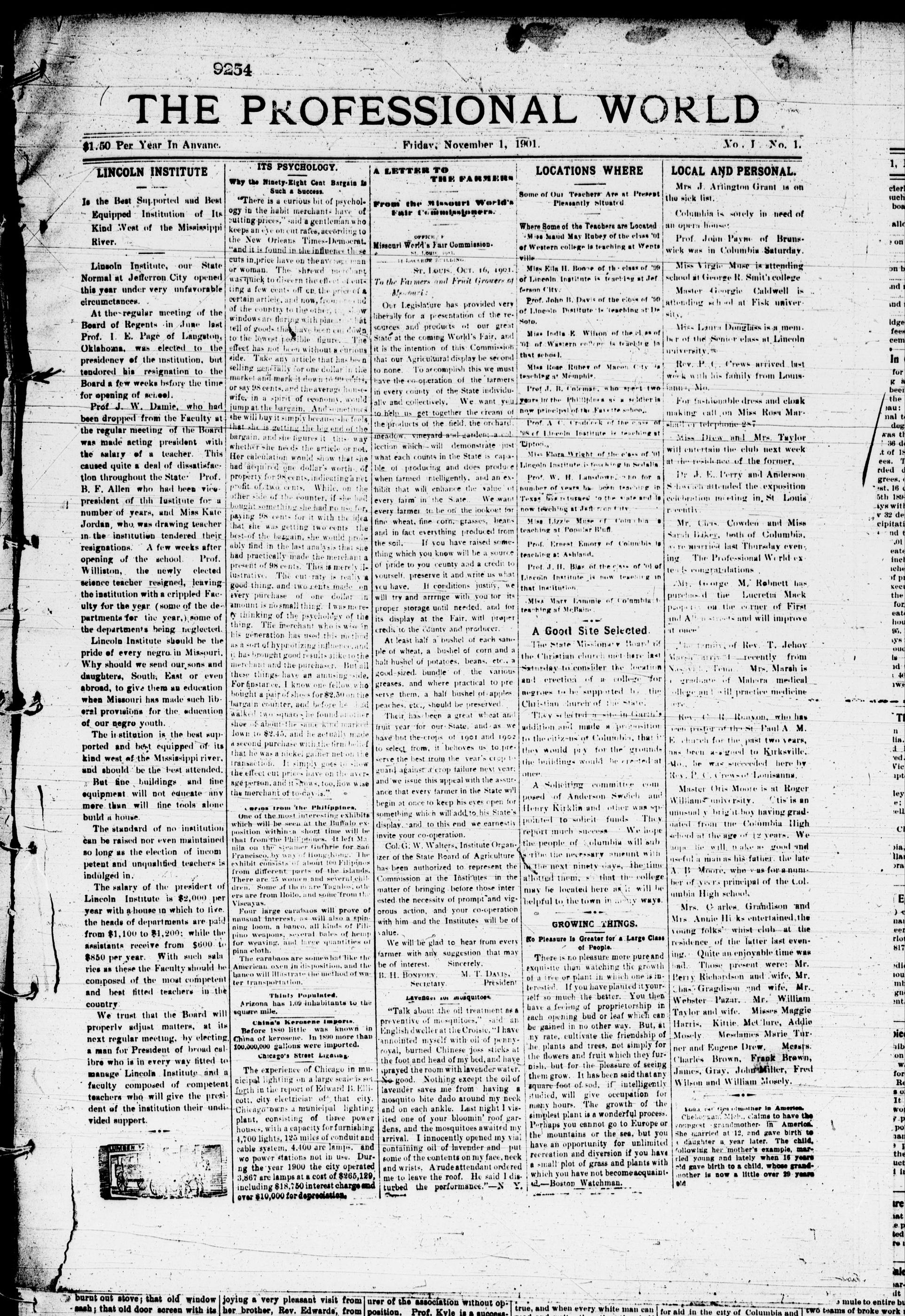
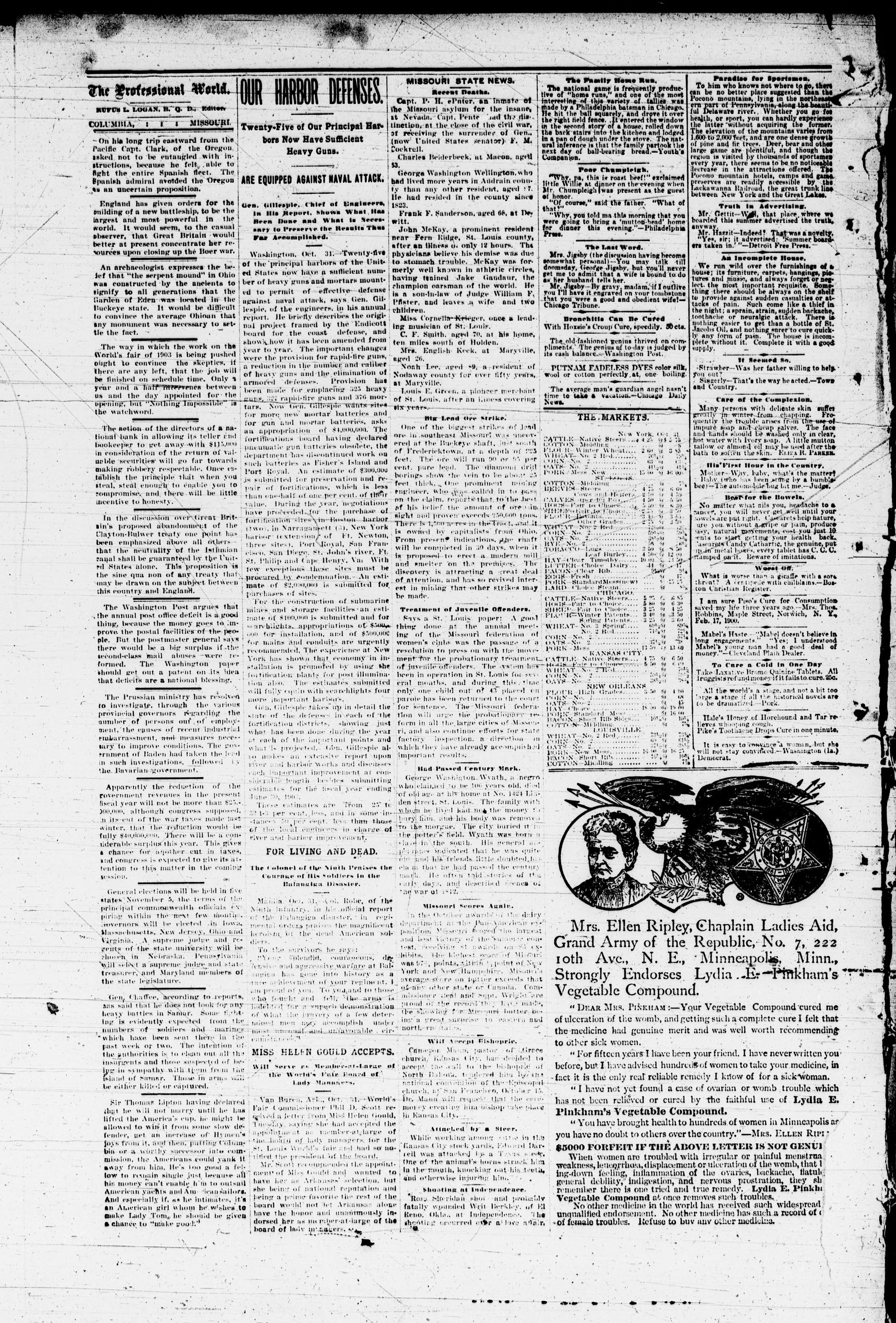
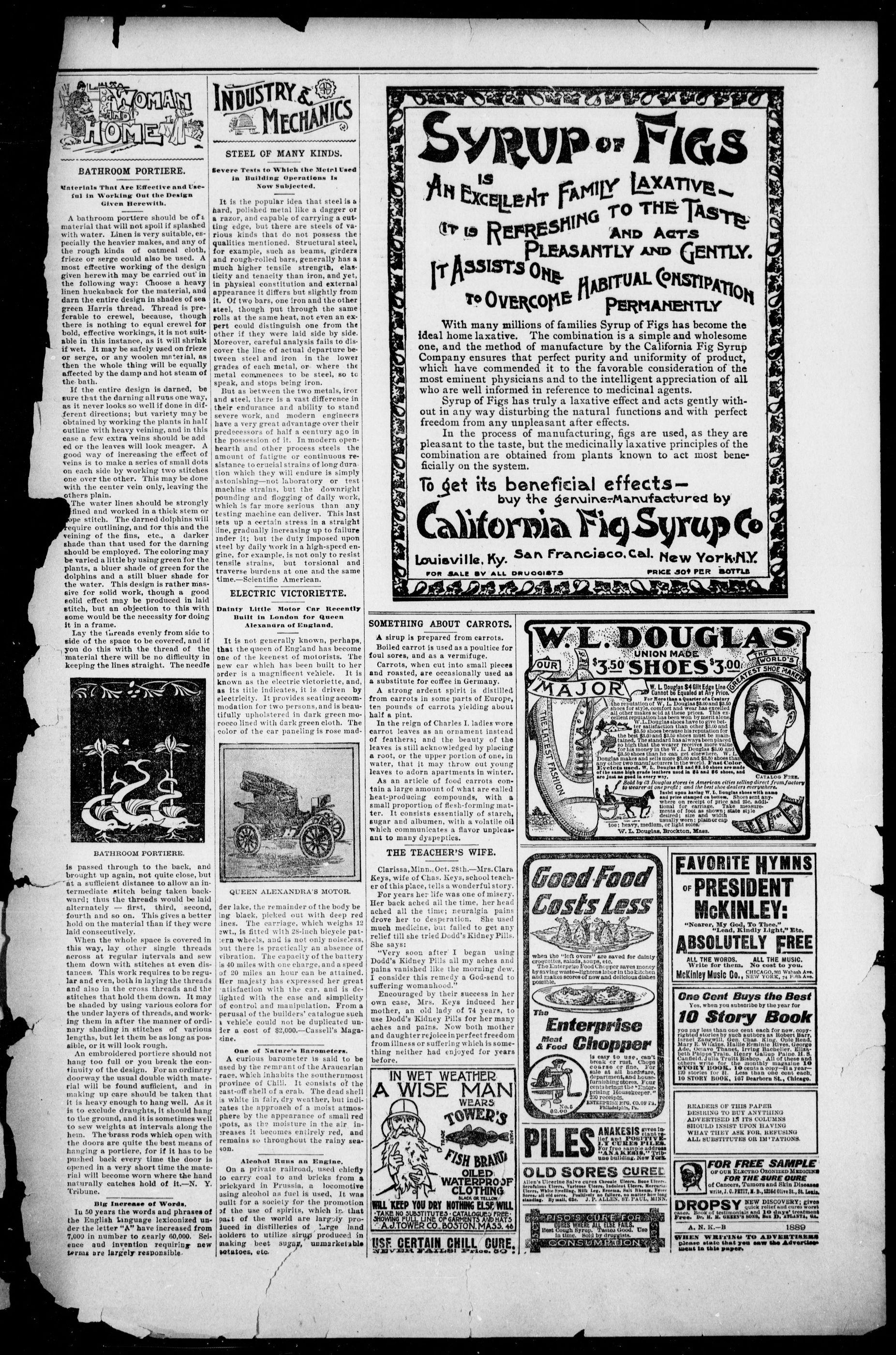
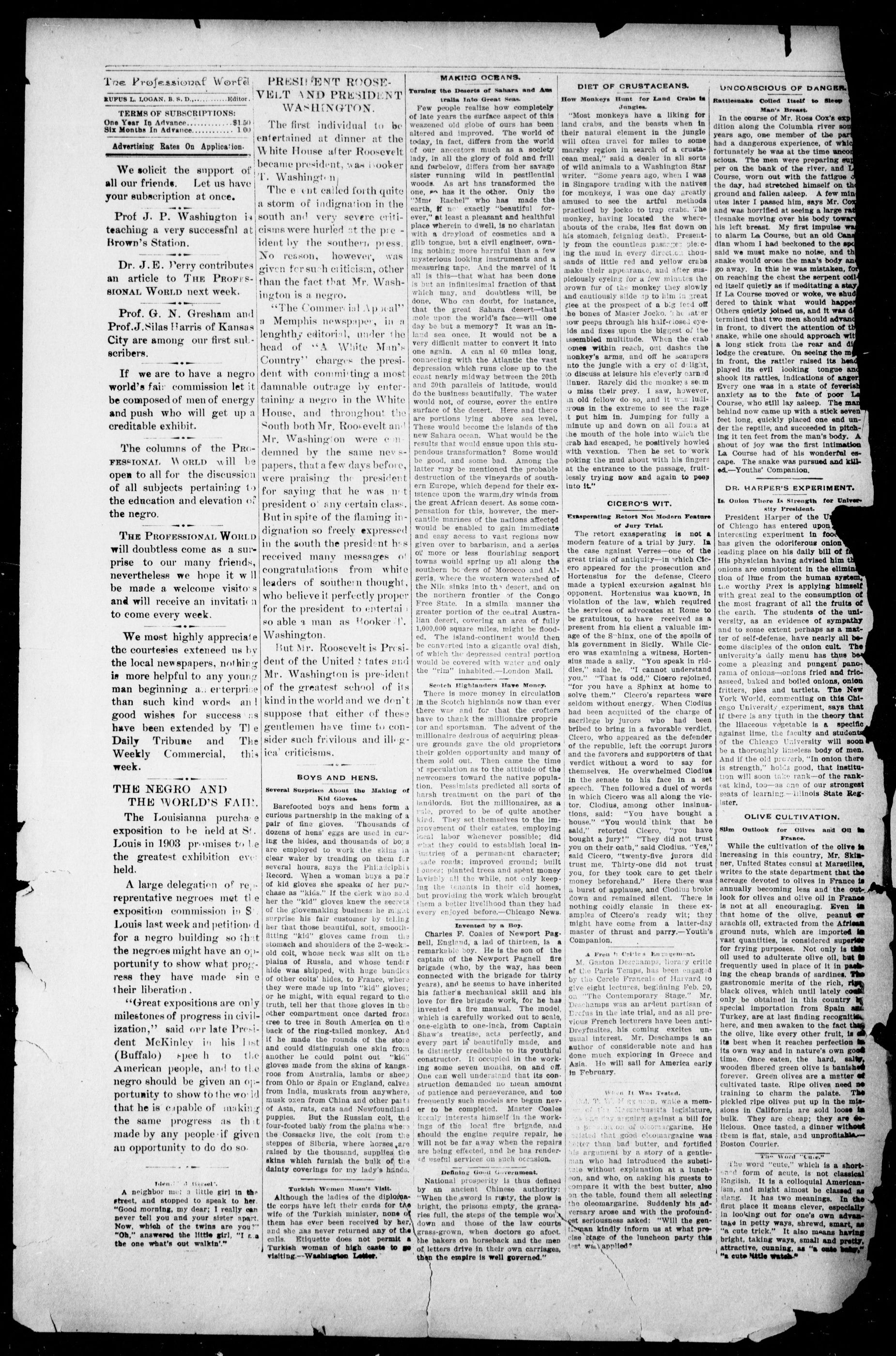
Page text (machine-generated)
THE PROFESSIONAL WORLD
9254
$1.50 Per Year In Anvanc.
LINCOLN INSTITUTE
Is the Best Supported and Best Equipped Institution of Its Kind West of the Mississippi River.
Linsoln Institute, our State Normal at Jefferson City opened this year under very unfavorable circumstances.
At the regular meeting of the Board of Regents in June last Prof. I. E. Page of Langston, Oklahoma, was elected to the presidency of the institution, but tendered his resignation to the Board a few weeks before the time for opening of school.
Prof J. W. Damie, who had been dropped from the Faculty at the regular meeting of the Board was made acting president with the salary of a teacher. This caused quite a deal of dissatisfaction throughout the State: Prof. B. E. Allen who had been vice
president of thb Institute for a number of years, and Miss Kate Jordan, who was drawing teacher in the institution tendered their resignations. A few weeks after opening of the school. Prof. Williston, the newly elected science teacher resigned, leaving the institution with a crippled Faculty for the year. (some of the departments for the year.) some of the departments being neglected.
Lincoln Institute should be the pride of every negro in Missouri. Why should we send our sons and daughters, South, East or even abroad, to give them an education when Missouri has made such liberal provisions for the education of our negro youth. The institution is the best supported and best equipped of its kind west of the Mississippi river, and should be the best attended. But fine buildings and fine equipment will not educate any more than will fine tools alone build a house.
The standard of no institution can be raised nor even maintained so long as the election of incompetent and unqualified teachers is indulged in.
The salary of the president of Lincoln Institute is $2,000 per year with a house in which to live. the heads of departments are paid from $1,100 to $1,200; while the assistants receive from $600 to $850 per year. With such salaries as these the Faculty should be composed of the most competent and best fitted teachers in the country.
We trust that the Board will properly adjust matters, at its next regular meeting, by electing a man for President of broad calibre who is in every way fitted to manage Lincoln Institute and a faculty composed of competent teachers who will give the president of the institution their undivided support.
burnt out stove; that old window joying
There is a curious bit of psychology in the habit merchants have of cutting prices," said a gentleman who keeps an eye on cut rafs, according to the New Orleans Times-Democrat, "and it is found in the influence these cuts in price have on the average man or woman. The shewed merchant was quick to discern the effect of cutting a few cents off on the price of a certain article, and now, from one end of the country to the other, to show windows are flaring with place, that tell of goods that have been cut down to the lowest possible figure. The effect has not been without a curious side. Take any article that has been selling generally for one dollar in the market and mark it down to 99 cents, or say 98 cents, and the average housewife, in a spirit of economy, would jump at the bargain. And sometimes she will buy it simply because she feels that she is getting the big end of the bargain, and she figures it this way whether she needs the article or not. Her calculation would show that she had acquired one dollar's worth of property for 98 cents, indicating a net profit of two cents. While, on the other side of the counter, if she had bought something she had no use for, paying 98 cents for it with the idea that she was getting two cents the best of the bargain, she would probably find in the last analysis that she had practically made the merchant a present of 98 cents. This is merely illustrative. The cut rate is really a good thing, and two cents made on every purchase of one dollar in amount is no small thing. I was merely thinking of the psychology of the thing. The merchant who is wise in his generation has used this method as a sort of hypnotizing influence, and it has brought good results alike to the merchant and the purchaser. But all these things have an amusing side. For instance, I know one fellow who bought a pair of shoes for $2.50 on the bargain counter, and before he had walked two squares he found another shoe of about the same kind marked down to $2.45, and he actually made a second purchase with the firm belief that he was a nickel gamer net on the transaction. It simply goes to show the effect cut prices have on the average person, and it shows, too, how wise the merchant of to-day is."
CARABAOS from the Philippines.
One of the most interesting exhibits which will be seen at the Buffalo exposition within a short time will be that from the Philippines. It left Manila on the Spamer Gobrine for San Francisco, by way of Hong Kong. The exhibit consists of about 100 Filipinos from different parts of the islands. There are 25 women and several children. Some of them are Tagalos, others are from Hoilo, and some from the Viscayas.
Four large carabaoes will prove of unusual interest, as will also a spinning loom, a banco, all kinds of Filipino weapons, several bales of hemp for weaving, and large quantities of pina cloth.
The carabaoes are somewhat like the American oxen in disposition, and the banco will illustrate the method of water transportation.
Thinly Populated.
Arizona has 1.09 inhabitants to the square mile.
China's Kerosene imports.
Before 1880 little was known in China of kerosene. In 1890 more than 100,000,000 gallons were imported.
Chicago's Street Lighting.
The experience of Chicago in municipal lighting on a large scale is set forth in the report of Edward B. Elliott, city electrician of that city. Chicago owns a municipal lighting plant, consisting of three power houses, with a capacity for furnishing 4,700 lights, 125 miles of conduit and cable system, 4,400 are lamps, and wo power stations not in use. During the year 1900 the city operated 3,867 are lamps at a cost of $265,129, including $18,750 interest charge and over $10,000 for depreciation.
Friday, November 1, 1901.
From the Missouri World's Fair Commissars.
St. Louis, Oct. 16, 1901.
To the Farmers and Fruit Growers of
Missouri.
Our Legislature has provided very liberally for a presentation of the resources and products of our great State at the coming World's Fair, and it is the intention of this Commission that our Agricultural display be second to none. To accomplish this we must have the cooperation of the farmers in every county of the State individually and collectively. We want you to help us get together the cream of the products of the field, the orchard, meadow, vineyard and garden; a collection which will demonstrate just what each counts in the State is capable of producing and does produce when farmed intelligently, and an exhibit that will enhance the value of every farm in the State. We want every farmer to be on the lookout for fine wheat, fine corn, grasses, beans and in fact everything produced from the soil. If you have raised something which you know will be a source of pride to you county and a credit to yourself, preserve it and write us what you have. If conditions justify, we will try and arrrge with you for its proper storage until needed, and for its display at the Fair, with proper credit to the county and producer.
At least half a bushel of each sample of wheat, a bushel of corn and a half bushel of potatoes, beans, etc., a good-sized, bundle of the various greases, and where practical to preserve them, a half bushel of apples, peaches, etc., should be preserved.
Their has been a great wheat and fruit year for our State, and as we have but the crops of 1901 and 1902 to select from, it behoves us to preserve the best from the year's crop to guard against a crop failure next year; and we issue this appeal with the assurance that every farmer in the State will begin at once to keep his eyes open for something which will add to his State's display, and to this end we earnestly invite your co-operation.
Col. G. W. Walters, Institute Organizer of the State Board of Agriculture has been authorized to represent the Commission at the Institutes in the matter of bringing before those interested the necessity of prompt and vigorous action, and your co-operation with him and the Institutes will be of value.
We will be glad to hear from every farmer with any suggestion that may be of interest. Sincerely.
B. H. BONFOLY M. T. DAVIS
Secretary President
Lavender mosquitoes
"Talk about the oil treatment as a preventive of mosquitoes," said an English dweller at the Croisie. "I have anointed myself with oil of penny-royal, burned Chinese joss sticks at the foot and head of my bed, and have sprayed the room with lavender water. No good. Nothing except the oil of lavender saves me from having a mosquito bite dado around my neck and on each ankle. Last night I visited one of your bloomin' roof gardens, and the mosquitoes awaited my arrival. I innocently opened my vial containing oil of lavender and put some of the contents on my face, neck and wrists. A rude attendant ordered me to leave the roof. He said I disturbed the performance."—N Y.
LOCATIONS WHERE
Some of Our Teachers Are at Present
Pleasantly Situated
Where Some of the Teachers are Located
Miss Maud May Rubey of the class '01
of Western college is teaching at Wents
ville
Miss Ella H. Boone of the class '09
of Lincoln Institute is teaching at Jeff
erson City.
Prof. John B. Davis of the class '09
of Lincoln Institute is teaching at De
Soto.
Miss India K. Wilson of the class of 91 of Western college is teaching in that school.
Miss Rose Rubey of Macon City is teaching at Memphis.
Prof J. B. Coleman, who spent two years in the Phillipines as a soldier is now principal of the Favorite school.
Prof A. C. Cradock of the class of 98 of Lincoln Institute is teaching at Tipton.
Miss Flora Wright of the class of 91 Lincoln Institute is teaching in Sedalia.
Prof W. H. Lansdown, who for a number of years has been teaching in Texas has returned to the state and is now teaching at Jefferson city.
Miss Lizzie Muse of Columbia is teaching at Popular Bluff.
Prof. Ernest Emory of Columbia is teaching at Ashland.
Prof. J. H. Blair of the class of 101 of Lincoln Institute is now teaching in that institution.
Misa Mary Lamie of Columbia is teaching at McBain.
A Good Site Selected.
The State Missionary Board of the Christian church met here last Saturday to consider the location and erection of a college for negroes to be supported by the Christian church of the State. They selected a site in Garth's addition and made a proposition to the citizens of Columbia, that if they would pay for the grounds the buildings would be erected at once.
A Soliciting committee composed of Anderson Swich and Henry Kirklin and other was appointed to solicit funds. They report much success. We hope the people of columbia will subscribe the necessary amount with in the next ninety days, the time allotted them, that the college may be located here as it will be helpful to the town in many ways.
GROWING THINGS.
No Pleasure is Greater for a Large Class of People.
There is no pleasure more pure and exquisite than watching the growth of a tree or plant in which one is interested. If you have planted it yourself so much the better. You then have a feeling of proprietorship in each opening bud or leaf which can be gained in no other way. But, at any rate, cultivate the friendship of the plants and trees, not simply for the flowers and fruit which they furnish, but for the pleasure of seeing them grow. It has been said that any square foot of sod, if intelligently studied, will give occupation for many hours. The growth of the simplest plant is a wonderful process. Perhaps you cannot go to Europe or the mountains or the sea, but you have an opportunity for unlimited recreation and diversion if you have a small plot of grass and plants with which you have not become acquainted.—Boston Watchman.
```markdown
```
No. J. No. 1.
LOCAL AND PERSONAL.
Columbia is sorely in need of an opera house:
Prof. John Payne of Brunswick was in Columbia Saturday.
Miss Virgie Muse is attending school at George R. Smith's college
Master Georgie Caldwell is attending school at Fisk university.
Miss Laura Donglass is a member of the Senior class at Lincoln university.
Rev. P. C. Crews arrived last week with his family from Louisiana. Mo.
For fashionable dress and cloak making call on Miss Rosu Marshall or telephone 287.
Miss Drew and Mrs. Taylor will entertain the club next week at the residence of the former.
Dr. J. E. Perry and Anderson Schweitzer attended the exposition celebration meeting in St. Louis recently.
Mr. Chris Cowden and Miss Sarah Dikey, both of Columbia, were married last Thursday evening.
The Professional World extends congratulations.
Mr. George M. Robnett has purchased the Lucretia Mack property on the corner of First and All streets and will improve it once.
The faculty of Rev. T. Jehov Marsh arrived recently from Nassau, Tenn. Mrs. Marsh is a graduate of Mahara medical college and will practice medicine now.
Rey, C. R. Ranson, who has been pastor of the St. Paul A. M. E. church for the past two years, has been a good to Kirksville, Mo., he was succeeded here by Rey, P. C. Crews of Louisiana. Master Otis Moore is at Roger William university. Otis is an unusually bright boy having graduated from the Columbia High school at the age of 12 years. We hope he will make a good and useful a man as his father, the late A. B. Moore, who was for a number of years principal of the Columbia High school.
Mrs. Charles Grandison and Mrs. Annie Hicks entertained the young folks' whist club at the residence of the latter last evening. Quite an enjoyable time was had. Those present were: Mr. Berry Richardson and wife, Mr. Chas. Gragdison and wife, Mr. Webster Pazar, Mr. William Taylor and wife. Misses Maggie Harris, Kittie McClure, Addie Mosely. Mesdames Marie Turner and Eugene Drew. Messrs. Charles Brown, Frank Brown, James, Gray, John Miller, Fred Wilson and William Mosely.
Ana sat grandmother in America.
Cheekoamam, claims to have the youngest grandmother in America.
She married at 12, and gave birth to a daughter a year later. The child, following her mother's example, married young and lately when 16 years old gave birth to a child, whose grandmother is now a little over 29 years old.
The Professional World.
RUPUS L. LOGAN, B. Q. D., EDITOR
COLUMBIA, : : : MISSOURI.
On his long trip eastward from the Pacific Capt. Clark, of the Oregon, asked not to be entangled with instructions, because he felt, able to fight the entire Spanish fleet. The Spanish admiral avoided the Oregon as an uncertain proposition.
England has given orders for the building of a new battleship, to be the largest and most powerful in the world. It would seem, to the casual observer, that Great Britain would better at present concentrate her resources upon closing up the Boer war.
An archaeologist expresses the belief that "the serpent mound" in Ohio was constructed by the ancients to signify to all generations that the Garden of Eden was located in the Buckeye state. It would be difficult to convince the average Ohioan that any monument was necessary to settle the fact.
The way in which the work on the World's fair of 1903 is being pushed ought to convince the skeptics, if there are any left, that the job will be finished on schedule time. Only a year and a half intervenes between us and the day appointed for the opening, but "Nothing Impossible" is the watchword.
The action of the directors of a national bank in allowing its teller and bookkeeper to get away with $115,000 in consideration of the return of valuable securities will go far towards making robbery respectable. Once establish the principle that when you steal, steal enough to enable you to compromise, and there will be little incentive to honesty.
In the discussion over Great Britain's proposed abandonment of the Clayton-Bulwer treaty one point has been emphasized above all others that the neutrality of the Isthmian canal shall be guaranteed by the United States alone. This proposition is the sine qua non of any treaty that may be drawn on the subject between this country and England.
The Washington Post argues that the annual post office deficit is a good thing, because the money goes to improve the postal facilities of the people. But the postmaster general says there would be a big surplus if the second-class mail abuses were reformed. The Washington paper should get out a patent on its idea that deficits are a national blessing.
The Prussian ministry has resolved to investigate, through the various provincial governors, regarding the number of persons out of employment, the causes of recent industrial embarrassment, and measures necessary to improve conditions. The government of Baden had taken the lead in such investigations, followed by the Bavarian-government.
Apparently the reduction of the government revenues in the present fiscal year will not be more than $27,000,000, although congress supposed, in its cut of the war taxes made last winter, that the reduction would be fully $40,000,000. There will be a considerable surplus this year. This gives chance for another cut in taxes, and congress is expected to give its attention to this matter in the coming session.
General elections will be held in five states November 5, the terms of the principal commonwealth officials expiring within the next few months. governors will be elected in Iowa, Massachusetts, New Jersey, Ohio and Virginia. A supreme judge and regents of the state university will be chosen in Nebraska. Pennsylvania will select a supreme judge and state treasurer, and Maryland members of the state legislature.
Gen. Chaffee, according to reports, as said that he does not look for any heavy battles in Samar. Some fighting is evidently expected from the numbers of soldiers and marines which have been sent there in the past week or two. The intention of the authorities is to clean out all the insurgents and those suspected of being in sympathy with them from the island of Samar. Those in arms will be either killed or captured.
Sir Thomas Lipton having declared that he will not marry until he has lifted the America's cup, he might be allowed to win it from some slow defender, get an increase of Hymen's joys from it, and then, putting Columbia or a worthy successor into commission, the Americans could yank it away from him. He's too good a fellow to remain single just because all his money can enable him to outsail American yachts and American sailors. And especially if, as he intimates, it's an American girl whom he wishes to make Lady Tom, he should be given a chance to "make good."4
Twenty-Five of Our Principal Harbors Now Have Sufficient Heavy Guns.
ARE EQUIPPED AGAINST NAVAL ATTACK.
Gen. Gillespie, Chief of Engineers
In His Report, Shows What Has
Been Done and What is Necessary to Preserve the Results Thus Far Accomplished.
Washington, Oct. 31. Twenty-five of the principal harbors of the United States now have a sufficient number of heavy guns and mortars mounted to permit of effective defense against naval attack, says Gen. Gillespie, of the engineers, in his annual report. He briefly describes the original project framed by the Endicott board for the coast defense, and shows how it has been amended from year to year. The important changes were the provision for rapid-fire guns, a reduction in the number and caliber of heavy guns and the elimination of armored defenses. Provision has been made for emplacing 325 heavy guns, 325 rapid-fire guns and 376 mortars. New Gen. Gillespie wants sites for more new mortar batteries and for gun and mortar batteries, asks an appropriation of $4,000,000. The fortifications board having declared pneumatic gun batteries obsolete, the department has discontinued work on such batteries as Fisher's Island and Port Royal. An estimate of $300,000 is submitted for preservation and repair of fortifications, which is less than one-half of one per cent. of their value. During the year, negotiations have proceeded for the purchase of fortification sites in Boston harbor (two), in Narragansett (3), New York harbor (extension) of Ft. Newton, three sites). Port Royal, San Francisco, San Diego, St. John's river, Ft. St. Philip and Cape Henry, Va. With few exceptions these sites must be procured by condemnation. An estimate of $2,000,000 is submitted for purchases of sites.
For the construction of submarine mines and storage facilities an estimate of $100,000 is submitted and for searchlights, appropriations of $500,000 for installation, and of $500,000 for mains and conduits are urgently recommended. The experience at New York has shown that economy in installation is promoted by using the fortification plants for post illumination also. The estimates submitted will fully copie with searchlights four more important harbors.
Gen. Gillespie takes up in detail the state of the defenses in each of the fortification districts, showing just what has been done during the year at each of the important points and what is projected. Gen. Gillespie also makes an extensive report upon river and harbour works and discusses each important improvement at considerable length besides submitting estimates for the usual year ending June 30, 1900.
These estimates are From 25 to 32 1/2 per cent., less, and in some instances 50 per cent., less than those of the local engineers in charge of river and harbour improvement.
FOR LIVING AND DEAD.
The Colonel of the Ninth Praises the Courage of His Soldiers in the Balamiga Disaster.
Mahinna Oct. 31, Col. Robe, of the North infantry, in his official report of the fallangian disaster, in regimental orders praises the magnificent heroism of the dead American soldiers.
To the survivors he says:
"Your soldier, courteous, de-
pensive and aggressive warfare at Ballingia has gone into history as a rare achievement of your regiment. I am proud of you. To you, and to those
who fought and tell, the army is indebted for a superb demonstration
of what the injury of a few determined men apply, accomplish under
most unanimous and unfavorable circumstances."
MISS HELEN GOULD ACCEPTS.
Will Serve as Member-at-Large of
the World's Fair Board of
Lady Managers.
Van Buren, Ark., Oct., M. World's
Fair Commissioner Phil D. Scott required a letter from Miss Helen Gould,
Tuesday, saying she had accepted the appointment as member-at-large of
the board of lady managers for the
St. Louis World's fair and had so
notified the president of the board.
Mr. Scott recommended the appointment of Miss Gould and wanted to
have her as Arkansas' selection, but
she being of national reputation and
being a prime favorite the rest of the
board would not let Arkansas alone
have the honor and unanimously
indorsed her as member-at-large of the
board of lady managers.
MISSOURI STATE NEWS.
Capt. P. H. ePuter, an inmate of the Missouri asylum for the insane, at Nevada. Capt. Pente, had the distinction, at the close of the civil war, of receiving the surrender of Gen. (now United States senator) F. M. Cockrell.
Charles Beiderbeck, at Macon, aged 53.
George Washington Wellington, who had lived more years in Audrain county than any other resident, aged 77. He had resided in the county since 1823.
Frank F. Sanderson, aged 66, at DeWitt.
John McKay, a prominent resident near Fern Ridge, St. Louis county, after an illness o. only 12 hours. The physicians believe his demise was due to stomach trouble. McKay was formerly well known in athletic circles, having trained Jake Gaudaur, the champion carman of the world. He is a son-in-law of Judge William F. Pfister, and leaves a wife and two children.
Miss Cornellia Krieger, once a leading musician of St. Louis.
C. F. Smith, aged 70, at his home, ten miles south of Holden.
Mrs. English Keck, at Maryville, aged 26.
Nonh Lee, aged 9, a resident of Nodaway county for over fifty years, at Maryville.
Louis E. Green, a pioneer merchant of St. Louis, after an illness covering six years.
Btg Lead Ors Strike.
One of the biggest strikes of lead ore in southeast Missouri was unevocated at the Buckeye shaft, just south of Fredericktown, at a depth of 225 feet. The ore will run 30 or 95 percent, pure lead. The diamond drill borings show the vein to be about 25 feet thick. One prominent mining engineer, who was called in to pass on the claim, reports that to the best of his belief the amount of ore in sight and proven exceeds 250,000 tons. There is 1,500 acres in the tract, and it is owned by capitalists from Ohio. From present indications, the shaft will be completed in 30 days, when it is proposed to erect a modern mill and smelter on the premises. The discovery is attracting a great deal of attention, and has so revived interest in mining that other strikes may be made.
Treatment of Juvenile Offenders.
Treatment of Juvenile Offenders.
Says a St. Louis paper: A good thing done at the annual meeting of the Missouri federation of women's clubs was the passage of a resolution to press on with the movement for the probationary treatment of juvenile offenders. The system has been in operation in St. Louis for several months, and during this time only one child out of 45 placed on parole has been returned to the court for sentence. The Missouri federation will urge the probationary reform in all the large cities of Missouri, and also continue efforts for state factory inspection, a direction in which they have already accomplished important results.
Had Passed Century Mark.
George Washington, Wyath, a negro who claimed to be 100 years old, of old age, or his home at No. 1424 Linden street, St. Louis. The family with whom he lived had no the money to bury him, and his body was removed to the morgue. The city buried it in the potter's field. Wyath was born a clad in the south. His general appearance indicated that he was quite city and his friends little doubted he elm in that he had passed the century mark. He often told stories of the early days, and described scenes of the war of 1812.
Missouri Scores Again.
In the October awards of the daily department at the Pan-American exposition, Missouri captured the largest and best victory of the Summer contest, receiving 11 awards on 30 exhibits. The highest score of Missouri was 75, points, at a point of New York and New Hampshire. Missouri's average score on litter exceeds that of any other state or Canada. Commissioner Dean and Sept. Wright are proud of the record they have made, the showing for Missouri butter being a great surprise to eastern and northern States.
Will Accept Bishopric.
Cannonon Mann, pastor of Greece church/Kibsas City, has decided to accept the call to the bishopric of North Dakota, tendered him by an national convention of the Episcopal church, of San Francisco, October 15. Do Mann will request that the ceremony creating him bishop take place in Kansas City.
Attacked by Steer.
While working among cattle in the Kansas City stock yards, Edward Darrell was attacked by a Texas sore. One of the animals horns struck him in the mouth, knocking out his teeth, and otherwise injuring him.
Shooting at Independence.
Shooting at Independence.
Rosg. Sheridan shot and probably fatally wounded Writ. Berkley, of El Reno, Okla. at Independence. The shooting occurred over above a field.
LEM QA
1826-1855
Mrs. Ellen Ripley, Chaplain Ladies Aid, Grand Army of the Republic, No. 7, 222 10th Ave., N. E., Minneapolis, Minn. Strongly Endorses Lydia E. Pinkham's Vegetable Compound.
"DEAR MRS. PINKHAM:—Your Vegetable Compound cured me of ulceration of the womb, and getting such a complete cure I felt that the medicine had genuine merit and was well worth recommending to other sick women.
"For fifteen years I have been your friend. I have never written you before, but I have advised hundreds of women to take your medicine, in fact it is the only real reliable remedy I know of for a sick woman.
"I have not yet found a case of ovarian or womb trouble which has not been relieved or cured by the faithful use of Lydia E. Pinkham's Vegetable Compound.
"You have brought health to hundreds of women in Minneapolis as you have no doubt to others over the country."—MRS. ELLEN RIPI: $5000 FORFEIT IF THE ABOVE LETTER IS NOT GENUI
When women are troubled with irregular or painful menstrual weakness, leucorrhea, displacement or ulceration of the womb, that lying-down feeling, inflammation of the ovaries, backache, flatulence, general debility, indigestion, and nervous prostration, they sh remember there is one tried and true remedy. Lydia E. Pinkha Vegetable Compound at once removes such troubles. No other medicine in the world has received such widespread unqualified endorsement. No other medicine has such a record of of female troubles. Refuse to buy any other medicine.
The Family Home Run.
The national game is frequently productive of "home runs" and one of the most interesting of this variety of tallies was made by a Philadelphia batman in Chicago. He hit the ball squarely, and drove it over the right field fence. It entered the window in the second story of a house, rolled down the back stairs into the kitchen and lodged in a pan of dough under the stove. The natural inference is that the family partook the next day of ball-bearing bread.—Youth's Communion.
Poor Chambleigh
"Why, pa, this is roast beef!" exclaimed little Willie at dinner on the evening when Mr. Chumpleigh was present as the guest of honor. "Of course," said the father. "What of that?"
"Why, you told me this morning that you were going to bring a 'mutton-head' home for dinner this evening."—Philadelphia Press.
The Last Word.
Mrs. Jigaby (the discussion having become somewhat personal)—You may talk till dnoomday, George Jigaby, but you'll never get me to admit that a wife is bound to do a hand and tell her.
Mr. Jigaby. My husband, if I outlive you I'll have it engraved on your tombstones that you were a good and obedient wifel—Chicago Tribune.
Bronchitis Can Be Cured
The old fashioned genius thrived on compliments. The genius of to-day is judged by its cash balance. Washington Post.
PUTNAM FADELESS DYES color silk, wool or cotton perfectly at, one boiling.
The average man's guardian angel hasn't time to take a vacation. Chicago Daily News.
Paradise for Sportsmen.
To him who knows not where to go, there can be no better place suggested than the Pocono mountains, lying in the northeast arm part of Pennsylvania, along the beautiful Delaware river. Whether you go for health, or sport, you can hardly experience the latter without acquiring the former. The elevation of the mountains varies from 1,600 to 2,000 feet, and are one dense growth of pine and fir trees. Deer, bear and other large game are plentiful, and though the region is visited by thousands of sporters every year, there seems to be no noticeable decrease in the attractions offered. The Pocono mountain hotels, camps and game preserves are readily accessible by the backawanna Railroad, the great trunk line between New York and the Great Lakes.
Truth in Advertising.
Mr. Gettit—Well, that place, where we boarded this summer advertised the truth, anway.
Mr. Hazzit—Indeed? That was a novelty.
"Yes, sir; it advertised: 'Summer boarders taken in.'"—Detroit Free Press.
An Incomplete House.
We run wild over the furnishings of a house; its furniture, carpets, hangings, pictures and music, and always forget or neglect the most important requisite. Something there should be always on the shelf to provide against sudden casualties or attacks of pain. Such come like a thief in the night; a sprain, strain, sudden backache, toothache or neuralgic attack. There is nothing easier to get than a bottle of St. Jacobs Oil, and nothing surer to cure quickly any form of pain. The house is incomplete without it. Complete it with a good supply.
It Seemed So.
Strawber—Was her father willing to help you out?
Sigently-That's the way he acted.—Town and Country.
Care of the Complexion.
Many persons with delicate skin suffer greatly in winter from chapping. Frequently the trouble arises from the use of impure soap and cheap salves. The face and hands should be washed only in clear, hot water with ivory soap. A little minton tallow or almond oil may be used after the bath to soothe the skin. ELLA R. PARKER.
Hip First Hour in the Country.
Mother—Why, baby, what's the matter?
Baby, (who has been stung by a bumblebee)—The automobile bug bit me.—Judge.
Best for the Bowels.
No matter what nails you, headache to a cancer, you will never get well until your sores are put right. Casescars help nature, are you without a grip or pain, produce easy, natural movements, cost you just 10 Casescars Candy, the genuine, put in metal boxes, every tablet has C. C. C. gramed on it. Beware of imitations.
Worst Off.
What is worse than a giraffe with a nose throat? A cripetude with chinblains—Boston Christian Register.
I am sure Piso's Cure for Consumption saved my life three years ago—Mrs. Thea Robbins, Maple Street, Norwich, N. Y. Feb. 17, 1900.
Mabel's Haste — "Mabel doesn't believe in long engagements." "Yes; I understood Mabel's young man had a good deal of money."—Cleveland Plain Dealer.
To Cure a Cold in One Day
Take Laxat or Brome Quinine Tablets. All frugists ref and money if it fails to cure. 350.
All the world's a stage, and not a bit too large a stage if all the historical novels are to be dramatized—Puck.
Hale's Honey of Horchound and Tar relieves whooping cough. Pike's Toothacne Drops Cure in one minute.
It is easy to convince a woman, but she will not stay convicted—Washington (la.) Democrat.
WOMAN AND HOME
BATHROOM PORTIERE.
Materials That Are Effective and Useful in Working Out the Design Given Herewith.
A bathroom portiere should be of a material that will not spoil if splashed with water. Linen is very suitable, especially the heavier makes, and any of the rough kinds of oatmeal cloth, frieze or serge could also be used. A most effective working of the design given herewith may be carried out in the following way: Choose a heavy linen huckaback for the material, and darn the entire design in shades of sea green Harris thread. Thread is preferable to crewel, because, though there is nothing to equal crewel for bold, effective workings, it is not suitable in this instance, as it will shrink if wet. It may be safely used on frieze or serge, or any woolen material, as then the whole thing will be equally affected by the damp and hot steam of the bath.
If the entire design is darned, be sure that the darning all runs one way, as it never looks so well if done in different directions; but variety may be obtained by working the plants in half outline with heavy veining, and in this case a few extra veins should be added or the leaves will look meager. A good way of increasing the effect of veins is to make a series of small dots on each side by working two stitches one over the other. This may be done with the center vein only, leaving the others plain.
The water lines should be strongly defined and worked in a thick stem orope stitch. The darned dolphins will require outlining, and for this and the veining of the fins, etc., a darker shade than that used for the darning should be employed. The coloring may be varied a little by using green for the plants, a bluer shade of green for the dolphins and a still bluer shade for the water. This design is rather massive for solid work, though a good solid effect may be produced in laid stitch, but an objection to this with some would be the necessity for doing it in a frame. Lay the threads evenly from side to side of the space to be covered, and if you do this with the thread of the material there will be no difficulty in keeping the lines straight. The needle
BATHROOM PORTIERE.
is passed through to the back, and brought up again, not quite close, but at a sufficient distance to allow an intermediate stitch being taken backward; thus the threads would be laid alternately — first, third, second, fourth and so on. This gives a better hold on the material than if they were laid consecutively.
When the whole space is covered in this way, lay other single threads across at regular intervals and sew them down with stitches at even distances. This work requires to be regular and even, both in laying the threads and also in the cross threads and the stitches that hold them down. It may be shaded by using various colors for the under layers of threads, and working them in after the manner of ordinary shading in stitches of various lengths, but let them be as long as possible, or it will look rough.
An embroidered portiere should not hang too full or you break the continuity of the design. For an ordinary doorway the usual double width material will be found sufficient, and in making up care should be taken that it is heavy enough to hang well. As it is to exclude draughts, it should hang to the ground, and it is sometimes well to sew weights at intervals along the hem. The brass rods which open with the doors are quite the best means of hanging a portiere, for if it has to be pushed back every time the door is opened in a very short time the material will become worn where the hand naturally catches hold of it.—N. Y. Tribune.
Big Increase of Words.
In 50 years the words and phrases of the English language lexiconized under the letter "A" have increased from 7,000 in number to nearly 60,000. Science and invention requiring new terms are largely responsible.
INDUSTRY MECHANICS
STEEL OF MANY KINDS.
Severe Tests to Which the Metel Used in Building Operations is Now Subjected.
It is the popular idea that steel is a hard, polished metal like a dagger or a razor, and capable of carrying a cutting edge, but there are steels of various kinds that do not possess the qualities mentioned. Structural steel, for example, such as beams, girders and rough-rolled bars, generally has a much higher tensile strength, elasticity and tenacity than iron, and yet, in physical constitution and external appearance it differs but slightly from it. Of two bars, one iron and the other steel, though put through the same rolls at the same heat, not even an expert could distinguish one from the other if they were laid side by side. Moreover, careful analysis fails to discover the line of actual departure between steel and iron in the lower grades of each metal, or where the metal commences to be steel, so to speak, and stops being iron.
But as between the two metals, iron and steel, there is a vast difference in their endurance and ability to stand severe work, and modern engineers have a very great advantage over their predecessors of half a century ago in the possession of it. In modern open-hearth and other process steels the amount of fatigue or continuous resistance to crucial strains of long duration which they will endure is simply astonishing—not laboratory or test machine strains, but the downright pounding and flogging of daily work, which is far more serious than any testing machine can deliver. This last sets up a certain stress in a straight line, gradually increasing up to failure under it; but the duty imposed upon steel by daily work in a high-speed engine, for example, is not only to resist tensile strains, but torsional and traverse burdens at one and the same time.—Scientific American.
ELECTRIC VICTORIETTE.
Dainty Little Motor Car Recently Built in London for Queen Alexandra of England.
It is not generally known, perhaps, that the queen of England has become one of the keenest of motorists. The new car which has been built to her order is a magnificent vehicle. It is known as the electric victoriette, and, as its title indicates, it is driven by electricity. It provides seating accommodation for two persons, and is beautifully upholstered in dark green morocco lined with dark green cloth. The color of the car paneling is rose mad-
QUEEN ALEXANDRA'S MOTOR.
nder lake, the remainder of the body be ing black, picked out with deep red lines. The carriage, which weighs 12 awt., is fitted with 28-inch bicycle pattern wheels, and is not only noiseless, but there is practically an absence of vibration. The capacity of the battery is 40 miles with one charge, and a speed of 20 miles an hour can be attained. Her majesty has expressed her great satisfaction with the car, and is delighted with the ease and simplicity of control and manipulation. From a perusal of the builders' catalogue such a vehicle could not be duplicated under a cost of $2,000.—Cassell's Magazine.
One of Nature's Barometers.
A curious barometer is said to be used by the remnant of the Araucarian race, which inhabits the southernmost province of Chill. It consists of the cast-off shell of a crab. The dead shell is white in fair, dry weather, but indicates the approach of a moist atmosphere by the appearance of small red spots, as the moisture in the air increases it becomes entirely red, and remains so throughout the rainy season.
Alcohol Runs an Engine.
On a private railroad, used chiefly to carry coal to and bricks from a prickyard in Prussia, a locomotive using alcohol as fuel is used. It was built for a society for the promotion of the use of spirits, which in that part of the world are largely produced in distilleries of large land holders to utilize sirup produced in making beet sugar, unmarketable potatoes, etc.
SYRUP OF FIGS IS AN EXCELLENT FAMILY LAXATIVE- IT IS REFRESHING TO THE TASTE AND ACTS PLEASANTLY AND GENTLY. IT ASSISTS ONE TO OVERCOME HABITUAL CONSTIPATION PERMANENTLY
With many millions of families Syrup of Figs has become the ideal home laxative. The combination is a simple and wholesome one, and the method of manufacture by the California Fig Syrup Company ensures that perfect purity and uniformity of product, which have commended it to the favorable consideration of the most eminent physicians and to the intelligent appreciation of all who are well informed in reference to medicinal agents.
Syrup of Figs has truly a laxative effect and acts gently without in any way disturbing the natural functions and with perfect freedom from any unpleasant after effects.
In the process of manufacturing, figs are used, as they are pleasant to the taste, but the medicinally laxative principles of the combination are obtained from plants known to act most beneficially on the system.
Louisville, Ky. San Francisco, Cal. New York, N.Y.
FOR SALE BY ALL DRUGGISTS PRICE $0.99 PER BOTTLE
SOMETHING ABOUT CARROTS.
A sirup is prepared from carrots. Boiled carrot is used as a poultice for foul sores, and as a vermifuge. Carrots, when cut into small pieces and roasted, are occasionally used as a substitute for coffee in Germany. A strong ardent spirit is distilled from carrots in some parts of Europe, ten pounds of carrots yielding about half a pint. In the reign of Charles I. ladies wore carrot leaves as an ornament instead of feathers; and the beauty of the leaves is still acknowledged by placing a root, or the upper portion of one, in water, that it may throw out young leaves to adorn apartments in winter.
As an article of food carrots contain a large amount of what are called heat-producing compounds, with a small proportion of flesh-forming matter. It consists essentially of starch, sugar and albumen, with a volatile oil which communicates a flavor unpleasant to many dyspeptics.
THE TEACHER'S WIFE.
Clarissa, Minn. Oct. 28th.—Mrs. Clara Keys, wife of Chas, Keys, school teacher of this place, tells a wonderful story. For years her life was one of misery. Her back ached all the time, her head ached all the time; neuralgia pains drove her to desperation. She used much medicine, but failed to get any relief till she tried Dodd's Kidney Pills. She says: "Very soon after I began using Dodd's Kidney Pills all my aches and pains vanished like the morning dew. I consider this remedy a God-send to suffering womanhood."
Encouraged by their success in her own case, Mrs. Keys induced her mother, an old lady of 74 years, to use Dodd's Kidney Pills for her many aches and pains. Now both mother and daughter rejoice in perfect freedom from illness or suffering which is something neither had enjoyed for years before.
IN WET WEATHER
A WISE MAN
WEARS
TOWER'S
TRAD
FISH BRAND
OILED
WATERPROOF
CLOTHING
BLACK OR YELLOW
WILL KEEP YOU DRY NOTHING ELSE. WILL
-TAKE NO SUBSTITUTE- CAT LOGO FREE
-SHOWING PULL LINE OF GARMENTS AND HATS
A.J.TOWER CO., BOSTON, MASS. 46
USE CERTAIN CHILL CURE.
NEVER TAILED. Prsg. 90.
W. L. DOUGLAS
UNION MADE
$3.50 SHOES $3.00
OUR
THE WORLD'S
GREATEST SHOE MAKER
THE ATEST FASHION
W. L. Douglas $4 Gift Edge Line
Cannot be Equaled at Any Price
For More than a Quarter of a Century
the reputation of W. L. Douglas $3.00 and $3.50
shoes for style comfort and wear has excelled
all other makes in at these times. His
excellent reputation has been won by merit alone
W. L. Douglas shoes have had a very
per satisfaction than other $3.00 and
$3.50 shoes because his reputation for
the best $5.00 and $5.50 shoes must be
maintained. The standard has always been placed
so high that the wearer receives more value
On his shoes in the W. L. Douglas and
$3.50 shoes than on his can get elsewhere. W. L.
Douglas makes and sells more $3.00 and $3.50 shoes than
on other two manufacturers in the world. And every
Plyers uses W. L. Douglas $3 and $3.50 shoes are made
of the same high grade leather used in $5 and $6 shoes, and
are just as easy to wear.
Sold by $3 Douglas stores in American cities selling direct from factory
to wearer at one profit; and the best shoe dealers everywhere.
Institute upon having W. L. Douglas shoes with name
and price shaped or bitten. Shoes sent any-
where on receipt of price and 25c. additional
for warranty. Take measurement
of foot as shown. State style
desired: size and width
usually worn, plain or cap
toes: heavy, medium, or high heels.
W. L. Douglas, Brockton, Mass.
The
Enterprise
Meat & Food Chopper
is easy to use, can't
break or rust. Chops
coarse, dine. For
sale at all hardware,
department, and house-
fitting stores. You
can centrally bring the "En-
trprising Housekeeper."
230 receipts.
ENTERTAINMENT CO. OF PA.
Philadelphia, Pa.
PILES
ANAKESIS gives in-
stant revival
IN CURES PILES.
For free sample address
"ANAKESIS," Trib-
une building, New York.
when the "ifc ovrs" are saved for dainty
cookware the "Enterprise Food Chopper" saves money
by saving waste—lighthearted labor in the kitchen
and makes scores of now and delicious dishes
OLD SORES CURED
Allen's Ulcerine Salve curzes Chronic Ulcers. Bone Ulcer,
Scrofula. Ulcerous Skin. Bone Ulcer. Bone Ulcer.
White Spelling. Milk Lecithin. Salt Lecithin. Fever
Sore. all old sores. Positively no failure, no matter heat
standing. by mail. GSc. J. P. ALLEN. ST. PAUL. MINN.
ALL THE WORDS. ALL THE MUSIC.
Write for them. No cost to them.
McKinley Music Co., CHICAGO, 300 Wabash Ave.
NEW YORK, 74 Eighth Ave.
One Cent Buys the Best
Yes, when you subscribe by the year for
10 Story Book
you pay less than one cent each for new, copy-
billed books by such authors as Josephine
Israel Zangwil, such as Charles Ching, Olec Read,
Mary E. Wilkins, Hannah Ernie Hines, George
Mary, Terry Russell, Lyle Bailby, Ellen
beth Philps Train, Henry Gallup Paine, H. S.
Canfield, Julia Truitt Bishop. All of these and
other writers, the monthly magazine 10
STORY BOOK, 10 cents a copy-a year-
120 stories for $1. Less than one cent each,
10 STORY BOOK, 167 Dearborn St., Chicago.
READERS OF THIS PAPER
DESIREING TO BUY ANYTHING
ADVERTISED 15 ITS COLUMNS
SHOULD INSIST HAVING WHAT THEY ASK FOR, REFUSING
ALL SUBSTITUTES OR IM TATIONS.
FOR FREE SAMPLE
OF OUR ELCTROC OZONIZED MEDICINE
FOR THE SURE OURE
of Cancers, Tumora and Skin Diseases
write, J. C. PRITT, M. D. B, 1216d Olive St. St. Laina
FOR FREE SAMPLE OF OUR ELECTRO OZONIZED MEDICINE FOR THE SURE OURE of Cancers, Tumors and Skin Diseases write, J. C. PETIT, E. D., 12164 Olive St., St. Louis.
DROPSY NEW DISCOVERY; gives quick relief and curts treatment cases. Book of testimonials and 10 days' treatment Free. Dr. H. H. GREEN'S SONS, Box D, ATLANTA, GA.
A. N. K. - B 1889
WHEN WRITING TO ADVERTISEERS please state that you saw the Advertisement in this paper.
The Professional World
RUFUS L. LOGAN, B. S. D.,.....Editor.
TERMS OF SUBSCRIPTIONS:
One Year In Advance.....$1.50
Six Months In Advance.....1.00
Advertising Rates On Application.
We solicit the support of all our friends. Let us have your subscription at once.
Prof J. P. Washington is teaching a very successful at Brown's Station.
Dr. J.E. Perry contributes an article to THE PROFESSIONAL WORLD next week.
---
Prof. G. N. Gresham and Prof.J.Silas Harris of Kansas City are among our first subscribers.
If we are to have a negro world's fair commission let it be composed of men of energy and push who will get up a creditable exhibit.
The columns of the PROFESSIONAL WORLD will be open to all for the discussion of all subjects pertaining to the education and elevation of the negro.
---
THE PROFESSIONAL WORLD will doubtless come as a surprise to our many friends, nevertheless we hope it will be made a welcome visitors and will receive an invitation to come every week.
We most highly appreciate the courtesies extended us by the local newspapers, nothing is more helpful to any young man beginning an enterprise than such kind words and good wishes for success as have been extended by The Daily Tribune and The Weekly Commercial, this week.
THE NEGRO AND
The Louisianna purchase exposition to be held at St. Louis in 1903 promises to be the greatest exhibition ever held.
A large delegation of representative negroes met the exposition commission in St. Louis last week and petitioned for a negro building so that the negroes might have an opportunity to show what progress they have made since their liberation.
"Great expositions are only milestones of progress in civilization," said our late President McKinley in his last (Buffalo) speech to the American people, and to the negro should be given an opportunity to show to the world that he is capable of making the same progress as that made by any people if given an opportunity to do do so.
Iden. d Herself.
A neighbor met a little girl in the street, and stopped to speak to her. "Good morning, my dear; I really can never tell you and your sister apart. Now, which of the twins are you?" "Oh," answered the little girl, "I a. the one what's out walkin."
PRESIDENT ROOSEVELT AND PRESIDENT
The first individual to be entertained at dinner at the White House after Roosevelt became president, was Booker T. Washington. The event called forth quite a storm of indignation in the south and very severe criticisms were hurled at the president by the southern press. No reason, however, was given for such criticism, other than the fact that Mr. Washington is a negro.
"The Commercial Appeal" a Memphis newspaper, in a lengthy editorial, under the head of "A White Man's Country" charges the president with committing a most damnable outrage by entertaining a negro in the White House, and throughout the South both Mr. Roosevelt and Mr. Washington were condemned by the same newspapers, that a few days before, were praising the president for saying that he was not president of any certain class. But in spite of the flaming indignation so freely expressed in the south the president has received many messages of congratulations from white leaders of southern thought, who believe it perfectly proper for the president to entertain so able a man as Rooker F. Washington.
But Mr. Roosevelt is President of the United States and Mr. Washington is president of the greatest school of its kind in the world and we don't suppose that either of these gentlemen have time to consider such frivolous and illogical criticisms.
BOYS AND HENS.
Several Surprises About the Making of Kid Gloves.
Barefooted boys and hens form a curious partnership in the making of a pair of fine gloves. "Thousands of dozens of hens' eggs are used in curing the hides, and thousands of boys are employed to work the skins in clear water by treading on them for several hours, says the Philadelphia Record. When a woman buys a pair of kid gloves she speaks of her purchase as "kids." If the clerk who sold her the "kid" gloves knew the secrets of the glovemaking business he might surprise his fair customer by telling her that those beautiful, soft, smooth-fitting "kid" gloves came from the stomach and shoulders of the 3-week-old colt, whose neck was slit on the plains of Russia, and whose tender hide was shipped, with huge bundles of other colts' hides, to France, where they were made up into "kid" gloves; or he might, with equal regard to the truth, tell her that those gloves in the other compartment once darted from tree to tree in South America on the back of the ring-tailed monkey. And if he made the rounds of the store and could distinguish one skin from another he could point out "kid" gloves made from the skins of kangaroos from Australia, lambs or sheep from Ohio or Spain or England, calves from India, muskrats from anywhere, musk oxen from China and other parts of Asta, rats, cats and Newfoundland puppies. But the Russian colt, the four-footed baby from the plains where the Cossacks live, the colt from the steppes of Siberia, where horses are raised by the thousand, supplies the skins which furnish the bulk of the dainty coverings for my lady's hands.
Turkish Women Mustn't Visit.
Turkish Women Mustn't Visit.
Although the ladies of the diplomatic corps have left their cards for the wife of the Turkish minister, none of them has ever been received by her, and she has never returned any of the calls. Etiquette does not permit a Turkish woman of high caste to go visiting.--Washington Letter.
MAKING OCEANS.
Turning the Deserts of Sahara and Ass
trails into Great Seas.
Few people realize how completely of late years the surface aspect of this weazened old globe of ours has been altered and improved. The world of today, in fact, differs from the world of our ancestors much as a society lady, in all the glory of fold and frill and furbelow, differs from her savage sister running wild in pestilential woods. As art has transformed the one, has it the other. Only the "Mmr Rachel" who has made the earth, if no exactly "beautiful forever," at least a pleasant and healthful place wherein to dwell, is no charlatan with a drayload of cosmetics and a glib tongue, but a civil engineer, owning nothing more harmful than a few mysterious looking instruments and a measuring tape. And the marvel of all it is this—that what has been done is but an infinitesimal fraction of that which may, and doubtless will, be done. Who can doubt, for instance, that the great Sahara desert—that mole upon the world's face—will one day be but a memory? It was an inland sea once. It would not be a very difficult matter to convert it into one again. A can al 60 miles long, connecting with the Atlantic the vast depression which runs close up to the coast nearly midway between the 20th and 30th parallels of latitude, would do the business beautifully. The water would not, of course, cover the entire surface of the desert. Here and there are portions lying above sea level. These would become the islands of the new Sahara ocean. What would be the results that would ensue upon this stupendous transformation? Some would be good, and some bad. Among the latter may be mentioned the probable destruction of the vineyards of southern Europe, which depend for their existence upon the warm, dry winds from the great African desert. As some compensation for this, however, the mercantile marines of the nations affected would be enabled to gain immediate and easy access to vast regions now given over to barbarism, and a series of more or less flourishing seaport towns would spring up all along the southern borders of Morocco and Algeria, where the western watershed of the Nile sinks into the desert, and on the northern frontier of the Congo Free State. In a simila manner the greater portion of the central Australian desert, covering an area of fully 1,000,000 square miles, might be flooded. The island-continent would then be converted into a gigantic oval dish of which the depressed central portion would be covered with water and only the "rim" inhabited.—London Mall.
Scotch Highlanders Have Money.
Scotch Highlanders Have Money. There is more money in circulation in the Scotch highlands now than ever there was and for that the crofters have to thank the millionaire proprietor and sportsman. The advent of the millionaire desirous of acquiring pleasure grounds gave the old proprietors their golden opportunity and many of them sold out. Then came the time of speculation as to the attitude of the newcomers toward the native population. Pessimists predicted all sorts of harsh treatment on the part of the landlords. But the millionaires, as a rule, proved to be of quite another kind. They set themselves to the improvement of their estates, employing local labor whenever possible; did what they could to establish local industries of a permanent character; made roads; improved ground; built houses; planted trees and spent money lavisily all the while, not only keeping the tenants in their old homes, but providing the work which brought them a better livelihood than they had every enjoyed before.-Chicago News.
Invented by a Boy.
Charles F. Coales of Newport Pagnell, England, a lad of thirteen, is a remarkable boy. He is the son of the captain of the Newport Pagnell fire brigade (who, by the way, has been connected with the brigade for thirty years), and he seems to have inherited his father's mechanical skill and his love for fire brigade work, for he has invented a fire manual. The model, which is carefully worked out to scale, one-eighth to one-inch, from Captain Shaw's treatise, acts perfectly, and every part is beautifully made, and is distinctly creditable to its youthful constructor. It occupied in the working some seven months, on and off. One can well understand that its construction demanded no mean amount of patience and perseverance, and too frequently such models are begun never to be completed. Master Coales keenly interests himself in the workings of the local fire brigade, and should the engine require repair, he will not be far away when the repairs are being effected, and he has rendered useful services on such occasion.
Defining Good Government.
National prosperity is thus defined by an ancient Chinese authority: "When the sword is rusty, the plow is bright, the prisons empty, the granaries full, the steps of the temple work down and those of the law courts grass-grown, when doctors go afoot, the bakers on horseback and the men of letters drive in their own carriages, than the empire is well governed."
DIET OF CRUSTACEANS.
How Monkeys Hunt for Land Crabs in
junries.
"Most monkeys have a liking for land crabs, and the beasts when in their natural element in the jungle will often travel for miles to some marshy region in search of a crustacean meal," said a dealer in all sorts of wild animals to a Washington Star writer. "Some years ago, when I was in Singapore trading with the natives for monkeys, I was one day greatly amused to see the artful methods practiced by jocko to trap crabs. The monkey, having located the whereabouts of the crabs, lies flat down on his stomach, feigning death. Presently from the countless passages piecing the mud in every direction thousands of little red and yellow crabs make their appearance, and after suspiciously eyeing for a few minutes the brown fur of the monkey they slowly and cautiously slide up to him in great glee at the prospect of a big feed off the bones of Master Jocko. The latter now peeps through his half-closed eyes and fixes upon the biggest of the assembled multitude. When the crabsomes within reach, out dashes the monkey's arms, and off he scamper into the jungle with a cry of delight, to discuss at leisure his cleverly earned dinner. Rarely did the monkey seem to miss their prey. I saw, however, an old fellow do so, and it was ludicrous in the extreme to see the rage it put him in. Jumping for fully a minute up and down on all fours at the mouth of the hole into which the crab had escaped, he positively howled with vexation. Then he set to work poking the mud about with his fingers at the entrance to the passage, fruitlessly trying now and again to peep into it."
CICERO'S WIT.
Exasperating Retort Not Modern Features of Jury Trial
The retort exasperating is not a modern feature of a trial by jury. In the case against Verres—one of the great trials of antiquity—in which Cicero appeared for the prosecution and Hortensius for the defense, Cicero made a typical excursion against his opponent. Hortensius was known, in violation of the law, which required the services of advocates at Rome to be gratuitous, to have received as a present from his client a valuable image of the S. hinx, one of the spoils of his government in Sicily. While Cicero was examining a witness, Hortensius made a sally. "You speak in riddles," said he. "I cannot understand you." "That is odd," Cicero rejoined, "for you have a Sphinx at home to solve them." Cicero's repartees were seldom without energy. When Clodius had been acquitted of the charge of sacrilege by jurors who had been bribed to bring in a favorable verdict, Cicero, who appeared as the defender of the republic, left the corrupt jurors and the favorers and supporters of that verdict without a word to say for themselves. He overwhelmed Clodius in the senate to his face in a set speech. Then followed a duel of words in which Cicero was all along the victor. Clodius, among other insinuations, said: "You have bought a house." "You would think that he said," retorted Cicero, "you have bought a jury!" "They did not trust you on their oath," said Clodius. "Yes," said Cicero, "twenty-five jurors did trust me. Thirty-one did not trust you, for they took care to get their money beforehand." Here there was a burst of applause, and Clodius broke down and remained silent. There is nothing coily classic in these examples of Cicero's ready wit; they might have come from a latter-day master of thrust and parry.—Youth's Companion.
A Freud's Critics Enragement.
M. Gaston Deschamps, library critic of the Paris Temps, has been engaged by the Circle Francais of Harvard to give eight lectures, beginning Feb. 20, on "The Contemporary Stage." Mr. Deschamps is an ardent partisan of Dufcus in the late trial, and as all previous French lecturers have been anti-Dreyfusites, his coming excites unusual interest. Mr. Deschamps is an author of considerable note and has done much exploring in Greece and Asia. He will sail for America early in February.
When It Was Teated.
Oh, T. T. M. Morgan, while a member of the Massachusetts legislature, was the day arguing against a bill for a provision of oleomargarine. He insisted that good oleomargarine was better than bad butter, and fortified his argument by a story of a gentleman who had introduced the substitute without explanation at a lunchoon, and who, on asking his guests to compare it with the best butter, also on the table, found them all selecting the oleomargarine. Suddenly his adversary arose and with the profoundest seriousness asked: "Will the gentleman kindly inform us at what precise stage of the luncheon party this test was applied?"
In the course of Mr. Ross Cox's expedition along the Columbia river some years ago, one member of the party had a dangerous experience, of which fortunately he was at the time unconscious. The men were preparing super on the bank of the river, and La Course, worn out with the fatigue of the day, had stretched himself on the ground and fallen asleep. A few minutes later I passed him, says Mr. Cox and was horrified at seeing a large rat snakemoving over his body toward his left breast. My first impulse was to alarm La Course, but an old Cansi dlan whom I had beckoned to the spoil said we must make no noise, and the snake would cross the man's body and go away. In this he was mistaken, for on reaching the chest the serpent coiled itself quietly as if meditating a stay. If La Course moved or woke, we shuddered to think what would happen. Others quietly joined us, and it was determined that two men should advance in front, to divert the attention of the snake, while one should approach with a long stick from the rear and d lodge the creature. On seeing the man in front, the rattler raised its head played its evil looking tongue and shook its rattles, indications of anger. Every one was in a state of feverish anxiety as to the fate of poor La Course, who still lay asleep. The man behind now came up with a stick seven feet long, quickly placed one end under the reptile, and succeeded in pitching it ten feet from the man's body. A shout of joy was the first intimation La Course had of his wonderful escape. The snake was pursued and killed.—Youths' Companion.
DR. HARPER'S EXPERIMENT.
Is. Oulon There Is Strength for University President.
President Harper of the University of Chicago has entered upon an interesting experiment in food, has given the odoriferous onion a leading place on his daily bill of fire. His physician having advised him the onions are omnipotent in the elimination of lime from the human system, the worthy Prex is applying himself with great zeal to the consumption of the most fragrant of all the fruits of the earth. The students of the university, as an evidence of sympathy and to some extent perhaps as a matter of self-defense, have nearly all become disciples of the onion cult. The university's daily menu has thus become a pleasing and pungent panorama of onions—onions fried and fried asseed, baked and boiled onions, onion fritters, pies and tartlets. The New York World, commenting on this Chicago University experiment, says that if there is any truth in the theory that the illiacous vegetable is a specific against lime, the faculty and students of the Chicago University will soon be a thoroughly limeless body of men. And if the old proverb, "In onion there is strength," holds good, that institution will soon take rank of the rankest kind, too—as one of our strongest seats of learning—Illinois State Register.
OLIVE CULTIVATION.
Silm Outlook for Olives and Oil France
While the cultivation of the olive is increasing in this country, Mr. Skinner, United States consul at Marseille, writes to the state department that the acreage devoted to olives in France is annually becoming less and the outlook for olives and olive oil in France is not at all encouraging. Even in that home of the olive, peanut or arachis oil, extracted from the African ground nuts, which are imported in vast quantities, is considered superior for frying purposes. Not only is this oil used to adulterate olive oil, but is frequently used in place of it in packing the cheap brands of sardines. The gastronomic merits of the rich, red, black olives, which until lately could only be obtained in this country is special importation from Spain and Turkey, are at last finding recognition here, and men awaken to the fact that the olive, like every other fruit, is its best when it reaches perfection in its own way and in nature's own good time. Once eaten, the hard, salty, wooden fibered green olive is banished forever. Green olive are a matter of cultivated taste. Ripe olives need no training to charm the palate. The pickled ripe olives put up in the missions in California are sold loose in bulk. They are cheap; they are delicious. Once tasted, a dinner without them is flat, stale, and unprofitable—Boston Courier.
The Word "Cue."
The word "cute," which is a shortened form of acute, is not classical English. It is a colloquial Americanism, and might almost be classed as slang. It has two meanings. In the first place it means clever, especially in looking out for one's own advantage in petty ways, shrewd, smart, as "a cute trick." It also means having bright, taking ways, small and pretty, attractive, cunning, as "a cute baby." "a cute little watch."