The Professional World
Friday, November 15, 1901
Columbia, Missouri
Page text (machine-generated)
THE PROFESSIONAL WORLD
$1.50 Per Year In Advance.
THE NEED OF EDUCATION.
BY REV. J. P. PARSONS.
The term education is one of the most important in the English language. Indeed there is no other in which man is so deeply concerned.
(1) It may be taken for "Instruction"; formation of manners,"as Webster uses it
(2) It maybe taken for development of the powers of the mind for usefulness.
How great is its value? It is inestiable.
The human being enters life as a buntle of possibilities and is the most helpless of all God's creation without a knowlege of of his greatest need. He must be clothed fed and educated. These are the elmements that knit him to society,and the latter of which prepares him for a useful life. His usefulness depends upon his ability to do. and his ability to do depends upon his education.
Therefore to be useful he must be educated. All men need education. It may be truthfully said of the Negro, that he has never been sufficiently aroused to realize the great value of an education which is really the very foundation of his usefulness as an American citizen. It may be said that his chances to secure an education are poor, but many do not take advantage of the opportunities they have
The bell of warning has been rung for thousands of our young people, and is still ringing, but they are allowing the warning bell to pass unheeded. It will be considered almost criminal indifference if a matter of such great importance is allowed to pass without giving it the most careful consideration.
All women need education.
All women need education. It is thought by some that girls are more devoted to books than boys, and we may say that especially among the Negroes this is true. However a boy will never rise higher in the scale of reputation, than the standard of the opposite sex, with him they must rise or fall. But are our girls doing all that is possible in the line of education? If not why not? As a rule they cease attending school too early; education is elevating and women must ascend high enough in its magnificent training before they can realize the true nobility involved in the title of perfect womanhood.
The world's need. The world is constantly calling for educated men and women, and the foremost inquiry is. What can you do? Excuses will not
serve as hiding places for the Negocs of to-day. He must stand up and face life's problems be he prepared orn prepared.
Pleasant Whist Party.
Mrs. Frances M. Brashears entertained a few friends at her home on Second street, Tuesday evening. The popular game whist was indulged till a late hour. The fortune telling with cards by Mrs Margaret Acres proved quite amusing and i teresting. Those invited were: Dr. J. E Perry and wife, Mesdames Margaret Acres, Emma Ballenger, Alice Marshall and Miss Stella Digg5.
Messrs. Willard Turner, Everett Coleman and Rufus Logan.
Successful Entertainment.
The entertainment given at the Independent school last Friday eveting was in every wry a success. The program rendered was quite interesting and entertaining throughout, and showed that Mrs. A. B. Moore, principal, and Mrs. C. Henry Keys, assistant, are doing ex5ellent work.
CITY NOTES.
Mr. Seldom Lyons is on the sick list.
Rev. J. Arlington Grant was in Armstrong, this week.
Rev. J. B. Parsons left Thursday for Fulton and Osage city.
An old folks concert was given at the Fifth t Hall Thursday evening.
Miss Mary Diggs left lost Wednesday for George R. Smith College, where she will attend school.
The ordinance of baptism will be administered at the Second Baptist church next Sunday morning.
Mrs. C. K. Runyon and family left Tuesday for Wirksville where Rev. Runyon is located this conference year.
Mrs. Wallace Dixon of Palmyra, Grand Matron of the Ladies Court of Missouri, addressed the Golden Queen Court of Columbia, last week.
Mr. Anderson Schwiech is building a residence to replace the one destroyed by fire some time ago. It is to be a hand some two-story frame structure with all modern appliances.
The first ball of the season was given last Wednesday evening by the Export club at stone's Hall. About fifty invitations issued. Mrs. H. A. Clark furnished excellent music for the occasion and the young tipped the fantastic toe until the last hour.
Friday, November 15, 1901.
GLEANINGS.
There are only 78 Negro dentists in the United States. Supt Soldin is urging the erection of a Normal School for the city of t. louis. Prof. H. L. Dillups of eorge R. Smith College has resigned his position to take educational work. Hooker T. Washington will address The State Teachers Association of Wisconsin at their meeting during the holidays.
Prof. B. F. Allen for everly Vice President and Professor of Pedagogy of Linclon Institute is now at the Georgia state college at Savannah Ga. The French Government contemplates founding an industrial college in New York or Chicago to enable French youths to study American business methods.
Mr. James Strawn of Columbia, who is a member of the Senior class Lincoln Institute is Editor-in-chief of the Lincoln Institute Record The editor of "THE PROFESSIONAL WORLD" was one of the founders of the Record and held the position of Literary Editor; it being our first experience in newspaper writing.
A Worthy Undertaking.
The Tribune wishes to call attention to the fact that Rufus Logan's PROFESSAL WORLD is an enterprise well worthy of support Rufus Logan is the editor of a paper devoted to the interest of the colored people; as an earnest advocate for whatever is good for his race, he deserves the help of every man irrespective of race or politics. He is of unusual intelligence, and he believes that Columbia is the best place from which to send for his evangel of better things to our brother in black — Daily Tribune
CATHERINE WAITE. ESQ.
lorado Woman Lawyer Who Is Hes
Husband's Partner.
Mrs. Catherine V. Waite, aged 71, is about to form a law partnership in server, Colo., with her husband, former Judge Charles B. Waite. The firm will be C. B. & C. V. Waite, and friends will be disappointed if the aged couple do not make some of the custusing eastern firms do their best to maintain
marcus. Mrs. Walter, who is now inroit, has lived in Chicago at various times since 1865, and her home is at present with her daughter, Mrs. Lucy White, 98 Loomis street. She has been lifelong friend of Susan B. Anthony, and is one of the most remarkable women of the west. Having lived in many states of the union, Mrs. Waite is going to Colorado because she believes it has the only atmosphere conenial to women of business ability and who desire a voice in the administration of public affairs. The versatility of this energetic woman is shown by the fact that she has been a farmer, teacher, a lecturer, an author, a merchant, a contractor and a manager of large moneyed interests, and has attained eninent success in each of these allings.—Cincinnati Commercial Trib-
Lavender for mosquitoes.
"Talk about the oil treatment as a preventive of mosquitoes," said an English dweller at the Croisic, "I have anointed myself with oil of penny-coyal, burned Chinese joss sticks at the foot and head of my bed, and have sprayed the room with lavender water. No good. Nothing except the oil of lavender saves me from having a mosquito bite dado around my neck and on each ankle. Last night I visited one of your bloomin' roof gardens, and the mosquitoes awaited my arrival. I innocently opened my vial containing oil of lavender and put some of the contents on my face, neck and wrists. A rude attendant ordered me to leave the roof. He said I disturbed the performance."—N Y.
. Chicago's Street Lighting.
The experience of Chicago in municipal lighting on a large scale is set forth in the report of Edward B. Elliott, city electrician of that city. Chicago owns a municipal lighting plant, consisting of three power houses, with a capacity for furnishing 4,700 lights, 125 miles of conduit and cable system, 4,400 arc lamps, and two power stations not in use. During the year 1900 the city operated 3,867 arc lamps at a cost of $265,129, including $18,750 interest charge and over $10,000 for depreciation.
The Know-It-A : Turns Up.
The Know-It-All Turns Up.
As is customary after such things, It has been discovered that a seer knew all along that King Humbert was to be slain. Attention has been drawn to a book of horoscopes published in Paris in 1885, in which July 29, 1900, was predicted as the date preordained for King Humbert of Italy to die. This was the date of his murder. This slyly drew horoscopes of other sovereigns with equal exactness, though their accuracy is yet to be tested. March 5, 1907, is the date assigned for the death of the king of the Belgians, while the Emperor of Austria is to live until February 24, 1911, when he will be an octogenarian.—New York Press.
Count Bont in Paris.
Boni de cellane has never for a moment been taken seriously here by anyone except his creditors. He is regarded as a harmless little personification of good-natured, generous vanity. His bitter antagonism to President Loubet, his pose as a sort of Gallic boxer, his plunge in Chauvinist, Nationalist, Jew-baiting politics, adroitly exploited by older and more experienced political lords, who hoped through this means eventually to tap the Gould estate for the benefit of the Chauvinist political cliques, was all long regarded as mere youthful exu-
urance—Paris Letter.
A. French Critics Engagement.
A French Critics Engagement.
M. Gaston Deschamps, literary critic of the Paris Temps, has been engaged by the Cercle Francais of Harvard to give eight lectures, beginning Feb. 20, on "The Contemporary Stage." Mr. Deschamps was an ardent partisan of Drefus in the late trial, and as all previous French lecturers have been anti-Drefusites, his coming excites unusual interest. Mr. Deschamps is an author of considerable note and has done much exploring in Greece and Asia. He will sail for America early in February.
A Joke on Sir Hen..y.
Henry Irving tells a good story against himself. On his return from America a banquet was given in his honor, at which Lord Russell presided. During dinner Lord Russell said to Sir Henry, "It would be so much better if Comyns Carr proposed your health; I can't make speeches." To which Sir Henry replied gently, "I heard you make a rather good speech before the Parnell commission." "Oh, yes," said the lord chief justice, "but when I had something to talk about." —London Express.
Butterflies 600 Miles from Land.
Butterflies 600 miles from Land. Butterflies have often been met far out at sea and the fragile things will hover about a ship for days. A scientist recently saw a butterfly, the monarch, commonly known as milkweed butterfly, 600 miles from land. It played about the ship for a time and then disappeared. When asked if he thought it would reach land the scientist replied that he started out expecting to and he thought probably the butterfly had the same intention
Vol. I. 3.
DR. HARPER'S EXPERIMENT.
15. Onion There Is Strength for University President.
President Harper of the University of Chicago has entered upon a most interesting experiment in food. He has given the odoriferous onion the leading place on his daily bill of fare. His physician having advised him that onions are omnipotent in the elimination of lime from the human system, the worthy Prex is applying himself with great zeal to the consumption of the most fragrant of all the fruits of the earth. The students of the university, as an evidence of sympathy and to some extent perhaps as a matter of self-defense, have nearly all become disciples of the onion cult. The university's daily menu has thus become a pleasing and pungent panorama of onions—onions fried and fricaseed, baked and boiled onions, onion fritters, pies and tartlets. The New York World, commenting on this Chicago University experiment, says that if there is any truth in the theory that the iliacous vegetable is a specific against lime, the faculty and students of the Chicago University will soon be a thoroughly limeless body of men. And if the old proverb, "In onion there is strength," holds good, that institution will soon take rank—of the rankest kind too—as one of our strongest seats of learning.—Illinois State Register
Scotch Highlanders Have Money.
There is more money in circulation in the Scottish highlands now than ever here was and for that the crofters have to thank the millionaire proprietor and sportsman. The advent of the millionaire desirous of acquiring pleasure grounds gave the old proprietors their golden opportunity and many of them sold out. Then came the time of speculation as to the attitude of the newcomers toward the native population. Pessimists predicted all sorts of harsh treatment on the part of the landlords. But the millionaires, as a rule, proved to be of quite another kind. They set themselves to the improvement of their estates, employing local labor whenever possible; did what they could to establish local industries of a permanent character; made roads; improved ground; built ware; planted trees and spent money wisely all the while, not only keep the tenants in their old homes, but providing the work which brought them a better livelihood than they had ever enjoyed before.—Chicago News.
Topaz Is Much Favored.
"Not the least beautiful of the many semi-precious stones for which there is always a large demand is the topaz," said a wholesale dealer in gems to the Washington Star. "The name topaz generally suggests only a yellow stone, yet there are light blue, brown and green varieties which are frequently sold as aquamarines. The genuine aquamarine may, however, be easily distinguished from a topaz, as the former stone more closely resembles the color of green sea salt. Besides, the topaz admits of a higher polish, and is extremely slippery to the touch. strange to say, the yellow topaz when slightly heated, becomes pink; heated further, the pink grows paler, and by long heating it is entirely expelled, leaving the green colorless. The sherry colored or brown topaz is bleached in a very short time by the rays of the sun or strong daylight, and all the white topazes found in nature have been colorized in this way. The topaz is found in granite rocks in Silberia, Japan, Peru, Ceylon, Brazil and Maine and in volcanic rocks in Colorado, Utah and New Mexico."
Large Butter Producer.
"The saying 'when the cows come home' means something to an Illinois man I know," said a citizen of that state to the writer, the other day. "It requires the coming home of 120,000 cows to supply the milk with which he makes his annual output of butter. He made and sold 14,000,000 pounds of that produce last year and received $2,500,000 for it. Of course, he didn't stand and agitate the churn dasher that thrashed all that butter out; but the employees of the 160 creameries that he owns and controls managed to churn it. He is the largest butter producer in the world, and thirteen years ago he started business with only one small creamery. At the present time it requires twenty carloads, or more than 600 tons, of salt to salt the butter that he turns out every year, and 6,000 farms to support or feed the cows that furnish the milk. He is only a hayseed citizen, but he is doing quite well."—Washington Star.
RUFUS L. LOGAN, B. S. D., .....Editor
TERMS OF SUBSCRIPTS:
One Year In Advance..... g45
Six Months In Advance..... 10
ADVERTISING RALES ON PUBLIC
CATIO
JOB WORK OF ALL KINDS SOLL
ITEO.
DIET OF CRUSTACEANS.
Hew Monkeys Hunt for Land Crabs in Jungles
"Most monkeys have a liking for land crabs, and the beasts when in their natural element in the jungle will often travel for miles to some marshy region in search of a crustacean meal," said a dealer in all sorts of wild animals to a Washington Star writer. "Some years ago, when I was in Singapore trading with the natives for monkeys, I was one day greatly amused to see the artful methods practiced by jocko to trap crabs. The monkey, having located the whereabouts of the crabs, lies flat down on his stomach, feigning death. Presently from the countless passages piercing the mud in every direction thousands of little red and yellow crabs make their appearance, and after suspiciously eyeing for a few minutes the brown fur of the monkey they slowly and cautiously slide up to him in great glee at the prospect of a big feed off the bones of Master Jocko. The inter now peeps through his half-closed eyes and fixes upon the biggest of the assembled multitude. When the crab comes within reach, out dashes the monkey's arms, and off he scamper into the jungle with a cry of delight, to discuss at leisure his cleverly earned dinner. Rarely did the monkeys seem to miss their prey. I saw, however, an old fellow do so, and it was ludicrous in the extreme to see the rage it put him in. Jumping for fully a minute up and down on all fours at the mouth of the hole into which the crab had escaped, he positively howled with vexation. Then he set to work poking the mud about with his fingers at the entrance to the passage, fruitlessly trying now and again to peep into it."
Curbed a Nuisance.
Prof. Tait of Edinburgh, after having subdued a lady pianist who annoyed him by taking to bagpipes, was troubled by an amateur elocutionist in the house. One day, the story goes, when the house was filled with oratory, a volley of explosions came from Tait's room, followed by smoke and unearthly skies. The lessons in oratory were suspended and everyone in the house collected to find out what the trouble was. Tait, with unmoved countenance, said to the landlord: "As there seems to be no restraint on the nature of studies pursued in these lodgings, I have begun a series of experiments in high explosives, from which I expect to draw much advantage." The elocution ceased.
THE KHEDIVE'S MISTAKE
force of Rationess Does Not In-
press the World.
The young kineidive of Egypt, who most recently visited Queen Victoria, charmely one who met him by his tact courtly, says the Whitehall Reception. His father, who also once visited the court of St. James, was a mark-central to his son, being intentionally rude and brusque in order to assuage his own importance. He made it a prerequisite to be late in coming to every entreatment given in his honor, and displeased courtly to hosts and guests on his arrival. He was bidden to sit at a banquet at Windsor Castle, joined by the queen in his honor. The queen appointed was nine o'clock, as usual. The queen waited until the quarter past had struck, and then led the way to the dining room. Presently the kineidive arrive and entered with an aggrieved and astonished fact. The queen quietly motioned him to the vacant seat on her right, saying: "In England and we never delay dinner for any one. Your highness was highly complimented when I kept my guests waiting fifteen minutes for you. Then turning to her guests she said: 'I have to apologize to you all for it.' The kineidive never forgot the lesson. It is not only kings who make the mistake of being rude in order to assert their importance; it is a frequent error among uneducated people, and among selfish people who are educated. The ignorant dinner-guest arrives late and makes no apology. The self-important galegirl is indifferent and sometimes insulting in her manner toward her customers. The self-assertive conductor rudely shoves his passengers. There are men and women in every class who jostle each other and are curt and arrogant, although perhaps at heart they may be kindly disposed. They are making the mistake of the kineidive. By the force of their rudeness they try to impress the world with a sense of their power and authority. They forget, if they ever knew, that real power and real authority do not need a label to distinguish them. "Youths' Companion.
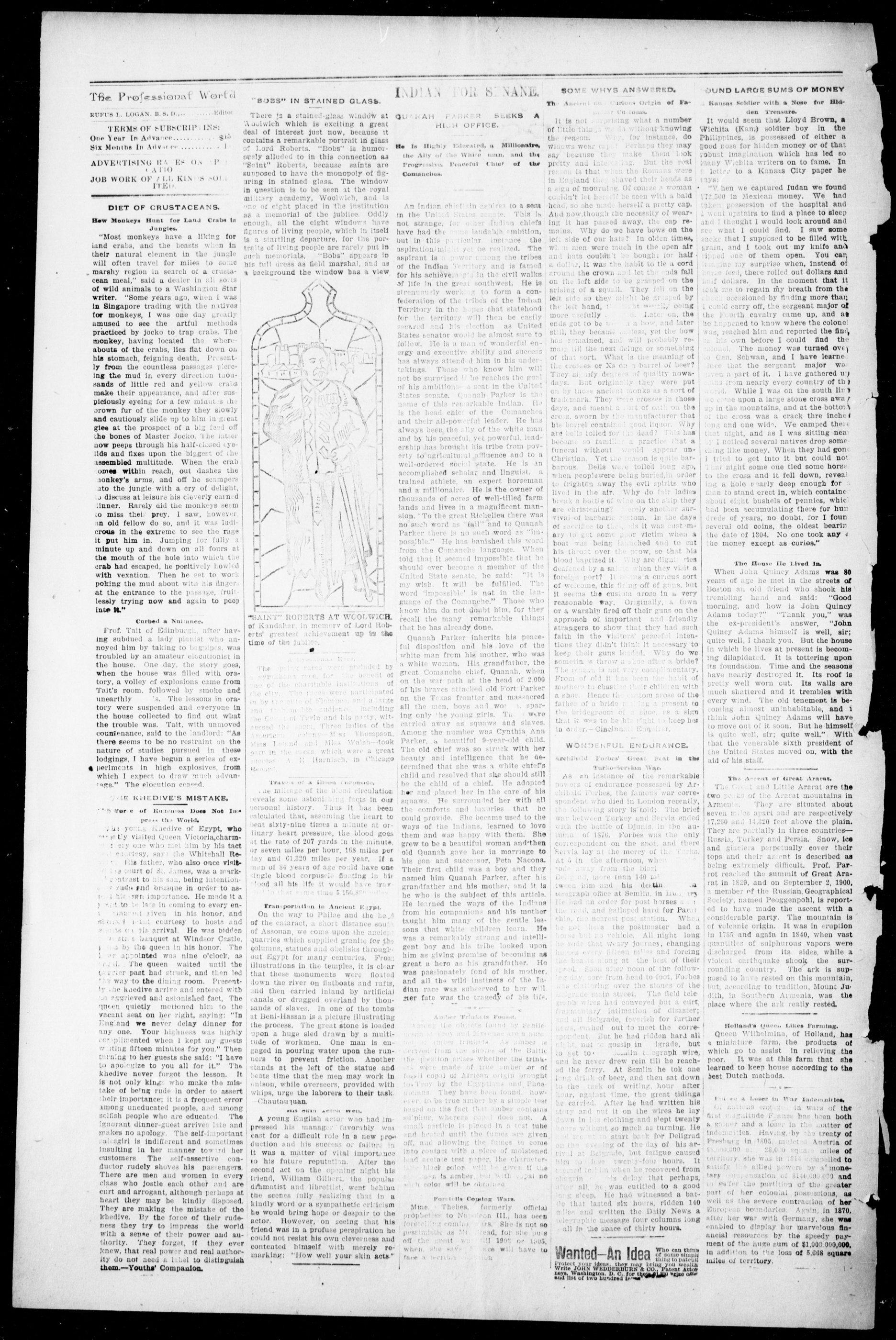
"BOBS" IN STAINED GLASS.
There is a stained-glass window at Woolwich which is exciting a great deal of interest just now, because it contains a remarkable portrait in glass of Lord Roberts. "Bobs" is humorously alluded to in this connection as "Saint" Roberts, because saints are supposed to have the monopoly of figuring in stained glass. The window in question is to be seen at the royal military academy, Woolwich, and is one of eight placed in the institution as a memorial of the jubilee. Oddly enough, all the eight windows have figures of living people, which in itself is a startling departure, for the portraits of living people are rarely put in such memorials. "Bobs" appears in his full dress as field marshal, and as a background the window has a view
[Stained glass window depicting a medieval knight in armor holding a sword and shield, with a cityscape in the background.]]
"SAINT" ROBERTS AT WCOLWICH of Kandahar, in memory of Lord Roberts' greatest achievement up to the time of the jubilee.
"SAINT" ROBERTS AT WCOLWICH of Kandahar, in memory of Lord Roberts' greatest achievement up to the time of the jubilee.
---
The quinning races were precluded by a symphonica race, for the benefit of one of the charitable institutions of the city. The races were participated in by the elite of Florence, and a large and thrilling audience, including the Court of Turin and his party, witnessed the sport. Three ladies of the American etery—Miss Thompson, Miss Leand and Miss Walsh—took part in the races, which were a great success. A. D. Harnisch, in Chicago Record.
Traverse of a Bileon coruscle.
the mileage of the blood circulation reveals some astonishing facts in our personal history. Thus it has been calculated that, assuming the heart to beat sixty-nine times a minute at ordinary heart pressure, the blood goes at the rate of 207 yards in the minute, or seven miles per hour, 168 miles per day and 61,320 miles per year. If a man of 84 years of age could have one single blood corpuscle floating in his blood all his life it would have travelled in that same time 15,160 miles.
Transportation in Ancient Egypt.
On the way to Philine and the head of the cataract, a short distance south of Assouan, we come upon the ancient quarries which supplied granite for the columns, statues and obelisks throughout Egypt for many centuries. From illustrations in the temples, it is clear that these monuments were floated down the river on flatboats and rafts, and then carried inland by artificial canals or dragged overland by thousands of slaves. In one of the tombs at Beni-Hassan is a picture illustrating the process. The great stone is loaded upon a huge sled drawn by a multitude of workmen. One man is engaged in pouring water upon the runners to prevent friction. Another stands at the left of the statue and beats time that the men may work in unison, while overseers, provided with whips, urge the laborers to their task. Chautauqua.
OUS SKIN, ACID WED.
A young English actor who had impressed his manager favorably was cast for a difficult role in a new production and his success or failure in it was a matter of vital importance to his future reputation. After the second act on the opening night his friend, William Gilbert, the popular dramatist and librettist, went behind the scenes fully realizing that in a kindly word or a sympathetic criticism he would bring hope or despair to the actor. However, on seeing that his friend was in a profuse perspiration he could not resist his own cleverness and contented himself with merely remarking: "How well your skin acts."
INDIAN FOR SINANE.
QUANAH PARKER SEEKS A HIGH OFFICE.
He Is Highly Educated, a Millionaire, the Ally of the White man, and the Progressive, Peaceful Chief of the Comanches.
An Indian chiefain assures to a seas in the United States senate. This is not strange, for other Indian chiefs have had the same laudable ambition, but in this particular instance the aspiration implicit yet be realized. The aspirant is a power among the tribes of the Indian Territory and is farned for his achievements in the civil walks of life in the great southwest. He is strenuously working to form a confederation of the tribes of the Indian Territory in the hopes that statehood for the territory will then be easily secured and his election as United States senator would be almost sure to follow. He is a man of wonderful energy and executive ability and success has always attended him in his undertakings. Those who know him will not be surprised if he reaches the goal of his ambitions—a seat in the United States senate. Quanah Parker is the name of this remarkable Indian. He is the head chief of the Comanches and their all-powerful leader. He has always been the ally of the white man and by his peaceful, yet powerful, leadership has brought his tribe from poverty to agricultural affluence and to a well-ordered social state. He is an accomplished scholar and linguist, a trained athlete, an expert horseman and a millionaire. He is the owner of thousands of acres of well-tilled farm lands and lives in a magnificent mansion. 'To the great Richelieu there was no such word as "fall" and to Quanah Parker there is no such word as "impossible." He has banished this word from the Comanche language. When told that it seemed impossible that he should ever become a member of the United State senate, he said: "It is my wish. It will be fulfilled. The word 'impossible' is not in the language of the Comanche." Those who know him do not doubt him, for they recall the many remarkable things that he has already done.
Quanah Parker inherits his peaceful disposition and his love of the white man from his mother, who was a white woman. His grandfather, the great Comanche chief, Quanah, when on the war path at the head of 2,000 of his braves attacked old Fort Parker on the Texas frontier and massacred all the men, boys and women, sparing only the young girls. They were carried away as squaws and slaves. Among the number was Cynthia Ann Parker, a beautiful 9-year-old child. The old chief was so struck with her beauty and intelligence that he determined that she was a white chief's child and resolved that she should still be the child of a chief. He adopted her and placed her in the care of his squaws. He surrounded her with all the comforts and luxuries that he could provide. She became used to the ways of the Indians, learned to love them and was happy with them. She grew to be a beautiful woman and then old Quanah gave her in marriage to his son and successor, Peta Nacona. Their first child was a boy and they named him Quanah Parker, after his grandfather and his mother, and it is he who is the subject of this article. He learned the ways of the Indians from his companions and his mother taught him many of the gentle lessons that white children learn. He was a remarkably strong and intelligent boy and his tribe looked upon him as giving promise of becoming a great a hero as his grandfather. He was passionately fond of his mother, and all the wild instincts of the Indian race was subserved to her with fate was the tragedy of his life
Another Trick is found.
Among the objects found by Senile-
men of Troy and Mycenae are a pum-
pure amber trinkets. As amber is
derived from the shores of the Baltic
the precession arises whether the trink-
tets were made of true amber or of
fossil copal of African origin brought
to Troy by the Egyptians and Phoen-
cians. They have been found, how-
ever, to be true amber by a simple test
based on the fact that amber contains
sulphur, whereas copal does not. A
small particle is placed in a test tube
and heated until the fumes are given
off, and allowing the fumes to come
into contact with a piece of molstened
lead acetate test paper, the character-
istic black color will be given if the
sulphur is amber, but with copal no
such color will be obtained.
Forstells Coping Wars.
Mine. Thebes, formerly official
prophetess to Napoleon III., has been
forestalling coming wars. She is not so
pessimistic as Mr. Tread, for she puts
off the great war till 1903 or 1905,
when she says it once will have to
face a terrible condition.
SOME WHYS ANSWERED.
The Ancient Numerical Origin of Fa-
nomenclature Unions.
It is not surprising what a number of little things we do without knowing the reason. Why, for instance, do windows wear cap? Perhaps they may say because they make them look pretty and interesting. But the real reason is that when the Romans were in England they shaved their heads as a sign of mourning. Of course a woman couldn't let herself be seen with a bald head, so she made herself a pretty cap. And now, though the necessity of wearing it has passed away, the cap remains. Why do we have bows on the left side of our hats? In olden times, when men were much in the open air and hats couldn't be bought for half a dollar, it was the habit to tie a cord around the crown and let the ends fall on the left side to be grasped on the arising of a squall. They fell on the left side so they might be grasped by the left hand, the right neatly being more usefully coiled. Later on, the ends got to be coiled in a bow, and later still, they became endless, yet the bow has remained, and will probably remain till the next deluge or something of that sort. What is the meaning of the crosses or Xs on a barrel of beer? They simplify degrees of quality nowadays. But originally they were put on by those ancient monks as a sort of trademark. They were crosses in those days, and meant a sort of oath on the cross, sworn by the manufacturer that his barrel contained good liquor. Why are bells toiled for the dead? This has become so familiar a practice that a funeral without would appear unChristian. Yet the reason is quite barbarous. Bells were toiled long ago, when people were being buried, in order to frighten away the evil spirits who lived in the air. Why do fair ladies break a bottle of wine on the ship they are christening? Merely another survival of barbaric custom. In the days of sacrifice to the gods it was customary to get some poor victim when a boat was being launched and to cut his throat over the prow, so that his blood baptized it. Why are dignities deafened by a salute when they visit a foreign port? It seems a curious sort of welcome, this firing off of guns, but it seems the custom arose in a very reasonable way. Originally, a town or a warship fired off their guns on the approach of important and friendly strangers to show that they had such faith in the visitors' peaceful intentions they didn't think it necessary to keep their guns loaded. Why do we sometimes throw a shoe after a bridge? The reason is not very complimentary. From old it has been the habit of mothers to chastise their children with a shoe. Hence the custom arose of the father of a bride raising a present to the bridegroom of a shoe, as a sigh that it was to be his right to keep his in order. Cincinnati Enquirer.
WONDERFUL ENDURANCE.
Archibald Foobes' Great Feat in the
Torto-Serian Wine.
As an instance of the remarkable powers of endurance possessed by Archibald Forbes, the famous war correspondent who died in London recently, the following story is told: The brief war between Turkey and Servia ended with the battle of Djums, in the autumn of 1876. Forbes was the only correspondent on the shot, and there Servia lay at the mercy of the Turks. At 5 in the afternoon, when code away from the blazer. Dong alq, more than 140 m between him and his destiny. A telegraph office at Semlin, in Hussar. He had an order for post horses at the road, and galloped hard for Parachin, the nearest post station. When he got there the postmaster had a horse but no vehicle. All night long he rode that weary journey, changing horses every fifteen miles and forcing the hears along at the best of their speed. Soon after noon of the following day, sore from head to foot, Forbes was clitoring over the stones of the Belgrade main street. The field telegraph wires had conveyed but a curt, documentary intimation of disaster, and all Belgrade, feverish for further news, rushed out to meet the correspondent. But he had ridden hard all night, not to gossip in Belgrade, but to get to. Semlin telegraph wire, and he never drew rein till he reached the ferry. At Semlin he tok one long drink of beer, and then sat down to the task of writing, hour after hour, against time, the great tidings he carried. After he had written his story and put it on the wires he lay down in his clothing and slept twenty hours without so much as turning. He had meant to start back for Delgrad on the evening of the day of his arrival at Belgrade, but fatigue caused him to lose twenty-four hours. It seemed to him when he recovered from shegrin in his delay that perhaps, after all, he was entitled to a good long sleep. He had witnessed a battle that lasted six hours, ridden 140 miles and written the Daily News a telegraph message four columns long all in the space of thirty hours.
Wanted—An Idea Who can throw of some simple thing to patrol Protect your ideas, they may bring you wealth Write EDDERBUEN & CO., Patent attorney Washington, Washington office and list of two hundred ideas
GUND LARGE SUMS OF MONEY
Kansas Soldier with a Nose for Hidden Treasure.
It would seem that Lloyd Brown, a Wichita (Kan) soldier boy in the Philippines, is possessed of either a good nose for hidden money or of that robust imagination which has led so many Wichita writers on to fame. In letter to a Kansas City paper he
1785:
"When we captured Iudan we found $72,500 in Mexican money. We had taken possession of the hospital and I went upstairs to find a place to sleep and I thought I would look around and see what I could find. I saw some snacks that I supposed to be filled with grain, and I took out my knife and tipped one of them open. You can imagine my surprise when, instead of horse feed, there rolled out dollars and half dollars. In the moment that it took me to regain my breath from the thick occasioned by finding more than I could carry off, the sergeant major of the Fourth cavalry came up, and as he happened to know where the colonel was, reached him and reported the find as his own before I could find the colonel. The money was turned over to Gen. Schwan, and I have learned since that the sergeant major was given a part of it. I have gathered up coins from nearly every country of the world. While I was on the south line we came upon a large stone cross away up in the mountains, and at the bottom of the cross was a crack three inches long and one wide. We camped there that night, and as I was sitting near by I noticed several natives drop something like money. When they had gone I tried to get into it but could not. That night some one tied some horse to the cross and it fell down, revealing a hole nearly deep enough for a man to stand erect in, which contained about eight bushels of pennies, which had been accumulating there for hundreds of years, no doubt, for I found several old coins, the oldest bearing the date of 1304. No one took any of the money except as curios."
The House He Lived In.
When John Quincy Adams was 80 years of age he met in the streets of Boston an old friend who shook his trembling hand and said: "Good morning, and how is John Quincy Adams today?" "Thank you," was the ex-president's answer, "John Quincy Adams himself is well, sir; quite well, I thank you. But the house in which he lives at present is becoming dilapidated. It is toottering upon its foundation. Time and the seasons have nearly destroyed it. Its roof is pretty well worn out. Its walls are much shattered and it trembles with every wind. The old tenement is becoming almost uninhabitable, and I think John Quincy Adams will have to move out of it soon. But he himself is quite well, sir; quite well." With that the venerable sixth president of the United States moved on, with the aid of his staff.
The Ascent of Great Ararat.
The Great and Little Ararat are the two peaks of the Ararat mountains in Armenia. They are situated about seven miles apart and are respectively 17,260 and 14,320 feet above the plain. They are partially in three countries—Russia, Turkey and Persia. Snow, ice and glaciers perpetually cover their tops and their ascent is described as being extremely difficult. Prof. Parrot reached the summit of Great Ararat in 1829, and on September 2, 1900, a member of the Russian Geographical Society, named Peoggenpohl, is reported to have made the ascent with a considerable party. The mountain is of volcanic origin. It was in eruption in 1785 and again in 1840, when vast quantities of sulphurous vapors were discharged from its sides, while a violent earthquake shook the surrounding country. The ark is supposed to have rested on this mountain, but, according to tradition, Mount Judith, in Southern Armenia, was the place where the ark really rested.
Holland's Queen, Likes Farming.
France a Loser in War Indemnities.
Of nations engaged, in wars of the first magnitude France has been both a gainer and a loser in the matter of indemnities. Having, by the treaty of Presburg in 1805, mulled Austria of $3,000,000 al. 28,000 square miles of territory, she was in 1814 compelled to satisfy the allied powers by a monetary compensation of $146,000,000 and to suffer the partition of the greater part of her colonial possessions, as well as the severe contraction of her European boundaries. Again, in 1870, after her war with Germany, she was enabled to display her marvelous financial resources by the speedy payment of the huge sum of $1,000,000,000, in addition to the loss of 5,668 square miles of territory.
VINES IN HOMES.
Peanut Plants Make a Pretty Ornament
for the Boulder.
Pew persons are, perhaps, aware, that a thing of beauty is a common peanut plant, growing singly in a six or eight-inch pot and grown indoors during the colder months. Kept in a warm room or by the kitchen stove a peanut kernel planted in a pot of lose mallow loam, kept only moderately moist, will soon germinate and grow up into a beautiful plant. It is in a similar way that the peanut planters test their seeds every year, beginning even early in the winter, and the facility with which the seeds will grow in this way has suggested to many southern flower lovers the possibility of making the useful plant an ornamental plant for the parlor or sitting room window. As the plant increases in size and extends its branches over the sides of the pot in a pendant maner, there are few plants of more intrinsic beauty. The curious habit of the compound leaves of closing together like the leaves of a book on the approach of night or when a shower begins to fall on them, is one of the most interesting habits of plant life. And then, later on, for the peanut is no ephemeral wonder, enduring for a day or two only, the appearance of the tiny yellow flowers and putting forth of the peduncles on which the nuts grow imparts to this floral rarity a striking and unique charm all its own. There is nothing else like it, and florists throughout the country might well add the peanut plant to their list of novel and rare things.—Washington Star.
PERILS OF DEATH VALLEY;
Most Desirable Borough in the Western
Humberton.
Death valley is probably the most unique natural feature in California. It is located in the southeast corner of Inezo county, and is inclosed by the Panamint mountains on the west and the Funeral range on the east. It is seventy-five miles long and at its narrowest point but eight miles wide. The prevailing winds in Death valley are from the west. Though originating in the Pacific ocean and saturated with humidity in traveling the intermediate distance, they are intercepted by the lofty peaks of the four ranges of mountains, which absorb all of their moisture, so that by the time they reach the valley all humidity has disappeared. The blasts are as if heated in a fiery furnace, and no living thing an survive the intense heat. Even birds, indigenous to the region, die. It is in the months of greatest heat that the sand storms of Death valley are most deadly. They rage with an intense fury, obliterating the landscape and dimming the light of the sun, withering the scanty vegetation and covering the trails deep in powdered dust. At all times the aspect of the valley is superlatively desolate. No spot on earth surpasses it in acidity and topet-like heat. During the heated term an hour without water means death. Meat becomes putrid in an hour. Eggs are cooked in the blistering sand. Water is only palatable by means of large porous earthenware jars, common to all hot countries, suspended in drafts and reduced in temperature by means of the rapid evaporation of the moisture from the out side.
speaker Farriss and Col Crisp
Speaker Farriss and Col Crisp.
Col. Crisp, when-in the Missouri legislature, was one of the central figures in a scene which promised bloodshed, which ended in a hearty laugh, and which was the cause of an astounding remark from Hon. John W. Farris, the then speaker. Crisp and another belligerent son of Anch got into a debate which grew into a quarrel. They shook their fists at each other and roared like a pair of Numidian lions. Everybody expected and many hoped to see a regular old-fashioned knock-down and drag-out fight, which expectations and hopes were frustrated and dashed to the ground by Speaker Farriss remarking: "If you gentlemen do not quit fussing and take to your seats I will order the chaplain to take you into custody!" which so amazed the bellicose legislators that they stood in a state of lingual paralysis, while the spectators laughed till they were red in the face. Humor saved the day. Champ Clark, in Denver Republican.
Cannular Gulls.
An example of the cunning of gulls was observed at Tacoma, when several alighted on a bunch of logs that had been in the water for a long time, with the submerged sides thick with barnacles. One was a big gray fellow who seemed to be the captain. He walked to a particular log, stood on one side of it, close to the water, and then uttered peculiar cries. The other gulls came and perched on the same side of the log, which, under their combined weight, rolled over a few inches. The gulls, step by step, kept the log rolling until the barnacles showed above the water. The birds picked eagerly at this food, and the log was not abandoned until every barnacle had been picked.—Golden Days.
They Are Keeping a close of Nibblers
Who Seeks Refuge in America
The Russian secret police are probably the most skillful in the world; they need to be. In the days of Napoleon III, the police of France had that reputation. They haven't it now for the best of reasons. An emperor needs skillful spies in all the world—a republic doesn't. Russia has had its lessons in the death of the late czar and in many attempts made upon the present ruler. So the chief of political police keeps agents in every great city in the world. New York, where so many Russian nihilists have found refuge; San Francisco and Chicago are especially favored in this way. Escaped convicts from Siberia sometimes drift to the Pacific coast city, while Chicago is watched on general principles. New York, however, is getting to be more and more the chief object of the solicitous attentions of the czar's people. The spies who keep tab on nihilists in America always claim to be nihilists themselves, called for their political views, or escaped suspects. It is their plan to secure admittance to some of the many nihilists carles here and keep the police informed of what goes on. So long as the nihilists confine themselves to speech making nothing it done about it. But, if one of them should start for St. Petersburg with such a mission as that which took Bresci from Paterson the home authorities would be warned and stand ready to receive him after certain well-known recedents. As for the spy, his is a dangerous lift. If suspected he may become at almost any time the hero of a mysterious murder case.
WISE KING CANUTE.
How He Taught DIs. Courtiers a Lesson in Humidity.
The old story of Canute rebuking his courtiers is well known to most of us. King Canute, desirous of teaching his flattering courtiers a lesson, caused his throne to be set up in the senshore as the tide was coming in and nearing its height. Surrounded by all the great dignitaries of the kingdom he summoned the flatterers to his presence and asked them if they believed the sea would recognize his authority, "Believe it," cried Earl Halfryd, "there is no doubt of it. Your majesty has but to command, you will be obeyed." The obsequious courtiers joined in a chorus of "So say we, all of us," "Very good," said the king, "now do you, each in turn, stand on the steps of yonder throne and bid the sea retire." His command was obeyed and courtier after courtier, after complying, retired baffled amid the jeering laughter of the populace. In this manner the time was fully occupied until the hour of flood was passed and the tide was just about the eob when the king ascended the throne. He, beheaded, the waves retreat and was soon left in triumph upon dry ground, amid the loud applause of his loyal subjects "You see, gentlemen," he said, turning to his courtiers, "there is all the difference in the world between a regular threeply all-wool king, like myself, and a sea of insignificant subjects like you, test this experience teach you bu-
CHARGE FOR FRESH AIR.
experiences of a Family Who Were
invited to Germany.
Many have been the doleful stories of travelers returned from Europe and the extortionate charges immed upon long suffering Americans in the lands across the Atlantic. And now comes a distressing Chicagoan who departs from Germany recently to be charged for fresh air. With no wife and family he was journeying in a railway train. The air in the stuff-little compartment becoming stale, the wife of the Chicagoan asked him to communicate with the guard. In such compartment in European trains a handle connected with a bell rope leading to the guards' cab. Near the end is posted a notice warning passengers that the guard is not to be summoned except in desperate cases as murder, etc., under penalty, the Chicagoan could not read German, but he knew that his wife wanted fresh air, so he gave the grip a jump. The train, which was an express decelerated speed and finally came to a full stop. The guard and the engine driver rushed back excitedly, expecting to discover something very dire in land. By virtue of signs the Chicagoan explained what he wanted there he was greeted with a short of abuse, and he was very near helpless with personal violence however, the guard and the engine driver returned to their posts and the train proceeded. When the Chicagoan and his party arrived at their destination he was met at the railway station by a jabbering man of officials, who promptly hauled him before an aureus dictionary, who managed to inform him that his little gayety with the cool cord would cost him just 30 marks which he must pay or go to prison. The Chicagoan took the former alternative.
CICERO'S WIT.
Exasperating Retort Not Modern Feature of Jury Trial.
The retort exasperating is not a modern feature of a trial by jury. In the case against Verres—one of the great trials of antiquity—in which Cleero appeared for the prosecution and Hortensius for the defense, Cleero made a typical excursion against his opponent. Hortensius was known, in violation of the law, which required the services of advocates at Rome to be gratuitous, to have received as a present from his client a valuable image of the S hinx, one of the spoils of his government in Sicily. While Cleero was examining a witness, Hortensius made a sally, "You speak in riddles," said he, "I cannot understand you." "That is odd," Cleero rejoined, "for you have a sphinx at home to solve them." Cleero's repartees were seldom without energy. When Clodius had been acquitted of the charge of sacrilege by jurors who had been bribed to bring in a favorable verdict, Cleero, who appeared as the defender of the republic, left the corrupt jurors and the favorers and supporters of that verdict without a word to say for themselves. He overwhelmed Clodius in the senate to his face in a set speech. Then followed a duel of words in which Cleero was all along the victor. Clodius, among other insinuations, said: "You have bought a house," "You would think that he said," retorted Cleero, "you have bought a jury!" "They did not trust you on their oath," said Clodius, "Yes," said Cleero, "twenty-five jurors did trust me. Thirty-one did not trust you, for they took care to get their money beforehand." Here there was a burst of applause, and Clodius broke down and remained silent. There is nothing coldly classic in these ex amples of Cleero's ready wit; they might have come from a latter-day master of thrust and parry.—Youth's Companion.
GLIVE CULTIVATION.
Slim Outlook for Olives and Oil in France
While the cultivation of the olive is increasing in this country, Mr. Skinner, United States consul at Marseilles, writes to the state department that the acreage devoted to olives in France is annually becoming less and the outlook for olives and olive oil in France is not at all encouraging. Even in that home of the olive, peanut or arachis oil, extracted from the African ground nuts, which are imported in vast quantities, is considered superior for frying purposes. Not only is the oil used to adulterate olive oil, but it frequently used in place of it in pressing the cheap brands of sardines. The gastronomic merits of the rich, ripe black olives, which until recently only be obtained in this country is special importation from Spain and Turkey, are at last finding recognition here, and men awaken to the fact that the olive, like every other fruit, is its best when it reaches perfection in its own way and in nature's own good time. Once eaten, the hard, salt wooden fibreed green olive is banished forever. Green olives are a matter cultivated taste. Ripe olives need no training to charm the palate. The pickled ripe olives put up in the missions in California are sold loose in bulk. They are cheap; they are delicious. Once tasted, a dinner without them is flat, stale, and unprofitable. Boston Courier.
STREET CALCULATION:
Hamburg's Method of Dealing with Overs
grounded Street Cups.
The overcrowded street car nuisance is dealt with in a positive way in Hamburg, according to the statement of an American who recently returned from abroad. He says that in that city a man has to think twice before giving up his seat to a woman, as he may be put off the car for his politeness. The Hamburg trolley cars, it is stated, will seat, according to size, 20 or 28 persons—10 to 14 on each side. In addition, four persons are allowed on the front and five on the rear platform. When the car is full the conductor hangs out a sign "Besetz," which means "occupied." The conductor is forbidden to take on another passenger until some one leaves the car. Sometimes, while the conductor is in front collecting fares, a woman will step on a car which is already filled. As there is no conductor on hand to prevent her, the woman goes inside, and any man who offers her a seat steps out to the platform. When the conductor returns to his post on the rear platform he asks the man to leave the car; the reason being that the car being "occupied," he has for felted his seat. If the man refuses to leave he is put off. The policeman on the streets are instructed to watch the cars, and if they find that a conductor carries even one more than the proper number the conductor is fined 72 cents, which amount goes to a charity fund of the street car company.—Argonaut.
UNCONSCIOUS OF DANGER.
Rattlesnake Collected Reef to Sleep on
Mant's Breast.
In the course of Mr. Ross Cox's expedition along the Columbia river some years ago, one member of the party had a dangerous experience, of which fortunately he was at the time unconscious. The men were preparing supper on the bank of the river, and La Course, worn out with the fatigue of the day, had stretched himself on the ground and fallen asleep. A few minutes later I passed him, says Mr. Cox, and was horrified at seeing a large rattlesnake moving over his body toward his left breast. My first impulse was to alarm La Course, but an old Canadian whom I had beckoned to the spot said we must make no noise, and the snake would cross the man's body and go away. In this he was mistaken, for on reaching the chest the serpent coiled itself quietly as if meditating a stay. If La Course moved or woke, we shuddered to think what would happen. Others quietly joined us, and it was determined that two men should advance in front, to divert the attention of the snake, while one should approach with a long stick from the rear and dislodge the creature. On seeing the men in front, the rattler raised its head, played its evil looking tongue and shook its rattles, indications of anger. Every one was in a state of feverish anxiety as to the fate of poor La Course, who still lay asleep. The man behind now came up with a stick seven feet long, quickly placed one end under the reptile, and succeeded in pitching it ten feet from the man's body. A shout of joy was the first intimation La Course had of his wonderful escape. The snake was pursued and killed.—Youths' Companion.
A SOLOMON IN TURKEY.
How a Guarantee of the Law Profitably
Set In Place
The other day I witnessed an amusing instance of Turkish police justice, says a Constantinople correspondent. At Armenian and a Kurd had quarreled over the ownership of a tobacco box. As their language grew more expressive and their speech louder a crowd collected, delighted with the dispute. The Kurd had picked up the box at the street and the Armenian defended it was bis. When they were out to come to blows a policeman came up and cried to effect a compromise, but in neither disputant would give way. At last the Armenian suggested that the Kurd should be asked to describe what was in the box. The Kurd complyly answered "Tobacco and cigarette paper." The Armenian smilingly informed the officer that all the box contained was a 25-cent piece. The policeman gravely opened the mysteries case, then, turning to the crowd with the air of a Solomon, said: "The Armenian is the owner of the box. I return it to him. The Kurd is a liar, here he smote the man from the mountain over the hand.) Allah be raised! For my trouble in deciding like complicated affair I keep the 25 cents."
dow England Henred Peabody
How England Honored Peabody.
George Peabody might have slept in Westminster abbey. His funeral took place there, the gates for the first time in history being opened for the burial sites of a private citizen of another country. It was owing solely to his lying wish to be buried beside his mother in his native land that he was not entombed in the abbey with the universal consent and approbation of the British nation. The swiftest and finest frigate in the English navy bore its body across the sea, and a fellow memorial, Admiral Farraguat, received with an American squadron.
Wanda G. Cordell, mother in America.
Cheloe Gay, mother, admits to have the youngest grandmother in America.
She married at 12, and so a birth to daughter a year later.
The child, allowing her mother's example, married young and lately when 16 years old gave birth to a child, whose grandmother is now a little over 29 years old.
An Idyllic Breakfast.
Richard Whiteing, who is still rather the London celebrity of the moment, does not exactly write immortal verse, but people are still talking of his novel, "No. 5 John Street," and wondering what his next book will be like. He is a personality that would not lose a particle of its charm even if one did know what his favorite recreations are, which he has never been weak enough to dislose. At the present moment recreation has a delicious significance for him, for, having at last severed a connection of many years with the Daily News, he is realizing what it means to be a bondsman no longer.
"I go to bed at 12 and rise with the lark," he was heard to say to a friend the other day with a twinkle. "The London lark?" inquired the friend, rather unkindly. "I don't know," answered the great man, chuckling. "but it is the lark that gets down to a 10 o'clock beast."—Philadelphia Post.
PADETH NOT AWAY.
Louching Description of Last Sleep of
Aged Professor,
The old professor sat listening with a half smile while his class explained certain facts in metaphysics. The brain, they said, retained longest the first impressions made upon it. Memories of middle life failed out, while those of childhood remained vivid and clear. Dying persons had been known to speak in a language which they had learned in childhood and forgotten during a long long time. When the class was dislissible, one of the young men no usual, he gored to walk across the campus with the professor. The class had noticed that the old man was a little more deaf this winter, a little duller of sight, a little more gentle. They contrived that he should not cross the key spaces without some one to assist him. "All that is the rest, Bob," he said, thinking of the recitation and talking half to himself. "Quite true, and very strange. You learn in childhood a language, simple enough, having to do with the foundation of things. God and heaven and you, yourself. Then you get out into the world and forget it. You learn difficult languages—philosophy or trade or politics; loud, strident kinds of talk that move the world, and you do your share of talking as loudly as you can. But presently these things begin to fade out of your mind. They seem less weighty; they count for little. The old language that you learned on your mother's knee comes back, and you find yourself speaking it again. These later languages are about that is your own tongue." "It is strong, sir," said Bob, with a bewildered face. He brought the professor to his own door, and bade him goodnight. The old man lingered, looking with a wistful smile at the great quadrangle that the shadow buildings in which languages and philosophy and metaphysics were taught. "I have indeed gone back to the beginning," he said. "These things seem to mean so little, and I think so often of the first line that I ever learned:
'Now I lay me down to sleep'
Strange Punishment
The Jewish colony of South Norfolk, Conn., U. S. A., has a unique new relative to punishment of petty thieves. A visitor there noticed a man talking about with two hats on his head, one over the other. "What's he being that for?" asked the visitor. What's replied a native, "is our way of punishing petty thievery. He has been allowed to wear two hats on his head for two weeks, and copy one here knows what the two hats on his head signify. We don't have much trouble of that character; we don't steal sticks in transgressing the man's thievery drive him out of the colony now numbers in thousands.
A Mad Prophetess in Spain
In Algalba, Murcia, Spain, a mad young prophetess, a peasant of 24, Teresa Guillen, who took to prophecy and reaching several months ago, after stirring up many disorderly pilgrimages, was looked upon as a religious maniac. Recently she was allowed to return home, and once more crowds began to assemble, spellbound by the impassioned ostacy of her harangues. One day she was preaching before a large concourse of people when fivegendarmes arrived to arrest her. The ignorant persons, worked upon by the wild appeals of the sibyl, attacked the policy with fury, and in the fight four of thegendarmes were mortally wounded, while sixteen persons in the crowd were seriously hurt. Among the killed were the woman's father and brother—New York Press.
TURKEY'S RESOURCES.
The Ottoman Empire One of the Richest
Countries in the World.
The Ottoman empire is, in potential resources, probably the richest country in the world next to the United States, says Collier's Weekly. For years American and Turkish statesmen have been endeavoring with all their power to foster what little trade their countries have, and to create new trade channels to commercially connect the republic and the empire. These endeavors have already borne good fruit, and the future possibilities in that direction are infinite. The mutual relations of commerce amount already to millions, and it would be most unfortunate that an untoward event should disturb in their growth these promising shoots of trade, and bring about a distrust which would cause the originating of new branches of trade to be made impossible for many years to come. The feeling of fellowship among nations is to a large extent sentimental, especially when there is no possible point of hostile contact. The Turks have been educated to know that there is a great free nation far in the west, foremost in all the endeavors of commerce, industry and technical invention—a nation to whom they could without any fear entrust the development of their magnificent resources.
The Professional World
RUFUS L. LOGAN, B.S. D.... Editor
TERMS OF SUBSCRIPTIONS:
One Year In Advance..... $1 50
Six Months In Advance..... 1 00
ADVERTISING RATES ON APPLICATION.
JOB WORK OF ALL KINDS SOLICITED.
Doubting yourself is a very strong argument but, having confidence is what does the work.
Dr. J. H. Garnett and Prof. J. H. Bias of Lincoln Institute will read THE PROFESSIONAL WORLD the coming year. A copy of the Richmond Plaindealer has reached our desk, it is a newsy little semimonthly and edited by Wm. Jacobs. May it live long.
Our thanks are due Prof. A. L. Reynolds of Lincoln Institute for subscription to THE PROFESSIONAL WORLD and words of encouragement. The State Teachers association will meet in Kansas City during the holidays. One fare rate has been obtained over all railroads and a large attendance is expected.
In another column is found an interesting and pointed article on Education by Rev. J. B. Parsons. Rev. Parsons is the leading Divine of the colored Christian church of Missouri.
---
If there is anything worse than the criticisms of the southern press on President Roosevelt's entertaining Mr. Booker T. Washington, it is the expression of a few narrow minded negroes of the south who attempt to criticise Mr. Washington for accepting the invitation.
The Western University of Quindaro, Kansas, is destined to become one of the greatest negro institutions in the country. Its President, Prof. W. T. Vernon has few equals as an orator and educationalist. Through his ability liberal appropriations are obtained from the Kansas legislatures for the support of the school.
The population of Columbia is fifty per cent negroes without a single negro business house. A joint stock company well organized and properly managed should prove to be quite a profitable enterprise for Columbia negroes. All that is necessary is for some good energetit man to take the initiative in establishing such a project.
Ne More Botany Bay.
As there is an inevitable propensity throughout the English-speaking world to associate the name Botany Bay with convictism, a movement has recently been started in Australia which has for its object the abolition of that name and the substitution of Banks' Bay instead. The Sydney Sunday Times suggests that the change be effected before the new curtury, that the new commonwealth must start under the best and brightest condition without the taint on its fame now suggested by the name of Botany Banka.
WASHINGTON LETTER.
Chatty Personal Gossip Gen. Corbin's Wedding
THE BRITISH AMBASSAD R
And His Family—The Chinese Minister and His Wife Other Washington Society Notes.
(From Our Regular Correspondent )
WASHINGTON, D. C. Nov. 3, 1901
"It was my first full dress parade of the army officers and society of the season," was the way a bright young woman who was there described the marriage of Gen. Corbin and Miss Edyth Patton, which took place at noon Wednesday, Nov. 6, 1901. It had been intended that Gen. S. M. B. Young should serve as best man, but owing to the serious illness of his daughter, Col. George R. Dyer was substituted. It was the most notable gathering of men and women seen at a Washington wedding for a long time, and was the first public gathering atteneded by the President and Mrs. Roosevelt. There was more than five hundred guests, and they included about every person of prominence in official circles, except General elson A. Miles, who has not been on friendly terms with General Corbin for some years. The presents were many and costly, but the one most highly prized by the General was a silver punch bowl and stand from the officers of his old regiment, the 24th Infantry, now in the Phillipines. By the way speaking of punch bowls, Gen. Corbin gave a stag dinner at the Country Club, of which he has long been a shining light, recently, that must have been a "screamer" judging from the whispers heard among some of his chums about it.
Lord Pauncefote, the British Ambassador, is back in town as big as life and rudder thru ever. He brought his daughters, the Hen Maude and Hon. Andry—that is the way they speak of them in England, but in Washington they mostly called the Pauncefote girls—with him. Lady Pauncefote did not come with them, as her youngest daughter, Mrs. Bromley, only recently became a mother for the first time, but she will come in a few weeks. Lord Pauncefote is the ideal jovial Englishman when you get to know him, but should you happen first to see him salking int the Department of State, as though he was owner of the building and had come to dun the tenant for overdue rent, you would set him down for old man Pomposity himself. But pombosity, you know, is one of the tools of the diplomatic trade.
There is a double reason for the extent of the gossip about the reported recall of Mr. Wu, the Chinese Minister. The first is we like Wu and would be glad to have him stay, and the other is if he is recalled it may deprive the frequenters of social functions of an anticipated pleasure, as Mine Wu, now on her way to Washington from China, where she has been visiting her relatives, is understood to be bringing with her an adopted daughter, for the purpose of introducing her to Wash-
```markdown
```
ington society As no Chinese girl of high degree has ever appeared in Washington society, the debut of this one has naturally aroused no little curiosity. Mr. Wu says he has received no instructions from his government of his recall, but that it would not surprise him, as the rule of the Chinese government is to change its ministers every three years, and he has been in Washin ton more than four. He says there is nothing in the story that he would remain in the United States if he was recalled; that China is his home, contains all his interests, and that he will go back and spend the remainder of his life as a private citizen if his government has no further use for him. He also says it is ridiculous to ascribe his recall: if it has been decided upon, to his popularity in this country
The Presidedt is having trouble about getting satisfactory carriage horses. He isn't a David Harum but he knows what sort of horses he wants, and he knows horses well enough to know when he gets them. Several pairs have keen in the White House stables on trial, but all have been returned as lacking some desired point, and the President and Mrs. Roosevelt are using the horses owned by the government. They both have riding horses, brought from Cyster Bay, as has Miss Alice, which are used much more than the carriage. It is a horse-loving family. Even the boy has a Shetland pony.
Hon. Joseph Choate, United States Ambassador to England. is in Washington, he says for pleasure only, but that must be taken in a diplomatic sense, as every body knows that it is in connection with the new canal treaty brought from London by the British Ambassador that he is here. "Joe" Choate always reminded me of the late William M. Evarts, with whom he was for a long time closely connected in the practice of law, although he is a better looking man. It may be because they were both successful lawyers in the same line of practice that the very movements of either always reminded me of the other, although Mr. Choate has nearly or quite a score of years to his credit in the matter of age. Mr. Evarts served as Secretary of State under President Hayes, but it was not until sixteen years later that Mr. Choate entered diplomacy at the top, by becoming American Ambassador to Great Britain, which, although ranked with the Ambassadors to France, Germany and Russia, and carrying exactly the same salary and allowances, in by general consent recognized as our biggest diplomatic plum. Mr. Choate is when among friends a Chaunce Depew sort of a man, in desiring to make others laugh, but he doesn't follow the Depew contagious method.
Nothing could better illustrate the fleeting nature of notoriety than the arrival of Lieut. Richmond Pearson Hobson at a Washington hotel this week. He registered and went to his room with out attracting any attention from anybody. Even the hotel reporters always on the watch to interview men in the public eye hadn't a word to say to him or about him further than the bare announcement of his arrival.
LOST—A gold horseshoe scar pin. Bring to this office and receive reward.
ITS PSYCHOLOGY.
Why the Ninety-Eight Cent Bargain Is Such a Success.
"There is a curious bit of psychology in the habit merchants have of cutting prices," said a gentleman who keeps an eye on cut rates, according to the New Orleans Times-Democrat. "and it is found in the influence these cuts in price have on the average man or woman. The shrewd merchant was quick to discern the effect of cutting a few cents off on the price of a certain article, and now, from one end of the country to the other, the show windows are flaring with placards that tell of goods that have been cut down to the lowest possible figure. The effect has not been without a curious side. Take any article that has been selling generally for one dollar in the market and mark it down to 99 cents, or say 98 cents, and the average housewife, in a spirit of economy, would jump at the bargain. And sometimes she will buy it simply because she feels that she is getting the big end of the bargain, and she figures it this way whether she needs the article or not. Her calculation would show that she had acquired one dollar's worth of property for 98 cents, indicating a net profit of two cents. While, on the other side of the counter, if she had bought something she had no use for, paying 98 cents for it with the idea that she was getting two cents the best of the bargain, she would probably find in the last analysis that she had practically made the merchant a present of 98 cents. This is merely illustrative. The cut rate is really a good thing, and two cents made on every purchase of one dollar in amount is no small thing. I was merely thinking of the psychology of the thing. The merchant who is wise in his generation has used this method as a sort of hypnotizing influence, and it has brought good results alike to the merchant and the purchaser. But all these things have an amusing side. For instance, I know one fellow who bought a pair of shoes for $2.50 on the bargain counter, and before he had walked two squares he found another shoe of about the same kind marked down to $2.45, and he actually made a second purchase with the firm belief that he was a nickel gainer net on the transaction. It simply goes to show the effect cut prices have on the average person, and it shows, too, how wise the merchant of to-day is."
GROWING THINGS.
No Pleasure Is Greater for a Large Class of People.
There is no pleasure more pure and exquisite than watching the growth of a tree or plant in which one is interested. If you have planted it yourself so much the better. You then have a feeling of proprietorship in each opening bud or leaf which can be gained in no other way. But, at any rate, cultivate the friendship of the plants and trees, not simply for the flowers and fruit which they furnish, but for the pleasure of seeing them grow. It has been said that any square foot of sod, if intelligently studied, will give occupation for many hours. The growth of the simplest plant is a wonderful process. Perhaps you cannot go to Europe or the mountains or the sea, but you have an opportunity for unlimited recreation and diversion if you have a small plot of grass and plants with which you have not become acquainted.—Boston Watchman.
Carios from the Philippines.
Carios from the Philippines.
One of the most interesting exhibits which will be seen at the Buffalo exposition within a short time will be that from the Philippines. It left Manila on the steamer Guthrie for San Francisco, by way of Hong-Kong. The exhibit consists of about 100 Filipinos from different parts of the islands. There are 25 women and several children. Some of them are Tagalos, others are from Iloilo, and some from the Viscayas.
Four large carabaos will prove of unusual interest, as will also a spinning loom, a banco, all kinds of Filipino weapons, several bales of hemp for weaving, and large quantities of pina cloth.
The carabaos are somewhat like the American oxen in disposition, and the banco will illustrate the method of water transportation.
Thinly Populated. Arizona has 1.09 inhabitants to the square mile.
Worst Place for the Disease Is Senegal
Africa.
From the reports there can be little doubt that just now the worst yellow fever spot on earth is Senegal, the French colony in East Africa. "Fifteen per cent of the population of this colony is already destroyed by the fearful disease. One per cent die every day with hopeless regularity during the incessant winter rain. There is still nearly 100 days of this in prospect. Imagine an epidemic in any city that should carry 75,000 inhabitants in three months, or 800 persons daily. Suppose that during the last five days none 25,000 individuals, or 5,000 persons daily, had been carried off, and that the probabilities were in favor of an increase of the epidemic, and one can get an idea of the situation in Senegal. "We are guarded," says the report, "by a military cordon, which lives on those unfortunate who attempt to escape. It does not take long. On a Saturday Colonel de Coeur was in full health. On Sunday morning he entered the hospital. On Monday evening at 3 o'clock he was buried." Usually, however, a case casts three or four days. The mortality is always about 86 per cent in proportion to the number of those attacked. The epidemic started from the extreme western section of the town, and after following a regular line of march, is on board the warship Heroine, moored at the extreme eastern end of the town. For fifteen days the officers and men have been consigned on board this old vessel and have not appeared on shore. Nevertheless, the disease has found means to reach them. "Physicians die like files," continues the report. "Sisters and infirmaries follow the same road. Mass is no longer said in public on account of contagion. Fortunately there will always remain a negro priest to absolve the last who die, for it is a curious fact that the negroes are completely immune."
FAITHFUL SENTINEL.
Gun That Scares Wolves by Shooting Every Hour.
The wolf gun was considered such a foolish device that the United States government for a long time refused to issue a patent for it. Now it is in operation, and is saving thousands of head of cattle, sheep, and swine. Dozens of ranchmen in Colorado and Wyoming are providing themselves with the weapons, and it is said that they are "worth their weight in gold." The wolf gun is an ordnary gun arranged to explode a blank cartridge every hour during the night by a clever little device invented by a Kansas man. The ranchman places it near his herd and goes to sleep, knowing that they will be safe from the attack of predatory animals, because these animals fear the report of a gun. It is a faithful watch. Every hour its report can be heard, and if there are coyotes within half a mile of the machine they will endeavor to get more distance between them and the noise—Denver Times.
China's Kerosene imports.
Before 1880 little was known in
China of kerosene. In 1890 more than
100,000,000 gallons were imported.
TO SAVE TIME.
A Reform That's Suggested for Communal Correspondence.
Not content with the destruction of the art of letter-writing through the invention of the telegraph, the typewriter and other time-saving devices, an iconoclastic Camden genius makes what he calls a plea for reform in commercial correspondence by eliminating the few courteous words, such as "Dear Sir" and "Yours very truly," which still survive in the arid waste of business letters. "By actual experiment," he says in the Philadelphia Record, "it will be found that it takes a typewriter one hour to write these formal introductions and conclusions to 500 letters. Now, the estimated total annual letter mail of the world is 8,000,000,000 pieces. Of course, this is not all commercial correspondence, nor is it all typewritten, but for the purpose of having some statistical starting point it will be assumed that it is. To write the 'Dear sirs' and 'Yours very truly' for this number of pieces would take one typewriter 16,000,000 days, or allowing 300 working days to the year, about 6,700 years. To translate this into an approximation of its money value, allowing $10 as the wage of the typewriter and eight hours as the average day's work, the cost would be $3,350,000. Is it worth it? Or, to go a step further, is it worth anything? Little by little the forms of address have been condensed until such old-school phrases as 'My Dear and Respected Sir' and 'Your humble and obedient servant' are obsolete. Why not continue the good work and 'reform it altogether?' Why not adopt the following sensible, straightaway, businesslike form:
"T. Brown & Co.' That is what you mean. Why not say it and stop!"