The Professional World
Friday, December 13, 1901
Columbia, Missouri
Page text (machine-generated)
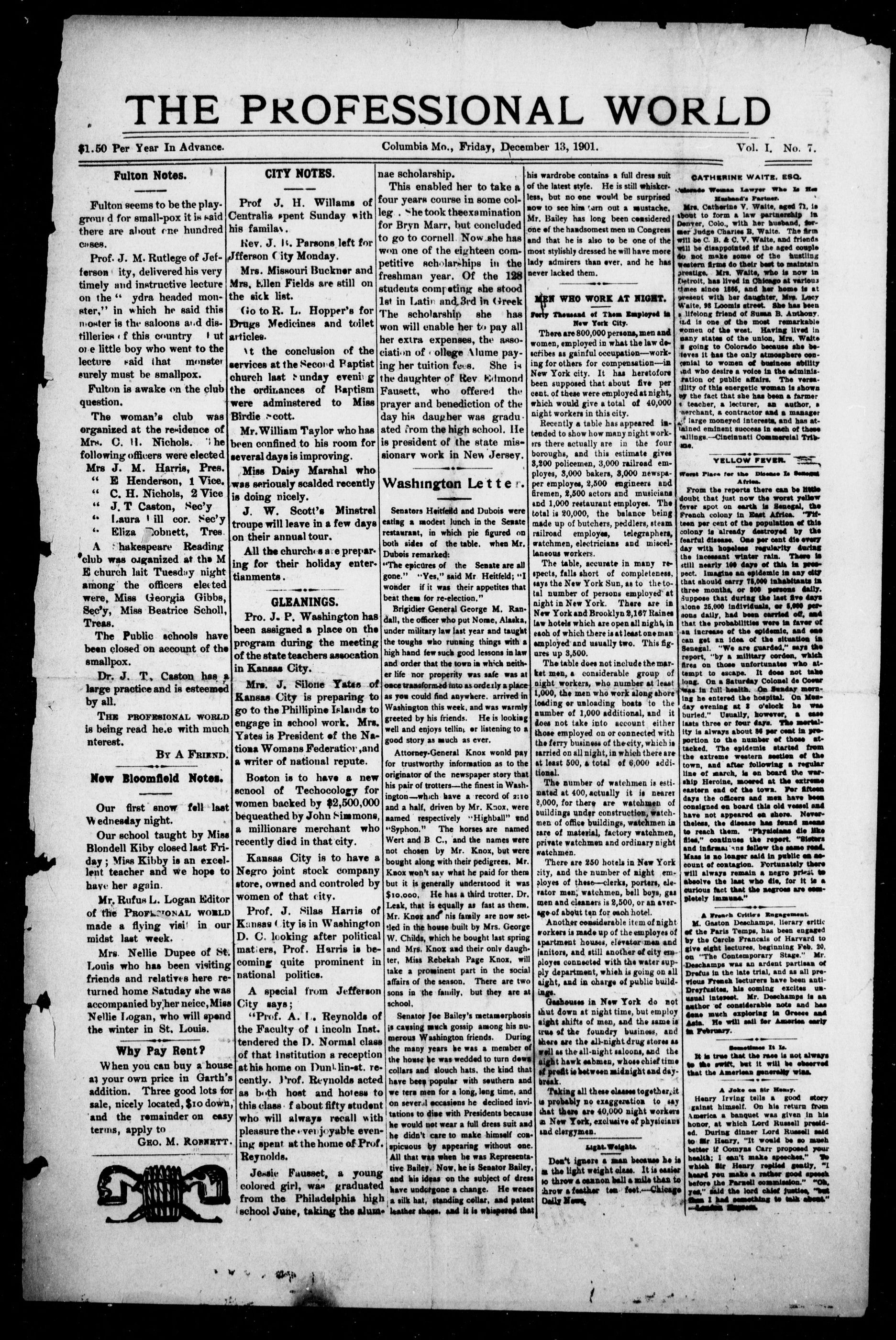
THE PROFESSIONAL WORLD
Prof. J. M. Rutlege of Jefferson city, delivered his very timely and instructive lecture on the "ydra headed monster," in which he said this monster is the saloons and distilleries of this country but one little boy who went to the lecture said that monster surely must be smallpox.
Fulton is awake on the club question.
The woman's club was organized at the residence of Mrs. C. H. Nichols. The following officers were elected Mrs J. M. Harris, Pres.
" E Henderson, 1 Vice.
" C. H. Nichols, 2 Vice
" J. T Caston, Sec'y
" Laura Hill cor. Sec'y
" Eliza Robnett, Tres.
A hakespeare Reading club was organized at the M E church lait Tuesday night among the officers elected were, Miss Georgia Gibbs, Sec'y, Miss Beatrice Scholl, Treas.
The Public schools have been closed on account of the smallpox.
Dr. J. T. Caston has a large practice and is esteemed by all.
THE PROFESIONAL WORLD is being read he.e with much interest.
BY A FRIEND.
New Bloomfield Notes.
Our first snow fell last Wednesday night.
Our school taught by Miss Blondell Kiby closed last Friday; Miss Kibby is an excellent teacher and we hope to have her again.
Mr. Rufus L. Logan Editor of the PROFESSIONAL WORLD made a flying visit in our midst last week.
Mrs. Nellie Dupee of St. Louis who has been visiting friends and relatives here returned home Saturday she was accompanied by her neice, Miss Nellie Logan, who will spend the winter in St. Louis.
Why Pay Rent?
When you can buy a house at your own price in Garth's addition. Three good lots for sale, nicely located, $10 down, and the remainder on easy terms, apply to GEO. M. ROBNETT.
---
GLEANINGS.
Pro. J. P. Washington has been assigned a place on the program during the meeting of the state teachers assocation in Kansas City.
Mrs. J. Silone Yates of Kansas City is preparing to go to the Phillipine Islands to engage in school work. Mrs. Yates is President of the Nationa Womans Federation, and a writer of national repute.
Boston is to have a new school of Techocology for women backed by $2,500,000 bequeathed by John Simmons, a millionare merchant who recently died in that city.
Kansas City is to have a Negro joint stock company store, owned and controled by women of that city.
Prof. J. Silas Harris of Kansas City is in Washington D.C. looking after political matters, Prof. Harris is becoming quite prominent in national politics.
"Prof. A. I. Reynolds of the Faculty of Lincoln Inst. tendered the D. Normal class of that Institution a reception at his home on Dunblin-st. recently. Prof. Reynolds acted as both host and hostess to this class of about fifty student who will always recall with pleasure the evenjoyable evening spent at the home of Prof. Reynolds.
Jessie Fausset, a young colored girl, was graduated from the Philadelphia high school June, taking the alum-
Columbia Mo., Friday, December 13, 1901.
nae scholarship. This enabled her to take a four years course in some college. She took the examination for Bryn Marr, but concluded to go to cornell. Now she has won one of the eighteen competitive scholarships in the freshman year. Of the 128 students competing she stood 1st in Latin and 3rd in Greek The scholarship she has won will enable her to pay all her extra expenses, the association of college Alume paying her tuition fees. She is the daughter of Rev Edmond Fausett, who offered the prayer and benediction of the day his daughter was graduated from the high school. He is president of the state missionary work in New Jersey.
Washington Lett e.
Senators Heitfeld and Dubois were eating a modest lunch in the Senate restaurant, in which pie figured on both sides of the table, when Mr. Dubois remarked:
"The epicures of the Senate are all gone." "Yes," said Mr. Heitfeld; "I wonder if it was their appetites that beat them for re-election."
Brigidier General George M. Randall, the officer who put Nome, Alaska, under military law last year and taught the toughs who running things with a high hand few such good lessons in law and order that the town in which neither life nor properity was safe was at once transformed into as orderly a place as you could find anywhere. arrived in Washington this week, and was warmly greeted by his friends. He is looking well and enjoys tellin; or listening to a good story as much as ever.
Attorney-General Knox would pay for trustworthy information as to the originator of the newspaper story that his pair of trotters—the finest in Washington—which have a record of 2:10 and a half, driven by Mr. Knox, were named respectively "Highball" end "Syphon." The horses are named Wert and B C., and the names were not chosen by Mr. Knox, but were bought along with their pedigrees. Mr. Knox won't say what he paid for them but it is generally understood it was $10,000. He has a third trotter. Dr. Leak, that is equally as fast as them. Mr. Knox and his family are now settled in the house built by Mrs. George W. Childs, which he bought last spring and Mrs. Knox and their only daughter, Miss Rebekah Page Knox, will take a prominent part in the social affairs of the season. There are two sons in the family, but they are at school.
Senator Joe Bailey's metamorphosis is causing much gossip among his numerous Washington friends. During the many years he was a member of the house he was wedded to turn down collars and slouch hats, the kind that have been popular with southern and we tera men for a long, long time, and on several occasions he declined invitations to dine with Presidents because he would not wear a full dress suit and he didn't care to make himself conspicuous by appearing without one. All that was when he was Representative Bailey. Now, he is Senator Bailey, and his ideas on the subject of dress have undergone a change. He wears a silk hat, standing collar, and patent leather shoes, and it is whispered that
his wardrobe contains a full dress suit of the latest style. He is still whiskerless, but no one would be surprised now to see him turn out a mustache. Mr. Bailey has long been considered one of the handsomest men in Congress and that he is also to be one of the most stylishly dressed he will have more lady admirers than ever, and he has never lacked them.
MEN WHO WORK AT NIGHT.
There are 800,000 persons, men and women, employed in what the law describes as gainful occupation—working for others for compensation—in New York city. It has heretofore been supposed that about five per cent. of these were employed at night, which would give a total of 40,000 night workers in this city.
Recently a table has appeared intended to show how many night workers there actually are in the four boroughs, and this estimate gives 3,200 policemen, 3,000 railroad employees, 3,000 bakers, 3,000 newspaper employees, 2,500 engineers and firemen, 2,500 actors and musicians and 1,000 restaurant employees. The total is 20,000, the balance being made up of butchers, peddlers, steam railroad employees, telegraphers, watchmen, electricians and miscellaneous workers.
The table, accurate in many respects, falls short of completeness, says the New York Sun, as to the total number of persons employed at night in New York. There are in New York and Brooklyn 2,167 Raines law hotels which are open all night, in each of which there is at least one man employed and usually two. This figures up 3,500.
The table does not include the market men, a considerable group of night workers, who number at least 1,000, the men who work along shore loading or unloading boats to the number of 1,000 additional, and it does not take into account either those employed on or connected with the ferry business of the city, which is carried on all night, in which there are at least 500, a total of 6,000 additional.
The number of watchmen is estimated at 400, actually it is nearer 2,000, for there are watchmen of buildings under construction, watchmen of office buildings, watchmen in care of material, factory watchmen, private watchmen and ordinary night watchmen.
There are 250 hotels in New York city, and the number of night employees of these—clerks, porters, elevator men, watchmen, bell boys, gasmen and cleaners is 2,500, or an average of about ten for each hotel.
Another considerable item of night workers is made up of the employees of apartment houses, elevator men and janitors, and still another of city employees connected with the water supply department, which is going on all night, and in charge of public buildings.
Gaushouses in New York do not shut down at night time, but employ eight shifts of men, and the same is true of the foundry business, and there are the all-night drug stores as well as the all-night saloons, and the night hawk cabmen, whose chief time of profit is between midnight and daybreak.
Taking all these classes together, it is probably no exaggeration to say that there are 40,000 night workers in New York, exclusive of physicians and clergymen.
Light. Weights
Don't ignere a man because he is in the light weight class. It is easier to throw a cannon ball a mile than to throw a feather ten feet. Chicago Daily News
Vol. I. No. 7.
CATHERINE WAITE, ESQ.
Mrs. Catherine V. Waite, aged 71, is about to form a law partnership in Denver, Colo., with her husband, former Judge Charles B. Waite. The firm will be C. B. & C. V. Waite, and friends will be disappointed if the aged couple do not make some of the hustling western firms do their best to maintain prestige. Mrs. Waite, who is now in Detroit, has lived in Chicago at various times since 1866, and her home is at present with her daughter, Mrs. Lucy Waite, 98 Loomis street. She has been a lifelong friend of Susan B. Anthony. And is one of the most remarkable women of the west. Having lived in many states of the union, Mrs. Waite is going to Colorado because she believes it has the only atmosphere congenial to women of business ability and who desire a voice in the administration of public affairs. The versatility of this energetic woman is shown by the fact that she has been a farmer, a teacher, a lecturer, an author, a merchant, a contractor and a manager of large moneyed interests, and has attained eminent success in each of these callings.—Cincinnati Commercial Tribune.
From the reports there can be little doubt that just now the worst yellow fever spot on earth is Senegal, the French colony in East Africa. "Fifteen per cent of the population of this colony is already destroyed by the fearful disease. One per cent die every day with hopeless regularity during the incessant winter rain. There is still nearly 100 days of this in prospect. Imagine an epidemic in any city that should carry 75,000 inhabitants in three months, or 800 persons daily. Suppose that during the last five days alone 25,000 individuals, or 5,000 persons daily, had been carried off, and that the probabilities were in favor of an increase of the epidemic, and one can get an idea of the situation in Senegal. "We are guarded," says the report, "by a military cordon, which fires on those unfortunates who attempt to escape. It does not take long. On a Saturday Colonel de Coeur was in full health. On Sunday morning he entered the hospital. On Monday evening at 3 o'clock he was buried." Usually, however, a case three or four days. The mortality is always about 86 per cent in proportion to the number of those attacked. The epidemic started from the extreme western section of the town, and after following a regular line of march, is on board the warship Heroine, moored at the extreme eastern end of the town. For fifteen days the officers and men have been consigned on board this old vessel and have not appeared on shore. Nevertheless, the disease has found means to reach them. "Physicians die like flies," continues the report. "Sisters and informants follow the same road. Mass is no longer said in public on account of contagion. Fortunately there will always remain a negro priest to absolve the last who die, for it is a curious fact that the negroes are completely immune."
A French Critica Engagement
A French Critics Engagement
M. Gaston Deschamps, literary critic of the Paris Temps, has been engaged by the Circle Francais of Harvard to give eight lectures, beginning Feb. 20, on "The Contemporary Stage." Mr. Deschamps was an ardent partisan of Dreus in the late trial, and as all previous French lecturers have been anti-Dreyfusites, his coming excites unusual interest. Mr. Deschamps is an author of considerable note and has done much exploring in Greece and Asia. He will sail for America early in February.
Sometimes It Is.
It is true that the race is not always to the swift, but it will be observed that the American generally wins.
A Joke on Sir Henry.
Henry Irving tells a good story against himself. On his return from America a banquet was given in his honor, at which Lord Russell presided. During dinner Lord Russell said to Sir Henry, "It would be so much better if Comyns Carr proposed your health; I can't make speeches." To which Sir Henry replied gently, "I heard you make a rather good speech before the Parnell commission." "Oh yes," said the lord chief justice, "but then I had something to talk about."
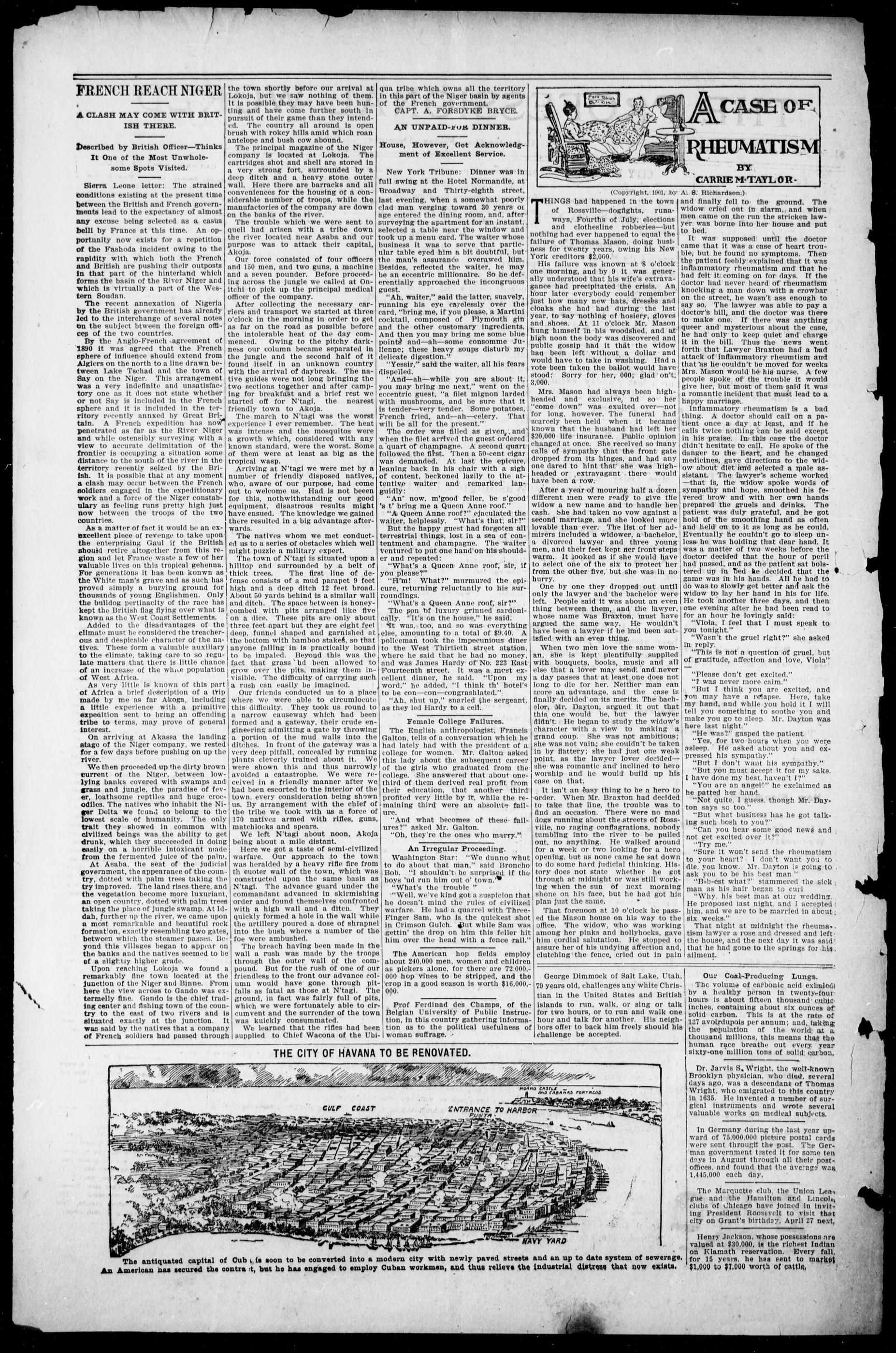
MORRO CASTLE
AND CABANAS FORTREAS
CULF COAST
ENTRANCE TO HARBOR
PUNTA
NAVY YARD
The antiquated capital of Cub is soon to be converted into a modern city with newly paved streets and an up to date system of sewerage. An American has secured the contract, but he has engaged to employ Cuban workmen, and thus relieve the industrial distress that now exists.
FRENCH REACH NIGER
CLASH MAY COME WITH BRITISH THERE.
Sierra Leone letter: The strained conditions existing at the present time between the British and French governments lead to the expectancy of almost any excuse being selected as a casus belli by France at this time. An opportunity now exists for a repetition of the Fashoda incident owing to the rapidity with which both the French and British are pushing their outposts in that part of the hinterland which forms the basin of the River Niger and which is virtually a part of the Western Soudan.
The recent annexation of Nigeria by the British government has already led to the interchange of several notes on the subject between the foreign offices of the two countries.
By the Anglo-French agreement of 1890 it was agreed that the French sphere of influence should extend from Algiers on the north to a line drawn between Lake Tschad and the town of Say on the Niger. This arrangement was a very indefinite and unsatisfactory one as it does not state whether or not Say is included in the French sphere and it is included in the territory recently annexed by Great Britain. A French expedition has now penetrated as far as the River Niger and while ostensibly surveying with a view to accurate delimitation of the frontier is occupying a situation some distance to the south of the river in the territory recently seized by the British. It is possible that at any moment a clash may occur between the French soldiers engaged in the expeditionary work and a force of the Niger constabulary as feeling runs pretty high just now between the troops of the two countries.
As a matter of fact it would be an excellent piece of revenge to take upon the enterprising Gaul if the British should retire altogether from this region and let France waste a few of her valuable lives on this tropical gehenna. For generations it has been known as the White man's grave and as such has proved simply a burying ground for thousands of young Englishmen. Only the bulldog pertinacity of the race has kept the British flag flying over what is known as the West Coast Settlements. Added to the disadvantages of the climate must be considered the treacherous and despicable character of the natives. These form a valuable auxiliary to the climate, taking care to so regulate matters that there is little chance of an increase of the white population of West Africa.
As very little is known of this part of Africa a brief description of a trip made by me as far Akoga, including a little experience with a primitive expedition to bring an offending tribe to terms, may prove of general interest.
On arriving at Akassa the landing stage of the Niger company, we rested for a few days before pushing on up the river.
We then proceeded up the dirty brown current of the Niger, between lowlying banks covered with swamps and grass and jungle, the paradise of fever, loathsome reptiles and huge crocodiles. The natives who inhabit the Niger Delta we found to belong to the lowest scale of humanity. The only trait they showed in common with civilized beings was the ability to get drunk, which they succeeded in doing easily on a horrible intoxicant made from the fermented juice of the palm.
At Asaba, the seat of the judicial government, the appearance of the country, dotted with palm trees taking the try improved. The land rises there, and the vegetation become more luxuriant, an open country, dotted with palm trees taking the place of jungle swamp. At Idah, further up the river, we came upon a most remarkable and beautiful rock formation, exactly resembling two gates, between which the steamer passes. Beyond this villages began to appear on the banks and the natives seemed to be of a slightly higher grade.
Upon reaching Lokoja we found a remarkably fine town located at the function of the Niger and Binne. From here the view across to Gando was externally fine. Gando is the chief trading center and fishing town of the country to the east of two rivers and is situated exactly at the junction. It was said by the natives that a company of French soldiers had passed through
THE CITY OF HAVANA TO BE RENOVATED.
the town shortly before our arrival at Lokoja, but we saw nothing of them. It is possible they may have been hunting and have come further south in pursuit of their game than they intended. The country all around is open brush with rokey hills amid which roan antelope and bush cow abound. The principal magazine of the Niger company is located at Lokoja. The cartridges shot and shell are stored in a very strong fort, surrounded by a deep ditch and a heavy stone outer wall. Here there are barracks and all conveniences for the housing of a considerable number of troops, while the manufactories of the company are down on the banks of the river. The trouble which we were sent to quell had arisen with a tribe down the river located near Asaba and our purpose was to attack their capital, Akoia.
Our force consisted of four officers and 150 men, and two guns, a machine and a seven pounder. Before proceeding across the jungle we called at Onitchi to pick up the principal medical officer of the company.
After collecting the necessary carriers and transport we started at three o'clock in the morning in order to get as far on the road as possible before the intolerable heat of the day commenced. Owing to the pitchy darkness our column became separated in the jungle and the second half of it found itself in an unknown country with the arrival of daybreak. The native guides were not long bringing the two sections together and after camping for breakfast and a brief rest we started off for Ntagi. the nearest friendly town to Akioa.
The march to N'tagi was the worst experience I ever remember. The heat was intense and the mosquitos were a growth which, considered with any known standard, were the worst. Some of them were at least as big as the tropical wasp. Arriving at N'tagi we were met by a number of friendly disposed natives, who, aware of our purpose, had come out to welcome us. Had is not been for this, notwithstanding our good equipment, disastrous results might have ensued. The knowledge we gained there resulted in a big advantage afterwards. The natives whom we met conducted us to a series of obstacles which well might puzzle a military expert.
The town of N'tagi is situated upon a hilltop and surrounded by a belt of thick trees. The first line of defense consists of a mud parapet 9 feet high and a deep ditch 12 feet broad. About 50 yards behind is a similar wall and ditch. The space between is honeycombed with pits arranged like five on a dice. These pits are only about three feet apart but they are eight feet deep, funnel shaped and garnished at the bottom with bamboo stakes, so that anyone falling in is practically bound to be impaled. Beyond this was the fact that grass 'hd been allowed to grow over the pits, making them invisible. The difficulty of carrying such a rush can easily be imagined.
Our friends conducted us to a place where we were able to circumlocate this difficulty. They took us round to a narrow causeway which had been formed and a gateway, their crude engineering admitting a gate by throwing a portion of the mud walls into the ditches. In front of the gateway was a very deep pitfall, concealed by running plants cleverly trained about it. We were shown this and thus narrowly avoided a catastrophe. We were received in a friendly manner after we had been escorted to the interior of the town, every consideration being shown us. By arrangement with the chief of the tribe we took with us a force of 170 natives armed with rifles, guns, matchlocks and spears. We left N'tagi about noon, Akoja being about a mile distant.
Here we got a taste of semi-civilized warfare. Our approach to the town was heralded by a heavy rifle fire from th e outer wall of the town, which was constructed upon the same basis as N'tagl. The advance guard under the commandant advanced in skirmishing order and found themselves confronted with a high wall and a ditch. They quickly formed a hole in the wall while the artillery poured a dose of shrapnel into the bush where a number of the foe were ambushed. The breach having been made in the wall a rush was made by the troops through the outer wall of the compound. But for the rush of one of our friendless to the front our advance column would have gone through pitfalls as fatal as those at N'tagl. The ground, in fact was fairly full of pits, which we were fortunately able to circumvent and the surrender of the town was kukliely consummated. We learned that the rifles had been supplied to Chief Wacona of the Ubi-
qua tribe which owns all the territory in this part of the Niger basin by agents of the French government.
CAPT. A. FORSDYKE BRYCE.
AN UNPAID-FOR DINNER.
House, However, Got Acknowledgment of Excellent Service.
New York Tribune: Dinner was in full swing at the Hotel Normandie, at Broadway and Thirty-eighth street, last evening, when a somewhat poorly clad man verging toward 30 years or age entered the dining room, and, after surveying the apartment for an instant, selected a table near the window and took up a menu card. The waiter whose business it was to serve that particular table eyed him a bit doubtful, but the man's assurance overawed him. Besides, reflected the waiter, he may be an eccentric millionaire. So he deferentially approached the incongruous guest.
"Ah, waiter," said the latter, suavely, running his eye carelessly over the card, "bring me, if you please, a Martini cocktail, composed of Plymouth gin and the other customary ingredients. And then you may bring me some blue points and—ah—some consomme Julienne; these heavy soups disturb my delicate digestion."
"Yessir," said the waiter, all his fears dispelled.
"And—ah—while you are about it, you may bring me next," went on the eccentric guest, "a filet mignon larded with mushrooms, and be sure that it is tender—very tender. Some potatoes, French fried, and—ah—celery. That will be all for the present."
The order was filled as given, and when the fillet arrived the guest ordered a quart of champagne. A second quart followed the first. Then a 50-cent cigar was demanded. At last the epicure, leaning back in his chair with a sigh of content, beckoned lazily to the attentive waiter and remarked languidly:
"An' now, m'good feller, be s'good's t' bring me a Queen Anne roof."
"A Queen Anne roof?" ejaculated the waiter, helplessly. "What's that, sir?" But the happy guest had forgotten all terrestrial things, lost in a sea of contentment and champagne. The waiter ventured to put one hand on his shoulder and repeated:
"What's a Queen Anne roof, sir, if you please?"
"H'm! What?" murmured the epicure, returning reluctantly to his surroundings.
"What's a Queen Anne roof, sir?" The son of luxury grinned sardonically. "It's on the house," he said.
It was, too, and so was everything else, amounting to a total of $9.40. A policeman took the impecunious dinner to the West Thirtieth street station, where he said that he had no money, and was James Hardy of No. 223 East Fourteenth street. It was a most excellent dinner, he said. "Upon my word," he added, "I think th' hotel's to be con—con—congrashlated." "Ah, shut up," snarled the sergeant, as they led Hardy to a cell.
Female College Failures.
The English anthropologist, Francis Galton, tells of a conversation which he had lately had with the president of a college for women. Mr. Galton asked this lady about the subsequent career of the girls who graduated from the college. She answered that about one-third of them derived real profit from their education, that another third profited very little by it, while the remaining third were an absolute failure.
"And what becomes of these failures?" asked Mr. Galton.
"Oh, they're the ones who marry."
An Irregular Proceeding.
Washington Star: "We dunno what to do about that man," said Broncho Bob. "I shouldn't be surprised if the boys 'ud run him out o' town."
"What's the trouble "
"Well, we've kind got a suspicion that he doesn't mind the rules of civilized warfare. He had a quarrel with Three-Finger Sam, who is the quickest shot in Crimson Gulch. But while Sam was gettin' the drop on him this feller hit him over the head with a fence rail."
The American hop fields employ about 240,000 men, women and children as pickers alone, for there are 72,000,-000 hop vines to be stripped, and the crop in a good season is worth $16,000,-000.
Prof Ferdinad des Champs, of the Belgian University of Public Instruction, in this country gathering information as to the political usefulness of woman suffrage.
A CASE OF RHEUMATISM BY CARRIE M·TAYLOR.
(Copyright, 1901, by A. S. Richardson.)
THINGS had happened in the town of Rossville—dogfights, runaways, Fourths of July; elections and clothesline robberies—but nothing had ever happened to equal the failure of Thomas Mason, doing business for twenty years, owing his New York creditors $2,000.
and finally fell to the ground. The widow cried out in alarm, and when men came on the run the stricken lawyer was borne into her house and put to bed.
It was supposed until the doctor came that it was a case of heart trouble, but he found no symptoms. The
His failure was known at 8 o'clock one morning, and by 9 it was generally understood that his wife's extravagance had precipitated the crisis. An hour later everybody could remember just how many new hats, dresses and cloaks she had had during the last year, to say nothing of hosiery, gloves and shoes. At 11 o'clock Mr. Mason hung himself in his woodshed, and at high noon the body was discovered and public gossip had it that the widow had been left without a dollar and would have to take in washing. Had a vote been taken the ballot would have stood: Sorry for her, 000; glad on't, 3,000.
Mrs. Mason had always been high-headed and exclusive, nd so her "come down" was exulted over—not for long, however. The funeral had scarcely been held when it became known that the husband had left her $20,000 life insurance. Public opinion changed at once. She received so many calls of sympathy that the front gate dropped from its hinges, and had any one dared to hint that she was high-headed or extravagant there would have been a row.
After a year of mourning half a dozen different men were ready to give the widow a new name and to handle her cash. She had taken no vow against a second marriage, and she looked more lovable than ever. The list of her admirers included a widower, a bachelor, a divorced lawyer and three young men, and their feet kept her front steps warm. It looked as if she would have to select one of the six to protect her from the other five, but she was in no hurry.
One by one they dropped out until only the lawyer and the bachelor were left. People said it was about an even thing between them, and the lawyer, whose name was Braxton, must have argued the same way. He wouldn't have been a lawyer if he had been satisfied with an even thing.
When two men love the same woman, she is kept plentifully supplied with bouquets, books, music and all else that a lover may send, and never a day passes that at least one does not long to die for her. Neither man can score an advantage, and the case is finally decided on its merits. The bachelor, Mr. Dayton, argued it out that this one would be, but the lawyer didn't. He began to study the widow's character with a view to making a grand coup. She was not ambitious; she was not vain; she couldn't be taken in by flattery; she had just one weak point, as the lawyer lover decided—she was romantic and inclined to hero worship and he would build up his case on that.
It isn't an easy thing to be a hero to order. When Mr. Braxton had decided to take that line, the trouble was to find an occasion. There were no mad dogs running about the streets of Rossville, no raging conflagrations, nobody tumbling into the river to be pulled out, no anything. He walked around for a week or two looking for a hero opening, but as none came he sat down to do some hard judicial thinking. History does not state whether he got through at midnight or was still working when the sun of next morning shone on his face, but he had got his plan just the same.
That forenoon at 10 o'clock he passed the Mason house on his way to the office. The widow, who was working among her pinks and hollyhocks, gave him cordial salutation. He stopped to assure her of his undying affection and, clutching the fence, cried out in pain
George Dimmock of Salt Lake, Utah, 79 years old, challenges any white Christian in the United States and British islands to run, walk, or sing or talk for two hours, or to run and walk one hour and talk for another. His neighbors offer to back him freely should his challenge be accepted.
and finally fell to the ground. The widow cried out in alarm, and when men came on the run the stricken lawyer was borne into her house and put to bed.
It was supposed until the doctor came that it was a case of heart trouble, but he found no symptoms. Then the patient feebly explained that it was inflammatory rheumatism and that he had felt it coming on for days. If the doctor had never heard of rheumatism knocking a man down with a crowbar on the street, he wasn't ass enough to say so. The lawyer was able to pay a doctor's bill, and the doctor was there to make one. If there was anything queer and mysterious about the case, he had only to keep quiet and charge it in the bill. Thus the news went forth that Lawyer Braxton had a bad attack of inflammatory rheumtism and that as he couldn't be moved for weeks Mrs. Mason would be his nurse. A few people spoke of the trouble it would give her, but most of them said it was a romantic incident that must lead to a happy marriage.
Inflammatory rheumatism is a bad thing. A doctor should call on a patient once a day at least, and if he calls twice nothing can be said except in his praise. In this case the doctor didn't hesitate to call. He spoke of the danger to the heart, and he changed medicines, gave directions to the widow about diet and selected a male assistant. The lawyer's scheme worked—that is, the widow spoke words of sympathy and hope, smoothed his fevered brow and with her own hands prepared the gruels and drinks. The patient was duly grateful, and he got hold of the smoothing hand as often and held on to it as long as he could. Eventually he couldn't go to sleep unless he was holding that dear hand. It was a matter of two weeks before the doctor decided that the hour of peril had passed, and as the patient sat bolstered up in bed he decided that the game was in his hands. All he had to do was to slowly get better and ask the widow to lay her hand in his for life. He took another three days, and then one evening after he had been read to for an hour he lovingly said:
"Viola, I feel that I must speak to you tonight."
"Wasn't the gruel right?" she asked in reply.
"This is not a question of gruel, but of gratitude, affection and love, Viola"
"Please don't get excited."
"I was never more calm."
"But I think you are excited, and you may have a relapse. Here, take my hand, and while you hold it I will tell you something to soothe you and make you go to sleep. Mr. Dayton was here last night."
"He was?" gasped the patient.
"Yes, for two hours when you were asleep. He asked about you and expressed his sympathy."
"But I don't want his sympathy."
"But you must accept it for my sake. I have done my best, haven't I?"
"You are an angel!" he exclaimed as he patted her hand.
"Not quite. I guess, though Mr. Dayton says so too."
"But what business has he got talking such bosh to you?"
"Can you hear some good news and not get excited over it?"
"Try me."
"Sure it won't send the rheumatism to your heart? I don't want you to die, you know. Mr. Dayton is going to ask you to be his best man."
"Bab-est what? stammered the sick man as his hair began to curl"
"Why, his best man at our wedding. He proposed last night, and I accepted him, and we are to be married in about six weeks."
"That night at midnight the rheumatism lawyer a rose and dressed and left the house, and the next day it was said that he had gone to the springs for his ailment."
Our Coal-Producing Lungs.
The volume of carbonic acid exhaled by a healthy person in twenty-four hours is about fifteen thousand cubic inches, containing about six ounces of solid carbon. This is at the rate of 137 avoirdupois per annum; and, taking the population of the world at a thousand millions, this means that the human race breathe out every year sixty-one million tons of solid carbon.
Dr. Jarvis S. Wright, the well-known Brooklyn physician, who died, several days ago, was a descendant of Thomas Wright, who emigrated to this country in 1635. He invented a number of surgical instruments and wrote several valuable works on medical subjects.
In Germany during the last year upward of 75,000,000 picture postal cards were sent through the post. The German government tested it for some ten days in August through all their post-offices, and found that the average was 1,445,000 each day.
The Marquette club, the Union League and the Hamilton and Lincoln clubs of Chicago have joined in inviting President Roosevelt to visit that city on Grant's birthday, April 27 next.
Henry Jackson, whose possessions are valued at $30,000, is the richest Indian on Klamath reservation. Every fall, for 15 years, he has sent to market $1,000 to $7,000 worth of cattle.
RUFUS L. LOGAN, B. S. D.,..... Editor
TERMS OF SUBSCRIP ION.
One Year In Advance..... $1.50
Six Months In Advance..... 1.00
ADVERTISING RA ES ON APPl.
CATIO
JOB WORK OF ALL KINDS SOLIC
ITED.
PUBLISHED EVERY FRIDAY.
Every teacher in the state should attend the association meeting in Kansas City, Kansas.
The Cardwell 'ibel suit is proving both interesting and amusing to Missourians who are not in the ring.
Our thanks are due Miss Miss Pattie Bradford and Mrs. Margaret Akers for subscription to THE PROFESSIONAL WORLD.
Judging from the developmen of facts brought out by depositions in the Cardwell case, there may be some thing for Attorney-General Crow to do when Mr. ardwell gets through.
A copy of the "Excelsior" edited by W. H. Harrison and S. Z. Herndon of Pleasant Hill, reached us last week. It is a neat newsy paper and doubtless will succeed.
Some few persons who have ordered The Professional World have failed to send in their subscriptions we trust they will do so at once as we hope to get our books straightened up before January 1st.
President's Roosevelt's message to Congress was one of the most scholarly documents ever presented to any legislative body, his silence on disfranchisement, however, was a surprise to many who read the message.
We are glad to place on our exchange list The Westenn Enterprise of Colorado Springs edited by Prof. J. H. Jackson formerly President of Lincoln Institute. It is needless to say that the paper is ably edited and sure to succed.
The State Board of the Christian church meets here in January to decide as to the location of the colored educational college. We hope that the citizens of Columbia will before that time subscribe the remainder of the money necessary to purchase the ground as it will greatly benefit Columbia to have the college located here.
A young English actor who had improved his manager favorably was not for a difficult role in a new production and his success or failure in it was a matter of vital importance to his future reputation. After the second act on the opening night his friend, William Gilbert, the popular dramatist and librettist, went behind the scene fully realizing that in a kindly word or a sympathetic criticism he would bring hope or despair to the actor. However, on seeing that his friend was in a profuse precipitation he could not resist his own cleverness and contented himself with merely remarshing: "How well your skin acts."
GROWING THINGS.
No Pleasure Is Greater for a Large Class of People.
There is no pleasure more pure and exquisite than watching the growth of a tree or plant in which one is interested. If you have planted it yourself so much the better. You then have a feeling of proprietorship in each opening bud or leaf which can be gained in no other way. But, at my rate, cultivate the friendship of the plants and trees, not simply for the flowers and fruit which they furnish, but for the pleasure of seeing them grow. It has been said that any square foot of sod, if intelligently studied, will give occupation for many hours. The growth of the simplest plant is a wonderful process. Perhaps you cannot go to Europe on the mountains or the sea, but you have an opportunity for unlimited recreation and diversion if you have a small plot of grass and plants with which you have not become acquainted. Boston Watchman.
HOW IBSEN GOT HIS START
First Drama Produced When He Wear
Fifteen Years of Age.
According to W. E. Curtis, writing to the Chicago Record-Herald from Scandinavia, Ibsen is supposed to be a rich man, although he is said to be very penurious and never contributes money to any cause. He receives a large income from his plays and saves the most of it. His only extravagance is pictures. He has a fine taste for art, and has one of the best private collections of paintings in Norway. In his early school days he took several prizes for drawing, and his boyish ambition was to be a painter, but his family could not afford to pay for instruction. He had a desperate struggle to sustain himself during the first half of his life.
His father was formerly a merchant of great wealth at the city of Skien, in southern Norway, but failed disastrously and died, leaving a large family entirely destitute. Henrik was compelled to earn his own living from childhood, and was never able to enjoy the sports and pleasures of other children. He has said of himself that he "was never a child," and his whole career as well as his disposition has been clouded and soured by his early poverty and privations. His natural literary abilities asserted themselves in childhood. His first poems were written at the age of 11, and at 15, while he was a clerk in a village drug store and studying medicine, he wrote his first drama, entitled "Katalina," which was published over the nom de plume of Brynjolf Bjerne. Although it attracted general attention, it was not approved by the public. Prof. Monrad, of the Royal university, one of the foremost critics of Norway, saw merit in the work of the unknown new author, and wrote a review, in which he predicted that the pen which framed those lines would some time be famous. He encouraged him to write again and again and to develop what he perceived to be genius.
This single friendly encouragement from a stranger seems to have been the turning point of Ibsen's career, for he continued his literary work under his nom de plume with greater success and popularity. At the same time he continued his medical studies and at the age of 20 appeared in Christiania for the first time in his life to take his preliminary examinations at the university. He failed to pass in Greek and mathematics, and was so mortified that he abandoned his plan of becoming a physician, and for several years lived a previous life in the garrets of the Norwegian capital, writing for the newspapers and magazines and composing plays which attracted no attention, but he finally succeeded in having one of them accepted at a theater in Bergen, where he lived six years and made his first reputation under his true name. He became the director of the Bergen theater. At the same time that his rival, Bjornson, was director of the National theater at Christiania.
In 1864 Ibsen succeeded in securing from the government a pension of 100 kroner a year, about $200 in our money, upon which he went to Ger-
many, France and Italy to study, and did not return to his native country until in 1886, after he became famous. His merit was first recognized in Denmark. A Danish publisher took the risk and responsibility of printing books which Norwegian publishers had rejected; the managers of the Danish theaters brought out plays which the Norwegian theaters had desired to produce, and the Danish public applauded the satire and sentiment which the Norwegian public had ignored. It is an interesting illustration of loyalty and gratitude that Ibsen has always stuck to his Danish publisher, and that the theater at Copenhagen has always had an option on his plays.
SENATOR FLATT.
In No Nature Lover—Has Seen Adren-
docks Only Once.
Senator Thomas C. Platt has never been counted as a nature lover. His dealings are with politicians and business men, and his expressions of fondness for the picturesque in nature are few and far between. The mountains have no attraction for the republican leader, and his friends were surprised last week when Senator Platt made a journey to the Adirondacks. His sons talked for hours to induce him to take the trip. The stay lasted three days, and when Senator Platt arived back in the Fifth Avenue hotel he said to a friend:
"It is the first time I have seen the Adirondack mountains, although I have lived within a short distance of them for years. Go back to the mountains? No, I never expect to see them again. The sea breezes of Coney island suit me." One of the tender spots in Senator Platt's nature is his desire to have rare cut flowers in his rooms. He deights to push a comfortable armchair close to a large vase of American beauty roses and enjoy their fragrance. N. Y. Times.
ONE USESUL FLY.
He Saved a Tired Merchant's Watch and Shirt Stud
Flies are so seldom heroic that the story of how one of the "pesky things" saved for a Cincinnati business man his wallet and diamond stud is in many ways remarkable.
The time was early Thursday morning, and the place was a smoking car of a Louisville & Nashville train which stood at the Tenth street station ready for the run to Cincinnati.
The fly was dozing on the bald spot of the Cincinnati merchant's head. The man, who had been attending the races, was also tired and sound asleep. In his inside coat pocket was his wallet, containing all his money. On his shirt front a diamond glistened.
Suddenly the fly was aroused. He saw a man's hand working at the shirt stud. Not a moment was to be lost. The fly danced over the sleeping man's cheek in a vain endeavor to arouse him. The merchant only turned. The fly galloped over his chin and did a "stunt" in his ear. No response.
In desperation he began a slow march up and down the nose of the man asleep. The merchant clutched wildly, struck the wrist of the pick-pocket and the next instant was awake. The thief ran from the smoker and disappeared in the darkness.
The fly, like all true heroes, did not await to receive the thanks of the man whom he had befriended, but flew away.—Louisville Courier-Journal.
Warline Engineer Surnames
The registers that have been preserved at Somerset house since 1837 furnish what seems at first sight to be a complete series of surnames connected with war. Supplying in the first place that invariable cause of hostilities, Quarrell, they lead on to Allies, Challenge, Charge, Battle, Greatbattle, Rout, Victory and Conquest. They proceed, as it would appear, to enumerate in detail the ghastly results of conflict in the names Gush, Gore, Slaughter, Carnage and Corpse and seem to furnish particulars of war material in Powder, Bullett, Shott, Shell, Cannon, Sword and Lance. They mention, too, the Gunner, and further specify his deadly charges in Caulster and Grape.
A BIT OF REALISM.
The Great Emotional Actress Back to Her Childhood Home.
"Back again to the old home," cried the great emotional actress, as she stepped through the wings and stood for a moment until the calcium man got the right focus.
"Back again," she continued, going up stage, so that her Parisian costume would get all there was in the calcium tank.
"Back to the scenes of me chelldhood, after all these long, long y'ars."
Be it known that when an actorady says "y'ars" she shows that she loves her art.
With trembling hand she searched the room, saying:
"It must be here! It must be here! I left it here long, long y'ars ago."
"The audience held its breath and swallowed cloves and allspice in its intense excitement.
"Yes, yes," she exclaimed, "I have found it! I knew it was here. Ah, those happy childhood days!"
And she brought to view the piece of chewing gum she had concealed under the chair that happy day, long, long y'ars ago, when Gerald Mortimer had asked her to be his'n.
Realism is all there is to it nowadays.—Baltimore American.
LAVENDER or mosquito.
"Talk about the oil treatment as a preventive of mosquitoes," said an English dweller at the Croisic, "I have appointed myself with oil of penny-royal, burned Chinese joss sticks at the foot and head of my bed, and have sprayed the room with lavender water. No good. Nothing except the oil of lavender saves me from having a mosquito bite dado around my neck and on each ankle. Last night I visited one of your bloomin' roof gardens, and the mosquitoes awaited my arrival. I innocently opened my vial containing oil of lavender and put some of the contents on my face, neck and wrists. A rude attendant ordered me to leave the roof. He said I disturbed the performance."—N. Y.
Chicago's Street Lighting
The experience of Chicago in municipal lighting on a large scale is set forth in the report of Edward B. Elliott, city electrician of that city. Chicago owns a municipal lighting plant, consisting of three power houses, with a capacity for furnishing 4,700 lights, 125 miles of conduit and cable system, 4,400 arc lamps, and two power stations not in use. During the year 1900 the city operated 3,867 arc lamps at a cost of $265,129, including $18,750 interest charge and over $10,000 for depreciation.
WAS LEFT-HANDED.
Art Connoisseur's Discovery Concerning One Old Master.
What old master among the Dutch painters was left-handed?
This knowledge is a very valuable asset to a connoisseur in art. Few experts know, and those who do are particular to keep the information to themselves. It enables them to detect a spurious painting ascribed to this artist at a glance.
Mr. George H. Story, of the Metropolitan museum, says, according to the New York World, that he discovered the fact for himself in a curious way. Mr. Story is the highest authority in this country upon old masters, and is especially familiar with those of the Dutch school. He gained his prestige by years of the minutest study in the galleries of Europe. One of his methods of study was to copy masterpieces for the sake of dissecting a painter's style. One day he set his easel down before a famous painting at The Hague.
"Now I'll get your stroke," reflected upon the artist. He found that he could not get the stroke. There was something about it quite out of the ordinary. Then he noticed the same oddity in the way that the original varnishing had been done. Suddenly he worked out the problem like a flash. The brush had been brought always from left to right instead of from right to left. It was easy to verify the discovery, once made. When a World reporter asked Mr. Story to name the painter he laughed. "Oh, no," he said; "I can't afford to part with that bit of knowledge."
ICE FROM NORWAY.
All Europe Be Supplied from the Soundd
north. Fennesse.
We have all heard about Greenland's loy mountains, but Norway's are a trifle less familiar to us by name, despite the fact that they are of far more practical service to us, for in summer and winter we draw our ice supplies, from the mountain lakes of that country. The lakes of crystal-clear water are high up in the mountains and are surrounded by countless pine trees that grow to a great height. Europe's ice supply from these sources is controlled by syndicates. The ice, which is considered by experts to be the finest in the world, is cut up into huge, square-shaped blocks by means of plows constructed for the purpose. These blocks are sent down the mountain side on huge slides. Owing to their great length the ice often requires an amazing velocity are it reaches the inclosed pool, outside which the bulky ice ships ride at anchor awaiting their cool cargoes. In spite of these arrangements it sometimes comes about that the ice supply does not continue altogether uninterrupted, for, apart from the occasional delay of ships, orders sometimes come which necessitate phenomenal quantities being cut from the lakes, and when this occurs after a drouth the demand quickly exceeds the supply and scarcity ensues. That is why we often have to pay dear for our ice even in winter time.
An Eagle and Dog Fight.
While a little boy, accompanied by a cattle dog, were proceeding through a paddock, near Dandenong, the dog was attacked by a huge eagle and raised in the air some considerable height. The dog struggled to get loose and managed to catch the eagle by the bony part of the wing, and both fell to the ground, the dog, which weighed some twenty-five pounds, being badly cut about the body and head as a result of the attack. The bird was killed by the boy with a stroke of a stick and measured seven feet from tip to tip across the wings. Melbourne (Australia) Leader.
A FREE PATTERN
(your own selection) to every subscriber. Only 50 cents a year.
McCALL'S
MAGAZINE
50
YEAR
A LADIES' MAGAZINE.
A gun; beautiful colored plates; latest fashions; drywashing enamels; easy work; hessenbelt hats; fiction, etc. Subscribe to day, or, read gc. for latest copy. Likely unused. Mail or e-mail.
Stylish, Reliable, Simple, Up-to-date, Economical and Absolutely Perfect-Fitting Paper Patterns.
Mc CALL
BAZAR
PATTERNS
10¢
15¢
All Seams Allowed and Performations show
the Batting and Sewing Line.
Only seams that meet—none higher
ask for them. Sold in sanctity city
and town, or by mail from
THE M.CALL CO.,
113-115-117 West 51st St., NEW YORK.
A Monthly Reporting of the Field of Literature, with the choice from over
250 Standard Library Books
By Prominent Authors
(Handomely printed and bound)
For the price of the Literary Era—Alche
$1.00 PER ANNUM
Full particulars and list of books sent upon application—Sample copy of
The Literary Era, for 2c. stamp.
The Literary Era
PHILADELPHIA, PA.
50 YEARS' EXPERIENCE
PATENTS
TRADE MARKS DESIGNS
COPYRIGHTS & G.
Axcess sending a sketch and description may quibble according our opinion free whether or not invention is probably patentable. Companies may send a sketch and description made free. Oldest agency for securing patents.
Patents taken through Mann & Co. receive special notice, without charge, in the