The Professional World
Friday, December 20, 1901
Columbia, Missouri
Page text (machine-generated)
THE PROFESSIONAL WORLD
CITY NO ES
Dr. J. Perr and wife arrived Monday from Clarksville, Texas.
It is rumored that the wedding bells will be ringing all during the holiday.
Mr. John Washington of Kansas City, has been visiting parents and friends.
Mrs. F. M. Bradshears and Mrs. Margaret Akers will spend the holidays in St. Louis.
Mrs. Fannie Smith of Milwaukee, Wisconsin, is visiting her parents, Mr. and Mrs. Joel Williams. Miss J. Ethel Fowler of the Fred Douglass school will spend the holidays with her parents Xenia, Ohio. Prof. and Mrs. H. A. Clark will attend the State Teachers Association meeting in Kansas City, Christmas.
Miss Carrie Smith of the Fred Douglrss school will spend the holidays with her parents in Springfield, Ill.
Mr. Forrest Lamme arrived Sunday from Oklahoma Territory to visit his daughters, Misses Mary and Birdie Lamme.
Master Otis Moore who is attending school et Roger Williams University will spend the holidays with his mother, Mrs. K. M. Moore.
Toilet sets glove and handkerchief cases, fine perfumeries, make excellent Xmas gifts and can be found at Hopper's.
MARRIED.
At the A. M. E. Parsonage last Monday evening, Warren Wilson and Mrs. Callie Rout, both of Columbia, Rev. P. C. Crews officating. Mr. Wilson is a well known resident of this city. Mrs Rout came here recently from Kirksville. They will begin house keeping immediately. at Mr. Wilson's home on Clay-st.
Re J. Arlington Grant, prefemal a double ceremony in the residence of Mrs. Jane recently the contracting were Mr. Lexy and Miss Ada Jackson nas Hendery
Why Pay Rent?
When you can buy a house at your own price in Garth's addition. Three good lots for sale, nicely located, $10 down, and the remainder on easy terms, apply to GEO. M. ROPNETT.
Dec. 10th 1901
Editor of The Professional Word:
As the time is drawing for me to come and see all the little boys and girls I thought I would write and tell you that I am very busy packing up my toys and every thing nice for the good little folks.
I recieved many nice letters from little boys and girls saying what they wanted for Xmas. I will leave here on the 20th and will be there on the 24th. There is plenty of snow, and my riendeers are looking fine, we will bring enough to fill every stocking we find hanging up and we hope all will have e merry Xmas and a happy new yerr.
SANTA CLAUS' CORNER.
The following are some of the many letters written by children of the public schools and mailed to the Professional World mail box;
Columbia Mo. Dec. 18th. 1901
Dear Santa Claus
I thought I would write you a few lines to let you know what I want for Xmas. I want some candy and oranges, peanuts and bananas, and a money bank.
Columbia, Mo. Dec 18 1901
Dear Santa will you please bring
me a hat? I want a wagon, and bring
Miss Eula a dress and, I want a flag.
Eddie Williams.
I live on Clay-st. now we moved out there in Oct. I wish you would hring me a suit of clothes and a pair of shoes, a drum, a bicycle and a wagon: Do not forget me for if you do I will be very disappointed.
Yours Truly,
Robert Clarkson.
Age 9-Grade 3rd.
Columbia, Mo.
Dear Santa;
I thought I would write you a few words to you I am well and hope you are the same. I want a drum some candy and nuts, oranges and bananas and an air rifle and an automobile.
Alex Strawn.
Columbia, Mo.
Dear Santa Claus.
I thought I would write to,
a few lines to let you know that I am
willing to write some candy and
to tell you about wagon a drum, and
that I don't forget my good teacher
Dr. A B. Marsh, she is so kind and
Mrs. A. B More and papa, mamma,
grandma and my brothers and sisters.
Good-by from;
Jas U Williams.
Columbia, Mo.
Dear Santa Claus:
Please bring me a piano, some candy and nuts. I am 7 years old. Room 1 Mamie Henderson.
Columbia Mo., Friday, December 20, 1901.
Dear Santa Claus: I thought I would write you a few lines to let you know I want a story book, some candy bananas and some oranges.
Columbia, Mo.,
Please bring me a doll, a doll hat, a speech book and bring my teacher a handkerchief, Miss Douglass.
Ella Williams, 11 years old.
Columba, Mo.
Dear Santa Claus;
I thought I write you a few lines to tell you what I want. I want a Piano nad a doll's bed. I want a sack of candy, I believe I will close.
Columbia, Mo.,
Dear Santa Claus;
want a doll, a stove, a lamp a
pair of shoes, if you want to bring me
what I want. I am six yerrs old.
CHURCH DIRECTORY.
A. M. E. CHURCH.
Rev. P. C. CREWS, Pastor
Order Of Services
11:00 a. m.—Preaching
3:00 a. m.—Sunday School
7:30 p. m.—Preaching.
Prayer meeting Wednesday evening
at 7:30.
Everybohy cordially invited to attend
these services.
M. E. CHURCH.
REV. J. ABLINGTON GRANT AS H.
ORDER OF SERVICES.
9;30 A. M.—Sunday School
11;60 A. M.—Preaching
7;30 P. M.—Preaching
Wednesday evening from 7.30 to 8:30
Prayer eeting.
ALL ARE MADE WELCOME.
Young est grandmother in America. Cheboygan, Mich., claims to have the youngest grandmother in America. She married at 12, and gave birth to a daughter a year later. The child, following her mother's example, married young and lately when 16 years old gave birth to a child, whose grandmother is now a little over 29 years old.
RUSSIAN SPIES HERE.
Who Seeks Refuge in America. The Russian secret police are probably the most skillful in the world; they need to be. In the days of Napoleon III. the police of France had that reputation. They haven't it now for the best of reasons. An emperor needs skillful spies in all the world—a republic doesn't. Russia has had its lessons in the death of the late carar and in many attempts made upon the present ruler. So the chief of political police keeps agents in every great city in the world. New York, where so many Russian nihilists have found refuge; San Francisco and Chicago are especially favored in this way. Escape convicts from Siberia sometimes drift to the Pacific coast city, while Chicago is watched on general principles. New York, however, is getting to be more and more the chief object of the solitious attentions of the czar's people. The spies who keep tab on nihilists in America always claim to be nihilists themselves, exiled for their political views, or escaped suspects. It is their plan to secure admittance to some of the many nihilist circles here and keep the police informed of what goes on. So long as the nihilists confine themselves to speech-making nothing it done about it. But, if one of them should start for St. Petersburg with such a mission as that which took Bresci from Paterson the home authorities would be warned and stand ready to receive him after certain well-known recedents. As for the spy, his is a dangerous lift. If suspected he may become at almost any time the hero of a mysterious murder case.
---
SOME WHYS ANSWERED.
1h Ancient and Curious Origin of Familiar Customs.
It is not surprising what a number of little things we do without knowing the reason. Why, for instance, do widows wear caps? Perhaps they may say because they make them look pretty and interesting. But the real reason is that when the Romans were in England they shaved their heads as a sign of mourning. Of course a woman couldn't let herself be seen with a bald head, so she made herself a pretty cap. And now, though the necessity of wearing it has passed away, the cap remains. Why do we have bows on the left side of our hats? In olden times, when men were much in the open air and hats couldn't be bought for half a dollar, it was the habit to tie a cord around the crown and let the ends fall on the left side to be grasped on the arising of a squall. They fell on the left side so they might be grasped by the left hand, the right usually being more usefully engaged. Later on, the ends got to be tied in a bow, and later still, they became useless, yet the bow has remained, and will probably remain till the next deluge or something of that sort. What is the meaning of the crosses or Xs on a barrel of beer? They signify degrees of quality nowadays. But originally they were put on by those ancient monks as a sort of trademark. They were crosses in those days, and meant a sort of oath on the cross, sworn by the manufacturer that his barrel contained good liquor. Why are bells toled for the dead? This has become so familiar a practice that a funeral without would appear unChristian. Yet the reason is quite barbarous. Bells were toled long ago, when people were being buried, in order to frighten away the evil spirits who lived in the air. Why do fair ladies break a bottle of wine on the ship they are christening? Merely another survival of barbaric custom. In the days of sacrifice to the gods it was customary to get some poor victim when a boat was being launched and to cut his throat over the prow, so that his blood baptized it. Why are dignities deafened by a salute when they visit a foreign port? It seems a curious sort of welcome, this firing off of guns, but it seems the custom arose in a very reasonable way. Originally, a town or a warship fired off their guns on the approach of important and friendly strangers to show that they had such faith in the visitors' peaceful intentions they didn't think it necessary to keep their guns loaded. Why do we sometimes throw a shoe after a bride? The reason is not very complimentary. From of old it has been the habit of mothers to chastise their children with a shoe. Hence the custom arose of the father of a bride making a present to the bridegroom of a shoe, as a sign that it was to be his right to keep her in order.—Cincinnati Enquirer.
Sometimes It Is.
It is true that the race is not always to the swift, but it will be observed that the American generally wins.
WISE KING CANUTE.
How He Taught His Controllers a Lesson in Humility.
The old story of Canute rebuking his courtiers is well known to most of us. King Canute, desirous of teaching his flattering courtiers a lesson, caused his throne to be set up on the seashore as the tide was coming in and nearing its height. Surrounded by all the great dignitaries of the kingdom, he summoned the flatterers to his presence and asked them if they believed the sea would recognize his authority. "Believe it," cried Earl Ealfryd, "there is no doubt of it. Your majesty has but to command, you will be obeyed." The obsequious courtiers joined in a chorus of "so say we, all of us." "Very good," said the king, "now do you, each in turn, stand on the steps of yonder throns and bid the sea retire." His command was obeyed and courtier after courtier, after complying, retired baffled amid the jeering laughter of the populace. In this manner the time was fully occupied until the hour of flood was passed and the tide was just about the ebb when the king ascended the throne. He bade the waves retire and was soon left in triumph upon dry ground, amid the loud applause of his loyal subjects. "You see, gentlemen," he said, turning to his courtiers, "there is all the difference in the world between a regular threeply all-wool king, like myself, and a lot of insignificant subjects like you. Let this experience teach you humility."
Vo.. L. No. 8
CHARGE FOR FRESH AIR.
Experiences of a Family Who Were
Traveling in Germany.
Many have been the doleful stories of travelers returned from Europe nent the extortionate charges imposed upon long-suffering Americans in the lands acrosse the Atlantic. And now comes a distinguished Chicagoan who declares that in Germany recently he was charged for fresh air. With his wife and family he was journeying in a railway train. The air in the stuffy little compartment becoming stale the wife of the Chicagoan asked him to communicate with the guard in each compartment in European trains is a handle connected with a bell cops leading to the guards' cab. Near the handle is posted a notice warning passengers that the guard is not to be summoned except in desperate cases such as murder, etc., under penalty. The Chicagoan could not read German, but he knew that his wife wanted fresh air, so he gave the grip a jum-pull. The train, which was an express, thickened speed and finally came to a full stop. The guard and the engine driver rushed back excitedly, expecting to discover something very dire indeed. By virtue of signs the Chicagoan explained what he wanted. Theocrat he was greeted with a storm of abuse, and he was very near being threatened with personal violence. However, the guard and the engine driver returned to their posts and the train proceeded. When the Chicagoan and his party arrived at their destination he was met at the railway station by a jabbering mob of officials, who promptly hauled him before an auxiliary, who managed to inform him that his little gayey with a bell cord would cost him just 30 man which he must pay or go to prison. The Chicagoan took the former all-entive.
24E KHEDIVE'S MISTAKE
force of Rudeness Does Not In-
press the World
The young Khedive of Egypt, who recently visited Queen Victoria, charmied every one who met him by his tact and courtesy, says the Whitehall Review. His father, who also once visited the court of St. James, was a marked contrast to his son, being intentionally rude and brusque in order to assert his own importance. He made it a point to be late in coming to every entertainment given in his honor, and showed great courtesy to hosts and guests on his arrival. He was bidden to a state banquet at Windsor Castle, given by the queen in his honor. The queen appointed was nine o'clock, as usual. The queen waited until the quarter past had struck, and then led the way to the dining room. Presently the khedive arrive and entered with an aggrieved and astonished fact. The queen quietly motioned him to the vacant seat on her right, saying: "In England we never delay dinner for any one. Your highness was highly complimented when I kept my guests waiting fifteen minutes for you." Then turning to her guests she said: "I have to apologize to you all for it." The khedive never forgot the lesson. It is not only kings who make the mistake of being rude in order to assert their importance; it is a frequent error among uneducated people, and among selfish people who are educated. The ignorant dinner-guest arrives late and makes no apology. The self-important salesgirl is indifferent and sometimes insulting in her manner toward her customers. The self-assertive conductor rudely shoves his passengers. There are men and women in every class who jostle each other and are curt and arrogant, although perhaps at heart they may be kindly disposed. They are making the mistake of the khedive. By the force of their rudeness they try to impress the world with a sense of their power and authority. They forget, if they ever knew, that real power and real authority do not need a label to distinguish them.—Youths' Companion.
PATENTS GUARANTEED
Our fee returned if we fail. Any one sending sketch and description of any invention will promptly receive our opinion free concerning the patent in the form of a letter to Patent "sent upon request". Patents secured through us advertised for sale at our expense. Patents taken out through us receive a spectal notice of our decision. Record, an illustrated and widely circulated journal, consulted by Manufacturers and Investors. Send for sample copy FREE. Address. VICIOR J. EVANS & CO. (Patent Attor nays). Groupe Building. WASHINGTON D. C.
W. TENRIGHT.
Christmas. 1901.
MR. TEASER'S DILEMMA By WILLIAM WALLACE COOK
Mr. Teaser was a burglar.
One Christmas eve he went a-burgling and, in the drawing-room of the entered house, the rays from his bull's-eye lantern fell across sundry presents laid out in a neat array on a table. There was a box of cigars. Mr. Teaser was on the point of setting the lantern down and putting the cigars into a capacious bag which he was carrying when he discovered a card with these words written in a feminine hand: "For Charlie, from his loving wife." He dropped the box as though it were something hot. "Two-fers," he muttered; "friend-killers for Charlie." Placing the bull's-eye on a neighboring chair, its beams directed upon the scene of operations, he dropped into his bag a gold watch, in a plush case, marked: "Ella, from
W. JENRIGHT.
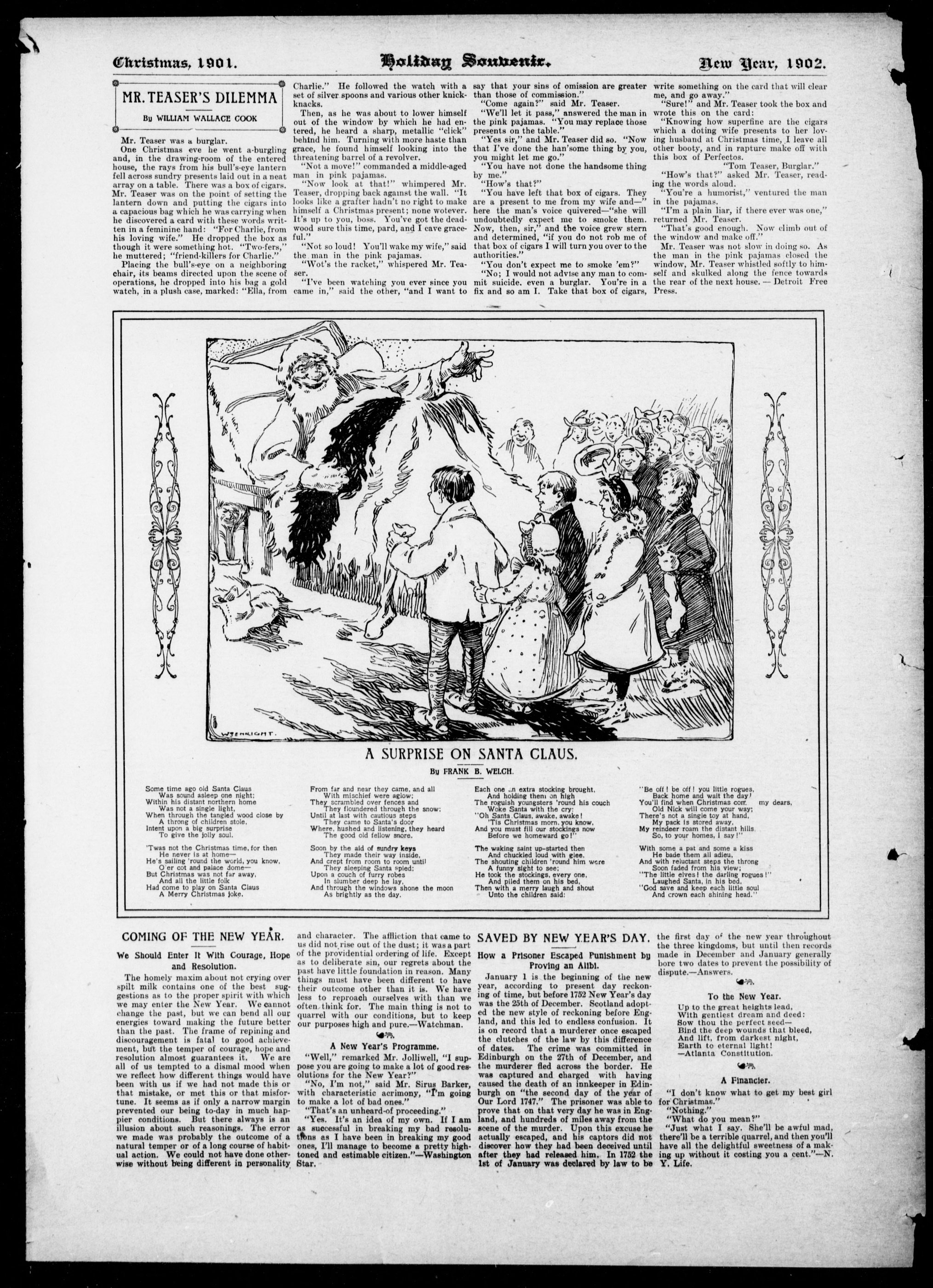
Some time ago old Santa Claus
Was sound asleep one night:
Within his distant northern home
Was not a single light;
When through the tangled wood close by
A throng of children stole.
Intent upon a big surprise
To give the jolly soul.
'Twas not the Christmas time, for then
He never is at home—
He's sailing 'round the world, you know,
O'er cot and palace dome—
But Christmas was not far away,
And all the little folk
Had come to play on Santa Claus
A Merry Christmas joke.
COMING OF THE NEW YEAR.
We Should Enter It With Courage, Hope and Resolution.
The homely maxim about not crying over spilt milk contains one of the best suggestions as to the proper spirit with which we may enter the New Year. We cannot change the past, but we can bend all our energies toward making the future better than the past. The frame of repining and discouragement is fatal to good achievement, but the temper of courage, hope and resolution almost guarantees it. We are all of us tempted to a dismal mood when we reflect how different things would have been with us if we had not made this or that mistake, or met this or that misfortune. It seems as if only a narrow margin prevented our being to-day in much happier conditions. But there always is an illusion about such reasonings. The error we made was probably the outcome of a natural temper or of a long course of habitual action. We could not have done otherwise without being different in personality
---
Charlie." He followed the watch with a set of silver spoons and various other knickknacks. Then, as he was about to lower himself out of the window by which he had entered, he heard a sharp, metallic "click" behind him. Turning with more haste than grace, he found himself looking into the threatening barrel of a revolver. "Not a move!" commanded a middle-aged man in pink pajamas.
say that your sins than those of comm "Come again?"
"We'll let it pass the pink pajamas. presents on the table "Yes sir," and M that I've done the you might let me g "You have not d by me."
"Now look at that!" whimpered Mr. Teaser, dropping back against the wall. "It looks like a grafter hadn't no right to make himself a Christmas present; none wotever. It's up to you, boss. You've got the deadwood sure this time, pard, and I cave graceful."
"Not so loud! You'll wake my wife," said the man in the pink pajamas.
"Wot's the racket," whispered Mr. Teaser.
"I've been watching you ever since you came in," said the other, "and I want to
A boy looks up at a snowy landscape. A large, smiling snowman stands in the background, holding a snowball. The boy stands in the foreground, holding a small object.
A SURPRISE ON SANTA CLAUS.
From far and near they came, and all
With mischief were aglow;
They scrambled over fences and
They floundered through the snow;
Until at last with cautious steps
They came to Santa's door
Where, hushed and listening, they heard
The good old fellow snore.
Soon by the aid of sundry keys
They made their way inside.
And crept from room to room until
They sleeping Santa spied;
Upon a couch of furry robes
In slumber deep he lay.
And through the windows shone the moon
As brightly as the day.
and character. The affliction that came to us did not rise out of the dust; it was a part of the providential ordering of life. Except as to deliberate sin, our regrets about the past have little foundation in reason. Many things must have been different to have their outcome other than it is. We have less to reproach ourselves with than we often think for. The main thing is not to quarrel with our conditions, but to keep our purposes high and pure.—Watchman.
A New Year's Programme.
"Well," remarked Mr. Jolliwell, "I suppose you are going to make a lot of good resolutions for the New Year?" "No, I'm not," said Mr. Sirus Barker, with characteristic acrimony, "I'm going to make a lot of bad ones."
"That's an unheard-of proceeding."
"Yes. It's an idea of my own. If I am as successful in breaking my bad resolutions as I have been in breaking my good ones, I'll manage to become a pretty hightoned and estimable citizen."—Washington Star.
```markdown
```
say that your sins of omission are greater than those of commission."
"Come again?" said Mr. Teaser.
"We'll let it pass," answered the man in the pink pajamas. "You may replace those presents on the table."
"Yes sir," and Mr. Teaser did so. "Now that I've done the han'some thing by you, you might let me go."
"You have not done the handsome thing by me."
"How's that?"
"You have left that box of cigars. They are a present to me from my wife and—" here the man's voice quivered—"she will undoubtedly expect me to smoke them. Now, then, sir," and the voice grew stern and determined, "if you do not rob me of that box of cigars I will turn you over to the authorities."
"You don't expect me to smoke 'em?"
"No; I would not advise any man to commit suicide. even a burglar. You're in a fix and so am I. Take that box of cigars,
Each one an extra stocking brought,
And holding them on high
The rogish youngsters 'round his couch
Woke Santa with the cry:
"Oh Santa Claus, awake, awake!
'Tis Christmas morn, you know,
And you must fill our stockings now
Before we homeward go!"
The waking saint up-started then
And chuckled loud with glee.
The shouting children 'round him were
A funny sight to see;
He took the stockings, every one,
And piled them on his bed.
Then with a merry laugh and shout
Unto the children said:
January 1 is the beginning of the new year, according to present day reckoning of time, but before 1752 New Year's day was the 25th of December. Scotland adopted the new style of reckoning before England, and this led to endless confusion. It is on record that a murderer once escaped the clutches of the law by this difference of dates. The crime was committed in Edinburgh on the 27th of December, and the murderer fled across the border. He was captured and charged with having caused the death of an innkeeper in Edinburgh on "the second day of the year of Our Lord 1747." The prisoner was able to prove that on that very day he was in England, and hundreds of miles away from the scene of the murder. Upon this excuse he actually escaped, and his captors did not discover how they had been deceived until after they had released him. In 1752 the 1st of January was declared by law to be
New Year, 1902.
write something on the card that will clear me, and go away."
"Sure!" and Mr. Teaser took the box and wrote this on the card:
"Knowing how superfine are the cigars which a doting wife presents to her loving husband at Christmas time, I leave all other booty, and in rapture make off with this box of Perfectos.
"Tom Teaser, Burglar."
"How's that?" asked Mr. Teaser, reading the words aloud.
"You're a humorist," ventured the man in the pajamas.
"I'm a plain liar, if there ever was one," returned Mr. Teaser.
"That's good enough. Now climb out of the window and make off."
Mr. Teaser was not slow in doing so. As the man in the pink pajamas closed the window, Mr. Teaser whistled softly to himself and skulked along the fence towards the rear of the next house. — Detroit Free Press.
"Be off! be off! you little rogues,
Back home and wait the day!
You'll find when Christmas corr. my dears,
Old Nick will come your way;
There's not a single toy at hand,
My pack is stored away.
My reindeer roam the distant hills.
So, to your homes, I say!"
With some a pat and some a kiss
He bade them all adieu.
And with reluctant steps the throng
Soon faded from his view;
"The little elves! the darling rogues!"
Laughed Santa, in his bed.
"God save and keep each little soul
And crown each shining head."
the first day of the new year throughout the three kingdoms, but until then records made in December and January generally bore two dates to prevent the possibility of dispute.—Answers.
```markdown
```
To the New Year.
Up to the great heights lead,
With gentlest dream and deed:
Sow thou the perfect seed—
Bind the deep wounds that bleed,
And lift, from darkest night,
Earth to eternal light!
—Atlanta Constitution.
```markdown
```
A Financier.
"I don't know what to get my best girl for Christmas."
"Nothing."
"What do you mean?"
"Just what I say. She'll be awful mad, there'll be a terrible quarrel, and then you'll have all the delightful sweetness of a making up without it costing you a cent."—N. Y. Life.
```markdown
```
Curmudgeon's Christmas
By ALFRED HURRY
instructions that he was out. the letter box. "Bowled out, you mean! pen the door, my son, or I'll play a tin- ted his neighbor like a thunderstorm that fault, really. He was so naughty; O, Mr. Turmudgeon, he was so naughty that I had to speak severey to him, and it runned into your legs."
Curmudgeon remembered that yesterday he had been surprised by a shock behind the knees, and, turning wrathfully, had discovered an alarmed infant with a mail cart, packed full of frightened dolls.
tercepting the maid in the hall, growled out instructions that he was out.
"Out be hanged!" cried a voice through the letter box. "Bowled out, you mean! I see you, Curmudgeon, by the hat rack. Open the door, my son, or I'll play a tinwhistle on the doorsten."
"Out be hanged!" cried a voice through the letter box. "Bowled out, you mean! I see you, Curmudgeon, by the hat rack. Open the door, my son, or I'll play a tinwhistle on the doorstep."
Curmudgeon opened the door and confronted his neighbor like a thunderstorm that had made a mistake in the season.
"Now, sir, what the dev—"
"Devil be hanged!" quoth Felix, bursting into the hall like a forlorn hope through a breach. "This is Christmas eve—Christmas eve, Curmudgeon! Good old Christmas eve! Good old Santa Claus! Good old Curmudgeon! Join in the chorus, and I'll tip you a stave."
Curmudgeon opened the door and confronted his neighbor like a thunderstorm that had made a mistake in the season.
into the hall like a forlorn hope through its eve, Curmudgeon! Good old Christmas Judgeon! Join in the chorus, and I'll tiperry gentlemen, then appear!"
Gege; he had been toasting Christmas, and so that there was really no excuse for her Felix had mistaken his semidetached Relieved to hear that the old gentleman's looks had belied him, Maidie kissed him in both eyes. Curmudgeon blinked and stifled a despairing "Ugh!"
"Now, ladies and gentlemen," said Felix, "I am about to douse the glim—I mean I am about to turn the gas out. No kissing aloud, please. Now, Geoff, ready with the slides?"
Almost before the younger gentlemen had had time to range themselves by the side of the younger ladies the room was dark and Geoff's magic lantern was in operation, and the hands of the youths found the hands of the maidens.
A skeleton flashed on the screen. Geoff, with youthful prodigality, had given his piece de resistance first. Chorus of delight from the younger spectators and cries of mock terror from Felix.
"Devil be hanged!" quoth Felix, bursting into the hall like a forlorn hope through a breach. "This is Christmas eve—Christmas eve, Curmudgeon! Good old Christmas eve! Good old Santa Claus! Good old Curmudgeon! Join in the chorus, and I'll tip you a stave."
Felix was a member of the stock exchange; he had been toasting Christmas, and he and Curmudgeon had been boys together; so that there was really no excuse for that merry gentleman's inquiry as to whether Felix had mistaken his semidetached villa for the county asylum. Felix laughed like rude Boreas in a good humor, and his laugh would have made a charity school forget its misery.
But it was lost on Curmudgeon. He had made up his mind to celebrate Christmas eve by a cheerful grizzle over his solitary fire and a festive growl over his solitary supper.
"What on earth do you want at this unearthly hour?" he asked, peevishly. "And what do you mean by this unearthly behavior?" he added, savagely.
The maid beamed in the background, but, catching Curmudgeon's fiery eye, she fled to the underground kitchen and cheered herself with the thought that Robert would be off duty at ten.
"Unearthly hour! Good heavens, man, it isn't half-past seven, and to-morrow's Christmas!"
Felix was a member of the stock exchange; he had been toasting Christmas, and he and Curmudgeon had been boys together; so that there was really no excuse for that merry gentleman's inquiry as to whether Felix had mistaken his semidetached villa for the county asylum. Felix laughed like rude Boreas in a good humor, and his laugh would have made a charity school forget its misery.
get its misery.
made up his mind to celebrate Christmas
are and a festive growl over his solitary
arthly hour?" he asked, peevishly. "And
Curmudgeon reassured the small owner of the voice. It tickled his ear. He
writhed like a red Indian at the stake.
A boar at bay was depicted.
"O, look, Mr. Turmudgeon! Just look at that pretty pig—o-o-h! and that naughty
butcher man!"
But it was lost on Curmudgeon. He had made up his mind to celebrate Christmas eve by a cheerful grizzle over his solitary fire and a festive growl over his solitary supper.
"What on earth do you want at this unearthly hour?" he asked, peevishly. "And what do you mean by this unearthly behavior?" he added, savagely.
The maid beamed in the background, but, catching Curmudgeon's fiery eye, she fled to the underground kitchen and cheered herself with the thought that Robert would be off duty at ten.
"Unearthly hour! Good heavens, man, it isn't half-past seven, and to-morrow's Christmas!"
A man in a suit sits in an ornate chair, holding a child in his lap. A woman stands behind him, holding a book. A man in a suit sits in an ornate chair, holding a child in his lap. A woman stands behind him, holding a book.
men making fools of themselves and slides before other people's gates, and told Felix so in language that was forcible and free.
so in language that was forcible and free.
"All right; I've done now," said Felix. "I'll send the boy out to throw some sand over it."
He bore the despairing Curmudgeon into his bright hall. Tom, the page of all work, went out to throw sand over the slide; and did it so thoroughly that 20 minutes later, when a demand arose for his services, they found him, after a quarter of an hour's calling and ringing, the leader of a string of butcher's boys, and baker's boys, and poulterer's boys, sliding before the house, oblivious to all the world.
But long before this Curmudgeon had been welcomed in the drawing-room hilariously, Codger and Cockywax and Buffer had wrung him by the hands and slapped him on the back, Mrs. Felix and Mrs. Felix's gossips had wished him a "Merry Christmas," and a horde of children, white-frocked and velvet-suited, had hailed him as a man and a "gran'papa."
"And now," said Felix, standing on the hearthrug and beaming like a winter sun, "let us be happy."
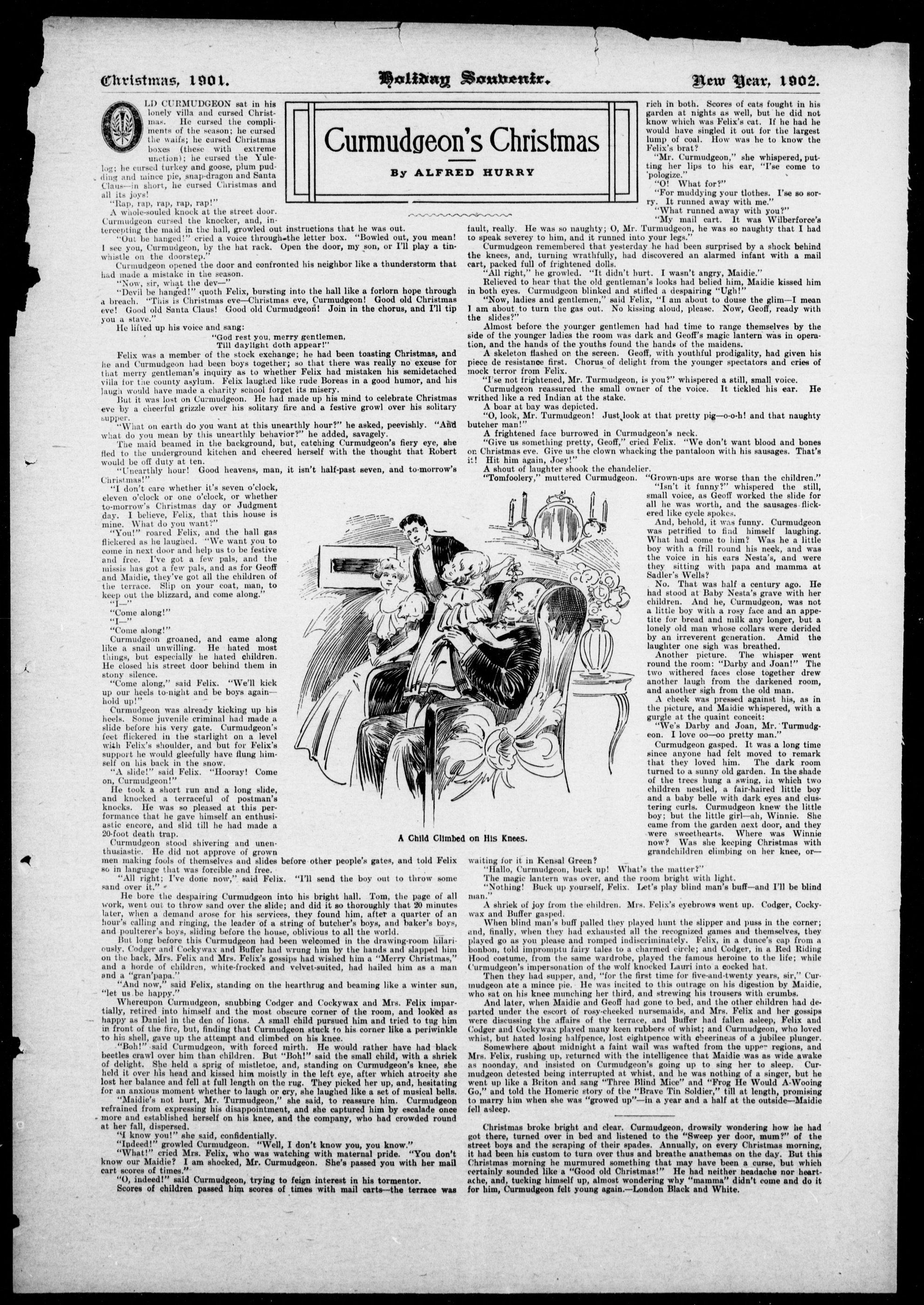
Whereupon Curmudgeon, snubbing Codger and Cockywax and Mrs. Felix impartially, retired into himself and the most obscure corner of the room, and looked as happy as Daniel in the den of lions. A small child pursued him and tried to tug him in front of the fire, but, finding that Curmudgeon stuck to his corner like a periwinkle to his shell, gave up the attempt and climbed on his knee.
"Boh!" said Curmudgeon, with forced mirth. He would rather have had black beetles crawl over him than children. But "Boh!" said the small child, with a shriek of delight. She held a sprig of mistletoe, and, standing on Curmudgeon's knee, she held it over his head and kissed him moistly in the left eye, after which atrocity she lost her balance and fell at full length on the rug. They picked her up, and, hesitating for an anxious moment whether to laugh or cry, she laughed like a set of musical bells.
"Maidie's not hurt, Mr. Turmudgeon," she said, to reassure him. Curmudgeon refrained from expressing his disappointment, and she captured him by escalade once more and established herself on his knee, and the company, who had crowded round at her fall, dispersed.
"All right; I've done now," said Felix. "I'll send the boy out to throw some sand over it."
He bore the despairing Curmudgeon into his bright hall. Tom, the page of all work, went out to throw sand over the slide; and did it so thoroughly that 20 minutes later, when a demand arose for his services, they found him, after a quarter of an hour's calling and ringing, the leader of a string of butcher's boys, and baker's boys, and poulterer's boys, sliding before the house, oblivious to all the world.
But long before this Curmudgeon had been welcomed in the drawing-room hilariously, Codger and Cockywax and Buffer had wrung him by the hands and slapped him on the back, Mrs. Felix and Mrs. Felix's gossips had wished him a "Merry Christmas," and a horde of children, white-frocked and velvet-suited, had hailed him as a man and a "gran"papa."
"And now," said Felix, standing on the hearthrug and beaming like a winter sun, "let us be happy."
Whereupon Curmudgeon, snubbing Codger and Cockywax and Mrs. Felix impartially, retired into himself and the most obscure corner of the room, and looked as happy as Daniel in the den of lions. A small child pursued him and tried to tug him in front of the fire, but, finding that Curmudgeon stuck to his corner like a periwinkle to his shell, gave up the attempt and climbed on his knee.
“Boh!” said Curmudgeon, with forced mirth. He would rather have had black beetles crawl over him than children. But “Boh!” said the small child, with a shriek of delight. She held a sprig of mistletoe, and, standing on Curmudgeon’s knee, she held it over his head and kissed him moistly in the left eye, after which atrocity she lost her balance and fell at full length on the rug. They picked her up, and, hesitating for an anxious moment whether to laugh or cry, she laughed like a set of musical bells.
“Maidie’s not hurt, Mr. Turmudgeon,” she said, to reassure him. Curmudgeon refrained from expressing his disappointment, and she captured him by escalade once more and established herself on his knee, and the company, who had crowded round at her fall, dispersed.
“I know you!” she said, confidentially.
“Indeed!” growled Curmudgeon. “Well, I don’t know you, you know.”
"What!" cried Mrs. Felix, who was watching with maternal pride. "You don't know our Maidie? I am shocked, Mr. Curmudgeon. She's passed you with her mail cart scores of times."
"O, indeed!" said Curmudgeon, trying to feign interest in his tormentor.
Scores of children passed him scores of times with mail carts—the terrace was
---
Christmas, 1901.
LD CURMUDGEON lonely villa and curus mas. He cursedments of the season the waifs; he cursed boxes (these wit
LD CURMUDGEON sat in his lonely villa and cursed Christmas. He cursed the compliments of the season; he cursed the waifs; he cursed Christmas boxes (these with extreme unction); he cursed the Yule-log; he cursed turkey and goose, plum pudding and mince pie, snap-dragon and Santa Claus—in short, he cursed Christmas and all its joys!
"Rap, rap, rap, rap, rap!"
A whole-souled knock at the street door. Curmudgeon cursed the knocker, and, in-
He lifted up his voice and sang:
"God rest you, merry gentlemen,
Till daylight doth appear!"
"I don't care whether it's seven o'clock, eleven o'clock or one o'clock, or whether to-morrow's Christmas day or Judgment day. I believe, Felix, that this house is mine. What do you want?"
"You!" roared Felix, and the hall gas flickered as he laughed. "We want you to come in next door and help us to be festive and free. I've got a few pals, and the missis has got a few pals, and as for Geoff and Maidie, they've got all the children of the terrace. Slip on your coat, man, to keep out the blizzard, and come along."
"I—"
"Come along!"
"I—"
"Come along!"
Curmudgeon groaned, and came along like a snail unwilling. He hated most things, but especially he hated children. He closed his street door behind them in stony silence.
"Come along," said Felix. "We'll kick up our heels to-night and be boys again—hold up!"
Curmudgeon was already kicking up his heels. Some juvenile criminal had made a slide before his very gate. Curmudgeon's feet flickered in the starlight on a level with Felix's shoulder, and but for Felix's support he would gleefully have flung himself on his back in the snow.
"A slide!" said Felix. "Hooray! Come on. Curmudgeon!"
He took a short run and a long slide, and knocked a terraceful of postman's knocks. He was so pleased at this performance that he gave himself an enthusiastic encore, and slid till he had made a 20-foot death trap. Curmudgeon stood shivering and unenthusiastic. He did not approve of grown men making fools of themselves and slides so in language that they were forbidden and frowned.
"I know you!" she said, confidentially.
rich in both. Scores of cats fought in his garden at nights as well, but he did not know which was Felix's cat. If he had he would have singled it out for the largest lump of coal. How was he to know the Felix's brat?
"Mr. Curmudgeon," she whispered, putting her lips to his ear, "Ise come to 'pologize.'"
"O! What for?"
"For muddying your clothes. I'se so sorry. It runned away with me."
"What runned away with you?"
---
fault, really. He was so naughty; O, Mr. Turmudgeon, he was so naughty that I had to speak severely to him, and it runned into your legs."
Curmudgeon remembered that yesterday he had been surprised by a shock behind the knees, and, turning wrathfully, had discovered an alarmed infant with a mail cart, packed full of frightened dolls.
"All right," he growled. "It didn't hurt. I wasn't angry, Maidie."
Relieved to hear that the old gentleman's looks had belied him, Maidie kissed him in both eyes. Curmudgeon blinked and stifled a despairing "Ugh!"
"Now, ladies and gentlemen," said Felix, "I am about to douse the glim—I mean I am about to turn the gas out. No kissing aloud, please. Now, Geoff, ready with the slides?"
Almost before the younger gentlemen had had time to range themselves by the side of the younger ladies the room was dark and Geoff's magic lantern was in operation, and the hands of the youths found the hands of the maidens.
A skeleton flashed on the screen. Geoff, with youthful prodigality, had given his piece de resistance first. Chorus of delight from the younger spectators and cries of mock terror from Felix.
"I see not frightened, Mr. Turmudgeon, is you?" whispered a still, small voice.
Curmudgeon reassured the small owner of the voice. It tickled his ear. He writhed like a red Indian at the stake.
"O, look, Mr. Turmudgeon! Just look at that pretty pig—o-o-h! and that naughty butcher man!"
A frightened face burrowed in Curmudgeon's neck.
"Give us something pretty, Geoff," cried Felix. "We don't want blood and bones on Christmas eve. Give us the clown whacking the pantaloon with his sausages. That's it! Hit him again, Joey!"
A shout of laughter shook the chandelier.
"Tomfoolery," muttered Curmudgeon. "Grown-ups are worse than the children."
"Grown-ups are worse than the children."
"Isn't it funny?" whispered the still, small voice, as Geoff worked the slide for all he was worth, and the sausages flickered like cycle spokes.
And, behold, it was funny. Curmudgeon was petrified to find himself laughing. What had come to him? Was he a little boy with a frill round his neck, and was the voice in his ears Nesta's, and were they sitting with papa and mamma at Sadler's Wells?
No. That was half a century ago. He had stood at Baby Nesta's grave with her children. And he, Curmudgeon, was not a little boy with a rosy face and an appetite for bread and milk any longer, but a lonely old man whose collars were derided by an irreverent generation. Amid the laughter one sigh was breathed.
Another picture. The whisper went round the room: "Darby and Joan!" The two withered faces close together drew another laugh from the darkened room, and another sigh from the old man.
A cheek was pressed against his, as in the picture, and Maidie whispered, with a gurgle at the quaint conceit:
"We's Darby and Joan, Mr. Turmudgeon. I love oo-oo pretty man."
Curmudgeon gasped. It was a long time since anyone had felt moved to remark that they loved him. The dark room turned to a sunny old garden. In the shade of the trees hung a swing, in which two children nestled, a fair-haired little boy and a baby belle with dark eyes and clustering curls. Curmudgeon knew the little boy; but the little girl—ah, Winnie. She came from the garden next door, and they were sweethearts. Where was Winnie now? Was she keeping Christmas with grandchildren climbing on her knee, or—
A Child Climbed on His Knees.
waiting for it in Kensal Green?
"Hallo, Curmudgeon, buck up! What's the matter?" The magic lantern was over, and the room bright with light.
"Nothing! Buck up yourself, Felix. Let's play blind man's buff—and I'll be blind man."
A shriek of joy from the children. Mrs. Felix's eyebrows went up. Codger, Cockywax and Buffer gasped.
When blind man's buff palled they played hunt the slipper and puss in the corner; and, finally, when they had exhausted all the recognized games and themselves, they played go as you please and romped indiscriminately. Felix, in a dunce's cap from a bonbon, told impromptu fairy tales to a charmed circle; and Codger, in a Red Riding Hood costume, from the same wardrobe, played the famous heroine to the life; while Curmudgeon's impersonation of the wolf knocked Lauri into a cocked hat.
Then they had supper, and, "for the first time for five-and-twenty years, sir," Curmudgeon ate a mince pie. He was incited to this outrage on his digestion by Maidie, who sat on his knee munching her third, and strewing his trousers with crumbs.
And later, when Maidie and Geoff had gone to bed, and the other children had departed under the escort of rosy-cheeked nursemaids, and Mrs. Felix and her gossips were discussing the affairs of the terrace, and Buffer had fallen asleep, Felix and Codger and Cockywax played many keen rubbers of whist; and Curmudgeon, who loved whist, but hated losing halfpence, lost eightpence with cheeriness of a jubilee plunger.
Somewhere about midnight a faint wail was wafted from the upper regions, and Mrs. Felix, rushing up, returned with the intelligence that Maidie was as wide awake as noonday, and insisted on Curmudgeon's going up to sing her to sleep. Curmudgeon detested being interrupted at whist, and he was nothing of a singer, but he went up like a Briton and sang "Three Blind Mice" and "Frog He Would A-Wooing Go," and told the Homeric story of the "Brave Tin Soldier," till at length, promising to marry him when she was "growed up"—in a year and a half at the outside—Maidie fell asleep.
Christmas broke bright and clear. Curmudgeon, drowsily wondering how he had got there, turned over in bed and listened to the "Sweep yer door, mum?" of the street boys and the scraping of their spades. Annually, on every Christmas morning, it had been his custom to turn over thus and breathe anathemas on the day. But this Christmas morning he murmured something that may have been a curse, but which certainly sounded like a "Good old Christmas!" He had neither headache nor heartache, and, tucking himself up, almost wondering why "mamma" didn't come and do it for him, Curmudgeon felt young again—London Black and White.
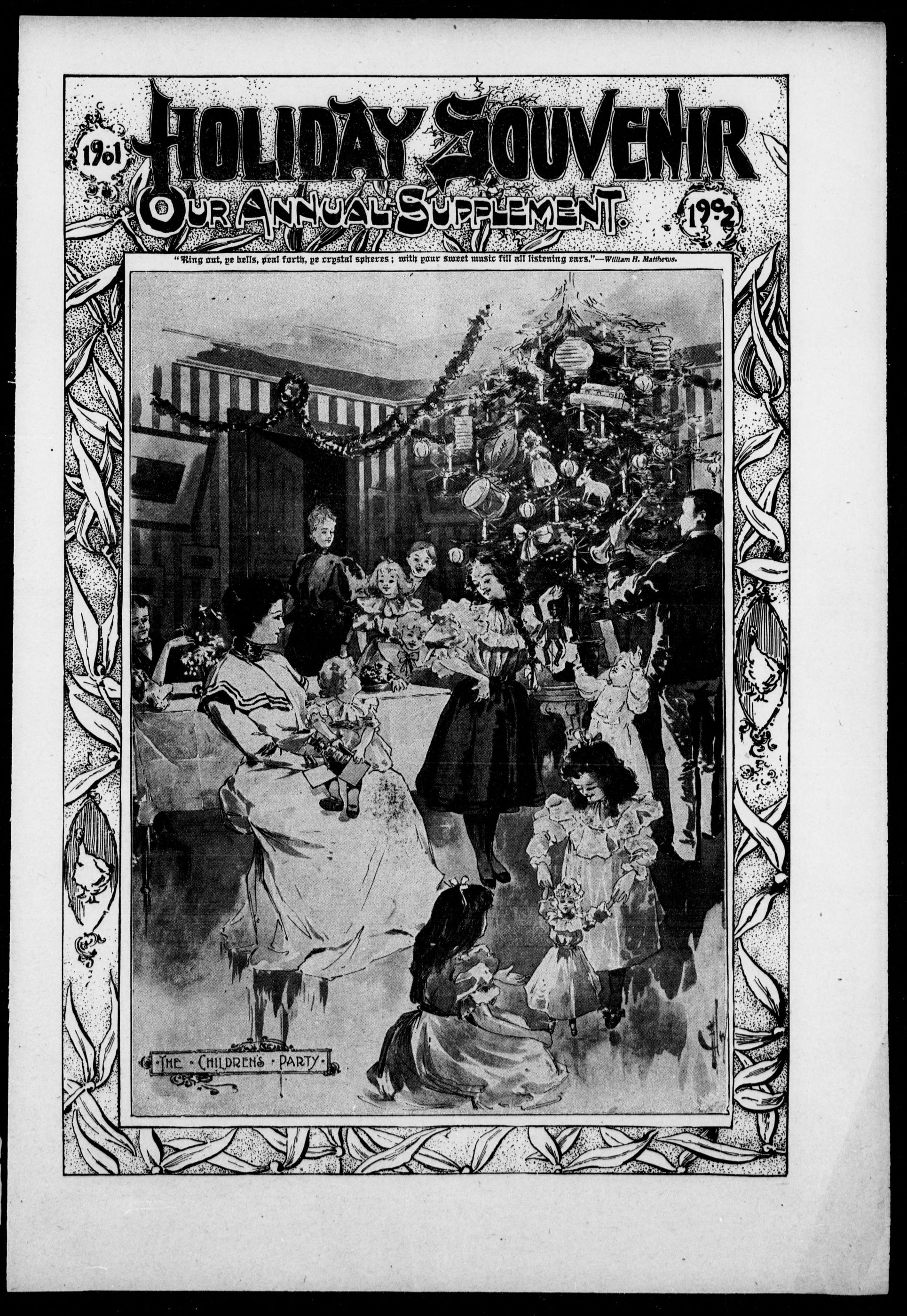
Holiday Souvenir.
1902
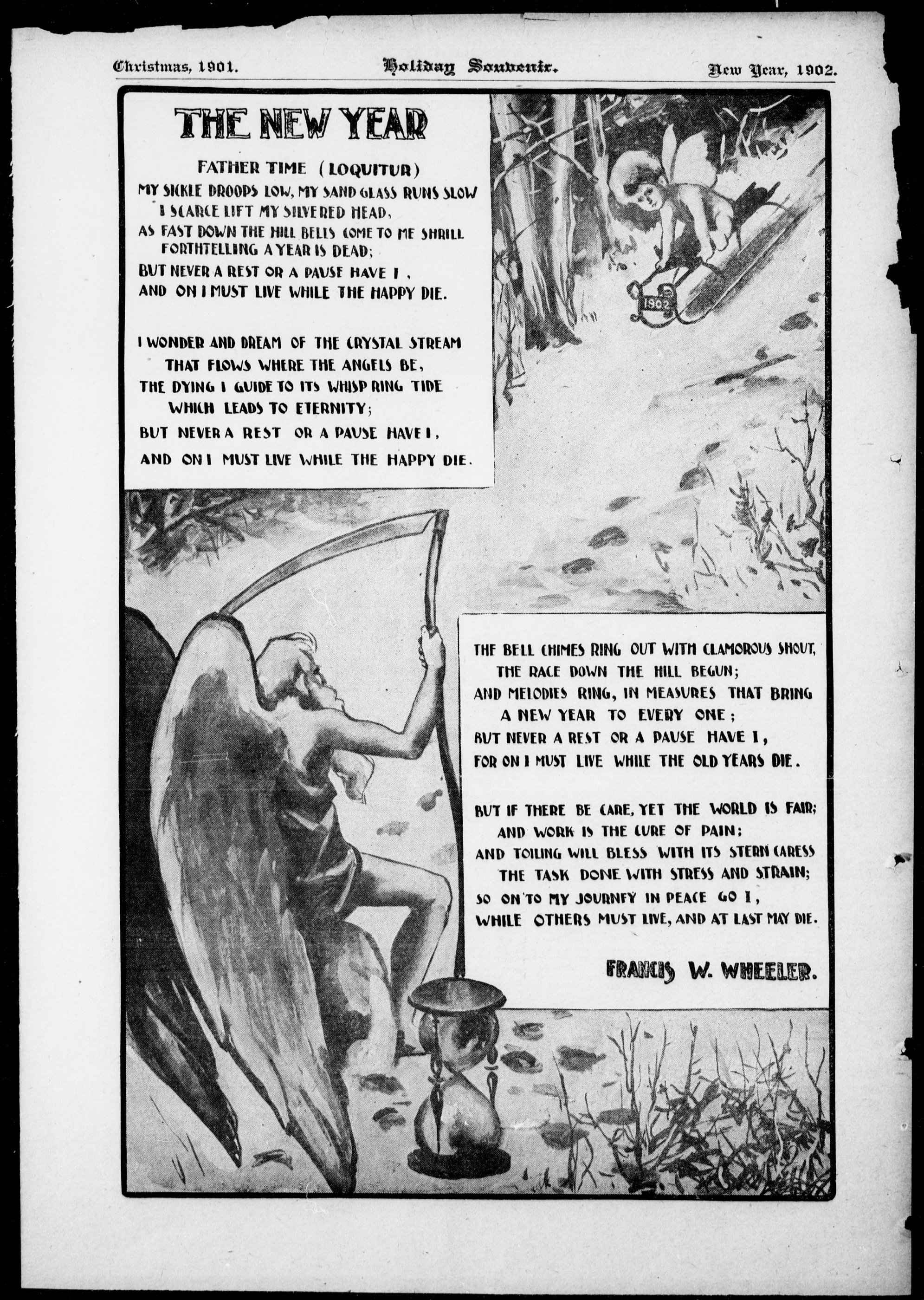
THE NEW YEAR
MY SICKLE DROOPS LOW, MY SAND GLASS RUNS SLOW I SCARCE LIFT MY SILVERED HEAD, AS FAST DOWN THE HILL BELLS COME TO ME SHRILL FORTHTELLING A YEAR IS DEAD; BUT NEVER A REST OR A PAUSE HAVE I , AND ON I MUST LIVE WHILE THE HAPPY DIE.
I WONDER AND DREAM OF THE CRYSTAL STREAM THAT FLOWS WHERE THE ANGELS BE, THE DYING I GUIDE TO ITS WHISP RING TIDE WHICH LEADS TO ETERNITY; BUT NEVER A REST OR A PAUSE HAVE I, AND ON I MUST LIVE WHILE THE HAPPY DIE.
THE DEATH OF GOD
THE BELL CHIMES RING OUT WITH CLAMOROUS SHOUT, THE RACE DOWN THE HILL BEGUN; AND MELODIES RING, IN MEASURES THAT BRING A NEW YEAR TO EVERY ONE; BUT NEVER A REST OR A PAUSE HAVE I, FOR ON I MUST LIVE WHILE THE OLD YEARS DIE.
BUT IF THERE BE CARE, YET THE WORLD IS FAIR; AND WORK IS THE CURE OF PAIN; AND TOILING WILL BLESS WITH ITS STERN CARESS THE TASK DONE WITH STRESS AND STRAIN; SO ON TO MY JOURNFY IN PEACE GO I, WHILE OTHERS MUST LIVE, AND AT LAST MAY DIE.
Christmas, 1901.
New Year, 1902.
FRANCIS W. WHEELER.
VINEB IN HOMES.
Funnel Plants Make a Pretty Ornament
for the Bendoc.
Pew persons are, perhaps, aware that a thing of beauty is a common peanut plant, growing singly in a six or eight-inch pot and grown indoors during the colder months. Kept in a warm room or by the kitchen stove a peanut kernel planted in a pot of lose mellow loam, kept only moderately moist, will soon germinate and grow up into a beautiful plant. It is in a similar way that the peanut planters test their seeds every year, beginning even early in the winter, and the facility with which the seeds will grow in this way has suggested to many southern flower lovers the possibility of making the useful plant an ornamental plant for the parlor or sitting room window. As the plant increases in size and extends its branches over the sides of the pot in a pendant maner, there are few plants of more intrinsic beauty. The curious habit of the compound leaves of closing together like the leaves of a book on the approach of night or when a shower begins to fall on them, is one of the most interesting habits of plant life. And then, later on, for the peanut is no ephemeral wonder, enduring for a day or two only, the appearance of the tiny yellow flowers and putting forth of the peduncles on which the nuts grow imparts to this floral rarity a striking and unique charm all its own. There is nothing else like it, and florists throughout the country might well add the peanut plant to their list of novel and rare things.—Washington Star.
CATHERINE WAITE, ESQ.
lorade Woman Lawyer Who Is Her
Husband's Partner.
Mrs. Catherine V. Waite, aged 71, is bout to form a law partnership in server, Colo., with her husband, forer Judge Charles B. Waite. The firm will be C. B. & C. V. Waite, and friends will be disappointed if the aged couple not make some of the hustling stern firms do their best to maintain
ment with her daughter, Mrs. Lucy
late, 98 Loomis street. She has been
lifelong friend of Susan B. Anthony,
and is one of the most remarkable
women of the west. Having lived in
many states of the union, Mrs. Walte
is going to Colorado because she she
believes it has the only atmosphere con-
cenial to women of business ability
and who desire a voice in the adminis-
tration of public affairs. The versatility of this energetic woman is shown by the fact that she has been a farmer,
teacher, a lecturer, an author, a
merchant, a contractor and a manager
of large moneyed interests, and has attained eminent success in each of these callings.—Cincinnati Commercial Tribune.
FADETH NOT AWAY.
Touching Description of Last Sleep
Aged Professor
The old professor sat listening with a half smile while his class explained certain facts in metaphysics. The brain, they said, retained longest the first impressions made upon it. Memories of middle life faded out, while those of childhood remained vivid and clear. Dying persons had been known to speak in a language which they had learned in childhood and forgotten during a long life time. When the class was dismissed, one of the young men, as usual, lingered to walk across the campus with the professor. The class had noticed that the old man was a little more deaf this winter a little duller of sight, a little more gentle. They contrived that he should not cross the icy spaces without some one to assist him. "All that is true, Bob," he said, thinking of the recitation and talking half to himself. "Quite true, and very strange. You learn in childhood a language, simple enough, to do with the foundation of things, God and heaven and you, yourself. Then you get out into the world and forget it. You learn difficult languages—philosophy or trade or politics; loud, strident kinds of talk that move the world, and you do your share of talking as loudly as you can. But presently these things begin to fade out of your mind. They seem less weighty; they count for little. The old language that you learn on your mother's knee comes back and you find yourself speaking it in. These later languages are on; that is your own tongue." "It is strange, sir," said Bob, with a bewildered face. He brought the professor to his own door, and bade him good luck. The old man lingered, looking in a wistful amble at the great quadrilateral that the shadow buildings in which languages and philosophy and sciences were taught. "I have indeed come back to the beginning," he said, these things seem to mean so little and I think so often of the first line that I ever learned:
'Show I lay me down to sleep!'
Sweden.
In cold and cheerless weather a great concourse of working people gathered on a hill in the outskirts of Stockholm and listened to their orators, adopted resolutions and finally adjourned in the midst of a blinding snowstorm. A speaker who attracted not a little attention was a Norwegian woman named Mrs. Anna Sterky. Between the speeches songs were sung, and but for the weather a pleasant time was spent. About 16,000 persons took part in the meeting, and everything was conducted in the most orderly manner. Meetings also took place in Upsala, Orebro, Ekilstima, Malmo and Norrkoping.—Charles Sanders, in Chicago Record.
Curbed a Nulance
Prof. Tait of Edinburgh, after having subdued a lady pianist who annoyed him by taking to bagpipes, was troubled by an amateur elocutionist in the house. One day, the story goes, when the house was filled with oratory, a volley of explosions came from Tait's room, followed by smoke and unearthly skies. The lessons in oratory were suspended and everyone in the house collected to find out what the trouble was. Tait, with unmoved countenance, said to the landlord: "As there seems to be no restraint on the nature of studies pursued in these lodgings, I have begun a series of experiments in high explosives, from which I expect to draw much advantage." The elocution ceased.
One of the most energetic of the bishops of the Methodist church is Joseph C. Hartzell, whose jurisdiction lies in Africa. Since his election to the episcopate in May, 1896, Bishop Hartzell has visited all parts of the continent of Africa, traveling nearly 50,000 miles on railroads, steamships, by hammock, on bullocks, by horse and on foot. He has not only investigated the work of the missions over which he has ecclesiastical jurisdiction, but he has carefully studied all the great political and social questions that have to do with the future of the dark continent.
No statesman of England or Europe, or even of Africa itself, is better informed in regard to Africa than is he, for he has read all the standard books by accepted authorities, has consulted with governors, explorers, merchants, miners and all other classes of men, from the highest to the lowest, who make up the controlling population and by personal observation has learned much that could not otherwise have been known.
In the future of Africa, Bishop Hartzell will in all probability be an important factor. On that continent, in in other parts of the world, the Christian missionaries, among whom have been Robert Moffatt, David Livingstone, Alexander Mackay, Bishop Hannington and others well known, have exerted a powerful civilizing and educating influence and they will continue to do so in the future upon the 150,000,000 of savage natives. But they will also influence very largely the white millions who will before many years populate the southern portion of the continent, and divide it into great republics, free from European oppression.
Bishop Hartzell was a distinguished man before he became bishop for Africa, for which he was prepared by his previous life-work. He was born near Moline, Ill., fifty-six years ago.
In young manhood Bishop Hartzell entered Garrett Biblical institute at Evanston, Ill., as a student, to prepare for the ministry. As a boy he had become an expert swimmer, and Lake Michigan furnished him a fine opportunity for the enjoyment of his favorite sport. One day the report spread through Evanston that a vessel had been wrecked off South Evanston and that many lives were in peril. Young Hartzell, with many others, went to the scene. There he found that nothing was being done to rescue those in peril and no one seemed to be able to do anything, for the waves were too tempestuous for a boat to ride them. Hartzell saw that only one thing was to be done. He partly stripped, tied a rope around his waist, plunged into the waves and by heroic efforts, saved four lives. His heroism was appropriately recognized when in a mass meeting of citizens he received a memento which he prizes to this day as one of his most precious possessions. Two years ago one of the men whom he saved introduced himself to the bishop in Chicago. They had not met since the day of the wreck.
Soon after graduating, Mr. Hartzell succeeded Dr. John P. Newman (later bishop), in 1870, as pastor of the M. E. church in New Orleans. Early in his work in New Orleans Mr. Hartzell started at his own expense the Southwestern Christian Advocate. This paper was a power in reconstruction days and a great educator to the negroes just emerging from slavery. After some years the paper was turned over to the church and is now published by the Methodist Book-Concern. Mr. Hartzell's interest in the education of the negro soon attracted attention, and he was elected a member of the New Orleans School board.
Scotch Highlanders Have Money.
There is more money in circulation in the Scotch highlands now than ever there was and for that the crofters have to thank the millionaire proprietor and sportsman. The advent of the millionaire desirous of acquiring pleasure grounds gave the old proprietors their golden opportunity and many of them sold out. Then came the time of speculation as to the attitude of the newcomers toward the native population. Pessimists predicted all sorts of harsh treatment on the part of the landlords. But the millionaires, as a rule, proved to be of quite another kind. They set themselves to the improvement of their estates, employing local labor whenever possible; did what they could to establish local industries of a permanent character; made roads; improved ground; built houses; planted trees and spent money lavishly all the while, not only keeping the tenants in their old homes, but providing the work which brought them a better livelihood than they had every enjoyed before.—Chicago News.
The Ascent of Great Ararat.
The Great and Little Ararat are the two peaks of the Ararat mountains in Armenia. They are situated about seven miles apart and are respectively 17,260 and 14,320 feet above the plain. They are partially in three countries—Russia, Turkey and Persia. Snow, ice and glaciers perpetually cover their tops and their ascent is described as being extremely difficult. Prof. Parrot reached the summit of Great Ararat in 1829, and on September 2, 1900, member of the Russian Geographical Society, named Peoggenpohl, is reported to have made the ascent with a considerable party. The mountain is of volcanic origin. It was in eruption in 1785 and again in 1840, when vast quantities of sulphurous vapors were discharged from its sides, while a silent earthquake shook the surrounding country. The ark is supposed to have rested on this mountain, according to tradition, Mount Juith, in Southern Armenia, was the place where the ark really rested.
* VERSATILE RAILROAD MAN.
A versatile railroad man is Sir William V. Van Horne of the Canadian Pacific railway. Sir William's job as executive head of the Canadian Pacific is never been a sinecure; when he began service with the road his task was a most superhuman, inasmuch as he blood the financing of the company and the overcoming of the physical problems incident to the operation of the road a mountainous region, where snow and ice were common much of the year. Sir William was saved out his own fortune. His mother died when he was 13 and left him to support his mother. He secured a place in the railroad yards, and his steady application to his work and hard study gradually rose to his
MIR WILLIAM VAN HORNE. present high position. He has great ability and can well be classed with priica's greatest railroad men.
FAITHFUL SENTINEL.
Gun That Scores Wolves by Shooting Every Hour.
The wolf gun was considered such a foolish device that the United States government for a long time refused to issue a patent for it. Now it is in operation, and is saving thousands of head of cattle, sheep, and swine. Dozens of ranchmen in Colorado and Wyoming are providing themselves with the weapons, and it is said that they are "worth their weight in gold." The wolf gun is an ordeal gun arranged to explode a blank cartridge every hour during the night by a clever little device invented by a Kansas man. The ranchman places it near his herd and goes to sleep, knowing that they will be safe from the attack of predatory animals, because these animals fear the report of a gun. It is a faithful watch. Every hour its report can be heard, and if there are coyotes within half a mile of the machine they will endeavor to get more distance between them and the noise—Denver Times
```markdown
```
No More Botany Bar.
As there is an inevitable propensity throughout the English-speaking world to associate the name Botany Bay with conviction, a movement has recently been started in Australia which has for its object the abolition of that name and the substitution of Banks' Bay instead. The Sydney Sunday Times suggests that the change be effected before the new century, that the new commonwealth may start under the best and brightest condition without the taint on its fame now suggested by the name of Botany Banks.
DR. HARPER'S EXPERIMENT.
In Onion There Is Strength for University President.
President Harper of the University of Chicago has entered upon a most interesting experiment in food. He has given the odoriferous onion the leading place on his daily bill of fare. His physician having advised him that onions are omnipotent in the elimination of lime from the human system, the worthy Prex is applying himself with great zeal to the consumption of the most fragrant of all the fruits of the earth. The students of the university, as an evidence of sympathy and to some extent perhaps as a matter of self-defense, have nearly all become disciples of the onion cult. The university's daily menu has thus become a pleasing and pungent panorama of onions—onions fried and friedseed, baked and boiled onions, onion fetters, pies and tartlets. The New York World, commenting on this Chicago University experiment, says that if there is any truth in the theory that the illacious vegetable is a specific against lime, the faculty and students of the Chicago University will soon be a thoroughly limeless body of men, and if the old proverb, "In onion there is strength," holds good, that institution will soon take rank—of the rank kind, too—as one of our strongest sets of learning. Illinois State Register
A Mad Prophetess in Spain
In Algalba, Murcia, Spain, a maung prophetess, a peasant of 24, Teo Grillen, who took to prophecy and teaching several months ago, after arriving up many disorderly pilgrimages, was looked upon as a religious uniac. Recently she was allowed to return home, and once more crowded to assemble, spellbound by the impassioned estacy of her harangue one day she was preaching before large concourse of people when five endarmes arrived to arrest her. The emorant persons, worked upon by the wild appeals of the sibyl, attacked the molley with fury, and in the fight four of the gendarmes were mortally bounded, while sixteen persons in the crowd were seriously hurt. Among the killed were the woman's father and brother—New York Press
DeWitt's Little Early Risers,
The Limpus Little pills.
OLIVE CULTIVATION.
Silm Outlook for Olives and Oil in France
While the cultivation of the olive is increasing in this country, Mr. Skinner, United States consul at Marseilles, writes to the state department that the acreage devoted to olives in France is annually becoming less and the outlook for olives and olive oil in France is not at all encouraging. Even is that home of the olive, peanut or arachis oil, extracted from the African ground nuts, which are imported in vast quantities, is considered superior for frying purposes. Not only is the oil used to adulterate olive oil, but frequently used in place of it in passing the cheap brands of sardines. The gastronomic merits of the rich, rip black olives, which until lately could only be obtained in this country special importation from Spain as Turkey, are at last finding recognition here, and men awaken to the fact that the olive, like every other fruit, is its best when it reaches perfection in its own way and in nature's own good time. Once eaten, the hard, salt wooden fibered green olive is banished forever. Green olives are a matter cultivated taste. Ripe olives need n training to charm the palate. The pickled ripe olives put up in the missions in California are sold loose in bulk. They are cheap; they are delicious. Once tasted, a dinner without them is flat, stale, and unprofitable. Boston Courier.
---
hops Grow Wild in English Counties. It is a somewhat remarkable fact that the hop, although only cultivated in a few districts in a few English counties, yet grows freely in a wild condition in very many places. It is perennial, flowering in July and August, and to be found in hedges and thickets. The plant is only cultivated, for instance, in the northeastern porous of Hampshire, and about Peterseld, and even there it does not cover 1,000 acres in all. It grows and flourishes, however, in a wild state all over the county, including the Isle of Wight. -London Express:
INDIAN FOR NAME.
QUANAIL PARKER SEEKS A
HELF OFFICER.
He Is Hardy Educated, a Millionaire,
the Ally of the White man, and the
Progressive, Peaceful Chief of the
Daughters.
[Illustration of a Native American man with long hair and a dotted scarf.]
An Indian chieftain aspires to a seat in the United States senate. This is not strange, for other Indian chiefs have had the same laudable ambition, but in this particular instance the aspiration might yet be realized. The aspirant is a power among the tribes of the Indian Territory and is famed for his achievements in the civil walks of life in the great southwest. He is strenuously working to form a confederation of the tribes of the Indian Territory in the hopes that statehood for the territory will then be easily secured and his election as United States senator would be almost sure to follow. He is a man of wonderful energy and executive ability and success always attended him in his undertakings. Those who know him will not be surprised if he reaches the goal of his ambitions—a seat in the United States senate. Quanah Parker is the name of this remarkable Indian. He is the head chief of the Comanche and their all-powerful leader. He has always been the ally of the white man and by his peaceful, yet powerful, leadership has brought his tribe from poverty to agricultural affluence and to a well-ordered social state. He is an accomplished scholar and linguist, a trained athlete, an expert horseman and a millionaire. He is the owner of thousands of acres of well-tilled farm lands and lives in a magnificent mansion. To the great Richelieu there was no such word as "fail" and to Quanah Parker there is no such word as "impossible." He has banished this word from the Comanche language. When told that it seemed impossible that he should ever become a member of the United State senate, he said: "It is my wish. It will be fulfilled. The word 'impossible' is not in the language of the Comanche." Those who know him do not doubt him, for they recall the many remarkable things that he has already done.
Quanah Parker inherits his peaceful disposition and his love of the white man from his mother, who was a white woman. His grandfather, the great Comanche chief, Quanah, when on the war path at the head of 2,000 of his braves attacked old Fort Parker on the Texas frontier and massacred all the men, boys and women, sparing only the young girls. These were carried away as squaws and slaves. Among the number was Cynthia Ann Parker, a beautiful 9-year-old child. The old chief was so struck with her beauty and intelligence that he determined that she was a white chief's child and resolved that she should still be the child of a chief. He adopted her and placed her in the care of his squaws. He surrounded her with all the comforts and luxuries that he could provide. She became used to the ways of the Indians, learned to love them and was happy with them. She grew to be a beautiful woman and then old Quanah gave her in marriage to his son and successor, Peta Nacona. Their first child was a boy and they named him Quanah Parker, after his grandfather and his mother, and it is he who is the subject of this article. He learned the ways of the Indians from his companions and his mother taught him many of the gentle lessons that white children learn. He was a remarkably strong and intelligent boy and his tribe looked upon him as giving promise of becoming as great a hero as his grandfather. He was passionately fond of his mother and all the wild instincts of the Indian race was subserved to her willer fate was the tragedy of his life
Butterflies 600 Miles from Land. Butterflies have often been met far out at sea and the fragile things will hover about a ship for days. A scientist recently saw a butterfly, the monarch, commonly known as milkweed butterfly, 600 miles from land. It played about the ship for a time and then disappeared. When asked if he thought it would reach land the scientist replied that he started out expecting to and he thought probably the butterfly had the same intention.
TERMS OF SUBSCRIPTION.
One Year In Advance..... $150
Six Months In Advance..... 1 00
ADVERTISING RATES ON APPLICATION.
JOB WORKOF ALL KINDS SOLICITED.
PUBLISHED EVERY FRIDAY.
Subscribe now to the PROFESIONAL WORLD and begin with the new year.
Our thanks are due Meseers Alexander and Christopher Hicks for subscriptions to the PROFESSIONAL.
All announcements pertaining to church services and church entertainments will be in serted in these columns free of charge, if handed us in due time.
It looks much better for you to support a worthy enterprise and help make a success than for you to tell your neighbor that the reason you don't support it is because you think it will be a failure.
Columbia Negroes should not allow another Xmas to come and find them without a Negro business house of some kind. Therə is no town in Mo. in which a Nego stock Company store should be more successful than in Columbia.
Negrro boys should loarn that five dollars earned by the boy who shiues shoes is worth just as much as five dollars earned by the boy who is teller in a bank and that the question is not how much you earn but how much you save.
THE PROEESSIONAL WORLD extends Xmas greetings to its many readers and hope that Santa Claus will come and see you all; we are just eight weeks old to day and as we grow in age we hope to grow in size, and do all the good we can and as little harm as possible.
STREET CAR PROBLEM:
Hamburg's Method of Dealing with Over crowded Street Cars.
The overcrowded street car nuisance is dealt with in a positive way in Hamburg, according to the statement of an American who recently returned from abroad. He says that in that city a man has to think twice before giving up his seat to a woman, as he may be put off the car for his politeness. The Hamburg trolley cars, it is stated, will seat, according to size, 20 or 28 persons—10 to 14 on each side. In addition, four persons are allowed on the front and five on the rear platform. When the car is full the conductor hangs out a sign "Besetz," which means "occupied." The conductor is forbidden to take on another passenger until some one leaves the car. Sometimes, while the conductor is in front collecting fares, a woman will step on a car which is already filled. As there is no conductor on hand to prevent her, the woman goes inside, and any man who offers her a seat steps out to the platform. When the conductor returns to his post on the rear platform he asks the man to leave the car, the reason being that the car being "occupied," he has forfeited his seat. If the man refuses to leave he is put off. The policeman on the streets are instructed to watch the cars, and if they find that a conductor carries even one more than the proper number the conductor is fined 72 cents, which amount goes to a charity fund of the street car company. Argonaut.
**Wanted—An Idea** Who can then of some simple thing to patient Protect your ideas, they may bring you wealth WITH DEDICATION GUURN & CO. Patent Attorneys Washington, D.C. VICE OF office list of two hundred letters.
COMMON NAMES.
Would Furnish the Subject for Some Interesting Statistics.
Speaking of names, says the New Orleans Times-Democrat, there is really a demand in this country for new family names, and no man knows this better than the fellow whose business forces him to study the directories of the large cities of the country. Of course, the trouble is with the more common names, but when you come to think of it these common names make up at least 90 percent of the population of the larger cities. Really, what a void there would be in some of the largest places of the country if there should be a sudden exodus of the families bearing common names! Suppose the Smiths, and the Joneses, and the Browns should suddenly decide to beat hastily over the corporate line of any one of the big cities of the United States; think of the number of houses that would be left vacant, the amount of money that would be pulled out of the banks and out of circulation, and the enormous amount of labor that would be withdrawn, and the value of the trade that would go with them in their sudden flight. But cities could not stand the shock, so deeply have these families become intrenched in the industrial, commercial and financial institutions of the modern municipality. There are many other names, which, while probably less common, still carry with them a heavy per cent. of city population. The Johnsons play some part, but the mane is variously spelled. Black, too, is a common name. Washington has become very common since the legend of the cherry tree and the hatchet. Miller is a popular name, and there are many others that might be included in the classification. The directories are full of them. There is a chance for some statistical friend to make an interesting and instructive compilation along this line. What per cent., for instance, of the American population will the Smiths represent? Or the Joneses? Or the Browns? Or the Johnsons, and Blacks, and Whites, and Millers, and Washington, and other familiar names? There is a chance for some figuring. These names not only represent a heavy per cent. of the American population, but they own a heavy per cent. of American values. So the fellow who undertakes it might find a lifetime task if he traced the names in all their bearings and in all their infinite ramifications. The social and business fabric is literally threaded with these names. But I had in mind the confusion frequently resulting in sending letters through the mails, and in sending telegraphic communications. These messages frequently get mixed on account of the vast number of persons bearing the same name, and not infrequently the same initials.
WONDERFUL STRIKE OF GOLD
Two Men Wash Out $5,000 a Day in the Eldorado Creek Dis-
trict
Men who have just arrived from Dawson say a second strike has been made in the marvelous Eldorado creek district in Alaska. Two men who discovered the spot washed out $5,000 the first day. Pans of dirt taken from the streak yield as high as $50 each; and not a bucket of the gravel comes to the surface that does not contain nuggets running all the way from a quarter of an ounce to an ounce in weight, pure gold. The messengers say that the strike has created the wildest excitement all along Eldorado, and that miners are flocking to the neighborhood by the thousands.
France a Loser in War Indemnities
Of nations engaged in wars of the
first magnitude France has been both
a gainer and a loser in the matter of
indemnities. Having, by the treaty of
Presburg in 1805, mulcted Austria of
$8,000,000 and 28,000 square miles of
territory, she was in 1814 compelled to
satisfy the allied powers by a mon-
etary compensation of $140,000,000 and
to suffer the partition of the great
part of her colonial possessions,
as well as the severe contraction of her
European boundaries. Again, in 1870
after her war with Germany, she was
enabled to display her marvelous fin-
ancial resources by the speedy payment of the huge sum of $1,000,000,000 in addition to the loss of 5,668 square miles of territory.
RIVAL POETS.
Ibsen and Bjornson Are Very Jealous of Each Other.
Ibsen has a wife and one son, Sigurd Ibsen, now about 40 years old, who has been in the consular service, and I believe, says W. E. Curtis, in the Chicago Record-Herald, spent several years at Washington as secretary of legation. He is at present occupying a subordinate position in the ministry of foreign affairs. Sigurd married a daughter of Bjornstjerne Bjornsen, his father's most formidable rival in literature and popular estimation. The two authors are not friends. They are very jealous of each other. Ibsen envies Bjornson's great popularity and prosperity, while the latter regards Ibsen as "an affected old donkey," and often calls him such.
In front of the new theater in Christiana are Bronze statues of both men in heroic size, which were erected at the expense of the public and generally admired, but are unsatisfactory to the subjects. It is seldom that people have the privilege of criticising their own statues. Such honors are usually reserved until they are dead. In this case there was no formal dedication or unveiling and neither of the subjects saw his statue until after it was placed in position, and both have since expressed great dissatisfaction. A few days after his statue was in position Ibsen varied his morning walk by strolling over in that direction. For several moments he stood gazing at the effigy of himself, showing his long coat, his bushy hair and whiskers and his big eye glasses, then shook his head sadly as if in disapproval and went on his way. He has never been near the statue since.
Bjornson, being a man of impetuous manners and quick temper, expressed his dissatisfaction in a more emphatic manner. When he first saw himself in bronze he became greatly excited and gesticulated wildly, declaring that it was "a permanent injury" and must come down, but his son, who is the manager of the theater, succeeded in cooling the old gentleman down, and the latter has become reconciled so far as to make jokes about the statue.
WAS LEFT-HANDED.
Art Connoisseur's Discovery Concern
ing One Old Master.
What old master among the Dutch painters was left-handed?
This knowledge is a very valuable asset to a connoisseur in art. Few experts know, and those who do are particular to keep the information to themselves. It enables them to detect a spurious painting ascribed to this artist at a glance.
Mr. George H. Story, of the Metropolitan museum, says, according to the New York World, that he discovered the fact for himself in a curious way. Mr. Story is the highest authority in this country upon old masters, and is especially familiar with those of the Dutch school. He gained his prestige by years of the minutest study in the galleries of Europe. One of his methods of study was to copy masterpieces for the sake of dissecting a painter's style. One day he set his easel down before a famous painting at The Hague.
"Now I'll get your stroke," reflected upon the artist. He found that he could not get the stroke. There was something about it quite out of the ordinary. Then he noticed the same oddity in the way that the original narnishing had been done. Suddenly he worked out the problem like a flash. The brush had been brought always from left to right instead of from right to left. It was easy to verify the discovery, once made. When a World reporter asked Mr. Story to name the painter he laughed: "Oh, no," he said; "I can't afford to part with that bit of knowledge."
motor Cars in France.
Besides about 1,000,000 cycles there are no fewer than 6,000 motor cars in use in France at present. There are 1,436 in the Seine department, and the rest are scattered about the country. The figures show an increase of 41 per cent, in 12 months.
A Light That Is Seen
If a man has a light heart the reflection will light up his countenance. Chicago Daily News.
ANOTHER SMART WOMAN.
Found a Way to Add to Her Moderate Income.
"Yes," said the dreamy-eyed real estate man, "it was a handsome gown. Made the dress of the older woman look cheap, didn't it? Well, it ought to. It cost $500."
The intimate friend expressed some astonishment, says the New York World, that the real estate man should be conversant with the buying price of his customers' clothes. The dealer in dirt looked at the clock. After three," he said. "No more business around this part of town to-day. Come along over to the refectory opposite." The journey being accomplished, the dreamy-eyed real estate man began:
"I don't know that I ought to tell you about this," he said, doubtfully. "In fact, I'm sure I shouldn't, but I'll tell you anyway, for I know it won't go any further. That woman who wore the $500 gown is one of my employees."
"What!" said the intimate friend. "Why, I thought I recognized her as a woman who moves in very good society."
"Now, see here," said the dreamy-eyed real estate man, "is there anything in me that would give you the right to suppose that any of my employees were debarred from good society?"
"Why, no," said the friend; "of course not. I didn'tmean it that way, but the idea of a woman of position working is rather odd."
"All right," said the dealer, amiably, "think that way if you wish. But let me tell you, you're wrong. I met that woman some months ago at a reception. I was impressed with her culture and her brain. I made some inquiries and learned that she was of good family, but not very well supplied with money. Her relatives, on the other hand, had plenty of wealth. She enjoyed a little income, but not much. I saw her again, and was more impressed with the fact that she could be of use to me. Finally, I wrote her a note, asking if she would drop in at the office on a matter of business.
"Well, she came. I asked her, point blank, if she didn't want to make some money. She colored, and said she did if it could be made in a manner appropriate to her gentility. I assured her that it could, and we began to talk terms at once. I told her she was to bring her friends to me to buy lots. She was to explain to them the advantages of the land and give them a general real estate talk from a society standpoint. She was, of course, to figure as having bought some lots herself and having made a profit on the investment. She demurred to this part, at first, but I finally won her over.
"She is the best salesman, or saleswoman, I have—and I have three other women doing the same thing. She is a brilliant and convincing talker, and she brings good money into the office every week. Her first commission was $500, and she put that into the hands of her dressmaker. That's how I know the price of her gown. The woman she brought in to-day bought three lots at $750 a lot, which gave my clerk a commission of $22.50, one per cent. Not so bad for half an hour's work, is it?"
GROWING THINGS.
So Pleasure is Greater for a Large Class of People.
There is no pleasure more pure and exquisite than watching the growth of a tree or plant in which one is interested. If you have planted it yourself so much the better. You then have a feeling of proprietorship in each opening bud or leaf which can be gained in no other way. But, at any rate, cultivate the friendship of the plants and trees, not simply for the flowers and fruit which they furnish, but for the pleasure of seeing them grow. It has been said that any square foot of sod, if intelligently studied, will give occupation for many hours. The growth of the simplest plant is a wonderful process. Perhaps you cannot go to Europe or the mountains or the sea, but you have an opportunity for unlimited recreation and diversion if you have a small plot of grass and plants with which you have not become acquainted.—Boston Watchman.
INTEREST is being displayed in the use of smokeless powders and hacked bullets in large calibre rifles. A 45 calibre bullet weighing 500 grains gives a shock to large game that the small bullet cannot always be depended on for. Martin Model 1895 Repeaters have "Special Smokeless Steel" barrels. For up-to-date information see our catalog. Mailed for 3 stamps.
THE MARLIN FIRE ARMS' CO.
NEW HAVEN, CONN.
A FREE PATTERN
(your own selection) to every subscriber. Only 50 cents a year.
C CALL'S 50
MAGAZINE YEAR
A LADIES' MAGAZINE.
A gem, beautiful colored plates, latest fashion, dressmaking economies; fancy work, household hints, fiction, etc. Subscriber to day, or send $c. for latest copy agents quoted. Send for terms.
Stylish, Relatable, Simple, Up-to-date, Economical and Absolutely Perfect-Fitting Paper Patterns.
C CALL
BAZAR
PATTERNS
10¢
AND
15¢
A Allowed and Perforations show the Bazar and Sewing Lines.
Sold and each-some higher for them. Sold in nearly every city, town or by mail from TWY McCALL CO.,
NEW YORK.
50 YEARS' EXPERIENCE
PATENTS
TRADE MARKS
DESIGNS
COPYRIGHTS &c.
Anyone sending a sketch and description may easily assort their opinion free whether or notation is probably patentable. Communications must strictly confidential. Handbook on Patents is free. Oedest agency for securing patents. Patents taken through Munn & Co. receive patent notice, without charge, in the Scientific American.
a handsomely ill-traced weekly. Largest citation of any scientific journal. Terms: 90 days; four months. $c. Sold by all new dealers.
WUNN & Co. 361 Roadway. New York Branch Office, 235 F St., Washington, D.C.
The Literary Era
A Monthly Reporting of the Field of Literature, with the choice from over
250 Standard Library Books
By Prominent Authors
(Handsomely printed and bound)
For the price of the Literary Era—Alone
$1.00 PER ANNUM
Full particulars and list of books sent upon application—Sample copy of The Literary Era, for 2c. stamp.
The Literary Era
PHILADELPHIA, PA.
WANTED INVENTORS
to write for our confidential letter before applying for patent; it may be worth money. We promptly obtain U.S. and Foreign
PATENTS
and TRADE MARKS or return ENTIRE attorney's ice. Send model, sketch or photo and we send an IMMEDIATE FREE report on patentability. We give the best legal service and advice, and our charges are moderate. Try us.
SWIFT & CO.,
Patent Lawyers,
Opp. U.S. Patent Office, Washington, D.C.
STOP
WE
MEAN
WHAT
WE
SAY
WE
GUARANTEE
GOOCHS
MEXICAN ROOT PILLS
To cure SICK HEADACHE,
MABITUAL CONSTIPATION,
and all diseases arising from in-
digestion. They will purify your
blood and make your complexion
as FAIR AS A LILY. They are
gelatin coated.
PRICE 26 CENTS.
---
HOLIDAY SOUVENIR
OUR ANNUAL SUPPLEMENT.
1901 1902
"Ring out, ye kells, peal forth, ye crystal spheres; with your sweet music fill all listening ears."—William H. Matthews.
THE · CHILDREN'S · PARTY·
Holiday Souvenir.
HE twins rushed noisily into the house, caught up their banks, and rushed out again, closing the door with a bang.
Aunt Mary glanced up from the book she was reading—a look of disapproval on her faceShe thought the twins were not as careful of their money as they should be, and she must discover some way by which they might be taught economy. Accordingly, after supper that night, she called the twins to her.
"I have a plan to propose to you, girls," she said. "But first—how much money have you in the bank, Rachel?"
"Not a cent," Rachel answered, promptly. "I gave the last of it to the monkey."
"So did I," chimed in Clarice. "Oh, Aunt Mary, he was so cute!"
"Well, that makes you even to start with," she said. "Now, I will tell you my plan. I want you each to save all the money you can from now until New Year, then I will take the one who has saved the most with me to spend New Year's day at Aunt Harriet's."
The twins clapped their hands in delight. Aunt Harriet lived in the country, and they asked no greater happiness than to visit her.
"Oh, how lovely!" Rachel exclaimed. "I'm not going to spend another cent, from now until the happy day. I'll be the one to go, Clarice, just see if I'm not. You know you never can save money."
"Oh, don't you be too sure of that," Clarice replied. "You know the doctor has forbidden me to eat any more candy, so I'm that much ahead of you. Oh, dear, I wish New Year goes."
Aunt Mary opened first one bank, then the other; then she gave an exclamation of dismay. The twins slowly looked around. Both banks lay open on the table, and there was not a cent in either of them. For a moment not a word was said; the children stared at each other in astonishment. Rachel was the first to speak.
"Why, Clare Sedswick! What on earth did you do with all of your money?"
"I—I gave it to Nurse Bently, so she wouldn't have to go to the poor-house," Clarice replied, with a little catch in her voice which showed how great her struggle had been. "But where is yours?" she demanded, looking blankly at the other bank.
Rachel gave a hysterical laugh. "I gave mine to nurse, too," she said. "Oh, Clare!" With one impulse the twins threw their arms around each other.
It did seem to the twins that an expected holiday was never before so slow in coming. It was very hard for them to pass the stands where the fruit was arranged so temptingly; and the candy, seen through the store windows, had never looked quite so delicious before. It was hard, also, to pass the old blind man on the corner, and the old apple woman, and the crippled boy to whom they had been accustomed to giving some of their pennies.
"I declare, I feel just too stingy to live!" Clarice exclaimed, a few days before New Year. "I passed the dearest little beggar girl on the street to-day. She was crying because she was so cold and hungry, and I didn't give her a single penny. I've felt mean about it ever since. Oh, I'm so glad it's so near New Year. Won't it be nice to spend our own money again, Ray? Seems to me I'd like
"Oh! It's the Bables!"
Mother and Children
"Oh! It's the Babies!" She Exclaimed. Relieved.
"I wonder which of us will go to Aunt Harriet's," Rachel said, after a pause. "Do you know how much money you have in your bank, Clare?"
"No, I haven't kept account of it," Clarice answered. "About seven dollars, though, I guess. How much have you?"
"I don't know. More than that, I hope. Oh, I wish it were time to open our banks, now. What shall we do, anyhow? I'm tired of doing nothing; I wish mamma were home!" For Mr. and Mrs. Sedswick had suddenly been called away, and did not expect to return for several days.
"Let's go and see Nurse Bently," Rachel suggested. "It's an awfully long time since we were to see her, and I'm sure she must be having the rheumatism dreadfully. She always does in winter, you know."
"All right," Clarice answered, rising and reaching for her wraps. "Come on."
The children's destination was in one of the poorest parts of the city. Long rows of tumble-down tenement houses were on either side of the street, and around the corners the wind whistled shrilly. In one of these houses Nurse Bently lived. The twins did not wait to knock, but pushed open the door, and walked directly into the room. It was cheerless, cold and bare. In one corner there was a small stove over which an old woman was huddling. Her limbs were drawn and misshapen with rheumatism. As the children entered she arose with a frightened exclamation, and turned toward them.
HAPPY NEW YEAR!
By RUTH RAYMOND.
Happy New Year to the mother
Rising in the early dawn.
Caring for her nurslings ever
Till the daylight hours are gone.
May the New Year keep and strengthen
Loving hands that gently guide
Little feet that else would wander
In forbidden paths untried.
Happy New Year to the maiden
Pledged to one she deems as true;
May the New Year bring her gladness,
Keeping life's best gift in view,
With the love she holds the dearest,
And the tender arms and strong,
That will sheiter still and keep her
As she sings love's sweetest song.
Happy New Year to the people.
"Oh, it's the babies!" she exclaimed, relieved. Rachel had often said the old lady would call them babies if they were a hundred years old. "Which is Clare and which is Rachel? My poor old eyes ain't so good as they were once. My, but it does a poor soul good to see you again," she added. "Take chairs and tell me about your ma." Her face had lost its frightened expression, but it still looked haggard and worn, and she kept glancing nervously toward the door.
"What is the matter, nurse?" Clarice asked, laughingly, after awhile. "You look as though you were expecting a ghost!"
Nurse Bently's voice trembled. "There are things to be more afraid of than ghosts, dearie, as you may find out when you are older," she said. "It's the landlord himself that I'm expecting, and not a cent in the house to pay him."
"That's too bad," Rachel said, sympathetically. "But can't you tell him to come again next week?"
"And where would the money come from next week, with me crippled up with the rheumatism?" she asked, with quivering lips. "And it wouldn't do any good to ask him. He says he won't be put off any longer. He said the next time he came if I didn't have the money for him he'd turn me out into the street." She drew her little thin shawl more tightly about her shoulders, as though she already felt the cutting blast outside.
---
Christmas. 1901.
How the Twins Saved Money
T
Aunt Mary frowned. She had given them each a quarter only a day or so ago.
It did seem to the twins that an expected holiday was never before so slow in coming. It was very hard for them to pass the stands where the fruit was arranged so temptingly; and the candy, seen through the store windows, had never looked quite so delicious before. It was hard, also, to pass the old blind man on the corner, and the old apple woman, and the crippled boy to whom they had been accustomed to giving some of their pennies.
"I declare, I feel just too stingy to live!" Clarice exclaimed, a few days before New Year. "I passed the dearest little beggar girl on the street to-day. She was crying because she was so cold and hungry, and I didn't give her a single penny. I've felt mean about it ever since. Oh, I'm so glad it's so near New Year. Won't it be nice to spend our own money again, Ray? Seems to me I'd like
to spend it by the handful, just to make up for lost time," she added, laughingly.
"All right," Clarice answered, rising and reaching for her wraps. "Come on."
"Oh, how mean!" Clarice cried, indignantly, while Rachel opened her eyes wide in amazement.
"Yes, he's a hard, cruel man," Nurse Bently said. The tears were trickling down her wrinkled face, and she wiped them off with the corner of her shawl. "He says the poorhouse is the place for them that can't pay, and I expect it is; maybe it won't be so bad," she added, trying to speak cheerfully. "But it does come hard when folks have lived independent all their lives, like I have."
"It's a burning shame!" Rachel exclaimed, passionately. "I only wish papa were home, and he'd fix it all right, and he would teach that old landlord a lesson! I wish I were big enough to do something myself." She paused suddenly, and her face flushed. "Isn't there something I can do?" flashed through her mind. "There's that money in my bank at home. It's enough to pay a month's rent for this old shell of a room, I should think; or at least enough to keep the landlord from doing anything until papa comes home. But, 'oh, dear!" with sudden dismay, "I don't want to give that money away!"
Rachel was very quiet after she had bidden Nurse Bently good-by and was on the way home. But she was thinking earnestly. "Oh, I almost know I would be the one to go to Aunt Harriet's, and now, if I give my money to Nurse Bently, I'll have to stay at home and let Clare go. But I can't let poor old nurse go to the poorhouse! If she hadn't taken such good care of me when I had the scarlet fever I should have died; the doctor said so. Oh, dear!"
Rachel was very thoughtful all that evening, but when bedtime came she had made up her mind.
"I'll take the money over to nurse bright and early to-morrow morning," she thought, pressing her lips together resolutely. "I don't care if I can't go to Aunt Harriet's!"
But she did care very much. Even Nurse Bently's great joy over the money did not entirely soothe the ache in her heart. She did not tell Clarice what she had done; she did not feel quite able to talk of it yet.
The last day arrived.
"You may bring your banks into the library, girls," said Aunt Mary. The twins obeyed, rather slowly, much to her surprise. Rachel was feeling better now. She had had a talk with her father the day before, and knew that he approved of her action toward Nurse Bently. Still there was a little lump in her throat as she put her bank down on the table and walked toward the window. She dreaded to hear Clare's cry of delight which would announce the fortunate one. Clarice also put her bank on the stand, then stood gazing intently at the fire in the grate.
Aunt Mary opened first one bank, then the other; then she gave an exclamation of dismay. The twins slowly looked around. Both banks lay open on the table, and there was not a cent in either of them. For a moment not a word was said; the children stared at each other in astonishment. Rachel was the first to speak.
"Why, Clare Sedswick! What on earthdid you do with all of your money?" "I-I gave it to Nurse Bently, so she wouldn't have to go to the poorhouse," Clarice replied, with a little catch in her voice which showed how great her struggle had been. "But where is yours?" she demanded, looking blankly at the other bank.
Rachel gave a hysterical laugh. "I gave mine to nurse, too," she said. "Oh, Clare!" With one impulse the twins threw their arms around each other, half laughing, half crying.
"Why, what does all this mean?" Mrs. Sedswick asked, in astonishment, while Aunt Mary looked from one to the other with a puzzled expression upon her face. After several attempts the children succeeded in giving them a fairly clear explanation.
"But, oh, Ray!" Clarice exclaimed, "I never dreamed that you had any intention of doing such a thing. And I've been almost half angry at you to think that you would be the one to go to Aunt Harriet's. I sent my money by Clara," she added, "and I suppose that's the reason nurse didn't say anything about yours."
Rachel laughed. "Isn't it funny? We've each been thinking the same thing, and didn't know it. And you had told papa about it, hadn't you?" she asked. "That's the reason he looked so kind of funny when I told him."
Clarice gave Rachel's hand a loving little squeeze. "I'm so glad it has turned out this way, only I suppose neither of us will spend New Year's at Aunt Harriet's now," she added, wistfully.
Mrs. Sedswick suddenly drew the children closer to her. "My blessed girls!" she exclaimed, with shining eyes. "You shall both of you spend New Year's with Aunt Harriet. If Mary don't take you, I will!"
"But I will!" Aunt Mary said. And with a shout of joy the twins rushed off to pack their trunks.—Minneapolis Housekeeper.
HAPPY NEW YEAR
By RUTH RAYMOND.
Happy New Year to the mother
Rising in the early dawn.
Caring for her nurslings ever
Till the daylight hours are gone.
May the New Year keep and strengthen
Loving hands that gently guide
Little feet that else would wander
In forbidden paths untried.
Happy New Year to the maiden
Pledged to one she deems as true:
May the New Year bring her gladness,
Keeping life's best gift in view,
With the love she holds the dearest.
And the tender arms and strong,
That will shelter still and keep her
As she sings love's sweetest song.
Christmas. 1901.
The Professional World.
The Professional World.
RUFUS L. LOGAN, B. Q. D., Editor.
COLUMBIA, : : : MISSOURL
FRIDAY, DECEMBER 20, 1901.
In our homes and out of our homes at this
time the reign of Christmas is supreme.
CHRISTMAS
THOUGHTS
and places where joy and abundance are unknown.
It takes possession of us, this recurring revelation of what the great birthday means. Mothers, filling the stockings of their little ones beside the nursery fires, remember bare, half-frozen feet uncovered in the wintry snows, and seeing the jolly, rosy faces overflowing with delight in the light of Christmas morning, they are glad that little grimy and hunger-pinched children, unknown to them, are somewhere in distant quarters receiving some joy of their giving, sent by faithful hands. For this one day they have a sisterly realization of what it means to see a child suffer and be powerless to relieve.
The man of fashion and of the world, happening to catch a glimpse of a tattered shoeblack staring into a bright shop, or a group of dirty newsboys fighting for bits of evergreen dropped at a church door, will feel a sudden impulse to join the workers at a public Christmas tree, and for those hours will give out the charm which wins him favor at many a stately home, in order to give zest to the merriment of the worthy gathering in some great hall. Something tugs at his heart, a half-formed thought awakens in his mind: "I really must do something for these poor little mites! I daresay a few dollars, now and then, would do a great deal for them, when Christmas is over." The struggling embryo of brotherhood in his heart is nearly strong enough to live, but the environment of to-morrow will stifle it.
It is good to think, says the New York Evening Post, of the joy of the fair outside show of the holiday; all the glitter and brightness of hospitable tables with dear ones gathered, old and young, about them; it is pleasant to think of the jolly schoolboy and the gentle grandmother, side by side. It warms and cheers to feel the cordial handshake of a friend or receive a greeting of remembrance across the dividing sea. It rouses dear memories and touches sealed fountains to hear the old melodies familiar since childhood, and ever new, as true things always are. It is like a reviving wine to one that is weary to find, though absent, we are not forgotten.
But above this rises the ennobling influence which overleaps barriers and demarcations, and reaches out a generous, uplifting hand to those who are bound down by the hard fortune of a degraded life. The spirit of Christmas is the spirit of the universal brotherhood of the race. It may seem a small thing for a rich man to send his poor neighbor a dinner, but it blesses twice; he that gives and he that takes is blessed. Even though the giver's thoughts rose no higher than that he would divide his overabundance with the hungry, his unconscious act has taken a first step to acknowledging his brother's claim. "Share with me" is the unspoken meaning of his gift. "I cannot be comfortable alone in my wealth. We are of the same race, begotten by the same Divine Father; it is our Elder Brother's birthday. Let us keep the feast."
Christina Rosetti, whose fervent heart is like a warming flame to colder ones, sings this tender song:
Love came down at Christmas,
Love all lovely, Love Divine;
Love was born at Christmas,
Stars and Angels gave the Sign.
Love shall be our token,
Love be yours and love be mine,
Love to God and all men,
Love to God and an man,
Love for gift and plea and Sign.
Many a custom, firm through centuries of use, may die out; full many a thing men once revered may be covered out of sight by the dust of the earth; but the more humanity seeks the welfare and the uplifting of man, the more true and loyal will be the honor we give to Christmas Day.
```markdown
```
Once again has New Year's day come around, and as we look back over the
have ever known. Many plans are made for more systematic work, many good resolutions formed, many bad habits broken, and we start out with head erect and breast heaving. How long will our good intentions last?
We become weary, and some day the work is dropped for a little while; the good resolution conflicts with a strong desire
Holiday Souvenir.
to do a certain thing, and consequently suffers; while as to the bad habit—well, if we were not strong enough to break it before, why should the advent of any particular day make it easier for us to overcome it now? Thus we are apt to reason, and, soon growing tired, we give up the thought of our New Year's resolutions and plod along in the old way. If we could only keep them always before us much might be done, for there is only one way to accomplish anything, and that is by adhering in the minuteest detail to the plans we have made. One seldom breaks his high resolve or does a great wrong in the beginning; he misses a step here, a step there, goes a little out of the way on this side, a little on that, and is soon far from his starting point.
The year, to look forward, seems long; but it will soon be gone. Let us strive each day, writes Olive Hyde Foster, in Farm and Fireside, to make that one as near perfect as possible, and then the consciousness of earnest effort will, in a measure, compensate for the failure often sustained. Let the thought of the dear ones we so fondly love check the impatient word. Who can tell where they may all be ere we make our next New Year's pledges? Some may be scattered over the face of the earth—some, alas! may have gone into the great beyond, leaving us to "sigh for the touch of a vanished hand and the sound of a voice that is still;" nay, even we may be called to join the great majority; and if the summons should come, may there not be a single secret pang over the word left unsaid to mar the joy of being released from the trials and temptations of this life.
YULE
YULE-TIDE.
By MARGARET E. SANGSTER.
WITH TWINING OF CEDAR AND
WITH FRAGRANCE AND SPICE
WITH LAUGHTER OF CHILDREN
AND HAND-CLASP AND GREETING FOR
'MID HEART-WARMTH TO LOOSEN THE
AND HEARTH-FLAMES LIKE BANNERS TO
THE DEAREST OF DAYS, MERRY CHRIST
AND THE CHILD IN THE MIDST IS THE
NOW MAIDENS AND MATRONS
AND SWEETHEARTS AND LOVERS
AND LADDIES AND LASSIES, GO
LET THE JOY OF YOUR HEARTS
BE YOUR GIFTS LIKE THE DAISIE
WHEN THE SUMMER BRIMS OVE
OLD GRUDGES FORGET, IF THEY
IN THE LIGHT OF THE YULE-FIRE
FOR HARDNESS AND HATRED NOW
WHEN THE CHILD IN THE MIDST
ONE STAR, LIKE THE SUN
TO THE MOTHER WHO
NOW STARS BY THE MID
AS THE TAPERS ARE LIT
ONE SONG SANG THE
THAT THE CHILD IN THE
OH, LIST! ON THE CO
FOR THE CHILD IN THE
A TRUCE TO OUR SADN
EARTH HATH NOT A SAD
WHEN, SOFT AS THE VE
IS BORNE ROUND THE V
AND CHRISTMAS, THE
AND THE CHILD IN THE
—N. Y. HOME JOURNAL
WITH TWINING OF CEDAR AND HOLLY AND FIR,
WITH FRAGRANCE AND SPICE OF FRANKINCENSE AND MYRRH,
WITH LAUGHTER OF CHILDREN AND STIR IN THE STREET,
AND HAND-CLASP AND GREETING FOR ANY WE MEET,
'MID HEART-WARMTH TO LOOSEN THE PURSE OF THE CHURL,
AND HEARTH-FLAMES LIKE BANNERS THAT FLOAT AND UNFURL,
THE DEAREST OF DAYS, MERRY CHRISTMAS, IS HERE,
AND THE CHILD IN THE MIDST IS THE KING OF THE YEAR.
NOW MAIDENS AND MATRONS AND GENTLEMEN ALL,
AND SWEETHEARTS AND LOVERS, HELD FONDLY IN THRALL,
AND LADDIES AND LASSIES, GOLD-HAIRED AND BRIGHT-EYED,
LET THE JOY OF YOUR HEARTS OVERFLOW AT YULETIDE;
BE YOUR GIFTS LIKE THE DAISIES THAT BLOOM ON THE LEA
WHEN THE SUMMER BRIMS OVER LIKE FOAM OF THE SEA;
OLD GRUDGES FORGET, IF THEIR CHILL HAS BEEN FELT,
IN THE LIGHT OF THE YULE-FIRE TO TENDERNESS MELT;
FOR HARDNESS AND HATRED NO ROOM HAVE WE HERE
WHEN THE CHILD IN THE MIDST IS THE KING OF THE YEAR.
ONE STAR, LIKE THE SUN, LED THE SAGES OF OLD TO THE MOTHER WHO CRADLED THE GLORY UNTOLD. NOW STARS BY THE MILLION AND BILLION WE SEE, AS THE TAPERS ARE LIT ON THE GLAD CHRISTMAS TREE. ONE SONG SANG THE ANGELS, AND YET DO THEY SING THAT THE CHILD IN THE MIDST IS OF AGES THE KING. OH, LIST! ON THE COLD BLAST THAT SONG RISES CLEAR, FOR THE CHILD IN THE MIDST IS THE KING OF THE YEAR. A TRUCE TO OUR SADNESS, AND END TO OUR GRIEF. EARTH HATH NOT A SADNESS THAT KNOWS NOT RELIEF, WHEN, SOFT AS THE VOICE OF THE ANGELS ABOVE, IS BORNE ROUND THE WORLD THE SWEET MESSAGE OF LOVE. AND CHRISTMAS, THE BLITHE, MERRY CHRISTMAS IS HERE, AND THE CHILD IN THE MIDST IS THE KING OF THE YEAR. —N. Y. HOME JOURNAL.
New Year's Maxims.
Don't worry. Don't hurry. "Too swift arrives as tardily as too slow." Sleep and rest abundantly. Spend less nervous energy each day than you make. Be cheerful. "A light heart lives long." Think only healthful thoughts. "As a man thinketh in his heart, so he is." "Seek peace and pursue it." "Work like a man, but don't be worked to death." "Avoid passion and excitement; a moment's anger may be fatal." "Associate with healthy people; health is contagious as well as disease." Don't carry the whole world on your shoulders, far less the universe. "Never despair; lost hope is a fatal disease."—Christian Work.
New Year in Wales and Germany.
In Wales, fires are burned to usher in the New Year, and are left alight from one year to the other. In Germany there are parts where at one time belief was entertained in a god who brought light and warmth to the world each year. As a bonfire typified the goodness of this god, a huge fire is still built in the market place, and here the people flock, bringing with them things they wish to leave behind. Young men cast in their pipes and maidens their love letters. A little before midnight the young people dance around the fire, calling: "Health to the New Year."
```markdown
```
```markdown
```
Mirth of the H
Mirth of the Holiday Season
The editor, poor man, has but little chance to slumber
When a wife and fourteen children comprise his Christmas number.
Great Day in European Courts.
In the courts of Europe New Year's is a great day. All the monarchs begin the day by attending church; afterward, they receive the dignitaries of church, state, army and diplomatic corps.
No Reelection Needed.
One curious fact must give us pause: We strive for all things new, But when it comes to Santa Claus.
A Resolution Worth the While.
Resolve that you will stand well with yourself during the coming year, whether you stand well with others or not. Resolve never again to set a cheap estimate upon yourself or your chances in life.—O. S. Marden, in Success.
TIDE.
HOLLY AND FIR,
OF FRANKINCENSE AND MYRRH,
AND STIR IN THE STREET,
ANY WE MEET,
PURSE OF THE CHURL,
FLOAT AND UNFURL,
MAS, IS HERE,
KING OF THE YEAR.
AND GENTLEMEN ALL,
HELD FONDLY IN THRALL,
HAIRED AND BRIGHT-EYED,
OVERFLOW AT YULETIDE;
THAT BLOOM ON THE LEA
LIKE FOAM OF THE SEA;
CHILL HAS BEEN FELT,
TO TENDERNESS MELT;
ROOM HAVE WE HERE
IS THE KING OF THE YEAR.
LED THE SAGES OF OLD
CRADLED THE GLORY UNTOLD.
BILLION AND BILLION WE SEE,
ON THE GLAD CHRISTMAS TREE.
ANGELS, AND YET DO THEY SING
THE MIDST IS OF AGES THE KING.
BLAST THAT SONG RISES CLEAR,
MIDST IS THE KING OF THE YEAR.
ESS, AND END TO OUR GRIEF.
NESS THAT KNOWS NOT RELIEF,
DICE OF THE ANGELS ABOVE,
WORLD THE SWEET MESSAGE OF LOVE.
BLITHE, MERRY CHRISTMAS IS HERE,
MIDST IS THE KING OF THE YEAR.
AL.
2
Good Housekeeping.
A MERRY CHRISTMAS.
His Gift List.
```markdown
```
holiday Season
Welcoming a Change.
"Do you enjoy the holiday season?" asked the jovial friend.
"Yes," answered Sirius Barker, with his customary cynicism. "It's a great relief to be able to say 'Merry Christmas' and 'Happy New Year' for a change. 'How dy do' gets very monotonous."—Washington Star.
He's All Right.
I have a blessing for the man
(And care not who may hear it)
Who is intoxicated with
The real, true Christmas spirit.
—Brooklyn Life.
On Desert Air.
Winthrop—"If Freddie is going to spend Christmas with his grandmother, perhaps you'd better buy him the drum and whistle." Mrs. Winthrop—"I spoke to him about them, my dear, but he said they'd be no good, as his grandmother was deaf."—Leslie's Weekly.
```markdown
```
Resolutions.
We've made resolutions anew,
As it's long been our custom to do,
And (tne thought causes pain)
We will make them again
In the year 1902.
—Washington Star.
```markdown
```
Method With Him.
Crawford—What induced you to buy such a small turkey for Christmas?
```markdown
```
The Christmas Spirit.
"Josephine always looks so gloomy at Christmas time."
"Yes; I wonder what ails her."
"I think she is vexed with her brothers and sisters because they have so many children."—Detroit Free Press.
```markdown
```
Her View.
"It isn't always what a Christmas present costs," said her friend, "that makes it appreciated."
"Oh, no!" replied Mrs. Bargain-Hunter; "very often it is what people think it cost."
—Puck.
```markdown
```
Greeting the New Year.
Greeting the New Year.
Hall, glad New Year! We do not ask Our woes you should disperse. We merely urge this simple task— Pray do not make them worse. Chicago Daily Record.
```markdown
```
A Christmas Favorite.
A man with a past is a man to admire,
A man with a future is one to desire;
But the man just at this time the girls find most pleasant,
They will frankly confess is the man with a present. Brooklyn Life.
```markdown
```
Intense Ironu.
"Mister," said Meandering Mike, "have you got a quarter you can spare?"
"What do you want with it?"
And with a look of pity and reproach came the answer:
"I js' wanted money enough to go before a notary an' swear off nex' New Year day; dat's all."—Washington Star.
```markdown
```
Preparing for Christmas.
"To catch you 'neath the mistletoe Will be my aim," said he.
"Pray, will you kindly let me know Just where the spray will be?"
"It shall be where you wish," said she; "I really do not care."
He answered: "Then be kind to me And wear it in your hair."
—Chicago Evening Post.
```markdown
```
Angelic Tommy.
Now Tommy hops when he is bid.
All chores he does, he's rarely chid;
He is a different boy because
His eyes are fixed on Santa Claus.
—Chicago Daily Record.
Uncle Allen.
"The meanest man of the season," according to the opinion expressed by Uncle Allen Sparks when the subject came up for discussion, "is the man who hunts the house over, from cellar to garret, trying to find out what his wife has hidden away as his Christmas present."—Chicago Tribune.
Christmas. 1901.
Paul's little visit at grandpa's was at an end, and he had to come home. The butler oepned the door quietly, and looked down at him with a twinkling eye, writes Marion Dickinson, in Youth's Companion.
"Happy New Year, Jenkins!" and the small man skipped into the hall.
"Happy New Year, sir!" answered the big man.
Paul tugged away at his rubber boots, but was glad of Jenkins' help. "See the skates grandpa gave me!" he said, proudly displaying the shining treasure. "Where's mamma? I want to show 'em to her right away."
"Your mother says you're to go into the library and wait until nurse comes; then you can go up to see her."
"But I want to go now!" Paul objected. Nevertheless, he went obediently into the library.
Backing up to his father's easy chair, he was just about to make himself comfortable, when there came a small shriek from the hall and the rustle of garments, and somebody seized him by the coat collar.
"Gracious goodness!" nurse panted. "In another second you would have sat down! You gave me a turn, Master Paul."
"What's the matter?" asked Paul, rather indignant at this unceremonious treatment of a boy who was old enough to own skates.
Nurse laughed softly. "Turn around and look at the chair," she said. "It's another present."
A large pillow filled the seat of the great chair, and on it lay a soft roll of flannel. Paul backed away. "What is it?" he asked, sturdily.
Nurse carefully drew down a fold of the flannel, and there was a tiny pink face, with blinking blue eyes, a mouth like a round O, and no hair to speak of.
For an instant Paul stared with wide-open eyes; then, with a whoop of delight, he dashed into the hall and up the stairs.
"Mamma, mamma," he shouted, "come down quick! The little New Year's in the library!"
S
CHRISTMAS PRESENTS.
They Should Go Only Where Our Hearts Prompt the Sending.
In the Ladies' Home Journal Edward Bok writes in vigorous deprecation of the complicating of Christmas. "Much as we need simplicity in all the phases of our living," he contends, "its greatest need is sometimes felt at Christmas. And it seems a pity that we cannot make a beginning there. We could if we would simplify this question of presents; if we would leave out of our consideration all but the natural promptings of our hearts. If ever material considerations should be dismissed from our minds and lives it should be in connection with Christmas. If ever our friends should see our hearts—our real inner selves—it should be on Christmas day. Not that we should be other than our real selves on other days. But as it is, we are not our actual selves on the day of all days when we should be. See how we strive that our present of this year shall surpass the one we gave last year! See how instinctively we think of the material value of what we give, and actually of what we receive! See how we wrong ourselves by leaving needful things undone and inviting illness because we feel we must give something of our own making to a friend, when really a sigh goes into each stitch, instead of being frank with ourselves, and pleasing our friends infinitely more by being frank with them, and purchasing something at far less cost to our health. Every woman knows what I mean by this; the great evil of 'making things' for Christmas presents when really neither the time nor the strength can be spared. In much the same way we complicate Christmas at the table."
```markdown
```
A Month of Celebration.
Perhaps no nation or religion enjoys New Year's day more than the Chinese. They celebrate their feast in the early part of February, and the festivities last a month. Beating of drums and firing of crackers, with decoration of bunting and flags, usher in this day, when the people visit their joss houses, worship their gods, and with oriental ceremony shake hands with "A Happy New Year." In preparation for this event a Chinaman tries to square his accounts with all the world, and a Chinaman who owes debts at the beginning of the New Year forfeits his right to be called a gentleman.
Christmas Noise.
Who buys for boys this hint may take:
The frailest drum will soonest break.
-Chicago Record.
Holiday Souvenir.
THE LONG-AGO CHRISTMAS
Alice Williams Brotherton.
(Uncle Seth loquitur.)
A good old-fashioned Chris'mas, with the logs upon the hearth,
The table filled with feasters, an' the room a-roar 'ith murth,
With the stockin's crammed to bustin' an' the medders piled 'ith snow---
A good old-fashioned Chris'mas like we had so long ago!
Now that's the thing I'd like to see ag in afore I die!
But Chris mas in the city here--it's different, oh my!
With the crowded hustle-bustle of the slushy, noisy street.
An' the scowl upon the faces of the strangers that you meet.
Oh, there's buyin', plenty of it, of a lot o' gorgeous toys,
An' it takes a mint o' money to please modern girls and boys.
Why, I mind the time a jack-knife an' a toffy-lump for me
Made my little heart an' stockin' just chock-full of Chris' mas glee.
An' there's feastin' Think o' feedin' with these stuck-up city folk!
Why, we have to speak in whispers, an' ye datn't crack a joke.
Then remember how the tables looked all crowded with your kin,
When you couldn't hear a whistle blow across the merry din!
You see I'm so old-fashioned like I don't care much for style.
An' to eat your Chris'mas banquets here I wouldn't go a mile.
I'd rather have, like Solomon, a good yarb-dinner set
With real old friends than turkle soup with all the nobs you'd get.
There's my next-door neighbor Gurley---fancy how his brows 'u'd lift
If I'd holler "Merry Chris'mas! Caught, old fellow, Chris'mas gift!"
Lordy-Lord, I'd like to try it! Guess he'd nearly have a fit.
Hang this city stiffness, anyways. I can't get used to it.
Then your heart it kept a-swellin' till it nearly bu'st your side,
An' by night your jaws were achin' with your smile four inches wide,
An' your enemy, the wo'st one, you'd just grab his hand, an' say:
"Mebbe both of us was wrong, John. Come, let's shake, it's Chris
"Mebbe both of us was wrong, John. 'Come, let's shake. It's Christmas day!'"
Mighty little Chris'mas spirit seems to dwell 'tween city walls.
Where each snowflake brings a soot-flake for a brother as it falls;
Mighty little Chris'mas spirit! An' I'm pinin', don't you know?
For a good old-fashioned Chris'mas like we had so long ago.
New Year, 1902.
AN AMATEUR SANTA CLAUS
HIS LOT WAS NOT AN ENVIABLE ONE
BY ANY MEANS.
The man who had been selected to be the Santa Claus sat out on the top of the roof in the cold, cold night and looked up at the twinkling stars.
"I've got a nice job, I don't think," growled Santa Claus. "I think when it comes to being a nice, obliging young man I am certainly the easiest ever. The next time I go to a Christmas house party, why, I won't. O, yes. 'We just have to have a Santa Claus, Mr. Everts, to slide down the great, wide chimney in the back hall. There is a ladder fixed there, and you can come down easy. The other men just won't do it, and I hate to ask you, but you are so obliging.'
'O, I'm obliging all right. I'm a real sweet thing, and I'm just tickled to death to sit up here like a north pole explorer on the warm side of an iceberg. All nice and warm down-stairs and that idiot Fleming is dancing all over the shop with Miss Roberts. The other fellows are sitting on dark stairs and making goo-goo eyes, and I'm on top of the house playing Santa Claus.
"O, this is just too lovely for any use. I just dote on this game. But if anybody ever comes up sudden like in the night and asks me if it's nice to be a Santa Claus, I'll tell them that when it comes to good things being Santa Claus is certainly the butt end.
"I wonder how many years I have to roost up here on this perch anyhow. I was to sit near the chimney so that I could hear that gang of trundle-bed trash howl that song about 'Welcome, welcome, dear old Santa Claus.' Well, not a sound do I hear.
"I believe this is one of those snipe hunting propositions. They get me up here and then skip. Wonder they don't set fire to the house to make it more pleasant for your nice old uncle Santa.. Wish they would. It'd be warmer."
A voice from the trap door in the roof: "Mr. Everts, Mr. Everts, we've been waiting a half hour and the children have sung until they're hoarse. Why, Mr. Everts, you're at the wrong chimney."—Chicago Daily Tribune.
```markdown
```
A PLACE FOR SANTA CLAUS.
The Storm of the Old Saint should Be Told in Merry Mood.
With the approach of Christmas arises the problem discussed by modern mothers and child-students in regard to the fiction of Santa Claus. Is it wrong to deceive a child, and will he not lose faith in the parent when he finds out that Santa Claus does not exist? The best advice we have ever seen on the subject was an editorial printed in that excellent magazine for mothers as well as teachers, the Kindergarten Review. The editor defends Santa Claus. The trouble, where there is any, arises, she says, from efforts to give the old story a realistic setting and to reply to questions with too ingenious fibs. "We put too little fun and fantasy into our telling of the Christmas tale," she writes; and again: "Told as such tales ought to be told—in a merry mood, with laughing mien and wonder tone, with funny winks and shrugs as parryings of difficult questions—the tale is harmless enough." When the child discovers that Santa Claus is not real, he need not feel a shock any more than when he suspects that there are no fairies or goblins. But the parents who raise this difficulty are usually those who disapprove of fairy stories. We are glad that we have such authority for retaining the "Santa Claus myth," for old and young enjoy the merry "make-believe." And when the child outgrows it we can afford to let it go. One Christmas story more wonderful and supernatural he can never outgrow—that of the Babe and the Star and the Angels.—Congregationalist.
```markdown
```
A Good New Year's Resolution.
I have never been much of a hand at making resolutions; still less at keeping them; but if I were to throw some of my ideals into that form for a New Year's gift to my friends, I suppose it would run something like this: Resolved. To live in the active voice, intent on what I can do, rather than what happens to me in consequence; in the indicative mood, concerned with what is, rather than what might be more to my liking; in the present tense, with concentration on immediate duty, ratner than regret for the past or anxiety for the future; in the first person, criticising myself, rather than condemning others; in the singular number, obeying my own conscience, rather than the demands of the many.—William De Witt Hyde, in Boston Congregationalist.
THE TRAIN IS ON THE WAY
Christmas. 1901.
THE NIGHT 'FORE CHRISTMAS. By JOE LINGOLN.
Most gen'rally at eight o'clock I go up stairs to bed.
An' jes' undress an' say my prayers an' cover up my head,
An' shut my eyes up good'n tight an' go to sleep, an' then
First thing I know it's mornin', an' time to git up again.
Some nights, er course, don't seem so short, like 'fore the Fourth, yer know,
Or 'fore a feller's birthday, or the night
ies' 'fore yer go
To visit gran'pa—oh, my, yes! they're kinder long, but, gee!
The night that comes 'fore Chris'mus is a million years to me.
Seems's if December, anyway, 's the longest month they is;
The months that's in the summer, why, they go so fast they whiz.
But old December crawls along, so kinder slow and late
That Chris'mus keeps so far away seems 's if you couldn't wait.
An' when yer've marked off all the days but one, an' that's most through.
An' yer've hanged up yer stockin' right 'longside the chimney flue.
An' sald "Good night" an' gone upstairs, my, don't the minutes creep!
'Cause when he knows it's Chris'mus eve no boy can go to sleep.
Yer hear the old hall clock "tick tock" an' hear the wind, so low
An' kinder soft an' lonesome like,jes' 's if 'twas goin' to snow;
An' then yer wonder if it will, so's yer can slide next day.
An' then yer think 'bout Santy an' his rein-
deer, an' his sleigh.
Yer wonder what he'll bring yer, an' yer
wonder how he guessed
Yer' wanted skates las' Chris'mus an' a bowgun an' the rest;
An' then yer try to git to sleep, an' then,
er course, yer don't.
An' then yer say: "Well, you Jes' will,"
an' then, er course, yer won't.
I s'pose it must be right, but, oh! sometimes it does seem wrong
That that one night boys wants so short should be so extra long;
I've tried to think out why it is, but all the 'scuse I've found
Is that it's long so Santy he'll have time to git around.
But I know this, I'm mighty glad I ain't a Eskymow
An' has to live 'way, 'way up north 'mong all the ice an' snow,
I really don't see what they do, the boys, I mean—oh, dear!
Jes' think of waitin' through a night that lasts a half a year. People's Home Journal
```markdown
```
TURNING OVER A NEW LEAF.
One year ago, according to the Youth's Companion, Mr. Billings settled himself comfortably in his favorite chair beside the stove in the grocery store, and returned the neighborly greetings of the other regular attendants.
"Yes," he said, meditatively, "this is the last night of the old year. Somethin' kind o' solemn 'bout it, too, when ye stop to think of it. A year past an' gone, an' a new one—mebbe the last some of us'll ever see—just beginnin'. It makes a man feel serious. People laugh 'bout New Year's resolutions, but I maintain it's a good thing for a man to pull up now an' then an' start fresh; an' the first of the year seems the most natural an' fittin' time to do it."
"Makin' any res'lutions yourself, 'Lisha?' asked Nathan Hobbs, good-naturedly. "Yes, sir, I am!" replied Elisha, defiantly. "I'm makin' one, anyway, an' I don't care who knows it. I'm resolvin' to keep a better hold on my temper this year. 'He that ruleth his spirit is better than he that taketh a city,' the Book says. I've had my failin's that way, as some of ye know; but now we're beginnin' a new year an' a new century, too, I'm goin' to turn over a new leaf." "What was that you said 'bout a new century?' asked old Eben Cook, from his seat in the corner.
A
DRUMMER—I'm off home for the holidays, boys. I know there is something nice waiting for me there.
DRUMMER—I'm off home for the holiday, boys. I know there is something nice waiting for me there.
"I said now that we was beginnin' a new century I was goin'—"
"What you talkin' about, 'Lisha? The twentieth century begun a year ago. Tomorrow'll be nineteen hundred an' one, won't it?"
"Course 'twill; but ain't 'one' the first number there is? An' don't that make to-morrow the first day of the new century?"
"Not by a long shot, 'less I've forgotten how to count. It don't take a hundred an' one years to make a century, does it?"
"No, but it takes more'n ninety-nine. S'pose I was to begin with one, an' count—"
"Good land and sings, as he rose ex he didn't know an of hand-picked lunk for more'n six or o waste o' breath talk mare's got more sen of ye!" and he start "What was it? New Year's res'lutin the storekeeper, as bang. But Judson argument with Gibb
"Hold on a minute," interposed Judson, the storekeeper. "Let's say that Bill, here, owed me a hundred dollars an' started to pay me in dollar bills, callin' out 'one,' 'two,' 'three,'—"
"Well, s'pose he did."
"No, Jud," suggested Seth Gibson. "Here's the way I heard that feller up to the academy put it: How old is a man on his one-hundredth birthday?"
LISTEN! JOHNNY
WHERE
STEN! JOHNNY MUST BE PEEPING
WHERE IS HE?
SANTA'S STORIES
LISTEN! JOHNNY MUST BE PEEPING WHERE IS HE?
He did not mean to speak, but the surprise Of seeing Santa with his prying eyes Caused little Johnny to exclaim: "Oh, ho!" Just as old Santa was about to go.
He was well hidden, as he meant to be, And where he thought old Santa couldn't see. Look sharp and well—he's but a little man—Hunt round the room and find him—if you can.
SOME UNBIASED OPINIONS.
It is not always the biggest stocking that contains the costliest present.
When a girl is caught under the mistletoe she always pretends that she had forgotten it was there.
A woman always likes a man better if the gloves he sends her are about two sizes too small.
Many a person has got kick a gift horse in the mouth.
The average Christmas slap the worst thing that a man foot into.
Doing business without about the same as for a prey
A woman declares she is delighted with her presents, but she never fails to look at the price marks on them.
If the stone is small and cheap it is perhaps just as well to put a girl's engagement ring in her stocking.
It always makes a woman sad if her husband hasn't bought something for her that she is afraid they really oughtn't to afford. —Chicago Times-Herald.
When you are careful boy have anything nois is sure to be some kind him a drum and a whi up her mistietoe and under it.
While it is always o useful presents, don't of whiskey just because that he uses it.
THE BROADWAY
you your present
EMPLOYER—Just in time for Christmas John. Better take a week off to examine your presents.
THE CHILD got some Chocolate Go up and so on.
you your presents present
EMPLOYER—Just in time for Christmas John. Better take a week off to examine your presents.
THE CHILD got some Chocolate Go up and so
```markdown
```
"Well, s'pose he did."
FELLOW TRAVELER—I envy you your good fortune. My Christmas present will have to wait for me.
"Good land and seas!" shouted Mr. Billings, as he rose excitedly to his feet. "If he didn't know any more'n this 'election of hand-picked lunkheads he wouldn't pass for more'n six or seven, at most. It's a waste o' breath talkin' to ye. My ol' sorrel mare's got more sense than the whole passel of ye!" and he started for the door.
"What was it 'Lisha was sayin' 'bout New Year's res'lutions?' McPherson asked the storekeeper, as the door shut with a bang. But Judson was too intent on his argument with Gibson to reply.
Struck by the Resemblance.
Little Rodney (manipulating his Christmas toy)—Hoo-ee, pa!
Mr. Scrappington—Well, what is it, my son?
Little Rodney—Why, pa, my jumpin' jack cuts up just like you do whenever ma asks you for money!—Smart Set.
MUST BE PEEPING.
HE IS HE?
Many a person has got kicked for looking a gift horse in the mouth.
The average Christmas slipper is about the worst thing that a man can put his foot into.
Doing business without advertising is about the same as for a pretty girl to hang up her mistletoe and then neglect to stand under it.
While it is always commendable to make useful presents, don't give a man a bottle of whisky just because it is well known that he uses it.
When you are careful not to let your little boy have anything noisy for Christmas there is sure to be some kind friend who will give him a drum and a whistle.-Judge.
THE MASTER OF THE MUSEUM
```markdown
```
```markdown
```
THE CHILDREN—Oh, papa, mamma's got some Christmas for you up stairs. Go up and see them.
New Year, 1902
THE CHILD'S FESTIVAL
There Is a Special Significance in Christmas for the Little Ones.
The true Children's day is Christmas. The Lord of the feast was a child in Bethlehem, and He still loves little children as He did when, in the strength of His manhood, He took them in His arms and blessed them. If there were no children in our world to receive and enjoy, the advent time would lose much of its beauty and delight. The child's imagination, which transforms commonplace things, the child's receptivity, which does not stop to question, but enjoys—these reflect themselves upon our minds and bring us for the moment into the childlike mood of happiness. Nor is the child's thought of happiness simply one of getting. Neither the gift nor the surprise of the gift, dear as these are to the child's heart, brings as much pleasure as the planning and the giving. The best of Christmas is enjoyed before ever Christmas comes. We older ones need to be reminded every year that love is more than elaboration at the Christmas time, and that the value of the gift is measured by the affection of the giver; but unspoiled children know it and act upon it, as if there could be no doubt of it at all, and we would all be happier at Christmas if we were to learn of them. Then would the Christmas burden, of which so many are complaining, turn to pure delight.—Congregationalist.
An Important Dau.
Nowhere is New Year's day more festively observed than in the east, and especially in Mohammedan lands. In Persia the No Rooz, (as the new year is called) is by far the most important holiday observed by the subjects of the shah. On New Year's eve the fun begins with the kindling of huge bonfires, and among the more active it is considered the correct thing to leap over or through the flames. The Persian is careful to perform his fire dance in old garments, for on New Year's day every one who has the means is bound by the strictest custom to appear in new clothes.—N. Y. Sun.
Willie's Useful Present.
Hired Man—So Sandy Claus he's brung ye a nice sled, has he?
"Yep, an' left six cords of firewood for paw 'bout two miles down the pike so's I could haul it home."—Brooklyn Life.
A Very Important Gift.
"Mamma," said a Brooklyn girl, "what would be an appropriate Christmas present to give Albert?" "How long has he been coming to see you?" asked mamma.
"About four years."
"Then I think you had better give him the sack."—Leslie's Weekly.
```markdown
```
Don't Bun Bargain Presents.
Speaking of Christmas reminds me that it is not always safe to buy bargain presents for your friends who live in the same town with you. It's all right to do it if you are sending the gifts outside the city's shopping limits, but when you undertake to present your immediate friends with the cullings of the "marked down" sales of holiday week you run a big risk. For instance, one of the big dry goods shops made a special feature of liberty silk ruches, cutting the price exactly in half. They really were a tremendous bargain. Any woman who was not blind could see that with one eye shut and it was no wonder that they sold like hot cakes. A liberty silk ruche that looks like a $4 one and costs just 97 cents is not to be despised. Pretty nearly every woman who went into that store looking for Christmas presents bought one and I happen to know of four women who bought three apiece and sent them to the other three. And as a consequence to-day those four women are the possessors of liberty silk ruches that are as alike as two peas in a pod and each one of them cherishes a secret opinion of the other three—Milwaukee Sentinel.
THE SCHOOL
mamma's up stairs. The pleasant Christmas surprise the Drummer's Wife had at home for him.