The Professional World
Friday, January 10, 1902
Columbia, Missouri
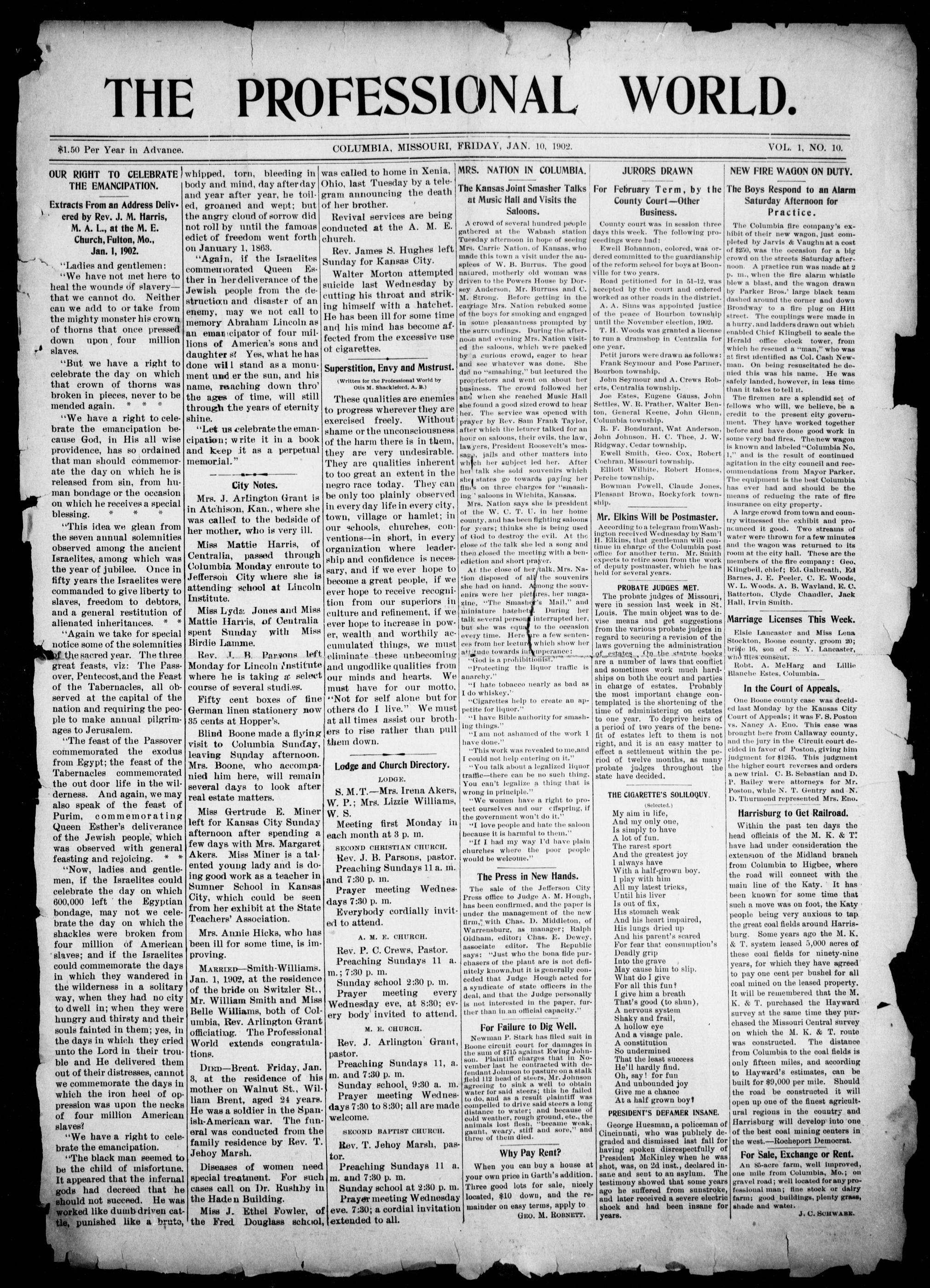
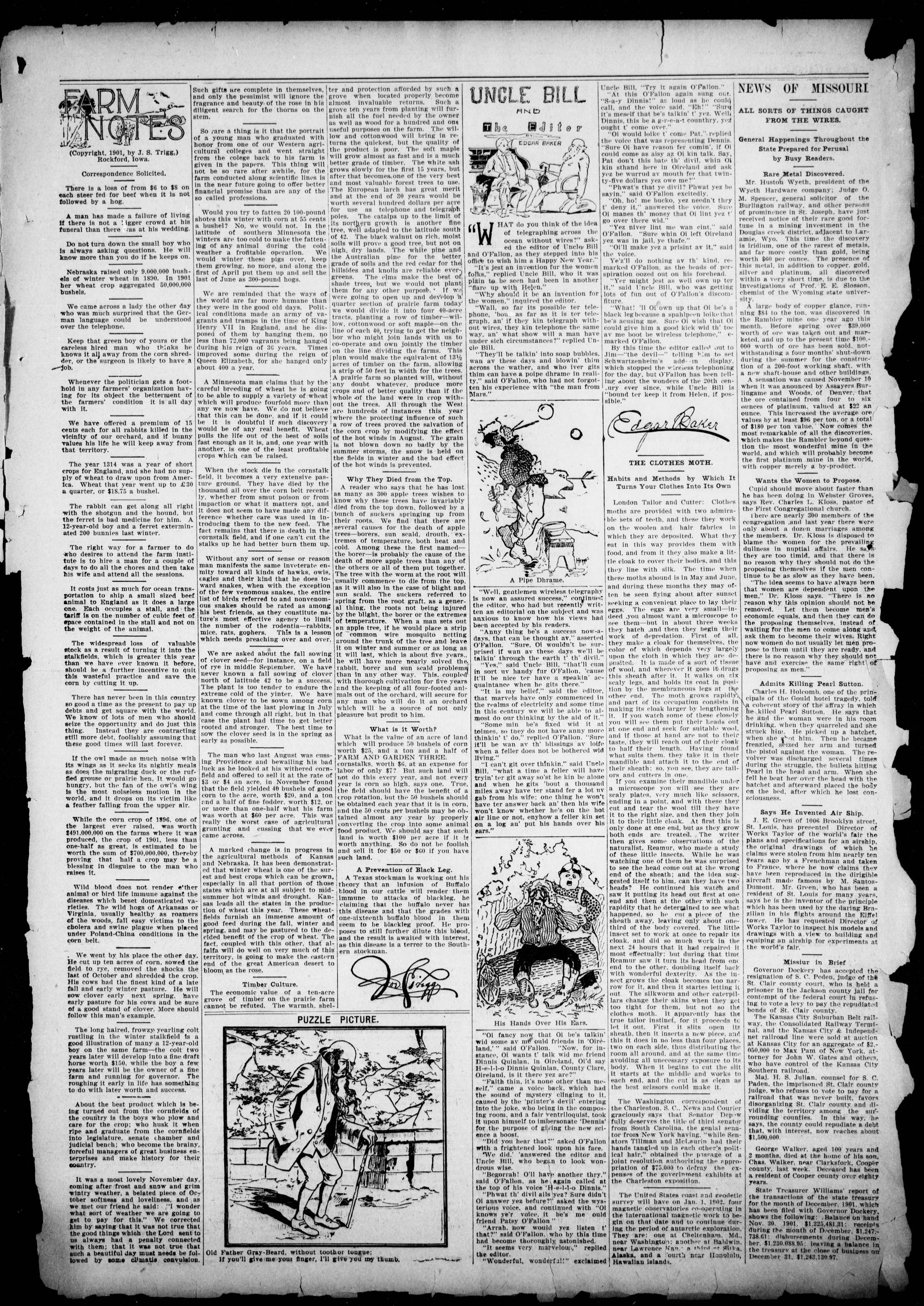
Page text (machine-generated)
THE PROFESSIONAL WORLD.
$1.50 Per Year in Advance.
OUR RIGHT TO CELEBRATE THE EMANCIPATION.
Extracts From an Address Delivered by Rev. J. M. Harris,
M. A. L., at the M. E.
Church, Fulton, Mo.,
Jan. 1, 1902.
"Ladies and gentlemen:
"We have not met here to heal the wounds of slavery—that we cannot do. Neither can we add to or take from the mighty monster his crown of thorns that once pressed down upon four million slaves.
"But we have a right to celebrate the day on which that crown of thorns was broken in pieces, never to be mended again. * * *
"We have a right to celebrate the emancipation because God, in His all wise providence, has so ordained that man should commemorate the day on which he is released from sin, from human bondage or the occasion on which he receives a special blessing. * * *
"This idea we glean from the seven annual solemnities observed among the ancient Israelites, among which was the year of jubilee. Once in fifty years the Israelites were commanded to give liberty to slaves, freedom to debtors, and a general restitution of alienated inheritances. * *
"Again we take for special notice some of the solemnities of the sacred year. The three great feasts, viz: The Passover, Pentecost, and the Feast of the Tabernacles, all observed at the capital of the nation and requiring the people to make annual pilgrimages to Jerusalem.
"The feast of the Passover commemorated the exodus from Egypt; the feast of the Tabernacles commemorated the out door life in the wilderness. And again, we may also speak of the feast of Purim, commemorating Queen Esther's deliverance of the Jewish people, which was observed with general feasting and rejoicing. * *
"Now, ladies and gentlemen, if the Israelites could celebrate the day on which 600,000 left the Egyptian bondage, may not we celebrate the day on which the shackles were broken from four million of American slaves; and if the Israelites could commemorate the days in which they wandered in the wilderness in a solitary way, when they had no city to dwell in; when they were hungry and thirsty and their souls fainted in them; yes, in the days in which they cried unto the Lord in their trouble and He delivered them out of their distresses, cannot we commemorate the days in which the iron heel of oppression was upon the necks of four million American slaves?
"We have a right to celebrate the emancipation.
"The black man seemed to be the child of misfortune. It appeared that the infernal gods had decreed that he should not succeed. He was worked like dumb driven cattle, punished like a brute,
whipped, torn, bleeding in body and mind, day after day and year after year, he toiled, groaned and wept; but the angry cloud of sorrow did not roll by until the famous edict of freedom went forth on January 1, 1863.
"Again, if the Israelites commemorated Queen Esther in her deliverance of the Jewish people from the destruction and disaster of an enemy, may we not call to memory Abraham Lincoln as an emancipator of four millions of America's sons and daughters? Yes, what he has done will stand as a monument under the sun, and his name, reaching down throtthe ages of time, will still through the years of eternity shine.
"Let us celebrate the emancipation; write it in a book and keep it as a perpetual memorial."
City Notes.
Mrs. J. Arlington Grant is in Atchison, Kan., where she was called to the bedside of her mother, who is very ill.
Miss Mattie Harris, of Centralia, passed through Columbia Monday enroute to Jefferson City where she is attending school at Lincoln Institute.
Miss Lyda: Jones and Miss Mattie Harris, of Centralia spent Sunday with Miss Birdie Lamme.
Rev. J. B. Parsons left Monday for Lincoln Institute where he is taking a select course of several studies.
Fifty cent boxes of fine German linen stationery now 35 cents at Hopper's.
Blind Boone made a flying visit to Columbia Sunday, leaving Sunday afternoon. Mrs. Boone, who accompanied him here, will remain several days to look after real estate matters.
Miss Gertrude E. Miner left for Kansas City Sunday afternoon after spending a few days with Mrs. Margaret Akers. Miss Miner is a talented young lady and is doing good work as a teacher in Sumner School in Kansas City, which could be seen from her exhibit at the State Teachers' Association. Mrs. Annie Hicks, who has been ill for some time, is improving.
MARRIED—Smith-Williams. Jan. 1, 1902, at the residence of the bride on Switzler St., Mr. William Smith and Miss Belle Williams, both of Columbia, Rev. Arlington Grant officiating. The Professional World extends congratulations.
Died—Brent. Friday, Jan. 3, at the residence of his mother on Walnut St., William Brent, aged 24 years. He was a soldier in the Spanish-American war. The funeral was conducted from the family residence by Rev. T. Jehoy Marsh.
Diseases of women need special treatment. For such cases call on Dr. Rushby in the Haden Building.
Miss J. Ethel Fowler, of the Fred Douglass school,
COLUMBIA, MISSOURI, FRIDAY, JAN. 10, 1902.
was called to home in Xenia, Ohio, last Tuesday by a telegram announcing the death of her brother.
Revival services are being conducted at the A. M. E. church.
Rev. James S. Hughes left Sunday for Kansas City.
Walter Morton attempted suicide last Wednesday by cutting his throat and striking himself with a hatchet. He has been ill for some time and his mind has become affected from the excessive use of cigarettes.
Superstition, Envy and Mistrust.
These qualities are enemies to progress wherever they are exercised freely. Without shame or the unconsciousness of the harm there is in them, they are very undesirable. They are qualities inherent to too great an extent in the negro race today. They can be only too plainly observed in every day life in every city, town, village or hamlet; in our schools, churches, conventions—in short, in every organization where leadership and confidence is necessary, and if we ever hope to become a great people, if we ever hope to receive recognition from our superiors in culture and refinement, if we ever hope to increase in power, wealth and worthily accumulated things, we must eliminate these unbecoming and ungodlike qualities from our minds and hearts. We must have for our motto, "Not for self alone but for others do I live." We must at all times assist our brothers to rise rather than pull them down.
Lodge and Church Directory.
S. M. T.—Mrs. Irena Akers,
W. P.; Mrs. Lizzie Williams,
W. S.
Meeting first Monday in
each month at 3 p. m.
SECOND CHRISTIAN CHURCH.
Rev. J. B. Parsons, pastor.
Preaching Sundays 11 a. m.
and 7:30 p. m.
Prayer meeting Wednesdays 7:30 p. m.
Everybody cordially invited to attend.
A. M. E. CHURCH.
Rev. P. C. Crews, Pastor.
Preaching Sundays 11 a.
m.; 7:30 p. m.
Sunday school 2:30 p. m.
Prayer meeting every
Wednesday eve, at 8:30; every body invited to attend.
Rev. J. Arlington Grant, pastor.
Preaching Sundays 11, a.
m. and 7:30 p. m.
Sunday school, 9:30 a. m.
Prayer meeting Wednesdays 7:30 to 8:30; all are made welcome.
Rev. T. Jehoy Marsh, pastor.
Preaching Sundays 11 a.
m. and 7:30 p. m.
Sunday school at 2:30 p. m.
Prayer meeting Wednesday
eve. 7:30; a cordial invitation
extended to all.
The Kansas Joint Smasher Talks at Music Hall and Visits the
A crowd of several hundred people gathered at the Wabash station Tuesday afternoon in hope of seeing Mrs. Carrie Nation, of Kansas, who made this town a visit under the auspices of W. B. Burrus. The good natured, motherly old woman was driven to the Powers House by Dorsey Anderson, Mr. Burruss and C. M. Strong. Before getting in the carriage Mrs. Nation rebuked some of the boys for smoking and engaged in some pleasantness prompted by the surrundings. During the afternoon and evening Mrs. Nation visited the saloons, which were packed by a curious crowd, eager to hear and see whatever was done. She did no "smashing," but lectured the proprietors and went on about her business. The crowd followed her and when she reached Music Hall she found a good sized crowd to hear her. The service was opened with prayer by Rev. Sam Frank Taylor, after which the leturer talked for an hour on saloons, their evils, the law, lawyers, President Roosevelt's message, jails and other matters into which her subject led her. After her talk she sold souvenirs which she states go towards paying her finds on three charges for "smashing" saloons in Wichita, Kansas.
Mrs. Nation says she is president of the W. C. T. U. in her home county, and has been fighting saloons for years; thinks she is being used of God to destroy the evil. At the close of the talk she led a song and then closed the meeting with a benediction and short prayer. At the close of her talk, Mrs. Nation disposed of all the souvenirs she had on hand. Among the souvenirs were her pictures, her magazine, "The Smasher's Mail," and miniature hatehets. During her talk several persons interrupted her, but she was equal to the occasion every time. Here are a few sentences from her lecture which show her attitude towards intemperance: "God is a prohibitionist." "Protecting the liquor traffic is anarchy."
"I hate tobacco nearly as bad as I do whiskey."
"Cigarettes help to create an appetite for liquor."
"I have Bible authority for smashing things."
"I am not ashamed of the work I have done."
"This work was revealed to me, and I could not help entering on it."
"You talk about a legalized liquor traffic—there can be no such thing. You can't legalize a thing that is wrong in principle."
"We women have a right to protect ourselves and our offspring, if the government won't do it."
"I love people and hate the saloon because it is harmful to them."
"If I had my way I'd have plain churehes where the poor people would be welcome."
The Press in New Hands.
The sale of the Jefferson City Press office to Judge A. M. Hough, has been confirmed, and the paper is under the management of the new firm," with Chas. D. Middleton, of Warensburg, as manager; Ralph Oldham, editor; Chas. E. Dewey, associate editor. The Republic says: "Just who the bona fide purchasers of the plant are is not definitely known,but it is generally conceded that Judge Hough acted for a syndicate of state officers in the deal, and that the Judge personally is not interested in the paper, further than in an official capacity."
For Failure to Dig Well.
Newman P. Stark has filed suit in Boone circuit court for damages in the sum of $715 against Ewing Johnson. Plaintiff charges that in November last he contracted with defendant Johnson to pasture on a stalk field 112 head of steers, Mr. Johnson agreeing to sink a well to obtain water for said steers; this he failed to do, and as a result plaintiff was compelled to drive said steers a long distance to water; and because of cold weather, rough ground, etc., the animals lost flesh, "became weak, gaunt, weary, stiff and sore," and three of them died.
Why Pay Rent?
When you can buy a house at your own price in Garth's addition. Three good lots for sale, nicely located, $10 down, and the remainder on easy terms, apply to GEO. M. ROBNETT.
JURORS DRAWN
For February Term, by the County Court-Other Business
County court was in session three days this week. The following proceedings were had: Ewell Bohannon, colored, was ordered committed to the guardianship of the reform school for boys at Boonville for two years. Road petitioned for in 51-12, was accepted by the court and ordered worked as other roads in the district. A. A. Sims was appointed justice of the peace of Bourbon township until the November election, 1902.
T. H. Woods was granted a license to run a dramshop in Centralia for one year.
Petit jurors were drawn as follows:
Frank Seymour and Pose Parmer, Bourbon township.
John Seymour and A. Crews Roberts, Centralia township.
Joe Estes, Eugene Gauss, John Settles, W. R. Prather, Walter Benton, General Keene, John Glenn, Columbia township.
R. F. Bondurant, Wat Anderson, John Johnson, H. C. Thee, J. W. Ridgway, Cedar township.
Elliott Wilhite, Robert Homes, Perche township. Bowman Powell, Claude Jones, Pleasant Brown, Rockyfork township.
Mr. Elkins Will be Postmaster.
According to a telegram from Washington received Wednesday by Sam'H. Elkins, that gentleman will continue in charge of the Columbia post office for another term. Mr. Smith expects to retire soon from the work of deputy postmaster, which he has held for several years.
PROBATE JUDGES MET.
The probate judges of Missouri, were in session last week in St. Louis. The main object was to devise means and get suggestions from the various probate judges in regard to securing a revision of the laws governing the administration of estates. On the statute books are a number of laws that conflict and sometimes work much hardships on both the court and parties in charge of estates. Probably the most important change contemplated is the shortening of the time of administering on estates to one year. To deprive heirs of a period of two years of the benefit of estates left to them is not right, and it is an easy matter to effect a settlement within the period of twelve months, as many probate judges throughout the state have decided.
THE CIGARETTE'S SOLILOQUY
My aim in life,
And my only one,
Is simply to have
A lot of fun.
The rarest sport
And the greatest joy
I always have
With a half-grown boy.
I play with him
All my latest tricks,
Until his liver
Is out of fix,
His stomach weak
And his heart impaired,
His lungs dried up
And his parent's scared
For fear that consumption's
Deadly grip
Into the grave
May cause him to slip.
What do I give
For all this fun?
I give him a breath
That's good (to shun),
A nervous system
Shaky and frail,
A hollow eye
And a visage pale.
A constitution
So undermined
That the least success
He'll hardly find.
Oh, say! for fun
And unbounded joy
Give me a chance
At a half grown boy!
PRESIDENT'S DEFAMER INSANE.
George Huesman, a policeman of Cincinnati, who was publicly degraded and dismissed last fall for having spoken disrespectfully of President McKinley when he was shot, was, on 2d inst., declared insane and sent to an asylum. The testimony showed that some years ago he suffered from sunstroke, and later received a severe electric shock and had been insane for years.
VOL. 1, NO. 10.
NEW FIRE WAGON ON DUTY.
The Boys Respond to an Alarm Saturday Afternoon for Practice.
The Columbia fire company's exhibit of their new wagon, just completed by Jarvis & Vaughn at a cost of $250, was the occasion for a big crowd on the streets Saturday afternoon. A practice run was made at 2 p. m., when the fire alarm whistle blew a blast, and the wagon drawn by Parker Bros.' large black team dashed around the corner and down Broadway to a fire plug on Hitt street. The couplings were made in a hurry, and ladders drawn out which enabled Chief Klingbeil to scale the Herald office clock tower, from which he rescued a "man," who was at first identified as Col. Cash Newman. On being resuscitated he denied this was his name. He was safely landed, however, in less time than it takes to tell it.
The firemen are a splendid set of fellows who will, we believe, be a credit to the present city government. They have worked together before and have done good work in some very bad fires. The new wagon is known and labeled "Columbia No.1," and is the result of continued agitation in the city council and recommendations from Mayor Parker. The equipment is the best Columbia has ever had and should be the means of reducing the rate of fire insurance on city property.
A large crowd from town and country witnessed the exhibit and pronounced it good. Two streams of water were thrown for a few minutes and the wagon was returned to its room at the city hall. These are the members of the fire company: Geo, Klingbell, chief; Ed. Galbreath, Ed Barnes, J. E. Peeler, C. E. Woods, W. L. Woods, A. B. Wavland, E. C. Batterton, Clyde Chandler, Jack Hall, Irvin Smith.
Marriage Licenses This Week.
Elsie Lancaster and Miss Lena Stockton, Boone county, groom 20; bride 16, son of S. Y. Lancaster, who files consent.
Robt. A. McHarg and Lillie Blanche Estes, Columbia.
In the Court of Appeals.
One Boone county case was decided last Monday by the Kansas City Court of Appeals; it was F. S. Poston vs. Nancy A. Eno. This case was brought here from Callaway county, and the jury in the Circuit court decided in favor of Poston, giving him judgment for $1245. This judgment the higher court reverses and orders a new trial. C. B. Sebastian and D. P. Bailey were attorneys for Mr. Poston, while N. T. Gentry and N. D. Thurmont represented Mrs. Eno.
Harrisburg to Get Railroad.
Within the past ten days the head officials of the M. K. & T. have had under consideration the extension of the Midland branch from Columbia to Higbee, where the road will connect with the main line of the Katy. It has been known for some time that such a move was on foot, the Katy people being very anxious to tap the great coal fields around Harrisburg. Some years ago the M. K. & T. system leased 5,000 acres of these coal fields for ninety-nine years, for which they have agreed to pay one cent per bushel for all coal mined on the leased property. It will be remembered that the M. K. & T. purchased the Hayward survey at the same time they purchased the Missouri Central survey on which the M. K. & T. route was constructed. The distance from Columbia to the coal fields is only fifteen miles, and according to Hayward's estimates, can be built for $9,000 per mile. Should the road be constructed it will open up one of the finest agricultural regions in the country and Harrisburg will develop into one of the best coal mining centers in the west.—Rocheport Democrat.
For Sale, Exchange or Rent.
For Sale, Exchange or Rent.
An 85-acre farm, well improved,
one mile from Columbia, Mo.; on
gravel road; well located for any
professional man; fine stock or dairy
farm; good buildings, plenty grass,
shade and water.
RUFUS L. LOGAN, B. S. D.
Editor.
THEY WANT POOLING ACT
THEY WANT POOLING ACT
RAILWAYS SHOW DESIRE IN INVESTIGATION.
Trend of Testimony at Chicago Inquiry Indicates an Alliance for That Purpose With the Interstate Commerce Commission—J. P. Morgan and Other Magnates to be Called During Rate Investigation.
Chicago. Jan. 7. — Prosecutions against all the big packing concerns in the West for violation of the interstate commerce law against receiving preferential rates are contemplated by the commission. Its fact developed today during the investigation into handling of packing house products and dressed meats, and was the result of evidence of the officials of the leading railroads.
Pooling Bill Object.
It also became apparent that the commission and railway managements of the entire country practically had entered into an alliance to induce congress to pass legislation permitting railroads to pool under certain regulations in the interstate commerce commission, and that it is believed such law will be passed.
Magnates to be Summoned.
The third development was the announcement that the commission had required the attendance of all the leading men in the advancement of the community of interests idea, including J. P. Morgan, James J. Hill and F. H. Hariman, and that if they fail to respond, harsher measure will be taken to compel their coming.
The packing houses and their representatives to whom rebates were paid during 1901, according to Commissioner Prouty, will, if possible, be made amendable to a maximum fine of $5,600 for every violation.
State and Federal Courts Clash
Washburn, Wis., Jan. 7.—General Manager Clark of the Washburn, Bayfield & Iron River railroad, together with a train crew and 35 laborers whose movements he was directing, was arrested at Iron River today by Sheriff Lien and a pose for attempting to tear up the main line of that road. The railroad official was acting under the direction of Receiver Frost, who has an order from the United States court to tear up the line. The county is back of the movement to prevent the tearing up of the road, and secured an order from Circuit Judge Parish commanding the sheriff to prevent the tearing up of the line. It is understood that the attempt today was for the purpose of bringing the matter to an issue and to establish which the court's orders will govern.
The prisoners were bought here this evening, and are in custody of the sheriff, who is keeping them at a hotel.
Northern Securities Case
Washington, Jan. 7. The second document filed in the United States supreme court today by Attorney General Douglas of Minnesota, in addition to citing many authorities bearing on the right of the state to institute suit in this court, briefly relates the state's contention as to the legal attitude of the railroad consolidations, with special reference to the Northern Pacific and Great Northern merger.
NAVAL STATION ON LAKES.
Secretary Long Prepares Bill Leaving the Matter of Location for
Washington, Jan. 7.—Secretary of the Navy Long has prepared a bill providing for the establishment of a naval training station on the Great Lakes. The pending bill before the house provides for the erection of such station at Milwaukee, but the department bill leaves the location to be fixed by a board of naval officers. The station is projected on lines like the one at Yerba Buena island, San Francisco harbor. Another bill, drawn at the navy department, provides that a naval cadet who wishes to resign after entering the service for a term of eight years must pay the cost to the government of his stay at the naval academy.
TO PAY SOUTHERN CLAIMS.
House Committee Favorably Reports Bill to Reimburse Them for Horses and Arms.
Washington, Jan. 7.—The house committee on census today ordered a favorable report of the bill creating a permanent census bureau.
The house committee on war claims favorably acted upon the bill providing for the paying of the former Confederate soldiers for horses, bridles, saddles and side arms taken from them in violation of the terms of surrender made by Lee and Johnston with Grant and Sherman.
Representative H. C. Smith of Michigan today introduced a bill striking out the stamp tax on bills of lading, manifests, etc.
Cedarmen in Session
Meminee, Mich., Jan. 7.—The Northwestern Cedarmen's association is in session here. Cedarmen from Michigan, Wisconsin, Minnesota and other states are present. It is expected an increase will be made in the price of white cedar shingles. A banquet was given tonight. The price of Star A cedar shingles was advanced to $1.27 and Standard to $2.10.
Manufacturers Sue Strikers.
Springfield, Ill., Jan. 4.—The Sattley Manufacturing company today filed suit for $5,000 damages against 42 strikers who formerly worked in their shops, but are now engaged in a strike. The case is based on trespassing and other unlawful actions of the strikers.
Representative Hooker of Mississippi Would Have Congress Tender Admiral Vote of Thanks for Santiago Achievement.
Washington, Jan. 7.—Representative Hooker of Mississippi today introduced a joint resolution reciting that Commodore Schley was the senior officer in command at the battle of Santiago; was in absolute command at that battle, and is "entitled to the credit due such commanding officer for the glorious victory which resulted in the total destruction of the Spanish ships."
Vote of Thanks.
The resolution provides for the thanks of congress to Admiral Schley and the officers and men under his command.
SET SPEECH IN THE HOUSE
Chairman of Committee Recites Many Strong Reasons for Waterway Via Nicaragua.
Washington, Jan. 7.—The debate on the Nicaragua canal bill in the house was opened in a lively fashion today by Representative Hepburn, chairman of the interstate and foreign commerce committee, which reported the bill. For two hours he held the floor, replying to a volley of questions concerning the recent offer of the Panama Canal company to sell its property and franchises to the United States for $40,000,000.
MORGAN SCENTS A MONOPOLY.
Makes Move to Secure Investigation of Alleged Compact by Appropriate Committee.
Washington, Jan. 7.—The first notes of the contest between the Nicaragua and Panama routes were heard in the senate today. Senator Morgan offered and secured the adoption of a resolution which indicated his purpose to have the committee on inter-oceanic canals inquire into the relations alleged to exist between the trans-continental railroad companies of the United States and Canada, and the Panama Canal company.
Morgan Scents a Combine.
In the explanation Morgan declared the alleged relations were a "wicked monopoly" which already had cost the people of the Pacific coast millions of dollars. The relations involve control by the Panama Canal company of the Panama Railroad company and an agreement existing between certain railroads of the United States and the Pacific Mail Steamship company.
Compliment Foraker:
At the conclusion of the business today, the senate paid a graceful compliment to Senator Foraker of Ohio by adjourning until 2 o'clock tomorrow in order that the senators might attend the marriage of Miss Foraker tomorrow without interfering with their executive duties.
McKinley Memorial Arch.
Over 300 bills and joint resolutions were introduced in the senate. Among these is one for a postoffice building at New York, and appropriating $2,500,000 or a memorial arch in honor of the late President McKinley; appropriating $2,000,000 for a building for the departments of state and justice.
To Await House Action
Washington. Jan. 7.—The senate committee on inter-oceanic canals has decided to defer all effort to secure action by the senate on the question of a canal across the Isthmus of Panama after the house shall have disposed of the bill now under consideration in the latter body.
CAVE-IN IN MICHIGAN SHAFT.
Accident Follows the Departure of 150 Men from the Ill-Fated
Negaunee, Mich., Jan. 7.—By a cavein at a mine here today, 13 to 17 miners are supposed to have lost their lives. Had the accident occurred an hour sooner, probably 150 would have been killed.
Known Dead.
The know dead are:
WILLIAM WILLIAMS,
JOHN SULLIVAN,
JOHN PASCOE,
JOHN PEARCE,
JACOB HUNLALLA.
First Note of Disaster.
A dull roar and the sound of crashing timbers gave the men on the surface the first intimation that a disaster was being enacted 500 feet under ground. When all had quieted down, volunteers descended in the cage in an attempt at rescue. It was found, however, that the shaft was so badly damaged that it was impossible to get within 80 feet of the level in which the men were buried.
Rush to Rescue
Cries for help were heard at the lowest point reach, and the removal of the timbers which blocked the way found a man who, shortly before the cave-in, had started for the surface. He could throw no light on the fate of his associates, a majority of whom were Italians and Finlanders. The steam pipes leading to the underground pumps were so damages that would be impossible to operate pumps, and as the mine is the wettest in Iron county, the shaft is making water fast.
Battle for Life
A big force of rescuers is working on relays and making desperate attempts to get to the damaged level before the water reaches it. If the men are not rescued within 10 or 12 hours all hope of getting them out alive must be abandoned.
ELECTRIC CAR RUNS AWAY.
Ann Arbor, Mich., Jan. 7.—An electric car ran away while descending the incline to the Michigan Central depot today. Motorman Alfred Myers and Mrs. Daisy Cownewell of Lansing, Mich., were seriously injured.
THE NEWS CONDENSED.
MATTERS OF INTEREST FROM
VARIOUS LOCALITIES.
General Happenings of the Past Few
Days Taken from the Wires and
Condensed to Suit—Of Interest to
All Who Wish to Know What Has
Been Going On in This and Other
Countries.
Fred France of Huntington has been
elected a member of the Indiana Dem-
ocratic state committee.
The employees of the street railway
company at Lima, have demanded
shorter hours and more pay.
Frederick Rupert, aged 18 years, of
Huntingdon, Pa., was killed by the
accidental discharge of his gun.
John Henderson of Metropolis, Ill.,
became entangled in the dust elevator
at the box factory and was killed.
Despondency over misdeed of his son led William Hafen to committ suicide at Clinton, Iowa, by taking carbolic acid. The son was in jail at the time.
King Carlos, in his speech opening the cortes at Lisbon Thursday, referred with regret to the death of President McKinley.
Robbers assaulted the assistant postmaster at Mystic, Ga., and robbed the office of stamps, money order blanks, mail locks and keys.
Two wagon loads of clothing, dry goods and jewelry, worth about $2,000, were stolen from the Brown dry goods store at De Soto, Iowa.
B. F. Partridge, a prominent citizen of Fergus Falls, Minn. died from apoplexy, aged 60 years. He organized the Fergus Wagon company.
Lawrence Hex, colored, was sentenced to be hanged during the week of April 13th at Pueblo, Colo. He murdured a man and woman.
The Chickasaw full blood Indians in Indian Territory are waging a hot campaign for the election of William Bord to succeed Governor D. M. Johnson.
Attorney General McVurg of Mississippi is contemplating the institution of proceedings to break the merger of the Southern and Mobile & Ohio railways.
The Illinois Central fast mail train struck a hand car near Farina, Ill., and killed a man named Stevens, overseer for the Giser Construction company of St. Louis.
Judge W. W. Duncan of Marion and state Senator O. H. Burnett have announced themselves as candidates for congress from the twenty-second Illinois district.
Levi Reed, who was among the prisoners that escaped from the federal jail at Guthrie, Ok., T., on July 5 last, was recaptured on New Year's day and returned to jail.
The San Francisco mint has just completed a coinage record which makes 1901 the banner year in its history, $5,101,250 having been converted from bullion into coin.
The Italian government has declined the invitation of the United States to participate in the St. Louis exhibition, but undertakes to facilitate representation of Italian producers.
A man 39 years old, believed to be J. W. Cheek, formerly a practicing physician in Bryan, Texas, St. Clair county, Mo., and Council Grove, Kan., committed suicide at Kansas City Mo.
The engagement of Miss Abbie Campbell of San Jose, Cal., to Prince David Kanawakoa of Hawaii has been formally announced. Miss Campbell is a native of the Hawaiian Islands.
The Candid Friend says that M. de Blowitz has resigned the Paris correspondence of the London Times and retired to private life, and that he has been succeeded by Arthur Fullerton, an American.
By biting a highwayman's fingers until he cried out with pain and then kicking his companion senseless, Mrs. Anna Wirsing, a widow living on the South side, in Chicago, foiled an attempt to rob her.
Robert Ames, has surrendered to the officers at Fort Pierre, S. D., saying he had shot and wounded Frank Handley, a ranch manager for whom he worked, on White Clay Creek. He claims he acted in self-defense.
Zionists of the middle Western states organized as the Knights of Zion will hold their fourth annual conZion held their fourth annual conSunday. About sixty delegates attended, representing 30 organizations.
Jorche员 J. C. Jackson and Walter Beavers, a boy, were fatally hurt at South McAlester, I. T., They were standing on the depot platform, when two freight trains collided, and were thrown under the wheels of a car, their legs being cut off.
The National Grain Dealers' association executive committee will meet in Chicago the first week in March. The place for holding next year's convention will be determined. The principal bidders are Minneapolis and Memphis.
A dispatch from Ilwaco, Wash., says: Lieutenant James F. Beven, Eighth artillery, was found dead in bed at Fort Canby. His brains were blown out and by his side was found a revolver. It is apparently a case of suicide, though no reason is known why he should take his life.
A man entered the office of the Prudential Insurance company in Roxbury near Boston, and, pointing a revolver at the young woman cashier, Wilhelmina Knott, demanded what money she had. She gave him about $60, which was in the drawer. The police have not been able to trace him.
Miss Estelle Reel, government superintendent of Indian education, has decided to have the annual convention of those interested in Indian education, including the teachers, held in Minneapolis next July in connection with the session of the National Educational association.
General Frank Armstrong, as agent of the war department is at Fort Sill, Ok. T., making arrangements for the release of Chief Geronimo and the 298 Arizona Apache Indians who are held by the government as prisoners of war. They were captured by General Lawton 12 years ago after a 3,000-mile campaign. They will be allotted land by the government.
The state of Maine is in the best financial condition in its history. It has a $300,000 surplus. The taxation acts of the last legislature have increased the state revenues beyond expectation.
Governor Odell has appointed Nathan L. Miller of Cortland county, state comptroller to fill the vacancy caused by the resignation of Erastus C. Knight, who was recently elected mayor of Buffalo.
Wild horse meat is the principal article of food of the section men on the desert districts of the railroads in southern Utah. The section men say the meat is not bad and it is the only fresh meat obtainable.
James Davidson, the oldest Odd Fellow in the United States, is dead at Santa Barbara, Cal. He was born in West Virginia 89 years ago and became a member of Franklin lodge at Wheeling on June 17, 1838.
Mrs. Hattie House of Perkinsville, Ind., is dead from the effects of burns she inflicted on herself by pouring kerosene on her clothing and then applying a match. She had been insane, it is thought, for two years.
One of the new compound locomotives recently put in service by the Chicago, Milwaukee & St. Paul railway made a record run from Chicago to Milwaukee New Year's eve, traveling 85 2-10 miles in 87 minutes.
London counsel for the duke of Manchester declare there is absolutely no truth in the report that the duke had offered Porta Knight, the actress $20,000 in full settlement of her claim for damages resulting from alleged breach of promise of marriage.
The explosion of a boiler in the basement of the Sacred Heart institute at Duluth Tuesday night resulted in a loss of several thousand dollars to the building, while 10 persons who were within at the time narrowly escaped being killed or injured.
Plans for establishing in the City of Mexico a branch of the Y. M. C. A. are maturing. The project has the cooperation of Miss Helen Gould and John Barrett, member of the Pan-American conference. The object is to provide many foreign young men with a resort.
The federal court at Denver has declared unconstitutional the state law taxing corporations at their full cash value. Small property-owners, however, must pay in full. The decision leaves a deficit in the state revenues and will compel the closing of many state institutions.
The Court Gazette announces that the king has appointed Lord Marcus Beresford extra equerry and manager of his majesty's thoroughbreds stud. The appointment is interpreted as an indication of the king's intention to renew his active patronage of the turf, from which he withdrew on his mother's death.
Charles Fox and John Miller, deaf mutes at Kokomo, Ind.. quarreled with their fingers over the former's wife, also a deaf mute, who for some time has been separated from her husband. Miller inflicted severel severe wounds with a knife and Fox was dangerously injured. Miller fled and has not yet been found.
Maggie Madwick, who is in jail at Port Huron, Mich., awaiting trial on a serious charge, received a letter from her aged husband, Elias Madwick of Watford, Ont., whom she deserted some time ago, stating that he had fallen heir to $50,000. He begs her to return to him and go to England with him to claim the amount.
Judge Hazen has decided that the council of the city of Topeka has no right to pass an ordinance for the search of places in which liquor is illegally sold and for the seizure of liquors found there. This leaves the city practically without an ordinance under which the police can successfully prosecute the illegal liquor sellers. Charles Hockenbrock, son of Mr. and Mrs. John Hockenbrock, of Chippewa Falls, Wis., has returned to the parental roof after being absent ten years. He was thought to be dead. Three years ago he enlisted in California and has been in the Philippines. The family was seated at the supper table when the young man appeared at the door.
F. D. Coburn, secretary of the Kansas state board of agriculture, certified to the auditor of state that the farmers of Western Kansas produced this year 1.712½ tons of sugar beets that yielded more than 12 per cent. of sugar. By the act of the last legislature these farmers will be paid by the state $1 a ton bounty in addition to the market value of their product.
Mrs. Jack Wilmerding of New York, granddaughter of Commodore Vanderbilt, an unsuccessful actress despite her beauty, whose struggle to be released from Bloomingdale asylum, where she was placed by her family, kept the courts busy two years ago, had had a relapse and it is reported that she is now under the constant care of two physicians and a nurse.
The authorities at St. Petersburg have just given out official figures, according to which the expenditure of Russia's China expedition amounted to a total of 61,843,435 rubles, of which 42,763,541 rubles were spent in 1900. Of the total amount, 56,000,000 rubles were used by the war department: 4,200,000 rubles by the navy department, and the rest for reconstructing railroad and telegraph lines.
A New Haven dispatch says: W. J. Hays, who went several months ago as the agent of large tobacco interests to superintend the growing of Sumatra tobacco under shade in Porto Rico, has returned, and reports that the experiments there were entirely successful. The tobacco grew well under shade and was fully protected, not only from unfavorable atmosphere conditions, but from all availages by insects.
The government of Corea has just granted a concession to a number of Russian engineers for the establishment of a glass factory at Seoul, the Corean capital. It is said that the machinery required for this plant will be imported from the United States: Up to the present time Corea has imported considerable quantities of glassware from England, Germany, Austria-Hungary, Belgium and Japan. The United States Rubber company has adopted the new policy this year of announcing its price lists on Jan. 1; instead of April 1. The new list records an advance of about 5 per cent net in prices for business in 1902.
FIGHT FOR THE SOUTH
LOUISVILLE GETS M'GOVERN-
SULLIVAN MATCH.
Featherweight Will Battle Before the
Southern Athletic Club for Lucre
and Honors on the Afternoon of
Feb. 22—Match Will be Twenty-
five Rounds, and Men Receive 60
Percent of Proceeds.
New York, Jan. 6.—The 25-round bout between Terry McGovern and Dave Sullivan will take place before the Southern Athletic club of Louisville, Ky., on the afternoon of Feb. 22. The conditions of the match are 25 rounds at 126 pounds, and to weigh in at 10 o'clock on Feb. 22. The purse agreed upon is 60 percent of the gross receipts, and will be divided as follows: 65 percent to the winner and 35 percent to the loser. It is also stipulated that if "Bob" Fitzsimmons should not go to Louisville to referee the contest. Tim Hurst is to act as referee.
League Presidents Confer:
Omaha, Jan. 6.—President Hickey of the American association and President Whitfield of the Western League had a conference today, but the result was not given out. Both spoke confidently of the future of their organizations.
Bouts at Philadelphia
Philadelphia, Pa., Jan. 6—Kid Broad of Cleveland had a shade the better of a six-round bout with Tim Callahan of Philadelphia tonight.
The bout between Eddy Connolly of St. John, N. B., and Joe Gans of Baltimore tonight was stopped in the fifth round by the referee. Connolly persisted in wrestling and hugging his opponent to such an extent that the referee stopped the contest.
No Fight at Cincinnati
Cincinnati, O., Jan. 6.—Sheriff Taylor and a squad of police were on hand at the Abbey Athletic club tonight to see that the order of Governor Nash to prevent the Schreck-Temple fight was obeyed. The manager of the club declared the fight off indefinitely.
Garvin Signs With Chicago
Chicago, Jan. 6.—Virgil Garvin, the Milwaukee pitcher, signed a contract today with Chicago (American league) for next season. Catcher Joe Sugden was traded for Garvin.
Victory for Tim Murphy.
Chicago, Jan. 6.—Tim Murphy, the Australian, won a decision over Dick O'Brien of Lewiston, Me., in a six-round contest tonight.
GENERAL NOTES OF CAPITAL.
Bill to be Introduced in Congress Creating Another Assistant Postmaster-Generalship.
Washington, Jan. 6. The creation of another assistant postmaster generalship, to have charge of the free city and rural delivery service, is contemplated in a bill shortly to be introduced in the house.
Another Dividend for Creditors
Washington, Jan. 6.—The comptroller of the currency has declared a fifth dividend of 2 per cent in favor of the creditors of the National bank of Illinois at Chicago.
Successor to Macclay.
Washington. Jan. 6.—Secretary, Long has appointed John A. Kearney of Cohoes, N. Y., successor to E. S. MacLay, the historian-laborer, at the New York navy yards, who was removed by order of the president for his strictures upon Rear Admiral Schley.
Provisions in Bill.
Washington, Jan. 6.—Representative Cooper of Wisconsin, chairman of the insular committee, will introduce, probably tomorrow, a bill providing for a system of civil government for the Philippines. Provisions are incorporated regulating corporate franchises, establishing regulations for mining, timber and land operations, and establishing the preliminary steps by which self-governance shall be undertaken by the people of the islands.
MIDLAND ROAD TIED UP
Muncie, Ind., Jan. 6.—The Chicago & Southeastern railroad (Midland) is again tied up, nearly all the trainmen going on a strike. The strikers say they are not being paid wages.
RECEIVER FOR TOLEDO ROAD
Toledo, O., Jan. 6.—The financial troubles of the Everett-Moore syndicate have resulted in the appointent of receivers for the Toledo & Detroit railroad, one of the properties owned by the syndicate.
Boer Treachery Story Denied
London, Jan. 6—The war office, on authority of Lord Kitchener, this evening denies the report that two officers of the intelligence department who were sent to parley with the Boers who desired to surrender, near Warm Baths, were treacherously shot by concealed Boers.
Illinois Postoffice Robbed.
Lincoln, Ill., Jan. 6.—The postoffice at Chestnut, this county, was robbed early this morning. Postage stamps amounting to $225 and some money were taken.
Three Killed in a Wreck
Shawnee. O. T., Jan. 4.—Two negroes and an Indian were killed in a collision between a freight and extra train near Earleboro tonight. Both engines were wrecked and eight cars demolished. The wreck was caused by a mistake in train orders.
SEVERAL IMPORTANT
STATE LAWS UPHELD
BY SUPREME COURT.
Nebraska Railway Damages Act,
Ohio Oleo Law, New York Inheritance
Tax Measure and Kentucky Rate Statute Sustained.
Washington, Jan. 6.—The United
States Supreme court today sustained
the constitutionality of the Nebraska
law providing that persons injured on
a railroad in that state should be
awarded damages in cases not caused
by the criminal negligence of the
passenger.
It also sustained the Ohio law regulating
the manufacture and sale of oleomargarine, and likewise sustained the New York law providing for an inheritance tax upon stocks and bonds.
In the Kentucky long and short haul
case, the company based its contest on
the allegation that the long and short
haul provision of the state law is in violation of the fifteenth amendment of the constitution of the United States.
Long and Short Hauls.
Justice Shiras, in an opinion today, said that the case did not involve a question of power to fix rates as contended by the company, but merely of uniformity rates. This was a question of state policy. "When," he said, "citizens of Kentucky voluntarily seek and obtain a grant from the state of a charter to build and maintain a public highway in the form of a railroad, it would seem evident that they would take hold and operate their road subject to the constitutional inhibition, we are without power to challenge its validity."
RAISE ON THE PENNSYLVANIA.
Train and Yardmen Receive an Increase Aggregating Several Hundred Thousand a Month.
Philadephia, Jan. 6.—The Pennsylvania Railway company today announced to its train and yardmen that with a few exceptions wages had been adjusted to date from Jan. 1. This means an increase in most instances, and will require the payment of several hundred thousand dollars a month more than is now paid.
SALE OF A SOUTHERN ROAD.
West Virginia Central to be Acquired by Pennsylvania for Seventeen Millions.
Parkersburg, W. Va., Jan. 6.—It is announced here today that the West Virginia Central and Pittsburg and Pennsylvania railroad companies have agreed upon terms in which the property of the West Virginia Central will pass into the hands of the Pennsylvania for a consideration of $17,000,000.
WRECK ON ROCK ISLAND.
Chicago, Jan. 7.—The Rock Island special bearing 200 recruits bound for the Philippines from Columbus, O., was partially wrecked in the yards here early today. Three men were injured as follows: Henry Lewis, condition serious; C. C. Murphy, slight; Lawrence Schafer, slight bruises. The other passengers were merely lofted.
Dairymen for Gront Bill
Freeport, Ill., Jan. 7.—At the State Dairy convention today President Newman urged co-operation in support of the Grout bill, and held that colored butterline was responsible for the low prices of dairy products.
LATEST MARKETS REPORT.
Chicago Grains.
Chicago, Jan. 9. — Flour — The market was quiet and unchanged.
Wheat — There was a good trade, the market being irregular and closing lower. May opened at 84%@84%; highest, 84%@84%; lowest, 83%; closing, 82%@83%. Corn — The market was active and weaker, closing lower. May opened at 67%@67%; highest, 67%; lowest, 67%; closing, 67%.
Rats — The market was active and unstretched, closing lower except for July. May opened at 46%@46%; highest, 47%@47%; lowest, 48%; closing, 46%.
Receipts—Flour, 30 cars; wheat, 81 cars; corn, 184 cars; oats, 191 cars.
Chicago Live Stock
Chicago, Jan. 9. -Cattle-About 25,000 head have been marketed here so far this week against 22,562 head for the same portion of last week. With estimated receipts of 7,000 head, trade was fairly animated at rating prices, the offerings being largely common to medium in quality. Good to prime steers, $7.50/kg; poor to prime beef, $4.50/kg; valued at $2.55/kg/4.75; heifers, $2.59/kg/5.50; valued at $2.60; cows, $125.64/kg; Texans, $309.05/kg. Hogs-About 100,000 head have reached this market this week against 6,934 head for the same time last week. This big run is sending prices down rapidly. Yesterday's late sales were at reduced prices, and today's receipts of 50,000 head resulted in a decline of 10 to 20c from Monday's best time. Heavy, $6.35/kg/6.50; light, $5.98/kg/6.20; mixed, $6.108/kg/6.40. Large receipts are sending prices downward, and with estimated receipts of 25,000 today, values declined about 15c for both sheep and lambs, the latter again showing the most weakness. Sheep, $3.506/kg/6.00; lambs, $3.506/kg/6.00.
Chicago Produce.
Chicago, Jan. 9—Butter—The market was steady, Creamer, 15¢24¢; dairy, 14¢20¢.
Eggs—The market was firm at 15¢20¢. Dressed Poultry—The market was steady, Turkeys, 14¢11¢; chickens, 14¢11¢. Ribs—Short and clear sides, $8.35¢8.95; others unchanged.
St. Louis Live Stock
St. Louis, Jan. 9 — Cattle—Receipts, 4,-
000 head. The market was steady, Beef
steers, $4.50/6.45; stockers and feeders,
$2.40/3.90; cows and heifers, $2.90/4.75;
Texas steers, $3.40/6.39.
Hogs—Receipts, 9,000 head. The market was
10c lower and the range was $6,000
6.00.
Minneapolis Grain.
Minneapolis, Jan. 9 - Wheal-Cash, 78%; May, 78%; July, 88%; On track - No. 1, hard 81%; No. 1 Northern, 78%; No. 2 Northern, 77%; #777.
FARM NOTES
(Copyright, 1901, by J. S. Trigg.)
Rockford, Iowa.
Correspondence Solicited.
There is a loss of from $6 to $$ on each steer fed for beef when it is not followed by a hog.
A man has made a failure of living if there is not a bigger crowd at his funeral than there was at his wedding.
Do not turn down the small boy who is always asking questions. He will know more than you do if he keeps on.
Nebraska raised only 9,000,000 bushels of winter wheat in 1830. In 1901 her wheat crop aggregated 50,000,000 bushels.
We came across a lady the other day who was much surprised that the German language could be understood over the telephone.
Keep that green boy of yours or the careless hired man who thinks he knows it all away from the corn shredder, or the surgeon is likely to have a job.
Whenever the politician gets a foothold in any farmers' organization having for its object the betterment of the farmers' condition it is all day with it.
We have offered a premium of 15 cents each for all rabbits killed in the vicinity of our orchard, and if bunny values his life he will keep away from that territory.
The year 1314 was a year of short crops for England, and she had no supply of wheat to draw upon from America. Wheat that year went up to £30 a quarter, or $18.75 a bushel.
The rabbit can get along all right with the shotgun and the hound, but the ferret is bad medicine for him. A 12-year-old boy and a ferret exterminated 200 bunnies last winter.
The right way for a farmer to do who desires to attend the farm institute is to hire a man for a couple of days to do all the chores and then take his wife and attend all the sessions.
It costs just as much for ocean transportation to ship a small sized beef animal to England as it does a large one. Each occupies a stall, and the tariff is on the number of cubic feet of space contained in the stall and not on the weight of the animal.
The widespread loss of valuable stock as a result of turning it into the stalkfields, which is greater this year than we have ever known it before, should be a further incentive to quit this wasteful practice and save the corn by cutting it up.
There has never been in this country so good a time as the present to pay up debts and get square with the world. We know of lots of men who should seize the opportunity and do just this thing. Instead they are contracting still more debt, foolishly assuming that these good times will last forever.
If the owl made as much noise with its wings as it seeks its nightly meals as does the migrating duck or the ruffled grouse or prairie hen. It would go hungry, but the fan of the owl's wing is the most noiseless motion in the world, and it drops on its victim like a feather falling from the upper air.
While the corn crop of 1896, one of the largest ever raised, was worth $491,000,000 on the farms where it was produced, the crop of 1801, less than one-half as great, is estimated to be worth the sum of $700,000,000, thereby proving that half a crop may be a blessing in disguise to the man who raises it.
Wild blood does not render either animal or bird life immune against the diseases which beset domesticated varieties. The wild hogs of Arkansas or Virginia, usually healthy as roamers of the woods, fall easy victims to the cholera and swine plague when placed under Poland-China conditions in the corn belt.
We went by his place the other day. He cut up ten acres of corn, sowed the field to rye, removed the shocks the last of October and shredded the crop. His cows had the finest kind of a late fall and early winter pasture. He will sow clover early next spring, have early pasture for his cows and be sure of a good stand of clover. More should follow this man's example.
The long haired, frowny yearling colt rustling in the winter stalkfield is a good illustration of many a 12-year-old boy on the same farm—the colt two years later will develop into a fine draft horse worth $150, while the boy a few years later will be the owner of a fine farm and running for governor. The roughing it early in life has something to do with later worth and success.
About the best product which is being turned out from the cornfields of the country is the boys who plow and care for the crop; who husk it when ripe and graduate from the cornfields into legislature, senate chamber and judicial bench; who become the brainy, forceful managers of great business enterprises and make history for their country.
It was a most lovely November day, coming after frost and snow and grim wintry weather, a belated piece of October softness and loveliness, and as we met our friend he said: "I wonder what sort of weather we are going to get to pay for this." We corrected him by saying that it was not true that the good things which the Lord sent to us always had a penalty connected with them; that it was not true that such a beautiful day must needs be followed by some climatic convulsion.
A man walking in a park. He is wearing a long coat and a long beard. He is holding a cane.
Old Father Gray-Beard, without toothor tongue;
If you'll give me your finger, I'll give you my thumb.
Such gifts are complete in themselves, and only the pessimist will ignore the fragrance and beauty of the rose in his diligent search for the thorns on the stem.
So rare a thing is it that the portrait of a young man who graduated with honor from one of our Western agricultural colleges and went straight from the college back to his farm is given in the papers. This thing will not be so rare after awhile, for the farm conducted along scientific lines is in the near future going to offer better financial promise than are any of the so called professions.
Would you try to fatten 20 100-pound shots this winter with corn at 55 cents a bushel? No, we would not. In the latitude of southern Minnesota the winters are too cold to make the fattening of any animal during the cold weather a frottable operation. We would winter these pigs over, keep them growing, no more, and along the first of April put them up and sell the last of June as 300-pound hogs.
We are reminded that the ways of the world are far more humane than they were in the good old days. Political conditions made an army of vagrants and tramps in the time of King Henry VII in England, and he disposed of them by hanging them, no less than 72,000 vagrants being hanged during his reign of 36 years. Times improved some during the reign of Queen Elizabeth, for she hanged only about 400 a year.
A Minnesota man claims that by the careful breeding of wheat he is going to be able to supply a variety of wheat which will produce fourfold more than any we now have. We do not believe that this can be done, and if it could be it is doubtful if such discovery would be of any real benefit. Wheat pulls the life out of the best of soils fast enough as it is, and, one year with another, is one of the least profitable crops which can be raised.
When the stock die in the cornstalk field, it becomes a very extensive pasture ground. They have died by the thousand all over the corn belt recently, whether from smut poison or from impaction or what it matters not, and it does not seem to have made any difference whether care was used in introducing them to the new feed. The fact remains that there is death in the cornstalk field, and if one can't cut the stalks up he had better burn them up
Without any sort of sense or reason man manifests the same inveterate eminity toward all kinds of hawks, owis, cagles and their kind that he does toward snakes, when with the exception of the few venomous snakes, the entire list of birds referred to and nonvenomous snakes should be rated as among his best friends, as they constitute nature's most effective agency to limit the number of the rodentia—rabbits mice, rats, gophers. This is a lesson which needs preaching over and over
We are asked about the fall sowing of clover seed—for instance, on a field of rye in middle September. We have never known a fall sowing of clover north of latitude 42 to be a success. The plant is too tender to endure the extreme cold of the yinter. We have known clover to be sown among corn at the time of the last plowing in July and come through all right, but in that case the plant had time to get better rooted and stronger. The best time to sow the clover seed is in the spring as early as possible.
The man who last August was cussing Providence and bewailing his bad luck as he looked at his withered corn-field and offered to sell it at the rate of $3 or $4 an acre, in November found that the field yielded 40 bushels of good corn to the acre, worth $20, and a tom and a half of fine fodder, worth $12, or more than one-half what his farm was worth at $60 per acre. This was really the worst case of agricultural grunting and cussing that we ever came across.
A marked change is in progress in the agricultural methods of Kansas and Nebraska. It has been demonstrated that winter wheat is one of the surest and best crops which can be grown, especially in all that portion of those states which are at all subject to mid-summer hot winds and drought. Kansas loads all the states in the production of wheat this year. These wheat-fields furnish an immense amount of good feed during the fall, winter and spring, and may be pastured to the decided benefit of the crop of wheat. The fact, coupled with this other, that alfalfa will do well on very much of this territory, is going to make the eastern end of the great American desert to bloom as the rose.
Timber Culture
The economic value of a ten-acre grove of timber on the prairie farm cannot be refuted. The warmth, shel-
ter and protection afforded by such a grove when located properly become almost invaluable returns. Such a grove ten years from planting will furnish all the fuel needed by the owner as well as wood for a hundred and one useful purposes on the farm. The willow and cottonwood will bring in returns the quickest, but the quality of the product is poor. The soft maple will grow almost as fast and is a much better grade of timber. The white ash grows slowly for the first 15 years, but after that becomes one of the very best and most valuable forest trees to use. The European larch has great merit and at the end of 30 years would be worth several hundred dollars per acre for use as telephone and telegraph poles. The catalpa up to the limit of its northern growth is another fine tree, well adapted to the latitude south of 42. The black walnut on rich, moist soils will prove a good tree, but not on hills and dry lands. The white tree and the Australian pine for the better grade of soils and the red cedar for the hillsides and knolls are reliable evergreens. The elms make the best of shade trees, but we would not plant them for any other purpose. If we were going to open up and develop a quarter section of prairie farm today we would divide it into four 40-acre tracts, planting a row of timber—willow, cottonwood or soft maple—on the line of each 40, trying to get the neighbor who might join lands with us to co-operate and own jointly the timber on the line dividing the farms. This plan would make the equivalent of 13½ acres of timber on the farm, allowing a strip of 50 feet in width for the trees. A prairie farm so planted will, without any doubt whatever, produce more crops and of better quality than if the whole of the land were in crop without the trees. All through the West are hundreds of instances this year where the protecting influence of such a row of trees proved the salvation of the corn crop by modifying the effect of the hot winds in August. The grain is not blown down so badly by the summer storms, the snow is held or the fields in winter and the bad effect of the hot winds is prevented.
Why They Died from the Top.
A reader who says that he has lost as many as 300 apple trees wishes to know why these trees have invariably died from the top down, followed by a bunch of suckers springing up from their roots. We find that there are several causes for the death of apple trees—borers, sun scald, drouth, extremes of temperature, both heat and cold. Among these the first named—the borer—is probably the cause of the death of more apple trees than any of the others or all of them put together. The tree with the worm at the root will usually commence to die from the top, as it will also in the case of blight and sun scald. The suckers referred to spring from the root graft, as a general thing, the roots not being injured by the blight, the borer or the extremes of temperature. When a man sets out an apple tree, he would place a strip of common wire mosquito netting around the trunk of the tree and leave it on winter and summer or as long as it will last, which is about five years, he will have more nearly solved the rabbit, borer and sun scald problems than in any other way. This, coupled with thorough cultivation for five years and the keeping of all four-footed animals out of the orchard, will secure for any man who will do it an orchard which will be a source of not only pleasure but profit to him.
What is it Worth?
What is the value of an acre of land which will produce 50 bushels of corn worth $25, and a ton and a half of FARM AND GARDEN THREE. cornstalks, worth $6, at an expense for labor of only $7? But such land will not do this every year, and not every year is corn so high, says one. True, the field should have the benefit of a crop rotation, but the 50 bushels should be obtained each year that it is in corn, and the 50 cents per bushel may be obtained almost any year by properly converting the crop into some animal food product. We should say that such land is worth $100 per acre if it is worth anything. So do not be foolish and sell it for $50 or $60 if you have such land.
A Prevention of Black Leg
A Texas stockman is working out his theory that an infusion of Buffalo blood in our cattle will render them immune to attacks of blackleg, he claiming that the buffalo never has this disease and that the grades with one-sixteenth buffalo blood in them seem to be blackleg proof. He proposes to still further dilute this blood, and the result is awaited with interest, as this disease is a terror to the Southern stockman.
UNCLE BILL
HZG
EDGAR BAKER
"W HAT do you think of the idea of telegraphing across the ocean without wires?" asked the editor of Uncle Bill and O'Fallon, as they stepped into his office to wish him a Happy New Year."
office to wish him a Happy New Year." "It's jest an invention fur the women folks," replied Uncle Bill, who it was plain to be seen had been in another "flare up with Helen." "Why should it be an invention for the women," inquired the editor. "Wall, so far its possible ter telephone, 'bon, as far as it is ter telegraph, an' if they kin telegraph without wires, they kin telephone the same way, an' what show will a man have under sich circumstances?" replied Uncle Bill. "They'll be talkin' into soap bubbles, wan av these days and blowin' thim across the wather, and who fivers thim can have a pope dhrame in reality," said O'Fallon, who had not forgotten his experience with "the man from Mars."
A Plue Dhrame.
"A Pipe Dhrame.
"Well, gentlemen wireless telegraphy is now an assured success," continued the editor, who had but recently written an editorial on the subject and was anxious to know how his views had been accepted by his readers.
"Anny thing be's a success now-a-days, that can be thought av," asserted O'Fallon.
"Sure, Ol wouldn't be surprised if wan av these days we'll be talkin' through the earth t' th' divil.
"Yes," said Uncle Bill, "that'll cum in sort uv handy fur O'Fallon, 'cause it'll be nice ter have a speakin' acquaintance when he gits there."
"It is my belief," said the editor, that marvels have only commenced in the realms of electricity and some time in this century we will be able to almost do our thinking by the aid of it."
"Some min be's fixed wid it at toimes, so they do not have any more thinkin' t' do," replied O'Fallon. "Sure if'll be wan av th' blissings av loffe when a feller does not be bothered wid living."
"I can't git over thlnkin," said Uncle Bill, "what a time a feller will have tryin' ter git away so st he kin be alone and when he gits' bout a thousand miles away have ter stand fer a lot uw gab from his wife; one thing he won't have ter answer back an' then his wife won't know whether he's on the hot air line or not, enyhow a feller kin set on a log an' put his hands over his ears."
Mangini
His Hands Over His Ears.
"Oi fancy now that Oi be's talkin' wid some am we me'uld friends in 'Oireland,' said O'Fallon. "Now, for instance, Oi wants't talk wid me friend Dinnis Quinlan, in Oireland, Oi'd say H-e-l-1-o Dinnis Quinlan, County Clare, Oireland, is it there yez are?"
"Falthin thit, it's none other than me'self," came a voice back, which had the sound of mystery clinging to it, caused by the 'printer's devil' entering into the joke, who being in the composing room, and a fair trivialloquil, took it upon himself to imbersonate 'Dennis' for the purpose of giving the new science a boost.
"Did you hear that?" asked O'Fallon with a frightened look upon his face. "We did, 'answered the editor and Uncle Bill, who began to look wondrous wise."
"Begorrah! O'll have another thy," said O'Fallon, as he again called at the top of his voice. "H-e-l-1-o Dinnis."
"Phwt th' divil ails ye? Sure didn't Ol answer yez be before?" asked the wysterious voice, and continued with "Ol knows yel' voice, it be's me mec friend Patsy O'Fallon"
"Arrah, now would yez listen t' that?" said O'Fallon, who by this time had become thoroughly astonished.
"It seems very marvelous," replied the editor.
"Wonderful, wonderful!" exclaimed
Uncle Bill, "Try it again O'Fallon."
"At this O'Fallon again sung out,
'Sa-a-y Dinnis' as loud as he could
call, and the voice said, 'Eh!' "Surg
it's meself that be's talkin' t' yez. Wel-
Dinnis, this be a g-r-e-a-t counthry, yez
ought t' come over."
"Oi would loke t' come Pat," replied
the voice that was representing Dennis.
"Sure Ol have reason fer comin', if Ol
could come as aisy az Ol kin talk, Say.
Pat don't this bate t' divil, whin Ol
kin sthand here in Oiroland and ask
yez be wurrud av mouthFER that twint-
y-five dollars yez owe me?"
"Phwat's that ye divil? Phwat ye bez sayin," said O'Fallon excited.
"Oh, ho! me bucko, yez needn't thry t' deny it," answered the voic. Sure Oi manes th' money that Oi lint yez t' go over there wid."
"Yez niver lint me wan cint," said O'Fallon. "Sure whin Oi left Oireland yez was in jail, ye tha."
"Oi'll make ye zea prisint av it," said the voice.
Yez'll do nothing av th' kind, remarked O'Fallon, as the beads of perspiration oozed on his forehead.
"Yer might jest as well own up ter it," said Uncle Bill, who was getting lots of fun out of O'Fallon's discom-fiture.
"What! 'll Oi own up that Oi be's a black leg because a spahplon loike that he's acusing me. Sure Oi wish that Oi could give him a good kick wid th' too av me boot be wireless telephone," c-marked O'Fallon.
By this time the editor called out to Jim—"the devil—" telling him to set Schwartzenheim's add-in display, which stopped the wireless telephoning for the day, but O'Fallon has been telling about the wonders of the 20th century ever since, while Uncle Bill is "bound ter keep it from Helen, if possible."
Edgar Raper
THE CLOTHES MOTH.
Habits and Methods by Which It
Turns Your Clothes Into Its Own
London Tailor and Cutter: Clothes moths are provided with two admirable sets of teeth, and these they work on the woolen and hair fabrics in which they are deposited. What they eat in this way provides them with food, and from it they also make a little cloak to cover their bodies, and this they line with silk. The time when these moths abound is in May and June, and during these months they may often be seen flying about after sunset seeking a convenient place to lay their eggs. The eggs are very small—indeed you almost want a microscope to see them—but in about three weeks they hatch and then they begin their work of deprepation. First of all, they make a cloak for themselves, the color of which depends very largely upon the cloth in which they are deposited. It is made of a sort of tissue of wool, and wherever it goes it drags this sheath after it. It walks on six scaly legs, and holds its coat in position by the membranous legs at the other end. The moth grows rapidly and part of its occupation consists in making its cloak larger by lengthening it. If you watch some of these closely you will see them put their heads out at one end and seek for suitable wool and if those at hand are not to their taste, they will reach out of their cloak to half their length. Having found what suits them, they take it in their mandible and attach it to the end of their sheath; so, you see, they are tailors and cutters in one.
If you examine their mandible under a microscope you will see they are scaly plates, very much like scissors, ending in a point, and with these they cut and tear the wool till they have it to the right size, and then they join it to their little cloak. At first this is only done at one end, but as they grow both ends are treated. The writer then gives some observations of the naturalist, Reamur, who made a study of these little insects. While he was watching one of them he was surprised to see the head come out at the wrong end of the sheath; and the idea suggested itself to him, can they have two heads? He continued his watch and saw it putting its head out first at one end and then at the other with such rapidity that he determined to see what happened, so he cut a piece of the sheath away, leaving only about one-third of the body covered. The little insect set to work at once to repair its cloak, and did so much work in the next 24 hours that it had repaired it most effectually; but during that time Reamur saw it turn its head from one end to the other, doubling itself back with wonderful dexterity. As the insect grows the cloak becomes too narrow for it, and then it starts letting it out. The silkworm and other caterpillars change their skins when they get too tight for them, but not so the clothes moth. It apparently has the true tail instinct, for it proceeds to let it out. First it slits open its sheath, then it inserts a new piece, and this it does in no less than four places, two on each side, thus distributing the room all around, and at the same time avoiding all unnecessary exposure to its body. When it begins to cut the slit it starts at the middle and works to each end, and the cut is as clean as the best scissors could make it.
The Washington, correspondent of the Charleston, S. C., News and Courier graciously says that Senator Depw fully deserves the title of third senator from South Carolina, the genial senator from New York having, "while Senators Tillman and McLaurin had their hands tangled up in each other's political hair," obtained the passage of a joint resolution authorizing the appropriation of $75,000 to defray the expenses of the government exhibits at the Charleston exposition.
The United States coast and geodetic survey will have on Jan. 1, 1902, four magnetic observatories co-operating in the international magnetic work to begin on that date and to continue during the period of antarctic exploration. They are: one at Cheltenham, Md. near Washington; another at Baldwin, near Lawrence Kane; a third at Sitka, Alaska, and a fourth near Honolulu, Hawaiian islands.
NEWS OF MISSOURI
ALL SORTS OF THINGS CAUGHT
FROM THE WIRES.
General Happenings Throughout the State Prepared for Perusal by Busy Readers.
Rare Metal Discovered.
Mr. Huston Wyeth, president of the Wyeth Hardware company; Judge O. M. Spencer, general solicitor of the Burlington railway, and other persons of prominence in St. Joseph, have just received notice of their rare good fortune in a mining investment in the Douglas creek district, adjacent to Laramie, Wyo. This time the discovery is iridium, one of the rarest of metals, and far more costly than gold, being worth $60 per ounce. The presence of this metal, in addition to copper, gold, silver and platinum, all discovered within a very short time, is due to the investigations of Prof. E. E. Slosson, chemist of the Wyoming state university.
A large body of copper glance, running $84 to the ton, was discovered in the Rambler mine one year ago this month. Before spring over $39,000 worth of ore was taken out and marketed, and up to the present time $100,000 worth of ore has been sold, notwithstanding a four months' shut-down during the summer for the construction of a 200-foot working shaft, with a new shaft-house and other buildings. A sensation was caused November 10 when it was announced by Assayers Burlingame and Woods, of Denver, that the ore contained from four to six ounces of platinum, valued at $22 an ounce. This increased the average ore values by at least $96 per ton, or a total of $180 per ton value. Now comes the most remarkable of all the discoveries, which makes the Rambler beyond question the most wonderful mine in the world, and which will probably become the first platinum mine in the world with copper merely a by-product.
Wants the Women to Propose.
Cupid should move about faster than he has been doing in Webster Groves, says Rev. Charles L. Kloss, pastor of the First Congregational church. There are nearly 300 members of the congregation and last year there were only about a dozen marriages among the members. Dr. Kloss is disposed to blame the women for the prevailing dullness in nuptial affairs. He says they are too timid, and that there is no reason why they should not do the proposing themselves if the men continue to be as slow as they have been.
"The idea seems to have always been that women are dependent upon the men." Dr. Kloss says, "There is no reason why this opinion should not be removed. Let them become men's economic equals, and then they can do the proposing themselves, instead of waiting for the men to come along and ask them to become their wives. Right now women do not usually let men propose to them until they are ready, and there is no reason why they should not have and exercise the same right of proposing as men."
Admits Killing Pearl Sutton
Charles H. Holcomb, one of the principals of the Gould hotel tragedy, told a coherent story of the affray in which he killed Pearl Sutton. He says that he and the woman were in his room drinking, when they quarreled and she struck him. He picked up a hatchet, when she got him. Then he became frenzied, seized her arm and turned the pistol against the woman. The revolver was discharged several times during the struggle, the bullets hitting Pearl in the head and arm. When she fell he beat her over the head with the hatchet and afterward placed the body on the bed, after which he lost consciousness.
Says He Invented Air Ship
J. E. Green of 1006 Brooklyn street, St. Louis, has presented Director of Works Taylor of the world's fair the plans and specifications for an airship, the original drawings of which he claims were stolen from him nearly ten years ago by a Frenchman and taken to France, where he now claims they have been reproduced in the dirigible aircraft made famous by M. Santos-Dumont. Mr. Green, who has been a resident of St. Louis for many years, says he is the inventor of the principle which has been used by the daring Brazilian in his flights around the Eiffel tower. He has requested Director of Works Taylor to inspect his models and drawings with a view to building and equipping an airship for experiments at the world's fair.
Missiur in Brief
Governor Dockery has accepted the resignation of S. C. Peden, judge of the St. Clair county court, who is held a prisoner in the Jackson county jail for contempt of the federal court in refusing to vote a levy to pay the repudiated bonds of St. Clair county.
The Kansas City Suburban Belt railway, the Consolidated Railway Terminal, and the Kansas City & Independnet railroad line were sold at auction at Kansas City for an aggregate of $2,050,000 to Max Pam of New York, attorney for John W. Gates and others, who have control of the Kansas City Southern railroad.
Maj. H. S. Julian, counsel for S. C. Paden, the imprisoned St. Clair county judge, who refuses to vote to pay for a railroad that was never built, favors disorganizing St. Clair county and dividing the territory among the surrounding counties. In this way, he says, the county could repudiate a debt that, with interest, now reaches about $1,500,000.
George Walker, aged 100 years and 2 months, died at the home of his son, Chas, Walker, near Clarksfork, Cooper county, last week. Deceased has been a resident of Cooper county over eight years.
State Treasurer Williams' report of the transactions of the state treasury for the month of December, 1901, which has been filed with Governor Dockery, shows the following: Balance on hand Nov. 30, 1901, $1,225,481.31; receipts during the month of December, $1,247,738.61; disbursements during December, $1,230,068.95; leaving a balance in the treasury at the close of business on December 31, $1,243,130.97.
Columbia negroes should have a charity organization.
Some people have a lot to say until time comes to say it then mum is the by-word.
We trust our friends will patronize the business men of Columbia who patronize the Professional World.
The negro State Teachers' Association will go to St. Louis next Xmas on an invitation extended to itself by itself.
If a negro is compelled to take the farthest back seat in an opera house he should not bring further chumiliation on his race by being disorderly but he should try to convince those who occupy the boxes that there is a gentleman occupying the back seat.
We highly appreciate the complimentary remarks of our friends relative to the recent improvement made in the size and appearance of the Professional World. We believe it is best to begin at the bottom and to go gradually to the top. We hope to be able from time to time to make improvements until we have made the Professional World the best negro paper in this section of the country. We trust also that those who have not paid their subscriptions will remember that improvements mean additional expense.
The argument that a Missouriian should be at the head of Lincoln Institute simply because he is a Missouriian is all rot and narrow-mindedness. Students come to Lincoln Institute from all over the United States and it would be silly to argue that only Missourians should be admitted there. We believe in standing up for Missouri and Missourians but we believe that when individuals are to be considered for positions in Lincoln Institute there are qualifications more important to be consider than the state in which they were born.
Should Succeed.
Rufus Logan has started a state paper called the "Professional World" which he says is to help in the education and elevation of the colored race. We have known young Logan from boyhood up, and he comes from an intelligent upright family, who were always respected by the white people. Young Logan pushed out early in life and secured his education at Lincoln Institute and later taught in the public school. Last year he was Principal of the negro Public Schools at Kirksville. Now he issues from Columbia his newspaper which he hopes to make the state paper of his people.
The greatest problem to be solved in the south is the race question. It may trouble Missouri in the near future as it now does the more southern states. Therefore we welcome and wish to encourage all means for the education of the negro race. We believe that young Logan has plain, sensible, and practical views, and has
no dreams or social equality with white people. The only salvation of the negro race is education. They must be taught to be virtuous, and to quit stealing and go to work. It will not make a negro happy to associate with white people. The white and black races can never mix. Let the educators of the colored race create and cultivate a society among themselves. Let them inspire their people to be men and women. Because a man is a negro does not keep him from being honest, industrious, and a gentleman.
We would say to the negro race, shake your rotten trifleness from you and go to work. Wash yourselves with soap and water and wear decent clothes. Make yourselves homes, and it will be an incentive to have good character. Get self respect and you will soon have a desire to be respected by other people. Don't squander every cent you get, but save it and put it in a home or something that will do you and other people some good. Be moral, honest, industrious, men saving; be Christian and women and you will be respected by your own and other races, and you will feel that you have something for which to work and live.
If Editor Logan will preach such plain practical things, he may become a Booker Washington in the newspaper field of his people in Missouri.—Columbia Missouri Statesman.
A First Class Entertainment.
The students who are attending Lincoln Institute from Columbia gave an entertainment at the fifth street Hall Wednesday evening Jan. 1st. A very neat program was rendered to a packed audience. The managers were Miss Estella Kirklin, James Strawn and, Virgil Schweich. The following program was rendered : Chorus—"My country 'tis of Thee." Invocation—Rev. T. Jehoy Marsh.
Recitation—Majorie Powers.
Vocal Duet—Luella Graves and Estella Kirklin.
Oration—James Strawn.
Male quartette—Logan Williams, James. Strawn, Virgil Schweich, and Z. Mosley.
Address—Theodore Martin.
Chorus—by several young ladies.
Recitation—Viola Salisbury.
Declamation—Virgil Schweich.
Recitation—Ida Schweich.
The proceeds were donated to the Independent school.
The following are the officers.
Henry Kirklin Pres., W. W.
Lampkins Sec., and Wallace Lilly
Treas.
Back to the Allopaths.
From the Fulton Gazette.
Allopathic physicians will have charge of the Fulton Hospital for Insane after March 11 next. This decision was reached at a meeting of the board held on Monday evening of this week, at which time Dr. J. W. Smith, of pleasant Hill, was nominated, and Drs. Z. T. Martin, of Lathrop, W. M. Bayliss, of Clarence and J. Frank Harrison, of Martinsburg, were nominated for assistant physicians in the order named. All of the members of the board were present except Dr. W. L. Reed, of St Louis, the hold over homeopathic physician appointed by former Governor Stephens.
The formal election will not be held until the march meeting, but that the nominations should be made last Monday was deemed expedient. The chief reason for such early action was that those who might be nominated could take special courses in neurology before assuming their positions.
The most eminent persons who passed away during the year 1901 are included in the following list: January 1, Ignatius Donnelly, author and politician, United States: January 6, Phillip D. Armour, packer, United States; January 21, Elisha Gray, electrical inventor, United States; January 22, Victoria, Queen of Great Britain; January 25, Baron Wilhelm von Rothschilds, financier, Germany; January 27, Guiseppe Verdi, opera composer, Italy; February 11, ex-King Milan, Servia; February 15, MauriceThompson, novelist, United States; Feb. 28, William M. Evarts, statesman, United States; March 5, Pierre Leopold Leonard Benoit, composer, Belgium; March 13, Benjamin Harrison, ex-President United States; March 25, Charlotte M. Yonge, novelist, England; March 27, Jean Cazin, painter, France; April 1, Sir John Stainer, composer, England; May 6, Franz Rummel, pianist, Germany; June 2, James A. Herne, actor, United States; June 9, Edward Moran, artist, United States; June 10. Sir Walter Besant, novelist, England; June 10, Robert W. Buchanan, poet, England; June 25, the Rev. Joseph Cook, philosophical and theological writer, United States; July 4, Prof. John Fiskie, Historian United States; July 5, Prince von Hohenlohe, exchancellor of Germany; July 19, Alfred Piatti, 'cellist and composer, England; August 5, Dowager Empress Frederick, Germany; August 11, Francesco Crispi, expremier, Italy; August 13, Baron Adolf Erik Nordenskjold, explorer, Sweden; August 18, Edmond Audran, composer, France; September 14, William McKinley, President of the United States; October 7, Abdur Rahman Khan, ameer, Afghanistan; October 25, James McD. Hart, painter, New York; November 6, Li Hung Chang, statesman, China: November 7, Kate Greenway, artist, England; December 23, William Ellery Channing, author, United States.
THE MULE.
The mule, whether military or civilian, is often made the butt of unseemly jests, but we of Missouri know his solid and sober value. We are therefore glad to have an opinion corroborated by a serious agricultural Journal. The Tennessee Farmer says of our semi-equine friend: The mule is an easy animal to raise. He doesn't eat much as compared with a horse. An energetic mule will make a trip quicker than a horse, though he may not go so fast. The secret of his speed is his uniform gait—steady and persistent. you hardly ever see a sick mule; he seems practically immune from the diseases which attack horses. A mule can endure more hardships than a horse, will pull more in proportion to his size and will 'stay with it' longer.
A mule is easier broken or trained to work than a horse and is more reliable after initiated. If a team of mules run away they look out for themselves, and though they make close turns and go through a needle's eye, so to speak, they usually come out unharmed. We would rather plow corn with a team of mules than with horses. They break down less and turn around quicker. Hot weather affects the mule less than the horse. A good, honest, business mule is worth, and will command a good price, any day in the week. The mule is not handsome, doesn't make a good roadster, isn't stylish, doesn't 'de himself proud' if hitched to a fancy yellow wagon or cart, but what he lacks in appearance he makes up in actual usefulness on the farm.
"The most remarkable family discovered by the census enumerator was at a little village named Mary's Home, in Miller county, Mo. about thirty miles from Jefferson City. The enumerator in that district reports he found a Mrs. Henry Smith, wife of a storekeeper, 32 years old, who during a brief marriage of seven years had presented her devoted husband with sixteen children. Only one of them was a 'solitaire.' There were two pairs of twins, two sets of triplets and one quintet, five sturdy boys at birth, averaging six pounds in weight. They are all alive and hearty, their mother is as active and strong as any woman in the state."
Jules Verne is in very poor health. He still takes his promenades about Amiens, and until recently he made his daily visit, as had long been his habit to the Hotel de Ville in his quality of city official. The author of "Round the World in Eighty Days" was also well enough to welcome back the representative of a Paris newspaper who recently beat Verne's imaginary hero at his own game.
KINGDOM OF TONGA
15 Probably the Smallest Recognized Nation
It is almost impossible to state with absolute certainty which is the smallest kingdom of the world, for in the savage and semi-civilized portions of the earth there are a number of small communities whose rulers style themselves kings. In Europe, Belgium is the smallest independent kingdom, its area being 11,373 square miles. Montenegro is smaller, with an area of 3,630 square miles and Monaco is smaller still, for its area is only eight square miles, but the two latter are principalities. Monaco is surrounded by the territory of France, except on one side, where it is bounded by the Mediterranean sea. Although small in area it has a population of $1,350. Its principal city is Monte Carlo, the greatest gambling place in the world. In Italy near Rimini on the Adriatic is a small republic, San Marino, with an area of 33 square miles, and in the Pyrenees between Spain and France there is another miniature republic, Andora, with an area of 175 square miles. Probably the smallest kingdom in the world generally recognized by the Great Powers is the Kingdom of Tonga, comprising three groups of the Friendly Islands in the South Pacific Ocean. The area of the kingdom is 374 square miles. Its ruler is King George II., born in 1874, who succeeded to the throne in 1893. The annual revenue of the kingdom is about $130,000. The inhabitants are Christians and most of them can speak the English language.—Montreal Herald and Star.
They Cordially Agreed
"Yes, sir, the newspapers of this country by their extended publication of sensational crimes and incidents are doing an incalculable amount of injury." "That's right. The people shouldn't be permitted to read such details. The less they know about crime and criminals the better." "I entirely agree with you. May I ask the nature of your business?" "I am a green goods man." "And I am a dealer in gold bricks. Shake."—Cleveland Plain Dealer.
Perfumes Destroy Germs
According to the Lancet the liberal use of scent on the handkerchief is calculated to make it antiseptic and to destroy the germs in it, owing to the action partly of the spirit of the scent and partly of the essential oils dissolved in the spirit. Before, therefore, we condemn the persons who use scent upon the handkerchief for practicing a foppish or luxurious habit, we should remember that they actually may be doing good to their neighbors by checking the distribution of infectious materials.—New York Press.
Consolation of scholarship.
A famous English scholar, whose hobby was the derivation of words, had occasion to store his furniture while proceeding to the continent in quest of the origin of the term "Juggins." During his researches in Berlin he received from the warehouse company the following letter: "Sir: We have the honor to inform you that the mattress you sent to our store had the moth in it. Since the epidemic would expose the goods of other clients to injury, we have caused your mattress to be destroyed." The scholar replied: "Dear Sir—My mattress may, as you say, have moth in it, but I am confident that it had an 'w' in it also."
Paris will doubtless set the seal of fashion upon white fabrics for evening wear this winter, for every French lady of the higher official classes had an elaborate toilette blanche constructed for the visit of the czar and czarina to Compemeigne. And in having thus to turn out a very large number of gowns of different styles the great possibilities of white have been revealed. It is said by those present at one of these receptions that the effect of all these colorless dresses, adorned only with rich laces, and in every fabric from satin to mousselline de sole, was most beautiful. It was, of course, in deference to the known preference of the czarina for snowy costumes for women that these salons blances were held. But the result has been so beautiful as a whole and individually the dresses have been such artistic confections, that it is not at all unlikely that we shall find this will be the beginning of a white craze this winter. "Ouida" has said that all women should at all times wear white; it is a view largely shared by the czarina, who never wears any color at night. Mingled with silver and gold, white can be made to look richer than any color ever sent forth by the most cunning dyer. It would be interesting to note how many variations could be produced without the aid of color at all.—Philadelphia Ledger.
First Traveling Trunk
The first traveling trunk was so named because it was nothing more or less than the trunk of a tree hollowed out so as to make a box. It is now preserved in the interesting and beautiful old church of Minster in the isle of Thanet, where it is pointed out to visitors, who are told that it was brought over by William the Conqueror among his baggage, but that subsequently it was used for the collection of Peter's pence. The venerable trunk still bears traces of its money box days in the little slits in its cover for the coins to be dropped through—Chicago News.
Sleges of Herat
Herat has been besieged more times than any place in the world. If the sieges are accurately counted the result is fifty-two. It was the capital of Tl-mur, it was fought for by the Mohammedans, by the Persians, by the ameers of Kabul, and there was always an ameer of Herat anxious to regain his patrimony. The years when Herat has not seen fighting have been rare, and Herat is a very old town. During the present century it has been unsuccessfully besieged in 1837 and 1838 by the Persians and taken by them in 1856, regained by Dost Mohammed, ameer of Kabul, in 1863; lost by him to an ameer of Herat, and regained by him in 1881 under the late ameer, Abburrahman Khan.
Very Reassuring.
After missing first one thing and then another, such as candlesticks and so forth, from his dining room, a man finally spoke to his servant about it. "What's become of them all, Mary?" he asked. "First it was the mantel clock, and then the silver candlesticks, and now a couple of etchings. Where have they vanished to?" "Oh, they're all up in my room," returned the servant composely. "I didn't suppose you'd miss them," as the jaw of the man dropped, "and I liked the looks of them, and my room needed ornaments of some sort"—severely—"so I just took them up there. They're perfectly safe—Oh, perfectly safe, sir."—Stray Stories.
A "Judiclous" Buyer
One of the younger proprietors of one of the big department stores up town, that advertises "bargain sales" on a special preannounced day every week, has been winning all his expenses by betting with his coterie in Delmonico's that Russell Sage would be one of the first to arrive at his store on the morning of the marked-down disposals. He knew from experience that the veteran financier rarely in the spring and fall misses one of these "clearings out." Mr. Sage picks up bargains in all sorts of things which he can find use for, from a pair of trousers ($3.50—original price $7) to small kitchen utensils marked down from five cents to a penny apiece. "If every one would be as judicious in their buying as I am," Mr. Sage once observed to the narrator of this true story, "there would be less poverty and the mortification and suffering resulting therefrom. Nearly every one is living beyond his means."—New York Times.
Not Wholly Wrong.
One of the cruel things said by Justice Jerome in his campaign speeches was the remark, to an audience in the "brownstone" district, of the educated, wealthy class: "Because they think a little, they think they are the only ones who think." Yet the saying has some truth in it, along with its delicious sarcasm—Springfield Republican.
Vest Source of Gold.
Western Australia is one of the richest territories in the world, as man counts riches, and its wealth lies in that which mankind has been striving after ever since he made it an article of value—gold. There is gold in abundance in Western Australia, scattered in irregular patches all over the state. Some of these patches are one hundred miles in length by thirty or forty in breadth. Today it is said that the total area of the gold fields of western Australia is over 324,000 square miles, or just one-third of the area of the colony itself.
Whe- It Took Three Days Between New York and Philadelphia
The remarkable coaching trip between New York and Philadelphia the other day and the fact that the Philadelphia whips are talking about attempting to lower the time made by young Mr. Vanderbilt and his friends, recall the old days when the stage coach was the only means of transportation between the two cities. The first New York stage via Trenton and Perth Amboy was instituted by John Butler in 1756. The coach left the sign of the Death of the Fox, a well-known tavern in Strawberry alley, and was scheduled to arrive in New York in three days. In 1765 a second line of stages to New York was started, and another competitor entered the field in 1776. This line was known as "The Flying Machine," and guaranteed to make the journey in two days. It started from Elm street, near Vine. The vehicles were advertised as "good stage wagons with seats set on springs," and the fare was 3 pence per mile or 20 shillings for the entire route. When the railroad between Camden and South Amly was built stage travel between Philadelphia and New York ceased, except for a short time, when the stage lines attempted to compete with the railroad. This means of transportation was finally abandoned in 1836. It is worthy of remark that all the force and energy as well as the capital, were supplied by the Philadelphia end of the line, showing how, even in those early days, Philadelphia took the lead in coaching matters—Philadelphia Record.
LEARNING THE GAME.
How Eastern Sports Taught Wild Bill to Play Poker.
When that great plainsman, W. B. Hickok, better known as Wild Bill, came east on what he called a "red hot trail to learn something," he stopped one Saturday night at a hotel in Portland, Me. When he went to his room to seek rest he found that the adjoining room was occupied by a company of fashionable and rich young sports of Portland whom it did not take him long to discover were playing an interesting game of poker for high stakes. In vain did he try to sleep. He could not do so, and after an hour, he arose, dressed himself and knocked at the door. Instantly all was silent, but he said politely that as they would not let him sleep, would they not let him come in and watch the game? They did so, and were impressed with the appearance of the man, and asked if he would join them. "I will if you post me, but you know I'm a tenderfoot east," he replied. They were willing to "post" him, and, playing awkwardly, making blunders and asking questions, but seemingly greatly interested, he continued to play until daylight, when he put his wins, some $1,500. In his pocket. "I thank you gentlemen," he said, according to the Detroit Free Press, "and I'm rather glad you would not let me sleep—I'll be here until tomorrow, so keep me awake some more." But the players did not appear again.
She Didn.t Feel Lonesome
A venerable woman calmly puffing away at an old clay pipe was one of the sighs, now much less frequent than formerly, in the Carthage (Kas.) court house the other day. She had come in from some of the backwoods corners of Jasper county, where there are others of her kind. "From Tennessee? Why, sartinly," she repiled to the local interviewer's query. "And from South Cali'ny to Tennessee when a little girl. You see, us girls learned to smoke the tobacco we raised, and the boys they chawed it, and there wasn't no objections from the old folks. When we come out to Missouri, along afore the war, our pipes come, too. Yes, reckon I can't the only old lady in Jasper county what smokes a pipe."
For Utilizing Lost Power.
A device described by M. Rateau of Paris uses the lost power of machines worked intermittently, like winding engines, or the reversible engines of rolling mills, and is claimed to add 500 horse power to the energy available in a winding engine plant of ordinary size. The extra apparatus consists of a low pressure reservoir and a turbine. The reservoir has a series of basins for collecting and carrying away the condensed steam, and is by its peculiar construction made much smaller and less expensive than an ordinary reservoir. It makes practicable the supplying of a continuous flow of steam to the turbine from an intermittent source.
The Big Corn States.
In 1899 the big corn states were Illinois, Iowa, Kansas, Nebraska and Missouri, with the following crops: Illinois, 247,000,000 bushels; Iowa, 242,000,000; Kansas, 237,000,000; Nebraska, 224,000,000; Missouri, 162,000,000. Wheat crops the same year: Minnesota, 68,000,000 bushels; North Dakota, 51,000,000; Ohio, 40,000,000; South Dakota, 38,000,000; Kansas, 36,000,000. To show the variation the following figures for wheat in 1900 are given: Kansas, 32,000,000 bushels; Minnesota, 51,000,000; Nebraska, 25,000,000; California, 28,000,000, and Washington, 25,000,000. Indianapolis News.
Seventy Years a Methodist.
Phoebe Polling Shaw died at her home in Neosho county, Kan., recently, age ninety-one years. For seventy years she had belonged to the Methodist church, and once each year for twenty-seven years she read the Bible from cover to cover.