The Professional World
Friday, January 31, 1902
Columbia, Missouri
Page text (machine-generated)
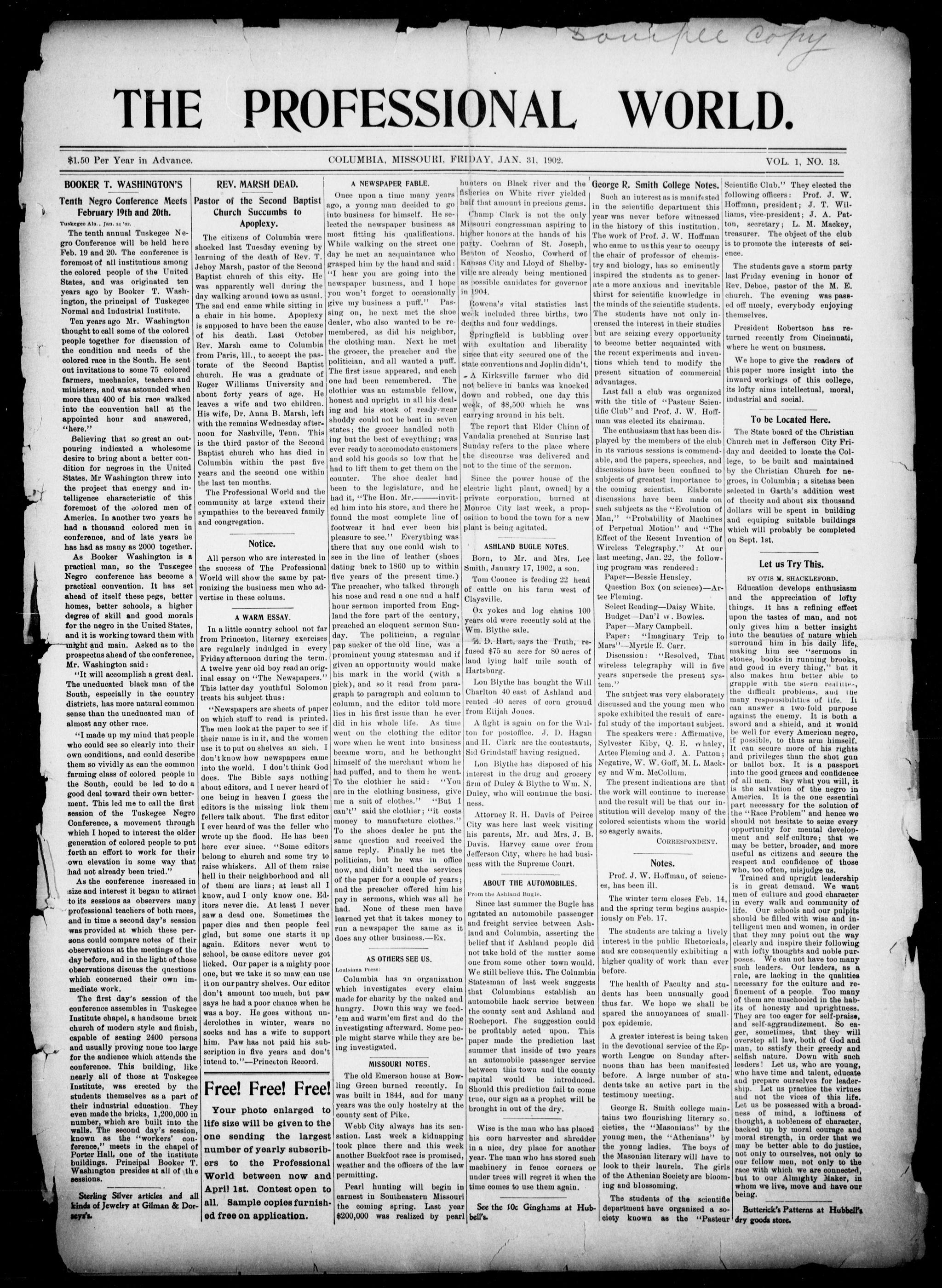
THE PROFESSIONAL WORLD.
$1.50 Per Year in Advance
BOOKER T. WASHINGTON'S
Tenth Negro Conference Meets February 19th and 20th.
The tenth annual Tuskegee Negro Conference will be held here Feb.19 and 20. The conference is foremost of all institutions among the colored people of the United States, and was originated ten years ago by Booker T. Washington, the principal of Tuskegee Normal and Industrial Institute.
Ten years ago Mr. Washington thought to call some of the colored people together for discussion of the condition and needs of the colored race in the South. He sent out invitations to some 75 colored farmers, mechanics, teachers and ministers, and was astounded when more than 400 of his race walked into the convention hall at the appointed hour and answered, "here."
Believing that so great an outpouring indicated a wholesome desire to bring about a better condition for negroes in the United States, Mr Washington threw into the project that energy and intelligence characteristic of this foremost of the colored men of America. In another two years he had a thousand colored men in conference, and of late years he has had as many as 2000 together.
As Booker Washington is a practical man, so the Tuskegee Negro conference has become a practical convention. It has set ahead of itself these pegs, better homes, better schools, a higher degree of skill and good morals for the negro in the United States, and it is working toward them with might and main. Asked as to the prospectus ahead of the conference, Mr. Washington said:
"It will accomplish a great deal. The uneducated black man of the South, especially in the country districts, has more natural common sense than the uneducated man of almost any other race.
"I made up my mind that people who could see so clearly into their own conditions, and could describe them so vividly as can the common farming class of colored people in the South, could be led to do a good deal toward their own betterment. This led me to call the first session of the Tuskegee Negro Conference, a movement through which I hoped to interest the older generation of colored people to put forth an effort to work for their own elevation in some way that had not already been tried."
As the conference increased in size and interest it began to attract to its sessions as observers many professional teachers of both races, and in time a second day's session was provided at which these persons could compare notes of their observations at the meetings of the day before, and in the light of those observations discuss the questions which concerned their own immediate work.
The first day's session of the conference assembles in Tuskegee Institute chapel, a handsome brick church of modern style and finish, capable of seating 2400 persons and usually proving none too large for the audience which attends the conference. This building, like nearly all of those at Tuskegee Institute, was erected by the students themselves as a part of their industrial education. They even made the bricks, 1,200,000 in number, which are built into the walls. The second day's session, known as the "workers' conference," meets in the chapel of Porter Hall, one of the institute buildings. Principal Booker T. Washington presides at all of the sessions.
Sterling Silver articles and all kinds of Jewelry at Gilman & Dorseys's.
REV. MARSH DEAD.
Pastor of the Second Baptist Church Succumbs to Apoplexy.
The citizens of Columbia were shocked last Tuesday evening by learning of the death of Rev. T. Jehoy Marsh, pastor of the Second Baptist church of this city. He was apparently well during the day walking around town as usual. The sad end came while sitting in a chair in his home. Apoplexy is supposed to have been the cause of his death. Last October Rev. Marsh came to Columbia from Paris, lll., to accept the pastorate of the Second Baptist church. He was a graduate of Roger Williams University and about forty years of age. He leaves a wife and two children. His wife, Dr. Anna B. Marsh, left with the remains Wednesday afternoon for Nashville, Tenn. This is the third pastor of the Second Baptist church who has died in Columbia within the past five years and the second one within the last ten months.
The Professional World and the community at large extend their sympathies to the bereaved family and congregation.
Notice.
All person who are interested in the success of The Professional World will show the same by patronizing the business men who advertise in these columns.
A WARM ESSAY.
In a little country school not far from Princeton, literary exercises are regularly indulged in every Friday afternoon during the term. A twelve year old boy read an original essay on "The Newspapers." This latter day youthful Solomon treats his subject thus:
"Newspapers are sheets of paper on which stuff to read is printed. The men look at the paper to see if their name is in it, and the women use it to put on shelves an sich. I don't know how newspapers came into the world. I don't think God does. The Bible says nothing about editors, and I never heard of one being in heaven I guess the editors is the missing link them fellers talk about. The first editor I ever heard of was the feller who wrote up the flood. He has been here ever since. "Some editors belong to church and some try to raise whiskers. All of them raise hell in their neighborhood and all of them are liars; at least all I know, and I only know one. Editors never die. At least I never saw a dead one. Sometimes the paper dies and then people feel glad, but some one starts it up again. Editors never went to school, be cause editors never got licked. Our paper is a mighty poor one, but we take it so maw can use it on our pantry shelves. Our editor don't amount too much, but paw says he had a poor chance when he was a boy. He goes without underclothes in winter, wears no socks and has a wife to support him. Paw has not paid his subscription in five years and don't intend to."—Princeton Record.
Free! Free! Free!
Your photo enlarged to life size will be given to the one sending the largest number of yearly subscribers to the Professional World between now and April 1st. Contest open to all. Sample copies furnished free on application.
COLUMBIA, MISSOURI, FRIDAY, JAN. 31. 1902.
A NEWSPAPER FABLE.
Once upon a time many years ago, a young man decided to go into business for himself. He selected the newspaper business as most fitting his qualifications. While walking on the street one day he met an acquaintance who grasped him by the hand and said: "I hear you are going into the newspaper business, and I hope you won't forget to occasionally give my business a puff." Passing on, he next met the shoe dealer, who also wanted to be remembered, as did his neighbor, the clothing man. Next he met the grocer, the preacher and the politician, and all wanted a puff. The first issue appeared, and each one had been remembered. The clothier was an estimable fellow, honest and upright in all his dealing and his stock of ready-wear shoddy could not be beat in seven states; the grocer handled nothing but the best of everything; was ever ready to accomodato customers and sold his goods so low that he had to lift them to get them on the counter. The shoe dealer had been to the legislature, and he had it, "The Hon. Mr.——invited him into his store, and there he found the most complete line of footwear it had ever been his pleasure to see." Everything was there that any one could wish to see in the line of leather (shoes dating back to 1860 up to within five years of the present time.) The preacher, who talked through his nose and read a one and a half hour sermon imported from England the fore part of the century, preached an eloquent sermon Sunday. The politician, a regular pap sucker of the old line, was a prominent young statesman and it given an opportunity would make his mark in the world (with a pick), and so it read from paragraph to paragraph and column to column, and the editor told more lies in his first issue than he ever did in his whole life. As time went on the clothing the editor wore when he went into business became worn, and he bethought himself of the merchant whom he had puffed, and to them he went. To the clothier he said: "You are in the clothing business, give me a suit of clothes." "But I can't" said the clothier; "it costs money to manufacture clothes." To the shoes dealer he put the same question and received the same reply. Finally he met the politician, but he was in office now, and didn't need the services of the paper for a couple of years and the preacher offered him his pay in sermons, which was all he had. None of these men have learned yet that it takes money to run a newspaper the same as it does any other business.—Ex.
AS OTHERS SEE US
Columbia has 9n organization which investigates every claim made for charity by the naked and hungry. Down this way we feed'em and warm'em first and do the investigating afterward. Some people might starve while they are being investigated.
MISSOURI NOTES
The old Emerson house at Bowling Green burned recently. In was built in 1844, and for many years was the only hostelry at the county seat of Pike.
Webb City always has its sensation. Last week a kidnapping took place there and this week another Buckfoot race is promised, weather and the officers of the law permitting.
Pearl hunting will begin in earnest in Southeastern Missouri the coming spring. Last year $200,000 was realized by pearl
hunters on Black river and the fisheries on White river yielded half that amount in precious gems. Champ Clark is not the only Missouri congressman aspiring to higher honors at the hands of his party. Cochran of St. Joseph, Beaton of Neosho, Cowherd of Kansas City and Lloyd of Shelbyville are already being mentioned as possible candidates for governor in 1904. Rowena's vital statistics last week included three births, two deaths and four weddings.
Springfield is bubbling over with exultation and liberality since that city secured one of the state conventions and Joplin didn't. A Kirksville farmer who did not believe in banks was knocked down and robbed, one day this week, of $8,500 which he was carrying around in his belt. The report that Elder Chinn of Vandalia preached at Sunrise last Sunday refers to the place where the discourse was delivered and not to the time of the sermon.
Since the power house of the electric light plant, owned] by a private corporation, burned at Monroe City last week, a proposition to bond the town for a new plant is being agitated.
ASHLAND BUGLE NOTES
Born, to Mr. and Mrs. Lee Smith, January 17, 1902, a son.
Tom Coonce is feeding 22 head of cattle on his farm west of Claysville.
Ox yokes and log chains 100 years old were recently sold at the Wm. Blythe sale.
B. D. Hart, says the Truth, refused $75 an acre for 80 acres of land lying half mile south of Hartsburg.
Lon Blythe has bought the Will Charlton 40 east of Ashland and rented 40 acres of corn ground from Elijah Jones.
A fight is again on for the Wilton for postoffice. J. D. Hagan and H. Clark are the contestants, Sid Grindstaff having resigned.
Lon Blythe has disposed of his interest in the drug and grocery firm of Duley & Blythe to Wm. N. Duley, who will continue the business.
Attorney R. H. Davis of Peiree City was here last week visiting his parents, Mr. and Mrs. J. B. Davis. Harvey came over from Jefferson City, where he had business with the Supreme Court.
ABOUT THE AUTOMOBILES
Since last summer the Bugle has agitated an automobile passenger and freight service between Ashland and Columbia, asserting the belief that if Ashland people did not take hold of the matter some one from some other town would. We still believe this. The Columbia Statesman of last week suggests that Columbians establish an automobile hack service between the county seat and Ashland and Rocheport. The suggestion could be profitably acted upon. This paper made the prediction last summer that inside of two years an automobile passenger service between this town and the county capital would be introduced. Should this prediction fail to come true, our sign as a prophet will be brought in out of the dry.
Wise is the man who has placed his corn harvester and shredder in a nice, dry place for another year. The man who has stored such machinery in fence corners or under trees will regret it when the time comes to use them again.
See the 10c Ginghams at Hubbell's.
Such an interest as is manifested in the scientific department this year was never before witnessed in the history of this institution. The work of Prof. J. W. Hoffman who came to us this year to occupy the chair of professor of chemistry and biology, has so eminently inspired the students as to generate a more anxious and inevitable thirst for scientific knowledge in the minds of the scientific students. The students have not only increased the interest in their studies but are seizing every opportunity to become better acquainted with the recent experiments and inventions which tend to modify the present situation of commercial advantages.
Last fall a club was organized with the title of "Pasteur Scientific Club" and Prof. J. W. Hoffman was elected its chairman.
The enthusiasm that has been displayed by the members of the club in its various sessions is commendable, and the papers, speeches, and discussions have been confined to subjects of greatest importance to the coming scientist. Elaborate discussions have been made on such subjects as the "Evolution of Man," "Probability of Machines of Perpetual Motion" and "The Effect of the Recent Invention of Wireless Telegraphy." At our last meeting, Jan. 22, the following program was rendered:
Paper—Bessie Hensley.
Question Box (on science)—Artee Fleming.
Select Reading—Daisy White.
Budget—Dan'l w. Bowies.
Paper—Mary Campbell.
Paper: “Imaginary Trip to Mars”—Myrtle E. Carr.
Discussion: “Resolved, That wireless telegraphy will in five years supersede the present system.”
The subject was very elaborately discussed and the young men who spoke exhibited the result of careful study of the important subject.
The speakers were: Affirmative, Sylvester Kiby, Q. E. whaley, Artee Fleming and J. A. Patton; Negative, W. W. Goff, M. L. Mackey and Wm. MeCollum.
The present indications are that the work will continue to increase and the result will be that our institution will develop many of the colored scientists whom the world so eagerly awaits.
CORRESPONDENT.
Notes.
Prof. J. W. Hoffman, of sciences, has been ill.
The winter term closes Feb. 14, and the spring term begins auspiciously on Feb. 17.
The students are taking a lively interest in the public Rhetoricals, and are consequently exhibiting a higher quality of work than ever before.
The health of Faculty and students has been unusually good thus far. We hope we shall be spared the annoyances of small pox epidemic.
A greater interest is being taken in the devotional service of the Epworth League on Sunday afternoons than has been manifested before. A large number of students take an active part in the testimony meeting.
George R. Smith college maintains two flourishing literary societies, the "Masonians" by the young men, the "Athenians" by the young ladies. The boys of the Masonian literary will have to look to their laurels. The girls of the Athenian Society are blooming and blossoming.
The students of the scientific department have organized a society known as the "Pasteur
Scientific Club." They elected the following officers: Prof. J. W. Hoffman, president; J. T. Williams, vice-president; J. A. Patton, secretary; L. M. Mackey, treasurer. The object of the club is to promote the interests of science.
The students gave a storm party last Friday evening in honor of Rev. Deboe, pastor of the M. E. church. The evening was passed off nicely, everybody enjoying themselves.
President Robertson has returned recently from Cincinnati, where he went on business.
We hope to give the readers of this paper more insight into the inward workings of this college, its lofty aims intellectual, moral, industrial and social.
To be Located Here.
The State board of the Christian Church met in Jefferson City Friday and decided to locate the College, to be built and maintained by the Christian Church for negroes, in Columbia; a sitehas been selected in Garth's addition west of thecity and about six thousand dollars will be spent in building and equiping suitable buildings which will probably be completed on Sept. 1st.
Let us Try This.
Education develops enthusiasm and the appreciation of lofty things. It has a refining effect upon the tastes of man, and not only gives him a better insight into the beauties of nature which surround him in his daily life, making him see "sermons in stones, books in running brooks, and good in every thing," but it also makes him better able to grapple with the stern realities, the difficult problems, and the many responsibilities of life. It can answer a two-fold purpose against the enemy. It is both a sword and a shield, and it would be well for every American negro, if possible, to thus arm himself. It can secure more of his rights and privileges than the shot gun or ballot box. It is a passport into the good graces and confidence of all men. Say what you will, it is the salvation of the negro in America. It is the one essential part necessary for the solution of the "Race Problem" and hence we should not hesitate to seize every opportunity for mental development and self culture; that we may be better, broader, and more useful as citizens and secure the respect and confidence of those who, too often, misjudge us.
Trained and upright leadership is in great demand. We want men of culture and good character in every walk and community of life. Our schools and our pulpits should be filled with wise and intelligent men and women, in order that they may point out the way clearly and inspire their following with lofty thoughts and noble purposes. We can not have too many such leaders. Our leaders, as a rule, are lacking in the qualities necessary for the culture and refinement of a people. Too many of them are unschooled in the habits of honesty and uprightness. They are too eager for self-praise, and self-aggrandizement. So eager, sometimes, that they will overstep all law, both of God and man, to satisfy their greedy and selfish nature. Down with such leaders! Let us, who are young, who have time and talent, educate and prepare ourselves for leadership. Let us practice the virtues and not the vices of this life. Let us be possessed with a broadness of mind, a loftiness of thought, a nobleness of character, backed up by moral courage and moral strength, in order that we may be better able to do justice, not only to ourselves, not only to our fellow men, not only to the race with which we are connected, but to our Almighty Maker, in whom we live, move and have our being.
Butterick's Patterns at Hubbell's dry goods store.
RUFUS L. LOGAN, B. S. D.
Editor.
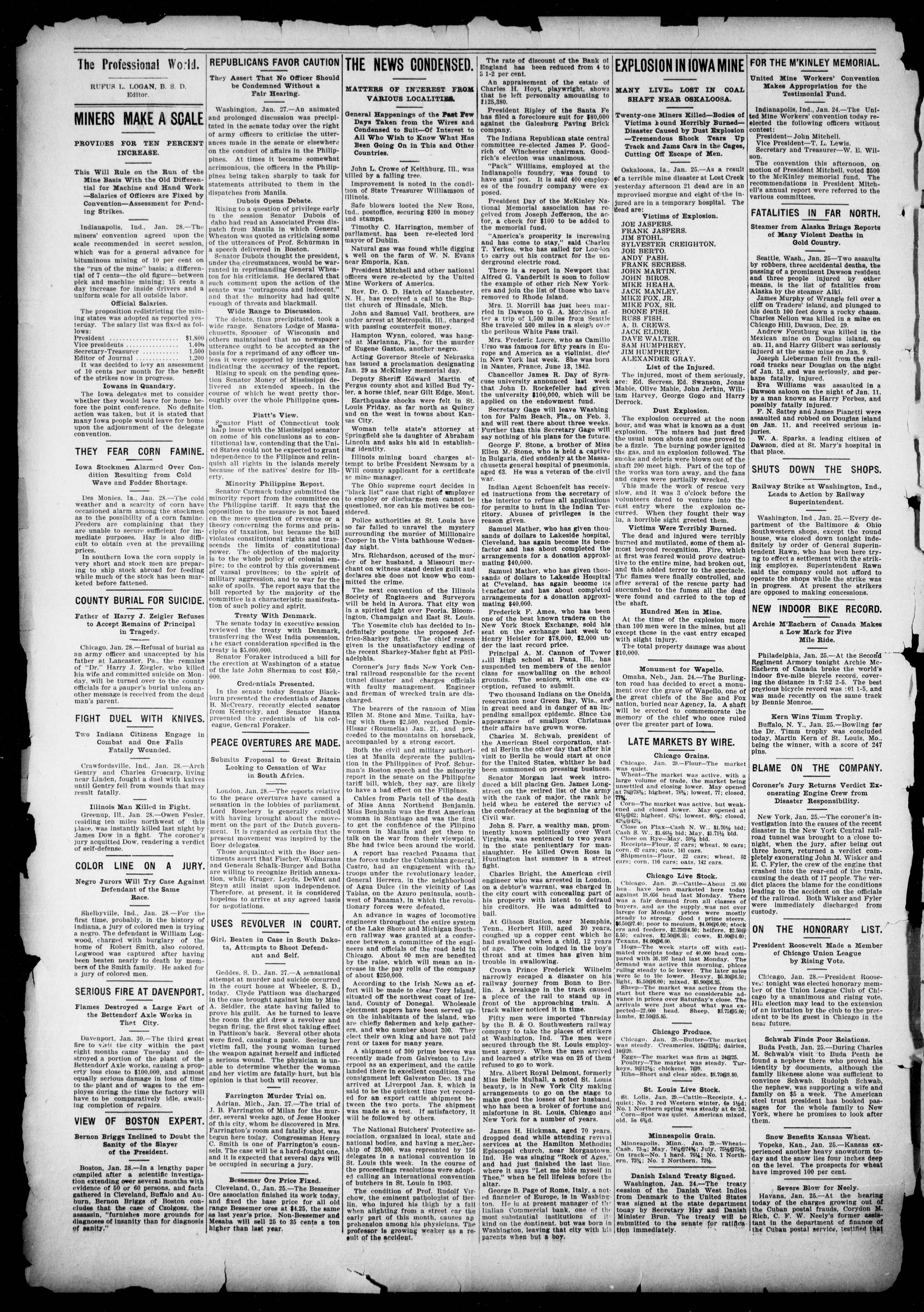
MINERS MAKE A SCALE
PROVIDES FOR TEN PERCENT INCREASE.
This Will Rule on the Run of the Mine Basis With the Old Differential for Machine and Hand Work—Salaries of Officers are Fixed by Convention—Assessment for Pending Strikes.
Indianapolis, Ind., Jan. 28.—The miners' convention agreed upon the scale recommended in secret session, which was for a general advance for bituminous mining of 10 per cent on the "run of the mine" basis; a differential of 7 cents—the old figure—between pick and machine mining; 15 cents a day increase for inside drivers and a uniform scale for all outside labor.
Official Salaries
The proposition redistricting the mining states was adopted as reported yesterday. The salary list was fixed as follows:
President ..... $1,800
Vice presidents ..... 1,400
Secretary-Treasurer ..... 1,500
Editor of Journal ..... 1,200
It was decided to levy an assessment of 10 cents per month for the benefit of the strikes now in progress.
Iowans in Quandary.
The Iowa delegates met to consider whether they would leave for home before the point conference. No definite action was taken, but it is stated that many Iowa people would leave for home upon the adjournment of the delegate convention.
THEY FEAR CORN FAMINE.
Iowa Stockmen Alarmed Over Condition Resulting from Cold Wave and Fodder Shortage.
Des Monies, Ia., Jan. 28.—The cold weather and a scarcity of corn have occasioned alarm among the stockmen as to the possibility of a corn famine. Feeders are complaining that they are unable to serve a patient for immediate purposes. Hay is also difficult to obtain even at the prevailing prices.
In southern Iowa the corn supply is very short and stock men are preparing to ship stock abroad for feeding while much of the stock has been marketed before fattened.
COUNTY BURIAL FOR SUICIDE
Father of Harry J. Zeigler Refuses to Accept Remains of Principal in Tragedy.
Chicago, Jan. 28.—Refusal of burial as an army officer and unaccepted by his father at Lancaster, Pa., the remains of "Dr." Harry J. Ziegler, who killed his wife and committed suicide on Monday, will be turned over to the county officials for a pauper's burial unless another message is received from the dead man's parent.
FIGHT DUEL WITH KNIVES.
Two Indiana Citizens Engage in Combat and One Falls Fatally Wounded.
Crawfordsville, Ind., Jan. 28.—Arch Gentry and Charles Groscarp, living near Linden, fought a duel with knives until Gentry fell from wounds that may result fatally.
Illinois Man Killed in Fight.
Greenup, Ill., Jan. 28.—Owen Fesler, residing ten miles northwest of this place, was instantly killed last night by James Dow in a fight. The coroner's jury acquitted Dow, rendering a verdict of self-defense.
COLOR LINE ON A JURY.
Negro Jurors Will Try Case Against Defendant of the Same Race.
Shelbyville, Ind., Jan. 28—For the first time, probably, in the history of Indiana, a jury of colored men is trying a negro. The defendant is William Logwood, charged with burglary of the home of Robert Smith, also colored. Logwood was captured after having been beaten nearly to death by members of the Smith family. He asked for a jury of colored men.
SERIOUS FIRE AT DAVENPORT.
Flames Destroyed a Large Part of the Bettendorf Axle Works in That City.
Davenport, Jan. 30.—The third great fire to visit the city within the past eight months came Tuesday and destroyed a portion of the plant of the Bettendorf Axle works, causing a property loss close to $100,000, and almost equally serious damage in loss of time to the plant and of wages to the employees during the time the factory will have to be comparatively idle, awaiting completion of repairs.
VIEW OF BOSTON EXPERT.
Bernon Briggs Inclined to Doubt the Sanity of the Slayer of the President.
Boston, Jan. 28.—In a lengthy paper compiled after a scientific investigation extending over several months with evidence of 50 or 60 persons, and facts gathered in Cleveland, Buffalo and Auburn, Bernon Briggs of Boston concludes that the case of Czolgosz, the assassin, "furnishes more grounds for diagnoses of insanity than for diagnosis of sanity."
REPUBLICANS FAVOR CAUTION
They Assert That No Officer Should be Condemned Without a Fair Hearing.
Washington, Jan. 27.—An animated and prolonged discussion was precipitated in the senate today over the right of army officers to criticise the utterances made in the senate or elsewhere on the conduct of affairs in the Philippines. At times it became somewhat acrimonious, the officers in the Philippines being taken sharply to task for statements attributed to them in the dispatches from Manila.
Dubois Opens Debate.
Rising to a question of privilege early in the session Senator Dubois of daho had read an Associated Press dispatch from Manila in which General Wheaton was quoted as criticising some of the utterances of Prof. Schurman in a speech delivered in Boston. Senator Dubois thought the president, under the circumstance, would be warranted in reprimanding General Wheaton for his criticisms. He declared that such comment upon the action of the senate was "outrageous and indecent," and that the minority had had quite enough of threats and blackmail.
Wide Range to Discussion.
The debate, thus precipitated, took a wide range. Senators Lodge of Massachusetts, Spooner of Wisconsin and others maintained that no newspaper utterance ought to be accepted as the basis for a reprimand of any officer unless it were supported by investigation indicating the accuracy of the report. Rising to speak on the pending question Senator Money of Mississippi delivered an extended speech, in the course of which he went pretty thoroughly over the whole Philippine question.
Platt's View.
Signator Platt of Connecticut took harp issue with the Mississippi senator on some of his conclusions as to constitutional law, contending that the United States could not be expected to grant independence to the Fillipinos and relinquish all rights in the islands merely because of the natives' desire for lib-
Minority Philippine Report.
Senator Carmack today submitted the minority report from the committee on the Philippine tariff. It says that the opposition to the measure is not based on the mere question of revenue or a theory concerning the forms and principles of taxation, but because the bill violates constitutional rights and transcends the limits of constitutional power. The objection of the majority is to the whole policy of colonial empire; to the control by this government of vassal provinces; to the spirit of military aggression, and to war for the sake of spoils. The report says that the bill reported by the majority of the committee is a characteristic manifestation of such policy and spirit.
Treaty With Denmark.
The senate today in executive session reviewed the treaty with Denmark, transferring the West India possession. the exact consideration specified in the treaty is $5,000,000. Senator Foraker introduced a bill for the erection at Washington of a statue on the late John Sherman to cost $50,000.
Credentials Presented
In the senate today Senator Blackburn presented the credentials of James B. McCreeay, recently elected senator from Kentucky, and Senator Hanna presented the credentials of his colleague, General Foraker.
PEACE OVERTURES ARE MADE
Submits Proposal to Great Britain Looking to Cessation of War in South Africa.
London, Jan. 28.—The reports relative to the peace overtures have caused a sensation in the lobbies of parliament. Lord Rosebery is generally credited with having brought about the movement on the part of the Dutch government. It is regarded as certain that the present movement was inspired by the Boer delegates.
Those acquainted with the Boer sentiments assert that Fischer, Wolmarans and Generals Schalk-Burger and Botha are willing to recognize British annexation, while Kruger, Leyds, DeWet and Steyn still insist upon independence. Therefore, at present, it is considered hopeless to arrive at any agreed basis for negotiations.
USES REVOLVER IN COURT.
Girl, Beaten in Case in South Dakota, Attempts to Shoot Defendant and Self.
Geddes, S. D. Jan. 27.—A sensational attempt at murder and suicide occurred in the court house at Wheeler, S. D. today. Clyde Pattison was discharged in the case brought against him by Miss A. Sellder, the state having failed to prove his guilt. As he turned to leave the room the girl drew a revolver and began firing, the first shot taking effect in Pattison's back. Several other shots were fired, causing a panic. Seeing her victim fall, the young woman turned the weapon against herself and inflicted a serious wound. The physician is unable to determine whether the woman and her victim are fatally hurt, but his opinion is that both will recover.
Farrington Murder Trial on.
Adrian, Mich., Jan. 27.—The trial of J. B. Farrington of Milan for the murder, several weeks ago, of Jesse Hooker of this city, whom he discovered in Mrs. Farrington's room and fatally shot, was begun here today. Congressman Henry C. Smith is one of Farrington's counsels. The case will be a hard-fought one, and it is expected that several days will be occupied in securing a jury.
Bessemer Ore Price Fixed
Cleveland, O., Jan. 25.—The Bessemer Ore association finished its work today, and fixed the base price for all old range Bessemer ores at $4.25, the same as last year's price. Non-Bessemer and Mesaba will sell 25 to 35 cents a ton higher than last year.
THE NEWS CONDENSED.
MATTERS OF INTEREST FROM
VARIOUS LOCALITIES
General Happenings of the Past Few Days Taken from the Wires and Condensed to Suit—Of Interest to All Who Wish to Know What Has Been Going On in This and Other Countries.
John L. Crowe of Keithburg, Ill., was killed by a falling tree.
Improvement is noted in the condition of State Treasurer Williamson of Illinois.
Safe blowers looted the New Ross, Ind., postoffice, securing $200 in money and stamps.
Timothy C. Harrington, member of parliament, has been re-elected lord mayor of Dublin.
Natural gas was found while digging a well on the farm of W. N. Evans near Emporia, Kan.
President Mitchell and other national officers were re-elected by the United Mine Workers of America.
Rev. Dr. O. D. Hatch of Manchester, N. H., has received a call to the Baptist church of Hinsdale, Mich.
John and Samuel Vall, brothers, are under arrest at Metropolis, Ill., charged with passing counterfeit money.
Hampton Wynn, colored, was hanged at Marlanna, Fla., for the murder of Eugene Gaston, another negro.
Acting Governor Steele of Nebraska has issued a proclamation designating Jan. 29 as McKinley memorial day.
Deputy Sheriff Edward Martin of Fergus county shot and killed Bud Tyler, a horse thief, near Gilt Edge, Mont.
Earthquake shocks were felt in St. Louis Friday, as far north as Quincy and on the west in towns about Kansas City.
Woman tells state's attorney at Springfield she is daughter of Abraham Lincoln and asks his aid in establishing identity.
Illinois mining board charges attempt to bribe President Newsam by a Will county applicant for a certificate ac mine manager.
The Ohio supreme court decides in "black list" case that right of employer to employ or discharge men cannot be questioned, nor can his motives be considered.
Police authorities at St. Louis have so far failed to unravel the mystery surrounding the murder of Millionaire Cooper in the Vista bathhouse Wednesday night.
Mrs. Richardson, accused of the murder of her husband, a Missouri merchant on witness stand denies guilt and declares she does not know who committed the crime.
The next convention of the Illinois Society of Engineers and Surveyors will be held in Aurora. That city won in a spirited fight over Peoria. Bloomington, Champaign and East St. Louis.
The Yosemite club has decided to indefinitely postpone the proposed Jeffries-Sharkey fight. The chief reason given is the unsatisfactory ending of the recent Sharkey-Maher fight at Philadelphia.
Coroner's jury finds New York Central railroad responsible for the recent tunnel disaster and charges officials with faulty management. Engineer and fireman of wrecked train are discharged.
The bearers of the ransom of Miss Ellen M. Stone and Mme. Tsilka, having with them $2,500, reached Demir-Hissar (Roumella) Jan. 21, and proceeded to the mountains on horseback, accompanied by a strong escort.
Both the civil and military authorities at Manila depreciate the publication in the Philippines of Prof. Schurman's Boston speech and the minority report in the senate on the Philippine tariff bill, which, they say, are likely to have a bad effect on the Philippines.
Cables from Paris tell of the death of Miss Anna Northend Benjamin. Miss Benjamin was the first American woman in Santiago and was the first to get the confidence of the Filipino women in Manila and get them to talk on the war from their viewpoint. She had twice been around the world. A report has reached Panama that the forces under the Colombian general, Castro, had an engagement with the troops under the revolutionary leader, General Herrera, in the neighborhood of Agua Dulce (in the vicinity of Las Tablas, on the Azuro peninsula, southwest of Panama), in which the revolutionary forces were defeated. An advance in wages of locomotive engineers throughout the entire system of the Lake Shore and Michigan Southern railway was granted at a conference between a committee of the engineers and officials of the road held in Chicago. About 60 men are benefited by the raise, which will mean an increase in the pay rolls of the company of about $250,000.
According to the Irish News an effort will be made to clear Tory Island, situated off the northwest coast of Ireland, County of Donegal. Wholesale ejection papers have been served upon the inhabitants of the island, who are chiefly fishermen and kelp gatherers, and who number about 300. They elect their own king and have not paid rent or taxes for many years.
A shipment of 300 prime beeves was recently made from Galveston to Liverpool as an experiment, and the cattle landed there in excellent condition. The consignment left Galveston Dec. 18 and arrived at Liverpool Jan. 8, which is said to be the quickest time yet recorded for an export cattle shipment between the two ports. The shipment was made as a test. If satisfactory, it will be followed by others.
The National Butchers' Protective association, organized in local, state and national bodies, and having a mer.bership of 23,000, was represented by 156 delegates in a national convention in St. Louis this week. In the course of the proceedings resolutions were adopted calling an international convention of butchers in St. Louis in 1903. The condition of Prof. Rudolf Virchow, the eminent pathologist of Berlin, who injured his thigh by a fall when alighting from a street car the early part of this month, causes ap prehension among his physicians. The professor is growing weaker as a result of the accident.
The rate of discount of the Bank of England has been reduced from 4 to 5-1-2 per cent.
An appraisal of the estate of Charles H. Hoyt, playwright, shows that he left personality amounting to $125,380.
President Ripley of the Santa Fe has filed a foreclosure suit for $80,000 against the Galesburg Paving Brick company.
The Indiana Republican state central committee re-elected James P. Goodrich of Winchester chairman. Goodrich's election was unanimous.
"Pack" Williams, employed at the Indianapolis foundry, was found to have small pox. It is said 400 employees of the foundry company were exposed.
President Day of the McKinley National Memorial association has received from Joseph Jefferson, the actor, a check for $100 to be added to the memorial fund.
"America's prosperity is increasing and has come to stay," said Charles T. Yerkes, who has sailed for London to carry out his contract for the underground electric road.
There is a report in Newport that Alfred G. Vanderbilt is soon to follow the example of other rich New Yorkers and join the list of those who have removed to Rhode Island.
Mrs. B. Morrill has just been married in Dawson to G. A. Morrison after a trip of 1,500 miles from Seattle She traveled 500 miles in a sleigh over the perilous White Pass trail.
Mrs. Frederic Lucre, who as Camillo Urso was famous for fifty years in Europe and America as a violinist, died in New York last week. She was born in Nantes, France, June 13, 1842.
Chancellor James R. Day of Syracuse university announced last week that John D. Rockefeller had given the university $100,000, which will be applied on the endowment fund.
Secretary Gage will leave Washington for Palm Beach, Fla., on Feb. 3, and will rest there about three weeks. Further than this Secretary Gage will say nothing of his plans for the future. George F. Stone, a brother of Miss Ellen M. Stone, who is held a captive in Bulgaria, died suddenly at the Massachusetts general hospital of pneumonia, aged 63. He was a veteran of the civil war.
Indian Agent Schoenfelt has received instructions from the secretary of the interior to refuse all applications for permits to hunt in the Indian Territory. Abuses of privileges is the reason given.
Samuel Mather, who has given thousands of dollars to Lakeside hospital, Cleveland, has again become its benefactor and has about completed the arrangements for a donation approximating $40,000.
Samuel Mather, who has given thousands of dollars to Lakeside Hospital at Cleveland, has again become its benefactor and has about completed arrangements for a donation approximating $40,000.
Frederick F. Ames, who has been one of the best known traders on the New York Stock Exchange, sold his seat on the exchange last week to Henry Heisler for $78,000, $2,000 under the last record price.
Principal A. M. Cannon of Tower Mill High school at Pana, Ill., has suspended ten members of the senior class for snowballing on the school grounds. The seniors, with one exception, refused to submit.
Two thousand Indians on the Oneida reservation near Green Bay, Wis., are in great need and in danger of an impending smallpox epidemic. Since the appearance of smallpox Christmas their affairs have grown worse.
Charles M. Schwab, president of the American Steel corporation, stated ni Berlin the other day that after his visit to Berlin he would start at once for the United States, whither he had been summoned on pressing business.
Senator Morgan last week introduced a bill placing Gen. James Long-street on the retired list of the army with the rank of major, the rank he held when he entered the service of the confederacy at the beginning of the Civil war.
John S. Farr, a wealthy man, prominently known politically over West Virginia, was sentenced to two years in the state penitentiary for manslaughter. He killed Owen Ross in Huntington last summer in a street fight.
Charles Bright, the American civil engineer who was arrested in London, on a debtor's warrant, was charged in the city court with concealing part of his property with intent to defraud his creditors. He was admitted to bail.
At Gibson Station, near Memphis, Tenn., Herbert Hill, aged 30 years, coughed up a copper cent which he had swallowed when a child, 12 years of age. The coin lodged in the boy's throat and at times has given him trouble in swallowing.
Crown Prince Frederick Wilhelm narrowly escaped a disaster on his railway journey from Bonn to Berlin. A breakage in the track caused a piece of the rail to stand up in front of the approaching train. A trackwalk noticed it in time.
Fifty men were imported Thursday by the B. & O. Southwestern railway company to take the places of strikers at Washington, Ind. The men were secured through the St. Louis employment agency. When the men arrived and learned a strike was on 25 of them refused to go to work.
Mrs. Albert Royal Delmont, formerly Miss Belle Mulhall, a noted St. Louis beauty, is in New York City making arrangements to go on the stage to make good the losses of her husband, who has been a broker of fortune and misfortune in St. Louis, Chicago and New York for a number of years.
James H. Hickman, aged 70 years, dropped dead while attending revival services at the Hamilton Methodist Episcopal church, near Morgantown, Ind. He was singing "Rock of Ages," and had just finished the last line where it says "Let me hide myself in Thee," when he fell lifeless before the altar.
George B. Page of Rome, Italy, a noted financier of Europe, is in Washington. He is at present manager of the Italian Commercial bank, one of the most substantial institutions of it kind on the continent, but was born in Washington, leaving that city with his parents when but a boy.
EXPLOSION IN IOWA MINE
MANY LIVES LOST IN COAL
SHAFT NEAR OSKALOOSA.
Twenty-one Miners Killed—Bodies of
Victims Found Horribly Burned—
Disaster Caused by Dust Explosion
—Tremendous Shock Tears Up
Track and Jams Cars in the Cages,
Cutting Off Escape of Men.
Oskaloosa, Ia., Jan. 25.—As a result
of a terrible mine disaster at Lost Creek
yesterday afternoon 21 dead are in an
improvised morgue and eight of the in-
jured are in a temporary hospital. The
dead are:
Victims of Explosion.
JOE JAPERS.
FRANK JASPERS.
JIM STOHL.
SYLVESTER CREIGHTON.
JOE BERTO.
ANDY PASH.
FRANK SECRESS.
JOHN MARTIN.
JOHN BIROS.
MIKE HEAHA.
JACK MANLEY.
MIKE FOX, JR.
MIKE FOX, SR.
BOONE FISH.
RUSS FISH.
A. B. CREWS.
JACK ELDER.
DAVE WALTER.
SAM HUMPHREY.
JIM HUMPHREY.
ALEXANDER GRAY.
The injured, most of them seriously, are: Ed. Secress, Ed. Swanson, Jonas Mable, Olive Mable, John Swarkin, William Harvey, George Gogo and Harry Derrock
Dust Explosion.
The explosion occurred at the noon hour, and was what is known as a dust explosion. The miners had just fired the usual noon shots and one proved to be a flizzle. The burning powder ignited the gas, and an explosion followed. The smoke and debris were blown out of the shaft 200 meet high. Part of the top of the works was torn away, and the fans and cages were partially wrecked. This made the work of rescue very slow, and it was 3 o'clock before the volunteers dared to venture into the east entry where the explosion occurred. When they fought their way in, a horrible sight greeted them.
Victims Were Terribly Burned
Victims Were Terribly Burned.
The dead and injured were terribly burned and mutilated, some of them almost beyond recognition. Fire, which at first was feared would prove destructive to the entire mine, had broken out, and this added terror to the spectacle. The flames were finally controlled, and after several of the rescue party had succumbed to the fumes all the dead were found and carried to the top of the shaft.
Hundred Men in Mine
At the time of the explosion more than 100 men were in the mines, but all except those in the east entry escaped with slight injury. The total property damage was about $10,000.
Monument for Wapello.
Omaha, Neb. Jan. 24—The Burlington road has decided to erect a monument over the grave of Wapello, one of the great chiefs of the Sac and Fox nation, buried near Agency, Ia. A shaft will be erected to commemorate the memory of the chief who once ruled over the greater part of Iowa.
LATE MARKETS BY WIRE
**Chicago Grains.**
Chicago, Jan. 29. -Flour-The market was quiet.
Wheat-The market was active, with a large volume of trade, the market being unsettled and closing lower. May opened at 78%@78%; highest, 78%; lowest, 77; closed, 77%.
Corn-The market was active, but weakened and closed lower. May opened at 61%@61%; highest, 62%; lowest, 60%; closed, 42%@42%.
Close on Flax-Cash N. W., $1.70% bid; Cash S. W., $1.66% bid; May, $1.71% bid.
Close on Rye-May, $59% bid.
Receipts-Flour, 37 cars; wheat, 90 cars; corn, 62 cars; oats, 141 cars.
Shipments—Flour, 22 cars; wheat, 52
cars; corn, 116 cars; oats, 142 cars.
Chicago Live Stock
Chicago. Jan. 20—Cattle—About 21,000
heat. have been marketed here today
against 18,556 head last Monday. There was
a fair demand from all classes of
buyers, and the supply was not over
largage for Monday prices were mostly
ready to strong. Good t prime steers,
7.6/7.7 head, $4.00; $4.00/6.00; stockers
and feeders, $2.25/4.50; heifers, $2.50/
5.50; calves, $2.50/6.25; cows, $1.00/4.00;
Texans, $4.00/6.00. Hogs—The week starts off with
estimated receipts today of 40,000 head
compared with 36,197 head last Monday. The
demand was active this morning, phices
ruling steady to 5c lower. The later sales
were 5c to 10c lower. Heavy, $3.30/6.50;
light, $5.50/6.00; mixed, $5.90/6.35.
Sheep—The market was active from the
sidelines to considerable advance
in prices over Saturday. Arrivals
were just about what was expected—22,000 head. Sheep, $3.75/6.00;
lambs, $2.50/6.50.
Chicago Produce.
Chicago, Jan. 29. --Butter--The market was steady. Creameries, 15% $22½; dairys, 14% $20.
Breads--The market was firm at 24% $25.
Poultry--The market was steady. Turkeys, 9% $12½; chickens, 7% $6.
Ribs--Short and clear sides, $8.70/$8.80.
St. Louis Live Stock.
St. Lolls, Jan. 20. -Cattle-Receipts. 4.
quiet; No. 2 red Western winter, 6 1/4 hrs.
No. 1 Northern spring was steady at 6s 20.
No. 1 was quiet. American mixed,
old. 5 6/8 hrs.
Minneapolis Grain.
Minneapolis, Minn. 29. 29—Wheat-
Cash, 75%; May, 74%@74%; July, 75%@75%
on track—No. 1 hard; 76%; No. 1 Northern;
73%; No. 2 Northern. 72%
Danish Island Treaty Signed.
Washington, Jan. 24.—The treaty cession of the Danish West Indies from Denmark to the United States was signed at the state department today by Secretary Hay and Danish Minister Brun. The treaty will be submitted to the senate for ratification immediately.
FOR THE M'KINLEY MEMORIAL
United Mine Workers' Convention
Makes Appropriation for the
Testimonial Fund.
Indianapolis, Ind., Jan. 24.—The United Mine Workers' convention today reelected the following officers without contest:
President—John Mitchell.
Vice President—T. L. Lewis.
Secretary and Treasurer—W. E. Wilson.
The convention this afternoon, on motion of President Mitchell, voted $500 to the McKinley memorial fund. The recommendations in President Mitchell's annual report were referred to the various committees.
FATALITIES IN FAR NORTH.
Steamer from Alaska Brings Reports of Many Violent Deaths in Gold Country.
Seattle, Wash., Jan. 25—Two assaults by robbers, three accidental deaths, the passing of a prominent Dawson resident and three people injured by other means, is the list of fatalities from Alaska by the steamer Alki.
James Murphy of Wrangle fell over a cliff on Traders' island, and plunged to his death 100 feet down a rocky chasm. Charles Nellon was killed in a mine on Chicago Hill, Dawson, Dec. 29.
Andrew Forstburg was killed in the Mexican mine on Douglas island, on an. 11, and Harry Gilbert was seriously injured at the same mine on Jan. 9.
Joseph Lieberman fell from the railroad tracks near Douglas on the night of Jan. 12, and was seriously, and perhaps fatally, injured.
Eva Williams was assaulted in a Dawson saloon on the night of Jan. 11, by a man known as Harry Forbes, and possibly fatally injured.
F. N. Sattie and James Pianetti were assaulted and robbed on Douglas island on Jan. 11, and received serious injuries. W. A. Sparks, a leading citizen of Dawson, died at St. Mary's hospital in that place.
SHUTS DOWN THE SHOPS.
Railway Strike at Washington, Ind., Leads to Action by Railway Superintendent.
Washington, Ind., Jan. 25.—Every department of the Baltimore & Ohio Southwestern shops, except the round house, was closed down tonight indefinitely by order of General Superintendent Rawn, who has been here trying to effect a settlement with the striking employees. Superintendent Rawn said the company could not afford to operate the shops while the strike was in progress. At present the strikers are opposed to making concessions.
NEW INDOOR BIKE RECORD.
Archie M'Eachern of Canada Makes a Low Mark for Five Mile Ride.
Philadelphia, Jan. 25.—At the Second Regiment Armory tonight Archie McEachern of Canada broke the world's indoor five-mile bicycle record, covering the distance in 7:52 2-5. The best previous bicycle record was : 01.1-5, and was made recently on the same track by Bennie Monroe.
Kern Wins Timm Trophy
Buffalo, N. Y., Jan. 25.—Bowling for the Dr. Timm trophy was concluded today, Martin Kern of St. Louis, Mo., being the winner, with a score of 247 pins.
BLAME ON THE COMPANY.
Coroner's Jury Returns Verdict Exonerating Engine Crew from Disaster Responsibility.
New York, Jan. 25.—The coroner's investigation into the causes of the recent disaster in the New York Central railroad tunnel was brought to a close tonight, when the jury, after being out three hours, returned a verdict completely exonerating John M. Wisker and E. C. Fyler, the crew of the engine that crashed into the rear-end of the train, causing the death of 17 people. The verdict places the blame for the conditions leading to the accident on the officials of the railroad. Both Wisker and Fyler were immediately discharged from custody.
ON THE HONORARY LIST.
President Roosevelt Made a Member of Chicago Union League by Rising Vote.
Chicago, Jan. 28.—President Roosevelt: tonight was elected honorary member of the Union League Club of Chicago by a unanimous and rising vote. His election may lead to the extension of an invitation by the club to the president to be its guest in Chicago in the near future.
Schwab Finds Poor Relations
Buda Pesth, Jan. 25—During Charles M. Schwab's visit to Buda Pesth he found a nephew there who proved his identity by documents, although the family likeness alone was sufficient to convince Schwab. Rudolph Schwab, the nephew, was supporting a wife and family on $5 a week. The American steel trust president has booked passages for the whole family to New York, where he promises to look after them.
Snow Benefits Kansas Wheat.
Snow Kauai, Jan. 25.—Kansas experienced another heavy snowstorm today and the snow lies four inches deep on the level. The prospects for wheat have improved 100 per cent.
Severe Blow for Neely.
Havana, Jan. 25—At the hearing today of the charges growing out of the Cuban postal frauds, Corydon M. Rich, C. F. W. Neely's former assistant in the department of finance of the Cuban postal service, testified that
TRIGG'S
FARM
NOTES
FARM
ORCHARD
GARDEN
Copyrighted
Fine naval oranges are $2.10 a box at points in the central West, considerably cheaper than good apples.
So long as interests rates keep way down just so long will there be a good demand for farm land.
The present high prices of all dairy food rations is greatly enlarging the number of cows which do not pay for their board.
The willow tree, planted ten feet apart each way on moist, rich bottom land, will cut about 70 cords of wood to the acre inside of fifteen years.
The Whippoorwill pea is being highly commended as a valuable legume for use in nearly all the northern states. But little is known of its merits in the West.
If it was not that the English farm hand expects and receives about three pints of good, strong beer a day, he would rebel and refuse to work for the wages paid him.
Booker Washington, the modern Moses of the Ethiopian race, avers that the salvation of the negro depends upon his being taught how to cultivate the soil, which statement is a concrete wisdom.
The laws of Minnesota provide a fine of $10 for any farmer who allows wild mustard to go to seed upon his premises. There are some men up there who would have to go into bankruptcy if this law was enforced against them.
The American people have no interest whatever in the maintenance of the sugar trust's refineries, but they do have a vital and abiding interest in the establishment and development of as many beet sugar refineries as possible.
A consignment of Mexican oranges for San Francisco was recently seized and burned up, boxes of and all. They were affected by a yellow worm, a new pest, which if introduced into the citrus belt of the coast would work incalculable damage.
We hardly believe it pays to bother much to raise roots as a succulent winter ration for stock when silage can be so much easily prepared, stored and fed. But if one cannot put up silage by all means have some roots for winter feeding.
An acre of cheap farm land will quite likely produce just as good and often better crops than an acre of 75 dollar land, while the crop may not sell for quite so much money because of the higher freight rate the sum total of this difference is not very much after all.
There is one thing about turkey, oranges and a lot of other delicacies, one soon gets very tired of them, while luckily for health and pocketbook, good homemade bread, oatmeal, potatoes and buckwheat cakes we never weary of. The best things after all, are the cheapest.
In most of the states woman's property rights are not fairly and properly protected. There is nothing fair or right when a man's brothers and father can step in and take property which the man and his wife alone have accumulated by joint work, and where no will is left this can be done in several states
The English walnut is being successfully grown in the state of New Jersey. We have often wondered why this most valuable nut tree was not given more attention in Kentucky, West Virginia and other states having like climatic conditions. Up to this time California is the only state which has shown any interest in the cultivation of this tree.
---
A lumber company during the last winter's work in the north woods, employing 200 men, had during the winter no less than 4,000 different men upon its pay roll. The trouble was that just as soon as a man had earned enough to go to Minneapolis and have a rip roaring old time he would quit work. This sort would be better off as slaves than as free men.
A friend of ours who has a farm of 160 acres in the Eastern portion of South Dakota which he rents to a pretty good tenant tells us that the two-fifths of the crop which he receives for his share has netted him an average of $3.30 per acre for the past four years, which is equivalent to 6 per cent interest on a valuation of $55 per acre for the farm, yet where this farm is located good farms are selling now at $25 to $30 per acre.
An American boy—young man man perhaps would be better, for he is 21 years old, though he only weighs 90 pounds will draw a bigger salary the coming year than the president of the United States—$55,000—as a horse jockey under contract, with the king of England to ride the king's racehorses. The boy is probably cheap at this price when the stakes he will win for his royal master are taken into account. The king is also shrewd in getting an American boy to ride his horses, for if there is a prize to be won the American usually wins it.
A stockman five years ago selected three very promising and well bred steer calves with the purpose in view of seeing how big he could make them succeeded in making them average over 2,200 pounds each at the end of five years, but he was greatly disappointed
when he sold them in Chicago last December, for big, and fat as they were, they sold at only $6 per hundredweight, when baby beef—well finished steers 15 months old weighing 1,200 pounds—brought $7.30. This man overdid the beef business and produced a type of beef which is not salable or profitable.
Short Corn Crop Troubles
The short crop of corn for 1901 and the consequent high price which this cereal commands are affecting some agricultural interests very unfavorably, notably the dairy interests and the feeders of cattle and hogs for the market. Conditions this winter are such that it is almost impossible for a man to handle a dairy of cows with profit, the price of dairy products having failed to maintain a profitable relation to the foodstuffs out of which they are made. The corn at 65 cents and average beef and pork at 5-1-2 cents a pound is another unprofitable condition of things for the man who fed the corn. It is one of those rare years when the man who has stock is at a disadvantage and when the man who raises grains and forage to sell has his innings.
Thinning the Fruit
The timely and proper thinning of the fruit on the orchard trees is a matter which should receive far more attention than it does. The peach men in Michigan, Delaware and Georgia and the orange prune men of the Western coast are well up on the importance of this matter, but the majority of fruit raisers other than these named pay little or no attention to it. In any season when the apple or plum tree sets very full of fruit and the same is not thinned by frost or natural means are always of inferior quality and undersized and often unsalable, while the bearing of such a chop is a most fearful drain upon the vitality of the tree. Man never interferes with the operation of natural law with more benefit to himself and his orchard trees than when he thins out two-thirds of any such crop of fruit. It must not be understood however, that this principle can properly be applied to large families of children.
Which Should Build the Fire?
We are asked whether it is the duty of the man or his wife to get up in the morning and build the fire. On general principles any man in good health who will let his wife do this work needs the discipline of the church. Where wome nare made to do this they will almost always speak of their husbands as "their man," the tribute which is usually the last to retire. She has the kids to look after, the cat to put out, the clock and like enough, some sockings to darn and a patch to put on—Johnhy's breeches long after "her man" is abed and sound asleep. Then, if a man has to build the fire the kindling is always ready, which is not always the case when his wife builds it. However, there are some exceptions to this rule. Where the woman dominates and practically runs the farm and the home and the little man up in his bed is only a pawn for her to move here and there, in such cases let her build the fire every time. Few men become so thoroughly hardened that they can listen with pleasure to their good wives rattling the lids of kitchen stove on a cold morning while they lie comfortably in bed.
Our Small Farm
The winter's farm is only a small one—forty acres—ten acres sugar bush and 3,000 apple trees, mostly Wealthy. The crop for the coming year will be clover, five acres; corn, ten acres; onions, two acres; melons, one acre; popcorn, two acres; potatoes, two acres; raspberries and strawberries, two acres, and a piece for experimental purposes on some new crops. These crops named will be mostly grown among the orchard trees, allowing the trees a strip sixteen feet wide upon which no crop will be grown, but which will be kept continuously and thoroughly cultivated up to the 1st of August, when it will be sown with buckwheat as a winter cover crop. Two Jersey cows, 150 hens and six hogs will constitute the stock equipment of the little farm. We figure that, barring bad luck, we will make our own maple syrup, have a family supply of eggs, chickens, pork, butter, fruits and fuel and a little to sell for pocket money, besides more or less as the fruit may materialize. There is a lot of pleasure in managing a little farm on these lines, even though a man never becomes rich enough to endow a public library. Mistakes made are circumscribed in the extent of financial injury inflicted, while the successes are big enough to fairly demonstrate the value of any new methods or things for the benefit of our readers.
Permanent Pastures.
We have one or two inquiries as to permanent pastures—how to get them and what kind of grasses to sow. An answer to this to be worth anything must presuppose a knowledge of soil and latitude, yes, and longitude also. In the Western range country West of longitude 100 there is probably no better permanent pasture to be had than that consisting of the native grasses, and these must not be too closely fed off or the weeds will soon take the place of grasses. In the corn belt, as far South as central Missouri, the permanent pasture becomes in fact a pure blue grass pasture in a very few years, no matter what kind of grasses may be sown. We know of one case where eight different kinds of grass seed was sown, to make theoretically, at least, a model permanent pasture, but at the end of four years there was nothing to be found there but blue grass and a little white clover in spots. He land usually devoted to permanent pasture is generally upfit for cultivation, either
being too rough, broken or wet. For the rough and broken tracts nothing is better than blue grass, while the wetter lands may be improved by the addition of timothy and clive clover. A good job is always done in the early spring when a man takes some grass seed—medium clover, white clover, blue grass timothy—and, scarifying the bare spots with a disk harrow, sows some seed with a liberal hand. It is overstocking which spoils the permanent pasture, and if one is so situated that such pasture can be divided and one-half off at a time, giving the other half a chance to grow, the pasture woud be more productive and enduring. The good permanent pasture should always be in such a condition that the owner would feel sure that he could carry more head of stock in it.
Boys and Puppies.
You can raise in most cases just the sort of a boy you want. The boy is very like a puppy or colt. He may be allowed to run wild when young and in the most natural way in the world will gravitate into a "yaller" dog around town or a sheep killing pest or else a bucking, kicking, worthless broncho, or he may be trained (commencing very young, mind you) and developed into a $50 dog or a $200 horse. In these latter days there is altogether too much importance charged up to heredity, the crediting of the meanness and general cursedness of men to their poor old grandfathers, when the real truth is that if the father and mothers of the boy would take him in hand so soon as he is weaned and train him on moral and intellectual lines as they would carefully and sensibly train a puppy or a colt they would have a boy to be proud of instead of a scad to be everlastingly ashamed of. A boy has to be made of more than average good stuff if he ever aspires to be a better man than his dad.
Go to Kirk.
A decent and respectful observance of the Sabbath day is always helpful and beneficial. Purely physical reasons demand a periodical cessation from daily toil both for man, animals and machines. This rest day should be made a good day. The church in all its varied branches crystallizes the religious instinct and in a fitting manner gives it expression. Man may live and seemingly prosper making all days workdays, but still in a broad sense he has made a bad mistake and placed an unpleasant burden upon the parson or priest when it comes to burying him. Sunday should be in the fullest sense a rest day, and if with this can be coupled a mental and moral development of the man one day in seven is thus well spent. While you may think the mass or prayers or the sermon or song has no mission for you, still all the same you will be a better man morally and physically if you go to church.
Too Many Laws.
A good many state legislatures are just now in session. In most of them are a lot of third rate attorneys who need watching pretty close to prevent them from putting a lot of useless legislation on the statute books. We have too many laws and not a few which are so contrary to public sentiment that they remain a dead letter. We cite as an instance a law which was passed in our own state of Iowa some years ago, which required the township authorities to erect signboards at all four corners of the public highways. The absurdity of the law was so apparent when it was undertaken to put it into practice that everybody laughed and dropped it. Still, this law has never been repealed. Then there are laws on a hundred and one petty matters, so many that not even the lawyers themselves can interpret them, let alone the common people.
A Grafting Convenience
A very successful nurseryman gives us the following method of preparing wax used in grafting which seems to have so much to commend it over the old way that we give it to our readers: Take old cotton cloth, pretty rotten; prepare the wax according to the usual formula and spread it when warm upon the cloth after the wax cools into strips, which accomplishes all that can be done when the wax is melted and wastefully applied with a stick. This plan makes easy work of grafting.
AUSTIN STIRS THE POETS.
Should envious aliens plan and plot 'Gainst one and now the other. They swift would learn how strong the
Binds brother unto brother.
How quickly they would change their tack
And show the recurrent feather.
Shows how the feather will join Jack.
But float must-bright together.
Tail or ear swan
A tail or ear swan fluffs flags unfurried.
Be fair or foul the weather.
Should need arise, face all the world
And stand or fall together.
Chicago Inter-Ocean
Should envious allens plan and plot
And fight one with the other,
Your Uncle Sam would surely not
be able to help you.
Discretion he would never lack
Or go beyond his tether
By tangling up the Union Jack
By tangling up the Union Jack
And Stars and Stripes together.
We've no objection to a grip
Of hands across the ocean.
But will not risk the Yankee ship
In seas of false emotion
By piercing the sea to right
A craft that's almost stranded,
For Jonathan prefers to fight
His battles single-handed.
Kansas City Journal
As grow two flow rets on one stem
By self-same showers watered,
So we are blooming just like them;
And though we sometimes tottered.
Yet we have lived through every storm;
And through all kinds of weather,
And ever in true friendship warm
We'll live and bloom "Together."
We're standing proudly side by side,
Just like the twins of Siam.
The bonds or blood no closely tied
That we're cemented by 'em.
If one should try to get away,
Twould be a question whether
The other would survive the day
We didn't stand "Together."
fde feroux
Bella Donna—"Was my death scene realistic last night?" She is "inspired" Super! Why, an insurance company director in the guidance faction!
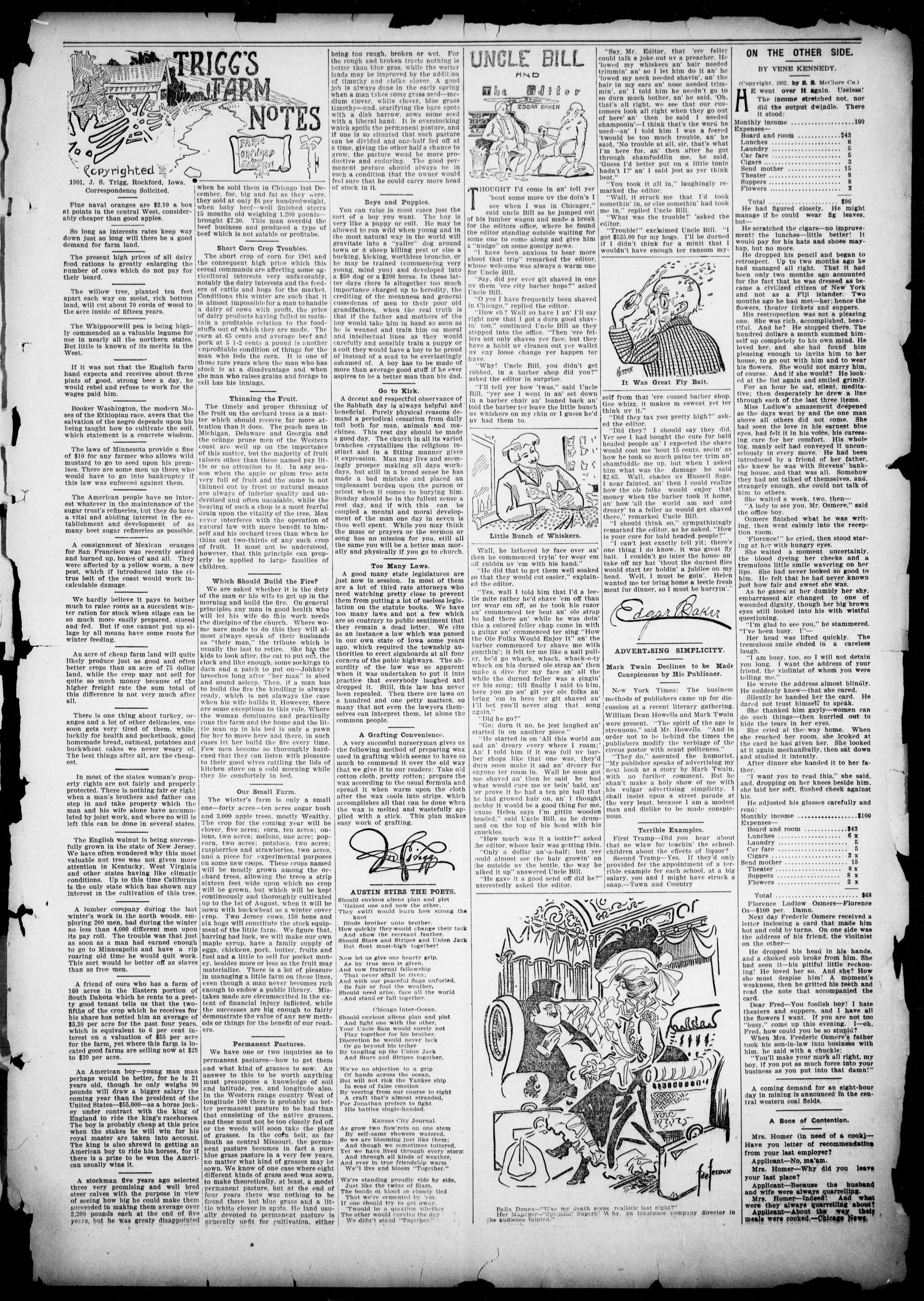
UNCLE BILL
The Editor
EDGAR BAKER
THOUGHT I'd come in an' tell yer
'bout some more uv the doin's I
see when I was in Chicago,'
said uncle Bill as he jumped out
of his lumber wagon and made a break
for the editors office, where he found
the editor standing outside waiting for
some one to come along and give him
a "nudge" on some gossip news.
"I have been anxious to hear more about that trip" remarked the editor, whose welcome was always a warm one for Uncle Bill.
"Say, did yer ever git shaved in one uv them 'ere city barber hops?' asked Uncle Bill.
"O yes I have frequently been shaved in Chicago," replied the editor.
"How eh? Wall so have I an' I'll say right now that I got a durn good shavin' too," continued Uncle Bill as they stepped into the office. "Then 'ere fellers not only shaves yer face, but they have a habit uv cleanen out yer wallet uv eny loose change yer happen ter have.
"Why! Uncle Bill, you didn't get robbed, in a barber shop did you?" asked the editor in surprise.
"I'll tell yer how 'twas," said Uncle Bill, "year see I went in an' set down in a barber chair an' leaned back an' told the barber ter leave the little bunch uv whiskers on my chin or I guess he'd uv had them to.
Little Bunch of Whiskers.
Wall, he lathered by face over an' then he commenced tryin' ter wear em off rubbin uv 'em with his hand."
"He did that to get them well soaked so that they would cut easier," explained the editor.
"Yes, wall I told him that I'd a lee-
te mite rather he'd shave 'off than
ter wear em off, so he took his razor
an' commenced the beat an' ole strap
he had there an' while he was doin'
this a colored feller chap come in with
a guitar an' commenced ter sing "How
the Ole Folks Would Enjoy it" an'
the barber commenced ter shave me with
sumthin'; it felt ter me like a nail puller,
he'd go whack, whack, whack-e-ty
whack on his durned ole strap an' then
make a dive fur my face an' all the
while the durned feller was a singin'
uv his song; till finally I said to him
here you go an' git yer ole folks an'
bring 'em in here ter git shaved an'
I bet you'll never sing that song
again."
"Did he go?"
"Go; durn it no, he jest laughed an'
started in on another piece."
"He started in on 'All this world am sad an 'dreary everywhere I roam';' An' I told him if it was full uv barber shops like that one was, they'd durn soon make it sad an 'dreary fur anyone roam in. Wall he soon got me shaved an' then he said he had what would cure me uv bein' bald, an' her prove it he had a ten pin ball that he had grown hair on, an' I thought mebby it would be a good thing fur me, cause Helen says I'm gittin wooden headed," said Ucle Bill, as he drummed on the top of his head with his snuckles.
"How much was it a bottle?" asked the editor, whose hair was getting thin. "Only a dollar an'-a-half; but yet could almost see the hair growin' on the outside uv the bottle, the way he talked it up" answered Uncle Bill.
"He gave it a good send off did he?" interested asked the editor.
"Say, Mr. Editor, that 'ere feller could talk a joke out uv a preacher. He 'lowed my whiskers an' hair needed trimmin' an' so I let him do it an' he 'lowed my neck needed shavin', an' the hair in my ears an' nose needed trimmin', an' I told him he needn't go to so durn much bother, an' he said, 'Oh, that's all right, we see that our customers look all right when they go out of here' an' then he said I needed shampooin'—I think that's the word he used—an' I told him I was a feered 'twould be too much trouble, an' he said, 'No trouble at all, sir, that's what I'm here for, an', then after he got through shamfuddlin me, he said, 'Guess I'd better put on a little tonic hadn't I?' an' I said jest as yer think best."
"You took it all in," laughingly remarked the editor.
"Wall, it struck me that I'd took somethin' in, or else somethin' had took me in," replied Uncle Bill.
"What was the trouble? 'asked the editor.
"Trouble!" exclaimed Uncle Bill. "I got $535.00 fur my hogs. I'll be durned if I didn't think fur a minit that I wouldn't have enough ter ransom my-
It Was Great Fly Bait.
self from that 'ere cussed barber shop. Gee whiz, it makes me eswat yet ter think uv it."
"Did they tax you pretty high?" asked the editor.
"Did they? I should say they did. Yer see I had bought the cure fur bald headed people an' I expected the shave would cost me 'bout 15 cents, seein' as how he took so much palms ter trim an' shamfuddle me up, but when I asked him what was the damage he said $2.65. Wall. shades uv Russell Sage. I near fainted, an' then I could realize how the ole folks would enjoy that money when the barber took it home, an' how 'all the world am sad and dreary' to a feller as would g shaved there,' remarked Uncle Bile.
"I should think so," sympathizingly remarked the editor, as he asked, "How is your cure for bald headed people?"
"I can't jest exactly tell yit; there's one thing I do know, it was great fly bait. I couldn't go inter the house an' take off my hat 'thout the durned flies would start ter holdin' a jubilee on my head. Well, I must be goin'. Helen wanted me ter bring home a leetle fresh meat fur dinner, so I must be hurryin."
Edgar Baker
ADVERTISING SIMPLICITY.
Mark Twain Declines to be Made Conspicuous by His Publisher.
New York Times: The business methods of publishers came up for discussion at a recent literary gathering. William Dean Howells and Mark Twain were present. "The spirit of the age is strenuous," said Mr. Howells. "And in order not to be behind the times the publishers modify the verbiage of the circus postor with scant politeness." "They do," assented the humorist, "My publisher speaks of advertising my next book as a story by Mark Twain with no further comment. But he shan't make a holy show of me with his vulgar advertising simplicity. I shall insist upon a street parade at the very least, because I am a modest man and dislike to be made conspicuous.
Terrible Examples.
First Tramp—Did you hear about that ne wlaw for teachin' the schoolchildren about the effects of liquor? Second Tramp—Yes. If they'd only provided for the appointment of a terrible example for each school, at a big salary, you and I might have struck a snan—Town and Country
ON THE OTHER SIDE.
BY VENE KENNEDY.
(Copyright, 1892, by B. S. McClure Co.)
He went over it again. Useless!
The income stretched not, nor did the output dwindle. There it stood:
Monthly income ... 100
Expenses—
Board and room ... $43
Lunches ... 6
Laundry ... 5
Car fare ... 5
Cigars ... 3
Send mother ... 15
Theater ... 8
Suppers ... 8
Flowers ... 3
Total ... $96
He had figured closely. He might manage if he could wear fig leaves, but—
He scratched the cigars—no improvement; the lunches—little better! It would pay for his hats and shoes may-hap, but no more.
He dropped his pencil and began to retrospect. Up to two months ago he had managed all right. That it had been only two months ago accounted for the fact that he was dressed as became a civilized citizen of New York and not as a Fiji islander. Two months ago he had met—her; hence the flowers, theater tickets and suppers. His restropection was not a pleasing one. She was rich, accomplished, beautiful. And he? He stopped there. The hundred dollars a month summed himself up completely to his own mind. He loved her, and she had found him pleasing enough to invite him to her house, to go out with him and to wear his flowers. She would not marry him, of course. And if she would? He looked at the list again and smiled grimly. For an hour he sat, silent, meditative; then desperately he drew a line through each of the last three items.
Miss Ludlow's amazement deepened as the days went by and the one man above all others did not come. She had seen the love in his earnest blue eyes, had felt it in his voice, his caressing care for her comfort. His whole big, manly self had conveyed it unconsciously in every move. He had been introduced by a friend of her father, she knew he was with Stevens' banking house, and that was all. Somehow they had not talked of themselves, and strangely enough, she could not talk of him to others.
She waited a week, two, then—"A lady to see you, Mr. Osmere," said the office boy.
Osmere finished what he was writing, then went calmly into the reception room.
"Florence!" he cried, then stood staring at her with hungry eyes.
She waited a moment uncertainly, the blood dyeing her cheeks and a tremulous little smile wavering on her lips. She had never looked so good to him. He felt that he had never known just how fair and sweet she was.
As he gazed at her dumbly her shy, embarrassed air changed to one of wounded dignity, though her big brown eyes still looked into his with wistful questioning.
"I'm glad to see you," he stammered. "I've been busy. I"—
Her head was lifted quickly. The tremulous smile ended in a careless laugh.
"I am busy, too, so I will not detain you long. I want the address of your friend, the violinist of whom you were telling me."
He wrote the address almost blindly. He suddenly knew—that she cared.
Silently he handed her the card. He dared not trust himself to speak.
She thanked him gayly—women can do such things—then hurried out to hide the tears in her eyes.
She cried at the way home. When she reached her room, she looked at the card he had given her. She looked at it again mechanically, then sat down and studied it intently.
After dinner she handed it to her father.
"I want you to read this," she said,
and, dropping on her knees beside him,
she laid her soft, flushed cheek against
his.
He adjusted his glasses carefully and
read:
Monthly income ..... $100
Expenses—
Board and room ..... $43
Lunches ..... 6 x
Laundry ..... 5
Car fare ..... 5
Cigars ..... 3 x
Send mother ..... 15
Theater ..... 8 x
Suppers ..... 8 x
Flowers ..... 3 x
Total ..... $68
Florence Ludlow Osmere—Florence
Os—$100 per. Damn.
Next day Frederic Osmere received a
letter inclosing a card that made him
hot and cold by turns. On one side was
the address of his friend, the violinist
on the other—
He dropped his head in his hands, and a choked sob broke from him. She had seen it—his pitiful little reckoning! He loved her so. And she? How she must despise him! A moment's weakness, then he gritted his teeth and read the note that accompanied the card.
Dear Fred—You foolish boy! I hate theaters and suppers, and I have all the flowers I want. If you are not too "busy," come up this evening. I—oh, Fred, how could you be so stupid?
When Mrs. Frederic Osmere's father took his son-in-law into business with him, he said with a chuckle:
"You'll make your mark all right, my boy, if you put as much force into your business as you put into that damn!"
A coming demand for an eight-hour day in mining is announced in the central western coal fields.
A Bone of Contention.
Mrs. Homer (in need of a cook)—Have you letter of recommendation from your last employer?
Applicant—No, ma'am.
Mrs. Homer—Why did you leave your last place?
Applicant—Because the husband and wife were always quarrelling.
Mrs. Homer—Indeed! And what were they always quarrelling about?
Applicant—About the way their meals were cooked—Chicago News.
The Professional World
RUFUS L. LOGAN, B. S. D. - EDITOR
TERMS OF SUBSCRIPTION.
One Year in Advance - - - $1.50
Six Months in Advance - - 1.00
Three Months in Advance - - .50
Single Copies - - .05
Special rates of $1.00 per year to ministers.
Advertising Rates on Application.
Job Work of all Kinds Sollicited.
Entered at the postoffice at Columbumbia, Mo., as second class matter, Jan. 15, 1902.
Agents wanted in every town in the state.
MANY persons make us feel good by complimenting our paper. How much better would they make us feel if they would pay their subscriptions.
ALL business men who have local advertising in the columns of this paper are friendly to the negro and his interests and should have your patronage.
It is reported that about 200 students at Wisconsin university have been cited to appear before the faculty to answer the charge of poker playing.
Two scholarships have been established in the woman's law class at New York university. They are entitled the 1902 and the Mrs. Russell Sage scholarships. They are intended to encourage young women who work in lawyer's offices and would like to become lawyers.
The election of Prof. Nicholas Murray Butler to succeed Seth Low as president of Columbia was unanimous. He was also elected a member of the board of trustees to succeed Frederic R. Coudert, who resigned on account of ill health. President Roosevelt will attend the installation April 18.
The next meeting of the Missouri College union will be held in St. Louis at Washington university. At this meeting President Jesse will deliver an address on the subject just now of such paramount interest to teachers throughout the state, the "Educational Exhibit at the Louisiana Purchase Centennial."
The new $500,000 endowment for Oberlin college will give an annual income of $20,000 at the average percentage of the college's invested money. The yearly deficit has been $10,000, so that $10,000 will be left for expenditure in new ways. This money is for the college department alone, and will be used for its needs exclusively.
We have received messages from all parts of the state congratulating us upon the stand we took concerning affairs at Lincoln Institute. While we most highly appreciate these expressions commending our manhood and loyalty to our Alma Mater, we feel that we have simply discharged our duty honestly and fearlessly. Such a duty as every loyal member of the Alumni Association owes to Lincoln Institute. We have unhesitatingly condemned that which was wrong without any indulgence in personalities and will say that the readers of the Professional World will always find such a sentiment in these columns.
The School Muddle Settled.
The school war which has been waged in Columbia since last spring has, we are glad to state, come to an end. Prof. H. A. Clark tendered his resignation to the Board of Education last Monday evening, and the same was accepted by an unanimous vote. The independent school which has been maintained by Prof. Clark's opponents at a cost of $500 and which was very successfully managed by Mrs. A. B. Moore, was dismissed Tuesday and the children returned to
the Fred Douglass school. The cause of the trouble is too well known for any further comment. The Professional World out of respect to all concerned has taken no part whatever in this matter. We trust however that this will end the controversy and that perfect harmony will at once be restored. The Fred Douglass school will remain under the supervision of Mrs. H. A. Clark who was elected principal last September.
City Notes.
Mr. Beverly Chapman is seriously ill at his home on Christian College Avenue.
Mrs. Rosa Marshal is confined to her bed with lagripe.
Go to Rader's for all kinds of fresh and salt meats.
Mr. Robert Gross, of California, Mo., is in the city and has a position at Conger's laundry.
Mrs. Engenia Boone, who has been spending two weeks at home, left Saturday to join the Boone Concert Co. in Iowa.
Have your prescriptions filled at Gilman & Dorsey's drugstore.
Finest assortment of laces at R. F. Rogers' Dry Goods Co.
Miss Lucy Farris left Saturday for Jefferson City to resume her school work at Lincoln Institute.
Get rubbers at less than cost at C. B. Miller's.
R. F. Rogers headquarters for mattings, oilcloth and carpets. Call and get prices.
Mrs. Sallie Holman is on the sick list.
Finest steak in the city at O. E. Rader's meat market, two doors north of the Statesman office.
Cloaks, Capes and Furs at Hubbell's dry goods store.
Mrs. Maggie Maupin and her sister-in-law, Miss Effie Maupin, spent Sunday in Jefferson City visiting Rev. J. B. Parsons and wife.
Shoes of all kinds, all styles, and all sizes at greatly reduced prices at C. B. Miller's.
Mrs. Laura Woods is on the sick list.
Go to Gilman & Dorsey's for drugs and all kinds of toilet articles. Prescriptions carefully filled day or night.
Slaughtering sale prices in C. B. Miller's show window, the most reliable shoe house.
All kinds of patent medicines at Gilman & Dorsey's.
Dr. Perry has sold his property on Broadway and purchased a nice plat of ground in Garth's Addition. Dr. Perry is an ideal citizen and professional man and the people of Columbia will be glad to hear that he is to remain in the city.
O. E. Rader has the most up-to-date meat market in the city and keeps all kinds of meats, fish, oysters and game. Call on him when you need anything in his line.
Shannon Henderson is serving a jail sentence for wife-beating.
Dr. King's New Discovery for Coughs and Colds. Get a trial bottle free at Gilman & Dorsey's.
See the great display of laces in R. F. Rogers' show window.
The banquet that was to have been given by the big seventeen club of the Second Baptist church has been postponed to February 6th on account of the death of Rev. T. Jehoy Marsh. The invitations sent out recently will hold good for that date. An excellent program is being prepared by Mrs. Margaret Akers. Every body should attend.
All kinds of dress goods at the most reasonable prices can be had at R. F. Rogers' Dry Goods House. Mr. Rogers is now sole proprietor of the firm of Rogers & Carson and invites every body to call and examine his stock of goods. K. P. Acme Lodge No. 24. Meetings first and fourth Fridays in each month. W. H. Turner, C. C. and D. D. G. C. W. W. Lampkins, M. F.
Prof. Edward A. Clark of Wilberforce University Placed at the Head of Lincoln Institute
Jefferson City, Mo., Jan 27th, 1902.—SPECIAL CORRESPONDENCE TO THE PROFESSIONAL WORLD.
The Board of Requests met here today and elect Prof. Edward A. Clark of Wilberforce university to be president of Lincoln Institute The condition of Lincoln Institute is well known throughout the state having had neither President nor vice President this school year. Prof. I. E. Page who was elected at the regular meeting of the Board last June tendered his resignation in July and Prof. J. W. Damel formerly science teacher in the school was made acting president. Prof. B. F. Allen who had been vice-president of the institution tendered his resignation leaving neither president nor vice president for the Institution.
The announcement that the Board would meet here today to elect a president attracted considerable attention among the friends and patrons of the school all over the state and much interest was manifest as to the result of to-day's Board meeting. There were many applicants for the position which pays $2000 per year, an exceptionally good salary for a negro institution, and was sought by some of the best negro educators in the country. The selection of Prof. Clark will doubtless, give general satisfaction he is a man of broad calibre highly educated and experienced, he is well known here, having been connected with Lincoln Institute during the administration Prof. Page, resigning in 1892 to accept a position at the national capitol. Quite a deal of excitement prevails on the Lincoln Institute hill to-night; acting President Damel who was an applicant for the position of president was much chagrined at his defeat, and at once dispatched a delegation of students to the executive mansion with a petition to the Governor asking that he be retained for the remainder of the year. The Governor positively refused to consider the petition as Prof. Clark has been elected with the understanding that he would assume charge of the work as soon a practicable. Prof. Damel will remain in charge however until the arrival of President Clark.
Special prices in muslin under wear at Hubbell's.
After the Mule Swindlers.
J. P. Quinn, the Memphis mule man who was here recently, his brother, Jim Quinn, and another man by the name of Baker, have been indicted by a Memphis grand jury and they will all be tried there in April. A warrant is out for another party, Geo. Cox, of Mississippi, who aided in the swindle. All the men except J. P. Quinn were accomplices, and assisted in disposing of the mules fraudulently obtained from Boone and Callaway county farmers. Farmers in other states were also defrauded of mules. Attorney H. D. Murray returned from Memphis last Friday after putting the prosecution on foot.
Have your watch and clock repairing done at Gilman & Dorsey's.
No Case Against Coats.
The case of the State of Missouri against Jack Coats was called Friday before Justice Boggs for preliminary examination. Coats was on hand and twenty-seven witnesses were there; but on order of the prosecuting attorney, the case was dismissed. He thought there was not sufficient evidence to warrant a trial for manslaughter, and the defendant Coats was discharged. Coats recently shot and killed a negro in his (Coats) restaurant at McBaine. The killing was done in self-defense, and after being threatened by Eaton Henderson, who was killed.
Talk of New Railroad.
A special from Jefferson City on Jan. 28 to the St. Louis Chronicle says:
"Secretary of State Cook to-day issued a certificate of incorporation to the Columbia & St. Louis Railroad Co., capital stock, $800,000; incorporated by Bryant C. Winston, E. T. Clapp, E. B. Pricer and others. The road is to be from Columbia, Mo., to the Wabash Railroad Co. at Centralia, Mo., a distance of twenty-four miles."
FARM FURROWS.
Turned by a Practical Farmer in the Livestock Indicator.
Comparatively few farmers know the value of a clover crop.
Keeping farm account may be the means of turning loss into profit.
Most of us want to be "in the top of the heap" or out of it altogether. We can't always tell how it is going to pile up. The safe way is to get in the heap.
The old sow has the advantage of the young sow in experience and is usually the best mother, but when she gets her head set the wrong way there is sure to be trouble if she is opposed.
The "stand" of candidates is very good so far, and if political conditions are favorable the crop will be an immense one. Sometimes the growth is spontaneous and the crop springs up like mushrooms.
The almost universal verdict is that this country would be better off with more sheep and fewer dogs. Dogs may be all right in their places but that place is not in a sheep pen or pasture at a midnight hour.
The extreme difficulty with a milking machine that actually milks is in keeping it clean. Actual tests have shown many very hurtful germs in milk that have come there through the use of machines which are not found in milk that has been hand drawn.
Feeding an unprofitable cow or an old plug horse is worse than a mortgage to the extent of the food consumed. One seems to be as hard to eradicate as the other. They will steal the farmer's labor and his hope. Sometimes they work in such a manner as to drive the boys from the farm and make the girls shy of farmers' sons who are matrimonially inclined. Don't feed a forty dollar plug fifty dollars' worth of feed.
A rotation of crops on the same soil prevents the exhaustion of plant food, primarily because different crops draw in different proportions on the plant food elements of the soil. When a rotation is kept up, one element will be drawn largely one year, the next some other and so a balance is maintained. Rotation implies more, however. Some plants in the rotation should add to the soil.
Get plows and cultivators sharpened and put in a good condition for spring work and when the time comes for using them there will be no delay. Of course this is meant for the man who failed to get that done before putting the tools away in the fall. It is better to get stirring plows sharpened just before the last field is finished in the fall and plow a half day or a day after sharpening. The plow will then be bright and sharp for spring work.
Some of these days when there is a soft snow, or what is known as "slush," will be a very good time to hitch up the colt to a sled and drive about over the fields. In the past this was done by driving over the prairies, but since the other fellow has come in and "settled up how to appreciate them is missing a whole lot of the good of this life. "I could be happy with either, were t'other dear charmer away."
Once upon a time a man would have a large lot of cattle and own every one of them. It is now possible for him to have a great number and owe for every one of them. With some men there is a vast difference in owning a large number and owing for the same number. A man can afford to owe for cattle when corn is selling below twenty cents per bushel if his owing does not cost too much. Money is cheap now and corn is dear, and when these products change places there is a chance to lose as well as make.
Corn is scarce and high priced in most localties. Oats in price are proportionately high. In view of this fact there is a good deal of figuring done to employ other kinds of feed with a view of saving money. Nothing has been
found that will take place of corn as a basis for the ration of the fattening animal, and nothing that will quite fill the bill for working horses, colts, calves, pigs or lambs. All other mixtures are simply apologies for substitutes and we use them when we are compelled to do so.
In growing farm products it is useless to raise such as cannot be readily sold in the nearest market, useless they are raised in carload lots, in which case they can be shipped to a convenient market. It is also unwise to try to grow products for which land and locality are not well adapted.
It is plain that a man with a small farm should engage in intensive farming. Extensive farming on a small farm will never pay. By extensive farming we mean on the extensive plan, which is also expensive. When large crops are put in they are necessarily given light tillage and much help is employed. Intensive means to farm with energy and to do things well and in season.
When a calf a day old will not drink, the teacher is very prone to say, "such a stubborn calf," and if the calf could talk it would say the very same thing of the man. It is a wrong impression that because skim milk is not very rich, a calf should de fed a great deal of it. When this is done, there is soon a "plot-bellied" calf on hands and the wonder is what has made it so? Over-feeding, irregular feeding, feeding cold milk and feeding sour milk are conducive to troubles and should be avoided.
The man who is not able to give a reason for the "hope that is in him" has denied the faith. The farmer who gives as a reason why he is a farmer, because he can do nothing else, is as far from the true path as it is possible for him to get. He needs to know many things and know them well. He needs to know that he is not a slave to his occupation, but that he needs to employ diligence, activity and intelligence in his management of farm affairs. We need to know our sphere, and then lose no time in attaining it.
There are three very good excuses for not husking corn fodder in season where it is done by hand. One excuse may be when it is to dry and another is when it is to wet, and the third reason is when one has "that tired feeling." A long stretch of fine weather will cause more delay in this business than any other one thing. These are days of rapid movements and close calculations and the profits in any business do not stand around waiting for wet or dry conditions, or the convenience or leisure of the operator. Where there is room for reformation, let it come.
I have wondered sometimes who it is that starts so many nonsensical ideas that people are wont to believe. Evidently some person tells them as a joke or draws on his imagination, and soon there are scores who are willing to repeat it to others as having come under their own observation. The latest is that ensilage is ruinous to cows teeth and that it should not be fed on that account. Next thing we know some person will be recommending baking powders for feeding bacon hogs, or that a pump can be kept from freezing by dropping a hot tomale in it in cold weather. Some people were born in the wrong time of the moon, and on Friday at that, and they are always predicting trouble to come from some practice that is doing good.
In the Probate Court.
Estate of Henry Schorman, Herman Schorman appointed administrator.
Estate of Nathan Hagan, J. D. Hagan, J. S. Rippeto and L. W. Rippeto appointed administrators.
Will Frame the Circuit Clerks.
The present circuit clerk, Hugh M. Hall, is collecting photographs of the former clerks of the Boone circuit court, and will group them in one frame to be placed in the clerk's office, and later in the new courthouse. There have been seven clerks as follows: North Todd, R. L. Todd, John M. Samuel, W. W. Garth, Josiah W. Stone, Walter F. Hodge and Hugh M. Hall.
Lodge and Church Directory.
S. M. T.—Mrs. Irena Akers,
W. P.; Mrs. Lizzie Williams,
W. S.
Meeting first Monday in
each month at 3 p. m.
SECOND CHRISTIAN CHURCH.
Rev. J. B. Parsons, pastor.
Preaching Sundays 11 a. m.
and 7:30 p. m.
Prayer meeting Wednesdays 7:30 p. m.
Everybody cordially invited
to attend.
Rev. P. C. Crews, Pastor.
Preaching Sundays 11 a.
m.; 7:30 p. m.
Sunday school 2:30 p. m.
Prayer meeting every
Wednesday eve, at 8:30; every body invited to attend.
M. E. CHURCH.
Rev. J. Arlington Grant,
pastor.
Preaching Sundays 11, a.
m. and 7:30 p. m.
Sunday school, 9:30 a. m.
Prayer meeting Wednesdays 7:30 to 8:30; all are made welcome.
SECOND BAPTIST CHURCH.
Rev. T. Jehoy Marsh, pastor.
Preaching Sundays 11, a.
m. and 7:30 p. m.
Sunday school at 2:30 p. m.
Prayer meeting Wednesday
eve. 7:30; a cordial invitation
extended to all
Another C. & A. Wreck.
The passenger coach and several box cars attached to the north bound C. & A. combination passenger and freight train on the South Branch, went into the ditch five miles south of Mexico at 7 o'clock Friday night and eleven passengers were injured. Among the injured ones were: J. F. Rohn, Fulton, two ribs broken and seriously shaken up; Chas. L. Fisher, Fulton, leg skinned; Prof. J. C. Humphrey, Fulton, head cut, injured in side; Frank Robertson, Mexico, leg skinned. A broken rail threw the engine. The baggage and passenger car rolled over twice.
Wants Cleaner Streets.
A citizen very much interested in Columbia wants the papers to start a crusade for better streets. In a letter to the Statesman he says: "It seems to me that the papers of Columbia ought to start a movement in behalf of better sidewalks and a neater condition of the streets. In my opinion nothing within the corporate limits of Columbia detracts so much from the appearance of the city as the lack of good side walks and the filthy condition in which the streets are allowed to remain. What do I mean by filthy streets? I mean the paper, trash, and so on, in the streets and in the gutters and the weeds growing up between the sidewalks and the fences and the sidewalks and the beds of the street."
February Weather in Columbia.
The following data for the month of February, covering a period of twelve years, have been compiled from the records of the local office of the Weather Bureau.
The mean or normal temperature of February is 31 degrees. The warmest February was that of 1892, with an average of 40 degrees, and the coldest was that of 1899 with an average of 20 degrees. The highest temperature recorded was 76 degrees on February 26, 1896, and the lowest, 26 degrees below zero. on February 12, 1899. The average number of days with minimum temperature below 32 degrees is 23.
The average precipitation for February is 2.32 inches, and the average number of days with 01 of an inch or more is 9. The greatest February precipitation was 6.80 inches, in 1892, and the least., 31 inch, in 1895. The greatest amount of precipitation recorded in any consecutive 24 hours was 2.78 inches, on the 18-19th, 1892. The greatest amount of snowfall recorded in any 24 hours was 13.9 inches, on the 27-28th, 1900. The average snowfall for the month is 6.7 inches. The average number of clear days is 8; partly cloudy days, 7; cloudy days, 13. The prevailing winds have been from the northwest, and the highest velocity recorded was 44 miles per hour, from the south, on February 24, 1891.
---