The Professional World
Friday, February 7, 1902
Columbia, Missouri
Page text (machine-generated)
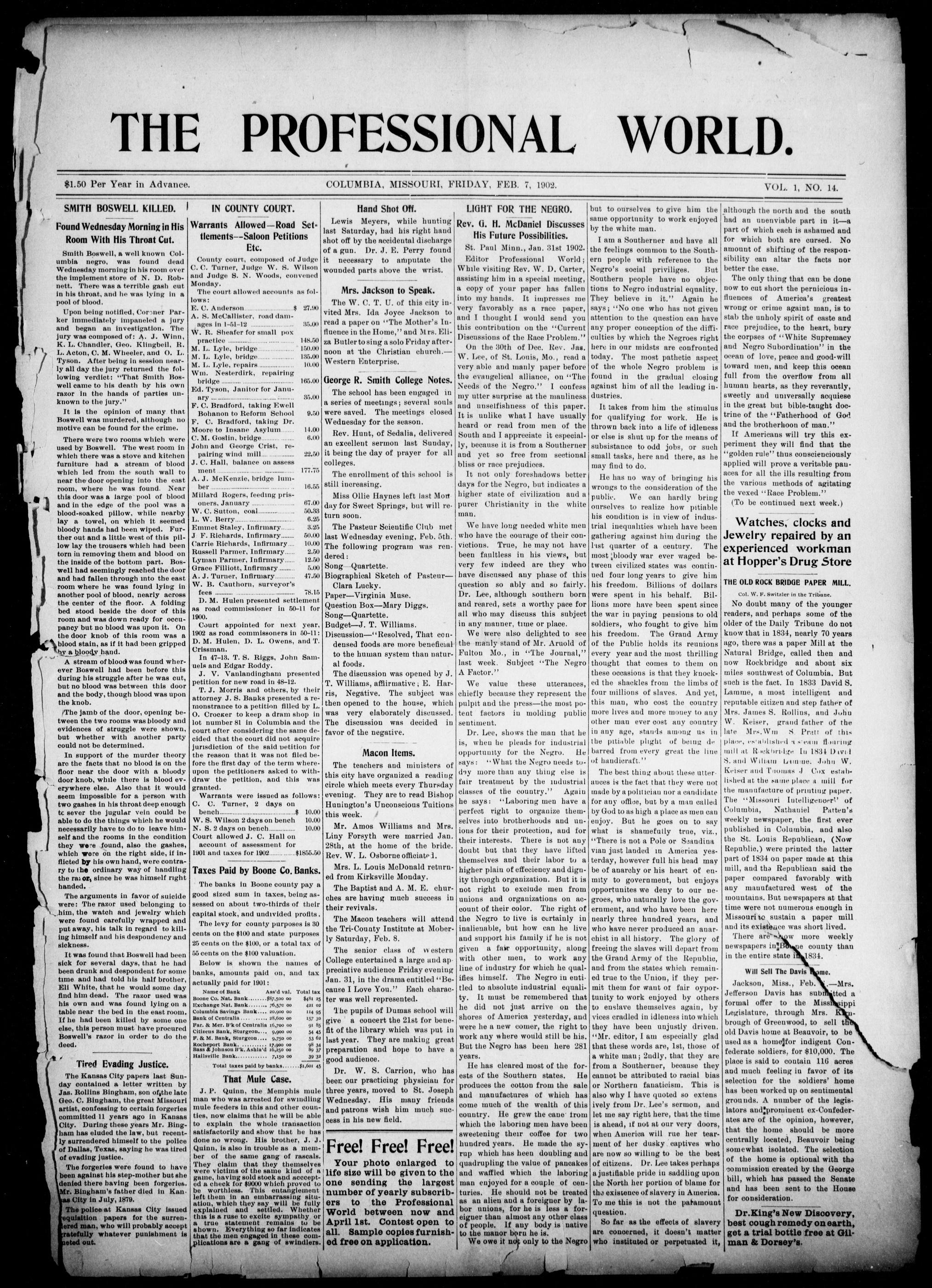
THE PROFESSIONAL WORLD.
$1.50 Per Year in Advance.
SMITH BOSWELL KILLED.
Found Wednesday Morning in His Room With His Throat Cut.
Smith Boswell, a well known Columbia negro, was found dead Wednesday morning in his room over the implement store of N. D. Robnett. There was a terrible gash cut in his throat, and he was lying in a pool of blood.
Upon being notified, Corner Parker immediately impaneled a jury and began an investigation. The jury was composed of: A. J. Winn, K. L. Chandler, Geo. Klingbeil, R. L. Acton, C. M. Wheeler, and O. L. Tyson. After being in session nearly all day the jury returned the following verdict: "That Smith Boswell came to his death by his own razor in the hands of parties unknown to the jury."
It is the opinion of many that Boswell was murdered, although no motive can be found for the crime.
There were two rooms which were used by Boswell. The west room in which there was a stove and kitchen furniture had a stream of blood which led from the south wall to near the door opening into the east room, where he was found. Near this door was a large pool of blood and in the edge of the pool was a blood-soaked pillow, while nearby lay a towel, on which it seemed bloody hands had been wiped. Further out and a little west of this pillow lay the trousers which had been torn in removing them and blood on the inside of the bottom part. Boswell had seemingly reached the door and had fallen into into the east room where he was found lying in another pool of blood, nearly across the center of the floor. A folding bed stood beside the door of this room and was down ready for occupancy but no blood was upon it. On the door knob of this room was a blood stain, as if it had been gripped by a bloody hand.
A stream of blood was found wherever Boswell had been before this during his struggle after he was cut, but no blood was between this door and the body, though blood was upon the knob.
/The jamb of the door, opening between the two rooms was bloody and evidences of struggle were shown, but whether with another party could not be determined.
In support of the murder theory are the facts that no blood is on the floor near the door with a bloody door knob, while there is blood everywhere else. Also that it would seem impossible for a person with two gashes in his throat deep enough to sever the jugular vein could be able to do the things which he would necessarily have to do to leave himself and the rooms in the condition they were found, also the gashes, which were on the right side, if inflicted by his own hand, were contrary to the ordinary way of handling the razor, since he was himself right handed.
The arguments in favor of suicide were: The razor used belonging to him, the watch and jewelry which were found carefully wrapped and put away, his talk in regard to killing himself and his despondency and sickness.
It was found that Boswell had been sick for several days, that he had been drunk and despondent for some time and had told his half brother, Ell White, that he would some day find him dead. The razor used was his own and was found lying on a table near the bed in the east room. If he had been killed by some one else, this person must have procured Boswell's razor in order to do the deed.
Tired Evading Justice.
The Kansas City papers last Sunday contained a letter written by Jas. Rollins Bingham, son of the late Geo. C. Bingham, the great Missouri artist, confessing to certain forgeries committed 11 years ago in Kansas City. During these years Mr. Bingham has eluded the law, but recently surrendered himself to the police of Dallas, Texas, saying he was tired of evading justice.
The forgeries were found to have been against his step-mother but she denied there having been forgeries. Mr. Bingham's father died in Kansas City in July, 1879.
The police at Kansas City issued acquisition papers for the surrendered man, who will probably accept gratefully whatever punishment is met out.
IN COUNTY COURT.
Warrants Allowed—Road Settlements--Saloon Petitions Etc.
County court, composed of Judge C.C. Turner, Judge W. S. Wilson and Judge S. N. Woods, convened Monday.
The court allowed accounts as follows:
E. C. Anderson..... $ 27.90
A. S. McCallister, road damages in 1-51-12..... 35.00
W. R. Sheafer for small pox practice..... 148.50
M. L. Lyle, bridge..... 150.00
M. L. Lyle, bridge..... 135.00
M. L. Lyle, repairs..... 10.00
Wm. Nesterdirk, repairing bridge..... 165.00
Ed. Tyson, Janitor for January..... 35.00
F. C. Bradford, taking Ewell Bohanon to Reform School..... 9.50
F. C. Bradford, taking Dr. Moore to Insane Asylum..... 14.00
C. M. Goslin, bridge..... 6.00
John and George Crist, repairing wind mill..... 22.50
J. C. Hall, balance on assessment..... 177.75
A. J. McKenzie, bridge lumber..... 16.55
Millard Rogers, feeding prisoners, January..... 67.00
W. C. Sutton, coal..... 50.33
L. W. Berry..... 6.25
Emmet Staley, Infirmary..... 3.25
J. F. Richards, Infirmary..... 50.00
Carrie Richards, Infirmary..... 10.00
Russell Parmer, Infirmary..... 2.50
Lyman Parmer, Infirmary..... 12.50
Grace Filliott, Infirmary..... 5.00
A. J. Turner, Infirmary..... 47.50
W. B. Cauthorn, surveyor's fees..... 78.15
D. M. Hulen presented settlement as road commissioner in 50-11 for 1900. Court appointed for next year, 1902 as road commissioners in 50-11: D. M. Hulen, D. L. Owens, and T. Crissman. In 47-18, T. S. Riggs, John Samuels and Edgar Roddy. J. V. Vanlandingham presented petition for new road in 48-12.
T. J. Morris and others, by their attorney J. S. Banks presented a remonstrance to a petition filled by L. O. Crocker to keep a dram shop in lot number 81 in Columbia and the court after considering the same decided that the court did not acquire jurisdiction of the said petition for the reason that it was not filed before the first day of the term whereupon the petitioners asked to withdraw the petition, and this was granted.
Warrants were issued as follows:
C. C. Turner, 2 days on bench.....$ 10.00
W. S. Wilson 2 days on bench 10.00
N. S. 2 days on bench.....10.00
Court allowed J. C. Hall on account of assessment for 1901 and taxes for 1902.....$1855.50
Taxes Paid by Boone Co. Banks.
The banks in Boone county pay a good sized sum in taxes, being assessed on about two-thirds of their capital stock, and undivided profits.
The levy for county purposes is 30 cents on the $100 and state purposes 25 cents on the $100, or a total tax of 55 cents on the $100 valuation.
Below is shown the names of banks, amounts paid on, and tax actually paid for 1901:
Name of Bank Ass'd val. Total tax
Boone Co. Nat. Bank.....$87,500 00 $481 25
Exchange Nat. Bank.....76,570 00 421 02
Columbia Savings Bank.....20,900 00 114 95
Bank of Centralia.....28,600 00 157 30
Far. & Mer. B'k of Centralia.....16,700 00 91 85
Citizens Bank, Sturgeon.....9,900 00 54 45
F. & M. Bank, Sturgeon.....9,750 00 53 62
Rocheport Bank.....17,900 00 98 34
Bass & Johnson B'k, Ashla'd.....16,250 00 99 37
Hallsville Bank.....7,450 00 39 32
That Mule Case.
J. P. Quinn, the Memphis mule man who was arrested for swindling mule feeders in this and other counties, now claims that he will be able to explain the whole transaction satisfactorily and show that he has done no wrong. His brother, J. J. Quinn, is also in trouble as a member of the same gang of rascals. They claim that they themselves were victims of the same kind of a game, having sold stock and accepted a check for $9000 which proved to be worthless. This entanglement left them in an embarrassing situation, which they say will be fully explained and settled. Whether this is a ruse to excite sympathy or a true statement remains to be shown. Everything so far indicates that the men engaged in these complications are a gang of swindlers.
COLUMBIA, MISSOURI, FRIDAY, FEB. 7, 1902.
Hand Shot Off.
Lewis Meyers, while hunting last Saturday, had his right hand shot off by the accidental discharge of a gun. Dr. J. E. Perry found it necessary to amputate the wounded parts above the wrist.
Mrs. Jackson to Speak.
The W. C. T. U. of this city invited Mrs. Ida Joyce Jackson to read a paper on "The Mother's Influence in the Home," and Mrs. Eliza Butler to sing a solo Friday afternoon at the Christian church. Western Enterprise.
George R. Smith College Notes.
The school has been engaged in a series of meetings; several souls were saved. The meetings closed Wednesday for the season.
Rev. Hunt, of Sedalia, delivered an excellent sermon last Sunday, it being the day of prayer for all colleges.
The enrollment of this school is still increasing.
Miss Ollie Haynes left last Monday for Sweet Springs, but will return soon.
The Pasteur Scientific Club met last Wednesday evening, Feb. 5th. The following program was rendered:
Song—Quartette.
Biographical Sketch of Pasteur- Clara Lucky. Paper—Virginia Muse.
Budget—J. T. Williams.
Discussion—"Resolved, That condensed foods are more beneficial to the human system than natural foods.
The discussion was opened by J. T. Williams, affirmative; E. Harris, Negative. The subject was then opened to the house, which was very elaborately discussed.
The discussion was decided in favor of the negative.
Macon Items.
The teachers and ministers of this city have organized a reading circle which meets every Thursday evening. They are to read Bishop Huntington's Unconscious Tuitions this week.
Mr. Amos Williams and Mrs. Liny Forsyth were married Jan. 28th, at the home of the bride. Rev. W. L. Osborne officiated.
Mrs. L. Louis McDonald returned from Kirksville Monday.
The Baptist and A. M. E. churches are having much success in their revivals.
The Macon teachers will attend the Tri-County Institute at Moberly Saturday, Feb. 8.
The senior class of western College entertained a large and appreciative audience Friday evening Jan. 31, in the drama entitled "Because I Love You." Each character was well represented.
The pupils of Dumas school will give a concert the 21st for benefit of the library which was put in last year. They are making great preparation and hope to have a good audience.
Dr. W. S. Carrion, who has been our practicing physician for three years, moved to St. Joseph Wednesday. His many friends and patrons wish him much success in his new field.
Free! Free! Free!
Your photo enlarged to life size will be given to the one sending the largest number of yearly subscribers to the Professional World between now and April 1st. Contest open to all. Sample copies furnished free on application.
Rev. G. H. McDaniel Discusses His Future Possibilities.
St. Paul Minn., Jan. 31st 1902. Editor Professional World; While visiting Rev. W. D. Carter, assisting him in a special meeting, a copy of your paper has fallen into my hands. It impresses me very favorably as a race paper, and I thought I would send you this contribution on the "Current Discussions of the Race Problem."
On the 30th of Dec. Rev. Jas. W. Lee, of St. Louis, Mo., read a very able and manly paper before the evangelical alliance, on "The Needs of the Negro." I confess my utter surprise at the manliness and unselfishness of this paper. It is unlike what I have usually heard or read from men of the South and I appreciate it especially, because it is from a Southerner and yet so free from sectional bliss or race prejudices. It not only foreshadows better days for the Negro, but indicates a higher state of civilization and a purer Christianity in the white man.
We have long needed white men who have the courage of their convictions. True, he may not have been faultless in his views, but very few indeed are they who have discussed any phase of this question so ably and so fairly. Dr. Lee, although southern born and reared, sets a worthy pace for all who may discuss this subject in any manner, time or place. We were also delighted to see the manly stand of Mr. Arnold of Fulton Mo., in "The Journal," last week. Subject "The Negro A Factor."
We value these utterances, chiefly because they represent the pulpit and the press—the most potent factors in molding public sentiment.
Dr. Lee, shows the man that he is, when he pleads for industrial opportunity for the Negro. He says: "What the Negro needs today more than any thing else is fair treatment by the industrial classes of the country." Again he says: "Laboring men have a perfect right to organize themselves into brotherhoods and unions for their protection, and for their interests. There is not any doubt but that they have lifted themselves and their labor to a higher plain of efficiency and dignity through organization. But it is not right to exclude men from unions and organizations on account of their color. The right of the Negro to live is certainly in inalienable, but how can he live and support his family if he is not given a fair opportunity, along with other men, to work any line of industry for which he qualifies himself. The Negro in entitled to absolute industrial equality. It must be remembered that he did not just arrive on the shores of America yesterday, and were he a new comer, the right to work any where would still be his. But the Negro has been here 281 years.
He has cleared most of the forests of the Southern states. He produces the cotton from the sale and manufactures of which has come much of the wealth of this country. He grew the cane from which the laboring men have been sweetening their coffee for two hundred years. He made the syrup which has been doubling and quadrupling the value of pancakes and waffled which the laboring man enjoyed for a couple of centuries. He should not be treated as an alien and a foreigner by labor unions, for he is less a foreigner than almost any other class of people. If any body is native to the manor born he is. We owe it not only to the Negro
but to ourselves to give him the same opportunity to work enjoyed by the white man.
I am a Southerner and have all the feelings common to the Southern people with reference to the Negro's social privileges. But Southern people have no objections to Negro industrial equality. They believe in it." Again he says; "No one who has not given attention to the question can have any proper conception of the difficulties by which the Negroes right here in our midsts are confronted today. The most pathetic aspect of the whole Negro problem is found in the gradual closing against him of all the leading industries.
It takes from him the stimulus for qualifying for work. He is thrown back into a life of idleness or else is shut up for the means of subsistance to odd jobs, or such small tasks, here and there, as he may find to do.
He has no way of bringing his wrongs to the consideration of the public. We can hardly bring ourselves to realize how pitiable his condition is in view of industrial inequalities which have been gathering against him during the last quarter of a century. The most bloody war ever waged between civilized states was continued four long years to give him his freedom. Billions of dollars were spent in his behalf. Billions more have been spent since the war in paying pensions to old soldiers, who fought to give him his freedom. The Grand Army of the Public holds its reunions every year and the most thrilling thought that comes to them on these occasions is that they knocked the shackles from the limbs of four millions of slaves. And yet, this man, who cost the country more lives and more money to any other man ever cost any country in any age, stands among us in the pitiable plight of being debarred from every great the line of handicraft."
The best thing about these utterances is the fact that they were not made by a politician nor a candidate for any office, but by a man called by God to as high a place as men can enjoy. But he goes on to say what is shamefully true, viz., "There is not a Pole or Scandina vian just landed in America yesterday, however full his head may be of anarchy or his heart of empty to government, but enjoys opportunities we deny to our negroes, who naturally love the government, and who have been here nearly three hundred years, and who have never produced an anarchist in all history. The glory of freeing the slaves will depart from the Grand Army of the Republic, and from the states which remained true to the Union, if they permit them for want or fair opportunity to work enjoyed by others to enslave themselves again, by vices cradled in idleness into which they have been unjustly driven. "Mr. editor, I am especially glad that these words are, 1st, those of a white man; 2ndly, that they are from a Southerner, because they cannot be attributed to racial bias or Northern fanaticism. This is also why I have quoted so extensively from Dr. Lee's sermon, and let me say right here, that the time is ahead, if not at our very doors, when America will rue her tearment of her dusky captives who are now so willing to be the best of citizens. Dr. Lee takes perhaps a justifiable pride in saddling upon the North her portion of blame for the existence of slavery in America. To me this is not the paramount question.
So far as the effects of slavery are concerned, it doesn't matter who instituted or perpetuated it,
although the north and the south had an unenviable part in it—a part of which each is ashamed and for which both are cursed. No amount of shifting of the responsibility can altar the facts nor better the case.
The only thing that can be done now to cut short the pernicious influences of America's greatest wrong or crime against man, is to stab the unholy spirit of caste and race prejudice, to the heart, bury the corpses of "White Supremacy and Negro Subordination" in the ocean of love, peace and good-will toward men, and keep this ocean full from the overflow from all human hearts, as they reverently, sweetly and universally acquiesce in the great but bible-taught doctrine of the "Fatherhood of God and the brotherhoon of man."
If Americans will try this experiment they will find that the "golden rule" thus conscienciously applied will prove a veritable pauacea for all the ills resulting from the various methods of agitating the vexed "Race Problem." (To be continued next week.)
Watches, clocks and Jewelry repaired by an experienced workman at Hopper's Drug Store
THE OLD ROCK BRIDGE PAPER MILL.
Col. W. F. Switzler in the Tribune.
No doubt many of the younger readers, and perhaps some of the older of the Daily Tribune do not know that in 1834, nearly 70 years ago, there was a paper Mill at the Natural Bridge, called then and now Rockbridge and about six miles southwest of Columbia. But such is the fact. In 1833 David S. Lamme, a most intelligent and reputable citizen and step father of Mrs. James S. Rollins, and John W. Keiser, grand father of the late Mrs. Wm S. Pratt of this place, established a steam flouring mill at Rockbridge. In 1834 David S. and William Lamme, John W. Keiser and Thomas J. Cox established at the same place a mill for the manufacture of printing paper. The "Missouri Intelligencer" of Columbia, Nathaniel Patten's weekly newspaper, the first ever published in Columbia, and also the St. Louis Republican, (Now Republic.) were printed the latter part of 1834 on paper made at this mill, and the Republican said the paper compared favorably with any manufactured west of the mountains. But newspapers at that time were not numerous enough in Missouri to sustain a paper mill and its existence was short lived.
There are now more weekly newspapers in Bornee county than in the entire state in 1834.
Will Sell The Davis Home
Jackson, Miss., Feb. N.—Mrs. Jefferson Davis has submitted a formal offer to the Mississippi Legislature, through Mrs. Kernbrough of Greenwood, to sell the old Davis home at Beauvoir, to be used as a home for indigent Confederate soldiers, for $10,000. The place is said to contain 116 acres and much feeling in favor of its selection for the soldiers' home has been worked up on sentimental grounds. A number of the legislators and prominent ex-Confederates are of the opinion, however, that the home should be more centrally located, Beauvoir being somewhat isolated. The selection of the home is optional with the commission created by the George bill, which has passed the Senate and has been sent to the House for consideration.
Dr.King's New Discovery, best cough remedy on earth, get a trial bottle free at Gilman & Dorsey's.
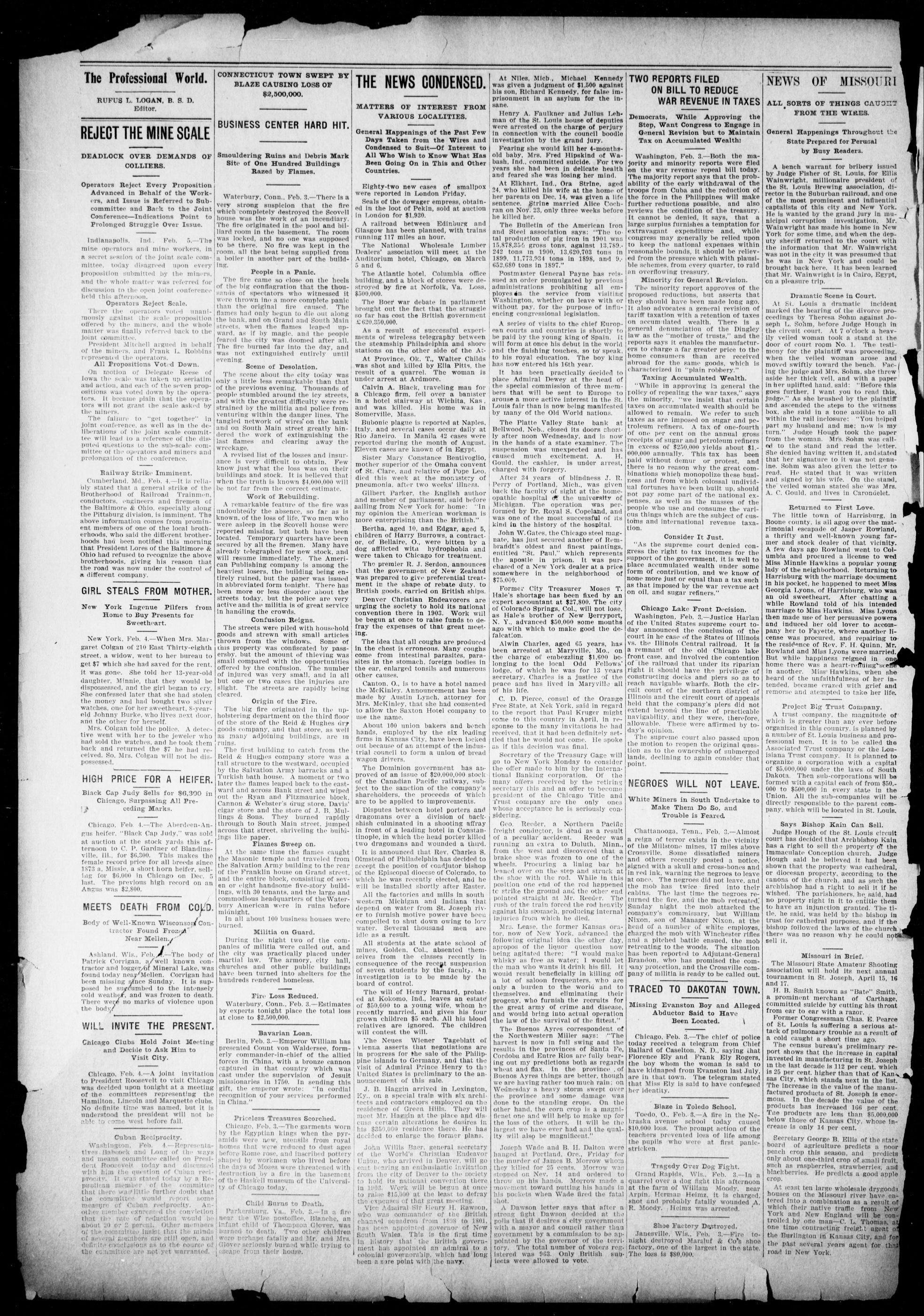
The Professional World.
RUFUS L. LOGAN, B. S. D.
Editor.
REJECT THE MINE SCALE
REJECT THE MINE SCALE
DEADLOCK OVER DEMANDS OF COLLIERS.
Operators Reject Every Proposition Advanced in Behalf of the Workers, and Issue is Referred to Subcommittee and Back to the Joint Conference—Indications Point to Prolonged Struggle Over Issue.
Indianapolis, Ind., Feb. 5.—The mine operators and mine workers, in a secret session of the joint scale committee, today disagreed upon every proposition submitted by the miners, and the whole matter was referred for discussion to the open joint conference held this afternoon.
Operators Reject Scale.
There the operators voted unanimously against the scale proposition offered by the miners, and the whole matter was finally referred back to the joint committee.
President Mitchell argued in behalf of the miners, and Frank L. Robbins represented the operators.
All Propositions Voted Down
All Propositions Voted Down.
On motion of Delegate Reese of Iowa the scale was taken up seriatim and action, and each of the seven propositions was voted down by the operators. It became plain that the operators did not grant the scale asked by the miners.
The failure to "get together" in joint conference, as well as in the deliberations of the joint scale committee will lead to a reference of the disputed questions to the sub-scale committee of the operators and miners and prolongation of the conference.
Railway Strike Imminent.
Cumberland, Md., Feb. 4.—It is reliably stated that a general strike of the Brotherhood of Railroad Trainmen, conductors, engineers and firemen of the Baltimore & Ohio, especially along the Pittsburg division, is imminent. The above information comes from prominent members of one of the local brotherhoods, who said the different brotherhoods had been notified this morning that President Lores of the Baltimore & Ohio had refused to recognize the above brotherhoods, giving his reason that the road was now under the control of a different company.
GIRL STEALS FROM MOTHER.
New York Ingenee Pilfers from Home to Buy Presents for Sweetheart.
New York, Feb. 4.—When Mrs. Margaret Colgan of 210 East Thirty-eighth street, a widow, went to her bureau to get $7 which she had saved for the rent, it was gone. She told her 13-year-old daughter, Minnie, that they would be dispossessed, and the girl began to cry. She confessed later that she had stolen the money and had bought two silver watches, one for her sweetheart, 8-year-old Johnny Burke, who lives next door, and the other for herself.
Mrs. Colgan told the police. A detective went with her to the jeweler who had sold the watches, and he took them back and returned the $7 he had received. So, Mrs. Colgan will not be dispossessed.
HIGH PRICE FOR A HEIFER.
Black Cap Judy Sells for $6,300 in Chicago, Surpassing All Preceding Marks.
Chicago, Feb. 4.—The Aberdeen-Angus heifer, "Black Cap Judy," was sold at auction at the stock yards this afternoon to C. P. Gardner of Blandinsville, Ill., for $6,300. This makes the female record price for all breeds since 1873 a. Missie, a short horn heifer, selling for $6,000 in Chicago on Dec. 5 last. The previous high record on an Angus was $2,800.
Body of Well-Known Wisconsin Contractor Found Frozen Near Mellen.
Ashland, Wis., Feb. — The body of Patrick Corrigan, a well known contractor and logger of Mineral Lake, was found today near Mellen. Corrigan had been missing since Sunday. It is supposed he succumbed to the intensely cold weather, and was frozen to death. There were no marks of violence upon the body.
WILL INVITE THE PRESENT.
Chicago Clubs Hold Joint Meeting and Decide to Ask Him to Visit City.
Chicago, Feb. 4.—A joint invitation to President Roosevelt to visit Chicago was decided upon tonight at a meeting of the committees representing the Hamilton, Lincoln and Marquette clubs. No definite time was named, but it is understood the president will not be able to come west before fall.
Cuban Reciprocity.
Washington. Feb. 4.—Representatives Babcock and Long of the ways and means committee called on President Roosevelt today and discussed with him the question of Cuban recolprocity. It was stated today by a Republican member of the committee that there was little further doubt that the committee would report some measure of Cuban recolprocity. Another member expressed the conviction that the rate of reduction would be about 20 or 2 percent. Other members of the committee insisted that the minds of several members are still open, and definite conclusions as to the course of the committee are not yet warranted.
CONNECTICUT TOWN SWEPT BY
BLAZE CAUSING LOSS OF
$2,500,000.
BUSINESS CENTER HARD HIT.
Smouldering Ruins and Debris Mark Site of One Hundred Buildings Razed by Flames.
Waterbury, Conn.. Feb. 3.—There is a very strong suspicion that the fire which completely destroyed the Scovell house was the work of an incendiar. The fire originated in the pool and billiard room in the basement. The room was locked, and no one was supposed to be there. No fire was kept in the room, all the heat being supplied from a boiler in another part of the building.
People in a Panic.
The fire came so close on the heels of the big conflagration that the thousands of spectators who witnessed it were thrown in a more complete panic than the original fire caused. The flames had only begun to die out along the bank, and on Grand and South Main streets, when the flames leaped upward, as if by magic, and the people feared the city was doomed after all. The fire burned far into the day, and was not extinguished entirely until evening.
Scene of Desolation.
The scene about the city today was only a little less remarkable than that of the previous evening. Thousands of people stumbled around the icy streets, and with the greatest difficulty were restrained by the militia and police from venturing within the danger lines. The tangled network of wires on the bank and on South Main street greatly hindered the work of extinguishing the last flames and clearing away the wreckage.
A revised list of the losses and insurance is very difficult to obtain. Few know just what the loss was on their buildings and stock. It is believed that when the truth is known $4,000,000 will be not far from the correct estimate.
Work of Rebuilding.
A remarkable feature of the fire was undoubtedly the absence, so far as is known, of the loss of life. Two men who were asleep in the Scovell house were reported missing, but both have been located. Temporary quarters have been secured by all the firemen. Many have already telegraphed for new stock, and will resume immediately. The American Publishing company is among the heaviest losers, the building being entirely ruined, but the paper was issued in abbreviated form tonight. There has been more or less disorder about the streets today, but the police are very active and the militia is of great service in handling the crowds.
Confusion Reigns
The streets were piled with household goods and strewn with small articles thrown from the windows. Some of this property was confiscated by passersby, but the amount of thieving was small compared with the opportunities offered by the confusion. The number of injured was very small, and in all but one or two cases the injuries are slight. The streets are rapidly being cleared.
Origin of the Fire.
The big fire originated in the upholstered department on the third floor of the store of the Reid & Hughes dry goods company, and that store, as well as many adjoining buildings, are ruins.
The first building to catch from the Reid & Hughes company store was a tall structure to the westward, occupied by the Salvation Army barracks and a Turkish bath house. A moment or two later the flames leaped back to the eastward and across Bank street and wiped out the Ryan and Fitzmaurice block, Cannon & Webster's drug store, Davis' cigar store and the store of J. B. Mullings & Sons. They burned rapidly through to South Main street, jumped across that street, shriveling the buildings like paper.
Flames Sweep on.
At the same time the flames caught the Masonic temple and traveled from the Salvation Army building to the rear of the Franklin house on Grand street, and the entire block, consisting of seven or eight handsome five-story buildings, with 30 tenants, and the large and commodious headquarters of the Waterbury American were in ruins before midnight. In all about 100 business houses were burned.
Militia on Guard.
During the night two of the companies of militia were called out, and the city was practically placed under martial law. The armory, city hall, churches and other public buildings have been turned into shelters for the hundreds rendered homeless.
Fire Loss Reduced
Waterbury, Conn., Feb. 3.—Estimates by experts tonight place the total loss at close to $2,500,000.
Bavarian Loan.
Berlin, Feb. 3.—Emperor William has presented Count von Waldersee, formerly commander-in-chief of the allied forces in China, with a bronze cannon captured in that country which was cast under the supervision of Jesuit missionaries in 1750. In sending this gift, the emperor wrote: "In cordial recognition of your services performed in China."
Priceless Treasures Scorched
Chicago, Feb. 3.—The garments worn by the Egyptian kings when the pyramids were new, utensils from royal homes that were reduced to dust ages before Rome rose, and inscribed pottery shaped by workmen who lived before the days of Moses were threatened with destruction by a fire in the basement of the Haskell museum of the University of Chicago today.
Child Burns to Death
Parkersburg, Va., Feb. 3.—In a fire near the Wise postoffice, Blanche, an infant child of Thompson Glover, was burned to death. Two other children were perhaps fatally and Mr. and Mrs. Glover seriously burned while trying to escape from their house.
THE NEWS CONDENSED.
THE NEWS CONDENSED.
MATTERS OF INTEREST FROM
VARIOUS LOCALITIES.
General Happenings of the Past Few
Days Taken from the Wires and
Condensed to Suit—Of Interest to
All Who Wish to Know What Has
Been Going On in This and Other
Countries.
Eighty-two new cases of smallpox
were reported in London Friday.
Seals of the dowager empress, obtained in the loot of Pekin, sold at auction in London for $1,930.
A railroad between Edinburg and Glasgow has been planned, with trains running 117 miles an hour.
The National Wholesale Lumber Dealers' association will meet at the Auditorium hotel, Chicago, on March 5 and 6.
The Atlantic hotel, Columbia office building, and a block of stores were destroyed by fire at Norfolk, Va. Loss, $500,000.
The Boer war debate in parliament brought out the fact that the struggle so far has cost the British government £620,350,000.
As a result of successful experiments of wireless telegraphy between the steamship Philadelphia and shore stations on the other side of the At-At Province, Ok. T., Walter Childs was shot and killed by Ella Pitts, the result of a quarrel. The woman is under arrest at Ardmore.
Calvin A. Black, traveling man for a Chicago firm, fell over a banister in a hotel stairway at Wichita, Kas, and was killed. His home was in Somerville, Mass.
Bubonic disease is reported at Naples, Italy, and several cases occur daily at Rio Janeiro. In Manila 42 cases were reported during the month of August. Eleven cases are known of in Eugnt.
Sister Mary Constance Bentivoglio, mother superior of the Omaha convent of St. Clare, and relative of Pope Leo, died this week at the monastery of pneumonia, after two weeks' illness.
Gilbert Parker, the English author and member of parliament, said before sailing from New York for home: "In my opinion the American workman is more enterprising than the British."
Bertha, aged 10, and Edgar, aged 5, children of Harry Burrows, a contractor, of Bellaire, O., were bitten by a dog afflicted wita hydrophobia and were taken to Chicago for treatment.
The premier R. J. Serdon, announces that the government of New Zealand was prepared to give preferential treatment in the shape of rebate duty. to British goods, carried on British ships.
Denver Christian Endeavorors are urging the society to hold its national convention there in 1903. Work will be begun at once to raise funds to defray the expenses of that great meeting.
The idea that all coughs are produced in the chest is erroneous. Many coughs come from intestinal parasites, parasites in the stomach, foreign bodies in the ear, enlarged tonsils and numerous other causes.
Canton, O., is to have a hotel named the McKinley. Announcement has been made by Austin Lynch, attorney for Mrs. McKinley, that she had consented to allow the Saxton Hotel company to use the name.
About 100 union bakers and bench hands, employed by the six leading firms in Kansas City, have been locked out because of an attempt of the industrial council to form a union of bread wagon drivers.
The Dominion government has approved of an issue of $20,000,000 stock of the Canadian Pacific railway, subject to the sanction of the company's shareholders, the proceeds of which are to be applied to improvements.
Disputes between hotel porters and dragomans over a division of backshish culminated in a shooting affray in front of a leading hotel in Constantinople, in which the head porter killed two dragomans and wounded a third. It is announced that Rev. Charles S. Olmstead of Philadelphia has decided to accept the coadjutor bishop of the Episcopal diocese of Colorado, to which he was recently elected, and he will be installed shortly after Easter. All the factories and mills in southwestern Michigan and Indiana that depend on water from St. Joseph river to furnish motive power have been compelled to shut down owing to low water. Several thousand men are idle as a result. All students at the state school of mines, Golden, Col., absented themselves from the classes recently in consequence of the receipt suspension of seven students by the faculty. An investigation is to be made by the board of control.
The will of Henry Barnard, probated at Kokomo. Ind., leaves an estate of $50,000 to a young wife, whom he recently married, and gives his four grown children $5 each. All his blood relatives are ignored. The children will contest the will.
The Neues Wiener Tageblatt of vienna asserts that negotiations are in progress for the sale of the Philippine islands to Germany, and that the visit of Admiral Prince Henry to the United States is preliminary to the announcement of this sale.
J. B. Haggin arrived in Lexington, Ky., on a special train with six architects and contractors employed on the residence of Green Hills. They will meet Mr. Haggin at the place and discuss certain alterations he desires in his $250,000 residence there. He has decided to enlarge the former plans.
John Willis Baer, general secretary of the World's Christian Endeavor Union, who arrived in Denver, will go east bearing an enthusiastic invitation from the city of Denver to the society to hold its national convention there in 1903. Work will be begun at once to raise $15,000 at the least to defray the expenses of that great meeting. Vice Admiral Sir Henry H. Rawson, who was commander of the British channel squadron from 1838 to 1801, has appointed governor of New South Wales. This is the first time in history that the British government has appointed an admiral to a colonial governorship, which had long been a rare point with the navy.
At Niles, Mich., Michael Kennedy was given a judgment of $1,500 against his son, Richard Kennedy, for false imprisonment in an asylum for the insane.
Henry A. Faulkner and Julius Lehman of the St. Louis house of deputies were arrested on the charge of perjury in connection with the council boodle investigation by the grand jury.
Fearing she would kill her 4-month-old baby, Mrs. Fred Hipskind of Wabash, Ind., committed suicide. For two years she had been in delicate health and feared she was losing her mind.
At Elkhart, Ind., Ora Strine, aged 24, who killed his wife at the home of her parents on Dec. 14, was given a life sentence. Strine married Alice Cochran on Nov. 23, only three weeks before he killed her.
The Bulletin of the American Iron and Steel association says: "The total production of pig iron in 1901 was 15,878,355 gross tons, against 13,789,242 tons in 1900, 13,620,703 tons in 1899, 11,773,934 tons in 1898, and 9,652,680 tons in 1897."
Postmaster General Payne has reissued an order promulgated by previous administrations prohibiting all employees in the service from visiting Washington, whether on leave with or without pay, for the purpose of influencing congressional legislation.
A series of visits to the chief European courts and countries is shortly to be paid by the young king of Spain. It will form at once his debut in the world and the finishing touches, so to speak, to his royal education. The boy king has now entered his 16th year.
It has been practically decided to place Admiral Dewey at the head of the special commission of three members that will be sent to Europe to arouse a more active interest in the St. Louis fair than is now being manifested by many of the Old World nations. The Platte Valley State bank at Bellwood, Neb., closed its doors shortly after noon Wednesday, and is now in the hands of a state examiner. The suspension was unexpected and has caused much excitement. A. H. Gould, the cashier, is under arrest, charged with forgery. After 34 years of blindness J. R. Perry of Portland, Mich., was given back the faculty of sight at the homeopathic hospital the university of Michigan. The operation was performed by Dr. Royal S. Copeland, and was one of the most successful of its kind in the history of the hospital.
John W. Gates, the Chicago steel magnate, has just secured another of Rembrandt's oldest and finest paintings, entitled "St. Paul," which represents the apostle in prison. It was purchased of a New York dealer at a price somewhere in the neighborhood of $75,069.
Former City Treasurer Moses T. Hale's shortage has been fixed by an expert accountant at $27,800. The city of Colorado Springs, Col., will not lose, as Hale's brother of New Berryport, N. Y., advanced $50,000 some months ago with which to make good the defalcation.
Alwin Charles, aged 65 years, has been arrested at Maryville, Mo., on the charge of embezzling $1,600 belonging to the local Odd Fellows' lodge, of which he was for 13 years secretary. Charles is a justice of the peace and has lived in Maryville all of his life.
C. D. Pierce, consul of the Orange Free State, at Nek York, said in regard to the report that Paul Kruger might come to this country in April, in response to the many invitations he had received, that it had been definitely settled that he would not come. He spoke as if this decision was final.
Secretary of the Treasury Gage will go to New York Monday to consider the offer made to him by the International Banking corporation. Of the many offers received by the retiring secretary this and an offer to become president of the Chicago Title and Trust company are the only ones whose acceptance he is seriously considering.
Geo. Reeder, a Northern Pacific freight conductor, is dead as a result of a peculiar accident. Reeder was running an extra to Duluth, Minn, from the west and discovered that a brake shoe was frozen to one of the wheels. Procuring a lining bar he leaped over on the step and struck at the shoe with the rod. While in this position one end of the rod happened to strike the ground and the other end pointed straight at Mr. Reeder. The rush of the train forced the rod heavily against his stomach, producing internal injuries from which he died.
Mrs. Lease, the former Kansas orator, now of New York, advanced the following original idea the other day, apropos of the liquor question now being agitated there: "I would make whisky as free as water; I would let the man who wants it drink his fill. It would result beneficially in killing off a lot of saloon frequenters, who are only a burden to the world and to themselves, and eliminating their progeny, who furnish the recruits for the great army of crime and disease, and would bring into actual operation the law of the survival of the fittest."
The Buenos Ayres correspondent of the Northwestern Miller says: "The harvest is now in full swing and the results in the provinces of Santa Fe, Cordoba and Entre Rios are fully bearing out my predictions both as regards wheat and flax. In the province of Buenos Ayres things are better, though we are having rather too much rain; on Wednesday a heavy storm swept over the province and some damage was done to the standing crops. On the other hand, the corn crop is a magnificent one and will help to make up for the loss of the others. It will be the largest we have ever had and the quality will also be magnificent."
Joseph Wade and B. H. Dalton were hanged at Portland, Ore., Friday for the murder of James B. Morrow whom they killed for 25 cents. Morrow was stopped on Nev. 14 and ordered to throw up his hands. Morrow made a movement toward putting his hands in his pockets when Wade fired the fatal shot.
A Dawson letter says that after a strong fight Dawson decided at the polls that it desires a city government with a mayor and council rather than government by a commission to be appointed by the governor of the territories registered was 1933. Only British subjects were allowed to vote.
TWO REPORTS FILED
ON BILL TO REDUCE
WAR REVENUE IN TAXES
Democrats, While Approving the Step, Want Congress to Engage in General Revision but to Maintain Tax on Accumulated Wealth:
Washington, Feb. 3.—Both the majority and minority reports were fled on the war revenue repeal bill today. The majority report says that the probability of the early withdrawal of the troops from Cuba and the reduction of the force in the Philippines will make further reductions possible, and also reviews the condition of the treasury. It cannot be denied, it says, that a large surplus furnishes a temptation for extravagant expenditure and, while congress may generally be relied upon to keep the national expenses within reasonable bounds, it should be relieved from the pressure which with plausible schemes, from every quarter, to raid an overflowing treasury.
Minority for General Revision.
Minority for General Revision.
The minority report approves of the proposed reductions, but asserts that they should have been made long ago. It also advocates a general revision of tariff taxation with a retention of taxes on accumulated wealth. There is a general denunciation of the Dingley law as the "mother of trusts," and the reports say it enables the manufacturers to charge a far greater price to the home consumers than are received abroad for the same goods, which is characterized in "plain robbery."
Taxing: Accumulated Wealth
"While in approving in general the policy of repealing the war taxes," says the minority, "we insist that certain taxes on accumulated wealth should be allowed to remain. We refer to such taxes as are imposed on sugar and petroleum refiners. A tax of one-fourth of one per cent on the annual gross receipts of sugar and petroleum refiners in excess of $250,000 yields about $1,000,000 annually. This tax has been paid without remar or protest, and there is no reason why the great combinations which monopolize these business and from which colossal individual fortunes have been built up, should not pay some part of the national expenses, as well as the masses of the people who use and consume the varicous things which are the subject of customs and international revenue taxation.
Consider It Just.
"As the supreme court denied congress the right to tax incomes for the support of the government, it is well to place accumulated wealth under some form of contribution, and we know of none more just or equal than a tax such as that imposed by the war revenue act on oil, and sugar refiners."
Chicago Lake Front Decision
Washington, Feb. 3.—Justice Harlan of the United States supreme court today announced the conclusion of the court in his case of the States of Illinois vs. the Illinois Central railroad. It is a remnant of the old Chicago lake front case, and involved the contention of the railroad that under its riparian right it should have the privilege of constructing docks and piers so as to reach navigable wharfs. Both the circuit court of the northern district of Illinois and the circuit court of appeals held that the company's piers did not extend beyond the line of practicable navigability, and they were, therefore, allowable. These were affirmed by today's opinion.
The supreme court also passed upon the motion to reopen the original question as to the ownership of submerged lands, declining to again consider that point.
NEGROES WILL NOT LEAVE.
White Miners in South Undertake to Make Them Do So, and Trouble is Feared.
Chattanooga, Tenn., Feb. 3.—Almost a reign of terror exists in the vicinity of the Millstone mines, 17 miles above Crossville. Some dissatisfied miners and others recently posted a notice, signed with a skull and cross-bones and in red ink, warning the negroes to leave at once. The negroes did not leave, and the mob has twice fired into their cabins. The last time the negroes returned the fire, and the mob retreated? Sunday night the mob attacked the company's commissary, but William Nixon, son of Manager Nixon, at the head of a number of white employees, charged the mob with Winchester riffles and a pitched battle ensued, the mob retreating to the woods. The situation has been reported to Adjutant-General Brandon, who has promised the company protection, and the Crossville company of militia is ready to be called out.
TRACED TO DAKOTAN TOWN.
Missing Evanston Boy and Alleged Abductor Said to Have Been Located.
Chicago, Feb. 3.—The chief of police today received a telegram from Chief Ballard of Caselton, N. D., saying that Florence Ely and Frank Ely Rogers, the boy whom the woman is said to have kidnapped from Evanston last July, are in that town. The telegram stated that Miss Ely is said to have confessed her identity.
Blaze in Toledo School
Toodo, O. Feb. 3.—A fire in the Nebraska avenue school today caused $10,000 loss. The prompt action of the teachers prevented loss of life among the pupils who were at first panic-stricken.
Tragedy Over Dog Fight.
Grand Rapids, Wis. Feb. 3.—In a quarrel over a dog fight this afternoon at the farm of William Moody, near Arpin. Herman Helmz, it is charged, shot and probably fatally wounded A. R. Moody. Helmz was arrested.
Shoe Factory Destroyed.
Janesville, Wis. Feb. 3.—Fire tonight destroyed Marshuf & Co's shoe factory, one of the largest in the state. The loss is $80,000.
NEWS OF MISSOURI
ALL SORTS OF THINGS CAUGHT FROM THE WIRES.
General Happenings Throughout the State Prepared for Perusal by Busy Readers.
A bench warrant for bribery issued by Judge Fisher of St. Louis, for Ellis Wainwright, millionaire president of the St. Louis Brewing association, director in the Suburban railroad, and one of the most prominent and influential capitalists of this city and New York. He is wanted by the grand jury in municipal corruption investigation. Mr. Wainwright has made his home in New York for some time, and when the deputy sheriff returned to the court with the information that Mr. Wainwright was not in the city it was presumed that he was in New York and could be brought back here. It has been learned that Mr. Wainwright is in Cairo, Egypt, on a pleasure trip.
Dramatic Scene in Court
At St. Louis a dramatic incident marked the hearing of the divorce proceedings by Theresa Sohm against Joseph L. Sohm, before Judge Hough in the circuit court. At 7 o'clock a heavily velled woman took a stand at the door of court room No. 1. The testimony for the plaintiff was proceeding, when the velled woman arose and moved swiftly toward the bench. Facing the judge and Mrs. Sohm, she threw aside her thick veil, and with a paper in her uplifted hand, said: "Before this goes further, I want you to read this, judge." As she brushed by the plaintiff and ascended the steps to the witness box, she said in a tone audible to all within the rail inclosure: "You helped part my husband and me; now is my turn." Judge Hough took the paper from the woman. Mrs. Sohm was called to the stand and read the letter. She denied having written it, and stated that her signature to it was not genuine. Sohm was also given the letter to read. He stated that it was written and signed by his wife. On the stand, the velled woman stated she was Mrs. A. C. Gould, and lives in Carondelet.
Returned to First Love.
The little town of Harrisburg, in Boone county, is all agog over the matrimonial escape of Jasper Rowland, a thrifty and well-known young farmer and stock dealer of that vicinity. A few days ago Rowland went to Columbia and procured a license to wed Miss Minnie Hawkins a popular young lady of the neighborhood. Returning to Harrisburg with the marriage document in his pocket, he happened to meet Miss Georgia Lyons, of Harrisburg, who was an old sweetheart. After chatting a while Rowland told of his intended marriage to Miss Hawkins. Miss Lyons then made use of her persuasive powers and induced her old lover to accompany her to Fayette, where another license was procured, and repairing to the residence of Rev. F. H. Quinn, Mr. Rowland and Miss Lyons were married. But while happiness reigned in one home there was a heart-reminding scene in another. Miss Hawkins, when she heard of the unfaithfulness of her intended, became crazed with grief and remorse and attempted to take her life.
Project Big Trust Company
A trust company, the magnitude of which is greater than any ever before organized in this country, is planned by a number of St. Louis business and professional men. It is to be called the Associated Trust company or the Louisiana Trust company. It is planned to organize a corporation with a capital of $5,000,000 under the laws of South Dakota. Then sub-corporations will be formed with a capital each of from $50,000 to $500,000 in every state in the Union. All the sub-companies will be directly responsible to the parent company, which will be located in St. Louis.
Says Bishop Kain Can Sell
Judge Hough of the St. Louis circuit court has decided that Archbishop Kaln has a right to sell the property of the Immaculate Conception church. Judge Hough said he believed it had been shown that the property was cathedral, or diocesan property, according to the canons of the church, and as such the archbishop had a right to sell it if he wished. The parishioners, he said, had no property right in it to entitle them to have an injunction granted. The title, he said, was held by the bishop in trust for cathedral purposes, and if the bishop followed the laws of the church there was no reason why he could not sell it.
Missouri in Brief?
The Missouri State Amateur Shooting association will hold its next annual tournament in St. Joseph, April 15, 16 and 17.
H. B. Smith known as "Bate" Smith, a prominent merchant of Carthage, committed suicide by cutting his throat from ear to ear with a razor.
Former Congressman Chas. E. Pearce of St. Louis is suffering a serious attack of pulmonary trouble as a result of a cold caught a short time ago.
The census bureau's preliminary report shows that the increase in capital invested in manufacturing in St. Joseph in the last decade is 112 per cent, which is 25 per cent. higher than that of Kansas City, which stands next in the list. The increase in the value of the manufactured products of St. Joseph is enormous. In the decade the value of the products has increased 166 per cent. The products are less than $5,000,000 below those of Kansas City, whose increase is only 14 per cent.
Secretary George B. Ellis of the state board of agriculture predicts a poor peach crop this season, and predicts only about one-third crop of small fruit, such as raspberries, strawberries, and blackberries. He predicts a good apple crop.
At least ten large wholesale drygoods houses on the Missouri river have entered into a combination as a result of which their native traffic from New York and New England will be controlled by one man—C. L. Thomas, at one time contracting freight agent of the Burlington in Kansas City, and for the past several years agent for that road in New York.
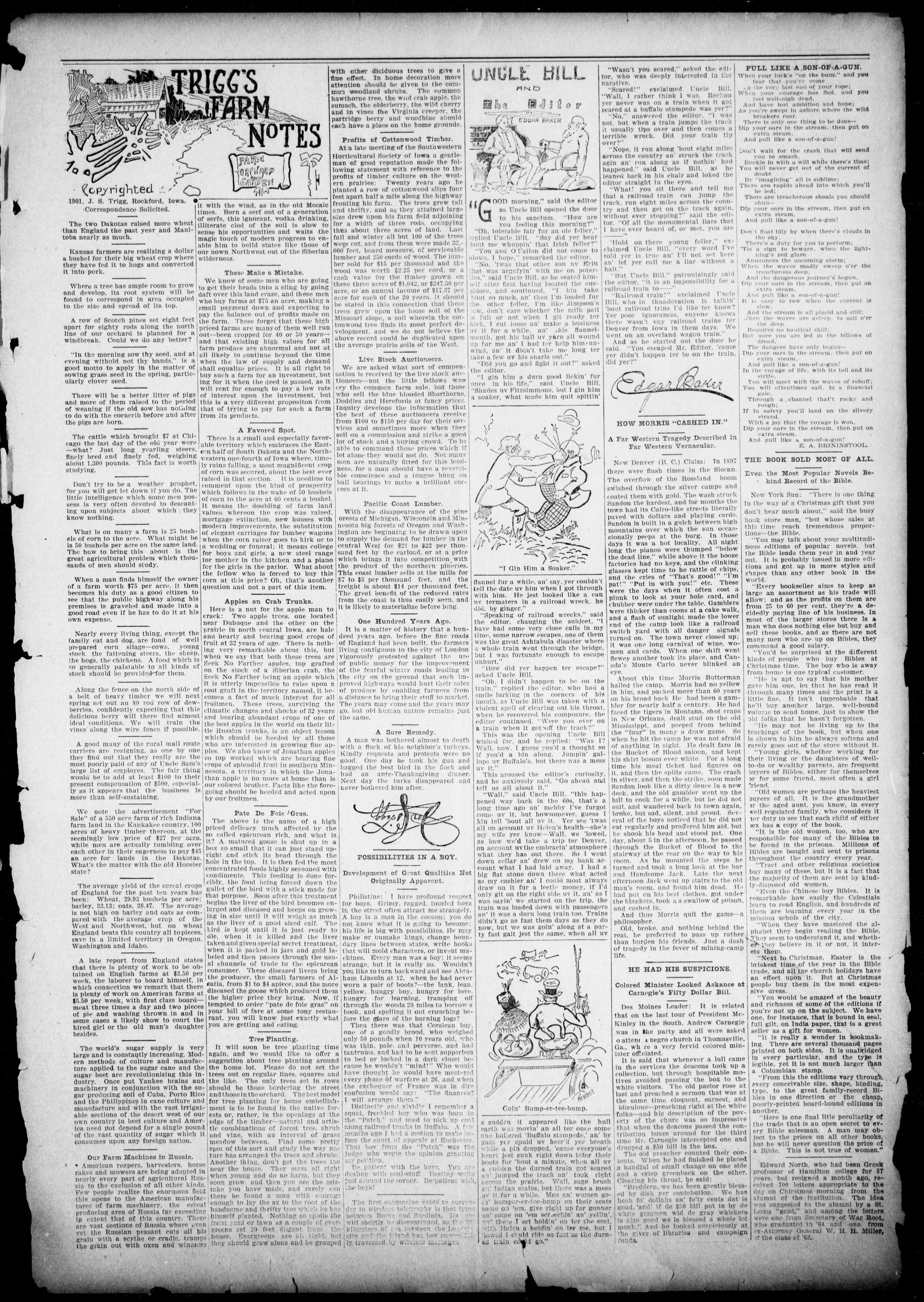
TRIGG'S
FARM
NOTES
FARM
ORCHARD
AND
GARDEN
Copyrighted
1901, J. S. Trigg, Rockford, Iowa. Correspondence Solicited.
The two Dakotas raised more wheat than England the past year and Manitoba nearly as much.
Kansas farmers are realizing a dollar a bushel for their big wheat crop where they have fed it to hogs and converted it into pork.
Where a tree has ample room to grow and develop, its root system will be found to correspond in area occupied to the size and spread of its top.
A row of Scotch pines set eight feet apart for eighty rods along the north line of our orchard is planned for a windbreak. Could we do any better?
"In the morning sow thy seed, and at evening withhold not thy hands," is a good motto to apply in the matter of sowing grass seed in the spring, particularly clover seed.
There will be a better litter of pigs and more of them raised to the period of weaning if the old sow has nothing to do with the corncrib before and after the pigs are born.
The cattle which brought $7 at Chicago the last day of the old year were—what? Just long yearling steers, finely bred and finely fed, weighing about 1,300 pounds. This fact is worth studying.
Don't try to be a weather prophet, for you will get let down if you do. The little intelligence which some men possess is very often devoted to descending upon subjects about which they know nothing.
What is on many a farm is 25 bushels of corn to the acre. What might be is 50 bushels per acre on the same land. The how to bring this about is the great agricultural problem which thousands of men should study.
When a man finds himself the owner of a farm worth $75 per acre, it then becomes his duty as a good citizen to see that the public highway along his premises is graveled and made into a good road even if he has to do it at his own expense.
Nearly every living thing, except the family cat and dog, are fond of well prepared corn silage—cows, young stock, the fattening steers, the sheep the hogs, the chickens. A food which is so generally palatable to all kinds of stock should be provided for them.
Along the fence on the north side of a belt of heavy timber we will next spring set out an 80 roo row of dewberries, confidently expecting that this delicious berry will there find almost ideal conditions. We will train the vines along the wire fence if possible.
A good many of the rural mall route carriers are resigning, as one by one they find out that they really are the most poorly paid of any of Uncle Sam's large list of employees. The fair thing would be to add at least $100 to their present compensation of $500, especially as it appears that the business is more than self-sustaining.
We note the advertisement "For Sale" of a 550 acre farm of rich Indiana farm land in the Kankakee country, 100 acres of heavy timber thereon, at the seemingly low price of $27 per acres, while men are actually tumbling over each other in their eagerness to pay $45 an acre for lands in the Dakotas. What's the matter with the old Hoosier state?
The average yield of the cereal crops of England for the past ten years has been: Wheat. 29.93 bushels per acre; barley, 33.13; oats, 38.47. The average is not high on barley and oats as compared with the average crop of the West and Northwest, but on wheat England beats this country all topples save in a limited territory in Oregon Washington and Idaho.
A late report from England states that there is plenty of work to be obtained on English farms at $3.50 per week, the laborer to board himself, in which connection we remark that there is plenty of work on American farms at $5.50 per week, with first class board—meat three times a day and two pieces of pie and washing thrown in and in some cases a likely show to court the hired girl or the old man's daughter besides.
The world's sugar supply is very large and is constantly increasing. Modern methods of culture and manufacture applied to the sugar cane and the sugar beet are revolutionizing this industry. Once put Yankee brains and machinery in conjunction with the sugar producing soil of Cuba, Porto Rico and the Philippines in cane culture and manufacture and with the vast fregitable sections of the desert west of our own country in beet culture and America need not depend for a single pound of the vast quantity of sugar which it consumes upon any foreign nation.
Our Farm Machines in Russia
- American reapers, harvesters, horse rakes and mowers are being adopted in nearly every part of agricultural Russia to the exclusion of all other kinds. Few people realize the enormous field this opens to the American manufacturer of farm machinery, the cereal producing area of Russia far exceeding in extent that of this country. There are vast sections of Russia where even yet the Russian peasant cuts all his grain with a scythe or cradle, tramps the grain out with oxen and windows
it with the wind, as in the old Mosaic times. Born a serf out of a generation of serfs, this ignorant, vodka drinking, illiterate clod of the soil is slow to sense his opportunities and waits the magic touch of modern progress to enable him to build states like those of our nown Northwest out of the Siberian wilderness.
These Make a Mistake.
We know of some men who are going to get their heads into a sling by going daft over this land craze, and these men who buy farms at $75 an acre, making a small payment down and expecting to pay the balance out of profits made on the farm. These forget that these high priced farms are many of them well run out—been cropped for 40 or 50 years—and that existing high values for all farm produce are abnormal and not at all likely to continue beyond the time when the law of supply and demand shall equalize prices. It is all right to buy such a farm for an investment, but ing for it when the deed is passed, as it will rent for enough to pay a low rate of interest upon the investment, but this is a very different proposition from that of trying to pay for such a farm from its products.
A Favored Spot.
There is a small and especially favorable territory which embraces the Eastern half of South Dakota and the Northwestern one-fourth of Iowa where, timely rains falling, a most magnificent crop of corn was secured, about the best ever raised in that section. It is needless to comment upon the kind of prosperity which follows in the wake of 50 bushels of corn to the acre at 60 cents a bushel. It means the doubling of farm land values whereon the crop was raised, mortgage extinction, new houses with modern improvements, the substitution of elegant carriages for lumber wagons when the corn raiser goes to kirk or to a wedding or funeral; it means college for boys and girls, a new steel range for mother in the kitchen and a piano for the girls in the parlor. What about the fellow who is forced to buy this corn at this price? Oh, that's another question and not a part of this item.
Apples on Crab Trunks.
Here is a nut for the apple man to crack. Two apple trees, one located near Dubuque and the other on the prairie in north central Iowa, are hare and hearty and bearing good crops of fruit at 32 years of age. There is nothing very remarkable about this, but when we say that both these trees are Seek No Farther apples, top grafted on the stock of a Siberian crab, the Seek No Farther being an apple which it is utterly impossible to raise upon a root graft in the territory named, it becomes a fact of much interest for all fruitmen. These trees, surviving the climatic changes and shocks of 32 years and bearing abundant crops of one of the best apples in the world on their little Russian trunks, is an object lesson which should be beeded by all those who are interested in growing fine apples. We also know of Jonathan apples so top worked which are bearing fine crops of splendid fruit in southern Minnesota, a territory in which the Jonathan apple is no more at home than is our colored brother. Facts like the foregoing should be beeded and acted upon by our fruitmen.
Pate De Foie / Gras
The above is the name of a high priced delicacy much affected by the so called epicurean rich, and what is it? A mature goose is shut up in a box small that it can just stand upright and stick its head through the hole in the top. It is then fed the most concentrated foods highly seasoned with condiments. This feeding is done forcibly, the food being forced down the gullet of the bird with a stick made for that purpose. Soon after this treatment begins the liver of the bird becomes enlarged and diseased and keeps on growing in size until it will weigh as much as the liver of a good sized calf. The bird is kept until it is just ready to die, when it is killed and the liver taken and given special secret treatment, when it is packed in jars and gold labeled and then passes through the usual channels of trade to the epicurean consumer. These diseased livers bring the producer, the small farmers of Algeria, from $1 to $4 apiece, and the more diseased the goose which produced them the higher price they bring. Now, if tempted to order "pate de foe gras" on your bill of fare at some tony restaurant, you will know just exactly what you are getting and eating.
Tree Planting.
It will soon be tree planting time again, and we would like to offer a suggestion about tree planting around the home lot. Please do not set the trees out on regular lines, squares and the like. The only trees set in rows should be those bordering the street and those in the orchard. The best model for tree planting for home embellishment is to be found in the native forests or, rather, in the openings at the edge of the timber—natural and artistic combinations of forest tree, shrub and vine, with an interval of grass meadow between. Find some pretty spot of this sort and study the way nature has arranged the trees and shrubs. Another thing, don't get the trees too near the house. They seem all right when young and do no harm, but they soon grow, and then you see the mistake you have made, and rarely can there be found a man with courage enough to lay the ax to the root of the handsome and thrifty tree which he has himself planted. Nothing so spells the front yard or lawn as a couple of evergreens set 29 feet diglant from the house. Evergreens are all right, but they should grow alone and be grouped
with other deciduous trees to give a fine effect. In home decoration more attention should be given to the common woodland shrubs. The common hawthorne tree, the wild crab apple, the sumach, the elderberry, the wild cherry and in vines the Virginia creeper, the partridge berry and woodbine should each have a place on the home grounds.
Profits of Cottonwood Timber.
Profits or Cottonwood Timber.
At a late meeting of the Southwestern Horticultural Society of Iowa a gentleman of good reputation made the following statement with reference to the profits of timber culture on the western prairies: Twenty years ago he planted a row of cottonwood slips four feet apart half a mile along the highway fronting his farm. The trees grew tall and thrifty, and as they attained large size drew upon his farm field adjoining for a width of three rods, occupying thus about three acres of land. Last fall and winter all but 100 of the trees weed cut, and from them were made 22,000 feet, board measure, of serviceable lumber and 250 cords of wood. The jumber sold for $15 per thousand and the wood was worth $2.25 per cord, or a cash value for the timber grown on these three acres of $1.042, or $347.50 per acre, or an annual income of $17.37 per acre for each of the 20 years. It should be stated in this connection that these trees grew upon the loose soil of the Missouri slope, a soil wherein the cottonwood tree finds its most perfect development, and we do not believe the above record could be duplicated upon the average prairie soils of the West.
Live Stock Auctioneers
We are asked what sort of compensation is received by the live stock auctioneers—not the little fellows who cry the common farm sale, but those who sell the blue blooded Shorthorns, Doddies and Herefords at fancy prices. Inquiry develops the information that the best of these auctioneers receive from $100 to $150 per day for their services and sometimes more when they sell on a commission and strike a good lot of stock and a buying crowd. To be able to command these prices which if let alone they would not do. Not many men are naturally fitted for this business, for a man should have a reversible conscience and a tongue hung on ball bearings to make a brilliant success at it.
Pacific Coast Lumber
With the disappearance of the pine forests of Michigan, Wisconsin and Minnesota big forests of Oregon and Washington are beginning to be drawn upon to supply the demand for lumber in the central West for $21 to $22 per thousand feet by the carload, or at a price which brings it into competition with the product of the northern pineries. This coast lumber sells at the mills for $7 to $8 per thousand feet, and the treight is about $14 per thousand feet. The great benefit of the reduced rates from the coast is thus easily seen, and it is likely to materialize before long.
One Hundred Years Ago.
It is a matter of history that a hundred years ago, before the fine roads of England had been built, the farmers living contiguous to the city of London vigorously protested against the use of public money for the improvement of the fearful winter roads leading to the city on the ground that such improved highways would hurt their sales of produce by enabling farmers from a distance to bring their stuff to market. The years may come and the years may go, but old human nature remains just the same.
A. Sure Remedy
A man was bothered almost to death with a flock of his neighbor's turkeys. Kindly requests and protests were no good. One day he took his gun and bagged the best bird in the flock and had an ante-Thanksgiving dinner. Next day the turks disappeared and never bothered him after.
POSSIBILITIES IN A BOY.
Development of Great Qualities Not Originally Apparent.
Philistine; I have profound respect for boys. Grimmy, ragged, touched boys in the street often attract me strangely. A boy is a man in the cocoon; you do not know what it is going to become: his life is big with possibilities. He may make or unmake kids, change boundary lines between states, write books that will mold characters, or invent machines. Every man was a boy; it seems strange, but it is really so. Wouldn't you like to turn backward and see Abraham Lincoln at 12, when he had never worn a pair of boots?—the lank, lean yellow, hungry boy, hungry for love hungry for learning, tramping off through the woods 20 miles to borrow a book, and spelling it out crouching before the share of the burning logs?
Then there was that Corsican boy, one of a goodly brood, who welged only 50 pounds when 10 years old, who was thin, pale, and perverse, and had tandrums, and had to be sent supperless to bed or locked in a dark closet because he wouldn't "mind!" Who would have thought he would have mastered every phase of warfare at 26, and when the exchequer of France was in dire confusion would say: "The finances? I will arrange them."
Distinctly and vividly I remember a squat, freckled boy who was born in the "Patch," and used to pick up coal along railroad tracks in Buffalo. A few months ago I had a motion to make before the court of appeals at Rochester. That boy from the "Patch" was the judge who wrote the opinion granting my petition.
Be patient with the boys. You are dealing with soul-stuff. Destiny waits just around the corner. Be patient with the boys!
The first submarine cable to sur-
ponder to wireless telephony is that lyning
between Rome and Sardinia. Its use
will shortly be discontinued, an the 20
kilometers of sea between the Inper-
city and the land bag has been succes-
fully traversed by wireless messages.
UNCLE BILL
AND
the Editor
BY
EDGAR BAKER
"Oh, tolerable fair fur an ole feller," replied Ucello Bill. "Say did yer hear me whuppin' that Irish feller?" "You and O'Fallon did not come to blows, I hope," remarked the editor. "No, 'twas that other son uv Erin that was argufyn' with me on poteries," said Ucello Bill, as he seated himself after first having located the cuspid, and continued, "I 'kin take bout so much, an' then I'm loaded fur the other feller, I'm like Jimpson's now, don't care whether the milk pail is full or not when I git ready ter kick, I cut loose an' make a business uv it fur a while, an' this flannel-mouth, got his ball uv yarn all wound up for me an' I had ter help him-unwind, an' it didn't take me long ter take a few uv his snarls out." "Did you go and fight it out?" asked the editor. "I gin him a durn good lick'in fur once in his life," said Ucello Bill. "Shades uv Fitzimmons, but I gin him a soaker, what made him quit spitttin'
HERBIGR
"I Gin Him a Soaker."
"I Gln Him a Soaker."
flannel fur a while, an' say, yer couldn't tell the date uv him when I got through with him. He jest looked like a can uv termaters in a railroad wreck, he did, by ginger."
"Speaking of railroad wrecks," said the editor, changing the subject, "I have had some very close calls in my time, some narrow escapes, one of them was the great Ashtabula disaster where a whole train went through the bridge, but I was fortunate enough to escape unhurt."
"How did yer happen ter escape?" asked Uncle Bill.
"Oh, I didn't happen to be on the train," replied the editor, who had a smile lurking in the corners of his mouth, as Uncle Bill was taken with a violent spell of clearing out his throat, when he recovered his composure, the editor continued. "Were you ever on a train when it got off the track?"
This was the opening Uncle Bill wished for, and he replied: "Was I? Wall, now, I guess you'd a thought so if you'd a bin along. Jumpin' gallops uv Buffalo's, but there was a mess uv it." This aroused the editor's curiosity, and he anxiously said, "Go ahead and tell us all about it."
"Wall," said Uncle Bill, "this happened way back in the 60s, that's a long time ago an' mebby I've forgot some uv it, but howsomeme, guess I knell tell 'bout all uv it. Yer see 'twas all on account uv Helen's health—she's my wife yer know—Wall, we 'lowed, as how we'd take a trip ter Denver, on account uv the embrace' atmosphere what they has out there. So I went down cellar an' drew on my bank account what I had laid away. I had a big flat stone down there what acted as my cashier an' I could most always draw on it fur a leetle money, if I'd only git on the right side uv it, an' as I was sayin' we started on the trip, the train was loaded down with passengers an' it was a durn long train too. Trains didn't go as fast them days as they do now, but we was goin' along at a purity fast galt jest the same, when all uv
Coln' Bump-er-tee-bump.
a sudden it appeared like the hull earth was movin' an all ter once some one hollered 'Buffalo stampede' an' by gum yer could uv heed' yer breath while a pin dropped, 'cause everyone's heart sunk right down inter their boots fur 'bout a minute, when all uv a sudden the durned train got scared an' jumped the track an' took right across the prairie. Wall, sage brush an' Indian scalp, but there was a mess av it fur a while. Men an' women go! bumper-er-tee-bump on their seats some on 'em, give right up fur gonner an' some on 'em screechin' an' yellin' an' there I set holdin' on ter the sent, with Helen a holdin' on ter me, but I bowed I could ride as fast as the durned train could go."
"Wasn't you scared," asked the editor, who was deeply interested in the narrative.
"Scared!" exclaimed Uncle Bill. "Wall, I rather think I was. Reckon yer never was on a train when it got scared at a buffalo stampede was yer?" "No," answered the editor. "I was not, but when a train jumps the track it usually tips over and then comes a terrible wreck. Did your train tip over?"
"Nope, it run along 'bout eight miles across the country an' crawl the track agin an' run along as if nothin' had happened," said Uncle Bill, as he leaned back in his chair and loked the editor straight in the eyes.
"What! you sit there and tell me that a railroad train can jump the track, run eight miles across the country and then get on the track again, without ever stopping?" said the editor. "Of all the monumental liars that I have ever heard of, or met, you are
"Hold on there young feller," exclaimed Uncle Bill, "every word I've told yer is true an' I'll not set here an' let yer call me a liar without a hail."
"But Uncle Bill." patronizingly said the editor, "it is an impossibility for a railroad train to——"
"Railroad train!" exclaimed Uncle Bill, who in thunderstation is talkin' 'bout railroad trins I'd like ter know? Yer poor ignoramus, anyone knows there wasn't eny railroad trains ter Denver from Iowa in them days. We went on an overland wagon train."
And as he started out the door he said, "You escaped Mr. Editor, 'cause yer didn't happen ter be on the train, did yer?"
HOW MORRIS "CASHED IN."
A Far Western Tragedy Described in Far Western Veracular.
New Denver (B. C.) Claim: In 1897 there were flush times in the Slocan. The overflow of the Rossland boom swished through the silver camps and coated them with gold. The wash struck Sandon the hardest, and for months the town had its Cairo-like streets literally paved with dollars and playing cards. Sandon is built in a gulch between high mountains over which the sun occasionally peeps at the burge. In those days it was a hot locality. All night long the pianos were thumped "below the dead line," while above it the booze factories had no keys, and the clinking glasses kept time to he rattle of chips, and the cries of "That's good!" "I'm pat!" "Put in with you!" etc. These were the days when it often cost a plunk to look at your hole card, and chubber were under the table. Gamblers were thicker than coons at a cake walk, and a flash of sunlight made the lower end of the camp look like a railroad switch yard with all danger signals turned on. The town never closed up; it was one long carnival of wine, women and cards. When one shift went flewley another took its place, and Canada's Monte Carlo never blinked an eye.
About this time Morris Butterman hailed the camp. Morris had no yellow in him, and packed more than 60 years on his broad back He had been a gambler for nearly half a century. He had faced the tigers in Montana, shot craps in New Orleans, dealt stun on the old Mississippi, and peeped from behind the "four" in many a draw game. So when he hit the camp he was not afraid of anything in sight. He dealt far in the Bucket of Blood saloon, and kept his shirt bosom ever white. For a long time his meal ticket had figures on it, and then the splits came. The crash in silver, and then the strike, soon made Sandon look like a dirty deuce in a new deck, and the gambler went up the hill to cook for a while, but he did not suit, and wandered back to town again, broke, but sad, silent, and proud. Several of the boys notified that he did not eat regularly and proffered him aid, but he shook his head and stood pat. One day, about 5 in the afternoon, he passed through the Bucket of Blood to the stairway at the rear on the way to his room. As he mounted the steps he turned and took a long look at the bar and Handsome Jack. Late the next afternoon Jack went up stairs to the old man's room, and found him dead. He had put on his best clothes, got under the blankets, took a a swallow of poison and cashed in.
And thus Morris quit the game—a philosopher.
Old, broke, and nothing behind the real, he preferred to pass up rather than burden his friends. Just a dash of tragedy in the fever of mining-camp life.
HE HAD HIS SUSPICIONS.
Colored Minister Looked Askance at Carnegie's Fifty Dollar Bill.
Des Moines Leader: It is related that on the last tour of President McKinley in the South, Andrew Carnegie was in the party and all were asked oattem negro church in Thomasville, Ga., where a very fervid colored minister officiated.
It is said that whenever a lull came in the services the deacons took up a collection, but through hospitable motives avoided passing the box to the white visitors. The old pastor rose at last and preached a sermon that was at the same time eloquent, earnest, and idiculous—preaching right at the white folks—and his description of the poverty of the chure was so impressive that when the deacons passed the contribution boxes around for the third time Mr. Carnegie intercepted one and dropped a $50 bill in the box.
The old preacher counted their contents. When he had finished he placed a handful of small change on one side and a crisp greenback on the other. Clearing his throat, he said:
"Breddern, we has been greatly blessed by dish yer contenbution. We has heath fo' dolhans an' fo'ty cents dat is good, 'and' if de $50 bill put in by de white gemmen wid de gray whiskers is also good we is blessed a whole lot month." And he looked suspiciously at the giver of libraries and campaign funds.
When your luck's "on the bum," and you fear that you've come
o the very last end of your rope;
When your courage has fled, and you feel well-night dead,
And have lost ambition and hope;
As you've stept in nashore where the wild breakers roar.
There is only one thing to be done—
Dip your oars in the stream, then put on extra steam.
And pull like a son-of-a-gun!
Don't wait for the crash that will send you to smash.
Bounce with a will while there's time;
You will never get out of the current of doubt
By "imagining" all is sublime;
There are rapids ahead into which you'll be led;
There are treacherous shoals you should shun—
Dip your oars in the stream, then put on extra steam,
And pull like a son-of-a-gun!
Don't float idly by when there's clouds in the sky.
There's a duty for you to perform;
'Tis a sign to beware, when the lightning's red glare
Announces the oncoming storm;
When the waves suddenly sweep 'oer the treacherous deep,
And the dangerous journey's begun.
Dip your oars in the stream, then put on extra steam.
And pull like a son-of-a-gun!
It is easy to row when the current is over;
And the stream is all placid and still;
When the waves are asleep, to sail 'oer the deep.
Requires no nautical skill;
Dip your ours in the stream, then put on extra steam.
And pull like a son-of-a-gun!
In the voyage of life, with its toil and its
You will meet with the waves of reburf;
You will oftentimes sail, in a financial
gate.
Through a channel that's rocky and
rough;
In if safety you'll land on the silvery
strand.
With a joy that the voyage is won.
Dip your oars in the stream, then put on
extra steam.
And pull like a son-of-a-gun!
E. A. BRINSTOOL
THE BOOK SOLD MOST OF ALL.
Even the Most Popular Novels Behind Record of the Bible.
New York Sun: "There is one thing in the way of a Christmas gift that you don't hear much about," said the busy book store man, "but whose sales at this time reach tremendous proportions—the Bible.
"You may talk about your multitudinous editions of popular novels, but the Bible leads them year in and year out. It is probably issued in more editions and got up in more styles and shapes than any other book in the world.
"Every bookseller aims to keep as large an assortment as his trade will allow; and as the profits on them are from 25 to 60 per cent, they're a decidedly paying line of his business. In most of the larger stores there is a man who does nothing else but buy and sell these books, and as there are not many men who are up on Bibles, they command a good salary.
"You'd be surprised at the different kinds of people who buy Bibles at Christmas time. The boy who is away from home is one typical customer.
"He is apt to say that his mother gave him one, but that he has read it through many times and the print is a little fine. It isn't improbable that he'll buy another large, well-bound volume to send home, just to show the old folks that he hasn't forgotten.
"He may not be living up to the teachings of the book, but when one is shown to him he always softens and rarely goes out of the store without it.
"Young girls, whether working for their living or the daughters of well-to-do or wealthy parents, are frequent buyers of Bibles, either for themselves or for some friend, most often a girl friend.
"Old women are perhaps the heaviest buyers of all. It is the grandmother or the aged aunt, you know, in every well regulated family, who considers it her duty to see that each child of either sex has a copy of the book.
"It is the old women, too, who are responsible for many of the Bibles to be found in the prisons. Millions of Bibles are bought and sent to prisons throughout the country every year.
"Tract and other religious societies buy many of these, but it is a fact that the majority of them are sent by kindly-disposed old women.
"Even the Chinese buy Bibles. It is remarkable how easily the Celestials learn to read English, and hundreds of them are learning every year in the mission schools of the city.
"When they have mastered the alphabet they begin reading the Bible. They seem to understand it, and whether they believe in it or not, it interests them.
"Next to Christmas, Easter is the briskest time of the year in the Bible trade, and all the church holidays have an effect upon it. But at Christmas people buy them in the most expensive dress.
"You would be amazed at the beauty and richness of some of the editions if you're not up on the subject. We have one, for instance, that is bound in seal, full gilt, on India paper, that is a great seller as a gift for women.
"It is really a wonder in bookmaking. There are several thousand pages printed on both sides. It is unabridged in every particular, and the type is legible, yet it is not much larger than a Columbian stamp.
"From this the editions vary through every conceivable size, shape, binding, type, to the great family-record Bibles in one direction or the cheap, poorly-printered board-bound editions in another.
"Here is one final little peculiarity of the trade that is an open secret to every Bible salesman. A man may object to the prices on all other books, but he will never question the price of a Bible. This is not true of woman."
Edward North, who had been Greek professor of Hamilton college for 57 years, but resigned a month ago, received 700 letters appropriate to the day on Christmas morning from the alumni of the institution. The idea was suggested to the alumit by a St. Louis "grad," and among the letters were one from Secretary of War Root, who graduated in '64, and one from ex-Attorney General W. H. H. Miller, of the class of '62.
The Professional World
TERMS OF SUBSCRIPTION.
One Year in Advance - - - $1.50
Six Months in Advance - - 1.00
Three Months in Advance - .50
Single Copies - - .05
Special rates of $1.00 per year to ministers.
Advertising Rates on Application.
Job Work of all Kinds Solicited.
Published Every Friday.
Entered at the postoffice at Colum-
umbia, Mo., as second class matter,
Jan. 15, 1902.
The negroes of Arkansas are wide awake on the Louisiana purchase exposition question. Missouri negroes should not be behind any state in the union in the effort to show the progress of the negro race at the coming World's Fair.
In another column is fround a most interesting article from the pen of Rev. G. H. McDaniel, president of Ambidexter Institute, of Springfield, Ill. It is a logical discourse on the future of the negro and should be read by all.
Carrington's Methods.
To the Editor of the Globe-Democrat.
St. Louis, Mo., Feb. 1.—Speaking of State Superintendent Carrington's efforts to gather the school teachers of Missouri into the democratic camp I want to cite you to two instances which bear out your statement. 1. Why did Carrington have President Howe put out of the Warrensburg Normal school? 2. Why has he put seven or eight men (white), all democrats in Lincoln Institute, the negro state normal school? 3. Why has he had recently elected to the presidency of that school a relative of Peter H. Clark, of St. Louis, the acknowledged father of negro democracy in the United States! A PATRON.
Evidently "Patron" needs to be informed concerning Lincoln Institute. The white men in that institution were not "put in" by Mr. Carrington but were elected by a Board of Regents of which Mr. Carrington is an ex-officio member. As to the election of Mr. Clark the board could not have made a better selection and we are certain that political influence did not control his election.
Have your watch repaired at Gilman & Dorsevs.
ROCHEPORT DEMOCRAT ITEMS
Mr. O. C. Roby bought 120 head of feeding cattle in Kansas City some days since.
A baby boy was born to the wife of Mr. Thos. Pipes, of near Rocheport, Sunday night.
Prof. Jesse Geery, of Columbia, is here on a visit to his family. The Professor says there are more pretty ladies and handsome men down at the county seat than in any other town in the state.
Rocheport can boast of the oldest mail carrier in the state. Uncle Jim Nichols, who carries the mail between Rocheport and Fayette, making daily round trips of thirty miles, is 78 years of age, weighs 230 pounds, and says he'll wrestle with any farmer along his route for money, cord-wood or whisky.
JURIES MUST FIX PUNISHMENT
Jefferson City, Mo.,Jan. 24.—In an opinion filled in the Supreme Court, Judge Sherwood yesterday declared that section of the statutes which permits Judges in the Circuit Courts to assess punishments in cases where the juries do not fix the punishments in their verdict, unconstitutional.
Judge Gantt dissented and the case was transferred to court in banc for further hearing.
See 10c ginghams at Hubbell's dry goods store.
A Tribute of Respect.
"Ah! rest the now; for rest is sweet
To weary hands and way-worn feet.
God's hand' is laid above thy heart.
And softly all its cares depart.
God looks upon thee with His smiles
That lights the path was dim ere
while—
God gives, who knoweth what is best.
The tired body easeful rest.
No trouble mars thy placid brow, Nor any pain. Ah, rest the now." Rev. T. Jehoy Marsh, our brother and co-worker in the Masters vineyard is no more. It would be simply stating a truth to all familiar with the facts to say that this man of God had hosts of friends. Wherever he lived and whatever position he occupied he was loved and honored, and the better he was known the more he was loved and honored. He had the happy art of making friends and holding them. He was patient, gentle, firm, and consciences to the last degree. In his death which occurred on the
REV. T. JEHOY MARSH.
evening of the 28th of January his church has lost one of its most eminent ministers and we, his coworkers, a beloved brother. He left us when he might well have anticipated added years of usefulness. Not by wasting and painful disease did he reach the end of his journey but without a word of warning he passed to the beyond. His was a noble form and commanding presence. His features were impressive and harmonious. When Bro. Marsh passed away from earth he found a welcome to the company of the redeemed that must have thrilled his being with most aesthetic joy.
While we sympathize most tenderly with the bereaved family and express to them the assurance of our prayers, let us renew our consecration to the service of God and the church, and emulate the good example of our departed brother whom we hope to meet in the better land and in the presence of Him whom we are and whom we serve.
P. C. CREWS,
J. ARLINGTON GRANT,
His Brother Ministers.
Finest assortment of jewelry at Gilman & Dorsey's drug store.
IT'S A MISTAKE.
To chide a child in the presence of strangers.
To encourage children to be precocious in company.
To permit your daughter to use the slang of the street.
To try to be witty at the expense of some one's feelings.
To give to boys in their teens the license of men of middle age.
To tell your wife foolish stories about your business shrewdness.
To let your wife feel that you have no confidence in her judgment.
to be too exacting in your demands as to where your husband goes.
Buy your dress goods at Hubbell's dry goods store.
The Richmond (Kentucky) Register, says there is a growing sentiment in that state in favor of removing the Capital from Frankfort to a more accessible City. Removalists declare that "you can't get in or out of the place, without climbing a mountain, crossing a bridge, or going through a hole in the ground." The Register wants the capital removed to Lexington, the Queen of the Blue Grass.
City Notes.
Mrs. P. Crews is on the sick list.
Buy your meats, oysters, lard, and game at O. E. Rader's new meat market.
Miss Lucile Smith is on the sick list.
C. B. Miller is having a great clearing sale on shoes of all kinds.
The Columbia colored band is preparing to have an entertainment.
Special prices on muslin underwear at Hubbell's.
Most complete line of carpets, oilcloths and mattings at R. F. Rogers'.
Editor L. K. Davis, of the Commercial, spent Tuesday and Wednesday in Hartsburg.
Hogs heads are 4 cent per pound at O. E. Rader's new meat market.
Mr. Bart Akers is out after several days' confinement.
See the children's rubbess only 10 cents per at C. B. Miller's.
Dr. Anna B. Marsh returned Sunday from Nashville, Tenn., where she accompanied the remains of her husband.
Just received a new and complete line of laces, embroidery and white goods at R. F. Rogers'.
Buy your toilet articles at Gilman & Dorsey's drug-store.
Mr. Howard Turner of Deer Park, who was reported dead several days ago, is rapidly improving.
C. B. Miller's is the place to buy your boots, shoes and rubbers.
Mr. Beverly Chapman is still confined to his room with heart trouble.
Have your prescriptions filled at Gilman & Dorsey's.
Just received a new and complete line of table linen and napkins at R. F. Roger's dry goods store.
Miss America Hall has returned from a visit to her sister, Mrs. Howard Turner, of Deer Park.
Best meat for your money at O. E. Rader's.
Miss Estella Diggs is ill of pneumonia.
Buy laces and embroideries at Hubbell's dry goods store.
R. F. Roger's headquarters for Standard patterns.
Memorial services will be held at the Second Baptist church Sunday evening, Feb. 16.
Bargains in shoes as long as they last at C. B. Miller's clearing sale.
Cloaks, capes and furs at Hubbell's dry goods store.
Mr. Fred Williams, of Macon, passed through Columbia, Wednesday enroute to McBaine to visit relatives. While here he subscribed for the Professional World.
Don't forget that O. E. Rader has recently opened a new meat market two doors north of the Statesman office and keeps the most complete line of fresh and salt meats of all kinds ever had in the city.
Have your watch repaired at Hopper's drug store.
Go to Gilman & Dorsey's for drugs and toilet articles.
SAYINGS OF THE CHILDREN
Books of children, for children, and about children are being added largely to our literature every year. Some of them are very entertaining; but perhaps if some child should write a book, it would be more entertaining in unintentional humor than anything written by grown up people.
A member of the English Parliament, who had once been a schoolteacher, not long ago addressed an audience in London, and told some old as well as new stories of the sayings and compositions of children. Some of them are worth quoting.
"What is a vacuum?" was asked one little Britisher. His answer
was: "A vacuum is nothing shut up in a box." That was not bad.
Asked to tell what a fort and fortress are, another wisely said: "A fort is a place for soldiers to live in. A fortress is where they put their wives."
One little boy did not think what a reflection he was making on Anne of Denmark when he sent in this sentence of a composition: "King James I. was very unclean in his habits; he never washed his hands, and married Anne of Denmark."
One lass must have been able to read the signs about parks, for when defining grass it was in these words: "Grass is what you have to keep off."
A bishop gave a prize book called "Our Feathered Friends," of course a work on birds. He was amused after asking a girl who our feathered friends are and heard her reply: "Angels." She had gotten this idea from hearing reference to angels' wings, we suppose.
A meeting was held for children in London on Christmas. Before going away the minister said: "Now, boys, mind you don't get into mischief or trouble between now and next Christmas." The boys wanted to be polite—we are quite sure that did not doubt the piety of the good preacher—but they doffed their hats and cried: "Same to you sir!"—Ex.
MISSOURI AN EMPIRE.
Resources as shown at Charleston (S. C.) Exposition.
Mr. J. E. Crumbaugh, who has charge of the Missouri Agricultural exhibit at the Charleston (S. C.) Exposition, sends the Statesman a copy of the News and Courier, of that city, which comments thus on Imperial Missouri:
The Missouri commissioners yesterday perfected and completed the installation of their exhibits at the Exposition. The results are a series of marvellously beautiful creations, which are attracting the continuous and admiring attention of visitors. Artistic taste has been displayed in the arrangement of the fine specimens of Missouri's resources and every detail of the installation has been marked by skill and good judgment. A well known South Carolinian, after carefully inspecting the Missouri exhibits yesterday, said: "Several friends of mine had about made up their minds to migrate to Texas, but if they could see these wonderful specimens of what the people produce in Missouri I am sure they would go there instead."
The Missouri commission has brought to Charleston a display which will do much to emphasize the fact that Missouri is the empire State of the West, not only in the immediate products of the soil, but in manufactures of all kinds and in commercial activity. The commissioners say that a large number of Missourians will visit Charleston during the Exposition and add their encouragement and support to the magnificent enterprise which this city has inaugurated. The Missouri Press' Association has under consideration a special invitation to visit the Exposition early in February. It is hoped the editors will come here.
AGRICULTURE
The Missouri exhibit of agriculture bespeaks the rich abundance of that famous Western State. It is presented, too, in an artistic and beautiful setting. The colors of the decorations are tuscan red, gold, dark-green, which give picturesque effect to the finest yellow, white and red corn ever seen in this section. It is evident the Missourians desire to make special emphasis of their corn, for which they received the only gold medal given by the Pan-American Exposition on that product.
In the centre of the exhibit is a circular bin of corn, surmounted by a white and black pig. At the entrance of the exhibit is an octagonal pagoda, with eight panels of French plate glass, behind which roats shelled corn of different colors
and grades, supplemented by wheat, oats and rye. In the centre panel is a striking picture of Governor A. M. Dockery. Upon semicircular shelves at the end of the exhibit may be seen tier upon tier of grain seeds in fine glass jars—nearly every variety of farm seed known to Missouri soil. In an alcove at the front is Missouri's fine wool exhibit, which received a gold medal at the Pan-American over all competitors. This exhibit is in glass boxes and was collected by Prof Waters, of the State Agricultural College, from past spring's shearing. There are nineteen of these boxes and those interested in fine wool should not fail to see them. Adjoining the wool exhibit is a cabinet of specimens of Missouri cotton, and it is an interesting fact that Missouri was the first State to make a display of cotton in the Cotton palace. In former times Southeastern Missouri produced much cotton, but the formers found other products more profitable and certain. Still the State has yet an annual output of about 50,000 bales. Fine tobacco is another product that will be exhibited later on. The Missouri agriculture exhibit is further enriched by small bales of last fall's growth of hay and with specimens of tallest grasses that are so characteristic of the fruitful soil of Missouri. But, after all, it is the magnificent display of corn in a rich setting of color and decoration that renders this exhibit of such peculiar beauty and attractiveness.
As a final bit of showiness, and perhaps the first to be seen, is a splendid effect in decoration enclosing on one of the largest posts at the exhibit entrance a copy of the last proclamation issued by President McKinley, in which he called upon the nations of the earth to join in the celebration of the centennial of the Louisiana Purchase and the International Exposition that will be held in St. Louis. Missouri, in 1903. Above the proclamation is the name "St Louis" in black letters on a green back ground and beneath are the figures '1903" similarly displayed. It is a very effective notification of a coming great event.
On each of the posts and panels of the exhibit is a fine showing of grasses, accompanied by a richly formed pocket containing a half dozen ears of Missouri corn. Altogether it is a very handsome display.
This exhibit is directly in charge of the Hon. E. S. Garver, who is president of the Missouri commission and has been several times a member of the Legislature of his State. He is the editor of a newspaper at Grant City, Worth County. To his efficient superintendent, Mr. J. E. Crumbaugh, is due the credit for most of the decorative work of the exhibit.
Notice.
All person who are interested in the success of The Professional World will show the same by patronizing the business men who advertise in these columns.
THE DREAMER
The peculiar phases of human life, impress themselves almost painfully upon the mind in the midst of this intensely, practical age. As we go about our daily tasks, bearing our burdens and fighting our battles many of them, common place enough, yet the inner self exerts itself and wings its flight to that ethereal world, where our imaginations and brain pictures assail the present and show us the full conviction of our duality. Yet this very dream life saves us from desperation and often dispair.
Does it not color every hill-top with roseate hue and irradiate the common place present with bright hopes of a happier future? What miserable beings we would be without our day dreams—even though most of them are illusionary and fruitless; still they serve to guide and inspire us to nobler efforts and greater hopefulness What a misnomer, yet for all of that, only dreams! Sometimes they
Lodge and Church Directory.
LODGE.
S. M. T.—Mrs. Irena Akers,
W. P.; Mrs. Lizzie Williams,
W. S.
Meeting first Monday in each month at 3 p. m.
Crispus Attucks Lodge,No. 62. Meetings 2nd and 4th Tuesdays in each month. Visiting members cordially invited. Caleb Hall, W. M. A. M. Schweich, W. S.
K. P. Acme Lodge, No. 24. Meetings first and fourth Fridays in each month. W. H. Turner, C. C. and D. D. G. C. W. W. Lampkins, M. F.
SECOND CHRISTIAN CHURCH.
Rev. J. B. Parsons, pastor
Preaching Sundays 11 a. m.
and 7:30 p. m.
Prayer meeting Wednesdays 7:30 p. m.
Everybody cordially invited to attend.
A. M. E. CHURCH.
Rev. P. C. Crews, Pastor.
Preaching Sundays 11 a.
m.; 7:30 p. m.
Sunday school 2:30 p. m.
Prayer meeting every
Wednesday eve, at 8:30; every
body invited to attend.
M. E. CHURCH.
Rev. J. Arlington Grant, pastor.
Preaching Sundays 11, a. m. and 7:30 p. m.
Sunday school, 9:30 a. m.
Prayer meeting Wednesdays 7:30 to 8:30; all are made welcome.
are golden dreams of power and again romantic and tender dreams of love; yet they exert great power for good undoubtedly. I plead for the dreamers—he who dreams by day—for'tis thus that the common place and dreary in life is redeemed.
The effulgence of all genius, what is it but the blossom put forth by a dreamer? By it the world is made glad and joyous with the hope which promises an age when the brightest of all dreams shall have come true.
J. A. K.
CHANGE IN DISCIPLINE
Brutal Punishments Inflicted in Navy Only Forty Years Ago
Only Forty Years Ago.
"John Murphy, seaman, disobedience of orders; mutinous conduct. Guilty of charges and specifications. Sentenced by the fourt to forfeit all pay and subsistence now due him, to be reduced to the rate of third-class boy, to suffer one month's solitary confinement in double iron on bread and water, then to be branded with the letter M one inch long on the right shoulder, then to carry a six-inch hollow shot attached by a chain to his waist for the remainder of his term of enlistment (during this time he will be confined to small limits on board ship); to be placed in solitary confinement in any navy yard at which the United States ship Portsmouth may arrive when her cruise is at an end. At the end of his term of enlistment to be dishonorably discharged from the naval service, and a descriptive list of his person and the marks thereon to be sent to every naval rendezvous in the United States." This was the sentence imposed upon a seaman in the American navy in 1860. The lash had been abolished, but the branding iron was still in force, and discipline was only maintained by the most brutal punishments. An examination of the court-martial records of the first quarter of the last century shows that the bo'sun's mates had no sinecures on some ships; on many vessels the sound of the cat falling on bared backs was heard continuously, and justice was never tempered with mercy. It appears almost incredible that a man could receive 300 lashes from the cat-o-nine tails and survive the awful punishment, yet that it was not an exceptional sentence is shown by the frequency with which it was inflicted.—A. Maurice Low in Harper's Weekly.
Make Them Short.
Resolutions, cards of thanks, and lengthy obituary articles when sent in should be accompanied by enough cash to cover cost of setting in type. We never charge for merely announcing deaths or any other news. But anything outside of news should be paid for.