The Professional World
Friday, February 14, 1902
Columbia, Missouri
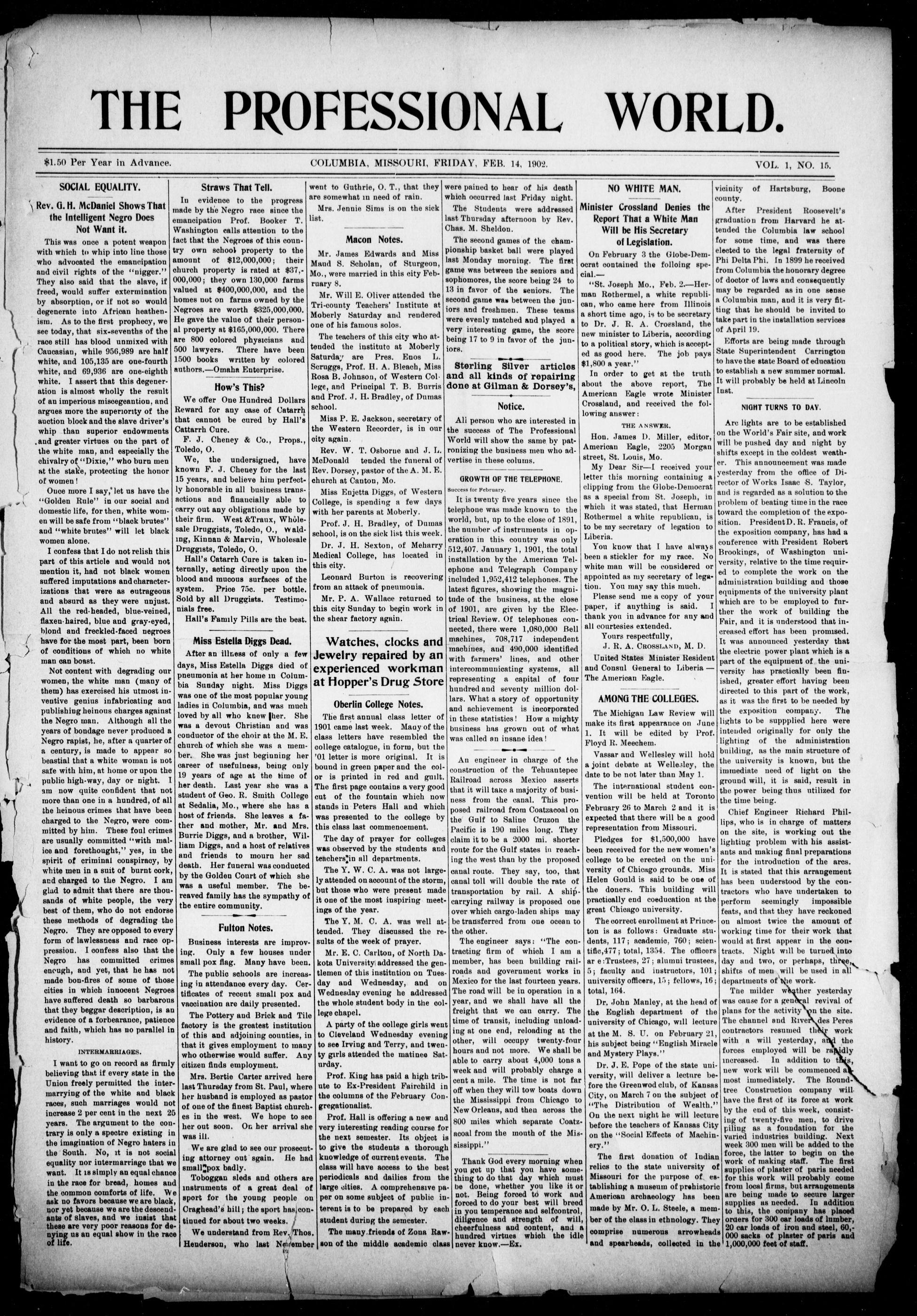
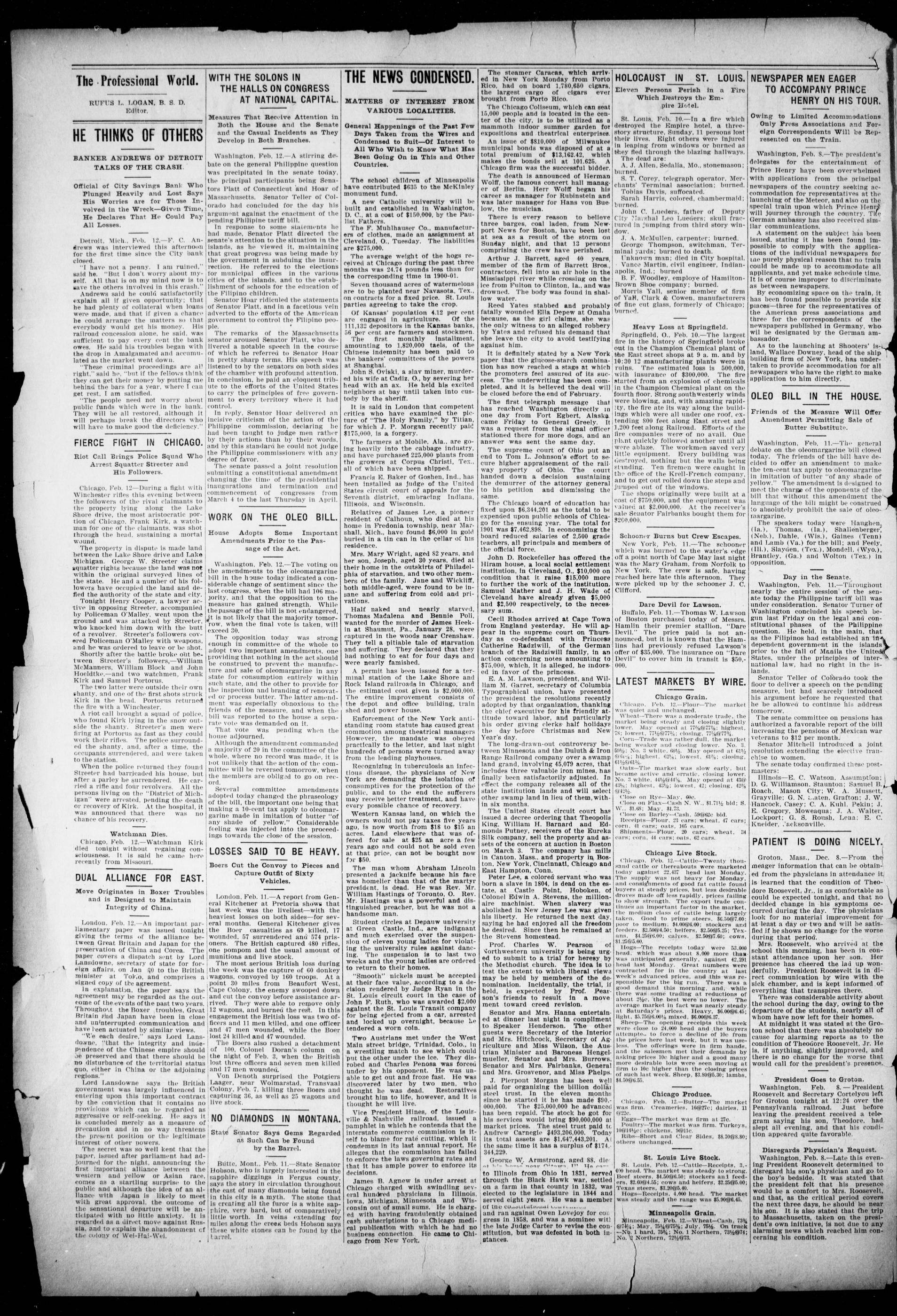
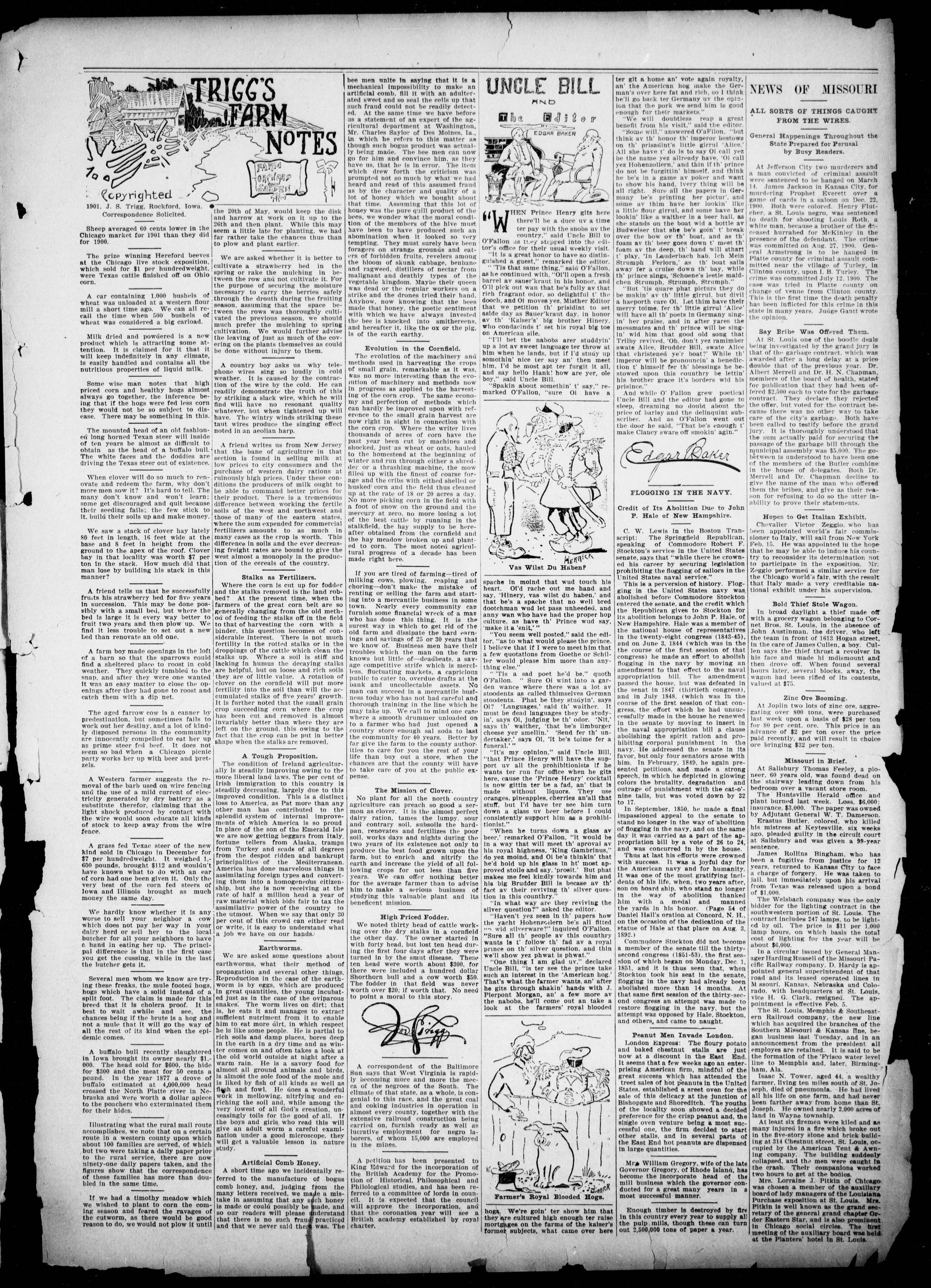
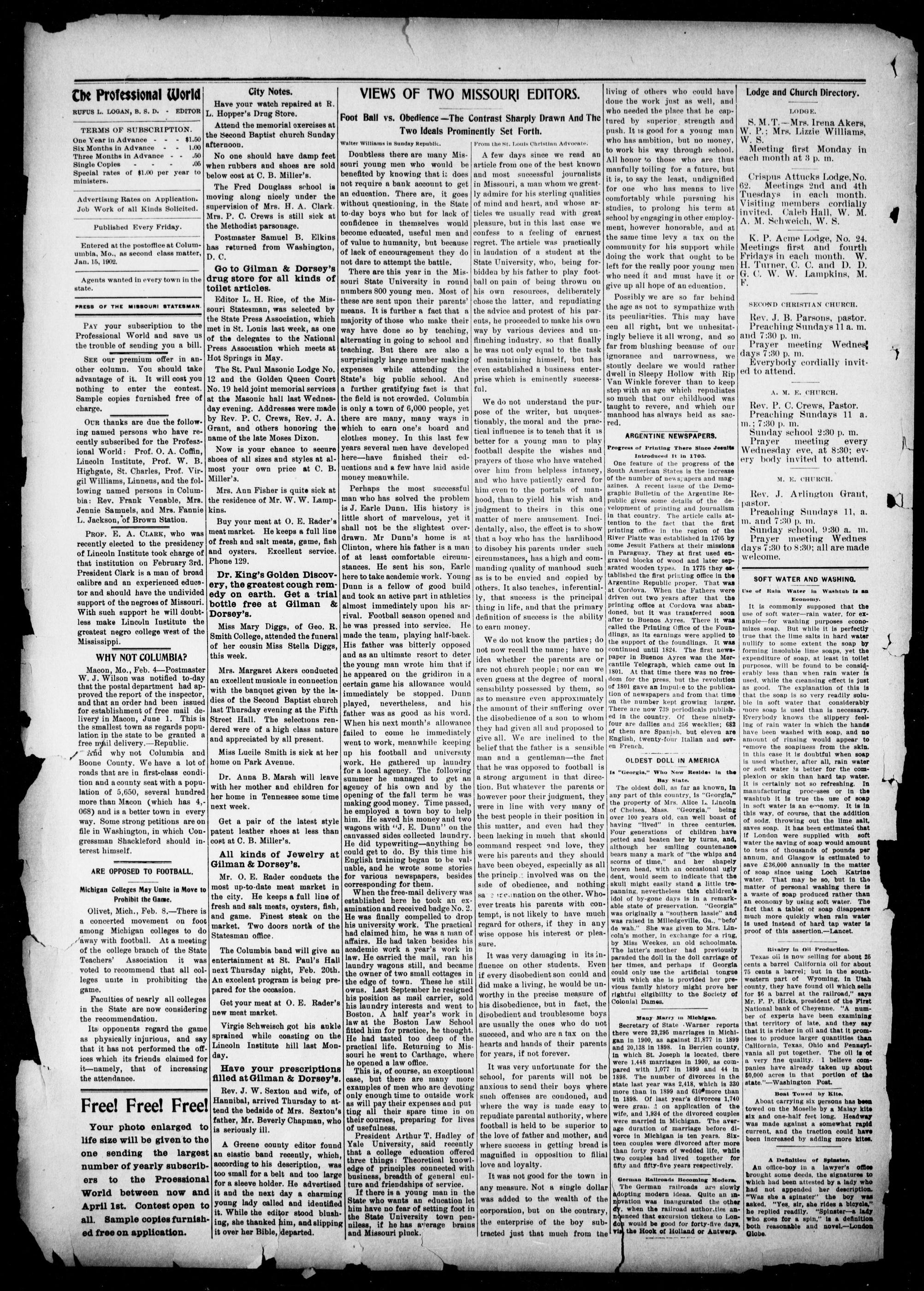
Page text (machine-generated)
THE PROFESSIONAL WORLD.
$1.50 Per Year in Advance. SOCIAL EQUALITY.
Rev. G. H. McDaniel Shows That the Intelligent Negro Does Not Want it.
This was once a potent weapon with which to whip into line those who advocated the emancipation and civil rights of the "nigger." They also said that the slave, if freed, would suffer extermination by absorption, or if not so would degenerate into African heathenism. As to the first prophecy, we see today, that six-sevenths of the race still has blood unmixed with Caucasian, while 956,989 are half white, and 105,135 are one-fourth white, and 69,996 are one-eighth white. I assert that this degeneration is almost wholly the result of an imperious miscegeantion, and argues more the superiority of the auction block and the slave driver's whip than superior endowments and greater virtues on the part of the white man, and especially the chivalry of "Dixie," who burn men at the stake, protecting the honor of women!
Once more I say, let us have the "Golden Rule" in our social and domestic life, for then, white women will be safe from "black brutes" and "white brutes" will let black women alone.
I confess that I do not relish this part of this article and would not mention it, had not black women suffered imputations and characterizations that were as eutrageous and absurd as they were unjust.
All the red-headed, blue-veined, flaxen-haired, blue and gray-eyed, blond and freckled-faced negroes have for the most part, been born of conditions of which no white man can boast.
Not content with degrading our women, the white man (many of them) has exercised his utmost inventive genius infabricating and publishing heinous charges against the Negro man. Although all the years of bondage never produced a Negro rapist, he, after a quarter of a century, is made to appear so beastial that a white woman is not safe with him, at home or upon the public high-way, day or night. I am now quite confident that not more than one in a hundred, of all the heinous crimes that have been charged to the Negro, were committed by him. These foul crimes are usually committed "with malice and forethought," yes, in the spirit of criminal conspiracy, by white men in a suit of burnt cork, and charged to the Negro. I am glad to admit that there are thousands of white people, the very best of them, who do not endorse these methods of degrading the Negro. They are opposed to every form of lawlessness and race oppression. I confess also that the Negro has committed crimes enough, and yet, that he has not made bon-fires of some of those cities in which innocent Negroes have suffered death so barbarous that they beggar description, is an evidence of a forbearance, patience and faith, which has no parallel in history.
INTERMARRIAGES.
I want to go on record as firmly believing that if every state in the Union freely permitted the intermarrying of the white and black races, such marriages would not increase 2 per cent in the next 25 years. The argument to the contrary is only a spectre existing in the imagination of Negro haters in the South. No, it is not social equality nor intermarriage that we want. It is simply an equal chance in the race for bread, homes and the common comforts of life. We ask no favors because we are black, nor yet because we are the descendants of slaves, and we insist that these are very poor reasons for denying us an equal show in the race of life.
Straws That Tell.
In evidence to the progress made by the Negro race since the emancipation Prof. Booker T. Washington calls attention to the fact that the Negroes of this country own school property to the amount of $12,000,000; their church property is rated at $37,-000,000; they own 130,000 farms valued at $400,000,000, and the homes not on farms owned by the Negroes are worth $325,000,000. He gave the value of their personal property at $165,000,000. There are 800 colored physicians and 500 lawyers. There have been 1500 books written by colored authors.—Omaha Enterprise.
How's This?
We offer One Hundred Dollars Reward for any case of Catarrh that cannot be cured by Hall's Cattarrh Cure.
F. J. Cheney & Co., Props., Toledo, O.
We, the undersigned, have known F. J. Cheney for the last 15 years, and believe him perfectly honorable in all business transactions and financially able to carry out any obligations made by their firm. West & Traux, Wholesale Druggists, Toledo, O., walding, Kinnan & Marvin, Wholesale Druggists, Toledo, O.
Hall's Catarrh Cure is taken internally, acting directly upon the blood and mucous surfaces of the system. Price 75c. per bottle. Sold by all Druggists. Testimonials free. Hall's Family Pills are the best.
Miss Estella Diggs Dead.
After an illness of only a few days, Miss Estella Diggs died of pneumonia at her home in Columbia Sunday night. Miss Diggs was one of the most popular young ladies in Columbia, and was much loved by all who knew her. She was a devout Christian and was conductor of the choir at the M. E. church of which she was a member. She was just beginning her career of usefulness, being only 19 years of age at the time of her death. Last year she was a student of Geo. R. Smith College at Sedalia, Mo., where she has a host of friends. She leaves a father and mother, Mr. and Mrs. Burrie Diggs, and a brother, William Diggs, and a host of relatives and friends to mourn her sad death. Her funeral was conducted by the Golden Court of which she was a useful member. The bereaved family has the sympathy of the entire community.
Fulton Notes.
Business interests are improving. Only a few houses under small pox flag. Many have been. The public schools are increasing in attendance every day. Certificates of recent small pox and vaccination are daily presented. The Pottery and Brick and Tile factory is the greatest institution of this and adjoining counties, in that it gives employment to many who otherwise would suffer. Any citizen finds employment.
Mrs. Bertie Carter arrived here last Thursday from St. Paul, where her husband is employed as pastor of one of the finest Baptist churches in the west. We hope to see her out soon. On her arrival she was ill.
We are glad to see our prosecuting attorney out again. He had small-pox badly.
Toboggan sleds and others are instruments of a great deal of sport for the young people on Craghead's hill; the sport has continued for about two weeks.
We understand from Rev. Thos. Henderson, who last November
COLUMBIA, MISSOURI, FRIDAY, FEB. 14, 1902.
went to Guthrie, O. T., that they are somewhat in need of rain.
Mrs. Jennie Sims is on the sick list.
were pained to hear of his which occurred last Friday.
The Students were ad last Thursday afternoon by
Macon Notes.
Mr. James Edwards and Miss Maud S. Scholan, of Sturgeon, Mo., were married in this city February 8.
Mr. Will E. Oliver attended the Tri-county Teachers' Institute at Moberly Saturday and rendered one of his famous solos.
The teachers of this city who attended the institute at Moberly Saturday are Pres. Enos L. Scruggs, Prof. H. A. Bleach, Miss Rosa B. Johnson, of Western College, and Principal T. B. Burris and Prof. J. H. Bradley, of Dumas school.
Miss P. E. Jackson, secretary of the Western Recorder, is in our city again.
Rev. W. T. Osborne and J. L. McDonald tended the funeral of Rev. Dorsey, pastor of the A. M. E. church at Canton, Mo.
Miss Enjetta Diggs, of Western College, is spending a few days with her parents at Moberly.
Prof. J. H. Bradley, of Dumas school, is on the sick list this week.
Dr. J. H. Sexton, of Meharry Medical College, has located in this city.
Leonard Burton is recovering from an attack of pneumonia.
Mr. P. A. Wallace returned to this city Sunday to begin work in the shear factory again.
Watches, clocks and Jewelry repaired by an experienced workman at Hopper's Drug Store
Oberlin College Notes.
The first annual class letter of 1901 came last week. Many of the class letters have resembled the college catalogue, in form, but the '01 letter is more original. It is bound in green paper and the color is printed in red and guilt. The first page contains a very good cut of the fountain which now stands in Peters Hall and which was presented to the college by this class last commencement.
The day of prayer for colleges was observed by the students and teachers in all departments.
The Y. W. C. A. was not largely attended on account of the storm, but those who were present made it one of the most inspiring meetings of the year.
The Y. M. C. A. was well attended. They discussed the results of the week of prayer.
Mr. E. C. Carlton, of North Dakota University addressed the gentlemen of this institution on Tuesday and Wednesday, and on Wednesday evening he addressed the whole student body in the college chapel.
A party of the college girls went to Cleveland Wednesday evening to see Irving and Terry, and twenty girls attended the matinee Saturday. Prof. King has paid a high tribute to Ex-President Fairchild in the columns of the February Congregationalist.
Prof. Hall is offering a new and very interesting reading course for the next semester. Its object is to give the students a thorough knowledge of current events. The class will have access to the best periodicals and dailies from the large cities. A comprehensive paper on some subject of public interest is to be prepared by each student during the semester. The many friends of Zona Rawson of the middle academic class
were pained to hear of his death which occurred last Friday night. The Students were addressed last Thursday afternoon by Rev. Chas. M. Sheldon. The second games of the championship basket ball were played last Monday morning. The first game was between the seniors and sophomores, the score being 24 to 13 in favor of the seniors. The second game was between the juniors and freshmen. These teams were evenly matched and played a very interesting game, the score being 17 to 9 in favor of the juniors.
Sterling Silver articles and all kinds of repairing done at Gilman & Dorsey's,
Notice.
All person who are interested in the success of The Professional World will show the same by patronizing the business men who advertise in these columns.
GROWTH OF THE TELEPHONE
Success for February.
It is twenty five years since the telephone was made known to the world, but, up to the close of 1891, the number of instruments in operation in this country was only 512,407. January 1, 1901, the total installation by the American Telephone and Telegraph Company included 1,952,412 telephones. The latest figures, showing the magnitude of the business, at the close of 1901, are given by the Electrical Review. Of telephones connected, there were 1,080,000 Bell machines, 708,717 independent machines, and 490,000 identified with farmers' lines, and other intercommunicating systems, all representing a capital of four hundred and seventy million dollars. What a story of opportunity and achievement is incorporated in these statistics! How a mighty business has grown out of what was called an insane idea!
---
An engineer in charge of the construction of the Tehuantepec Railroad across Mexico asserts that it will take a majority of business from the canal. This proposed railroad from Coatzacoal on the Gulf to Saline Cruzon the Pacific is 190 miles long. They claim it to be a 2000 mi. shorter route for the Gulf states in reaching the west than by the proposed canal route. They say, too, that canal toll will double the rate of transportation by rail. A shipcarrying railway is proposed one over which cargo-laden ships may be transferred from one ocean to the other.
The engineer says: "The contracting firm of which I am a member, has been building railroads and government works in Mexico for the last fourteen years. The road will be in operation in a year, and we shall have all the freight that we can carry. The time of transit, including unloading at one end, reloading at the other, will occupy twenty-four hours and not more. We shall be able to carry about 4,000 tons a week and will probably charge a cent a mile. The time is not far off when they will tow boats down the Mississippi from Chicago to New Orleans, and then across the 800 miles which separate Coatzacoal from the mouth of the Mississippi."
Thank God every morning when you get up that you have something to do that day which must be done, whether you like it or not. Being forced to work and forced to do your best will breed in you temperance and selfcontrol, diligence and strength of will, cheerfulness and content, and a hundred virtues which the idle never know.—Ex.
NO WHITE MAN.
Minister Crossland Denies the Report That a White Man Will be His Secretary of Legislation.
On February 3 the Globe-Democrat contained the following special.
"St. Joseph Mo., Feb. 2.—Herman Rothermel, a white republican, who came here from Illinois a short time ago, is to be secretary to Dr. J. R. A. Crossland, the new minister to Liberia, according to a political story, which is accepted as good here. The job pays $1,800 a year."
In order to get at the truth about the above report, The American Eagle wrote Minister Crossland, and received the following answer:
THE ANSWER.
Hon. James D. Miller, editor, American Eagle, 2205 Morgan street, St. Louis, Mo.
My Dear Sir—I received your letter this morning containing a clipping from the Globe-Democrat as a special from St. Joseph, in which it was stated, that Herman Rothermel a white republican, is to be my secretary of legation to Liberia.
You know that I have always been a stickler for my race. No white man will be considered or appointed as my secretary of legation. You may say this much.
Please send me a copy of your paper, if anything is said. I thank you in advance for any and all courtesies extended.
Yours respectfully,
J. R. A. CROSSLAND, M. D.
United States Minister Resident and Consul General to Liberia — The American Eagle.
AMONG THE COLLEGES.
The Michigan Law Review will make its first appearance on June 1. It will be edited by Prof. Floyd R. Meechem. Vassar and Wellesley will hold a joint debate at Wellesley, the date to be not later than May 1. The international student convention will be held at Toronto February 26 to March 2 and it is expected that there will be a good representation from Missouri.
Pledges for $1,500,000 have been received for the new women's college to be erected on the university of Chicago grounds. Miss Helen Gould is said to be one of the donors. This building will practically end coeducation at the great Chicago university.
The correct enrollment at Princeton is as follows: Graduate students, 117; academic, 760; scientific, 477; total, 1354. The officers ar e: Trustees, 27; alumni trustees, 5; faculty and instructors, 101; university officers, 15; fellows, 16; total, 164.
Dr. John Manley, at the head of the English department of the university of Chicago, will lecture at the M. S. U. on February 21, his subject being "English Miracle and Mystery Plays." Dr. J. E. Pope of the state university, will deliver a lecture before the Greenwod club, of Kansas City, on March 7 on the subject of "The Distribution of Wealth." On the next night he will lecture before the teachers of Kansas City on the "Social Effects of Machinery."
The first donation of Indian relics to the state university of Missouri for the purpose of establishing a museum of prehistoric American archaeology has been made by Mr. O. L. Steele, a member of the class in ethnology. They comprise numerous arrowheads and spearheads, collected in the
vicinity of Hartsburg, Boone county.
After President Roosevelt's graduation from Harvard he attended the Columbia law school for some time, and was there elected to the legal fraternity of Phi Delta Phi. In 1899 he received from Columbia the honorary degree of doctor of laws and consequently may be regarded as in one sense a Columbia man, and it is very fitting that he should be invited to take part in the installation services of April 19.
Efforts are being made through State Superintendent Carrington to have the state Board of education to establish a new summer normal. It will probably be held at Lincoln Inst.
NIGHT TURNS TO DAY:
Arc lights are to be established on the World's Fair site, and work will be pushed day and night by shifts except in the coldest weather. This announcement was made yesterday from the office of Director of Works Isaac S. Taylor, and is regarded as a solution to the problem of beating time in the race toward the completion of the exposition. President D. R. Francis, of the exposition company, has had a conference with President Robert Brookings, of Washington university, relative to the time required to complete the work on the administration building and those equipments of the university plant which are to be employed to further the work of building the Fair, and it is understood that increased effort has been promised. It was announced yesterday that the electric power plant which is a part of the equipment of the university has practically been finished, greater effort having been directed to this part of the work, as it was the first to be needed by the exposition company. The lights to be supplied here were intended originally for only the lighting of the administration building, as the main structure of the university is known, but the immediate need of light on the ground will, it is said, result in the power being thus utilized for the time being.
Chief Engineer Richard Phillips, who is in charge of matters on the site, is working out the lighting problem with his assistants and making final preparations for the introduction of the arcs. It is stated that this arrangement has been understood by the contractors who have undertaken to perform seemingly impossible feats, and that they have reckoned on almost twice the amount of working time for their work that would at first appear in the contracts. Night will be turned into day and two, or perhaps, three, shifts of men will be used in all departments of the work.
The milder weather yesterday was cause for a general revival of plans for the activity on the site. The channel and River des Peres contractors resumed their work with a will yesterday, and the forces employed will be rapidly increased. In addition to this, new work will be commenced almost immediately. The Round-tree Construction company will have the first of its force at work by the end of this week, consisting of twenty-five men, to drive piling as a foundation for the varied industries building. Next week 300 men will be added to the force, the latter to begin on the work of making staff. The first supplies of plaster of paris needed for this work will probably come from local firms, but arrangements are being made to secure larger supplies as needed. In addition to this, the company has placed orders for 300 car loads of lumber, 20 car loads of iron and steel, 60,000 sacks of plaster of paris and 1,000,000 feet of staff.
The Professional World.
RUFUS L. LOGAN, B. S. D.
Editor.
HE THINKS OF OTHERS
HE THINKS OF OTHERS
BANKER ANDREWS OF DETROIT
TALKS OF THE CRASH.
Official of City Savings Bank Who
Plunged Heavily and Lost Says
His Worries are for Those Involved in the Wreck—Given Time,
He Declares That He Could Pay
All Losses.
Detroit, Mich., Feb. 12—F. C. Andrews was interviewed this afternoon for the first time since the City bank closed.
"I have not a penny. I am ruined," said he. "But I don't worry about myself. All that is on my mind now is to save the others involved in this crash."
Andrews said he could satisfactorily explain all if given opportunity; that he had plenty of collateral when loans were made, and that if given a chance he could arrange the matters so that everybody would get his money. His railroad concession alone, he said, was sufficient to pay every cent the bank owes. He said his troubles began with the drop in Amalgamated and accumulated as the market went down.
"The criminal proceedings are all right," said he, "but if the fellows think they can get their money by putting me behind the bars for a year, where I can get rest. I am satisfied.
"The people need not worry about public funds which were in the bank. They will be all restored, although it will perhaps break the directors who will have to make good the deficiency."
FIERCE FIGHT IN CHICAGO.
Riot Call Brings Police Squad Who Arrest Squatter Streeter and His Followers.
Chicago, Feb. 12—During a fight with Winchester rifles this evening between the followers of the rival claimants to the property lying along the Lake Shore drive, the most aristocratic portion of Chicago, Frank Kirk, a watchman for one of the claimants, was shot through the head, sustaining a mortal wound.
The property in dispute is made land between the Lake Shore drive and Lake Michigan. George W. Streeter claims squatter rights because the land was not within the original surveyed lines of the state. He and a number of his followers have occupied the land and defied the authority of the state and city.
Tonight Henry Cooper, a lawyer active in opposing Streeter, accompanied by Policeman O'Malley, went upon the ground and was attacked by Streeter, who knocked him down with the butt of a revolver. Streeter's followers covered Policeman O'Malley with weapons, and he was ordered to leave or be shot.
Shortly after the battle broke out between Streeter's followers,—William McManners, William Block and John Hoedtke—and two watchmen, Frank Kirk and Samuel Portorus.
The two latter were outside their own shanty, and one of the first shots struck Kirk in the head. Portorus returned the fire with a Winchester.
A riot call brought a squad of police, who found Kirk lying in the snow outside the shanty. Streeter's men were firing at Portorus as fast as they could work their rifles. The police surrounded the shanty, and, after a time, the occupants surrendered, and were taken to the station.
When the police returned they found Streeter had barricaded his house, but after a parley he surrendered. He carried a rifle and four revolvers. All the persons living on the "District of Michigan" were arrested, pending the death or recovery of Kirk. At the hospital, it was announced that there was no chance of his recovery.
Watchman Dies
Chicago, Feb. 12.—Watchman Kirk died tonight without regaining consciousness. It is said he came here recently from Missouri.
DUAL ALLIANCE FOR EAST.
Move Originates in Boxer Troubles and is Designed to Maintain Integrity of China.
London, Feb. 12.—An important parliamentary paper was issued tonight giving the terms of the alliance between Great Britain and Japan for the preservation of China and Corea. The paper covers a dispatch sent by Lord Lansdowne, secretary of state for foreign affairs, on Jan $0 to the British minister at Tokyo, and comprises a signed copy of the agreement.
In explanation, the paper says the agreement may be regarded as the outcome of the events of the past two years. Throughout the Boxer troubles, Great Britain and Japan have been in close and uninterrupted communication and have been actuated by similar views.
"We each desire," says Lord Lansdowne, "that the integrity and independence of the Chinese empire should be preserved and that there should be no disturbance of the territorial status quo, either in China or the adjoining regions."
Lord Lansdowne says the British government was largely influenced in entering upon this important contract by the conviction that it contains no provisions which can be regarded as aggressive or self-seeking. He says it is concluded merely as a measure of precaution and in no way threatens the present position or the legitimate interest of other powers. The secret was so well kept that the paper, issued after parliament had adjourned for the night, announcing the first important alliance between the western and yellow or Asian race, comes as a startling surprise to the public and although the idea of an alliance with Japan is likely to meet with great approval, the outcome of the sensational departure will be anticipated with no little anxiety. It is regarded as a direct move against Russia, and to explain the abandonment of the colony of Wei-Hal-Wei.
WITH THE SOLONS IN
THE HALLS ON CONGRESS
AT NATIONAL CAPITAL
Measures That Receive Attention in Both the House and the Senate and the Casual Incidents as They Develop in Both Branches.
Washington, Feb. 12.—A stirring debate on the general Philippine question was precipitated in the senate today, the principal participants being Senators Platt of Connecticut and Hoar of Massachusetts. Senator Teller of Colorado had concluded for the day his argument against the enactment of the pending Philippine tariff bill. In response to some statements he had made, Senator Platt directed the senate's attention to the situation in the islands, as he viewed it, maintaining that great progress was being made by the government in subduing the insurrection. He referred to the elections for municipal offices in the various cities of the islands, and to the establishment of schools for the education of the Filipino children.
Senator Hoar ridiculed the statements of Senator Platt, and in a facetious vein adverted to the efforts of the American government to control the Filipino people.
The remarks of the Massachusetts senator aroused Senator Platt, who delivered a notable speech in the course of which he referred to Senator Hoar in pretty sharp terms. His speech was listened to by the senators on both sides of the chamber with profound attention. In conclusion, he paid an eloquent tribute to the efforts of the United States to carry the principles of free government to every territory where it had control.
In reply, Senator Hoar delivered an incisive criticism of the action of the Philippine commission, declaring he had been taught to judge men rather by their actions than by their words, and by this standard he could not judge the Philippine commissioners with any degree of favor.
The senate passed a joint resolution submitting a constitutional amendment changing the time of the presidential inaugurations and termination and commencement of congresses from March 4 to the last Thursday in April.
WORK ON THE OLEO BILL
House Adopts Some Important Amendments Prior to the Passage of the Act
Washington, Feb. 12.—The voting on the amendments to the oleomargarine bill in the house today indicated a considerable change of sentiment since the last congress, when the bill had 106 majority, and that the opposition to the measure has gained strength. While the passage of the bill is not endangered, it is not likely that the majority tomorrow, when the final vote is taken, will exceed 30. The opposition today was strong enough in committee of the whole to adopt two important amendments, one providing that nothing in the act should be construed to prevent the manufacture and sale of oleomargarine in any state for consumption entirely within such state, and the other to provide for the inspection and branding of renovated or process butter. The latter amendment was especially obnoxious to the friends of the measure, and when the bill was reported to the house a separate vote was demanded on it. That vote was pending when the house adjourned.
Although the amendment commanded a majority of 20 in the committee of the whole, where no record was made, it is not unlikely that the action of the committee will be reversed tomorrow, when the members are obliged to go on record.
Several committee amendments adopted today changed the phraseology of the bill, the important one being that making a 10-cent tax apply to oleomargarine made in imitation of butter "of any shade of yellow." Considerable feeling was injected into the proceedings towards the close of the session.
LOSSES SAID TO BE HEAVY.
Boers Cut the Convoy to Pieces and Capture Outfit of Sixty
Vehicles.
London, Feb. 11.—A report from General Kitchener at Pretoria shows that last week was the liveliest—with the heaviest losses on both sides—for several months. General Kitchener gives the Boer casualties as 69 killed, 17 wounded, 57 surrendered and 574 prisoners. The British captured 480 rifles, one pompom and the usual amount of munitions and live stock.
The most serious British loss during the week was the capture of 60 donkey wagons, convoyed by 160 troops. At a point 30 miles from Beaufort West, Cape Colony, the enemy sweoped down and cut the convoy before assistance arrived. They were able to remove only 12 wagons, and burned the rest. In this engagement the British loss was two officers and 11 men killed, and one officer and 47 men wounded, while the Boer lost 24 killed and 47 wounded.
The Boers also rushed a detachment of 100, Colonel Doran's column on the night of Feb. 3, when the British lost three officers and seven men killed and 17 men wounded.
Von Denoth surprised the Potgiers Laager, near Wolmarstad, Transvaal Colony, Feb. 7, killing three Boers and capturing 36, as well as 25 wagons and live stock.
NO DIAMONDS IN MONTANA
State Senator Says Gems Regarded as Such Can be Found by the Barrel.
Butte, Mont., Feb. 11.—State Senator Hobson, who is largely interested in the sapphire diggings in Fergus county, says the story in circulation throughout the east of many diamonds being found in this city is a myth. The stone that is creating all the funer is white opire, very hard, but of comparatively little worth. In veins extending for miles along the creek beds Hobson says these white stones can be found by the barrel.
THE NEWS CONDENSED.
MATTERS OF INTEREST FROM
VARIOUS LOCALITIES.
General Happenings of the Past Few Days Taken from the Wires and Condensed to Suit—Of Interest to All Who Wish to Know What Has Been Going On in This and Other Countries.
The school children of Minneapolis have contributed $635 to the McKinley monument fund.
A new Catholic university will be built and established in Washington, D. C., at a cost of $150,000, by the Paulist Fathers.
The F. Muhlhauser Co., manufacturers of clothes, made an assignment at Cleveland, O. Tuesday. The liabilities are $275,000.
The average weight of the hogs received at Chicago during the past three months was 24.74 pounds less than for the corresponding time in 1900-01.
Seven thousand acres of watermelons are to be planted near Navasota, Tex., on contracts for a fixed price. St. Louis parties agreeing to take the crop.
Of Kansas' population 4.12 per cent are engaged in agriculture. Of the 111,132 depositors in the Kansas banks, 56 per cent are farmers and stockmen.
John S. Oviski, a slav miner, murdered his wife at Cadiz, O., by severing her head with an ax. He held his excited neighbors at bay until taken into custody by the sheriff.
It is said in London that competent critics who have examined the picture of "The Holy Family," by Titan, for which J. P. Morgan recently paid $175,000, is a forgery.
The farmers at Mobile, Ala., are going heavily into the cabbage industry, and have purchased 225,000 plants from the growers at Corpus Christi, Tex., all of which have been shipped.
Francis E. Baker of Goshen, Ind., has been installed as judge of the United States circuit court of appeals for the Seventh district, embracing Indiana, Illinois, and Wisconsin.
Relatives of James Lee, a pioneer resident of Calhoun, who died at his home in Fredonia township, near Marshall, Mich., have found $6,000 in gold buried in a tin can in the cellar of his residence.
Mrs. Mary Wright, aged 82 years, and her son, Joseph, aged 30 years, died at their home in the outskirts of Philadelphia of starvation, and two other members of the family. Jane and Wickliff, both middle-aged, were found to be insane and suffering from cold and privations.
Half naked and nearly starved, Thomas Madalena and Bennie Poll, wanted for the murder of James Heekin at Shaumut, Pa., January 28, were captured in the woods near Crenshaw. They tell a pititable tale of starvation and suffering. They declared that they had nothing to eat for four days and were nearly famished.
A permit has been issued for a terminal station of the Lake Shore and Rock Island railroads in Chicago, and the estimated cost given is $2,000,000. The entire improvement consists of the depot and office building, train shed and power house.
Enforcement of the New York anti-standing room statute has caused great commotion among theatrical managers However, the mandate was obeyed practically to the letter, and last night hundreds of persons were turned away from the leading playhouses. Recognizing in tuberculosis an infectious disease, the physicians of New York are demanding the isolation of consumptives for the protection of the public, and to the end the sufferers may receive better treatment, and have every possible chance of recovery. Western Kansas land, on which the owners would not pay taxes five years ago, is now worth from $18 to $15 an acres. Land elsewhere that was offered for sale at $25 an acre a few years ago and could not be sold even at that price, can not be bought now for $50.
The man whom Abraham Lincoln presented a jacknife because his face was homelier than that of the martyr president, is dead. He was Rev. Mr. William Hastings of Toronto, O. Rev. Mr. Hastings was a powerful and distinguished preacher, but he was not a handsome man.
Student circles at Depauw university at Green Castle, Ind., are indignant and much exercised over the suspension of eleven young ladies for violating the university rules against dancing. The suspension is to last two weeks and the young ladies are ordered to return to their homes.
"Smooth" nickels must be accepted at their face value, according to a decision rendered by Judge Ryan in the St. Louis circuit court in the case of John F. Ruth, who was awarded $2,000 against the St. Louis Transit company for being ejected from a car, arrested and locked up overnight, because he tendered a worn coin.
Two Austrians met under the West Main street bridge, Trinidad, Colo., in a wrestling match to see which could put the other under the ice. They disrobed and Charles Penosa was forced under by his opponent. He was unable to get out and froze fast. He was discovered later by two men, who thought he was dead. Restoratives brought him to life, however, and it is thought he will live.
Vice President Hines, of the Louisville & Nashville railroad, issued a pamphlet in which he contends that the interstate commerce commission is itself to blame for rate cutting, which it condemns in its last annual report. He alleges that the commission has failed to enforce the laws governing rates and that it has ample power to enforce its decisions.
James B. Agnew is under arrest at Chicago charged with swindling several hundred physicians in Illinois, Iowa, Michigan, Minnesota and Wisconsin out of small sums. He is charged with having fraudulently obtained cash subscriptions to a Chicago medical publication with which he had no business connection. He came to Chicago from New York.
The steamer Caracas, which arrived in New York Monday from Porto Rico, had on board 1,780,650 cigars, the largest cargo of cigars ever brought from Porto Rico. The Chicago Coliseum, which can seat 15,000 people and is located in the center of the city, is to be utilized as a mammoth indoor summer garden for expositions and theatrical enterprises. An issue of $810,000 of Milwaukee municipal bonds was disposed of at a total premium of $13,162.42, which makes the bonds sell at 101.625. A Chicago firm was the successful bilder. The death is announced of Herman Wolff, the famous concert hall manager of Berlin. Herr Wolff began his career as manager for Rubinstein and was later manager for Hans von Buelow, the musician. There is every reason to believe three barges, coal laden, from Newport News for Boston, have been lost at sea as a result of the storm on Sunday night, and that 13 persons comprising the crew have perished.
Arthur J. Barrett, aged 40 years, member of the firm of Barrett Bros. contractors, fell into an air hole in the Mississippi river while crossing on the ice from Fulton to Clinton, la., and was drowned. The body was found in shallow water.
Reed Yates stabbed and probably fatally wounded Ela Depew at Omaha because, as the girl claims, she was the only witness to an alleged robbery by Yates and refused his demand that she leave the city to avoid testifying against him.
It is definitely stated by a New York paper that the glucose-starch combination has now reached a stage at which the promoters feel assured of its success. The underwriting has been completed, and it is believed the deal will be closed before the end of February.
The first telegraph message that has reached Washington directly in one day from Fort Egbert, Alaska came Friday to General Greely. It was a request from the signal officer stationed there for more dogs, and an answer was sent the same day.
The supreme court of Ohio put an end to Tom L. Johnson's effort to secure higher appraisement of the railway property of Ohio. The court handed down a decision sustaining the demurrer of the attorney general to his petition and dismissing the same.
The Chicago board of education has fixed upon $8,344,201 as the total to be expended upon public schools of Chicago for the ensuing year. The total for 1901 was $7,462,898. In economizing the board reduced salaries of 2,500 grade teachers, all principals and members of the official force.
John D. Rockefeller has offered the Hiram house, a local social settlement institution, in Cleveland, O., $10,000 on condition that it raise $15,000 more to further the work of the institution. Samuel Mather and J. H. Wade of Cleveland have already given $5,000 and $2,500 respectively, to the necessary sum.
Cecil Rhodes arrived at Cape Town from England yesterday. He will appear in the supreme court on Thursday as the defendant with Princess Catherine Radziwill of the German branch of the Radziwill family, in an action concerning notes amounting to $75,000, which it is alleged, he indorsed in favor of the princess.
E. A. M. Lawson, president, and William M. Garret, secretary of Columbia Typographical union, have presented the president the resolutions recently adopted by that organization, thanking the chief executive for his friendly attitude toward labor, and particularly his order giving clerks half holidays the day before Christmas and New Year's day.
The long-drawn-out controversy between Minnesota and the Duluth & Iron Range Railroad company over a swamp land grand, involving 45,079 acres, that includes three valuable iron mines, has finally been satisfactorily adjusted. In effect the company releases all of the state institution lands and will select other swamp land in lieu of them, within six months. The United States circuit court has issued a decree ordering that the Popolius King, William H. Barnard and Edmonds Putney, receivers of the Eureka Silk company, sell the property and assets of the concern at auction in Boston on March 3. The company has mills in Canton, Mass., and property in Boston, New York, Cincinnati, Chicago and East Hampton, Conn.
Peter Lee, a colored servant who was born a slave in 1804, is dead on the estate, at Castle Point, Hoboken, of Colonel Edwin A. Stevens, the millionaire machinist. When slavery was abolished in New Jersey Lee was given his liberty. He returned the next day, saying he had enjoyed all the freedom he desired. Since then he remained at the Stevens homestead.
Prof. Charles W. Pearson of Northwestern university is being urged to submit to a trial for heresy by the Methodist church. The idea is to test the extent to which liberal views may be held by members of the denomination. Incidentally, the trial, if held, is expected by Prof. Pearson's friends to result in a movement toward creed revision.
Senator and Mrs. Hanna entertained at dinner last night in compliment to Speaker Henderson. The other guests were Secretary of the Interior and Mrs. Hitchcock, Secretary of Agriculture and Miss Wilson, the Austrian Minister and Baroness Hengelmueller, Senator and Mrs. Burrows, Senator and Mrs. Fairbanks, General and Mrs. Grosvenor, and Miss Phelps. J. Plepont Morgan has been well paid for organizing the billion dollar steel trust. In the eleven months since he started it he has made $50,000,000. The $25,000,000 he advances has been repaid. The stock he got for his services would bring $90,000,000 at market prices. The steel trust paid to Andrew Carnegie $438,206,000. Today its total assets are $1,647,443,201. At the same time it has a surplus of $174,344,229.
and ran against Owen Lovejoy for congress in 1858, and was a nominee with the late Judge Carter to revise the constitution, but was defeated in both instances.
HOLOCAUST IN ST. LOUIS.
St. Louis, Feb. 10.—In a fire which destroyed the Empire hotel, a three-story structure, Sunday, 11 persons lost their lives. Eight others were injured in leaping from windows or burned as they fled through the blazing hallways. The dead are:
A. J. Allen, Sedalia, Mo., stonemason; burned.
S. T. Corey, telegraph operator, Merchants' Terminal association; burned. Tobias Davis, suffocated.
Sarah Harris, colored, chambermaid; burned.
John C. Lueders, father of Deputy City Marshal Leo Lueders; skull fractured in jumping from third story window.
J. A. McMullen, carpenter; burned.
George Thompson, switchman, Terminal yards; burned to death.
Unknown man; died in City hospital. Vance Martin, civil engineer, Indianapolis, Ind.; burned.
B. F. Woodley, employee of Hamilton-Brown Shoe company; burned.
Morris Yall, senior member of firm of YaH, Clark & Cowen, manufacturers of fine cut glass, formerly of Chicago; burned
Heavy Loss at Springfield
Springfield, O., Feb. 10.—The largest fire in the history of Springfield broke out in the Champion Chemical plant of the East street shops at 9 a. m. and by 10:30 12 manufacturing plants were in ruins. The estimated loss is 500,000, with insurance of $300,000. The fire started from an explosion of chemicals in the Champion Chemical plant on the fourth floor. Strong southwest winds were blowing, and, with amazing rapidity, the fire ate its way along the buildings which were all under a roof, extending 800 feet along East street and 1,200 feet along Railroad. Efforts of the fire companies were of no avail. One plant quickly followed another until all were ablaze. The workmen saved very little equipment. Every building was destroyed, nothing but the walls being standing. Ten firemen were caught in the office of the Krell-French company, and to get out rolled down the steps and jumped out of the windows.
The shops originally were built at a cost of $750,000, and the equipment was valued at $2,000,000. At the receiver's sale Senator Fairbanks bought them for $200,000.
Schooner Burns but Crew Escapes.
New York, Feb. 11.—The schooner which was burned to the water's edge off a point north of Cape May last night was the Mary Graham, from Norfolk to New York. The crew is safe, having reached here late this afternoon. They were picked up by the schooner J. C. Clifford.
Dare Devil for Lawson.
Buffalo, Feb. 11.—Thomas W. Lawson of Boston purchased today of Messrs. Hamlin their premier stallion, "Dare Devil." The price paid is not announced, but it is known that the Hamlins had previously refused Lawson's offer of $25,000. The insurance on "Dare Devil" to cover him in transit is $50,-000.
LATEST MARKETS BY WIRE
LATEST MARKETS BY WIRE
**Chicago Grain.**
Chicago, Feb. 12–Flour. The market was quiet and unchanged.
Wheat. There was a moderate trade, the market being steady and closing slightly lower. May opened at 77%@77%; highest, 78%; lowest, 77%@77%; closing, 77%@77%.
The market being weaker and closing lower. No. 3, 59%; No. 3 white, 60%. May opened at 61%@61%; highest, 62%; lowest, 61%; closing, 61%@61%.
Outs. The market was slow early, but became active and erratic, closing lower. No. 3 white, 44%@44%. May opened at 436%@436%; highest, 43%; lowest, 42%; closing, 42%@42%.
Close on Rye–May, 60c.
Close on Flax—Cash N, W., $1.71% bid; S, W., $1.08; M, May, $1.73.
Close on Barley—Cash, $59@62 bid.
Receipts—Flour, 23 cars; wheat, 47 cars;
Corn, 23 cars; wheat, 34 cars;
Shipments—Flour, 20 cars; wheat, 34 cars;
Corn, 44 cars; oats, 62 cars.
Chicago Live Stock
Sheep-The opening receipts this week were close to 24,000 head and the buyers attempte. to force a decline of 10c from the prices here last week, but it was useless. The offerings were in firm hands, and the salesmen met their demands by asking prices 10c higher and a good many more desirable lots were seen moving at the price higher than the closing prices of such last week. Sheep, $3,800.38; lams, $4,500.65.
Chicago Produce.
Chicago, Feb. 12—Butter—the market
was firm. Creameries, 10027c; dairys, 11
22.
Ribs—Short and Clear Sides, $.70@$.80;
others unchanged.
St. Louis Live Stock.
St. Louis, Feb. 12—Cattle—Receipts, 3.2-
00 head. The market was steady to strong.
Beef steers, $4.50/6.50; stockers and 1feed-
ers, $2.00/4.55; cows and heifers, $2.50/5.00;
pigs, $1.00/3.00; hogs, $1.00/3.00.
Hogs—Receipts, 4,000 head. The market was steady and the range was $5.90/6.45.
Minneapolis Grain.
Minneapolis, Feb. 12 — Wheat-Cash, 73% @ #43; May, 75% @ #43; July, 75% On track — No. 1 hard, 75%; No. 1 Northern, 73% @ #43; No. 2 Northern, 72% @ #43.
NEWSPAPER MEN EAGER TO ACCOMPANY PRINCE HENRY ON HIS TOUR.
NEWSPAPER MEN EAGER TO ACCOMPANY PRINCE HENRY ON HIS TOUR.
Owing to Limited Accommodations Only Press Associations and Foreign Correspondents Will be Represented on the Train.
Washington, Feb. 8.—The president's delegates for the entertainment of Prince Henry have been overwhelmed with applications from the principal newspapers of the country seeking accommodation for representatives at the launching of the Meteor, and also on the train upon which Prince Henry will travel through the country. The German ambassador has also received similar communications. A statement on the subject has been issued, stating it has been found impossible to comply with the applications of the individual newspapers for the purely physical reason that no train could be made up to accommodate all applicants, and yet make schedule time. It is of course improper to discriminate as between newspapers.
By economizing space on the train, it has been found possible to provide six places—three for the representatives of the American press associations and three for the correspondents of the newspapers published in Germany, who will be designated by the German ambassador. As to the launching at Shooters' island, Wallace Downey, head of the ship building firm of New York, has undertaken to provide accommodation for all newspapers who have the right to make application to him directly.
OLEO BILL IN THE HOUSE.
Friends of the Measure Will Offer Amendment Permitting Sale of Butter Substitute.
Washington, Feb. 11.—The general debate on the oleomargarine bill closed today. The friends of the bill have decided to offer an amendment to make the ten-cent tax apply to oleomargarine in imitation of butter "of any shade of yellow." The amendment is designed to meet the charge of the opponents of the bill that without this amendment the language of the bill might be construed to absolutely prohibit the sale of oleomargarine.
The speakers today were Haughen, (Ia.), Thomas, (Ia.), Shallenberger, (Neb.), Dahle, (Wis.), Gaines (Tenn) and Lamb (Va.) for the bill; and Feely, (Ill.), Slayden, (Tex.), Mondell, (Wyo.), Brantley, (Ga.) and Wolton (Tex.) in opposition.
Day in the Senate.
Washington, Feb. 11.—Throughout nearly the entire session of the senate today the Philippine tariff bill was under consideration. Senator Turner of Washington concluded his speech begun last Friday on the legal and constitutional phases of the Philippine question. He held, in the main, that as the Filipinos had established an independent government in the islands prior to the fall of Manila the United States, under the principles of international law, had no right in the islands.
Senator Teller of Colorado took the floor to deliver a speech on the pending measure, but had scarcely introduced his argument before he requested that he be allowed to continue his address tomorrow.
The senate committee on pensions has authorized a favorable report of the bill increasing the pensions of Mexican war veterans to $12 per month.
Senator Mitchell introduced a joint resolution extending the elective franchise to women.
The senate today confirmed these post-masters:
Illinois—E. C. Watson, Assumption;
D. G. Williamson, Staunton; Samuel B. Roach, Mason City; W. A. Mussett, Grayville; G. N. Laten, Grafton; J. W. Hancock, Casey; C. A. Kuhl, Pekin; J. E. Gregory, Moweaqu; J. A. Walter, Lockport; G. S. Roush, Lena; E. C. Kneider, 'acksonville.
PATIENT IS DOING NICELY.
Groton, Mass., Dec. 8.—From the meager information that can be obtained from the physicians in attendance it is learned that the condition of Theodore Roosevelt, Jr., is as comfortable as could be expected tonight, and that no decided change in his symptoms occurred during the day. The physicians look for no material improvement for at least a day or two and will be satisfied if he shows no change for the worse during that period.
Mrs. Roosevelt, who arrived at the school this morning, has been in constant attendance upon her son. Her presence has cheered the lad up wonderfully. President Roosevelt is in direct communication by wire with the sick chamber, and is kept informed of everything that transpires there.
There was considerable activity about the school during the day, owing to the departure of the students, nearly all of whom have now left for their homes.
At midnight it was stated at the Groton school that there was absolutely no cause for alarming reports as to the condition of Theoore Roosevelt, Jr. He is, if anything, slightly improved, and there is no change for the worse that would call for the president's presence.
President Goes to Groton.
Washington, Feb. 8. — President Roosevelt and Secretary Cortelyou left for Groton tonight at 12:24 over the Pennsylvania railroad. Just before leaving the president received a telegram saying his son, Theodore, had slept all evening, and that his condition appeared quite favorable.
Disregards Physician's Request.
Washington, Feb. 8.—Late this evening President Roosevelt determined to disregard his son's physician and go to the boy's bedside. It was stated that the president felt that his presence would be a comfort to Mrs. Roosevelt, and that, as the critical period covers the next three days, he should be near his son. It is also stated that the trip to Massachusetts, taken on the president's own initiative, is not due to any alarming news which reached him concerning his condition.
TRIGG'S
FARM
NOTES
FARM
ORCHARD
GARDEN
Copyrighted
Sheep averaged 60 cents lower in the Chicago market for 1901 than they did for 1900.
The prize winning Hereford beeves at the Chicago live stock exposition, which sold for $1 per hundredweight, were Texas cattle finished off on Ohio corn.
A car containing 1,000 bushels of wheat was unloaded at a western flour mill a short time ago. We can all recall the time when 500 bushels of wheat was considered a big carload.
Milk dried and powdered is a new product which is attracting some attention. It is claimed for that it will keep indefinitely in any climate, is easily handled and contains all the nutritious properties of liquid milk.
Some wise man notes that high priced corn and healthy hogs almost always go together, the inference being that if the hogs were fed less corn they would not be so subject to disease. There may be something in this.
The mounted head of an old fashioned long horned Texan steer will inside of ten years be almost as difficult to obtain as the head of a buffalo bull. The white faces and the doddies are driving the Texas steer out of existence.
When clover will do so much to renovate and redeem the farm, why don't more men sow it? It's hard to tell. The many don't know and won't learn; some get discouraged and quit because their seeding falls; the few stick to it, build their soils up and make money.
We saw a stack of clover hay lately 80 feet in length, 16 feet wide at the base and 8 feet in height from the ground to the apex of the roof. Clover bay in that locality was worth $7 per ton in the stack. How much did that man lose by building his stack in this manner?
A friend tells us that he successfully fruits his strawberry bed for five years in succession. This may be done possibly with a small bed, but where the bed is large it is every way better to fruit two years and then plow up. We find it less trouble to set out a new bed than renovate an old one.
A farm boy made openings in the loft of a barn so that the sparrows could find a sheltered place to roost in cold weather. They quickly tumbled to the snap, and after they were one wanted it was an easy matter to close the openings after they had gone to roost and catch them with a dip net.
The aged farrow cow is a canner by predestination, but sometimes fails to work out her destiny, and a lot of kindly disposed persons in the community are innocently compelled to eat her up as prime steer fed beef. It does not seem so bad when a Chicago picnic party works her up with beer and pretzels.
A Western farmer suggests the removal of the barbed used on wire fencing and the use of a mild current of electricity generated by dry battery as a substitute thereof, claiming that the light shock produced by contact with the wire would soon educate all kinds of stock to keep away from the wire fence.
A grass fed Texac steer of the new kind sold in Chicago in December for $7 per hundredweight. It weighed 1, 600 pounds, brought $112 and wouldn't have known what to do with an ear of corn had one been given it. Only the very best of the corn fed steers of Iowa and Illinois brought as much money the same day.
We hardly know whether it is any worse to sell your neighbor a cow which does not pay her way in your dairy herd or sell her to the local butcher for all your neighbors to have a hand in eating her up. The principal difference is that in the first case you get the cussing, while in the last the butcher gets it.
Several men whom we know are trying these freaks, the mule footed hogs, hogs which have a solid instead of a split foot. The claim is made for this breed that it is cholera proof. It is best to wait awhile and see, the chances being if the brute is a hog and not a mule that it will go the way of all the rest of its kind when the epidemic comes.
A buffalo bull recently slaughtered in Iowa brought its owner nearly $1,000. The head sold for $600, the hide for $300 and the meat for 50 cents a pound. In the year 1877 a drove of buffalo estimated at 4,000,000 head crossed the North Platte river in Nebraska and were worth a dollar aplece to the poachers who exterminated them for their hides.
Illustrating what the rural mail route accomplishes, we note that on a certain route in a western county upon which about 100 families are served, of which but two were taking a daily paper prior to the rural service, there are now ninety-one daily papers taken, and the figures show that the correspondence of these families has more than doubled in the same time.
If we had a timothy meadow which we wished to plant to corn the coming season and feared the ravages of the cutworm, as there would be good reason to do, we would not plow it until
the 20th of May, would keep the disk and harrow at work on it up to the 26th and then plant. While this may seem a little late for planting, we had far rather take the chances thus than to plow and plant earlier.
We are asked whether it is better to cultivate a strawberry bed in the spring or rake the mulching in between the row and not cultivate it. For the purpose of securing the moisture necessary to carry the berries safely through the drought during the fruiting season, assuming that the space between the rows was thoroughly cultivated the previous season, we should much prefer the mulching to spring cultivation. We would further advise the leaving of just as much of the covering on the plants themselves as could be done without injury to them.
---
A country boy asks us why telephone wires sing so loudly in cold weather. It is caused by the contraction of the wire by the cold. He can readily demonstrate the truth of this by striking a slack wire, which he will find will have no resonant quality whatever, but when tightened up will have. The wintry winds striking these taut wires produce the singing effect noted in an acollian harp.
A friend writes us from New Jersey that the bane of agriculture in that section is found in selling milk at low prices to city consumers and the purchase of western dairy rations at ruinously high prices. Under these conditions the producers of milk ought to be able to command better prices for their product. There is a tremendous difference between working the fertile soils of the west and northwest and those of many of the eastern states, where the sum expended for commercial fertilizers amounts to as much in many cases as the crop is worth. This difference in soils and the ever decreasing freight rates are bound to give the west almost a monopoly in the production of the cereals of the country.
Stalks as Fertilizers.
Where the corn is cut up for fodder and the stalks removed is the land robbed? At the present time, when the farmers of the great corn belt are so generally changing from the old method of feeding the stalks off in the field to that of harvesting the corn with a binder, this question becomes of considerable interest. There is not much fertility in the rotted stalks or in the droppings of the cattle which clean the stalks up. Where a soil is stiff and lacking in humus the decaying stalks are helpful, but on loose and rich soils they are of little value. A rotation of clover on the cornfield will put more fertility into the soil than will the accumulated stalks of five years' growth. It is further noted that the small grain crop succeeding corn where the crop has been cut and removed is almost invariably better than where they are left on the ground, this owing to the fact that the crop can be put in better shape when the stalks are removed.
A Tough Proposition.
The condition of Ireland agriculturally is steadily improving owing to the more liberal land laws. The per cent of Irish immigration to this country is steadily decreasing, largely due to this improved condition. This is a distinct loss to America, as Pat more than any other man has contributed to the splendid system of internal improvements of which America is so proud. In place of the son of the Emerald Isle we are now getting beggars from Italy, fortune tellers from Alaska, tramps from Turkey and scads of all degrees from the despot ridden and bankrupt principalities of the Mediterranean. America has done marvelous things in assimilating foreign types and converting them into a homogeneous citizenship, but she is now receiving at the rate of half a million head a year of raw material which bids fair to tax the assimilative power of the country to the utmost. When we say that only 30 per cent of this crowd can either read or write, it is easy to understand what a job we have on our hands.
Earthworms
We are asked some questions about earthworms, what their method of propagation and several other things. Reproduction in the case of the earthworm is by eggs, which are produced in great quantities, the young incubated just as in the case of the oviparous snakes. The worm lives on dirt; that is, he eats it and manages to extract sufficient nutrition from it to enable him to eat more dirt, in which respect he is like some people. He is partial to rich soils and damp places, bores deep in the earth in a dry time and as winter comes on and often takes a look at the old world outside at night after a warm rain. He is a savory food for almost all ground animals and birds, is almost the sole food of the mole and is liked by fish of all kinds as well as fish and fowl. He does a wonderful work in mellowing, ultrifying and enriching the soil and, while among the very lowest of all God's creation, unceasingly toils for the good of all. If the boys and girls who read this will give an adult worm a careful examination under a good microscope, they will get a valuable lesson in nature study.
Artificial Comb Honey.
A short time ago we incidentally referred to the manufacture of bogus comb honey, and, judging from the many letters received, we made a mistake in assuming that any such honey is made or could possibly be made, and so our readers will please understand that there is no such fraud practiced and that we never said there was. The
bee men unite in saying that it is a mechanical impossibility to make an artificial comb, fill it with an adulterated sweet and so seal the cells up that such fraud could not be readily detected. At the same time we have before us a statement of an expert of the agricultural department at Washington, Mr. Charles Saylor of Des Moines, Ia., in which he refers to this matter as though such bogus product was actually being made. The bee men can now go for him and convince him, as they have us, that he is in error. The item which drew forth the criticism was prompted not so much by what we had heard and read of this assumed fraud as by the character and quality of a lot of honey which we bought about that time. Assuming that this lot of honey was the pure quill product of the bees, we wonder what the moral condition of the members of the hive must have been to have produced such an abomination when it looked so very tempting. They must surely have been foragers on strange grounds and eaters of forbidden fruits, revelers among the bloom of skunk cabbage, benbane and ragweed, distillers of nectar from malignant and deathly types of the vegetable kingdom. Maybe their queen was dead or the regular workers on a strike and the drones tried their hand. Anyhow, now knowing that the bees made that honey, the poetic sentiment with which we have always invested the bee is knocked into smithereens, and hereafter it, like the ox or the pig, is of the earth earth.
Evolution in the Cornfield.
The evolution of the machinery and methods used in harvesting the crops of small grain, remarkable as it was, was no more interchangeable as the coation of machinery and methods need in progress as applied to the harvesting of the corn crop. The same economy and perfection of methods which can hardly be improved upon with reference to the small grain harvest are now right in sight in connection with the corn crop. Where the writer lives thousands of acres of corn have the past year been cut by machines and shocked, just as wheat or oats, hauled to the homestead at the beginning of winter and run through either a shredder or a thrashing machine, the mow filled up with the finest of coarse forage and the cribbs with ethed shelled or husked corn and the field thus cleaned up at the rate of 18 or 20 acres a day. No more picking corn in the field with a foot of snow on the ground and the mercury at zero, no more losing a lot of the best cattle by running in the stalkfield, the hay supply to be here after obtained from the cornfield and the hay meadow broken up and planted to corn. The most noted agricultural progress of a decade has been made right here.
If you are tired of farming—tired of milking cows, plowing, reaping and choring—don't make the mistake of renting or selling the farm and starting into a mercantile business in some town. Nearly every community can furnish some financial wreck of a man who has done this thing. It is the surest way in which to get rid of the old farm and dissipate the hard earnings and savings of 25 or 30 years that we know of. Business men have their troubles which the man on the farm knows but little of—deadbeats, a savage competitive strife which is merciless, fluctuating markets, a capriculous public to cater to, overdue drafts at the bank and uncollectible assets. No man can succeed in a mercantile business today who has not had careful and thorough training in the line which he may take up. We call to mind one case where a smooth drummer unloaded on to a farmer who had just opened a country store enough sal soda to last the community for 40 years. Better by far give the farm to the county authorities to care for you the rest of your life than buy out a store, when the chances are that the county will have to take care of you at the public expense.
The Mission of Clover
No plant for all the north country agriculture can preach so good a sermon as clover. It is the almost perfect dairy ration, tames the lumpy, sour and contrary soil, subsolls the hard-pan, renovates and fertilizes the poor soil, works days and nights during the two years of its existence not only to produce the best food grown upon the farm, but to enrich and nitrify the earth and increase the yield of all following crops for not less than five years. We can offer nothing better for the average farmer than to advise him to make a serious business of studying this valuable plant and its beneficent mission.
High Priced Fodder
We noted thirty head of cattle working over the dry stalks in a cornfield the other day. The owner started in with forty head, but lost ten head during the first four days after they were turned in by the smut disease. These ten head were worth about $300, for there were included a hundred dollar Shorthorn bull and a cow worth $50. The fodder in that field was never worth over $20, if worth that. No need to point a moral to this story.
A correspondent of the Baltimore Sun says that West Virginia is rapidly becoming more and more the mecca of the negroes of the South. The climate of that state, as a whole, is congenial to this race, and the great coal and coking industries in operation in almost every county, together with the extensive railroad construction being carried on, furnish ready as well as lucrative employment for negro laborers, of whom 15,000 are employed in the mines.
A petition has been presented to King Edward for the incorporation of the British Academy for the Promotion of Historical, Philosophical and Philological studies, and has been referred to a committee of lords in council. It is expected that the council will approve the incorporation, and that the coronation year will see a British academy established by royal charter.
The Editor
BY
EDGAR BAKER
"W
HEN Prince Henry gits here
there'll be a duce uv a time
ter pay with the snobs uv the
country." said Uncle Bill to
O'Fallon as they stopped into the editor's office for their usual weekly visit. "It is a great honor to have so distinguished a guest," remarked the editor, "Tis that same thing," said O'Fallon, as he continued with, "Ol'll open a fresh barrel av sauer'kraut in his honor, and Ol'll pick out wan that be's fully avy that rich fragrant odor, so delightful t' the dooch, and Oi moves yez. Misther Editor that we petition th' prisdint to set aslde day as Sauer'kraut day, in honor av th' 'Kalser's' big brother Hinery, who condacnds t' set his royal big toe on American sile. "I'll bet the nabobs arer studdyin" up a lot a sweet language ter throw at him when he lands, but if I'd stuyup on somethin' nice ter say an' then meet him, I'd be most apt ter furgit it all, and say hello Hank! how are yer, ole boy," said Uncle Bill. "Spakin about somethin' t' say," remarked O'Fallon, "sure Oi have a
MERRICK
Vas Wilst Du Haben?
spache in mould that wud touch his heart. Ol' rdache out me hand and say, 'Hniry, was wist du haben,' and that be's a spache that no well bred dootchman wud let pass unheeded, and anny man who have had the proper hop culture, as have th' Prince wud say, 'make it a 'snit,'"
"You seem well posted," said the editor, "as to what would please the prince. I believe that if I were to meet him that a few quotations from Goethe or Schiller would please him more than anything else."
"Tis a sad poet he'd be," quoth O'Fallon. "Sure Oi wint into a garden dance where there was a lot av stoodents as called thimselfes German stoodents. Phat be they studyin', says Oi? 'Languages,' said th' waither. It must be dead languages they be studyin', says Oi, judging he th' odor, 'Nit,' says th' waither, 'that be's limburger cheese yse smellin'. 'Send fer th' undertaker,' says Oi, 'it be's tome fer a funeral.'"
"It's my opinion," said Uncle Bill, "that Prince Henry will have the support uv all the prohibitionists if he wants ter run fur office when he gits here, cause the 'Prince Henry' cocktail is now gittin ter be a fad, an' that is made without liquors. They use oranges, pineapples, cherries an' all that stuff, but I'd have ter see him turn down a glass uv beer before I could consistently support him as a prohibitionist."
"When he turns down a glass uv beer, remarked O'Fallon, "it would be in a way that will meet th' approval av his royal highness, 'King Gambrinus,' do ye moid, and Oi be's thinkin' that he'd hold up his glass in th' most approved stole and say, 'prosit.' But phat makes me feel kindly towards him and his big Brudder Bill is because av th' fact av their reviving th' silver question in this country."
"In what way are they reviving the silver question?" asked the editor.
"Havent yez seen in t' papers how the yacht Hohenzoilenn be' all fitted wiid silverware?" inquired O'Fallon. "Sure all t' people av this country wants is t' follow th' fad av a royal prince on th' silver question, and thin we'll show yez phwat is phwat."
"One thing I am glad uv," declared Uncle Bill, "is ter see the prince take such an interest in the 'American hog.' That's what the farmer wants, 'an' after he gets through shakin' hands with J. Plerpont Morgan, an' a few more av the nabobs, he'll come out an take a look at the farmers' royal blooded
Farmer's Royal Blooded Hogs.
hogs. We're goin' ter show him that they are cultured high enough ter raise mortgages on the farms of the kalser's former subjects, what came over here
hogs. We're goin' ter show him that they are cultured high enough ter raise mortgages on the farms of the kalser's former subjects, what came over here
ter git n a home an' vote again royalty,
the an' American hog make the German's over here fat and rich, so I think he'll go back ter Germany uv the option that the we send him is good enough fur their markets."
"We will doubtless reap a great benefit from his visit," said the editor. "Some will," answered O'Filion, "but think av th' honor th' imperial bestows on th' prisadint's little girrul 'Alice. All she have t' do is to say IQ call ye be the name ye all already have, 'Oi call ye zehoboz尔農, and thin if th' prince do not be furgittin himself, and think he be's in a game av poker and want to show his hand, ivery thing will be all right. Sure all the papers in Germany be's printing her picture, and some av thim have his lookin' like a little flour girrul, and some have her lookin' like a walther in a beer hall, as she stands on the boat wid a bottle av Budweiser that she be's goin' t' break over the bow ov th' boat, and as th' foam av th' beer goes down t' meet the foam av the deep, th' band will sthart t' play. In Lauderbach hab, Ich Mein Strumph Ferlor, as th' boat salis away far a cruise down th' bay, while th' prince sings, 'Schoene's leetle maidle Strumph, Strumph, Strumph."
"But 'tis quare phat pictures they do be makin' av th' little girlul, but divin a haeporth care Ol. Let thim have their merry tome, fer th' little girlul 'Alice' will have all th' poets in Germany singin' her praise, and in after yares the messmates and th' prince will be singin' wid him that good old song that Tribly revived, 'Oh, don't yez ramimber swate Alice, Brudder Bill, swate Alice that christened ye' ear? While th' imperor will be pronouncin' a benediction t' himself fer th' blessings he be stowed upon this country be letting his brother grace it's borders wid his prisince."
And while O' Fallon grew poetical Uncle Bill and the editor had gone to sleep, dreaming no doubt about the price of barley and the delinquint subscriber. And as as O'Fallon went out the door he said, "That he's enough t make Clancy sware off smokin' again."
Edgar Baker
FLOGGING IN THE NAVY.
Credit of Its Abolition Due to John
P. Hale of New Hampshire.
C. W. Lewis in the Boston Transcript: The Springfield Republican, speaking of Commodore Robert F. Stockton's service in the United States senate, says that "while there he crowned his career by securing legislation prohibiting the flogging of sailors in the United States naval service."
This is a perversion of history. Flogging in the United States navy was abolished before Commodore Stockton entered the senate, and the credit which the Republican gives to Stockton for its abolition belongs to John P. Hale, of New Hampshire. Hale was a member of the national house of representatives in the twenty-eight congress (1843-45), and on June 1, 1844 (which was in the course of the first session of that congress) he made an effort to abolish flogging in the navy by moving an amendment to that effect to the naval appropriation bill. The amendment passed the house, but was defeated in the senat in 1847 (thirtieth congress), and in July 1848, (which was in the course of the first session of that congress, the effort which he had unsuccessfully made in the house he renewed in the senate by moving to insert in the naval appropriation bill a clause abolishing the spirit ration and prohibiting corporal punishment in the navy. He addressed the senate in its favor, but only four senators arose with him. In February, 1849, he again presented petitions, and made a strong speech, in which he depicted in glowing colors the brutality, degradation and outrage of punishment with the cat-o-nine tails, but was voted down by 23 to 17.
In September, 1850, he made a final impassioned appeal to the senate to stand no longer in the way of abolition of flogging in the navy, and on the same day it was carried as a part of the appropriation bill by a vote of 26 to 24, and was concurred in by the house. Thus at last his efforts were crowned with success. It was a joyful day for the American navy and for humanity. It was one of the most gratifying incidents of his life, when, two years after, son on board ship, who stand no longer in the way of abolition thanked him with a medal and manned the yards in his honor. (Page 54 of Daniel Hall's oration at Concord, N. H., on the occasion of the dedication of the statue of Hale at that place on Aug. 3, 1892.)
Commodore Stockton did not become a member of the senate till the thirty-second congress (1851-53), the first session of which began on Monday, Dec. 1, 1851, and it is thus seen that, when Stockton took his seat in the senate, flogging in the navy had already been abolished more than 14 months. At that same first session of the thirty-second congress an attempt was made to restore flogging in the navy, but the attempt was opposed by Hale, Stockton, and others, and came to naught.
Peanut Men Invade London.
London Express: The floury potato and baked chestnut stalls are just now at a discount in the East End. It seems that a few weeks ago an enterprising American firm, mindful of the great success which has attended the treet sales of hot peanuts in the United States, established a sweet oven for the sale of this delicacy at the junction of Bishopgate and Shoreditch. The youths of the locality soon showed a decided preference for the crisp peanut and, the single oven venture being a most successful one, the firm decided to start other stalls, and in several parts of the East End hot peanuts are dispensed in large quantities.
Mr. William Gregory, wife of the late Governor Gregory, of Rhode Island, has become the incorporate head of the mill business which the governor conducted for a great many years in a most successful manner.
Enough timber is destroyed by fire in this country every year to supply all the pulp mills, though these can turn out 2,500,000 tons of paper a year.
NEWS OF MISSOURI
ALL SORTS OF THINGS CAUGHT FROM THE WIRES.
General Happenings Throughout the State Prepared for Perusal by Busy Readers.
At Jefferson City two murderers and a man convicted of criminal assault were sentenced to be hanged on March 14. James Jackson in Kansas City, for murdering Prophet Everett over a game of cards in a saloon on Dec. 22, 1900. Both were colored. Henry Flutter, a. St. Louis negro, was sentenced to death for shooting Louis Roth, a white man, because a brother of the deceased hurrared for McKinley in the presence of the defendant. The crime was committed on Aug. 27, 1900. General Armstrong is to be hanged in Platte county for criminal assault committed near the village of Turley, in Clinton county, upon I. B. Turley. The crime was committed July 12, 1900. The case was tried in Platte county on change of venue from Clinton county. This is the first time the death penalty has been inflicted for this crime in this state in many years. Juice Gantt wrote the opinion.
Say Bribe Was Offered Tham
Say Bribe Was Offered Them.
At St. Louis one of the boodle deals being investigated by the grand jury is that of the garbage contract, which was awarded after a long delay at a price double that of the previous year. Dr. Albert Merrell and Dr. H. N. Chapman, members of the board of health, stated for publication that they had been offered $2,500 each to vote for the garbage contract. They declare they rejected the offer, but voted for the contract because there was no other way to take care of the city's garbage. Both have been called to testify before the grand jury. It is thoroughly understood that the sum actually paid for securing the passage of the garbage bill through the municipal assembly was $5,000. The gobetween is understood to have been one of the members of the Butler combine in the house of delegates. Both Dr. Merrell and Dr. Chapman decline to give the name of the man who offered them the bribes, and give as their reason for refusing to do so the utter inability to prove their statements.
Hopes to Get Italian Exhibit
Chevalier Victor Zeggio, who has been appointed world's fair commissioner to Italy, will sail from New York Feb. 15. He was appointed in the hope that he may be able to induce his country to reconsider its determination not to participate in the exposition. Mr. Zeggio performed a similar service for the Chicago world's fair, with the result that Italy made a very creditable national exhibit under his supervision.
Bold Thief Stole Wagon.
In broad daylight a thief made off with a grocery wagon belonging to Cornet Bros. St. Louis, in the absence of John Austinman, the driver, who left the team in front of 1613 Hogan street, in the care of James Cullen, a boy. Cullen says the thief thrust a revolver in his face and made hi mldmount and then drove off. When found several hours later, several blocks, away, the wagon had been riffed of its contents, valued at $75.
Zinc Ore Booming.
At Joplin two lots of zinc ore, aggregating over 800 tons, were purchased last week upon a basis of $28 per ton for 80 per cent. ore. This price is an advance of $2 per ton over the price paid recently, and will result in choice ore bringing $32 per ton.
Missouri in Brief
At Salisbury Thomas Feeley, a pioneer, 60 years old, was found dead on the stairway leading down from his bedroom over a vacant room store. The Huntsville Herald office and plant burned last week. Loss, $6,000; insurance, $3,000. The paper was owned by Adjutant General W. T. Damerson. Erastus Butler, colored, who killed his mistress at Keytesville, six weeks ago, pleaded guilty in the circuit court at Salisbury and was given a 99-year sentence. James Rollins Bingham, who has been a fugitive from justice for 12 years, returned to Kansas City to face a charge of forgery. He was taken to jail, but immediately upon his arrival from Texas was released upon a bond of $1,000. The Welsbach company was the only bidder for the lighting contract in the southwestern portion of St. Louis. The contract includes 247 lamps, to be lighted by oil. The price is $11 per 1,000 lamp hours, on which basis the total cost of lighting for the year will be about $6,000.
In a circular issued by General Manager Harding Russell of the Missouri Pacific Railway company, D. Hardy is appointed general superintendent of that road and its leased operated lines in Missouri, Kansas. Nebraska and Colorado, with headquarters at St. Louis, vice H. G. Clark, resigned. The appointment is effective Feb. 5. The St. Louis, Memphis & Southeastern Railroad company, the new line which has acquired the branches of the Southern Missouri & Kansas line, began business last Tuesday, and in an announcement from the president all employees are retained. It is said to be the formation of the "Frisco water level line to Memphis and, later, Birmingham, Ala. Isaac N. Tower, aged 44, a wealthy farmer, living ten miles south of St. Joseph, died of pneumonia. He had lived all his life on one farm, and had never been farther away from home than St. Joseph. He owned nearly 2,000 acres of land in Wayne township.
At least six firemen were killed and as many injured in a fire which broke out in the five-story stone and brick building at 314 Chestnut street, St. Louis, occupied by the American Tent & Awning company. The building suddenly collapsed, and the men were caught in the crash. Their companions worked two hours to get at the bodies.
Mrs. Lorraine J. Pitkin of Chicago was chosen a member of the auxiliary board of lady managers of the Louisiana Purchase exposition at St. Louis. Mrs. Pitkin is well known as the grand secretary of the general grand chapter Order Eastern Star, and is also prominent in Chicago social circles. The first meeting of the auxiliary board was held at the Planters' hotel in St. Louis.
i i iii ili
Che Professional World
|
RUFUS L. LOGAN, B.8.D. + EDITOR
TERMS OF SUBSCRIPTION.
One Year in Advance - - - $1.50
Six Months in Advance - - 1.00
‘Three Months in Advance - - .50
Single Copies = - - - 06
Special rates of $1.00 per year to
ministers.
Advertising Rates on Application.
Job Work of all Kinds Solicited.
Published Every Friday.
Entered at the postoffice at Colum-
umbia, Mo., as second class matter,
Jan, 15, 1902,
Agents wanted in every town in the
iat
Pay your subscription to the
Professional World and save us
the trouble of sending you a bill.
SEE our premium offer in an-
other column, You should take
advantage of it, It will cost you
nothing to enter the contest.
Sample copies furnished free of
charge.
Our thanks are due the follow.
ing named persons who have re-
cently subseribed for the Profess-
ional World: Prof. 0. A. Coffin,
Lincoln Institute, Prof. W. B.
Highgate, St. Charles, Prof. Vir-
gil Williams, Linneus, and the fol-
lowing named persons in Colum:
bia: Rev. Frank Venable, Mrs.
Jennie Samuels, and Mrs. Fannie
L. Jackson, of Brown Station.
Pror. E, A. CLARK, who was
recently elected to the presidency
of Lincoln Institute took charge of
that institution on February 3rd.
President Clark is a man of broad
calibre and an experienced educs-
tor and should have the undivided
support of the negroes of Missouri.
With such support he will doubt-
less make Lincoln Institute the
greatest negro college west of the
Mississippi.
WHY NOT COLUMBIA?
Macon, Mo., Feb. 4—Postmaster
W. J. Wilson was notified to-day
that the postal department had ap-
proved the report of the inspector,
and that an order had been issued
for establishment of free mail de-
livery in Macon, June 1, This is
the smallest town as regards popu-
lation in the state to be granted a
free mfil delivery.—Republie.
,- aid why not Columbia and
Boone County. We have a lot of
roads that are in first-class condi-
tion and acounty seat with a popu-
lation of 5,650, several hundred
more than Macon (which has 4,-
068) and is a better town in every
way. Some strong petitions are on
file in Washington, in which Con-
gressman Shackleford should in-
terest himself.
ARE OPPOSED TO FOOTBALL,
Michigan Colleges May Unite in Move to
Prohibit the Game,
Olivet, Mich,, Feb. 8.—There is
a concerted movement on foot
among Michigan colleges to do
‘away with football. Ata meeting
of the college branch of the State
Teachers’ Association it was
voted to recommend that all col-
leges umte in prohibiting the
game.
Faculties of nearly all colleges
in the State are now considering
the recommendation.
Its' opponents regard the game
as physically injurious, and say
that it has not performed the off-
ices which its friends claimed for
it—namely, that of increasing
the attendance.
Free! Free! Free!
Your photo enlarged to
life size will be given to the
one sending the largest
number of yearly subscrib-
ers to the Proessional
World between now and
April 1st. Contest open to
all, Sample copies furnish-
ed free on application.
City Notes.
Have your watch repaired at R.
L. Hopper’s Drag Store.
Attend the memorial oxercises at
the Second Baptist church Sunday
afternoon.
No one should have damp feet
when rubbers and shoes are sold
below cost at C. B. Miller’s.
The Fred Douglass school is
moving along nicely under the
supervision of Mrs. H. A. Clark
Mrs. P. C. Crews is still sick at
the Methodist parsonage,
Postmaster Samuel B. Elkins
has returned from Washington,
D.C.
Go to Gilman & Dorsey’s
ae nee net eee (ieee a ae
ee ee ee | ee ae)
toilet articles.
Editor L. H. Rice, of the Mis-
souri Statesman, was selected by
the State Press Association, which
met in St, Lonis last week, as one
of the delegates to the National
Press Association which meets at
Hot Springs in May.
The St. Paul Masonic Lodge No.
12 and the Golden Queen Court
No. 19 held joint memorial services
at the Masonic hall last Wednes-
day evening. Addresses were made
by Rev. P. C. Crews, Rev. J. A.
Grant, and others honoring the
name of the late Moses Dixon.
Now is your chance to secure
shoes of all sizes and styles at al-
most your own price at C. B.
Miller’s.
Mrs. Ann Fisher is quite sick at
the residence of Mr. W. W. Lamp-
kins.
Buy your meat at O. E. Rader’s
meat market. He keeps a full line
of fresh and salt meats, game, fish
and oysters. Excellent service.
Phone 129.
Dr. King’s Golden Discov-
ery, the greatest cough rem-
edy on earth. Get a trial
bottle free at Gilman &
Dorsey’s.
Miss Mary Diggs, of Geo. R.
Smith College, attended the funeral
of her cousin Miss Stella Diggs,
this week.
Mrs. Margaret Akers conducted
an excellent musicale in connection
with the banquet given by the la
dies of the Second Baptist church
Jast Thursday evening at the Fifth
Street Hall. The selections ren.
dered were of a high class nature
and appreciated by all present.
Miss Lucile Smith is sick at her
home on Park Avenue.
Dr. Anna B. Marsh will leave
with her mother and children fo.
her home in Tennessee some tim
next week.
Get a pair of the latest styl
patent leather shoes at less that
cost at C. B. Miller’s.
All kinds of Jewelry ai
Gilman & Dorsey’s.
Mr, O, E. Rader conducts th
| most up-to-date meat market ir
the city. He keeps a full line o:
fresh and salt meats, oysters, fish
jand game. Finest steak on thi
|market. Two doors north of th
| Statesman office.
| The Columbia band will give a
|entertainment at St. Paul’s Hal
|next Thursday night, Feb. 20th
| An excelent program is being pre
pared for the occasion.
Get your meat at 0. E. Rader’
| new meat market.
| Virgie Schweisch got his aukl
|sprained while coasting on th
|Lincoln Institute hill last Mor
.| day.
| Have your prescription
filled at Gilman & Dorsey's
*| Rev. J. W. Sexton and wife,
Hannibal, arrived Thursday to at
tend the bedside of Mrs. Sexton’
father, Mr. Beverly Chapman, wh
>is seriously ill.
>] A Greene county editor foun
tian elastic band recently, whict
.|according to his description, we
1 too small for a belt and too larg
for a sleeve holder, He advertise
1}it and the next day a charmin
y|young lady called and identifie
it. While the editor stood blus
"ling, she thanked tn, and slippir
it over her Bible, if
VIEWS OF TWO MISSOURI EDITORS.
Foot Ball vs. Obedience —The Contrast Sharply Drawn And The
Two Ideals Prominently Set Forth.
Doubtless there are many Mis-
souri young men who would be
benefited by knowing that it does
not require a bank account to get
an education. There are, it goes
without questioning, in the State
to-day boys who but for lack of
confidence in themselves would
become educated, useful men and
of value to humanity, but because
of lack of encouragement they do
not dare to attempt the battle.
‘There are this year in the Mis-
souri State University in round
numbers 800 young men. Most of
these are sent upon their parents’
means. It is further a fact that a
majority of those who make their
way have done so by teaching,
alternating in going to school and
teaching. But there are also a
surprisingly large number making
expenses while attending the
State’s big public school. And
a further gratifying fact is that
the field is not crowded. Columbia
is only a town of 6,000 people, yet
there are many, many ways in
which to earn one’s board and
elothes money. In this last few
years several men have developed
here—have finished their ed-
ueations and a few have laid aside
money meanwhile.
Perhaps the most successful
man who has solved the problem
is J, Earle Dunn, His history is
little short of marvelous, yet it
shall not be the slightest over-
drawn. Mr Dunn’s home is at
Clinton, where his father is a man
of at least comfortable circum-
stances. He sent his son, Earle
here to take academic work. Young
Dunn is a fellow of good build
Jand took an active part in athletics
almost immediately upon his ar-
rival. Football season opened and
|he was pressed into service. He
|| made the team, playing half-back.
|His father was bitterly opposed
and as an ultimate resort to deter
the young man wrote him that if
he appeared on the gridiron ina
'|certain game his allowance would
‘Jimmediately be stopped. Dunn
'|played, nevertheless, and his
‘father was as good as his word.
‘| When his next month’s allowance
‘failed to come he immediately
went to work, meanwhile keeping
‘up his football and university
work, He gathered up laundry
for a local agency. The following
lsummer he managed to get at
‘Jageney of his own and by the
,| opening of the fall term he was
making good money. Time passed,
he employed a town boy to helt
,|him, He saved his money and tw«
,| wagons with “J. E. Dunn’’ on the
canvassed sides collected laundry
He did typewriting—anything he
,|could get to do. By this time hi
English training began to be val
uable, and he wrote some storie
{for various newspapers, beside:
,| corresponding for them.
¢| When the freo-mail delivery wa
established here he took an ex
, | amination and received badge No. 2
»|He was finally compelled to dro}
»|his university work. ‘The practica
had claimed Rae he was a man 0
affairs, He had taken besides hi
| academic work a year’s work ii
1|law. He carried the mail, ran hi
laundry wagons still, and becam
*|the owner of two small cottages i
-|the edge of town. ‘These he stil
owns, Last September he resigne
his position as mil carrier, sol
5) his racy) interests and went t
Boston, A half year’s work i
g|law at the Boston Law Schoo
fitted him for practice, he thought
®|He had tasted too deep of th
-| practical life. Returning to Mis
souri he went to Carthage, wher
he opened a law office.
8] This is, of course, an exceptions
j.|ease, but there are many mor
f examples of men who are devotin
only enough time to outside wor
as will pay their expenses and put
la idle. att whale amen oioka im A
in Missouri, a man whom we great-
ly admire for his sterling qualities
of mind and heart, and whose ar-
ticles we usually read with great
pleasure, but in this last ease we
confess to a feeling of earnest
regret. The article was practically
in landation of a student at the
State University, who, being for-
bidden by his father to play foot:
ball on pain of being thrown on
his own resources, deliberately
chose the latter, and repudiating
the advice and protest of his par-
ents, he proceeded to make his own
way by various devices and un-
flinching industry, so that finally
he was not only equal to the task
of maintaining himself, but has
[even established a business enter-
|prise which is eminently suecess-
fol.
We do not understand the pur-
pose of the writer, but unques-
tionably, the moral and the prac-
tical influence is to teach that it 1
|better for a young man to play
|football despite the wishes and
| prayers of those who have watched
Jover him from helpless intaney,
and who have patiently eared for
‘him even to the portals of man-
|hood, than to yield his wish and
jndgment to theirs in this one
matter of mere amusement. Inci-
dentally, also, the effet is to show
that a boy who has the hardihood
| to disobey his parents under such
circumstances, has a high and com-
manding quality of manhood such
as is to be envied and copied by
others, It also teaches, inferential-
Jly, that snecess is the principal
thing in life, and that the primary
definition of success is the ability
| to earn money.
We do not know the parties; do
| not now recall the name; have no
Jidea whether the parents are or
are not chureh people; nor can we
jeven guess at the degree of moral
||sensibility possessed by them, s0
'|as to menstire even approximately
the amount of their suffering over
| the disobedience of u son to whom
| they had given all aud proposed to
| give all. We are inclined to the
| belief that the father is a sensible
|man and a gentleman—the fact
| that he was opposed to football is
|a strong argument in that diree-
| tion, But whatever the parents or
| however poor their judgment, they
| were in line with very many of
| the best people in their position in
.|this matter, and even had they
| been lacking in much that shoul¢
+Jcommand respect ond love, they
'| were his parents and they should
,| have been obeyed, especially as al
;|the princip.- involved was on the
side of obedience, and nothing
‘}sa 2 tremation on the other, Who
“lever treats his parents with con
| tempt, is not likely to have muck
|| regard for others, if they in any
f| wise oppose his interest or plea
: sure.
;| It was very damaging in its in
e/fluence on other students. Ever
1 if every disobedient son could an
|) did make a living, he would be un
| worthy in the precise measure o
| his disobedience, but in fact, th
1 | disobedient and troublesome boy
I} are usually the ones who do uo
A succeed, and who are a tax on th
.| hearts and hands of their parent
e| for years, if not forever.
| It was very unfortunate for th
e| school, for parents will not b
g|anxions to send their boys wher
k|such offenses are condoned, an
|| where the way is made easy t
3 | Fepudiate parental authority, wher
football is held to be superior t
| the love of father and mother, an
A Ree AT cee aaa ee NpR Te tae
living of others who could have
done the work just as well, and
who needed the place that he cap-
tured by superior strength and
push. It 1s good fora young man
who has ambition, but no money,
to work his way through school.
All honor to those who are thus
manfully toiling for a future, but
it is, to say the least, undignified
for one who has means to live
comfortably while pursuing his
studies, to prolong his term at
school by engaging in other employ-
ment, however honorable, and at
the same time levy a tax on the
community for his support while
doing the work that ought to be
left for the really poor young men
who need it and must have it or
give up all hope of an education,
Possibly we are so far behind
the age as not to sympathize with
its peculiarities. This may have
een all right, but we unhesitat-
ingly believe it all wrong, and so
far from blushing because of out
ignorance and narrowness, we
stoutly declare we would rather
dwell in Sleepy Hollow with Rip
Van Winkle forever than to keep
step with an age which repudiates
so much that our childhood was
taught to revere, and which our
ae has always held as sae-
red,
ARGENTINE NEWSPAPERS,
Sa Oe Se ee ee ee eee
Introduced It in 1705.
One feature of the progress of the
South American States is the increase
of the number of newsapers and mag-
azines. A recent isstte of the Demo-
graphic Bulletin of the Argentine Re-
public gives some details of the de-
velopment of printing and journalism
in that country. The article calls at-
tention to the fact that the first
printing office in the region of the
River Platte was established in 1705 by
some Jesuit Fathers at their missions
in Paraguay. ‘They at first used en-
graved blocks of wood and later sep-
arated wooden types. In 1775 they o8-
tablished the first printing office in the
Argentine Republic proper. That was
at Cordova, When the Fathers were
driven out two years after that the
printing office at Cordova was aban-
doned, but it was transferred soon
after to Buenos Ayres. There it was
called the Printing Office of the Foun-
dlings, as its earnings were applied to
the support of the foundlings. Tt was
continued until 1824. The first news-
paper in Buenos Ayres was the Mer-
cantile Telegraph, which came out in
1801. At that time there was no free-
dom for the press, but the revolution
of 1801 gave an impul-e to the publica-
tion of newspapers and from that time
on the number kept growing larger.
There are now 739 periodicals publish-
jed in the country. Of these ninety-
four are dailies and 256 weeklies; 682
of them are Spanish, but eleven are
/inglish, twenty-four ‘Tiallan snd. sev
fen French,
OLDEST DOLL IN AMERICA
In “Georgia,” Who Now Resides in the
Bay State,
‘The oldest doll, as far as known, im
any part of this country, 1s “Georgia,”
the property of Mrs, Alice I, Lincoln
of Chelsea, Mass. “Georgia,” being
over 100 years old, can well boast of
having “lived” in three centuries,
Four generations of children have
petted and beaten her by turns, and,
although her smiling countenance
bears many a mark of “the whips and
scorns of time,” and her shapely
brown head, with an occasional ugly
dent, would seem to indicate that the
skull might easily stand a little tre-
panning, nevertheless this children’s
idol of by-gone days is in a remark-
able state of preservation. “Georgia”
was originally a “southern lassie” and
was raised in Milledgeville, Ga., “befo’
de wah.” She was given to Mrs, Lin-
coln’s mother, in exchange for a ring,
by Miss Weekes, an old schoolmate,
‘The latter's mother had previously
paraded the doll in the doll carriage of
her times, and perhaps if Georgta
could only use the artificial tongue
with which she is provided her pre-
vious family history might prove her
rightful eligibility to the Society of
Colonial Dames.
) wany: Marry in Mishionn.
Secretary of State Warner reports
there were 23,295 marriages in Michi-
gan in 1900, as against 21,877 in 1899
and 20,198 in 1898. In Berrien county,
in which St. Joseph is located, there
were 1,448 marriages in 1900, as com-
pared with 1,077 in 1899 and 44 in
1898. ‘The number of divorces in the
state last year was 2,418, which is 330
more than in 1899 and 610@more than
in 1898. Of last year’s divorces 1,740
were grau. 1 on application of the
wife, and 1,934 of the divorced couples
were married in Michigan, ‘The aver-
age duration of marriage before di-
vorce in Michigan is ten years, Six-
teen couples were divorced after more
than forty years of wedded life, while
two couples had lived together for
fifty and fifty-five years respectively,
Gorman Katirouds Becoming Moderm,
‘The German railroads are slowly
jopting modern ideas. Quite an ime
vation was inaugurated the other
, when the railroad author.ties an-
nQunced that excursion tickets to Lon-
would be good for forty-five days,
‘the Hook of Holland or Antwerp.
Lodge and Church Directory.
LODGE,
S.M.T.—Mrs. Lrena Akers,
W. P.; Mrs. Lizzie Williams,
W.S.
Meeting first Monday in
each month at 8 p. in.
Crispus Attucks Lodge,No.
62. Meetings 2nd and 4th
Tuesdays in each month.
Visiting members cordially
invited. Caleb Hall, W. M.
A. M. Schweich, W. 8.
K. P. Acme Lodge, No. 24.
Meetings first and fourth
Fridays in each month. W.
H. Turner, ©. C. and D. D.
G. 0. W. W. Lampkins, M.
K,
SECOND CHRISTIAN CHURCH,
Rey. J. B. Parsons, pastor.
Preaching Sundays 11 a. m.
and 7:30 p.m.
Prayer meeting Wednesg
days 7:30 p.m.
Everybody cordially invit-
ed to attend.
A.M. E. CHURCH,
Rey. P. C. Crews, Pastor.
Preaching Sundays 11 a.
m.; 7:30 p.m.
Sunday school 2:30 p, m.
Prayer meeting — every
Wednesday eve, at 8:30; ev-
ery body invited to attend.
M, KE. CHURCH,
Rev. J. Arlington Grant,
pastor.
Preaching Sundays 11, a.
m, and 7:30 p.m.
Sunday school, 9:30 a, m.
Prayer meeting Wednes
days 7:30 to 8:30; all are made
welcome.
SOFT WATER AND WASHING.
Use of Rain Water in Washtub Is am
Keonomy.
It is commonly supposed that the
use of soft water—rain water, for ex-
ample—for washing purposes econo-
mizes soap. But while it is perfectly
true that the lime salts in hard water
nullify to some extent the soap by
forming insoluble lime soaps, yet the
expenditure of soap, at least in toflet
purposes, will be found to be consid-
erably less than when rain water 1s
used, while the cleansing effect is just
as good, The explanation of this 1s
that the soap is so very readily solu-
ble in soft water that considerably
more soap {s used than is necessary.
Everybody knows the slippery feel-
Ing of rain water in which the hands
have been washed with soap, and no
amount of rinsing would appear to
remove the soapiness from the skin,
in this case it is doubtful when soap
is used whether, after all, rain water
or soft water ‘s better for the com-
plexion or skin than hard tap water.
It is certainly not so refreshing. In
manufacturing processes or in the
washtub it {8 true the use of soap
‘In soft water Is an eronomy, It Is in
this way, of course, that the addition
of sodz, throwing out the lime salt,
saves soap. It has been estimated that
if London were supplied with soft
water the saving of soap would amount
to tens of thousands of pounds per
annum, and Glasgow is estimated to
save £36,000 annually In the matter
of soap since using Loch Katrine
water. That may be so, but In the
matter of personal washing there is
a waste of soap produced rather than
an economy by using soft water. The
fact that @ tablet ot soap disappears
much more quickly when rain water
is used instead of hard tap water ts
proof of this assertion,—Lancet.
Rivalry In Olt Production.
‘Texas oli 1s now selling for about 26
cents a barrel California oil for about
75 cents a barrel; but in the south-
western part of Wyoming, in Uteh
county, they have found of! which sells
for $6 a barrel at the railroad,” says
Mr. F. P. Hicks, president of the Firat
National bank of Cheyenne, “A num-
ber of experts have been examining
that territory of late, and they say
that it Is richer in oll and that it prom~
{ses to produce larger quantities than
Calitornia, Texas, Ohio and Pennsyl-
vania all put together. ‘The oll fs of
a very fine quality. 1 belleve com-
panies have already taken up about
60,000 acres in that portion of the
state."—Washington Post,
Boat Towed by Kite,
Aboat carrying six persons has been
towed on the Moselle by a Malay kite
six and one-half feet long, Headway
was made against a somewhat rapid
current, and the traction could have
been increased by adding more kites,
A cae eee
An office-boy in a lawyer's office
brought some deeds, the signatures to
which had been attested by a Indy who
had not appended her description.
“Was she a spinster’ the boy was
asked, “Yes, sir, she rides a bicyele,”
he replied readily, “Spinster—s lady
who goes for a spin,” is a definition
Doth reasonable and novel,—Londom
Globe. .