The Professional World
Friday, March 7, 1902
Columbia, Missouri
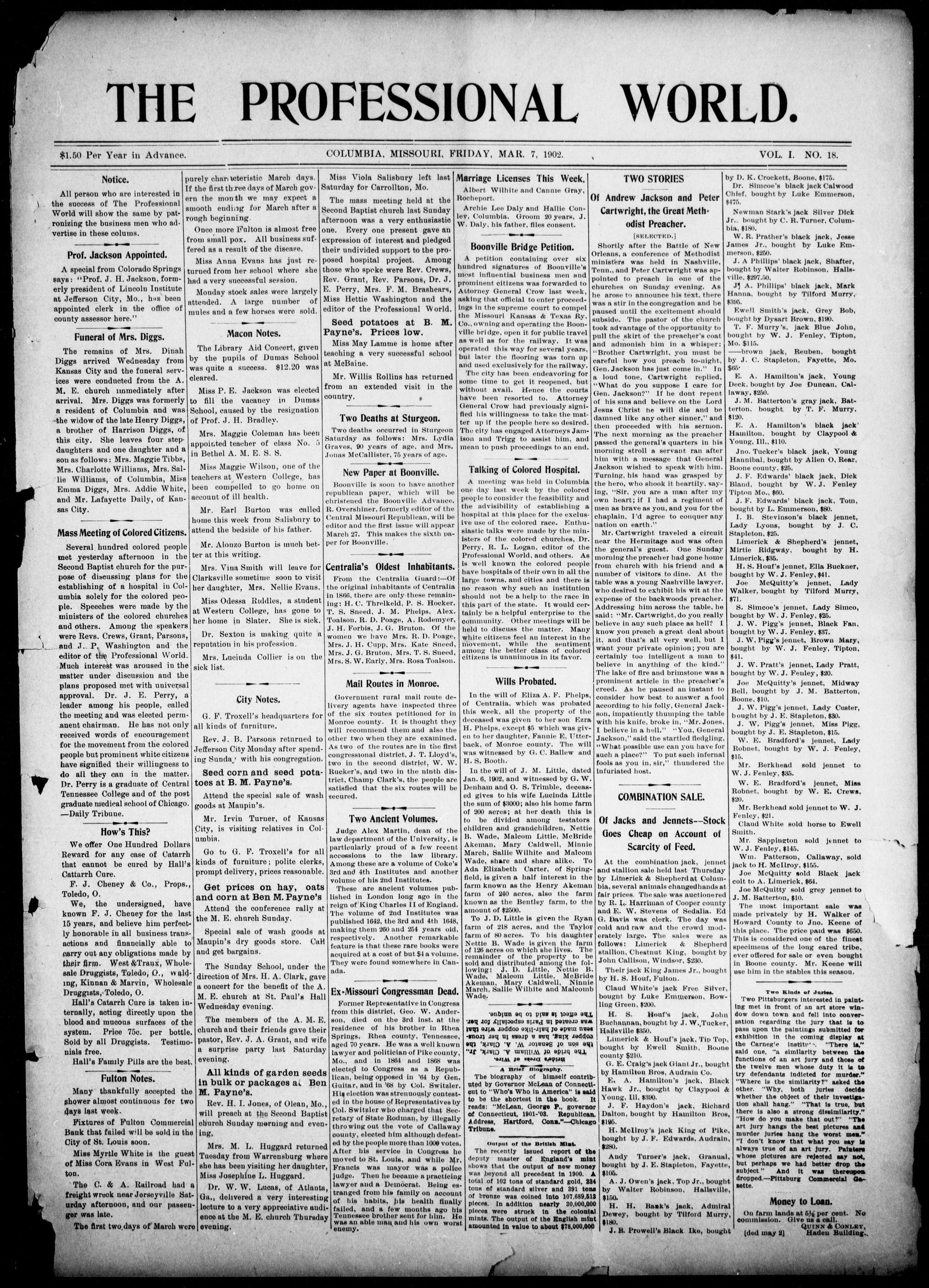
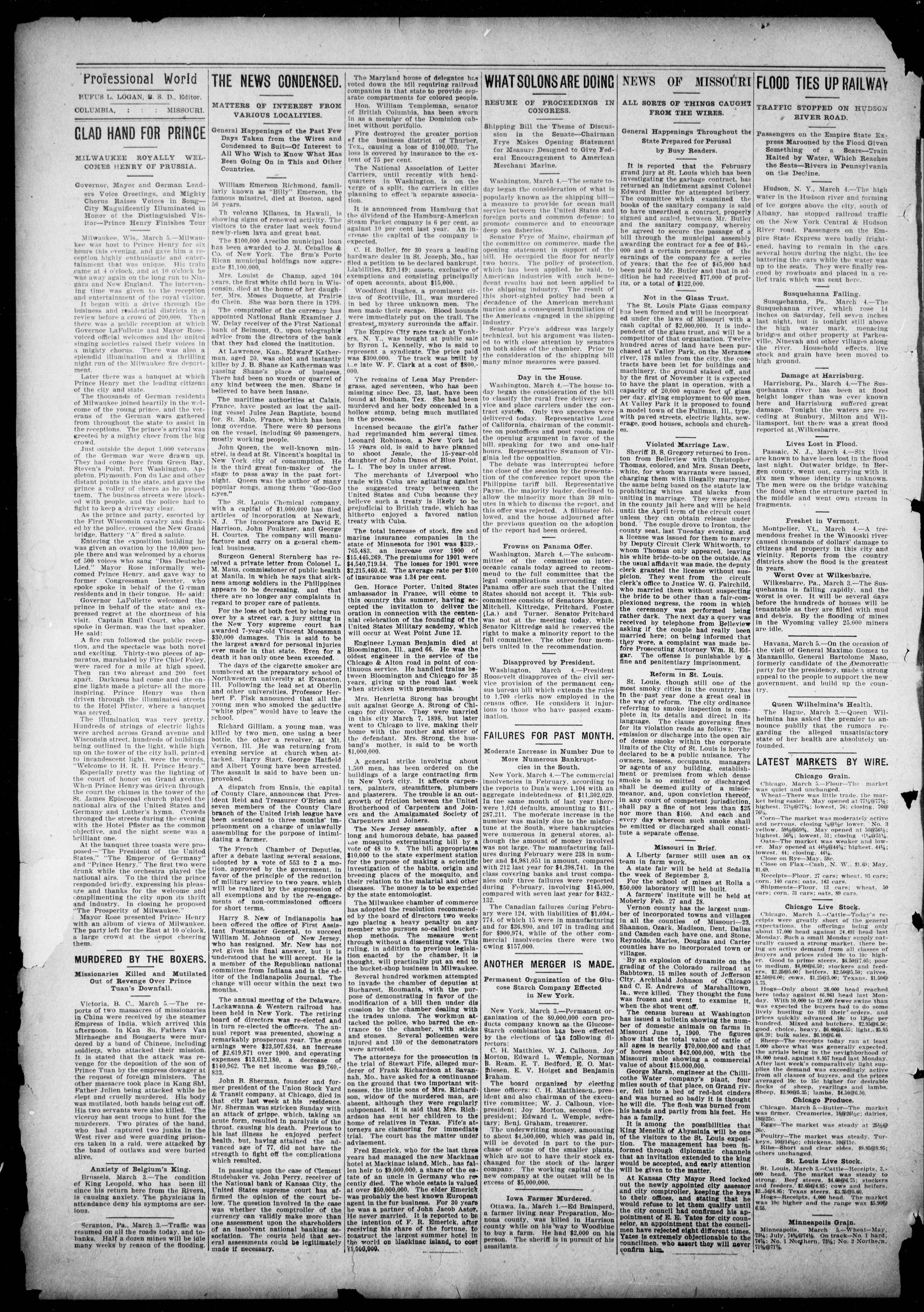
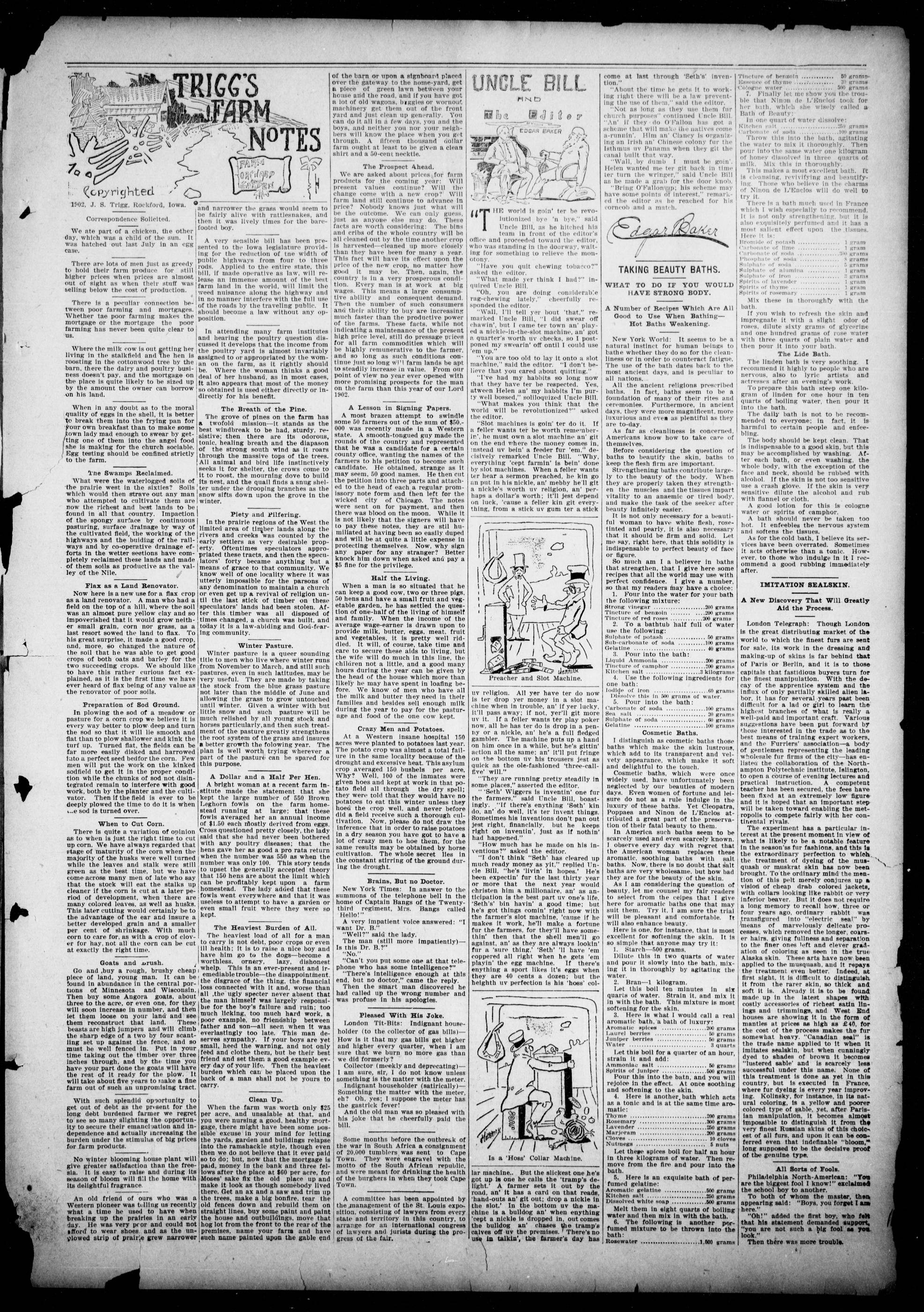
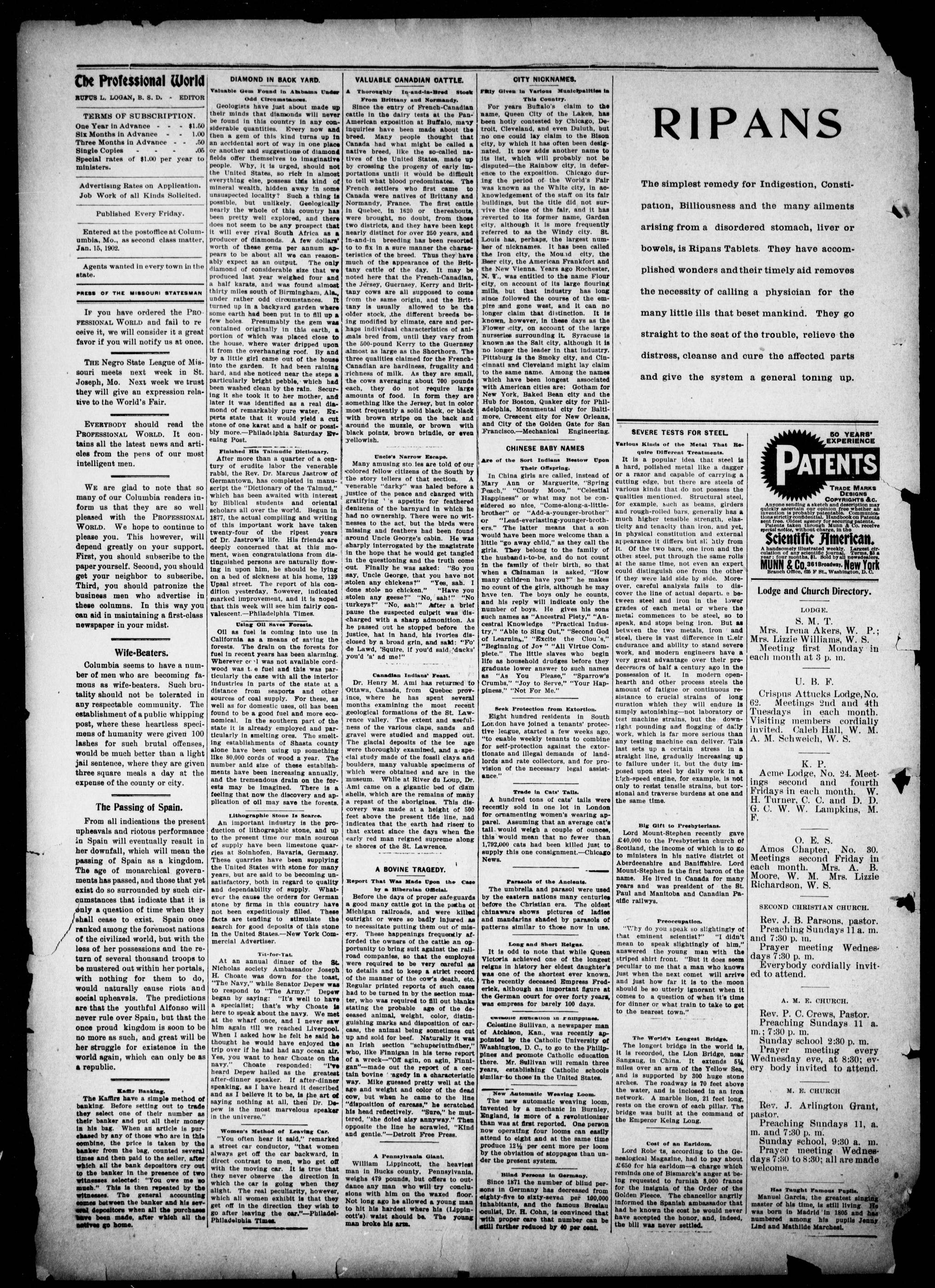
Page text (machine-generated)
THE PROFESSIONAL WORLD.
$1.50 Per Year in Advance.
Notice.
All person who are interested in the success of The Professional World will show the same by patronizing the business men who advertise in these columns.
Prof. Jackson Appointed.
A special from Colorado Springs says: "Prof. J. H. Jackson, formerly president of Lincoln Institute at Jefferson City, Mo., has been appointed clerk in the office of county assessor here."
Funeral of Mrs. Diggs.
The remains of Mrs. Dinah Diggs arrived Wednesday from Kansas City and the funeral services were conducted from the A. M. E. church immediately after arrival. Mrs. Diggs was formerly a resident of Columbia and was the widow of the late Henry Diggs, a brother of Harrison Diggs, of this city. She leaves four stepdaughters and one daughter and a son as follows: Mrs. Maggie Tibbs, Mrs. Charlotte Williams, Mrs. Sallie Williams, of Columbia, Miss Emma Diggs, Mrs. Addie White, and Mr. Lafayette Daily, of Kansas City.
Mass Meeting of Colored Citizens.
Several hundred colored people met yesterday afternoon in the Second Baptist church for the purpose of discussing plans for the establishing of a hospital in Columbia solely for the colored people. Speeches were made by the ministers of the colored churches and others. Among the speakers were Revs. Crews, Grant, Parsons, and J. P. Washington and the editor of the Professional World. Much interest was aroused in the matter under discussion and the plans proposed met with universal approval. Dr. J. E. Perry, a leader among his people, called the meeting and was elected permanent chairman. He has not only received words of encouragement for the movement from the colored people but prominent white citizens have signified their willingness to do all they can in the matter. Dr. Perry is a graduate of Central Tennessee College and of the post graduate medical school of Chicago.—Daily Tribune.
How's This?
We offer One Hundred Dollars Reward for any case of Catarrh that cannot be cured by Hall's Cattarrh Cure.
F. J. Cheney & Co., Props., Toledo, O.
We, the undersigned, have known F. J. Cheney for the last 15 years, and believe him perfectly honorable in all business transactions and financially able to carry out any obligations made by their firm. West & Traux, Wholesale Druggists, Toledo, O., walding, Kinnan & Marvin, Wholesale Druggists, Toledo, O.
Hall's Catarrh Cure is taken internally, acting directly upon the blood and mucous surfaces of the system. Price 75c. per bottle. Sold by all Druggists. Testimonial free. Hall's Family Pills are the best.
Fulton Notes.
Many thankfully accepted the shower almost continuous for two days last week.
Fixtures of Fulton Commercial Bank that failed will be sold in the City of St. Louis soon.
Miss Myrtle White is the guest of Miss Cora Evans in West Fulton.
The C. & A. Railroad had a freight wreck near Jerseyville Saturday afternoon, and our passenger was late.
The first two days of March were
purely characteristic March days. If the first three days of March govern the month we may expect a smooth ending for March after a rough beginning.
Once more Fulton is almost free from small pox. All business suffered as a result of the disease.
Miss Anna Evans has just returned from her school where she had a very successful session.
Monday stock sales were largely attended. A large number of mules and a few horses were sold.
Macon Notes.
The Library Aid Concert, given by the pupils of Dumas School was quite a success. $12.20 was cleared.
Miss P. E. Jackson was elected to fill the vacancy in Dumas School, caused by the resignation of Prof. J. H. Bradley.
Mrs. Maggie Coleman has been appointed teacher of class No. 5 in Bethel A. M. E. S. S.
Miss Maggie Wilson, one of the teachers at Western College, has been compelled to go home on account of ill health.
Mr. Earl Burton was called home this week from Salisbury to attend the bedside of his father.
Mr. Alonzo Burton is much better at this writing.
Mrs. Vina Smith will leave for Clarksville sometime soon to visit her daughter, Mrs. Nellie Evans.
Miss Odessa Riddles, a student at Western College, has gone to her home in Slater. She is sick.
Dr. Sexton is making quite a reputation in his profession.
Mrs. Lucinda Collier is on the sick list.
City Notes.
G. F. Troxell's headquarters for all kinds of furniture.
Rev. J. B. Parsons returned to Jefferson City Monday after spending Sunday with his congregation.
Seed corn and seed potatoes at B. M. Payne's.
Attend the special sale of wash goods at Maupin's.
Mr. Irvin Turner, of Kansas City, is visiting relatives in Columbia.
Go to G. F. Troxell's for all kinds of furniture; polite clerks, prompt delivery, prices reasonable.
Get prices on hay, oats and corn at Ben M. Payne's
Attend the conference rally at the M. E. church Sunday.
Special sale of wash goods at Maupin's dry goods store. CaH and get bargains.
The Sunday School, under the direction of Mrs. H. A. Clark, gave a concert for the benefit of the A. M. E. church at St. Paul's Hall Wednesday evening.
The members of the A. M. E. church and their friends gave their pastor, Rev. J. A. Grant, and wife a surprise party last Saturday evening.
All kinds of garden seeds in bulk or packages at Ben M. Payne's.
Rev. H. I. Jones, of Olean, Mo., will preach at the Second Baptist church Sunday morning and evening.
Mrs. M. L. Huggard returned Tuesday from Warrensburg where she has been visiting her daughter, Miss Josephine L. Huggard.
Dr. W. W. Lucas, of Atlanta, Ga., delivered a very interesting lecture to a very appreciative audience at the M. E. church Thursday evening.
COLUMBIA, MISSOURI, FRIDAY, MAR. 7, 1902.
Miss Viola Salisbury left last Saturday for Carrollton, Mo.
The mass meeting held at the Second Baptist church last Sunday afternoon was a very enthusiastic one. Every one present gave an expression of interest and pledged their undivided support to the proposed hospital project. Among those who spoke were Rev. Crews, Rev. Grant, Rev. Parsons, Dr. J. E. Perry, Mrs. F. M. Brashears, Miss Hettie Washington and the editor of the Professional World.
Marriage Licenses This W.
Albert Wilhite and Cannue Rocheport.
Archie Lee Daly and Hallie lev, Columbia. Groom 20 yrs. W. Daly, his father, files const.
Boonville Bridge Petition
A petition containing over hundred signatures of Boonville most influential business men prominent citizens was forward Attorney General Crow last asking that official to enter prings in the supreme court to a
Seed potatoes at B. M. Payne's. Prices low. Miss May Lamme is home after teaching a very successful school at MeBaine. Mr. Willis Rollins has returned from an extended visit in the country.
Two Deaths at Sturgeon.
Two deaths occurred in Sturgeon Saturday as follows: Mrs. Lydia Graves, 90 years of age, and Mrs. Jonas McCallister, 75 years of age.
New Paper at Boonville.
Boonville is soon to have another republican paper, which will be christened the Boonville Advance. R. Overshiner, formerly editor of the Central Missouri Republican, will be editor and the first issue will appear March 27. This makes the sixth paper for Boonville.
Centralia's Oldest Inhabitants.
From the Centralia Guard: Of the original inhabitants of Centralia in 1866, there are only these remaining: H. C. Threlkeld, P. S. Hocker, T. S. Sneed, J. M. Phelps, Alex Toalson, R. D. Poage, A. Rodemyer, J. H. Forbis, J. G. Bruton. Of the women we have Mrs. R. D. Poage, Mrs. J. H. Cupp, Mrs. Kate Sneed, Mrs. J. G. Bruton, Mrs. T. S. Sneed, Mrs. S. W. Early, Mrs. Rosa Toalson.
Mail Routes in Monroe.
Government rural mail route delivery agents have inspected three of the six routes petitioned for in Monroe county. It is thought they will recommend them and also the other two when they are examined. As two of the routes are in the first congressional district, J. T. Lloyd's, two in the second district, W. W. Rucker's, and two in the ninth district, Champ Clark's, the people are satisfied that the six routes will be secured.
---
Two Ancient Volumes.
Judge Alex Martin, dean of the law department of the University, is particularly proud of a few recent accessions to the law library. Among these are a volume of Coke's 3rd and 4th Institutes and another volume of his 2nd Institutes. These are ancient volumes published in London long ago in the reign of King Charles II of England. The volume of 2nd Institutes was published 1642, the 3rd and 4th 1648, making them 260 and 254 years old, respectively. Another remarkable feature is that these rare books were acquired at a cost of but $4 a volume. They were found somewhere in Canada.
Ex-Missouri Congressman Dead.
Former Representative in Congress from this district, Geo. W. Anderson, died on the 3rd inst. at the residence of his brother in Rhea Springs, Rhea county, Tennessee, aged 70 years. He was a well known lawyer and politician of Pike county, Mo., and in 1864 and 1868 was elected to Congress as a Republican, being opposed in '64 by Gen. Guitar, and in '68 by Col. Switzler. His election was strenuously contested in the house of Representatives by Col. Switzler who charged that Secretary of State Rodman, by illegally throwing out the vote of Callaway county, elected him although defeated by the people more than 1000 votes. After his service in Congress he moved to St. Louis, and while Mr. Francis was mayor was a police judge. Then he became a practicing lawyer and a Democrat. Being estranged from his family on account of his habits, his health finally failed, and a few months ago his Tennessee brother sent for him. He was an able man and his own worst enemy.
Marriage Licenses This Week.
Albert Wilhite and Cannie Gray,
Rocheport.
Archie Lee Daly and Hallie Conley,
Columbia. Groom 20 years, J. W. Daly, his father, files consent.
Boonville Bridge Petition
A petition containing over six hundred signatures of Boonville's most influential business men and prominent citizens was forwarded to Attorney General Crow last week, asking that official to enter proceedings in the supreme court to compel the Missouri Kansas & Texas Ry. Co., owning and operating the Boonville bridge, open it for public travel as well as for the railway. It was operated this way for several years, but later the flooring was torn up and used exclusively for the railway.
The city has been endeavoring for some time to get it reopened, but without avail. Hence the courts have been resorted to. Attorney General Crow had previously signified his willingness to take the matter up if the people here so desired. The city has engaged Attorneys Jamison and Trigg to assist him, and mean to push proceedings to an end.
Talking of Colored Hospital.
A meeting was held in Columbia one day last week by the colored people to consider the feasibility and the advisibility of establishing a hospital at this place for the exclusive use of the colored race. Enthusiastic talks were made by the ministers of the colored churches, Dr. Perry, R. L. Logan, editor of the Professional World, and others. As is well known the colored people have hospitals of their own in all the large towns, and cities and there is no reason why such an institution should not be a help to the race in this part of the state. It would certainly be a helpful enterprise to the community. Other meetings will be held to discuss the matter. Many white citizens feel an interest in the movement, while the sentiment among the better class of colored citizens is unanimous in its favor.
Wills Probated.
In the will of Eliza A. F. Phelps, of Centralia, which was probated this week, all the property of the deceased was given to her son Ezra H. Phelps, except $5 which was given to her daughter, Fannie E. Utterback, of Monroe county. The will was witnessed by G. C. Ballew and H. S. Booth.
In the will of J. M. Little, dated Jan. 6, 1902, and witnessed by G. W. Denham and O. S. Trimble, deceased gives to his wife Lucinda Little the sum of $3000; also his home farm of 200 acres; at her death this is to be divided among testators children and grandchildren, Nettie B. Wade, Malcom Little, McBride Akeman, Mary Caldwell, Minnie March, Sallie Wilhite and Malcom Wade, share and share allike. To Ada Elizabeth Carter, of Springfield, is given a half interest in the farm known as the Henry Akeman farm of 240 acres, also the farm known as the Bentley farm, to the amount of $2500.
To J. D. Little is given the Ryan farm of 218 acres, and the Taylor farm of 80 acres. To his daughter Nette B. Wade is given the farm of 126 acres on which she lives. The remainder of the property to be sold and distributed among the following: J. D. Little, Nette B. Wade, Malcon Little, McBride Akeman, Mary Caldwell, Ninnie March, Sallie Wilhite and Malcomb Wade.
The bride of William A. Clark, Jr., the son of Senator W. A. Clark, the copper king, has a dress in her trouser made of hair-like copper wire that was created in Paris especially for her. The effect is said to be unique.
A Brief Biography.
The biography of himself contributed by Governor McLean of Connecticut to "Who's Who in America" is said to be the shortest in the book. It reads: "McLean, George P., governor of Connecticut, 1901-'08. Republican. Address, Hartford, Conn."—Chicago Tribune.
Output of the British Mint.
The recently issued report of the deputy master of England's mint shows that the output of new money was beyond all precedent in 1900. A total of 102 tons of standard gold, 234 tons of standard silver and 391 tons of bronze was coined into 107,689,513 pieces. In addition nearly 30,000,000 pieces were struck in the colonial mints. The output of the English mint amounted in value to about $78,000,000.
TWO STORIES
Of Andrew Jackson and Peter Cartwright, the Great Methodist Preacher.
[SELECTED.]
Shortly after the Battle of New Orleans, a conference of Methodist ministers was held in Nashville, Tenn., and Peter Cartwright was appointed to preach in one of the churches on Sunday evening. As he arose to announce his text, there was a stir in the congregation and he paused until the excitement should subside. The pastor of the church took advantage of the opportunity to pull the skirt of the preacher's coat and admonish him in a whisper: "Brother Cartwright, you must be careful how you preach to-night. Gen. Jackson has just come in." In a loud tone, Cartwright replied, "What do you suppose I care for Gen. Jackson?" If he dont repent of his sins and believe on the Lord Jesus Christ he will die and be damned like any other sinner," and then proceeded with his sermon. The next morning as the preacher passed the general's quarters in his morning stroll a servant ran after him with a message that General Jackson wished to speak with him. Turning, his hand was grasped by the hero, who shook it heartily, saying, "Sir, you are a man after my heart; if I had a regiment of men as brave as you, and for you the chaplain, I'd agree to conquer any nation on earth."
Mr. Cartwright traveled a circuit near the Hermitage and was often the general's guest. One Sunday morning the preacher had gone home from church with his friend and a number of visitors to dine. At the table was a young Nashville lawyer, who desired to exhibit his wit at the expense of the backwoods preacher. Addressing him across the table, he said: "Mr. Cartwright, do you really believe in any such place as hell? I know you preach a great deal about it, and that's all very well, but I want your private opinion; you are certainly too intelligent a man to believe in anything of the kind." The lake of fire and brimstone was a prominent article in the preacher's creed. As he paused an instant to consider how best to answer a fool according to his folly, General Jackson, impatiently thumping the table with his knife, broke in, "Mr. Jones, I believe in a hell," "You, General Jackson," said the startled fledgling, "What possible use can you have for a place?" To put such infernal fools as you in, sir," thundered the infuriated host.
COMBINATION SALE.
Of Jacks and Jennets--Stock Goes Cheap on Account of Scarcity of Feed.
At the combination jack, jennet and stallion sale held last Thursday by Limerick & Shepherd at Columbia, several animals changedhands at fair prices. The sale was auctioned by R. L. Harriman of Cooper county and E. W. Stevens of Sedalia. Ed G. Davis was clerk. The day was cold and raw and the crowd moderately large. The sales were as follows: Limerick & Shepherd stallion, Chestnut King, bought by John Callison, Windsor, $230.
Their jack King James Jr., bought by H. S. Houf, Fulton.
Claud White's jack Free Silver, bought by Luke Emmerson, Bowling Green, $200.
H. S. Houf's jack, John Buchanan, bought by J. W. Tucker, Hallsville $250.
Limerick & Houf's jack, Tip Top,
bought by Ewell Smith, Boone
county $210.
G. E. Craig's jack Giant Jr., bought
by Hamilton Bros, Audrain Co.
E. A. Hamilton's jack, Black
Hawk Jr., bought by Claypool &
Young, Ill, $390.
J. F. Haydon's jack, Richard
Dalton, bought by Hamilton Bros,
$195.
H. McIlroy's jack King of Pike,
bought by J. F. Edwards, Audrain,
$280.
Andy Turner's jack, Granual,
bought by J. E. Stapleton, Fayette,
$105.
A. J. Owen's jack, Top Jr., bought
by Walter Robinson, Hallsville,
$150.
H. H. Bank's jack, Admiral
Dewey, bought by Tilford Murry,
$180.
J. B. Proulle Bleach, Inc.
VOL. I. NO. 18.
by D. K. Crockett, Boone, $175.
Dr. Simcoe's black jack Calwood
Chief, bought by Luke Emmerson,
$475.
Newman Stark's jack Silver Dick
Jr., bought by C. R. Turner, Columbia,
$180.
J. W. Pigg's jennet, Brown Mary, bought by W. J. Fenley, Tipton, $41.
J. W. Pratt's jennet, Lady Pratt, bought by W. J. Fenley, $20.
Joe McQuitty's jennet, Midway Bell, bought by J. M. Batterton, Boone, $10.
J. W. Pigg's jennet, Lady Custer, bought by J. E. Stapleton, $30.
J. W. Pigg's jennet, Miss Pigg, bought by J. E. Stapleton, $15.
W. E. Bradford's jennet, Lady Robnet, bought by W. J. Fenley, $15.
Mr. Berkhead sold jennet to W. J. Fenley, $35.
W. E. Bradford's jennet, Miss Robnet, bought by W. E. Crews, $20.
Mr. Berkhead sold jennet to W. J. Fenley, $21.
Claud White sold horse to Ewell Smith.
Mr. Sappington sold jennet to W. J. Fenley, $145.
Wm. Patterson, Callaway, sold jack to H. McIlroy, $155.
Joe McQuitty sold Black jack colt to A. Limerick, $64.
Joe McQuitty sold grey jennet to J. M. Batterton, $10.
The most important sale was made privately by H. Walker of Howard County to Jno. Keene of this place. The price paid was $650. This is considered one of the finest specimens of the long eared tribe, ever offered for sale or even bought in Boone county. Mr. Keene will use him in the stables this season.
Two Kinds of Juries.
Two Pittsburgers interested in painting met in front of an art store window down town and fell into conversation regarding the jury that is to pass upon the paintings submitted for exhibition in the coming display at the Carnegie institute. "There is," said one, "a similarity between the functions of an art jury and those of the twelve men whose duty it is to try defendants indicted for murder." "Where is the similarity?" asked the other. "Why, both juries decide whether the object of their investigation shall hang." "That is true, but there is also a strong dissimilarity." "How do you make that out?" "The art jury hangs the best pictures and murder juries hang the worst men." "I don't know that what you say is always true of an art jury. Painter whose pictures are rejected say not, but perhaps we had better drop the subject." And it was thereupon dropped—Pittsburg Commercial Gazette.
Money to Loan.
On farm lands at 5½ per cent. No commission. Give us a call. QUINN & CONLEY, [ded may 2] Haden Building.
Professional World
RUFUS L. LOGAN, B. S. D., Editor.
COLUMBIA, : : : MISSOURI.
GLAD HAND FOR PRINCE
MILWAUKEE ROYALLY WELCOMES HENRY OF PRUSSIA.
Governor, Mayor and German Leaders Voice Greetings, and Mighty Chorus Raises Voices in Song—City Magnificently Illuminated in Honor of the Distinguished Visitor—Prince Henry Finishes Tour
Milwaukee, Wis., March 5.—Milwaukee was host to Prince Henry for six hours this evening, and gave him a reception highly enthusiastic and entertainment that was unique. His train came at 4 o'clock, and at 10 o'clock he was away again on the long run to Nigara and New England. The intervening time was given to the reception and entertainment of the royal visitor.
It began with a drive through the business and residential districts in a review before a crowd of 200,000. Then there was a public reception at which Governor LaFollette and Mayor Rosevoiced official welcomes and the united singing societies raised their voices in a mighty chorus. There was also a splendid illumination and a thrilling night run of the Milwaukee fire department.
Later there was a banquet at which Prince Henry met the leading citizens of the city and state.
The thousands of German residents of Milwaukee joined heartily in the welcome of the young prince, and the veterans of the German wars gathered from throughout the state to assist in the receptions. The prince's arrival was greeted by a mighty cheer from the big crowd.
Just outside the depot 1,000 veterans of the German war were drawn up. They had come here from Green Bay, Steven's Point, Port Washington, Appleton, Plymouth, Fon du Lac and other distant points in the state, and gave the prince a volley of cheers as he passed them. The business streets were blocked with people, and the police had to fight to keep a driveway clear.
As the prince and party, escorted by the First Wisconsin cavalry and flanked by the police, crossed the New Grand bridge, Battery "A" fired a salute.
Entering the exposition building he was given an ovation by the 10,000 people there and was welcomed by a chorus of 500 voices who sang "Das Deutsche Lied." Mayor Rose informally welcomed Prince Henry, and gave way to former Congressman Deuster, who spoke spoke in behalf of the German residents and in their tongue. He said:
Governor LaFollette welcomed the prince in behalf of the state and expressed regret at the shortness of his visit. Captain Emill Court, who also spoke in German, was the last speaker, He said:
A fire run followed the public reception, and the spectacle was both novel and exciting. Thirty-two pieces of apparatus, marshaled by Fire Chief Foley, were raced for a mile at high speed. Then ran two acrest and 200 feet apart. Darkness had come and the engine lights made a picture all the more inspiring. Prince Henry was then driven through the illuminated streets to the Hotel Pfister, where a banquet was served.
The illumination was very pretty. Hundreds of strings of electric lights were arched across Grand avenue and Wisconsin street, hundreds of buildings being outlined in the light, while high up on the tower of the city hall, printed to incandescent light, were the words, "Welcome to H. R. H. Prince Henry."
Especially pretty was the lighting of the court of honor on Grand avenue. When Prince Henry was driven through the court the chimes in the tower of the St. James Episcopal church played the national airs of the United States and Germany and Luther's hymn. Crowds thronged the streets during the evening with the Hotel Pfister as the common objective, and the night scene was a brilliant one.
At the banquet three toasts were proposed—"The President of the United States," "The Emperor of Germany" and "Prince Henry." The first two were drunk while the orchestra played the national airs. To the third the prince responded briefly, expressing his pleasure and thanks for the welcome and complimenting the city upon its thrift and industry. In closing he proposed "The Prosperity of Milwaukee."
Mayor Rose presented Prince Henry with an album of views of Milwaukee. The party left for the East at 10 o'clock, a large crowd at the depot cheering them.
MURDERED BY THE BOXERS.
Missionaries Killed and Mutilated Out of Revenge Over Prince Tuan's Downfall.
Victoria, B. C., March 5.—The reports of two massacres of missionaries in China were received by the steamer Empress of India, which arrived this afternoon. In Kan Su, Fathers Van Mirhaege and Bougaerts were murdered by a band of Chinese, including soldiers, who attacked their mission. It is stated that the attack was revenge for the deposition of the son of Prince Tuan by the empress dowager at the request of foreign ministers. The other massacre took place in Kang Shl, Father Julien being attacked while he slept and cruelly murdered. His body was mutilated, both hands being cut off. His two servants were also killed. The viceroy has sent troops to hunt for the murderers. Two pirates of the band, who had captured two junks in the West river and were guarding prisoners taken in a raid, were attacked by the band of outlaws and were buried alive.
Anxiety of Belgium's King.
Brussels. March 3.—The condition of King Leopold, who has been ill since his return here from the Rivera, is causing anxiety. The physicians in attendance deny his symptoms are serious.
Scranton, Pa., March 3.—Traffic was resumed on all the roads today, and to-banks. Half a dozen mines will be idle many weeks by reason of the flooding.
THE NEWS CONDENSED
MATTERS OF INTEREST FROM
VARIOUS LOCALITIES.
General Happenings of the Past Few
Days Taken from the Wires and
Condensed to Suit—Of Interest to
All Who Wish to Know What Has
Been Going On in This and Other
Countries.
William Emerson Richmond, fami-
larily known as "Billy" Emerson, the
famous minstrel, died at Boston, aged
56 years.
Th volcano Kilauea, in Hawaii, is
showing signs of renewed activity. The
visitors to the crater last week found
newly-risen lava and great heat.
The $100,000 Arecibo municipal loan
has been awarded to J. M. Ceballos &
Co. of New York. The firm's Porto
Rican municipal holdings now aggre-
gate $1,100,000.
Mrs. Louise de Champ, aged 104 years, the first white child born in Wisconsin, died at the home of her daughter, Mrs. Moses Duquette, at Prairie du Chein. She was born there in 1798. The comptroller of the currency has appointed National Bank Examiner J. W. Delay receiver of the First National bank of Beimont, O., upon telegraphie advice from the directors of the bank that they had closed the institution. At Lawrence, Kan. Edward Katherman, aged 20, was shot and instantly killer by J. B. Shane as Katherman was passing Shane's place of business. There had been no words or quarrel of any kind between the men. Shane is believed to have been insane. The maritime authorities at Calais, France, have posted as lost the sailing vessel Jules Jean Baptiste, bound for St. Malo, France, which has been long overdue. There were 80 persons on the vessel, including 60 passengers, mostly working people.
John Queen, the well-known minstrel, is dead at St. Vincent's hospital in New York city of consumption. He is the third great fun-maker of the stage to pass away in the past fornight. Queen was the author of many popular songs, among them "Goo-Goo Eyes."
The St. Louis Chemical company, with a capital of $1,000,000 has filed articles of incorporation at Newark, N. J. The incorporators are David E. Harrison, John Foulkner, and George H. Courtes. The company will manufacture and carry on a general chemical business.
Surgeon General Sternberg has received a private letter from Colonel L. M. Maus, commissioner of public health at Manila, in which he says that sickness among soldiers in the Philippines appears to be decreasing, and that there are no longer any complaints in regard to proper care of patients.
For the loss of both feet by being run over by a street car, a jury sitting in the New Yory supreme court has awarded 7-year-old Vincent Musselman $30,000 damages. This is said to be the largest award for personal injuries ever made in that state. Even for a death it has only once been exceeded. The days of the cigarette smoker are numbered at the preparatory school of Northwestern university at Evanston, Ill. Following the lead set at Oberlin and other universities, Professor Herbert F. Fisk announced that all the young men who smoked the seductive "white pipes" would have to leave the school.
Richard Gilliam, a young man, was killed by two men, one using a beer bottle, the other a revolver, at Mt. Vernon, Ill. He was returning from evening service at church when attacked. Harry Start, George Hattfield and Albert Young have been arrested. The assault is said to have been unprovoked.
A dispatch from Ennis, the capital of County Clare, announces that President Reid and Treasurer O'Brien and seven members of the County Clare branch of the United Irish league have been sentenced to three months' imprisonment on a charge of unlawfully assembling for the purpose of intimidating a farmer.
The French Chamber of Deputies, after a debate lasting several sessions, adopted by a vote of 553 to 2 a motion, approved by the government, in favor of the principle of the reduction of military service to two years, which will be realized by the suppression of all exemptions and by the re-engagements of non-commissoned officers for short terms.
Harry S. New of Indianapolis has been offered the office of First Assistant Postmaster General, to succeed William M. Johnson of New Jersey, who has resigned. Mr. New has not yet given his final answer, but it is understood that he will accept. He is a member of the Republican national committee from Indiana and is the editor of the Indianapolis Journal. The change will occur within the next two months.
The annual meeting of the Delaware, Lackawanna & Western railroad has been held in New York. The retiring board of directors was re-elected and in turn re-elected the officers. The annual report was presented, showing a remarkably prosperous year. The gross earnings were $23,507,634, an increase of $2,619,871 over 1900, and operating expenses $13,612,180, a decrease of $140,962. The net income was $9,760,-833.
John B. Sherman, founder and former president of the Union Stock Yard & Transit company, at Chicago, died in that city last week at his residence. Mr. Sherman was stricken Sunday with an attack of gripe, which, taking an acute form, resulted in paralysis of the throat, causing his death. Previous to his last illness he enjoyed perfect health, but, having attained the advanced age of 77, did not have the strength to fight off the complications which resulted.
In passing upon the case of Clement Studebaker vs. John Perry, receiver of the National bank of Kansas City, the United States supreme court has affirmed the opinion of the court below. The question involved in the case was whether the comproller of the currency can validly make more than one assessment upon the shareholders of an insolvent national banking association. The courts held that several assessments could be legitimately made if necessary.
The Maryland house of delegates has voted down the bill requiring railroad companies in that state to provide separate compartments for colored people. Hon. William Templeman, senator of British Columbia, has been sworn in as a member of the Dominion cabinet without portfolio.
Fire destroyed the greater portion of the business district of Thurber, Tex., causing a loss of $100,000. The loss is covered by insurance to the extent of 75 per cent.
The National Association of Letter Carriers, until recently with headquarters in Washington, is on the verge of a split, the carriers in cities planning to effect a separate association.
It is announced from Hamburg that the dividend of the Hamburg-American Steam Packet company is 6 per cent, against 10 per cent last year. An increase the capital of the company is expected.
C. H. Boller, for 30 years a leading hardware dealer in St. Joseph, Mo., has filed a petition to be declared bankrupt. Liabilities, $29,149; assets, exclusive of exemptions and consisting principally of open accounts, about $15,000. Woodford Hughes, a prominent citizen of Scottville, Ill., was murdered in bed by three unknown men. The men made their escape. Blood hounds were immediately put on the trail. The greatest mystery surrounds the affair. The Empire City race track at Yonkers, N. Y., was bought at public sale by Byron L. Kennelly, who is said to represent a syndicate. The price paid was $300,000. The track was built by late W. F. Clark at a cost of $800,000. The remains of Lena May Prendergrass, aged seventeen, who has been missing since Dec. 23, last, have been found at Bonham, Tex. She had been murdered and her body concealed in a hollow stump, being much mutilated in the process.
Incensed because the girl's father had reprimanded him several times. Leonard Robinson, a New York lad 15 years old, is said to have planned to shoot Jessie, the 15-year-old daughter of John Danes of Blue Point, L. I. The boy is under arrest.
The merchants of Liverpool who trade with Cuba are agitating against the suggested treaty between the United States and Cuba because they believe such a treaty is likely to be prejudicial to British trade, which has hitherto enjoyed a favored nation treaty with Cuba.
The total increase of stock, fire and marine insurance companies in the state of Minnesota for 1901 was $339.765,483. an increase over 1900 of $15,445,269. The premiums for 1901 were $4,540,719.54. The losses for 1901 were $2,215,460.42. The average rate per $100 of insurance was 1.34 per cent.
Gen. Horace Porter, United States ambassador in France, will come to this country this summer, having accepted the invitation to deliver the oration in connection with the centennial celebration of the founding of the United States Military academy, which will occur at West Point June 12.
Engineer Lyman Benjamin died at Bloomington, Ill., aged 66. He was the oldest engineer in the service of the Chicago & Alton road in point of continuous service. He handled trains between Bloomington and Chicago for 35 years, giving up the road last week when stricken with pneumonia.
Mrs. Henrietta Strong has brought suit against George A. Strong of Chicago for divorce. They were married in this city March 7, 1898, but later went to Chicago to live, making their home with the mother and sister of the defendant. Mrs. Strong, the husband's mother, is said to be worth $1,000,000.
A general strike involving about 1,500 men, has been ordered on the buildings of a large contracting firm in New York city. It affects carpenters, painters, steamfitters, plumbers and plasterers. The trouble is an outgrowth of friction between the United Brotherhood of Carpenters and Joiners and the Amalgamated Society of Carpenters and Joiners. The New Jersey assembly, after a long and humorous debate, has passed the mosquito exterminating bill by a vote of 48 to 9. The bill appropriates $10,000 to the state experiment station for the purpose of making a scientific investigation of the habits, origin and breeding places of the mosquito, and their relation to the malarial and other diseases. The money is to be expended by the state entomologist.
The Milwaukee chamber of commerce has adopted the resolution recommended by the board of directors two weeks ago placing a heavy penalty on any member who pursues so-called bucket-shop methods. The measure went through without a dissenting vote. This ruling, in addition to previous legislation enacted by the chamber, it is thought, will practically put an end to the bucket-shop business in Milwaukee. Several hundred workmen attempted to invade the chamber of deputies at Bucharest, Roumania, with the purpose of demonstrating in favor of the modification of a bill then under discussion by the chamber dealing with the trades unions. The workmen attacked the police, who barred the entrance to the chamber, with sticks and stones. Several policemen were injured and 130 of the demonstrators were arrested.
The attorneys for the prosecution in the trial of Stewart Fife, alleged murderer of Frank Richardson at Savannah, Mo., have asked for a continuance on the ground that two important witnesses, the little sons of Mrs. Richardson, widow of the murdered man, are absent, although they were regularly subpoenaed. It is said that Mrs. Richardson has sent her children to the home of relatives in Texas. Fife's attorneys are clamoring for immediate trial. The court has the matter under advisement.
Fred Emerick, who for the last three years had managed the new Mackinac hotel at Mackinac island, Mich., has fallen heir to $9,000,000, a share of the estate of an uncle in Germany who recently died. The whole estate is valued at over $50,000,000. The elder Emerick was probably the best known European agent in the fur business. For 30 years he was a partner of John Jacob Astor. He never married. It is reported to be the intention of F. R. Emerick, after receiving his share of the fortune, to construct the largest summer hotel in the world on Mackinac island, to cost $11,000,000.
WHAT SOLONS ARE DOING
RESUME OF PROCEEDINGS IN CONGRESS.
Shipping Bill the Theme of Discussion in the Senate—Chairman Frye Makes Opening Statement for Measure Designed to Give Federal Encouragement to American Merchant Marine.
Washington, March 4.—The senate today began the consideration of what is popularly known as the shipping bill—a measure to provide for ocean mail service between the United States and foreign ports and common defense; to promote commerce and to encourage deep sea fisheries.
Senator Frye of Maine, chairman of the committee on commerce, made the opening statement in support of the bill. He occupied the floor for nearly two hours. The policy of protection, which has been applied, he said, to American industries with such beneficent results had not been applied to the shipping industry. The result of this short-sighted policy had been a decadence of the American merchant marine and a consequent humiliation of the Americans engaged in the shipping industry.
Senator Frye's address was largely technical, but his argument was listened to with close attention by senators on both sides of the chamber. Prior to the consideration of the shipping bill many minor measures were passed.
Day in the House.
Washington, March 4.—The house today began the consideration of the bill to classify the rural free delivery service and place carriers under the contract system. Only two speeches were delivered today. Representative Loud of California, chairman of the committee on post offices and post roads, made the opening argument in favor of the bill, speaking for two and one-half hours. Representative Swanson of Virginia led the opposition. The debate was interrupted before the close of the session by the presentation of the conference report upon the Philippine tariff bill. Representative Payne, the majority leader, declined to allow the minority more than 30 minutes in which to discuss the report, and this offer was rejected. A filibuster followed, and the house adjourned after the previous question on the adoption of the report had been ordered.
Frowns on Panama Offer.
Washington, March 4.—The subcommittee of the committee on interoceanic canals today agreed to recommend to the full committee that the legal complications surrounding the Panama offer are such that the United States should not accept it. This subcommittee consists of Senators Morgan Mitchell, Kittredge, Pritchard, Foster (La.) and Turner. Senator Pritchard was not at the meeting today, while Senator Kittredge said he reserved the right to make a minority report to the full committee. The other four members united in the recommendation.
Disapproved by President
Washington, March 4.—President Roosevelt disapproves of the civil service provision of the permanent census bureau bill which extends the rules to 1,700 clerks now employed in the census office. He considers it injurious to those who have passed examination.
FAILURES FOR PAST MONTH.
Moderate Increase in Number Due to More Numerous Bankruptcies in the South.
New York, March 4.—The commercial insolvencies in February, according to the reports to Dun's were 1,104 with an aggregate indebtedness of $11,302,029. In the same month of last year there were 1,024 defaults, amounting to $11,287,211. The moderate increase in the number was mainly due to the misfortune at the South, where bankruptcies were numerous in general stores, although the amount of money involved was not large. The manufacturing failures during February were 238 in number and $4,981,051 in amount, compared with 212 last year for $4,398,741. In the class covering banks and trust companies only three failures were reported during February, involving $145,000, compared with seven last year for $432.,132.
The Canadian failures during February were 124, with liabilities of $1,094,774, of which 15 were in manufacturing and for $36,800, and 107 in trading and for $800,974, while of the other commercial insolvencies there were two cwing $157,000.
ANOTHER MERGER IS MADE.
Permanent Organization of the Glucose Starch Company Effected in New York.
New York, March 3.—Permanent organization of the 80,000,000 corn products company known as the Glucose-Starch combination has been effected by the elections of the following directors:
C. H. Matthies, W. J. Calhoun, Joy Morton, Edward L. W. Wemple, Norman B. Ream, E. T. Bedford, E. O. Matthiesen, E. V. Hoiget and Benjamin Braham.
The board organized by chelting these officers: C. H. Matthiesen, president and also chairman of the executive committee; W. J. Calhoun, vice president; Joy Morton, second vice president; Edward L. Wemple, secretary; Benj. Graham, treasurer.
The underwriting money, amounting to about $5,400,000, which was paid in, will be devoted in part to the purchase of some of the smaller plants, which are not to have their stock exchanged for fuel. The working company. The working capital of the new company at the outset will be in excess of $5,000,000.
Iowa Farmer Murdered.
Ottawa, Ia., March 1—Ed Brainner, a farmer living near Preparation, Monona county, was killed in Harrison county while on his way to Woodbine to buy a farm. He had $2,000 on his person. The sheriff is in pursuit of his assailants.
NEWS OF MISSOURI
ALL SORTS OF THINGS CAUGHT
FROM THE WIRES.
General Happenings Throughout the State Prepared for Perusal by Busy Readers.
It is reported that the February grand jury at St. Louis which has been investigating the garbage contract, has returned an indictment against Colonel Edward Butler for attempted bribery. The committee which examined the books of the sanitary company is said to have unearthed a contract, properly signed and sealed, between Mr. Butler and the sanitary company, whereby he agreed to secure the passage of a bill through the municipal assembly awarding the contract for a fee of $45,000 and a certain percentage of the earnings of the company for a series of years; that the fee of $45,000 had been paid to Mr. Butler and that in addition he had received $77,000 of profits, or a total of $122,000.
Not in the Glass Trust
The St. Louis Plate Glass company has been formed and will be incorporated under the laws of Missouri with a cash capital of $2,000,000. It is independent of the glass trust, and will be a competitor of that organization. Twelve hundred acres of land have been purchased at Valley Park, on the Meramec river, 178 miles from the city, the contracts have been let for buildings and machinery, the ground staked off, and by the first of November it is expected to have the plant in operation, with a capacity of 20,000 square feet of glass per day, giving employment to 600 men. At Valley Park it is proposed to found a model town of the Pullman, Ill. type, with paved streets, electric lights, sewerage, good houses, schools and churches.
Violated Marriage Law.
Sheriff B. S. Gregory returned to Ironton from Bellevue with Christopher Thomas, colored, and Mrs. Susan Deets, white, for whom warrants were issued, charging them with illegally marrying, the same being based on the statute law prohibiting whites and blacks from uniting in marriage. They were placed in the county jail here and will be held until the April term of the circuit court unless they can obtain release under bond. The couple drove to Ironton, the county seat, last Tuesday evening, and a license was issued for them to marry by Deputy Circuit Clerk Whitworth, to whom Thomas only appeared, leaving his white bride-to-be on the outside. As the usual affidavit was made, the deputy clerk granted the license without suspicion. They went from the circuit clerk's office to Justice W. G. Fairchild, who married them without suspecting the bride to be other than a fair-complexioned negress, the room in which the ceremony was performed being rather dark. The next day a query was received by telephone from Bellevue asking if the couple had really been married here; on being informed that they were, a complaint was made before Prosecuting Attorney Wm. R. Edgar. The offense is punishable by a fine and penitentiary imprisonment.
Reform in St. Louis.
St. Louis, though still one of the most smoky cities in the country, has in the past year done a great deal in the way of reform. The city ordinance referring to smoke inspection is complete in its details and direct in its language. The clause governing fines for its violation reads as follows: The emission or discharge into the open air of dense smoke within the corporate limits of the City of St. Louis is hereby declared to be a public nuisance. The owners, lessees, occupants, managers or agents of any building, establishment or premises from which dense smoke is so emitted or discharged shall be deemed guilty of a mismeanor, and, upon conviction thereof, in any court of competent jurisdiction, shall pay a fine of not less than $25 nor more than $160. And each and every day whereon such smoke shall be emitted or discharged shall constitute a separate offense.
Missouri in Brief
A Liberty farmer still uses an ox team in farm work.
A state fair will be held at Sedalia the week of September 3.
opers. 3.
For the school of nurses at Rolla a
$50,000 laboratory will be built.
$50,000 laboratory will be built.
A farmers' institute will be held at Moberly Feb. 27 and 28.
Vernon county has the largest number of incorporated towns and villages in all the counties of Missouri—23, Shannon, Ozark, Madison, Dent, Dallas and Camden each have one, and Stone, Reynolds, Marles, Douglas and Carter counties have no incorporated town or villages.
By an explosion of dynamite on the grading of the Colorado railroad at Babbtown, 15 miles south of Jefferson City, Archbald Johnson of Chicago and C. E. Andrews of Marshalltown, Ia., were killed. They thought the fuse was frozen and went to examine it, when the shot went off.
The census bureau at Washington has issued a bulletin showing the number of domestic animals on farms in Missouri June 1, 1900. The figures show that the total value of cattle of all ages is nearly $70,000,000 and that of horses about $42,000,000, with the Missouri mule showing a commercial value of about $15,000,000.
George Marsh, engineer at the Chillicothe Water company's plant, four miles south of that place, on Grand river, fell into a bed of red-hot cinders and was burned so badly it is thought he will die. The flesh was burned from his hands and partly from his feet. He has a family.
It is among the possibilities that King Menellik of Abyssinia will be one of the visitors to the St. Louis exposition. The management has been informed through diplomatic channels that an invitation extended to the king would be accepted, and early attention will be given to the matter.
At Kansas City Mayor Reed locked out the newly appointed city assessor and city comptroller, keeping the keys to their offices, and stating that he would refuse to let them qualify until the city council had confirmed his appointment of E. E. Yates for city counsel, an appointment that the councilmen have rejected eight different times. Yates is extremely objectionable to the councilmen, who assert they will never confirm him.
TRAFFIC STOPPED ON HUDSON RIVER ROAD.
Passengers on the Empire State Express Marooned by the Flood Given Something of a Scare—Train Hailed by Water, Which Reaches the Seats—Rivers in Pennsylvania on the Decline.
Hudson, N. Y., March 4.—The high water in the Hudson river and forming of ice gorges above the city, south of Albany, has stopped railroad traffic on the New York Central & Hudson River road. Passengers on the Empire State Express were badly frightened, having to remain in the cars several hours during the night, the ice battering the cars while the water was up to the seats. They were finally rescued by rowboats and placed in a relief train which was sent here.
Susquehanna Falling.
Susquehanna, Pa., March 4.—The Susquehanna river, which rose 14 inches on Saturday, fell seven inches last night, but is tonight still above the high water mark, menacing bridges and other property at Parkesville, Nineveh and other villages along the river. Household effects, live stock and grain have been moved to high ground.
Damage at Harrisburg
Harrisburg, Pa., March 4.—The Susquehanna river has been at flood height longer than was ever known here and Harrisburg suffered great damage. Tonight the waters are receding at Sunbury, Milton and Williamsport, but there was a great flood reported at Wilkesbarre.
Lives Lost in Flood
Passaic, N. J., March 4.—Six lives are known to have been lost in the flood last night. Outwater bridge, in Bergen county, went out, carrying with it six men whose identity is unknown. The men were on the bridge watching the flood when the structure parted in the middle and went own stream in fragments.
Freshet in Vermont
Montpellier, Vt. March 4. A tremendous freshet in the Winooski river caused thousands of dollars' damage to citizens and property in this city and vicinity. Reports from the country districts show the flood is the greatest in years.
Worst Over at Wilkesbarre
Wilkesbarre, Pa., March 3.—The Susquehanna is falling rapidly, and the worst is over. It will be several days before the hundreds of houses will be tenantable as they are filled with mud and debris. By the flooding of mines in the Wyoming valley 25,000 miners are idle.
Havana, March 5.—On the occasion of the visit of General Maximo Gomez to Manzanillo, General Bartolome Maso, formerly candidate of the Democratic party for the presidency, made a strong appeal to the people to support the new government, and build up the country.
Queen Wilhelmina's Health
The Hague, March 3.—Queen Wilhelmina has asked the premier to announce publicly that the rumors regarding the alleged unsatisfactory state of her health are absolutely unfounded.
LATEST MARKETS BY WIRE.
Chicago Grain.
Chicago. March 5. Flour—The market was quiet and unchanged.
Wheat—There was little trade, the market being easier. May opened at 77%@77%; highest, 77%@77%; lowest, 76; closing, 76%@76%.
Corn—The market was moderately active and nervous, closing 1/2@c lower. No. 3 yellow, 59%@65%; May opened at 55%@65%; highest, 56%; lowest, 51; closing, 1/2@51%; Oats—the Market was weaker and lower, and produced 54%@44%; highest, 44%; lowest, 44; closing, 44%.
Close on Rye—May, 58c.
Close on Flax—Cash, N. W., $1.69; May, $1.69.
Receipts—Flour, 27 cars; wheat, 93 cars; corn, 140 cars; oats, 142 cars.
Shipments—Flour, 13 cars; wheat, 50 cars; corn, 31 cars; oats, 89 cars.
Chicago Live Stock
Chicago, March 5—Cattle-Today's receipts were greatly short of the general expectations, the offerings being only about 17,000 head against 24,491 head last Monday. Such a small Monday supply naturally led to a strong market, there being an active buyer and buyer prices ruled 10c to 16c higher. Good to prime steers, $5.605.77; poor to medium, $4.00@6.50; stockers and feeders, $2.25@6.50; hefers, $2.50@6.50; calves, $2.50@6.00; cows, $1.25@5.00; Texans, $1.50@5.75. **Gows-Only about 28,000 head reached here today against 46,961 head last Monday. With 10.90 to 12.00 fewer swine than was expected the buyers had to do some lively hustling to fill their' orders, and prices quickly advanced 18c to 124c per hundred. Mixed and butchers, $2.55@6.50; good, choice, heavy, $4.40@6.55; light, $5.85@6.50.** Sheep—The receipts today ran at least 3,00 above what was generally expected, the arrivals being in the neighborhood of 18,000 head, against 8,957 head last Monday. After last week's comparatively light supplies the demand was exceedingly active from all classes of buyers, and the prices of 18,000 head were desirable flocks of sheep, yearlings and lambs. Sheep, $3.90@6.35; lambs, $4.55@6.50.
Chicago Produce
Chicago, March 5—Butter—The market was firmer. Creameries, 18@25%c; dairies, 18@25c.
Eggs—The market was steady at 25%@26.
Poultry—The market was steady. Turkeys, 10@14%c; chickens, 10@11c.
Ribs-Short and clear sides. $8.95@8.95;
others unchanged.
St. Louis Live Stock
St. Louis, March 3. -Cattle-Receipts, 3.-000 head. The market was steady to strong. Beef steers, $4.90@6.75; stockers and feeders, $2.55@4.85; cows and heifers, $2.5@4.85; Texas steers, $3.35@6.0. Hogs-Receipts, 4,000 head. The market was 10c higher and the range was $5.90@6.55.
Minneapolis Grain.
Minneapolis, March 5. -Wheat-May, 73%; July, 74%; @74% on track-No 1 hard, 74%; No 1 Northern, 73%; No 2 Northern, 71%; @71%.
TRIGG'S
FARM
NOTES
FARM
ORCHARD
GARDEN
Copyrighted
Correspondence Solicited.
We ate part of a chicken, the other day, which was a child of the sun. It was hatched out last July in an egg case.
There are lots of men just as greedy to hold their farm produce for still higher prices when prices are almost out of sight as when their stuff was selling below the cost of production.
There is a peculiar connection between poor farming and mortgages. Whether the poor farming makes the mortgage or the mortgage the poor farming has never been quite clear to us.
Where the milk cow is out getting her living in the stalkfield and the hen is roosting in the cottonwood tree by the barn, the dairy and poultry business doesn't pay, and the mortgage on the place is quite likely to be sized up by the amount the owner can borrow on his land.
When in any doubt as to the moral quality of eggs in the shell, it is better to break them into the frying pan for your own breakfast than to make some lady mad enough to swear by getting one of them into the angel food she is making for the church sociable. Egg testing should be confined strictly to the farm.
The Swamps Reclaimed.
What were the waterlogged soils of the prairie west in the sixties? Soils which would then strave out any man who attempted to cultivate them are now the richest and best lands to be found in all that country. Impaction of the spongy surface by continuous pasturing, surface drainage by way of the cultivated field, the working of the highways and the building of the railways and by co-operative drainage efforts in the wetter sections have completely reclaimed these lands and made of them soils as productive as the valley of the Nile.
Flax as a Land Renovator:
Now here is a new use for a flax crop as a land renovator. A man who had a field on the top of a hill, where the soil was an almost pure yellow clay and so impoverished that it would grow neither small grain, corn nor grass, as a last resort sowed the land to flax. To his great surprise, it made a good crop, and, more, so changed the nature of the soil that he was able to get good crops of both oats and barley for the two succeeding crops. We should like to have this rather curious fact explained, as it is the first time we have ever heard of flax being of any value as the renovator of poor soils.
Preparation of Sod Ground
In plowing the sod of a meadow or pasture for a corn crop we believe it is every way better to plow deep and turn the sod so that it will lie smooth and flat than to plow shallower and kink the turf up. Turned flat, the fields can be far more easily disked and harrowed into a perfect seed bed for the corn. Few men will put the work on the kinked sodfield to get it in the proper condition while the chunks of sod not disintegrated remain to interfere with good work, both by the planter and the cultivator. Then if the field is ever to be deeply plowed the time to do it is when the sod is turned over.
When to Cut Corn.
There is quite a variation of opinion as to when is just the right time to cut up corn. We have always regarded that stage of maturity of the corn when the majority of the husks were well turned while the leaves and stalk were still green as the best time, but we have come across many men of late who say that the stock will eat the stalks up cleaner if the corn is cut at a later period of development, when there are many colored leaves, as well as husks. This later cutting would certainly be to the advantage of the ear and insure a better developed grain and a smaller per cent of shrinkage. With much corn to care for, as with a crop of clover for hay, not all the corn can be cut at exactly the right time.
Goats and brush.
Go and buy a rough, brushy cheap piece of land, young man. It can be found in abundance in the central portions of Minnesota and Wisconsin. Then buy some Angora goats, about three to the acre, or even one, for they will soon increase in number, and then let them loose on your land and see them reconstruct that land. These beasts are high jumpers and will climb the sharp edge of a two by four scantling set up against the fence, and so must be well fenced in. Put in your time taking out the timber over three inches through, and by the time you have your part done the goats will have the rest of it ready for the plow. It will take about five years to make a fine farm out of such an unpromising tract.
With such splendid opportunity to get out of debt as the present for the long debt burdened farmer we regret to see so many slighting the opportunity to secure their emancipation and independence and actually increasing the burden under the stimulus of big prices for farm products.
No winter blooming house plant will give greater satisfaction than the freesia. It is easy to raise and during its season of bloom will fill the home with its delightful fragrance.
An old friend of ours who was a Western pioneer was telling us recently what a time he used to have when breaking up the prairies in an early day. He was very prudent and could not afford to wear shoes, and as the unwoved strip of prairie's grew narrower
and narrower the grass would seem to be fairly alive with rattlesmakes, and then it was lively times for the bare-footed boy.
A very sensible bill has been presented to the Iowa legislature providing for the reduction of the width of public highways from four to three rods. Applied to the entire state, this bill, if made operative as law, will release an immense amount of the best land land in the world, will limit the weed nuisance along the highway and in no manner interfere with the full use of the roads by the traveling public. It should become a law without any opposition.
In attending many farm institutes and hearing the poultry question discussed it develops that the income from the poultry yard is almost invariably assigned to or appropriated by the woman on the farm, as it rightly should be. Where the woman thinks a good deal of her husband, as in most cases, it also appears that most of the money so obtained is used either directly or indirectly for his benefit.
The Breath of the Pine
The grove of pines on the farm has a twofold mission—it stands as the best windbreak to be had, sturdy, resistive; then there are its odorous, tonic, healing breath and the diapason of the strong south wind as it roars through the massive tops of the trees. All animal and bird life instinctively seeks it for shelter, the crows come to it to roost, the mourning dove to build its nest, and the quall finds a snug shelter under the drooping branches as the snow sifts down upon the grove in the winter.
Piety and Pilfering
In the prairie regions of the West the limited area of timber lands along the rivers and creeks was counted by the early settlers as very desirable property. Oftentimes speculators appropriated these tracts, and then the speculators' forty became anything but a means of grace to that community. We know well of one locality where it was utterly impossible for the parsons of any denomination to maintain a church or even get up a revival of religion until the last stick of timber on these speculators' lands had been stolen. After this timber was all disposed of times changed, a church was built, and today it is a law-abiding and God-fearing community.
Winter Pasture
Winter pasture is a queer sounding title to men who live where winter runs from November to March, and still such pastures, even in such latitudes, may be very useful. They are made by taking the stock from the blue grass pasture not later than the middle of June and allowing the grass to grow untouched until winter. Given a winter with but little snow and such pasture will be much relished by all young stock and horses particularly, and then such treatment of the pasture greatly strengthens the root system of the grass and insures a better growth the following year. The plan is well worth trying wherever a part of the pasture can be spared for this purpose.
A Dollar and a Half Per Hen
A bright woman at a recent farm institute made the statement that she kept the large number of 550 Brown Leghorn fowls on the farm homestead running at large; that these fowls averaged her an annual income of $1.50 each mostly derived from eggs. Cross questioned pretty closely, the lady said that she had never been bothered with any poultry diseases; that the hens gave her as good a pro rata return when the number was 550 as when the number was only 100. This story tends to upset the generally accepted theory that 150 hens are about the limit which can be profitably kept upon a farm homestead. The lady added that these fowls went everywhere and that it was useless to attempt to have a garden or even small fruit where they were so kept.
The Heaviest Burden of All
The heaviest load of all for a man to carry is not debt, poor crops or even ill health; it is to raise a nice boy and have him go to the dogs—become a worthless, ornery, lazy, dishonest whelp. This is an ever-present and irremediable trouble—the disappointment, the disgrace of the thing, the financial loss connected with it and, worse than all, the ugly specter never absent that the man himself was largely responsible for the boy's failure and ruin; too much liking, too much hard work, a poor example, no friendship between father and son—all seen when it was everlastingly too late. This man deserves sympathy. If your boys are yet small, heed the warning, and not only feed and clothe them, but be their best friend and set them a good example every day of your life. The heaviest burden which can be placed upon the back of a man shall not be yours to carry.
Clean Up.
When the farm was worth only $25 per acre, and unsalable at that, and you were nursing a good, healthy mortgage, there might have been some possible excuse in your mind for letting the yards, garden and buildings relapse into the ramshackle style, though even then we do not believe that it ever paid so to do; but, now that the mortgage is paid, money in the bank and three fellows after the place at $60 per acre, for Moses' sake fix the old place up and make it look as though somebody lived there. Get an ax and a saw and trim up the trees, make a big bonfire, tear the old fences down and rebuild them on straight lines, buy some paint and paint the house and outbuildings, move that hog lot from the front to the rear of the premises, name your farm and have such name painted upon the gable end
of the barn or upon a signboard placed over the gateway to the home-yard, get a piece of green lawn between your house and the road, and if you have got a lot of old wagons, baggles or wormout machinery get them out of the front yard and just clean up generally. You can do it all in a few days, you and the boys, and neither you nor your neighbor will be able to get through. A fifteen thousand dollar farm ought at least to be given a clean shirt and a 50-cent necktie.
The Prospect Ahead.
We are asked about prices, for farm products for the coming year: Will present values continue? Will the change come with a new crop? Will farm land still continue to advance in price? Nobody knows just what will be the outcome. We can only guess, just as anyone else may do. These facts are worth considering: The bins and cribs of the whole country will be all cleaned out by the time another crop is harvested—cleaned up more closely than they have been for many a year. This fact will have its effect upon the price of the new crop, no matter how good it may be. Then, again, the country is in a very prosperous condition. Every man is at work big wages. This means a large consumptive ability and consequent demand. Then the number of such consumers and their ability to buy are increasing much faster than the productive power of the farms. These facts, while not indicating a maintenance of the present price level, still do pressure prices for all major communities which will be highly remunerative to the farmer and so long as such conditions continue just so long will farm lands be apt to steadily increase in value. From our point of view no year ever opened with more promising prospects for the man on the farm than this year of our Lord 1902.
A Lesson in Signing Papers
A most brazen attempt to swindle some 50 farmers out of the sum of $50,-000 was recently made in a Western state. A smooth-tongued guy made the rounds of the country and represented that he was a candidate for a certain county office, wanting the names of the farmers to his petition to become such candidate. He obtained, strange as it may seem, 50 good names. He then cut the petition into three parts and attached to the head of each a regular promissory note form and then left for the wicked city of Chicago. The notes were sent on for payment, and then there was blood on the moon. While it is not likely that the signers will have to pay these notes, they are still humiliated at having been so easily duped and will be at quite a little expense in protecting themselves. Now, why sign any paper for any stranger? Better knock him down when asked and pay a $5 fine for the privilege.
Half the Living.
When a man is so situated that he can keep a good cow, two or three pigs, 50 hens and have a small fruit and vegetable garden, he has settled the question of one-half of the living of himself and family. When the income of the average wage-earner is drawn upon to provide milk, butter, eggs, meat, fruit and vegetables, it is pretty well riddled. It will, of course, take time and care to secure these aids to living, but the wife will do much in this line, the hours during which she will head the head of the house which more than likely he may have spent in loafing before. We know of men who have all the milk and butter they need in their families and besides sell enough milk during the year to pay for the pasturage and food of the one cow kept.
Crazy Men and Potatoes
At a Western insane hospital 150 acres were planted to potatoes last year. The potato crop was almost a total failure in the same locality because of the drought and excessive heat. This asylum crop averaged 150 bushels per acre. Why? Well, 100 of the inmates were given hoes and kept at work in that potato field all through the dry spell; they were told that they would have no potatoes to eat this winter unless they hoed the crop well, and never before a field receive such a thorough cultivation. Please do not draw the inference that in the order to raise potatoes in a dry season you have got to have a lot of crazy men to hoe them, for the same results may be obtained by horse cultivation. The whole secret lies in the constant stirring of the ground during the drought.
Brains. But no Doctor.
New York Times: In answer to the summons of the telephone bell in the home of Captain Bangs of the Twenty-third regiment, Mrs. Bangs called Hello! "A very impatient voice answered: "I want Dr. B."
"Well?" said the lady.
The man (still more impatient)—Is this Dr. B.?"
"No."
"Can't you put some one at that telephone who has some intelligence?"
"The manager is enough at this end, but no doctor" came the reply.
Then the smart man discovered he had called up the wrong number and was profuse in his apologies.
Pleased With His Joke.
London Tit-Bits: Indignant householder (to the collector of gas bills)—How is it that my gas bills get higher and higher every quarter, when I am sure that we burn no more gas than we did formerly?
Collector (meekly and deprecating)—I am sure, str, I do not know unless something is the matter with the meter.
Indignant householder (satirically)—Something the matter with the meter, eh? Oh, yes; I suppose the meter has the gastrick fever!
And the old man was so pleased with his joke that he cheerfully paid the bill.
Some months before the outbreak of the war in South Africa a consignment of 20,000 tumblers was sent to Cape Town. They were engravel with the motto of the South African republic, and were meant for drinking the health of the burghers in when they took Cape Town.
A committee has been appointed by the management of the St. Louis exposition, consisting of lawyers from every state and territory in this country, to arrange for an international congress of lawyers and jurists during the progress of the fair.
UNCLE BILL
The Editor
EDGAR BAKER
team in front of the editor's office and proceeded toward the editor, who was standing in the doorway, waiting for something to relieve the monitor.
"Have you quit chewing tobacco?" asked the editor.
"What made yer think I had?" inquired Uncle Bill.
"Oh, you are doing considerable rag-chewing lately." cheerfully responded the editor.
"Wall, I'll tell yer hout 'that,' remarked Uncle Bill. "I did swear off chawin', but I came tern town an' played a nickle-in-the-slot machine, an' got a quarter's worth uv checks, so I postponed my swairin' off until I could use 'em up."
"You are too old to lay it onto a slot machine," said the editor. "I don't believe that you cared about quitting."
"I've had my habbits so long now that they have ter be respected. Yes, atween Helen an' my habbits I'm purty well bossed," soliloquized Uncle Bill.
"What makes you think that the world will be revolutionized?" asked the editor.
"Slot machines is goin' ter do it. If a feller wants ter be worth rememberin', he must own a slot machine an' git on the end where the money comes in, instead uv bein' a feeder fur 'em.' decisively remarked Uncle Bill. "Why, everything 'cept farmin' is bein' done by slot machines. When a feller wants ter hear a sermon preached, he kin go an put in his nickle, an' mebby he'll git a nickle's worth uv religion, an' perhaps a dollar's worth; it'll jest depend on luck, cause a feller kin git everything, from a stick uv gum t器 a stick
Preacher and Slot Machine
Preacher and Slot Machine.
uv religion. All yer have ter do now is ter drop yer money in a slot machine when in trouble, an' if yer lucky, it'll pass away; if not, yer'll git more uv it. If a feller wants ter play poker now, all he has ter do is drop in a penny or a nickle, an' he's a full fledged gambler. The machine puts up a hand on him once in a while, but he's gittin' action all the same; an' it'll put fringe on the bottom uv his trousers jest as quick as the ole-fashioned 'three-call-five' will.
"They are running pretty steadily in some places," asserted the editor.
"Seth' Wiggers is inventin' one fur the farmers," said U仑 Bill, boastingly. "If there's anything 'Seth' keln do, an' do well, its ter invent things. Sometimes his inventions don't pan out jest right, financially, but he keeps right on inventin', just as if nothin' had happened."
"How much has he made on his inventions?" asked the editor.
"I don't think 'Seth' has cleared up much ready money as yit," replied Uncle Bill, "he's 'livin' in hopes." He's been expectin' fur the last thirty year or more that the next year would christen him a millionaire, an' as anticipation is the best part uv one's life, 'Seth's' bin havin' a good time; but he's got things comin' right now with the farmer's slot machine, 'cause if he makes it work, he'll make a fortune fur the farmers, for they'll have some-thin' then that the shell men'll go against, an' as they are always lookin' fur a 'sure thing.' 'Seth' will have 'em coppered all right when he gets 'em playin' the egg machine. If there's anything a sport likes it's eggs when they are 40 cents a dozen; but the height uv perfection is his 'hoss' col-
Is a 'Hoss' Collar Machine.
lar machine.. But the slickest one he's got up is one he calls the 'tramp's delight.' A farmer sets it out by the road, an' it has a card on that reads, 'hand-outs an' git out; drop a nickle in the slot.' In the bottom uv the machine is a bulldog an' when anything 'cept a nickle is dropped in, out comes the bulldog an' chases the tramp's calves off uv the premises. 'There no use in talkin', the farmer's day has
come at last through 'Seth's' invention."
"About the time he gets it to working right there will be a law preventing the use of them," said the editor.
"Not as long as they use them fur church purposes" continued Uncle Bill. "An' if they do O'Fallon has got a scheme that will make the natives come a-runnin'. Him an' Clancy is organizing an Irish an' Chinese colony fur the Isthmus ov Panama when they git the canal built that way.
"Wall, by dumb I must be goin'. Helen wanted me ter git back in time turn the wringer," said Uncle Bill as he made a grab for the door knob.
"Bring O'Fallon up; his scheme may have some points of interest," remarked the editor as he reached for his corncob and a match.
WHAT TO DO IF YOU WOULD HAVE STRONG BODY.
A Number of Recipes Which Are All Good to Use When Bathing—Hot Baths Weakening.
New York World: It seems to be a natural instinct for human beings to bath whether they do so for the cleanliness or in order to counteract fatigue. The use of the bath dates back to the most ancient days, and is peculiar to all nations.
All the ancient religions prescribed baths. In fact, baths seem to be a foundation of many of their rites and ceremonies. Furthermore, in ancient days, they were more magnificent, more luxurious and even as plentiful as they are to-day.
As far as cleanliness is concerned, Americans know how to take care of themselves.
Before considering the question of baths to beautify the skin, baths to keep the flesh firm are important.
Strengthening baths contribute largely to the beauty of the body. When they are properly taken they strengthen the muscles and the tissues impart vitality to an anaemic or tired body, and make the task of the seeker after beauty infinitely easier.
It is not only necessary for a beautiful woman to have white flesh, rose-tinted and pearly, it is also necessary that it should be firm and solid. Let me say, right here, that this solidity is indispensable to perfect beauty of face or figure.
So much am I a believer in baths that strengthen, that I give here some recipes that all the world may use with perfect confidence. I give a number, so that my readers may have a choice: 1. Four into the water for your bath the following mixture:
Strong vinegar ..... 200 grams
Tincture of beuzoln ..... 200 grams
Tincture of red wine ..... 200 grams
2. To a bathhole half of water use the following:
Sulphate of potash ..... 50 grams
Sub-carbonate of soda ..... 100 grams
Gelatine ..... 40 grams
3. Pour into the bath:
Liquid salt ..... 200 grams
Tincture of camphor ..... 200 grams
Kitchen salt ..... 3 kilograms
4. Use the following ingredients for
one bath:
Iodide of iron ..... 60 grams
Dissolve this in 500 grams of water.
5. Pour into the bath:
Carbonate of soda ..... 100 grams
Sodium ..... 60 grams
Sulphate of soda ..... 60 grams
Gelatine ..... 100 grams
Cosmetic Baths
I distinguish as cosmetic baths those baths which make the skin lustrous, which add to its transparent and velvety appearance, which make it soft and delightful to the touch.
Cosmetic baths, which were once widely used, have unfortunately been neglected by our beauties of modern days. Even women of fortune and leisure do not as a rule indulge in the luxury of these baths. Yet Cleopatra, Poppaea and Ninon de L'Enclos attributed a great part of the preservation of their fatal beauty to them.
In America such baths seem to be scarcely used and even scarcely known. I observe every day with regret that the American woman replaces these aromatic, soothing baths with salt baths. Now, there is no doubt that salt baths are very wholesame, but how bad they are for the beauty of the skin.
As I am considering the question of beauty, let me counsel my fair readers to select from the ceipes that I give here for aromatic baths one that may suit them. Try it. I am sure the trial will be pleasant and comfortable. It will also enhance beauty.
Here is one, for instance, that is most excellent for softening the skin. It is so simple that anyone may try it:
1. Starch—500 grams.
Dilute this in two quarts of water and pour it slowly into the bath, mixing it in thoroughly by agitating the water.
2. Bran—1 kilogram.
Let this boil ten minutes in six quarts of water. Strain it, and mix it in with the bath. This mixture is most softening for the skin.
3. Here is what I would call a real aromatic bath, a bath of luxury:
Aromatic spices ..... 200 grams
Laurel berries ..... 50 grams
Juniper berries ..... 50 grams
Water ..... 3 quarts
Let this boil for a quarter of an hour, strain it and add:
Ammonolac salt ..... 50 grams
Spirits of Juniper ..... 500 grams
Pour this into the bath, and you will rejoice in the effect. At once soothing and softening to the skin.
4. Here is another, bath which acts as a tonic and is at the same time aromatic:
Thyme ..... 200 grams
Rosemary ..... 300 grams
Lavender ..... 250 grams
Marjoram ..... 300 grams
Cloves ..... 10 cloves
Nutmegs ..... 5 nuts
Let these spices boil for half an hour in three kilograms of water. Then remove from the fire and pour into the bath.
5. Here is an exquisite bath of perfumed gelatine:
Aromatic gelatine .....500 grams
Kitchen salt .....250 grams
Dissolved white soap .....500 grams
Melt them in eight quarts of boiling water and then mix in with the bath.
6. The following is another perfumed mixture to be thrown into the bath:
Rosewater ..... 1.500 grams
Tincture of benzoin ..... 50 grams
Essence of thyme ..... 30 grams
Cologne water ..... 30 grams
Water to let me show you the bottle that Ninon de l'Enclos took for her bath, which she wisely called a Bath of Beauty:
In one quart of water dissolve:
Kitchen salt ..... 250 grams
Carbonate of sooth ..... 100 grams
Throw this into the bath, agitating the water to mix it thoroughly. Then pour into the same water one kilogram of honey dissolved in three quartes of milk. Mix this in thoroughly.
This makes a most excellent bath. It is cleansing, revivifying and beautifying. Those who believe in the charms of Ninon de L'Enclos will do well to try it.
There is a bath much used in France which I wish especially to recommend. It is not only strengthening, but it is also exquisitely perfumed and it has a most salient effect upon the tissues.
Here it is:
Bromide of potash ..... 1 gram
Carbonate of lime ..... 1 gram
Carbonate of soda ..... 300 grams
Phosphate of soda ..... 8 grams
Sodium sulfate ..... 5 grams
Sulphate of alumina ..... 1 gram
Sulphate of iron ..... 2 grams
Spirits of lavender ..... 1 gram
Spirits of thyme ..... 1 gram
Spirits of rosemary ..... 1 gram
Mix these in thoroughly with the bath.
If you wish to refresh the skin and impregnate it with a slight odor of roses, dilute sixty grams of glycerine and one hundred grams of rose water with three quarts of plain water and then pour it into your bath.
The Lide Bath.
The linden bath is very soothing. I recommend it highly to people who are nervous, also to lyric artists and actresses after an evening's work.
To prepare this bath steep one kilogram of linden for one hour in ten quarts of boiling water, then pour it into the bath.
The daily bath is not to be recommended to everyone; in fact, it is harmful to certain people and enfeebling.
The body should be kept clean. That is indispensable to a good skin, but this may be accomplished by washing. After each bath, or even washing, the whole body, with the exception of the face and neck, should be rubbed with alcohol or the skin is not too sensitive use a crash glove. If the skin is very sensitive dilute the alcohol and rub with flannel or cloth.
A good lotion for this is cologne water or spirits of camphor.
A bath should never be taken too hot. It enfeebles the nervous system and softens the tissues.
As for the cold bath, I believe its services have been overrated. Sometimes it acts otherwise than a tonic. However, to those who indulge in it I recommend a good rubbing immediately after
IMITATION SEALSKIN.
A New Discovery That Will Greatly Aid the Process.
London Telegraph: Though London is the great distributing market of the world to which the finest furs are sent for sale, its work in the dressing and making-up of skins is far behind that of Paris or Berlin, and it is to those capitals that fastidious buyers turn for the finest manipulation. With the decay of the apprentice system and the influx of only partially skilled alien labor, it has for several years past been difficult for a lad or girl to learn the highest branches of what is really a well-paid and important craft. Various suggestions have been put forward by those interested in the trade as to the best means of training expert workers, and the Furriers' association—a body of gentlemen representing the leading wholesale fur firms of the city—has enlisted the collaboration of the Northampton Polytechnic institute, Islington, to open a course of evening lectures and practical instruction. A competent teacher has been secured, the fees have been fixed at an extremely low figure and it is hoped that an important step will be taken toward enabling the metropolis to compete fairly with her continental rivals.
The experiment has a particular interest at the present moment in view of what is likely to be a notable feature in the season's fur fashions, and this is the extraordinary perfection to which the treatment of dyeing of the musquash or muskrat skin has now been brought. To the ordinary mind the mention of this pelt merely conjures up a vision of cheap drab colored jackets, with collar looking like rabbit or very inferior bearer. But it does not require a long memory to recall how three or four years ago, ordinary rabbit was transfigured into "electric seal" by means of marvelously delicate processes, which removed the longer, coarser hairs, giving fullness and separation to the finer ones left and clever gradation of coloring as seen in the true Alaska skin. These arts have now been applied to the musquash, and it repays the treatment even better. Indeed, at first sight, it is difficult to distinguish it from the rarer skin, which thick and soft it is. Already it is to be found made up in the latest shapes with costly accessories of richest satin linings and trimmings, and West End houses are showing it in the form of mantles at prices as high as £40, for the cost of the process makes the fur somewhat heavy. "Canadian seal" is the trade name applied to it when it imitates sealskin, but when cunningly dyed to shades of brown it becomes "lustered sable" and is scarcely less successful under this name. None of this treatment is done as yet in this country, but is executed in France, where fur dyeing is every year improving. Kollinsky, for instance, in its natural coloring, is a yellow and poorer colored type of sable, yet, after Parisian manipulation, it becomes almost impossible to distinguish it from the very finest Russian skins of this choice of all furs, and upon it can be conferred even that indefinable "bloom," long supposed to be the decisive proof of the genuine type.
All Sorts of Fools
Philadelphia North-American: "You are the biggest fool I know!" exclaimed the school boy to another.
To both of whom the master, then appearing said: "Boys, you forget I am here."
"Oh!" added the first boy, who felt that his statement demanded support, "you are not such a big fool as you look."
Then there was more trouble.
The Professional World
TERMS OF SUBSCRIPTION.
One Year in Advance - - - $1.50
Six Months in Advance - - - 1.00
Three Months in Advance - - .50
Single Copies - - - .05
Special rates of $1.00 per year to ministers.
Advertising Rates on Application.
Job Work of all Kinds Sollicited.
Published Every Friday.
Entered at the postoffice at Colum-
umbia, Mo., as second class matter,
Jan. 15, 1902.
Agents wanted in every town in the
state.
If you have ordered the PROFESSIONAL WORLD and fail to receive it, we will consider it a great favor if you will notify us at once.
THE Negro State League of Missouri meets next week in St. Joseph, Mo. Next week we trust they will give an expression relative to the World's Fair.
EVERYBODY should read the PROFESSIONAL WORLD. It contains all the latest news and articles from the pens of our most intelligent men.
We are glad to note that so many of our Columbia readers inform us that they are so well pleased with the PROFESSIONAL WORLD. We hope to continue to please you. This however, will depend greatly on your support. First, you should subscribe to the paper yourself. Second, you should get your neighbor to subscribe. Third, you should patronize the business men who advertise in these columns. In this way you can aid in maintaining a first-class newspaper in your midst.
Wife-Beaters.
Columbia seems to have a number of men who are becoming famous as wife-beaters. Such brutality should not be tolerated in any respectable community. The establishment of a public whipping post, where these heartless specimens of humanity were given 100 lashes for such brutal offenses, would be much better than a light jail sentence, where they are given three square meals a day at the expense of the county or city.
The Passing of Spain.
From all indications the present upheavals and riotous performance in Spain will eventually result in her downfall, which will mean the passing of Spain as a kingdom. The age of monarchical governments has passed, and those that yet exist do so surrounded by such circumstances that indicate that it is only a question of time when they shall cease to exist. Spain once ranked among the foremost nations of the civilized world, but with the loss of her possessions and the return of several thousand troops to be mustered out within her portals, with nothing for them to do, would naturally cause riots and social upheavels. The predictions are that the youthful Alfonso will never rule over Spain, but that the once proud kingdom is soon to be no more as such, and great will be her struggle for existence in the world again, which can only be as a republic.
Kafer Banking:
The Kaffira have a simple method of banking. Before setting out to trade they select one of their number as their banker and put all their money in his bag. When an article is purchased by any of those who are in this combine, the price is taken by the banker from the bag, counted several times and then paid to the seller, after which all the bank depositors cry out to the banker in the presence of two witnesses selected: "You owe me so much." This is then repeated by the witnesses. The general accounting comes between the banker and his several depositors when all the purchases have been made, after which all the activities go home.
---
DIAMOND IN BAOK YARD
Valuable Gem Found in Alabama Under
Odd Circumstances
Geologists have just about made up their minds that diamonds will never be found in this country in any considerable quantities. Every now and then a gem of this kind turns up in an accidental sort of way in one place or another and suggestions of diamond fields offer themselves to imaginative people. Why, it is urged, should not the United States, so rich in almost everything else, possess this kind of mineral wealth, hidden away in some unsuspected locality? Such a thing is possible, but unlikely. Geologically nearly the whole of this country has been pretty well explored, and there does not seem to be any prospect that it will ever rival South Africa as a producer of diamonds. A few dollars' worth of these gems per annum appears to be about all we can reasonably expect as an output. The only diamond of considerable size that we produced last year weighed four and a half karats, and was found almost thirty miles south of Birmingham, Ala., under rather odd circumstances. It turned up in a backyard garden where some earth had been put in to fill up a few holes. Presumably the gem was contained originally in this earth, a portion of which was placed close to the house, where water dripped upon it from the overhanging roof. By and by a little girl came out of the house into the garden. It had been raining hard, and she noticed near the steps a particularly bright pebble, which had been washed clean by the rain. Securing it she took it to her mother, and later it was identified as a real diamond of remarkably pure water. Exports state that it would yield a cut stone of one karat and a half or possibly more.—Philadelphia Saturday Evening Post.
---
Finished His Talmudic Dictionary.
After more than a quarter of a century of erudite labor the venerable rabbi, the Rev. Dr. Marcus Jastrow of Germantown, has completed in manuscript the "Dictionary of the Talmud," which has been awaited with interest by Biblical students and oriental scholars all over the world. Begun in 1877, the actual compiling and writing of this important work have taken twenty-four of the ripest years of Dr. Jastrow's life. His friends are deeply concerned that at this moment, when congratulations from distinguished persons are naturally flowing in upon him, he should be lying on a bed of sickness at his home, 139 Upsal street. The report of his condition yesterday, however, indicated marked improvement, and it is noped that this week will see him fairly convalescent.—Philadelphia Times.
Using Oil Saves Forces.
Oil as fuel is coming into use in California as a means of saving the forests. The drain on the forests for fuel in recent years has been alarming. Wherever coal was not available cordwood was the fuel and this was particularly the case with all the interior industries in parts of the state at a distance from seaports and other sources of coal supply. For these, as well as for domestic uses, oil has been found to be a good fuel and more economical. In the southern part of the state it is already employed and particularly in smelting ores. The smelting establishments of Shasta county alone have been using up something like 80,000 cords of wood a year. The number and size of these establishments have been increasing annually, and the tremendous drain on the forests may be imagined. There is a feeling that now the discovery and application of oil may save the forests.
Lithographic Stone Is Scarce
An important industry is the production of lithographic stone, and up to the present time our main sources of supply have been limestone quarries at Solnhofen, Bavaria, Germany. These quarries have been supplying the United States with stone for many years, but are said to be becoming unsatisfactory, both in regard to quality and dependability of supply. Whatever the cause the orders for German stone by firms in this country have not been expeditiously filled. These facts are tending to stimulate the search for good deposits of this stone in the United States.—New York Commercial Advertiser.
Tit-for-Tat.
At an annual dinner of the St. Nicholas society Ambassador Joseph H. Choate was down for the toast, "The Navy," while Senator Depew was to respond to "The Army." Depew began by saying: "It's well to have a specialist; that's why Choate is here to speak about the navy. We met at the wharf once, and I never saw him again till we reached Liverpool. When I asked how he felt he said he thought he would have enjoyed the trip over if he had had any ocean air. Yes, you want to hear Choate on the navy." Choate responded: "I've heard Depew hailed as the greatest after-dinner speaker. If after-dinner speaking, as I have it heard it described and as I believe it to be, is the art of saying nothing at all, then Dr. Depew is the most marvelous speaker in the universe."
Women's Method of Leaving Car
"You often hear it said," remarked a street car conductor, "that women always get off the car backward, in direct contrast to men, who get off with the moving car. It is true that they never observe the direction in which the car is going when they alight. The real peculiarity, however, which all women exhibit is that they get off in the direction they wish to go after leaving the car."—Philadelph Philadelphia Times.
VALUABLE CANADIAN OATTLE.
A Thorongly In-and-la-Bred Stock
B Patterns and Needs
Since the entry of French-Canadian cattle in the dairy tests at the Pan-American exposition at Buffalo, many inquiries have been made about the breed. Many people thought that Canada had what might be called a native breed, like the so-called natives of the United States, made up by crossing the progeny of early importations until it would be difficult to tell what blood predominates. The French settlers who first came to Canada were natives of Brittany and Normandy, France. The first cattle in Quebec, in 1620 or thereabouts, were brought, no doubt, from those two districts, and they have been kept nearly distinct for over 250 years, and in-and-in breeding has been resorted to to fix in a sure manner the characteristics of the breed. Thus they have much of the appearance of the Brittany cattle of the day. It may be noted here that the French-Canadian, the Jersey, Guernsey, Kerry and Brittany cows are all supposed to come from the same origin, and the Brittany is usually allowed to be the older stock, the different breeds being modified by climate, care and perhaps individual characteristics of animals bred from, until they vary from the 500-pound Kerry to the Guernsey almost as large as the Shorthorn. The three qualities claimed for the French-Canadian are hardiness, frugality and richness of milk. As they are small, the cows averaging about 700 pounds each, they do not require large amounts of food. In form they are something like the Jersey, but in color most frequently a solid black, or black with brown stripe on the back and around the muzzle, or brown with black points, brown brindle, or even yellowish.
Uncle's Narrow Escape.
Many amusing stolies are told of our colored fellow citizens of the South by the story tellers of that section. A venerable "darky" was haled before a justice of the peace and charged with gratifying 's appetite for feathered denizens of the barnyard in which he had no ownership. There were no witnesses to the act, but the birds were missing and feathers had been found around Uncle George's cabin. He was sharply interrogated by the magistrate in the hope that he would get tangled in the questioning and the truth come out. Finally he was asked: "So you say, Uncle George, that you have not stolen any chickens?" "Yes, sah. I done stole no chicken." "Have you stolen any geese?" "No, sah!?" "No turkeys?" "No, sah!!" After a brief pause the suspected culprit was discharged with a sharp admonition. As he passed out he stopped before the justice, hat in hand, his ivories disclosed by a broad grin, and saM: "For de Lawd, Squire, if you'd said, ducks you'd 'a ad me!"
Canadian Indians' Feast
Canadian Indians' Feast.
Dr. Henry M. Ami has returned to Ottawa, Canada, from Quebec province, where he has spent several months examining the most recent geological formations of the St. Lawrence valley. The extent and usefulness of the various claps, sands and gravel were studied and mapped out. The glacial deposits of the ice age were thoroughly examined, and a special study made of the fossil clays and boulders, many valuable specimens of which were obtained and are in the museum. While at River du Loup, Dr. Ami came on a gigantic bed of clam shells, which are the remains of many a repast of the aborigines. This discovery was made at a height of 500 feet above the present tide line, nad indicates that the earth had risen to that extent since the days when the early red man reigned supreme along te shores of the St. Lawrence.
A BOVINE TRAGEDY.
Report That Was Made Upon the Case by a Hibernian Official.
Before the days of proper safeguards a good many cattle got in the paths of Michigan railroads, and were killed outright or were so badly injured as to necessitate putting them out of misery. These happenings frequently afforded the owners of the cattle an opportunity to bring suit against the railroad companies, so that the employees were required to be very careful as to details and to keep a strict record of the manner of the cow's death, etc. Regular printed reports of such cases had to be turned in by the section master, who was required to fill out blanks stating the probable age of the deceased animal, weight, color, distinguishing marks and disposition of carcass, the animal being sometimes cut up and sold for beef. Naturally it was an Irish section "schuperintndher," who, like Finnigan in his terse report of a wreck—"Off agin, on agin, Finnigan"—made out the report of a certain bovine "agedy in a characteristic way. Mike guessed well at the age and weight and color of the dead cow, but when he came to the line "disposition of carcass," he scratched his head reflectively. "Sure," he muttered, "she dotted ally anwayway." Then opposite the line he scrawled. "Kind and gentle."—Detroit Free Press.
A Pennsylvania Giant.
William Lippincott, the heaviest man in Bucks county, Pennsylvania, weighs 479 pounds, but offers to outdance any man who will try conclusions with him on the waxed floor. Not long ago he allowed a young man to hit his hardest where his (Lippincott's) waist should be. The young man broke his arm.
CITY NICKNAMES.
FIRLY Given in Various Municipalities in This Country.
For years Buffalo's claim to the name, Queen City of the Lakes, has been hotly contested by Chicago, Detroit, Cleveland, and even Duluth, but no one could lay claim to the Bison city, by which it has often been designated. It now adds another name to its list, which will probably not be disputed—the Rainbow city, in deference to the exposition. Chicago during the period of the World's Fair was known as the White city, in acknowledgement of the staff on its fair buildings, but the title did not survive the close of the fair, and it has reverted to its former name, Garden city, although it is more frequently referred to as the Windy city. St. Louis has, perhaps, the largest number of nicknames. It has been called the Iron city, the Mound city, the Beer city, the American Frankfort and the New Vienna. Years ago Rochester, N. W., was entitled to the name Flour city, on account of its large flouring mills, but that industry has long since followed the course of the empire and gone west, and it can no longer claim that distinction. It is known, however, in these days as the Flower city, on account of the large nurseries surrounding it. Syracuse is known as the Salt city, although it is no longer the leader in that industry. Pittsburg is the Smoky city, and Cincinnati and Cleveland might lay claim to the same name. Among the names which have been longest associated with American cities are: Gotham for New York, Baked City and the Hub for Boston, Quaker city for Philadelphia, Monumental city for Baltimore, Crescent city for New Orleans, and City of the Golden Gate for San Francisco—Mechanical Engineering.
CHINESE BABY NAMES
Are of the Sort Indians Bestow Upon Their Offspring.
In China girls are called, instead of Mary Ann or Marguerite, "Spring Peach," "Cloudy Moon," "Celestial Happiness" or what may not be considered so nice, "Come-along-a-little-brother" or "Add-a-younger-brother" or "Lead-everlasting-younger-brothers." The latter means that a son would have been more welcome than a little "go away child," as they call the girls. They belong to the family of the husbands-to-be, and do not count in the family of their birth, so that when a Chinaman is asked, "How many children have you?" he makes no count of the girls, although he may have ten. The boys only he counts, and his reply will indicate only the number of boys. He gives his sons such names as "Ancestral Plenty," "Ancestral Knowledge" "Practical Industry," "Able to Sing Out," "Second God of Learning," "Excite the Cloud's," "Beginning of Joy" "All Virtue Complete." The little slaves who begin life as household drudges before they graduate lower answer to such names as "As You Please," "Sparrow's Crumbs," "Joy to Serve," "Your Happiness," "Not For Me."
Seek Protection from Extortion.
Eight hundred residents in South London have joined a tenants' protective league, started a few weeks ago, "to enable weekly tenants to combine for self-protection against the extortionate and illegal demands of landlords and rate collectors, and for provision of the necessary legal assistance."
Trade in Cats' Tails.
A hundred tons of cats' tails were recently sold in one lot in London for ornamenting women's wearing apparel. Assuming that an average cat's tail would weigh a couple of ounces, this would mean that no fewer than 1,792,000 cats had been killed just to supply this one consignment.—Chicago News.
Parasols of the Ancients.
The umbrella and parasol were used by the eastern nations many centuries before the Christian era. The oldest chinaware shows pictures of ladies and mandarins shaded by parasols of patterns similar to those now in use.
Long and Short Relgns.
It is odd to note that while Queen Victoria achieved one of the longest reigns in history her eldest daughter's was one of the shortest ever known. The recently deceased Empress Frederick, although an important figure at the German court for over forty years, was empress for barely 100 days.
Catholic Education in Philippines.
Celestine Sullivan, a newspaper man of Atchison, Kan., was recently appointed by the Catholic University of Washington, D. C., to go to the Philippines and promote Catholic education there. Mr. Sullivan will remain three years, establishing Catholic schools similar to those in the United States.
New Automatic Weaving Loom. The new automatic weaving loom, invented by a mechanic in Burnley, England, is more of a revolutionizer than was at first reported. One person now operating four looms can easily attend to eight and at the same time produce $12 \frac{1}{2}$ per cent more per loom by the obviation of stoppages than under the present system.
Blind Persons in Germany
Since 1871 the number of blind persons in Germany has decreased from eighty-five to sixty-seven per 100,000 inhabitants, and the famous Breslau oculat, Dr. H. Cohn, is convinced that with proper care that number can be still further reduced by 40 per cent.
RIPANS
The simplest remedy for Indigestion, Constipation, Billiousness and the many ailments arising from a disordered stomach, liver or bowels, is Ripans Tablets. They have accomplished wonders and their timely aid removes the necessity of calling a physician for the many little ills that beset mankind. They go straight to the seat of the trouble, relieve the distress, cleanse and cure the affected parts and give the system a general toning up.
SEVERE TESTS FOR STEEL
Various Kinds of the Metal That Re-
quire Different Treatments
quire Different Treatments.
It is a popular idea that steel is a hard, polished metal like a dagger or a razor and capable of carrying a cutting edge, but there are steels of various kinds that do not possess the qualities mentioned. Structural steel, for example, such as beams, girders and rough-rolled bars, generally has a much higher tensible strength, elasticity and tenacity than iron, and yet, in physical constitution and external appearance it differs but still from it. Of the two bars, one iron and the other steel, put through the same rolls at the same time, not even an expert could distinguish one from the other if they were laid side by side. Moreover, careful analysis fails to discover the line of actual departure between steel and iron in the lower grades of each metal or where the metal commences to be steel, so to speak, and stops being iron. But as between the two metals, iron and steel, there is vast difference in the elr durance and ability to stand severe work, and modern engineers have a very great advantage over their predecessors of half a century ago in the possession of it. In modern open-hearth and other process steels the amount of fatigue or continuous resistance to crucial strains of long duration which they will endure is simply astonishing—not laboratory or test machine strains, but the downright pounding and flogging of daily work, which is far more serious than any testing machine can deliver. This last sets up a certain stress in a straight line, gradually increasing up to failure under it, but the duty imposed upon steel by daily work in a high-speed engine, for example, is not only to resist tensile strains, but torsional and traverse burdens at one and the same time.
Big Gift to Presbyterians-
Lord Mount-Stephen recently gave £40,000 to the Presbyterian church of Scotland, the income of which is to go to ministers in his native district of Aberdeenshire and Baniffshire. Lord Mount-Stephen is the first baron of the name. He lived in Canada for many years and was president of the St. Paul and Manitoba and Canadian Pacific railways.
Preoccupation.
"Why do you speak so slightlyly of that eminent scientist?" "I didn't mean to speak slightlyly of him," answered the young man with the striped shirt front. "But it does seem peculiar to me that a man who knows just when the next comet will arrive and just how far it is to the moon should be so utterly ignorant when it comes to a question of when it's time for dinner or what train to take to get to the nearest town."
The World's Longest Bridge.
The longest bridge in the world is, it is recorded, the Lion Bridge, near Sangang, in China. It extends 51% miles over an arm of the Yellow Sea, and is supported by 300 huge stone arches. The roadway is 70 feet above the water, and is inclosed in an iron network. A marble lion, 21 feet long, rests on the crown of each pillar. The bridge was built at the command of the Emperor Keing Long.
Cost of an Earldom.
Lord Robt ts, according to the Genealogical Magazine, had to pay about £650 for his earldom—a charge which reminds one of Bismarck's anger at being requested to furnish 3,000 francs for the insignia of the Order of the Golden Fleece. The chancellor angrily informed the Spanish ambassador that had he known the cost he would never have accepted the honor, and, indeed, the bill was never settled.
50 YEARS' EXPERIENCE
PATENTS
TRADE MARKS DESIGNS
COPYRIGHTS & C.
Anyone sending a sketch and description may quickly ascertain our opinion free whether an invention is publicly available. Collections strictly confidential. Handbook on Patents sent free. Oldest agency for securing patents, then thru Bunn in A.O. receive special notice, without charge, the
Scientific American.
A handsomely illustrated weekly. Largest circulation of any scientific journal. Terms. $3 a year; four months. $1. Sold by all dealers.
MUNN & Co. 361 Broadway, New York
Braunch Office, 625 F St., Washington, D.C.
Lodge and Church Directory.
S. M. I.
Mrs. Irena Akers, W. P.; Mrs. Lizzie Williams, W. S.
Meeting first Monday in each month at 3 p. m.
U B F
Crispus Attucks Lodge, No. 62. Meetings 2nd and 4th Tuesdays in each month. Visiting members cordially invited. Caleb Hall, W. M. A. M. Schweich, W. S.
K. P.
Acme Lodge, No. 24. Meetings second and fourth Fridays in each month. W. H. Turner, C. C. and D. D. G. C. W. W. Lampkins, M. F.
O. E. S.
Amos Chapter, No. 30. Meetings second Friday in each month. Mrs. A. B. Moore, W. M. Mrs. Lizzie Richardson, W. S.
SECOND CHRISTIAN CHURCH.
Rev. J. B. Parsons, pastor.
Preaching Sundays 11 a. m.
and 7:30 p. m.
Prayer meeting Wednesdays 7:30 p. m.
Everybody cordially invited to attend.
A. M. E. CHURCH.
Rev. P. C. Crews, Pastor.
Preaching Sundays 11 a.
m.; 7:30 p. m.
Sunday school 2:30 p. m.
Prayer meeting every
Wednesday eve, at 8:30; every body invited to attend.
M. E. CHURCH
Rev. J. Arlington Grant, pastor.
Preaching Sundays 11, a. m. and 7:30 p. m.
Sunday school, 9:30 a. m.
Prayer meeting Wednesdays 7:30 to 8:30; all are made welcome.
Has Taught Famous Pupils.
Manuel Garcia, the greatest singing master of his time, is still living. He was born in Madrid in 1805 and has numbered among his pupils Jenny Lind and Mathilde Marchesl.