The Professional World
Friday, March 21, 1902
Columbia, Missouri
Page text (machine-generated)
THE PROFESSIONAL WORLD.
$1.50 Per Year in Advance
Jefferson City, Mo., Mar. 15, 1902. Quite an interesting discussion took place in the Monroe House office tonight while a number of persons were waiting to hear who had been nominated on the two city tickets. Among those gathered was an old soldier who did not seem to be so much interested in the result of the two conventions as in other things. "I never thought," said the old soldier, "that when I gave twenty dollars to help start that school out yonder (pointing to Lincoln Institute) that I was helping to start a school where white teachers would be hired to teach instead of colored ones. You see it was jes like this. we had jes got back from the war and had all been set free and thought it would be a nice thing to have a school for our boys and girls to learn to read and write. And a lot of us got together and each one decided to give all he could and when we got our mites together we had over six thousand dollars. We rented a building which then stood on the hill overlooking the baseball park, and opened school. We hired white teachers then because we didn't have many teachers among the colored people and was the only thing we could do, but after we got to having as smart black men as white men, we hired colored teachers." "But you have some white teachers there," remarked a listener. "That is jes the pint," said the old soldier, "you see Foster, the first president of that school, was a white man and he made a good one, but when he left they hired all colored teachers, till Page worked the legislature and got that Industrial School, then they needed a man to superintend the shops. They hired a man who was a graduate of an industrial school and he died and they got another white man, but he didn't exactly suit and they let him go, and don't you know they hired a blacksmith at the head of them shops? Yes sir, a blacksmith, and gittin $1200 a year, too, he is, and they needed an assistant teacher in that department and they hired another white man. Now the pint I want to make is this: Now that is a school for colored people and the teachers should be colored. We can find plenty of colored teachers to teach that shop work and that board ought to get 'em." Just then the delegates to the convention came in and everybody began discussing the tickets just nominated, and the old soldier went home, but said he had more to say about the matter soon.
Grab sale at Gilman & Dorsey's, April 2nd, from 25c to $20. Value received for everything you draw.
Lost.
Somewhere between the residence of Blind Boone and that of Mrs. A. B. Moore a left hand black undressed kid glove; return to 305 N. 5th st. and get reward.
Notice.
All person who are interested in the success of The Professional World will show the same by patronizing the business men who advertise in these columns.
Notice of Annual School Election
Notice is hereby given to the qualified voters of the School District, township No. 48, range No. 24, County of Boone, State of Missouri, that the annual School election of said district will be held
2nd: To increase the annual rate of taxation (which is 40c) 25 cents on the $100 valuation for school purposes, making the total levy for maintaining schools 65 cents on the $100 valuation. JNO, L. HENRY, Secretary. This 14th day of March, 1902.
Garden seeds of all kinds in bulk or packages at Ben M. Payne's.
Master Otis Moore, who is attending school at Lincoln Institute, will spend Easter with his mother, Mrs. A. B. Moore.
Rev. H. I. Jones arrived Saturday from Olean and is conducting a very successful revival at the Second Baptist church.
Just received a new line of walking skirts at R. F. Rogers.
Rev. H. I. Jones will preach at the Second Baptist church Sunday morning and evening. Subject for Sunday morning, "God's Mysterious Handiwork."
Seed corn and seed potatoes at Ben M. Payne's.
Rev. Low, a student of the State University, will preach at the Second Christian church Sunday afternoon at 3 o'clock. Everybody is invited to be present.
The ladies of the Christian church gave a social at the church Monday evening and a neat little sum was realized by the effort. The ladies are especially thankful to Mr. Taylor Wilson for his generosity and patronage and would that there were more such young men.
Just received a new line of walking skirts at R. F. Rogers.
Mrs. Margaret Akers conducted a very entertaining programme at the M. E. church Monday evening. Every selection was highly appreciated by the audience. The programme consisted of well prepared musical selections rendered in the form of duets, solos, quartetts and choruses. Only ladies appeared on the programme.
Get prices on hay, corn and oats at B. M. Payne's.
Rev. J. A. Grant closed a very successful year's work as pastor of the M. E. church last Sunday. Mrs. H. A. Clark conducted a song service at 3 o'clock p. m., to a good audience. The programme was interspersed with remarks by the following members and friends of the church: Mr. Matt Douglass, Mr. Burrie Diggs, Mr. Edward Brown, Prof. J. P. Washington, and the editor of the Professional World.
Souls.
O, restless souls of men, pent up
In clayey shells on earth
Like prisoners there within, have liv'd,
And long'd and pin'd since birth.
Unhappy spirits, they, bound up
In painful clayey moulds,
Are subject to the toils and sares,
And ills and griefs untold.
While in these wretched troubles hurl'd,
They cry for their release;
They're longing for sweet freedom's sphere,
They want to dwell in peace.
They love the homeland of the soul,
They hate this dusty den.
They want to join their wondrous whole
And quit the walks of men.
They're roused by music's softest strain,
By poet's sweetest lay,
To try to break the cords in twain,
Which keep them bound in clay.
O, upward, swift and sure they'd fly!
Were't not for earthly weights,
They're ever struggling towards the sky
From things they loath and hate.
—O. M. SHACKLEFORD
Fulton Notes.
March is doing her share in the wind line. She has also given us a good rain.
Prof. J. T. Caston, M. D., and congregation were expecting Rev. Williams to help in a protracted effort and were shocked to learn of his sudden death.
Miss Myrtle White, the guest of Miss Anna Evans, returned to her home at Auxvasse Monday. She made many friends.
Rev. J. M. Harris will leave this week for conference at Louisiana. We hope he will be sent back where he and his wife have made so many friends.
R. A. Henderson, of Meharry Medical College, Nashville, Tenn., stopped off here on his way to his father's in Guthrie, O. T. He will return in the fall to Meharry where he has just completed creditably and honourably a 2-years' course in medicine.
It seen that small pox was about gone but it has returned to make a few more of its unwelcome calls.
We are glad to see Mrs. Jennie Sims out after her long illness.
Mrs. Henry Minor, of east Fulton is convalescent. We are glad to know of her improved condition.
Tie-loading is not progressing as railroad company would prefer. Men are too scarce. The pottery wants hands.
Miss Beatrice Scholl is expecting her grand-mother, Mrs. Martha Arnold, who was a resident here some time ago, and her many friends will be glad to see her.
The Garth-Burton concert company did not appear at the M. E. church Friday evening.
Fulton ladies are like ladies of other places; they do not like to be seen in work clothes.
Last Monday gardening was the feature of the hour; to-day fire is.
Hallsville Farmers Fight.
W. W. Anderson, near Hallsville, was down Tuesday to see Prosecuting Attorney Murry and to make complaint against his neighbor Luther Johnson, who will be tried before Justice McMinn next Monday on a charge of assault and trespass. The trouble came up in this way: Mr. Anderson found Mr. Johnson's hogs in his (Anderson's) field, put them up, and sent Johnson word to come and get them and pay him damages. Johnson went to the premises, took the hogs out without permission, and was driving them home, when Anderson interfered and a fight resulted. Mr. Anderson received several bruises about the head and face hence the law suit.
They Pay One Twenty-fifth or 4 Per Cent. of The City's Taxes.
According to figures compiled by R. L. Withers, the total taxes paid by the colored citizen of Columbia last year was about 4 per cent, or one twenty-fifth, of the total taxes of the city of Columbia. He finds that they own property assessed as follows:
Real estate $54,630.00
Personal 23,425.00
Total 78,055.00
The total taxable wealth of the city is about two million dollars. Some of our colored citizens are well fixed in property and money, while the majority are not so well to do. Below are the names of all the colored persons in Columbia who pay taxes on more than $300 worth of real estate; they have, besides, some personal property. There are in addition to those mentioned about 150 who own real estate below $300:
Tom Jones $400
Sarah Epperson 325
Alex Hicks 550
Tom Ridgway 2,825
Bart Akers 2,925
John Lang 1,925
John W. Boone 2,400
Geo. Richardson 500
Ella D. Richardson 300
Alex Kimbrough 350
Martin Hurd 450
Chas. Boyle 525
Harriet Turner 650
Eliza Estes 450
Henry Williams 350
Marion Thomas 350
Turner Doram 600
Beverly Chapman estate 500
Anna Fisher 325
Teresa Mack 300
James Brown 350
Sarah Willis 425
Frank McKinney 425
Willard Turner 300
Lula Hobbs 400
Wallace Doram 225
Charlotte Graves 400
Sally Knolley 425
Rube Knolley 325
Nelson McClane 800
Isaac Jackson 550
Tom Jones and wife 300
Harrison Diggs 325
Carey Gentry 350
Mrs. A. B. Moore 975
Anna Campbell 375
Anna L. Hicks 375
Fire Near Woodlandville.
A frame house of 8 rooms belonging to James P. Wade, near Woodlandville, burned Sunday Mar. 16. A total loss as to house and contents. Insurance $600. The entire community sympathizes with Mr Wade in his trouble. The origin of the fire is unknown.
Mrs. Mary A. Slack Dies Suddenly
About nine o'clock Saturday night some one entered the room occupied by Mrs. Mary A. Slack, at the Gordon hotel and found her in a prostrate condition, breathing with great difficulty. A physician was summoned but he found her dead upon his arrival. Mrs. Slack was in her usual good health on Saturday, enjoying the evening with friends, and eating her supper as usual.
Funeral services were held at Calvary Episcopal church, where she held membership. Rev. H. P. Horton conducted the burial service, and the deceased was interred in the city cemetery. Mrs. Slack was a daughter of Newman B. Starke who settled in Boone county, on the two mile prairie, many years ago. About thirty-five years ago she was married to Alfred Slack of Boonville, eldest son of the late Squire John Slack, prominent Boone county pioneer. In 1882 Mr. and Mrs. Slack again became citizens of Boone county, locating 10 miles south-east of Columbia and remaining there until the death of Mr. Slack, which took place several years ago. For the past few months Mrs. Slack had been living at the Gordon hotel, where she died. She was a most excellent woman and leaves a host of friends. Among surviving relatives is Newman P. Starke, of Boone county and Anthony Starke of Nebraska, her brothers, George Dyson of Columbia, Edward and Dunbar Dyson, nephews.
Lady Superintendent.
From the Ashland Bugle.
Miss Laura Olds is superintendent of Sunday School of the Christian church in Ashland. The superintendency of a Sunday school is a distinction that perhaps no other young lady in the state enjoys.
The Royall House on West Broadway Burned Monday Morning.
On Monday morning about five o'clock fire was discovered in the rear of the old Royall house at the corner of Broadway and Seventh street. It is claimed that the fire originated in a shed just back of W. D. Sitton's second-hand store. Mr. Sitton, who carried no insurance, claims that the building was set on fire. Firemen also claim that the odor of burning coal oil led them to believe the fire was incendiary. The high wind soon drove the fire through the buildings and turned Broadway into a sea of burning cinders. By hard work Chief Klingbeil and the fire department kept the fire from spreading to surrounding property. The frame building on the corner, known as the Newman property, was occupied by a barber shop and restaurant for colored people. The entire contents were burned. This property was insured for $600. The brick house known as the Royall property, belonged to Mrs. G. C. Broadhead and was partially covered by $2300 insurance. Among those who occupied the building were Bud Creasy and wife, Mrs. Julia Acton, and Jap Windmeyer and family.
The building was one of the historic landmarks of Columbia, having been built in 1840 by George Northeut and sold to the late Captain John B. Royall on Christmas Day of that year. It has been the property of the family ever since that time. It was in this house that Col. Switzler was married to Miss Mary Jane Royall, sister of Mrs. Broadhead, on August 31, 1843.
The destruction of this building makes room for another modern structure in the center of Columbia, and it will not be many months before the corner, which is one of the best in Columbia, will be thus occupied.
In Probate Court.
Estate of Grace A. and Ruby L. Pilcher, W. P. Pilcher appointed curator.
Estate of Mary Ann, Slack, Newman P. Starke appointed administrator.
Estate of John Carlisle, order of distribution of special legacies and $1,000 ordered paid among residuary legacies.
Sidewalk Built in a Night.
The old proverb that "all things come to him who waits" was confirmed again Saturday night. when Brownies built a good side walk on Ninth street leading to the University. It was built without the noise of saw or hammer. But next morning it was noticed that a good plank walk was missing from Locust street, a few' blocks away. Now, if the same good Brownies (who probably attend the University) would supply this deficiency, the city fathers would meet and pass an ordinance of thanks.
Former Columbians.
Shawnee, Ok., March 15.—Mr. and Mrs. Peter Dunbar, residents of this city, to-day celebrated their golden wedding anniversary. A large number of friends and relatives were present. The couple were married half a century ago in Bourbon County, Kentucky. Four years later they took up their residence at Columbia, Mo., and from thence to Carroll County, Missouri. In 1879 they moved to Texas, and from there, five years later, to the Indian Territory. Eight years ago they became citizens of Shawnee. Mr Dunbar's grandfather was a Revolutionary soldier and belonged to Washington's army. Elev en children were born of the union, nine of whom are yet living.
Marriage Licenses this Week.
Hermann Hesse and Lizzie Straatmann, Boone county.
E. C. Bratton and Katie Mills, Youngers.
Aubrey Preston Stidham, Harrisburg, and Etta Lee Foley, Perche.
George W. Ankrum, Boone county, and Miss Mary Anderson, Audrain county.
Garrett Littrell, of Audrain county, and Georgie P. Matthews, Randelph county.
William Hiram Cowden, 21, and Grace F. Coons, 16, Columbia. The bride's father, Richard Coons, gives his consent.
VOL. I. NO. 20.
May Have Government Building.
The committee on public buildings and grounds, to whom Congressman Shackleford's bill for a postoffice building in Columbia was referred, has reported favorably on the bill, changing the amount from $50,000 to $35,000. It is thought the bill will pass both houses and become a law. It includes similar buildings for other Missouri towns.
Centralia Tragedy.
Centralia came near having a killing this week. A difficulty arose between two negroes and razors flourished for some minutes. The antagonists were Dan Johnson and Larkin Tutt, the latter a preacher and a son-in-law of Johnson. Tutt received a gash on the neck four inches long. On back of neck the gash reached the bone and extended around, though not so deep. The jugular vein was plainly visible and had the razor gone the least bit deeper Tutt's life would have been ended.
Ashland Bugle Notes.
Last Saturday was Dr. Sitton's 80th birthday.
J. G. Day will make 200,000 brick the coming spring and summer.
Miss Sallie Pierce closed a very successful term of school at the Haydon school house recently.
Mrs. C. D. Rice was hostess to the Wednesday Club last week. Mrs. Rice was voted a most gracious and charming entertainer.
On April 1st, W. D. Morris will succeed S. S. Griggs (resigned) at the toll gate north of Ashland. Fourteen years ago Mr. Morris reigned as gate keeper and now goes back to his old job.
Enlargement of the Trade Center building is contemplated this spring. It is proposed to build a 50-foot addition on the north to accommodate a large stock of hardware, stoves and implements. About 75,000 or 100,000 bricks will be used in making the improvement, and when completed the Trade Center building will be the largest and most commodious business house in the county.
Petrified 'Possum Tail.
While getting out rock for the furnace of a sugar camp at his home 5 miles northwest of Columbia last week, C. E. Wilcox found a rare geological specimen. In the center of a limestone rock was imbedded the curled tail of a very large opossum, well preserved and showing plainly every detail of that important member. The length was about 7 inches, the size indicated an animal weighing about 12 pounds, the curl was as natural as life, and the hide in thickness, texture, color, etc., left no doubt as to the identity of the once happy owner of the tail. Only one question remains to be answered by the scientist—what become of the opossum?
Tuesday Club Notes.
Quite a pleasing programme in which history, art and literature played important roles, was the programme of this week for the Tuesday club. Illness of some and absence of others to whom the subjects had been assigned somewhat marred the occasion. The subject, Joan of Arc, is always a rich motive in the world of art as well as history. Painters and sculptors have spent their genius on the theme without realizing its simple grandeur. Mrs. John Burrusk presented this striking feature of the fifteenth century in a very excellent paper which received much pleasing comment. Mrs. Poor, whose intelligence and amiability graces all occasions, kindly supplied the missing numbers of the programme by a sketch of each. "The new conditions and new learning" which resulted from the martyrdom of "Joan of Arc" as well as from the "Hundred Years War," also character sketches of "Jean De Joinville" "Jean Froissart" and a short review of "French art of the fifteenth century" each were ably discussed.
The annual election of officer which takes place April 29 is an animated prospect in the club.
Street Improvements.
Believing perhaps that the town authorities and the owners of the property abutting on South Ninth street, opposite Messrs. Elwang and Gribble would not improve the side walk and thus lift pedestrians out of the mud, on Saturday "the boys" (whoever they are) actually moved about 150 feet of plank west from the street on the north of J. A. Hudson's and laid it on the east side of Sixth and covered the 150 foot mud spot so as to keep the Mayor and City Council from soiling their boots as they walked along there.
Professional World
RUFUS L. LOGAN, B. S. D., Editor.
COLUMBIA. : : : MISSOURI
CUBA WILL BE FAVORED
REPUBLICANS DECIDE FOR RE
CIPROCITY.
Fifth Conference on Subject Results in the Adoption of the Ways and Means Proposition Providing for Twenty Percent Reduction—Life of Concession to Expire in December, 1903—Proceedings at Session
Washington, D. C., March 19.—The ways and means proposition for reciprocity with Cuba to the extent of 20 per cent reduction of duties, modified by the Sibley amendment, limiting the lifetime of the reduced rates to December, 1903, was adopted by the Republican conference tonight by a vote of 85 to 31.
Detailed Procedures.
Washington, D. C., March 19. The fifth meeting of the Republican members of the house to harmonize differences on the Cuban reciprocity was held tonight. Both Chairman Payne, for the ways and means committee, and Representative Dick, for the opposition, stated that the conferences had been unable to agree upon a settlement. Representative Dick presented a resolution authorizing the president to negotiate a commercial treaty with Cuba providing that in consideration of a certain reduction of duties in favor of the United States, he shall agree to pay Cuba each year for three years 20 percent of the duties paid by the island on the goods imported into the United States. In support of the resolution Representative Dick presented a formal statement giving a long list of the reasons of his side for opposing the ways and means proposition.
The speaking was general, Representatives Boutell of Illinois, Sibley of Pennsylvania, Morris of Minnesota, Littlefield of Maine, Burke of South Dakota and Lacey and Hepburn of Iowa speaking on the various phases of the question.
Chairman Payne closed the discussion with an earnest plea for the support of the reciprocity proposition, and a motion that the previous question be ordered on all pending questions.
This brought the question to a decisive issue rather unexpectedly, and the voting began amid considerable excitement. The previous question was ordered by a vote of 78 years to 56 nayes, which was the first decisive test of strength between the contending elements.
The next vote was on the substitute offered by Representative Dick earlier in the evening, and it was defeated by a vote of 57 to 79. Quite a number of those in the minority then withdrew from the chamber.
Representative Morris of Minnesota, one of the conferences in behalf of the beet sugar interests, offered an amendment taking off the differential on refined sugar. It was defeated by a vote of 50 to 72.
This cleared the way for the final vote on the reciprocity proposition, as brought forward by Chairman Payne, modified by the amendment of Representative Sibley, limiting its duration to December, 1903. The vote was then taken on these two propositions as a whole, resulting in 85 yeas and 31 nays. Immediately following this vote the conference adjourned, and the long-pending controversy over Cuban reciprocity was determined so far as the Republican conference was conferred.
Sovereignty in Cuba.
Washington, D. C. March 18.—Representative Jenkins of Wisconsin today introduced a resolution directing the house committee on judiciary to report on a number of questions relating to the political status of Cuba, viz.: Is Cuba, so far as the United States is concerned, foreign or domestic territory? Has the United States exercised sovereignty over the island and people? Has the United States a title to the island, and if not, where does the title rest? Numerous other question are also asked by the resolution. Representative Jenkins holds that when the sovereignty of Spain over Cuba ended, it was vested in the United States, and cannot be in a suspended condition.
CLEVELAND IS GROWING OLD.
Former President Quietly Celebrates Birthday at His Home in Princeton.
Princeton, N. J., March 19.—Former President Cleveland, now the only living ex-president of the United States, was 65 years old today. He spent the day at his home.
Speaking of the construction of the Panama canal, Mr. Cleveland said: "I notice the question has already been debated and passed one house, and I see no reason why it should not go through. Much care should be exercised, however, that we do not make the thing merely a kind of grab bag for ourselves."
Referring to Henry Watterson's letter, in which it is asserted that things are politically in bad shape with the Republican party, he said: "Well, the party may get badly mixed up with itself at times, but it seems to have the faculty of pulling together at convenient times."
Mr. Cleveland also expressed the opinion that much good would come out of the meetings of the National Civic federation's arbitration committee when emergencies arose sufficient to warrant the calling of the members together.
Dawes Scores in Illinois.
Bloomington, Ill., March 17.—At the McLean county Republican primaries today, John A. Sterling, for congressman and the Dawes-Sherman combination won a decisive victory over J. H. Rowell and the Yates-Lorimer-Hopkins opposition. Duncan M. Funk, candidate for renomination for a fourth term in the legislature, was defeated by Wesley Owens, a young lawyer.
PRINCE TALKS OF HIS TRIP
Henry of Prussia Grateful to Americans for Splendid Reception on His Tour.
Cuxhaven, March 19.—The Hamburg-American line steamer Deutschland arrived here at 6 o'clock this evening from Cherbourg, having on board Prince Henry and suite. The Deutschland was met in the roadstead by the German battleship Kaiser Wilhelm I, on which was Emperor William. His majesty greeted the prince cordially. Prince Henry boarded the battleship, which afterward started for Kiel.
As the steamer drew near to Cuxhaven, Prince Henry received the correspondent of the Associated Prince in his cabin. Prince Henry said:
"I desire to send a last word through you to America, to say how deeply grateful I am for the measureless kindness I received while there. I tried to say this before I left, but I want to say again that I am grateful for the cordial and generous manner in which the people and residents of the United States received me.
"I met and talked with as many individuals as I could, but, of course, I saw most of the people in crowds, and some only from the car platform, and only long enough to touch my ear or take off my hat to them. I wish to thank all those thousands for the trouble they took." Prince Henry spoke with feeling. "I had no opportunity," he continued, "of sudying the details of industry as I would like to have done."
As to the fatigue of the trip, Prince Henry said; "I was often tired, and I had to be careful what I said, both publicly and privately. But since my long sleeps on board the Deutschland I would be ready to return to America at once for just such another trip—this one has been so full of pleasure and instruction. It is a good thing to look upon another people, face to face, and form your own impressions."
Concerning his speech at Philadelphia, Prince Henry said: "It seemed proper that I should make some such utterance, for there are always some undercurrents running that have to be taken into account. What I said in my Philadelphia speech was precisely the truth. I might have been thought that during my talks with President Roosevelt, and my ride with him alone, I might have said a word or two of a political character, but such was not the case. No political topic was alluded to on either side."
Prince Henry referred to President Roosevelt's attentions, and said he had not received the president's farewell telegram, as he was by that time at sea, and he only saw the text of the message upon his arrival at Plymouth. The interest Emperor William takes in Prince Henry's trip was then mentioned, and in this connection the prince said:
"I shall tell his majesty exactly what I have told you; namely, how I appreciate the kindness shown by the people of America. I wish to add a special word of thanks for the sympathetic way in which the American newspapers treated me. You may be sure the impressions I received will be lasting."
WARM DEBATE IN COMMONS.
Motion to Investigate Commercial Side of African War Causes Excited Discussion.
London, March 18.—The debate this evening in the house of commons on the motion of the Liberal leader, Sir Henry Campbell-Bannerman, for the appointment of a committee to investigate the whole commercial history of the South African war, including contracts for the purchase of remounts, meat and forage, and the contracts for freight and transportation, called out several acrimonious exchanges of remarks.
Corruption was openly charged, bringing Lord Stanley up with an angry denial. Mr. Lambton, Liberal-Unionist, engaged Lord Stanley in a hot exchange of words, and the speaker called both to order. Mr. Norton, Advanced Liberal, declared the losses on the transport of each column in South Africa amounted to from $350,000 to $800,000.
When challenged regarding his authority for the statement, Mr. Norton said War Secretary Broderick had ordered the departmental committee to investigate the matter, and had then pigcon-holled the evidence.
Boer Losses for Week.
London, March 19.—Lord Kitchener's weekly report shows that during the week ending today 11 Boers were killed, seven wounded, 158 made prisoners and 126 surrendered.
Lord Wolseley's Mission.
London, March 19.—In the house of commons today War Secretary Broderick announced that Lord Wolseley has gone to Cape Town on an entirely private visit and without previously communicating with the war office. Regarding the Boers wearing British uniforms, Broderick said all civilized nations punished such action with death. The Boers captured wearing British uniforms are liable to be shot after trial by courtmartial, and Kitchener, in some cases, has already inflicted that penalty.
RICHEST MAN IN WISCONSIN.
Daniel Wells, Pioneer Lumberman
dent. Passes Away.
Milwaukee. Wis., March 19.—Daniel Wells, a pioneer lumberman of Wisconsin, died tonight, aged 88 years. The deceased was known as the richest man in Wisconsin, and the oldest resident of Milwaukee. He still held up to the time of his death an active interest In several of the biggest lumbering companies in the Northwest. Congressman Samuel Stephenson of Michigan and Isaac Stephenson of Wisconsin, formerly his employees, were his partners to the time of his death. Wells, Mich., was named for the dead financier.
Muncie, Ind., March 18.—Granville Shepp, fire chief, was shot in the mouth by a negro at Montpellier tonight. His chances for recovery are slight. The negro escaped.
THE NEWS CONDENSED
MATTERS OF INTEREST FROM
VARIOUS LOCALITIES.
General Happenings of the Past Few Days Taken from the Wires and Condensed to Suit—Of Interest to All Who Wish to Know What Has Been Going On in This and Other Countries.
The Minnesota house by a vote of 90 to 12 passed the Smith bill providing for the holding of a constitutional convention.
The statement of the British board of trade for February shows increases of £1,777,200 imports and £274,900 in exports.
Miss Julia Lamont, daughter of Daniel Lamont, formerly secretary of war, is critically ill with brain fever at her home in New York.
The Yorkshire Post says it learns that Hon. Alfred Littleton is likely to succeed Lord Pauncefote as British ambassador at Washington.
The visible supply of grain in the United States is as follows: Wheat, 5,155,000 bushels; corn, 10,855,000 bushels; oats, 4,014,000 bushels.
Senator Hanna is to be invited to make an effort to settle the strike at the Allis-Chalmers works, which has been on since June 1, 1801.
The senate committee on public buildings and grounds today authorized a favorable report on the new public building at Hastings, Neb., to cost $125,000.
Rumors are affoat to the effect that the Anglo-Swiss Condensed milk factory of Elgin, Ill., had been sold to the Gail Borden company of Elgin for $2,000,000.
Senator Dolliver will address the Methodist Episcopal church conference, which will be held in Baltimore in April, on "Education Day." His topic will be "Education."
The Minnesota house adopted a committee report for the indefinite postponement of the bill making an appropriation for a Minnesota exhibit at the St. Louis exposition.
The threatened strike among the railway employees in Italy has been averted. The government has agreed to pay 31,000,000 live to satisfy the demands of the workmen.
General Chakir Pacha, a brother of the late Grand Vizier, who was recently arrested by order of the Sultan, and the other officer taken into custody with him, have been liberated.
Word comes that Cornelius Van Ness, the octogenarian millionaire of Port Jervis, formerly of New York, had been baptized in the river Jordan by the Rev. William K. Hall of Newburgh, N. Y. Mr, and Mrs. Van Ness sailed on the steamer Celtic for a trip to the Orient, to gratify an ambition of years to be baptized in the Jordan.
Mrs. Roosevelt has received a gift from President Diaz of Mexico consisting of three pieces of exquisitely drawn linen. They have been pronounced the most beautiful specimens that have ever come to this country, and were sent to Mrs. Roosevelt as a special recognition of her encouragement to the linen workers in Porto Rico. Bullets from the revolvers of policemen whistled over the heads of the outpouring congregation at Trinity church, Chicago, on Sunday morning, creating a panic among the women and children. In the midst of the exegetement an escaping burglar dashed through the crowd, followed by detectives from the Stanton avenue police station, shooting as they ran.
Miss Alice Roosevelt, the daughter of the president, with several friends and accompanied by a maid, has left Washington for a visit to General and Mrs. Leonard Wood at Havana, going by rail to Florida. Mrs. Harriet Blaine Beale and Captain Philip were of the party. Miss Roosevelt expects to return to Washington the latter part of the month.
Mrs. Minnie Madden Flake, the actress, who was injured at the Grand opera house at St. Louis Saturday night has left for Indianapolis with her company. Inquiry at the Planters' hotel, where Mrs. Flake stopped while here, revealed the fact that her injuries consisted only of bruises on the head, from which she is rapidly recovering.
The officials of the foreign office and of the British embassy at Paris united in denying the truth of the report circulated in the United States that Miss Maude Gonne had aroused the English colony by her revolutionary speeches, and that the British ambassador, Sir Edmund J. Monson, had made formal complaint against her utterances, claiming they were treasonable.
In a decision just handed down, the supreme court at Texas holds that the state live stock sanitary board has not the authority to establish a cattle quarantine line at variance with that of federal commission. The quarantine was established as a protection against splenetic fever, and the variance between the state and federal lines has been a source of much trouble to cattlemen throughout the western country.
The steamship Majestic, which arrived at New York this week, reported a very stormy passage. Late Saturday evening a 40-mile gale sprang up. Shortly before midnight an unusually heavy sea struck the steamer, smashing in the port holes and shaking the big liner to her keel. An hour later another big wave was encountered, which carried away a lifeboat and snapped a thousand-pound davit. One of the cabin passengers, Mrs. Irving H. Goodrich, was badly injured about the head by being thrown against a table.
George W. Vanderbilt has appeared before the New York commissioner of the department of taxes and assessments and obtained a reduction in his personal assessment from $2,000,000, which was fixed by the last month to $10,000. Instead of pleading non-residence, Mr. Vanderbilt told the commissioner that, while he was worth all that the assessment called for, his wealth principally is in real estate and in securities, which were either non-taxable or else are taxed by the state. Without particuliarizing, he indicated that most of his holdings were in trust companies and kindred corporations, over which the local authorities have no control.
THOUSANDS GO TO WIDOW.
Mrs. Barnum, Who Met and Married Husband on Same Day, Wins in Court
Sloux City, Ia., March 18.—Judge Griminson has entered a decree at Columbus, Neb., awarding the $50,000 estate of Guy G. Barnum, deceased, to his widow, formerly Mary C. Delomel, of Galveston, Tex. The court thus recognizes as valid the wedding that took place at Los Angeles, Cal., Dec. 10, 1899. Barnum met Mary Delomel in the morning and married her that afternoon. The other heirs fought the will giving her his property. They asserted that the California marriage was not valid—that the Southern woman had unduly influenced the old man, but they were overruled. Barnum died last summer. Barnum a few years ago was worth $100,000. He has been a senator in the Nebraska legislature and otherwise prominent in the state. But his reason left him, and he spent several years in the Nebraska asylum. When allowed his liberty he roamed over the country, spending his money right and left, and finally ending with the Los Angeles marriage.
WRECKED BY AN EXPLOSION.
Wisconsin Sawmill Destroyed and Three Men Killed by Bursting of Boiler.
Wausau, Wis., March 19.—Three men were killed, the entire mill wrecked and one man injured as the result of a boiler explosion today in Wheeler Gavitt's sawmill, near Gallon, eight miles east of Wausau. The dead are:
WHEELER GAVITT, proprietor of the mill.
CHESTER GOLDMAN, engineer.
JOHN DOMAHOWSKI.
Miners' Head Blown Off.
Lead, S. D., March 19.—A premature blast killed George W. Holvey on the 200-foot level of the Homestake mine today. He was firing block holes, and one of the charges exploded while he was directly over it, blowing his head entirely off. Holvey was president of the Lead Miners' union.
HARNEY TURNS DOWN MOTION
Montana Judge Refuses to Grant a New Trial in Minnie Healy Mining Case.
Butte, Mont., March 17.—Judge Harney today refused to grant a new trial in the celebrated Minnie Nealy mining case. He also ordered stricken from the court files the senational affidavits which alleged that the court had been unduly influenced in directing that the Minnie Nealy property belonged to F. Augustus Heinze.
PUTS POISON IN COPFEE
Negro in South Almost Wipes Out
Family Through Desire to
Kil Nurse.
Washington, N. C., March 18.—Dr. T.
N. Taylor of the state board of medical
examiners, and his entire family were
poisoned this morning from coffee and
hash containing arsenic put there by
Jim Walker, a negro driver, who had
often threatened to kill the negro nurse.
When arrested rat poison, containing
arsenic, was in his pocket. Quick aid
saved the persons of the family, all of
whom were seriously ill. The negro is
in jail, and has confessed that he put
the poison in the coffee and hash, but
only to kill the nurse, who had con-
jured him. The feeling is high against
the negro, and Governor Aycock has
granted the sheriff's request for troops
to protect him.
NOTHING TO SHOW BUT DEBTS
Former Chicago Banker Files Bankruptcy Petition With Nearly Million in Liabilities.
Chicago, ill., March 18.—Gustavus A. Bodenschatz, former proprietor of the Haymarket Produce bank, filed a petition in bankruptcy today. His liabilities are placed at $896,693, and no assets are scheduled. Most of the debts are the outgrowth of the failure of the bank in August, 1896.
LYNCHERS ARE SET FREE.
Californians Charged With Hanging
Five Men Turned Loose
After Hearing.
Alturas, Cal., March 18.—A Trow-
bridge and son Erwin Roberts
and son Harry Richard Nichols.
R. Myres, Claude Marcus and Joe Leve-
ton, charged with participating in the
lynching of Calvin Hall and his sons
Jim and Frank and Dan Yantis and
Martin Wilson at Lookout on May 31,
1901, were released today after their
preliminary hearing. Eleven other suspects
are in jail here.
Unrest in the Provinces
London, March 18.—The correspondent of the Times at St. Petersburg says the revolutionary movement in St. Petersburg is less serious than in the provinces.
Disquieting reports are daily received from various parts of the country. At Tula the soldiers refused to fire on the strikers at a small arms factory. A grenadier regiment has been removed from Moscow because it could not be trusted to fire on the people, and there are evidences elsewhere of the sympathy of the troops with the revolutionary movement.
At Poitava recently several men were arrested for participation in the "Tolstian revolution." They made a demonstration, and won over the other prisoners in the jail, who started a riot, overpowered the warders and escaped.
Friction in Philippines
Washington, D. C., March 18—Rumors of cases of conflict of authority between the civil and military authorities in the Phillippines find substantial confirmation in an order recently issued by General Chaffee to the commanding officer of the fifth separate brigade operating in Illoilo. The order is intended to define the authority of the military and civil government in such a way that the former will not clash with the local authorities in administering the laws.
WHAT SOLONS ARE DOING
RESUME OF PROCEEDINGS IN CONGRESS.
Senate Passes the Shipping Bill, the Senators from Iowa, Wisconsin and Vermont Voting in the Negative—Measure Limits Subsidy to American-built Ships Manned by American Crews.
Washington. D. C., March 18.—After a prolonged debate, the senate today passed the ship subsidy bill, the final vote upon the measure being 42 to 31. Senators Allison and Dolliver of Iowa, Spooner and Quarles of Wisconsin, and Proctor and Dillingham of Vermont, Republicans, voted against the final passage of the bill, and Senator McLaurin of South Carolina for it. Some amendments to the bill were adopted, but they were all agreeable to those in charge of the measure, the friends of the bill voting down all other amendments.
With the exception of the amendments offered by Senator Allison, and accepted by Senator Frye, limiting the time of the operation of contracts made under the provisions of the bill to July 1, 1920, and that the amount of expenditure under the mail subsidy paragraph should not at any time exceed $8,000,000 annually, none of the amendments agreed to materially affected the bill as it was reported from the commerce committee.
The senate agreed to the amendment offered by Senator Spooner, providing that congress should have power to amend or repeal the act, without impairing any contract made under its authority. Senator Hannah of Ohio offered, and the senate adopted, three amendments applying indirectly to the acquisition by J. Pierpont Morgan and his associates of the Leyland line of British ships. They provide that no foreign-built ships shall participate in the proposed subsidy, that nothing in the act shall be construed to prevent American citizens or corporations from holding or operating foreign ships in the ocean-carrying trade: that no foreign-built ship of any line thus acquired by American citizens shall be admitted hereafter to American registry.
The title of the bill as passed by the senate is: "To provide for ocean mail service between the United States and foreign ports and common defense; to promote home commerce and encourage deep sea fisheries."
Title II deals with ocean mail steamships and subsidies. It specifies in detail the conditions for securing the ratio-subsidy that vessels shall be American-built, owned and officered by American citizens. The vessels are divided into seven classes of varying speed, those of the first to be constructed with reference to prompt conversion into auxiliary naval cruisers.
Title II of the measure provides for the general subsidy to be paid. Title III relates to the compensation of vessels engaged in deep sea fishing.
Title IV prevents a vessel receiving compensation under more than one title of this act at the same time, and that subsidized vessels shall not be sold to a subject of a foreign country.
Day in the House.
Washington. D. C., March 18.—The house today began the consideration of the river and harbor bill. Representative Burton of Ohio made an extended speech in explanation of the measure, in the course of which he presented many interesting facts relative to it. Chairman Burton of Ohio, who is in charge of the measure, said the impression existed the bill carried something over $60,000,000 for the ensuing fiscal year, whereas it carried but $24,000,000 of actual appropriations, the remaining $36,000,000 being simply authorized to be appropriated under the contract system. There was an almost mistaken idea the pending measure carried larger appropriations than any previous bill.
Representatives Foster of Illinois and Cochran of Missouri discussed the Boer war, criticising the majority severely for the failure to allow congress to express the sympathy of the American people with the struggling republic. At the conclusion of the proceedings today, Representative Wachter of Maryland denied the newspaper story to the effect that Speaker Henderson had attempted to influence his course on the question of Cuban reciprocity. Representative Otey of Virginia today introduced a bill appropriating $160,000,000 as a "good road fund" to improve the highways of the country.
To Investigate Southern Suffrage.
Washington March 18.—The house committee on rules by a divided vote on party lines today decided to report a resolution for a special committee of 13 to investigate and report on the allowed disfranchisement of voters in some states.
The Democrats threaten, if the resolution is presented, to go to the extreme parliamentary procedure, even to the extent of stopping the regular proceedings of the house.
It is stated that the movement of the minority is directed not only against the proposed resolution with a view to contesting its adoption to the last extreme but also to other legislation so as to embarrass and harass the majority at every point.
The action of the committee on rules in favor of the resolution will not be reported to the house for about ten days as Representative Grosvenor, who is to make the report, will be out of the city temporarily.
Cabinet Member's Brother.
Washington, D. C., March 19.—Secretary Hitchcock telegraphed here today that his brother, Henry Hitchcock, died at his home in St. Louis at 10 o'clock this morning. Mr. Hitchcock had been ill for some weeks. He was 71 years old. He was formerly president of the St. Louis Bar association, and had a wide reputation among lawyers. He was offered a seat on the bench of the United States supreme court by President Harrison, but declined on account of his large practice. He was one of the trustees of the new Carnegie institution, and was interested in public institutions.
ALL SORTS OF THINGS CAUGHT
FROM THE WIRES.
General Happenings Throughout the State Prepared for Perusal by Press Readers
The United States department of agriculture has begun an extensive series of experiments in irrigation in Missouri. The irrigating reservoir built on the state farm in Columbia last year and finished later in the fall will facilitate the experiments that have recently been carried on to some extent as to the feasibility of irrigation in this climate. Similar experiments are being made in New Jersey and Wisconsin and the United States department of agriculture selected Missouri as the most representative state in the Mississippi valley for the experiments. The reservoir on the state farm was built by the government, which will furnish also the funds necessary for carrying on the experimental work. It is 30 feet deep, covers two and one-half acres of ground and is so arranged that about 15 acres of bottom land can be watered from it. The crops that will be put to the test this summer as to the advantage of irrigation are corn, potatoes, alfalfa and pasture grasses.
Last season experiments were made to some extent with fruits, such as strawberries, raspberries, blackberries and apples, water from the city waterworks being used. The effect on strawberry vines was marked indeed, but as they were young plants the result as to the effect on the fruit, of course, could not be observed. However, the experiment will be watched with much interest the coming summer. Careful observations will be made of the effect of the soil and atmospheric conditions on the crops under test and bulletins at various periods of the experiments will inform the public of results. The soil on the state farm is well adapted to the experiment undertaken. Dean h. J. Waters, of the agricultural college, is interested in the work and is confident of success.
Wounded Man Crawls Far
Reet Rhodes, a St. Louis carpenter, crawled two miles on hands and knees over the rocky roadbed of the Louisville & Nashville railroad with his left foot severed and his right foot badly crushed by the wheels of a freight train. Suffering untold agonies and able to move only by the exercise of the greatest will power, Rhodes finally reached a farmhouse and with his last strength aroused a farmer, who tied up his bleeding members and hauled the unfortunate man to Carmi, Ill., whence he was taken by train to St. Louis. Rhodes was out of work for several months and hearing of a chance to get employment at Evansville, Ind., he started to beat his way through. He went to sleep on top of a freight car Saturday night and rolled off.
Feud Appealed to Cardinal.
To prevent the closing on April 11 of the immaculate Conception church, Jefferson avenue and Locust street, St. Louis, which has been officially ordered by Archbishop John J. Kain, the parishioners have appealed to Cardinal Martinielli, papal delegate at Washington. The archbishop is anxious to sell the immaculate Conception property, which is worth between $15,000 and $175,000, to provide funds for the new Catholic cathedral to be erected at Newstead and Maryland avenues. In the clvf proceedings in the circuit court the archbishop won. A motion for a new trial is now pending.
Important Witnesses Absent.
One of the state's best witnesses in the case of Stewart Fife, charged with the murder of Frank W. Richardson, is missing, and it is believed he has disappeared to avoid testifying. The witness is E. E. Norris of St. Joseph, a saloonkeeper. Norris was expected to swear that Fife was in his saloon before the killing of Richardson, and had made threats of taking Richardson's life. Norris did not respond when his name was called, and Judge Burns issued an attachment for him. Lydia Brinkman, another important witness for the state, was not on hand when wanted. It was this woman who is alleged to have said Fife made a confession to her of his connection with the murder.
Missouri in Brief.
A military hand has been organized at Torkio.
The Knights Templar have organized a commandery at Albany.
Within eight hours recently W. P. Hall bought 180 horses, paying $20,000 for them at Bloomfield.
The Christian church at Nevada has just paid off a debt of over $10,000.
The new harrow factory at Savannah will probably be in operation within a month.
A Newton county woman, living at Neosho, has an income of $4,000 a month.
Mobberly has bought seven town lots and set them aside for use of farmers and their teams.
It is stated that only three of the nearly 2,000 convicts in the state penitentiary have red hair.
George P. Welch, proprietor of the Taylor Hotel at Pleasant Hill, M., committed suicide at the Hotel Cosby, Kansas City, despondent over business reverses.
He bequeathed his body to a local medical college.
At St. Joseph, J. L. Bottsford, vardmaster for the Chicago & Great Western, fell from the top of a box car, striking on his head and shoulders. He was rendered unconscious for several hours, and has received internal injuries which will probably prove fatal.
Harry Barber, a young man living at Mt. Zlon, about 20 miles southeast of Clinton, was burned to death. The house in which he was sleeping caught fire and he was unable to escape. Two brothers, Nelll and Carl Barber, were severely burned and will probably die. At Cameron, Abe Edle has been shot and killed by Frank Huff, aged 12 years. He got to his car and was so frightened, and the Huff boy, who with his twin brother, were alone in the house, thought a burglar was attempting to gain entrance when he seized a shot grun, threw open the door and fired, the load taking effect in Edle's neck Edle was a well-to-do citizen.
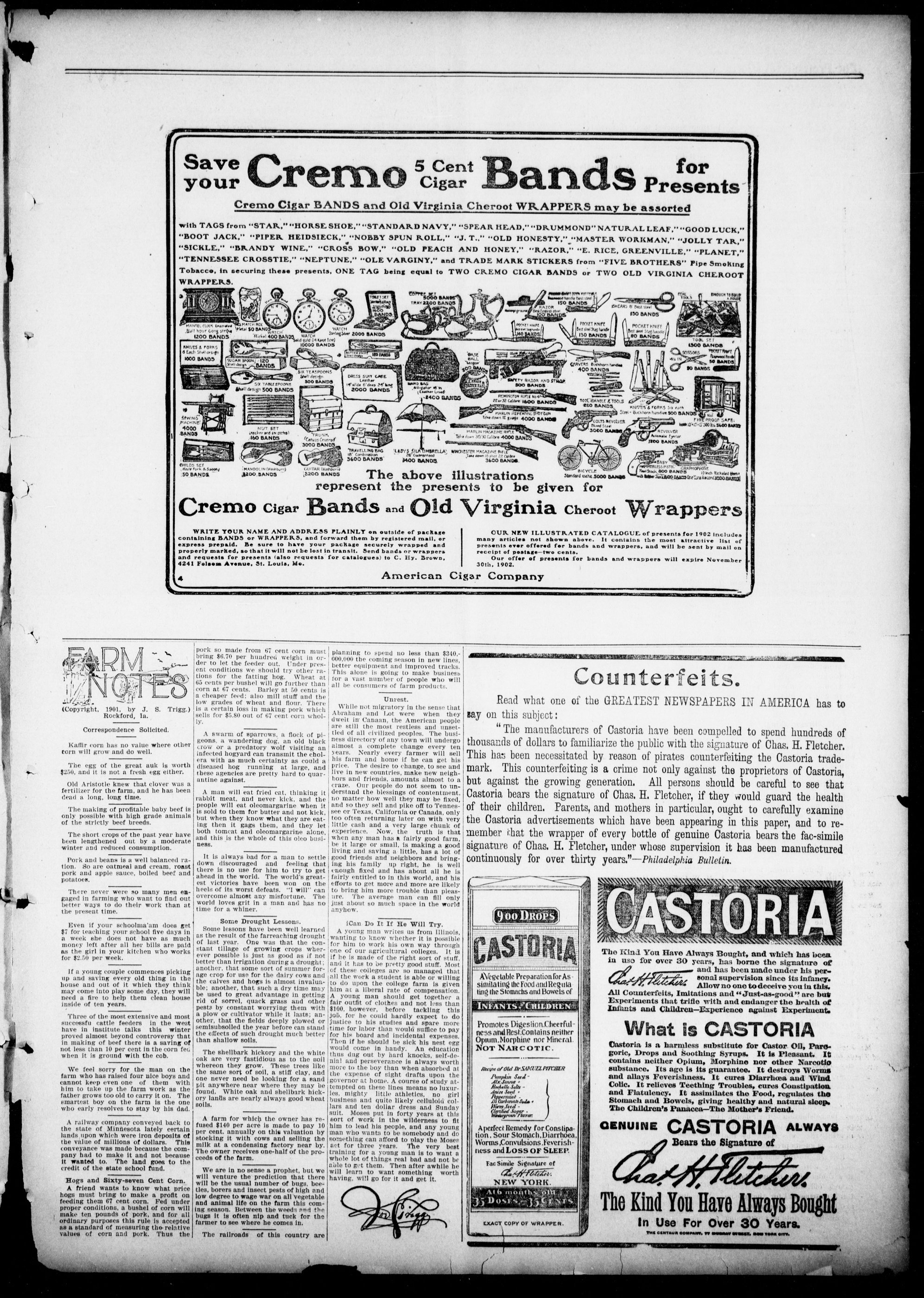
Save your Cremo 5 Cent Bands for Presents
Cremo Cigar BANDS and Old Virginia Cheroot WRAPPERS may be assorted with TAGS from "STAR," "HORSE SHOE," "STANDARD NAVY," "SPEAR HEAD," "DRUMMOND" NATURAL LEAF," "GOOD LUCK," "BOOT JACK," "PIPER HEIDSIECK," "NOBBY SPUN ROLL," "J. T.," "OLD HONESTY," "MASTER WORKMAN," "JOLLY TAR," "SICKLE," "BRANDY WINE," "CROSS BOW," "OLD PEACH AND HONEY," "RAZOR," "E. RICE, GREENVILLE," "PLANET," "TENNESSEE CROSSTIE," "NEPTUNE," "OLE VARGINY," and TRADE MARK STICKERS from "FIVE BROTHERS" Pipe Smoking Tobacco, in securing these presents, ONE TAG being equal to TWO CREMO CIGAR BANDS or TWO OLD VIRGINIA CHEROOT WRAPPERS.
MANTEL CLOKK Enamelled Hall hour Long string 1200 BANDS
MANTELINE Metal 50 BANDS
WATCH Nickel 400 BANDS
WATCH Silver gold (14 Rare time) 10000 BANDS
WATCH Starting Silver 2000 BANDS
SUGAR SPoon 120 BANDS
SIX TABLESPOONS Shell design 500 BANDS
SIX TEASPOONS Shell design 300 BANDS
DRESS SUIT CASE Leather 14 wide 6 deep 24 long 2000 BANDS
SEWING MACHINE 4000 BANDS
NUT SET (Shell and Sheath) 160 BANDS
TRUNK (Shell and Sheath) 3000 BANDS
TRAVELING BAG 18" Combination 3600 BANDS
LADY'S SILK UMBRELLA 26" Guaranteed 3400 BANDS
WHOLESTER MAGAZINE RIFLE Take down 16 shat 22 center 3600 BANDS
KINETES & FORKS Slim bench Steel - Buckhorn handle 500 BANDS
COINS REVOLVER Handle Store 3000 BANDS
FIRE PROOF SAFE
REVOLVER Automatic Ejection 1200 BANDS
The above illustrations
FARM NOTES
(Copyright. 1901. by J. S. Trigg.)
Rockford, Ia.
Correspondence Solicited
Kaffir corn has no value where other corn will grow and do well.
The egg of the great auk is worth $250, and it is not a fresh egg either.
Old Aristotle knew that clover was a fertilizer for the farm, and he has been dead a long, long time.
The making of profitable baby beef is only possible with high grade animals of the stricly beef breeds.
The short crops of the past year have been lengthened out by a moderate winter and reduced consumption.
Pork and beans is a well balanced ration. So are oatmeal and cream, roast pork and apple sauce, boiled beef and potatoes.
There never were so many men engaged in farming who want to find out better ways to do their work than at the present time.
Even if your schoolma'am does get $7 for teaching your school five days in a week she does not have as much money left after all her bills are paid as the girl in your kitchen works for $2.50 per week.
If a young couple commences picking up and saving every old thing in the house and out of it which they think may come into play some day, they will need a fire to help them clean house inside of ten years.
Three of the most extensive and most successful cattle feeders in the west have in institute talks this winter proved almost beyond controversy that in making of beef there is a saving of not less than 10 per cent in the corn feed when it is ground with the cob.
We feel sorry for the man on the farm who has raised four nice boys and cannot keep even one of them with him to take up the farm work as the father grows too old to carry it on. The smartest boy on the farm is the one who early resolves to stay by his dad.
A railway company conveyed back to the state of Minnesota lately certain lands upon which were iron deposits of the value of millions of dollars. This conveyance was made because the company had to make it and not because it wanted to. The land goes to the credit of the state school fund.
Hogs and Sixty-seven Cent Corn.
A friend wants to know what price hogs must bring to make a profit on feeding them 67 cent corn. Fed under proper conditions, a bushel of corn will make ten pounds of pork, and for all ordinary purposes this rule is accepted as a standard of measuring the relative values of corn and pork. Thus the
WRITE YOUR NAME AND ADDRESS PLAINLY on outside of package containing BANDS or WRAPPERS, and forward them by registered mail, or express prepaid. Be sure to have your package securely wrapped and properly marked, so that it will not be lost in transit. Send bands or wrappers and requests for presents (also requests for catalogues) to C. Hy. Brown, 4241 Folsom Avenue, St. Louis, Mo.
pork so made from 67 cent corn must bring $6.70 per hundred weight in order to let the feeder out. Under present conditions we should try other rations for the fatting hog. Wheat at 65 cents per bushel will go further than corn at 67 cents. Barley at 50 cents is a cheaper feed; also mill stuff and the low grades of wheat and flour. There is a certain loss in making pork which sells for $5.80 out of 67 cent corn wholly.
---
A swarm of sparrows, a flock of pigeons, a wandering dog, an old black crow or a predatory wolf visiting an infected hoydog can transmit the cholera with as much certainty as could a diseased hog running at large, and these agencies are pretty hard to quarantine against.
A man will eat fried cat, thinking it rabbit meat, and never kick, and the people will eat oleomargarine when it is sold to them for butter and not kick, but when they know what they are eating then it gags them, and they let both tomcat and oleomargarine alone, and this is the whole of the oleo business.
It is always bad for a man to settle down discouraged and feeling that there is no use for him to try to get ahead in the world. The world's greatest victories have been won on the heels of its worst defeats. "I will" can overcome almost any misfortune. The world loves grit in a man and has no time for a whiner.
Some Drought Lessons
Some lessons have been well learned as the result of the farreaching drought of last year. One was that the constant tillage of growing crops wherever possible is just as good as if not better than irrigation during a drought; another, that some sort of summer forage crop for use for the dairy cows and the calves and hogs is almost invaluable; another, that such a dry time may be used to great advantage in getting rid of sorrel, quack grass and other pests by constant worrying them with a plow or cultivator while it lasts; another, that the fields deeply plowed or semisubsoiled the year before can stand the effects of such drought much better than shallow soils.
The shellbark hickory and the white oak are very fastidious as to the soil whereon they grow. These trees like the same sort of soil, a stiff clay, and one never need be looking for a sand pit anywhere near where they may be found. White oak and shellbark hickory lands are nearly always good wheat soils.
A farm for which the owner has refused $140 per acre is made to pay 10 per cent. annually on this valuation by stocking it with cows and selling the milk at a condensing factory near by. The owner receives one-half of the proceeds of the farm.
We are in no sense a prophet, but we will venture the prediction that there will be the usual number of bugs, beetles, borers and insect pests of high and low degree to wage war on all vegetable and animal life on the farm this coming season. Between the weeds and the bugs it is often nip and tuck for the farmer to see where he comes in.
The railroads of this country are
American Cigar Company
planning to spend no less than $340,
000,000 the coming season in new lines
better equipment and improved tracks
This alone is going to make business
for a vast number of people who will
all be consumers of farm products
While not migratory in the sense that Abraham and Lot were when they dwelt in Canaan, the American people are still the most restless and unsettled of all civilized peoples. The business directory of any town will undergo almost a complete change every ten years. Nearly every farmer will sell his farm and home if he can get his price. The desire to change, to see and live in new countries, make new neighbors and friends, amounts almost to a craze. Our people do not seem to understand the blessings of contentment, no matter how well they may be fixed, and so they sell and pike off to Tennessee or Texas, California or Canada, only too often returning later on with very little cash and a very large chunk of experience. Now, the truth is that when any man has a fairly good farm, be it large or small, is making a good living and saving a little, has a lot of good friends and neighbors and bringing his family up right, he is well enough fixed and has about all he is fairly entitled to in this world, and his efforts to get more and more are likely to bring him more trouble than pleasure. The average man can fill only just about so much space in the world anyhow.
iCan Do It If He Will Try
A young man writes us from Illinois, wanting to know whether it is possible for him to work his own way through one of our agricultural colleges. It is if he is made of the right sort of stuff, and it has to be pretty good stuff. Most of these colleges are so managed that all the work a student is able or willing to do upon the college farm is given him at a liberal rate of compensation. A young man should get together a fair outfit of clothes and not less than $100, however, before tackling this job, for he could hardly expect to do justice to his studies and spare more time for labor than would suffice to pay for his board and incidental expenses. Then if he should be sick his nest egg would come in handy. An education thus dug out by hard knocks, self-denial and perseverance is always worth more to the boy than when absorbed at the expense of sight drafts upon the governor at home. A course of study attempted on these lines means no luxuries, mighty little athletics, no girl business and quite likely celluloid collars and ten dollar dress and Sunday suit. Moses put in forty years at this sort of work in the wilderness to fit him to lead his people, and any young man who wants to be somebody and do something can afford to play the Moses act for three years. The very best training for a young man is to want a whole lot of things real bad and not be able to get them. Then after awhile he will learn to want something worth having, will go for it and get it.
Johann Sieg
Unrest.
OUR NEW ILLUSTRATED CATALOGUE of presents for 1902 includes many articles not shown above. It contains the most attractive list of presents ever offered for bands and wrappers, and will be sent by mail on receipt of postage-two cents.
Our offer of presents for bands and wrappers will expire November 30th, 1902.
Read what one can say on this subject:
"The manufacture thousands of dollars to fix this has been necessitary mark. This counterfeiting but against the growing Castoria bears the sign of their children. Parent the Castoria advertisement member that the wrapper signature of Chas. H. F. continuously for over t
900 DROPS
CASTORIA
Read what one of the GREATEST NEWSPAPERS IN AMERICA has to say on this subject:
"The manufacturers of Castoria have been compelled to spend hundreds of thousands of dollars to familiarize the public with the signature of Chas. H. Fletcher. This has been necessitated by reason of pirates counterfeiting the Castoria trademark. This counterfeiting is a crime not only against the proprietors of Castoria, but against the growing generation. All persons should be careful to see that Castoria bears the signature of Chas. H. Fletcher, if they would guard the health of their children. Parents, and mothers in particular, ought to carefully examine the Castoria advertisements which have been appearing in this paper, and to remember that the wrapper of every bottle of genuine Castoria bears the fac-simile signature of Chas. H. Fletcher, under whose supervision it has been manufactured continuously for over thirty years."—Philadelphia Bulletin.
A Vegetable Preparation for As simulating the Food and Regula ting the Stomachs and Bowels of
Promotes Digestion.Cheerfulness and Rest.Contains neither Opium,Morphine nor Mineral.
NOT NARCOTIC.
Recipe of Old Dr.SAPUEL PITCHER
Pumpkin Seed -
Alk Serava -
Almond Salt -
Juni Seed -
Peppermint -
All Cinnamon Soda -
Horn Seed -
Cinnamon Sugar -
Wintergreen Flavor
Aperfect Remedy for Constipation,
Sour Stomach, Diarrhoea
Worms, Convulsions, Feverishness and LOSS OF SLEEP
Fac Simile Signature of
Charles W. Wither.
NEW YORK.
A 16 month old
35 doses = 35 CENTS
EXACT COPY OF WRAPPER.
Counterfeits.
Counterfeits.
CASTORIA
The Kind You Have Always Bought, and which has been in use for over 30 years, has borne the signature of and has been made under his personal supervision since its infancy. Allow no one to deceive you in this. All Counterfeits, Imitations and "Just-as-good" are but Experiments that trifle with and endanger the health of Infants and Children—Experience against Experiment.
What is CASTORIA
Castoria is a harmless substitute for Castor Oil, Paragoric, Drops and Soothing Syrups. It is Pleasant. It contains neither Opium, Morphine nor other Narcotic substance. Its age is its guarantee. It destroys Worms and allays Feverishness. It cures Diarrhoea and Wind Colic. It relieves Teething Troubles, cures Constipation and Flatulency. It assimilates the Food, regulates the Stomach and Bowels, giving healthy and natural sleep. The Children's Panacea-The Mother's Friend.
The Professional World
RUFUS L. LOGAN, B. S. D. - EDITOR
TERMS OF SUBSCRIPTION.
One Year in Advance - - - $1.50
Six Months in Advance - - - 1.00
Three Months in Advance - - - .50
Single Copies - - - .05
Special rates of $1.00 per year to ministers.
Advertising Rates on Application.
Job Work of all Kinds Solicited.
Entered at the postoffice at Columbumbia, Mo., as second class matter, Jan. 15, 1902.
Agents wanted in every town in the state.
PRESS OF THE MISSOURI STATESMAN
A CERTAIN negro newspaper in this state should remember that it is a breach of editorial courtesy to copy editorial from other papers without giving them credit for the same.
WHEN persons write to other persons about matters which are of no interest to the persons to whom they write and expect an answer they should enclose the neccessary postage.
OUR thanks are due the following named persons for recent subscription to the Professional World Mr. W. H. Turner, Mrs. Charles Baker, Miss Fannie Johnson, of Columbia, and Prof. J. B. Coleman of Fayette, Mo.
THE Professional World is not a political organ but we are endeavoring to establish in Central Mo., A clean newsy race paper, that one will be helpful to the race. We believe that every man should be enough interested in politics to vote for clean, honest men regardless of party affiliations. The civil war has long since been over and we live in a different era than those we lived in the ante-bellum days.
Wanted.
For our file, a few copies of the Professional World dated Jan. 24th; any one having one of the above dated copies will do us a favor by sending us the same.
Dressmaking.
Plain sewing and dressmaking done by Mrs. A. B. Moore, prices reasonable. Phone 638; 305, N. fifth st.
Jefferson City Notes.
Rev. Hopkins of the A. M. E. Church has just closed a series of meetings with 26 additions to the church.
Rev. Goins of the Second Baptist church is preparing for Easter.
Mrs. Fanny Brown is on the sick list.
Mrs. Antone Furgerson has has been very sick but is improving.
Mr. Ike Adams is still on the sick list.
Mrs. Robinson of St. Louis spent several days in the city visiting her daughter, Miss Anna Cohen who is attending school at Lincoln Institute.
Mr. Thomas Moore, teacher in Chamois Public schools, arrived on Sunday morning and spent the day with his friend Mr. Chauncy Dupee.
Mr. Juber Coleman and family of Elston Mo., have moved to our city to live.
Mr. and Mrs. M. D, Mayberry entertained a number of friends at their home 601 Lafayette st. last Friday evening. The occasion was the celebration of their daughter Miss Geneva's birthday; a delightful time was spent by the numerous guests present.
Richard Muston and Mrs. Jane Spencer were married last week Rev. Goins of the Second Baptist church officiating. This is the third matrimonial for the groom and the second for the bride.
Lincoln Institute is progressing
---
nicely under the management of President Clarke.
Quite a number of students were called home last week on account of sickness.
The D. Normal class of Lincoln Institute tendered their rhetorical teacher, Prof. Bias, a reception last Friday afternoon in the young ladies Hall; a programe was rendered after which light refreshments were served; an enjoyable time was had.
$100 Reward. $100.
The readers of this paper will be pleased to learn that there is at least one dreaded disease that science has been able to cure in all its stages, and that is Catarrh. Hall's Catarrh Cure is the only positive cure known to the medical fraternity. Catarrh being a constitutional disease, requires a constitutional treatment. Hall's Catarrh Cure is taken internally, acting directly upon the blood and mucous surfaces of the system, thereby destroying the foundation of the disease, and giving the patient strength by building up the constitution and assisting nature in doing its work. The proprietors have so much faith in its curative powers, that they offer One Hundred Dollars for any case that it fails to cure. Send for list of testimonials.
Address, F. J. CHENNEY & Co.,
Toledo, O.
Sold by Druggists, 75c.
Hall's Family Pills are the best.
Newman P. Starke is reported
ill.
Mrs. Hooe will have her millinery
opening Monday.
F. D. Dimmitt is working for Samuel
Cupples in St. Louis.
Mr. and Mrs. DavidiNeeley have a
10-pound girl at their home.
R. B. Glenn shipped six horses to
St. Joseph Sunday for the big sale.
Millinery opening of Mrs. J. E.
Hooe, Monday, March 24th.
Bishop Hendrix preaches at the
Methodist church, Sunday morning
at 11 o'clock.
R. O. Summerville, law student, visited homefolks at Chillicothe Sunday and Monday.
"A Suit of Livery" will be played by the young ladies of Stephens College on March 25.
Dr. R. L. Hopper has just placed a new cash register on his counter at the drug store.
Dr. Lockridge and wife were in Paris Saturday to attend the funeral of Mr. Lockridge's bother-in-law.
Local weather prophets say we may expect rain this month, for it was a "wet moon."
F. W. Niedermeyer has bought the Blackwell cottages on South Ninth street.
The annual encampment of the Missouri G. A. R. will be held at Cape Girardeau, May 13-14.
R. F. Rogers has been in St. Louis this week for new spring goods and Easter bargains.
Judge Bicknell bound Clarence Weaver over to the grand jury for feloniously assaulting Marvin Long last week.
M. W. Coffey and Henry Bergman left on the 20th for Batesville, Ark., with twelve men to work on the railroad for W. H. Kolkmeyer.
Col. Kerfoot, the real estate agent, advertises that he has property in the "plug hat" district near the University, on his list.
Friends of Prof. F. Pannell will be glad to know he has sufficiently recovered from his four weeks illness to be at his office.
B. M. Anderson sold a cottage in Nowell's addition, to Willis Proctor, for $850. Mr. Proctor will move to Columbia.
Prof. C. L. Buckmaster, who is teaching at Pilot Grove, Mo., spent Saturday and Sunday with his family in Columbia.
S. L. Moser, secretary of the Direct Legislation League of Missouri, was in Columbia this week scattering literature on that subject.
The "Souvenir Tea" given Tuesday afternoon at Mrs. J. P. Gant's, on Price avenue, was a most enjoyable occasion.
The Farmer's Bank will be open for business Saturday, and Cashier Bradford expects to see a great many of his friends over the counter.
Paul Shouse, formerly of Columbia, is now on the New York News. He is now the telegraph editor for that evening paper.
W. C. Johnson, a University student, was taken to his home, Vandalia, Wednesday, prostrated with inflammatory rheumatism.
Among those reported sick are: Mrs Nancy Boggs, Ben McKimpson, Mrs. Geo. Northcutt, John C. Quarles, and Mrs. J. M. Gwynn.
The Freshmen and Sophmore engineers "enjoyed" a class rush Saturday night on the campus which ended in an agreement to try it again.
"The Coming Man" will be Bishop Hendrix's subject at Stephens College Saturday night. This is the last number in the Epworth League lecture course.
J. H. Murry tells the Sturgeon Leader man that he is not a candidate for representative, though he has been solicited by his friends to make the race.
The county court has certified J. E. Silver, of Columbia to the board of managers of the Feeble Minded Colony at Marshall, Mo., as a proper subject for that institution.
Miss Nellie Havens of Carthage, received from Miss Alice Roosevelt, the President's daughter, a dainty embroidered handkerchief with an autograph card as mark of esteem and friendship.
George Northcutt, of near Stephens Store, said Tuesday that it was still very dry in his locality; the farmers were buying feed, and money is tight.
The ladies of the Presbyterian church entertained Miss McCorkle, who was here in the interest of the Y. W. C. A., at the home of Mrs. N. T. Gentry Wednesday afternoon.
Announcement is made of the coming marriage in June of B. M. Thompson, formerly of Columbia, to Miss Anne Slade in New York, where Mr. Thompson is now located. Mr. Thompson is a brother of Mrs. J. C. Jones.
Councilman Truitt says the city of Columbia has no authority to license bucket shops, and towns that have done so in Missouri have over-stepped their authority. They can only be classed as nuisances and their operators fined.
This is the time of year when the people of the state are coming to its Mecca, Dr. Miller's Sanitarium, to be healed of their chronic diseases. Mrs. F. A. Fish, of Fulton, is one of them, and is said to be greatly delighted with her treatment.
Mrs. Mary Rogers Jones, wife of the Reverend J. B. Jones, president of William Woods College, Fulton, died Tuesday morning. She was about 50 years old. Burial will take place at Carlisle Ky., on Friday.
John Burruss, W. E. Bradford, and C. B. Long will hold a public sale of 100 noculated short-horn cattle at Dallas, Texas, Thursday and Friday April 24-25. They find a splendid market in Texas for high-grade Missouri cattle.
Mrs. W. J. Lhamon will make an illustrated talk on Missions, under the auspices of the C. W. B. M. at the Christian church auditorium Friday evening of this week at 7:30 o'clock. No admission will be charged, but a silver offering will be expected.
James W. Schwabe is a candidate for a place on the school board of Columbia. There are two places to be filled at the school election April 1. W. B. Nowell and Walter Williams are the retiring members. F. W. Peck and Emmett Clinkscales are also candidates.
The country residence near Fulton of George W. Hamilton, a real estate agent and author of several books, was burned Tuesday morning, entailing a loss of about $4,000. Mr. Hamilton's library, one of the best in Central Missouri, was also burned. Only $1,000 Insurance was carried on the whole property.
There will be a Conference of the Friendly Visitors of the Charity Organization Society next Tuesday at four o'clock in the Parlors of the Powers House. The topic to be considered will be the care of poor families during the summer. All interested in the work of caring for the poor of Columbia are invited to be present.
Walker Whiteside.
The remarkably large receipts played to this season by Mr. Whiteside and his excellent company has caused no little comment in theatrical circles. In St. Louis, Indianapolis, Baltimore, Montreal, St. Paul and Minneapolis and other large cities, the audience has many nights each week, tested the capacity of the theatres. Through one night stands, crowded houses have been the rule. Mr. Whiteside's beautiful production of "The Merchant of Venice"—that most popular of comedies—has been received with the greatest of favor, and the actor is rapidly regaining his small fortune which he lost by the burning of the Coates Theatre in Kansas City. Mr. Whiteside will be here Saturday, April 5th, at Stephens College Chapel.
Marriages.
COWDEN-Coons.—William Cowden, press feeder in the Statesman office, was married last Friday afternoon to Miss Grace Coons. The marriage took place in Judge Boggs' office with the judge as officiant. The young people have the best wishes of all their friends.
"WIRELESS TELEGRAMS."
Special to the Statesman.
Harg, Mo., Mar. 17.—Since the withdrawal of Clark and De Armond from the senatorial race, several enthusiastic Clark men in this neighborhood have withdrawn their election bets.
Wilton, Mo., Mar. 19.—The drug business at this place shows that the effect of the drouth is unabated and that drinking-water is still hard to get. Substitutes, however, are easily obtained.
Rock Bridge, Mo., Mar. 18.—We are on the boom in this neck of the woods. Several new houses, going up. No candidates or wild geese seen here this spring and we fear winter is not yet over. We don't plant potatoes till the sign is just right.
Sturgeon, Mo., Mar., 16.-It is understood here that Judge W. F. Roberts will again be in the race for representative. Our citizens hope he will run. The common pleas court is still running. (Later-we hear the Judge is off the track.)
Hartsburg, Mo., Mar. 14.—The building of a gravel road from this place to Ashland, has been abandoned, owing to the fear of the Ashland people that it might result in bringing the Ashland and Columbia trade to Hartsburg. We have raised in the last ten years not less than $80,-000, for this road, but before we could get organized the mud would be gone—also our enthusiasm. So that the money is yet unspent. The amount of money we have subscribed to these roads would have built a first class court house.
Centralia, Mo., Mar. 18.—The citizens of this town and township are heartily in favor of a new $40,000 Court House at the County seat, provided the bond proposition includes also a proposition to spend $75,000 on the roads in each of the 7 townships. This we consider fair to us, since our township is much the smallest in the county, and about one fourth the size of Cedar. The Court House sentiment is growing in this part of the county. Some of our citizens want to donate the park to the county and have the new structure built there. If Mr. Booth receives the nomination for probate judge and Mr. Harris becomes prosecuting attorney, it is also believed a good vote for the structure at Columbia might be given by Centralia.
HALLSVILLE BUDGET
Mrs. E. E. Evans is on the sick list.
Miss Georgia Hulen is clerking for Hulen, Hulett & Co.
Mrs. A. C. Hulen has been quite sick the past week.
Mrs. W. T. Rooker entertained her sister of Mexico over Sunday.
Mrs. T. P. Brown entertained her mother and sister over Sunday.
Emmett Dickenson purchased two mules of D. L. McBride for $100.
Elias Elliott was up from Woodlandville Monday and finished moving his goods.
S. P. Hulen and wife, of Clark, visited the family of A. C. Hulen one day last week.
Miss Susan and Id Austene were the guests of Columbia relatives Saturday and Sunday.
Mrs. Susan McMinn attended quarterly meeting at Browns Station Saturday and Sunday.
The German Medicine Show Co., is in Hallaville this week giving an entertainment each night.
W. J. Todd will have a public sale March 22nd and sell all his household and kitchen furniture.
Mrs. Eppa F. Elliott came over from Thompson Sunday on a visit to her parents Wm. H. Brink and wife.
J. W. Hulen and family were down Saturday from Centralia the guests of F. M. Hulen and wife and to celebrate Mr. Hulen's birthday.
Mrs. R. S. Austene lost some chickens last week that were caught by a pet coyote, which the doctor brought from Oklahoma last summer.
Emmett F. Elliott came up Monday from Hinton and reports fourteen applications for membership in starting a Married Men's League at that place.
New Cash Grocery!
We save you money by paying cash for Groceries. All new goods; highest price paid for produce and poultry. 708 W. Broadway, Phone 631.
Charming Designs,
Luxurious Qualities,
Gratifying Assortments,
Unrivalled Prices,
Call and examine stocks.
R. F
SOLE AGENT FOR ST
R. F. ROGERS.
SOLE AGENT FOR STANDARD PATTERNS
RIPANS
I have been taking Ripans Tabules for the dyspepsia, and they have helped me wonderfully. I do not know any particular way they affect me; but they seem to give vigor to the entire system. I had a sort of languid feeling, but since taking the Tabules I feel spirited and have not that melancholy way about me. I think they are good for a general build up of the system, as they seem to act like a tonic. At druggists. The five-cent packet is for an ordinary occasion, the family bottle, sixty cents, contains a supply for a year.
Riggs.
J. E. Reid has a new telephone.
B. R. Tucker sold a horse for $65.
J. D. Rowland has been quite sick.
Joe Prowell sold a jack last week for $300.
Judge S. N. Woods is in Columbia this week.
Mrs. Warren Voorhees is in very poor health.
John Sims wife and children have the measles.
Mrs. Lottie Prowell died March 16th 1902, buried at Bethlehem Monday.
Miss Nora McAllister of Columbia is visiting her sister Mrs. N. B. Green.
Miss Emma Burnham visited her sister Mrs. J. A. Reid the first of the week.
Mrs. Susan Seymour had a sale last Saturday. She is going to move to Sturgeon.
Mrs. John Riley and daughter Miss Nina have pneumonia but are improving.
Married March 9th at the residence of and by Eld. J. K. Robinson. W. W. Woods and Miss Jessie Malone.
Deaths
Moss.—Miss Belle Moss, who recently visited relatives in Columbia, died Monday night in Paris Mo., after a very brief illness of pneumonia. She was a popular and talented young woman.
PURDY.—Mrs. Martha E. Purdy, sister of Mr. W. S. Culbertson, died March 14, 1902, at her home in Centralia, Mo. Deceased was in her 68th year. She leaves four sons and three daughters, all grown up. Her husband Robert Andy Purdy, died 16 years ago. Mrs. Purdy was buried Saturday in Centralia.
Riggs.
VESSER & TRUE
50 YEARS' EXPERIENCE
PATENTS
TRADE MARKS DESIGNS
COPYRIGHTS & C.
Anyone sending a sketch and description may quickly ascertain our opinion free whether an invention is certainly reasonable. Documents strictly confidential. Handbook on Patents sent free. Oldest agency for securing patents. Patents taken through Kunn & Co. receive special notice, without charge, in the Scientific American.
A handsomely illustrated weekly. Largest circulation of any scientific journal. Terms, $3 a year; four months, $1. Sold by all news dealers.
MUNN & Co. 361 Broadway, New York
Branch Office, 625 F St., Washington, D.C.
Lodge and Church Directory.
Mrs. Irena Akers, W. P.; Mrs. Lizzie Williams, W. S. Meeting first Monday in each month at 3 p. m.
U. B. F.
Crispus Attucks Lodge,No. 62. Meetings 2nd and 4th Tuesdays in each month. Visiting members cordially invited. Caleb Hall, W. M. A. M. Schweich, W. S.
K. P.
Acme Lodge, No. 24. Meetings second and fourth Fridays in each month. W. H. Turner, C. C. and D. D. G. C. W. W. Lampkins, M. F.
O. E. S.
Amos Chapter, No. 30. Meetings second Friday in each month. Mrs. A. B. Moore, W. M. Mrs. Lizzie Richardson, W. S.
Rev. J. B. Parsons, pastor. Preaching Sundays 11 a. m. and 7:30 p. m.
A. M. E. CHURCH.
Rev. P. C. Crews, Pastor.
Preaching Sundays 11 a.
m.; 7:30 p. m.
Sunday school 2:30 p. m.
Prayer meeting every
Wednesday eve, at 8:30; every body invited to attend.
M. E. CHURCH
Rev. J. Arlington Grant, pastor.
Preaching Sundays 11, a. m. and 7:30 p. m.
Sunday school, 9:30 a. m.
Prayer meeting Wednesdays 7:30 to 8:30; all are made welcome.