The Professional World
Friday, March 28, 1902
Columbia, Missouri
Page text (machine-generated)
THE PROFESSIONAL WORLD.
$1.50 Per Year in Advance.
EASTER SERVICES.
All of the churches have prepared special exercises to be rendered on Sunday. The following are the programmes which may be clipped and used by those attending these exercises:
M. E. CHURCH, 11 A. M.
Chorus—Hallelujah.
Prayer—Brother Gosline.
Chorus and march—School.
Responsive reading.
Recitation—Mary Rolley.
Solo—Mrs. Jennie Colbert.
Dialogue—Four Girls.
Chorus—Speed the Light.
Recitation—Minnie Peach.
Select Reading—Zetta Scott.
Trio—Misses Diggs, Mason and
Burton.
Recitation—Stella Freeman.
Recitation—Mattie Fields.
Recitation—Jazo Peach.
Chorus—Ship of Zion.
Recitation—Austine Freeman.
Select Reading—Mrs. Washington.
Recitation—Georgia Diggs. Chorus and March—"On to Victory."
Hymn—Choir.
Scripture Reading—Rev. P. C.
Crews.
Lord's Prayer, chanted—Choir.
Paper—Miss L. Walker.
Address—E. W. Emory.
Recitation—Nannie Carter.
Solo—Miss E. Estes.
Paper—Mrs. H. A. Clark.
Recitation—Miss Nora Wilson.
Paper—Miss Eulalie Douglass.
Solo—Miss K. McClure.
Paper—Miss F. Moseley.
Reading—Mrs. V. S. Walden.
Address—Mrs. P. C. Crews.
Selection—Choir.
SECOND BAPTIST CHURCH, 3 P. M.
Sing Praises Unto Him—Song
by School.
Prayer—Mr. Thad Lang.
Happy Hearts Have We—Song by School.
Easter, paper—Miss Maggie Williams.
Christ is Risen, Recitation—Ma vie Gatewood.
Sunshine, Recitation—Oscar Tibbs.
Easter Morn, Recitation—Nora Wilson.
Hail to Thee, Recitation—Charlie Flood.
Led by the Voice of Jesus, Duet —Misses Marshall and Mason.
Resurrection, paper—Miss Ella Diggs.
Theme that Keeps me Singing, Recitation—Edna Gatewood. Heaven's Gate, solo—Miss Carri
tion—Miss Annie M. Fisher.
Open Wide the Gates—Song by School.
The Resurrection—Mattie Brown and Bertha Lampkin.
Easter Greetings—Song by School.
Easter Awakening, Recitation—Miss Alby Mason.
Easter Tidings, Recitation—Lucile Smith.
Tell Me of My Savior—Song by School.
Collection.
Distribution of Easter eggs.
Savior Breathe an Evening Blessing, Anthem—By Choir.
Benediction.
SECOND CHRISTIAN CHURCH.
Sacred concert by choir.
Organ Voluntary—Mrs. M. Akers.
Anthem—True Easter—by choir.
Declaration, Miss Lucy Ward.
Anthem—Jesus Lover of my Soul—by choir.
Paper, Miss Addie Mosely.
Solo, "The Holy City" Mrs. L. L. Maupin.
Paper, "Woman's Work in the
Church," Mrs. Annie L. Hicks.
Authem—"Nearer My God to
Thee," by choir.
Paper, "How We May Assist the
Youth of the Sunday School"
-Miss Effie Maupin.
Declamation—Miss Matsy Rice.
Selection by choir.
Offering.
Benediction.
Notice.
All person who are interested in the success of The Professional World will show the same by patronizing the business men who advertise in these columns.
Wanted.
For our file, a few copies of the Professional World dated Jan. 24th; any one having one of the above dated copies will do us a favor by sending us the same.
Dressmaking.
Plain sewing and dressmaking done by Mrs. A. B. Moore, prices reasonable. Phone 638; 305, N. fifth st.
$100 Reward. $100.
The readers of this paper will be pleased to learn that there is at least one dreaded disease that science has been able to cure in all its stages, and that is Catarrh. Hall's Catarrh Cure is the only positive cure known to the medical fraternity. Catarrh being a constitutional disease, requires a constitutional treatment. Hall's Catarrh Cure is taken internally, acting directly upon the blood and mucous surfaces of the system, thereby destroying the foundation of the disease, and giving the patient strength by building up the constitution and assisting nature in doing its work. The proprietors have so much faith in its curative powers, that they offer One Hundred Dollars for any case that it fails to cure. Send for list of testimonials.
Address, F. J. CHENNEY & Co.,
Toledo, O.
Sold by Druggists, 75c.
Hall's Family Pills are the best.
Shakespeare Entertainment at Fifth Street Hall, April 3rd, 1902.
PROGRAM (IN PART.)
Opening—solo and chorus, Holy City, (Solo by Dr. J. E. Perry.)
Recitation—"The Roman Soldier," Miss Annie May Fisher.
Baritone Solo—"Asleep in the Deep," Mr. J. J. Diggs.
Recitation—"The Polish Boy," Miss Maud Holmsly.
Balcony scene from Romeo and Juliet—Mrs. Annie Taylor and J. L. Diggs.
Piano Solo—Mr5. W. R. Akers,
Vocal Duet—Misses Estes and Mason.
Ghost scene from Hamlet—Dr. J. E. Perry as Hamlet, E. B. Coleman as Marcellus, Lawrence Diggs as Horatio, J. L. Diggs as Ghost. Solo--Miss Susie Coleman. Scene from Richard III--Miss Scott and J. L. Diggs. Solo and Chorus-"Kentucky Babe," (solo sung by Miss Estes.) Musical Comedy--Mrs. Akers and Mr. Diggs. Solo--Miss Alba Mason.
REV. JONES' VISIT.
Rev. H. I. Jones, of Olean, Mo., spent last week in our city conducting a revival meeting at the Second Baptist church. The meetings were well attended and spiritual success; three additions were made to the church. Rev. Jones is an able young minister, and is destined to become a power in the Baptist church. The meeting closed Sunday evening. A large congregation attended the closing services.
COLUMBIA, MISSOURI, FRIDAY, MAR. 28, 1902.
A NIGHT WITH SHAKESPEARE
Mr. J. Leon Diggs, assisted by local agent, will present "Hamlet" at the Fifth Street Hall. Everybody should attend, it will be strictly high-class.
Miss Mamie Keene, for with Matthews Mercantile Co now with R. F. Rogers Dry Co., where she will be please see all her old friends.
Seed potatoes at Ber
LINCOLN INSTITUTE NOTES.
Prof. E. Seruggs, of Macon City, lectured to school at the Christian Union Meeting.
Local meeting of alumni to take steps for founder's day, speaker for annual program, official organ and closer union between church, school and citizen, was held this week.
The alumni association hopes to have the largest meeting this June. This association must be a greater power in our state.
On last Friday the D Normal Class gave as a mark of respect to their teacher, John Bias, the following program was rendered:
Song-By Class.
Essay-Miss Lillian Collier.
Music-Huff's Mandolin and
Guitar Club.
Ice Cream.
Trio-Miss A. Williams, Messrs. S. E. Hill and D. R. Keys.
Fruits and Nuts.
Solo-Miss Maud Douglas.
Oration-Alvin Payne.
Instrumental Solo-Miss Almyra Longdon.
Address to Prof. Bias-C. A.
Huff, President of Class.
Talk—President E. A. Clarke. Music.
City Notes.
Rev. H. I. Jones left Monday for Olean, Mo.
Just received at R. F. Rogers a new line of dimities and lawns.
Mrs. George Trigg left for Kansas City Sunday to join her husband, who has been there for some time.
Grab sale at Gilman & Dorseys's, April 2nd, from 25c to $20. Value received for every thing you draw.
Miss Lucile Smith is able to be out again after several weeks' illness.
Mr. G. W. Davis, of Providence, was in Columbia Monday. Get prices on hay, corn and oats at B. M. Payne's.
Mrs. Maria Gillaspy is on the sick list.
Rev. J. A. Grant returned Monday from Louisiana, Mo. where he attended the annual M. E. conference.
Just received at R. F. Rogers a new line of dimities and lawns.
Rev. J. B. Parsons returned Tuesday from Jefferson City and will remain until after Easter.
Mr. William Terril is seriously ill.
Rev. Jas. L. Smith and wife, of Lexington, Mo., visited the family of Mrs. Joseph Peach this week.
Wait for the grab sale at Gilman & Dorsey's, Apr. 2.
Mr. Anderson Schweich was in St. Louis and Chicago this week.
Mrs. Mason, mother-in-law of Rev. J. B. Parsons, is reported ill at her home in Fulton.
Garden Seeds of all kinds in bulk or packages at Ben M. Payne's.
Mrs. Gabriel Crocket is on the sick list.
Don't forget the grab sale at Gilman & Dorsey's, April 2nd.
---
Miss Mamie Keene, formerly with Matthews Mercantile Co., is now with R. F. Rogers Dry Goods Co., where she will be pleased to see all her old friends.
Seed potatoes at Ben M. Payne's.
Attend the entertainment at the Fifth Street Hall next Thursday evening. You'll never regret it.
Seed corn and seed potatoes at Ben M. Payne's.
Master Otis Moore is home from Lincoln Institute to visit his mother, Mrs. A. B. Moore.
Just received at R. F. Rogers a new line of dimities and lawns.
WHAT IS YOUR DUTY?
By PROF, PAUL SCHWEITZER.
(Reprinted from the Argus. Vol. VIII
No. 2, November, 1800, published by the
students of the Missouri State University.)
The complaint is often heard in these days, that graduates of college and university cannot think; that they are inferior to practical men in the various pursuits of life; that, excepting as a preparation for one or two professions, a college education involves a waste of time. These complaints are heard on all sides not only here but abroad; are they founded in fact or are they, like most of the common sayings, made up of truth and error, blended and made into a single image of contorted shape and false colors? An examination of the matter may result in clearing our vision and answering our question.
A college course implies with most persons about fourteen years of school life; much is learned during this time and after a few years forgotten; languages history, natural sciences and mathematics become obliterated from the mind, and only those things are really and usefully retained, which are continued in use after graduation; if the years spent in school gave nothing else but this slight increment of knowledge, a woful waste of time might indeed be laid at the door of our present civilization; but the case is different. Aside from the minor civilizing tendencies of school life, such as adjusting one's self in the circle with others, forming friendships, striving after ideals, and the like, education as a preparation for the duties and enjoyments of life has three main aims: The formation of character, the development of mental power, the acquisition of knowledge.
These are of importance in the order named; the last but the instrument for the second, and both for the full attainment of the first, and all, which is the momentous and gratifying fact, free to the grasp of individual effort. Wealth, family and influence, though a protective setting around the life of many a youth, count for nothing in the struggle for knowledge, mental power and character. And verily a struggle it is; no room there for makeshifts, indolence or prevarication; the law is inexorable; sowing before reaping; laboring before enjoying. Go to, then, aspiring youth! Leave faintheartedness behind; press onward, and at the hand of duty, imposed by self or filial affection, reach out for the golden prize; it is yours through honest toil. THE ACCOMPLISHMENT OF KNOWLEDGE
The business of the district schools is a threefold one: To furnish the implements of knowledge as reading, writing, ciphering and others, to impart knowledge itself, and to cultivate and develop the faculties of the mind. Little need be said about the first, excepting that the time spent on it should be shortened by connecting it more
intimately with the second; interesting knowledge imparted interestingly stimulates wonderfully to a mastering of the implements. The knowledge given by the district school is necessarily limited in scope and extent; it should be sufficient, however, for the duties of citizenship and the demands of ordinary business; but because of its daily application to the affairs of life it should be precise and exact. To make and enter into a contract, to ascertain gain or loss of an enterprise, to form an opinion on any of the great questions of the day, to discharge intelligently the grave duties of citizenship at the polls, requires a clear and precise knowledge of the English language, of arithmetic, of history and of such subjects as are taught at the public schools. Slovenly and inaccurate methods must therefore be tolerated even less there than elsewhere, since the pupil is helpless through youth and lack of judgment. He is so far, then, held irresponsible; but his responsibility begins with the cultivation of his mental faculties; he himself must make the effort to strengthen his memory, to develop his powers of observation, to conconcentrate and force his attention; no one can do it for him, and in proportion as he does it honestly and conscientiously he will cultivate not only his mental faculties, but acquire at the same time knowledge. Wise, indeed, are the providences of God! For if money, which can surround our body with the comforts and conveniences of the whole world, could also buy, through the labors of others, knowledge and mental power, abiding slavery of body and soul would be the inevitable lot of most of us.
I have so far said nothing of the cultivation within the district school of the pupil's moral nature; altogether too little attention is paid to it at present; for, aside from cultivating habits of order, obedience and outwardly good manners, no direct effort is made to reach the heart; it is truly to be hoped that this most important matter will receive a speedy practical solution.
The high school and academy continue on a broader basis the work of the district school, but give increased attention to the development of mental faculties, and, for that reason, increased opportunities for the discharge of a student's proper duties. (TO BE CONTINUED.)
THE NEGRO IN POLITICS
Is the decadence or the negro in national politics a true index to his declining sway in the affairs of the nation? That his presence in official position is growing rarer and rarer as the years go by is a fact too noticeable for the older generations to overlook.
For the first time in thirty-two years, except for a brief period between 1887 and 1889, no colored man sits in either chamber of Congress, and there is less prospect of the election of a colored man to this body than at any time since the close of the war.
The first negro elected to Congress, was J. W. Menard from Louisiana. He was born in Illinois and educated. Owing to irregularities he was barred from taking his seat. In the Forty-first Congress, Revells, a negro from Mississippi was admitted to the Senate to fill a seat made vacant by Jefferson Davis,' resignation. Two other negroes served in the Forty-first Congress—Joseph H. Rainey and Jefferson F. Long. There were four negro representatives in the Forty-second Congress which number was increased
to seven in the Forty-third. The Forty-fourth Congress was known as the "black Congress." Bruce represented Mississippi in the Senate, and seven men of his race served in the lower House. Of these the most conspicuous was Robert Smalls of South Carolina.
With the Forty-fourth Congress the number of colored men in the House and Senate began to decrease. In the next Congress only four colored members were returned. Bruce was the only man of his race in the Forty-sixth Congress. Smalls and Lynch represented their race in the Forty-seventh Congress. In the two succeeding Congresses there was only one colored man, O. Hare of North Carolina, who was defeated for the Fiftieth Congress, and since then only five negroes have served in Congress-Langston of Virginia, Miller of South Carolina, Cheatham of North Carolina, Murry of South Carolina and White of North Carolina.
THE TRUE MEASURE:
The place to take the true measure of a man is not in the market place or amen corner, nor in the field or forum, but at his own fireside. There he lays aside his mask and you learn whether he is an imp or angel, king or cur, hero or humbug. I do not care a copper what the world says of him, whether it crowns him with glory or pelts him with eggs. I care not of what religion he may be. If his babies dread his coming home and his better half swallows her heart every time she asks him for a $5 bill, he is a fraud of the first water, even though he prays night and morning until he shakes the eternal hills. But if his children run to the front gate to meet him and love's own sunshine illumines the face of his wife when she hears his footstep, you can take it for granted that he is pure gold—his home is a heaven—and the humbug never gets near to the throne of God. He may be a rank atheist and a red-flag anarchist, a Mormon and mugwump; he may buy votes, bet on elections, he may deal from the bottom and drink beer until he can't tell a silver dollar from a circular saw, and still be better than the man who is all suavity but who makes home a hell; who vents on his helpless wife and children the ill nature he he would like to inflict on his fellow-man, but dares not. I can forgive much in a fellow mortal who would rather make men swear than women weep; would rather have the hate of all the world than the contempt of his wife; who had rather call anger to the face of a king than fear to the face of a child.
BILL TO PROTECT PRESIDENT PASSED SENATE.
The bill provides that any person within the United States who shall willfully and maliciously kill the President, or any officer on whom the duties of President may devolve, or any sovereign of a foreign country, or shall attempt to kill any of the persons named, shall suffer death; that any person who shall aid, abet, advise or counsel the killing of any of the persons named, or shall conspire to accomplish their death, shall be imprisoned not exceeding twenty years; that any person who shall threaten to kill or advise or counsel another to kill the President, or any official on whom the duties of President may devolve, shall be imprisoned not exceeding ten years; that any person who shall willfully aid in the escape of any person guilty of any of the offenses mentioned shall be deemed an accomplice, and shall be punished as a principal. The Secretary of war is directed to detail from the regular army a guard of officers and men to protect the President, "without any unnecessary display," and the Secretary is authorized to make regulations as to the dress, arms and equipment of such guard.
RUFUS L. LOGAN, B. S. D., Editor.
COLUMBIA, : : : MISSOURI.
CUBA FOR THE CUBANS
CUBA FOR THE CUBANS
TRANSFER OF GOVERNMENT
SET FOR MAY 20.
Secretary of War Issues Order to General Wood for the Withdrawal of American Troops Except Small Artillery Force—Cuban Congress to be Convened and New Government to Assume Obligations.
Washington, D. C., March 26.—Secretary of War Root this afternoon made public the order to General Wood directing him to turn over the control of the government of Cuba to its people on May 20 next. The order requires the cuban government to assume all the treaty obligations, and directs General Wood to continue a small artillery force to avoid leaving the island and entirely defenseless until the Cuban government shall have opportunity to organize its own force. General Wood is also directed to convene the Cuban congress before May 20, and also to consult with President-elect Palma and substitute such persons as he shall desire for those now holding official positions in Cuba.
General Wood is instructed to advise the president and congress of Cuba that such transfer is upon the express understanding and conditions that the new government does thereupon and by acceptance thereof, pursuant to the provisions of the appendix to the constitution of Cuba, adopted by the constitutional convention on the 12th of June, 1901, assume and undertake all and the several obligations assumed by the United States with respect to the Cuban treaty between the United States and Swain.
"It is the purpose of the United States government," says the order, "forthwith upon the inauguration of the new government of Cuba, to terminate the occupancy of the island by the United States and to withdraw from that island the military forces now in occupancy thereof; but for preservation and care of the coast defenses of the island, and to avoid leaving the island entirely defenseless against external attacks you may leave in the coast fortifications such small number of artillery men as may be necessary, for such reasonable time as may be required to enable the new government to organize and substitute therefor an adequate military force of its own."
The order provides for the convening of the Cuban congress, the counting and rectifying of the electoral vote and the promulgation of the constitution.
"It is the understanding of the United States government that the island will pass to the new president and congress, all the laws promulgated by the government of occupation continuing in force and effect, and all the judicial and subordinate executive and administrative officers continuing in the lawful discharge of their present functions until changed by the constitutional officers of the new govern- At the same moment the responsibility of the United States for the collection and administration of revenues of the proper performance of duties by the officers and employees of the insular government will end and the responsibility of the new government Cuba commence.
The instructions to General Wood were accompanied by an order of General Miles and Adjuntant-General Corbin providing for the movements of the military on the island and their withdrawal. The order also directs the entire discontinuance of the military department of Cuba. Secretary Root has requested Secretary of State Hillary Clinton to present a reposition of the United States in Cuba. Provision for the consular service will also be made.
To Follow Platt Amendment.
Washington, D. C., March 26.—President-elect Palma, having concluded his conference with President Roosevelt and other officials on matter relating to Cuba, left for New York tonight. In an interview he reviewed the situation in Cuba, and expressed himself hopefully of the future of the island. He said one of the first acts of the new government, would be the appointment of a minister to Washington.
As soon as this is done and a representative appointed from the United States to Cuba, steps will be taken for the drafting of a treaty embodying the features outlined in the Platt amendment, which has been made the appendix of the Cuban constitution. This will include the provision for a naval station probably at Guantanama, although this is not settled, and the establishment of coal stations at points to be mutually agreed upon.
General Palma, in closing, paid this tribute to the United States: "The government of the United States has shown a most beautiful example of good faith in dealing with a weak government which it undertook to rescue from oppressors. It has demonstrated its generosity and patriotism, and by the shedding of its own blood has helped Cuba to break the chain which united it with Spain.
"Some countries would have sought some pretext for selfish gain in undertaking a work of this character and would take advantage of some technicality for their own aggrandizement, but a contrary spirit has been manifested by the United States, and it has given to the world evidence of good will seldom found. The people of the United States have remembered their own declaration of independence, and have fulfilled a duty to mankind."
BODY DANGLES FROM TREE.
Negro Who Gives Poison, to Southern Doctor's Family Sent Usual Route by Mob. Washington, N. C., March 26.—The body of James Walker, the negro who poisoned Dr. David T. Taylor's family, was found hanging to a tree just outside of town this morning. He had been lynched by a mob from Williamston some time during Monday night.
STRUNG UP FOR ASSAULT.
W. H. Wallace, Colored Sleeping Car Porter, Lynched at La Junta, Col.
La Junta, Colo., March 26.—W. H. Wallace, a negro sleeping car porter, was lynched at 8 o'clock tonight in the court house square, being hung to an electric pole by a howling mob of 4,000 people who had been hunting for him all day. After hanging, the body was riddled with bullets. Wallace had been kept out of town all day by Sheriff Farr in an attempt to save him from the mob. The prisoner made no resistance to lynching, and died protesting his innocence. Wallace was charged with criminally assaulting Mrs. Henrietta Miller of Los Angeles, aged 67. She arrived last night, and responding to an inquiry for the Denver sleeper Wallace offered to conduct her to the car. On the way he struck her on the head, and choked her into insensibility. She recovered consciousness an hour later, and, returning to the depot, gave an account of the assault.
Wallace was arrested and identified. The sheriff started for Pueblo with the prisoner, but 16 miles away the mob took him away and returned to this place. Here thousands of men, women and children awaited them. The crowd consented to permit the committee to try and get a confession from Wallace, and they went into the court house.
When announced that the doors had been locked and that the committee would try to prevent a lynching, an attack was made on the building. With a telegraph pole as a bettering ram, the crowd broke down the doors and Wallace was taken out. All efforts to prevent a lynching failed.
1 The rope was thrown over the cross bar of the telegraph pole. A hundred hands grasped the loose end, and in an instant the negro was in the air. Almost at the same instant hundreds of pistols were drawn, and, before the body reached the top of the pole, it was riddled with bullets.
The sheriff says that Wallace steadfastly maintained his innocence, but the police say they found sufficient evidence to satisfy them that he was guilty.
CONVICTED MEN TO APPEAL.
Rathbone, Neely and Reeves to Seek Rehearing in the Cuban Supreme Court.
Washington, D. C., March 26.—Official advices indicate that Rathbone, Neely and Reeves, sentenced at Havana yesterday as a result of the Cuban postoffice frauds, will appeal to the supreme court of Cuba, the highest tribunal in the island. Their fines aggregate $127,536, which is stated to be the sum of the shortage in the general account and in the surcharged stamp account. The decision of the court is understood to have been unanimous on the general charges of embezzlement and conspiracy as to all three defendants. Ex-Director General Rathbone, however, is believed to have been absolved from charge as to "trips and general expenditures."
Rathbone's Town Shocked.
Hamilton, O., March 26—This city has been shocked at the severity of the sentence imposed in Havana on Estes G. Rathbone. It was felt here that Rathbone was culpable principally through love of luxury and social display, which lost him his fortune here, but nobody feels that he was willfully criminal or that he would embezzle. A conviction and light sentence would have been generally approved by Hamilton, though it is felt that the court's sentence is too severe.
Hope of Neely's Friends.
Municle, Ind., March 26.—If the fine imposed on Neely at Havana is paid, he will probably have to pay it himself. Contrary to the general supposition, his relatives are said to be unable to pay the heavy fine. It is hoped here that the United States will be induced to intercede if the Cuban supreme court does not modify the sentence.
[The sentences imposed by the court were as follows: C. F. W. Neely, ten years' imprisonment, and to pay a fine of $56.710; W. H. Reeves, ten years' imprisonment, and to pay a fine of $35.516; Estes G. Rathbone, ten years' imprisonment, and to pay a fine of $35.-224.]
CAMPBELL OUT OF RACE.
Former Democratic Congressman Foregoes Republican Nomination in Illinois District.
McLeansboro, Ill., March 26.—General James R. Campbell announced today that he would withdraw from the contest for the Republican nomination for congress from this district. He says he desires to have no act of his embassas the Republican party in this district. He was formerly Democratic member of congress from this district but resigned to enter the military service during the Spanish-American war. He was commissioned brigadier-general after service in the Philippines.
Record Trip on Railway.
New York, March 26.—A. J. Cassatt, president of the Pennsylvania railroad, his counsel, John G. Johnson, and three others have broken the running record between Philadelphia and Jersey City by four minutes. The special train on which they made the remarkable run covered the 90 1-2 miles in exactly 80 minutes. The best previous record was made by J. P. Morgan's special on Feb. 7, which covered the same route in 84 minutes. President Cassatt came to New York to confer with the president of the Long Island railroad—now part of the Pennsylvania system—and other men interested in the passage of the Pennsylvania railroad tunnel bill by the New York legislature.
Costly Blaze at Omaha.
Omaha, Neb., March 26.—The building of the Omaha Match company, located in a suburb of the city, was destroyed by fire shortly after midnight. The loss is above $50,000. The factory was located here about two months ago. The machinery costing $20,000 was destroyed.
STRIKE IN COAL FIELD
MINE WORKERS ARE READY TO WALK OUT.
Anthracite Colliers Adopt Resolution Making Provisional Declaration to Strike and Leaving the Date to be Selected by Executive Board—Sole Hope for Peace Now Rests With Civic Federation.
Shamokin, Pa., March 25.—Unless the efforts of the civic federation are effective with the coal operators, it is more than likely that a repetition of the struggle of 1900 will occur in the anthracite region. That year 140,000 employees were on a strike for six weeks. The convention today of the United Mine Workers of America, comprising the entire anthracite field, made a provisional strike declaration, leaving the date to be decided by the executive boards. This was practically the last official act of the delegates, and the convention adjourned sine die this afternoon. The adoption of the resolution containing the ultimatum of the mine workers was followed by a scene of wild antitumorism and the opera house rang with the acclamation of the delegates who, with lusty cheers, approved the work of the special resolution committee and expressed confidence in President Mitchell.
The convention from the first session showed a disposition to insist on the adjustment of the Mine workers' grievances, but the delegates were willing to relinquish the question of recognition providing other important concessions were granted. This fact was evidenced in the resolution adopted today, which states as the chief demands, a shorter workday, a minimum day wage scale, uniform increase of wages and weighing of coal wherever practicable. The Civic Federation is regarded by delegates as the last hope of the Mine Workers in their demands for improved conditions, and the gravity of the situation is manifested in these words of President Mitchell: "I am free to say that to me a strike seems imminent."
The resolution adopted today was the result of difference of opinion among the delegates as to the methods to be pursued in enforcing the Mine Workers' demands. The resolutions had been presented to the convention from all districts, but none of them were satisfactory to the entier body of the delegates. It was then decided to place the matter in the hands of President Mitchell and the district presidents and vice-presidents. Before completing a draft of the resolution, President Mitchell telegraphed the presidents of the coal carrying roads, making a last appeal for a conference. He received several replies, one of which was from President Baer of the Philadelphia & Reading Coal and Iron company, and all of which refused to meet representatives of the union. The others made no response. The text of the replies have not been made public.
This resulted in the formulation of the resolution presented today, and, according to President Mitchell it was adopted without a dissenting vote. The resolution provides boards who will carry the Mine Workers' demands to a conciliation committee of the Civic federation. The committee was appointed tonight. The appeal was made today to Secretary Easey of the Civic Federation, and he made the facts known to Senator Hanna, chairman of the Federation.
Springfield Miners Win.
Springfield, Ill., March 25.—The striking miners, 180 in number, of the Springfield Coal company, at Pana, who have been out for two weeks, effected a settlement with the operators today, the operators conceding the strikers' demands.
Deadlock in Illinois.
Springfield, Ill., March 25.—The miners and operators of the Springfield subdistrict, after a session of four days, adjourned this evening without being able to come to an agreement. By the terms of the state conference they must work until May 1 at the old rates. The operators and miners of Chicago and the Alton subdistrict have also been in conference four days and have adjourned until tomorrow without reaching a settlement. In Williamson county there is going to be much trouble and perhaps a strike, as the miners demand 45 cents per ton instead of 42.
WHIP SUPPLANTS HATCHET.
Protege of Mrs. Nation Lashes Mayor of Topeka Over Failure to Enforce Law.
Topeka, Kan., March 25.—Miss Blanche Boise, a professional nurse, aged 35, and a very handsome young lady, a protege of Mrs. Carrie Nation, horsewhipped Mayor Parker in his office at the city building this morning. Three times she slashed the mayor, then he sprang at her, gripped her by the throat, choked her, tore the rawhide out of her hand, and pushed her into the hall, where she exclaimed:
"Thank God, I've done it. I've horsewhipped you and now I'm going to horse whip the governor."
Miss Boise accuses the mayor of being responsible for the fact the joints are running openly in Topeka.
When seen after the affair, Mayor Parker refused to discuss it, but the woman who whipped him talked freely.
"I was in sympathy with Mrs. Nation, but did not take part in her raids. I have come to the conclusion that the only way to make public officers enforce temperance laws is to horsewhip them. I have an organization behind me, and we have whips for Governor Stanley and Judge Hazen. I will wait and see how this dose acts on Mayor Parker before I repeat it. I think it is a good plan."
Chicago Lumber Rate Lowered.
Minneapolis, Minn., March 26.—The Minneapolis & St. Louis railroad has reduced the lumber tariff to Chicago from 13 to 8 cents per hundred. Other Chicago lines will probably follow suit
Save the Babies.
INFANT MORTALITY is something frightful. We can hardly realize that of all the children born in civilized countries, twenty-two per cent., or nearly one quarter, die before they reach one year; thirty-seven per cent., or more than one-third, before they are five, and one half before they are fifteen!
We do not hesitate to say that a timely use of Castoria would save a majority of these precious lives. Neither do we hesitate to say that many of these infantile deaths are occasioned by the use of narcotic preparations. Drops, tinctures and soothing syrups sold for children's complaints contain more or less opium, or morphine. They are, in considerable quantities, deadly poisons. In any quantity, they stupefy, retard circulation and lead to congestions, sickness, death. Castoria operates exactly the reverse, but you must see that it bears the signature of Chas. H. Fletcher. Castoria causes the blood to circulate properly, opens the pores of the skin and allays fever.
9,00 DROPS
CASTORIA
A Vegetable Preparation for Assimilating the Food and Regulating the Stomachs and Bowels of
INFANTS • CHILDREN
Promotes Digestion, Cheerfulness and Rest. Contains neither Opium, Morphine nor Mineral. NOT NARCOTIC.
Recipe of Old Dr. SAMUEL PITCHER
Pumpkin Seed -
Alb. Serrula -
Rodelle Salts -
Anise Seed -
Peppermint -
Bl. Carburetic Soda -
Worm Seed -
Clarified Sugar -
Witchgrain Flavor.
Aperfect Remedy For Constipation, Sour Stomach, Diarrhoea, Worms, Convulsions, Feverishness and LOSS OF SLEEP.
Fac Simile Signature of
Cha. H. Fletcher.
NEW YORK.
At 6 months old:
35 Doses – 35 CENTS
EXACT COPY OF WRAPPER.
CASTORIA
The Kind You Have Always Bought, and which has been in use for over 30 years, has borne the signature of and has been made under his personal supervision since its infancy. Allow no one to deceive you in this.
All Counterfeits, Imitations and "Just-as-good" are but Experiments that trifle with and endanger the health of Infants and Children—Experience against Experiment.
What is CASTORIA
Castoria is a harmless substitute for Castor Oil, Parogoric, Drops and Soothing Syrups. It is Pleasant. It contains neither Opium, Morphine nor other Narcotic substance. Its age is its guarantee. It destroys Worms and allays Feverishness. It cures Diarrhoea and Wind Colic. It relieves Teething Troubles, cures Constipation and Flatulency. It assimilates the Food, regulates the Stomach and Bowels, giving healthy and natural sleep. The Children's Panacea—The Mother's Friend.
GENUINE CASTORIA ALWAYS
Bears the Signature of
Cha. H. Fletcher.
The Kind You Have Always Bought
In Use For Over 30 Years.
THE GENTAUR COMPANY, 77 MUBRAY STREET, NEW YORK CITY.
SIX MEN CRUSHED TO DEATH.
They Lose Their Lives by the Caving in of Embankment at Cleveland.
Cleveland, O., March 26.—As the result of a cave-in of a bank of earth at the Main street plant of the Cleveland ternoon, six men are dead. The victims are:
COLLEGRO AMATL
ANDREW HAHN.
PETER PREAST.
AN ITALIAN, name not yet learned.
Edward Lynch was injured.
The men were working close to the bank of clay when it suddenly gave away without the slightest warning, burying them beneath the mass of earth. Fellow workmen immediately began the work of rescue, and in a very short time six were taken out. Some were alive, and others dead. The living were started to hospitals, but died enroute.
There are 35 or more at work on the excavation, and as all lived nearby, their wives and children, who had learned of the disaster, rushed to the place and added to the confusion by their terror-stricken cries for relatives whom they were not able to locate instantly.
UNCLE SAM RELENTLESS FOE.
Makes a Point of Hunting Down Federal Law Violators Regardless of Expense.
Wichita, Kan., March 26.—One of the most remarkable illustrations of the relentlessness with which the United States government pursues the man who violates its laws and fees from justice is the long chase of George Irons, alleged to be the leader of a gang of Western postoffice robbers, by Inspector D. W. Peters of the Kansas City division of postoffice inspectors.
After trailing his man from the Mississippi to the Pacific coast, covering more than 5,500 miles in the pursuit, and devoting his entire time to it for 13 months, Peters captured him and brought him back to Kansas, where he was wanted on the specific charge of robbing the postoffice at Salva Feb. 18, 1901.
A federal grand jury at Wichita has indicted Irons with Albert Gibbs, Ray Taggert and Albert Taggert on charges of postoffice robbery.
The three last named men have all confessed that they were members of a gang which committed many postoffice robberies in western Kansas under the leadership of Irons.
TO OPERATE ROLLING MILLS.
Plant at Springfield, Ill., to Again Become Active After Lapse of Three Years
March 26. -Smoke the stacks of the mills for the first The business men
Springfield, Ill.
today issued from
Springfield rolling
time in three years
of Springfield subscribed $150,000 as a bonus on $50,000 worth of the stock of the Republic Iron and Steel company, being the difference between the par value and the market value of that amount of stock, on condition that the mill should be opened. A hundred men are now at work preparing the machinery. The buildings will be remodeled and repaired, the machinery perfected, new appliances put in, and the mills fitted up in modern style.
LIFE CLOSES IN FLORIDA
Prominent Official of the Burlington Railroad Passes Away in the Southern State.
Chicago, March 26.—Edward E. Fayerweather, auditor of freight claims of the Chicago, Burlington & Quincy railroad, died at Daytona, Fla., last night, aged 58. He was born in Connecticut and moved to Burlington, Ia., with his parents to 1856. He entered the service of the Burlington & Missouri River railroad in Iowa in 1865, and was auditor of that road up to the time of its consolidation with the Chicago, Burlington & Quincy railroad. He resided in Hinsdale, Ill., and was at the time of his death one of the trustees of the village. He leaves a widow, son and daughter. It is expected that his remains will reach Chicago on Thursday morning and they will be taken to Burlington, Ia., for interment.
Passing of Gold Pioneer:
Salt Lake, Utah, March 26.—James Brown, who was with Joseph W. Marshall when the first discovery of gold was made in California in January 1848, died here today, aged 73.
LIFTS BLAME FROM EVE
Congregation Sustains Pastor, Who Avers That Her Tempter Was a Man.
McPherson, Kan., March 25.—Rev. Granville Lowther, against whom charges of heresy have been preferred in the Methodist Episcopal conference, which will meet at Arkansas City this week, has been practically sustained by his church in this city. Four-fifths of the membership are in favor of retaining him. Rev. Mr. Lowther, in explaining his idea of the temptation of Eve, which teaching prompted the filing of the charges against him, said: "On the temptation of Eve we maintain that the language used with reference to the serpent that tempted Eve was figurative rather than literal; that the methods used were serpentine, subtle and deceptive in their nature; that the serpent was a man of the same race to which Adam and Eve belonged.
"The account of the temptation was written by Moses at least 2,500 years after the temptation. It would be only natural that the spiritual idea would be lost sight of and the sign stand for the temptation harmonize with the temptations of men today as well as to harmonize with reason, and does no vlo-
lence to the sacred creed, while any other theory that requires a miracle is irrational and unnatural. We do not deny the power of God to perform miracles, but when the Scripture can be made more reasonable without a miracle we prefer the rational interpretation."
MADE A BANK EXAMINER.
Comptroller of the Currency Gives Place to Brother, Prominent Gold Democrat.
Springfield, Ill., March 24.—Edward Ridgely, former cashier of the Ridgely National bank of this city, has been appointed by his brother, William Earrett Ridgely, comptroller of the treasury, as a national bank examiner. Mr. Ridgely, in 1896, was the candidate of the gold Democrats for state treasurer in Illinois. He will have New York city as territory.
Canton, O., March 24.—Judge Harter tonight granted an injunction asked for by the Morgan Engineering company of Alliance, restraining the striking machinists from interfering with the non-union men.
Counterfeiters' Den Raided.
Chicago, March 25.—The police raided the counterfeiting den in an attic of a building on Case street tonight, and confiscated two boxes heaped with bogus coins. They also secured the counterfeiting outfit. Two men were arrested, and a third escaped.
Given Naval Cadetship.
Springfield, Ill., March 24—Congressman Caldwell has appointed Harold Hickox Utley, son of Dr. Joseph H. Utley of this city, a cadet at the United States Naval academy at Annapolis. Utley ranked the highest in the competitive examination held here on March 7 and 8.
Would Slav President
Baraboo, Wis., March 26.—Sheriff Stackhaus says his prisoner Steilman, in addition to confessing that he tied the handkerchief to Czolgosz' hand, stood near with revolvers loaded with poisoned bullets ready to do the work had Czolgosz failed. Steilman's home is in New Jersey.
Noted Missionary Worker Dead.
Omaha, March 25—Mrs. Henrietta M. McCague, wife of Rev. Thomas McCague, D. D., died at her home in this city today. Mrs. McCague and her husband were the founders of the United Presbyterian mission in Cairo, Egypt, and formed the first United Presbyterian church in Nebraska.
Ohio Campaign Bill Wined Out.
Ohio Campaign Bill Wiped Out.
Columbus, O. March 26—The Garfield law compelling candidates for office to file sworn statements of campaign expenses and limiting the amount spent to secure election was wiped off the statute books today by the repeal of the bill passed by the senate.
FARM NOTES
(Copyright, 1901, by J. S. Trigg.)
Rockford, Ia.
Correspondence Solicited.
If you plant juneberries, you may be sure that the birds will get every berry unless you cover them up.
For all practical purposes it may be said that genius is just another name for hard, persistent work.
Denmark has 1,032 co-operative creameries, making $35,000,000 worth of butter each year.
The good hired girl is dead sure to get married just about the time the family which employs her thinks it is fixed just right. It is a way hired girls have.
The skunk is one of the nuisances of settlement and civilization. There are a hundred of these beasts now where there was one when the country was first settled.
A piece of land in the city of New York sold recently at a price which if you could realize the same figure for your quarter section farm would bring you in the sum of $562,324,000.
The Danish Baldhead cabbage is recommended to us as one of the best cabbages grown for winter use. It is not a large variety, but wonderfully solid and may be kept well until spring. We shall try it this year.
The last large body of white pine left in the estate of Wisconsin was sold recently. It was estimated to contain 300,000,000 feet of lumber and brought $20,000,000. Northern pine forests are almost a thing of the past.
There are hundreds of stacks of good straw all through northwestern Iowa and southwestern Minnesota, which the owners would not sell last fall save at an exorbitant figure, which will have to be burned inside of 30 days to clear the ground for another crop.
The farm hand is feeling quite cocky this spring and talks about $25 per month, his board and washing and no cows to milk. And he has not got to the end of his string either, for he is studying the government eight hour plan with a good deal of interest.
We do a great many foolish things in our ignorance. Years ago, not knowing the sexual differences in different varieties of the strawberry plant, we planted a bed of the wrong sort—old maid plants—and, while they grew finely and blossomed profusely, not a berry did we get for all our trouble.
The best field of corn which we know of as grown last season was produced on a gumbo soil on a clover sod turned over the middle of May, and the corn plows kept working in the field until the middle of July. The last plowings were done with a single horse, and the corn grower's neighbors stopped on the highway long enough to tell him he
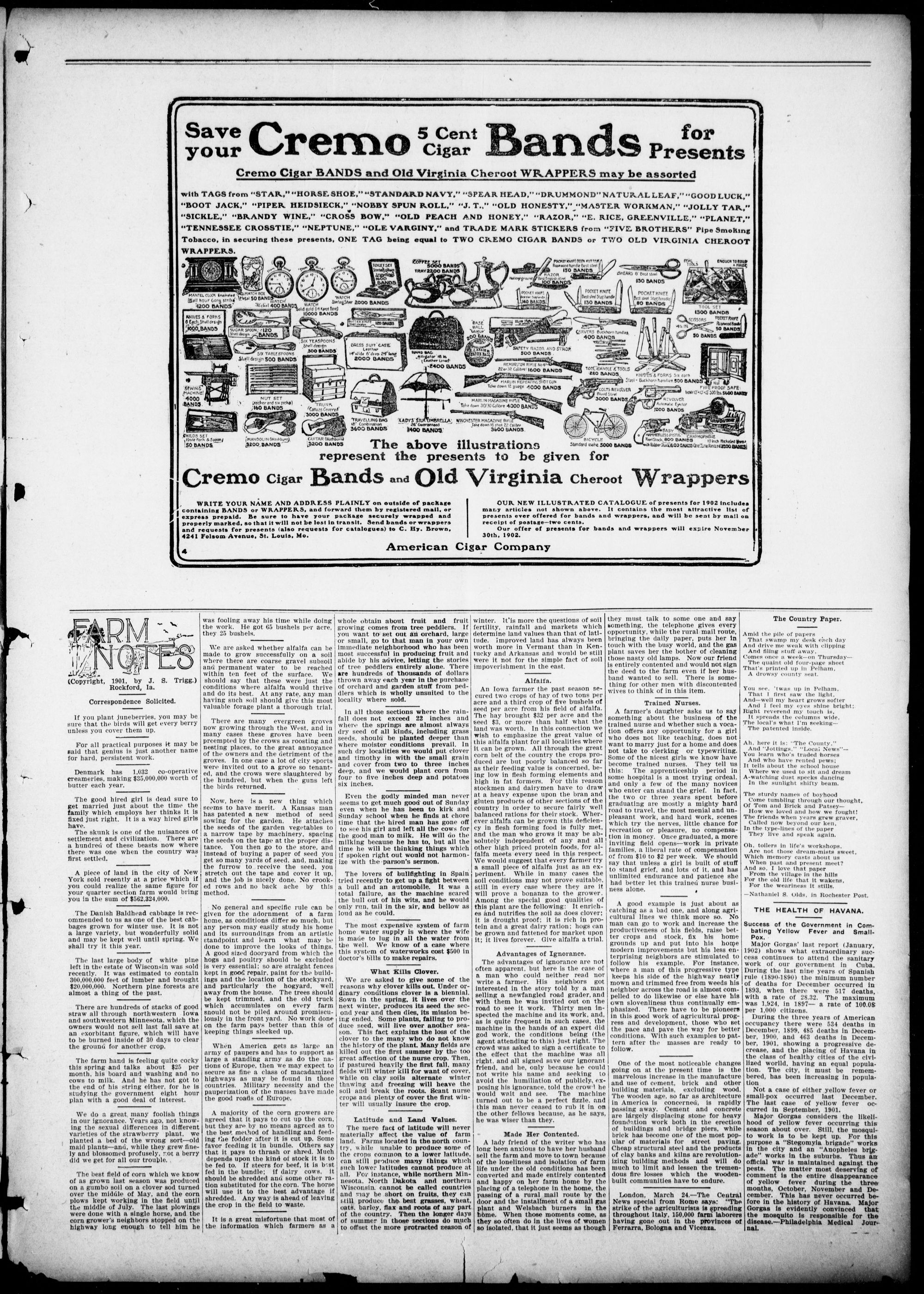
Save your Cremo 5 Cent Bands for Presents
Cremo Cigar BANDS and Old Virginia Cheroot WRAPPERS may be assorted with TAGS from "STAR," "HORSE SHOE," "STANDARD NAVY," "SPEAR HEAD," "DRUMMOND" NATURAL LEAF," "GOOD LUCK," "BOOT JACK," "PIPER HEIDSIECK," "NOBBY SPUN ROLL," "J. T.," "OLD HONESTY," "MASTER WORKMAN," "JOLLY TAR," "SICKLE," "BRANDY WINE," "CROSS BOW," "OLD PEACH AND HONEY," "RAZOR," "E. RICE, GREENVILLE," "PLANET," "TENNESSEE CROSSTIE," "NEPTUNE," "OLE VARGINY," and TRADE MARK STICKERS from "FIVE BROTHERS" Pipe Smoking Tobacco, in securing these presents, ONE TAG being equal to TWO CREMO CIGAR BANDS or TWO OLD VIRGINIA CHEROOT WRAPPERS.
MANTEL CLOCK Enamelled Hall hour Long strike 1200 BANDS
MATCH BOX Metal 50 BANDS
WATCH Nickel 400 BANDS
WATCH Gold (4 Kanal Time) 10000 BANDS
WATCH Silver 2000 BANDS
TOILET SET Stainless Steel 1000 BANDS
COFFEE SET 5000 BANDS TRAY 2200 BANDS
POCKET HUNTER Belt Wrist Wrap 150 BANDS
Rearwood handle Best steel 100 BANDS
KINOR Best Engineer Steel 150 BANDS
SHEARS 6 Best steel 130 BANDS
POCKET KNIFE Best steel Stag handle 150 BANDS
POCKET KNIFE Best steel Stag handle 80 BANDS
TOOL SET 1300 BANDS
SCISSORS 4 In 100 BANDS
TOOL SET 500 BANDS
SEWING MACHINE 4000 BANDS
NUT SET Cracker and six picks 160 BANDS
TRUNK Canvas Covered 3000 BANDS
TRAVELLING BAG 3600 BANDS
LADYS SILK UMBRELLA 1400 BANDS
WINCHESTER MAGAZINE RIFLE Take down 30/30 Calibre 3800 BANDS
BICYCLE Standard make 5000 BANDS
BABY MONKEYLESS PISTOL Four Stock 800 BANDS
GRAPHOPHOLE 10 In Nickel Bound Metal Stock 600 BANDS
The above illustrations
Cremo Cigar Bands and Old Virginia Cheroot Wrappers
WRITE YOUR NAME AND ADDRESS PLAINLY on outside of package containing BANDS or WRAPPERS, and forward them by registered mall, or express prepaid. Be sure to have your package securely wrapped and properly marked, so that it will not be lost in transit. Send bands or wrappers and requests for presents (also requests for catalogues) to C. Hy. Brown, 4241 Folsom Avenue, St. Louis, Mo.
was fooling away his time while doing the work. He got 65 bushels per acre, they 25 bushels.
We are asked whether alfalfa can be made to grow successfully on a soil where there are coarse gravel subsol and permanent water to be reached within ten feet of the surface. We should say that these were just the conditions where alfalfa would thrive and do its best. At any rate, any man having such soil should give this most valuable forage plant a thorough trial.
There are many evergreen groves now growing through the West, and in many cases these groves have been preempted by the crows as roosting and nesting places, to the great annoyance of the owners and the detriment of the groves. In one case a lot of city sports were invited out to a grove so tenanted, and the crows were slaughtered by the hundred, but when the guns left the birds returned.
Now, here is a new thing which seems to have merit. A Kansas man has patented a new method of seed sowing for the garden. He attaches the seeds of the garden vegetables to a narrow tape by machinery, spacing the seeds on the tape at the proper distance. You then go to the store, and instead of buying a paper of seed you get so many yards of seed, and, making the furrow to receive the seed, you stretch out the tape and cover it up, and the job is nicely done. No crooked rows and no back ache by this method.
No general and specific rule can be given for the adornment of a farm home, as conditions differ so much, but any person may easily study his home and its surroundings from an artistic standpoint and learn what may be done to improve the looks of things. A good sized dooryard from which the hogs and poultry should be excluded is very essential; so are straight fences kept in good repair, paint for the buildings and the location of the stockyard, and particularly the hogyard, well away from the house. The trees should be kept trimmed, and the old truck which accumulates on every farm should not be piled around promiscuously in the front yard. No work done on the farm pays better than this of keeping things sleeked up.
When America gets as large an army of paupers and has to support as large a standing army as do the nations of Europe, then we may expect to secure as fine a class of macadamized highways as may be found in those countries. Military necessity and the pauzerization of the masses have made the good roads of Europe.
A majority of the corn growers are agreed that it pays to cut up the corn, but they are by no means agreed as to the best method of handling and feeding the fodder after it is cut up. Some favor feeding it in bundle. Others say that it pays to thrash or shred. Much depends upon the kind of stock it is to be fed to. If steers for beef, it is best fed in the bundle; if dairy cows, it should be shredded and some other ration substituted for the corn. The horse will use it to the best advantage if shredded. Any way is ahead of leaving the crop in the field to waste.
It is a great misfortune that most of the information which farmers as a
American Cigar Company
whole obtain about fruit and fruit growing comes from tree peddlers. If you want to set out an orchard, large or small, go to that man in your own immediate neighborhood who has been most successful in producing fruit and abide by his advice, letting the stories of tree peddlers entirely alone. There are hundreds of thousands of dollars thrown away each year in the purchase of orchard and garden stuff from peddlers which is wholly unsuited to the locality where sold.
In all those sections where the rainfall does not exceed 22 inches and where the springs are almost always dry seed of all kinds, including grass seeds, should be planted deeper than where moister conditions prevail. In such dry localities we would put clover and timothy in with the small grain and cover from two to three inches deep, and we would plant corn from four to five inches deep and potatoes six inches.
Even the godly minded man never seems to get much good out of Sunday even when he has been to kirk and Sunday school when he finds at chore time that the hired man has gone off to see his girl and left all the cows for the good man to milk. He will do the milking because he has to, but all the time he will be thinking things which if spoken right out would not harmonize with the parson's sermon.
The lovers of bullfighting in Spain tried recently to get up a fight between a bull and an automobile. It was a total failure, as the machine scared the bull out of his wits, and he would only run, tail in the air, and bellow as loud as he could.
The most expensive system of farm home water supply is where the wife is made to lug in all the water from the well. We know of a case where this system of waterworks cost $500 in doctor's bills to make repairs.
What Kills Clover
We are asked to give some of the reasons why clover kills out. Under ordinary conditions clover is a biennial. Sown in the spring, it lives over the next winter, produces its seed the second year and then dies, its mission being ended. Some plants, failing to produce seed, will live over another season. This fact explains the loss of the clover to the many who do not know the history of the plant. Many fields are killed out the first summer by the too great affection of the nurse crop. Then, if pastured heavily the first fall, many fields will winter kill for want of cover, while on clay soils alternate winter thawing and freezing will heave the soil and break the roots. Scant nurse crops and plenty of cover the first winter will usually insure the crop.
Latitude and Land Values.
The mere fact of latitude will never materially affect the value of farm land. Farms located in the north country, while unable to produce some of the crops common to a lower latitude, can still produce many things which such lower latitudes cannot produce at all. For instance, while northern Minnesota, North Dakota and northern Wisconsin, cannot be called countries and may be short on fruits, they can still produce the best grasses, wheat, oats, barley, flax and roots of any part of the country. Then the longer days of summer in those sections do much to offset the more protracted season of
OUR NEW ILLUSTRATED CATALOGUE of presents for 1902 includes many articles not shown above. It contains the most attractive list of presents ever offered for bands and wrappers, and will be sent by mail on receipt of postage-two cents.
Our offer of presents for bands and wrappers will expire November 30th, 1902.
winter. It is more the questions of soil fertility, rainfall and markets which determine land values than that of latitude. improved land has always been worth more in Vermant than in Kentucky and Arkansas and would be still were it not for the simple fact of soil impoverishment in the east.
An Iowa farmer the past season secured two crops of hay of two tons per acre and a third crop of five bushels of seed per acre from his field of alfalfa. The hay brought $32 per acre and the seed $3, or more than half what the land was worth. In this connection we wish to emphasize the great value of this alfalfa plant for all localities where it can be grown. All through the great corn belt of the country the crops produced are but poorly balanced so far as their feeding value is concerned, being low in flesh forming elements and high in fat formers. For this reason stockmen and dairymen have to draw at a heavy expense upon the bran and gluten products of other sections of the country in order to secure fairly well balanced rations for their stock. Wherever alfalfa can be grown this deficiency in flesh forming food is fully met, and the man who grows it may be absolutely independent of any and all other high protein foods, for alfalfa meets every need in this respect. We would suggest that every farmer try a small piece of alfalfa just as an experiment. While in many cases the soil conditions may not prove suitable, still in every case where they are it will prove a bonanza to the grower. Among the special good qualities of this plant are the following: It enriches and nutrifies the soil as does clover; it is drought proof; it is rich in protein and a great dairy ration; hogs can be grown and fattened for market upon it; it lives forever. Give alfalfa a trial.
Advantages of Ignorance.
The advantages of ignorance are not often apparent, but here is the case of a man who could neither read nor write a farmer. His neighbors got interested in the story told by a man selling a newfangled road grader, and with them he was invited out on the road to see it work. Thirty men inspected the machine and its work, and, as is quite frequent in such cases, the machine in the hands of an expert did work, the conditions being (the agent attending to this) just right. The crowd was asked to sign a certificate to the effect that the machine was all right, and all signed save our ignorant friend, and he, only because he could not write his name and seeking to avoid the humiliation of publicly, exposing his ignorance, told the crowd he would wait and see. The machine turned out to be a perfect fizzle, and this man never ceased to rub it in on the other fellows because, as he says, he was wiser than they.
Made Her Contented.
A lady friend of the writer who has long been anxious to have her husband sell the farm and move to town because of the loneliness and isolation of farm life under the old conditions has been converted and made entirely contented and happy on her farm home by the placing of a telephone in the home, the passing of a rural mail route by the door and the installation of a small gas plant and Welsbach burners in the home. When those moments come, as they so often do in the lives of women so isolated, that it just seems as though
Alfalfa
they must talk to some one and say something, the telephone gives every opportunity, while the rural mail route, bringing the daily paper, puts her in touch with the busy world, and the gas plant saves her the bother of cleaning those nasty old lamps. Now our friend is entirely contented and would not sign the deed to the farm even if her husband wanted to sell. There is something for other men with discontented wives to think of in this item.
Trained Nurses.
A farmer's daughter asks us to say something about the business of the trained nurse and whether such a vocation offers any opportunity for a girl who does not like teaching, does not want to marry just for a home and does not take to clerking or typewriting. Some of the nicest girls we know have become trained nurses. They tell us this: The apprenticeship period in some hospital is a most trying ordeal, and only a few of the many novices who enter can stand the grief. In fact, the two or three years spent before graduating are mostly a mighty hard road to travel, the most menial and unpleasant work, and hard work, scenes which try the nerves, little chance for recreation or pleasure, no compensation in money. Once graduated, a more inviting field opens—work in private families, a liberal rate of compensation of from $10 to $2 per week. We should say that unless a girl is built of stuff to stand grief, and lots of it, and has unlimited endurance and patience she had better let this trained nurse business alone.
A good example is just about as catching as a bad one, and along agricultural lines we think more so. No man can go to work and increase the productiveness of his fields, raise better crops and stock, fix his home grounds up and put into his home modern improvements but his less enterprising neighbors are stimulated to follow his example. For instance, where a man of this progressive type keeps his side of the highway neatly mown and trimmed free from weeds his neighbor across the road is almost compelled to do likewise or else have his own sloveniness thus continually emphasized. There have to be pioneers in this good work of agricultural progress and development, those who set the pace and pave the way for better conditions. With such examples to pattern after the masses are ready to follow.
One of the most noticeable changes going on at the present time is the marvelous increase in the manufacture and use of cement, brick and other building materials, excluding wood. The wooden age, so far as architecture in America is concerned, is rapidly passing away. Cement and concrete are largely displacing stone for heavy foundation work both in the erection of buildings and bridge piers, while brick has become one of the most popular of materials for street paving. Cheap structural steel and the products of clay banks and kilns are revolutionizing building methods and will do much to limit and lessen the tremendous fire losses which the wooden-built communities have to endure.
London, March 24.—The Central News special from Rome says: "The strike of the agriculturists is spreading throughout Italy, 150,000 farm laborers having gone out in the provinces of Ferrarra, Bologna and Vicenza.
The Country Paper.
Amid the pile of papers
That swamp my desk each day
And drive me weak with clipping
And filing stuff away.
Come once it week—"The Thursday—
The quaint old four-page sheet
That's printed up in Pelham,
A drowsy county seat.
You see, 'twas up in Pelham,
That I first saw the light,
And—well my heart grows softer
And I feel my eyes shine bright;
Right reverend my touch is,
It spreads the columns wide,
The local's what I'm seeking—
The patented inside.
Ah, here it is: "The County."
And "Jottings." "Local News"—
You learn who's traded horses
And who have rented pews;
It tells about the school house
Where we used to and dream
A-watching dust specks dancing
In the sunlight shiny beam.
The sturdy names of boyhood
Come tumbling through our thought,
Of Tom and Brick and Patsey—
How we ought to fought!
The friends when years grew gruver,
Called now beyond our ken,
In the line-types of the paper
They live and speak again.
Oh, toilers in life's workshops,
Are not those dream-mists sweet,
Which memory casts about
When past and present meet?
And so, I love that paper
From the village in the hills
For the old life that it wakens,
For the weariness it stills.
—Nathaniel S. Olds, in Rochester Post.
THE HEALTH OF HAVANA.
Success of the Government in Combating Yellow Fever and Small-Pox.
Major Gorgas' last report (January, 1902) shows what extraordinary success continues to attend the sanitary work of our government in Cuba.
During the last nine years of Spanish rule (1890-1890) the minimum number of deaths for December occurred in 1893, when there were 517 deaths, with a rate of 28.32. The maximum was 1,924, in 1897—a rate of 100.08 per 1,000 citizens.
During the three years of American occupancy there were 534 deaths in December, 1899, 485 deaths in December, 1900, and 463 deaths in December, 1901, showing a progressive decrease, and the placing of Havana in the class of healthy cities of the civilized world, having an equal population. The city, it must be remembered, has been increasing in population
Not a case of either yellow fever or small-pox occurred last December. The last case of yellow fever occurred in September, 1801.
Major Gorgas considers the likelihood of yellow fever occurring this season about over. Still, the mosquito work is to be kept up. For this purpose a "Stegomyia brigade" works in the city and an "Anopheles brigade" works in the suburbs. Thus an official war is maintained against the pests. The matter most deserving of comment is the entire disappearance of yellow fever during the three months, October, November and December. This has never occurred before in the history of Havana. Major Gorgas is evidently convinced that the mosquito is responsible for the disease.—Philadelphia Medical Journal.
The Professional World
RUFUS L. LOGAN, B. S. D. - EDITOR
TERMS OF SUBSCRIPTION.
One Year in Advance - - - $1.50
Six Months in Advance - - 1.00
Three Months in Advance - - .50
Single Copies - - - .05
Special rates of $1.00 per year to ministers.
Advertising Rates on Application.
Job Work of all Kinds Solicited.
Published Every Friday.
Entered at the postoffice at Colum-
umbia, Mo., as second class matter,
Jan. 15, 1902.
Agents wanted in every town in the state.
PRESS OF THE MISSOURI STATESMAN
OUR thanks are due the following named persons who have paid subscriptions to this paper: Miss Flora Wright, Sedalia, Mo., Prof. H. F. Thompson, of Higginsville, Prof. J. H. Bias, of Lincoln Institute, Jefferson City Mo., Mrs. Rosa Marshal and Mrs. Rachel Salisbury, Columbia.
A NUMBER of the members of the alumni association of Lincoln Institute met in Jefferson City last week and took steps towards the establishment of what is to be known as Founder's Day to be observed by the alumni association during each commencement week. It is a capital idea and will doubtless meet with the hearty approval of all the alumni association.
THE Professional World has received several communications for publication which were not accompanied by the signature of the writer or sender of such articles. It is useless to state that all such articles have landed in the wastebasket. The Professional World does nothing "under cover" and if you have anything worth mentioning to the public you should be manly enough to say it over your own signature or, if you think it will do the most good by not having your name attached, then have an understanding with the proprietor of this paper. Some people are so accustomed to "cat paw" journalism that they find it difficult to appreciate any other kind.
The City and Sidewalks
What about sidewalks? inquired the Statesman man of Mr. Crouch who is one of the active members of the City Council. He replied:
"You may say to the people that there is no authority given the City Council to build sidewalks except on petition of the property owners. We can order a bad walk condemned and remove it but we can not order walks down nor build them except upon petition. The people will find us ready to grant these petitions and to help build the walks.
"If people who are kicking the City Council would only read up on this matter there would be less noise and more petitions, less talk and more walks."
Centralia Fair Association Committees.
A meeting of the Centralia Fair Association was held recently and the following committees appointed: Advertising and Printing—H. C. Threlkeld and J. E. Hinman. Speaking—O. B. Wilson and H. C. Threlkeld. Show Ring—J. S. Brown, J. C. Jones and W. I. Keene. Cattle, Sheep and Hogs—J. M. Fountain, C. H. Early and Chas. Thompson. Art Department—Frank Traughber and J. A. Johnson.
Poultry—H. E Stone.
Special Premiums—John E. Hinman, O. B. Wilson.
The following are the superintendents of the departments—Music, H. C. Threlkeld; ring marshal, Robert Brown; cattle, sheep and hogs, J. M. Fountain; art department, T. O. Robinson; agriculture, Frank Traughber; poultry, H. E. Stone.
Double Wedding in Chariton.
From the Chariton Courier:—A double wedding took place Sunday, March 16, at the residence of the brides' parents, Mr. and Mrs. Augustus Coleman, of near Guthridge Mills, when Stephen Bushnell and B.F. Stephens led Misses Sidnee and Bettie Coleman, respectively, to the marriage alter. Justice H. A. Wheeler of Keytesville officiating in his usual felicitous manner.
LIVESTOCK IN KANSAS.
A. T. Garth Quotes High Prices of Mules, Jacks and
Macksville, Kansas, March 17—
In looking over the sales of live stock in your paper, especially the sale of jacks, why are they so low in old Boone? I sold a jack a few days ago for $1200.00. I bought this jack 4 years ago with two others from James McQuity of near Midway, Boone Co., for $250.00 each. I sold the other two "Vest," and "Gov. Stone," for $550.00 each; also bought a jack from Mr. Ridgway of near Rochport for $200.00 and sold him for $350.00; have collected about $1000 in service fees; also from the jack "Sanford" which I sold at $1200.00. I am selling coming 3-year-old mules as high as $340 a pair; but mind you, they are cracker-jacks. I sold 90 head of mules, horses and mares last week at high prices. Sold 100 hogs at 5cts, feeders. I sold corn at 80c, seed oats at 65c; barley at 60cts, at public sale.
I just drop you these few lines to show you the differences between prices here and in Missouri. I have sold 2500 acres of my land since last June at $15 per acre, and still have 3000 acres to sell. Very Res'y., A. T. GARTH.
Fifty Teachers Examined.
The first regular teacher's examination of the year was held March 21-22 in the Agricultural building in Columbia, conducted chiefly by Prof. Carter of the County Institute Board. About fifty teachers took the examination, several with a view to having their grades recorded on State Certificates. Under the new law three examinations are held annually, in March, June and August.
Marriage Licenses this Week.
Mamie Ravenscraft and John E. Atkins, Boone county.
Chas. A. Craft, Brown's Station,
and Martha E. E. Brown, Hallsville,
Mo. Groom, 19; son of L. G. Craft,
bride 15, daughter, of S. A. Brown.
Both parties file consent.
Eddie E. Prewitt and Minnie Butler,
Boone county.
A. T. Crane and Susie F. Salmon,
of Sapp.
C. W. Shain and Eva L. Sappington,
Huntsdale.
John K. Wilson, Chicago, and
Anna Bess Mayer, Sturgeon.
Wm. Blackburn and Addie Ravenscraft; groom 20; bride 15.
Another "Oldest Citizen."
The county papers, the Statesman included, printed an item last week from the Daily Tribune, to the effect that W. T. Wren, born in 1823, was the oldest native Boone county now living in the county. Since then the Centralia Courier has learned that "Uncle Joe Brown, of Brown Station, ante-dates Mr. Wren, having been born in Boone, March 1, 1822, and having lived in the county continuously since. Mr. Brown is hale and hearty and doesn't look to be over 65 years of age."
Domestic Science at the University.
To mend a shirt, scrub a floor, make a pumpkin pie, cut a pig into sausages—this is not the half the students in the Domestic Science department of the University are learning to do. How all this is accomplished without the mussing of a frilled cap or the staining of a finger tip is a secret of the Science, and a charming mystery to Columbia young gentlemen, who crowd the steps of the Agricultural building in the hope of glance from a saint-like eye, or a whiff of that incense vapor from the cook stove.
This department was organized in October, 1900; since that time the students have increased by two fold, the manifested public interest by ten. The work is considered under the various heads: Cooking, Sewing, and General House Work, such as, Sanitation and Hygiene, House decorations, etc.
The girls in the sewing room draft their patterns according to a system of Miss Zabriskie's own. The garments turned out are of plain cotton material supplied by the students. A most interesting feature in connection with this department since it nerves the girls to effort and renders them in touch with the public, is the occasional sewing exhibit, one of such to be given but a few weeks from this writing, and the dinner, which unfortunately is always limited to four guests, well-fed members of the faculty at that. As yet but two students, Miss Alfa Jackson and Miss Harriet Gerould, have completed the domestic course. These young ladies presented their final essays in the shape of elaborate, ten course dinners, in the consideration
of which the aforesaid fat, fortunate faculty members we are closeted for hours. 'Tis hoped the subject-matter of the same was well digested.
The Board of Curators has recently set apart the sum of $200 for use in the Domestic Science Department; so that as soon as the new stock building is completed, and certain parts of the Agricultural building vacated, two new sewing rooms will be added to Miss Zabriskie's apartments.
MODERN AUDITORIUM.
Another Building for Christian College to be Built Soon.
Columbia is about to take another step forward and a big one. A $25,000 building is the exception rather than the rule in all localities, but no less an imposing building than this has been planned by the ladies who have, in the new Christian College, shown us that they can bring their plans to fruition. It has been admitted on all hands that a new Chapel must soon be erected, not only to correspond architecturally with the handsome building that two years ago replaced the old Christian College, but to cope with the demands incidental to an enlarged school and a growing town.
We believe it was in the minds of the Principals, at the opening of the new Dormitory building, to continue the construction, as opportunity occurred, of other buildings in harmony with their general purpose of making Christian College second to none of the great schools for young women in the United States. They have been quietly working towards this object, so quietly that only those immediately interested have known that plans have been drawn, contractors' bids entered and a considerable portion of the money needed already raised for the first building, the main purpose of which will be for use as an auditorium, capable of seating about one thousand people. But the plans are so drawn that this handsome building of stone and red pressed brick will contain also adequate accommodation for a library, art studios, and a gymnasium, all of which are badly needed, the rooms now in use being altogether too small for the increasing numbers of young ladies who are attending this old-established institution under its new regime. The new building will be connected with the west end of the Dormitory building by a portecochere and it is hoped to have it ready for use by next September, when the College re-opens.
The cost of the new building was estimated at $25,000, but the lowest bid was $3,000 more than this. Towards the building fund three gentlemen have given the generous donation of $5000 apiece in the form of scholarships. They are W. H. Dulany, of Hannibal, Mo., B. F. Lowry, of Columbia, Mo., and Frank Coop, of Southport, England. Residents of Columbia and others, also, have subscribed and the trustees are heartily co-operating, but the complete list is not ready for publication.
Miss Mary L. Hale, the architect of the new dormitory, has drawn the plans of the proposed auditorium.
The Student Riot?
What has been paraded for a week by the city dailies as a "student riot" at the University has come and gone and few if any Columbians were able to magnify the little rowdyism last Friday night into a "student riot." The gravity of the affair has been recklessly overdrawn by the dailies as is usually the case under such circumstances. The students evidently did things that evening they had not intended to do and things for which they are now sorry. A large majority of the participants in the "riot" deplore the fact that any violence was done. That a rock was thrown through a window into the reception parlors hasn't the least approval of the participants as a body. Boys of the town and students from other schools took a part in the evening's jubilee and it is certainly not strange that at least one black sheep manifested his presence in this motley conglomeration. Out of the great student body of this town no one could be startled should it develop that there was a criminal among this immense number. Because of this discovery, however, it would be unfair to class a thousand of his associates as criminals because they are all jumbled up together in the every day occurrences of a school career.
Outside of the indignities shown President Jesse and Profs. Jones, Hoffman and Defoe, the actions of the University students, proper, were in the main innocent, at least excusable. A few of the students are reported to have jeered at President Jesse when he sought to advise them. Such a course is to be condemned and was doubtless the
acts of thoughtless boys who are now only too sorry for this feature of the evening.
The object of the meeting was to taunt the freshmen and junior academics who were booked for a jubilee of their own. The freshmen were to give the juniors a reception in the University parlors Friday night and as had been the custom the other classes sought to detain and even prevent some of the class enthusiasts from participating at the reception. Some were caught and held while others were locked up; others however not offering much resistance were released and allowed to go on their way rejoicing. Certain indignities were shown some of the professors mainly because their motives were misinterpreted when they appeared on the scene. Some felt the professors were espousing the cause of the juniors and freshies and had not come as friendly advisers. Urged on by false incentives the students did various things of minor importance not becoming a cool headed, well meaning body of young men. Half a cord of Jesse's wood was carried onto the quad rangle and converted into a bonfire.
The police was called and appared on the scene when only a few of the party remained. Six students were arrested by the police and taken before some of the University authorities where they gave their names and were released. The matter is now being investigated by the discipline Committee and will be dealt with promptly and in a manner similar to other occasions. Where property was destroyed or injured, the parties who did it ought to be handled without gloves; where violence was resorted to unjustifiably the guilty should pay the penalty. The discipline committee has suspended two students for the remainder of the term, and seven others for two weeks. Other suspensions may follow.
Mrs. Lhamon's Lecture.
A good crowd was highly entertained at the Christian church last Friday night by Mrs. W. J. Lhamon in an illustrated lecture on the work of the Christian Woman's Board of Missions. The meeting was opened with prayer and scripture reading by Mrs. H. H. Banks, member of the local board. She emphasized the importance of the work and insisted on other devoted women becoming members. After a musical selection Mrs. Lhamon was introduced and made a most helpful talk, showing stereopticon views of the workers in the foreign field and many scenes from the domestic life of the natives. It was instructive and helpful. An offering was taken for the work.
Stephehs College "Actors."
Last Tuesday evening the Chapel of Stephen's college boasted a large and attentive audience; the occasion, a theatrical entertainment given by six young ladies of the Alpha Omega Sorority. As the play lected called for representatives of the masculine sex, the young ladies, accustomed to doing without that article, ingenious through necessity, had improvised a few out of pretty girls and masculine attire. These self-made men deported themselves with the dignity befitting gentlemen. They strode about the stage, kicked over furniture, kissed the waiting maids and even swore, a little. The entertainment was, in fine, a success, Miss Lancaster took the part of leading lady, and Miss Callie Taylor of leading man.
Deaths
Reid.—Mrs. Annie Lee Reid, wife of James C. Reid, died at her home in Roswell N. M. March 10, 1902. Deceased was a daughter of George T. Duncan of Millersburg, Mo. and formerly lived in Columbia where she was well known. Mr. Reid's family have been living at Roswell for several years.
Lewis.—Died, near Sturgeon, March 19, 1902, Christina Lewis, aged 72 years. She was the widow of Lafayette Lewis, who was captured in the Poindexter raid in Aug. 1862 and taken to Alton prison where he died soon afterwards and was buried there. She was an old Baptist in religious belief and left four children surviving.
Marriages.
WILSON-MAYER.—Jno. K. Wilson of Chicago, was married last Sunday to Miss Anna Bess Mayer, of Sturgeon, by Rev. Sam Frank Taylor, of Columbia.
BRATTON-MILLS.—By Judge L. M. Switzler at his office in Columbia, Mo., March 19, 1902, E. C. Bratton and Miss Katie Mills, Youngers, Mo.
ANKROM-ANDERSON.—By Josiah Hall, Centralia, Mo., March 20, 1902, George W. Ankrom and Miss Mary Anderson.
CRANE-SALMON.—By James G. Roddy, J. P., Sapp, Mo., March 23, 1902, A. T. Crane and Miss Susie F. Salmon.
CARPETS.
Come and select your carpets from the largest A assortment ever shown here. All grades in 1902 patterns. Rogers' Superlative Carpets. Rock Bottom Prices.positively give satisfaction, lease our customers every time. everybody should see the fine line each pattern a Gem. Tell your neighbors about these elegant new carpets. We save much waste in matching, and surely can please you all.
New Cash
We save you more
for Groceries. All
est price paid for
try. 708 W. Broa
RIP
---
New Cash Grocery!
New Cash Grocery!
We save you money by paying cash for Groceries. All new goods; highest price paid for produce and poultry. 708 W. Broadway, Phone 631.
RIPANS
I have been taking Ripans Tabules for the dyspepsia, and they have helped me wonderfully. I do not know any particular way they affect me; but they seem to give vigor to the entire system. I had a sort of languid feeling, but since taking the Tabules I feel spirited and have not that melancholy way about me. I think they are good for a general build up of the system, as they seem to act like a tonic. At druggists. The five-cent packet is for an ordinary occasion, the family bottle, sixty cents, contains a supply for a year.
Lodge and Church Directory.
Mrs. Irena Akers, W. P.; Mrs. Lizzie Williams, W. S. Meeting first Monday in each month at 3 p. m.
Crispus Attucks Lodge,No. 62. Meetings 2nd and 4th Tuesdays in each month. Visiting members cordially invited. Caleb Hall, W. M. A. M. Schweich, W. S.
Acme Lodge, No. 24. Meetings second and fourth Fridays in each month. W. H. Turner, C. C. and D. D. G. C. W. W. Lampkins, M. F.
Amos Chapter, No. 30.
Meetings second Friday in each month. Mrs. A. B.
Moore, W. M. Mrs. Lizzie Richardson, W. S.
SECOND CHRISTIAN CHURCH.
Rev. J. B. Parsons, pastor.
Preaching Sundays 11 a. m.
and 7:30 p. m.
Prayer meeting Wednesdays 7:30 p. m.
Everybody cordially invited to attend.
A. M. E. CHURCH.
Rev. P. C. Crews, Pastor.
Preaching Sundays 11 a.
m.; 7:30 p. m.
Sunday school 2:30 p. m.
Prayer meeting every
Wednesday eve, at 8:30; every
body invited to attend.
U. B. F.
K. P.
O. E. S
R. F. ROGERS,
VESSER & TRUE.
50 YEARS' EXPERIENCE
PATENTS
TRADE MARKS
DESIGNS
COPYRIGHTS & C.
Anyone sending a sketch and description may quickly ascertain our opinion free whether an invention is probably patentable. Commitments strictly confidential. Handbook on Patentations sent free. Oldest agency for securing patents. Entitles taken through Munn & Co. receive special notice, without charge, in the Scientific American.
A handsomely illustrated weekly. Largest circulation of any scientific journal. Terms, $3 a year, four months, $1. Sold by all new dealers.
MUNN & Co. 361 Broadway, New York
Branch Office, 625 F St., Washington, D.C.
M. E. CHURCH
Rev. J. Arlington Grant, pastor. Preaching Sundays 11, a. m. and 7:30 p. m. Sunday school, 9:30 a. m. Prayer meeting Wednesdays 7:30 to 8:30; all are made welcome.
Notice of Annual School Election:
Notice is hereby given to the qualified voters and tax-paying citizens of the Columbia School District, township No. 49, range No. 12 and 13, and county No. 11, range No. 12 and 13, and among the Annual School election of said district will be held on RUESDAY THE 1ST DAY OF APIL, 1902, commencing at 9 o'clock in the morning, the following will be proposed for consideration: ist:—The election of two directors to serve the school; and—To increase the annual rate of taxation (which is 40c) 25 cents on the $100 valuation for school purposes, making the total levy for maintaining schools 65 cents on the $100 valuation. This 14th day of March, 1902.
Crispl's Witty Retort.
A Paris newspaper gives a retort of the late Italian prime minister. He was receiving a French journalist, who was also a deputy. Suddenly M. Crispl said to his visitor: "I seem to recollect that your government put you in prison some years ago?" "Yes, I was in prison for a political offense, like everyone else in France." "That's right!" replied Crispl. "Begin by being in prison and you will finish by being able to send others there—like me."