The Professional World
Friday, May 2, 1902
Columbia, Missouri
Page text (machine-generated)
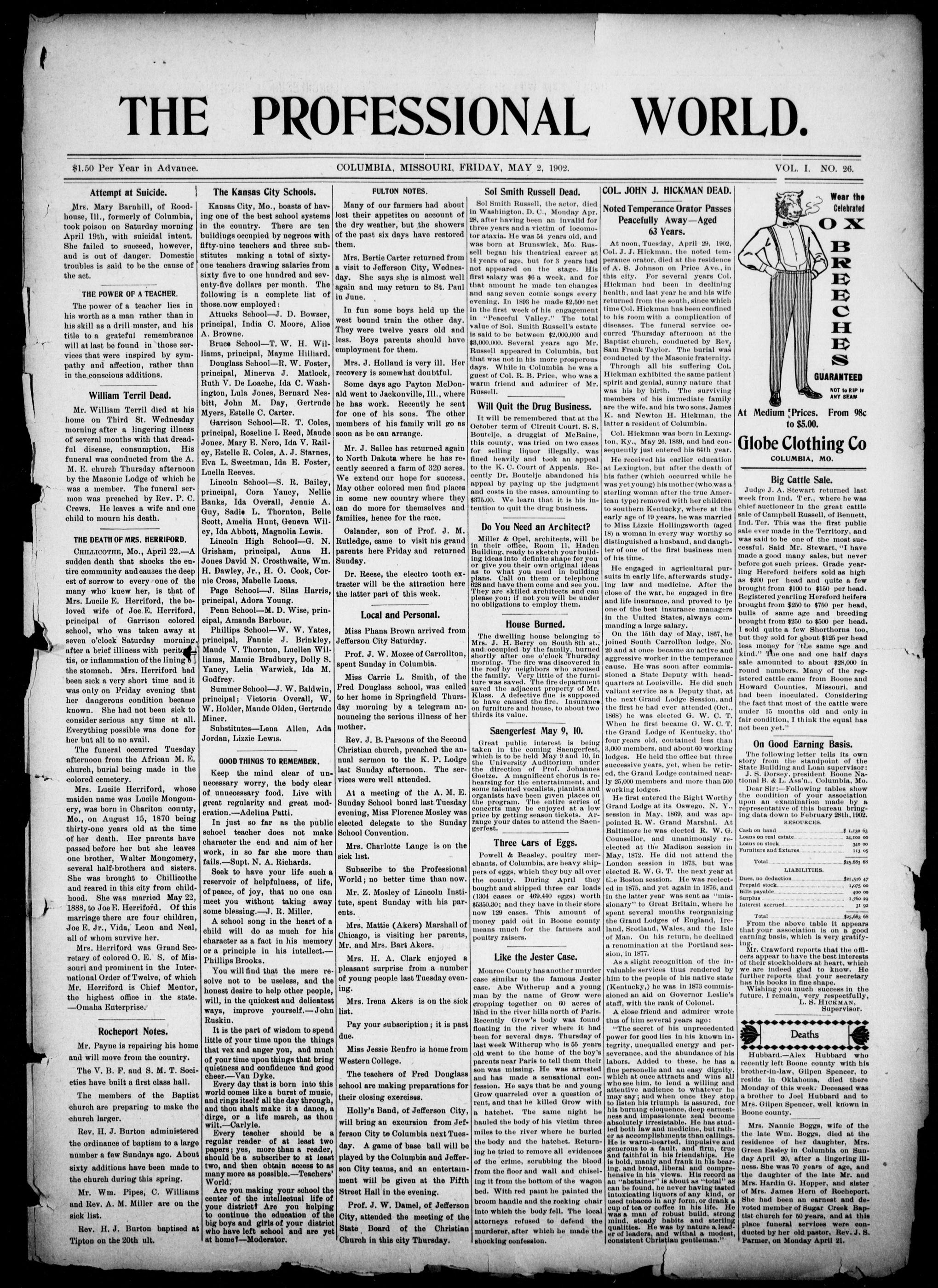
THE PROFESSIONAL WORLD.
$1.50 Per Year in Advance.
Attempt at Suicide.
Mrs. Mary Barnhill, of Roodhouse, Ill., formerly of Columbia, took poison on Saturday morning April 19th, with suicidal intent. She failed to succeed, however, and is out of danger. Domestic troubles is said to be the cause of the act.
THE POWER OF A TEACHER
The power of a teacher lies in his worth as a man rather than in his skill as a drill master, and his title to a grateful remembrance will at last be found in those services that were inspired by sympathy and affection, rather than in the conscious additions.
William Terril Dead.
Mr. William Terril died at his home on Third St. Wednesday morning after a lingering illness of several months with that dreadful disease, consumption. His funeral was conducted from the A. M. E. church Thursday afternoon by the Masonic Lodge of which he was a member. The funeral sermon was preached by Rev. P. C. Crews. He leaves a wife and one child to mourn his death.
THE DEATH OF MRS. HERRIFORD.
CHILLICOTHE, Mo., April 22.—A sudden death that shocks the entire community and causes the deepest of sorrow to every one of the many who knew her, is that of Mrs. Lucile E. Herriford, the beloved wife of Joe E. Herriford, principal of Garrison colored school, who was taken away at seven o'clock Saturday morning after a brief illness with peritonitis, or inflammation of the lining of the stomach. Mrs. Herriford had been sick a very short time and it was only on Friday evening that her dangerous condition became known. She had not been sick to consider serious any time at all. Everything possible was done for her but all to no avail.
The funeral occurred Tuesday afternoon from the African M. E. church, burial being made in the colored cemetery.
Mrs. Lucile Herriford, whose maiden name was Lucile Mongomery, was born in Chariton county, Mo., on August 15, 1870 being thirty-one years old at the time of her death. Her parents have passed before her but she leaves one brother, Walter Mongomery, several half-brothers and sisters. She was brought to Chillicothe and reared in this city from childhood. She was married May 22, 1888, to Joe E. Herriford. Of this marriage there are four children, Joe E. Jr., Vida, Leon and Neal, all of whom survive her.
Mrs. Herriford was Grand Secretary of colored O. E. S. of Missouri and prominent in the International Order of Twelve, of which Mr. Herriford is Chief Mentor, the highest office in the state. —Omaha Enterprise.
Rocheport Notes.
Mr. Payne is repairing his home and will move from the country.
The V. B. F. and S. M. T. Societies have built a first class hall.
The members of the Baptist church are preparing to make the church larger.
Rev. H. J. Burton administered the ordinance of baptism to a large number a few Sundays ago. About sixty additions have been made to the church during this spring.
Mr. Wm. Pipes, C. Williams and Rev. A. M. Miller are on the sick list.
Rev. H. J. Burton baptised at Tipton on the 20th ult.
The Kansas City Schools.
Kansas City, Mo., boasts of having one of the best school systems in the country. There are ten buildings occupied by negroes with fifty-nine teachers and three substitutes making a total of sixty-one teachers drawing salaries from sixty five to one hundred and seventy-five dollars per month. The following is a complete list of those.now employed:
Attucks School—J. D. Bowser, principal, India C. Moore, Alice A. Browne.
Bruce School—T. W. H. Williams, principal, Mayme Hilliard. Douglass School—R. W. Foster, principal, Minerva J. Matlock, Ruth V. De Loache, Ida C. Washington, Lula Jones, Bernard Nesbitt, John M. Day, Gertrude Myers, Estelle C. Carter. Garrison School—R. T. Coles, principal, Roseline I. Reed, Maude Jones. Mary E. Nero, Ida V. Railey, Estelle R. Coles, A. J. Starnes, Eva L. Sweetman, Ida E. Foster, Luella Reeves.
Lincoln School—S. R. Bailey, principal, Cora Yancy, Nellie Banks, Ida Overall, Jennie A. Guy, Sadie L. Thornton, Belle Scott, Amelia Hunt, Geneva Wiley, Ida Abbott, Magnolia Lewis.
Lincoln High School—G. N. Grisham, principal, Anna H. Jones David N. Crosthwaite, Wm. H. Dawley, Jr., H. O. Cook, Cornie Cross, Mabelle Lucas.
Page School—J. Silas Harris, principal, Adora Young.
Penn School—M. D. Wise, principal, Amanda Barbour.
Phillips School—W. W. Yates, principal, Fannie J. Brinkley, Maude V. Thornton, Luellen Williams, Mamie Bradbury, Dolly S. Yancy, Lelia Warwick, Ida M. Godfrey.
Summer School—J. W. Baldwin, principal; Victoria Overall, W. W. Holder, Maude Olden, Gertrude Miner.
Substitutes—Lena Allen, Ada Jordan, Lizzie Lewis.
GOOD THINGS TO REMEMBER.
Keep the mind clear of unnecessary worry, the body clear of unnecessary food. Live with great regularity and great moderation.—Adelina Patti.
In just so far as the public school teacher does not make character the end and aim of her work, in so far she more than fails.—Supt. N. A. Richards.
Seek to have your life such a reservoir of helpfulness, of life, of peace, of joy, that no one can meet you without taking away some blessing.—J. R. Miller.
A school song in the heart of a child will do as much for his character as a fact in his memory or a principle in his intellect.—Phillips Brooks.
You will find that the mere resolve not to be useless, and the honest desire to help other people, will, in the quickest and delicatest ways, improve yourself.—John Ruskin.
It is the part of wisdom to spend little of your time upon the things that vex and anger you, and much of your time upon things that bring quietness and confidence and good cheer—Van Dyke.
Every day that is born into this world comes like a burst of music, and rings itself all the day through, and thou shalt make it a dance, a dirge, or a life march, as thou wilt.—Carlyle.
Every teacher should be a regular reader of at least two papers; yes, more than a reader, should be a subscriber to at least two, and then obtain access to as many more as possible.—Teachers' World.
Are you making your school the center of the intellectual life of your district? Are you helping to continue the education of the big boys and girls of your district who have left school and are yet at home?—Moderator.
COLUMBIA, MISSOURI, FRIDAY, MAY 2, 1902.
FULTON NOTES.
Many of our farmers had about lost their appetites on account of the dry weather, but the showers of the past six days have restored them.
Mrs. Bertie Carter returned from a visit to Jefferson City, Wednesday. She says she is almost well again and may return to St. Paul in June.
In fun some boys held up the west bound train the other day. They were twelve years old and less. Boys parents should have employment for them.
Mrs. J. Holland is very ill. Her recovery is somewhat doubtful.
Some days ago Payton McDonald went to Jackonville, Ill., where he has work. Recently he sent for one of his sons. The other members of his family will go as soon as he can arrange.
Mr. J. Sallee has returned again to North Dakota where he has recently secured a farm of 320 acres. We extend our hope for success. May other colored men find places in some new country where they can do more for themselves and families, hence for the race.
Oslander, son of Prof. J. M. Rutledge, came to visit his grand parents here Friday and returned Sunday.
Dr. Reese, the electro tooth extractor will be the attraction here the latter part of this week.
Local and Personal.
Miss Phana Brown arrived from Jefferson City Saturday.
Prof. J. W. Mozee of Carrollton, spent Sunday in Columbia.
Miss Carrie L. Smith, of the Fred Douglass school, was called to her home in Springfield Thursday morning by a telegram announcing the serious illness of her mother.
Rev. J. B. Parsons of the Second Christian church, preached the annual sermon to the K. P. Lodge last Sunday afternoon. The services were well attended.
At a meeting of the A. M. E. Sunday School board last Tuesday evening, Miss Florence Mosley was elected delegate to the Sunday School Convention.
Mrs. Charlotte Lange is on the sick list.
Subscribe to the Professional World; no better time than now.
Mr. Z. Mosley of Lincoln Institute, spent Sunday with his parents.
Mrs. Mattie (Akers) Marshall of Chicago, is visiting her parents, Mr. and Mrs. Bart Akers.
Mrs. H. A. Clark enjoyed a pleasant surprise from a number of young people last Tuesday evening.
Mrs. Irena Akers is on the sick list.
Pay your subscription; it is past due.
Miss Jessie Renfro is home from Western College.
The teachers of Fred Donglass school are making preparations for their closing exercises.
Holly's Band, of Jefferson City, will bring an excursion from Jefferson City te Columbia next Tuesday. A game of base ball will be played by the Columbia and Jefferson City teams, and an entertainment will be given at the Fifth Street Hall in the evening. Prof. J. W. Damel, of Jefferson City, attended the meeting of the State Board of the Christian Church in this city Thursday.
Sol Smith Russell Dead.
Sol Smith Russell, the actor, died in Washington, D. C., Monday Apr. 28, after having been an invalid for three years and a victim of locomotor ataxia. He was 54 years old, and was born at Brunswick, Mo. Russell began his theatrical career at 14 years of age, but for 3 years had not appeared on the stage. His first salary was $6 a week, and for that amount he made ten changes and sang seven comic songs every evening. In 1893 he made $2,500 net in the first week of his engagement in "Peaceful Valley." The total value of Sol. Smith Russell's estate is said to be between $2,000,000 and $3,000,000. Several years ago Mr. Russell appeared in Columbia, but that was not in his more prosperous days. While in Columbia he was a guest of Col. R. B. Price, who was a warm friend and admirer of Mr. Russell.
Will Quit the Drug Business.
It will be remembered that at the October term of Circuit Court, S. S. Boutelje, a druggist of McBaine, this county, was tried on two cases for selling liquor illegally, was fined heavily and took an appeal to the K. C. Court of Appeals. Recently Dr. Boutelje abandoned his appeal by paying up the judgment and costs in the cases, amounting to $375.00. We learn that it is his intention to quit the drug business.
Do You Need an Architect?
Miller & Opel, architects, will be in their office, Room 11, Haden Building, ready to sketch your building ideas into definite shape for you or give you their own original ideas as to what you need in building plans. Call on them or telephone 628 and have them come and see you. They are skilled architects and can please you; if not you will be under no obligations to employ them.
House Burned.
The dwelling house belonging to Mrs. J. H. Berry on South 8th st., and occupied by the family, burned shortly after one o'clock Thursday morning. The fire was discovered in the roof by neighbors who aroused the family. Very little of the furniture was saved. The fire department saved the adjacent property of Mr. Klass. A defective flue is supposed to have caused the fire. Insurance on furniture and house, to about two thirds its value.
Saengerfest May 9, 10.
Great public interest is being taken in the coming Saengerfest, which is to be held May 9 and 10, in the University Auditorium under the direction of Prof. Johannes Goetze. A magnificent chorus is rehearsing for the entertainment, and some talented vocalists, pianists and organists have been given places on the program. The entire series of concerts may be enjoyed at a low price by getting season tickets. Arrange your dates to attend the Saengerfest.
Three Cars of Eggs.
Powell & Beasley, poultry merchants, of Columbia, are heavy shippers of eggs, which they buy all over the county. During April they bought and shipped three car loads (1304 cases or 469,440 eggs) worth $535,50.30; and they have in their store now 129 cases. This amount of money paid out in Boone county means much for the farmers and poultry raisers.
Like the Jester Case.
Monroe County has another murder case similar to the famous Jester case. Abe Witherup and a young man by the name of Grow were cropping together on 60 acres of land in the river hills north of Paris. Recently Grow's body was found floating in the river where it had been for several days. Thursday of last week Witherup who is 55 years old went to the home of the boy's parents near Paris to tell them their son was missing. He was arrested and has made a sensational confession. He says that he and young Grow quarreled over a question of rent, and that he killed Grow with a hatchet. The same night he hauled the body of his victim three miles to the river where he buried the body and the hatchet. Returning he tried to remove all evidences of the crime, scrubbing the blood from the floor and wall and chiseling it from the bottom of the wagon bed. With red paint he painted the broom handle and the rocking chair into which the body fell. The local attorneys refused to defend the murderer, after which he made the shocking confession.
COL. JOHN J. HICKMAN DEAD.
Noted Temperance Orator Passes Peacefully Away-Aged 63 Years.
At noon, Tuesday, April 29, 1902, Col. J. J. Hickman, the noted temperance orator, died at the residence of A. S. Johnson on Price Ave., in this city. For several years Col. Hickman had been in declining health, and last year he and his wife returned from the south, since which time Col. Hickman has been confined to his room with a complication of diseases. The funeral service occurred Thursday afternoon at the Baptist church, conducted by Rev. Sam Frank Taylor. The burial was conducted by the Masonic fraternity.
Through all his suffering Col. Hickman exhibited the same patient spirit and genial, sunny nature that was his by birth. The surviving members of his immediate family are the wife, and his two sons, James K. and Newton H. Hickman, the latter a resident of Columbia.
Col. Hickman was born in Lexington, Ky., May 26, 1839, and had consequently just entered his 64th year. He received his earlier education at Lexington, but after the death of his father (which occurred while he was yet young) his mother (who was a sterling woman after the true American type) removed with her children to southern Kentucky, where at the early age of 19 years, he was married to Miss Lizzie Hollingsworth (aged 18) a woman in every way worthy so distinguished a husband, and daughter of one of the first business men of his time.
He engaged in agricultural pursuits in early life, afterwards studying law and medicine. After the close of the war, he engaged in fire and life insurance, and proved to be one of the best insurance managers in the United States, always commanding a large salary.
On the 15th day of May, 1867, he joined South Carrollton lodge, No. 20 and at once became an active and aggressive worker in the temperance cause. He was soon after commissioned a State Deputy with headquarters at Louisville. He did such valiant service as a Deputy that, at the next Grand Lodge Session, and the first he had ever attended (Oct., 1868) he was elected G. W. C. T. When he first became G. W. C. T. the Grand Lodge of Kentucky, tho' four years old, contained less than 3,000 members, and about 60 working lodges. He held the office but three successive years, yet, when he retired, the Grand Lodge contained nearly 25,000 members and more than 500 working lodges.
He first entered the Right Worthy Grand Lodge at its Oswego, N. Y., session in May, 1869, and was appointed R. W. Grand Marshal. At Baltimore he was elected R. W. G. Counsellor, and unanimously reelected at the Madison session in May, 1872. He did not attend the London session in 1873, but was elected R. W. G. T. the next year at the Boston session. He was reelected in 1875, and yet again in 1876, and in the latter year was sent as "missionary" to Great Britain, where he spent several months reorganizing the Grand Lodges of England, Ireland, Scotland, Wales, and the Isle of Man. On his return, he declined a renomination at the Portland session, in 1877.
As a slight recognition of the invaluable services thus rendered by him to the people of his native state (Kentucky,) he was in 1873 commissioned an aid on Governor Leslie's staff, with the rank of Colonel. A close friend and admirer wrote thus of him several years ago:
"The secret of his unprecedented power for good lies in his known integrity, unequalled energy and perseverance, and the abundance of his labors. Added to these, he has a fine personelle and an easy dignity, which at once attracts and wins all who see him, to lend a willing and attentive audience to whatever he may say; and when once they stop to listen his triumph is assured, for his burning eloquence, deep earnestness and impassionate zeal become absolutely irresistible. He has studied both law and medicine, but rather as accomplishments than callings. He is warm-hearted, impulsive and generous to a fault, and firm, true and faithful in his friendships. He is bold, manly and frank in his bearing, and broad, liberal and comprehensive in his views. His record as an "abstainer" is about as "total" as can be found, he never having intoxicated liquors of any kind, or used tobacco in any form, or drank a cup of tea or coffee in his life. He was a man of robust build, strong mind, steady habits and sterling qualities. He was by nature a leader of leaders, and withal a modest, consistent Christian gentleman."
VOL. I. NO. 26.
Wear the
Celebrated
OX
BREECHES
GUARANTEED
NOT to RIP is
ANY SEAM
At Medium 'Prices.
to $5.00.
Globe Clothing Co
Big Cattle Sale.
Judge J. A. Stewart returned last week from Ind. Ter., where he was chief auctioneer in the great cattle sale of Campbell Russell, of Bennett, Ind. Ter. This was the first public sale ever made in the Territory, and was said to be one of the most successful. Said Mr. Stewart, "I have made a good many sales, but never before got such prices. Grade yearling Hereford heifers sold as high as $200 per head and quite a few brought from $100 to $150 per head. Registered yearling Hereford heifers brought from $250 to $750 per head, bulls of same age and breeding brought from $250 to $500 per head. I sold quite a few Shorthorns too, but they sold for about $125 per head less money for the same age and kind." The one and one half days sale amounted to about $28,000 in round numbers. Many of the registered cattle came from Boone and Howard Counties, Missouri, and had been inoculated. Considering the fact that most of the cattle were under 15 months old and only in fair condition, I think the equal has not been yet."
On Good Earning Basis.
The following letter tells its own story from the standpoint of the State Building and Loan supervisor: J. S. Dorsey, president Boone National B. & L. Ass'n., Columbia, Mo.
Dear Sir:—Following tables show the condition of your association upon an examination made by a representative of this bureau bringing data down to February 28th, 1902.
RESOURCES.
Cash on hand $ 1,130 63
Loans on real estate $ 2,100 00
Loans on stock $ 340 00
Furniture and fixtures $ 113 05
Total $ 25,683 68
LIABILITIES.
Dues, no deduction $ 21,516 47
Prepaid stock $ 1,975 00
Bills payable $ 400 00
Surplus $ 1,760 29
Interest accrued $ 31 92
Total $ 26,683 68
From the above table it appears that your association is on a good earning basis, which is very gratifying.
Mr. Crawford reports that the officers appear to have the best interests of their stockholders at heart, which we are indeed glad to know. He further reports that your secretary has his books in fine shape. Wishing you much success in the future, I remain, very respectfully, L. S. HICKMAN,
Hubbard.—Alex Hubbard who recently left Boone county with his brother-in-law, Gilpen Spencer, to reside in Oklahoma, died there Monday of this week. Deceased was a brother to Joel Hubbard and to Mrs. Gilpen Spencer, well known in Boone county.
Mrs. Nannie Boggs, wife of the late Wm. Boggs, died at the residence of her daughter, Mrs. Green Easley in Columbia on Sunday April 20, after a lingering illness. She was 70 years of age, and the daughter of the late Mr. and Mrs. Hardin G. Hopper, and sister of Mrs. James Hern of Rocheport. She had been an earnest and devoted member of Sugar Creek Baptist church for 50 years, and at this place funeral services were conducted by her old pastor, Rev. J. S. Parmer, on Monday April 21.
Professional World
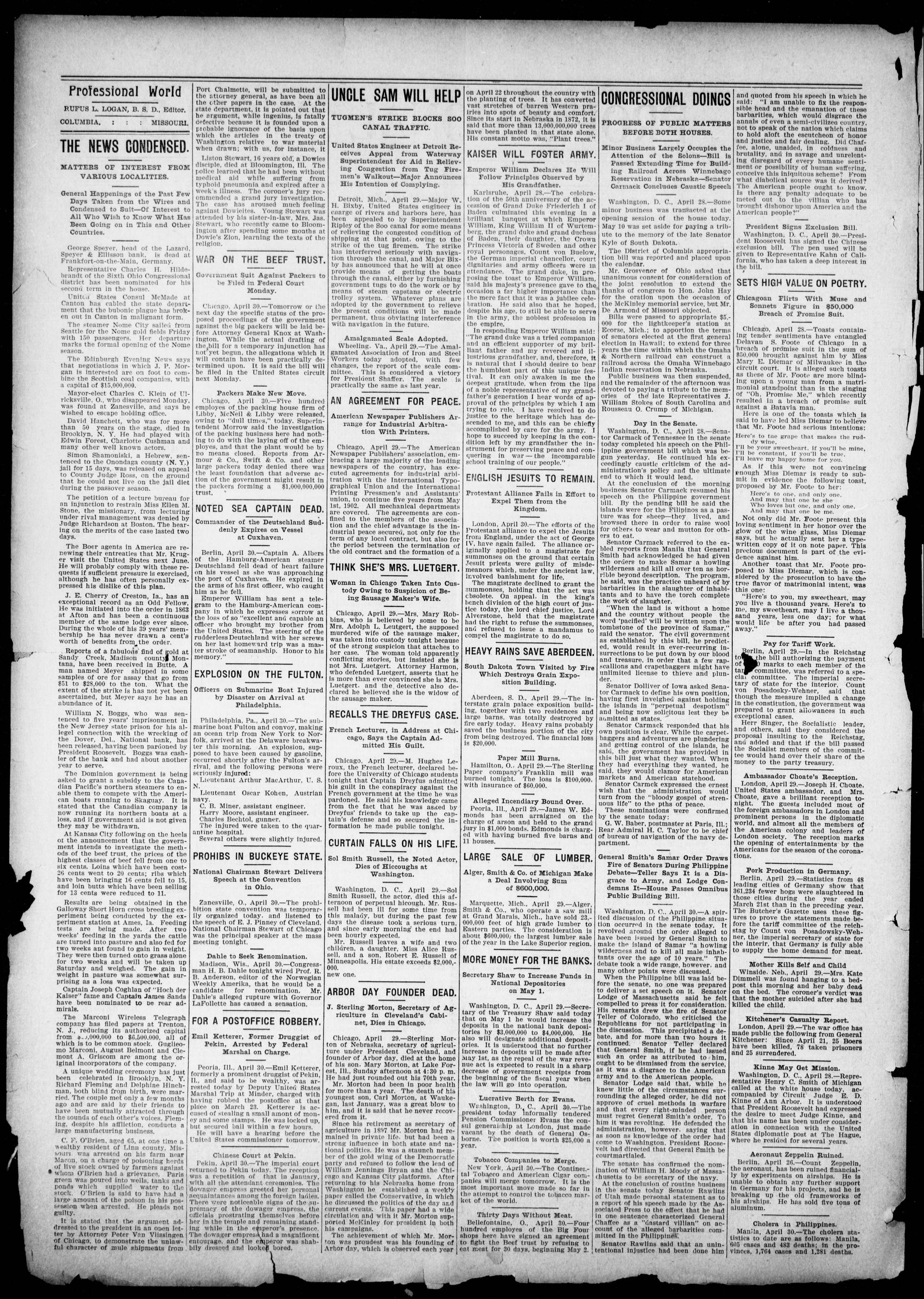
THE NEWS CONDENSED.
MATTERS OF INTEREST FROM VARIOUS LOCALITIES.
General Happenings of the Past Few Days Taken from the Wires and Condensed to Suit—Of Interest to All Who Wish to Know What Has Been Going on in This and Other Countries.
George Speyer, head of the Lazard, Speyer & Ellison bank, is dead at Frankfort-on-the-Main, Germany.
Representative Charles H. Hildebrandt of the Sixth Ohio Congressional district has been nominated for his second term in the house.
United States Consult McMade at Canton has cabled the state department that the bubonic plague has broken out in Canton in malignant form.
The steamer Nome City sailed from Seattle for the Nome gold fields Friday with 150 passengers. Her departure marks the formal opening of the Nome season.
The Edinburgh Evening News says that negotiations in which J. P. Morgan is interested are on foot to combine the Scottish coal companies, with a capital of $15,000,000.
Mayor-elect Charles C. Klein of Ultricksville, O., who disappeared Monday, was found at Zanesville, and says he wished to escape holding office.
David Hanchett, who was for more than 50 years on the stage, died in Brooklyn, N. Y. He had played with Edwin Forest, Charlotte Cushman and many other well known actors.
Simon Shamoniski, a Hebrew, sentenced to the Onondaga county (N. Y.) jail for 15 days, was released on appeal to County Judge Ross, on the ground that he could not live on the jail diet during the passover season.
The petition of a lecture bureau for an injunction to restrain Miss Ellen M. Stone, the missionary, from lecturing under rival management was denied by Judge Richardson at Boston. The hearing on the merits of the case lasted two days.
The Boer agents in America are renewing their entreaties that Mr. Kruger visit the United States next June. He will probably comply with these requests if sufficient pressure is exercised, although he has often personally expressed his dislike of this plan.
J. E. Cherry of Creston, Ia., has an exceptional record as an Odd Fellow. He was initiated into the order in 1863 at Atton and has been a continuous member of the same lodge ever since. During the whole of his 39 years' membership he has never drawn a cent's worth of benefits from the order.
Reports of a fabulous find of gold at Sandy Creek, Madison county of Montana, have been received in Butte. A man named Meyer shipped in some samples of ore for assay that go from $51 to $28,000 to the ton. What the extent of the strike is has not yet been ascertained, but Meyer says he has an abundance of it.
William N. Boggs, who was sentenced to five years' imprisonment in the New Jersey state prison for his alleged connection with the wrecking of the Dover, Del., National bank, has been released, having been pardoned by President Roosevelt. Boggs was cashier of the bank and had about another year to serve.
The Dominion government is being asked to grant a subsidy to the Canadian Pacific's northern steamers to enable them to compete with the American boats running to Skagway. It is stated that the Canadian company is now running its northern boats at a loss, and if government aid is not given they may be withdrawn.
At Kansas City following on the heels or the announcement that the government intends to investigate the methods of the beef trust, the prices of the highest classes of beef fell from one to six cents. Loins which have been cost-26 cents went to 20 cents; ribs which have been bringing 16 cents fell to 15, and butin butts which have been selling for 13 cents were reduced to 11.
Results are being obtained in the Galloway Short Horn cross breeding experiment being conducted by the experiment station at Ames, 1a. Feeding tests are being made. After two weeks' feeding in the yards the cattle are turned into pasture and also fed for two weeks ant found to gain in weight. They were then turned onto grass alone for two weeks and will be taken up Saturday and weighed. The gain in weight in pasture was somewhat surprising as a loss was expected.
Captain Joseph Coghlan of "Hoch der Kaiser" fame and Captain James Sands have been nominated to be rear admirals.
The Marconi Wireless Telegraph company has filed papers at Trenton, N. J., reducing its authorized capital from $,000,000 to $8,500,000, all of which is to be common stock. Guglielmo Marconi, August Belmont and Clemont A. Griscom are among the original incorporators of the company. A unique wedding ceremony has just been celebrated in Brooklyn, N. Y. Richard Fleming and Delphine Hinman, both blind from birth, were married. The couple met only a few months ago and are said by their friends to have been mutually attracted through the sounds of each other's voices. Fleming, despite his affliction, conducts a large manufacturing business.
C. F. O'Brien, aged 65, at one time a wealthy resident of Linn county. Missouri, was arrested on his farm near Macon, on a charge of poisoning hords of live stock owned by farmers against whom O'Brien had a grievance. Paris green was poured into wells, tanks and ponds which supplied water to the stock. O'Brien is said to have had a large amount of the poison in his possession when arrested. He pleads not guilty.
It is stated that the argument addressed to the president in an open letter by Attorney Peter Van Vlissingen of Chicago, to demonstrate the unlawful character of mule shipments from
Port Chalmette, will be submitted to the attorney general, as have been all the other papers in the case. At the state department, it is pointed out that he argument, while ingenius, is fatally defective because it is founded upon a probable ignorance of the basis upon which the articles in the treaty of Washington relative to war material when drawn; with us, for instance, it Listen Stewart, 16 years old, a Dowies displease, died at Bloomington, III. The police learned that he had been without medical aid while suffering from typhoid pneumonia and expired after a week's illness. The coroner's jury recommended a grand jury investigation. The case has aroused much feeling against Dowleites. Young Stewart was attended by his sister-in-law, Mrs. Jas. Stewart, who recently came to Bloomington after spending some months at Dowle's Zion, learning the texts of the religion.
WAR ON THE BEEF TRUST.
Government Suit Against Packers to be Filed in Federal Court Monday
Chicago, April 30.—Tomorrow or the next day the specific status of the proposed proceedings of the government against the big packers will be laid before Attorney General Knox at Washington. While the actual drafting of the bill for a temporary injunction has not yet begun, the allegations which it will contain have been practically determined upon. It is said the bill will be filed in the United States circuit next Monday.
Packers Make New Move.
Chicago, April 30.—Five hundred employees of the packing house firm of Libby, McNell & Libby were released, owing to "dull times," today. Superintendent Morrow said the investigation of the packing business here had nothing to do with the laying off of the employees, and that the plant would be by no means closed. Reports from Armour & Co., Swift & Co. and other large packers today denied there was the least foundation that adverse action of the government might result in the packers forming a $1,000,000,000 trust.
NOTED SEA CAPTAIN DEAD.
Commander of the Deutschland Suddenly Expires on Vessel at Cuxhaven.
Berlin, April 30.—Captain A. Albers of the Hamburg-American steamer Deutschland fell dead of heart failure on his vessel as she was approaching the port of Cuxhaven. He expired in the arms of his first officer, who caught him as he fell.
Emperor William has sent a telegram to the Hamburg-American company in which he expresses sorrow at the loss of so "excellent and capable an officer who brought my brother from the United States. The steering of the rudderless Deutschland with her screws on her last homeward trip was a master stroke of seamanship. Honor to his memory."
EXPLOSION ON THE FULTON.
Officers on Submarine Boat Injured by Disaster on Arrival at Philadelphia.
Philadelphia, Pa., April 30.—The submarine boat Fulton and convoy, making an ocean trip from New York to Norfolk, arrived at the Delaware breakwater this morning. An explosion, supposed to have been caused by gasoline, occurred shortly after the Fulton's arrival, and the following persons were seriously injured:
Lieutenant Arthur MacArthur, U. S.
N.
Lieutenant Oscar Kohen, Austrian navy.
C. B. Miner, assistant engineer.
Harry Moore, assistant engineer.
Charles Bechtol, gunner.
The injured were taken to the quarantine hospital.
Several others were slightly injured.
PROHIBS IN BUCKEYE STATE.
National Chairman Stewart Delivers Speech at the Convention in Ohio.
Zanesville, O., April 30.—The prohibition state convention was temporarily organized today, and listened to the speech of E. J. Pinney of Cleveland. National Chairman Stewart of Chicago was the principal speaker at the mass meeting tonight.
Dahle to Seek Renomination
Madison, Wis., April 30—Congressman H. B. Dahle tonight wired Prof. R. B. Anderson, editor of the Norwegian Weekly Amerika, that he would be a candidate for renomination. Mr. Dahle's alleged rupture with Governor LaFollette has caused a sensation.
FOR A POSTOFFICE ROBBERY.
Emil Ketterer, Former Druggist of Pekin, Arrested by Federal Marshal on Charge.
Peoria, Ill., April 30.—Emil Ketterer, formerly a prominent druggist of Pekin, Il., and said to be wealthy, was arrested today by Deputy United States Marshal Trip at Minder, charged with having robbed the postoffice at that place on March 23. Ketterer is accused of stealing a small amount of money and some stamps. He was locked up, but secured ball within a few hours. He will have a hearing before the United States commissioner tomorrow.
Chinese Court at Pekin.
Pekin, April 30—The imperial court returned to Pekin today. The reception was a repetition of that in January, with all the attendant ceremonies. The dowager empress greeted her personal acquaintances among the foreign ladies. There were noticeable signs of the supremacy of the dowager empress, the officials prostrating themselves before her in the temple and remaining standing while in the emperor's presence. The dowager empress had a magnificent entourage, and the emperor was shabbi dressed and looked bored.
UNCLE SAM WILL HELP
TUGMEN'S STRIKE BLOCKS SOO
CANAL TRAFFIC.
United States Engineer at Detroit Receives Appeal from Waterway Superintendent for Aid in Relieving Congestion from Tug Firemen's Walkout—Major Announces His Intention of Complying.
Detroit, Mich., April 29.—Major W. H. Bixby, United States engineer in charge of rivers and harbors here, has been appealed to by Superintendent Ripley of the Soo canal for some means of relieving the congested condition of shipping at that point, owing to the strike of the tug firemen. The strike has interfered seriously with navigation through the canal, and Major Bixby has announced that he will at once provide means of getting the boats through the canal, either by furnishing government tugs to do the work or by means of steam capsans or electric trolley system. Whatever plans are adopted by the government to relieve the present conditions will be made permanent, thus obviating interference with navigation in the future.
Amalgamated Scale Adopted.
Wheeling. Va., April 29—The Amalgamated Association of Iron and Steel Workers today adopted, with few changes, the report of the scale committee. This is considered a victory for President Shaffer. The scale is practically the same as last year.
AN AGREEMENT FOR PEACE.
American Newspaper Publishers Arrange for Industrial Arbitration With Printers.
Chicago, April 29.—The American Newspaper Publishers' association, embracing a large majority of the leading newspapers of the country, has executed agreements for industrial arbitration with the International Typographical Union and the International Printing Pressmen's and Assistants' union, to continue five years from May 1st, 1902. All mechanical departments are covered. The agreements are confined to the members of the association and the chief advantage is the industrial peace secured, not only for the term of any local contract, but also for the period between the termination of the old contract and the formation of a
THINK SHE'S MRS. LUETGERT
Woman in Chicago Taken Into Custody Owing to Suspicion of Being Sausage Maker's Wife.
Chicago, April 29.—Mrs. Mary Robbins, who is believed by some to be Mrs. Adolph L. Leutgent, the supposed murdered wife of the sausage maker, was taken into custody tonight because of the strong suspicion that attaches to her case. The woman told apparently conflicting stories, but insisted she is not Mrs. Leutgent. Attorney Harmon, who defended Leutgent, asserts that he is more than ever convinced she is Mrs. Leutgent, and the detective also declared he believed she is the widow of the sausage maker.
RECALLS THE DREYFUS CASE
French Lecturer, in Address at Chicago, Says the Captain Admitted His Guilt.
Chicago, April 29.—M. Hughes Leroux, the French lecturer, declared before the University of Chicago students tonight that Captain Dreyfus admitted his guilt in the conspiracy against the French government at the time he was pardoned. He said his knowledge came from the fact that he was asked by Dreyfus' friends to take up the captain's defense and so secured the information he made public tonight.
CURTAIN FALLS ON HIS LIFE.
Sol Smith Russell, the Noted Actor,
Dies of Hiccoughs at
Washington.
Washington, D. C., April 29.—Sol
Smith Russell, the actor, died this
afternoon of perpetual hic cough. Mr. Russell had been ill for some time from this malady, but during the past few days the disease took a serious turn,
and since early morning the end had
been hourly expected.
Mr. Russell leaves a wife and two
children, a daughter, Miss Alice Russell,
and a son, Robert E. Russell of
Minneapolis. His estate exceeds $2,000,-000.
new one.
ARBOR DAY FOUNDER DEAD
J. Sterling Morton, Secretary of Agriculture in Cleveland's Cabinet, Dies in Chicago.
Chicago, April 29.—Sterling Morton of Nebraska, secretary of agriculture under President Cleveland, and founder of Arbor day, died at the home of his son. Mary Morton, at Lake Forest, Ill. Sunday afternoon at 4:30 p. m. He had just rounded out his 70th year. Mr. Morton had been in poor health for more than a year. The death of his youngest son, Carl Morton, at Waukean, last January, was a great blow to him, and it is said that he never recovered from it.
Since his retirement as secretary of agriculture in 1897 Mr. Morton had remained in private life, but had been a strong influence in both state and national politics. He was a staunch member of the gold wing of the Democratic party and refused to follow the lead of William Jennings Bryan and the Chicago and Kansas City platforms. After returning to his Nebraska home from Washington he established a weekly paper called the Conservative, in which he discussed the politics of the day and current events. This paper had a wide circulation and with it Mr. Morton supported McKinley for president in both his campaigns.
The achievement of which Mr. Morton was proudest was his founding of Arbor day, which is observed each year
on April 22 throughout the country with the planting of trees. It has converted vast stretches of barren Western prairies into spots of beauty and comfort. Since its start in Nebraska in 1872, it is said that more than 13,000,000 trees have been planted in that state alone. His constant motto was, "Plant trees."
KAISER WILL FOSTER ARMY.
Emperor William Declares He Will Follow Principles Observed by His Grandfather.
Karlsruhe, April 28.—The celebration of the 50th anniversary of the accession of Grand Duke Friedrich I of Baden culminated this evening in a brilliant banquet at which Emperor William, King William II of Wurtemberg, the grand duke and grand duchess of Baden, their daughter, the Crown Princess Victoria of Sweden and other royals, engaged. Count von Buelow, the German Imperial minister, court dignitaries and army officers were in attendance. The grand duke, in proposing the toast to Emperor William, said his majesty's presence gave to the occasion a far higher importance than the mere fact that it was a jubilee celebration. He said also that he hoped, despite his age, to still be able to serve in the army, the noblest profession in the empire.
In responding Emperor William said: "The grand duke was a tried companion and an efficient supporter of my brilliant father and my revered and illustrious grandfather, and, therefore, it is natural that I should desire to bear the humblest part of this unique festival. It can only awaken in me the deepest gratitude, when from the lips of a noble representative of my grandfather's generation I hear words of approval of the principles by which I am trying to rule. I have resolved to do justice to the heritage which has descended to me, and this can be chiefly accomplished by care for the army. I hope to succeed by keeping in the condition left by my grandfather the instrument for preserving peace and conquering in war—the incomparable school training of our people."
ENGLISH JESUITS TO REMAIN.
Protestant Alliance Fails in Effort to Expel Them from the
London, April 30.—The efforts of the Protestant alliance to expel the Jesuits from England, under the act of George IV, have again failed. The alliance originally applied to a magistrate for summonses on the ground that certain Jesuit priests were guilty of misdemeanors which, under the ancient law, involved banishment for life. The magistrate declined to grant the summonses, holding that the act was chosote. On appeal, in the king's bench division of the high court of justice today, the lord chief justice, Lord Alverstone, held that the magistrate had the right to refuse the summonses, and refused to issue a mandamus to compel the magistrate to do so.
HEAVY RAINS SAVE ABERDEEN.
South Dakota Town Visited by Fire
Which Destroys Grain Exposition Building.
Aberdeen, S. D., April 29.—The interstate grain palace exposition building, together with two residences and large barns, was destroyed by fire early today. Heavy rains probably saved the business portion of the city from being destroyed. The financial loss is $20,000.
Paper Mill Burns.
Hamilton, O.. April 29.—The Sterling Paper company's Franklin mill was burned tonight. The loss is $100,000. with insurance of $60,000.
Alleged Incendiary Bound Over
Peoria, 111, April 29. -James W. Edmonds has been arraigned on the charge of arson and held to the grand jury in $1,000 bonds. Edmonds is charged with having burned five barns and 11 houses.
LARGE SALE OF LUMBER.
Alger, Smith & Co. of Michigan Make a Deal Involving Sum of $600,000.
Marquette, Mich., April 29.—Alger, Smith & Co., who operate a saw mill at Grand Marais, Mich., have sold 23.000,000 feet of high grade lumber to Eastern parties. The consideration is about $600,000; the largest lumber sale of the year in the Lake Superior region.
MORE MONEY FOR THE BANKS.
Secretary Shaw to Increase Funds in National Depositories on May 1.
Washington, D. C., April 29.—Secretary of the Treasury Shaw said today that on May 1 he would increase the deposits in the national bank depositories by $3,000,000 to $4,000,000. He also will designate additional depositories. It is understood that no further increase in deposits will be made after May 1st, as the appeal of the war revenue act is expected to result in a sharp decrease of government receipts from the beginning of the fiscal year when the law will go into operation.
Lucrative Berth for Evans
Washington, D. C., April 30.—The president today informally tendered Pension Commissioner Evans the consul generalship at London, just made vacant by the death of General Osborne. The position is worth $25,000 a year.
Tobacco Companies to Merge
New York, April 30.—The Continental Tobacco and American Cigar companies will merge tomorrow. It is the most important move made so far in the attempt to control the tobacco market of the world.
Thirty Days Without Meat
Bellefontaine, O., April 30.—Four hundred employees of the Big Four shops here have signed an agreement to fight the Beef trust by refusing to eat meat for 30 days, beginning May 2.
CONGRESSIONAL DOINGS
CONGRESSIONAL DOINGS
PROGRESS OF PUBLIC MATTERS
BEFORE BOTH HOUSES.
Minor Business Largely Occupies the Attention of the Solons—Bill is Passed Extending Time for Building Railroad Across Winnebago Reservation in Nebraska—Senator Carmack Concludes Caustic Speech
Washington, D. C., April 28.—Some minor business was transacted at the opening session of the house today. May 10 was set aside for paying a tribute to the memory of the late Senator Kyle of South Dakota.
The District of Columbia appropriation bill was reported and placed upon the calendar.
Mr. Grosvenor of Ohio asked that unanimous consent for consideration of the joint resolution to extend the thanks of congress to Hon. John Hay for the oration upon the occasion of the McKinley memorial service, but Mr. De Armond of Missouri objected.
Bills were passed to appropriate $5,000 for the lightkeeper's station at Ecore, Mich.; to apportion the terms of senators elected at the first general election in Hawaii; to extend for three years the time within which the Omaha & Northern railroad can construct a railroad across the Omaha Winnebago Indian reservation in Nebraska. Public business was then suspended, and the remainder of the afternoon was devoted to paying a tribute to the memories of the late Representatives J. William Stokes of South Carolina and Rousseau O. Crump of Michigan.
Day in the Senate
Washington, D. C., April 28.—Senator Carmack of Tennessee in the senate today completed his speech on the Philippine government bill which was begun yesterday. He continued his exceedingly caustic criticism of the administration's policy and the ultimate end to which it would lead.
At the conclusion of the morning business Senator Carmack resumed his speech on the Philippine government bill. By the pending bill he said the islands were for the Filippinos as a pasture was for sheep—they lived, and browsed there in order to raise wool for others to wear and mutton for others to eat.
Senator Carmack referred to the cabled reports from Manila that General Smith had acknowledged he had given the orders to make Samar a howling wilderness and kill all over ten as horrible beyond description. The program, he said, was the practice unheard of by barbarists in the slaughter of inhabitants and to have the torch complete the work of slaughter.
"When the land is without a home and the country without people the word 'pacified' will be written upon the tombstone of the province of Samar," said the senator. The civil government as established by this bill, he predicted, would result in ever-recurring insurrections to be put down by our blood and treasure. In order that a few rap scallions and crapetbaggers might have unlimited license to thieve and plunder.
Senator Dolilier of Iowa asked Senator Carmack to define his own position, having first inveighed against holding the islands in "perpetual despotism" and being now solicitous lest they be admitted as states.
Senator Carmack responded that his own position is clear. While the carpetbaggers and adventures are plundering and getting control of the islands, he said, the government has provided in this bill just what they wanted. When they had everything they wanted, he said, they would clamor for American markets and American statehood.
Senator Carmck expressed the ernest wish that the administration would turn from the "bloody gospel of strenuous life" to the pths of peace. These nominations were confirmed by the senate today:
G. W. Baber, postmaster at Paris, Ill.; Rear Admiral H. C. Taylor to be chief of bureau of navigation of the navy department.
General Smith's Samar Order Draws
Fire of Senators During Philippine Debate—Teller Says It is a Disgrace to Army, and Lodge Condemns It—House Passes Omnibus Public Building Bill.
Washington, D. C., April 30—A spirited discussion of the Philippine situation occurred in the senate today. It revolved around the order alleged to have been issued by General Smith to make the island of Samar "a howling wilderness and to kill all male inhabitants over the age of 10 years." The debate took a wide range, however, and many other points were discussed. When the Philippine bill was laid before the senate, no one was prepared to deliver a set speech on it. Senator Lodge of Massachusetts said he felt compelled to press it for consideration. His remarks drew the fire of Senator Teller of Colorado, who criticised the Republicans for not participating in the discussion. This precipitated a debate, and for more than two hours it continued. Senator Teller declared that General Smith, if he had issued such an order as attributed to him, ought to be dismissed from the service, as it was a disgrace to the American army and to the American people.
Senator Lodge said that, while he knew little of the circumstances surrounding the alleged order, he did not approve of cruel methods in warfare and that every right-minded person must regret General Smith's order. To him it was revolting. He defended the administration, however, saying that as soon as knowledge of the order had come to Washington, President Roosevelt had directed that General Smith be courtmitalied.
The senate has confirmed the nomination of William H. Moody of Massachusetts to be secretary of the navy.
At the conclusion of routine business in the senate today Senator Rawlings of Utah made personal statement as to a report of his speech made by the Associated Press to the effect that he had in one sentence characterized General Chaffee as a "dastard villian" on account of the alleged barbarities committed in the Philippines.
Senator Rawlings said that an unintentional injustice had been done him
and quoted from his speech in which he said: "I am unable to fix the responsible head and the emanation of these barbarities, which would disgrace the annals of even a semi-civilized country, not to speak of the nation which claims to hold aloft the escutcheon of honor and justice and fair dealing. Did Chaffee, alone unaided, in coldness and brutality, and in savage and unrelenting disregard of every humane sentiment or possibility of human suffering, conceive this iniquitous scheme? From what diabolical source was it derived? The American people ought to know. Is there any penalty adequate to be meted out to the villian who has brought dishonor upon America and the American people?"
President Signs Exclusion Bill.
Washington, D. C., April 30.—President Roosevelt has signed the Chinese exclusion bill. The pen used will be given to Representative Kahn of California, who has taken a deep interest in the bill.
SETS HIGH VALUE ON POETRY.
Chicagoan Flirts With Muse and Sonnets Figure in $50,000 Breach of Promise Suit.
Chicago, April 28.—Toasts containing tender sentiments have entangled Delavan S. Foote of Chicago in a breach of promise suit in the sum of $50,000 brought against him by Miss Mary E. Diemar of Milwaukee in the circuit court. It is alleged such toasts as these of Mr. Foote are more blinding upon a young man from a matrimonial standpoint than is the singing of "Oh, Promise Me," which recently resulted in a breach of promise suit against a Batavia man.
Here is one of the toasts which is said to have led Miss Diemar to believe that Mr. Foote had serious intentions: Here's to the grape that makes the rud-
Here's to the grape that makes the ruddy wine.
I'll be your sweetheart. If you'll be mine,
I'll be constant, if you'll be true.
I'll leave my happy home for you.
As if this were not convincing
enough Miss Diemar is ready to submit
in evidence the following toast,
proposed by Mr. Foote to her:
Here's to one, and only one.
And may that one be she
Who loves but one, and only one.
And may that one be me.
Not only did Mr. Foote present this loving sentiment in her honor over the glow of the wine glass, Miss Diemar says, but he actually sent her a type-written copy of it on note paper. This precious document is part of the evidence against him.
Another toast that Mr. Foote proposed to Miss Diemar, which is considered by the prosecution to have the true flavor of matrimonial intent, was this one:
"Here's to you, my sweetheart, may you live a thousand years. Here's to me, my sweetheart, may I live a thousand years, less one day; for what would life be after you had passed away."
Pay for Tariff Work.
Berlin, April 29.—In the Reichstag to the bill authorizing the payment of 10 marks to each member of the tax committee, was referred to a special committee. The imperial secretary of state for the interior, Count von Posadosky-Wehner, said that though the measure implied a change in the constitution, the government was prepared to grant allowances in such exceptional cases. Herr Singer, the Socialistic leader, and others, said they considered the proposal insulting to the Reichstag, and added and that if the bill passed the Socialist members of the committee would hand over their share of the money to the party treasury.
Ambassador Choate's Reception
London, April 29.—Joseph H. Choate, United States ambassador, and Mrs. Choate, gave a brilliant reception tonight. The guests included most of the foreign ambassadors in London and prominent persons in the diplomatic world, and almost all the members of the American colony and leaders of London society. The reception marks the opening of entertainments by the Americans for the season of the coronations.
Pork Production in Germany
Berlin, April 29.—Statistics from 48 leading cities of Germany show that 361,234 fewer hogs were slaughtered in those cities during the year ended March 21st than in the preceding year. The Butcher's Gazette uses these figures to prove the statements made before the tariff committee of the rechstag by Count von Posadowsky-Wehner, the imperial secretary of state for the interim, that Germany is fully able to supply the home demand for meat.
Mother Kills Self and Child
Winside. Neb., April 29.—Mrs. Kate Dimmell was found hanging to a bedpost this morning and her baby dead on the bed. The coroner's verdict was that the mother suicided after she had killed the child.
London, April 29.—The war office has made public the following from General Kitchener: Since April 21, 25 Boers have been killed, 78 taken prisoners and 25 surrendered.
Kinne May Get Mission
Washington, D. C., April 28.—Representative Henry C. Smith of Michigan called at the white house today, accompanied by Circuit Judge E. D. Kinne of Ann Arbor. It is understood that President Roosevelt had expressed the desire to meet Judge Kinne, and that his name has been under consideration in connection with the United States diplomatic post at The Hague, where he resided for several years.
Aeronaut Zeppelin Ruined
Berlin, April 26.—Count Zeppelin, the aeronaut, has been ruined financially by experiments on airships. He is unable to obtain any further support in Germany for his projects, and he is breaking up the old frameworks of his airships. He has sold five tons of aluminum.
Manila, April 30.—The cholera statistics to date are as follows: Manila, 605 cases and 483 deaths; in the provinces, 1,764 cases and 1,281 deaths.
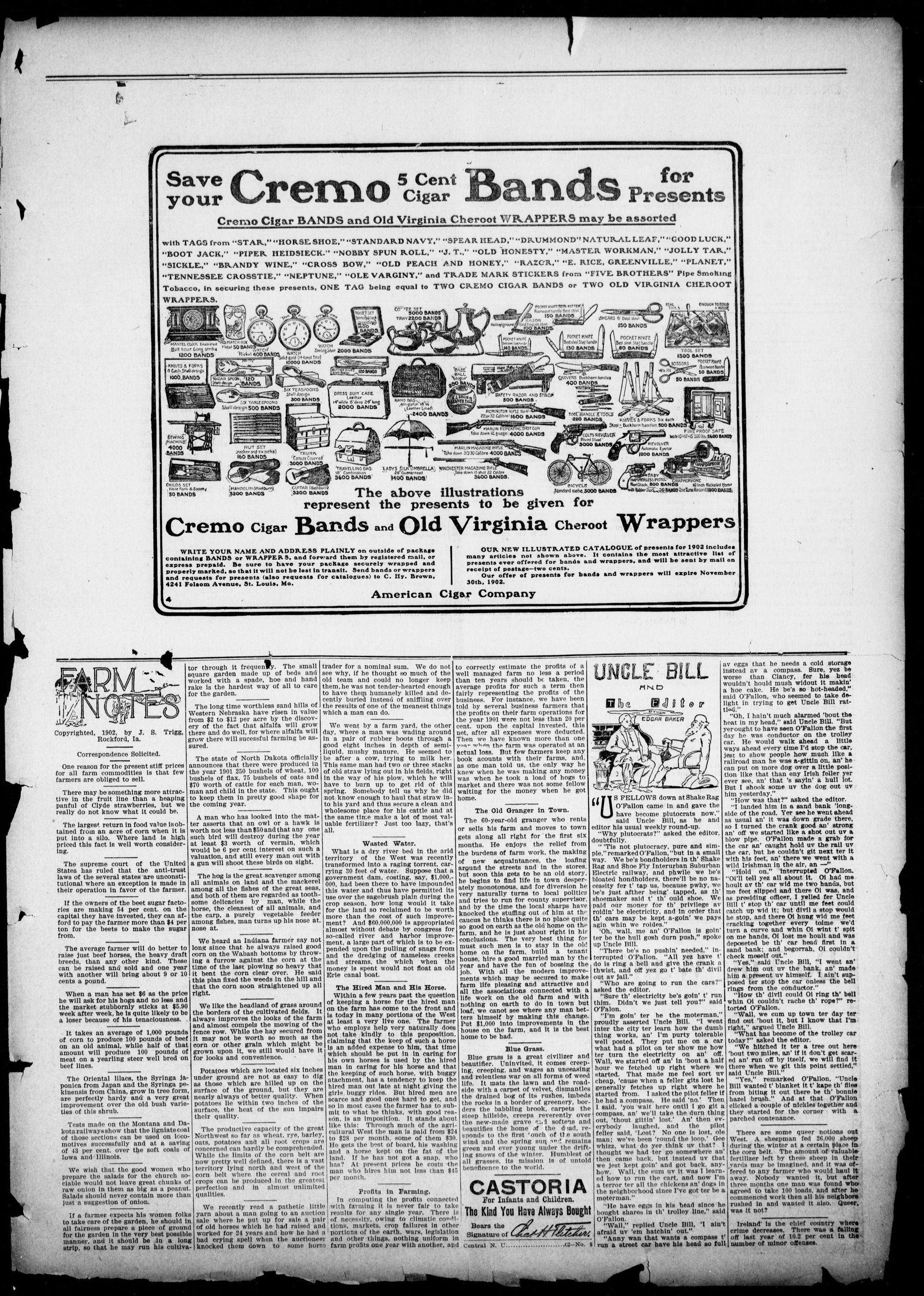
Save your Cremo 5 Cent Bands for Presents
with TAGS from "STAR," "HORSE SHOE," "STANDARD NAVY," "SPEAR HEAD," "DRUMMOND'NATURAL LEAF," "GOOD LUCK," "BOOT JACK," "PIPER HEIDSIECK." "NOBBY SPUN ROLL," "J. T.," "OLD HONESTY," "MASTER WORKMAN," "JOLLY TAR," "SICKLE," "BRANDY WINE," "CROSS BOW," "OLD PEACH AND HONEY," "RAZCR," "E. RICE, GREENVILLE," "PLANET," "TENNESSEE CROSSTIE," "NEPTUNE," "OLE VARGINY," and TRADE MARK STICKERS from "FIVE BROTHERS" Pipe Smoking Tobacco, in securing these presents, ONE TAG being equal to TWO CREMO CIGAR BANDS or TWO OLD VIRGINIA CHEROOT WRAPPERS.
WRAFTERS:
MANTEL CLICK Enamelled Hall Long Strike 1200 BANDS
MATCH BOX Metal 50 BANDS Watch Nickel 400 BANDS
WATCH Hall Long Strike (4 Kneel time) 10000 BANDS
WATCH Sailor Steel (4 Kneel time) 10000 BANDS
TOOL SET Stainless Steel 1200 BANDS
COFFEE SET Stainless Steel 1200 BANDS
POCKET KNIFE Best Steel Steel handle 150 BANDS
SHEARS 6 Best steel 150 BANDS
POCKET KNIFE Best Steel Steel handle 130 BANDS
POCKET KNIFE Best Steel Steel handle 80 BANDS
TOOL SET 1300 BANDS
POCKET KNIFE (Assessed Hand) 50 BANDS
KNIVES & FORKS 6 Each Shell design 1000 BANDS
SUGAR SPOON 120 BANDS
SIX TEASPOONS Shell design 500 BANDS
DRESS SUIT CASE 14 wide 6 Kneel 24 long 2000 BANDS
HAND BAG Alligator 16 in Leather Lace 2400 BANDS
SAFETY RAZOR AND STROP 500 BANDS
REMINGTON RIFLE No. 220 30 Calibre 1600 BANDS
HARLUN REPENTING GOTOUN Take down 16 gauges 4000 BANDS
MARLIN MAGAZINE RIFLE Take down 30/30 Calibre 4000 BANDS
WINCHESTER MAGAZINE RIFLE Take down 16 about 22 Calibre 3600 BANDS
KNIVES & FORKS Six each Steel - Buckhorn handles 500 BANDS
COLTS REPENTING Blued Steel 3000 BANDS
FIRE PROOF SAFE (10 10 10 15 3000 lbs) 5600 BANDS
CHILD'S SET Knife Fork & Spoon MANDOLIN (Woodburns) CUITAR (Woodburns)
TRAVELLING BAG 18 wide 3600 BANDS
LADYS SILK DMBRELLA 1400 BANDS
BICYCLE Standard nipple 5000 BANDS
BABY Washable Nipple 800 BANDS
WASHPHONE No. 1 Inch Nickel horn 30 BANDS
The above illustrations
Cremo Cigar Bands and Old Virginia Cheroot Wrappers
WRITE YOUR NAME AND ADDRESS PLAINLY on outside of package containing BANDS or WRAPPERS, and forward them by registered mail, or express prepaid. Be sure to have your package securely wrapped and properly marked, so that it will not be lost in transit. Send bands or wrappers and requests for presents (also requests for catalogues) to C. Hy. Brown, 4241 Folsom Avenue, St. Louis, Mo.
FARM NOTES
Correspondence Solicited.
One reason for the present stiff prices for all farm commodities is that few farmers are obliged to sell.
There may be something more attractive in the fruit line than a heaping panful of Clyde strawberries, but we really do not know what it could be.
The largest return in food value is obtained from an acre of corn when it is put into a silo. Where land is high priced this fact is well worth considering.
The supreme court of the United States has ruled that the anti-trust laws of the several states are unconstitutional where an exception is made in their operation in favor of the farmer.
If the owners of the beet sugar factories are making 54 per cent. on the capital they have invested, they can afford to pay the farmer more than $4 per ton for the beets to make the sugar from.
The average farmer will do better to raise just beef horses, the heavy draft breeds, than any other kind. These can be raised and sold and one year with another will bring about 9 or 10 cents a pound.
When a man has set $6 as the price he will ask for his hogs and no less and the market stubbornly sticks at $5.90 week after week, he is quite likely to be a loser because of his tenaciousness.
It takes an average of 1,000 pounds of corn to produce 100 pounds of beef on an old animal, while half of that amount will produce 100 pounds of meat on a yearling steer well bred on beef lines.
The Oriental lilacs, the Syringa japonica from Japan and the Syringa pekinensis from China, grow in tree form, are perfectly hardy and a very great improvement over the old bush varieties of this shrub.
Tests made on the Montana and Dakota railways show that the ligniate coal of those sections can be used on locomotives successfully and at a saving of 43 per cent, over the soft coals of Iowa and Illinois.
We wish that the good women who prepare the salads for the church sociable would not leave great chunks of raw onion in them as big as a peanut. Salads should never contain more than just a suggestion of onion.
If a farmer expects his women folks to take care of the garden, he should in all fairness prepare a piece of ground for the garden in the very best possible manner, and it should be in a long strip, so that he may run his cultiva-
Cremo Cigar BANDS and Old Virginia Cheroot WRAPPERS may be assorted
tor through it frequently. The small square garden made up of beds and worked with a spade, hoe and hand rake is the hardest way of all to care for the garden.
The long time worthless sand hills of Western Nebraska have risen in value from $2 to $12 per acre by the discovery of the fact that alfalfa will grow there and do well, for where alfalfa will grow there will successful farming be assured.
The state of North Dakota officially announces that there were produced in the year 1901 250 bushels of wheat, 100 bushels of flax, 75 bushels of oats and $70 worth of cattle for each man, woman and child in the state. This ought to keep them in pretty good shape for the coming year.
A man who has looked into the matter asserts that an owl or a hawk is worth not less than $50 and that any one such bird will destroy during the year at least $3 worth of vermin, which would be 6 per cent interest on such a valuation, and still every man out with a gun will shoot these birds on sight.
The hog is the great scavenger among all animals on land and the mackerel among all the fishes of the great seas, and both of them are regarded as toothsome delicacies by man, while the horse, the cleanest of all animals, and the carp, a purely vegetable feeder among fishes, man turns up his nose at, nose at.
We heard an Indiana farmer say not long since that he always raised good corn on the Wabash bottoms by throwing a furrow against the corn at the time of the last plowing so heavy that it bent the corn clear over. He said this plan fixed the weeds in the hill and that the corn soon straightened up all right.
---
We like the headland of grass around the borders of the cultivated fields. It always improves the looks of the farm and almost compels the mowing of the fence row. While the hay secured from it may not be worth so much as the corn or other grain which might be grown upon it, we still would have it for looks and convenience.
Potatoes which are located six inches under ground are not as easy to dig as those which are hilled up on the surface of the ground, but they are nearly always of better quality. When potatoes lie within two inches of the surface, the heat of the sun impairs their quality.
The productive capacity of the great Northwest so far as wheat, rye, barley, oats, potatoes and all root crops are concerned can hardly be comprehended. While the limits of the corn belt are now pretty well defined, there is a vast territory lying north and west of the corn belt where the cereal and root crops can be produced in the greatest perfection and in almost unlimited qualities.
We recently read a pathetic little yarn about a man going to an auction sale where he put up for sale a pair of old horses which he had raised and worked for 24 years and how he had a bad crying spell when the auctioneer knocked them down to some horses
American Cigar Company
trader for a nominal sum. We do not see why, if he thought so much of the old team and could no longer keep them, he was not tender-hearted enough to have them humanely killed and decently buried instead of sniffing over the results of one of the meanest things which a man can do.
We went by a farm yard, the other day, where a man was wading around in a pair of rubber boots through a good eight inches in depth of semiliquid, mushy manure. He seemed to be after a cow, trying to milk her. This same man had two or three stacks of old straw lying out in his fields, right in the way of his plow, which he will have to burn up to get rid of this spring. Somebody tell us why he did not know enough to haul that straw into his yard and thus secure a clean and wholesome place for his cattle and at the same time make a lot of most valuable fertilizer? Just too lazy, that's all.
Wasted Water
What is a dry river bed in the arid territory of the West was recently transformed into a raging torrent, carrying 30 feet of water. Suppose that a government dam, costing, say, $1,000,-000, had been there to have impounded this water and thus have permitted its use over the sagebrush plain during the crop season, how long would it take for the land so reclaimed to be worth more than the cost of such improvement? And $60,000,000 is appropriated almost without debate by congress for so-called river and harbor improvement, a large part of which is to be expended upon the pulling of snags from and the dredging of nameless creeks and streams, the which when the money is spent would not float an old Erte canal boat.
The Hired Man and His Horse.
Within a few years past the question of keeping a horse for the hired man on the farm has come to the front and is today in many portions of the West at least a very live one. The farmer who employs help very naturally does not take kindly to this proposition, claiming that the keep of such a horse is an added expense to him, that time which should be put in in caring for his own horses is used by the hired man in caring for his horse and that the keeping of such horse, with buggy attachment, has a tendency to keep the hired man out late at night giving the girls buggy rides. But hired men are scarse and good ones hard to get, and so in most cases the farmer has to submit to what he thinks, with good reason, is an imposition. It stands about like this: Through much of the agricultural West the man is paid from $24 to $28 per month, some of them $30. He gets the best of board, his washing and a horse kept on the fat of the land. If he has not got a snap, who has? At present prices he costs the man who hires him not less than $45 per month.
Profits in Farming.
In computing the profits connected with farming it is never fair to take results for any single year. There is of necessity, owing to climatic conditions, markets, crop failures in other portions of the earth, wars, legislation and other things, nothing uniform in farm profits one year with another, and
OUR NEW ILLUSTRATED CATALOGUE of presents for 1902 includes many articles not shown above. It contains the most attractive list of presents ever offered for bands and wrappers, and will be sent by mail on receipt of postage—two cents.
Our offer of presents for bands and wrappers will expire November 30th, 1902.
to correctly estimate the profits of a well managed farm no less a period than ten years should be taken, the average profits for such a term then fairly representing the profits of the business. For instance, we have been told by several business farmers that the profits on their farm operations for the year 1901 were not less than 20 percent. upon the capital invested, this net, after all expenses were deducted. Then we have known more than one year when the farm was operated at an actual loss. But few farmers keep any book accounts with their farms, and, as one man told us, the only way he knew when he was making any money was when he took a load of hogs to market and there was not some fellow waiting for the money when he got home.
The Old Granger in Town
The 60-year-old granger who rents or sells his farm and moves to town gets along all right for the first six months. He enjoys the relief from the burdens of farm work, the making of new acquaintances, the loafing around the streets and in the stores, but soon this gets to be an old story, he begins to find life in town desperately monotonous, and for diversion he naturally turns to local politics and tries to run a county supervisor, and by the time the local sharps have knocked the stuffing out of him at the caucus he thinks there is no place quite so good, earth as the old home on the farm, and he is just about right in his conclusions. The very best thing for must such men is to stay in the old house, hire a good married man by the year and have the fun of bossing the job. With all the modern improvements which may be secured to make farm life pleasing and attractive and all the associations connected with a life work on the old farm and with nothing on earth to do in town but loaf, we can see where any man betters himself by making this change Put $1,000 into improvements in the house on the farm, and it is the best home to be had.
Blue grass is a great civilizer and beautifier. Uninvited, it comes creeping, creeping, and wages an unceasing and relentless war on all forms of weed life. It mats the lawn and the roadside with a carpet of velvet, dismantles the drained bog of its rushes, imbeds the rocks in a border of greenery, borders the babbling brook, carpets the steep hillside, creeps reverently over the new-made grave and softens and beautifies the home of the dead, responds to the first touch of the south wind and the spring sun and remains green and ever young under the drifting snows of the winter. Humblest of all grasses, its mission is of untold benefence to the world.
Blue Grass
The Editor
EDGAR BAKER
"US FELLOWS down at Shake Rag
O'Fallon came in and gave the
have become plutocrats now,"
said Uncle Bill, as he and
editor his usual weekly round-up.
"Why plutocrats?" asked the editor,
doubtfully.
"Tis not plutocracy, pure and simple," remarked O'Fallon, "but in a small way. We be's bondholders in th' Shake Rag and Shoe Fly Interurban Suburban Electric railway, and phwile we be's bloated hondholders, there'll be no necessity fer t' tap us, because pwyhe, we be's just after being' tapped, as th' shoemaker said t' th' tould shoe. We paid our money for th' privilege avroldin' be electricity, and in order that 'th' cars may be kept a-goin' we pays agin whin we roides."
"Oh, wall, me an' O'Fallon is goin' ter be the hull gosh durn push," spoke up Uncle Bill.
"There be's no pushin' needed," interrupted O'Fallon. "All ye have t' do is ring a bell and give the crank a thwist, and off yez go t' bate th' divil out av jail."
"Who are going to run the cars?" asked the editor.
"Sure th' electricity be's goin' t' run thim. Didn't we just tell you?" said O'Fallon.
"I'm goin' ter the be moterman," proudly asserted Uncle Bill. "I went inter the ter learn how the dumb thing works, an' I'm purty tolerable well posted. They put me on a car what had a pilot on ter show me how ter turn the electricity on an' off. Wall, we started off an' in 'bout a half hour we fetched up right where we started. That made me feel sort uv cheap, 'cause when a feller gills lost he generally fetches up right where he started from. I asked the pilot feller if he had a compass. He said 'no.' Then I said, 'you wait here until I go git a compass, an' you take the durn things out, 'thout gittin' lost. An' then everybody laughed, and the pilot feller said, 'Lost?' No one is lost, ole man; we've been 'round the loop.' Gee whizz, what do ye think uv that? I thought we had ter go somewhere an then came back, but instead uv that we jest kept goin' and got back, anyhow. Wall, the sum uv it was I learned how to run the cart, and now I'm a terror ter all the chickens an' dogs in the neighborhood since I've got ter be a noterman."
"He have eggs in his head since he bought shares in th' trolley line," said O'Fallon.
"Wall," replied Uncle Bill, "I ain't afraid uv 'em hatchin' out."
"Anny wan that wants a compass t" run a street car have his head so full
av eggs that he needs a cold storage instead av a compass. Sure, yez be worse than Clancy, for his head wouldn't hould mush widout it makin' a hoe cake. He he's so hot-headed," said O'Fallon, who seemed to take delight in trying to get Uncle Bill rattled."
"Oh, I hain't much alarmed 'bout the heat in my head," said Uncle Bill. "But yerought to have seen O'Fallon the first day he was conductor on the trolley car. He would walk ahead a little ways ahead every time I'd stop the car, jest to show people how much like a railroad man he was a-gittin on, an' he can put on more dog over a little position like that than any Irish feller yer ever see, an' that 's sayin' a hull lot. But I shook some uv the dog out uv him yesterday."
"How was that?" asked the editor.
"I landed him in a sand bank 'long-side of the road. Yer see he went ahead as usual an 'i' it was down grade there, so I turned the crank good an 'strong an' off we started like a shot out uv a blow pipe. O'Fallon made a grab for the car an' caught hold uv the rail uv the car, but he couldn't git next ter it with his feet, an' there we went with a wild Irishman in the air, an' "Hold on," interrupted O'Fallon.
"Oil tell you all about it. OI had me hault vt th' car in two hands, but me feet slipped and there OI was, and as presiding officer, I yelled for Uncle Bill's car 'h' car until me feet could stop up wi it; but divl a stop would he stop, and there OI hung wi me feet cracking together every tome wed' turn a curve and whin Oi wint 't spit on me hands, OI lost he hoult and was deposeted be' th' car head first in a sand bank; and begorrah, OI couldn't check myself out."
"Yes," said Uncle Bill, "I went an' drew him out uv the bank, an' made him a present uv himself. I ain't supposed ter stop the car onless the bell rings from the conductor."
"How th' divil could Ii ring th' bell whin Oi couldn't rache th' rope?" retorted O'Fallon.
"Wall, we cum up town ter day ter find out 'bout it, but I know that I'm right," argued Uncle Bill.
"What has become of the trolley car today?" asked the editor.
"We hitched it ter a tree out here 'bout two miles, an' if it don't get scarred an' run off by itself, we will find it there when we git this point settled," said Uncle Bill.
"Yes," remarked O'Fallon, "Uncle Bill wanted t' blanket it t' kape th' flies from biting it out there be th' bonnie hazel brush." And at that O'Fallon clicked a couple of nickles together and they started for the corner with a parched contenance.
There are some queer notions out West. A sheepman fed 26,000 sheep during the winter at a certain place in the corn belt. The amount of valuable fertilizer left by these sheep in their yards may be imagined, and it was offered to any farmer who would haul it away. Nobody wanted it, but after three months one man was found who agreed to take 100 loads, and after he commenced work then all his neighbors rushed in and wanted it also. Queer, was it not?
Ireland is the chief country where crime decreases. There was a falling off last year of 10.2 per cent in the number of minor offences.
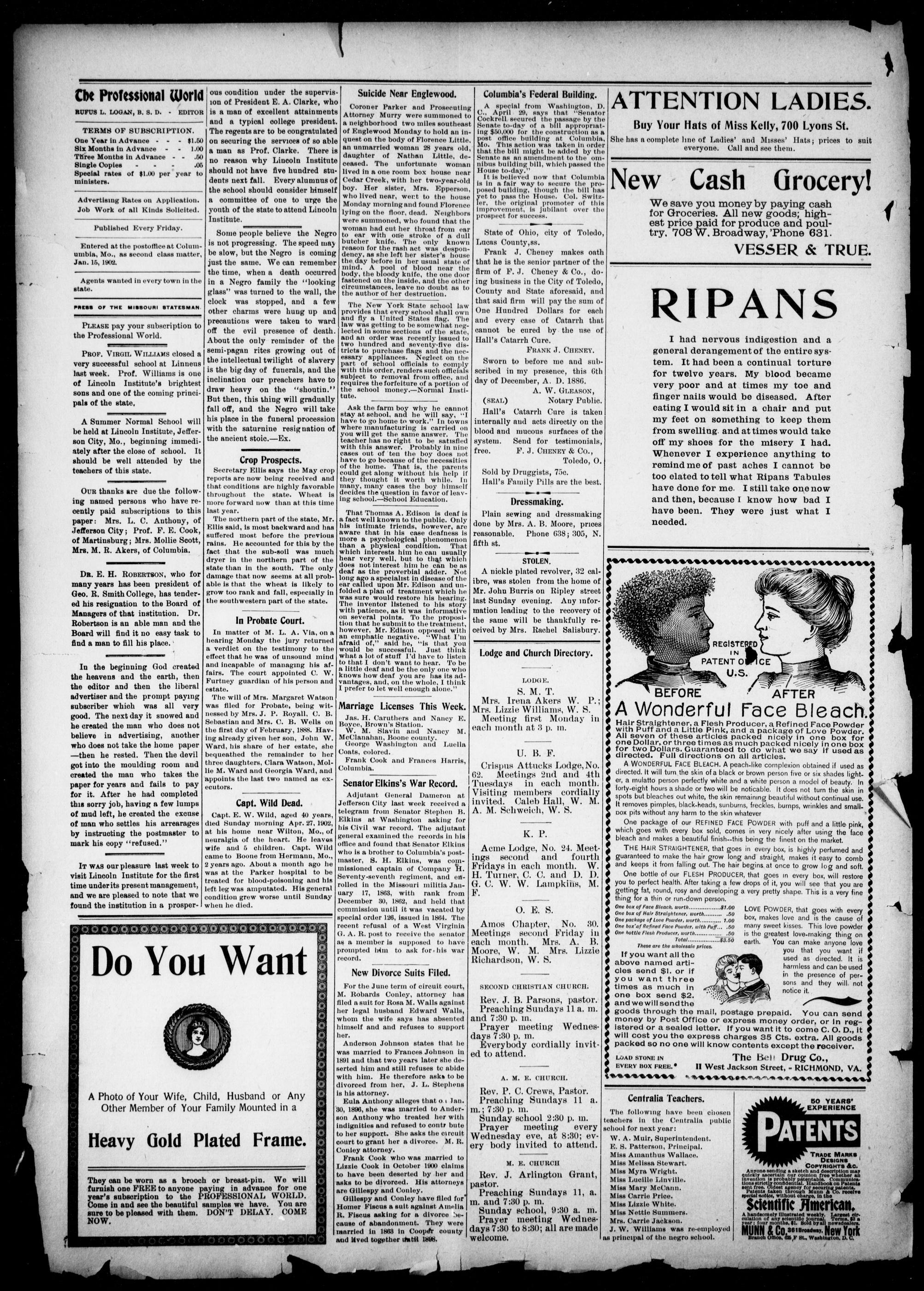
The Professional World
RUFUS L. LOGAN, B. S. D. - EDITOR
TERMS OF SUBSCRIPTION.
One Year in Advance - - - $1.50
Six Months in Advance - - 1.00
Three Months in Advance - - .50
Single Copies - - - .05
Special rates of $1.00 per year to ministers.
Advertising Rates on Application.
Job Work of all Kinds Sollicited.
Published Every Friday.
Entered at the postoffice at Columb-
umbia, Mo., as second class matter,
Jan. 15, 1902.
Agents wanted in every town in the state.
PRESS OF THE MISSOURI STATESMAN
PLEASE pay your subscription to the Professional World.
PROF. VIRGIL WILLIAMS closed a very successful school at Linneus last week. Prof. Williams is one of Lincoln Institute's brightest sons and one of the coming principals of the state.
A Summer Normal School will be held at Lincoln Institute, Jefferson City, Mo., beginning immediately after the close of school. It should be well attended by the teachers of this state.
OUR thanks are due the following named persons who have recently paid subscriptions to this paper: Mrs. L. C. Anthony, of Jefferson City; Prof. F. E. Cook, of Martinsburg; Mrs. Mollie Scott, Mrs. M. R. Akers, of Columbia.
Dr. E. H. ROBERTSON, who for many years has been president of Geo. R. Smith College, has tendered his resignation to the Board of Managers of that institution. Dr. Robertson is an able man and the Board will find it no easy task to find a man to fill his place.
In the beginning God created the heavens and the earth, then the editor and then the liberal advertiser and the prompt paying subscriber which was all very good. The next day it snowed and he created the man who does not believe in advertising, another who does not take the home paper —then he rested. Then the devil got into the moulding room and created the man who takes the paper for years and fails to pay for it. After he had completed this sorry job, having a few lumps of mud left, he created the excuse of man who settles his arrearages by instructing the postmaster to mark his copy "refused."
IT WAS our pleasure last week to visit Lincoln Institute for the first time under its present management, and we are pleased to note that we found the institution in a prosper-
Do You Want
THE LADY OF THE ROAD
A Photo of Your Wife, Ch
Other Member of Your
Heavy Gold P
They can be worn as a brooch
furnish one FREE to anyone p
year's subscription to the P
Come in and see the beautiful s
sure to be pleased with them.
A Photo of Your Wife, Child, Husband or Any Other Member of Your Family Mounted in a
They can be worn as a brooch or breast-pin. We will furnish one FREE to anyone paying in advance for one year's subscription to the PROFESSIONAL WORLD. Come in and see the beautiful samples we have. You are sure to be pleased with them. DON'T DELAY. COME NOW.
ous condition under the supervision of President E. A. Clarke, who is a man of excellent attainments and a typical college president. The regents are to be congratulated on securing the services of so able a man as Prof. Clarke. There is no reason why Lincoln Institute should not have five hundred students next fall. Every alumnus of the school should consider himself a committee of one to urge the youth of the state to attend Lincoln Institute.
Some people believe the Negro is not progressing. The speed may be slow, but the Negro is coming just the same. We can remember the time, when a death occurred in a Negro family the "looking glass" was turned to the wall, the clock was stopped, and a few other charms were hung up and precautions were taken to ward off the evil presence of death. About the only reminder of the semi-pagan rites growing out of the intellectual twilight of slavery is the big day of funerals, and the inclination our preachers have to draw heavy on the "shoutin." But then, this thing will gradually fall off, and the Negro will take his place in the funeral procession with the saturnine resignation of the ancient stoic.—Ex.
Secretary Ellis says the May crop reports are now being received and that conditions are highly favorable throughout the state. Wheat is more forward now than at this time last year.
The northern part of the state, Mr. Ellis said, is most backward and has suffered most before the previous rains. He accounted for this by the fact that the sub-soil was much dryer in the northern part of the state than in the south. The only damage that now seems at all probable is that the wheat is likely to grow too rank and fall, especially in the southwestern part of the state.
In matter of M. L. A. Via, on a hearing Monday the jury returned a verdict on the testimony to the effect that he was of unsound mind and incapable of managing his affairs. The court appointed C. W. Furtney guardian of his person and estate.
The will of Mrs. Margaret Watson was filed for Probate, being witnessed by Mrs. J. P. Royall, C. B. Sebastian and Mrs. C. B. Wells on the first day of February, 1888. Having already given her son, John W. Ward, his share of her estate, she bequeathed the remainder to her three daughters, Clara Watson, Mollie M. Ward and Georgia Ward, and appoints the last two named as executors.
Capt. E. W. Wild, aged 40 years, died Sunday morning Apr. 27, 1902, at his home near Wilton, Mo., of neuralgia of the heart. He leaves wife and 5 children. Capt. Wild came to Boone from Hermann, Mo. 2 years ago. About a month ago he was at the Parker hospital to be treated for blood-poisoning and his left leg was amputated. His general condition grew worse until Sunday when he died.
Crop Prospects.
In Probate Court.
Capt. Wild Dead.
Suicide Near Englewood.
Coroner Parker and Prosecuting Attorney Murry were summoned to a neighborhood two miles southeast of Englewood Monday to hold an inquest on the body of Florence Little, an unmarried woman 28 years old, daughter of Nathan Little, deceased. The unfortunate woman lived in a one room box house near Cedar Creek, with her two-year-old boy. Her sister, Mrs. Epperson, who lived near, wert to the house Monday morning and found Florence lying on the floor, dead. Neighbors were summoned, who found that the woman had cut her throat from ear to ear with one stroke of a dull butcher knife. The only known reason for the rash act was despondency, as she left her sister's house the day before in her usual state of mind. A pool of blood near the body, the bloody knife, the one door fastened on the inside, and the other circumstances, leave no doubt as to the author of her destruction.
The New York State school law provides that every school shall own and fly a United States flag. The law was getting to be somewhat neglected in some sections of the state, and an order was recently issued to two hundred and seventy-five districts to purchase flags and the necessary appliances. Neglect on the part of school officials to comply with this order, renders such officials subject to removal from office, and requires the forfeiture of a portion of the school money.—Normal Institute.
Ask the farm boy why he cannot stay at school, and he will say, "I have to go home to work." In towns where manufacturing is carried on you will get the same answer. The teacher has no right to be satisfied with this answer. Probably in nine cases out of ten the boy does not have to go because of the necessities of the home. That is, the parents could get along without his help if they thought it worth while. In many, many cases the boy himself decides the question in favor of leaving school.—School Education.
That Thomas A. Edison is deaf is a fact well known to the public. Only his intimate friends, however, are aware that in his case deafness is more a psychological phenomenon than a physical condition. That which interests him he can usually hear very well, but to that which does not interest him he can be as deaf as the proverbial adder. Not long ago a specialist in disease of the ear called upon Mr. Edison and unfolded a plan of treatment which he was sure would restore his hearing. The inventor listened to his story with patience, as it was informative on several points. To the proposition that he submit to the treatment, however, Mr. Edison opposed with an emphatic negative. "What I'm afraid of," said he, "is that you would be successful. Just think what a lot of stuff I'd have to listen to that I don't want to hear. To be a little deaf and be the only one who knows how deaf you are has its advantages, and, on the whole, I think I prefer to let well enough alone."
Marriage Licenses This Week
Jas. H. Caruthers and Nancy E. Boyce, Brown's Station. W. M. Slavin and Nancy M.
W. M. Slavin and Nancy M. McClanahan, Boone county.
George Washington and Luella Coats, colored.
Frank Cook and Frances Harris, Columbia.
Senator Elkins's War Record.
Adjutant General Dameron at Jefferson City last week received a telegram from Senator Stephen B. Elkins at Washington asking for his Civil war record. The adjutant general examined the records in his office and found that Senator Elkins who is a brother to Columbia's postmaster, S. H. Elkins, was commissioned captain of Company H. Seventy-seventh regiment, and enrolled in the Missouri militia January 17, 1863, with rank from December 30, 1862, and held that commission until it was vacated by special order 126, issued in 1864. The recent refusal of a West Virginia G. A. R. post to receive the senator as a member is supposed to have prompted him to ask for his war record.
New Divorce Suits Filed.
For the June term of circuit court, M. Robards Conley, attorney has filed a suit for Rosa M. Walls against her legal husband Edward Walls, whom the wife says has absented himself and refuses to support her.
Anderson Johnson states that he was married to Frances Johnson in 1891 and that two years later she deserted him and still refuses to abide with him. He therefore asks to be divorced from her, J. L. Stephens is his attorney.
Eula Anthony alleges that o. Jan. 30, 1896, she was married to Anderson Anthony who treated her with indignities and refused to contr bute to her support. She asks the circuit court to grant her a divorce. M. R. Conley attorney.
Frank Cook who was married to Lizzie Cook in October 1900 claims to have been deserted by her and asks to be divorced. His attorneys are Gillespy and Conley. Gillespy and Conley have filed for Homer Fiscus a suit against Amelia R. Fiscus asking for a divorce because of abandonment. They were married in 1863 in Cooper county and lived together until 1868.
Columbia's Federal Building.
A special from Washington, D.C., April 29, says that "Senator Cockrell secured the passage by the Senate to-day of a bill appropriating $50,000 for the construction as a post office building at Columbia, Mo. This action was taken in order that the bill might be added by the Senate as an amendment to the omnibus building bill, which passed the House to-day."
It is believed now that Columbia is in a fair way to secure the proposed building, though the bill has yet to pass the House. Col. Switzler, the original promoter of this improvement, is jubilant over the prospect for success.
State of Ohio, city of Toledo, Lucas County, ss.
Frank J. Cheney makes oath that he is the senior partner of the firm of F. J. Cheney & Co., doing business in the City of Toledo, County and State aforesaid, and that said firm will pay the sum of One Hundred Dollars for each and every case of Catarrh that cannot be cured by the use of Hall's Catarrh Cure.
FRANK J. CHENEY.
Sworn to before me and subscribed in my presence, this 6th day of December, A. D. 1886.
Hall's Catarrh Cure is taken internally and acts directly on the blood and mucous surfaces of the system. Send for testimonials, free. F. J. CHENEY & Co., Toledo, O. Sold by Druggists, 75c. Hall's Family Pills are the best.
Dressmaking.
Plain sewing and dressmaking done by Mrs. A. B. Moore, prices reasonable. Phone 638; 305, N. fifth st.
STOLEN
A nickle plated revolver, 32 calibre, was stolen from the home of Mr. John Burris on Ripley street last Sunday evening. Any information leading to the recovery of the same will be thankfully received by Mrs. Rachel Salisbury.
Lodge and Church Directory.
LODGE.
S. M. T.
LODGE.
S. M. T.
Mrs. Irena Akers W. P.
Mrs. Lizzie Williams, W. S.
Meeting first Monday in each month at 3 p. m.
U. B. F.
Crispus Attucks Lodge,No. 62. Meetings 2nd and 4th Tuesdays in each month. Visiting members cordially invited. Caleb Hall, W. M. A. M. Schweich, W. S.
K. P.
Acme Lodge, No. 24. Meetings second and fourth Fridays in each month. W. H. Turner, C. C. and D. D. G. C. W. W. Lampkins, M. F.
O. E. S.
Amos Chapter, No. 30. Meetings second Friday in each month. Mrs. A. B. Moore, W. M. Mrs. Lizzie Richardson, W. S.
SECOND CHRISTIAN CHURCH.
Rev. J. B. Parsons, pastor. Preaching Sundays 11 a. m. and 7:30 p. m. Prayer meeting Wednesday days 7:30 p. m.
Everybody cordially invited to attend.
A. M. E. CHURCH.
Rev. P. C. Crews, Pastor.
Preaching Sundays 11 a.
m.; 7:30 p. m.
Sunday school 2:30 p. m.
Prayer meeting every
Wednesday eve, at 8:30; every
body invited to attend.
M. E. CHURCH
Rev. J. Arlington Grant, pastor.
Preaching Sundays 11, a. m. and 7:30 p. m.
Sunday school, 9:30 a. m.
Prayer meeting Wednesdays 7:30 to 8:30; all are made welcome.
ATTENTION LADIES.
ATTENTION LADIES.
Buy Your Hats of Miss Kelly, 700 Lyons St. She has a complete line of Ladies' and Misses' Hats; prices to suit everyone. Call and see them.
New Cash Grocery!
We save you money by paying cash for Groceries. All new goods; highest price paid for produce and poultry. 708 W. Broadway, Phone 631.
nervous indigene arrangement of the had been a contin- ee years. My bri- and at times it would be dis- would sit in a ch- on something to- ting. and at times it goes for the mi- I experience a lot of past aches to tell what Rip- for me. I still t- because I know. They were j- REGISTERED IN PATENT OFFICE U.S. Furful Face Flesh Producer, a be Pink, and a pac- articles packed n times as much pa- guaranteed to do w- tions on all arti- LEACH. A peach-like co- of a black or brown p- white and a white p- two will be noticeable. e, the skin remaining b- heads, sunburns, freckles- to the skin whatever DEFINED FACE POWDER sold, comes in very- ful finish--this being the TER, that goes in every hair grow long and strai- out. The hair begins at H PRODUCER, that go- taking a few drops of i developing a very pre- person.
RIPANS
RIPANS
I had nervous indigestion and a general derangement of the entire system. It had been a continual torture for twelve years. My blood became very poor and at times my toe and finger nails would be diseased. After eating I would sit in a chair and put my feet on something to keep them from swelling. and at times would take off my shoes for the misery I had. Whenever I experience anything to remind me of past aches I cannot be too elated to tell what Ripans Tabules have done for me. I still take one now and then, because I know how bad I have been. They were just what I needed.
REGISTERED
IN
PATENT OFFICE
U.S.
BEFORE
AFTER
Hair Straightener, a Flesh Producer, a Refined Face Powder with Puff and a Little Pink, and a package of Love Powder. All seven of these articles packed nicely in one box for one Dollar, or three times as much packed nicely in one box for two Dollars. Guaranteed to do what we say if used as directed. Full directions on all articles.
A WONDERFUL FACE BLEACH. A peach-like complexion obtained if used as directed. It will turn the skin of a black or brown person five or six shades lighter, a mulatto person perfectly white and a white person a model of beauty. In forty-eight hours a shade or two will be noticeable. It does not turn the skin in spots but bleaches out white, the skin remaining beautiful without continual use. It removes pimples, black-heads, sunburns, freckles, bumps, wrinkles and small-box pits without any harm to the skin whatever.
One package of our REFINED FACE POWDER with puff and a little pink, which goes with every box sold, comes in very nicely after using the face bleach and makes a beautiful finish--this being the finest on the market.
THE HAIR STRAIGHTENER, that goes in every box, is highly perfumed and guaranteed to make the hair grow long and straight, makes it easy to comb and keeps it from falling out. The hair begins at once to grow log and soft.
One bottle of our FLESH PRODUCER, that goes in every box, will restore you to perfect health. After taking a few drops of it, you will see that you are getting fat, round, rosy and developing a very pretty shape. This is a very fine thing for a thin or run-down person.
One box of Face Wash, worth ..... $1.00
One box of Hair Straightener, worth ..... $.50
One package of Love Powder, worth ..... 1.00
One box of Refined Face Powder, with Puff ..... $.50
One bottle Flesh Producer, worth ..... $.50
Total ..... $3.50
enail, postage pre-
size or express mo-
etter. If you want
express charges 35
will know contents of
The Bell
West Jackson St
goods through the mail, post money by Post Office or exp listered or a sealed letter. If will cost you the express cha packed so no one will know o LOAD STONE IN EVERY BOX FREE. II West Ja
goods through the mail, postage prepaid. You can send money by Post Office or express money order, or in registered or a sealed letter. If you want it to come C. O. D., it will cost you the express charges 35 Cts. extra. All goods packed so no one will know contents except the receiver.
The following have been chosen teachers in the Centralia public school for next year:
W. A. Muir, Superintendent.
E. S. Patterson, Principal.
Miss Amanthus Wallace.
Miss Melissa Stewart.
Miss Myra Wright.
Miss Lucille Linville.
Miss Mary McCann.
Miss Carrie Price.
Miss Lizzie White.
Miss Nettie Summers.
Mrs. Carrie Jackson.
J. W. Williams was re-employed as principal of the negro school.
---
If you want all the above named articles send $1. or if you want three times as much in one box send $2. and we will send the
Centralia Teachers.
VESSER & TRUE.
us indigestion and a
ment of the entire sys-
tle a continual torture
s. My blood became
at times my toe and
had be diseased. After
it in a chair and put
something to keep them
and at times would take
the misery I had.
experience anything to
at aches I cannot be
what Ripans Tabules
s. I still take one now
I know how bad I
were just what I
AFTER
Face Bleach.
Producer, a Refined Face Powder
and a package of Love Powder.
packed nicely in one box for
much packed nicely in one box
to do what we say if used as
in all articles.
Peach-like complexion obtained if used as
sk or brown person five or six shades light-
and a white person a model of beauty. In
noticable. It does not turn the skin in
remaining beautiful without continual use.
burns, freckles, bumps, wrinkles and small-
whatever
FACE POWDER with puff and a little pink,
comes in very nicely after using the face
this being the finest on the market.
Goes in every box, is highly perfumed and
long and straight, makes it easy to comb
air begins at once to grow log and soft.
CER, that goes in every box, will restore
new drops of it, you will see that you are
ang a very pretty shape. This is a very fine
LOVE POWDER, that goes with every box, makes love and is the cause of many sweet kisses. This love powder is the greatest love-making thing on earth. You can make anyone love
stage prepaid. You can send
press money order, or in reg-
你 want it to come C. O. D., it
arges 35 Cts. extra. All goods
contents except the receiver.
The Bell Drug Co.,
Jackson Street, - RICHMOND, VA.
50 YEARS' EXPERIENCE
PATENTS
TRADE MARKS DESIGNS
COPYRIGHTS & C.
Anyone sending a sketch and description may quickly receive approval for patent. The patent invention is probably patentable. Communications strictly confidential. Handbook on Patents sent free. Dissident agency for securing patent. Patent taken through MUNN & Co. receive special notice, without charge, in the Scientific American.
A handsome illustrated weekly. Largest circulation of any scientific journal. Terms, $3 a year; four months, $1. Sold by all newadcaler.
MUNN & Co. 3618 Broadway, New York
Branch Office, 65 F. St. Washington, D. C.
---
you that you want if used as directed. It is harmless and can be used in the presence of persons and they will, not notice it.