The Professional World
Friday, September 26, 1902
Columbia, Missouri
Page text (machine-generated)
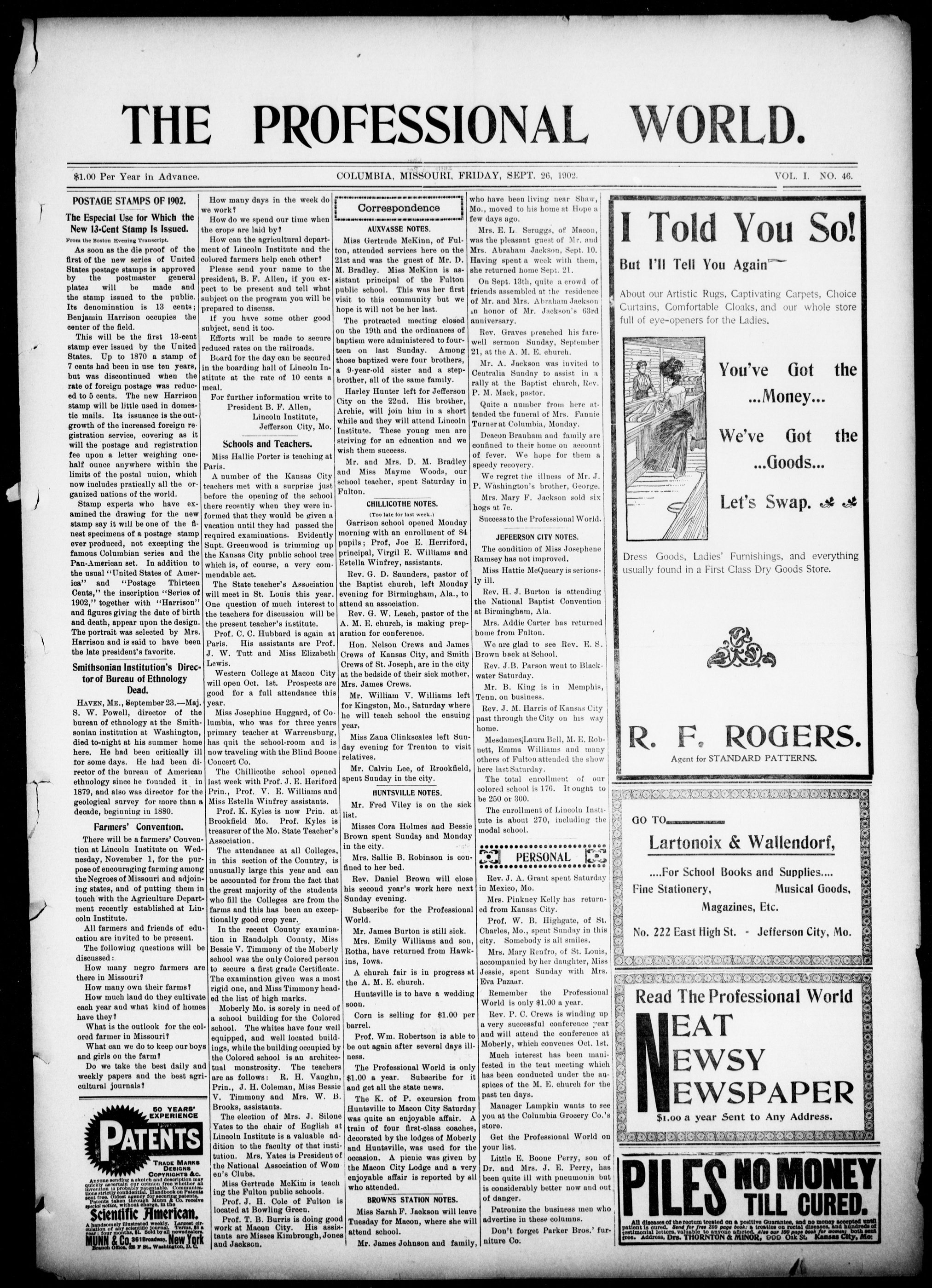
THE PROFESSIONAL WORLD.
$1.00 Per Year in Advance.
POSTAGE STAMPS OF 1902.
The Especial Use for Which the New 13-Cent Stamp Is Issued. From the Boston Evening Transcript. As soon as the die proof of the first of the new series of United States postage stamps is approved by the postmaster general plates will be made and the stamp issued to the public. Its denomination is 13 cents; Benjamin Harrison occupies the center of the field.
This will be the first 13-cent stamp ever issued by the United States. Up to 1870 a stamp of 7 cents had been in use ten years, but was discontinued when the rate of foreign postage was reduced to 5 cents. The new Harrison stamp will be little used in domestic mails. Its issuance is the outgrowth of the increased foreign registration service, covering as it will the postage and registration fee upon a letter weighing one-half ounce anywhere within the limits of the postal union, which now includes pratically all the organized nations of the world.
Stamp experts who have examined the drawing for the new stamp say it will be one of the finest specimens of a postage stamp ever produced, not excepting the famous Columbian series and the Pan-American set. In addition to the usual "United States of America" and "Postage Thirteen Cents," the inscription "Series of 1902," together with "Harrison" and figures giving the date of birth and death, appear upon the design. The portrait was selected by Mrs. Harrison and is said to have been the late president's favorite.
Smithsonian Institution's Director of Bureau of Ethnology Dead.
HAVEN, ME., September 23.—Maj. S. W. Powell, director of the bureau of ethnology at the Smithsonian institution at Washington, died to-night at his summer home here. He had been critically ill for some days. He had been director of the bureau of American ethnology since he founded it in 1879, and also was director for the geological survey for more than a decade, beginning in 1880.
Farmers' Convention.
There will be a farmers' Convention at Lincoln Institute on Wednesday, November 1, for the purpose of encouraging farming among the Negroes of Missouri and adjoining states, and of putting them in touch with the Agriculture Department recently established at Lincoln Institute.
All farmers and friends of education are invited to be present.
The following questions will be discussed:
How many negro farmers are there in Missouri?
How many own their farms?
How much land do they cultivate each year and what kind of homes have they?
What is the outlook for the colored farmer in Missouri?
What can we do to keep our boys and girls on the farm?
Do we take the best daily and weekly papers and the best agricultural journals?
50 YEARS' EXPERIENCE
PATENTS
TRADE MARKS DESIGNS
Anyone sending a sketch and description may quickly ascertain our counsel风 whether an invention is probably patented. We have a Handbook on Patents free. Oldest agency for securing patents. Patents taken through Munn & Co. receive special notice, without charge, in the Scientific American. A handsonly illustrated weekly. Largest circulation of any scientific journal. Terms, $3 a year; four months, $1. Sold by all new盐铺. MUNN & Co. 3615roadway, New York Branch Office, 61 St. F. Washington, D.C.
How many days in the week do we work?
How do we spend our time when the crops are laid by?
How can the agricultural department of Lincoln Institute and the colored farmers help each other?
Please send your name to the president, B. F. Allen, if you expect to be present and tell what subject on the program you will be prepared to discuss.
If you have some other good subject, send it too.
Efforts will be made to secure reduced rates on the railroads.
Board for the day can be secured in the boarding hall of Lincoln Institute at the rate of 10 cents a meal.
For further information write to President B. F. Allen,
Lincoln Institute,
Jefferson City, Mo.
Schools and Teachers.
Miss Hallie Porter is teaching at Paris. A number of the Kansas City teachers met with a surprise just before the opening of the school there recently when they were informed that they would be given a vacation until they had passed the required examinations. Evidently Supt. Greenwood is trimming up the Kansas City public school tree which is, of course, a very commendable act. The State teacher's Association will meet in St. Louis this year. One question of much interest to the teachers for discussion will be the present teacher's institute.
Prof. C. C. Hubbard is again at Paris. His assistants are Prof. J. W. Tutt and Miss Elizabeth Lewis. Western College at Macon City will open Oct. 1st. Prospects are good for a full attendance this year. Miss Josephine Huggard, of Columbia, who was for three years primary teacher at Warrensburg, has quit the school-room and is now traveling with the Blind Boone Concert Co. The Chillicothe school opened last week with Prof. J. E. Heriford Prin., Prof. V. E. Williams and Miss Estella Winfrey assistants.
Prof. K. Kyles is now Prin. at Brookfield Mo. Prof. Kyles is treasurer of the Mo. State Teacher's Association.
The attendance at all Colleges, in this section of the Country, is unusually large this year and can be accounted for from the fact that the great majority of the students who fill the Colleges are from the farms and this has been an exceptionally good crop year.
In the recent County examination in Randolph County, Miss Bessie V. Timmony of the Moberly school was the only Colored person to secure a first grade Certificate. The examination given was a most rigid one, and Miss Timmony headed the list of high marks.
Moberly Mo. is sorely in need of a school building for the Colored school. The whites have four well equipped, and well located buildings, while the building occupied by the Colored school is an architectural monstrosity. The teachers are as follows: R. H. Vaughn, Prin., J. H. Coleman, Miss Bessie V. Timmony and Mrs. W. B. Brooks, assistants. The election of Mrs. J. Silone Yates to the chair of English at Lincoln Institute is a valuable addition to the faculty of that institution. Mrs. Yates is President of the National Association of Women's Clubs.
Miss Gertrude McKim is teach ing the Fulton public schools. Prof. J. H. Cole of Fulton is located at Bowling Green. Prof. T. B. Burris is doing good work at Macon City. His assistants are Misses Kimbrough, Jones and Jackson.
COLUMBIA, MISSOURI, FRIDAY, SEPT. 26, 1902.
Miss Gertrude McKinn, of Fulton, attended services here on the 21st and was the guest of Mr. D. M. Bradley. Miss McKinn is assistant principal of the Fulton public school. This was her first visit to this community but we hope it will not be her last. The protracted meeting closed on the 19th and the ordinances of baptism were administered to fourteen on last Sunday. Among those baptized were four brothers, a 9-year-old sister and a stepbrother, all of the same family.
Harley Hunter left for Jefferson City on the 22nd. His brother, Archie, will join him in a short while and they will attend Lincoln Institute. These young men are striving for an education and we wish them success. Mr. and Mrs. D. M. Bradley and Miss Mayme Woods, our school teacher, spent Saturday in Fulton.
CHILLICOTHE NOTES.
Garrison school opened Monday morning with an enrollment of 84 pupils; Prof, Joe E. Herriford, principal, Virgil E. Williams and Estella Winfrey, assistants.
Rev. G. D. Saunders, pastor of the Baptist church, left Monday evening for Birmingham, Ala., to attend an association.
Rev. G. W. Leach, pastor of the A. M. E. church, is making preparation for conference.
Hon. Nelson Crews and James Crews of Kansas City, and Smith Crews of St. Joseph, are in the city at the bedside of their sick mother, Mrs. James Crews.
Mr. William V. Williams left for Kingston, Mo., Saturday where he will teach school the ensuing year.
Miss Zana Clinkscales left Sunday evening for Trenton to visit relatives.
Mr. Calvin Lee, of Brookfield, spent Sunday in the city.
HUNTSVILLE NOTES.
Mr. Fred Viley is on the sick list.
Misses Cora Holmes and Bessie Brown spent Sunday and Monday in the city.
Mrs. Sallie B. Robinson is confined to her bed.
Rev. Daniel Brown will close his second year's work here next Sunday evening.
Subscribe for the Professional World.
Mr. James Burton is still sick.
Mrs. Emily Williams and son, Rotha, have returned from Hawkins, Iowa.
A church fair is in progress at the A. M. E. church.
Huntsville is to have a wedding soon.
Corn is selling for $1.00 per barrel.
Prof. Wm. Robertson is able to be out again after several days illness.
The Professional World is only $1.00 a year. Subscribe for it and get all the state news.
The K. of P. excursion from Huntsville to Macon City Saturday was quite an enjoyable affair. A train of four first-class coaches, decorated by the lodges of Moberly and Huntsville, was used for the occasion. A picnic was given by the Macon City Lodge and a very enjoyable affair is reported by all who attended.
BROWNS STATION NOTES.
Miss Sarah F. Jackson will leave Tuesday for Macon, where she will attend school. Mr. James Johnson and family,
who have been living near Shaw, Mo., moved to his home at Hope a few days ago.
Mrs. E. L. Seruggs, of Macon, was the pleasant guest of Mr. and Mrs. Abraham Jackson, Sept. 10. Having spent a week with them, she returned home Sept. 21.
On Sept. 13th, quite a crowd of friends assembled at the residence of Mr. and Mrs. Abraham Jackson in honor of Mr. Jackson's 63rd anniversary.
Rev. Graves preached his farewell sermon Sunday, September 21, at the A. M. E. church.
Mr. A. Jackson was invited to Centralia Sunday to assist in a rally at the Baptist church, Rev. P. M. Mack, pastor.
Quite a number from here attended the funeral of Mrs. Fannie Turner at Columbia, Monday.
Deacon Branham and family are confined to their home on account of fever. We hope for them a speedy recovery.
We regret the illness of Mr. J. P. Washington's brother, George.
Mrs. Mary F. Jackson sold six hogs at 7c.
Success to the Professional World.
JEFEERSON CITY NOTES.
The condition of Miss Josephene Ramsey has not improved.
Miss Hattie McQueary is seriously ill.
Rev. H. J. Burton is attending the National Baptist Convention at Birmingham, Ala.
Mrs. Addie Carter has returned home from Fulton.
We are glad to see Rev. E. S. Brown back at School.
Rev. J.B. Parson went to Blackwater Saturday.
Mr. B. King is in Memphis, Tenn. on business.
Rev. J. M. Harris of Kansas City past through the City on his way home.
Mesdames;Laura Bell, M. E. Robnett, Emma Williams and many others of Fulton attended the show here last Saturday.
The total enrollment of our colored school is 176. It ought to be 250 or 300.
The enrollment of Lincoln Institute is about 270, including the modal school.
PERSONAL
Rev. J. A. Grant spent Saturday in Mexico, Mo.
Mrs. Pinkney Kelly has returned from Kansas City.
Prof. W. B. Highgate, of St. Charles, Mo., spent Sunday in this city. Somebody is alt smiles.
Mrs. Mary Renfro, of St. Louis, accompanied by her daughter, Miss Jessie, spent Sunday with Mrs. Eva Pazaar.
Remember the Professional World is only $1.00 a year.
Rev. P. C. Crews is winding up a very successful conference year and will attend the conference at Moberly, which convenes Oct. 1st.
Much interest has been manifested in the tent meeting which has been conducted under the auspices of the M. E. church for the past ten days.
Manager Lampkin wants to see you at the Columbia Grocery Co.'s store.
Get the Professional World on your list.
Little E. Boone Perry, son of Dr. and Mrs. J. E. Perry, has been quite ill with pneumonia but is considerably better now and out of danger.
Patronize the business men who advertise in these columns.
Don't forget Parker Bros.' furniture Co.
old You S
You So!
I Told You So!
But I'll Tell You Again
About our Artistic Rugs, Captivating Curtains, Comfortable Cloaks, and full of eye-openers for the Ladies.
Artistic Rugs, Captivating Carpets Comfortable Cloaks, and our wh openers for the Ladies.
You've Got ...Money.
gs, Captivating Carpets, Choice Cloaks, and our whole store the Ladies.
You've Got the ...Money...
About our Artistic Rugs, Captivating Carpets, Choice Curtains, Comfortable Cloaks, and our whole store full of eye-openers for the Ladies.
THE LABELLING HOUSE
We've Got the ...Goods...
Let's Swap. Goods, Ladies' Furnishings, and everything and in a First Class Dry Goods Store.
s' Furnishings, and everything
st Class Dry Goods Store.
Dress Goods, Ladies' Furnishings, usually found in a First Class Dry Go
Dress Goods, Ladies' Furnishings, and everything usually found in a First Class Dry Goods Store.
R. F. ROG
F. ROGE
ROGERS
R. F. ROGERS.
Agent for STANDARD PATTERNS.
GO TO
rtonoix & Wallendo
& Wallendorf,
Lartonoix & Wallendorf,
....For School Books and Supplies.... Fine Stationery, Musical Goods, Magazines, Etc. No. 222 East High St. - Jefferson City, Mo.
PILES NO MONEY TILL CURED.
All diseases of the rootum treated on a positive Guarantee, and no money accepted until patient is cured. Send for free 200 page book; a treaties on rectal diseases, and hundreds of testimonial letters, valuable to anyone affected. Also our 100 page book for women; both sent free. Address, Drs. THORNTON & MINOR, 999 Oak St. Kansas City, Mo.
VOL. I. NO. 46.
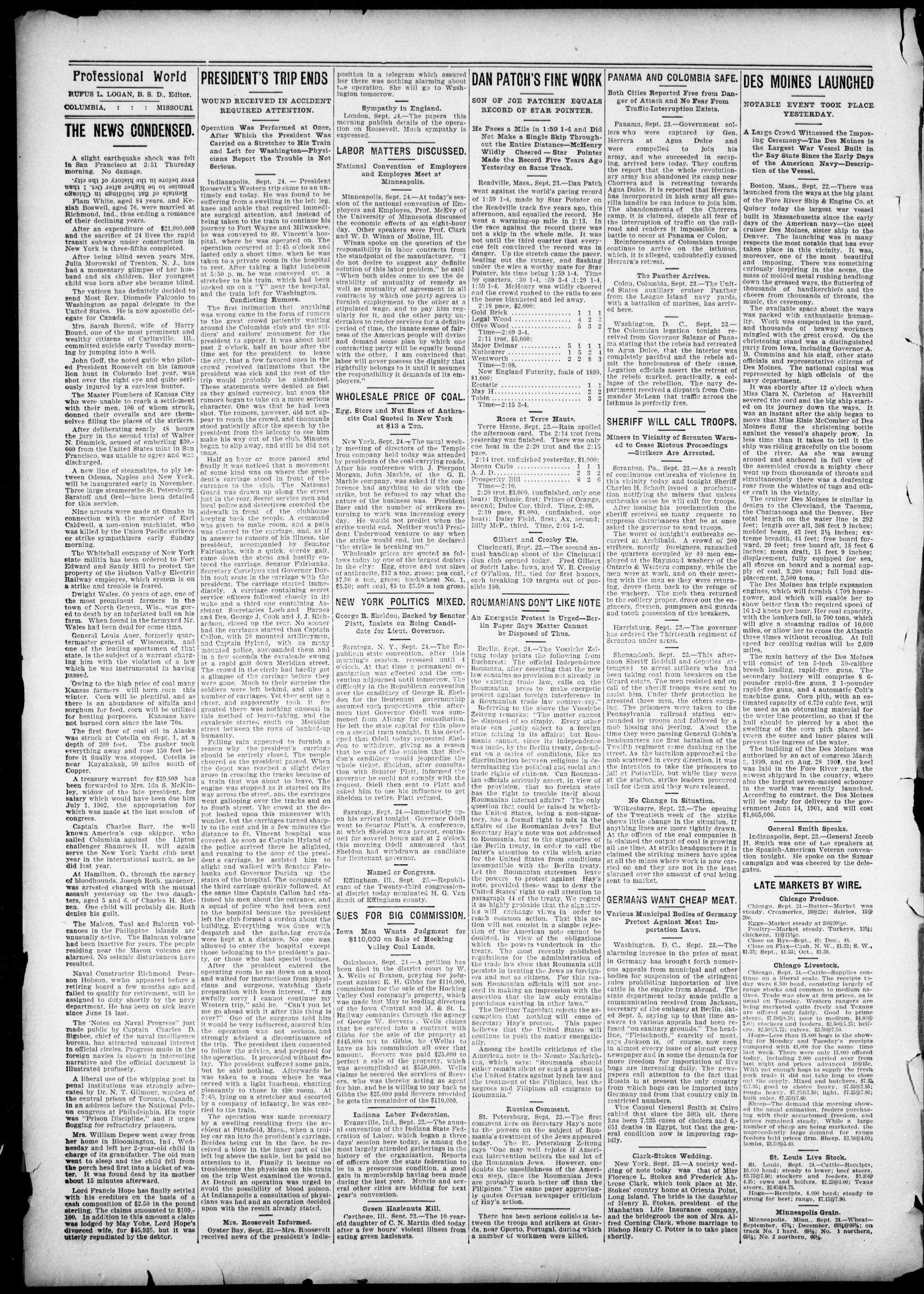
RUFUS L. LOGAN, B. S. D., Editor.
COLUMBIA. : : : MISSOURL
THE NEWS CONDENSED.
THE NEWS CONDENSED.
A slight earthquake shock was felt in San Francisco at 3:51 Thursday morning. No damage.
A severe earthquake in the history of the city.
Flam White, aged 84 years, and Keziah Boswell, aged 76, were married at Richmond, Ind., thus ending a romance of their declining years.
After an expenditure of $21,000,000 and the sacrifice of 24 lives the rapid transit subway under construction in New York is three-fifths completed.
After being blind seven years Mrs. Julia Morowski of Trenton, N. J., has had a momentary glimpse of her husband and six children. Her youngest child was born after she became blind.
The vatican has definitely decided to send Most Rev. Diomide Falconio to Washington as papal delegate in the United States. He is now apostolic delegate for Canada.
Mrs. Sarah Bound, wife of Harry Bound, one of the most prominent and wealthy citizens of Carlinville, Ill., committed suicide early Tuesday morning by jumping into a well.
John Goff, the noted guide who piloted President Roosevelt on his famous hunt in Colorado last year, was shot over the right eye and quite seriously injured by a carless hunter.
The Master Plumbers of Kansas City who were unable to reach a settlement with their men, 100 of whom struck, dunned their overalls and are themselves filling the places of the strikers.
After deliberating nearly 48 hours the jury in the second trial of Walter N. Dimmick, accused of embezzling $30,000 from the United States mint in San Francisco, was unable to agree and was discharged.
A new line of steamships, to ply between Odessa, Naples and New York, will be inaugurated early in November. Three large steamster in St. Petersburg, Saratoff and Orel—have been detailed for this service.
Nine arrests were made at Omaha in connection with the murder of Earl Caldwell, a non-union machinist, who was killed by the Union Pacific strikers or strike sympathizers early Sunday morning.
The Whitehall company of New York state militia has been ordered to Fort Edward and Sandy Hill to protect the property of the Hudson Valley Electric Railway employes, which system is on a strike and trouble is feared.
Dwight Wales, 60 years of age, one of the most prominent farmers in the town of North Geneva, Wis., was gored to death by an infuriated bull on his farm. When found in the farmyard Mr. Wales had been dead for some time.
General Louis Auer, formerly quartermaster general of Wisconsin, and one of the leading sportsmen of that state, is the subject of a warrant charging him with the violation of a law which he was instrumental in having passed.
Owing to the high price of coal many Kansas farmers will burn corn this winter. Corn will be plentiful, and as there is an abundance of alfalfa and sorghum for feed, corn will be utilized for heating purposes. Kansans have not burned corn since the late 70s.
The first flow of coal oil in Alaska was struck at Cotella on Sept. 1, at a depth of 200 feet. The gusher took everything away and rose 150 feet before it finally was stopped. Cotella is near Kayakakak, 30 miles south of Copper.
A treasury warrant for $39,809 has been forwarded to Mrs. Ida S. McKinley, widow of the late president, for salary which would have been due him July 1, 1902, the appropriation for which was made at the last session of congress.
Captain Charles Barr, the well known America's cup skipper, who sailed Columbia against the Lipton challenger Shamrock II, will again serve the New York Yacht club next year in the international match, as he did lost year.
At Hamilton, O., through the agency of bloodhounds, Joseph Roth, gardener, was arrested charged with the mutual assault yesterday on the two daughters, aged 5 and 6, of Charles H. Motzen. One child will probably die. Roth denies his guilt.
The Malcon, Taal and Balucan volcanoes in the Philippine islands are unusually active. The Balucan volcano had been inactive for years. The people residing near the Macon volcano are alarmed. No seismic disturbances have resulted.
Naval Constructor Richmond Pearson Hobson, who appeared before a retiring board a few months ago and failed to qualify for retirement, will be assigned to duty shortly by the navy department. He has been on sick leave since June 18 last.
The 'Notes on Naval Progress' just made public by Captain Charles D. Sigbsbe, chief of the naval intelligence bureau, has attracted unusual interest in official circles. Progress made in the foreign navies is shown in interesting narrative and the official document is illustrated profusely.
A liberal use of the whipping post in penal institutions was strongly advocated by Dr. N. T. Gilmour, warden of the central prison of Toronto, Canada, in an address before the National Prison congress at Philadelphia. His topic was "Prison Discipline," and it urges fogging for refractory prisoners.
Mrs. William Depew went away from her home in Bloomington, Ind. Wednesday and left her 2-year-old child in charge of its grandfather. The old man went to sleep and the child fell from the porch head first into a bucket of water. It was found dead by its mother about 15 minutes afterward.
Lord Francis Hope has finally settled with his creditors on the basis of a cash composition of $2.50 in the pound sterling. The claims amounted to $109,-100. In addition to this amount a claim was lodged by May Yohe, Lord Hope's divorced wife, for $45,935, but it was utterly repudiated by the debtor.
PRESIDENT'S TRIP ENDS
WOUND RECEIVED IN ACCIDENT
REQUIRED ATTENTION.
Operation Was Performed at Once, After Which the President Was Carried on a Stretcher to His Train and Left for Washington—Physicians Report the Trouble is Not Serious.
Indianapolis, Sept. 24. — President Roosevelt's Western trip came to an untimely end today. He was found to be suffering from a swelling in the left leg, knee and ankle that required immediate surgical attention, and instead of being taken to the train to continue his journey to Fort Wayne and Milwaukee, he was conveyed to St. Vincent's hospital, where he was operated on. The operation occurred at 3:45 o'clock and lasted only a short time, when he was taken to a private room in the hospital to rest. After taking a light luncheon at 5:50 p. m. he was conveyed on a stretcher to his train, which had been backed up on a "Y" near the hospital, and the train left for Washington.
Conflicting Rumors.
The first intimation that anything was wrong came in the form of rumors to the great crowd patiently waiting around the Columbia club and the soldiers' and sailors' monument for the president to appear. It was about half past 2 o'clock, half an hour after the time set for the president to leave the city, that a few favored ones in the crowd received intimations that the president was sick and the rest of the trip would probably be abandoned. These statements were denied as fast as they gained currency, but soon the rumors began to take on a more serious character. One was that he had been shot. The rumors, however, did not appear to reach the crowd, and thousands stood patiently after the speech by the president from the balcony to see him make his way out of the club. Minutes began to slip away, and still he did not come.
Half an hour or more passed and finally it was noticed that a movement of some kind was on where the president's carriage stood in front of the entrance to the club. The National Guard was drawn up along the street just in the rear. Secret service men and local police and detectives crowded the sidewalk in front of the clubhouse keeping back the people. A command was given to make room, and a pain was cleared to the carriage, and, as if in answer to rumors of his illness, the president, accompanied by Senator Fairbanks, with a quick, scurvy gait, came down the steps and hastily entered the carriage. Senator Fairbanks, Secretary Cortelyou and Governor Durbin took seats in the carriage with the president. The carriage started immediately. A carriage containing secret service officers followed closely in its wake and a third one containing Assistant Secretaries Loeb and Barnes and Drs. George J. Cook and J. J. Richardson, closed up the rear. No sooner had the carriages started than Captain Callon, with 20 mounted artillerymen, and Captain Hyland, with as many mounted police, surrounded them and in a few seconds the cavalcade swung at a rapid gait down Meridian street. The crowd in the circle had hardly got a glimpse of the carriage before they were gone. Much to their surprise the soldiers were left behind, and also a number of carriages. Yet they sent up a cheer, and apparently took it for granted there was nothing unusual in this method of take-taking, and the cavalcade started south on Meridian street between the rows of banked-up humanity.
Falling rain appeared to furnish a reason why the president's carriage should be entirely closed. The people cheered as the president passed. When the depot was reached a slight delay arose in crossing the tracks because of a train that was about to leave. The engine was stopped as it started on its way across the street, and the carriages went galloping over the tracks and on to South street. The crowd at the depot looked upon this maneuver with wonder, but the carriages turned sharply to the east and in a few minutes the distance to St. Vincent hospital was covered. As soon as Captain Hyland of the police arrived there he alighted, and running to the door of the president's carriage, he assisted him to alight and walked with Senator Fairbanks and Governor Durbin up the stairs of the hospital. The occupants of the third carriage quickly followed. At the same time Captain Callon had stationed his men about the entrance, and a squad of police who had been sent to the hospital because the president left the club formed a cordon about the building. Everything was done with despatch and the gathering crowds were kept at a distance. No one was allowed to enter the hospital except those belonging to the president's party, or those who had special business.
After the president entered the operating room he sat down on a stool and waited for instructions from physicians and surgeons, watching their preparation with keen interest. "I am awfully sorry I cannot continue my Western trip," said he. "Can't you let me go ahead with it after this thing is over?" One of the surgeons told him it would be very indiscreet, assured him the operation was not serious, and strongly advised a discontinuance of the trip. The president then consented to follow the advice, and prepared for the operation. It proceeded without delay. The president suffered some pain, but he said nothing. Afterwards he was taken to a room where he was served with a light luncheon, chatting pleasantly to those in the room. At 7:40, lying on a stretcher and escorted by a company of infantry, he was carried to the train.
The operation was made necessary by a swelling resulting from the accident at Pittsfield, Mass., when a troley car ran into the president's carriage. Besides being cut in the face, he received a blow in the inner part of the left leg above the ankle, but he paid no attention to it. Finally it became so troublesome the physician on his train on the trip West examined the wound. At Detroit an operation was urged to avoid the possibility of blood poison. At Indianapolis a consultation of physicians was had and an operation decided upon with the result already stated.
Mrs. Roosevelt Informed.
Oyster Bay, Sept. 23.—Mrs. Roosevelt received news of the president's indis-
position in a telegram which assured her there was nothing alarming about the operation. She will go to Washington tomorrow.
Sympathy in England.
London, Sept. 24.—The papers this morning publish details of the operation on Roosevelt. Much sympathy is expressed.
LABOR MATTERS DISCUSSED.
National Convention of Employers and Employes Meet at Minneapolis.
Minneapolis, Sept. 24.—At today's session of the national convention of Employers and Employes, Prof. McEvy of the University of Minnesota discussed the economic effects of an eight-hour day. Other speakers were Prof. Clark and W. D. Winan of Moline, Ill.
Witan spoke on the question of the responsibility in labor contracts from the standpoint of the manufacturer, "I do not desire to suggest any definite solution of this labor problem," he said. "When both sides come to see the desirability of mutuality of remedy as well as mutuality of agreement in all contracts by which one party agrees to furnish employment to the other at a stipulated wage, and to pay him regularly for it, and the other party undertakes to render services for a definite period of time, the innate sense of fairness of the American people will devise and demand some plan by which one contracting party will be equally bound with the other. I am convinced that labor will never possess the dignity that rightfully belongs to it until it assumes the responsibility it demands of its employers."
WHOLESALE PRICE OF COAL
Egg, Store and Nut Sizes of Anthracite Coal Quoted in New York at $13 a Ton.
New York, Sept. 24.—The usual weekly meeting of directors of the Temple Iron company held today was attended by presidents of the coal-carrying roads. After his conference with J. Pierpont Morgan, John Markle, of the G. B. Markle company, was asked if the conference had anything to do with the strike, but he refused to say what the nature of the business was. President Baer said the number of strikers returning to work was increasing every day. He would not predict when the strike would end. Neither would President Underwood venture to say when the strike would end, but he declared "the strike is breaking up." Wholesale prices are quoted as follows today by one of the largest dealers in the city: Egg, stove and nut sizes of anthracite, $12 a ton, gross: pea coal, $7.50 a ton, gross: buckwheat No. 1, $5.50; soft coal, $5 to $5.50 a ton gross.
NEW YORK POLITICS MIXED.
George R. Sheldon, Backed by Senator Platt, Insists on Being Candidate for Lieut. Governor.
Sanatoga, N. Y., Sept. 24.—The Republican state convention, after this morning's session, recessed until 4 o'clock. At that time a permanent organization was effected and the convention adjourned until tomorrow. The difficulty in the Republican convention over the candidacy of George R. Sheldon for the lieutenant governorship assumed such proportions this afternoon that Governor Odell was summoned from Albany for consultation. He left the state capital for this place on a special train tonight. It has developed that Odell today requested Sheldon to withdraw, giving as a reason that he was of the coinion that Sheldon's candidacy would jeopardize the whole ticket, Sheldon, after consultation with Senator Platt, informed the governor he could not comply with the request. Odell then sent to Platt and asked him to use his influence to get Sheldon to retire. Platt refused.
Saratoga, Sept. 24.—Immediately upon his arrival tonight, Governor Odell went to Senator Platt's. A conference, at which Sheldon was present, continued for soverel hours and at 2 o'clock this morning Odell announced that Sheldon had withdrawn as candidate for lieutenant governor.
Named or Congress.
Effingham. 11., Sept. 23.—Republicans of the Twenty-third congressional district today nominated H. G. Van Sandt of Effingham county.
SUES FOR BIG COMMISSION.
Iowa Man Wants Judgment for $110,000 on Sale of Hocking Valley Coal Lands.
Oskaloosa, Sept. 24. A petition has been filed in the district court by W. A. Wells of Buxton, praying for judgment against E. H. Gibbs for $110,000, commission for the sale of the Hocking Valley Coal company's property, which was made last May to leading directors of the Iowa Central and M. & St. L. Railway companies through the agency of George W. Seewers. Wells claims that he entered into a contract with Gibbs for the sale of the property at $445,000 net to Gibbs, he (Wells) to have as his commission all over that amount. Seewers was paid $25,000 to perfect a sale of the property, which was accomplished at $550,000. Wells claims he secured the services of Seewers, who was thereby acting as agent for him, and he is willing to pay back Gibbs the $25,000 paid Seewers provided he gets the remainder of the $110,000.
Indiana Labor Federation.
Evansville, Ind., Sept. 23.—The annual convention of the Indiana State Federation of Labor, which began a three days' session here today, is among the most largely attended gatherings in the history of the organization. Reports of officers show the state federation to be in a prosperous condition, a good gain in membership having been made during the last year. Muncie and several other cities are bidding for next year's convention.
Green Hazlenuts Kill
Carthage, Ill. Sent. 23.—The 10-year-old daughter of C. N. Martin died today after a few hours' violent illness from eating green hazelnuts.
DAN PATCH'S FINE WORK
DAN PATCH'S FINE WORK
SON OF JOE PATCHEN EQUALS
RECORD OF STAR POINTER.
He Paces a Mile in 1:59 1-4 and Did
Not Make a Single Skip Through-
out the Entire Distance—McHenry
Wildly Cheered — Star Pointer
Made the Record Five Years Ago
Yesterday on Same Track.
Readville, Mass., Sept. 23.—Dan Patch went against the world's pacing record of 1:59 1-4, made by Star Pointer on the Readville track five years ago, this afternoon, and equalled the record. He went a warming-up mile in 2:13. In the race against the record there was not a skip in the whole mile. It was not until the third quarter that everyone felt convinced the record was in danger. Up the stretch came the pacer, beating out the runner, and flashing under the wire a worthy mate for Star Pointer, his time being 1:59 1-4. Time by quarters. 30:1 4, 59:3 4, 1:29 1-4, 1:59 1-4. McHenry was wildly cheered and the crowd rushed to the rails to see the horse blanketed and led away.
Races at Terre Haute.
Terre Haute, Sept. 23.—Rain spoiled the afternoon card. The 2:14 trot from yesterday was finished. There was only one heat in the 2:20 trot and the 2:15 pace.
2:14 trot, unfinished yesterday, $1,000;
Monto Carlo ..... 111
A. J. D. ..... 232
Prosperity Bill ..... 626
Time—2:10.
2:20 trot, $3,000, (unfinished, only one heat): Rythmic, first; Prince of Orange, second; Dulce Cor, third. Time, 2:09.
2:10 pace, $1,000, (unfinished, one heat): Daisy Field, first; Ax, second; Billy McP. third. Time, 2:06 1-2.
Gilbert and Crosby Tie.
Cincinnati, Sept. 23. The second annual handicap shoot of the Cincinnati Gun club opened today. Fred Gilbert of Spirit Lake, Iowa, and W. B. Crosby of O'Fallon, Ill., tied for first honors, each breaking 169 targets out of possible 180.
ROUMANIANS DON'T LIKE NOTE
An Energetic Protest is Urged—Berlin Paper Says Matter Cannot be Disposed of Thus.
Beilin, Sept. 24.—The Vossiche Zeitung today prints the following from Bucharest: The official Independence Roumana, after asserting that the new law contains no provision not already in the existing trade law, calls on the Roumanian press to make energetic protest against foreign interference in a Roumanian trade law controversy."
Referring to the above the Vossiche Zeitung remarks: "The matter cannot be disposed of so simply. Every other state can justly object to a foreign state mixing in its affairs; but Roumania cannot, since its independence was made, by the Berlin treaty, dependent on a series of conditions, like no discrimination between religions in determining the political and social and trade rights of citizens. Can Roumanian officials seriously assert, in view of the provision, that no foreign state has the right to trouble itself about Roumanian internal affairs? The only question that could be raised is whether the United States, being a non-signatory, has a formal right to mix in the affairs of the Roumanian Jews? But Secretary Hay's note was not addressed to Roumania, but to the signatories of the Berlin treaty, in order to call the latter's attention to evils which arises for the United States from conditions incompatible with the Berlin treaty. Let the Roumanian statesmen leave the powers to protest against Hay's note, provided these want to deny the United States' right to call attention to paragraph 44 of the treaty. We regard it as highly probable that the signatories will exchange views in order to reach common action. That this action will not consist in a simple rejection of the American note cannot be doubted, in view of the obligations which the powers *undertock* in the treaty. The most recently published regulations for the administration of the trade law show that Roumania still persists in treating the Jews as foreigners and not as citizens. For this reason Roumanian officials will not succeed in making an impression with the assertion that the law only contains provisions existing in other laws."
The Berliner Tageblatt rejects the assumption that nothing will come of Secretary Hay's protest. This paper believes that the United States will continue to push the matter energetically. Among the hostile criticisms of the American note is the Neuste Nachrichten, which says: "Roumania should either remain silent or send a protest to the United States against lynch law and the treatment of the Filipinos, lest the negroes and Filipinos all emigrate to Roumania."
Russian Comment.
St. Petersburg, Sept. 23.—The first comment here on Secretary Hay's note to the powers on the subject of Roumania's treatment of the Jews appeared today. The St. Petersburg Zoltung says "One may well rejoice if American intervention betters the sad lot of the Roumanian Jews. However, one doubts the unselfishness of the American step, since the Roumanian Jews are probably much better off than the Filipinos." The same paper approvingly quotes German newspaper criticism of Hay's action.
There has been serious collisions between the troops and strikers at Guarda, near Oporto, Portugal, during which a number of workmen were killed.
PANAMA AND COLOMBIA SAFE.
Both Cities Reported Free from Danger of Attack and No Fear From Traffic Interruption Exists.
Panama, Sept. 23.—Government soldiers who were captured by Gen. Herrera at Agua Dulce and were compelled to join his army, and who succeeded in escaping, arrived here today. They confirm the report that the whole revolutionary army has abandoned its camp near Chorrera and is retreating towards Agua Dulce. It is reported that Herrera has incorporated in his army all guerilla bandits he can induce to join him. The abandonment of the Chorrera camp, it is claimed, dispels all fear of the interruption of traffic on the railroad and renders it impossible for a battle to occur at Panama or Colon.
Reinforcements of Colombian troops continue to arrive on the isthmus, which, it is alleged, undoubtedly caused Herrera's retreat.
The Panther Arrives.
Colon, Colombia, Sept. 23.—The United States auxiliary cruiser Panther from the League Island navy yards, with a battalion of marines, has arrived here.
Washington, D. C., Sept. 23.—The Colombian legation tonight received from Governor Salazar of Panama stating that the rebels had retreated to Agua Dulce, that the interior was completely pacified and the rebels admit the hopelessness of their cause. Legation officials assert the retreat of the rebels marked, practically, a collapse of the rebellion. The navy department received a dispatch from Commander McLean that traffic across the Isthmus is perfectly free.
SHERIFF WILL CALL TROOPS
Miners in Vicinity of Scranton Warn ed to Cease Riotous Proceedings —Strikers Are Arrested.
Scranton, Pa., Sept. 23.—As a result of continuous outbreaks of violence in this vicinity today and tonight Sheriff Charles H. Schadt issued a proclamation notifying the miners that unless outbreaks cease he will call for troops. After issuing his proclamation the sheriff received so many requests to suppress disturbances that he at once asked the governor to send troops. The worst of tonight's outbreaks occurred at Archibald. A crowd of 200 strikers, mostly foreigners, ransacked the quarters occupied by 49 men employed at the Raymond washery of the Ontario & Western company, while the men were at work, and on their meeting with the men as they were returning, drove them back to the refuge of the washery. The mob then returned to the colliery proper, drove out the engineers, firemen, pumpmen and guards and took possession of the breakers.
Harrisburg, Sept. 23.—The governor has ordered the Thirteenth regiment of Scranton under arms.
Shenandoah, Sept. 23.—This afternoon Sheriff Boddall and Gepetts attempted to arrest strikers who had been taking coal from breakers on the Girard estate. The men resisted and on call of the sheriff troops were sent to assist him. Under their protection he arrested three men, the others escaping. The prisoners were taken to the Pennsylvania railroad station surrounded by troops and followed by a mob hissing and jeering. About the time they were passing General Gobin's headquarters the first battalion of the Twelfth regiment came dashing up the street. As the battalion approached the mob scattered in every direction. It was the intention to take the prisoners to fall at Pottsville, but while they were at the station, strike leaders procured ball for them and they were released.
No Change in Situation.
Wilkesbarre, Sept. 23.—The opening of the Twentieth week of the strike shows little change in the situation. If anything lines are more tightly drawn. At the offices of the coal companies it is claimed the output of coal is growing all the time. At strike headquarters it is claimed the striking miners have spies at all the mines where work is now carried on and they are not in the least alarmed over the amount of coal being sent to market.
GERMANS WANT CHEAP MEAT
Various Municipal Bodies of Germany Protest Against Meat Importation Laws.
Washington, D. C., Sept. 23.—The alarming increase in the price of meat in Germany has brought forth numerous appeals from municipal and other bodies for suspension of the stringent rules prohibiting importation of live cattle in the empire from abroad. The state department today made public a communication received from Jackson, secretary of the embassy at Berlin, dated Sept. 5, saying up to that time answers to various appeals had been refused "on sanitary grounds." The headline, "Fleischneth," scarcity of meat, says Jackson is, of course, now seen in almost every issue of almost every newspaper and in some the demands for more freedom for importation of live hogs are increasing daily. The newspapers call attention to the fact that Russia is at present the only country from which hogs can be imported into Germany and from that country only in restricted numbers.
Vice Consul General Smith at Cairo cabled that since the 30th alt. there has been 7,235 cases of cholera and 6,651 deaths in Egypt, but that the general condition now is improving rapidly.
Clark-Stokes Wedding
New York. Sept. 23.—A society wedding of note today was that of Miss Florence L. Stokes and Frederick Abbrose Clark, which took place at Mr. Stokes' country home at Orienta Point, Long Island. The bride is the daughter of Henry B. Stokes, president of the Manhattan Life Insurance company and the bridegroob the son of Mrs. Alfred Corning Clark, whose marriage to Bishop Henry C. Potter is to take place shortly.
NOTABLE EVENT TOOK PLACE YESTERDAY.
A Large Crowd Witnessed the Imposing Ceremony—The Des Moines is the Largest War Vessel Built in the Bay State Since the Early Days of the American Navy—Description of the Vessel.
Boston, Mass., Sept. 22.—There was launched from the ways at the big plant of the Fore River Ship & Engine Co. at Quincy today the largest war vessel built in Massachusetts since the early days of the American navy—the steel cruiser Des Moines, sister ship to the Denver. The launching was in many respects the most notable that has ever taken place in this vicinity. It was, moreover, one of the most beautiful and imposing. There was something curiously inspiring in the scene, the mass of molded metal rushing headlong down the greased ways, the fluttering of thousands of handkerchiefs and the cheers from thousands of throats, the music, the ceremony.
The available space about the ways was packed with enthusiastic humanity. Work was suspended in the yard, and thousands of brawny workmen mingled with the great crowd. On the christening stand was a distinguished party from Iowa, including Governor A. B. Cummins and his staff, other state officials and representative citizens of Des Moines. The national capital was represented by high officials of the navy department.
It was shortly after 12 o'clock when Miss Clara N. Carleton of Haverhill severed the cord and the big ship started on its journey down the ways. It was an instant after the ship began to move that Miss Elsie McComber of Des Molines flung the christening bottle against the vessel's shapely prow. In less time than it takes to tell it the ship was riding gracefully on the bosom of the river. As she was swung around and anchored in full view of the assembled crowds a mighty cheer went up from thousands of throats and simultaneously there was a deafening roar from the whistles of tugs and other craft in the vicinity.
The cruiser Des Moines is similar in design to the Cleveland, the Tacoma, the Chattanooga and the Denver. Her total length on the water line is 292 feet; length over all, 308 feet 9 inches; molded beam, 43 feet $ \frac{3}{2} $ inches; extreme breadth, 44 feet; free board forward, 20 feet; free board affront, 18 feet 6 inches; mean draft, 15 feet 9 inches; displacement, fully equipped for sea, all stores on board and a normal supply of coal, 3,200 tons; full load displacement, 3,500 tons.
The Des Moines has triple expansion engines, which will furnish 4,700 horsepower, and which will enable her to show better than the required speed of 16 1-2 knots per hour. Her coal capacity, with the bunkers full, is 700 tons, which will give a steaming radius of 10,000 miles, or allow her to cross the Atlantic three times without recoaling. At full speed her coaling radius will be 2,600 miles.
The main battery of the Des Moines will consist of ten 5-inch 50-caliber breech loading, rapid-fire guns. The secondary battery will comprise 8 6-pounder rapid-fire guns. 2 1-pounder rapid-fire guns, and 4 automatic Colt's machine guns. Corn pith, with an estimated capacity of 6,720 cubic feet, will be used as an obturating material for the water line protection, so that if the hull should be pierced by a shot the swelling of the corn pith placed between the outer and inner plates will prevent the ingress of the water.
The building of the Des Moines was authorized by an act of congress March 5, 1899, and on Aug. 28, 1900, the keel was laid in the Fore River yard, the newest shipyard in the country, where also the largest seven-masted schooner in the world was recently launched. According to contract, the Des Moines will be ready for delivery to the government Juno 14, 1901, and will cost $1,055,000.
General Smith Speaks.
Indianapolis, Sept. 23.—General Jacob H. Smith was one of the speakers at the Spanish-American Veteran convention tonight. He spoke on the Samar campaign and was cheered by the delegates.
LATE MARKETS BY WIRE.
Chicago Produce.
Chicago, Sept. 24—Butter—Market was steady, Creameries, 16@22c; dairies, 15@20c.
Eggs—Market steady at 20@20½c.
Poultry—Market steady, Turkeys, 13½; chickens, 11@13½c.
On rye Rye—Sept., 49; Dec., 48.
On flax Onlax—Cash, N. W., $1.33; S. W., $1.33; Sept., $1.33; Oct., $1.30.
Chicago Livestock.
Chicago, Sept. 24.—Cattle-Supplies continue on a liberal scale. The receipts today were 6,500 head, consisting largely of range stocks and common to medium natives. Trade was slow at firm prices, as is usual on Tuesday. Western rangers are being marketed quite freely and Texans are buying cattle and steers. $7.50/50.80; poor to medium, $4.00/7.00; stockers and feeders. $2.50/50.25; heifers. $2.50/50.75; calves. $3.50/50.70. Hogs—Less than 15,000 hogs is the showing for Monday and Tuesday's receipts compared with 43,000 for the same time last week. There were only 13,000 offered today, including 2,000 carried over from last night and prices advanced. 4016.50; the hogs to supply the pork trade品 it did to close out the supply. Mixed and butchers. $7.35/7.55; good to choice heavy, $7.55/7.65; rough heavy, $7.55/7.50; light, $7.55/7.50; bulk sales. $7.55/7.60. Sheep—The demand this morning showed the usual animation, feeders purchasing with their accustomed freedom, and prices remained steady. While a large number of sheep are being marketed, the cattle demand for range feeders hold prices firm. Sheep. $7.50/40.00; lambs. $7.50/50.40.
St. Louis Live Stock.
St. Louis, Sept. 24.—Cattle—Receipts,
10,000 head; steady to lower; beef steers,
$3.75@7.90; stockers and feeders, $3.30@
7.90; stockers and feeders, $2.50@60; Texas
steers, $2.64@4.75.
Hogs—Receipts, 8,000 head; steady to
strong for range; best, $1.75@7.90.
Minneapolis Grain.
Minneapolis, Minn., Sept. 24.—Wheat-
September, 67%; December, 65%; 66%; on
track No. 1 hard, 69%; No. 1 northern,
68%; No. 2 northern, 66%.
WHEN PA TRIED MENTAL
HEALIN'
When Pa tried Mental Healin' in the Fall of '64.
He says: "At las' I've found the art of livin' evermore!"
And a moisture born of pity dimmed the luster of his eye.
As he said: "Oh, wretched mortals, in your ignorance to die!
Were you might keep right on livin' if the fact you ousted the person that disease is but a phantom of the morbid, resilious mind.
Haleluyer!" said my father, in a jubilatin' awe,
"That the fact Mind is Monarch is, the glorious truth I've saw."
"Oh, not cry, my little son," said Pa, "for here's the truth;
Your pain is only in your Mind; it is not in your tooth.
Jus' set your Mind upon it, an' keep it sit right there.
An' you be surprised to notice that it is not anywhere.
Don't tell that your tooth does ache! I guess I ortor know!
An' quit that howlin' now at once, an' give your Mind a show!"
And then I went behind the barn until my tears I slaked—
Perhaps my tooth won't aching, but I know I thought it ached.
One day my Pa was pounding on a nail against the wall.
And he sort of missed the target and hit his thumb—that's all.
But the words my Pa then strewed around they were a grief to me.
And I thought I'd best console him, for his language was too free;
And so I says: "It doesn't hurt; it's only in your Mind.
And if you give your Mind a show you'll be surprised to find—"
I never did get farther, for he jerked me out of plumb.
And said: "Dern Mental Halin!' This hurt is in my thumb.
Since then my Pa's backslidden, and he groans and moans around.
And his books on Mental Healin' in theattle may be found;
And he often says, emphatic: "A man's a fool, I find.
Who thinks it a broke thumbnail is a phantom of the mind.
That cholere's a delusion, an' that typhoid is a sham.
They's plenty of such imbeciles, but drat me if I am!"
And so I kind o' argue, though in confidence I speak.
That my Pa has good intentions, but his mind is middlin' weak.
-Alfred J. Waterhouse in New York Times.
In a Strange Land.
BY EDGAR WELTON COOLEY.
copyright, 1901, by Authors' Syndicate)
STRANGER in a strange land he was, this youth aimlessly wandering the streets of the great city.
His garments were ill-fitting and coarse. His large red hands hung awkwardly at his sides.
Two inches of his wrists show-
STRANGER in a strange land he was, this youth aimlessly wandering the streets of the great city. His garments were ill-fitting and coarse. His large, red hands hung awkwardly at his sides. Two inches of his wrists showed below his coat sleeve. His trousers bagged frightfully at the knees and his heavy plow shoes were strangers to polish. But his face was honest—honest and brown as the autumn fields. A healthy tan covered his features, but in his large blue eyes a sadness lingered. He glanced into a thousand faces and saw not one he knew. He was losted by the passing throng, but no friendly hand grasped his. He was weary with his trumping and hungry for the sound of a familiar voice.
Plainly he was from the country. In his eyes there seemed to slumber the glitter of the sunlight on the ripples of a brook, and his freckled face seemed dappled with the shadows sweeping over meadows clover-covered. Around his worn and faded garments there seemed to cling the wild fragrance of the confields far outstretching and the sweeter, subtle perfume of the tangled, nodding grasses.
His movements were slow and ungraceful, but his shoulders were broad and his muscles hard as steel.
Neither tramp nor beggar was Robert Lane, but in his pockets there was not a penny. A light luncheon he had eaten, but he knew not from whence his dinner was to come.
He was searching for work—searching in strange and unfamiliar places. Few could husk more corn or bind more grain in a day than he, but he was of small value in the busy marts of trade.
He had cut adrift from his quiet, peaceful home upon a farm to drift amid the whirlpools of the metropolis, lured by wrong impressions, by misguided hopes. And so it was not strange that his heart was heavy and his eyes dim with unshed tears. Ever before him was a picture of the sweet-faced girl waiting for him in the neat white farmhouse in the Iowa hills. He had meant to make her so proud of him. He had meant to work and economize; to save and to prosper, and then return to the old farm and her and bring her back with him to the city and dress her in fine clothes.
He remembered how she smiled up into his face as they stood beside the river that last night they were together; he remembered how tenderly she placed her hand upon his shoulder; he remembered how softly the starlight glimmered on the smooth surface of the water; how distinctly there came to them, through the fragrant air, the barking of Wilson's dog on the hilltop a mile away, and the lowing of the cattle in the lowlands; how the beetles boomed through the dusk; how the wind whispered among the corn, and how, over all, hung the peacefulness of a summer evening in the country.
And was this the end of it all—the end of his dreams, of his hopes, of his ambitions?
A lump arose in his throat and he drew the back of his hand across his eyes. Cable cars rattled past; elevated trains thundered overhead. An endless stream of humanity flowed by like a boundless ocean about to engulf him.
Suddenly above the tumult and the din arose a piercing scream, the rattle of swiftly moving wheels over the brick pavement, the shouting of men and the sound of scurrying feet.
Then Robert Lane beheld a spectacle that drove the blood from his temples, that made him clench his fists and stare with cold lips pressed together.
Along the thoroughfare a frightened team was madly dashing, dragging a carriage that whipped from side to side as the animals swerved this way and that. A frail young girl clung desperately to the rear seat, her face pale, her hair flying in the wind.
As the team dashed toward Robert, the child's frieghtened eyes fell on his
freckedle face. Perhaps the innate strength and courage of the man impressed her childish mind—perhaps it was but a desperate hope of succor. At all events she partly arrows and reached out her hands towards him, while into her eyes there flashed an appealing gleam, awful in its intensity.
"Help!" she cried. "Oh, save me!"
Robert Lane could never listen with deaf ears to the weak's appeal. To him, womanhood and childhood were the most sacred things on earth. Forever he would have despised himself as a coward had he hesitated at a time like this.
And so it was that almost before the bystanders had realized what was transpiring, he had leaped directly in the path of the team and had clutched the horses by the bits in a grasp of steel.
The maddened animals dragged him roughly over the hard pavement in their headlong flight. His legs were bruised and mangled by their hoofs; his head was battered by the buggy toungue. But he did not relax his grip. He had spent all his life with horses; to handle them—to master them, was a second nature with him.
He exerted the whole of his giant strength upon the bits. The muscles on his arms, from which the coat and shirt sleeves had been torn, stood out like hickory knots. Slowly but surely he drew the horses' heads down, down, down, until their necks were all but broken. He pressed their muzzles beneath their breasts and held them until they knew that they were conquered—until they stopped and groaned for mercy.
After that he had a faint recollection of being pulled from beneath the horses' feet. Then he knew nothing more until he awoke in a hospital and saw a bright-eyed nurse with snowy can and apron hending over him.
He was covered with cuts and bruises. Every inch of his body seemed to ache and pain. But, looking into the bright eyes of the nurse, he forgot all this. For somehow, those eyes reminded him of the sweet-faced girl in the farmhouse in the Iowa hills.
The nurse smiled and smoothed the pillow under his head.
"You have been delirious," she said, softly, "but you are not seriously injured. In a few days you will be quite recovered."
"I have been delirious?" he replied.
"Yes, you have talked a great deal. Mostly about Annie and the Iowa river, and let's see—Marietta. Is that the name?"
"Yes," he laughed. "I live on the Iowa river near Marietta, and Annie—Annie has eyes like you."
"There," she said, brushing his dark hair back from his temples, "you must be quiet now."
Then she moved away, and he watched her with dreamy eyes until she disappeared through the door.
On the third day he had a visitor. He was an elderly man with eye-glasses attached to a gold chain. The nurse conducted him to Robert's cot, and he took the boy's brown, rough hand in both his soft, white ones.
"Young man," he said, in a manner intended to be matter of fact, but in a voice that trembled in spite of himself, "young man, it is needless for me to try to thank you for saving my daughter's life. Nothing that I can say or do will sufficiently express my gratitude. But I will say this: My wealth, my influence and my experience are at your command. I am ready to further. My son is my most cherished ambition. Tell me, my son, what is your most ardent desire."
From the kind face of the grateful father, Robert shifted his glance to the bright eyes of the smiling nurse. A wistful look came into his face and his lips trembled. Then again he looked into the eyes of the aged man.
"My greatest desire," he said. "Oh, sir, I want to hear the wind whisperin' in the corn; I want to see the starlight fallin' in the river, and I want to look at Annie and to hold Annie's hand."
FIRST DINING CAR MADE
It Was Called the "Delmonico" and Was Crudely Equipped.
Leslie's Weekly: The first dining car was called the Delmonico, of course. It must have resembled our present beautiful dining cars but slightly. Built by the Pullman company at its pioneer works in Chicago, it was put into service in 1866, and after a short but distinguished career descended to the position of boarding car for constructors along the line, but it did not come to this, of course, until great improvements had ben made upon it in subsequent models. It was built in two sections, with a kitchen in the middle. One end was reserved for ladies, and here no smoking was allowed, the other end was a buffet arrangement, and got itself nicknamed "the beer garden" before it had been in service many moons.
The floor of the car was uncarpeted, and the seats were ordinary low-backed coach seats, upholstered in leather. The car was finished in walnut, but the ceiling was covered with oilcloth. The provision supply storeroom and refrigerator were under the center of the car, and access could be had to them only by means of a little brass ladder suspended from the side of the car. It was rather a precarious adventure for the dining car employees to make a visit to the larder while the train was in motion, inasmuch as there were a great many covered bridges and other obstructions along the road. They undoubtedly have sapt them into eternity had they not timed their trips down the little brass ladder strictly according to schedule. The kitchen was supplied with an ordinary soft coal range. Still, in spite of all these peculiar disadvantages, the bill of fare for that time was considered most elaborate.
The most interesting thing, however, about the Delmonico was the way in which the employees kept tab on receipts. When a passenger entered the car the conductor handed the waiter, who was to take care of him, a small pasteboard ticket, which the waiter straightway deposited in a padlocked tin box in the kitchen. At the terminal station the ticket agent came into the car, unlocked the tin box, and with due ceremony "counted up the house." The conductor and other employees, while not being required to give an exact account, were expected to make an approximate check in accordance with the number of passengers served.
Talk about your graft! Are there any opportunities like that nowadays?
Cotton comes mighty near being a king full this year.—Atlanta Journal.
DUMAS AS A COOK
He Was Particularly Good in the Preparation of Turkey.
London News: Dumas pere was in producing the slave of his pen, and never studied in his life. No author ever owed less to education of book learning and more to a perpetually fresh and unsophisticated mind and to sociable intercourse with the bright spirits of his day, the upper Bohemia, the best artists, dramatic authors and lions of various kinds of his time. His one accomplishment was his neat, flowing, clerkly handwriting. But he knew nothing of science, of any kind of serious literature, and as he had never thought of punctuation before he burst on the world as an author, left it always to the proofreader. Like Rossini, if Dumas had not been the author of "Monte Cristo" and other novels that brought him each a fortune (which he spent as soon as he made it), he might have been a great cook.
I partook of a lunch he cooked two years before his death at the house of Gudin, the painter. He came to cook it in this way: Gudin, meeting him on a Friday on the boulevard, said: "A friend has just sent me three splendid turkeys from Devonshire. What shall I do with them?" "You should let me cook them," said Dumas. "All right. But I must go tomorrow to prepare them for the spit." Dumas arrived next morning with a hamperful of truffles for the turkey, and, not to allow any to go to waste, brought calves' sweet-breads and other delicacies which are the better for truffle accompaniments. He prepared his "plats" carefully, and suggested that if Gudin wished to invite friends to a particularly well-cooked lunch then was his time. "Perhaps," he added, "you had better call on Alboni and ask her to come. She will crown the feast by singing a brindisi." So said, so done. Dumas acted as chef in the kitchen until it was almost time to serve the lunch.
A most brilliant company had been invited to judge of "le grand Alexandre's" culinary talents. They declared he deserved the name of "Alexandre le Grande" and expressed their sorrow that his literary genius had deprived the world of the greatest chef of the nineteenth century. Dumas used also to cook the grand dinners which Mine, Rattazzi gave at Florence when her husband was prime minister of Italy.
. ANKRUPT IN LIVERY.
Curious Laws Once Inforced in England and Scotland.
Philadelphia Ledger: At one time in England and Scotland bankrupts were compelled to wear a distinctive dress, at various times in Scotland from the year 1606 to 1688. The Edinburgh court of cessions specified the dress to be of parti-color, one-half yellow and the other brown, something after the style of dress now worn in English prisons by the worst class of prisoners, those who have attempted to escape or been guilty of murderous assaults on officers. The enactment also provided that the bankrupt should be exhibited publicly in the market place of his town for a period of two hours and then sent away, condemned to wear the dress until such time as he had paid his debt or some one else had done it for him.
Although this was a period of laws which can only be described as ferocious, this law was such an outrage on public sentiment that in 1688 it was so far repealed that the wearer of the dress was only compulsory in cases in which fraud had been proved, or, curiously enough, if the bankrupt had been convicted of smuggling. The same practice was legal, but not generally in force in England down to the year 1830. The idea was, of course, to warn persons who might have given credit that the bankrupt was not able to pay, but popular sentiment soon recognized that it was wholly unfair to impose such excessive penalties on a man who might have become bankrupt through no fault of his own, and, as usual, when the law became contrary to public feeling it ceased to be operative.
Recalls Accident to President Pierce.
The narrow escape of the president from death will be a matter of profound congratulation throughout the whole country. The death of the detective who was accompanying him as a safeguard against danger of another kind may well suggest the necessity of greater caution against other dangers than those of assassination. The accident will recall one somewhat similar which occurred to President-elect Franklin Pierce. On the 6th of January, 1533, only two months before his inauguration, he was traveling on the Boston & Maine railroad from Andover to Lawrence, Mass. He was accompanied by Mrs. Pierce and their son, 13 years old, when the car was thrown from the tracks and dashed against the rocks. The boy was killed instantly.—Louisville Courier-Journal.
Mothers will find Mrs. Winslow's Sootting Syrup the best remedy to use for their children during the teething period.
Hypnotic Hair Dressers
Our attention is called to a hair-dresser who is said to have great power to hypnotize those men and women on whose heads he gets a chance in past issues of our paper. There is no doubt it can be used by good men for good purposes, and quite as surely can be used by bad men for devilish purposes. We advise our readers not to employ as hair-dressers persons of doubtful character who may have studied hypnotism.—Our Dumb Animals.
Frank J. Cheney makes oath that he is senior partner of the firm of F. J. Cheney & Co., doing business in the City of Toledo, County and State aforesaid, and that said firm will pay the sum of ONE HUNDRED DOLLARS for each and every case of Catarrh that cannot be cured by the use of Hall's Catarrh Cure.
FRANK J. CHENEY.
Sworn to before me and subscribed in my presence, this 6th day of December, A. D., 1886.
(Seal)
A. W. GLEASON.
Notary public.
Hall's Catarrh Cure is taken internally, and acts directly on the blood and mucous surfaces of the system. Send for testimonials, free.
F. J. CHENEY & Co., Toledo, O. Sold by all Druggists, 75c.
Hall's Family Pills are the best.
Senator W. A. Clark of Montana has purchased the Henela Independent and that paper will hereafter be known as his personal organ.
OLIO OF EVENTS.
General Coxey of ragged army fame is no longer chasing the octopus; he is busy training one.
Secretary Wilson says he has not been tendered the presidency of the Iowa Agricultural college and would not accept it if he was so honored.
A Massachusetts man sent the king of England some verses on appendicitis, and the king has sent him a letter of thanks for them. That is carrying kindness too far.
Samuel Hawkins Napier, who has just een buried in Upper Ottawa, was the discoverer of the largest nugget of pure gold which the world has ever known.
William H. Moody, secretary of the navy, acted as ampire in a baseball game played at Haverhill, Mass., several days ago between the lawyers and city officials of that city.
Sixkuler, the aged ex-chief of the Cherokee, has just died at his home in the Spavinaw Hills, Indian Territory. His death witnesses the passing of one of the most picturesque figures of the Southwest.
Hon. John D. Henderson of New York will deliver the address at the dedication of the Thirty-fourth New York regiment monument on the Antietam battlefield on September 17.
Captain James R. Mullins of Detroit makes a good living capturing sea lions. He gets most of them on the coast of Mexico and Southern California. He has just returned from Europe, where he disposed of 40.
Dr. Daniel Merriman, president of the board of directors of the Worcester art museum, has made a gift to that institution of ten Greek grave monuments. He bought the casts in Greece this year while on his travels.
Charles Emery Smith of Philadelphia, who was once ambassador to Russia, discussing the habits of the Russian czar the other day, said: "He passes a part of his summer in the mountains. He rarely goes to the seaside, because he does not love the serf."
It is not generally know that Prince Max, the youngest son of the new king of Saxony, is a Roman Catholic priest, and that he was at one time an earnest worker among the poor of the East End of London.
Since the two-hat plan of assuaging a thirst has been suppressed by Secretary Shaw the tabloid high ball comes to the relief of treasury clerks. After all, the up-to-date inventor is the genuine Johnny-on-the-spot for suffering mankind.
Captain John R. M. Taylor, Fourteenth infantry, now attached to the bureau of insular affairs of the war department, has been detailed to write the military history of the United States for the last six years, including an account of the Cuban insurrection of 1886.
A recently published pamphlet recalls the old dispute of two friends as to whether the word "news" was singular or plural. They telegraphed to Mr. Greeley the question: "Are there any news?" and he promptly flashed back the answer: "Not a new."
There is not yet in Portland any monument to William Pitt Fessenden. Long United States senator from Maine, and secretary of the treasury under President Lincoln. Mr. Fessenden was born in Portland, and the citizens of his native town are at last talking of erecting a well-deserved memorial to him there.
After his retirement from the post of ambassador at Berlin Andrew D. White will settle in Ithaca, N. Y. He is now at work on a book of reminiscences at Berlin in 1879-81, as minister at St Petersburg in 1892-94 and as ambassador to Germany from 1897 to his retirement in November next. He is also at work on a volume describing the new Germany of the the last decade, which has grown from an agricultural to a big industrial power. His personal reminiscences will also contain much interesting biographical and anecdotal material relating to Mr. White's personal relations with Emperor William.
Mr. George Wyndham, who has been chief secretary for Ireland since 1900, and was recently promoted to cabinet rank by Premier Balfour, was born in 1863, and is one of the most able of the younger conservatives. He is the son of the Hon. Percy Wyndham, and his mother was a daughter of Sir Guy Campbell, so that he claims a Scottish as well as an Irish ancestry. He was educated at Eton and at Sandhurst, and served with the Coldstream Guards in Egypt and in Cyprus. He then gave up the army and took to politics. He was private secretary to Mr. Balfour while he was Irish secretary, and wrote some of the secretary's pitiful and wittiest letters at that time. He was under secretary for war from 1898 till 1900, when he became secretary for Ireland.
Max O'Rell is back in Paris, and says he finds it greatly changed and much improved. The fact which has impressed him most is that Parisians bathe now more than they used to. This he attributed to the wholesome influence of the English and American visitors. Whereas, formerly a bathroom was only to be found in the houses of the wealthiest aristocrats, and there was only inadequate public bathing accommodation, now the bathroom is to be found at all the hotels and in most houses and flats. "Before ten years have passed," he adds, "the French will enjoy the luxury of a bath every day. Even the wildest anarchists will have one, and if any of them is, like the late Mart, assassinated in his bath, no revolutionist will be found to say, as was said of the friend of the people when he was stabbed to death by Charlotte Corday, that it served him right for being such an aristocrat as to indulge in a bath."
Mrs. Carrie Nation is preambulating about the East, and receives so little attention that she might as well have been a defeated vice presidential candidate of some distant campaign. She is seeking money for her home for the wives of drunkards in Kansas City. Her hatchet has been replaced altogether by her elocation; she smashes no more and merely talks.
A Reuter's dispatch says: A number of frauds have been discovered in Barcelona university, where certain persons are said to have received false degrees in medicine and law. The rector of the university intends to ask for a revision of all degrees granted within the last 25 years.
CASTORIA The Kind You Have Always Bought has borne the signature of Chas. H. Fletcher, and has been made under his personal supervision for over 30 years. Allow no one to deceive you in this. Counterfeits, Imitations and "Just-as-good" are but Experiments, and endanger the health of Children-Experience against Experiment.
Castoria is a harmless substitute for Castor Oil, Paregoric, Drops and Soothing Syrups. It is Pleasant. It contains neither Opium, Morphine nor other Narcotic substance. Its age is its guarantee. It destroys Worms and allays Feverishness. It cures Diarrhoea and Wind Colic. It relieves Teething Troubles, cures Constipation and Flatulency. It assimilates the Food, regulates the Stomach and Bowels, giving healthy and natural sleep. The Children's Panacea—The Mother's Friend.
WON ON A COUNTERFEIT.
Passed a Bad $20 Bill at Klinchol
Winning $200 on the Play.
St. Louis Globe-Democrat: When men are broke they will often take long chances to refill the empty purse. This story, from the Kinloch race track, is rather curious and decidedly novel, to say the least:
A well known young man, formerly St. Louis, but now of the county, he to the city Monday. He had been worked a short time ago on a $20 counterfeit bill and was in a quandary how to even up the loss, so he went to the races at Kinlock and soon had dropped every cent he had except the counterfeit $20. He looked sad and thought a great deal. When a race came up at 10 to 1 odds he holdly up to a hustling bookmaker and passed up the $20 note, quickly calling out the horse he wanted it placed on. Booky didn't examine the bill closely, just tossing it in the box and throwing out a ticket calling for $220.
The race was called, and with varying emotion the young man watched the fliers around the track, and, to his surprise, the horse come in first, a full neck.
He was not long in cashing his ticket, planted his bundle down deep in his jeans and getting off the track. When he struck a quiet saloon he sat down and ordered something to calm his excited feelings. While" the decoction was being prepared he counted over his money, but before he had got half through he saw his spurious $20 note looking up at him. He didn't kick, but quickly plucked it from the bunch, took out a cigar, then coolly walked over to the lighter and touched off that bad bill that had been so good to him. He lighted his smoker, watched the counterfeit turn to ashes, which he had scattered with a breath, took his drink, and walked out into the sunshine thinking how lucky he had been, but is not yet satisfied whether he is just as honest as he would like to have the world believe him. It's a mighty peculiar situation, and the young man is not quite satisfied with it. Still, no one has heard of him losing sleep over the affair "Conscience don't make cowards of us all," that's sure.
THERE ARE OTHERS.
Less Than Half the Steel Output Controlled by the Trust.
Buffalo Express: So much has been said by the so-called trust hunters about the United States Steel corporation and it alleged control of the iron and steel business in this country that some figures on this point furnished in the latest bulletin of the American Iron & Steel association possess unusual interest. No one who has at all studied the industry in the United States has taken any stock in the severe criticism of this great organization, for it has been strong from the time the combine was formed and has been growing ever since.
When the trust was incorporated it was generally believed that the constituent companies controlled about 80 per cent of the American output. Later reports placed the percentage much lower. The bulletin which has just been issued gives rates on the various products. Of a total production of 28,887,479 tons of or in 1901 the United States Steel corporation controlled 43.9 per cent, while the plants in the trust produced 6,803,988 tons of pig iron, or 42 per cent of the total. The trust output of Bessemer and open hearth steel ingots and castings was 8,860,584 tons, which was 66.3 per cent of the production of 1901. Of a total of 12,349,227 tons of rolled product, the Steel trust manufactured 50.1 per cent, while it manufactured 65.8 per cent of the wire nails.
It is thus apparent that the United States Steel corporation is much less formidable than some of its critics would have the public believe. It is true that the iron and steel business is more active than at any former time in the history of the country and that the real test of strength between the big corporation and the independent organizations cannot be felt until a period of depression sets in. But is it not reasonable to expect that the outside companies, with their more modern plants, will be thoroughly able to hold their own in competition with the United States Steel corporation if it is ever necessary to start a fierce fight? It is worth bearing in mind that the Steel trust is doing all it can through holding down prices to prevent such a struggle.
CENTRAL N. U. . . . NO. 30-02
AGE NOT A MATTER OF YEARS.
"Freshness of Heart Laughs Gray
Hairs Away."
Baltimore American: Apropos of a discussion on the age of Rear Admiral T. O. Selfridge, in which it is said, "The records don't show and he won't tell," one of the queerest instincts of American human nature is the mania for learning people's ages. It is not in provincial society alone that this personal detail is cagely saved after by the curious, and there was a time when it was all-important, and when the age limit was as strictly observed socially as it is now officially. But it is a sign of the times that age is merely an incidental detail. There are nonagenarians of 20 and youngster of 90; there are young men and young women on the sunny side of 25 who have exhausted all life has to offer for them, and men and women on the shady side of 60 to whom living has numerous pleasures and keen interests. It is not the grayness of the head, but the freshness of the heart, which determines the limit when youth has passed.
What young man in English public life was the rival of Gladstone in the point of mental vigor and healthy activity? Queen Victoria never ceased to take an active interest in public affairs, and but for the strain of personal sorrows and the anxiety caused by the Boer war would probably have lived into another decade. There are few today who can boast of the ability and the clear brains of Pope Leo XIII, and he is nearing the century mark. Examples of youth in age multiply as one stops to recall them. It has ceased to be a truism that age is a matter of years. And when the eagerness, the energy, the enthusiasm, the ambition of youth still flourish, but tempered with the experience, the sagacity, the wisdom of age, then has one world its most valuable men. And the tendency of the age is to produce them, and, what is more, to recognize and honor them. The times, it is true, demand young blood, but that by no means indicates they do not encourage age.
PINE TREES ON THE SAND HILLS
Uncle Sam Takes a Hand at Making Land, Valuable.
New York Sun: About 15,000,000 acres in Northwestern Nebraska are so sandy as to be unfit for tillage. Two-thirds of this region is still the property of the national government. About 12 years ago the state board of agriculture and the Nebraska geological survey began to study the sand hills from a scientific point of view, and reported that it was believed to be possible to cover large tracts of this country with trees and shrubs, from which a good revenue might eventually be derived. Mr. Hicks of the geological survey also reported that the foresting of the sand hills would probably lead to considerable economic results.
The national government, therefore, sent a large number of Scotch, Austrian, rock and jack pines, which were set out in furrows in one of the worst locations in the sand hills in the southwestern part of Holt county. Practically all of these trees have thrived. The Scotch and Austrian pines have now attained a height of six to eight feet, the rock pines 4 to 6 feet and the jack pines 12 to 18 feet. The trees are now thriving upon the period of their most rapid growth, their thriving appearance shows that they are well adapted to the conditions and the division of forestry reports that they are certain, unless burned out, to attain suitable size for lumbering. These varieties of the pine, it is declared, are perfectly adapted for hundreds of thousands of acres in the sand hills, where the national conditions are the same as those under which the present forest is growing.
Who Owns the Court?
Chicago Chronicle: Senator Clark declares that Mr. Heinze must not be allowed to own the supreme court of Montana. Mr. Heinze is equally firm in his demand that Senator Clark shall not own the supreme court of Montana. In this situation there seems to be some reason to look for a surprising and unprecedented condition of affairs in which nobody shall own the supreme court of Montana.
BarbWire Cuts
HEALS them
TRADE MARK
BarbWire
Cuts
HEALS them
without a scar.
It is an antiseptic healing powder, keeps
out proud flesh. Keeps flies from wound.
Send for free sample.
Address 1-O-D-O Medicine Co., 66 Hastings
St., Chicago, Ill.
Twentieth Century Negro Literature
WRITTEN BY
This book contains One Hundred Treatises on Thirty-Eight General Topics in which the negro problem is viewed from every possible standpoint. No work could more fully represent the higher stratum of race subjects. No work could more furnish the basis of future calculations on all race subjects. There are
100 PORTRAITS AND 100 BIOGRAPHIES of the writers. To see the pictures and read the lives of the hundred most prominent negroes is to have a fair knowledge of the entire race. Over 100 large pages and retails at $2.50 in cloth, postpaid.
AGENTS. great book. High commissions paid. Books on credit. Agent's magnificent sample book for $3c. to pay mailing expenses. Write for our proposition at once. This is the opportunity of your life.
J. L. NICHOLS & CO., Naperville, Illinois.
The Professional World
RUFUS L. LOGAN, B. S. D. - EDITOR
TERMS OF SUBSCRIPTION.
One Year in Advance - - - $1.00
Six Months in Advance - - .75
Three Months in Advance - - .50
Single Copies - - - .05
Advertising Rates on Application.
Job Work of all Kinds Solicited.
Published Every Friday.
Entered at the postoffice at Colum-
umbia, Mo., as second class matter,
Jan. 15, 1902.
Agents wanted in every town in the
state.
PRESS OF THE MISSOURI STATESMAN.
ORDER the Professional World now; only $1.00 a year.
OUR thanks are due Prof. R. L. Summers, of Chicago, and Mrs. Rutha Lange, of Kansas City, for subscriptions to the Professional World recently.
THE life of President Roosevelt continues to become more and more strenuous each day. A weak man physically has no more business in the White House than a weak man mentally.
The fact that Prof. J. U. White, candidate for state superintendent of schools, is advocating free school books for this state will cause him to receive the support of all the people regardless of politics.
LITTLE or nothidg has been done toward securing a negro building at the coming Louisiana Purchase Exposition. This is a matter that should be taken up by the State Teachers Association which will be held in St. Louis during the holidays.
WHEN the people of the eighth congressional district elect Dr. I. N. Enloe to represent them in congress they will know that they are represented by a man who will not go on record as voting against a bill providing for the protection of American soldiers abroad.
National Gleanings.
Sometime ago a New Jersey millionaire, Henry M. Bennett of Farmingdale, died, leaving more than a million dollars, the bulk of his estate to the actress Laura Bigger, "for tireless service and unfaltering devotion." Mrs. Bigger nursed the old millionaire for four years before his death and ruined her own health in caring for him. Now she is sued by his heirs, his wife having died some years ago, as having exercised undue influence upon the aged and sickly millionaire, bit she has a good case.
The best known politician in the United States never to have been in office, is Richard Croker of New York, at one time "Boss of Tammany." Mr. Croker is now in England, at his horse-farm "Wantage," and he says he has retired from politics and New York. Among his most vigorous opposers in Tammany is John C. Sheehan, who recently charged Mr. Croker with getting a million and a half dollars out of a contract let by the city to some friends of his. This angered Mr. Croker to such an extent that he sent word to his New York friends that he was coming back, but only long enough "to smash John C. Sheehan's face." As will be seen by Mr. Sheehan's face in the picture, Mr. Croker will have plenty of face to smash.
Among the American prisoners in Cuba released by President Palma's amnesty proclamation was Estes G. Rathbone convicted with others of post office frauds and
DR. D.W. OULP
sentenced to ten years' penal servitude. He was also fined $35,324. Rathbone has returned to New York and he is very bitter against Gen Wood, whom he accuses of preventing a fair trial. Rathbone is a near friend of Senator Hanna and the Senator is doing all he can to get Rathbone's case straightened out.
The greatest killer of human beings of recent years is Jane Toppan, a trained nurse, recently sent for life to the Insane Asylum from Taunton, Mass. Miss Toppan is about thirty-five years old and during her services as nurse has killed thirty-one persons with morphine. Some of them were her best friends. She showed no remorse when her acts were brought home to her, and freely admitted that she killed her patients because she could not help herself. She also attempted on various occasions to set fire to houses.
General Charles P. Eagan, former Commissary General, U. S. Army who was retired from the service because of his violent attack on General Miles in the "embalmed beef" investigation, has for some time past been mining in Mexico and Arizona, where where he is said to have made a great deal of money. Recently, however, he almost lost his life at Hermosillo, Mex , where he drew his revolver on a man named Goldbaum. Goldbaum caught the pistol in time to send the bullet to the ceiling, and he threw Gen. Eagan to the floor and might have ended his career if others had not interfered and stopped the fight.
Much discussion has arisen over the conduct of Governor General Wood in Cuba in using his influence and Cuban money to effect American legislation in favor of reciprocity with Cuba. The stories circulated did much to secure the defeat of the bill which if passed would have injured the Beet Sugar industry in this country. It is generally believed that General Wood did not exceed his authority, and the money he spent was subscribed by Cubans for the purpose and was legitimately expended.
$100 Reward, $100.
The readers of this paper will be pleased to learn that there is at least one dreaded disease that science has been able to cure in all its stages and that is Catarrh. Hall's Catarrh Cure is the only positive cure now known to the medical fraternity. Catarrh being a constitutional disease, requires a constitutional treatment. Hall's Catarrh Cure is taken internally, acting directly upon the blood and mucous surfaces of the system, thereby destroying the foundation of the disease and giving the patient strength by building up the constitution and assisting nature in doing its work. The proprietors have so much faith in its curative powers, that they offer one Hundred Dollars for any case that it fails to cure. Send for list of testimonals.
Address. F. J. CHENEY & Co., Toledo, O.
Sold by druggists, 75c.
Hall's Family Pills are the best.
TRIALS OF THE CITY EDITOR.
A city editor, grown weary of the heat and dust and clang and clatter of crowded streets and slops, pours fourth his sentimental longings in the following pastoral prize poem:
"I would flee from the city's rule and law—from its fashions and forms cut loose—and go where the strawberry grows on its straw and gooseberry grows on its goose, where the catnip tree is climbed
by the cat as she clutches for her prey—the guileless unsuspecting rat on the rattan bush at play; I will watch with ease the saffron cow and the cowlet in their glee, they leap with joy from bough to bough on a cowslip tree, and list while the partridge drums his drum and the woodchuck chucks his wood, and the dogs devour the dogwood plum in the primitive solitude. Oh, let me drink from the moss-grown pump, that was hewn from the pumpkin tree; eat mush and milk from a rural stump, from folly and fashion free—new gathered mush from the mushroom vine, and milk from the milkweed sweet—with pine apple from the pine. And then to the white-washed dairy I'll turn, where the dairy maid hastening hies, her ruddy and golden butter to churn from the milk of her butterflies; and I'll rise at morn with the early bird, to the fragrant farm-yard pass and watch while the farmer turns his herd of grasshoppers out to grass."
Notice! Notice!
We will give $1.00 in cash for the best half bushel of potatoes raised in Boone county, delivered at our store. THE COLUMBIA GROCERY CO.
TIRED OF THE STATE FAIR.
At a meeting of the Manufacturers' Association in Kansas City the other day, among the topics discussed, was a plan to secure the removal of the State Fair from Sedalia to Kansas City. In the course of an address George A. Bond, president of the Retail Men's association stated that if an effort were made Kansas City might secure the state fair, which at present belongs to Sedalia. Mr. Bond is reported to have said that Sedalia does not care to handle the fair and would be glad to see it go elsewhere.
Administrator's Notice.
Notice is hereby given that letters of administration upon the estate of Jerry Morrison, deceased, were granted to the undersigned on August 26th, 1902, by the Probate Court of Boone county Missouri. All persons having claims against said estate are required to exhibit them for allowance to the administrator, within one year after the date of said letters, or they may be precluded from any benefit of said estate; and if such claims be not exhibited within two years from the date of such letters, they shall be forever barred.
DORA MORRISON,
Sept. 13th 4t. Administratrix.
The Railroads.
WABASH
Time Table—Columbia Branch.
GOING SOUTH.
No. 33, Arrive Columbia. ..... 8:15 a. m.
No. 35, Arrive Columbia. ..... 1:20 p. m.
No. 37, Arrive Columbia. ..... 8:45 p. m.
GOING NORTH.
No. 30, Leave Columbia ..... 10:00 a. m.
No. 38, Leave Columbia. ..... 1:40 p. m.
No. 34, Leave Columbia ..... 4:15 p. m.
M. K. & T. Ry.
TRAINS NORTH
A. M. No. 36
A. M. No. 38
P. M. No. 40.
Leave:
McBaine .... 6:30 11:53 4:05
Webster .... 6:33 11:58 4:08
Brushwood .... 6:38 11:02 4:13
Turner .... 6:48 12:06 4:17
Limerick .... 6:47 12:11 4:22
Arrive
Columbia .... 6:55 12:19 4:30
TRAINS SOUTH.
A. M. No. 35 St. Louis Express
P. M. No. 37 Texas Express
P. M. No. 39.
Leave
Columbia .... 11:00 3:10 6:30
Limerick .... 11:08 3:18 6:38
Turner .... 11:17 3:22 6:42
Brushwood .... 11:17 3:27 6:47
Webster .... 11:22 3:32 6:52
Arrive
McBaine .... 11:25 3:35 6:55
MOSES H. CALDWELL
803|Ash|St.,|Columbia,|Mo.
For Horse Shoeing and First Class Blacksmithing of all Kinds.
PARKER BROS. The "Furniture Kings,"
Undertakers and Dealers in Caskets and Other Burial Goods.
GO TO
S. MI
For DRY GOODS
227 Madison Street
AGENT FO
ANOTHER
WALTHERS HAS A
AND DOES F
POSITIV
CITY HALL BLDG. PHONE 363
WALTHERS HAS ALL KINDS OF FURNITURE AND DOES FUNERAL DIRECTING.
I have experienced result in using R.P. was seriously af败 gestion and health suggested trying to surprised at the in making application ago for policy off refused on account but the same could recently, and I give credit for the hir ing. I can certa them to anyone s pitation of the heir AT DRU.
The five-cent p for an ordinary family bottle, sixt a supply for a ye
Preaching Sundays 11 a.m., and 7:30 p. m.
Sunday school at 2:30 p. m.
Prayer meeting Wednesday evening, 7:30.
A cordial invitation extended to all.
Notice.
Prayer meeting Wednesdays 7:30 p. m.
Everybody cordially invited to attend.
A. M. E. CHURCH.
Rev. J. Arlington Grant, pastor. Preaching Sundays 11, a. m. and 7:30 p. m. m., and Sund Praye evening
All persons writing me will please address my mail to Huntsville, Mo., after Sept. 8th RUFUS L. LOGAN.
---
Lodge and Church Directory.
Mrs. Irena Akers W. P.; Mrs. Lizzie Williams, W. S. Meeting first Monday in each month at 3 p. m.
U. B. F.
Crispus Attucks Lodge,No. 62. Meetings 2nd and 4th Tuesdays in each month. Visiting members cordially invited. Caleb Hall, W. M. A. M. Schweich, W. S.
K. P.
Acme Lodge, No. 24. Meetings second and fourth Fridays in each month. W. H. Turner, C. C. and D. D. G. C. W. W. Lampkins, M. F.
O. E. S.
Amos Chapter, No. 30. Meetings second Friday in each month. Mrs. A. B. Moore, W. M. Mrs. Lizzie Richardson, W. S.
LADIES COURT.
Golden Queen Court No. 19 meets first Friday in each month. Mrs. Annie Williams M. A. M. Mrs. V. L. Waldon Sec.
ST. PAUL LODGE, NO. 12.
St. Paul Lodge, No. 12. A.
F. & A. M., meets every first and third Tuesday in each month. A cordial invitation extended to all visiting brothers. J. A. Mosely, W.
M. J. A. Grant, Secretary.
SECOND CHRISTIAN CHURCH.
Rev. J. B. Parsons, pastor.
Preaching Sundays 11 a. m. and 7:30 p. m.
Rev. P. C. Crews, Pastor.
Preaching Sundays 11 a.
m.; 7:30 p. m.
Sunday school 2:30 p. m.
Prayer meeting every
Wednesday eve, at 8:30; every body invited to attend.
M. E. CHURCH
Sunday school, 9:30 a. m.
Prayer meeting Wednesdays 7:30 to 8:30; all are made welcome.
SECOND BAPTIST CHURCH.
Rev. A. A. Adams, Pastor.
COLUMBIA, MISSOURI.
The Columbia Gro=cery Co.,
Keeps constantly on hand a fresh supply of staple and
OUR PRODUCE WANTS
I have experienced a wonderful result in using Ripans Tabules, is seriously affected with infection and heartburn. A free suggested trying Ripans, and I am surprised at the improvement. Making application a few years for policy of insurance, I used on account of a weak heart of the same company passed recently, and I give Ripans Tabula credit for the health I am enrolled. I can certainly recommend him to anyone suffering with a condition of the heart or indigestion AT DRUGGISTS.
The five-cent package is enclosed an ordinary occasion. Fully bottle, sixty cents, contient apply for a year.
FANCY GROCERIES.
YOUR PRODUCE WANTED.
RIPANS
I have experienced a wonderful result in using Ripans Tabules. I was seriously affected with indigestion and heartburn. A friend suggested trying Ripans, and I was surprised at the improvement. On making application a few years ago for policy of insurance, I was refused on account of a weak heart, but the same company passed me recently, and I give Ripans Tabules credit for the health I am enjoying. I can certainly recommend them to anyone suffering with palpitation of the heart or indigestion. AT DRUGGISTS.
The five-cent package is enough for an ordinary occasion. The family bottle, sixty cents, contains a supply for a year.
---
Notice.
PROCERIES.
CE WANTED.
PANS
cased a wonderful
Ripans Tabules. I
fected with indi-
turburn. A friend
Ripans, and I was
improvement. On
on a few years
insurance, I was
of a weak heart,
company passed me
Ripans Tabules
health I am enjoy-
nily recommend
suffering with pal-
art or indigestion.
GGISTS.
Package is enough
occasion. The
cents, contains
er.
Strawberry Plants.
All the best varieties for this climate; true to name. Can supply you at any time from now till Oct. 1st. 50c per 100. Come and inspect the plants for yourself, and get prices on larger quantities.
HENRY KIRKLIN,
Gardiner.
P. O. box 14, Phone 296.