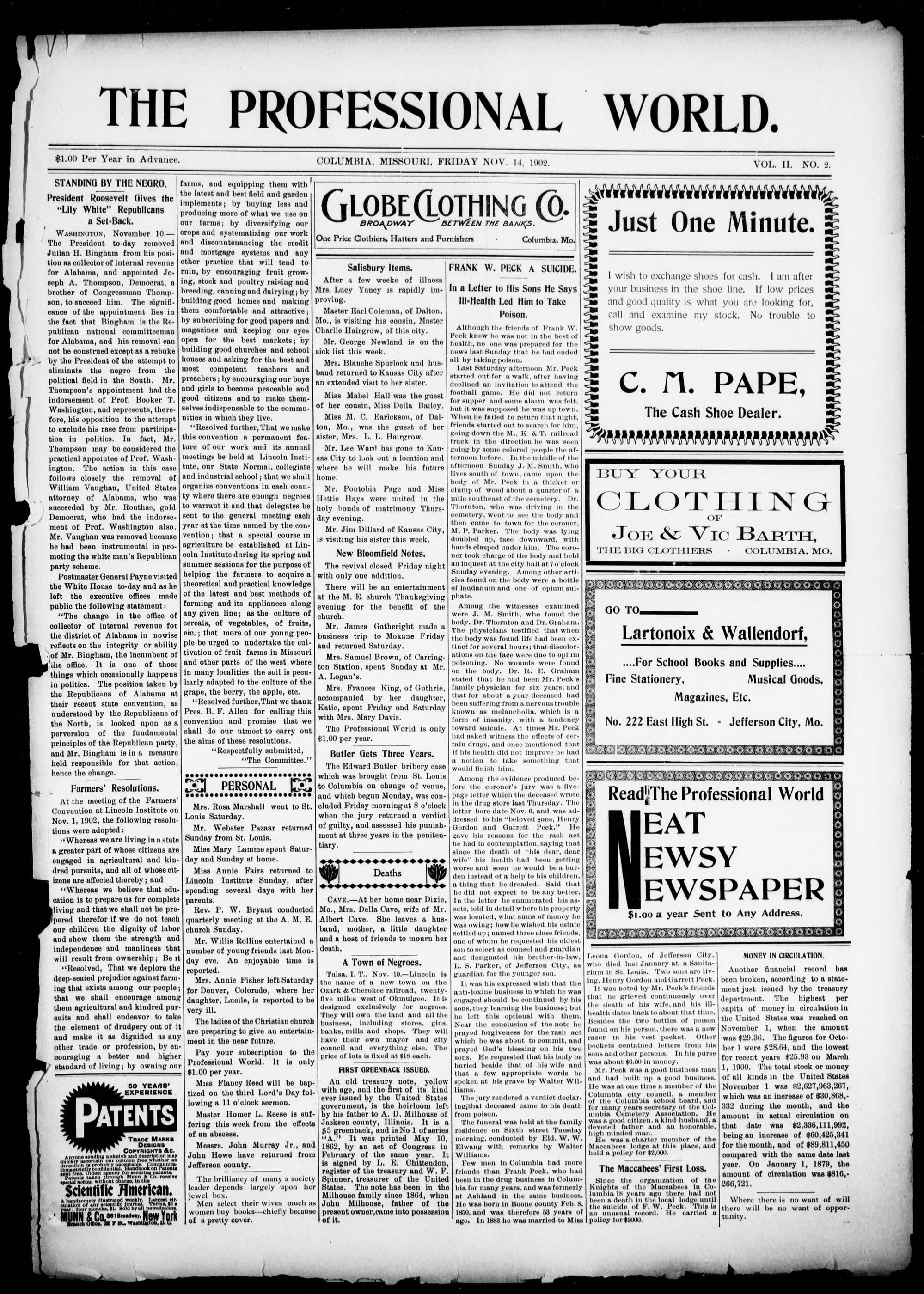
The Professional World
Friday, November 14, 1902
Columbia, Missouri
Page text (machine-generated)
RUFUS L. LOGAN, B. S. D., Editor.
COLUMBIA. : : : MISSOURI
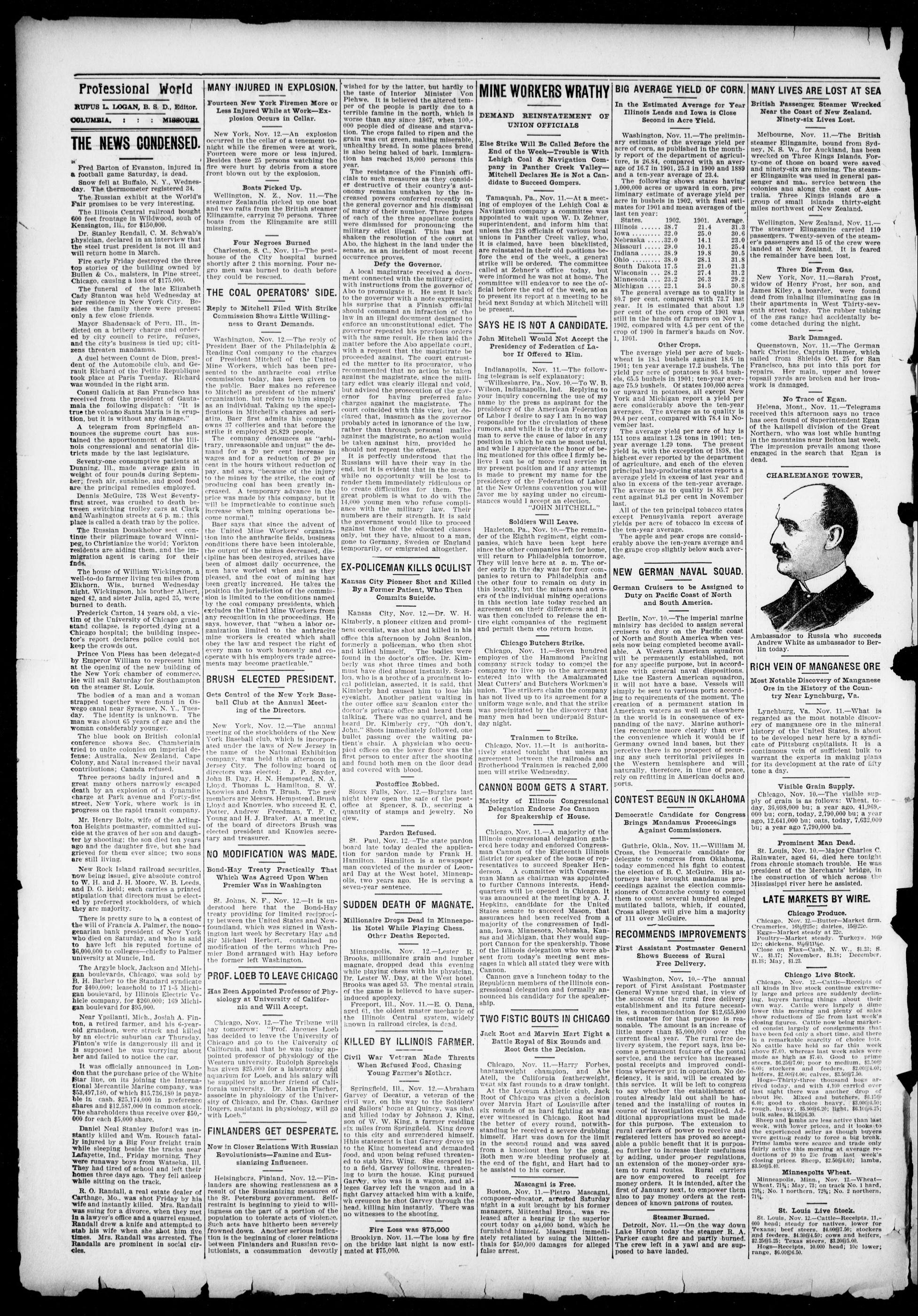
THE NEWS CONDENSED.
THE NEWS CONDENSED.
Fred Barton of Evanston, injured in a football game Saturday, is dead. Snow fell at Buffalo, N. Y., Wednesday. The thermometer registered 34. The Russian exhibit at the World's Fair promises to be very interesting.
The Illinois Central railroad bought 600 feet frontage in Wildwood, south of Kensington, Ill., for $150,000.
Dr. Stanley Rendall, C. M. Schwab's physician, declared in an interview that the steel trust president is not ill and will return home in March.
Fire early Friday destroyed the three top stories of the building owned by Bullen & Co., malsters, in Pine street, Chicago, causing a loss of $175,000.
The funeral of the late Elizabeth Cady Stanton was held Wednesday at her residence in New York City. Besides the family there were present only a few close friends.
Mayor Shadensack of Peru, III., indicted on a bribery charge and ordered by city council to retire, refuses, and the city's business is tied up; citizens threaten mandamus.
A duel between Count de Dion, president of the Automobile club, and Gerault Richard of the Petite Republice took place at Paris Tuesday. Richard was wounded in the right arm.
Consul Galicia at San Francisco has received from the president of Gautamala the following dispatch: "It is true the volcano Santa Maria is in eruption, but it is without any damage." A telegram from Springfield announces the supreme court has sustained the apportionment of the Illinois congressional and senatorial districts made by the last legislature. Seventy-one consumptive patients at Dunning, Ill., made average gain in weight of four pounds during September; fresh air, sunshine, and good food are the principal remedies employed. Dennis McGuire, 738 West Seventy-first street, was crushed to death between switching trolley cars at Clark and Washington streets at 6 p. m.; this place is called a death trap by the police. The Russian Douskhobor sect continue their pilgrimage toward Winnipeg, to Christianize the world: Yorkton residents are aiding them, and the immigration agent is caring for their fnds.
The house of William Wickingson, a well-to-do farmer living ten miles from Elkhorn. Wis., burned Wednesday night. Wickingson, his brother Albert, aged 42, and sister Julia, aged 35, were burned to death.
Frederick Carton, 14 years old, a victim of the University of Chicago grand stand collapse, is reported dying at a Chicago hospital; the building inspector's report declares police could not keep the crowds out.
Prince Von Pless has been delegated by Emperor William to represent him at the opening of the new building of the New York chamber of commerce. He will sail Saturday for Southampton on the steamer St. Louis.
The bodies of a man and a woman strapped together were found in Oswego canal near Syracuse, N. Y., Tuesday. The identity is unknown. The man was about 65 years of age and the woman considerably younger.
The blue book on British colonial conference shows Sec. Chamberlain tried to unite colonies on imperial defense; Australia, New Zealand, Cape Colony, and Natal increased their naval contributions; Canada refused.
Three persons badly injured and a great many others narrowly escaped death by an explosion of a dynamite charge at Park avenue and Forty-first street. New York, where work is in progress on the rapid transit company.
Mr. Henry Bolte, wife of the Arlington Heights postmaster, committed suicide at the graves of her son and daughter by shooting; the son died ten years ago and the daughter five, but she had grieved for them ever since; two sons are still living.
New Rock Island railroad securities, now being issued, give absolute control to W. H. and J. H. Moore, W. B. Leeds, and D. G. Keld; each carries a printed stipulation that directors must be elected by preferred stockholders, of which they are majority.
There is pretty sure to be a contest of the will of Francis A. Palmer, the non-genian bank president of New York who died on Saturday, and who is said to have left his reputed fortune of $6,000,000 to colleges—chiefly to Palmer university at Muncie, Ind.
The Argyle block, Jackson and Michigan boulevards, Chicago, was sold by B. H. Barber to the Standard syndicate for $400,000; leasehold to 17-1-5 Michigan boulevard, by Illinois Electric Vehicle company, for $260,000; 169 Michigan boulevard for $95,000.
Near Ypsiilanti, Mich., Josiah A. Finton, a retired farmer, and his 6-year-old grandson, were struck and killed by an electric suburban car Thursday. Finton's wife is dangerously ill and it is supposed he was worrying about her and failed to notice the car.
It was officially announced in London that the purchase price of the White Star line, on its joining the International Mercantile Marine company, was $53,497,180, of which $15,736,180 is payable in cash. $25,174,000 in preference shares and $12,587,000 in common stock. The shareholders thus receive over $50,000 for each $5,000 share.
Daniel Neal Stanley Buford was instantly killed and Wm. Rousch fatally injured by a Big Four freight train while sleeping beside the tracks near Lafayette, Ind. Friday morning. They were runaway boys from Watsela, Ill. They had tired of school and left their homes three days ago. They fell asleep while sitting on the track.
R. O. Randall, a real estate dealer of Carthage, Mo., was shot Friday by his wife and instantly killed. Mrs. Randall was suing for a divorce, when they met in a lawyer's office and a quarrel ensued. Randall drew a knife and attempted to stab his wife when she shot him five times. Mrs. Randall was arrested. The Randalls are prominent in social circles.
MANY INJURED IN EXPLOSION
Fourteen New York Firemen More or Less Injured While at Work—Explosion Occurs in Cellar.
New York, Nov. 12.—An explosion occurred in the cellar of a tenement tonight while the firemen were at work. Fourteen were more or less injured. Besides these 25 persons watching the fire were hurt by debris from a store front blown out by the explosion.
Boats Picked Up.
Wellington, N. Z., Nov. 11.—The steamer Zealandia picked up one boat and two rats from the British steamer Elingamite, carrying 70 persons. Three boats from the Elingamite are still missing.
Four Negroes Burned
Charleston, S. C., Nov. 11—The pesthouse of the City hospital burned shortly after 2 this morning. Four negro men was burned to death before they could be rescued.
THE COAL OPERATORS' SIDE
Reply to Mitchell Filed With Strike Commission Shows Little Willingness to Grant Demands.
Washington. Nov. 12.—The reply of President Baer of the Philadelphia & Reading Coal company to the charges of President Mitchell of the United Mine Workers, which has been presented to the anthracite coal strike commission today, has been given to the public. Baer makes no reference to Mitchell as president of the miners' organization, but refers to him simply as an individual. Taking up the specifications in Mitchell's charges ad seriatim, Baer first admits his company owns 37 collieries and that before the strike it employed 26,829 people. The company denounces as "arbitrary, unreasonable and unjust" the demand for a 20 per cent increase in wages and for a reduction of 20 per cent in the hours without reduction of pay, and says, "because of the injury to the mines by the strike, the cost of producing coal has been greatly increased. A temporary advance in the price was made by this company, but it will be impracticable to continue such increase when mining operations become normal."
Baer says that since the advent of the United Mine Workers' organization into the anthracite fields, business conditions there have been intolerable, the output of the mines decreased, discipline has been destroyed, strikes have been of almost daily occurrence, the men have worked when and as they pleased, and the cost of mining has been greatly increased. He takes the position the jurisdiction of the commission is limited to the conditions named by the coal company presidents, which excludes the United Mine Workers from any recognition in the proceedings. He says, however, that "when a labor organization limited to the anthracite mine workers is created which shall obey the law and respect the right of every man to work honestly and cooperate with his employers trade agreements may become practicable."
BRUSH ELECTED PRESIDENT.
Gets Control of the New York Baseball Club at the Annual Meeting of the Directors.
New York, Nov. 12.—The annual meeting of the stockholders of the New York Baseball club, which is incorporated under the laws of New Jersey in the name of the National Exhibition company, was held this afternoon in Jersey City. The following board of directors was elected: J. P. Snyder, John B. Day, H. N. Hempstead, N. A. Lloyd, Thomas L. Hamilton, S. W. Knowles and John T. Brush. The new members are Messrs. Hempstead, Brush Lloyd and Knowles, who succeed E. C. Potter, Andrew Freedman, T. F. C. Young and H. J. Braker. At a meeting of the board of directors Brush was elected president and Knowles secretary and treasurer.
NO MODIFICATION WAS MADE.
Bond-Hay Treaty Practically That Which Was Agreed Upon When Premier Was in Washington
St. Johns, N. F., Nov. 12.—It is understood here that the Bond-Hay treaty provides that the limited reciprocity between the United States and Newfoundland, which was signed in Washington last week by Secretary Hay and Sir Michael Herbert, contained no modification of the terms which Premier Bond arranged with Hay before the former left Washington.
PROF. LOEB TO LEAVE CHICAGO
Has Been Appointed Professor of Physiology at University of California and Will Accept.
Chicago, Nov. 12.—The Tribune will say tomorrow: "Prof. Jacques Loeb has decided to leave the University of Chicago and go to the University of California, and that he was today appointed professor of physiology of the Western university. Rudolph Spreckels has given $25,000 for a laboratory and aquarium for Loeb, and his salary will be supplied by another friend of California university. Dr. Martin Fischer, associate in physiology of the University of Chicago, and Dr. Chas. Gardner Roers, assistant in physiology, will go with Loeb."
FINLANDERS GET DESPERATE.
Now in Closer Relations With Russian Revolutionists—Famine and Russianizing Influences.
Helsingbors, Finland, Nov. 12.—Finlanders are showing restlessness as a result of the Russianizing measures of the St. Petersburg government, a restraint on their willingness on the part of a portion of the population to tolerate acts of violence. Such acts have hitherto been severely frowned down. Another serious indication is the beginning of closer relations between Finlanders and Russian revolutionists, a consummation devotely
wished for by the latter, but hardly to the taste of Interior Minister Von Plehwe. It is believed the altered temper of the people is partly due to a terrible famine in the north, which is worse than any since 1867, when 100,000 people died of disease and starvation. The crops failed to ripen and the grain was cut green, making miserable, unhealthy bread. In some places bread is also being baked of bark. Immigration has reached 18,000 persons this year. The resistance of the Finnish officials to such measures as they consider destructive of their country's autonomy remains unshaken by the increased powers conferred recently on the general governor and his dismissal of many of their number. Three judges of each of the three appellate courts were dismissed for pronouncing the military edict illegal. This has not shaken the resolution of the court at Abo, the highest in the land under the senate, as an incident of most recent occurrence proves.
Defy the Governor.
A local magistrate received a document connected with the military edict, with instructions from the governor of Abo to promulgate it. He sent it back to the governor with a note expressing his surprise that a Finnish official should command an infraction of the law in an illegal document designed to enforce an unconstitutional edict. The governor repeated his previous orders with the same result. He then laid the matter before the Abo appellate court, with a request that the magistrate be proceeded against. The court entrusted the matter to its procurator, who recommended that no action be taken against the magistrate, since the military edict was clearly illegal and void, but advised the prosecution of the governor for having preferred false charges against the magistrate. The court coincided with this view, but declared that, inasmuch as the governor probably acted in ignorance of the law, rather than through personal malice against the magistrate, no action would be taken against him, provided he should not repeat the offense.
It is perfectly understood that the Russians will have their way in the end, but it is evident that in the meanwhile no opportunity will be lost to render them immediately ridiculous or to create difficulties for them. The great problem is what to do with the 14,000 young men who refuse compliance with the military law. Their numbers are their strength. It is said the government would like to proceed against those of the educated classes only, but they have, almost to a man, gone to Germany, Sweden or England temporarily, or emigrated altogether.
EX-POLICEMAN KILLS OCULIST
Kansas City Pioneer Shot and Killed By a Former Patient, Who Then Commits Suicide.
Kansas City, Nov. 12—Dr. W. H. Kimberly, a pioneer citizen and prominent occultist, was shot and killed in his office this afternoon by John Scanlon, formerly a policeman, who then shot and killed himself. The bodies were found in the doctor's office. Dr. Kimberly was shot three times and both must have died almost instantly. Scanlon, who is a brother of a prominent local politician, asserted, it is said, that Kimberly had caused him to lose his eyesight. Another patient waiting in the outer office saw Scanlon enter the room and be heard talking. There was no quarrel, and he heard Dr. Kimberly cry. "Oh don't John." Shots immediately followed, one bullet passing over the waiting patient's chair. A physician who occupied offices on the lower floor was the first person to enter after the shooting and found both men on the floor dead and covered with blood.
Postoffice Robbed.
Sloux Falls, Nov. 12—Burglar's last night blew open the safe of the post-office at Spencer, S. D., securing a stamp of stamps and jewelry. No clew.
Pardon Refused.
St. Paul, Nov. 12.—The state pardon board late today denied the application for pardon made by Frank H. Hamilton. Hamilton is a newspaper man convicted of the murder of Leonard Day at the West hotel, Minneapolis, two years ago. He is serving a seven-year sentence.
SUDDEN DEATH OF MAGNATE.
Millionaire Drops Dead in Minneapolis Hotel While Playing Chess. Other Deaths Reported.
Minneapolis, Nov. 12.—Lester R. Brooks, millionaire grain and lumber mopie, dropped dead this evening while playing chess with his physician, Dr. Lester W. Day, at the West hotel Brooks was aged 53. The mental strain of the game is believed to have super-induced apoplexy.
Freeport, Ill., Nov. 11.—E. O. Dana aged 61, the oldest master mechanic of the Illinois Central system, widely known in railroad circles, is dead.
KILLED BY ILLINOIS FARMER.
Civil War Veteran Made Threats When Refused Food, Chasing Young Farmer's Mother.
Springfield, Ill., Nov. 12.—Abraham Garvey of Decatur, a veteran of the civil war, on his way to the Soldiers' and Sailors' home at Quincy, was shot and killed today by Johnson J. King, son of W. W. King, a farmer residing six miles from Springfield. King drove to this city and surrendered himself, and killed him. He then to the King homestead and demanded food, and upon being refused threatened to stab Mrs. Wing. She escaped into a field, Garvey following, threatening to burn the house. King pursued Garvey, who was in a wagon, and alleges Garvey left the wagon and in a fight Garvey attacked him with a knife, wh ereupon he shot Garvey through the head, killing him instantly. There was no witnesses to the shooting.
Fire Loss was $75,000
Brooklyn. Nov. 11.—The loss by fire on the bridge last night is now estimated at $75,000.
MINE WORKERS WRATHY
DEMAND REINSTATEMENT OF
UNION OFFICIALS
Else Strike Will Be Called Before the End of the Week—Trouble is With Lehigh Coal & Navigation Company in Panther Creek Valley—Mitchell Declares He is Not a Candidate to Succeed Gompers.
Tamaquah, Pa., Nov. 11.—At a meeting of employees of the Lehigh Coal & Navigation company a committee was appointed to wait upon W. D. Zehner, superintendent, and inform him that unless the 218 officials of various local unions in Panther Creek valley, who, it is claimed, have been blacklisted, are reinstated in their old positions before the end of the week, a general strike will be ordered. The committee called at Zehner's office today, but were informed he was not at home. The committee will endeavor to see the official before the end of the week, so as to present its report at a meeting to be held next Sunday at which Mitchell will be present.
SAYS HE IS NOT A CANDIDATE.
John Mitchell Would Not Accept the Presidency of Federation of Labor If Offered to Him.
Indianapolis, Nov. 11.—The following telegram is self explanatory: "Wilkeshareh, Pa., Nov. 10.—To W. B. Wilson, Indianapolis, Ind. Replying to your inquiry concerning the use of my name by the press as aspirant for the presidency of the American Federation of Labor I desire to say I am in no way responsible for the circulation of these rumors, and while it is the duty of every man to serve the cause of labor in any position in which he can be most useful, and while I appreciate the honor of being mentioned for this office I firmly believe I can be of more real service in my present position and if any attempt is made to present my name for the presidency of the Federation of Labor at the New Orleans convention you will favor me by saying under no circumstances would I accept an election.
Soldiers Will Leave.
Hazleton, Pa., Nov. 10.—The remainder of the Eighth regiment, eight companies, which have been kept here since the other companies left for home, will return to Philadelphia tomorrow. They will leave here at a. m. The order early in the day was for four companies to return to Philadelphia and the other four to remain on duty in this locality, but the miners and owners of the individual mining operations in this section late today reached an agreement on their differences and it was then concluded to release the entire eight companies of the regiment and permit them eto return home.
Chicago Butchers Strike
Chicago, Nov. 11.—Seven hundred employees of the Hammond Packing company struck today to compel the company to live up to the agreement entered into with the Amalgamated Meat Cutters' and Butchers Workmen's union. The strikers claim the company has not lived up to its agreement for a uniform wage scale, and that the strike was precipitated by the discovery that many men had been underpaid Saturday night.
Trainmen to Strike.
Chicago, Nov. 11.—It is authoritatively stated tonight that unless an agreement between the railroads and Brotherhood Trainmen is reached 2,000 men will strike Wednesday.
CANNON BOOM GETS A START.
Majority of Illinois Congressional Delegation Endorse Joe Cannon for Speakership of House.
Chicago, Nov. 11.—A majority of the Illinois congressional delegation gathered here today and endorsed Congressman Cannon of the Eighteenth Illinois district for speaker of the house of representatives to succeed Speaker Henderson. A committee with Congressman Mann as chairman was appointed to further Cannons interests. Headquarters will be opened in Chicago. It was announced at the meeting by A. J. Hopkins, candidate for the United States Senate, succeeding on the assurances had been received from a majority of the congressmen of Indiana, Iowa, Minnesota, Nebraska, Kansas and Michigan, that they would support Cannon for the speakership. Those of the Illinois delegation who were absent from today's meeting sent messages in which all stated they were with Cannon.
Cannon gave a luncheon today to the Republican members of the Illinois congressional delegation and formally announced his candidacy for the speakership.
TWO FISTIC BOUTS IN CHICAGO
Jack Root and Marvin Hart Fight a Battle Royal of Six Rounds and Root Gets the Decision.
Chicago, Nov. 11—Harry Forbes, bantamweight champion, and Abe Atell, the California featherweight, went six fast rounds to a draw tonight. At the Lyceum Athletic club, Jack Root of Chicago was given a decision over Marvin Hart of Louisville after six rounds of as hard fighting as was ever witnessed in Chicago. Root had the better of every round, notwithstanding he received a severe drubbing himself. Hart was down for the limit in the second round and was saved from a knockout then by the gong. Both men were bleeding profusely at the end of the fight, and Hart had to be assisted to his corner.
Mascagni is Free.
Boston, Nov. 11.—Pietro Mascagni composer-educator, arrested Saturday night in a suit brought by his former managers. Mittenthal Bros., was released after a hearing in the superior court today on $4,000 bond, which he furnished himself. Mascagni immediately retaliated by suing the Mittenhals for $50,000 damages for alleged false arrest.
BIG AVERAGE YIELD OF CORN.
In the Estimated Average for Year Illinois Leads and Iowa is Close Second in Acre Yield.
Washington, Nov. 11.—The preliminary estimate of the average yield per acre of corn, as published in the monthly report of the department of agriculture, is 26.84, compared with an average of 16.7 in 1901, 25.3 in 1900 and 1889 and a ten-year average of 23.4.
The following shows states having 1,000,000 acres or upward in corn, preliminary estimate of average yield per acre in bushels in 1902, with final estimates for 1901 and mean averages of the last ten year:
States. 1902. 1901. Average.
Illinois 38.7 21.4 31.3
Iowa 32.0 25.0 30.6
Nebraska 32.0 14.1 23.0
Missouri 29.0 10.1 25.4
Indiana 38.9 19.8 30.5
Ohio 38.0 28.1 31.8
South Dakota 17.5 21.0 21.3
Wisconsin 28.2 27.4 31.2
Minnesota 23.2 26.3 29.2
Michigan 22.1 34.5 30.8
The general average as to quality is 89.7 per cent, compared with 73.7 last year. It is estimated that about 1.9 per cent of the corn crop of 1901 was still in the hands of farmers on Nov 1, 1902, compared with 4.5 per cent of the crop of 1900 in farmer's hauds on Nov. 1, 1901.
Other Crops.
The average yield per acre of buck-wheat is 18.1 bushels against 18.6 in 1901; ten year average 17.2 bushels. The yield per acre of potatoes is 95.4 bushels, 65.5 bushels in 1901; ten-year average 75.9 bushels. Of states 100,000 acres or upward in potatoes, all except New York and Michigan report a yield per acre considerably above the ten-year averages. The average as to quality is 90.4 per cent, compared with 78.4 in November last.
The average yield per acre of hay is 151 tons against 1.28 tons in 1901; ten-year average 1.29 tons. The present yield is, with the exception of 1898, the highest ever reported by the department of agriculture, and each of the eleven principal hay-producing states reports a average yield in excess of last year and also in excess of the ten-year average. The average as to quality is 85.7 per cent against 91.3 per cent in November last.
All of the ten principal tobacco states except Pennsylvania, report average yields per acre of tobacco in excess of the ten-year average.
The apple and pear crops are considerably above the ten-years average and the grape crop slightly below such average.
NEW GERMAN NAVAL SQUAD
German Cruisers to be Assigned to Duty on Pacific Coast of North and South America.
Berlin, Nov. 10.—The imperial marine ministry has decided to assign several cruisers to duty on the Pacific coast of North and South America when vessels now being completed become available. A Western American squadron will be permanently established, not for any specific purpose, but in accordance with general naval dispositions. Like the Eastern American squadron, it will not have a base. Vessels will simply be sent to various ports according to requirements of the moment. The creation of a permanent station in American waters as well as elsewhere in the world is in consequence of expanding of the navy. Marine authorities recognize more clearly than ever the convenience which it would be if Germany owned land bases, but they perceive there is no prospect of securing any such territorial privileges in the Western hemisphere and will naturally, therefore, in time of peace, rely on refitting in American docks and ports.
CONTEST BEGUN IN OKLAHOMA
Democratic Candidate for Congress Brings Mandamus Proceedings Against Commissioners.
Guthrie, Okla., Nov. 11—William M. Cross, the Democratic candidate for delegate to congress from Oklahoma, today commenced his fight to contest the election of B. C. McGuire. His attorneys have brought mandamus proceedings against the election commissioners of Comanche county to compel them to count several hundred alleged mutilated ballots, which, if counted, Cross alleges will give him a majority of 111 over McGuire.
RECOMMENDS IMPROVEMENTS
First Assistant Postmaster General Shows Success of Rural Free Delivery
Washington, Nov. 10.-The annual report of First Assistant Postmaster General Wynne urged that, in view of the success of the rural free delivery establishment and its future necessities, a recommendation for $12,655,800 in estimates for that purpose is reasonable. The amount is an increase of little more than $5,000,000 over the current fiscal year. The rural free delivery system, the report says, has become a permanent feature of the postal service, and the service has increased postal receipts and improved conditions wherever put in operation. No deficiency, it is said, will be created by this service. It will be left to congress to say whether the establishment of routes already laid out shall be hastened and the installing of routes in course of investigation expedited. Additional appropriations must be made for this purpose. The extension to rural carriers of power to receive and registered letters has proved so acceptable a public benefit that it is purposeful further to increase their usefulness by adding, under proper regulations, an extension of the money-order system to rural routes. Rural carriers are now empowered to receipt for money orders. It is intended, after the first of January next, to empower them also to pay money orders at the residences of known patrons of routes.
Steamer Burned.
Detroit, Nov. 11.—On the way down Lake Huron today the steamer R. A. Parker caught fire and partly burned. The crew left in a yawl and are supposed to have landed.
MANY LIVES ARE LOST AT SEA
British Passenger Steamer Wrecked Near the Coast of New Zealand. Ninety-six Lives Lost.
Melbourne, Nov. 11.—The British steamer Elingamite, bound from Sydney, N. S. W., for Auckland, has been wrecked on Three Kings Islands. Forty-one of those on board were saved and ninety-six are missing. The steamer Elingamite was used in general passenger and man, service between the colonies and along the coast of Australia. Three Kings islands are a group of small islands thirty-eight miles northwest of New Zealand.
Wellington, New Zealand, Nov. 11.—The steamer Elingamite carried 110 passengers. Twenty-seven of the steamer's passengers and 15 of the crew were landed at New Zealand. It is feared the remainder have been lost.
Three Die From Gas.
New York, Nov. 11.—Sarah Frost, widow of Henry Frost, her son, and James Kiley, a boarder, were found dead from inhaling illuminating gas in their apartments in West Thirty-seventh street today. The rubber tubing of the gas range had accidentally become detached during the night.
Bark Damaged.
Queenstown, Nov. 11.—The German bark Christine, Captain Hamer, which sailed from Shields Oct. 25 for San Francisco has put into this port for the Hainai, upper and lower topsail yards are broken and her iron-work is damaged.
No Trace of Egan.
Helena, Mont. Nov. 11.—Telegrams received this afternoon says no trace has been found of Superintendent Egan of the Kallspell division of the Great Northern, who was lost while hunting in the mountains near Benton last week. The depression prevails among those engaged in the search that Egan is dead.
Ambassador to Russia who succeeds Andrew White as ambassador to Berlin today.
Ambassador to Russia who succeeds Andrew White as ambassador to Berlin today.
RICH VEIN OF MANGANESE ORE
Most Notable Discovery of Manganese
Ore in the History of the Country Near Lynchburg, Va.
Lynchburg, Va. Nov. 11.—What is regarded as the most notable discovery of manganese ore in the mineral history of the United States, is about to be developed near here by a syndicate of Pittsburg capitalists. It is a continuous vein of sufficient bulk to warrant the experts in making plans for its development at the rate of fifty tone a day.
Visible Grain Supply.
Chicago, Nov. 10.—The visible supply of grain is as follows: Wheat, today, 36,98,000 bu; a year ago, 41,968,000 bu; corn, today, 2,790,000 bu; a year ago, 12,641,000 bu; oats, today, 7,632,000 bu; a year ago 7,790,000 bu.
Prominent Man Dead.
St. Louis, Nov. 10.—Major Charles C. Rainwater, aged 64, died here tonight from chronic stomach trouble. He was president of the Merchants' bridge, in the construction of which across the Mississippi river here he assisted.
LATE MARKETS BY WIRE.
**Chicago Produce.**
Chicago, Nov. 12—Butter—Market firm.
Creameries, 15%@2c; dairies, 15%22c.
Eggs—Market steady at 22c.
Poultry—Market steady. Turkeys, 10%@
10%@22c.
122. chickens, 9.12.12
Close on Flax-Cash, N. W., $1.23; S.
W., $1.17; November, $1.18; December,
$1.18; May, $1.23.
Chicago Live Stock.
Chicago, Nov. 12—Cattle-Receipts of all kinds in live stock continue extremely large and prices are suddenly declining, buyers having things about their own way. Cattle were largely a dime lower this morning and plenty of sales show reductions of 25c from last week's closing figures. Cattle now been marketed consist largely of consignments that are in a remarkable scarcity to choice lots. No cattle have held so far this week above $7.00, whereas last week sales were made as high as $7.40. Good to prime steers, $6.25$7.00; poor to medium, $3.50$4.00; stockers and feeders, $2.00$4.00; heifers, $2.00$4.00; calves, $3.50$7.00. Hogs-Thirty-three thousand hogs arrived today, and with 4,100 carried over last night there was another drop of 1.50$6.25; good to choice heavy, $3.00$6.50; good to choice heavy, $3.00$6.50; rough, heavy, $5.90$6.20; light, $6.10$6.25; bulk sales, $15.50$6.20.
Sheep and lambs are less active than last week, with lower prices, and it looks to the experienced seller as though buyers were getting ready to force a big break. Prime lambs were scarce and trade only fairly active this morning at average reductions of 10 to 20c from last week's prices. Sheep. $2.50@40; lambs. $3.50@40
Minneapolis Wheat.
Minneapolis, Minn., Nov. 12—Wheat-
Wheat, 71%; May, 73; on track No. 1 hard,
73%; No. 1 northern, 72%; No. 2 northern,
71%.
St. Louis Live Stock
St. Louis, Nov. 12—Cattle—Receipts, 11..600 head; steady for natives, lower for Texans; beef steers, $4.007.50; stockers and feeders, $4.304.45; cows and heifers, $4.304.45; steers, $3.205.60.
Hogs—Receipts, 10,000 head; 10c lower; range, $6.002.65.0.
The Editor
EDGAR BAKER
OW that election is over
presume that your mind
will rest easy for a period
at least," remarked the edi-
tor to Uncle Bill, who
seemed to be taking the
world easy for the time
being.
"N
"Pollectics is a trade that I hainn't worked at very much uv late," said Uncle Bill. "There was a time when I used ter bill enthused over a party's needs an greeds, but I've sort uv cooled off. A feller what's gin' ter waste much time in pollectics needs a different kind uv environment than we git in the country an' it's hard ter git enthused much over votin' some other feller into temptation's way. Uv course, it sounds nice ter have Hon. prefixed ter a feller's name, but see how they feller in St. Louis come out. A few years ago when the papers would say anything about 'em they'd always start off with the Hon. so an' so made a short trip ter such a place," an' now it's the "Dishonorable so an' so was sentenced ter five years in the pententiary." So yer can see that they didn't have the proper science uv pollectics applied 'em an' uv course they fell."
"What do you mean by the proper science of politics?" asked the editor.
"I mean gittin' inter the band wagon without the visibal use uv a boodle sten-ladder."
"You are too dense,for me this morning," said the editor in an inquisitive tone.
"The science uv potencies fixes a man so he boodles himself. I'll admit that it's a deep proposition ter see through. how a man'll buy him up ter vote franchises away, but in a city what's up ter snuff in potencies they never have any convictions on account uv boodling, 'cause if a feller is doin' uv it on his own account he don't even know that he's buyin' uv himself," asserted the old man, as he stroked his whiskers, lurched back in his chair so hard that his feet flew up in the air and came down on the editor's desk with a bang which made the editor "pie" his thoughts for a moment.
"Pound your story into me the old way, do not try to kick it in," remarked the editor with emphasis. "It may take me a while to grasp what you are trying to get at, but I'll master the situation presently."
"It wouldn't be a bad idea to have the spring stiffened up a bit in this chair, or else have a pair of stirrups put on so a feller can ride it 'thou bein' throw'd," remarked the old man. "If you throw yourself, you will not know it," facetiously remarked the editor.
"I see that yer a novice in polletics, or else it would be plain fur yer ter see 'thou all the explainin' it'll take," said Uncle Bill with a wise look on his face, which seemed to denote that he had a "coup" on the political situation, as he continued, "The real poloician is never known ter the public eye. He's the man what baits the trap an' then sets back an' laughs at the people vote fur their own interest."
"You have evidently got something up your sleeve on politics," said the editor with much decision, "so shake it out and let us see what it is."
"Wall, when I was out in Kansas," began the old man. "I met aeller from Louisville. Kentucky, who was takin' a trip for his health an' he told me just how scientific a game polietics is. He used ter be a hotel man in a small way; had a hotel with a bar attached an' was quite popular with the young fellers in his ward, so much so that fellers who thought they was polieticians used ter come an' spend a lot uv money with him so'ter git uv his influence, an' it got so they had ter have it, or they couldn't carry the ward, an' finally two or three uv the rich fellers what was interested in railways, got ter comin' in (as they said) jest because he kept good liquor, an' they got purty friendly with Charlie (that was his name), so one day in comes one uv the richest uv 'em—he was a millionaire—an' he had a good drink uv Charlie's liver out uv the bottle what had the gift on the label, an' after talkin' awhile he said, 'Charlie, why don't yer git a larger place?' an' Charlie blushed an' owned up that he couldn't afford ter buy one, as his capital was limited. Uv course he would like a bigger place an' all that sort, but he had ter he satisfied with his small place. An' at that the feller said, "Yer can buy the hotel down on the corner, Charlie, as it's fur sale, an' I think it's a mighty good chance.' That made a frog come up in Charlie's throat, 'cause he had big ideas an' a small bank account, an' then the rich feller, who was called 'Doc,' said, 'Charlie, if yer want ter but that place I'll help yer,' cause I like yer.' An' ter make a long story short, Charlie bought the place an' enlarged his business, an' he commenced ter make money might fast, an' one day 'Doc said, 'Charlie, why don't yer run fur alderman yourself?' Instead uv always helpin' someone else into office, help yourself. It will add ter yer popularity an' increase yer business here.' So Charlie became an alderman."
"I begin to see into the game," said the editor, at this point in Uncle Bill's story, as he handed him a cigar with the remark, "Light up and proceed." "Now, yer think that 'Doc' bhooded him, don't yer? said Uncle Bill, answering his own question by saying, "Wall, he didn't do nothin' uv the kind, but he helped him make money, used ter go an' ask Charlie's advice 'bout polertics an' sich like, an' then he found a man what would buy the hotel from him at a price that made him several thousand dollars profit, an' Charlie sold 'cause as he told 'Doc' he was willin' t ter take the advice uv so good a financier as he was every time. An' so he bought another piece uv property. Then one day 'Doc' said, Charlie, let's build an elevated road over ter New Albany. We'll organize a stock company an' hold a certain number uv shares ourselves, an' sell
MILL OWNERS AND GIRLS.
Had to "Register Out" Until Squabble Was Over.
The mill owners exert, as far as possible, an influence over the moral tone of their employees. The average girls are self-respecting, yet they trifle with love. The attraction they wish to exert is ever present in their minds and in their conversation. Their most important sacrifices are invariably for clothes. They have superstitions of all kinds; to sneeze on Saturday means the arrival of a beau on Sunday; a big or little tealleaf means a tall or short caller, and so one. There is a book of dreams kept at one table in the mill. The girls consult it to find the interpretation of their nocturnal reveries. They are fanciful, sentimental, cold, passionless.
Two girls in the seaming room had got into a quarrel that day over a packer—a fine-loking, broad-shouldered fellow, who had touched both of their hearts and awakened in each an emotion she claimed the right to defend. The quarrel be lightly with an exchange of unpleasant comment; it soon took the proportions of a dispute which could not give itself the desired vent in words alone. The boss was called in. He made no attempt to control what lay beyond his power, but applying factory legislation to the case, he ordered the two Amazons to "register out" until the squabble was settled, as the factory did not propose to pay its hands for the time spent in fights. So the two girls "rang out" past the timekeeper and took an hour in open air, hand in hand, fist to fist, which, as happens to man, had its claiming effect.—Everybody's Magazine.
GREEN COUNTY'S SENSATION.
Catskill, N. Y., Nov. 10.—Ulster and Greene counties are ringing with the news of the wonderful recovery of Geo. F. Ayers who lives at 16 Division St., in this city. One year ago Mr. Ayers was suffering from Bright's disease of the kidneys and the doctors gave him little relief and less hope. Today Mr. Ayers is as well as man could wish. He tells the following story:
"About a year ago I was at West Camp, sick with Bright's disease and without hope of ever being better, when an old gentleman from Bath, N. Y., advised me to take Dodd's Kidney Pills, telling me they had cured him of the same disease.
"I had tried so many remedies that I was past hoping and told him so, but when he bought me a box of Dodd's Kidney Pills and coaxed him to try them I did so just to humor his whim.
"That was the means of saving my life. I took that box and half a dozen more. Thanks to that old man and Dodd's Kidney Pills, I am cured.
Diplomatic circles in Washington will feel a distinct loss in the retirement of M. Pioda, Swiss minister. He is one of the few foreigners to retain their native customs in the legations. On all formal occasions his guests were greeted with baskets of most beautiful artificial flowers, the ware used on the table was exclusively Swiss, as were the dishes served. The Piodas never gave up their peculiar window draperies, and every Christmas they had a tree, from which every Swiss resident in Washington got a present brought from the little European republic.
State of Ohio, City of Toledo,
Lucas County.
Frank J. Cheney makes oath that he is senior partner of the firm of F. J. Cheney & Co., doing business in the City of Nedo, County and State aforesaid, and the firm of HUNDRED DOLLARS for each and every case of Catarrh that cannot be cured by the use of Hall's Catarrh Cure.
FRANK J. CHENEY
Sworn to before me and subscribed in my presence, the 6th day of December, A. D., 1886.
(Seal) A. W. GLEASON.
Notary Public.
Hall's Catarrh Cure is taken internally,
and acts directly on the blood and mucous surfaces of the system. Send for testimonial, tree.
(GHENEY & CO., Toledo, O.
Sold by all Drustsgs, 75c.
Hall's Family, Pills are the best.
Americanisms.
We are reminded by a correspondent that "fall" is not the only word of which the Americans have preserved the old English meaning. According to the late Mr. Richard Proctor, the phrase, "I guess," to English ears so ridiculous, is really identical with the old expression "I wits," meaning "I know." The word "guess" has changed its meaning entirely in England, but has partly preserved it in America, where, of course, the native says, "I guess," when he is more or less in a state of certainty. There are many other examples of words that have played fast and loose with "g" and "w," such as "guardian" and "warden," "guard" and "ward," "guichet" and "wicket."—London Chronicle.
Mothers will find Mrs. Winslow's Sootting Syrup the best remedy to use for their children during the teething period.
Reflections of a Bachelor
After a woman works up her shape it is called her figure.
Spread red hair over a thousand generations and it won't get lost.
There is nothing that will season up old maids to make them palatable. It seems funny to think that great men were once spanked just like the rest of us. You can't tell anything about a woman's real dimensions by the size of her corset.—New York Press.
CASTORIA
For Infants and Children.
The Kind You Have Always Bought
Bears the Signature of Charles Plutchin
Prof. Paul Haupt, of Johns Hopkins university, has just returned from a tour of research abroad. He says that the mines of Tarsish, where King Solomon got his gold and silver and precious stones, were situated in what is now the southwestern part of Spain. Baron Rothschild now owns the mines, but he gets out of them no gold or precious stones, as they contain only iron ore. Professor Haupt found in the old workings many specimens of crystalline of great beauty, and he believes that Solomon used much of this to ornament his temples.
UNCLE BILL
ZND
W that election is over I presume that your mind will rest easy for a period, at least," remarked the editor to Uncle Bill, who seemed to be taking the world easy for the time being.
the rest.' An, Charlie said, Doc.' I believe you gittin' the dropy, cause I begin fer feel like a bloated bond holder.' Wall, they started ter organize a company, an' a few other aldermen who had ooen prosperous fur a few years like Charlie had took some stock an' then in rushed the capitalists' an' bought up all the rest uv the stock, an then it occurred ter them that they had forgotten all 'bout a franchise. So at the next meetin' uv the council an ordinance was introduced for the granting uv a franchise."
"And the whole thing was knocked in the head, I suppose," interposed the editor.
"I want ter know if it was," said Uncle Bill, tantalizingly. "Wall, they passed the ordinance all right, 'cause the aldermen had boodled themselves with the stock they had honestly bought an' the elevated railroad was built an' recapitalized an' Charlie sold out his stock fur big money; enough so'st he could travel fur his health—but I guess he'll never git cured, poor feller."
"What was his alliment?" asked the editor.
"Swelled head, as near as I could judge," replied Uncle Bill. "That's a disease what most everyone gits when they make a lotuv money an' don't know how they did it, an' the only remedy that's guaranteed ter cure it is fur them ter stay in the game an' let the same fellers rob 'em that made 'em rich. But Charlie got out uv it an' said he thought he'd buy some farms in Kansas, 'cause they could always raise 'somethin' in Kansas. If they couldn't raise craps they could raise _____"
"Ahem!" coughed the editor, "don't say it. Uncle Bill, I know that you are a little put out about having been locked up out there, but your friends here all believe that it was all a mistake and have the utmost confidence in your sanity."
"Say," exclaimed the old man as he started out the door, "if I could only git confidence restored with Helen. I believe that L'd git inter the science uv politertics right."
Edgar Baker
WIT AND HUMOR OF THE DAY.
French Maid.
Mrs. Houseleigh: "Your name, I understand, is Bridget McShine? You are Irish, I suppose?"
Applicant: "No, mem, Oi'm Frinch."
Mrs. Houseleigh: "French? Were you not born in Ireland?"
Applicant: "Yis mem; but Oi took French lave from it."—Boston Transcript.
Plain Speaking for Her
"I see," he said, "that coal has gone up some more."
"Has it?" she replied.
"And they're raising rents," he continued.
"Well," she exclaimed, flaring up, "if you wish to have our engagement broken off, say so. I always hate to have people beat around the bush in a case of this kind."
Scots Wha Hae
McPattrich: "Mon, it's awful! McOats yonder's gaen clean daw. I saw him wi' main e'en gie awa' sax-pence tae a beggar mon."
MacMeal: "Be gox! He's no daft; he's followin' the evil, eenequitious example set up by Carnegie of Skibo. What's becomin' o' Bonnie Scotlan' at a, at'?"—Tit-Bits.
An Achievement
Scratcher: "Brown yonder makes fun of my printed jokes, the rascal!" Fair Friend: "Rascal? Why. I should think anybody who could make fun of your jokes ought to be called your best friend."—Chicago Daily News.
The Stars Alone Can Tell.
The Other Man: "Hello, Arkley! Building another skyscraped, as usual?" The Busy Contractor: "No, it's a sky piercer this time. I'm building a cathedral."—Chicago Tribune.
A Sure Thing.
"Why did you insist on getting me an upper berth in the sleeping car?" asked the habitually austere lady. "Well," answered her irrepressible niece, "you have been expecting for so many years to find somebody under your bed that I thought it might relieve your mind to have all doubts on the subject removed for once."—Washington Star.
Meeting the Demand.
"How's this?" asked the customer in the book store. "Last week the prices on Bacon and Lamb were only $1.25, and now you have marked them up to $3?" "Well, you see," explained the book-seller, "since the meat trust began cornering supplies—" But the customer hurried away to secure matinee seats for "A Texas Steer" before the price went up at the theater also.—Baltimore American.
Encouraging Him.
"There is only one reason why I have never asked you to be my wife."
"What is that?"
"I have always been half afraid you might refuse."
"Well, (in whisper, after a long silence), I should think you'd have curiosity enough to want to find out whether your suspicion was well founded or not!"—Tid-Bits.
Good at Figures.
Domestic: "Beggin' your pardon for interruptin' you and your company, Mister, but the grocer is here with this bill, sir, and—"
Mr. Shortpurse (anxious to gain time): "Have you looked over that bill to see if it is correct?"
"N-o, sir."
"Ha! I thought not. How am I to know that it is not full of mistakes? Some other day, when I have more time—"
"Oh, I'm sure it's all right, sir. He's very good at figures."
"How should you know that?"
'Why, sir, he said this was the twenty-seventh time he's called with that bill, and I know that is so, cause I kept count myself.'—New York Weekly.
Cascarets
CANDY CATHARTIC
THEY WORK WHILE YOU SLEEP
Cascarets
THEY WORK WHILE YOU SLEEP
THIS IS
A
10c BOX
GET WHAT YOU ASK FOR!
CASCARETS Candy Cathartic are always put up in blue metal box, our trade-marked, long-tailed C on the cover — tablet octagonal, stamped CCC. Never sold in bulk! Imitations and substitutes are sometimes offered by unscrupulous dealers who try to palm off fakes when CASCARETS are called for, because the fake pays a little more profit. Get the genuine CASCARETS and with it satisfaction or your money refunded under iron-clad guarantee. 10,000,000 boxes a year, that's the sale of CASCARETS today, and merit did it. They are a perfect cure for Constipation, Appendicitis, Billousness, Sour Stomach, Sick Headache, Bad Breath, Bad Blood, Pimples, Piles, Worms and all Bowel Diseases. All druggists, 100, 250, 500. Sample and booklet free. Address Sterling Remedy Co., Chicago or New York.
THE USE OF OIL AS FUEL
Railroads and Manufacturing. Plants Replacing Coal With It.
While New York is without an adequate coal supply, San Francisco is comparatively at ease. The reason for the difference is that in San Francisco the use of crude oil for fuel is general. Other cities are also heavy users of oil fuel and in consequence are suffering much less than New York because of the coal strike.
The use of crude oil as fuel is at this time of special interest. There are a thousand facts bearing upon the subject well known in the oil trade, but little known to the general public. During the past year railroad and steamship lines, factories, electric plants, public buildings, schools and apartment houses which formerly burned coal changed to the use of oil.
as companies in the East and South are replacing coal with oil. At the waterworks in Buffalo, Providence and Galveston, oil is being used. In New York the Rapid Transit officials have begun to consider the use of oil for generating electricity in their plants. Cities as far apart as London and Jersey City are using oil-burning fire engines. In California briquettes of crude oil pressed solid, are used in hundreds of homes for cooking purposes. The oil briquette is as yet chiefly a French idea, but it is rapidly forcing its way into domestic economy on the Pacific slope. The briquettes are blocks which are said to burn better than coal and without smoke. The following statements gleaned from copyrighted articles by Raymond L. Bernier in the aNational Oil Reporter, and used in the Sun by permission, throw a flood of light on the increase in the use of fuel oil.
"In 1901 more than $10,000,000 was expended in San Francisco alone for coal. Dr. C. T. Deane, secretary of the California Petroleum Miners' association, after a careful investigation, reports that at the present rate of consumption of fuel oil, the total cost of coal to San Francisco will be only about $5,000,000, a reduction in the use of coal of one-half in one year. More than 250 manufactories in San Francisco have discarded coal for oil. The Pacific railroad has 210 locomotives converted to all burners and it has let contracts for eight oil tanks along its lines, the tanks having a capacity of from 20,000 to 55,000 barrels. The company has decided to equip its entire system for fuel oil, including its railroads, steamship lines and ferryboats.
Last April, on the western division of the Southern Pacific, thirty-nine engines traveled a total distance of 100,000 miles, using oil for fuel. If coal had been used in these engines, it would have required 4,000 tons at a cost of $20,000. The amount of oil used was 12,000 barrels at a cost of $3,600. The saving to the company was more than $16,000—more than four-fifths. The Dutch steamship company uses oil for fuel. The Hamburg-American line has recently built four steamships using liquid fuel. The North German Lloyd line has two steamers of the kind. The Santa Fe road is using more than twice as much oil as the Southern Pacific, or about 11,800 barrels a month. In all the company has seventy-three engines using oil, and thirty others will shortly discard coal.
An oil-burning locomotive is being used by the Northern Pacific road with a view to burning oil on every locomotive on the system. Instead of the car being in the rear, it is in front, giving the engineer an unobstructed view and reducing the possibility of accident. The engineer controls the supply of oil and water by a twist of the valves in his cab, and so no fireman is needed, another great economy in addition to the decreased cost of fuel. According to the Chicago officials of the road, the cost of fuel oil is about one-half that of coal. Fuel oil is coming into favor with steamboat men and several of the steamers now plying the Mississippi and its tributaries are burning it. All the state institutions in Texas use fuel oil, and the great smelting plant at El Paso and similar smaller ones throughout the state are doing likewise.
In the west and southwest, where oil is plenty and coal scarce, it is natural that oil fuel should make great progress, yet what is being done in California and Texas and the southwestern states is reflected all over the globe. In Russia the great railroads are run by oil-burning locomotives, while the use of oil fuel is general. In Philadelphia the United as Improvement company is using oil at the rate of 1,200,000 barrels a year. Many manufacturers have substituted oil for coal since the anthracite strike began. In Newark there are a brewery, an iron foundry, a stamping mill, a chem-
ical works and a crucible steel plant using oil.
In Baltimore oil-heating apparatus is being installed in the 125 public schools. A large number of manufacturers at Springfield, Mass., are using petroleum in their plants where formerly they used hard coal.
Oil has taken the place of coal at the Morse iron works in Brooklyn, and the president of the company says it is a better fuel than coal because there is complete consumption without either smell or smoke.
The government has been experimenting with fuel oil. Last August there was an endurance trial of an oil-fuel engine at Washington. A boiler and engine room, constructed on the same plan and run under the same conditions as on cruisers of the Denver class was operated for 116 hours continuously.
The torpedo boats Talbot and Rodgers have been fitted with oil-burning apparatus and put into commission as an experiment at Annapolis.
The use of oil in the north and central and eastern states is not so economical as in the southwest because of the distance from the source of supply. Thus the Southern Pacific railroad shows a saving of four-fifths by the use of oil, while the Northern Pacific reports a saving of only one-half. It is said by those who have used it for fuel that oil is cheaper than coal at $3 a ton. It is calculated that in heating capacity 7,250 pounds of oil is equal to 2,000 pounds of coal. The oil is used mostly by means of spray burners, the fuel being piped to the furnace under a pressure sufficient to spray it at the point of ignition. The danger of its use is commonly over-estimated, it is declared. The briquelette, which is in general use in France, is the preferred domestic form. Plans are under way at Beaumont, Tex., for the building of two plants to manufacture briquettes.
Hillary S. Brunot, United States consult at St. Etienne, France, says that the briquettes are composed chiefly of petroleum, crude or refined, and possess all of the advantages of coal and petroleum, without the inconveniences of either. They weight only half as much as coal, leave only 2 or 3 per cent of residue, leave no clinkers, do not melt or run, burn without smell or smoke, do not absorb molsure, will float on water, do not explode, are not liable to spontaneous combustion, and will keep indefinitely, retaining all of their flames of combustion, give off a white flame eight to ten inches in height, produce twice as much heat as coal, can be used in any kind of furnace and are easy and agreeable to handle.—New York Sun.
PROVED TO BE MATCH.
A Conductor Got the Worth of His Money.
They were both very tough; they knew it, and, furthermore, they were proud of it. The conductor of the Manayunk car they boarded at Ninth and Vine streets was a little, weanen-faced, thin-lipped, red-headed fellow, but he was full of grit. He collected the fares from the two toughs, and then one of them pulled out a short clap pipe and filled it with tobacco. The conductor eyed them as he came in to collect a fare from another passenger. "If I had a match I'd smoke this," remarked the one with the pipe, feeling in his pocket.
"You'll smoke nothing on this car," said the little conductor emphatically. "If I had a match I'd show you whether I would or not," was the reply. "I'll just call that bluff," said the conductor, and he handed the fellow a match. Then he went to the front of the car and pretended to study the cash register. When he turned the tough was puffing away, filling the car with smoke. With a swift movement the conductor knocked the pipe from the unruly passenger's mouth, and before the passengers quite knew what had happened he had run the fellow off the car. Taking a nickel from his pocket he throw it after him, saying: "There's your fare."
By this time the other tough had recovered from his astonishment, and as he, too, showed light, the plucky little conductor treated him in the same manner. "I'm out two fares," he remarked, "but I've had more than 10 cents worth of satisfaction." -Philadelphia Record.
"Rousted By a Midnight Attack"
Roasted by a Midnight Attack
If ever Williamstown, Ky., starts to burn down all the citizens of the place will be fully aware of the occurrence.
It started to burn down while I was there. I had been engaged to ampire a game of baseball, and occupied a room at the little hotel with the cap-
CENTRAL N. U. - - - - - NO. 37-02
tain of the visiting team. Before morning I was awakened from a sound sleep by a pistol shot. Then I heard another, then more shots in quick succession.
All this was followed by a roar as of many voices and a furious rushing and bumping of heavy wheels.
In the midst of it I awakened my roommate. The pistol shots were still snapping like corn in the popper. My companion could only grasp:
"Great heavens! Is it the militia?"
Presently a great red glow suffused the night. Evidently the mob was getting in its work. We put on our clothes and crept downstairs. In the lobby we met the proprietor with a gun in each hand.
"Smith's barn is nearly to the ground!" he yelled. "Turn in the alarm!"
He dived behind desk for more cartridges. Then carned that in many Southern towns the way to notify the community of its peril from fire is to rise with small arms and guns as though repelling an invader.—St. Louis Republic.
It is noted as a portentous fact in Austria that the family vault of the house of Hapsburg has room but for one more tenant. It was built to hold 128 coffins, and the remains of the late empress repose in the 127th. The Emperor Francis Joseph upon his death will be placed in the last vacant space, and the junction is asked: "Will there be need for a new mausoleum for the House of Hapsburg, or will the Hapsburg line and the Austro-Hungarian empire terminate with the life of the present ruler?"
The most remarkable thing about a 34-year-old male owned by a Kirkville (Mo.) farmer is the fact that it was not sold to those British remount agents during the Boer war.
ABSOLUTE
SECURITY.
Genuine
Carter's
Little Liver Pills.
Must Bear Signature of
See Fac-Simile Wrapper Below.
Very small and as easy
to take as sunsuit.
CARTER'S
LITTLE
LIVER
PILLS.
FOR HEADACHE.
FOR DIZZINESS.
FOR BILIOUSNESS.
FOR TORPID LIVER.
FOR CONSTIPATION.
FOR SALLOW SKIN.
FOR THE COMPLEXION
*Price
25 Cents
GENUINE
MUST HAVE SIGNATURE:
Purely Vegetable
CURE SICK HEADACHE.
A Skin of Beauty Is a Joy Forever.
DR. T. Felix Gouraud's Oriental Cream, or Magical Beautifier.
Removes Tan, Pimples, Freckles, Moth Patches, Rash and Skin diseases, to blemish on beauty, and defies detection, as stood the tenor of 55 years, and is so harmless that it be sure to it be properly made. Acceptance of similar name. Dr. L. A. Sargent a lady of the haut-top (a patient): "As you dies will use them, I recommend 'GOURAUD'S CREAM' as the least harmful of all the Skin Creames. For such skin and Fancy-Goods Dealers in the U. S., Canada and Europe.
Ferd, T. Hopkins, Prop., 77 Great Jones St. N. Y.
Free! A 24 col. illustrated weekly,
mos. 100 labels, with your name
and address and 100 sample
copies of papers, magazines, etc.
all for 10c. postage.
PHILLIPS SUBSCRIPTION AGENCY,
West Chester, O.
You Will Always
find a fine, fashionable stock of
CLOTHING
with us. The only difference between our suits and the
made-to-order suits is imagination. As to fit, we allow you
to be judge and jury. Try us and be convinced. Your
money back on any unsatisfactory article. We are bound
to make a customer of you if low prices will do it.
Globe Mercantile
Company.
210 E. High St. - Jefferson City, Mo.
Twentieth Century Negro Literature
WRITTEN BY
ONE HUNDRED OF AMERICA'S GREATEST NEGROES
and Edited by DR. D. W. CULP.
This book contains One Hundred Negroes on Thirty-Eight
General Topics in which the negro problem is viewed from every pos-
sible standpoint. No work could more fully represent the higher stratum of
negro citizenship. It will furnish the basis of future calculations on all
race subjects. There are 100 PORTRAITS AND 100 BIOGRAPHIES
of the writers. To see the pictures and read the lives of the hundred most
prominent negroes is to have a fair knowledge of the entire race. Over
100 large pages and retails at $8.50 in cloth, postpaid.
AGENTS: We want 5,000 canvassers at once to introduce this
great book. Highest commissions paid. Books on
credit. Agrate magnificent sample book for $50 to pay mailing expenses.
Write for our proposition at once. This is the opportunity of your life.
J. L. NICHOLS & CO., Naperville, Illinois.
The Professional World
RUFUS L. LOGAN, B. S. D. - EDITOR
TERMS OF SUBSCRIPTION.
One Year in Advance - - - $1.00
Six Months in Advance - - .75
Three Months in Advance - - .50
Single Copies - - - .05
Advertising Rates on Application.
Job Work of all Kinds Solicited.
Published Every Friday.
Entered at the postoffice at Columb-
umbia, Mo., as second class matter,
Jan. 15, 1902.
Agents wanted in every town in the
state.
IF the single tax law was in force in this country the agricultural products would be greatly increased. Thousands of acres of land are lying idle that would be utilized under the single tax law.
OUR thanks are due Mrs. Crosha Conner, of Independence, Mr. Lee Williams, of Brown's Station, Miss Annie Delly and Prof. J. P. Washington, of Columbia, Prof. Geo. W. Moorman, of St. Louis, for subscriptions this week.
THE farmers convention held at Lincoln Institute is destined to arouse a long needed interest in agricultural pursuits in Missouri. The state should be divided into districts and district conventions should be held at least twice a year, one before and one after the annual meeting at Lincoln Institute.
THE Professional World, under the management of Rufus L. Logan, has turned the first mile-stone in its history, and entered upon its second year as a newspaper. It has steadily grown better during the first year of its life, and no paper could have a better reason for existence in this part of Missouri than a paper for the colored people.—The Columbia Daily Tribune.
A COMMENDABLE ACT.
The action taken by President Roosevelt in removing from office Julian H. Bingham, collector of revenue for Alabama, is most commendable. Bingham is said to be responsible for the "lily white" movement in the state of Alabama which is a movement to drive the negro from the polls, President Roosevelt evidently does not approve of such narrow-minded prejudiceness and consequently has removed Bingham from office and appointed a democrat in his place. The negroes of Alabama doubtless praise the president to the highest for his action. The republicans
claim to be the negro's friend, but it would be better for all the positions in the south to be filled by democrats than republicans of the Bingham stripe.
Schools and Teachers.
At Wellesley college there are clubs composed of members from the respective states. The last one to be organized is the Maine club.
November 7 was observed in the schools of St. Louis as Eugene Field day with appropriate exercises.
John D. Rockefeller gave $500,-000 to teachers' college in New York, dependent upon the raising of $440,000, and in less than a week from the time the offer was made pledges were given for nearly the whole amount.
The students at the Michigan agricultural college are still on a "strike," and decided at a mass meeting a few days ago that no paper presented by the faculty would be signed until the boys had met in mass and passed upon it. The boys stayed in their rooms on Hallow'een night and played no pranks.
There are enrolled at the University of Pennsylvania two students who are father and son. The fathar, Benard Medoff, is 44 years of age and his son, Joseph, 25. Both will be graduated in the same year. They are Russians and, like all of their nationality, appreciate the advantages of American education. The father is taking a three years' course in architecture and the son is interested in the arts and sciences.
The teachers of Boone and surrounding counties will hold an institute during the Thanksgiving vacation.
The indications are that the State teacher's association will be very largely attended this year.
State of Ohio, City of Toledo, { ss
Lucas County.
Frank J. Cheney makes oath that he is senior partner of the firm of F. J. Cheney & Co., doing business in the City of Toledo, county and state aforesaid, and that said firm will pay the sum of One Hundred Dollars for each and every case of Catarrh that cannot be cured by the use of Hall's Catarrh Cure. FRANK J. CHENEY.
Sworn to before me and subscribed in my presence, this 6th day of December, A. D. 1886.
A. W. GLEASON,
Notary Public.
Hall's Catarrh Caterpillar is taken internally, and acts directly on the blood and mucous surfaces of the system. Send for testimonials, free.
F. J. Cheney, & Co., Toledo, O.
Sold by all druggists, 75c.
Hall's Family Pills are the best.
WHAT name next! James T.
Pencil lives in Macon, Mo., and
according to his wife is of bad
brand. She has sued him for
divorce.
Huntsville Notes.
Mr. Scott Robinson has been confined to his home with erysipelas.
Much interest is manifested in the revival services and about fifty confessions are reported.
Mr. Tony Davis has returned from South Dakota.
The enrollment in Lincoln School is 163.
Rev. Mrs. Howard is conducting a revival at the A. M. E. church.
Both churches are making preparations for Thanksgiving.
Mr. Nelson Carter is on the sick list.
Mr. Fred Viley is still very ill. Subscribe for the Professional World. Only $1.00 a year.
A WORD
...To the Ladies...
You Will Find Here The Best Stock of Ladies' Furnishing in the Town
R. F. Rogers.
Agent for Standard Patterns.
BUY
Your Ready-made Clothing
and Gents' Furnishing
Goods of
Jno. Vogt
112 E. High St. - Jefferson City
We also make suits to order.
The Railroads.
WABASH
Time Table—Columbia Branch.
GOING SOUTH.
No. 33. Arrive Columbia. ..... 8:15 a. m.
No. 35. Arrive Columbia. ..... 1:20 p. m.
No. 37. Arrive Columbia. ..... 8:45 p. m.
GOING NORTH.
No. 30. Leave Columbia. ..... 10:00 a. m.
No. 38. Leave Columbia. ..... 1:40 p. m.
No. 34. Leave Columbia. ..... 4:15 p. m.
M. K. & T. Ry.
TRAINS NORTH.
A. M. No. 36 A. M. No. 38 A. P. No. 40
Leave:
McBaine ... 6:30 11:53 4:08
Webster ... 6:53 11:58 4:08
Brushwood ... 6:38 12:02 4:13
Turner ... 6:42 12:06 4:17
Limerick ... 6:47 12:11 4:22
Arrive
Columbia ... 6:55 12:19 4:30
TRAINS SOUTH.
A. M. No. 35 St. Louis Express P. M. No. 37 Texas Express P. M. No. 39.
Leave
Columbia ... 11:00 3:10 6:30
Limerick ... 11:08 3:18 6:38
Turner ... 11:12 3:22 6:42
Brushwood ... 11:17 3:27 6:47
Webster ... 11:22 3:32 6:38
Arrive
McBaine ... 11:25 3:35 6:55
GO TO
MOSES H. CALDWELL,
803 Ash St., Columbia, Mo.
For Horse Shoeing and First-
Class Blacksmithing of
all Kinds.
GO TO
FURNITURE!
EVERYONE INVITED TO VISIT OUR STORE AND INSPECT THE LARGEST LINE OF FURNITURE AND UNDERTAKER'S GOODS EVER CARRIED IN THIS SECTION OF THE STATE.
PARKER BROS.
WALTHERS HAS ALL KINDS OF FURNITURE AND DOES FUNERAL DIRECTING.
PAYNE BUILDING
ANOTHER
WALTHERS H
AND DO
POSIT
CITY HALL BLDG. PHONE
Lodge and Church Directory.
S. M. T.
Mrs. Ada Douglass, W. P.; Mrs. Lizzie Williams, W. S. Meeting first Monday in each month at 3 p. m.
U. B. F.
Crispus Attucks Lodge,No. 62. Meetings 2nd and 4th Tuesdays in each month. Visiting members cordially invited. Caleb Hall, W. M. A. M. Schweich, W. S.
K. P.
Acme Lodge, No. 24. Meetings second and fourth Fridays in each month. W. H. Turner, C. C. and D. D. G. C. W. W. Lampkins, M. F.
O. E. S.
Amos Chapter, No. 30. Meetings second Friday in each month. Mrs. Bessie Washington, W. M. Mrs. Lizzie Richardson, W. S.
LADIES COURT.
Golden Queen Court No. 19 meets first Friday in each month. Mrs. Annie Williams M. A. M. Mrs. V. L. Waldon Sec.
ST. PAUL LODGE, NO. 12.
St. Paul Lodge, No. 12, A. F. & A. M., meets every first and third Tuesday in each month. A cordial invitation extended to all visiting brothers. J. A. Mosely, W. M. J. A. Grant, Secretary.
Rev. J. B. Parsons, pastor.
Preaching Sundays 11 a. m.
and 7:30 p. m.
Prayer meeting Wednesdays 7:30 p. m.
Everybody cordially invited to attend.
A. M. E. CHURCH.
Rev. P. C. Crews, Pastor.
Preaching Sundays 11 a.
m.; 7:30 p. m.
Sunday school 2:30 p. m.
Prayer meeting every Wednesday eve, at 8:30; every body invited to attend.
M. E. CHURCH
Rev. J. Arlington Grant, pastor.
Preaching Sundays 11, a.
m. and 7:30 p. m.
Sunday school, 9:30a. m.
Prayer meeting Wednesdays 7:30 to 8:30; all are made welcome.
SECOND BAPTIST CHURCH.
Rev. A. A. Adams, Pastor.
Preaching Sundays 11 a. m., and 7:30 p. m.
Sunday school at 2:30 p. m.
Prayer meeting Wednesday evening, 7:30.
A cordial invitation extended to all.
The Columbia Grocery Company Has the Greasiest Lard,
The Strongest Coffee,
The Sweetest Sugar,
And the Largest Potatoes and Cabbage on the Market.
W. W. LAMPKIN, Manager.
I had suffered for over a year with a sore mouth and tongue. The doctor said it came from the stomach. I was advised to try Ripans Tabules and have found them the best thing I have yet taken. I would advise everybody that has any stomach trouble to try Ripans Tabules.
AT DRUGGISTS
The five-cent price for an ordinaire family bottle, six a supply for a year.
The Colum cery
Keeps constant a fresh supply
FANCY GR
YOUR PRODU
PILES
All diseases of the rectum treated on a positive patient in curved, hard-pressed 200 page bed, testimonial letters, valuable to anyone affluent. Address, Drs. THORNTON & MIN
Columbia
Grocery Co.,
is constantly on hand
with supply of staple a
Y GROCER
PRODUCE WA
created on a positive Guarantee, and
200 pages back, a treaties on rotting
no anyone affected. Also our (600) pe
NTON & MINOR, 999 Oak
The five-cent package is enough for an ordinary occasion. The family bottle, sixty cents, contains a supply for a year.
The Columbia Gro= cery Co.,
Keeps constantly on hand
a fresh supply of staple and
FANCY GROCERIES.
YOUR PRODUCE WANTED.
PILES NO MONEY TILL CURED.
All diseases of the rectum treated on a positive Guarantee, and no money accepted until patient is cared. Send for free 200 page book; a treaties on rectal diseases, and hundreds of testimonial letters, valuable to anyone elected. Also our 100 page book for women; both seat free. Address, Drs. THORNTON & MINOR, 999 Oak St. Kansas City, Mo;
We will give $1.00 in cash for the best half bushel of potatoes raised in Boone county, delivered at our store.
Read the Professional World. t is $1.00 per year.
---
Noticel Noticel
mbia Gro= Co.,
ntly on hand
of staple and
PROCERIES.
CE WANTED.
NO MONEY
TILL CURED.
Positive Guarantee, and no money accepted until a treaties on rectal diseases, and hundreds of C. Also our 100 page book for women, both sent OR, 890 Oak St Kansas City, Mo:
Our Xmas Number.
We are preparing to get out a special holiday number of the Professional World. It will contain interesting reading matter and cuts and sketches of the lives of some of Missouri's most prominent educators. If you desire to occupy space let us hear from you.