The Professional World
Friday, January 30, 1903
Columbia, Missouri
Page text (machine-generated)
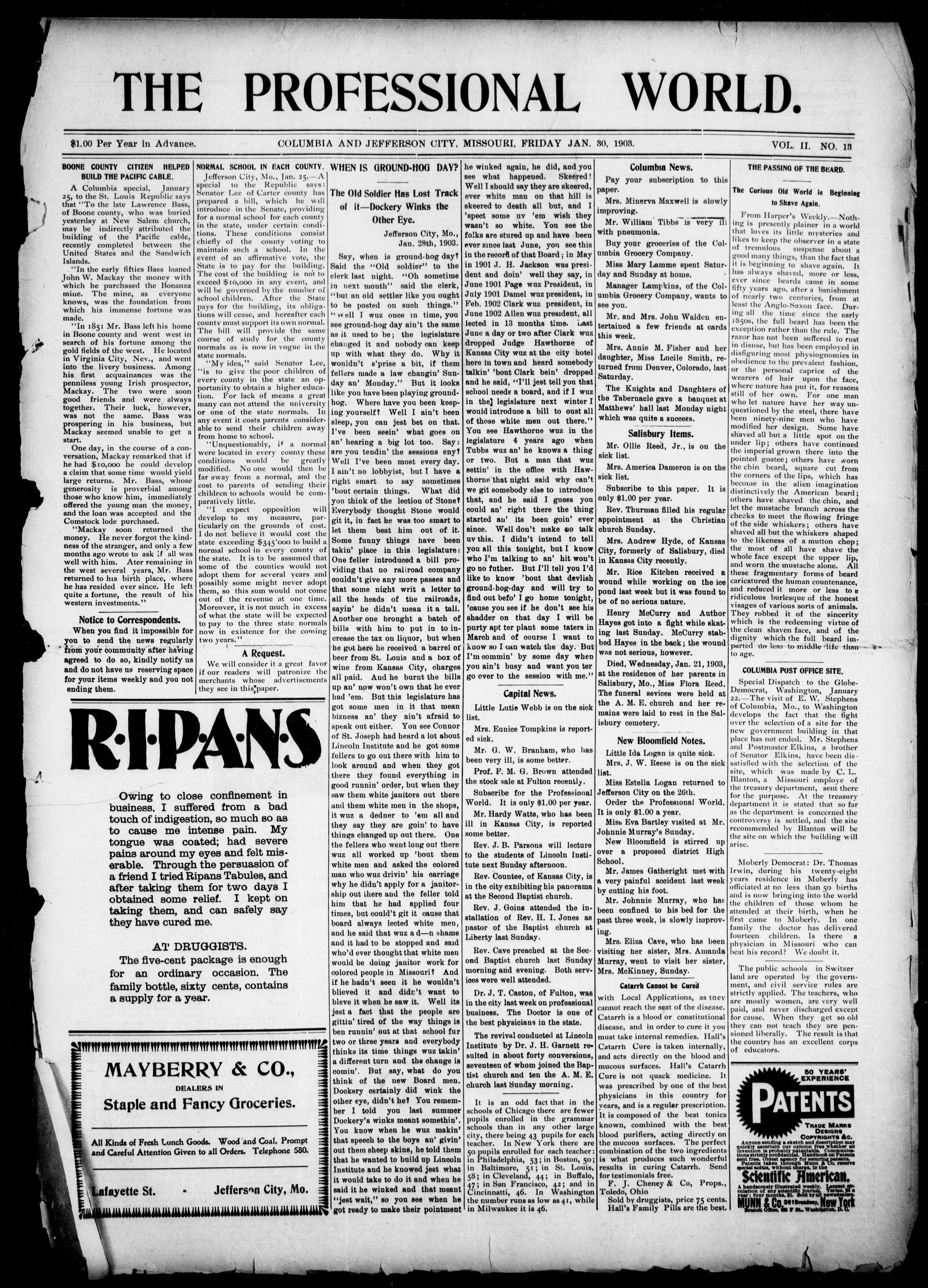
THE PROFESSIONAL WORLD.
$1.00 Per Year in Advance.
BOOLEAN COUNTY CITIZEN HELPED
BUILD THE PACIFIC CABLE.
A Columbia special, January 25, to the St. Louis Republic says that "To the late Lawrence Bass, of Boone county, who was buried yesterday at New Salem church, may be indirectly attributed the building of the Pacific cable, recently completed between the United States and the Sandwich Islands.
"In the early fifties Bass loaned John W. Mackay the money with which he purchased the Bonanza mine. The mine, as everyone knows, was the foundation from which his immense fortune was made.
"In 1851 Mr. Bass left his home in Boone county and went west in search of his fortune among the gold fields of the west. He located in Virginia City, Nev., and went into the livery business. Among his first acquainances was the penniless young Irish prospector, Mackay. The two were soon good friends and were always together. Their luck, however, was not the same. Bass was prospering in his business, but Mackay seemed unable to get a start.
One day, in the course of a conversation, Mackay remarked that if he had $10,000 he could develop a claim that some time would yield large returns. Mr. Bass, whose generosity is proverbial among those who know him, immediately offered the young man the money, and the loan was accepted and the Comstock lode purchased. "Mackay soon returned the money. He never forgot the kindness of the stranger, and only a few months ago wrote to ask if all was well with him. Ater remaining in the west several years, Mr. Bass returned to his birth place, where he has resided ever since. He left quite a fortune, the result of his western investments."
Notice to Correspondents.
When you find it impossible for you to send the news regularly from your community after having agreed to do so, kindly notify us and do not have us reserving space for your items weekly and you not ending them.
R·I·P
Owing to close business, I suffer touch of indigestion to cause me in tongue was corp pains around my erable. Through a friend I tried R after taking them obtained some n taking them, and they have cured
RIPANS
Owing to close confinement in business, I suffered from a bad touch of indigestion, so much so as to cause me intense pain. My tongue was coated; had severe pains around my eyes and felt miserable. Through the persuasion of a friend I tried Ripans Tabules, and after taking them for two days I obtained some relief. I kept on taking them, and can safely say they have cured me.
AT DRUGGISTS.
The five-cent p for an ordinary family bottle, six a supply for a ye
The five-cent package is enough for an ordinary occasion. The family bottle, sixty cents, contains a supply for a year.
All Kinds of Fresh Lunch Goods. Wood and Coal. Prompt and Careful Attention Given to all Orders. Telephone 580.
NORMAL SCHOOL IN EACH COUNTY.
Jefferson City, Mo., Jan. 25.—A special to the Republic says: Senator Lee of Carter county has prepared a bill, which he will introduce in the Senate, providing for a normal school for each county in the state, under certain conditions. These conditions consist chiefly of the county voting to maintain such a school. In the event of an affirmative vote, the State is to pay for the building. The cost of the building is not to exceed $10,000 in any event, and will be governed by the number of school children. After the State pays for the building, its obligations will cease, and hereafter each county must support its own normal. The bill will provide the same course of study for the county normals as is now in vogue in the state normals.
"My idea," said Senator Lec, "is to give the poor children of every county in the state an opportunity to obtain a higher education. For lack of means a great many can not attend the university or one of the state normals. In any event it costs parents considerable to send their children away from home to school.
"Unquestionably, if a normal were located in every county these conditions would be greatly modified. No one would then be far away from a normal, and the cost to parents of sending their children to schools would be comparatively little.
"I expect opposition will develop to my measure, particularly on the grounds of cost. I do not believe it would cost the state exceeding $345'000 to build a normal school in every county of the state. It is to be assumed that some of the counties would not adopt them for several years and possibly some might never adopt them, so this sum would not come out of the revenue at one time. Moreover, it is not much in excess of what the state will be expected to pay to the three state normals now in existence for the coming two years."
We will consider it a great favor if our readers will patronize the merchants whose advertisements they see in this paper.
se confinement in
dered from a bad
ion, so much so as
intense pain. My
ated; had severe
eyes and felt mis-
the persuasion of
hipans Tabules, and
m for two days I
relief. I kept on
and can safely say
me.
package is enough
ty occasion. The
ty cents, contains
ear.
COLUMBIA AND JEFFERSON CITY, MISSOURI, FRIDAY JAN. 30, 1903.
A Request.
The Old Soldier Has Lost Track of it—Dockery Winks the Other Eye.
Jefferson City, Mo. Jan. 28th, 1903.
Say, when is ground-hog day? Said the "Old soldier" to the clerk last night. "Oh sometime in next month" said the clerk, "but an old settler like you ought to be posted on such things." "well I wuz once in time, you see ground-hog day ain't the same as it used to be; the legislature changed it and nobody can keep up with what they do. Why it wouldn't s'praise a bit, if them fellers made a law changin' Sunday an' Monday." But it looks like you have been playing ground-hog. Where have you been keeping yourself? Well I ain't been sleep, you can jest bet on that. I've been seein' what goes on an' hearing a big lot too. Say: are you tendin' the sessions eny! Well I've been most every day. I ain't no lobbyist, but I have a right smart to say sometimes 'bout certain things. What did you think of the lection of Stone? Everybody thought Stone would git it, in fact he was too smart to let them beat him out of it. Some funny things have been takin' place in this legislature: One feller introduced a bill providing that no railroad company couldn't give any more passes and that some night writ a letter to all the heads of the railroads, sayin' he didn't mean it a tall. Another one brought a batch of bills with him to put in to increase the tax on liquor, but when he got here he received a barrel of beer from St. Louis and a box of wine from Kansas City, charges all paid. And he burnt the bills up an' now won't own that he ever had 'em. But this legislature has got some men in it that mean bizness an' they ain't afraid to speak out either. You see Connor of St. Joseph had heard a lot about Lincoln Institute and he got some fellers to go out there with him to look around and when they got there they found everything in good runnin' order, but when they saw them white janitors out there and them white men in the shops, it wuz a dedner to 'em all and they say they are goin' to have things changed up out there. One the fellers who went long out there wuz all worked up 'bout them white men and asked the colored man who wuz drivin' his carriage why he didn't apply for a janitorship out there and the feller told him that he had applied four times, but couldn't git it cause that board always lected white men, and he said that wuz a d—n shame and it had to be stopped and said who'd ever thought that white men would be doing janitor work for colored people in Missouri? And if he hadn't seen it he wouldn't bleived it and didn't want to bleve it when he saw it. Well its jest a fact that the people are gittin' tired of the way things is ben runnin' out at that school fur two or three years and everybody thinks its time things wuz takin' a different turn and the change is comin'. But say, what do you think of the new Board men. Dockery certainly did wink the other eye, didn't he? You remember I told you last summer Dockery's winks meant somethin'. You know when he wuz makin' that speech to the boys an' givin' out them sheep skins, he told them that he wanted to build up Lincoln Institute and he knew jest what it would take to do it and when he said it winked and that meant "jest wait," so you see when he got ready to make their pointment
he winked again, he did, and you see what happened. Skeered! Well I should say they are skeered, ever white man on that hill is skeered to death all but, and I 'spect some uv 'em wish they wasn't so white. You see the folks are stured up and have been ever since last June, you see this in the record of that Board; in May in 1901 J. H. Jackson was president and doin' well they say, in June 1901 Page wuz President, in July 1901 Damel wuz president, in Feb. 1902 Clark wuz president, in June 1902 Allen wuz president, all lected in 13 months time. Last June a day or two after Clark wuz dropped Judge Hawthorne of Kansas City wuz at the city hotel here in town and heard somebody talkin' 'bout Clark bein' dropped and he said, "I'll jest tell you that school needs a board, and if I wuz in the] legislature next winter I would introduce a bill to oust all of those white men out there." You see Hawthorne wuz in the legislature 4 years ago when Tubbs wuz an' he knows a thing or two. But a man that wuz settin' in the office with Hawthorne that night said why can't we git somebody else to introduce that, and he said I guess you could an' right there the thing started an' its been goin' ever since. Well don't make no talk uv this. I didn't intend to tell you all this tonight, but I know who I'm talking to an' hit won't go no futher. But I'll tell you I'd like to know 'bout that devilish ground-hog-day and will try to find out befo' I go home tonight, 'cause you see if he don't see his shadder on that day I will be purty apt ter plant some taters in March and of course I want to know so I can watch the day. But I'm commin' by some day when you ain't busy and want you ter go over to the session with me."
Capital News.
Little Lutie Webb is on the sick list.
Mrs. Eunice Tompkins is reported sick.
Mr. G. W. Branham, who has been very ill, is some better.
Prof. F. M. G. Brown attended the stock sale at Fulton recently.
Subscribe for the Professional World. It is only $1.00 per year.
Mr. Hardy Watts, who has been ill in Kansas City, is reported some better.
Rev. J. B. Parsons will lecture to the students of Lincoln Institute next Sunday afternoon.
Rev. Countee, of Kansas City, is in the city exhibiting his panorama at the Second Baptist church.
Rev. J. Goins attended the installation of Rev. H. I. Jones as pastor of the Baptist church at Liberty last Sunday.
Rev. Cave preached at the Second Baptist church last Sunday morning and evening. Both services were well attended.
Dr. J. T. Caston, of Fulton, was in the city last week on professional business. The Doctor is one of the best physicians in the state.
The revival conducted at Lineoln Institute by Dr. J. H. Garnett resulted in about forty conversions, seventeen of whom joined the Baptist church and ten the A. M. E. church last Sunday morning.
It is an odd fact that in the schools of Chicago there are fewer pupils enrolled in the grammar schools than in any other large city, there being 43 pupils for each teacher. In New York there are 50 pupils enrolled for each teacher: in Philadelphia, 53; in Boston, 50; in Baltimore, 51; in St. Louis, 58; in Cleveland, 44; in Buffalo, 47; in San Francisco, 42; and in Cincinnatti, 46. In Washington the number runs as low as 41, while in Milwaukee it is 46.
Pay your subscription to this paper.
Mrs. Minerva Maxwell is slowly improving.
Mr. William Tibbs is very ill with pneumonia.
Buy your groceries of the Columbia Grocery Company.
Miss Mary Lamme spent Saturday and Sunday at home.
Manager Lampkins, of the Columbia Grocery Company, wants to see you.
Mr. and Mrs. John Walden entertained a few friends at cards this week.
Mrs. Annie M. Fisher and her daughter, Miss Lucile Smith, returned from Denver, Colorado, last Saturday.
The Knights and Daughters of the Tabernacle gave a banquet at Matthews' hall last Monday night which was quite a success.
Salisbury Items.
Mr. Ollie Reed, Jr., is on the sick list.
Mrs. America Dameron is on the sick list.
Subscribe to this paper. It is only $1.00 per year.
Rev. Thurman filled his regular appointment at the Christian church Sunday.
Mrs. Andrew Hyde, of Kansas City, formerly of Salisbury, died in Kansas City recently.
Mr. Rice Kitchen received a wound while working on the ice pond last week but it was found to be of no serious nature.
Henry McCurry and Author Hayes got into a fight while skating last Sunday. McCurry stabbed Hayes in the back; the wound was not serious, however.
Died, Wednesday, Jan. 21, 1903, at the residence of her parents in Salisbury, Mo., Miss Flora Reed. The funeral services were held at the A. M. E. church and her remains were laid to rest in the Salisbury cemetery.
New Bloomfield Notes.
Little Ida Logan is quite sick.
Mrs. J. W. Reese is on the sick list.
Miss Estella Logan returned to Jefferson City on the 26th.
Order the Professional World. It is only $1.00 a year.
Miss Eva Bartley visited at Mr. Johnnie Murray's Sunday.
New Bloomfield is stirred up over a proposed district High School.
Mr. James Gatheright met with a very painful accident last week by cutting his foot.
Mr. Johnnie Murray, who has been confined to his bed for the past three week, is slowly improving.
Mrs. Eliza Cave, who has been visiting her sister, Mrs. Amanda Murray, went to visit her sister, Mrs. McKinney, Sunday.
Catarrh Cannot be Cured
with Local Applications, as they cannot reach the seat of the disease. Catarrh is a blood or constitutional disease, and in order to cure it you must take internal remedies. Hall's Catarrh Cure is taken internally, and acts directly on the blood and mucous surfaces. Hall's Catarrh Cure is not quack medicine. It was prescribed by one of the best physicians in this country for years, and is a regular prescription. It is composed of the best tonics known, combined with the best blood purifiers, acting directly on the mucous surfaces. The perfect combination of the two ingredients is what produces such wonderful results in curing Catarrh. Send for testimonials free.
F. J. Cheney & Co., Props,
Toledo, Ohio
Sold by druggists, price 75 cents.
Hall's Family Pills are the best.
VOL. II. NO. 13
THE PASSING OF THE BEARD.
The Curious Old World is Beginning to Shave Again.
From Harper's Weekly. —Nothing is presently plainer in a world that loves its little mysteries and likes to keep the observer in a state of tremulous suspense about a good many things, than the fact that it is beginning to shave again. It has always shaved, more or less, ever since beards came in some fifty years ago, after a banishment of nearly two centuries, from at least the Anglo-Saxon face. During all the time since the early 1850s, the full beard has been the exception rather than the rule. The razor has not been suffered to rust in disuse, but has been employed in disfiguring most physiognomies in obedience to the prevalent fashion, or the personal caprice of the wearers of hair upon the face, where nature has put it, for reasons still of her own. For one man who let nature have her way unquestioned by the steel, there have been ninety-nine men who have modified her design. Some have shaved all but a little spot on the under lip; others have continued the imperial grown there into the pointed goatee; others have worn the chin beard, square cut from the corners of the lips, which have become in the alien imagination distinctively the American beard; others have shaved the chin, and let the mustache branch across the checks to meet the flowing fringe of the side whiskers; others have shaved all but the whiskers shaped to the likeness of a mutton chop; the most of all have shave the whole face except the upper lip, and worn the mustache alone. All these fragmentary forms of beard caricatured the human countenance, and reduced it more or less to ridiculous burlesque of the honest visages of various sorts of animals. They robbed it of the sincerity which is the redeeming virtue of the clean shaven face, and of the dignity which the full beard imparted to less to middle life than to age.
COLUMBIA POST OFFICE SITE.
Special Dispatch to the Globe-Democrat, Washington, January 22.—The visit of E. W. Stephens of Columbia, Mo., to Washington develops the fact that the fight over the selection of a site for the new government building in that place has not ended. Mr. Stephens and Postmaster Elkins, a brother of Senator Elkins, have been dissatisfied with the selection of the site, which was made by C. L. Blanton, a Missouri employee of the treasury department, sent there for the purpose. At the treasury department it is stated that so far as the department is concerned the controversy is settled, and the site recommended by Blanton will be the site on which the building will arise.
Moberly Democrat: Dr. Thomas Irwin, during his twenty-eight years residence in Moberly has officiated at no less than 50 births and is now bringing into the world the children of those whom he attended at their birth, when he first came to Moberly. In one family the doctor has delivered fourteen children. Is there a physician in Missouri who can beat his record? We doubt it.
The public schools in Switzer land are operated by the government, and civil service rules are strictly applied. The teachers, who are mostly women, are very well paid, and never discharged except for cause. When they get so old they can not teach they are pensioned liberally. The result is that the country has an excellent corps of educators.
50 YEARS' EXPERIENCE
PATENTS
TRADE MARKS DESIGN
COPYRIGHTS & C.
Anyone sending a sketch and description may
quickly ascertain our opinion free whether an
authority has received the sketch or strictly confidential. Handbook on Patents
for securing patent rights or securing patent
patents taken through OMR, who receive
special notice, without charge, is the
Professional World
RUFUS L, LGGAN, B. S. D., Editor.
COLUMBIA. : : : MISSOURI
Matters of Interest Covering Various Parts of the World and Put in Concise Form.
H. C. Hansbrough has been re-elected senator from North Dakota.
The plague fatalities at Mazatlau, Mex., average 33 per cent. Fully one-third of the people have fled.
The Pierre, S. D., Democrats have nominated John Bowler of Aberdeen for the United States senate.
Milton McClure is dead at his home in Carlinville, Ill. He was banker and has held several local offices.
James Maher, aged 80, is dying at the hospital at Toledo, O., as the result of having been frozen while on a street car.
A venire for a special grand jury to investigate the coal situation was issued and witnesses summoned at Chicago.
A westbound passenger train on the Denver & Rio Grande was derailed near Sargent College. Thirty passengers were injured four seriously.
The jury in the perjury trial of Chas. F. Kelly, formerly speaker of the house of delegates in St. Louis, brought in a sealed verdict Monday.
A. C. VanMater, who resided about 50 miles from Pierre, S. D., dropped dead Monday evening. He was one of the first Dakota settlers.
It is officially announced at The Hague that the self-styled sultan of Achin, (Sumatra) Dutch East Indies, has tendered his submission.
Ella Mont. a spokane, Wash., domestic, was shot and killed by Ed. Spencer, who then shot himself. The girl's refusal to marry him was the cause.
Fire in the St. James' Orphanage at Benson, Neb., caused $25,000 damages. There was a panic among the 100 inmates, but all were taken out safely.
Notices of dismissal have been served by the colliers in the Bochum and Dortmund districts, Westphalia, where it has been decided to restrict the output of coal.
A special from Pekin says the censor's office has memorialized the dowager empress to resign in favor of the emperor as the first step in the policy of reform.
The nomination of Pietro Mascagni, the composer, to the directorship of the Rossini Lyceum, the musical conservatory at Pesaro, has been officially confirmed.
Miss Mary Andrews, of Hamilton, O., has been installed as pastor of the First Presbyterian church at Kansas City. She is the only woman preacher in Missouri.
The Illinois and Black Diamond railroad has incorporated. It is the intention to build from Peoria to Springfield, and thence to Harrisburg, in all about 250 miles.
At Hamilton, Ont., Maurice Reardon, the Hamilton wing shot, won first money in the Grand Canadian hand-cap. Of 41 competitors he alone made a straight score of 20 kills.
Herminia Josephson cashier, and Jno. Cottain, engineer, lost their lives in a fire which destroyed the dry goods store of Aaron & Weitheimer of New York Friday night. The loss is $80,-000.
An electric road will be built from Sault Marie to St. Ignace in the interests of the Pennsylvania railroad. It is expected that the running time between the two places will be shortened to one hour.
The machinists on the Big Four railroad have demanded an increase of wages. A conference with the superintendent of motive power did not result in final action. Another conference will be held later.
Four powder kegs exploded in a Slav boarding house in Windner, Pa., Friday night. Six men were probably fatally injured. One of these was endeavoring to dry a quantity of powder when the explosion occurred.
A decision has been reached to make the big $10,000 Charter Oak stake at Hartford, Conn., open to 2:09 trotters. The mark last year was 2:11. The stake will be contested for at the grand circuit meeting next fall.
George C. Coon, general agent in Milwaukee of the Pere Marquette railroad, has been advanced to be the assistant general freight agent of the enlarged system of that company, with headquarters in Milwaukee.
The common council of Janesville, Wis., was restrained from paying certain contracts until a suit brought by the citizens against the council and contractors on a charge of conspiracy to rob the city shall have been decided.
The engagement is announced of First Lieutenant Charles Edward Hay, Jr. Twenty-fourth United States infantry, of former Mayor Hay of Springfield, Ill., and nephew of Secretary of State Hay and Miss Jane Robey, one of the belles of Decatur, Ill. The date of the wedding is not as yet decided upon.
The gentlemen of the Methodist Episcopal church of Rck Valley will give a public supper Jan. 22. The menu will consist of edibles cooked and baked by gentlemen only and gentlemen will attend to every detail of receiving, serving, etc. to dish-washing. Everybody is invited, gentlemen especially invited when escorted by ladies. The object is to pay off an old debt.
At Valparaiso, Ind., Emma and John Cliska, aged 10 and 12, were struck by a fast Lake Shore train Friday and killed. Michael Michaelis, a merchant of Porter, Ind., was struck and killed by the same train a few minutes later.
The Cherokee Times and the Cherokee Herald have been merged. A new company has been formed and the two papers will be issued in the future under the title, of Times-Herald, with C.W. Thompson of the Herald as editor. Cherokee has had three papers for some time past. It was found that the field was not large enough for all, and the consolidation is regarded as a happy settlement of existing conditions.
The inspec in the Gonzales tracedy resulted in verdict accusing Tillman of causing the editor's death.
BLOCKADE IS ABOUT ENDED.
BLOCKADE IS ABOUT ENDED.
Minister Bowen and Representatives of Powers Meet—Conference Is Satisfactory.
Washington, Jan. 28.—The first joint conference of the Venezuelan negotiators occurred during the afternoon at Minister Bowen's apartments. The envoys asked whether the monthly payments to the allies should be in proportion to the amount of the claims or whether they would receive the same amounts each month until the indemnity was paid. Minister Bowen said he was willing to leave this with the powers themselves to settle, and that any arrangements they might make would be satisfactory to Venezuela.
Another obstruction not yet cleared was whether the claims of the allies should receive preferential treatment against those of other countries. Minister Bowen made the point that if the dispute was referred to The Hague all would be equality, and furthermore as this question did not form a part of the allies' condition precedent to the raising of the blockade, it did not seem fair that it should be presented as an essential, now that Venezuela had compiled with the original proposition and offered a satisfactory territory. This answer was cabled to London, Berlin and Rome tonight and it is hoped that favorable answers will be received tomorrow.
The force of Minister Bowen's contention has appealed to the allies' representatives here, and there is reason to believe that the powers will yield on this last objection and sign the protocol for raising the blockade.
Caracas Not Worried.
Caracas, Jan. 28.—The news cabled yesterday that the blockade would be called off tomorrow is confirmed by the semi-official press here, which says:
"There are well founded reasons today for the belief that the blockade will be suspended between today and tomorrow night." It is a visible fact that only foreigners are suffering from the effects of the blockade. Venezuelans themselves are accustomed to native products and are not undergoing hardships. The supply of corn is sufficient to furnish native bread for a year.
How It Started.
London, Jan. 28.—Count Von Quadt, the German government d'affaires at Washington, has been instructed to communicate to the United States and Count Wolff-Metternich, the German ambassador here to the British foreign office further particulars received by the German government of the circumstances which occasioned the bombardment of Fort San Carlos. According to this statement the German cruiser Panther was proceeding to enter Maracalco lagoon when she was suddenly fired upon and had no alternative but to return the fire. The commander of the Panther communicated to the German commodore and thereupon the other German warships were ordered to bombard San Carlos. In making this communication to the United States the German government expressed the conviction that no British or American admiral would have sufficed his ships to be fired upon without retaliating. It is affirmed by the German officials here that the action of Fort San Carlos was probably directed from Caracas, the purpose being to gain American and European sympathy by making it appear that the Germans were acting harshly. It is thought that the fort would not have fired on a British ship.
As indicative of the fact that the Germans do not desire to embroil the situation uncessarily, it is pointed out in the official statement that the Restaurant now under the German flag "was recently closer to the shore at La Guayara when many rifle shots were fired at her, but, in order not to cause trouble, she left without returning the fire."
MINE WORKERS CLOSE MEET.
Indianapolis. Jan. 28.—The mine workers completed their work and adjourned this afternoon. Many important measures have been considered and acted upon. Among them the formulation of a demand for an increase of 12 1-2 cents flat per ton on the run of the mine basis and a flat differential of 7 cents per ton between pick and machine mined coal a demand for an increase of wages of the laborers in proportion to the increase of miners; a retusal to commit the convention to socialism and to government ownership; the raising of officers' salaries; a declaration against children working in mines; a demand for an anti-injunction law; and plans for a defense fund. A conference is to be held with the operators Friday night. It is open that the conference will be of short duration.
The afternoon was devoted to speeches. President Mitchell declared that "The trades union meeting does more than raise the wages; it is raising the standard of manhood, of womanhood and of citizenship." And that the growing strength of trade unionism, is a bright hope for the country. He urged the miners "not to follow false Gods," but to steer clear of the "rocks upon which so many labor movements have been wrecked."
Will Create Ten Cardinals
Washington. Jan. 28.—Word has reached here from Rome that the next consistory probably will be held at the end of February when the pope will celebrate the 25th year of pontificate. The occasion according to the best information obtainable in Rome, will mark the creation of eight or ten cardinals, all of whom it is understood will be italians, save one. The exception it is said is a German prelate, possibly the had of the Strasburg diocese.
Tender Mitchell Position.
Springfield, Ill., Jan. 28.—John Mitchell, president of the miners' union, has been offered a place on the Illinois board of arbitration. Col. John Oglesby, secretary to Governor Gates, left tonight for Indianapolis with a letter from the governor offering Mr. Mitchell the position.
Mr. Mitchell is a resident of Illinois, and was formerly the vice president of the Illinois organization of Mine Workers. It is understood that in offering Mr. Mitchell this appointment the governor did not take politics into consideration.
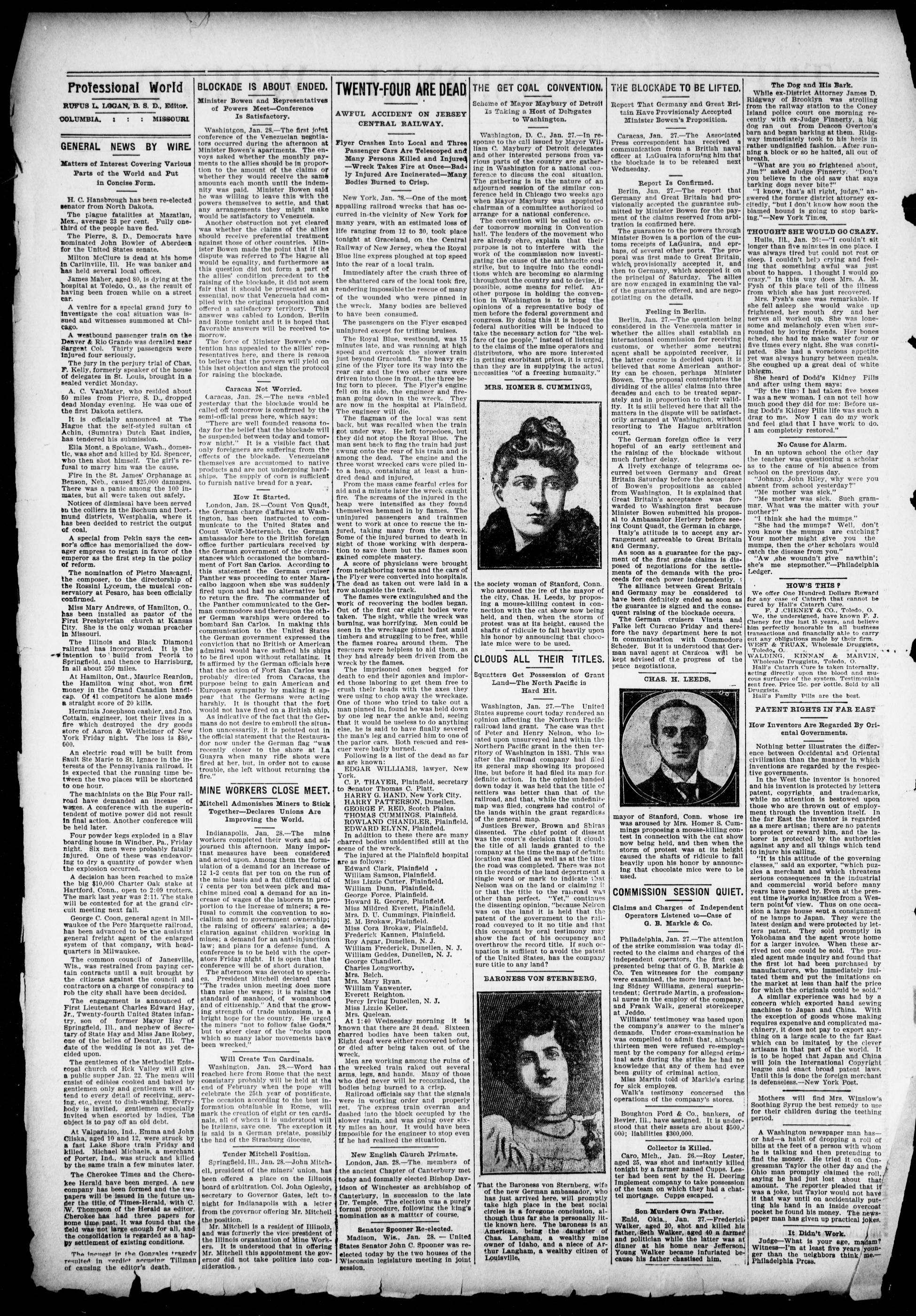
TWENTY-FOUR ARE DEAD
AWFUL ACCIDENT ON JERSEY CENTRAL RAILWAY.
Flyer Crashes Into Local and Three Passenger Cars Are Telescoped and Many Persons Killed and Injured—Wreck Takes Fire at Once—Badly Injured Are Incinerated—Many Bodies Burned to Crisp.
New York, Jan. 28.—One of the most appalling railroad wrecks that has occurred in the vicinity of New York for many years, with an estimated loss of life ranging from 12 to 30, took place tonight at Graceland, on the Central Railway of New Jersey, when the Royal Blue line express ploughed at top speed into the rear of a local train.
Immediately after the crash three of the shattered cars of the local took fire, rendering impossible the rescue of many of the wounded who were pinned in the wreck. Many bodies are believed to have been consumed.
The passengers on the Flyer escaped uninjured except for trifling bruises. The Royal Blue, westbound, was 15 minutes late, and was running at high speed and overtook the slower train just beyond Graceland. The heavy engine of the Flyer tore its way into the rear car and the two other cars were driven into those in front, the three being torn to pieces. The Flyer's engine fell on its side, the engineer and fireman going down in the wreck. They are now in the hospital at Plainfield. The engineer will die.
The flagman of the local was sent back, but was recalled when the train got under way. He left torpedoes, but they did not stop the Royal Blue. The man sent back to flag the train had just swung onto the rear of his train and is among the dead. The engine and the three worst wrecked cars were piled into a heap, containing at least a hundred dead and injured.
From the mass came fearful cries for aid and a minute later the wreck caught fire. The screams of the injured in the heap were intensified as they found themselves hemmed in by flames. The uninjured passengers and trainmen went to work at once to rescue the injured, taking many from the wreck. Some of the injured burned to death in sight of those working with desperation to save them but the flames soon gained complete mastery.
A score of physicians were brought from neighboring towns and the cars of the Flyer were converted into hospitals. The dead as taken out were laid in a row alongside the track.
The flames were extinguished and the work of recovering the bodies began. Out of the first car eight bodies were taken. The sight, while the wreck was burning, was horrifying. Men could be seen in the wreckage pinned fast amid timbers and struggling to be free, while the flames roared around them. The rescuers were helpless to aid them, as they had already been driven from the wreck by the flames.
The imprisoned ones begged for death to end their agonies and implored those laboring to get them free to crush their heads with the axes they were using to chop away the wreckage. One of those who tried to take out a man pinned in, found he was held down by one leg near the ankle and, seeing that it would be useless to do anything else, he is said to have finally severed the man's leg and carried him to one of the parlor cars. Both rescued and rescuer were badly burned.
Following is a list of the dead as far as are known:
EDGAR WILLIAMS, lawyer, New York.
C. P. THAYER, Plainfield, secretary to Senator Thomas C. Platt.
HARRY G. HAND, New York City.
HARRY PATTerson, Dunellen.
GEORGE F. RED, Scotch Plains.
THOMAS CUMMINGS, Plainfield.
ROWLAND CHANDLER, Plainfield.
EDWARD ELYNN, Plainfield.
In addition to these there are many charred bodies unidentified still at the scene of the wreck.
The injured at the Plainfield hospital are as follows:
Edward Clark, Plainfield.
William Samson, Plainfield.
Miss Lizzie Cutter, Plainfield.
William Dunn, Plainfield.
George Force, Plainfield.
Howard R. George, Plainfield.
Miss Mildred Everett, Plainfield.
Mrs. D. U. Cummings, Plainfield.
E. M. Brokaw, Plainfield.
Miss Cora Brokaw, Plainfield.
Frederick Kannen, Plainfield.
Roy Angar, Dunellen, N. J.
William Frederick, Dunellen, N. J.
William Geddes, Dunellen, N. J.
George Chandler.
Percy Irving Dunellen, N. J.
Miss Lizzie Keller.
Mrs. Quelean.
At 1:40 Wednesday morning it is known that there are 24 dead. Sixteen charred bodies have been taken out. Eight dead were either recovered before or died after being taken out, of the wreck.
Men are working among the ruins of the wrecked train raked out several arms, legs, and hands. Many of those who died never will be recognized, the bodies being burned to a crisp.
Railroad officials say that the signals were in working order and properly set. The express train overran and dashed into the block occupied by the slower train, and was going over sixty miles an hour. It would have been impossible for the engineer to stop even if he had realized the situation.
New English Church Primate.
London, Jan. 28.—The members of the ancient Chapter of Canterbury met today and formally elected Bishop Davidson of Winchester as archbishop of Canterbury, in succession to the late Dr. Temple. The election was a purely formal procedure, following the king's nomination as a matter of course.
Senator Spooner Re-elected
Madison, Wis., Jan. 28. — United States Senator John C. Spooner was re-elected today by the two houses of the Wisconsin legislature meeting in joint session.
GET COAL CONVENTION
Scheme of Mayor Maybury of Detroit Is Taking a Host of Delegates to Washington.
Washington, D. C., Jan. 27.—In response to the call issued by Mayor William C. Maybury of Detroit delegates and other interested persons from various parts of the country are gathering in Washington for a national conference to discuss the coal situation. The gathering is in the nature of an adjourned session of the similar conference held in Chicago two weeks ago when Mayor Maybury was appointed chairman of a committee authorized to arrange for a national conference.
The convention will be called to order tomorrow morning in Convention hall. The leaders of the movement who are already ehre, explain that their purpose is not to interfere with the work of the commission now investigating the cause of the anthracite coal strike, but to inquire into the conditions which are becoming so alarming throughout the country and to devise, if possible, some means for relief. Another purpose in holding the convention in Washington is to bring the opinions of a representative body of men before the federal government and congress. By doing this it is hoped the federal authorities will be induced to take the necessary action for "the welfare of the people," instead of listening to the claims of the mine operators and distributors, who are more interested in getting exorbitant prices, it is urged, than they are in supplying the actual necessities "of a freezing humanity."
MRS. HOMER S. CUMMINGS.
M.
the society woman of Stanford, Conn. who aroused the ire of the mayor of the city, Chas. H. Leeds, by proposing a mouse-killing contest in connection with the cat show now being held, and then, when the storm of protest was at its height, caused the shafts of ridicule to fall heavily upon his honor by announcing that chocolate mice were to be used.
CLOUDS ALL THEIR TITLES.
CLOUDS ALL THEIR TITLES.
Squatters Get Possession of Grant Land—The North Pacific is Hard Hit.
Washington, Jan. 27.—The United States supreme court today rendered an opinion affecting the Northern Pacific railroad land grant. The case was that of Peter and Henry Nelson, who located upon unsurveyed land within the Northern Pacific grant in the then territory of Washington in 1881. This was after the railroad company had filed its map showing a proposed line, but before he had filed its map for definite action. In the opinion handed down today it was held that the title of settlers was better than that of the railroad, and that, while the undefinite map was filed, congress had control of the lands within the grant regardless of the general man.
Justices Brewer, Brown and Shiras dissented. The chief point of dissent was the court's decision that it clouded the title of all lands granted to the company at the time the map of definite location was filed as well as at the time the road was completed. There was not on the records of the land department a single word or mark to indicate that Nelson was on the land or claiming it or that the title to the rainroad was other than perfect. "Yet," continues the dissenting opinion, "because Nelson was on the land it is held that the patent of the government to the railroad conveyed to it no title and that this occupant by oral testimony may show the fact of his occupancy and overthrow the record title. If such occupation is sufficient to avoid the patent of the United States, has the company sure title to any land?
BARONESS VON STERNBERG.
M.
That the Baroness von Sternberg, wife of the new German ambassador, who has just arrived here, will promptly take high place in the best social circles is a foregone conclusion, although thus far she is personally little known here. The baroness is an American, being the daughter of Chas. Langham, a wealthy mine owner of Idaho, and a niece of Arthur Langham, a wealthy citizen of Louisville.
THE BLOCKADE TO BE LIFTED.
THE BLOCKADE TO BE LIFTED.
Report That Germany and Great Britain Have Provisionally Accepted Minister Bowen's Proposition.
Caracas, Jan. 27.—The Associated Press correspondent has received a communication from a British naval officer at LaGuatra informing him that the blockade is to be released next Wednesday.
Report Is Confirmed.
Berlin, Jan. 27.—The report that Germany and Great Britain had provisionally accepted the guarantee submitted by Minister Bowen for the payment of the claims reserved from arbitration is confirmed here.
The guarantee to the powers through Minister Bowen is a portion of the customs receipts of LaGuaira, and epheps, of several other ports. The proposal was first made to Great Britain, which provisionally accepted it, and then to Germany, which accepted it on the principal of Saturday. The allies are now engaged in examining the val-of the guarantee offered, and are negogotiating on the details.
Feeling in Berlin.
Berlin, Jan. 27.—The question being considered in the Venezuela matter is whether the allies shall establish an international commission for receiving customs, or whether some neutral agent shall be appointed receiver. If the latter course is decided upon it is believed that some American authority can be chosen, perhaps Minister Bowen. The proposal contemplates the dividing of the allies' claims into three decades and each to be treated separately and in proportion to their validity. It is still believed here that all the matters in the dispute will be satisfactorily arranged at Washington, without resorting to The Hague arbitration court.
The German foreign office is very hopeful of an early settlement and the raising of the blockade without much further delay.
A lively exchange of telegrams occurred between Germany and Great Britain Saturday before the acceptance of Bowen's propositions as cabled from Washington. It is explained that Great Britain's acceptance was forwarded to Washington first because Minister Bowen submitted his proposal to Ambassador Herbery before seeing Count Quadt, the German in charge. Italy's attitude is to accept any arrangement agreeable to Great Britain and Germany. As soon as a guarantee for the payment of the first grade claims is disposed of negotiations for the settlements of the demands with the proceeds for each power independently. The alliance between Great Britain and Germany may be considered to have been definitely ended as soon as the guarantee is signed and the consequent raising of the blockade occurs.
The German cruisers Vineta and Falke left Curacao Friday and therefore the navy department here is not in communication with Commodora Scheder. But it is understood that German naval agent at Curacao will be kept advised of the progress of the peace negotiations.
8
mayor of Stanford, Conn. whose ire was aroused by Mrs. Homer S. Cummings proposing a mouse-killing contest in connection with the cat show now being held, and then when the storm of protest was at its height caused the shafts of ridicule to fall heavily upon his honor by announcing that chocolate mice were to be used.
COMMISSION SESSION QUIET.
Claims and Charges of Independent Operators Listened to—Case of G. B. Markle & Co.
Philadelphia, Jan. 27.—The attention of the strike commission was today directed to the claims and charges of the independent operators, the first case presented being that of G. B. Markle & Co. Ten witnesses for the company were examined, the more important being Sidney Williams, general suprenant; Gertrude Martin, a professional nurse in the employ of the company, and Frank Walk, general storekeeper at Jeddo.
Williams' testimoney was based upon the company's answer to the miner's demands. Under cross-examination he was compelled to admit that, although thirteen men were refused re-employment by the company for alleged criminal acts during the strike he had ever been guilty of criminal action.
Miss Martin told of Markle's caring for sick employees.
Walk's testimony concerned the operations of the company's stores.
Boughton Ford & Co., bankers, of Bevler, Ill., have assigned. It is understood that their assets are about $500,000; liabilities $300,000.
Collector is Killed
Caro, Mich., Jan. 26.—Roy Lester, aged 25, was shot and instantly killed tonight by a farmer named Cupps. Lester had been sent by the H. Deering Implement company to take possession of the team on which they had a chattel mortgage. Cupps escaped.
Son Murders Own Father.
Enld, Okla., Jan. 27—Fredericki Walker, aged 20, shot and killed his father, Seth Walker, aged 40 a farmer and politician while the latter was at dinner at his home near Jefferson. Young Walker became infuriated because his father chastised him.
The Dog and His Bark.
While ex-District Attorney James D. Ridgway of Brooklyn was strolling from the railway station to the Coney Island police court one morning recently with ex-Judge Finnerty, a big dog ran out from Deacon Overton's barn and began barking at them. Ridgway immediately took to his heels in rather undignified fashion. After running a block or so he halted, all out of breath.
"What are you so frightened about, Jim?" asked Judge Finnerty. "Don't you believe in the old saw that says barking dogs never bite?"
"I know, that's all right, judge," answered the former district attorney excitedly, "but I don't know how soon the blamed hound is going to stop barking."—New York Times.
THOUGHT SHE WOULD GO CRAZY.
HOUSE she would be so cute!
Hulls, Ill., Jan. 26: "I couldn't sit longer than five minutes in one place. I was always tired but could not rest or sleep. I couldn't help crying and feeling that something awful was just about to happen. I thought I would go crazy." In this way does Mrs. A. M. Fysh of this place tell of the illness from which she has just recovered.
Mrs. Fysh's case was remarkable. If she fell asleep she would wake up frightened, her mouth dry and her nerves all worked up. She was lonesome and melancholy even when surrounded by loving friends. Her bones ached, she had to make water four or five times every night. She was constipated. She had a voracious appetite yet was always hungry between meals. She coughed up a great deal of white phlegm.
She heard of Dodd's Kidney Fills and after using them says:
"By the time I had taken five boxes I was a new woman. I can not tell how much good they did for me: Before using Dodd's Kidney Pills life was such a drag to me. Now I can do my work and feel glad that I have work to do. I am completely restored."
No Cause for Alarm.
In an uptown school the other day the teacher was questioning a scholar as to the cause of his absence from school on the previous day.
"Johnny, John Riley, why were you absent from school yesterday?"
"Me mother was sick."
"Me mother was sick. Such grammar. What was the matter with your mother?"
"I think she had the mumps."
"She had the mumps? Well, don't you know the mumps are catching? Your mother might give you the mumps, then the other scholars would catch the disease from you." "Aw, she woundn't give nawthin'; she's me stepmother."—Philadelphia Ledger.
HOW'S THIS?
We offer One Hundred Dollars Reward for any case of Catarrh that cannot be cured by Hall's Catarrh Cure.
F. J. CHENEY & CO., Toledo, O.
We, the undersigned, have known J. Cheney and have believed him perfectly honorable in all business transactions and financially able to carry out any obligations made by their firm.
WEST & TRUX, Wholesale Druggists,
Toledo, O.
WALDING, KINNAN & MARVIN,
Wholesale Druggists, Toledo, O.
Hall's Catarrh Cure is taken internally, acting directly upon the blood and mucous surfaces of the system. Testimonials are price 75c. per bottle. Sold by all Druggers.
Hall's Family Pills are the best.
PATENT RIGHTS IN FAR EAST
How Inventors Are Regarded By Oriental Governments.
Nothing better illustrates the difference between Occidental and Oriental civilization than the manner in which inventions are regarded by the respective governments.
In the West the inventor is honored and his invention is protected by letters patent, copyrights, and trademarks, while no attention is bestowed upon those who are thrown out of employment through the invention itself. In the far East the inventor is regarded as a mere artisan; there are no patents to protect or reward him, and the laborer is protected by the authorities against any and all things which tend to injure his calling.
"It is this attitude of the governing classes," said an exporter, "which puzzles a merchant and which threatens serious consequences in the industrial and commercial world before many years have passed by. Even at the present time it works injustice from a Western point of view. Thus on one occasion a large house seats a consignment of ne lamps to Japan. They were the latest design and were protected by letters patent. They sold promptly in Yokohama and the agent wrote home for a larger invoice. When these arraigned not one could be sold, the puzzles were found and found the first lot had been purchased by manufacturers, who immediately imitated them and put the imitations on the market at less than half the price for which the originals could be sold."
A similar experience was had by a concern which exported hand sewing machines to Japan and China. With the exception of goods whose making requires expensive and complicated machinery, it does not pay to export anything on a large scale to the far East which can be imitated by the clever artisans in that part of the world. It is to be hoped that Japan and China will join the International Copyright league and enact broad patent laws. Until this is done the foreign merchant is defenseless.—New York Post.
Mothers will find Mrs. Winslow's Soothing Syrup the best remedy to use for their children during the teething period.
A Washington newspaper man has or had—a habit of dropping a roll of bills at the feet of a person with whom he is talking and then pretending to find the money. He tried it on Congressman Taylor the other day and the Ohio man promptly claimed the roll, saying he had just lost about that amount. The reporter pleaded that it was a joke, but Taylor would not have it that way until on accidentally putting his hand in an inside overcoat pocket he found his money. The newspaper man has given up practical jokes.
It Didn't Work.
Judge—What is your age, madam? Witness—I'm at least five years younger than the neighbors think me. Philadelphia Press.
Use Crescent Fence and see that you get it. Write today for catalogue.
WIRE FENCE AND
IOWA CITY, IOWA.
A glance into the early records of the parish of the St. Paul's Episcopal church of Boston shows us that at a meeting of the proprietors held on September 11, 1820, the pews in the church were divided into three classes. The number of proprietors of St. Paul's is now 34, and it is interesting to note that at the auction spoken of in 1820 the sum of $84,950 was realized from 134 pews at the present date a value of $14,925.37 each or a gain of $13-291.42, or figured in percentage, a gain of 2.239 per cent for the past 82 years, which is not a bad interest on the original investment. One, upon looking into the historic old edifice and inspecting the pews, would never dream of their real value. Rising to the height of three feet they are upholstered in faded red brocaded satin, the pattern of which cannot be discovered on account of the wear.
The doors and sides are of enameled white panels topped off with railings of polished book rack of black walnut running the whole length of the pew, while carpet upholstered kneeling hassocks are in plenty.
Pew No. 25, for which Daniel Webster bid $650 at the first sale in 1820, is on that side of the church facing Winter street and is midway between the channel and the front entrance. It is only conspicuous from the other pews by being opposite the second stained glass window on the Winter street side. Its present occupant is Miss Ellen F. Mason.
The last six pews in the last row are somewhat higher than the others, as the railings are at least five high above the aisles. Every pew is upholstered in the same style and no two differ in fitting and decorations.—Boston Post.
The city of Wiesbaden, Germany, has constructed extensive ozone water works for the purpose of obtaining a drinking water entirely free from pathogenic germs. The ozone, generated by electric discharges in an apparatus composed of metal tubes, passes upward through coarse gravel contained in towers, while the water to be sterilized flows down and arrives at the bottom perfectly germless.
Capital, - $2,000,000
Surplus & Profits 1,000,000
DIRECTORS
A. MONTGOMERY WARD.
American Trust and Savings Bank CHICAGO, ILL.
A PICTURE OF HEALTH Do you wish to look like one?
There is a preparation made that will transform weak and sickly persons into veritable pictures of health. The preparation is known under the name of TONO-CAPS, city of Galesburg by Chemist Oscar D. Thorelius at his Prescription Drug store on the northwest corner of Main and Seminary streets. Sent postpaid on receipt of 80c in stamps or money order. For further information, testimonials, etc., address Oscar D. TONO-CAPS, Thorelius, Chemist, Galesburg, Ill.
We disagree - all competing.
John Whittier, a Lowell weaver, is a consistent advocate of physical culture. He walks 24 miles each day between the factory and his home in Littleton. Between the daily journeys on foot Whittier spends ten hours before a loom in a Lowell suspender factory. He is a small man, about 40 years old, and is all muscle and grit.
Rear Admiral George B. Balch, who enjoys the distinction of being the oldest living flag officer in the United States navy, has just entered upon his 83d year. For several years he was commandant of the naval academy at Annapolis.
READ CAREFULLY
CANCERS
Are one of the things that the human race is heir to—it makes men and women trouble—it is a horrible disease and brings sure death and a painful one, but it can be cured without a knife or drugs, at Prof. J. F. Whitson Institute of Magnetic Magnetism. And once cured always cured, because it takes out roots and all.
J.
J. F. WHITSON.
To the Editor: Kindly allow me space in your valuable paper. I wish to tell the suffering humanity what torture I have endured for years. Three years ago I came to this city from Clarence, Iowa, to have a cancer out of my left thigh, from which I was a great sufferer; after undergoing the operation I was told that was the last of my cancer. I would need suffer no more, but it was only a few months until the cancer made their deathly grip on my right thigh and abdomen. Again suffering almost three years could not sleep or rest in bed at night; used to groan and turn in bed, and then get up and set in a chair the remainder of the night. I finally resolved to undergo a second operation with the knife. Giving my life and children good-bye, telling them life or death must come soon. I took the train for Davenport, the 29th of October. Finding a good friend of mine, telling him of my torture and intention of undergoing the knife again, then my dear, kind and noble friend said to me: Why not see Prof. J. F. Whitson, the successful magnetic healer, who uses no drugs or knife. I soon resolved to see him. Going to his Institute, finding a good friend of mine, telling him of getting well. After waiting for my turn the Professor gave me twenty minutes of his valuable time, telling me what alled me without one question, and telling me he could cure me as he had thousands of others without knife or drugs, and I at once gave the Professor my case and I thank God I did. I took ten weeks' treatment and he has taken the cancer entirely away; now I am a sound and well man. Not only the cancer is cured, but my limbs from my knees to my ankles were as black as ink, and scarcely able to walk; the doctors told me, after having given me medicine and salve, that my limbs were incurable, now they, too, are all right; no more pain, nor restless, long, dreary nights, but sweet peace and rest from seven in the evening until seven in the morning. Sunshine prevails by day and night. I could scarcely eat one meal a day, now I could eat five meals a day. It is a joyful story to get among his many patients that come to his Institute daily for treatments, and hear them tell of all the suffering they have gone through and how delighted they now are over their being helped, not one word of complaint, all seems sunshine and happiness, and all have a word of praise for his wonderful power of healing, when all others fall. No bitter drugs nor horror of undergoing the knife, but sweet soothing only as nature has been given from on high. Kind readers, I am going home this Saturday to my beloved wife and dear children, a sound and well man. No tongue can tell what a sufferer I have been for over three years, and now am the happiest man in the land. Do you want to get well and happy, if so as I have done, and many others I have seen at his Institute in the short time I have been there. It is impossible for me to express my gratitude to Prof. J. F. Whitson. I am an old settler of Clarence, Cedar County, Iowa.
Yours respectfully.
W. KLINE.
THE SCIENCE OF CURRENT
MAGNETISM TAUGHT AND ALL
DIEASES TREATED SUCCESSFULLY
AS ABOVE AT
INSTITUTE OF MAGNETIC MAGNETISM,
THE CRESCENT FENCE
is the best all around fence on the market. It has a close diamond mesh that will not slip; it is well braced, will not sag, and will turn stock of all kinds. This fence is made with either twisted cables or heavy single parallel wires.
BARB WIRE MAKERS
OLD ST. PAUL'S COSTLY PEWS.
At Present Valuation of Boston Property They Are Worth Two Million
A pew in St. Paul's Episcopal church with the present real estate market value of the property is worth the neat sum of $14,925.37 showing as it does the great rise in values of Boston's real estate in the past four-score years. Just 82 years ago the value of a new at St. Paul's Episcopal church on Tremont street could be figured up at a selling price of $633.95, though some came as high as $900, but the sum mentioned was the average. In 82 years the pews have gone up 2,239 percent. As high as two million dollars has been offered for the property of the St. Paul's Episcopal parish on Tremont street, between Temple place and street, betweenn Templen twoypoo and secret of success with horses pews has been obtained.
Banking by Mail
Send for booklet "A" for full particulars of how to open a savings account by mail.
3 Per Cent Interest Compounded Twice Each Year.
Montgomery Ward & Co.
W. H. M'DOEL
Trade
EDWIN A. POTTER. President.
V. A. WATKINS, Capitalist.
W. A. WATKINS, Capitalist.
Formerly Former. G. B. Shaw Lumber Co
WILLIAM KENT, Kent Cattle Co.
E. H. HARRIS
President A. T. & S. F. R. R.
CHAS. T. NASH.
Nash-Wright Co., Board of Trade.
JOY MORTIN, Joy Morton & Co., Salt T. P. SHONTS, Capitalist,
T. P. SHONTS, President, I. I. R. R.
C. W. HERQUA, President of Trade.
JAS. R. CHAPMAN, Vice President
CHARLES H. THORNE.
Montgomery Ward & Co.
B. THOMAS.
President Chicago & W. Ind. R. R.
CHAS. H. DEERE.
BACK TO NATURE.
What the Strenuousness of Twentleth Century is Leading Us To.
Dr. Arthur McDonald, of St. Louis, declares that "automobiles, electric cars, telephones and other luxuries of life are responsible for the increase in crime, insanity and suicide."
What? you say.
Are not these the adjuncts of civilization and is not civilization a good thing?
Yes, but civilization has its perils.
It is a great mistake to suppose that luxuries and conveniences add to life. If not judiciously used they subtract from it. Men find strength in struggle. In so far as the comforts and facilities of modern life limit the natural struggle of mind and body in so far do they enfeeble mind and body.
As Dr. McDonald says modern conveniences "put an abnormal strain upon the nervous system as compared with the muscular system."
Therefore the cry, "Back to Nature!"
Therefore the thousand and one systems of muscular development. Primordial man found strength in doing things for himself. He had no automobile in which to go on a journey. He walked and built up his muscles. He had no telephone to convey a message to a friend. He carried it.
Our immediate ancestors had fewer labor-saving devices than we. Inheriting strength from their ancestors, who had still fewer accommodations, our forebears gave to this generation the physical capital upon which it is now doing business.
Does civilization then, weaken the race?
It depends.
If civilized man is unable to use rationally the devices of today, if he slavishly uses them, neglecting the activities that nature requires, he will go down physically and mentally.
The refinements of civilization ought not to cause man to forget that he has an animal nature.
He is more than an animal—much more.
But he is animal at the base, nevertheless—Des Molnes News.
LEGISLATION AGAINST PESTS:
Politics not Always the Best Cure for the Evil.
In general we believe that politics is a poor cure for insect or fungal pests. We have little sympathy with the hue and cry started a few years ago by certain excitable entomologists. We have not opposed a reasonable amount of conservative legislation aimed to control the San Jose scale; but we have never had great faith in the effectiveness of the best of such legislation, and we have felt that some of it was designed more to boom a few entomologists than to protect fruitgrowers. What, now, is the history of the San Jose case? We have had a flood of quarantine legislation and of expert police protection such as this country never saw in any circumstances before. Practically every rose bush or plum tree that has been circulated in the last six years has passed some sort of an official inspection, certification of fumigation. And yet, at the same time, the scale has spread without the slightest check, apparently throughout every state in the fruitgrowing region, and is now in, or within reach of, almost every orchard in the country. The scientists who have studied the means for repressing the scale in the orchard have been doing the fruitgrowers a real service; but those who have been devising quarantines, or lobbying for special appropriations, have been of very doubtful value to the country.—Country Gentleman.
A JEWEL IN HOCK.
Isle of Guam Pleads for a Lift from Congress.
From his lonely station in mid Pacific Commander Schroeder issues a pitiful appeal in behalf of the helpless people over whom he has been appointed benevolent dictator. In the first place, the handful of natives on the island of Guam have no money to pay for their education in the ways of American civilization and congress has refused to contribute to their support. Since the hurricane of 1900 they have done well to keep alive. Not a pound of copra or cocoa or coffee has been produced for export. In fact, there has not been enough produced to supply the home market, according to Commander Schroeder. The $35,000 worth of exports last year consisted almost entirely of Mexican silver dollars. Practically the sole source of funds to the islanders is the small force of naval and civil employees. Besides those in the pay of the United States government there are 14 American residents. The establishment of a leper station and the heavy shrinkage in the governor's receipts have made it necessary to stop all works on public improvements.
It is not much Commander Schroeder asks congress to grant him—only $43,000, to give employment to the people in road building. Certainly a great world power like the United States ought to be willing to pay that small price for the glory of possessing a paltry "gem and jewel of the Pacific"—Philadelphia North American.
Castles Not Sulted to America.
Castles Not Suited to America. Some of our millionaires, in building their houses, are bothered no doubt to find architectural styles which suit them. One thing, however, they ought never to do and that is to build an imitation in whole or in part of some European castle dating back to the middle ages. Nothing could be more absurd, in an architectural sense, than the importation of the castle style into America, for the castle was the special outgrowth of feudal conditions of warfare and it has no reason for existence today except as it may survive to tell its own history in the lands that developed it. But more than that. The introduction of fake castles into America to emphasize the social importance of their millionaire builders is excruciatingly vulgar, abnormally snobish and disgustingly alien to the air we breathe—Springfield, Mass., Republican.
A Vegetable Preparation for Assimilating the Food and Regulating the Stonnets and Bowels of
Promotes Digestion,Cherfulness and Rest.Contains neither Opium,Morphine nor Mineral. NOT NARCOTIC.
Purpose of Old Dr. SANUEL PITCHER
Pumpkin Seed -
Alc.Stone -
Rocky Salt -
Juniper Seed -
Apricot -
Elm Cinnamon-Salt -
Warty Seed -
Clotted Sugar
Wintergreen Phorr.
Aperfect Remedy for Constipation. Sour Stomach, Diarrhoea Worms, Convulsions, Feverishness and LOSS of SLEEP.
Fac Simile Signature of
Charles H. Fletcher.
NEW YORK.
AUG. MONTHS OLD
35 DOSIES - 35 CUNTS
EXACT COPY OF WRAPPER.
ONE KNOWING OFFICE CAT.
It Was Included in the List of Necessary Help.
Though not dignified by any other name than "The Cat," the feline pet of a certain Broadway office building as thoroughly enjoys the convenience of the skyscraper as any of the tenants who pay high rents and who answer to the big names gilded on the doors of the office. In its kitten days the little black and white thing had been tossed off the higher skyscraper adjoining by the mischievous son of the janitor, and complacently installed itself in the restaurant on the roof of its new abode. By and by "The Cat" was bereft of its provender by the closing up of the restaurant, so it took to prowling about the big building in search of rats and mice and its sleekness testified to its prowess as a hunter.
But climbing the stairs of a skyscraper is no more attractive to cats than it is to men, and what are elevators for at any rate? At first "The Cat" would watch its chance to slip on the elevator when passengers entered or left the "cage," but now its sharp "meaow" is as much heeded by the elevator men as the shout of "up" or "down" by one of the tenants. Thus "The Cat" travels about its domains and easily reaches any part of its rat-stocked game preserves. The building being somewhat old-fashioned, and, therefore, well adapted to the purposes of the rat family. "The Cat" is welcomed in many offices, and it seems to realize its responsibilities, for it patrols the building from subcellar to roof, following the janitor about on his tours and searching likely corners for rodents, while the uniformed functionary inspects the work of the cleaners and sees that everything is ship-shaped.
When a family of rats sets up housekeeping in one of the offices, "The Cat" becomes a daily visitor. Sometimes it is waiting when the tenant comes in the morning and slips in when he opens the door. This will occur every morning for several days until the guilty rats or mice are caught, and then "The Cat" will find a new hunting ground in another office.
Recently when a new manager took charge of the building he was asked to make out a list of his help, with notes as to their efficiency, and feline pride assuredly would have been gratified to see at the end of the roll of hall men, elevator runners, cleaners, and mechanics, the line:
"One black cat, indispensable."—New York Times.
SHE GOT THE COAL.
Bride Who Used Her Wits at the Right Time.
Once in a while—a great while, perhaps—the youthful housekeeper executes a coup in a domestic crisis which puts older and more experienced matrons to the blush. So it was with the Bronx bride, one day this week. There was mud and slush a-plenty along the block of the alleged Queen Anne cotages. A mass meeting of wives and mothers revealed sorrow and indignation, but no plan of relief, no scheme by which the unfeeling coal agent could be induced to relent in his prediction that he would be unable to get any more coal for ten days. Reports from contiguous nursery precincts indicated to "croup and sore throat." The next evening at dusk eight weary horses dragged four heavy loads of antracite through the street. The bride stood on the stoop with tear-dimmed eyes and watched them pass. The driver esuied here.
"Can you tell me, mum, where the Blanks live hereabouts? I've hauled this coal all the way from pier A, and the horses are beat out, if I can't find 'em before it sets clean in dark I'll dump the stuff in the street."
The bride was down the steps and at the heads of the leading team in a second. She inspected the eight horses gravely and minutely.
"We all belong to the S. P. C. A. in this street," she announced to the driver, "and if you make these horses haul that load any farther I'll have you arrested."
CASTORIA
For Infants and Children.
The Kind You Have
Always Bought
Bears the
Signature
of
Chat H. Hitchter.
In
Use
For Over
Thirty Years
CASTORIA
THE GENTAUR COMPANY, NEW YORK CITY.
It is not hard to intimidate a tried driver, nine miles from his stable at 5:30 on a winter evening. There were no stranded coal wagons upon the street when the returning colony of husbands arrived for dinner. But the cheerful warmth that greeted them was a surprise. It was the bride who was the guest o fhonor at the evening theater party.—New York Evening Post.
Couldn't Hoe His Row.
City Cousin—Your father must be getting pretty well along in years, isn't he. Silas?
Silas—Yaas; he's nigh on to eighty-nine.
City Cousin—Is his health good?
Silas—Naw; he ain't been right peer for sum time back.
City Cousin—What seems to be the matter with him?
Silas—Gosh, I dunno. I reckon as heow farmin' don't ergee with him eny more.—Chicago News.
Joseph John Thomson, D. Sc., F. R. S., 1889, for the last 18 years Cavendish professor of experimental physics at Cambridge university, England, has been appointed by the trustees of Columbia university to become head of the department of physics, to succeed the late Ogden Nicholas Rood. Prof. Thomson was born at Manchester in 1856, and attained Owens college and Trinity college, Cambridge. At Cambridge he was Second Wrangler and Second Smith's Prizeman in 1880. Fellow of Trinity College in 1881, lecturer in 1883, and president of the Cambridge Philosophical society in 1894. In 1896 he was elected president of Section A of the British association and is a member of the Athenaeum and Saville clubs.
There are now at work in the rivers of the middle island of New Zealand about 240 dredges, each costing from $25,000 to $70,000, with the object of extracting gold from the deposits in the beds of the streams.
ABSOLUTE
SECURITY.
Genuine
Carter's
Little Liver Pills.
Must Bear Signature of
See Pac-Simile Wrapper Below.
Very small and as easy
to take as sugar.
CARTER'S
LITTLE
LIVER
PILLS.
FOR HEADACHE.
FOR DIZZINESS.
FOR BILIOUSNESS.
FOR TORPID LIVER.
FOR CONSTIPATION.
FOR SALLOW SKIN.
FOR THE COMPLEXION
GENUINE
Purely Vegetable.
CURE SICK HEADACHE.
SURE CURE PILE
REMEDY
If you have tried other pile remedies,
and they have failed, do not be discouraged,
but send 50 cents to the Hydrioid
Medicine Co. for a box of SURE CURE
Pile remedy. It cures.
HYDRIODO MEDICINE CO.
523 West Third St., Davenport, Iowa.
CENTRAL N. U. No. 48--02
Do You Want to Buy a Farm?
Do You Want to Buy a Farm?
240 Acres
Located one mile from a good town of about 1,200 inhabitants. Large eight-room house, latted and plastered; good cave; well and clistern at the house. Two good barns, one 65x70, built about 12 years ago, painted and in good repair; the other barn 09x64 for hay and cattle, built two years ago. The barn is padded. Good granary, implement shed and carriage house. The farm is fenced and cross-fenced, feed yards fenced with woven wire and gates are on hinges. Good steel tanks in all feed yards, water supplied from good wells by windmill. The hays well, just rolling enough to drain water, is in grass which in corn last summer. There are 1,200 on the place now. The farm has carried, this year, 100 head of cattle. No timber or waste land on the farm. Plenty of fruit. This is considered one of the best farms in Cass county and Cass county is one of the best counties in Missouri. Remember this city, a good railroad town of Kansas City, a good railroad town of Cass inhabitants and a school house located less than one mile from the dwelling. If this farm was located in Iowa or Illinois it would sell for over $100 per acre. It can be bought, if taken soon, at $65 per acre. Purchaser can secure a loan of $7,000, if interest with option to pay $100 or any multiple thereof any interest pay day, $2,000 cash and balance March 1st, 1903. For further particulars write to
320 Acres
Near Clarence, Shelby county, Missouri.
Well improved, good house and barns,
fenced and cross-fenced. Good grain and
stock farm. Price $25 per acre.
260 Acres
Near Clinton, Henry county, Missouri
Good house, large barn; farm fenced into
five different fields; soil rich and produc-
tive; no waste land; 80 acres pasture, 60
acres meadow and balance under plow.
Price $4 per acre.
120 Acres
Four miles from Deepwater, Henry county, Missouri. This farm is well-improved and nearly all nice land. Good house of five rooms, small barn. Forty acres second bottom land in cultivation, about 40 acres in pasture, some timber and balance in meadow. Price $37.50 per acre.
480 Acres
Near Clearfield. Taylor county, Iowa. This farm is well improved—one of the best in the county. Price $80 per acre if taken soon.
80 Acres
Near Conway, Taylor county, Iowa. Pasture land, about half in timber, no buildings, fenced. Price $25 per acre. A large list of farms in northeast part of the county at from $45 to $90 per acre. Write for list.
80 Acres
Near Lenox, Taylor county, Iowa.
Splendid land, but cheap buildings. Price
$60 per acre. Eighty near by at $55 and
another $8 at $30 per acre.
560 Acres
Near railroad town and about ten miles from county seat of Clarke county, Iowa. Two hundred acres nice level land, balanced with a few acres of improvements worth over $4,000. The farm is fenced into several fields and pastures. Abundance of water, which is pumped by mudmills into tanks, every field on the farm is irrigated by a church three miles. Price $4 per acre.
240 Acres
Located within two miles of a railroad town, and five miles from Butler, the county seat of Bates county, Missouri. Missouri, land lays maze and level; and church. The land cross-fenced; good wells and springs, fine orchard and all kinds of fruit; 150 acres in cultivation and balance good tame grass. Good house of five rooms, large barn and outbuildings, all in good repair. This is a very desirable farm. Price $40 per acre.
480 Acres
Near Clearfield, Taylor county, Iowa. Large house with good cellar walled with brick. Two good barns, one 40x54, and cattle barn 60x64. Buildings new and in good condition. Scales, windmill and other valuable improvements. All upland and lays well. No timber or waste land on the property. Balanced abundance of water. About 100 acres cultivated balance tame grass. Price $70 per acre. Not for sale after February 1st, 1903.
340 Acres
Near Garnett, the county seat of Anderson county, Kansas. All bottom land except about 30 acres where buildings are located. Creek and timber on land. The bottom is all cleared and no better land anywhere. Thirty acres timothy and clovely of clover plowing alfalfa. Twenty acres of clover plowing alfalfa. Wheat; also 30 acres adjoining in wheat, making 60 acres now in wheat, which is in fine condition. The improvements are good. House 20x32 with 20 ft. studding, wing 16x36 with 14 ft. studding; two large porches, good cellar, good cistern and pump on porch. House well painted and insured for $2,500. Big horse barn, took in house barn, hog pens, 25 with shingle roof, shed with shingle roof on each side, equipped with carriers room for machinery. Spring runs into a trough breast-high for stock, located between house and barns; water also runs through cement trough for cooling milk, etc. There is a tenant house of six rooms, barn and sheds. The alfalfa will pasture two head of cattle eight months each year. Price $50 per acre. For further information address C. O. HALL, Agent.
According to Nature news has been received at Stockholm that the Swedish Antarctic exploration ship Antarctic left Terra Del Fuego at the beginning of November on its second summer expedition. It was expected that the expedition, after some cartographic work and natural historical research in the northern and western portion of the Dirck Gerritz Archipelago, arrive about Dec. 10 at the winter quarters in Snow Hill Land, where Dr. Nordenkjold would resume the leadership of the entire expedition. The Antarctic will probably return to Port Stanley (Falkland Islands) at the end of February or beginning of March.
PILES NO MONEY TILL CURED.
All diseases of the rectum treated on a positive Guarantee, and no money accepted until patient is cured. Send for free 200 page book: a treaties on rectal diseases, and hundreds of testimonial letters, valuable to anyone affected. Also our 100 page book for women; both sent free. Address, Drs. THORNTON & MINOR, 999 Oak St, Kansas City, Mo;
This book contains One Hundred Treatises on Thirty-Eight General Topics in which the negro problem is viewed from every possible angle. The book is written for the negro citizenship. It will furnish the basis of future calculations on all race subjects. There are
100 BRICHTRAITS AND 100 BIBROGRAPHIES of the
100 largest pictures and read the lives of the hundred most prominent negro is to have a fair knowledge of the entire race. Over 700 large pages and resale at $2.50 in cloth, postpaid.
AGENTS: We want 500 canvassers at once to introduce this book to the negro community. This book is on credit. Agent's magnificent sample book for $3c. to pay mailing expenses.
Write for our proposition at once. This is the opportunity of your life.
The Professional World
RUFUS L. LOGAN, B. S. D. - EDITOR
TERMS OF SUBSCRIPTION.
One Year in Advance - - - $1.00
Six Months in Advance - - .75
Three Months in Advance - - .50
Single Copies - - - .05
Advertising Rates on Application.
Job Work of all Kinds Solicited.
Published Every Friday.
Entered at the postoffice at Columb-
umbia, Mo., as second class matter,
Jan. 15, 1902.
Agents wanted in every town in the
state.
PRESS OF THE MISSOURI STATESMAN.
SEND us your $1.00 and get the best negro paper in this section for a year.
If your paper has ceased to come and you got it all last year, send your $1.00 to renew your subscription for 1903.
THE course pursued by Governor Dockery in the appointment of members of the board of regents for Lincoln Institute is indeed commendable and it is to be hoped by the friends of that institution that they will at least be in favor of manning the institution with negroes, both janitorsand teachers.
NEGROES must cease being so noisy and disorderly in public if they would command the respect of the better classes. We, as a race, often make and take our own "knock-out drops." A disorderly negro in a railway waiting room or on the cars will attract attention and bring forth comment ten times quicker than a cultured and refined one.
ONE of the greatest mistakes negroes make is in their failure to draw the lines socially. We are too prone to associate with persons of tainted character or questionable reputations for policy's sake or for popularity. "Birds of a feather flock together." No matter how pure we may be individually if we take as our associates "questionable" characters how long is it before we become "questionable?" Ofttimes do we go into communities and find the leading individuals in the church and secret organizations, men and women who are by no means examples and yet are leaders. Who is to blame?
A NEGRO supervisor for the negro schools of Missouri is very much needed and the agitation of such a provision by the Missouri legislature should be kept up until it has been accomplished. The office, however, should be separate and distinct from that of the state superintendent and the appointment should be made by the governor of the state. The supervisor should hold office four years at a time. A bill was framed and reported by Prof. J. W. Damel four years ago which provided for a negro assistant superintendent of schools and lacked only three votes of passing the lower house of the legislature. The necessity of such provision can be more readily
PILES
All diseases of the rectum treated on a po
patient is cured. Send for free 200 page book
testimonial letters, valuable to anyone adu
free. Address, Drs. THORNTON & MIN
DR. D. W. OULP
```markdown
```
seen now than a few years ago and we believe that the members of both branches of the legislature if approached in the proper manner, could be constrained to vote for such a measure.
Special Hearing for Negroes.
JEFFERSON CITY, Mo., January 27.—Representative Murphy of St. Louis to night, in a meeting of the house committee on railroads, insisted that the colord people be given a hearing in relation to the bills of Representatives Williams and Crisp, providing for a separate coach for colored people on trains, otherwise known as the "Jim Crow" bills.
Mr. Murphy insisted that the colored people should be heard and succeeded in having a special hearing set for next Tuesday night. He will notify leading colored men of St. Louis, and Capt. Tandy and Attorney Farmer and other well known leaders of the colored citizenship of St. Louis are expected here to appear before the committee.
Health and Beauty.
Fever blisters can be gotten rid of by the use of powdered alum. A little carbolic acid added to the water in which burns, bruises and cuts are washed greatly lessens the soreness. For bronchitis, take the dried leaves of common mullen plant; powder and smoke in a clay pipe. Liquid carbolic acid, one-half drachm to four ounces iodine will prevent the discoloration of the skin. A mustard plaster made with the white of an egg instead of water will never blister.
A mixture of lanolin and sweet oil is the best cure for chapped skin, either on adults or babies. Perhaps it is not generally known, as it should be, that salt put in the mouth will instantly relieve convulsive movements in fits, either of children or animals. For a stiff neck, pains in the chest, etc., warm some sweet oil and rub on thoroughly with the hands, then cover with sheet wadding, the shiny side out. Wear it until you feel comfortable.
To make camphor ice, take two ounces of oil of sweet almonds, four ounces of spermaceti, two ounces of white wax and half an ounce of camphor. Melt all over a water bath, and run in moulds of proper size and form.
Five cents' worth of vaseline, which is tasteless and odorless, will cure all the chapped hands, cracked lips and sunburned faces, heal all the sores, burns and abrasions with which a family would ordinarily be afflicted.
For a soft corn dip a piece of linen cloth in turpentine and wrap it around the toe on which the corn is, every night and morning. It will prove an immediate relief to the pain and soreness, and the corn will disappear after a few days.
Do You Want a Cut?
If so send us your photo and $2 and we will furnish you a cut, guaranteed for twenty years and also return your photo.
Curious Facts.
An average acre of corn yields 28 bushels.
The United States imports a million lobsters a year.
Detached bits of human skin live two to ten days.
Roses came from Persia, and into Persia from India.
In Liverpool the population is 63,823 to the square mile.
London is better off for trees than any other city in Europe.
Over 100,000 hogsheads of tobacco are now stored at Liverpool.
Three-fourths of the world's coffee is produced in Brazil.
The first daily paper, the "Daily Courant," appeared in 1709.
The first Bible printed in America was Ellot's Indian version 1658-1663.
Paris and Rome will be connected by public telephone in a few months.
The average rate of freight in France is nearly a cent and a half a ton per mile.
The monkey wrench was invented by Thomas Monkey, of Bordentown, N. J.
Four new lighthouses have been erected recently on the coasts of the Red Sea.
TO STOP FOOT BALL.
Representative Dawson of Lincoln county is the chairman of the House committee on the State University. The Jefferson City Tribune says that he is after the football players. He is of the opinion that football is exceedingly dangerous and for that reason it should be prohibited by law. He also believes that our State educational institutions devote entirely too much time to this subject. He has introduced a bill in the House to prohibit the playing of football. The penalty is a misdemeanor and it is made a misdemeanor for any manager of any State institution to allow anyone to play football who is a student or teacher in said school. Below is the bill in full:
"Section 1. Hereafter, it shall be unlawful for any person or persons to engage in the game commonly known as football in this state.
Section 2. It shall be unlawful for any person in charge, whether wholly or in part, of any of this State's public institutions, university, normal schools, reform schools, nor in any institution supported, wholly or in part, by this State, to permit, encourage or allow pupils, students or inmates of such institutions to engage in such game of football after the passage of this act.
"Section 3. Any person who shall violate the provisions of this law shall be deemed guilty of a misdemeanor."
Ben Hur.
Excursion to St. Louis via the Wabash, January 31, 1903; $1.75 round trip, good going on 9:40 a. m., 1:40 p. m., and 4:10 p. m., 31st and returning on any train out of St. Louis including 9 a. m., February 2nd, 1903.
THE SPIRIT OF WINTER
In an exciague last week we read this: "The spirit of Winter is with us, making its presence known in many different ways—sometimes by cheery sunshine and glistening snows, and sometimes by driving winds and blinding storms. To many people it seems to take a delight in making bad things worse, for rheumatism twists harder, twinges sharper, catarrh becomes more annoying, and the many symptoms of scrofula are developed and aggravated. We stopped here, thinking we had run into a patent medicine advertisement, but not so. It was a true story, and the moral is this: Keep your feet dry by wearing C. B. Miller's shoes.
Efforts are being made to establish another industrial school for negroes, which will be located at Corona, Ala., where a thousand negroes are employed in the coal and iron company. Twenty-five thousand dollars has been given by one man for the building fund. It will be something like the school at Tuskegee managed by Booker Washington.
The teachers of New York city contemplate building a clubhouse, and for that purpose a committee of 100 members of the teachers' association has been appointed to interview the teachers and discover just what the feeling of the majority is in the matter and what amount can be raised.
WABASH
CHEAP EXCURSIONS
ONE WAY RATES
VIA
WABASH ROUTE.
February 15th to April 30th, inclusive, to Points in California, Washington, Oregon, Idaho, Montana and intermediate.
THROUGH TOURIST CARS
For full information in regard to rates, time of trains, etc., apply to nearest ticket agent or address
H. E. WATTS, P. & T. A.,
Mobberly, Mo.
To Subscribers.
When your subscription expires and you receive a notice to that effect and do not respond, your paper will at once be discontinued.
Lodge and Church Directory.
S. M. T.
Mrs. Ada Douglass, W. P.; Mrs. Lizzie Williams, W. S.
Meeting first Monday in each month at 3 p. m.
U. B. F.
Crispus Attucks Lodge,No. 62. Meetings 2nd and 4th Tuesdays in each month. Visiting members cordially invited. Caleb Hall, W. M. A. M. Schweich, W. S.
K. P.
Acme Lodge, No. 24. Meetings second and fourth Fridays in each month. W. H. Turner, C. C. and D. D. G. C. W. W. Lampkins, M. F.
O. E. S.
Amos Chapter, No. 30. Meetings second Friday in each month. Mrs. Bessie Washington, W. M. Mrs. Lizzie Richardson, W. S.
LADIES COURT.
Golden Queen Court No. 19 meets first Friday in each month. Mrs. Annie Williams M. A. M. Mrs. V. L. Waldon Sec.
ST. PAUL LODGE, NO. 12.
St. Paul Lodge, No. 12. A. F. & A. M., meets every first and third Tuesday in each month. A cordial invitation extended to all visiting brothers. J. A. Mosely, W. M. J. A. Grant, Secretary.
SECOND CHRISTIAN CHURCH.
Rev. J. B. Parsons, pastor.
Preaching Sundays 11 a. m. and 7:30 p. m.
Prayer meeting Wednesdays 7:30 p. m.
Everybody cordially invited to attend.
K. OF P
Harrison Lodge No. 12, Huntsville, Mo. Meeting the second and fourth Thursdays in each month. M. W. Tony, C. C., W. T. Ansel, K. R. S., I. A. Robinson, M. E.
A. M. E. CHURCH.
Rev. P. C. Crews, Pastor.
Preaching Sundays 11 a.
m.; 7:30 p. m.
Sunday school 2:30 p. m.
Prayer meeting every
Wednesday eve, at 8:30; every body invited to attend.
M. E. CHURCH
Rev. J. Arlington Grant, pastor.
Preaching Sundays 11, a. m. and 7:30 p. m.
Sunday school, 9:30 a. m.
Prayer meeting Wednesdays 7:30 to 8:30; all are made welcome.
SECOND BAPTIST CHURCH.
Rev. A. A. Adams, Pastor.
Preaching Sundays 11 a.
m., and 7:30 p. m.
Sunday school at 2:30 p. m.
Prayer meeting Wednesday
evening, 7:30.
A cordial invitation ex-
tended to all.
Lartonoix & Walendorf,
No. 222 East High St. - Jefferson City, Mo.
Keeps constantly on hand a fresh supply of staple and
FANCY GR
YOUR PRODU
You Will
find a fine, fashion
CLOT
with us. The only difference made-to-order suits is imagining to be judge and jury. Try money back on any unsatisfactory to make a customer of you if
Globe M
Comp
210 E. High St.
Read The Prof
NEAT NEWS NEWS
$1.00 a year Sent
NNCY GROCERIE
OUR PRODUCE WANTS
You Will Always find a fine, fashionable stock of LOTHING.
The only difference between our sur- order suits is imagination. As to fit, w ee and jury- Try us and be convin- ck on any unsatisfactory article. We customer of you if low prices will do it.
obe Mercant Company.
High St. - Jefferson
The Professional W
EAT
EWSY
EWSPAP
oo a year Sent to Any Addr
FANCY GROCERIES.
YOUR PRODUCE WANTED.
You Will Always
find a fine, fashionable stock of
CLOTHING
with us. The only difference between our suits and the
made-to-order suits is imagination. As to fit, we allow you
to be judge and jury- Try us and be convinced. Your
money back on any unsatisfactory article. We are bound
to make a customer of you if low prices will do it.
Globe Mercantile
Company.
210 E. High St. - Jefferson City, Mo.
Read The Professional World NEAT NEWSY NEWSPAPER
$1.00 a year Sent to Any Address.
THE STUDENT IN POLITICS.
From the Boston Herald.—We hear more now of the scholar in politics than of the student there, and, indeed, there is more of the former than of the latter. The scholar in politics is a term applied to educated men with literary tendencies. Yet such men have not in all instances set the example there that was expected of them, and their previous training has not invariably fitted them to excel in the treatment of public affairs. The student in politics is more useful provided he has an equipment in intellect and intentions for public life. There has been no better representative of this class in the present generation than the late Abram S. Hewitt. He sought to study public affairs and to apply himself to their elucidation in his public career. He was signally successful in his aim. He thus became finely equipped for public duties.
We go to press on Thursdays. All matter for publication must reach us by that day to insure publication. No old news will be published.
---
Notice!
Always
reasonable stock of
WITHING
between our suits and the
ation. As to fit, we allow you
us and be convinced. Your
factory article. We are bound
low prices will do it.
mercantile
pany.
Jefferson City, Mo.
Professional World
BY
PAPER
to Any Address.
NEWSPAPERS FOR BEGGARS.
The professional beggars of Paris, France, now have a daily newspaper of their own. It is a trade paper and is devoted entirely to the interests of the beggars.
It prints articles on the profession it represents, and gives lists of baptisms, marriages, funerals, birthday celebrations and other events at which well-to-do people are likely to feel charitably inclined towards beggars.
It also prints a long list of "wants" in which chief beggars advertise for assistance having particular deformities or afflictions. It is probably the most thoroughly unique newspaper printed any where in the world.
Owen McCarton, a rich recluse fo Oceanic, New Jersey, died recently, aged 70 years. For 3 years he had not crossed the threshold of his dwelling between sunrise and sunset, because of an election bet. During the campaign of 1872 between Grant and Greely, McCarton was one of the latter's most enthusiastic supporters. He made a bet that if Grant was elected he would not leave his house, except during the night, as long as he lived. Mr. McCarton lived up to his wager.
---