The Professional World
Friday, February 27, 1903
Columbia, Missouri
Page text (machine-generated)
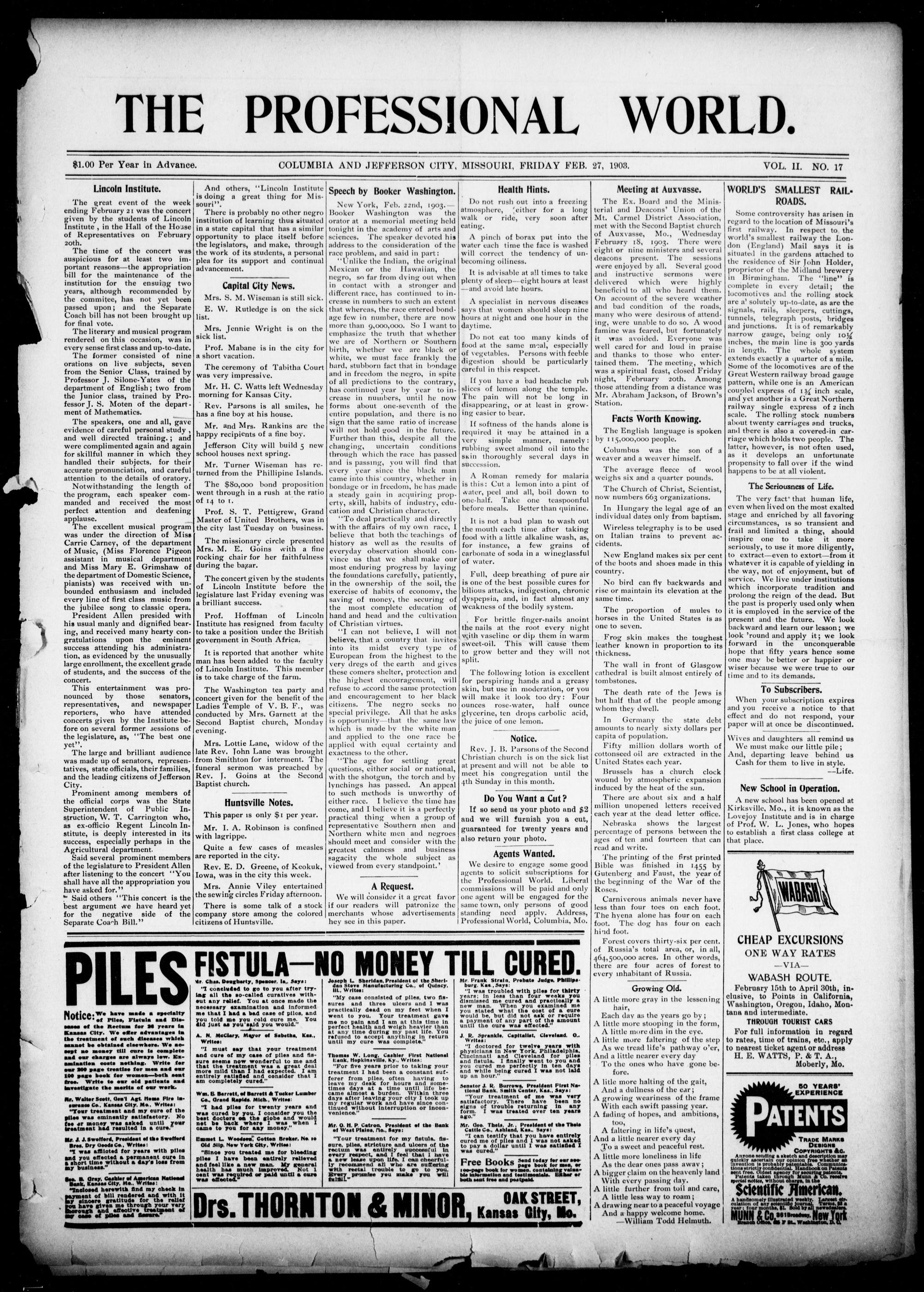
THE PROFESSIONAL WORLD.
FISTULA-NO MONEY TILL CURED.
$1.00 Per Year in Advance.
Lincoln Institute.
The great event of the week ending February 21 was the concert given by the students of Lincoln Institute, in the Hall of the House of Representatives on February 20th.
The time of the concert was auspicious for at least two important reasons—the appropriation bill for the maintenance of the institution for the ensuing two years, although recommended by the committee, has not yet been passed upon; and the Separate Coach bill has not been brought up for final vote.
The literary and musical program rendered on this occasion, was in every sense first class and up-to-date.
The former consisted of nine orations on live subjects, seven from the Senior Class, trained by Professor J. Silone-Yates of the department of English; two from the Junior class, trained by Professor J. S. Moten of the department of Mathematics.
The speakers, one and all, gave evidence of careful personal study, and well directed training; and were complimented again and again for skillful manner in which they handled their subjects, for their accurate pronunciation, and careful attention to the details of oratory.
Notwithstanding the length of the program, each speaker commanded and received the most perfect attention and deafening applause.
The excellent musical program was under the direction of Miss Carrie Carney, of the department of Music, (Miss Florence Pigeon assistant in musical department and Miss Mary E. Grimshaw of the department of Domestic Science, pianists) was received with unbounded enthusiasm and included every line of first class music from the jubilee song to classic opera. President Allen presided with his usual manly and dignified bearing, and received many hearty congratulations upon the eminent success attending his administration, as evidenced by the unusually large enrollment, the excellent grade of students, and the success of the concert.
This entertainment was pronounced by those senators, representatives, and newspaper reporters, who have attended concerts given by the Institute before on several former sessions of the legislature, as, "The best one yet". The large and brilliant audience was made up of senators, representatives, state officials, their families, and the leading citizens of Jefferson City. Prominent among members of the official corps was the State Superintendent of Public Instruction, W. T. Carrington who, as ex-officio Regent Lincoln Institute, is deeply interested in its success, especially perhaps in the Agricultural department.
Said several prominent members of the legislature to President Allen after listening to the concert "You shall have all the appropriation you have asked for." Said others "This concert is the best argument we have heard yet for the negative side of the Separate Coach Bill."
Notice: We have made a specialty of Piles, Fistula and Diseases of the Rectum for 26 years in Kansas City. We offer advantages in the treatment of such diseases which cannot be obtained elsewhere. We accept no money till cure is complete and choose the most effective medication costs nothing. Write for our 200 page treatise for men and our 100 page book for women—both sent free. Write to our old patients and investigate the merits of our work.
Mr. Walter Scott, Goal's Age: Home Fire In-Kansas City, Mo. Write:
"Your treatment and my cure of the piles was eminently satisfactory. No fee or money was asked until your treatment had resulted in a cure."
Mr. J. J. Swofferd, President of the Swofferd Men, Dr. Gee, Co. Writes:
"I afflicted for years with piles and you affected a permanent cure in a short time without a day's loss from my business."
See. B. Gray, Cashier of American National Bank, Kansas City, Mt. Writes:
"Inclosed herewith find my check in payment of bill rendered and with it my sincere gratitude for the relief you have given me through your very Borough and effective treatment of my case of piles and flasms."
COLUMBIA AND JEFFERSON CITY, MISSOURI. FRIDAY FEB. 27, 1903.
Drs. THORNTON & MINOR, OAK STREET, Kansas City, Mo.
And others, "Lincoln Institute is doing a great thing for Missouri". There is probably no other negro institution of learning thus situated in a state capital that has a similar opportunity to place itself before the legislators, and make, through the work of its students, a personal plea for its support and continual advancement.
Capital City News.
Mrs. S. M. Wiseman is still sick.
E. W. Rutledge is on the sick list.
Mrs. Jennie Wright is on the sick list.
Prof. Mabane is in the city for a short vacation.
The ceremony of Tabitha Court was very impressive.
Mr. H. C. Watts left Wednesday morning for Kansas City.
Rev. Parsons is all smiles, he has a fine boy at his house.
Mr. and Mrs. Rankins are the happy recipients of a fine boy.
Jefferson City will build 5 new school houses next spring.
Mr. Turner Wiseman has returned from the Phillipine Islands.
The $80,000 bond proposition went through in a rush at the ratio of 14 to 1.
Prof. S. T. Pettigrew, Grand Master of United Brothers, was in the city last Tuesday on business.
The missionary circle presented Mrs. M. E. Goins with a fine rocking chair for her faithfulness during the bazar.
The concert given by the students of Lincoln Institute before the legislature last Friday evening was a brilliant success.
Prof. Hoffman of Lincoln Institute has resigned from faculty to take a position under the British government in South Africa.
It is reported that another white man has been added to the faculty of Lincoln Institute. This member is to take charge of the farm.
The Washington tea party and concert given for the benefit of the Ladies Temple of V. B. F., was conducted by Mrs. Garnett at the Second Baptist church, Monday evening.
Mrs. Lottie Lane, widow of the late Rev. John Lane was brought from Smithton for interment. The funeral sermon was preached by Rev. J. Goins at the Second Baptist church.
Huntsville Notes.
This paper is only $1 per year.
Mr. I. A. Robinson is confined with lagrippe.
Quite a few cases of measles are reported in the city.
Rev. E. D. Greene, of Keokuk, Iowa, was in the city this week.
Mrs. Annie Viley entertained the sewing circles Friday afternoon.
There is some talk of a stock company store among the colored citizens of Huntsville.
FISTULA—N
Mr. Chas, Dougherty, Spencer, In. Says:
"I concluded to go to you after trying all the so-called curatives without any relief. You at once made the necessary examination and informed me that I had a bad case of piles, and you told me you cold cure me. You did just as you said you would."
A. N. McClary, Mayor of Sabetha, Kas., Writes:
"I must say that your treatment and cure of my case of piles and fissure seems now wonderful to me and that the case was a great deal more mid than I had expected. I am entirely satisfied and consider that I am completely cured."
Wm. E. Barrett, of Barrett & Tucker Lumber Co., Grand Rapids, Mich., Writes:
"I had piles for twenty years and was cured by you. I consider you the best doctors on the globe and would not be back where I was when I came to you for any money."
Emmet L. Woodson, Cotton Broker, No. 10 Old Slip, New York City, Writes:
"Since you treated me for bleeding piles I have been entirely relieved and feel like a new man. My general health has much improved. Not 1 cent was required or paid until a cure was effected."
Drs. THORNT
Speech by Booker Washington.
New York, Feb. 22nd, 1903. Booker Washington was the orator at a memorial meeting held tonight in the academy of arts and sciences. The speaker devoted his address to the consideration of the race problem, and said in part:
"Unlike the Indian, the original Mexican or the Hawaiian, the negro, so far from dying out when in contact with a stronger and different race, has continued to increase in numbers to such an extent that whereas, the race entered bondage few in number, there are now more than 9,000,000. So I want to emphasize the truth that whether we are of Northern or Southern birth, whether we are black or white, we must face frankly the hard, stubborn fact that in bondage and in freedom the negro, in spite of all predictions to the contrary, has continued year by year to increase in numbers, until he now forms about one-seventh of the entire population, and there is no sign that the same ratio of increase will not hold good in the future. Further than this, despite all the changing, uncertain conditions through which the race has passed and is passing, you will find that every year since the black man came into this country, whether in bondage or in freedom, he has made a steady gain in acquiring property, skill, habits of industry, education and Christian character.
"To deal practically and directly with the affairs of my own race, I believe that both the teachings of history as well as the results of everyday observation should convince us that we shall make our most enduring progress by laying the foundations carefully, patiently, in the ownership of the soil, the exercise of habits of economy, the saving of money, the securing of the most complete education of hand and head and the cultivation of Christian virtues.
"I can not believe, I will not believe, that a country that invites into its midst every type of European from the highest to the very dregs of the earth and gives these comers shelter, protection and the highest encouragement, will refuse to accord the same protection and encouragement to her black citizens. The negro seeks no special privilege. All that he asks is opportunity—that the same law which is made by the white man and applied to the one race be applied with equal certainty and exactness to the other.
"The age for settling great questions, either social or national, with the shotgun, the torch and by lynchings has passed. An appeal to such methods is unworthy of either race. I believe the time has come, and I believe it is a perfectly practical thing when a group of representative Southern men and Northern white men and negroes should meet and consider with the greatest calmness and business sagacity the whole subject as viewed from every standpoint."
A Request.
We will consider it a great favor if our readers will patronize the merchants whose advertisements hey see in this paper.
Joseph L. Sheridan, President of the Sheridan Stove Manufacturing Co., of Quincy, Ill., Writes:
"My case consisted of piles, two fissures and three ulcers and I was practically dead on my feet when I went to you. Your treatment gave me perfect health and relieved heavier than at any time during my past life. You refused to accept anything in return until my cure was complete."
Thomas W. Long, Cashier First National Bank, Hopkinson Ky., Writes:
"For five years prior to taking your treatment I had been a constant sufferer from piles, often having to be added to my daily times days at a time until life became almost a burden. Within three days after leaving your city I took up a new work and have since continued without interruption or Inconvenience."
Mr. O. H. P. Catron, President of the Bank of West Plains, Ia., Says:
"Your treatment for my fistula, fissure, plies, stricture and ulcers of the rectum was entirely successful in every respect, and I feel that I have a new lease upon life. I can cheerfully recommend all who are suffering from rectal cancer to go to you. Every promise you make you will fulfill."
Health Hints.
Do not rush out into a freezing atmosphere, either for a long walk or ride, very soon after eating.
A pinch of borax put into the water each time the face is washed will correct the tendency of unbecoming oilliness.
It is advisable at all times to take plenty of sleep—eight hours at least—and avoid late hours.
A specialist in nervous diseases says that women should sleep nine hours at night and one hour in the daytime.
Do not eat too many kinds of food at the same meal, especially of vegetables. Persons with feeble digestion should be particularly careful in this respect.
If you have a bad headache rub slices of lemon along the temple. The pain will not be long in disappearing, or at least in growing easier to bear.
If softness of the hands alone is required it may be attained in a very simple manner, namely: rubbing sweet almond oil into the skin thoroughly several days in succession.
A Roman remedy for malaria is this: Cut a lemon into a pint of water, peel and all, boil down to one-half. Take one teaspoonful before meals. Better than quinine.
It is not a bad plan to wash out the mouth each time after taking food with a little alkaline wash, as, for instance, a few grains of carbonate of soda in a wineglassful of water.
Full, deep breathing of pure air is one of the best possible cures for bilious attacks, indigestion, chronic dyspepsia, and, in fact almost any weakness of the bodily system.
For brittle finger-nails anoint the nails at the root every night with vaseline or dip them in warm sweet-oil. This will cause them to grow better and they will not split.
The following lotion is excellent for perspiring hands and a greasy skin, but use in moderation, or you will make it look too dry: Four ounces rose-water, half ounce glycerine, ten drops carbolic acid, the juice of one lemon.
Notice.
Rev. J. B. Parsons of the Second Christian church is on the sick list at present and will not be able to meet his congregation until the 4th Sunday in this month.
Do You Want a Cut?
If so send us your photo and $2 and we will furnish you a cut, guaranteed for twenty years and also return your photo.
Agents Wanted.
We desire to engage some good agents to solicit subscriptions for the Professional World. Liberal commissions will be paid and only one agent will be engaged for the same town, only persons of good standing need apply. Address, Professional World, Columbia, Mo.
Mr. Frank Strain, Probate Judge, Phillipsburg, Kes. Says: "I was troubled with piles for thirty years than four weeks you dismissed me cured and practically a new man. When you examined me you stated what the cost of a cure was. I was told you require a payment of any part of the amount until the cure was effected."
J R. Sprankle, Capitalist, Cleveland. O. Writes: "I doctored for twelve years with physicians in New York, Philadelphia, Cincinnati and Cleveland for piles and fatula. I finally went to you and my men to cure me and while being cured I was not laid up an hour."
Senator J. R. Burrows, President First National Bank, Smith Center, Kes. Says:
"Your treatment of me was very satisfactory. There have been no signs of trouble returning in any form. I was treated over ten years" Mr. Geo. Thels, Jr. President of the Theis Cattle Co., Aubland, Kau, Saves;
"I can testify that you have entirely cured me of piles and I was not asked to pay a dollar until I was satisfied I was cured."
Free Books Send today for our ebook page book for men, or too-page book for women, containing valuable information. Either or both ant free and postpaid.
Meeting at Auxvasse.
The Ex. Board and the Ministerial and Deacons' Union of the Mt. Carmel District Association, met with the Second Baptist church of Auxvasse, Mo., Wednesday February 18, 1903. There were eight or nine ministers and several deacons present. The sessions were enjoyed by all. Several good and instructive sermons were delivered which were highly beneficial to all who heard them. On account of the severe weather and bad condition of the roads, many who were desirous of attending, were unable to do so. A wood famine was feared, but fortunately it was avoided. Everyone was well cared for and loud in praise and thanks to those who entertained them. The meeting, which was a spiritual feast, closed Friday night, February 20th. Among those attending from a distance was Mr. Abraham Jackson, of Brown's Station.
Facts Worth Knowing.
The English language is spoken by 115,000,000 people.
Columbus was the son of a weaver and a weaver himself.
The average fleece of wool weighs six and a quarter pounds.
The Church of Christ, Scientist, now numbers 663 organizations.
In Hungary the legal age of an individual dates only from baptism.
Wireless telegraphy is to be used on Italian trains to prevent accidents.
New England makes six per cent of the boots and shoes made in this country.
No bird can fly backwards and rise or maintain its elevation at the same time.
The proportion of mules to horses in the United States is as one to seven.
Frog skin makes the toughest leather known in proportion to its thickness.
The wall in front of Glasgow cathedral is built almost entirely of tombstones.
The death rate of the Jews is but half that of the people among whom they dwell.
In Germany the state debt amounts to nearly sixty dollars per capita of population.
Fifty million dollars worth of cottonseed oil are extracted in the United States each year.
Brussels has a church clock wound by atmospheric expansion induced by the heat of the sun.
There are about six and a half million unopened letters received each year at the dead letter office.
Nebraska shows the largest percentage of persons between the ages of ten and fourteen that can read and write.
The printing of the first printed Bible was finished in 1455 by Gutenberg and Faust, the year of the beginning of the War of the Roses.
Carniverous animals never have less than four toes on each foot. The hyena alone has four on each foot. The dog has four on each hind foot.
Forest covers thirty-six per cent. of Russia's total area, or, in all, 464,500,000 acres. In other words, there are four acres of forest to every inhabitant of Russia.
Growing Old.
A little more gray in the lessening hair,
Each day as the years go by;
A little more stooping in the form,
A little more dim in the eye.
A little more faltering of the step
As we tread life's pathway o'er,
And a little nearer every day
To the ones who have gone before.
A little more halting of the gait,
And a dullness of the ear;
A growing weariness of the frame
With each swift passing year.
A fading of hopes, and ambitions,
too,
A faltering in life's quest,
And a little nearer every day
To a sweet and peaceful rest.
A little more loneliness in life
As the dear ones pass away;
A bigger claim on the heavenly land With every passing day.
A little further from toil and care,
A little less way to roam;
A drawing near to a peaceful voyage And a happy welcome home.
—William Todd Helmuth.
VOL. II. NO. 17
WORLD'S SMALLEST RAILROADS.
Some controversy has arisen in regard to the location of Missouri's first railway. In respect to the world's smallest railway the London (England) Mail says it is situated in the gardens attached to the residence of Sir John Holder, proprietor of the Midland brewery in Birmingham. The "line" is complete in every detail; the locomotives and the rolling stock are a' solutely up-to-date, as are the signals, rails, sleepers, cuttings, tunnels, telegraph posts, bridges and junctions. It is of remarkably narrow gauge, being only 10% inches, the main line is 300 yards in length. The whole system extends exactly a quarter of a mile. Some of the locomotives are of the Great Western railway broad gauge pattern, while one is an American couplel express of 1 3/4 inch scale, and yet another is a Great Northern railway single express of 2 inch scale. The rolling stock numbers about twenty carriages and trucks, and there is also a covered-in carriage which holds two people. The latter, however, is not often used, as it develops an unfortunate propensity to fall over if the wind happens to be at all violent.
The Seriousness of Life.
The very fact that human life, even when lived on the most exalted stage and enriched by all favoring circumstances, is so transient and frail and limited a thing, should inspire one to take it more seriously, to use it more diligently, to extract—even to extort—from it whatever it is capable of yielding in the way, not of enjoyment, but of service. We live under institutions which incorporate tradition and prolong the reign of the dead. But the past is properly used only when it is employed in the service of the present and the future. We look backward and learn our lesson; we look 'round and apply it; we look forward in the unconquerable hope that fifty years hence some one may be better or happier or wiser because we were true to our time and to its demands.
To Subscribers.
When your subscription expires and you receive a notice to that effect and do not respond, your paper will at once be discontinued.
Wives and daughters all remind us We must make our little pile; And, departing leave behind us Cash for them to live in style.
--Life.
New School in Operation.
A new school has been opened at Kirksville, Mo., it is known as the Lovejoy Institute and is in charge of Prof. W. L. Jones, who hopes to establish a first class college at that place. WABASH
CHEAP EXCURSIONS ONE WAY RATES VIA WABASH ROUTE.
VIA
WABASH ROUTE.
February 15th to April 30th, inclusive, to Points in California, Washington, Oregon, Idaho, Montana and intermediate.
THROUGH TOURIST CARS
For full information in regard to rates, time of trains, etc., apply to nearest ticket agent or address H. E. WATTS, P. & T. A.,
50 YEARS' EXPERIENCE
PATENTS
TRADE MARKS
DESIGNS
COPYRIGHT & C.
Anyone sending a sketch and description may quickly ascertain our opinion free whether an invention is patentable. Kunin & Co. receive strictly confidential. Handbook on Patents sent free. Oldest agency for securing patients. Patients taken through. Kunin & Co. receive special notice, without charge, in the Scientific American.
A handsomely illustrated weekly. Largest circulation of patent information. C. B. Hartman, Jr. monthly. Bld. by all newadditions.
MUNN & Co. 301 Broadway, New York
Branch Office, 40 St. Washington, N. O.
---
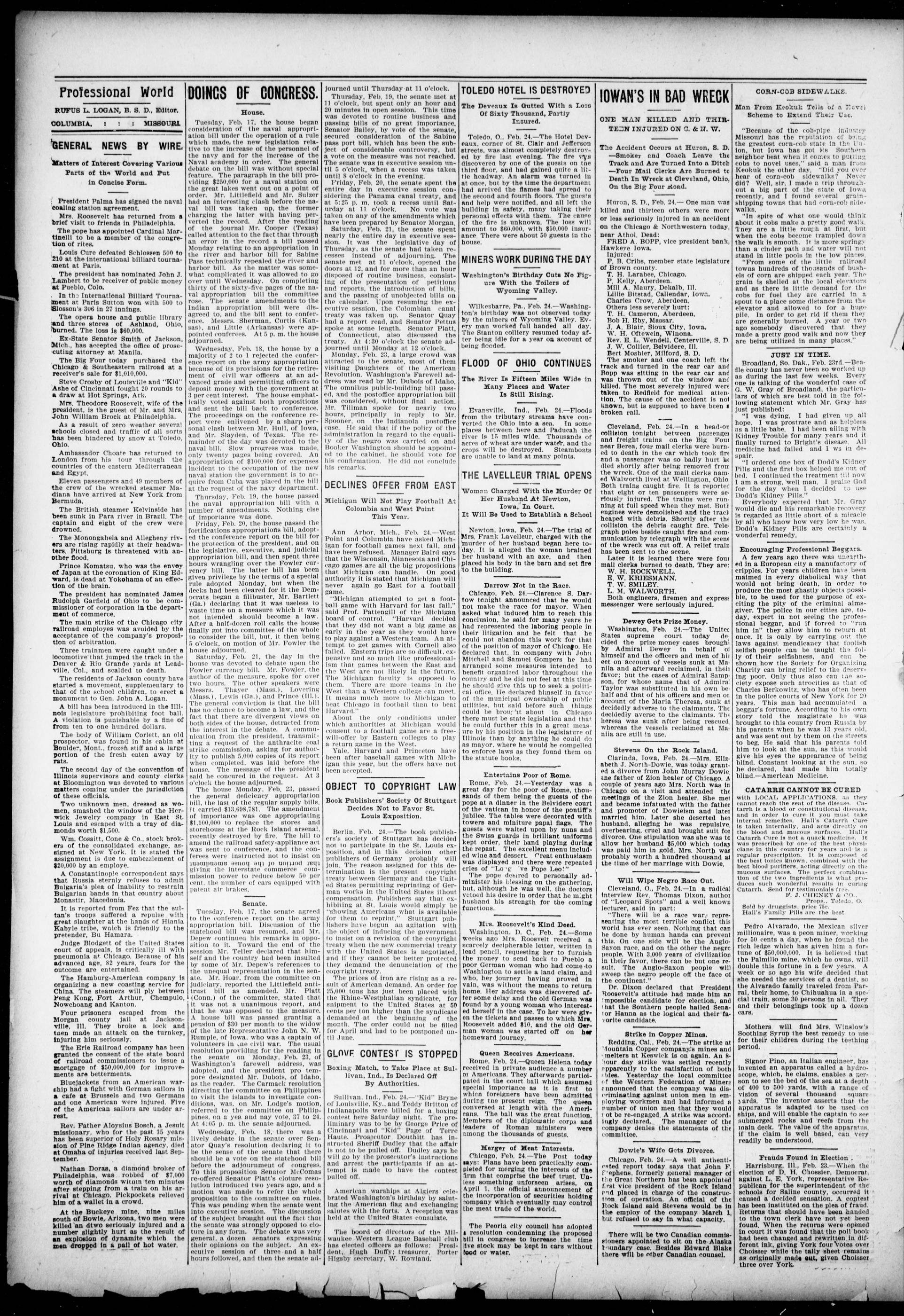
RUFUS L. LOGAN, B. S. D., Editor.
COLUMBIA. : : : MISSOURL
GENERAL NEWS BY WIRE.
Matters of Interest Covering Various Parts of the World and Put in Concise Form.
President Palma has signed the naval coaling station agreement. Mrs. Roosevelt has returned from a brief visit to friends in Philadelphia.
the pope has appointed Cardinal Martinelli to be a member of the congration of rites.
Louis Cure defeated Schlossen 500 to 210 at the international billiard tournament at Paris.
The president has nominated John J. Lambert to be receiver of public money at Pueblo, Colo.
In the International Billiard Tournament at Paris Sutton won with 500 to Slosson's 306 in 27 innings.
The opera house and public library and three stores of Ashland, Ohio, burned. The loss is $60,000.
Ex-State Senator Smith of Jackson, Mich., has accepted the office of prosecuting attorney at Manila.
The Big Four today purchased the Chicago & Southeastern railroad at a receiver's sale for $1,010,000.
Steve Crosby of Louisville and "Kid" Ashe of Cincinnati fought 20 rounds to a draw at Hot Springs, Ark.
Mrs. Theodore Roosevelt, wife of the president, is the guest of Mr. and Mrs. John William Brock at Philadelphia.
As a result of zero weather several schools closed and traffic of all sorts has been hindered by snow at Toledo, Ohio.
Ambassador Choate has returned to London from his tour through the countries of the eastern Mediterranean and Egypt.
Eleven passengers and 49 members of the crew of the wrecked steamer Madiana have arrived at New York from Bermuda.
The British steamer Kelvinside has been sunk in Para river in Brazil. The captain and eight of the crew were drowned.
The Monongahela and Allegheny rivers are rising rapidly at their headwaters. Pittsburg is threatened with another flood.
Prince Komatsu, who was the envoy of Japan at the coronation of King Edward, is dead at Yokohama of an effection of the brain.
The president has nominated James Rudolph Garfield of Ohio to be commissioner of corporation in the department of commerce.
The main strike of the Chicago city railroad employees was avoided by the acceptance of the company's proposition of arbitration.
Three trainmen were caught under a locomotive that jumped the track in the Denver & Rio Grande yards at Leadville, Col., and scaled to death.
The residents of Jackson county have started a movement, supplementary to that of the school children, to erect a monument to Gen. John A. Logan.
A bill has been introduced in the Illinois legislature prohibiting foot ball. A violation is punishable by a fine of from ten to one hundred dollars.
The body of William Corlett, an old prospector, was found in his cabin at Boulder, Mont., frozeth stiff and a large portion of the fresh eaten away by rats.
The second day of the convention of Illinois supervisors and county clerks at Bloomington was devoted to various matters coming under the jurisdiction of these officials.
Two unknown men, dressed as women, smashed the window of the Herwick Jewelry company in East St. Louis and escaped with a tray of diamonds worth $1,500.
Wm. Cossitt, Cone & Co., stock brokers of the consolidated exchange, assigned at New York. It is stated the assignment is due to embezzlement of $20,000 by an employee.
A Constantinople correspondent says that Russia sternly refuses to admit Bulgaria's plea of inability to restrain Bulgarian bands in that country about Monastir, Macedonia.
It is reported from Fez that the sultan's troops suffered a repulse with great slaughter at the hands of Hianla Kabyle tribe, which is friendly to the pretender, Bu Hamara. Judge Bloodygott of the United States court of appeals, is critically ill with pneumonia at Chicago. Because of his advanced age, 82 years, fears for the outcome are entertained.
The Hamburg-American company is organizing a new coasting service for China. The steamers will plly between Peng Kong, Fort Arthur, Chempulo, Nowchoang and Kanton.
Four prisoners escaped from the Morgan county jail at Jacksonville, Ill. They broke a lock and then made an attack on the turnkey, injuring him seriously.
The Erle Railroad company has been granted the consent of the state board of railroad commissioners to issue a mortgage of $50,000,000 for improvements are betterments.
Bluejackets from an American warship had a fight with German sailors in a cafe at Brussels and two Germans and one American were injured. Five of the American sailors are under arrest.
Rev. Father Aloysius Bosch, a Jesuit missionary, who for the past 15 years has been superior of Holy Rosary mission of Pine Ridge Indian agency, died at Omaha of injuries received last September.
Nathan Doras, a diamond broker of Philadelphia, was robbed of $7,000 worth of diamonds witten ten minutes after stepping from a train on his arrival at Chicago. Pickpockets relieved him of a wallet in a crowd.
At the Buckeye mine, nine miles south of Bowie, Arizona, two men were killed an dtwo seriously injured and a number slightly hurt as the result of an explosion of dynamite which the men dropped in a pail of hot water.
DOINGS OF CONGRESS.
House.
Tuesday, Feb. 17, the house began consideration of the naval appropriation bill under the operation of a rule which made, the new legislation relative to the increase of the personnel of the navy and for the increase of the Naval academy in order. The general debate on the bill was without special feature. The paragraph in the bill providing $250,000 for a naval station on the great lakes went out on a point of order. Mr. Littlefield and Mr. Sulzer had an interesting clash before the naval bill was taken up, the former charging the latter with having perverted the record. After the reading of the journal Mr. Cooper (Texas) called attention to the fact that through an error in the record a bill passed Monday relating to an appropriation in the river and harbor bill for Sabine Pass technically repealed the river and harbor bill. As the matter was somewhat complicated it was allowed to go over until Wednesday. On completing thirty of the sixty-five pages of the naval appropriation bill the committee rose. The senate amendments to the Indian appropriation bill were disagreed to, and the bill sent to conference. Messrs. Sherman, Curtis (Kansas), and Little (Arkansas) were appointed conferences. At 5 p. m. the house adjourned.
Wednesday, Feb. 18, the house by a majority of 2 to 1 rejected the conference report on the army appropriation because of its provisions for the retirement of civil war officers at an advanced grade and permitting officers to deposit money with the government at 3 per cent interest. The house emphatically voted against both propositions and sent the bill back to conference. The proceedings on the conference report were enlivened by a sharp personal clash between Mr. Hull, of Iowa, and Mr. Slayden, of Texas. The remainder of the day was devoted to the naval bill. Slow progress was made, only twenty pages being covered. An appropriation of $100,000 for expenses incident to the occupation of the new naval station the government is to acquire from Cuba was placed in the bill at the request of the navy department. Thursday, Feb. 19, the house passed the naval appropriation bill with a number of amendments. Nothing else of importance was done.
Friday, Feb. 29, the house passed the fortifications appropriations bill, adopted the conference report on the bill for the protection of the president, and on the legislative, executive, and judicial appropriation bill, and then spent three hours wrangling over the Fowler currency bill. The latter bill has been given privilege by the terms of a special rule adopted Monday, but when the decks had been cleared for it the Democrats began a filibuster, Mr. Bartlett (Ga.) declaring that it was useless to waste time on a measure which it was not intended should become a law. After a half-dozen roll calls the house finally got into committee of the whole to consider the bill, but, it then being 5 o'clock, on motion of Mr. Fowler the house adjourned.
Saturday, Feb. 21, the day in the house was devoted to debate upon the Fowler currency bill. Mr. Fowler, the author of the measure, spoke for over two hours. The other speakers were Messrs. Thayer (Mass.), Lovering (Mass.), Lewis (Ga.), and Prince (Ill.). The general conviction is that the bill has no chance to become a law, and the fact that there are divergent views on both sides of the house, detracted from the interest in the debate. A communication from the president, transmitting a request of the anthracite coal strike commission, asking for authority to publish 5,000 copies of its report when completed, was laid before the house. The message of the president said he concurred in the request. At 3 o'clock the house adjourned.
The house Monday, Feb. 23, passed the general deficiency appropriation bill, the last of the regular supply bills, it carried $13,698,781. The amendment of importance was one appropriating $1,100,000 to replace the stores and storehouse at the Rock Island arsenal; recently destroyed by fire. The bill to amend the railroad safety-appliance act was sent to conference, and the conferences were instructed not to insist on manpower auquq aoqi jqo joqo duqiq giving the interstate commerce commission power to reduce below 50 per cent, the number of cars equipped with patent air brakes.
Senate.
Tuesday, Feb. 17, the senate agreed to the conference report on the army appropriation bill. Discussion of the statehood bill was resumed, and Mr. Depew continued his remarks in opposition to it. Toward the end of the session Mr. Teller declared that himself and the country had been insulted by some of Mr. Depew's references to the unequal representation in the senate. Mr. Hoar, from the committee on judiciary, reported the Littlefield antitrust bill as amended. Mr. Platt (Conn.) of the committee, stated that it was not a unanimous report, and that he was opposed to the measure. A house bill was passed granting a pension of $30 per month to the widow of the late Representative John N. W. Rumple, of Iowa, who was a captain of volunteers in the civil war. The usual resolution providing for the reading in the senate on Monday, Feb. 23, of Washington's farewell address, was adopted, and the president pro tempore designated Mr. Dubois, of Idaho as the reader. The Carmack resolution directing the committee on Philippines to visit the islands to investigate conditions, was, on Mr. Lodge's motion, referred to the committee on Philippines, on a yea and nay vote, 37 to 24 at 4:05 p. m. the senate adjourned.
Wednesday, Feb. 18, there was a lively debate in the senate over Senator Quay's resolution declaring it to be the sense of the senate that there should be a vote on the statethood bill before the adjournment of congress. To this proposition Senator McComas re-offered Senator Platt's cloture resolution introduced two years ago, and a motion was made to refer the whole proposition to the committee on rules. This was pending when the senate went into executive session. The discussion of the subject brought out the fact that the senate was strongly opposed to cloture in any form. The debate was very general, a dozen senators expressing their opinions on the subject. An executive session of three and a half hours followed, and then the senate ad-
journed until Thursday at 11 o'clock.
Thursday, Feb. 19, the senate met at 11 o'clock, but spent only an hour and 20 minutes in open session. This time was devoted to routine business and passing bills of no great importance. Senator Bailey, by vote of the senate, secured consideration of the Sabine pass port bill, which has been the subject of considerable controversy, but a vote on the measure was not reached. The senate was in executive session until 5 o'clock, when a recess was taken until 8 o'clock in the evening. Printer Roberts, upon the entire day in executive session considering the Panama canal treaty, and at 5:25 p.m. m. took a recess until Saturday at 11 o'clock. No vote was taken on any of the amendments which have been prepared by Senator Morgan.
Saturday, Feb. 21, the senate spent nearly the entire day in executive session. It was the legislative day of Thursday, as the senate had taken recesses instead of adjourning. The senate met, at 11 o'clock, opened the doors at 12, and for more than an hour disposed of routine business, consisting of the presentation of petitions and reports, the introduction of bills, and the passing of unobjected bills on the calendar. Upon resuming the executive session, the Colombian canal treaty was taken up. Senator Quay had a report read, and Senator Pettus spoke at some length. Senator Platt, of Connecticut, also discussed the treaty. At 4:30 o'clock the senate adjourned until Monday at 12 o'clock.
Monday, Feb. 23, a large crowd was attracted to the senate, most of them visiting Daughters of the American Revolution. Washington's Farewell address was read by Mr. Dubois of Idaho. The omnibus public-building bill passed, and the postoffice appropriation bill was considered, without final action, Mr. Tillman spoke for nearly two hours, principally in reply to Mr. Spooner, on the Indianola postoffice case. He said that if the policy of the administration in regard to the equality of the negro was carried on and Booker Washington should be appointed to the cabinet, he should vote for his confirmation. He did not conclude his remarks.
DECLINES OFFER FROM EAST
Michigan Will Not Play Football At Colombia and West Point This Year
Ann Arbor, Mich., Feb. 24—West Point and Columbia have asked Michigan for football games next fall, and have been refused. Manager Baird says that Wisconsin, Minnesota and Chicago games are all the big propositions that Michigan can handle. On good authority it is stated that Michigan will never again go East for a football game.
"Michigan attempted to get a football game with Harvard for last fall," said Prof. Pattengil of the Michigan board of control. "Harvard decided that they did not want a big game as early in the year as they would have to play against a Western team. An attempt to get games with Cornell also failed. Eastern trips are so difficult, expensive and so much like professionalism that games between the East and the West are not likely in the future. The Michigan faculty is opposed to them. There are more teams in the West than a Western college can meet. It means much more to Michigan to beat Chicago in football than to beat Harvard."
About the only conditions under which authorities at Michigan would consent to a football game are a free-will-offer by Eastern colleges to play a return game in the West. Yale, Harvard and Princeton have been after baseball games with Michigan this year, but the offers have not been accepted.
OBJECT TO COPYRIGHT LAW
Book Publishers' Society Of Stuttgart Decides Not to Favor St. Louis Exposition.
Berlin, Feb. 24.—The book publishers's society of Stuttgart has decided not to participate in the St. Louis exposition, and in this decision other publishers of Germany probably will join. The reason assigned for this determination is the present copyright treaty between Germany and the United States permitting reprinting of German works in the United States without compensation. Publishers say that exhibiting at St. Louis would simply be "showing Americans what is available for them to reprint." Stuttgart publishers have begun an agitation with the object of inducing the government to insist on a revision of the copyright treaty when the new commercial treaty with the United States is negotiated, and if they cannot be better protected they demand the denunciation of the copyright treaty.
The prices of iron are rising as a result of American demand. An order for 25,000 tons has just been placed with the Rhine-Westphalian syndicate, for shipment to the United States at 50 cents per ton higher than the syndicate demanded at the beginning of the month. The order could not be filled for April and had to be postponed until June.
GLOVE CONTEST IS STOPPED
Boxing Match, to Take Place at Sullivan, Ind., Is Declared off By Authorities
Sullivan, Ind., Feb. 24.—"Kid" Bryne of Louisville, Ky., and Teddy Britton of Indianapolis were billed for a boxing contest here Saturday night. The preliminary was to be by George Price of Cincinnati and "Kid" Page of Terre Haute. Prosecutor Douthitt has instructed Sheriff Dudley that the affair is not to be pulled off. Dudley says he will go by the prosecutor's instructions and arrest the participants if an attempt is made to have the contest pulled off.
American warships at Algiers celebrated Washington's birthday by saluting the American flag and exchanging salutes with the forts. A reception was held at the United States consulate.
The board of directors of the Milwaukee Western League Baseball club has elected officers as follows: President, Hugh Duffy; treasurer, Porter Higgsy secretary, W. Rowland.
TOLEDO HOTEL IS DESTROYED
The Deveaux Is Gutted With a Loss Of Sixty Thousand, Partly Insured.
Toledo, O., Feb. 24. —The Hotel Deveaux, corner of St. Clair and Jefferson streets, was almost completely destroyed by fire last evening. The fire was discovered by one of the guests on the third floor, and had gained quite a little headway. An alarm was turned in at once, but by the time the department had arrived the flames had spread to the second and fourth floors. The guests and help were notified, and all left the building in safety, many taking their personal effects with them. The cause of the fire is unknown. The loss will amount to $60,000, with $50,000 insurance. There were about 50 guests in the house.
MINERS WORK DURING THE DAY
Washington's Birthday Cuts No Figure With the Toilers of Wyoming Valley.
Wilkesbarre, Pa., Feb. 24.—Washington's birthday was not observed today by the miners of Wyoming Valley. Every man worked full handed all day. The Stanton colliery resumed today after being idle for a year on account of being flooded.
FLOOD OF OHIO CONTINUES
The River Is Fifteen Miles Wide in Many Places and Water Is Still Rising.
Evansville, Ind., Feb. 24.—Floods from the tributary streams have converted the Ohio into a sea. In some places between here and Paducah the river is 15 miles wide. Thousands of acres of wheat are under water, and the crops will be destroyed. Steamboats are unable to land at many points.
THE LAVELLEUR TRIAL OPENS
Woman Charged With the Murder Of Her Husband At Newton, Iowa, In Court
It Will Be Used to Establish a School
Newton, Iowa, Feb. 24.—The trial of Mrs. Frank Lavelleur, charged with the murder of her husband began here today. It is alleged the woman brained her husband with an axe, and then placed his body in the barn and set fire to the building.
Darrow Not in the Race
Chicago, Feb. 24—Clarence S. Dartow tonight announced that he would not make the race for mayor. When asked what induced him to reach this conclusion, he said for many years he had represented the laboring people in their litigation and he felt that he could not abandon this work for that of the position of mayor of Chicago. He declared that, in company with John Mitchell and Samuel Gompers he had arranged some measures intended to benefit organized labor throughout the country and he did not feel at this time he should give this up to seek a political office. He declared himself in favor of the municipal ownership of public utilities, but said before such things could be brought about in Chicago there must be state legislation and that he could further this in a great measure by his position in the legislature of Illinois than by anything he could do as mayor, where he would be compelled to enforce laws as they found them on the statute books.
Entertains Poor of Rome.
Rome, Feb. 24.—Yesterday was a great day for the poor of Rome, thousands of them being the guests of the pope at a dinner in the Belvidence court of the vatican in honor of the pontiff's jubilee. The tables were decorated with towers and miniature papal flags. The guests were waited upon by nuns and the Swiss guards in brilliant uniforms kept order, their band playing during the repast. The excellent menu included wine and dessert. Great enthusiasm was displayed and there were repeated cries of "Long, we've Pope Leo!" The pope desired to personally administer his blessing on the gathering, but, although he was well, the doctors vetoed his desire in order that he might husband his strength for the coming functions.
Mrs. Roosevelt's Kind Deed.
Washington, D. C., Feb. 24—Some weeks ago Mrs. Roosevelt received a scarcely decipherable letter, written in lead pencil, requesting her to furnish the money to send back to Pueblo a poor German woman who had come to Washington to settle a land claim, and who, her journey having proved in valn, was without the means to return home. Her address was discovered after some delay and the old German was found by a young woman who Interested herself in the case. To her were given the tickets and passes to which Mrs. Roosevelt added $10, and the old German woman was started off on her homeward journey.
Queen Receives Americans
Home, Feb. 24.—Queen Helena today received in private audience a number of Americans. They afterwards participated in the court ball which assumed special importance as it is first to which foreigners have been admitted during the present reign. The queen conversed at length with the Americans. The ball was the great function. Members of the diplomatic corps and leaders of Roman ministers were among the thousands of guests.
Merger of Meat Interests.
Chicago, Feb. 24.—The Post today says: Plans have been practically completed for merging the interests of the firm that comprise the beef trust. Unless something unforeseen arises, on April 1, the official announcement of the incorporation of securities holding company which eventually may control the meat trade of the world.
The Peoria city council has adopted a resolution condemning the proposed bill in congress to increase the time five stock may be kept in cars without food or water.
IOWAN'S IN BAD WRECK
IOWAN'S IN BAD WRECK
ONE MAN KILLED AND THIRTEEN INJURED ON C. & N. W.
The Accident Occurs at Huron, S. D.
—Smoker and Coach Leave the Track and Are Turned Into a Ditch
—Four Mail Clerks Are Burned to Death In Wreck at Cleveland, Ohio,
On the Big Four Road.
Huron, S. D., Feb. 24.—One man was killed and thirteen others were more or less seriously injured in an accident on the Chicago & Northwestern today, near Athol, Dead:
FRED A. BOPP, vice president bank, Hawkeve Iowa.
Injured:
P. B. Cribs, member state legislature of Brown county.
T. H. Larabee, Chicago.
Rev. E, L. Wendell, Centerville, S. D. J. W. Collier, Belvidere, III. Bert Mosher, Milford, S. D. The smoker and one coach left the track and turned in the rear car and Ropp was sitting in the rear car and was thrown out of the window and killed. The most severely injured were taken to Redfield for medical attention. The cause of the accident is not known, but is supposed to have been a broken rail.
Cleveland, Feb. 24.—In a head-or collision tonight between passengers and freight trains on the Big Four near Berea, four mail clerks were burned to death in the car which took fire and a passenger was so badly hurt he died shortly after being removed from the wreck. One of the mail clerks named Walworth lived at Wellington, Ohio. Both trains caught fire. It is reported that eight or ten passengers were seriously injured. The trains were running at full speed when they met. Both engines were demolished and the track heaped with debris. Shortly after the collision the debris caught fire. Telegraph poles beside caught fire and communication by telegraph with the scene of the wreck was cut off. A relief train has been sent to the scene.
Later it is learned there were four men who died. They are: W. H. HeKWFELI
Both engineers, firemen and express messenger were seriously injured.
Dewey Gets Prize Money
Washington, Feb. 24.—The United States supreme court today decided the prize money cases brought by Admiral Dowey in behalf of himself and the officers and men of his heet on account of vessels sunk at Manila and afterward reclaimed, in their favor; but the cases of Admiral Sampson, for whose name that of Admiral Taylor was substituted in his own behalf and that of his officers and men or account of the Marla Theresa, sunk at decidedly adverse to the claimants. The decidedly averse to the claimants. The heresa was sunk after being rescued whereas the vessels reclaimed at Manila are still in use.
Stevens On the Rock Island
Clarinda, Iowa, Feb. 24.—Mrs. Elizabeth J. North-Dowle, was today granted a divorce from John Murray Dowle, the father of Zion healer of Chicago. A couple of years ago Mrs. North was in Chicago on a visit and attended the meetings of the Zion healer. She met and became infatuated with the father and promoter of Dowleism and later married him. Later she deserted her husband, alleging he was repulsive, overbearing, cruel and brought suit for divorce. One stipulation was she was to allow her husband $5,000 which today was paid him in gold. Mrs. North was probably worth a hundred thousand at the time of her marriage with Dowle.
Will Wipe Negro Race Out.
Cleveland, O., Feb. 24.—In a radical interview Rev. Thomas Dixon, author of "Leopard Spots" and a well known lecturer, said in part:
"There will be a race war; representing the most terrible conflict this world has ever seen. Nothing that can be done by human hands can prevent this. On one side will be the Anglo-Saxon race, and on the other the negro people. With 3,000 years of civilization in their favor, there can be but one result. The Anglo-Saxon people will sweep the negro people off the face of the continent."
Dr. Dixon declared that President Roosevelt's attitude had made him an impossible candidate for election, and that the Southern people hailed Senator Hanna as the logical and their favorite candidate.
Strike in Copper Mines
Redding, Cal., Feb. 24.—The strike at Mountain Copper company's mines and melters at Kewick is on again. An 8-hour day strike was located recently apparently to the satisfaction of both sides. Yesterday the local committee of the Western Federation of Miners announced that the company was discriminating against union men in employing workmen and had informed a number of union men that they would not be re-engaged. A strike was accordingly declared. The manager of the company denies the statements of the committee.
Dowie's Wife Gets Divorce.
Chicago, Feb. 24.—A well authenticated report today says that John F. Stephens, formerly general manager of the Great Northern has been appointed first vice president of the Rock Island and placed in charge of the construction of operation. An official of the Rock Island said Stevens would be in the employ of the company March 1, but refused to say in what capacity.
There will be two Canadian commissioners appointed to sit on the Alaska boundary case. Besides Edward Blake there will be other Canadian counsel.
7
CORN-COB SIDEWALKS.
Man From Keokuk Tells of a Novel Scheme to Extend Their Use.
"Because of the cob-pipe industry Missouri has the reputation of being the greatest corn-cob state in the Union, but Iowa has got its Southern neighbor beat when it comes to putting cobs to novel uses," said a man from Keokuk the other day. "Did you ever hear of corn-cob sidewalks? Never did? Well, sir, I made a trip throughout a big part of the state of Iowa recently, and I found several grain-shipping towns that had corn-cob sidewalks.
"In spite of what one would think about it cobs make a pretty good walk. They are a little rough at first, but when the cobs become trampled down the walk is smooth. It is more springy than a cinder path and water will not stand in little pools in the low places.
"From some of the little railroad towns hundreds of thousands of bushels of corn are shipped each year. The grain is shelled at the local elevators and as there is little demand for the cobs for fuel they are carried in a spout to a place some distance away. They are also used for a huge pile. In order to get rid if they are generally burned. A year or two ago somebody discovered that they made a pretty good walk and now they are being utilized in many places."
JUST IN TIME
Broadland, So. Dak., Feb. 23rd. — Beadle county has never been so worked up as during the last few weeks. Every one is talking of the wonderful case of G. W. Gray of Broadland, the particulars of which are best told in the following statement which Mr. Gray has just published:
"I was dying. I had given up all hope. I was prostrate and as helpless as a little babe. I had been ailing with Kidney Trouble for many years and it finally turned to Bright's disease. All medicine had failed and I was in despair.
"I ordered one box of Dodd's Kidney Pills and the first box helped me out of bed. I continued the treatment till now I am a strong, well man. I praise God for the day when I decided to use Dodd's Kidney Pills."
Everybody expected that Mr. Gray would die and his remarkable recovery is regarded as little short of a miracle by all who know how very low he was. Dodd's Kidney Pills are certainly a wonderful remedy.
Encouraging Professional Beggars
A few years ago there was unearthened in a European city a manufactory of cripples. For years children have been maimed in every diabolical way that would not bring death, in order to produce the most ghastly objects possible, to be used for the purpose of exciting the pity of the criminal almsgiver. The police in our cities are today, expert in not seeing the professional beggar, and if forced to "run him in" they allow him to return at once. It is only by carrying out the laws against mendicancy that foolish selfish people can be taught the folly of their selfishness, and can be shown how the Society for Organizing Charity can bring relief to the deserving poor. Only thus also can the laws expose such atrocities as that of Charles Berkowitz, who has often been in the police courts of New York for 20 years. This man had accumulated a beggar's fortune. According to his own story told the magistrate he was brought to this country from Russia by his parents when he was 13 years old, and was sent out by them on the streets to beg. He said that his parents told him to look at the sun, as this would give his eyes the appearance of being blind. Constant looking at the sun, so he declared, had made him totally blind—American Medicine.
CATARRH CANNOT BE CURED
with LOCAL APPLICATIONS, as they cannot reach the seat of the disease. Catarr is a blood or constitutional disease, and in order to cure it you must take internal remedies. Hall Catarr Cure is prescribed for the blood and mucous surfaces. Hall's Catarr Cure is not a quack medicine. It was prescribed by one of the best physicians in this country for years and is a regular prescription. It is composed of the best tonics known, with the best blood pills, acting directly on the mucous surfaces. The perfect combination of the two ingredients is what produces such wonderful results in curing Catarr. Send for testimonials free. P. J. CHENEY & CO.. Sold by drugstores. price 75. Hall's Family Pills are the best
Pedro Alvarado, the Mexican silver millionaire, was a peon miner, working for 50 cents a day, when he found the rich ledge which has given him a fortune of $50,000,000. It is believed that the Palmillo mine, which he owns, will double this fortune in a few years. A week or so ago his wife decided that she needed the services of a dentist, so the Alvarado family traveled from Parral, their home, to Chihuahua in a special train, some 30 persons in all. They and their belongings took up a dozen cars.
Mothers will find Mrs. Winslow's Soothing Syrup the best remedy to use for their children during the teething period.
Signor Pino, an Italian engineer, has invented an apparatus called a hydroscope, which, he claims, enables a person to see the bed of the sea at a depth of 400 to 500 yards, with a range of vision of several thousand square yards. The inventor asserts that the apparatus is adapted to be used on ships, and will enable the captain to see submerged rocks and reefs from the main deck. The value of the apparatus, if the claim is well based, can very readily be understood.
Frauds Found in Election
Harrisburg Ill. Feb. 23.—When the election of D. H. Caossier, Democrat, against L. E. York, representative Republican for the superintendent of the schools for Saline county, occurred it caused a decided sensation. A contest has been instituted on the plea of fraud. Returns that should have been handed to the town clerk have not yet been found. When the returns were opened in court it was found that the poll book had been changed and rewritten in different ink, giving York four Votes over Choisser while the tally sheet remains as originally made out, given Choisser three over York.
Banking by Mail
Send for Booklet "A" for full particulars of how to open a savings account by mail.
3 Per Cent Interest Compounded Twice Each Year.
Capital, - $2,000,000
Surplus & Profits 1,000,000
DIRECTORS
A. MONTGOMERY WARD,
Montgomery Ward & Co.
W. H. M'DOEL,
President C. I. & L. (Monon) R. R.
CHARLES T. TREGO,
Board of Trade.
EDWIN A. POTTER, President.
V. A. WATKIN, Capitalist.
Formerly with P.Lower & Co.,
Sash Doors and Blinds.
F. W. PECK, Capitalist.
G. B. SHAW, Capitalist.
Formerly Pres. G. B. Shaw Lumber Co.
WILLIAM KENT, Kent Cattle Co.
E. P. RIPLEY,
President A. T. & S. F. R. R.
CHAS. T. NASH,
Nash Wright Co., Board of Trade.
JOY MORTIN, Joy Morton & Co., Salt.
T. P. SHONTS, Capitalist,
Formerly President I. I. R. R.
C. W. REQUA, Board of Trade.
JAS. R. CHAPMAN, Vice President.
CHARLES H. THORNE,
Montgomery Ward & Co.
B. THOMAS,
President Chicago & W. Ind. R. R.
CHAS. H. DEERE,
Deere & Co., Plows, Moline, Ill.
American Trust and Savings Bank CHICAGO, ILL.
A PICTURE OF HEALTH
Do you wish to look like one?
There is a preparation made that will transform weak and slicky persons into veritable pictures of health. The preparation is known under the name of CAPS. It is manufactured in the TONO-CAPS, city of Galesburg by Chemist Oscar D. Thorellus at his Prescription Drug store on the northwest corner of Main and Third Avenues, on account of receipt of $60 in stamps or money order. For further information, testimonials. CAPS etc., address Oscar D. TONO-CAPS, Thorellus, Chemist, Galesburg, Ill.
Do You Want to Buy a Farm?
320 Acres
Near Clarence, Shelby county, Missouri.
Well improved, good house and barns,
fenced and cross-fenced. Good grain and
stock farm. Price $25 per acre.
260 Acres
Near Clinton, Henry county, Missouri.
Good house, large barn; farm fenced into five different fields; soil rich and productive; no waste land; 80 acres pasture, 60 acres meadow and balance uncrew plow.
Price $42 per acre.
120 Acres
Four miles from Deepwater, Henry county, Missouri. This farm is well improved and nearly all nice land. Good house of five rooms, small barn. Forty acres second bottom land in cultivation, about 40 acres in posture, some timber and balance in meadow. Price $37.50 per acre.
480 Acres
Near Clearfield, Taylor county, Iowa. This farm is well improved—one of the best in the county. Price $$0 per acre if taken soon.
80 Acres
Near Conway, Taylor county, Iowa, Pasture land, about half in timber, no buildings, fenced. Price $35 per acre. A large list of farms in northeast part of the county at from $45 to $90 per acre. Write for list.
80 Acres
Near Lenox, Taylor county, Iowa.
Splendid land, but cheap buildings. Price
$60 per acre. Eighty near by at $55 and
another $8 at $60 per acre.
560 Acres
Near railroad town and about ten miles from county seat of Clarke county, Iowa. Two hundred acres mite level land built on the site of the old church. Improvements worth over $3,000. The farm is fenced into several fields and pastures. Abundance of water, which is pumped by windmills into tanks in every field on the farm, is used for church three miles. Price $4 per acre.
240 Acres
Located within two miles of a railroad town, and five miles from Bainer, the county seat of Bates county, Missouri. One mile to school and church. The land is well fenced, cross-fenced; good wells and springs, fine orchard and all kinds of fruit; 150 acres in cultivation and balance good tume grasses. Good house of five rooms, large barn and a number of outbuildings, all in good condition, a very desirable farm. Price $40 per acre.
340 Acres
Near Garnett, the county seat of Anderson county, Kansas. All bottom land except about 30 acres where buildings are located. Creek and timber on land. The bottom land is covered by a thick mound. Thirty acres timothy and clover mound, 15 acres alfalfa. Twenty acres of clover plowed up last fall and put in wheat; also 30 acres adjoining in wheat, making 60 acres now in wheat, which is in fine condition, improvements are made, and 20×32 will wing 18×36 with 14 ft. stuuding; two large porches, good cellar, good cistern and pump on porch. House well painted and insured for $2,500. Big horse barn, tool house, chicken house, hog pens, 25 with shing, 25 with siding, 25 with a side, equipped with carriers and room for machinery. Spring runs into a trough breast-high for stock, located between house and barns; water also runs through cement trough for cooling milk, etc. There are 200 shed. The alfalfa will pasture two head of cattle eight months each year. Price $50 per acre. For further information address C. O. HALL, Agent.
Creston, Iowa.
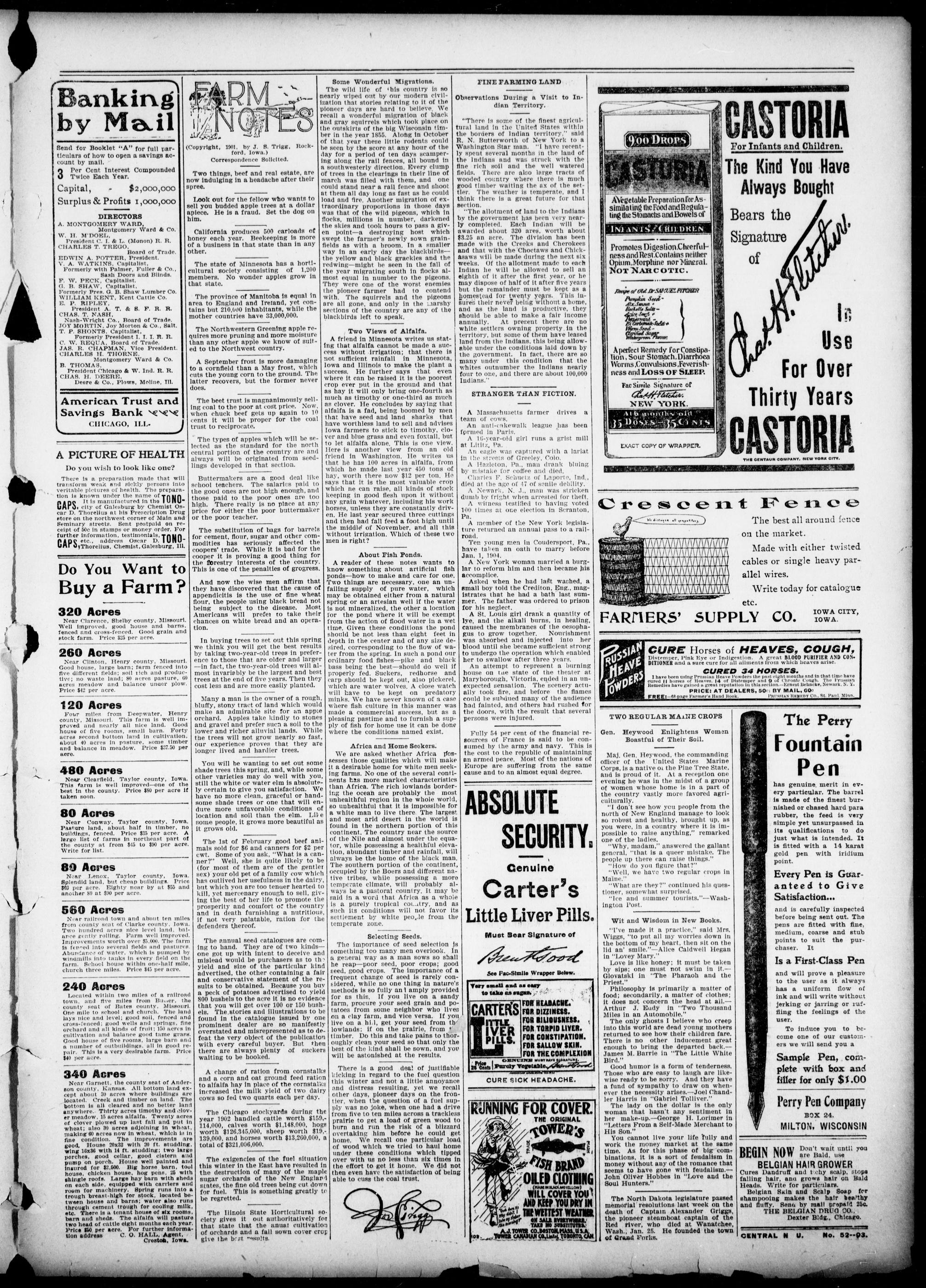
FARM NOTES
(Copyright, 1901. by J. S. Trigg, Rock-
ford, Iowa.)
Correspondence Sollicited.
Two things, beef and real estate, are now indulging in a headache after their spree.
Look out for the fellow who wants to sell you budded apple trees at a dollar apiece. He is a fraud. Set the dog on him.
California produces 500 carloads of honey each year. Beekeeping is more of a business in that state than in any other.
The state of Minnesota has a horticultural society consisting of 1,200 members. No wonder apples grow in that state.
The province of Manitoba is equal in area to England and Ireland, yet contains but 210,000 inhabitants, while the mother countries have 33,000,000.
The Northwestern Greening apple requires more pruning and more moisture than any other apple we know of suited to the Northwest country.
A September frost is more damaging to a cornfield than a May frost, which cuts the young corn to the ground. The latter recovers, but the former never does.
The beet trust is magnanimously selling coal to the poor at cost price. Now, when chuck beef gets up again to 10 cents it will be proper for the coal trust to reciprocate.
The types of apples which will be selected as the standard for the north central portion of the country are and always will be originated from seedlings developed in that section.
Buttermakers are a good deal like school teachers. The salaries paid to the good ones are not high enough, and those paid to the poor ones are too high. There really is no place at any price for either the poor buttermaker or the poor teacher.
The substitution of bags for barrels for cement, flour, sugar and other commodities has seriously affected the cooper's trade. While it is bad for the cooper it is proving a good thing for the forestry interests of the country. This is one of the penalties of grogress.
And now the wise men affirm that they have discovered that the cause of appendicitis is the use or fine wheat flour, the people using black bread not being subject to the disease. Most Americans will prefer to take their chances on white bread and an operation.
In buying trees to set out this spring we think you will get the best results by taking two-year-old trees in preference to those that are older and larger—in fact, the two-year-old trees will almost invariably be the largest and best trees at the end of five years. Then they cost less and are more easily planted.
Many a man is the owner of a rough, bluffy, stony tract of land which would make an admirable site for an appie orchard. Appies take kindly to stones and gravel and prefer such a soil to the lower and richer alluvial lands. While the trees will not grow nearly so fast, our experience proves that they are longer lived and hardier trees.
You will be wanting to set out some shade trees this spring, and, while some other varieties may do well with you, still the white or water elm is absolutely certain to give you satisfaction. We have no more clean, graceful or hand-some shade trees or one that will endure more unfavorable conditions of location and soil than the elm. Like some people, it grows more beautiful as it grows old.
The 1st of February good beef animals sold for $6 and canners for $2 per cwt. Some of you ask, "What is a canner?" Well, she is quite likely to be (for most of them are of the gentler sex) your old pet of a family cow which has outlived her usefulness in the dairy, but which you are too tenuer hearted to kill, yet mercenary enough to sell, giving the best of her life to promote the prosperity and comfort or the country and in death furnishing a nutritious, if not very palatable, ration for the defenders thereof.
The annual seed catalogues are coming to hand. They are of two kinds—one got up with intent to deceive and mislead would be purchasers as to the yield and size of the particular kind advertised, the other containing a fair and conservative statement of the results to be obtained. Because you buy a peek of potatoes advertised to yield 800 bushels to the acre it is no evidence that you will get over 100 or 150 bushels. The stories and illustrations to be found in the catalogue issued by one prominent dealer are so manifestly overstated and misrepresented as to defeat the very ooblet of the publication with every careful buyer. But then there are always plenty of suckers waiting to be hooked.
A change of ration from cornstalks and a corn and oat ground feed ration to alfalfa hay in place of the cornstalks increased the milk yield of two dairy cows so fed two quarts each per day.
The Chicago stockyards during the year 1902 handled cattle worth $159,114,000, calves worth $1,148,000, hogs worth $126,345,000, sheep worth $19,139,000, and horses worth $13,260,000, a total of $221,006,000.
The exigencies of the fuel situation this winter in the East have resulted in the destruction of many of the maple sugar orchards of the New England states, the fine old trees being cut down for fuel. This is something greatly to be regretted.
The Illinois State Horticultural society gives it out authoritatively for that state that the annual cultivation of orchards and a fall sown cover crop give the best results.
Some Wonderful Migrations.
Some wonderful migrations.
The wild life of this country is so nearly wiped out by our modern civilization that stories relating to it of the pioneer days are hard to believe. We recall a wonderful migration of black and gray squirrels which took place on the outskirts of the big Wisconsin timber in the year 1855 and in October of the year these little rodents could be seen by the camera at any hour of the day for a period of ten days scampering along the rail fences, all bound in a southwesterly direction. Every clump of trees in the clearings in their line of march was filled with them, and one could stand near a rail fence and shoot at them all day long as fast as he could load and fire. Another migration of extraordinary proportions in those days was that of the wild pigeons, which in flocks, millions in number, darkened the skies and took hours to pass a given point—a destroying host which swept the farmer's newly grain-fields as with a broom. In a smaller way in an early day the blackbirds—the yellow and black grackles and the redwing—might be seen in the fall of the year migrating south in flocks almost equal in number to the pigeons. They were one of the worst enemies the pioneer farmer had to contend with. The squirrels and the pigeons are all gone, and only in the marshy sections of the country are any of the blackbirds left to speak.
Two Views of Alfalfa.
A friend in Minnesota writes us stating that alfalfa cannot be made a success without irrigation; that there is not sufficient rainfall in Minnesota, Iowa and Illinois to make the plant a success. He further says that even where it can be raised it is the poorest crop ever put in the ground and that as hay it will only bring one-fourth as much as timothy or one-third as much as clover. He concludes by saying that alfalfa is a fad, being boomed by men that have seed and land sharks that have worthless land to sell and advises Iowa farmers to stick to timothy, clover and blue grass and even foxtail, but to let alfalfa alone. This is one view. Here is another view from an old friend in Washington. He writes us that he has 100 acres in alfalfa, from which he made last year 450 tons of hay, worth there now $12 per ton. He says that it is the most valuable crop which he can raise, all kinds of stock keeping in good flesh upon it without any grain whatever, including his work horses, unless they are constantly driven. He last year secured three cuttings and then had fall feed a foot high until the middle of November, and all this without irrigation. Which of these two men is right?
About Fish Ponds.
A reader of these notes wants to know something about artificial fish ponds—how to make and care for one. Two things are necessary, one an unfailing supply of pure water, which may be obtained either from a natural spring or an artesian well if the water is not mineralized, the other a location for the pond where it will be exempt from the action of flood water in a wet time. Given these conditions the pond should be not less than eight feet in depth in the center and of any size desired, corresponding to the flow of water from the spring. In such a pond our ordinary food fishes—pike and black bass being the best—should do well if properly fed. Suckers, redhorse and carp should be kept out, also pickerel, which are water wolves. A close watch will have to be kept on predatory minks. We have never known of a case where fish culture in this manner was made a commercial success, but as a pleasing pastime and to furnish a supply of fish for home use it can be done where the conditions named exist.
Africa and Home Seekers.
We are asked whether Africa possesses those qualities which will make it a desirable home for white men seeking farms. No one of the several continents has more marked characteristics than Africa. The rich lowlands bordering the ocean are probably the most unhealthful region in the whole world, so unhealthful that it is impossible for a white man to live there. The largest and most arid desert in the world is found in the northern portion of this continent. The country near the source of the Nile and almost under the equator, while possessing a healthful elevation, abundant timber and rainfall, will always be the home of the black man. The southern portion of the continent, occupied by the Boers and different native tribes, while possessing a more temperate climate, will probably always be a pastoral country. It may be said in a word that Africa as a whole is a purely tropical country, and as such its conditions will not favor its settlement by white people from the temperate zone.
Selecting Seeds.
The importance of seed selection is something too many men overlook. In a general way as a man sows so shall he reap—poor seed, poor crops; good seed, good crops. The importance of a frequent change of seed is rarely considered, while no one thing in nature's methods is so fully and amply provided for as this. If you live on a sandy farm, procure your seed grain and potatoes from some neighbor who lives on a clay farm, and vice versa. If you live on a hill, get your seed from flowlands; if on the prairie, from timber. Do this and take pains to thoroughly clean your seed so that only the best of the kind be sown, and you will be astonished at the results.
There is a good deal of justifiable kicking in regard to the fuel question this winter and not a little annoyance and distress resulting, yet we recall other days, pioneer days on the frontier, when the question of a fuel supply was no joke, when one had a drive from five to ten miles across a trackless prairie to get a load of green wood to burn and run the risk of a blizzard overtaking him before he could get home. We recall one particular load of wood which we tried to haul home under these conditions which tipped over with us no less than six times in the effort to get it home. We did not then even have the satisfaction of being able to cuss the coal trust.
FINE FARMING LAND
Observations During a Visit to Indian Territory.
"There is some of the finest agricultural land in the United States within the borders of Indian territory," said R. N. Butterworth of New York to a Washington Star man. "I have recently spent several months in the land of the Indians and was struck with the fine rich soil and the well watered fields. There are also large tracts of wooded country where there is much good timber waiting the ax of the settler. The weather is temperate, and I think there is a great future for that section.
"The allotment of land to the Indians by the government has been very nearly completed. Each Indian will be awarded about 320 ares, worth about $3.25 an acre. The division has been made with the Creeks and Cherokees and that with the Choctaws and Chickasaws will be made during the next six weeks. Of the allotment made to each Indian he will be allowed to sell an eighth of it after the first year, or he may dispose of half of it after five years but the remainder must be kept as a homestead for twenty years. This insures their never being without a home, and as the land is productive, they should be able to make a fair income annually. At present there are no white settlers owning property in the territory, but some of them have leased land from the Indians, this being allowable under the conditions laid down by the government. In fact, there are so many under this condition that the whites outnumber the Indians nearly four to one, and there are about 100,000 Indians."
STRANGER THAN FICTION
A Massachusetts farmer drives a team of cows. An anti-cakewalk league has been formed in Paris. A 16-year-old girl runs a grist mill at Litz, Pa. An eagle was captured with a lariat in the streets of Greeley, Colo.
A Hazleton, Pn., man drank bluing by mistake for coffee and died.
Charles F. Schneitz of Laporte, Ind, died at the age of 47 of sanile debility. A Newark, N. J., man was stricken dumb by fright when arrested for theft. A witness testified to having voted 100 times at one election in Scranton, Pa. A member of the New York legislature returned an annual pass to a railroad. Ten young men in Coudersport, Pa., have taken an oath to marry before Jan. 1, 1904. A New York woman married a burglar to reform him and then became his accomplice. Asked when he had last washed, a small boy told the Crediton, Eng., magistrates that he had a bath last summer. The father was ordered to prison for his neglect.
A St. Louis girl drank a quantity of lye, and the alkali burns, in healing, caused the membranes of the oesophagus to grow together. Nourishment was absorbed and injected into her blood until she became sufficient strong to undergo the operation which enabled her to swallow after three years.
An attempt to represent a burning house on the state of the theater at Maryborough, Victoria, ended in an unexpected sensation. The scenery actually took fire, and before the flames could be subdued many of the audience had fainted, and others had rushed for the doors, with the result that several persons were injured.
Fully 54 per cent of the financial resources of France is said to be consumed by the army and navy. This is the cost to the republic of maintaining an armed peace. Most of the nations of Europe are suffering from the same cause and to an almost equal degree.
ABSOLUTE SECURITY.
Genuine
Carter's
Little Liver Pills.
Must Bear Signature of
Aunt Good
See Fac-Simile Wrapper Below.
Very small and as easy
to take as sugar.
CARTERS
TITLE
LIVER
PILLS.
FOR HEADACHE.
FOR DIZZINESS.
FOR BILIOUSNESS.
FOR TORPID LIVER.
FOR CONSTIPATION.
FOR SALLOW SKIN.
FOR THE COMPLEXION
Price
25 Cents
GENUINE
MUST HAVE SIGNATURE.
Purely Vegetable
CURE SICK HEADACHE.
RUNNING FOR COVER.
THE ORIGINAL
TOWER'S
FISH BRAND
OILED CLOTHING
(MADE IN BLACK AND YELLOW)
WILL COVER YOU
AND KEEP YOU DRY IN
THE WETTEST WEATHER
ON SALT EVERYWHERE.
TAKES NO SUBSTITUTE.
A.J. TOWER CO. BOSTON, MASS. U.S.A.
TOWER CANADIAN CO. LINCOLN, TOBONTO, CAN
Crescent Fence
CURE Horses of HEAVES, COUGH,
Distemper, Pink Eye or Indigestion. A great BLOOD PURIFIER AND CONDITIONER and a sure cure for all ailments from which heaves arise.
CURED 34 HORSES.
I have been using Prussian Heavy Powders the morning before and in that time have cupped Horses Heavy with 10 and 10 of O'Ryanne Cough. The Prussian Remedies have gaited a great reputation in this section—Ernest Behnke, Newark, N. Y.
PRICE: AT DEALERS, 50¢; BY MAIL, 60¢
Avegetable Preparation for Assimilating the Food and Regulating the Stomachs and Bowels of
Promotes Digestion.Cheerfulness and Rest.Contains neither Opium.Morphine nor Mineral. NOT NARCOTIC.
Recipe of Old Dr. SAMUEL PITCHER
Pumpkin Seed -
Alix, Sanna -
Rockellia Suita -
Grape Seed -
Raspberry -
Di Gerontale Suita -
Worm Seed -
Carpinid Sugar
Whittyroom Flavor.
A perfect Remedy for Constipation, Sour Stomach, Diarrhoea, Worms, Convulsions, Feverishness and LOSS OF SLEEP.
Fac Simile Signature of
Gust H. Pitcher.
NEW YORK.
At month's old
35 DOSES - 35 CINES
EXACT COPY OF WRAPPER.
We dislike all competing
PRUSSIAN HEAVE POWDERS
CURE Horses of Distemper, Pink Eye or India DITIONER and a sure cure for CURE
I have been using Prussian horse cured 11 horses of Heaven. 14 of Remedies have gained a great repu FREE: AT D
TWO REGULAR MAINE CROPS
Gen. Heywood Enlightens Women Boastful of Their Soil.
Maj. Gen. Heywood, the commanding officer of the United States Marine Corps, is a native of the Pine Tree State, and is proud of it. At a reception one evening he was in the midst of a group of women whose home is in a part of the country vastly more favored agriculturally.
"I don't see how you people from the north of New England manage to look so robust and healthy, brought up, as you were, in a country where it is impossible to raise anything," remarked one of the ladies.
"Why, madam," answered the gallant general, "that is a queer mistake. The people up there can raise things."
"How do you figure that?"
"Well, we have two regular crops in Maine."
"What are they?" continued his questioner, somewhat surprised.
"Ice and summer tourists."—Washington Post.
Wit and Wisdom in New Books.
"I've made it a practice," said Mrs. Wiggs, "to put all my worries down in the bottom of my heart, then sit on the lid an 'smile."—Alice Caldwell Hegan in "Love Mary."
Love is like honey; it must be taken by sips; one must not swim in it.—Glovatski in "The Pharaoh and the Priest."
Philosophy is primarily a matter of food; secondarily, a matter of clothes; it does not concern the head at all.—Arthur J. Eudy in "Two Thousand Miles in an Automobile."
The only ghosts I believe who creep into this world are dead young mothers returned to see how their children fare. There is no other inducement great enough to bring the departed back.—James M. Barrie in "The Little White Bird."
Good humor is a form of tenderness. Those who are easy to laugh are likewise ready to be sorry. And they have a fund of sympathy to draw on whenever the necessity arises.—Joel Chandler Harris in "Gabriel Tolliver."
The lady on the dollar is the only woman that hasn't any sentiment in her make-up.—George H. Lorimer in "Letters From a Self-Made Merchant to His Son." You cannot live your life fully and work the money market at the same time. As for this phase of big combinations, it is a sort of feudalism in money without any of the romance that seems to have gone with feudalism.—John Oliver Hobbes in "Love and the Soul Hunters."
The North Dakota legislature passed memorial resolutions last week on the death of Captain Alexander Griggs, the pioneer steamboat captain of the Red river, who died at Wanatchee, Wash., Jan. 25. He founded the town of Grand Forks.
CASTORIA
For Infants and Children.
The Kind You Have
Always Bought
Bears the
Signature
of
Chat. H. Flitcher.
In
Use
For Over
Thirty Years
CASTORIA
THE GENTAUR COMPANY. NEW YORK CITY.
nt Fence
The best all around fence on the market.
Made with either twisted cables or single heavy parallel wires.
Write today for catalogue etc.
PPLY CO. IOWA CITY, IOWA.
s of HEAVES, COUGH,
Indigestion. A great BLOOD PURIFIER AND CON-
for all ailments from which heaves arise.
RED 34 HORSES.
Heave Powders the past eight months and in that time have
4 of Distemper and 9 of Chronicle Cough. The Frussian
population in this section. Ernest Behnke, Newark, N. Y.
T DEALERS, 50-0 BY MAIL, 600
and Book.
PRUSSIAN HERMEDY Co. St. Paul Minn.
The Perry Fountain Pen
has genuine merit in every particular. The barrel is made of the finest burnished or chased hard para rubber, the feed is very simple yet unsurpassed in its qualifications to do just what is intended. It is fitted with a 14 karat gold pen with iridium point.
Every Pen is Guaranteed to Give Satisfaction...
and is carefully inspected before being sent out. The pens are fitted with fine, medium, coarse and stub points to suit the purchaser. It
Is a First-Class Pen
and will prove a pleasure to the user as it always has a uniform flow of ink and will write without jerking or jarring or ruffling the feelings of the user.
To induce you to become one of our customers we will send you a Sample Pen, complete with box and filler for only $1.00
Perry Pen Company
BOX 24.
MILTON, WISCONSIN
BEGIN NOW Don't wait until you are Bald, use BELGIAN HAIR GROWER Cures Dandruff and tachy scalp, stops falling hair, and grows hair on Bald Heads. We work for parties and Scalp Soap for shampooing makes the hair beathy and fuzzy. Send by mail propail 25c. THE BELGIAN DRUG CO.
CENTRAL N U. No. 52--93.
RUFUS L. LOGAN, B. S. D. - EDITOR
TERMS OF SUBSCRIPTION.
One Year in Advance - - - $1.00
Six Months in Advance - - .75
Three Months in Advance - - .50
Single Copies - - - .05
Advertising Rates on Application.
Job Work of all Kinds Solicited.
Entered at the postoffice at Columbia, Mo., as second class matter, Jan. 15, 1902.
Agents wanted in every town in the state.
Payments may be made in two cent stamps, by postal note, money order, by registered letter or express order.
Correspondence containing news of interest and importance is desired from all parts of the United States.
Communications should be made to reach us not later than Thursday morning, to insure insertion in the current issue.
No attention will be paid to anonymous communications.
Agents wanted everywhere. Write for terms.
Specimen copies sent to any address upon request.
PRESS OF THE MISSOURI STATESMAN.
JIM CROW CARS.
There is no doubt, but that only narrow minded predjudiced citizens of Missouri want the separate car law enacted in this state. The Lexington News, a democratic paper, has the following to say on the subject in a recent issue: "We are opposed to the "Jim Crow" car law for Missouri.
"It is thirty-seven years now since the negroes were set free, and during this time we have done fairly well without it, and such matters are bound to get better as the years go by. It will create a state of bad feeling between the races that will result in harm to both. Missouri negroes have been remarkably free from offensive conduct toward the whites. In all our traveling we have never been insulted or made uncomfortable by the conduct of negro travelers. We would as well make laws requiring them to walk on a particular part of the sidewalk. It will be bad civic policy to pass such a law. There is really no occasion for it in Missouri.
"The objectionable feature of mixed cars can be remedied by requiring more cars, so that they will not be so crowded. This is the real discomfort of traveling on cars, not the presence of well-behaved negroes. A strict law, well enforced, against misbehavior on public cars will do the rest.
"Let us give the negroes the benefit of such association, for it is worth much to them. The matter of social equality is out of the question. It does not enter into the case at all. No more than meeting them on the street."
"Lafayette county had more slaves than any other county in Missouri, and has in it today more negroes than any other county in the state except those containing large cities. We have everyday experience to go by, and our experience is that the law is a bad one."
Send fifty cents and get the best negro paper in this section of the country for 3 months.
The enumeration of last spring showed that there were in Columbia 786 negro children between the ages of six and twenty-one years. Probably two-thirds of this number are attending school, the other one-third can be seen loafing on the streets or about their homes with practically no reason whatever for not attending school. This state of affairs can only be justly charged to the parents and guardians, who allow their children and those under their protection to grow up in ignorance rather than send them to school.
The recent action of the citizens of Fayette, Mo., in beating women under the disguise of "white caps" is a disgrace to any people or community, and only shows a mark of semi-barbarous lawlessness on the part of those who engage in such. No intelligent law-abiding citizen will approve of any such action. No matter how great the crime of the victims, may have been. No good citizen believes in lawlessness. No law-abiding citizen will at any time refuse to let the law take its course. If the laws of Missouri are not severe enough to punish the aggressors of the law, they should be made so.
Spring Goods.
Mr. Victor Barth of the Barth Clothing Co., is in the East buying spring goods, look for their "ad" in this paper later.
CHANGES IN POSTAGE STAMPS.
Postoffice Authorities Tell of Several Changes.
A formal notification from headquarters in Washington contains the information that postage stamps bearing a new design will soon be distributed.
The most conspicuous alteration that will be made will be seen in the 10-cent special delivery stamps, which will bear, instead of the figure of a messenger boy running, a cut of the same boy astride of a wheel.
The old custom of placing replicas of celebrated men upon the stamps will be adhered to, but there will appear, in addition to the stamped features, the name, date of birth and date of death of the men so honored.
There will soon go into effect,
too, a slight decline in the cost of
stamped envelopes and wrappers.
The one-cent manila envelopes,
which formerly sold for $11 per
thousand, will now be sold for
$10.60; newspaper wrappers will
be reduced 'n price from $11 to
$10.60 per thousand. A new
white one-cent envelope will cost
$11.08 per thousand.
The 1903 stamps will bear the
following colors and faces.
One-cent—Green; Benjamin
Franklin.
Two cent—Red; George Washington.
Four cent—Dark brown; U. S.
Grant.
Five cent—Blue; Abraham
Lincoln.
Six cent—Magenta; James A. Garfield.
Eight cent—Dark blue; Martha Washington.
Ten cent—Light 'blue; Daniel Webster.
Thirteen cents—Orange, slate; Benjamin Harrison.
Fifteen cents—Orange; Thomas Jefferson.
One dollar—Black; D. G.
Farragut.
Two dollar—Sapphire blue;
James Madison.
Five dollar—Dark green; John
Marshall.
Get in Touch With the World.
The man who gets "out of the swim", so to speak, who loses his touch with the great, pulsing world about him, who secludes himself in his study or laboratory, and deals only with books and theories instead of with men and things, will soon find himself going down grade.
It is not living in the world of yesterday, nor in the world of tomorrow, but in today's world, that counts. We must know the world, and the day we are living in, and keep in responsive touch with the great movements of civilization.
A great many men have lived in the past, and have been educated in mediaeval methods instead of modern ones. They have lived in history, spending their time in buried cities, in dead philosophies, in exhausted theories, until they are dried up. They have gathered all their nourishment from the past. They are as much out of place in the present as a bird of paradise would be at the north pole. Their mental food, their reflections are all in the past, and yet they wonder why the world does not appreciate them, why they are not in touch with it, when the fact is that they are really strangers in a strange land. They have no sympathy with the struggles of the present, with the tendency of the age, or with the great movements going on all about them.—Success.
THE NEVER FAILING BAIT.
From the Boston Herald.—Of all the sure baits to catch gudgeons, the matrimonial advertisement is still the surest, apparently, and the latest expose in this line furnishes cumulative evidence of the fact that the men are more easily taken in by it than the women. It is still very much as John Boyle O'Reilly sang:
"What bait do you use?" said a saint to the devil,
"When you fish where the souls of men abound?"
"Well, for special tastes," said the king of evil,
"Gold and fame are the best I've found."
"But for general use?" asked the saint. "Ah, then."
then Said the demon, 'I angle for man, not,men.
"Are you civilized?" asked the lady of an Indian girl at Hampton College. "No", was the reply, "are you?"
On the 13th representative Robert L. Hains' bill, of Saline county, to make the crime of petit larceny punishable by fine, imprisonment or "by being whipped on the bare back with a rawhide by not less than ten nor more than 39 lashes in the discretion of the court, justice or jury trying the cause," and requiring the Constable to do the whipping, came up for consideration and excited considerable debate, after which it was indefinitely postponed by a vote of 65 to 39. This of course disposes of the bill for this session.
Worth Remembering.
Never overlook an opportunity.
The neglected opportunity never calls again.
After all, final success depends upon one's character.
Do the right thing, and failure is impossible.—Fecke.
How beautiful the law of love can make the cares and trials of life.—Bryant.
The man who dares to waste an hour of time has not learned the value of life.—Darwin.
One of two things always happens regarding a habit, you either master it, or it masters you.
Observe the postage stamp.—Its usefulness consists of sticking to one thing until it gets there.
The one thing worth living for—yes, worth dying for—is the chance to make somebody useful and happy.
Life is a series of surprises. We do not guess today the mood, the pleasure, the power of tomorrow—when we are building up our being.
"It is necessary to hope, though hope should always be deluded, for hope itself is happiness, and its frustrations, however frequent, are yet less dreadful than its extinction"—Johnson.
"The greatest thing," says some one, "a man can do now for his Heavenly Father is to be kind to some of his other children." I wonder why it is that we are not all kinder than we are. How much the world needs it! How easily it is done! How instantaneously it acts! How infallibly it is remembered! How superabundantly it pays itself back! For there is no debtor in the world so honorable, so superbly honorable, as love. "Love never faileth."—Henry Drummond.
Conscience in Work.
Talents and skill tell for much but conscience in work tells for more. The mechanic or the clerk who, beyond his stated salary, beyond even his obligations to his employer or the demands which public opinion could make upon him, exerts himself to make his work as perfect as he can, and delights in its thoroughness and excellence apart from any private benefit it can render him, has a value which can never be computed. It matters not what the work be, whether it be done with the spade of the laborer, the pen of the clerk, the brush of the artist, or the voice of the statesman. Such people are sought far and wide; there are places open to them, and their services are always at a premium.
Fixing Weight of Flour.
Mr. Reinmiller, of Newton, introduced a bill in the house last week fixing the net weight of flour in its several packages, as follows: Barrel, 196 pounds; sack, 98 pounds; half sack, 49 pounds; quarter sack, 24½ pounds, and no package of flour containing a fewer number of pounds shall be offered for sale. Violations of the act are punishable by a fine of not less than $10 nor more than $100.
Father—Tell me why you want to get married?
Daughter—I expect it's one of the traits inherited from my mother.
Notice to Correspondents.
When you find it impossible for you to send the news regularly from your community after having agreed to do so, kindly notify us and do not have us reserving space for your items weekly and you not sending them.
Notice !
We go to press on Thursdays. All matter for publication must reach us by that day to insure publication. No old news will be published.
The Railroads.
WABASH
GOING SOUTH.
No. 33. Arrive Columbia. 8:15 a. m.
No. 37. Arrive Columbia. 8:20 p. m.
No. 37. Arrive Columbia. 8:45 p. m.
GOING NORTH.
No. 30. Leave Columbia. 9:40 a. m.
No. 38. Leave Columbia. 9:40 p. m.
No. 34. Leave Columbia. 4:10 p. m.
TRAINS NORTH.
| | A. M. No. 36 | A. M. No. 38 | P. M. No. 40 |
| :--- | :--- | :--- | :--- |
| **Leave:** | | | |
| McBaine ... | 6:30 | 11:53 | 4:05 |
| Webster ... | 6:33 | 11:58 | 4:08 |
| Brushwood ... | 6:38 | 12:02 | 4:15 |
| Turner ... | 6:42 | 12:06 | 4:17 |
| Limerick ... | 6:47 | 12:11 | 4:27 |
| Arrive Columbia ... | 6:55 | 12:19 | 4:30 |
**TRAINS SOUTH.**
| | A. M. No. 35 St. Louis Express | P. M. No. 37 Texas Express | P. M. No. 39 |
| :--- | :--- | :--- | :--- |
| **Leave:** | | | |
| Columbia ... | 11:00 | 3:10 | 6:30 |
| Limerick ... | 11:08 | 3:18 | 6:38 |
| Turner ... | 11:12 | 3:22 | 6:42 |
| Brushwood ... | 11:17 | 3:27 | 6:47 |
| Webster ... | 11:22 | 3:32 | 6:52 |
| Arrive McBaine ... | 11:25 | 3:35 | 6:52 |
Lodge and Church Directory.
S. M. T.
Mrs. Ada Douglass, W. P.; Mrs. Lizzie Williams, W. S. Meeting first Monday in each month at 3 p. m.
U. B. F.
Crispus Attucks Lodge,No. 62. Meetings 2nd and 4th Tuesdays in each month. Visiting members cordially invited. Caleb Hall, W. M. A. M. Schweich, W. S.
K. P.
Acme Lodge, No. 24. Meetings second and fourth Fridays in each month. W. H. Turner, C. C. and D. D. G. C. W. W. Lampkins, M. F.
LADIES COURT.
Golden Queen Court No. 19 meets first Friday in each month. Mrs. Annie Williams, M. A. M., Mrs. Lizzie Richardson, Secretary.
O. E. S
Amos Chapter, No. 30. Meetings second Friday in each month. Mrs. Bessie Washington, W. M. Mrs. Lizzie Richardson, W. S.
LADIES COURT.
Golden Queen Court No. 19 meets first Friday in each month. Mrs. Annie Williams M. A. M. Mrs. V. L. Walden Sec.
St. Paul Lodge, No. 12, A.
F. & A. M., meets every first
and third Tuesday in each
month. A cordial invitation
extended to all visiting
brothers. J. A. Mosely, W.
M. J. A. Grant, Secretary.
SECOND CHRISTIAN CHURCH.
Rev. J. B. Parsons, pastor.
Preaching Sundays 11 a. m.
and 7:30 p. m.
Prayer meeting Wednes-
days 7:30 p. m.
Everybody cordially invited to attend.
K. OF P.
Harrison Lodge No. 12,
Huntsville, Mo. Meeting the
second and fourth Thursdays
in each month. M. W. Tony,
C. C., W. T. Ansel, K. R. S.,
I. A. Robinson, M. E.
A. M. E. CHURCH.
Rev. P. C. Crews, Pastor.
Preaching Sundays 11 a.
m.; 7:30 p. m.
Sunday school 2:30 p. m.
Prayer meeting every
Wednesday eve, at 8:30; every
body invited to attend.
M. E. CHURCH
Rev. J. Arlington Grant, pastor.
Preaching Sundays 11, a. m. and 7:30 p. m.
Sunday school, 9:30 a. m.
Prayer meeting Wednesdays 7:30 to 8:30; all are made welcome.
Rev. A. A. Adams, Pastor.
Preaching Sundays 11 a.
m., and 7:30 p. m.
Sunday school at 2:30 p. m.
Prayer meeting Wednesday
evening, 7:30.
A cordial invitation ex-
tended to all.
The Columbia Gro=cery Co.,
Keeps constantly on hand a fresh supply of staple and FANCY GROCERIES.
YOUR PRODUCE WANTED.
You Will Always
find a fine, fashionable stock of
LOTHING
The only difference between our suit-
der suits is imagination. As to fit, we
need and jury- Try us and be convinc-
ed on any unsatisfactory article. We
customer of you if low prices will do it.
Gobe Mercantile
Company.
North St. - Jefferson
Artonoix & Walendon
For School Books and Supplies
Stationery, Musical
Magazines, Etc.
East High St. - Jefferson City
AYBERRY & CO.
DEALERS IN
Table and Fancy Grocer
of Fresh Lunch, Goods. Wood, and Coa-
tal Attention Given to all Orders. Telep
with us. The only difference between our "suits" and the made-to-order suits is imagination. As to fit, we allow you to be judge and jury- Try us and be convinced. Your money back on any unsatisfactory article. We are bound to make a customer of you if low prices will do it.
Lartonoix & Walendorf,
....For School Books and Supplies....
Fine Stationery, Musical Goods,
Magazines, Etc.
No. 222 East High St. - Jefferson City, Mo.
Staple and Fancy Groceries.
All Kinds of Fresh Lunch Goods. Wood and Coal. Prompt and Careful Attention Given to all Orders. Telephone 580.
The Professional W
$1.00 a year Sent to Any Address.
210 E. High St.
GO TO
Larton
....For So
Fine Station
No. 222 East
MAY
Staple
All Kinds of Fro
and Careful Att
Lafayette S
Read The
$1.00 a
DR. D. W. OULP
HING
between our 'suits' and the
n. As to fit, we allow you
and be convinced. Your
ery article. We are bound
prices will do it.
rcantile
any.
Jefferson City, Mo.
Valendorf,
and Supplies....
Musical Goods,
Etc.
Jefferson City, Mo.
Y & CO.,
IN
icy Groceries.
Wood, and Coal. Prompt
Orders. Telephone 580.
Jefferson City, Mo.
sional World
This book contains One Hundred Treatises on Thirty-Eight General Topics in which the negro problem is viewed from every possible angle. The book is written for the negro citizenship. It will furnish the basis of future calculations on all race subjects. There are 100 PORTRAITS AND 100 BIOGRAPHIES of the great African-American and Indian men and most prominent negro is to have a fair knowledge of the entire race. Over 100 large pages and retails at $2.50 in cloth, postpaid. AGENTS: We want 5,000 canvassers at once to introduce this book to highest commissions paid. Books on credit. Agents magnificent in their writing. Write for our proposition at once. This is the opportunity of your life.