The Professional World
Friday, March 20, 1903
Columbia, Missouri


Page text (machine-generated)
THE PROFESSIONAL WORLD.
$1.00 Per Year in Advance.
Columbia News.
Patronize the Columbia Grocery Company.
Miss Viola Salisbury is visiting friends in Carrollton, Mo.
Buy your garden seed of the Columbia Grocery Co.
The A. M. E. church is having a revival meeting. Rev. Crews is being assisted by Revs. Dakes and Bryaut.
Mrs. Leonard Smith, of Rocheport, visited friends in this city Saturday and Sunday.
Best and most reliable garden seed at the Columbia Grocery Company's Store.
Messrs. Bass, Williams, and Hall, of Switzler Station, attended the debate at St. Paul's Hall Monday evening.
Miss Addie Mosely and her aunt, Mrs. Thyes, arrived Saturday from Kansas City, having been called here on account of the serious illness of Miss Luella Mosely.
The surest garden seed at the Columbia Grocry Co.
Died, at the residence of 10 parents, in Columbia, Tuesday, March 17, 1903, Miss Luella Mosely, aged 24 years. She leaves a father, mother, sister two brothers and a host of friends and relatives to mourn her death.
Capital City News.
Rev. H. J. Burton is in this city.
Prof. J. C. Mabane has returned to his school.
Prof. E. L. Anthony visited his family last week.
Prof. J. H. Burton has returned home from his school.
Subscribe for the Professional World. It is only $1.00 a year.
Nothing sensational has taken place since the death of "Jim Crow."
Rev. J. P. Smith is holding a ten days' revival at the Second Baptist church.
Mr. George Lane, postmaster at Elliott, Indian Territory, attended the funeral of his mother, Mrs. Malinda Moore. Prof. G. N. Gresham, of Kansas City, stopped over in this city last week on his way from Washington, D.C. He addressed the students of Lincoln Institute and called on a few friends.
We are sorry to record the death of two of Jefferson City's oldest citizens who have passed away in the last week. They were Mrs. Lucinda Boyd and Mrs. Malinda Moore. These two ladies lived just across the street from one another and died about the same time. Mrs. Boyd leaves a son, three daughters and a number of grand children; Mrs. Moore leaves three sons and a daughter. Both had been residents of Jefferson City many years.
Macon Items.
Rev. Corbin remains the same.
Mr. Roscoe Osborne is visiting home again.
Mrs. R. B. Burris is able to be out again after a few weeks of illness.
Miss Mollie Robinson, who has been sick several days, is improving nicely.
The musical given by Mrs. Scruggs was a success and was well attended.
CASH OR CREDIT. Catalogue FREE. CENTURY MF'G CO.
COLUMBIA AND JEFFERSON CITY, MISSOURI, FRIDAY MAR. 20, 1903.
Miss Sarah Green is in school again after several weeks' absence caused by malarial fever.
A very attentive audience listened to the Tennessee Jubilee Singers at the opera house Saturday evening.
Mrs. Hattie Coleman and Mrs. Eliza Houston have set up a first class restaurant on Weed St. and solicit your patronage.
Mrs. Eliza Jackson, who has for two weeks visited her daughter, Mrs. P. Erline Jackson Osborne, at 107 3rd St., left Friday for her home at Glasgow. Mo.
The members of the Vine St. Second Baptist church visited Rev. Osborne and congregation Sunday evening, paying a visit of a few Sundays ago. The collection taken amounted to $20. The two churches work together in peace and harmony assisting each other nicely. A donation reception was given in honor of Rev. W. T. Osborne and wife on Tuesday evening. Quite a grand donation was had, and both Rev. Osborne and wife expressed themselves as being highly pleased with the appreciation shown them by the members of the church and their friends.
Notice to Correspondents.
When you find it impossible for you to send the news regularly from your community after having agreed to do so, kindly notify us and do not have us reserving space for your items weekly and you not sending them.
A Prominent Couple Married.
The Professional World takes great pleasure in informing its many readers of the marriage of Rev. W. T. Osborne and Miss P. Erline Jackson, of Macon City, both of whom are widely known, Rev. Osborne being one of the leading ministers of the North Missouri conference and now serving his fourth year at Macon, Mo., to the greatest satisfaction of his people and honor to himself. Miss Jackson is a woman of culture and ranks high as a teacher. She is a former student of both Walden University, Nashville, Tenn., and Dixon College, Dixon Ill. She is now first assistant teacher in Dumas school at Macon Mo., and is a woman of business, full of ambition and a great determination to succeed, and no doubt will be a wonderful helper in the service of for Christ. We wish for them a happy journey through life and pray that success may crown their efforts.
How's This?
We offer One Hundred Dollars Reward for any case of Catarrch that cannot be cured by Hall's Catarrch Cure.
F. J. CHENEY & Co., Toledo, O.
We, the undersigned, have known
F. J. Cheney, for the last fifteen years, and believe him perfectly honorable in all business transactions and financially able to carry out any obligations made by their firm.
WEST & TRUE, Wholesale Druggists, Toledo, O.
WALDIN, KINNAN, & MARVIN, Wholesale Druggists, Toledo, O. Hall's Catarrh Cure is taken internally, acting directly upon the blood and mucous surfaces of the system. Testimonials sent free. Price 75c per bottle. Sold by all Druggists. Hall's Family Pills are the best.
It will pay you
Harness, etc. We sell direct from our Factory to Consumers at Factory Prices. This guaranteed Buggy only $33.50; Cash or Easy Monthly Payments. We trust honest people located in all parts of the world.
Write for Free Catalogue.
MENTION THIS PAPER.
DEP'T 910. East St. Louis, Ill.
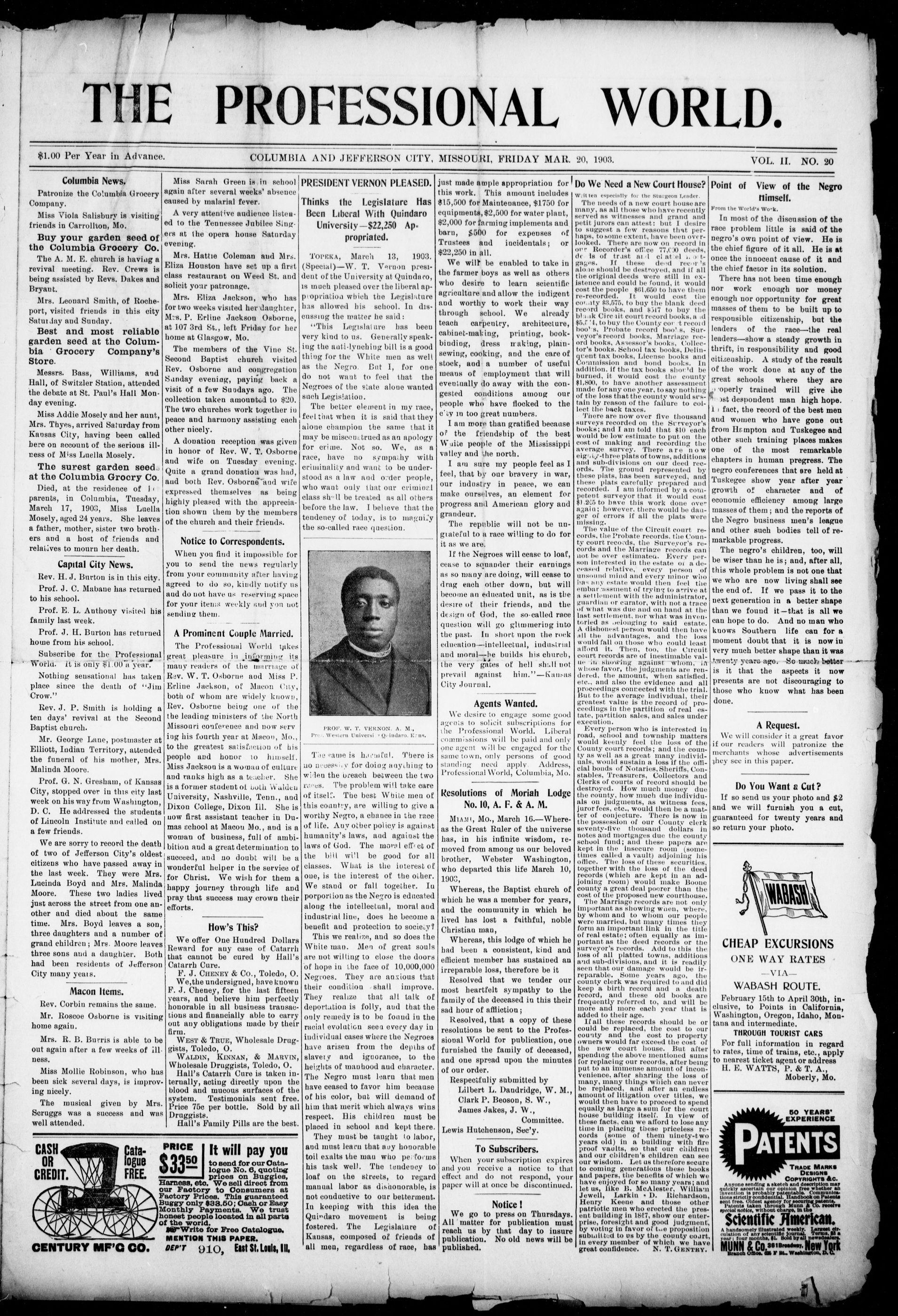
PRESIDENT VERNON PLEASED.
Thinks the Legislature Has Been Liberal With Quindaro University—$22,250 Ap-
TOPEKA, March 13, 1903. (Special)—W. T. Vernon president of the University at Quindaro, is much pleased over the liberal appropriation which the Legislature has allowed his school. In discussing the matter he said: "This Legislature has been very kind to us. Generally speaking the anti-lynching bill is a good thing for the White men as well as the Negro. But I, for one do not want to feel that the Negroes of the state alone wanted such Legislation.
The better element in my race, feel that when it is said that they alone champion the same that it may be misconstrued as an apology for crime. Not so. We, as a race, have no sympathy with criminality and want to be understood as a law and order people, who want only that our criminal class shall be treated as all others before the law. I believe that the tendency of today, is to magnify the so-called race question.
P. W. H.
PROF, W. T. W. TVERNON, A. M.
Proc. Western Universi Q. Indarand, Kris
The same is harmful. There is no necessity for doing anything to widen the breach between the two races. The problem will take care of itself. The best White men of this country, are willing to give a worthy Negro, a chance in the race of life. Any other policy is against humanity's laws, and against the laws of God. The moral effect of the bill will be good for all classes. What is the interest of one, is the interest of the other. We stand or fall together. In porportion as the Negro is educated along the intellectual, moral and industrial line, does he become a benefit and protection to society?
This we realize, and so does the White man. Men of great souls are not willing to close the doors of hope in the face of 10,000,000 Negroes. They are anxious that their condition shall improve. They realize that all talk of deportation is folly, and that the only remedy is to be found in the racial evolution seen every day in individual cases where the Negroes have arisen from the depths of slavery and ignorance, to the heights of manhood and character. The Negro must learn that men have ceased to favor him because of his color, but will demand of him that merit which always wins respect. His children must be placed in school and kept there.
They must be taught to labor, and must learn that any honorable toil exalts the man who performs his task well. The tendency to loaf on the streets, to regard manual labor as dishonorable, is not conductive to our betterment. In keeping with this idea the Quindaro movement is being fostered. The Legislature of Kansas, composed of friends of all men, regardless of race, has
just made ample appropriation for this work. This amount includes $15,500 for Maintenance, $1750 for equipments, $2,500 for water plant, $2,000 for farming implements and barn, $500 for expenses of Trustees and incidentals; or $22,250 in all.
We will be enabled to take in the farmer boys as well as others who desire to learn scientific agriculture and allow the indigent and worthy to work their way through school. We already teach carpentry, architecture, cabinet-making, printing, bookbinding, dress making, plainsewing, cooking, and the care of stock, and a number of useful means of employment that will eventually do away with the congested conditions among our people who have flocked to the city in too great numbers.
I am more than gratified because of the friendship of the best White people of the Mississippi valley and the north.
I am sure my people feel as I feel, that by our bravery in war, our industry in peace, we can make ourselves, an element for progress and American glory and grandeur.
The republic will not be ungrateful to a race willing to do for it as we are.
If the Negroes will cease to loaf, cease to squander their earnings as so many are doing, will cease to drag each other down, but will become an educated unit, as is the desire of their friends, and the design of God, the so-called race question will go glimmering into the past. In short upon the rock education—intellectual, industrial and moral—he builds his church, the very gates of hell shall not prevail against him."—Kansas City Journal.
Agents Wanted.
We desire to engage some good agents to solicit subscriptions for the Professional World. Liberal commissions will be paid and only one agent will be engaged for the same town, only persons of good standing need apply. Address, Professional World, Columbia, Mo.
Resolutions of Moriah Lodge No.10. A. F. & A. M.
MIAMI, Mo., March 16.—Whereas the Great Ruler of the universe has, in his infinite wisdom, removed from among us our beloved brother, Webster Washington, who departed this life March 10, 1903.
Whereas, the Baptist church of which he was a member for years, and the community in which he lived has lost a faithful, noble Christian man.
Whereas, this lodge of which he had been a consistent, kind and efficient member has sustained an irreparable loss, therefore be it
Resolved that we tender our most heartfelt sympathy to the family of the deceased in this their sad hour of affliction;
Resolved, that a copy of these resolutions be sent to the Professional World for publication, one furnished the family of deceased, and one spread upon the minutes of our order.
Respectfully submitted by
Lilbert L. Dandridge, W. M.,
Clark P. Beoson, S. W.,
James Jakes, J. W.,
Committee.
Lewis Hutchenson, Sec'y.
To Subscribers.
When your subscription expires and you receive a notice to that effect and do not respond, your paper will at once be discontinued.
Notice!
We go to press on Thursdays. All matter for publication must reach us by that day to insure publication. No old news will be published.
Do We Need a New Court House?
Written especially for the Sturgeon Leader.
The needs of a new court house are many, as all those who have recently served as witnesses and grand and petit jurors can attest: but I desire to suggest a few reasons that perhaps, to some extent, have been overlooked. There are now on record in our Recorder's office 77,000 deeds, de ls of trust and client mortgages. If these deed records also should be destroyed, and if all the original deeds were still in existence and could be found, it would cost the people $61,650 to have them re-recorded. It would cost the county $3,575, to buy the blank deed record books, and $517 to buy the blank Circ it court record books, and $5,74, to buy the County record books, Probate record books, Surveyor's record books, Marriage record books, Assessor's books, Collector's books. School tax books, Delinquent tax books, License books and Commission and bond books. In addition, if the tax books should be burned, it would cost the county $1,800, to have another assessment made for any one year, to say nothing of the loss that the county would sustain by reason of the failure to collect the back taxes.
There are now over five thousand surveys recorded on the Surveyor's books; and I am told that $10 each would be low estimate to put on the cost of making and recording the average survey. There are now eight-three plats of towns, additions and sub-divisions on our deed records. The ground represented by these plats, has been surveyed, and these plats carefully prepared and recorded. I am informed by a competent surveyor that it would cost $1.25 to have this work done over again; however, there would be danger of errors if all the plats were missing.
The value of the Circuit court records, the Probate records, the County court records, the Surveyor's records and the Marriage records cannot be over estimated. Every person interested in the estate or a deceased relative, every person of unbound mind and every minor who has any embarassment would then feel the embarassment of trying to arrive at a settlement with the administrator, guardian or carer, with not a trace of what was due and on hand at the last settlement, nor what was inventoried as belonging to said estate. A dishonest person would then have all the advantages, and the loss would fall on those who could least afford it. Then, too, the Circuit court records are of inestimable value in showing against whom, in whose favor, the judgments are rendered, the amount, when satisfied, etc., and also the evidence and all proceedings connected with the trial. But to the average individual, their greatest value is the record of proceedings in the partition of real estate, partition sales, and sales under execution.
Every person who is interested in road, school and township matters would keenly feel the loss of the County court records; and the county as well as a great many individuals, would sustain a loss if the official bonds of Notaries, Sheriffs, Constables, Treasurers, Collectors and Clerks of courts of record should be destroyed. How much money due the county, how much due individuals on judgments, as witness fees, juror fees, etc., would then be a matter of conjecture. There is now in the possession of our County clerk seventy-five thousand dollars in notes and mortgages due the county school fund; and these papers are kept in the insecure room (sometimes called a vault) adjoining his office. The loss of these securities, together with the loss of the deed records (which are kept in an adjoining room) would make Boone county a great deal poorer than the cost of the proposed new courthouse.
The Marriage records are not only important as showing when, where, by whom and to whom our people were married, but many times they form an important link in the title of real estate; often equally as important as the deed records or the surveyor's records. Add to this the loss of all platted towns, additions and sub-divisions, and it is readily seen that our damage would be irreparable. Some years ago, the county clerk was required to and did keep a birth record and a death record, and these old books are frequently referred to, and will be more and more each year that is added to their age.
If all these records should be or could be replaced, the cost to our county and the cost to property owners would far exceed the cost of the new court house. But after spending the above mentioned sums for replacing our records, after being put to an immense amount of inconvenience, after sharing the loss of many, many things which can never be replaced, and after an endless amount of litigation over titles, we would then have to proceed to spend equally as large a sum for the court house building itself. In view of these facts, can we afford to lose any time in placing these priceless records (some of them ninety-two years old) in a building with fire proof vaults, so that our children and our children's children can see our wisdom. Let us therefore secure to coming generations these books and papers, the benefits of which we have enjoyed for so many years; and let us, like B. McAlerest, William Jewell, Larkin D. D. Richardson, Henry Keene and those other patriotic men who erected the present building in 1877, show our enterprise, foresight and good judgment, by voting in favor of t.e. proposition submitted to us by the county court, in every member of which we have great confidence. N. T. GENTRY.
VOL. II. NO. 20
Point of View of the Negro himself.
From the World's Work.
In most of the discussion of the race problem little is said of the negro's own point of view. He is the chief figure of it all. He is at once the innocent cause of it and the chief factor in its solution.
There has not been time enough nor work enough nor money enough nor opportunity for great masses of them to be built up to responsible citizenship, but the leaders of the race—the real leaders—show a steady growth in thrift, in responsibility and good citizenship. A study of the result of the work done at any of the great schools where they are properly trained will give the most despondent man high hope. I fact, the record of the best men and women who have gone out from Hampton and Tuskegee and other such training places makes one of the most remarkable chapters in human progress. The negro conferences that are held at Tuskegee show year after year growth of character and of economic efficiency among large masses of them; and the reports of the Negro business men's league and other such bodies tell of remarkable progress.
The negro's children, too, will be wiser than he is; and, after all, this whole problem is not one that we who are now living shall see the end of. If we pass it to the next generation in a better shape than we found it—that is all we can hope to do. And no man who knows Southern life can for a moment doubt that it is now in very much better shape than it was twenty years ago. So much better is it that the aspects it now presents are not discouraging to those who know what has been done.
A Request.
We will consider it a great favor if our readers will patronize the merchants whose advertisements they see in this paper.
Do You Want a Cut?
If so send us your photo and $2 and we will furnish you a cut, guaranteed for twenty years and so return your photo.
WABASH
CHEAP EXCURSIONS ONE WAY RATES
February 15th to April 30th, inclusive, to Points in California, Washington, Oregon, Idaho, Montana and intermediate.
THROUGH TOURIST CARS
For full information in regard to rates, time of trains, etc., apply to nearest ticket agent or address
H. E. WATTS, P & T. A.
50 YEARS'
EXPERIENCE
PATENTS
TRADE MARKS
DESIGNS
COPYRIGHT & C.
Anyone sending a sketch and description may quickly ascertain our opinion free whether an invention is patentable, applicable, communications strictly confidential. Handbook on Patent sent free. Oldest agency for securing patents. Patients taken through Jumlum & Co. receive special notice, without charge, in the
Professional World
RUFUS L. LOGAN, B. S. D., Editor.
COLUMBIA. : : : MISSOURL
Matters of Interest Covering Various
Parts of the World and Put
in Concise Form.
Five new cases of typhoid have developed at Ithaca, N. Y., one a student of Cornell college.
Victory dock, together with 10,000 tons of wheat, 2,000 tons salt, burned at Portland, Ore. The loss is $400,000.
Andrew C. Wheeler, "Nym Crinkle," the well known newspaper writer, is dead at his home at Monsey, Mass.
It is stated that the grand jury at Noblesville, Ind., has decided upon at least six indictments for grave robbery.
The pope received in the hall of the consistory a number of pilgrims from Nice. He greeted them in a few words.
A dispatch from Ardmore, I. T., says that reports from ranges indicates that 40,000 cattle perished in the recent blizzard.
The police raided two gambling houses at New York, capturing fifty persons and a large quantity of gambling apparatus.
The eruption of Vesuvius continues. The volcano has been very active, but lately the disturbance has become more feeble.
The Vancouver club of Vancouver, B.C., has offered a purse of $25,000 for a 20-round contest between Corbett and Jeffries.
Rev. Wm. B. Chamberlain, director of music of the Chicago Theological seminary, died suddenly on a Chicago & Northwestern train.
Governor Aycock of North Carolina gives it as his opinion that the proposed race problem convention is a "piece of foolishness."
Secretary Moody, Postmaster General Payne, Congressman Cannon and Foss and othere have left Washington for a cruise in West Indian waters.
The Very Rev. George Granville Bradley, dean of the order of The Bath, and lately dean of Westminster, died in his eighty-second year at London.
The president has appointed Wm. Plimley of New York, to be assistant treasurer of the United States at New York, to succeed the late Conrad Jordan.
The American government in the Philippines is preparing a bill regulating the importation of opium. It is proposed to control the traffic through one concessioner.
A cablegram from Governor Taft says George Swift of Detroit, has been awarded a franchise of 35 miles of electric road, electric light, heat and power works at Manila.
Fire raged in the coal mine of the Northern Pacific company at Chestnut, Mont. The reports indicate the damage is extensive. Two hundred men have been rendered tide.
King Edward held a levee in the throne room of Buckingham palace. Among those present was United States Consul General Evans, who was presented by Ambassador Choate.
The program for the international railroad Y. M. C. A. conference at Topeka, Kas. April 30 to May 3, has been announced. President Roosevelt heads the list of prominent speakers.
J. Pierpont Morgan called at the white house and held a conference with the president. He was alone and remained an hour with Roosevelt. The nature of his call was not disclosed.
Judge Yaple of Mendon, Mich., has notified the state committee that he will not accept the nomination for justice of the supreme court which the Democratic convention gave him Tuesday.
John Crook, aged 23, died at Springfield, Ill. He was the son of Judge A. N. J. Crook, formerly judge in Oklahoma under Cleveland, and was a veteran of the Spanish-American war.
A dispatch from Ostersund, Sweden,
says that the Slangeli copper fields,
which extend on either side of the
boundary between Norway and Sweden
have been sold to an American company
for $1,000,000.
The annual report of the Missouri
Pacific and Iron Mountain roads show
net earnings after deducting various
charges to be $10,768,154; surplus of income
for the year over all charges, $6,544,622. Gross earnings, $37,495,687.
Announcement has been made that
the Chicago Stock Yards and Transit
company has secured articles of incorporation with a capital of $200,000. It is asserted the capital will be increased to $200,000 in the near future. The company will go into the livestock industry as a competitor of the Union Stock
Yards company.
The leading cities of Illinois are represented at the convention of the Union Cigarmakers at Bloomington. The purpose is to organize a union label league to fight non-union cigars. F. M. Gibbhardt of Springfield has been chosen president and C. C. Hoffman of Gibson City secretary.
Prices on iron ore from the mines of Lake Superior have been fixed for the year at Cleveland, O. The total sales up to date are upwards of 2,000,000 tons. Bessmer old range ores, which last year sold at $4.25, are now $4.50. Mesaba has advanced from $3.50 to 4.00.
The men who would destroy a banker's property because the banker refused to loan the worthless vagabonds money are perhaps no greater criminals than the men who combine to ruin his business in some other way. What is true in the banker's case is also true of all legitimate enterprises.
The miners and operators at Brazil, Ind., have reached an agreement, the miners getting every demand made by them except that of naming the court in which the constitutionality of the weekly pay law is to be tested.
Zola made of himself such a perfect writing machine that in his later years he began to publish his novels in parts as soon as he began to write—a practice not uncommon in the days of Thackeray, but now almost obsolete. As a result of this method, although Zola's new novel, the third in the four gospel series, has already begun to appear, it seems that only three or four chapters had been finished.
IS CRIME OF A MANIAC
WOMAN KILLS MOTHER AND DAUGHTER.
Then She Burns Farmhouses and Commits Suicide—Places Hay On Her Head and Deliberately Enters One Of the Burning Buildings—Three Lived Alone On the Farm—Deed Unparalleled.
Penn Yan, N. Y., March 18.—In a frenzy of mania Mrs. James Strowbridge of Guyanoga, a village five miles from here, killed her daughter, aged 26, and her mother, aged 80 and after setting fire to the house in which the bodies lay deliberately entered it and perished in the flames.
The first intimation the neighbors had of the tragedy was when the Strowbridge house was found to be on fire and the woman was seen to set fire to another house across the street in which her daughter lived and also to two barns in which were 18 head of cattle, and three horses. When a party of men attempted to break open the barn and release the animals Mrs. Strowbridge, who was standing in front of her blazing home, brandishing a revolver, fired at them repeatedly. Several men made a rush, hoping to close in on the real woman, to whom she but she them at bay. Then she suddenly cut her throat, filled a pail of water at the well, thrust a quantity of hay and straw into it and placing the whole mass on her head rushed into the blaze.
Then she ran into the house where the charred bodies of daughter and mother were found afterwards. The three women lived a hermit life working on the farm like men and often wearing male attire. They are supposed to have been well to do. For several days Mrs. Strowbridge has acted strangely but her method of life was such that none of the neighbors ever visited her. Several years ago the husband of Mrs. Strowbridge is said to have been driven from the farm, after he had deed the property to his daughter. He never dared return, and is now living with a brother in Potter,
Result Of Jealousy.
Findlay, O., March 17.—As a result of a quarrel, said to have been caused by jealousy, Lewis Routson shot and fatally wounded his 17-year-old wife, and probably fatally wounded her mother. Routson was arrested.
Insane Negro Shoots.
Birmingham, Ala., March 18. A message has been received by Rev. Z. T. Dowling, stating that his brother, A. T. Dowling, and his brother's wife, and two young men were shot by a negro near Clayton, Ala. Dowling is dead, and the others are probably fatally wounded. The negro has been arrested. It is thought he is insane. He also attacked his wife, and son, seriously wounded both.
DETAILS OF FIGHT AT CEIBA
United States Vice Consul At Honduras Tells Of Defeat Of Government Garrison There.
Washington, March 18.—The cablegram stating that the Caribbean fleet had sailed for Honduras was supplemented by a mail report received at the state department from Vice Consul Wilt under date of Ceiba, Honduras, March 5th. He says that in the fighting which resulted in the defeat of the government garrison at Ceiba two officers and three enlisted men of the government force were killed. The commandant fled to the Spanish consulate, where he was afforded protection. The entire consular body was extremely apprehensive, regarding the situation as grave and demanding protection from their governments.
FOUND DEAD IN THE ICE
Carl McCormick, a Recluse, Met Death
Near Harper's Ferry By Failing
Through Airhole.
Lansing, March 18.—Carl McCormick,
a recluse, living some miles below this
city, was found in Harper's Ferry
slough, dead. He had been missed for
some days, but it was thought that he
had left. Parties visiting the house on
the island found his gun lying on the
table and a half famished eat wandering
about the premises. The right of
his dog, McCormick, a McCormick
digger, saw a light moving on the
ice opposite his home and later de-
velopments prove that McCormick had
borrowed a lantern from Lansing parties
and in going home had fallen into
airhole. McCormick was addicted
to the use of liquor and the supposition
is that he was intoxicated when he met
his death. He leaves a wife and five
children in Winona, Minn.
BIG BOULDER STRIKES TRAIN
Passenger On the Milwaukee Is Near-
ly Thrown Into the Mistiss-
sippi River.
Prairie du Chien, Wis., March 18.—
A passenger train on the Milwaukee
road was nearly thrown into the Missi-
sippi river two miles north of this
city by a boulder weighing several
tons that rolled down the hill side as
the train passed at a high rate of
speed. It struck the trucks of the
tender and tore off all wheel boxes
and swept the entire length of the
train. Passengers were severely shaken
up but no one was injured.
AN AWARD OF HEAVY DAMAGES
A Verdict For $70,000 Is Granted Against New York Central Road For Death of N. Y. Man.
White Plains, N. Y., March 18.—A verdict of $70,000 damages against the New York, Central railroad has been awarded for the death of Ernest F. Walton of New Rochelle, who was a victim of the Park Avenue tunnel accident. Walton was a member of the New York stock exchange.
EXPLOSIONS IN CARDIFF MINE
It Is Expected That Five Men Came to Their Death—Most Violent Explosions.
Pontiac, Ill., March 17.—Three more terrific explosions have occurred at the Cardiff mines following that of last Thursday. The nature of the explosion still remains a mystery. Six miners were in the mine clearing up the wreckage of Thursday's explosion, when the first of the last series occurred. Men were sent below at once to their aid, and recovered William Humphrey alive, but terribly injured. The dead bodies of two others were also recovered, but three of the party are still buried in the mine. They are Alerson, Hutchinson and Wilson. At 9 o'clock the most violent explosion of all occurred blowing out the top of the shaft and wrecking the top works. Chief Mechanic Michaels was at the mouth of the pit at the time and was seriously injured. He died three hours later. Another explosion took place at 3 o'clock in the afternoon but with no fatalities. The mine will be flooded.
Boiler Explosion.
Toledo, O., March 17.—In a boiler explosion which wrecked a large portion of the East Toledo mills of the Republic Iron and Steel company John Thompson, fireman, was killed and two other employees were probably fatally burned. The property damage was $40,000.
ESTIMATES FOR NAVY LARGE
Secretary Of the English Admiralty Regrets Great Competition and Rivalry Between Nations.
London, March 17.—Secretary of the Admiralty Arnold Foster has introduced the navy estimates for 1903-04, providing for an expenditure of $179,184,205. In the course of an explanatory statement the secretary remarked that the estimates were unparalleled in peace or war, and as a private citizen he could not help regretting the great competition and rivalry, in the matter of naval armaments that continued to make this enormous and unproductive expenditure necessary.
MOB RULE IN A PORTUGAL CITY
Three Are Killed In a Fray—People Attack Troops With Stones, But Are Repulsed.
Madrid, March 17.—During rioting at Coimbra, Portugal, caused by the refusal of the inhabitants to pay their taxes and which resulted in three persons being killed, the mob attacked the court's of justice, broke up furniture, and stoned the troops, who repulsed them with a volley. The inhabitants of neighboring villages, having been summoned by the ringing of alarm bells, flocked to Coimbra and swelled the ranks of the mob.
COWBOYS IN OLD ENGLAND
Two Of Buffalo Bill's Troop Lasso a Herd of Deer Escaped From Park.
London, March 17.—Two of Buffalo Bill's most expert cowboys, S. I. Compton and Tom Webb, gave a practical demonstration of their skill with the lasso at the late Pannure Gardens park in Hertfordshire last week to the delight of the whole countryside. The herd of deer had to be caught, and, other means failing, the cowboys were requisitioned. Various arts had to be practiced to get near the deer, which were very wild, but in two hours the cowboys had lashed the five leaders and corraled the remainder. The deer repeatedly escaped from the lasso by jumping several feet straight into the air, but the patience and resources of the cowboys triumphed in the end.
HUNDREDS OUT ON A STRIKE
Masons Employed On Large Buildings
At Omaha Want An Increase In Wages.
Omaha, Neb., March 17.—Three hundred and fifty masons, tenders employed in the federal building, the auditorium, and several other large structures, have gone on a strike for an increase in wages. About 150 other employees are out of employment.
SLOAN WINS THE GRAND PRIZE
Tod Is Successful In Pigeon Shooting Contest Now On At Monte Carlo.
Monte Carlo, March 17.—In the pigeon shooting here "Tod" Sloan, the American jockey, won the grand prix De Litteral, receiving $1,197 and a gold medal. Five other contestants tied for second place.
NEW MONITOR STARTS OUT
The Florida Will Have a Preliminary Trial Trip In Long Island Sound.
Elizabeth, N. J., March 17.—The United States monitor Florida has left here for Bridgeport, Conn. The Florida will have a preliminary trial trip over the official course in Long Island Sound.
Secretary of the Treasury Shaw has authorized denials of the rumors of his intention to purchase bonds or to increase deposits with national banks.
DESCENDED FROM OLD FAMILY
Captain Bourie Dies At Fort Wayne, Was Born In the Old Council House.
Fort Wayne, Ind., March 17.—Captain Louis T. Bourie, whose family has been connected with the history of Fort Wayne since the time of General Anthony Wayne, died here. He was the descendant of the old French family of settlers of northern Indiana, and was born in the old council house in 1828.
SIX HUNDRED PERISH
DEATH AND DESTRUCTION FROM
TYPHOON IN PEARL ISLANDS
Ghastly Work Of Hurricane—Live
Bodies Frightfully Mutilated Are
Strewn About—Decaying Corpses
Lie Unburied and Pollute the Air—
Inhabitants Literally Washed Off
—Details of the Catastrophe.
San Francisco, March 17—The steamer Mariposa has arrived here from Australia bringing additional news of the typhoon and tidal wave at the Pearl Island group in the middle of January. The French government has investigated the disaster and found that between 500 and 600 islanders perished during the storm. After the wind had subsided, and the waters receded, the bodies of the drowned natives were found tied to trees about the place. Hikueru, one of the islands visited by the deluge, was least able to withstand its force as its highest place is 12 feet above the sea level. The people sought safety by binding themselves to the rock. There they remained three or four days during which the storm swept over the dreadful scene. The islands of Hao, Morakau and Hikuura were virtually washed away, as they are at present little above the sea level. On them a man cannot subsist, as the soil has vanished and the coconut trees are dried up and dead.
Charles Revel, the French colonist inspector, now at Tahiti, made a tour of inspection of the Paumoatus group in the Italian man of war, Claibra. Revel says: "On approaching Katui we saw the Zelo, a French man of war. We exchanged signals, and came close enough so that I could be 'out on board.' Commander Riordan had at first collected the survivors of Hikura and had taken them to Rarioa. He had visited Anna, Reituru, Merokau, Motulaunga, Tepoto, Tuanake and Katli. Hikura had been devastated. It had 400 deaths. It was a complete disaster. Commander Richard of the Zelo made a tour of the island. He described the destitution as complete as in the Island of Reituru. Three-fourths of the fruit trees had been destroyed and houses had been cast down. The walls of the Catholic church and the prison had been swept away, and 12 inhabitants killed. At Amanu three persons were killed by the cyclone.
Some Terrible Details.
Correspondence of the Associated Press dated Papette, March 4, gives details of the Tuamotu or Low Archipelago as follows: The loss of life was about 600 and the financial loss $500-900. The hurricane and high water lasted from Jan. 14 to 16. At Hikurape 277 deaths occurred and at other islands 142. At Hikurape 262 natives were swept into the sea and terribly lacerated by contact with the rock coral and debris. On the night of Jan. 15th, in the darkness and driving downpour of rain that stung their faces and naked bodies, parents tied their children to their backs and sought safety. Over their heads rolled a mighty wave and when the surges retreated infants and half-drowned boys and girls succumbed. Fathers and mothers would vainly endeavor to retain the corpse of their dead, and at length had to abandon them. They tied themselves to coconut trees and some at last fell with them; others escaped, clinging to the trees temporarily and at other times able to catch hold of something else, and so between breakers they reached safety after many hours and were rescued by ships.
The stench on Hikuera and the destruction of buildings and lack of food rendered the place unapproachable for further refuges, and as soon as possible the survivors were sent to other islands, and relief measures were inaugurated. Heavy winds and high water is reported throughout the South Sea Islands and much damage has been done. The water on the islands was from 15 to 20 feet deep and at times over.
Brewsome details are given by Elder Chiffel of the Mormon church and Mrs. Gilbert of the Latter Day Saints' mission in a report to the United States consul after spending t he night in terror and several times narrowly escaping being swept away, day dawned on the scene
The terror was harder to endure than the terrors of the night. Corpses were frightfully mutilated and strewn about, and there were living beings with unsightly and most painful wounds. In some instances, only one out of a family survived. Upon a barren reef many bodies had lodged, and as the brown skins had been scraped off by coral the ghastly appearance was hard to bear. Out on the surface of the deep sharks were seen devouring many bodies, while in the lagoon bodies were floating upon the debris. The story of fatality in Morakau, where 95 out of 100 inhabitants perished is likewise extremely sad, and so also with regard to the other islands. Very little food was rescued from the debris, the supply of coconuts soon being exhausted, and to eat fish would be suicidal considering the danger of poison as the fish were preying upon floating corpses. As only one or two out of 66 sailboats escaped destruction, and these could not be sent for relief, about 1,000 survivors were in danger of starvation or perishing from thirst or disease. Shelterless, nude, weak and discouraged it is not wondered at that some of the natives became looters. The Americans constructed a condenser by which they succeeded in securing a supply of distilled water for several days.
Mike Ward, lightweight champion of Canada, was given the decision over Henry Fagin of Chicago at the end of the tenth round at Detroit.
NEW ARMY POST TO BE BUILT
Government Will Erect Fort Benjamin Harrison—Old Indianapolis Arsenal Is Sold.
Indianapolis, March 17.—The old indianapolis arsenal has been sold at auction by the government to the Winona Technical and Agricultural Institute for $154,000. The money realized by the government will be reinvested in an army post of 2,000 acres near this city to be known as Fort Benjamin Harrison.
Honeymoon and Jail.
The jailkeeper at Fort Scott was astonished the other night when a good-looking young couple asked for permission to stay in one of the cells till morning. It was explained that they had just been married over in Missouri, and were going into southern Kansas where the man had work. They ran out of money and had no place to sleep. The bride was good looking and cheerful and seemed to look upon the matter as something of a joke. But think of a honeymoon commenced in jail!—Kansas City Journal.
Doctor—Good morning! How are you feeling today? Slick Pshychologist—Splendidly, doctor; my nerves transmit the sensations of pain without a break—Harvard Lampoon.
He MEANS IT.
New Berlin, Ill., March 16th.—Mr. Frank Newton of this place speaks very earnestly and emphatically when asked by any of his many friends the reason for the very noticeable improvement in his health.
For a long time—over two years—he has been suffering a great deal with pains in his back and an all over feeling of illness and weakness. His appetite failed him and he grew gradually weaker and weaker till he was very much run down.
A friend recommended Dodd's Kidney Pills and Mr. Newton began to take two at a dose, three times a day. In a very short time he noticed an improvement; the pains left his back and could not better. He kept on improving and now he says:
"Yes, indeed! I am a different man and Dodd's Kidney Pills did it all. I cannot tell you how much better I feel. I am a new man and Dodd's Kidney Pills deserve all the credit."
Boon to Humanity.
A scientist has perfected a scheme for photographing the human voice. It is to be hoped that this will enable pugilists to exchange silent challenges via the camera route.—Denver Republican.
Among the Slavs much honor is paid to literary celebrities. A Polish poetess, Marya Konopinka, was recently feted in magnificent fashion on the occasion of her twenty-fifth anniversary. Delegations came from a distance to pay her honor, and a substantial evidence of admiration came in the shape of a country house which was presented to her. A public library was founded in her name.
State of Ohio, City of Toledo, Lucas County—ss.
Frank J. Cheney makes oath that he is senior partner of the firm of F. J. Cheney of Toledo, County and State aforesaid, and that said firm will pay the sum of ONE HUNDRED DOLLARS for each and every case of Catarrh that cannot be cured by the use of Hall's Catarrh Cure.
Sworn to before me and subscribed in my presence, this 6th day of December, A. D., 1886. (Seal) A. W. GLEASON. Public. Notary Public. Hall's Catarrh Cure is taken internally, and acts directly on the blood and mucous surfaces of the system. Send for testimonial face. F. J. CHENEY & CO., Toledo, O. Sold by all Druggists, 75c. Hall's Family Pills are the best.
At the beginning of 1902 Germany possessed about 280 trusts, of which about 300 were organized by manufacturers and the remaining 80 by dealers. Since then the total number has risen to 400, of which the chemical industries contribute proportionately the largest number. At the present moment negotiations are pending in Germany for the formation of a central European electrical trust.
The best soap for the skin and scalp is the Hin Doo Soap, made by the American Hin Doo Medicine Co., Tuscola, Illinois. All druggists or 15 cents prepaid.
"What is the man with the hoe doing in the graveyard?" "Nothing much. You see, his last friend died a few days ago, so he's trying to scrape up an acquaintance."—Cornell Widow.
The biblical parable of the house built on sand seems about to be paralleled at Sayville, L. I., where William K. Vanderbilt's splendid stone mansion, "Idle Hour," is said to be steadily sinking. The immense and heavy building is on a sand foundation, and the sand is being pushed out or compressed, with the result that the walls and roof have cracked several times. One side of the house is said to be sinking more rapidly than the other.
Mothers will find Mrs. Winslow's Soothing Syrup the best remedy to use for their children during the teething period.
William H. Spillman, of Hagerstown, Md., has entered a claim for a pension of $30 a month on rather novel grounds. As a child during the civil war he witnessed a skirmish between the Federal and Confederate troops near Hagerstown, and was frightened into a paralytic stroke which permanently injured him. His claim is now before congress.
CASTORIA
For Infants and Children.
The Kind You Have Always Bought
Bears the Signature of Charles H. Hitchcow.
According to the Warsaw papers, a regular massacre of cats is now taking place in Warsaw. It appears, the St. Petersburg correspondent of the London Dally Chronicle states, that the cats are being killed by agents, who sell their skins to firms in Leipzig, where they are manufactured into different kinds of fashionable cloaks. The agents pay about 6 pence for each cat skin, and each agent binds himself to procure 5,000 skins.
CRESCENT FENCE
PRICES THE LOWEST
QUALITY THE BEST
WRITE TODAY FOR
CATALOGUE & PRICES
FARMERS SUPPLY CO.
IOWA CITY IA.
THE FLOOD SITUATION
REPORTS FROM FLOOD LANDS
SAY CONDITIONS ARE WORSE
Armed Guards Patrol the Levses At
Different Places—Terrific Rainfall
Occurs At New Orleans—Many
Streets Are Flooded and Dispatches
Show That Danger Is By No Means
Over—One Life Known to be Lost
New Orleans, March 16.—Though
New Orleans has experienced the most
terrific rainfall in many years the river
is 19.2, three-tenths under the record
of six years ago. The rainfall during
twelve hours amounted to 7.92 of which
five and a half inches fell between
noon and 3 o'clock. Drainage machinery
was overwhelmed and many streets
were flooded, and lower floors of stores
in many instances being under water.
Equals Maximum Flood
Memphis, Tenn., March 16.—The stage of water this evening equate the maximum flood of 1897, when such widespread damage was done throughout the delta. Engineers seem hopeful that the levee will remain intact, but despite this there is grave apprehension and increasing fear for the safety of the country behind the levees. Levee patrols at all points have been strengthened and positive instruction has been issued to protect the embankments against the possibility of cutting up. It is reported from a point twenty miles north of Memphis on the Arkansas side that a man was shot at by the guards there. The situation in the north Memphis lumber region is growing worse each hour.
Reports Are Discouraging.
Natchez, Miss., March 16.—Rains have aggravated much, and intensified the feeling of gloom. Reports from the tributary territory are most discouraging. The river end of Jefferson county for a distance of thirty miles extending in land more than nine miles is covered with water. It is believed that some of the levees are not high enough to stand the coming rise. All lowlands from Vicksburg to Bayou Sara are under water and some of the finest plantations are flooded. Even if the levees should hold the damage already incurred will amount to many millions of dollars.
More Armed Guards In Service.
Vicksburg, Miss., March 16. — To guard against the possibility of levee-cutting armed guards have been placed along the embankments in Madison, and East Carroll parishes. Reports from all along the line report that the levees are holding out splendidly and if the rains cease and give the new work a chance to harden, the danger of crevasses will be reduced to a minimum. Several steamers have arrived here loaded to the guards with refugees, cattle and household effects. So far only one fatality has accompanied the flood in this section, the victim being a Yazoo river ferryman who was swept off his flat boat.
River Is Still Rising
Paducah, Ky., March 16. -Portions of the city along the water front are under water and the river is still rising. The Illinois Central track is under water in places and the flood has invaded Armour's Packing plant, lumber yards and several factories.
HARRISON WILL BE CANDIDATE
Candidate for Renomination for Mayor Of Chicago Secures Nearly All the Delegates.
Chicago, March 16.—In the Democratic primaries Mayor Harrison, who is a candidate for renomination for mayor, secured practically all the delegates to the city convention, and will without doubt be the candidate of his party. The aldermanic contest in the Thirty-first ward excited the chief interest. This is the home ward of the mayor and Robert E. Burke, a prominent Democratic leader. The mayor desired the renomination of Honore Palmer, and Burke supported John C. Dalton. Palmer won by a decisive majority, carrying even the primary district in which Burke resides. The convention will be held Monday.
ALL UNIONS ARE ENJOINED
Another Temporary Injunction Is Granted to a Corporation—Result Of Waterbury Strike.
Waterbury, March 16.—Judge Elmer in the superior court granted a temporary injunction on the application of the Connecticut Railway and Lighting company to restrain the Trolleymen's Union, individually and collectively, and all other unions in Waterbury, from interfering in any way with the business of the company or its employees and from making use of the boycott to injure the business of the company.
HAS $150,000 FOR EXPENSES
HAS $150,000 FOR EXPENSES
England Will Allow Her Commission to St. Louis That Sum For Spending Money.
Lendon, March 16.—Among the civil service estimates for 1903-04, just issued, appears the sum of $150,000 as a grant in aid of the expenses of the royal commission for the St. Louis exposition. A note appended explains that any further contributions decided upon will be provided for in the estimates of subsequent years.
VALUABLE BROOCH IS MISSING
San Francisco Police Are Worried Over Disappearance Of Five Thousand Dollar Diamond.
San Francisco, March 16.—The detectives of this city are puzzled to account for the disappearance of a diamond brooch valued at $5,100, the property of Mrs. Franklin of Chicago, a guest of the Pacific hotel. The brooch was lost at private dinner party at an uptown hotel and no clue to its whereabouts has yet been obtained.
OUT OF THE ORDINARY.
Herbert Spencer has for years turnout an average of 330 words of revise manuscript per day.
The city of New York has a considerable amount of property which it rent to private tenants, but it is also a tenant under 403 leases, which cost annually for rent $517,000.
A writer in Charities places the number of crippled children who applied for relief at the New York hospitals during the visit of Dr. Lorenz at 8,000 nearly all of whom were sent away because of the inadequacy of the hospitals for their care.
P. S. Devine of St. Louis owns a sundial made by Thomas Jefferson. The authenticity of the relic is attested by documents duly sworn to. In order to tell the correct time the dial must be set by the north star.
Buffalo physicians, in an operation the other day, took out of the patient's stomach nearly 500 tacks, knife blades and nails. That stomach must have been used to hard wear.
An insurance company in New York has just paid $100,000 for a five-foot strip of land, in order to keep the windows of its building from being closed up by another structure. The phrase "free as air" is not of universal application. Lawrence McAlpin of Philadelphia has just celebrated his 100th birthday. He was born in Ireland and laid the first rail on the Madison & Indianapolis railroad. He has had 17 children. He lost track of four of them—two sons and two daughters—several years ago, but thinks they are now living in Canada. A curious recognition of the right of women to hold public office has, with little gauntry, been made in Pike county, Pennsylvania. Porter township has so few voters that Mrs. Sarah Miller was placed on the Democratic ticket for school director, there being no other available candidate, one Democrat being the nominee for three local offices.
Congressman Heatwol of Minnesota is a continual cause of envy among colleagues whose digestion is not of pristine vigor. The Minnesota man attacks and assimilates all sorts of incongruous feeds. The other afternoon his luncheon in the house restaurant consisted of a milk punch, a chicken sandwich, an oyster stew, a piece of custard pie and two cups of coffee. In compliance with appeals from many partiole citizens of Hartford, Conn, Philip Hansling, Jr., superintendent, of steps, consented to foreign Washington elm, opposite the Wadsworth atheneum on Main street, that city. He trimmed the overhanging limbs, which might fall during a gale and do injury to persons or property and gave the chance to the old tree to add a few years to its history. There is a tablet on the trunk of the tree placed there by the Daughters of the American Reolution in memory of the time when Washington visited Hartford and stopped beneath the tree.
The New England Historical Genealogical society has appointed a committee to ascertain, if possible, the exact place of rendezvous of the Boston Tea Party when it assembled, Dec. 16, 1773, preliminary to throwing the tea into Boston harbor. The stories of the place handed down by tradition have been conflicting and many of the members of the society think the effort will be in vain.
ABSOLUTE
SECURITY
Genuine
Carter's
Little Liver Pills.
Must Dear Signature of
Grant Wood
See Face-Simple Wraper Below.
Very small and as easy
to take as sugar.
CARTERS
LITTLE
LIVER
PILLS.
FOR HEADACHE.
FOR DIZZINESS.
FOR BILIOUSNESS.
FOR TORPID LIVER.
FOR CONSTIPATION.
FOR SALLOW SKIN.
FOR THE COMPLEXION
Price
25 Cents
GENUINE
MUST HAVE SIGNATURE.
Purple Vegetable.
CURE SICK HEADACHE.
A Skin of Beauty Is a Joy Forever.
D R. T. Felix Gouraud's Oriental
Cream, or Magical Beautifier.
PURITELS
AS WELL AS
Beautifies the Skin
No other medicinal
will do it.
Removes Tan, Pimples, Freckles, Moth
Patches, Kash and Skin
diseases, to be
blemish on
beauty, and
defines detec-
tion and
stored the test
of 55 years,
and is so
harmful that
taste it to be
sure it is
properly
managed
to cept no co-
nterfeit of
similar name
Savre said to
a lady of the haut-ton (a patient): "As you
lides will use them, I recommend 'GOURAUD'S
CREAM' as the least harmful of all the Skin
preventations." For sale in the U. S. Canada and
Pancy-Goood Deals in the U. S., Canada and
Europe.
Werd. T. Hopkins, Prop., 27 Great Jones St. N.
CRESCENT FENCE
PRICES THE LOWEST
QUALITY THE BEST
WRITE TODAY FOR
CATALOGUE & PRICES
FARMERS SUPPLY TO
IOWA CITY IA
FARM NOTES
(Copyright, 1901, by J. S. Trigg, Rockford, Iowa.)
Correspondence Solicited.
We note a recent sale in England of choice Shire two-year-old mares at $1,000 to $1,400 each.
Drought caused a shrinkage of 16,000,000 sheep and 275,000 head of cattle in New South Wales last year.
The owners of the rich Nile valley lands have to pay an annual tax of $8 per acre. We know of men who kick at a tax of 25 cents per acre.
The second and third weeks of a cow's lactate period are the ones during which she will, under normal fees and conditions, give the largest yield of butter.
The ordinary average farm of the corn belt is just the place to raise the heavy draft horse, and there should be a pair of good well bred draft horses on every quarter section farm.
At the late poultry show at Kansas City a three-year-old hen sold for $101. This beats $4,000 for a boar pig or $12-500 for a Shorthorn bull and beats Shamrock, who only brought about $10 per pound, including all the prizes he won.
The dairy cow expected to give a flow of milk during the winter season should be provided with some kind of a suculent ration, either roots or ensilage. In the line of roots there is nothing better for her than sugar beets or carrots.
A point worth remembering in the tile draining of land is that if the tile are laid in the near vicinity of willow trees or hedges the fibrous roots of willow trees will seek the tile drain for the moisture it contains and by filling it with a mass of roots thus render the drain worthless. The roots once inside of the tile will travel an almost unlimited distance.
The tendency has been in the keeping of butter in cold storage to gradually lower the temperature year by year of the room where the butter is stored. This season the butter which has kept in the most perfect condition and which shows practically no loss whatever of fine quality and flavor has been kept at a temperature of from six to ten degrees below zero.
No apple grown in the West has been the recipient of more unstinted abuse than the variety known as Patten's Greening, and still a fruit grower in central Iowa who has eight acres of this variety told us recently that he obtained a gross return of $200 per acre from these trees last year. This would indicate that the criticism referred to is not altogether impartial and fair.
A little pest and brute almost unknown in the West thirty years ago—the civet cat or small skunk—is constantly increasing in numbers so that in many sections it has become an intolerable plague and menace to all poultry raisers. We know of just two farms, and these adjoining a city of 5,000 population, where last season were killed no less than 35 of these pests.
A friend writes asking why apples shrink up and wither when kept in a cool cellar. The air is probably too dry and subjects the fruit to a steady process of evaporation. When kept in a cellar, apples should not be exposed to the air. They keep well packed in moist sand or in an underground pit, just as potatoes are kept. If kept in the cellar, cover them with something which will prevent the evaporation.
Molasses as a by-product of the sugar factories has always until lately been regarded as little better than a nulsance. It is now known that when it is properly mixed with other foods it makes a most valuable stock ration, especially for horses. In France and Germany it is now being used in immense quantities as food for horses, and they are being kept in the best of condition at a cost of only 33 per cent of the old-time grain ration.
One serious drawback to the co-operative creamery business is the seeming necessity which compels Sunday work during the summer to properly care for the milk. Of course the cows must be milked on Sunday just as on any other day, and this seeming necessity of running the creamery on Sunday has in most cases overruled whatever moral sentiment there may have been in the community against Sunday work. We notice, however, that quite a number of creameries are giving up this Sunday work, the patrons having made arrangements to care for their Sunday milk at home. Wherever it is possible to do this it should be done, as any form of labor on the Sabbath has a demoralizing influence on the community at large.
The Farmer and the Trusts.
In these days of almost universal combination of business interests we note two lines yet left out in the cold—the farm and the church. Each of these is jogging along at the same old gait, going it alone in the old competitive way while meeting the power of combined interests at every point. The farmer today is rocked to sleep as a baby in a cradle made by a trust, he like enough is raised on a bottle made by a trust, he goes to work later on in a trust-made wampus, overalls, shoes and hat, he plows with a trust plow, seeds his fields with a trust seeder, drags them with a trust drag, cultivates his corn with a trust cultivator, harvests his crop with a trust harvester, thrashes it with a trust thrasher, hauls his crop to market on a trust wagon, has his load weighed on a trust scales and sells to a representative of the grain dealers' trust; he loads up in town with a load of trust lumber or coal, buys some trust sugar and beef and tobacco and goes home to sleep in a trust bed. When he dies, he is buried in a trust coffin after being treated by a trust doctor and laid out by a trust undertaker, but the only thing in his whole career not controlled by a trust being the funeral sermon by the decominational parson, who alone with
the deceased still rights his way through life free of any religious trust. This state of affairs should operate to turn the granger's thoughts toward religion when he finds that the trusts are too many for him.
Fifty years ago all through the states of Wisconsin, Indiana and Michigan the logging bee was a common thing. We recall it as we knew it in the state of Wisconsin, where settlers had located in the big timber. The great thing to be desired then was to get rid of the splendid timber with which their land was covered in the easiest possible manner so that a field on which crops might be grown could be cleared up. The wood at that time had no value whatever either as fuel, fencing or for manufacturing purposes. This timber was largely hard maple, white oak and beech, the growth of centuries, many of the larger trees being three feet in diameter. The settler lengths so that they could be moved into lengths so that they could e moved into loglog piles. When he had a sufficient amount felled, the neighbors would come to the logging bee, which consisted of hauling these logs into piles and burning them up, a process which, though seemingly necessary in those early days, seems to us of this day a wicked and wanton waste of a most valuable product. We have seen a single log heap burning containing timber which would sell for hundreds of dollars today. So far as we know there are no logging bees going on today.
How One Man Lost His Hogs
Lightning killed two steers for a farmer late last fall. He sold the carcasses to a traveling junk peddler, who took the hides. In his wagon was a freshly skinned horse hide bought of a man miles away who happened to have an outbreak of hog cholera on his place. Before skinning the steers he spread out the horse hide on the ground to dry. A bunch of small pigs, getting scent of it, came up and commenced to nose the horse hide around. Four days after the cholera broke out among his herd of hogs and made a clean swep of $700 worth of choice hogs. See?
May Corn.
We are in receipt of a most seductive invitation from a board of trade commission house to buy May corn, "sure to advance," "big profits" and all that. We recall but just one time when the farmer could have safely bought futures on corn and that a few years since when a hot wind swept the western half of the corn belt just as the corn was in the tassel, absolutely destroying its power of fertilization, a fact which none save the farmer who closely studied the condition of the crop got on to for nearly ten days after the damage was done. Had a man been wise he then could have bought 35 cent corn in unlimited quantities which inside of thirty days, when the full extent of the damage became generally known, went up to 63 cents. The sensible farmer will let options alone, contenting himself with producing the best crops and studying the markets to determine the best time to sell.
From Street to Farm.
A man who has been for twenty-five years wholly engaged in the strentuous life of a member of a board of trade in one of our largest cities, writes and wants some suggestions, and advice along the line of quitting his board of trade business and buying a good small farm and settling down as an up to date progressive farmer. He writes that he is fast nearing the age when he will be turned down and forced aside in favor of a younger and more vigorous man and would like to be somewhere and be doing something where gray hair would not bar him. He says that he is well read on the technical and scientific side of agriculture, but that his actual experience is limited to garden and poultry work on a small scale. The particular thing he is anxious to know is whether it is safe to make this radical change of employment in a financial way. Yes, if he will not carry to the farm he board of trade style of living and be content to begin in a very moderate way, learning as he goes. We see this difficulty—the excitement, high pressure and intoxication, as it may be termed, associated with a board of trade life would make for him the quiet, peaceful work of the farm seem inexpressibly dull and monotonous at times, and it would be strange indeed if he did not long for the fleshpots of Egypt; but possibly the certainly improved health and appetite, the release from the ever present nervous strain of city life and the opportunity thus afforded to gratify his love of nature and natural things would to a large extent compensate and tend to make him contended. Something also depends upon how his wife and family look on this scheme, for a man had better rush up and down the city streets till he drops dead than undertake to enjoy life in the country with a petulant, discontented wife in a farm home. If it was our case, we should let the women folks settle this matter.
Wanted.
"A capable man who has had experience on a farm conducted in an up to date way can obtain a permanent situation. Wages the best."
The above advertisement appeared recently in a newspaper. It is significant in this particular: It shows that a demand is arising for men skilled in the science of agriculture, the kind of men who are now being turned out by our agricultural colleges. More than ever before are men of capital looking to the farm scientifically conducted as a safe and very profitable investment for their money. This fact should be of no more than ordinary interest to the young men of the country who may be debating what employment to select as a life work. There is a large excess of doctors, lawyers, teachers and all other professional men being turned out of our colleges each year, who find it more and more difficult to secure satisfactory positions. The educated farmer has and always will have a large field of opportunity opening for him and will meet less competition than in any other business in life. If you are studying what to do with that boy, perhaps this article may give you a hint.
Johann Sigff
MY LADY NICOTINE.
Curious Meditations Upon the Smoking Habit.
There must be a great army of men who smoke an ounce of tobacco a day. Such worthy smokers are, of course men of a philosophic and reflecting disposition, although they do not always care to favor the world with the results of the high meditations due to the influence of the soothing weed. It will be new, even to many of these, to know that it would take no less than 98 years to dispose of a ton of tobacco at the market. Thus many Tit-Bits, and it will be still more surprising to consider the magnitude of this amount under various aspects.
The smoker of an ounce a day is almost invariably a faithful disciple of the pipe. He may submit to a cigar or a cigaret to please the ladies, but the pipe remains his true love. Hence he will first suppose that out ton of tobacco is to be sacrificed to My Lady Nicotine in the homely pipe. If the ordinary ounce packets in which the tobacco is probably bought were piled in a single column they would tower to a height of 2,700 feet. Arranged in a solid block they would form a cube of packed "shag" measuring 13 feet in every direction, or more than twice the height of the room.
We might conceive a pipe specially built to consume this mass. Such a pipe, if built on the plan of the familiar briar, would be 100 feet long, and the bow would be 20 feet in diameter. This bow could accommodate 700 men. Should the smoker of such a huge pipeful prefer the "church warden," he would obtain a graceful clay 500 feet long.
On a low average two matches are used to each pipe of tobacco. After his 750,000 pipes the smoker would have used as many matches as would stretch from London to Coventry, or Bath or Gloucester, if placed end to end. The timber would be barely contained in a grove of 20 stalwart trees each 40 feet high. The heat energy represented, and which is largely water, would serve to run a locomotive a considerable distance.
We must not forget that there are many who prefer the mild cigarette. Let us consider our ton of tobacco in this form. There will be a considerable difference in the actual number of cigarettes consumed if the smoker makes his cigarette in the evening or when ready made. In the former case he will burn no fewer than 1,000,000 in fragrant smoke; a quantity which is placed in order would make a thin white line from London to Brighton, and in the latter case they would stretch for 37 miles. Placed side by side, they would have a small pathway five miles long.
Could we make these cigarettes into one huge whole, we should obtain a cigarette 10 feet in diameter and nearly 100 feet long. A man built in proportion to enjoy this little smoke would be a mere 2,220 feet high. The consumer of this tobacco may, like Svengall, be a lover of the big cigar of the Havana. If so, he must be prepared to spend at least £3,000, of which 500 pounds will be wasted in fag-ends.
CAPACITY OF THE LOCOMOTIVE
Comparisons of the Lifetime of Engines Here and in England.
An expert on railway affairs has recently said that on English railways it had been found most economical that locomotives should go through the shops every two years, and that there engines were built with a view to longer service than in America. It has only ben the last two years that American roads generally have taxed the capacity of the locomotive manufacturers to the utmost, replenishing their worn-out engines and providing new ones to meet the demands of the increasing volume of the increasing volumes of business. The economies of the '50s led many roads to overtax their motive power. Comparing the average life of an engine, this expert says that one English company had stated the average lifetime of a boiler, on a basis of 350,000 miles, to be, passenger engines, nine years; freight engines, 14 years; switching engines, 17 years, and branch passenger engines, 16 years.
He did not agree with this, claiming that passenger express engines in England last 25 years, freight 26 years, local passenger 25 years, and freight 27 years. The mileage of express engines from his data varied from 700,000 to 1,000,000 miles, freight engines from 500,000 to 800,000 miles, and local passenger engines from 500,000 to 800,000 miles. Comparing this with American experience, he claims that the aim of Americans is to continue the life of a locomotive 15 years, getting the utmost out of it during that time, and then throwing it on the scrap heap, if it could not be sold to some smaller road. The average lifetime of engines on six American roads, as stated in this connection, has been demonstrated to be: Express engines, 18 years; freight engines, 16 years; local passenger, 19 years. He finds under this claim that all classes of American engines make a higher mileage than the English, the range being between one to two million miles. The average lifetime of the boiler varies slightly in the two countries. In America engines are taken to the shops for overhauling on the average from every year and a quarter to a year and a half, as compared with two years in England.—New York Evening Post.
Returns made to the bureau of navigation in the treasury department show that fifty-five vessels of 23,906 gross tons were built in the United States and officially numbered in February. Not a single one of these vessels was for the foreign trade. The largest vessel, 8,671 tons, is for the Hawaiian trade, the next largest for the Old Dominion steamship company, and the third for the lake trade.
Guenther reports from Frankfort that a regular professorship of railroading is to be created at the Technical high school of Berlin. Since 1901 a course of six lectures on railroading has been delivered at this school; but as this limited course was not sufficient for the important branch (for which a program of instruction has been agreed upon in conjunction with the management of the state railroads), it is now proposed to establish a full professorship. Much more attention has recently been paid in the school to the construction of locomotives and to signaling.
Senator Wark, who is a member of the Canadian parliament, and who expects this year to attend to his legislative duties, as he has annually for over half a century, is probably the oldest legislator in the world. He is in his 100th year, and has been one of the leaders of the Brunswick for upward of sixty years. He was an old man when the provinces were confederated into the Dominion.
HOUSEWIVES HEADACHES
```markdown
```
You don't know why you suffer from headache and you are apt to believe you have some dire female trouble, but its dollars to doughnuts that you are wrong. Women are prone to put off the duties of Nature to attend to the duties of the home and when they do get time to go, the feeling has passed. Constipation results and then the awful racking headache. Take a spoonful of
Dr.Caldwell's Syrup Pepsin
every night before going to bed.
Keep it up for a few weeks.
A. B. Klopf, of Troy, Ohio, miller at Haven
1801: "My wife and she suffered off and on for
three or four years with Constipation and Sick
Headache, and we received almost instant
feeding." The use of several bottles restored our
digestive organs to normal condition, and although
we do not have any gastric tube, we do not
consider being fed.
Your Money Back
If It Don't Bencit You
PEPSIN SYRUP CO., Monticello, IL.
KILLS
lice and all vermin that
infest horse cage, poultry
fry, or cattle will not lay; nor chicks grow.
LICE!
Ive upon the blood which
should go to sustain life
is wished: PRUSSIAN
lice, thus it SAVES
the lice, thus it SAVES
the lice, must be given on accounts
of vermin. 25c and 50c
diamonds. Pymall 60c.
PRUSSIAN REMEDY CO.
PRUSSIAN REMEDY CO.
ST. PAUL, MINN.
68 page Hand Book Free
107
THE ORIGINAL
WATERPROOF
OILED CLOTHING
Made in block or yellow for all kinds
of wet work. On sale everywhere.
Look for the Slogan of the Fish and
the name TOWER on the buttons.
A J. TOWER CO. DOSTON MASS. U.S.A.
TOWER CALAMAN CO. WALK TRONIC CAN
MICROFLEX PEN
The Perry Fountain Pen
has genuine merit in every particular. The barrel is made of the finest burnished or chased hard para rubber, the feed is very simple yet unsurpassed in its qualifications to do just what is intended. It is fitted with a 14 karat gold pen with iridium point.
Every Pen is Guaranteed to Give Satisfaction...
and is carefully inspected before being sent out. The pens are fitted with fine, medium, coarse and stub points to suit the purchaser. It
Is a First-Class Pen
and will prove a pleasure to the user as it always has a uniform flow of ink and will write without jerking or jarring or ruffling the feelings of the user.
To induce you to become one of our customers we will send you a Sample Pen, complete with box and filler for only $1.00
Nature's remedy for women. Is a saf and sure cure for all forms of Femal Weakness and diseases. All drugg or write to Diamond Specialty Co. Mattoon, L. Price 75e per box, making a month treatment.
Do You Want to Buy a Farm?
320 Acres
Near Clarence, Shelby county, Missouri.
Well improved, good house and barns,
fenced and cross-fenced. Good grain and
stock farm. Price $25 per acre.
260 Acres
Near Clinton, Henry county, Missouri.
Good house, large barn; farm fenced into five different fields; soil rich and productive; no waste land; 80 acres pasture, 60 acres meadow and balance under plow.
Price $42 per acre.
Four miles from Deepwater, Henry county, Missouri. This farm is well improved and nearly all nice land. Good house of five rooms, small barn. Forty acres second bottom land in cultivation, about 40 acres in pasture, some timber and balance in meadow. Price $37.50 per acre.
480 Acres
Near Clearfield, Taylor county, Iowa. This farm is well improved—one of the best in the county. Price $80 per acre if taken soon.
80 Acres
Near Conway, Taylor county, Iowa, Pasture land, about half in timber, no buildings, fenced. Price $35 per acre. A large list of farms in northeast part of the county at from $45 to $90 per acre. Write for list.
80 Acres
Near Lenox, Taylor county, Iowa.
Splendid land, but cheap buildings. Price $60 per acre. Eighty near by at $55 and another 80 at $80 per acre.
560 Acres
Near railroad town and about ten miles from county seat of Clarke county, Iowa. Two hundred acres nice level land, balanced with a few acres of improvements worth over $5,000. The farm is fenced into several fields and pastures. Abundance of water, which is pumped by windmills into tanks in every field on the farm, is used for irrigation to church three miles. Price $4 per acre.
240 Acres
Located within two miles of a railroad town, and five miles from Builer, the county seat of Bates county, Missouri, one mile to seattle and march. The land is good and level, good grass, cross-fenced; good wells and springs, fine orchard and all kinds of fruit; 150 acres in cultivation and balance good tame grass, Good house of five rooms, large barn and a master of outbuildings, all in good repair. A very desirable farm. Price $40 per acre.
340 Acres
Near Garnett, the county seat of Anderson county, Kansas. All bottom land except about 30 acres where buildings are Creeks edge on land on the bottom is cleared on land anywhere. Thirty acres timothy and slover meadow, 15 acres alfalfa. Twenty acres of clover plowed up last fall and in wheat; also 30 acres adjoining in wheat, making 60 acres now in wheat, which is in good condition. Good, good, good. House 20x32 with 20 ft. studding, wing 1x6x5 with 14 ft. studding; two large porches, good cellar, good clister and pump on porch. House well painted and insured for $25.00. Big horse barn, tool shed, barn, shed, shingle roofs. Large hay barn with sheds on each side, equipped with carriers and room for machinery. Spring runs into a trough breast-high for stock, located between house and barns; water also runs through the barn. There is a tenant house of six rooms, barn and sheds. The alfalfa will pasture two head of cattle eight months each year. Price $50 per acre. For further information address C. O. HALL, Agent.
INK.
BUY YOUR PRINTING INK
OF THE
Davenport, Iowa.
BEST NEWS AND JOB INK ON
THE MARKET.
...BOOK INK....
PUT UP IN 5 AND 10 LB. CANS
DISCOUNT 25 PER CENT.
Columbia Black, No. 8000 ... $ .35
Deineator Black, No. 8200 ... .40
Special Black, No. 7690 ... .50
Shepard Cut Black, No. 5726 ... .75
DISCOUNT SUPER CENT.
Combination Black, per lb. $ 1.50
Cornish Black, per lb. 1.00
Blue Black, per lb. 1.50
Linen Paper Black, per lb. 1.50
Scarlet Geranium, per lb. 8.00
Pure Vermillion, per lb. 2.00
Fast Label Red, per lb. 2.00
Purple Label Red, per lb. 2.00
Mahogany Brown, per lb. 2.00
Medium Crome Yellow, per lb. 2.00
Medium Yellow, per lb. 1.00
Bronze Blue, per lb. 2.50
Deep Blue, per lb. 1.00
Medium Blue, per lb. 1.00
Deep Silk Green, per lb. 1.50
Light Silk Green, per lb. 1.50
JOB INK
PUT UP IN 1 LB. CANS
DISCOUNT 25 PER CENT.
Combination Book and Job Black... $ .50
No. 4291 Black .65
Combination Job Black .1.00
No. 4667 Black .1.25
No. 5749 Black .1.50
Brilliant Red, No. 4 .1.00
Brilliant Red, No. 1 .1.00
Bronze Blue, No. 4 .1.00
Bronze Blue, No. 1 .2.50
Silk Green, No. 1, Light .2.00
Silk Green, No. 1, Medium .2.00
These inks are from the celebrated factories of SIGMUND ULLMAN CO.
and the JAENECKE PRINTING INK CO., and are fully guaranteed.
CENTRAL N. U. No. 12--03.
ee es
RUFUS L. LOGAN, B,8.D. - EDITOR
TERMS OF SUBSCRIPTION.
One Year in Advance - = - $1.00
Six Months in Advance = = —.75
Three Months in Advance - - .60
Single Copies - = - 0
Advertising Rates on Application.
Job Work of all {Kinds Solicited.
Published Every Friday.
Entered at the postoffice at Colum-
umbia, Mo., as second class matter,
Jan, 15, 1902,
Agents wanted in every town in the
state.
Payments may be made in two cent stamps,
by postal note, money order, by registered
letter or express order.
Correspondence containing news of interest
ana importance fs desired from all. parts of the
Unitedstates.
Communications should he made to reach us
not tater than Thursday morning, to insure in~
sertion in the current issue.
No attention will be paid to anonymous com
munications.
‘Agents wanted everywhere. Write for terms.
Specimen copies sent to any address upon
request.
PRESS OF THE MISSOURI STATESMAN
Vore for J. W. Schwabe for
councilman. No better selection
could be made.
Patronize the merchants whose
“ads” you see in these columns
and tell them where you saw the
ita?
Our thanks are due the follow-
ing named persons for subserip-
tions this week: Mr, Cassie Harris,
of Centralia, Miss Lucile Smith,
Mr. J. W. Schwabe, Mr. Wallace
Lilly, Mrs. Rachel Salisbury, Mr.
John Stout, of Columbia, Prof. W.
T. Vernon, of Quandaro, Kan.
Mr. F. W. Nemermeyer, who is
now before the people as a candi-
date for mayor, is well qualified
for the office for which he is a
candidate and, if elected, will make
Columbia an excellent mayor.
Mr. Neidermeyer is a progressive
citizen and would doubtless use his
influence to bring about many
needed improvements in Colum-
bia. He is president of the Col-
umbia Board of Education and en-
joys the confidence of the citizens
of Columbia without regard to
race or political parties.
On Tuesday, April 7th, the vot-
ers of Boone county will be called
upon to elect a county school com-
missioner. ‘The present incumbent,
Prof. A. S. Greene, of Sturgeon,
Mo., is a candidate for the office
and we know of no reason why he
should not be elected. Prof.
Greene was appointed to fill out
the unexpired term of Prof. Pat-
terson and has filled the office
most creditably and we are sure
that the voters will make no mis-
take in electing him to this respon-
sible position.
Negro Orator Wins at Ann
Arbor.
Ann Arbor, Mich., March 14.—
The thirteenth avnual oratorical
contest to determine who will
represent the University of
Michigan in the Northern oratorieal
league took place last night.
Mayor Maybury of Detroit pre-
sided. The contestants were F.
W. Balcomb, Edward Sonnen-
schein, L, C. Hull, Eugene Mar.
shall, W. D. Cole and KH. M.
Halliday. { Marshall, who is a
negro student from Detroit, was
declared the victor. He is a senior
Jaw studeut, and was in the finals
in both his freshman and junior
years. He won over Sonnenschein
of Chicago, who was a member of
the debating team which defeated
Chicago and Minnesota in 1901,
end is also the first man on this
year’s team against Wisconsin.
His subject was ‘Hamilton and
the Constitutiun.’’
Kansas newspapers say they
have found the meanest man in
that state. It is an individual who
hired a colored boy to carry a ton
of coal by the bucketful up three
flights of stairs, paying him only
fifteen cents for the job. Then he
engaged the lad in a game of craps
and won back the money.—Ex.
In a Flourishing Condition,
Under the economical and busi-
ness management of Prof. A. lL.
Reynolds Capital City Lodge No.
9, A. F. & A.M., together with her
many friends, assembled in an
informal way in the A, M. E.
ehureh, March 12th, 1903, and
celebrated in a public way the ex-
tinguishing of all indebtness of
said lodges.
Speeches were made by Past
Master G. W. Dapee, Past Master
A. Drake, Prof. J. W. Damel,
Prof. J. H. Garnett, J. W., Past
Master Richard Winston, cbap-
lain, C. B, Laue, 8. W., and the
W. M., Prof. A. L. Reynolds, who
is serving his fourth term as W.
M., of the lodge.
When Prof. Reynolds was first
installed as W. M., of the lodge it
was about $700 in debt; and dur-
ing his admivistration about $500
more fell upon the lodge from
deaths, funeral expenses, looking
after the sick, ete. All of which
has been paid and the lodge
stands today cleat of debt and
owns its hall witha store room
which brings in $13 monthly.
This splendid condition of affair
is due largely to our most wortby
W.M., A. L. Reynolds. So well
has he managed the financial
affairs of the lodge and has pre-
sided with such dignity and equal
justice to all that he has been
elected to the position he now
holds three times without solicit-
ing it and without opposition.
‘Thece is not a member of the
lodge but what would vote for his
re-election at the avual meeting
in June if he would accept, but be
has positively stated that he will
not accept nomination as he wishes
to encourage other ambitions
young men, He bas made the
[way easy and the lodge is in sueh
a condition that the pext man will
have smooth sailing.
Prof. Reynolds does vot stand
high ouly in the Masovie Praterni
|ty, bat he stands high in seioo
| work, in the community in whiel
he resides and in the state al
large. He is a member of the
faculiy of Lincoln Tosiitute. He
Jholds three objects dear to him.
| His work as a teacher, his churel
and his lodge. He has been to
his chureh what he has been to his
\lodge,—a financier. When the
A. M. E. church split into twe
| factions, one known as the A, M,
|B. Z. church, he was superintend:
ent of the Sunday School. AL
| though he was not identified with
}the church aud only a handful of
|the members left with a debt
‘| hanging over the charch of $1600.
'|he did not falier, He soon after
| wards joived the church and wai
| elected one of ifs trustees. Throng]
‘|his advice and valuable counse
‘|the church has reduced the bebt
from $1600 to about $700. We,
asa lodge, asa church and a
citizens are proud of Prof.
Reynolds and feel that it is no
Jonly due him that some:hing b
| said of him butit is due the race
0 an ops:
$2930 a)
mre
: oe | |
SAAS oo tes {
(lial | aarti
Free Qa
eels -_
Catalogue | ies
Century Stec! Range, No, 80-A-18
Has aix B-inch lids, oven 17x21x12,
splendid. reservoir and warming closet,
ilsed throughout with asbestos, burna
anything, best bakers and roasters on
Earth. Guaranteod 10 yoars. Weight
476 Ibe, Oniy $22 00. Terms $8.00 onal,
balance payable $3.00.a month, no inter:
est, Shipped immediately on receipt of
$8.00 cash paymont. We trust honest
people located in all parts of the World,
Jash discount $1.60 on Range, Preight
averages $1.25 for each 600 miles, Send
for free catalogue, but this is the great.
get bargain ever offered. We refer 40
Southern 1linois National Bank.
CENTURY + MANUFACTURING CO,
Det. 910, East St. Louis, ii.
LOOKING FOR BOODLE,
Members of Missouri Lower House Say
Whitecotten Must Prove
Statements,
Jefferson City, March 14.—Fri-
day, March 13, 1903, will go down
in the annals of the Missouri legis-
lature in red ink. Not on account
of the large number of laws that
were made by the legislators on
that particulur day, but because of
the raging tempest that broke
loose on the floor of the house dur-
ing that day’s session.
‘The defeat of the Davidson text
book bill was the cause of it all.
Representative Chapman of Kan-
sas City hud made @ motion to in-
definitely postpone a vote on this
troubiesome would-be law. The
motion carried. But this is the
way Speaker Whitecotten an-
nounced it:
“The vote stands 74 to 60 against
the’motion. The lobby prevails.’’
Instantly protests came hurling
at the speaker's head from all over
the house. Representative Wal-
laceof Ralls county, who voted
against the measure, cried like a
child.
InJwas up to the speaker to
explain.
He did.
Hef left the chair to do so and in
ashort but most effective speech
and;intormed the house that to his
knojledge doodling, bribing, in-
'timidation and wholesale corrup-
tion were rampant in the lower
chamber of the legislature.
A motion at onee carried to ap-
point a committee to investigate the
speaker’s charges. After long
[discussion the members of this in-
|vestigating body were selected and
it stands:
Representatives Eversole, Wal-
lace, Tapley, Democrats; and
O'Fallon and Hildreth.
This committee held its first ses-
sion last night and decided to con-
duet its investigation behind closed
doors.
It is known that Speaker White:
cotten’s charges of lobby rule ap-
ply also to the alum bill as well as
tothe text book measure. It is
said that he believes $50,000 was
used to influence members on that
bill.
A QUESTION IN LAW.
From the New York Su
This interesting legal question
was propounded the other night
by one of a group of law students
sitting around the table of a hotel
cafe:
“A drummer putting up at a
city hotel finds a valuable ring
under some paper in one of the
drawers of his bureau, He informs
the hotel proprietor and a cham-
bermaid confesses to have stolen
the ring from a previous occupant
of the,room, and to have concealed
it. The address of the previous
occupant is unknown. Now, the
question arises, who gets the ring?
The drummer claims it, having
found it; the proprietor says it is
his until claimed, and the chamber-
maid says that she is willing to go
to jail, but thinks it ought to be
given to her. When the police are
informed they demand that the
ring be turned over to them.
Which of the four claimants has
the best right in law?”’
City Election Judges,
At council meeting Tuesday night
anordinanee was passed designat-
ing polling places and appointing
judges for general city election, to
be held April 7th,
First Ward: polling place, Colum:
bia Gas Works office. Judges: W.
B. Kelliher, 8. D, Rummans, Benja-
min Mode, M, MeCaskte, Irvin Rose,
Emmett Fay.
Second Ward: polling place,
County Court House. Judges, D,
A. Robnett, John Hubbell, Jack
Conley, Alexander Stewart, W. H
McKuen, Joseph McGuire.
‘Third Ward: polling place, Wil
liam Walker's shop on Tenth street
Judges: M. L. Edwards, Warwick
M. Scott, G. W. Smith, B, Loeb
Jake Sellinger, J.T. Gribble,
Fourth Ward: polling place, cor
ner of Ninth and Conley avenue
Judges: J. H. Barnett, GL, Nor.
yell, R. J. Bouchelle, J. M. Vanhorn
William Berkebile, E. F, Ammer
mann, :
SPA RMR
The Railroads.
Meath a haat aaa aN aaa ea
Time Table—Columbia Branch,
coins sours.
No. 35, Arrive Golumbla,.+ 8:15 a.m
No. $8 Affive Columbia. L238 pm
No; 37, Arrive Columbia bias p.m
Going NOwTi:
No. 30, Leave Columbia sevssce.. 9340.8. m
No, $e, Leave Columbie...... P48 pm.
No. 34; Leave Columbia’ ".. siclise' waite Be a
M.K. & T. Ry.
‘TRAINS NORTH.
Sa epee | aie eee
aa No. 36 | No'se | Novas,
Mepaine...../ $30 | rrsg | gag
Webnter 3] gay | gh | fish
Brushwood':.| 6:38 | anise | diy
Turner sresecs] 6:42 | i206 | uy
Kimerte’--""] 6:47 | tain | fae
Arrive
SMoiumbia. 1 _6:55_| rato | a:s0_
"TRAINS SOUTH,
aa: x“ AM. | P.M. EM
st Lotte] Texas | “9
Hixprens | Repress
Meeeiumbla.....| 1:00 | gto | 6:90
imerieke 2.) | 6:
Hamers) as | das | Sia
Brushwoot s.| tay | Say | Say
Websters] tas | 3330 | bigs
Arrive
MeBaine......! 11:25 | 3:35 | 6:s5-_
Lodge and Church Directory.
LODGE.
S.M. T.
Mrs. Ada Douglass, W. P.;
Mrs. Lizzie Williams, W. 8.
Meeting first Monday in
each month at 8 p. in.
U. BRK.
Crispus Attucks Lodge, No.
62. Meetings 2nd and 4th
Tuesdays in each month.
Visiting members cordially
invited. Caleb Hall, W. M.
A. M. Schweich, W. 8.
KB:
Acme Lodge, No. 24. Meet-
ings second and fourth
Fridays in each month. W.
H. Turner, ©. C. and D. D.
a Cc. W. W. Lampkins, M.
| LADIES COURT.
Golden Queen Court No. 19
meets first Friday in cach month.
Mrs. Annie Williams, M. A. M.,
| Mrs. Lizzie Richardson, Secretary.
0. ES.
Amos Chapter, No. 30.
Meetings second Friday in
each month. Mrs. Bessie
Washington, W. M. Mrs. Liz-
zie Richardson, W. 8.
ST. PAULLODGE, NO. 12.
St. Paul Lodge, No. 12, A.
F. & A, M.. meets every first
and third Tuesday in each
month. A cordial invitation
extended to all visiting
brothers. J. A. Mosely, W.
M. J. A. Grant, Secretary.
SECOND CHRISTIAN CHURCH.
Rey. J. B. Parsons, pastor.
Preaching Sundays 11 a. m.
and 7:30 p. in.
Prayer meeting Wednes-
days 7:30 p. m.
Everybody cordially invit-
ed to attend.
K. OF P.
Harrison Lodge No. 12,
Huntsville, Mo. Meeting the
second and fourth Thursdays
ineach month. M. W. Tony,
C.C., W. T. Ansel, K. BR. S.,
I, A. Robinson, M. EK.
A. M. EK. CHURCH.
Rev. P. C. Crews, Pastor.
Preaching Sundays 1) a.
m.; 7:30 p. m.
Sunday school 2:30 p. m.
Prayer meeting every
Wednesday eve, at 8:30; ev:
ery body invited to attend.
M. E. CHURCH
Rev. J. Arlington Grant,
pastor.
Preaching Sundays 11, a.
m. and 7:30 p. m.
Sunday school, 9:30 a. m.
Prayer meeting Wednes-
days 7:30 to 8:30; all are made
welcome.
SECOND BAPTIST CHURCH,
Rev, A, A. Adams, Pastor.
Preaching Sundays 11 a.
m., and 7:30 p. m.
Sunday school at 2:80 p. m.
Prayer meeting Wednesday
evening, 7:30,
| A cordial invitation ex
tended to all.
The Columbia Gro- |
4
cery Co., .
Keeps constantly on hand a
afresh supply of staple and :
FANCY GROCERIES. |
YOUR PRODUCE WANTED.
Se ee ee ee
i |
| You Will Always |
find a fine, fashionable stock of |
‘CLOTHING
with us. The only difference between our ‘suits™and the |
made-to-order suits is imagination. As to fit, we allow you |
to be judge and jury- Try us and be convinced. Your |
money back on any unsatisfactory article. Weare bound |
to make a customer of you if low prices will do it. |
Globe Mercantile |
i |
|
: Company. |
210 E. High St. 2 : TeffersonCity, Mo. |
OE ee a NEO ETE TEE SIAN NEE EL
! '
| GO TO cee
Lartonoix & Walendori, |
a ee {
«For School Books and Supplies....
Fine Stationery, Musical Goods,
Magazines, Etc. |
| No. 222 East High St. - Jefferson City, Mo. |
MY Ee ITE EE PF
STOTT OOOO OEE Tee
: MAYBERRY & CO., ;
: DEALERS IN 3
= Staple and Fancy Groceries. :
= All Kinds of Fresh Lunch{Goods, Wood/and Coal Prompt =
= and Careful Attention Given tovall[Orders. , Telephone 580. =
= Lafayette St. - — Jeffersan City, Mo. :
SL IACJAUSAUALE MIRARLALLAL DIAL IAL AACA ARRALLALRARL IBLE LADERA
(dB TS lB Nd IBS eh El edit
) Read The Professional World
; AJEAT
| MIEWsy
; #GEWSPAPER |
$1.00 a year Sent to Any Address. .
6
2)
en
Twentieth Century Negro Literature
warren
‘ONE HUNDRED OF AMERICA’S GREATEST NEGROES
‘ane Edited bv DR. D. W. CULP,
‘This book contains One Hundred Treatises on Thirty-Eight
GeneralToplen inwhion cue nogre problem i viewed trem every Paste
Tremandpointe No work ould mote fully represent the higher satan of
ervey’ Kw frnih the bass Of faut valuations onal
100 PORTRAITS AND 100 BIOGRAPHIES
of we writers, Yo soe sho pletures and read tho Ives of the hundred mort
Prominent negroce ts to havo fate knowledgo of the entire Face, Over
Wire paor ant rue a's tse pnt
5 We want 6,000 canvassers at once to tntroduce
AGENTS. Ervat Tena hugs commons rit ‘hake y
rodit. Agents magnificent sample book for abe to pay tailing ex
‘Writ for Cur proposition at once. Tinie ts the opportabity of Jour
i J. L, NICHOLS & ©O., Naperville, {linols. *