The Professional World
Friday, April 3, 1903
Columbia, Missouri
Page text (machine-generated)
THE PROFESSIONAL WORLD.
PRICE
$3350
Harness, etc. We sell direct from our Factory to Consumers at Factory Prices. This guaranteed Buggy only $33.50; Cash or Easy Monthly Payments. We trust honest people located in all parts of the world.
Write for Free Catalogue.
MENTION THIS PAPER.
DEP'T 910. East St. Louis, Ill.
$1.00 Per Year in Advance
Local News.
Mr. Eugene Drew returned Monday from Vandalia.
Mrs. J. B. Coleman visited in Moberly Friday and Saturday.
Mr. Dave Brown returned to Miami, Mo., Wednesday morning.
Mr. John Bannister who has been teaching in Vandalia returned home Monday.
Miss Lucile Smith is greatly improving in health since her return from Denver.
Mr. Mose Williams, the young man that was shot at by the city police is greatly improving. He will get well.
Miss Addie Moseley, Mrs. Thyes and son returned to Kansas City Saturday. They were accompanied as far as Centralia by Miss Allyne Smith.
To Subscribers.
When your subscription expires and you receive a notice to that effect and do, not respond, your paper will at once be discontinued.
Capital News.
Mrs. S. M. Watts has been very ill.
Mr. J. C. McMahon is in the city on business.
Prof. I. W. Baldwin of Kansas City was in the city last week.
Mr. Allen Bloodsworth was on the sick list about four weeks but is able to be out again.
Ocie Brown is the youngest cook in Centralia, Mo. He is at present head cook at the Monroe House.
Rev. J. P. Smith returned from Rocheport and is still conducting the revival at the Second Baptist church.
The city election will be held here next Tuesday. Only good men should be voted for. No better men could be selected for the Board of Education than Messrs. Binder and Grimshaw. They should receive the entire colored vote.
A Request.
We will consider it a great favor if our readers will patronize the merchants whose advertisements they see in this paper.
Schools and Teachers.
The Huntsville school will close on or about April 24th. It costs $100 per day to run the Columbia public schools. Miss Mary Lamme has just closed a very successful school term at McBaine. This is Miss Lamme's fifth year as teacher at McBaine. The debating team of the university of Missouri will meet that of Nebraska at Lincoln some time in April, the exact date not yet being decided upon.
As a result of the coal strike it is probable that the Boston school committee may find it necessary to make a big cut in the running expenses for the current year. The only alternative is for the legislature to make an appropriation for the schools,as it will require $110,000 more than can be legally appropriated by the city.
Agents Wanted.
We desire to engage some good agents to solicit subscriptions for the Professional World. Liberal commissions will be paid and only one agent will be engaged for the same town, only persons of good standing need apply. Address, Professional World, Columbia, Mo.
CASH OR CREDIT.
Catalogue FREE.
CENTURY MF'G CO.
COLUMBIA AND JEFFERSON CITY, MISSOURI, FRIDAY APRIL 3, 1903.
Lincoln Institute Notes.
Among those interested in education who have recently visited the institute, creating enthusiasm by their excellent addresses, or cheering by their presence, as the case may be, may be mentioned Bishop Lee, Professor G. N. Grisham, J. W. Baldwin and I. M. Horton. President Allen recently spent several days away inspecting High, or Normal schools, and Colleges of Chicago, St. Louis, etc; and on his return gave the faculty and students an inspiring account of school work as seen in other cities.
The faculty tendered President Allen a complimentary surprise reception at the mansion, Friday, March 27th in appreciation of his progressive and harmonious administration. An excellent program was rendered, toothsome dainties were served and the evening was thoroughly enjoyed by all present. Among the honored guests was Principal J. W. Baldwin of Kansas City.
"The Lincoln Institute Boys Glee Club" has received an invitation to sing in Kansas City, in the near future, for the benefit of the Old Folks Home.
The Honorable D. C. Floyd, a member of the New York Board of Education, and recently returned from the work of looking through a great number of Southern schools and Colleges spent the greater part of Monday, March 30th, in carefully inspecting the work at Lincoln Institute. Mr. Floyd visited each department and spent some time in each teacher's room. He expressed himself as very much pleased with the work of the faculty and students, with the appearance and characteristics of the students, with the appearance of the buildings, etc. And left with Arthur Buckner,—senior normal,—one of the best and most faithfulstud ents,—albeit a "kodak fiend,"—a good-sized order for cuts of the buildings, exterior and interior views.
Do You Want a Cut?
If so send us your photo and $2 and we will furnish you a cut, guaranteed for twenty years and so return your photo.
POLITENESS DEFINED
Politeness does not consist in bowing and scraping and doffing of hats, although some very polite people do these things, says the Lexington News, but we have observed much real rudeness from those who were adepts in the art mentioned. True politeness consists in consideration for the comfort and welfare of those whom we come in contact. A man is more truly polite who quietly gives up his seat to a strange woman with as little appearance as possible of having done so than he who offers it with bows and flourishes that calls attention to his act. This is only an illustration; but unostentatious acts performed for the accommodation of associates mark the really polite person. Of course, gentle and elegant manners add a charm to all, but these are not always marks of politeness they may be acquired, but true politeness springs from a kindly heart. We have seen assistance offered with so much ceremony and ostentation as to be real rudeness and we have observed times when refraining from offers of help was true politeness.
It will pay you
to send for our Catalogue No. 6, quoting prices on Buggles,
THE SESSION'S WORK.
Summary of Bills Passed by the Missouri Legislature.
Jefferson City, Mo., March 22. Following are the bills which have passed both branches of the general assembly and have been approved by the governor:
Establishing thirty-second circuit, of Osage, Franklin and Gasconade counties.
Permitting cities of second class to abandon public utilities by vote of the people.
Compelling property owners in cities of second class to waive damages when petitioning for alleys and streets.
Providing for appointment of assistant city counselor in cities of second class.
Establishing county boards of equalization.
Establishing board of public works in cities of second class.
Appropriating money for payment of interests on bonded debt and school and seminary certificates; for payment of bonded debt; support of public schools.
Permitting cities of less than 30,000 and more than 2,000 to borrow money for water works.
Compelling railroad companies to pay employees once a month and within 10 days.
Ordinary appellant courts to keep records in appealed cases.
Reducing pay of fruit experiment station trustees to $100 a year.
Permitting county courts to order planting of shade trees within two miles of cities of more than 50,000 and less than 200,000 inhabitants.
Reducing number of trustees of federal and confederate soldiers' homes from nine to five.
Ordering coal oil inspectors to take oil from bottom of tanks.
Transferring $10,000 from railroad and warehouse commissioners to general revenue fund.
Authorizing towns with special charters to pay judgments.
Permitting transfer of patients from Fulton to Farmington asylum.
Compelling plaintiffs in suits to set aside tax deeds to reimburse defendants.
Changing time of holding court in twentieth circuit.
Compelling township boards to make out lists of delinquent taxpayers March 1, instead of May.
Permitting St. Louis to deposit $1,000,000 in each official depository.
Suspending hedge law when dwelling-houses exist on opposite side of road.
Making eight hours' work legal in smelters.
Compelling owners of mines to keep surplus explosives in strong box.
Transferring$50,000 from insurance department to revenue fund.
Authorizing insurance companies to insure against loss from sprinkler, pumps and other apparatus.
Fixing levy for state purposes at 15 cents and 3 cents and 2 cents for school certificates.
Authorizing reissuance of school certificates.
Establishing one legislative body in cities of second class.
Establishing binding-twine plant at state penitentiary.
Changing time of holding court in twenty-fifth circuit.
Making Gupton's abstracts official records in Montgomery county.
Charging cost of trimming and repairing fences to delinquents.
Prohibiting use of deleterious substances in fertilizers.
Changing time of holding court in third circuit, in fifth circuit.
Regulating charges on excess baggage.
Increasing salary of commissioner of permanent seat of government from $900 to $1,200.
Appropriating money for expenses of collecting and assessing revenue; for civil list.
Fixing value of life estates.
Making chicken stealing at night a felony.
Regulating fees of circuit clerk.
Raising number of regular patrolmen in St. Louis at 1,000 and probationaries at 100.
Prohibiting sale of cigarettes to minors under 18 years of age.
Permitting private insurance contracts, otherwise known as the co-insurance law, applying to cities of 100,000 inhabitants or over.
Prohibiting use of deleterious substances in manufacture of cigarettes.
Permitting organization of companies to operate street car lines and electric light plants in towns of less than 10,000 inhabitants.
Appropriating $50,000 from the state fair fund for the use of the state fair.
Prohibiting the issuance of saloon licenses in St. Joseph until approved by the board of police commissioners.
Giving authority to city councils in cities of the third-class to fix by ordinance the price and quality of water, gas, gasoline, electric light furnished by persons or corporations to the city or private consumers.
To provide for the letting of contracts for the laying of sidewalks by order of the county court in unincorporated villages in Jackson county.
Relating to executions.
Providing for the establishment and maintenance of a county hospital in Jackson county.
Providing for the resubmission of the county school supervision proposition.
Amending the law relating to county boards of education and teachers' institutes.
Authorizing justices of the peace to appoint other than the constable to serve summons.
Defining robbery in the first degree.
Authorizing the expenditure of certain revenues in special road districts for the building of macadam streets within the corporate limits of cities in those districts.
Affecting bridges built in Jackson county.
Relating to levee crossings over railroads.
Relating to appointment of juries to examine insane persons.
Relating to executions of judgments.
Relating to grading streets.
Relating to private sewers in cities of the fourth class.
Relating to elections to vote on certain propositions.
Relating to levees.
To prohibit junk dealers from buying junk from boys without parents' consent.
Relating to the widening of streams.
Relating to the St. Francois Basin.
Relating to township division for road improvement purposes.
Senate bill No. 407, introduced by Senator Kinealy, providing for dropping real estate and railroad tax bills made prior to 1887 from
the Collector's books in St. Louis, also was signed.
Allowing rebates for prepayment of taxes in St. Joseph.
Prohibiting the selling of real estate by any person without the written consent of the owner. (This applies only to St. Louis, and is directed against the class known as "curbstone brokers.")
Providing for clearing obstructions from the Marias des Cygnes river in Bates county.
For the assessment of property or estates in the hands of administrators or executors in the county where the decedent resided at his death.
Amending the Nesbit election law for St. Louis. Relating to private corporations. Relating to the incorporation of street car companies.
All Over the Farm.
Animals cannot thrive their best on dry food alone, no matter how plentiful. What most people regard as scientific farming is only the common sense method of doing it. No animal of any breed or species of domestic animals will uniformly produce young that are all of a superior order. A little knowledge, well used, counts more than a university training that fails to fit one for doing his work. One of the surest signs of advanced civilization in a country is the fact that improved live stock is a part of the farming.
It is asserted that cattle which receive salt regularly are less liable to disease than are cattle which are not so provided for.
A great many are prone to take the wrong view of the farm. They do not put the proper value on it, because they credit it with only what it brings above a living and what is enjoyed from it.
A garden properly conducted will furnish something to sell every day in the year, and one need never go to town without taking something from it to sell. This is not the result from the usual farm garden, for the soil is kept neither sufficiently rich, deep nor well drained.
Rotation of crops is necessary for success in farming, as two or three crops of the same kind cannot be profitably grown on a lot. This may be noticed every day, as hedge plants cannot be renewed by a hedge of the same kind and trees planted in place of others of the same kind do not thrive. The best results are obtained when there is a radical change of crops.
Better than to give your boy $1,000 when he is twenty-one years old is it for you to give him but $500 and use the other $500 to give him two years at some agricultural college when he is seventeen. He will then be in shape to earn that other $500 and a good deal more besides. There is nothing surer today than the fact that the man who knows is the man who can make money. And this is not all. That two years at college will so broaden and widen him that he will not only be able to make more money, but will in every way be a bigger, better type of man.—Live Stock Journal.
APRIL WEATHER IN COLUMBIA
The following data for the month of April have been compiled from the records of the Weather Bureau office in this city and cover the period from 1890 to 1902, inclusive. The mean or normal temperature of April is 56 degrees. The warmest April was that of 1896, with an average of 64 degrees, and
the co dest was that of 1898, with an average of 52 degrees. The highest temperature recorded during any April was 90 degrees on the 29th, 1894, and 15th and 27th, 1896, and the lowest, 18 degrees, on the 4th, 1899. The average number of days with minimum temperature below 32 degrees is 3. The average date of the last killing frost in spring is April 13th. The latest date on which a killing frost has occurred was May 6, 1891.
he average precipitation for April is 2.98 inches, and the average number of daws with .01 of an inch or more, 12. The greatest April precipitation was 11.30 inches, in 1893, and the least, 1.04 inches, in 1895. The greatest amount of precipitation recorded in any 24 consecutive hours was 2.39 inches, on the 18th and 19th, 1893. The greatest amount of snowfall recorded in any 24 hours was 4.0 inches, on the 11th, 1900. The average number of clear days is 9; partly cloudy days, 8, and cloudy days, 13. The prevailing winds have been from the southeast, and the highest velocity recorded was 60 miles per hour, from the northwest, on the 13th, 1898.
Looking on the bright side of life can be made a habit which can scarcely be resisted by those coming in daily contact with it. Habits of cheerfulness and hopefulness can be formed just as easy as complaining and disagreeable ones. We really do not drift into habits, we cultivate them. It is by taking a cheerful and contented view of people and interests outside of self that we gain the beauties of expression.—Clifton Rustler.
WABASH
CHEAP EXCURSIONS
ONE WAY RATES
—VIA—
WABASH ROUTE.
February 15th to April 30th, inclusive, to Points in California, Washington, Oregon, Idaho, Montana and intermediate.
THROUGH TOURIST CARS
For full information in regard to rates, time of trains, etc., apply to nearest ticket agent or address H. E. WATTS, P. & T. A.
50 YEARS' EXPERIENCE
PATENTS
TRADE MARKS DESIGNS
COPYRIGHTS & C.
Anyone sending a sketch and description may quickly obtain our opinion free whether an invention is probable or notable. Commissions strictly confidential. Handbook on Patents sent free. Oldest agency for securing patents. Patents taken through Munn & Co. receive special notice, without charge, in the
Scientific American.
A handsomely illustrated weekly. Largest circulation of any scientific journal. Commence year, four months, by sold all new editions.
MUNN & Co. 361 Broadway, New York
Branch Office. F. F. St. Washington, D. C.
Suits.....
—made to your—
...Measure
From $10.00, Up.
—By the—
COLUMBIA TAILORING CO.,
16, 9th st.,
COLUMBIA. . MO.
```markdown
```
VIEWS OF MITCHELL.
Labor Leader Declares Strikes a Feature of Civilization.
Huntington, W. Va., April 1.—"Strikes are a feature of civilization. They are merely a means to an end in the great social evolution now confronting the American people." This statement was made here by President John Mitchell of the United Mine Workers. He was addressing an open air meeting which was composed of 2,000 coal operators, miners, laboring men, business and professional men. His remarks were confined almost entirely to the situation in West Virginia. Continuing, Mr. Mitchell said:
"I am not an advocate of strikes, but there are times when they are necessary to clinch the argument of truth in the interests of the laboring people of this country. Strikes are the sledge hammers that weld the connecting links of labor and capital and make the endless chain of commercial prosperity. We want a better understanding between employer and employee.
"The labor unions are trusts, just like your doctors' trust, the ministers' trust and the money trust, only we call these associations and corporations, while we style ourselves unions. There is no civilization without labor, there can be no progress without this potent factor, and why should we not protect and foster the interests of such an important element in our national progress. We have an abiding faith in the people for an amicable adjustment of the differences between labor and capital; and truth will set tle all strikes and adjust all differences. We desire an amicable settlement of the pressing questions of the labor movement in West Virginia, and every fair means will be employed by the United Mine Workers to bring about this happy result."
A NEGRO'S STORY.
He Tells a Minnesota Congressman of
the Plot Against the President.
Winna, Minn., April 1—An aged negro orator, J. C. Fremont of Watertown, S. D., who at the close of the civil war was president of the society that sent many negroes back to Africa, called on Congressman Tawney yesterday and asked for a private interview. He said he had a communication which he desired the congressman to convey to the president. This was to the effect that Fremont had obtained information that a plan had been made to attempt the life of Roosevelt on his Western trip, but that this had been abandoned and instead the plotters were planning at some favora blein point in Montana or Colorado to capture Secretary of the Treasury Shaw, Secretary of War Root and Attorney General Knox and carry them to the mountains to be held for suitable ransom.
Fremont refused to divulge the source of his information, but insisted it was correct. Congressman Tawney places little credence in the tale, but has written to Secretary Shaw, telling him the negro's story.
THEY WILL AID
Southern Governors on the Making
List of War Veterans
Washington, D. C., April 1.—The secretary of war received letters from the governors of Mississippi, Louisiana, Kentucky, Georgia, Virginia and North Carolina promising their hearty co-operation in the plans of General Ainsworth, in behalf of the record and pension office, for the publication of names of officers and enlisted men who bore arms for the union or for the confederacy during the war of the rebellion.
Governor Heard of Louisiana in his letter says: "This publication will be extremely gratifying. I am sure, to all the peole of this state (Louisiana), and particularly to the participants in the great struggle and to the descendants of those who have passed away.
"The contemplated work has my entire approbation and commendation, and I desire to assure you of my readiness to extend to it all the assistance that will lie in my power."
CHOIR ON STRIKE.
Church Janitor Figured in the Jangle of Choisters.
Omaha, Neb., April I.—Musical Director Kelly and the choir of the First Methodist church were on strike Sunday and the congregation was forced to furnish its own music. The church janitor was the immediate cause but a sentiment among some of the older members that too much was being made of the music was the real basis of the trouble. The church has had the largest and one of the best choirs in the city. The janitor took sides with the faction which wanted less music and neglected to have the church in proper condition for choir practice and in other ways annoyed the choir and its director Thomas J. Kelly. Director Kelly refused to continue in that position unless the janitor was discharged, and as no action was taken on Saturday he was not present to preside at the big organ, the choir which stands by him, was also absent.
SALVATION LASSIE.
```markdown
```
Sioux City, Ia., April 1.—The beauty of Lieutenant Bertie Faulk of the Sioux City Salvation Army rescue mission is sadly marred. Across her forehead is a deep red scar, where a bullet fired by Mrs. Frank Ball of this city traced its course. Mrs. Ball claims the lieutenant had been robbing her of the affections of her husband. Lieutenant Bertie explains she was trying to save his soul, and that if Mrs Ball had been a Christian woman an the husband would not have sought religious consolation from the Salvation Army lassie.
SHAMROCK TRIAL
Postponed Until Monday on Account of Prevalence of Gale
Glasgow, March 28.—The first spin of Shamrock III., which was to have taken place today, has been postponed until Monday, owing to the fact that a gale of wind is sweeping over the Clyde. Captain Wringe fears to risk the challengers' new sails.
GOVERNMENT OFFERS CHINESE SILK WORMS
White Mulberry Plants Also Furnished How Same May be Procured Without Expense
Washington, April 1.—Dr. Howard, the chief bug expert of the agricultural department, has begun to scatter the eggs of the Chinese silk worm broadcast over the South. They are sent through the mail done up in small packages. Anybody living south of Mason and Dixon's line can get an assignment of these eggs merely by writing to Dr. Howard and assuring him that there is a white mulberry tree on the farm of the writer.
If the seekers of Chinese silk worm eggs has no white mulberry tree he can get a plant of that valuable species of the vegetable kingdom by writing to the chief of the forestry division of the agricultural department.
This official, Prof. Pinchot, like Dr. Howard, has been instructed by Secretary Wilson, to supply every request made by the farmers of the South for the means whereby they can begin the culture of the silk worms. The plants have been brought over by the tens of thousands from France and Italy. The white mulberry is not indigenous to any part of the United States, though good specimens of it are found in various parts of the country. The Chinese silk worm is a domesticated animal and refuses to eat the leaves of our mulberry trees. Its taste for the white variety is the result of more than 4000 years cultivation. This worm after eating the American mulberry leaf either dies of the product or its mysterious loom is not silk.
When the so-called silk worm that is found in this country is fed on the leaves of the white mulberry tree he gets enormously fat, spins a silkless cocoon and finally turns to a butterfly. There are, according to Secretary son's counsel, in each cocoon a silken cord in each cocoon developed at the agricultural department. Secretary Wilson believes that the small farmers in the South will find the cul-
Chicago (Special)—Former county Surveyor Louis Enricht and Attorney A. T. Dreutzer yesterday were arrested, charged with operating a big land swindle and violating the postal laws. it is alleged that in the few years they have been operating they have cleared nearly $50,000. This money, it is claimed, they have taken out of the pockets of people in humble circumstances and have thus brought ruin and desolation to many homes.
Enricht and Dreutzer conducted the United States land syndicate, with offices at 107 Washington street. The stationery of the "syndicate" proclaimed Enricht as manager and Dreutzer as attorney. They placed glaring advertisements in the country papers, offering to give free farms to any who would apply. In reply to the answers they received to these advertisements they sent out circulars agreeing to give farms of large acreage if the interested party would worward $10 to cover the cost of recording the deed and looking up the abstract of title. Whenever possible, they secured more than this sum on the plea that the abstract was complicated and the cost correspondingly higher. In some case, it is alleged, they secured as high as $500.
But whether the deeds were given for large or small sums, they were toun to be worthless in every case. persons who went to claim their land found either that the property was in possession of some old settler, who could establish an unquestionable right to it, or that it was submerged, or ran up the side of a perpendicular hill.
This land was located in the states of Georgia, Tennessee, Kentucky, Virginia, and West Virginia. In some instances it was found that the undesirable property was unclaimed, and could be occupied by any one willing to live on it, without a grant from the United States Land syndicate.
The majority of the victims, when they realized that they had been duped.
GERMANS GET BIG CONTRACTS.
Berlin, April 1.—It is reported that the Allegemeine Elektricitaets company has contracted with the United States government for the delivery of 25 fully equipped wireless telegraph installations of the Slaby-Arco system. The Hartman machine works at Chemnitz have received an order for 20 locomotives for the Canadian Pacific railway company. This is the first time that a contract for locomotives has come from North America to Germany.
ture of the Chinese silk worm profitable after they learn how to do it. Some of the white mulberry plants that he scattered through that part of the country three years ago are now large enough to supply the necessary food to the worm and he desires those who have the trees to begin feeding the worms. He is having prepared a detailed description of how to treat the worms so as to get the best results.
MONSTER STOCK FEEDING TEST.
Five Hundred Steers—Ten Lots of Fifty Head Each Under Experiment. Prof. W. J. Kennedy, head of the animal husbandry department of the Iowa Agricultural college, has completed final arrangements for the mammoth cattle feeding experiments to be conducted on the Cook farms, Odebolt, Ia. The cattle have been carefully selected and divided by Prof. Kennedy and Marshall into ten lots of 50 animals each
Three distinct experiments are being conducted. The first is an acceleration test to determine the climatic influence, if any, on Southern cattle when brought to the Northern states as feeders. For this purpose 50 head of Southern cattle from Oklahoma and Indian territory are being fed on exactly the same kind of a ration and under similar environments as another lot of 50 head of Western cattle from Colorado and the Sand Hills. Exact data will be kept of all the feed eaten by each of the lots, gains made and a careful comparison of the results will be made at the conclusion of the test.
The second experiment contains three lots of 50 head each to be fed on different amounts of grain. The light ration lot not to be fed over 16 pounds of grain per day per steer when on full feed; the medium ration lot not to exceed 20 pounds and the heavy ration lot 24 pounds of grain per day per steer when on full feed. At the conclusion of the test the relative cost of feed per 100 pounds gain, average daily gain, and other interesting data will be deducted.
The third experiment contains five lots of 50 head each. This test will be a continuation of the work commenced last year except that none of the lots will be fed any stock food as the manufacturers of the same would not enter this year's test on the same ground that they did last year and as complied with by the manufacturers of the other foods which are being fed this year. Lot one will be fed corn and roughage. Lot two, corn, Old Process oil meal furnished by the Midland Linse seen company, Minneapolis, Minn., and roughage, Lot three, corn, Dixie Brand Cottonseed meal, furnished by Humphreys, Goodwin & company., Memphis, Tenn., and roughage. Lot four corn, Buffalo Gluten feed, furnished by the Glucose Sugar Refining company Chicago, Ill., and roughage. Lot five corn, Dried Blood furnished by Swift & company, Chicago, Ill., and rough age.
The feeding is being done by Newton C. Rew, a graduate of the college. Full details and results of the work will be published in bulletin work at the conclusion of the test.—eDs Moines News
preferred to lose the money they had invested rather than acknowledge themselves the victims of a swindle, and the "syndicate" was enjoying a good business before the postal authorities learned of it. But for the past year Inspectors Stuart and Netchem have been investigating the matter, and declared yesterday that they had enough evidence to convict the alleged swindlers.
The efendants were arrested in their offices by Deputy United States Marshals Fraley and St. Clair. They were taken before United States Commissioner Foote and granted a continuance until April 4. Each was required to give bonds in the sum of $1,500.
The "yndicate" claimed to own 38,000 acres of rich farming and mineral lands in the states advertised in their circulars. As their reasons for their liberality in selling such valuable land for only a nominal sum they stated in their circulars:
"We never give away two adjoining tracts. It is our belief that those to whom we give this land will be so well pleased with it that they will buy land adjoining their farms at a fair valuation. But even if we should never sell another acre of land to the free land holders we will be nothing out of pocket, as the improvements that they will put on their own lands will enhance the value of the land surrounding which we own."
In spector Stuart declared that this alleged swindle affects more poor peo ple than have been involved in any of the recently exposed "get-rich-quick" schemes.
Young Li Is Ill.
Victoria, B. C., April 1.—According to news from Peking, Yung Li's illness seems to be of a serious nature and his recovery is doubtful. The Japan Mail says his final withdrawal from the political field would be an event of greater importance than ever the death of Li Hung Chang.
WILL BE SET FREE
London, April 1. —Mrs. Florence Maybrick, the American woman serving a life sentence on the charge of poisoning her husband, will be released in 1904. The announcement comes from the Home Office, which now authorizes her Washington lawyers to use the fact of her release next year as a reason for securing the postponement of the trial of the law suit bearing on the prisoner's interest in land in Kentucky, Virginia and West Virginia, until she is able to personally testify.
CLARK'S NEW POSITION.
The Union Labor Man from Iowa to be in the Department of Commerce.
Washington, D. C., April 1.—President Roosevelt has decided to appoint as Assistant Secretary of the department of commerce and labor Edgar E. Clark of Cedar Rapids, Ia., chief of the Brotherhood of Railway Conductors, and one of the members of the anthracite coal strike commission.
Judge George Gray, president of the strike commission, recommended Mr. Clark to the president as one of the best executive officers he had ever come in contact with, and said that some of the most important work in the investigation of the coal strike had been done by him. The other members of the commission also commended Mr. Clark's work, and President Roosevelt was gratified because these recommendations harmonized with his own opinions, formed last summer, when he met Mr. Clark at Chattanooga, and heard him speak to the railway men's convention.
There has been a desire to select an assistant secretary who would represent organized labor, as the department is to represent labor as well as commerce. Mr. Clark, besides representing organized labor, will be an efficient executive officer to aid Secretary Cortelyou in organizing the new department.
EFFECT OF A SERMON.
A California Preacher Stirs the Conspiracy of a Healer.
Wabash, Ind., April 1.—A peculiar case of a quickened conscience after the lapse of years is revealed in a remittance of $10 just received by Mrs. Mary Williams of Kewanna, from Rev. L. O. Herrold, pastor of the Christian church at, San Jose, Cal. The minister wrote to Mrs. Williams that at the close of his service a week ago last Sunday a young man approached the pulpit and handed him $10, remarking that the sermon has so appealed to him that he was moved to make amends for a wrong done to Mrs. Williams many years ago, when he was a clerk in a store at Kewanna. Mrs. Williams was a customer, and in making change he defrauded her of $5. He wished to pay the money thus taken with interest for the entire period, and the pastor consented to send the cash to Mrs. Williams. She has no recollection of the occurrence, but gladly accented the money.
FIND SUNKEN TREASURE.
Gold Hunters Return with News of Discovery of Steamer's Wreck.
(San Francisco (dispatch).—Among the passengers on the steamer Newport, which arrived from Central American ports, were Captain F. Johnstone and a party of treasure-hunters which left here last November in the hope of locating the wreck of the side-wheel steamer Golden Gate, which was burned to the water's edge off the Mexican coast in 1862.
The Golden Gate carried much treasure. She took fire at sea and sunk with all on board. Captain Johnstone reports that the vessel, submerged in eight feet of water, has been located and the treasure, or some of it found. He exhibits many sea-corroded and partly melted gold coins in proof of his assertion that the treasure has been located, and returns to this city to obtain appliances for recovering the gold that he feels assured is in the hulk of the Golden Gate.
SUPERSTITIOUS CHINESE.
They Go Into a Panic on Account of
the Show Naval Battle
Victoria, B. C., April 1.—According to advices received from the Orient, the grand review of Chang Chih Tung's modern drilled soldiers in the langsse provinces, together with the Nangang and part of the Pei Yang naval squadrons, was a great naval and military display, but it was disastrous to the populace and a large number of lives were lost.
When the sham battle started a panic seized the whole populace, a report had been spread that an invasion was to take place. So great was the panic that suicide was resorted to, and it is reported also that many children were drowned to get rid of them to allow their parents to run faster.
According to news from Pekin Yung Lu's illness seems to be of serious nature, and his recovery is doubtful. The Japan Mall say his final withdrawal from the political field would be an event of greater importance than even the death of Li Hung Chang.
HERBREW UNION COLLEGE.
Jewish Rabbis Trying to Raise Money for It
New York, April 1.—A meeting of rabbits, chiefly of the state of New York, was held at Temple Emanuel to discuss steps to be taken to collect money in various Jewish communities of state of New York for the Isaac M. Wise memorial fund, which is being raised for the Hebrew Union college at Cincinnati. This fund now amounts to over $150,000 and it is intended to raise $500,000 before September, when Dr. K. Kohler, now rabbi of Temple Beth El of this city, will be installed as president of the college. A resolution was adopted to appoint a committee of five to act with the director of the fund to devise ways for enlisting the interest of prominent Jewish laymen in New York city in the college. Dr. E. G. Hirsch of Chicago promised his enthusiastic support. Committees similar to those named yesterday are to be appointed in all states where Uure are Jews.
Baltimore, Md., April 1.—Amanda Orr, once good looking, but who now gives the police more trouble than any other person in Baltimore, was arrested for the 623d time. She is 45 years old, and holds the record. Tuesday night she took possession of Central Market. She assaulted one man, who picked himself up from the gutter, rubbed a bump on his head, exponentored blood and a front tooth, and fled. When arrested Amanda sprang at Police Sergeant Lancaster, and fought until she was put in a cell. Once in a cell she began tearing of her clothing, and had to be handcuffed.
FARM LABORERS ARE ORGANIZING UNIONS
FORMED TO CONTROL MARKET
All Employers of Labor Forming Co-operative Associations for Mutual Benefit
Chicago, April 1.—Farmers in the central states are confronted with a new terror. The hired man the "hand", and the "hobo," who toils when stress of circumstances compels, are forming labor unions. Frederick W. Job, who returned yesterday from a trip through Illinois organizing employers' associations, says the farmers are locking to the new associations by the hundred in the hope of finding protection against the demands of the wage workers.
"In Bloomington I assisted in the organization of the Citizen's Alliance," he said. "The men comprising this are the employers of labor and the purpose of the organization is similar to that of the Employers' Association, which has proved a success in Chi cago.
"When the meeting was held in Bloomington some 500 men were present.
"What does this mean?" I asked.
"There are not half that number of people in the city hiring help."
" 'O.' I was told, 'many of these are farmers. Their hands have organized.'
"That seems to be the case. The regular hired men have been going into unions rapidly. Furthermore, all the chance 'hobos' who will toll occasionally, and to whom the farmers in all the central and western states look for help in the rush seasons, have given in their names.
"The stubble chasers,' who roam from one section to another following the harvest, are organizing. These men do most of the work of gathering the grain in Kansas, Nebraska and the Dakotas. Then there is another class which appears like birds of passage, with the first warm weather that marks the opening of spring. Without them the farmers would not get their spring plowing done in time. The
Chicago, April 1.—The announcement of the organization of the National Packing company, which practically consolidates the great packing interests of the country, with the exception of two firms, under one management, was made in Chicago yesterday. That it is the powerful packers' trust which has long been sought by the beef and the pork kings is believed by all.
In the directorate of the National Packing company are the principal officers of Swift & Co., Armour & Co. and Nelson Morris & Co. Jesse P. Lyman, former president of the G. H. Hammond Packing company, is the president. Several packing companies have been engulfed in the enormous project, which means to the financiers of La Salle street that the Morris, this represents only those firms which have been bought outright. The Morris, Swift and Armour interests bring Swift and Armour interests practically control the packing industry of the country.
The capitalization is $15,000,000, but this capitalization up to more than $70,000,000.
The company was incorporated March 18 under the laws of New Jersey, but not until yesterday was the light of publicity turned on the great combination. The firms which were bought by the National Packing company are:
Omaha Packing company, Chicago and Omaha.
Hammond Packing company, Omaha and St. Joseph.
G. H. Hammond company, Chicago.
Hutchinson Packing company, litchinson, Kan.
Anglo-American Provision company, Chicago.
United Dressed Beef company, New York. Fowler Packing company, Kansas City. The list of directors announced by President Lyman is as follows:
J. P. Lyman, Ira Morris, E. F. Swift, G. F. Swift, J. O. Armour, J. D. Standish, P. A. Valentine, Edward Morris, K. K. McLaren, L. F. Swift, Arthur Meeker.
James D. Standish lives in Detroit and has been for many years the secretary and treasurer of the G. H. Hammond Packing company, Kenneth K. McLaren is a New Yorker, being the president of a corporation trust company there.
While the capital stock of the seven companies named as making up the National Packing company is announced as only $15,000,000, it is readily acknowledged that the Morris, Swift and Armour millions must not be for
broom corn cutters, on whom the growers in central Illinois are absolutely dependent in gathering their crop, are party to the new unions. The men who are needed to pick the fruit are going in.
"I can't say what are the demands of the farm 'hands' organizations," Mr. Job said. "But they will probably be for shorter hours and uniform wages. No wonder some farmers are excited at the prospect that they will be able to work their help only 12 or 15 hours a day."
Mr. Job also formed a citizen's alliance in Peoria, where, he said, scenes similar to those at Bloomington were enacted.
"All over the country," he said, "the employers are making haste to perfect their organizations. Grocers, dry goods merchants, and dealers in every sort of goods are subscribing. Manufacturers, laundrymen, those with teaming interests—in fact, all who hire work done and pay wages, are signing the rosters of the new organizations. This morning I received a letter from Kansas City asking my services for the work there."
GETS FEE OF $151,640.
Which is 25 Per Cent, of the Satisfied War, Claim of, Connecticut.
(Stamford, Conn., dispatch).—Samuel Fessenden of this city, state attorney for Fairfield county, has just received $151,640.15 for legal services rendered the state of Connecticut. The fee is 25 per cent, of an award of $605,560.59 made by the national government to the state for money and interest on money advanced by the state in the equipment, maintenance and outfitting of troops in the Civil war. Mr. Fessenden entered into a contract with Governor Lorrin A. Cook in 1897, under authority of an act of the legislature, to act as agent for the state in prosecuting the claim, for 25 per cent, of any award made. The award is much larger than was anticipated. He was assisted by the law firm of Cotton & White of Washington, whose charges will be paid by Mr. Fessenden.
FLOCK TO OUR SHORES.
Immigration Increasing in Spite of Unusually Strict, Inspection
New York, April 1—Immigration figures for Marsh show that immigration is increasing in spite of the unusual strictness of the inspection on both sides of the ocean. During the first 25 days of March 49,162 immigrants arrived, or 4,000 more than during the same period last year. About 10,000 are due to land during the rest of the month.
BIG STOCK ISSUE.
The Pennsylvania Railroad Authorizes One Today of $80,000,000.
Philadelphia, April 1. —The directors of the Pennsylvania railroad today authorized an issue of stock amounting to 33 1-3 per cent of the outstanding stock. It is issued at sixty dollars a share payable in three installments. The new issue amounts to about eighty-three million.
gotten in computing the financial translation of the National Packing company. The money which in reality is involved is shown in the following:
Armour & Co. $20,000,000
Swift & Co. 25,000,000
Uelson Morris & Co. 10,000,000
G. H. Hammond Packing Co. 4,000,000
Hammond Packing Co. 1,250,000
Fowler Packing Co. 3,755,000
United Dressed Beef Co. 2,500,000
Hutchinson Packing Co. 1,500,000
Anglo-Americ'n Prvisi'n Co. 1,500,000
Omaha Packing Co. 2,000,000
Total $71,505,000
MASTER OF SLANG
New Yrok, April 1.—A new master of slang has appeared in the police department who has them all beaten to a standstill. He is Captain Dillon of the West Forty-seventh street station, which takes in Long Acre sourare and the upper part of the White Light district of Broadway. He says he intends to chase out the members who have made that territory extremely disagreeable for respectable women. Said the captain: "The first one of these is-its I see making ogeey eyes, zitting or high-signing a woman in my precinct I'm going to pinch him myself. The dropping lilies of the tenderloin will have to get off these corners."
When the bewildered correspondent got his voice, he asked for a diagram. Captain Dillon appeared to be surprised that his conversation was unintelligible.
"Why," he said, "is-Its and dropping lilies of the tenderloin are mashers! mashers! professional mashers; Making ogy eyes is staring at a woman with an inquiring look. Zitting is smiling at the strange women with a pretense of acquaintance. Giving the highsign is lifting the lid, I mean raising the hat, to a woman and asking her if she is not Miss Smith, or some other fancy name."
"Between the companionship of a masher and a wet dog," continued Captain Dillon, "a wet dog for mine. Since coming up here from the tenderloin station, where I was sergeant. I have found that the masher pest is prevalent to an alarming degree.
"They come out on matinee days like cockeyroaches out of a sink. After the matinee is over, Eighth and Fort-second are lanes of ogey eyes. I have received lots of complaints, and I realize that mashing is a hard thing to regulate, but with a few plain clothes men I am going to make a stagger at it, and it will be a successful stagger, too."
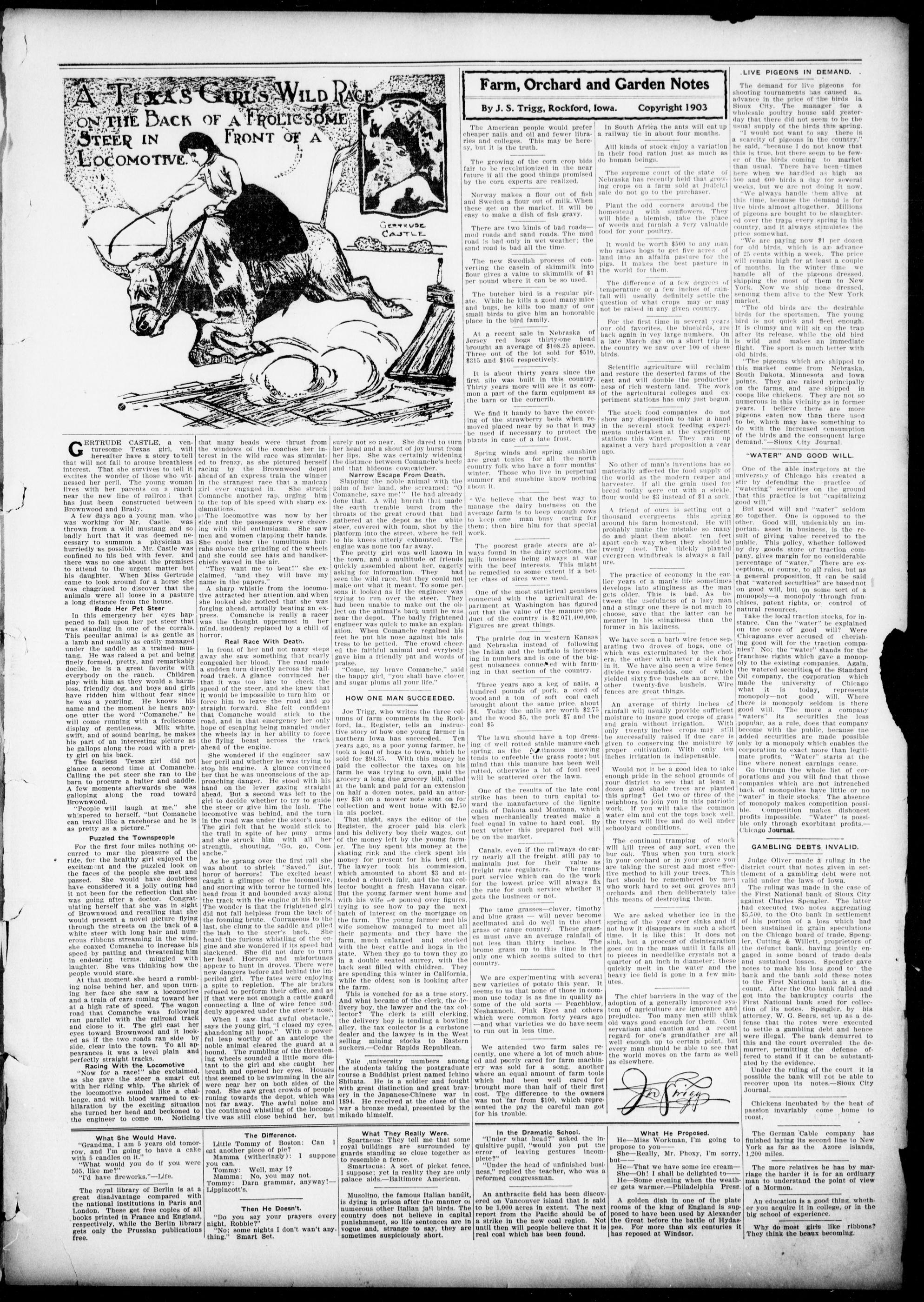
A TEXAS GIRL'S WILD RACE
ON THE BACK OF A FROLICSOME
STEER IN FRONT OF A
LOCOMOTIVE.
GERTRUDE
CASTLE
GERTRUDE CASTLE, a venturesome Texas girl, will hereafter have a story to tell that will not fail to arouse breathless interest. That she survives to tell it excites the wonder of those who witnessed her peril. The young woman lives with her parents on a ranch near the new line of railroad that has just been constructed between Brownwood and Brady. A few days ago a young man, who was working for Mr. Castle, was thrown from a wild mustang and badly hurt that it was deemed necessary to summon a physician as hurriedly as possible. Mr. Castle was confined to his bed with fever, and there was no one about the premises to attend to the urgent matter but his daughter. When Miss Gertrude came to look around for a horse she was chagrined to discover that the animals were all loose in a pasture a long distance from the house.
Rode Her Pet Steer
In this emergency her eyes happened to fall upon her pet steer that was standing in one of the corrals. This peculiar animal is as gentle as a lamb and usually as easily managed under the saddle as a trained mustang. He was raised a pet and being finely formed, pretty, and remarkably docile, he is a great favorite with everybody on the ranch. Children play with him as they would a harmless, friendly dog, and boys and girls have ridden him without fear since he was a yearling. He knows his name and the moment he hears any one utter the word "Comanche." he will come running with a frollecism display of gentleness. Milk white swift, and of sound bearing, he makes his part of an interesting picture as he gallops along the road with a pretty girl on his back.
The fearless Texas girl did not glance a second time at Comanche. Calling the pet steer she ran to the barn to procure a halter and saddle. A few moments afterwards she was galloping along the road toward Brownwood.
"People will laugh at me," she whispered to herself, "but Comanche can travel like a racehorse and he is as pretty as a picture."
Puzzled the Townspeople
For the first four miles nothing occurred to mar the pleasure of the ride, for the healthy girl enjoyed the excitement and the puzzled look on the faces of the people she met and passed. She would have doubtless have considered it a jolly outing had it not been for the reflection that she was going after a doctor. Congratulating herself that she was in sight of Brownwood and recalling that she would present a novel picture flying through the streets on the back of a white steer with long hair and numerous ribbons streaming in the wind, she coaxed Comanche to increase his speed by patting and threatening him in endearing terms, mingled with laughter. She was thinking how the people would stare.
At that moment she heard a rumbling noise behind her, and upon turning her face she saw a locomotive and a train of cars coming toward her at a high rate of speed. The wagon road that Comanche was following ran parallel with the railroad track and close to it. The girl cast her eyes toward Brownwood and it looked as if the two roads ran side by side, clear into the town. To all appearances it was a level plain and perfectly straight tracks.
Racing With the Locomotive
"Now for a race!" she exclaimed, as she gave the steer a smart cut with her riding whip. The shriek of the locomotive sounded like a challenge, and with blood warmed to exhilaration by the exciting situation she turned her head and beckoned to the engineer to come on. Noticing
What She Would Have.
"Grandma, I am 5 years old tomorrow, and I'm going to have a cake with 5 candles on it."
The royal library of Berlin is at a great disadvantage compared with the national institutions in Paris and London. These get free copies of all books printed in France and England, respectively, while the Berlin library gets only the Prussian publications free.
that many heads were thrust from the windows of the coaches her interest in the wild race was stimulated to frenzy, as she pictured herself racing by the Brownwood depot ahead of an express train the winner in the strangest race that a madcap girl ever engaged in. She struck Comanche another rap, urging him to the top of his speed with sharp exclamations.
The locomotive was now by her side and the passengers were cheering with wild enthusiasm. She saw men and women clapping their hands. She could hear the tumultuous hurrahs above the grinding of the wheels and she could see hats and handkerchiefs waved in the air.
"They want me to beat!" she exclaimed, "and they will have my name in the papers."
A sharp whistle from the locomotive attracted her attention and when she looked she noticed that she was forging ahead, actually beating an express. Comanche is really a racer was the thought uppermost in her mind, suddenly replaced by a chill of horror.
Real Race With Death.
In front of her and not many steps away she saw something that nearly congealed her blood. The road made a sudden turn directly across the railroad track. A glance convinced her that it was too late to check the speed of the steer, and she knew that it would be impossible to turn him on or force him to leave the road and go straight forward. She felt confident that Comanche would stick to the road, and in that emergency her only hope of escaping being mangled under the wheels lay in her ability to force the flying beast across the track ahead of the engine.
She wondered if the engineer saw her peril and whether he was trying to stop his engine. A glance convinced her that he was unconscious of the approaching danger. He stood with his hand on the lever gazing straight ahead. But a second was left to the girl to decide whether to try to guide the steer or give him the lash. The locomotive was behind, and the turn in the road was under the steer's nose. The girl felt that he would stick to the trail in spite of her puny arms and she struck him with all her strength, shouting, "Go, go, Com anche."
As he sprang over the first rail she was about to shriek "Saved." But, horror of horrors! The excited beast caught a glimpse of the locomotive, and snorting with terror he turned his head from it and bounded away along the track with the engine at his heels. The wonder is that the frightened girl did not fall helpless from the back of the foaming brute. Courageous to the last, she clung to the saddle and plied the lash to the steer's back. She heard the furious whistling of the engine and she wondered if its speed had slackened. She did not dare to turn her head. Horrors and misfortunes appear to hunt in droves. There were new dangers before and behind the imperiled girl. The fates were enjoying a spite to repletion. The air brakes refused to perform their office, and as if that were not enough a cattle guard connecting a line of wire fence and denly appeared under the steer's nose.
When I saw that awful obstacle," says the young girl, "I closed my eyes, abandoning all hope." With a powerful leap worthy of an antelope the noble animal cleared the guard at a bound. The rumbling of the threatening wheels sounded a little more distant to the girl and she caught her breath and opened her eyes. Houses that seemed to be swimming in the air were near her on both sides of the road. She saw great crowds of people running towards the depot, which was not far away. The awful noise and the continued whistling of the locomotive was still close behind her, but
surely not so near. She dared to turn her head and a shout of joy burst from her lips. She was certainly widening the distance between Comanche's heels and that hideous cowcatcher.
Narrow Escape From Death.
Narrow Escape From Death.
Slapping the noble animal with the palm of her hand, she screamed: "O Comanche, save me!" He had already done that. A wild hurrah that made the earth tremble burst from the throats of the great crowd that had gathered at the depot as the white steer, covered with foam, shot by the platform into the street, where he fell to his knees utterly exhausted. The engine was none too far away.
The pretty girl was well known in the town, and a multitude of friends quickly assembled about her, eagerly asking for information. They had seen the wild race, but they could not make out what it meant. To some persons it looked as if the engineer was trying to run over the steer. They had been unable to make out the object on the animal's back until he was near the depot. The badly frightened engineer was quick to make an explanation. When Comanche regained his feet he put his nose against his nails to be petted. The crowd cheered the faithful animal and everybody gave him a friendly pat and words of praise.
"Come, my brave Comanche," said the happy girl, "you shall have clever and sugar plums all your life."
HOW ONE MAN SUCCEEDS
Joe Trigg, who writes the three columns of farm comments in the Rockford, Ia., Register, tells an instructive story of how one young farmer in northern Iowa has succeeded. Ten years age, as a poor young farmer, he took a load of hogs to town, which he sold for $4.35. With this money he paid the collector the taxes on his farm he was trying to own, paid the grocery a long due grocery bill, called at the bank and paid for an extension on half a dozen notes, paid an attorney $30 on a mower note sent on for collection and went home with $2.50 in nis pocket.
That night, says the editor of the Register, the grocer paid his clerk and his delivery boy their wages, out of the money left by the young farmer. The boy spent his money at the skating rink and the clerk spent his money for present for his best girl. The lawyer took his commission, which amounted to about $3 and attended a church fair, and the tax collector bought a fresh Havana cigar. But the young farmer went home and with his wife .o poured over figures, trying to see how to pay the next batch of interest on the mortgage on the farm. The young farmer and his wife somehow managed to meet all their payments and they have the farm, much enlarged and stocked with the best cattle and hogs in the state. When they go to town they go in a double seated surrey, with the back seat filled with children. They are spending this winter in California while the oldest son is looking after the farm.
This is vouchered for as a true story. And what became of the clerk, the delivery boy, the lawyer and the tax collector? The clerk is still clerkling, the delivery boy is tending a bowling alley, the tax collector is a curbstone dealer and the lawyer is in the West selling mining stocks to Eastern suckers—Cedar Rapids Republican.
Yale university numbers among the students taking the postgraduate course a Buddhist priest named Ichino Shibata. He is a soldier and fought with great distinction and great bravery in the Japanese-Chinese war in 1894. He received at the close of the war a bronze medal, presented by the mikado himself.
What They Really Were.
Spartacus: They tell me that some royal buildings are surrounded by guards standing so close together as to resemble a fence.
Smartacus: A sort of picket fence, I suppose; yet in reality they are only palace alds.—Baltimore American.
Musolino, the famous Italian bandit, is dying in prison after the manner or numerous other Italian jail birds. The country does not believe in capital punishment, so life sentences are in vogue and, strange to say, they are sometimes suspiciously short.
Farm, Orchard and Garden Notes
The American people would prefer cheaper nails and oil and fewer libraries and colleges. This may be heresy, but it is the truth.
The growing of the corn crop bids fair to be revolutionized in the near future if all the good things promised by the corn experts are realized.
Norway makes a flour out of fish and Sweden a flour out of milk. When these get on the market it will be easy to make a dish of fish gravy.
There are two kinds of bad roads—mud roads and sand roads. The mud road is bad only in wet weather; the sand road is bad all the time.
The new Swedish process of converting the casein of skimmilk into flour gives a value to skimmilk of $1 per pound where it can be so used.
The butcher bird is a regular pirate. While he kills a good many mice and bugs, he kills too many of our small birds to give him an honorable place in the bird family.
At a recent sale in Nebraska of Jersey red hogs thirty-one head brought an average of $108.25 apiece. Three out of the lot sold for $510, $315 and $166 respectively.
It is about thirty years since the first silo was built in this country. Thirty years more will see it as common a part of the farm equipment as the barn or the corncrib.
We find it handy to have the covering of the strawberry beds when removed placed near by so that it may be used if necessary to protect the plants in case of a late frost.
Spring winds and spring sunshine are great tonics for all the north country folk who have a four months' winter. Those who live in perpetual summer and sunshine know nothing about it.
*We believe that the best way to manage the dairy business on the average farm is to keep enough cows to keep one man busy caring for them; then hire him for that special work.
The poorest grade steers are always found in the dairy sections, the milk business being always at war with the beef interests. This might be remedied to some extent if a better class of sires were used.
One of the most statistical geniuses connected with the agricultural department at Washington has figured out that the value of the manure product of the country is $2 071,400,000. Figures are great things.
The prairie dog in western Kansas and Nebraska instead of following the Indian and the buffalo is increasing in numbers and is one of the biggest nuisances connected with farming in that section of the country.
Three years ago a keg of nails, a hundred pounds of pork, a cord of wood and a ton of soft coal each brought about the same price, about $4. Today the nails are worth $2.75 and the wood $5, the pork $7 and the coal $5
The lawn should have a top dressing of well rotted stable manure each spring, as the continuous mowing tends to enfeeble the grass roots; but mind that this manure has been well rotted, otherwise a lot of foul seed will be scattered over the lawn.
One of the results of the late coal strike has been to turn capital toward the manufacture of the lignite coals of Dakota and Montana, which when mechanically treated make a fuel equal in value to hard coal. By next winter this prepared fuel will be on the market.
Canals, even if the railways do carry nearly all the freight, still pay to maintain just for their value as freight rate regulators. The transport service which can do the work for the lowest price will always fix the rate for such service whether it gets the business or not.
The tame grasses—clover, timothy and blue grass — will never become acclimated and do well in the short grass or range country. These grasses must have an average rainfall of not less than thirty inches. The brome grass up to this time is the only one which seems suited to that country.
We are experimenting with several new varieties of potato this year. It seems to us that none of those in common use today is as fine in quality as some of the old sorts — Peachblow, Neshannock, Pink Eyes and others which were common forty years ago—and what varieties we do have seem to run out in less time.
We attended two farm sales recently, one where a lot of much abused and poorly cared for farm machinery was sold for a song, another where an equal amount of farm tools which had been well cared for brought more than half of their first cost. The difference to the owners was not far from $100, which represented the pay the careful man got for his trouble.
In the Dramatic School.
"Under what head?" asked the inquisitive pupil, "would you put the error of leaving gestures incomplete?"
"Under the head of unfinished business," replied the teacher, who was a reformed congressman.
An anthracite field has been discovered on Vancouver island that is said to be 1,000 acres in extent. The next report from the Pacific should be of a strike in the new coal region. Not until then will people believe that it is real coal which has been found.
In South Africa the ants will eat up a railway tie in about four months.
All kinds of stock enjoy a variation in their food ration just as much as do human beings.
The supreme court of the state of Nebraska has recently held that growing crops on a farm sold at judicial sale do not go to the purchaser.
Plant the odd corners around the homestead with sunflowers. They will hide a blemish, take the place of weeds and furnish a very valuable food for your poultry.
It would be worth $500 to any man who raises hogs to get five acres of land into an alfalfa pasture for the pigs. It makes the best pasture in the world for them.
The difference of a few degrees of temperature or a few inches of rainfall will usually definitely settle the question of what crops may or may not be raised in any given country.
For the first time in several years our old favorites, the bluebirds, are back again in vey large numbers. On a late March day on a short trip in the country we saw over 100 of these birds.
Scientific agriculture will reclaim and restore the deserted farms of the east and will double the productiveness of rich western land. The work of the agricultural colleges and experiment stations has only just begun.
The stock food companies do not show any disposition to take a hand in the several stock feeding experiments undertaken at the experiment stations this winter. They ran up against a very hard proposition a year ago.
No other of man's inventions has so materially affected the food supply of the world as the modern reaper and harvester. If all the grain used for bread today were cut with a sickle, flour would be $2 instead of $1 a sack.
A friend of ours is setting out a thousand evergreens this spring around his farm homestead. He will probably make the mistake so many do and plant them about ten feet apart each way when they should be twenty feet. The thickly planted evergreen windbreak is always a failure.
The practice of economy in the earlier years of a man's life sometimes develops into stinginess as the man gets older. This is bad. As be between the usefulness of a lazy man and a stingy one there is not much to choose, save that the latter can be meaner in his stinginess than the former in his laziness.
We have seen a barb wire fence separating two droves of hogs, one of which was exterminated by the cholera, the other with never a sick hog in it. We have also seen a wire fence divide two cornfields, one of which yielded sixty-five bushels an acre, the other twenty-five bushels. Wire fences are great things.
An average of thirty inches of rainfall will usually provide sufficient moisture to insure good crops of grass and grain without irrigation. With only twenty inches crops may still be successfully raised if due care is given to conserving the moisture by proper cultivation. With only ten inches irrigation is indispensable.
Would not it be a good idea to take enough pride in the school grounds of your district to see that at least a dozen good shade trees are planted this spring? Get two or three of the neighbors to join you in this patriotic work. If you will take the common water elm and cut the tops back well, the trees will live and do well under schoolyard conditions.
The continual tramping of stock will kill trees of any sort, even the bur oak. Thus when you turn stock in your orchard or in your grove you are taking the surest and most effective method to kill your trees. This fact should be remembered by men who work hard to set out groves and orchards and then deliberately take this means of destroying them.
We are asked whether ice in the spring of the year ever sinks and if not how it disappears in such a short time. It is like this: It does not sink, but a process of disintegration goes on in the mass until it falls all to pieces in needlelike crystals not a quarter of an inch in diameter; these quickly melt in the water and the heavy ice field is gone in a few minutes.
The chief barriers in the way of the adoption of a generally improved system of agriculture are ignorance and prejudice. Too many men still think old ways good enough for them. Conservatism and caution and a recent regard for one's grandfather are all well enough up to certain point, but every man should be able to see that the world moves on the farm as well as elsewhere.
Johann Spigey
He—Miss Workman, I'm going to propose to you—
propose to you—
She—Really, Mr. Phoxy, I'm sorry,
but—
He—That we have some ice cream—
She—Oh! I shall be delighted to—
He—Some evening when the weather gets warmer—Philadelphia Press.
A golden dish in one of the plate rooms of the king of England is supposed to have been used by Alexander the Great before the battle of Hydaspes. For more than six centuries it has reposed at Windsor.
LIVE PIGEONS IN DEMAND.
The demand for live pigeons for shooting tournaments has caused a advance in the price of the birds in Sioux City. The manager for a wholesale poultry house said yesterday that there did not seem to be the usual supply of the birds this spring. "I would not want to say there is a scarcity of pigeons in the country," he said, "because I do not know that this is true, but there seem to be fewer of the birds coming to market than usual. There have been times here when we hardled as high as 500 and 600 birds a day for several weeks, but we are not doing it now. "We always handle them alive at this time, because the demand is for live birds almost altogether. Millions of pigeons are bought to be shattered over the traps every spring in this country, and it always stimulates the price somewhat.
"We are paying now $1 per dozen for old birds, which is an advance of 25 cents within a week. The price will remain high for at least a couple of months. In the winter time we handle all of the pigeons dressed, shipping the most of them to New York. Now we ship none dressed, sending them alive to the New York market.
"The old birds are the desirable birds for the sportsmen. The young bird is not quick and fleet enough. It is clumsy and will sit on the trap after its release, while the old bird is wild and makes an immediate flight. The sport is much better with old birds.
The pigeons which are shipped to this market come from Nebraska, South Dakota, Minnesota and Iowa points. They are raised principally on the farms, and are shipped in coops like chickens. They are not so numerous in this vicinity as in former years. I believe there are more pigeons eaten now than there used to be, which may have something to do with the increased consumption of the birds and the consequent large demand." -Sloux City Journal.
"WATER" AND GOOD WILL.
One of the able instructors at the university of Chicago has created a stir by defending the practice of "watering" securities on the ground that this practice is but "capitalizing good will." But good will and "water" seldom go together. One is opposed to the other. Good will, undeniably an important, asset in business, is the result of giving value received to the public. This policy, whether followed by dry goods store or traction company, gives margin for no considerable percentage of "water." There are exceptions, or course, to all rules, but as a general proposition, it can be said that "watered securities" are based not on good will, but on some sort of a monopoly—a monopoly through franchises, patent rights, or control of natural resources.
Take the local traction stocks, for instance. Can the "water" be explained on the score of good will? Were Chicagoans ever accused of cherishing good will for the traction companies? No; the "water" stands for the franchise rights which gave a monopoly to the existing companies. Again, the watered securities of the Standard Oil company, the corporation which made the university of Chicago what it is today, represents monopoly—not good will. Where there is monopoly seldom is there good will. The more a company "waters" its securities the less popular, as a rule, does that company become with the public, because the added securities are made possible only by a monopoly which enables the corporation to exact more than legitimate profits. "Water" starts at the line where nonest earnings cease.
Go through the whole list of corporations and you will find that those companies which are not intrenched back of monopolies have little or no "water" in their stocks. The absence of monopoly makes competition possible. Competition makes dishonest profits impossible. "Water" is possible only through exorbitant profits.—Chicago Journal.
GAMBLING DEBTS INVALID.
Judge Oliver made a ruling in the district court that notes given in settlement of a gambling debt were not valid under the laws of Iowa.
The ruling was made in the case of the First National bank of Sloux City against Charles Spengler. The latter had executed two notes aggregating $5,500, to the Oto bank in settlement of his portion of a loss which had been sustained in grain speculations on the Chicago board of trade, Spengler, Cutting & Willett, proprietors of the defunct bank, having jointly engaged in some board of trade deals and sustained losses. Spengler gave notes to make his loss good to' the bark and the bank sold these notes to the First National bank at a discount. After the Oto bank failed and got into the bankruptcy courts the First National bank sued for collection of its notes. Spengler, by his attorney, W. G. Sears, set up as a defense that the rotes were executed to settle a gambling debt and hence were illegal. The bank demurred to this and the court overruled the demurrier, permitting the defense of fered to stand if it can be substantiated by the evidence.
Under the ruling of the court it is possible the bank will not be able to recover upon its notes.—Sioux City Journal.
Chickens incubated by the heat of passion invariably come home to roost.
The German Cable company has finished laying its second line to New York as far as the Azore islands, 1,200 miles.
The more relatives he has by marriage the harder it is for an ordinary man to understand the point of view of a Mormon.
An education is a good thing, whether you acquire it in college, or in the big school of experience.
Why do most girls like ribbons? They think the beaux becoming.
The Professional World
RUFUS L. LOGAN, B. S. D. - EDITOR
TERMS OF SUBSCRIPTION.
One Year in Advance - - - $1.00
Six Months in Advance - - .75
Three Months in Advance - - .50
Single Copies - - - .05
Advertising Rates on Application.
Job Work of all Kinds Solicited.
Published Every Friday.
Entered at the postoffice at Columbia, Mo., as second class matter, Jan. 15, 1902.
Agents wanted in every town in the state.
Payments may be made in two cent stamps, by postal note, money order, by registered letter or express order.
Correspondence containing news of interest and importance is desired from all parts of the United States.
Communications should be made to reach us not later than Thursday morning, to insure insertion in the current issue.
No attention will be paid to anonymous communications.
Agents wanted everywhere. Write for terms.
Specimen copies sent to any address upon request.
PRESS OF THE MISSOURI STATESMAN.
You should not fail to vote next Tuesday.
Vote for only good men for members of the Board of Education.
Negroes should not go on record as opposing all public improvements.
Vote for Prof. A. S. Greene for the school commissioner of Boone county.
Our thanks are due Mrs. Emma Payne of Whites Store and Mrs. Hester Yancy of Deer Park for subscriptions.
It is much more sensible for one to acknowledge their inability to pay for a paper than to find fault of the paper as a reason for not taking it.
The American Eagle says the Republicans defeated the "Jim Crow" bill. But some fair minded democrats helped just the same. Let us be grateful to them all.
Centralia and Sturgeon should remember that because the courthouse is located in Columbia it does not mean that Columbia owns it. It belongs to Boone county just the same.
James D. Miller, editor of the American Eagle, has deserted the democratic party and declares he cannot support such men as "Ben" Tillman, John T. Crisp, and Alonzo Williams.
In every community in the state the voters will select members of the boards of education next Tuesday. Only good men should be voted for. The welfare of your children is at stake.
School of schools should be and are examples for the children whom they teach. But the question do they set good examples, such that your children should emulate? Teachers who teach simply for the money and who are found frequently at dances and engaging in all kind of worldly frivolities should not be sought.
At the annual school election next Tuesday a school commissioner is to be elected for Boone county. Prof. A. S. Greene of Sturgeon will doubtless be elected and should have a large majority. He is in every way qualified to fill the office he seeks and is interested in the cause of education. Every colored voter in the county should cast his vote for A. S. Greene.
Will Conduct Sewing Classes.
Mrs. M. L. Huggard has purchased a valuable piece of property on 6th street near Broadway and is preparing to open sewing rooms and conduct a class during the summer season. Mrs. Huggard is a seamstress of unusual ability, and has a large sewing trade among the better class of white people of Columbia. Mrs. M. H. Gregory of Montgomery is here to assist Mrs. Huggard in her work.
THE WORK OF A NEGRO.
Bob Cole One of the Popular Song Composers of the Day.
Of the thousands of people who have enjoyed "Under the Bamboo Tree" and "The Maiden with the Dreamy Eyes," few have been aware that these songs were written by a negro, Bob Cole. Both the words and the music are his composition. Not since the palmy days of Charles K. Harris, author of "After the Ball," has any composer produced so many really popular songs as this talented young negro. The unusual feature of Cole's compositions is that they are not of the "coon" song variety but are clean cut and catchy.
Almost everyone has heard his "Under the Bamboo Tree." It is sung everywhere on the stage, whistled on the streets and murdered by organ grinders. This song has been popular to a remarkable extent in this country, but it is said to be having a greater run in England, and is being sung in India. The composer who is a member of the vaudeville team of Cole and Johnson, which appears at the Orpheum theatre this week arrived yesterday from Los Angeles.
"A rather peculiar circumstance surrounded the writing of the bamboo song," he said. "Several years ago I met a soldier just back from the Philippines, who told me of the love affairs of a Red Cross nurse and an army officer. Their courtship was carried on under a bamboo tree. The phrase attracted me, but I couldn't figure just where I could connect the nurse and the tree, so finally decided to make the scene of the song in Zululand. I wrote it, but Johnson and I decided that it was altogether too silly to inflect upon the public, so it was piggeonholed. One day we got it out and sang it for a publisher. He was delighted, and insisted that it be put on the market immediately. This was done, and the success surprised us.
"How do you write your songs?" he was asked. "Do you think of the air first, or do you make the music fit the words?"
"I could say my songs are almost entirely suggestion. Mr. Johnson is a talented pianist and sometimes sits before the piano from five to seven hours a day. He will run off a particularly catchy bar or two. That bar may suggest something to me or Johnson may call my attention to it. Take the case of "The Maiden With the Dreamy Eyes." Johnson was running his hands over the keys when a pretty line caught his ear. He played it over to me. 'What does that seem to say?' he asked. I listened. Then I said: 'It seems to say, "The maiden with the dreamy eyes." We then wrote the song.'
Cole and Johnson are both bright and well educated negroes, Johnson being a graduate of the New England Music conservatory of Boston. Cole has written an unusually large number of popular songs. Among them are the following: "Castle on the River Nile," "Oh, Didn't He Ramble," "Two Eyes," "Cupid's Ramble," "I Must Have Been a-Dreaming," "The Katydid, the Cricket and the Frog," "Under the Bamboo Tree," "The Maiden With the Dreamy Eyes" and "Tell Me, Dusky Maiden."—Kansas City Journal.
---
How's This?
We offer One Hundred Dollars Reward for any case of Catarrh that cannot be cured by Hall's Catarrh Cure.
F. J. CHENEY & Co., Toledo, O.
We, the undersigned, have known F. J. Cheney, for the last fifteen years, and believe him perfectly honorable in all business transactions and financially able to carry out any obligations made by their firm.
WEST & TRUE, Wholesale Druggists, Toledo, O.
WALDIN, KINNAN, & MARVIN, Wholesale Druggists, Toledo, O.
Hall's Catarrh Cure is taken internally, acting directly upon the blood and mucous surfaces of the system. Testimonials sent free. Price 75c per bottle. Sold by all Druggists.
Hall's Family Pills are the best.
NO COURT HOUSE YET.
Proposition to Rebuild Gets a Majority of 1003 Votes, But Falls Short of Necessary Two-Thirds.
The election in Boone county last Saturday on the proposition to build a new courthouse costing $100,000, resulted in a handsome majority of 1003 votes for the proposition; but since it lacked a few hundred of receiving a two-thirds majority, no courthouse can be built yet. A larger vote was cast than at either of the two previous elections. In some precincts the vote was lighter. Below we give the official vote as reported to the county court, also the vote at the two previous elections, so that our readers may compare the results.
VOTE CAST SATURDAY, MARCH 28,
1903, FOR $100,000 COURT HOUSE
YES. NO.
Columbia Precinct No. 1. 1,355. 49
Columbia " " 2. 361. 7
Hallsville. 93. 174
Hartsburg. 41. 93
Chaysville. 21. 12
Ashland. 195. 122
Gallup's Mill. 14. 15
Hinton. 27. 90
Martin. 13. 7
Brown's Station. 36. 48
Strawn's School house. 34. 12
Centralia. 40. 354
Deer Park. 61. 10
Sturgeon. 58. 105
Perche Ch. S. H. 19. 24
Riggs. 28. 33
Harrisburg. 20. 84
Harg. 50. 2
Prairie Grove. 24. 26
Woodlandville. 37. 29
Rocheport. 125. 40
Huntsdale. 42. 42
Providence. 36. 10
Sapp. 17. 59
Wilton. 17. 51
Englewood. 9. 27
Murry. 9. 48
Wallace school house. 1. 59
Perche. 10. 48
Totals. 2,733. 1,730
Total vote cast. 4,463.
Two-thirds of the total vote cast. 2,975.
Majority for the proposition. 1,003.
Columbia Precinct No. 1. 1,212 34
Columbia Precinct No. 2. 409 4
Hallsville 85 101
Hartsburg 44 63
Claysville 28 9
Ashland 93 180
Gallup's Mill. 16 2
Hinton 41 7
Martin. 21 3
Brown's Station 38 50
Strawn Schoolhouse 38 31
Centralia. 76 381
Deer Park 44 21
Sturgeon 68 143
Perche Church School house 29 12
Riggs 46 25
Harrisburg 32 52
Harg 67 8
Prairie Grove 28 21
Woodlandville 41 19
Rocheport 78 40
Huntsdale 58 30
Providence 37 15
Sapp 18 55
Wilton 39 56
Englewood 33 10
Murry 17 58
Wallace School House 5 56
Perche 31 24
Grand View 9 45
Total. 2,779 1,603
Total vote cast. 4,382
Two-thirds of total vote 2,621
Majority for the proposition 1,170
VOTE CAST ON DECEMBER 13, 1900,
FOR $75,000 COURT HOUSE.
YES. No.
Columbia Precinct No. 1. 1,073 38
Columbia Precinct No. 2. 505 21
Hallsville 61 197
Harttsburg 27 75
Claysville 26 22
Ashland 72 201
Gallup's Mill 12 6
Hinton 36 11
Martin 17 2
Brown's Station 32 22
Centralia 164 190
Strawn School house 42 38
Deer Park 26 31
Sturgeon 108 115
Perche Church School house 6 43
Riggs 38 29
Harrisburg 25 61
Harg 48 9
Prairie Grove 21 17
Woodlandville 44 31
Rocheport 88 96
Huntsdale 37 17
Providence 31 10
Sapp 6 76
Wilton 27 69
Englewood 28 20
Murry 19 37
Wallace School House 8 96
Percene 19 26
Totals 2,061 1,406
Total vote cast 4,124
Two-thirds of total vote 2,746
Majority for the proposition 1139
Administrator's Notice
Notice is hereby given that letters of administration, with will annexed, on the estate of Sarah Willis, deceased, were granted to the undersigned on the 23rd day of March, 1903, by the Missouri, Missouri, persons having claims against them are required to exhibit them for allowance by the administrator within one year after the date of said letters or they may be precluded from any other action, such as such be exhibited within two years from this date of publication they shall be forever barred.
HENRY KIRKLIN
Administrator with will annexed.
mar 22-4w
U. B. F.
Crispus Attucks Lodge,No. 62. Meetings 2nd and 4th Tuesdays in each month. Visiting members cordially invited. Caleb Hall, W. M. A. M. Schweich, W. S.
K. P.
Acme Lodge, No. 24. Meetings second and fourth Fridays in each month. W. H. Turner, C. C. and D. D. G. C. W. W. Lampkins, M. F.
LADIES COURT.
Golden Queen Court No.19 meets first Friday in each month. Mrs. Annie Williams, M. A. M., Mrs. Lizzie Richardson, Secretary.
O. E. S.
Amos Chapter, No. 30. Meetings second Friday in each month. Mrs. Bessie Washington, W. M. Mrs. Lizzie Richardson, W. S.
ST. PAUL LODGE. NO. 12
St. Paul Lodge, No. 12, A.
F. & A. M., meets every first
and third Tuesday in each
month. A cordial invitation
extended to all visiting
brothers. J. A. Mosely, W.
M. J. A. Grant, Secretary.
SECOND CHRISTIAN CHURCH.
Rev. J. B. Parsons, pastor.
Preaching Sundays 11 a. m.
and 7:30 p. m.
Prayer meeting Wednesdays 7:30 p. m.
Everybody cordially invited to attend.
K. OF P.
Harrison Lodge No. 12, Huntsville, Mo. Meeting the second and fourth Thursdays in each month. M. W. Tony, C. C., W. T. Ansel, K. R. S., I. A. Robinson, M. E.
Rev. P. C. Crews, Pastor.
Preaching Sundays 11 a.
m.; 7:30 p. m.
Sunday school 2:30 p. m.
Prayer meeting every
Wednesday eve, at 8:30; every body invited to attend.
M. E. CHURCH
Rev. J. Arlington Grant, pastor.
Preaching Sundays 11, a. m. and 7:30 p. m. Sunday school, 9:30 a. m. Prayer meeting Wednesdays 7:30 to 8:30; all are made welcome.
Rev. A. A. Adams, Pastor.
Preaching Sundays 11 a.
m., and 7:30 p. m.
Sunday school at 2:30 p. m.
Prayer meeting Wednesday
evening, 7:30.
A cordial invitation ex-
tended to all.
The Railroads.
WABASH
GOING SOUTH.
No. 33. Arrive Columbia. 8:15 a. m.
No. 35. Arrive Columbia. 1:20 p. m.
No. 37. Arrive Columbia. 8:45 p. m.
GOING NORTH.
No. 30. Leave Columbia. 9:40 a. m.
No. 32. Leave Columbia. 1:40 p. m.
No. 34. Leave Columbia. 4:10 p. m.
TRAINS NORTH.
A. M. No. 36
A. M. No. 38
P. M. No. 40.
Leave:
McBaine ... 6:30
Webster ... 6:33
Brushwood ... 6:38
Turner ... 6:42
Limerick ... 6:47
Arrive:
Columbia ... 6:55
TRAINS SOUTH.
A. M. No. 35 St. Louis Express
A. M. No. 37 Texas Express
P. M. No. 39
Leave:
Columbia ... 11:00
Limerick ... 11:08
Turner ... 11:12
Brushwood ... 11:17
Webster ... 11:22
Arrive:
McBaine ... 11:25
A. M. No. 35
P. M. No. 39
---
with us. The only difference between our "suits" and the made-to-order suits is imagination. As to fit, we allow you to be judge and jury- Try us and be convinced. Your money back on any unsatisfactory article. We are bound to make a customer of you if low prices will do it.
The Columbia Gro=cery Co.,
Keeps constantly on hand a fresh supply of staple and FANCY GROCERIES.
YOUR PRODUCE WANTED.
All Kinds of Fresh Lunch Goods. Wood and Coal. Prompt and Careful Attention Given to all Orders. Telephone 580.
JOHN C. MADDEN
Madison St.,
Courthouse Election Notes.
A majority in this country have a right to be heard.
The negroes of Columbia took very little interest in the election.
The vote at Huntsdale was a stand oft, being 42 for, and 42 against.
At Wallace school house there was only 1 vote for the proposition, and 59 against it.
The people polled a good majority for progress, considering nearly half the newspapers in the county opposed the proposition.
The "folly" of paying interest on bonds was forgotten when Centralia put up her city hall. Why did that town not pay "cash down" and save the interest.
It will be noted that Claysville, Ashland, Martin, Strawn's school house, Deer Park, Harg, Woodlandville, Rocheport, Providence and Englewood, gave majorities for the new courthouse.
Wanted For Our File.
A few copies of the Professional World, dated Feb. 13th, 1903. Any person having a copy of this date, will do us a favor by sending us the same.
Ladies Admire .... Perfect Fitting garments,
and only first class tailors can make them.
Suits from $25.00, up.
Trousers from $6.00, up.
N, Merchant Tailor,
JEFFERSON CITY, MO
ON CREDIT.
$22.90
Free
Catalogue
CENTURY MFG. CO.
EAST ST. LOUIS, ILL.
Century Steel Range, No. 80-A-18
Has six 8-inch lids, oven 17x21x12,
splendid reservoir and warming closet,
lined throughout with asbestos, burns
anything, best bakers and roasters on
Earth. Guaranteed 10 years. Weight
475 lbs. Only $22.90. Terms $8.00 cash,
balance payable $3.00 a month, no inter-
est, shipped immediately on receipt of
$8.00 cash payment. We trust homes
people located in all parts of the World.
Cash discount $1.50 on Range. Freight
average $1.25 for each 600 miles. Send
for free catalogue, but this is the greatest
bargain ever offered. We refer to
Southern Illinois National Bank.
CENTURY • MANUFACTURING • CO.
Dept. 910, East St. Louis, Ill.