The Professional World
Friday, April 10, 1903
Columbia, Missouri
Page text (machine-generated)
THE PROFESSIONAL WORLD.
$1.00 Per Year in Advance.
Columbia News.
Prof. Stone, of Sturgeon, spent several days in the city this week.
Rev. O. F. Nelson, of Louisiana, passed through the city last Saturday.
Mr. Roy Turner visited friends in Rocheport, Saturday and Sunday.
Mr. W. W. Lampkins has been appointed curator for the heirs of Mr. James Tibbs.
Rev. W. M. Coleman, of Ashland, preached at the Second Baptist church Sunday.
The members of the A. M. E. Church gave their pastor a donation party this week.
The members of the M. E. Church will hold their regular quarterly meeting Sunday. Rev. J. W. Jackson, their presiding elder, will be present. Mr. Forrest Lamme is in the city visiting his daughter, Miss Mary Lamme, and will go to Jefferson City to visit his other daughter, Miss Birdie Lamme at Lincoln Institute. Rev. Mack Allen, of Kansas City, exhibited his moving picture show and passion play at the A. M. E. Church on Tuesday evening, and at the second Baptist church Wednesday evening.
Mr. John Groves, of Topeka, Kan., deeded Mr. and Mrs. Henry Kirklin a lot valued at $500, as appreciation of the kindness they showed his mother, Mrs. Martha Willis, who died recently.
Capital City Notes.
Prof. Mebane has returned to the city.
The choir will give a sacred concert at night.
Prof. Reynolds went to Chamoise last Friday.
The young men of Lincoln Institute gave a concert at Chamoise last Friday evening.
The Lincoln Institute base ball team will play the Fulton boys at Fulton next Saturday.
Mr. William Spencer, a graduate of Lincoln Institute is in the city visiting his mother.
Subscribe to the Professional World. J. M. Rutlege Agt., 726 Elm St. Jefferson City, Mo.
The ordinance of baptism will be administered to about 20 candidates after the morning services.
The republicans of this city are rejoicing. They elected their whole ticket except Alderman, in the first ward.
Mr. and Mrs. Tuck Emerson passed through the city on their way to St. Louis where they will make their hoe.
Preparations are being made by the churches of this city for Easter services. The Baptist Sunday school under the supervision of Dr. J. H. Garnett, will render an Easter program. The teachers of the public school are preparing to give a concert at the second Baptist church next Friday evening, April 10th for the benefit of the church. They will give another one as the A. M. E. church for the benefit of that church.
A Request.
We will consider it a great favor if our readers will patronize the merchants whose advertisements they see in this paper.
CASH OR CREDIT.
Catalogue FREE.
COLUMBIA AND JEFFERSON CITY, MISSOURI, FRIDAY APRIL 10. 1903.
Lincoln Institute Notes.
The faculty and students of Lincoln Institute have had several rare treats in the recent Sunday afternoon sermons preached by Revs. Patillo, Clayton Brooks, and others.
The discourse of the first mentioned was a most scholarly effort, prepared expressly for the occasion; and its historical allusions were a source of great intellectual pleasure to all, but especially, perhaps, to the B. Normal class in General History, the members of which, under the leadership of Prof. J. Silone-Yates, have become intensely interested in the great events and personages of Ancient, Mediaeval, and Modern History; while newspapers and magazines are eagerly purchased and carefully read for the current events of the day, that become the history of the morrow.
The sermon preached by Rev. Clayton Brooks was no less a masterpiece and vividly pictured the "Christian Life."
The Union Literary and Debating Society, composed of the young men of the Senior and Junior Normai classes, entertained the Faculty, the Olive Branch, and members, Saturday evening, April 14th. The subject for debate, Resolved, "That Co-Education is a Failure."
Affirmative, Messrs. S. A. Logan, R. A. West. Negative, Messrs. Amos Madison, A. P. Bolden, was handled in a scholarly manner and reflected much credit upon the young men. The same eulogy may be pronounced upon the papers, orations and musical numbers rendered.
A challenge for joint debate from the young men of the U. L. D. was accepted by the young ladies of the Olive Branch; the subject and time to be decided upon by a committee from each society.
The entertainment of Friday night April 3rd, for benefit of the "Girls dormitory" was a decided success; among the many interesting features were the drill by the little people of the model school; and, the spelling match, in which twenty-four students from the Normal department participated. The first prize was won by Wilfred Wise of the B. Normal class.
President Allen presided, and presented the prize in glowing words that will certainly inspire the receiver to continue in his aspirations to stand at or near, the top of every undertaking.
The April Review of Reviews contains a highly interesting illustrated article from the pen of David E. Cloyd "School Visitor for the General Education Board," who March 30th, spent the day carefully inspecting the work done at Lincoln Institute.
Mr. Cloyd is preparing another article with reference to this subject, and is having several cuts of the Institute, interior and exterior, made, for use in this article and otherwise.
Formerly engaged in educational work in Moberly, and in other parts in Missouri he had from a professional standpoint, intimately known several of the graduates of Lincoln Institute, and spoke in most flattering terms of their work as he had observed it, in various towns.
It will pay you
Harness, etc. We sell direct from our Factory to Consumers at Factory Prices. This guaranteed Buggy only $33.50; Cash or Easy Monthly Payments. We trust honest people located in all parts of the world.
Write for Free Catalogue,
MENTION THIS PAPER.
DEPT' 910. East St. Louis, IL
BOOKER T. WASHINGTON
Honored by the People in Trenton. New Jersey.
TRENTON, N. J., April 3.—The color line in Trenton society was altogether relaxed last evening when a large and fashionable audience thronged the big hall of the Y. M. C. A. to hear Booker T. Washington, the famous negro leader.
The meeting was held under the auspices of the Contemporary Club, composed exclusively of women who are social leaders, not only in the city but in the state as well. Distinguished Trentonians, including ministers and other distinguished men, and heads of business firms, occupied places on the platform and applauded as vigorously as any one the negro orator. Washington was the guest while in Trenton of Dr. and Mrs. James Green, the former being principal of the state schools and the latter one of the most accomplished and cultured women of the capital.
The famous negro was accorded every mark of consideration, not only by the Greens but by all other society people of the city as well, many of the leaders calling to meet him yesterday afternoon. Just previous to noon yesterday he delivered an address to 1,500 of the students of the state schools and of the Trenton high school, in the auditorium of the normal school. He was enthusiastically received by the young men and women when he appeared on the platform, escorted by Bishop James A. McFaul, of the Catholic diocese of Trenton, and was introduced by Dr. Green.
For more than an hour the famous negro thrilled his audience with the story of his early life and his struggles to attain an education. He moved his hearers at will from laughter to tears, and at one time became so dramatic that a girl student fainted.
Washington paused for a moment as the young woman was being carried from the room, and then resumed his discourse as calmly as though nothing had happened. Among other things he said:
"In 1881, I started the Tuskegee school in an old shed, and, after teaching a few days, enlarged it by calling into service an old hen house.
"To-day there are 1,400 students at the school from thirty states and several foreign countries. We have 110 instructors. Our realty consists of 200 acres and 63 buildings. All except four of the buildings were built by students, and in the building of them they were taught the lesson of self independence. It cost $1.99 in the south to complete the education of a negro. In New York it costs $41.
"The negro problem is the nation's problem, because the nation is responsible for it."
Agents Wanted.
We desire to engage some good agents to solicit subscriptions for the Professional World. Liberal commissions will be paid and only one agent will be engaged for the same town, only persons of good standing need apply. Address, Professional World, Columbia, Mo.
SCHOOLS AND TEACHERS. The Sturgeon Schools will close April 18th.
The forty-second general assembly has passed the bill giving $667,966 to the State University at Columbia. This is the largest appropriation by about $200,000 that has ever been voted to the University for a biennial period. The amount for maintenance is over $100,000 larger than the legislature appropriated in 1901. $75,000 has been given for a physics building, $69,200 for a gym-
nassium, $25,000 for an addition to the chemical laboratory and $35,-000 for the libraries.
Very frequently a teacher desiring a degree gets it for some work that has nothing to do with the subject he is finally called upon to teach, and his studying for it may have been a waste of time that would have been better spent in acquiring knowledge of teaching his special branch in the college curriculum.
This worship of the degree is a kind of educational snobbery that is not at all in keeping with our democratic institutions. It may work more harm than good, and many men who have letters tasked to their names, indicating the doctor's degree, are far from good teachers, compared with others who have not had the opportunity to get a degree, but have become good teachers.
At a meeting recently of the trustees of the Iowa state agricultural college, the name of Secretary Wilson was suggested as a candidate. Secretary Wilson will, however, not accept, as he has no desire to resign his seat in the cabinet, and is very much interested in the work of the national department of agriculture. He was at one time connected with the Iowa state agricultural college, and the trustees would like very much to have him at the head of the institution.
It has been announced that Miss Parthenia Brosius, of Jefferson City, was recently married to Mr. Harry Hoskins of Kirksville, Mo.
A negro student at Yale from Little Rock, Ark., has carried off a noted prize for oratory at that university. He is working his way through college, and his native state will not be able to close the door of hope to him if it tries.—Globe-Democrat.
Finding the Boodle.
As the result of an effort to bribe John A. Lee, Lee, Lieutenant Governor of Missouri, Daniel J. Kelley, legislative agent of a baking powder company of New York, has been arrested. The information alleges that Kelley sent to Governor Lee a check for $1,000 by Robert E. Lee, his brother. It further sets forth that Kelley desired to obtain the Governor's influence against the repeal of an amendment to the alum bill by the Forty-First General Assembly. Other important discoveries are looked for in a few days from the grand jury of Cole county.
Marriage Licenses This Week.
Elias F. Walton and Jennie C. Pauley, Columbia; bride 17, and her father, W. T. Pauley, files consent. H. Coates and Armath Riley, Riggs
John Stout and Dora L. Turner, (colored.)
More Railroad Talk.
On April 3,the following special from Columbia appeared in the St. Louis daily papers: "Plans are being perfected for an electric railroad to run from Columbia through Ashland and other small towns to Jefferson City. Senator B. M. Anderson, S. M. Myers and Joe Scott are pushing the enterprise. George B. Harrison, president of the Central Missouri electric railway company writes Columbia parties that the financing of the road is complete, and actual construction will begin as soon as the right of way can be secured." Other advices from those interested in the Central Missouri are to the same effect. Mr. Cauthorn, the engineer, declares everything is ready now to begin throwing dirt as soon as the right of way is secured.
A DEMOCRATIC SURPRISE.
F. W. Niedermeyer Elected Mayor of Columbia by a Majority of 41.
For the first time in many years the city of Columbia has elected a republican mayor, and a republican councilman. Mr. F. W. Niedermeyer will be the new mayor, and Jas. W. Schwabe will serve as councilman from the first ward, so decreed by the vote that was polled at the annual election last Tuesday. The remainder of the democratic ticket was elected, giving democrats practical control of municipal affairs. Below is a table showing the vote polled for each candidate in each ward and total vote:
1st Ward,
2nd Ward,
3rd Ward,
4th Ward,
Total
For Mayor—
F. W. Niedermeyer,
M. O. P. Parker.
212 245 84 65 606
228 162 113 62 565
For Marshal—
L. J. Slate.
260 192 142 92 680
For Police Judge—
N. W. Heakman,
For City Attorney—
W. H. Rothwell,
For Assessor—
F. W. Saggi,
For Collector—
Henry Silver,
For Treasurer—
J. W. Saggi,
For Councilman, 1 ward
J. W. Schwabe,
J. W. Read,
For Councilman 2 Ward
F. P. Miller,
For Councilman 3 Ward
Stanley Smith,
For Councilman 4 Ward
J. W. Stone,
257 190 141 91 678
222 189 141 91 678
260 192 139 91 684
257 190 139 90 678
216
189
141
111
Niedermeyer's majority, 41.
Schwabe's majority, 6.
The day was a busy one around the polling places, and it was evident that the negroes were going to show their numerical strength. When it was ascertained that Messrs. Niedermeyer and Schwabe were elected, the colored voters paraded the streets with brass band, shouting "What's the matter with Niedermeyer—he's all right;" and also this couplet:
"Democrats, democrats, what you goin' to do?
goin to do:
We've elected Niedermeyer and Schwabe, too."
There was also rejoicing by negroes on Walnut and Ninth streets and frequent speculation among them as to which of them would be policeman, street commissioner, etc., showing that they have been led to expect great things at the hands of the new mayor. However, it is safe to say that no such revolution will take place in the city government of Columbia, because the gentleman who is to succeed Mr. Parker as mayor, has no desire to substitute negroes for white men in the city administration, and if he so desired, he must first have the co-operation of the city council.
The total vote of each ward was as follows:
First Ward..... 438
Second Ward..... 412
Third Ward..... 199
Fourth Ward..... 132
Total vote of town.....1,181
New Post Offices—"Pierpont" and "Gimlet."
A postoffice, "Pierpont", has just been established at Rock Bridge, this county, with W. D. Gloyne as postmaster. Mr. Gloyne also conducts a store at that place. The office will be a great convenience to the people of that neighborhood.
Another new postoffice has just been put in operation a few miles east of Deer Park, known officially as "Ginlet," or "Gimlet,"—the patrons do not yet know what the name really is. Mr. Barnes is postmaster.
Mr. O. L. Settle, of the firm of Rader & Settle, the enterprising proprietors of the Star meat market, on Eighth street, and Miss Josephine Vawter were married at the bride's home on Lyon street, Tuesday evening at 8 o'clock, Elder Pasley officiating. The Statesman texends congratulations to this worthy young couple, and wishes for them every contemplated happiness.
VOL. II. NO. 23
NOT "CORN—WHEAT."
So-Called New Grain is Known Correctly as "Polish Wheat" and its Chief Value is as a Hog Food.
Wasrington, March 28.—An enormous number of letters is being received at the Department of Agriculture from farmers from all parts of the country, asking for definite information concerning a so-called new grain, called cornwheat. The writers usually $ y $ , at the same time, request samples for trial. It was said at the department that these letters are the result of newspaper reports which originated in the State of Washington, and which have been widely copied.
In order to enlighten the farmers generally on the actual facts concerning this grain, so far as known, a statement was given out at the department today, which says in part:
"There is no such thing as cornwheat, and it is probable that no such brand of corn and wheat could ever be produced, or at any rate, one that would be fertile. The grain under discussion is known correctly as Polish wheat.
"It is not native to Poland, however, but its original home is probably somewhere in the Mediterranean region. The newspaper reports are correct in saying that the heads and grains of this wheat are very large, being in many cases, twice the size of ordinary wheat grains. The statement that it yields sixty to 100 bushels, is, however, probably considerably exaggerated.
"In appearance and quality, a grain of this wheat is very much like macaroni wheats, and it is, in fact, used occasionally for making macaroni. The wheat has been grown only experimentally in this country, except in a very few places, but it is believed the grain would be very good as a hog food. "Polish wheat is much restricted in its adaptation, and could not be successfully grown anywhere east of the Mississippi River, but only in the great plain region, in Washington, Idaho, Montana and other parts of the mountain and Pacific states, where grain is usually grown.
"It is a variety which might well be grown in those districts, however, particularly because of its great resistance to drouth and for the purpose of feeding to stock, or for its probable value in making macaroni."
50 YEARS' EXPERIENCE
PATENTS
TRADE MARKS
DESIGNS
COPYRIGHTS & C.
Anyone sending a sketch and description may quickly ascertain our opinion, because invention is probably patentable. Communications strictly confidential. Handbook on Patents sent free. Oldest agency for securing patents.
Patents taken through Munn & Co. receive special notice, without charge, in the
Scientific American.
A handsomely illustrated weekly. Largest circulation of any scientific journal. Terms, $3 a year, four months. H. Sold by all newdelaware
MUNN & Co. 361 Broadway, New York
Branch Office. 62 F St., Washington, D.C.
Suits.....
—made to your—
...Measure
From $10.00, Up.
—By the—
COLUMBIA TAILORING CO.,
16, 9th st.,
COLUMBIA, . . MO.
---
RUFUS L. LOGAN, Editor
Crop Report for March
Washington, D. C., April 8.—The crop for March, issued by the weather bureau, says that March weather conditions were generally favorable for the growth of grains and grasses in all districts east of the Rocky mountains, but outside of New England and portions of the middle Atlantic states and lake region spring work has been retarded by excessive rains and the consequent wet soil condition. While the season is two to four weeks in advance in New England and portions of the middle Atlantic states, it is that much late in Louisiana and Texas, and correspondingly behind in other sections. Much valuable land has been inundated in the lower Mississippi valley. On the Pacific coast the weather conditions were generally favorable, although it was too cool and the season is two to three weeks late in Washington.
Reports from all sections indicate that winter wheat is in very promising condition generally. The crop has wintered well and is now making vigorous growth in all sections. Too rank growth is reported from limited areas in Kentucky, and some damage by water on lowlands in Maryland and the lower Ohio and central Mississippi valleys. In California winter wheat is in excellent condition, with heavy yields indicated from a large acreage. Some reseeding is necessary in scattered portions of eastern Oregon, and some reports of slight damage by freezing are received from Washington. Otherwise in these states the crop is considered in good condition, although not especially thrifty in Washington.
Some spring wheat has been sown in Washington, but no seeding has been done in the principal spring-wheat states, the soil being too wet for preparatory work. The seeding of spring oats has begun as far north as Michigan, but this work has been retarded to a considerable extent by wet ground. Fall-sown oats are making vigorous growth in the Southern states, with excellent prospects, although seriously damaged by lice in some portions of South Carolina.
Little corn has been planted north of the gulf states, and, while the bulk of the crop is planted in Florida and planting is general in Texas, it has been greatly delayed by excessive moisture, and is confined, as a rule, to the uplands. Where the early planted is up, the stand is fair to good, and in extreme southern texas is receiving its first cultivation.
Cotton planting is in progress in southern Georgia and eastern South Carolina. A little has been planted in Alabama and Florida. Preparations are general for this work in Louisiana and Mississippi, except in the flooded districts. In Texas the crop is being planted in the central and southern portions, and some is coming up. Serious injury to the peach crop by frost is reported from nearly all sections east of the Mississippi, and from Oklahoma and northern Texas. Other fruits are more promising, although the abnormal high temperatures in the lake region have forced buds to such an extent that frosts at this time would be very damaging.
SPIRIT OF BEECHER.
Celebrated Spiritualist Medium May
Be Used to Locate it.
Boston, April 8 —Dr. Richard Hodgson, secretary of the American branch of the Society for Psycial Research, has received a letter from Dr. Isaac K. Tunk, of New York, in regard to the "Widow's Mite" coin, possession on which a spiritualistic medium revealed to Funk, by whom it had been forgotten nearly ten years. Funk wishes to get into communication with the spirit of Henry Ward Beecher, through which the revelation in regard to the coin was made, in order to learn what disposition the noted preacher would have made of it. He wrote Hodgson inquiring if Mrs. Piper, the noted medium, would assist in the case. Hodgson expresses doubt of the genuineness of the original spirit message.
"Not that I doubt Dr. Funk's sincerity," said Holgson, "but beyond that there is the much more difficult problem of discovering whether the message really came from a discernate spirit, or was revealed by telepathy through living persons. Though Dr. Funk had forgotten about the coin, and though his brother, whom he told to return it, had forgotten, too, it is not impossible that the information regarding the coin's location may have come from them, they being unconscious of it or, more possible still, it may have come from somebody entirely outside. Several people un doubtedly have known, in some way or other, where that coin has been
"You see, in dealing with communications from spirits, you must first eliminate all possibility of interference from living people, and in a case like this it is practically impossible to do. I had been dealing with Mrs. Piper for several years before I was willing to admit that any of her messages came from discarnate spirits; I was sure they came from living persons, telepathically; but finally I was forced to abandon that hypothesis. "If Mrs. Piper is used in connection with this matter it is not at all sure definite answers to our inquiries will be obtained. It is just as if I gave somebody the name of a living person whose whereabouts were unknown and asked to have him traced up. It could not be done in a minute. I have got to find somebody who communicates through Mrs. Piper and get him to hunt up Mr. Beecher for us."
Washington, April 8—One person is supposed to have been killed, and several others hurt at a fire today in a tenement house in Henry street. A fireman found a body on the top floor so badly burned that the sex could not be told. The twenty four families in the building were greatly excited. One woman. Mrs. Greenfield, aged 60. jumped from the second story and was badly hurt.
ROPING CONTESTS BECOMING POPULAR
Houston, Tex., April 8.—Arrangements will soon be completed for the introduction into the north of a new sport, already found successful in the southwest. This season for the first time roping contests have become popular throughout Texas, and the fever has spread to New Orleans. In fenced arenas wild steers are loosed before an assemblage of people, laissez, thrown and tied in a contest of skill. The best cowboys of the Texas ranges are giving up their life on the plains to appear in public, garbed in their picturesque attire, swinging their "rope" and going through all the pantomime of a "round up." A regular championship has been attained by one cowboy, who has ridden fifty yards after a fleet steer, roped, thrown and tied it all in forty seconds.
The wildest cattle are collected from the plains, brought to the city and inclosed in pens connected with the arena by a narrow passageway of high fence extending upon the field. Behind this fence cluster the cowboys. The roper is selected by lot and almost as soon as the beast is sent galloping to the field he starts on horseback in pursuit. Across the field is a line beyond which the steer must pass before the
St. Louis, April 8.—I the United States district court today Judge Adams handed down a decision which dissolved an injunction granted March 3 restraining the officials of the Brotherhoods of Locomotive Firemen and Trainmen and other labor leaders from influencing in any way or ordering the men employed on the Wabash system to strike. A temporary injunction was granted by Judge Adams on allegations made by the officials of the Wabash system that the defendants were conspiring to interfere with interstate traffic.
F. N. Judson, special counsel for the Brotherhood, stated to an Associated Press representative that he and Colonel Blodgett, general solicitor of the Wabash, were making an effort to bring all the parties interested together, and, in his opinion, an amicable agreement had been reached and there would be no strike.
Colonel Blodgett was apparently depressed by the decision. He said it was too early to say if an appeal would be taken.
In his decision Judge Adams analyzed the bill of complaint, and says the provisional restraining order was made without notice to the defendants under the stress of facts disclosed by the bill, and was fully authorized by the revised statutes of the United States, and was imperatively demanded by the general principles of equity and jurisprudence, recognized and enforced in many similar cases in the United States and England. Many authorities warranting a provisional restraining order in question in cases of conspiracies to interfere with inter-state commerce and otherwise are cited in support of this last proposition.
Continuing the judge says: "Many
MOST LET OUT.
New York, April 7.—After serving a year's imprisonment less two months commutation of sentence for good behavior on Blackwell's island, John Most, the anarchist, has been released. Most was convicted for the publication in his paper, the Freiheit, on the day McKinley was shot, of an article with the caption "Murder and Murder," which was held by the courts to endanger the public peace. The murder was not a crime when its perpetrator acted for what he considered good of the human race.
INTENSE CONCERN.
Constantinople, Apr. 8—Officials advices from Monastir says that the Bulgarian inhabitants of thirty villages in the Okhrida district totally three thousand men and supported by a bish op and a number of revolutionary bands, have risen against the Turks. Although affairs at Mitrovitza and Priestina are reported to be calmer, the rising of the Albanians in those districts creates intense concern at the palace, among the ministers and at the Embassies.
cowboy spurs his pony to the race. Still another line marks the roping district, where it is permissible to throw the lasso. An expert will catch the animal over the horns at almost every attempt. With a twitch the rope is tossed over the side of the steer and about his legs. A sudden sidewise movement on the part of the contestant draws the line taut and hurls the animal to the ground. The pony is taught to stand back, holding the lariat tight while the cowboy dismounts and with a short rope, carried about his waist, secures the four feet of the steer making escape impossible. A flag is dropped and the time is taken. Judges decide the points.
The bull fights of Mexico do not equal in excitement and danger the spirit of the cattle roping contest. Cowboys are hurled from their saddles, horses frequently meet death and it is a common thing to break the neck of a wild steer in sending it plunging to the earth. Scarcely a roping contest occurs without a serious mishap, and the death of a steer means nothing, as after being once roped and thrown, it is good only for the packing house. A stumble means death to a horse and six-shooters frequently are brought into play to send an animal out of misery. The humane societies have taken the matter up in efforts to stop contests, but in vain. No law covers the true reproduction of a necessary vocation.
To the spectator the excitement is intense and proportionate with the risk and skill involved. Betting at the arena side is invariable, and odds are offered on the favorite, but such an element of risk is involved that often an inexperienced man has a good chance against the champion. Accidents and even death frequently figure in the result.
NOTED HORSEMAN IS DEAD.
Nashville. Tenn., April 8.—General William H. Jackson, once a noted confederate cavalry leader, owner of the Belle Meade stock farm, died at his home, Belle Meade, near here, yesterday afternoon. He was 68 years of age and had been in failing health for more than a year. General Jackson was graduated from West Point in 1856 and went to New Mexico, where he participated in a number of Indian fights with Kit Carson and other scouts. He resigned his commission, however, at the opening of the civil war to enter the confederate service. After the war he devoted himself to agriculture and the breeding of thoroughbred running horses, some of the most noted performers of the American turf having been born at famous Belle Meade farm.
affidavits and exhibits filed on both sides of the case have been ably, exhastively argued by eminent counsel The question now is, whether upon all proof before it the court should award the preliminary injunction or set aside the provisional restraining order already made. The court, after fully considering all the proof finds the statements of the bill of complaint to the effect that the employees were satisfied with their wages and conditions of service are not supported; that, irrespective of the question of whether the men or a committee of brother-hoods representing them first suggested an increase of wages and a change of rules, employees themselves, attend for a long time prior to the filing of the bill. Complainants were dissatisfied with their wages and conditions of service, and a real difference of opinion existed between the railroad and a large body of its employees, members of brother-hoods, with respect to their wages; that the defendants as an officer and committees of brotherhoods were fully authorized both by reason of their relation to their members and also by direct written authority to represent them in an effort to secure high er wages and arrange a condition of wage, and that the proposed strike instead of being officially ordered by the defendants was the result of a vote of the employees acting without coercion and directly authorizing the same
The court further finds after a full examination of the evidence that a charge of conspiracy to interfere with interstate commerce of the United States was not sustained.
The court finishes its opinion by stating its conclusions with a summary of the situation pertaining to the controversy.
Philadelphia, Pa., April 8.—On the testimony of Ina Thomas of New York a member of the theatrical company playing "McFadden's Row of Flats" at the People's theater here, Thomas Laughlin was today held in $1,200 bail for trial, charged with assault and battery Laughlin, with sixteen associates, was arrested on Monday night for assailing the performers with eggs bricks, and vegetables. The additional al charge of assault and battery was made against Laughlin by Miss Thom as, who said she was struck by an egg thrown by him.
Washington, D. C., April 4. — That the navy department officials regard the recent records established by the gunners of the North Atlantic fleet engaged in target practice in southern waters as noteworthy, is evident from a telegram sent to Rear Admiral Higginson, commanding, by Acting Secretary Darling this morning, congratulating the fleet upon the improvement in gun practice. A dispatch to the department today from Admiral Higginson announced a record of eighteen hits out of twenty four shots by the thirteen-inch gun of the Indiana yesterday at the fifteen hundred yard target.
J. P. MORGAN PLANS TO FOUND ART MUSEUM IN NEW YORK CITY
GREAT STRIKE ENDED
Wabash Agreement is Victory for Labor
INCREASE IN WAGES
Agreement Reached After Four Months Controversy and Legal Proceedings
THE REVISION OF RULES
Officials of Association Representing Employees are Pleased With Terms Granted
St. Louis, Mo., April 8.—After four months' controversy between the employees and officials of the Wabash road, during which, at one time, a strike was imminent and which was only prevented by an injunction restraining the employees from vacating their positions, which injunction was dissolved last Wednesday, the differences were finally adjusted and the controversy satisfactorily settled this evening. Officials of the brotherhood representing the employee declare the settlement eminently satisfactory and it is a sweeping victory for organized labor. The Wabash officials declare all differences with the employees have been finally terminated in a satisfactory manner and future relations in all probability will be most harmonious. The following are the main points embraced in the settlement: An increase of 12 per cent for conductors, brakemen, baggagemen, passenger service; and 15 per cent for conductors and brakemen, freight service, over the rates which existed January 1, 1902, west of the Mississippi river. The firemen increase were granted on the Canadian lines in accordance with the Canada South ern division of the Michigan Central On lines in the United States materia
J. P. MORGAN PLAN ART MUSEUM IN New York, April 8.—J. Pierpont Morgan is planning to build a splendid art museum and present it to the American nation. Mr. Morgan's private art collections are by far the rarest and most extensive owned by any individual in the world. The most valuable of the treasures of this munificent collector are now abroad, scattered over continental Europe and England.
The bête noir of American art collectors—the tariff has so far stopped Mr. Morgan from transporting his art objects to this country. If he were to give his treasures to a public institution they could be brought in free of duty. It was learned from one of Mr. Morgan's friends that the ambition of Mr. Morgan is to create a great art institution which shall be monumental in scope and which shall contain the very cream of the available art objects of the world. The addition which Mr. Morgan is now making to his home at Madison avenue and Thirty-sixth street will contain but a small part of his art collections.
"This much can be said definitely," said one of Mr. Morgan's friends, "and that is that Mr. Morgan is by nature one of the most philanthropic men in the world. He has not made his vast collections with a view to keeping them secluded for the personal enjoyment of himself and his friends, but he cherishes the ambition of making his collection the most beautiful and valuable in the world.
"Morgan is today the greatest art collector in the world. He has spent more money for art objects probably than a dozen most lavish collectors in the world combined. He is a man of
FOR THE PUBLIC GOOD.
Seattle, Wash.. April 8.—"For the public good we recommend that Mayor Humes and Chief of Police Sullivan resign their offices. We also are of the opinion that a majority of the aldermen also could best serve the interests of the community by doing likewise."
This was the burden of the report submitted to Judge Bell by the grand jury. Although a difference of opinion existed regarding many recommendations, the suggestion affecting the city officials was unanimous. In both the majority and minority reports submitted by the jurors the same recommendations were offered.
The report has caused much excitement throughout Seattle. Neither Mayor Humes nor Chief Sullivan will discuss the matter, and what action on the report will be taken remains to be seen. It is probable that nothing will come of the criticism.
New York, April 8.—The eighth annual chess match between America and Great Britain for the possession of the Newnes' challenge trophy, ten players a side, was begun today and will be finished tomorrow.
increases and improvements in working conditions were granted the firemen East of the Mississippi river the rates will be brought up to this standard when competing lines in the same territory grant similar increases. Yard men receive a substantial increase, varying in different localities. There is an entire revision of the rules applying to all classes of train service. This was the main bone of contention and was granted in its entirety.
LABOR UNIONS ARE TRUSTS
They are Made So by the New Law of Texas.
Austn, Tex., Apr. 8.—According to the new anti-trust law, signed yesterday by Governor Lanham, labor unions are trusts and can be prosecuted as such. The law went into effect as soon as the governor's signature was attached to it.
It is the most sweeping piece of legislation in regard to combinations and monopolies in the history of the state, and differs radically from all former laws on the subject. Every kind of combination can be proceeded against under the act.
The labor leaders of the state recognized the fact that the new act would render unions amenable as trusts, and they made a tremendous effort to prevent the inclusion of a phrase under which the unions could be prosecuted. Great pressure was brought to bear on the legislature, but all efforts to have the clause regarding labor unions stricken out were unavailing.
SOLDIER DESERTS TO WED.
President Asked to Pardon Man Who Won Cantain's Daughter.
Washington, D. C., April 8.—Except in novels and in comic operas an enlisted man of any military service seldom wins the captain's daughter, or, for that matter, ever aspires to her hand.
Robert Green is one of the exceptions. He deserted from the army to become the husband of Miss Bertha Garvey, daughter of the late Captain W. S. Garvey of the First United States cavalry, and is now serving a two years' sentence at the military prison, Alcatraz island, California.
The romance of Green and Miss Garvey is told in a petition from him addressed to the president of the United States now under consideration at the war department. The woman is now seeking her husband's pardon.
Little Rock, Ark., April 8.—U. S. Senator J. P. Clark and Congressman S. Brundige of Searcy engaged in a sensational street fight Thursday afternoon. Both men received severe blows on the face and head. Mr Brundige getting the worse of it Clark called Brundige "a — skunk, and struck the congressman. A general mixup followed. The cause of the trouble was the publication of an interview in which Brundige criticised the senator for not accepting Senator Berry's offer to act as his escort when he was sworn in as Senator J. K. Jones' successor.
rare taste and expert judgment. As an art critic he has few equals and he has gathered together hundreds of marvelously beautiful things. "It is the desire of the owner of these objects that they shall be made available for the American people. He is planning to house all his collections in some one place, and it is very likely that the great museum of art which he will establish will be offered as a gift to the American nation, or be made the foundation for a great national art gallery." Mr. Morgan's visits to Europe every summer have been devoted as much to the purchase of art objects as to the transaction of his banking business. In the last seven years he is believed to have purchased fully $7,000,000 worth of art treasures in Europe.
The Spanish press has been aroused by the statement that Mr. Morgan had secured some of the royal tapestry of Madrid. The cables stated that Spanish newspapers had demanded an investigation, and they intimated that dealers had palmed off on Mr. Morgan spurious tapestries, the collections of the royal household being pronounced complete.
Mr. Duveen said: "The Mazarin tapestry was at one time in the Escorial in Madrid and was taken from there clandestinely by some of the soldiers of Louis XIII and his prime minister, Mazarin, in the 17th century. It was handed down to Mazarin's heirs, who sold it to an old French family in the south of France. It is the only one missing from the incomparable set in the Escorial. It represents the story the Escorial. It represents the story in Boullion gold and is the greatest master work of this old Escorial set."
STEAMER BLOW UP.
London, April 8.—It is believed that the steamer Bambara on her first trip from Marselles to Dakar, French west Africa, with a cargo of 95,000 pounds of gun-powder and two cases of dynamite, was blown up at sea and foundered. Lloyd's says there is reason to fear this has occurred although no confirmation is at hand. The Bambara has not been reported from Gibraltar although she should have been sighted there March 31. The captain of the French schooner Assumption of Marselles reports that on March 27, when sixty miles off the Isle Du Palmier, he saw a brilliant flash of light which was followed by a loud explosion. The captain of the Nina makes a similar report. The crew of the Bambara numbered 35 men and she carried six passengers.
Charlevoix, Mich., April 8.—Lightning struck the Central school house just after school convened and a panic ensued among the pupils. Fortunately no one was seriously hurt. One girl was stunned by the lightning. The belfry of the school was wrecked, and all the glass in one room was shattered.
NEW CATTLE DISEASE
Strange Malady Appears In Southern Iowa
PECULIAR SYMPTOMS
Many Cattle in Southern Iowa Afflicted With Disease Like Hydrophobia
NEARLY ALWAYS FATAL
State Veterinarian is Making Vigorous Efforts to Check the Disease
Des Moines, April 8.—Governor Cummins has been called upon to send the state veterinarian into southern Iowa to investigate a strange disease that has been killing cattle by the dozen, and whose ravages the veterinarians in that section of the state have been powerless to check. Wayne and Decatur counties have been most disastrously affected. The township trustees at Humeston, Wayne county, have united in a demand that the state veterinarian be sent to the scene of the trouble under the section of the code which makes it the veterinarian's duty to visit any part of the state upon the written request of a majority of the county supervisors, township trustees or city councilmen interested.
The new disease has many symptoms similar to those of hydrophobia, Dr. John J. Repp, a professor at the state college at Ames, who is also one of the deputies of the state veterinarian, has been called upon for an opinion by the farmers whose cattle have been infected by the disease. From a description given him Prof. Repp decided that the disease might be rabies, but advised that an official investigation by the veterinarian be asked for.
A local veterinarian at Garden Grove, Decatur county, pronounced the ousease brain fever. The cattle frotted at the mouth, bled from the nose and were very fierce. They refuse to eat or drink after being taken with the disease. One man reported that a cow that he had had for years tried to climb into the wagon to get at him when he drove through the barn yard. The local veterinarian recommended the application of turpentine to the backs of the infected animals to stimulate the circulation of the blood and take it away from the brain. Post-mortem examinations of the bodies of two of the cows were held and the investigators reported that there was no excess of blood at the brain, no signs of poison in the stomach, and no other condition that explained the cause of death.
Captain J. S. Clark of Des Moines has lost ten cattle already by the ravages of a strange disease. Captain Clark's farm is near the county line between Wayne and Decatur, and adjoining the Burlington railroad. "One of my men writes me that the people there are unable to solve the mystery of the disease," said Captain Clark. "The trouble was first reported to me a month ago. At that time three cows had been killed by the disease. Since then ten more have been killed and there is no let-up. My man reports that the disease is prevalent in other localities in that part of the state, and that the farmers and stock men are very much wrought up. He says that the cattle act very much if they were mad. They run about in a furious state and pay no attention toences running over or through them invariably. One of them attacked him in the yard and he had difficulty in escaping unhurt. The cattle live only about 24 hours after they had been taken with the disease. There has been a mad dog scare in that section of the state but no one knows of any cattle having been bitten, and it is not known how the disease could spread among the cattle. They don't bite, though they are ferocious. They refuse to take food or water."
THE WIRELESS SERVICE.
It is to Connect Omaha, Kansas City
Fort Worth and St. Louis.
Omaha, Neb., April 6.—Owing to the success of its experiment with wireless telegraphy in Chicago Armour & Co. have ordered the Deforest Wireless Telegraph company, to install a similar system between its Omaha and Kansas City plants. This is to be extended later to Fort Worth, Tex., and St. Louis. The cost of equipping the stations at Kansas City and Omaha will not exceed $7,000, while the company contracts to maintain the service between the two cities for $2,500 a year. The same service over the ordinary telegraph system would cost $4,500.
Mr. Deforest is now in Omaha. From here he goes to Seattle to take preliminary steps for the construction of a system from that place to Dutch Harbor, from which point it will be carried to Nome and later to Japan. It is estimated that the cost of the system between America and Japan will not exceed $200,000, while it costs $12,000,000 to lay a cable between the same countries.
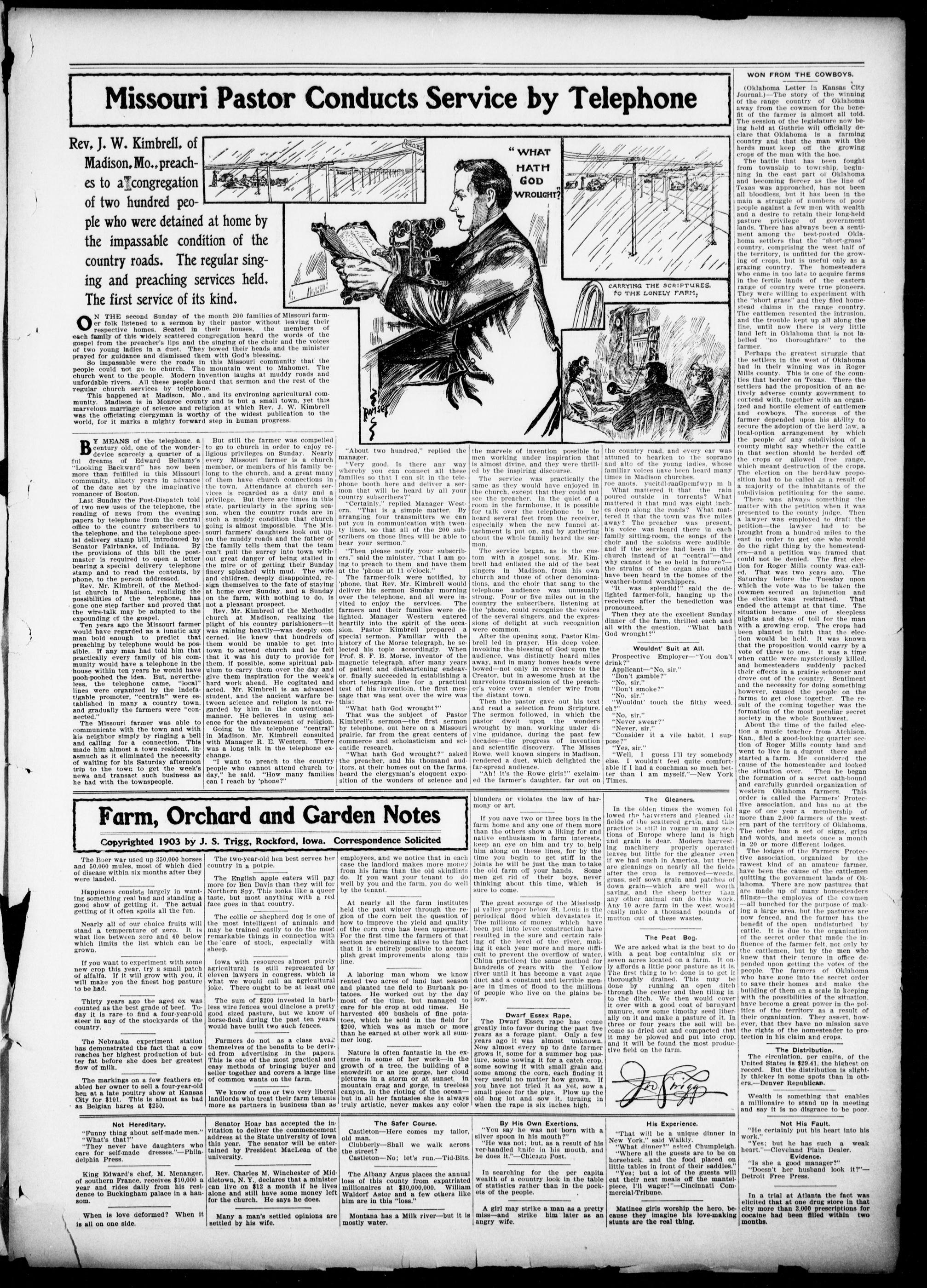
Missouri Pastor Conducts Service by Telephone
ple who were detained at home by the impassable condition of the country roads. The regular singing and preaching services held. The first service of its kind.
ON THE second Sunday of the month 200 families of Missouri farmer folk listened to a sermon by their pastor without leaving their respective homes. Seated in their houses, the members of each family of this widely scattered congregation heard the words of the gospel from the preacher's lips and the singing of the choir and the voices of two young ladies in a duet. They bowed their heads and the minister prayed for guidance and dismissed them with God's blessing.
So impassable were the roads in this Missouri community that the people could not go to church. The mountain went to Mahomet. The church went to the people. Modern invention laughs at muddy roads and unfordable rivers. All these people heard that sermon and the rest of the regular church services by telephone.
This happened at Madison, Mo., and its environing agricultural community. Madison is in Monroe county and is but a small town, yet this marvelous marriage of science and religion at which Rev. J. W. Kimbrell was the officiating clergyman is worthy of the widest publication to the world, for it marks a mighty forward step in human progress.
Farm, Orchard and Garden Notes
Copyrighted 1903 by J. S. Trigg, Rockford, Iowa. Correspondence Solicited
BY MEANS of the telephone, a century old, one of the wonder-device scarcely a quarter of a ful dreams of Edward Bellamy's "Looking Backward" has now been more than fulfilled in this Missouri community, ninety years in advance of the date set by the imaginative romancer of Boston.
Last Sunday the Post-Dispatch told of two new uses of the telephone, the reading of news from the evening papers by telephone from the central office to the country subscribers to the telephone, and the telephone special delivery stamp bill, introduced by Senator Fairbanks, of Indiana. By the provisions of this bill the postmaster is required to open a letter bearing a special delivery telephone stamp and to read the contents, by phone, to the person addressed.
Rev. Mr. Kimbrell, of the Methodist church in Madison, realizing the possibilities of the telephone, has gone one step farther and proved that the wire-talk may be adapted to the expounding of the gospel.
Ten years ago the Missouri farmer would have regarded as a lunatic any man bold enough to predict that preaching by telephone would be possible. If any man had told him that practically every family of his community would have a telephone in the house within ten years he would have pooh-poohed the idea. But, nevertheless, the telephone came, "local" lines were organized by the indefatigable promoter, "centralls" were established in many a country town, and gradually the farmers were "connected."
The Missouri farmer was able to communicate with the town and with his neighbor simply by ringing a bell and calling for a connection. This made him almost a town resident, inasmuch as it eliminated the necessity of waiting for his Saturday afternoon trip to the town to get the week's news and transact such business as he had with the townspeople.
Farm, Orc
Copyrighted 1903 by J
The Boer war used up 350,000 horses and 50,000 mules, most of which died of disease within six months after they were landed.
Happiness consists largely in wanting something real bad and standing a good show of getting it. The actual getting of it often spoils all the fun.
Nearly all of our choice fruits will stand a temperature of zero. It is what lies between zero and 40 below which limits the list which can be grown.
If you want to experiment with some new crop this year, try a small patch of alfalfa. If it will grow with you, it will make you the finest hog pasture to be had.
Thirty years ago the aged ox was counted as the best grade of beef. Today it is rare to find a four-year-old steer in any of the stockyards of the country.
The Nebraska experiment station has demonstrated the fact that a cow reaches her highest production of butter fat before she does her greatest flow of milk.
The markings on a few feathers enabled her owner to sell a four-year-old hen at a late poultry show at Kansas City for $101. This is almost as bad as Belgian hares at $250.
Not Hereditary.
"Funny thing about self-made men."
"What's that?"
"They never have daughters who care for self-made dresses."—Philadelphia Press.
King Edward's chef, M. Menangers, of southern France, receives $10,000 a year and rides daily from his residence to Buckingham palace in a hansom.
When is love deformed? When it is all on one side.
"WHAT HATH GOD WROUGHT?
CARRYING THE SCRIPTURES, TO THE LONELY FARM.
of Missouri farm-
but leaving their
members of
the words of the
er and the voices
and the minister
g.
community that the
Mahomet. The
buddy roads and
the rest of the
agricultural com-
town, yet this
J. W. Kimbrell
publication to the
press.
A rainy day
But still the farmer was compelled to go to church in order to enjoy religious privileges on Sunday. Nearly every Missouri farmer is a church member, or members of his family belong to the church, and a great many of them have church connections in the town. Attendance at church services is regarded as a duty and a privilege. But there are times in this state, particularly in the spring season, when the country roads are in such a muddy condition that church going is almost impossible. The Missouri farmers' daughters look out up on the muddy roads and the father of the family tells them that the team can't pull the surrey into town without great danger of being stalked in the mire or of getting their Sunday finery splashed with mud. The wife and children, deeply disappointed, resign themselves to the fate of staying at home over Sunday, and a Sunday on the farm, with nothing to do, is not a pleasant prospect.
Rev. Mr. Kimbrell of the Methodist church at Madison, realizing the plight of his country parishioners—it was raining heavily—was deeply concerned. He knew that hundreds of them would be unable to get into town to attend church and he felt that it was his duty to provide for them, if possible, some spiritual pabulum to carry them over the day and give them inspiration for the week's hard work ahead. He cogitated and acted. Mr. Kimbrell is an advanced student, and the ancient warfare between science and religion is not regarded by him in the conventional manner. He believes in using science for the advancement of religion. Going to the telephone "central" in Madison, Mr. Kimbrell consulted with Manager R. E. Western. There was a long talk in the telephone exchange.
"I want to preach to the country people who cannot attend church to day," he said. "How many families can I reach by 'phone?'
The two-year-old hen best serves her country in a potpie.
The English apple eaters will pay more for Ben Davis than they will for Northern Spy. This looks like a queer taste, but most anything with a red face goes in that country.
The collie or shepherd dog is one of the most intelligent of animals and may be trained easily to do the most remarkable things in connection with the care of stock, especially with sheep.
Iowa with resources almost purely agricultural is still represented by eleven lawyers in congress, which is what we would call an agricultural joke. There ought to be at least one
The sum of $200 invested in barbless wire fences woul disclose a pretty good sized pasture, but we know of horse-flesh during the past ten years would have built two such fences.
Farmers do not as a class avail themselves of the benefits to be derived from advertising in the papers. This is one of the most practical and easy methods of bringing buyer and seller together and covers a large line of common wants on the farm.
We know of one or two very liberal landlords who treat their farm tenants more as partners in business than as
Senator Hoar has accepted the invitation to deliver the commencement address at the State university of Iowa this year. The senator will be entertained by President MacLean of the university.
Rev. Charles M. Winchester of Middletown, N. Y., declares that a minister can live on $12 a month if he lives alone and still have some money left for the church. He says he does.
Many a man's settled opinions are settled by his wife.
"About two hundred," replied the manager.
"Very good. Is there any way whereby you can connect all these families so that I can sit in the telephone booth here and deliver a sermon that will be heard by all your country subscribers?"
"Certainly," replied Manager Western.
"That is a simple matter. By arranging four transmitters we can put you in communication with twenty lines, so that all of the 200 subscribers on those lines will be able to hear your sermon."
"Then please notify your subscribers," said the minister, "that I am going to preach to them and have them at the 'phone at 11 o'clock."
The farmer-folk were notified, by 'phone, that Rev. Mr. Kimbrell would deliver his sermon Sunday morning over the telephone, and all were invited to enjoy the services. The farmers and their families were delighted. Manager Western entered heartily into the spirit of the occasion. Pastor Kimbrell prepared a special sermon. Familiar with the history of the Morse telegraph, he selected his topic accordingly. When Prof. S. F. B. Morse, inventor of the magnetic telegraph, after many years of patient and disheartening endeavor, finally succeeded in establishing a short telegraph line for a practical test of his invention, the first message that was sent over the wire was this:
"What hath God wrought?"
That was the subject of Pastor Kimbrell's sermon—the first sermon by telephone, out here on a Missouri prairie, far from the great centers of commerce and scholasticism and scientific research.
"What hath God wrought?" asked the preacher, and his thousand auditors, at their homes out on the farms, heard the clergyman's eloquent exposition of the wonders of science and
arden Notes
Correspondence Solicited
employees, and we notice that in each case the landlord makes more money from his farm than the old skinflintts do. If you want your tenant to do well by you and the farm, you do well by the tenant.
At nearly all the farm institutes held the past winter through the region of the corn belt the question of how to improve the yield and quality of the corn crop has been uppermost. For the first time the farmers of that section are becoming alive to the fact that it is entirely possible to accomplish great improvements along this line.
---
A laboring man whom we know rented two acres of land last season and planted the field to Burbank potatoes. He worked out by the day most of the time, but managed to care for his crop at odd times. He harvested 400 bushels of fine potatoes, which he sold in the field for $200, which was as much or more than he earned at other work all summer long.
Nature is often fantastic in the extreme in some of her work—in the growth of a tree, the building of a snowdrift or an ice gorge, her cloud pictures in a storm or at sunset, in mountain crag and gorge, in treeless canyon, in the rioting of the ocean—but in all her fantasies she is always truly artistic, never makes any color
The Safer Course.
Clubberly—Shall we walk across
The Albany Argus places the annual loss of this county from expatriated millionaires at $30,000,000. William Waldorf Astor and a few others like him are in this "loss."
Montana has a Milk river—but it is mostly water.
the marvels of invention possible to men working under inspiration that is almost divine, and they were thrilled by the inspiring discourse.
The service was practically the same as they would have enjoyed in the church, except that they could not see the preacher. In the quiet of a room in the farmhouse, it is possible for talk over the telephone to be heard several feet from the receiver, especially when the new funnel attachment is put on, and by gathering about the whole family heard the sermon.
The service began, as is the custom with a gospel song. Mr. Kimbrell enlisted the aid of the best singers in Madison, from his own church and those of other denominations, and the choir that sang to the telephone audience was unusually strong. Four or five miles out in the country the subscribers, listening at the 'phone, could recognize the voices of the several singers, and the expressions of delight at such recognition were common.
After the opening song, Pastor Kimbrell led in prayer. His deep voice, invoking the blessing of God upon the audience, was distinctly heard miles away, and in many homes heads were bowed—not only in reverence to the Creator, but in awesome hush at the marvelous transmission of the preacher's voice over a slender wire from the distant town.
Then the pastor gave out his text and read a selection from Scripture. The sermon followed, in which the pastor dwelt upon the wonders wrought by man, working under divine guidance, during the past few decades—the progress of invention and scientific discovery. The Misses Rowe, well known singers in Madison, rendered a duet, which delighted the far-spread audience.
"Ah! it's the Rowe girls!" exclaimed the farmer's daughter, far out on
blunders or violates the law of harmony or art.
If you have two or three boys in the farm home and any one of them more than the others show a liking for and native enthusiasm in farm interests, keep an eye on him and try to help him along on these lines, for by the time you begin to get stiff in the joints he will be just the man to take the old farm off your hands. Some men get rid of their boys, never thinking about this time, which is sure to come.
The great scourge of the Mississippi pi valley proper below St. Louis is the periodical flood which devastates it. The millions of money which have been put into levee construction have resulted in the sure and certain raising of the level of the river, making it each year more and more difficult to prevent the overflow of water. China practiced the same method for hundreds of years with the Yellow river until it has become a vast aqueduct and a constant and terrible menace in times of flood to the millions of people who live on the plains below.
Dwarf Essex Rape.
The Dwarf Essex rape has come greatly into favor during the past five years as a forage plant. Only a few years ago it was almost unknown. Now almost every up to date farmer grows it, some for a summer hog pasture, some sowing it for a catch crop, some sowing it with small grain and some among the corn, each finding it very useful no matter how grown. If you have not tried it as yet, sow a small piece for the pigs. Plow up the old hog lot and sow it, turning in when the rape is six inches high.
By His Own Exertions.
"You say he was not born with a silver spoon in his mouth?"
"He was not; but, as a result of his ver-handed knife in his mouth, and he does it."—Chicago Post.
In searching for the per capita wealth of a country look in the table of statistics rather than in the pockets of the people.
A girl may strike a man as a pretty miss—and strike him later as an angry wife.
the country road, and every ear was attuned to hearken to the soprano and alto of the young ladies, whose familiar voices have been heard many times in Madison churches.
roe anots, yuucit!-raaGpcmfwjp m h
What mattered it that the rain poured outside in torrents? What mattered it that mud was eight inches deep along the roads? What mattered it that the town was five miles away? The preacher was present, his voice was heard there in each family sitting-room, the songs of the choir and the soloists were audible, and if the service had been in the church instead of at "central"—and why cannot it be so held in future?—the strains of the organ also could have been heard in the homes of the weather-bound worshippers.
"It was splendid!" said the delighted farmer-folk, hanging up the receivers after the benediction was pronounced.
Then they ate the excellent Sunday dinner of the farm, thrilled each and all with the question, "What hath God wrought?"
Wouldn't' Suit at All.
Prospective Employer—"You don't drink?"
Applicant—"No. sir."
"Don't gamble?"
"No, sir."
"Don't smoke?"
"No, sir."
"Wouldn't touch the filthy weed. eh?"
"No, sir."
"Never swear?"
"Never, sir."
"Consider it a vile habit. I suppose?"
"Yes, sir."
"Well, I guess I'll try somebody else. I wouldn't feel quite comfortable if I had a coachman so much better than I am myself."—New York Times.
The Gleaners.
In the olden times the women followed the harvesters and cleaned the fields of the scattered grain, and this practice is still in vogue in many sections of Europe where land is high and grain is dear. Modern harvesting machinery properly operated leaves but little for the gleaner even if we had such in America, but there are gleanings on nearly all the fields after the crop is removed—weeds, grass, self sown grain and patches of down grain—which are well worth saving, and the sheep better taan any other animal can do this work. Any 10 acre farm in the west would easily make a thousand pounds of mutton out of these wastes.
The Peat Bog.
We are asked what is the best to do with a peat bog containing six or seven acres located on a farm. It only affords a little poor pasture as it is. The first thing to be done is to get it thoroughly drained. This may be done by running an open ditch through the center and then tiling in to the ditch. We then would cover it over with a good coat of barnyard manure, sow some timothy seed liberally on it and make a pasture of it. In three or four years the soil will be come so dried out and compacted that it may be plowed and put into crop and it will be found the most productive field on the farm.
His Experience.
"That will be a unique dinner in New York," said Walkly.
"What dinner?" asked Chumpleigh.
"Where all the guests are to be on horseback, and the food placed on little tables in front of their saddles."
"Yes; but a lot of the guests will eat their next meals off the mantel piece. I'll wager!"—Cincinnati Commercial-Tribune.
Matinee girls worship the hero, be cause they imagine his love-making stunts are the real thing.
WON FROM THE COWBOYS.
(Oklahoma Letter in Kansas City Journal.)—The story of the winning of the range country of Oklahoma away from the cowmen for the benefit of the farmer is almost all told. The session of the legislature now being held at Guthrie will officially declare that Oklahoma is a farming country and that the man with the herds must keep off the growing crops of the man with the hoe.
The battle that has been fought from township to township, beginning in the east part of Oklahoma and becoming fiercer as the line of Texas was approached, has not been all bloodless, but it has been in the main a struggle of numbers of poor people against a few men with wealth and a desire to retain their long-held pasture privilege of government lands. There has always been a sentiment among the best-posted Oklahoma settlers that the "short-grass" country, comprising the west half of the territory, is unfitted for the growing of crops, but is useful only as a grazing country. The homesteaders who came in too late to acquire farms in the fertile lands of the eastern range of country were true pioneers. They were willing to experiment with the "short grass" and they filed homestead claims in the range country. The cattlemen resented the intrusion, and the trouble kept up all along the line, until now there is very little land left in Oklahoma that is not labelled "no thoroughfare" to the farmer.
Perhaps the greatest struggle that the settlers in the west of Oklahoma had in their winning was in Roger Mills county. This is one of the counties that border on Texas. There the settlers had the proposition of an actively adverse county government to cortend with, together with an organized and hostile element of cattlemen and cowboys. The success of the farmer depended upon his ability to secure the adoption of the herd law, a local-option arrangement by which the people of any subdivision of a county might say whether the cattle in that section should be herded off the crops or allowed free range, which meant destruction of the crops. The election on the herd-law proposition had to be called as a result of a majority of the inhabitants of the subdivision nettingting for the same.
There was always something the matter with the petition when it was presented to the county judge. Then a lawyer was employed to draft the petition—the lawyer had to be brought from a hundred miles to the east in order to get one who would do the right thing by the homesteaders—and a petition was framed that could not be denied. The first election for Roger Mills county was called. That was two years ago. The Saturday before the Tuesday upon which the vote was to be taken the cowmen secured an injunction and the election was restrained. That ended the attempt at that time. The situation became one of sleepless nights and days of toil for the man with a growing crop. The crops had been planted in faith that the election would be held. It was known that the proposition would carry by a vote of three to one. It was a time when cattle were mysteriously killed, and homesteaders suddenly packed their effects in a prairie schooner and drove out of the country. Sentiment and the necessity for doing something however, caused the people on the farms to get close together. The result of the coming together was the formation of the most peculiar secret society in the whole Southwest.
About the time of the failed election a music teacher from Atchison, Kan., filed a good-looking quarter section of Roger Mills county land and went to live in a dugout there and started a farm. He considered the cause of the homesteader and looked the situation over. Then he began the formation of a secret oath-bound and carefully guarded organization of western Oklahoma farmers. This order is called the Farmers' Protective association, and has no at the age of one year a membership of more than 2,000 farmers of the western part of the territory of Oklahoma. The order has a set of signs, grips and words, and meets once a month in 20 or more different lodges.
The lodges of the Farmers Protective association, organized by the rawest kind of an amateur farmer, have been the cause of the cattlemen quitting the government lands of Oklahoma. There are now pastures that are made up of many homesteaders filings—the employees of the cowmen—all bunched for the purpose of making a large area, but the pastures are now fenced, and the farmer has the benefit of the open undisturbed by cattle. It is due to the organization of the secret order that made the influence of the farmer felt, not only by the cattlemen, but by the men who knew that their tenure in office depended upon getting the votes of the people. The farmers of Oklahoma who have gone into the secret order to save their homes and make the building of them on a scale in keeping with the possibilities of the situation, have become a great power in the politics of the territory as a result of their organization. They assert, however, that they have no mission save the rights of the nomesterade to protection in his claim and crops.
The Distribution.
The circulation, per capita, of the United States is $29.41, the highest on record. But the distribution is slightly thicker in some spots than in others.—Denver Republican.
Wealth is something that enables a millionaire to stand up in meeting and say it is no disgrace to be poor.
Not His Fault
Not His Paint.
"He certainly put his heart into his work."
"Yes; but he has such a weak heart."—Cleveland Plain Dealer.
Evidence.
"Is she a good manager?"
"Doesn't her husband look it?"—Detroit Free Press.
In a trial at Atlanta the fact was elicited that at one drug store in that city more than 3,000 prescriptions for cocaine had been filled within two months.
The Professional World
RUFUS L. LOGAN, B. S. D. - EDITOR
TERMS OF SUBSCRIPTION.
One Year in Advance - - - $1.00
Six Months in Advance - - .75
Three Months in Advance - - .50
Single Copies - - - .05
Advertising Rates on Application.
Job Work of all Kinds Sollicited.
Entered at the postoffice at Colum-
umbia, Mo., as second class matter,
Jan. 15, 1902.
Agents wanted in every town in the
state.
Payments may be made in two cent stamps,
by postal note, money order, by registered
letter or express order.
Correspondence containing news of interest
and importance is desired from all parts of the
United States.
Communications should be made to reach us
not later than Thursday morning, to insure insertion in the current issue.
No attention will be paid to anonymous communications.
Agents wanted everywhere. Write for terms.
Specimen copies sent to any address upon request.
PRESS OF THE MISSOURI STATESMAN
PLEASE send in your subscription.
COLUMBIA's streets should at least be as good as the roads of Boone county.
It is said that President Francis of the Exposition Commission has become so familiar with big men that he calls the great steel trust president "Charlie."
Our thanks are due the following named persons for subscriptions recently: Prof. J. B. Coleman and Miss Fannie Turner, of Columbia, and Mrs. Pinkie Stapleton, of Moberly.
THE Professional World is in receipt of an invitation from the National Press Bureau to be present at the dedication of the World's Fair Grounds in St. Louis, April 30th. The invitation is quite unique and has the signatures of Pres. D. R. Francis and Pres. Thos. H. Carter.
Too long have we been silent with reference to the moral deficiencies of those who are in the front ranks endeavoring, as preachers and teachers, to lead our people. There are men in our pulpits whose morals, to say the least, are questionable. We have teachers whose influence, from a moral point of view, will not bear inspection. Yet we hold on to these men and women very often, and thereby increase their boldness in pursuing their shameless course. Let negroes tone up their ethical sense, and lift up their courage to the point of disapproving every person whose life is not in accord with principles of morality and whose character is not without blemish.—Western Messenger.
Civil Service Examination Dates and Places Fixed.
WASHINGTON, April 4.—The civil service commission will hold a special examination on April 28, for the purpose of establishing a suitable register of eligibles of clerks in the government service. A number of these positions will be filled on July 1, and it is expected that 100 or more positions will be filled by the organization of the new department of commerce and labor. This examination will be held on April 28 instead of April 21, as heretofore announced. The examinations will be held at the following places:
Arizona—Phoenix, Prescott, Tucson.
Arkansas—Fort Smith, Little Rock Tex-
arkana.
Nebraska—Beatrice, Grand Island, Omaha.
Mississippi—Greenville, Jackson.
Missouri—Jefferson City, Kirksville, Spring-
field, St. Joseph, St. Louis
Oklahoma—Enid, Guthrie, Oklahoma.
New Mexico—Albuquerque, East Lee Vegas.
Illinois—Chicago, Freeport, Peoria, Spring-
field.
Indiana—Evansville, Fort Wayne, Indian-
apola, Terre Haute.
Kansas—Des Moines, Fort Madison, Mason
City, Sioux City.
Kansas—Fort Scott, Salina, Topeka, Wichita
Tennessee—Bristol, Chattanooga, Knoxville
Memphis, Nashville.
Texas—El Paso, Forth Worth, Houston, San
Antonio, Waco.
$10,000.00 TO BE DISTRIBUTED
The St. Louis Republic Offers Fourteen
Splendid Rewards to Subscribers.
An interesting announcement appears in that great metropolitan newspaper, The St. Louis Republic in the form of a profit-sharing offer to any one now a subscriber or willing to become a subscriber of the Republic. A big sum of $10,000.00 is to be paid in rewards for good judgement and skill. It is possible to earn all the way from $10.00 to $5,000.00.
The Republic's subscribers are invited to estimate upon the number of admissions to the World's Fair Grounds upon the occasion of the grand dedicatory ceremonies, April 30, 1903, of the Lousiana Purchase Exposition. The subscriber whose estimate comes nearest the official record will receive $5,000.00; the next one will get $2,500.00 and an additional sum of $2,500.00 will be divided in rewards ranging from $1,000 down to $10.00 among those whose estimates most nearly approximate the official record of admissions. A payment of $7.80 will provide for the delivery of the Daily and Sunday Republic for not less than one year, or $6.00 will pay for six annual subscriptions to the Twice-a-Week Republic, and if the remittance is received on or before 4 p. m. of April 29, 1903, the person sending it can make six estimates. More estimates may be made by extending a subscription beyond one year, or by organizing clubs and inducing others to subscribe.
Complete information as to the conditions of this contest, together with blanks will be found in the Daily, Sunday and Twice-a-week editions of The Republic from April 2 to April 29, 1903, or will be mailed to any one upon application. All communications and estimates should be addressed to THE REPUBLIC PROFIT-SHARING BUREAU, CALL BOX 201, ST. LOUIS, MO.
DOG AND MASTER BURIED TOGETHER.
William L. Murphy, one of the oldest settlers of Logan county, Ill., when he died last Thursday, made a final request that his faithful old watch dog be buried with him. Not many hours after the old gentleman's death the dog that had been his companion for many years laid down and died. The faithful canine was shipped to Louisville, Ky., and will be interred in the same tomb with his master.
WITH A FEW DOLLARS
to invest, the farmer or artisan desirous of changing his location should investigate conditions in Missouri, Kansas, Indian Territory, Oklahoma and Texas. "Business Chances," and other interesting books telling of the prosperity and progress in the Great Southwest, free. Address "KATY," 304 Wainwright Bldg., St. Louis, Mo. Low Colonist Excursions from the North on the first and third Tuesdays of each month.
Annual Sermon to K. of P.
The K. of P. Lodge of Moberly had their annual sermon preached last Sunday at the A. M. E. Church in that city by Rev. George Williams of that church. The exercises were largely attended by lodges from surrounding town.
Married.
STOUT-TURNER—At the residence of the bride's sister, Mrs. Macie Bass, near Ashland, Sunday, April 5th, 1903, Mr. John Stout of Columbia and Miss Dora Turner of Ashland, Rev. A. A. Adams officiating. Mr. Stout is a prosperous young man of Columbia, while his bride is an accomplished school teacher of Boone county. The Professional World extends congratulations.
T. J. Nevins.
Mr. T. J. Nevins, our polite grocer, is doing an excellent business at the old stand, 2800 Lacadele avenue. His store is always supplied with the freshest and best groceries in the market at the most reasonable market prices. Mr. Nevins is a race man well deserving of the support of the entire surrounding community, and especially those of his own race.—(American Eagle). Mr. Nevins is an old Callaway boy, who is making a good record for himself, and the Eagle has said nothing about him, but what he deserves.
Administrator's Notice.
Notice is hereby given that letters of administration, with will annexed, on the estate of Sarah Willis, deceased, were granted to the undersigned on the 23rd day of March, 1903, by the administrator on the 23rd day of March, 1903, by persons having claims against said estate are required to exhibit them for allowance by the administrator within one year after the date of said letters or they may be precluded from any other claim which may be not exhibited within two years from this date of publication they shall be forever barred.
HENRY KIRLKIN
Administrator with will annexed
mar 27-4w
Lodge and Church Directory.
Mrs. Ada Douglass, W. P.; Mrs. Lizzie Williams, W. S. Meeting first Monday in each month at 3 p. m.
U. B. F
Crispus Attucks Lodge, No. 62. Meetings 2nd and 4th Tuesdays in each month. Visiting members cordially invited. Caleb Hall, W. M. A. M. Schweich, W. S.
K. P.
Acme Lodge, No. 24. Meetings second and fourth Fridays in each month. W. H. Turner, C. C. and D. D. G. C. W. W. Lampkins, M. F.
St. Paul Lodge, No. 12, A.
F. & A. M., meets every first
and third Tuesday in each
month. A cordial invitation
extended to all visiting
brothers. J. A. Mosely, W.
M. J. A. Grant, Secretary.
SECOND CHRISTIAN CHURCH.
Rev. J. B. Parsons, pastor.
Preaching Sundays 11 a. m.
and 7:30 p. m.
Prayer meeting Wednesdays 7:30 p. m.
Everybody cordially invited to attend.
K. OF P.
Harrison Lodge No. 12,
Huntsville, Mo. Meeting the
second and fourth Thursdays
in each month. M. W. Tony,
C. C., W. T. Ansel, K. R. S.,
I. A. Robinson, M. E.
A. M. E. CHURCH.
Rev. P. C. Crews, Pastor.
Preaching Sundays 11 a.
m.; 7:30 p. m.
Sunday school 2:30 p. m.
Prayer meeting every
Wednesday eve, at 8:30; every
body invited to attend.
M. E. CHURCH
Rev. J. Arlington Grant,
pastor.
Preaching Sundays 11, a.
m. and 7:30 p. m.
Sunday school, 9:30 a. m.
Prayer meeting Wednes-
days 7:30 to 8:30; all are made
welcome.
SECOND BAPTIST CHURCH.
Rev. A. A. Adams, Pastor.
Preaching Sundays 11 a.
m., and 7:30 p. m.
Sunday school at 2:30 p. m.
Prayer meeting Wednesday
evening, 7:30.
A cordial invitation ex-
tended to all.
LADIES COURT.
Golden Queen Court, No. 19, meets first Friday in each month. Mrs. M. E. Ridgway, M. A. M., Mrs. Lizzie Richardson, Secretary.
O. E. S.
Amos Chapter, No. 30. Meetings second Friday in each month. Mrs. Bessie Washington, W. M. Mrs. Annie Williams, W. S.
PILES
Notice: We have made a specialty of Piles, Fintula and Diseases of the Rectum for 28 years in Kansas City. We offer advantages in the treatment of such diseases, which cannot be obtained elsewhere. We accept no money till cure is complete and our charges are always low. Examination costs nothing. Write for our 200 page treatise for men and our 100 page book for women—both sent free. Write to our old patients and investigate the merits of our work.
Mr. Walter Scott, Gen'l Agt Home Fire in
"Your treatment and my cure of the piles was eminently satisfactory. No fee or money was asked until your treatment had resulted in a cure."
Mr. J. J. Swofford, President of the Swofford Bros. Drywood Co., Writer:
"I was afflicted for years with piles and you effected a permanent cure in a short time without a day's loss from my business."
See. B. Gray, Cashier of American National Bank, Kansas City, Mo., Writes:
"Included herewith find my check in payment of bill rendered and with it my sincere gratitude for the relief you have given me through your very thorough and effective treatment of my case of piles and fracture."
Drs. THORNTON & MINOR, OAK STREET, Kansas City, Mo.
Wanted For Our File.
A few copies of the Professional World, dated Feb. 13th, 1903. Any person having a copy of this date, will do us a favor by sending us the same.
Do You Want a Cut?
If so send us your photo and $2 and we will furnish you a cut, guaranteed for twenty years and so return your photo.
How's This?
We offer One Hundred Dollars Reward for any case of Catarrh that cannot be cured by Hall's Catarrh Cure.
F. J. CHENEY & Co., Toledo, O.
We, the undersigned, have known F. J. Cheney, for the last fifteen years, and believe him perfectly honorable in all business transactions and financially able to carry out any obligations made by their firm.
WEST & TRUE, Wholesale Druggists, Toledo, O.
WALDIN, KINNAN, & MARVIN, Wholesale Druggists, Toledo, O.
Hall's Catarrh Cure is taken internally, acting directly upon the blood and mucous surfaces of the system. Testimonials sent free. Price 75c per bottle. Sold by all Druggists.
Hall's Family Pills are the best.
WABASH
CHEAP EXCURSIONS
ONE WAY RATES
VIA
WABASH ROUTE.
February 15th to April 30th, inclusive, to Points in California, Washington, Oregon, Idaho, Montana and intermediate.
THROUGH TOURIST CARS
For full information in regard to rates, time of trains, etc., apply to nearest ticket agent or address
H. E. WATTS, P. & T. A.,
Mobery, Mo.
The Railroads.
WABASH
GOING SOUTH.
No. 33. Arrive Columbia. 8:15 a. m.
No. 37. Arrive Columbia. 1:20 a. m.
No. 37. Arrive Columbia. 8:45 a. m.
NO. 30. Leave Columbia. 9:40 a. m.
No. 32. Leave Columbia. 4:00 a. m.
No. 34. Leave Columbia. 4:10 a. m.
A. M. No. 36
A. M. No. 38
P. M. No. 40.
Leave:
McBaine ... 6:30 11:53 4:05
Webster ... 6:53 11:38 4:08
Brushwood ... 6:38 12:02 4:13
Turner ... 6:42 12:06 4:17
Limerick ... 6:47 12:11 4:22
Arrive
Columbia ... 6:55 12:19 4:30
TRAINS SOUTH.
Leave
Columbia ... 11:00 3:10 6:30
Limerick ... 11:08 3:18 6:38
Turner ... 11:12 3:22 6:42
Brushwood ... 11:17 3:27 6:47
Webster ... 11:22 3:32 6:52
Arrive
McBaine ... 11:25 3:35 6:55
Mr. Chas, Dougherty, Spencer, la.. Says:
"I concluded to go to you after trying all the so-called curatives without any relief. You at once made the necessary examination and informed me that I had a bad case of piles, and you told me you cool cure me. You did just as you said you would."
A. N. McClary, Mayor of Sabetha, Kan., Writes:
"I must say that your treatment and cure of my case of piles and fissure seems now wonderful to me and that the treatment was a great deal more than I had expected. I am entirely satisfied and consider that I am completely cured."
Wm. E. Barrett, of Barrett & Tucker Lumber Co., Grand Rapids, Mich., Writes:
"I had piles for twenty years and was cured by you. I consider you the best doctors on the globe and would not be back where I was when I came to you for any money."
Emmet L. Woodson, Cotton Broker, No. so Old Silp, New York City, Writes:
"Since you treated me for bleeding piles I have been entirely relieved and feel like a new man. My general health has much improved. Not 1 cent was required or paid until a cure was effected."
Drs. THORNT
with us. The only difference between our suits and the made-to-order suits is imagination. As to fit, we allow you to be judge and jury- Try us and be convinced. Your money back on any unsatisfactory article. We are bound to make a customer of you if low prices will do it.
The Columbia Gro=cery Co.,
Keeps constantly on hand a fresh supply of staple and FANCY GROCERIES.
YOUR PRODUCE WANTED.
---
All Kinds of Fresh Lunch Goods. Wood and Coal. Prompt and Careful Attention Given to all Orders. Telephone 580.
---
210 E. High St.
The Colum
cery
Keeps constant
a fresh supply of
FANCY GR
YOUR PRODUC
MAYBERR
DEALER
Staple and Fan
All Kinds of Fresh Lunch Good
and Careful Attention Given to
Lafayette St.
Lafayette
JOHN C. MADDEN
Madison St.
NO MONEY T
Joseph L. Sheridan, President of the Sheridan Stove Manufacturing Co., of Quincy, Ill., Writes:
"My case consisted of piles, two fixtures and three ulcers and I was practically dead on my feet when I went to you. Your treatment gave me no pain and I am at this time in perfect health and weigh heavier than at any time during my past life. You refused to accept anything in return until my cure was complete."
Thomas W. Long, Cashier First National Bank, Hopkinsville, Ky., Writes:
"For five years prior to taking your treatment I had been a constant sufferer from piles, often having to leave my desk for hours and some time later. I had came almost a burden. Within three days after leaving your city I took up my regular work and have since continued without interruption or inonvenience."
Mr. Q. H. P. Catron. President of the Bank of West Plains, Mo., Sayr.
"Your treatment for my fistula, fissure, piles, stricture and ulcers of the rectum was entirely successful in every respect, and I feel that I have a new lease upon life. I can cheerfully recommend all who are suffering with rectal trouble to go to you. Every promise you make you will fulfill."
Ladies Admire
....Perfect
Fitting garments,
and only first class
tailors can make
them.
Suits from $25.00, up.
Trousers from $6.00, up.
Merchant Tailor,
JEFFERSON CITY, MO
Mr. Frank Strain, Probate Judge, Phillipsburg. Kas, Says:
"I was troubled with piles for thirty years before and four weeks you dismissed me more cured than new man. When you examined me you stated what the cost of a cure did not ask or require a payment of the amount until the cure was effected."
J. R. Sprankle, Capitalist, Cleveland. O. Writes:
"I doctored for twelve years with physicians in New York, Philadelphia, Cincinnati and Cleveland for piles and dactula. I finally went to you and me, and we certainly saw the days and while being cured I was not laid up an hour."
Senator J. R. Burrows, President First National Bank. Smith Center, Kas, Says:
"Your treatment of me was very satisfactory. There have been no signs of trouble returning in any way. I was treated over ten years ago."
Mr. Gee, Thels, Jr., President of the Thesis Cattle Co., Ashland, Kau., Sayes;
"I can testify that you have entirely cured me of piles and I was not asked to pay a dollar until I was satisfied I was cured."
Free Books Send today for our care book page book for men, or roo-po page book for women containing valuable information and testimonials. Either or both sent free and postpaid.