The Professional World
Friday, May 15, 1903
Columbia, Missouri
Page text (machine-generated)
THE PROFESSIONAL WORLD.
$1.00 Per Year in Advance.
Columbia Notes.
Buy your millinery of Mrs. Adkison, over Vanhorn & Mountjoys store.
Rev. A. A. Adams returned from Fulton Saturday.
Mr. William Dozier left Monday for Billings, Montana.
Subscribe for the Professional World. It is only $1.00 per year.
A number of persons from Rocheport attended the circus here Monday.
Mrs. Abraham Jackson, of Browns Station, was in Columbia Saturday.
Mrs. A. B. Moore has been re-elected as teacher in the Jefferson City school.
Col. Isaac Bodenheimer, of Jefferson City, attended the circus here Monday.
Miss Laura Douglass has been re-elected as teacher in the St. Charles school.
Miss J. Ethel Fowler will leave next week to spend the vacation with her parents in Ohio.
Mr. Wm. Graves is rejoicing over the arrival of a fine boy at his home. Mother and son are doing nicely.
Miss Lillian Cave of New Bloomfield, made a short visit to Columbia this week and while here was the guest of Miss Louella Bass. An entertainment will be given at Fifth street hall next Monday evening for the benefit of the city grave yard fund. A neat program is being prepared. The exercises will be in charge of Prof. J. B. Coleman. All are invited to attend.
Notice.
Persons writing me after April 26th, will please address my mail to Columbia instead of Huntsville.
Capitol News.
Mr. Fred Summers has returned to the city.
Miss Octavia Roberts of St. Louis, is in this city.
Rev. J. Goins is in Macon attending Western College commencement.
Mrs. Parthena Hoskins, of Kirksville, is in the city visiting her parents.
Prof. Shelton H. French, of Sedalia is in the city. The public school will close on the 21st.
Mr. E. S. Brown went to St. Louis, having been called there by the serious illness of his mother.
The electoral college, the district conference and the district Sunday school convention of the A.M.E. church are in session in this city with many prominent ministers and members of the church in attendance.
The local members of the Lincoln Institute Alumni Association met monday evening in the reception room of the ladies dormitory to arrange a program for commencement week. Prof. A. L. Reynolds was chairman of the meeting, Miss Florence Pigeon secretary, and Miss Leona Bennett treasurer. Prof. Reynolds was made chairman of the social committee We are pleased to announce that Judge I. F. Bradley, of Kansas City will deliver the alumni address. The following are in attendance at the St. Louis district conference
CASH OR CREDIT. Catalogue FREE.
COLUMBIA AND JEFFERSON CITY, MISSOURI, FRIDAY MAY 15. 1903.
and Sunday school convention: Rev. J. H. Allen, presiding elder; Dr. D. P. Roberts, St. Paul chapel, St. Louis; Rev. Wm. Alexander, Sedalia; Rev. S. L. Bean, Chamois; Rev. W. C. Williams, St. Louis; Rev. W. B. Stewart, St. Louis; Rev. I. H. Johnson, Marshall; Rev. T. L. Watson, Higginsville; Rev. L. P. Duke, Osage; Rev. P. W. Weaver Speed, Mo.; Rev. H. McTassel, Pleasant Green; Rev. L. S. Watson, St. Louis; Rev. J. F. Sage, Boonville; Rev. J. E. Christopher, St. Louis; Rev. C. L. Jackson, Higginsville, Dr. J. C. C. Owens, presiding elder, Kansas City district; Rev. J. W. Scott, Allen chapel, Kansas City; Rev. D. W. Oakes North, Mo. conference; Rev. J. C. Caldwell, Independence, Mo.
Do You Want a Cut?
If so send us your photo and $2 and we will furnish you a cut, guaranteed for twenty years and so return your photo.
Huntsville Notes.
Mrs. John Denny is on the sick list.
Mrs. James Yancy is improving nicely.
Mrs. Martha Robinson is on the sick list.
Miss Hattie Harvey is very ill with consumption.
Mr. J. C. Perkin of Marshall spent Tuesday in our town.
Mrs. Mary Harvey of St. Joseph is visiting her mother and friends.
The Professional World is only $1.00 per year and contains all the news.
Mrs. Emma Rout entertained the A. M. E. sewing circle Monday afternoon.
Mr. and Mrs. William Salisbury of Iowa are the guests of his uncle Edward Salisbury.
Miss Dehlia Henderson and Mr. Homer Walker went to Kansas City Sunday for a visit.
Misses Mayme Maupin and Prudence Carmeny of Kansas City were the guests of Miss Mabel Finney last Sunday.
Clarence Teeters met with a serious accident while out hunting last Monday he was accidently shot through the hand.
Mrs. Frances Allen and two children were called home from Iowa on a very sad occasion. It being the death of her brother Mr. Luther Brown.
Mrs. Mary Watts died at her home in Huntsville last Thursday night. Her remains were taken to Dalton for burial. She leaves a husband, one son, and a host of friends to mourn her death.
Voting Contest.
The Professional World is arranging to have a voting contest. A fine broadcloth dress pattern will be given to the most popular young married lady in Boone county, as decided by the highest number of votes received. Every person who pays one dollar for subscription or renews a year's subscription to the Professional World will be entitled to ten votes. See next issue.
A Request.
We will consider it a great favor if our readers will patronize the merchants whose advertisements they see in this paper.
It will pay you
prices on Buggies,
Harness, etc. We sell direct from
our Factory to Consumers at
Factory Prices. This guaranteed
Buggy only $33.50; Cash or Easy
Monthly Payments. We trust
honest people located in all parts
of the world.
DEPART 910. East St. Louis, IL.
THE BUTLER CASE.
An Error Has Caused it to be Continued.
Because of an error in copying the bill of expenses filed by the defendant in the case of Edward Butler, of St. Louis, who was convicted of attempted bribery in the Boone county circuit court last November, the hearing of his appeal in the state supreme court will be delayed for three months.
The error was made by the private stenographer of the defendant and in consequence the case will not be taken up until the October term, instead of this month, as was understood by the attorneys for the state at the conclusion of the Butler trial at Columbia in November.
The official stenographer of the Boone county circuit court filled the customary report of the trial written in shorthand, in the clerk's office. When an appeal is taken the defendant is entitled to the use of the papers in making a copy for the supreme court.
It is the custom for two copies to be made, one to be filed in the office of the circuit clerk and another to be sent to Jefferson City. The private stenographer of Butler made but one copy of the transcript. The clerk retained this on file, but had no copy to send to Jefferson City.
The error went unnoticed until recently, when Mr. Folk discovered that the Butler case was not on the docket for the May term of the supreme court. He requested that the matter be investigated in Columbia and the error was revealed.
Columbia Teachers Elected.
The Columbia board of education met Thursday evening and elected teachers for the ensuing year. The room which was closed last year will remain closed owing to the shortage of school funds, and only six teachers were elected, as the Prin. Prof. J. B. Coleman, was re-elected several weeks ago. The following old teachers were re-elected: Prof. E. W. Emory, Mrs. F. M. Brashears, Miss J. Ethel Fowler, Mrs. Virgie L. Waldon. The new teachers were Miss Cordelle Walton of Marshall, who succeeds Mrs. M. R. Akers, and Mrs. Annie Wright, of Sedalia, who succeeds Mrs. M. D. Billups (Mrs. Billups not being an applicant for re-election. Miss Walton is a graduate of Lincoln Institute and is now employed in the Marshall public school, and is known to be a very successful teacher, while Mrs. Wright has had ten years experience and is Prin. of the Versailes school. Both of them were highly recommended and will doubtless add much to the teaching strength of Fred Douglass school.
Fred Douglass School Report.
The finance committee of the Fred Douglass school submits the following report showing receipts and expenditures of money realized from school entertainments during the past year:
WEATHER AND CROPS.
U. S. Department of Agriculture, Climate and Crop Bulletin of the Weather Bureau, Missouri section for the week ending May 11, 1903, published by A. E. Hackett, section director:
The mean temperature of the past week was very near the normal in all sections of the state, except the southwest, where there was a marked deficiency, and there has been about the average amount of sunshine. Light frost occurred in some localities during the fore part of the week but did little or no damage. Over portions of the southwest section the rainfall of the week ranged from one to over two inches, but elsewhere it was generally less than one-half inch, many localities receiving none. Warm showers are now needed.
Except in some of the southwestern counties, where heavy rains kept the ground wet, the week has been very favorable for farm work and plowing and corn planting have been vigorously pushed. In most of the southern counties planting is nearing completion, and from one-half to three-fourths of the crop has been planted in portions of the central and northern sections, but in many counties of those sections less than half the land intended for corn has not yet been broken. In the northwestern counties much corn will be listed. The soil is now in better condition to work than at any previous time this spring, but there is much complaint that it is cloddy and hard to pulverize, and in portions of the central and northern sections it is still very "soggy." In a few of the southeastern counties the ground is becoming too to plow. Corn is coming up very slowly, as a rule, owing to the continued cool weather, and in portions of the southern sections there is much complaint of poor stands. Some early fields in the extreme southern counties have been cultivated. Cotton planting is nearing completion in the extreme southeastern counties and good stands are reported in New Madrid county, but in Dunklin and Pemiscot counties there is complaint that it is not coming up well.
Wheat continues to deteriorate in portions of the central and southern sections owing to damage by rust and insects, and in some of the southern and eastern counties it is greatly in need of rain. In most of the central and northern counties it continues in fair to excellent condition. The earliest is now heading in the southern counties and there is some complaint that it is very short. In a few of the extreme southern counties the crop was damaged by frost. Oats are being greatly retarded by the cool and dry weather and in some counties are turning yellow. Grasses are also making slow progress, and are needing warm showers. Reports regarding the damage done to fruits by the freeze of the 1st indicate that in most of the southern counties apples have been damaged one-half or more, many correspondents stating that they are almost entirely killed. In the central or northern counties the loss does not seem to have been so great, although in many counties they are reported damaged one-half. What peaches remained suffered to about the same extent as apples, and other small fruits were greatly damaged in nearly all sections. Strawberries were generally cut short one-half or more, except in portions of the central and northern sections, where they were not yet in bloom. Potatoes are slowly recovrring from the effects of the frost. Gardens are generally backward.
Tailor made suits and extension skirts at Hoee's.
50 STUDENTS LEAVE WILLIAM JEWELL COLLEGE.
Left Liberty School in a Body Because Faculty Refused to Dissolve Fraternities.
LIBERTY, Mo., May 12.—Fifty Baptist ministerial students left William Jewel College for their homes to-day because the faculty refused to grant their request that the fraternities of the college be dissolved.
The students give as their reason for making the request that nearly all the trouble that arises among the students is due to the fraternity men; that the college is regarded as a preacher's school and consequently the ministerial students are unjustly forced to bear part of the blame. The college enrollment numbers 400. The ministerial students pay no tuition.
Agents Wanted.
We desire to engage some good agents to solicit subscriptions for the Professional World. Liberal commissions will be paid and only one agent will be engaged for the same town, only persons of good standing need apply. Address, Professional World, Columbia, Mo.
A CURE FOR BAD TEMPER.
From the Kansas City Truth.
Whatever may be thought of Christian Science, and however much it may be ridiculed as being neither Christian nor scientific, one thing is certain—it cures bad temper. Other Christians and other scientists are often sour and cross, and hardly to be differentiated from the rest of mankind by any impress of their creed or calling, but the distinguishing characteristic of the Christian Scientists is their radiant cheerfulness and serenity of temper. It has often been claimed by students of humanity that they could tell a man's calling by his face; the scholar from the soldier, the merchant from the professional man, the gambler from the industrial worker; but that they could not tell a Christian from a non-believer, much less recognize in men's lineaments any difference between Methodists and Episcopalians, or Protestants and Catholics. And they go so far as to say that this applies to actions as well as looks, and that even the greatest of all Christian virtues, charity, is more often found outside of the church than in it.
But, whatever the merits of Christian Science in other respects, it is a remarkable fact that it does leave an outward and visible sing on the countenances of those who practice it, and its happy effect upon their dispositions is indisputable. And so, whether it cures diseases of the body or not, it certainly cures the worst and commonest diseases of the human mind, crossness and despondency. And this is triumph, indeed, for the advocates of the absolute supremacy of mind over matte.
MISSOURI'S WEALTH.
You Can't Get Away "PRICE!"
You Can't Get Away from the "PRICE!"
It is Bound to Strike You. Any Child can Read the "PRICE" of PAPE'S Shoes
810, Broadway,
VOL. II. NO. 28
SEE THE
NEW
SPRING
CLOTHES
AT
JOE. & VG. BARTH'S
THE BIG CLOTHIERS.
of real and personal property of
Missouri for the year 1903 as follows:
Lands, $42,205,552; value, $346,-571,149.
Town lots valued at $492,074,-282.
Total value real estate, $838,-645,431.
Horses, $763,717; value, $20,-159,764.
Mules, $222,239; value, $6,625,-233.
Asses and jennets, $7,493; valued at $365,284.
Sheep, $906,373; valved at $933,-326.
All other live stock, $12,924;
valued at $53,324.
Money, bonds and notes, $71,
-307,729.
Brokers and exchange dealers,
$11,110.
Corporate companies, $65,656,
-033.
All other personal property,
$57,742,570.
Total value personal property,
$258,575,234.
Total value real and personal
property, $1,097,220,665.
Ginlet's Troubles.
The new postoffice of "Ginlet," east of Deer Park, has not proved to be either profitable or convenient, and therefore it may prove a small "white elephant" on Uncle Sam's hands. The postmaster agreed to carry the mail for two-fifth of the revenue of the office, which practically means two-fifths of the stamp sales at that place. For some time the mail has been carried by various patrons of the office, who acknowledge that the office is somewhat a "Jonah."
Wear a pair of C. B. Miller's shoes to the circus and you will enjoy it twice as much.
50 YEARS' EXPERIENCE
PATENTS
TRADE MARKS
DESIGNS
COPYRIGHTS & C.
Anyone sending a sketches and descriptions may quickly ascertain our opinion free whether an invention is probably patentable. Communications strictly commercial is subject to Patent saint free. Oldest agency for securing patents, Patents taken through Munn & Co. receive special notices, without charge, in the Scientific American.
A handsomely illustrated weekly. Largest circulation of any scientific journal. Torns. $3 a year: four months, $1. Sold by all new dealers.
MUNN & Co. 361 Broadway, New York
Branch Office, 65 F St., Washington, D.C.
from the
way, COLUMBIA, MISSOURI.
GERMANY'S AIMS.
It is true that Germany has most distinctly declared to our government that it has no intention to acquire territory or naval stations in the West Indies or on the South American coast. Yet it is also notably true that Germany's intentions change rapidly under altered conditions. It may be set down as true that one of the reasons for the almost unanimous ratification by the senate, last month, of a Fanama Canal treaty which many of the senators would have been glad
amend in various ways, was the knowledge that a strong German movement had been organized to buy the French Panama company's assets and secure a Colombian franchise, in case the United States should lose its French option by delay beyond the time limit. Moreover, not many well-informed people suppose that the trifling debts which formed the pretext for Germany's expedition against Venezuela supplied the real motive for that enterprise. Such expeditions often lead, by a chain of occurrences, to the gaining of some sort of foothold.
Thus, England's obligation to keep out of Egypt was almost, if not quite, as clear as Germany's to keep out of Venezuela. Yet Egypt's debt led to a foreign regulation of finances, which, in turn, gave excuse for interference to suppress a revolution, followed, in further turn, by a temporary occupation that has now grown into a permanent control, together with the open annexation of a large part of the Egyptian Sudan. It would have seemed impossible at one time that anything of this sort could have come about without plunging England into a great war with France.
The German colonial party has been hoping that by an analogous streak of luck Germany might somehow gain a foothold in the West Indies and in South America without having to fight the United States. Germany is not seeking war any more than we are; and Germany's desire for friendly relations with the United States is perfectly sincere. But it is doubtless the opinion of President Roosevelt and of the leaders in congress as well, that the way to make our present relations with Germany secure for the long future is to keep our navy fully equal to hers, and to insist without hesitation upon our full present in interpretation of the Monroe doctrine. Meanwhile, our government will welcome every indication of growing strength and stability in the other republics of the Western Hemisphere.
VOW THE DOWIEITE TAKES.
One of the letters of the Rev. John Alexander Dowie to his agents who are now here preparing for the arrival of the Zlon Restoration Host next October contains the official wording of the vow which every convert to Dowielism will be compelled to sign when received into the fold of Elijah U. This is a copy:
"I vow in the name of God, my Father, and of Jesus the Christ, His Son and my Saviour, and of the Holy Ghost, who proceeds from the Father and the Son, that I will be a faithful member of Zion Restoration Host, organized at the Shiloh Tabernacle in the city of Zion on Lord's Day, Sept. 21, 1902, and I declare that I recognize John Alezander Dowie, General Overseer of Christain Catholic church in Zion, of which I am a member, in his threefold prophetic office, as the Messenger of the Covenant, the prophet foretold by Moses and Elijah the Restorer.
"I promise to the fullest extent of all my powers to obey all rightful orders, issued by him directly or by his properly appointed officers, and to proceed to any part of the world, wherever he shall direct, as a member of Zion Restoration Host, and that all family ties and obligations, and all relations to all human government shall be held subordinate to this vow, this declaration and this promise.
"This I make in the presence of God and of all the visible and invisible witnesses.—New York Sun."
Miss Newman devotes much time to the study of wireless telegraphy, liquid air, and geology, and her home contains many books bearing upon these topics. She says she has not time to read books dealing with other subjects. The hillside in the rear of the house is strewn with rocks of meteoric origin, and Miss Newman has given much attention to the geological features of the country. The only rocks showing any traces of volcanic forces in the Adirondack mountains she found in the vicinity of Keene.
The states and territories of the purchase produced 264,000,000—more than half of the wheat crop of the whole United States; 1,013,000,000 bushels of corn, or 48 per cent of the country's product; 38 per cent of the country's oats. The wheat, corn, oats, rye, barley, cotton, hay and potatoes produced in this region in 1900 brought $755,000,000, and its farm animals were valued at $825,000,000, 38 per cent of those of the whole country.—Charles M. Harvey in World's Work.
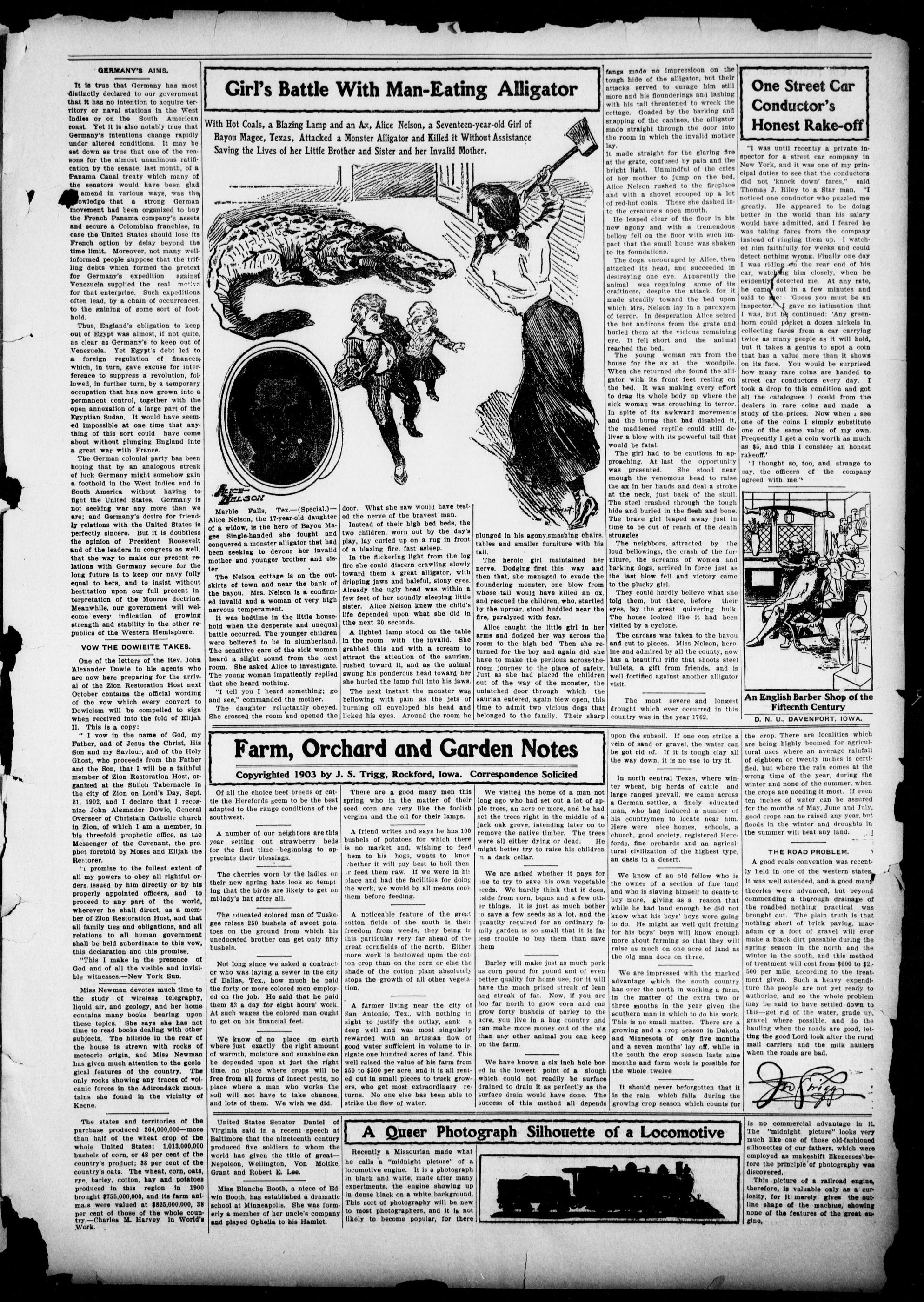
Girl's Battle With Man-Eating Alligator
With Hot Coals, a Blazing Lamp and an Ax, Alice Nelson, a Seventeen-year-old Girl of Bayou Magee, Texas, Attacked a Monster Alligator and Killed it Without Assistance Saving the Lives of her Little Brother and Sister and her Invalid Mother.
BICE-
DELSON
Farm, Orchard and Garden Notes
Copyrighted 1903 by J. S. Trigg, Rockford, Iowa. Correspondence Solicited
Marble Falls, Tex.—(Special.)—Alice Nelson, the 17-year-old daughter of a widow, is the hero of Bayou Magee Single-handed she fought and conquered a monster alligator that had been seeking to devour her invalid mother and younger brother and sister.
The Nelson cottage is on the outskirts of town and near the bank of the bayou. Mrs. Nelson is a confirmed invalid and a woman of very high nervous temperament.
It was bedtime in the little household when the desperate and unequal battle occurred. The younger children were believed to be in slumberland. The sensitive ears of the sick woman heard a slight sound from the next room. She asked Alice to investigate. The young woman impatiently replied that she heard nothing.
"I tell you I heard something; go and see," commanded the mother.
The daughter reluctantly obeyed. She crossed the room and opened the Farm, Orc
Copyrighted 1903 by J
Of all the choice beef breeds of cattle the Herefords seem to be the best adapted to the range conditions of the southwest.
A number of our neighbors are this year setting out strawberry beds for the first time—beginning to appreciate their blessings.
The cherries worn by the ladies on their new spring hats look so tempting that the birds are likely to get on mi-lady's hat after all.
The educated colored man of Tuskegee raises 250 bushels of sweet potatoes on the ground from which his uneducated brother can get only fifty bushels.
Not long since we asked a contractor or who was laying a sewer in the city of Dallas, Tex., how much he paid the forty or more colored men employed on the job. He said that he paid them $2 a day for eight hours' work. At such wages the colored man ought to get on his financial feet.
We know of no place on earth where just exactly the right amount of warmth, moisture and sunshine can be depended upon at just the right time, no place where crops will be free from all forms of insect pests, no place where a man who works the soil will not have to take chances, and lots of them. We wish we did.
United States Senator Daniel of Virginia said in a recent speech at Baltimore that the nineteenth century produced five soldiers to whom the world has given the title of great—Nepoleon, Wellington, Von Moltke, Grant and Robert E. Lee.
Miss Blanche Booth, a niece of Edwin Booth, has established a dramatic school at Minneapolis. She was formerly a member of her uncle's company and played Ophelia to his Hamlet.
A Queer Photograph Silhouette of a Locomotive
door. What she saw would have tested the nerve of the bravest man.
Instead of their high bed beds, the two children, worn out by the day's play, lay curled up on a rug in front of a blazing fire, fast asleep.
In the flickering light from the log fire she could discern crawling slowly toward them a great alligator, with dripping jaws and baleful, stony eyes. Already the ugly head was within a few feet of her soundly sleeping little sister. Alice Nelson knew the child's life depended upon what she did in the next 30 seconds.
A lighted lamp stood on the table in the room with the invalid. She grabbed this and with a scream to attract the attention of the saurian, rushed toward it, and as the animal swung his ponderous head toward her she hurled the lamp full into his jaws.
The next instant the monster was bellowing with pain as the jets of burning oil enveloped his head and licked his eyes. Around the room he
N. S. Trigg, Rockford, Iowa.
There are a good many men this spring who in the matter of their seed corn are very like the foolish vergins and the oil for their lamps.
A friend writes and says he has 100 bushels of potatoes for which there is no market and, wishing to feed them to his hogs, wants to know whether it will pay best to boil them or feed them raw. If we were in his place and had the facilities for doing the work, we would by all means cook them before feeding.
A noticeable feature of the great cotton fields of the south is their freedom from weeds, they being in this particular very far ahead of the great cornfields of the north. Either more work is bestowed upon the cotton crop than on the corn or else the shade of the cotton plant absolutely stops the growth of all other vegetation.
A farmer living near the city of San Antonio, Tex., with nothing in sight to justify the outlay, sank a deep well and was most singularly rewarded with an artesian flow of good water sufficient in volume to irrigate one hundred acres of land. This well raised the value of his farm from $50 to $500 per acre, and it is all rented out in small pieces to truck growers, who get most extraordinary returns. No one else has been able to strike the flow of water.
A Queer Photo
Recently a Missourian made what he calls a "midnight picture" of a locomotive engine. It is a photograph in black and white, made after many experiments, the engine showing up in dense black on a white background. This sort of photography will be new to most photographers, and it is not likely to become popular, for there
T
plunged in his agony,smashing chairs, tables and smaller furniture with his tail.
The heroic girl maintained her nerve. Dodging first this way and then that, she managed to evade the floundering monster, one blow from whose tail would have killed an ox, and rescued the children, who, startled by the uproar, stood huddled near the fire, paralyzed with fear.
Alice caught the little girl in her arms and dodged her way across the room to the high bed. Then she returned for the boy and again did she have to make the perilous across-the-room journey to the place of safety. Just as she had placed the children out of the way of the monster, the unlatched door through which the saurian entered, again blew open, this time to admit two vicious dogs that belonged to the family. Their sharp
arden Notes
Correspondence Solicited
We visited the home of a man not long ago who had set out a lot of apple trees, an acre or more, and he had set the trees right in the middle of a jack oak grove, intending later on to remove the native timber. The trees were all either dying or dead. He might better try to raise his children in a dark cellar.
We are asked whether it pays for one to try to save his own vegetable seeds. We hardly think that it does, aside from corn, beans and a few other things. It is just as much bother to save a few seeds as a lot, and the quantity required for an ordinary family garden is so small that it is far less trouble to buy them than save them.
Barley will make just as much pork as corn pound for pound and of even better quality for home use, for it will have the much prized streak of lean and streak of fat. Now, if you are too far north to grow corn and can grow forty bushels of barley to the acre, you live in a hog country and can make more money out of the big than any other animal you can keep on the farm.
We have known a six inch hole bored in the lowest point of a slough which could not readily be surface drained to drain it as perfectly as the surface drain would have done. The success of this method all depends
graph Silhouette
fangs made no impressoon on the tough hide of the alligator, but their attacks served to enrage him still more and his flounderings and lashing with his tail threatened to wreck the cottage. Goaded by the barking and snapping of the canines, the alligator made straight through the door into the room in which the invalid mother lay.
It made straight for the glaring fire at the grate, confused by pain and the bright light. Unmindful of the cries of her mother to jump on the bed, Alice Nelson rushed to the fireplace and with a shovel scooped up a lot of red-hot coals. These she dashed into the creature's open mouth.
He leaped clear of the floor in his new agony and with a tremendous bellow fell on the floor with such impact that the small house was shaken to its foundations.
The dogs, encouraged by Alice, then attacked its head, and succeeded in destroying one eye. Apparently the animal was regaining some of its craftiness, despite the attack, for it made steadily toward the bed upon which Mrs. Nelson lay in a paroxysm of terror. In desperation Alice seized the hot and irons from the grate and hurled them at the vicious remaining eye. It fell short and the animal reached the bed.
The young woman ran from the house for the ax at the woodpile. When she returned she found the alligator with its front feet resting on the bed. It was making every effort to drag its whole body up where the sick woman was crouching in terror. In spite of its awkward movements and the burns that had disabled it, the maddened reptile could still deliver a blow with its powerful tail that would be fatal.
The girl had to be cautious in approaching. At last the opportunity was presented. She stood near enough the venomous head to raise the ax in her hands and deal a stroke at the neck, just back of the skull. The steel crashed through the tough hide and buried in the flesh and bone. The brave girl leaped away just in time to be out of reach of the death struggles. The neighbors, attracted by the loud bellowings, the crash of the furniture, the screams of women and barking dogs, arrived in force just as the last blow fell and victory came to the plucky girl. They could hardly believe what she told them, but there, before their eyes, lay the great quivering hulk. The house looked like it had been visited by a cyclone.
The carcass was taken to the bayou and cut to pieces. Miss Nelson, heroine and admired by all the county, now has a beautiful rifle that shoots steel bullets, a gift from friends, and is well fortified against another alligator visit.
The most severe and longest drought which ever occurred in this country was in the year 1762.
upon the subsoll. If one con strike a vein of sand or gravel, the water can be got rid of. If it is tough clay all the way down, it is no use to try it.
In north central Texas, where winter wheat, big herds of cattle and large ranges prevail, we came across a German settler, a finely educated man, who had induced a number of his countrymen to locate near him. Here were nice homes, schools, a church, good society, registered Herefords, fine orchards and an agricultural civilization of the highest type, an oasis in a desert.
We know of an old fellow who is the owner of a section of fine land and who is slaving himself to death to buy more, giving as a reason that while he had land enough he did not know what his boys' boys were going to do. He might as well quit fretting for his boys' boys will know enough more about farming so that they will raise as much on one acre of land as the old man does on three.
We are impressed with the marked advantage which the south country has over the north in working a farm, in the matter of the extra two or three months in the year given the southern man in which to do his work. This is no small matter. There are a growing and a crop season in Dakota and Minnesota of only five months and a seven months' lay off, while in the south the crop season lasts nine months and farm work is possible for the whole twelve
It should never beforgotten that it is the rain which falls during the growing crop season which counts for
One Street Car Conductor's Honest Rake-off
"I was until recently a private inspector for a street car company in New York, and it was one of my principal duties to see that the conductors did not 'knock down' fares," said Thomas R. Riley to a Star man. "I noticed one conductor who puzzled me greatly. He appeared to be doing better in the world than his salary would have admitted, and I feared he was taking fares from the company instead of ringing them up. I watched him faithfully for weeks and could detect nothing wrong. Finally one day I was riding on the rear end of his car, watching him closely, when he evidently detected me. At any rate, he came out in a few minutes and said to me: 'Guess you must be an inspector.' I gave no intimation that I was, but he continued: 'Any greenhorn could pocket a dozen nickels in collecting fares from a car carrying twice as many people as it will hold, but it takes a genius to spot a coin that has a value more than it shows on its face. You would be surprised how many rare coins are handed to street car conductors every day. I took a drop to this condition and got all the catalogues I could from the dealers in rare coins and made a study of the prices. Now when I see one of the coins I simply substitute one of the same value of my own. Frequently I get a coin worth as much as $5, and this I consider an honest rakeoff.'
"I thought so, too, and, strange to say, the officers of the company agreed with me."
BARBER
D. N. U., DAVENPORT, IOWA.
the crop. There are localities which are being highly boomed for agricultural uses where an average rainfall of eighteen or twenty inches is certified, but where the rain comes at the wrong time of the year, during the winter and none of the summer, when the crops are needing it most. If even ten inches of water can be assured for the months of May, June and July, good crops can be raised any year, but floods in the winter and droughts in the summer will beat any land.
THE ROAD PROBLEM.
A good roals convention was recently held in one of the western states. It was well attended, and a good many theories were advanced, but beyond commending a thorough drainage of the roadbed nothing practical was brought out. The plain truth is that nothing short of brick paving, macadam or a foot of gravel will ever make a black dirt passable during the spring season in the north and the winter in the south, and this method of treatment will cost from $600 to $2,500 per mile, according to the treatment given. Such a heavy expenditure the people are not yet ready to authorize, and so the whole problem may be said to have settled down to this—get rid of the water, grade up, gravel where possible, and do the hauling when the roads are good, letting the good Lord look after the rural mail carriers and the milk haulers when the roads are bad.
is no commercial advantage in it. The "midnight picture" looks very much like one of those old-fashioned silhouettes of our fathers, which were employed as makeshift likenesses before the principle of photography was discovered. This picture of a railroad engine, therefore, is valuable only as a curiosity, for it merely gives the outline shape of the machine, showing none of the features of the great engine.
Delile
ree Neer
vm
Che Professional World
RUFUS L, LOGAN, B,8,D. - EDITOR
Advertising Rates on Application.
Job Work of all Kinds Solicited,
Published Every Friday,
Entered at the postoffice at Colum-
umbia, Mo., as second class matter,
Jan, 16, 1902,
Agents wanted in every town in the
state.
Payments may be made in two cent stamps
by postal note, money order, by registered
letter or express order.”
Correspondence containing mews of interest
anajimportance ts desired from all parts of the
United States. :
Communications should be made to reach us
not later than Thursday morning, to insure in-
section inthe current Issue,
‘Nofattention will be paid to anonymous com-
munications.
‘Agents wanted everywhere. Write for terms,
Specimen copies sent to any address upon
request.
PRESS OF THE MISSOURI STATESMAN.
Many people have an idea that
diplomacy and deceit are the same
thing,
Warc for the names of the
ladies who will enter the voting
contest next week.
Our thanks are due the follow-
ing named persons for recent
subscriptions: Miss Dehlia Hender-
son of Huntsville, Miss Dora Mary
F. Woods, of Moberly, Mrs. Dora
Morrison, and Mrs. Birdie Elliott,
of Columbia.
Tur Professional World is the
only negro paper in this section of
the country that is published for
$1.00 per year, and it has never
missed an issue and contains as
much news as any of the papers
published for $2.00 per year. Make
‘a comparison and be convinced.
Tue ‘Conservator’ a weekly
paper published at Sedalia, made
its bow to the world last Friday,
and has reached our desk, It is a
five column folio and W, H.
Huston is its editor and C. M,
Rnglish manager. This makes
two colored papers for Sedalia,
Here's our hand, Bro, Huston
‘Tae Jefierson city notes in last
week’s issue of the Omaha Enter-
prise contains mention of a ball
game between students of Lincoln
Institute and a St. Lonis team
played on Sunday, The enter-
prise correspondent should be
more careful about giving detes.
Sunday ball games would not be a
very good advertisement for Lin-
ania Tontitiha:
Some students from the state
University learned a lesson that
they will not forget soon, when
they tried to take charge of the
Pan-American circus and came
back with bruised heads and
spoiled faces. When companies or
individuals pay license to exhibit
in a town they should be permitted
to do sounmolested. This thing of
exhibiting ‘The college spirit” on
all occasions will not always work.
Tue industrial department at
Lineoln isa humbug. During its
ten years or more of existence it
has never turned out a mechanic.
Students are seated on the stage
every year and have their names
on the list of graduates and are
given a supposed diploma, Some
of whom have been in the school
less than a year are paraded before
the public as “graduates from the
Industrial school."’ Yet the in-
dividual at the head of that
school draws $1200 per year and
never attended an _ industrial
school. It is to be hoped that the
regents of that school will see to it
thatthis part of Lincoln Institute
is put into the hands of competent
instructors.
Notice.
‘The annual sermon to the mem-
bers of Acme Lodge No, 24 K. of
P. will be preached Sunday after.
meen, Oy Rev. A, A. Adams,
everybody cordially invited to
attend.
(Sargt) W. H. Turner, ©, C,
The Pan-American Circus.
The Pan American circus ex.
hibited here last Monday, giving
two performances, at 2 and 7:3(
p.m. Thonsands of people were
on the streets at an early hour in
the morning and waited anxiously
til 11:30 to see the street parade
and despite the down pour of rain
a large throng witnessed both per:
formances. This cireus as a whole
was a very up-to-date one and was
minus the many objectionable
features which are usually circus
characteristics.
NEVER FORGET THIS BELL.
Near Roanoke, [llinois, there is
a school teacher whose ingenuity
might not please all his pupils—
that is, the indolent ones. E. N.
Wheelright teaches a district school
the teacher has to ring the bell
and build the fire and sweep the
floor unless he pays some ambitious
boy to do it for him. But this
teacher does not have to hire a boy
to ring the bell, nor does he ring
it himself. No matter what he
may be doing at 9 o’clock in the
morning, the bell sets up a clatter
that no boy or girl can escape. Mr.
Wheelwright has arranged a clock
which at the proper hour sets in
motion an electric apparatus that
sets the bell to ringing. The boys
of that district have no longe any
hope that the teacher will he so
busy that he will forget to call
school.
$100 Reward, $00.
The readers of this paper will be
pleased to learn that there is at
least one dreaded disease that
science has been able to cure in all
its stages and that is Catarrh.
Hall’s Catarrh Cure is the only
positive cure now known to the
medical fraternity. Catarrh being
constitutional disease, requires all
constitutional treatment. Hall’s
Catarrh Cure is taken internally,
acting directly upon the blood and
mucous surfaces of the system,
thereby destroying the foundation
of the disease, and giving the
patient strength by building in
the constitution and assistant
nature in doing its work. The
proprietors have so much faith in
its curative powers, that they offer
one Hundred Dollars for any case
that it fails to cure. Send for list
of testimonials,
Address, F. J. Crenney & Co.,
Toledo, 0.
Sold'by Druggist, 750.
Hall’s Family Pills are the best.
A GREAT GIFT.
eee ae eee Se pee
“When Treasurer Logan stepped
to the platform at the Chapel on
Thursday evening of last week and
announced that Mr, Andrew
Carnegie has presented Tuskegee
Institute with the magnificent sum
of $600,000 toward the Endow-
ment Fund, a scene was enacted
‘that will live in the history of the
school. The great hall echoed
with the cheers of the happy stu-
dents, The ‘Tuskegee-rah-rah’
was given over and over with a
will, mingled with miscellaneous
college cries and yells, culminating
in the chorus of ‘C-a-r-n-e-g-i-e’
and a whirlwind of enthusiasm.
‘The officers and teachers were no
less delighted than the students,
even if less demonstrative. Led
by the chaplain, the entire as-
semblage joined heartily in that
appropriate hymn, ‘Praise God
from Whom All Blessings Flow.’
It was a great night for Tuskegee
Institute. It wasa great night for
the race.”
WOMEN AS BLACKSMITHS.
One of the newest trades for
women is blacksmithing, and
Miss Esther Searle of Cawker cigy,
Kan., is the pioneer. She adopted
it in the way in which unusal oceu-
pations generally are taken up—by
chance. Her father is a blacksmith,
and has been assisted at the forge
by his son, and last summer, when
the young man was away on his
vacation Miss Searle thought that
the work was too much for her
father alone, so she went into the
forge and soon learned to wield the
heavy hammer with ease and skill.
When her brother returned Miss
Searle found herself so interested
in her novel work that she con
tinued to goto the smithy every
day for an hour or s0 .She found
that her biceps were so developed
that she could swing the heaviest
hammer easily, and that her chest
measurment had increased several
inches in the short period.
A blacksmith’s shop, with
several assistants, fell to the lot of
Celia Holbrook, of Sherborn,
Mass, when she was but
seventeen. At her father’s death she
undertook to run this and has done
so for two years, supporting her
mother and a large family. besides
this smithy she has another _busi-
ness, being a mail carrier, Twice
a day she takes the United States
mail four miles in thet sumuer,
peforming this service on her
wheel ; in winter she goes on foot.
THIS MAN KNOWS WHISKY,
(From the K. C. World.)
Se ne at ae aay OEtD ie tee eee ea 2 oe
was to save my life. I have seen
too much of its work, I have seen
the misery it has made for my
mother. I have seen, too, the
brute it made of my stepfather
when he was under its influence.
If it were not for whiskey, our
trouble would never have happened
and I would not be in jail. I
never touched the stuff, and I’ve
made a vow that I never will.’”
These are not the words of an
impassioned temperance theorist.
They are the calm, deliberate
utterance of a young man who
killed his drunken stepfather in
defense of his mother and was in-
carcerated in a Cleveland police
station, A police lieutenant had
pressed a glass of whiskey upon
him, urging him that his weakened
condition demanded it. But he
knew whiskey and he had no use
for it.
Here is what might well be ac-
cepted as an expert opinion upon
the effects of whiskey.
This -young man had had ex-
periences that have shown him
what whiskey will do. He does
not need to theorize. He speaks
with positive information.
But for whiskey he would not
have been in jail.
Decidedly true. And — equally
true it is that but for whiskey few
other people ever would be in jail.
It is not putting it too strongly to
say that whiskey causes nine-tenths
of the crimes that get people in
jail.
This young man has seen the
misery whiskey has made for his
mother, |
And who cannot call up from
one’s own recollection} dozens of
mothers whom whiskey has made
miserable?
Scarcely a community or social
circle but has several—often good,
patient uncomplaining heroines
‘who have given up hope, and
whose desolated hearts are left to
feed on the agony of despair.
They bear the deprivations, the
‘neglect, the abuse, the blows, and
utter no moan but in their hearts,
where there is moaning always.
The earth has been salted with
tears shed by mankind in sympathy
with the brave women who send
their husbands and sons to battle,
sitting alone at home with their
tears and fears, but such women are
happy, proud, exalted, compared
with the drunkard’s wives, crouch -
ing with tears and fears and shame,
while their husbands give their
lives up to the devil, Drink,
The bright, sweet hopes of their
bridal days have become a mock-
ery. The vows upon which they
staked their life happiness have
proved as light as air, The love
that once bade fair to be a shelter
in every storm has been beaten
down and torn to ruin by} whirl-
winds of bestial passions.
There are millions of women
like this.
“LT have seen, too,” says this
young man, “the brute whiskey
has made of my stepfather when he
was under its influence.’”
Yes, there is the truth, S[t makes
amana brute. He may be good
and kind and tender, when he is
sober, but whisky makes him a
brute. He may be provident and
thrifty when he is himself, but,
filled with whisky, he becomes an
entirely different class of being.
Sober. he may not be able to rea-
lize that he can be a brute when
drunk, He may be the last one to
know the misery that his drunken-
ness causes in his home. He can-
not view himself in correct perspec-
tive.
But this young man who was
sent to jail because of whisky
speaks the simple truth, He has
seen how whisky turned a good
man into a brute, a happy wife in-
to a miserable drudge, and a devot-
ed son into an unwilling murderer.
And whisky is no respecter of
persons. What it does in one fami-
ly it will do in another. What it
has made of one man it has made of
millions. The woe of this one
woman is a woe that ever goes cry-
ing and moaning throughout the
earth.
Doesn't Respect Old Age.
It’s shameful when youth fatls to
show proper respect for old age, but
just the contrary in the ease of Dr
King’s New life Pills. They cut off
maladies no matter how severe and
irrespective of old age. Dyspepsia,
Jaundice, Fever, Constipation all
yield to. this perfect Pill... 25e at
Gilanm & Doseye's Drug Store.
Lodge and Church Directory.
LODGE.
8. M. T.
Mrs. Ada Douglass, W. P.;
Mrs. Lizzie Williams, W. S.
Meeting first Monday in
each month at 3 p. m.
UB
Crispus Attucks Lodge, No.
62. Meetings 2nd and 4th
Tuesdays in each month.
Visiting members cordially
invited. Caleb Hall, W. M.
A. M. Schweich. W. 8S.
K. P.
Acme Lodge, No. 24. Meet:
ings second and __ fourth
Fridays in each month. W.
H. Turner, C. C. and D. D.
a Cc. W. W. Lampkins, M.
ST. PAULLODGE, NO. 12.
St. Paul Lodge, No. 12, A.
F, & A. M., meets every first
and third Tuesday in each
month. A cordial invitation
extended to all visiting
brothers. J. A. Mosely, W.
M. J. A. Grant, Secretary.
SECOND CHRISTIAN CHURCH.
Rey. J. B. Parsons, pastor.
Preaching Sundays 11a. m.
and 7:30 p. mn.
Prayer meeting Wednes-
days 7:30 p. m.
Everybody cordially invit-
ed to attend.
K. OFP.
Harrison Lodge No. 12,
Huntsville, Mo. Meeting the
second and fourth Thursdays
ineach month, M. W. Tony,
C.C., W. T. Ansel, K. R. 8.,
I. A. Robinson, M. E.
A. M. FE, CHURCH,
Rey. P. C. Crews, Pastor.
Preaching Sundays 1) a.
m.; 7:30 p, m.
Sunday school 2:30 p. m.
Prayer meeting every
Wednesday eve, at 8:30; ev-
ery body invited to attend,
M. E, CHURCH
/ Rev. J, Arlington Grant,
pastor.
Preaching Sundays 11, a.
m. and 7:30 p. m.
Sunday school, 9:30 a, m.
Prayer meeting Wednes-
days 7:30 to 8:30; all are made
| welcome. :
BECOND BAPTIST CHURCH.
Rey. A. A. Adams, Pastor.
Preaching Sundays 11 a.
m., and 7:30 p. m.
Sunday school at 2:30 p. m.
Prayer meeting Wednesday
evening, 7:30,
A cordial invitation ex
tended to all.
LADIES COURT.
Golden Queen Court, No.
19, meets first wriday, in each
month. Mrs. M. KE. Ridg-
way, M. A. M., Mrs. Lizzie
Richardson, Secretary.
oO. E. 8.
Amos Chapter, No. 30.
Meetings second Friday in
each month, Mrs. Bessie
Washington, W. M. Mrs. An-
nie Williams, W. 8.
You Will Always
find a fine, fashionable stock of
with us. The only difference between our suits and the
made-to-order suits is imagination, As to fit, we allow you
to be judge and jury- Try us and be convinced. Your
money back on any unsatisfactory article We are bf |
to make a customer of you if low prices will do it. ed
Globe Mercantile |
Company.
250 E. High St. . “ Jefferson City, Mo.
TET ee ee Oe Oe Oe Oe Oe eee canal
aos “em |: Ladies Admire
BOBS Brees || .. Perfect
a fs i fo 4} Fitting garments,
AWN = $ cecococossosccc#co000
TN Mm \ 1 and only first class
j \y 4, \\ : tailors can make
i : them.
ee aL | \ i
> beste =\)) : Suits from $25.00, up.
seeNceenmmeee corres et Trousers from $6.0, up. |
JOHN C. MADDEN, [lerchant Tailor,
OOM ey ees STN SEEPRREON CITY. MO. |
Nae eee eee ee ee ie
= MAYBERRY & CO., 3
E DEALERS IN 2
=° Staple and Fancy Groceries.
E All Kinds of Fresh Lunch Goods. Wood and Coal. Prompt =
E and Careful Attention Given to all Orders. Telephone 580. 3
E Lafayette St. - Jefferson City, Mo. 3
SUG os
Ae oRibai AGENTS WANTED
~— in each towa to take orders for our new High Grado
1 } n Guaranteed Bicycles,
A [\S New 1903 Models
if if * Bellise,”” Complete $8.75
AI FRAY << Gossack,’? cusranwd ie credo $10.75
Hi “4 Siberian,’?. _A Beauty $12.75
f\ NO \e “Neudorf,?? = Road Racer $14.75
M no better biey¢le at any price.
re \ i ‘Any other make or model you want at one-third
\ VFR esa teu! price. Choice of any standard tines and best
PIU BY Wg ZePM cvsiomient on all our bicycles. “Strongest guarantee
aad Ph oa We SHIP ON APPROVAL C. 0. D. to any one
AK) IN without a cent deposit and allow 10 DAYS FREE
7} \ 7 TRIAL, before purchase is binding.
\ WO WANE, 500 Second Hand Wheels
/ ! Sistas Wea, stoner bor Cage ral store to
RATS WReeaB ellos and mada, good weno encone WU
) evens DO NOT BUY Pacsdiy’eives’aio'ehee"thiat Oren.
IF] fires, equipment, sundries and sporting goods of all Kinds, at hat regular price,
Ly baci tretsinaneaicg cians otmorld gf asetl nvorgation. Wri Bie
J. L, MEAD GYGLE GO., Chicago, Ill,
Twentieth Century Negro Literature
warrra a
‘ONE HUNDRED OF AMERICA'S GREATEST NEGROES,
and Edited hv DR. D. W. CULP.
‘This book contains One Hundred Treatises on Thirty-Eight
General Fopies in which chs negro prouien ia viewed from every jos,
$eetanapoine No work enula mote fully reprosent the higher strata of
reroriamnhig Tei Fruit te bane of fore ealclaione on mt
100 PORTRAITS AND 100 BIOGRAPHIES
of the writers, To ae0 the pletares and read the lives of the hundred most
Promiment negroca te to bavea tute knowledge of the entire race. Over
{olarge pages and retails at 3.50 tn cloth, pontpald
| AGENTS. Monten bscnmeeers at auce to lotredace tle
ered Agente magmicent aninple hvok for 356, Co pay malting expenees.
Write for Sur propestiton at ouve, "Thi le the opportunity of your ite.
4.1, NICHOLS & ©O., Naperville, Hlinols,
Twentieth
. ONE HUNDRI
ns % ar
é z \ ‘Tas book conta
; Gonna rt sitet
Hae | Bp isSestiect Bir
Na >} 100 POR
\ uy ry hectare te
SY] FL isin
J | AGENTS.
‘Write for eu prope
DR. D.W.OULP aL, NI
Cnn
The Railroads.
Matataatahata ata ate aa aa tata a aaa ae aa
|
SWADASHD
Time Table—Columbia Branch,
Going sour.
wos sus Arrive Corpmbie ey co cies BiAG wm
Be ee rere ceeebii cceccccias Bm
No: $! Arrive Columbia’, gs bo
Going Now,
No. go, Leave Columbia =~ 940.8. m
No. do) Leave Colueabie..c.cccccisasatsae pm
a. Be Leave Golenbas’ 20 ciiccse calle pe
M.K. & T. Ry.
pe
Arrive |
ab lade | a las
‘ st Kotla] Texas ”
ies
Peat oe |e | he
Beers) te | ie | de
pam] BE | aE | ae
nt
‘McBaine,.....| 11%: 33 6
ioe th oat 7
$990 2a
Bre:
ee
A Boy potent oth J .
pp
Bly teen |
| ENB aa
oi ait conan
ie al t if
Free i ria
bien
Catalogue |fikagiifcrersceos.c)
Century Steel Range, No. 80-A-18
Has six 86-inch lids, oven 17x21x12,
spent reservoir and warming closet,
ined throughout with asbestos, burne
| anything, best bakers and ronsters on
| Barth. Guaranteed 10 years. Weight
| 475 lbs, Only $22 90. Terms $8.00 cash,
balance payable $3.00 a month, no inter-
| est. Shipped immediately on receipt of
| $8.00 cash paymont. We trust honest
Boobs located in all parts of the World.
| discount $1.50 on Range. Freight
evorages $1.25 for each 600 miles, Send
| Sos Sree eacalorue, but cule to the grees
est bargain ever’ offered.” We
Gouthern Illinois National Bank.
| CENTURY + MANUFACTURING + GO,
| Dept, 91O, East St. Louls, i