The Professional World
Friday, May 29, 1903
Columbia, Missouri
Page text (machine-generated)
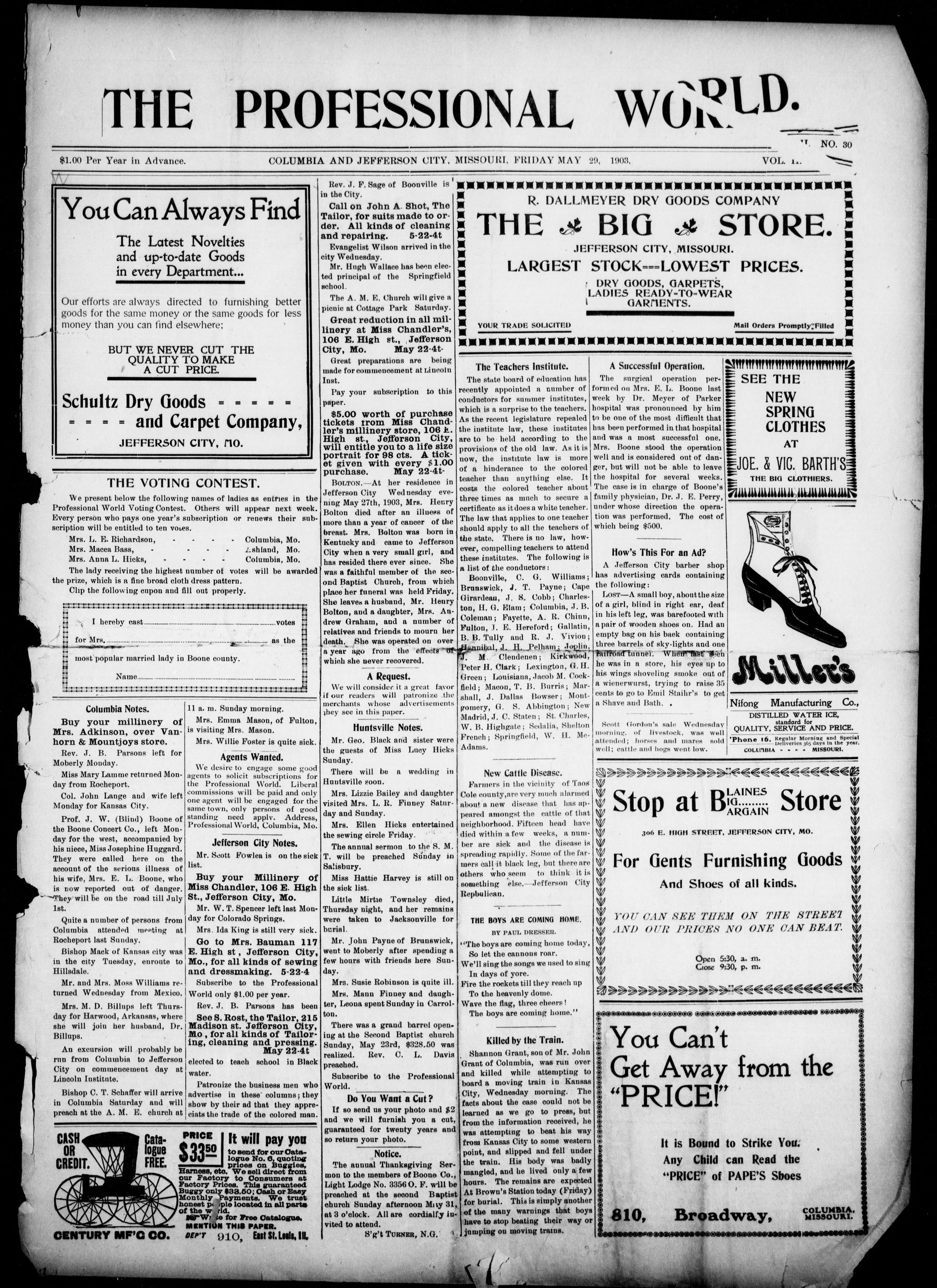
THE PROFESSIONAL WORLD.
$1.00 Per Year in Advance. You Can A
You Can Always Find
The Latest Novelties and up-to-date Goods in every Department...
Our efforts are always directed to furnish goods for the same money or the same go money than you can find elsewhere;
Our efforts are always directed to furnishing better goods for the same money or the same goods for less money than you can find elsewhere;
BUT WE NEVER CUT THE QUALITY TO MAKE A CUT PRICE.
Schultz Dry Goods = = = = =
= = = = and Carpet Company,
JEFFERSON CITY, MO.
THE VOTING CONTEST.
We present below the following Professional World Voting Contest. Every person who pays one year's scription will be entitled to ten votes.
Mrs. L. E. Richardson,
Mrs. Macea Bass,
Mrs. Anna L. Hicks,
The lady receiving the highest the prize, which is a fine broad cloth.
Clip the following cupon and f
I hereby cast
for Mrs.
most popular married lady in
Name
We present below the following names of ladies as entries in the Professional World Voting Contest. Others will appear next week. Every person who pays one year's subscription or renews their subscription will be entitled to ten votes.
Columbia Notes.
Buy your millinery of Mrs. Adkinson, over Vanhorn & Mountjoys store.
Rev. J. B. Parsons left for Moberly Monday.
Miss Mary Lamme returned Monday from Rocheport.
Col. John Lange and wife left Monday for Kansas City.
Prof. J. W. (Blind) Boone of the Boone Concert Co., left Monday for the west, accompanied by his niece, Miss Josephine Huggard. They were called here on the account of the serious illness of his wife, Mrs. E. L. Boone, who is now reported out of danger. They will be on the road till July 1st.
Quite a number of persons from Columbia attended meeting at Rocheport last Sunday.
Bishop Mack of Kansas city was in the city Tuesday, enroute to Hillsdale.
Mr. and Mrs. Moss Williams returned Wednesday from Mexico.
Mrs. M. D. Billups left Thursday for Harwood, Arkansas, where she will join her husband, Dr. Billups.
An excursion will probably be run from Columbia to Jefferson City on commencement day at Lincoln Institute.
Bishop C. T. Schaffer will arrive in Columbia Saturday and will preach at the A. M. E. church at
CASH OR CREDIT. Catalogue FREE.
CENTURY MF'G CO.
ected to furnishing better or the same goods for less sewhere;
oods = = = = =
arpet Company,
CITY, MO.
long names of ladies as entries in the
Others will appear next week.
subscription or renews their sub-
s.
Columbia, Mo.
Ashland, Mo.
Columbia, Mo.
number of votes will be awarded
in dress pattern.
will out properly.
votes
as the
Boone county.
11 a. m. Sunday morning.
Mrs. Emma Mason, of Fulton,
is visiting Mrs. Mason.
Mrs. Willie Foster is quite sick.
Agents Wanted.
We desire to engage some good agents to solicit subscriptions for the Professional World. Liberal commissions will be paid and only one agent will be engaged for the same town, only persons of good standing need apply. Address, Professional World, Columbia, Mo.
Jefferson City Notes.
Mr. Scott Fowlea is on the sick list.
Buy your Millinery of Miss Chandler, 106 E. High St., Jefferson City, Mo.
Mr. W. T. Spencer left last Monday for Colorado Springs.
Mrs. Ida King is still very sick.
Go to Mrs. Bauman 117 E. High st., Jefferson City, Mo., for all kinds of sewing and dressmaking. 5-22-4
Subscribe to the Professional World only $1.00 per year.
Rev. J. B. Parsons has been See S. Rost, the Tailor, 215 Madison st. Jefferson City, Mo., for all kinds of Tailoring, cleaning and pressing. May 22-4t elected to teach school in Black water. Patronize the business men who advertise in these columns; they show by their ad that they appreciates the trade of the colored man.
It will pay you
to send for our Catalogue No. 6, quoting prices on Buggies, harness, etc. We sell direct from our Factory to Consumers at factory Prices. This guaranteed huggy only $33.50; Cash or Easy Monthly Payments. We trust honest people located in all parts of the world. NOTE: Write for Free Catalogue. IMPORTION THIS PAPER. DEP'T 910, East St. Louis, Ill.
Rev. J. F. Sage of Boonville is in the City.
Call on John A. Shot, The Tailor, for suits made to order. All kinds of cleaning and repairing. 5-22-4t
Evangelist Wilson arrived in the city Wednesday.
Mr. Hugh Wallace has been elected principal of the Springfield school.
The A. M. E. Church will give a picnic at Cottage Park Saturday.
Great preparations are being made for commencement at Lincoln Inst.
Pay your subscription to this paper.
$5.00 worth of purchase tickets from Miss Chandler's millinery store, 106 k. High st., Jefferson City, will entitle you to a life size portrait for 98 cts. A ticket given with every $1.00 purchase. May 22-4t-
BOLTON.—At her residence in Jefferson City Wednesday evening May 27th, 1903, Mrs. Henry Bolton died after an illness of more than a year of cancer of the breast. Mrs. Bolton was born in Kentucky and came to Jefferson City when a very small girl, and has resided there ever since. She was a faithful member of the second Baptist Church, from which place her funeral was held Friday. She leaves a husband, Mr. Henry Bolton, and a daughter, Mrs. Andrew Graham, and a number of relatives and friends to mourn her death. She was operated on over a year ago from the effects of which she never recovered.
A Request.
We will consider it a great favor if our readers will patronize the merchants whose advertisements they see in this paper.
Huntsville Notes.
Mr. Geo. Black and sister were the guests of Miss Lucy Hicks Sunday.
There will be a wedding in Huntsville soon.
Mrs. Lizzie Bailey and daughter visited Mrs. L. R. Finney Saturday and Sunday.
Mrs. Ellen Hicks entertained the sewing circle Friday.
The annual sermon to the S. M. T. will be preached Sunday in Salisbury.
Miss Hattie Harvey is still on the sick list.
Little Mirtue Townsley died, Thursday night, and her remains were taken to Jacksonville for burial.
Mr. John Payne of Brunswick, went to Moberly after spending a few hours with friends here Sunday.
Mrs. Susie Robinson is quite ill.
Mrs. Mann Finney and daughter, Leona spent Sunday in Carrolton.
There was a grand barrel opening at the Second Baptist church Sunday, May 23rd, $328.50 was realized. Rev. C. L. Davis preached.
Subscribe to the Professional World.
Do You Want a Cut?
If so send us your photo and $2 and we will furnish you a cut, guaranteed for twenty years and so return your photo.
Notice.
The annual Thanksgiving Sermon to the members of Boone Co.,
Light Lodge No. 3356 O. F. will be preached at the second Baptist
church Sunday afternoon May 31,
at 3 o'clock. All are cordially invited to attend.
S'g't TURNER. N.G.
YOUR TRADE SOLICITED
The Teachers Institute.
The state board of education has recently appointed a number of conductors for summer institutes, which is a surprise to the teachers. As the recent legislature repealed the institute law, these institutes are to be held according to the provisions of the old law. As it is now, the institute law is more of a hindrance to the colored teacher than anything else. It costs the colored teacher about three times as much to secure a certificate as it does a white teacher. The law that applies to one teacher should apply to all the teachers of the state. There is no law, however, compelling teachers to attend these institutes. The following is a list of the conductors:
Boonville, C. G. Williams; Brunswick, J. T. Payne; Cape Girardean, J. S. Cobb; Charleston, H. G. Elam; Columbia, J. B. Coleman; Fayette, A. R. Chinn, Fulton, J. E. Hereford; Gallatin, B. B. Tully and R. J. Vivion; Hannibal, J. H. Pelham; Jooplin, J. M. Clendenen; Kirkwood, Peter H. Clark; Lexington, G. H. Green; Louisiana, Jacob M. Cockfield; Macon, T. B. Burris; Marshall, J. Dallas Bowser; Montgomery, G. S. Abbington; New Madrid, J. C. Staten; St. Charles, W. B. Highgate; Sedalia, Shelton French; Springfield, W. H. MeAdams.
New Cattle Disease.
Farmers in the vicinity of Taos Cole county, are very much alarmed about a new disease that has appeared amongst the cattle of that neighborhood. Fifteen head have died within a few weeks, a number are sick and the disease is spreading rapidly. Some of the farmers call it black leg, but there are others who seem to think it is something else.-Jefferson City Republican.
THE BOYS ARE COMING HOME.
BY PAUL DRESSER.
"The boys are coming home today,
So let the cannons roar.
We'll sing the songs we used to sing
In days of yore.
Fire the rockets till they reach up
To the heavenly dome.
Killed by the Train.
Shannon Grant, son of Mr. John Grant of Columbia, was run over and killed while attempting to board a moving train in Kansas City, Wednesday morning. The facts about the case could not be learned as we go to press, but from the information received, he was attempting to beat his way from Kansas City to some western point, and slipped and fell under the train. His body was badly mangled, and he lived only a few hours. The remains are expected At Brown's Station today (Friday) for burial. This is simply another of the many warnings that boys have to stop beating their way or jumping on moving trains.
DRY GOODS, GARPETS, LADIES READY-TO-WEAR GARMENTS.
A Successful Operation.
The surgical operation performed on Mrs. E. L. Boone last week by Dr. Meyer of Parker hospital was pronounced by him to be one of the most difficult that has been performed in that hospital and was a most successful one. Mrs. Boone stood the operation well and is considered out of danger, but will not be able to leave the hospital for several weeks. The case is in charge of Boone's family physician, Dr. J. E. Perry, under whose direction the operation was performed. The cost of which being $500.
How's This For an Ad?
A Jefferson City barber shop has advertising cards containing the following:
Lost—A small boy, about the size of a girl, blind in right ear, deaf in his left leg, was barefooted with a pair of wooden shoes on. Had an empty bag on his back containing three barrels of sky-lights and one railroad tunnel. When last seen he was in a store, his eyes up to his wings shoveling smoke out of a wienerwurst, trying to raise 35 cents to go to Emil Staihr's to get a Shave and Bath.
Scott Gordon's sale Wednesday morning. of livestock, was well attended; horses and mares sold well; cattle and hogs went low.
Stop at B
306 E. HIGH STREET, J
For Gents Furn
And Shoes o
YOU CAN SEE THEM
AND OUR PRICES N
Open 5:30
Close 9:30
You Can't
Get Away
"PRICE!"
Stop at BLAINES
BIG.....
ARGAIN
306 E. HIGH STREET, JEFFERSON CITY, MO.
For Gents Furnishing Goods
And Shoes of all kinds.
YOU CAN SEE THEM ON THE STREET
AND OUR PRICES NO ONE CAN BEAT.
Open 5:30, a. m.
Close 9:30, p. m.
You Can't Get Away from the "PRICE!"
It is Bound to Strike You. Any Child can Read the "PRICE" of PAPE'S Shoes
810, Broadway,
Mail Orders Promptly Filled
SEE THE
NEW
SPRING
CLOTHES
AT
JOE. & VIC. BARTH'S
THE BIG CLOTHIERS.
Miller's
DISTILLED WATER ICE,
standard for
QUALITY, SERVICE AND PRICE.
'Phone 16. Regular Morning and Special Deliveries 365 days in the year.
COLUMBIA - - - - MISSOURI.
LAINES
JIG.....
MARGAIN
Store
JEFFERSON CITY, MO.
nishing Goods
of all kinds.
M ON THE STREET
NO ONE CAN BEAT.
30, a. m.
30, p. m.
from the
lway, COLUMBIA, MISSOURI.
RUFUS L. LOGAN, Editor
Columbia - - - - Missouri
IMPORTED FOOD PRODUCTS.
The Agricultural Department is After Adulterated Wines From Mayence Washington, D. C., special—Acting Secretary of Agriculture Moore has requested the secretary of state to ascertain from the United States consul at Mayence the facts regarding the trial of Dr. Schlamp von Hoppe, who is charged with the adulteration of Niersteiner wines. It was alleged in this case that the wines were largely adulterated and imitated. If this were so, under the act of March 3, 1903, they would be excluded from United States ports. This act authorizes the secretary of agriculture to examine imported food products and to refuse admission to any found to violate its provisions.
This government will refuse to admit into this country articles that are placed under the ban in the country or countries in which they are made or exported. The laws governing this subject differ widely among the different countries and it is stated that there is scarcely any food product whose sale is not restricted in one form or another in some country. The law which is about to go into operation authorizes the secretary of agriculture to investigate the character of the chemical and physical tests which are applied to American food products in foreign countries, to inspect before shipment American food products intended for countries where chemical physical tests are required preliminary to sale there.
PATRICK HENRY'S BODY.
A Movement Started to Move the Remains of the Great Orator.
Richmond, Va., May 27.—A strong movement has been begun in Richmond for the removal of the body of Patrick Henry from its present humble and neglected grave in Charlotte county to Johnson churchyard here and the erection of a marble monument to the great Virginia orator and revolutionist.
Those who have broached the subject to business men and others have found the heartiest commendation and indorsement. The idea is to have Henry's body buried, if possible, beneath St. John's church at the spot where he stood while delivering his famous speech which culminated in the ringing sentence:
"Give me liberty or give me death."
The suggested monument will be of white marble and under a covering like that of Clay in Capitol square. A meeting will be called next week and a preliminary organization formed.
GOMPERS GIVES HIS VIEWS.
He Says an Organization of Employers Will Lead to Industrial Peace. (Washington special.) — President Samuel Gompers of the American Federation of Labor is an advocate of the organization of employers.
"Employers will find it to their advantage to be organized," said Mr. Gompers, "and not only this, but to deal with organized labor. The movement to form unions among the business men will tend rather to prevent conflict than to promote trouble. Organized employers will be better able to understand the demand of organized labor and to meet these demands without friction.
"There has been much hot talk about the increasing demands of labor. My experience has taught me not to be an alarmist."
BANISHED PRIESTS ARRIVE.
Members of Holy Cross, Driven from France, Reach Notre Dame.
Notre Dame, Ind., May 27—Eleven members of the order of the Holy Cross who were recently banished from France arrived at the university yesterday. They come here under the direction of the provincial in this country, Rev. Dr. John A. Zahm, and will be assigned to teaching French and other studies at the university. More are to follow soon, and some who are teaching at present in France will be allowed to remain until *the close of the scholastic year on July 31. These in all probability, will be scattered among the different branch schools of Notre Dame throughout the country.
FIRE CAUSES FIVE EXPLOSIONS.
New York, May 27—Fire started today in one of the seven gas houses at 155th street and Sheridan avenue, and there were five explosions. The fire communicated with a carpenter shop and several Pullman cars. The police headquarters have been officially notified that one body had been taken out of the fire. Several persons are injured. While the fire is not entirely under control, the firemen have it well in hand.
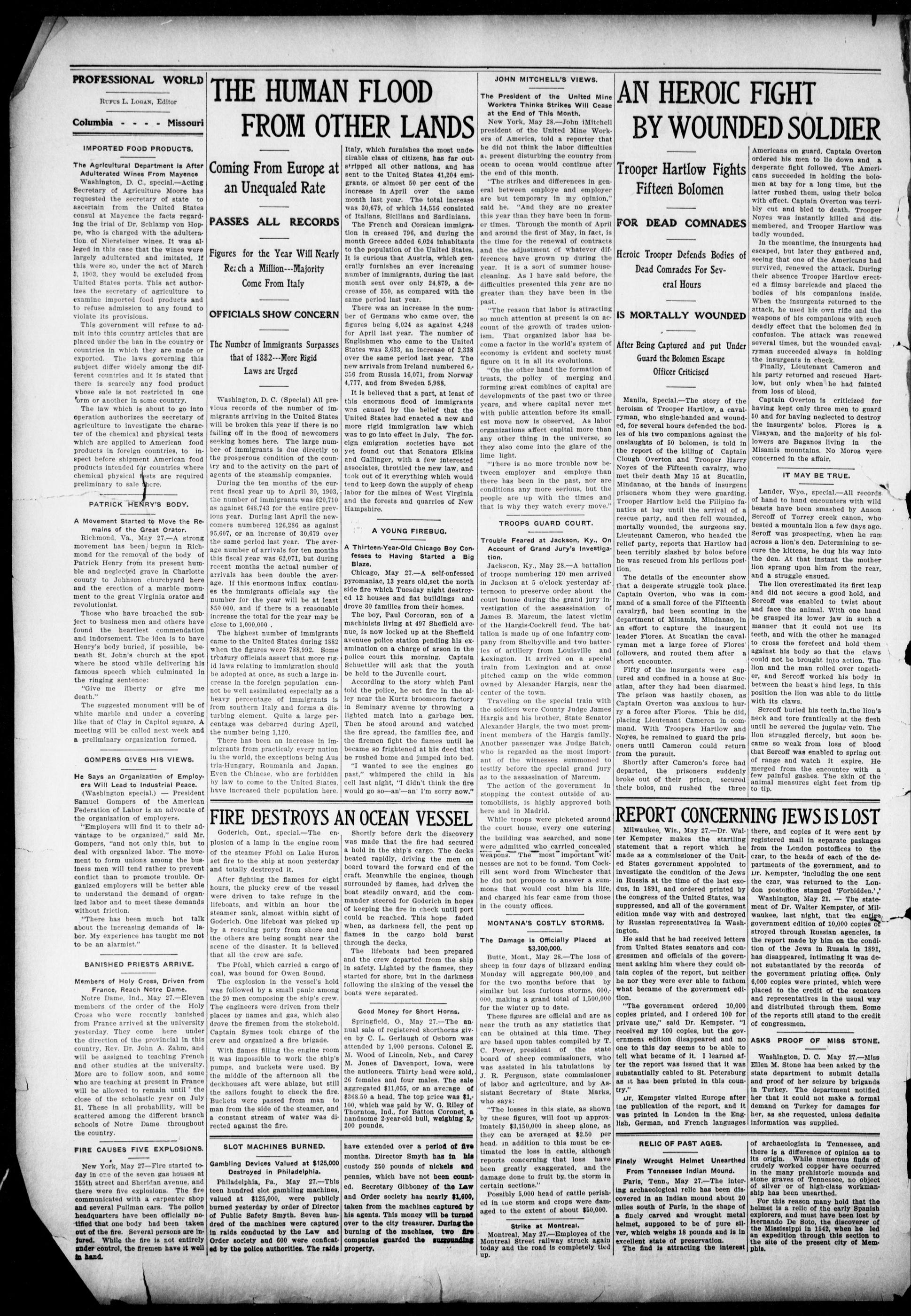
THE HUMAN FLOOD FROM OTHER LANDS
FIRE DESTROYS AN OCEAN VESSEL
FIRE DESTROYS AN OCEAN VESSEL
Coming From Europe at an Unequaled Rate
PASSES ALL RECORDS
Figures for the Year Will Nearly Reach a Million---Majority Come From Italy
OFFICIALS SHOW CONCERN
The Number of Immigrants Surpasses that of 1882----More Rigid Laws are Urged
Washington, D. C. (Special) All previous records of the number of immigrants arriving in the United States will be broken this year if there is no failing off in the flood of newcomers seeking homes here. The large number of immigrants is due directly to the prosperous condition of the country and to the activity on the part of agents of the steamship companies.
During the ten months of the current fiscal year up to April 30, 1903, the number of immigrants was 620,710 as against 648,743 for the entire previous year. During last April the newcomers numbered 126,286 as against 95,607, or an increase of 30,679 over the same period last year. The average number of arrivals for ten months this fiscal year was 62,071, but during recent months the actual number of arrivals has been double the average. If this enormous influx continues the immigrants officials say the number for the year will be at least 850,000, and if there is a reasonable increase the for the year may be close to 1,000,000.
The highest number of immigrants came to the United States during 1882 when the figures were 788,992. Some treasury officials assert that more rigid laws relating to immigration should be adopted at once, as such a large increase in the foreign population cannot be well assimilated especially as a heavy percentage of immigrants is from southern Italy and forms a disturbing element. Quite a large percentage was debarred during April, the number being 1,120. There has been an increase in immigrants from practically every nation in the world, the exceptions being Austria-Hungary, Roumania and Japan. Even the Chinese, who are forbidden by law to come to the United States, have increased their population here.
Goderich, Ont., special.—The enplosion of a lamp in the engine room of the steamer Pfohl on Lake Huron set fire to the ship at noon yesterday and totally destroyed it.
After fighting the flames for eight hours, the plucky crew of the vessel were driven to take refuge in the lifeboats, and within an hour the steamer sank, almost within sight of Goderich. One lifeboat was picked up by a rescuing party from shore and the others are being sought near the scene of the disaster. It is believed that all the crew are safe.
The Pfohl, which carried a cargo of coal, was bound for Owen Sound.
The explosion in the vessel's hold was followed by a small panic among the 20 men composing the ship's crew. The engineers were driven from their places by names and gas, which also drove the firemen from the stokehold. Captain Symes took charge of the crew and organized a fire brigade. With flames filling the engine room it was impossible to work the ship's pumps, and buckets were used. By the middle of the afternoon all the deckhouses aft were ablaze, but still the sailors fought to check the fire. Buckets were passed from man to man from the side of the steamer, and a constant stream of water was directed against the fire.
SLOT MACHINES BURNED.
Gambling Devices Valued at $125,000
Destroyed in Philadelphia.
Philadelphia, Pa., May 27.—This
teen hundred slot gambling machines,
valued at $125,000, were publicly
burned yesterday by order of Director
of Public Safety Smyth. Seven hundred
of the machines were captured in raids conducted by the Law and
Order society and 600 were conficated
by the police authorities. The raids
Italy, which furnishes the most undesirable class of citizens, has far outstripped all other nations, and has sent to the United States 41,204 emigrants, or almost 50 per cent of the increase in April over the same month last year. The total increase was 30,679, of which 14,556 consisted of Italians, Sicilians and Sardinians. The French and Corsican immigration in creased 796, and during the month Greece added 6,024 inhabitants to the population of the United States. It is curious that Austria, which generally furnishes an ever increasing number of immigrants, during the last month sent over only 24,879, a decrease of 350, as compared with the same period last year.
There was an increase in the number of Germans who came over, the figures being 6,024 as against 4,248 for April last year. The number of Englishmen who came to the United States was 3,633, an increase of 2,338 over the same period last year. The new arrivals from Ireland numbered 6,356 from Russia 16,071, from Norway 4,777, and from Sweden 5,988.
It is believed that a part, at least of this enormous flood of immigrants was caused by the belief that the United States had enacted a new and more rigid immigration law which was to go into effect in July. The foreign emigration societies have not yet found out that Senators Elkins and Gallinger, with a few interested associates, throttled the new law, and took out of it everything which would tend to keep down the supply of cheap labor for the mines of West Virginia and the forests and quarries of New Hampshire.
A YOUNG FIREBUG.
A Thirteen-Year-Old Chicago Boy Confesses to Having Started a Big Blaze.
Chicago, May 27.—A self-confessed pyromaniac, 13 years old, set the north side fire which Tuesday night destroyed 12 houses and flat buildings and drove 30 families from their homes.
The boy, Paul Corcoran, son of a machinist living at 497 Sheffield avenue, is now locked up at the Sheffield avenue police station pending his examination on a charge of arson in the police court this morning. Captain Schuettler will ask that the youth be held to the Juvenile court.
According to the story which Paul told the police, he set fire in the alley near the Kurtz broomcorn factory in Seminary avenue by throwing a lighted match into a garbage box. Then he stood around and watched the fire spread, the families flee, and the firemen fight the flames until he became so frightened at his deed that he rushed home and jumped into bed. "I wanted to see the engines go past," whimpered the child in his cell last night, "I didn't think the fire would go so—an'—an' I'm sorry now."
Shortly before dark the discovery was made that the fire had secured a hold in the ship's cargo. The decks heated rapidly, driving the men on board toward the forward end of the craft. Meanwhile the engines, though surrounded by flames, had driven the boat steadily onward, and the commander steered for Goderich in hopes of keeping the fire in check until port could be reached. This hope faded when, as darkness fell, the pent up flames in the cargo hold burst through the decks.
The lifeboats had been prepared and the crew departed from the ship in safety. Lighted by the flames, they started for shore, but in the darkness following the sinking of the vessel the boats were separated.
Good Money for Short Horns
Springfield, O., May 27.—The annual sale of registered shorthorns given by C. L. Gerlaugh of Osborn was attended by 1,000 persons. Colonel E. M. Wood of Lincoln, Neb., and Carey M. Jones of Davenport, Iowa, were the autoeers. Thirty head were sold, 26 females and four males. The sale aggregated $11,055, or an average of $368.50 a head. The top price was $1,100, which was paid by W. G. Riley of Thornton, Ind., for Baton Coronet, a handsome 2-year-old bull, weighing 2,200 pounds.
have extended over a period of five months. Director Smyth has in his custody 250 pounds of nickels and pennies, which have not been counted. Secretary Gibboney of the Law and Order society has nearly $1,600, taken from the machines captured by his agents. This money will be turned over to the city treasurer. During the burning of the machines, two fire companies guarded the surrounding property.
JOHN MITCHELL'S VIEWS.
The President of the United Mine Workers Thinks Strikes Will Cease at the End of This Month. New York, May 28—John iMitchell president of the United Mine Workers of America, told a reporter that he did not think the labor difficulties a present disturbing the country from ocean to ocean would continue after the end of this month.
"The strikes and differences in general between employee and employer are but temporary in my opinion," said he. "And they are no greater this year than they have been in former times. Through the month of April and around the first of May, in fact, is the time for the renewal of contracts and the adjustment of whatever differences have grown up during the year. It is a sort of summer house-cleaning. As I have said before, the difficulties presented this year are no greater than they have been in the past.
"The reason that labor is attracting so much attention at present is on account of the growth of trades unionism. That organized labor has become a factor in the world's system of economy is evident and society must figure on it in all its evolutions.
"On the other hand the formation of trusts, the policy of merging and forming great combines of capital are developments of the past two or three years, and where capital never met with public attention before its smallest move now is observed. As labor organizations affect capital more than any other thing in the universe, so they also come into the glare of the lime light.
"There is no more trouble now between employer and employee than there has been in the past, nor are conditions any more serious, but the people are up with the times and that is why they watch every move."
TROOPS GUARD COURT.
Trouble Feared at Jackson, Ky., On Account of Grand Jury's Investigation.
Jackson, Ky., May 28.—A battalion of troops numbering 120 men arrived in Jackson at 5 o'clock yesterday afternoon to preserve order about the court house during the grand jury investigation of the assassination of James B. Marcum, the latest victim of the Hargis-Cockrell feud. The battalion is made up of one infantry company from Shelbyville and two batteries of artillery from Louisville and Lexington. It arrived on a special train from Lexington and at once pitched camp on the wide common owned by Alexander Hargis, near the center of the town.
Traveling on the special train with the soldiers were County Judge James Hargis and his brother, State Senator Alexander Hargis, the two most prominent members of the Hargis family. Another passenger was Judge Batch, who is regarded as the most important of the witnesses summoned to testify before the special grand jury as to the assassination of Marcum.
The action of the government in stopping the contest outside of automobilists, is highly approved both here and in Madrid.
While troops were picked around the court house, every one entering the building was searched, and none were admitted who carried concealed weapons. The most important witnesses are not to be found. Tom Cockrill sent word from Winchester that he did not propose to answer a summons that would cost him his life, and charged his fear came from those in the county offices.
MONTANA'S COSTLY STORMS.
The Damage is Officially Placed at
$3,300,000.
Butte, Mont., May 28.—The loss of sheep in four days of blizzard ending Monday will aggregate 900,000 and for the two months before that by similar but less furious storms, 600,000, making a grand total of 1,500,000 for the winter up to date.
These figures are official and are as near the truth as any statistics that can be obtained at this time. They are based upon tables compiled by T. C. Power, president of the state board of sheep commissioners, who was assisted in his tabulations by J. R. Ferguson, state commissioner of labor and agriculture, and by Assistant Secretary of State Marks, who says:
"The losses in this state, as shown by these figures, will foot up approximately $3,150,000 in sheep alone, as they can be averaged at $2.50 per head. in addition to this must be estimated the loss in cattle, although reports concerning that loss have been greatly exaggerated, and the damage done to fruit by the storm in certain sections."
Possibly 5,000 head of cattle perished in the storm and crops were damaged to the extent of about $50,000.
Strike at Montreal.
Montreal. May 27.—Employes of the Montreal Street railway struck again today and the road is completely tied up.
AN HEROIC FIGHT BY WOUNDED SOLDIER
REPORT CONCERNING JEWS IS LOST
REPORT CONCERNING JEWS IS LOST
Trooper Hartlow Fights Fifteen Bolomen
FOR DEAD COMNADES
Heroic Trooper Defends Bodies of Dead Comrades For Several Hours
IS MORTALLY WOUNDED
After Being Captured and put Under Guard the Bolomen Escape Officer Criticised
Manila, Special.—The story of the heroism of Trooper Hartlow, a cavalryman, who single-handed and wounded, for several hours defended the bodies of his two companions against the onslaughts of 50 bolomen, is told in the report of the killing of Captain Clough Overton and Trooper Harry Noyes of the Fifteenth cavalry, who met their death May 15 at Sucatlin, Mindanao, at the hands of insurgent prisoners whom they were guarding. Trooper Hartlow held the Filipino fanatics at bay until the arrival of a rescue party, and then fell wounded, mortally wounded, the surgeons say. Lieutenant Cameron, who headed the relief party, reports that Hartlow had been terribly slashed by bolos before he was rescued from his perilous position.
The details of the encounter show that a desperate struggle took place. Captain Overton, who was in command of a small force of the Fifteenth cavalryfi, had been scouting in the department of Misamis, Mindanao, in an effort to capture the insurgent leader Flores. At Sucatian the cavalryman met a large force of Flores' followers, and routed them after a short encounter.
Fifty of the insurgents were captured and confined in a house at Sucatian, after they had been disarmed. The prison was hastily chosen, as Captain Overton was anxious to hurry a force after Flores. This he did, placing Lieutenant Cameron in command. With Troopers Hartlow and Noyes, he remained to guard the prisoners until Cameron could return from the pursuit.
Shortly after Cameron's force had departed, the prisoners suddenly broke out of their prison, secured their bolos, and rushed the three
Milwaukee, Wis., May 27.—Dr. Walter Kempster makes the startling statement that a report which he made as a commissioner of the United States government appointed to investigate the condition of the Jews in Russia at the time of the last exodus, in 1891, and ordered printed by the congress of the United States, was suppressed, and all of the government edition made way with and destroyed by Russian representatives in Washington.
He said that he had received letters from United States senators and congressmen and officials of the government asking him where they could obtain copies of the report, but neither he nor they were ever able to fathom what became of the government edition.
"The government ordered 10,000 copies printed, and I ordered 100 for private use," said Dr. Kempster. "I received my 100 copies, but the government edition disappeared and no one to this day seems to be able to tell what became of it. I learned after the report was issued that it was substantially cabled to St. Petersburg as it hau been printed in this country." Dr. Kempster visited Europe after the publication of the report, and it was printed in London in the English, German, and French languages
RELIC OF PAST AGES.
Finely Wrought Helmet Unearthed
From Tennessee Indian Mound.
Paris, Tenn., May 27.—The intering archaeological relic has been discovered in an Indian mound about 20 miles south of Paris, in the shape of a finely carved and wrought metal helmet, supposed to be of pure silver, which weighs 18 pounds and is in excellent state of preservation. The find is attracting the interest
Americans on guard. Captain Overton ordered his men to lie down and a desperate fight followed. The Americans succeeded in holding the bolomen at bay for a long time, but the latter rushed them, using their bolos with effect. Captain Overton was terribly cut and bled to death. Trooper Noyes was instantly killed and dismembered, and Trooper Hartlow was badly wounded.
In the meantime, the insurgents had escaped, but later they gathered and, seeing that one of the Americans had survived, renewed the attack. During their absence Trooper Hartlow erected a filmsy barricade and placed the bodies of his companions inside. When the insurgents returned to the attack, he used his own rifle and the weapons of his companions with such deadly effect that the bolzen fled in confusion. The attack was renewed several times, but the wounded cavalryman succeeded always in holding the insurgents in check. Finally, Lieutenant Cameron and his party returned and rescued Hartlow, but only when he had fainted from loss of blood.
Captain Overton is criticized for having kept only three men to guard 50 and for having neglected to destroy the insurgents' bolos. Flores is a Visayan, and the majority of his followers are Baganos living in the Misamis mountains. No Moros were concerned in the affair.
IT MAY BE TRUE.
Lander, Wyo., special.—All records of hand to hand encounters with wild beasts have been smashed by Anson Seroff of Torrey creek canon, who bested a mountain lion a few days ago. Seroff was prospecting, when he ran across a lion's den. Determining to secure the kittens, he dug his way into the den. At that instant the mother lion sprang upon him from the rear, and a struggle ensued.
The lion overestimated its first leap and did not secure a good hold, and Sercoff was enabled to twist about and face the animal. With one hand he grasped its lower jaw in such a manner that it could not use its teeth, and with the other he managed to cross the forefeet and hold them against his body so that the claws could not be brought into action. The lion and the man rolled over together, and Sercoff worked his body in between the beast's hind legs. In this position the lion was able to do little with its claws.
Sercoff buried his teeth in the lion's neck and tore frantically at the flesh until he severed the jugular vein. The lion struggled fiercely, but soon became so weak from loss of blood that Sercoff was enabled to spring out of range and watch it expire. He merged from the encounter with a few painful gashes. The skin of the animal measures eight feet from tip to tip.
there, and copies of it were sent by registered mail in separate packages from the London postoffice to the czar, to the heads of each of the departments of the government, and to Dr. Kempster, 'including the one sent the czar, was returned to the London postoffice stamped "Forbidden."
Washington, May 21. — The statement of Dr. Walter Kempster, of Milwaukee, last night, that the entire government edition of 10,000 copies of stroyed through Russian agencies, is the report made by him on the condition of the Jews in Russia in 1891, has disappeared, intimating it was not substantiated by the records of the government printing office. Only 6,000 copies were printed, which were placed to the credit of the senators and representatives in the usual way and distributed through them. Some of the reports still stand to the credit of congressmen.
ASKS PROOF OF MISS STONE.
Washington, D. C. May 27.—Miss Ellen M. Stone has been asked by the state department to submit details and proof of her seizure by brigands in Turkey. The department notified her that it could not make a formal demand on Turkey for damages for her, as she requested, unless definite information was supplied.
of archaeologists in Tennessee, and there is a difference of opinion as to its origin. While numerous finds of crudely worked copper have occurred in the many prehistoric mounds and stone graves of Tennessee, no object of silver or of high-class workmanship has been unearthed.
For this reason many hold that the helmet is a relic of the early Spanish explorers, and must have been lost by Hernando De Soto, the discoverer of the Mississippi in 1542, when he led an expedition through this section to the site of the present city of Memphis.
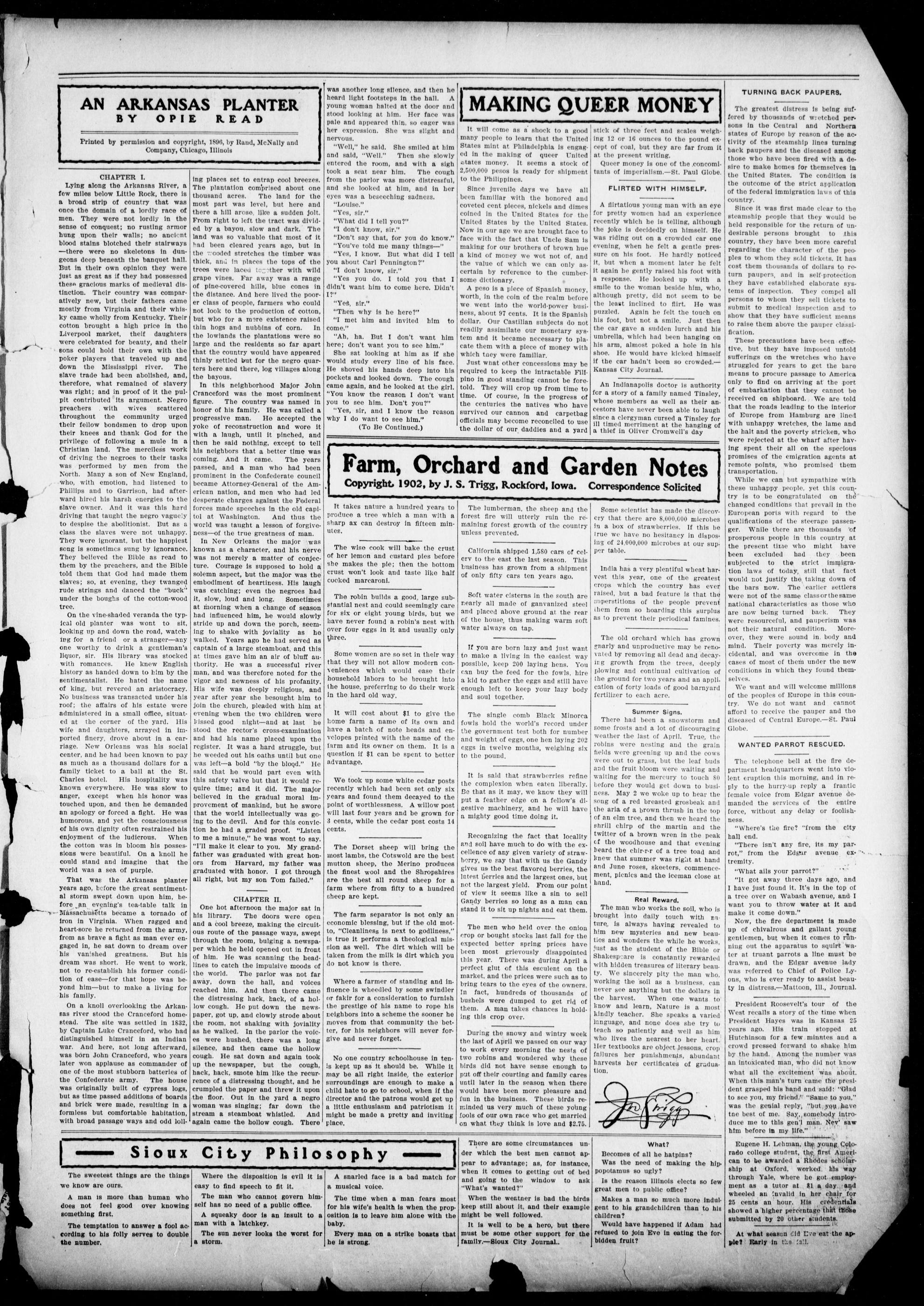
AN ARKANSAS PLANTER BY OPIE READ
Printed by permission and copyright, 1896, by Rand, McNally and Company, Chicago, Illinois
Sioux City Philosophy
CHAPTER I.
Lying along the Arkansas River, a few miles below Little Rock, there is a broad strip of country that was once the domain of a lordly race of men. They were not lordly in the sense of conquest; no rustling armor hung upon their walls; no ancient blood stains blotched their stairways—there were no skeletons in dungeons deep beneath the banquet hall. But in their own opinion they were just as great as if they had possessed these gracious marks of medieval distinction. Their country was comparatively new, but their fathers came mostly from Virginia and their whisky came wholly from Kentucky. Their cotton brought a high price in the Liverpool market, their daughters were celebrated for beauty, and their sons could hold their own with the poker players that traveled up and down the Mississippi river. The slave trade had been abolished, and, therefore, what remained of slavery was right; and in proof of it the pulpit contributed its argument. The preacher with wives scattered throughout the community urged their fellow bondsmen to drop upon their knees and thank God for the privilege of following a mule in a Christian land. The merciless work of driving the negroes to their tasks was performed by men from the North. Many a son of New England, who, with emotion, had listened to Phillips and to Garrison, had afterward hired his harsh energies to the slave owner. And it was this hard driving that taught the negro vaguely to despise the abolitionist. But as a class the slaves were not unhappy. They were ignorant, but the happiest song is sometimes sung by ignorance. They believed the Bible as read to them by the preachers, and the Bible told them that God had made them slaves; so, at evening, they twanged rude strings and danced the "buck" under the boughs of the cotton-wood tree.
On the vine-shaded veranda the typical old planter was wont to sit, looking up and down the road, watching for a friend or a stranger—any one worthy to drink a gentleman's liquor, sir. His library was stocked with romances. He knew English history as handed down to him by the sentimentalist. He hated the name of king, but revered an aristocracy. No business was transacted under his roof; the affairs of his estate were administered in a small office, situated at the corner of the yard. His wife and daughters, arrayed in imported finery, drove about in a carriage. New Orleans was his social center, and he had been known to pay as much as a thousand dollars for a family ticket to a ball at the St. Charles hotel. His hospitality was known everywhere. He was slow to anger, except when his honor was touched upon, and then he demanded an apology or forced a fight. He was humorous, and yet the consciousness of his own dignity often restrained his enjoyment of the ludicrous. When the cotton was in bloom his possessions were beautiful. On a knoll he could stand and imagine that the world was a sea of purple.
That was the Arkansas planter years ago, before the great sentimental storm swept down upon him, before an evening's tea-table talk in Massachusetts became a tornado of iron in Virginia. When ragged and heart-sore he returned from the army, from as brave a fight as man ever engaged in, he sat down to dream over his vanished greatness. But his dream was short. He went to work, not to re-establish his former condition of ease—for that hope was beyond him—but to make a living for his family.
On a knoll overlooking the Arkansas river stood the Cranceford homestead. The site was settled in 1832, by Captain Luke Cranceford, who had distinguished himself in an Indian war. And here, not long afterward, was born John Cranceford, who years later won applause as commander of one of the most stubborn batteries of the Confederate army. The house was originally built of cypress logs, but as time passed additions of boards and brick were made, resulting in a formless but comfortable habitation, with broad passage ways and odd ooll-
The sweetest things are the things we know are ours.
A man is more than human who does not feel good over knowing something first.
The temptation to answer a fool according to his folly serves to double the number.
ing places set to entrap cool breezes. The plantation comprised about one thousand acres. The land for the most part was level, but here and there a hill arose, like a sudden jolt. From right to left the tract was divided by a bayou, slow and dark. The land was so valuable that most of it had been cleared years ago, but in the wooded stretches the timber was thick, and in places the tops of the trees were laced together with wild grape vines. Far away was a range of pine-covered hills, blue cones in the distance. And here lived the poorer class of people, farmers who could not look to the production of cotton, but who for a more existence raised thin hogs and nubbins of corn. In the lowlands the plantations were so large and the residents so far apart that the country would have appeared thinly settled but for the negro quarters here and there, log villages along the bayous.
In this neighborhood Major John Cranceford was the most prominent figure. The country was named in honor of his family. He was called a progressive man. He accepted the yoke of reconstruction and wore it with a laugh, until it pinched, and then he said nothing, except to tell his neighbors that a better time was coming. And it came. The years passed, and a man who had been prominent in the Confederate council became Attorney-General of the American nation, and men who had led desperate charges against the Federal forces made speeches in the old capitol at Washington. And thus the world was taught a lesson of forgiveness—of the true greatness of man.
In New Orleans the major was known as a character, and his nerve was not merely a matter of conjecture. Courage is supposed to hold a solemn aspect, but the major was the embodiment of heartiness. His laugh was catching; even the negroes had it, slow, loud and long. Sometimes at morning when a change of season had influenced him, he would slowly stride up and down the porch, seeming to shake with joviality as he walked. Years ago he had served as captain of a large steamboat, and this at times gave him an air of bluff authority. He was a successful river man, and was therefore noted for the vigor and newness of his profanity. His wife was deeply religious, and year after year she besought him to join the church, pleaded with him at evening when the two children were kissed good night—and at last he stood the rector's cross-examination and had his name placed upon the register. It was a hard struggle, but he weeded out his oaths until but one was left—a bold "by the blood." He said that he would part even with this safety valve but that it would require time; and it did. The major believed in the gradual moral improvement of mankind, but he swore that the world intellectually was going to the devil. And for this conviction he had a graded proof. "Listen to me a minute," he was wont to say. "I'll make it clear to you. My grandfather was graduated with great honors from Harvard, my father was graduated with honor. I got through all right, but my son Tom failed."
CHAPTER II.
One hot afternoon the major sat in his library. The doors were open and a cool breeze, making the circuitous route of the passage ways, swept through the room, bulging a newspaper which he held opened out in front of him. He was scanning the headlines to catch the impulsive moods of the world. The parlor was not far away, down the hall, and voices reached him. And then there came the distressing hack, hack, of a hollow cough. He put down the newspaper, got up, and clowny strode about the room, not shaking with joviality as he walked. In the parlor the voices were hushed, there was a long silence, and then came the hollow cough. He sat down and again took up the newspaper, but the cough, hack, hack, smote him like the recurrence of a distressing thought, and he crumpled the paper and threw it upon the floor. Out in the yard a negro woman was singing; far down the stream a steamboat whistled. And again came the hollow cough. There
Where the disposition is evil it is easy to find speech to fit it.
The man who cannot govern himself has no need of a public office.
A squeaky door is an insult to a man with a latchkey.
The sun never looks the worst for a storm.
Farm, Orchard and Garden Notes Copyright 1902, by J. S. Trigg, Rockford, Iowa. Correspondence Solicited
was another long silence, and then he heard light footsteps in the hall. A young woman halted at the door and stood looking at him. Her face was pale and appeared thin, so eager was her expression. She was slight and nervous.
"Well," he said. She smiled at him and said, "Well." Then she slowly entered the room, and with a sigh took a seat near him. The cough from the parlor was more distressful, and she looked at him, and in her eyes was a beseeching sadness.
"Louise."
"Yes, sir."
"What did I tell you?"
"I don't know, sir."
"Don't say that, for you do know."
"You've told me many things—"
"Yes, I know. But what did I tell you about Carl Pennington?"
"I don't know, sir."
"Yes you do. I told you that I didn't want him to come here. Didn't I?
"Yes, sir."
"Then why is he here?"
"I met him and invited him to come."
"Ah, ha. But I don't want him here; don't want you to see him."
She sat looking at him as if she would study every line of his face. He shoved his hands deep into his pockets and looked down. The cough came again, and he looked at the girl. "You know the reason I don't want you to see him. Don't you?" "Yes, sir, and I know the reason why I do want to see him."
Farm, Orch
Copyright. 1902, by J.
It takes nature a hundred years to produce a tree which a man with a sharp ax can destroy in fifteen minutes.
The wise cook will bake the crust of her lemon and custard pies before she makes the pie; then the bottom crust won't look and taste like half cooked marcaroni.
The robin builds a good, large substantial nest and could seemingly care for six or eight young birds, but we have never found a robin's nest with over four eggs in it and usually only three.
Some women are so set in their way that they will not allow modern conveniences which would ease their household labors to be brought into the house, preferring to do their work in the hard old way.
It will cost about $1 to give the home farm a name of its own and have a batch of note heads and envelopes printed with the name of the farm and its owner on them. It is a question if $1 can be spent to better advantage.
We took up some white cedar posts recently which had been set only six years and found them decoded to the point of worthlessness. A willow post will last four years and be grown for 3 cents, while the cedar post costs 14 cents.
The Dorset sheep will bring the most lambs, the Cotswold are the best mutton sheep, the Merino produces the finest wool and the Shropshires are the best all round sheep for a farm where from fifty to a hundred sheep are kept.
The farm separator is not only an economic blessing, but if the old motto, "Cleanliness is next to godliness," is true it performs a theological mission as well. The dirt which will be taken from the milk is dirt which you do not know is there.
Where a farmer of standing and influence is wheeled by some swindler or fakir for a consideration to furnish the prestige of his name to rope his neighbors into a scheme the sooner he moves from that community the better, for his neighbors will never forgive and never forget.
---
No one country schoolhouse in ten is kept up as it should be. While it may be all right inside, the exterior surroundings are enough to make a child hate to go to school, when if the director and the patrons would get up a little enthusiasm and patriotism it might be made a pretty and inviting place.
sophy
A snarled face is a bad match for a musical voice.
The time when a man fears most for his wife's health is when the proposition is to leave him alone with the baby.
Every man on a strike boasts that he is strong.
MAKING QUEER MONEY
It will come as a shock to a good many people to learn that the United States mint at Philadelphia is engaged in the making of queer United States money. It seems a stock of 2,500,000 pesos is ready for shipment to the Philippines.
Since juvenile days we have all been familiar with the honored and coveted cent pieces, nickels and dimes coined in the United States for the United States by the United States. Now in our age we are brought face to face with the fact that Uncle Sam is making for our brothers of brown hue a kind of money we wot not of, and the value of which we can only ascertain by reference to the cumbersome dictionary.
A peso is a piece of Spanish money, worth, in the coin of the realm before we went into the world-power business, about 97 cents. It is the Spanish dollar. Our Castilian subjects do not readily assimilate our monetary system and it became necessary to placate them with a piece of money with which they were familiar.
Just what other concessions may be required to keep the intractable Filipino in good standing cannot be foretold. They will crop up from time to time. Of course, in the progress of the centuries the natives who have survived our cannon and carpetbag officials may become reconciled to use the dollar of our daddies and a yard
hard and Ga
S. Trigg, Rockford, Iowa.
The lumberman, the sheep and the forest fire will utterly ruin the remaining forest growth of the country unless prevented.
California shipped 1,580 cars of celerv to the cast the last season. This business has grown from a shipment of only fifty cars ten years ago.
Soft water cisterns in the south are nearly all made of ganvanized steel and placed above ground at the rear of the house, thus making warm soft water always on tap.
If you are born lazy and just want to make a living in the easiest way possible, keep 200 laying hens. You can buy the feed for the fowls, hire a kid to gather the eggs and still have enough left to keep your lazy body and soul together.
The single comb Black Minorca fowls hold the world's record under the government test both for number and weight of eggs, one hen laying 202 eggs in twelve months, weighing six to the pound.
It is said that strawberries refine the complexion when eaten liberally. Be that as it may, we know they will put a feather edge on a fellow's digestive machinery, and he will have a mighty good time doing it.
Recognizing the fact that locality and soil have much to do with the excellence of any given variety of strawberry, we say that with us the Gandy gives us the best flavored berries, the latest berries and the largest ones, but not the largest yield. From our point of view it seems like a sin to sell Gandy berries so long as a man can stand it to sit up nights and eat them.
The men who held over the onion crop or bought stocks last fall for the expected better spring prices have been most grievously disappointed this year. There was during April a perfect glut of this esculent on the market, and the prices were such as to bring tears to the eyes of the owners. In fact, hundreds of thousands of bushels were dumped to get rid of them. A man takes chances in holding this crop over.
During the snowy and wintry week the last of April we passed on our way to work every morning the nests of two robins and wondered why these birds did not have sense enough to put off their courting and family cares until later in the season when there would have been more pleasure and fun in the business. These birds reminded us very much of these young fools of our own race who get married on what they think is love and $2.75.
There are some circumstances under which the best men cannot appear to advantage; as, for instance, when it comes to getting out of bed and going to the window to ask "What's wanted?"
When the weatner is bad the birds keep still about it, and their example might be well followed.
It is well to be a hero, but there must be some other support for the family.—Sioux City Journal.
stick of three feet and scales weighing 12 or 16 ounces to the pound except of coal, but they are far from it at the present writing.
Queer money is one of the concomitants of imperialism.—St. Paul Globe.
FLIRTED WITH HIMSELF.
A flirtatious young man with an eye for pretty women had an experience recently which he is telling, although the joke is decidedly on himself. He was riding out on a crowded car one evening, when he felt a gentle pressure on his foot. He hardly noticed it, but when a moment later he felt it again he gently raised his foot with a response. He looked up with a smile to the woman beside him, who, although pretty, did not seem to be the least inclined to flirt. He was puzzled. Again he felt the touch on his foot, but not a smile. Just then the car gave a sudden lurch and his umbrella, which had been hanging on his arm, almost poked a hole in his shoe. He would have kicked himself if the car hadn't been so crowded.—Kansas City Journal.
An Indianapolis doctor is authority for a story of a family named Tinsley, whose members as well as their ancestors have never been able to laugh since a clergyman cursed a Tinsley for ill timed merriment at the hanging of a thief in Oliver Cromwell's day.
Some scientist has made the discovery that there are 8,000,000 microbes in a box of strawberries. If this be true we have no hesitancy in disposing of 24,000,000 microbes at our supper table.
India has a very plentiful wheat harvest this year, one of the greatest crops which the country has ever raised, but a bad feature is that the superstitions of the people prevent them from so hoarding this surplus as to prevent their periodical famines.
The old orchard which has grown gnarly and unproductive may be renovated by removing all dead and decaying growth from the trees, deeply plowing and continual cultivation of the ground for two years and an application of forty loads of good barnyard fertilizer to each acre.
Summer Signs.
There had been a snowstorm and some frosts and a lot of discouraging weather the last of April. True, the robins were nesting and the grain fields were greening up and the cows were out to grass, but the leaf buds and the fruit bloom were waiting and waiting for the mercury to touch 80 before they would get down to business. May 2 we woke up to hear the song of a red breasted grosbeak and the aria of a brown thrush in the top of an elm tree, and we heard the shrill chirp of the martin and the twitter of a brown wren in the peak of the woodhouse and that evening beard the chir-r-r of a tree toad and knew that summer was right at hand and June roses, skeeters, commencement, picnics and the iceman close at hand.
Real Reward.
The man who works the soil, who is brought into daily touch with nature, is always having revealed to him new mysteries and new beauties and wonders the while he works, just as the student of the Bible or Shakespeare is constantly rewarded with hidden treasures of literary beauty. We sincerely pity the man who, working the soil as a business, can never see anything but the dollars in the harvest. When one wants to know and learn, Nature is a most kindly teacher. She speaks a varied language, and none does she try to teach so patiently and well as him who lives the nearest to her heart. Her textbooks are object lessons, crop failures her punishments, abundant harvests her certificates of graduation.
Jn. Stirg
What?
Becomes of all he hatpins?
Was the need of making the hippopotamus so ugly?
Is the reason Illinois elects so few great men to public office?
Makes a man so much more indulgent to his grandchildren than to his children?
Would have happened if Adam had refused to join Eve in eating the forbidden fruit?
TURNING BACK PAUPERS.
The greatest distress is being suffered by thousands of wretched persons in the Central and Northern states of Europe by reason of the activity of the steamship lines turning back paupers and the diseased among those who have been fired with a desire to make homes for themselves in the United States. The condition is the outcome of the strict application of the federal immigration laws of this country.
Since it was first made clear to the steamship people that they would be held responsible for the return of undesirable persons brought to this country, they have been more careful regarding the character of the peoples to whom they sold tickets. It has cost them thousands of dollars to return paupers, and in self-protection they have established elaborate systems of inspection. They compel all persons to whom they sell tickets to submit to medical inspection and to show that they have sufficient means to raise them above the pauper classification.
These precautions have been effective, but they have imposed untold sufferings on the wretches who have struggled for years to get the bare means to procure passage to America only to find on arriving at the port of embarkation that they cannot be received on shipboard. We are told that the roads leading to the interior of Europe from Hamburg are lined with unhappy wretches, the lame and the halt and the poverty stricken, who were rejected at the wharf after having spent their all on the specious promises of the emigration agents at remote points, who promised them transportation.
While we can but sympathize with these unhappy people, yet this country is to be congratulated on the changed conditions that prevail in the European ports with regard to the qualifications of the steerage passenger. While there are thousands of prosperous people in this country at the present time who might have been excluded had they been subjected to the strict immigration laws of today, still that fact would not justify the taking down of the bars now. The earlier settlers were not of the same class or the same national characteristics as those who are now being back back. They were resourceful, and pauperism was not their natural condition. Moreover, they were sound in body and mind. Their poverty was merely incidental, and was overcome in the cases of most of them under the new conditions in which they found themselves.
We want and will welcome millions of the peoples of Europe in this country. We do not want and cannot afford to receive the pauper and the diseased of Central Europe.—St. Paul Globe.
WANTED PARROT RESCUED.
The telephone bell at the fire department headquarters went into violent eruption this morning, and in reply to the hurry-up reply a frantic female voice from Edgar avenue demanded the services of the entire force, without any delay or foolishness.
"Where's the fire? "from the city hall end.
"There isn't any fire, its my parrot," from the Edgar avenue extremity.
"What ails your parrot?"
What ams you parrot?
"It got away three days ago, and I have just found it. It's in the top of a tree over on Wabash avenue, and I want you to throw water at it and make it come down."
Now, the fire department is made up of chivalrous and gallant young gentlemen, but when it comes to running out the apparatus to squirt water at truant parrots a line must be drawn, and the Edgar avenue lady was referred to Chief of Police Lyons, who is ever ready to assist beauty in distress.—Mattoon, Ill., Journal.
President Roosevelt's tour of the West recalls a story of the time when President Hayes was in Kansas 25 years ago. His train stopped at Hutchinson for a few minutes and a crowd pressed forward to shake him by the hand. Among the number was an intoxicated man, who did not know what all the excitement was about. When this man's turn came the president grasped his hand and said: "Glad to see you, my friend." "Same to you," was the genial reply, "but you have the best of me. Say, somebody introduce me to this genl man. New saw him before in my life."
Eugene H. Lehman, the young Colorado college student, the first American to be awarded a Rhodes scholarship at Oxford, worked his way through Yale, where he got employment as a tutor at $1 a day, and wheeled an invalid in her chair for 25 cents an hour. His credentials showed a higher percentage that those submitted by 20 other students.
At what season did Eve eat the apple? Early in the fall.
The Professional World
RUFUS L. LOGAN, B. S. D. - EDITOR
TERMS OF SUBSCRIPTION.
One Year in Advance - - - $1.00
Six Months in Advance - - .75
Three Months in Advance - - .50
Single Copies - - - .05
Advertising Rates on Application.
Job Work of all Kinds Solicited.
Published Every Friday.
Entered at the postoffice at Columbia, Mo., as second class matter,
Jan. 15, 1902.
Agents wanted in every town in the state.
Payments may be made in two cent stamps by postal note, money order, by registered letter or express order.
Correspondence containing news of interest and importance is desired from all parts of the United States.
Communications should be made to reach us not later than Thursday morning, to insure insertion in the current issue.
Not attention will be paid to anonymous communications.
Agents wanted everywhere. Write for terms.
Specimen copies sent to any address upon request.
PRESS OF THE MISSOURI STATESMAN
You should not make it necessary for us to send you a second notice concerning your subscription.
JEFFERSON CITY is to have brick streets in the near future which will be a great improvement to the Capital City.
MARK HANNA says that Roosevelt will not be endorsed by the Ohio Convention. May be not, but he'll be the next president just the same.
WE spent a few hours at Lincoln Institute last week and were glad to note the cheerfulness and harmony that exists among all connected with the Iustitute.
OUR thanks are due Mrs. Sallie Nolly and Miss America Hall, of Columbia, Messrs Robin Watson, Grant Gilmore, Henry Harvey and Jake Peach, of McBaine, Mo.
THE prospects for a main line of railroad through Columbia were never brighter than they are now. Surely the citizens of Columbia and Boone county will take hold of one of the several propositions now before them.
THE readers of this paper will bear in mind that the merchants who advertise in this paper appreciate the patronage of the colored man, and we urge upon you to call on them when in need of any thing they have.
THE Joplin man who filed a suit for divorce after reinstating his wife 22 times, when she had deserted him, has probably discovered that he had one grain of sense. It would be; a difficult matter to convince many people that he had very much sense when he reinstated her the first time.
THE "Hallsville Eagle," a weekly paper published at Hallsville in Boone county, made its appearance before the public last Saturday and has reached our desk. It is a neat, newsy eight page paper, and edited by L. K. Davis, a well known newspaper man, and the "Eagle's" shrill cry will doubtless be heard in every section of Boone county.
WHEN the Columbia band intends to have a dance it should be announced as such so that only persons who dance would be expected, and those who do not dance would not be humiliated by finding themselves unexpectedly at a dance. The people of Columbia should encourage the band as it is an organization which is helpful to any community, but there are some citizens in Columbia who do not take part in dancing nor do they attend dances, and it is an imposition on them to have announced from the pulpits that the band is to have an entertainment or a concert, and when the crowd gathers, engage in a general mix up dance, as was the case at fifth street hall last evening.
UNLESS all signs fail a negro will be put at the head of Lincoln Institute Industrial school and
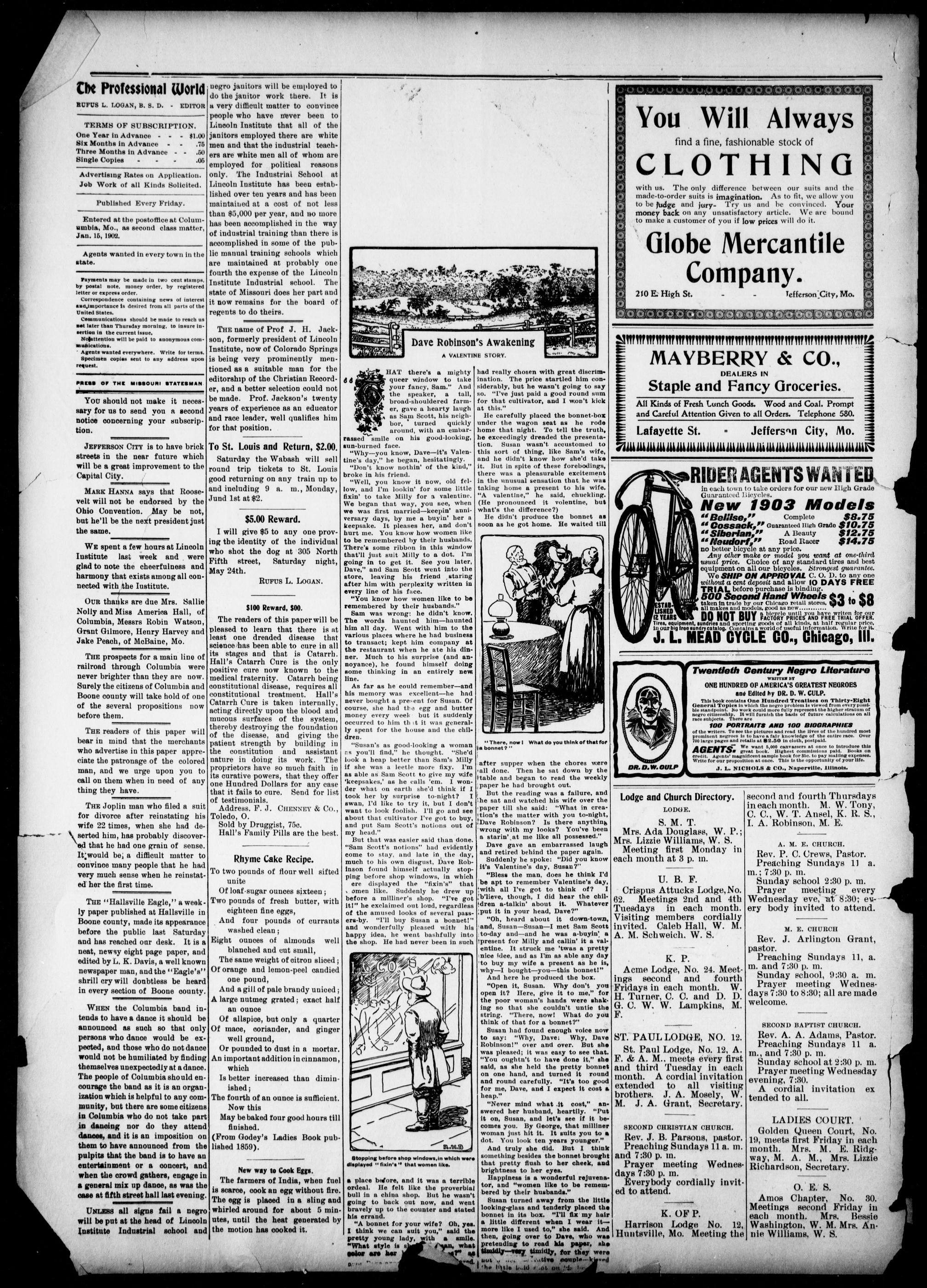
Dave Robinson's Awakening
A VALENTINE STORY.
HAT there's a mighty queer window to take your fancy, Sam." And the speaker, a tall, broad-shouldered farmer, gave a hearty laugh as Sam Scott, his neighbor, turned quickly around, with an embarrassed smile on his good-looking, sun-burned face.
"Why—you know, Dave—it's Valentine's day," he began, hesitatingly.
"Well, you know it now, old fellow, and I'm lookin' for some little fixin' to take Milly for a valentine. We began that way, you see, when we was first married—keepin' anniversary days, by me a buyin' her a keepsake. It pleases her, and don't hurt me. You know how women like to be remembered by their husbands. There's some ribbon in this window that'll just suit Milly to a dot. I'm going in to get it. See you later, Dave," and Sam Scott went into the store, leaving his friend staring after him with perplexity written in every line of his face.
"You know how women like to be remembered by their husbands."
Sam was wrong; he didn't know. The words haunted him—haunted him all day. Went with him to the various places where he had business to transact; kept him company at the restaurant when he ate his dinner. Much to his surprise (and annoyance), he found himself doing some thinking in an entirely new line.
As far as he could remember—and his memory was excellent—he had never bought a present for Susan. Of course, she had the egg and butter money every week but it suddenly occurred to him that it was generally spent for the house and the children.
"Susan's as good-looking a woman as you'll find," he thought. "She'd look a heap better than Sam's Milly if she was a leetle more fixy. I'm as able as Sam Scott to give my wife 'keepsakes,' as he calls 'em. I wonder what on earth she'd think if I took her by surprise to-night? I swan, I'd like to try it, but I don't want to look foolish. I'll go and see about that cultivator I've got to buy, and put Sam Scott's notions out of my head."
But that was easier said than done. "Sam Scott's notions" had evidently come to stay, and late in the day, much to his own disgust, Dave Robinson found himself actually stopping before shop windows, in which
ere displayed the "fain's" that
omen like. Suddenly he drew up
before a milliner's shop. "I've got it!" he exclaimed out loud, regardless
of the amused looks of several pass-
ers-by. "Till buy Susan a bonnet!" and wonderfully pleased with his
happy idea, he went bashfully into
the shop. He had never been in such
I & CO.
P. VOL. B.
Stopping before shop windows, in which were displayed "fixin's" that women like.
a place before, and it was a terrible ordeal. He felt like the proverbial bull in a china shop. But he wasn't going to back out now, and went bravely up to the counter and stated his errand.
"A bonnet for your wife? Oh, yes. I think we can suit you," said the pretty young lady, with a smile.
"What style is she / can, what color are her
negro janitors will be employed to do the janitor work there. It is a very difficult matter to convince people who have never been to Lincoln Institute that all of the janitors employed there are white men and that the industrial teachers are white men all of whom are employed for political reasons only. The Industrial School at Lincoln Institute has been established over ten years and has been maintained at a cost of not less than $5,000 per year, and no more has been accomplished in the way of industrial training than there is accomplished in some of the public manual training schools which are maintained at probably one fourth the expense of the Lincoln Institute Industrial school. The state of Missouri does her part and it now remains for the board of regents to do theirs.
THE name of Prof J. H. Jackson, formerly president of Lincoln Institute, now of Colorado Springs is being very prominently mentioned as a suitable man for the editorship of the Christian Recorder, and a better selection could not be made. Prof. Jackson's twenty years of experience as an educator and race leader, well qualifies him for that position.
To St. Louis and Return, $2.00.
Saturday the Wabash will sell round trip tickets to St. Louis good returning on any train up to and including 9 a. m., Monday, Jund 1st at $2.
$5.00 Reward.
I will give $5 to any one proving the identity of the individual who shot the dog at 305 North Fifth street, Saturday night, May 24th.
RUFUS L. LOGAN.
$100 Reward, $00
The readers of this paper will be pleased to learn that there is at least one dreaded disease that science has been able to cure in all its stages and that is Catarrh. Hall's Catarrh Cure is the only positive cure now known to the medical fraternity. Catarrh being constitutional disease, requires all constitutional treatment. Hall's Catarrh Cure is taken internally, acting directly upon the blood and mucous surfaces of the system, thereby destroying the foundation of the disease, and giving the patient strength by building in the constitution and assistant nature in doing its work. The proprietors have so much faith in its curative powers, that they offer one Hundred Dollars for any case that it fails to cure. Send for list of testimonials.
Address. F. J. CHENNEY & Co., Toledo, O. Sold by Druggist, 75c. Hall's Family Pills are the best.
Rhyme Cake Recipe.
To two pounds of flour well sifted unite
Of loaf-sugar ounces sixteen ;
Two pounds of fresh butter, with eighteen fine eggs,
And four pounds of currants washed clean ;
Eight ounces of almonds well blanched and cut small,
The same weight of citron sliced ;
Of orange and lemon-peel candied one pound,
And a gill of pale brandy uniced ;
A large nutmeg grated; exact half an ounce
Of allspice, but only a quarter
Of mace, coriander, and ginger well ground.
Or pounded to dust in a mortar.
An important addition in cinnamon, which
Is better increased than diminished;
The fourth of an ounce is sufficient.
Now this
May be baked four good hours till finished.
(From Godey's Ladies Book published 1859).
New way to Cook Eggs.
The farmers of India, when fuel is scarce, cook an egg without fire. The egg is placed in a sling and whirled around for about 5 minutes, until the heat generated by the motion has cooked it.
HAT there's a mighty queer window to take your fancy, Sam." And the speaker, a tall, broad-shouldered farmer, gave a hearty laugh as Sam Scott, his neighbor, turned quickly around, with an embar-
had really chosen with great discrimination. The price startled him considerably, but he wasn't going to say so. "I've just paid a good round sum for that cultivator, and I won't kick at this."
He carefully placed the bonnet-box under the wagon seat as he rode home that night. To tell the truth, he exceedingly dreaded the presentation. Susan wasn't accustomed to this sort of thing, like Sam's wife, and he didn't know how she'd take it. But in spite of these forebodings, there was a pleasurable excitement in the unusual sensation that he was taking home a present to his wife. "A valentine," he said, chuckling. (He pronounced it volentine, but what's the difference?)
He didn't produce the bonnet as soon as he got home. He waited till
A man and a woman are standing at a table, holding a glass of wine. The man is wearing a hat and a shirt, while the woman is wearing a dress and a hat. The table is covered with a tablecloth, and there is a lamp on the table.
"There, now! What do you think of that for a bonnet?"
after supper when the chores were all done. Then he sat down by the table and began to read the weekly paper he had brought out.
But the reading was a failure, and he sat and watched his wife over the paper till she said: "What in creation's the matter with you to-night, Dave Robinson? Is there anything wrong with my looks? You've been a starin' at me like all possessed."
Dave gave an embarrassed laugh and retired behind the paper again.
Suddenly he spoke: "Did you know it's Valentine's day, Susan?"
"Bless the man, does he think I'd be apt to remember Valentine's day, with all I've got to think of? I b'lieve, though, I did hear the children a-talkin' about it. Whatever put it in your head, Dave?"
"Oh, heard about it down-town, and, Susan—Susan—I met Sam Scott to-day and—and he was a-buyin' a present for Milly and callin' it a valentine. It struck me 'mewas a pretty nice idea, and as I'm as able any day to buy my wife a present as he is, why—I bought—you this bonnet!"
And here he produced the box.
"Open it, Susan. Why don't you open it? Here, give it to me," for the poor woman's hands were shaking so that she couldn't untie the string. "There, now! What do you think of that for a bonnet?"
Susan had found enough voice now to say: "Why, Dave: Why, Dave Robinson!" over and over. But she was pleased; it was easy to see that. "You oughtn't to have done it," she said, as she held the pretty bonnet on one hand, and turned it round and round carefully. "It's too good for me, Dave, and I expect it cost a heap."
"Never mind what it cost," answered her husband, heartily. "Put it on, Susan, and let's see if it becomes you. By George, that milliner woman just hit it. It suits you to a dot. You look ten years younger." And truly she did. But I think something besides the bonnet brought that pretty flush to her cheek, and brightness to her eyes. Happiness is a wonderful rejuvenator, and "women like to be remembered by their husbands."
Susan turned away from the little looking-glass and tenderly placed the bonnet in its box. "I'll fix my hair a little different when I wear it—more like I used to," she said. And then, going over to Dave, who was pretending to read his paper, she timidly—very timidly, for they were not aATIVE couple—knew the little
You Will Always
find a fine, fashionable stock of
CLOTHING
with us. The only difference between our suit
made-to-order suits is imagination. As to fit, we
to be judge and jury- Try us and be convin-
money back on any unsatisfactory article. We
to make a customer of you if low prices will do it.
Globe Mercant
Company.
LOTHING
The only difference between our suits and the order suits is imagination. As to fit, we allow you and jury- Try us and be convinced. Your likeness on any unsatisfactory article. We are bound customer of you if low prices will do it.
obe Mercantile Company.
CLOTHING
with us. The only difference between our suits and the made-to-order suits is imagination. As to fit, we allow you to be judge and jury- Try us and be convinced. Your money back on any unsatisfactory article. We are bound to make a customer of you if low prices will do it.
Globe Mercantile Company.
MAYBERDEALER
Staple and Fa
All Kinds of Fresh Lunch Good
and Careful Attention Given
Lafayette St.
AYBERRY & CO.,
DEALERS IN
Apple and Fancy Groceries.
Of Fresh Lunch Goods. Wood and Coal. Prompt
Attention Given to all Orders. Telephone 580.
State St. Jefferson City, Mo.
RIDER AGENTS WANTED
in each town to take orders for our new High Grade
Guaranteed Bicycles.
New 1903 Models
"Belilise," Complete $8.75
"Cossack," Guaranteed High Grade $10.75
"Siberian," A Beauty $12.75
"Neudorf," Road Racer $14.75
no better bicycle at any price.
Any other make or model you want at one-third
usual price. Choice of any standard tires and best
equipment on all our bicycles. Strongest guarantee.
We SHIP ON APPROVAL C. O. D. to any one
without a cent deposit and allow 10 DAYS FREE
TRIAL before purchase is binding.
500 Second Hand Wheels $3 to $8
taken in trade by our Chicago retail stores,
all makes and models good as now.
Do NOT BUY a bicycle until you have written for our
equipment, sundries and sporting goods of all kinds, at half regular price.
Free sunny catalog. Contains a world of useful information. Write for it.
MEAD CYCLE CO., Chicago, Ill.
Twentieth Century Negro Literature
WRITTEN BY
ONE HUNDRED OF AMERICA'S GREATEST NEGROES
and Edited by DR. D. W. CULP.
This book contains One Hundred Treatises on Thirty-Eight
General Topics in which the negro problem is viewed from every possible
standpoint. No work could more fully represent the higher stratum of
negro citizenship. It will furnish the basis of future calculations on all
race subjects. There are
PORTRAITS AND 100 BIGGRAPHIES
of the writers. To see the pictures and read the lives of the hundred most
prominent negroes is to have a fair knowledge of the entire race. Over
700 large pages and retails at $2.50 in cloth, postpaid.
AGENTS. We want 5,000 canvasvans at once to introduce this
agent's highest commercial pat. Books on
credit. Agents' magnificent samples for 500 to pay mailing expenses.
Write for our proposition at once. This is the opportunity of your life.
All Kinds of Fresh Lunch Goods. Wood and Coal. Prompt and Careful Attention Given to all Orders. Telephone 580.
---
RIDERAGENTSWANTED
"Belise," Complete $8.75
"Cossack," Guaranteed High Grade $10.75
"Siberian," A Beauty $12.75
"Neudorf," Road Racer $14.75
no better bicycle at any price.
Any other make or model you want at one-third
usual price. Choice of any standard tires and best
equipment on all our bicycles. Strongest guarantee.
We SHIP ON APPROVAL C. O. D. to any one
without a cent deposit and allow IO DAYS FREE
TRIAL before purchase is binding.
Twentieth Century Negro Literature
This book contains One Hundred Treaties on Thirty-Eight General Topics in which the negro problem is viewed from every possible standpoint. No work could more fully represent the higher stratum of all race subjects. We can furnish the basis of future calculations on all race subjects. There are
100 PORTRAITS AND 100 BIOGRAPHIES of the writers. To see the pictures and read the lives of the hundred most prominent negroes is to have a fair knowledge of the entire race. Over 700 large pages and retails at $2.50 in cloth, postpaid.
AGENTS: we want 600 canvases at our request to introduce this credit. AGENTS' magnificent book sample for $2.60 to pay mailing expenses. Write for our proposition at once. This is the opportunity of your life.
J. L. NICHOLS & CO., Naperville, Illinois.
Lodge and Church Directory.
LODGE.
S. M. T.
Mrs. Ada Douglass, W. P.;
Mrs. Lizzie Williams, W. S.
Meeting first Monday in
each month at 3 p. m.
Crispus Attucks Lodge,No. 62. Meetings 2nd and 4th Tuesdays in each month. Visiting members cordially invited. Caleb Hall, W. M. A. M. Schweich, W. S.
Acme Lodge, No. 24. Meetings second and fourth Fridays in each month. W. H. Turner, C. C. and D. D. G. C. W. W. Lampkins, M. F.
ST. PAUL LODGE, NO. 12.
St. Paul Lodge, No. 12. A.
F. & A. M., meets every first
and third Tuesday in each
month. A cordial invitation
extended to all visiting
brothers. J. A. Mosely, W.
M. J. A. Grant, Secretary.
SECOND CHRISTIAN CHURCH.
Rev. J. B. Parsons, pastor.
Preaching Sundays 11 a. m.
and 7:30 p. m.
Prayer meeting Wednesdays 7:30 p. m.
Everybody cordially invited to attend.
Harrison Lodge No. 12, Huntsville, Mo. Meeting the
---
210 E. High St.
ESTABLISHED
12 YEARS
Tires, equipment,
in our big free su
J. L. M
DR. D.W. OULP
LODGE.
S M T
U. B. F.
K. P.
K. OF P.
Jefferson City, Mo.
second and fourth Thursdays in each month. M. W. Tony, C. C., W. T. Ansel, K. R. S., L. A. Robinson, M. E.
A. M. E. CHURCH.
Rev. P. C. Crews, Pastor.
Preaching Sundays 11 a.
m.; 7:30 p. m.
Sunday school 2:30 p. m.
Sunday school 2:30 p. m.
Prayer meeting every
Wednesday eve, at 8:30; every
body invited to attend.
M. E. CHURCH
Rev. J. Arlington Grant, pastor.
Preaching Sundays 11, a. m. and 7:30 p. m.
Sunday school, 9:30 a. m.
Prayer meeting Wednesdays 7:30 to 8:30; all are made welcome.
SECOND BAPTIST CHURCH
Rev. A. A. Adams, Pastor.
Preaching Sundays 11 a.
m., and 7:30 p. m.
Sunday school at 2:30 p. m.
Prayer meeting Wednesday
evening, 7:30.
A cordial invitation extended to all.
LADIES COURT.
Golden Queen Court, No. 19, meets first Friday in each month. Mrs. M. E. Ridgway, M. A. M., Mrs. Lizzie Richardson, Secretary.
O. E. S.
Amos Chapter, No. 30. Meetings second Friday in each month. Mrs. Bessie Washington, W. M. Mrs. Annie Williams, W. S.