The Professional World
Friday, June 12, 1903
Columbia, Missouri
Page text (machine-generated)
THE PROFESSIONAL WORLD.
$1.00 Per Year in Advance.
You Can All
The Latest and up-to-date in every Dep
Our efforts are always direct goods for the same money or money than you can find else
Our efforts are always directed to furnishing better goods for the same money or the same goods for less money than you can find elsewhere;
BUT WE NEVER CUT THE QUALITY TO MAKE A CUT PRICE.
Schultz Dry Goods = = = = =
= = = = and Carpet Company,
JEFFERSON CITY, MO.
Jefferson City Notes.
Among those attending the commencement exercises from Kansas City are Prof. J. W. Baldwin and wife, Prof. J. S. Harris and wife, Mrs. Nero and Mrs. Frances Jackson.
Buy your Millinery of Miss Chandler, 106 E. High St., Jefferson City, Mo.
Prof. O. M. Shackleford, of Warrensburg, is in this city.
Call on John A. Shot, The Tailor, for suits made to order. All kinds of cleaning and repairing. 5-22-4t
Prof. S. T. Pettigrew was in the city last week.
See S. Rost, the Tailor, 215 Madison st. Jefferson City, Mo., for all kinds of Tailoring, cleaning and pressing. May 22-4t
Owing to the flood fewer visitors than usual attending the commencement exercises.
Go to Mrs. Bauman 117 E. High st., Jefferson City, Mo., for all kinds of sewing and dressmaking. 5-22-4
Mr. J. C. McMahan of Fulton is in the city.
$5.00 worth of purchase
tickets from Miss Chandler's millinery store, 106 E.
High st., Jefferson City,
will entitle you to a life size
portrait for 98 cts. A ticket
given with every $1.00
purchase. May 22-4t.
Patronize the merchants who
advertise in this paper.
Great reduction in all millinery at Miss Chandler's,
106 E. High st., Jefferson
City, Mo. May 22-4t.
Curious Facts.
A Massachusetts farmer drives a team of cows.
There are nearly 20,000 known medicinal remedies.
One-sixth of the land owners in Great Britain are women.
India exported $46,000,000 worth of cotton last year.
Petroleum is the fuel of the locomotives in Asia.
Ohio collects over $4,000,000 in licenses from 10,739 saloons.
On many railroads cement ties are used displacing wooden ties.
Holton, Mo., with a population of 4,500, has seventeen churches.
CASH OR CREDIT. Catalogue FREE.
CENTURY MF'G CO.
ods = = = = =
carpet Company,
N CITY, MO.
There are about 30,000 automobiles in use in the United States.
The average coffee tree in Honduras produces half a pound of beans.
Peat has about half of the heating power of coal and double that of wood.
Polo is probably the oldest of athletic sports. It has been traced to 600 B. C.
The first complete sewing machine was patented by Elias Howe, Jr., in 1846.
Three pairs of Siamese twin fishes have been hatched at the New York Aquarium.
The first Union flag was unfurled on January 1, 1776, over the camp at Cambridge.
It is unlawful for a doctor in France to inherit property left to him by a deceased patient. Twelve thousand people were arrested in Glasgow last year for using obscene language. The gold yield of Victoria for the first two months of this year amounted to 136,139 ounces. The population of Damascus, reputed the oldest city in the world, is calculated at 225,000 souls.
Beware of Ointments For Catarrh That Contains Mercury
as mercury will surely destroy the sense of smell and completely derange the whole system when entering it through the mucous surfaces. Such articles should never be used except on prescriptions from reputable physicians, as the damage they will do is ten fold to the good you can possibly derive from them. Hall's Cattarrh Cure, manufactured by F. J. Cheney & Co., Toledo, O., contains no mercury, and is taken internally, acting directly upon the blood and mucous surfaces of the system. In buying Hall's Cattarrh Cure be sure you get the genuine. It is taken internally and made in Toledo, Ohio, by F. J. Cheney & Co. Testimonials free.
Sold by Druggists, Price 75c per bottle. Hall's Family Pills are the best.
Harness, etc. We sell direct from our Factory to Consumers at Factory Prices. This guaranteed Buggy only $33.50; Cash or Easy Monthly Payments. We trust honest people located in all parts of the world.
Write for Free Catalogue.
MENTION THIS PAPER.
DEP'T 910, East St. Louis, Ill.
COLUMBIA AND JEFFERSON CITY, MISSOURI, FRIDAY JUNE 12, 1903.
It will pay you
to send for our Catalogue No. 6, quoting prices on Buggies,
Another Successful Year of the State School for Colored Youths passes into History.
Jefferson City, Mo., June 12, '03. The thirty-third commencement of Lincoln Institute was held this week and closed at noon to-day when diplomas were presented to young men and young women by Prof. B. F. Allen, President of the institution. The flood situation throughout the state prevented many patrons and friends of the institution from being present at the exercises of the week, which began Sunday, June 7th. The sermon to the graduating class was preached by Rev. Father Harper of Kansas City. The sermon to the religious societies was delivered by Rev. Gibson of Kansas City. The annual address to the literary societies was delivered by Prof. Gordon of St. Louis. The graduating exercises of the "C" Normal class were held Tuesday evening and were largely attended, and the program rendered was a most excellent one and those who took part acquitted themselves most creditably. The production "Beauty a duty," by Ida Schweish of Columbia, was one of the best, deserves special mention from the point of delivery and thought. The class day exercises of the graduating class were held Wednesday evening and were probably the best exercises of the week. Hon. I. F. Bradley of Kansas City delivered the annual address to the Alumni Association Thursday evening at which time the following program was rendered:
Piano Solo—"Murmuring Zephyr" - - Jensen
Miss Stella Zimmerman
Invocation
Piano Solo—"Walse Lente" - - - Sureking
Miss Bessie Clark
Address—President J. M. Rutledge, '81
Vocal Duett—"Love Shall Thee" - White
Miss Carney and Anderson
Talk—Relation of Lincoln Institute Alumni to Lincoln Institute, Prin. W. H. Harrison, '88
Ductt—"Hungarian Rhapsody" - - - Liszt Misses Zimmerman and Williams
Talk—Relation other institutions of the state sustain to Lincoln Institute, Editor R. L. Logan, '98
Piano Solo—"Second Mazurka" . . . Godard
Miss Mary Lou Williams
Address—"Now" Judge I.F. Bradley, 85, Kan.
City, Kan
Music
The teachers for the ensuing
year will be announced next week.
A Communication.
The Professional World is in receipt of the following communication from the Columbia band:
"Columbia, Mo., June, 1093.
"Permit us to say that Dr. Perry's band has neither in the past nor the present attempted to deceive the public. The affair given by us recently at Fifth street hall was advertised as an entertainment, carried out as such, and enjoyed by fully 98 per cent of those present. Our aim was to give a musical entertainment as many Columbians were anxious to hear us play but had never had an opportunity.
"We are neither confidence men nor men whose highest ambition is to engage in 'mix-up' or any other variety of dances; but nearly half of us are church workers and eleven twelfths of us do not dance. We trust the good citizens will not be misled by any reports to the contrary.
"Very Respectfully,
DR. PERRY'S CONCERT BAND." The above statement was brought out by an editorial which appeared in this paper a short time ago with reference to an entertainment given by them at Fifth street hall at which a part of the crowd engaged in dancing while many who attended expected to hear a program rendered by the band. We willingly publish the above and hope the young men will profit by the mistake and that it will not occur again.
YOUR TRADE SO., LICITED
Columbia Notes.
Mrs. Laura Vilhite, who has been the guest of Mr. and Mrs. Harvey Pazar, has returned to her home in Rocheport, Mo.
The editor of the Professional World left Sunday for Jefferson City where he will attend the commencement exercises of Lincoln Institute.
Mrs. Jane Matson is very ill.
Subscribe for the Professional World, only one dollar per year, and join the voting contes t.
Miss Luella Graves, who has been visiting her mother at Guthrie, Okla., has returned home.
Mr. Jas. L. Matson of Boston, Mass., and Mr. John Matson of St. Louis was suddenly called to the bed side of their mother.
Mrs. Bettie Waldon and little granddaughter returned from Carrolton, Mo., Wednesday.
The A. M. E. Sunday school convention will convene here next week.
Dr. J. E. Perry has sold his home on eighth street.
Miss Maud Williams has been elected delegate of the A. M. E. Sunday school.
The Boone County Teacher's Institute, was called to order by the conductor, Prof. J. B. Coleman, June 8, 1903, at the Fred Douglass school, having an enrollment of seventeen teachers.
777 in Salo Deo Salus 333.
The Grand session of the Knights and Daughters of Tabor will convene in Columbia July 28th, 1903, in Orears hall cor. Broadway and 10th streets at 8 o'clock a. m.
J. E. HERRIFORD, C. G. M.
J. G. HAYES, C. G. S.
Health and Beauty.
Alcohol is one of the best of cosmetic remedies.
Deep breathing in pure air is a health preservative.
Sunshine, exercise and fresh air are the best cure for insomnia.
Warts and moles can be removed by touching with muriate of ammonia.
A glass of hot water before breakfast is a laxative and tones up the system.
Scars can be lessened by nightly rubbing with cocoa butter or almond meal.
Grapes are healthful and fattening, as they contain a large amount of sugar.
Hair that splits at the ends should be trimmed with a pair of sharp scissors or singed.
Orris root imparts a delicate fragrance to the breath and can be bought in small sticks.
Bitter aloes rubbed on the finger tips will generally break the habit of biting the nails.
Nervous people should take light exercises, increasing them daily as strength is gained.
Flour spread thickly on a burn will prevent blistering and the scars that are likely to follow.
COMPANY
STORE.
RI.
T PRICES.
R
Mail Orders Promptly Filled
Nifong Manufacturing Co.
DISTILLED WATER ICE,
standard for
QUALITY, SERVICE AND PRICE.
'Phone 16. Regular Morning and Special
Deliveries 365 days in the year.
COLUMBIA - - - - MISSOURI.
A Tale Told in Titles.
"When Knighthood Was in Flower," "Janice Meredith" and "Peter Sterling" possessed "The Right of Way" to "The Puppet Crown," while "Alice of Old Vincennes," with "A Portion of Labor" brought about "The Crisis" of the "Eternal City." "In The P lace of the King" "Richard" met "Audrey," also "David Harum," who followed "In His Steps' "To Have and to Hold" her for his own. But "Eleanor"
good like." The Red Rock between st. so consequently "Questions science" were not thought then. of Con. at "No. 5 St. John St.," of when. Market Place" one of near "The married "Miss Pet these gallants ted the "King of ticoats" and visit. their bridal Honey Island" on tour.
We desire to engage some agents to solicit subscriptions the Professional World. Libe. commissions will be paid and only one agent will be engaged for the same town, only persons of good standing need apply. Address. Professional World, Columbia, Mo.
THE VOTING CONTEST.
names of ladies as entries in the
Others will appear next week.
subscription or renews their sub-
s.
Columbia, Mo.
Δshland, Mo.
Columbia, Mo.
number of votes will be awarded
in dress pattern.
all out properly.
votes
as the
We present below the following names of ladies as entries in the Professional World Voting Contest. Others will appear next week. Every person who pays one year's subscription or renews their subscription will be entitled to ten voices.
Mrs. L. E. Richardson, - - - - - Columbia, Mo.
Mrs. Macea Bass, - - - - - Δshland, Mo.
Mrs. Anna L. Hicks, - - - - - Columbia, Mo.
The lady receiving the highest number of votes will be awarded the prize, which is a fine broad cloth dress pattern.
Clip the following cupon and fill out properly.
most popular married lady in Boone county.
LAINES
G.....
MARGAIN
Store
JEFFERSON CITY, MO.
Finishing Goods
---
306 E. HIGH STREET, JEFFERSON CITY, MO.
And Shoes of all kinds.
M ON THE STREET
NO ONE CAN BEAT.
0, a. m.
0, p. m.
YOU CAN SEE THEM ON THE STREET AND OUR PRICES NO ONE CAN BEAT.
Open 5:30, a. m.
Close 9:30, p. m.
If you have perspiring feet bathe them in warm water to which a little ammonia has been added.
Almond meal softens and whitens the skin, and for tender skins may be used as a substitute for soap.
Bunions and corns may be cured by nightly applications of iodine and the wearing of easy-fitting shoes.
Baked bananas are more nutritious than the raw fruit, and are often used by physicians in cases of fever.
Red lips cannot indicate good health and a large quantity in the blood.
To thicken the eyebrows an lashes apply vaseline or lanoline in which a small quantity of quinine has been mixed.
Apples are wholesome and easily digested, eaten on an empty stomach before breakfast they make a good laxative.
A few drops of tincture of myrrh in a glass of water applied daily to the gums will keep them hard and in good condition.
A Request.
We will consider it a great favor if our readers will patronize the merchants whose advertisements they see in this paper.
VOL. 11. NO. 32
good for val
Agents Wanted.
Rufus L. LOGAN, Editor
Columbia - - - - Missouri
Weekly Crop Bulletin
Washington, D. C., June 10.—The weekly crop bulletin of the weather bureau is as follows:
The states of the lower Missouri valley and portions of the Mississippi valley have suffered much from heavy rains, especially Iowa, the eastern portions of Kansas and Nebraska, and western Missouri. Drought continues in New England, the northern portion of the Middle Atlantic states, and in Florida, and rains are needed in portions of the central gulf states and in southern Texas. Drought conditions have been wholly relieved in the Ohio valley and over part of the middle and south Atlantic states. The latter part of the week was unseasonably cool in the lower Missouri valley, west gulf districts, and New England, damaging frosts occurring in the last-named district. Very favorable temperatures prevailed in the Ohio valley and south Atlantic and east gulf states. More favorable conditions than in the previous week are reported from the Pacific coast states, much needed showers having occurred in Oregon and Washington.
Wet weather has caused further delay in corn planting in the Missouri and upper Mississippi valleys, where much of this work is unfinished and the early planted is becoming weedy. In the eastern portion of Kansas and Nebraska and in Iowa corn fields have been badly washed out, and much replanting will be necessary. In Iowa the average will be materially reduced.
In Illinois planting is practically finished and an excellent stand attained. In the central and upper Ohio valleys planting is delayed and early fields in some portions are suffering for cultivation. In the Southern states corn has experienced a very favorable week and is largely laid by.
sustained injury from floods, but on the whole the crop has made satisfactory advancement, an improvement being generally indicated in the Ohio valley, lake region, and middle Atlantic states. Harvesting is general in Texas, and has begun in Arkansas and North Carolina. Winter wheat has made slow growth in Washington and Oregon, and the fields in the eastern portion of Oregon are unusually weedy, in California the outlook is not promising, and much late wheat is being cut for hay.
In Nebraska, the Dakotas, and northern Minnesota spring wheat has made splendid progress, but in southern Minnesota, Wisconsin, and Iowa the crop on lowlands has suffered much from heavy rains. In Washington and Idaho the crop is greatly improved.
On lowlands in the lower Missouri and upper Mississippi valleys oats have suffered from heavy rains, but, on the wole, the crop has done well, and in the Ohio valley a general improvement is reported. In New York and Pennsylvania the outlook is not promising. Harvesting has begun in Texas.
Further improvement in the condition of cotton is generally indicated, but the crop, as a rule, is from two to three weeks late. Better stands are reported from the Carolinas, Tennessee, Alabama, and portions of Mississippi, Louisiana, and Texas. In Arkansas, Oklahoma and Missouri, the crop is grassy. Cutworms are causing damage in central and southern Texas, and boll weevil are reported this week from a number of additional counties in that state.
The week has been very favorable for transplanting tobacco and this work has made rapid progress in the Ohio valley and middle Atlantic states, where the bulk of the crop will be set during the present planting season.
```markdown
```
STEEL WORKERS GET ADVANCE.
Amicable Adjustment of Differences With American Steel Company.
Pittsburg, June 9.—The wage scale conference officials of the American Sheet Steel company and the representatives of the Amalgamated Association of Iron, Steel and Tinplate workers, resulted in an amicable adjustment of all differences. It is understood the men were granted a 15 per cent advance.
FERRIS WHEEL SOLD
Junk Dealer Buys it for $1,800—It
Originally Cott $362,000.
Chicago, June 9.—The Ferris wheel
one of the attractions during the
world's fair, was sold today to a junk
dealer for $1,800.
The wheel cost originally $362,000.
Outstanding against it are bonds
amounting to $300,000, and it had a
floating debt of $100,000.
MANY FAIR EXHIBITS INSURED IN LONDON
MORE MEN WANTED FOR THE NAVY
MORE MEN WANTED FOR THE NAVY
UNION MEN ARE SUSPENDED
Seven Hundred in Chicago Break Contracts
MUST STAND BY AGREEMENTS
The Suspended Men Are Members of the Blacksmiths' and the Teamsters' Unions
Chicago, June 10.—Radical action was taken yesterday by powerful labor leaders to check contract breaking by labor organizations. Seven hundred union men find themselves suspended from membership for failing to live up to agreements signed in supposed good faith with their employers. The drastic action of suspension is believed by students of the industrial problem to carry a more wholesome lesson than injunctions or civil suits. The International Brotherhood of Blacksmiths and the Teamsters' National union are the organizations which have administered this lesson. The two decrees, issued in separate cases, were both issued after careful investigations, in which the suspended men were given ample opportunity to defend themselves.
The International Brotherhood of Blacksmiths found its Chicago local, No. 14, guilty of insubordination in refusing to live up to an agreement signed with the Chicago Metal Trades association, which was broken by a strike in sympathy with the helpers, who went out two weeks ago.
The Teamsters' National union deprived 300 of its St. Louis members of their union cards for failure to obey the dictates of their officers, cease supporting the freight handlers in their strike in that city, and return to work.
For the last two months irresponsible labor leaders have been calling strikes, regardless of agreements, verbal and written. Business men have become alarmed, and even the rank and file of organized labor has voiced its protest. This feeling of disapproval reached the stage last week where it had to be recognized, and the blacksmiths and the team
A very interesting demand for insurance upon exhibits at the St. Louis Exposition has arisen at Lloyds, London, where risks aggregating more than $500,000 have been placed. Very much larger sums will be written as the time for shipping draws near, exhibitors seeming to be particularly anxious to secure their protection unusually early this year. This haste is natural in view of the sharp advance in rates at the time of the Chicago Exposition in 1893. So great was the inquiry for insurance then that as high as 5 guineas per cent was paid for the risk only between May and October, the period of the exhibition.
Present insurances are effected on a basis varying from 1 to 15 guineas per cent, according to the risks incurred. In some cases the policies cover the whole risk, including breakage, sea damage, and total loss arising from any cause from the time the goods leave the warehouse until they return to their destination after the exhibition. In other contracts only total loss is covered either by fire or wreckage at sea or both. Every classification of exhibit, which includes both English and German goods, is covered by these policies, but they chiefly consist of those which require great care in handling, such as glass-wars, statuary, pictures, and stuffed animals. It is anticipated that good rates of premium will be maintained, for at the Chicago exposition several fires occurred which in some cases resulted in considerable loss for the underwriters. For this reason exhibitors who can guarantee that their "show goods will be placed in permanent buildings can effect their insurance on better terms than those who exhibit in temporary structures.
Such risks rank among the most interesting written by underwriters anywhere. In some cases a variety of different hazards are covered, which
Washington, June 10.—Secretary Moody has become satisfied that the unsanitary conditions which recently prevailed in receiving ships owing to their crowded condition will not recur and ordered that recruiting for the navy be begun. Recruiting stations will be reestablished in Chicago, Baltimore, Boston and other cities. A number of additional men will be
sters were the first to realize its strength.
On Monday, May 18, the blacksmiths' helpers, employed in the shops controlled by the Chicago Metal Trades association, went out on a strike. They had made wage and hour demands a month before, but had agreed that, "pending settlement or arbitration, there should be no lock-out or strike." This restriction they found irksome and tossed it aside.
When the helpers struck the blacksmiths of local No. 14 refused to continue at work, although they, too, had an agreement which stipulated "that there shall be no strike or sympathetic strike" during its life. Their action roused the wrath of the Metal Trades association, which protested to the Chicago officials of the union.
Business Agent J. P. Williams of the blacksmiths tried to get the men back to work, but they refused to go. He then telegraphed to the international president, John Slocum, who sent Vice President P. H. Cummins of Cleveland, O., to investigate. A week ago Slocum also arrived in the city and became conversant with the situation. A second attempt was made to force the striking blacksmiths to live up to their contract, and, when they refused, Slocum and Cummins took drastic action. They notified the men that if they did not resume work their local would be suspended and they would be without standing in the labor world. Even this threat had no effect and the action was taken.
The officers of the local were notified that it was suspended and the 400 members received individual cards informing them they were no longer in good standing.
"I would prefer to have ten men in Chicago whose word is good," said President Slocum, in issuing the decree, "than 400 who cannot live up to an agreement signed in good faith."
A ROCKEFELLER DEAL.
Boston, Mass., June 9.—A syndicate of New York capitalists, represented by Arthur E. Appleyard, has purchased a controlling share of the stock of the First National bank of this city, which has a surplus of $1,055,000 and resources of $5,020,000. John D. Rocke feller is reported to be behind the syndicate. As high as $225 per share was paid for the stock, which, figuring in the surplus, has a face value of $200. Another New York syndicate is reported to be negotiating for control of the Mount Vernon National bank, of which ex-Mayor Thomas N. Hart is president.
all have to be taken into account in adjusting the rate. In the case of "blanket policies," where a heavy liability is written for a three month's period, the proposition is much complicated. Although the steamship companies will exercise every care in transporting the goods it is never possible to guarantee the safe delivery of very fragile objects. Protection in such cases will be afforded at Lloyd's under only very stringent conditions and at high rates of premium. Although the fire hazard may be insignificant, possibilities of breakage, wear and tear, and careless handling make the assumption of liability very risky.
Many policies will be taken out in this country, although the risks attaching to domestic exhibits will be less complicated owing to the better arrangements for transportation, etc. Some large contracts of insurance have already been placed. The total liability will represent an enormous valuation.—New York Evening Post.
(London cable.)—The government of New Zealand will shortly initiate a big meat selling enterprise. Prime Minister Seddon has cabled in response to an inquiry from London that the government proposes to buy meat in the colony and ship it direct to the united kingdom, where depots will be established in big manufacturing centers. The meat will be sold at a price that will simply cover the cost. It is further learned that New Zealand intends to employ the existing 60 or 70 factories to kill, freeze, pack, and ship the meat at a fixed sum per carcass. The first depots will be established at Glasgow, Manchester, Liverpool, and Cardiff.
The New Zealand mutton imported into Great Britain in 1897 was valued at £2,077,000, and the beef at £118,000. In 1902 the mutton imports had risen in value to £3,219,000 and the beef to £417,000.
needed to man the new vessels which will be put into commission shortly. The protected cruiser Minneapolis, for some time the receiving-ship at the League island navy yard, has been placed out of commission and her officers and crew transferred to the double-turret monitor Puritan. This action was taken because of the in'ection of the Minneapolis.
THE EASTERN DROUTH.
The Loss on Account of It Will Reach Millions.
(Boston special.)—At office of the Massachusetts board of agriculture it was said that unless rains and warm weather came at once the estimate of a loss to the farmers of New England of $70,000,000 will not prove too large. This estimate is based on the value of agricultural products in a normal year of $135,000,000, divided as follows:
Hay and forage, $43,500,000; cereals, $7,500,000; vegetables, $84,500,000.
The loss on these crops is already 75 per cent and the probable loss on live stock and live-stock products owing to the failure of hay and forage brings the total loss up to considerably more than $70,000,000.
Drought conditions throughout New England are about equally bad. In Vermont the hay crop is already so far gone that hay is selling at retail in the country at $20 a ton, an unprecedented price. In New England hay and grain promises to be almost complete failures, and in Maine, where great quantities of potatoes are raised, ruin faces the farmers. In this state the tobacco crop will be a failure, and truck farmers are already ploughing up their crop to get the land ready to plant again when rain does come. Rhode Island and Connecticut are slightly better off, owing to the character of the soil, than northern New England, but their losses will be enormous.
DROUTH IN THE EAST.
Extreme Dry Weather from Maine to Virginia Has Seriously Affected Crops.
(New York dispatch, June 11.)—"J can't see any rain ahead," confessed Forecaster Emory, looking up from an intricate chart he had been scrutinizing in the hope that a promising young storm center, in embryo even, might be steering its course in this direction.
"No, I can't see any."
For more than three weeks the prophet has been pointing his telescope, figuratively, of course, toward every corner of our land for a storm cloud, but each morning his doleful prophecy has been: "Fair today and tomorrow."
From Maine to Virginia the farmers have been sending disheartening reports to his eyrie at the top of the Manhattan Life building: "Peaches a failure," "germination and growth of all crops retarded by drouth," "hay and oats spoiled," "strawberries gone," "pastures and meadows drying up," "hay crop nearly ruined," until it really seems that the financial loss by the drouth in the East will be greater than the loss by flood in the West. "Has the Western inundation anything to do with our scarcity of rain?" the reporter asked. "Yes, indeed," he replied. "You see the high atmospheric pressure which has been prevailing over the Eastern states would not let a storm in. They have emptied themselves over the Mississippi valley—hence the floods."
"What are the necessary conditions for a good hard storm in these parts, Mr. Forecaster?"
"We won't have any rain storms. This is certainly the worst spring drouth on record," added Mr. Emory, "but it does not seem naturally that it should keep up much longer."
During the month of May less than one-third of an inch of rain fell here. During the last generation the only May which compares in any way with this was that of 1880, when a little more than four-fifths of an inch fell. The average amount is three and one-fifth inches. In May of 1901, however, there was a downfall of over seven inches.
DIED OF THE PLAGUE.
Viennese Physician Loses His Life in Studying the Disease.
Berlin, June 11.—Dr. Milan Sachs, a Viennese physician, is dead from the plague at the Berlin hospital. He had studied the disease at Agram and other Balkan cities, and came to Berlin a few weeks ago to continue his researches at the Bacteriological institute, where he became infected with the plague. Thursday he was transferred to the isolated barrack, where he died Friday afternoon. The medical and municipal authorities take the matter seriously, but have assured the public that precautions have been taken which will render a spread of the disease impossible.
WENT TO THE WALL.
Eppinger & Co. of San Francisco Fall —Has Big European Connection.
San Francisco, June 10—Eppiger & Co. of this city, one of the largest grain dealing firms in the United States, went to the wall today. The attorney for the firm says the books show liabilities of $350,000 and assets of $700,000. The firm's connections are extensive, not alone on the coast but in every European grain port. In addition to grain trading the firm did a big business in warehouses.
AMERICAN FLOUR MAKERS IN CONVENTION
RUSSIAN JEWS THANK AMERICA
GROCERS FORM A COMBINE
Wholesalers of the West and North Organize
$10,000,000 CONCERN IN OHIO
The Wholesale Grocers of Canada have Organized a Combine with Headquarters at Toronto
(Chicago special)—A combination of wholesale grocery companies, with a capital of $10,000,000, is being formed in Ohio by Frank C. Lettis of Chicago, who is vice president of the National Grocer company, of which H. N. High inbotham is the head. Announcement was also made yesterday of the organization of the Canada Groceries company, limited, having a capital of $5,000,000 and headquarters at Toronto This company includes nearly all of the large grocery concerns in Canada
According to Mr. Letts, who is president of the Western Grocer company, owning and operating a number of grocery houses in Iowa, Minnesota and Missouri, this plan of cooperation of jobbers has been decided upon as the best way to bring to terms the various trusts with which grocers have to deal to avoid extermination. Mr. Letts says the combinations he has formed are not trusts and that eventually it is expected to organize grocery houses from New York to the Rocky mountains. Combinations will be organized in New York soon.
The stock in the Ohio combination will all be owned by Ohio people, mostly by those interested in or owning grocery houses. Mr. Letts and his brother, N. M. Letts, who is in Ohio now completing the details of the scheme, will not control any stock, but the former probably will be president of the united companies, of which there will be about 30. Practically every jobbing point in Ohio will be combined under one head. There are about 46 jobbing points in the state and approximately 100 wholesale groceries.
Mr. Letts says nearly all the groceriesmen have signified their willingness to join the combination in Ohio
(Detroit Special.) — The good qualities of American flour are fully appreciated by the English consumers. At the first convention of the Millers' National Federation, which opened here yesterday with 300 delegates present, a memorial from the British flour buyers was read in which they declared that the American product was preferable to that received from any other foreign country and urged the American millers to secure the establishment of a more satisfactory transportation rate so as to compete with the European trade.
Transportation rates and the reciprocity treaties negotiated by Commissioner Kasson are two of the most important subjects that the millers will consider at their three days' session. They allege that the railroads and ocean lines discriminated against flour in favor of wheat in making freight rates. In, his address yesterday afternoon President B. A. Eckhart of Chicago gave a comprehensive resume of the milling industry as it exists today.
"The railroad transportation companies," said Mr. Eckhart, "until recently have failed to show a proper appreciation of the importance of the milling industry in that they not only refuse to make fair and reasonable freight rates for carrying the product of the mills, but actually discriminate against flour for export, although such a differential is unwarranted by the relative cost of carrying the commodities. The ocean steamship lines are still discriminating against flour for export in favor of wheat for export, thus giving the foreign miller an undue advantage over the American miller.
"The action of foreign countries in closing their doors against our flour, either by a high protective tariff or a registration duty, should stimulate the members of the federation, as well as the millers of the country, to favor a
St. Petersburg, June 10,—The American subscriptions for the relief of the sufferers at Kishinev are gratefully acknowledged by the Jewish community, which recognizes that the United States has easily taken the lead both in material and moral sympathy. The Jewish journal Voskhod voles the sentiment of the Jews as follows:
and it is only a question of selecting the houses which they desire to be in the union. Officers have not been chosen to manage the combination, but both of the Letts brothers will be on the directorate of the company. Since the Western Grocery company was organized several years ago and the National Grocery company some time after, sales over previous years have been increased from 15 to 40 per cent, Mr. Letts said yesterday. The retailer also has been much benefited by the new system, he said.
"There is no such a thing as a trust in the grocery business," he continued. "There cannot be. Competition is too strong. To resist the demands of the many trusts, such as those in sugar, tobacco and other combinations whose goods we handle in great quantities, something had to be done or business could not be carried on with profit. We decided upon this means of self-preservation and we will be put in a position now to conduct business with the big manufacturers in a way that will be satisfactory to all concerned.
"There has been much abuse of the smaller jobber by the large and arrogant dealer and it has been shown since these combinations have been organized that the business of both has been conducted to advantage. Competition in the grocery business always has been strong and the margins of profit very small, and there are a great many evils we have to meet. This new system works well where it has been tried and we predict success in future efforts. It gives the retailer a chance to import goods at less cost than paid before and the grocer then can offer the consumer low prices. There are other advantages.
"The companies are separate and distinct as such, but will, of course, work together when large contracts are made or it becomes necessary to protect the interests of each company by arbitrary exactions of the trusts. The jobbing houses will be run under the same name, but each concern will be a branch of the parent company and will have its cooperation and assistance at all times. In organizing we buy the business of the stores we want and stock can be had in the company if the owners chooses."
Mr. Lettis, with his brother, has been in the grocery business for a number of years and is well known among wholesale and retail grocerymen. He also has been interested somewhat in politics in his home state, Iowa, having been on the staffs of three governors and a delegate to the national convention that nominated William McKinley.
policy of national reciprocity and to induce the government to negotiate new treaties with France, Germany, England and other European countries. It is the conviction of the most thoughtful minds of this country that the prosperity of American agriculture, commerce and manufacturing industries depends in a preeminent degree upon the foreign markets to which our surplus products may be exported."
Herbert Bradley, traffic manager of the federation, in a short address, pointed out the apparent disregard on the part of the millers of the details of shipping the product. "Flour bags are often placed in cars," he said, "that have just discharged a cargo of coal. By the time the bags reach a seaport and suffer several transfers before they reach the foreign dealer they do not present a desirable appearance."
DROPPED FROM THE SERVICE.
A Clerk Who Wanted to Secure More Pay.
Washington, June 10.—For trying to organize a movement to secure the payment of traveling expenses of railway postal clerks, which would cost the government $1,500,000 a year, Postal Clerk S. Schilbsby of Kansas City was discharged from the service by Second Assistant Postmaster General Shallenberger. This matter has been agitated on different occasions among the railway clerks, but the department has always refused to consider it. The case has been investigated by Alexander Grant, the assistant general superintendent of the railway mail service. Schilbsby stated that his arrangements were made in good faith and that they were not made until after he had notified the chief clerk of his division of his intention to resign from the service.
"The land of the dollar", as Europe terms America, has displayed more humanity toward the victims than Europe, with its vaunted idealism, though Europe was unusually generous. American sympathy in this terrible crisis will render that country infinitely dear to our hearts."
An Arkansas Planter
By OPIE READ
Printed by permission and copyright,
1896, by Rand, McNally & Co., Chicago
never so sor-
as I am for
BITS OF WIT, WISDOM AND PHILOSOPHY
CHAPTER II—(Continued.)
CHAPTER II—(Continued.)
"Thank you, sir," Pennington said, bowing, and then, after a short pause, he added: "I don't know what to say in explanation of—of myself. But I should think, sir, that the strength of a man's love is a sufficient defense of any weakness he may possess—I mean a sufficient defense of any indiscretion that his love has led him to commit. This situation stole upon me, and I was scarcely aware of its coming until it was here. I don't know how serious—" He coughed his words, and when he became calmer, repeated his plea that love ought to excuse any weakness in man. "Your daughter is an angel of mercy," he said. "When I found myself dying as young as I was and as hopeful as I had been my soul filled up with a bitter resentment against nature and God, but she drew out the bitterness and instilled a sweetness and a prayer. And now to take her from me would be to snatch away the prospect of that life that lies beyond the grave, Sir, I heard you tell her that she was crazy. If so, then may God bless all such insanity."
He pressed the handkerchief to his mouth, racking, struggling; and when the convulsive agony had passed he smiled, and there in the shadow by the door the light that crossed his face was ghastly, like a dim smear of phosphorus. And now the Major's shoulders were not stiffened with resentment; they were drooping with a pity that he could not conceal, but his face was hard set, the expression of the mercy of one man for another, but also the determination to protect a daughter and the good name of an honored houseold.
"Mr. Pennington. on, I was never so sorry for any human being as I am for
for any human soul you at this moment, but, sir, the real blessings of this life come through justice and not through impulsive mercy. In thoughtless sympathy a great wrong may lie, and out of a marriage with disease may arise a generation of misery. We are largely responsible the ailments of those who are to follow us. The wise man looks to future; the weak man hugs the present. You say that my daughter is an angel of mercy. She has ever been a sort of sister of charity. I confess that I have never been able wholly to understand her. At times she has even puzzled mother.
and a daughter is odd, indeed, when a mother cannot comprehend her. I am striving to be gentle with you, but I must tell you that you cannot marry her. I don't want to tell you to go, yet it is better that this interview should come to a close."
He bowed to Pennington and turned toward the veranda that overlooked the river, but a supplicating voice called him back. "I wish to say," said the consumptive, "that from your point of view you are right. But that does not alter my position. You speak of the misery that arises from a marriage with disease. That was very well put, but let me say, sir, that I believe that I am growing stronger. Sometimes I have thought that I had consumption, but in my saner moments I know that I have not. I can see an improvement from day to day. Several days ago I couldn't help coughing, but now at times I can suppress it. I am growing stronger."
Truth should be either beautiful in the nude or cleverly masked.
Love is a double back action of the sky rocket and the match. Goes up heavenward all right, but the stick comes down to earth, earth.
The kiss of some women is like being struck by the sharp corner of the ice trust.
"Sir," exclaimed the Major, "if you were as strong as a lion you should not marry her. Good day."
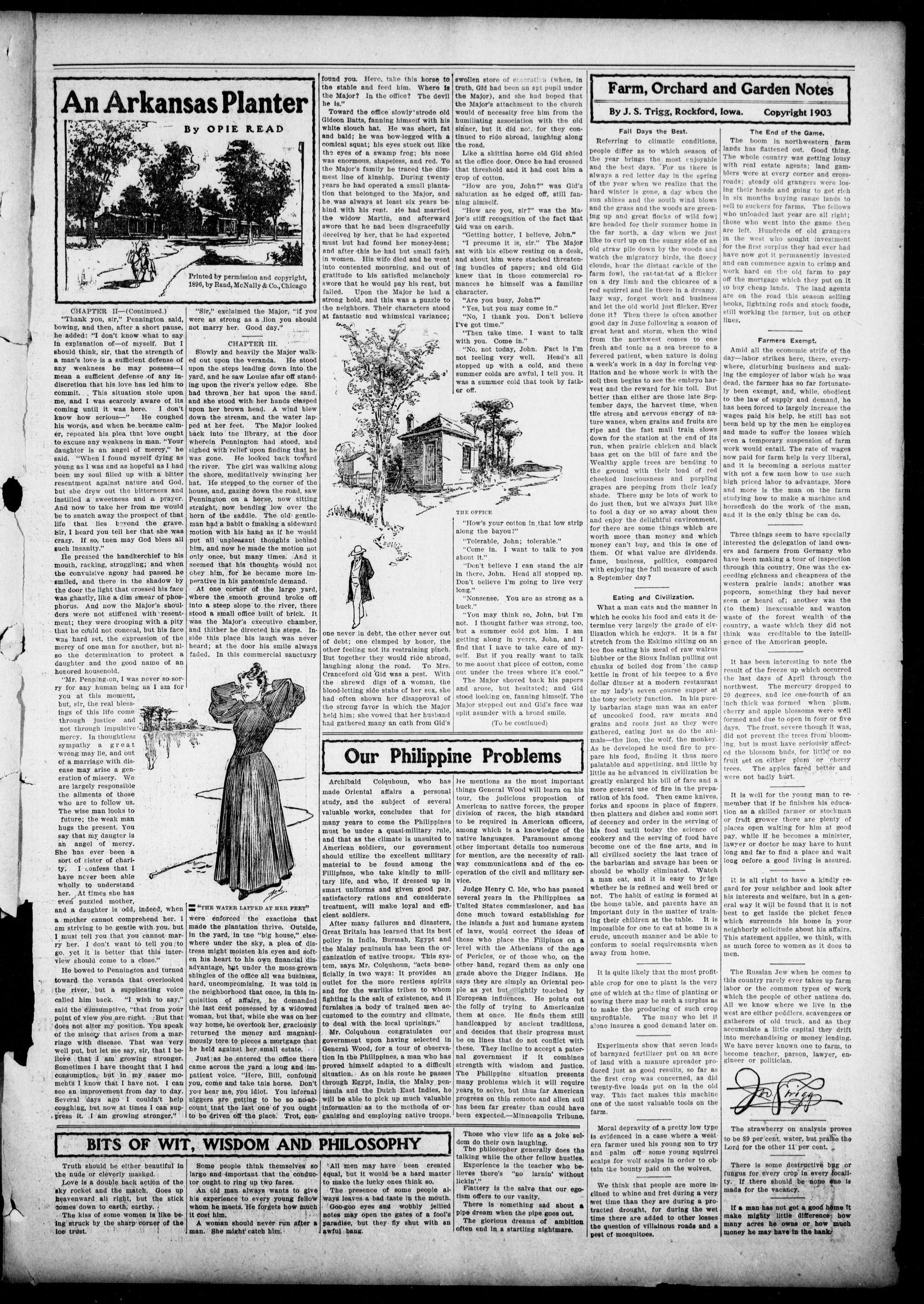
Slowly and heavily the Major walked out upon the veranda. He stood upon the steps leading down into the yard, and he saw Louise afar off standing upon the river's yellow edge. She had thrown her hat upon the sand, and she stood with her hands chasped upon her brown head. A wind blew down the stream, and the water lapped at her feet. The Major looked back into the library, at the door wherein Pennington had stood, and sighed with relief upon finding that he was gone. He looked back toward the river. The girl was walking along the shore, meditatively swinging her hat. He stepped to the corner of the house, and, gazing down the road, saw Pennington on a horse, now sitting straight, now bending low over the horn of the saddle. The old gentleman had a habit of fmaking a sideward motion with his hand as if he would put all unpleasant thoughts behind him, and now he made the motion not only once, but many times. And it seemed that his thoughts would not obey him, for he became more imperative in his pantomime demand.
At one corner of the large yard, where the smooth ground broke off into a steep slope to the river, there stood a small office built of brick. It was the Major's executive chamber, and thither he directed his steps. Inside this place his laugh was never heard; at the door his smile always faded. In this commercial sanctuary
"THE WATER LAPPED AT HER FEET"
were enforced the exactions that made the plantation thrive. Outside in the yard, in the "big house," elsewhere under the sky, a plea of distress might moisten his eyes and soften his heart to his own financial disadvantage, but under the moss-grown shingles of the office all was business, hard, uncompromising. It was told in the neighborhood that once, in this inquisition of affairs, he demanded the last cent possessed by a widowed woman, but that, while she was on her way home, he overtook her, graciously returned the money and magnanimously toore to pieces a mortgage that he held against her small estate.
Just as he entered the office there came across the yard a long and impatient voice. "Here, Bill, confound you, come and take this horse. Don't you hear me, you idiot. You infernal niggers are getting to be so no account that the last one of you ought to be driven off the place. Trot, con-
, WISDOM AND
Some people think themselves so large and important that the conductor ought to ring up two fares.
An old man always wants to give his experience to every young fellow whom he meets. He forgets how much it cost him.
A woman should never run after a man. She might catch him.
mum. She might eaten him.
T. H.
Our Philippine Problems
found you. Here, take this horse to the stable and feed him. Where is the Major? In the office? The devil he is."
Toward the office slowly strode old Gideon Batts, fanning himself with his white slouch hat. He was short, fat and bald; he was bow-legged with a comical squat; his eyes stuck out like the eyes of a swamp frog; his nose was enormous, shapeless, and red. To the Major's family he traced the dimest line of kinship. During twenty years he had operated a small plantation that belonged to the Major, and he was always at least six years behind with his rent. He had married the widow Martin, and afterward swore that he had been disgracefully deceived by her, that he had expected must but had found her money-less; and after this he had but small faith in women. His wife died and he went into contented mourning, and out of gratitude to his satisfied melancholy swore that he would pay his rent, but failed. Upon the Major he had a strong hold, and this was a puzzle to the neighbors. Their characters stood at fantastic and whimsical variance;
A
one never in debt, the other never out of debt; one clamped by honor, the other feeling not its restraining pinch. But together they would ride abroad, laughing along the road. To Mrs. Cranceford old Gid was a pest. With the shrewd digs of a woman, the blood-letting side stabs of her sex, she had often shown her disapproval of the strong favor in which the Major held him; she vowed that her husband had gathered many an oath from Gid's
Our Philippi
Archibald Colquhoun, who has made Oriental affairs a personal study, and the subject of several valuable works, concludes that for many years to come the Philippines must be under a quasi-military rule, and that as the climate is unsuited to American soldiers, our government should utilize the excellent military material to be found among the Fillipinos, who take kindly to military life, and who, if dressed up in smart uniforms and given good pay, satisfactory rations and considerate treatment, will make loyal and efficient soldiers.
After many failures and disasters, Great Britain has learned that its best policy in India, Burmah, Egypt and the Malay peninsula has been the organization of native troops. This system, says Mr. Colquhoun, "acts beneficially in two ways: It provides an outlet for the more restless spirits and for the warlike tribes to whom fighting is the salt of existence, and it furnishes a body of trained men accustomed to the country and climate, to deal with the local uprisings."
Mr. Colquhoun congratulates our government upon having selected in General Wood, for a tour of observation in the Philippines, a man who has proved himself adapted to a difficult situation. As on his route he passes through Egypt, India, the Malay peninsula and the Dutch East Indies, he will be able to pick up much valuable information as to the methods of organizing and employing native troops.
PHILOSOPHY
All men may have been created equal, but it would be a hard matter to make the lucky ones think so.
The presence of some people always leaves a bad taste in the mouth. Goo-goo eyes and wobbly jellied notes may open the gates of a fool's paradise, but they fly shut with an awful bang.
swollen store of execration (when, in truth, Gid had been an apt pupil under the Major), and she had hoped that the Major's attachment to the church would of necessity free him from the humiliating association with the old sinner, but it did not, for they continued to ride abroad, laughing along the road.
Like a skittish horse old Gid shied at the office door. Once he had crossed that threshold and it had cost him a crop of cotton.
"How are you, John?" was Gid's salutation as he edged off, still fanning himself.
"How are you, sir?" was the Major's stiff recognition of the fact that Gid was on earth.
"Getting hotter. I believe, John."
"Getting hotter, I believe, John."
"I presume it is, sir." The Major sat with his elbow resting on a desk, and about him were stacked threatening bundles of papers; and old Gid knew that in those commercial romances he himself was a familiar character.
"Are you busy, John?" "Yes, but you may come in."
"No, I thank you. Don't believe I've got time."
"Then take time. I want to talk with you. Come in."
"No, not today, John. Fact is I'm not teeling very well. Head's all stopped up with a cold, and these summer colds are awful, I tell you. It was a summer cold that took by father off.
THE OFFICE
THE OFFICE
"How's your cotton in that low strip along the bayou?"
"Tolerable, John; tolerable."
"Come in. I want to talk to you about it."
"Don't believe I can stand the air in there, John. Head all stopped up. Don't believe I'm going to live very long."
"Nonsense. You are as strong as a buck."
"You may think so, John, but I'm not. I thought father was strong, too, but a summer cold got him. I am getting along in years, John, and I find that I have to take care of myself. But if you really want to talk to me about that piece of cotton, come out under the trees where it's cool."
The Major shoved back his papers and arose, but hesitated; and Gid stood looking on, fanning himself. The Major stepped out and Gid's face was split asunder with a broad smile. (To be continued) ne Problems
He mentions as the most important things General Wood will learn on his tour, the judicious proposition of American to native forces, the proper division of races, the high standard to be required in American officers, among which is a knowledge of the native languages. Paramount among other important details too numerous for mention, are the necessity of railway communications and of the cooperation of the civil and military service.
Judge Henry C. Ide, who has passed several years in the Philippines as United States commissioner, and has done much toward establishing for the islands a just and humane system of laws, would correct the ideas of those who place the Filipinos on a level with the Athenians of the age of Pericles, or of those who, on the other hand, regard them as only one grade above the Digger Indians. He says they are simply an Oriental people as yet but lightly touched by European influences. He points out the folly of trying to Americanize them at once. He finds them still handicapped by ancient traditions, and decides that their progress must be on lines that do not conflict with these. They incline to accept a paternal government if it combines strength with wisdom and justice. The Philippine situation presents many problems which it will require years to solve, but thus far American progress on this remote and alien soil has been far greater than could have been expected.—Minneapolis Tribune
Those who view life as a joke seldom do their own laughing.
The philosopher generally does the talking while the other fellow hustles.
Experience is the teacher who believes there's "no larnin' without lickin'."
Flattery is the salve that our egotism offers to our vanity.
There is something sad about a pipe dream when the pipe goes out.
The glorious dreams of ambition often end in a startling nightmare.
Farm, Orchard and Garden Notes
By J. S. Trigg, Rockford, Iowa
Fall Days the Best.
Referring to climatic conditions, people differ as to which season of the year brings the most enjoyable and the best days. For us there is always a red letter day in the spring of the year when we realize that the hard winter is gone, a day when the sun shines and the south wind blows and the grass and the woods are greening up and great flocks of wild fowl are headed for their summer home in the far north, a day when we just like to curl up on the sunny side of an old straw pile down by the woods and watch the migratory birds, the fleecy clouds, hear the distant cackle of the farm fowl, the rat-tat-tat of a flicker on a dry limb and the charlee of a red squirrel and lie there in a dreamy, lazy way, forget work and business and let the old world just flicker. Ever done it? Then there is often another good day in June following a season of great heat and storm, when the wind from the northwest comes to one fresh and tonic as a sea breeze to a fevered patient, when nature is doing a week's work in a day in forcing vegetation and he whose work is with the soil then begins to see the embryo harvest and the reward for his toll. But better than either are those late September days, the harvest time, when the stress and nervous energy of nature wanes, when grains and fruits are ripe and the fast mall train slows down for the station at the end of its run, when prairie chicken and black bass get on the bill of fare and the Wealthy apple trees are bending to the ground with their load of red cheeked lusciousness and purpling grapes are peeping from their leafy shade. There may be lots of work to do just then, but we always just like to too a fool a day or so away about them and enjoy the delightful environment, for there are some things which are worth more than money and which money can't buy, and this is one of them. Of what value are dividends, fame, business, politics, compared with enjoying the full measure of such a September day?
Eating and Civilization.
What a man eats and the manner in which he cooks his food and eats it determine very largely the grade of civilization which he enjoys. It is a far stretch from the Eskimo sitting on an ice floe eating his meal of raw walrus blubber or the Sioux Indian pulling out chunks of boiled dog from the camp kettle in front of his teeepee to a five dollar dinner at a modern restaurant or my lady's seven course supper at the tony society function. In his purely barbarian stage man was an eater of uncooked food, raw meats and grains and roots just as they were gathered, eating just as do the animals—the lion, the wolf, the monkey. As he developed he used fire to prepare his food, finding it thus more palatable and appetizing, and little by little as he advanced in civilization he greatly enlarged his bill of fare and a more general use of fire in the preparation of his food. Then came knives, forks and spoons in place of fingers, then platters and dishes and some sort of decency and order in the serving of his food until today the science of cookery and the serving of food have become one of the fine arts, and in all civilized society the last trace of the barbarian and savage has been or should be wholly eliminated. Watch a man eat, and it is easy to judge whether he is refined and well bred or not. The habit of eating is formed at the home table, and parents have an important duty in the matter of training their children at the table. It is impossible for one to eat at home in a crude, uncouth manner and be able to conform to social requirements when away from home.
It is quite likely that the most profitable crop for one to plant is the very one of which at the time of planting or sowing there may be such a surplus as to make the producing of such crop unprofitable. The many who let it alone insures a good demand later on.
Experiments show that seven loads of barnyard fertilizer put on an acre of land with a manure spreader produced just as good results, so far as the first crop was concerned, as did twenty-five loads put on in the old way. This fact makes this machine one of the most valuable tools on the farm.
Moral depravity of a pretty low type is evidenced in a case where a western farmer used his young son to try and palm off some young squirrel scalps for wolf scalps in order to obtain the bounty pald on the wolves.
We think that people are more inclined to whine and fret during a very wet time than they are during a protracted drought, for during the wet time there are added to other losses the question of villainous roads and a pest of mosquitoes.
Copyright 1903
The End of the Game.
The boom in northwestern farm lands has flattened out. Good thing. The whole country was getting lousy with real estate agents; land gamblers were at every corner and crossroads; steady old grangers were losing their heads and going to get rich in six months buying range lands to sell to suckers for farms. The fellows who unloaded last year are all right; those who went into the game then are left. Hundreds of old grangers in the west who sought investment for the first surplus they had ever had have now got it permanently invested and can commence again to crimp and work hard on the old farm to pay off the mortgage which they put on it to buy cheap lands. The land agents are on the road this season selling books, lightning rods and stock foods, still working the farmer, but on other lines.
Farmers Exempt.
Amid all the economic strife of the day—labor strikes here, there, everywhere, disturbing business and making the employer of labor wish he was dead, the farmer has so far fortunately been exempt, and, while, obedient to the law of supply and demand, he has been forced to largely increase the wages paid his help, he still has not been held up by the men he employees and made to suffer the losses which even a temporary suspension of farm work would entail. The rate of wages now paid for farm help is very liberal, and it is becoming a serious matter with not a few men how to use such high priced labor to advantage. More and more is the man on the farm studying how to make a machine and horseflesh do the work of the man, and it is the only thing he can do.
Three things seem to have specially interested the delegation of land owners and farmers from Germany who have been making a tour of inspection through this country. One was the exceeding richness and cheapness of the western prairie lands; another was popcorn, something they had never seen or heard of; another was the (to them) inexcusable and wanton waste of the forest wealth of the country, a waste which they did not think was creditable to the intelligence of the American people.
It has been interesting to note the result of the freeze up which occurred the last days of April through the northwest. The mercury dropped to 20 degrees, and ice one-fourth of an inch thick was formed when plum, cherry and apple blossoms were well formed and due to open in four or five days. The frost, severe though it was, did not prevent the trees from blooming, but is must have seriously affected the blossom buds, for little or no fruit set on either plum or cherry trees. The apples fared better and were not badly hurt.
It is well for the young man to remember that if he finishes his education as a skilled farmer or stockman or fruit grower there are plenty of places open waiting for him at good pay, while if he becomes a minister, lawyer or doctor he may have to hunt long and far to find a place and wait long before a good living is assured.
It is all right to have a kindly regard for your neighbor and look after his interests and welfare, but in a general way it will be found that it is not best to get inside the picket fence which surrounds his home in your neighborly solicitude about his affairs. This statement applies, we think, with as much force to women as it does to men.
The Russian Jew when he comes to this country rarely ever takes up farm labor or the common types of work which the people of other nations do. All we know where we live in the west are either peddlers, scavengers or gatherers of old truck, and as they accumulate a little capital they drift into merchandising or money lending. We have never known one to farm, to become teacher, parson, lawyer, engineer or politician.
The strawberry on analysis proves to be 89 per cent. water, but praise the Lord for the other 11 per cent.
There is some destructive bug or fungus for every crop in every locality. If there should be none one is made for the vacancy.
If a man has not got a good home it make mighty little difference; how many acres he owns or how much money he may have in the bank.