The Professional World
Friday, June 19, 1903
Columbia, Missouri
Page text (machine-generated)
THE PROFESSIONAL WORLD.
$1.00 Per Year in Advance.
You Can Always
The Latest Novelties
and up-to-date Goods
in every Department...
Our efforts are always direct goods for the same money or money than you can find els
Our efforts are always directed to furnishing better goods for the same money or the same goods for less money than you can find elsewhere;
BUT WE NEVER CUT THE QUALITY TO MAKE A CUT PRICE.
Schultz Dry Goods = = = = =
= = = = and Carpet Company,
JEFFERSON CITY, MO.
[Name]
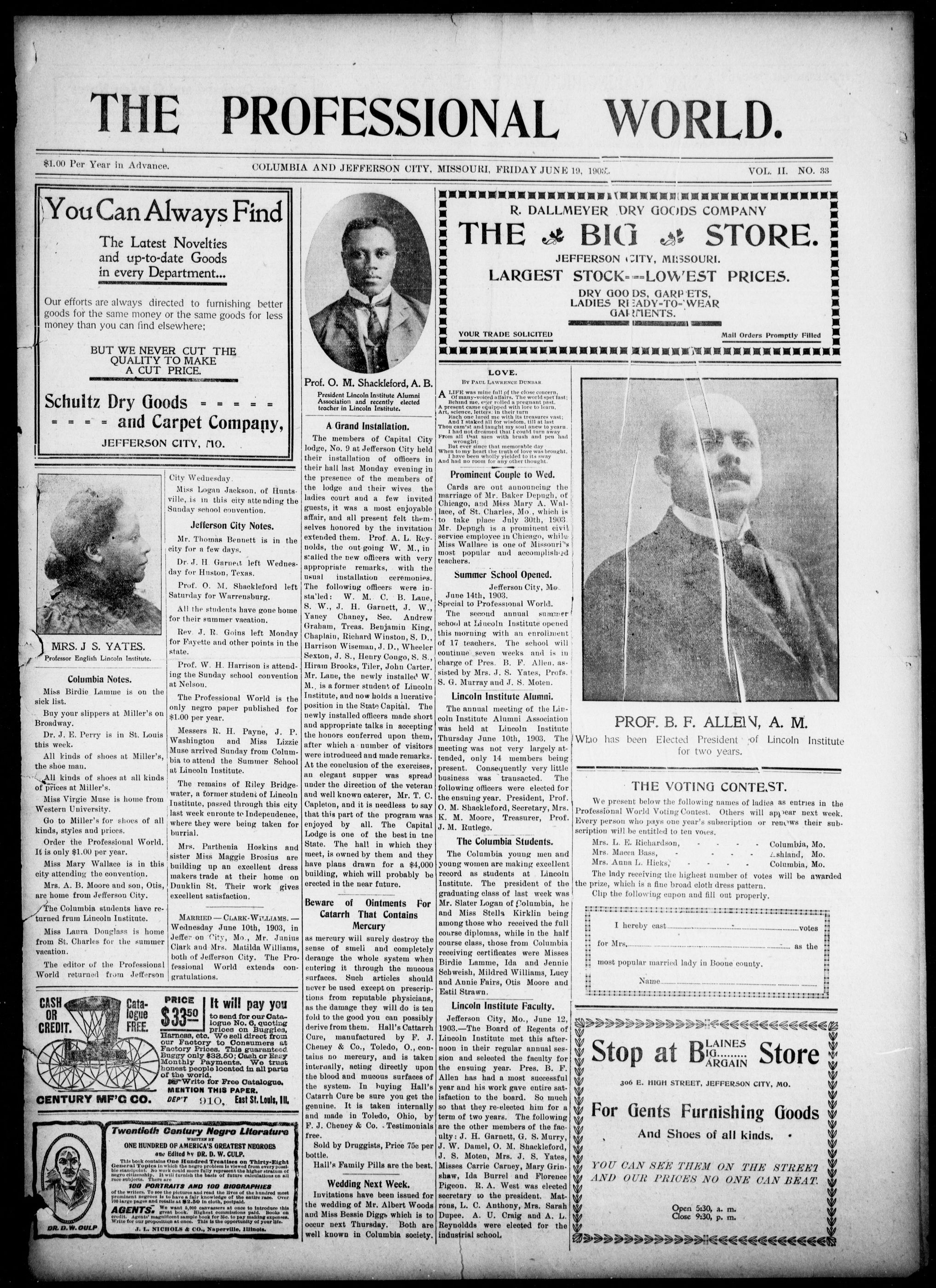
MRS. J S. YATES. Professor English Lincoln Institute.
Columbia Notes.
Miss Birdie Lamme is on the sick list.
Buy your slippers at Miller's on Broadway.
Dr. J. E. Perry is in St. Louis this week.
All kinds of shoes at Miller's, the shoe man.
All kinds of shoes at all kinds of prices at Miller's.
Miss Virgie Muse is home from Western University.
Go to Miller's for shoes of all kinds, styles and prices.
Order the Professional World. It is only $1.00 per year.
Miss Mary Wallace is in this city attending the convention.
Mrs. A. B. Moore and son, Otis, are home from Jefferson City.
The Columbia students have returned from Lincoln Institute.
Miss Laura Douglass is home from St. Charles for the summer vacation.
The editor of the Professional World returned from Jefferson
CASH OR CREDIT. Catalogue FREE.
CENTURY MF'G CO.
Twentieth Century Negro Literature
ONE HUNDRED OF AMERICA'S GREATEST NEROGS
and Edited by Dr. D. W. CULP.
This book contains One Hundred Treaties on Thirty-Eight
General Topics in which the negro problem is viewed from every posible standpoint. No work could more fully represent the higher stratum of negro citizenship; it will furnish the basis of future calculations on all race and the entire world.
100 PORTRAITS AND 100 BIOGRAPHIES of the writers. To see the pictures and read the lives of the hundred most prominent negroes in knowledge of the entire race. Over 100 maps and retails at $2.50 on each book.
AGENTS: We want $5,000 cavaliers at once to introduce this great book. Highest commissioned books on credit. Write for our proposition at once. This is the opportunity of your life.
---
DR. D. W. OULP
COLUMBIA AND JEFFERSON CITY, MISSOURI, FRIDAY JUNE 19, 1903.
City Wednesday. Miss Logan Jackson, of Huntsville, is in this city attending the Sunday school convention.
Jefferson City Notes.
Mr. Thomas Bennett is in the city for a few days.
Dr. J. H. Garneut left Wednesday for Huston, Texas.
Prof. O. M. Shackleford left Saturday for Warrensburg.
All the students have gone home for their summer vacation.
Rev. J. R. Goins left Monday for Fayette and other points in the state.
Prof. W. H. Harrison is attending the Sunday school convention at Nelson.
The Professional World is the only negro paper published for $1.00 per year.
Messers R. H. Payne, J. P. Washington and Miss Lizzie Muse arrived Sunday from Columbia to attend the Summer School at Lincoln Institute.
The remains of Riley Bridgewater, a former student of Lincoln Institute, passed through this city last week euronte to Independence, where they were being taken for burrial.
Mrs. Parthenia Hoskins and sister Miss Maggie Brosius are building up an excellent dress makers trade at their home on Dunklin St. Their work gives excellent satisfaction.
MARRIED — CLARK-WILLIAMS. — Wednesday June 10th, 1903, in Jeffer on City, Mo., Mr. Junius Clark and Mrs. Matilda Williams, both of Jefferson City. The Professional World extends congratulations.
It will pay you
to send for our Catalogue No. G, quoting prices on Buggiea
Buggies, etc. We sell direct from
our Factory to Consumers at
Factory Prices. This guaranteed
Buggy only $33.50; Cash or Easy
Monthly Payments. We trust
honest people located in all parts
of the world.
Write for Free Catalogue,
MENTION THIS PAPER.
DEP'T 910. East St. Louis, Ill.
[Name]
Prof. O. M. Shackleford, A. B. President Lincoln Institute Alumni Association and recently elected teacher in Lincoln Institute.
A Grand Installation.
The members of Capital City lodge, No. 9 at Jefferson City held their installation of officers in their hall last Monday evening in the presence of the members of the lodge and their wives, the ladies court and a few invited guests, it was a most enjoyable affair, and all present felt themselves honored by the invitation extended them. Prof. A. L. Reynolds, the out-going W. M., installed the new officers with very appropriate remarks, with the usual installation ceremonies. The following officers were insta'led: W. M. C. B. Lane, S. W., J. H. Garnett, J. W., Yancy Chaney, See. Andrew Graham, Treas. Benjamin King, Chaplain, Richard Winston, S. D., Harrison Wiseman, J. D., Wheeler Sexton, J. S., Henry Congo, S. S., Hiram Brooks, Tiler, John Carter. Mr. Lane, the newly installed W. M., is a former student of Lincoln Institute, and now holds a lucrative position in the State Capital. The newly installed officers made short and appropriate talks in accepting the honors conferred upon them, after which a number of visitors were introduced and made remarks. At the conclusion of the exercises, an elegant supper was spread under the direction of the veteran and well known caterer, Mr. T. C. Capleton, and it is needless to say that this part of the program was enjoyed by all. The Capital Lodge is one of the best in the State. The hall in which they meet, is owned by them and they have plans drawn for a $4,000 building, which will probably be erected in the near future.
Beware of Ointments For Catarrh That Contains Mercury
as mercury will surely destroy the sense of smeli and completely derange the whole system when entering it through the mucous surfaces. Such articles should never be used except on prescriptions from reputable physicians, as the damage they will do is ten fold to the good you can possibly derive from them. Hall's Cattarrh Cure, manufactured by F. J. Cheney & Co., Toledo, O., contains no mercury, and is taken internally, acting directly upon the blood and mucous surfaces of the system. In buying Hall's Cattarrh Cure be sure you get the genuine. It is taken internally and made in Toledo, Ohio, by F. J. Cheney & Co. Testimonials free.
Sold by Druggists, Price 75c per bottle. Hall's Family Pills are the best.
Wedding Next Week.
Invitations have been issued for the wedding of Mr. Albert Woods and Miss Bessie Diggs which is to occur next Thursday. Both are well known in Columbia society.
YOUR TRADE SOLICITED
BY PAUL LAWRENCE DUNBAR
A LIFE was mine full of the close concern,
of many-voiced affairs. The world spet fast;
the moment past,
A present cane equipped with the learn,
Art, science, letters; in their turn
Each one lured me with its treasures vast;
I staked all for wisdom, till at last
Thou canest and light my own souls to year.
I had not dreamed that I could turn away
From all that men with brush and pen had
wrongly;
In face of that memorable day
When to my heart the truth of love was brought,
I have been wholly yielded to its sway
And had no room for any other thought.
Prominent Couple to Wed.
Cards are out announcing the marriage of Mr. Baker Depugh, of Chicago, and Miss Mary A. Wallace, of St. Charles, Mo., which is to take place July 30th, 1903 Mr. Depugh is a prominent civil service employee in Chicago, while Miss Wallace is one of Missouri's most popular and accomplished teachers.
Summer School Opened.
June 14th, 1903.
Special to Professional World.
The second annual summer school at Liucolin Institute opened this morning with an enrollment of 17 teachers. The school will continue seven weeks and is in charge of Pres. B. F. Allen, assisted by Mrs. J. S. Yates, Profs.
S. G. Murray and J. S. Moten.
Lincoln Institute Alumni.
The annual meeting of the Lincoln Institute Alumni Association was held at Lincoln Institute Thursday June 10th, 1903. The meeting was not very largely attended, only 14 members being present. Consequently very little business was transacted. The following officers were elected for the ensuing year. President, Prof. O. M. Shackleford, Secretary, Mrs. K. M. Moore, Treasurer, Prof. J. M. Rutlege.
The Columbia Students.
The Columbia young men and young women are making excellent record as students at Lincoln Institute. The president of the graduating class of last week was Mr. Slater Logan of Columbia, he and Miss Stella Kirklin being among those who received the full course diplomas, while in the half course class, those from Columbia receiving certificates were Misses Birdie Lamme, Ida and Jennie Schweish, Mildred Williams, Lucy and Annie Fairs, Otis Moore and Estil Strawn.
Lincoln Institute Faculty.
Jefferson City, Mo., June 12, 1903.—The Board of Regents of Lincoln Institute met this afternoon in their regular annual session and selected the faculty for the ensuing year. Pres. B. F. Allen has had a most successful year and his work gave entire satisfaction to the board. So much so that they re-elected him for a term of two years. The following are the other members of the faculty: J. H. Garnett, G. S. Murry, J. W. Damel, O. M. Shackleford, J. S. Moten, Mrs. J. S. Yates, Misses Carrie Carney, Mary Grinshaw, Ida Burrel and Florence Pigeon. R. A. West was elected secretary to the president. Matrons, L. C. Anthony, Mrs. Sarah Dupee. A. U. Craig and A. L. Reynoldds were elected for the industrial school.
VOL. II. NO. 33
COMPANY
STORE.
PRICES.
Mail Orders Promptly Filled
ROF. B. F. ALLEN, A.
been Elected President of Lincoln
for two years.
LLEIN, A. M.
ident of Lincoln Institute years.
M.
Who has been Elected President of Lincoln Institute for two years.
THE VOTING CONTE.ST.
nt below the following names of ladies as World Voting Contest. Others will appe
who pays one year's subscription or renq
be entitled to ten votes.
L. Richardson, - - - - Colu
ea Bass, - - - - 4shl
names of ladies as entries in s
Others will appear next we
description or renews their s
- Columbia, Mo.
- Ashland, Mo.
- Columbia, Mo.
number of votes will be aware
We present below the following names of ladies as entries in the Professional World Voting Contest. Others will appear next week. Every person who pays one year's subscription or renews their subscription will be entitled to ten votes.
Mrs. L. E. Richardson, - - - - Columbia, Mo.
Mrs. Macea Bass, - - - - Ashland, Mo.
Mrs. Anna L. Hicks, - - - Columbia, Mo.
The lady receiving the highest number of votes will be awarded the prize, which is a fine broad cloth dress pattern.
Clip the following epon and fill out properly.
306 E. HIGH STREET, JEFFERSON CITY, MO.
YOU CAN SEE THEM ON THE STREET AND OUR PRICES NO ONE CAN BEAT.
---
Conference on International Arbitration Addressed By Hon. John W. Foster.
Lake Mohonk, N. Y., June 3.—The Lake Mohonk conference on International arbitration met here. The general topic of the first session was the present outlook of arbitration. The opening address was made by John W. Foster, formerly secretary of state, who told the decision of the Plus fund case, submitted by the United States and Mexico to the Hague, and the acceptance of the decision by both governments. He told of the agreement made by Chile and Argentine to submit all disputes to arbitration, adding:
"They further agreed to stop the construction of more naval vessels and to sell those which were ordered at the time the war fever was raging, and as a result there are now in the naval dockyards of Europe several war vessels of the two nations seeking customers. They also agreed to reduce their armies to a peace footing and to so maintain them, and to particularly disarm their naval vessels at once.
"As a result of this disarmment, we are informed by recent press news from Buenos Ayres that the minister of marine has tendered to the minister of agriculture two of his unoccupied men-of-war, to transport grain and meat products to South Africa, where the government is seeking to open up a new market for their superabundant harvests. With a slight change in the biblical metaphor, may we regard this as the beginning of that millenium era, foretold by the ancient prophet, when the people 'shall beat their swords into plow shares, and their spears into pruning hooks; nations shall not lift up a sword against nation, neither shall they learn war any more.'
An Inspiring Example.
"From these ear away countries, where we have been so prone to expect war and disorder, comes this inspiring and hopeful example. They are people, too, of a different religion and race from the most of us—Catholics, not Protestants; Spanish-Americans of the Latin race, not the boastful Anglo-Saxon. May we not learn from this to be a little more charitable in our criticisms of the countries to to the south of us, in their struggles to free themselves from the customs which enchain them during so many centuries of misrule."
COMEDY FOR TRAVELERS
A Gypsy Mother Thrashes Her Seventeen Children in Denver Railway Station.
Seventeen gypsy children afforded people at the Union depot considerable amusement yesterday afternoon. They are all children of the same mother, who accompanied them with her husband, and are on their way from New York to San Francisco.
With their wardrobes and sleeping arrangements these 19 occupied floor space in one of the waiting rooms and the children skirmished around to see how many nickels would reward their dancing and witticisms. When this had been worked for all that it was worth paterfamilias called his brood to dinner, which consisted largely of apples and onions.
Things were going on peaceably, fragments were being scattered in all directions, the mother had a large pot of coffee balanced precariously on a pile of bedding at her elbow when some individual with a better sense of kindness than of cause and effect tossed a dime into the midst.
There was a simultaneous rush and a screech from 17 throats. Unfortunately the coin had fallen close to the mother. In the scramble woman, bedding, coffee, children and "grub" were mixed in an indistinguishable heap, which only disentangled itself after the smallest one of the lot had crawled out with the money in her mouth.
As soon as the mother got her bearings it was evident that she was not in the best of tempers. When she had satisfied herself that the dime had not been lost, she proceeded to thrash impartially her entire flock.—Denver Republican.
New Rochelle, N. Y., June 3.—Fearing that his congregation would not attend the new $40,000 church given by Adrian Iselin to the Italian Roman Catholics of this place if non-union labor was employed. Father Manzello, a nephew of Cardinal Satolli, has ordered all the men at work on the building to cease operations.
The contractor had ignored the strike in the building trades and was employing non-union men. The church probably will remain as it is until the strike is ended.
A NEW COALING HIGH WATER AT STATION KANSAS CITY
Admiral Dewey Advises One for Alaska
DUTCH HARBOR IS THE SITE
Report Recommends Erection of Coal Depot With a Capacity of 50,000 Tons
Washington, June 3.—Admiral Dewey as president of the general board, has made a report to Secretary Moody recommending the immediate establishment of a coaling station at Dutch Harbor, Alaska, and the erection there of a coal depot with an initial capacity of 5,000 tons. The estimated cost of the work is about $51,000. The money is now available. Believing the establishment of a coal depot at this strategic point will strengthen the United States on the Pacific ocean, the president has heartily approved the plan and preliminary steps in the work have been taken already.
Dutch harbor is located on one of the Aleutian islands and is the direct commercial route between the ports of Behring sea and southern Alaska and the Pacific coast of the United States. It is also in line of steamers passing through the Unimak pass, port of call. Its use as a coal depot site was first recommended by Rear Admiral Bradford, chief of the bureau of equipment. His recommendation was referred to the general board and is now about to be executed according to his plans.
Dutch harbor will form the fifth in the chain of coal depots along the Pacific coast, which will begin at San iDego and include San Francisco, Puget Sound and Sitka. Honolulu is the sixth in the chain and Guam possibly may be added to the list. In recommending Dutch harbor as a site for a coal depot the general board has in mind the fact that there is no coal suitable for naval purposes mined anywhere within thousands of miles.
Rear Admiral Bradford in his report recommending this new coaling station said: 'Attention is also invited to one of the great political questions of the day, viz., the settlement of the boundary between the territory of Alaska, and the Dominion of Canada. 'Ineere is abundant evidence to show that the spirit of Canada on this matter may be considered threatening.
Between Alaska and the continental limits of the United States is located the domain of a foreign country. The territory separating Alaska has good harbors and ample anteriors waters and this fact alone constitutes a great strategic advantage to a possible opponent. It certainly constitutes a strong reason why the sinews of war, whatever they may be, should be stored in Alaska."
Although Silika is located in the vicinity of the disputed boundary, there is no coal kept there by mercantile companies and the navy frequently has been embarrassed for the want of coal in the protection of American seal and other interests. A coal depot at Dutch Harbor, it is believed, also will prove a great aid to commerce, as ships are frequently in need of coal when reaching this point, and an arrangement will be made by which the government can sell coal to steamships applying for it.
DIGGING FOR TREASURE.
Illinois Farmers are Looking for a
Chest Said to Contain $25,000.
Percy, Ill., June 4.—Farmers living in the vicinity of Hawthorne creek, near here, are quietly digging on their farms for a chest containing $25,000 in gold and silver, constituting the treasure buried by Colonel George Rogers Clarke and his men. The money is supposed to have been buried by Clarke's men before a battle near the creek. That the battle was fought is a historical fact. A man who came here from France a short time ago confirmed the story and claimed to know where the treasure had been buried. Te went away, however, without giving any further information. The legend current in this section has it that the night before Clarke and his men had the battle four of the party we sent to bury the gold and silver. Their bodies were found later and the hiding place of the treasure remained a secret.
Information has been received from Rome that the installation of Mgr. O'Connell as president of the Catholic University of America, in succession to Bishop Conaty, will not be held on April 22, as had been arranged.
KANSAS CITY CONDITIONS ARE IMPROVED
Square Miles of Business District Submerged
WATER WORKS ARE CLOSED
Railroad Trains are Unable to Reach the City----Business in all Lines at a Standstill
(Kansas City special.)—The flood situation here showed no improvement this morning, except that the fires which it was feared last night would spread were put out by the rain. The only rail communication the city has, and that is very uncertain, is by a road running south and east.
Business all over the city is suspended. Manufacturers on the high ground are compelled to shut down owing to the almost total shutting off of the water supply. No street cars are running.
The river guage this morning showed 35 feet, having risen from 30.7 in the night. This is nearly nine feet higher than at any previous high record.
Committees having in charge the work of relief and rescue were busy early, and a special meeting of the city council was held during the forenoon.
Thousands of refugees at Convention hall made their breakfasts from liberal rations issued by the relief committee.
The police have been ordered to shoot on sight any one caught plundering.
The number of lives lost in this vicinity cannot be learned for some time, and probably never will be known definitely. However, there seems to be ample verification of the reports which account for the loss of more than a dozen lives in the bottoms.
Great anxiety is felt for the safety of the people of Kansas City. One rumor circulated during the night was that scores of people had perished there, but owing to the fact that there has been absolutely no communication with that place since yesterday there is a general disposition to discredit these and other sensational reports. That there has been some loss of life there, however, is regarded as probable.
Kansas City, June 2.—There is a decided improvement in the situation this morning and there is a general feeling that Kansas City has seen the worst of the flood. Unofficial weather guages in the union depot showed a fall of about six inches during the night, while the official report shows it is stationary. The danger line of famine has passed and the railroads are confident that they will be able to bring in ample supplies from this time on. There is a greater scarcity of food in Kansas City, Kans., but with the opening of the electric line from Leavenworth, it is thought that there will be no acute distress and it is believed the water supply will be in a measure restored by night fall. All the cable car lines have resumed, but the power plant of the electric lines is under water, and these roads will not be able to run until the water subsides.
The financial damage is estimated by prominent business men at anywhere between ten and twenty-five million dollars in this city alone, but there is no method of determining this with accuracy.
The great danger now is the crumbling of brick buildings and this has begun in some quarters where old buildings are standing.
It was announced by the police engaged in relief work in the east bottoms that all the people who had been imprisoned in houses in that district had been rescued, and that there was no chance for any further loss of life. The story yesterday of fifty Belgians drowned in the east bottoms this morning has proved to be untrue.
Death List May Be Fifty.
It is estimated that fifty persons have been drowned in this city. This estimate may be too large. Eighteen victims of the flood were reported last night. The number has not been greatly added to today. There were rumors this morning that fifty Belgians had been drowned in Sycamore avenue but careful inquiry by the police failed to confirm the story.
Extent of Property Loss.
The first estimates of the losses were exaggerated. The greatest loss to the big packing houses across the river will come from enforced idleness. The machinery plants will be rusted but not ruined.
The wholesale houses in the city
Telegraph and telephone wires north, south and west are down, and there are only a few wires cast. At 11 o'clock the weather bureau issued the following:
"There will probably be a slight change in the river conditions at Kansas City during the next 24 hours. Slight fluctuations mean but little in the way of relief so long as the weather conditions remain unsettled. The storm area is central in the middle Mississippi valley, from which the West has not emerged, and the threatened development of another storm area in the southwest carries no assurance of immediate relief. Rain was falling over a great part of Kansas, Iowa, Missouri and Nebraska this morning."
According to statements of flood refugeeesc, which generally are exaggerated, from the east bottoms, about 50 Belgian men, women and children, were drowned near the Crescent hotel on Sycamore avenue, early this morning. Another refugee reported the drowning of 12 people by the capsizing of their skiff. None of these stories have been substantiated. Kansas City, Mo., June 1.—Twelve square miles of the two Kansas Citys are submerged. Armourdale is abandoned, Argentine and other suburban towns are under water, and millions of dollars worth of property has been destroyed as a result of the flood.
The waterworks plant has shut down. All electric cars are idle. Railroad trains cannot enter the city. The Union depot in this city has been abandoned. The freight depots are under water.
The property loss in Kansas City and the city across the river is estimated at $6,000,000.
Fifteen persons are known to have been drowned in this city, and it is feared that the death list will reach 60.
At 6 o'clock last evening eight separate fires were burning unchecked in the submerged district. It is impossible for the fire departments to reach them.
Shortly after noon yesterday the Third regiment, M. N. G., 800 strong, was ordered out, both as a precautionary measure and to stop looting. The flooded district of the two Kan-border of the circle mentioned. Early Sunday morning the rise in the Kansas Citys covers an area three miles long by four miles wide. The flood forms a semi-circle reaching south and west from the Union depot, which is located under high bluffs that mark the dividing line between Kansas City, Mo., proper and what is known as the West bottoms.
The principal damage done was at Armourdale and Argentine, Kas., in the packing house district on the Kansas river, on the extreme southwest sas river met the waters of the Missouri on the northwest and merged finally at the highest point, at the union depot.
will be losers to the extent of the value of the goods stored in the basements and they will lose, also, through inability to fill orders.
Last night the city was in darkness. There was not the glimmer of a gas jet or the flare of an electric light, save in buildings which have their own electric light plants. Steam for these plants is supplied from the water hauled from the river. Power for the three street car lines that have resumed operation is furnished by water, piped six squares from a small stream in one of the valleys.
In all of the buildings in the city elevators have been discontinued, unless provision has been made for hauling water.
The newspapers have been compiled to discontinue the use of their types setting machines, and because of lack of power are sticking type in the good old way.
Water Supply Is Short.
In the hotels, all of which are crowded to their utmost capacity, the most elaborate care is taken to prevent waste of water. In front of every washroom a guard is stationed and no guest is admitted, even to wash his hands, unless he identifies himself at the desk, secures the key of his room, and in this manner having proved his character and intention good, he is permitted to enter, slop out water from a pail, and do the best he can with it.
The gas company made a fight all day to keep gas in the mains, but at 2 o'clock yesterday afternoon Secretary MacMillan of the gas company said he would be forced to shut down.
The question of food supply is a disquieting one. There was a run on every retail grocery and meat store in Kansas City yesterday morning. The storekeepers handled the situation as systematically as possible, and no large quantities were sold to any one buyer.
The widow of Sir Hector MacDonald and her son have received the maximum allowance from the government possible in the case of the widow and the child of an officer. In addition an appeal has been issued for funds to enable the boy to continue his education at Dulwich college and give him a start in life.
Farm, Orchard and Garden Notes
When we note how useful an animal the mule is we sometimes wonder why he was not made in the first place instead of a jackass.
If it were only practicable it would be a good idea to make every owner of a farm responsible for the condition of the highways bordering his land.
The Kansas experiment station has realized $11.90 acre from rape pasture and $24.10 from alfalfa pasture when fed to hogs in connection with a light feed of grain.
The shrike or butcher bird quick to note the availability of barbed wire fence as just the place him to impale his victims upon.
Along the bottom lands of the zos and Arkansas rivers the c stalks grow so large that it is as much work to clear the land a new crop as it would be to clear hazel brush.
If no man asked or could get at and all paid spot cash what a n world this would be to do business.
It is now said that the oleo fellows are coloring their product with the yolks of eggs. They are bound to get that steer butter into the gizzards of the American people somehow.
And now the distressing information comes from an Iowa town that one of its citizens is in a bad way as the result of eating a package of bird seed, mistaking it for a new brand of breakfast food.
The hog, bringing more than ordinary good prices for the past year, has enabled the feeders of beef cattle to get out without serious loss this season. If it had not been for the pig they would have been in a hole.
Where milk is set in deep cans in cold water and the cream thus raised the farm separator will step in and give the dairyman about 20 per cent. more cream. You can do some figuring yourselves with this fact to start from.
The time is here now when the farmer with a $15,000 corn and hog farm drives into town and pays 30 cents for two boxes of strawberries, when he might raise the luscious berries by the bushel just as easily as he raises the corn to feed his hogs.
Rabbits make about the best pets for children. They are reasonably cleanly, are not expected to have the run of the house like cats and dogs, always have a lot of cute little ones, and the surplus may be sold and not killed off on the home place to get rid of them.
It is but reiterating a baldheaded truth to say that any man is a fool to ship to any commission house which offers more than the going prices for a product, and still men are being bitten in this manner all the time because their greed and avarice are better developed than their common sense.
A lady who died recently in the east left by will to her husband $100 per month and her cat and dog $50 per month. From this it would appear that the deceased lady thought just twice as much of her husband as she did of her cat and dog. We know of cases where it is just the other way.
The difference between butter which scores 97 and that which scores $97\frac{1}{2}$ is so small as not to be detected save by a buter expert, still, the $97\frac{1}{2}$ fellow walks off with the gold medal, gets his picture in the dairy journals and like enough has a brand of salt named after him.
The payment of the road taxes has for many years been loaded on to the tenant of the farm—that is, he has been required to work out that part which could be paid in that manner. The payment of all the road taxes in cash lets the tenant out and makes the landlord kick.
We have a friend who has so great a love for the birds that he can find all the birds' nests in tree, shrub or grass wherever he goes, and then we have another friend who can never see a bird's nest until the leaves are all off the trees and the birds flown to the south. Men will find the thing which they love and look for, whether it be birds' nests or good qualities in their neighbors.
We count a strawberry bed and an asparagus bed properly cared for as foremost among the cheapest and most desirable luxuries for the family. To have these two things in abundance is to solve the problem of good living from the 1st of May to the 1st of July; then have the green peas follow the asparagus and the red and black raspberries, the strawberries, and who cares whether school keeps or not?
The paper said that he was a rich farmer; had half a section of good land, lots of stock, fine home and all that; that he went to town, filled up on whisky and then went home and thrashed his good wife. Now, there is no use in cussing the saloon keeper in such a case as this, but instead this old duffer should be given thirty days at hard labor in the county jail in spite of his standing and money. This would cure him. It will cure nine out of ten of such cases.
The shrike or butcher bird was quick to note the availability of the barbed wire fence as just the place for him to impale his victims upon.
Along the bottom lands of the Brazos and Arkansas rivers the cotton stalks grow so large that it is almost as much work to clear the land for a new crop as it would be to clear it of hazel brush.
If no man asked or could get credit and all paid spot cash what a nice old world this would be to do business in. While such a system would be hard on some, the people as a whole would be better off.
One of the best ways to get rid of quack grass is to seed the field down with clover and give it a good coat fertilizer. The clover will then grow so dense and heavy that it will choke the quack grass out.
Even where corn cannot be successfully grown barley, peas, millet ground, clover and blue grass will, with skim milk, make lots of pork, and mighty good pork, too, and any country where these things can be produced should raise hogs:
We have a young friend who got his home in shape, furniture and domestic equipment all complete, before he got married, which is so much better than hiking off to some justice or parson to get married and then going to live with the old folks.
A good many men in the west in trying to produce both beef and butter on their farms do well with neither. The two interests are always and forever clashing, and most men will make a better combination with the steer and the hog or the dairy cow and the hog.
A great deal of very careful, scientific and thorough work is being done in the states of Iowa and Illinois in the effort to improve the quality of the corn. Already by the use of selected and pedigreed seed an increase in yield of twenty-five bushels per acre is reported from Illinois.
The kind of roads a whole lot of people are clamoring for will cost the taxpayers not less than $3,000 per mile. It has taken 200 years to get this kind of highways in Europe, and the people there have been further favored with an abundance of pauper labor and a military necessity to help build them.
We just hate to come across a man, or worse yet, a community, which is on the hog to that extent that it will take no interest in any matter of public improvement unless it brings dollars into its pockets. Even the Sloux Indian would decorate his tepee, nearly all birds will use art and refinement in the building of the nest, while thousands of so-called civilized human beings will care as little for their home surroundings as a fox in his den. We have altogether too much civilization which does not civilize.
If the public highways did not border every man's farm and were confined to a few leading thoroughfares through a county it would be easier to get good work done on such roads. Some men are so narrow and selfish that if any money is paid by them for such a purpose they want it applied on the highway in front of their lands even if three teams did not travel the road. The main traveled roads should be first put in good shape; then when this is done the byroads can receive attention.
He called at the farmer's house, praised his crops and his stock and his children, with the result that he got the granger's name signed to an order for a twenty dollar map or atlas of somee sort. When he came to deliver the book the farmer's wife, a muscular female, went for the little sandy haired agent with a poker and made him cancel the order. When the old man came home to supper there was a family scene which we are prevented from properly describing in these notes and can only say that the old man looked tired when he went to bed.
There is a lot of vegetation which will thrive and grow at a temperature of from 55 to 65—for instance, peas, rajishes, onions, potatoes, turnips, barley, wheat, rye, cabbages, cauliflowers, apples, currants, gooseberries, and in flowers violets, tulips, crocus, sweet peas, but a temperature of 80 to 90 is essential for the growth corn, melons, cucumbers, tomato peaches and grapes. The differ between a temperature of 65 and only 25 degrees, determines what shall be the cereal, vegetable, floral and fruit products of a country.
‘epee By OPIE READ
Sa ee ae
A ee! RR. Bei ee TAGS
ach mee ree Gee rag
% | % “; iy Seca fees,
eeosb Bo PS, ho
eh ee if. Rae
eae hy Ne rae Nagy
; : i Ay OL ca
oem tir Lio
| Pa x ci eed
ne
wae Printed by permission and copyrihgt,
1896, by Rand, McNally & Co., Chicago
Short Stories of the Children
CHAPTER 11—(Continued.)
“The devil—pardon me,’ he quickly
added, withdrawing his hands from
his pockets and bowing to her. She
slightly inclined her head and smiled
sadly. He looked hard at her, striv-
ing to read her thoughts; and she
was frail, her face was so thin and
her eyes so wistful that she smote
him with pity. He reached over and
took one of her hands, and affection-
ately she gave him the other one.
She tried to laugh. The cough came
again, and she took her hands away.
He reached for them, but she put
them behind her. “No, not until I
have told you,” she said, and he saw
her lip tremble. “He was afraid to
come in here to see you,” she went
‘on, speaking with timid slowness. “He
is so weak and sick that he can't
stand to be scolded, so I have come to
—" She hesitated. He shoved him-
self back and looked hard at her, and
ee ev \
bi aN
Aa)
“Manny mim?” ty Bi
ye a
his eye-brows stuck out fiercely.
“To ask me what?” His voice twa:
dry and rasping. “What can you ask
me? To let him come here to sec
you? No, daughter. I can’t permit
that. And I don't intend to be crue
when I say this. I am sorry for him
God knows I deeply sympathize with
him, but he must not hope .to—”
“I was not going to ask you to let
him come,” she broke in. “I am go:
ing to ask you to let me go—go with
him.”
“By the blood!” the major ex
claimed, jumping to his feet. “What
do you mean? Marry him?”
“Yes, sir,” she quietly answered.
He looked at her, frowning, his face
puffed, his brows jagged. And then
appearing to master himself he sat
down and strove to take her hand,
but she held it behind her. “My
daughter, I want to talk with you, not
in anger, but with common sense. It
actually horrifles me to think of your
marriage—I can’t do it, that’s all,
‘Why, the peor fellow can’t live three
months; he is dead on his feet now,
Listen at that cough. Louise, how
can you think of marrying him?
Haven't you any judgment at all? Is
4s possible that you have lost—but I
won't scold you; I must reason with
you. There is time enough for you to
marry, and the sympathetic fancy
that you have for that poor fellow
will soon pass away. It must, You've
got plenty of chances. Jim Taylor—”
“Why do you speak of him, fath-
er?"
“I speak of him because he loves
you—because he js as fine a young fel-
low as walks the face of the earth.”
“But, father, he {s so big and strong
that he doesn't need any one to love
him.”
At this the Major appeared not to
know whether to laugh or to frown.
but he did neither; he sat for a cme
with bis hands on his knees, looking
wonderingly, almost stupidly at her;
and then he said: “Nonsense. Where
did you pick up that preposterous
idea? So strong that he doesn’t need
love! Why, strength demands love
Teacher: See how thin this sheet of
paper is? Now, Johnnie, do you
know of anything else that’s thin?
Johnnie: Yes'm; my excuse for be-
ing late—Chelsea Gazette.
Stories of the Children.
Mother; Why are you so naughty,
Dorothy?
Dorothy (aged three), ‘Cause {t's
easier, muzzer.
“—_— o> & 06 Man the love of a little
woman—" She drew back from him
as he leaned toward her and he did
not complete the sentence, Her im-
patience made him frown. “Won't
you let me reason with you?” he
asked, “Won't you help me to sup-
Dress all appearance of displeasure?”
“It is of no use,” she replied,
“What is of no use? Reason?”
“Argument.”
“What! Do you mean—”
“I mean that I am going to marry
him”
In her eyes there was no appeal, no
pleading, for the look that she gave
him was hard and determined. Harsh
words flew to the Major's mind, and
he shook with the repression of them;
but he was silent. He shoved his
hands into his pockets and she heard
his keys rattling. He arose with a
deep sigh, and now, with his hands be-
hind him, walked up and down the
room. Suddenly he faced about and
stood looking down upon her, at the
rose in her hair,
“Louise, one night on a steamboat
there was a rollicking dance. It was
@ moonlight excursion. ‘There was a
splash and a cry that a woman had
fallen overboard. I leaped into the
river, grasped her, held her head
above the stream, fighting the current.
A boat was put out and we were taken
‘on board, and then by the light of a
lantern I found that I had saved the
life of my own daughter. So, upon
you, I have more than a father’s claim
—the claim of gallautry, and this you
cannot disregard, and upon it I base
my plea.”
She looked yp straight at him; her
lips were half open, but she said
nothing.
“You don’t seem to understand,”
he added, seeming to stiffen his shoul-
ders in resentment at the calmness
with which she regarded him. “I tell
you that I waive the authority of a
father and appeal to your gratitude;
I remind you that I saved your life—
leaped into the cold water and seized
you, not knowing whose life I was
striving to save at the risk of losing
my own. Isn't that worth some sort
jot return? Isn't it worth even the
sacrifice of a whim? Louise, don't
look at me that way. Is it possible
that you don’t grasp—" He hesitated
and turned his face toward the parlor
whence came again the cough, hollow
and distressing. ‘The sound died away,
echoing down the hall, and a hen
clucked on the®porch and a passage
door slammed.
“Louise,” he said, looking at her.
“Yes, sir.”
“Do you catch—”
“T catch everything, father. It was
noble of you to jump into the river
when you didn't know but that you
might be drowned, and recognizing
that you risked your life, and feeling
a deep gratitude, it is hard to repay
you with disobedience. Wait a mo-
ment, please, You must listen to me.
It is hard to repay you with disobedi-
ence, but it cannot be helped. You
say that Mr. Pennington is dying and
I know that you speak the truth, He
knows that he is dying, and he ap-
peals to me not to let him die alone—
not alone in words,” she quickly add-
ed, “but with something stronger than
words, his helplessness, his despair.
Other people have appeared to shun
him because he is dying, but—"
“Hold on,” he broke in. “I deny
that, No one has shunned him be-
cause he is dying. Everybody {s sor-
ry for him, and you know that I would
do anything for him.”
“Would you? Then let him die un-
der this roof as my husband. Ob, look
how poor and thin he is, so helpless,
and dying day by day, with no rela-
tives near him, with-nothing in pros-
EE
Perhaps . the most remarkable
bridges in the world are the kettle
bridges in Russia and Siberia, of
which Cossack foldiers are expert
builders. ‘They are built up of the
soldiers’ lances and cooking kettles.
Seven or eight lances are placed un-
der the handles of a number of ket:
tles and fastened by means of ropes
to form a raft. Each of these rafts
will béar the weight of half a ton.
Please don’t tell me that I shan’t take
care of him, for I feel that tt is the
strongest duty that will ever come to
me. Listen how he coughs. Doesn't
it appeal to you? How can you refuse
—how can you remind me of the grat-
itude I owe yout”
Tears were streaming down her
face, He bent over her, placed his
hands upon her cheeks and kissed her,
but instantly he drew back with his
resentful stiffening of the shoulders,
“Louise, it can't be, No argument
and no appeal can bring it about. It
makes me shudder to think of it, Real:
ly I can’t understand it. The situa-
tion to me is most unnatural. But I
won't be harsh with you. But I must
say that I don't know where you get
your stubbornness. No, 1 won't be
harsh, Let me tell you what I will
agree to do. He may come to this
house and stay here until—may stay
here and the best of care shall be
taken of him, and you may nurse him,
but you must not bear his name. Will
you agree to this?” *
She shook her head. Sho had
wiped away her tears and her eyes
were strong and determined. “After
conceding so much I don’t see why
you should refuse the vital point,” sho
said.
“I can tell you why, and I am afraid
that I must.”
“Don't be afraid; simply tell me,”
“But, daughter, it would seem
cruel.”
“Not if I demand it.”
“Then you do demand it? Well, you
shall know. His father served a term
in the Louisiana pententiary for for-
gery. And now you may ask why I
ever Jet him come into this house. I
will tell you. He had been teaching
school here some time and I said
nothing. One day during a rainstorm
he stopped at the gate. He was sick
and I invited him to come in, After
that I could not find enough firmness
to tell him not to come, he was so pale
bee weak. I see now that it was a
false sympathy. Do you understand
me? His father was a convict.”
“Yes, I understand, He told me.”
“By the blood on the Cross! Do
you mean to say—Louise,” he broke
off, gazing upon her, “your mind is un:
settled. Yes, you are crazy, and, of
course, all your self-rsepect is gone.
You needn't say a word, you are crazy.
You are—I don’t know what you are,
but I know what I am, and now, after
[the uselessness of my appeal to your
eratitude, I will assert the authority
lof a father, You shall not marry
him.”
“And would you kill a dying man?”
she quietly asked,
The question jolted him, and he
snorted out: “What do you mean by
such nonsense? You know I wouldn't.”
“Then I will marry him.’
For a moment the Major's anger
choked him. With a dry rasp he
strove to speak, and just as he had
made smoother a channel for his
words, he heard the hollow cough
drawing nearer. He motioned toward
la door that opened in an opposite di-
‘rection, and the girl, after hesitating
a moment, quickly stepped out upon a
veranda that overlooked the river.
‘The Major turned his eyes toward the
other door, and there Penningtu.
‘stood with a handkershief tightly
to his mouth,
For a time
they were si-
lent, one was
strong and
severe, the
other tremu-
lous and al-
most sbectral
in the soft:
ened light,
“There is
a choir, sir,”
said the Ma-
jor, pointing.
a pea i) to his mouth,
| Sites zi For a time
i they were si-
q if lent, onewas
€ fee
al ry Ait } other tremu-
' Ss hy if lous and al-
] DP. aN j) mostsbectral
ied i 1: ly in the soft:
ry te I ened light,
} Le Hero
My Dalal? fe! schoir, sir,”
& said the Ma-
PENNINGTON ENTERED ior, pointing,
“I thank you, sir; I don't care to sit
down, I—TI am very sorry that you
are compelled to look upon me as—
as you do, sir. And it is all my fault,
I assure you, and I can't defend my-
self.”
He dropped his handkerchief and
looked down as if he were afraid to
stoop to pick it up. The Major step-
ped forward, caught up the bandker-
chief, handed it to him and stepped
back,
(To Be Continued.)
| The aixty horse power traction en-
‘gines used on western ranches will
‘pull simultaneously seventeen four-
‘teen inch plows plowing twenty feet
‘wide. The autfit will plow from forty
to sixty acres per day or will plow,
‘drill and harrow all at one time, with
properly arranged tools, from thirty:
five to fifty acres per day. i
a
POINTED PARAGRAPHS.
A woman never puts anything tn
her pocket that she can hold in her
mouth,
Happy {s the suburban dweller
who is the general manager of a small
garden,
One trouble with some men is that
their upper and lower lips so seldom
meet,
Some men never discover that they
are on the wrong tack till they sit
dows on it.
A Lesson in Values
SE eae
4 ee ta a \ fa
A 1 GR at Zh i
Ne a i a is)
| ey pp ae ‘ i
|) pers
| et
ti, Y
“4 — AAToRGe tha) cantina oh tie. acy
CONCERNING MEN AND WOMEN OF THE DAY
Young McChesney was so good that
it was likely to hurt him,
At least that was the verdict on the
stuckup little red headed prig by
“Shorty” Carson and bis particular
“gang” at the Norwood Military acad-
emy. They did not specify, though,
by what means the burt might come,
“Shorty” and Feaster had been
‘caught by the officer of the day out of
‘bounds, and in punishment therefor
‘they had been placed on the fourth de-
linquency and given delinquent guard
‘for two weeks, Suspicion was strong
in their minds against McChesney as
the informer, and they determined on
revenge at the expiration of the pe-
riod of punishment,
Twelve days later, on Saturday af-
ternoon, as young McChesney was
lounging against a tree near the drill
hall, “Shorty” sauntered carelessly
‘toward him,
“Why, hello, McChesney!” he eried,
“I haven't seen you for a coon's age.
Where have you been keeping your-
self?”
“Oh, I've been working pretty hard
lately,” he replied. “I'm going to lead
the class this year.”
“Indeed?” exclaimed the elder
youth, “Then you're pretty apt next
year to be sergeant major or first ser
geant, ain't you?"
“Of course Iam. Col, Wells has al
ready spoken to me about my mathe
matical recitations,”
“Well, that’s not so remarkable; he
spoke to me, too, about mine, I don't
imagine, though, he said quite the
same thing to us.”
“By the way,” exclaimed “Shorty,”
suddenly, “I hear you're a great run-
ner. How fast can you do a mile in?”
“Ob, something under six minutes.”
“Six minutes?” cried “Shorty,” evi-
dently deeply impressed. “Now, I tell
you what let's do—it’s just a mile
around the edge of the field here, so
let’s you and me take a turn round
and see how long it takes us. I'm
yretty good on runnin’ myself, but, of
course, I can’t do a mile as fast as
you.”
“Well,” said McChesney, doubtfully,
"do you think we have time before 2
o'clock?”
“Sure!” cried “Shorty,” drawing out
his watch, which with wise fore-
thought he had turned back ten min-
utes. “You see, it’s only twenty min
utes to 2 by my watch.”
“Well, come on!” cried McChesney,
with sudden determination, “we'll
have to try, any how!”
“Shorty” could have leaped for joy,
but not a word or look betrayed his
triumph.
“Well, you lead off and set the
pace,” he said, and the next moment
the two boys were running lightly
over the soft grass toward the corner
of the field nearest the chestnut tree
where “Shorty” and Feaster had been
caught out of bounds,
‘The instant that “Shorty” and his
companion were under way four
watchful boys behind the drill hall
cleared at a leap the fence into the
field and went speeding across by a
short cut, toward the chestnut tree.
“Ob, my,” suddenly cried “Shorty,”
as they drew near che first turn. “Just
wait a moment. Such—a—stitch—in
side!”
Instantly McChesney came to a halt,
and violently panting, approached bis
companion, who was leaning on the
fence as though in severe pain,
“What's—what’s the matter?” he
panted, “A stitch?”
But the sentence was never finished,
for like a tiger “Shorty” turned and
threw his arms about him,
“Let goo’ me! What do you
mean?” cried McChesney angrily,
strugeling as though in the grip of a
devil fish, “I'll report you.”
“Well, perhaps, later on, but not
just yet,’ ‘was the calm relpy. “At
present you just climb through that
fence and come along with me; some
friends of mine are waiting for you.”
“This {s an outrage,” began Mc-
‘Chesney angrily, but a sudden twist
of his left arm caused his protest to
end in a cry of pain,
| MeChesney realized that futility of
‘resistance, so without further protest
‘he crept through the fence with his
Jailer,
“Now, march, double time!” or-
dered “Shorty,” and captor and cap-
tive broke into a sharp trot in the di-
rection of the fatal chestnut tree. On
passing the wheat field the four other
members of the band came in sight—
Feaster, Saunders, “Monkey” Sams,
and a boy named Lovejoy—comforta-
bly seated within its shade and await-
ing their arrival.
“Batallion, halt!” cried “Shorty,”
and McChesney brought up with a
sharp exclamation as a final twist was
given to his wrist.
“Captain,” said “Shorty,” saluting
Sams, “I have to report the capture of
this spy and informer. He was taken
red handed.”
“Very well, sentry, he will be tried
red handed. Prisoner, sit down,”
Sams pointed to a heap of burrs at
the trunk of the tree.
“What is the meaning of this out-
rage?” cried McChesney angrily. “I
will report—"
But he got no further, for at a sign
Sams, Saunders and Lovejoy seized
‘him, and with a dextrous twist they
landed him directly on top of the burr
heap.
“Ouch! Ouch!” cried the unfortun-
ate youth, but as an attempt to rise
was accompanied by a threatening
movement on the part of his two
guardians he thought better of the
matter and continued to repose om his
seat of torture, squirming in agony.
“Prisoner,” said Sams gravely, “in
future you will be even more of a
‘stickler’ for punctiliousness than ev-
er. But to proceed with the trial.
You have been taken red handed in
the crime of spying and informing.
You are, therefore, to be tried, not
by a drumhead, but by a chestnut burr
court martial. Are you guilty or not
quilty of informing on Cadets Carson
and Feaster?”
“I am not guilty—I swear I am not
guilty. I never told on ‘em, honest!”
“You never told on ‘em ‘honest.’
Well, I never for a moment supposed
it was honest, However, you say that
as though you really believed it your-
self, so we won't press that charge.
‘There are others. It is true, McChes-
ney, that you are the cleverest boy in
the third class? The prisoner will
please stop wriggling. It disturbs tae
court.”
“I didn't say I was the cleverest
boy,” replied McChesney, “Prof, Per-
kins sald so,
“and Prof, Perkins teaches Sunday
school, too!” sighed Lovejoy tragical-
yy.
“Prisoner,” continued the presiding
judge, “did not ‘Dutchy’ Schmidt yes-
terday solve the problem in geometry
you got stuck on?”
ee
“Never mind any buts, We'll do
the butting when the time comes. Is-
n't Thistlewood's averare in algebra
higher than yours?”
“Yes,” admitted McChesney, reluc-
tantly.
“Well, that is enough on that sub-
Ject. I simply wanted to show you
that there are others beside yourself,
even in the unimportant branches of
algebra and geometry, Now for the
things that really count. How old are
you?”
“Sixteen.”
“Say ‘sir’ when you speak to your
superiors, You acknowledge, don't
you, that Lovejoy ean put you on your
back five times in two minutes? Or
shall I order him to do it? Speak!”
“Yes, he can do it,” said MeChes-
ney, sullenly.
“And jumping. Can't Saunders
Jump further backward than you can
foraward, hey? He won't answer,
won't he? Well, just press him down
comfortably into his seat.”
‘The two boys made a movement to
obey.
“No, no! I'll answer!” cried the un-
fortunate lad. “Yes, Saunders can
beat me jumping. I acknowledge he
can.”
“Prisoner,” suddenly cried Sams, “is
there anything you can do better than
anybody else, even if it's only shooting
marbles?”
“He's pretty good at reporting peo
ple,” suggested Feaster, but Sams
waved him aside,
“Stand up!” continued the relentless
judge. “No, you needn't bother about
getting those stickers out till you get
back to the academy. They'll keep.
Cadet McChesney, we have given you
a fair and square trial, and since you
have sworn that you did not report
your two classmates the court has
graciously decided to acquit you of the
charge. But don’t try it again, One
word more. We have wasted our val-
uable time in proving your inferiority
to your schoolmates from algebra up
to jumping, so just recall this pleasant
haf hour the next time you are temp-
ted to turn up your nose at your su-
periors, Do you see that path? Well,
march! And if you report us——"
The threat was lost on McChesney,
who was already speeding like a kil-
dare in the direction of the academy.
*$'pose he gives us away!” mur-
mured Saunders, weakly. “They'll fire
us.”
“O, but he won't” said Sams reas-
suringly; “those burrs will remind him
not to for some time to come.”
And Sams was right,
NOW MAKING OUTLAWS.
Frank James and Cole Younger
have quit their notorious careers as
highway robbers through force of ne
cessity, but they seem to be sowing
seeds of outlawry through their wild
west show that bears quick fruit, Re
cently these two exdesperadoes or.
ganizea a wild and wooly amusement
aggregation which is now exhibiting
in Chicago; the performance ts hair
raising and suggestive of their own
‘notor.ous days. Saturday afternoon
five boys who attended the perform
ance tried to emulate some of the
deeds they saw and they came within
a very little bit of wrecking the Mo-
non passenger train,
Frank James and Cole Younger
ought to be suppressed along with
their show. Both of them are in
mighty poor business and both are
showing little gratitude for the official
generosity that was responsible for
their pardon and release from prison.
Younger especially is violating the
spirit of it if not the letter of the
terms of his release from the Minne
sota penitentiary. Their show will
scatter harm wherever it goes and
the public may expect its trail to be
marked by a long series of incidents
such as happened in Chicago. Public
sympathy was wasted on these men;
the law might well have been allowed
to take its course in their cases, They
themselves have perhaps quit prac-
ticing outlawry, but they are making
outlaws.—Council Bluffs Nonpareil,
D. M. Walker of Kirksville, Mo.,
holds a record that really should
bring him an appointment of some
kind from the president. He is a great
grandfather at the age of 569 years. At
19 he was a father and at 38 a grand:
father. He is the father of 14 chil
dren, the oldest being 39 and the
youngest 4 years, Ie has 25 grand:
children. His one great-grandehild is
the daughter of Mr. and Mrs, J. 8.
Watts of Pana, Il,
Our friends often think of us as our
enemies speak of us,
The German embassy in Washing:
ton is to be made as splendid as pos
sible, Emperor William having given
Baron Von Sternburg carte blanche
as to expense in connection with the
redecoration, This unexpected liber
ality {8 regarded in Washington as
another proof that the kaiser wishes
to make @ favorable impression of
America,
BUFUS L. LOGAN, B. S. D. - EDITOR
TERMS OF SUBSCRIPTION.
One Year in Advance - - - $1.00
Six Months in Advance - - .75
Three Months in Advance - - .50
Single Copies - - - .05
Advertising Rates on Application.
Job Work of all Kinds Solicited.
Published Every Friday.
Entered at the postoffice at Columbia, Mo., as second class matter, Jan. 15, 1902.
Agents wanted in every town in the state.
Payments may be made in two cent stamps, by postal note, money order, by registered letter or express order.
Correspondence containing news of interest and importance is desired from all parts of the United States.
Communications should be made to reach us not later than Thursday morning, to insure insertion in the current issue.
No attention will be paid to anonymous communications.
Agents wanted everywhere. Write for terms, Specimen copies sent to any address upon request.
PRESS OF THE MISSOURI STATESMAN.
You should remember that the Professional World is the only negro paper published in this section of the country for $1.00 per year.
THERE should be 500 students at Lincoln Institute next year. Let every alumnus consider himself a committee of one to solicit students for his alma mater.
THE Illinois house of representatives at its last session, had to preside over it one afternoon, the colored representative, Hon. E. H. Morris, while the Tennessee department was passing laws to suppress the race in every conceivable way.—Nashville Clarion.
OUR thanks are due the following named persons for subscriptions last week: Prof. J. W. Baldwin, of Kansas City. Dr. J. H. Garnett, Mr. T. C. Capleton, Mrs. Parthenia Hoskins, Mrs. Mattie Barnett, Mr. Gabriel Nash and City Marshal Schmidt, of Jefferson City.
THE attempt of Lon Stephens, Big Jim Siebert and others to make a political annex of Lincoln Institute proved to be all in vain last Friday. The Professional World has always contended that the most needful thing at Lincoln Institute was a set of self-respecting men to serve as a board of regents.
A New Deal at Lincoln Institute.
The professional World is glad to announce that a new deal has been secured at Lincoln Institute. At a recent meeting of the board of regents for that school the five incompetent white men who have been employed there for political reasons, were discharged and competent negroes were employed instead. It will be remembered that the dropping of Prof.E. A. Clark from the presidency of the Institution last year was due to the fact that he recommended in his report that these white men be dropped. The people of the state have been aroused ever since this action of board and will be pleased to know that the present board of regents believes that Lincoln Institute should be regarded as more than a political annex. Pres. Clark served as a martyr for the good of Lincoln Institute, something the people of Missouri and friends of Lincoln should never forget.
The 2nd days session of the Sunday School convention which was called to order prompt at 2 p. m., Wednesday by the president. Miss Marry Wallace engaged in the careful consideration of many very important subjects, which evoked not only much interesting discussion, but the following resolutions:
Whereas we have listened to the well rendered paper on the subject "Christ in Every Lesson."
Whereas it is the consent of this convention that Christ shall and must be plainly presented in
every lesson before the desired work can be accomplished. Whereas the discipline makes ample provision for the organization of normal classes in the local school. Be it therefore resolved that each Sunday School in the Columbia District organize normal classes and the superintendent see that some suitable text book be adopted.
Whereas the paper read by the representative of St. Charles brought forth quite a discussion and it was plainly proven that the future of our young people will not be what the church desires unless brought up in accordance to the doctrine in our church.
Be it resolved that each Sunday School be supplied with catechisms.
Where as the paper read by the delegate of Moberly so plainly showed that the Christian Sabbath is the one designed by our blessed Lord: that we shall observe.
Be it resolved that each teacher teach and practice that which is taught in the commandments.
Whereas the paper read by the delegate of Centralia on "How may the Sunday School offerings be increased," as so ably rendered, and many valuable suggestions were given.
Be it resolved that the suggestions offered be as far as possible be put in practice.
Committee.
Chairman, MRS. S. E. CREWS,
MRS. OAKS,
MISS ELLA BROWN,
MISS GRANT,
See'y, L. D. DOUGLASS
Visitors from the Boone county teachers institute now in session at the Fred Douglass school building of this city were present and Rev. Parson was introduced to the convention as its representative who made a short and pointed address and in turn introduced Prof. J. B. Coleman, who delivered an address characteristic of himself, was full of thought and remarkably appropriate and helpful which was fittingly responded to by Rev. W. H. Peck, of St. Charles, Mo., on the district conference of this A. M. Equally as much concern was indicated in the performanse of their several duties.
The following resolutions were adopted Thursday:
Whereas, It seems to be the common consent of this convention that every instructor or teacher needs to be strengthened and the place for him to derive this strength is in the teachers' meeting. Be it
Resolved, that every Sunday School throughout the district have its regular weekly meetings.
Whereas, the paper read by Miss Blossie Mosely, as a representative of Jonesburg, was nicely discussed and many valuable suggestions were given. Be it
Resolved that each Sunday School if possible have weekly prayer meetings so that the teachers may first receive a spiritual blessing and then impart it to their pupils.
Whereas the subject "Children's Day" was so grandly discussed by Pres. M. S. Bryant be it
Resolved, that every delegate and pastor on returning home, arouse a newer and deeper interest in regard to "Children's Day."
Whereas, the paper on Home and Foreign Missions was ably discussed by this convention. Be it
Resolved, that the Sunday School not only look forward to the sending of money but also do actual work in the Home Mission work.
Whereas, the subject of temperance was ably brought before the convention by the presiding elder, Rev. Bryant, and
Whereas it was plainly shown by the discussions of the same, that the evils of intemperance are very damaging. Therefore be it
Resolved, that in the sense of this convention that each Sunday School in the bounds of this P. E. district organize Missionary Societies for the purpose of teaching their pupils the evils of intemperance.
Colorado Springs, Colo., June 4, 1903.
To the Editor of the Western Enterprise:
Dear Sir:—I have in the past few weeks received letters from several western towns and from friends in Tennessee concerning Prof. John H. Jackson's candidacy for the editorship of the great religious weekly the Christian Recorder.
I will say in reply through your valuable paper that I consider that an endorsement from one who has the welfare of the great A. M. E. church at heart should at least explain my idea. I am a western man, Prof. Jackson is a western man, and the west virtually having no representative, I do hope and trust that our friends throughout the country will rally to the support of Prof. Jackson as he is in every way qualified for the position which he seeks.
1 will also ask the Western Negro Press Association to lend all the aid possible to bring the matter to the attention of the reading public. Yours for success. W. H. DUNCAN.
DISTILLED WATER ICE,
standard for
QUALITY, SERVICE AND PRICE.
'Phone 16. Regular Morning and Special
Deliveries 365 days in the year.
COLUMBIA - - - - MISSOURI.
MRS. EDNA WATTS HARDIN
FACE MASSAGING,
SHAMPOOING,
HAIR DRESSING.
Nursing a Specialty.
609 Lafayette St., Jefferson City, Mo.
O. J. BROOKS ARTIST
PORTRAITS IN
OIL FROM LIFE.
PASTELS, CRAYONS.
Studio 1512, North 5th Street,
KANSAS CITY. KANSAS.
TAKE THE
WABASH
TO
DETROIT, MICH.
TO THE
INTERNATIONAL
EPWORTH - LEAGUE
CONVENTION
JULY 16-19, 1903.
The Missouri State Epworth
League has designated The Wabash
as the Official Route to Detroit.
Greatly Reduced Rates
The most attractive and lowest-priced summer trip ever offered.
For particulars and souvenir folders write
W. D. Wood, L. S. McClellan,
T. P. A. W. P. A.
St. Louis, Mo. Kansas City, Mo.
H. E. WATTS, P. & T. A.,
MOBERLY, MO.
Notice. We have made a specialty of Piles, Flatula and Diseases of the Rectum for 20 years in Kansas City. We offer advantages in the treatment of such diseases which cannot be obtained elsewhere. We accept no money till cure is complete and our charges are always low. Examination costs nothing. Write for our 200 page treatise for men and our 100 page book for women—both sent free. Write to our old patients and investigate the merits of our work.
Mr. Walter Scott, Genl. Agt. Home Fire Insurance Co., Kansas City, Mo. Writes:
"Your treatment and my cure of the piles was eminently satisfactory. No fee or money was asked until your treatment had resulted in a cure.
Mr. J. J. Swofford, President of the Swofford Bros. Dry soaked Co. Writes:
"I was afflicted for years with piles and you effected a permanent cure in a short time without a day's loss from my business."
Geo. B. Gray, Cashier of American National Bank, Kansas City, Mo. Writes:
"Inclosed herewith find my check in payment of bill rendered and with it my sincere gratitude for the relief you have given me through your very thorough and effective treatment of my case of piles and fissure."
FISTULA—NO MONEY TILL CURED.
Drs. THORNTON & MINOR, OAK STREET, Kansas City, Mo.
TWO CONVICTS ESCAPE.
Get Away from the Penitentiary Stone Quarry.
Charles Tanwell and James Claggett, two negro convicts escaped from the Missouri penitentiary Monday afternoon about two o'clock. The men made a bold dash for liberty and got away unobserved. Up until a late hour last night neither one was captured. These two men make three prisoners that have gotten away from the penitentiary within a week and a half. Tanwell was sent up for the second time and had only served three months of a two-year sentence for grand larceny from Mississippi county.
Claggett was sent from Jackson county for ten years for sodomy. He had served four years of his sentence.—Cole County Democrat.
Reward for Escaped Convicts.
Jefferson City, Mo., June 16. Governor Dockery to-day offered a reward of $200 each for the arrest of Charles Pennell and James Claggett, negro convicts, who escaped from the State Penitentiary Monday night. Pennell came from Mississippi county and Claggett from Kansas City.
Notice.
The remaining report of the District Conference will be published in our next issue.
Lodge and Church Directory.
LODGE.
S. M. T.
Mrs. Gertrude Hurd, W. P.;
Mrs. Lizzie Williams, W. S.
Meeting first Monday in
each month at 3 p. m.
K. P.
Acme Lodge, No. 24. Meetings second and fourth Fridays in each month. W. H. Turner, C. C. and D. D. G. C. W. W. Lampkins, M. F.
ST. PAUL LODGE, NO. 12.
St. Paul Lodge, No. 12. A. F. & A. M., meets every first and third Tuesday in each month. A cordial invitation extended to all visiting brothers. J. A. Mosely, W. M. J. A. Grant, Secretary.
K. OF P.
Harrison Lodge No. 12,
Huntsville, Mo. Meeting the
second and fourth Thursdays
in each month. M. W. Tony,
C. C., W. T. Ansel, K. R. S.,
I. A. Robinson, M. E.
LADIES COURT.
Golden Queen Court, No. 19, meets first Friday in each month. Mrs. M. E. Ridgway, M. A. M., Mrs. Lizzie Richardson, Secretary.
O. E. S.
Amos Chapter, No. 30. Meetings second Friday in each month. Mrs. Bessie Washington, W. M. Mrs. Annie Williams, W. S. FISTULA Mr. Chas, Dougherty, Spencer, Ia. Says:
"I concluded to go to you after trying all the so-called curatives without any relief. You at once made the necessary examination and informed me that I had a bad case of piles, and you told me you cold cure me. You did just as you said you would."
A. N. McClary, Mayor of Sabetha, Kas., Writes:
"I must say that your treatment and cure of my case of piles and fissure seems now wonderful to me and that the treatment was a great deal more than I had expected. I am entirely satisfied and consider that I am completely cured."
Wm. E. Burrett, of Barrett & Tucker Lumber Co., Grand Rapids, Mich., Writes:
"I had piles for twenty years and was cured by you. I consider you the best doctors on the globe and would not be back where I was when I came to you for any money."
Emmet L. Woodson, Cotton Broker, No 20 Old Slip, New York City, Writes:
"Since you treated me for bleeding piles I have been entirely relieved and feel like a new man. My general health has much improved. Not 1 cent was required or paid until a cure was effected."
Drs. THORN
with us. The only difference between our suits and the made-to-order suits is imagination. As to fit, we allow you to be judge and jury- Try us and be convinced. Your money back on any unsatisfactory article. We are bound to make a customer of you if low prices will do it.
Globe Mercantile Company.
Testing The Eyes.
Our Optician has the knowledge and experience—Scientific examination and correct adjustment guaranteed. No fancy prices either.
All Kinds of Fresh Lunch Goods. Wood and Coal. Prompt and Careful Attention Given to all Orders. Telephone 580.
RIDER AGENTS WANTED
in each town to take orders for our new High Grade
Guaranteed Bicycles.
How 1903 Models
"Bollise," Complete $8.75
"Cossack," Guaranteed High Grade $10.75
"Siberian," A Beauty $12.75
"Neudorf," Road Racer $14.75
no better bicycle at any price.
Any other make or model you want at one-third
usual price. Choice of any standard tires and best
equipment on all our bicycles. Strongest guarantee.
We SHIP ON APPROVAL C. O. D. to any one
without a cent deposit and allow 10 DAYS FREE
TRIAL before purchase is binding.
500 Second Hand Wheels $3 to $8
taken in trade by our Chicago retail stores,
all makes and models, good as new...
DO NOT BUY a bicycle until you have written for our
tires, equipment, sunsets and sporting goods of all kinds, at half regular price,
in our big free sundry catalog. Contains a world of useful information. Write for it.
J. L. MEAD CYCLE CO., Chicago, Ill.
210 E. High St.
Testing T
Our Optician has the knowledge and
amination and correct adjo-
No fancy price
HENNINGER &
Columbia's Lead
MAYBERRY
DEALER
Staple and Farm
All Kinds of Fresh Lunch Good
and Careful Attention Given to
Lafayette St.
RIDER A
in each town to
Guaranteed Bi-
How
"Bellise," "Cossack," "Siberian," "Neudorf," no better bicycle
Any other man
usual price. O
equipment on a
We SHIP O
without a cent a
TRIAL before
500 Seconds
taken in trade by
all makes and mo-
DO NOT BU
fires, equipment, sundries and sporting
in our big free catalog. Contain
J. L. MEAD CYCLE
Joseph L. Sheridan, President of the Sheridan Stove Manufacturing Co., of Quincy, Ill. Writes:
"My case consisted of piles, two fixtures and three ulcers and I was practically dead on my feet when I went to you. Your treatment gave me no pain and I am at this time in pain. I was at any time during my past life. You refused to accept anything in return until my cure was complete."
Thomas W. Long, Cashier First National Bank, Hopkinsville, Ky. Writes:
"For five years prior to taking your treatment I had been a constant sufferer from piles, often having to leave them for hours and sometimes days at a time until life became almost a burden. Within three days after leaving your city I took up work that had not been tinned without interruption or inconvenience."
Mr. O. H. P. Catron, President of the Bank of West Plains, N. Says;
"Your treatment for my fistula, issue, piles, stricture and ulcers of the rectum was entirely successful in every respect, and I feel that I have a new lease upon life. I can cheerfully recommend all who are suffering with rectal trouble to go to you. Every promise you make you will fulfill."
Jefferson City, Mo.
What a Difference
A common expression heard among people who have been fitted with glasses from our establishment
Knowledge is necessary in
The Eyes.
and experience—Scientific ex-
justment guaranteed.
places either.
& WHEELER,
ing Jewelers.
RY & CO.,
ERS IN
ncy Groceries.
Is. Wood and Coal. Prompt
to all Orders. Telephone 580.
Jefferson City, Mo.
GENTS WANTED
to take orders for our new High Grade
cycles.
1903 Models
Complete $8.75
Guaranteed High Grade $10.75
A Beauty $12.75
Road Racer $14.75
ale at any price.
make or model you want at one-third
choice of any standard tires and best
all our bicycles. Strongest guarantee.
IN APPROVAL C. O. D. to any one
deposit and allow 10 DAYS FREE
e purchase is binding.
Hand Wheels $3 to $8
models, good as new.....
a bicycle until you have written for our
FACTORY ORIGINS AND FREE TRIAL OFFER.
our goods of all kinds, at half regular, price.
a world of useful information. Write for it.
LE CO., Chicago, Ill.
TILL CURED.
Mr. Frank Strain, Probate Judge, Phillipsburg, Kas, Says: "I was troubled with piles for thirty years, and I was not satisfied dismissed me cured and practically a new man. When you examined me you stated what the cost of a cure was, but you did not until a payment of any part of the amount until the cure was effected."
J. R. Sprinkle, Capitalist, Cleveland, O. Writes:
"I doctored for twelve years with physicians in New York, Philadelphia, Cincinnati and Cleveland for plies in the Army and Navy for years you cured me perfectly in ten days and while being cured I was not laid up an hour."
Senator J. R. Burrows, President First National Bank, Smith Center, Kass, Va.
"Your treatment of me was very satisfactory. There have been no signs of trouble returning in any form. I was treated over ten years" Mr. Goo. Thesis, Jr., President of the Thesis Cattle Co., Ashland, KS, Sayesj.
"I can testify that you have entirely cured me of piles and I was not asked to pay a dollar until I was satisfied I was cured."
Free Books Send today for our see page book for men, or two-page book for women, containing valuable information and testimonials. Either or both sent free and postpaid.
OAK STREET, Kansas City, Mo.