The Professional World
Friday, July 10, 1903
Columbia, Missouri
Page text (machine-generated)
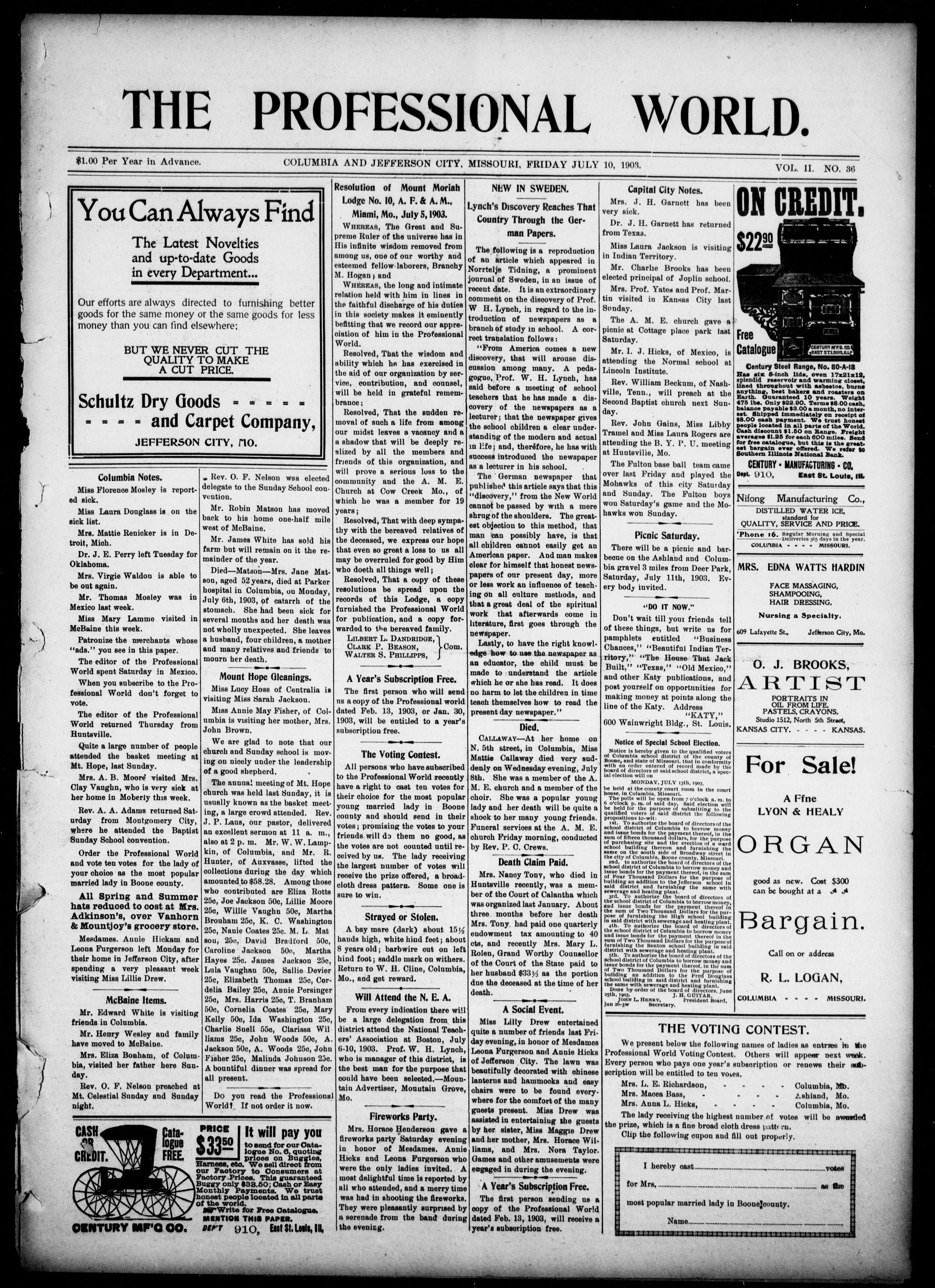
THE PROFESSIONAL WORLD.
$1.00 Per Year in Advance. You Can A
You Can Always Find
The Latest Novelties and up-to-date Goods in every Department...
Our efforts are always directed to furnishing goods for the same money or the same go money than you can find elsewhere;
Our efforts are always directed to furnishing better goods for the same money or the same goods for less money than you can find elsewhere;
BUT WE NEVER CUT THE QUALITY TO MAKE A CUT PRICE.
Schultz Dry Goods = = = = =
= = = = and Carpet Company,
JEFFERSON CITY, MO.
Columbia Notes.
Miss Florence Mosley is reported sick.
Miss Laura Douglass is on the sick list.
Mrs. Mattie Renicker is in Detroit, Mich.
Dr. J. E. Perry left Tuesday for Oklahoma.
Mrs. Virgie Waldon is able to be out again.
Mr. Thomas Mosley was in Mexico last week.
Miss Mary Lamme visited in McBaine this week.
Patronize the merchants whose "ads." you see in this paper.
The editor of the Professional World spent Saturday in Mexico. When you subscribe to the Professional World don't forget to vote.
The editor of the Professional World returned Thursday from Huntsville.
Quite a large number of people attended the basket meeting at Mt. Hope, last Sunday.
Mrs. A. B. Moore' visited Mrs. Clay Vaughn, who is very sick at her home in Moberly this week.
Rev. A. A. Adams returned Saturday from Montgomery City, where he attended the Baptist Sunday School convention.
Order the Professional World and vote ten votes for the lady of your choice as the most popular married lady in Boone county.
All Spring and Summer hats reduced to cost at Mrs. Adkinson's, over Vanhorn & Mountjoy's grocery store.
Mesdames. Annie Hickam and Leona Furgerson left Monday for their home in Jefferson City, after spending a very pleasant week visiting Miss Lillie Drew.
McBaine Items.
Mr. Edward White is visiting friends in Columbia.
Mr. Henry Wesley and family have moved to McBaine.
Mrs. Eliza Bonham, of Columbia, visited her father here Sunday.
Rev. O. F. Nelson preached at Mt. Celestial Sunday and Sunday night.
CASH OR CREDIT. Catalogue FREE.
CENTURY MF'G CO.
ected to furnishing better or the same goods for less elsewhere;
ods = = = = = Carpet Company,
N CITY, MO.
Rev. O. F. Nelson was elected delegate to the Sunday School convention.
Mr. Robin Matson has moved back to his home one-half mile west of McBaine.
Mr. James White has sold his farm but will remain on it the remainder of the year.
Died—Matson—Mrs. Jane Matson, aged 52 years, died at Parker hospital in Columbia, on Monday, July 6th, 1903, of catarrh of the stomach. She had been sick for several months and her death was not wholly unexpected. She leaves a husband, four children, a mother and many relatives and friends to mourn her death.
Mount Hope Gleanings.
Miss Lucy Hoss of Centralia is visiting Miss Sarah Jackson.
Miss Annie May Fisher, of Columbia is visiting her mother, Mrs. John Brown.
We are glad to note that our church and Sunday school is moving on nicely under the leadership of a good shepherd.
The annual meeting of Mt. Hope church was held last Sunday, it is usually known as the basket meeting, a large crowd attended. Rev. J. P. Laus, our pastor, delivered an excellent sermon at 11 a. m., also at 2 p. m. Mr. W. W. Lampkin, of Columbia, and Mr. R. Hunter, of Auxvasse, lifted the collections during the day which amounted to $58.28. Among those who contributed are Eliza Rotts 25c, Joe Jackson 50c, Lillie Moore 25c, Willie Vaughn 50c, Martha Brouham 25c, K. C. Washington 25c, Nauie Coates 25c, M. L. Matson, 25c, David Bradford 50c, Caroline Jackson 50c, Martha Hayes 25c, James Jackson 25c, Lula Vaughan 50c, Sallie Devier 25c, Elizabeth Thomas 25c, Cordelia Bailey 25c, Annie Persinger 25c, Mrs. Harris 25c, T. Branham 50c, Cornelia Coates 25c, Mary Kelly 50c, Ida Washington 25c, Charlie Snell 55c, Clarissa Williams 25c, John Woods 50c, A Jackson 50c, A. Woods 25c, John Fisher 25c, Malinda Johuson 25c. A bountiful dinner was spread for all present.
Do you read the Professional World! If not order it now.
Harness, etc. We sell direct from our Factory to Consumers at Factory Prices. This guaranteed Buggy only $33.50; Cash or Easy Monthly Payments. We trust honest people located in all parts of the world.
Write for Free Catalogue.
MENTION THIS PAPER.
DEP'T 910, East St. Louis, IL.
COLUMBIA AND JEFFERSON CITY, MISSOURI, FRIDAY JULY 10. 1903.
It will pay you
to send for our Catalogue No. 6, quoting prices on Buggles,
Resolution of Mount Moriah
Lodge No. 10, A. F. & A. M.,
Miami, Mo., July 5, 1903.
WHEREAS, The Great and Supreme Ruler of the universe has in His infinite wisdom removed from among us, one of our worthy and esteemed fellow-laborers, Branchy M. Hogan; and
WHEREAS, the long and intimate relation held with him in lines in the faithful discharge of his duties in this society makes it eminently befitting that we record our appreciation of him in the Professional World.
Resolved, That the wisdom and ability which he has exercised in the aid of our organization by service, contribution, and counsel, will be held in grateful remembrance;
Resolved, That the sudden removal of such a life from among our midst leaves a vacancy and a shadow that will be deeply realized by all the members and friends of this organization, and will prove a serious loss to the community and the A. M. E. Church at Cow Creek Mo., of which he was a member for 19 years;
Resolved, That with deep sympathy with the bereaved relatives of the deceased, we express our hope that even so great a loss to us all may be overruled for good by Him who doeth all things well;
Resolved, That a copy of these resolutions be spread upon the records of this Lodge, a copy furnished the Professional World for publication, and a copy forwarded to the bereaved family.
LILBERT L. DANDRIDGE,
CLARK P. BEASON,
WALTER S. PHILLIPPS,
Com.
A Year's Subscription Free.
The first person who will send us a copy of the Professional world dated Feb. 13, 1903, or Jan. 30, 1903, will be entitled to a year's subscription free.
The Voting Contest.
All persons who have subscribed to the Professional World recently have a right to cast ten votes for their choice for the most popular young married lady in Boone county and should send in their votes; promising the votes to your friends will do them no good, as the votes are not counted until received by us. The lady receiving the largest number of votes will receive the prize offered, a broadcloth dress pattern. Some one is sure to win.
Straved or Stolen.
A bay mare (dark) about 15% hands high, white hind feet; about 8 years old; barbwire cut on left hind foot; saddle mark on withers. Return to W. H. Cline, Columbia, Mo., and get reward.
Will Attend the N. E. A.
From every indication there will be a large delegation from this district attend the National Teachers' Association at Boston, July 6-10, 1903. Prof. W. H. Lynch, who is manager of this district, is the best man for the purpose that could have been selected.—Mountain Advertiser, Mountain Grove, Mo.
Fireworks Party.
Mrs. Horace Henderson gave a fireworks party Saturday evening in honor of Mesdames. Annie Hicks and Leona Furgerson who were the only ladies invited. A most delightful time is reported by all who attended, and a merry time was had in shooting the fireworks. They were pleasantly surprised by a serenade from the band during the evening.
NEW IN SWEDEN.
Lynch's Discovery Reaches That Country Through the German Papers.
The following is a reproduction of an article which appeared in Norrtelje Tidning, a prominent journal of Sweden, in an issue of recent date. It is an extraordinary comment on the discovery of Prof. W H. Lynch, in regard to the introduction of newspapers as a branch of study in school. A correct translation follows:
"From America comes a new discovery, that will arouse discussion among many. A pedagogue, Prof. W. H. Lynch, has said before a meeting of school teachers that he has made a discovery of the newspapers as a lecturer; that the newspaper gives the school children a clear understanding of the modern and actual in life; and, therefore, he has with success introduced the newspaper as a lecturer in his school.
The German newspaper that published this article says that this "discovery," from the New World cannot be passed by with a mere shrug of the shoulders. The greatest objection to this method, that man can possibly have, is that all children cannot easily get an American paper. And man makes clear for himself that honest newspapers of our present day, more or less work an influence of teaching on all culture methods, and that a great deal of the spiritual work that afterwards come in literature, first goes through the newspaper.
Lastly, to have the right knowledge how to use the newspaper as an educator, the child must be made to understand the article which he or she has read. It does no harm to let the children in time teach themselves how to read the present day newspaper."
Died.
CALLAWAY—At her home on N. 5th street, in Columbia, Miss Mattie Callaway died very suddenly on Wednesday evening, July 8th. She was a member of the A. M. E. church and a member of the choir. She was a popular young lady and her death will be quite a shock to her many young friends. Funeral services at the A. M. E. church Friday morning, conducted by Rev. P. C. Crews.
Death Claim Paid.
Mrs. Nancy Tony, who died in Huntsville recently, was a member of the Court of Calantha which was organized last January. About three months before her death Mrs. Tony had paid one quarterly endowment tax amounting to 40cts, and recently Mrs. Mary L. Rolen, Grand Worthy Counsellor of the Court of the State paid to her husband $33½ as the portion due the deceased at the time of her death.
A Social Event.
Miss Lilly Drew entertained quite a number of friends last Friday evening, in honor of Mesdames Leona Furgerson and Annie Hicks of Jefferson City. The lawn was beautifully decorated with chinese lanterns and hammocks and easy chairs were to be found everywhere for the comfort of the many guests present. Miss Drew was assisted in entertaining the guests by her sister, Miss Maggie Drew and her mother, Mrs. Horace Williams, and Mrs. Nora Taylor-Games and other amusements were engaged in during the evening.
A Year's Subscription Free.
The first person sending us a copy of the Professional World dated Feb. 13, 1903, will receive a year's subscription free.
Mrs. J. H. Garnett has been very sick.
Dr. J. H. Garnett has returned from Texas.
Miss Laura Jackson is visiting in Indian Territory.
Mr. Charlie Brooks has been elected principal of Joplin school.
Mrs. Prof. Yates and Prof. Martin visited in Kansas City last Sunday.
The A. M. E. church gave a picnic at Cottage place park last Saturday.
Mr. I. J. Hicks, of Mexico, is attending the Normal school at Lincoln Institute.
Rev. William Beckum, of Nashville, Tenn., will preach at the Second Baptist church next Sunday.
Rev. John Gains, Miss Libby Tramel and Miss Laura Rogers are attending the B. Y. P. U. meeting at Huntsville, Mo.
The Fulton base ball team came over last Friday and played the Mohawks of this city Saturday and Sunday. The Fulton boys won Saturday's game and the Mohawks won Sunday.
Picnic Saturday.
There will be a picnic and barbeue on the Ashland and Columbia gravel 3 miles from Deer Park, Saturday, July 11th, 1903. Every body invited.
"DO IT NOW."
Don't wait till your friends tell of these things, but write us for pamphlets entitled "Business Chances," "Beautiful Indian Territory," "The House That Jack Built," "Texas," "Old Mexico," and other Katy publications, and post yourself on opportunities for making money at points along the line of the Katy. Address "KATY," 600 Wainwright Bldg., St. Louis.
Notice of Special School Election
Notice is hereby given to the qualified voters of Boone, and the county of Boone, and state of Missouri, that in connection with an order entered of record made by the governor of said school district, a special election will be held.
MONDAY, JULY 13th, 1903,
be held at the county court room in the court house, in Columbia, Missouri.
The polls will be open from 7 o'clock a.m. to 6 o'clock p.m. of said day. Said election will be held for the purpose of submitting to the qualified voters of said district the following propositions to-wit:
1st. To authorize the board of directors of the school district of Columbia to borrow money and issue bonds to the government thereof, in the sum of fifteen thousand dollars the purpose of purchasing site and the erection of a school building thereon and furnishing the same on the south side of Broadway street in the city of Columbia, Boone county, Missouri.
2nd. To authorize the board of directors of the school district of Columbia to borrow money and issue bonds for the payment thereof, in the sum of Four Thousand Dollars for the purpose of purchasing addition to the Jefferson school in said district a wall of the same with sewerage and heating plant.
3rd. To authorize the board of directors of the school district of Columbia to borrow money, and issue bonds for the payment thereof in the sum of Two Thousand Dollars for the purpose of furnishing the High school building in said district with sewerage and heating plant.
4th. To authorize the board of directors of the school district of Columbia to borrow money and issue bonds for the purpose thereof in the sum of Two Thousand Dollars for the purpose of furnishing the Benton school building in said district with sewerage and heating plant.
5th. to authorize the board of directors of the school. Columbia to borrow money and issue bonds for the school of Two Thousand Dollars for the purpose of the school's addition to the Fred Douglass school building, including the same with sewerage and heating plant. Done by order of the board of directors, June 25th. J. H. GUTAR. J. H. HENNY. President Board, jun 26-3w. Secretary.
THE VOTING CONTEST.
We present below the following
Professional World Voting Contest.
Every person who pays one year's
scription will be entitled to ten vouch
Mrs. L. E. Richardson,
Mrs. Macea Bass,
Mrs. Anna L. Hicks,
The lady receiving the highest
the prize, which is a fine broad cloth
Clip the following cupon and
We present below the following names of ladies as entries in the Professional World Voting Contest. Others will appear next week. Every person who pays one year's subscription or renews their subscription will be entitled to ten votes.
Mrs. L. E. Richardson, - - - - Columbia, Mo.
Mrs. Macea Bass, - - - - Ashland, Mo.
Mrs. Anna L. Hicks, - - - Columbia, Mo.
The lady receiving the highest number of votes will be awarded the prize, which is a fine broad cloth dress pattern.
Clip the following cupon and fill out properly.
I hereby cast.....votes
for Mrs. .....as the
most popular married lady in Boone county.
Name.....
VOL. II. NO. 36
ON CREDIT.
$22.90
Free
Catalogue
CENTURY MFG. CO.
EAST S. T. LOUIS, LLC.
Century Steel Range, No. 80-A-18
Has six 8-inch lids, oven 17x21x12,
splendid reservoir and warming closest,
lined throughout with asbestos, burns
anything, best bakers and roasters on
Earth. Guaranteed 10 years. Weight
475 lbs. Only $23.90. Terms $9.00 cash,
limited throughout 60 month, no interest.
Shipped immediate to $8.00 cash payment. We trust honest
people located in all parts of the World.
Cash discount $1.50 on Range. Freight
average $1.25 for each 600 miles. Send
for free catalogue, but this is the greatest
bargain ever offered. We refer to
Southern Illinois National Bank.
CENTURY • MANUFACTURING • CO.
Dept. 910. East St. Louis, IL.
Nifong Manufacturing Co.,
DISTILLED WATER ICE,
standard for
QUALITY, SERVICE AND PRICE.
'Phone 16. Regular Morning and Special
Deliveries 365 days in the year.
COLUMBIA - - - - MISSOURI.
MRS. EDNA WATTS HARDIN
FACE MASSAGING,
SHAMPOOING,
HAIR DRESSING.
Nursing a Specialty.
609 Lafayette St., Jefferson City, Mo.
O. J. BROOKS,
ARTIST
PORTRAITS IN
OIL FROM LIFE.
PASTELS, CRAYONS.
Studio 1512, North 5th Street,
KANSAS CITY. - - - KANSAS.
For Sale!
A Ffne
LYON & HEALY
ORGAN
good as new. Cost $300
can be bought at a
Bargain.
Call on or address
R. L. LOGAN,
COLUMBIA - - - - MISSOURI.
ing names of ladies as entries in the
Others will appear next week.
subscription or renews their sub-
es.
Columbia, Mb.
Δshland, Mo.
Columbia, Mo.
number of votes will be awarded
h dress pattern.
all out properly.
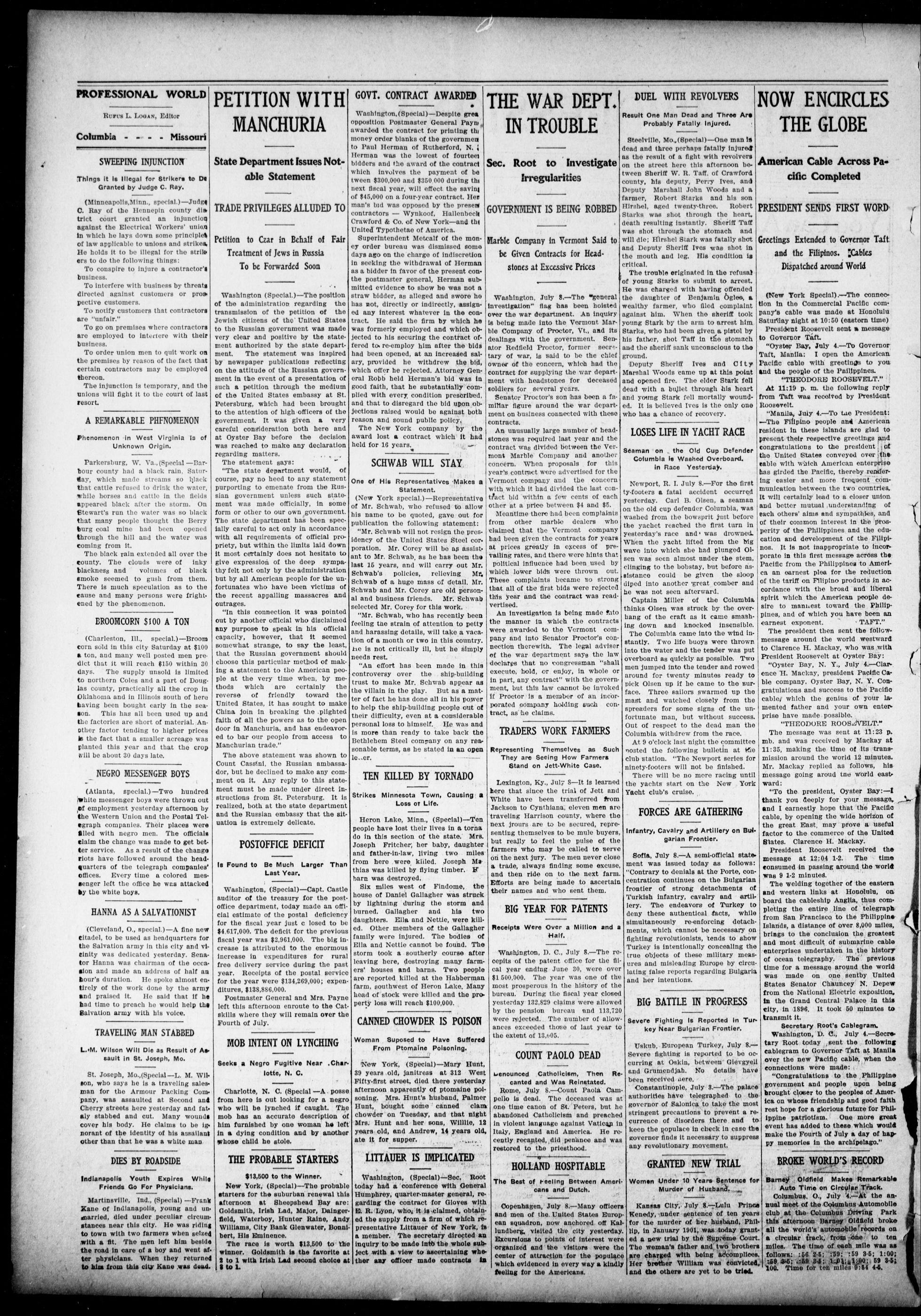
Rufus L. LOGAN, Editor
Columbia - - - - Missouri
SWEEPING INJUNCTION
Things it is illegal for Strikers to De Granted by Judge C. Ray.
(Minneapolis, Minn., special.)—Judge C. Ray of the Hennepin county district court granted an injunction against the Electrical Workers' union in which he lays down some principles of law applicable to unions and strikes. He holds it to be illegal for the strikers to do the following things:
To conspire to injure a contractor's business.
To interfere with business by threats directed against customers or prospective customers.
To notify customers that contractors are "unfair."
To go on premises where contractors are employed to intertie with their business.
To order union men to quit work on the premises by reason of the fact that certain contractors may be employed thereon.
The injunction is temporary, and the unions will fight it to the court of last resort.
A REMARKABLE PHFNOMENON
Phenomenon in West Virginia Is of Unknown Origin.
Parkersburg, W. Va., (Special—Barbour county had a black rain, Saturday, which made streams so black that cattle refused to drink the water, while horses and cattle in the fields appeared black after the storm. On Stewart's run the water was so black that many people thought the Berry burg coal mine had been opened through the hill and the water was coming from it. The black rain extended all over the county. The clouds were of inky blackness and volumes of black smoke seemed to gush from them. There is much speculation as to the cause and many persons were frightened by the phenomenon.
BROOMCORN $100 A TON
(Charleston, Ill., special.)—Broom corn sold in this city Saturday at $100 a ton, and many well posted men predict that it will reach $150 within 30 days. The supply unsold is limited to northern Coles and a part of Douglas county, practically all the crop in Oklahoma and in Illinois south of here having been bought early in the season. This has all been used up and the factories are short of material. Another factor tending to higher prices is the fact that a smaller acreage was planted this year and that the crop will be about 30 days late.
NEGRO MESSENGER BOYS
(Atlanta, special)—Two hundred white messenger boys were thrown out of employment yesterday afternoon by the Western Union and the Postal Telegraph companies. Their places were filled with negro men. The officials claim the change was made to get better service. As a result of the change riots have followed around the headquarters of the telegraph companies' offices. Every time a colored messenger left the office he was attacked by the white boys.
HANNA AS A SALVATIONIST
(Cleveland, O., special.)—A fine new citadel, to be used as headquarters for the Salvation army in this city and vicinity was dedicated yesterday. Senator Hanna was chairman of the occasion and made an address of half an hour's duration. He spoke almost entirely of the work done by the army and praised it. He said that if he had time to preach he would help the Salvation army with his voice.
TRAVELING MAN STABBED
L.M. Wilson Will Die as Result of Assault in St. Joseph, Mo.
St. Joseph, Mo.,(Special—L. M. Wilson, who says he is a traveling salesman for the Armour Packing Company, was assaulted at Second and Cherry streets here yesterday and fatally stabbed and cut. Many wounds cover his body. He claims to be ignorant of the identity of his assailant other than that he was a white man
DIES BY ROADSIDE
Indianapolis Youth Expires While Friends Go For Physicians.
Martinsville, Ind., (Special) —Frank Kane of Indianapolis, young and unmarried, died under peculiar circumstances near this city. He was riding to town with two farmers when seized with a fit. The men left him beside the road in care of a boy and went after physicians. When they returned to him from this city Kane was dead.
PETITION WITH MANCHURIA
State Department Issues Notable Statement
TRADE PRIVILEGES ALLUDED TO
Petition to Czar in Behalf of Fain Treatment of Jews in Russia To be Forwarded Soon
Washington (Special.)—The position of the administration regarding the transmission of the petition of the Jewish citizens of the United States to the Russian government was made very clear and positive by the statement authorized by the state department. The statement was inspired by newspaper publications reflecting on the attitude of the Russian government in the event of a presentation of such a petition through the medium of the United States embassy at St. Petersburg, which had been brought to the attention of high officers of the government. It was given a very careful consideration both here and at Oyster Bay before the decision was reached to make any declaration regarding matters.
"The state department would, of course, pay no heed to any statement purporting to emulate from the Russian government unless such statement was made officially, in some form or other to our own government. The state department has been specially careful to act only in accordance with all requirements of official propriety, but within the limits laid down it most certainly does not hesitate to give expression of the deep sympathy felt not only by the administration but by all American people for the fortunes who have been victims of the recent appalling massacres and outrages.
"In this connection it was pointed out by another official who disclaimed any purpose to speak in his official capacity, however, that it seemed somewhat strange, to say the least, that the Russian government should choose this particular method of making a statement to the American people at the very time when, by methods which are certainly the reverse of friendly toward the United States, it has sought to make China join in breaking the plighted faith of all the powers as to the open door in Manchuria, and has endeavored to bar our people from access to Manchurian trade."
The above statement was shown to Count Cassini, the Russian ambassador, but he declined to make any comment on it. Any reply to this statement must be made under direct instructions from St. Petersburg. It is realized, both at the state department and the Russian embassy that the situation is extremely delicate.
POSTOFFICE DEFICIT
Is Found to Be Much Larger Than Last Year.
Washington, (Special)—Capt. Castle auditor of the treasury for the post-office department, today made an official estimate of the postal deficiency for the fiscal year just c losed to be $4,617,000. The deficit for the previous fiscal year was $2,961,000. The big increase is attributed to the enormous increase in expenditures for rural free delivery service during the past year. Receipts of the postal service for the year were $134,269,000; expenditures, $138,886,000.
Postmaster General and Mrs. Payne left this afternoon enroute to the Catskills where they will remain over the Fourth of July.
MOB INTENT ON LYNCHING
Seeks a Negro Fugitive Near .Charlotte, N. C.
Charlotte, N. C. (Special — A. posse from here is out looking for a negro who will be lynched if caught. The mob has an accurate description of him furnished by one woman he left in a dying condition and by another whose child he stole.
THE PROBABLE STARTERS
New York, (Special)—The probable starters for the suburban renewal this afternoon at Sheepshead Bay are: Goldsmith, Irish Lad, Major, Daingerfield, Waterboy, Hunter Raine, Andy Williams, City Bank Glenwater, Bonnibert, His Eminence.
The race is worth $13,500 to the winner. Goldsmith is the favorite at 2 to 1 with Irish Lad second choice at 2 to 1.
GOVT. CONTRACT AWARDED
Washington, (Special)—Despite great opposition Postmaster General Paym awarded the contract for printing the money order blanks of the government to Paul Herman of Rutherford, N. Herman was the lowest of fourteen bidders and the award of the contract which involves the payment of between $300,000 and $350,000 during the next fiscal year, will effect the saving of $45,000 on a four-year contract. Herman's bid was opposed by the present contractors — Wynkoof, Hallenbeck Crawford & Co. of New York—and the United Typotheta of America.
Superintendent Metcalf of the money order bureau was dismissed some days ago on the charge of indiscretion in seeking the withdrawal of Herman as a bidder in favor of the present cont the postmaster general, Herman submitted evidence to show he was not a straw bidder, as alleged and swore he has not, directly or indirectly, assigned any interest whatever in the contract. He said the firm by which he was formerly employed and which objected to his securing the contract offered to re-employ him after the bids had been opened, at an increased salary, provided he withdrew the bid, which offer he rejected. Attorney General Robb held Herman's bid was in good faith, that he substantially complied with every condition prescribed, and that to disregard the bid upon objections raised would be against both reason and sound public policy.
The New York company by the award lost a contract which it had held for 16 years.
SCHWAB WILL STAY
One of His Representatives Makes a Statement.
(New York special.)—Representative of Mr. Schwab, who refused to allow his name to be quoted, gave out for publication the following statement:
"Mr. Schwab will not resign the presidency of the United States Steel corporation. Mr. Corey will be as assistant to Mr. Schwab, as he has been the last 15 years, and will carry out Mr. Schwab's policies, relieving Mr. Schwab of a huge mass of detail. Mr. Schwab and Mr. Corey are old personal and business friends. Mr. Schwab selected Mr. Corey for this work.
"Mr. Schwab, who has recently been feeling the strain of attention to petty and harassing details, will take a vacation of a month or two in this country. He is not critically ill, but he simply needs rest.
"An effort has been made in this controversy over the ship-building trust to make Mr. Schwab appear as the villain in the play. But as a matter of fact he has done all in his power to help the ship-building people out of their difficulty, even at a considerable personal loss to himself. He was and is more than ready to take back the Bethlehem Steel company on any reasonable terms, as he stated in an open le...er.
TEN KILLED BY TORNADO
Strikes Minnesota Town, Causing a Loss or Life.
Heron Lake, Minn., (Special)—Ten people have lost their lives in a tornado in this section of the state. Mrs. Joseph Fritcher, her baby, daughter and father-in-law, living two miles from here were killed. Joseph Mathias was killed by flying timber. Harn was destroyed.
Six miles west of Findome, the house of Daniel Gallagher was struck by lightning during the storm and burned. Gallagher and his two daughters. Ella and Nettie, were killed. Other members of the Gallagher family were injured. The bodies of Ella and Nettie cannot be found. The storm took a southerly course after leaving here, destroying many farmers' houses and barns. Two people are reported killed at the Habberman farm, southwest of Heron Lake. Many head of stock were killed and the property loss will reach $100,000.
CANNED CHOWDER IS POISON
Woman Suposed to Have Suffered From Ptomaine Poisoning.
New York, (Special)—Mary Hunt,
39 years old, janitress at 312 West
Fifty-first street, died there yesterday
afternoon apparently of ptomaine poisoning. Mrs. Hunt's husband, Palmer Hunt, bought some canned clam
chowder on Tuesday, and that night
Mrs. Hunt and her sons, Willlie, 12
years old, and Andrew, 14 years old,
ate it for supper.
LITTAUER IS IMPLICATED
Washington, (Special)—Sec. Root today had a conference with General Humphrey, quarter-master general, regarding the contract for Gloves with E. R. Lyon, who, it is claimed, obtained the supply from a firm of which representative Littauer of New York, is a member. The secretary directed an inquiry to be made into the whole subject with a view to ascertaining whether any officer made contracts in
THE WAR DEPT. IN TROUBLE
Sec. Root to Investigate Irregularities
GOVERNMENT IS BEING ROBBED
Marble Company in Vermont Said to be Given Contracts for Headstones at Excessive Prices
Washington, July 8.—The "general investigation" flag has been holested over the war department. An inquiry is being made into the Vermont Marble Company of Proctor, Vt., and its dealings with the government. Senator Redfield Proctor, former secretary of war, is said to be the chief owner of the concern, which had the contract for supplying the war department with headstones for deceased soldiers for several years. Senator Proctor's son has been a familiar figure around the war department on business connected with these contracts.
An unusually large number of headstones was required last year and the contract was divided between the Vermont Marble Company and another concern. When proposals for this year's contract were advertised for the Vermont company and the concern with which it had divided the last contract bid within a few cents of each other at a price between $4 and $5. Meantime there had been complaints from other marble dealers who claimed that the Vermont company had been given the contracts for years at prices greatly in excess of prevailing rates, and there were hints that political influence had been used by which lower bids were thrown out. These complaints became so strong that all of the first bids were rejected this year and the contract was readvertised.
An investigation is being made into the manner in which the contracts were awarded to the Vermont company and into Senator Proctor's connection therewith. The legal adviser of the war department says the law declares that no congressman "shall execute, hold, or enjoy, in whole or in part, any contract" with the government, but this law cannot be invoked if Proctor is a member of an incorporated company holding such contract, as he claims.
TRADERS WORK FARMERS
Representing Themselves as Such They are Seeing How Farmers Stand on Jett-White Case.
Lexington, Ky., July 8—It is learned here that since the trial of Jett and White have been transferred from Jackson to Cynthiana, eleven men are traveling Harrison county, where the next jours are to be secured, representing themselves to be mule buyers, but really to feel the pulse of the farmers who may be called to serve on the next jury. The men never close a trade, always finding some excuse, and then ride on to the next farm. Efforts are being made to ascertain their names and who sent them.
BIG YEAR FOR PATENTS
Receipts Were Over a Million and a Half.
Washington, D. C., July 8.—The receipts of the patent office for the fiscal year ending June 30, were over $150,000. The year was one of the most prosperous in the history of the bureau. During the fiscal year closed yesterday 132,829 claims were allowed by the pension bureau and 113,720 were rejected. The number of allowances exceeded those of last year to the extent of 13,005.
COUNT PAOLO DEAD
Denounced Catholicism, Then Recanted and Was Reinstated.
Rome, July 8.—Count Paola Campello is dead. The deceased was at one time canon of St. Peters, but he abandoned Catholicism and preached in violent language against Vatican in Italy, England and America. He recently recanted, did penance and was restored to the priesthood.
HOLLAND HOSPITABLE
The Best of Feeling Between Americans and Dutch.
Copenhagen, July 8.—Many officers and men of the United States European squadron, now anchored off Kallundberg, visited the city yesterday. Excursions to points of interest were organized and the visitors were the center of attraction for the populace which evidenced in every way a kindly feeling for the Americans.
DUEL WITH REVOLVERS
Result One Man Dead and Three Are Probably Fatally Injured.
Steelville, Mo. (Special)—One man is dead and three perhaps fatally injured as the result of a fight with revolvers on the street here this afternoon between Sheriff W. R. Taff, of Crawford county, his deputy, Perry Ives, and Deputy Marshall John Woods and a farmer, Robert Starks and his son Hirshel, aged twenty-three. Robert Starks was shot through the heart, death resulting instantly. Sheriff Taff was shot through the stomach and will die; Hirshel Stark was fatally shot and Deputy Sheriff Ives was shot in the mouth and leg. His condition is critical.
The trouble originated in the refusal of young Starks to submit to arrest. He was charged with having offended the daughter of Benjamin Ogles, a wealthy farmer, who filed complaint against him. When the sheriff took young Stark by the arm to arrest him Starks, who had been given a pistol by his father, shot Taff in the stomach and the sheriff sank unconscious to the ground.
Deputy Sheriff Ives and City Marshal Woods came up at this point and opened fire. The elder Stark fell dead with a bullet through his heart and young Stark fell mortally wounded. It is believed Ives is the only one who has a chance of recovery.
LOSES LIFE IN YACHT RACE
Seaman on the Old Cup Defender Columbia is Washed Overboard. in Race Yesterday.
Newport, R. I. July 8.—For the first ty-footers a fatal accident occurred yesterday. Carl B. Olsen, a seaman on the old cup defender Columbia, was washed from the bowsprit just before the yacht reached the first turn in yesterday's race and was drowned. When the yacht lifted from the big wave into which she had plunged Olsen was seen almost under the stem, clinging to the bobstay, but before assistance could be given the sloop diped into another great comber and he was not seen afterward.
Captain Miller of the Columbia thinks Olsen was struck by the overhang of the craft as it came smashing down and knocked insensible
The Columbia came into the wind instantly. Two life buoys were thrown into the water and the tender was put overboard as quickly as possible. Two men jumped into the tender and rowed around for twenty minutes ready to pick Olsen up if he came to the surface. Three sailors swarmed up the mast and watched closely from the spreaders for some signs of the unfortunate man, but without success. Out of respect to the dead man the Columbia withdrew from the race. At 9 o'clock last night the committee posted the following bulletin at the club station. "The Newport series for ninety-footers will not be finished. There will be no more racing until the yachts start on the New York Yacht club's cruise.
FORCES ARE GATHERING
Infantry, Cavalry and Artillery on Bulgarian Frontier.
Sofia, July 8.—A semi-official statement was issued today as follows: "Contrary to denials at the Porte, concentration continues on the Bulgarian frontier of strong detachments of Turkish infantry, cavalry and artillery. The endeavors of Turkey to deny these authentical facts, while simultaneously re-enforcing detachments, which cannot be necessary on fighting revolutionists, tends to show Turkey is intentionally concealing the true objects of these military measures and misleading Europe by circulating false reports regarding Bulgaria and her intentions.
BIG BATTLE IN PROGRESS
Severe Fighting Is Reported in Turkey Near Bulgarian Frontier.
Uskub, European Turkey, July 8.—Severe fighting is reported to be occurring at Oskin, between Glevgyeli and Grumendjah. No details have been received aere.
Constantinople, July 3.—The palace authorities have telegraphed to the governor of Salonica to take the most stringent precautions to prevent a recurrence of disorders there and to keep the populace in check in case the governor finds it necessary to suppress any revolutionary movement.
GRANTED NEW TRIAL
Women Under 10 Years Sentence for Murder of Husband.
Kansas City, July 8—Lulu Prince Kennedy, under sentence of ten years for the murder of her husband, Phillip, in January 1901, was today granted a new trial by the Supreme Court. The woman's father and two brothers are charged with being accomplices. Her brother William was convicted, and the others are yet to be tried.
NOW ENCIRCLES THE GLOBE
American Cable Across Pacific Completed
PRESIDENT SENDS FIRST WORD
Greetings Extended to Governor Taft and the Filipinos. Cables Dispatched around World
(New York Special).—The connection in the Commercial Pacific company's cable was made at Honolulu Saturday night at 10:50 (eastern time)
President Roosevelt sent a message to Governor Taft.
"Oyster Bay, July 4.—To Governor Taft, Manila: I open the American Pacific cable with greetings to you and the people of the Philippines.
"THEODORE ROOSEVELT."
At 11:19 p. m. the following reply from Taft was received by President Roosevelt.
"Manila, July 4.—To the President: The Filipino people and American resident in these islands are glad to present their respective greetings and congratulations to the president of the United States conveyed over the table with watch American enterprise has girded the Pacific, thereby rendering easier and more frequent communication between the two countries. It will certainly lead to a closer union and better mutual understanding of each others' aims and sympathies, and of their common interest in the prosperity of the Philippines and the education and development of the Filipinos. It is not inappropriate to incorporate in this first message across the Pacific from the Philippines to America an earnest plea for the reduction of the tariff on Filipino products in accordance with the broad and liberal spirit which the American people desire to manifest toward the Philippines, and of which you have been an earnest exponent. TAFT."
The president then sent the follow-
message around the world westward to
Clarence H. Mackay, who was with
President Roosevelt at Oyster Bay:
"Oyster Bay, N. Y., July 4.—Clarence
H. Mackay, president Pacific Cable
company, Oyster Bay, N. Y. Congratsulations and success to the Pacific cable' which the genius of your lamented father and your own enterprise have made possible.
"THEODORE ROOSJEVLT."
The message was sent at 11:23 p.
mb. and was received by Mackay at
11:35, making the time of its trans-
mission around the world 12 minutes.
Mr. Mackay replied as follows, his
message going around the world east-
ward:
"To the president, Oyster Bay:I thank you deeply for your message, and I earnestly hope that the Pacific cable, by opening the wide horizon of the great East, may prove a useful factor to the commerce of the United States. Clarence H. Mackay. President Roosevelt received the message at 12:04 1-2. The time consumed in passing around the world was 9 1-2 minutes.
The welding together of the eastern and western links at Honolulu, on board the cableship Anglaia, thus completing the entire line of telegraph from San Francisco to the Philippine Islands, a distance of over 8,000 miles, brings to the conclusion the greatest and most difficult of submarine cable enterprises undertaken in the history of ocean telegraphy. The previous time for a message around the world was made on one sentby United States Senator Chauncey N. Depew from the National Electric exposition, in the Grand Central Palace in this city, in 1886. It took 50 minutes to transmit it.
Secretary Root's Cablegram.
Washington, D. C., July 4.—Secretary Root today sent the following cablegram to Governor Taft at Manila over the new Pacific cable, when the connections were made:
"Congratulations to the Philippine government and people upon being brought closer to the peoples of America on whose friendship and good faith rest hope for a glorious future for Philippine patriotism. One more great event has added to these which would make the Fourth of July a day of happy memories in the archipelago."
BROKE WORLD'S RECORD
Barney Oldfield Makes Remarkable Auto Time on Circular Track.
Columbus, O., July 4.—At the annual meet of the Columbus Automobile club at the Columbus Driving Park this afternoon Barney Oldfield broke all the world's automobile records on a circular track, from one to ten miles. The time of each mile was as follows: :56 2:5; :59; :59 3:5; :100; :59 3:5; :100; :59 3:5; :100. Time for ten miles: 9:54 4:5.
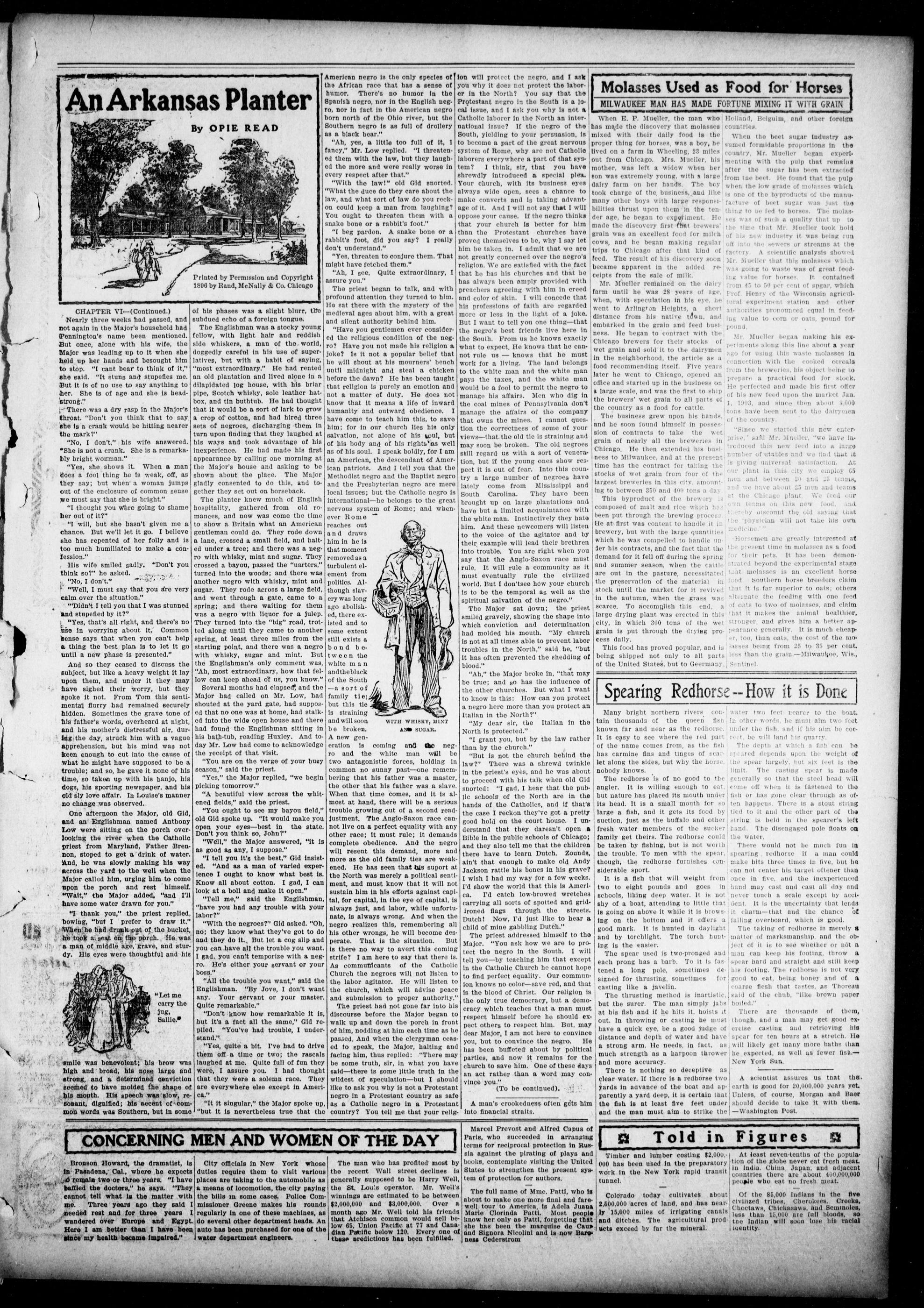
An Arkansas Planter
By OPIE READ
Printed by Permission and Copyright
1806 by Rand, McNally & Co. Chicago
CONCERNING MEN AND WOMEN OF THE DAY
CHAPTER VI—(Continued.)
Nearly three weeks had passed, and not again in the Major's household had Pennington's name been mentioned. But once, alone with his wife, the Major was leading up to it when she held up her hands and besought him to stop. "I can bear to think of it," she said. "It stuns and stupefies me. But it is of no use to say anything to her. She is of age and she is headstrong."
There was a dry rasp in the Major's throat. "Don't you think that to say she is a crank would be hitting nearer the mark?"
"No, I don't," his wife answered. "She is not a crank. She is a remarkably bright worm."
"Yes, she shows it. When a man does a fool thing he is weak, off, as they say; but when a woman jumps out of the enclosure of common sense we must say that she is bright."
"I thought you were going to shame her out of it?"
"I will, but she hasn't given me a chance. But we'll let it go. I believe she has repented of her folly and is too much humiliated to make a confession."
His wife smiled sadly. "Don't you think so?" he asked.
"No, I don't."
"Well, I must say that you are very calm over the situation."
"Didn't I tell you that I was stunned and stunfied by it?"
"Yes, that's all right, and there's no use in worrying about it. Common sense says that when you can't help a thing the best plan is to let it go until a new phase is presented."
And so they ceased to discuss the subject, but like a heavy weight it lay upon them, and under it they may have sighed their worry, but they spoke it not. From Tom this sentimental flurry had remained securely hidden. Sometimes the grave tone of his father's words, overheard at night, and his mother's distressful air, during the day, struck him with a vague apprehension, but his mind was not keen enough to cut into the cause of what he might have supposed to be a trouble; and so, he gave it none of his time, so taken up with his banjo, his dogs, his sporting newspaper, and his old sly love affair. In Louise's manner no change was observed.
One afternoon the Major, old Gid, and an Englishman named Anthony Low were sitting on the porch overlooking the river when the Catholic priest from Maryland, Father Brennon, stoped to get a drink of water. And, he was slowly making his way across the yard to the well when the Major called him, urging him to come upon the porch and rest himself. "Walt," the Major added, "and I'll have some water drawn for you."
"I thank you," the priest replied, bowing, "but I prefer to draw it." When he had drunk out of the bucket, he took a seat on the porch. He was a man of middle age, grave, and sturdy. His eyes were thoughtful and his
"Let me carry the jug, Sallie."
smile was benevolent; his brow was high and broad, his nose large and strong, and a determined conviction seemed to have molded the shape of his mouth. His speech was slow, resonant, dignified; his accent of common words was Southern, but in some
Bronson Howard, the dramatist, is in Pasadena, Cal., where he expects 6 remain two or three years. "I have barfed the doctors," he says. "They cannot tell what is the matter with me. Three years ago they said I needed rest and for three years I wandered over Europe and Egypt. Here I am better than I have been since my health became impaired."
American negro is the only species of the African race that has a sense of humor. There's no humor in the Spanish negro, nor in the English negro, nor in fact in the American negro born north of the Ohio river, but the Southern negro is as full of drollery as a black bear."
"Ah, yes, a little too full of it, I fancy," Mr. Low replied. "I threatened them with the law, but they laughed the more and were really worse in every respect after that."
"With the law!" old Gid snorted. "What the duce do they care about the law, and what sort of law do you reckon could keep a man from laughing? You ought to threaten them with a snake bone or a rabbit's foot."
"I beg pardon. A snake bone or a rabbit's foot, did you say? I really don't understand."
"Yes, threaten to conjure them. That might have fetched them."
"Ah, I see. Quite extraordinary, I assure you."
The priest began to talk, and with profound attention they turned to him. He sat there with the mystery of the medieval ages about him, with a great and silent authority behind him.
"Have you gentlemen ever considered the religious condition of the negro? Have you not made his religion a joke? Is it not a popular belief that he will shout at his mourners' bench until midnight and steal a chicken before the dawn? He has been taught that religion is purely an emotion and not a matter of duty. He does not know that it means a life of inward humanity and outward obedience. I have come to teach him this, to save him; for in our church lies his only salvation, not alone of his soul, but of his body and of his rights as well as of his soul. I speak boldly, for I am an American, the descendant of American patriots. And I tell you that the Methodist negro and the Baptist negro and the Presbyterian negro are more local issues; but the Catholic negro is international—he belongs to the great nervous system of Rome; and when-
ever Rome reaches out and draws him in he is that moment removed as a turbulent element from politics. Although slavery was long ago abolished, there existed and to some extent still exists a bond between the white man and the black of the South—a sort of family tie; but this tie is straining and will soon be broken. A new gen-
eration is coming and the negro and the white man will be two antagonistic forces, holding in common no sunny past—one remembering that his father was a master, the other that his father was a slave. When that time comes, and it is almost at hand, there will be a serious trouble growing out of a second readjustment. The Anglo-Saxon race cannot live on a perfect equality with any other race; it must rule; it demands complete obedience. And the negro will resent this demand, more and more as the old family ties are weakened. He has seen that his support at the North was merely a political sentiment, and must know that it will not sustain him in his efforts against capital, for capital, in the eye of capital, is always just, and labor, while unfortunate, is always wrong. And when the negro realizes this, remembering all his other wrongs, he will become desperate. That is the situation. But is there no way to avert this coming strife? I am here to say that there is As communicants of the Catholic Church the negroes will not listen to the labor agitator. He will listen to the church, which will advise peace and submission to proper authority.'
The priest had not gone far into his discourse before the Major began to walk up and down the porch in front of him, nodding at him each time as he passed. And when the clergyman ceased to speak, the Major, halting and facing him, thus replied: "There may be some truth, sir, in what you have said—there is some jittle truth in the wildest of speculation—but I should like to ask you why is not a Protestant negro in a Protestant country as safe as a Catholic negro in a Protestant country? You tell me that your relig-
The man who has profited most by the recent Wall street declines is generally supposed to be Harry Well, the St. Louis operator. Mr. Well's winnings are estimated to be between $2,000,000 and $3,000,000. Over a month ago Mr. Well told his friends that Atchison common would sell below 65, Union Pacific at 77 and Canadian Pacific below 120. Every one of these predictions has been fulfilled.
of his phases was a slight blurr, the subdued echo of a foreign tongue.
The Englishman was a stocky young fellow, with light hair and reddish side whiskers, a man of the world, doggedly careful in his use of superlatives, but with a habit of saying, "most extraordinary." He had rented an old plantation and lived alone in a dilapidated jog house, with his briar pipe, Scotch whiskey, sole leather hatbox, and tin buttub. He had thought that it would be a sort of lark to grow a crop of cotton, and had hired three sets of negroes, discharging them in turn upon finding that they laughed at his ways and took advantage of his inexperience. He had made his first appearance by calling one morning at the Major's house and asking to be shown about the place. The Major gladly consented to do this, and together they set out on horseback.
The planter knew much of English hospitality, gathered from old romances, and now was come the time to show a Britain what an American gentleman could do. They rode down a lane, crossed a small field, and halted under a tree; and there was a negro with whisky, mint and sugar. They crossed a bayou, passed the "quarters," turned into the woods; and there was another negro with whisky, mint and sugar. They rode across a large field, and went through a gate, came to a spring; and there waiting for them was a negro with liquor for a julep. They turned into the "big" road, trotted along until they came to another spring, at least three miles from the starting point, and there was a negro with whisky, sugar and mint. But the Englishman's only comment was, "Ah, most extraordinary, how that fellow can keep ahead of us, you know."
Several months had elapsed, and the Major had called on Mr. Low, had shouted at the yard gate, had supposed that no one was at home, had stalked into the wide open house and there had found the Englishman sitting in his bath-tub, reading Huxley. And today Mr. Low had come to acknowledge the receipt of that visit.
"You are on the verge of your busy season," said the priest.
"Yes," the Major replied, "we begin picking tomorrow."
"A beautiful view across the whitened fields," said the priest.
"You ought to see my bayou field," old Gld spoke up. "It would make you open your eyes—best in the state. Don't you think so, John?"
"Well," the Major answered, "it is as good as any, I suppose."
"I tell you it's the best," Gld insisted. "And as a man of varied experience I ought to know what best is. Know all about cotton. I gad, I can look at a boll and make it open."
"Tell me," said the Englishman, "have you had any trouble with your labor?"
"With the negroes?" Gld asked. "Oh, no; they know what they've got to do and they do it. But let a cog slip and you can have all the trouble you want. I gad, you can't temperize with a negro. He's either your servant or your boss."
"All the trouble you want," said the Englishman. "By Jove, I don't want any. Your servant or your master. Quite remarkable."
"Don't know how remarkable it is, but it's a fact all the same," Gld replied. "You've had trouble, I understand."
"Yes, quite a bit. I've had to drive them off a time or two; the rascals laughed at me. Quite full of fun they were, I assure you. I had thought that they were a solemn race. They are everywhere else except in America."
"It it singular," the Major spoke up, "but it is nevertheless true that the
City officials in New York whose duties require them to visit various places are taking to the automobile as a means of locomotion, the city paying the bills in some cases. Police Commissioner Greene makes his rounds regularly in one of these machines, as do several other department heads. An auto has been purchased for one of the water department engineers.
A
WITH WHISKY, MINT AND SUGAR.
ion will protect the negro, and I ask you why it does not protect the laborer in the North? You say that the Protestant negro in the South is a local issue, and I ask you why is not a Catholic laborer in the North an international issue? If the negro of the South, yielding to your persuasion, is to become a part of the great nervous system of Rome, why are not Catholic laborers everywhere a part of that system? I think, sir, that you have shrewdly introduced a special plen. Your church, with its business eyes always wide open, sees a chance to make converts and is taking advantage of it. And I will not say that I will oppose your cause. If the negro thinks that your church is better for him than the Protestant churches have proved themselves to be, why I say let him be taken in. I admit that we are not greatly concerned over the negro's religion. We are satisfied with the fact that he has his churches and that he has always been amply provided with preachers agreeing with him in creed and color of skin. I will concede that his professions of faith are regarded more or less in the light of a joke. But I want to tell you one thing—that the negro's best friends live here in the South. From us he knows exactly what to expect. He knows that he cannot rule us—knows that he must work for a living. The land belongs to the white man and the white man pays the taxes, and the white man would be a fool to permit the negro to manage his affairs. Men who dig in the coal mines of Pennsylvania don't manage the affairs of the company that owns the mines. I cannot question the correctness of some of your views—that the old tie is straining and may soon be broken. The old negroes still regard us with a sort of veneration, but if the young ones show respect it is out of fear. Into this country a large number of negroes have lately come from Mississippi and South Carolina. They have been brought up on large plantations and have but a limited acquaintance with the white man. Instinctively they hate him. And these newcomers will listen to the voice of the agitator and by their example will lead their brethren into trouble. You are right when you say that the Anglo-Saxon race must rule. It will rule a community as it must eventually rule the civilized world. But I don't see how your church is to be the temporal as well as the spiritual salvation of the negro."
The Major sat down; the priest smiled gravely, showing the shape into which conviction and determination had molded his mouth. "My church is not at all times able to prevent labor troubles in the North," said he, "but it has often prevented the shedding of blood."
"Ah," the Major broke in, "that may be true; and go has the influence of the other churches. But what I want to know is this: How can you protect a negro here more than you protect an Italian in the North?"
"My dear sir, the Italian in the North is protected."
"I grant you, but by the law rather than by the church."
"But is not the church behind the law?" There was a shrewd twinkle in the priest's eyes, and he was about to proceed with his talk when old Gid snorted: "I gad, I hear that the public schools of the North are in the hands of the Catholics, and if that's the case I reckon they've got a pretty good hold on the court house. I understand that they daresn't open a Bible in the public schools of Chicago; and they also tell me that the children there have to learn Dutch. Zounds, ain't that enough to make old Andy Jackson rattle his bones in his grave? I wish I had my way for a few weeks. I'd show the world that this is America. I'd catch low-browed wretches carrying all sorts of spotted and grid-ironed flags through the streets. Dutch! Now, I'd just like to hear a child of mine gabbling Dutch."
The priest addressed himself to the Major. "You ask how we are to protect the negro in the South. I will tell you—by teaching him that except in the Catholic Church he cannot hope to find perfect equality. Our communion knows no color—save red, and that is the blood of Christ. Our religion is the only true democracy, but a democracy which teaches that a man must respect himself before he should expect others to respect him. But, may dear Major, I am not here to convince you, but to convince the negro. He has been buffeted about by political parties, and now it remains for the church to save him. One of these days an act rather than a word may convince you."
(To be continued).
A man's crookedness often gets him into financial straits.
Marcel Prevost and Alfred Capus of Paris, who succeeded in arranging terms for reciprocal protection in Russia against the pirating of plays and books, contemplate visiting the United States to strengthen the present system of protection for authors.
The full name of Mme. Patti, who is about to make one more final and farewell tour to America, is Adela Juana Marie Clorina Patti. Most people know her only as Patti, forgetting that she has been the marquise de Caud and Signora Nicolini and is now Baroness Cederstrom
Molasses Used as Food for Horses
Spearing Redhorse--How it is Done
Told in Figures
When E. P. Mueller, the man who has made the discovery that molasses mixed with their daily food is the proper thing for horses, was a boy, he lived on a farm in Wheeling, 23 miles out from Chicago. Mrs. Mueller, his mother, was left a widow when her son was extremely young, with a large dairy farm on her hands. The boy took charge of the business, and like many other boys with large responsibilities thrust upon them in the tender age, he began to experiment. He made the discovery first that brewers' grain was an excellent food for milch cows, and he began making regular trips to Chicago after that kind of feed. The result of his discovery soon became apparent in the added receipts from the sale of milk.
Mr. Mueller remained on the dairy farm until he was 28 years of age, when, with speculation in his eye, he went to Arlington Heights, a short distance from his native town, and embarked in the grain and feed business. He began to contract with the Chicago brewers for their stocks of wet grain and sold it to the dairymen in the neighborhood, the article as a food recommending itself. Five years later he went to Chicago, opened an office and started up in the business on a large scale, and was the first to ship the brewers' wet grain to all parts of the country as a food for cattle.
The business grew upon his hands, and he soon found himself in possession of contracts to take the wet grain of nearly all the breweries in Chicago. He then extended his business to Milwaukee, and at the present time has the contract for taking the stocks of wet grain from four of the largest breweries in this city, amounting to between 350 and 400 tons a day. This byproduct of the brewery is composed of malt and rice which has been put through the brewing process. He at first was content to handle it in brewery, but with the large quantities which he was compelled to handle under his contracts, and the fact that the demand for it fell off during the spring and summer season, when the cattle are out in the pasture, necessitated the preservation of the material in stock until the market for it revived in the autumn, when the grass was scarce. To accomplish this end, a large drying plant was erected in this city, in which 300 tons of the wet grain is put through the drying process daily.
This food has proved popular, and is being shipped not only to all parts of the United States, but to Geermany.
Many bright northern rivers contain thousands of the queen fish known far and near as the redhorse. It is easy to see where the red part of the name comes from, as the fish has carmine fins and tinges of scarlet along the sides, but why the horse, nobody knows.
The redhorse is of no good to the angler. It is willing enough to eat but nature has placed its mouth under its head. It is a small mouth for so large a fish, and it gets its food by suction, just as the buffalo and other fresh water members of the sucker family get theirs. The redhorse could be taken by fishing, but is not worth the trouble. To men with the spear though, the redhorse furnishes considerable sport.
It is a fish that will weight from two to eight pounds and goes in schools, liking deep water. It is not shy of a boat, attending to little that is going on above it while it is browsing on the bottom and it offers a good mark. It is hunted in daylight and by torchlight. The torch hunting is the easier.
The spear used is two-pronged and each prong has a barb. To it is fastened a long pole, sometimes designed for thrusting, sometimes for casting like a javelin.
The thrusting method is inartistic, but the surer. The man simply jabs at his fish and if he hits it, hoists it out. In throwing or casting he must have a quick eye, be a good judge of distance and depth of water and have a strong arm. He needs, in fact, as much strength as a harpoon thrower and more accuracy.
There is nothing so deceptive as clear water. If there is a redhorse two yards in advance of the boat and apparently a yard deep, it is certain that the fish is at least five feet under and the man must aim to strike the
Timber and lumber costing $2,000,000 has been used in the preparatory work in the New York rapid transit tunnel.
Colorado today cultivates about 2,500,000 acres of land, and has nearly 15,000 miles of irrigating canals and ditches. The agricultural products exceed by far the mineral.
Holland, Belgium, and other foreign countries.
When the beet sugar industry assumed formidable proportions in the country, Mr. Mueller began experimenting with the pulp that remains after the sugar has been extracted from the beet. He found that the pulp when the low grade of molasses which is one of the byproducts of the manufacture of beet sugar was just the thing to be fed to horses. The molasses was of such a quality that up to the time that Mr. Mueller took hold of his new industry it was being run off into the sewers or streams at the factory. A scientific analysis showed Mr. Mueller that this molasses which was going to waste was of great feeding value for horses. It contained from 45 to 50 per cent of sugar, which Prof. Henry of the Wisconsin agricultural experiment station and other authorities pronounced equal in feeding value to corn or oats, pound for pound.
Mr. Mueller began making his experiments along this line about a year ago for using this waste molasses in connection with the cooked cereals from the breweries, his object being to prepare a practical food for stock. He perfected and made his first offer of his new feed upon the market Jan. 1, 1903, and since then about 8,000 tons have been sent to the dairymen of the country.
"Since we started this new enterprise," safd Mr. Mueller, "we have introduced this new feed into a large number of stables and we find that it is giving universal satisfaction. At our plant in this city we employ 65 men and between 20 and 25 teams, and we have about 25 men and teams at the Chicago plant. We feed our own teams on this new food, and thereby discount the old saying that the 'physician will not take his own medicine.'"
Horsemen are greatly interested at the present time in molasses as a food for their pets. It has been demonstrated beyond the experimental stage that molasses is an excellent horse food. Southern horse breeders claim that it is far superior to oats; others alternate the feeding with one feed of oats to two of molasses, and claim that it makes the animal healthier, stronger, and gives him a better appearance generally. It is much cheaper, too, than oats, the cost of the molasses being from 25 to 35 per cent less than the grain—Milwaukee, Wis., Sentinel.
water two feet nearer to the boat. In other words, he must aim two feet under the fish, and if his aim be correct, he will land his quarry. The depth at which a fish can be speared depends upon the weight of the spear largely, but six feet is the limit. The casting spear is made generally so that the steel head will come off when it is fastened to the fish or has gone clear through as often happens. There is a stout string tied to it and the other part of the string is held in the spearer's left hand. The disengaged pole floats on the water.
There would not be much fun in spearing, redhorse if a man could make hits three times in five, but he can not center his target oftener than once in five, and the inexperienced hand may cast and cast all day and never touch a scale except by accident. It is the uncertainty that lends it charm—that and the chance of falling overboard, which is good.
The taking of redhorse is merely a matter of marksmanship, and the object of it is to see whether or not a man can keep his footing, throw a spear hard and straight and still keep his footing. The redhorse is not very good to eat, being honey and of a coarse flesh that tastes, as Thoreau said of the chub, "like brown paper boiled."
There are thousands of them, though, and a man may get good exercise casting and retrieving his spear for ten hours at a stretch. He will likely get many more baths than he expected, as well as fewer fish.—New York Sun.
A scientist assures us that the earth is good for 20,000,000 years yet. Unless, of course, Morgan and Baer should decide to take it with them.—Washington Post.
At least seven-tenths of the population of the globe never eat fresh meat, in India, China, Japan, and adjacent countries there are about 400,000,000 people who eat no fresh meat.
Of the 85,000 Indians in the five civilized tribes, Cherokeees, Creeks, Choctaws, Chickasaws, and Seminoles, less than 15,000 are full bloods, so the Indian will soon lose his racial identity.
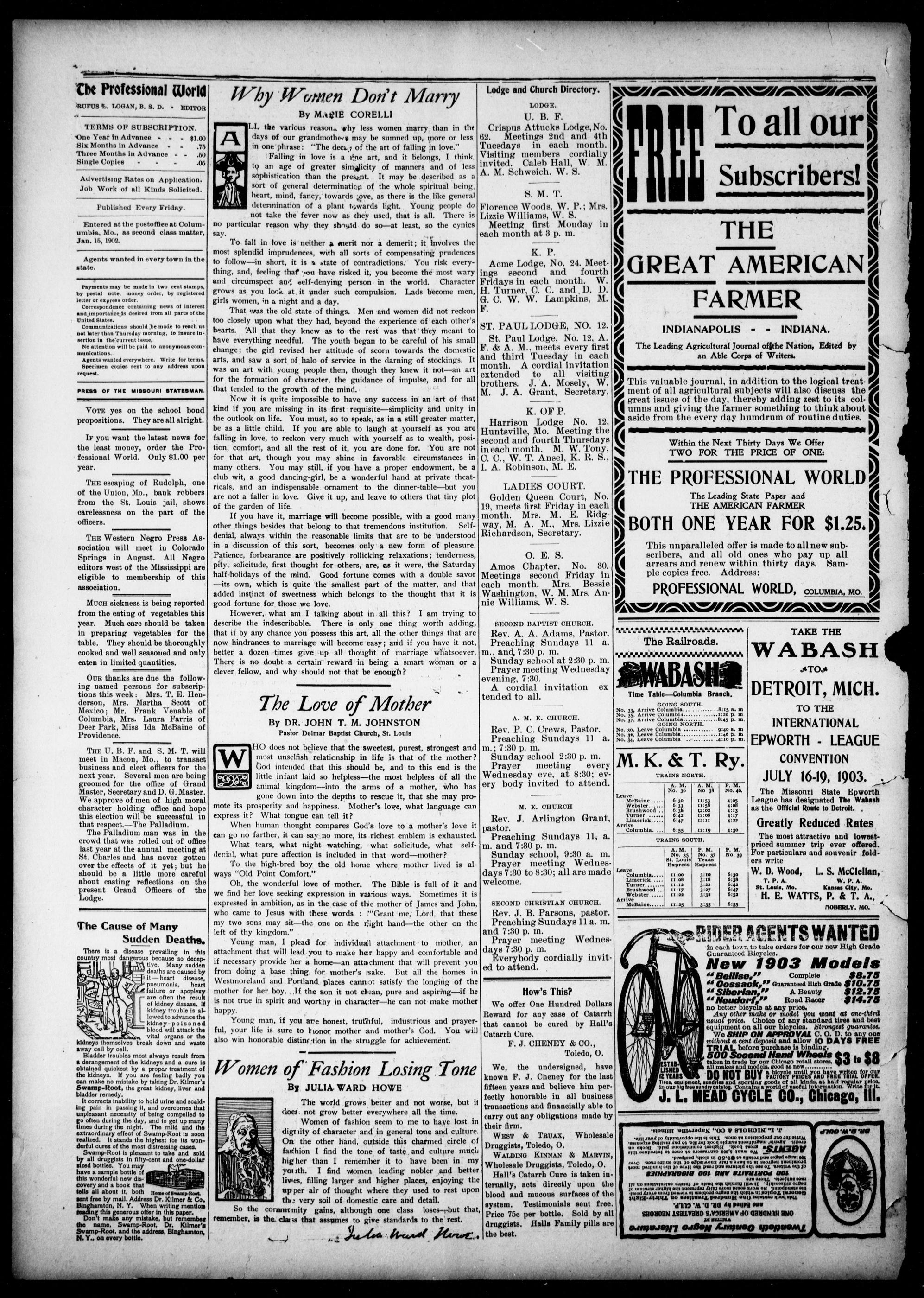
RUFUS E. LOGAN, B. S. D. • EDITOR
TERMS OF SUBSCRIPTION.
One Year in Advance - - - $1.00
Six Months in Advance - - .75
Three Months in Advance - - .50
Single Copies - - - .05
Advertising Rates on Application.
Job Work of all Kinds Solletted.
Published Every Friday.
Entered at the postoffice at Colum-
umbia, Mo., as second class matter,
Jan. 15, 1902.
Agents wanted in every town in the
state.
Payments may be made in two cent stamps,
by postal note, money order, by registered
letter or express order.
Correspondence containing news of interest
and importance, is desired from all parts of the
United States.
Communications should be made to reach us not later than Thursday morning, to insure insertion in the current issue, No attention will be paid to anonymous communications. Agents wanted everywhere. Write for terms. Specimen copies sent to any address upon request.
PRESS OF THE MISSOURI STATESMAN.
VOTE yes on the school bond propositions. They are all alright.
If you want the latest news for the least money, order the Professional World. Only $1.00 per year.
The escaping of Rudolph, one of the Union, Mo., bank robbers from the St. Louis jail, shows carelessness on the part of the officers.
The Western Negro Press Association will meet in Colorado Springs in August. All Negro editors west of the Mississippi are eligible to membership of this association.
MUCH sickness is being reported from the eating of vegetables this year. Much care should be taken in preparing vegetables for the table. They should be thoroughly cooked and well seasoned and only eaten in limited quantities.
OUR thanks are due the following named persons for subscriptions this week: Mrs. T. E. Henderson, Mrs. Martha Scott of Mexico; Mr. Frank Venable of Columbia, Mrs. Laura Farris of Deer Park, Miss Ida McBaine of Providence.
THE U. B. F. and S. M. T. will meet in Macon, Mo., to transact business and elect officers for the next year. Several men are being groomed for the office of Grand Master, Secretary and D. G. Master. We approve of men of high moral character holding office and hope this election will be successful in that respect. The Palladium. The Palladium man was in the crowd that was rolled out of office last year at the annual meeting at St. Charles and has never gotten over the effects of it yet; but he should be a little more careful about casting reflections on the present Grand Officers of the Lodge.
The Cause of Many
There is a disease country most dangerous
prevailing in this
s because so deceptive.
Many sudden
deaths are caused by
it—heart disease,
pneumonia,
heart
failure or apoplexy
are often the result
of kidney disease.
if kidney trouble is
allowed to advance the
kidney-poisoned
blood will attack the
vital organs or the
ak down and waste
What organs of the kidneys themselves break down and waste way cell by cell. Bladder troubles most always result from derangement of the kidneys and a cure is obtained quickest by a proper treatment of the kidneys. If you are feeling badly you can make no mistake by taking Dr. Kilmer's Swamp-Root, the great kidney, liver and bladder remedy. It corrects inability to hold urine and scalding pain in passing it, and overcomes that unpleasant necessity of being compelled to go often during the day, and to get up many times during the night. The mild and the extraordinary effect of Swamp-Root is soon realized. It stands the highest for its wonderful cures of the most distressing cases.
have a sample bottle of this wonderful new discovery and a book that tells all about it, both sent free by mail. Address Dr. Ktlmer & Co. Binghamton, N. Y. When writing mention this generous offer in this paper. Don't make any mistake, but remember the name, Swamp-Root, Dr. Kilmer's Swamp-Root, and the address, Binghamton, N. Y., on every bottle.
Why Women Don't Marry
LL the various reasons why less women marry than in the days of our grandmothers may be summed up, more or less in one phrase: "The decay of the art of falling in love."
Falling in love is a fine art, and it belongs, I think, to an age of greater simplicity of manners and of less sophistication than the present. It may be described as a sort of general determination of the whole spiritual being, heart, mind, fancy, towards love, as there is the like general determination of a plant towards light. Young people do not take the fever now as they used, that is all. There is no particular reason why they should do so—at least, so the cynics say.
To fall in love is neither a merit nor a demerit; it involves the most splendid imprudences, with all sorts of compensating prudences to follow—in short, it is a state of contradictions. You risk everything, and, feeling that you have risked it, you become the most wary and circumspect and self-denying person in the world. Character grows as you look at it under such compulsion. Lads become men, girls women, in a night and a day.
That was the old state of things. Men and women did not reckon too closely upon what they had, beyond the experience of each other's hearts. All that they knew as to the rest was that they meant to have everything needful. The youth began to be careful of his small change; the girl revised her attitude of scorn towards the domestic arts, and saw a sort of halo of service in the darning of stockings. It was an art with young people then, though they knew it not—an art for the formation of character, the guidance of impulse, and for all that tended to the growth of the mind.
Now it is quite impossible to have any success in an art of that kind if you are missing in its first requisite—simplicity and unity in the outlook on life. You must, so to speak, as in a still greater matter, be as a little child. If you are able to laugh at yourself as you are falling in love, to reckon very much with yourself as to wealth, position, comfort, and all the rest of it, you are done for. You are not for that art, though you may shine in favorable circumstances in many others. You may still, if you have a proper endowment, be a club wit, a good dancing-girl, be a wonderful hand at private theatricals, and an indispensable ornament to the dinner-table—but you are not a faller in love. Give it up, and leave to others that tiny plot of the garden of life.
If you have it, marriage will become possible, with a good many other things besides that belong to that tremendous institution. Self-denial, always within the reasonable limits that are to be understood in a discussion of this sort, becomes only a new form of pleasure. Patience, forbearance are positively rollicking relaxations; tenderness, pity, solicitude, first thought for others, are, as it were, the Saturday half-holidays of the mind. Good fortune comes with a double savor—its own, which is quite the smallest part of the matter, and that added instinct of sweetness which belongs to the thought that it is good fortune for those we love.
However, what am I talking about in all this? I am trying to describe the indescribable. There is only one thing worth adding, that if by any chance you possess this art, all the other things that are now hindrances to marriage will become easy; and if you have it not, better a dozen times give up all thought of marriage whatsoever. There is no doubt a certain reward in being a smart woman or a clever fellow, and why should not that be enough?
The Love of Mother
HO does not believe that the sweetest, purest, strongest and most unselfish relationship in life is that of the mother? God intended that this should be, and to this end is the little infant laid so helpless—the most helpless of all the animal kingdom—into the arms of a mother, who has gone down into the depths to rescue it, that she may promote its prosperity and happiness. Mother's love, what language can express it? What tongue can tell it?
When human thought compares God's love to a mother's love it can go no farther, it can say no more, its richest emblem is exhausted. What tears, what night watching, what solicitude, what self-denial, what pure affection is included in that word—mother?
To the high-bred boy the old home where mother lived is always "Old Point Comfort."
Oh, the wonderful love of mother. The Bible is full of it and we find her love seeking expression in various ways. Sometimes it is expressed in ambition, as in the case of the mother of James and John, who came to Jesus with these words: "Grant me, Lord, that these my two sons may sit—the one on the right hand—the other on the left of thy kingdom."
Young man, I plead for individual attachment to mother, an attachment that will lead you to make her happy and comfortable and if necessary provide her a home—an attachment that will prevent you from doing a base thing for mother's sake. But all the homes in Westmoreland and Portland places cannot satisfy the longing of the mother for her boy. If the son it not clean, pure and aspiring—if he is not true in spirit and worthy in character—he can not make mother happy.
Young man, if you are honest, truthful, industrious and prayerful, your life is sure to honor mother and mother's God. You will also win honorable distinction in the struggle for achievement.
Women of Fashion Losing Tone BY JULIA WARD HOWE
So the community gains, although one class loses—but that, remember, is the class that assumes to give standards to the rest.
A
not take no particular reasay.
To fall in the most splendid in to follow—in thing, and, feeling and circumspect grows as you lo girls women, in a That was the too closely upon hearts. All that have everything change; the girl arts, and saw a was an art within for the formation that tended to the Now it is good if you are the outlook on life be as a little ch falling in love, tition, comfort, art for that art, the many others. Y club wit, a goodricals, and an it are not a faller in of the garden of If you have other things besidenial, always w in a discussion of Patience, forbeam pity, solicitude, the half-holidays of it—its own, which added instinct of good fortune for However, we describe the ind that if by any ch now hindrances better a dozen There is no do clever fellow, and
W
mote its prosper
express it? Wh
When huma
can go no farther
What tears,
denial, what pur
To the high
ways "Old Point
Oh, the woe
we find her love
expressed in ambi
who came to Jee
my two sons ma
left of thy king
Young man
attachment that
if necessary prov
from doing a b
Westmoreland a
mother for her b
is not true in sp
happy.
Young man
ful, your life is
also win honoral
Women
[Image of a man with a crown and a sword, wearing a black and white patterned robe.]
So the con- remember, is the
By MAGIE CORELLI
various reason, why less women must of our grandmother may be summed up by phrase: "The decay of the art of fall, falling in love is a fine art, and it is a age of greater simplicity of mannication than the present. It may be of general determination of the whole mind, fancy, towards love, as there isination of a plant towards light. You like the fever now as they used, that reason why they should do so—at least love is neither a merit nor a demerit,僕udences, with all sorts of compendious, it is a state of contradictions. Giving that you have risked it, you become and self-denying person in the way look at it under such compulsion. Late night and a day.
The old state of things. Men and women what they had, beyond the experience, they knew as to the rest was that needful. The youth began to be cared for revised her attitude of scorn toward sort of halo of service in the darning of young people then, though they knew of character, the guidance of impulse the growth of the mind.
Quite impossible to have any success in missing in its first requisite—simplicity. You must, so to speak, as in a still old. If you are able to laugh at you reckon very much with yourself as all the rest of it, you are done for though you may shine in favorable you may still, if you have a proper of dancing-girl, be a wonderful hand indispensable ornament to the dinner in love. Give it up, and leave to other life.
It, marriage will become possible, writes that belong to that tremendous within the reasonable limits that are to of this sort, becomes only a new force are positively rolling relaxairst thought for others, are, as it we the mind. Good fortune comes with it is quite the smallest part of the sweetness which belongs to the thing we love.
What am I talking about in all this? describable. There is only one thingance you possess this art, all the other marriage will become easy; and if times give up all thought of marriagbt a certain reward in being a smal and why should not that be enough?
The Love of Moth
By DR. JOHN T. M. JOHNSTO
Pastor Delmar Baptist Church, St. Louis does not believe that the sweetest, pure unselfish relationship in life is that intended that this should be, and to infant laid so helpless—the most helpful kingdom—into the arms of a man down into the depths to rescue it, the ty and happiness. Mother's love, what tongue can tell it? In thought compares God's love to a
The world grows better and not worse, but it does not grow better everywhere all the time. Women of fashion seem to me to have lost in dignity of character and in general tone and culture. On the other hand, outside this charmed circle of fashion I find the tone of taste and culture much higher than I remember it to have been in my youth. I find women leading nobler and better lives, filling larger and higher places, enjoying the upper air of thought where they used to rest upon the very soil of domestic care and detail.
Lodge and Church Directory.
U. B. F.
Crispus Attucks Lodge,No.
62. Meetings 2nd and 4th
Tuesdays in each month.
Visiting members cordially
invited. Caleb Hall, W. M.
A. M. Schweich, W. S.
S. M. T.
Florence Woods, W. P.; Mrs. Lizzie Williams, W. S. Meeting first Monday in each month at 3 p. m.
K. P.
Acme Lodge, No. 24. Meetings second and fourth Fridays in each month. W. H. Turner, C. C. and D. D. G. C. W. W. Lampkins, M. F.
ST. PAUL LODGE, NO. 12.
St. Paul Lodge, No. 12. A. F. & A. M., meets every first and third Tuesday in each month. A cordial invitation extended to all visiting brothers. J. A. Mosely, W. M. J. A. Grant, Secretary.
K. OF P.
Harrison Lodge No. 12,
Huntsville, Mo. Meeting the
second and fourth Thursdays
in each month. M. W. Tony,
C. C., W. T. Ansel, K. R. S.,
I. A. Robinson, M. E.
LADIES COURT
Golden Queen Court, No. 19, meets first Friday in each month. Mrs. M. E. Ridgway, M. A. M., Mrs. Lizzie Richardson, Secretary.
O E S
Amos Chapter, No. 30.
Meetings second Friday in each month. Mrs. Bessie Washington, W. M. Mrs. Annie Williams, W. S.
SECOND BAPTIST CHURCH.
Rev. A. A. Adams, Pastor.
Preaching Sundays 11 a.
m., and 7:30 p. m.
Sunday school at 2:30 p. m.
Prayer meeting Wednesday evening, 7:30.
A cordial invitation extended to all.
A. M. E. CHURCH.
Rev. P. C. Crews, Pastor.
Preaching Sundays 11 a.
m.; 7:30 p. m.
Sunday school 2:30 p. m.
Prayer meeting every
Wednesday eve, at 8:30; every
body invited to attend.
M. E. CHURCH
Rev. J. Arlington Grant, pastor.
Preaching Sundays 11, a. m. and 7:30 p. m.
Sunday school, 9:30 a. m.
Prayer meeting Wednesdays 7:30 to 8:30; all are made welcome.
Rev. J. B. Parsons, pastor.
Preaching Sundays 11 a. m.
and 7:30 p. m.
Prayer meeting Wednesdays 7:30 p. m.
Everybody cordially invited to attend.
How's This?
We offer One Hundred Dollars Reward for any case of Catarrh that cannot be cured by Hall's Catarrh Cure.
F. J. CHENEY & CO.,
Toledo, O.
We, the undersigned, have known F. J. Cheney for the last fifteen years and believe him perfectly honorable in all business transactions and financially able to carry out any obligations made by their firm.
WEST & TRUAX, Wholesale Druggists, Toledo, O.
WALDING KINNAN & MARVIN, Wholesale Druggists, Toledo, O.
Hall's Catarrh Cure is taken internally, acts directly upon the blood and mucous surfaces of the system. Testimonials sent free. Price 75c per bottle. Sold by all druggists. Halls Family pills are the best.
INDIANAPOLIS - - INDIANA. The Leading Agricultural Journal of the Nation, Edited by an Able Corps of Writers.
This valuable journal, in addition to the logical treatment of all agricultural subjects will also discuss the great issues of the day, thereby adding zest to its columns and giving the farmer something to think about aside from the every day humdrum of routine duties.
Within the Next Thirty Days We Offer TWO FOR THE PRICE OF ONE:
The Leading State Paper and THE AMERICAN FARMER
BOTH ONE YE
This unparalleled offer
scribers, and all old
arrears and renew with
ple copies free. Addr
PROFESSIONAL
BOTH ONE YEAR FOR $1.25.
This unparalleled offer is made to all new subscribers, and all old ones who pay up all arrears and renew within thirty days. Sample copies free. Address: PROFESSIONAL WORLD, COLUMBIA, MO.
The Railroads.
WABASH
Time Table—Columbia Branch.
GOING SOUTH.
No. 33, Arrive Columbia.....8:15 a. m.
No. 35, Arrive Columbia.....1:20 p. m.
No. 37, Arrive Columbia.....8:45 p. m.
GOING NORTH.
No. 30, Leave Columbia.....9:40 a. m.
No. 33, Leave Columbia.....1:40 p. m.
No. 34, Leave Columbia.....4:10 p. m.
A. M. No. 36
A. M. No. 38
P. M. No. 40
Leave:
McBaine ... 6:30 11:53 4:08
Webster ... 6:30 11:58 4:08
Brushwood ... 6:38 12:02 4:13
Turner ... 6:42 12:06 4:17
Limerick ... 6:47 12:11 4:22
Arrive
Columbia ... 6:55 12:19 4:30
TRAINS SOUTH.
A. M. No. 35
St. Louis Express
P. M. No. 37
Texas Express
P. M. No. 39
Leave:
Columbia ... 11:00 3:10 6:30
Limerick ... 11:08 3:18 6:38
Turner ... 11:12 3:22 6:42
Brushwood ... 11:17 3:27 6:47
Webster ... 11:22 3:32 6:52
Arrive
McBaine ... 11:25 3:35 6:55
RIDER AGENTSWANTED
ESTABLISHED
12 YEARS
Tires, equipment,
in our big tree su
J. L. M
to Hundred Treasures on Thirty-Six
birds in the negro problem is viewed from every post,
would fully realize the higher stratum of
furnish the basis of future acquisitions on all
ITTS AND 100 BIOGRAPHIES
pictures and read the Area of the hundred most
have a fair knowledge of the entire book.
@ $ 2.50 in cloth, postpaid.
amount 6,000 canvases as once to introduce this
book. Highest communal paid.
sample book for $ 50. to pay mailing expenses,
as once. This is the opportunity of your life.
ILLS & CO., Naperville, Illinois.
This book contains One Hundred Treatises on Thirty-Eight General Topics in which the negro problem is viewed from every possible standpoint. No work could more fully represent the higher stratum of negro citizenship. It will furnish the basis of future calculations on all race subjects. There are
100 PORTRAITS AND 100 BIOGRAPHIES
of the writers. To see the pictures and read the lives of the hundred most prominent negroes is to have a fair knowledge of the entire race. Over 700 large pages and retails at $9,500 in cloth, postpaid.
AGENTS. We want $5,000 canvassers at once to introduce this great book. Highest commission paid. Books on credit. Agents' magnificent sample book for 55c. to pay mailing expenses. Write for our proposition at once. This is the opportunity of your life.
AR FOR $1.25.
is made to all new sub-
ones who pay up all
in thirty days. Sam-
ss:
WORLD, COLUMBIA, MO.
TAKE THE
WABASH
DETROIT, MICH.
TO THE INTERNATIONAL EPWORTH - LEAGUE CONVENTION
The Missouri State Epworth League has designated The Wabash as the Official Route to Detroit.
Greatly Reduced Rates
The most attractive and lowest-priced summer trip ever offered. For particulars and souvenir folders write
W. D. Wood, L. S. McClellan,
T. P. A.
St. Louis, Mo.
W. P. A.
Kansas City, Mo.
H. E. WATTS, P. & T. A.,
NOBERLY, MO.
AGENTS WANTED
to take orders for our new High Grade
Bicycles.
1903 Models
Complete $8.75
Guaranteed High Grade $10.75
A Beauty $12.75
Road Racer $14.75
cycle at any price.
make or model you want at one-third
Choice of any standard tires and best
all our bicycles. Strongest guarantee.
ON APPROVAL C. O. D. to any one
at deposit and allow 10 DAYS FREE
ore purchase is binding.
Bond Hand Wheels $3 to $8
by our Chicago retail stores.
models, good as new .....
BUY bicycles until you have written for our
factory PRICES AND FREE TRIAL OFFER.
buy goods of all kinds, at half regular price.
ains a world of useful information. Write for it.
CLE CO., Chicago, Ill.
```markdown
```
DR. D.W. OULP