The Professional World
Friday, August 21, 1903
Columbia, Missouri
Page text (machine-generated)
THE PROFESSIONAL WORLD.
$1.00 Per Year in Advance.
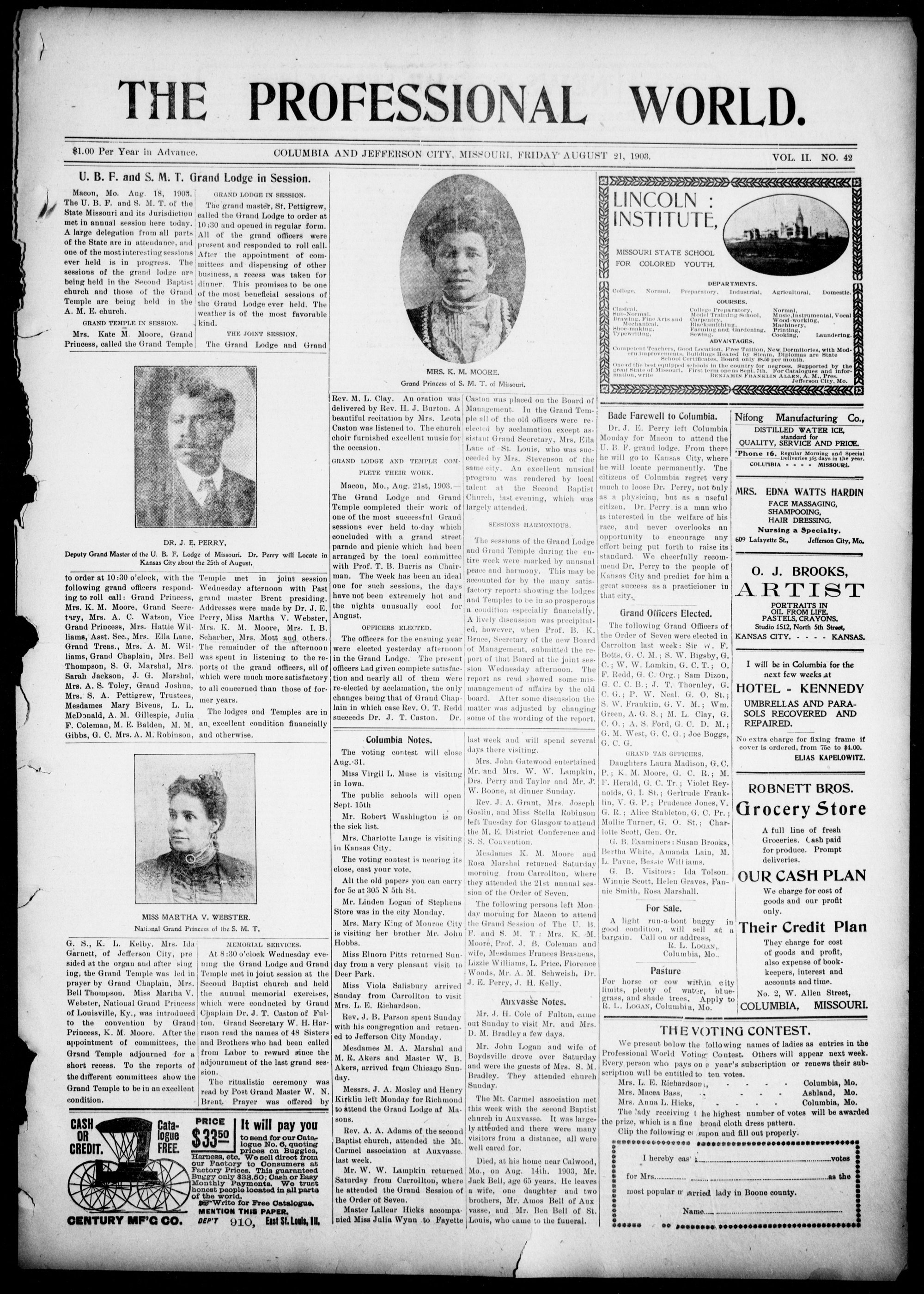
U. B. F. and S. M. T. Grand Lodge in Session.
Macon, Mo. Aug. 18, 1903. The U. B. F. and S. M. T. of the State Missouri and its Jurisdiction met in annual session here today. A large delegation from all parts of the State are in attendance, and one of the most interesting sessions ever held is in progress. The sessions of the grand lodge are being held in the Second Baptist church and those of the Grand Temple are being held in the A. M. E. church.
GRAND TEMPILE IN SESSION.
Mrs. Kate M. Moore, Grand Princess, called the Grand Temple
DR. J. E. PERRY.
Deputy Grand Master of the U. B. F. Lodge of Missouri. Dr. Perry will Locate in Kansas City about the 25th of August.
to order at 10:30 o'clock, with the following grand officers responding to roll call: Grand Princess, Mrs. K. M. Moore, Grand Secretary, Mrs. A. C. Watson, Vice Grand Princess, Mrs. Hattie Williams, Asst. Sec., Mrs. Ella Lane, Grand Treas., Mrs. A. M. Williams, Grand Chaplain, Mrs. Bell Thompson, S. G. Marshal, Mrs. Sarah Jackson, J. G. Marshal, Mrs. A. S. Toley, Grand Joshua, Mrs. S. A. Pettigrew, Trustees, Mesdames Mary Bivens, L. L. McDonald, A. M. Gillespie, Julia F. Coleman, M. E. Balden, M. M. Gibbs, G. C. Mrs. A. M. Robinson,
MISS MARTHA V. WEBSTER.
National Grand Princess of the S. M. T.
G. S., K. L. Kelby. Mrs. Ida Garnett, of Jefferson City, presided at the organ and after singing, the Grand Temple was led in prayer by Grand Chaplain, Mrs. Bell Thompson. Miss Martha V. Webster, National Grand Princess of Louisville, Ky., was introduced to the convention by Grand Princess, K. M. Moore. After the appointment of committees, the Grand Temple adjourned for a short recess. To the reports of the different committees show the Grand Temple to be in an excellent condition.
CASH OR CREDIT. Catalogue FREE. CENTURY MF'G CO.
The grand master, St. Pettigrew, called the Grand Lodge to order at 10:30 and opened in regular form. All of the grand officers were present and responded to roll call. After the appointment of committees and dispensing of other business, a recess was taken for dinner. This promises to be one of the most beneficial sessions of the Grand Lodge ever held. The weather is of the most favorable kind.
THE JOINT SESSION.
The Grand Lodge and Grand
Temple met in joint session Wednesday afternoon with Past grand master Brent presiding. Addresses were made by Dr. J. E. Perry, Miss Martha V. Webster, Mrs. K. M. Moore, Mrs. I. B. Scharber, Mrs. Mott and others. The remainder of the afternoon was spent in listening to the reports of the grand officers, all of which were much more satisfactory to all concerned than those of former years. The lodges and Temples are in an excellent condition financially and otherwise.
At 8:30 o'clock Wednesday evening the Grand Lodge and Grand Temple met in joint session at the Second Baptist church and held the annual memorial exercises, which were conducted by Grand Chaplain Dr. J. T. Caston of Fulton. Grand Secretary W. H. Harrison read the names of 48 Sisters and Brothers who had been called from Labor to reward since the adjournment of the last grand session. The ritualistic ceremony was read by Post Grand Master W. N. Brent. Prayer was offered by
prices on Buggies,
Harness, etc. We sell direct from
Our Factory to Consumers at
Factory Prices. This guaranteed
Buggy only $33.50; Cash or Easy
Monthly Payments. We trust
honest people located in all parts
of the world.
Write for Free Catalogue.
MENTION THIS PAPER.
DEP'T 910. East St. Louis, Ill.
COLUMBIA AND JEFFERSON CITY, MISSOURI, FRIDAY AUGUST 21, 1903.
It will pay you
[Picture of a woman with curly hair, wearing a dark dress with a high collar and decorative embroidery.]
MRS. K. M. MOORE.
Grand Princess of S. M. T. of Missouri.
Rev. M. L. Clay. An oration was delivered by Rev. H. J. Burton. A beautiful recitation by Mrs. Leota Caston was listened to. The church choir furnished excellent music for the occasion. GRAND LODGE AND TEMPLE COMPLETE THEIR WORK.
Macon, Mo., Aug. 21st, 1903. The Grand Lodge and Grand Temple completed their work of one of the most successful Grand sessions ever held to-day which concluded with a grand street parade and picnic which had been arranged by the local committee with Prof. T. B. Burris as Chairman. The week has been an ideal one for such sessions, the days have not been extremely hot and the nights unusually cool for August.
OFFICERS ELECTED.
The officers for the ensuing year were elected yesterday afternoon in the Grand Lodge. The present officers had given complete satisfaction and nearly all of them were re-elected by acclamation, the only changes being that of Grand Chapplain in which case Rev. O. T. Redd succeeds Dr. J. T. Caston. Dr.
Columbia Notes.
The voting contest will close Aug.-31.
Miss Virgil L. Muse is visiting in Iowa.
Mr. Robert Washington is on the sick list.
The voting contest is nearing its close, cast your vote.
All the old papers you can carry for 5c at 305 N 5th St.
Mr. Linden Logan of Stephens Store was in the city Monday.
Mrs. Mary King of Monroe City is visiting her brother Mr. John Hobbs.
Miss Elnora Pitts returned Sunday from a very pleasant visit to Deer Park.
Miss Viola Salisbury arrived Sunday from Carrollton to visit Mrs. L. E. Richardson.
Rev. J. B. Parson spent Sunday with his congregation and returned to Jefferson City Monday.
Mesdames M. A. Marshal and M. R. Akers and Master W. B. Akers, arrived from Chicago Sunday.
Messrs. J. A. Mosley and Henry Kirklin left Monday for Richmond to attend the Grand Lodge af Masons.
Rev. A. A. Adams of the second Baptist church, attended the Mt Carmel association at Auxvasse last week.
Mr. W. W. Lampkin returned Saturday from Carrollton, where he attended the Grand Session of the Order of Seven. Master Lalear Hicks accompanied Miss Julia Wynn to Fayette
Caston was placed on the Board of Management. In the Grand Temple all of the old officers were reelected by acclamation except assistant Grand Secretary, Mrs. Ella Lane of St. Louis, who was succeeded by Mrs. Stevenson of the same city. An excellent musical program was rendered by local talent at the Second Baptist Church, last evening, which was largely attended.
SESSIONS HARMONIOUS
The sessions of the Grand Lodge and Grand Temple during the entire week were marked by unusual peace and harmony. This may be accounted for by the many satisfactory reports showing the lodges and Temples to be in so prosperous a condition especially financially. A lively discussion was precipitated, however, when Prof. B. K. Bruce, Secretary of the new Board of Management, submitted the report of that Board at the joint session Wednesday afternoon. The report as read showed some mismanagement of affairs by the old board. After some discussion the matter was adjusted by changing some of the wording of the report.
last week and will spend several days there visiting.
Mrs. John Gatewood entertained Mr. and Mrs. W. W. Lampkin, Drs. Perry and Taylor and Mr. J. W. Boone, at dinner Sunday.
Rev. J. A. Grant, Mrs. Joseph Goslin, and Miss Stella Robinson left Tuesday for Glasgow to attend the M. E. District Conference and S. S. Convention.
Mesdames K. M. Moore and Rosa Marshal returned Saturday morning from Carrollton, where they attended the 21st annual session of the Order of Seven.
The following persons left Monday morning for Macon to attend the Grand Session of The U. B. F. and S. M. T.: Mrs. K. M. Moore, Prof. J. B. Coleman and wife, Mesdames Frances Brasneas, Lizzie Williams, L. Price, Florence Woods, Mr. A. M. Schweish, Dr. J. E. Perry, J. H. Kelly.
Auxvasse Notes.
Mr. J. H. Cole of Fulton, came out Sunday to visit Mr. and Mrs. D. M. Bradley a few days.
Mr. John Logan and wife of Boydsville drove over Saturday and were the guests of Mrs. S. M. Bradley. They attended church Sunday.
The Mt. Carmel association met this week with the second Baptist church in Auxvasse. It was largely attended and there were many visitors from a distance, all were well cared for.
Died, at his home near Calwood, Mo., on Aug. 14th, 1903, Mr. Jack Bell, age 65 years. He leaves a wife, one daughter and two brothers, Mr. Amos Bell of Aux vasse, and Mr. Ben Bell of St. Louis, who came to the funeral.
LINCOLN: INSTITUTE,
MISSOURI STATE SCHOOL FOR COLORED YOUTH.
DEPARTMENTS.
College, Normal, Preparatory, Industrial, Agricultural, Domestic.
COURSES.
Classical, Normal, College Preparatory, Normal, Music, Instrumental, Vocal
Sub-Normal, Model Training School, Wood-working, Drawing, Fine Arts and Carpentry, Mechanical, Blacksmithing, Machinery, Show-making, Farming and Gardening, Printing, Typewriting, Sewing, Laundering.
ADVANTAGES.
Competent Teachers, Good Location, Free Tuition, New Dormitories, with Modern Improvements, Buildings Heated by Steam, Diplomas are State School Certificates, Board only $8.50 per month.
One of the best equipped schools in the country for negroes. Supported by the great State of Missouri. First term opens Sept. 7th. For Catalogues and information, write
BENJAMIN FRANKLIN ALLEN, A. M., Pres.
Jefferson City, Mo.
Bade Farewell to Columbia.
Dr. J. E. Perry left Columbia Monday for Macon to attend the U. B. F. grand lodge. From there he will go to Kansas City, where he will locate permanently. The citizens of Columbia regret very much to loose Dr. Perry, not only as a physician, but as a useful citizen. Dr. Perry is a man who is interested in the welfare of his race, and never overlooks an opportunity to encourage any effort being put forth to raise its standard. We cheerfully recommend Dr. Perry to the people of Kansas City and predict for him a great success as a practicioner in that city.
Grand Officers Elected.
The following Grand Officers of the Order of Seven were elected in Carrolton last week: Sir w. F. Botts, G. C. M.; S. W. Bigsby, G. C.; W. W. Lamkin, G. C. T.; O. F. Redd, G. C. Org.; Sam Dizon, G. C. C. B.; J. T. Thornley, G. C. G.; P. W. Neal, G. O. St.; S. W. Franklin, G. V. M.; Wm. Green, A. G. S.; M. L. Clay, G. C. O.; A. S. Ford, G. C. D. M.; G. M. West, G. C. G.; Joe Boggs, G. C. G.
GIAND TAB OFFICERS.
Daughters Laura Madison, G. C.
P.; K. M. Moore, G. C. R.; M.
F. Herald, G. C. Tr.; Violet Reynolds, G. I. St.; Gertrude Franklin, V. G. P.; Prudence Jones, V. G. R.; Alice Stableton, G. C. Pr.; Mollie Turner, G. O. St.; Charlotte Scott, Gen. Or.
G. B. Examiners: Susan Brooks, Bertha White, Amanda Lain, M. L. Pavne, Bessie Williams.
G. B. Visitors: Ida Tolson. Winnie Scott, Helen Graves, Fannie Smith, Rosa Marshall.
A light run-a-bout buggy in good condition, will sell at a bargain. Call on or address
R. L. LOGAN,
Columbia, Mo.
For horse or cow within city limits, plenty of water, bluegrass, and shade trees. Apply to R. L. LOGAN, Columbia, Mo.
THE VOTING CONTEST.
We present below the following names of ladies as entries in the Professional World Voting Contest. Others will appear next week. Every person who pays on e year's subscription or renews their subscription will be entitled to ten votes.
Mrs. L. E. Richardson, Columbia, Mo.
Mrs. Macea Bass, Ashland, Mo.
Mrs. Anna L. Hicks, Columbia, Mo.
The lady receiving t the highest number of votes will be awarded the prize, which is a fine broad cloth dress pattern.
Clip the following group and fill out properly.
For Sale.
Pasture
VOL. II. NO. 42
MENTS.
Industrial, Agricultural, Domestic.
USES.
Factory, Normal,
Erg School, Music, Instrumental, Vocal
Wood, working,
Machinery,
Gardening, Printing,
Cooking, Laundering.
TAGES.
Free Tuition, New Dormitories, with Mod-
ed by Steam, Diplomas are State
and only $8.50 per month.
Country for negroes. Supported by the
as Sept. 7th. For Catalogues and infor-
MIN FRANKLIN ALLEN, A. M., Pres.
Jefferson City, Mo.
Nifong Manufacturing Co.
DISTILLED WATER ICE,
standard for
QUALITY, SERVICE AND PRICE.
'Phone 16. Regular Morning and Special
Deliveries 305 days in the year.
COLUMBIA MISSOURL
MRS. EDNA WATTS HARDIN
FACE MASSAGING,
SHAMPOOING,
HAIR DRESSING.
Nursing a Specialty.
609 Lafayette St., Jefferson City, Mo.
O. J. BROOKS, ARTIST
PORTRAITS IN
OIL FROM LIFE.
PASTELS, CRAYONS.
Studio 1512, North 5th Street,
KANASAS CITY. - - - KANASAS.
I will be in Columbia for the next few weeks at
HOTEL = KENNEDY
UMBRELLAS AND PARA-
SOLS RECOVERED AND REPAIRED.
No extra charge for fixing frame if cover is ordered, from 75c to $4.00.
ELIAS KAPELOWITZ.
ROBNETT BROS.
Grocery Store
A full line of fresh Groceries. Cash paid for produce. Prompt deliveries.
OUR CASH PLAN
We charge for cost of goods and our profit only.
Their Credit Plan
They charge for cost of goods and profit, also expense of bookkeepers, interest and accounts and time. No. 2, W. Allen Street, COLUMBIA. MISSOURI.
long names of ladies as entries in the
test. Others will appear next week.
its subscription or renews their sub-
tutes.
- - - Columbia, Mo.
- - - Ashland, Mo.
- - - Columbia, Mo.
best number of votes will be awarded
with dress pattern.
I fill out properly.
votes
WEEKLY CROP BULLETIN
Rain Needed in the South Atlantic and East Gulf States—Harvesting in Progress in the Northwest—General Conditions.
Washington, D. C., Aug. 5.—Following is the official weekly crop report issued by the department of agriculture:
Throughout the northern portions of the country, from New England to the north Pacific coast, the temperature was too low for the best results, there being light frosts in North Dakota. In the southern states the weather was more favorable, although clear and warmer weather is needed in the west gulf districts.
Portions of the south Atlantic and east gulf states and the central and lower Mississippi valleys need rain, but elsewhere, east of the Rocky mountains, rains have been ample, being excessively heavy in central and northeastern Texas, in the eastern portions of Nebraska and Kansas, and over areas in the Ohio valley and the east gulf states. It is now dry in the central and southern. Rocky mountain districts.
Corn is generally improved, especially in Iowa, Nebraska, Kansas, and portions of Illinois and the lake region, the least favorable reports being received from Missouri and the Ohio valley states. The crop continues late. An excellent crop now is assured in the southern states.
General rains in the spring wheat region of the upper Missouri and the Red river of the North valleys checked the ripening of spring wheat and caused a better filling of heads. Harvesting is in progress, some of the early sown being cut in the northern portion, but it was delayed by rains in South Dakota and Nebraska. Harvesting also is in progress in Oregon with a light yield, but of excellent quality. In Washington the crop is maturing slowly, but is filling well. Rust in oats is quite extensively reported in Iowa, Minnesota, Wisconsin, and portions of Pennsylvania, but the late rains have benefited the crop in Minnesota. Harvesting is well advanced in the more northerly sections, being largely completed elsewhere with yields generally lighter than anticipated.
The improvement in cotton continues generally throughout the cotton belt. It is fruiting well, although of too rank a growth in portions of the central and western districts, and shedding on the sandy lands in the Carolinas is reported. Rains have been detrimental in the central and southwestern portions of the cotton area in Texas, but have been beneficial in the northern portion, while the boll weevil appears to be more destructive in a few of the southwestern counties. Clear warm weather is needed in Louisiana and Texas. The crop continues late. Tobacco is needing rain in portions of the Ohio valley and Virginia, but the general condition of the crop is promising.
Rains caused injury to hay in Texas, New York, and Michigan and delayed haying in South Dakota and New England; elsewhere this work has progressed under favorable conditions.
A HUGE LAND GRANT
Senator Pettigrew Gets It from the Mexican Government.
Sioux Falls, S. D., special.—Former United States Senator Pettigrew has secured a grant of 1,000,000 acres of land from the Mexican government. On the tract are several thousand acres of timber and a vast herd of cattle and horses. Two large rivers form the northern and southern boundaries, while the eastern border runs to the Gulf of Mexico. A never failing crop is raised every year, but it is Mr. Pettigrew's intention to raise two crops each year by irrigation. He proposes to tap one of the streams at various points and divert a portion of its waters across the plains.
He has entered into an agreement with South African Boers, who have taken 100,000 acres of the land and are under contract to have 400 families established on their new possessions by Sept. 1 of next year.
TURKS MASSACRED
Bulgarian Insurgents Kill Many—Four Thousand Troops Bombarding Krushevo. Salonica, Aug. 19. — It is reported that Bulgarian insurgents have massacred the inhabitants of a large Turkish village named Kenatil, near Monastir. Only twenty escaped. Four thousand troops are bombarding Krushevo, which is in the hands of the insurgents. Bulgarians in Krushevo and Reka districts are suffering severely
SCIENTIFIC
Away Up Amid the Clouds.
St. Louis will be the Mecca of meteorologists during the World's Fair if the plans of Prof. H. Erdmann, one of Germany's famous scientists, are carried out as indicated in a letter received Tuesday by Chancellor W. S. Chapin of Washington university. Prof. Erdmann proposes to send to the Exposition an enormous balloon to be used for taking the temperature and pressure of the upper strata of the atmosphere. The balloon will be sent up to as great a height as the scientists can stand and the atmospheric conditions of the upper air subjected to exact measurements. Instruments designed by Prof. Erdmann will accompany the balloon to this country and daily observations will be made. Inquiry was made in the letter as to the facilities for obtaining sufficient gas to fill the balloon, which has a capacity of 307,000 cubic feet. Director of Works Taylor states that the gas supply on the Exposition grounds will be ample to fill the balloon in two hours. Conditions of the upper atmosphere are as yet little understood and have been measured only by instruments sent up without an observer to watch the dials. Projects similar to that of Prof. Erdmann have been planned by the department of agriculture at Washington, but were not carried through for the lack of available funds.
Nuts and Tomatoes His Food.
Peter Johnson, of 1012 Washington avenue south, Minneapolis, Minn., has had nothing to eat but a handful of nuts and raw tomato a day for nine months. He is a living example of the so-called fasting fad for foolish persons.
Johnson had partial paralysis of the left side a year ago, he was a victim of Bright's disease, weighed 240 pounds, suffered from asthma, and was informed by his medical advisers that he could not live more than a month or two. Now Johnson weighs 170 pounds, is harder than nails and free from aches or pains.
Johnson fasted nearly 40 days when he began his "cure." Then, as he tells the story:
"I ate half a tomato a day for a week, and then increased to a whole tomato. After awhile I added a half pound of mixed nuts. Three weeks from the time I began eating I was told to eat more by degrees, but never to overfeed. I shall never take a chance. The tomato and the nuts, with plenty of water, keep me in splendid condition. I am as sound as the day I was born. I can do four times the day's work I used to do."
Electric Wave Explodes Powder.
The noted scientist, Dr. Le Bon, who lately has been experimenting with the Hertz waves, recently discovered that it is possible to send a current of electric waves by means of a simple reflector through the air over a distance of several miles, and that this current can be made strong enough to explode powder or dynamite. In one of his last experiments he exploded a number of cartridges of different kinds, which were placed in a bomb-proof vault in a fort outside of Paris, at a distance of nine kilometers. Military experts now declare that this invention will positively abolish all wars, as you may by it blow up any battery, fort or battle ship with the powder intended for its own guns.
EXECUTIVE
Opposes Penny Post With U. S.
In response to a correspondent, advising penny postage between Great Britain and the United States, Post-Master General Austen Chamberlain writes that it would be difficult to adopt such a scheme for the benefit of one country while refusing it to others, and that the sacrifices of revenue involved in the adoption of international penny postage would be so great that he does not feel justified in proposing it.
The Negro in the Navy.
The navy department denied Tuesday that it contemplated the elimination of negro enlisted men from the navy. A number of officers urged that displine and the effectiveness of the enlisted force would be promoted by eliminating the 500 colored men in the navy. The experiment of consolidating all these men on certain ships, a similar policy to that of the army, which has four colored regiments, may be tried.
Miscellaneous Happenings
Baggagemen to Carry Papers.
Postmaster-General Payne has decided to have the baggagemen on trains not carrying postal clerks distribute newspaper mail. This decision was made on the application of many newspapers and will greatly facilitate the transportation of this class of mail. The plan contemplates that the baggagemasters shall be sworn in as postoffice department employees and that they shall be paid for their services. It is intended that they shall deliver the papers to whom they are addressed, at points along the line, from the car doors, thus saving much time which would be lost in case the papers were inclosed in the pouch, as this would necessitate their being taken to the local post office before they could be delivered to agents. It is estimated that the cost of the service through the baggagemen will be much less than if postoffice employees were supplied for all such trains.
Sec. Root Will Leave Office.
It is reported that when Secretary Root leaves Washington for London, Aug. 22, to sit with the Alaskan Boundary commission, he will have practically ended his term as secretary of war, and that upon his return to this country he will formally retire from office and resume the practice of law. It is said Gov. William H. Taft of the Philippines will succeed Root, and that Vice-Governor Luke Wright will succeed Taft.
GENERAL POLITICAL
Half Million Negroes Going North
Through an organized movement by the Rev. J. Henry Duckrey, of Cambridge, Mass., 500,000 negroes will have emigrated from the South to points between Troy, N. Y., Boston and Providence within three years. The work of arranging for the migration has been carried on secretly by the Northwestern and Western Immigration society, of which Mr. Duckrey is the president. The organization has unlimited money at its command, subscribed by wealthy men and women, who believe that this scheme is the safe and sure solution of the negro problem. The negroes will be distributed along the line of the Boston on Maine railroad. Many of the coming negroes are skilled laborers and some are women, but all are seeking employment. The negroes say they are willing to join the labor unions, but though the unions do not want them, they will come just the same. Mr. Duckrey is in close touch with persons in Troy, Albany and eastern cities, and says that from the encouragement given him he believes he can get 10,000 persons out of the South by Nov. 1. A manufacturer of paper boxes at Cambridge, Mass., has agreed to employ 100 of the negro women and arrangements are now being perfected whereby several thousand colored persons of both sexes will find work. A large number will remain in northern cities, while some will be sent to the farming districts. Many persons believe that the coming of so many negroes to this section will fill the poorhouses and cause wild deserts to be made upon the charity organizations. Many others believe that the workingmen here to-day will be cut out of employment. On the other hand, the members of the Immigration society assert that they are perfectly able to take care of every negro man and woman coming here and each will be provided with employment. Mr. Duckrey has letters from the business men who offer to furnish employment to the negroes immediately.
Bryan Goes to Farmers' Congress.
Governor Mickey of Nebraska has appointed W. J. Bryan a delegate to the Farmers' National congress, which holds its twenty-third annual meeting at Niagara Falls Sept. 23 to Oct. 10 next. Speaking of this John M. Stahl, of Chicago, for the last ten years secretary of the congress, said: "Mr. Bryan is appointed as a farmer and because he is a farmer. The Farmers' National congress is not in any way a political organization."
Lowell Poisoned by Water.
Over 8,000 residents of Lowell, Mass. were made ill by drinking unfiltered water from the reservoir, which had been contaminated by poisons from the mills along the river above the city. The disease resembles cholera morbus and the death rate increased 25 per cent.
INDUSTRIAL
Gompers Challenges Parry.
Samuel Gompers, president of the American Federation of Labor, left a challenge in the hands of a committee addressed to D. M. Parry, offering to meet the latter on the stump at the Labor Day celebration at the fair grounds in Indianapolis and argue with him the question of unionism. The challenge will be handed to Mr. Parry within the next few days, when told of the challenge Mr. Parry, who is president of the National Manufacturers' association, said he would await the delivery of the challenge with a great deal of interest. He also said he had no desire to parade Mr. Gompers as a rival attraction at a "bany show."
Monthly Crop Report
The monthly crop report of the bureau of agriculture puts corn Aug. 1 at 78.7, as compared with 79.4 July 1 at 86.5 Aug. , 1902, and a two-year average of 84.4. Following is the estimate for the principal corn states and Oklaoma territory: Missouri, 71; Illinois, 74; Iowa, 72; Kansas, 67; O...ahoma, 71; Nebraska, 75; and Texas, 95. The winter wheat yield is now put at 410,000,000, an average of 12.4 bushels to the acre, against 13.8 last year. The average yield in Missouri is 8.1; Illinois, 8.4; Kansas, 14; Nebraska, 16.4; Oklahoma, 14.6.
P. M. Arthur's Successor.
W. S. Stone, of Eldon, Ia., No. 181, has been elected to fill the unexpired term as grand chief engineer of the Brotherhood of Locomotive Engineers made vacant by the death of P. M. Arthur and A. B. Younggson. After the election the executive committee of the Brotherhood said that no fear need be felt of any radical changes in the policy of the Brotherhood, that the new grand chief will carry out the conservative principles advocated by the late Chief Arthur.
LEGAL AND CRIMINAL
Suit Over Big Oil Tract.
A suit has been filed in the district court at Austin, Tex., involving the title to 4,400 acres of land, embracing all of the Saratoga oil field and valued at more than $1,000,000. The plaintiff in the case is Georgeria Lazarain, of Wilson county, and the defendants are J. L. Hume and others, of Austin. The plaintiff bases her claim to the land on the ground that it was granted to her father by the governor of Coahulla and Texas in 1835 and that title passed to her mother upon his death and that she is the sole heir. A few days ago she sold the land to Mr. Hume, M. C. Johnson, P. J. Houston and P. G. Berera, all of Austin, for $450. The plaintiff alleges in her petition that she was ignorant of the value of the land and that she made the sale upon misrepresentation in this respect. She asks that the conveyance to Mr. Hume and others be set aside and that $25,000 damages be given her.
Carrie Nation's Big Suit.
Carrie Nation's summary conviction for selling hatchets in violation of a city ordinance was declared illegal by Judge Newcomb at Scranton, Pa. Mrs. Nation's counsel will bring suit against the city for $50,000 damages for false arrest and imprisonment.
COMMERCIAL
Hard Coal Roads Merging.
It was reported In Philadelphia that the reading railway has been leased to the Delaware and Hudson and the Lackawanna. This means the end of the Gould-Cassatt war and the entrance of the Gould railroads into New York and Philadelphia without further warfare with the Pennsylvania. It also means that the long expected merger of the four anthracite carrying roads, the Reading, the Delaware and Hudson, the Lackawanna and the New Jersey Central, as planned by J.-erpont Morgan. It is stated on the authority of Moore and Schley of New
Who Owns Liberty Bell.
City Solicitor Kinsley of Philadelphia has formerly denied the claim to ownership of the cracked Liberty Bell recently set up by several defendants of John Wiltbank, the old bell easter. The calmants do not seek possession of the bell, but threaten to if it is again sent off on a junket
RELIGIOUS
SCIENTIFIC
EDUCATIONAL
York that by the agreement the Delaware and Hudson and the Lackawanna have guaranteed a dividend of 4 per cent on Reading common stock. This arrangement, if carried out, will complete an effectual community of interest among the anthracite producers and carriers.
Cold Storage Transportation Combine
A $1,000,000 combine has been effected by the consolidation of the Hammond Refrigerator, Anglo-American Refrigerator, Kansas City Refrigerator, Omaha Packing and St. Louis Dressed Beef and Provision companies' car lines, under the name of the National Car line. The general offices will be in the Rookery building, Chicago. The officers are: President, J. P. Lyman; vice-president, S. A. McClean; secretary and treasurer, J. D. Standish. In announcing the consolidation the company gave notice of the appointment of F. W. Cherrier to the office of superintendent of car service, W. G. Finn to that of auditor and F. A. Spink general manager. The consolidation places in the hands of the trust absolute control of all the refrigerator car lines used in the transportation of fresh meats and provisions, the products of all the packing houses of the country.
A Stocking Room.
A "stocking room" has been built and furnished in the National Bank of Commerce of Kansas City. It is called the "stocking room" because it is a place where a woman may go to be alone, while she takes from its hiding place the money she wishes to deposit. In the room are three mahogany sools about 12 inches high, with a leather cushion top on each. The stools are not intended for seats. There are chairs for that purpose. e stools are for women to put their feet upon while they are taking out their money. "Not many men will ever see the inside of the stocking room," said Mr. Winants, vice-president of the bank. "It is sacred to the use of our women clients. I have seen the necessity of it ever since I have been in the banking business. Half the women who come to the bank to deposit money carry it either in their stockings or in the bosom of their dress. The National Bank of Commerce is the first bank to have a "stocking room."
RELIGIOUS
Nude Donkhober Women Whipped.
Lashed into obedience by the heavy whips of their husbands and brothers, several hundred Dunkhober women near winnipeg, Manitoba, were forced to abandon their pilgrimage in search of Jesus. While nude, the misguided women started across the prairie in the morning, singing their strange hymns, and soon a band of Dunkhober men was in pursuit. When the men caught up with the procession words of entreaty to return were met in stolid silence. Commands were answered by scriptural quotations, proving the righteousness of the march. Then, as a last resort, came the use of the whips. No mercy was shown. Young and old alike felt the sting of the cutting rawhide across their bare shoulders. Unrelenting were the men and the blows fell unremittingly until the misguided women were all safe under roof again. Blood flowed in streams from some of the women's backs, but, as they are a strong and hardy race, no fears are had for their recovery. Cowed into submission, they have promised to remain at home and cease their vain efforts to locate the redeemer on this earth.
See Tyranny at Zion City.
Trials of Zion City people for insanity are severely criticised in Waukegan, following the hearing of Fred Speller, who was found sane, there being practically no evidence of insanity. It is said by the Waukegan people that when the Zion City authorities find any resident annoying they charge insanity and try to dispose of him in that manner if other means fall. In every case of a Zion man or woman being tried for insanity, it develops that the patient is an ardent believer of Dowle, and that he would be willing to go to an insane asylum if the doctor thought best.
Two-Cent Mile Rate.
The Chicago Great Western announced Monday that it would soon establish a flat passenger rate of two cents a mile in the territory east of the Missouri river and St. Paul and west and northwest of Minnesota.
Miles for G. A. R. Chief.
A movement has been started by the Maryland delegation to the Aug. 17 G. A. R. encampment at San Francisco, to elect Gen. Miles commander-in-chief of that organization.
COLLEGE BRED NEGROES
Until quite recently the number of college-bred negroes in the state of Iowa has been comparatively few, but within the last few years the number has gradually increased until the list of those negroes who have taken regular four-year college courses in this state contains the names of about twenty men and women, each of whom holds a baccalaureate degree in either science, philosophy or art, and several of whom hold the master's or the doctor's degree.
Among the first negroes to receive college degrees in this state were Prof. E. L. Blackshear, Ph. D., president of the State Normal and Industrial college of Texas, and Rev. Dr. Kealing, editor of the A. M. E. Church Review of Philadelphia. These two gentlemen were graduated from the classical course at Tabor college, Tabor, Iowa, in 1886, and in 1890 this same institution conferred the degree of A. B. upon Rev. W. H. Speese now pastor of the A. M. E. church at Newton, Iowa. Perhaps the largest number of negroes that have taken college degrees in Iowa have been from Wesleyan university at Mt. Pleasant, which numbers among its honored alumni four negro women—Mrs. S. Mosby Grandison, A. M., now a resident of Mt. Pleasant, but for some time a teacher in Benedict college, Columbia, S. C.; Misses Agnes and Louise Mason, both of whom have received the degree of B. S., and have been for most of the time since their graduation engaged in the teaching profession, and Miss Ida M. Godfrey, B. S., principal of the primary department of the public schools of Kansas City, Mo.
Prof. George Carver, B. S., in agriculture and head of the agricultural department of Prof. Booker T. Washington's institute at Tuskegee, is a graduate of the Iowa Agricultural college at Ames, and Mr. Frank Armstrong, Ph. B., an assistant private secretary to Prof. Washington, is an alumnus of Cornell college at Mt. Vernon, Iowa, having taken his degree there in 1899. Besides these there are a score of others who have been to college but not taken the full four years' course.
Lest it should occur to some that twenty college-bred men and women is a very small number for this proud state with her excellent system of common schools and numerous colleges it should be explained that the negro population of this state is less than 10,000 and since the average proportion of college-bred men in Ameri ca is one in five thousand, the college record of the Iowa negro is far in advance of that of the average Ameri can.
THE TURN OF THE TIDE.
The country is gradually experiencing the economic and financial change which has been anticipated, a tapering off of the flush and speculative conditions of the past three years. The work of the promoter is ended—nothing doing in that line, and that is a good thing. Interest rates are advancing and money brings 6 and 7 per cent as readily as it did four or five years ago. Water enough to run a lot of big mills has been squeezed out of corporation securities, and there is more to be wring out of them yet. Hardpan is in sight. The land boom was the last of the speculative fireworks—always is. The next strikes will be to prevent a cut in wages and not to compel an increase, and the time is not far off when the man will be hunting for a job instead of the job hunting the man. It has been a pretty good time, however, and all have had a share in it. The wise man has paid up his debts and in a large measure made himself independent of more ad verse conditions. The foolish man has run his credit to the limit and may well dread pay day. The American people are never content with moderate profits and healthful prosperity in a small way. They are always either "lickerin'" up or sobering off, raising the devil or being converted, ready to sacrifice a reasonable competence for a run for a fortune or the poorhouse and in doing thus they manage to get a plenty of variety and excitement.
A New "Society" Diversion.
The "society" people of Boonville entertain themselves by watching lit the negroes root for money. They fill a dishpan with flour, drop several small coins into it, and then have the boys nose it out, the boy who gets a piece in his mouth being given it. After the pickaninnies have rooted all the money out of a pan of flour it is the usual custom to fill the pan with molasses and let them root in that.—Kansas City Journal.
Expert Fisherman, Too.
Senator Lotsmun, who was a candidate for reelection, had been sending some financial feelers, as it were, down into a doubtful district, but had received no satisfactory assurances in return.
"Confound 'em!" he muttered. "I know the difference between a nibble and a bite, but I'm not getting either. Those fellows down there are merely taking my bait."—Chicago Tribune.
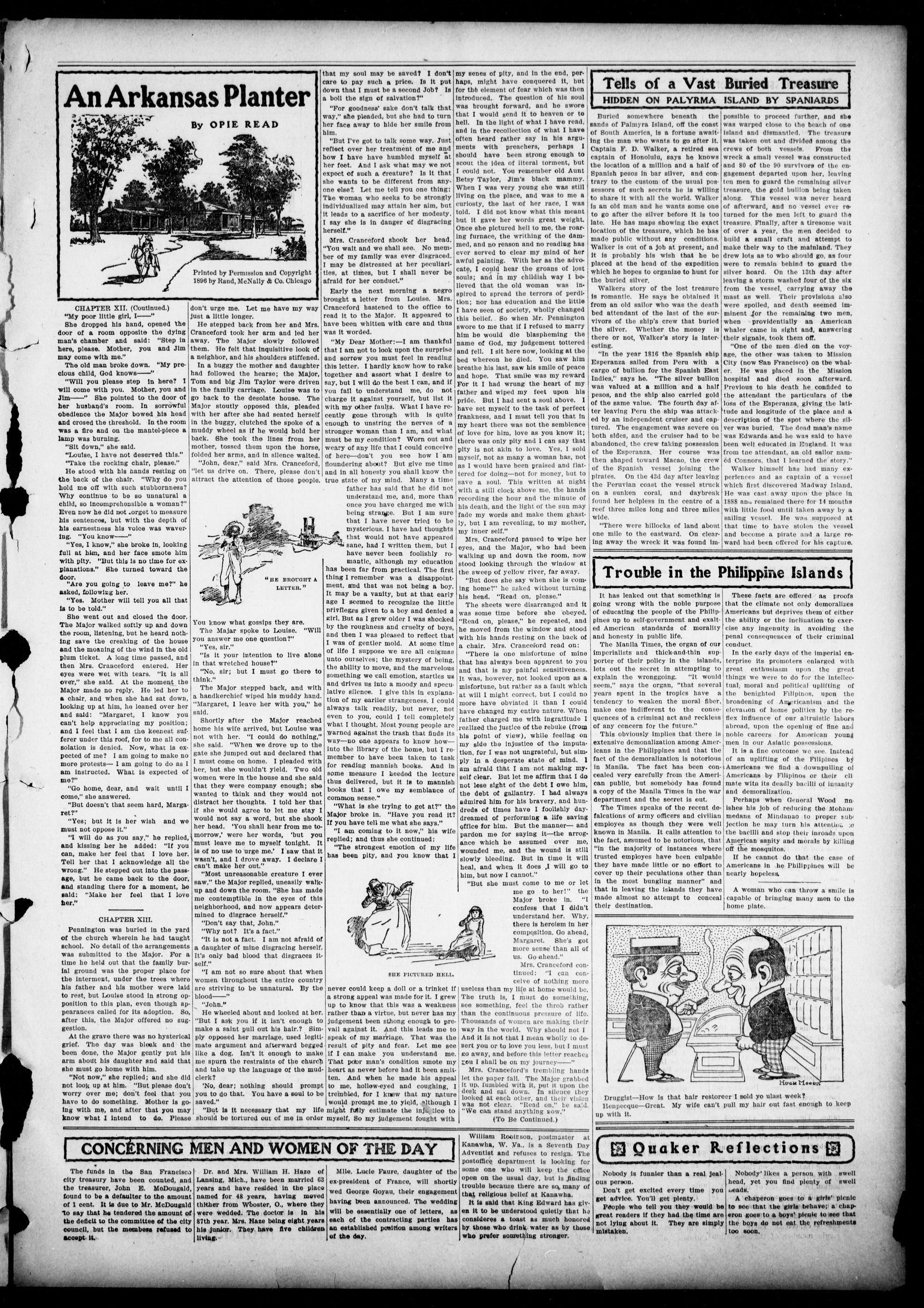
An Arkansas Planter
By OPIE READ
Printed by Permission and Copyright
1896 by Rand, McNally & Co. Chicago
CONCERNING MEN AND WOMEN OF THE DAY
CHAPTER XII. (Coutinued.)
"My poor little girl, I——"
She dropped his hand, opened the door of a room opposite the dying man's chamber and said: "Step in here, please. Mother, you and Jim may come with me."
The old man broke down. "My precious child, God knows——"
"Will you please step in here? I will come with you. Mother, you and Jim——" She pointed to the door of her husband's room. In sorrowful obedience the Major bowed his head and crossed the threshold. In the room was a fire and on the mantel-piece a lamp was burning.
"Sit down," she said.
"Louse, I have not deserved this."
"Take the rocking chair, please."
He stood with his hands resting on the back of the chair. "Why do you hold me off with such stubbornness? Why continue to be so unnatural a child, so incomprehensible a woman?" Even now he did not forget to measure his sentences, but with the depth of his earnestness his voice was wavering. "You know——"
"Yes, I know," she broke in, looking full at him, and her face smoke him with pity. "But this is no time for explanations." She turned toward the door.
"Are you going to leave me?" he asked, following her.
"Yes. Mother will tell you all that is to be told."
She went out and closed the door. The Major walked softly up and down the room, listening, but he heard nothing save the creaking of the house and the moaning of the wind in the old plum ticket. A long time passed, and then Mrs. Cranceford entered. Her eyes were wet with tears. "It is all over," she said. At the moment the Major made no reply. He led her to a chair, and when she had sat down, looking up at him, he leaned over her and said: "Margaret, I know you can't help appreciating my position; and I feel that I am the keenest sufferer under this roof, for to me all consolation is denied. Now, what is expected of me? I am going to make no more protests—I am going to do as I am instructed. What is expected of me?" "Go home, dear, and wait until I come," she answered.
"But doesn't that seem hard, Margaret?"
"Yes; but it is her wish and we must not oppose it."
"I will do as you say," he replied, and kissing her he added: "If you can, make her feel that I love her. Tell her that I acknowledge all the wrong." He stepped out into the passage, but he came back to the door, and standing there for a moment, he said: "Make her feel that I love her."
CHAPTER XIII.
Pennington was buried in the yard of the church wherein he had taught school. No detail of the arrangements was submitted to the Major. For a time he held out that the family burial ground was the proper place for the interment, under the trees where his father and his mother were laid to rest, but Louise stood in strong opposition to this plan, even though appearances called for its adoption. So after this, the Major offered no suggestion. At the grave there was no hysterical grief. The day was bleak and the been done, the Major gently put his arm about his daughter and said that she must go home with him.
"Not now," she replied; and she did not look up at him. "But please don't worry over me; don't feel that you have to do something. Mother is going with me, and after that you may know what I intend to do. Please
The funds in the San Francisco city treasury have been counted, and the treasurer, John E. McDougald, found to be a defaulter to the amount of 1 cent. It is due to Mr. McDougald to say that he tendered the amount of the deficit to the committee of the city council, but the members refused to accept it.
don't urge me. Let me have my way just a little longer.
He stepped back from her and Mrs. Cranceford took her arm and led her away. The Major slowly followed them. He felt that inquisitive look of a neighbor, and his shoulders stiffened.
In a buggy the mother and daughter had followed the hearse; the Major, Tom and big Jim Taylor were driven in the family carriage. Louise was to go back to the desolate house. The Major stoutly opposed this, pleaded with her after she had seated herself in the buggy, clutched the spoke of a muddy wheel as if he would hold her back. She took the lines from her mother, tossed them upon the horse, folded her arms, and in silence waited.
"John, dear," said Mrs. Cranceford, "let us drive on. There, please don't attract the attention of those people.
"HE BROUGHT A LETTER."
You know what gossips they are.
The Majar spoke to Louise. "Will you answer me one question?"
"Yes, sir."
"Is it your intention to live alone in that wretched house?"
"No, sir; but I must go there to think."
The Major stepped back, and with a handkerchief wiped his muddy hand. "Margaret, I leave her with you," he said.
Shortly after the Major reached home his wife arrived, but Louise was not with her. "I could do nothing," she said. "When we drove up to the gate she jumped out and declared that I must come on home. I pleaded with her, but she wouldn't yield. Two old women were in the house and she said that they were company enough; she wanted to think and they would not distract her thoughts. I told her that if she would agree to let me stay I would not say a word, but she shook her head. 'You shall hear from me tomorrow,' were her words, 'but you must leave me to myself tonight. It is of no use to urge me.' I saw that it wasn't, and I drove away. I declare I can't make her out."
"Most unreasonable creature I ever saw," the Major replied, uneasily walk-up and down the room. "She has made me contemptible in the eyes of this neighborhood, and now appears determined to disgrace herself."
"Don't say that, John."
"Why not? It has a fact."
"It is not a fact. I am not afraid of a daughter of mine disgracing herself. It's only bad blood that disgraces itself."
"I am not so sure about that when women throughout the entire country are striving to be unnatural. By the blood——"
He wheeled about and looked at her. "But I ask you if it isn't enough to make a saint pull out his hair." Simply opposed her marriage, used legitimate argument and afterward begged like a dog. Isn't it enough to make me spurn the restraints of the church and take up the language of the mud-clerk?
"No, dear; nothing should prompt you to do that. You have a soul to be saved."
"But is it necessary that my life should be tortured out of me in order
Dr. and Mrs. William H. Haze of Lansing, Mich., have been married 63 years and have resided in the place named for 48 years, having moved thither from Wboster, O., where they were wedded. The doctor is in his 87th year. Mrs. Haze being eight years his junior. They have five children living.
my senes of pity, and in the end, perhaps, might have conquered it, but for the element of fear which was then introduced. The question of his soul was brought forward, and he swore that I would send it to heaven or to hell. In the light of what I have read, and in the recollection of what I have often heard father say in his arguments with preachers, perhaps I should have been strong enough to scout the idea of literal torment, but I could not. You remember old Aunt Betsy Taylor, Jim's black mammy. When I was very young she was still living on the place, and was to me a curiosity, the last of her race, I was told. I did not know what this meant but it gave her words great weight. Once she pictured hell to me, the roaring furnace, the writhing of the damned, and the reason and no reading has ever served to clear my mind of her awful painting. With her as the advocate, I could hear the groans of lost souls; and in my childish way I believed that the old woman was inspired to spread the terrors of perdition; nor has education and the little I have seen of society, wholly changed this belief. So when Mr. Pennington swore to me that if I refused to marry him he would die blaspheming the name of God, my judgement tottered and fell. I sit here now, looking at the bed whereon he died. You saw him breathe his last, saw his smile of peace and hope. That smile was my reward For it I had wrung the heart of my father and wiped my feet upon his pride. But I had sent a soul above. I have set myself to the task of perfect frankness, and I must tell you that in my heart there was not the semblence of love for him, love as you know it; there was only pity and I can say that pity is not akin to love. Yes, I sold myself, not as many a woman has, not as I would have been praised and flattered for doing—not for money, but to save a soul. This written at night with a still clock above me, the hands recording the hour and the minute of his death, and the light of the sun may fade my words and make them ghastly, but I am revealing, to my mother, my inner self."
Mrs. Cranceford paused to wipe her eyes, and the Major, who had been walking up and down the room, now stood looking through the window at the sweep of yellow river, far away.
"But does she say when she is coming home?" he asked without turning his head. "Read on, please."
The sheets were disarranged and it was some time before she obeyed. "Read on, please," he repeated, and he moved from the window and stood with his hands resting on the back of a chair. Mrs. Cranceford read on:
"There is one misfortune of mine that has always been apparent to you and that is my painful sensitiveness. It was, however, not looked upon as a misfortune, but rather as a fault which at will I will correct, but I could no more have obviated it than I could have changed my entire nature. When father charged me with ingratitude I realized the justice of the rebuke (from his point of view), while feeling on my side the injustice of the imputation, for I was not ungrateful, but simply in a desperate state of mind. I am afraid that I am not making myself clear. But let me affirm that I do not lose sight of the debt I owe him, the debt of gallantry. I had always admired him for his bravery, and hundreds of times have I foolishly day-dreamed of performing a life saving office for him. But the manner—and pardon me for saying it—the arrogance which he assumed over me, wounded me, and the wound is still slowly bleeding. But in time it will heal, and when it does, I will go to him, but now I cannot."
him, but no "But she
useless than my life at home would be. The truth is, I must do something, see something, feel the throb rather than the continuous pressure of life. Thousands of women are making their way in the world. Why should not I And it is not that I mean wholly to desert you or to love you less, but I must go away, and before this letter reaches you I shall be on my journey——" Mrs. Cranceford's trembling hands let the paper fall. The Major grabbed it up, humbled with it, put it upon the desk and sat down. In silence they looked at each other, and their vision was not clear. "Read on," he said. "We can stand anything now."
William Roolinson, postmaster at Kanawha, W. Va., is a Seventh Day Adventist and refuses to resign. The postoffice department is looking for some one who will keep the office open on the usual day, but is finding trouble because there are so many of that religious belief at Kanawha.
It is said that King Edward has given it to be understood quietly that he considers a toast as much honored by those who drink water as by those who prefer something stronger.
that my soul may be saved? I don't care to pay such a price. Is it put down that I must be a second Job? Is a boll the sign of salvation?"
"For goodness' sake don't talk that way," she pleaded, but she had to turn her face away to hide her smile from him.
"But I've got to talk some way. Just reflect over her treatment of me and how I have have humbled myself at her feet. And I ask what we not expect of such a creature? Is it that she wants to be different from anyone else? Let me tell you one thing: The woman who seeks to be strongly individualized may attain her aim, but it leads to a sacrifice of her modesty. I say she is in danger of disgracing herself."
Mrs. Cranceford shook her head. "You wait and we shall see. No member of my family was ever disgraced. I may be distressed at her peculiarities, at times, but I shall never be afraid for her conduct."
Early the next morning a negro brought a letter from Louise. Mrs. Cranceford hastened to the office to read it to the Major. It appeared to have been whiten with care and thus was it worded.
"My Dear Mother;—I am thankful that I am not to look upon the surprise and sorrow you must feel in reading this letter. I hardly know how to rake together and assort what I desire to say, but I will do the best I can, and if you fail to understand me, do not charge it against yourself, but list it with my other faults. What I have recently gone through with is quite enough to unstring the nerves of a stronger woman than I am, and what must be my condition? Worn out and weary of any life that I could conceive of here—don't you see how I am floundering about? But give me time and in all honesty you shall know the true state of my mind. Many a time
father has said that he did not understand me, and, more than once you have charged me with being strange. But I am sure that I have never tried to be mysterious. I have had thoughts that would not have appeared sane, had I written them, but I have
mantic, although my education has been far from practical. The first thing I remember was a disappointment, and that was not being a boy. It may be a vanity, but at that early age I seemed to recognize the little privileges given to a boy and denied a girl. But as I grew older I was shocked by the roughness and cruelty of boys, and then I was pleased to reflect that I was of gentler mold. At some time of life I suppose we are all enigmas unto ourselves; the mystery of being, the ability to move, and the marvelous something we call emotion, startles us and drives us into a moody and speculative silence. I give this in explanation of my earlier strangeness. I could always talk readily, but never, not even to you, could I tell completely what I thought. Most young people are warned against the trash that finds its way—no one appears to know how—into the library of the home, but I remember to have been taken to task for reading mannish books. And in some measure I heeded the lecture thus delivered, but it is to mannish books that I owe my semblance of common sense."
"What is she trying to get at?" the Major broke in. "Have you read it? If you have tell me what she says." "I am coming to it now," his wife replied; and thus she continued: "The strongest emotion of my life has been pity, and you know that I
never could keep a doll or a trinket if a strong appeal was made for it. I grew up to know that this was a weakness rather than a virtue, but never has my judgement been strong enough to prevail against it. And this leads me to speak of my marriage. That was the result of pity and fear. Let me see if I can make you understand me. That poor man's condition smote my heart as never before had it been smitten. And when he made his appeal to me, hollow-eyed and coughing, I trembled, for I knew that my nature would prompt me to yield, although I might fully estimate the influence to myself. So my judgement fought with
Mile, Lucie Faure, daughter of the ex-president of France, will shortly wed George Goyau, their engagement having been announced. The wedding will be essentially one of letters, as each of the contracting parties has an established position among writers of the day.
"But she must come to me or let
just come to me or let me go to her!" the Major broke in. "I confess that I didn't understand her. Why, there is heroism in her composition. Go ahead, Margaret. She's got more sense than all of us. Go ahead." Mrs. Crandace continued: "I can conceive of nothing more
(To Be Continued.)
Tells of a Vast Buried Treasure HIDDEN ON PALYRMA ISLAND BY SPANIARDS
Trouble in the Philippine Islands
Hugh Moore
Druggist—How is that hair restoreer I sold yo ulast week?
Henpecque—Great. My wife can't pull my hair out fast enough to keep up with it.
Quaker Reflections
Buried somewhere beneath the sands of Palmyra Island, off the coast of South America, is a fortune awaiting the man who wants to go after it. Captain F. D. Walker, a retired sea captain of Honolulu, says he knows the location of a million and a half of Spanish pesos in bar silver, and contrary to the custom of the usual possessors of such secrets he is willing to share it with all the world. Walker is an old man and he wants some one to go after the silver before it is too late. He has maps showing the exact location of the treasure, which he has made public without any conditions. Walker is out of a job at present, and it is probably his wish that he be placed at the head of the expedition which he hopes to organize to hunt for the buried silver.
Walkers story of the lost treasure is romantic. He says he obtained it from an old sailor who was the death bed attendant of the last of the survivors of the ship's crew that buried the silver. Whether the money is there or not, Walker's story is interesting.
"In the year 1816 the Spanish ship Esperanza sailed from Peru with a cargo of bullion for the Spanish East Indies," says he. "The silver bullion was valued at a million and a half pesos, and the ship also carried gold of the same value. The fourth day after leaving Peru the ship was attacked by an independent cruiser and captured. The engagement was severe on both sides, and the cruiser had to be abandoned, the crew taking possession of the Esperanza. Her course was then shaped toward Macao, the crew of the Spanish vessel joining the pirates. On the 43d day after leaving the Peruvian coast the vessel struck on a sunken coral, and daybreak found her helpless in the centre of a reef three miles long and three miles wide.
"There were hillocks of land about one mile to the eastward. On clearing away the wreck it was found im
Trouble in the P
It has leaked out that something is going wrong with the noble purpose of educating the people of the Philippines up to self-government and exalted American standards of morality and honesty in public life.
The Manila Times, the organ of our imperialists and thick-and-thin supporter of their policy in the islands, lets out the secret in attempting to explain the wronggoing. "It would seem," says the organ, "that several years spent in the tropics have a tendency to weaken the moral fiber, make one indifferent to the consequences of a criminal act and reckless of any concern for the future."
This obviously implies that there is extensive demoralization among Americans in the Philippines and that the fact of the demoralization is notorious in Manila. The fact has been concealed very carefully from the American public, but somebody has found a copy of the Manila Times in the war department and the secret is out.
The Times speaks of the recent defalcations of army officers and civilian employees as though they were well known in Manila. It calls attention to the fact, assumed to be notorious, that "in the majority of instances where trusted employees have been culpable they have made little or no effort to cover up their peculations other than in the most bungling manner" and that in leaving the islands they have made almost no attempt to conceal their destination.
Druggist—How is that hair restore
Henpecque—Great. My wife can't
up with it.
Nobody is funnier than a real jealous person.
Don't get excited every time you get advice. You'll get plenty.
People who tell you they would be great readers if they had the time are not lying about it. They are simply mistaken.
possible to proceed further, and she was warped close to the beach of one island and dismantled. The treasure was taken out and divided among the crews of both vessels. From the wreck a small vessel was constructed and 80 of the 90 survivors of the engagement departed upon her, leaving ten men to guard the remaining silver treasure, the gold bullion being taken along. This vessel was never heard of afterward, and no vessel ever returned for the men left to guard the treasure. Finally, after a tiresome wait of over a year, the men decided to build a small craft and attempt to make their way to the mainland. They drew lots as to who should go, as four were to remain behind to guard the silver hoard. On the 13th day after leaving a storm washed four of the six from the vessel, carrying away the mast as well. Their provisions also were spolled, and death seemed imminent for the remaining two men when providentially an American whaler came in sight and, answering their signals, took them off.
"One of the men died on the voyage, the other was taken to Mission City (now San Francisco) on the whaler. He was placed in the Mission hospital and died soon afterward. Previous to his death he confided to the attendant the particulars of the loss of the Esperanza, giving the latitude and longitude of the place and a description of the spot where the silver was buried. The dead man's name was Edwards and he was said to have been well educated in England. It was from the attendant, an old sailor named Connors, that I learned the story."
Walker himself has had many experiences and as captain of a vessel which first discovered Madway Island. He was cast away upon the place in 1888 and remained there for 14 months with little food until taken away by a sailing vessel. He was supposed at that time to have stolen the vessel and become a pirate and a large reward had been offered for his capture.
Philippine Islands
These facts are offered as proofs that the climate not only demoralizes Americans but deprives them of either the ability or the inclination to exercise any ingenuity in avoiding the penal consequences of their criminal conduct.
In the early days of the imperial enterprise its promoters enlarged with great enthusiasm upon the great things we were to do for the intellectual, moral and political uplifting of the benighted Filipinos, upon the broadening of Americanism and the elevation of home politics by the reflex influence of our altruistic labors abroad, upon the opening of fine and noble careers for American young men in our Asiatic possessions. It is a fine outcome we see. Instead of an uplifting of the Filipinos by Americans we find a downpulling of Americans by Filipinos or their climate with its deadly bacilli of insanity and demoralization.
Perhaps when General Wood nails his job of reducing the Mohammedans of Mindanao to proper subjection he may turn his attention to the bacilli and stop their inroads upon American sanity and morals by killing off the mosquitos.
If he cannot do that the case of Americans in the Phillippines will be nearly hopeless.
A woman who can throw a smile is capable of bringing many men to the home plate.
Hueh Meers
eer I sold yo ulast week?
pull my hair out fast enough to keep
eflections
Nobody' likes a person with swell head, yet you find plenty of swell heads.
A chaperon goes to a girls' picnic to see that the girls behave; a chaperon goes to a boys' picnic to see that the boys do not eat the refreshments too soon.
The Professional World
TERMS OF SUBSCRIPTION.
One Year in Advance - - - $1.00
Six Months in Advance - - .75
Three Months in Advance - - .50
Single Copies - - - .05
Advertising Rates on Application.
Job Work of all Kinds Solicited.
Published Every Friday.
Entered at the postoffice at Columbumbia, Mo., as second class matter, Jan. 15, 1902.
Agents wanted in every town in the state.
Payments may be made in two cent stamps, by postal note, money order, by registered letter or express order. Correspondence containing news of interest and importance is desired from all parts of the United States.
Agents wanted everywhere. Write for terms. Specimen copies sent to any address upon request.
PAY your subscription to this paper.
IF YOU don't get the Professional World, order it now. $1.00 a year.
SCHOOL will open at Lincoln Inst., next Sept. 7th. A large attendance is expected this year, as the school has been more thoroughly advertised than ever before.
THE election of a Governor in Missouri next year should not be a matter of party politics, but of electing a clean man. Let him belong to whatever party he may.
Schools and Teachers.
Miss Hallie Porter will teach at Paris this year.
The Huntsville schools will open Monday Sept. 7th.
Miss Mary Lamme of Columbia will teach at Portland.
Prof. James Viley of Huntsville will teach at Warsaw, Mo., this year.
Get your children ready to enter school on the first day. Every day counts.
Miss Sarah Sutherlin of Jefferson City has opened school at New Bloomfield.
The Jefferson City schools will open Sept. 15th. $8000 has been spent in buildings by the Jefferson City Board of Education.
Moberly, Mo., is to have two new teachers in the persons of Prof. A. B. Bolden who succeeds Prof. J. H. Coleman as first assistant and Mrs. Hortense Pollard who succeeds Miss Bessie Timmony as primary teacher. Mr. Coleman and Miss Timmony recently married and are now living in St. Louis.
Why They Don't Attend.
The Professional World desires to respectfully call the attention of the Boone County Fair Association to the fact that the reason the fair is not more liberally patronized by the better class of Boone county negroes is on account of the poor accommodations they have.
There are in Columbia and Boone county over 3000 negroes, and of this number doubtless 1000 would attend the fair if suitable provisions were made for their accommodation. No sensible person in Boone county would object to the separate accomodations for whites and negroes. But why not have equal accommodations!—the gate fees for both races are the same. They are all expected to witness the same performances. But no self-respecting colored man should feel like taking his wife and children to the fair grounds and having them seated on those rudely constructed seats with no protection from the sun or rain. Yet we admit that some few do so. Is it not reasonable for us to expect better consideration if our patronage is expected! There is not a single member of the association
---
The National Bank of Commerce of Kansas City has furnished for private use of its women patrons a "stocking room," where they may retire and in the seclusion of a cosy boudoir remove their cash from its hiding place.
AMONG the remarkably few instances in history of the office seeking the man and not the man seeking the office is Folk's case. He has never announced his candidacy for Governor, or even desire for the office. Yet the Governorship is chancing around the State.
When the horse show was on at Milwaukee, Wis., it was stated that William Jennings Bryan wanted the pair of chestnut carriage horses entered in the show by Charles Rasor, of Normal, Ill. Word was received in Milwaukee Wednesday that Mr. Bryan had purchased the team, paying for them the fancy price of $1,200 in gold. The team was known as Roosevelt and Pabst, and was said by horsemen to be the finest team of family horses at the show.
ON CREDIT.
$22.90
Free
Catalogue
CENTURY MFG. CO.
EAST ST. LOUIS, IL.
Century Steel Range, No. 30-A-18
Has six 8-inch lids, oven 17x21x12,
splendid reservoir and warming closet,
lined throughout with asbestos, burns
anything, best bakers and roasters on
Earth. Guaranteed 10 years. Weight
475 lbs. Only $22.90. Terms $9.00 cash,
balance payable $3.00 a month, no interest.
Shipped immediately on receipt of
$8.00 payment. We trust honest
people located in your area. Cash discount $1.50 on Range. Fresh
averages $1.25 for each 600 miles. Send
for free catalogue, but this is the greatest
e bargain offered. We refer to
Southern Illinois National Bank.
CENTURY • MANUFACTURING • CO.
Dept. 910. East St. Louis, IL
who will not agree with us. If the fair association does not want the negro patronage no provision whatever should be made for them. They should even be refused tickets or admission, but if they are expected and admitted, suitable provision should be made for their accommodation.
State Christian Convention.
The State convention of the Christian churches in Missouri was held at Lathrop Aug. 4-9, with success. Every church in the state was represented either by letter or delegate. There were about two hundred (200) delegates and visitors present and notwithstanding the small size of the town, all were well provided for. The annual reports from the churches show an encouraging increase along all lines. In church property $13\frac{1}{2}$ per cent. In membership $12\frac{1}{2}$ per cent. In mission money over last year 50 per cent. The following were elected officers of the State Boards:
State Missionary Board and officers of the convention,—Eld. J. B. Parsons, President, Jefferson City, Eld. C. H. Poindexter, 1st Vice Pres., New London, Eld. J. H. Bell, 2nd Vice Pres., Fulton, Eld. T. A. Abbott, Cor. & R. R. Sec'y., Kansas City, Prof. J. W. Damel, Recording Sec'y., Jefferson City, Eld. A. Webb, Treas., Osage City, Officers of the Sunday School State Work: Eld. J. R. Gibbs, President, Osage City, Eld. R. L. Winn, 1st Vice Pres., Higbee, Miss Flossie McGruder, 2nd Vice Pres., Lathrop, Mrs. Annie L. Hicks, Corresponding Sec'y., Columbia, Miss Julia Steward, Recording Sec'y., Naptonville, Miss Susie Douglas, Ass't. Recording Sec'y., Lexington, Mrs. Emily Mott, Treas., Kansas City. Officers of the C. W. B. M. State Work: Mrs. Fannie M. West, President, Kansas City, Mrs. Montee Johnson, Vice Pres., Blackwater, Mrs. L. G. Bantz, Corresponding Sec'y., St. Louis, Miss Genevia Maybery, Recording Sec'y., Jefferson City, Miss Fannie Berry, Treas., Fulton.
The next State convention will be held in Fulton, Mo., August 17- 21, 1904.
Mrs. Ada Douglass III.
Mrs. Ada Douglass, who was a delegate to the Grand Temple at Macon, was taken seriously ill there Tuesday with symptoms of typhoid fever. She was brought home this morning and stood the trip well.
Deafness Cannot be Cured
by local applications as they cannot reach the diseased portion of the ear. There is only one way to cure deafness, and that is by constitutional remedies. Deafness is caused by an inflamed condition of the mucous lining of the Eustachian Tube. When this tube is inflamed you have a rumbling sound or imperfect hearing, and when it is entirely closed, Deafness is the result, and unless the inflammation can be taken out and this tube restored to its normal condition, hearing will be destroyed forever; nine cases out of ten are caused by Catarrh, which is nothing but an inflamed condition on the mucous services.
We will give One Hundred Dollars for any case of Deafness caused by catarrh that cannot be cured by Hall's Catarrh Cure. Send for circulars, free. F. J. CHENEY & Co., Toledo, O. Sold by Druggists, 75. Hall's Family Pills are the best
GENERAL NEWS IN BRIEF.
The lynching for the first half of 1903 number 48.
Ten to twelve ships a day arrive in the port of New York.
The price of labor in Alaska is $4.50 to $6.50 a day, with board.
In Saxony there is an industrial school for every 14,641 inhabitants.
Pope Pius X. has given $20,000 to be distributed among the poor of Rome.
The wheat crop of Oklahoma is estimated officially at 40,000,000
RIDER AGENTS WANTED
In each town to take orders for our new High Grade
Guaranteed Bicycles.
New 1903 Models
"Bellise," Complete $8.75
"Cossack," Guaranteed High Grade $10.75
"Siberian," A Beauty $12.75
"Neudorf," Road Racer $14.75
no better bicycle at any price.
Any other make or model you want at one-third
usual price. Choice of any standard tires and best
equipment on all our bicycles. Strongest guarantee.
We SHIP ON APPROVAL C. O. D. to any one
without a cent deposit and allow 10 DAYS FREE
TRIAL before purchase is binding.
500 Second Hand Wheels $3 to $8
taken in trade by our Chicago retail stores,
all makes and models, good as new...we have written for our
third-hand bike and have written for our
tires, equipment, sundries and sporting goods of all kinds, at half regular price.
In our big free sundry catalog. Contains a world of useful information. Write for it.
J. L. MEAD CYCLE CO., Chicago, Ill.
bushels.
The manufacture of musical instruments occupies 20,000 persons in Germany.
In the last year the United States has paid in ocean freights to foreign ships, $20,000,000.
M. Curie, the discoverer of radium, has found that the rays of radium color glass a violet blue.
The brains of the Japanese, both male and female, average greater weight than those of the English.
In 1870 the German people barely exceeded 40,000,000; in 1885 they had risen to nearly 47,000,000, and in 1890 the census return gave 56,345,014.
Joseph Pulitzer, of the New York World, has provided a sum of $2,000,000 to establish a school of journalism in Columbia university, New York.
It is said that President Roosevelt desires the nomination of Secretary Root for governor of New York, to be followed by his nomination for President in 1908.
Senator Farris, under indictment for accepting a bribe, is reported to be seriously ill at his home in Steelville. In consequence his trial, which is set for Monday next, may not be called on that date.
Lodge and Church Directory.
LODGE.
U. B. F.
Crispus Attucks Lodge, No.
62. Meetings 2nd and 4th
Tuesdays in each month.
Visiting members cordially
invited. Caleb Hall, W. M.
A. M. Schweich, W. S.
S. M. T.
Florence Woods, W. P.; Mrs. Lizzie Williams, W. S. Meeting first Monday in each month at 3 p. m.
G. U. O. F.
Boone county light lodge, No. 3356. Meetings, 1st and 3rd Tuesdays in each month. Visiting members in good standing invited. W. H. TURNER, N. G. J. C. BURTON, P. S.
K. P.
Acme Lodge, No. 24. Meetings second and fourth Fridays in each month. W. H. Turner, C. C. and D. D. G. C. W. W. Lampkins, M. F.
ST. PAUL LODGE, NO. 12.
St. Paul Lodge, No. 12, A.
F. & A. M., meets every first
and third Tuesday in each
month. A cordial invitation
extended to all visiting
brothers. J. A. Mosely, W.
M. J. A. Grant, Secretary.
K. OF P.
Harrison Lodge No. 12, Huntsville,Mo.Meeting the second and fourth Thursdays in each month. M.W.Tony, C.C., W.T. Ansel, K.R.S., I.A. Robinson, M.E.
LADIES COURT
Golden Queen Court, No. 19, meets first Friday in each month. Mrs. M. E. Ridgway, M. A. M., Mrs. Lizzie Richardson, Secretary.
O. E. S.
Amos Chapter, No. 30.
Meetings second Friday in each month. Mrs. Bessie Washington, W. M. Mrs. Annie Williams, W. S.
SECOND BAPTIST CHURCH.
Rev. A. A. Adams, Pastor.
Preaching Sundays 11 a.
m., and 7:30 p. m.
Sunday school at 2:30 p. m.
Prayer meeting Wednesday evening, 7:30.
A cordial invitation extended to all.
A. M. E. CHURCH.
Rev. P. C. Crews, Pastor.
Preaching Sundays 11 a.m.; 7:30 p. m.
Sunday school 2:30 p. m.
Prayer meeting every Wednesday eve, at 8:30; every body invited to attend.
M. E. CHURCH
Rev. J. Arlington Grant,
pastor.
Preaching Sundays 11, a.
m. and 7:30 p. m.
Sunday school, 9:30 a. m.
Prayer meeting Wednesdays 7:30 to 8:30; all are made welcome.
Rev. J. B. Parsons, pastor.
Preaching Sundays 11 a. m.
and 7:30 p. m.
Prayer meeting Wednesdays 7:30 p. m.
Everybody cordially invited to attend.
RENTS WANTED
To take orders for our new High Grade
Bicycles.
1903 Models
" Complete $8.75
k," Guaranteed High Grade $10.75
n," A Beauty $12.75
f," Road Racer $14.75
cycle at any price.
make or model you want at one-third
Choice of any standard tires and best
all our bicycles. Strongest guarantee.
ON APPROVAL C. O. D. to any one
deposit and allow 10 DAYS FREE
are purchase is binding.
Hand Wheels $0.00
WAIT FOR THE REAL SHOW THE MEN FROM MISSOURI.
Cole Younger
Frank James HISTORICAL WILD WEST COLUMBIA, = = 24. Monday, August
A Proudly Pre-Eminent Exhibition of Universal Interest. Standing Like an Obelisk Above and Beyond All Others. A Perfect Phalanx of All That is
Great, Grand & Heroic
with more than enough Features to make an entire Exhibition. The Mounted Warriors of The World in Martial Array.
W
Rugged Rough Riders
A Gathering of Extraordinary Consequence to Fittingly Illustrate all that Muscular Heroic Manhood has and can endure. Cowboys, American Indians, Mexican Ruralies Bedouin Arabs, Hungarian Cavalry Russian Cossacks, American Cavalry, Roosevelt Rough Riders, Western Cow Girls
Great Exhibition Famous
THE MILITARY CORPS
The Two Famous Men
Cole Younger and Frank James
who will Review the Rough Riders in a Gorgeous Military Tournament.
Two Performances Daily
2 and 8 p. m. Rain or Shine.
Watch for the Big Free Street Parade at 10 a. m.
Monday, August 24.