The Professional World
Friday, August 28, 1903
Columbia, Missouri
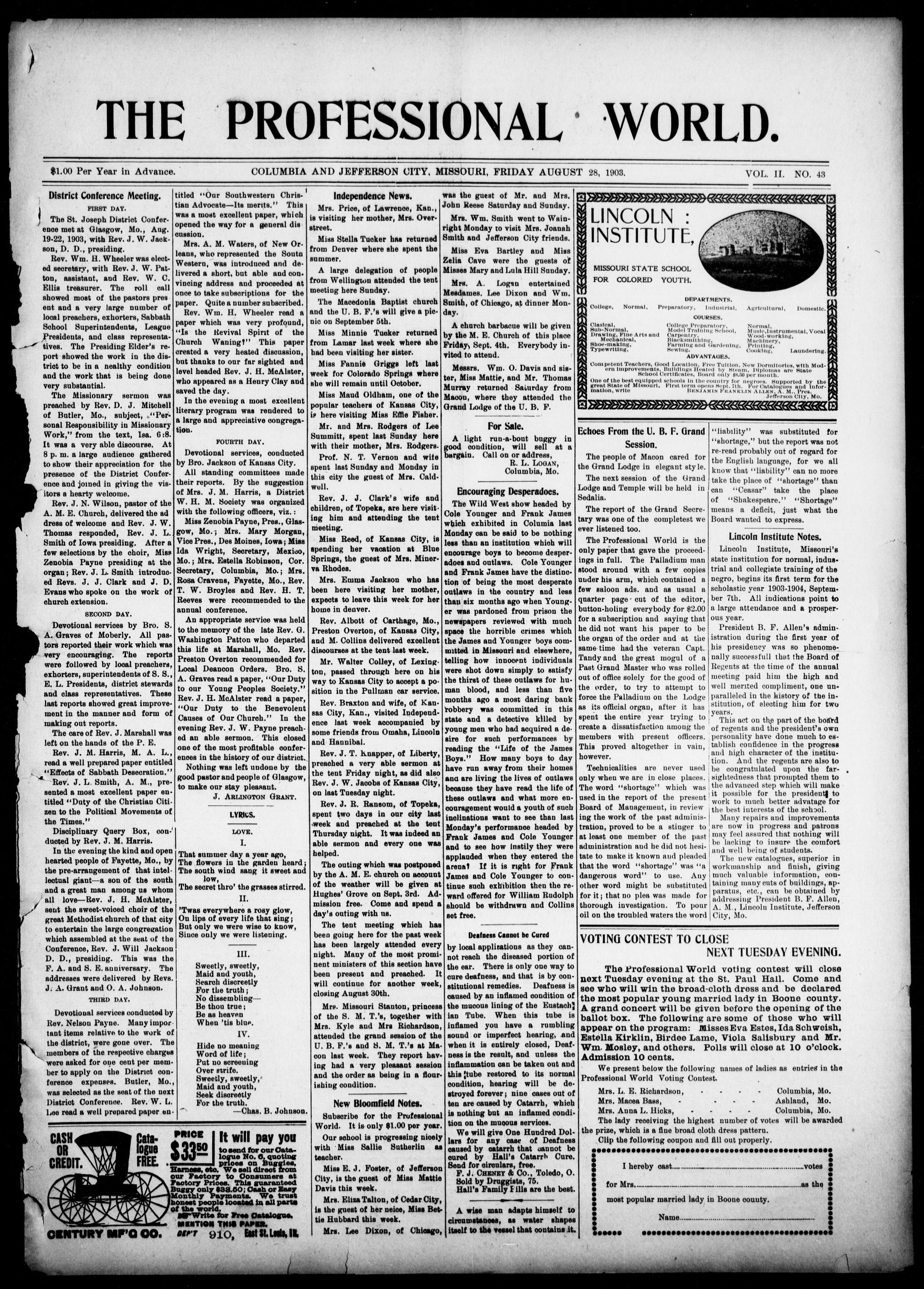
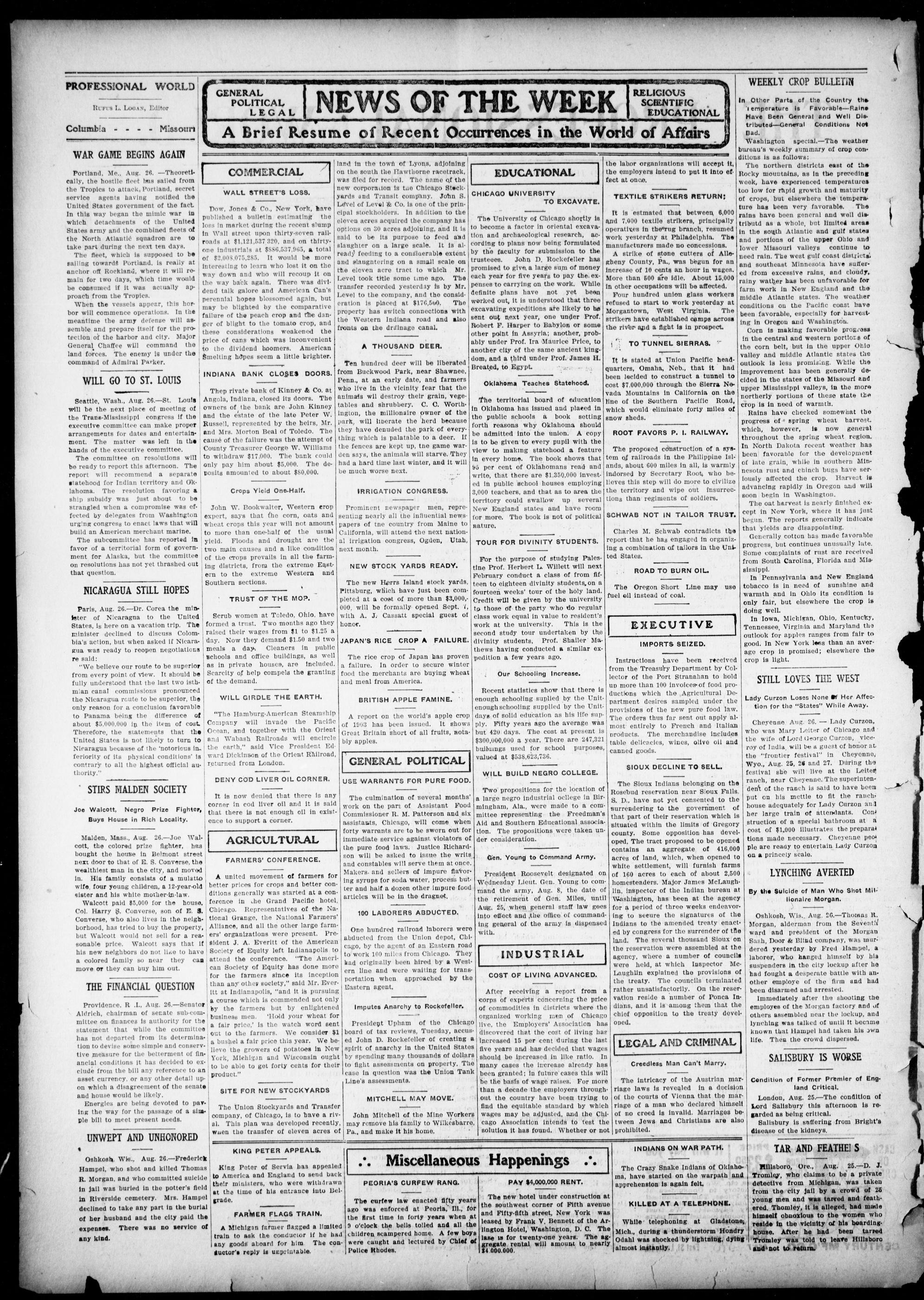
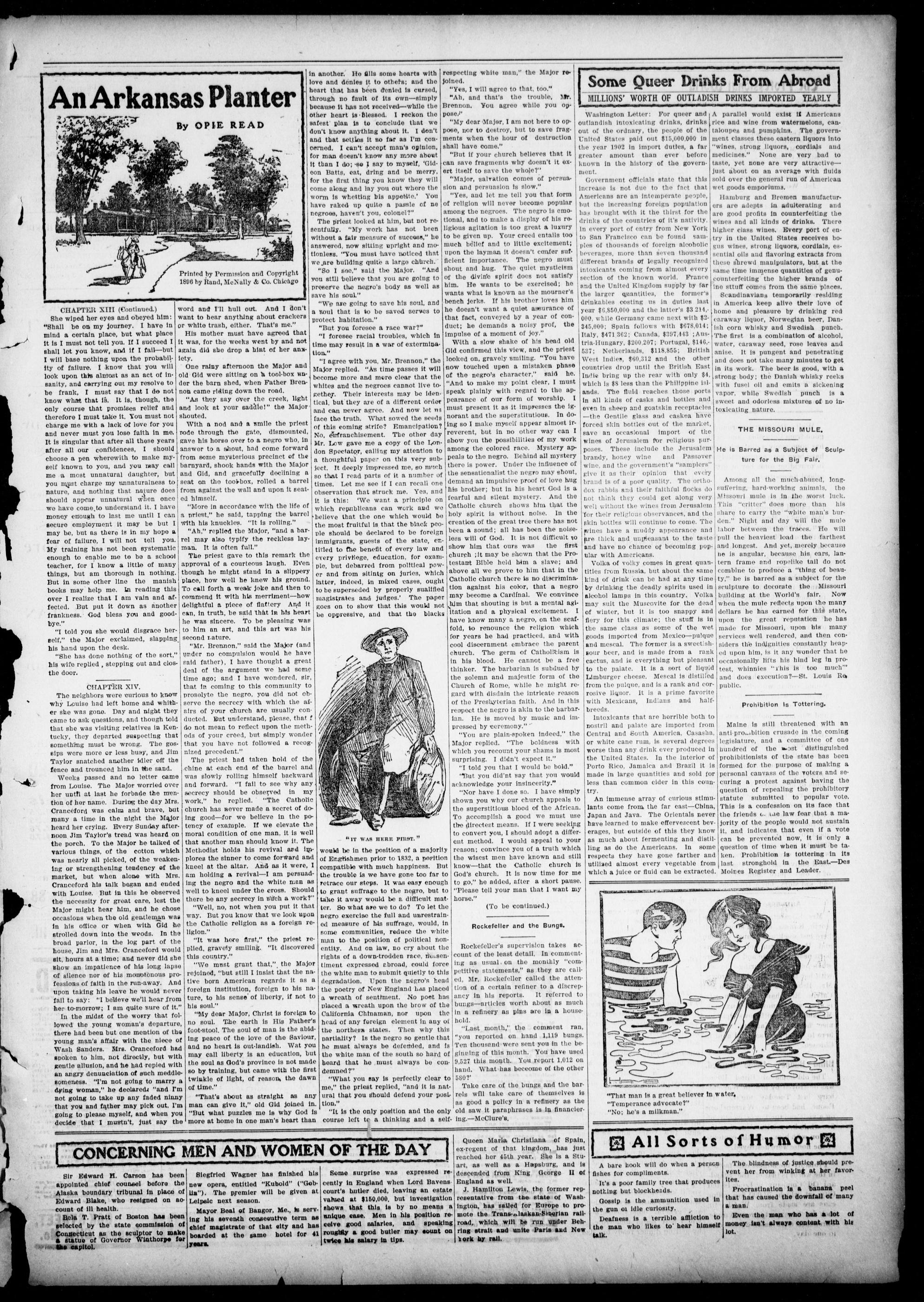
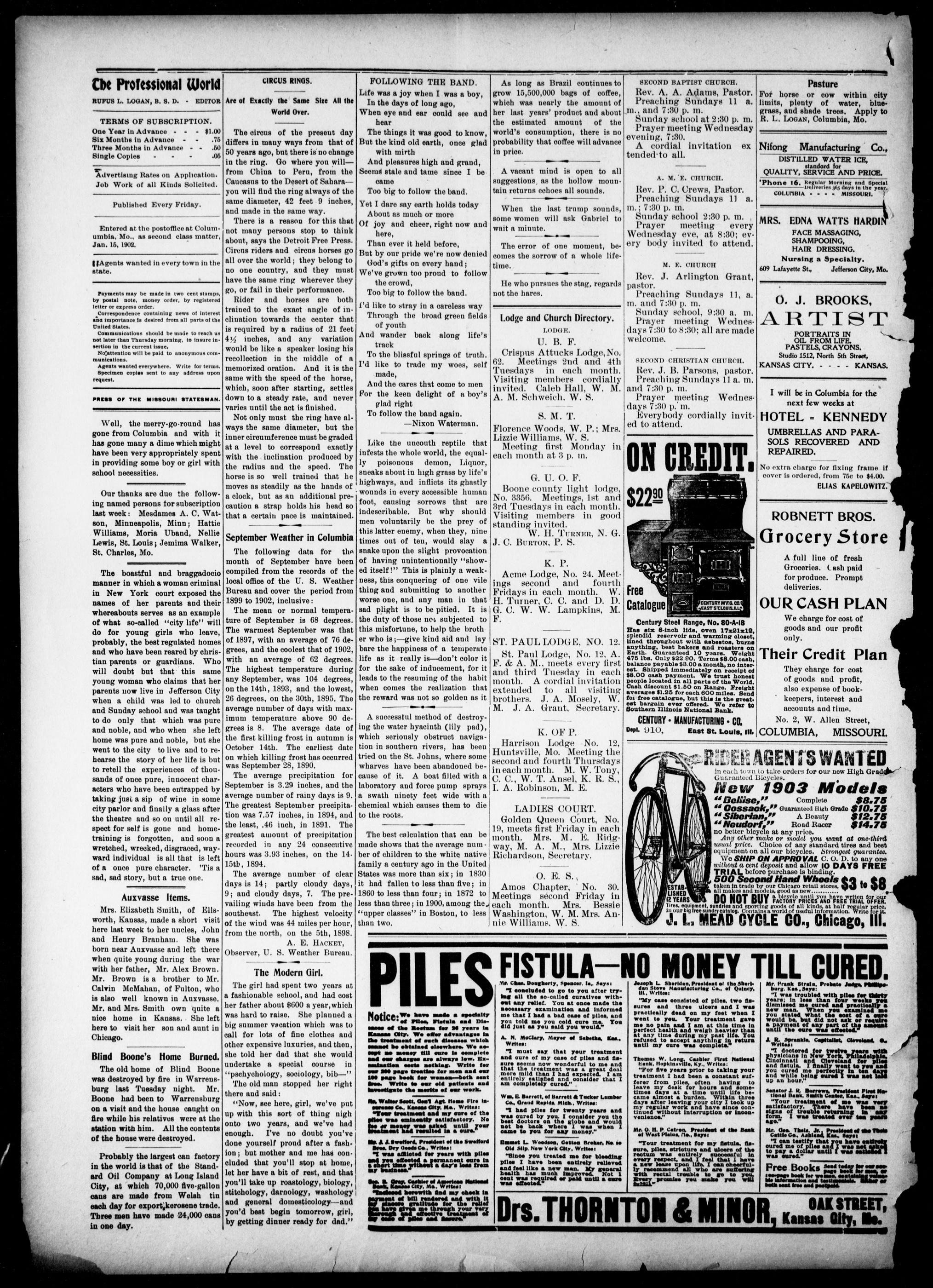
Page text (machine-generated)
THE PROFESSIONAL WORLD.
$1.00 Per Year in Advance.
District Conference Meeting. FIRST DAY.
The St. Joseph District Conference met at Glasgow, Mo., Aug. 19-22, 1903, with Rev. J. W. Jackson, D. D., presiding.
Rev. Wm. H. Wheeler was elected secretary, with Rev. J. W. Patton, assistant, and Rev. W. C. Ellis treasurer. The roll call showed most of the pastors present and a very large number of local preachers, exhorters, Sabbath School Superintendents, League Presidents, and class representatives. The Presiding Elder's report showed the work in the district to be in a healthy condition and the work that is being done very substantial.
The Missionary sermon was preached by Rev. D. J. Mitchell of Butler, Mo., subject, "Personal Responsibility in Missionary Work," from the text, Isa. 6:8. It was a very able discourse. At 8 p.m. a large audience gathered to show their appreciation for the presence of the District Conference and joined in giving the visitors a hearty welcome.
Rev. J. N. Wilson, pastor of the A. M. E. Church, delivered the address of welcome and Rev. J. W. Thomas responded, Rev. J. L. Smith of Iowa presiding. After a few selections by the choir, Miss Zenobia Payne presiding at the organ; Rev. J. L. Smith introduced Revs. J. J. Clark and J. D. Evans who spoke on the work of church extension.
SECOND DAY.
Devotional services by Bro. S. A. Graves of Moberly. All pastors reported their work which was very encouraging. The reports were followed by local preachers, exhorters, superintendents of S. S., E. L. Presidents, district stewards and class representatives. These last reports showed great improvement in the manner and form of making out reports. The care of Rev. J. Marshall was left on the hands of the P. E.
Rev. J. M. Harris, M. A. L., read a well prepared paper entitled "Effects of Sabbath Desecration." Rev. J. L. Smith, A. M., presented a most excellent paper entitled "Duty of the Christian Citizen to the Political Movements of the Times." Disciplinary Query Box, conducted by Rev. J. M. Harris.
In the evening the kind and open hearted people of Fayette, Mo., by the pre-arrangement of that intellectual giant—a son of the south and a great man among us whom all love—Rev. J. H. McAlster, sent the sweet-voiced choir of the great Methodist church of that city to entertain the large congregation which assembled at the seat of the Conference, Rev. J. Will Jackson D. D., presiding. This was the F. A. and S. E. anniversary. The addresses were delivered by Revs. J. A. Grant and O. A. Johnson.
THIRD DAY.
Devotional services conducted by Rev. Nelson Payne. Many important items relative to the work of the district, were gone over. The members of the respective charges were asked for one cent per member to apply on the District conference expenses. Butler, Mo., was selected as the seat of the next District Conference. Rev. W. L. Lee read a well prepared paper en
CASH OR CREDIT. Catalogue FREE.
COLUMBIA AND JEFFERSON CITY, MISSOURI, FRIDAY AUGUST 28, 1903.
titled "Our Southwestern Christian Advocate—Its merits." This was a most excellent paper, which opened the way for a general discussion. Mrs. A. M. Waters, of New Orleans, who represented the South Western, was introduced and delivered a short, but able and convincing address and proceeded at once to take subscriptions for the paper. Quite a number subscribed.
Rev. Wm. H. Wheeler read a paper which was very profound, "Is the Revival Spirit of the Church Waning?" This paper created a very heated discussion, but thanks to our far sighted and level headed Rev. J. H. McAlster, who appeared as a Henry Clay and saved the day. In the evening a most excellent literary program was rendered to a large and appreciative congregation.
FOURTH DAY.
Devotional services, conducted by Bro. Jackson of Kansas City.
All standing committees made their reports. By the suggestion of Mrs. J. M. Harris, a District W. H. M. Society was organized with the following officers, viz.: Miss Zenobia Payne, Pres., Glasgow, Mo.; Mrs. Mary Morgan, Vice Pres., Des Moines, Iowa; Miss Ida Wright, Secretary, Mexico, Mo.; Mrs. Estella Robinson, Cor. Secretary, Columbia, Mo.; Mrs. Rosa Cravens, Fayette, Mo., Rev. T. W. Broyles and Rev. H. T. Reeves were recommended to the annual conference.
An appropriate service was held to the memory of the late Rev. G. Washington Patton who departed this life at Marshall, Mo. Rev. Preston Overton recommended for Local Deancon Orders. Bro. S. A. Graves read a paper, "Our Duty to our Young Peoples Society." Rev. J. H. McAlster read a paper, "Our Duty to the Benevolent Causes of Our Church." In the evening Rev. J. W. Payne preached an able sermon. This closed one of the most profitable conferences in the history of our district. Nothing was left undone by the good pastor and people of Glasgow, to make our stay pleasant.
J. ARLINGTON GRANT.
LYRICS.
That summer day a year ago,
The flowers in the garden heard;
The south wind sang it sweet and
low.
The secret thro' the grasses stirred.
II.
'Twas everywhere a rosy glow,
On lips of every life that sing;
But only we were wise to know,
Since only we were listening.
III.
Sweetly, sweetly,
Maid and youth,
Search discreetly
For the truth;
No dissembling
Be thou true;
Be as heaven
When 'tis blue.
IV.
Hide no meaning
Word of life;
Put no screening
Over strife.
Sweetly, sweetly,
Maid and youth,
Seek discreetly
For the truth.
—Chas. B. Johnson.
It will pay you
Harness, etc. We sell direct from
our Factory to Consumers at
Factory Prices. This guaranteed
Buggy only $33.50; Cash or Easy
Monthly Payments. We trust
honest people located in all parts
of the world.
Write for Free Catalogue.
MENTION THIS PAPER.
DEPT 7 910 East St. Louis, IL
Mrs. Price, of Lawrence, Kan., is visiting her mother, Mrs. Overstreet.
Miss Stella Tucker has returned from Denver where she spent the summer.
A large delegation of people from Wellington attended the tent meeting here Sunday.
The Macedonia Baptist church and the U. B. F.'s will give a picnic on September 5th.
Miss Minnie Tucker returned from Lamar last week where she had been visiting her sister.
Miss Fannie Griggs left last week for Colorado Springs where she will remain until October.
Miss Maud Oldham, one of the popular teachers of Kansas City, is here visiting Miss Effie Fisher.
Mr. and Mrs. Rodgers of Lee Summitt, spent last Sunday here with their mother, Mrs. Rodgers.
Prof. N. T. Vernon and wife spent last Sunday and Monday in this city the guest of Mrs. Caldwell.
Rev. J. J. Clark's wife and children, of Topeka, are here visiting him and attending the tent meeting.
Miss Reed, of Kansas City, is spending her vacation at Blue Springs, the guest of Mrs. Minerva Rhodes. Mrs. Emma Jackson who has been here visiting her mother, expects to leave this week for her home in denver. Rev. Albott of Carthage, Mo., Preston Overton, of Kansas City, and M. Collins delivered excellent discourses at the tent last week. Mr. Walter Colley, of Lexington, passed through here on his way to Kansas City to accept a position in the Pullman car service.
Rev. Braxton and wife, of Kansas City, Kan., visited Independence last week accompanied by some friends from Omaha, Lincoln and Hannibal.
Rev. J. T. Knapper, of Liberty, preached a very able sermon at the tent Friday night, as did also Rev. J. W. Jacobs of Kansas City, on last Tuesday night.
Rev. J. R. Ransom, of Topeka, spent two days in our city last week and preached at the tent Thursday night. It was indeed an able sermon and every one was helped.
The outing which was postponed by the A. M. E. church on account of the weather will be given at Hughes' Grove on Sept. 3rd. Admission free. Come and spend a day's outing with us. The tent meeting which has been going here for the past week has been largely attended every night. Many of the most prominent ministers of this section have been present and preached. It will continue for another week, closing August 30th.
Mrs. Missouri Stauton, princess of the S. M. T.'s, together with Mrs. Kyle and Mrs Richardson, attended the grand session of the U. B. F.'s and S. M. T.'s at Macon last week. They report having had a very pleasant session and the order as being in a flourishing condition.
New Bloomfield Notes.
Subscribe for the Professional World. It is only $1.00 per year.
Our school is progressing nicely with Miss Sallie Sutherlin as teacher.
Miss E. J. Foster, of Jefferson City, is the guest of Miss Mattie Davis this week.
Mrs. Eliza Talton, of Cedar City, is the guest of her niece, Miss Bettie Hubbard this week.
Mrs. Lee Dixon, of Chicago,
was the guest of Mr. and Mrs. John Reese Saturday and Sunday.
Mrs. Wm. Smith went to Wainright Monday to visit Mrs. Joanah Smith and Jefferson City friends.
Miss Eva Bartley and Miss Zelia Cave were the guests of Misses Mary and Lula Hill Sunday.
Mrs. A. Logan entertained Meadames. Lee Dixon and Wm. Smith, of Chicago, at dinner Monday.
A church barbacue will be given by the M. E. Church of this place Friday, Sept. 4th. Everybody invited to attend.
Messrs. Wm. O. Davis and sister, Miss Mattie, and Mr. Thomas Murray returned Saturday from Macon, where they attended the Grand Lodge of the U. B. F.
For Sale.
A light run-a-bout buggy in good condition, will sell at a bargain. Call on or address,
R. L. LOGAN,
Columbia, Mo.
Encouraging Desperadoes
The Wild West show headed by Cole Younger and Frank James which exhibited in Columia last Monday can be said to be nothing less than an institution which will encourage boys to become desperadoes and outlaws. Cole Younger and Frank James have the distinction of being the most desperate outlaws in the country and less than six months ago when Younger was pardoned from prison the newspapers reviewed with much space the horrible crimes which the James and Younger boys committed in Missouri and elsewhere, telling how innocent individuals were shot down simply to satisfy the thirst of these outlaws for human blood, and less than five months ago a most daring bank robbery was committed in this state and a detective killed by young men who had acquired a desire for such performances by reading the "Life of the James Boys." How many boys to day have run away from their homes and are living the lives of outlaws because they have read the life of these outlaws and what more encouragement would a youth of such inclinations want to see than last Monday's performance headed by Frank James and Cole Younger and to see how insistily they were applauded when they entered the arena? If it is right for Frank James and Cole Younger to continue such exhibition then the reward offered for William Rudolph should be withdrawn and Collins set free.
Deafness Cannot be Cured
by local applications as they cannot reach the diseased portion of the ear. There is only one way to cure deafness, and that is by constitutional remedies. Deafness is caused by an inflamed condition of the mucous lining of the Eustachian Tube. When this tube is inflamed you have a rumbling sound or imperfect hearing, and when it is entirely closed, Deafness is the result, and unless the inflammation can be taken out and this tube restored to its normal condition, hearing will be destroyed forever; nine cases out of ten are caused by Catarrh, which is nothing but an inflamed condition on the mucous services.
We will give One Hundred Dollars for any case of Deafness caused by catarrh that cannot be cured by Hall's Catarrh Cure. Send for circulars, free. F. J. CHENEY & Co., Toledo, O. Sold by Druggists, 75. Hall's Family Fills are the best. A wise man adapts himself to circumstances, as water shapes itself to the vessel that contains it.
LINCOLN : INSTITUTE,
MISSOURI STATE SCHOOL
FOR COLORED YOUTH.
DEPARTMENTS.
College, Normal, Preparatory, Industrial,
COURSES.
Clasical,
Sub-Normal,
Drawing, Fine Arts and
Mechanical,
Shoe-making,
Typewriting,
College Preparatory,
Model Training School,
Carpentry,
Blacksmithing,
Farming and Gardening,
Sewing.
ADVANTAGES.
Competent Teachers, Good Location, Free Tuition,
ern improvements, Buildings Heated by Steel
School Certificates, Board only 88.
One of the best equipped schools in the country for
great State of Missouri. First term opens Sept. 7th
mation, write
BENJAMIN FRANK
Competent Teachers, Good Location, Free Tuition, New Dormitories, with Modern improvements, Buildings Heated by Steam, Diplomas are State School Certificates, Board only $8.50 per month.
One of the best equipped schools in the country for negroes. Supported by the great State of Missouri. First term opens Sept. 7th. For Catalogues and Information, write BENJAMIN FRANKLIN ALLEN, A. M., Pres.
Echoes From the U. B. F. Grand Session.
The people of Macon cared for the Grand Lodge in elegant style. The next session of the Grand Lodge and Temple will be held in Sedalia. The report of the Grand Secretary was one of the completest we ever listened too.
The Professional World is the only paper that gave the proceedings in full. The Palladium man stood around with a few copies under his arm, which contained a few saloon ads. and as usual a quarter page cut of the editor, button-holing everybody for $2.00 for a subscription and saying that he did not want his paper to be the organ of the order and at the same time had the veteran Capt. Tandy and the great mogul of a Past Grand Master who was rolled out of office solely for the good of the order, to try to attempt to force the Palladium on the Lodge as its official organ, after it has spent the entire year trying to create a dissatisfaction among the members with present officers. This proved altogether in vain, however.
Technicalities are never used only when we are in close places. The word "shortage" which was used in the report of the present Board of Mauagement, in reviewing the work of the past administration, proved to be a stinger to at least one member of the past administration and he did not hesitate to make it known and pleaded that the word "shortage" was "a dangerous word" to use. Any other word might be substituted for it; that no plea was made for thorough investigation. To pour oil on the troubled waters the word
VOTING CONTEST TO CL
The Professional Wor next Tuesday evening at the see who will win the broads the most popular young man A grand concert will be give ballot box. The following
VOTING CONTEST TO CLOSE NEXT TUESDAY EVENING.
The Professional World voting contest will close next Tuesday evening at the St. Paul Hall. Come and see who will win the broad-cloth dress and be declared the most popular young married lady in Boone county. A grand concert will be given before the opening of the ballot box. The following are some of those who will appear on the program: Misses Eva Estes, Ida Schweish, Estella Kirklin, Birdee Lame, Viola Salisbury and Mr. Wm. Mosley, and others. Polls will close at 10 o'clock. Admission 10 cents.
We present below the following names of ladies as entries in the Professional World Voting Contest.
```markdown
```
ARTMENTS.
Industrial, Agricultural, Domestic.
COURSES.
Separatory, Normal,
Inning School, Music, Instrumental, Vocal
Inning, Wood-working,
Inning, Machinery,
And Gardening, Printing,
Cooking, Laundering.
VANTAGES.
Free Tuition, New Dormitories, with Mod-
eated by Steam, Diplomats are State
Board only $8.50 per month.
the country for negroes. Supported by the
opens Sept. 7th. For Catalogues and infor-
JAMIN FRANKLIN ALLEN, A. M. Pres.
Jefferson City, Mo.
"liability" was substituted for "shortage," but the report was not re-read probably out of regard for the English language, for we all know that "liability" can no more take the place of "shortage" than can "Ceasar" take the place of "Shakespeare." "Shortage" means a deficit, just what the Board wanted to express.
Linecoln Institute, Missouri's state institution for normal, industrial and collegiate training of the negro, begins its first term for the scholastic year 1903-1904, September 7th. All indications point to a large attendance and a prosperous year. President B. F. Allen's administration during the first year of his presidency was so phenomenally successful that the Board of Regents at the time of the annual meeting paid him the high and well merited compliment, one unparalleled in the history of the institution, of electing him for two years.
This act on the part of the board of regents and the president's own personality have done much to establish confidence in the progress and high character of the institution. And the regents are also to be congratulated upon the farsightedness that prompted them to the advanced step which will make it possible for the president to work to much better advantage for the best interests of the school. Many repairs and improvements are now in progress and patrons may feel assured that nothing will be lacking to insure the comfort and well being of students.
The new catalogues, superior in workmanship and finish, giving much valuable information, containing many cuts of buildings, apparatus, etc., can be obtained by addressing President B. F. Allen, A. M., Lincoln Institute, Jefferson City, Mo.
CLOSE
NEXT TUESDAY EVENING.
world voting contest will close the St. Paul Hall. Come and ad-cloth dress and be declared married lady in Boone county. Given before the opening of the gag are some of those who will Misses Eva Estes, Ida Schweish,
VOL. II. NO. 43
Lincoln Institute Notes.
An Arkansas Planter
By OPIE READ
Printed by Permission and Copyright
1806 by Rand, McNally & Co. Chicago
CONCERNING MEN AND WOMEN OF THE DAY
CONCERNING MEN AND WOMEN OF THE DAY
CHAPTER XIII (Continued.)
She wiped her eyes and obeyed him: "Shall be on my journey. I have in mind a certain place, but what place it is I must not tell you. If I succeed I shall let you know, and if I fall—but I will base nothing upon the probability of failure. I know that you will look upon this almost as an act of insanity, and carrying out my resolve to be frank, I must say that I do not know what that is. It is, though, the only course that promises relief and therefore I must take it. You must not charge me with a lack of love for you and never must you lose faith in me. It is singular that after all these years after all our confidencees, I should choose a pen wherewith to make myself known to you, and you may call me a most unnatural daughter, but you must charge my unnaturalness to nature, and nothing that nature does should appear unnatural when once we have come to understand it. I have money enough to last me until I can secure employment it may be but I may be, but as there is in my hope a fear of failure, I will not tell you. My training has not been systematic enough to enable me to be a school teacher, for I know a little of many things, but am thorough in nothing. But in some other line the manish books may help me. In reading this over I realize that I am vain and affected. But put it down as another frankness. God bless you and good bye."
"I told you she would disgrace herself," the Major exclaimed, slapping his hand upon the desk.
"She has done nothing of the sort," his wife replied, stepping out and closethe door.
CHAPTER XIV.
The neighbors were curious to know why Louise had left home and whither she was gone. Day and night they came to ask questions, and though told that she was visiting relatives in Kentucky, they departed suspecting that something must be wrong. The gossips were more or less busy, and Jim Taylor snatched another killer off the fence and trounced him in the sand.
Weeks passed and no letter came from Louise. The Major worried over her until at last he forbade the mention of her name. During the day Mrs. Cranceford was calm and brave, but many a time in the night the Major heard her crying. Every Sunday afternoon Jim Taylor's tread was heard on the porch. To the Major he talked of various things, of the cotton which was nearly all picked, of the weakening or strengthening tendency of the market, but when alone with Mrs. Cranceford his talk began and ended with Louise. But in this he observed the necessity for great care, lest the Major might hear him, and he chose occasions when the old gentleman was in his office or when with Gid he strolled down into the woods. In the broad parlor, in the log part of the house, Jim and Mrs. Cranceford would sit, hours at a time; and never did she show an impatience of his long lapse of silence nor of his monotonous professions of the run in the away. And upon taking his leave he would never fall to say: 'I believe we'll hear from her to morrow; I am quite sure of it.'
In the midst of the worry that followed the young woman's departure, there had been but one mention of the young man's affair with the niece of Wash Sanders. Mrs. Cranceford had spoken to him, not directly, but with gentle allusion, and he had replied with an angry denunciation of such meddlesomeness. "I'm not going to marry a dying woman," he declared "and I'm not going to take up any faded ninny that you and father may pick out. I'm going to please myself, and when you decide that I mustn't, just say the
Sir Edward H. Carson has been appointed chief counsel before the Alaska boundary tribunal in place of Edward Blake, who resigned on account of ill health. Bela T. Pratt of Boston has been selected by the state commission of Connecticut as the sculptor to make a statue of Governor Winthorpe for the capitol.
word and I'll hull out. And I don't want to hear anything about crackers or white trash, either. That's me." His mother must have agreed that it was, for the weeks went by and not again did she drop a hint of her anxiety. One rainy afternoon the Major and old Gid were sitting on a tool-box under the barn shed, when Father Brennon came riding down the road. "As they say over the creek, light and look at your saddle!" the Major shouted.
With a nod and a smile the priest rode through the gate, dismounted, gave his horse over to a negro who, in answer to a shout, had come forward from some mysterious precinct of the barnyard, shook hands with the Major and Gid, and gracefully declining a seat on the toolbox, rolled a barrel from against the wall and upon it seated himself.
"More in accordance with the life of a priest," he said, tapping the barrel with his knuckles. "It is rolling."
"Ah," replied the Major, "and a barrel may also typify the reckless lay man. It is often full."
The priest gave to this remark the approval of a courteous laugh. Even though he might stand in a slippery place, how well he knew his ground. To call forth a weak joke and then to commend it with his merriment—how delightful a piece of flattery. And it can, in truth, be said that in his heart he was sincere. To be pleasing was to him an art, and this art was his second nature.
"Mr. Brennon," said the Major (and under no compulsion would he have said father), I have thought a great deal of the argument we had some time ago; and I have wondered, sir, that in coming to this community to prosolyte the negro, you did not observe the secrecy with which the affairs of your church are usually conducted. But understand, please, that I do not mean to reflect upon the methods of your creed, but simply wonder that you have not followed a recognized precedent."
The priest had taken hold of the chine at each end of the barrel and was slowly rolling himself backward and forward. "I fail to see why any secrecy should be observed in my work," he replied. "The Catholic church has never made a secret of doing good—for we believe in the potency of example. If we elevate the moral condition of one man, it is well that another man should know it. The Methodist holds his revival and implores the sinner to come forward and kneel at the altar. And as it were, I am holding a revival—I am persuading the negro and the white man as well to kneel under the cross. Should there be any secrecy in such a work?" "Well, no, not when you put it that way. But you know that we look upon the Catholic religion as a foreign religion."
"It was here first," the priest replied, gravely smiling. "It discovered this country."
"We must grant that," the Major rejoined, "but still I insist that the native born American regards it as a foreign institution, foreign to his nature, to his sense of liberty, if not to his soul."
"My dear Major, Christ is foreign to no soul. The earth is His Father's foot-stool. The soul of man is the abiding peace of the love of the Saviour, and no heart is out-landish. Wat you may call liberty is an education, but the soul as God's province is not made so by training, but came with the first twinkle of light, of reason, the dawn of time."
"That's about as straight as any man can give it," old Gid joined in. "But what puzzles me is why God is at home in one man's heart than
Siegfried Wagner has finished his new opera, entitled "Kubold" ("Gobla"). The premier will be given at Leipscik next season. Mayor Beal of Bangor, Me., is serving his seventh consecutive term as chief magistrate of that city and has boarded at the same hotel for 41 years.
in another. He fills some hearts with love and denies it to others; and the heart that has been denied is cursed, through no fault of its own—simply because it has not received—while the other heart is blessed. I reckon the safest plan is to conclude that we don't know anything about it. I don't and that settles it so far as I'm concerned. I can't accept man's opinion, for man doesn't know any more about it than I do; so I say to myself, 'Gideon Batts, eat, dring and be merry, for the first thing you know they will come along and lay you out where the worm is whetting his appetite.' You have raked up quite a passle of no negroes, haven't you, colonel?
The priest looked at him, but not resentfully. "My work has not been without a fair measure of success," he answered, now sitting upright and motionless. "You must have noticed that we are building quite a large church." "So I sae," said the Major. "And you still believe that you are going to preserve the negro's body as well as save his soul." "We are going to save his soul, and a soul that is to be saved serves to protect habitat." "But you foresee a race war?"
"I foresee racial troubles, which in time may result in a war of extermination."
"I agree with you. Mr. Brennon," the Major replied. "As time passes it will become more and more clear that the whites and the negroes cannot live together. Their interests may be identical, but they are of a different order and can never agree. And now let us face the truth. What sowed the seeds of this coming strife? Emancipation? No, enfranchisement. The other day Mr. Low gave me a copy of the London Spectator, calling my attention to a thoughtful paper on this very subject. It deeply impressed me, so much so that I read parts of it a number of times. Let me see if I can recall one observation that struck me. Yes, and it is this: 'We want a principle on which republicans can work and we believe that the one which would be the most fruitful is that the black people should be declared to be foreign immigrants, guests of the state, entitled to the benefit of every law and every privilege, education, for example, but debarred from political power and from siting on juries, which latter, indeed, in mixed cases, ought to be superseded by properly squalified magistrates and judges.' The paper goes on to show that this would not be oppressive, and that the blacks
A
"IT WAS HERE FIRST."
would be in the position of a majority of Englishmen prior to 1832, a position compatible with much happiness. But the trouble is we have gone too far to retrace our steps. It was easy enough to grant suffrage to the negro, but to take it away would be a difficult matter. So what are we to do? To let the negro exercise the full and unrestrained measure of his suffrage, would, in some communities, reduce the white man to the position of political non-entity. And on law, no cry about the rights of a down-trodden race, no sentiment expressed abroad, could force the white man to submit quietly to this degradation. Upon the negro's head the poetry of New England has placed a wreath of sentiment. No poet has placed a wreath upon the brow of the California Chinaman, nor upon the head of any foreign element in any of the northern states. Then why this partiality? Is the negro so gentle that he must always be defended, and is the white man of the south so hard of heard that he must always be condemned?"
"What you say is perfectly clear to me," the priest replied, "and it is natural that you should defend your position."
"It is the only position and the only course left to a thinking and a self
Some surprise was expressed recently in England when Lord Bavenscourt's butler died, leaving an estate valued at $150,000, but investigation shows that this is by no means a unique case. Men in his position receive good salaries, and speaking roughly a good butler may count on twice his salary in tips.
respecting white man," the Major rejoined.
"Yes, I will agree to that, too."
"Yes, I will agree to that, too."
"Ah, and that's the trouble, Mr. Brennon. You agree while you oppose."
"My dear Major, I am not here to oppose, nor to destroy, but to save fragments when the hour of destruction shall have come."
"But if your church believes that it can save fragments why doesn't it exert itself to save the whole?"
"Major, salvation comes of persuasion and persuasion is slow."
"Yes, and let me tell you that form of religion will never become popular among the negroes. The negro is emotional, and to make a display of his religious agitation is too great a luxury to be given up. Your creed entails too much belief and to little excitement; upon the layman it doesn't confer sufficient importance. The negro must shout and hug. The quiet mysticism of the divine spirit does not satisfy him. He wants to be exercised; he wants what is known as the mourner's bench jerks. If his brother loves him he doesn't want a quiet assurance of that fact, conveyed by a year of conduct; he demands a noisy prof, the impulse of a moment of joy."
With a slow shake of his head old Old confirmed this view, and the priest looked on, gravely smiling. "You have now touched upon a mistaken phase of the negro's character," said he. "And to make my point clear, I must speak plainly with regard to the appearance of our form of worship. I must present it as it impresses the ignorant and the superstitious. In doing so I make myself appear almost irreverent, but in no other way can I show you the possibilities of my work among the colored race. Mystery appeals to the negro. Behind all mystery there is power. Under the influence of the sensationalist the negro may shout, demand an impulsive proof of love hug his brother; but in his heart God is a fearful and silent mystery. And the Catholic church shows him that the holy spirit is without noise. In the creation of the great tree there has not been a sound; all has been the noiseless will of God. It is not difficult to show him that ours was the first church; it may be shown that the Protestant Bible held him a slave; and above all we prove to him that in the Catholic church there is no discrimination against his color, that a negro may become a Cardinal. We convince him that shouting is but a mental agitation and a physical excitement. I have many many a negro, on the scaffold, to renounce the religion which for years he had practiced, and with cool discernment embrace the parent church. The germ of Catholicism is in his blood. He cannot be a free thinker. The barbarian is subdued by the solemn and majestic form of the Church of Rome, while he might regard with disdain the intricate reason of the Presbyterian faith. And in this respect the negro is akin to the barbarian. He is moved by music and impressed by ceremony."
"You are plain-spoken indeed," the Major replied. "The boldness with which you recount your shams is most surprising. I didn't expect it." "I told you that I would be bold." "But you didn't say that you would acknowledge your insincerity." "Nor have I done so. I have simply shown you why our church appeals to the superstitious blood of the African. To accomplish a good we must use the directest means. If I were seeking to convert you, I should adopt a different method. I would appeal to your reason; convince you of a truth which the wisest men have known and still know—that the Catholic church is God's church. It is now time for me to go." he added, after a short pause. "Please tell your man that I want my horse."
(To be continued.)
Rockefeller and the Bungs.
Rockefeller's supervision takes account of the least detail. In commenting as usual, on the monthly "competitive statements," as they are called, Mr. Rockefeller called the attention of a certain refiner to a discrepancy in his reports. It referred to bungs—articles worth about as much in a refinery as pins are in a household.
"Last month," the comment ran, "you reported on hand 1,119 bungs. Ten thousand were sent you in the beginning of this month. You have used 9,527 this month. You report 1,012 on hand. What has become of the other 580?"
Take care of the bungs and the barrels will take care of themselves as is good a policy in a refinery as the old saw it paraphrases is in financiering—McClure's.
Queen Maria Christiana of Spain, ex-regent of that kingdom, has just reached her 45th year. She is a Stuart, as well as a Hapsburg, and is descended from King George II of England as well.
J. Hamilton Lewis, the former representative from the state of Washington, has sailed for Europe to promote the Trans-Askian-Siberian railroad, which will be run under Behring strait and unite Paris and New York by rail.
Some Queer Drinks From Abroad MILLIONS' WORTH OF OUTLADISH DRINKS IMPORTED YEARLY
T
All Sorts of Humor
All Sorts of Humor
Washington Letter: For queer and outlandish intoxicating drinks, drinks out of the ordinary, the people of the United States paid out $15,000,000 in the year 1902 in import duttes, a far greater amount than ever before known in the history of the government.
Government officials state that this increase is not due to the fact that Americans are an intemperate people, but the increasing foreign population has brought with it the thirst for the drinks of the countries of it's nativity. In every port of entry from New York to San Francisco can be found samples of thousands of foreign alcoholic beverages, more than seven thousand different brands of legally recognized intoxicants coming from almost every section of the known world. France and the United Kingdom supply by far the larger quantities, the former's drinkables costing us in duties last year $8,580,000 and the latter's $3,214,000, while Germany came next with $2,345,000; Spain follows with $678,014; Italy, $471,362; Canada, $397,443; Austria-Hungary, $200,207; Portugal, $146,527; Netherlands, $118,855; British West Indies, $60,312 and the other countries drop until the British East Indie bring up the rear with only $4, which is $5 less than the Philippine islands. The fluid reaches those ports in all kinds of casks and bottles and even in sheep and goatskin receptacles—the Gentle glass and caskea have forced skin bottles out of the market save an occasional import of the wines of Jerusalem for religious purposes. These include the Jerusalem brandy, honey wine and Passover wine, and the government's "samplers" give it as their opinion that every brand is of a poor quality. The orthodox rabbis and their faithful flocks do not think they could get along very well without the wines from Jerusalem for their religious observances, and the skin bottles will continue to come. The wines have a muddy appearance and pre thick and unpleasant to the taste and have no chance of becoming popular with Americans.
Volka of volky comes in great quantities from Russia, but about the same kind of drink can be had at any time by drinking the deadly spirits used in alcohol lamps in this country. Volka may suit the Muscovite for the dead of winter, but it is too snappy and flier for this climate; the stuff is in the same class as some of the wet goods imported from Mexico—pulque and mescal. The former is a sweetish-sour beer, and is made from a rank cactus, and is everything but pleasant to the palate. It is a sort of liquid Limburger cheese. Mescal is distilled from the pulque, and is a rank and corrosive liquor. It is a prime favorite with Mexicans, Indians and half breeds.
Intoxicants that are horrible both to nostril and palate are imported from Central and South America, Casasha, or white cane rum, is several degrees worse than any drink ever produced in the United States. In the interior of Porto Rico, Jamaica and Brazil it is made in large quantities and sold for less than common cider in this country.
An immense array of curious stimulants come from the far east—China, Japan and Java. The Orientals never have learned to make effervescent beverages, but outside of this they know as much about fermenting and distilling as do the Americans. In some respects they have gone farther and utilized almost every vegetable from which a juice or fluid can be extracted.
HAME
"That man is a great believer in water,
"Temperance advocate?"
"No; he's a milkman."
All Sorts of
A bare hook will do when a person fishes for compliments.
It's a poor family tree that produces nothing but blockheads.
Gossip is the ammunition used in the gun or idle curiosity.
Deafness is a terrible affliction to the man who likes to hear himself talk.
---
A parallel would exist if Americans rice and wine from watermelons, cantaloupes and pumpkins. The government classes these eastern liquors into "wines, strong liquors, cordials and medicines." None are very bad to taste, yet none are very attractive—just about on an average with fluids sold over the general run of American wet goods emporiums.
Hamburg and Bremen manufacturers are adepts in adulterating and are good profits in counterfeiting the wines and all kinds of drinks. There higher class wines. Every port of entry in the United States receives bogus wines, strong liquors, cordials, essential oils and flavoring extracts from these shrewd manipulators, but at the same time immense quantities of genu-counterfeiting the higher brands of ine stuff comes from the same places. Scandinavians temporarily residing in America keep alive their love of home and pleasure by drinking red caraway liquor, Norwegian beer, Danish corn whisky and Swedish punch. The first is a combination of alcohol, water, caraway seed, rose leaves and anise. It is pungent and penetrating and does not take many minutes to get in its work. The beer is good, with a strong body; the Danish whisky reeks with fusel oil and emits a sickening vapor. while Swedish punch is a sweet and odorless mixtures of no in toxicating nature.
THE MISSOURI MULE.
He is Barred as a Subject of Sculpture for the Big Fair.
Among all the much-abused, long-suffering, hard-working animals, the Missouri mule is in the worst luck. This "critter" does more than his share to carry the "white man's burden." Night and day will the mule labor between the traces. He will pull the heaviest load the farthest and longest. And yet, merely because he is angular, because his ears, lantern frame and ropelike tail do not combine to produce a "thing of beauty," he is barred as a subject for the sculpture to decorate the Missouri building at the World's fair. Now when the mule reflects upon the many dollars he has earned for this state upon the great reputation he has made for Missouri, upon his many services well rendered, and then considers the indignities constantly heaped upon him, is it any wonder that he occasionally lifts his hind leg in protest, whinnies "this is too much" and does execution?—St. Louis Re public.
Prohibition Is Tottering.
Maine is still threatened with an anti-probation crusade in the coming legislature, and a committee of one hundred of the most distinguished prohibitionists of the state has been formed for the purpose of making a personal canvass of the voters and securing a protest against having the question of repealing the prohibitory statute submitted to popular vote. This is a confession on its face that the friends owe the law fear that a majority of the people would not sustain it, and indicates that even if a vote can be prevented now, it is only a question of time when it must be taken. Prohibition is tottering in its last stronghold in the East.—Des Moines Register and Leader.
n water.
s of Humor
The blindness of justice should prevent her from winking at her favorites.
Procrastination is a banana peel that has caused the downfall of many a man.
Even the man who has a lot of money isn't always content with his lot.
RUFUS L. LOGAN, B. S. D. - EDITOR
TERMS OF SUBSCRIPTION.
One Year in Advance - - - $1.00
Six Months in Advance - - .75
Three Months in Advance - - .50
Single Copies - - - .05
Advertising Rates on Application.
Job Work of all Kinds Solicited.
Published Every Friday
Entered at the postoffice at Columbia, Mo., as second class matter, Jan. 15, 1902.
Agents wanted in every town in the state.
Payments may be made in two cent stamps, by postal note, money order, by registered letter or express order.
Correspondence containing news of interest and importance is desired from all parts of the United States.
Communications should be made to reach us not later than Thursday morning, to insure insertion in the current issue.
No attention will be paid to anonymous communications.
Agents wanted everywhere. Write for terms.
Specimen copies sent to any address upon request.
PRESS OF THE MISSOURI STATESMAN.
Well, the merry-go-round has gone from Columbia and with it has gone many a dime which might have been very appropriately spent in providing some boy or girl with school necessities.
Our thanks are due the following named persons for subscription last week: Mesdames A. C. Watson, Minneapolis, Minn; Hattie Williams, Moria Uband, Nellie Lewis, St. Louis; Jemima Walker, St. Charles, Mo.
The boastful and braggadocio manner in which a woman criminal in New York court exposed the names of her parents and their whereabouts serves as an example of what so-called "city life" will do for young girls who leave, probably, the best regulated homes and who have been reared by christian parents or guardians. Who will doubt but that this same young woman who claims that her parents now live in Jefferson City when a child was led to church and Sunday school and was taught to do only that which was pure and noble, and who when she left home was pure and noble, but she went to the city to live and to rehearse the story of her life is but to retell the experiences of thousands of once pure, innocent characters who have been entrapped by taking just a sip of wine in some city parlor and finally a glass after the theatre and so on until all respect for self is gone and home-training is forgotten, and soon a wretched, wrecked, disgraced, wayward individual is all that is left of a once pure character. 'Tis a sad, sad story, but a true one.
Auxvasse Items.
Mrs. Elizabeth Smith, of Ellsworth, Kansas, made a short visit here last week to her uncles, John and Henry Branham. She was born near Auxvasse and left there when quite young during the war with her father, Mr. Alex Brown. Mr. Brown is a brother to Mr. Calvin McMahan, of Fulton, who is also well known in Auxvasse. Mr. and Mrs. Smith own quite a nice home in Kansas. She left here to visit her son and aunt in Chicago.
Blind Boone's Home Burned.
The old home of Blind Boone was destroyed by fire in Warrensburg last Tuesday night. Mr. Boone had been to Warrensburg on a visit and the house caught on fire while his relatives were at the station with him. All the contents of the house were destroyed.
Probably the largest can factory in the world is that of the Standard Oil Company at Long Island City, at which 70,000 five-gallon cans are made from Welsh tin each day for export, kerosene trade. Three men have made 24,000 cans in one day.
---
CIRCUS RINGS.
Are of Exactly the Same Size All the World Over.
The circus of the present day differs in many ways from that of 50 years ago, but there is no change in the ring. Go where you will—from China to Peru, from the Caucasus to the Desert of Sahara—you will find the ring always of the same diameter, 42 feet 9 inches, and made in the same way.
There is a reason for this that not many persons stop to think about, says the Detroit Free Press. Circus riders and circus horses go all over the world; they belong to no one country, and they must have the same ring wherever they go, or fail in their performance.
Rider and horses are both trained to the exact angle of inclination towards the center that is required by a radius of 21 feet $4\frac{1}{2}$ inches, and any variation would be like a speaker losing his recollection in the middle of a memorized oration. And it is the same with the speed of the horse, which, soon after starting, settles down to a steady rate, and never varies until the act is finished.
Not only must the ring have always the same diameter, but the inner circumference must be graded at a level to correspond exactly with the inclination produced by the radius and the speed. The horse is so well trained that he moves as steadily as the hands of a clock, but as an additional precaution a strap holds his head so that a certain pace is maintained.
September Weather in Columbia
The following data for the month of September have been compiled from the records of the local office of the U. S. Weather Bureau and cover the period from 1899 to 1902, inclusive:
The mean or normal temperature of September is 68 degrees. The warmest September was that of 1897, with an average of 76 degrees, and the coolest that of 1902, with an average of 62 degrees. The highest temperature during any September, was 104 degrees, on the 14th, 1893, and the lowest, 26 degrees, on the 30th, 1895. The average number of days with maximum temperature above 90 degrees is 8. The average date of the first killing frost in autumn is October 14th. The earliest date on which killing frost has occurred was September 28, 1890.
The average precipitation for September is 3.29 inches, and the average number of rainy days is 9. The greatest September precipitation was 7.57 inches, in 1894, and the least, .46 inch, in 1891. The greatest amount of precipitation recorded in any 24 consecutive hours was 3.93 inches, on the 14-15tb, 1894.
The average number of clear days is 14; partly cloudy days, 9; and cloudy days, 7. The prevailing winds have been from the southeast. The highest velocity of the wind was 44 miles per hour, from the north, on the 5th, 1898.
The Modern Girl.
The girl had spent two years at a fashionable school, and had cost her father about $600 a year, which was hard to raise. She planned a big summer vacation which was to call for lots of fine clothes and other expensive luxuries, and then, she told her dad that she would undertake a special course in "psychology, sociology, bib—" The old man stopped her right there and said:
"Now, see here, girl, we've put up with this sort of thing nigh onto two years, and we've had enough. I've no doubt you've done yourself proud after a fashion; but mother and me has concluded that you'll stop at home, let her have a bit of rest, and that you'll take up roastology, biology, stitchology, darnology, washology and general domesticology—and you'd best begin tomorrow, girl, by getting dinner ready for dad."
FOLLOWING THE BAND.
Life was a joy when I was a boy,
In the days of long ago,
When eye and ear could see and
hear
The things it was good to know,
But the kind old earth, once glad
with mirth
And pleasures high and grand,
Seems stale and tame since I be
came
Too big to follow the band.
Yet I dare say earth holds today
About as much or more
Of joy and cheer, right now and
here,
Than ever it held before,
We've grown too proud to follow the crowd,
Too big to follow the band.
I'd like to stray in a careless way
And wander back along life's track
To the blissful springs of truth.
I'd like to trade my woes, self made,
And the cares that come to men
For the keen delight of a boy's glad right
To follow the band again.
—Nixon Waterman.
Like the uncouth reptile that infests the whole world, the equally poisonous demon, Liquor, sneaks about in high grass by life's highways, and inflicts its ghastly wounds in every accessible human foot, causing sorrows that are indescribable. But why should men voluntarily be the prey of this latter enemy, when they, nine times out of ten, would slay a snake upon the slight provocation of having unintentionally "showed itself!" This is plainly a weakness, this conquering of one vile thing and submitting to another worse one, and any man in that sad plight is to be pitied. It is the duty of those not subjected to this misfortune, to help the brother who is; give kind aid and lay bare the happiness of a temperate life as it really is—don't color it for the sake of inducement, for it leads to the resuming of the habit when comes the realization that the reward was not so golden as it
A successful method of destroying the water hyacinth (lily pad), which seriously obstruct navigation in southern rivers, has been tried on the St. Johns, where some wharves have been abandoned because of it. A boat filled with a laboratory and force pump sprays a swath ninety feet wide with a chemical which causes them to die to the roots.
The best calculation that can be made shows that the average number of children to the white native family a century ago in the United States was more than six; in 1830 it had fallen to less than five; in 1860 to less than four; in 1872 to less than three; in 1900, among the "upper classes" in Boston, to less than two.
Notice: We have made a specialty
of Files, Plates, Plastula and Dias-
ses of the Rootum for 20 years in
Kansas City. We offer advantages in
the treatment of such diseases which
cannot be obtained elsewhere. We
accept no money till cure is complete
and our charges are always low. Ex-
amination costs nothing. Write for
our 200 page treatise for men and our
100 page book for women—both sent
free. Write to our old patients and
investigate the merits of our work.
Mr. Walter Scott, Genl. Agt. Home Fire
Insurance Co., Kansas City, Mt. Write:
"Your treatment and my cure of the
piles was eminently satisfactory. No
fee or money was asked until your
treatment had resulted in a cure.
Mr. d. J. Swofford, President of the Swofford
Bros. Dry Goods Co., Writes:
"I was allotted for years with piles and you affected a permanent cure in a short time without a day's loss from my business."
"Indeed herewith find my check in payment of bill rendered and with it my sincere gratitude for the relief you have given me through your very endeavour and effective treatment of my case of piles and tumours."
Drs. THORNTON & MINOR, OAK STREET, Kansas City, Mo.
As long as Brazil continues to grow 15,500,000 bags of coffee, which was nearly the amount of her last years' product and about the estimated amount of the world's consumption, there is no probability that coffee will advance in price.
A vacant mind is open to all suggestions, as the hollow mountain returns echoes all sounds.
When the last trump sounds, some women will ask Gabriel to wait a minute.
The error of one moment, becomes the sorrow of a whole lifetime.
He who pursues the stag, regards not the hares.
Lodge and Church Directory.
LODGE.
U. B. F.
Crispus Attucks Lodge,No. 62. Meetings 2nd and 4th Tuesdays in each month. Visiting members cordially invited. Caleb Hall, W. M. A. M. Schweich, W. S.
S. M. T.
Florence Woods, W. P.; Mrs. Lizzie Williams, W. S.
Meeting first Monday in each month at 3 p. m.
G. U. O. F.
Boone county light lodge, No. 3356. Meetings, 1st and 3rd Tuesdays in each month. Visiting members in good standing invited. W. H. TURNER, N. G. J. C. BURTON, P. S.
K. P.
Acme Lodge, No. 24. Meetings second and fourth Fridays in each month. W. H. Turner, C. C. and D. D. G. C. W. W. Lampkins, M. F.
ST. PAUL LODGE, NO. 12.
St. Paul Lodge, No. 12, A.
F. & A. M., meets every first
and third Tuesday in each
month. A cordial invitation
extended to all visiting
brothers. J. A. Mosely, W.
M. J. A. Grant, Secretary.
K. OF P.
Harrison Lodge No. 12,
Huntsville, Mo. Meeting the
second and fourth Thursdays
in each month. M. W. Tony,
C. C., W. T. Ansel, K. R. S.,
I. A. Robinson, M. E.
LADIES COURT
Golden Queen Court, No. 19, meets first Friday in each month. Mrs. M. E. Ridgway, M. A. M., Mrs. Lizzie Richardson, Secretary.
O. E. S.
Amos Chapter, No. 30. Meetings second Friday in each month. Mrs. Bessie Washington, W. M. Mrs. Annie Williams. W. S.
FISTULA
Mr. Chas. Dougherty, Spencer, In. Says:
"concluded to go to you after trying all the so-called curatives without any relief. You at once made the necessary examination and informed me that I had a bad case of piles, and you told me I cold cure me. You did just as you said you would."
A. N. McClary, Mayer of Subetha, Kan., Writes:
"I must say that your treatment and cure of my case of piles and fissure seems now wonderful to me and that the treatment was a great deal more than I expected. I am entirely satisfied and consider that I am completely cured."
Wm. E. Barrett, of Barrett & Tucker Lumber Co., Grand Rapids, Mich., Writes:
"I had piles for twenty years and was cured by you. I consider you the best doctors on the globe and would not be back where I was when I came to you for any money."
Emmet L. Woodson, Getton Broker, No. so Old Silp, New York City, Writes:
"Since you treated me for bleeding plies I have been entirely relieved and feel like a new man. My general health has much improved. Not 1 cent was required or paid until a cure was effected."
Drs. THORNT
SECOND BAPTIST CHURCH.
Rev. A. A. Adams, Pastor.
Preaching Sundays 11 a.
m., and 7:30 p. m.
Sunday school at 2:30 p. m.
Prayer meeting Wednesday
evening, 7:30.
A cordial invitation ex-
tended to all.
A. M. E. CHURCH.
Rev. P. C. Crews, Pastor.
Preaching Sundays 11 a.m.; 7:30 p. m.
Sunday school 2:30 p. m.
Prayer meeting every Wednesday eve, at 8:30; every body invited to attend.
M. E. CHURCH
Rev. J. Arlington Grant, pastor.
Preaching Sundays 11, a. m. and 7:30 p. m.
Sunday school, 9:30 a. m.
Prayer meeting Wednesdays 7:30 to 8:30; all are made welcome.
Rev. J. B. Parsons, pastor.
Preaching Sundays 11 a. m.
and 7:30 p. m.
Prayer meeting Wednesdays 7:30 p. m.
Everybody cordially invited to attend.
ON CREDIT.
$22.90
Free
Catalogue
CENTURY M.F.G. CO.
EAST ST. LOUIS, ILL.
Century Steel Range, No. 80-A-18
Has six 8-inch lids, oven 17x21in2,
splendid reservoir with warming closet,
lined throughout with asbestos, burns
anything, bake bakers and roasters on
Earth. Guaranteed 10 years. Weight
475 lbs. Only $22.90. Terms $8.00 cash,
balance payable $3.00 a month, no interest.
Shipped immediately on receipt of
$8.00 cash from trust. Trust most
people located in all parts of the
World. Cash discount $1.50 on Range. Freight
averages $1.25 for each 600 miles. Send
for free catalogue, but this is the greatest
bargain ever offered. We refer to
Southern Illinois National Bank.
CENTURY • MANUFACTURING • CO.
Dept. 910, East St. Louis, IL
ESTABLISHED
12 YEARS
Tires, equipment,
in our big free su
NO MONEY
Joseph L. Sheridan, President of the Sheridan Stove Manufacturing Co., of Quincy, Ill., Writes:
"My case consisted of piles, two fixtures and three ulcers and I was practically dead on my feet when I went to you. Your treatment gave me no pain and I am at this time in perfect health and weigh heavier than at any time during my past life. You refused to accept anything in return until my cure was complete."
Thomas W. Long, Cashier, First National Bank, Hopkinsonville, Ky., Writes:
"For five years prior to taking your treatment I had been a constant sufferer from piles, often having to leave my desk for hours and some time later, when I became almost a burden. Within three days after leaving your city I took up my regular work and have since conventioneed without interruption or inconvenience."
Mr. O. H. P. Catron, President of the Bank of West Plains, Ie., Says:
"Your treatment for my fistula, fissure, piles, stricture and ulcers of the rectum was entirely successful in treating my condition. I now have a new lease upon life. I can cheerfully recommend all who are suffering with rectal trouble to go to you. I promise you make you will happy."
TON & MINO
For horse or cow within city limits, plenty of water, bluegrass, and shade trees. Apply to R. L. LOGAN, Columbia, Mo.
Nifong Manufacturing Co.,
DISTILLED WATER ICE,
standard for
QUALITY, SERVICE AND PRICE.
'Phone 16. Regular Morning and Special
Deliveries 365 days in the year.
COLUMBIA - - - - MISSOURI.
MRS. EDNA WATTS HARDIN
FACE MASSAGING,
SHAMPOOING,
HAIR DRESSING.
Nursing a Specialty.
609 Lafayette St., Jefferson City, Mo.
O. J. BROOKS,
ARTIST
PORTRAITS IN
OIL FROM LIFE,
PASTELS, CRAYONS.
Studio 1512, North 5th Street,
KANSAS CITY. KANSAS.
I will be in Columbia for the next few weeks at
UMBRELLAS AND PARA-
SOLS RECOVERED AND
REPAIRED.
No extra charge for fixing frame if
cover is ordered, from 75c to $4.00.
ELIAS KAPELOWITZ.
ROBNETT BROS. Grocery Store
A full line of fresh Groceries. Cash paid for produce. Prompt deliveries.
OUR CASH PLAN
We charge for cost of goods and our profit only.
Their Credit Plan
They charge for cost of goods and profit, also expense of bookkeepers, interest and accounts and time. No.2, W. Allen Street, COLUMBIA. MISSOURI.
AGENTS WANTED
to take orders for our new High Grade
bicycles.
1903 Models
" Complete $8.75
" Guaranteed High Grade $10.75
" A Beauty $12.75
" Road Racer $14.75
cycle at any price.
make or model you want at one-third
Choice of any standard tires and best
all our bicycles. Strongest guarantee.
ON APPROVAL C. O. D. to any one
deposit and allow 10 DAYS FREE
are world purchase is binding.
Hand Hand Wheels $3 to $8
models, good as new.
BUY a bicycle until you have written for our
FACTORY PRICES AND FREE TRIAL OFFER.
ing goods of all kinds, at half regular price.
ins a world of useful information. Write for it.
CLE CO., Chicago, Ill.
TILL CURED.
Mr. Frank Straus, Probate Judge, Phillips-
burg, Kes, Says;
"I was troubled with piles for thirty years; in less than four weeks you were a new man. When you examined me you stated what the cost of a cure would be; but did not ask or require payment, and amount until the cure was effected.
J. R. Sprankle, Capitalist, Cleveland, G.
Writes:
"I doctored for twelve years with physicians in New York, Philadelphia, Indiana, and Cleveland for placed and handicap. I finally taught you cured me perfectly in ten days and while being cured I was not laid up an hour."
Senator J. R. Burrows, President First National Bank, Smith Center, Kas, Says:
"Your treatment of me was very satisfactory. There have been no signs of trouble or trauma in my form. I was treated over ten years ago."
Mr. Goe, Thels, Jr., President of the Thels Cattle Co., Ashland, Kas, Says:
"I can testify that you have entirely cured me of plies and I was not asked to pay a dollar until I was entitled I was cured."
Free Books Send today for our souvenir page book for men, or accompany book for women containing valuable information and testimonials. Either or both sent free and postpaid.
R, OAK STREET,
Kansas City, Mo.