The Professional World
Friday, October 30, 1903
Columbia, Missouri
Page text (machine-generated)
THE PROFESSIONAL WORLD.
$1.00 Per Year in Advance.
---
We Hear Every Day.
We Hear Every Day.
ARKS
"I would like
just like these
satisfactory."
YES! That's
It's a long land
We are work
price. Cash w
vice. Try P
of shoes.
Jefferson City News.
"I would like another pair of Shoes just like these. They are so easy and satisfactory." YES! That's what we love to hear! It's a long lane that don't make a turn. We are working hard to lower the price. Cash will do it. Take our advice. Try PAPE for your next pair of shoes.
---
Mrs. Fanny Denny is reported better.
Mrs. M. Rankins' baby is very sick with scarlet fever.
Miss Dollie Wilkerson returned to her home in Kansas City Sunday.
Miss Mollie Johnson, who has been visiting in Marshall, returned home Sunday.
Mr. Guy Williams, who visited his mother last week, returned home Sunday.
Rev. and Mrs. Hopkins left for Fredericktown, Thursday, where he is to be pastor.
In the football game between Lincoln Tigers and Columbia High School, Monday, Columbia was defeated, 11 to 5.
There was a large attendance at the B. Y. P. U., Sunday afternoon. An excellent program was rendered after the discussion of the Bible lesson.
Persons desiring to employ help or persons desiring to secure employment, will do well to call and see me at the Herald office.
J. F. VENABLE.
Independence News.
Mrs. Fannie Hudson, of St. Louis; is here visiting friends.
Rev. Allen has been assigned here as pastor of the A. M. E. Church.
Mrs. C. A. Conner is on the sick list. Also Mr. George Fouche is still sick.
Order the Professional World now and you will get it free until Christmas.
Mrs. John Rone Jr., of Kansas City, is visiting her mother, Mrs. C. A. Conner, this week.
Mr. Wm. Wilson, of Lexington, Ky., is visiting his brother, Mr. George Wilson, on Main street.
Mrs. Fannie Brown has returned from St. Louis, where she attended the A. M. E. Confeence.
Mr. Fred Tate and wife will leave Thursday for Los Angeles, Calif., where they will make their home.
Miss Effie Fisher entertained Rev. McDowell, Rev. and Mrs. J. C. Caldwell, Rev. Smith and Prof. J. H. Harrison at dinner last Tuesday.
A very fashionable dinner party
CASH OR CREDIT. Catalogue FREE.
CENTURY MF'Q CO.
Notice.
another pair of Shoes
e. They are so easy and
's what we love to hear!
ne that don't make a turn.
king hard to lower the
will do it. Take our ad-
APE for your next pair
was given by Mrs. Julia Chrisman in honor of Rev. J. C. Caldwell and wife, at her beautiful residence on Hocker ave. Wednesday evening, Oct. 21. The invited guests were: Mr. and Mrs. J. H. Garlish, of Kansas City; Mr. and Mrs. William Rhodes, of Blue Springs; Mr. and Mrs. James Lobb, of Lake City; Mrs. H. Bishop, and Mr. and Mrs. John Rone Jr, of Kansas City; Mr. and Mrs. Frank Scott, Mrs. M. A. Stanton, Mr. Martin Gillis and Mr. and Mrs. George Chrisman.
Agent Wanted.
The Professional World wants an industrious, energetic, honest man to take the general agency for the Professional World, in this state. Good salary paid to hustling agent. Address,
THE PROFESSIONAL WORLD,
Columbia, Mo.
Huntsville News.
Mr. Al Robinson is still quite sick.
Mrs. R. A. Terril and daughter, of Moberly, attended the corner stone laying here Sunday.
Mrs. C. B. Appleton and daughter, Bessie, of Kirksville, spent Sunday with Mrs. G. C. Chinn.
Mesdames Geo. Carr, Amanda Timmony, Rev. and Mrs. Batts, of Moberly, witnessed the corner stone laying here, Sunday, and were the guests of Mrs. A. B. Viley.
Mrs. I. A. Robinson entertained at supper Sunday evening, Mesdames Franklin, Dickerson, Wilcox, Brown and Houston, of Moberly, Mrs. Ella Houston, of Macon, Mrs. C. B. Appleton and daughter, Miss Bessie, of Kirksville, and Mr. T. Thompson of Macon.
CAVE—At his home near Drexel, four miles east of New Bloomfield, Mo., on Sunday, Oct. 25, 1903, Ely Cave, aged 50 years and 3 months. He had been in poor health for some time and his death was not unexpected. He leaves a wife, 3 sons and one daughter to mourn his death. His remains were laid to rest in the home cemetery, at the A. M. E. Church. May he rest in peace.
Harness, etc. We sell direct from our Factory to Consumers at Factory Prices. This guaranteed Buggy only $33.50; Cash or Easy Monthly Payments. We trust honest people located in all parts of the world.
WRITE for Free Catalogue,
MENTION THIS PAPER.
DEP'T 910, East St. Louis, IA.
COLUMBIA AND JEFFERSON CITY, MISSOURI, FRIDAY OCTOBER 30. 1903.
Died.
It will pay you
to send for our Catalogue No. 6, quoting prices on Buggies.
GET THE PROFESSIONAL WORLD FREE
Any one paying $1.00 for a year's Subscription to the Professional World will get it free until Xmas.
SEND YOUR SUBSCRIPTION IN NOW
Auxvasse News.
DIED—Dee Katy Woolery, daughter of Mr. and Mrs. John L. Woolery, died Oct. 23, 1903. She was born March 26, 1890; age 13 years, 6 months, 27 days. For sixteen months she was ill, but did not take her bed until near death's door. She has been blind for eight months. On the day before her death she visited an uncle and spent the day with his family. She became a member of Pleasant Hill Church, Sept. 19, 1902. All through her illness she exercised great patience and seldom complained. She was loved by all who knew her. She leaves parents, six brothers and two sisters to mourn their loss. To the be-reaved family and friends we extend our tenderest sympathy.
Mrs. Dickman, sister of Mr. Woolery, and their mother of Mexico, attended the burial.
George Woolery, a brother of deceased, arrived from Indian Territory, soon after the body had been laid to rest.
A precious one from us has gone,
A voice we loved is stilled;
A place is vacant in our home,
Which never can be filled.
God in His wisdom has recalled
The boon His love has given,
And though the body slumbers here,
The soul is safe in heaven.
Columbia Fruit Store corner 9th and Walnut, the place to buy fruit cheap. Special price on bananas 10 and 1 cents. Fresh Michigan Celery every day. Arena Bros., Props. Phone 134. Oct. 16-2m
Hon. Walter M. Farmer.
It has been reported that Hon. Walter M. Farmer, our talented attorney of St. Louis, is to leave the state. We hope this is not true as Mr. Farmer's place as a citizen and race man would be hard to fill. He is a modest, unassuming gentleman of the highest type, and his removal from the state would be almost an irreparable loss to us as a race.
No Color Line in Commerce. From the Atlantic Monthly.
It did not take the more level-headed members of the race long to see that while the negro in the South was surrounded by many difficulties, there was practically no line drawn and little race discrimination in the world of commerce, banking, store-keeping, manufacturing and the skilled trades, and in agriculture, and that in this lay his great opportunity. They understood that, while the whites might object to a negro's being a postmaster, they would not object to his being the president of a bank, and in the latter occupation they would give him assistance and encouragement. The colored people were quick to see that while the negro would not be invited as a rule to attend the white man's prayer meeting, he would be invited every time to attend the stockholders' meeting of a business concern in which he had an interest, and that he could buy property in practically any portion of the South where the white man could buy it. The white citizens were all the more willing to encourage the negro in this economic or industrial development, because they saw that the prosperity of the negro meant also the prosperity of the white man. They saw, too, that when a negro became the owner of a home and was a tax
payer, having a regular trade or other occupation, he at once became a conservative and safe citizen and voter; one who would consider the interests of his whole community before casting his ballot; and, further, one whose ballot could not be purchased.
$100 Reward, $100.
The readers of this paper will be pleased to learn that there is at least one dreaded disease that science has been able to cure in all its stages and that is Catarrh. Hall's Catarrh Cure is the only positive cure now known to the medical fraternity. Catarrh being a constitutional disease, requires a constitutional treatment. Hall's Catarrh Cure is taken internally, acting directly upon the blood and mucous surfaces of the system, thereby destroying the foundation of the d.sease, and giving the patient strength by building up the constitution and assisting nature in doing its work. The proprietors have so much faith in its curative powers, that they offer One Hundred Dollars for any case that it fails to cure. Send for list of testimonials.
Address, F. J. CHENEY & Co., Sold by Druggists 75c. Toledo, O. Hall's family Pills are the best.
Curious Facts.
A German mathematician estimates that the average man who lives to be 70 years old, consumes $10,000 worth of food in his life. In twenty years the aggregate wealth of the country has more than doubled—increasing from
$42,000,000,000 to $94,000,000,- 000,000.
The average life of a dog is about 10 years. A few live to be 15 and we have had records of their having lived from 20 to 25 years.
The number of irrigating ditches and canals in operation in the United States exceeds 20,000, and their combined length is not less than 50,000 miles.
More men have died and are buried in the Isthmus of Panama, along the line of the proposed canal, than on any equal amount of territory of the world.
Lieutenant Hino, of the Japanese infantry, has invented an automatic pistol which will fire eighty cartridges a minute. The range is more than 1,000 yards.
The land occupied by olive orchards in Italy is estimated at 1,300,000 acres, and the quantity of olive oil annually produced at from 70,000,000 to 75,000,000 gallons.
The death rate of the globe is estimated at 68 a minute, 97,920 a day, or 35,740,800 a year. The birth rate is 70 a minute, 100,800 a day.,or 36,792,000 a year, reckoning the year to be 365 days in length.
When Victor Emmanuel II died the sum of $400,000 was in a short time subscribed for a monument. The Government added $1,600,000. The estimate now is that the total cost will reach about $6,000,000. The monument is to be the most beautiful and costly in modern Italy.
Get This Paper Free.
Any one sending us four cash yearly subscriptions will receive the Professional World free for one year.
I am now prepared to show the public my complete line of Fall and Winter Hats and Millinery goods, and ask that you call and inspect my goods and get my prices before going elsewhere.
HIGH STREET. JEFFERSON CITY, MO.
Sewing and Dressmaking.
I am again at my sewing rooms and prepared to do the latest style cutting and fitting of skirts and shirt waist. A well furnished reception room for my customers.
LINCOLN INSTITUTE,
MISSOURI STATE SCHOOL
FOR COLORED YOUTH.
DEPARTMENTS.
College, Normal, Preparatory, Industrial, Agricultural, Domestic.
COURSES.
Clasical,
Sub-Normal,
Drawing, Fine Arts and
Mechanical,
Shoe-making,
Typewriting,
College Preparatory,
Model Training School,
Carpentry,
Blacksmithing,
Farming and Gardening,
Sewing,
Normal,
Music, Instrumental, Vocal
Wood-working,
Machinery,
Printing,
Cooking,
Laundering.
ADVANTAGES.
Competent Teachers, Good Location, Free Tuition, New Dormitories, with Modern improvements, Buildings Heated by Steam, Diplomas are State School Certificates, Board only $8.50 per month.
One of the best equipped schools in the country for negroes. Supported by the great State of Missouri. First term opens Sept. 7th. For Catalogues and information, write
BENJAMIN FRANKLIN ALLEY, A.M., Free Jefferson City, Mo.
Hats and Millinery
I am now prepared to lic my complete Winter Hats and Mills ask that you call my goods and get my p elsewhere.
Miss Ch
HIGH STREET,
CLARENBAC
MILLIE
HAVE A FULL AND COM
AND WINTER HATS AND
NEFF BUILDING,
Sewing and Dress
I am again at my sewing room style cutting and fitting of skinned reception room for my MRS.
12 N. 6th street, COLUMBIA, MO.
Schools and Teachers.
Educators throughout the country are interested in the decision of the appellate division of the United States Supreme Court affirming the right of the school boards of New York to declare the position vacant of any woman teacher or principal who is married during the term of service. There is a difference of opinion among school masters upon the subject, which has resulted in very much discussion. The school board adopted a resolution that marrying should be equivalent to resigning. Two Brooklyn teachers brought suits to test the law, and the lower court decided in their favor. Supt. Maxwell then brought the matter before the Supreme Court, and the result was the upholding of the New York school board. Justice Hooker, in giving his opinion, said:
"The purpose of the rule is not to discourage marriage. It is rather in the public interest to dispense with the services of that class of teachers who assume new duties and step into another field, and where it is thought their environments would tend toward the disparagement of school interest." In the majority of the cities of the country there is either a written or unwritten law upon the subject, which makes marriage of the
LINCOLN
INSTITUTE,
MISSOURI STATE SCHOOL
FOR COLORED YOUTH.
VOL. II. NO. 52
Lion
to show the pub-
line of Fall and
millinery goods, and
and inspect my
prices before going
handler,
JEFFERSON CITY, MO.
CH & ARTZ,
WINERS,
COMPLETE LINE OF FALL
AND TRIMMINGS.
JEFFERSON CITY MO.
making.
Items and prepared to do the latest
shirts and shirt waist. A well fur-
ry customers.
S. M. L. HUGGARD,
woman teacher equivalent to resignation, and it seems manifestly wise that such should be the case. Dr. Fred w. Atkinson, ex-superintendent of education in the Philippines, made an interesting speech before the Massachusetts Schoolmaster Club last week, in which he gave a graphic description of the conditions in the islands at the time the first consignment of American teachers went out there and of the characteristics of the people. As the English language is to be the official language after 1906, the natives who desire to hold office are very anxious to acquire it before that time. He described the children as being very quick to learn, but not fond of continuous effort, as the American children.
Prof. J. H. Jackson, formerly president of Lincoln Institute, has recently published and placed before the public a history of education. It is quite an interesting volume and every one interested in education should have a copy of this book.
Washington, D. C., Oct. 20. President Roosevelt to-day issued his proclamation calling an extra session of congress, on Monday, Nov. 9, to consider the reciprocity treaty with Cuba, and attend to some other matters.
RTMENTS.
RUSSIA AGAINST TREATY
Fears United States Will Acquire Her Trade
Article 12 of Agreement Between U. S. and China Shows American Advantage in East
St. Petersburg, Oct. 28.—Russians having interests in the far east are clamoring loudly against the new commercial treaty between the United States and China. They declare that it strikes a vital blow to the interests of the empire and that Manchuria might as well be surrendered at once as to give the United States equal commercial privileges.
commenting on the treaty between the United States and China declares that article 12 (opening ports in Manchuria to United States) strikes at the very heart of Russian interests in Manchuria and says it is convinced the treaty will only be ratified after material modifications, as it affects part of the territory which by virtue of existing relations is not free so long as Russia has not definitely come to an understanding with China regarding her rights.
"Moreover," the Novykrai adds, "prior to her present occupation Russia had special treaty relations with China regarding this territory, giving her the right to build railways and guaranteeing that no similar privileges will be granted to others."
Privileges to Americans.
Washington, Oct. 28 —The full text of article 12 of the commercial treaty between the United States and China, referred to in the dispatch from St. Petersburg, is as follows:
"The Chinese government, having in 1898 opened the navigable inland waters of the empire to commerce and all steam vessels—native or foreign—that may be registered for the purpose of conveyance of passengers and lawful merchandise, it is now agreed by the Chinese government that such commerce is opened to the vessels of every type belonging to the citizens, firms and corporations of the United States and that they may freely engage in it on equal terms with those granted to the subjects of China or any power having relations with China. China further agrees to foster all such intercourse and commerce by the adoption of such rules and regulations in addition to those already in force as shall promote the end in view."
TO BUILD NEW TROLLEY LINE
Winterset and Creston People Take Up Old Project.
Creston, Ia., Oct. 28.—The abandonment by the Rock Island road of the proposed extension of its Winterset branch from Winterset to Greenfield by way of Mackburg, has had a reawakening effect on the interurban project from this city to Winterset. The people of Macksburg are determined to have a road of one kind or another, the people of Winterset are interested, and men of means and enterprise in this city are ready to join them in injecting new life into the trolley cross-country enterprise. The Creston-Macksburg-Winterset line has never so nearly reached a practical basis as at the present time. Those behind the scheme say they can and will make it go.
SAYS WOMEN EQUAL THE MEN
Chicago Rabbi Addresses State Federation of Clubs at Cairo
Cairo, Ill., Oct. 23—Rabbi Emil G. Hirsch of Chicago spoke on "Civil Service in Illinois" to the Federation of Women's Clubs yesterday. Dr. Hirsch maintained that there was no distinction between men and women as regards intellect. Neither is superior nor inferior to the other. He deplored the fact that public institutions, particularly those for the deaf and dumb, blind, feeble-minded and the penitentiaries, are managed and the help all appointed by men whose only qualification for office was a political pull, instead of men of ability in the various lines of work involved.
Many Guests Have Narrow Escape
Loss is $130,000.
Redwood Falls, Minn., Oct. 28.—The Hotel Francois was burned early today and for a time the fire threatened the entire business portion of the city.
Several structures adjoining the hotel were badly damaged and many guests of the hotel had a narrow escape. The loss is $130,000.
MANIAC STRIKES HIS JAILOR
Minneapolis, Minn., Oct. 28.—A terrific battle w tha maniae took place in the county jail, as a result of which Jailor Quinn, was sent to his home, and may lose the sight of one eye.
The sheriff of Cokato brought an insane man to the county jail on Tuesday evening for safe keeping, and before he had been there long, the difficulty of living up to the new law prohibiting the confinement of insane patients in a jail, was shown.
The insane man made great trouble Tuesday night, and it was found imperative to place him in the old insane ward built especially for the purpose and used before the law of last year prohibited the use of bars and jails.
The next morning, when Jailor Quinn went into the cage to attend to the patient, the maniae tore a heavy steel bar from the wall and struck him a terrific blow over the eye.
Luckily the door had been swung and the jailor had strength enough left to turn the key, before he became weak and almost unconscious.
He called for help and was assisted into the jail office. Dr. Kistler was sent for at once and the ugly wound was dressed. Had it struck a trifle to one side it would have meant death. As it is serious results may develop, and the eye may be blinded.
All this time the manlac kept up a fearful racket. His howls rang through the corridors, while the incessant clang of the steel weapon rang upon the bars of the cage and vibrated on the steel-sheeted walls.
Several deputies went to the cage room accompanied by Chief Deputy Jones, and there the man threatened their lives, at the same time striving to hew his way to freedom. Later, however, the deputies succeeded in quieting him.
SHABBONA GIVEN MONUMENT
People of Morris, Ill., Will Dedicate Memorial to Indian.
Morris, Ill., Oct. 28.—The Shabbona Memorial Association of this county will today dedicate a monument to the memory of Chief Shabbona, or Chemblee, an Indian who was a friend of the white man in the early days of Illinois.
The monument will be a huge bowler of gray granite weighing many tons, and across a smooth side of it will be inscribed the words: "Shabbona, 1775-1859." This stone will be placed at the head of Shabbona's grave, where he was buried on July 27, 1859.
Shabbona, or Chemblee, his real name, was born on the banks of the Maumee river in Ohio in 1775. His father was the great chief Pontiac of the Ottawa tribe. Tecumseh found in Shabbona a trusted lieutenant, and between 1807 and 1813, the latter being the date of the battle of the Thames, Shabbona was a powerful ally.
Becoming disgusted with Gen. Proctor and the other British soldiers who were fighting with the Indians against the settlers, Shabbona and Capt. Billy Caldwell, one of the characters of the early days, left the ranks and proceeded to the home of the Poitawattamies and other Indian tribes within the present limits of Illinois and Wisconsin.
SPEAKS FROM TOP A OF POLE
O. F. Hotchkiss, Who Claims to be From Chicago, Alarms Crowd.
Kenosha, Wis., Oct. 28.—Standing on the crossbar of a telephone pole forty-five feet above the street, O. F. Hotchkiss, who claims Chicago as his home, made a speech to a crowd. For fifteen minutes he stood on the swaying crossbar while the crowd below expected him to be killed. When Police Officer John Leik arrived Hotchkiss fell forward, caught the pole, and slid to the ground. He started to run, but was captured by the crowd and taken to the county jail. He is violently insane and is being held pending the arrival of friends from Chicago.
DEFAULTER KRATZ ARRES1ED
St. Louis, Mo., Oct. 28.—Word has been received here from Guadalajara, Mexico, of the arrest of Charles Kratz, the fugitive boodling councilman who jumped his bond of $20,000 and fled before he could be tried. Kratz is one of the former councilmen indicted in connection with the suburban railway franchise, for which $135,000 was deposited in a safety deposit vault, but was never divided because of a dispute with the railway company. The arrest was brought about by the state department whose aid was invoked by Circuit Attorney Folk.
STOLE TO AID HIS SUPERIOR
Cashier of New York Assurance Company Sentenced to Prison.
New York, Oct. 28.—Cashier Scott of the New York branch of the London Assurance company today in making a plea for clemency after having been convicted of stealing' $25,000, stated that he did it for a superior. He was sentenced from one to five years' imprisonment.
GENERAL POLITICAL LEGAL A Brief Resum
LEGAL AND CRIMINAL
The Legality of Faith Healing.
Two important decisions have been rendered during the week by the supreme courts of New Hampshire and New York, dealing with the difficult question of faith healing in different forms. In the New Hampshire decision, the right of Christian Science healers was upheld, the case being that of Mrs. Speed of Concord against the Rev. Mr. Tomlinson for treating appendicitis.
The New York court of appeals in People vs. Pierson, declared the dependence on faith healing to be criminal negligence. The conviction of J. L. Pierson at White Plains in 1901 for criminal negligence in falling to have a doctor attend his daughter in a case of pneumonia which proved fatal, was upheld. This decision is expected to pave the way for other Christian Science prosecutions.
Death for Ladrones.
Eight Ladrones have been convicted at Manila for highway robbery and sentenced to be hanged.
Herman and Johnson, who turned pirates and ran away with $6,000, ran their vessel aground and secured supplies on the coast of Negros.
Another man has been arrested at Washington. Charles A. Wissner, who said he wanted to see President Roosevelt to complain of persecutions. Peer Elliott, one of the cranks, has been declared legally insane and will be confined.
Anti-Graft Editorial Costly.
The Missouri supreme court decided Tuesday, in the case of Editor Shepherd of Warrensburg, who was fined $500 for contempt in printing an article on the grafting propensities of the courts, that the $500 fine must be paid.
The Colorado court of appeals decided that an employer who hired men to take the place of strikers without informing them of the strike is liable for damages if any of the strike breakers are injured.
First of the Postal Trials.
The cases of Daniel V Miller, former second assistant attorney general in the postoffice, and Joseph M. Johns were called for trial at Cincinnati Tuesday, in connection with the turf investment scheme conducted by John J. Ryan.
Boston Chinese Raided.
Immigration officials and United States marshals arrested 250 China men at Boston on the ground that they had entered this country illegally.
COMMERCIAL
Wilson to Visit Cotton Belt.
It was announced at Washington that Secretary of Agriculture, Wilson would make a tour of the South to determine whether the prevailing high prices of cotton are benefiting the farmers who produce the raw material. It is alleged that the big dealers absorb the increase by offering storage facilities.
Big Earnings of Rock Island.
During the fifteen months prior to June 30 last the gross earnings of the biggest railroad system in the world the Rock Island, with about 18,000 mileage, were $42,752,555. The total operating expenses were $26,890,980, leaving net earnings to the amount of $15,861,576. The company has authorized a new issue of about $250,000,000 for the purpose of refunding the debts of its various component lines.
Train Runs 94 Miles an Hour.
All records for railroad train speed were smashed Tuesday when a special train on the Illinois Central bearing general passenger agents from all parts of the country to attend a convention at New Orleans went 189 miles in 187 minutes and 105 miles in 90 minutes including stops and 393 miles in 420 minutes exclusive of stops. At times the train went at the rate of 94.4 miles an hour. The train was composed of engine, buffet, library car, diner, five Pullmans and an observation car.
Jersey's Corporation Grist.
The annual report of the New Jer-
MISCELLANEOUS
Because the music of the gospel hymns of the book in use at Washburn college, Topeka, Kas., is in waltz polka and two-step, Prok. Henry has refused to allow the students to sing from the book. For instance, he thought that "God Be With You Till We Meet Again" was an immoral song because of the music.
NEWS OF THE WEEK
sey comptroller for a period of ten years shows to what extent the corporations inaugurated within the state contribute to its resources. The state's income from this source in 1893 was $536,612. Last year it was $1,959,206. Besides this the filing fees amounted to $569,000. In the last year 2,250 corporations were authorized in this state with a total capitalization of nearly $15,000,000,000. During the same period 885 corporations defaulted.
Philadelphia Invites Wabash.
A strong movement has been on foot in Philadelphia led by Mayor Weaver and the great commercial and labor organizations to induce the Wabash railroad to enter that city in competition with the Pennsylvania railroad. This and a thirty-five foot channel in the Delaware is expected to bring the Quaker City abreast of its competitors.
Overproduction Our Trouble
President Hardy of the American Bankers' association, while at St. Paul on his way to the convention of bankers at San Francisco, said he thought the country was in a better state than ever before. the only trouble being from overproduction.
Building Tie-Up Expensive
It is estimated that the stagnation in building operations in the largest eight cities of the country, due to labor disputes and strikes, has kept out of circulation $42,500,000.
SOCIOLOGICAL
Parsons' Ideal City.
The address or Prof. Frank Parsons of Boston before the League of American Municipalities at Baltimore outlining his conception of "the ideal city," has attracted wide attention. He took for his model the Columbian exposition, contrasting its beauty and purity with the ugliness of our large cities at present. Among the things to be attained were broad, clean streets, garden space between residences, free transportation, all factories in one section, union stations, no skyscrapers in blocks or narrow streets, no saloons, no drug stores, no tobacco stores, no stock exchanges, a union church and public power stations.
Burke Cochran on Divorce.
"As between the two evils, divorce and polygamy. give me polygamy." This was the startling climax of a speech delivered by W. Bourke Cochran before the Knights of Columbus at New York Sunday night. He had been speaking of American civilization, which he said was threatened by one great evil, divorce. Otherwise his views were optimistic. He said the accumulation of large fortunes was not a danger because men were learning the lesson of self-denial, and self-indulgence was not characteristic of the age.
Mothers to Save Children.
The executive board of the National Congress of Mothers has undertaken to extend its work in the direction of child saving and child culture. Organizers have been appointed for New Hampshire, Wisconsin, Delaware and Texas. The next congress is to be held in Chicago. It was decided to have an exhibit at the St. Louis fair.
EDUCATIONAL
Britishers See Our Schools
Albert Moseley and the members of his British educational commission have begun their investigation of the American system of schooling by visiting the schools and colleges of New York city. On Monday night they were the guests of President Butler of Columbia at dinner. William Jones, M. P., said they had come to see how we make citizens and how it is that we get along so well as a nation.
McKinley and Roosevelt Barred.
On the theory that pictures of living or recently dead statesmen are likely to inculcate a partisan spirit when hung on the walls of the public schools, the school board of Orange City, Iowa, has ordered the removal of pictures of Presidents McKinley and Roosevelt from all schools in that place.
STEAMER SUNK IN THE LAKE.
Shore Near Bessemir, Mich.. is Strewn
with Wreckage—Is No Sign
Bessemir, Mich., Oct. 27 — Fishermen in from in the mouth of Black river, Lake Superior, report a steamer having sunk in the lake about five miles out Saturday night. The shore is strewn with wreckage but there is no sign of life anywhere.
LABOR AND CAPITAL
A new plan for carrying on building operations that will be insured from interference by strikes or labor disputes is to be tried. A group of New York and London capitalists has just caused to be incorporated in the state of New York, the Trades Union Contracting Company with a capital of $1,250,000. Of this capital stock $250,000 is set aside for unions and their members. In general the plan is to let all the interested parties in the contract know what is going on from the proprietor to the humblest workman, all being represented in an advisory board, and as the laborers are to have a share in the profits of the company, they are expected to maintain a conservative attitude.
Gompers Tries to Make Peace
President Samuel Gompers and Vice President Duncan of the American Federation of Labor came to New York Monday in the hope of settling the long-standing troubles of the building trades. After various conferences with the unions and the employers, an address was issued in which the arbitration plan favored by the employers and accepted by some unions was approved. All unions were urged to sign this plan of arbitration, but that the rival organizations which have formed in place of those who would not sign should then be disbanded.
Employers' Federation Call.
President Parry of the National Association of Manufacturers issued at Indianapolis a general call for a meeting of the representatives of manufacturers, employers and trade organizations to be held in Chicago on Oct. 20 and 30 to complete the formation of the National Federation of Employers. Part of the plan is the raising of a fund of $1,500,000 to defend members from boycotts and strikes.
New Orleans Strike Ended.
After several days of strenuous police work in preventing the striking cotton screw men at New Orleans from attacking the non-union laborers imported from St. Louis, thirteen of the shipping agents gave in and made terms with the strikers, the latter conceding some minor points. Later the compromise was accepted by all and the strike, which had lasted several weeks, came to an end.
Labor Riots at San Juan.
The labor unionists at the Porto Rican capital came into collision with the police after a parade in which black flags and American flags draped in black were carried. Several labor leaders had been arrested and convicted. The anti-American administration sentiment of the labor party is bitter.
Labor Cheers Morse Failure
When a member of the New York Central Federated Union announced the failure of the Morse Shipbuilding Company and said the union had caused the failure by demanding minimum rates, there was great applause. It was said that the unions ought to put such arms out of business.
Railroad Retrenching.
The Southern Pacific has inaugurated a policy of retrenching similar to that of the New York Central in the east, and 1,200 men have been laid off within the past week or two. In spite of this the business of the road has been increasing steadily.
SCIENTIFIC
Radium's Wonders Demonstrated.
An exhibition of the wonderful powers of radium was given at the National History Museum at New York by a Tiffany diamond expert. A tiny portion of radium of 300,000 radio activity was put in a tube, the tube put in a rubber case, the case in a thick wooden box, the box in a lead pipe, the pipe in a brass tube, and the whole in a jar of water behind four inches of wood. A fifteen-carat diamond was then made to flash with phosphorescence in utter darkness. The exhibition confirmed every statement made abroad about the wonders of the new metal.
Second Government Food Test.
Chemist Wiley of the agricultural
MOB LEADER CONFESSES.
Is the Man Who Helped Lynch Two Murderers at Basin, Wyo.
Cody, Wyo., Oct. 27.—W. H. Smith, in custody at Basin, Wyo., has confessed to complicity in moobbing the jail at Basin last July, when Gorman and Walters, two murderers, were shot, one deputy sheriff killed and another wounded. Smith gives the names of thirty-five other men in the mob.
department began on Tuesday the second of his series of practical tests of food adulterants, twelve young men of Washington voluntarily entering on an eight months' diet in which foods adulterated with salicylic acid was to be served. The squad of "poison eaters," as they are called, will take capsules of the acid which is commonly used as a milk and meat preservative. Other chemical preservatives in general use will also be tested.
Fruit and Nuts True Foods
As the final outcome of several years of experiments to determine the dietary value of different foods, the department of agriculture has reached the conclusion that both fruit and nuts should be regarded as true foods, rather than food accessories. In the experiments conducted the only animal foods allowed were cottage cheese and eggs. The fruit and nut diet was found to vary from 15 to 18 cents a day for adults, while the ordinary meat and vegetable fare costs from 26 to 30 cents.
Asphaltum in Salt Lake.
The recent fall of water level in the Great Salt Lake has revealed in the north arm many dark colored islands, found to be asphaltum of splendid quality, thus adding another to the natural wonders and commercial advantages of Utah.
RELIGIOUS
W. C. T. U. Teaching Criticized.
The committee appointed by the Pennsylvania State Medical society to examine into the physiology and hygiene text books used in the public schools of the state, especially in reference to the teachings on the subject of alcohol, have reported thus: "We are sorry to be compelled to say that the books supervised by the Woman's Christian Temperance Union are the most reprehensible."
Coincident with this report it is announced that the W. C. T. U. Purity league is preparing to introduce into the common schools courses in social morals, particularly with reference to the relation of the sexes. Mrs. J. W. Allen says that the prevalence of immorality among school children is due largely to the fact that parents are remiss in their duty of instruction and that the school must supply this need.
A Chance for Dr. Dowie
Out of all the ridicule and abuse with which the leader of the Chicago Zionists was met in advance of his New York crusade, the appeal of the Rev. R. S. MacArthur of the Calvary Baptist church stood alone for its judicial fairness. While recognizing the extravagant and spectacular methods and claims of Dowie, Mr. MacArthur called attention to the man's power in getting people to give up their bad habits, and if he could reach the unchurched of New York, said he should be welcome. Hence he urged that Dowie should have a fair hearing.
Rockefeller's Church Ideas.
In a farewell address to the Baptist school at Cleveland, John D. Rockefeller commended the cordiality with which the church opened its arms to all classes of society, and urged that all who come into the church should contribute something to its support.
GENERAL POLITICAL
Long's Criticism of Roosevelt.
The president has made no reply to the widely discussed Outlook article by former Secretary of Navy Long, in which he told of Mr. Roosevelt's plan, just before the outbreak of the Spanish war, when he was assistant secretary of the navy, to have a fleet sent to attack the Spanish warships before war was actually declared.
Allison Speaks in Iowa
United States Senator Allison, in a speech at Clinton, Ia., Oct. 10, came out squarely against the "Iowa idea" that trusts can be checked by tariff reform or free trade, insisting that the big combines, like the Standard Oil, are the result of economic conditions. He admitted that some tariff revision might be needed, but said the tinkering couldn't be done until after the presidential election. He was opposed to radical currency legislation.
PERSONAL
Prof. Mark V. Slingerland of the Cornell college of agriculture wants bugs, dead or alive, and has issued a letter to that effect.
Of the ten Victorian premiers three died at an earlier age than Lord Salisbury—Peel at 62, Melbourne at 69, and Derby at 70. The average age of Victoria's prime ministers was 74.
An Arkansas Planter
By OPIE READ
Printed by Permission and Copyright
1896 by Rand, McNally & Co. Chicago
CHAPTER XXII (Continued.)
"I hope not," the giant replied, looking up, and in his voice was a note of distress, and in his eyes lay the shadow of a fear."
"And why not, Jimmie?"
"Because if she should turn out to be a genius she won't marry me."
"That's where your perception is broken off at the end, Jimmie. In the matter of marriage genius is mighty skittish of genius—it seeks the constancy of the sturdy and commonplace. I'll try a dip of those preserves. Now let me see. After breakfast you'd better lie down on my bed and take a nap."
"No, I must go. The Major is going over to Brantly today and I want him to bring me a box of cartridges. I forgot to tell him last night."
"Oh, you're thinking about Mayo, eh?"
"Well, I don't know but he did cross my mind. It occurred to me that he might waylay me some night, and I don't want to stand out in the road and dance while he's shooting at me."
"That's right," said the old man. "A fellow cuts a mighty sorry figure under such circumstances. I've tried it." He shoved his chair back from the table and Jim got up to take his leave. "Look out for the door. Jimmie. Duck as you go under or it will lay you out. Traps set all through life for fellows of your size."
Jim was not oppressed with weariness as he strode along the highway, for in the crisp air a tonic was borne, but loss of sleep had made his senses dreamy, and all things about him were touched with the spirit of unreality—the dead leaves fluttering on the underbrush, the purple mist rising from the fields, the water-mirrors flashing in the road; and so surrendered was he to a listless brooding, forgetful even that he moved along, that he did not notice, up the road, a man leap aside into the woods. The man hid behind a tree, with his eye on the giant and with the barrel of a pistol pressed hard against the bark. Jim passed on, with his hands in his pockets, looking down; and when a clump of bushes, red with frost-dyed leaves, hid him from view, Mayo came out from behind the tree and resumed his journey down the road.
The Major~had mounted his horse at the gate and was on the point of riding forth when Jim came up. "Why, good-morning, James," the old gentleman heartily greeted him. "Have you just crawled out of that old man's kennel? I see that the old owl must have kept you up all night. Why, sir, if I were to listen to him I'd never get another wink of sleep."
"I kept myself up," said the giant; and then he added: "I wanted to see you this morning, not very bad, but just to ask you to get me a box of forty-fours when you go to Brantly today."
"I'm glad to find you so thoughtful," said the Major. "And I want to tell you right now that you've got to look out for yourself. But staying up all night is no way to begin. Go on into Tom's room and take a nap."
The Major whistled as he rode along, not for want of serious reflection, for he could easily have reached out and drawn in trouble, but because the sharp air stirred his spirits. Nowhere was there a cloud—a speckless day in the middle of a week that had threatened to keep the sky besmirched. Roving bands of negro boys were hunting rabbits in the fields, with dogs that leaped high in low places where dead weeds stood brittle. The pop-eyed hare was startled from his bed among bramly vines, and fierce shouts arose like the remembered yell of a Confederate troop. The holidays were near, the crops were gathered, the winter's wood was up, the hunting
Dr. Wiley, chief of the bureau of chemists, who is intensely intellectually, says men go bald because of their intellectuality, while women keep their glory because they are savages. Perhaps so, but if Dr. Wiley will take off his hat and let the wind blow through his hair he may save what is left of it. Intellectuality without common sense is apt to produce all sorts of fantastic phenomena—St. Louis Post-Dispatch.
: The Housekeeping Expert :
season open, but no negro fired a gun. At this time of the year, steamboatmen, and tavern-keepers in the villages, were wont to look to Titus, Eli, Pompey, Sam, Caesar and Bill for their game, and it was not an unusual sight to see them come loaded down with rabbits and quails caught in traps, but now they sat sullen over the fire by day, but were often met prowling about at night. This crossed the Major's mind and drove away his cheerful whistling; and he was deeply thinking when someone riding in haste reined in a horse abreast with him. Looking up he recognized the priest. "Why, good-morning, Mr. Brennon; how are you?" "Well, I thank you. How far do you go?"
"To Brantly."
"That's fortunate," said the priest,
"for I am selfish enough to let you
shorten the journey for me."
"I can not do that," the Major laughed,
"but we can divide it. Been some
time since I've seen you, Mr. Brennon."
"Yes; I have been very busy."
"And successfully so, I suppose."
"I am not in a position to complain,"
said the priest.
"By the way, will you answer a few
questions?"
"Gladly, if they're answerable."
"Gladly, if they are answerable."
"I think they are . Now, the negroes that come into your communion tell you many things, drop idle gossip that may mean much. Did any of them ever drop a hint of preparations which their brethren may or may not be making to demand some unreasonable concession from the white people of this community?"
"What I have seen I am free to relate to you," the priest answered. "but as to what has been told—well, that is quite another matter. I have seen no preparations, but you doubtless remember a conversation we had some time ago, and on that occasion I think we agreed that we might have trouble sooner or later."
"Yes, we were agreed upon that point," the Major replied, "but neither of us professed to see trouble close at hand. For some time I have heard it rumored that the negroes are meeting at night to drill, but I have paid but little attention, giving them credit for more sense than to believe that their uprising could be more than a short, and, to themselves, a disastrous, struggle; but there is one aspect that impresses me, the fact that they are taking no notice of the coming of Christmas; for when this is the case you must know that the negro's nature must have undergone a complete change. I don't quite understand it. Why, sir, at present they can find no possible excuse for revolt. The crops are gathered and they can make no demand for higher wages; no election is near and they can't claim a political cause for disaffection. If they want better pay for their labor, why didn't they strike in the midst of the cotton picking? That would have been their time for trouble, if that's what they want."
"Perhaps they hadn't money enough to buy equipment, guns and ammunition," the priest suggested. "Perhaps they needed the money that the gathering of the crops would bring them." The Major looked at him. "I hadn't thought of that," he said. "But surely the negroes have sense enough to know that the whites would exterminate them within a week."
It was some time before Father Brennon replied. His deliberation led the Major to believe that he would speak from his abundant resources; and the planter listened eagerly with his head turned to one side and with his hand behind his ear. "It is possible," the priest began, "that the negro had been harangued to the conviction
Is skilled in culinary arts, which means a vastly wide range of information and experience.
She is something of a chemist, a physician, an accountant, a disciplinarian, and a sanitarian.
She sees that food is properly chosen, properly prepared, cooked and served.
that he is to begin a general revolt against capital, that labor organizations everywhere will rise up when they hear that he has been bold to fire his gun."
The Major's shoulders stiffened. "Sir, if you have known this, why haven't you as a white man and a Southern gentleman told us of it? Why haven't you warned us?"
The priest smiled. "Your resentment is just," said he. "But the truth is, it was formulated as an opinion 'until late last night. I called at your house this morning and was told that you had set out for the county-seat. And I have overtaken you."
The Major reined up his horse. Both horses stopped. "Mr. Brennou, you are a gentleman sir. My hand."
They shook hands and rode on. The Major was deep in thought. "It has all been brought by that scoundrel Mayo," he said at last. "He has instilled a most deadly poison into the minds of those people. I will telegraph the governor and request him to send the state militia into this community. The presence of the soldiers will dissolve this threatened outbreak; and by the blood, sir, Mayo shall be convicted of treason against the state and hanged on the public square in Brantly. And that will be an end of it."
The priest said nothing, and after a time the Major asked: "How are you getting on with your work?"
"I am greatly encouraged, and I wish I had more time."
"What do you mean by that?"
"I have told you that the church can save the negro. Do you know a negro named Bob Hackett?"
"Yes; he was a worthless politician, but they tell me that he has withdrawn from active politics and gone to work. What about him?" "He is now a communicant of the acknowledges a moral authority; and I make bold to say that should trouble church," the priest answered. "He come, he will take no part in it. And I make still bolder to say that the church, the foster mother of the soul of man, can in time smooth all differences and establish peace and brotherly regard between the white man and the negro. The Ethiopian cannot change his skin, but true religion
es
ll
at
m
h
pe
le
of
e-
but
is
en
e-
ne
nk
le
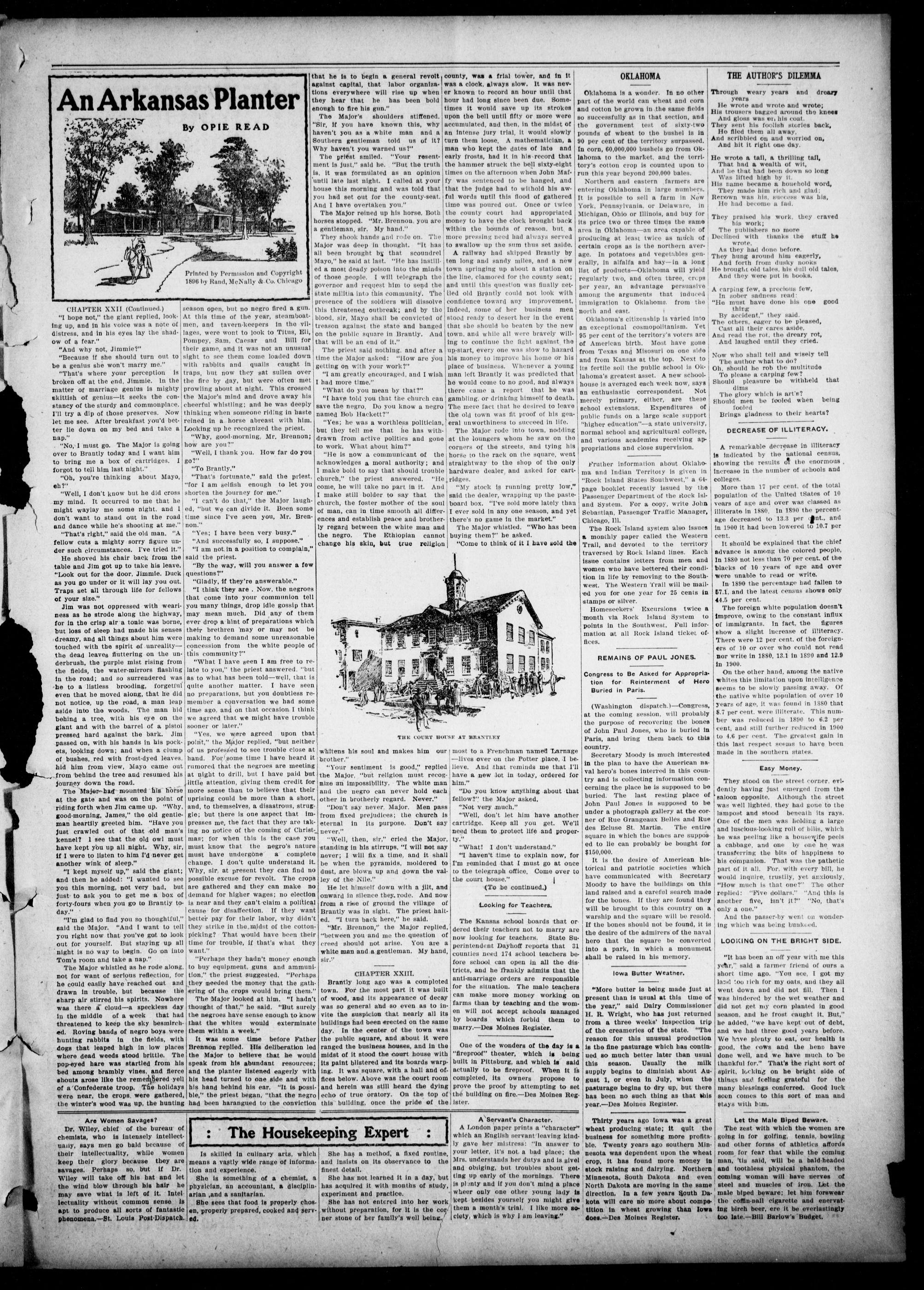
THE COURT HOUSE
THE COURT HOUSE AT BRANTLEY
whitens his soul and makes him our brother."
"Your sentiment is good," replied the Major, "but religion must recognize an impossibility. The white man and the negro can never hold each other in brotherly regard. Never."
"Don't say never, Major. Men pass from fixed prejudices; the church is eternal in its purpose. Don't say never."
"Well, then, sir," cried the Major, standing in his stirrups, "I will not say never; I will fix a time, and it shall be when the pyramids, moldered to dust, are bled up and down the valley of the Nile."
He let himself down with a jilt, and onward in silence they rode. And now from a rise of ground the village of Brantly was in sight. The priest halted. "I turn back here," he said.
"Mr. Brennon," the Major replied, "between you and me the question of creed should not arise. You are a white man and a gentleman. My hand, sir."
Brantly long ago was a completed town. For the most part it was built of wood, and its appearance of decay was so general and so even as to invite the suspicion that nearly all its buildings had been erected on the same day. In the center of the town was the public square, and about it were ranged the business houses, and in the midst of it stood the court house with its paint blistered and its boards warping. It was square, with a hall and offices below. Above was the court room and herein was still heard the dying echo of true oratory. On the top of this building, once the pride of the
keeping Expert :
ch
na-
a
in-
rv-
She has a method, a fixed routine,
and insists on its observance to the
finest detail.
She has not learned it in a day, but
has acquired it with months of study,
experiment and practice.
She has not entered into her work
without preparation, for it is the cor-
ner stone of her family's well being.
CHAPTER XXIII
county, was a frial tower, and in it was a clock, always slow. It was never known to record an hour until that hour had long since been due. Sometimes it would save up its strokes upon the bell until fifty or more were accumulated, and then, in the midst of an intense jury trial, it would slowly turn them loose. A mathematician, a man who kept the dates of late and early frosts, had it in his record that the hammer struck the bell sixty-eight times on the afternoon when Maffy was sentenced to be hanged, and that the judge had to withhold his awful words until this flood of gathered time was poured out. Once or twice the county court had appropriated money to have the clock brought back within the bounds of reason, but a more pressing need had always served to swallow up the sum thus set aside. A railway had skipped Brantly by ten long and sandy miles, and a new town springing up about a station on the line, clamored for the county seat; and until this question was finally filed old Brantly could not look with confidence toward any improvement. Indeed, some of her business men stood ready to desert her in the event that she should be beaten by the new town, and while all were bravely willing to continue the fight against the up-start, every one was slow to hazard his money to improve his home or his place of business. Whenever a young man left Brantly it was predicted that he would come to no good, and always there came a report that he was gambling, or drinking himself to death. The mere fact that he desired to leave the old town was fit proof of his gen eral unworthiness to succeed in life.
The Major rode into town, nodding at the loungers whom he saw on the corners of the streets, and tying his horse to the rack on the square, went straightway to the shop of the only hardware dealer, and asked for cartridges.
"My stock is running pretty low," said the dealer, wrapping up the pasteboard box. "I've sold more lately than I ever sold in any one season, and yet there's no game in the market."
The Major whistled. "Who has been buying them?" he asked.
"Come to think of it I have sold the
WILLIAM
most to a Frenchman named Larnage
lives over on the Potter place, I believe.
And that reminds me that I'll have a new lot in today, ordered for him."
"Do you know anything about that fellow?" the Major asked.
"Not very much."
"Well, don't let him have another cartridge. Keep all you get. We'll need them to protect life and property."
"What! I don't understand."
"I haven't time to explain now, for I'm reminded that I must go at once to the telegraph office. Come over to the court house."
Looking for Teachers.
The Kansas school boards that ordered their teachers not to marry are now looking for teachers. State Superintendent Dayhoff reports that 31 counties need 174 school teachers before school can open in all the districts, and he Frankly admits that the anti-marriage orders are responsible for the situation. The male teachers can make more money working on farms than by teaching and the women will not accept schools managed by boards which forbid them to marry.—Des Moines Register.
One of the wonders of the day is a "fireproof" theater, which is being built in Pittsburg, and which is said actually to be fireproof. When it is completed, its owners propose to prove the proof by attempting to set the building on fire.—Des Moines Register.
A `Servant's Character.`
A Servant's Character.
A London paper prints a "character" which an English servant leaving kindly gave her mistress: "In answer to your letter, it's not a bad place; the Mrs. understands her dutyys and is sivel and obliging, but troubles about getting up early of the mornings. There is plenty and if you don't mind a place wheer only one other young lady is kept besides yourself you might give them a month's trial. I like more society, which is why I am leaving."
(To be continued.)
OKLAHOMA
Oklahoma is a wonder. In no other part of the world can wheat and corn and cotton be grown in the same fields so successfully as in that section, and the government test of sixty-two pounds of wheat to the bushel is in 90 per cent of the territory surpassed. In corn, 60,000,000 bushels go from Oklahoma to the market, and the territory's cotton crop is counted upon to run this year beyond 200,000 bales.
Northern and eastern farmers are entering Oklahoma in large numbers. It is possible to sell a farm in New York, Pennsylvania, or Delaware, in Michigan, Ohio or Illinois, and buy for its price two or three times the same area in Oklahoma—an area capable of producing at least twice as much of certain crops as is the northern average. In potatoes and vegetables generally, in alfalfa and hay—in a long list of products—Oklahoma will yield regularly two, and often three, crops per year, an advantage persuasive among the arguments that induced immigration to Oklahoma, from the north and east.
Oklahoma's citizenship is varied into an exceptional cosmopolitanism. Yet 95 per cent of the territory's voters are of American birth. Most have gone from Texas and Misosurl on one side and from Kansas at the top. Next to its fertile soil the public school is Oklahoma's greatest asset. A new schoolhouse is averaged each week now, says an enthusiastic correspondent. Not merely primary, either, are these school extensions. Expenditures of public funds on a large scale support "higher education"—a state university, normal school and agricultural college, and various academies receiving appropriations and close supervision.
Fruther information about Oklahoma and Indian Territory is given in "Rock Island States Southwest," a 64-page booklet recently issued by the Passenger Department of the Rock Island System. For a copy, write John Sebastian, Passenger Traffic Manager, Chicago, Ill.
The Rock Island system also issues a monthly paper called the Western Trail, and devoted to the territory traversed by Rock Island lines. Each issue contains letters from men and women who have bettered their condition in life by removing to the Southwest. The Western Trail will be mailed you for one year for 25 cents in stamps or silver.
Homeseekers' Excursions twice a month via Rock Island System to points in the Southwest. Full information at all Rock Island ticket offices.
REMAINS OF PAUL JONES.
Congress to Be Asked for Appropriation for Reinterment of Hero Buried in Paris.
(Washington dispatch.)—Congress, at the coming session, will probably the purpose of recovering the bones of John Paul Jones, who is buried in Paris, and bring them back to this country.
Secretary Moody is much interested in the plan to have the American naval hero's bones interred in this country and is collecting information concerning the place he is supposed to be buried. The last resting place of John Paul Jones is supposed to be under a photograph gallery at the corner of Rue Grangeaux Belles and Rue des Ecluse St. Martin. The entire square in which the bones are supposed to lie can probably be bought for $150,000.
It is the desire of American historical and patriotic societies which have communicated with Secretary Moody to have the buildings on this land raised and a careful search made for the bones. If they are found they will be brought to this country on a warship and the square will be resold. If the bones should not be found, it is the desire of the admirers of the naval hero that the square be converted into a park, in which a monument shall be raised in his memory.
Iowa Butter Weather.
"More butter is being made just at present than is usual at this time of the year," said Dairy Commissioner H. R. Wright, who has just returned from a three weeks' inspection trip of the creameries of the state. "The reason for this unusual production is the fine pasturage which has continued so much better later than usual this season. Usually the milk supply begins to diminish about August 1, or even in July, when the pasturage begins to dry up, but there has been no such thing as that this year."-Des Moines Register.
Thirty years ago Iowa was a great wheat producing state; it quit the business for something more profitable. Twenty years ago southern Minnesota was dependent upon the wheat crop. it has found more money in stock raising and dairying. Northern Minnesota, South Dakota and even North Dakota are moving in the same direction. In a few years South Dakota will care no more about competition in wheat growing than Iowa does. Des Moines Register.
THE AUTHOR'S DILEMMA
Through weary years and dreary years
He wrote and wrote and wrote;
His trousers bagged around the knees
And gloss was on his coat.
They sent his foolish stories back,
He filed them all away.
And scribbled on and worried on,
And hit it right one day.
And he that had been down so long
Was lifted high by it.
His name became a household word,
They made him rich and glad:
Rerown was his, success was his,
He had become a fad.
They praised his work, they craved
his work;
The publishers no more
Declined with thanks the stuff he
wrote.
As they had done before.
They hung around him eagerly,
And forth from dusky nooks
He brought old tales, his dull old tales,
And they were put in books.
A carping few, a precious few,
In sober sadness read:
"He must have done his one good
thing
By accident," they said.
The others, eager to be pleased,
Cast all their cares aside.
And read the rot, the dreary rot,
And laughed until they cried.
Now who shall tell and wisely tell
The author what to do?
Oh, should he rob the multitude
To please a carping few?
Should pleasure be withheld that
dims
The glory which is art's?
Should men be fooled when being
DECREASE OF ILLITERACY.
A remarkable decrease in illiteracy is indicated by the national census, showing the results of the enormous increase in the number of schools and colleges.
More than 17 per cent, of the total population of the United tSates of 10 years of age and over was classed as illiterate in 1880. In 1890 the percentage decreased to 13.3 per cent., and in 1900 it had been lowered to 10.7 per cent.
It should be explained that the chief advance is among the colored people. In 1880 not less than 70 per cent. of the blacks of 10 years of age and over were unable to read or write.
In 1890 the percentage had fallen to 57.1, and the latest census shows only 44.5 per cent.
The foreign white population doesn't improve, owing to the constant influx of immigrants. In fact, the figures show a slight increase of illiteracy. There were 12 per cent. of the foreigners of 10 or over who could not read nor write in 1880, 13.1 in 1890 and 12.9 in 1900.
On the other hand, among the native whites this limitation upon intelligence seems to be slowly passing away. Of the native white population of over 10 years of age, it was found in 1880 that 8.7 per cent. were illiterate. This number was reduced in 1890 to 6.2 per cent, and still further reduced in 1900 to 4.6 per cent. The greatest gain in this last respect seems to have been made in the southern states.
Easy Money.
They stood on the street corner, evidently having just emerged from the saloon opposite. Although the street was well lighted, they had gone to the lampost and stood beneath its rays. One of the men was holding a large and luscious-looking roll of bills, which he was peeling like a housewife peels a cabbage, and one by one he was transferring the blits of happiness to his companion. That was the pathetic part of it all. For, with every bill, he would inquire, trustily, yet anxiously, "How much is that one?" The other replied: "Five dollars." "And this is another five, isn't it?" "No, that's only a one."
And the passer-by went on wondering which was being bunked.
LOOKING ON THE BRIGHT SIDE.
"It has been an off year with me this year," said a farmer friend of ours a short time ago. "You see, I got my land too rich for my oats, and they all went down and did not fill. Then I was hindered by the wet weather and did not get my corn planted in good season, and he frost caught it. But," he added, "we have kept out of debt, and we had three good years before. We have plenty to eat, our health is good, the cows and the hems have done well, and we have much to be thankful for." That's the right sort of spirit, locking on he bright side of things and feeling grateful for the many blessings conferred. Good luck soon comes to this sort of man and stays with him.
Let the Male Biped Beware.
Let the Male Biped Beware.
The zest with which the women are going in for golfing, tennis, bowling and other forms of athletics affords room for fear that while the coming man, 'tis said, will be a bald-headed and toothless physical phantom, the coming woman will have nerves of steel and muscles of iron. Let the male biped beware; let him forwear the coffin-nail cigarette and enervating birch ear, ere it be everlastingly too late—Bill Blow's Budget.
RUFUS L. LOGAN, B. S. D. - EDITOR
TERMS OF SUBSCRIPTION.
One Year in Advance - - - $1.00
Six Months in Advance - - .75
Three Months in Advance - - .50
Single Copies - - - .05
Advertising Rates on Application.
Job Work of all Kinds Solicited.
Published Every Friday.
Entered at the postoffice at Columb-
umbia, Mo., as second class matter,
Jan. 15, 1902.
Agents wanted in every town in the
state.
Payments may be made in two cent stamps, by postal note, money order, by registered letter or express order.
Correspondence containing news of interest and importance is desired from all parts of the United States.
Communications should be made to reach us not later than Thursday morning, to insure insertion in the current issue.
No attention will be paid to anonymous communications.
Agents wanted everywhere. Write for terms.
Specimen copies sent to any address upon request.
PRESS OF THE MISSOURI STATESMAN
ORDER the Professional world now and you will get it free until Xmas.
RANDOLPH county has a man who is so lazy that he rides in a wagon to sow wheat.
THE governor of Indiana and the sheriff of Danville, Ill., have not hesitated to place themselves in contempt of Judge Lynch's court.—Exchange.
THE republicans have their candidate for president already and only have to find a running mate for him. How would Major Warner, of Missouri, do?
OUR thanks are due the following named persons for subscriptions this week: Mesdames Minerva Baily, Louisa Mun and Miss Della Williams, of Higbee.
NEGROES should exercise more care in selecting the heads of their lodges. The best men should always, be selected and the word "best" should mean intellectual ability and moral qualifications as well.
SENATOR Gorman's speeches in which he attempts to make the race question an issue in the coming campaign will have no effect on Rooseveit's strength either as a candidate for the nomination or after he is nominated.
WHITE secret organizations are expelling and driving out from their lodges and societies all men who have acknowledged crime or have been proven guilty of the same. The colored organizations should pattern after the white brother in this respect. The American Eagle.
THE Professional World is just two years old today and since making its bow to the public two years ago it has never failed to appear each week and regardless of the many obstacles and hindrances which confront the establishment of a newspaper, we have been able to keep the Professional World before the people. We have a steadily increasing subscription list of which we are proud and most heartily thank our many friends who have supported us in our effort in giving the people of Missouri a long felt want—a regularly published paper for only $1.00 a year.
A Negro's Maxims.
Colored folks, be polite to white folks and all other kind of folks.
The loud-mouthed, swaggering disreputable colored folks are the bane of the colored people of this country.
Colored men, honesty is the best policy, and we should not fail to remember the maxim.
We shall win our way to the topmost round in the ladder of success if we persevere and faint not by the wayside.
We stand for correct living, and its strict observance of the law, and we have no sympaty with the
---
lawless elements, be they white or black. Colored men, we have been and are now on trial. It is absolutely essential that we do all we can to win the respect and esteem of the better class of white citizens of this country.
Corner-Stone Laid at Huntsville
--Over $400 Raised.
The corner-stone of the Second Baptist church of Huntsville was laid Sunday, October 25th with imposing ceremonies by Finney Masonic lodge of Huntsville and visiting lodges from Moberly and Salisbury, Prof. A. R. Chinn, of Glasgow, Grand Master of the Masonic Order of Missouri and its jurisdictions, acting as master of ceremonies during the day. A large crowd of visitors from surrounding towns were present to witness the exercises as well as many from the immediate country vicinity of Huntsville. At 11 o'clock a.m., services were held in the county court court and Rev. G. C. Chinn, pastor, preached to a large congregation. At 2 p.m. the crowd reassembled at the court house and listened to an address of welcome by Mayor Wm. Hethman and a masterly response by Grand Master Chinn. A line of march was then formed in front of the courthouse, by the Masonic order, headed by the Huntsville band and followed by a large crowd they moved to the foundation now under construction for the new church where the corner stone was laid. Four hundred and twenty-three dollars was realized for the day. Rev. G. C. Chinn, pastor of the church, has been in Huntsville only one year and during that time he has raised about $1,200 to be applied to the new church, which is now being built.
General News in Brief.
San Francisco, Cal., Oct. 20. The steamer South Portland struck a reef off Cape Blanco, Ore., before daylight and 30 lives are believed to have been lost.
Kansas City, Mo., Oct. 25. Ninety freight cars were burned in the Missouri Pacific yards in the east bottoms to-day. The loss will exceed $50,000. Some of the cars were loaded with grain. It is probable that the fire was started by tramps.
Mountain Grove Mo., Oct. 21. W. J. Davis, aged 74 years, and Mrs. Maggie J. Berry, aged 73 years, were married to-day at the residence of the bride, four miles south of this city. Rev. C. V. Shullenberger officiating. Troy, Mo., Oct. 23. The trial of Clarence Barnes for the killing of Rhodes Clay, in Mexico, last summer, was concluded here today, and Barnes was acquitted by the jury after being out less than an hour. It was one of the most sensational cases ever tried here. The defense established clearly a case of self-defense. The case was brought here on a change of venue.
prison without due cause. W. F. Davis another prominent union man who was confined at the same time, also brings suit for an equal amount. Wichita, Kas., Oct. 10. Once more Crescous is "King of Trotters," having snatched the world's record for a mile from Major Delmar this afternoon, when he went the distance in 1:59% without the aid of a wind shield and with only "Old Mike, the Tramp" to keep him company. The stallion, the hero of many fast miles, trotted a fast mile and yet he did it easily to all appearances, and finished strongly.
Indianapolis, Oct. 21.—Samuel E. Morss, editor and proprietor of the Indianapolis Sentinel, fell from the third story of the Sentinel building to-day and lived only 15 minutes. The window from which he fell was in his private office. No one was with him at the ttime. Mr. Morss had been in ill health for some time. It was announced by his private secretary that he
probably had opened the window for air and was overcome by heart disease. He left a widow and one daughter. His mother also survives him.
Honolulu, via San Francisco, Oct. 20 — The eruption of Mauna Loa, the great volcano, raising 13,650 feet above sea level, continues. Three pillars of fire rise two miles above the snow-covered crest, while a stream of molten lava flows toward the sea, 20 miles away. Hundreds of persons from Honolulu have gone out on steamers to see the spectacle from the sea and many are trying to reach the volcano by land. Although the volcano is 40 miles from the city of Hilo, there is no road over the trackless lava beds.
Jefferson City, Oct. 21. The grand lodge of the Knights of Pythias spent the greater part of the day electing officers. The following were successful: George C. Crowther, St. Joseph, grand chancellor; Harry E. Barker, Kansas City, grand vice chancellor; J. E. Thomas, Caldwell, grand prelate; Herman Raleke, Bethany, grand master exchequer; John H. Holmes, grand keeper of records and seals; Frank B. Hillock, Kahoka, grand master at arms; Ward Cunningham, DeSoto, grand inner guard; Harry, Sloan, Skidmore, grand outer guard; J. W. Sullinger, King City, and W. E Webb, Macon, were elected supreme representatives to the supreme lodge, which meets in Louisville. Joplin was selected unanimously as the place for the next meeting and the date was fixed for the third Tuesday in October, 1904.
MR. FOLK'S MANNERS.
Young Attorney has None of the Actions of Professional Politicians.
Folk's manner is modest and quiet, but confident; his handshake is cordial, and he has a pleasant word for everyone, but having been so short a time in politics, he has none of the stereotyped mannerisms which usually characterize the older "party leaders."
When introductions were flying right and left in Columbia, and he was meeting strangers at the rate of four or five a minute, it often happened that he would be introduced twice to the same man. But he never failed to note this fact, showing that he had an extraordinary memory for names and faces.
"Mr. Folk let me introduce you to Mr. ——"
"Yes, I have met Mr. Jones before," Mr. Folk would say, seizing the Jones hand, and Mr. Jones would be flattered to think that Mr. Folk had remembered him among so many.
THE INHERITANCE TAX DECREASING.
The inheritance tax, which formerly yielded $20,000 per month,
The Great Southern Hair Pomade.
Softens, beautifies and promotes the growth of the hair.
PRICE 25c.
GOOD AGENTS WANTED.
Fill out this blank, mention this paper, and send it with $1.00 and you will receive by express $2.00 worth of the Pomade and terms to agents:
F. J. NOTT, PARIS MO.: Enclosed please find P. O. Money Order for $1.00, for which send me as per your offer, $2.00 worth of the Great Southern Hair Pomade, and terms to agents.
Name ...
Street ...
Town or City ...
County ...
State ...
Express Office ...
Date of this order ...
SEND ALL ORDERS TO
F. J. NOTT, Box 81, Paris, Mo.
---
now yields only $12,000 per month. Gymnasium is to cost $79,000; physics laboratory, $75,000; chemistry laboratory $25,000; animal hospital in connection with the department of veterinary surgery, $15,000. All are conditioned by the income from this tax. The appropriation was made this way by the last legislature. It is now sure that the buildings will not all be erected.
TUESDAY, NOVEMBER 10th, 1903,
pursuant to and for the purpose expressed in
an ordinance of said city passed and approved
in October 1903, and of which
the following is a copy:
Bill to enact an ordinance entitled, "An Ordinance providing for a special election in the county of One Hundred and a quarter qualified voters thereof a proposition for said City to incur an indebtedness of One Hundred Thousand Dollars and issue bonds thereof as a form of payment for the collection of by purchase or construction water works and electric light plant to be owned exclusively by said City, and providing for the collection of by purchase or construction water works to pay the interest on such indebtedness as it falls due, and also to constitute a sinking fund for the payment of the principal thereof within five years from the time of contracting the same."
Be it ordained by the Council of the City of Columbia, as follows:
SECTION 1. A Special Election is hereby ordered to be held in the City of Columbia on November 1, 2015, by a vote of submitting a proposition to the qualified voters thereof for the City of Columbia to incur an indebentness of One Hundred Thousand Dollars, provided, for the purpose of acquiring, by purchase or construction, water works and electric light plant to be owned exclusively by said entity.
SECTION 2. The following are hereby designated as the polling places in the four wards of the City for the special election provided in Section 1 of this ordinance:
First Ward, on Lot 14 in Harbinson's addition
concurrent with the revenue.
Second Ward, at County Court
Third Ward, Wm. Walker's Shop on South
10th street.
fourth Street.
Fourth Ward, Southwest Corner of Conley
Avenue and Hitt Street.
Avenue and Hitt Street.
Section 3. That within each ward there are hereby appointed six judges of such election, who are able to read and write, qualified voters and residents of the ward in which they are first Ward–R, L, Finley, W. B. Kellier. J, T. Berry, A. J. Saudker, Howard Gribble, Wm. McCaskey.
Second Ward-Dr. J. W. Carryer, Webster
Second Ward-Dr. Remley, W. S.
Johnson, Shannon Mountjoy.
Third Ward—B. Bole, Jacob Sellenger, J. T. Clement, Wm. N. Lowrey W. G. W. Smith, Waltland
Fourth Ward—C, B. Rollin, W. H. Cochran
J. Wouthard, J. H. Barnett, W. G. Brown, W. K. Stone
"For increase of debt—Yes."
the former of which shall be taken as a vote asenting to such increase of debt, and the latter asenting to such decrease of debt. **SECTION 7.** Upon the result of such election being certified by the judges thereof to the Council, the Council, if the proposition for the increase of debt may be proper ordinance declare such result, and cause bonds of the City of Columbia to be issued, covering the amount of the debt. **SECTION 8.** Upon such indebentness the City Council shall provide for the levy and collection of an annual tax or 35 cents or such part thereof as may be necessary, and subject to taxation in said city, for the purpose of paying the interest on such indebentness as the same falls due, and to constitute a sinking payment of the principal within twenty years. **SECTION 9.** This ordinance shall take effect and be in full force from and after its passage. It may be approved this the 20th day of October, 1903.
ATTEST:
BSAI:
JOHN S. BICKNELL,
Oct. 17,
Clerk.
Lodge and Church Directory.
U. B. F.
Crispus Attucks Lodge,No. 62. Meetings 2nd and 4th Tuesdays in each month. Visiting members cordially invited. Caleb Hall, W. M. A. M. Schweich, W. S.
S.M.T.
Florence Woods, W. P.; Mrs. Lizzie Williams, W. S. Meeting first Monday in each month at 3 p. m.
G. U. O. F.
Boone county light lodge,
No. 3356. Meetings, 1st and
3rd Tuesdays in each month.
Visiting members in good
standing invited.
W. H. TURNER, N. G.
J. C. BUURTON, P. S.
K. P.
Acme Lodge, No. 24. Meetings second and fourth Fridays in each month. W. H. Turner, C. C. and D. D. G. C. W. W. Lampkins, M. F.
I. O. K. T.
Naomie Tabernacle No. 57,
Columbia, Mo., meets Second
and Fourth Mondays in each
month.
MRS. ROSA MARSHAL, C. P.
MRS. MINNIE HAYES, C. R.
Watch This Space.
Reserved for
The Globe Me
210 East
JEFFERSON CITY
GO TO
Gentsch'
JEFFERSON CITY, - - MISSOURI.
Gentsch's Bakery
For Bread, Cakes and Pies.
Everything always Fresh.
22 S. 9th Street,
ST. PAUL LODGE, NO. 12.
St. Paul Lodge, No. 12, A.
F. & A. M., meets every first
and third Tuesday in each
month. A cordial invitation
extended to all visiting
brothers. J. A. Mosely, W.
M. J. A. Grant, Secretary.
MRS. EDNA W
FACE MA
SHAMPOO
HAIR DR
Nursing a S
609 Lafayette St.,
K. OF P.
Harrison Lodge No. 12,
Huntsville, Mo. Meeting the
second and fourth Thursdays
in each month. M. W. Tony,
C. C., W. T. Ansel, K. R. S.,
L. A. Robinson, M. E.
LADIES COURT.
Golden Queen Court, No. 19, meets first Friday in each month. Mrs. M. E. Ridgway, M. A. M., Mrs. Lizzie Richardson, Secretary.
O. E. S.
Amos Chapter, No. 30.
Meetings second Friday in each month. Mrs. Bessie Washington, W. M. Mrs. Annie Williams, W. S.
SECOND BAPTIST CHURCH.
Rev. A. A. Adams, Pastor.
Preaching Sundays 11 a.
m., and 7:30 p. m.
Sunday school at 2:30 p. m.
Prayer meeting Wednesday evening, 7:30.
A cordial invitation extended to all.
A. M. E. CHURCH.
Rev. P. C. Crews, Pastor.
Preaching Sundays 11 a.
m.; 7:30 p. m.
Sunday school 2:30 p. m.
Prayer meeting every
Wednesday eve, at 8:30; every
body invited to attend.
M. E. CHURCH
Rev. J. Arlington Grant, pastor.
Preaching Sundays 11, a. m. and 7:30 p. m.
Sunday school, 9:30 a. m. Prayer meeting Wednesdays 7:30 to 8:30; all are made welcome.
Rev. J. B. Parsons, pastor.
Preaching Sundays 11 a. m.
and 7:30 p. m.
Prayer meeting Wednesday
days 7:30 p. m.
Everybody cordially invited
ed to attend.
RIDER
in each town
Guaranteed
New
"Bellse
"Cossal
"Siberia
"Neudor
no better bid
Any other
usual price.
equipment or
We SHIP
RIDER AGENTS WANTED
in each town to take orders for our new High Grade
Guaranteed Bicycles.
New 1903 Models
"Bellise," Complete $8.75
"Cossaak," Guaranteed High Grade $10.75
"Siberlan," A Beauty $12.75
"Neudorf," Road Racer $14.75
no better bicycle at any price.
Any other make or model you want at one-third
usual price. Choice of any standard tires and best
equipment on all our bicycles. Strongest guarantees.
We SHIP ON APPROVAL C. O. D. to any one
without a cent deposit and allow 10 DAYS FREE
TRIAL before purchase is binding.
500 Second Hand Wheels $3 to $8
taken in trade by our Chicago retail stores.
all makes and models, good as new.
DO NOT BUY FACTORY PRICES AND FREE TRIAL OFFER.
trees, equipment, sandies and sporting goods of all kinds, at half regular price.
in our l free sundry catalog. Contains a world of useful information. Write for it.
J. L. MEAD CYCLE CO., Chicago, Ill.
ercantile Co.,
High St.,
MISSOURI.
MRS. EDNA WATTS HARDIN
FACE MASSAGING,
SHAMPOOING,
HAIR DRESSING.
Nursing a Specialty.
609 Lafayette St., Jefferson City, Mo.
ROBNETT BROS.
Grocery Store
A full line of fresh Grooeries. Cash paid for produce. Prompt deliveries.
OUR CASH PLAN
We charge for cost of goods and our profit only.
Their Credit Plan
They charge for cost of goods and profit, also expense of bookkeepers, interest and accounts and time. No. 2, W. Allen Street, COLUMBIA. MISSOUR
ON CREDIT
$22.90
Free
Catalogue
CENTURY MFG. CO.
EAST ST. LOUIS, K.L.
Century Steel Range, No. 80-A-18
Has six 8-inch lids, oven 121x112,
splendid reservoir and warming close,
lined throughout with asbestos, burns
anything, heat bakers and roasters on
Earth. Guaranteed 10 years. Weight
475 lbs. Only $22 90. Terms $8.00 cash,
balance payment $3.00 a month, no interest.
Shipped immediately on receipt of
$800. No interest. Honeest people
located in all parts of the world.
Cash discount $1.50 on Range. Freight
average $1.25 for each 600 miles. Send
for free catalogue, but this is the greatest
bargain ever offered. We refer to
Southern Illinois National Bank.
CENTURY • MANUFACTURING • CO.
Dept. 910, East St. Louis, IL
AGENTS WANTED
to take orders for our new High Grade
Bicycles.
1903 Models
Complete $8.75
Guaranteed High Grade $10.75
A Beauty $12.75
Road Racer $14.75
cycle at any price.
make or model you want at one-third
Choice of any standard tires and best
all our bicycles. Strongest guarantees.
ON APPROVAL C. O. D. to any one