Richmond Planet
Saturday, January 13, 1900
Richmond, Virginia
Page text (machine-generated)
THE RICHMOND PLANET
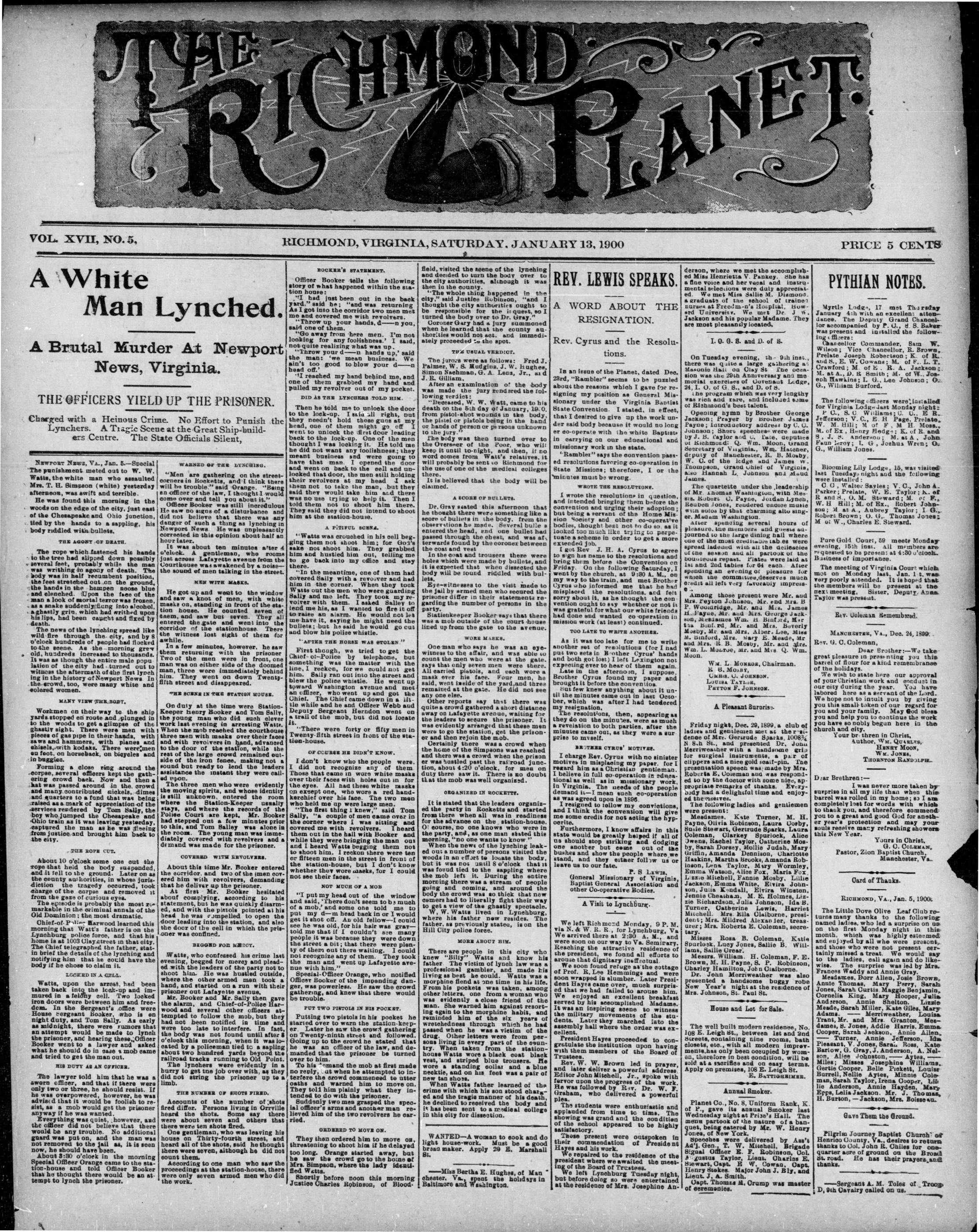
A White Man Lynched.
A Brutal Murder At Newport News, Virginia.
THE OFFICERS YIELD UP THE PRISONER. Charged with a Heinous Crime. No Effort to Punish the Lynchers. A Tragic Scene at the Great Ship-builders Centre. The State Officials Silent.
VOL. XVII. NO.5.
A White Man
A Brutal Murder
News, V
THE OFFICERS YIEL
Charged with a Heinous Crime
Lynchers. A Tragic Scene
ers Centre. The S
NEWPORT NEWS, VA., Jan. 5.—Special The punishment meted out to W. W. Watts, the white man who assaulted Mrs. T. H. Simpson (white) yesterday afternoon, was swift and terrible. He was found this morning in the woods on the edge of the city, just east of the Chesapeake and Ohio junction, tied by the hands to a sapling, his body riddled with bullets.
THE AGONY OF DEATH.
The rope which fastened his hands to the tree had slipped down possibly several feet, probably while the man was writhing in agony of death. The body was in half recumbent position, the feet stretched out on the ground, the hands in the hampen noose blue and elenched. Upon the face of the man a look of mortal terror was frozen, as a snake suddenly flung into alcohol, a ghastly grin, which had writhed upon his lips, had been caught and fixed by death.
The news of the lynching spread like wild fire through the city, and by 8 o'clock hundreds of people had flocked to the scene. As the morning grew old, hundreds increased to thousands. It was as though the entire male population of the city had turned out to witness the aftermath of the first lynching in the history of Newport News. In the crowd, too, were many white and colored women.
MANY VIEW THR BODY.
Workmen on their way to the ship yards stopped on route and plunged in to the woods to get a gilppee of the ghastly sight. There were men with pieces of gas pipe in their hands, with saws and hammers, with planes and chisels, with kodaks. There were men on foot, on horseback, on bicycles and in buggies.
Forming a close ring around the corpse, several officers kept the gathering crowd back. Now and then that was passed around in the crowd and many contributed nickels, dimes and quarters to a fund that was being raised as a mark of appreciation of the services rendered by Tom Sally, the boy who jumped the Chesapeake and Ohio train as it was leaving yesterday, captured the man as he was fleeing from justice, and brought him back to the city.
THE ROPE CUT.
About 10 o'clock some one cut the rope that held the body suspended, and it fell to the ground. Later on as the county authorities, in whose jurisdiction the tragedy occurred, took charge of the corpse and removed it from the gaze of curious eyes. The episode is probably the most remarkable in the criminal annals of the Old Dominion; the most dramatic. Chief-of-Police Harwood learned this morning that Watt's father is on the Lynechburg police force, and that his home is at 1003 Oak street in that city. The Chief telegraphed the father, statin brief the details of the lynching and notifying him that he could have the body if he chose to claim it.
LOCKED IN A GZLL
Watts, upon the arrest, had been taken back into the lock-up and immured in a felony cell. Two locked iron doors were between him and freedom. In the Sergeant's office were House Sergeant Booker, who is on night duty, and Tom Sally. As early as midnight, there were rumors that attempts were made to lynch the murderer, having these, Officer Booker went to his lawyer, asked what he should do in case a mob came and tried to get the man out.
HIS DUTY AS AN OFFICER.
The lawyer told him that he was a sworn officer, and that if there were only two or three, he should resist. If he was overpowered, however, he was advised that it would be foolish to resist, as a mob would get the prisoner anyway if he was wanted.
Everything was quiet, however, and the officer did not believe that there would be any trouble. No additional guard was put on, and the man was not removed to the jail as it is seen now, he should have been.
About 8:30 o'clock in the morning Special Officer Orange came to the station-house and told Officer Booker that he thought there would be an attempt to lynch the prisoner.
WARNED OF THE DYNCHING.
"Men are gathering on the street-corners in Rockett, and I think there will be trouble," said Orange. "Being an officer of the law, I thought I would come over and tell you about it." Officer Booker was still incredulous He saw no signs of a disturbance and did not believe that there was any danger of such a thing as lynching in Newport News. He was unpleasantly corrected in this opinion about half an hour later. It was about ten minutes after 4 o'clock. A gentleman, who rooms just across Lafayette avenue from the Courthouse was awakened by a noise—the sound of men talking in the street.
MEN WITH MASKS.
He got up and went to the window and saw a knot of men, with white masks on, standing in front of the station house. He counted seven of taem, and saw but seven. They all entered the gate and went into the corridor of the stationhouse. There the witness lost sight of them for awhile. In a few minutes, however, he saw them returning with the prisoner Two of the men were in front, one man was on either side of the doomed man, three were immediately behind him. They went on down Twentsfifth street and disappeared.
THE SCENE IN THE STATION HOUSE
On duty at the time were Station-Keeper henry Booker and Tom Sally, the young man who did such clever work last evening in arresting Wattr. When the mob reeched the courthouse three men with masks over their faces and with revolvers in hand, advanced to the door of the station, while the rest of the large crowd remained outside of the iron fence, making not a sound but ready to lend the leaders assistance the instant they were called upon. The three men who were evidently the moving spirits, and whose identity is still unknown, entered the room where the Station-Keeper usually stays, and where the records of the Police Court are kept. Mr. Booker had stepped out a few minutes prior to this, and Tom Salley was alone in the room. The young man was immediately covered with revolvers and a demand was made for the prisoner.
COVERED WITH REVOLVERS
About this time Mr. Booker entered the corridor, and two of the men covered him with revolvers, demanding that he deliver up the prisoner. At first Mr. Booker hesitated about complying, according to his statement, but he was quickly disarmed, and with the pistols pointed at his head he was compelled to open the door leading into the station, and also the door of the cell in which the prisoner was confined.
BIGGED FOR MESSY.
Watts, who confessed his crime last evening, begged for mercy and pleased with the leaders of the party not to shoot him. He was hustled outside, where the other armed man took a hand, and started on a run with their prisoner out Lafayette avenue. Mr. Booker and Mr. Sally then gave the alarm, and Chief-of-Police Harwood and several other officers attempted to follow the mob, but they had not been notified in time and were too late to interfere. In fast, the body was not found until after 8 o'clock this morning, when it was located by a policeman tied to a sapling about two hundred yards beyond the railroad tracks running to Old Point. The lynchers were evidently in a hurry to get the job over with, as they did not string the prisoner up to a limb.
THE NUMBER OF SHOTS FIRED.
Accounts of the number of shots fired differ. Persons living in Orrville heard the shots. Some say there were about seven and others that there were ten shots fired. One gentleman, who was leaving his house on Thirty-fourth street, and heard all of the shots, said he thought there were seven, although he did not count them. According to one man who saw the proceedings at the station-house, there were only seven armed men who did the work.
RICHMOND, VIRGINIA, SATURDAY, JANUARY 13, 1900
BOCKER'S STATEMENT.
Officer Booker tells the following story of what happened within the station house: "I had just been out in the back yard." said he; "and was returning. As I got into the corridor two men met me and covered me with revolvers.
"Throw up your hands, d——n you,
said one of them.
"Go away from here men. I'm not looking for any foolishness." I said, not quite realizing what was up. "Throw your d—n hands up," said the man: 'we mean business. We isn't too good to blow your d—n head off.' "I reached my hand behind me, and one of them grabbed my hand and pulled my revolver out of my pocket.
DID AS THE LYNCHERS TOLD HIM.
Then he told me to unlock the door to the lock-up. I said all right, but they needn't hold those guns at my head, one of them might go off. I went to unlock the first door leading back to the lock-up. One of the men thought I was looking it. He told me he did not want any toolfulness; they meant business and were going to have that man. I opened the door and went on back to the sell and unlocked that door, the men still holding their revolvers at my head. I ask to move the man, but they said they would be there. There was no use trying to help it. They told them not to shoot him there. They said they did not intend to shoot him at the station-house.
A PITIFUL SCENA.
"Watts was crouched in his cell begging them not shoot him; for God's sake not shoot him. They grabbed him and hustled him out, telling me to go back into my office and stay there.
"In the meantime, one of them had covered Sally with a revolver and had him in the corner. When they took Watts out the men who were guarding Sally and me left. They took my receiver with them. I asked Salley to reel in the arm, as waited to fire it off to raise an alarm. He would not me have it, saying he might need the bullets; but he said he would go out and blow his police whistle.
"AFTER THE HORSE WAS STOLEN"
First though, we tried to get the Chief-ot-Police by telephone, but something was the matter with the line, I reckon, for we could not get him. Sally ran out into the street and blew the police whistle. He went up toward Washington avenue and met an officer, who went up and got the Chief. The Chief came down in a little while and he and Officer Webb and Deputy Sergeant Herndon went on a trail of the mob, but did not locate it.
"There were forty or fifty men in Twenty-fifth street in front of the station-house.
OF COURSE HE DIDN'T KNOW.
I don't know who the people were. I did not recognize any of them. Those that came in wore white masks over their faces with holes out in for the eyes. All had these white masks on except one, who wore a red handkerchief over his face. The two men who held me up were large men. "The first thing I knew," said Tom Sally, "a couple of men came over in the corner where I was sitting and covered me with revolvers. I heard them out in the hall with Booker and while they were bringing the man out and I heard Watts begging them not to shoot him. I reckon there were ten or fifteen men in the street in front of the station-house, but I don't know whether they wore masks, for I could not see their faces.
NOT MUCH OF A MOB
"I put my head out of the window and said, 'There don't seem to be much of a mob,' and some one told me to put my d—m head back in or I would get it shot off. An old fellow—I could see he was old, for his hair was gray—told me that if I couldn't see many people it was because they were down the street a bit; that there were plenty of them out there waiting. I could not recognize any of them. They took the man and went up Lafayette avenue with him."
Special-Officer Orange, who notified Officer Booker of the impending danger, was powerless. He saw the crowd gathering, and knew that there would be trouble.
PUT TWO PISTOLS IN HIS POCKET.
Putting two pistols in his pocket he started over to warn the station keeper. Later he saw the crowd gathering on Twenty-ninth street and followed. Going up to the crowd he stated that he was an officer of the law, and demanded that the prisoner be turned over to him.
To his demand the mob at first made no reply, but when he attempted to interfere the scrawl commenced to utter oaths and warned him to move on. They told him plainly what they intended to do with the prisoner.
Suddenly two men grasped the special officer's arms and another man relieved him of the two revolvers he carried.
ORDERED TO MOVE ON.
They then ordered him to move on, threatening to shoot him if he delayed too long. Orange started away, but he saw the crowd go to the home of Mrs. Simpson, where the lady identified Wetts. Shortly before noon this morning Justice Charles Robinson, of Blood-
field, visited the scene of the lynchings and decided to turn the body over to the city authorities, although it was then in the county.
"The whole thing happened in the city," said Justice Robinson, "and I thought the city authorities ought to be responsible for the inquest, so I thought they did Gray." Coroner Gary had a jury summoned when he learned that the county authorities would not act, and immediately proceeded to the spot.
THE USUAL VERDICT.
The jurors were as follows: Fred J. Palmer, W. S. Mudgins, J. W. Hughes, Simon Nechman, G. A. Lenz, Jr., and J. R. Gilliam.
After an examination of the body was made the jury rendered the following verdict:
"Deceased, W. W. Watt, came to his death on the 5th day of January, 1900, from pistol-shot wounds in the body, the pistel or pistols being in the hand or hands of person or persons unknown to the jury."
The body was then turned over to the Oversseer of the Poor, who will keep it until to-night, and then, if no word comes from Watt's relatives, it will probably be sent to Richmond for the use of one of the medical colleges there.
It is believed that the body will be claimed.
A SCORE OF BULLETS.
Dr. Gray seated this afternoon that he thought there were something like a score of bullets in the body, from the observations he made. Several bulle s entered the head, and one bullet had passed through the chest, and was afterwards found by the coroner between the coat and vest.
In the coat and trousers there were holes which were made by bullets, and it is expected that when dissected the body will be found riddled with bullets.
Eye-witnesses to the visit made to the jail by armed men who secured the prisoner differ in their statements regarding the number of persons in the party.
Stationkeeper Booker says that there was a mob outside of the court-house lined up from the gate to the avenue.
WORK MASKS.
One man who says he was an eye-witness to the affair, and was able to count the men who were at the gate, says that only seven men were there. All carried pletois, and each wore a mask over his face. Four men, he said, went inside of the yard, and three remained at the gate. He did not see any one else.
Other reports say that there was quite a crowd gathered a short distance away on Lafayette avenue, waiting for the leaders to secure the prisoner. It was evidently arranged that these men were at the station, got the prisoner and then join the rest.
Certainly there was a crowd when the home of the Simpsons was reached and there was a crowd when the prisoner was hustled past the railroad junction, about 4:20 o'clock, for men on duty there saw it. There is no doubt that the mob was well organized.
ORGANIZED IN ROCKETTE.
It is stated that the leaders organized the party in Rockettts and started from there when all was in readiness for the advance on the station-house. Of course, no one knows who were in the party, and, as one man stated this morning, "no one wants to know."
When the news of the lynching leaked out a number of persons visited the woods in an effort to locate the body, but it was not until S. clock that it was found tied to the sappling where the mob left it. During the entire morning there was a stream of people going and coming, and around the body the crowd was so thick that new semers had to literally fight their way to get a view of the ghastly spectacle.
W, W. Watts lived in Lynchburg, where his father new resides. The father, as previously stated, is on the Hill City police force.
MORN ABOUT HIM.
There are people in this city who knew "Billy" Watts and know his father. The victim of lynch law was a professional gambler, and made his living as best he could. Watts was a morphine flend at one time in his life. From his pockets was taken, among other letters, one from a woman who was evidently a close friend of the man. She warned him against resorting again to the morphine habit, and reminded him of the six years of wretchedness through which he had passed when he was a victim of the drug. Other letters were from persons living in every part of the country. When taken from the station-house Watts wore a black coat black vest, and striped blue trousers. He wore a standing collar and a blue necktie, and on his feet was a pair of new tan shoes.
When Watts father learned of the crime with which his son stood charged and the tragic manner of his death, he declined to receive the body and it has been sent to a medical college in this city for dissection.
WANTED—A woman to cook and do light house-work. Must be a good bread maker. Apply 20 E. Marshall St.
Miss Bertha E. Hughes, of Manchester, Va., spent the holidays in Baltimore and Washington.
REV. LEWIS SPEAKS.
REV. LEWIS SPEAKS.
A WORD ABOUT THE RESIGNATION.
Rev. Cyrus and the Resolutions.
In an issue of the Planet, dated Dec. 23rd, "Rambler" seems to be puzzled about the reasons which I gave for resigning my position as General Missionary under the Virginia Baptist State Convention. I stated, in effect, that I desired to give up the work under said body because it would no longer so-operate with the white Baptist in carrying on our educational and missionary work in the state.
"Rambler" says the convention passed resolutions favoring co-operation in State Missions; therefore, I or the minutes must be wrong.
WROTE THE RESOLUTION.
I wrote the resolutions in question, and intended bringing them before the convention and urging their adoption; but being a servant of the Home Mission Society and other co-operative bodies, thought best not to do so as it looked too much like trying to perpetuate a scheme in order to get a more extended job.
I got Rev J. H. A. Cyrus to agree to sign his name to the resolutions and bring them before the Convention on Friday. On the following Saturday, I went by the church, at 9:40 A.M., on my way to the train, and met Brother Cyrus who informed me that he had displaced the resolutions, and felt sorry about it, as he thought the convention ought to say whether or not it was grateful for what our white friends had done and wanted co-operation in mission work (at least) continued.
TOO LATE TO WRITE ANOTHER.
Late in the afternoon, I suppose, Brother Cyrus found my paper and brought it before the convention. But few knew anything about it until the minutes came out in last October, which was after I had tendered my resignation. The resolutions, then, appearing as they do on the minutes, were as much a revelation to both parties, after the minutes came out, as they were a surprise to myself.
BROTHER CYRUS' MOTIYEP.
I charge Rev. Cyrus with no sinister motives in misplacing my paper, for I regard him as a Christian gentleman. I believe in full co-operation in educational as well as in missionary work, in Virginia. The needs of the people demand it. I mean such co-operation as was agreed upon in 1896. I resigned to follow my convictions, and I think the convention will give me some eredis for not asting the hypocrite. Furthermore, I know affairs in this state would be greatly helped if all of us should stop talking and dodging one another but come out of the bushes and show the people where we stand, and they either follow us or leave us to our fate.
P. S. LAWIS,
General Missionary of Virginia,
Baptist General Association and other Co-operative Bodies.
We left Richmond Monday, 9 P.M. via N. & W. R. R., for Lynchburg, Va. We arrived there at 2:30 A. M., and were soon on our way to Va. Seminary. Reaching the attractive residence of the president, we found all efforts to arouse that dignitary ineffectual. We soon found refuge at the cottage of Prof. R. Lee Hemmings and were soon wrapped in slumber. Later President Hayes came over, much surprised that we had failed to arouse him. We enjoyed an excellent breakfast even by his accomplished Madame. It was an inspiring scene to witness the military movements of the students. Later they marched into the assembly hall where the order was excellent. President Hayes proceeded to congratulate the institution upon having with them members of the Board of Trustees.
Rev. W. W. Brown led in prayer, and later deliver a powerful address. Editor John Mitchell, Jr., spoke with fervor upon the progress of the work. He was followed by Rev. Dr. W. F. Graham, who delivered a powerful plea.
The students were enthusiastic and applauded from time to time. The opening was grand and the condition of the school appeared to be highly satisfactory.
Those present were outspoken in their commendation of President Hayes and his work.
We repaired to the residence of the president where we awaited the meeting of the Board of Trustees.
We left Lynchburg Tuesday night, but before doing so were entertained at the residence of Mrs. Josephine An-
derson, where we met the accomplished Miss Henrietta V. Pankey. She has a fine voice and her vocal and instrumental selections were duly appreciated. We met Miss Sallie M. Diamond, a graduate of the school of trainee nurses at Freedom-m-n's Hospital, Howard University. We met Dec. J. W. Jackson and his popular Madame. They are most pleasantly located.
I. O. G. S. and D. of S.
On Tuesday evening, the 9th inst., there was quite a large gathering at Masonite Hall on Clay St. The occasion was the 29th Anniversary and memorial exercises of Govenant Lodge, 24, I. O. of G. S., and D. of S.
The program which was very lengthy was rich and rare, and included some of Richmond's best talent.
Opening hymn by Brother George Jackson; Prayer by Brother James Payne; introductory address by C. O. Johnson; Short speeches were made by J. B. taylor and C. Paste, deputies of Richmond: Q. Wm. Moon, Grand Secretary of Virginia, Wm. Hatcher, deputy of Manchester, R. B. Mosby, the lodge and James w. Thompson, grand chief of Virginia, also Hannah L. Johnson and Maud James.
The quartette under the leadership of Mr. Thomas Washington, with Marga, Robert O. Payne, Jordan Lynne, Reuben Jones, reedered enceuse mute with solos by that charming alto singer, Madam Washington.
After spending several hours of pleasure, the members and guests adjourned to the large dining hall where one of the most creditable tables were spread ladened with all the delicacies of the season and all partook of the bountiful repast. Plates were laid at last and 2nd tables for 64 each. After spending an evening of pleasure for which the committee, deserves much credit all left very favorably impressed.
Among those present were Mr. and Mrs. Feyton Johnson, Mr. and Mrs. B. P. Woundridge, Mr. and Mrs. James H. Payee, Mr. and Mrs. George Jackson, Madames Wm. H. Binford, Mortha Binfrd, Mr. and Mrs. Beverly Mosby, Mr. and Mrs. Aloer, Loe, Miss Aninford, Mrs. Mary E. Meade, Mr and Mrs. R. B. Mosby, Mr. and Mrs. Wm. L. Mocruce, and Mrs. Q. Wm. L.
WM. L. MUNSON, Chairman.
R. G. MOSBY,
CORRIS. C. JOHNSON.
LOUISA TAYLOR,
PEYTON F. JOHNSON.
A Pleasant Surprise:
Friday night, Dec. 29, 1899, a club of ladies and gentlemen met at the residence of Mrs. Gertrude Sparks, 1008% N s.h. St., and presented Dr. John Merriweather with a handsome grip for surgical instruments, a pair of clippers and a nice gold saff-pin. The presentation speech was made by Mrs. Roberta E. Cooleman and was responded to by the doctor with some nice, appropriate remarks of thanks. Every night a lightful time and enjoyed the ourselves.
The following ladies and gentlemen were present:
Meadames, Kate Turner, M. H. Payne, Olivia Robinson, Laura Cosby, Susie Stewart, Gerrude Sparks, Laura Coleman, Clarkey Spurlock, Alice Owens, Rachel Taylor, Oatherine Mosby, Sarah Dorssey, Mollie Judah, Mary Griffin, Amanda Dennison, Charlotte Haskins, Martha Brooks, Amanda Robinson, Lena Taylor, Mary Wormley, Emma Watson, Alice Fox, Maria Fox, Lizzie Miechell, Fannie Mosby, Lillie Jackson, Emma White, Elvira Johnson, Julia Kendall, Elvira Winston, Jennie Cheahm, M. E. Holmes, Lizzie Richardson, Julia Johnson, Ida B. Harrier, Catberine Lewis, Harrier Mitchell, Mrs. Ella Claiborne, president; Mrs. Mildred Alexan ier, treasurer; Mrs. Roberta E. Coleman, secretary.
Misses Rosa B. Coleman, Katie Spurlock, Lucy Jones, Sallie B. Williams, Sallie Crear.
Messrs. William. H. Coleman, F. E. Brown, M. H. Payne, S. P. Robinson, Charley Hamilton, John Cialiborne.
Dr. John Merriweather was also presented a handsome buggy robe New Year's night at the residence of Mrs. Johnson, St. Paul St.
The well built modern residence, No. 108 E. Leigh St., between 1st and 2nd streets, containing nine rooms, bath closets, etc., with all modern improvements, has only been occupied by women, therefore in best condition, will be sold at a sacrifice and on easy terms. Apply on premises, 108 E. Leigh St.
E. BATTGHRIMER.
Annual Smoker
Planet Co., No. 8, Uniform Rank, K. of P., gave its annual Smoker last Wednesday night at Prise's Hall. The menu partook of the nature of a banquet, being catered by Mr. W. Henry Jones, of New York. Speeches were delivered by Ass't Ad'J. Gen., T. W. Mitechell, Brigade Signal Officer E. F. Robinson, Col. Augustus Taylor, Lieut. Charles E. Stewart, Capt. E. W. Cowan, Capt. Henry Stokes. Major John J. Bly, and Lieut. J. A. Smith. Capt. Thomas M. Crump was master of ceremonies.
PRICE 5 CENTS
PYTHIAN NOTES.
Myrtle Lodge, 17 met Thursday January 4th with an excellent attendance. The Deputy Grand Chancellor accompanied by P. G., S. S. Baker was present and installed the following officers:
Chancellor Commander, Sam W. Wilson; Vice Chancellor, B. Brown; Prelate Joseph Robertson; K. of R. and S. E. W. Cowans; M. of F. L. T. Crawford; M. of E. R. A. Jackson; m. at A. D. R. Smith; m. of W. Joseph Hawkins; L. G. Lee Johnson; O. G., William Burford.
The following officers were, installed for Virginia Lodge last Monday night: P. G., S. C. Williams; C. O. E. R. Jefferson; V. C., E. H. Page, Prelate, W. M. Hill; M. of F. M. H. Moss, M. of Ex. Henry Hedge; K. of R. and S. J. S. Anderson; m. at A. John Faunieroy; I. G. Joshua Wren; O. G., William Jones.
---
Blooming Lily Lodge, 15, was visited last Tuesday night and the following were installed: C. O. Walter Sayles; V. C., John A. Parker; Prelate, W. E. Taylor; A. of R and S., O. M. Steward; M. of F., W. H Hill; M. of Ex., Robert Johnson; M at A., Aubrey Taylor; I. G., Robert Brown; O. G., Thomas Jones; M of W., Charles E. Steward.
Pure Gold Court, 59 meets Monday evening, 15th inst. All members are requested to be present at 4:30 o'clock. Business of importance.
The meeting of Virginia Court which mot on Monday last, Jan. 1, it was very poorly attended. It is hoped that the members will be present at the next meeting, Sister, Deputy Anna Taylor was present.
MANCHESTER, VA., Dec. 24, 1899.
Rev. G. C. Coleman.
Dear Brother:—We take great pleasure in presenting you this barrel of flour for a kind remembrance of the holidays.
We wish to state here our approval of your Christian work and conduct in our city during the year. You have labored here as a servant of the Lord.
We hope not to insult you by giving you this small token of our regard for you and your family. May God bless you and help you to continue the work you have so nobly begun here in the church and city.
Your br- thren in Christ,
Author, WM. QUARLES,
HENRY MOON,
WM. JONES,
THORNTON RANDOLPH.
D;ar Brethren:—
I was never more taken by surprise in all my life than when this barrel was rolled in my home; so I am completely lost for words with which to thank you, and therefore commend you to a great and good God for another year's protection and may your souls receive many refreshing showers this New Year.
Yours in Christ,
G. C. COLEMAN,
Pastor, Zion Baptist Church,
Manchester, Va.
Card of Thanks.
RICHMOND, VA., Jan. 5, 1900c
The Little Dove Olive Leaf Club returns many thanks to the following named ladies, who led a surprise on us on the first Monday night in this month, which was highly esteemed and enjoyed by all who were present, and those who were not present certainly missed a treat. We would say to the ladies, call again and do likewise. The surprise was led by Mrs. Frances Waddy and Annie Gray.
Meadames, Dorr Allen, Josie Brown, Annie Thomas, Mary Perry, Sarah Jones, Sarah Curtis Maggie Benjamin, King, King Hooper, Julia and Anderson, Shelton Lizzie Meade, Sarah Miller, Kate Gilts, Mary Adams, Merriweather, Linda Trant, Mr. and Mrs. Granton, Meadames, S. Jones, Addie Harris, Emma Cooper, Sarah Jackson, Annie Allen
Turner, Annie Jefferson, Ida Pleasant, V. Jones, Saral Ross, Kate Bartlow, G. Gray, J. Anderson, A. Nelson, Alice Johnston, Ayles, Miles, Misses Josephine Williams, Gertie Cooper, Belle Pickett, Louis Burrell Nelle Ayles, Minnie Cole-Sawyer, Sam Cooper, Lille Anderson, Annie Hauw, Meps, Lelia Jackson, Mr. J. Thomas, H. Burton, - Jackson, Mr. Boissean
Gave Them the Ground.
Pilgrim Journey Baptist Church of
Henrico County, Va., desires to return
thanks to Col. John R. Chiles for on-
quarter age of ground on the Broad
St. road. He has their prayers, and
thanks.
—Sergeant A. M. Toles of _ Troops_
D. 9th Cayalry carried on us.
A DETECTIVE
WHO
DETECTED
by Philip G. Hubert, Jr.
Copyright, 1898
by J. P. Lippincott Co.
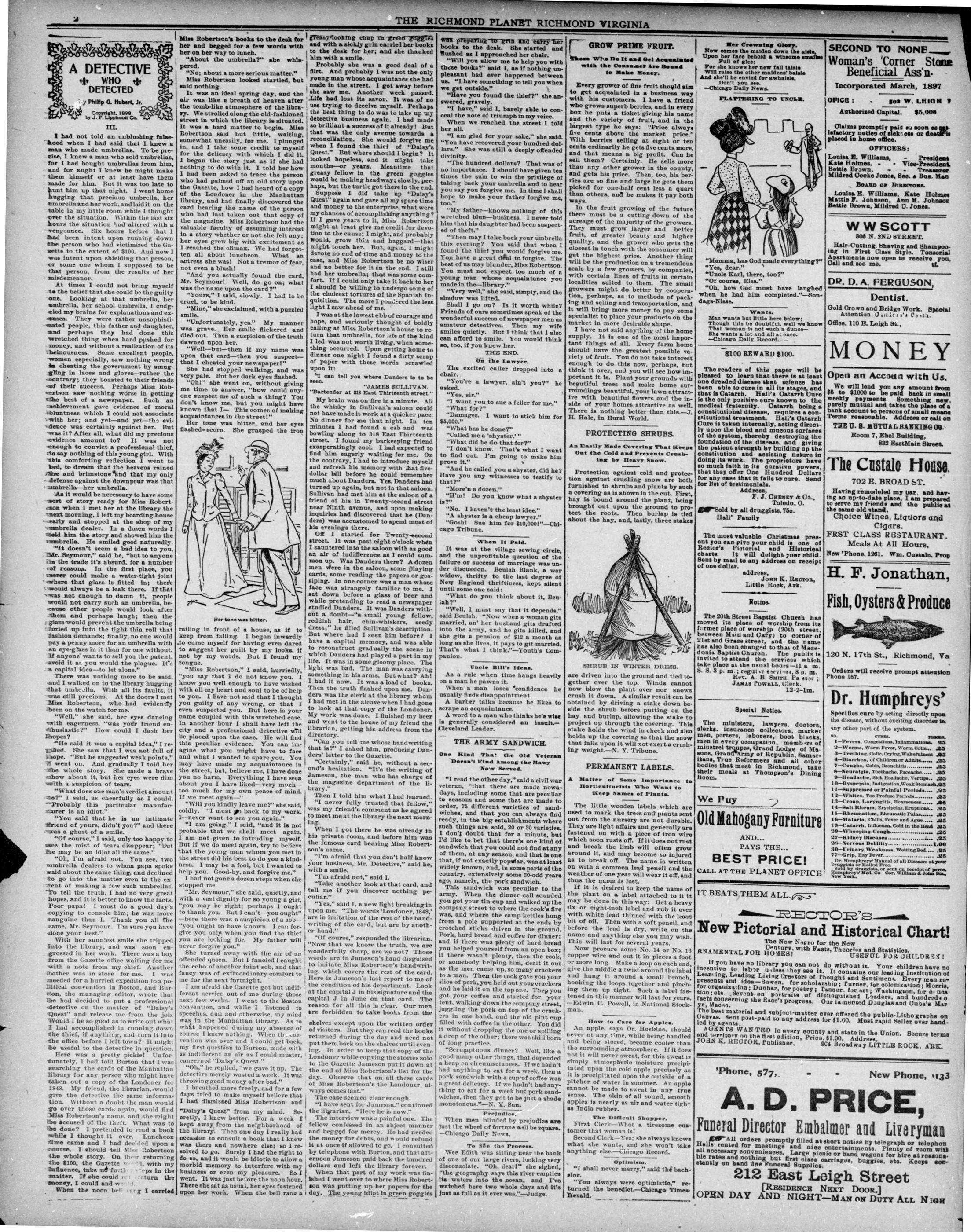
I had not told an unblushing falsehood when I had said that I knew a man who made umbrellas. To be precise, I knew a man who sold umbrellas, for I had bought umbrellas from him, and for aught I knew he might make them himself or at least have them made for him. But it was too late to hunt him up that night. I went home lugging that precious umbrella, her umbrella and her work, and laid it on the table in my little room while I thought over the situation. Within the last six hours the situation had altered with a vengeance. Six hours before that I had been intent upon running down the person who had victimized the Gauche to the extent of $100. And now I was intent upon shielding that person, or some one whom I supposed to be that person, from the results of her misdemeanor.
At times I could not bring myself to the belief that she could be the guilty one. Looking at that umbrella, her umbrella, her school umbrella, I cudged my brains for explanations and excuses. They were rather unsophisticated people, this father and daughter, and perhaps they had done this wretched thing when hard pushed for money, and without a realization of its heinousness. Some excellent people, women especially, saw nothing wrong in cheating the government by smuggling in laces and gloves—rather the contrary; they boasted to their friends of their success. Perhaps Miss Robertson saw nothing worse in getting the best of a newspaper. Such an achievement gave evidence of moral bluntness which I could not associate with her; and yet—and yet—the evidence was certainly against her. But was it? After all, what did my precious evidence amount to? It was not enough to convict a professional thief, to say nothing of this young girl. With this comforting reflection I went to bed, to dream that the heavens rained fire and brimstone and that my only defense against the downpour was that umbrella—her umbrella.
As it would be necessary to have some sort of story ready for Miss Robertson when I met her at the library the next morning, I left my boarding house early and stopped at the shop of my umbrella dealer. In a dozen words I sold him the story and showed him the umbrella. He spilled good naturedly.
"It doesn't seem a bad idea to you, Mr. Seymour," said he, "but to anyone in the trade it's absurd, for a number of reasons. In the first place, you never could make a water-tight joint where that glass is fitted in; there would always be a leak there. If that was not enough to damn it, people would not carry such an umbrella, because other people would look after them and perhaps laugh; then the glass would prevent the umbrella being curled up into the tight thin roll that fashion demands; finally, no one would pay a penny more for an umbrella with an eye-glass in it than for one without. If anyone wants to sell you the patent, avoid it as you would the plague. It's a capital idea—to let alone."
There was nothing more to be said, and I walked on to the library hugging that umbrella. With all its faults, it was still precious. At the doors I met Miss Robertson, who had evidently been on the watch for me.
"Well," she said, her eyes dancing with eagerness, "How could I dash her hopes?
"He said it was a capital idea," I replied. She saw that I was not full of hope. "But he suggested weak points," I went on. And gradually I told her the whole story. She made a brave show about it, but her eyes were dim with a suspicion of tears.
"What does one man's verdict amount to?" I said, as cheerfully as I could. "Probably this particular manufacturer is an idiot."
"You said that he is an intimate friend of yours, didn't you?" and there was a ghost of a smile.
"Of course," I said, only too happy to see the mist of tears disappear; "but he may be an idiot all the same."
"Oh, I'm afraid not. You see, two umbrella dealers to whom papa spoke said about the same thing, and declined to go into the matter even to the extent of making a few such umbrellas. To tell the truth, I had no very great hopes, and it is better to know the facts. Poor papa! I must do a good day's copying to console him; he was more sanguine than I. Thank you all the same, Mr. Seymour. I'm sure you have done your best."
With her sunniest smile she tripped into the library, and was soon engrossed in her work. There was a boy from the Gazette office waiting for me with a note from my chief. Another bother was in store for me. I was needed for a hurried expedition to a political convention in Boston, and Burton, the managing editor, wrote that he had decided to put a professional detective on the matter of "Daisy's Quest" and release me from the job. Would I be so good as to write out what I had accomplished in running down the thief, if anything, and turn it into the office before I left town? It might be useful to the detective in question.
Here was a pretty pickle! Unfortunately, I had told Burton that I was searching the cards of the Manhattan library for any person who might have taken out a copy of the Londoner for 1848. My friend, the librarian, would give the detective the same information. Without a doubt the man would go over those cards again, would find Miss Robertson's name, and she might be accused of the theft. What was to be done? I pretended to read a book while I thought it over. Luncheon time came and I had decided upon a course. I should tell Miss Robertson the whole story. On their returning the $100, the Gazette would, with my influence, take no further steps in the matter. If she could not return the money, I could and would. When the noon bell rang I carried
Miss Robertson's books to the dek for her and begged for a few words with her on her way to lunch.
"About the umbrella?" she whispered.
"No; about a more serious matter."
Miss Robertson looked startled, but said nothing.
It was an ideal spring day, and the air was like a breath of heaven after the tomb-like atmosphere of the library. We strolled along the old-fashioned street in which the library is situated. It was a hard matter to begin. Miss Robertson said but little, waiting, somewhat unceasing, for me. I plunged in, and I take some credit to myself for the delicacy with which I did it. I began the story just as if she had nothing to do with it. I told her how I had been asked to trace the person who had palmed off an old story upon the Gazette, how I had heard of a copy of the Londoner in the Manhattan library, and had finally discovered the card bearing the name of the person who had last taken out that copy of the magazine. Miss Robertson had the valuable faculty of assuming interest in a story whether or not she felt any; her eyes grew big with excitement as I reached the climax. We had forgotten all about luncheon. What an actress she was! Not a tremor of fear, not even a blush!
"And you actually found the card, Mr. Seymour! Well, do go on; what was the name upon the card?"
"Yours," I said, slowly. I had to be cruel, to be kind.
"Mine," she exclaimed, with a puzzled smile.
"Unfortunately, yes." My manner was grave. Her smile flickered and died out. Then a suspicion of the truth dawned upon her.
"Well—but—then if my name was upon that card—then you suspect—that I cheated your newspaper!"
She had stopped walking, and was very pale. But her dark eyes flashed.
"Oh!" she went on, without giving me time to answer, "how could anyone suspect me of such a thing? You don't know me, but you might have known that I— This comes of making acquaintances in the street!" Her tone was bitter, and her eyes flashed—scorn. She erased the iron
M.
Her tone was bitter.
railing in front of a house, as if to keep from falling. I began inwardly to curse myself for having even dared to suggest her guilt by my looks, if not by my words. But I found my tongue.
"Miss Robertson," I said, hurriedly, "you say that I do not know you. I know you well enough to have wished with all my heart and soul to be of help to you. I have not said that I thought you guilty of any wrong, or that I even suspected you. But here is your name coupled with this wretched case. In another hour I shall have left the city and a professional detective will be placed upon the case. He will find this peculiar evidence. You can imagine what you might have to face and what I wanted to spare you. You may have made my acquaintance in the street, but, believe me, I have done you no harm. Everything I have seen about you I have liked—very much—too much for my own peace of mind. If we meet again—"
"Will you kindly leave me?" she said, coldly. "I must go back to my work. I—never want to see you again."
"I am going," I said, "and it is not probable that we shall meet again. I am not given to intruding myself. But if we do meet again, try to believe that the young man whom you met in the street did his best to do you a kindness. I may be a fool, but I wanted to help you. Good-by, and forgive me." I had not gone a dozen steps when she stopped me.
"Mr. Seymour," she said, quietly, and with a vast dignity for so young a girl, "you may be right; perhaps I ought to thank you. But I cann't—you ought"—here there was a suspicion of a sob—"you ought to have known. I can forgive you only when you find the thief you are looking for. My father will never forgive you."
She turned away with the air of an offended queen. But I fancied I caught the echo of another faint sob, and that fancy was of extraordinary comfort to me for the next fortnight.
I am afraid the Gazette got but indifferent service out of me during those next few weeks. I went to the Boston convention, and while I listened to speeches, dull and otherwise, my mind was in the Manhattan library. As to what happened during my absence of course I knew nothing. When the convention was over and I could get back, my first question to Burton, mide with as indifferent an air as I could muster, concerned "Daisy's Quest."
"Oh," he replied, "we gave it up. The detective merely wasted a week. It was throwing good money after bad."
I breathed more freely, and for a few days tried to make myself believe that I had dismissed Miss Robertson and
"Daisy's Quest" from my mind. Secretly, I knew better. For a week I kept away from the neighborhood of the library. Then one day I really had occasion to consult a book that I knew was there and nowhere else; so I resolved to go. Surely I had the right to do so, and it would be idiotic to allow a morbid memory to interfere with my business or even my pleasure. So I went. It was just before the noon hour. There she sat as usual, her eyes fastened upon her work. When the bell rang a
THE RICHMOND PLANET RICHMOND VIRGINIA
greatly-looking chap in green goggles and with a skelly grin carried her books to the desk for her; and she thanked him with a smile.
Probably she was a good deal of a flirt. And probably I was not the only young man whose acquaintance she had made in the street. I got away before she saw me. Another week passed. Life had lost its savor. It was of no use trying to deceive myself. Perhaps the best thing to do was to take up my detective business again. I had made so brilliant a success of it already! But that was the only avenue towards a reconciliation. She would forgive me when I found the thief of "Daisy's Quest." But where should I begin? It looked hopeless, and it might take months—or years. Meantime that greasy fellow in the green goggles would be making headway; slowly, perhaps, but the turtle got there in the end. Suppose I did take up "Daisy's Quest" again and gave all my spare time and money to the enterprise, what were my chances of accomplishing anything? If I gave years to it, Miss Robertson might at least give me credit for devotion to the cause; I might, and probably would, grow thin and haggard—that might touch her. But, again, I might devote no end of time and money to the case, and Miss Robertson be no wiser and no better for it in the end. I still had her umbrella; that was some comfort. If I could only take it back to her I should be willing to undergo some of the choicest tortures of the Spanish Inquisition. The more I pondered the less light I saw ahead of me.
I was at the lowest ebb of courage and hope, and seriously thought of boldly calling at Miss Robertson's house to return that umbrella, for life of the kind I led was not worth living, when something occurred. Upon getting home to dinner one night I found a dirty scrap of paper with these words scrawled upon it:
"I can tell you where Danders is to be seen.
"Bartender at 318 East Thirteenth street."
My brain was on fire in a minute. All the whisky in Sullivan's saloon could not have made it work at a quicker pace. No dinner for me that night. In ten minutes I had found a cab and was bowling along to 318 East Thirteenth street. I found my barkeeper friend exasperatingly cool. I had expected to find him eagerly waiting for me. On the contrary, I had to introduce myself and refresh his memory with that five-dollar bill before he could remember much about Danders. Yes, Danders had turned up again, but not in that saloon. Sullivan had met him at the saloon of a friend of his in Twenty-second street near Ninth avenue, and upon making inquiries had discovered that he (Danders) was accustomed to spend most of his evenings there.
Off I started for Twenty-second street. It was past eight o'clock when I sauntered into the saloon with as good an air of indifference as I could summon up. Was Danders there? A dozen men were in the saloon, some playing cards, some reading the papers or gossiping. In one corner was a man whose face was strangely familiar to me. I sat down before a glass of beer and while pretending to read a newspaper studied Danders. It was Danders without a doubt—"a small young fellow, reddish hair, chin-whiskers, seedy dress;" he filled Sullivan's description. But where had he seen him before? I have a capital memory, and was able to reconstruct gradually the scene in which Danders had played a part in my life. It was in some gloomy place. The light was bad. The man was carrying something in his arms. But what? Ahl I had it now. It was a load of books. Then the truth flashed upon me. Danders was the clerk at the library whom I had met in the alcove when I had gone to look at that copy of the Londoner. My work was done. I finished my beer and went to the house of my friend the librarian, getting his address from the directory.
"Can you tell me whose handwriting that is?" I asked him, producing Danders' letter to the Gazette.
"Certainly," said he, without a second's hesitation. "It's the writing of Jameson, the man who has charge of the magazine department of the library."
Then I told him what I had learned.
"I never fully trusted that fellow," was my friend's comment as he agreed to meet me at the library the next morning.
When I got there he was already in his private room, and before him was the famous card bearing Miss Robertson's name.
"I'm afraid that you don't half know your business, Mr. Detective," said he, with a smile.
"I'm afraid not," said I.
"Take another look at that card, and tell me if you discover nothing peculiar."
"Yes," said I, a new light breaking in upon me. "The words 'Londoner, 1845,' are in imitation of the rest of the handwriting of the card, but are by another hand."
"Of course," responded the librarian. "Now that we know the truth, we are wonderfully sharp, are we not? Those words are in Jameson's hand disguised to imitate Miss Robertson's handwriting, which covers the rest of the card. Here is Jameson's last report to me of the condition of his department. Look at the capital J in his signature and the capital J in June on that card. The reason for all this is clear. Our men are forbidden to take books from the
shelves except upon the written order of visitors. But they can read the books returned during the day and need not put them, back on the shelves until evening. In order to keep that copy of the Londoner while copying the stories sold to the Gazette Jameson put it down at the end of Miss Robertson's list for the day. Observe that on all these cards of Miss Robertson's the Londoner always comes last."
The case seemed clear enough.
"I have sent for Jameson," continued the librarian. "Here he is now."
The interview wns a painful one. The fellow confessed in an abject manner and begged for mercy. He had needed the money for debts, and would refund it at once if allowed to go. I consulted by telephone with Burton, and that afternoon Jameson paid back the hundred dollars and left the library forever.
When that part of my work was finished I went over to where Miss Robertson was putting up her papers for the day. The young idiot in green goggles
was preparing to grin and carry her books to the desk. She started and flushed as I approached her chair.
"Will you allow me to help you with these books?" said I, as if nothing unpleasant had ever happened between us.
"I have something to tell you when we get outside."
"Have you found the thief?" she answered, gravely.
"I have," said I, barely able to conceal the note of triumph in my voice.
When we reached the street I told her all.
"I am glad for your sake," she said.
"You have recovered your hundred dollars." She was still a deeply offended divinity.
"The hundred dollars? That was of no importance. I should have given ten times the sum to win the privilege of taking back your umbrella and to hear you say you forgive me. In time I shall hope to make your father forgive me, too."
"My father—knows nothing of this wretched blun—business. I never told him that his daughter had been suspected of theft."
"Then may I take back your umbrella this evening? You said that when I found the thief you would forgive me. You have a great deal to forgive. The best of us may blunder, Miss Robertson. You must not expect too much of a young man whose acquaintance you made in the—library."
"Very well," she said, simply, and the shadow was lifted.
Shall I go on? Is it worth while? Friends of ours sometimes speak of the wonderful success of newspaper men as amateur detectives. Then my wife smiles quietly. But I think that I also can afford to smile. You would think so, too, if you knew her.
On the Lawyer
The excited caller dropped into a chair.
"You're a lawyer, ain't you?" he asked.
"Yes, sir."
"I want you to sue a feller for me."
"What for?"
"Damages. I want to stick him for $5,000."
"What has he done?"
"Called me a 'shyster.'"
"What did he do that for?"
"I don't know. That's what I want to find out. I'm going to make him prove it."
"And he called you a shyster, did he? Have you any witnesses to testify to that?"
"More'n a dozen."
"H'm! Do you know what a shyster is?"
"No. I haven't the least idea."
"A shyster is a cheap lawyer."
"Goshl Sue him for $10,000!"—Chicago Tribune.
When It Paid.
It was at the village sewing circle, and the unprofitable question of the failure or success of marriage was under discussion. Beulah Blank, a war widow, thrifty to the last degree of New England thriftiness, kept silent until some one said:
"What do you think about it, Beulah?"
"Well, I must say that it depends," said Beulah. "Now when a woman gits married, an' her husband gits drafted into the army, and he gits killed, and she gits a pension of $12 a month as long as she lives, it pays to git married. That's what I think."—Youth's Companion.
Uncle Bill's Ideas
As a rule when time hangs heavily on a man he pawns it.
When a man loses 'confidence he usually finds disappointment.
A barter talks because he likes to scrape an acquaintance.
A word to a man who thinks he'a wise is generally considered an insult.—Cleveland Leader.
THE ARMY SANDWICH
One Kind Tha! the Old Veteran Doesn't Find Among the Many Now Served.
"I read the other day," said a civil war veteran, "that there are made nowadays, including some that are peculiar to seasons and some that are made to order, 75 different varieties of sandwiches, and that you can always find ready, in the big establishments where such things are sold, 20 or 30 varieties. I don't doubt that for a minute, but I'd like to bet that there's one kind of sandwich that you could not find at any of them, at any season, and that is one that, if not exactly popular, was at least widely known, and, in some parts of the country, extensively some 30-odd years ago, namely, the pork sandwich.
This sandwich was peculiar to the army. When the dinner call sounded you got your tin cup and walked up the company street to where the cook's fire was, and where the camp kettles hung from a pole supported at the ends by crotched sticks driven in the ground. Pork, hard bread and coffee for dinner; and if there was plenty of hard bread you helped yourself from an open box; if there wasn't plenty, then the cook, or somebody helping him, dealt it out as the men came up, so many crackers to a man. Then the cook gave you your slice of pork, you held out your crackers and he laid it on the top one. They got your coffee and started for your tent, walking down the company street, juggling the pork on top of the crackers in one hand, and the old pint cup filled with coffee in the other. You did it without dropping the one or spilling a drop of the other; there was skill born of long practice.
"Serumpuntous dinner? Well, like a good many other things, that depended a heap on circumstances. If we hadn't had anything to eat for a week, then a pork sandwich with a cup of coffee was a great delicacy. If we hadn't had anything to eat for a week but pork sandwiches, then they got to be just a shade monotonous."—N. Y. Sun.
Prejudice.
When men blinded by prejudice are just the wheel of fortune will be square.
—Chlengo Daily News.
To §£c the Proce
Wee Edith was sitting near the bank of one of our large rivers, looking very disconsolate. "Oh, dear!" she sighed, "the geography says this river empties its waters into the ocean, and I've watched here two whole days and it's just as full as it ever was." - Judge.
GROW PRIME FRUIT.
Those Who Do It and Get Acquainted with the Consumer Are Bound to Make Money.
Every grower of fine fruit should aim to get acquainted in a business way with his customers. I have a friend who grows superb berries, and in every box he puts a ticket giving his name and the variety of fruit, and in the largest type he says: "Price always five cents above the market price." With berries selling at eight or ten cents ordinarily he gets five cents more, and that means a big profit. Can he sell them? Certainly. He sells more than any other grower in the county, and gets his price. Then, too, his berries are so fine and large he gets them picked for one-half cent less a quart than others, and he makes it pay both ways.
In the fruit growing of the future there must be a cutting down of the acreage of the majority of the growers. They must grow larger and better fruit, of greater beauty and higher quality, and the grower who gets the closest in touch with the consumer will get the highest price. Another thing will be the production on a tremendous scale by a few growers, by companies, with certain lines of fruits in certain localities suited to them. The small growers might do better by cooperation, perhaps, as to methods of packing and selling and transportation, and it will bring more money to pay some specialist to place your products on the market in more desirable shape.
I have not said anything of the home supply. It is one of the most important things of all. Every farm home should have the greatest possible variety of fruit. You do not take interest enough to do this now, perhaps, but think it over, and you will see how important it is. Plant your grounds with beautiful trees and make home surroundings beautiful, your lawn attractive with beautiful flowers, and the inside of your homes attractive as well. There is nothing better than this. J. H. Hale, in Rural World.
PROTECTING SHRUBS
An Enally Made Covering That Keeps Out the Cold and Prevents Crushing by Heavy Snow.
Protection against cold and protection against crushing snow are both furnished to shrubs and plants by such a covering as is shown in the cut. First, hay is bound around the plant, being brought out upon the ground to protect the roots. Then burlap is tied about the hay, and, lastly, three stakes
SHRUB IN WINTER DRESS.
are driven into the ground and tied together over the top. Winds cannot now blow the plant over nor snows crush it down. A similar result can be obtained by driving a stake down beside the shrub before putting on the hay and burlap, allowing the stake to project up through the covering. This stake holds the wind in check and also holds up the covering so that the snow that falls upon it will not exert a crushing weight.-N. Y. Tribune.
PERMANENT LABELS.
A Matter of Some Importance to Horticulturists Who Want to Keep Names of Plants.
The little wooden labels which are used to mark the trees and plants sent out from the nursery are not durable. They are light affairs and generally are fastened on with a piece of iron wire which soon rusts off. If it does not rust and break the limb will often grow around it, and may become so injured as to break off. The name is written on with a common lead pencil and the weather of one year will wear it off, and thus the name is lost.
If it is desired to keep the name of the plant on a label attached to it it may be done in this way: Get a heavy six or eight-inch label and rub it over with white lead thinned with the least bit of oil. Then with a soft pencil, and before the lead is dry, write on the name and anything else you may wish. This will last for several years.
Now procure some No. 14 or No. 18 copper wire and cut it in pieces a foot or more long. Make a loop on each end, give the middle a twist around the label and hang it around a small branch, hooking the loops together and pinching them up tight. Such a label fastened in this manner will last for years.
—Edwin C. Powell, in National Stockman.
How to Care for Apples
An apple, says Dr. Hoskins, should never at any time, while being handled and being stored, become cooler than the surrounding atmosphere. If it does not it will never sweat, for this sweat is simply atmospheric moisture precipitated upon the cold apple precisely as it is precipitated upon the outside of a pitcher of water in summer. An apple cannot be made to sweat in any true sense. The skin of all sound, smooth apples is nearly as air and water tight as India rubber.
The Difficult Shopper.
First Clerk—What a tiresome customer that woman is!
Second Clerk—Yes; she always knows what she wants, and she won't take anything else—Chicago Record.
Optimism.
"I shall never marry," said the bachelor.
"You always were optimistic," returned the benedict—Chicago Times-Herald.
New Pictorial and Historical Chart!
The New Negro for the New Century, with Facts, Theories and Statistics.
RNAMENTAL FOR HOMES!
USEFUL FOR CHILDREN!
If you have no library you can not do without it. Your children have no incentive to labor unless they see it. It contains our leading Institution of Learning, Leading Living Creators of Thought and Sentiment. Every man represents and idea—Bowen, for scholarship; Turner, for colonization; Morris, for organization; Dunbar, for poetry; Tanner, for art; Washington, for e usationists. Seventen-ear portraits of distinguished Leaders, and hundreds of facts concerning the Race's progress. Our lamented Douglas and Cuba's Marry, Macao.
The best material and subject-matter ever offered the public-Lithographs on Canvas. Sent post-paid so any address for $1.00. Most rapid Seller ever handled by agents.
AGENTS WANTED in every county and state in the Union. Secure terms and territory on the first edition, Price, $1.00. Address.
JOHN K. REUTER, Publisher
A.D.PRICE,
All orders promptly filled at short notice by telegraph or telephone Halls rented for meetings and nice entertainments. Plenty of room with all necessary conveniences. Large pienic or band wagons for hire at reasonable rates and nothing but first class carriages, buggies, etc. Keeps constantly on hand fine Funeral Supplies.
Her Crowning Glory.
Now comes the maiden down the aisle.
Upon her face behold a winsome smalle.
For all of glee;
For she knows her new fall taisle
Will she use the other maidens' balle
And she'll be beware for awhaisle.
Don't you see.
-Chicago Daily News
"Mamma, has God made everything?" "Yes, dear."
"Oh, how God must have laughed when he had him completed."—Sondags-Nisse.
Wants.
Man wants but little here below;
Though this be doubtful, well we know
That woman is not such a dunce—
She wants a lot and all at once.
—Chicago Daily Record.
$100 REWARD $100.
The readers of this paper will be pleased to learn that there is at least one dreaded disease that science has been able to cure in all its stages, and that is Catarrh. Hall's Catarrh Oure is the only positive cure known to the medical fraternity. Catarrh being a constitutional disease, requires a constitutional treatment. Hall's Catarrh Oure is taken internally, acting directly upon the blood and mucous surfaces of the system, thereby destroying the foundation of the disease, and giving the patient strength by building up the constitution and assisting nature in doing its work. The proprietors have so much faith in its curative powers, that they offer One Hundred Dollars for any case that it fails to cure. Send for list of testimonials,
Address,
F. J. CHENEY & Co.,
Toledo, O.
Sold by all druggists, 750.
Hall' Family
The most valuable Christmas present you can give your child is one of Rector's Pictorial and Historical charts. It will delight your child. Sent by mail to any address on receipt of one dollar. address, JOHN K. RECTOR, Little Rock, Ark.
The 20th Street Baptist Church has moved its place of worship from its former place of worship (20th street, between Main and Oary) to corner of 21st and Grace street, and the name has also been changed to that of Macedonia Baptist Church. The public is invited to attend the services which take place at the usual hours—11 a.m. S. 3 p. m.; regular services, 8 p. m. Rev. A. B. Smith, Pa star; JAMAS POWELL, Clerk. 12-2-1m.
Special Notice.
The ministers, lawyers, doctors, clerks, insurance collectors, market men, porters, laborers, boot blacks, men in every occupation, mem-ba-ra of minstrel troupes, Grand Lodge of Masons, Grand Army of Republic, Samaritans, True Reformers and all other bodies that meet in Richmond, take their meals at Thompson's Dining Room.
We Puy
Old Mahogany Furniture
AND...
PAYS THE...
BEST PRICE!
CALL AT THE PLANET OFFICE
IT BEATS THEM ALL.
RECT
New Pictorial and
The New Negro for
Century, with Fac-
RNAMENTAL FOR HOMES!
If you have no library you can not
incentive to labor unless they see it.
Learning, Leading Living Creators of T
presents and idea—Bowen, for scholar
for organization; Dunbar, for poetry; L
tion; etc. Devant-on portraits of di
factions concerning the Race's progress.
Ory, Macao.
The best material and subject-matter en
Canvas. Sent post-paid to any address i
led by agents.
SECOND TO NONE
Woman's 'Corner Stone
Beneficial Ass'n.
Incorporated March, 1897
OFFICE: 502 W. LEIGH 7
Authorized Capital. $5,000
Claims promptly paid so soon as satisfactory notice of sickness or death is placed in home office.
OFFICERS:
Louisa E. Williams. President
Kate Holmes. Vice-President
Bettie Brown. Treasurer
Mildred Cooke Jones, See. A Bus. Man
BOARD OF DIRECTORS.
Louisa E. Williams, Kate Holmes
Mattie F. Johnson, Ann M. Johnson
Bettie Brown, Mildred C. Jones.
W W SCOTT
808 N. 2ND STREET.
Hair-Cutting. Shaving and Shampooing in First Class Style. Tonsorial Apartments now open to receive you. Call and see me. tt.
DR. D. A. FERGUSON.
Dentist.
Gold Crown and Bridge Work. Special Attention Outside's Court.
Office, 110 E. Leigh St.,
MONEY
Open an Account with Us.
We will lend you any amount from $5 to $1000 to be paid back in small weekly payments. Something new, barely mutual and takes the place of a bank account to persons of small means Terms reasonable. Address or call on
THE U. S. MUTUAL BANKING CO.
Room 7, Ebel Building,
882 East Main Street.
The Custalo House
Having remodeled my bar, and having an up-to-date place, I am prepared to serve my friends and the public at the same old stand.
Choice Wines, Liquors and
Cigars.
PRST CLASS RESTAURANT.
Meals At All Hours.
New 'Phone, 1261. Wm. Custalo, Prop
Fish, Oysters & Produce
120 N. 17th St., Richmond, Va
Orders will receive prompt attention
Phone 157.
Dr. Humphreys'
Sold by druggists or sent on proof of prox-
mium. Humphrys Med. Co. Cor. William & John Sta.
Barnes.
ATOR'S
Historical Chart!
at the New
arts, Theories and Statistics.
USEFUL FOR CHILDREN!
do without it. Your children have no
It contains our leading Institution of
ought and Sentiment. Every man re-
ship; Turner, for colonization; Morris,
banner, for art; Washington, for eucas
stinguished Leaders, and hundreds o
our lamented Douglas and Cuba's Mar
ever offered the public-Litho graphs on
for $1.00. Most rapid Seller ever hand-
y and state in the Union. Secure terms
$1.00. Address,
04 Broadway LITTLE ROCK, ARK.
PRICE,
Palmer and Liveryman
short notice by telegraph or telephon
entertainments. Plenty of room with
die or band wagons for hire at reasons
carriages, buggies, etc. Keeps con-
neigh Street
[NEXT DOOR.]
—MAN ON DUTY ALL NIGH
LULLABY.
Wave up ye' haid, my little lady,
Myach de win 'a-biwallow' out 'a do's.
Myach de win 'biwallow' wid de comefat',
Lose'n frost' bit you' mummy,
But ye' anes, an' snuggle up to mummy;
Gt me bofo ye' bans, I' hoi' 'em tight;
Don' you be aefard, zn' 'mence to trimle
Doe en soon en I blows out de light.
Angels is a-mindin' you, my baby,
Keepin' off de Bad Man in de night.
Oe' use o' bein' skared o' nuffin'
You don't o' skared o' nwine to bite!
What de crackin' oo' you byehac errroun'
you?—
Laway, chille, you tickles me to deft—
Dat's de man what brings de frost, a
baitin
Picters on de winder wid his bref.
Mommyn't afraid, you hyean huh laffin'
Go 'n' Mianna, you can't come in;
Baby ain' erceivein' folks din's
Reckon dat you'll have to call ag'in.
Carl yo' little toes up so, my possum—
Umph, but you's a cunniin' one fu' truet—
Go to sleep, de angels is a-watchin';
Ambient cunniin' of you, too.
—Paul Laurence Dunbar, in Saturday
Evening Post.
FOR THE land's sake, pa," called out Mrs. Drusilla Gladen to her husband as he wiped his feet on a piece of carpet at the kitchen door, "I thought you'd never get in. Guess who sent me a lotter. You'd never think in a month of Sundays. It's from Devah Bland—my Cousin Devah."
Pa gave a smile of interest and rubbed his hands.
"Well, I swan, now! And what has Davy got to say for himself?"
"He's coming to Ohio to visit. He'll be here next week. What do you think of that?"
Pa pulled off his boots contentedly.
"Won't be sorry to see Davy. We war in school together. What say? Is he doing well?"
"Doing well, but his wife's dead; been dead two year or more. I bet you a great deal, pa, he's on the warpath. And to think Angeline Culver's visiting around here just now, and she's a widder. Pa, it looks like the 'pintin's of Providence, don't it?" Mrs. Gladden smiled benignly on her husband and he on her. They were in love with each other, and had been for 20 years.
"It truly does," replied pa, "it truly does. Jest think how those two courted over three years, wasn't it? I hold the split was all Angeline's folks' fault, wasn't it? That old man Porter never stayed anywhere and got a streak to move to Indiana. Her ma wouldn't let her stay here, and that made Devy properly mad. They key' it up up while writin', then Devy went out farther west and married himself to a strange woman. After awhile Angeline gets married. First we hears her pardner's gone and she's a likely widow, visitin' round. Then we gets a letter sayin' Devy's partner has been departed two years, an' he's comin' visitin'. Now don't that beat all"
"How plain you've made it, pa," beamed Mrs. Drusilla. "It sounds like them story papers. You ort to have been a writer for one. I often thought that. My, ain't it plum interesting? I don't want to miss none of it, do you? How can we fix it?"
Po was so appreciative of his wife's praise he tilted back in the rocker and gave the matter solemn thought.
"I callilate we kin have all this to ourselves," he began, "of you kin hold but 'gainst mentionin' Devy's comin'. It will be hard work for ye, Drusilly, but it's the only way. Do you think you肌 hold that news over prayer meetin' and Sunday? I tell you what," he went on, excitedly, "we can just have the whole think happen right here, meetin' ar' all, if you don't tell."
Mrs. Gladden's pleasant face fell.
"I wonder if it'll be fair not to tell the rest of the folks," she began. "You see, Devy'll be expecting a big welcome."
Asahel! Gladden rose up in his socks.
"Drusilly, I have jest set my heart on managin' the whole thing. Don't you disappoint me. I never had so much chance as this in all my mortal life. I always wanted to do sech directin' and managin', and don't you disappoint me."
"What'll folks say when they find we held that news?" asked his wife, much impressed, but giving up as usual.
"They'll say you've come to years of discretion; though I don't want to hurt your feelings, Drusilly. You can take it all out fixin' up the spare room and Marindy's room. It air lucky Angeline hain't been down here yet—another clear 'pintin'. Now hurry up dinner, and write Devy a letter tellin' him he must come right here, an' we won't take as for an answer. I'll hitup the cutter an' we'll go over to town an' engage Angeline for the whole endurin' week."
The two were as excited as children. The letter had to be strong enough to suit pa, and was the labor of an hour for Mrs. Gladden ere it suited him. Dinner over, they tucked themselves into a green sleigh and drove over to New California.
"We'll stop on the way," said the small and rosy man. "I feel so anxious to get hold of Angeline."
"Oh, you do?" questioned the wife, demeanely. "Well, as our Marindy declares, her pa's younger'n anyone."
Angeline Culver—Angeline Porter that was—was visiting at old Dr. Norman's. She and Sissy Norman had always been close friends. She came out to the sleigh to speak to Mrs. Gladden. She was quite dressy, and had on a pink House sack trimmed with white lace. She had tied a little white fascinator over her brown waves.
"I was 'loyin' to go over to Dennis Daedna's next week," she said, in her soft, comfortable voice, "but if you make a point of it, I guess I can put them off."
Pa Gladden was so anxious that his litter feet danced up and down in the floor.
"Oh, we want you real bad next week. Angeline! We been waiting for you exeptin' 'till we're set on it special. Do say you'll come."
"I believe pa'll burst if you don't come, Angeline," said his wife, "he gets set on anything."
"Well, I will," assented the widow. "I used to have good times at your house when I was a girl. I never have forgetten them."
Pa went through an expressive pantomime behind her.
"And paul fetch you on Sunday afternoon," went on Mrs. Gladden. "If the snow don't stay on he'll fetch you in the buggy."
Afterward Mrs. Gladden declared that paul spent the happiest week of his life getting ready for that couple to be reunited. It never struck his warm and innocent heart that anything could go amiss. He piled up special wood for the parlor, he hovered around the two bedrooms, he actually had his finger in every pie and cake baked. He went to the village store alone once or twice, and after the last visit, wore an air of the deepest mystery.
Mrs. Gladden stood this until the hour of retiring.
"Asahell" she exclaimed, with a break in her voice, "Asahel, you never had a secret from me in all your life—did you?"
The rosy man looked as guilty as if detected in a crime. He saw her kind eyes, and his voice quavered.
"Never before," he whispered, "but I'm so afraid you can't hold this one over Sunday meetin' I'm bound not to breathe it."
One dry sob brought him to terms.
"It air," he whispered, uptoeing over to her, "it air that I telegraphed to Devy to git here on the Sunday afternoon express."
Mrs. Gladden's attitude toward the world on Sunday morning was the gossip of the neighborhood for weeks. She suddenly assumed an air of funeral dignity, would converse with no one, and stalked silently out after meeting and climbed into the sleigh triumphantly.
"You've done it," whispered her husband, delighted. "I didn't credit you with it."
After dinner the parlor fire was lit, the table spread for company tee, and Pa Gladden wrapped himself up to go for Angeline. He was so happy his wife's heart trembled.
"Pa," she said, "don't you set too much store by it. Devah may have other intentions, and Angeline may not agree."
"Don't you think it," declared pa. "Angeline air a hundred times prettier than she war. Devy air a man; that settles it all. Now do your part. I've
"NOW HURRY UP DINNER AND WRITE DEVY."
told you jest what to say to her. Leave Devy to me. Men understand man."
He brought Angeline and her valises back in an hour. Mrs. Gladden rejoiced in her womanly beauty. She kissed her as tenderly as if she had been a young girl when she helped her in. Angeline's face beamed.
"How nice you've made everything for me!" she cried. "It is like a homecoming." Her face grew thoughtful. "It makes me think of old times—old friends."
"Well, just settle down and make yourself at hone." said pa, coming in. "I have to be gone an hour or two. You and ma can have a good old talk."
Awhile later he was stamping off the falling snow on the platform of the station. A tall, bronzed man alighted from the express and pa met him, so eager he almost cried over him as he shook hands.
Alas! Alas! All pa's finesse and subtle phrases were forgotten. He was as nervous as a woman. Finally he reined in Dolly almost in sight of the house.
"Devy," he quavered, "I always felt so sorrowful 'bout you an 'langer Angeline Porter's break-off. You war so happy, together when you was young. Devy, I've got Angeline here. She air a wildow; she air a finer woman 'n you could see in a day's travel. It air the desire of my heart to bring you two together." The man beside him grew pale and gasped, then he wrung the mittened hand. Good Ma Glaidden came out to the sleigh. She, too, had forgotten her part. She had been crying and broke down. "Please 'scuse Angeline," she said, brokenly, "she is there in the parlor. Don't you want to go in, Devah? I guess you needn't be afeard." The tall man strode past her, his own eyes misty. The wedded couple left on the steps were not ashamed to kiss each other with tears and smiles.—The Columbian.
Getting Under Way
"How is yoh all comin' on wif yoh military projections?"
"Oh," answered Mr. Erastus Pinkley,
"It's comin' long. I hasn' got my comp'ny of sojers organized yit, but I has foh yalter dogs an' some yuthuh animals wot'll beat de world冯 masoota."
—Washington Star.
Unprecedented.
Smith—It's strange how young Blissful seems to be infatuated with his wife yet.
Brown—In love yet, is he?
Smith—In love! This is their third child, and they've given it his wife's family name for its Christian name!—N. Y. World.
Old Savings
Dick—Why, a rich chestnut, of course. Girls couldn't see through a window with the glass out.—Chicago Daily News.
Found His Lot.
Bouttown—Where did you go on your vacation?
Laschance—I went out west to look at a corner lot I bought by mail.
“Find it?”
“Yes; went swimming in it.”—N. Y.
Weekly.
THE RICHMOND PLANET RICHMOND VIRGINIA
It Has a Thread of Romance in It. But
Is Horrible, Nevertheless—A State
Of Affairs That Needs Quick
John Johnson is the second mate of the bark Wilder, which a short while ago arrived at San Francisco from Honolulu by way of Puget sound.
John is romantic, and he tells a strange story of his experiences in the Paradise of the Pacific. For he wowed and won a white slave.
Love, which laughs at bars, overcame in this case obstacles seemingly insurmountable. Johnson placed his life in jeopardy, but he won his game.
It was in the recent days before the American flag was raised in Honolulu. John was overseeer of a plantation, on which his inmorata worked.
He declared to the manager, a Simon Tegree, that he wanted to marry the girl. "Then buy her," was the answer. But John was poor. He appealed to the law, but could do nothing because of lack of funds, and put to sea again in the endeavor to save the necessary cash.
Sophie Pollome, by the way, is the lady's name. But here is the sailor's story, as told in the Philadelphia Press: "I arrived in Honolulu," he says, "as second mate of the S. G. Wilder. I was tired of the sea and thought to make a stay ashore. "Without any trouble I secured a position as overseer on Hackefield's plantation, near Pearl City. At that time the workmen were made up of Japanese, Chinese, Portuguese and natives. The Japanese were under three-year contracts. The others knew the ropes and would not sell themselves into bondage. "In the fall one of the Hackefield line of ships arrived from Bremen with about 400 Polacks. The majority of the
ONE OF HAWAII'S WHITE SLAVES.
latter were young men, but in the lct
were 21 families.
"One morning one of the Polacks refused to work. He was laissez and dragged for four miles at the pommel of a saddle. The baron policeman rode behind him playing with a whip. That brought about a climax.
"Next morning 140 of the young Polacks failed to appear in the fields. They had gone to Honolulu to lay their case before the German consul, Ahras rode after them and tried to induce them to return. Failing in this, he rode on ahead of them and told the consul what was coming.
"The consul is a brother of Hackfield, and, as might have been expected, the men were given their choice of going back to the plantation or going on the reef. They chose the reef, and they are now working on the streets of Honolulu in the chain-gang.
"Every morning they are asked if they wish to return to the plantation, and they answer no. Life on the reef is sweet compared to the plantation.
"But the Polacks who had brought their families were compelled to stay and toll with their burdens.
"Sophie's father was not in the best of health and could not work all the time. He was in my gang and I did all I could to help him. Besides his wife he had three children to support.
"I helped the family by throwing odd jobs in their way. I saw a great deal of Sophie and time passed pleasantly in her company. We became engaged, and I built fancy air castles for our future. I had laid by a couple of hundred dollars, and it seemed to me that I was fixed for life.
"I told Manager Ahrms that I was going to marry Sophie. He said that I would have to pay him $125 for her first. I was astounded.
"'Am I to understand that the girl is a slave?' I asked. He told me that that was what she cost him and that I would have to pay that sum. I turned on my heel and left him.
"That night when I entered Sophie's house I was confronted by six armed men. They ordered me from the house and the baron policeman told me that if I ever ventured in again I would be shot. Then he placed me under arrest and marched me to Pearl City jail.
"Next morning Ahrns telephoned to the jail to release me. I immediately had the six men arrested for false imprisonment and threats against life. The case was set for trial and then postponed, and it dragged along for days.
"My lawyer finally got the family into court as witnesses. Then he told me to take the girl, but at that time, what with court fees and lawyers' fees and other expenses, my savings were pretty well eaten up.
"I would not ask Sophie to marry me without money, and I told her of my unfortunate position. I told her that I must go to sea again and earn money enough to take her away from that awful place.
"She promised to wait until I returned, and in court we renewed our vows of love. I saw her no more.
"As soon as I can get some money ahead I will go back to Honolulu. When I leave there next time Sophie will come with me as Mrs. Johnson."
By a Bored Listener.
He could not tell a lie—but that Was not his only glory.
For all who's heard him try declared He couldn't tell a story.
—Chicago Tribune.
Equal to the Occasion.
Customer (emerging from bargain counter crush)—Help! My leg is broken.
Floorwalker—You will find the crutch department, sir, on the fourth floor, in the rear—Judge.
Edward
" Bill Wilson, " Put hand on white woman, Jasper Fla.
" Will Chambers, " Attempted Assault, Port Gibson, M's.
" Will McClure, " Criminal Assault, Bell Buckley, Ten.
" Charlie Hart, " Attempted Assault, Queen Ga.
" Peter Loin and 18 year old Son, white, Shooting a man, Wetumpka, Ala.
" Charlie Hart, colored criminal assault Brantley, Ala.
Aug. 16, Tom Keith, colored entered lady's room drunk, Near Greenville, S.C.
Aug. 20, R.v. T. J. Floyd, colored wanted to work, Cartersville, Ill.
" Wm. Crevillis, " Hughee Bradley, " Henry Branum, " Jim Hayes, " John Black, " Sim Cremmings,
" white, stroke against lynching, Georgetown, Ga.
Sept. 12, Rev H. B. Battle col, spoke against lynching, Near Thompson, Ga.
Sept. 27, Sense Sanchez, Cuban, nothing Havana, Cuba.
October 11 Judge Barit La Place white, Assaulting Near New Orleans.
" 18 Joe Letters Colored Arson and Assault, burned, St. Ann Miss.
" 18 Robert Smith Col Innocent, Partly Roasted not dead "
" 20, George Wells, Colored, Murder, Wier City Kan
Total
The Reign of Lawlessness
THE TREE OF THE TOMB
10:30 p. m., Daily, for Cinemati, with Pullman to Hinton W. Va., and Gordonville to Cincinnati and Louisville Cars. Connects at Staunton (except Sunday) Winchester, Va., at Cincinnati, Va., daily for Virginia Hot Springs.
TRAINS LEAVE EIGHTH-STREET STATION.
18:50 A. M., Daily, for Leasing Lynchburg, and Clifton Ferge. Connects exceeds Sunday with Buckingham and Alpenrose, Branched, and a Clifton Forge with No. 140 for Cincinnati.
18:50 P. M., Exceps Sunday, for Columbia.
TRAINS ARRIVE A RIGHMOND, BROAD-STREET STATION.
8:00 A. M., Exceps Sunday from Doswell.
8:30 A. M., Daily from Cincinnati.
12:00 A. M., from Norfolk and Old Point.
8:30 P. M., Daily, from Cincinnati and Loxi-
5:50 P. M., Daily, from Norfolk, and Old Point.
7:45 P. M., Exceps Sunday, from Clifton Forge.
TRAINS ARRIVE EIGHTH STREET STATION.
4:40 A. M., Exceps Sunday from Columbia.
6:20 P. M., Daily from Lynchburg, Lexington and Clifton Ferge, and Exceps Sunday from New Castle, and Cosney.
JOHN D POTTS.
Ann't. General Passenger Agans.
Southern Railway
Southern Railway
IN EFFECT NOVEMBER, 14, 1899
Traiza Leaves Richmond, Va.
11.00 P.M. NO 11 SOUTHERN EXPRESS SALO
Augusta Augusta Jacksville, and
points South Sleeper for Danville.
Greenville Sawbury, and Charlotte.
Shreveport open Birmingham, Steps for passengers at local stations.
Connects at Danville and Charlotte,
winter vacation (No 83) carrying through sleeper, be tween New York and Tampa with connections also connects at Danville, Charlotte with the Washington and southwestern Limite.
No 83 carrying through sleeper be tween New York and Memphis and new York and New Orleans, also, Fullman Tourist station dava, Washington to San Francisco without change, with connections for all points in Texas, Mexico and California.
12:01 P.M. No. 7, solid train daily for Chan
lotte, N.C. Connects at Moseley with
Fannville and York at Lackawanna.
Keysville for Clarksville, Oxford, Hem
derson and Durham and at Greensboro
for Durham, Raleigh, and Winston
Saunders for New York, and at
States Fast Mail, solid train, daily to
New Orleans and points South, which
carries sleepers New York to New Or
lans and Nassau and Hassau.
Through sleeper Salisbury, to Mem
phis.
6:00 P.M. to 17, LOCAL, daily except Sunday
for Keysville and intermediate points
TRAINS ARRIVE AT RICHMOND.
6:00 A.M.
6:25 P.M., from Atlanta Augusta, Amwville
and all points South.
8:00 P.M., from Keysville and local stations.
LOCAL FREIGHT TRAINS.
NOR. $1 and $2, between Manchester and Ne
apolis, Va.
YORK RIVER LINE, WEST POINT
The Favorite Route North.
LEAVE RICHMOND
BALKMORE LIMITER, Daily, except 8:30am
for West Point, and intermediate stations
making close connectio. Mondays, Wednesdays
and Fridays with steamer for Haiti
Train No. 10, 2:30 P. M.
Train No. 74. 6:00 A. M.
LOCAL MIXED, leaves daily except Sundays from Virginia Street Station for West Point and intermediate stations, connecting with motor manor for Walkerton and Tap pahannook.
TRAINS ARRIVE AT RICHMOND
9:20 a.m. Bally, from West Point, with Connection from Baltimore, Tuesdays, Thursdays, saturdays.
10:45 a.m. Middlesay and Fridays.
6:40 p.m. Dally, except Sunday from West point and intermediate stations.
Steamers leave West Point Mondays, Wednesdays & Fridays 6:40 p.m. Arriving Baltimore, Baltimore at 6 p.m. Tuesdays, Thursdays and Saturdays arriving West Point 7:30 and Rielmont 8:20 for lowing morning
FRANK S. GANNON
Third Vice-President and General Manager
Washington
MRS P. C. EASLEY.
Steam Ice-Cream Manufactory
Ice-Cream made daily both Winter
and Summer, and we can supply you
with any quantity at all times Satisfaction guaranteed. Special attention
given to all orders. 5-6-8am.
PALLY LINE FOR NEW YORK, EXCEPT SUNDAY
Passengers can leave Richmond daily except
P. M., or Richmond and Peterburg railroad.
(Norfolk and Western route 9:00 A.M. M.
Little steamer with Old Domini
Little steamer same evening at 7.
o'clock for New York
Tickets on sale at Richmond Transfer G
ompany. Little steamer with Old Domini
Ohio railway and Richmond and Petersburg
railroad deposits, and at company's office, 1231
Street, Richmond. Baggage checked
through.
PRIORITY.
for New York and all points beyond can be
shipped by steamer. Every MONDAY, WEDNESDAY, FRI
DAY at 5:00 P.M. This steamer carries steer
Manifest closed one hour before sailing time
Freight received and forwarded and through
loading issued for all northern, eastern
and foreign ports.
FROM NEW YORK
Passengers can leave daily except Sunday
at $ P.M. or Old Domini or Old
Point Comfort, connecting with Norfolk
Western railroad or Chesapeake and Ohio
River foot of Beach Street. Freights received
and forwarded daily except Sunday.
VIRGINIA NAVIGATION
COMPANY'S JAMES-RIVER LINE
To Norfolk, Portsmouth, Old Point, Newport
New, Gloucester, and James River landings
and connecting at Old Point, Norfolk for
Washington, Baltimore and the North
STREAMER POCAHONTAS LEAVES MONDAY, WED
TUESDAY AND FRIDAY AT 7 A.M.
Electrically divides what are only $1.50
and $1.00 to Norfolk, Portsmouth, Old Point
and Newport News. Music by a grand Orehestr
Freight received daily from above-named
places and all points in Eastern Virginia and
North Carolina.
IRVIN WEISIGER
Superintendent
EDWARD E. BARNY
President
General Offices: Planters' Bank Building.
S.A.L.
SEABOARD AIR LINE.
SCHEDULE IN EFFEFT MAY 8, 1999.
LEAVES BYD-STREET STATION.
9:05 A.M. Daily
9:00 P.M.
Henderson (arrive Durham daily, exsq
Pine Ridge, Southern Pines
Wilmington, Waysboro, Monroe, Chester,
Lincolnshire, Shelby, kutherfordton, Chester,
Lake Champlain, Wood, Abbeville, Elberton,
Athens, ATLANTA Augusta, Jackson,
gomery, New Orleans, Pensacola, Jackson
ville, Chattanooga Nashville, Memphis, Texa
tas, Charleston (California) and the west via Memphis or New Orleans.
Trains leaving at 9:00 P M runs through solid in Atlanta without change of cars. Steeper ready for occupancy at 8:40 P M
STRAINS ARRIVE RICHMOND
815 a.m Daily, except Sunday (Sunday 8:06 a.m a.m. m.)
7:00 p.m Daily.
For tickets, baggage cheeks, sleeping on reservation, etc. apply to
H. M. BOYKIN,
General Agent,
856 East Main St
R. ST. JOHN, V.ee-president, Manage
V. E. MOGHE, General Superintendent
W. H. W. GLOWER,
Vehicle Manager.
New 'Phone 983.
ATLANTIC COAST LINE
9:00 A. M., Daily Arrives Petersburg. 9:21 A.
M., Daily Arrives 11:25 A. M. Stops only at
Petersburg. Waverly and Sof-
folk. Va.
9:06 A. M., Daily Arrives Petersburg 9:26 A.
M., Weldon 11:45 A. M., Fayetteville
4:15 M., Warton 10:20 M., Savan
nak 12:30 A. M.,孝治 12:30 A.
M., Port Tampa 6:20 P. M., Cen-
nects at Wilson with No. 47. Ar-
rives at Wilson with No. 47. P. M.
Wilmington 5:45 P. M. P. Palmer
Sleeper New York to Jacksonville
11:00 A. M., Daily except Sunday Arrives Peter-
burg. Daily Stops Manchester,
Dewey's Bluff, Centralia, and
Chester on signal
3:28 P. M., Daily. Local. Arrives Peters-
burg. 15 P. M. Makes all stops.
5:20 P. M., Daily. Local. Arrives
Petersburg. 15 P. M. Roosevelt
Mount 9:30 P. M. makes all imme-
dial stops.
THE PLANET
Published every Saturday by John Mitchell Jr., at 811 North Fourth Street.
JOHN MITCHELL, JR., EDITOR
ABOUT NUMBERS intended for publicisat
should be so as to reach us by
Wednesday.
TERMS IN ADVANCE
ADVERTISING RATES.
For one inch, one insertion..... 50
For one inch each subsequent insertion..... 50
For two inches, three months..... 600
For two inches, six months..... 1000
For two inches, nine months..... 1400
For two inches, ten months..... 2000
Marriage and funeral notices..... 10
Standing and transient in pieces per line..... 10
POSTAGE STAMPS OF A INMOMINATION
HIGHER THAN TWO CENTS NOT RECEIVED
IN SUBSCRIPTIONS.
THE PLANET is issued weekly. The subscript
don prize is $1.00 a year, in advance.
There are four ways by which money can be by mail at our risk—in a Post Office Money Order; by Bank Check or Draft; or an Express Money Order, and when none of these can be sent, you can buy a Money Order in your Post-Office, payable at the Richmond Post-Office, and we will be responsible for it in the Express Money Orders can be obtained at any time. We are the United States Express Co., and the Wells, Macy, and Co.'s Express Company. We will be responsible for money sent by any of these companies for money sent to your state and venue way for forwarding money.
REGISTERED LETTER—If Money Order Post Office or an Express Office is not within your teach your Postmaster will register the letter you wish to send us on payment of ten cents. The letter is lost or stolen, it can be traced. You can send money in this manner our risk.
We cannot be responsible for money sent in letter in any other way than one of the four ways above. If you send your money in any other way, you must do it at your own risk.
KERNWEALS, etc.—If you do not want the PLAN you continued or another year after your sub-account was closed, you must do it at your own risk.
KERNWEALS, etc.—If you do not want the PLAN you continued or another year after your sub-account was closed, you must do it at your own risk.
of time for which it has been
and liable for the payment of the subscription
up to date when they order the paper discover
COMMUNICATION:—When writing to
to renew your subscription or to discontinue
your paper, you should give your name and
perfume we cannot find your
name on our books.
CHANGE OF ADDRESS:—In order to change
the address of a subscriber we must be sent the
former as well as the present address.
Entered in the Post-Office at Richmond, Va.
second class matter.
SATURDAY, JAN. 13, 1900
ALL white men are not our enemies.
We must pray to God for our oppressors. He knows what to do with them.
Colored men, the law guarantees certain rights and the Negro-haters defy the law.
Good behaviour will help us wonderfully. We must put down the lawless elements in our midst.
An ill-mannered colored person is just as bad as an ill-mannered white person.
Let us make friends with as many white people as we can, colored men. The time is now at hand that we need their friendship: yes, we need it badly.
A colored man stands no mere sure in a controversy with a white man in the criminal courts of this commonwealth than does a "bob-tailed mule in fly-time."
We should be polite and obliging. Our conduct towards white men should be as gentlemanly as that towards colored ones.
Race prejudice always cost something, but in this case it is proposed to transfer the expense to the shoulders of the railroad companies. They naturally object.
Hon. JOHN E. EPPs seems to think that he was sent to the legislature from Richmond to represent only the white people. If this be true, fair-play would dictate that at least one of the representatives should be of the colored persuasion.
We should like to know whether Hon. JOHN E. EPPs has ever thought of that oath of office since he took it, and we should like to propound to Hon. S. S. P. Patterson the same question.
All of our daily journals are playing on the political harp, and the tune is "Keep the Negro dewn!" He is "going to" get up brethrem, he is "going to get up" as sure as you are born.
Ar is counseling to know that, the white folks grave-yards are filling up. The members of the legislature will all have places on the hill-side. It's a glorious thought, brethren when we listen to the rantings of the Negroaters against us.
This lynching of colored men has led to the lynching of white ones. The end of the infamy cannot be far off. Newport News by this exhibition of savagery which took away the life of the white man, W. W. Watts Friday Jan. 5th, 1900, dealt itself a far more serious blow than it did the victim.
His troubles as far as this world is
concerned are ended, those of the city have just begun.
It is true that WARTs was charged with a heinous crime, but the laws of Virginia provide death for even the attempt to commit it.
It is strange indeed that government in this country should be constant proving itself a failure and sworn obligations cast aside.
The lynchers of WARTs are guilty of murder, a crime as heinous as the one with which he stood charged. Under the law, they have merited death and it is a reflection upon our legal institutions that the officers entrusted with the enforcement of the statutes should quail before the lawless and decline to do their full duty. Lynch-law must
A PLBA FOR SEPARATION
The Richmond, Va., DISPATCH in its issue of the 9th inst., proceeds to discuss "Separate Cars." It says:
"The plea is made that a separate earl law would be humiliating to the Negroes. They say it would be, and they ought to know their own feelings."
The above is a concession which is thrown as a "sop to the whale." It continues:
"But why would they be any more humiliated in being compelled to go to themselves than the whites would be to go to themselves? As we view the matter, the real humiliation consists in their being willing and anxious to go where they must know they are not wanted."
The bove is a fair question and is entitled to a fair answer. They are no more humiliated than white men would feel under similar condition.
Pass a law debarring a certain class of white men from entering Pullman Palace Cars, simply because they could not trace a lineage to the "revolutionary fathers" and this class of white men would feel as much humiliated as does the Negro of to-day. When you place a requirement which is based upon an alleged inferiority on the part of the persons discriminated against, you then humiliate them and awaken a spirit of antagonism which increases as the objectionable features of the requirement are enforced. You will see therefore that the Negroes are no more humiliated than the whites would be under similar conditions.
The Dispatch continues:
"They must know the whites do not want them in the same railroad car with them, yet despite this knowledge the Negroes will insist upon going there."
This is the enunciation of a very dangerous doctrine, that the wishes of only one class of the body politic are to be consulted without any regard for the wishes of the other class.
The majority can force upon the minority any kind of oppressive legislation or policy without any regard for the inherent rights of the minority or the commands of the constitution, which is the compass of the government itself.
The rich have the right to discriminate against the poor and the trusts against the people.
It sacrifices the bed-rock principles of the Declaration of Independence and is a mild expression of the divine right of kings, the supremacy of the aristocracy over the decrees of the people. By this declaration, the inherent rights of the humblest citizen are sacrificed upon the altar of prejudice. The argument is so absurd as to almost provoke ridicule. It is a declaration that our democratic form of government is a failure.
The DISPATCH says:
"If there were any question as to the class of accommodations afforded them, the matter would assume a different aspect, but in all laws providing for separate cars for whites and blacks provision invariably is made forbiding discrimination in the quality of service."
It is a promise "made to the car and broken to the hope." There is not a state in the union which has provided separate cars for the citizens of color but what the service is inferior on the side of the blacks and superior on the side of the whites. It says:
"Again, it is said that in the interests of education we ought to be willing to allow the present condition of things to continue, so that the black man may profit by observing the habits and demeanor of the white man. The answer to that is, that we have been doing that very thing for thirty odd years and we cannot see where it has been productive of much good."
Truly has it been said "that there are none so blind as those who will not see."
That the citizen of color has improved is sustained by testimony and statistics. We violate no confidence when we say that the example set for us has in many cases been anything but creditable.
W. W. WATTS at Newport News, Va., set an example which is in keeping with similar actions on the part of white men elsewhere. We presume you know that he was charged with criminal assault upon a white woman. We presume you remember the case of Tom PENN, who committed a similar crime upon LINA HANNA (colored) at Danville, Va., several years ago. It continues:
"In the judgment of most of the whites the colored people's morals and manners are not improving."
In this, they are mistaken. It is true that we have a large number of boorish, ill-behaved people, who were "brought up in the cornfield" so to speak without the influence of good training, but they do not embrace the intelligent, substantial element whi
THE RICHMOND PLANET RICHMOND VIRGINIA
is now protesting against the discriminations on the railroads. It should not be forgotten too that the masses of our people do not travel upon the railroads and the laboring elements to which you refer, invariably gravitate to the smoking or second-class car. It says
"So far from it, great numbers of them show positive deterioration as compared with the condition of their race in the days of slavery."
We do not believe this to be true, expressive as it is of an opinion of one inherently opposed to the interests of the race.
During slavery, we owned nothing not even ourselves. Now, our wealth is estimated at four hundred million dollars, with our theologians, physicians, scientists, statesmen, real estate agents, authors editors, bankers, lawyers, and members of the race in all of the vocations of life. A man who cannot see progress is in line with the man who will not see it. It continues: "It seems that the masses of them are not profiling by the opportunities and advantages put before them, and we believe the time is rapidly ap proaching when every Southern State must consider very seriously, indeed, whether the money expanded in Negro education is wisely spent or not."
How can the masses prosper? You give their children about three or four months' education and from eight to nine months' opportunities to "unlear-
You reduce them to the level of serfs, rob them of their crops, and withhold from them their money. You oppress them with onerous laws and inflict upon them vexatious burdens.
To say that the money devoted to education has not been wisely spent to say that education and not the Negro is a failure.
How else could he have made the progress cited? Whence came the "gentel Negro," if not through the civilizing influences of education and the beneficent effects of a Christian training? The Dispatch says:
"We know of but one thing which can turn the tide of public opinion now setting in, and that is for the Negro to show more appreciation of their responsibilities as citizens."
That is just what they are doing. It is the low, the vicious the prejudiced, who are calling for oppressive legislation against him.
It continues:
"Gandor compels us to admit that the whites of the South have not as much patience with the Negroes as they used to have. The reason is plain to use. The two races are no longer brought together as formerly. It takes a vast stock of patience to offset the red-hot indignation which arises and spreads over the whole land whenever an assault is made upon one of our women. Then, too many Negro servants—female servants, especially—lead nomadic lives. They are here today and gone to-morrow. This is an which is not lessening, but increase, 50,000 rule, strong attachments cannot be formed between master or mistress and servant. In most households there is a never ending procession of servants—some goong, others coming."
The above needs no answer. It is a confession of weakness on the part of this journal. It concludes:
in hesitating so long about ordering separate cars—"Jim Urow cars," they are popularly called—our patience has endured longer than that of most of our southern brethren. Down South the separate car law is the rule, and not the exception, and it has not been found to work injury, either to the blacks or to the railroad companies. Usually, the railroad company partitions off each car and assigns one compartment to the whites and one to the blacks and there's an end of it. "Is there any reason to suppose that a system which has worked so well in other States will not work well in Virginia? We think not." The conditions in Virginia do not call for any such restrictive measures. The disriminations made in the South on the railroads is ridiculous and is a disgrace to the states permitting it.
It creates friction, rather than avoid it, and causes colored men to regard with suspicion any professions of genuine friendship on the part of the white brother.
The humble elements of the white race cannot afford to discriminate against the humble elements of the colored race. Let us have no 'Jim Crow Car' law in Virginia.
Under the Influence
Mr. Bender—Marcha, I shaw something th-that made m-m-y hair stand up straight.
Mrs. Bender—Well, that shows your hair is better off than you are. It can stand up straight—Chicago Daily News.
Then Silence Reigned.
"I see beef if firm," remarked the landlady, looking up from the morning paper.
"Very firm, indeed!" grunted the thin border, continuing his efforts to dismember the steak—N. Y. Journal.
Hateful Thing
"There are very few woman orators, aren't there?"
"Why, I don't know. I had the impression that the great majority of women were great talkers."—Philadelphia Bulletin.
Afraid to Take Chances.
"If you think he wants to marry you for your money why don't you tell him that your father has failed and that you are consequently penniless?"
"I'm afraid I'd lose him."—Chicago Post.
Railroad President—That was a bad accident, but it might have been a thousand times worse. Suppose those cars had taken fire! Phew! Why didn't they?
Superintendent—A lazy brakeman had let the fires go out.
President—Raise his salary—M. Y.
Weekly.
WAR
REINISCENCE
SHE OUTTRANKED GRANT.
How "Aunt Becky" Stole a March
on Her Commanding
Officer.
"Aunt Becky" Young is really not
"Aunt Becky" at all; young she will
always be, although she is now 68 years
old.
This is the way she tells of the acquisition of the name by which she is known to many survivors of the war:
"The boys began by calling me 'mother,'" she says, "and I wouldn't allow that. So one of the doctors in the hospital said: 'I'll give you a name that you'll keep to your last day,' and he christened me 'Aunt Becky.' That's what everybody calls me now. Why, I couldn't get my letters if they should come addressed to 'Mrs. Sarah Young.'"
Aunt Becky followed the Army of the Potomae on its line of march, nursing
"AUNT BECKY OUTRÄNKS ME."
the fevered and sick patients. In her last year she dressed amputations entirely.
"I took care of one rebel," she says, "without any arms or legs."
The battlefields of Fredericksburg, Spottyvanis, Cold Harbor, Chancellorville and Petersburg all saw Aunt Becky ministering to their sufferers. It is with the latter place that one of her most interesting experiences is connected.
"We had a lot of men," so she recounts the tale, "who were very sick and I knew they'd die if they couldn't be taken to Washington. But we could not get exchanges for them. So I went up to the quartermaster's office to make a call, and there were a lot of tickets of exchange lying on the desk. I shoved some off with my elbow, and when I got back I found that I had captured 14 of them. Without saying a word to anybody I pinned them on the worst cases, and when the sick from the other division were being carried down to the boats, I had one nurse carry these men down to meet them, and they were safely packed off.
"Well, the next morning the doctor came around.
"Where's Brother Jonathan?" said he, asking for one of the patients.
"Gone to Washington,' the nurse told him.
"By whose orders?" he asked.
"Aunt Becky,' the said.
"Then he came right down to me, and he was furious.
"I'll discharge you at once," he threatened. "I'd like to know on whose responsibility you sent those men off."
"On my own," I said, very quietly.
They'd have died if they stayed here."
"So he went straight to Gen. Grant to complain of me, and he told how I had stolen the tickets for them and all.
"Gen. Grant laughed and sald: 'I've got nothing to say. Aunt Becky outranks me!'
"I didn't get discharged, you may guess," laughed Aunt Becky, as she told this tale. "And listen," she called, "those men who went to Washington all got well."—Philadelphia Press.
He Saw the Battle.
One of the former officers of the Alabama is a resident of East Orange. He narrowly missed being present at the battle between the Kearsarge and Alabama. He was in London when he received word that the Kearsarge people knew that the Alabama was bound for a French port. He went to Paris and made his way to Cherbourg, expecting to join his ship in time for the battle. He supposed that he was unknown, but it turned out that he was known, and was followed from the minute he entered France until the moment when muffled in citizen's clothing, he stepped into a rowboat and asked the man to row him to the Alabama. At that moment a French officer tapped him on the shoulder and said: "Pardon, monsieur, the Lieut. Gillmore, of the Alabama, but you are my prisoner. France has not recognized the confederacy and has warned your ship away. She will be attacked to-morrow by monsieur the Capt. Winslow, of the Kearsarge, and you may have an opportunity of observing the battle from the tower of yonder prison, to whih it is my duty to escourcy you." The next day Lieut. Gillmore did see the battle from the prison tower—Newark-Ledger.
Confederate Losses.
Pickett's division of confederates lost at Gettysburg more men in 20 minutes than the British have lost—killed, wounded and captured — in South Africa since the war began. Heth's division of Lee's army at Gettysburg lost 2,700 men in killed and wounded in 25 minutes. — Chicago Chronicle.
An Old Tale Revived.
Salt used in sweeping carpets keeps out the moths.
Love of One's Notebooks
Miss Gaylord-I hear there are to be several novelties at Miss Catshem's wedding.
Miss Altair-One very pretty and practical one would be to take up a central position for the bridegroom-N. N. World.
BOLD GIRL SHERIFF.
Utah Woman Who Has Proved a Terror to Criminals.
She Has Had Some Adventures Which Would Have Tested the Nerves of the Bravest Man—Expert Revolver Shot.
No occupation, however daring, daunts the woman of the west. Even in days when woman is invading almost every field which man has so long appropriated, it comes as a shock and a surprise to learn that there is at least one woman, young, beautiful and refined, whose duty it is to execute a criminal at a moment's notice, to arrest the most reckless desperado and to spend much of her time in conveying lunatics, single-handed, to asylums. The story of this girl's life reads more like a chapter of daring romance than a page of sober fact and experience.
Miss Claire Helena Ferguson, who rightly claims to be the most daring woman in the world, was brought up in a home of refinement. Her mother is a practicing physician of repute, and it was while assisting her mother in the operating room that Miss Ferguson acquired the nerve which now stands her in such good stead. Two years ago, when she was barely 21, Miss Ferguson, who seems to have been born with a craving for risk and adventure, applied for and obtained the post of assistant to the sheriff of Salt Lake City. When Sheriff Lewis handed her her commission he told her that it might be her duty at any time to execute a criminal, and that she had better start revolver practice at once.
It is the custom in Utah to allow a condemned man to choose whether he will die by the hangman's rope or the bullet; and if he elects to be shot he is led out to a lonely place among the hills and a piece of white paper is pinned over his heart as a target for the bullet. Miss Ferguson, nothing daunted by such a terrible prospect, immedi-
C
"IF YOU MAKE ANOTHER MOVE ILL SHOOT."
ately began to practice with her reviver, and soon became so proficient that she could rely on hitting a small piece of paper, nine times out of ten, at a distance of ten yards. Happily, however, she has not yet been called upon to execute this part of her art.
One of her earliest adventures was such as would have tested the nerve and courage of the bravest man. She was left for a time in charge of one of the most daring burglaries in Utah, a handsome, unprincipled scoundrel, who had already served five terms of imprisonment and who goes by the name of "Handsome Gray." The man was handcuffed, but contrived to pick the lock of his handcuffs with the help of a piece of wire. Miss Ferguson only detected what he was doing when the handcuffs fell on the floor and the burglar was in the act of springing on her.
With the rapidity of lightning she seized her revolver, and, covering him with it, said: "If you take another step I'll shoot." The man qualified before the pointed revolver and the determined look of his pretty jaller, and thus the strangely matched pair stood, facing each other for some moments, until, providentially, his captor, a man of great strength and courage, entered the room and secured him from behind.
Miss Ferguson during her two years of office has conveyed no fewer than 106 lunatics, many of them homicidal, to the asylum. As the asylum is 50 miles from Salt Lake City, a two hours' ride, and as Miss Ferguson always accompanies them alone, the terrible strain on her nerves may be imagined.
On more than one occasion she has been violently attacked by her wards, many of them much bigger and stronger than herself, and she has had many narrow escapes from losing her life. With one dangerous lunatic she had a life-and-death struggle for an hour, and when finally the brave girl succeeded in mastering the lunatic she had to hold her hands, bleeding and fainting though she was, for the remainder of the journey.
It is some tribute to the remarkable courage of this young girl that she was invited by the most desperate gang of cattle thieves and highwaymen in Utah to visit them in their fastness, known as "Robbers' Roost," and as a souvenir they promised her the "fineest horse on the range." Miss Ferguson did not accept this strange, if complimentary, invitation, but there is little doubt that she would have been most hospitality and gallantly treated
Miss Ferguson has none of the physical equipment one would associate with a life of such risk and hardship. She is very slight and girlish, with no suggestion of either strength or endurance, and her face is as refined as it is beautiful. It is not surprising to learn that during the last two years she has had no fewer than 15 offers of marriage, her lovers ranging from a Dakota cowboy to a Chicago lawyer.
Not an Incendiary
"Mr. Slocum," said little Tommy to Sister Mary's young man, "you never play with matches, do you?" "What makes you ask that funny question, Tommy?" "Nothin', only paa says he guesses you won't ever set the river on fire."—N. Y. World.
Had to Be at First Sight.
"I understand it was a case of love at first sight," he said.
"It was," replied the dearest friend of the woman in question. "It had to be. If he had looked a second time he never could have fallen in love with her."—Chicago Post.
VERY CLOSE SHAVE.
A Burglary Story Which Is Quite Out of the Ordinary.
Drummer Carries a Gold Watch as the Souvenir of an Occasion That Came Near Sending Him to the Penitentiary.
"This watch was part of the spoils of a burglary in which I participated in 1881," said a guest in the St. Charles lobby to a New Orleans Times-Democrat reporter, drawing out a handsome gold timepiece with a curious spiral pattern engraved in heavy relief on the lid. "It was my first affair of the kind, and I regret to say I bungled it and got caught almost immediately. What is the joke, did you ask? There is no joke; it is perfectly true. It happened like this: In the fall of '81, when I was quite young and green, I got a job traveling for a Chicago grocery house, and one of the first places I visited was a small town in northern Ohio. I arrived about 11 at night, and went out to take a stroll and smoke a cigar before going to bed. Passing through a side street, I noticed a light in the little jewelry store, and also that the door was ajar. That reminded me I had recently broken the malinspring of my watch, and I sauntered in to leave it for repairs. As I entered a young man arose from the further end of the counter. He seemed startled, which was not unnatural, at such a late call, but he regained his composure while I explained the purpose of my visit, and told me he had closed some hours before, but happened to remember some things that had been left out of the safe, and returned to put them back. When I handed him my watch I asked him to give me another to wear in the meantime, and he gave me one at random from a tray on the counter. This is it on my chain now.
"Next morning," continued the story-
teller, "I was lounging in the hotel of-
"LET ME SEE YOUR WATCH."
fice, when the town marshal tapped me on the shoulder.
"'Let me see your watch,' he said.
Let me see your watch, he said.
"I pulled it out mechanically, and was at once placed under arrest on the charge of robbing the jewelry store. It seemed that it had been burglarized during the night, and somebody in the hotel had noticed my peculiar-looking watch and reported it to the police. It was promptly identified as part of the stolen goods, and, needless to say, my story of its acquisition was laughed to scorn. I was oblonged to admit that it seemed a little ganzy myself, and I can't say I blame the authorities for declining to give it credence. At any rate, I found myself in the deuce of a fix. My old watch had been carried off by the thief, and there was absolutely nothing to confirm my statement except the bare fact that none of the other goods was found in my possession. That, however, went for very little, for it was argued that I had abundant time to conceal my plunder. In my agitation and excitement I must have presented a perfect picture of guilt, and the townpeople came near mobbing me on my way to jail. They kept me there exactly three hours, the agony of which will dwell with me if I live to be a hundred. Meanwhile the sure-enough burglar had been bagged in an adjoining town, with all the loot, including my timepiece, in his valise, and when I was finally released he was bundled into my cell. If he hadn't been caught I don't know what might have happened. I don't like to think about it. The authorities made groveling apologies, and the jeweler was especially abject. To placate me he offered to let me keep the new watch in exchange for my old one, and I accepted the proposition. I carry it as a sort of tragi-couvenir."
Explosive Kentucky Potatoes
A peculiar explosion occurred the other day at the home of Mrs. R. S. Garnett at Owenton. She had some potatoes baking in a stove. In the oven was also a roast of beef and other good things. Without warning an explosion occurred, blowing open the oven door. The roast came tumbling out of the oven, followed by other estables. Upon investigation it developed that a mild-eyed Irish tuber had swelled up and let go. A similar accident occurred near Monterey, in which a potato exploded in a kettle, throwing hot water on the lady of the house and seriously scalding her.
Mysterious Ways.
A correspondent of the Atlanta Constitution from Clinch county sent the following the other day: "Brother Jones prayed for rain six days on a stretch, and when the rain came he was the first man to be drowned in it. The ways of providence are past finding out."
Business Transaction
"I see by the papers that old Bullion's heiress was married yesterday to that French count."
"That so? Who gave the bride away?"
"Nobody. She was sold. It was discovered this morning that he is not a count."—Omaha World-Herald.
Not Resilam.
"I thought you said this was a realistic novel."
"In't it?"
"Judge for yourself. It contains the statement that they were married and lived happily ever afterward."—Chicago Post.
M.
Dr. Shea, Marvelous Medtum
Gives the names of dead and living friends to no and when you will marry, also of business and health or anything you know, no matter what it is. He can call up your spirit friends to help you with them, then rap a' around the room. He ask no questions don't ask you to write names for him. Don't try to pump you in any way, but let your spirit friends do it, dressed by leading spiritualists everywhere, received from them a gold medal and speeches, and given credentials no one else can show, can give thousands of references to both white and colored patrons. Twenty-five years practice healing and healing, can do all that he can tell of. Can tell what business is best for you and where, how to do it, how to be successful in all your doings is short what is best to do. He succeeds when he calls for a massage, a reflection or no pay. Call and see. You will consult this Christian gentleman. He has a medicine that will cure drunkenness, cad be known by, and know it. Thousands through him are now.
RICH, HAPPY AND SUCCESSFUL
with all their undertakings, while those who neglect his advice are still laboring against poverty. Through his perfect knowledge of the world, he is to you a secret that will overcome your enemies and friends. His aid and advice have often been solicited; the result has always been the securing of speedy and happy marriages and families, and affairs he never falls. He has the secret of, winning the af-
fections of the opposite sex. It is the curse of spiritualism that in all large cities there are powers they do not possess. Women who claim powers they do not possess, neither gifts, credentials nor references. S rarely the colored people are not so wanting of their time and money away on such. Dr. Shaw, William Denmore, Architect and builder, 42 Cleveland Ave., and Archer Sewell, Shipbuilder, South Brooklyn. All have known him better than a frestet of his power to all. The doctor practiced five years in New Orleans, 84 Louis. Memphis and Louville; understands the races, spells or influences the race is subject to. He always had a large patronage from them.
PLEASE READ THE FOLLOWING:
Brooklyn. Aug. 15, 1891 — This is to certify that came to New York from Albany. I was a student of Brooklyn. I out of money. I had no luck in anything I undertook. What to do I did not know. A teacher told me. What I did. I did. He told me the cause of my troubles he took me in and treated me as a brother. Through him I got a good position that very much helped me. Money and did me no good. I bless the day I first met Dr. Shea. I would advise all in him, sick or not, to go to him on once. I supervise.
ALBERT AYERS, 2957 Atlantic Ave.
South Plainfield, Aug. 15, 1881. This as-sc
certify that my husband had gone away and
been absent two years. I mourned for him
night and day. I gave him up as dead.@
Hearing of the wonderful things Dr. Shea was doing, resolved to consult him. He told me to go to the house where he was; told me he would come home and when. To my joy all of it came true. He told me to come from the dead. I also wish to say that lost the sum of $50. I am a poor woman and I was most insane I went to Dr. Shea and he helped me to the intense joy I did find as it he told me. I thank God there is a man so gifted in our mind that can help people and tell them.
MRS. MARY MILLER,
South Plainfield: N. J.
A SENSATION IN. BROOKLYN - A MINIS
TERS' STATEMENT
I wish to state that one of my parishers was sick and in trouble for a long time. Mrs. Wheeler was a kind and hard worker, understand her case. She had several doctors, but none of them seemed to know what was the matter. None could to her any good. It was hard to tell. She was a kind and hard worker. Hearing of the wonderful work being done by Dr. Shea the last few years, I thought she was a kind and hard worker. He him a kind sympathetic gentleman. He gave me a wonderful test of his powers; told me that he was a kind and hard worker, which I did by her daughter.
He told atonice what was the matter and the sound and well. He family had seemingly been dead. Now all is changed. All are weil and recommend Dr. Shes to all those in sickness of any kind, Rev. William Johnson Dr. Shes can show thousands such
DR. SHEA
has been carefully educated, in the Homopathic and Electronic Schools of Medicine, in the Nursing and Nursing paralysis, Rheumatism, Asthma, Sore Eyes, Cancer, Constipation. Ague, Dyspnea, Pain, Liver Disease, Complaints, Dreadness, Catarrh, Dropleye, Nervous Disease, Heart Disease, Consumption, Diseases of women and children, Fits, Kidney Disease, Heart Disease, You can call them, others don't understand. All diseases, no matter what they be. Nothing but honora-treatment to can and will honestly tell you you can call them. Remedies and new success. Has had ample experience in public hospitals and private hospitals. No riffing with human life. Call at once. Do not delay. Diplomas hang in parlor. Do not delay. New remedy for Rheumatism just discovered. Hopefulness and those that others cannot cure solicited to call. Fat folks this time. Contain $1.00, two pampers, age, lock of hair. For consultation, advice and diagnosis. No postal cards.
Charges for medical treatment only. In-tention title payer.
65 FULLOW STREET,
BROOKLYN, N. Y.
TAKEN FROM LIFE:
6
Strange Matrimonial Experience of Mrs. Florence Hardy.
Married by a Man Who Did Not Want Her Himself, But Was Determined to Injure a Rival Whom He Disliked.
A wife barely five minutes and then deprived of the title by the husband who has promised a deathless union is, according to the Chicago Chronicle, the heart-suffering experience of Mrs. Florence L. Hardy, of Washington. D. C.
The remarkable and pathetic experience came to her five years ago. Mrs. Hardy is now suing for legal divorce from her husband, George M. Hardy. Every effort is being made to keep the details of the affair from publicity. The woman's lawyer will not reveal her maiden name. The suit was filed in the district court two weeks ago. The restoration of her maiden name is not asked. So great is her modesty that pending the suit Hardy has immured herself at the home of her parents in a quiet country village of Virginia several miles from Washington.
At the time of her romance she was a clerk in the post office department. In her boarding house her beauty and divinity made her the envy of the ladies and the adored of the men. She could have married any of a half-dozen suiters. Hardy was one of them, though less ardent than the rest. It was observed that when none of his rivals was around Hardy treated her distantly. But the appearance of other suitors in her train inflamed his passion apparently.
At such times he would not let her out of his sight. Finally Hardy learned that she was engaged to another. This made him desperate. He wooed. This led to a "tiff" between her fiance and herself. The quarrel afforded Hardy his opportunity. This was in August, 1894. With passionate protestations of
A
MARRIED AND DESERTED IN AN HOUR.
Love Hardy begged her to go to Baltimore with him and become his wife. Resisting but a moment, she hurriedly donned her handsomest gown—a white confection of fluffy white laces—and on a morning train she fled to the monumental city with Hardy. The procurement of the marriage license was attended with no difficulty, as they both presented themselves to the marriage clerk. Hardy left her as the Hotel Renert while he hunted up a minister of her faith—Presbyterian. The church organist also was found and feed liberally to play the soft, pleading tones of Mendelssohn's famous march as the bridal couple, unattended, walked from the door to the chancel. It was all as she had arranged. There was no wedding ring. The ceremony did not require it, nor did she in her agitation demand it.
From the church they hastened in a carriage back to the Baltimore & Ohio depot. They had been in Baltimore only five hours. She had been his bride only the length of time required to ride from the church to the train which bore her back to Washington, when, assisting her into a car, Hardy spoke the words which sent her home with her heart crushed and bleeding.
"I do not love you," he said, "as a husband should love a wife. You see, I didn't want a wife at all. All I wanted was to freeze out those other fellows. I couldn't bear the thought of seeing you married to another man. Good-by forever."
With this Hardy darted back into the crowd. Scarcely realizing the terrible import of his words, she staggered, half faintning, into the car. She sat like one dazed as the train rumbled back into Washington. Not a hint of the marriage did she give anyone. Hoping against hope, she nursed the stinging secret in her bosom for a year, believing that her husband would come to claim her. Finally she told her great secret to a girl friend and showed the marriage certificate. Soon it became known in her whole circle of acquaintances.
Hardy, a telegraph operator, disappeared from Washington for three years after his strange conduct. Several times during the last two years Hardy has been in Washington and remained several weeks. On neither occasion did he call upon his widowed wife. Once she met him face to face in Pennsylvania avenue. He bowed to her like a Chesterfield and lost himself in the crowd. In despair, Mrs. Hardy has sued him for dicorce.
A Magnificent Thimble.
The queen of Siam owns a thimble which was a present from her royal husband. It is made in the shape of a lotus bud, of the finest gold, and is studded with diamonds, which are so arranged that they form their names and the date of their marriage.
SQUIRREL BEGS NUTS.
Charming Little Incident Recently Observed in Central Park by a New York Reporter.
A pretty incident was seen by a Tribune reporter while walking through Central park, New York. A man on a beach, under one of the trees, was feeding peanuts to a beautiful gray squir-
rel, which rested its forepaws against the man's knee, in the manner of a dog. The tiny mendicant, with its plumelike tail waving above it, would take food from the fingers of the man, and, sitting up before him, eat it with the greatest relish. It would then resume its position with its forepaws against
A man in a suit and hat sits on a bench, with a dog lying beside him.
the man and its little neck craned in the most beseaching attitude. This continued until several peanuts had disappeared. Then the observer said:
"Did you train this squirrel? Does it know you?"
"No," was the reply, "anyone can call these little fellows if they only know how," and handing a nut to a woman, he added: "Take a quarter of it in your fingers and hold it out so, and pretend to throw it."
The squirrel had retreated to the opposite edge of the walk during this conversation, but kept a very keen eye on the two people. When the new friend tried to entice him, he was not sure about things, and expressed his uncertainty and indecision by many pretty whisks and maneuvers, but finally, with the air of a squirrel who would say faint squirrel never won fair nut, he darted toward the outstretched morsel, seized it, and, sitting on his hind feet, ate it all.
Just as he had decided to accept another fragment he discovered in the grass another and larger nut, and, with a most businesslike air, he picked it up, carried it into the middle of the lawn and buried it. Then he returned for more peanuts.
A MONKEY'S VICTIM.
Attractive Cincinnati Widow Is Smitched Baldheaded by Mischievous Little Simian.
There's an attractive young widow on Eighth street, at Cincinnati, who had her matrimonial chances almost ruined recently by the sportiveness of a red-capped monkey going about with his master. This widow is buxom, and possessed of a fair amount of this world's goods, and, being of a lively disposition and sociable, she naturally has many admirers and some wooers.
A few days ago, says the Commercial Tribune, she gave a sort of musical entertainment in her parlors, when were present a dozen or more friends, among them two men whom she was particularly anxious to impress favorably, for, be it said sub rosa, she wants to marry again.
All went well until an organ grinder and a monk set up before the house.
MONKEY HAS LOTS OF FUN.
The men teased the monkey, and one allowed him his hat to take off and put on again, the monkey hopping all about him, even on to his head. The little rascal seemed bent on certain mischief, as he eyed the hostess. Suddenly he sprang from the man's shoulder, and, quick as lightning, he had literally snatched bald the screaming widow. There was terrible consternation as the wretched monkey danced about the pavement with a beautiful blond wig in his grasp, and the widow, with her own short black hair, madly rushed indoors.
The consequences can better be imagined than described. But if there was ever intelligence or intuition displayed by a lower animal, it assuredly was manifested by that miserable little street monkey.
Hand-Painted Coats for Men.
The latest thing in male fashion, is to have painted silk facings to our white or black cloth coats, and, to be quite in the very forefront of the fashion, we must have our favorite flower painted thereon. We all have our favorite flower, of course, and so this fashion may be a popular one.
Domestie Wees.
A bride of three short weeks is she, and yet her heart is sad;
For she has troubles of her own, and she has them mighty bad.
To-day she sought the kitchen, and an effort made to bake
A wondrous thing from a recipe that called for a simple cake.
But the cruel words of hubby brought tears to her dark eyes—
Said he: "Why it's called angel cake, I can readily surmise."
—Chicago Daily News.
Daughter—Yes, Henry calls here three times a week, but I don't think he means anything by it. He says he don't take any stock in matrimony, thinks a man is better off single and is exceedingly apathetic and inattentive to me! Father—Great Scott! That shows he wants you the worst way! He's a horse dealer, you know—Puck.
THE RICHMOND PLANET RICHMOND VIKGINIA
THE LATEST DIAGONAL
A Smart Street Dress Which Shows Off the New Scalloped Jacket.
It requires only a few yards—say 5½—of extra wide diagonal to make up this attractive street gown. Royal blue autumn brown, russe green or a dark rich purple would be a stylish color. The skirt could have a tunic fitting perfectly smooth over the hips with trimming of braid and stitching. One of the most fashionable, finishings for the tunic around the foot would be points faced either with braid or blas bands of satin.
The lining of the skirt could be of bright green, scarlet, cerulean blue or
11
A FASHIONABLE TAILOR-MADE DIAGONAL
A FASHIONABLE TAILOR-MADE DIAGONAL
helliotrope, either of which combines harmoniously with the new shades of blue, brown, green and purple. The bands of goods which faces the outside of the lining around the foot could either be of diagonal or velvet.
A very elegant finish for the smart little jacket would be lapeils of dark fur. This, however, is an expensive treatment unless imitations are used, and as fine cloth and velvet produce a very rich effect they are often preferred to fur imitations.
The newest cut for tailor made jackets, and one which would look well with a diagonal street gown, has a fly front finished below the waistline in scallops. The scallops are stitched several times and the sinuses are given a very pretty effect by a trimming of small buttons.
The most serviceable hat to go with such a gown would be a small toque of velvet or felt trimmed with wired ribbon and fancy quilts.
HELEN GREY-PAGE.
NEW ENGLISH WALKING HAT.
An Improvement on the Popular Shape with Many New Trimmings.
The English walking hat has undergone a radical change at the hands of London milliners. They have retained the broad, low crown, but have straightened out the sides until they are quite flat. The only observable trace of the familiar rolling brim is the slight curve on its outer edge; and this is as often as not concealed beneath a ruching of chiffon or a band of fur. Frequently a combination of the two.
Many new forms of trimming are seen. The one used on the new Eng-
O
A NEW ENGLISH SHAPE IN WHITE FELT.
A NEW ENGLISH SHAPE IN WHITE
PELT.
Hish walking hat consists of a tall
piece of ribbon-covered wire which
stands at the back of the crown with
the ends of the ribbon inclining to
toward the front, where they are trimmed
around the edges with ruchings of lace
combined with fur.
White felt is much the fashion, es-
pecially in the low-crowned hats. The
felt is of the very finest quality and
the edges can be left raw; or, they
can be finished with a ruching of
chiffon and fur, or narrow frills of
lace and fur. Thin materials and
fur are very much used together this
season.
HELEN GREY-PAGE.
Among the Parsees a murderer is
punished with 90 stripes on his bare
back, while a master who neglects his
dog receives 200 stripes.
"Why is it, Jack—I mean Mr. Buchanan," she asked, "that you have never married?"
"Well," he replied, "I have always felt that I was not good enough for any girl that I would want to be my wife."
She had intended to land him, but after thinking the matter over for a few seconds she decided that there was really nothing further to be said on the subject.—Answere
Good News for the Unemuloved.
I live right here in the north. I am in touch with those who need help can find out who is unreasonable and unjust. I have a steady demand for good women as cooks, chambermaids and maidsens, and often for good indoor and outdoor men wanted. I pay your fars to which is added a reasonable amount for expenses and fees. I take no orders under any circumstances from disreputable houses and hells of that kind, and the best protection is afforded the respectable girl who respects herself.
Send one stamp for information to
F. Z. S. FRANGBINO,
Albany, N. Y.
In care of the "Spectator." 12,2-3mo
BLACK SKIN REMOVER
COPYRIGHTED
BEFORE AFTER
A WONDERFUL FACE BLEACH.
This preparation, if used as directed, will
turn the skin of a block person four or five
shades white and that of mulattoes perfectly
white when wearing it can see the re-
al in forty-eight hours.
It does not turn the skin in spots but bleaches
out white. It is a very good thing for the
eyes if allowed to get in the eye while wash-
ing the skin.
One box of this preparation is all that is required if used as directed, the skin remains intact, without continual use, and is perfectly wrinkle-free. Will remove wrinkles, freckles, dark spots,
Will remove wrinkles, freckles, dark spots, and pimples from the face without harm to
Direction and preparation will be sent to any address on receipt of $2.00, C. O. D., or send money to the receiver, and this no one can know contents except the receiver.
THOMAS R. CRANE,
1204 W. Broad St., Richmond, Va.
assigned on this train
9:36 A. M., Dally, "The Chieftain from Lynchburg, Roanoke, Columbus and Chicago, Pulman Sleeper Rea oke to Columban; also for Bristol Knoxville, Roanoke to Knoxville
6 48 P. M., Daily for Norfolk, Suffolk and intermediate stations; arrives at Norfolk at 9:36 A. M.
9:00 P. M., Daily, for Lynchburg and Roanoke Connects at Roanoke with Wash turton and Chattanooga Limited Pulman Sleeper Lynchburg to Memphis and Pairor and Observation Cars Radderd to Atalta, Ala. Pulman Sleeper between Richmond and Lynchburg and Bore and Observation paney at 8:36 P. M. Also Pulman Sleeper Petersburg to Roanoke.
Fair train Richmond from Lynchburg and the West daily from Norfolk and the East 11:16 a.m and yea bealed Limited 7 00 p. M. Office: 536 Main St. JOHN N WAGNNR City Passenger and Bark Agent W H BOOKE District Passenger Agent W B BEVILL General Passenger Agent General Offices: Roanoke, Va.
UNITED AID & INSURANCE CO.
Incorporated Under the Laws of Va.
This Company is doing a great work
it cares for its sick members and pro-
vides for their burial.
It pays from $1.60 to $10.00 per wee
when sick and from $15.00 to $126.00 at
death.
Record: Three years successful
fin business; over (28000) twenty-five
thousand members received; over 4000
sick and death benefits paid.
Reliable young men and women car
always get work in this Company.
Write to us as once and say in what
field you would like to work.
Main office, No. 500 E. Broad Street
Richmond, Va.
J. E. BYRD, President,
P. S BROWN Secretarv.
Cavents, and Trade-Marks obtained and all Pam-
lic business conducted for MODERATE FEEs.
Our Office is less time than those OFFICE
and we can secure patent in less time than those
promote from Washington.
Send model, drawing or photo, with descrip-
tion, to PAMPLEH.
Our fee does not due till patent is secured.
PAMPLEH "How to Obtain Patents," from
U.S. and foreign companies sent free.
Address:
WANTED-SEVERAL BRIGHT AND honest persons to represent us as Managers in this and close by counties. Salary, $300 a year, excellent wages, light bona fina, no mors, no less salary. Position permanent. Our afferences, any bank in any town. In mainly office work conducted at home. Reference. Encloses self-addressed stamped envelope. THE DOMINION COMPANY, Dept. & Chicago.
JOHN M HIGGINS
DEALER IN Choice Groceries Wines Liquors & Cigars.
PURE GOODS, FULL VALUE FOR THE MONEY.
1610 E. Franklin, St.,
(Near Old Market.)
Richmond. Virginia.
A.
MRS. MARTM, the world renowned and highly celebrated business and test Medium reveals everything. No imposition. Can be consulted upon all affairs of life, business, love and marriage a speciality. Every mystery revealed, also of absent, deceased and living friends. Removes all troubles and estrangements, challenges any Medium who can exceed her in startling revelations of the past, present and future events of one's life. Remember she will not for any price faster you; you may rest assured you will gain fasts without nonsense. She can be consulted upon all affairs of Life, Love, Courtship, Marriage, Friends, etc., with description of future companion. She is very accurate in describing missing friends, enemies etc. Her advice upon sickness, change of business, law suits, journeys, contented wills, divorce and speculation is valuable and reliable. She reads your destiny—good or bad; she withholds nothing.
MES. MARTH tells your entire life past, present and future in a DEAD TRANSE, has the power of any two Mediums you ever met. In tests she tells your mother's foll name before marriage, the names of all your family their ages and description, the name and business of your present husband the name of your next if you are to have one, the name of the young man who new calls on you, then name of your future husband, and the day, month and year of your marriage, how many hildren you have or will have; whether your present sweetheart will be true to you and if he will marry you; if you have no sweetheart she will tell you when you will have and his name, business of acquaintance. All your future will be in honest clear and plain manner and in dead trance. Mothers should know the nuance of their husbands and children young ladies should know everything about their sweethearts or intended husband. Do not keep company, marry or go into business until you knew all, do not let silly religious seruples prevent your consulting.
Madame is the only one in the world who can tell you the FULL NAME of your future husband, with age and date of marriage, and tells whether the one you love is true or false.
There are some persons who believe that there is no truth to be gained from consulting a Medium, but such beliefs are contrary to the truth. It is only from the lack of discrimination that such a conclusion can be reached. It is not one who one placards himself or herself as a medium that can stand a test of what he or she claims.
And a person of an enquiring mind may ask the reason why. It is simply t these advisers do not take the able to study human nature. They do not spend their thoughts for a moment with acquiring the art of phaseology and kindred branches that will have a tendency to make the pathway to the road of the business clear and devoid of all obstacles.
It is an undeniable fact that persons will come for advice in full knowledge of what they want to know, and yet as soon as they confront a Medium they try their utmost endeavor to dispel from their minds what they know so as to hear if it will be rehearsed by the Medium. To get the secret out or a person is the art used by many unprinsep.ed mediums, but to take hold of the head and gain control of the mind thereby is a matter of impossibility to most of them. And yet this can be done and by consulting Ms. Marth the seeming mystery becomes a realization.
This subject has received no little attention by eminent men and even college professors. So it proves conclusively that although there are infringers in our midst with oily tongues perhaps the gates of wisdom have not been closed to the entire profession.
It takes a great deal of study to become an accomplished medium and by a continuous and untiring effort, the key to the well of apparently unfathom able mysteries has been secured by MRS. MARTH for the benefit of humanity.
ADVION BY LETTER, $1.90
MEANS FROM 10 A. M., TO 9 P. M.
Enclose stamp for reply.
Please mention the PLANET
9 E. Duval St. Richmond, Va.
—Dealer in—
FINE GROCERIES, MEATS,
VEGETABLES, CIGARS
TOBACCO AND FEED.
WOOD AND COAL
PRICES LOW.
Goods Strictly First-class and
delivered free.
DON'T your HAIR by using cheap
preparations. Make it straight
and beautiful with the original
Ozonized Ox Marrow and
FEEL SAFE. It is the only
preparation that has stood the
test of time and never fails to give perfect satisfaction. It renders the hair soft, pliable and glossy and makes it grow. Sold over 40 years and used by thousands. Warranted harmless. Testimonials free on request. Only 30 conts. Sold by dealers or send us $1. 40 Postal or Express Money Order for three bottles, express paid. Write your name and address plainly to.
LIQUORS, CIGARS, &c. All Stock Sold as Guaranteed.
W. I. Johnson, FUNERAL DIRECTOR & EMBALMER Office and Warerooms 297 N. Fonshee St., near Broad --HACKS FOR HIRE--
Orders by Telephone or Telegraph promptly filled. Wed
dings suppers and Entertainments promptly attended.
Old 'Phone 686 Residence in Building New 'Phone 480
RICHMOND
THEOLOGICAL
SEMINARY.
RICHMOND WAYLAND
THEOLOGICAL SEMINARY SEMINARY and COLLEGE
Opens in magnificent new Granite Buildings the first Wednesday in October at 8:45 A.M. Examination and Classification or new students the same hour of the preceding day.
EXCEEDINGLY STRONG FACULTY.
BEAUTIFUL AND EXTENSIVE GROUNDS,
[FINEST OF SCHOOL BUILDINGS,
LARGE LIBRARY. NEW EQUIPMENT.
THEOLOGICAL COURSE. Scholarly, Sound, Evangelical,
COLLEGE COURSE, Modern, Broad, Thorough,
COLLEGE PREPARATORY COURSE, to fit students for College.
ACADEMIC OR NORMAL COURSE, to prepare students for teaching, or for living wise, useful and noble lives.
Unexcelled advantages for those who wish to take common School or College studies in connection with Theological. A talented young man can find no better school if he wants the best preparation for a life of wide usefulness and deserved respect
THEOLOGICAL COURSE. Scholarly, Sound, Evangelical, COLLEGE COURSE, Modern, Broad, Thorough, COLLEGE PREPARATORY COURSE, to fit students for College.
ACADEMIC OR NORMAL COURSE, to prepare students for teaching, or for living wise, useful and noble lives.
Unexcelled advantages for those who wish to take common School or College studies in connection with Theological. A talented young man can find no better school if he wants the best preparation for a life of wide usefulness and deserved respect.
For further information, apply to VIRGINIA UNION UNIVERSITY, Richmond, Va.
Knights of Columbus of the World
VIRGINIA UNION UNIVERSITY, Richmond, Va
Knights of Columbus of the World
Pablo Picasso
V. P. & F. K. of W.
TO WHOM IT MAY CONCERN;
This organization has been chartered and legally instituted under the laws and statute of the State of New York, for the purposes of uniting together all as capable men on the Broad Bases of Charity—Beneficial and Fraternal and to promote the Social and Moral condition of humanity. Its two distinct military and uniform ranks will secure for this organization a place in the front ranks of all sacred institutions of modern events, a grand opportunity for active men. Deputies wanted in all section of the country to organize ledges. Kindly address,
This organization has been chartered and legally instituted under the laws and statute of the State of New York, for the purposes of uniting together all as capable men on the Broad Bases of Charity—Beneath special and Fraternal and to promote the Social and Moral condition of humanity. Its two distinct military and uniform ranks will secure for this organization a place in the front ranks of all sacred institutions of modern events, a grand opportunity for active men. Deputies wanted in all section of the country to organize lodges.
G. W. ALLEN, Supreme Voyager,
884 W. 58rd Street, New York City
NELSON'S STRAIGHTINE.
THE LASTEST DISCOVERY FOR MAKING
KNOTTY, KINKY, CURLY HAIR STRAIGHT.
BEFORE AFTER
FROM ANY
INJURIOUS
CHENICALS.
ABSOLUTELY
HARMLESS.
HUNDREDS OF
TESIMONIALS
FROM USERS.
INJURIOUS
CHEMICALS.
ABSOLUTELY
HARMLESS.
HUNDREDS OF
TESIMONIALS
FROM USERS.
STRAIGHTINE is an Elegant and Highly Perfumed Dressing. It softens
and invigorates the Hair. Makes the Hair grow. Prevents it from fall-
ing out. Removes Dandruff. Cures all kinds of itching, irritating Scalp
Diseases, giving a rich, long and luxurious head of Hair. As a Dressing, it
is superior to any kind of oil or cosmetic, as it does not make the Hair gum-
ny or sticky.
STRAIGHTINE is an Elegant and Highly Perfumed Dressing. It softens and invigorates the Hair. Makes the Hair grow. Prevents it from falling out. Removes Dandruff. Cures all kinds of itching, irritating Scalp Diseases, giving a rich, long and luxurious head of Hair. As a Dressing, it is superior to any kind of oil or cosmetic, as it does not make the Hair gumy or sticky.
WHAT THEY SAY.
P. A. McKAY (Agent), Maxton, N. C., writes: ROSA HOPE, Henderson, Va., writes; Send me two dozen more cans of Straightine at day's work. Straightine is very quick seller. Goes like wild fire, and it works on the hair's magic.
ROSA WALLER, Pikeville, Ky., writes: I take pleasure in recommending Straightine. Mary E. Maughan, Altoona, Pa., writes; I used your Straightine with my hair.
I
ROSA HOPE, Henderson, Vn., writes; Send me two dozen more cans of nightingale on the fire, and I works on the hair like magic. MARY F. MAYOR, Atona, Pa., writes; I write about the fire.
Price, 25 Cents a can at all drug stores, or sent by mail to any address on receipt of 30 cents in stamps or silver. NELSON M'F'G CO., Richmond, Va.
$1 00 - ONLY - $1 00
[BOARD BINDING—LEATHER TRIMMED, $1.00]
History of the Colored Soldiers IN THE Spanish-American War.
EDWARD A. JOHNSON, Author of the Famous "School History of the Negro Race."
CONTAINS — Pen pictures of the Daring Charges made by Negro Soldiers at San Juan, B.C. Caney and around Santiago—Corporal Brown killed at his post while during a scavenger hunt knocked over the block house and saved the Rough Riders—sergeant Berry, the colored soldier who was that to raise the American flag on San Juan Hill—The glowing tributes of Mr. Kinley, Miles Roosevelt, clammy officer—Antonio and Joe Maceo, Governor Minquaron, and the Cuban Women Cavalry—The Negro Paymasters in the Army—The Negro Pooh, Paul Lawrence Dunbar—"Eddie" avoy, the colored man who outwited the diplomacy of the Spanish minister in Washington—The Negro who seals Uncle Sam's money—The colored Register of the Treasury who has to sign Uncle Sam's money make it good.
Price, 25 Cents a can at all drug stores, or sent by mail to any address on receipt of 30 cents in stamps or silver. NELSON M*F*G CO., Richmond, Va.
History of the Colored Soldiers IN THE Spanish-American War.
Every Page brimful of New and Interesting Reading
With about fifty full half tone and line engravings of soldiers, officers, and scenes of the late Spanish-American War, with a fine picture of AGUINALDO, his headquarters, a Pilipi- lae of Manila, and a brief sketch of the Philippines and their civilization. Full sketch of the 6th Va. Volunteers and of their treatment under the threat of Gelling Guns.
HANDSOME PICTURE OF GEN. NELSON MILES, the Major General in command of all the American Army who said the fighting of the colored soldiers around Santiago was without a parallel in the history of the world."
All for $1.00 "Much in Little." Mailed Free,
AGENTS WANTED—Big Percentage—Send for copy of book and agents' terms
Address, E. A. JOHNSON,
Cor. West and Lenoir Streets, RHLEIGH, N.C.
IT'S WHAT YOU SAVE
NOT WHAT YOU EARN
THAT MAKES YOU RICH.
THE NICKEL SAVINGS BANK.
601 North 30th St., Richmond, Va.
R. F. Tancil, M. D. President. R. J. Bass, Vice-President
E. A. Washington, Cashier.
Branch Bank-Planet Building,
Every Page brimful of New and Interesting Reading
With about fifty full half tone and line engravings of soldiers, officers, and scenes of the late American War, with a fine picture of AGUINALDO, his headquarters, a Filipino lady of Marianne and his military and their civilization. Full sketch of the 6th Va. Volunteers and their treatment under the HANDSOME PICTURE OF GEN. NELSON MILES, the Major General in command of all the American Army who said the fighting of the colored soldiers around Santiago was without a parallel in the history of the world."
All for $1.00 "Much in Little." Malled Free.
AGENTS WANTED—Big Percentage—Send for a book of headline
Cor' West and Lenoir Streets, - - - RALEIGH, N C
311 North Fourth Street.
Its never too late to save your money and remember "A dollar saved is a dollar earned." Four per cent interest allowed on deposits. Checks cleared through the National Bank of Virginia. Loane negotiated.
DIRECTORS.
Rev. A. Ferguson Rev. W. S. Christian, Anderson Evans, J. Henry Iones, Lewis L. Banks, Charles West, Benjamin Smith.
Its never too late to save your money and remember "A dollar saved is a dollar earned." Four per cent interest allowed on deposits. Checks cleared through the National Bank of Virginia. Loane negotiated.
DIRECTORS.
Rev. A. Ferguson Rev. W. S. Christian, Anderson Evans, J. Henry Iones, Lewis L. Banks, Charles West, Benjamin Smith.
THE PLANET
SATURDAY, JAN, 13, 1900
TEMPERANCE NOTES
DAVID'S CANARY.
How a Little Boy Won a Victory Over
Appetite and Made His Cripp-
led Sister Happy.
It was almost time to dismiss school; and Miss Clark, the teacher, was telling the children a temperance story. She knew just how to tell stories to suit boys and girls, and this story was a very sweet one, yet sad, too, and a good many of the girls had wiped the tears from their cheeks with their handk-ruffles, but the boys were ashamed to cry, so they had looked up at the ceiling, down at the floor, or out of the window to hide their wet eyes.
When she had finished her story, she said:
"Now, don't you all think it a dreadful thing to drink anything that can make one drunk? You see how much sorrow it causes, and how much wickedness, and how much money is wasted in that way that could make people better and happier if used rightly. I hope not one of my dear boys or girls will ever touch a drop of any of these dreadful drinks."
"Whisky isn't bad. It makes your stomach warm when the weather is cold, and it tastes good, too. I just love it," said David Donald, who always stood at the foot of his class, and was the worst boy in school.
The children and Miss Clark were shocked to hear a boy talk that way. It seemed quite dreadful to them for a child to love to drink whisky, so after school Miss Clark talked to David very kindly, showing him the harm whisky would be sure to do him.
He told her her papa gave him a nickel every morning to get a drink of beer or whisky before breakfast.
HE TOLD MISS CLARK ALL ABOUT HIS HOME.
and he seemed to think his papa was very kind to him when he did it; but I don't do you?
Then he told Miss Clark all about his home; how his mamma cried because his papa went to saloons and let him go along, and about his poor little sister Flossy, who was crippled so badly that she had to lie in bed all the time; and the tears came into David's eyes, when he told how much pain she felt sometimes, and how lonesome she was when he was at school and there was no one at home to amuse her.
He said he loved Flossy better than anyone in the world, because he was so sorry for her, and that he would give anything if he could help her or keep her from being lonesome.
"Would you really and truly be willing to give up something you are very, very fond of, to please her?" said Miss Clark, patting him kindly on the shoulder.
"Yes, indeed, I would! I'd give up my baseball bat, or my top, or I'd—I'd go without any dinner, if it would be her any good," he said earnestly.
"Would you be willing to go without your whisky, and save the money to buy something to keep her company—a bird, for instance? You know if one has something pleasant to think about or listen to when they are sick, they are not so apt to think of their aches and pains," said Miss Clark. David's face turned very red, and he didn't say anything for awhile.
"I guess maybe papa would buy her a bird, if she asked for it," he said, slowly. "I think she would rather have a bird than anything else, she loves so much to hear them sing in summer time. But I don't see the need of giving up my whisky—papa says it is good for the health."
"Do you really think it is, David? Can you study as well or think as clearly after drinking, as before? Was it good for your father's health, do you think, when it made him so weak or so nervous or so clumsy that he dropped your dear little sister, and made a cripple of her?" said Miss Clark, looking into the boy's face.
"N--o, I s'pose not, and I believe I can study better before I drink it," David said slowly.
"Don't you think Flossy would love the bird better if she knew you had given up something to buy it for her? And wouldn't she be happier if she knew her brother, whom she loves so much, would never again touch a drop of whisky or beer or anything to make him drunk? And wouldn't your mother be very happy, too, if she knew her little boy would never more make her cry, by going into a saloon and perhaps some day becoming a drunkard? Oh! Dardd, I were in your place.
15
I'd try and see."
David looked up and saw tears in Miss Clark's eyes, and all at once he said bravely:
"I'll do it, Miss Clark, and, oh! won't Flossy and mamma be glad!"
Sure enough, when the Christmas holidays came, he bought a beautiful canary for his sister.
"You see," he said to Miss Clark, "as soon as I got to thinking about it, I knew I could earn some money after school hours, besides doing without the whisky, so I've just worked like the mischief, and oh! you don't know how glad I am, and I don't want the whisky at all, any more."
"Yes," said Miss Clark, "and that isn't all. Since you have done without the whisky, you have had good lessons, have been a much better boy, and I'm sure before long you will be head of your class. Will not your mother be proud then?"
"She just won't believe it at all, at first, and Flossy—ohl little Flossy will be the happiest girl living. Do you know, Miss Clark, I believe she is getting better now. She just lies there and smiles almost all the time, looking at that little canary. He is such a beauty, you know, with his bright little eyes like two shining black beads, and his feathers as yellow as primroses, and he hops from one perch to another, and is so happy that he just throws back his head and sings till he nearly bursts his little throat."—Laura J. Rittenhouse, in National Advocate.
PALSY FROM ALCOHOL
A Train Dispatcher Teaches a Physi
eian a Valuable Lesson on the
Perils of Wine Drinking.
A physician was invited to dine the club with the dispatcher of a railroad. After dinner the dispatcher remarked that he must go to his room and lie down. The physician inquired the reason. He answered: "The wine I have used, although in small quantity, has bewildered my brain for accurate work, and I must rest. I would not dare to go on duty now. I should make mistakes and not know it at the time, and the mortification of having them corrected by my associates would confuse me still more." The physician thought: "I am going to make some very important calls in the homes of friends who trust me implicitly, and at the hospital where my best judgment and skill is required. Is it possible that the wine I have used has made me unfit for this work?" Later, he met the dispatcher, and said: "You were right, and I have been taught a lesson I never will forget. That afternoon's work after the dinner cost me the loss of one of my best families by my indiscretion and anger. I realize now that I cannot use wine and have full possession of myself." This is a phase of the revolution of public sentiment which is coming into prominence among active brain workers. At banquet tables this is apparent in the abstemiousness of the practical men. This is not from sentiment or theory, but from experience. They know the anaesthetic effects of alcohol literally, and have felt its depressing action on the brain and nervous system.
An old-time clergyman during pastoral visitation called on his drinking members early in the week so that the disability from the spirits used on these occasions would pass away before the time for preparation for the Sunday service.
A noted public man refused to attend public dinners because of the wines used. He gave as a reason that he could not use wines without injuring himself.
Science's receiving a strong confirmation of its conclusions from the experience of practical brain workers and thinkers.—Journal of Inebriety.
NOTES OF REFORM.
An anti-saloon crusade has been launched at Erie, Pa.
An official of the prison of Sainte Pelagie, France, states that of the 2,950 under sentence in the prisons of the department of the Seline, no less than 2,124 were drunkards.
Under the direction of the American Citizens' alliance 40 ministers of Philadelphia, representing five denominations, have agreed to unite in a temperance crusade.
The German Teachers' Total Abstinence union has over 150 members, nearly all being Good Templars. The German Medical Total Abstinence union has some 120 members.
The Montreal Weekly Witness, of Canada, edited by Mr. John R. Dougall, prints no advertisements of liquors, tobacco or theaters, and gives no sporting news or items of a scandalous nature. Yet it is a financial success, having a circulation of 200,000.
A temperance federation has been recently organized in Worcester, Mass., consisting of the following local societies: The W. C. T. U., Reform club, six Iodges Independent Order Good Templars, three American, three Swedish. Each organization has a representative which forms an executive board. Object, a strong, united effort against licensing the liquor traffic. The members of St. Monica's Holy Family Society for the Suppression of Intemperance have petitioned Mayor Harrison, of Chicago, asking him to have removed from saloons all so-called "ladies' entrance" and "family entrance" signs. They state that they have "grave and serious reasons for making this appeal," as the signs are not only a reflection upon women and the family, but act as a snare to innocent persons.
Some Truth About Champagne
There is more champagne drunk in one year than the champagne district produces in seven, but it is interesting to know which countries take most of the genuine article. Last year the champagne district exported 19,630,000 liters, valued at 91,327,552 francs. England bought more than half the total. Belgium followed a long way after with 2,778,000 liters. Germany with 1,859,000 and the United States and Canada with 1,419,400 liters. Russia was satisfied with 498,500 liters.
Willing to the End.
She-Although my father is rich, I have never cared for wealth but as a means to an end.
He-Well, I'm ready to go as end man at a moment's notice.-Stray Stories.
THE RICHMOND PLANET, RICHMOND, VIRGINIA
HOT TIME IN LODGE.
A Cincinnati Heat Victim Is Made the Subject of Intricate Parliamentary Law.
The Cincinnati Commercial Tribune observes most truthfully that parliamentary law is a great thing, and strict adherence to its rules very desirable in conducting the deliberations of any organized body. But there is such a thing as parliamentary pedantry, which, in its extreme form, becomes decidedly ludicrous.
During the last hot spell one of the most prominent secret societies of Cincinnati held its regular monthly meeting. The heat in the close and stuffy meeting room was stifling, and grew
"I AM AWAITING A MOTION."
worse every minute. Everybody seemed to be drowsy, and the most trivial debates were spun out indefinitely, because no one seemed to have energy enough to bring them to a close. During one of those desultory discussions one of the members was overcome by the heat and collapsed in his seat. Now, the most natural thing would have been for some of the other members to have hurried to his assistance and helped the victim of the heat to reach the fresh air; that was not done, however.
The president of the society, when he noticed that one of the members had been overcome by the heat, arose from his seat with dignity, and, interrupting the debate, addressed himself gravely to the members:
"Gentlemen, one of our members, Mr. has just succumbed to the heat. What is the pleasure of the society in that case? I am awaiting a motion in the matter."
One of the members suggested that the sick man be taken home in a cab. "It is moved and seconded that Mr. — be taken home in a cab. Will the gentleman who made the motion state whether it is intended to mean that the society should bear the expense?" The author of the motion gave an affirmative answer. "It is moved and seconded that Mr. — be taken home in a cab at the expense of the society. Any remarks? All those in favor of the motion will please answer aye; those opposed to it will please say no. The ayes have it, and the motion is adopted. What is the further pleasure of the members?"
Fortunately for the sick man it did not please the members to make his case the subject of further parliamentary proceedings. Without awaiting the appointment of a committee two of the members went to the assistance of the unconscious comrade, dragged him out of the hot room and eventually sent him home in a cab at the expense of the society.
FIGHT WITH AN OWL
The Hunter Killed It, But Not Before He Had Been Hurt by the Infurited Bird.
H. K. Spencer, living near Red Bud, Ill., had an exciting encounter with a monster owl which resulted in Mr. Spencer coming off the victor with a badly lacerated arm, and in the owl becoming a corpse. Mr. Spencer was enjoying a day's outing with his gun
STEPPED ON THE OWL'S FEET.
and his dogs, and along in the afternoon he saw two large owls resting upon a branch of a dead tree in a field. He concluded to take a shot at the birds. He had creep up close enough to secure a shot, when both birds took to flight, but he succeeded in winging one of them. The owl fell to the ground and remained motionless. Mr. Spencer had had some experience with owls before and realized the fact that it would be safe to take precautions before approaching it, lest life had not left the creature. Accordingly, he placed his foot upon the owl's feet, and was in the act of cutting its throat, when the bird suddenly withdrew one of its powerful talons from under his foot and with lightning rapidity sank its claws into his left arm. Efforts to release his arm from the bird's vise-like grip were of no avail until he had killed it by crushing its head under his heel. Even then he was compelled to cut the tendons of the bird's leg before the claws could be removed from the flesh of his arm, which had by this time swollen terribly. Mr. Spencer brought the careless of the owl to town, where it was measured. It was one of the largest speckmens of the fowl family ever seen.
His Change.
"Why? Did you find that your system required meat?" "No, but my daughter married the son of one of the wealthiest packers, and I consider it my duty to refrain from anything that might have a tendency to injure the business."—Chicago Times-Herald.
BLOOD POI- SON CURED
BY BOTANIC BLOOD BALM
(B. B. B.)
BOTTLE SENT FREE!
An Inexpensive Home Treatment That Cures to Stay Cured.
Is your color bad?
Is your throat sore? Leading
Are you all run down? Symptoms.
Is the hair falling out?
Have you swollen glands?
Have you pimples?
Does the skin itch and burn?
Have you aching in the bones?
Have you Rheumatism?
Have you ulcers in the mouth?
Do humors break out on the skin?
Does the blood circulate sluggishly?
Does the blood feel hot and feverish?
Do the hands and feet puff up
and swell?
Is there a prickling sensation in
the skin?
Have you sores on your body that
won't heal?
There is only one real cure for this disease and all the above symptoms, and that is B. B. B. B. (Botanic Blood Balm.) which does not contain vegetable or mineral poison, and B. B. B. cures to stay cured. People cured by B. B. B. 20 years ago are well and free from Blood Taint today. So you may test B. B. B. We will send a sample free, to any sufferer.
Not a corner or a crevice of the system can escape the searching determination of Blood Balm to expel all traces of Blood Diseases. There is not in the entire body, even a spot in which virus can hide, that is not attacked and cleaned by the onward movement of Botaniex Blood Balm. It drives all the poison before it; and in an incredibly short space of time a new being comes into possession. Pimples disappear new rich blood is made; the hair stops falling out and grows again, ulcers and sores are healed, Bone Pains and Rheumatism are cured and every evidence of disease disappears.
B. B. B. At druggists, $1 per large bottle; b. bottle; six large bottles (full treatment) $5 we send to any sufferer a trial bottle free and prepaid on receipt of 2 stamps to pay postage. Describe your trouble and we will give Free medical advice. Address. BLOOD BALM CO., 145 Mitchell St., Atlanta, Ga.
BEFORE MAKING
Your purchase you would do well to call at this ample reliable furniture house in the city and see the fine line of
Refrigerators,
Mattings, Oil-Cloths,
And in fact everything that is need ed in house furnishings.
RUGS AND CARPETS.
Of every description; also the latest designs in ROOKERS and special OHAIRS. Our goods are the best from price and the price is very low.
G Jurgen's Son
421 EAST BROAD ST. Between 4th and 5th Street
Spratley Hotel.
No. 48 Old Street,
Petersburg, Va.
Visitors coming into and stopping in the city, can be accommodated in first class style in Boarding and Lodging at Spratley Hotel by taking the Old Street Car that runs by and stops you at the door.
Wm. Spratley.
RICHMOND FREDERICK 38 URGY
POTOMAC RAIL-ROAD.
SCHEDULE IN EFFECT Nov. 19, 1899.
LEAVE BYRD-STREET STATION.
8:38 A.M., Daily, for Washington and points
North. Stops only at Milford
and Potsomburg, Pullman
Sleemers to New York.
8:20 A.M., Sunday only, for Washington and
points North. Stops at Elba
Glen Allen, Ashland, Taylors-
ville, Dover, Woodland, Glen
Penna, Milford, Rutherford
Penna, Guinea, Summit, Frederick
Brooke, and Widewater. Pull-
man.
8:45 A.M., Daily except Sunday, for Wash-
ington' and points North. Stops
at Elba, Glen Allen, Ashland,
Taylorsville, Boswell, Ruther
Glen, Penna, Woodland,
Woodsland, Guinea, Summit,
FrederickBrooke, Widewater,
Pullman car.
12:00 M., Daily, for Sunday, for Washington
and points North. Stops
at Elba, Glen Allen, Ashland
Artistic Work.
If you are desirous of
of work in the Job Print
VISITING, INVITATION
CARDS; SOCIETY STA
send us your order do all work promptly prices. Special Disco sons desiring cuts or selves or their places have the work neatly e
Satisfaction Guaranteed
DON'T ASK US TO SPECIFY . . .
WHAT KIND
We are prepared to execute all kinds and
as satisfactory as the skill displayed in the
Address.
The Richmond
John Mitchell, Jr., Editor.
PLANET SUBSCRIPTION ONLY
ERY
PLANET DEPOTS
We are prepared to execute all kinds and at prices which will be as satisfactory as the skill displayed in the execution of the order. Address.
John Mitchell, Jr., Editor.
VISIT
THE CITY
CALL
TO SEE
TO SEE
US. PLA
US.
DENTISTRY
Fine Dentistry is possible, only with fine material fashioned into correct form with infinite care and skill. Money invested in fine Dentistry pay a high rate of interest often for a life-time. The interest is beautiful Teeth, Comfort Pleasure and Health.
OFFICE HOURS: From 8 A. M. to 6 P. M.
Old Phone, 816
Dr. P. B. Ramsey,
103 W. Leigh St., Richmond, Va.
IN THE FRONT RANK.
SECURITY, INDUSTRIAL MUTUAL AID SOCIETY
Has been a great benen to their sick members, also their death benetshave helped many.
Hustling and polite agents wanted Masonic Hall, 511 East Glay St.
WM. ISAAC JOHNSON, President,
J. E. JONES, Vice-President,
E. P. VANDERVALL, Secretary,
E. T. JINKINS, Treasurer,
D. J. CHAVERS Manager.
Tonsorial Artist.
Little Billy's Place
20 W. Leigh St., Richmond, Va.
First-Class Shaving and
Hair-Cutting.
Our styles are the LATEST and
cannot be easily imitated. Your pat-
ronege respectfully solicited.
Chartered by Legislature of Virginia.
MAIN OFFICE: 34 W. LEIGH ST.
RICHMOND, VA.
Sick and Death Benefits Paid. Those who do not keep a regular Bark Account, the plan of this Association takes its place.
MONEY LOANED to members on PERSONAL AND REAL ESCAPE SECURITIES on small weekly payments Interest Paid on all Deposits. For further information apply at the main office.
AGENTS WANTED.
Rev. G. G. Oleman, President;
Prof. J. H. Blackwell, Ses'y & Manage
WANTED SEVERAL PERSONS FOR DISCISION Office Managers in this state to represent the town and surrounding counties. Willing to pay yearly. Willing to weekly Desirable employment with unanticipated opportunities. References exchanged Enclosed. Envelope sa. Park, 220 Cactus Building
High=Class
... Job=Printing
If you are desirous of securing any kind of work in the Job Printing Line such as VISITING, INVITATION, AND BUSINESS CARDS; SOCIETY. STATIONERY.
BOOKS, POSTERS, &c.
send us your order We are prepared to do all work promptly and at the lowest prices. Special Discount for Cash. Persons desiring cuts or drawings of themselves or their places of business can have the work neatly executed.
PLANET SUBSCRIPTION ONLY $1.50 PER YEAR
The PLANET can be found at the fol-
owing places every Saturday:
ALTOONA Pa
D O Johnson, 1821 18th Ave
ATLANTIC CITY N J
John Johnson, 1605 Baltic Ave.
W. G. Robinson, 1908 Artie Ave
ANNSIA, CANN.
G. E Lennon, 45 Clifton Ave.
BELLLEY, PA.
John Mimms.
BALKMORE, MD.
Wakefield Book Concern,
420 Druid Hill, Ave.
BHAUMONT, TEXAS
Wm. Archibald.
BENEWS HILL, VA.
A. Ashburn.
BERKLEY, VA.
Nario Riddick
BOSTON, MASS.
William L. Reed 155 Cambridge St.
Mrs. AnnCollins 1411 Northampton St.
Edward Foote, 194 Northampton St.
W. W. Wallace, Hotel Brunswick
BACK Bay
BALTIMORE, MD.
P. D. Blackwell, 208 Richmond, St.
CLARKSVILLE, TANN.
Miner Baker
W. L. Johnson.
CAMBRIDGE, MASS.
Jas. O. Creedie, 73 Pleasant St.
CLIFTON FORGE, VA.
W S Thomas.
COSCHOCTON OHIO
S Hammons
DEMOPOLIS, VA.
John W. Anderson.
DANVILLE, VA.
R. H. Johnson 118 Union St.
FULTON, VA.
Thomas Page, State St.
EUPFAULA, ALA.
Miss E. V. Vandross.
FARMVILLE, VA.
P B Hairston.
GREENWICH, CANN.
Norwood Shields.
GERMANTOWN, PA.
W. M. Byrd, 176 W. Price St |
GLEN WILTON, VA.
Wm. A. Goff.
HOT SPRINGS, VA.
W. S. Themas.
HACKENSACK N. J.
D. H. Aassell.
HANTFORD, CANN.
A. E. Walker 380 Pearl St.
HUNTINGTON, W. Va.
Alex Davis
HAYBRHILL, MASS
Mrs L A Bailey, 24 Dudley St
HAMPTON, VA.
John G Smith
Solomon Philips
AMESTOWN, R. L.
Ralph White.
LYNCHBURG, VA.
Lewis G. Gablin, 1200—5th St.
Chas. Morgan, 702 Taylor St.
MT. HOPE, W. Va.
R. H. Thomas.
MIDDLETON, PA
Scott Barbour
NORFOLK, VA.
John De Bona, 886 Church St.
John A. Whidbee, 80 St. Paul St.
Geo. Peaman 322 Queen St
```markdown
```
We are prepared to
tly and at the lowest
account for Cash. Per
or drawings of them
aces of business, can
y executed.
N D OF WORK WE DO
and at prices which will be
the execution of the order.
nd Planet.
Richmond, Virginia.
Y $1.50 PER YEAR
NEWPORT NEWS VA
I. L. Brown 625—22d St
Wayne Orudup, 2800 Madison St.
Robert Rodgers, 629—23rd St.
NEW CASTLE, PA.
W. F, Barber, 67 North St.
NEWPORT, R. I.
Jefferson Marrow, 11 Caleb Earle St.
NEW YORK N. Y.
Frederick J. Brown, 63 Present Ave
W H. Allen, 142 Columbus Avenue
Geo H. Washington, 453 7th "Wm Johnson, 24 w 47th St
John Williams, 988 Washington,
W. A. Kenney, 1789 3rd Ave.
R. D. Galloway, 1489 Amsterdam Ave.
NEWARK, NEW JERSEY.
J. B. Timbrook, 86 South Canal
Lewis Biggers, 501 Washington St.
OXANNA, ALA.
Ed V. Nearing
ORANGE, N. J.
L. B Minor, 380 S. Main St.
PHILADELPHIA PA.
Gen. R. E. Johnson, 1022 Locust St)
James Aceoee, 206 S. 9th St.
E P Mackenis, 116 Pine St
James E Warwick, 254 S 11th St.
Andrew Kinkaid, 1218 Pine St.
E. J Kohler, 1040 Pine St.
J. A. Stokes, Broad & Fitswater St.
Charles Steward 1240 Rodman St.
Lively Central & Laundry Bicycle Co
507 South 11th Street
PETTERSBURG, VA.
Jos Jarrett, 701 High Pearl St.
PUCKERKREPSEN, N Y
Nelson House, Market St
W. J. Ellis.
PALESTINE, TEXAS.
H. B Barrett,
PITTSBURG PA
Jos Evans, Main Office 8rd Ave.
A. A. Charles, 6986 Kelly St.
PRATT CITY, ALA.
J. A. Epson.
PARKERSBURG, W. VA.
Marie L. Smith, 428 8th St.
PLANEFIELD N J
J E Robinson
PALMETTO, LA
Rev. G. V. Spencer.
PINNERS POINT, VA.
W. S. Knotts
RELISVILLE, N C.
R. R. Watkins.
ROPER, N. O.
Lenox Gaylord.
RICHMOND, VA.
W. H. white, 501 W. Leigh St)
SPRINGFIELD, O.
John W. Huffman, 503 Lagonda Ave.
STONE CLIFF, W. VA.
R. D. Coles
SALEM, VA.
S. R. Anderson.
SELMA, ALA.
Eugen T. Fisher
TIDEWATER, W. VA.
C. H. Spruill.
URBANA, VA.
W. D. Harris
WILMINGTON, N. O.
W. H. Moore, 8 Mulbery St.
Jas. G. Elain, 310 S. 7th St.
WHALNYVILLE, VA.
E. J. Field.
WREELING, W. Va.
Robert Bullett
M. F. Jennings, 18 N. Broadway St)
WAGO, TEXAS
Southern Herald.
WINSTON, N C.
Samuel Poliver
WASHINGTON, D
Cooper MS 78 Stress