Richmond Planet
Saturday, February 3, 1900
Richmond, Virginia
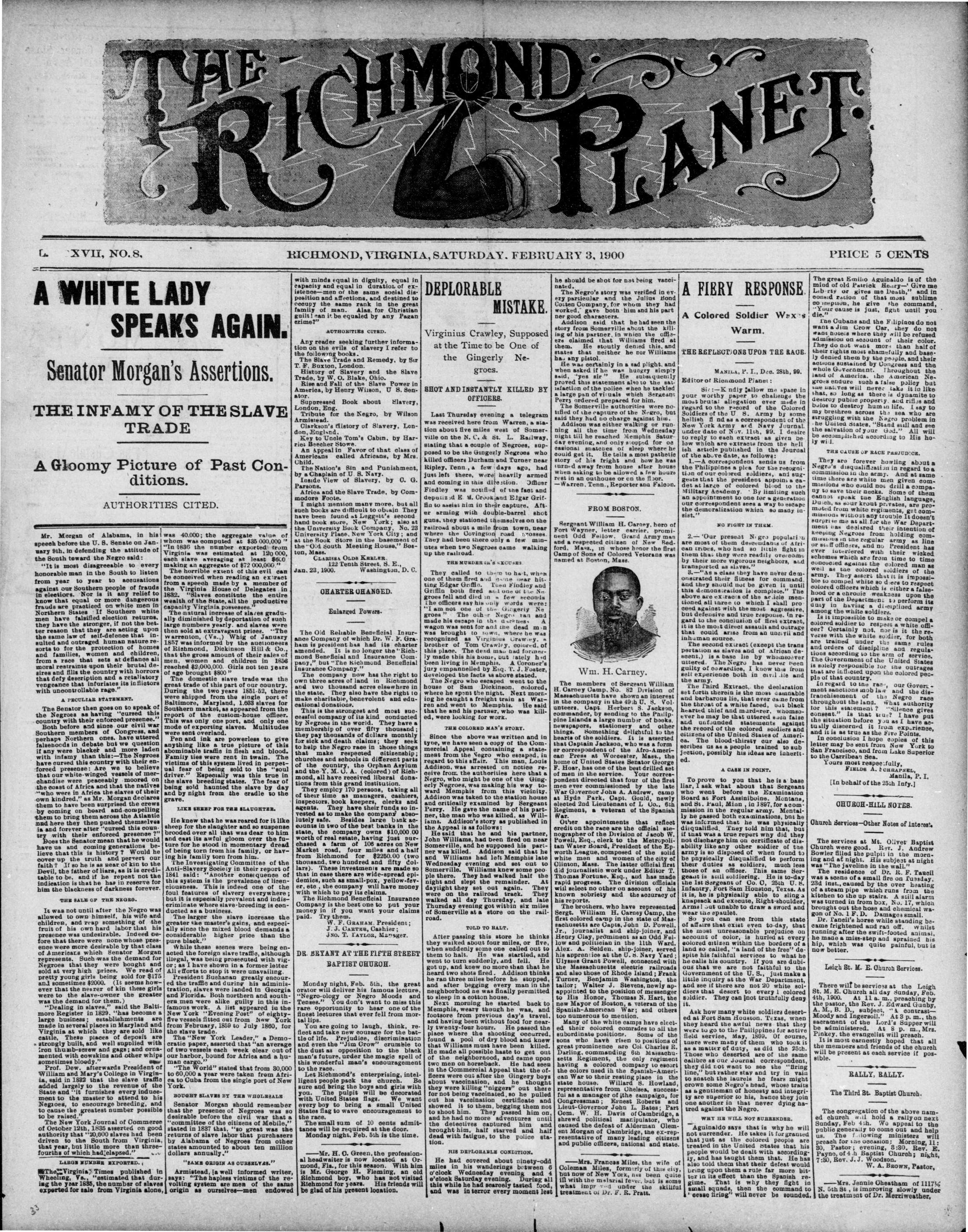
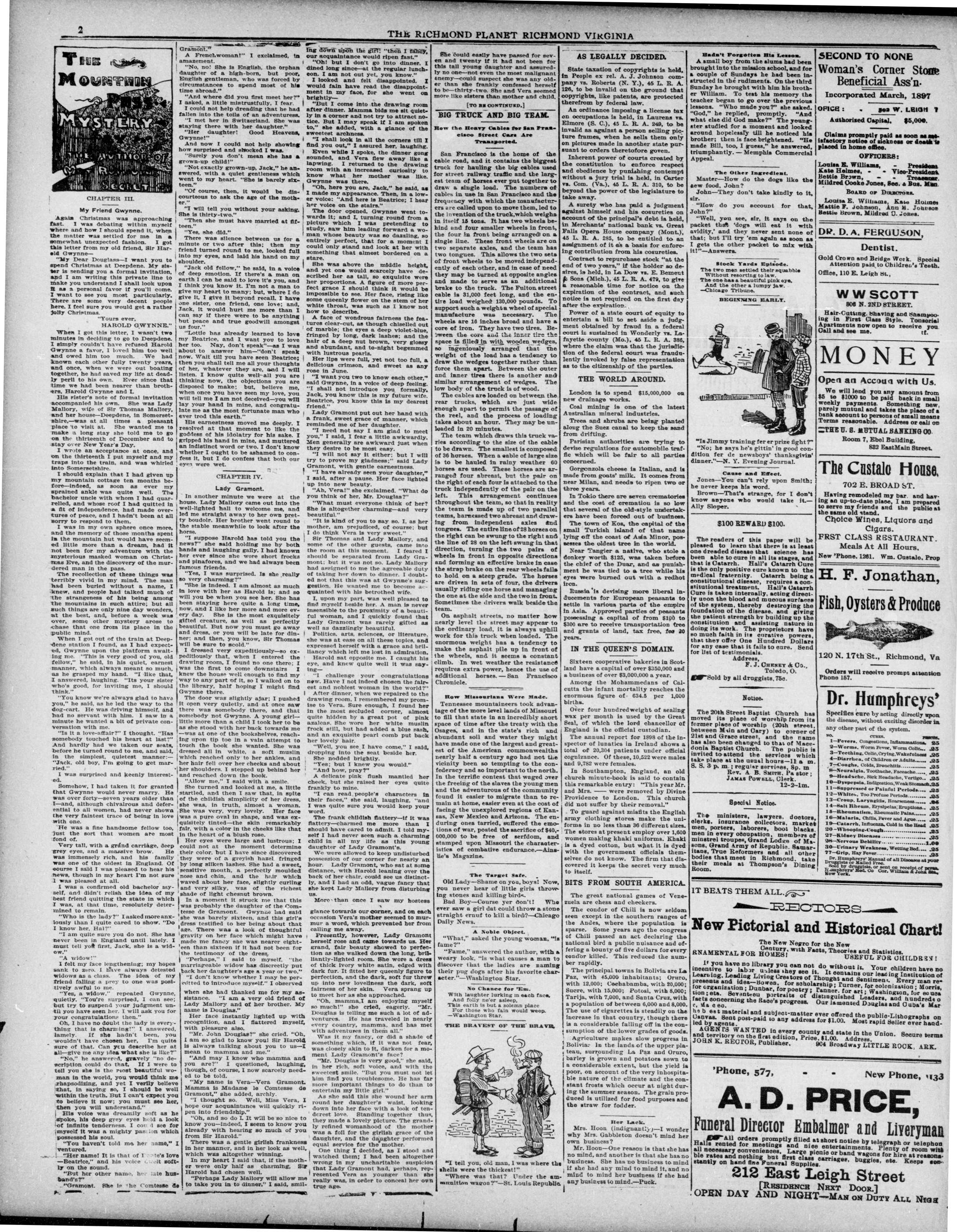
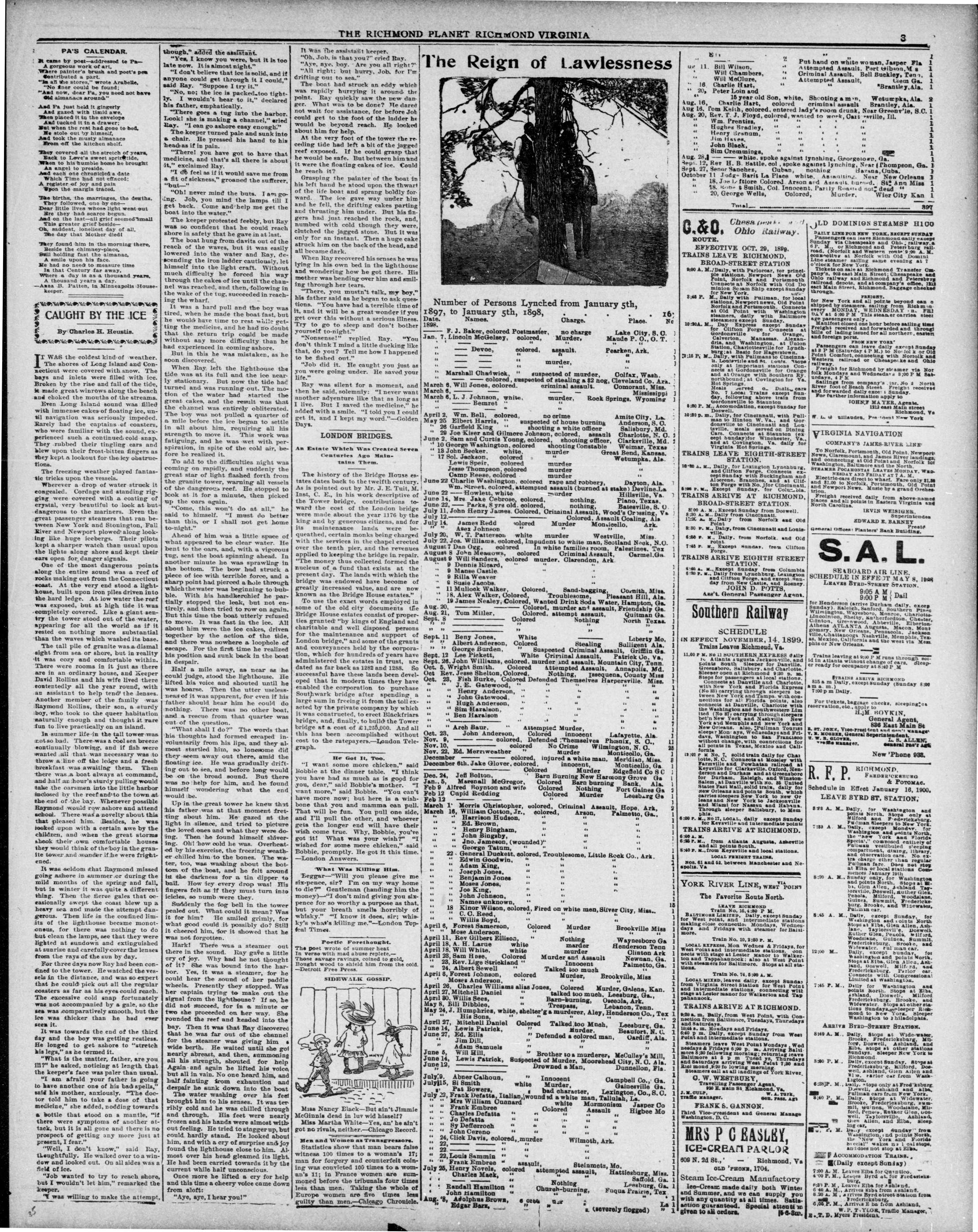
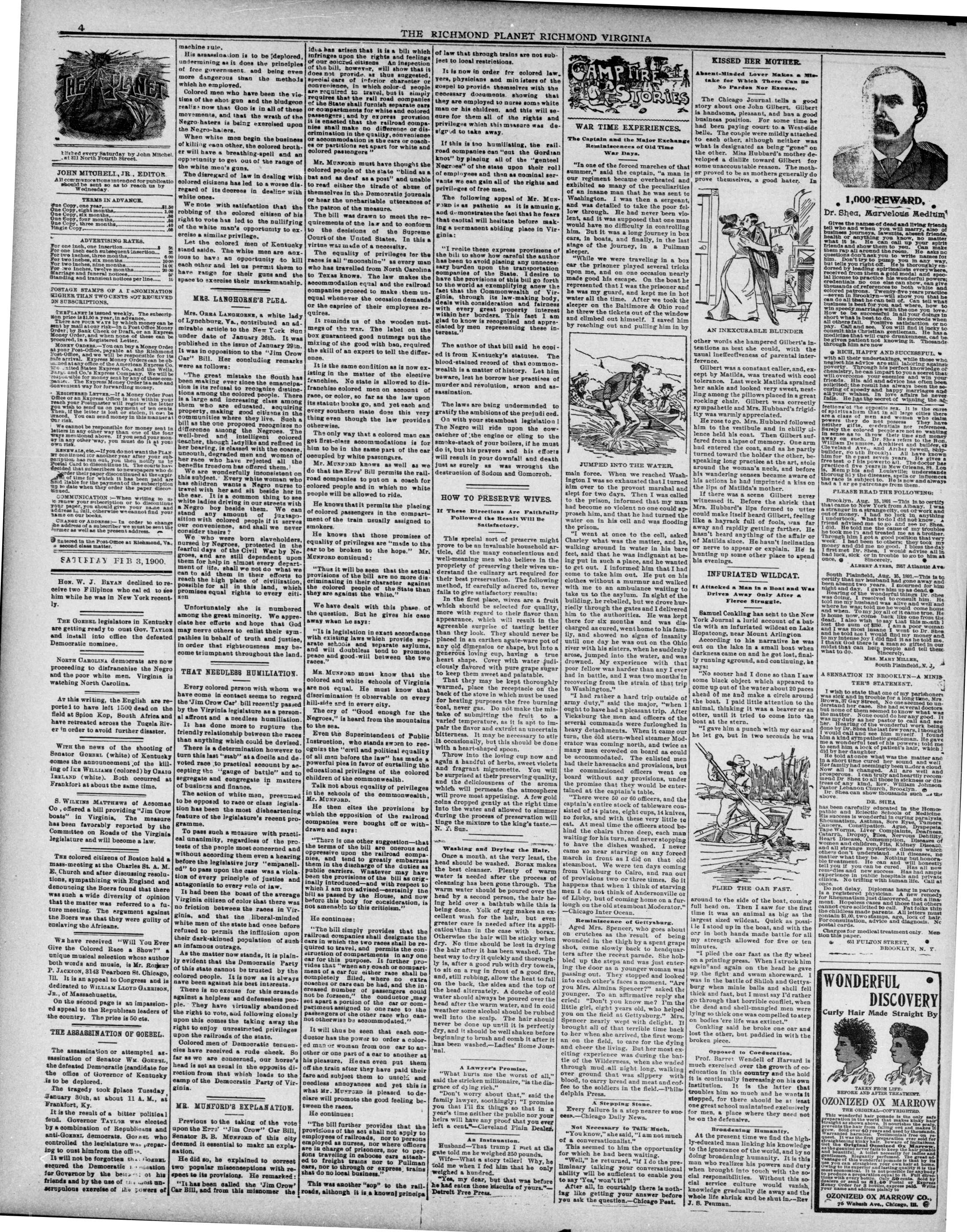
Page text (machine-generated)
THE RICHMOND PLANET
4. XVII, NO.8.
A WHITE L
SPEA
Senator Morgan
THE INFAMY C
TRA
A Gloomy Pictu
dition
A WHITE LADY SPEAKS AGAIN.
A Gloomy Picture of Past Conditions. AUTHORITIES CITED.
Mr. Morgan of Alabama, in his speech before the U. S. Senate on January 9th, in defending the attitude of the South toward the Negro said: "It is most disagreeable to every honorable man in the South to listen from year to year to accusations against our Southern people of frauds in electors. Nor is it any relief to know that equal or more dangerous frauds are practiced on white men in Northern States If Southern white men have falsified election returns, they have falsified, if not the better reason, that they are acting upon the same law of self-defence that insults and outraged human nature resists for the protection of homes and families, women and children, from a race that sets at defiance all moral restraints upon their brutal desires and fills the country with horrors that defy description and a retaliatory vengeance that infuriates its infiltrators with uncontrollable rage."
A PECULIAR STATEMENT.
The Senator then goes on to speak of the Negroes as having "cursed this country with their enforced presence." Both before and since our civil war Southern members of Congress, and perhaps Northern ones, have uttered falsehoods in debate but we question if any were blacker and more laden with infamy than this:—The Negroes have cursed this country with their enforced presence: Are we to believe that our white-winged vessels of merchandise were peaceably moored on the coast of Africa and that the natives "who were in Africa the slaves of their own kindred," as Mr. Morgan declares them to have been surprised the crews by coming on board and compelling them to bring them across the Atlantic and here they then pushed themselves is and forever after "cursed this country with their enforced presence?"
Does the Senator mean that he would have us and coming generations believe that this is history? Would he cover up the truth and perversity of faith so he is as sure as to the full, the ill, the as well as it is credible to be, and if he repent not the indication is that he has in reserve for him the blackness of darkness forever.
THE SALE OF THE NEGRO.
It was not until after the Negro was allowed to own himself, his wife and children, and reap something of the fruit of his own hard labor that his presence was undesirable. Indeed before that there were none whose presence were more desirable by that class of Americans which Senator Morgan represents. Such was the demand for Negroes that they were bought and sold at very high prices. We read of pretty young girls being sold for $175 and sometimes $2000. (It seems however that the nearer of kin these girls were to the slave-owner the greater was the demand for them.)
"Dealing in slaves," said the Baltimore Register in 1829, "has become a large business; establishments are made in several places in Maryland and Virginia at which they are sold like cattle. These places of deposit are strongly built, and well supplied with iron thumb-screw and gage; and ornamented with cowskins and other whips sometimes bloody."
Prof. Dew, afterwards President of William and Mary's College in Virginia, said in 1832 that the slave traffic added largely to the revenue of the State and "it furnishes every inducement to the master to attend to his Negroes, to encourage breeding, and to cause the greatest number possible to the New York Journal of Commerce of October 12th, 1835 asserted on good authority that "20,000 slaves had been driven to the South from Virginia, that year, but little more than three-fourths of which had elapsed."
LARGE NUMBER EXPORTED.
The Virginia Times published in Wheeling, Va., "estimated that during the year 1885, the number of slaves exported for sale from Virginia alone.
33
was 40,000; the aggregate value of whom was computed at $35,000,000.” “In 1836 the number exported from Virginia was estimated at 120,000, each slave averaging at least $600 making an aggregate of $72,000,000.” The horrible extent of this evil can be conceived when reading an extract from a speech made by a member of the Virginia House of Delegates in 1832. “Slaves constitute the entire wealth of the State, all the productive capacity Virginia possesses.” The natural increase of slaves gradually diminished by deportation of such large numbers yearly, and slaves were then sold at extravagant prices. “The warranton, (Va.), Whig of January 1857 was informed by the auctioneers of Rishmond, Dickinson Hill & Co., that the gross amount of their sales of men, women and children in 1856 reached $2,000,000. Girls not ten years of age brought $800.”
The domestic slave trade was the great trade of this part of our country. During the two years 1851-52, there were shipped from the single port of Baltimore, Maryland, 1.633 slaves for Southern market, as appeared from the report of the custom-house officer. This was only one port, and only one mode of exporting slaves. Multitudes were sent overland. Pen and ink are powerless to give anything like a true picture of this abominable traffic in flesh and blood. The slave trade was in Iran. The victims of this system lived in perpetual fear of being sold to the "soul driver." Especially was this true in the slave breeding states. The fear of being sold haunted the slave by day and by night from the cradle to the grave.
LIKE SHEEP FOR THE SLAUGHTER.
He knew that he was reared for it like sheep for the slaughter and so suspense brooded over all that was dear to him and cast its awful gloom over the future for he stood in momentary dread of being torn from his family, or having his family torn from him.
The Investigating Committee of the Anti-Slavery Society in their report of 1841 said: "Another consequence of this system is the prevalence of licenciousness. This is indeed one of the foul features of slavery everywhere; but it is especially prevalent and indiscriminate where slave-breeding is conducted as a business.
The larger the slave increase the greater the master's gains, and especially since the mixed blood demands a considerable higher price than the pure black."
While these scenes were being enacted the foreign slave traffle, although illegal, was being prosecuted with vigor; as I have shown in a former letter All efforts to stop it were unavailing.
President Buchanan greatly encouraged the traffic and during his administration, slaves were landed in Georgia and Florida. Both northern and southern men were alike guilty in this infamous work. A list appeared in the New York "Evening Post" of eighty-five vessels fitted out from New York from February, 1859 to July 1860, for the slave trade.
New York "Oak Leader," a Democratic paper, asserted that "an average of two vessels each week clear out of our harbor, bound for Africa and a human cargo."
"The World" stated that from 80,000 to 60,000 a year were taken from Africa to Cuba from the single port of New York.
BOUGHT SLAVES BY THE WHOLESALE
Senator Morgan should remember that the presence of Negroes was so desirable before the civil war that a "committee of the citizens of Mobile," stated in 1837 that, "so great was the race of Negroes in the purchasers by Alabama of Negroes from other states amounted to about ten million dollars annually."
"SAME ORIGIN AS OURSELVAS."
Armistead, [as well informed writer, says: "The hapless victims of the revolting system are men of the same origin as ourselves—men endowed
RICHMOND, VIRGINIA, SATURDAY, FEBRUARY 3, 1900
with minds equal in dignity, equal in capacity and equal in duration, of existence—men of the same social disposition and affections, and destined to occupy the same rank in the great family of man. Alas, for Christian guilt can it be equaled by any Pagan crime?"
AUTHORITIES CITED:
Any reader seeking further information on the evils of slavery I refer to the following books.
The Slave Trade and Remedy, by Sir T. F. Buxton, London.
History of Slavey and, the Slavey
History of Slavery and the Slave Trade, by W. O. Blake, Ohio.
Trade, by W. O. Blake, Ohio.
Rise and Fall of the Slave Power in
America, by Henry Wilson, U. S.
Senator.
Suppressed Book about Slavery, London, Eng.
Tribute for the Negro, by Wilson Armistead.
Clarkson's history of Slavery, London, England.
Key to Uncle Tom's Cabin, by Harriet Beecher Stowe.
Pet Beescher Sowe.
An Appeal in Favor of that class of
Americans called Africans, by Mrs.
Child.
The Nation's Sin and Punishment,
by a Chaplain of U. S. Navy.
Inside View of Slavery, by C. G. Parsons.
Africa and the Slave Trade, by Commodore Foote.
I might mention many more, but all such books are difficult to obtain. They have been found at Leggatt's second hand book store, New York; also at the University Book Company, No. 23 University Place, New York City; and at the Book Store in the basement of the "Old South Meeting House," Boston, Mass.
CLARISSA OLD'S KEELER.
122 Tenth Street, S. E.,.
Jan. 23, 1900.
Washington, D. C.
QHARTER QHANGED.
Enlarged Powers
The Old Reliable Beneficial Insurance Company of which Dr. W. F. Graham is president has had its charter amended. It is no longer the "Richmond Beneficial and Insurance Company," but "The Richmond Beneficial Insurance Company."
The company now has the right to own three acres of land in Richmond and two thousand acres elsewhere in the state. They also have the right to make charitable, benevolent and educational donations.
This is the strongest and most successful company of its kind conducted by Negroes in the world. They have a membership of over fifty thousand; they pay thousands of dollars monthly for sick and death claims; they seek to help the Negro race in those things that make respected citizenship; churches and schools in different parts of the country, the Orphan Asylum and the Y. M. C. A. (colored) of Richmond, all have received liberal donations from this grand institution.
They emply 170 persons, taking all of their time as managers, cashiers, inspectors, book keepers, clerks and agents. They have their funds so invested as to make the company absolutely safe. Besides large bank accounts in two of the best banks in the state, the company owns $10,000.00 worth of real estate, having just purchased a farm of 108 acres on New Market road, four miles and a half from Richmond for $2250.00 (two thousand, two hundred and fifty collars). These investments are made so that in the wide-spread epidemics, such as small-pox, yellow-fever, etc., the company will have money with which to pay its claims. The Richmond Beneficial Insurance Company is the best one to put your money in if you want your claims paid. Try them.
W. F. GRAMH. President;
J. J. CARTER, Cashier;
JNO. T. TAYLOR, Manager.
DR. BRYANT AT THE FIFTH STREET BAPTIST CHUROH.
Monday night, Feb. 5th, the great orator will deliver his famous lecture, "Negro-ology or Negro Moods and Tenses." You don't want to miss this rare opportunity to hear one of the finest lectures that ever fell from mortal lips.
You are going to laugh, think, reflect and take new courage for the battle of life. Prejudice, discrimination and even the "Jim Crow" crumble to the dust as opposition to the black man's future, under the magic spell of this wonderful man's encouragement to the race.
Let Richmond's enterprising, intelligent people pack the church. Be sure and bring the boys and girls with you. The pulpit will be decorated with United States flags. We want every boy to bring a small United States flag to wave encouragement to the race.
The small sum of 10 cents admittance will be required at the door. Monday night, Feb. 5th is the time.
Mr. H. G. Green, the professional headwaiter is now located at Ormond, Fla., for this season. With him is Mr. George H. Fleming, an old Richmond boy, who has not visited Richmond for years. His friends will be glad of his present location.
SHOT AND INSTANTLY KILLED BY OFFICERS.
Last Thursday evening a telegram was received here from Warren, a station about five miles west of Somerville on the N. C. & St. L. Railway, stating that a couple of Negroes, supposed to be the Gingerly Negroes who killed officers Durham and Turner near Ripley, Tenn, a few days ago, had just left there, were heavily armed and coming in this direction. Officer Findley was notified of the fast and deputized E. M. Crook and Elgar Griffin to assist him in their capture. After arming with double-barrel shot guns, they stationed themselves on the railroad about a mile from town, near where the Ovington road crosses. They had been there only a few minutes when two Negroes came walking up the railroad.
THE MURDER 4R'S XCUSES.
They called to them to hait, when one of them fired and game near hitting Edgar Griffin. Then Findley and Griffin both fired and one of the Negroes fell and died in a few seconds. The officers say his only words were: "I am not one of the Gingery Negroes." The other Negro tan and made his essay in the darkness. A wagon was sent for and the dead man was brought to town, where he was recognized as Virginius Crawley, a brother of Tom Crawley, colored, of this place. The dead man had formerly made this his home, but tately had been living in Memphis. A Coroner's jury empannelled by Eq. T. J. Foster, developed the facts as above stated.
The Negro who escaped went to the house or Sam Dickinson, colored, where he spent the night. Next morning he caught a freight train at Warren and went to Memphis. He said that he and his partner, who was killed, were looking for work.
THE COLORED MAN'S STORY.
Since the above was written and in type, we have seen a copy of the Commercial Appeal containing a statement from the Negro who escaped, in regard to this affair. This man, Louis Addison, was arrested on notice receive from the authorities here that a Negro, who might be one of the Gingerly Negroes, was making his way toward Memphis from this vicinity. Addison was taken to the station house and critically examined by Sergeant Perry. He gave the name of his partner, the man who was killed, as Williams. Addison's story as published in the Appeal is as follows:
He said that he and his partner, John Williams, had been fired on near Somerville, and he supposed his partner was killed. Addison said that he and Williams had left Memphis late Wednesday evening and set out to Somerville. Williams knew some people there. They had walked half the night and slept the remainder. At daylight they got out again. They had been railroaded. They walked all day Thursday, and late Thursday evening got within six miles of Somerville at a store on the railroad.
TOLD TO HALT
After passing this store he thinks they walked about four miles, or five, when suddenly some one called out to them to halt. He was startled, and went to turn suddenly, and fell. He got up, and knew no more than that he heard two shots fired. Addison thinks he ran three miles before he stopped, and then in the neighborhood he was finally permitted to sleep in a cotton house.
Next morning he started back to Memphis, weary though he was, and footsore from previous day's travel, and having been without food for nearly twenty-four hours. He passed the place where the shooting occurred, found a pool of dry blood and knew that Williams must have been killed. He made all possible haste to get out of the neighborhood, and came upon two men on horseback. He had seen in the Commercial Appeal that the officers were out after the Gingery boys about vaccination, and he thought they were killing "niggers" out there for not being vaccinated, so he pulled out his vaccination certificate and showed it to them, begging them not to shoot him. They passed him on, and he had no more adventures until the detectives captured him and brought him, half starved and half dead with fatigue, to the police station.
HIS DEPLOBABLE CONDITION.
He had covered about ninety-odd miles in his wanderings between 6 o'clock Wednesday evening and 4 e'clock Saturday evening. During all this while he had scarcely tasted food, and was in terror every moment lest
he should be shot for not being vaccinated.
The Negro's story was verified in every particular and the Julius Bond Cotton Company, for whom they had worked, gave both him and his partner good characters.
Addison said that he had seen the story from Somerville about the killig of his partner, in which the offiera claimed that Williams fired at them. He stoutly denied this, and states that neither he nor Williams has any pistol.
He was certainly in a sad plight, and when asked if he was hungry simply said, "yes sir." He subsequently proved this statement also to the satisfaction of the police when he tackled a large pan of visuals which Sergeant Perry ordered prepared for him.
The Somerville authorities were notified of the capture of the Negro, but said that he had no charge against him.
Addison was either walking or running all the time from Wednesday night till he reached Memphis Saturday evening, and only stopped for occasional snatches of sleep where he could get it. He tells a most pathetic story of his fright and how he was turn-d away from house after house when asking to be allowed a few hours outside. Warren Tann, Reporters-Eaton
FROM BOSTON.
Sergeant William H. Carney, hero of Fort Wayner, letter carrier, prominent Odd Fellow, Grand Army man and a respected citizen of New Bedford, Mass., in whose honor the first Camp of Sons of Colored Veterans was named at Boston, Mass.
Wm. H. Carney.
The members of Sergeant William H. Carney Camp, No. 82 Division of Massachusetts have shown an interest in the company in the 49th U. S. Volunteers. Capt Herbert S. Jackson, commander, by sending to the Philippine islands a large number of books, newspapers, stationery and other things. Something delightful to the hearts of the soldiers. It is asserted that Captain Jackson, who was a former correspondent of the Afro-American Press at Worcester, Mass., the home of United States Senator George F. Hoar, has one of the best drilled set of men in the service. Your correspondent is directed that four of the first men ever commissioned by the War Governor John A. Andrew, camp at Hydes Park, Capt. Gould, newly elected 2nd Lieutenant of L. Co. 86 Regiment, a veteran of the Spanish War.
Other appointments that reflect credit on the race are the official stenographer of the Division of Jacob W. Powell, Eq., clerk to the Metropolitan Water Board, President of the Eppworth League, composed of the solid white men and women of the city of Clinton, Mass. The latter official first did journalistic work under Editor T. Thomas Fortune, Esq., and has made rapid progress. The division officials will select no other on account of his known sobriety and the accuracy of his reports.
The brothers, who have represented Sergt. William H. Carney Camp, the first colored camp in the state of Massachusetts are Capts. John D. Powell, Jr., journalist and ship-joiner, and Henry Clay, prominent as an Odd Fellow and politician in the 11th Ward. Alex. A. Selden, ship-joiner, served his apprentice at the U. S. Navy Yard; Ulysses Grant Powell, connected with the Massachusetts electric railroads and the Rhode Island; Frank Turner, Benjamin Waintinger, the tailor; Walter J. Stevens, newly appointed to the position of messenger to His Honor, Thomas N. Hart, the new Mayor of Boston, a veteran of the Spanish-American War; and others too numerous to mention.
Many of the white campa have elected their colored comrades to all the subordinate positions. Some of the sons who have risen to positions of great prominence are Col Charles R. Darling, commanding 6th Massachusetts Regiment, the only regiment having a colored company to escort the colors used in the Spanish-American War to their resting place in the state house. Willard S. Howland, representative from Chelsea, successful as a manager of the campaign, for a campaign Roberts and Lieut-Governor John B. Com. W. H. Davis of Cambridge a shrewd political manipulator, who caused the defeat of Alderman Olement Morgan of Cambridge, the ex-representative of many leading citizens and public officers, national and state
—Mrs. Frances Miles, the wife of Coleman Miles, formerly of this city, but now of New York, has been quite ill with the malarial fever, but is some what improved under the skillful treatment of Dr. F. R. Pratt.
THE REFLECTONS UPON THE RACE.
MANILA, P. I., Dec. 28th, 99.
Editor of Riennion堡:
Sic.:—K ndly follow me space in your worthy paper to challenge the most brutal allegation ever made in regard to the record of the Colored Soldiers of the U. S. Army to some hellish fld as a correspondent of the New York Army and Navy Journal under date of Nov. 11th, 99. I desire to reply to each extract as given below which are extracts from the hellish article published in the Journal of the above date, as follows:
I.—A correspondent sends us from the Philippines a plea for the recognition of our colored soldiers, and suggests that the president appoint a cadet at large of colored blood to the Military Academy. By limiting such an appointment to one for a generation our correspondent sees a way to escape the demoralization which so many insist."
NO FIGHT IN THEM
2. "Our present Niger population are most of them descendants of African tribes, who had so little fight in them that they were readily overcome by their more vigorous neighbors, and transported as slaves."
3. "As a class they have never demonstrated their fitness for command, and they should not be given it until this demonstration is complete." The above are extracts of the article mentioned all three to which I shall proceed against with the most aggressive, but defensive and true response. In regard to the conclusion of first extract, it is the most direct assault and outrage that could arise from an unyil and inimical source.
The second extract (except the transportation as slaves and of African descent.) is a base lie by whosover uttered. The Negro has never been guilty of cowardice. I know this from self experience both in civil life and the army.
The Third Extract, the declaration set forth therein is the most damnable and barbarous lie, that ever came from the throat of a white faced, but black hearted thief and murderer, whomsoever he may be that uttered such false and unfounded statements against the record of the occupied soldiers and citizens of the United States of America. The blood-thirsty curse scribes us as a people trained to subjection, possibly his ideas are inherited.
A CASE IN POINT.
To prove to you that he is a base liar, I ask what about that Sergeant who went before the Examination Board at Fort Assiniboine, Montana, and St. Paul, Minn, in 1887, for a commission in the regular army. Mentally he passed both examinations, but he was informed that he was physically disqualified. They told him that, but if that was a true report why did they not discharge him on certificate of disability like any other soldier of the army is disposed of when found to be physically disqualified to perform their duties as soldiers, much less those of an officer. This same Sergeant is a soldiering. He is today the lst Sergeant of Co O, 25th T. Infantry, Fort San Houston, Texas. As it is, he is physically able to sling a knapsack and execute, Right-shoulder, Arms! but unable to draw a sword and wear the spaucle.
So you can see from this state of affairs that exist even to-day, that the most unreasonable prejudice on account of color, is hurried at every colored citizen within the borders of a land so called, "a land of the free" despite his faithful services to what he calls his country. If you are dubious that we are so faithful to the Government of the U. S., little inquiry at the War Department, and see if there are not 20 white soldiers that desert to every 1 colored soldier. They can not truthfully deny it.
Ask how many white soldiers deserved at Fort Sam Houston, Texas, when they heard the awful news that they were to go to the Philippines for active field service, May, 1899. Of course, there were many of them who took it as a matter of duty, as did the 25th. Those who deserted are of the same calibre as our Journal correspondent, they did not want to see the "firing line," neither stay and try in vain, match them, or might crown some Negro's head, whose traits as a gentleman of honesty and integrity are superior to his, hence they join one another in that never dying hatred against the Negro.
WHY HE WILL NOT SURRENDER.
Aguinaldo says that is why he will not surrender. He takes it for granted that just as the colored people are treated in the United States that his people would be dealt with accordingly, and has taught them that. He has also told them that their defeat would bring upon them a rule far more bitter in its effect than the Spanish regime. That is why they fight in small squads, then the command to "cease firing" will never be sounded.
PRICE 5 CENTS
The great Emilio Aguinaldo is of the mind of old Paskie Henry—"Give me Liberty or give me Death," and in considation ration of that most sublime soception, he give the command, "Your cause is just, fight until you die."
The Cubans and the Filipinos do not want a Jim Crow Car, they do not want a notes where they will be refused admission on account of their color. They do not want more than half of their rights most shamefully and basely denied them by the people, and their actions sustained by Congress and the whole Government. Throughout the land of America, the American Negroes endure such a false policy but the natives will never take it in like that, so long as there is dynamite to destroy public property, and rifles and bolos to destroy human life. I say to my brethren across the sea who are struggling with the Negro problem in the United States, "Stand still and see the salvation of your God." All will be accomplished according to His holy will.
THE CAUSE OF RACE PREJUDICE.
They are forever howling about a Negro's disqualification in regard to a commission in the army. And at same time there are white men given commissions who could not drill a company to save their necks. Some of them cannot speak the English language, Dutch, as sour krount privates, are promoted from white regiments, get commissions without any trouble It doesn't surprise me at all for the War Department has deserved their intention of keeping Negroes from holding commissions in the regular army as lines or staff officers, and no President has ever interfered with their wicked schemes which are from time to time conceived against the colored man as well as the colored soldiers of the army. They assert that it is impossible to compel white soiders to respect colored officers which is either a falsehood or a chronic weakness upon the part of the Department to perform its duty in having a disciplined army among the white soldiers.
Is it impossible to make or compel a colored soldier to respect a white officer? Certainly not, nor is it the reverse with the white soldier, for both are trained under the same rules and orders of discipline and regulations according to the arm of service. The Government of the United States is solely responsible for the outrages that are inflicted upon the colored people of that country. Is it the race, our Government sanctions and law and the disfranchisement of the Negro race throughout the land. What authority for this statement? "Silence gives consent." Is that true? I have put the situation before you as I have actually discerned it from experience, and it is as true as the Fire Points.
In conclusion I hope copies of this letter may be sent from New York to San Francisco, and from Lake Superior to the Carribean Sea.
Yours most respectfully.
FIELDS A. SCHRAFNEL,
Manila, P. I.
[In behalf of the 25th Infy.]
CHURCH-HILL NOTES.
Church Services—Other Notes of Interest.
The services at Mt. Olivet Baptist Church were good. Rev. J. Andrew Bowler filled the pulpit in the morning and at night. His subject at night was "The javeline in the wall."
The residence of Dr. R. F. Tauqil was a scene of a small fire on fussday, 23d inst., caused by the over heating of a steam pipe which runs from the kitchen to the up stairs. A still alarm was turned in from box, No. 17, which brought out the hose and chemical wagon of No. 1 F. D. Damages small.
Dr. Tancif's horse while standing became frightened and ran off, whilst running after the swift-footed animal, he made a miss-step and sprained his hip, which was quite painful, but is now better.
Leigh St. M. E. Church Services
There will be services at the Leigh St. M. E. Church all day Sunday, Feb. 4th, 1900. At 11 a. m., preaching by the pastor, the Rev. J. Edward Gunby, A. M., B. D., subject, "A contrast—Moody and Ingersoll." At 8 p. m., the sacrament of the Lord's Supper will be administered. At 8 p. m., Mrs. Pinkey, the evangelist will preach. It is most earnestly hoped that all the members and friends of the church will be present at all service if possible.
RALLY, RALLY.
The Third St. Baptist Church.
The congregation of the above named church will hold a rally on next Sunday, Feb 4th. We appeal to the public generally to come out and help us. The following ministers will preach for the occasion: Morning, 11: 80, Pastor; evening, 8:30, Rev. E. Payne, of 4th Baptist Church; night, 7:30, Rev. J. J. Woodson. W. A. BROWN, Pastor.
Mrs. Jennie Cheatham of 1117% N. 5th St, is improving slowly under the treatment of Dr. Merriweather.
THE MOUNTAIN
PASS
MYSTERY
THE AUTHOR OF
MYSTERY SECRET
My Friend Gwynne
Again Christmas was approaching fast. I was debating within myself where and how I should spend it, when the matter was settled for me in a somewhat unexpected fashion. I got this letter from my old friend, Sir Harold Gwynne—
"My Dear Douglass—I want you to spend Christmas at Deepeen. My sister is sending you a formal invitation, and I am writing this private line to you you understand I shall look upon it as a person you will love. I want to see you most particularly. There are some very decent people here. I feel sure you would get a rather jolly Christmas.
"Yours ever, HAROLD GWYNNE."
When I got this letter, I wasn't two minutes in deciding to go to Dependee. I simply couldn't have refused Harold Gwynne a favor, I loved him too well and owed him too much. We had known each other fully twenty years, and once, when we saved our life at deadly peril to his own. Ever since that time we had been nearer than brothers, Harold Gwynne and I.
His sister's note of formal invitation accompanied his own. She was Lady Mallory, wife of Sir Thomas Mallory, and her house—Deepdene in Somersetshire—was at all times a pleasant place to visit at. She wanted me to make a long stay she told me to go on the thirteenth of December and to stay over New Year's Day.
I wrote an acceptance at once, and on the thirteenth I put myself and my traps into the train, and was whirled into Somersetshire.
I should explain that I had given up my mountain cottage ten months before—indeed, as soon as ever my sprained ankle was quite well. The bachelor uncle with whom I had quarrelled, and whose roof I had quitted in a fit of independence, had made overtures of peace, and I hadn't been at all sorry to respond to them. I was a slave over my once more, and the memory of those months spent in the mountain hut would have seemed little more than a dream, had it not been for my adventure with the mysterious masked woman on Christmas Eve, and the discovery of the murdered man in the pass.
The recollection of these things was terribly vivid in my mind. The man had been buried without a name, I knew, and people had talked much of the strangeness of his being among the mountains in such attire; but all I knew was that he was at the best, and before a week was over, some other mystery arose to chase that one from its place in the public mind.
When I got out of the train at Deeenden station I found, as I had expected, Gwynne upon the platform awaiting me. "This is very good of you, old fellow," he said, in his quiet, earnest manner, which always meant so much, as he grasped my hand. "I like that, I answered, laughing. "Its your sister who's good, for inviting me, I should think."
"You know we're always glad to have you," he said, as he led the way to the dog-cart. He was driving himself, and had no servant with him. I saw in a minute he wanted a bit of private conversation with me.
"Is somebody a love-affair?" I thought. "Has somebody touched his heart at last?" And hardly had we taken our seats, before he turned round to me, and said, in the simplest, quietest manner:—"Jack, old boy, I'm going to get married."
I was surprised and keenly interested.
Somehow, I had taken it for granted that Gwynne would never marry. He was over forty—seven years older than I—and, although chivalrous and deferential to all women, had never shown the very faintest trace of being in love with one.
He was a fine handsome fellow too, just the sort that women are most fond of.
Very tall, with a grand carriage, deep grey eyes, and a massive brow. He was immensely rich, and his family was one of the oldest in England. Of course I said I was pleased to hear his news, though in my heart I'm not sure I was pleased at all.
I was a confirmed old bachelor myself, and didn't relish the idea of my best friend quitting the state in which I was, at that time, resolutely determined to remain.
"Who is the lady?" I asked more anxiously than I quite cared to show. "Do I know her, Hal?"
"I am quite sure you do not. She has never been in England until lately. I must tell you first, Jack, she is a widow."
"A widow!"
I felt my face lengthening; my hopes sank to zero. I have always detested widows as a class. The idea of my friend falling a prey to one was positively awful to me.
"Yes, a widow," repeated Gwynne, quietly. "You're surprised, I can see; but try to suspend your judgment until you have seen her. I will ask you for your congratulations then."
Oh, I have no doubt the lady is everything that is charming!" I answered, lamely. If she hadn't been, you wouldn't have chosen her. I'm quite sure of that. Can you describe her at all—give my any idea what she is like?"
"No," he answered, gravely "no description could do that. If I were to tell you she is the most beautiful woman in the world, you would think me rhapsodizing, and yet I verily believe that, in saying so, I should be well within the truth. But I can't expect you to believe it now; you must see her, then you will understand."
His voice was dreamily soft as he spoke, his deep grey eyes held a look of infinite tenderness. I could see for myself it was a mighty passion which possessed his soul. "You haven't told me her name," I ventured. "Her name! It is that of I note's love —Beatrice," and his voice oult softly on the sound.
"But her other name, her late husband's?"
"Gramont. She is the Comtesse de
Gramont."
A Frenchwoman!" I exclaimed, in amazement.
"No, no! She is English, the orphan daughter of a high-born, but poor, English gentleman, who was forced by circumstances to spend most of his time abroad."
She more did you first meet her?"
I asked, a little mistrustfully, I fear.
I could not help dreading that he had fallen into the toils of an adventures,
"I met her in Switzerland. She was staying there with her daughter."
"Her daughter! Good Heavens, Gwynne!"
And now I could not help showing how surprised and shocked I was,
"Surely you don't mean she has a grown-up child!"
"Not exactly grown-up, Jack," he answered, with a quiet gentleness which went to my heart. "She is barely sixteen."
"Of course, then, it would be discourseous to ask the age of the mother."
"I will tell you without your asking. She is thirty-two."
"Then she must have married at fifteen."
"Yes, she did." There was silence between us for a minute or two after this; then my friend turned round to me, looked full into my eyes, and lald his hand on my shoulder.
"Jack old fellow," he said, in a voice of deep emotion. If there's a man on earth I can be said to love it's you, and think you know it. I'm not a man to give it to many; but, where I do give it, I give it beyond all. I have one sister, one friend, one love; and Jack, it would hurt me more than I can say if there were to be anything but peace and true goodwill amongst us four."
"Lottie has already learned to love my Beatrice, and I want you to love her too. Nay, don't speak"—as I was about to answer him—"don't speak now. Wait till you have seen Beatrice; then you shall tell me all your thoughts of her, whatever they are, and I will listen. I know quite well all you are thinking now, the objections you are disposed to make; but, believe me, when once you have seen my love, you will tell me I am not deceived—you will say your hand in mine, and congratulate you most fortunate man who ever trod this road. I have earnedness moved me deeply. I resolved at that moment to like the goddess of his idolatry for his sake. I gripped his hand in mine, and muttered an indistinct word or two. I don't know whether I ought to be ashamed to confess it, but I do confess that both our eyes were wet.
CHAPTER IV.
Lady Gramont.
In another minute we were at the house. Lady Mallory came out into the well-lighted hall to welcome me, and led me straight away to her own pretty boudolr. Her brother went round to the stable meanwhile to look after the horse.
"I suppose Harold has told you the news?" she said holding me by both hands and laughing gaily. I had known her ever since she sore short frocks and pinafores, and we had always been famous friends.
"Yes, I was surprised. Is she really so very charming?"
"She is indeed. I am almost as much in love with her as Harold is; and so will you be when you see her. She has been staying here quite a long time, now, and I like her more and more every day. She is the most exquisitely gifted creature, as well as perfectly beautiful. But now you must go away and dress, or you will be late for dinner; and then, you know, Sir Thomas will be sure to scold."
I dressed very expeditiously—so expeditiously that, when I entered the drawing room, I found no one there; I was the first to come downstairs. I knew the house well enough to find my way to any part of it, so I walked on to the library, half hoping I might find Gwynne there.
The door was slightly ajar; I pushed it open very quietly, and at once saw there was somebody there, and that somebody not Gwynne. A young girl—little more than a child I took her to be as she stood with her back towards me—was at one of the bookshelves, reaching upon tip toe in a vain attempt to touch the book she wanted. She was dressed all in white, a soft muslin which reached only to her ankles, and her hair fell over her cheeks and about her shoulders. I stepped up behind her and reached down the book.
"Allow me," I said with a smile. She turned and looked at me, a little startled, and then I saw that, in spite of the childish simplicity of her dress, she was, in truth, almost a woman. She was very, very lovely. Her face was a pure oval in shape, and was exquisitely tinted—the skin remarkably fair, with a color in the cheeks like that in the heart of a blush rose. Her eyes were large and lustrous; I could not at the moment determine their color, but I have since discovered they were of a greyish hazel, fringed by long silken lashes. She had a sweet, sensitive mouth, a perfectly moulded nose and chin, and the hair which waved about her face, slightly curling and very silky, was of the richest shade of light chestnut brown.
In a moment it struck me that this was probably the daughter of the Comtesse de Gramont. Gwynne had said she was barely sixteen, and this girl's dress testified to her being about that age. There was a look of thoughtful gravity on her face which might have made me fancy she was nearer eighteen than sixteen if it had not been for the testimony of the dress.
"Perhaps," I said to myself, "the marriageable widow has discreetly put back her daughter's age a year or two."
"I don't know whether I may be per-cited to introduce myself." I observed when she had thanked me for my assistance, "I am a very old friend of Lady Mallory and of her brother. My name is Douglas."
Her face instantly lighted up with recognition, and I flattered myself, with pleasure also.
"Mr. John Douglas?" she cried. "Oh, I am so glad to know you Sir Harold is always talking about you to us—I mean to mamma and me."
"And may I know who mamma and you are?" I questioned, laughing, though, of course, I now scarcely needed to be told.
"My name is Vera—Vera Gramont. Mamma is Madame le Comtesse de Gramont," she added, archly.
"I thought so. Well, Miss Vera, I hope our acquaintance will quickly ripen into friendship."
"Oh, and so do I. It will be so nice to know you—indeed. I seem to know you already with hearing so much of you from Sir Harold."
There was a gentle girlish frankness in her manner, and in her look as well, which was altogether winning.
In my heart I said that, if the mother were only half as charming, Sir Harold had chosen well.
"Perhaps Lady Mallory will allow me to take you in to dinner," I said, smil-
THE RICHMOND PLANET RICHMOND VIKGINIA
I looked and felt disappointed. I would fain have read the disappointment in my face, for she went on brightly—
"But I come into the drawing room after dinner. Mamma bids me sit quietly in a corner and not try to attract notice. But I may speak if I am spoken to," she added, with a glance of the sweetest archness.
"I shall look in all the corners till I find you out," I assured her, laughing. Even while I spoke, the dinner gong sounded, and Vera few away like a lapwing. I returned to the drawing room with an increased curiosity to know what her mother was like. Gwynne was there.
"Oh, here you are, Jack," he said, as I made my appearance. Then, in a lower voice: "And here is Beatrice; I hear her voice on the stairs."
The door opened. Gwynne went towards it; and I, turning round from a picture which I was pretending to study, saw him leading forward a woman whose beauty was so dazzling, so entirely perfect, that for a moment I could only stand and look at her with nothing that almost bordered on a stare.
She was above the middle height, and yet one would scarcely have described her as tall, so exquisite were her proportions. A figure of more perfect grace I should think it would be impossible to see. Her face, rising like some queenly flower on the stem of her white throat, was such as I know not how to describe.
A face of wondrous fairness the features clear-cut, as though chiselled out of marble; the eyes a deep violet-blue, fringed by long, dark lashes; and the deep nut brown, very glossy and abundant, made to-night begemmed with lustrous pearls.
Her lips were full, yet not too full, a delicious crimson, and sweet as any rose in June.
"I want you two to know each other," said Gwynne, in a voice of deep feeling. "I shall not introduce you formally, Jack, you know this is my future wife. Beatrice, you know this is my dearest friend."
Lady Gramont put out her hand with a frank, sweet grace of manner, which reminded me of her daughter.
"I need not say I am glad to meet you," I said, I fear a little awkwardly, Men generally are awkward just when they desire to be most easy. I will not say it either; but I will try to be gladness;" said Lady Gramont, with grace of earnestness.
"I have already seen your daughter," I said, after a pause. Her face lighted up into new beauty.
"Ah, Vera!" she exclaimed. "What do you think of her, Mr. Douglas?"
"What must everyone think of her? She is altogether charming—and very beautiful."
"It is kind of you to say so. I as her mother, am prejudiced, of course; but I do think Vera is very sweet."
Sir Thomas and Lady Mallory, and some of the other guests, came into the room at this moment. I feared I should be separated from Lady Gramont; but it was not so. Lady Mallory had assigned to me the agreeable duty of taking her down to dinner. I doubted not that this was at Gwynne's suggestion. He wanted me to become acquainted with his betrothed wife. I, upon my part, was well pleased to find myself beside her. A man is never insensible to the proximity of a beautiful woman, and I quickly found that Lady Gramont was rarely gifted as a dauntingly beautiful, Politics, arts, sciences, or literature, she was at ease on all these topics, and expressed herself with a grace and brilliance which left me lost in admiration. Harold sat opposite me. I caught his eye, and knew quite well it was saying—
"I challenge your congratulations now. Have I not indeed chosen the fairest and noblest woman in the world?" After dinner, when we repaired to the drawing room, I remembered my promise to Vera. Sure enough, I found her in the most secluded corner, almost quite a palace, of pink azaleas. She wore her white muslin frock still, but had added a blue sash, and an exquisite pearl comb put back her lovely hair.
"Well, you see I have come," I said, dropping into the seat beside her. She nodded brightly.
"Yes; but I knew you would."
"And how, pray?" A delicate pink flush mantled her cheek, but she raised her eyes quite frightened.
"I can read people's characters in their faces," she said, laughing, "and I was quite sure you would keep your word.
The frank childish flattery—if it was flattery—charmed me more than I should have cared to admit. I told myself I had never seen such a charming child in all my life as this young daughter of Lady Gramont's. We were allowed to keep undisturbed possession of our corner for nearly an hour. Lady Gramont, who sat at some distance, with Harold leaning over the back of her chair, could see us distinctly, and I had an odd, vague fancy that she kept Lady Mallory from disturbing us. More than once I saw my hostess glance towards our corner, and on each occasion Vera's mother seemed to murmur a word, which prevented her from calling me away.
Presently, however, Lady Gramont herself rose and came towards us. Her grand, fair beauty showed to perfection as she walked down the long, brilliantly-lighted room. She wore a dress of thick ivory white satin, edged with dark fur. It fitted her queenly figure to perfection, and the dark, soft fur threw up into new loveliness the dark, soft fairness of her skin. Vera sprang up to meet her as she approached.
"Oh, mamma, I am enjoying myself so much!" she cried, eagerly. "Mr. Douglas is telling me such a lot of adventures. He has traveled in nearly every country, mamma, and has met with adventures in them all."
Was it my fancy, or did a shade of something which, if it was not fear, was closely to it to darken for a momma. "Mr. Douglas is free."
"Mr. Douglas is very good," she said, in her rich, soft voice, and with the sweetest smile. "But you must not let him find you troubles. He has far more important things to do than to entertain my little girl."
As she said this she wound her arm round her daughter's waist, looking down into her face with a look of tenderest love. Standing together thus, they made a lovely picture. The grandly refined womanhood of the mother was a foll for the girlish grace of the daughter, and the daughter performed equal service for the mother. One thing I decided, as I stood and watched them; I had been altogether wrong in my uncharitable suspicion that Lady Gramont had, perhaps, represented Vera as younger than she really was, in order to conceal her own true age.
She could easily have passed for seven and twenty if it had not been for this tall young daughter and assuredly no one—not even the most malignant enemy—could suspect she was any older than she frankly confessed herself to be—thirty-two. She and Vera seemed more like sisters than mother and child,
BIG TRUCK AND BIG TEAM.
How the Heavy Cables for San Francisco Street Cars Are Transported.
San Francisco is the home of the cable road, and it contains the biggest truck for hauling the big cables used for street railway traffic and the largest team of horses ever put together to draw a single load. The numbers of cables in use in San Francisco and the frequency with which the manufacturers are called upon to move them, led to the invention of the truck, which weighs in itself 15 tons. It has two wheels behind and four smaller wheels in front, the four in front being arranged on a single line. These front wheels are on two separate axles, and the team has two tongues. This allows the two sets of front wheels to be moved independently of each other, and in case of need they may be turned at opposite angles and made to serve as an additional brake to the truck. The Fulton street cable is 31,000 feet long, and the entire load weighed 130,000 pounds. To support such a weight a wheel of special manufacture was necessary. The wheels are 16 inches broad and have a core of iron. They have two tires. Between the core and the inner tire the space is filled in with wooden wedges, so ingeniously arranged that the weight of the load has a tendency to draw the wedges together rather than force them apart. Between the outer and inner tires there is another and similar arrangement of wedges. The low body of the truck is of wood.
The cables are loaded on between the rear trucks, which are just wide enough apart to permit the passage of the reel, and the process of loading takes about an hour. They may be unloaded in 20 minutes.
The team which draws this truck varies according to the size of the cable to be drawn. The smallest is composed of 36 horses. When a cable of large size is to be hauled in rainy weather 60 horses are used. These horses are arranged four abreast, but the pair on the right of each four is attached to the truck independently of the pair on the left. This arrangement continues throughout the team, so that in reality the team is made up of two parallel teams, harnessed two abreast and drawing from independent axles and tongues. The entire line of 28 horses on the right can be swung to the right and the line of 28 on the left swung in that direction, turning the two pairs of wheels in front in opposite directions and forming an effective brake in case the strap brake on the rear wheels fails to hold on a steep grade. The horses are driven in sets of four, the drivers usually riding one horse and managing the one at the side and the two in front. Sometimes the drivers walk beside the team.
On asphalt streets, no matter how nearly level the street may appear to the ordinary load, it is always uphill work for this truck when loaded. The enormous weight has a tendency to make the asphalt pile up in front of the wheels, and it seems a constant climb. In wet weather the resistance requires extra power, hence the use of additional horses. — San Francisco Chronicle.
Row Missourians Were Made.
Tennessee mountainers took advantage of the more level lands of Missouri to fill that state in an incredibly short space of time after the treaty with the Osages, and in the state's rich and abundant soil and water they might have made one of the largest and greatest of the American commonwealths nearly half a century ago had not the vicinity been so tempting to the confederacy and so important to the north. In the terrific contest that waged over the freeing of the slaves the young men and the adventurous of the community found it easier to migrate than to remain at home, easier even at the cost of facing the unexplored regions of Kansas, New Mexico and Arizona. The enduring ones tarried, suffered the emotions of war, posted the sacrifice of $40,000,000 to be free of serfdom, and stamped upon Missouri the characteristics of combative endurance.—Ainslie's Magazine.
The Target Safe.
Old Lady—Shame on you, boy! Now, you never hear of little girls throwing stones and killing birds.
Bad Boy—Course yer don't! Who ever saw a girl dat could throw a stone straight errun to kill a bird?—Chicago Daily News.
A Noble Object.
"What," asked the young woman, "is fame?
"Fame," answered the author, with a weary look, "is what causes a man to discover that the ladies are naming their pug dogs after his favorite character."—Washington Star.
No Chance for 'Em.
With laughter lurking in each face,
And folly ne'er asleep.
This earth is but a solemn place.
For those who fainn weep wee.
—Washington Star.
THE BRAVEST OF THE BRAVIR
"I tell you, old man, I was where the shells were the thickest!"
"Where was that? Under the ammunition wagon?"—St. Louis Republic
AS LEGALLY DECIDED.
State taxation of copyrights is held, in People ex rel. A. J. Johnson company vs. Roberts (N. Y.), 45 L. R. A. 126, to be invalid on the ground that copyrights, like patents, are protected therefrom by federal law.
An ordinance imposing a license tax on occupations is held, in Laurens vs. Elmore (S. C.), 45 L. R. A. 249, to be invalid as against a person selling picture frames, when he sells them only on pictures made in another state pursuant to orders theretofore goven.
Inherent power of courts created by the constitution to enforce respect and obedience by punishing contempt without a jury trial is held, in Carter vs. Com. (Va.), 45 L. R. A. 310, to be beyond the power of the legislature to take away.
A surety who has paid a judgment against himself and his cosureties on account of the principal's debt is held, in Merchants' national bank vs. Great Falls Opera House company (Mont.), 45 L. R. A. 285, to be entitled to an assignment of it as a basis for enforcing contribution from his cosureties.
Contract to repurchase stock "at the end of two years." If the holder so desires, is held, in La Dow vs. E. Bemeut & Sons (Mich.), 45 L. R. A. 479, to give a reasonable time for notice on the expiration of the contract, and such notice is not required on the first day after the expiration.
Power of a state court of equity to entertain a bill to set aside a judgment obtained by fraud in a federal court is sustained in Wonderly vs. Lafayette county (Mo.), 45 L. R. A. 386, where the claim was that the jurisdiction of the federal court was fraudulently invoked by false representation as to the citizenship of the parties.
THE WORLD AROUND.
Coal mining is one of the latest Australian mineral industries.
Trees and shrubs are being planted along the Suez canal to keep the sand from drifting.
Parisian authorities are trying to devise regulations for automobile traffic which will be fair to all parties concerned.
Gorgonzola cheese is Italian, and is made from goats' milk. It comes from near Milan, and needs to ripen two or three years.
In Tokio there are seven crematories and the cost of cremation is so low that several of the old-style undertakers have been forced out of business.
The town of Kos, the capital of the small Turkish island of that name lying off the coast of Asia Minor, possesses the oldest tree in the world.
Near Tangier a native, who stole a donkey worth $125, was taken before the chief of the Duar, and as punishment he was tied to a tree while his eyes were burned out with a redhot iron.
Russia is devising more liberal inducements for European peasants to settle in various parts of the empire in Asia. Approved parties of peasants possessing a capital of from $100 to $300 are to receive transportation free and grants of land, tax free, for 20 years.
IN THE QUEEN'S DOMAIN.
Sixteen cooperative bakeries in Scotland have a capital of over $350,000 and a business of over $3,000,000 a year.
Among the Mohammedans of Calcutta the infant mortality reaches the enormous figure of 634.5 per 1,000 births.
Over four hundredweight of sealing wax per month is used by the Great Seal, of which the lord chancellor of England is the official custodian.
The annual report for 1898 of the inspector of lunatics in Ireland shows a total of 20,304 patients under official cognizance. Of these, 10,522 were males and 9,782 were females.
In Southampton, England, an old church minute-book is said to contain this remarkable entry: "This year Mr. and Mrs. — were removed by Divine Providence to London. This church did not suffer by their removal."
To guard against misfits the English army clothing stores make the uniforms in no less than 36 different sizes. The stores at present employ over 1,000 women making khaki uniforms. Khaki is a dyed cotton, but what it is dyed with the government officials themselves do not know. The firm that discovered it keeps the secret very much to itself.
BITS FROM SOUTH AMERICA.
The great national games of Venezuela are chess and checkers.
The condor of Chili is now seldom seen except in the southern ranges of the Andes, where the population is sparse. Some years ago the congress of Chili passed an act declaring the national bird a public nuisance and offering a bounty of five dollars for every condor killed. This reduced the number rapidly.
The principal towns in Bolivia are La Paz, with 45,000 inhabitants; Oruro, with 12,000; Cochabamba, with 20,000; Sucre, with 15,000; Potosi, with 8,000; Tarija, with 7,000; Santa Cruz, with a population of between 6,000 and 8,000.
The use of cigarettes is steadily on the increase in that country, though there is a considerable falling off in the consumption of the lower grades of goods.
Agriculture makes slow progress in Bolivia. In the lands of the upper plateau, surrounding La Paz and Oruro, barley is grown and potatoes sown to a considerable extent, but the yield is poor, on account of the very inhospitable nature of the climate and the constant frosts which occur at night during the summer season. The grain produced is utilized for food purposes and the straw for fodder.
Her Lack.
Mrs. Hoon (indignantly)—I wonder why Mrs. Gabbleton doesn't mind her own business?
Mr. Hoon—One reason is that she has no mind, and another is that she has no business. She has no business to mind if she had any mind to mind it, and no mind to mind her business if she had any business to mind.—Puck.
A small boy from the slums had been brought into the mission school, and for a couple of Sundays he had been instructed in the rudiments. On the third Sunday he brought with him his brother William. To test his memory the teacher began to go over the previous lessons. "Who made you?" she asked. "God," he replied, promptly. "And what else did God make?" The youngster studied for a moment and looked around hopelessly till he noticed his brother; then is face brightened. "He made Bill, too, I guess," he answered, triumphantly. — Memphis Commercial Appeal.
The Other Ingredient
Master—How do the dogs like the
sew food, John?
John—They don't take kindly to it, sir.
"How do you account for that, John?"
"Well, you see, sir, it says on the packet that 'dogs will eat it with avidity,' and they never sent none of that; but I'll try 'em again as soon as I gets the other packet to mix with it!'"—Answers.
Stock Yards Episode.
The two men settled their aquabble Without resorting to law.
The onthe has a beautiful pink eye.
And the other a lumpy jaw.
-Chicago Tribune.
"Is Jimmy training fer er prize fight? "
"No; he says he's gittin' in good con-
dition fer de newsboys' thanksgivin'
dinner."—N. Y. Evening Journal.
Cause and Effect.
Jones - You can't rely upon Smith; he never keeps his word.
Brown - That's strange, for I don't know anyone who would take it.— Ally Sloper.
$100 REWARD $100.
The readers of this paper will be pleased to learn that there is at least one dreaded disease that science has been able to cure in all its stages, and that is Catarrh. Hall's Catarrh Cure is the only positive cure known to the medical fraternity. Catarrh being a constitutional disease, requires a constitutional treatment. Hall's Catarrh Cure is taken internally, acting directly upon the blood and mucous surfaces of the system, thereby destroying the foundation of the disease, and giving the patient strength by building up the constitution and assisting nature in doing its work. The proprietors have so much faith in its curative powers, that they offer One Hundred Dollars for any case that it fails to cure. Send for list of testimonials.
Address,
F. J. CHENEY & Co.,
Toledo, O.
Sold by all druggists, 75c.
Notice.
The 20th Street Baptist Church has moved its place of worship from its former place of worship (20th street, between Main and Oary) to corner of 21st and Grace street, and the name has also been changed to that of Macedonia Baptist Church. The public is invited to attend the services which take place at the usual hours -11 a.m. S. S. 3 p.m.; regular services, 8 p.m.
Special Notice.
The ministers, lawyers, doctors, clerks, insurance collectors, market men, porters, laborers, boot blacks, men in every occupation, members of minstrel troupes, Grand Lodge of Masons, Grand Army of Republic, Samaritans, True Reformers and all other bodies that meet in Richmond, take their meals at Thompson's Dining Room.
IT BEATS THEM ALL.
RECT
New Pictorial and
New Pictorial and Historical Chart!
The New Negro for the New
Century, with Facts, Theorie
RNAMENTAL FOR HOMES!
If you have no library you can not do without
incentive to labor unless they see it. It conta-
Learning, Leading Living Creators of Thought and
presents and Ideas—Bowen, for scholarship; Tur-
for organization; Dunbar, for poetry; Tanner, for
tions. Seventeen portraits of distinguished
factions concerning the Race's progress. Our lamen-
c, Mae co.
he best material and subject-matter ever offered
Canvas. Sent post-paid to any address for $1.00.
led by agents.
AGENTS WANTED in every county and state
and territory on the first edition, Price, $1.00. A
JOHN K. RECTOR, Publisher.
'Phone, 577,
If you have no library you can not do without it. Your children have no incentive to labor unless they see it. It contains our leasing Institution of Learning, Leading Living Creators of Thought and Sentiment. Every man represents and idea—Howen, for scholarship; Turnstile for colonization; Morris, for organization; Dunbar, for poetry; Tanner, for art; Washington, for education; ets. Seventeen portraits of distinguished Leaders, and hundreds of facts concerning the Race's progress. Our lamented Douglas and Ouba's Mar. Ma ceo.
Mail and subject-matter ever offered the public-Lithographs on
Ganvas. Sent post-paid to any address for $1.00. Most rapid Seller ever handled
by agents.
RENTS WANTED in every county and state in the Union. Secure terms and payment information, Price $1.00. Address, JOHN K. RECTOR, Publishers
A.D. PRICE,
All orders promptly filled at short notice by telegraph or telephone Halls rented for meetings and nice entertainments. Plenty of room with all necessary conveniences. Large pionic or band wagons for hire at reasonable rates and nothing but first class carriages, buggies, etc. Keeps constantly on hand fine Funeral Supplies.
Notice.
SECOND TO NONE
Woman's Corner Stone
Beneficial Ass'n.
Incorporated March, 1897
OFFICE: - Ses W. LEIGH 7
Authorized Capital, $5,000.
Claims promptly paid as soon as satisfactory notice of sickness or death is placed in home office.
OFFICERS:
Louisa E. Williams, - President
Kate Helmes, - Vice-President
Bettie Brown, - Treasurer
Mildred Cooke Jones, Sec. a Bus, Man.
BOARD OF DIRECTORS.
Louisa E. Williams, Kate Holmes
Mattie F. Johnson, Ann M. Johnson
Bettie Brown, Mildred O. Jones
DR. D. A. FERGUSON
Gold Crown and Bridge Work. Special Attention paid to Children's Teeth. Office, 110 E. Leigh St.
Hair-Cutting. Shaving and Shampooing in First Class Style. Tonsorial Apartments now open to receive you Call and see me. rf.
MONEY
Open an Account with Us.
We will lend you any amount from $5 to $1000 to be paid back in small weekly payments. Something new, barely mutual and takes the place of a bank account to persons of small means Terms reasonable. Address or call on
THE U. S. MUTUAL BANKING CO.
The Custalo House.
The Custalo House.
702 E. BROAD ST.
Having remodeled my bar. and having an up-to-date place, I am prepared to serve my friends and the public at the same old stand.
Choice Wines, Liquors and
Cigars.
FRST CLASS RESTAURANT.
Meals At All Hours.
New 'Phone, 1261. Wm. Custalo, Prop
H. F. Jonathan.
Fish, Oysters & Produce
120 N. 17th St., Richmond, Va
Orders will receive prompt attention
Phone 157.
TORS
and Historical Chart!
for the New
Motts, Theories and Statistics.
USEFUL FOR CHILDREN!
do without it. Your children have no it. It contains our leading Institution of Thought and Sentiment. Every man re-arship; Turner, for colonization; Morris, Tanner, for art; Washington, for eucua distinguished Leaders, and hundreds o Our lamented Douglas and Cuba's Mar never offered the public-Lithographs on for $1.00. Most rapid Seller ever hand-ty and state in the Union. Secure terms, $1.00. Address, 904 Broadway LITTLE ROCK, ARK.
PRICE,
Palmer and Liveryman
at short notice by telegraph or telephone
the entertainments. Plenty of room with
monie or band wagons for hire at reasona-
carriages, buggies, etc. Keeps son-
s.
Leigh Street
[NEXT DOOR.]
T—MAN ON DUTY ALL NIGH
Dentist.
W W SCOTT
806 N. 2ND 8STREET.
Room 7, Ebel Building,
882 EastMain Street
New Phone, 9133
a
af ase
eae
eyes ae
PEAR 4 dees
AUG Aver
é ies
A = A li
r jis Wan Roe ay;
a9, ee
¥ aN ee
a Be
as x :
——_—
ibe every Baseray vey Jokn Misha
_-#¢ Hl North Fourts Strect:
eee ee ae
JOHN MITOHELL, JR, EDITOR
A comrtpenocettrnssetounoa ne pooh
toonidse Sant Se as Ss Tasee Se
ease
eee pena nae tee
TERMS IN ADVANOE.
Set Dope, con pent cere
ee Sopr eh eae
moi ee
Sas Sore: oar conte
fas Sop Gre Saag
ae
cate cor sear eta
™ ADVERTISING RATES.
For cneinehveoe imtoo $f
Forsns inven nectar?
Series incresrinesmetunae nace
Bor tee inate eitameniner nnn 0
forfws incnes inetseng Be
SSS eet
Eisedigesat Tantra ssceena-—-—
Sandi sndiscantaeiespaise: |
ZUSTAGE STAMPS OF A I sNOMINATION
Sion aan routes cornucnves
onacascuanone
Borer cata nc
‘DRRPLANer is tasued weekly. The wabecrip.
SRC Birt a,
‘There are FOUR Wars by which money can te
sare Suara raat topes a
Sav euvaitpeneoein
‘Money Order, and when none of these can be
‘prooured, in & Registered Letter.
Roney tog Sera pane one
erry Tanne ye oe
sgteaeccass ches a eeciont
fate arrival. Express Money Orders can be ob
Seats aoc ce aanss
Soaiiniae eer
Secugicrenereeet Gn
ohaean cote, gers
Saher tem
Sisal
Bogor tare mee os
STE rar! cnez fate Fo
SAS far eateeen nen Oa ae
eee era miners arise
Eas tlaciney eens
—
emery
slesinntta repent 1 near gn
PGR SSeT Heres
sear? ei
Tecrris ott zn onetressn rt
Br continued ior another year after your sub
Fe ey
Ebates one
pacing an aegeceera see
A mie
Gestapo cea
ee
SORMUNIOATION wen writen mm
Reet etiee ees
TESS illlotherwise we contot Rad! you
Se
eee cca a
Re eee
seacraspernaee
penesn es mee ce racr
Gavin asic cae
SAJUFIAY FEB 3, 1900.
——
Hox. W. J. Baran declined to re-
ceive two Filipinos who eal ed to see
him while he was in New York recent-
ly.
Tue Goxpet legislators in Kentucky
are getting ready to oust Gov. Tarzon
and install into office the defeated
Democratic nominee,
Nort Canoxixa democrats sre now
Proceeding to disfranchise the Negro
and the poor white men, Virginia is
watehing North Carolina.
Ar this writing, the English are re-
ported to have left 1500 dead on the
field at Spion Kop, South Africa and
have retreated across the Tugela Riv-
er in order to avoid further disaster,
Wrrn the news of the shooting of
Senator Goxssr (white) of Kentucky
comes the announcement ,of the kill-
ing of Ixe Wizr1ams (colored) by Onata
Iaxzanp (white). Both occurred ot
Frankfort at about the same time,
8.Wixiws Marraews of Acsomac
Oo , offered a bill providing “Jim Crow
Doate” in Virginia, The measare
hasbeen favorably reported by the
Committee on Roads of the Virginia
Jegislature and will beeome s law.
=—
Tax colored citizens of Boston held a
mass-meeting at the Charles St. A. M.
E. Church and atter discussing resolu
tions, eympathizing with England and
denouncing the Boers tound that there
Was such wide diversity of opinion
that the matter was referred toa fa-
ture meeting. The argument against
the Boers was that they were guilty of
‘enslaving the Africans. '
=
Wx have received “Will You Ever
Give the Colored Race a Show?” »
‘Unique musical selection whoss author
both words and musie, is Mr. Ropeer
P. Jackeon, 8143 Dearborn Bt. Chicago,
Ti. It is an appeal to Oongress and ia
dedicated to Wiztiaw Lior Garereox,
Jn., of Massachusetts,
On the second page is an impassion-
td appeal to the Republiean leaders of
‘the country, The price is 50 cts,
——_—.
‘THE ASSASSINATION OF GOEBEL.
‘The assassination or attempted as.
‘assination of Senator Wx. Gorsr.
the defeated Democratic (candidate fo:
the office of Governor of Kentucky
isto be deplored.
The tragedy took gplace Tussday
Senusry 80th, at sbout 11 4. M., at
Frankfort, Ky.
It isthe result of a bitter politica!
feud. Governor Tayion wax elected
by scombination of Republicans and
anti-Goxnxr, democrats. Gor mer whe
controlled the legislature was prepar-
ing to oust himfrom the offi:
It will not be forgotten th.: lognmr
@ecured the Democratic 1» ,ivation
for Governor by the beir>:: ot his
friends and by the ase of ©). ost un-
strvpulous exercise of ihe powers of
ee ee eee
His araassionsion is to be {deplored
undermining as it does the principle
of fcee government. and being ever
more dangerous than the methoit
which he empioyed.
Colored men who have been the vie
tims of the shot gan and the bludgeon
reatina pow that Gop is in all of these
‘movements, and that the wrath of th
Negro-haters is beinz exercised upon
the Nezro-haters.
When white mon begin the basines
of killiog eaen other, the oolored broth.
er will have a breathing-spell and ar
opportunity to get out of the range of
the white mea’s gana,
The disregard of law in desling with
colored citizens has led to a worse dis
regard of itadecress in desliae with
white ones.
We note with satisfaction that the
robbing of the colored eitisen of bis
right to vote has led to the nullifying
of the white man’s opportunity to ex-
ercise a similar privilege,
Let the colorel men of Kentucks
sand aside. ‘The white men are aox
fovsto havs an opportunity to kil
each other and let us permit thom tc
have range for their guns and the
space to exercise their marksmanship.
=_—_
MR&. LANGHORNE’S PLEA.
Mrs. Ones Laxouonen, a white lady
of Lynehborg, Va., contributed an ad-
mirable article to the Nex York Sue
under date of January 20th. It wat
published in the issue of January 29%n.
It was in opposition to the “Jim Orow
Oar” Bill. Her concluding remarks
wore at follows:
“The great mistake the South ha
been making ever since the emancipa.
tion is its refasal to recognize distine-
tions among the colored people. ‘There
is a large and increasing class among
them who are edueated, acquiring
property, making good citizsns in the
communities where they live. Such s
bill as the one proposed recognizes no
Gifferenee sinong the Negroes. The
well-bred and “intelligent coiored
teacher, though laaylike and refined in
her bearing, is classed with the coarse,
uncouth, degraded men end women of
her race’ who have rejected’ all the
benefits treegom bas offered them.’
We are wonderfally inconsistent on
thie subject. Every white woman who
has children wants a Negro nurse to
travel with her and sit beside her in
‘the ear. It ina common thing to see
white Indies driving in our streets with
. Negro boy Deside them. We "can
‘Stand any amount of juxtapo-
sition with colored people if it serves
our convenience, and shall we never
consider theirs ?
We who were born slaveholders,
arsed by Negroes, protested in the
fearful daye of the Civil War by Ne-
groes, and are still dependent upon
them for help in slmost every depart.
ment of life, shall we notdo what we
ean to aid them in their efforts to
reach the bigh Plane of civilization,
Possible for all in this land, whieh
Promises equal rights to every citi-
zen
Unfortunately she is numbered
among the great minority. We appre-
ciate her efforts and hope that God
may nerve others to enlist their sym-
pathies in behalf of trath and justice,
in order that righteousness may be-
come triumpnant throughoat the land,
THAT NEEDLESS HUMILIATION.
Every colored person with whom we
have come in contact seems to regard
the ‘Jim Orow Car’ bill reeent!y passed
by the Virginia legislature as a person.
sl affront and a needless humiliation
It has done more to rupture the
friendly relationship between the races
than anything which could be devised.
There is « determination however tc
turn this last “stab” ata docile and de.
‘Yoted race .to practical secount by ac-
cepting the ‘gauge of battle” and to
segregate and congregate in matters
of business and finance,
The action of white men, presumed
to be epposed to race or class legisla.
tion has been the most disheartening
feature of the legislature’s recent pro-
gramme.
To pass such a moasure with practi-
eal unanimity, regardiess of the pro.
tests of the people most concerned and
without according them even a hearing
before the legislative jury ‘‘empanell-
ed” to pass upon the case was a viola-
tion of every principle of justice and
Antagonistic to evary rule of law.
It had been the boast of the average
Virginia citizen of color that there was
no friction between the races in Vir-
ginia, and that the liberal-minded
white men of the state had ones befors
refused to permit the infliction apon
their dark-skipued population of such
an infamous outrage,
As the matter now stands, it is plain-
ly evident that the Democratic Party
of this atate cannot be trusted by the
colored people. It is now as it always
nave been against his beet interests.
There is noexcuse for this crasade
sgainst a helpless and defenseless peo- |
ple. They have virtually abandoned
the right te vote, sad following closely
apon this comes the taking away the
right to enjoy unrestricted privileges
apon the railroads of the state.
Golored men of Democratic tenaen-
cies have reosived a rude check. So
lar aswe are concerned, our horse’
head is set as usual in the epposits di-
rection from that which leads to the
samp of the Democratic Party of Vir-
ginia.
MB. MUNFORD'S BXPLAN ATION.
Previous tothe taking of the vote
upon the Errz’ ‘Jim Orow” Oar Bill,
Senator B.B. Moxroxp of this city
deemed it essential to make an expla-
Ration,
He did so, he sxplained to correst
two popular misconeeptions with re.
spect to its provisions, He remarked :
“Ithes been ¢alled the ‘Jim Orow’
Oar Bill und from: tale misnomer the
THE RICHMOND PLANET RICHMOND VIRGINTA
Special care of inferior character or
convenience, in which eolor-d people
Sry FSsiee, fe travel, bus it slmpiy
requires that the rail road companies
‘of the State shall furaish separate cars
or compartments for white and colored
Passengers; and by express provision
it is onsoted that ‘the railroad compe
nies shall make no difference or dis-
crimination in the: quality, convenience
‘OF accommodation im the cars or coach-
6 or partitions set apart for white and
colored pastengers ”
‘Mr. MusrorD must have thonght the
colored people of the state “blind age
Dat and as deaf asa post” and unable
toread either the tirade of abuse of
themselves in the Democratic journals
or hear the uncharitable utterances of
the patron of the measure,
‘The bill was drawn to meet the re-
quirements of the law and to conform
to the desisions of the Supreme
Oourt of the United States. In this
virtue waz made of a necessity.
The equality of privileges tor the
Taces is all “moonshine” as every man
who has travelled from North Caroline
to Texas knows. The law makes the
accommodation equal and the railroad
companies proceed to make them un-
equal whenever the occasion demands
‘or the caprice of their employees re-
quires.
It reminds us of the wooden nut-
megeof the war. The label on the
box guaranteed good nutmege but the
mixing of the good with baa, required
the skill of an expert to tell the differ-’
ence.
It is the same condition as is now ex-
isting in the matter of the elective
teanchie. No state is allowed to dis-
franchise eolored men on account of
Face, or color, so far as the law upon
its statate books go, and yet each and
every southern state doss this very
thing even though the law provides
otherwise,
‘The only way that a colored man can
Ret first-clace accommodations is for
him to bein the same part of the car
oocupied by white pastongers.
Mr. Muxronp knows as well a3 we
do that the Eres’ Bill permits the rail-
road companies to puton a» coach for
colored people and in which no white
people will be allowed to ride.
He knows thatit permits the placing
ot colored passengers in the compart-
ment ofthe train usually assigned to
smokers.
He knows that those promises of
‘equality of privileges are “made to the
eartobe broken to the hope.” Mr.
Mowronp eontinusd:
“Thus it will be seen that the setual
Provisions of the bill are no more dis-
criminating in their character against
the colored people of the State than
they are against the white,”
We have dealt with this phase, of
the question, But he gives his conse
away when he sayz:
“It is legislation in exact sccordance
with existing laws whieh provide sep-
Srate achocis and veparate asylums,
and will doubtless tend to promote
Peace and good-will between the two
races.”
Mn. Mocxwono must know that the
colored and white echools of Virginia
are not equal, He must know that
discrimination iz observable on every
hill-side nd in every city.
The cry of “Good enoagh for the
Nogroes,” is heard from the mountains
to the sea.
Even the Saperintendent of Publie
Tostruction, who stands ‘@worn to rec-
ognize the “orvil and political equality
of all men before the law” has made a.
Powerful plea in favor of curtailing the
educational privileges of the colored
children of the commonwealth.
Talk not about equality of privileges
inthe schools of the commonwealth,
Mc. Moxronp.
He then cites the provisions by
which the opposition of the railroad
companies were bought off or with-
drawn and says:
“Thora is one other suggostion—that
the terms of the bill are onerous and
oppressive upon the railroad eompa-
nies, and tend to greatly embarrass
them in the discharge of the duties as
public carriers. Whatever may have
been the provisions of the bill as orig-
inally introduced—and with Fespect to
which I am not sdvised—sertainly the
bill ss passed by the House, and now
befors this body for covsideration, is
Not amenable to this criticism.”
He continues:
“The bill simply provides that the
railroad companies shall designate the
cars in which the two rages shall be re-
quired to travel, and permits the con:
struction of compartments in any one
ear for this purpose. It further Ppro~
vides that “wnen any coash or compart-
ment of a car for either race shall be
completely filled, where no extra
soaches oF ears can be had, and the in-
sreased number of passengera could
not be foraeen,” the conductor mav
“The bill simply provides that the
railroad companies shall designate the
ears in which the two races shall be re-
quired to travel, and permits the con-
struction of compartments in any one
ear for this purpose. It farther pro-
Vides that “wnen any coush or compart-
ment of a car for either rage shall be
completely filled, where no extra
coaches oF ears can be had, and the in-
creased number of passengers could
not be forssen,” the conductor .may
set apart a portion of the car or com~
Purtmeut assigned to one race to the
Pastengers of che other race who can-
Not otherwiss bs aesommodated.””
It will thus be seen that eash con-
ductor has the power to order a color-
ed manss woman from one ear to an-
other or one part of a ear to another at
his pleasure, Heean even put them
off the train after they have paid their
fare and subject them to untel and
Deedless anooyances and yet this is
what Mr. Musecap is pleased to de-
clare will promote the good feeling be-
tween the races, ©
He continues: |
“The bill farther provides that the
Provisions of the act shall not apply to
employees of railroads, nor to persons
employed aa nares, nor where oftcere
gre in charge of prisoners, nor to per-
fons traveling in caboose cars attach-
corse oc te chee r expr < ain
cars, nor oF express. trains
shat do no local basiness,””
‘This was another “sop” to the rail-
roads, althongh it isa knowa} principa
of law that through trains are not sub-
Jeet to local restrictions.
It is now in order fer oolored law.
vers, physicians and min isters of the
gospel to provide themesives with the
Deccssary documents. showing that
they are employed to nurse som> white
man or his children, and this will se-
eure for them all of the rights and
privileges whieh this moasare was de.
sigrud to take away.
If this is too humiliating, the rail
road companies can “ent the Gordiar
know” by piaciag all of the “genteel
Negroes” of the stare upon their roll
of employees and then as nominal ser-
‘Vaute we can gain allof the rights and
privileges of free men,
The following appeal of Mr. Mux:
vou isan pathetic as it is amusing.
aod d-monstrates the fact that he fears
that capital will hesitate before mak-
ing « permanent abiding place in Vir-
ginia:
“IT recite these ex; ne of
an ioe erred
has been to avoid pissing any unneces-
sary burden upon the transportation
companies of the State. Idesire to
have the provisions of this bill go forth
to the world as eerie omer the
fagt that the Commonwealth of Vir-
ginia, ‘throagh ite law-making body,
jeals with consideration and fairness
with every great Property interest
within her borders. This fact I am
glad to know is recognized and appre-
ciated by men representing these in-
terosts.”
The author of that bill said he covi-
ed it from Kentucky’s statutes. The
blood-stained record of that common-
wealth is a matter of history. Let him
beware, lest he borrow her practises of
murder snd revolution, arson and as-
‘sassination.
The laws are baing underminded to
aratity the ambitions of the prejudi ced.
On with your steamboat legislation |
The Negro will ride upon the cow-
catcher of ‘the engine or cling to the
smoke-stack of your boilers, if he must
do it, but his prayers and his efforts
will result in your downfall and death
just ae surely xs was wrought the
destruction of Sodom and Gomorroh.
HOW TO PRESERVE WIVES.
If These Directions Are Faithfully
Followed the Result Will Be
Sattafactory.
| This epecial sort of preserve might
prove to be an invaluable household ar
ticle, did the many conscientious and
‘well-meaning men who believe in the
Propriety of preserving their wives un-
‘Serstand the culinary art required for
thelr best preservation. The following
method, {f carefully adnered to, never
fails to give satisfactory results:
In the first place, wives are a fruit
which should be selected for quality,
‘more with regard to their flavor than
appearance, which will result in the
agreeable surprise of tasting better
than they look. They should never be
placed in an earthen agate-ware pot of
any old dimension or thape, but Into a
Benerous loving cup, having a true
heart shape. Cover with water judi-
clously flavored with pure grape sugar
to keep them sweet and palatable.
‘That they may be kept thoroughly
warmed, place the receptacle on’ the
‘back of the stove in which must be used
for heating purposes the free burning
‘Coal, never gas. Do not make the mis-
take of submitting the fruit to a
varied temperature, as it Is apt to im-
patr the flavor and extract an uncertain
Bitterness. It may be necessary to stir
At occasionally, but this should be done
‘with a heart-shaped spoon.
‘Throw into the loving cup now and
again @ handful of herbs, sweet violets
and fragrant mignonette. You will
be surprised at their preserving quality,
and the deliciousness of the aroma
‘which will permeate the atmosphere
will prove most appetizing. A few gold
soins dropped gently at the right time
into the water and allowed to simmer
during the process of preservation will
tinge the mixture to the king’s taste.—
N. vi Sun.
Seca
Washing and Drying the Hatr.
| Once a month, at the very least, the
head should be washed. Borax makes
the best cleanser. Plenty of warm
“water {s needed after the process of
cleansing has been gone through. The
warm water should be poured over the
head by a second person, the hair be-
ing held over a bathtub while this is
being done. Yolk of egg makes an ex-
cellent wash for the hair, but even
greater care is needed after its appli-
eation\than in the case with | borax.
Otherwise the hair will be sticky when
ary. No time should be lost in drying
the hair after it has been washed. The
best way todry it quickly and thorough-
ly 4s, after a good rub with dry towels,
to sit on a rug in front of a good fire,
and, still rubbing, allow the heat to fall
on the back, the sides and the top of
the head alternately. A douche of cold
water should always be poured over the
head after the warm water, and in cold
weather some aleohol should be rubbed
well into the scalp. The hair should
never be done up until it is perfectly
dry, and it should be well shaken before
beginning to brush and comb it after it
Jas been washed.—Ladies’ Home Jour-
‘nal.
& Baweeste Peete |
, what hurts me the worst of all,”
said the stricken millionaire, “is the dis-
grace of dy ing rich."
“Don't worry about that,” said the
family lawyer, soothingly; “I promise
you that I'll fix things so that in a
Fear’s time neither the public nor your
heirs will have any proof that you ever
left a cent"™—Cleveland Plain Dealet,
eters
Am Instnuation.
Husband—That tramp I met at the
gate told me he welghed 250 pounds,
Wite—What a story teller! Why, he
told me when I fed him that he only
weighed a hundred.
“Xe, my dear, but that was before
he had eaten those biscuits of yours."—
Detroit Free Press|
RTE SY a
Saaaiiaees
EE, WAX ote WS |
pects
WAR TIME EXPERIENCES.
“Ta one of the forced marches of that
summer,” said the captain, “a man in
our regiment became overheated and
exbibited so many of the peculiarities
of an insane man that he was sent to
Washington. I was then a sergeant,
and was detailed to take the poor fel-
low through. He had never been vio-
lent, and it was supposed that one man
would have no difficulty in controlling
him. But it was along journey in box
cars, in boats, and finally, in the last
stage of the Journey, in a Pullman
sleeper.
“While we were traveling in a box
car the prisoner played several tricks
upon me, and on one occasion nearly
made good his escape. On the boat he
represented that I was the prisoner and
he was my guard, and kept me in hot
water all the time. After we took the
sleeper on the Baltimore & Ohio road
he threw the tickets out of the window
and climbed out himself. I saved him
by reaching out and pulling him in by
Ree ee
As:
NE a tS
ea ats
Ey az
main force. When we reached Wash-
ington I was so exhausted that I turned
nim over to the provost marshal and
slept for two days. ‘Then I was called
to the prison, informed that my man
had become so violent no one could ap-
proach him, and that he had turned the
water on in his cell and was flooding
the prison.
“I went at once to the cell, asked
Charley what was the matter, and he,
walking around in water in his bare
feet, said that he was indignant at be-
ing put in such a place, and he wanted
to get out. I informed him that I had
come to take him ont, He put on his
clothes without a murmur and walked
with me to an ambulance waiting to
take us to the asylum. In sight of the
building, he rebelled, but we drove hur-
tiedly through the gates and I delivered
him to the authorities, He was kept
‘there for six months and was dis
charged as cured, went home to his fam-
ily, and showed no signs of insanity
‘until one day he was out on the Ohio
river with his sisters, when he: suddenly
arose, jumped into the water, and was
drowned. My experience with that
poor fellow was harder than any I ever
had in battle, and I was two months fn
recovering from the strain of that trip
to Washington.”
“I had rather a hard trip outside of
army duty,” said the major, “when 1
ought to have had a Pleasanttrip, After
Vicksburg the men and officers of the
several commands were furloughed in
heavy detachments. When it came our
turn, the old stern-wheel steamer Mod-
erator was coming north, and twice as
many men crowded on board as eould
be accommodated. The enlisted men
had their havesacks and Provisions, but
the commissioned officers went oD
Board without any provisions, under
the promise that they would be enter.
tained at the captain's table.
“There were 50 or 60 officers, and the
captain's entire stock of tableware con-
sisted of 14 plates, eight cups, 14 knives,
no forks, and with these very little ta
eat. At meal time the officers stood be
hind the chairs three deep, each man
waiting for his turn, and never stopping
to have the dishes washed. I never
came so near starving on any forced
march in front as I did on that old
steamboat. We were ten days coming
from Vickburg to Cairo, and ran out
of provisions two or three times, So it
happens that when 1 think of starving
men I do not think of Andersonville or
of Libby, but of coming home on a fur-
lough on the old steamboat Moderator.”
TES, SCARS iri nese
Reminiscence of Gettysburg.
"Aged Mrs. Spencer, who goes about
on crutches as the result of being
wounded in the thigh by a spent grape
shot, came slowly back to headquar
ters after the recent parade. She hob
bled up the steps and was just enter
ing the door as a younger woman was
Passing out. ‘They stopped and looked
into each other's faces a moment. “Are
you Mrs, Almina Spencer?” asked the
Younger. To an affirmative reply she
eried: “Don’t you know me? I'm the
Uttle girl, eight years old, who helped
you on the field at Gettysburg.” Mrs,
Spencer nearly wept with delight. Ii
brought all of that terrible time back
to her when she arrived, the first wom-
&n on the fleld, to care for the dying
and cheer the living, But her most ex:
citing experience was during the bat-
tle of the Wilderness, when she waded
through mud_all night long, walking
over ground that was slippery with
blood, to carry bread and meat andcof-
fee to the soldiers in the field—Philn
delphis Press,
A Stepping Stone.
Every failure is a step nearer to suc
eess.—Chicago Daily News.
aot Necessary to Talk’ Much.
“You know,” she said, “I am not much
of @ conversationalist.”
This seemed to him the opportunity
for which he had been waiting,
“Well,” he returned, “if Ido the pre-
Uminary talking your conversational
ability will be sufficient to enable you
‘to say ‘Yea,’ won't it?”
Atter all, tn courtship there ts noth-
fag like getting your answer before
you ask the quection—Chicage Peat,
_ KISSED HER MOTHER.
Absent-Mlinded Lover Makes @ mie
take for Which There Cum Re
Xo Pardon Nor Exeuse.
The Chicago Journal.telis 3 good
story about ove John Gilbert. Gilbert
is handsome, pleasant, aod has a good
business position. For some time he
had been paying court to. West-dide
belle. The couple were mildly attached
to each other, although neither was
what is designated as being “gone” on
the other. Miss Hubbard’s mother de-
veloped a dislite toward Gilbert for
some unaccountable reason. The moth-
er proved to be as mothers generally do
prove themselves, a good hater. In
2
¥
i
i
other words she hampered Gilbert's in-
tentions as best she could, with the
usual ineffectiveness of parental inter
ference.
Gilbert was a constant caller, and, ex-
cept by Matilda, was treated with cool
tolerance, Last week Matilda sprained
her ankle and looked very sweet, nest-
ling among the pillows placed in a great
rocking chair, Gilbert was correctly
sympathetic and Mrs. Hubbard's frigid-
ity was warmly appreciated.
He rose to go. Mrs. Hubbard followed
him to the vestibule and in chilly i-
lence held his coat. Then Gilbert suf-
tered from a lapse of memory. One arm
had entered the coat, and as he partly
turned toward the holder the other, be-
speaking long practice at the art, stole
around the woman's neck, and before
his wandering senses became aware of
his actions he had imprinted a kiss on
the lips of Matilda's mother.
If there was a scene Gilbert never
witnessed it. Before the shriek that
Mrs. Hubbard's lips formed to utter
could make itself heard Gilbert, feeling
like a hayrack full of fools, was far
away and rapidly getting farther. He
hasn't heard anything of the affair or
of Matilda since. He hasn’t inclination
or nerve to appear or explain. Hé is
hunting up some other place to spend
his evenings. :
INFURIATED WILDCAT.
t Attacked 2 Man in a Boat and Was
Driven Away Only After «
Flerce Strugste.
Samuel Conkling has sent to the New
York Journal a lurid account of a bat-
tle with an infuriated wildcat on Lake
Hopatcong, near Mount Arlington
According to his narrative he was
out on the lake in a small boat when
darkness came on and he got lost, final-
ly running aground, and continuing, he
says:
“No sooner had I done ao than I'saw
some black object which appeared to
come up out of the water about 20 paces
ahead o? me and make a circle around
the boat. I paid little attention to the
animal, thinking it was a beaver or an
otter, until it tried to come into the
boat at the stern. ‘
“I gave him a punch with my oarand
he let go, but in two seconds he waa
fo i
A ious fi Vi
= 4) f EN vi
TAS ya
Sa"
> <Gaj =
ate py
SS
SSS
=
Eee ee
around to the side of the boat, coming
full head on. Then I saw for the firs!
time it was an animal as big as the
largest sized wildcat. Quick as possi
Ue T stood up in the boat, and with the
osr in both hands made battie for al
my strength allowed for five or tex
minutes,
“I plied the oar fast as the fly wheel
ona printing press. When I struck him
again"and again on the head he gave
up the fight and swam shoreward. 1
was in the battle of Shiloh and Gettys.
burg when minie balls and shell fel
thiek and fast, but I must say I'd rather
go through that horrible conflict, when
the dead and shell-mangled men were
lying s0 thick one was compelled to step
on bodies 'ere life was extinct.”
Conkling said he broke one oar and
lost the other, but paddled in with the
broken piece.
CGtneuss te’ Goctinenttae:
Prof. Barret Wendell of Harvard is
much exercised over the growth of co-
education in this country and the hold
it is continually Mnereasing on his own
Institution. It ts the latter that
troubles him so much and he wanta ft
stopped, for there should be at least
one great school maintained exelusively
for men, a place where they need not
be on the defensive.
Brosdening Hamantty.
At the present time we find the high-
ly-educated man linking his knowledge
to the ignorance of the world, and by so
doing broadening humanity.’ It is this
man who realizes his powers and duty
when brought into touch with the so
cial responsibilities. Without this so
cial service culture would vanish,
knowledge gradually die away and the
whole life shrink and be shut in-—Rey
J. 8, Penman.
EO
/ =
U
‘Te &
td \ ,
ESS
Cana :
2 1,000°REWARD, -,
Dr. Shea, Marvelous Medtum’
sl who aad hen Fe ene rine Prien
tallwho and when you ear marie fase
Dusiness Journeys. Inwsvita, absent friends,
what. tS in We focs tall 2s’ eae
Iriends and show them to you. ‘Cam make
Elem rap aliasound therostn: Wo nseake
fine Dont try to. pamp yoa'in sae eet
Bet inle you igur ot fel incor
rogived trom aneuna ford metal se apes
iedentinis toons olen Son show, can iv
jusands of references ts both white ek
Sclgred patrons. Fweatty ave yea practice
‘gam Go all thot e'can tall OF Cas bel eae
do al eee) aw
Sueinees is beat for you and where, How es
Hinsneedy marriage wile the oe Fou Torts
Shore what is Dest ta do. as asc
altotines tail, “Fostetve satisiscton Gee
Day. Call and see. oe wit mad ie ack BS
Sousuit this Cristian gentiemun: He haere
iodietpe that will cuss dronttnions oad ie
‘Ghvugh im arenow =O" ne ‘Thosande
@ RICH, HAPPY AND SUCCESSFUL. ©
with afl thot ana while thove whe
Rogioctiin advice arseell innate
iota "Groene prec aa
Shomistry, ne cals impart toseat seesarta oe
siorersoue, jour gues an por
Treods." His ald and advice way oten
Curing of speedy and ahs Fane sees
Siiyour wicked. In over adees ete oke
falls He has the ancret of ‘winning’ the "a
See Se ban Re mecree ok winning thea
Speier of fue oppcaie hex Tr x the cure
Stepirituantm Gee in air hate ites ase
poeecnge.et gpee tre eetses hs ce
powers ie ee eee
Relther ‘gifts, credentinis mor refcreneee,
Barely the colored “peanin arene aerate
in penae ante thtoh these hae sree
Sway on auch. Dr shee sens S24, aN
Wililam Demmore, ‘Architect cad bathe oss
Cleveland’ Aver and Asker Bowen aah
builder, wo wth broukiys ah Smee
Rimfor thease eves esta, UAee gtee's
ireotest of hin powerto ait ine Sock tat
practiced ave yearsin Wew oreese’se' Bas
Fro aom Sig cud Touciier Widarmanss
G ¢ diseasen, apes of intense
the race in subject to, Hels tow ananenees
bata large petscusge tors wees
PLEASE READ THR FOLLOWING:
Brooklyn. Aug. 15.1801 This tnto certity
thatcame to New York from Aibaay, Tey
outot money. f had’ n Tace ise Berens
Pundertooke” What too 1 aid nek hese
Triend advised me to xo aia on or Shee,
Tata. He told me, ehe ‘cause of my tonnes
hs toox me f1 and treated mea etme
Theowa him Tot & ood positon eRee ey
weak T nd boon ‘to'Staober tay Sank Sd
Proney and-dia me No\poods Tides easy
Fartmet Dr. shear would caving sis
bad tuck, sick’ or in'troubio to Roto a as
once, @ Sincerely, °
Acmuer ATEEN 267 Atlantic Ave
South, Piaingela, Aug. 36, 01.—Tale ta te
certify that inv wustmnd had Hom ay ed
heen absent two ‘years. I mourned for hin
mightand day eave hime ae Gand
suring of tive! Sondarfa tine Mt Sine
mar doing. 1 reanived tenses oe
fold mem Momband Wan lite aie ea aS
Shere he wasrtold mete wuld some ae
{nd when. To my joy all of it came trae, He
Is hain now come bunk uke cane Rae, He
font eho ‘wt’ of eid. "Y ahatt Sais onan S
° :
Aid Twas most insane T'wend eo Dr eae
tnd he'oid met would Badin Shao eek
to my intense Joy T Ald Rnd It ns he told mee
mnlday that cait ely ean ak woh toe
rat a
what to do. ancerety,
Mus. Maoey Mm,
South Piaingeld,.¥. 3,
ASENSATION IN BROOKLYN—A MINIS
‘TER’S STATEMENT. <
aa
aa OE eae te teat ne OF mY Darla
wrauTutok and introgbiegae long tame, Mrs
Ruiveereartecor sah seem eee
found eran nscceneng ane
targus sruameaates ere
utter ace karne nee
arta, ariee wana pra Eos
‘oop bebe aaaeiorel eeu
{sul ouifaa we aa eur hea
Bisa wonnermbtecermerrsman, Ha gave
Bre reuafaerw aresest, taper
Begetilareincterpoteee hai Suet
EP ait atttle Sint wustte mater anc
atdinisnd seomiets pena’
Mer ay! Guanged, All fare. well and
apse eat ety Aiea
Head Dr: Rinea tovall these sickness Se aes
Rar sheen ate Soon
ar staan aan gee
Srekcra er RGN Ra sa,
eee DR. SHEA
has been carefully educated tm the Homos
pao ara tts, ome
isteoaas wiemtaeeiiete te, Sea,
Eianiiia, aa dhe orga
sete Aneae are
Sie Wrage ditt Sind eeres
Gatarrh,"Dropsy, Biles, Nervous Debi,
Heart Comsumption, "Discawea of
Hohe hasan enon? i, ohare
sett reset reer ie, Dees
fete ia, Sete Niet eee
Sretarmate hear tar tae
meeiaedr ere gna
Seed foc torts tene
Siete Wotbine astenan "Sh
ince duns, Dinlomas meng x arry
Is'a Fogtstered physician, “A ew onal
Houten ate tare
ctoiaten erences
iSotoy uroronstedbocai Patan a
sasha ast oe
gontain $1.00, twostamps, aie, lock of Batt
eseacianme Mi A ac
peteci
SPefetGs moet tratmentonty. Mew
esate
& — 61 FULTON STREET, e
WONDERFUL = ¢
Curly Hair Made Straight By
Se ec, fe
=e fy
AGE Sophy
LD) OyG?
see
aaron! EE TS ET neon
OZONIZED OX MARROW
eee
renaraon in theese mass ytesthe only ga
genres fe a tne Set prvygration Seren elt fe
fae ees
Gentionnen Hiegastin panel” fe:
Seaitemangnie rae
OZONIZED OX MARROW CO.,
«76 Wabash Ave., Chicago, tt. @
——_———
> = -.
ae ‘ cs :
4 ae ak oe NGA:
s sy e
‘ = NS;
, hy?
eS _ ha
SATURDAY, FEB. 3, 1900
iactiaiteaemaeonnateninegconpeies
DRINK MIXER’S TALE
Paid Five Hundred Dollars for a
Glass of Whisky.
(Calees Maperlenss of « Chiang base
heenesatlew Me Met the Seranser
and How ie Received a Me~
Seer eae
‘This is the story of a man who was
paid $500 for one drink of common rye
whisky and a few kind words thrown
im on the side, The man who got the
money is a Chicago bartender. He took
the $500 and put it in a safety deposit
Dox. It has become the nucleus of his
Uttle fortune, and he says he never will
part with it until he gets married. He
‘figures that marriage might have a dis-
astrous effect on hi accumulations, but
as he doesn’t intend to get married, he
thinks he is pretty sure of holding on
to the money. The $500 bill has been
withdrawn from circulation, but it is
put on exhibition when anybody doubts
is story.
‘The man is employed in a Chicago re-
sort. Every known device to extract
free drinks from an unwilling bar-
tender has been worked on this man
uring a long career as a drink mixer.
But he had “hunch” this time, and
he won out. ‘Thisis the way he tells the
story in the Chicago Tribune, and bis
friends know it to be true:
“I wouldn't refuse any good fellow a
@rink if I really thought he needed it,
but I am against dead ones, especially
when they are professionals. Once in
awhile « bartender does run into a real
ease of need, ehere a drink of whisky
will save a life. ‘Then I hand over the
Dottle, and on this occasion it made me
money.
“One evening about two years agoa
man came into the barroom and tried
‘to hobble up to the bar, The man was
© German and had a little difficulty in
explaining his business, He seemed to
be suffering, crippled—all done up, in
fact. He was fairly well dressed, but
aaid he was broke. He impressed meas
all right, and I gave him a good stiff
Grink of whisky. Then I had him sit
down in one of the wine stalls.
“He could hardly walk, and told me
that one of hislegs was swollen to twice
Ni ad Sar
| BN wae
We
HE HOBBLED OUT OF THE PLACE.
Mts natural size, He said he wanted to
get into some institution where he
could get treatment. I happened to be
@ good friend of the night clerk at the
county hospital, so I telephoned him.
‘The night clerk agreed to look after my
German friend if he would come out. I
gave him car fare 2nd told him how to
reach the hospital. He hobbled out of
the place and I never saw him again for
eight months,
“One afternoon while I was doing the
@ay trick a finely-dressed man, wearing
@ silk hat and kid gloves, came into the
‘buffet and stepped up to the cigar
counter. He ordered some ‘three for a
half cigars and threw a $20 bill on the
counter, He asked the manager to have
aciga= and requested that I join him,
“He asked me if Tremembered him. I
anid I did not have the pleasure. ‘Well,’
%s said: ‘You saved my life eight
months ago. i a: the man whom you
got into the county hospital. I have
been under treatment ever since, but
am now a well man, I just came in to
thank you.’
“I congratulated him on his recovery,
and he then went on to say that things
had changed with him since the first
time he met me. ‘Chad some money left
to me in Germany,” he said. ‘In fact, by
the death of a rciative Ihave fallen heir
to $30,000. Tam going back to Germany
to-morrow.’
* “T congratulated him again, and he
ordered a bottle of wine—no cheay
game for him. We had quite a little
talk, and then he said: ‘Well, good-by.
But we will shake hands’ He put out
his hand and I grasped it.
“I felt xomething sticking to my palm
after he had burried out. I almost fel
dead when I looked at the bill. Tt had
a big igure five on it and two elphers
and there wis no period, either, | be
tween the fire and the ciphers. 1
couldn't believe it was on the square
and I hustled over to a bank,
“The cashier said he would like tc
have aw street cir full of such money
‘Then I put itawny. I'saw that justbe
cause I got the best. of this litile dea!
that is no sign that Iam going to giv
away drinks to every fellow that come
along. You can't win the big prize ir
the lottery twice in succession. Bu
take one on the house this time, anc
don't forget us when you're passing
this way.”
‘The Value of Advertising.
A Coolbaugh (Pa.) man who adver
‘tised for a wife who can talk, who can
sit by the fre with him in’ the long
evenings, ard ales help him on the
arm, has recelved more than 1,000 an-
‘@wers. It pays to advertise.
: ‘WORK DIDN’T COUNT.
Bat Care for an Employer's Personal
Bafety Brought a Rich Reward
im Thin Instance.
‘When I entered the wholesale house
of Blank & Blank,” enid a leading
man in a Third street wholesale house
to a Cincinnati Commercial reporter.
“I determined to work hard and climb
up. That's the way all young men
start out, I believe, but as a matter
of fact I worked like a dog. I went
fm at starvation salary, did my best
In every respect, and yet it was three
years before I got a raise. Then it
‘was only a raise of two dollars per
week. After two years more I got a
raise of @ dollar, and I began to won-
=n.
NY NS
al BS le
MH
Sy
der if I hadn't better go out and work
on the street. There was no raise at
the beginning of the sixth year, and
as the seventh approached we heard
talk of hard times and all that, and
were given hints that no one could
"expect un increase. On Christmas ere
I was going home from a party, and
presently I found an oldish man in a
doorway. He was drunk and in danger
of freezing to death, but as I roused
him up he gave me his street number,
and I took him home. I saw that he
lived in a swell house, but I could not
make out that I had ever seen him
before, On New Year's a stranger
called at my house, and I soon made
out that he was the man I had taken
home. He must have got on to my
identity through my mentioning the
incident to a policeman who knew me.
I had never seen the man about the
store, and yet he introduced himself
as the senior partner and added:
“ ‘Mr, Jones, you have been in our
employ almost seven years.”
“*Yes, sir?
“*You have worked hard and given
satisfaction.’
““Thank you.’
“Indeed, you are rated as the most
faithful and loyal employe in the es-
tablishment,’
“It is kind of you, sir.’
“‘But your years of service, hard
work and faithfulness don't count for
shucks. What counts is the fact that
you helped me home the other night
‘when I was tight, and your salary will
be raised seven dollars per week from
this date!’
“I got the re'se, sure enough,”
Inughed the man, “and I was the only
‘one to be advanced a cent. It was a
lesson to me not to work so hard in-
side and to keep my eyes open out-
side, and I have been the gainer by it.”
GIRL’S WILD LEAP.
Jumped on the Pilot of a Locomotive
and by Thia Act Probably
Saved Her Lite.
Rose Costello was iy a hurry when
she started for work early yesterday
morning, says the Philadelphia Times,
She lives at 1490 North Second street,
and is employed at Scenlan’s mill,
Third and Huntingdon streets. Rose
got up late and! hurried from the house.
If she arrived at the mill behind time
the doors would be elosed aguinst her
feos ieee <2",
Ce AA Se <7,
at oe
f Fo
one CNEL.
ee: = IY Wee a
oe GR
EZ A7A S
ZZ Lega ~ Y
pe By OR
Z Sf a
Ge bi eee
G SF
a yi
Pree Ae Q
SHE LEAPED ON THE PILOT.
and she would lose a day's pay—per-
haps her situation, Qn her way she
had to cross the Philadelphia & Read-
ing railroad, at Third aud Berks streets,
‘The gates were down at the crossing,
but Rose thought she would have time
to get across before the approaching
train blocked the way. She had scarce-
ly put her foot on the tracks when the
engine was upon her. Fortunately fcr
Rose she did not lose her nerve. She
leaped on the pilot of the engine, hop-
ing to cling to it until the train was
brought toa stop. But she fainted and
fell off beside the rails, just out of the
reach of the wheels.
Bruised and unconscious the girl was
picked up and sent to the Episcopal
hospital. Her injuries are severe but
not serious.
Comma in the Wrong Place.
A misplaced comma has got a
Greeley county (Kan.) paper into a
peck of trouble. ‘The journal in ques-
tion recently published an item in
which the following sentence cc-
eurred: “Two young men from Leoti
went with their girls to Tribune to
attend the teachers’ institute and as
soon as they left, the girls got
@runk.” The comma belong after the
“girls” and the latter are making it
‘hot for the editor.
A crusade against the saloons of
Stilwell and Mill Creek, Ind., has been
started by the pastor of the Friends’
itianiaie.
THE RICHMOND PLANET RICHMOND VIRGINIA.
Sn
THRIFT OF TIME CRIPPLE CATCHES THIEF. | ROY'S |
A Suggestion for Those Whe Would | one-Legged Chicago Acrobat Taras
Make the Bent Use of Handsprings om the Street to
‘This Lite, PND ARO EY De I Tt Te Cente
Mr. Gladstone said on one occasion:
“Thrift of time will repay you in after-
life with a usury of profit beyond your
most sanguine dreams; while the waste
of it will make you dwindle, alike in
intellectual and moral stature, beyond
your darkest reckonings." No better
illustration of the truth of the first part
of this saying could be found than Mr.
Gladstone himself, for by thrift of time
he became one of the richest men of
his day in intellectual acquirements.
Time is the most valuable capital—
apart from natural endewments—that
God gives to us, While it continues it
is the same to all men, and yet not
the same. To all who have lived
through the past year God has given
exactly the same capital in hours and
minutes, but some have been thriftful
of their time and others have been
wasteful, leading to the enrichment of
the first class and the impoverishment
of the second.
Not only Gladstone but also many
other wise men have advocated economy
of time as the highest economy. Frank-
lin said: “Dost thou love life?. Then
‘waste not time, for time is the stuff
that Life is made of.” Colton said of
time: “Wisdom walks before it, op-
portunity with it, and repentance be-
hind it; he that hath made ithis friend
‘Will have little to fear from his enemies,
Dut he that hath made it his enemy
will have little to hope from his
friends.” Adams said: “Show me ao
man who has ettained to eminence, and
you show me « man who has econo-
mized his time.” Chesterfield was wise
in his letters to his son even if he was
not wise in his life, and in nothing: more
than this: “Know the value of time;
snatch, seize, and enjoy every moment
of it. No idleness, no laziness, no pro-
erastination; never put off till to-mor-
Tow what you can do today.” Emer
son said: “Write it on your heart that
every day is the best day in the year.
No man has learned anything rightly,
‘until he knows that every day is Dooms-
day." Young's “Night Thoughts” are
not read very much in these days, but
one may pick up gems of wisdom here
and there along the track of his som-
ber lines, and this fs one:
“Youth ts not rich in time, it may be poor:
Part with it as with money, sparing: pay
Not @ moment, but im purchase of ite
worth:
And what it's worth, ask death-beds; they
Gan tell.”
The writer of Leelesiastes said:
“Whatsoever thy hand findeth to do,
do it with thy might; for there is no
work, nor device, nor knowledge, nor
wisdom, in the grave whither thou
goest.” And Jesus, whomade the best
Use of time that can be seen in any life,
said: “I must work the works of Him
that sent Me, while it is day; the night
cometh when no man can work.”
When we think of it, a resolution to
make a good use of our time includes
all other good resolutions, or provides
opportunity for them as occasions for
action arise. As that wonderful mo-
ment which we call the Present cuts
away for us through the seaof time and
beers us on to opportunity after op-
portunity, if our chief desire is to make
‘the best use of time, especially if that
desire is itself ruled by “the power of
an endless life,” we shall find that good
resolutions are the everyday working
Sianintionn of tee hie hee
COMPENSATIONS.
Rule the Finite But Not the Infimite
Where Trade Has Xo
Place.
The finite is controlled by eompen-
sations. If we insulate life from the
infinite and the eternal we find its gains
are all of the sort that have to be paid
for. What we obtain in one quarter is
balanced by an equal loss in some oth-
er. There is no net gain anywhere; it
is only when we bring our lives into
relation with the infinite that we reach
gains which are not paid for and escape
the just law of compensation, It is
for this renson that Jesus insists on dis-
sociating the spiritual life from earn-
ing, meriting and paying, and insists on
it as giving simply. The Pharisees had
a religion in which all things were
earned and bought, and that very fact
showed that their faith had aot brought
them into a receptive attitude toward
God. Hence the emphasis of His re-
peated expulsion of the traders from
the courts of the temple. Neither sell-
ing nor lending belonged to that holy
place, which stood for the people's in-
most relation to God. Only giving and
getting were appropriate there, in the
house of Him who “giveth us richly all
things to enjoy,” that we also “may do
good” and be “rich in works, ready to
distribute, willing to communicate.”"—
8.8. Times.
FIGS AND THISTLES.
‘The pardon of sin is not perfect with-
out the power over sin.
It is not the man who does the most
talking who is the most talked about. |
‘The “Golden Rule” would not be
much but for the light of the Golden
Life on it.
‘The preacher without ambition is
worthless; with nothing but ambition
he is dangerous.
The kings of finance have no greater
power than the humblest toiler with
the King of Glory.
Just common everyday obedience
would please God about as much as
anything we can think of.
‘The church and the Christian need
to remember the judgment as truly as
the sinner does—Ram’s Horn.
Work.
Man is not exceptional in the fact
that he is and has to bea worker. All
nature is @ vast ecene of incessant ac-
tion. Everything from atoms to stars
and systems of suns are constantly in
motion. — Rev. Dr. Thomas, People’s
Church, *
folate edie coe aa a US
‘The queen of the Netherlands is an
enthusiastic amateur gardener, and
owns a miniature greenhouse which
she manages entirely herself. This ia
within a few minutes’ walk of the
palace, and she visite it daily, no mat-
ter what the weather. Once she re-
marked to # friend: “Here, among
my flower pots, I can forget that I'm
= anni
CRIPPLE CATCHES THIEF.
One-Legmed Chicago Acrobat Tarns
Handsprings om the Street to
Capture a Robber.
‘The Chicago Chronicle is authority
for the statement that in the pursuit of
@ thief who had robbed him of a pack-
age and bis crutch George Collins,
handicapped by the loss of a leg, out-
stripped a fleetfooted policeman the
other night and recovered the stolen
property, much to the amusement of the
great crowd of visitors at the county
hospital.
Collins’ remarkable ground-gaining
feat was accomplished through the use
of his hands and surviving leg. He
SSS
~,
Ie / Dm )
iP ae f
QE
=> SEY
es
Z A HOOPSNAEE.
went along the sidewalk like a huge
wheel, The officer who took charge of
the prisoner offered to commend the
captor to the civil service commission
for appointment on the police force in
spite of physical defects, but Collins
said that the profession of an acrobat
‘was far more lucrative.
Collins crossed Harrison street in ad-
vance of a car and proceeded toward
the circular walk in a shadow caused
by an eclipse of the electrie light on the
other side of the thoroughfare. A
hungry-looking fellow had been walt-
ing for just such a combination—an ap-
parently helpless person with a prom-
ising bundle and © spell of darkness.
Grabbing the bundle in one hand and
the crutch in the other, the thief bur-
ried toward Wood atreet.
Collins was thrown to the ground by
the onslaught, but quickly reeovered
himself. A policeman who had been
watching the erstwhile loiterer with a
suspicious eye was the first to give
chase, The distance between the fu-
gitive and the patrolman did not seem
to lessen and in the block covered the
officer had tired perceptibly. Just
when he was reaching for his pistol to
use @ more persuasive argument some-
thing with the pit-pat of a dog sped by
the policeman. It looked like a hoop-
snake. The speeding object overtook
the thief as if he were stationary. It
Ut on his back like a panther and down
he went on his face.
Out of the heap rose Collins, smiling
end triumphant. His movements had
‘been so speedy that none could under-
stand his peculiar locomotion. He had
turned a succession of handsprings
which were so rapid the eye could
scareely follow them. Collins pro-
ceoded undisturbed to the hospital,
where he gave some presents to two
friends who are convalescing.
NOW HE TRIMS HATS.
Sow’ wal Unaersaik cal oosiwenen
Crespo chee wean
ts Oendition.
A man who could not make more
than $15 a week as a bookkeeper has,
according to the Cincinnati Commer-
cial, found that he can, without any
trouble, make $4 every working day
as a milliner, going from house to house
and making over old hats or trimming
Sew nee
This man milliner used to be a book-
keeper in some large downtown estab-
a
gy
—,] "3 ¥
1 Was ¢ Z
an 2» i!
Gi eS
aay li 4
etl ihe
rag aR
WY \\'\V.aS Z
in [& \
Us f WY)
ae AN \\P
oH | vA
i tA
4 A
eee ERO Sad aes
lishment, for which work he was re-
ceiving the usual “fiftcen per week.”
‘There was no prospect of higher wages.
‘The market was overstocked with good
men, anxious and willing to work for
$15 a week. If he gave up his position
there were hundreds of others to take
his place. If he asked for an advance
he would be told that his services were
not needed, and the firm would not be
one day without a man to do its work.
Having within him the genius of in-
vention, he began by practicing on
dummies at home in the evenings, and
gradually he became quite un expert at
trimming ladies’ hats. He discovered
that he had good ideas, taste and style,
‘and determined to make millinery his
trade.
He worked hard and by degrees built
‘up quite @ trade. He pleased one lady.
She recommended him to a friend, and
thus the endless ehain was begun, until
now he earns $24 a week all the year
round, and in the busy season more, by
working over hours.
Not to He Wondered At.
A Colorado girl died from the ef-
fects of a cake walk-in a rag-time con-
test.
‘Siete “tditetin teste
A Kevtucky man undertook to do a
Kittle work with blasting powder in a
room where there were three children
and a fire, and as a natural result the
powder worked overtime. When all
people have learned the advisability ot
never getting on familiar terms with
explosives one may reasonably hope
to find the millennium just around the
enenee
BOY'S STRONG LOVE.
It Is Centered Updn His Grand-
mother and Is True Blue.
‘Youngster Spurns His Father to Be
with Mrs. King, to Whom Ie Had
Beem Requested by His
Dying ‘Methen.
According to the New York World
ene boy's love for his grandmother haa
thrown one of the leading families of
St. Louls into confusion. His name is
William Barrett Frost. His fa-her is
John Mullanphy Frost. His mother,
8 daughter of former Mayor Arthur V.
Barrett, died in 1885, when the boy
‘was two years old.
Her last act was ‘to place the child
in the arms of her mother, Mrs. Annie
¥. King, saying: “It is my wish that
you should take him and keep him and
rear him.”
Willie was heir to $30,000. He was
such a charming boy at the age of five
that his father’s sister, Mra. F. D.
Hirschberg, asked her brother for him.
Forgetful of his wite's injunction, Frost
gave her the child. He was allowed
to visit his grandmother, though, and
she often took him on trips at her own
expense. Four years ago Willie was
ordered south because of some throat
trouble. Mrs. Hirschberg could not
afford to send him, but his grandmoth-
er volunteered to take him herself.
‘With them went Nellie Fahey, a serv-
ant in the Hirschberg family. At New
Irleans Mrs. King proffered the girl a
ticket for home. Nellie Fahey refused
to go. Mrs, King discharged her for
fmpudence. The girl made an outery
In the hotel and accused Mrs. King of
iidnaping the boy.
‘There was much crossing of tele-
grams with St. Louis, and detectives
raced hither and thither. Mrs. King
agreed to return with Willie to St
Louis and allow the law to determine
who should have him.
Frost had just married the daugh-
ter of Gen. Rowen, of Kentucky, ®
S ay
| (ae
| WI
©| , 5
Ha |=
deautiful and sympathetic girl She
appeared in court with him.
Frost got the verdict. When Mrs.
Bing heard the decision she uttered a
loud cry and fell to the floor.
Young Mrs. Frost started to her as-
sistance. Her husband pulled hea
back,
Willie was turned over to his fa.
ther. He rushed to his grandmother,
who ‘had just come to her senses.
‘Throwing his arms about her he
cried:
“Ll come back to you, mamma! N
matter where they take me, I will
come back to you when I am 141”
He was sent to school in another
state and forbidden to communicate
with his mother’s family. Mrs. King
grieved continually. Ail her hopes of
happiness were centered in those
words: “I will come back, mamma,”
and she counted the months to his
fourteenth birthday.
‘The birthday came, but no Willie
He was still at school. The months
lengthened into one year—two!
‘Mrs. King felt sure that she mu
die without seeing her darling. Hor
health declined. She lifted her head
at every strange footstep, but only t
lapse into bitter disappointment.
But one afternoon a month ago
tall, comely boy rang her doorbell and
to the servant said proudly:
“Tell Mrs. King that her grandson
has kept his promise.”
One who was present said after
ward that lovers never met with great
er ardor than the warm-hearted boy
and his grandmother.
Several times he visited Mrs. King
and each time he stayed longer anc
left with greater regret. One night
he did not return till ten o'clock
Questioned next morning, he boldly
‘said that he had been to see his
grandmother.
‘There was excitement in the Hirsch
berg-Frost camp. Scolded for his dis
obedience, Willie went to Mrs. King’s
“prepared to stay. His father went
after him and ordered him to come
away.
“You may be able to take me bj
force,” said the boy, stoutly, “but my
home is with mamma, and I'll alway:
come back here at the first opportun
ity.”
Rogues Jim Was Wealthy. |
James Grayson, a former Missouri-|
an, who has been living in the
Osage Indian country nearly a quar-
ter of a century, and who was thought
to be quite poor, died recently. He
lived in a small hut, 10 by 12 feet,,
and had a wife. His apartments were
very dingy, and he always went shab-
bily dressed and was really a beggar
everywhere he went. He was known
as Beggar Jim. On his deathbed he
called his wife to his bedside and
whispered something to her, and, aft
er death, the feather bed on which he
died was cut open and $10,000 in gold
taken out, Since that time other
money and some valuables have been
discovered in Grayson’s private boxes.
Removes the Stone.
The wise individual never stumbles
‘over the same stone twice. When be
passes that way the second time ft
isn't there.—Chicago Daily News.
Courage.
Courage {s the thing that enables us
te forget our teara—Chicago Dally
an
1UU09 books Given away with-
I always give the bottom prices on every thing I'sell. Just
nowIam doing better than ever. I have knocked’ the
Bottom out !
25 Cent Books. oor-xenpidl,Cent Books,
Those sts. and SOcts. BOOKS at 20 Por| Boor-Koeping at ailance
ete nn | ESR EE iryman.
jardner's stu a ‘ .
Ganey's realation' aud Tiaorous stories, | HARABOOK of etigiuettg.
can fy maker. Hayte's games
Sorrece manners. Painters inaseal
Gashing’s manual. Pooms of Geo it: Sims
Hite tetege wetter. Taxidormist'e mantat
FREE nas ct manne ET,
Patriotlorestiations. Bete books Tor $e goct POOKS OF FLO. Ste
wr to Fal s ‘Ovren 2nd— on
ae sno?" PRLS ANE teh gn ator
aera, Salmeneentiee eee
Mock tenis. gauciiriclyy piaiabing: Mining, taniage
‘Wilson's moders Dainces Rrodgra sly painting eauteos, oouontea
Webster's pocket speller ‘and deftner. io." Bend for tpago catalonee aaa
Cat this advertisement ous, mark the books wanted and send stamps to
80914 N. Fourth St., ss: -- Richmond, Va
‘ais Geand Special Offer for 80 Days only. Write for Aaything and
you will get it.
le FE ee tse > eae emia ee ge an a
am |. Try Bah Woes
Zo, il | Ss
= ESR WZ =e
aI ere ] | Ve ie
a, AGS ( E> :
= bceeeny i | Wien:
3 tiga VAN eo » }
eae \ oN am |) >
Zoe AN (|| | Sean ee
Mr GA \\\\ (eh a
y KAI Wag fi ‘ RAY Ose |
ee et ||| Be
ie Sas rem Se le
Ppa Ni ie ae “y mG
7 eves Ny Ne
Bf Ry” :
i) a aN ig
g E> Gs f: ray Ri i Wh:
fy i) wi \, Sy iy in a
YI fEer7 pea y WANG
i i ciel are : y
(x ¢ AIO om
A lady living at Lawrence, Mass., describes an interesting condition}
+ ‘of affairs in her household. When she first heard of Ripans Tabuleg
she was having an awful spell with her stomach. She had had them |
off and on all her life and had swallowed enough medicines to stock
up a drug store. ~ “I was losing flesh every day,” said she. “See
days I was so weak I couldn't get out of bed. I'know if I hadn't get,
relief I wouldn’t be here now.” Two dollars’ worth of Ripans |
‘Tabules was all she ever used, and they made hex a well woman, Heg,
husband says she leoks beticr now than he ever saw her. She
made him take the Tabules for biliousness and they acted just as welll,
in his case. Ripans Tabales are a regular stand-by in that family new
Ww ee ee es err reve eee meen, taey eee pee
LESS EES SSeS ra)
Oherch Notien
First Presbycerian Uhureh ¢ orver
Monroe and Ostherine streats, Rev. We
E. Partee, D. D., pastor; Mra. Olivia
O. Bolden, organist.
Preachin . 6 ll A. M, and 8n
P. M. Prayer Mesting every Weanes-
day wvening at 8 P.M. Sabbath school
at 9:80 4. M. Dr. P. B. Ramsey. euper-
intendent.
A sordial invitation fe extended to
all persons to attend any and all of
theseservices Oct-21-Lyr le
| At the reguiar meeting of Auxilingy
Lodge, 2,K. of P., the following offi-
ecrs were elected for the ensuing
term: 0. 0., David B. Ooraish; V.C.,
William A. ‘Bragg; M. of W., Edward
| Branch ; Prelate, Walter A. Byera; K.
ot R. and 8., E.'W. Wood; M. of E.,
Josiah Ooleman; M. at A., William A.
Soot; I.G., Richard Smith; 0. G.,
Joho ‘Byrd; ‘Attendants: John J. Ei.
‘lom, James Macklin, James Boiling,
‘Bobert Veron, Grand Representa:
tive, Edward W. Wood,alternate, Mos-
i. Bact.
ee
| GOOD POSITIONS:—Hundreds of
|Our patrons in this and northern states
|and citioe want farm hands, cooks,
‘Durees and general iaborers.’ If you
|Want good home or paying empioy-
| mens write oreall at W. M. Martin &
Co., 814 Geass Broad St., Richmond
Va. 12-80-1m
WA Konest perszus te feprecsat es as Mane
gers An thie and gee by Sountieg Sar
Bac o'more, holes salary. ‘Position
Dermauent. Oar relerenossy aay bank in
Shy town. {ita mainly wifes work oonduet
Sdathome. Reference, Bucions sell-nddress
Saseredonrattee ‘run’ Dowxsuom Com.
Fant. Dept Chicago,
ANTED WEEKLY 100 COOKS
Housemaids and Watresses for
New York and other Northern
Cities, wages from $8.00 to $5.00 per
week. Transportation furnished, also
50 farm hands for Maryland.
. R. W Elsom
suIRt 417 E. Broad St
WANTED—fwo good women, one
tocook, wash and iron and must be
about thirty years old. The other for
Ghamb- "aie awe walt we tahte and
MOS be svn swrisy eo epee
first one $13.00 Lo inecemne wu $19 W por
month, the other from $11 to $12. This
is = good place for two sisters or
friends, Must be presentable and
first-class. Send references to
¥. Z. 8, PeneaRixo,
The Spectator,
12-28-2¢, ‘Albany.N. ¥,
M. F, MAURY,
ATTORNEY-AT-LAW
tors MainSt., - 9nd Floor
. .BiomMoxp, Va.
W. S. Selden,
FUNERAL DIRECTOR
eset eerie ioe
& EMBALMER
eters
1508 East Broad Street,
RESIDENCE
AND WARE-ROOMS:
1308 E. Leigh St., Richmond, Va,
5
————ees
-N WINSTON.
CONFECTIONER,
Choice Tobacco and
Cigars of the latest brands
SODA AND
MINERAL WATERS,
Hot and Cold Drinks
always on hand.
NOTIONS,
Fine Stationery,
School Supplies, &c.
Nelson Winston, 537 B-ook Ave
Fronting First Presbyt’n Ohureh.)
89 to 8. Garrett's and get your
Christmas suits made to order
‘Tax NATIONAL .,
“ANTI-MOB axp _3 i,
LYNOH-Law eo
+ASSOJIATION fie
eee
Econ.) iT A
eee,
FLO. Femina, Pres. i
ITE Bator orenaises: Pp
Sz Hatmen deans /X "
ie 3
geet ethos? eae
‘Agents wanted inevery er
Permzn Sy toe | Ae
Hatman Seer’, Spring | See
fold, O Liberty, Justices 1 WS
Bhd Protection. “weity of PON
Bigs or eittar’ [cami
Giving fall peiculars = 5eng
eee Poon
NATHANIEL J. LEWIS,
Attorney-at-Law
And Notary Public,
gee ".Mansmatr 8t.. Richmond, Ve
A. Hayes,
Office and Were-Roome
727 North Second St,
Residence : 725 N. 2nd St,
First-Class Hacks and Onskets of alt
descriptions. I have ® Spare coom for
bodies when the family have not « suit-
able place. Ali Country orders. are
given Special Attention, Your special
attentionis call d to the Rew style Oak
Caskets. sll and see me and you
shall be waited on kindly,
New 'Paone 1198,
When You Are Sick
Pure and Fresh Mediemes only wilt
whe P
eure you at ates your
Leonard’s
Reliable
Prescription
Drug Store,
724 North Second Street.
PARKING
MINES
EMERGENCY
WIGWAM
WAREHOUSE
DESCRIPTION
CURNING
OF ROOM
COME
MILK
BAG
GOLD
DUST
BOUGHT
CAPT. JACK'S UNIQUE WIGWAM AT DAWSON CITY
6
KLONDIKE PICTURES.
Some Peculiar Phases of Every-Day
Life at Dawson City.
Capt. Jack Crawford, the Poet-Scout,
Now Sella Ice Cream and Puts
Up Lunches—The Cape
Nome Fever.
[Special Correspondence.]
STORIES of the real life and condition of things in the Klondike mining district drift through with about the same reliability and directness as news from the seat of war in South Africa. The Klondike fever is radically exterminated, it is true, and no galvanic battery on earth is strong enough to resuscitate its germs. Like other fevers, it has run its course. It claimed thousands of victims. Battalions of ventursome and plucky fellows braved the dangers of arctie seas and northern cold tohew riches out of the bowels of the frozen earth or dredge yellow nuggets from the depths of ugly rivers and creeks. And other battalions staked all they had on mining stocks floated by unserpulous managers of fraudulent stock companies. Out of the huge army of prospectors and investors a few struck it rich; the neat fell, metaphorically speaking, by the wayside of greed—impoverished in money, but enriched in experience. They all learned the lesson, as mankind itself, that by the law of average the multitude acquires wealth only by industry, not by speculation or adventures.
But, however true this axiom may be, mankind is ever too young to be heed it; and even now the goldseekers of Dawson are preparing to emigrate en masse to the Cape Nome district, on the aslaskan gold coast, where a number of prospectors have within the past six months succeeded in digging remunerative quantities of yellow dust out of the sand on the sea beach. By the middle of May the exodus from Dawson is expected to begin, and if cuamon will
CAPT. JACK'S UNIQUE WIGW
something like a deserted village before the mosquitoes bite again.
Claims for which vast sums have been paid and which have yielded favorable returns, will be disposed of for a song by their owners, who expect to become millionaires as soon as their feet touch the golden sands of Nome. Old-timers say that the men who will stay at Dawson will have unlimited opportunities to pick up fortunes, and that good claims can even now be bought for a song; a statement which reminds me of the old fellow who said that way back in the fifties he could have bought what are now choice corner lots in the heart of Chicago for a song. "Why didn't you buy them?" asked one of his eronies. "Because I couldn't sing," replied the venerable philosopher. And that will be the condition of affairs up at Dawson. There will be many fine properties offered for sale for a song, but the singers are few. Most of them spent all they had to reach the Klon-
CAPT. JACK CRAWFORD. like and have ever since had a hard time to keep soul and body together
Among the most picturesque characters of Dawson is Capt. Jack Crawford, famed as one of the ablest scouts who ever served in the nation's army, distinguished as a writer of verse and well-known as a popular entertainer. Capt. Jack went to the Klondike at the head of an expedition sent out by one of the numerous "trading and mining corporations," organized in New York and elsewhere. Before he reached the promised land the concern, in which he had invested all his savings, went to pieces, and when he finally arrived at Dawson he had but $200 left—a mere drop in the bucket in a country where gold nuggets are used as a circulating medium.
Instead of bemoaning his fate and nitting idly by to see ill fortune rob him of hope and enterprise, the gallant captain, who for so many years had catered to the intellect of large audiences, concluded to cater to the stomachs of hungry miners and established an eating house and general trading place which are as unique and characteristic as their owner.
He bought a Dawson town lot on time, erected upon it an elifice of wonderful architecture, and at once proceeded to advertise his "wigwam" in the following manner: "When in town stop at Capt. Kick's Wigwam. Warmest stable in Dawson. Grain and hay always on hand. Cigars and tobaccos. Good comfortable beds. Drinks of all kinds (soft). Warm and cold stor-Groeries and general merchandise. Special attention given to orders from creeks. Good ships shipped promptly and satisfaction guaranteed. Agency for compressed air washers. One tubful of clothes costs more to lauter than the price of the machine. Clothes can be washed in 15 minutes. Good canvasser wanted, lady or gentleman."
The Wigwam is located just above the court house, and to attract attention to its precious contents Capt. Jack paid liberal sums to a sign painter, who, in letters well formed and executed in gaudy colors, tempts the passer-by to indulge in the following Klondike luxuries: "Ham and eggs, $1; coffee and pie or cake, 25 cents; coffee and sand-wiches, 25 cents; figs, dates and candies; fresh cow's milk, 25 cents per glass." A special feature of the culinary department of the wigwam is ice cream, the price of which, unfortunately, is omitted from the signs.
The artist in letters further informs us that in addition to the numerous commercial pursuits already mentioned Capt. Jack buys gold dust and manages the letting and sale of claims in all parts of the gold country.
That this Poob-Bahie enterprise has brought rich reward to a good man is evidenced by Capt. Jack himself, who informs his friends in the effete Mississippi valley that he has not only paid for the lot on which his wigwam is reared, but that in addition he has acquired a number of promising claims and some ready cash, the whole exceeding $5,500 in actual cash value. He furthermore ventures the assertion that in the spring he shall have glittering opportunities to invest some of his spare cash in gilt-edge mining properties and that early in the twentieth century he will return to his friends in the states a rich and prosperous man, but in sunshine, as he was in clouds, ever faithfully the plain, unassuming Capt. Jack of vore.
His success not only pleases his friends, but it forms a pleasing contrast to the harrowing hard-duck stories which have come from the Klondike region. It proves that well-directed industry and perseverance had to prosperity everywhere. And it also demonstrates that sobriety is the keystone of happiness.' Many of those who lost their lives and money in the far north were the victims of their appetite. Capt. Jack, true to the conviction of a lifetime, never touched whisky, and while others sacrificed their manhood to the demon of drink he pur-
PICKING
MINES
FM GIRL
WAM
WAM AT DAWSON CITY.
sued the noiseless tenor of his way and laid the foundation of his fortune, all the while extending a helping hand to the sick and unfortunate.
Another cause of his well-being may be found in his ability to adapt himself to conditions and circumstances. Instead of waiting for something to turn up, he boldly engaged in a business of which he knew nothing, but for which, his judgment told him, there was a demand.
No man is so entirely lost in a primitive community as he who seeks to force things to come his way or clings to one idea. He will not only lose all he has, but degenerate into a slave. Many young men who went to the gold country persisted in delving for the yellow metal until despair possessed them who, had they made use of their natural abilities in other directions, might at least have earned enough money to return to their homes and friends.
The scenes which made the early days of Dawson notorious will, no doubt, be repeated directly in the mining camps of Nome, the new Eldorado; and the failures which make the very name of Klondike a hideous sound to hundreds of once ambitious young men will be duplicated.
Human nature is a mystery. No lesson of the past, however potent or cruel, will prevent men from making the mistakes "their fathers have made." No warning will be heeded until experience has impressed it upon minds otherwise rational. But perhaps it is well that it should be so, for if we were all to profit from the misfortunes of others life might become a burden by reason of its monotony, and the spirit of romance and adventure supplemented by a selfishness more repulsive than that which now mars our social conditions. G. W. WEIPPERT.
Those Loving Girls.
Marde—Mr. De Jones asked me to sing for him the other evening after we had been introduced.
Clara—And what did you sing?
Maude—Why, how do you know that I sang at all?
Clara—Well, I noticed that he didn't ask you to sing to-night.—Chicago Daily News.
One of Many.
New Cook—What does your husband like for his breakfast, ma'm?
Mrs. Growells—Oh, he likes anything we haven't got.—Chicago Record.
Jane—I told you a secret yesterday and you went right off and told it.
Kitty—I know it.
"What did you do that for?"
"What pleasure is there in telling anything that everybody knows?"—Detroit Free Press.
"Pa," said little Edward, "when I was reading in the paper this morning it spoke about insane jealousy. What is that?" "Well, I dunno what standards other people may set for insane jealousy," Mr. Hawgood replied, with a querulous look at little Edward's mamma, "but it seems to me that the woman who will not allow her husband to shave more than twice a week for fear he will attract the attention of other women is about as near to being a victim of insane jealousy as anyone ever gets."—Chicago Times-Herald.
THE RICHMOND PLANET RICHMOND VIRGINIA
RELIGIOUS MATTERS
IN HIS HAND.
I know not now
What trial God may have in store for me—
I know not now.
Come joy or heaviness,
Come peace or trouble's press,
My times are in His hand,
My life at His command,
While through this desert land
He leadeth me;
Home to the fold
He leadeth me.
I know not now
How hard the storms of life may roll
o'er me—
I know not now.
Come clouds or tempest wild,
Come breath of Haven mild,
I shall outside the gale;
My bark shall furl his sail—
Anchor within the vail.
He pilots me,
Safe from the storm
He pilots me.
I know not now
What time the harvest sun shall sink to
rest—
I know not now.
Come frost or burning sun,
God's reapers soon are done.
When from the harvest main
His reapers come again.
This be my glad refrain:
He leadeth me.
Home to the fold
He leadeth me.
-C. M. Snow, in Baptist Union.
THE PATTERN PRAYER
Is Really Summed Up and Concentrated in the Petition "Thy Will Be Done."
The purpose of Christian as distinct from heathen prayer, to aid us to the doing of God's will rather than persuade God to the doing of our will, is strikingly shown in the pattern prayer prescribed by Jesus. Apparently distributed into a number of petitions, the aspirations of the Lord's Prayer are really summed up and concentrated in one "Thy Will be done." To this the preceding sentences lead up in their triple confession of love—"Our Father," of reverence — "Hallowed be Thy name," of loyalty—"Thy Kingdom come." From this focal point, "Thy Will be done," the following sentences expand its contents into a triple specification of the prime particulars of the Divine Will concerning us, as we should contemplate it and seek to realize it, viz., in the sustenance of our being—"Give us our daily bread," in the correction of our faults—"Forgive us our debts," in the redemption of our life—"Deliver us from the evil."
In true prayer of every type the focal point is the same. In thanksgiving for benefits, in confession of sins, in adoration of divine grace and glory, in aspiration toward divine ideals, in petition for whatever we desire for the bettering of our life and its opportunities, the innermost and universal implication of the Christian spirit is "Thy Will be done," the sum and substance of the Lord's prayer. In our various petitions for this or that we are imitating the example of that pattern prayer in transplanting its comprehensive word, "Thy Will," in its particulars as we conceive them. Our translation is sometimes fallacious. So was St. Paul's, when he prayed for relief from his "thorn in the flesh." We may fail to "understand what the will of the Lord is," and experience must reveal it. Our translation fails; our prayer does not, for the will of the Lord is fulfilled otherwise.
Even the agnostic, who recognizes in the evolution of the universe a certain purposiveness, an intelligent advance toward ends, and who is bidden even by Mr. Spencer not to rely passively on this, but to do his best "to hasten the evolution," must see the reasonableness of prayer in this point of view, as the natural effort of the finite will to cooperate with the infinite. "Thy Will be done" is at least the implication of every effort, whether scientific, philanthropic, or religious, to discover the divine line of advance and on it to move forward. None who has, however dimly, glimpsed an Executive Mind within the universal evolutionary process can consistently abjure the thought, "Thy Will be done," or decline to adopt it, with its natural implications, as the fit and universal prayer of man.
Origen, in the third century, remarked that the Christian life, in an ideal view, is simply the outward expression in conduct of the Lord's Prayer. In the point of view here taken of the Lord's Prayer Jesus seems therein to have pictured His own life. Whatever various purposes His mission involved, he summed them all in saying that he had come to do the will of God. Whatever His various activities, He affirmed that it was His "meat" to do the will of Him that sent Him. Whatever his ties to others, He declared that the doer of the will of God was his brother, sister, mother. By such sayings He irradiates the central significance of the prayer He phrased as the leader of mankind in prayer. In it we see the reflection of His will. It is the true type of all petitionary prayer, because it is centered in the great desire which constitutes man a citizen, and not an alien or a rebel, in the kingdom of God.—N. Y. Outlook.
Childlike Trust.
We should try to have this simplicity of childhood kept fresh within us. And the only way to preserve this good thing, or have it, if lost, renewed, is to open the heart to simple, trustful communion with God and Christ and try to bring the heart ever closer and closer to Him.-J. C. Shairp.
Don't Apologize for Sin.
Sinners are never caught by making apologies for sin.—Boston Congregationalist.
He Caught On.
He—Do you believe in hypnotism?
She—I heard the other day of a man who was hypnotized by being made to look for some time at a diamond ring.
She--Perhaps so, with a man, but not with a woman.
He (at a jeweler's the next day)--I want a diamond ring, lady's size, brightest you have--N. Y. World.
Good News for the Unemployed.
I live right here in the north. I am in touch with those who need help can find out who is unreasonable and unjust. I have a steady demand for good women as cooks, chambersmales and general servants, and often for good indoor and outdoor men servants. I pay your fare to which is added a reasonable amount for expenses and fees. I take no orders under any circumstances from disreputable houses and hella of that kind, and the best protection is afforded the respectable girl who respects herself.
IN care of the "Spectator." 12.2 mo
BLACK SKIN REMOVER
COPYRIGHTED.
BEFORE
A WONDERFUL FACE BLEACH.
This preparation, if used as directed, will turn the skin of a black person four or five shades whiter and that of mulattoes perfectly white, and that of mulattoes perfectly black, while using it can see the result in light, bright hair.
It does not to the skin in spots but bleaches out white. It is a very good thing for the eye if allowed to get in the eye while washing the face.
One box of this preparation is all that is required, used as directed, the skin remaining beautiful without continual use, and is perfectly harmless.
Will remove wrinkles, freckles, dark spots, and pimples from the face without harm to the skin.
Direction and preparation will be sent to any address on receipt of $1.00, C. O. D. or send money order. Packed so that no one can know contents except the receiver.
THOMAS B. CRANE.
1834 W. Broad St., Bichmond, Va.
MEN CURED FREE!
A most successful remedy has been found on occasion weaker than its impotence, ooatum, ashmuken organs, nervous delirium, lost manhood, night emissions, premature discharge and in all other results of self abnegation, unkind organs, nervous delirium, never fails to restore the organs to full natural strength and vigor. The Doctor who made the recommendation has recovered man know about. He will therefore send the receipt giving the various ingredients to be used in the treatment of expensive care are themselves. He sends free, and all the reader need do is to send his name and address to L. W. Knapp, M. D., 1822 Hull Street, London. He sends receipt as reported in this paper. It is a generous offer, and all men ought to be glad to have such an opportunity.
LEAVE RICHMOND, BYRD STREET STATION.
9:00 A. M., Daily—Richmond and Norfolk Ves-
tage. Arrives Norfolk
11:25 A M. St. Louisburg
Waverly and Suffolk. Second
tickets not accepted on this train
9:00 A. M., Daily. "The Chicago Express" for
Norfolk, Columbus
and Chicago, Puffin St.
oke to Columbus: also for Brisco
Knoxville, and Chattanooga. Pul-
man sleeper Roanoke to Knoxville
6:48 P. M., Daily. Suffolk and
termediate stations; arrives at Nor-
folk at 10:40 P. M.
Record: Three years successful business; over (25000) twenty-five thousand members received; over 4000 sick and death benefits paid.
Reliable young men and women can always get work in this Company.
Write to us at once and say in whiche field you would like to work.
Main office, No. 508 E. Broad Street Richmond, Va.
J. E. BYRD, President,
P. S. BROWN Secretary.
PATENTS
Caveats, and Trade-Marks obtained and all Patent business conducted for MODERATE OUR OFFICE IS OPPOSITE U.S. PATENT OFFICE, and we can secure patent in less time than those promote from our patenting firm.
Send model, drawing or print, with occupation.
We advise, if sattentable or not, free of charge.
Our fee not due till patent is secured.
A PATENT, "How to Obtain Patents" with cost of sitting in the U.S. and foreign secrecy sent free Address
WANTED-SEVERAL BRIGHT AND honest persons to represent us as Managers in this and close by counties. Salary $800 a year and expense. traight bona fide, no mors, no less salary. Position permanent. Our afterfees, any bank in any town. It is mainly office work k conducted at home. Reference. Enclose self-addressed stamped envelope. THE DOMINION COMPANY, Dept. 8, Chicago.
JOHN M HIGGINS
DEALER IN Choice Groceries Wines Liquors & Cigars.
PURE GOODS, FULL VALUE FOR THE MONEY.
1610 E. Franklin, St.,
(Near Old Market.)
Richmond. Virginia.
A.
MRS. MARTH, the world renowned and highly celebrated business and test Medium reveals everything. No imposition. Can be consulted upon all affairs of life, business, love and marriage a speciality. Every mystery revealed, also of absent, deceased and living friends. Removes all troubles and estrangements, challenges any Medium who can exceed her in startling revelations of the past, present and future events of one's life. Remember she will not for any price flatter you; you may rest assured you will gain facts without nonsense. She can be consulted upon all affairs of Life, Love, Courtship, Marriage, Friends, etc., with description of future companion. She is very accurate in describing missing friends, enemies etc. Her advice upon sickness, change of business, law suits, journeys, contested wills, divorce and speculation is valuable and reliable. She reads your destiny—good or bad; she withholds nothing.
MRS. MARTH tells your entire life past, present and future in a DEAD TRANCE, has the power of any two Mediums you ever met. In tests she tells your mother's full name before marriage, the names of all your family their ages and description. the name and business of your present husband the name of your next if you are to have one, the name of the young man who new calls on you, the name of your future husband, and the day, month and year of your marriage, how many hildren you have or will have; whether your present sweetheart will be true to you and if he will marry you; if you have no sweetheart she will tell you, you will have and his name, business and daily maintenance. All your future will be told: honest clear and plain manner and in deadance. Mothers should know the success of their husbands and children young ladies should know everything about the sweethearts or intended husband. Do not keep company, marry or go into business until you know all, do not let silly religious scruples prevent your consulting.
Madame is the only one in the world who can tell you the FULL NAME of your future husband, with age and date of marriage, and tells whether the one you love is true or false. There are some persons who believe that there is no truth to be gained from consulting a Medium, but such beliefs are contrary to the truth. It is only from the lack of discrimination that such a conclusion can be reached. It is not every one who placards himself or herself as a medium that can stand a test of what he or she claims. And a person of an enquiring mind may ask the reason why. It is simply t these advisers do not take the able to study human nature. They do not spend their thoughts for a moment with acquiring the art of phaseology and kindred branches that will have a tendency to make the pathway to the road of the business clear and devoid of all obstacles.
It is an undeniable fact that persons will come for advice in full knowledge of what they want to know, and yet as soon as they confront a Medium they try their utmost endeavor to dispel from their minds what they know so as to hear if it will be rehearsed by the Medium. To get the secret out or a person it is the art used by many unprincipled mediums, but to take hold of the head and gain control of the mind thereby is a matter of impossibility to most of us, and yet this can be done and by consulting Mrs. Marth the seeming mystery becomes a realization. This subject has received no little attention by eminent and even college professors. So it proves conclusively that although there are infringers in our midst with oily tongues perhaps the gates of wisdom have not been closed to the entire profession.
It takes a great deal of study to become an accomplished medium and by a continuous and untiring effort, the key to the well of apparently unfathomable mysteries has been secured by MRS. MARTH for the benefit of humanity.
ADVICE BY LETTER, $1.00
GURS FROM 10 A.M. TO 8 P.M.
Enclose stamp for reply.
Please mention the PLANET
Wm. Tennant.
9 E. Duval St. Richmond, Va.
—Dealer in—
FINE GROCERIES, MEATS,
VEGETABLES, CIGARS
TOBACCO AND FEED.
WOOD AND CO AL
PRICES LOW.
Goods Strictly First-class and
delivered free.
test of time and never falls to give
satisfaction. It renders the hair soft, puffy
and glossy and makes it grow. Sold over
40 years and used by thousands. Warr
anted harmless. Testimonial
on request. Only 30 cents. Sold by de
ders or send us $1.40. Postal or
Money Order for three bottles, express paid
Write your name and address plainly to
LIQUORS, CIGARS, &c.
All Steek Sold as Guaranteed
Prompt Attention.
Your patronage is respectfully solicited
Orders by Telephone or Telegraph promptly filled. Weddings suppers and Entertainments promptly attended Old Phone 686 Residence in Building New Phone 490
Vrgini a Union University
RICHMOND WAYLAND
THEOLOGICAL SEMINARY SEMINARY and COLLEGE
Opens in magnificent new Granite Buildings the first Wednesday in October at 8:45 A.M. Examination and Classification or new students the same hour of the preceding day.
EXCEEDINGLY STRONG FACULTY.
BEAUTIFUL AND EXTENSIVE GROUNDS,
FINEST OF SCHOOL BUILDINGS,
LARGE LIBRARY. NEW EQUIPMENT
THEOLOGICAL COURSE, Scholarly, Sound, Evangelical,
COLLEGE COURSE, Modern, Broad, Thorough,
COLLEGE PREPARATORY COURSE, to fit students for
College.
ACADEMIC OR NORMAL COURSE, to prepare st
dents for teaching, or for living wise, useful and noble lives.
Unexcelled advantages for those who wish to take common
School or College studies in connection with Theological. A ta
tented young man can find no better school if he wants the best
preparation for a life of wide usefulness and deserved respect
THEOLOGICAL COURSE, Scholarly, Sound, Evangelical,
COLLEGE COURSE, Modern, Broad, Thorough,
COLLEGE PREPARATORY COURSE, to fit students for
College.
ACADEMIC OR NORMAL COURSE, to prepare students for teaching, or for living wise, useful and noble lives.
Unexcelled advantages for those who wish to take common School or College studies in connection with Theological. A talented young man can find no better school if he wants the best preparation for a life of wide usefulness and deserved respect
For further information, apply to
VIRGINIA UNION UNIVERSITY, Richmond, Va
Knights of Columbus of the World
A
V. P. & F. K. of W.
TO WHOM IT MAY CONCERN:
This organization has been chartered and legally instituted under the laws and statute of the State of New York, for the purposes of uniting together all a ceptable men on the Broad Bases of Charity—Benevolent and Fraternal and to promote the Social and Moral condition of humanity.
Its two distinct military and uniform ranks will secure for this organization a place in the front ranks of all sacred institutions of modern events, grand opportunity for active men. Deputies wanted in all section of the country to organize lodges.
G. W. ALLEN, Supreme Voyager.
This organization has been chartered and legally instituted under the laws and statute of the State of New York, for the purposes of uniting together all acceptable men on the Broad Bases of Charity—Beneficial and Fraternal and to promote the Social and Moral condition of humanity. Its two distinct military and uniform ranks will secure for this organization a place in the front ranks of all sacred institutions of modern events, a grand opportunity for active men. Deputies wanted in all section of the country to organize lodges.
G. W. ALLEN, Supreme Voyager,
884 W. 58rd Street. New York City
NELSON'S STRAIGHTINE.
THE LATEST DISCOVERY FOR MAKING
KNOTTY, KINKY, CURLY HAIR STRAIGHT.
KNOTTY, KINKY, CURLY HAIR STRAIGHT.
FEED FREE
ANY
OUS
SPECIALS.
OUTELY
LESS.
EDS OF
MONIALS
USERS.
BEFORE
AFTER
Agents W
We want go
everywhere
Straightline.
We allow go
big profits a
very liberal.
Be the first
hold of it.
Write to-da
information.
Agents Wanted.
FROM ANY
INJURIOUS
CHEMICALS.
ABSOLUTELY
HARMLESS.
HUNDREDS OF
TESIMONIALS
FROM USERS.
INJURIOUS
CHEMICALS.
ABSOLUTELY
HARMLESS.
HUNDREDS OF
TESIMONIALS
FROM USERS.
STRAIGHTINE is an Elegant and Highly Perfumed Dressing. It softens
and invigorates the Hair. Makes the Hair grow. Prevents it from falling
out. Removes Dandruff. Cures all kinds of itching. Hibernating Scalp
Diseases, giving a rich, long and luxurious head of Hair. As a Dressing, it
is superior to any kind of oil or cosmetic, as it does not make the Hair gum-
my or sticky.
STRAIGHTINE is an Elegant and Highly Perfumed Dressing. It softens and invigorates the Hair. Makes the Hair grow. Prevents it from falling out. Removes Dandruff. Cures all kinds of itching, irritating Scalp Diseases, giving a rich, long and luxurious head of Hair. As a Dressing, it is superior to any kind of oil or cosmetic, as it does not make the Hair gummy or sticky.
P. A. McKAY (Agent), Maxton, N. C. writes:
P. A. McKAY (Agent), Maxton, N. C. writes:
half day's work, Straightline is a
day's work, Straightline is a
ROSA WALLER, Pikeville, Ky., writes; I
writes; I commends Straightline
I gives satisfaction.
Rosa Hope, Henderson, Va., writes: Send me two dozen more calls on my nighttime at the beach, and it works on the hair like magic.
I use P. MAYNARD, Atlanta, Pa., writes: I use M. P. MAYNARD, Atlanta, Pa., writes:
Price, 25 Cents a at all drug stores, or sent by mail to any address on receipt of 30 cents in stamps or silver. NELSON M'Y G CO., Richmond, Va.
Price, 25 Cents a can at all drug stores, or sent by mail to any address one receipt of 30 cents in stamps or silver. NELSON M'F'G CO., Richmond, Va.
$1 00 - ONLY - $1 00
HER TRIMMED, $1.00
History of the Colored Soldiers IN THE Spanish-American War.
EDWARD A. JOHNSON, Author of the Famous "School History of the Negro Race."
CONTAINS—Pen pictures of the Daring Charges made by Negro Soldiers at San Jasna, Boca Gate, and around Santiago—Corporal Brown killed at his post while firing a cannon which knocked over the block house of the American flag on Janua Hill—Tee glowing tributes of Morgan Macleod's officers—Antonio and Jose Maceo, Gomes, Miss Climeros, and the Coastal Women Gavialy—The Negro Paymasters in the Army—The Negro Poet, Paul Laurence Dunbar—"Eddie" savoy, the colored man who curried the diplomacy of the Spanish Minister at The Negro who seals Uncle Sam's money—The colored Register of the Treasury who has to sign Uncle Sam's money—make it good.
OVER 200 PAGES
Every Page brimful of New and interesting Reading
With about fifty full half stone and line engravings of soldiers, officers, and scenes of the late Spanish-American War, with a fine picture of AGUINALDO, his headquarters, a Pilipa no lady of Manila, and a brief sketch of the Virgins and their civilization. Full sketch of the 11th Va. Volunteers and their treatment in the Philippines and of Castigliano Dunbar—"Eddie" savoy, the colored man who curried the diplomacy of the Spanish Minister at The Negro who seals Uncle Sam's money—make it good.
All for $1.00 "Much in Little." Matiled Free,
AGENTS WANTED—Big Percentage—Send for copy of book and agents' term.
Address, E. A. JOHNSON,
Cor: West and Lenoir Streets,
RALEIGH, N.
IT'S WHAT YOU SAVE
NOT WHAT YOU EARN
THAT MAKES YOU RICH.
THE NICKEL SAVINGS BANK
601 North 30th St., Richmond, Va.
R. F. Tancil, M. D. President.
R. J. Bass, Vice-President.
E. A. Washington, Cashier.
Branch Bank-Planet Building,
$1 00 ONLY $1 00 HER TRIMMED, $1.00 History of the Colored Soldiers IN THE
EDWARD A. JOHNSON, Author of the Famous "School History of the — Negro Race."
CONTAINS—Pen pictures of the Daring Charges made by Negro Soldiers at San Juan, R Caney and around San Juan, down killed at his post while firing a cannon which knocked over the block house and saved the lives of the Nine Men. The glovering soldier who was first to raise the American flag on san Juan Hill—The glovering general Morgan advocates Negro officers and many others on the bravery of Negro Soldiers—General Morgan Women Cavalry—The Negro Paymaster, Jose Maceo, Gomes, Miss Cisneros, and the Cuban Women Cavalry—The Negro Paymaster who outwitted the diplomat of the Spanish king at Washington—The Negro who seals Uncle Sam's money—The colored Register of the Treasury who has to sign Uncle Sam's money make it good.
OVER 200 PAGES
Every Page brimful of New and Interesting Reading
With about fifty full half tone and fine engraving of soldiers, officers, and scenes of the late Spanish-American War, with a fine picture of AGUINALDO's quarters, a Filipino samba, and a brief sketch of the Fipininos and their civilization. Full sketch of the 6th VA. Yankees' movement under threats of Gaiting Guns.
HANDSOME PICTURE OF GEN. MILES, the Major General in command of all the American Army who said the fighting of the colored soldiers around Santiago was without a parallel in the history of the world.
All for $1.00
"Much in Little."
Mailed Free,
AGENTS WANTED—Big Papers.
Cor' West and Lenoir Streets, - - - RALEIGH, N C
601 North 30th St., Richmond, Va.
R.F. Tancil, M. D. President. R.J. Bass, Vice-President
E.A. Washington, Cashler.
311 North Fourth Street.
Its never too late to save your money and remember "A dollar saved is a dollar earned." Four per cent interest allowed on deposits. Checks cleared through the National Bank of Virginia, Loans negotiated.
Its never too late to save your money and remember "A dollar saved is a dollar earned." Four per cent interest allowed on deposits. Checks cleared through the National Bank of Virginia Loans negotiated.
DIRECTORS.
Rev. A. Ferguson Rev. W. S. Christian, Anderson Evans, Eur Jones, Lewis L. Banks, Charles West, Benjamin Smith.
DIRECTORS.
Rev. A. Ferguson Rev. W. S. Christian, Anderson Byans, E
Jones, Lewls L. Banks, Charles West, Benjamin Smith.
THE PLANET
SATURDAY, FEB. 3, 1900
Strange Hospital Incident Which Furnishes Food for Theught.
Leroy Mason, Reared by an Old Colored Servant. After Mammy's Death Becomes His Real Mother's "Adopted Son."
[Special Washington Letter.]
VERY many strange things happen in large cities, and the telling of them all would fill vast libraries with stories of real life, and "of the making of books there would be no end."
The foundling asylums are interesting places to those who are inclined to reflection and contemplation, because therein we see the beginnings of the lives of men and women who are to take their places in the affairs of the immediate future. No matter how well the waifs may be reared, they never know the real meaning of the word "home." They see other children with fathers and mothers, but they must live in ignorance of their own ancestry. That one thought alone incites the mind to pity and compassion.
Men forget their children and desert their wives in the mad race of life. Women cling to their offspring as long as they can hold them to their breasts. They also cling to their husbands "for better or for worse," even after they have found them to be much worse than they could have anticaped. Therefore it is that we have such deep sympathy for both mother and child when they are deserted. But no human being can fully realize the condition of a little one bereft of both father and mother.
Not long ago there came to one of the hospitals of this city a negro woman of middle age, bearing in her arms a white child only a few weeks old, begging shelter for the child and for herself because she was sick and threatened with malarial fever. The negro woman was given a cot in the free ward and the white child was taken in charge by one of the nurses. The woman soon became delirious and was seriously ill with typhoid fever. Two months passed away before she was able to leave the hospital. She said that the baby had been given to her to care for, but she would not tell the name of its parents. When she was able to leave the hospital she asked permission to go to
TAKEN WHEN SIX WEEKS OLD.
ner rooms to get new clothing for the white baby, saying that she would return within an hour. She was permitted to go. Two weeks have passed away and she has not returned. The little wail was finally turned over to the care of sisters of charity in charge of an orphan asylum. It will grow to manhood and never know who were its father and mother.
Of course the child will never know the true meaning of the word "home," and what the future portends for it nobody can dare to foretell.
The average reader will say that there are thousands of such cases, and that is true. This incident is narrated simply to point a moral and adorn a tale. Those who sin forget the effects of their wrong-doing. They forget that there is a time coming when everything will be laid bare before the awful tribunal of conscience, when "the rich and the poor shall be gathered together, for the Lord is the Maker of us all."
The little baby referred to may have a life of goodness or the reverse. Its parents cannot tell. But this little one has had many predecessors like unto itself ushered into the mystery of life; and of one of them this story is told to show the effects of the abandonment of children.
Leroy Mason is a white boy nine years of age, who attends one of our public schools. He is a handsome little fellow, always standing well in his classes, and always punctual in attendance upon the school sessions. He never invited any of the children to his home, and the teacher never saw his father or mother. A few days ago he was found begging on the streets, begging food for his mother, who, he said, was very sick and probably dying.
The case was reported to the police department, and was investigated by the board of children's guardians. The boy led an inspector to an attic with two rooms in the heart of the city, opposite, the patent office building. There, upon a little straw pallet, lay the suffering "mother" of this little boy. She was a negro woman, upwards of 80 years old, and was manifestly in a dying condition. She was taken to a hospital, and the boy was
39
given to one of the ladies in charge of home missionary work. This lady gave him a comfortable room and attended to his wants with maternal care. She learned from the boy that he had written letters to certain parties for his "mother," but he would not give any further information.
The old negro woman when taken to the hospital declined to tell anything of his parentage. Her name is Lucy Mason, and the little white boy took her name. This faithful old negro "mammy" had worked and toiled for the boy, until she broke down in health. Then the little fellow neglected his school, stayed away from his Sunday school, and took care of her, until he was obliged to go upon the streets and beg for aid. Woman and child were apparently devotedly attached to each other, and both of them cried when they were separated.
The officers of the police force and the ladies of the missionary society shook their heads and admitted that in all of their experience with falen and suffering humanity they had never known nor heard of such a ease. The old negro woman said that the child was given to her to keep, that she knew its parents, but she would not give
RECEIVING HER "ADOPTED SON."
their names nor say anything which would enlighten the authorities. She said that she knew she was dying, and she would die contented if she could only be assured that some kind person would care for "her boy." She said that when Leroy Mason was only six weeks old he was given to her, and that she had promised to never tell anyone anything about his origin.
"I was a slave," she said, "and I lived with the family until after the war. Then I came to Washington because the family was scattered, and I was free But I always loved the family, for all of them were kind to me. I will never tell anything about them, for they were good people always, and I loved my little mistress."
That was all, save that she said she belonged to the Mason family, took her name from that family, and that Mason was the correct name of the boy. She also said that she had lived in Virginia. Inasmuch as the Mason family of Virginia is a large family, it was, of course, well-nigh impossible to ascertain to which branch of that family little Leroy belonged. The mystery was not solved by these slight admissions.
But the boy was in the hands of a good kind woman, who soon gained his confidence. She told him that his "mother" would not live, and that his parents must be found, in order that some one might be required to sore for him. Finally he said that his "mother" used to receive letters, which were read to her by colored girls and sometimes by white gentlemen, who were called in to her attic rooms for that purpose. His "mother" had urged him to study hard at school, in order that some day he might read letters for her, and write letters for her. Within the last two years he has been able to read her letters for her, and write letters in reply. But he would not tell anything unless his "mother" gave him permission to do so. He was taken to the hospital several times to see her, but the old woman adjured him never to tell. He persisted in his silence, saying that he would never disobey her.
He had not only been sent to school, but he was one of the beloved little attendants of Calvary Baptist Sunday school, and his teachers were all interested in him; particularly when they ascertained, through the daily papers, that there was a mystery concerning his birth and parentage. He was well bred, well mannered and manifested the refinement of gentle breeding. His old guardian had been reared as a house servant in a Virginia family, and those house servants in the old Virginia families well knew how to bring up children.
At last old Lucy Mason died in the hospital, carrying with her to the grave the mystery of Leroy Mason's parentage. But fortunately she had lived long enough to have the little fellow read her letters and answer them for her, and he knew his mother's name and address. The lady who had taken him into her home then convinced him that, inasmuch as his "mother" was gone, and what he might say could do her no harm, but would benefit himself, he gave the desired information, and himself wrote a letter to his real mother, telling her that he was alone, helpless and in charge of strangers. The letter was addressed to Buffalo, N. Y.
An answer came quickly. His mother is married; happily married. She has a family, and will take Leroy as her "adopted son" with the consent of her husband. How this matter will be cleared up in the domestic atmosphere is not known. But the little fellow is to have a home at last, with his real mother.
But what of his future? Poor little fellow! He is to be the "adopted son" of his own mother. Truly truth is stranger than fiction.
SMITH D. FRY.
It Would Seem So.
"It's a long lane that has no turning," remarked the man who owns a book of popular quotations.
"Now I should think," said the other fellow, "that a long lane would be more likely to have turnings than a short one."—N. Y. Journal.
Of No More Use.
"Why did you discharge that cutter?"
"Oh, we can't use him any more," answered the tailor. "Now that box coats have gone out of style we have to make things to fit."—Chicago Post.
THE RICHMOND PLANET. CHMOND. VIRGINIA.
PERSONAL AND LITERARY.
C. P. Huntington is the only survivor of the great Southern Pacific quartet, composed of Stanford, Crocker, Hopkins and himself, and he now owns, or holds, an option on three-fourths of the stock of the road.
A German statistician has been counting up the books that have been written about famous women. He finds that Marie Antollette, Joan of Arc, Mary Stuart and Pope Joan head the list, with over a hundred books each.
A Pretoria barber who is new in London says that President Kruger never patronizes a barber, setting his own razor and shaving himself. Mrs. Kruger cuts her husband's hair and does the work in about the average amateur style.
In 1883 three now famous men were at the University of Strasburg—Roentgen, Paderewski and Tesla. Then Roentgen was a professor of physics, Paderewski was an instructor in music and Tesla was installing the electric light plant at the university.
It is a habit of Senator Cockrell, of Missouri, to read in the senate the name of every constituent who sends him a petition for presentation. This gets the names of his people in the Record in big black type, which they delight to see when he sends them marked copies with his compliments.
Senator Hanna has characteristic disregard for the conventionalities of polite society. A few evenings ago he shocked Washington society by appearing in public wearing a sack suit and a silk hat. He has been the recipient of several hints on this subject, but ignores them in his usual burly way.
An old interviewer of Washington pronounces Gen. Wheeler one of the hardest men to interview in this country. He says: "The general is even more shy than he has been represented. 'Reticent' doesn't half describe him. He is simply the despair of every newspaper man who tries to get 'copy' out of him."
. THE CHATEAU D'IF.
Prison of Dumas' Famous Romance "Count of Monte Cristo," as It Exits To-Day.
A correspondent of the Paris Temps, who attended the recent festival in Marseilles commemorating the twenty-five hundredth anniversary of the foundation of the city, visited the Chateau d'If, and made some interesting investigations of the prison where Dumas' Count of Monte Cristo was confined. A boat made three trips a day to the island—one indication of how widely Dumas is still read. The boat was full, and everybody maintained the serious demeanor proper on a pilgrimage. The trip takes about half an hour. The castle, situated on an islet about 800 yards in circumference, entirely surrounds it with its wall. It is a heavy structure, with short, thickset towers and a square donjon, yet there is a certain beauty in the color of its stones, even in its massive conformation. It was never used as anything but a state prison—a southern bastille. Francis I. in 1524 laided the first stone. He was through personal experience a connoisseur in prisons.
The cells open into a small, gloomy inside court. Many have no windows; some are merely low dungeons, below the level of the ground. Three larger and more cheerful ones on the second story have contained famous prisoners; the Man in the Iron Mask, who was transferred in 1686 to the Island of St. Marguerite; Philippe Egalite, father of Louis Philippe, who was beheaded on November 6, 1793, and Mirabeau, by virtue of a letter de cachet obtained by his father. But these places are not the ones that attract the crowds of visitors.
They all direct their steps first to a dungeon on the first floor, dreadful of appearance, with an iron-bound door, a grilled peephole, a bolt weighing a dozen pounds. Enter this door and you are in a chamber, dry, but gloomy, lighted by one little lamp. Written outside it are these words: "Cell of the Abbe Faris, expelled from Rome in 1811, confined in the Chateau d'If as a conspirator, died in 1820." It is nevertheless only an ante-chamber. Faria's cell is in a kind of recess, where a man can hardly stand, and where no ray of light penetrates. In this cell can be seen the hole dug by the abbe to communicate with Dantes! Yes, it really exists, this hole! What southern genius dug it? It is not known, but it is there, unfalling proof of the power of a popular book's illusion of reality. Through this hole Dantes' cell can be dimly seen, and in a glamour of mystery the more terrifying because the door has been walled up and no one can enter.
According to serious archaeological investigators, there were really prisoners confined in this dreadful hole, among them one named Bernadot, a rich merchant of Marselles, arrested on a charge of speaking ill of Cardinal Richelleu, and left there to die of hunger. Jean Paul, a sailor who had struck his commanding officer, died there in the tower in 1779, after 31 years of captivity. It was doubtless the story of these men, literally buried alive, that inspired Dumas. To-day for the whole world the Chateau d'If is the prison of Faria and Dantes, and the inscriptions are there to certify to their existence. An Italian visitor some years ago kissed the stones of these dungeons and wept copiously.
The correspondent embarked for the mainland. The captain of the boat pointed out to him a tiny islet sticking up out of the sea—a mass of rocks, wave-beaten and tragic in aspect.
"Tiboulen," he said, "where Dantes first landed after his escape."—N. Y. Tribune.
Not a Friend.
Mr. Northside—Who was that friend
you had with you this afternoon?
Mr. Shadyside—That wasn't a friend.
That was my father-in-law.—Pittsburgh
Chronicle Telegraph.
Left.
He who is left last is left worst.—
Chicago Dispatch.
Proof Positive.
"I wonder if all men are fools," snapped Mrs. Enpeck during a little domestic tiff the other morning. "No, indeed, my dear," replied her husband. "I know a number of men who are bachelors."—Chicago Daily News
The Lumberman.
The Lumberman.
For all the lumberman's rough jocularity, his heart is right. Once the forest harbored fugitives from justice; but the railroad brought the sheriff, the sheriff brought the law, and law brings decency. Besides, as at sea and on the plains, the open air breathes a spirit of chivalry. Suppose a man affronts a waitress, 20 defenders leap to their feet. Suppose a poor fellow is hurt, round goes the hat. What is more, two comrades will drop their work and take him 60 miles to the doctor. And, sad to tell, there is need enough for that sort of sympathy. "Woodman," says Helen, who, in spite of my earnest remonstrance, never verifies her quotations, "Woodman, spare that toel!" A fine hero, no doubt, is this man of the forest, a brave and generous soul; but, nevertheless, as in the case of Mr. Burgess' impurple heifer, "I'd rather see than be one." For, roundly outdoing that sly humorist's confessed preference for "fingers rather than toes," the lumberman does his best to dispense with both. What are left by the woods are claimed by the mill—R. L. Hartt, in Atlantic.
Tante Kruger.
Mrs. Paul Kruger is said to have accepted her husband's offer of marriage with the words: "I can bake, I can cook, I can sew, I can clean, I can scrub." Whether or not this is the customary Boer formula is not explained, but it is true that the wife of the president of the Transvaal has lived up to her words. Oom Paul is said to be worth several millions. Much of this accumulation is said to be attributed to the drift and economy of his wife, who was not only able to do the things that could help to make a man rich, but was not ashamed to. She is still a gentle-mannered, blue-eyed woman, who has not changed her method of life because the husband she married as a poor man has come to have riches and power. She still attends to the duties of which she told her husband she was capable.—Boston Globe.
A Fulfilled Prophecy
They hadn't seen each other for two or three years and were talking about old times.
"By the way," said Carter, "you were in trouble over a love affair the last time I saw you. Some girl had declined to be your wife, I believe."
"Yes," replied Gaston, "and do you remember the encouragement you gave me? You told me not to care; that inside of six months I would meet plenty of other girls I would think were far superior to her."
"I have a faint recollection of saying something like that."
"Well, you were right. It happened just as you said it would. She changed her mind, and we got married after all." -Chicago Times-Herald.
BLOOD POI- SON CURED
BY BOTANIC BLOOD BALM
(B. B. B.)
BOTTLE SENT FREE!
An Inexpe iv Home Treat
ment That Cures to Stay
Is your color bad?
Is your throat sore? Leading
Are you all run down? Symptoms.
Is the hair falling out?
Have you swollen glands?
Have you pimples?
Does the skin itch and burn?
Have you aching in the bones?
Have you Rheumatism?
Have you ulcers in the mouth?
Do humors break out on the skin?
Does the blood circulate sluggishly?
Does the blood feel hot and feverish?
Do the hands and feet puff up
and swell?
Is there a prickling sensation in
the skin?
Have you sores on your body that
won't heal?
There is only one real cure for this disease and all the above symptoms, and that is B. B. B. (Botanic Blood Balm.) which does not contain vegetable or mineral poison, and B. B. B. cures to stay cured. People cured by B. B. B. 20 years ago are well and free from Blood Paint today. So you may test B. B. B. We will send a sample free to any sufferer.
Not a corner or a crevice of the system can escape the searching determination of Blood Balm to expel all traces of Blood Diseases. There is not in the entire body, even a spot in which virus can hide, that is not attacked and cleaned by the onward movement of Botanic Blood Balm. It drives all the poison before it; and in an ineribly short space of time a new being comes into possession. Pimple disappears new rich blood is made; the hair stops falling out and grows again, ulcers and sores are healed. Bone Pains and Rheumatism are cured and every evidence of disease disappears.
B. B. B. At druggists, $1 per large bottle; six large bottles (full treatment) $5 we send to any sufferer a trial bottle free and prepaid on offer; we will pay postage. Describe your trouble. Give Free medical advice. Address. BLOOD BALM CO., 145 Mitchell St., Atlanta, Ga.
Benevolent Investment
Chartered by Legislature of Virginia.
MAIN OFFICE: 34 W. LEIGH ST.
RICHMOND, VA.
Sick and Death Benefits Paid. Those who do not keep a regular Bank Account, the plan of this Association takes its place.
MONEY LOANED to members on PERSONAL AND REAL ESCATE SECURITIES on small weekly payments Interest Paid on all Deposits. For further information apply at the main office.
AGENTS WANTED.
Rev. G. C. Coleman. President;
Prot. J. H. Blackwell. See Y & Manage
Artistic Work.
WEDDING
STATIONERY
SUPERB
VISITING
CARDS
FOR THE
PUBI IC AND SECRET
SOCIETIES.
send us your order do all work prompt prices. Special Disc sons desiring cuts or selves or their pla have the work neatly
VISIT
Satisfaction Guaranteed
DON'T ASK US TO SPECIFY . . .
WHAT KIN
We are prepared to execute all kinds of
as satisfactory as the skill displayed in
Address.
The Richmo
John Mitchell, Jr., Editor
PLANET SUBSCRIPTION ONL
CALL
TO SEE
DON'T ASK
We are prepa
as satisfactory
Address.
John Mint
DON'T ASK US TO SPECIFY . . .
WHAT KIND OF WORK WE DO.
We are prepared to execute all kinds and at prices which will be as satisfactory as the skill displayed in the execution of the order.
Address.
John Mitchell, Jr., Editor.
US. PLANET
PLANET SUBSCRIPTION ONLY $1.50 PER YEAR
OFFICE HOURS: From 8 A. M. to 6 P. M.
Old Phone, 816
Dr. P. B. Ramsey,
1002 W. Leigh St., Richmond, Va.
20 W. Leigh St., Richmond, Va. First-Class Shaving and Hair-Cutting.
Your purchase you would do well to call at the mansurable furniture house in the city and see the fine line of
Refrigerators,
Mattings, Oil-Cloths,
And in fast everything that is need- ed in house furnishings.
RUGS AND CARPETS.
Of every description; also the la- est designs in ROCKERS and speci- al OHAIRS. Our goods are the best from price and the price is very low.
411 EAST BROAD ST.,
Between 4th and 5th Street
IF YOU
VISIT THE CITY
TO SEE
DENTISTRY
Fine Dentistry is possible, only with fine material fashioned into correct form with infinite care and skill. Money invested in fine Dentistry pay a high rate of interest often for a life-time. The interest is beautiful Teeth, Comfort Pleasure and Health.
IN THE FRONT RANK.
SECURITY, INDUSTRIAL MUTUAL AID SOCIETY
Has been a great benefit to their sick members, also their death benefits have helped many.
Hustling and polite agents wanted Masonic Hall, 511 East Glay St.
Wm. Isaac Johnson, President,
J. E. JONES, Vice-President,
B. P. VANDERVALL, Secretary,
E. T. JANKINS, Treasurer,
D. J. CHAVERS, Manager.
Tonsorial Artist.
Little Billy's Place
Our styles are the LATEST and cannot be easily imitated. Your patronage respectfully solicited.
BEFORE MAKING
If you are desirous of securing any kind of work in the Job Printing Line such as VISITING, INVITATION, AND BUSINESS CARDS; SOCIETY-STATIONERY, CHECK
BOOKS, POSTERS, &c.,
send us your order We are prepared to do all work promptly and at the lowest prices. Special Discount for Cash. Persons desiring cuts or drawings of themselves or their places of business, can have the work neatly executed.
The Richmond Planet
PLANET DEPOTS
The PLANET can be found at the following places every Saturday:
ALTOONA Pa
D C Johnson, 1821 13th Ave
ATLANTIC GITY N J
John Johnson, 1605 Baltic Ave.
W. C. Robinson, 1908 Artis Ave
ANNESNIA Conn.
G. E. Lennon, 45 Clifton Ave.
BELLLEY, Pa.
John Mimms.
BALTIMORE, MD.
Wakefield Book Concern,
420 Druid Hill, Ave.
BEAUMONT, Texas.
Wm. Archibaid.
BOWERS HILL, VA.
A. Ashburn.
BENKLEY, Va.
Nario Riddleick
BOSTON, Mass.
William L. Reed 155 Cambridge St.
Mrs. AnnCollins 141½ Northampton,
Edward Foote, 184 Northampton, S.
W. W. Wallace, Hotel Brunswick,
Back Ba
BALTIMORE, MD.
P. D. Blackwell, 208 Richmond, St.
CLARKSVILLE, Tenn.
Miner Baker
W. L. Johnson.
CAMBRIDGE, Mass.
Jas. O. Creedie, 73 Pleasant St.
CLIFTON FORGE, VA.
W S Thomas.
COROHOCTON OHIO
S Hammons
DEMOPOLIS, VA.
John W. Anderson.
DANVILLE, VA.
R. H. Johnson 118 Union St.
FULTON, VA.
Thomas Page, State St.
EUPAULA, ALA.
Miss E. V. Vandross.
FARMVILLE, VA.
P B Hairston.
GREENWICH, Conn.
Norwood Shields.
GERMANTOWN, PA.
W. M. Byrd, 176 W. Price St.
GLEEN WILTON, VA.
Wm. A. Goff.
HOT Springs, VA.
W. S. Thomas.
HACKENBACK N. J.
D. H. Aassell.
HARTFORD, Conn.
A. E. Walker 850 Pearl St.
HUNTINGTON, W. Va.
Alex Davis
HAVERNILL, Mass.
Mrs L A Bailey, 24 Dudley St.
HAMPTON, VA.
John G Smith
Solomon Phillips
AMESTOWN, R. L.
Ralph White.
LYNOKURBURG, VA.
Lewis C. Gablis, 1200-52th St.
Chas. Morgan, 702 Taylor St.
Mr. Hope, W. Va.
R. H. Thomas.
MIDDLETON, PA
Scott Barbour
NORFOLK, VA.
John De Bons, 886 Church St.
John A. Whidbee, 80 St. Paul St.
Geo. Peaman 883 Queen St.
We are prepared to pay and at the lowest point for Cash. Per drawings of them-ces of business, can be executed.
END OF WORK WE DO. and at prices which will be the execution of the order.
and Planet.
Richmond, Virginia.
Y $1.50 PER YEAR
NEWPORT NEWS VA
I. L. Brown 625—22d St
Wayne Crudup, 2800 Madison St.
Robert Rodgers, 629—23rd St.
NEW CASTLE, PA.
W. F. Barber, 67 North St.
NEWPORT, R. I.
Jefferson Marrow, 11 Caleb Earle St.
NEW YORK, N. Y.
Froderick J. Brown, 63 Crescent Ave
W H. Allen, 142 Columbus Avenue
Geo H. Washington, 458 7th "Wm Johnson, 242 w 47th St
John Williams, 98 Washington,
W. A. Kenney, 1789 3rd Ave.
R. D. Galloway, 1489 Amsterdam Av.
NEWARK, NEW JERSEY,
J. B. Timbrook, 85 South Oanal
Lewis Biggers, 501 Washington St.
OXANNA, ALA.
Ed. V. Nearing
ORANGE, N. J.
L. B. Minor, 880 S. Main St.
PHILADRLPHIA PA..
Gen. R. R. Johnson, 1022 Locust St
James Aceoose, 206 S. 9th St.
E P Mackens, 1116 Pine St
James E Warwick, 254 S 11th St.
Andrew Kinkaid, 1218 Pine St.
E. J Kohler, 1040 Pine St.
J. A. Stokes, Broad A Fitzwater St.
Charles Steward 1240 Rodman St.
Lively Central and Laundry Bicycle Oe
507 South 11th Street
PETERSBURGE, VA.
Jos Jarrett, 701 High Pearl St.
POUGHKMBSE, N Y
Nelson House, Market St.
W. J. Ellis.
PALESTINE, TEXAS.
H. B. Barrett.
PITTSTURG PA
Jos Evans, Main Office 8rd Ave.
A. A. Charles, 6936 Kelly St.
PRATT CITY, ALA.
J. A. Epson.
PARKERBURG, W. VA.
Marie L. Smith, 428 8th St.
PLAINFIELD N J
J E Robinson
PALMETTO, LA
Rev. G. V. Spencer.
PINNERS POINT, VA.
W. S. Knotts
REIDEVILLE, N. C.
R. E. Watkins.
ROPER, N. O.
Lenox Gaylord.
RICHMOND, VA.
W. H. white, 501 W. Leigh St.
SPRINGFIELD, O.
John W. Huffman, 503 Lagonda Ave.
STONE CLIPF, W. VA.
E. D. Coles
SALEM, VA.
S. R. Anderson.
SEILMA, ALA.
Eugen T. Fisher
TIDDEWATER, W. VA.
O. H. Spruill.
URBANA, VA.
W. D. Harris
WILMINGTON, N. O.
W. H. Moore, 9 Mulberry St.
Jas. G. Blain, 810 S. 7th St.
WHALENVILLE, VA.
E. J. Field.
WHEELING, W. Va.;
Robert Bullett
M. F. Jennings, 18 N. Broadway St.
WACO, TEXAS.
Southern Herald.
WINSTON, N C.
Samuel Toliver
WASHINGTON, D
Cooper 839 7th Street
8
THE PLANET
SATURDAY FEB 3. 1900.
DOG FOUND HIS SHIP
Extraordinary Sagacity Manifested by a Canine Mascot.
Well Overboard Fifty Miles from New Orleans, But Joined His Messmates Two Days Later in the Latter City.
Many years ago, writes a New York Times correspondent, I was the second mate on the ship Carolina of Boston, commanded by Capt. Stephen Lemist. He had on board a fine, black, chaggy Newfoundland dog called Neptune. "Nep" was the pet of all hands as well as of his master. He had the full liberty of the quarter deck and sometimes availed himself of it by carelessly walking about on the taffrail. We were bound to New Orleans and were being towed up the Mississippi in company with four other vessels. "Nep" was walking on the rail, as was his occasional custom, when he unfortunately lost his balance and fell overboard. It was impossible to stop without disarranging the tow, which the captain of the tug would not consent to do. So Cap. t Lemist and the grief-stricken crew were constrained to leave the dog to his fate. For awhile he swam after the fleet, but finding he could not keep up with us he struck out for the western shore of the river, seeing that he was nearest to that side. The only satisfaction that we had was that his life was in no danger, for we were sure that he would reach the land. As for ourselves, we mourned that we had forever parted company with our dear ship, and the captain, as I can see him now, laid his head on the binnacle and sobbed like a child. We were about 50 miles below New Orleans at the time of the accident and in a few hours were berthed at the levee, where we remained for three days discharging our cargo. A freight of cotton and tobacco for London was engaged and we were towed up to Lafayette, some three or four miles above, to take it in, and were berthed the third outside in a tier of vessels, the cargo being carried on planks over
"NEP," THE SHIP'S PET.
the decks of the others. One morning after we had been there two days, as we were busily engaged at our work, to our utter astonishment "Nep" walked on board.
It is almost needless to say that our joy equaled his own. Wagging his organ of recognition, as a dog's tail has so aptly been termed, and crying in a dog's language of delight, he jumped upon every one of his friends, entirely ignoring the stevedores, whom he did not know, and then rushed down the companionway in search of the captain, who did not happen to be on board. Then he came on deck defected and woebegone, taking no further interest in any of us beyond casting about his inquiring looks. I expect to be believed, for I am telling the truth, when I say that the big tears stood in his eyes. The captain had gone ashore to his consignee's office in the city, as the chief mate knew, "Come, Nep," said he, "come along." Nep understood him readily enough, as he jumped on the stage over the other vessels' decks and followed him down to the office, where he was clasped in his fond master's arms. There is not a particle of fiction in this pathetic story. How Neptune found his ship was beyond our ken; we merely guessed that he had traveled 50 miles up the river until he came to the ferry, crossed over to New Orleans and then found his way up to Lafayette, walked over two tiers of ships and reached his old home again.
How did he find it? He yearned to tell us, for he knew that it was in our minds to ask him. But, alas, he could not speak. He was denied the gift that God has given to so many human brutes who have immortal souls, while he, when "life's fitful fever" was ended went back to dust, whence all of us came. But who knows if this is true? Why should a dog not be immortal because, although with two legs more than a man, he happens 'to have no voice, and why should all men be immortal because they can stand up on two legs and make more noise than dogs from their mouths?
Coincidence of the Revolution.
In one of the historical volumes of John F. Magginniness is recounted a most remarkable coincidence. On the very day that the Declaration of Independence was promulgated and old liberty bell proclaimed the joyful news in Philadelphia a little band of Scotch-Irish settlers, without any knowledge, of course, of what was occurring elsewhere, assembled at a certain place on the banks of Pine creek, about 14 miles above where now stands the city of Williamsport, and declared themselves free from the yoke of British rule. Chicago Chronicle.
QUESTION OF TERMS
Actress Has a Pet Dog Which Knows How to Protect Her Against Niggardly Managers.
The Chicago Daily News tells a rather good dog story of a popular actress now in that city. She has with her a rufflyly loking terrier, which she appropriately calls Snap, and his fidelity is as remarkable as his bad looks; but "handsome is that handsome does," says his pretty mistress, whenever his appearance is criticised unfavorably, and in support of that she relates this tale, among others:
One day a well known manager called upon her at her hotel and wished to engage her for a series of special
FLEW AT HIM AND PINNED HIM.
formances. Snap was there, and all through the interview seemed to regard the manager with suspicion. The actress—who was not then so high up in her profession as she is to-day—was not above considering a favorable offer and asked him to name a salary. The manager reflected for awhile and then mentioned a sum which the actress considered so inadequate that she arose from her chair and paced the room in great anger. Snap, imagining there was something seriously wrong and that the manager was at the bottom of it, flow at him and pinned him. "Call your dog off!" cried the manager, and the actress drove the animal underneath a chair. "You must really make me a better offer than that," said the actress, after the dog had been quieted.
The manager consulted the ceiling for a minute and then he said: "Well, say $50 more," but as he spoke he had the misfortune to knock a chair over and the dog fastened on him again and seemed as if it would worry him. This second attack scared him to such an extent that he bolted from the room without making any further offer. A short time afterward this manager met another theatrical man in the street and the latter said: "I'm just going to call on Miss So-and-so; I want to engage her if I can." "Well, then, let me give you a word of advice," said the other. "Mind and offer her enough, for she owns a blessed dog that knows her terms, and if you don't say enough it'll worry you."
HE REPEATED KIPLING
Insane Soldier Fires at All Who Come Within Range, Just Like the Novelist's Hero.
From Washington comes the news that Private Nicholas Davis, of troop B, Third cavalry, has been committed to the government hospital for the insane at St. Elizabeth's, by order of Gen. Merritt, in command of the department of the east. Davis enlisted from Kentucky and a fortnight ago went crazy brooding over what he deemed the wrongs inflicted on him by his fellow troopers. In his mania he got possession of a Krag-Jenson riffle and repeated the incident made known to the world several years ago by Kiplinger in his tale, "In the Matter of a Private." Barraloading himself in the troop's quar-
DAVIS FIRED INDISCRIMINATELY. ters, Davis fired at every one who came within range of the window at which he stationed himself, but fortunately injured no one.
After exhausting every expedient without exposing his men to the danger of death in the vain effort to induce Davis to desist and give up his weapon, the commandant ordered a sergeant and a squad to capture him. Instead of directing a volley at the unfortunate man and thereby killing a soldier in time of peace without trial, the sergeant, who is a crack shot, fired his weapon at the crazy man. At the time only Davis' head and the lock and barrel of his gun could be seen over the window sill. The sergeant's bullet struck the ammunition chamber of the rifle and a piece of the shattered weapon struck Davis on the head, stunning but not seriously injuring him. By this lucky shot a tragedy was averted and the commandant justified. Davis was pronounced insane, and, upon the report, Gen. Merritt ordered him to be committed to the asylum.
German Baptist Churches.
There are 243 German Baptist churches in the United States.
All's Fair in Love.
Fair play doesn't always win fair lady.—Chicago Dispatch.
"George says he loves me, papa."
"Well, I don't wonder at it. I said the same thing when I wanted to get into a rich man's family."—Cleveland Plain Dealer.
THE RICHMOND PLANET RICHMOND VIKGINJA
FROM THE WEST-END.
Religious Standard Growing Higher- Amos's Manly Letter Against the "Jim Crow Car" Highly Commended—About People You
It was our full purpose in this issue of our notes to express ourselves in no uncertain sound in condemnation of the infamous "Jim Crow Car Bill," but "Amos" has so completely, manly and righteously stated the situation, and we believe expressed the inmost soul of every paceable, law-abiding, liberty-loving citizens of color, who believes in the future success, peace and prosperity of our state; who has taken great pride in the past to boast of her fair and impartial treatment to her citizens of color, we shall be satisfied with the unanswerable and all powerful indictment of "Amos" and ask every citizen of color, old parents, to read his letter and lay it away for their children.
Last Sunday was a high day at River View Baptist Church. Rev. George E Johnson, pastor. At 4 o'clock the first communion of the year took place. The sacred edifice was comfortably filled. The pastor preached a sermon that pleased his hearers much.
Among the old leading lights we noticed Revs. Eli Saunders, W. H. Fauntleroy and Rev. Wm A. Brown, of 3rd Street Baptist Church. The hymns and prayers were most eloquent and seemed to arouse the entire audience. At times it seemed almost sublime. The services at 5th Baptist Church were so excellent that he preached an excellent sermon at 11:30, leading to slokness he excused himself for the remainder of the day. Rev. Dr. L. B. Tefft preached at 8:30.
PEOPLE YOU KNOW.
Many have left for other parts of the country to try and better their condition. May prosperity and success be with all of them.
Most excellent services were held at the Second Baptist Church last Sunday. Rev. Dr. Lewis, pastor, preached with great acceptability. No service at night.
It is rumored that most of the colored stone cutters at the Virginia Union University are on a strike, caused by a reduction of their wages. It is also rumored that white stone cutters have been put to work in place of the colored cutters. Why is this? We learned that the colored cutters gave perfect their workmanship and mechanical equipment.
As we cannot publish the grand lecture to be given at River View Baptist Church next week for the benefit of said church, under the auspices of the St. Lukes of the west-end, a distinguished Reverend, D. D., will entertain all who come.
AJAX
Colored Mother's Devotion Costs Two Lives in Burning Building.
ABBREDEEN, M.D., Jan. 29.—A mother and child were burned to death in their home near here to-day. A tenement house on the farm of August F. Brown was destroyed by fire this morning. The house was occupied by Sarah Brown, colored, with her husband and child.
The fire burned rapidly, fanned by the breeze. The woman could have escaped, but returned to the burning building to rescue her six-mounts-one child. She was too late, however, as the roof fell while she was in the building, and both were burned to a crisp.
BAMBAN LUZON, P. I., Dec. 25, '99
Dear Editor—
The Twenty-Fifth Infantry desires to send, through your valuable paper, their hearty wishes of a merry Xmas and a Happy New Year to the people of the United States. We express to you the same from the Twenty-Fourth Infantry, who are at present returning from their victorious march into the great eastern mountain system, minus. The company which went out on an independent mission on November 19th, and who have not been seen or heard from since, according to latest reports, express to the relatives of the following named persons that no anxiety is felt as the country over which they are supposed to be going is easy to subsist in: Privates Willie Lee, James Reese, Joe Valentine, Fred Thompson and William Davis.
They are expected to turn up most any minute. Christmas festivities will not be as elaborate as planned as the death of that brave and noble soldier, Maj. Gen. Lawton will prevent it. The brave General was killed while leading his troops at San Mateo and nobody feels the loss keener than the colored soldiers as he was their admirer and champion.
GAMES WON.
The 25th team, which defeated the champion, 12th Infantry team last week, went up to Panique where the 12th will endeavor to get back the lost laurels to-day. They have been making preparations to receive us in splendid characteristic of soldier sociality, and a good time may be expected by all, as the 25th and 12th are the warmest of friends and are delighted to be together. While they are enjoying Xmas at Panique, we were enjoying it here. Our dinner was very fine.
Dr. A. W. G. Farrar has removed his office from 100 E. Leigh St., to 808 N. 4th St., where he will be as usual ready for all calls. He returns many thanks to his patients for their past kind patronage. Old 'phone, 648.
Lieutenant and Three Men of the Twenty-fifth Infantry Killed.
Manila, Jan. 30.—A scouting party of the Twenty-fifth Infantry, while operating near Subig, was ambushed by insurgents and a lieutenant and three private were killed and two or three private wounded. A company some distance in the rear on hearing the firing hurried to the scene and recovered the bodies. The local papers assert, although the statement is not confirmed, that the insurgents lost forty in killed and wounded.
Rev. Dr. W. F. Graham has purchased the fine brick residence at 108 E. Leigh St., at a cost of $8320 and will move his family there.
K OF P. REUNION.
A NEW DEPARTURE.
An Excellent Programme----A Good Representation.
On last Monday evening at Price's Hall, the Knights of Pythias and Courts of Calanthe of Richmond and Manchester held their first Reunion. Every lodge in this city and Manchester was represented save one and the Courts were not far behind. Exercises were begun by Master of Cerrmonies, Sir F. S. Baker of Maceo Lodge, 89. Prayer was offered by Capt. Willis Wyatt of Royal Lodge. The opening ceremony was held by the municipal director, Sir G. C. Willis. The income address was delivered by Sir Joshua Kinney of Old Dominion Lodge A hyma was sung by the audience and Miss Eva G. Davis read a selection which compared favorably with her former efforts.
Grand Chancellor John Mitchell, Jr. was introduced as the speaker of the evening and delivered an able address on Pythianism from its foundation to the present. Much valuable information was imparted to those present.
Rev. G. W. Bryant, the renowned lecturer arrived and made an excellent talk. He promised to give a lecture on Friday night for the benefit of the order.
Rev. A. W. Shields made a few encouraging remarks.
Miss N. Beransenia Norrell of Execsior Court made her debut as a pianist and acquitted herself far b-yond the most sanguine expectations.
After this literary treat refreshments were served.
Miss Leena Taylor, the well known daughter of Mrs. Rachel Taylor, who disappeared from her home, 510 North Adan St., Sunday night, January 28th and eloped to Washington with Mr. Willie Dean was married. Their parents have forgiven them, and they have happily return home.
From Newport
Our churches were fairly attended on Sunday. The weather was quite pleasant until evening, when we had a rainfall.
There was quite a gathering at the A. M. E. Church. R.v. Brown, the pastor, to hear the converted Priest who escaped from Rome. His discourse was well worth hearing. In the evening he preached at the Union Congregational Church.
Mr. Suther still remains quite sick. Miss Irene F. Wingfield is improving after a week's confinement to her room. She is a sister to Mrs. T. F. Johnson of Sunshine St.
Miss S die C. Brown is convalescing after being confined to her bed for two weeks at her residence, 77 Bridge St.
M. Ollie M. Mitchell's little son Leon, is somewhat improved in health after a two weeks confinement to his bed at his residence, 96 Levin St.
There will be a grand social and promenade given by Hope Lodge, No. 3. K. of P., February 14 Chairman Robert E. Brooks; Secretary, I. M. Lewis.
Hope Lodge, No. 3, K. of P. gave a public installation last evening and on its last meeting initiated two new members. A. J. Tabb, Past G. Chancellor; E. E. Richards, G. K of R. and S.
Mr. and Mrs. Levi Jackson on Jan. 18th tendered their nephew, George P. Barclay a etag party in his honor at his beautiful illumore St. The house was beautifully decorated. The plants and ferns. The dining room was the beautiful picture of Chinese lantern and briac-brac scenery and the most clubs by set for 24 people.
Mr Barclay was assisted in receiving guest by Willis J. Reed. The evening was spent in conversation interspersed with the topical songs at 11 P.M. A bountiful collation was served with the cigars. The speech making began and every one present made the nearest speech of his life. Among those present were Thomas Carter, Nathaniel Johnson, Wm. Thompson, H. Jones, Glarence and Aaron Buchanan, Cornelius Jackson, Ollie M. Mitchell, Henry Allen, George Hamilton H. Graves, S. Newman, A. Mathias, Dr. Alonzo Van Horne, C. F. D. Fayerweather, J. Allen, Henry Baker, B. E. Robinson.
Sir James C. Watkins left last week for Atlantic City, N. J., also Sir Robert H. Brown who has been spending several days here.
The marriage of Miss Willie Allen to Mr. Napoleon Hewin took place Thursday night. 25th ult. They were the recipients of many presents and are closely located at 1008 N. 4th St.
We are glad to say that Mrs. Mary E. Meade of N. 9th St., who has been confined at her home for about two weeks is improving under the care of Dr. Meriweather.
Mr. J. Thomas Hewin who has been attending the Boston University Law School is in the city. He graduated in June last and will probably locate here.
Mr. W. P. Epps continues sick at his residence, 408% W. Duval St.
The Horses Gone
On Monday night last, some one entered the stable of Dr. Sarah G. Jones, 908 N. Third St., and took out two of her finest mares leaving the other horse. The loss was discovered the next morning and every effort is being made to locate the missing animals.
Dr. R. F. Tancil who was slightly injured by a runaway team is much improved.
Miss Vera Holmes has been indisposed.
THANKS.
Mr. and Mrs. George E. Wood, whose marriage took place at the Ebenezer Baptist Church, Thursday, Dec. 7, 1899 desire to return thanks to their many friends who contributed to make the affair pleasant by gifts to them. They were the recipients of five hundred and twelve (512) presents, consisting of household necessities, ornaments, money, etc. Since it would be a burdensome task to address thanks to each person individually, hence they desire to give thanks through the press.
Blooming Lily Lodge, 15. Knights of Pythias will celebrate its anniversary on the first Sunday in February, 1909, by attending a special sermon to be preached by the Rev. Williams, pastor of the Fountain Baptist Church, which church is situated at the corner of 81st and O Streets. All sister lodges of Knights of Pythias, Courts of Galanthe and Uniformed Rank of Knights of Pythias are respentfully invited to be present and participate in the celebration.
Blooming Lily Lodge will meet at its hall on P St., between 30th and 31st Street on Sunday, February 4th inst. at 2 o'clock P. M., and march to the church. Sir Knight Craven Taite will be the marshal on this occasion. All members of Blooming Lily Lodge are urged to be present in full re galla.
By order of the Lodge,
SIR WALTER WALKER, O. C.,
SIR O M. STEWARD, K. of R. and S.
At Mt. Olivet Baptist Church.
Services, to morrow (Sunday) as follows:
11 A. M., sermon by Prof. A A Graham.
S P.M., Young People's Meeting con- conducted by Rev. J. Andrew Rowley.
duested by Rev. J. Andrew Bowler.
8 P. M., sermon by Rev. Nelson
Brown, pastor of Mt. Olive Baptist
Church.
FULTON ITEMS.
Last Sabbath was a rather inclement day but a large congregation was present at the Union Level Baptist Church to hear Rev. Evana Payne preach the Recognition sermon to that church. His sermon was sublime and all who were present enjoyed it. Rev Dr. Shields of Waxington, DC, preached a most excellent sermon at the Rising Mt. Zion Baptist Church last Sabbath at S P M. At 11:30 A.M. the pastor, Rev. F. W. Williams favored his congregation with an interesting sermon.
Andrew Miles who died on the 28 hult, was buried on the 80 hult, from the Mt. Calvary Baptist Church of which he was a member. Rev. A Ferguson, his pastor preached and was loud in praise of the deceased. Rev. F. W. Williams also took a par. Only one brother, Harry Miles survived him. Miss Charlotte Bosque is improving, also Mrs. Elton Worcester.
MEN CURED FREE!
Atlantic Coast Line.
Schudule in Effect January 14, 1900
TRAINS LEAVE RICHMOND-14YRD STREET
STATION
9:00 A.M., Pally. Arrives Petersburg 9:31
A.M.; Norfolk 11:27. A.M. Stops
on Petersburg, Waverly and Suffolk, Va.
9:05 A.M., Daily. Arrives Petersburg 9:40
A.M.,eldon 11:25 A.M.; Fayetteville
9:45 P.M., Savannah 12:09 A.M.
11:20 P.M., Savannah 12:09 A.M.
Jacsonville 9:23 A.M.; Port
Tampa 6:20 P.M. Connects at
Wisconsin by driving
Geldabar 8:10 P.M. Wilmington
ton 5:45 Pullman sleeper New
York to Jacksonville
11:29 A.M. Daly. Daily. Arrives
Petersburg 12:36 P.M., Stops
Manchester, Drewry's Bluffs.
'Centraia, and Chester on signal.
8:38 P.M. Daily. Arrives Peters
burg 12:55 P.M. All stops
6:00 P.M., Daily. Except Sundays. Arrives
Petersburg 6:18 P.M., Weslon
8:30 P.M. and Rocky Mount. 9:30
P.M. makes all intermediate
stops.
10:00 P. M., Daily, except Sunday NEW
8:20 A. M., ORIDA SPCIAL
Arrives Charles 9:00 a.m., Jacksonville
Savannah 9:00 a.m., Jacksonville
1 P. M., instuance 2:20 P. M.
Tampa 9:00 P. M.
1:45 P. M., Daily, Arrives Petersburg 11:00
P. M.
**Trains Arrive Richmond.**
8:20 A. M., Daily, from Jacksonville, Savannah, Charleston and Macon Augusta, all points South.
7:15 A. M., Daily, except Monday from 8:15 A. M., Jacksonville, Savannah and Charleston
8:15 a. M., Daily, except Sunday, from 8:15 a. M., Athens, Raleigh, Headersburg, Lynchburg, the West.
8:37 A. M., Daily, except Sunday, Petersburg local.
8:00 A. M., Daily, from Atlanta, Athens, Raleigh, Headersburg, Lynchburg, the West.
11:19 A. M., Daily, except Sunday, from Goldsboro station stations, Norfolk and Suffolk.
11:05 A. M. Sunday only, From Norfolk, Suffolk, and Petersburg.
1:35 P. M., Arrives Petersburg from Brownsville.
R. W. G. C. J. W. Thompson and Q. W. Moon, G. See, accepted an invitation extended by Eastern Light Lodge, No 203 of Norfolk to be present at their memorial exercises at St. Luke Church, Thursday night, Jan 25, 1900. The programme was an excellent one.
The Uniform Rank made a fine showing with the Samaritans generally. They are doing great work in that city. District Deputy Robert Digger is a live man and also J. W. Randolph, L. J. Wiggins, Sandy Miller and ex-Deputy W. A. Brown.
After a short, but pleasant stay, they returned with great praise for the Samaritan city.
I am hunting my relations. My mother was named Lucy and her two daughters were Agnes and Lucinda, and my brothers were named William, Aaron, James and Peter. All were sold in 1844. Their master's name was Gen. W. F. Gordon from Edgeworth, Albemarle County, Va. The man that brought them was named Poundaxter. He carried them down Mississippi. I am the oldest son of my mother who is making inquiry, George Williams. Any information will be gladly received at 14 N. Patrick St., Alexandria, Va. 8-1-20 00.
Sir Chris. C. Johnson of Planet Lodge, 28, left this week for Atlantic City to spend the summer.
Unity Lodge, 24. meets Friday night. February 9th, at 8 p. m. sharp. Business of importance.
Mr. Frank Brown got seriously hurt Thursday morning. His hirsute became frightened at a car and threw him out and burst his head open.
Be Not D
ot Deceived!!
Be Not Deceived!!
BEFORE. AFTER.
RECOGNIZING the Fact that the straighteners now being offered on that that most of these are frauds pure and forward statement to the colored people Planet.
In the year 1871, our present Secret acquired the receipt for OZONO. It was extent until 1875, when it was put upon process. After a thorough test by the lea pronounced an honest, legitimate remo worthy in every respect of the consider the colored race. Because they found AND STRAIGHT, soft and fine and ease cures all forms of itching, humiliating out and causes a new growth to give ever a genuine article appears on the n who imitate and make capital out of this ing our marked success numerous rears were put on the market. Of course that they were being fooled and bought.
Now we ask you a plain question, you your money provided you not satisfy ture if our goods were not true to all we that we have ad vertised for nearly 244 every case in which Ozono did not give to refund the money. Ozono will poinky, curly, Refractory Hair. It straight. It will cure your head of its eases, Eczema, Pimples, Dandruff. It will stop your hair from falling color, making the hair Long and in an April morning, 10,000 people are plain. We have thousands of testing Rev. B Heriz an eminent Colored Divide your Ozono to prove satisfactory in every Kate W. Page, Blacksburg, Va. true to all you claim for it.
The price of Ozono is 50s. a box. the treatment. We make this liberal this Coupon and send to us with $1.00 Ozono and one bottle of Electrical Skin soft and pliant and cures one faint jar of our Electrical Skin Foam, Moth patches, Treckles and liberality we will add to this one Pac Sore Throat, all forms of Womb Disease also Removes all smells and Odors as Arm Pits, &s.
Remember we will refund the money and positively this offer is not good be mail this Coupon to us with One Dollar as this opportunity will not occur again.
Boston Chemist
411 N. 23d Street,
I enclose you $1.00 (One Dollar the following goods at on
4 (four) LARGE BOXES "OZONO" HAIR
1 (one) LARGE BOTTLE ELECTRICAL SKIN
1 (one) LARGE JAR ELECTRICAL SKIN
1 (one) LARGE PACKAGE ANTI-ODOR.
MY NAME IS
Name.....
House No.....
City.....
Establishe d1 868.
Colored People of America:
In the Fact that there are many so called hair growers and being offered on the market, and knowing to a certainty are frauds pure and simple, we wish to make a straight-to the colored people of America through its best paper, the most present Secretary through a fortunate circumstance for OZONO. It was not offered for sale or pushed to any when it was put upon the market and met with marked enough test by the leading colored people of that time, it was just, legitimate remedy. True to all we claimed for it and best of the confidence and attention of every member of because they found it to cause the hair to GROW LONG soft and fine and as beautiful as an April morning. It also thing, humiliating scalp diseases, stops the hair from fall, new growth to grow on the baldest head. Now, when it appears on the market, there are always a lot of people take capital out of the merits of other people's goods. Seeess numerous so-called hair growers and hair straighten-market. Of course the colored people had no way to tell fooled and bought most of them to their sorrow.
In a plain question. Would we absolutely agree to refund provided you not satisfied with the preparations we manufacture not true to all we claim for them? We assert right here for nearly 24 years, offering to restore the money for OZONO did not give satisfaction and we have never yet had. OZONO will positively take the Kinks out of Knotty, factory Hair. It will make short, harsh hair long and cure your head of itching, worrying, running scalp disables, Dandruff, Itch, &c.
Hair from falling out. It will restore gray hair to its nature hair Long and Soft, Fine and Silky and as beautiful as 10,000 people are to-day using OZONO and not one compounds of testimonials. We have not space to publish,iment Colored Divine of the Church writes: I have found satisfactory in every particular.
Blacksburg, Va., writes: Your preparation has proven for it.
On it is 50s. a box. It takes from 3 to 4 boxes to secomplish make this liberal offer for a limited time only. Cut out to us with $1.00, and we will forward to you 4 boxes of of Electrical Skin Refiner which make black skin bright pliant and cures all skin diseases. We will also include Electrical Skin Food—nature's great beautifier, removes hues, freckles and all faint blemishes, and to prove to this one Package of Anti-Odor. A positive cure for Womb Diseases, Chhilblains, Sore and Frosted Feet,ells and Odors arising from the human body such as Feet,
will refund the money if you are not pleased with the goods offer is not good but for a limited time only. Cut out and us with One Dollar and get this Grand Combination Offer; will not occur again.
One Dollar for which please send me goods at once:
"OZONO" Hair Grower and Hair Straightener,
Hair Electrical Skin Refiner,
Electrical Skin Food,
AGE ANTI-Odor.
To the Colored People of America:
RECOGNIZING the Fact that there are many so called hair growers and straighteners now being offered on the market, and knowing to a certainty that most of these are frauds pure and simple, we wish to make a straightforward statement to the colored people of America through its best paper, the Planet.
In the year 1871, our present Secretary through a fortunate circumstance acquired the receipt for OZONO. It was not offered for sale or pushed to any extent until 1875, when it was put upon the market and met with marked success. After a thorough test by the leading colored people of that time, it was pronounced an honest, legitimate remedy. True to all we claimed for it and worthy in every respect of the confidence and attention of every member of the colored race. Because they found it to cause the hair to GROW LONG AND STRAIGHT, soft and fine and as beautiful as an April morning. It also causes all forms of itching, humiliating scalp diseases, stops the hair from falling out and causes a new growth to grow on the baldest head. Now, whenever a genuine article appears on the market, there are always a lot of people who imitate and make capital out of the merits of other people's goods. Seeing our marked success numerous re-called hair growers and hair straighteners were put on the market. Of course the colored people had no way to tell that they were being fooled and bought most of them to their sorrow.
Now we ask you a plain question. Would we absolutely agree to refund you your money provided you not satisfied with the preparations we manufacture if our goods were not true to all you claim for them? We assert right here that we have advertised for nearly 24 years, offering to return the money for every case in which Ozono did not give satisfaction and we have never yet had to refund the money. Ozono will positively take the Kinks out of Knotty, Kinky, curly, Refractory Hair. It will make short, hairy hair long and straight. It will cure your head of all itching, worrying, running scalp diseases, Eczema, Pimples, Dandruff, Itch, &c.
It will stop your hair from falling out. It will restore gray hair to its natural color, making the hair Long and Soft, Fine and Silky and as beautiful as an April morning. 10,000 people are to-day using Ozono and not one complaint. We have thousands of testimonials. We have not space to publish, Rev. B Heriz an eminent Colored Divine of the Church writes: I have found your Ozono to prove satisfactory in every particular.
Kate W. Page, Blacksburg, V&., writes:—Your preparation has proven true to all you claim for it.
The price of Ozono is 50s. a box. It takes from 8 to 4 boxes to accomplish the treatment. We make this liberal offer for a limited time only. Out this Coupon and send to us with $1.00, and we will forward to you 4 boxes of Ozono and one bottle of Electrical Skin Refiner which makes black skin bright rough skin soft and pliant and cures all skin diseases. We will also include one fancy jar of our Electrical Skin Food—nature's great beautifier, removes Wrinkles, Moth patches, freckles and all faxial blemishes, and to prove our liberality we will add to this one Package of Anti-Odor. A positive cure for Sore Throat, all forms of Womb Diseases, Chilblains, Sore and Frosted Feet, also Removes all smells and Odors arising from the human body such as Feet, Arm Pits, &c.
Remember we will refund the money if you are not pleased with the goods and positively this offer is not good but for a limited time only. Cut out and mail this Coupon to us with One Dollar and get this Grand Combination Offer; as this opportunity will not occur again.
I enclose you $1.00 (One Dollar) for which please send me
the following goods at once:
4 (four) LARGE BOXES "OZONO" HAIR GROWER AND HAIR STRAIGHTENER,
1 (one) LARGE BOTTLE ELECTRICAL SKIN REFINER,
1 (one) LARGE JAR FILOTRICAL SKIN FOOD,
1 (one) LARGE PACKAGE ANTI-ODOR.
Jacob A. Cooke.
Funeral Directors En
OFFICE, WAREEN
528N. AdamsSt
Night Calls and Orders by Telephone
Directors Embalmers and Liverymen OFFICE, WAREROOMS & STABLES; AdamsSt. Near Leigh St. Holders by Telephone Promptly Executed. Residences J
Norfolk Samaritans
To the Richmond Planet:
M. H.
We Buy Old Mahogany Furniture
AND...
PAYS THE...
BEST PRICE!
Call at the PLANET OFFICE.
SINNER'S DREAM
SEVEN SEALS
is sold at 15cts each, and any one desiring to be an agent for them, can do so by paying 10cts, and this will allow them 5cts on each book. One dollar will buy ten. Give this a trial. All amounts must be paid in advance. Books sent free of postage. Address,
LUCINDA SMITH YOUNG,
Lambertville P. O., N.J.
RICHMOND, VA., Jan. 1, 190
All Master Masons
their mothers, wives,
sisters, and daughters
are respectively invited
to a mass meeting
Masonic Hall, 511 E. Olay
St., on Thursday, Jan.
25, 1900, at 8 o'clock P.
M. for the purpose of
their mothers, wives,
sisters and daughters
are respectfully invited
to a mass meeting at
sonic Hall, 511 E. Clay
St., on Thursday, Jan.
25, 1600, at 8 o'clock P.
M. for the purpose of
re-organizing the order of the Eastern
Star at which time plans for re-organization will be presented.
MRS. JAS. H. HAYES,
W. H. ANDERSON,
Special Deputy
[Picture of a man in a military uniform].