Richmond Planet
Saturday, April 7, 1900
Richmond, Virginia
Page text (machine-generated)
THE RICHMOND PLANET
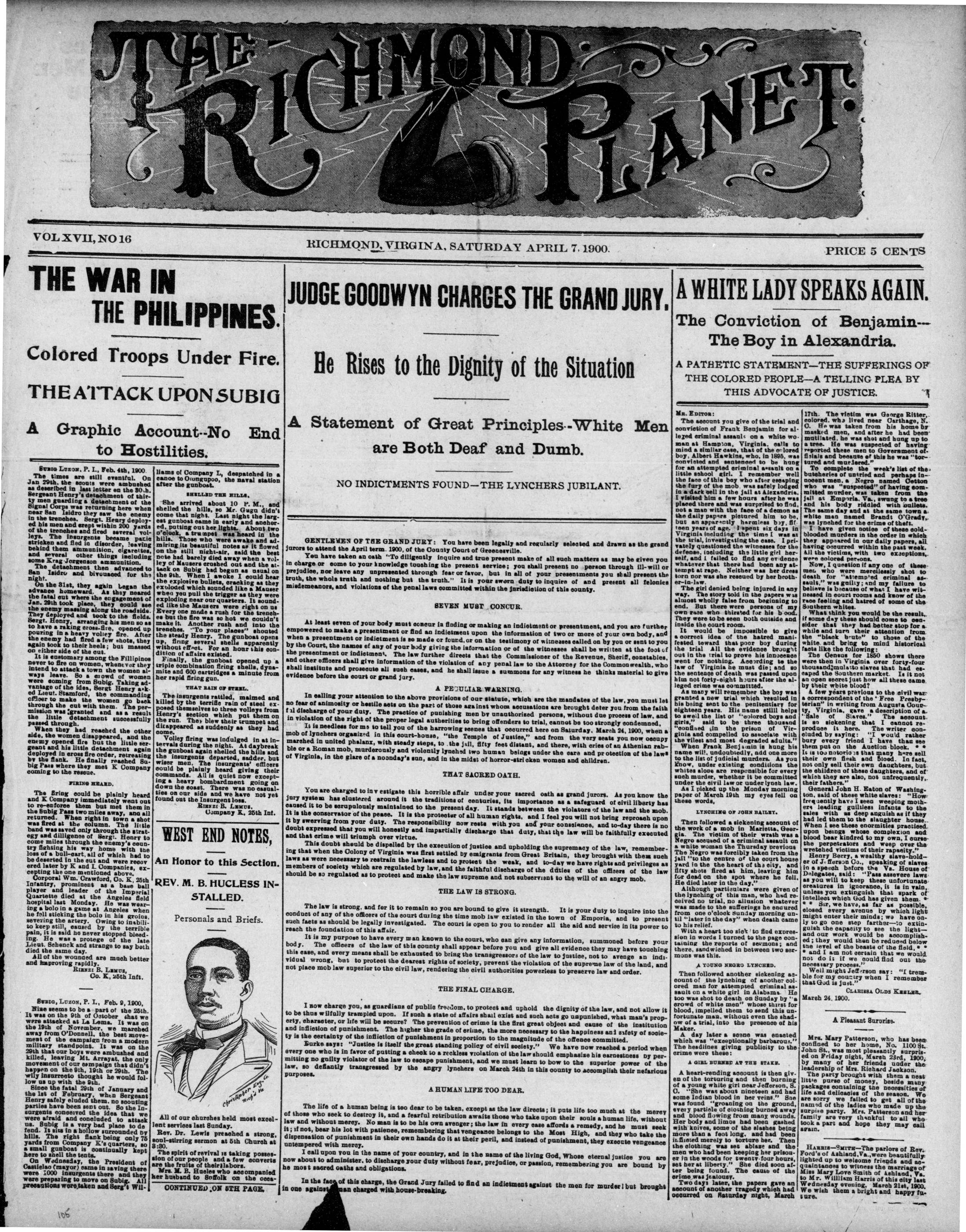
THE WAR IN THE PHILIPPINES.
THEATTACKUPONSUBIG
A Graphic Account--No End to Hostilities.
VOLXVII.NO16
THE WAR
THE P
Colored Troop
THE ATTACK
A Graphic Ac to Hos
SURGE LUZON, P. I., Feb. 4th, 1900.
The times are still eventful. On Jan 29th, the scouts were ambushed as described in last letter on the 80th. Sergeant Henry's detachment of thirty men guarding a detachment of the Signal Corps was returning here when near San Isidro they saw the enemy in the trenches. Sergt. Henry deployed his men and erupted within 200 of the trenches and fired several volleys. The insurgents became parricricken and fled in disorder, leaving behind them ammunition, cigarettes, and several other things including some Krag Jorgenson ammunition.
The detachment then advanced to San Isidro and bivouaced for the night.
On the 31st, they again began the advance homeward. As they neared the fatal cut where the engagement of Jan. 29th took place, they could see the enemy manship along the roadside. They deployed and took to the fields. Sergt. Henry, arranging his men so as to have a raking cross-fire, opened up during in a heavy volley fire. After the enemy had fired a few shots, they again tore their heels; but massed on either side of the cut.
It is customary among the Fillipinos never to fire on women, whenever they intend to attack a town the women always leave. So women were coming from Subig. Taking advantage of the idea, Sergt. Hertz ed Leit. Stamford, the commanding officer to make the women go back through the cut with them. The permission was granted and as a result the little detachment successfully passed through.
When they had reached the other side, the women disappeared, and the enemy opened fire but the little sergeant and his little detachment again deployed in cross fire order, retreating by the flank. He finally reached Subig Pass where they met K Company coming to the rescue.
FIRING HEARD:
The firing could be plainly heard and K Company immediately went out to re-enforce them but met them in the Subig Pass two miles away, and all returned. When right in town a shot was fired at the column. The little band was saved only through the strategy and diligence of Sergt. Henry to come miles through the enemy's country fighting his way home with the loss of a bull-cart, all of which had to be deserted in the cut and were rescued later by K and I Companies, excepting the one mentioned above. Corporal Wm. Crawford, Co. K, 25th Infantry, prominent as a base ball player and leader of the Imperial Quartette died at the Angeles field hospitals last Monday. He was wear-able, hold'd game at Angeles when he fell sticking the bolo in his groins, severing the same. Owing to insufficiency to keep still, caused by the terrible pain, it is said he never stopped bleeding. He was a protege of the late Lieut. Schenck and strange to say both died the same day. All of the wounded are much better and improving rapidly.
Co. K, 25th Inft.
SWBIG, LUZON, P. L., Feb. 2, 1900
BUSINESS, P. I., FEB. 9, 1900.
Nine seems to be a part of the 25th. It was on the 9th of October that we were attacked at La Lema. It was on the 19th of November, we marched away from O'Donnell, the best movement of the campaign from a modern military standpoint. It was on the 29th that our boys were ambushed and killed, leaving M. Arrayat, the only movement of our campaign that didn't happen on the 9th, 19th or 29th. The wily insurrector thought he would follow us up with the 9th.
Since the fatal 29th of January and the 1st of February, when Sergeant Henry safely eluded them, no squouting parties have been sent out. So the Insurgents conceived the idea that we were afraid and concluded to attack us. Subig is a very bad place to defend. It sits in a hollow surrounded by hills. The right flank being only 75 yards from Company K's quarters, a small gunboat is continually kept here to shell the tents.
On Wednesday, the President of Ostielao (mayor) came in saving there and they were preparing to move. Sara was preparing were taken and Sara's Will.
liams of Company L, despatched in a canoe to Ouungupoo, the naval station after the gunboat.
SHELLED THE FILLS.
She arrived about 10 P. M., and shelled the hills, so Mr. Gunn didn't come that night. Last night the largest gunboat came in early and anchored, putting out her lights. About two o'clock, a trumpet was heard in the hills. Those who were awake and admiring its beautiful notes as it flowed on the still night-air, said the best note had barely died away when a volley of Mausers crushed out and the attack on Subig had begun as usual on the 9th. When I awoke I could hear the explosive bullets, cracking as they exploded which sounded like a Mauser when you pull the trigger as they were exploding near our quarters. It sounded like the Mausers were right on us. Every one made a rush for the trenches but the fire was so hot we couldn't make it. Another rush and into the trenches. "To your places" shouted the steady Henry. The gunboat opens up, flinging several shells apparently without effect. For an hour this condition of affairs existed.
Finally, the gunboat opened up a triple combination firing shells, dynamites and 600 cartridges a minute from her rapid firing gun.
THAT RAIN OF STEEL
The insurgents rattled, maimed and killed by the terrific rain of steel exposed themselves to three volleys from Henry's section which put them on the run. They blew their trumpet and disappeared as suddenly as they had come.
Volley firing was indulged in at intervals during the night. At daybreak the gunboss again shelled the hills and the insurgents departed, sadder, but wiser men. The insurgents' officers could be plainly heard giving their commands. All is quiet now excepting a heavy bombardment going on down the coast. There was no casualties on our side and we have not yet found out the Insurgent loss.
RINZEN B. LEMUS.
Company K. 25th Int.
WEST END NOTES,
An Honor to this Section.
REV. M. B. HUCLESS IN-
STALLED.
Personals and Briefs.
All of our churches held most excellent services last Sunday.
Rev. Dr. Lewis preached a strong, soul-stirring sermon at 5th Church at 3:30.
The spirit of revival is taking possession of our people and a few converts are the fruits of their labors.
Mrs. M. B. Hueles who accompanied her husband to Suffolk on the oca-
an in finding or making an indictment or presentment, and you are further an indictment upon the information of two or more of your own body, and side or found, or on the testimony of witnesses called on by you or sent to you giving the information or of the witnesses shall be written at the foot of further directs that the Commissioner of the Revenue, Sheriff, constables, the violation of any penal law to the Attorney for the Commonwealth, who, and he shall issue a summons for any witness he thinks material to give own race wha They were to inside the co It would a correct id fested tow the trial A out in the tr went for no law of Virg the sentence him not forty
provisions of our statute, which are the mandates of the law, you must let part of those against whom accusations are brought deter you from the faith in punishing men by unauthorized persons, without due process of law, and authorities to bring offenders to trial, cannot be too strongly condemned, in harrowing scenes that occurred here on Saturday, March 24, 1900, when a case, "the Temple of Justice," and from the very seats you now occupy ups, to the jail, fifty feet distant, and there, with cries of an Athenian rabbitly lynched two human beings under the care and protection of the laws and in the midst of horror-striken women and children.
THAT SACRED OATH.
horrible affair under your sacred oath as grand jurors. As you know the traditions of centuries, its importance as a safeguard of civil liberty has the present day. It stands between the violators of the law and the mob. Protester of all human rights, and I feel you will not bring reproach upon insubstance now rests with you and your conscience, and to-day there is no impartially discharge that duty, that the law will be faithfully executed in execution of justice and upholding the supremacy of the law, rememberest settled by emigrants from Great Britain, they brought with them such passions and to protest the weak, and to-day we have rights and privileges as law, and the faithful discharge of the duties of the officers of the law like the law supreme and not subservient to the will of an angry mob.
THE LAW IS STRONG.
In so you are bound to give it strength. It is your duty to inquire into the bring the time mob law existed in the town of Emporia, and to present the court is open to you to render all the aid and service in its power to known to the court, who can give any information, summoned before your county shall appear before you and give all evidence they may have touching need to bring the transgressors of the law to justice, not to avenge an indignities of society, prevent the violation of the supreme law of the land, and rendering the civil authorities powerless to preserve law and order.
THE FINAL CHARGE.
Libile freedom, to protect and uphold the dignity of the law, and not allow it to a state of affairs shall exist and such acts go unpunished, what man's proprevention of crime is the first great object and cause of the institution the grade of erime, the more necessary to the happiness and safety of society in proportion to the magnitude of the offence committed.
At standing policy of civil society." We have now reached a period when to a reckless violation of the law should emphasize his earnestness by perplex punishment, and we must learn to bow to the superior power of the angry lynchers on March 24th in this county to accomplish their nefarious
As may well be granted a new his bising seas eighteen years to swell the said "sail" of conflict and ginia and the willet and whistle under the sails.
When Fear name will, un to the list of know, under whites alone, such murder, under the sails.
As I picked paper of Man these words,
Then follow the work of the gia. The vigor Negro accuse a white woman The Negro wail "jail" in the yard in the fifty shots for dead on He died later.
Although the lynching ceived no trac made to from one of the later in his relief. With a hea sion in wording the word, sand, mons was this A YOUR.
Then follow count of the creed man for sauls in a whit too was shot, erowd of whi blood, impel fortune to man ow of a trial, Maker.
A day last which was "The headline crime were to A GIRL BIRD.
A heart-ren en of the tor
to be taken, except as the law directs; it puts life too much at the mere real retribution awaits those who take upon their souls a human life, without its own avenger; the law in every case affords a remedy, and he must seek ordering that vengeance belongs to the Most High, and they who take the hands do it at their peril, and instead of punishment, they execute vengeance country, and in the name of the living God, Whose eternal justice you are duty without fear, prejudice, or passion, remembering you are bound by some Indian was found "every partial and blood for Her body and with knives, more than a it flushed merge the clothing men who had or in the wood at her lib
RICHMOND, VIRGINA, SATURDAY APRIL 7, 1900.
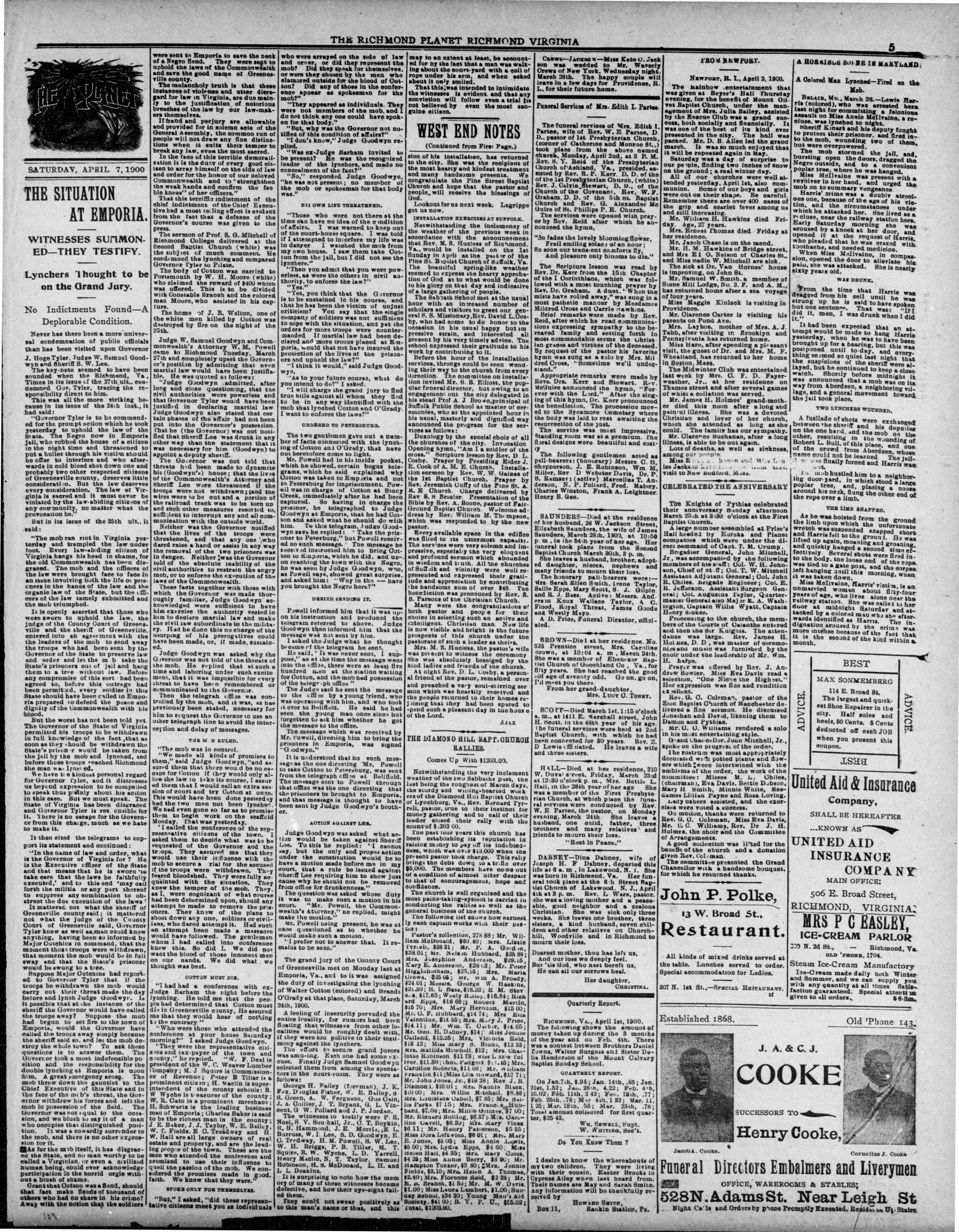
JUDGE GOODWYN CHARGES THE GRAND JURY.
He Rises to the Dignity of the Situation
A Statement of Great Principles-White Men are Both Deaf and Dumb.
NO INDICTMENTS FOUND—THE LYNCHERS JUBILANT
GENTLEWEN OF THE GRAND JURY: You have been legally and regularly selected and drawn as the grand jurors to attend the April term, 1900, of the County Court of Greengaville.
You have taken an oath "To diligently inquire and true present make of all such matters as may be given you in charge or come to your knowledge touching the present service; you shall present no person through ill-will or prejudice, nor leave any unpresented through fear or favor, but in all of your presentments you shall present the truth, the whols truth and nothing but the truth." It is your sworn duty to inquire of and present all felonies misdemeanors, and violations of the penal laws committed within the jurisdiction of this county.
SEVEN MUST CONCUR
At least seven of your body must concur in finding or making an indictment or presentment, and you are further empowered to make a presentment or find an indictment upon the information of two or more of your own body, and when a presentment or indictment is so made or found, or on the testimony of witnesses called on by you or sent to you by the Court, the names of any of your body giving the information or of the witnesses shall be written at the foot of the presentment or indictment. The law further directs that the Commissioner of the Revenue, Sheriff, constables, and other officers shall give information of the violation of any penal law to the Attorney for the Commonwealth, who shall institute and prosecute all such cases, and he shall issue a summons for any witness he thinks material to give evidence before the court or grand jury.
A PECULIAR WARNING.
In calling your attention to the above provisions of our statute, which are the mandates of the law, you must let no fear of animosity or hostile acts on the part of those against whom accusations are brought deter you from the faith fail discharge of your duty. The practice of punishing men by unauthorized persons, without due process of law, and in violation of the right of the proper legal authorities to bring offenders to trial, cannot be too strongly condemned.
It is needless for me to tell you of the harrowing scenes that occurred here on Saturday, March 24, 1900, when a mob of lynchers organized in this court-house, "the Temple of Justice," and from the very seats you now occupy marshed in united phalanx, with steady steps, to the jail, fifty feet distant, and there, with cries of an Athenian rabble or a Roman mob, murderously and violently lynched two human beings under the care and protection of the laws of Virginia, in the glare of a noonday's sun, and in the midst of horror-striken women and children.
THAT SACRED OATH:
You are charged to inv estigate this horrible affair under your sacred oath as grand jurors. As you know the jury system has clustered around it the traditions of centuries, its importance as a safeguard of civil liberty has caused it to be scrupulously maintained to the present day. It stands between the violators of the law and the mob. It is the conservator of the peace. It is the protector of all human rights, and I feel you will not bring reproach upon it by swerving from your duty. The responsibility now rests with you and your conscience, and to-day there is no doubt expressed that you will honestly and impartially discharge that duty, that the law will be faithfully executed and that crime will triumph over virtue.
This doubt should be dispelled by the execution of justice and upholding the supremacy of the law, remembering that when the Colony of Virginia was first settled by emigrants from Great Britain, they brought with them such laws as were necessary to restrain the lawless and to protect the weak, and to-day we have rights and privileges as members of society which are regulated by law, and the faithful discharge of the ditties of the officers of the law should be so regulated as to protect and make the law supreme and not subservient to the will of an angry mob.
THE LAW IS STRONG.
The law is strong, and for it to remain so you are bound to give it strength. It is your duty to inquire into the conduct of any of the officers of the court during the time mob law existed in the town of Emporia, and to present such facts as should be legally investigated. The court is open to you to render all the aid and service in its power to reach the foundation of this affair.
It is my purpose to have every man known to the court, who can give any information, summoned before your body. The officers of the law of this county shall appear before you and give all evidence they may have touching this case, and every means shall be exhausted to bring the transgressors of the law to justice, not to avenge an individual wrong, but to protect the dearest rights of society, prevent the violation of the supreme law of the land, and not place mob law superior to the civil law, rendering the civil authorities powerless to preserve law and order.
THE FINAL CHARGE
I now charge you, as guardians of public freedom, to protect and uphold the dignity of the law, and not allow it to be thus wilfully trampled upon. If such a state of affairs shall exist and such acts go unpunished, what man's property, character, or life will be secure? The prevention of crime is the first great object and cause of the institution and infliction of punishment. The higher the grade of crime, the more necessary to the happiness and safety of society is the certainty of the infliction of punishment in proportion to the magnitude of the offence committed.
Eurke says: "Justice is itself the great standing policy of civil society." We have now reached a period when every one who is in favor of putting a check to a reckless violation of the law should emphasize his earnestness by permitting no guilty violator of the law to escape punishment, and we must learn to bow to the superior power of the law, so defiantly transgressed by the angry lynchers on March 24th in this county to accomplish their nefarious purposes.
A HUMAN LIFE TOO DEAR.
The life of a human being is too dear to be taken, except as the law directs; it puts life too much at the mercy of those who seek to destroy it, and a fearful retribution awaits those who take upon their souls a human life, without law and without mercy. No man is to be his own angenger; the law in every case affords a remedy, and he must seek it; if not, bear his lot with patience, remembering that vengeance belongs to the Most High, and they who take the dispensation of punishment in their own hands do it at their peril, and instead of punishment, they execute vengeance untempered with mercy.
I call upon you in the name of your country, and in the name of the living God, Whose eternal justice you are now about to administer, to discharge your duty without fear, prejudice, or passion, remembering you are bound by he most sacred oaths and obligations.
In the face of this charge, the Grand Jury failed to find an indictment against the men for murder! but brought in one against a man charged with house-breaking.
A WHITE LADY SPEAKS AGAIN.
A PATHETIC STATEMENT—THE SUFFERINGS OF THE COLORED PEOPLE—A TELLING PLEA BY THIS ADVOCATE OF JUSTICE.
MR. EDITOR:
The account you give of the trial and conviction of Frank Benjamin for alleged criminal assault on a white woman at Hampon, Virginia, calls to mind a similar case, that of the colored boy, Albert Hawkins, who, in 1895, was convicted and sentenced to be hung for an attempted criminal assault on a little school girl. I remember well the face of this boy who after escaping the fury of the mob, was safely lodged in a dark cell in the jail at Alexandria. I visited him a few hours after he was placed there and was surprised to find, not a man with the face of a demon as the daily papers pictured him to be, but an apparently harmless boy, fifteen years of age. I spent six days in Virginia (including the time I was at the trial, investigating the case). I privately questioned the witnesses for the defense, including the little girl herself, and I failed to find any evidence whatever that there had been any attempt at rape. Neither was her dress torn nor was she rescued by her brother-in-law.
The girl denied being injured in any way. The story told in the paper was almost wholly false from beginning to end. But there were persons of my own race who thirasted for his blood. They were to be seen both outside and inside the court room.
It would be impossible to give a correct idea of the hatred manifested toward that poor boy during the trial. All the evidence brought out in the trial to prove his innocence went for nothing. According to the law of Virginia he must die; and so the sentence of death was passed upon him not forty-eight hours after the alleged crime was committed.
As many will remember the boy was granted a new trial which resulted in his being sent to the penitentiary for eighteen years. His name still helps to swell the list of "colored boys and girls," said to be three thousand "confused in the prison of Virginia and compelled to associate with the vilest and most degraded adults."
When Frank Benjamin is hung his name will, undoubtedly, add one more to the list of judicial murders. As you know, under existing conditions the whites alone are responsible for every such murder, whether it be committed under the civil law or under lynch law. As I picked up the Monday morning paper of March 19th my eyes fell on these words.
LYNCHING OF JOHN BAILEY.
Then followed a sickening account of the work of a mob in Marietta, Georgia. The victim of their wrath was a Negro accused of a criminal assault on a white woman the Thursday previous. The Negro was forcibly taken from the jail "to the centre of the court house yard in the heart of the city, and fifty shots fired at him, leaving him for dead on the spot where he fell. He died later in the day." Although particulars were given of the lynching of this man, who had received no trial, no allusion whatever was made to the sufferings he endured to shock Sunday morning until "later in the day" when death came to his relief. With a heart too sick to find expression in words I turned to the page containing the reports of sermons; and there, sandwiched in between two sermons was this.
A YOUNG NEGRO LYNCHED.
Then followed another sickening account of the lynching of another colored man for attempted criminal assault on a white girl in Alabama. He too was shot to death on Sunday by a crowd of white men" whose thirst for blood, impelled them to send this unfortunate man, without even the shadow of a trial, into the presence of his Maker.
A day later a scene was enacted which was "exceptionally barbarous." The headlines giving publicity to the crime were these:
A GIRL BURNER AT THE STAKE.
A heart-rending account is then given of the torturing and then burning of a young white girl near Jefferson, S. C. "She was about nineteen and had some Indian blood in her veins." She was found "groaning on the ground, every particle of clothing burned away and blood flowing from many wounds. Her body and limus had been gashed with knives, some of the slashes being more than a foot long, and had been inflicted merely to torture her. Then the clothing was seen ablaze and the man was killed. She was murdered in the woods for twenty-four hours set her at liberty." She died soon after being found. The cause of the crime was jealousy.
Two days later, the papers gave an account of another tragedy which had occurred on Saturday night. March
PRICE 5 CENTS
SPEAKS AGAIN.
of Benjamin---
Alexandria.
NT—THE SUFFERINGS OF
E—A TELLING PLEA BY
TE OF JUSTICE.
17th. The victim was George Ritter, colored, who lived near Carthage, N. C. He was taken from his home by masked men, and after he had been mutilated, he was shot and hung up to a tree. He was suspected of having reported these men to Government officials and because of this he was "tortured and murdered."
To complete the week's list of the butcheries of untried and perhaps innocent men, a Negro named Cotton who was "suspected" of having committed murder, was taken from the jail at Empiria, Va., swung to a tree and his body riddled with bullets. The man named at the same town a white man named Browder O'Grady, was lynched for the crime of that.
I have given notice of these cold-blooded murders in the order in which they appeared in our daily papers, all having occurred within the past week. All the victims, with two exceptions, were colored persons.
Now, I question if any one of these men, who were mercilessly shot to death for "attempted criminal assaults," was guilty; and my failure to believe is because of what I have witnessed in court rooms and know of the race feeling and hare of some of the Southern whites.
What think you would be the result, if some day these should come to consider that they had better stop for a whirl and turn their attention from the "thief" to those of the white and being to mind historical facts like the following.
The Census for 1880 shows there were then in Virginia over forty-four thousand and imbuita to slaves that had escaped the Southern market. Is it not an open secret just how all these came by their white blood?
A few years previous to the civil war a correspondent of the "Free Presbyterian" in writing from Augusta County, Virginia, gave a description of a "Sale of Slaves." The account is so sickening that I cannot reproduce it here. The writer concluded by saying: "I would rather bury evey friend I have than see them put on the Auction block. * It is too notorious that many have sell their own flesh and blood. In fact, not only sell their own daughters, but the children of these daughters, and of which they are also, not unfrequently, the children of the slaves. General John H. Eaton of Washington, said of these white slaves: "How frequently have I seen weeping mothers leading guilfies infants to the sales with as deep anguish as if they had led them to the slaughter house. When I see these enormities practiced upon beings whose complexion and blood bear kindred to my own, I curse the perpetrators and weep over the wretched victims of their rapacity."
Henry Berry, a wealthy slave-holder of J. Jefferson Co., speaking of slaves in a speech before the Va. House of Delegates, said: "Pass asserevere laws as you will to keep these unfortunate creatures in ignorance, it is in vain, unless you extinguish that spark of intellect which God has given them. * * Sir, we have, as far as possible, closed every avenue by which light might enter their minds; we have only to go one step farther—to extinguish the capacity to see the light—and our work would be accomplished; they would then be reduced below the level of the beasts of the field, * * and I am not certain that we would not do it; we could find out the necessary process."
Well might Jefferson say: "I tremble for my country when I remember that God is just."
CLARISSA OLD'S KEELER.
March 24 1800.
A Pleasant Surprise
Mrs. Mary Patterson, who has been confined to her home, No. 1100 St. John St., was most pleasantly surprised on Friday night, Marsh 23rd, 1900; by many of her friends under the leadership of Mrs. Richard Jackson. The party brought with them a neat little purse of money, beside many packages containing the necessities of life and delicacies of the season. We are sorry we failed to get all of the namd of the ladies who made up the surprise party. Mrs. Patterson and her family are very thankful to all who took a part and hope they may call aan.
HARRIS-SMITH—The parlors of Rev. Food's of Ashland, Va., were beautifully lighted up to welcome friends and acquaintances to witness the marriage of Miss Mary Love Smith of Ashland, Va. to Mr. William Harris of this city last Wednesday evening. March 21st, 1900. We wish them a bright and happy future.
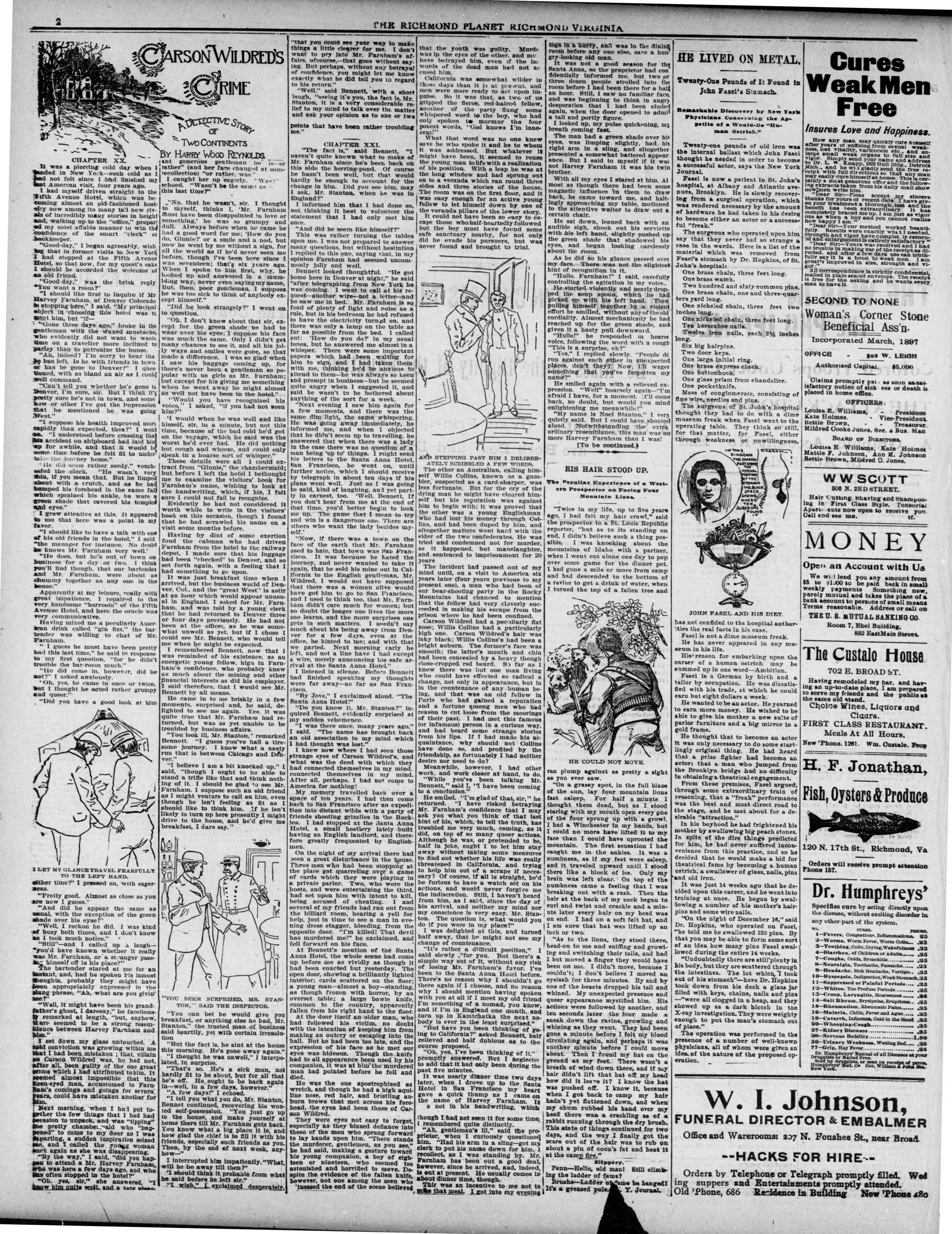
CARSON WILDRED'S
CRIME
A DETECTIVE STORY
OF
TWO CONTINENTS
BY HARRY WOOD REYNOLDS
2
It was a pleasing cold day when I landed in New York—such cold as I had not felt since I had finished my last American visit, four years ago.
I had myself driven straight to the Fifth Avenue Hotel, which was becoming almost an old-fashioned hostelry now among its many tall new rivals of incredibly many stories in height and, walking up to the "office," prepared my most affable manner to win the confidence of the smart "clerk" or housekeeper.
"Good day," I began agreeably, wishing that in former visits to New York I had stopped at the Fifth Avenue Hotel, so that now, for my guest's sake I should be accorded the welcome of an old friend.
"Good day," was the brisk reply "You want a room."
"I should like first to inquire if Mr Harvey Farnham, of Denver Colorado is stopping here," I said. "My principal object in choosing this hotel was to meet him, but "it—"Gone three days ago," broke in the gentleman with the waxed mustache who evidently did not want to waste time on a traveller more incline to parley than to patronize the house.
"Ah, indeed? I'm sorry to hear that he has left. Is he with friends in town or has he gone to Denver?" I questioned, with as bland an air as I could well command.
"Can't tell you whether he's gone to Denver, I'm sure, sir. But I think it's pretty sure he's not in town, and some how or other I've got the impression that he mentioned he was going West."
"I suppose his health improved more rapidly than expected, thea?" I went on. "I understood before crossing that his accident on shipboard had laid him up for awhile, and that it would be some time before he felt fit to undertake the journey home."
"He did seem rather seedy," vouch-sated the clerk. "He wasn't very thin, if you mean that. But he lumped about with a crutch, and as he had bumped his forehead in the same fall which sprained his ankle, he wore a green shade that covered his temples and eyes."
"I grew attentive at this. It appeared to me that here was a point in my favor.
"I should like to have a talk with one of his old friends in the hotel," I said "the manager for instance. No doubt he knows Mr. Farnham very well."
"He does, but he's out of town on business for a day or two. I think you'll find though, that our bartender and Mr. Farnham, were about as chummy together as any one in the house."
Apparently at my leisure, really with great impatience, I repaired to the very handsome "barroin" of the Fifth Avenue Hotel, and here the oracle was very communicative.
Having mixed me a peculiarly American drink called "gin fizz," the barbender was willing to chat of Mr. Farnham.
"I guess he must have been pretty bad this last time," he said in response to my first question, "for he didn't trouble the bar-room much."
"He did come in, however, did he not?" I asked anxiously.
"Oh, yes, he came in once or twice, but I thought he acted rather grumpy and queer."
"Did you have a good look at him
I LET MY GLANCE TRAVEL FEARFULLY
TO THE LEFT HAND.
either time?" I pressed on, with eagerness.
"Pretty good. Almost as close as you are now. I guess."
"And did he appear the same as usual, with the exception of the green shade over his eyes?"
"Well, I reckon he did. I was kind of busy both times, and I don't know as I took much notice."
"Still"—and I called up a laugh—"you'd have known whether it really was Mr. Farnham, or a st-anger pass- himself off in his place?"
The bartender stared at me for an instant, and, had he spoken his innest thoughts, probably they might have been appropriately expressed in the plang phrase, "Ah, what are you givin' me?"
"Well, it might have been his grandfather's ghost, I daresay," he facetiously remarked at length, "but, anyhow, there seemed to be a strong resemblance between Harvey Farnham and him."
I set down my glass untouched. A cold conviction was growing within me that I had been mistaken; that, villain as Carson Wildred was, he had not, after all, been guilty of the one great crime which I had attributed to him. It seemed almost impossible that this keen-eyed man, accustomed to Farnham's comings and goings for several years, could have mistaken another for him.
Next morning, when I had put together the few things that I had had occasion to unpack, and was "tipping" the pretty chambé, said who "happened to come to my door as I was departing, and the inspiration seized me, and I called the young woman again as she was disappearing.
"By the way," I said, "do you happen to attend a Harvey Farnham, who was here a few days ago, and who often stopped in the hotel!"
"Oh, yes, sir," she answered, "I know him unite well, and a very well-
ant generous gentleman he is—or rather" (and her face changed at some collection) "or rather, was."
I caught her up eager. "Was? rehoed. "Wasn't he the same as this last time?"
"No, that he wasn't, sir. I thought to myself, thinks I. 'Mr. Farnham must have been disappointed in love or something,' he was so grumpy and dull. Always before when he came he had a good word for me; How do you do, Glinnie? or a smile and a nod, but now he went by me without a sign, for all the world as if he'd never seen me before, though I've been here since I was seventeen; that six years ago. When I spoke to him first, why, he looked up and answered in a mumbling way, never even saying my name, But, then, poor gentleman, I suppose he was too sick to think of anybody except himself."
"Did he look strangely?" I went on to question.
"Oh. I don't know about that sir, except for the green shade he had to wear over his eyes; I suppose his face was much the same. Only I didn't get many chances to see it, and all his jolly ways and smiles were gone, so that made a difference. I was so glad when I saw his baggage coming up, for there's never been a gentleman so popular with us girls as Mr. Farnham; but except for his giving me something when he went away he might almost as well not have been in the hotel." "Wow. I you have recognized his voice." I asked, "if you had not seen him?" "I would when he was well and like hisself, sir, in a minute, but not this time, because of the bad cold he'd got on the voyage, which he said was the worst he'd ever had. He did nothing but cough and wheeze, and could only speak in a hoarse sort of whisper."
These details were all I could extract from "Glinnie," the chambermaid; but before I left the hotel I bethought me to examine the visitors' book for Farnham's name, wishing to look at the handwriting, which, if his, I felt sure I could not fall to recognize.
Evidently he had not considered it wished to write in the visitors' book on this book, though I found that he had scrawled his name on a visit some months before.
Having by dint of some exertion found the cabman who had driven Farnham from the hotel to the railway depot, I made sure that his luggage had been "checked" to Denver, and so set forth again, with a feeling that I had something to go upon.
It was just breakfast time when I arrived, but the business world of Denver, Col., and the "great West" is astir at an hour which would appear unusual in England. I asked for Mr. Farnham, and was told by a young clerk that he had returned to Denver three or four days previously. He had not been at the offices, as he was somewhat unwell as yet, but if I chose I could see Mr. Bennett, who would tell me when he might be expected.
I remembered Bennett, now that I was reminded of his existence, as an energetic young fellow, hige in Farnham's confidence, who probably knew as much about the mining and other financial interests as did his employer. I said therefore, that I would see Mr. Bennett by all means.
He came in to me briskly in a few moments, surprised and, he said, delighted to see me again. Yes, it was quite true that Mr. Farnham had returned, but was as yet unable to be troubled by business affairs.
"You look ill, Mr. Stanton," remarked Bennett. "I guess you've had a tiresome journey. I know what a nasty run that is between Chicago and Denver."
"I believe I am a bit knocked up." I said, "though I ought to be able to stand a trifle like that and think nothing of it. I should be glad" to see Mr. Farnham. I suppose such an old friend as I might venture to call on him, even though he isn't feeling as fit as I should like to think him. If he isn't likely to turn up here presently I might drive to the house, and he'd give me breakfast, I dare say."
"YOU SEEM SURPRISED, MR. STAN
TON." SAID THE INSPECTOR.
"You can bet he would give you breakfast, or anything else he had, Mr. Stanton," the trusted man of business said heartily, yet with certain irresolution
"But the fact is, he aint at the house this morning. He's gone away again."
"I thought he was unwell," I interpolated, in surprise.
"That's so. He's a sick man, not hardly fit to be about, but for all that he's off. He ought to be back again in—well, in a few days, however."
"A few days," I echoed.
"I tell you what you do, Mr. Stanton, Bennett continued, recovering his wonted self-possession. "You just get up to the house, and make yourself home there till Mr. Farnham gets back. You know what a big place it is, and how glad the chief is to fill it with his friends, especially such friends as you. Then, by the end of next week, anyhow-"
THE RICHMOND PLANET RICHMOND VIRGINIA
"that you could see your way to make things a little clearer for me. I don't want to pry into Mr. Farnham's affairs, of course,—that goes without saying. But perhaps, without any betrayal of confidence, you might let me know exactly what he did tell you in regard to his return."
"Well," said Bennett, with a short laugh, "seeing it's you, the fact is, Mr. Stanton, it is a very considerable relief to my mind to talk over the matter and ask your opinion as to one or two
points that have been rather troubling me."
CHAPTER XXI.
"The fact is," said Bennett, "I haven't quite known what to make of Mr. Farnham since he's been back on this side the herring-pond. Of course he hasn't been well, but that would hardly be enough to account for the change in him. Did you see him, may I ask, Mr. Stanton, when he was in England?" I informed him that I had done so, not thinking it best to volunteer the statement that I had only met him once.
"And did he seem like himself?" This was rather turning the tables upon me. I was not prepared to answer many questions, but without hesitation I came up with a saying that, in my opinion Farnham seemed uncommon jolly and well.
Bennett looked thoughtful. "He got home here in Denver at night," he said "after telegraphing from New York he was coming. I went to call at his request—another wire—not a letter—and he saw me in bed. M. Farnham is so fond of plenty of light and noise as a rule, but in his bedroom he had refused to have the electricity turned on, and there was only a lamp on the table as far as possible from the bed. I called out: 'How do you do?' in my usual tones, but he answered me almost in a whisper. There were some important papers which had been waiting for him to sign, and I had taken them with me, thinking he'd be anxious to attend to them—he was always so keen and prompt in business—but he seemed quite angry when I suggested it, and said he wasn't to be bothered about anything of the sort for a week.
"Next evening I saw him again for a few moments, and there was the same dim light, the same whispering. He was going away immediately, he informed me, and when I objected that he didn't seem up to travelling, he answered that when there was a lady in the case there was no question of a man being 'up to' things. I might send his letters to the Santa Anna Hotel, San Francisco, he went on, until further notice, which I should receive by telegraph in about ten days if his plans went well. Just as I was going he said, kind of laughing, and yet partly in earnest, too. 'Well, Bennett, If you don't hear from me at the end of that time, you'd better begin to look me up. The game that I mean to try and win is a dangerous one. There are others who want the lady besides myself.'
"Now, if there was a town on the face of the earth that Mr. Farnham used to hate, that town was San Francisco. It was because he hated the journey, and never wanted to take it again, that he sold his mine out in California to the English gentleman, Mr. Wildred. I would not have supposed that there was a woman alive would have got him to go to San Francisco, and I used to think too, that Mr. Farnham didn't care much for women; but no doubt the longer one the more one learns, and the more surprises one gets in such matters. I needn't say much about his being away from Denver for a few days, even at the office, he hinted to me; and with that we parted. Next morning early he left, and not a line have I had except a wire, merely announcing his safe arrival at the Santa Anna Hotel."
I listened in silence. Before Bennett had finished speaking my thoughts were far away—as far as San Francisco.
"By Jove," I exclaimed aloud. "The Santa Anna Hotel."
"Do you know it, Mr. Stanton?" inquired Bennett, evidently surprised at my sudden vehemence.
"I was there once, many years ago," I said. "The name has brought back an old association to my mind which I had thought was lost."
I knew now where I had seen those strange eyes of Carson Wildred's, and what was the deed with which they had connected themselves in my mind. After all, perhaps, I had not come to America for nothing!
My memory travelled back over a space of ten years. I had then come back to San Francisco after an expedition into distant wilds with a party of friends shooting grizzlies in the Rockies. I had stopped at the Santa Anna Hotel, a small hostelry lately-built having an English landlord, and therefore greatly frequented by Englishmen.
On the night of my arrival there had been a great disturbance in the house. Three men who had been stopping at the place got quarrelling over a game of cards which they were playing in a private parlor. Two, who were the hosts, and were entertaining the third, had set upon him with intent to kill, being accused of cheating. I and several of my friends had run out from the billard room, hearing a yell for help, just in time to see a man in evening dress stagger, bleeding, from the opposite door. "I'm killed! That devil has murdered me!" he exclaimed, and fell forward on his face.
At Bennett's mention of the Santa Anna Hotel, the whole scene had come up before me as vividly as though it had been enacted but yesterday. The open door, showing a brilliantly lighted interior; cards scattered on the floor; a young man—almost a boy—standing, with his hands on his knees, overset table; a large bowie knife, common to the country, apparently fallen from his right hand to the floor.
At the door itself an older man, who had followed his victim, no doubt with the intention of keeping him from making an outcry or escaping into the hall. But he had been too late, and the expression of his face as he met our eyes was hideous. Though the knife had to all appearance been used by his companion, it was at him the murdered man had pointed before he fell and dislodged. He was the one apostrophized as wretch, and though he had a high aquiline nose, red hair, and bristling auburn brows that met across his forehead, the eyes had been those of Carson Wildred.
They were eyes not easy to forget, especially as they blazed defiance into those of the men who sprang forward to lay hands upon him. "There stands the murderer, gentlemen, as you see," he had said, making a gesture toward his young companion, a boy of eighteen or nineteen, who seemed too astonished and horrified to move. Despite the evidence of the fallen knife, however, not one among the men who "tussed the end of the scene believed
that the youth was guilty. Murde was in the eyes of the other, and mu have betrayed him, even if the la words of the dead man had not acused him. California was somewhat wilder in those days than it is at present, and men were more ready to act upon impulse. So it was that, as two of us gripped the fierce, red-haired fellow, another of the party flung some whispered word to the boy, who had only spoken to murmur the four potent words, "God knows I'm innocent!"
What that word was no one knew save he who spoke it and he to whom it was addressed. But whatever it might have been, it seemed to rouse the young man to life with a realization of his position. With a leap he was at the long window and had sprung out on to a veranda which ran round three sides and three stories of the house. The room was on the first floor, and it was easy enough for an active young friend to get himself down by one of the veranda doors of the lower story. It could not have been, but the cape those who half-heartedly followed, but the boy must have found some safe sanctuary nearby, for not only did he evade his pursuers, but was never found and brought to trial.
A
AND STEPPING PAST HIM I DELIBERATELY SCREWED A PRINT
ATELY SCRIBBLED A Few WORDS. The other an Australian, calling himself Willis Collins, known as a gambler, suspected as a card-sharper, was less fortunate. But for the cry of the ding man he might have cleared himself from reputation was against him to begin with; it was proved that the other was a good fellow. The man who had lost his money through Collins, and had been duped by him, and altogether matters went hard with the elder of the two confederates. He was tried and condemned not for murder, as it happened, but mauslaughter, and sentenced to imprisonment for 20 years
The incident had passed out of my mind until, on a visit to America six years later (four years previous to my present one), a man who had been of our bear-shooting party in the Rocky Mountains had chanced to mention that the fellow had very cleverly succeeded in making his escape from the prison where he had been confined.
Carson Wildred had a peculiarly flat nose; Willis Collins had a particularly high one. Carson Wildred's hair was inky black; Willis Collins's had been a bright auburn. The former's face was smooth; the latter's mouth and chin had been concealed by a heavy though close-cropped red beard. So far as I knew there was but one man living who could have effected so radical a change, not only in appearance, but in the countenance of any human being, and that was an old fellow in Paris who had gained a reputation and a fortune among men who had reason to cut loose from the moorings of their past. I had met this famous (or infamous) person in a curious way, and had heard some strange stories from his lips. If I had made his acquaintance, why should not Collins have done so, and profited by the friendship, as fortunately I had neither desire nor need to do?
Meanwhile, however, I had other work, and work closer at hand, to do. "While you've been talking Mr. Bennett," said I, "I have been coming to a conclusion."
He smiled. "I'm glad of that, sir," he returned. "I have risked betraying Mr. Farnham's confidence that I may ask you what you think of that last hint of his, which, to tell the truth, has troubled me very much, coming, as it did, on top of so many queer actions. Although he was, or pretended to be, himself, ours, to let him stay away with making some measures to find out whether his life was really threatened in California, and if trying to help him out of a scrape, if necessary? Of course, if all is straight, he be curious to have a watch set on his actions, and would never forgive me the indiscretion. Still, I haven't heard from him, as I said, since the day of his arrival, and neither my mind nor my conscience is very easy. Mr. Stanton. The question is, what would you do if you were in my place?"
I was delighted at this, and turned half away, that he might not see my change of countenance.
"It's rather a difficult position," I said slowly, "for you. But there's a simple way out of it, without any risk of losing Mr. Farnham's favor. I've been to the Santa Anna Hotel before. There's no reason why I shouldn't go there again if I choose, and no reason why I should mention having spoken with you at all if I meet my old friend I'm something of a nomad, you know, and if I'm in England one month, and turn up in Kamchatka the next nobody is ever in the least surprised."
"But have you been thinking of going to California?" asked Bennett, half relieved and half dublous as to the course proposed.
"Oh, yes, I've been thinking of it," promptly answered. But I neglected to add that it had only been during the past five minutes.
It was nearly dinner time two days later, when I drove up to the Santa Hotel in San Francisco my heart gave a quick thump as I came on the name of Harvey Farnham. It is not in his handwriting, which though I had not seen it for some time, I remembered quite distinctly.
"Ah, gentleman's ill," said the proprietor, when I curiously questioned him. "Had his arm in a sling—got my clerk to put his name down for him. I recollect, as I was standing by. Mr. Farnham has been out a good deal, however, since he arrived, aud, indeed, is out at present. He usually comes in about dinner time, though. This is an incentive to me not to miss that meal. I got into my evening
dogs in a hurry, and was in the dining room before any one else, save a hungry-looking old man.
It was not a good season for the Santa Anna, so the proprietor had confidentially informed me, but two or three dozen people strolled into the room before I had been there for a half an hour. Still, I saw no familiar face and was beginning to think in angry desperation that I had been eluded again, when the door opened to admit a tall and portly figure.
I looked up, my pulse quickening, my breath coming fast.
The man had a green shade over his eyes, was limping slightly, had his right arm in a sling, and altogether presented a somewhat battered appear. But I said to myself if it was not Harvey Farnham it was his twin brother.
With all my eyes I stared at him. Al most as though there had been some magnetic influence in them to draw back, he came toward me, and halkingly approaching my table, motioned to the attentive waiter to draw out a certain chair.
He sat down, leaned back with an audible sigh, shook out his serviette with his left hand, slightly pushed up the green shade that shadowed his eyes, and began looking carelessly about the room.
As he did so his glance passed over my face. There was not the slightest hint of recognition in it.
"Hullo, Farnham!" I said, carefully controlling the agitation in my voice.
He started violently and nearly dropped the soup spoon, which he had picked up with his left hand. Then pulling himself together by a violent effort he smiled, without any of the old city. Almost mechanically he had reached. For the green shade, and given it a harsh pull downward.
"Hullo," he responded in hoarse voice, following the word with a cough "This is a surprise, ch?"
"Yes," I replied slowly. "People d run against each other in unexpected places, don't they? Now, I'll waget something that you've forgotten my name?"
He smiled again with a relieved expression. "Well" hoarsely again—"I'm afraid I have, for a moment. I'll come back, no doubt, but would you mind enlightening me meanwhile?" "My name is Noel Stanton." I very quietly said. But I could have shouted aloud. Notwithstanding the extra ordinary resemblance, this man was no more Harvey Farnham than I was!
HIS HAIR STOOD UP
The Peculiar Experience of a Western Prospector on Facing Four Mountain Lions.
"Twice in my life, up to five years ago, I had felt my hair crawl," said the prospector to a St. Louis Republic reporter, "but as to its standing on end, I didn't believe such a thing possible. I was knocking about the mountains of Idaho with a partner, when I went out alone one day to pop over some game for the dinner pot. I had gone a mile or more from camp and had descended to the bottom of a ravine to get a drink of water, when I turned the top of a fallen tree and
HE COULD NOT MOVE.
ran plump against as pretty a sight as you ever saw.
"On a grassy spot, in the full blaze of the sun, lay four mountain lions fast asleep. For half a minute I thought them dead, but as I stood staring with my mouth open every one of the four sprang up with a growl. I had a Winchester in my hands, but I could no more have lifted it to my face than I could have uprooted the mountain. The first sensation I had caught me in the ankles. It was a numbness, as if my feet were asleep, and it traveled upward until I stood there like a block of ice. Only my brain was left clear. On top of the numbness came a feeling that I was breaking out with a rash. Then the hair at the back of my neck began to curl and twist and crackle and a minute later every hair on my head was on end. I had on a soft felt hat, and I am sure that hat was lifted up an inch or two.
"As to the lions, they stood there, head-on to me and sniffing and growling and switching their tails, and had I but moved a finger they would have been on me. I didn't move, because I couldn't; I don't believe I moved an eyelash for three minutes. By and by one of the beasts dropped his tail and whined. My unexpected presence and queer appearance mystified him. His actions were followed by another, and ten seconds later the four made a anek down the ravine, growling and whining as they went. They had been gone a minute before I felt my blood circulating again, and perhaps it was another minute before I could move about. Then I found my hat on the ground at my feet. There wasn't a breath of wind down there, and if my hair didn't lift that hat off my head how did it leave it? I know the hat was pushed off. I know it, because when I got back to camp my hair hadn't yet flattened down, and when my chum rubbed his hand over my head there was a crackling as of a rabbit running through the dry brush. This state of things continued for two days, and the way I finally got the scare out of the hair was to rub on about a pin of coon's fat and heat it at the camp fire."
Penn--Hello, old man! Still climbing the ladder of fame?
Brusha—Ladder of fame be hanged!
11's a greased polee. X. Y. Journal.
Twenty-One Pounds of It Found in John Fasel's Stomach
Remarkable Discovery by New York Physicians Concerning the Appetite of a Would-be "Human Ostrich."
Twenty-one pounds of old iron was the internal ballast which John Fasch thought he needed in order to become a successful actor, says the New York Journal.
Fasel is now a patient in St. John's hospital, at Albany and Atlantic avenues, Brooklyn. He is slowly recovering from a surgical operation, which was rendered necessary by the amount of hardware he had taken in his desire to become either an actor or a successful "freak."
The surgeons who operated upon him say that they never had so strange a case in the wards. Here is a list of the material which was removed from Fasel's stomach by Dr. Hopkins, of St. John's hospital:
One brass chain, three feet long.
One brass watch.
Two hundred and sixty common pins.
One brass chain, one and three-quarters yard long.
One nickelled chain, three feet two inches long.
One nickelled chain, three feet long.
Teen horsehoe nails.
Twelve iron nails, each $2\frac{1}{2}$ inches long.
One large initial ring.
One glass prism from chandelier.
One pocketknife.
Mass of conglomerate, consisting of fine wire, needles and pins.
The surgeons of St. John's hospital thought they had to do with a dime museum freak when Fasel went to the operating table. They think so still, for that matter, for Fasel, either through weakness or unwillingness.
IN THIS DIAGRAM
THE SHAPE
AND SIZE
THE
RECORDING
POSITION
OF THE
BROOKING
THE BLACK
SPACE
THERE
IS A
JUROR'S FOUND
17
has not confided to the hospital authorities the real facts in his case. Fasel is not a dime museum freak. He has never appeared in any museum in his life. His reason for embarking upon the career of a human ostrich may be summed up in one word—Ambition. Fasel is a German by birth and a tailor by occupation. He was dissatisfied with his trade, at which he could earn but eight dollars a week. He wanted to be an actor. He yearned to earn more money. He wished to be able to give his mother a new suite of parlor furniture and a big mirror in a gold frame. He thought that to become an actor it was only necessary to do some startlingly original thing. He had heard that a prize fighter had become an actor; that a man who jumped from the Brooklyn bridge had no difficulty in obtaining a theatrical engagement.
From these premises, Fasel argued, through some extraordinary train of reasoning, that a "freak" performance was the best and most direct road to the stage, and he cast about for a desirable "attraction."
In his boyhood he had frightened his mother by swallowing big peach stones. In spite of the dire things predicted for him, he had never suffered inconvenience from this practice, and so he decided that he would make a bid for theatrical fame by becoming a human ostrich, a swallower of glass, nails, pins and old iron.
It was just 14 weeks ago that he decided upon this career, and he went into training at once. He began by swallowing a number of his mother's hairpins and some wire nails.
"On the night of December 16," said Dr. Hopkins, who operated on Fasel, "he told me he swallowed 320 pins. By that you may be able to form some sort of an idea how many pins Fasel swallowed during the entire 14 weeks.
"Undoubtedly there are stillplenty in his body, but they are scattered through the intestines. The lot which I took out of his stomach"—here Dr. Hopkins took down from his desk a glass jar filled with keys, chains, nails and pins—"were all clogged in a heap, and they showed up as a dark blotch in the X-ray investigation. They were weighty enough to put the man's stomach out of place."
The operation was performed in the presence of a number of well-known physicians, all of whom were given an idea of the nature of the proposed operation.
W. I. Johnson, FUNERAL DIRECTOR & EMBALMER Office and Warerooms: 207 N. Foushee St., near Broad.
--HACKS FOR HIRE--
Orders by Telephone or Telegraph promptly filled. Wed ing suppers and Entertainments promptly attended. Old 'Phone, 686 Residence in Building New 'Phone 480
Two door keys.
Cures WeakMen Free
Insures Love and Happiness.
How any man may quickly cure himself after years of suffering from sexual weakness, small warts, varicose etc., and large small warts, varicose etc., and vigor. Simply send your name and address to Knap, 1822 Hull Bldg, Detroit Mich., and send the free receipt with full directions so that it may easily cure himself at home. This is certainly generous offer and the following extracts taken from his daily mail show nowmen write him "Mr. -Pieces accept my sincere thanks for your treatment. I have given your treatment a thorough benefit has been extraordinary. It has as when I have traced me up, I am just as vigorous as when I buy and you cannot realize how happy I am.
"Dear Sir--Your method worked beautifully, results were exactly what I needed. Strong teamwork was complete, by returnal and enlargement to the factory. "Dear Sir--Yours was received as a no trouble in making use of the receipt as directed, and after a few days use can truthfully it is a boon to weak men. I am greatly improved in size, strength and vigor."
All correspondence is strictly confidential, made in plain sealed envelope. The receipt is free for the asking and he wants every man to have it.
SECOND TO NONE
Woman's Corner Stone Beneficial Ass'n.
Incovorated March, 1897
OFFICE - 502 W. LEIGH
Authorized Capital. $5,000
Claims promptly pai as soon as as-satisfactory notice of sickness or death is placed in home office.
OFFICERS:
Louisa E. Williams, - Presidents
Kate Holmes. - Vice-President
Bettie Brown. - Treasurer.
Mildred Cooke Jones. See - Bus. Man.
Louisa E. Williams, Kate Holmes
Mattie F. Johnson, Ann M. Johnson
Bettie Brown, Mildred C. Jones
Hair Cutting, Shaving and Shampooing in First Class Style. Tonsorial Apartments now open to receive you. Call and see me. tf.
MONEY
Opera an Account with Us
We will lend you any amount from $5 to $1,000 to be paid back in small weekly payments. Something new, parly mutual and ticks the place of a bank account to persons of small means Terms reasonable. Address or call on THE U. S. MUTUAL BANKING CO.
Room 7, Ebel Building,
882 EastMain Street.
The Custalo House
The Custalo House
Having remodeled my bar, and having an up-to-date place, I am prepared to serve my friends and the public at the same old stand.
FIRST CLASS RESTAURANT.
Meals At All Hours.
New 'Phone. 1261. Wm. Custalo. Prop
H. F. Jonathan,
Fish, Oysters & Produce
120 N. 17th St., Richmond, Va
Orders will receive prompt attention
Phone 157.
Johnson,
ATOR & EMBALMER
N. Foushee St., near Broad.
ATOR HIRE--
legraph promptly filled. Wed
ents promptly attended.
in Building New 'Phone 480
THE PLANET
ENVY.
WILLIE VISITING IN THE COUNTRY
I wish 'at I lived out here,
Where there are hills to climb,
And where a boy can slide down like
A rabbit to jump.
Where they are drifts to tumble in
And ponds to skate upon—
I wish my Cousin John was me
And I was Cousin John!
I'd like to have a colt to ride
And lambs 'n' things to pet,
With apples in the cellar, and
Milk that's steamin' yet;
I'd like to love the whoop
Around with all my might
And never have to be afraid
A cop would come in sight.
I's jolly sitting in the sled
When uncle drives to town,
And lets the horses walk up hill
And makes them gallop down!
I'ry getting out behind,
Sometimes tingling on—
I wish my Cousin John was me
And I was Cousin John!
JOHNNY VISITING IN THE CITY
I wish 'at I lived here, where things
Are all set at the door,
And where you see so many sights
You never saw before;
It like to ride in nice, warm cars
That this along the street,
Beastend to a bobbled, where
You nearly freeze your feet.
They never have no wood to chop,
Nor cows nor sheep to tend;
They never have to carry slop
They where the pligs are penned;
They where the water from
A well that's far.
Nor every night and morning feed
The stock a ton of hay.
They never have no cows to milk,
Nor other chores to do.
And every time they turn around
They look at something new;
There's always lots that's going on,
There's always not still—
I wish that Cousin Will was me,
And I was Cousin Will
-S. E. Kiser, in Chicago Times-Herald
SIR ROBERT HARRINGHAM sat adding up accounts at the library table of his luxurious flat in Maddox square. The handle of the door turned and John Freville entered, unannounced.
The two men were in sharp contrast—Harringham, cool, phlegmatic, cynical, with the blue eyes, fair hair and beard of the Saxon; Freville, dark, impetuous, full-blooded, generous, quixotie—a veritable Celt. Their friendship was the alliance of negations, secured by the cement of antithesis.
"How long is it? Eighteen months?" "Two years to the day."
"So long!" "It seems to me an eternity, but the calendar is rigid. It neither measures sentiment nor registers feelings." "I never quite knew why you went away. Try those Manilas, the brand is unexceptionable." Freville took a cigar and lighted it mechanically.
"I expect you will the less understand why I have come back."
"Then I shall not try. If the cause is obscure the result is satisfactory, which cannot be said of the other inexplicable spring of your movements."
Had Harringham asked for a solution Freville would probably not have given it. Unasked, he proffered it. That is why truth is rarely disclosed in the witness box, evidence being a playful game of question and evasion.
"I heard three words—accidentally."
"And you went away for two years. That seems to lack symmetry. It ought to have been a year a word, or nothing."
Harringham was quizzing; but his friend was not listening. Freville was talking because he couldn't help himself. He had been silent too long to trouble himself as to the attitude of his listener.
"You know how I cared for Di Lestrange?"
"Most people did. You made no secret of it."
"She had always seemed specially kind—to care for me. I had never said anything; nor, of course, she to me. But there is a light in a woman's eye—sometimes!"
"I know; a dangerous light, like a will-of-the-wisp."
"So it was in my case. I found it out at the Leighan ball. Di and Alec Travers were in a recess together. Before I knew who it was, or, in fact, that any one was there—I had only just come up—I heard Di say: 'You need not think that I care for Freville.'"
"That was more than three words," interjected Harringham.
"I never slept that night. Next day I left England."
"For the Arctic regions, to cool your heated blood."
Freville did not look exactly as if the remedy had been efficacious.
A runaway horse, attached to a smart brougham, in Regent street; people scattering in all directions, women fainting and shrieking, men chivalrously retreating into doorways.
A the lithe figure steps off the curb and seizes the frightened brute by the bridle. They sway to and fro, while the brougham gyrates on its axis and threatens every moment to topple over. Two terrified women, blanched with terror, look out breathlessly at the unequal struggle being waged on their behalf.
The man slips. He will fall. No, he won't! He is firm on his legs again. He holds on like grim death and the horse is forced back. The modern dress does not lend itself to heroics;
but there is a certain heroism, nevertheless, in the tense figure. A policeman runs up; then another. The horse yields to superior numbers. Freville lets go the bridle as soon as his hand is no longer required. His face is flushed and an angry welt across his right wrist is the outward sign of a strained muscle. A girl jumps from the brougham almost into his arms. It is Di Lestrange—or it was two years ago. "We can never thank you enough, Mr. Freville—mother and I—you have saved our lives. I must go back to her. She is feeling faint. Won't you come and see us—to-night—at nine o'clock? Then we can hear of your return, and thank you." Freville had hardly taken in what Miss Lestrange was saying. The ex-sitement of the struggle, the surprise of the meeting, so sudden and unexpected, the old glamour reawakened—stronger than ever.
"Where?" Freville managed to stammer.
"In the old place, 19 Curzon street
—where else should you think?"
Diana was recovering her composure. Freville gazed at the girl half incredulously.
"Still in Curzon street—you?"
"Why, where else?"
"I thought you—were—"
"Well?"
"Married."
Dl laughed.
"You say it as if you meant 'buried—to whom, pray?'
"To Alec Travers."
"Aleec Travers! The last man! Why, I never thought of him in my life. Now I must go. But we shall expect you at nine."
Mrs. Lestrange was too much upset by the adventure of the afternoon to appear at dinner or to receive their visitor afterward, much as she wished to do so. To Diana she intrusted the giving of her message of gratitude. Diana, in a simple evening gown of white, was sitting in the little boudoir off the conservatory when Freville was announced.
"Mother is too ill to come downstairs to night. She will thank you herself another day; I cannot thank you enough. We owe our lives to you. I shudder now when I think of that awful race from Piceadillah Circus." Then the girl broke off.
"But tell me why you thought I was married; and to Alec Travers, of all people!"
Freville looked confused. He had only just dropped Diana's hand.
For a minute he did not reply. Diana Lestrange was not going to be put off. She recognized the fact that the reason of something she had felt more than anything which had ever happened to her was near the surface. She meant to know what it was.
Freville was looking at her. How he admired the fine curves of her throat, the delicate tracery of her eyebrows, the soft, inviting languor of her eyes, those magnificent colls of subburn hair. Possibly his eyes were eloquent of his impressions. His speech was lame and halting enough.
"I have been away two years."
"I know that."
"I wnt away after the Leighan ball—do you remember it?"
Dl did not answer. She could not say enough without saying too much.
enough without saying too much.
Freville went on: "I heard you say something that night—I did not mean to—until you spoke I did not know you were there; you were in a recess on the landing at the top of the stairs, behind some yellow drapery; I can see it all now just as vividly as I could then."
"Well?"
"You said: 'You need not think I care about Freville.' I thought, of course, Travers had been pressing you about me."
Diana looked puzzled. After awhile she said:
"So that was why you went away."
"That was why I went away," said Freville, simply.
Diana walked across the room to an escritoire and took out a bundle of papers. She had a curious habit of keeping the cards of her engagements, as a sort of informal social diary.
Just two years ago! Yes; there it was! Lady Gallanter: At home, four to six; and in the corner, Mr. Henry Neville.
Diana handed the card to Freville without a word, just indicating the date with her forefinger. It was that on which he had started, the day after the ball.
"Music is a closed book to you," she said, quietly. "But in those days we music lovers were divided into two camps, Nevilleites and anti-Nevilleites. Neither I nor Alee Travers 'cared' for Henry Neville's playing. It was the only tie between us."
Diana looked into his eyes, and the smile about her lips deepened perceptibly as she added: "Neville is very like Freville, it is not, especially round the corner of 'some yellow drapery?'"
-Gentlewomen.
Didn't Find Out.
As showing how inquisitive persons are righteously discomfited sometimes, at the very moment when information seems within their reach, we quote this dialogue from an unidentified source: "What a beautiful louge!"
"Yes. That's a birthday present from my husband. He always gives me a present that costs him as many dollars as I am years old."
"That's nice of him. It reconcilies one to growing old. By the way, I have a lounge at home like that, but not nearly as fire, and we paid $38 for it."
"Is that all? This—this didn't cost nearly as much as that."—Youth's Companion.
A Broken Record.
"Well, sir, it's a remarkable thing about my wife. When we were married, 25 years ago, she weighed only 97 pounds."
"And now she tips the beam at about 180, eh?"
"No; she's as thin as ever."—Chicago Times-Herald.
"I hear you're making lots of money."
"My dear fellow, I lead a regular hand-to-mouth existence."
"You don't say! What are you doing?"
, "Practising dentistry."—Tit-Bits.
THR RICHMOND PLANET RICHMOND VIKGINIA
OLD BEAR HAD FUN.
Being Tired of Amusing Others, He
Makes His Escape and Has
a Prodigious Frolic.
A. C. Mitchell, travelling agent for a Rochester firm, tells, in the New York World, a thrilling story of the experiences of the hamlet of Alton, ten miles west of Wolcott, N. Y., with a cinnamon bear.
Two men named Mareena and Meeler arrived from the west at the Alton schoolhouse Monday and started to amuse the children during the noon intermission with a bear dance. For some reason the bear_was angry and obstinate, and by a sudden swing of
...
SHOULDERED THE BIGGEST HOG.
his head tore the iron ring from his nose.
As the blood trickled down he lapped it up and immediately became frenzied. He sprang at his owners, who climbed to the roof of a barn. The children ran screaming into the school building, but two little girls falted and fell in the entry. The teacher with a broom kept the bear at bay until they were dragged inside.
Landlord C. M. Glimpse, of the Alton hotel, drove by at this juncture and bruin attacked him. His horse ran away and completely demolished a new top cutter.
At ten p. m. a farmer named Gurnee left his house to take in the carcasses of several hogs he had butchered that morning. He saw the largest "Newfoundland dog" he had ever seen come around the corner of the cornerrib and perform the undoglike act of shouldering the biggest hog, after which he marched off on his hind legs. Gurnee threw a stone at the dog, which dropped the hog and ran at him. The farmer entered the house half a neck to the good. By this time he had dropped the dog theory. Dashing out of another door he ran to the next house and borrowed a rifle. Coming back he saw the strait, beast and his pork disappearing through the orchard.
For two days, Mr. Mitchell says, the excitement kept increasing. Finally, at noon Wednesday, the bear's owners tracked him to his temporary lair in the heart of a tamarack swamp south of Great Sodus bay. Nearly a hundred boys and men, all armed, joined them, and at sundown they surrounded the bear.
COMEDY ON THE SIDE
Virginia Girl Tickles Bald Head of a Bachelor in a Theater and Is Ejected.
Miss Lizzie Shoebridge is a jolly girl of 18, whose home is at Harper's Ferry, Va. Recently she came to Cumberland, Md., to be the guest of a prominent family for a week. According to a special correspondent of the Chicago Tribune, a young man of her host's family took her to the Academy of Music to see a play by the Chester-Devone company. They were late, and had to stand just back of the last
TICKLED HIS BALD SPOT
row of seats in the balcony, crushed by many others who could not get seats. Right under Miss Lizzie's nose was the shining bald pate of Charles Ridgely, a middle-aged bachelor, who is sensitive regarding his lack of hair. Miss Shoebridge could not resist her desire to tickle the bald spot. She twisted her lace handkerchief and brushed the filmy edges over the polished spot. Ridgely looked around, but was loath to believe such a pretty girl would do the like. Again the girl brushed the lace edges over his pate. People began to take notice, and when Ridgely again looked around Miss Shoebridge kept a straight face. The people tittered. The girl kept up the mischief until Ridgely demanded that a policeman interfere, and the gallery roared with laughter. The policeman ended the fun by roughly ejecting the girl and her escort.
Miss Shoebridge declared she was ashamed, but the temptation overcame her. She has apologized to Ridgely, who says she is a sweet girl.
Museum Manager—You're looking bad, old boy; what's the matter?
The Glass Eater—I feel slightly cut up; I'm afraid I took a glass too much this afternoon—Town Topics.
Quite Funny.
Patience—There's something about Tom's mustache that makes me laugh.
Patrice—Is that so? It tickles me, too. Yonke's Statesman.
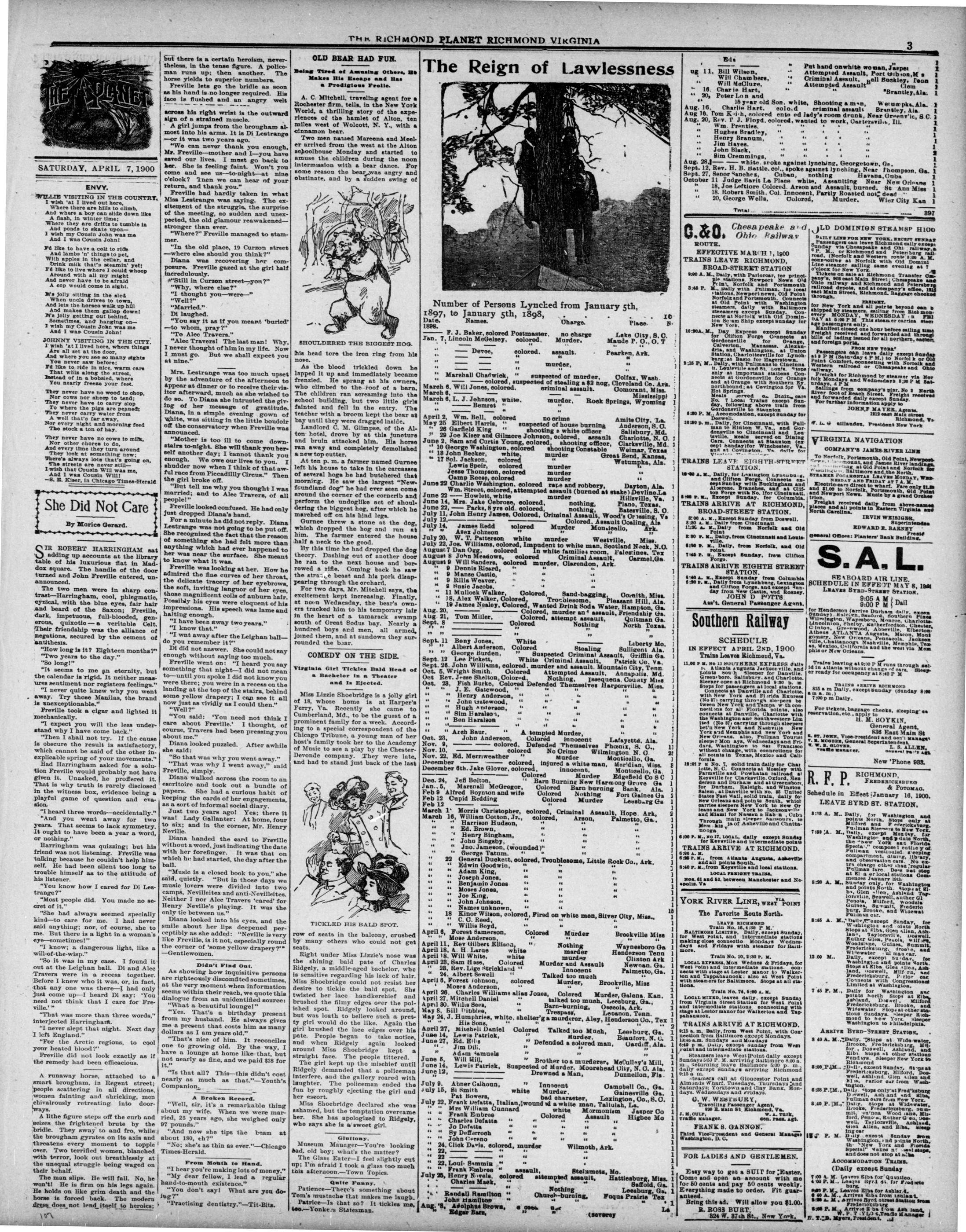
Eds
ug 11. Bill Wilson, Will Chambers, Will McClure, Charlie Hart, Peter Lon and 15 year old Son. white, Shooting a man, Wetumpka, Ala.
Aug. 16. Charlie Hart, colo. criminal assault Brantley, Ala.
Aug. 16. Tom Kish, colored ente ed lady's room drunk, Near Greenville, S.C.
Aug. 20. Rev. T. J. Floyd, colored, wanted to work, Cartersville, Ill.
Wm. Prenties. Hughes Bradley. Henry Branum. Jim Hayes. John Black. Sim Cremmings.
Aug. 28. white, stroke against lynching, Georgetown, Ga.
Sept. 12. Rev. H. B. Battie, col., spoke against lynching, Near Thompson, Ga.
Sept. 27. Senor Sanchez, Cuban, nothing Havana, Ocala
October 11 Judge Barit La Place white, Assaulting Near New Orleans
18. Joe Leftoit Colored. Arson and Assault, burned. St Ann Miss
18. Robert Smith. Col. Innocent, Partly Roasted not dead
20. George Wells. Colored, Murder. Wier City Kan
3
2
EFFECTIVE MARCH 1, 1900
TRAINS LEAVE RICHMOND,
BROAD-STREET STATION
9:00 A. M., Daily with Parlcorc, ter prinor
B. M., Newport, News Old
Pint, Norfolk, and Portsmouth
8:45 P. M., Daily with Pulman, for local
stations, Newport news, Old Point
Norfolk, Newport, with Washington
at Old Point to Washington
steamers, daily with Baltimore
steamers except Sunday. Coun-
sults at Norfolk, Drumon-
tion Scam Ship except Sunday for
New York.
10:00 A. M., Day Express except Sunday
in Louisville, Forte. Connects at
Gordonsville, Orange,
Calverton, Manassas, Alexandria,
and Washington, at Union站
Charlotteville for Lynch-
burg; at Orange for Ey-
northbound; at Ceyington for Va.
Hot Springs; served on Daina, car
No. 7 Local Trains except Sunday,
following above train from
Gordonsville.
1:20 P. M., Accomodation, except Sunday for Dowell.
10:20 p. m., Daily, for Cincinnati, with Pullman to Hinton W. Y., and Louisville to Cincinnati and Louisville, meals served on Dining Cars bound for Staunton (except bound) for Winston, Va., and at Covington, Va., daily for Virginia.
TRAINS LEAVE EIGHTH-STREET STATION.
10:20 A. M., Daily, for Lexington Lynchburg, and and Torrance Forge. Connects ex-going Sunday with No. of Albemarle. Branches, and at Clifton Forge with No. of Cincinnati.
1:20 P. M., Except Sunday, for Columbia.
TRAINS ARRIVE AT RICHMOND,
BROAD-STREET STATION.
8:00 A. M., Except Sunday from Dowell.
8:30 A. M., Daily from Cincinnati.
1:30 A. M., Daily from Norfolk and Old Point.
8:30 P. M., Daily from Cincinnati and Leu-
5:00 P. M., Daily from Norfolk, and Old Point.
7:45 P. M., Except Sunday, from Clifton
TRAINS ARRIVE EIGHTH STREET
STATION.
6:40 A. M., Except Sunday from Columbia
6:20 P. M., Daily from Lynchburg, Lexington
and New York, and except Sunday
from New York and Cosney.
JOHN D POTTS
Asst't. General Passenger Agent.
Southern Railway
Southern Railway
SCHEDULE
IN EFFECT APRIL 2ND, 1900
Trains Leaves Richmond, Va.
11.00 P.M. No 101 SOUTHERN EXPRESS daily
Atlanta Augusta Jacksonville, and
Atlanta Birmingham for Danville.
Greensboro Salem for Richmond.
Sleeper open at Richmond 9:30 P.M.
Steps for passengers at local stations.
Connects at Danville and Charlotte with New York and Florida Express (Nebraska Express) between New York and Tampa with connections for all Florida points, also connects at Danville, Charlotte with New York and Tampa, and it attached (No $17 carrying through sleeper bet'n New York and Nashville. New York and Memphis and New York and Tampa, sleeper Mon ays, Wednesday and Friday, Washington to San Francisco without change, with connections for all points in Texas, Mexico and California. M No. 7, solid train daily for Charlottetown, N. Connects at Moseley with Kenville and Powhatan railroad at Kenville for Clarksburg and derson and durans and at Greenbush, for Durham, Raleigh, and Winston Salem, at Danville with no. 55 United States Airlines and points to New Orleans and points to South, whiteth carries sleeper New York to New Orleans and New York to Jacksonville and Miami and New York to Chattanooga, main sleeper San Antonio, through in of Asheville and Chattanooga.
6:00 P. M., No 17, LOCAL, daily except Sunday
for Kewsville and intermediate pots
TRAINS ARRIVE AT RICHMOND.
6:00 A. M.
6:00 P. M., from atlanta Augusta, Asheville
and all points South.
8:00 P. M., from Keysville and local stations.
LOCAL FREIGHT TRAINS.
Nos. 61 and 62, between Manchester and
Nepolis, Va
YORK RIVER LINE, WEST POINT
The Favorite Route North.
BALMORE LIMITED, Daily, except Sunday,
for West Point, and intermediate stations
making close connection Mondays. Wednes-
days and Fridays with steamer for Bali-
more.
Train No. 10.2:30 P.M.
LOCAL EXPRESS, Mon Wednes & Fridays, for West point and intermediate stations. count on the Voyage at Lester manor, West point and Tampa at Lester manor. West point with steamers for Baltimore. Stops at all sta-
Train No. 74, 6:00 A. M.
LOCAL MIXED, leaves daily, except Sunday from Virginia Street Station for West Point immediate stations connecting with stage at Leeton manor for Walkerton and Taphannook.
TRAINS ARRIVE AT RICHMOND.
9:15 a.m. M. daily, from West Point, with connection from Baltimore except Mondays.
10:40 a.m. Sundays and Mondays
6:40 p.m. Daily, except Sunday from West Point and immediate stations.
Steamers leave West Point daily except Sundays 5:50 p.m. M. arriving Saltimore 8:00 a.m. returning leave Baltimore 5:00 p.m. daily except Sundays arriving Richmond 9:15 a.m. steamers call at Gloucester Point and Almonds Wharf, Tuesdays, Thursdays and Saturdays; Yorktown and Clay Bank, Mondays, West Point and Sundays.
O. W. WESTURK.
Travelling Passenger Agent,
920 E. Main St Richmond, Va.
J. M. GULF,
Traffic Manager.
con. Pass. Agent.
FRANK S. GANNON.
Third Vice-president and General Manager Washington, D.C.
FOR LADIES AND GENTLEMEN.
Easy way to get a SUIT for EASTER.
Come and open an account with me
for 50 cents and pay 50 cents weekly.
Everything made to order. Fit guaranteed.
Bring this ad. Will allow you $1.00.
R. BOSS BURT,
$24 W. 87th St., New York.
3
JLD DOMINION STEAMSP H100
DAILYLINE FOR NEW YORK, EXCEPT SUNDAY
Passengers can leave Richmond and Ohi railway,
sunday via Cheesapeake and Richmond and Petersburg railroad,
(Norfolk) and Richmond and Norfolk with Old Dominion,
congesting at Norfolk with Old Dominion.
Line steamer sailing same evening at 7 o'clock.
Tickets on sale at Richmond Transfer Gang's,
600 east Main Street; Cheesapeake and Richmond and Petersburg office, 1011 East Main Street, Richmond Baggage checked through.
PERKS.
for New York and all pairs beyond can be shipped by steamers, sailing from Richmond and Richmond and SDNESDAY : n FRI DAY at 5:00 P.M. SUNNESDAY : n FRI DAY at 5:00 P.M.
Manifest closed one hour before sailing time received and forwarded and through bills of payment assigned for all northern, eastern and foreign ports.
FROM NEW YORK
Passengers can leave daily except Sunday (M (Saturday) P M.) or Norfolk or Old Point comfort, connecting with Norfolk and Western railroad or Chesapeake and Ohio railway.
Neighbors for Richmond and by steamer via Nor
for ferry and Wednesdays 8:00 P M Saturdays,
4 P M Mondays' pier. No 2 Northeast
River foot of Beach Street received
and forwarded daily except Sunday.
VIRGINIA NAVIGATION
COMPANY'S JAMES-RIVER LINE
To Norfolk, Portsmouth, Old Point, Newport-
port, Mountaint, and James River landings.
To Washington, Old Point and Norfolk for
washington. Baltimore, Old Point and
STREAMER POCAGONTAK LEAVES MONDAY, WED-
NESDAY AND FRIDAY AT 7 A.M.
Eleven days direct to wharf. Fare only $1.58
and $1.00 Norfolk, Portsmouth, Old Point
and Newport News. Music by a grand Orchee
trion.
Freight received daily from above-names
and points in Eastern Virginia and
North Carolina.
S.A.L.
SEABOARD AIR LINE.
SCHEDULE IN EFFECT MAY 8, 1994
LEAVES BYRD-STREET STATION.
Henderson (arrive Durham daily, exon
Sunday, Baltimore, Southern Pine
Wilmington, Waynesboro, Monroe, tate
lincolnchester, Shelby, kutherfordton, Chester,
Lewiswood, Abberville, Elberton,
Atlanta, ATLANTA, Atlanta, Macon, Mount
gomery, New Orleans, Pensacoha, Jackson
ville, Chattanooga, Nashville, Memphis, Tex-
an, Mexico, California and the west via Mom
phis or New Orleans.
Trains leaving at 9:00 P M run through so-
ld in Atlanta without change of car. Sleeper
ready for occupancy at 8:40 P M
TRAINS ARIVERE RICHMOND
815 a m Daily, except Sunday (Sunday 8:00
a.m. a.m.),
7:00 p m Daily.
For tickets, baggage checks, sleeping on
reservation, etc., apply to
H. M. BOYKIN,
General Agent,
838 East Main St
E. S. JOHN, Vice-president and manag-
vant E. M. MOGER, General Superintendent.
W. W. B. GLOVER.
Traffic Manager.
L. S. ALLEN,
general p a g h
New 'Phone 983.
R. F. P. RICHMOND, FREDERICKBURG & POTOMAG.
Schedule in Effect January 18, 1800.
LEAVE BYRD ST. STATION.
8:38 A. M., Dally, for Washington and
P尔津 Hills hospice only at
Milford and F. P. Hospital.
Pulman Sleeper to New York.
7:39 A. M., except Monday, for
Washington and points north,
the "New York Flora Special."
"composed entirely of Pitman
manuscripted, sleeping
comparisons, nursing, care,
and observation can be.
No tris charge either than; regular
Pulman. Does not stop at El or local
Commences January 1811.
8:20 A. M. Sunday only, for Washington and points north. Stops at Elba Glen Allen, Oakland, Taylorville, Boswell, author of Penola, Milford, woods, Guinne, Summit, Frederic Burge, Brooke, and Widewat Pulman car.
8:45 A. M., Dally, except Sunday, for Washington and points north. Stops at Elba Glen Allen, Ashland, Boswell, Ruther Glenville, Milford, woods, Guinne, Summit, Fredericburge, drowe, and Widewat car.
12:00 M., Dally, except Sunday, for Washington and points north. Stops at Elba Glen Allen, Ashland, Boswell, Milford, and Fredericburge car. Connects with Congressional Limited at Washington.
7:45 P. M., Dally for Washington and points north. Stops at Elba land, Oakland, Fredericburge, Brooke, and Widewat. Stops at other stations. Sundays. Sleeper Richmond to Widewat Washington to Philadelphia.
8 40 A. M., Dally, "Stops at Wide-water,
Brooke, Fredericksbury, Milford,
Eibl, Stops at other states and
Sundays. Sleeper New York to
Ricmond.
8:00 P.M., Dally, "Sleep on Sunday, Stays
Fredericksbury, Milford, Doswell,
Ashlind, Glen Allen and
Mirar carr on from Washington.
8:20 P.M., Dally, "Sleep only on Fredk'sburg
Dowell, Ashl and Miba, Fullman cars from New York.
8:40 P.M., Dally, "Sleep on Fredericksbury, Summit, outne Wood lane, Milford, Penna, either Glen, Doswell, Tappan carr on, Glen Allen, and Biba, Sleeping car.
P. M. to scoot Sunday from Washington, and points North, the New York and Florida Special! takes n. stops, stops, and does not stop at Biba.
7:00 A. M. Leaves Els for Quantio,
4:00 P. M. Loaqs Bryd st. for Frederie
burg.
8:00 P. M. Leaves Els for Ashlar,
4:00 A. M. Arrives Els from aslulat.
8:00 A. M. Arrives Bryd street Station from
Fredericksburg.
8:00 P. M. M. Arrives Ashland,
W. P. T. LLO. Treadle land,
F. T. Myers, President.
HEY JANET
Published every Saturday by John Mitchell
Jr., at 311 North Fourth Street.
JOHN MITCHELL, JR., EDITOR
all communications intended for publication
should be sent so as to reach us by
Wednesday.
One Copy, one year. $1.56
One Copy, six months. 1.56
One Copy, six months. 66
One Copy, four months. 66
One Copy, three months. 66
Single Copy. $0.99
ADVERTISING RATES
For one inch, one insertion . . . $ 20
For one inch each subsequent insertion . . . 50
For one inch, six months . . . 10
For two inches, six months . . . 10
For two inches, nine months . . . 14
For two inches, nineteen months . . . 20
Marriage and funeral notices per line . . . 10
Standing and transient notices per line . . . 10
POSTAGE STAMPS OF A I N O M I N A T I O N
HIGHER THAN TWO CENTS NOT RECEIVED
ON SUBSCRIPTIONS.
THE PLANET is issued weekly. The subscript
mon price is $1.50 a year, in advance.
COMMUNICATION :- When writing to o
to renew your subscription or to discontinu
your supper, you should give your name an
address in all otherwise we cannot find you
name on our books.
CHANGE OF ADDRESS :- In order to change
the address of a subscriber we must be sent the
former as well as the present address.
Entered in the Post-Office at Riichmond, Va.
second class matter.
SATURDAY APRIL 7, 1900.
PATRICK County has convicted an
other lyncher. He was given five
years in the penitentiary.
The grand jury of Greeneesville
County seemed to have decided before
hand to violate its oath.
The Republican officials of Kentucky
are as yet holding the offices to
which they were elected.
Our condition in some sections of the country is deplorable, but we are nevertheless progressing.
The tide of war seems to have again turned in the Boers' favor in South Africa. They are causing the English much trouble.
The Bluefield, W. Va., TELEGRAPH states that the wages of the miners in the flat-top region has been advanced 20%. Large numbers of them are colored men.
We have received the 1900 Souvenir of the Washington Conference of the M. E. Clureh held at Baltimore, March 21, 1900. Kindness of Mr. MAGNUS L. ROBINSON.
This grand jury of the Greenesville County Court was told the name of the man who led the mob, and although sworn to bring an indictment against him, proceeded to ignore all of the evidence and failed to do its duty.
The election of Major Sol. Cutchins as a member of the Richmond City School-board will give general satisfaction. His course at Emporia, Va., has given universal satisfaction and all lovers of law and order are outspoken in their commendation of his course.
The Commissioners of Valuation law has been declared unconstitutional by the Supreme Court of Appeals and there is general rejoicing among the business people of the commonwealth. That tribunal held that the measure did not receive the vote as required by the constitution.
This statement has been made that the United States government is losing a regiment a month in the Philippines. This is over a thousand men. There has been an effort to discount this fast, but when those persons, incapacitated by disease, together with those killed and wounded are added together, it is evident that this statement is not far from the truth.
W. M. BRANCH (white) charged with lynching LEE PUCKETT (white) in September, 1898, was tried in the Patrick County Court, Va., March 27th, and he was convicted and given five years in the penitentiary. This makes the sixth conviction for this crime. This is indeed gratifying to note that in some sections of the Commonwealth the law is respected and lynchers punished.
SHRIFF LEE of Greenville County is sober enough at last to make a statement. He says he has not been drunk. that he was only physically exhausted and worn out.
The smell of whiskey on him was due of course to the two jugs of whiskey which he carried to the soldiers. But, as to himself, he was not drunk, only weary, tired and worn out.
The funniest part of the business is that the Judge, Commonwealth's Attorney, Major CUTOHINS and all who saw him still insist that he was drunk. Yes, he was both drunk and intoxicated and that he was drunk is evident by the fact that he was too drunk to really know how drunk he was.
THE TIMES AND THE DOCTOR.
The Richmond, Va., TIMES is suffering from a severe attack of Negro epizooty, better known as Negrophobia. Its symptoms are a disposition to discuss all matters, however trivial, which pertains to the Negro, and to show that he is unworthy, incapable and not entitled to enjoy the rights and privileges which the laws of the country guarantee to him.
It seems that an ethical monstrosity in the person of Dr. P. B. BARRINGER of the University of Virginia has succeeded in shoving one of his Negro-hating pamphlets under its nose and it at once proceeds to gulp down all of the strenge doctrine which its pages contain.
The TIMES remarks that the white man must lift the Negro up or he will pull him down.
That is a basic principle applicable to black and white alike. The intelligent must lift up the unintelligent of both races or must be dragged down to their level.
But it will not be men like Dr. BARNINGER who will perform this service. They are in the business of stirring up race prejudice, and we pause to remark that any man who attempts to array one race or class against another race or class is the enemy of both.
JUDGE GOODWYN'S OHARGE
JUDEN W. SAMUEL GOODWN's charge to the grand jury at Emporia, Va., Monday, April 2nd, 1900, was all that could have been desired. It was an able document and when we noted the result of the grand jury's deliberations—the failure to bring in an indictment against the lynchers, who were known to the members of that body, we felt constrained to believe that the humiliation of Virginia was complete.
There is something strangely pathetic in Judge GoodwN's case. It is evident that he desired and attempted to uphold the law.
What else could have meant his appeal to the Governor for troops, the refusal of that official to send them unless the request was counter-signed by the sheriff?
The fault was the Judge yielded to the pressure. He was threatened with dynamite. When the pressure was partially removed, he regained his composure and made an effort to do his whole duty. He now announces his intention to resign his office, showing plainly that he feels the humiliation of his position. Be the result what it may, there are thousands who will sympathize with JUDGE GOODWYN, while deploring the weakness which led him to take a position which has been the subject of condemnation throughout the civilized world.
WANTED TO LYNCH HIM
THE following statement was published in the daily papers Friday, 30th Oct. It has occasioned much comment:
"The boys of the East-End of Richmond, who had been having trouble with the Negroes of that section, became so enraged that on last Tuesday they decided to take the master at once in hand and lynch the offenders after the most approved Emporia rule and regulation.
"On Tuesday they found one Negro, Philip Smith, a boy about twelve years old, and drove him from the neighborhood with rocks. The colored boy was much frightened, and rushed into the front porch of Mrs. Vestal's residence, and furiously rang the bell. Mrs. Vestal opened the door, and Philip ran into the hall, pleading to her to save his life, and saying, that the boy were going to kill him.
"The boys had assembled around the front gate, and demanded the Negro. The lady refused to give up the dark," and the boys said that they would get him if they had to die. They talked roughly to the lady, who saw that she could do nothing with them, and at once sent her servant for Special-Policeman Garnett.
"As the officer came up the crowd dispersed, but two of the leaders were taken into custody, and two others recognized. The boys were Albert Lloyd, George stain, Willie Clark and Dock Dickerson. The case came up before Justice James T. Lewis, of Henrietta, and all of them, except Clark, who was not implicated in the disturbance, were fined $2.50 and costs each."
Yes, lynching is demoralizing to young and old. Had colored boys attempted the same upon a white boy, they would have languished in jail about twelve months, or been candidates for the penitentiary for attempting a felony.
The punishment meted was no doubt salutary, and will prevent a repetition of the offense in other sections of the city.
PEOULIAR "REPUBLIOAN" DOU-TRINE.
The following telegraphic report will explain itself:
"Lovingston, Va., April 1. The srlis
THE RICHMOND PLANET, RICHMOND, VIRGINIA
between the white and Negro Republicans, which occurred at the massmeeting of the 24th inst., seems to be final, and though many regret the manner in which it was brought about, there is general relief among the whites that a definite rupture has been accomplished.
There were nineteen white and forty-nine colored voters, by actual count at the meeting. Postmaster Wood, of Montreal, this (Nelson) county, stated point-blank to the Negroes that the whites intended to rule; that this is a white man's country, and it was time for the Negroes to know it. He said there would be a definite separation then and there, and that if any of the Negroes cared to join the white men's meetings they could do so, but would be allowed no voices in the proceedings.
The postmaster then led the whites into one of the jury rooms, where they held an executive meeting.
The Negroes were called to order by Chairman Jacob M. Brown, and Reed Thomas was elected temporary chairman. A dozen men, talking at once, denounced Postmaster Wood and his followers in warm terms. Chairman Thomas was unable to control the meeting, and called upon Rev. Lazarus Smith, who finally restored order. A full set of delegates and a county committee were elected, and Chairman Brown was re-elected. A resolution was adopted declaring that if the delegates were not recognized those present would support the Democratia ticket this fall." We understand that this policy has been adopted in other sections of the state. That it will be endorsed by the Republican Party of the country seems to us to be out of the question.
The colored men of Nelson county did right, and we have no hesitation in saying that their course will be approved by right-thinking men everywhere, irrespective of race or color.
BOY-COTTING STREET OARS
ATLANTA, GEORGIA established "Jim Crow" street cars and the result is told by the ATLANTA AGE as follows:
"It is a most remarkable thing, and yet true, that you stand on the streets all day and never see a Negro riding on the street cars unless he is going to Decatur, Edgewood or the river. the women seem to think that there is a law t have them sent to Judge Broyles to be sent to the stockade.
There must be at least a loss of $5,000 a month to the street car companies on account of the loss of Negro patronage. The Negro preachers and editors are afraid to ride if they wanted to. There would be a loss of yellow leg chickens and subscribers if they and we guess we will walk till there is a change in the ethics of the car companies as refers to Negroes."
This is a fine showing. The colored brother is learning how to strike back and when the blow is landed on the white man's pocket it will do more to wind him than if delivered on his stomach.
Mr. and Mrs. S. J. Mickey, in company with Miss Nannie E. Mickey of Roanoke, after spending a few days in the city on their bridal tour, left on Roanoke. During their stay they were, royally entertained at 1008 N. 7th St.
MR. DUVALL SPEAKS.
FIRST CREER, W. VA., Mar. 9th, 1800
Mr. Editor:
There are some of us who do not appreciate our liberty as we should do in the first place, as a whole, we fail to take the PLANET some other colored journal to read at all, to find out what is going on in the country for us and against us. I think if it we take the PLANET and read it, it would raise our ambition so that we would do all that is in our power to better our condition. If there is any manhood about us and if we ever expect to achieve anything, we must stand together as men and as a race.
I think that the action of the Legislature and Senate of Virginia should convince us all that the Democratic party is no friend to us politically. I mean the party. I do not mean all of the Democrats, for I have some good friends in that party. I claim that the Democratia party is responsible to a large extent for the prejudice that is now existing between the two races to-day, for they have used us as a political scheme to carry their points by giving us bad names. They say that they are our best friends. I know we have some friends among them; but to that class that are killing and butchering up our race, if that is what they call friendship we can live without it, and I pray God that it may be buried forever.
And again, it has been mentioned several times in the paper as to where the colored people would take their stand in the coming presidential election with the Democrats or with the Republican party. Why, the Democrats have answered that question with me years ago. We see in the southern states where they have the power, they are always making laws to oppress the Negro race. The Republican party is the party for us to support and we go to go work in our counties and in our states, and nominate Republican candidates for their different offices and with the aid of our white friends we can do much good for our country. We must consider that all officers are important, from the lowest to the highest. So we all should look at it in that light.
Well, I must say to Mr. John Epps and his crowd if they do not repent for their wrongs before death overtakes them, I guess the old dragon will have a "Jim Crow" Car prepared to take them over the road as well as they want the railroad companies to prepare them to take us over their road.
We must be a God-fearing, God-loving and a God-serving people and he will safely lead us through to victory. And again I will say to my people send in your subscription and take the RICHMOND PLANET for it is the right paper for us to take and in the right time for it you will send and take it and read it, I don't think you will regret the fact you pay for it. To you, John Mitchell, I must say continue on in the same direction as you have been heretofore, for you are right and endorsor your actions and wish that I was such a hero as you are. I must say that my love for the PLANET and its editor is inexpressible. It is so great. Well, I will close hoping that these suggestions may be heeded by my race.
Yours for the race. J. J. DUVALL.
City Items From Mayfield.
MAYFIELD, Kv., April 4, 1900.
A large number of people assembled
at the St. James A. M. E. Church on
the evening of the 5th ins., to witness
Albany's anniversary which was quite a
treaset to the intelligent and attentive
audience. Every person named on
the programme rendered their part
well, which reflected much credit upon
them and the church.
The occasion was real interesting and a grand time was enjoyed by those present. The programme, which was rendered in a commendable manner throughout, was as follows: Song by the choir; Devotional exercises by Rev. J. J. Meutchins, pastor of the Baptist Church; Paper by Mr. G. H. Jeckins, subject: "African Methodism in Mayfield." Solo by Miss Pearl Kowlet; "The Kougits and Daughters of Tabor," by Mr. A. Q. Greene; Duet by Messrs. Utterback and Hale; Resitation by Miss Mollie Dugger, subject: "Modern mother" Quartette, Misses Jessie Leffson and Loudora Hale, and Messrs. Olyde Murrell and Jasper Watson; Paper by Rev. L. Hamilton of the A. M. E. Church, subject: "The first Negro Bishop of America." Song by the choir; Recitation by Miss Nimer Threat; Duet by Misses Collins and Boatright; Paper by Miss Mary Threat, subject: "Progress of the Negro." Instrumental solo by Mr. Grant Redor; Selection, read by Miss M L Boatright; Journal by Messrs. Utterback and Ourd. Basiediction.
Quite a number of people gathered at a Fairview Baptist Church on last Sunday to celebrate the 3rd Anti-varsary of Rev. J. J. McCutech the pastor. The program, which was well rendered, was as follows: Meeting called to order at 8 o'clock p. m., by master of ceremony M. O. Uttierback; Opening exercises: Song by the choir; Devotional exercises by Rev. E. P. Williams; Song, "My soul be on thy guard." His standing among the preachers, by Rev. L. Hamilton of the St. James A. M. E. Church; General remarks by Rev. H. O. Roberts (white) of the 1st Baptist Church; Duty of our Pastor, by Deacon S. A. Mayes; Our pastor as a citizen, by Mr. J. E. Thomas; His ability as a pastor by Mr. Z. T. Rasteiiff; His ability as a scholar, by Master A. G. Greene; Its financial success, by Prof. A. Hale; How a church should care for its pastor, by Deacon H. Vauce. Resolutions w-re read by Mrs. Jennie Thomas—committee who formed them were Mesdames Jennie Thomas, Lucy Harden, Alice Mayes and Messrs. W. A. Thompson, Ramson Andrews. Closing remarks by Mr. Mr. m. O. Uttierback; Benediction by Rev. J. J. McCutech, the pastor.
The church has been prospering under Rev. McCutech's pastorate and he was highly eulogised by the speakers.
Rev. W. S. Baker of the 7th St. Baptist Church of Paducah, filled the pulpit at night and delivered a logical and spirit-stirring discourse to his many hearers. Rev. Baker is an able speaker and is admired by all who hear him. Mr. Halsey, traveling agent for The Halsey Manufacturing Company, is in our city in the interest of his company. We wish him great success.
Subscribe for this great race journal that is defending our people.
FROM PORTSMOUTH.
The Friday night club held their regular meeting at the residence of Mr. Scott White, 919 Glasgow St. Mr. H. W. Melvin read a paper on a change in the constitution. It was ably discussed by Mr. W. Paul Jenning, Mr. George W. Walker and Dr. J. J. France.
An exceedingly pretty wedding was solemnized at the residence of Mr. and Mrs John R. Baker Tuesday evening, March 27th, on Effingham St., when their daughter, Mrs. Florence Jones became the wife of Mr. W. H. Q Rodgers of Hartford, Conn.
The bride wore a handsome steel grey dress, and groom had a handsome conventional suit of black. The parlers were beautifully decorated with palms. Mr. George A. Melvin acted as best man.
Mr. C——: I saw you Sunday with Miss—— of Washington St. Mr. C—— is seen quite often going down Washington St. with a handsome bouquet of flowers.
The ladies locked very charming Sunday in their new suits and hats. One caught quite a severe cold. Ladies be more careful, summer has not come yet. Messrs George A. Melvin and John S. Collins attended the Republican City Convention which convered in Berkley Tuesday, March 8th. Little Martha, the daughter of Mr. B. J. Farmer is confined in house with an attack of Lagrime.
FULTON NOTES
The communion services at the Mt. Calvary Baptist Church last Sunday were well attended and those present could feel the working of the Holy Spirit.
At 11:30 a.m. m. Rev. R. J. Bass preach ed a most inspiring sermon at the R. Mt. Zion Baptist Church.
At 3:45 p.m. the B. Y. P. U., meeting was quite well attended and those present freely participated in the discussion of the subject, "Always ready." Next Sunday at 11:30 a.m., meeting of expression; at 3:30 p.m. Lord's Supper services at R. Mt. Zion Baptist Church.
Deacon Thomas Spratley is out again Mesdames Mary White, Susan Jones, Maria Fleming, Jane Reid, — Wing field, Cynthia Clements and Miss Charlotte Bossieux are convaicing. Mesdames Fannie Jackson Naney Jefferson and Mr. Isaiah Randolph are quite sick.
Mrs. Lizzie Johnson and her infant son, over whose advent she and her husband are jubilant, are getting along nicely.
The R. Mt. Zion Baptist Church edifies is being pushed to completion. It is grateful to the public for any assistance.
ST. LUKE'S THANKSGIVING.
The members of the Independent Order of St. Lukes of the Richmond District, in convention assembled have decided:
1. To hold the annual Thanksgiving service at the Sixth Mt. Zion Baptist Church on Sunday, April 15th, 1900 at 3 o'clock P. M.
2. That all male members of the order will meet at St. Luke's Hall, corner St. James and Baker St., at 2 o'clock P. M., to march in procession to the church.
3rd. That all female members of the order will meet in the basement of the Sixth Mt. Zion Church at two o'clock
that they may be formed in line to march in the church in a body. 4th. A collection will be raised for the benefit of the church. 5th. The sermon will be preached by Rev. A. S. Thomas, pastor of the Sharon Baptist Church. 6th. An address will be delivered by Mrs. Maggie L. Walker, Grand Secretary of the Grand Council of Virginia on the progress of the order. The public is in redfallen.
The publicia is cordially invited to attend these exercises.
On behalf of the Order,
H. L. HARRIS, M. D.,
Deputy for Richmond District and
Chairman of the Convention.
Attest:—Ella Williams Secretary of
the Convention.
W. B. Cunningham, Chief Marshal.
Attest: Ella Williams, Secretary.
PERSONAL.
This is to certify that the rumors afloat concerning myself, the same being circulated by some unscrupulous person to injure my reputation, are entirely false in every particular.
A reward of $5 hereby offered for the apprehension of the party.
ELAM L. BANK
2023 2 Mile Road.
Names Dropped.
RICHMOND, VA., April 3, 1800
The Pilgrim Bapt Church had a call meeting and dropped the said members from her midst that belonged to the said Bethlehem. By that the Pilgrim Baptist Church and the Bethlehem Church has become in union. The names of the members who were dropped were Nelson Taylor, Ben. T. Johnson, Henry Brown. Done by order of the church.
ROBERT CHANDLER.
Church Oierk
Mr. and Mrs. S. W. Robinson's twins are about one month old.
Mr. B. F. Turner, who was charged with embezzling the funds of his ward, Miss Clara M. Carter was acquitted. It seems that the matter was regarded as a civil transaction, the money being lost in speculation. Hon. George D. Wise and Mr. Giles B. Jackson defended Turner.
We are informed that Lawyer N. T. Goldsberry won the case in this city of Prof. G. W. Hayes against the Land grabbers. Prof. Hayes owned property on the east side of Third St., near Bates street, but had never put the deed to record.
The Land-grabbers had an order of publication entered but Prof. Hayes was not notified.
Rev. R. J. Perkins of Huntington, W. Va., is conducting revival services at the Fifth St. Baptist Church.
The Courts of Galanthe will celebrate their anniversary on the first Sunday in May.
—Silsa Anderson, the well-known painter who resides at 804 N. Second St. died Tuesday night, 8rd inst. H. had been confined to his room six days.
—Mrs. William H. Isham has entirely recovered.
Richmond will be treated to a feast of good music in this month, comprising gems and scenes from several first class operas taken from the repertoire of the Execsior Opera Co.
Save your money so that you can enjoy a rare treat in hearing first class and strictly operatic music by home talent.
The Execsior Opera Co. will give in the near future an attractive entertainment at True Reformers' Hall for the benefit of the Woman's Central League. Don't forget this.
Mr. W. Henry Walton left the city for New York last week on a business trip.
Mrs. S. A. Phillips and Mrs. Joseph Watkins are sisk.
They all know Mr. Silas Fields. His place is strictly first-class. Call on him.
For fine fish, oysters and etc., remember Mr. H. F. Jonathan. See advertisement.
Mr. P. B. Ramsey's parlors are the attraction just now. Teeth attended in first-class style. See notice.
For legal business and prompt attention, correspond with Geo. W. Lewis, Eq. See notice.
Mrs. Robt. A. Jackson, who has been quite sick with the Lagrippe, is improving.
The home of Mr. and Mrs. R. H. Hicks, 1532 Clarke St., Pittsburgh, Pa., was happy on the 27th of March by the birth of a little boy. Mother and child are doing well.
Mr. George Archer who has been quite sick at the residence of Mrs. M. E. Harrison, No. 318 N. 38d St., is now convalescent. He is improving rapidly and expects to be out.
The young ladies of Hartshorne Memorial College will present to the public the beautiful cantata of the Flower Queen on April 18, 1900 at 8 o'clock p.m., in the college chapel. Those who have heard these young ladies sing know that they may expect a rich treat. Admission, 15 cents.
St. Lukes, Attention I
The St. Lukes of the East End will hold Easter Celebration under the auspices of Olive Branch Council, 58, at Fountain Baptist Church on Sunday Evening, April 15th at 8 o'clock. The female members of the several counsellor will assemble at Lily of Valley Club and the male members at St. Lukes' Hall, 26th and R Sts.
Maria Uoralli's New Story.
Marie Corelli, for the first time in five years, has written a short story for an American magazine. The Laurels of the Brave is the titls of a butter, brilliant, timely story which she has just finished for The Saturday Evening Post, of Pilladelphia. It deals with the South African War Charities, and handles without gloves the 'Society Department' of the English War Office and the women wne, for advertising purposes, are jonning khaki.
The Laurels of the Brave, superbly illustrated by Harrison Fisher, will appear in The Saturday Evening Post of April 14.
WANTED:—Names and addresses of 5000 respectable colored girls for high class domestic service in the North, cooks, chamber-maids, child-nurses, laundresses and general house-work. 4-7-lm
Easter Monday, April 16, 19001
Excursion to Washington, D.C., by the
Summer Rest. Train will leave Broad
and Hancock St., at 8 a.m., returning
will leave Washington, Ninth Street
and Maryland Avenue, Tuesday,
April 17, at 6 p.m. Special car for
colored people. Tickets, $2.50 for the
round trip (good only on excursion
train) for sale at Wiba Station.
Given by Mr. and Mrs. George A. Barkedale.
2-4-7
Col. Wm. F. Wickham, who shot
himself is dead. Judge Waddill has
not as yet appointed his successor as
referee in bankruptcy. Col. Wickham'
funeral took place at Clayville, Sun-
day afternoon.
A WEEK'S NEWS OONDENSED
Thursday, March 29.
There are 5,000,000 people now receiving famine relief in India.
Philteus Sawyer, ex-United States senator from Wisconsin, died at Oskosh, Wis., aged 83.
The national senate refused to confirm W. D. Bynum as general appraiser of the port of New York.
In the libel case against Reporters Hay and Sloan, in Camden, the jurors disagreed and were discharged.
The army appropriation bill passed by the national house opens soldiers' homes to disabled Spanish war veterans.
The Delagoa bay arbitrators, in session at Berne, decided that Portugal must pay England and the United States 15,314,000 francs, which is considered wholly inadequate.
Senator Foraker has introduced a bill increasing to the extent of 25 per cent the salaries of all male employees of the government printing office where the salaries are now less than $4 a day.
Friday, March 30.
The mayor of Pittsburgh has prohibited the advertised production of "The Degenerates" by Mrs. Langtry. The daughter of ex-Speaker Reed and 47 other young women graduated as lawyers at the University of New York. Mrs. Cleary Hyland is dead at her home in Orange, N. J., aged 103 years. For the last year of her life she was totally blind. Police Captain Andrew J. Thomas has been indicted for permitting disorderly resorts in New York's Tenderloin district to remain open. Premature explosion of dynamite in Spokane, Wash., killed Salvatore Bruzzini, fatally wounded Michael Herman and totally blinded Andrew Hadberg. Saturday, March 31. The national senate confirmed G. W. Russell as postmaster at New Brunswick, N. J. John Hayslip, who murdered his wife and Maud Mitchell, and tried to kill Charles Barrier, was sentenced at Kansas City to 99 years in jail.
Should Leung Chi Tso, the Chinese reformer, come to San Francisco he may have the highbinders at his heels. The value placed upon Leung's head is $65,000.
An Ohio legislative committee recommends the passage of a bill prohibiting the issuance of insurance policies on the lives of children under 12 years.
A contract has been signed between the Ontario government and J. Plerpont Morgan, of New York, under which millions of dollars are to be spent in developing power from Niagara Falls on the Canadian side.
Harvard won the annual debate with Yale last night at New Haven. Harvard had the affirmative of the question: "Puerto Rico should be included in our customs boundaries."
Monday, April 2.
The shortage of F. E. Bundy, the defaulting city chamberlain of Elmira, N. Y., will reach $75,000.
Webster Davis has resigned as assistant secretary of the interior, and will lecture to aid the Boers' cause.
The Hamburg-American Inner Phoenix arrived at New York from Hamburg and Boulogne Saturday with 2,038 steerage passengers.
The latest gift ($200,000) of Sir W. C. Macdonald to McGill university, Montreal, makes his total gifts over $3,000,000.
Two negroes entered a store in Clinton, Ala., cut the threat of Clerk Buntain and robbed the place. Two suspects are in jail, and lynching is threatened.
Tuesday, April 3.
Our government's outlay for the Paris exposition last year was $240,634. We will have 7,000 exhibitors.
John Goly, a negro, who was under arrest for attempted murder, set fire to the jail at Richland, Ga., and was burned with it.
Rev. Dwight Hills, of Plymouth church, Brooklyn, retires from the Presbyterian church because he cannot accept its doctrines.
The total coinage at the mints of the United States during March was $17,075,688. Gold, $12,596,240; silver, $4,341,375; minor coins, $138,072.
Rev. Egidus Smulders, C. S. S. R., senior priest of the Redemptorist order of the United States, died suddenly yesterday in St. Louis, aged 85.
Republicans won generally in the Ohio elections. Mayor Jones was defeated in Toledo. Julius Fleischman, the mayor-elect of Cincinnati, is a wealthy Hebrew aged 28.
Wednesday, April 4.
The amount of bonds so far deposited in the treasury for exchange for the new 2 per cent is $210,135,500. During the heavy snow storms an avalanche did great damage in the Sudetian mountains, near Hirschberg, Germany, killing several persons. A delegation of G. A. R. members from Springfield, Mass., are the guests of A. P. Hill Camp, Confederate Veterans, at Petersburg, Va. Allen Brooks, the 19-year-old negro who assaulted Mrs. F. W. Hart, at Bloomingdale, Ga., on Monday night, was yesterday identified and lynched. Pennsylvania Congressmen John Dalzell and W. H. Graham have been renominated by Republicans. C. L. Magee was renominated for state senator. Anti-Quay resolutions were adopted.
Contract Labor From Puerto Rico.
New York, April 4: Application of the contract labor law to citizens of Puerto Rico is involved in an arrest made by the barge office officials yesterday. Jorg Cruz, an intelligent Puerto Rican, arrived on the steamship Caracas and was arrested on the charge of violation of the contract labor law on complaint of an organizer of the American Federation of Labor. Cruz came here under contract with an American firm, who declare their intentions to fight the case.
SNARLBETWEENSTATES
Governors Mount and Beckham
Quarrel Over Requisitions.
BECKHAM'S AUTHORITYIGNORED
The Indiana Executive Had FirstApplied to Republican Governor Taylor, Who Was Unable to Extend the Prisoner-Beckham Reinstated.
Frankfort, Ky., April 4.—Telegrams more significant than the bare wording of them might indicate passed between Democratic Governor Beckham, of this state, and Governor Mount, of Indiana, yesterday. Governor Mount made requisition on Governor Beckham for a warrant of arrest against Rudolph Gossman, a convict, whose term in the penitentiary will end today and who is wanted for trial on a criminal charge at New Albany, Ind. The Indiana officials recently applied to the Democratic officials at the penitentiary with a requisition from Governor Mount recognizing Taylor as governor, and they refused to honor the requisition. Yesterday when the requisition was made on Governor Beckham he sent the following telegram to Indiana's governor:
"A requisition from you for the arrest of one Gossman, wanted in Floyd county, Ind., has been presented to me. I will gladly honor it if you will first assure me that any requisition issued by me as governor upon you will be also honored. This understanding is desired because of certain expressions attributed to you in the press." Governor Mount answered as follows: Replying to your telegram of 3d inst., I cannot enter into any compact or agreement that shall become binding. This would be an unwarranted departure from executive practice and the law. I must reserve the right to determine each requisition on its merits." Governor Beckham made the following statement:
"The effort in this reply to create the impression that I seek to make a compact on the subject of requisitions with Governor Mount is ridiculous. Of course every one understands that a requisition must be considered on its merits by a governor. My object was to discover whether Governor Mount now recognizes Taylor or myself as governor of Kentucky. If he recognizes me as such then his requisitions to me will be considered. If he recognizes Taylor as governor then he should send his requisitions to him." Governor Beckham was today shown a published statement given out by Governor Mount, in which the Indiana governor declares Taylor the legal governor of Kentucky. In this statement Governor Mount says:
"The time will never come, certainly not under the present administration, when Indiana will be an asylum for criminals, but it would be unchristain and inhuman to permit maddened partisans of another commonwealth to drag away citizens, even though only temporarily abiding here, to a place of persecution—where, self confessedly, law is the travesty and justice is a mockery."
Beckham refused to discuss the statement.
PROBING THE GOEBEL MURDER.
Nine Democrats on the Grand Jury Investigating the Case.
Frankfort, Ky. April 3.—The April term of the Franklin circuit court, and the grand jury working under it, which will investigate the assassination of Governor Goebel, began work yesterday afternoon. The grand jury is composed as follows: Robert Suter, foreman (Dem), farmer; William Graham (Dem), farmer; S. D. Cahn (Dem), farmer; Frank Stagg (Dem), merchant; George Brock (Dem), farmer; Marlon Featherstone (anti-Goebel Dem), farmer; W. B. George (Rep), jeweler; Charles M. Bridgeford (Dem), painter; S. T. Brumbock (Dem), farmer; John Ries (Dem), butcher; Liewelyn Gaines (Dem), laundryman; W. L. Carter (Dem), farmer. Judge Cantrell's charge to the jury was impressive, but devoid of anything sensational.
The names of the suspects who have already been arrested and whose cases have been referred to the grand jury for investigation are: Republican Secretary of State Caleb Powers, Judge W. L. Hazellip, Lakeland; Henry Youtsey, Frankfort; J. L. Sutton, Williamsburg; Harland Whittaker, Butler county; Silas Jones, Whitley county, and John Davis, Frankfort. Warrants are also out for ex-Secretary of State Charles Finley, Captain John L. Powers, of Knox county, and "Tallow Dick" Combs (colored), all of whom, except the last named, have not yet been arrested.
The guns which have been in the state house yard have been placed inside the executive building.
Wisconsin Republican Gains
Milwaukee, April 4.—The result of the municipal elections throughout Wisconsin outside of Milwaukee show that where Republicans and Democrats placed party tickets in the field the Republicans gained the greater number of victories. In many instances, however, party lines were thrown aside and citizens' tickets were elected.
Nashville, April 3.—The fight between Republican National Committeeman Brownlow and Pension Commissioner H. Clay Evans for the control of the state convention and the delegates to the national convention resulted yesterday in the warmest political meeting Nashville ever saw. The Republicans of Davidson county held two conventions simultaneously in the same hall. Two sets of resolutions were passed and two sets of delegates elected to the state convention. Both sides endorsed President McKinley. Many Tennessee counties held two conventions and chose two sets of delegates.
Atlanta, April 3.—An 80 horse power boiler, weighing several tons, exploded yesterday afternoon at the G. O. Williams Lumber company's brick yard, killing three white men and injuring several others. The dead are: John M. Smith, aged 55, one of the owners of the yard; James Perkins, aged 25, engineer; Walter Evans, aged 21. In scalded Ruffus Glass (colored), badly scalded an Tom Glass (colored), badly bruised. The other colored men and a boy were injured by leaking debris. The body of Perkins was found wrapped around a post ten feet from the engines. No limbs were torn from the body, though one of his arms and both legs hung by shreds of flesh. The lower part of the body was stripped of clothing.
HEAVY LUNET
SATURDAY, APRIL 7, 1900
THE SITUATION AT EMPORIA.
WITNESSES SUMMON- ED—THEY TESTIFY.
Lynchers Thought to be on the Grand Jury.
No Indictments Found—A Deplorable Condition.
Never has there been a more universal condemnation of public officials than has been visited upon Governor J. Hoge Tyler. Judge W. Samuel Goodwyn and Sheriff S. W. Lee.
The key-note seemed to have been sounded when the Richmond, Va. Times in its issue of the 27th ult., co-demned Gov. Tyler, tracing the responsibility direct to him.
This was all the more striking because in its issue of the 24th inst., it had said:
"Governor Tyler is to be commended for the prompt action which he took yesterday to uphold the law of the State. The Negro now in Emporia jail, who robbed the house of a citizen in the night time and threatened to put a bullet through his victim should he offer to interfere and who afterwards in cold blood shot down one and probably two other respected citizens of Greeneville county, deserves little consideration. But the law deserves every consideration. The law of Virginia is sacred and it must never be violated by the law-abiding citizens of any community, no matter what the provocation be."
But in its issue of the 25th ult., it said:
"The mob ran riot in Virginia yesterday and trampled the law under foot. Every law-abiding citizen of Virginia hangs his head in shame, for the old Commonwealth has been disgraced. The mob and the officers of the law were brought face to face in an issue involving both the life of prisoners in the hands of the law and the organic law of the State, but the officers of the law tamely submitted and the mob triumphed.
It is openly asserted that those who were sworn to uphold the law, the judge of the County Court of Greenville and the sheriff of Greenville, entered into an agreement with the the leaders of the mob to send away the troops who had been sent by the Governor of the State to preserve law and order and let the m b take the State's prisoners out of jail and hang them to a tree without law. Before any compromise of this sort had been agreed to, before this outrage had been permitted, every soldier in this State should have been called to Emporia prepared to defend the peace and dignity of the Commonwealth with his blood. But the worst has not been told yet. The Governor of the State of Virginia permitted his troops to be withdrawn in full knowledge of the fact, that soon as they should be withdrawn the State's prison or would be taken from the jail by the mob and lynched, and before those troops reached Richmond the man was jailed.
We have the kindest personal regard for Governor Tyler, and it distressed us beyond expression to be compelled to speak thus pleasibly about his action in this case. But we must speak. The State of Virginia has been disraced and Governor Tyler is res onsible for it. There is no escape for the Governor from this change, much as we hate to make it.
It then cited the telegrams to support its statement and continued:
"In the name of law and order, what is the Governor of Virginia for? He is the Executive officer of the State and that means that he is sworn we take care that the laws be faithfully executed," and to this end "may call forth the militia or any part thereof to suppress any combination to obstruct the due execution of the laws."
It mattered not what the sheriff of Greensville county said; it mattered not what the judge of the County Court of Greensville said, Governor Tyler knew as well as man could know anything, having been so informed by Major Outhusin in command, that the Court held that the mob would that moment the mob would be in fall sway and that the State's prisoner would be swung to a tree.
Suppose Major Outchins had reported to Governor Tyler that if the troops be withdrawn the mob would carry out their threat made the day before and Lynch Judge Good wry. It is possible that at the instance of the sheriff the Governor would have called the troops away? Suppose the mob had begun to set fire to the town of Emporia, would the Governor have called the troops away simply because the sheriff said so, and let the mob destroy the whole town? To ask these questions is to answer them. The Governor took a most indefensible position and the responsibility for the double lynching at Emporia is upon the great emergency arose. The mob threatened to kill Chief Executive of this State and in the face of the mob's threat, the Governor withdrew his forces and left the mob in possession of the field. The Governor was not equal to the occasion, and we blush to say it of a man who occupies that distinguished position. It was a cowardly surrender to the mob, and there is no other expression for it.
As for the mob itself, it has disgraced the State, and no man worthy to be called a Virgian, or even a civilized human being, could ever acknowledge participation in the horrid orgle without a blush of shame.
Grant that Cotton was a fland, should that fact make fleeds of thousand of others who had no share in his crime?
Away with the notion that the soldiers
were sent to Emporia to save the neck of a Negrie flend. They were sept to uphold the laws of the Commonwealth and save the good name of Greenville county. The melancholy truth is that these instances of violence and utter disregard for law in Virginia, are due mainly to the justification of notorious breaches of the law by our law-makers themselves. If fraud and pardury are allowable and provided for in solemn acts of the General Assembly, the common run of people will not draw any fine distinctions when it suits their temper to break any law, even the most sacred. In the face of this terrible demoralization it is the duty of every good citizen to array himself on the side of law and order for the honor of our beloved Commonwealth and to "strengthen the weak hands and confirm the feeble knees" of her officers."
That this terrific indictment of the chief indictment of the Chief Executive had a most telling effect is evident from the fact that a defense of the Governor's course was given to the press.
The sermon of Prof. S. G. Mitchell of Richmond College delivered at the Second Baptist Church (white) was the subject of much comment. He condemned the lynching and compared Governor Tyler to Pilate.
The body of Cotton was carried to Portsmouth by W. H. Moore (white) who claimed the reward of $400 which was offered. This is to be divided with Constable Branch and the colored man Moore, who assisted in his capture.
The home of J. B. Welton, one of the white men killed by Cotton was destroyed by fire on the night of the 25th.
Judge W. Samuel Goodwyn and Commonwealth's Attorney W. M. Powell came to Richmond Tuesday, March 27th and completely upset the Governor's position by admitting that even martial law would have been justifiable. He was quoted as follows:
"Judge Goodwyn admitted, after long and close questioning, that the civil authorities were powerless and that Governor Tyler would have been justified in declaring martial law. Judge Goodwyn also stated that certain phases of the affair had not been put into the Governor's possession. that he (the Governor) was not notified that sheriff Lee was drunk in any other way than the statement that it was necessary for him (Goodwyn) to appoint a deputy sheriff. The Governor was not told that threats had been made to dynamite his (Goodwyn's) house; that the lives of the Commonwealth's Attorney and Sheriff Lee were threatened if the troops were not withdrawn; and the wires were to be cut and a portion of the railroad track was to be torn up and such other measures resorted to, sufficient to interrupt any and all communication with the outside world.
Neither was the Governor notified that the lives of the troops were threatened, and that any one who dared raise a hand or assist in any way the removal of the two prisoners was in danger. Neither was the Governor told of the absolute inability of the civil authorities to restrain the angry mob, or to enforce the execution of the laws of the Commonwealth.
These facts together with those with which the Governor was made thoroughly familiar, Judge Goodwyn acknowledged were sufficient to have him exeise the authority vested in him to declare marital law and make the civil law subordinate to the military. Had he done this no charge of the usurping of his prerogatives could have been made, or, if made, sustained.
Judge Goodwyn was asked why the Governor was not told of the threats of the mob. He replied that at such a time and laboring under such exeitement, that it was impossible for every threat to have been remembered or communicated to the Governor.
Then the telegraph office was controlled by the mob, and it was, as has previously been stated, necessary for him to request the Governor to use an other telegraph line to avoid the interception and delay of messages.
T A R M B R U L E D.
"The mob was in control. "We made all kinds of promises to them," said Judge Goodwyn, "and assured them that there would be no escape for Cotton if they would only allow the law to take its course, I assured them that I would call an extra session of court and try Cotton at once. We would do yesterdy had the two men not, yesterdy. We had even gone so far as to promise them to begin work on the saffold Monday. That was yesterday.
'I called the conference of the representative citizens of the town. I asked them to decide what was to be requested of the Governor and the troops. They assured me that they would use their influence with the mob to secure a rial for the accused if the troops were withdrawn. They feared bloodshed. They were fully acquainted with the situation. They knew the temper of the mob. They, as I, were cognizant of what course had been determined upon, should any attempt be made to remove the prisoners. They knew of the plans to shoot down any one, soldiers or civilians, who dared attempt it. Had such an attempt been made a massacre would have followed. The gentlemen whom I had called into conference knew this. So did I. We did not want the blood of those innocent men on our nands. We did what we thought was best.
COTTON MUST DIE.
"I had had a conference with ex-Judge Barham the night before the lynching. He told me that the people had determined that Cotton must die in Greenville county. He assured me that they would hear of nothing to the contrary."
"Who were those who attended the conference at your house Saturday morning?" I asked Judge Goedwyn.
"They were the representative citizens and tax-payer of the town and county," he replied. "W. F. Deal is president of the W. C. Weaver Lumber Company; M. J. Squire is Commissioner of Revenue; Peter B Tillar is a prominent citizen; H. Maclin is superintendent of the county schools: B. W. Wyche is treasurer of the county; H. R. Cato is a prominent merchant; H. R. Stewart is the leading business man of Emporia; Charles Baker is said to be the man in the county; J. E. Baker, J. T. Jones, W. Bailley, W. F. Fields, E. O. Treadway, W. Hall are all large owners of real estate and property, and are the leading people of the town. These are the men who attended the conference and promised to use their influence to quell the passion of the mob. We considered the promises made in good faith. We know that they were."
SPOKE ONLY FOR THEMSELVES.
"But," I asked, "did these representative citizens meet you as individual
who were arrayed on the side of law and order, or did they represent the mob? Did they speak for themselves, or were they chosen by the man who elamored outside for the blood of Ootton? Did any of those in the conference appear as spokesman for the mob?
"They appeared as individuals. They were not members of the mob, and I do not think any one could have spoken for that body."
"But why was the Governor not notified of this condition of affairs?"
"I don't know," Judge Goodwyn replied.
"Was ex-Judge Barham invited to be present? He was the recognized leader of the lynchers, and made no concealment of the fact?"
"No," responded Judge Goodwyn, "he was not present; no member of the mob or spokesman for that body was."
may to an extent at least, be accounted for by the fact that a man was walking about the court-yard with a coil of rope under his arm, and when asked about it only smiled.
That this was intended to intimidate the witnesses is evident, and that any conviction will follow even a trial is not believed by even the most sanguine citizen.
WEST END NOTES
(Continued from First Page.)
sion of his installation, has returned to the city. She was the recipient of the most hearty and kindest treatment and many handsome presents. We congratulate the Pine Street Baptist Church and hope that the pastor and people, will receive the blessings of
Cawe's-Jacson was w
Grews of New
March 28th,
leave in a few
L. for their f
Funeral Service
The funeral Partee, wife of D., pastor of I (corner of New
took place of
Church, Mond
Rev. S. Y. Re
church of Ash
sided by Rev. of the last Pres
Rev. J. Galyn
church of the
B13 OWN LIFE THREATENED.
"Those who were not there at the time can have no idea of the condition of affairs. I was warned to keep out of the court-house square. I was told if I attempted to interfere my life was in danger. I watched the mob from my own house. I saw them take Ocotton from the jail, but I did not see the lynchers."
"Then you admit that you were powerless, as were the others in civil authority, to enforce the law?"
"Yes."
"Yes, you think that the Governor is to be sustained in his course, and that he has been the victim of unjust críticaism? You say that the single company of soldiers was not sufficient to cope with the situation, and yet the orders over more troops were countered. If charities law had been declared and more troops placed at Emporia, would not have insured the protection of the lives of the prisoners and upheld the law?"
"I think it would," said Judge Goodwyn.
"As to your future course, what do you intend to do?" I asked.
"I will charge the grand jury to find true bills against all whom they find to be in any way identified with the mob that lynched Cotton and O'Grady. I want to enforce the laws?"
ORDERED TO PETERSBURG.
The two gentlemen gave out a number of facts connected with the lynching of Cotton and O'Grady, that have not heretofore come to light.
Mr. Powell had in his inside pocket, which he showed, certain bogus telegrams, which he said explained why Cotton was taken to Emporia and not to Petersburg for imprisonment. Powell was in charge of Cotton at Stony Creek, immediately after he had been captured. So having in charge the prisoner, he telegraphed to Judge Goodwyn at Emporia, that he had Cotton and asked what he should do with him. Te this telegram, Judge Goodwyn save he replied: "Take the prisoner to Peterburg," but Powell received no such message. The message he received instructed him to bring Cotton to Emporia, which he did, and upon reaching the town with the Negro, he was seen by Judge Goodwyn, who, as Powell says, showed great surprise, and asked him: "Why in the — have you brought the Negro here?"
DENIED SENDING IT.
Powell informed him that it was up on his instruction and produced the telegram referred to above. Judge Goodwyn then informed him that the message was not sent by him.
I asked the Judge what he thought became of the telegram he sent.
He said, "It was never sent, I suppose," as at the time the message went into the office, there were at least five hundred men at the station waiting for Cotton, and the mob had possession of the telegram office."
The Judge said he sent the message to the office by a young friend, who was operating with him, and who took it over to Bellfield. He said he had seen the young man once but forgotten to ask him whether he got the message to the office.
The message which was received by Mr. Powell, directing him to bring the prisoners in Emporia, was signed "Godwyn."
It is understood that no such message as the one directing Mr. Powell to take Cotton to Petersburg, was sent from the telegraph office at Bellfield. The message sent to Powell through that office was the one directing that the prisoners be brought to Emporia, and that message is thought to have been sent by Judge Goodwyn's brother.
ACTION AGAINST LER.
Judge Goodwyn was asked what action would be taken against Sheriff Lee. To this he replied: "I cannot say, but the only and proper action under the constitution would be to have a motion made before me in my court, that a rule be issued against Sheriff Lee requiring him to show just cause why he should not be removed from office for drunkenness." The question was asked whose duty it was to make such a motion in his court. "Mr. Powell, the Commonwealth's Attorney," he replied, might make the motion."
Mr. Powell being present, he was at once questioned as to whether he would make such a motion.
"I prefer not to answer that. It remains to be seen."
The grand jury of the County Court of Greensville met on Monday last at Emporia, Va., and to it was assigned the duty of investigating the lynching of Walter Cotton (outored) and Brandy O'Grady at that place, Saturday, March 24th, 1900.
A feeling of insecurity pervaded the entire locality, for rumors had been floating that witnesses from other localities would be roughly dealt with, if they were too politic in their testimony against the lynchers.
The effort to secure grand jurors was amu-ing. Each one had some excuse. Finally Judge Samuel Goodwyn selected them from among the spectators in the court-room. They were as follows:
George H. Failey (foreman), J. K. Fox, Douglas Fisher, W. E. Bailey, S. Green, A. W. Ferguson, Gus Cain, J. A. Collier, J. T. Bryant, G. L. Vincent, G. W. Pollard and J. P. Jordan
The witnesses to testify were P. B. Noel, S. V. Souhall, J., O. T. Boykin, R. B. Hammond, J. E. Morris, E. L. Burruse, W. I. Lee, S. D. Goodwyn, E. O. Tredway, H. M. Powell, S. W. Lee, W. H. Brigge, B. P. Tillar, M. T. Squire, B. W. Wyche, L. D. Yarrell, Henry Maclin, N. T. Taylor, Samuel Robinson, H. S. McDonald, L. H. and L. L. Deakins.
It is surprising to note how the mem ory of many of these witnesses became defective, and how their oge-sight failed them.
They could not swear positively as to this man's name or that, and this
may to an extent at least, be accounted for by the fact that a man was walking about the court-yard with a coil of rope under his arm, and when asked about it only smiled. That this, was intended to intimidate the witnesses is evident, and that any conviction will follow even a trial is not believed by even the most sanguine citizen.
WEST END NOTES
WEST END NOTES
(Continued from First Page.)
sion of his installation, has returned to the city. She was the recipient of the most hearty and kindest treatment and many handsome presents. We congratulate the Pine Street Baptist Church and hope that the pastor and people will receive the blessings of God.
Lookout for us next week. Lagripphe got us now.
INSTALLATION EXERCISES AT SUPFOLK.
Netwithstanding the inadmissibility of the weather of the previous week in accordance with the announcement that Mary B. B. Hercules of Richmond, V. would be held on the 1st Sunday in April as the patron of the Pine St. Baptist Church of Suffolk, V. The beautiful spring-like weather seemed to express the hearty approbation of God as to what would be done to his glory on that day and indicative of a large gathering of people.
The Sabath School met at the usual hour with an inreased number of scholars and visitors to greet our general S. S. Missionary, Rev. David L. Cosby, who had come to do honor to the occasion in his usual happy but impressive strain, and interested all present by his very timely advice. The school expressed their gratitude to his work by contributing to it.
Before the hour of the installation services, throngs could be seen wending their way to the church from every direction to the committee on installation invited Mr. S. B. Elliott, the popular funeral director, but owing to an engagement out the city delegated in his stead Prof A. J Browne, principal of Suffolk Public School as master of emonies, who at the appointed hour in his usual, masterly and dignified way announced the program for the services as follows:
Doxology by the special choir of all the churches of the city. Invocation Opening hymn, "Am I a soldier of the cross." Scripture lesson by Rev. D. L. Cosby. Prayer by Presiding Elder I. E. Cook of A. M. E. Church. Installation sermon by Rev. W. W. Gaines of the 1st Baptist Church. Prayer by Rev. Jeremiah Cuffy of the Pine St. A. M. E. Church. Charge delivered by Rev S. S Brossier. Presentation of the Bible by Rev A. Boone, pastor of Fair-Ground Baptist Church. Welcome address by Rev. William M. Thompson, which was responded to by the new pastor.
Every available space in the edifice was filled to its uttermost capacity. The services were very solemn and impressive, especially the very eloquent and profound sermon which abounded in wisdom and truth. All the churches of Suffolk and vicinity were well represented and expressed their gratitude and appreciation by contributing the handsome sum of over $48. The benediction was pronounced by Rew B. B. Parsons of the Christian Church. Many were the congratulations of both pastor and people for their choices in selecting such an active and intelligent Christian man. New life is now visible and bright is the future and church under the pastorate of such a leader as theirs. Mrs. M. B. H. Buehler's pastor's wife was present to witness the ceremony she was absolutely beseeded by the kind ladies and friends of the church.
At night Rev. D. L. Cosby, a personal friend of the pastor, remained over and preached a vey soul-stirring sermon which was heartily received and the people returned to their homes rejoicing that they had been spared to-pend such a pleasant day in the house of the Lord.
THE DIAMOND HILL BAPT. OHURCH
BALLIES.
Comes Up With $1203.00.
Notwithstanding the very inclement weather of the two Sabbaths past, the last being the rongest of March days, the sturdy and writing-hearted workers of the Diamond Hill Baptist Church of Lynchburg, Va., Rev. Bernard Tyrrell, pastor, true to their instinct for money gathering and to call of their leader closed their rally with the count of $.203 00.
The past tour years this church has been establishing its reputation in raising money to pay off its indebtedness, which was over $18,000 when the present pastor took charge. This rally brings the debt down to a trifle over $5,000. The members have come out of a condition of almost utter despair to encourage, hope and confidence.
The church is well organized and the most pains-taking-system is carried in conducting the rallies as well as the general business of the church.
The following list shows how earnestly each captain works with their pastor:
Pastor's collection, 278.88; Mr. William McDonald, $80.40; Mrs. Lizzie Pyrelt, $88.31; Mr. P. A. Gordon, $88.01; Mr. Nelson Hubbard, $38.88; Mrs. Josephine Anderson, $29.15; Mary E. Anderson, $28.08; Mr. Peter Higgishutham, $25.25; Mrs. Marie Crews, $25.05; Mr. Wm A. Broady, $24.01; Messrs. George W. Haskin, $21.50; H. L Bass, $18.38; R. M. Steward, $17.65; Wesley Ballet, $16.84; Riichard Epps, $16.88; Robert Martin, $15.70; Mrs. Mary Herndon, $15.00; Mr. O. F. Hubbard, $14.74; Mrs. Etia Valentine, $14.55; Mrs. Mary J. Preez, $14.11; Mr. Wm T. Carator, $14.05; Mr. Geo H. Dahney, $14; Miss Jennie Calland, $13.25; Mrs. Victoria Reid, $18.12; Mrs. Mary S. Bluns, $12.55; Mrs. Matilda Mitchell, $12; Mrs. Charlotte Robinson $11.73; Miss Lzzze Doliver, $11.05;hos. Padgett $1.45; Mrs. Caroline Roberts, $11.08; Mr. William Franklin $11; Miss Lizzie Howard, $10.71; Mr. John Jones, Jr., $10.28; Rev J. Diamonl, $10.01; Mrs. Naania Black, $10.00; Mrs. Willie Mitchell, $8.88; Mrs. Louisiana Obsel, $7.85; Mrs. Salie Parks $7.15; Mrs. France. Hubbard, $7.06; Mrs. Mille Gates, $7.00; Mr. Richard Bolilog, $6.57; Mrs. Caroline Cavell, $6.30; Mrs. Mary Vines $6.11; Mr. Henry Patterson, $5.55; Mrs Dora Letzwian, $6.01; Mrs. Mary E. Jones, $5.05; Miss Annie Lewis, $50; Mrs. Lydia Epps, $4.60; Miss Hein Hail, $4.55; Mrs. Mary Coles, $4.25; Miss Anne Berry, $3.90; Mr. Hampton Tucker, $2.80; Mrs. Jennie Fields, $5.10; Mrs. Hein A. Thomas, $2.40; Mrs. Florence Reid, $2.35; Mr. E. Bran, $2.10; Mr. M. W. Davis, $1.00; Miss Laura Lambart, $1.00; Sunday School, $34.20; Young Men's Aid Society, $41.00; B. Y. P. U., $55.02; Total, $1203.00.
CREWS--JACKO$--MISS Kate C. Jack son was wedded to Mr. Waverly Crews of New York, Wednesday night. Marsh 28th. The happy couple will leave in a few days for Providence, R. L., for their future home.
Funeral Services of Mrs. Edith L. Partee
The funeral services of Mrs. Edith I. Partée, wife of Rev. W. E. Partée, D. d. pastor of lst Presbyterian Church, (corner of Catherine and Monroe St.), took place from the above named church, Monday, April 2nd, at 8 P. M. Rev. S. Y. Reid of the Presbyterian Church of Ashland, Va., presided, assisted by Rev. R. P. Kerr, D. D. of the lst Presbyterian Church, (white) Rev. J. Calyin Stewart, D. D., of the Church of the Covenant, Rev. W. F. Graham, D. D. of the 5th St. Baptist Church and Rev. G. Alexander Me Guire of St. Phillips P. E. Church. The services were opened with prayer by Rev. Reid after which he announced the hymn,
"So fades the lovely blooming flower,
Frail smiling solan: of an hour:
So soon our transient comforts fly.
And pleasure only blooms to die."
The Scripture lesson was read by Rev. Dr. Kerr from the 15th Chapter of the I Corinthians, which was followed with a most touching prayer by Rev. Dr. Graham. A dues. "When the mists have rolled away," was sung in a most pathetic manner by Mesmedes Mildred Cross and Carrie Hawkins.
Brief remarks were made by Rev. Road, after which he read communication and setting sympathy to the bereaved family and meeting forth in most commendable terms. The bishop graces and virtues of the deceased. By request of the pastor his favorite hymn was sung as a solo by Mrs. Mildred Cross, "Sometimes we'll understand."
Appropriate remarks were made by Revs. Dra. Kerr and Stewart. Revs. McGuire announced the hymn, "Forever with the Lord." After the singing of this hymn, Dr. Kerr pronounced the benediction. The procession moved to the Sycamore Cemetery where the body was laid to rest awaiting the resurrection of the just. The service was most impressive. Standing room was at a premium. The floral designs were beautiful and costly.
The following gentlemen acted as pall-bearers: (honorary) Messrs C. H. Shepperson, J. E. Rubinis, Wm Miller, Rev. D Webster Davis, B. Ramssey: (active) Marcellus T. Anderson, N. P. Pollard, Fred. Mabry; Charles Winston, Frank A. Leightner; Henry B. Gee.
---
SAUNDERS—Died at the residence of her husband, 28 W. Jackson Street, Elizabeth Saunders, the wife of James Saunders, Saunders, March 28th, 1800, at 10:56 p.m. in the 64th year of her age. Her funeral took place from the Second Baptist Church March 80th, 8 p.m. She leaves a husband, brother, adopted daughter, nieces, nephews and many friends to mourn their loss. The honorary pall-bearers were: Mrs. Sarah Ellen Smith, Irene Taylor, Salie Epps, Mary Scott, S. J. Gilpin, R. J. Bass. Active: Messrs. Anderson Knox Wallace Taylor, A. C. Flood, Royal Threat, James Goode and Westly Mayo. A D. Price, Funeral Director, officiated.
BROWN—Died 1 at her residence. No. 525 Prentice street, Mrs. Caroline brown, at 10:04 a. m. March 24th. She was a member of Ebenezer Baptist Church of Goochland Go., Va. for fifty years. She had reached the good old age of seventy odd. Go on, go on. I will meet you there.
From her grand-daughter,
MRS. LUOY C. TONNY.
SCOTT—Died March 1st, 11:15 o'clock
a. m., at 1411 E. Marshall street, John
H. Scott, in the 48th year of his age,
the funeral services were held at 2ad
Baptist Church, with which he had
been connected for 30 years. Rev. Z.
D Lewis officiated. He leaves a wife
and three sisters.
HALL—Died at her residence, 210
W. Duval street, Friday, March 23d
at 12:80 o'clock p. m., Mrs. Bettie L.
Hail, in the 28th year of her age. She
was a member of the First Presbyterian
Church, at which place the funeral
services were conducted by Rav.
W. E. Partée, the pastor, on Monday
evening, March 24th. She leaves a
husband, one child, father, three
brothers and many relatives and
friends to mourn their loss.
DABNEY -Dina Dabney, wife of Joseph H. F. Dabney, departed this life at 6 a.m. in Lakewood, N. J. She was born in Richmond, Va. Her funeral took place at the 6 h Street Baptist Church of Lakewood, N. J., April 4th at 8 p.m. Rev. L Wars, passor. she was a loving mother and a peaceable, good neighbor and a zealous Christian. She was sick only three weeks. She leaves one brother, three sisters, a kind husband, seven children and other relatives on Churchhill, Woodville and in Richmond to mourn their loss.
Dearest mother, thou has left us, And our loss we deeply feel. But 'tis God, who hast bereft us, He can all our sorrows heal.
Quarterly Report.
RICHMOND, VA., April 1st, 1900. The following shows the amount of money taken up during the 3 months of the year and on Feb. 4th. There was a contest between Brothera Daniel Towns, Walter Burges and Sister Delia Henderson of the Mount Calvary Baptist Sunday School.
QUARTERLY REPORT.
On Jan.7th, $.94; Jan.14th, .85; Jan.21st, 1.52; Jan.28th, 4.22; Feb.4b, 10.02; Feb.11th, 2.42; Feb.18th, 7.7; Feb.25th, .78; Mar.4th, 1.33; Mar.11, 1.25; Mar.18th, 5.5; Mar.18th, .78; Total amount collected for first quarter, $25 43.
I desire to know the whereabouts of my two children. They were living with their cousin, Easter Brooks in Cypress Atley when last heard from. Their names are May and Sarah Smith. Any information will be thankfully received by Howard Smith, Box 11, Rockin Station, Pa.
J. A. & C. J.
COOKE
SUCCESSORS TO
Henry Cooke,
FROM NEWPORT.
Newport, R. I., April 2, 1900.
The Kainbow, entertainment that was given at Beyer's Hall Thursday evening, for the benefit of Mount Olivet Baptist Church, under the management of Mrs. Julia Bailey, assisted by the Rescue Club was a grand success, both socially and financially. It was one of the best of its kind, ever presented in the city. The hall was packed. Mr. D. B. Allen led the grand march. It was so much enjoyed that it will be repeated again in May. Saturday was a day of surprise to our people, finding two inches of snow on the ground; a real winter day. All of our churches were well attended yesterday. April last, also communion. Some of our boys and girls were out on their shape. Be careful. Remember there are over 400 cases of the grip and scarlet fever among us and still increasing. Mr. William H. Hawkins died Friday. Age, 27 years. Mrs. Ernest Thomas died Friday at her residence.
Mr. Jacob Chase is on the mend.
Mr. Jasob Chase is on the mend.
Mr. H. M. Hawkins of Bridge street,
and Mrs E1 O. Nelson of Charles St.,
and Miss Sadie W. Mitchell are sick.
The sick at Dr. Van Hornes' house is improving, on John St.
Mr. Samuel W. Smith, a member of Stone Mill Lodge, No. 3, F. and A. M., has returned home after a sea voyage of four years.
Miss Maggie Kinlock is visiting in Providence.
Mr. Clarence Carter is visiting his parents on Pond Axe.
Mrs. Laybos, mother of Mrs. A. J. Tabb, after visiting in Brooklyn and Pennsylvania has returned home. Miss Hare, after spending a pleasant visit, the guest of Dr. and Mrs. M. F. Wheatland, has returned to her home in Boston, Mass. The Midwinter Club was entertained last week by Mrs. C. F. D. Fayerweather, Jr., at her residence on Thames street and after several games of whist a collation was served. Mr. James H. Holmes' grand-mother died this noon after a long and painful illness. She was a devoted Christian and lover of her church, which she attended as long as she could. The family has our sympathy. Mr. Clarence Buchanan, after a long illness, is able to be out again. Lots of deaths, as well as sickness, among our people.
Miss E. E. H. H. and Miss L. L.
Jackson have been from then
visit to New Bedford, Mass.
CELEBRATED THE ANNIVERSARY
The Knights of Pythias celebrated their anniversary Sunday afternoon March 25th at 8:30 o'clock at the First Baptist Church.
A large number assembled at Price's Hall headset by Eureka and Planet companies which were under the direct command of Capt. T. M. Crump.
Brigadier General, John Mitchell, Jr., was accompanied by the following members of his staff: Col. W. H. Johnson, Chief of st. F.; Col. T. W. Mitchell Assistant Adjutant General; Col. John K. Chiles, Brigade Engineer; Col. E. K. Jefferson, Assistant Surgeon General; Col. Augustus Taylor, Quartermaster General also Major E. A. Washington, Captain Willis Wyatt, Capsain Engineer.
Proceeding to the church, the members of the Courts of Ocaiante entered and then the Sir Knights.
The attendances were large. Rev. James H. Holnes, D. D., was master of ceremonians and music was furnished by the enoir under the leadership of Mr. Wm. H. harbes.
Prayer was offered by Rev. J. Andrew Bowier. Miss Eva Davis read a selection, "One Niche the Highest." Her expression was fine and rendition exellent. Rev. G. C. Coleman, pastor of the Zion Baptist Church of Manchester delivered a fine sermon. He discussed Jonathan and David, likening them to Damon and Pythias.
Mr. O. O. Williams rendered a solo in his most entertaining style.
G and chancellor, John Mitchell, Jr.,
snoke on the prostrate, of the order.
The rostrum was most appropriately decorated with potted plants and flowers which were intertwined with the emblems of the order, the work of the committee: Misses M. L. Chiles, (chairman), Eva Davis, Bettie Dubson, Mary H Smith, Minnie White, Mesdames Lilian Payne and Rosa Loving. Lady ushers assisted, and the exercises were voted a success.
On motion, thanks were returned to Rev. G. O. Coleman, Miss Eva Davis, Mary C. C. Williams, Dr. J. H. Holmes, the choir and the Committee of Arrangements.
A good collection was lit'ed for the benefit of the church and a donation given Rev. Coleman.
The committee presented the Grand Chancellor with a handsome bouquet, for which he returned thanks.
All kinds of mixed drinks served at the table. Lunches served to order. Special accommodation for Ladies.
807 N. 1st St.,—SPECIAL RESTAURANT.
A HORSEIBLE BORNE IN MARYLAND
A Colored Man Lynched—Fired on the Mob.
BELAIR, Md., March 26.—Lewis Harris (colored), who was arrested here last night for committing a felonious assault on Miss Ansis McIlvaine, a recluse, was lynched to night.
Sheriff Kinart and his deputy fought to protect their prisoner, and fired into the mob, wounding two of them, but were overpowered.
The mob stormed the jail, and, bursting open the door, dragged the Negro outside, and to a convenient poplar tree, where he was hanged.
Miss McIlvaine was present with a revolver in her hand, and urged the mob on to summary vengeance.
Harris' crime was a doubly atrocious one, because of the age of his victim, and the circumstances under which he attacked her. She lived as a recluse, near the railway station here. Early Saturday morning she was aroused by a knock at her door, and opened it at the request of Harris, who pleaded that he was crazed with toothache, and needed medicine.
When Miss McIlvaine, in compassion, opened the door to alleviate his pain, she was attacked. She is nearly sixty years old.
WAS DRUNK.
From the time that Harris was dragged from his cell until he was strung up he is said to have spoken but one sentence. That was: "KI did it, men, I was drunk when I did it."
It had been expected that an attempt would be made to hang Harris yesterday, when he was to have been brought up for hearing, but this was postponed until today, and everything seemed so quiet last night that the suspicions of the sheriff were allayed, but he continued to keep a close watch. Shortly before midnight it was announced that a mob was on its way from Aberdeen, a neighboring village, and a general movement toward the jail took place.
TWO LYNCHERS WOUNDED
A fusillade of shots were exchanged between the sheriff and his deputies on the one hand, and the mob on the other, resulting in the wounding of Robert L. Bull, of this place, and one of the crowd from Aberdeen, whose name could not be learned. The jailer was finally forced and Harnett
hungry forced and Harris was it.
In mob hustled him to a neighbor-
door yard, in which stood a large
pillar, and, placing a noose
around his neck, gutted the other end of
the rope over a limb.
THE LIME SNAPPED
As he was hoisted from the ground the limb upon which the unfortunate woman was suspended snapped short and Hattie fell to the ground. He was lifted up horizontally, mousing and grooming, and quietly hung a second time effectively. Several shots were fired into the body, the loom end of the rope was tied to a gate post, and the corpse left hanging until this morning, when it was taken down.
Miss McLlvaine, Harris' victim, is an unmarried woman about fifty-four years of age, who lives alone near the railway station. She was called to hard door at midnight Saturday and atkid by a colored man who she afterwards called as Harris. The indignation caused by the crime was more intense because of the fact that it is in the second of the kind within a month.
BEST
MAX SONMEMBERG
114 E. Broad St.
The largest and quickest Shoe Repairer in the city. Half soles and heels, 50 Cents. 5 Cents deducted off each JOB when you present this coupon.
ADVICE.
BEST
United Aid & Insurance
Company,
SHALL BE HEREAFTER
...KNOWN AS
UNITED AID
INSURANCE
COMPANY
MAIN OFFICE:
506 E. Broad Street,
RICHMOND, VIRGINIA
MRS P C EASLEY,
ICE-CREAM PARLOR
209 N. 2d St., — Richmond, Va.
OLD 'PHONE, 1704.
Steam Ice-Cream Manufactory
Ice-Cream made daily both Winter
and Summer, and we can supply you
with any quantity at all times. Satisfaction guaranteed. Special attention
given to all orders. 6-8-8m.
Old 'Phone 143
& C. J.
OKE
TO
Cooke,
Cornellus J. Cooke
balmers and Liverymen
THE POWER
SATURDAY, APRIL 7, 1900.
RELIGIOUS MATTERS
SHUT IN.
"Come ye apart and rest awhile."
Apart from all life's busy ways—
Its ceaseless toll—its crowded days;
It too tired its jarring sounds to bear—
With weary frame and troubled breast,
The Master bids me come and rest.
The work the busy brain had planned
Drops idly from the nervous hand;
I long for service, but in vain,
And bowed beneath the cross of pain,
But little left of life to live,
What have I now my God to give?
O troubled heart, why thus oppressed?
This broken, suffering life may rest
On Him who everlasting arm
Protects the beetle child from harm.
He knoweth what he must do.
Though spirit fall, and flesh be weak;
The pllying love to which we trust
Remembereth that we are but dust.
To bear in patience, day by day;
To count the blessings on my way;
To lift to God a grateful heart;
To wall his time—be this my part!
These days of weariness and pain
Mand lengthening nights of rest gain,
And lengthening nights of mastlet,
And lonely hours, may all be bleu.
For as it is the tearful eyes
That look the oftentest to the skies,
The heavenly pathway shines more clean.
And, the earth is there,
And, resting in the desert place.
We meet the Master, face to face.
—J. E. Lyman, in N. Y. Observer.
JOHN.
The Record of a Life Faithful to Duty and Worthy to Be Emulated.
John was a sturdy, active young man, to whom a small farm had been left by his father. He worked it with intelligence; was up early in the morning and went to rest late in the evening. The soil was forced to give up its best to him.
The neighbors, too, found him a good citizen, ready to take part in work helpful to the community. His mother said that none of her children had been so obedient or tender to her. He made her old age beautiful and happy by his good humor and loving care. As a member of the church John was fully responsive to the ordinary demands of Christian service.
But John himself knew that other men no older than he worked huge farms at enormous profits. His comparatively small patches of barley and oats and potatoes and grass land were sometimes contemptible in his eyes. Other young men, who went to school with him, were leaders in the community, going out of it into the state legislature or into large cities. Other young men had wives and children. Some of the most respected of them led in church activities, and did not wait to be prompted, as he seemed forced to do.
Sometimes he wondered, with a large degree of longing, whether he might go out and grapple with some great work in the world. But he did not for this loose his hold of the little work he had to do on the farm and in town and church; instead he rose earlier the next morning, whistling cheerfully, and perhaps drove his plow later the next evening.
John's was, in seeming, a narrow, humdum life.
But one day a strange and wonderful thing came into it, which no man can understand. He was suddenly called to leave the plow in the furrow and come away. Because he had been so faithful to his poor little fields and his few homely duties, and so loyal to his old mother and his neighbors, "a greater estate was given to him, and high rank in an unseen kingdom, to which he belonged.
He heard the summons while he was in the field and went on the instant. When his neighbors found him, lying on the grass, and saw the happy, even trumphant, expression of his face, they knew that the King had called him to come up higher, and that the kindly messenger sent to summon him was Death. Youth's Compassion.
SPEAR POINTS
There is no moderation in sinning.
The milk of human kindness is all cream.
Prosperity needs more prayer than adversity.
The cure of worldly love is divine love for the world.
Slight thoughts of God, make light thoughts of sin.
The draught that extinguishes the match, increases the fire.
When God is the abundance of the heart the mouth speaketh aright.
He who lights the candle at both ends, may expect soon to burn his fingers.
Our lips are often first to profess love, but the last members to yield obedience.
If we demand perfection of our friends, we must pay for it in the same currency.
If we took as much pains to heal our faults as we do to hide them, they would soon be ended.
He who knows enough to mind his own business, is quite likely to be trusted with some one else's.
A great many Christians are dead wires because some one small part of the life is switched off from God.
Often trouble is just God's hand bringing us in to touch with all the troubled that we may show them the peace—Ram's Horn.
NOBLE LIVING.
The Value of Good Life—Right Thinking Leads to Right Doing—Faith and Works.
Ye shall know them by their fruits. Do men gather grapes of thorns, or rings of thistles?—Matt., 8:16.
This is not the only utterance in which Christ emphasized the value of a good life. It is as easy to see that He regarded honor, integrity, charity and courage to be the chief characteristics of the ideal man as to see which way the current flows when you stand on the river's bank. His revelations were made for the purpose of teaching us how to produce the best practical results, just as the farmer would tell his son that he must clear the ground of stones, must plow, harrow, sow seed and watch the growth of weeds if he expects to reap a harvest for his granary and barns.
I suspect I am something of a fanatic on this subject, for I think the man who puts himself to some trouble to give a cup of cold water to a thirsty child, and does it because he and that child are the offspring of the same Father, is better off morally and spiritually than the man who accepts the whole Nicene Creed but drinks the water himself. In other words, the liberty of belief is very large and wide, but the necessity of right action is to the last degree imperative. If your belief helps you to be gracious and kindly and gentle, then your belief is to be cherished as a mother cherishes her little one; but if you think to use this world for your own benefit only and expect your creed to carry you through the gate of Heaven and into the approval of the Almighty, you will find out your mistake by and by. When I reach the other world and am examined as to my past I would rather take the land of some poor creature whom, with great pains, I saved from stavation or drink or some crime and say: "I could not do much, dear Lord, for the time was short and the work was hard, but this brother of mine was going the wrong way and I persuaded him to turn his face to Thee," than to offer any other conceivable reason why I should be accepted with favor in that upper home.
When we think of Christ in a large way, what fact impresses us, subdues us, forces us to fall at His feet and touch the hem of His garment? Is it not that He lived as He taught us to live? In the single sentence: "My Father worketh hitherto, and I work," His whole career is summed up. He did what God wanted Him to do. The Father's purpose was His purpose, and He knew no other purpose. In order to accomplish it He was carried over the hills of Judea in the garb and the poverty of a pennant, under the hospitable roof of Bethany, into the shadow of Gethsemane and along the rugged slope of Calvary, but in every experience He kept the one end in view. At what cost the world will never know, but there was a straight path from Bethlehem to Heaven, and He walked in it with unfaltering step. His doctrine was comprised in love toward and confidence in God at all times and under all circumstances, and His one demand of us is that we shall "go and do likewise."
If a man does the works of Christ he will be with Him in the hereafter. There will be no other place than Heaven in which to assign him a residence. If He told us to judge our fellows by their fruits, then it is logical to suppose that He will judge us by the same standard.—N. Y. Herald
Men Who Pay Their Bills
The credit man of one of the large department stores in New York was asked what class of customers was most trustworthy. "Army and navy people can have all the credit they wish, and no questions asked," was his reply. "The standard of business morality in the army and navy is positive assurance that we will get our money."—N. Y. Journal.
Time.
The time element enters into the production of everything that is valuable. We improve slowly.—Rev. John R. Shannon.
Good News for the Unemployed
I live right here in the north. "I am in touch with those who need help can find out who is unreasonable and unjust. I have a steady demand for good women as cooks, chambermids and general servants, and often for good indoor and outdoor men servants. I pay your fare to which is added a reasonable amount for expenses and fees. I take no orders under any circumstances from disreputable houses and hells of that kind, and the best protection is afforded the respectable girl who respects herself.
Send one stamp for information to F. Z. S. PEREGRINO, Albany, N Y.
In care of the "Spectator." 12.28mo
N & R Y. W Norfolk AND Western
Schedule in Effect
GRAVE RICHMOND, BRYD PETER STATION.
9:00 A.M. M., Dally—Richmond and Norfolk Vestibule limited. Arrives Norfolk
11:35 A.M. M. Stop only at Petersburg,
and Windsor, and tickets not accepted on this train
9:08 A.M. M., Daily,"The Chicago Express" for
Lynchburg, Roanoke, Columbus,
and Chicago; arrives Norfolk
oke to Columbus; also for Bristol
Knoxville, and Chattanooga Pull
6:48 P.M. Daily for Norfolk, Roanoke
termediated stations; arrives at Norfolk
at 10:40 P.M.
9:00 P.M. M., Dally and Roanoke
Connects at Roanoke with Wash-
ington and Chattanooga Limited.
Kulman Sleepers Lynchburg to
Parlor and Observation Cars Rad-
ford to Attail, Ala. Pullman Sleep-
bergs, Windsor, and berths ready for
company at 9:00 P.M. M., Also Pullman
Sleepers to Burgos to Roanoke.
Frain arrives Burgos to Burgos.
and the West daily, 8:15 a.m., asd at 8:56 p.m
from Norfolk and the East 11:36 a.m and Mest-
bulated Limited 7 00 p.m. St.
JOHN E WAGNER
City Passenger and Ticket Agent
CH BOSLBY
District Passenger
W B BRVILL
General Passenger Agent
General Offices: Roanoke, Va.
THE LATEST IMPROVED
DRESS-MAKER OF 1900.
Dress-making and plain sewing at 35
Poplar Street, Newport, R. L. Easter
dresses made for Ladies, Misses
and Children at reasonable prices. Call
once and see the latest styles.
THE RICHMOND PLANET, RICHMOND, VIRGINIA
WANTED WEEKLY 100 COOKS
Housmaids and Wareresses for
N-w York and other Northern
ities, wages from $3.00 to $5.00 per
week. Transportation furnished, also
50 farm hands for Mavisand
R. W Elsom
tf 417 E. Bread St
W. S. Selden,
FUERAL DIRECTOR
1508 East Broad Street,
RESIDENCE
AND WARE-ROOMS:
1308 B. Leigh St., Richmond, Va
PERMANently straightens Knotty, Knappy
pricety is life. This comb in connection
hair Restorative," the great hair grower
tow long and straight. This great elec-
tus marvelous magnetic powers gives new
effect is seen at once. The hair com-
raight as soon as the use of the comb is
AT THE BUG! This is a Hair germ
unvisible to the naked eye, but under the
microscope the above picture is what they
can burrows at the roots of the hair, hun-
t them, destroying the life of the hair and
also causes all forms of scalp diseases.
off or any Scalp disease, if your hair
brittle, bald or thin on the top or on the
falling out, it is caused by this germ,
and Electrical Hair Restorative kills
enabling the hair to become long, straight,
tautiful. Two boxes of the hair grower,
Restorative" are sent with this comb, Price:
curely sealed to any address on receipt.
NOTICE!!
Produce this great invention, we have de-
leader of the PLANET this grand op-
tion this advertisement and mail to us with
we will mail you at once prepaid the
Two Boxes of Electrical Hair Restora-
tion and express orders payable to
client. Register your letters; it protects
orders to
Reliable Prescription Drug Store
724 North Second Street
Found 'a'
THE MAGNES
Positively and permanently
Kinky Hair. Electricity is like
with 'Electrical Hair Restorative'
causes the hair to grow long and
trical invention by its marvelous
life to the hair. The effect is
sometimes to grow straight as
commenced. LOOK AT THE
parasite. They are invisible to
rays of a powerful microscope,
look like, this germ burrows
dreds & thousands of them, de-
causing it to drop out also cause.
If you have dandruff or any
is short, harsh and brittle, bal-
temples or if it is falling
The Magnetic Comb and Elect-
these germs, thus enabling the
silky, soft and beautiful. T
"Electrical Hair Restorative"
$5.00 and mailed securely seas-
of price, $5.00.
NOTICE
To quickly introduce this
cided to give every reader of the
portunity. Cut out this adve-
tive ONE LOLLAR and we will
Magnet Comb and Two Box
Make all money and
R. Gathright, President. Reg-
you. Address all orders to
Found 'at Last
```markdown
```
Positively and permanently straightens Knotty, Knappy Kinky Hair. Electricity is life. This comb in connection with 'Electrical Hair Restorative," the great hair grower causes the hair to grow long and straight. This great electrical invention by its marvelous magnetic powers gives new life to the hair. The effect is seen at once. The hair commences to grow straight as soon as the use of the comb is commenced. LOOK AT THE BUG! This is a Hair germ parasite. They are invisible to the naked eye, but under the rays of a powerful microscope the above picture is what they look like, this germ burrows at the roots of the hair, hundreds & thousands of them, destroying the life of the hair and causing it to drop out also causes all forms of scalp diseases. If you have dandruff or any Scalp disease, if your hair is short, harsh and brittle, bald or thin on the top or on the temples or if it is falling out, it is caused by this germ. The Magnetic Comb and Electrical Hair Restorative kills these germs, thus enabling the hair to become long, straight, silky, soft and beautiful. Two boxes of the hair grower, "Electrical Hair Restorative" are sent with this comb, Price: $5.00 and mailed securely sealed to any address on receipt of price, $5.00.
To quickly introduce this great invention, we have decided to give every reader of the PLANET this grand opportunity. Cut out this advertisement and mail to us with ONE LOLLAR and we will mail you at once prepaid the Magnet Comb and Two Boxes of Electrical Hair Restoration. Make all money and express orders payable to R. Gathright, President. Register your letters; it protects you. Address all orders to MAGNETIC COMB CO.:
Take Notice. There being a decry every honest article a h repudiate all such evil mine guaranteeing that we will rem of dissatisfaction. This is a re no advertisement from a disho
ere being so many skeptical people who article a humbug, we take this method to evil minded slanderers, by absolutely we will REFUND the money for every case This is a reputable paper and would take from a dishonest firm.
Take Notice. There being so many skeptical people who decry every honest article a humbug, we take this method to repudiate all such evil minded slanderers, by absolutely guaranteeing that we will REFUND the money for every case of dissatisfaction. This is a reputable paper and would take no advertisement from a dishonest firm.
THE WEEKLY PRESS
A lady living at Lawrence, Mass., describes an interesting condition of affairs in her household. When she first heard of Ripans Tabulez she was having an awful spell with her stomach. She had had them off and on all her life and had swallowed enough medicines to stock up a drug store. "I was losing fl sh every day," said she. "Some days I was so weak I couldn't get out of bed. I know if I hadn't get relief I wouldn't be here now." Two dollars' worth of Ripans Tabules was all she ever used, and they made her a well man. Her husband she looks better now than he ever her. She made his the Tabules for loneliness and they act just as well in his c
Pure and Fresh Medicines only
cure you then purchase your
Drugs and Medicines tour
JUSTICE
THE NATIONAL
ANTI-MOB AND
LYNCH-LAW
ASSOCIATION
H. J. Henkins, Pres.
Jas. Hairy, Vice Pres.
E. B. Butter Organizer.
S. E. Huffman, Scoot.
Will organize in state of this Un on.
untied in every
locality.
Huffman, Scoot.
Spring field, O Liberty, Justice
tention.
Write the
Huffman for circular
gall fall particulars
NOTICE!!
Box No. 5, Station B,
RICHMOND, VA
A.
MRS. MARTIN, the world renowned and highly celebrated business and test Medium reveals everything. No imposition. Can be consulted upon all affairs of life, business, love and marriage a speciality. Every mystery revealed, also of absent, deceased and living friends. Removes all troubles and estrangements, challenges any Medium who can exceed her in startling revelations of the past, present and future events of one's life. Remember she will not for any price flatter you; you may rest assured you will gain facts without nonsense. She can be consulted upon all affairs of Life, Love, Courtship, Marriage, Friends, etc., with description of future companion. She is very accurate in describing missing friends, enemies etc. Her advice upon sickness, change of business, law suits, journeys, contested wills, divorce and speculation is valuable and reliable. She reads your destiny—good or bad; she withholds nothing.
MRS. MARTH tells your entire life past, present and future in a DEAD TRANCE, has the power of any two Mediums you ever met. In tests she tells your mother's full name before marriage, the names of all your family their ages and description. the name and business of your present husband the name of your next if you are to have one, the name of the young man who new calls on you, the name of your future husband, and the day, month and year of your marriage, how many hildren you have or will have; whether your present sweetheart will be true to you and if he will marry you; if you have no sweetheart she will tell you when you will have and his name, business and acquaintance. All your future will be honest clear and plain manner and in deadance. Mother's should know that once of their husbands and children young ladies should know everything about the sweethearts or intended husband. Do not keep company, marry or go into business until you knew all, do not let silly religious seruples prevent your consulting.
Madame is the only one in the world who can tell you the FULL NAME of your future husband, with age and date of marriage, and tells whether the one you love is true or false.
There are some persons who believe that there is no truth to be gained from consulting a Medium, but such beliefs are contrary to the truth. It is only from the lack of discrimination that such a conclusion can be reached. It is not every one who placards himself or herself as a medium that can stand a test of what he or she claims.
And a person of an enquiring mind may ask the reason why. It is simply
it these advisers do not take the ability to study hun an nature. They do not spend their thoughts for a moment with acquiring the art of phaseology and kindred branches that will have a tendency to make the pathway so the road of the business clear and devoid of all obstacles.
It is an undeniable fact that persons will come for advice in full knowledge of what they want to know, and yet as soon as they confront a Medium they try their utmost endeavor to dispel from their minds what they know so as to hear if it will be rehearsed by the Medium. To get the secret out or a person is the art used by many unprinciped mediums, but to take hold of the head and gain control of the mind thereby is a matter of impossibility to most of them. And yet this can be done and by consulting Mrs. Marth the seeming mystery becomes a realization.
This subject has received no little attention by eminent men and even college professors. So it proves concisely that although there are indeed many polly tongues perhaps the gates of wisdom been closed to the entire profession.
It takes a great deal of study to become an accomplished medium and by a continuous and untiring effort, the key to the well of apparently unfathomable mysteries has been secured by MRS. MARTH for the benefit of humanity
ADVICE BY LETTER, $1.00
HOURS FROM 10 A. M., TO 8 P. W
MRS. M.J.B. MARTH
246 W. 81st St., (near 5th Ave.)
NewYork City.
Enclose stamp for reply.
Please mention the PLANET
9 E. Duval St. Richmond, Va.
—Dealer in—
FINE GROCERIES, MEATS,
VEGETABLES, CIGARS
TOBACCO AND FEED.
WOODA ND COAL
PRICES LOW.
Goods
delivered fr
separation that has seen the test of time and never fails to give per se satisfaction. It renders the hair soft, pliable and glossy and makes it grow. Sold over 400 copies by thousands. Your warranted harmless estimate on request. Only 50 cents paid by dealers or send us $1.40 Postal or Express Money Order for three bottles, express paid. Write your name and address plainly to OZONIZED OX MARROW CO.
Va. Union University.
Sufficient new Granite Buildings the first Wednesday, 145 A. M. Examination and Classification of time hour of the preceding day.
STRONG FACULTY.
ALL AND EXTENSIVE GROUNDS,
NINE OF SCHOOL BUILDINGS,
LARGE LIBRARY, NEW EQUIPMENT.
COURSE, Scholarly, Sound, Evangelical,
CURSE, Modern, Broad, Thorough,
PREPARATORY COURSE, to fit students for
MIC OR NORMAL COURSE, to prepare studior for living wise, useful and noble lives.
antages for those who wish to take common studies in connection with Theological. A talcan find no better school if he wants the best life of wide usefulness and deserved respect.
other information, apply to
UNION UNIVERSITY, Richmond, Va.
Knights of Columbus of the World
Opens in magnificent new Granite Buildings the first Wednesday in October at 8:45 A.M. Examination and Classification on new students the same hour of the preceding day.
EXCEEDINGLY STRONG FACULTY
THEOLOGICAL COURSE, Scholarly, Sound, Evangelical,
COLLEGE COURSE,'Modern, Broad, Thorough,
COLLEGE PREPARATORY COURSE, to fit students for
College.
ACADEMIC OR NORMAL COURSE, to prepare students for teaching, or for living wise, useful and noble lives.
Unexcelled advantages for those who wish to take common School or College studies in connection with Theological. A talented young man can find no better school if he wants the best preparation for a life of wide usefulness and deserved respect.
For further information, apply to
VIRGINIA UNION UNIVERSITY, Richmond, Va
Knights of Columbus of the World
TO WHOM IT MAX CONCERN:
This organization has been chartered and legally instituted under the laws and statute of the State of New York, for the purposes of uniting together all ad ceptable men on the Broad Bases of Charity—Benefit to promote the Social and Moral condition of humanity and uniform ranks will secure for this organisa- tion ranks of all sacred institutions of modern events, a active men. Deputies wanted in all section of the coun- kindly address,
G. W. ALLN, Supreme Voyager,
884 W. 58rd Street, New York City
YOU HAVE
NOT WHAT YOU EARN!
THAT MAKES YOU RICH
KEL SAVINGS BANK
North 30th St., Richmond, Va.
President.
R. J. Pass, Vice-Presid
E. A. Washington, Cashier.
Bank-Planet Building,
This organization has been chartered and legally instituted under the laws and statute of the State of New York, for the purposes of uniting together all asceptable men on the Broad Bases of Charity-Beneficial and Fraternal and to promote the Social and More) condition of humanity. Its two distinct military and uniform ranks will secure for this organization a place in the front ranks of all sacred institutions of modern events, a grand opportunity for active men. Deputies wanted in all section of the country to organize lodges.
G. W. ALLN, Supreme Voyager,
834 W. 58rd Street, New York City
311 North Fourth Street
Its never too late to save your money and remember "A dollar saved is a dollar earned." Four per cent interest allowed on deposits. Checks cleared through the National Bank of Virginia. Loans negotiated.
save your money and remember "A dollar
denied." Four per cent interest allowed on de-
pared through the National Bank of Virginia.
DIRECTORS.
Ev. W. S. Christian, Anderson Evans, Henry
S. Banks, Charles West, Benjamin Smith.
Rev. A. Ferguson Rev. W. S. Christian, Anderson Evans, Henry Jones, Lewis L. Banks, Charles West, Benjamin Smith.
D. PRICE,
for Embalmer and Liveryman
omply filled at short notice by telegraph or telephon
ings and nice entertainments. Plenty of room wi
ees. Large picnic or band wagons for hire at reasons
out first class carriages, buggies, etc. Keeps sor
General Supplies.
A.D.PRICE
Funeral Director Embalmer and Liveryman
All orders promptly filled at short notice by telegraph or telephon Halis rented for meetings and nice entertainments. Plenty of room with all necessary conveniences. Large picnic or band wagons for hire at reasonable rates and nothing but first class carriages, buggies, etc. Keeps constantly on hand fine Funeral Supplies.
[KRESIDENCH NEXT DOOR.]
OPEN DAY AND NIGHT—MAN ON DUTY ALL NIGH
HEADQUARTERS for House Furnishing Goods. We deal with every one alike. All prices marked in plain figures. We have a nice line of CHAMBER AND PARLOR SUITS, HALL RACKS, WARDROBES, IRON BEDS, COOK STOVES, RANGES of the Best Make. All we ask is give us a call. We guarantee satisfaction in prices and quality. CASH OR ON CREDIT. 4.7-6m.
ED. ARDIA. JOHNSON, Author of the Famous "School History of the Negro Race."
CONTAINS—Pen pictures of the Daring Charges made by Negro Soldiers at San Juan, R. Canev and around Santa Clara, with post while firing a cannon which knocked over the block house and saved the Rough E r derm—present Berry the colonized dier who was first to raise the American flag on san Juan Hill—T e glowing tribute of We Kinney. Miles, hoosevelt and many others on the brevy of Negro Soldiers—General Morrison and around Oroño and Joe Maceb, Gomes, Miss Osnerco, and the Orucas Women Gavity. The Negro Power was the colonized Dunbar—"Eddie" avoy, the colored man who outwitted the diplomacy of the Spanish sitter at Washington—The Negro who seals Uncle Sam's money—The colored Register of the Treasury who has to sign Uncle Sam's money—make it good.
OVER 200 PAGES
Every Page brimful of New and Interesting Reading
With about fifty full half tone and fine engravings of soldiers, officers, and scenes of the late Spanish American War, with a fine picture of AGUINALDO, his headquarters, a Filipino naval officer, and a full sketch of the San Va. Volunteers and their treatment under threats of Gaiting Guns.
BANDOME PICTURE OF GEN. NELSON MILES, the Major General in command of all the American Army who said the fighting of the colored soldiers around Santiago was
all the American Army who said the fighting of the colored men in command of
their own army was the history of the war.
Bill for $1,000: "Much in Little" Mattered with
All for $1.00 "Much in Little." Mailed Free,
AGENTS WANTED—Big Percentage—Send for copy of book and agents' torus
RICMONOND
THHOLOGICAL
SEMINARY.
Opens in magnificent new day in October at 8:45 A.M. New students the same hour EXCEEDINGLY STRONG BEAUTIFUL AND FINEST O LARGE THEOLOGICAL COURSE, COLLEGE COURSE, M COLLEGE PREPAI College. ACADEMIC ORDENTS for teaching, or for live Unexcelled advantages in School or College studies instituted young man can find preparation for a life of wide For further inform VIRGINIA UNION
THE HOLY TRADITION
IT'S WHAT YOU NEED NOT
THE NICKEL
601 North 30
R. F. Tancil, M. D. President
E. A. Wa
Branch Bank
311 Nor
Its never too late to save you
saved is a dollar earned." H
posits. Checks cleared thre
Loans negotiated.
Rev. A. Ferguson Rev. W. S.
Iones, Lewis L. Banks,
'Phone, 577,
A.D.
Funeral Director E
All orders promptly fill
Halls rented for meetings and
all necessary conveniences. Larg
able rates and nothing but first e
stantly on hand.
WAYLAND
SEMINARY
and COLLEGE
V. P. & F. K. of W.
New Phone, 1133
THE PLANET
SATURDAY, APRIL 7 1900.
CAMPFIRE STORIES
UNION PLOT IN BALTIMORE
Preparations to Burn the City in 1861 If It Fell Into the Hands of the Confederates.
"During the first year of the war," a grizzled colonel remarked, while recalling incidents of the great rebellion, "business connected with the recruiting and equiping of volunteers in Pennsylvania took me frequently to Washington, and, as the hotels in that city soon became crowded and uncomfortable, I made it a custom to stop at Barnum's, in Baltimore, remain over night there and run over to the capital in the morning, arriving at the war department by the time it was open for business. Sometimes this arrangement was repeated, in a modified form, on the northern journey, and thus I passed many nights during 1861 in the famous old hotel of the Monumental city. Near it was a large tobaccoist's shop, where I discovered a superior grade of cigars was sold, and of this shop I became a regular customer. Ordinarily I was served by a young salesman, but I frequently saw in the shop an old gentleman who, I presumed, was the proprietor. One day I was rather surprised by the old gentleman's stepping forward to wait on me himself. After I was served he said:
"If you are not in a hurry, sir, I would be pleased to have you walk into my private office and have a smoke with me."
"I readily assented, and he led the way to a room at the rear of the store, separated from it by a glass partition, plainly but comfortably furnished, and having the appearance of long and ha-
"IT IS A FIREBALL"
bitual use. Pushing toward me a large split-bottomed rocking chair, my host remarked:
"Here, for many years, I have been accustomed to receive my friends, of whom I had many, but I am sorry to say that now the number is sadly diminished."
"Why so? I asked.
"Because of differences of opinion," he replied. 'I need not remind you of the condition the whole country is in, or tell you how completely men vary in their ideas of duty. Nowhere is that variance greater than here in Baltimore, and nowhere is there greater danger of its leading to a calamity that may astonish the world."
"You surprise me! I exclaimed. 'I knew there was considerable secession sentiment here, and that months ago it exhibited itself openly, reading to blood-shed on the streets, but I thought all that had passed away.'
"By no means," he replied. 'The southern sentiment in Baltimore is as intense and bitter to-day as it ever was. The apparent quiet is only on the surface. You are in the service of the union, and it may be as well for you to be informed exactly what the situation here is, for I honestly assure you it is critical.' After a brief pause he continued:
"I am a New England man by birth, but for more than 40 years I have lived and done business here. This shop is but a small portion of that business. As a tobacco merchant I am pretty generally known in the trade. When the southern states seceded and the sympathy of Baltimore was so openly avowed in their favor I made up my mind as a union man that my career as a merchant was over, and I shipped to the northern cities about $200,000 worth of goods. The interests I have left here are not very important, but this is my home, and I am determined to remain here, doing with my union friends—and there is a goodly lot of us—what we can to keep Baltimore from becoming a part of the southern confederacy.
"Three-fourths of the people of Baltimore are intensely southern in their feelings and prejudices. All the slave-holders are so, and they are the leading citizens. Following them is the class which always toddies to what is considered the aristocracy; and after these comes a large disorderly element, known as the plug uglies, who are willing and ready to do anything that looks like resistance to constituted authority. Now, I know beyond doubt that the leading secessionists here are thoroughly organized and are determined, the first favorable opportunity that offers, to declare openly for the new confederacy and carry Baltimore, certainly, and Maryland, if possible, out of the union."
"How is all this to be done?" I inquired.
"Their plan is this: They know
every man upon whom they can rely, and their strength is well understood. They have clubs organized, which meet regularly. The leaders have control of plenty of money and supplies of arms
are available. Regular communication is had with the confederate leaders in Virginia, and they are waiting only for a definite, tangible opportunity to strike. Such an opportunity would come if the confederate army made an advance toward Washington—a thing they expect—or should the union army meet with another serious reverse in the east. If Beauregard had pursued McDowell after the battle of Bufl Run, they would have risen then; and many were the curses heaped upon him for his failure, as they expressed it, "to follow up his victory." They are confident their chance will come, and if it does you can rest assured the attempt will be made to make Baltimore, to use their own language, "the barrier between the north and the national capital." "'What,' I asked, 'do you union men propose to do if the movement you anticipate is made'."
"Burn the city,' he replied. 'Just as certainly as the Russians burned Moscow, will we burn Baltimore if the confederates here to take it out of the union.'
"How can you, so few, comparatively, in numbers, do this?"
"Well, sir, we, too, are organized, and for this one purpose. In every part of the city preparations have been made, and when the time comes a hundred or more fires will be starred at once. Do you know what this is?" he asked, taking from a closet a ball of tow, cotton or oakum, about the size of a large coconut. 'It is a fireball, thoroughly saturated with turpentine. Plenty of these are ready, and at an understood signal they will be lighted and thrown where they will certainly prove effective. Oh, we know well enough that we cannot resist the organized confederates, but you can rely upon it that only the ruins of Baltimore will ever become a part of the slave-holding confederacy.'
"I never saw my old union-loving tobaccoist after that evening, for not long afterward I was sent to the army in the southwest and remained there until the end of the war. We all know that Baltimore remained in the union and was not burned; but we know, too, that the confederate army never made a serious advance on Washington, so that the opportunity waited for by the confederates in the Monumental city never came. How much truth, if any, there was in the old man's story must therefore remain unknown. I only tell the tale as it was told to me."—N. Y. Sun.
MORGAN WAS WILLING
The Confederate General Wanted Free Transportation to Washington.
It is not generally known, perhaps, that Senator Morgan, of Alabama, was once threatened with arrest for alleged complicity in the assassination of Lincoln.
Of course, Senator Morgan was not only innocent, but actually did not hear of Lincoln's death until a week after it had occurred. He was then a farmer in Dallas county, his practice of the law having been prohibited by the federal authorities, and he was plowing corn when he heard that an order had been received by Gen. McArthur at Selma to arrest him and send him to Washington for complicity in the Lincoln assassination. Senator Morgan went into his house, attired himself in his confederate general's uniform, with starred epaulettes, belt, sword, and other accouterments complete. Then he saddled his plow horse and rode to Selma, where he presented himself to Gen. MacArthur.
"Good morning, general," he said.
"Good morning, general," replied MacArthur, recognizing Morgan's rank.
"To what am I indebted for this visit?"
"I have come to be sent to Washington," replied Morgan. "I understand you have an order to send me there."
Gen. MacArthur expressed surprise to learn that the existence of the order was known, and smiled when Gen. Morgan told him that ex-confederates had not lost their habit of acquiring information. Then he remarked that the order would not be obeyed—or, at least, not until there had been a reasonable delay. This did not suit Morgan, who wanted to go to Washington to present some claims for destroyed cotton, and was quite willing to travel at government expense.
"I want to make one request of you," said Morgen. "When I went into the war I had $15,000 in gold in a bank in Selma. When I came back from the war I found that my gold had given place to $15,000 in confederate money. With that $15,000 I bought half a box of tobacco. With some of the tobacco I secured coffee and sugar and shoes for my family, and the rest of it went for 17 shoats. I kept those shoats until they were fat enough to kill, and now I have more meat than any other man in Dallas county. When I go to Washington, general, I want you to put a guard around my smokehouse."
"General," replied MacArthur, laughingly, "you had better go home and guard the smokehouse yourself, and, by the way," he added, "the restriction against your practice of the law will be removed."
Senator Morgan went back to his family and his plow, and he has never heard anything of the order from that day to this—Washington Post.
A Confederate's Idea.
"To succeed in war," Gen. Miles observes, "is to get ready before you commence hostilities." One of the confederate generals in 1861 said his idea of success was "to get there fustest with the most." -Deteriorate Free Press.
An Interchange:
She—You are the very nicest fellow on earth.
He—But I am not on the earth.
She—No?
He—No; because your admiration lifts me quite to the stars, don't you know—Detroit Free Press.
A Missit Proposal.
His love she coldly was sadle.
And dished was Cupid's plan.
Its quality she viewed with pride.
But he was not the man.
-Chicago Record.
THE RICHMOND PLANET RICHMONI: VIRGINIA
OLD MAID'S TELEGRAM.
She Would Not Take It Until She Found That the "Message" Really Was a Cat.
A great many people are unable to get over their fear of telegrams, and the messenger boys sometimes have a hard time delivering their messages, especially to nervous women.
Last week many presents were sent by messengers, and among those in
SHE TOOK THE "TELEGRAM."
Philadelphia was a cat. This cat was intrusted to a messenger, but there were unfortunate complications, for, though the boy started out with the cat secure in a beautiful basket, the cat got out, the basket was lost and the little fellow was scratched. When he reached the door of the house to which the cat was going the bell was answered by a prim-looking old maid, who was "not used to telegraphs." Upon sight of the boy's uniform she was in the act of slamming the door, saying excitedly: "No, I am afraid of telegraphs!" when the boy, frightened at the thought of having that scratching cat left on his hands, yelled in time to stop her: "But what'll I do with the cat, ma'am?" She took the "telegraph" in and fed it.
LOVELINESS OF A HOLY LIFE
Art in the Christian Life-Is Full of Color, Purity and Majesty.
Chiefly is the art movement leading to a new emphasis of the beauty of the Christian life. Loveliness is no longer confined to the unspeaking statue and the dumb picture. Loveliness is becoming life. That mother who bore herself with sweetness and gentleness, with patience and kindness beyond compare, has passed on; but for her boy her face hangs in the picture gallery of memory. No picture ever painted, no statue ever carved, no cathedral ever built, is comparable to beauty of the soul that is refined, reformed and possessed with the spirit of Jesus Christ. For the truly Christian life is as full of color as the spring, as full of fruit as is the autumn, as full of purity as the white cloud, as full of majesty as the noble mountain. One church made up of beautiful Christians who worship God in the beauty of holiness would transform our city and our civilization.—Newell Dwight Hillis, in Woman's Home Companion.
Better Than Our Best.
Looking back may show us where we have failed to do as well as we could, or it may remind us that we have done better than we are now doing. Looking forward may suggest to us that we can do better than we have done in the past, or it may encourage us to see possibilities of our doing in the future beyond anything we have thought of until now. Looking up may indicate what God would have us do, and that may be better for us than either regret for short-comings or encouragement to better doing. Our duty as God shows it to us, that should be our aim, rather than an improvement on our past, or our highest conceivable attainment in time to come. Better than our best, as shown up to this time, or as hoped for in time to come, is well in its way; but there can be nothing better for us than God's purpose in our behalf as he holds up the standard and the ideal.—S. S. Times.
Divine Friendship.
How constant is God's friendship! He loves us with an everlasting love and to the end, when other friendships are upon slight grounds easily and often broken off.—John Howe.
Innocent Enjoyment.
I believe we ought to get much pleasure out of this life in the way of innocent enjoyment—Rev. Dr. Holderby.
The Age of Organization.
New Boarder—Well! Well! This is the first place I've struck where they have preserved strawberries and peach jam instead of stewed prunes.
Old Boarder—All owing to organization, my boy. Us boarders have a mutual protective association, with ironclad rules and heavy penalties.
"Oh, ho! You kicked against prunes, did you?
"Not much we didn't. We passed a law that whenever prunes came on the table every member should eat a quart or pay ten dollars fine. That settled it. The landlady found prunes too expensive."—N. Y. Weekly.
Too Great a Contrast.
Father—I don't see why you can't like Mr. Chulebleh. His habits are excellent. He doesn't drink or smoke or play the races. What's your objection?
Daughter (who loves another)—Oh—er—I don't know. (Suddenly brightening.) I'd be so awfully homesick with him, papa; he's so unlike you—N. Y. World.
In Court.
Lawyer—So, witness, your name is Samson?
Witness—Yes, sir.
"Now, remember you are on your oath. Do you seriously think you could break your namesake's record?" "I don't know, sir; but I'd like to try when you have finished with the jawbone."—Brooklyn Life.
Quickly Arranged
"You take me by surprise," she exclaimed, after he had finally put the question.
"Well, I'm glad to get you in any way," he replied, pursuing his advantages.
And she let it go at that.—Philadelphia North American.
M.
Dr. Shea, Marvelous Medin
Gives the names of dead and living friend, and when you will marry, also of business and health or anything you know, no matter what it is. He can call up your spirit and help them rap around the room. He asks no questions don't ask you to write names but tells you right pump you in any way but tells you right credentials by leading spiritualists everywhere received from them a gold medal and speeches dorsed by leading bookwriters. No one else can show, can give thousands of references to both white and coloured patrons. Twenty-five years practice can do all that he can tell of. Can tell what business is best for you and where, how to do it, how to practice, how to be successful in all your doings is short what is to do. He succeeds when practice or no pay. Call and see. You will help consult this Christian gentleman. He has a medicine that will cure drunkenness, can be known by it. Those through him are now
PLEASE READ THE FOLLOWING:
Brooklyn. Aug. 15, 1891 — This is to certify that came to New York from Albany. I was a stranger in a strange city, out of work and out of money. I had no luck in anything I undertook. What to do I did not know. I friend advised me to go and see Dr. Shea I did. He told me the cause of my troubles he took me in and treated me as a brother. Through him I got a good position that was weak. I had been to others: they took my money and did me no good. I bless the day I first met Dr. Shea. I would advise all I had luck, sick or in trouble to go to him as once. Sincerely.
ALBERT AYERS, 2057 Atlantic Ave
South Plainfield, Aug. 15, 1891.—This is to certify that my husband had gone away and been absent two years. I mourned for his night and day. I gave him up as dead.
Hearing of the wonderful things Dr. Shae
was doing, resolved to consult him. He
told me he was going to the school
where he was; told me he would come
and when. To my joy all of it came true. He
told me he would come to my dead. I also wish to say that this month,
lost the sum of $50. I am a poor woman
and I was insane I went to Dr. Shae
and he told me I did not need to be
to my intense joy I did find it as he told me
I thank God there is a man so gifted in
our midst that can help people and tell them
what to do. MRS. MARY MILLER,
South Plainfield, N.J.
A SENSATION IN BROOKLYN - A MINIB
TER'S STATEMENT.
I wish to state that one of my parishones was sick and in trouble for a long time, Mrs Brown, 37 Gay Street, No one seemed to understand her case. She had several doctors but none of them seemed to know what was the matter. None could do her any good. I was my duty as her pastor to call and see her. Hearing of the wonderful work being done by Dr. Shea the last few years, I thought I would call and see him myself. I found him a kind sympathetic gentleman. He gave me a wonderful test of his powers; told me to send him a lock of patient's hair, which did by her daughter.
He told atonce what was the matter and in a short time cured her sound and well Her family had seemingly been u.der a cloud Now all is changed. All are well and prosperous. I can truly and heartily recommend Dr. Shea to all those in sickness or distress of any kind, Rev. William Johnson Pastor Lebanon Church, Brooklyn.
DR. SHEA
has been carefully educated in the Homopathic and Eclectic Schools of Medicine and is wonderful in curing paralysis, Rheumatism, Rheumatism, Cancer, Constipation, Ague, Dyspasia, Tape Worms, Liver Complaints, Deafness, Tearth, Dropsy, Piles, Nervous Debility, Hemorrhoids, Women's Diseases of women and children, Fits, Kidney Disease and all strange mysterious diseases which others don't understand. All diseases, no remedies, can be treated but honorable treatment. He can and will tell you if you can be cured. Has all new remedies and new success. Has had ample experience in public hospitals and private hospitals. No briding with human life. Call at once.
Do not delay. Diplomas hang in parloris
is a registered physician. A new remedy
for Rheumatism this month. You can al-
ment. Hopeless cases and those that cannot
cannot cure solicited to call. Fat folks thir
the childless made parents. All letters must
contain $1.00, two stamps, age, lock of hair.
For consultation, advice and diagnosis. No
postal cards.
Charges for medical treatment only. Mention this paper.
651 FULTON STREET,
BROOKLYN, N. Y.
BLACK SKIN
REMOVER
COPYRIGHTED.
A WONDERFUL FACE BLEACH.
BLACK SKIN REMOVER
COPYRIGHTED.
A WONDERFUL FACE BLEACH.
A PEACH-LINE completion obtained if used as directed.
A skin of a black or brown person four or five
shades lighter, lightest, or two lighter will be noticeable. It
fourty-eight hours a shade or two lighter will be noticeable.
This preparation skin in spots but bleaches are white. One box
of this preparation skin is all that is required if used as
preparation skin. Beautiful without continual use. Will re-
move wrinkles, deep pores, pigments and blackness.
and liver spots without harm to the skin. When you get
preparation skin to shop or prepare for office
preparation will be prepared with $2 or send Post-Office
Money Order, Express Money Order, Registered Letter, or we
will send it GO. The cost of preparation will
except receive. TRUS. S. CRANE. 39 W. Bread St.
Hicksville, Va.
The 'Economy.'
808 N. 3RD STREET.
W. O. TURNER, Prop.
PRACTICAL CUTTER AND FITTER. Gent's Fine Garments. The public is invited to call and inspect our line of new Imported Spring and Summer Goods. OLEANING, DYEING AND REPAIRING A SPECIALTY. Goods called for and delivered promptly. Old 'Phone 1188.
27 N. Juniper St., Philadelphia, Pa.
I can place any number of young
house work girls. Good wages. Write
or particulars. 2 24.6w
WANTED- Name and address of
5000 resa/stable colored girls for high
class domestic service in the North as
cooks, chambermaids, child nurses,
laundresses and general house-work
Address.
DAVID GIBSON
Burlington Emp'y Agency,
3-24 1mc
Burlington, N.J.
Notice
You can dress your hair in the latest fashionable style easily and safely with the Ozonised Ox Marrow (copyrighted) as it is perfectly harmless and never fails to make kinky hair straight, pliable and beautiful. Initiation won't do it. Measure you get the genuine. Sold over five years. If your dealer cannot suit you send us fifty cent and we ship you a bottle. Ozonized Ox Marrow 078 Wabash Ave. Chicago, Illinois 2 20-38.
WONDERFUL DISCOVERY Curly Hair Made Straight By
```markdown
```
This wonderful hair pomade is the only safe option on the world that makes kinky hair straight. It prevents the hair from falling out and makes it look longer. Warranted harmless. Testimonials free on request. It was the first preparation ever sold for $10. Get the Original OXnizedized Ox Marrow. Get the Original OXnizedized Ox Marrow. The original hair pomade is to keep the hair pliable and beautiful. A toilet brush. A gentlemenl. Elegantly perfumed. The great amenities you use can straighten your own hair at home. Owing to its superior and lasting quality it is the perfect hair pomade to produce a preparation equal to it. Full direction to dealers or send us $1.49 Post or Buy Money Order for 3 bottles, express paid. Write your name and address plainly to OZONIZED OX MARROW CO., 76 Wabesh Ave., Chicago, IL.
To Repair
Broken A. D.
cles t.
Major's
Cement
Remember
MAJOR'S
RUBBER
CEMENT.
MAJOR'S
LEATHER
CEMENT.
This Company is doing a great work
It cares for its sick members and pro
vides for their burial.
It pays from $1.50 to $16.00 per wee
when sick and from $15.00 to $125.00 at
death.
Record: Three years successful
business; over (25000) twenty-five
thousand members received; over 4000
sick and death benefits paid.
Reliable young men and women car
always get work in this Company.
Write to us at once and say in what
field you would like to work.
Main office, No. 508 E. Broad Street
Richmond, Va.
J. E. BYRD, President,
P. S. BROWN Secretary.
PATENTS
Caveats, and Trade-Marks obtained and all PAT-
ent business conducted for MODERATE FEED
GENERAL IN ASSOCIATION U.S. PATENT OFFICE
and we cannot give you longer than those
remote from Washington.
Witness drawing or prooof, with inscription. Witness charge. Our fee not due till court is secured. Our fee not due till court is secured. **JA PAMPHLEY.** How to Obey "Patentee" with inscription. **JA PAMPHLEY.** *4* and foreign consent joint free Address
WANTED-SEVERAL BRIGHT " AND
honest persons to represent us as Man-
ager, in this and all by counties, Salary,
$800 a year and expenses, twigless home
fire, no mors, no less salary. Position per-
manent. Do afterfees, any bank in any
town. It is small office, produced
home. Reference. Enclose self-addressed
stamped envelope. THE DOMI NION CO-
MPANY, Dept. 3, Chicago.
JOHN M HIGGINS
DEALER IN
Cholce Groceries Wines
Liquors & Cigars.
PURE GOODS, FULL VALUE FOR
THE MONEY.
1610 E. Franklin, St.,
(Near Old Market.)
Richmond. Virginia.
N. WINSTON
CONFECTIONER.
Choice Tobacco and
Cigars of the latest brands
SODA AND
MINERAL WATERS,
Hot and Cold Drinks
always on hand.
NOTIONS.
Fine Stationery,
School Supplies, &e.
Nelson Winston, 537 Brook Ave
Fronting First Presbyter's Church.
QUEEN OF MEDIUMS.
Madam Zantille's Divine Gift Conquers All Secrets.
Joy, happiness and success are the three great blessings of this life, and all three may be obtained through knowledge of one's self. She holds the key to every hidden mystery and is not only the OLDEST PRACTICING MEDIUM IN THE WORLD, but is also one of the few reliable ones, being over sixty years of age. Her experience and knowledge of life is broad, deep and profound and when naked with her most marvelous powers of mediumship is made of her cell that she claims to be. The earth reveals unto this medium the hidden treasures buried in her bosom, she gives advice on business, love, courtship, marriage everything. Madame Zantille wishes to state that she does not use a globe, nor inspect the hand or head, nor tell by astrology or palmistry, but reveals the past, tells the present and predicts the future by HER CLAIRVOYANT SIGHT AND FRANCE MEDIUMSHIP. HOURS—8 a.m. to 9 p. m. daily. White and color invited.
Love, Marriage, Divorce. -Mis-mated is the cause of so much trouble, therefore consult this powerful medium at once, as now is the time. Don't forget the name and number.
MADAME ZANTILLE,
Permanent Home and Office,
318.N. 2nd Street
SINNER'S DREAM
SEVEN SEALS
is sold at 150s each and any one day
diring to be on agent for them do
so by paying 10s each and this will at
low team 50s on each book. One dol
lar will buy ten. Give this a trial. All
amounts must be paid in advance.
Books sent free of postage. Address,
LUJINDA SMITH YOUNG,
Lambertville P. O., N. J.
2-24-3m.
How to obtain a standard $4.00
CAMERA for 25s. Address,
THE PEOPLE'S SUPPLY CO.,
1t Clear field, Pa.
WANTED-SEVERAL BRIGHT AND honest persons to represent us as Managers in this and close by counties. Salary expenses. Straight bona-fide, no more no less. Permanent. Our reference, any bank in any town. It is mainly office work conduct. Enclose self-addressed stamped envelopes. The DORINON COMPANY. Dept. Chicago
Benevolent Investment
And Relief Association.
OF VIRGINIA.
Chartered by Legislature of Virginia.
MAIN OFFICE: 84 W. LEIGH ST.
RICHMOND, VA.
Sick and Death Benefits Paid. Those
who do not keep a regular Bank Account,
the plan of this Association
takes its place.
MONEY LOANED to members on
PERSONAL AND REAL ESTATE SE
CURRULES on small weekly payments
interest Paid on all Deposits. For
further information apply at the main
office.
AGENTS WANTED.
Rev G. Coleman, President
Prof J. H. Blackwell, Stey & Ana er
DENTISTRY
PAINLESS EXTRACTION
Fine Dentistry is possible, only with fine material fashioned into correct form with infinite care and skill. Money invested in fine Dentistry pay a high rate of interest often for a life-time. The interest is beautiful Teeth, Comfort Pleasure and Health.
OFFICE HOURS: From 8 A. M. to 8 P. M.
Old Phone, 816
Dr. P. B. Ramsey,
102 W. Leigh St., Richmond, Va.
IN THE FRONT RANK.
SECURITY, INDUSTRIAL MUTUAL AID SOCIETY
Has been a great benefit to their sick members, also their death bene- tave helped many.
Hustling and polite agents wanted
Masonic Hall, 511 East Glay St.
Wm. ISAAC JOHNSON, President,
J. E. JONES, Vice-President,
B. P. VAMBERYALL, Secretary,
E. T. JANKINS, Treasurer,
D. J. CHAYVER, Manager.
A Hayes,
727 North Second St.,
Residence: 725 N. 2nd St.
First-Class Hacks and Oaskets of all descriptions. I have a spare room for bodies when the family have not a suitable place. All Country orders are given Special Attention. Your special attentions call to the new style Oaskets. Call and see me and you shall be waited on kindly.
N:w 'Papa: 1193.
BEFORE
Your purchase you would do well to call at the most suitable furniture house in the city and see the fine line of Refrigerators, Mattings, Oil-Cloths, And in fast everything that is needed in house furnishings. RUGS AND CARPETS. Of every description; also the latest designs in ROCKERS and special OHAIRS. Our goods are the best from price and the price is very low. C. G. Jurgen's Son 421 EAST BROAD ST., Between 4th and 11th.
7
PLANE DEPOTS
The PLANET can be found at the following places every Saturday:
BEAUMONT, TRIAS
Wm. Archibald,
BOWEN HILL, VA.
A Ashburn.
BERKLEY, VA.
Narlo Riddick
BOTTON, MASS.
William L. Reed 155 Cambridge St.
Mrs. AnnCollissia 141% Northampton St.
Edward Fotee, 194 Northampton, 8t
BALMORE, MD.
P. D. Blackwell, 208 Bismond, St.
CLARKVILLE, TENN.
Miner Baker
W. L. Johnson,
CAMBRIDGE, MASS.
Jas. O. Creedie, 78 Pressons St.
CLIPTON FORGE, VA.
W S Johnson,
DEMOPOLIS, VA.
John W. Anderson,
FULZON, VA.
Thomas Page, State St.
FANNVILLE, VA.
P B Hairston.
GERMANTOWN, PA.
W. M. Byrd, 178 W. Price St.
HAVERHURST, MASS.
Mrs L A Bailey, 24 Dudley St.
HAMPTON, VA.
Solomon Phillips
LYMOURBURG, VA.
Chas. Morgan, 702 Taylor St.
Mr. Hope, W. VA.
R. H. Thomas.
NORFOLK, VA.
John De Bona, 386 Church St.
NEWPORT NEWS VA.
I. L. Brown 2131 Madison St.
Wayne Oudup, 1222 31st St.
NEW YORK N. Y.
Frederick J. Brown, 4074 Park Ave
W H. Allen, 142 Columous Avenue
Geo H. Washington, 453 7th
Wm Johnson, 242 w 47th St.
John Williams, 983 Washington,
W. A. Kenney, 1789 3rd Ave.
OXANNE, ALA.
Ed. V. Nearing
PHILIPHIA, ALA.
ALMERIA P.A.
James Acoooe, 208 S. 9th St.
E P Mackens, 1116 Pine St
James E Warwick, 254 S 11th St
Mar. A Rie, 1218 Pine St
E J Kohier, 1040 Pine St.
J. A. Stokes, Broad a Fitswater Ses.
Charles Steward 1240 Rodman St
Lively Central and Laundry Bicycle De
507 South 11th Street
PETERBURG, VA.
Jos Jarrett, 701 High Pearl St
POUGHKENSPH, N Y
W. J. Ella.
Nelson House, Market St
PALESTINE, TEXAS.
H. B. Barrett.
ITTNBURG P4
Jos Evans, Main Office 3rd Ave.
A. A. Charles, 6936 Kelly S.
OPER, N. O.
Lemon Grove
WILMINGTON, N. C.
W. H. Moore. 8 Mulberry
WACO, TEXAS.
Southern Herald.
WINSTON, N. C.
Samuel Toliver
WARHINGTON, D
E ECOOPER 30 41% 17
Atlantic Coast Line.
Sohndule in Effect January 14, 1900
TRAINS LEAVE RICHMOND-BYRD STREET
STATION
9:00 A. M., "tally. Arrives Petersburg 0:21.
Norfolk 11.77 A. d. Stops
at Petersburg, Waverly and
Suffolk, Va.
9:00 A. M., "tally. Arrives Petersburg 0:21.
Norfolk 11.77 A. d. Stops
at Petersburg, Waverly and
Suffolk, Va.
9:36 A. M., Daily. Arrives Petersburg 9:36
A. M., Weldoa 11:43 A. M.; Fayetteville 12:30
11:20 P. M., Savannah 12:30
11:20 P. M., Jacksonville 7:3. A. M., Port
rampa 6:20 P. M. Connects at
Wilsonville; arriving
Geldabro' 8:10 P. M., Wilmington
5:43. Pulman sleeper New
New York to Jacksonville
11:20 A. M., Daily. Arrives Sunday. Arrives
Petrsburg 8:10 P. M.; Manchester, Drewry's
Bluffs, Centrais, and Chester on signal.
12:30 P. M., Daily. Arrives Petersburg
4:15 P. M. Petersburg
6:30 P. M., Daily, exept Sunday. Arrives
Petrsburg g 6:18 P. M., Weldon
6:30 P. M., and Rocky Mount, 9:30
P. M., makes all intermediate
stops.
6:30 P. M., Daily. Arrives Petersburg 7:21
P. M. Connects with Norfolk and
Wesley for Norfolk and later-
mediate stops. Emporil 9:18
connects with A. D. Stations
between Emporil and
marneville), Weldoa 6:58 P. M.
12:30 P. M., Jacksonville 11:30 A. M.
Port Tempi 9:45 P. M.
**MIDDLE**
GORGIA *10:00*
Wriving
Augs at 1:00 A.M., Mason at
M. Atlanta 1:15 P.M., P., Fullman
Sleepers New York to Wilmington
Arlton, Jackson, Jacksville,
Port Tampa, Miami, Angus and
Mason.
6:00 P, M. Dally. Arrives Petersburg 6:00
P, M. Weldon, 11:30 P M. Makes
between Petersburg and Weldon, 11:30 P
Lynchburg
burg 2:15 A. M. Kosnokova
burg 2:15 A. M. Kosnokova
M. 4:30 A. M. Bristol Vk. 10:30 A.
M. Connects at Emoriaa for
immediate Vk, arriving 2:15 A. M.
Palmau. Sleeper Kichmond to
Lynchburg
1006 P. M., Daily, except Sunday, NEW YORK
1007 P. M., Arrives Charleston, 164 A. M.
1008 S. Vanvall 100 a.m. J. Jenkinsville
1009 M. 200 a. P. 1009 Tampa 930 P. M.
1010 P. M.
8:28 A. M., Daily, from Jacksonville, Savannah, Charleston, Atlanta, Mississippi, South
7:18 A. M., Daily, except Monday from St. Augustine, Jacksville, Savannah and Charleston
8:15 A. M., except Sunday, from Atlanta, the South, Lynchburg and the West
8:07 A. M., Daily, except Sunday, Petersburg
8:00 A. M., Sunday only, from Atlanta, Athens, Raleigh, Henderson Lynchburg on the West
11:10 A. M., Daily, except Sunday, from Goldsboro, bayside stations, Norfolk and Suffolk
11:05 A. M. Sunday only. From Norfolk, Suffolk and Petersburg
1:35 P. M. Daily, except Sunday from Petersburg
6:55 P. M. Daily. From Norfolk, Suffolk and Petersburg
7:25 P. M. Daily, from Miami, Port Tamworth, Jacksonville, Charleston, Wilmington, goldbrook and all points South
8:26 P. M. Daily. From Petersburg, Lynchburg, and West
J. R. KENLY, Traffic Manager
H. M. MENKSON
.G W. LEWIS.
Attorney-at-Law and Notary Public.
Abstract of Title Office. Titles to
property carefully examined. Special
attention given to soita and other masters in relation to property.
311 N. 4th St.
8-24-6m
The Pinnacle of Fame, The acme of perfection Reached by the Great HAIR GROWER AND HAIR STRAIGHTENER.
HE PLANET
SATURDAY, APRIL 7, 1900.
IN MEMORIAM.
(Dedicated to the Memory of the Rev. Henry Williams, Jr., D. D., late pastor of Giffle Baptist Church, Petersburg, Va.)
A prince in the Church of Christ has fallen!
A warrior worthy of all renown;
A hero ceased from his deeds of valor.
Hath laid down his cross and taken his or we
His voice no longer is heard on the strm
And all is laid hand which labored for you;
The heart did beat for the good of h f ow s
Is still but his spirit is living above!
The cause of his Mas or was ever his burial.
And none called in vain whom he could release;—
He held up the cross of his blessed Redeemer.
And succeeded the sinner who thirsted for peace.
Those who best knew him declared that they loved him.
Because he lived not for himself nor his own.
The children of Christ were his sisters and brothers.
For Christ he gave all, for Him lived alone.
His life was so clean, so pure and so lovely.
His death was a triumph, he died but to live!
He presided Christ while living, in death still proclaiming
That Christ and Him only salvation could give.
O. M. STEWARD.
THE CASES COMPROMISED
It is reported that an agreement has been reached between counsel for Dr. K. F. Tancil and counsel for Rev. Erans Payne by which Rev. Payne will pay Dr. Tancil eleven hundred dollars. The suits which were entered in the Henrico Co., Court and the Law and Equity Court of this city against Dr. Tancil by Rev. Payne will be withdrawn and the matter will end.
Fred Crawley, a seven-year-old colored boy, was crushed under a freight train on the Chessapeake and Ohio railroad on Seventeenth street Tuesday of September about 4:30 o'clock, and he was so badly mangled that he died shortly after reaching the City Hospital. The boy was in the yard and attempted to crawl under a flat car. Just as he got under the car the locomotive started backing and he was caught under the wheels, which passed over the lower limbs. He was forced under the train in an unconscious condition and the ambulance summoned. He was carried to the City Hospital where he died shortly afterwards. His remains were carried to Price's Understake establishment, where they were prepared for interment.
---
—Mr. M. J. Edwards, who has been agent for the Benevolent Investment Relief Association in this city, has moved to Loncherne County, Va., where he will do similar work for the same company. We learn from the manager and other officers of the association that Mr. Edwards is a trust worthy gentleman, and they regret to have him leave Richmond, but wish him the greatest amount of success in his new field.
EASTER SERVICES.
Rev. W. H. Brooks, D. D., Will Preach.
The congregation of Ebenezer Baptist Church, Richmond, Va., will hold special services April 15, 1900; Easter Sunday. Rev. W. H. Brooks, D. D., of Washington, D. C., will preach at 11 o'clock a. m., and 8 o'clock p. m. services.
Communion will be administered at the 3:30 services.
The congregation desires to raise a num sufficient to pay off a debt due by the church, hence the members and friends of the congregation are requested to give liberally on the date above mentioned.
Special music by the choir will be rendered. Special exercises will be conducted by the Sunday School at 9 a.m.
Rev. R. WELLS, Pastor.
Rev. W. H. STREKS, B. D., Assty
W. P. EPPs, Olerk.
NOTICE!!!
Having been notified by the Town Council of Barton Heights, through its attorney that an effort would be made to get possession of Union Mechanics Burial Ground by the removal of its trustee and the appointment of a citizen of Barton Heights in his place to take charge, to notify all section owners to call to see me at once or to communicate with me in order that the necessary funds may be raised to save the property.
Ivanheh Commandery, No. 5, K. T. will hold a grand reception Thursday, evening April 18th at Wendel's Assembly rooms, 44th st., between 8th and 8th Avenues, New York, for the benefit of the Widows' and Orphans' Fond. Mr. Thomas H. Wright's latest display drill will be one of the leading feature. Music by Prof. Penalver's Orchestra. Admission. 500ta. Go and enjoy yourself and help a good cause. 29-8-81
BEFORE AFTER BEFORE. AFTER Imitations of OZONO are on the Market. Genuine OZONO is put up in square gold boxes, with Blue and Red Labels.
BEFORE. AFTER BEFORE AFTER.
Testimonials.
Rev. E. E. JACKSON, Pastor of Mount Olive Baptist Church, Plainfield, New Jersey writes:
Your preparations are a benefit to the Color- ed Race.
BEFORE AFTER BEFORE AFTER
Wytheville, Virginia, Says:
I have used OZONO in my family and would not be without it.
BEFORE. AFTER BEFORE AFTER
Mrs. ELLA POOLE,
New Haven, Conn., writes:
It is the best Hair Dressing I have ever used.
We refer the following eminent colored Editors with whom we are doing business as to how we keep our word in business transactions.
BEFORE AFTER BEFORE. AFTER
Mr. John Mitchell, Jr., Editor Planet, Richmond, Va. " W. E. King, " Dallas Express, Dallas, Tex. " E. E. Cooper, [ " Col'd-American, Wash., D. C. " E. C. Knox, " Freeman, Indianopalis Ind., or any Editor of note in the Country.
BEFORE. AFTER BEFORE AFTER
Special Notice!
WE ARE NOW OFFERING A GRAND COMBINATION WORTH $3.50 FOR $1.00 AS BY COUPON BE LOW. WE DO THIS TO INTRODUCE HONEST GOODS AND THERE IS NO PROFIT, SO WE WILL NOT SELL MORE THAN 2 ORDERS TO ANY ONE CUSTOMER.
OZONO. KING of HA
BOSTON CHEMICAL CO., 411 N. 23rd St., Richmond, Va.
THE RICHMOND PLANET RICHMOND VIRGINIA
OZONO!
OZONO!
BEFORE
AFTER
BEFORE
AFTER
BEFORE
AFTER
BOSTON CHEMICAL COMPANY
RICHMOND, VA.
AFTER
Be Not Deceived!!
BEFORE. AFTER.
To the Colored People of America
RECOGNIZING the Fact that there are many so called hair growers and straighteners now being offered on the market, and knowing to a certainty that most of these are frauds pure and simple, we wish to make a straight forward statement to the colored people of America through its best paper, the Planet.
In the year 1871, our present Secretary through a fortunate circumstance acquired the receipt for OZONO. It was not offered for sale or pushed to any extent until 1875, when it was put upon the market and met with marked success. After a thorough test by the leading colored people of that time, it was pronounced an honest, legitimate remedy. True to all we claimed for it and worthy in every respect of the confidence and attention of every member of the colored race. Because they found it to cause the hair to GROW LONG AND STRAIGHT, soft and fine and as beautiful as an April morning. It also cures all forms of itching, humiliating scalp diseases, stops the hair from falling out, land causes a new growth to grow on the baldest head. Now, whenever a genuine article appears on the market, there are always a lot of people who imitate and make capital out of the merits of other people's goods. Seeing our marked success numerous re-called hair growers and hair straighteners were put on the market. Of course the colored people had no way to tell that they were being fooled and bought most of them to their sorrow.
Now we ask you a plain question. Would we absolutely agree to refund you your money provided you not satisfied with the preparations we manufacture if our goods were not true to all we claim for them? We assert right here that we have advertised for nearly 24 years, offering to return the money for your satisfaction and we have never yet had to refund the money. Ozono will positively satisfy the Kinky city, Kinky, Curly, Refractory Hair. It will make short, harsh hair long straight. It will cure your head of all itching, worrying, running scalp diseases, Ezcma, Pimples, Dandruff, Itch, &c.
BEFORE. AFTER.
It will stop your hair from falling out. It will restore gray hair to its natural color, making the hair Long and Soft. Fine and Silky and as beautiful as an April morning. 10,000 people are to-day using Ozone and not one complaint. We have thousands of testimonials. We have not space to publish, Rev. B. Hertz an eminent Colored Divine of the Church writes: I have found your Ozone to prove satisfactory in every particular.
Kate W. Page, Blackburg, Va., writes: Your preparation has proven true to all you claim for it.
The price of Ozone is 50c. a box. It takes from 3 to 4 boxes to seemplish the treatment. We make this liberal offer for a limited time only. Cut out this Coupon and send to us with $1.00, and we will forward to you 4 boxes of Ozone and one bottle of Electrical Skin Refiner which makes black skin bright rough skin soft and oilent and cures all skin diseases. We will also include one fany jar of our Electrical Skin Food—nature's great beautifier, removes Wear andaches, freckles and all fastal blemishes, and to prove our liberality we will add to one Package of Anti Odor. A positive cure for Sore Throat, all forms of Womb Diseases, Chhlblains, Sore and Frosted Feet, also Removes all umells and Odors arising from the human body such as Feet, Arm Pits, &c.
Remember we will refund the money if you are not pleased with the goods and positively this offer is not good but for a limited time only. Cut out and mail this Coupon to us with One Dollar and get this Grand Combination Offer as this opportunity will not occur again.
I enclose you $1.00 (One Dollar) for which please send my
the following goods at once;
the following goods at once:
4 (four) LARGE BOXES "ZOONO" HAIR GROWER AND HAIR STRAIGHTENER,
1 (one) LARGE BOTTLE ELECTRICAL SKIN REPINER,
1 (one) LARGE JAR ELECTRICAL SKIN FOOD,
BEFORE AFTER BEFORE. AFTER.
Guarantee
We positively agree to refund all money for every case of dissatisfaction, OZONO is guaranteed to straighten Knotty, Kinky, Curly, Troublesome, Retractory Hair. The use does not have to be kept up after the hair becomes straight, once straightened it always stays so.
BEFORE. AFTER BEFORE AFTER
Why!
Send your money for preparations that require the use of hot irons which kill the hair and cause your hair to fall out and in a short while you are bald. BEFORE AFTER BEFORE AFTER
Ozono
is the only Hair Tonic on the market that is backed up by an absolute Guarantee to refund money if satisfaction is not given. BEFORE. AFTER BEFORE AFTER
Read
OU GAND
COUPON ORDER!
AND TAKE
ADVANTAGE OF IT
AT ONCE.
Procrastination is the Thief of Time.
BEFORE AFTER BEFORE. AFTER
S. Manufactured by N. 23rd St., Richmond, Va.