Richmond Planet
Saturday, June 2, 1900
Richmond, Virginia
Page text (machine-generated)
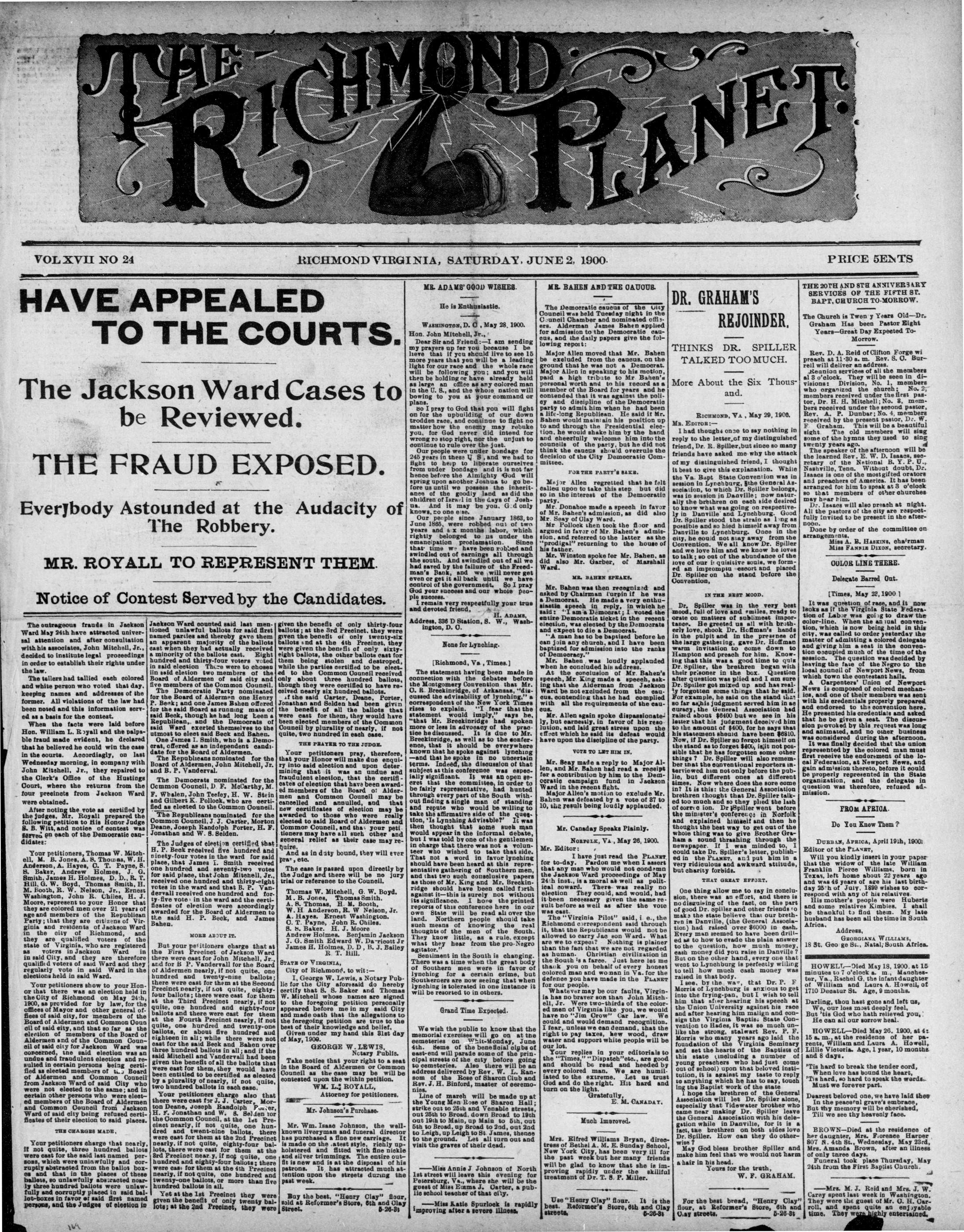
THE RICHMOND PLANET
HAVE APPEALED TO THE COURTS.
The Jackson Ward Cases to be Reviewed.
THE FRAUD EXPOSED.
Everbody Astounded at the Audacity of The Robbery.
MR. ROYALL TO REPRESENT THEM
Notice of Contest Served by the Candidates.
VOL XVII NO 24
HAVE A TO
The Jack be
THE FR
Everjbody Ast
MR. ROYAL
Notice of Con
The outrageous frauds in Jackson Ward May 24th have attracted universal attention and after consultation with his associates, John Mitchell, Jr., decided to institute legal proceedings in order to establish their rights under the law. The tellers had tallied each colored and white person who voted that day, keeping names and addresses of the former. All violations of the law had been noted and this information served as a basis for the contest.
When the facts were laid before Hon. William L. Royall and the palpable fraud made evident, he declared that he believed he could win the case in the courts. Accordingly, on last Wednesday morning, in company with John Kittshall, Jr., he repaired to the Clerk's Office of the Hustings Court, where the returns from the four presicincts from Jackson Ward were obtained.
After noting the vote as certified by the judges, Mr. Royall prepared the following petition to His Honor Judge S. B. Witt, and notice of contest was served on each of the Democratic candidates:
Your petitioners, Thomas W. Mitchell, M. B. Jones, A. S. Thomas, W. H. Anderson, A. Hayes, O. T. Payne, S. Baker, Andrew Holmes, J. G. Smith, James H. Holmes, D. D., R. T. Hill, G. W. Boyd, Thomas Smith, H. M. Booth, R. W. Nelson, Jr., Ernest Washington, John R. Chies, H. J. Moore, represent to your Honor that they are colored men over 21 years of age and members of the Republican Party; that they are citizens of Virginia and residents of Jackson Ward in the city of Richmond, and they are qualified voters of the state of Virginia, who are registered as voters in Jackson Ward in said City, and they are therefore qualified voters of said Ward and they regularly vote in said Ward in the elections held in said Ward.
Your petitioners show to your Honor that there was an election held in the City of Richmond on May 24th, 1800, as provided for by law, for the offices of Mayor and other general offices of said city, for members of the Board of Aldermen and Common Council of said city, and that so far as the election of members of the Board of Aldermen and of the Common Council of said city for Jackson Ward was concerned, the said election was an undue and fraudulent election and resulted in certain persons being certified as elected members of the Board of Aldermen and Common Council from Jackson Ward of said City who were not elected to the same; and in certain other persons who were elected members of the Board of Aldermen and Common Council from Jackson Ward of said city being refused certificates of their election to said places.
THE CHARGES MADE.
Your petitioners charge that nearly, if not quite, three hundred ballots were cast for the said last named persons, which were unlawfully and corruptly abstracted from the ballot boxes and that in the places of these ballots, so unlawfully abstracted nearly three hundred ballots were unlawfully and corruptly placed in said ballot-boxes in favor of said first named persons, and the Judges of election in
Jackson Ward counted said last mentioned unlawful ballots for said first named parties and thereby gave them an apparent majority of the ballots cast when they had actually received a minority of the ballots cast. Eight hundred and thirty-four voters voted in said election. These were to choose iin said election two members of the Board of Aldermen of said city and five members of the Common Council. The Democratic Party nominated for the Board of Aldermen one Henry P. Beck; and one James Bahen offered for the said Board as running mate of said Beck, though he had long been a Republican, and the Democrats of said Ward exerted themselves to the utmost to elect said Beck and Bahen.
One James I. Smith, who is a Democrat, offered as an independent candidate for the Board of Aldermen.
The Republicans nominated for the Board of Aldermen, John Mitchell, Jr. and B. P. Vanderval.
The Democrats nominated for the Common Council, D. F. McCarthy, M. F. Whalen, John Teefey, H. W. Stein and Gilbert K. Pollock, who are certified as elected to the Common Council.
The Republicans nominated for the Common Council, J. J. Carter, Morton Deane, Joseph Randolph Porter, H. F. Jonathan and W. S. Seiden.
The Judges of election certified that H. P. Beck received five hundred and ninety-four votes in the ward for said place, that James I. Smith received one hundred and seventy-two votes for said place, that John Mitchell, Jr., received one hundred and thirty-eight votes in the ward and that B. P. Vandervall received one hundred and forty-five votes in the ward and the certificates of election were accordingly awarded for the Board of Aldermen to the said H. P. Beck, and James Raben.
MORE ABOUT IT.
Your petitioners charge also that there were cast for J. J. Carter, Morton Deane, Joseph Randolph Porter, H. F. Jonathan and W. B. Seldon for the Common Council, at the 1st Precinct nearly, if not quite, one hundred and twentine ballots, there were cast for them at the 2nd Precinct nearly, if not quite, eighty-four ballots, there were cast for them at the 8th Precinct neary, if not quite, one hundred and eighty-four ballots; there were cast for them at the 4th Precinct nearly, if not quite, one hundred and twenty-one ballots, or more than five hundred ballots in all.
Yet at the 1st Precinct they were given the benefit of only twenty ballots; at the 2nd Precinct, they were
RICHMOND VIRGINIA, SATURDAY, JUNE 2, 1900
given the benefit of only thirty-four ballots; at the 3rd Presicet, they were given the benefit of only twenty-six ballots and at the 4th Presicet, they were given the benefit of only sixty-eight ballots, the other ballots cast for them being stolen and destroyed, while the parties certified to be elected to the Common Council received only about three hundred ballots, though they were certified to have received nearly six hundred ballots.
if the said Carter, Deane, Porter, Jonathan and Selden had been given the benefit of all the ballots that were cast for them, they would have been elected members of the Common Council by plurality of nearly, if not quite, two hundred in each case.
THE PRAYER TO THE JUDGE.
Your petitioners pray, therefore, that your Honor will make due enquiry into said election and upon determining that it was an undue and fraudulent election, that the certificates of election that have been awarded members of the Board of Aldermen and Common Council may be cancelled and annulled, and that new certificates of election may be awarded to those who were really elected to said Board of Aldermen and Common Council, and that your petitioners may have all such other and general relief as their case may require.
And as in duty bound, they will ever praj, etc.
The case is passed upon directly by the Judge and there will be no jury trial or reference to the Council.
Thomas W. Mitchell, G. W. Boyd,
M. B. Jones, Thomas Smith.
A. S. Thomas, H. M. Booth,
W. H. Anderson, R. W. Nelson, Jr.
A. Hayes, Ernest Washington.
C. T. Payne, John R. Chiles.
S. S. Baker, H. J. Moore
Andrew Holmes, Benjamin Jackson
J. G. Smith Edward W. Da-ricott Jr
James H. Holmes, D. D, B. J. Bailey
R. T. Hill.
STATE OF VIRGINIA,
City of Richmond, to wit:—
I. George W. Lewis, a Notary Public
for the City aforesaid do hereby
certify that S. S. Baker and Thomas
W. Mitchell whose names are signed
to the foregoing petition personally
appeared before me in my said City
and aforesaid to the petition to
the foregoing petition are taken to
the best of their knowledge and belief.
Given under my hand this 31st day
of May 1909.
Take notice that your right to a seat in the Board of Aldermen or Common Council as the case may be will be contested upon the within petition. WM. L.? ROYALL, Attorney for petitioners.
Mr. Wm. Isaac Johnson, the well-known liverman and funeral director has purchased a fine new carriage. It is made on theatest style, richly upholstered and fitted with fine nickel and silver trimmings. The entire outfit is new and is at the disposal of his patrons. It has attracted much attention upon the streets during the past week.
Buy the best. "Henry Clay" flour, sold at Reformer's Store, 6th and Clay Street. 5-26-83
WASHINGTON, D. C. May 28, 1900.
Hon. John Mitchell, Jr.,
Dear Sir and Friend:—I am sending my prayers up for you because I be leave that if you should live to see 15 more years that you will be a leading light for our race and the whole race will be following you; and you will then be holding or have already held as large an office as any colored man in the U. S., and the whole nation will bowing to you at your command or plan.
So I pray to God that you will fight on for the upholding of our down trodden race, and continue to fight no matter how the enemy may rebuke you, for God never did inedef for wrong ro stop right, nor the unjust to continue to rule over the just.
Our people were under bondage for 245 years in thes U S, and we had to fight to help to liberate ourselves from under bondage and it is not far hence before the Almighty God will spring upon another Joshua to go before us until we possess the inheritance of the goodly land as did the children of Israel in the days of Joshua. And it may be you. God only knows, no one else.
Our people since January 1863, to June 1885, were robbed out of two years and six months labor, which rightly belonged to us under the emancipation proclamation. Since we have been robbed and swindled out of war, all through the south. And swindled out of all we had saved by the failure of the Freedman's Bank, and we will never get even or get it all back until we have control of the government. So I pray God your success and our whole people success.
I remain very respectfully your true and devoted friend.
H. ADAMS,
Address, 336 D Station, S. W., Washington,
Dq. O
None for Lynching.
[Richmond, Va. , Times.]
The statement having been made in connection with the debates before the Montgomery Convention that Mr. O. R. Breckinridge, of Arkansas, "discussed the advisability of lynching," a correspondent of the New York Times rises to explain, "I fear that the statement would imply," says he, "that Mr. Breckinridge had spoken more or less in advocacy of the practice he discussed. It is due to Mr. Breckinridge, as well as to the conference, that it should be everywhere known that he spoke against lynching
—and that he spoke in no uncertain terms. Indeed, the discussion of that subject at this conference was especially significant. It was an open secret that the committee, in order to be fairly representative, had hunted through every part of the South without finding a single man of standing and repute who would be willing to take the affirmative side of the question, "Is Lynching Advisable?" It was then thought that some such man would appear in the informal debate, but I was told by one of the gentlemen in charge that there was not a volunteer who wished to take that side. That a word in favor lynching should have been heard at this representative gathering of Southern men, and that two such consulsive papers as those of Mr. King and Mr. Breckinridge should have been called forth against it—this is surely not without its significance. I hone the printed reports of this conference here in our own State will be read all over the land. Northern people should take such means of knowing the real thoughts of the men of the South They know little, as a rule, except what they hear from the pro-Negro agitator."
Sentiment in the South is changing. There was a time when the great body of Southern men were in favor of punching for a certain crime, but Sutherland was the one that when lynching is tolerated in one instance it will be resorted to in others.
Grand Time Expected.
We wish the public to know that the memorial exercises will go on at the cemeteries on White-Monday, June 4th. Some of the beneficial clubs of east-end will parade some of the principal streets of the city before going to cemeteries. Also there will be an address delivered by Rev. W. L. Ransom of the Rose of Sharon Club and Rev. J. H. Binford, master of ceremonies.
Line of march will be made up at the Young Men Rose of Sharon Hall; strike out to 25th and Venable streets, out 25th to Broad, down Broad to 19th out 19th to Main, up Main to 5th, out 5th to Broad, up Broad to 2nd, out 2nd to Leigh, up Leigh to St James, thence to the ground. Let all turn out and visit the graves of their dead.
Miss Annie J Johnson of North 1st street will leave this evening for Petersburg, Va., where she will be the guest of Miss Emma J. Osterer, a public school teacher of that city.
Miss Katie Spurlock is rapidly improving after a severe illness.
MR. BAHEN AND THE GAUOUS.
The Democratic caucus of the City Council was held Tuesday night in the Council Chamber and nominated officers. Alderman James Bahn applied for admission to the Democratic caucus, and the daily papers give the following report:
Major Allen moved that Mr. Bahn be excluded from the caucus, on the ground that he was not a Democrat. Major Allen in speaking to his motion, paid a high tribute to Mr. Bahn's personal worth and to his record as a member of the Board for years, and he contended that it was against the policy and discipline of the Democratic party to admit him when he had been a life-long Republican. He said if Mr. Bahn would maintain his position up and through the Presidential election, he would shake him by the hand and cheerfully welcome him into the councils of the party, but he did not think the caucus should overrule the decision of the City Democratic Committee.
FOR THE PARTY'S SAKE.
Major Allen regretted that he felt called upon to take this step but did so in the interest of the Democratic party.
Mr. Donahoe made a speech in favor of Mr. Bahen's admission, as did also Mr. Seyg of Clay Ward.
Mr. Pollock then took the floor and argued in favor of Mr. Bahen's admission, and referred to the latter as the prodigal returning to the house of his father.
Mr. Winston spoke for Mr. Bahen, as did also Mr. Garber, of Marshall Ward.
MR. BAHEN SPEAKS.
Mr. Bahen was then recognized and asked by Chairman Turpin if he was a Democrat. He made a very enthusiastic speech in reply, in which he said: "I am a Democrat; I voted the entire Democratic ticket in the recent election, was elected by the Democrats and expect to die a Democrat. "A man has to be baptised before he can join any church, and I have been baptized for admission into the ranks of Democracy." Mr. Bahen was loudly applauded when he concluded his address. At the conclusion of Mr. Bahen's speech, Mr. King made a speech, asking that the Alderman from Jackson Ward be not excluded from the caucus, contending that he had complied with all the requirements of the caucus. Mr. Allen again spoke dispassionately, but earnestly, in favor of his resolution, and laid great stress upon the effect which he said his defeat would have upon the discipline of the party.
VOTE TO LET HIM IN
Mr. Seay made a reply to Major Allen, and Mr. Bahen had read a receipt for a contribution by him to the Democratic campaign fund in Jackson Ward in the recent fight. Major Allen's motion to exclude Mr. Bahen was defeated by a vote of 87 to 10, the result being loudly applauded.
Mr. Canaday Speaks Plainly.
NORFOLK, VA., May 26, 1900.
Mr. Editor:
I have just read the PLANET, for to-day. Pardon me when I assert that any man who would not condemn the Jackson Ward proceedings of May 24th inst., is a moral as well as political coward. There was really no election. They could, and would, had it been necessary given the same result before as well as after the vowel.
The "Virginia Pilot" said, i.e., the Richmond correspondent said through it, that the Republicans would not be allowed to carry Jacob Saw Ward. What are we to expect? Nothing is plainer than the fact that we are not regarded as human. Christian civilization in the South is a fares. Just here let me thank you on behalf of every honest colored man and woman in Va. for the defence you have made in the PLANET for our people.
Whatever may be our faults, Virginia has no braver son than John Mitchell, Jr. Were two-thirds of the colored men of Virginia like you, we would have no "Jim Crow" Car law. We could and would demand recognition. I fear, unless we can demand, that the right to pay taxes,hew wood,draw water and support white people will be our lot. Your replies in your editorials to the "Times,""Dispatch"etc., are good and should be read and heeded by every colored man. We are humiliated to the extreme. Let us trust God and do the right. Hit hard and turn on the light.
Mrs. Elfred Williams Bryan, directress of Bethal A. M. E. Sunday School, New York City, has been very ill for the past week but her many friends will be glad to know that she is improving rapidly under the skillful treatment of Dr. T. S. P. Miller.
Use "Henry Clay" flour. It is the best. Reformer's Store, 6th and Clay streets. 5-26-3t
THINKS DR. SPILLER TALKED TOO MUCH.
RICHMOND, VA, May 29, 1900.
MR. EDITOR:—
I had thought once to say nothing in reply to the letter of my distinguished friend, Dr. R. Spiller, but since so many friends have asked me why the attack of my distinguished friend, I thought it best to give this explanation. While the Va. Bapt State Convention was in session in Lynchburg, the General Association, to which Dr. Spiller belongs, was in session in Danville; now naturally the brathren on each side desired to know what was going on respectively in Danville and Lynchburg. Good Dr. Spiller stood the strain as long as possible and so hied himself away from Danville to Lynchburg. Once in the city, he could not stay away from the Convention. We all know Dr. Spiller and we love him and we know he loves to talk; so out of the abundance of the love of our itquisitive souls, we formed an impromptu escort and placed Dr. Spiller on the stand before the Convention.
IN THE BEST MOOD.
Dr. Spiller was in the very best mood, full of love and smiles, ready to orate on matters of sublimest importance. He greeted us all with brotherly love, shook Dr. Hoffman's hands in the pulpit and in the presence of the large gathering, gave Dr. Hoffman warm invitation to come down to Hampton and preach for him. Knowing that this was a good time to quit Dr. Spiller, the brethren began with their prisoner in the box. Question after question was plied and I am sure Dr. Spiller got mixed up and has really forgotten some things that he said. For example, he said on the stand that so far as his judgment served him in acuracy, the General Association had raised about $6400 but we see in his letter that his judgment deceived him to the amount of $400, for he says that his statement should have been $6810. Now, if Dr. Spiller so forgot himself on the stand as to forget $400, it isn't possible that he has forgotten some other things? Dr. Spiller will also remember that the conventional reporters interviewed him not only before the public, but different ones at different times. Now where does the sore come in? It is this: the General Association brethren thought that Dr. Spiller talked too much and so they plied the lash of sorrow ion. Dr. Spiller went before the minister's conferences in Norfolk and explained himself and then he thought the best way to get out of the whole thing was to give Brother Graham a sound thrashing through the newspaper. If I was minded to, I could take Dr. Spiller's letter, published in the PLANER, and put him in a very ridiculous and awkward attitude, but charity forbids.
THAT GREAT EFFORT.
One thing allow me to say in conclusion, there was an effort, and there is no disguising of the fact, on the part of good Dr. spiller and other friends to make the state believe that our brethren in Danville, (the General Association) had raised over $6000 in cash. Every man seemed to have been drilled as to how to evade the plain answer to the question, how much money, cash money did you raise in Danville? But on one occasion, a Lynchburg is perfectly willing to tell how much cash money was raised in that body.
I see, by the way, that Dr. P. F. Morris of Lynchburg is anxious to get into the frying-pan, but I wish to tell him that after hearing his speech at the Union University against his race and after hearing him malign and consign the Virginia Baptist State Convention to Hades, it was so much unlike the strong, stalwart Rev. P. F. Morris who many years ago laid the foundation of the Virginia Seminary and set the hearts of the Baptists of this state (including a number of young preachers who had just come out of school) upon that beloved institution, it is against my taste to reply to anything which he has to say, touching the Baptist work of the state
I hope the brethren of the General Association will let Dr. Spiller alone, especially that of dear preacher who came to work with Dr. Spiller. The General Association with his delegation while in Danville, for it is a fact, the brethren on both sides love Dr. Spiller. How can they do otherwise?
May God bless brother Spiller and make him feel that we would not harm a hair in his head.
Youra tor the truth.
For the best brand, "Henry Clay" flour, at Reformer's Store, 5th and Clay streets. 5-26-8t
PRICE 5ENTS
THE 20TH AND 8TH ANNIVERSARY SERVICES OF THE FIFTH ST. BAPT. CHURCH TO-MORROW.
The Church is Twen y Years Old—Dr. Graham Has been Pastor Eight Years—Great Day Expected To-Morrow.
Rev. D. A. Reid of Clifton Forge wi preach at 11:30 a.m. Rev. S. O. Burrell will deliver an address. Reunion services of all the members al 3 o'clock. They will be seen in divisions: Division, No. 1, members who organized the church, No. 2, members received under the first pastor, Dr. H. P. Mitchell, No. 3, members received under the second pastor, Rev. A. P. Dunbar; No. 4, members received by the present pastor, Dr. W. F. Graham. This will be a beautiful sight. The old members will sing some of the hymns they used to sing twenty years ago.
The speaker of the afternoon will be the learned Rev. E. W. D. Isaacs, secretary of the National B. Y. P. U., Nashville, Tenn. Without doubt, Dr. Isaacs is one of the most gifted orators and preachers of America. It has been arranged for him to speak at 3 o'clock so that members of other churches may hear him.
Dr. Isaacs will also preach at night. All the pastors of the city are respectfully invited to be present in the afternoon.
Done by order of the committee on arrangements.
Miss A. B. HASKINS, chairman
Miss FANNIE DIXON, secretary.
COLOR LINE THERE.
Delegate Barred Out.
[Times. May 22, 1900.]
It was question of race, and it now looks as if the Virginia State Federation of Labor was going to draw the color-line. When the annual convention, which is now being held in this city, was called to order yesterday the matter of admitting a colored delegate and giving him a seat in the convention occupied much of the time of the session. The question was decided by leaving the face of the Negro to the local council of Newport News, from which town the contestant hails.
A Carpenters' Union of Newport News is composed of colored mechanics, and one of their members was sent with his credentials properly prepared endorsed to the convention here. He had to answer that question, that he be given a seat. The discussion provoked by this request was long and animated, and no other business was considered during the afternoon.
It was finally decided that the union represented by the colored man must first receive the endorsement of the local Federation, at Newport News, and gain admission thereto, before it could be properly represented in the State organization, and the delegate in question was therefore, refused admission.
FROM AFRICA.
Do You Know Them?
DURBAN, AFRICA, April 19th, 1900:
Editor of the PLANET,
Will you kindly insert in your paper that the widow of the late William Franklin Pierce Williams, born in Texas, left home about 22 years ago and was 48 years of age his last birthday 25th of July, 1899 wishes to correspond with any of his relatives.
His mother's people were Huberts and some relatives Kimbies. I shall be thankful to find them. My late husband has been all the time in South Africa.
Address,
GEORGIANA WILLIAMS,
18 St. Geo ge St., Natal; South Africa.
HOWELL—Died May 18, 1900, at 15 minutes to 7 o'clock a. m., Manchester, Va., Rachel G, the infant daughter of William and Laura A. Howell, of 1710 Decatur St. Age, 9 months.
Darling, thou hast gone and left us, We, our loss most deeply feel. But 'tis God who hath relieved you, He can all our sorrow heal.
HOWELL—Died May 26, 1900, at 4:15 a. m., at the residence of her parents, William and Laura A. Howell, Lillie Victoria. Age, 1 year, 10 months and 8 days.
'Tis hard to break the tender cord, When love has bound the heart, 'Tis hard, so hard to speak the words. Must we forever part.
Dearest beloved one, we have laid thee In the peaceful grave's embrace, But thy memory will be cherished, Till we see thy heavenly face.
BROWN-Died at the residence of her daughter, Mrs. Florence Harper 807 N. 4th St., Wednesday, May 23rd, Mrs. Amanda Brown, after an illness of only three days.
Funeral took place Thursday, May 24th from the First Baptist Church.
—Mrs. M. J. Reid and Mrs. J. W. Carey spent last week in Washington. They were the guest of Mr. O. H. Carroll, and spent quite an enjoyable time. They were highly entertained.
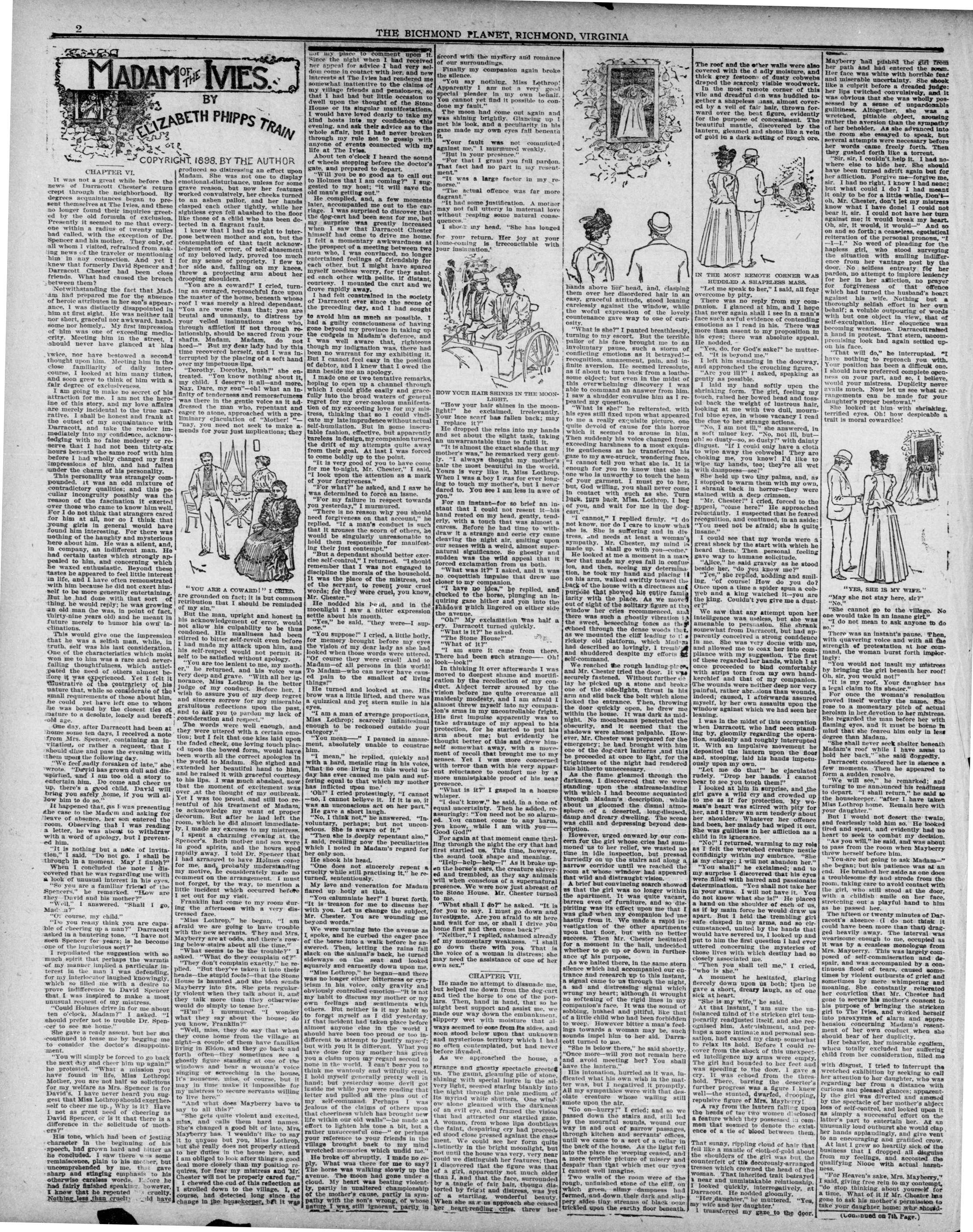
MADAM OF THE IVIES.
BY
ELIZABETH PHIPPS TRAIN
COPYRIGHT. 1898. BY THE AUTHOR
It was not a great while before the news of Darracott Chester's return crept through the neighborhood. By degrees acquaintances began to present themselves at The Ivies, and these no longer found their inquiries greeted by the old formula of exclusion. Presently it seemed to me that everyone within a radius of twenty miles had called, with the exception of Dr. Spencer and his mother. They only, of all whom I visited, refrained from asking news of the traveler or mentioning him in any connection. And yet I knew that formerly David Spencer and Darracott Chester had been close friends. What had caused the breach between them?
Notwithstanding the fact that Madam had prepared me for the absence of heroic attributes in her son's appearance, I was distinctly disappointed in him at first sight. He was neither tall nor short, graceful nor awkward, handsome nor homely. My first impression of him was of exceeding mediocrity. Meeting him in the street, I should never have glanced at him
twice, nor have bestowed a second thought upon him. Meeting him in the close familiarity of daily intercourse, I looked at him many times, and soon grew to think of him with a fair degree of exclusiveness. I am going to make no secret of his attraction for me. I am not the heroine of this story, and my love affairs are merely incidental to the true narrative. I shall be honest and frank at the outset of my acquaintance with Darracott, and take the reader immediately into my confidence, acknowledging with no false modesty or reserve that I had not been thirty-six hours beneath the same roof with him before I had wholly changed my first impressions of him, and had fallen under the charm of his personality.
This personality was strangely compounded. it was an odd mixture of contradictory qualities; and this peculiar incongruity possibly was the reason of the fascination it exerted over those who came to know him well. For I do not think that strangers cared for him at all, nor do I think that young girls in general would have found him interesting. For there was nothing of the haughty and mysterious hero about him. He was a silent, and, in company, an indifferent man. He had certain tastes which strongly appealed to him, and concerning which he waxed enthusiastic. Beyond these tastes he appeared to feel little interest in life, and I have often remonstrated with him because he did not exert himself to be more generally entertaining. But he had done with that sort of thing, he would reply; he was growing an old man (he was), in point of fact, thirty-nine years old), and he meant in future merely to humor his own inclinations.
This would give one the impression that he was a selfish man, while, in truth, self was his last consideration. One of the characteristics which most won me to him was a rare and never-failing thoughtfulness, which anticipated the need of others almost before it was experienced. Yet I felt it illustrative of the contrariety of his nature that, while so considerate of the small requirements of those about him, he could yet have left one to whom he was bound by the closest ties of nature to a desolate, lonely and bereft cold age.
One day, after Darracott had been at home some ten days, I received a note from Mrs. Spencer, containing an invitation, or rather a request, that I should dine and pass the evening with them upon the following day.
"We feel sadly forsaken of late," she wrote. "David has grown dull and dissipated, and I am too old a story to entertain him. Do come and cheer us up, there's a good child. David will bring you safely home, if you will allow him to do so."
It happened that, as I was presenting the case to the Madam and asking for leave of absence, her son entered the room. Observing that I was reading a letter, he was about to withdraw with a word of apology, but I prevented him.
"It is nothing but a note of invitation," I said. "Do not go. I shall be through in a moment. May I finish?" When I concluded the note I discovered that he was regarding me with a look of unusual interest in his eyes. "So you are a familiar friend of the Spencers," he remarked. "How are they-David and his mother?" "Well," I answered. "Shall I go, Madam?"
"O! course, my child."
"To you ready think you are capable of cheering up a man?" Dracortc asked in a bantering tone. "I have not seen Spencer for years; is he become one of the lugubrious sort?" I repudiated the suggestion with so much spirit that perhaps the warmth of my manner implied a particular interest in the man I was defending, for my interlocutor laughed knowingly, which so filled me with a desire to prove indifference to David Spencer that I was inspired to make a most unusual request of my mistress.
"Could Holmes drive in for me about ten o'clock, Madam?" I asked. "I should prefer not to trouble Dr. Spencer to see me home."
She gave a ready assent, but her son continued to tense me by begging me to consider the doctor's disappointment.
"You will simply be forced to go back the next day and cheer him up again!" he protested. "What a mission you have found in life, Miss Lothrop! Mother, you are not half so solicited for my welfare as Mrs. Spencer is for David's. I have never heard you suggest that Miss Lothrop should exert herself to cheer me up, Why is it? Have I not as great need of cheering as David Spencer, or is it that there is a difference in the solicitude of mothers?"
His tone, which had been of jesting character in the beginning of his speech, had grown hard and bitter as he concluded. I saw there was some reminiscence, plain to his mother, but uncomprehended by me, that gave sharp and stinging emphasis to his otherwise careless words. Before he had fairly finished speaking, however, I knew that he repented his cruelty. Nothing less than cruelty could have
produced so distressing an effect upon Madam. She was not one to display emotional disturbance, unless for some grave reason, but now her features worked convulsively, her cheeks turned to an ashen pallor, and her hands clasped each other tightly, while her sightless eyes fell abashed to the floor like those of a child who has been detected in a fragrant fault.
I knew that I had no right to interpose when mother and son, but the contemplation that tacit acknowledgment of error of self-abasement of my beloved lady, proved too much for my sense of propriety to her side and, falling on my knees, threw a protecting arm about her drooping shoulders.
"You are a coward" I cried, turning an enraged, reproachful face upon the master of the house, beneath whose roof I was merely a hired dependant. "You are worse than that; you are brutal and unmanly, to distress by your velled insinuations one who, through affliction if not through relationship, should be sacred from your shafts. Madam, Madam, do not heed-" But my dear lady had by this time recovered herself, and I was interrupted by the placing of a soft hand over my impetuous lips.
"Dorothy, Dorothy, hush!" she entreated. "You know nothing about it, my child. I deserve it all—and more. Nay, Dare, my son"—oh! what an infinity of tenderness and remorsetness was there in the gentle voice as it addressed the man who, repentant and eager to atone, approached with a preliminary ejaculation of "Mother!" "—nay, you need not seek to make amends for your just implications; they
"YOU ARE A COWARD!" I CRIED. are grounded on fact; it is but common retribution that I should be reminded of my sin."
But the man, upright and honest in his acknowledgement of error, would not allow his culpability to be thus condoned. His manliness had been stirred to bitter self-revolt even before I had made my attack upon him, and his self-respect would not permit its self to be satisfied without apology.
"You are too lenient to me, my mother," he returned, and his voice was very deep and grave. "With all her ignorance, Miss Lothrop is the better judge of my conduct. Before her, I wish to assure you of my deep regret and sincere sorrow for my miserable gratuitous reflections upon the past, and to ask you to pardon my lack of consideration and respect."
The words were well enough, and they were uttered with a certain emotion; but I felt that one kiss laid upon the faded cheek, one loving touch placed upon the bowed form, would have been worth all the correct apologies in the world to Madam. She sighed and extended her beautiful hand to him, and he raised it with graceful courtesy to his lips. I was much abashed, now that the moment of excitement was over, at the thought of my outbreak. Yet I was too proud, and still too resentful of his treatment of Madam, to acknowledge my want of proper decorum. But after he had left the room, which he did almost immediately, he made my excuses to my mistress. I spent the warming evening at the Spencer's. Both he and son were in good spirits, and the hours sped rapidly away. I told Dr. Spencer that I had arranged to have Holmes come for me, and, probably understanding my motive, he considerably made no comment on the arrangement. I must not forget, by the way, to mention a little incident which occurred before I set out for my visit.
Franklin had come to my room during the afternoon with a very distressed face.
"Miss Lothrop," he began. "I am afraid we are going to have trouble with the new servants. They and Mrs. Mayberry are at odds, and there's rowing below-stairs about all the time."
"What seems to be the trouble?" I asked. "What do they complain of?" "They don't complain exactly," he replied. "But they've taken it into their hands the stupid fools"—that the Stone Bee is haunted, and the idea sends Mayberry the fox. She gets regularly violent when they talk about it, and they talk more than they otherwise would do simply to tense her.
"H'm!" I murmured. "I wonder what they say about the house; do you know. Franklin?"
"Well, miss, they do say that when they come home from the village at night—a couple of them have families living in Eldon, and they go back and forth often—they sometimes see a ghostly figure standing at one of the windows and hear a woman's voice singing or screeching in the house. It's nonsense, miss, of course, but it may in time make it impossible for my mistress to secure servants willing to live here."
"And what does Mayberry have to say to all this?"
"She gets quite violent and excited, miss, and calls them hard names. She's changed a good bit of late, Mrs Mayberry has. I wouldn't like to say it to anyone but you. Miss Lothrop, but she really does not properly attend to her duties in the house here, and I am obliged to look after things a good deal more closely than my position requires, for fear my mistress and Mr. Chester will not be properly cared for." I chewed the cud of this reflection as I strolled down to the village. I, of course, had detected long since the change in the housekeeper, but it was
THE BICHMOND PLANET, RICHMOND, VIRGINIA
not my place to comment upon it.
Since the night when I had received her appeal for advice I had very seldom come in contact with her, and new interests at the Ilyes had rendered me somewhat inattentive to the claims of my village friends and pensioners, so that I had had but little occasion to dwell upon the thought of the Stone House or its singular manifestations. I would have loved dearly to take my kind hosts into my confidence at evening, and ask their advice as to the whole affair, but I had never broken through my rule not to gossip with anyone of events connected with my life at The Ilyes.
About ten o'clock I heard the sound of wheels stopping before the doctor's gate, and prepared to depart.
"Will you be so good as to call out to Holmes that I am coming?" I suggested to my host; "it will save the old man's getting out."
He complied, and, a few moments later, accompanied me out to the carriage. I was surprised to discover that the dog-cart had been sent for me, but my surprise was greatly increased when I saw that Darracott Chester himself had come to drive me home. I felt a momentary awkwardness at the prospect of a meeting between two men who, I was convinced, no longer entertained feelings of friendship for each other, but I might have spared myself needless worry, for they saluted each other with polite, if distant, courtesy. I mounted the cart and we drove rapidly away.
I had felt constrained in the society of Darracott ever since the scene of the preceding day, and I had sought to avoid him as much as possible. I had a guilty consciousness of having gone beyond my province in taking up the cudgels in Madam's defence, and I was well aware that, righteous though my indignation was, there had been no warrant for my exhibiting it. But I cannot feel easy in the position of debtor, and I knew that I owed the man beside me an apology.
I made one or two tentative remarks, hoping to open up a channel through which I could glide easily and gracefully into the broad waters of general regret for my over-zealous manifestation of my exceeding love for my mistress, thinking that so I could vindicate my late imprudence without actual self-humiliation. But in some inscrutable fashion, effective, but apparently careless in design, my companion turned the drift of my attempts quite away from their goal. At last I was forced to come boldly up to the point.
"It is very good of you to have come for me to-night, Mr. Chester," I said, "I look upon the attention as a mark of your forgiveness."
"For what?" he asked, and I saw he was determined to force an issue.
"For my failure in respect towards you yesterday." I murmured.
"There is no reason why you should need forgiveness on that account," he replied. "If a man's conduct is such that it arouses the scorn of others, he would be singularly unreasonable to hold them responsible for manifesting their just contempt."
"But a dependant should better exercise self-control." I returned. "I should remember that I was not engaged to discipline the morals of the household. It was the place of the mistress, not of the servant, to resent your cruel words; for they were cruel, you know, Mr. Chester."
He nodded his head, and in the moonlight I saw a bitter expression settle about his mouth.
"Yes," he said, "they were—I suppose."
"You suppose!" I cried, a little hotly, for memory-brought before my eyes the vision of my dear lady as she had looked when those words were uttered. "Of course they were cruell. And to Madam—of all persons in this world! To Madam—who can never have caused pain to the smallest of living things!"
He turned and looked at me. His brow was a little lifted, and there was a quizzical and yet stern smile in his eyes.
"I am a man of average proportions, Miss Lothrop; scarcely infinitesimal enough to be reckoned outside your category."
"You mean—" I paused in amazement, absolutely unable to construe him.
"I mean," he replied, quickly and with a hard, metallic ring in his voice, "that no one living in this world today has ever caused me pain and suffering equal to that which my mother has inflicted upon me."
"Oh!" I cried protestingly, "I cannot—no, I cannot believe it. If it is so, it was an unconscious act on her part." He gave a short laugh. "I think not," he answered. "Involuntary ecophases, but not unconscious. She is aware of it." "Then she is deeply repentant also." I said, recalling now the peculiarities which I noted in Madam's regard for her only son.
He shook his head.
"One does not sincerely repent a cruelty while still practising it," he returned, sententiously.
My love and veneration for Madam flared up hotly at this.
"You calumniate her!" I burst forth.
"It is treason for me to discuss her with you. Let us change the subject, Mr. Chester. You are wounding me beyond words."
We were turning into the avenue as I spoke, and he curbed the eager pace of the horse into a walk before he answered. Then, letting the rains fall slack on the animal's back, he turned sideways on the seat and looked squarely and earnestly down upon me.
"Miss Lothrop," he began—and there was no longer either bitterness or cynism in his voice, only gravity and obviously controlled emotion—it is not my habit to discuss my mother or my own feelings and sentiments with others. But neither is it my habit so to forget myself as I did yesterday. If that incident had taken place before almost anyone else in the world I should have been too proud or too indifferent to attempt to justify myself; but with you it is different. What you have done for my mother has given you a claim upon my regard second to none in the world. I can't bear you to think me wantonly and wilfully cruel. I hold myself generally pretty well in hand; but yesterday some devil got inside me while you were reading that letter and pulled all the pins out of my self-command. Perhaps I was jealous of the claims of others upon that cheeriness which has brought new life within our old walls"—he made an effort to lighten his tone a bit, but a rather unsuccessful one—"or perhaps your reference to your friends in the village brought back to my mind wretched memories which undid me." He broke off abruptly. I made no reply. What was there for me to say? The horse was walking slowly up the avenue. The moon had gone under a cloud. My heart was beating violently, partly in unaltered championship of the mother's cause, partly in sympathy with the son's wrong, of whose nature I was still ignorant, partly in
accord with the mystery and romance of our surroundings.
Finally my companion again broke the silence.
"You say nothing, Miss Lothron! Apparently I am not a very good special pleader in my own behalf. You cannot yet find it possible to condone my fault."
The moon had come out again and was shining brightly. Glancing up I met his look, and a peculiarity in his gaze made my own eyes fall beneath it.
"Your fault was not committed against me," I murmured weakly.
"But in your presence."
"For that I grant you full pardon. That fact had no part in my resentment."
"It was a large factor in my remorse."
"The actual offence was far more fragrant."
"It had some justification. A mother may not fall utterly in maternal love without reaping some natural consequences."
I shock my head. "She has longed
for your return. Her joy at your home-coming is irreconcilable with your insinuation.'
HOW YOUR HAIR SHINES IN THE MOON-LIGHT.
"How your hair shines in the moonlight!" he exclaimed, irrelevantly. Your lace scarf has fallen back; may I replace it?
He dropped the reins into my hands and set about the slight task, taking an unwarrantable time to fulfil it.
"It is almost the exact shade that my mother's was," he remarked very gently. "I always thought my mother's hair the most beautiful in the world. Yours is very like it, Miss Lothrop. When I was a boy I was for ever longing to touch my mother's, but I never did. You see I am less in awe of you."
For an instant—for so brief an instant that I could not resent it—his hand rested on my head, gently, tenderly, with a tone that was almost a caress. Before he had dimmed, with draw it a strange and eerie cry, cleansing the night air, smiling upon our senses with a weird, almost supernatural significance. So ghostly and sudden was the wild appeal that it forced exclamation from us both.
"What was it?" I asked, and it was no coquettish impulse that drew me closer to my companion.
"I have no idea," he replied, and clucked to the horse, plunging an inquiring gaze hither and yon into the shadows which lingered on either side the avenue.
"Oh!" My exclamation was half a cry. Darracott turned quickly.
"What is it?" he asked.
"The Stone House!"
"What of it?"
"I am sure it came from there. There had been such strange—Oh! look—look!"
In thinking it over afterwards I was moved to deepest shame and mortification by the recollection of my conduct. Abject terror aroused by the vision before me quite overcame all malediction modesty, and I am afraid I almost threw myself into my companion's arms in my uncontrollable fright. His first impulse apparently was to take advantage of my appeal to his protection, for he started to put his arm about me; but evidently he thought better of this and drew himself somewhat away, with a movement of scoll that brought me to my sense. Yet I was more concerned with terror than with his very apparent reluctance to comfort me by a more unmistakable proof of his near presence.
"What is it?" I gasped in a horrise whisper.
"I don't know," he said, in a tone of equal uncertainty. Then he added, reassuringly: "You need not be so alarmed. You cannot come to any harm, you know, while I am with you—Good God!"
For again at that moment came thrilling through the night the cry that had first startled us. This time, however, the sound took shape and meaning.
"Help—help—help—!" As it broke up on the horse's ears, the creature shivered and trembled, as they say animals will when conscious of a supernatural presence. We were now just abreast of the Stone House. Mr. Chester turned to me.
"What shall I do?" he asked. "It is for you to say. I must go down and investigate. Are you afraid to sit here and wait for me, or shall I drive you home first and then come back?"
"Neither," I replied, ashamed already of my momentary weakness. "I shall go down there with you. That is the voice of a woman in distress; she may need the assistance of one of her own sex."
CHAPTER VII
He made no attempt to dissuade me, but helped me down from the dog-cart and tied the horse to one of the ponlars. Then, hand in hand, that so he might best support and assist me, we made our way down the embankment, slippery wet with moisture that always seemed to coze from its slides, and soon stood below upon that unknown and mysterious territory which I had so often contemplated, but had never before invaded.
As we approached the house, a
strange and ghostly spectacle greeted us. The gaint, gleaming pile of stone, shining with special lustre in the silvery light, seemed staring blankly in the night through the pale medallion of its myriad white shutters. One window alone gleamed with the darkness of an evil eye, and framed the vision that had attracted our startled gaze. A woman, from whose lips doubtless the faint, despairing cry had proceeded stood close pressed against the enclosure. We could see her form quite distinctly in the bright moonlight, but not until the house was very, very near could we distinguish her features; then I discovered that the figure was that of a girl, apparently not much older than I, and that the face, surrounded by a tangle of fair hair, though distorted by frigit and distress, was yet of a startling, wonderful beauty. When she saw us approach she ceased her heart-reading cries, threw her
THE GIRL IN THE MIRRORED CLOSET
hands above her head, and, clasping them over her disordered hair in an easy, graceful attitude, stood leaning carelessly against the window, while the woolful expression of the lovely countenance gave way to one of curiosity.
"What is she?" I panted breathlessly, turning to my escort. But the terrible pallor of his face brought me to an involuntary pause, such a storm of conflicting emotions as it betrayed!-recognition, amazement, pain, and infinite aversion. He seemed irresolute, as if about to turn back from a loathesome object; but even in the midst of this overwhelming discovery I was able to command an answer from him. I saw a shudder convulse him as I repeated my question.
"What is she!" he reiterated, with his eyes still fixed upon what appeared to me a really exquisite picture, one quite devoid of cause for this horror which it seemed to arouse in him. Then suddenly his voice changed from exceeding harshness to a most exquisite gentleness as he transferred his gaze to my awe-struck, wondering face. "I cannot tell you what she is. It is enough for you to know that she is one who is unworthy to touch the hem of your garment. I must go to her, but, God willing, you shall never come in contact with such as she. Turn back, turn back, Miss. Lothrop, I beg of you, and wait for me in the dog-cart."
"I cannot," I replied firmly. "I do not know, nor do I care to know what she is. She is suffering and in distress, and needs at least a woman's sympathy. Mr. Chester, my mind is made up. I shall with you—coneer. He looked at me a moment in a manner that made my eyes fall in confusion, and then, seeing my determination, he took my hand and placing on his arm, walked swiftly toward the back of the house with a directness and purpose that showed his entire family with the place. As we moved out of sight of the solitary figure at the window her cries recommenced, and there was such a ghostly vibration to the sweet, beseaching tones as they echoed through the dense woods that, as we mounted the cliff leading to the rickety old platform, which Madame had described so lovingly. I trembled and shuddered despite my efforts to self-command.
We reached the rough landing place and Mr. Chester tried the door. It was securely fastened. Without further delay he picked up a stone and broke one of the side-lights, thrust in his arm and slid back the bolt which alone locked the entrance. Then, throwing the door quickly open, he drew me within the house. It was dark as midnight. No moonbeams penetrated the obscurity, and it seemed that the shadows were almost palpable. However, Mr. Chester was prepared for the emergency; he had brought with him one of the dog-cart lanterns, and this he proceeded at once to light, for the brightness of the night had rendered this hitherto unnecessary.
As the flame gleamed through the darkness, I discovered that we were standing upon the staircase-landing with which I had become acquainted through Madam's description, while about us gloomed the dismal atmosphere of a deserted, long-disused, damp and dreary dwelling. The scene was chill and depressing beyond description.
However, urged onward by our concern for the girl whose cries had summoned us to her relief, we wasted no time in idle inspection, but pressed hurriedly on up the stairs and along a narrow corridor until we reached the room at whose window had appeared that wild and distraught vision.
A brief but convincing search showed us that the girl was no longer within the apartment. It was quite vacant, barren even of furniture, and so disprising was its effect upon me that I was glad when my companion led me hastily from it. We made a rapid investigation of the other apartments upon that floor, but with no better success. Then Mr. Chester hesitated for a moment in the hall, undecided whether to go up or down in furtherance of his purpose. I brought there, in the same stern silence while and accompanied our entrance and researched up to this instant, a signal came to us through the night, a sad and distressing sound, which wrung my heart; although it wrought no softening of the rigid lines in companion's face. It was the sound of sobbing, hushed and pitiful, like that of a little child who had been forbidden to weep. However bitter a man's feelings towards a woman may be, such sounds impel him to her aid. Darrancott turned to me.
"She is below there," he said shortly. "Once more—will you not remain here and avoid meeting her? You shall have the lantern."
His intonation, hurried as it was, indicated what his own wish in the matter was, but I neglected it promptly. All my sympathies were with that desolate creature whose wailing still smoke upon the air.
"Go on—hurry!" I cried; and so we passed down the stairs and, still led by the mournful sounds, wound our way in and out of narrow passages, through kitchen and servants' offices, until we came to a sort of a cellar in the back of the house. As the light fell into the place the weeping ceased, and a more terrible picture of misery and despair than that which met our eyes I cannot well imagine.
Two walls of the room were of the rough, unfinished stone of the cliff, on which green, slimy dampness had formed, and down their dark and slippery sides tiny streams of black ooze trickled upon the earth floor beneath.
The roof and the other walls were also covered with the d adly moisture, and thick grey festoons of dusty cobwebs draped the scarcely visible woodwork. In the most remote corner of this vile and dreadful den was huddled together a shapeless mass, almost cover-ing the veil of fair hair, thrown forward over the floor, with widely for the purpose of concealment. The beautiful mantle, discovered by the lantern, gleamed and shone like a vein of gold in a dark setting of rough ore.
IN THE MOST REMOTE CORNER WAS HUDDLED A SHAPELESS, MASS.
MASS. "Let me speak to her," I said, all fear overcome by nity.
There was no reply from my companion. I glanced at him, and I hope that never again shall I see in a man's face such awful evidence of contending emotions as I read in his. There was more than assent to my proposition in his eyes; there was absolute appeal. He nodded.
"Yes, do. for God's sake!" he muttered. "It is beyond me."
I left him standing in the doorway, and approached the crouching figure. "I am asked, speaking as gently as possible.
I laid my hand softly upon the shrinking form. The girl, feeling my touch, raised her bowed head and tossed back the weight of lustrous hair, looking at me with two dull, mournful blue eyes, in whose vacancy I read the clue to her strange actions.
"No, I am not ill." she answered, in a soft minor key. "No, not ill, but—oh! so dusty—so, so dusty!" with dainty disgust. "If I could only have a cloth to wipe away the cobwebs! They are choking me, you know! I'd like to wipe my hands, too; they're all wet with dampness—see!" She held up two tiny palms, and, as I stopped to warm them with my own, I shrank back in horror—they were stained with a deep crimson.
"Mr. Chester!" I cried, forced to the appeal, "come here!" He approached reluctantly. I suspected that he feared recognition, and continued, in an aside: "You need not be afraid; she is quite insane."
I could see that my words were a great shock by the start with which he heard them. Then personal feeling gave way to humane solicitude.
"Alice," he said gravely as he stood beside her, "do you know me?"
"Yes," she replied, nodding and smiling, "of course! How do you do? Once upon a time a spider spun a coyweb and a king watched it—you are the king. Couldn't you give me a duster?" We saw that any attempt upon her intelligence was useless, but she was amenable to persuasion. She shrank somewhat from Darcott, but had apparently conceived a strong confidence in me. She was very docile with me, and allowed me to coax her into compliance with my suggestion. The first of these regarded her hands, which I at once proceeded to bind comfortably with strips torn from my own handkerchief and that of my companion. The wounds were neither deep nor very painful, rather abrasions than wounds, indeed; caused, I afterwards assured myself, by her own assaults upon the window against which we had seen her leaning.
I was in the midst of this occupation when Darracott, who had been standing by, gloomily regarding the operation, suddenly and roughly interrupted it. With an impulsive movement he deposited the lantern upon the floor and, stooping, laid his hands impetuously upon my own.
"Let me do that!" he ejaculated rudely. "Drop her hands. I cannot bear to see you touch them!"
I looked at him in surprise, and the girl gave a wild cry and crowded up to me as if for protection. My woman's heart was stirred with pity for her, and I threw an arm tenderly about her shoulder. Whatever her offence had been, her malady had wiped it out. She was gulless in her affliction as a child in its ignorance.
"No!" I returned, warming to my role as I felt the wretched creature nestle confidently within my embrace. "She is my charge; I will not abandon her."
"You shall!" he exclaimed; and to my surprise I discovered that his eyes were filled with hatred and passionate determination. "You shall not take her in your arms. I will not have it. You do not know what she is!" He placed a hand on the shoulder of each of us, as if by main force he would draw us apart. But I held the trembling girl safe clasped in my arms, and so circumstanced, united by the hands that would have severed us, I looked up and put to him the first question I had ever uttered concerning the mysteries of those lives with which destiny had so closely associated me.
"Then you shall tell me," I cried, "who is she."
A moment he hesitated, glaring fiercely down upon us both; then he gave a short, dreary laugh, as of one sick at heart.
"She is my wife," he said.
At that instant, I sure the unbalanced mind of the stricken girl temporarily readjusted itself, as she recognised him. Astestishment, and perhaps a more intimate and personalisation, had caused my clasp somewhat to relax its hold. Before I could recover from the shock of this unexpected intelligence my arms were empty. The girl had bounded to her feet and was speeding to the door. I gave a cry. It was echoed from the threshold. There, barring the deserter's further progress was a figure I knew well—the stunted, dwarfed, drooping, repulsive figure of Mrs. Mayberry!
A ray from the lantern falling upon the heads of the two women disclosed a feature which they possessed in common that seemed to denote the existence of a tie of blood between them.
That sunny, rippling cloud of hair that fell like a mantle of cloth-of-gold about the shoulders of the girl was but the counterfeit of the decorously-arranged tresses which crowned the head of the woman. That inherited trait betrayed a near and unmistakable relationship. I looked quickly, interrogatively, at Darracott. He nodded gloomily. "Her daughter," he muttered. "Yes, my wife and her daughter." I transferred my gaze to the door.
Mayberry had pushed the girl from her path and had entered the room. Her face was white with horrible fear and miserable uncertainty. She shook like a culprit before a dreaded judge; her lips twitched convulsively, and it was obvious that she was wholly possessed by a sense of unpardonable guiltiness. Altogether, she was a wretched, pliable object, arousing rather the aversion than the sympathy of her beholder. As she advanced into the room she essayed to speak, but several attempts were necessary before her words came freely forth. Then they gushed forth like a torrent.
"Sir, sir, I couldn't help it. I had nowhere else to hide her. She should have been turned adrift again but for her affliction. Forgive me -forgive me, sir. I had no right. I know I had nenct; but what could I do? I had meant it only to be for a little while. Don't -oh, Mr. Chester, don't let my mistress know what I have done! I could not bear it, sir. I could not have her turn against me; it would break my heart. Oh, sir, it would, it would—" And so on and so forth; a ceaseless, egotistical reiteration of the personal pronoun. "—I-I—" No word of pleading for the hapless girl, who stood surveying the situation with smiling indifference from her vantage post by the door. No selfess entreaty for her pardon, no attempt to implore lenency for her in her affliction, no prayer for forgiveness of that offence which had turned the husband's heart against his wife. Nothing but a thoroughly selfish effort in her own behalf; a voluble outpouring of words with but one object in view, that of self-exculpation. Her eloquence was becoming wearisome. Darracottraised a hand in protest. That stern, uncompromising look had again settled upon his face.
"That will do," he interrupted. "I have nothing to reproach you with. Your position has been a difficult one. I should have preferred complete openness on your part, and so, I believe, would your mistress. Duplicity never avails much. Now let us see what arrangements can be made for your daughter's proper bestowal." She looked at him with shrinking, terrified eyes. Oh! how despicable a trait is moral cowardice!
A
"She cannot go to the village. No one would take in an insane girl."
"I do not mean to ask anyone to do so."
There was an instant's pause. Then, with quavering voice and with all the strength of protestation at her command, the woman burst forth imploringly:
"You would not insult my mistress by bringing the girl beneath her roof! Oh, sir, you would not!"
"It is my roof. Your daughter has a legal claim to its shelter."
For once the woman's resolution proved itself worthy the name. She rose to a momentary pitch of actual herolism in her devotion to her mistress. She regarded the man before her with flaming eyes, and it must be borne in mind that she feared him only in less degree than Madam.
"She shall never seek shelter beneath Madam's roof while I have awns to hold her back," she said doggedly.
Darracott considered her in silence a few moments. Then he appeared to form a sudden resolve.
"We will see," he remarked; and turning to me announced his readiness to depart. "I shall return," he said to the housekeeper, "after I have taken Miss Lothrop home. Remain here with your daughter."
But I would not desert the twain, and fearlessly told him so. He looked tired and spent, and evidently had no heart to seek to combat my decision.
"As you will," he said, and was about to pass from the room when Mayberry threw herself before him.
"You are not going to ask Madam—" she began; but his patience was at an end. He brushed her aside as one does a troublesome fly and strode from the room, taking care to avoid contact with the girl, who still stood at the door, with a childish smile on her face, stretching out a playful hand to him as he passed her.
The fifteen or twenty minutes of Darracott's absence (I do not think it could have been more than that) dragged heavily away. The interval was wearisome enough to me, occupied as it was by a ceaseless monologue from Mrs. Mayberry. This was largely composed of self-commiseration and despair, and was accompanied by a continuous flood of tears, caused sometimes by violent outbursts of grief and sometimes by mere whimpering and moaning. She constantly reiterated her conviction that Mr. Chester had gone to secure his mother's consent to his purpose of bringing the stricken girl to The Ivies, and worked herself into paroxysms of alarm and apprehension concerning Madam's resentment of her own conduct when she should hear of her duplicity.
Her behavior, her miserable egotism, which totally excluded her suffering child from her consideration, filled me
with disgust. I tried to interrupt the wretched exhibition by seeking to call her attention to her daughter, who was regarding her from a distance with curious and pleased glances; apparently the girl was diverted and amused by the spectacle of her mother's abject loss of self-control, and looked upon it as simply a successful effort on the latter's part to entertain her. At an unusually loud outburst she would clap her hands applaudingly, and give vent to an encouraging and gratified crow. At last I grew so heartily sick of the business that I dropped all disguise from my feelings, and accosted the qualifying Nilope with actual harshness.
"For Heaven's sake, Mrs. Mayberry," I said, giving free rein to my contempt, "do stop thinking, about yourself for a time. What of it if Mr. Chester has gone to ask his mother's permission to take your daughter home; why should
“ noe oie
. me oe =F
Fra eNNt Egy ea
qieAc Ian,
re > AR .
Weed
es
SATURI AY, i JUNE 2 1900.
———
erate
¢ A FREAKY THING IS LUCK :
Sa) aes et
Be oak
man passed the cprner of Broadway
‘and Thirty-cighth street.
“What's that?” asked the race fol-
lower.
“Seein’ you throw the frapped coun-
tenance up against Hennessy. Say,
wasn't you feedin’ him couple years
ago, when I seen you down {” New Or-
Jeans?”
“Sure!” said the race man.
“And now you throw him down?”
“That's right.”
“Woman?”
“Not on your life.”
“What then?”
“Say,” said the race man, “d'y' ever
hear how me and Hennessy come to-
gether, an’ what happened to both of
us?”
“Nope.”
“Well, it’s a queer story, and it goes
to show what a freaky thing luck is,
We couldn't ever trot double, If Hen-
nessy is flying high, I'm cold broke,
an’ if I'm a winner, Hennessy's on the
pork. Besides, he could never stay
‘square with a friend nohow.”
“Well, how about it?” asked the
fare man.
“It was after the season closed at
Brighton Beach in ‘07. Hennessy had
been up against it for four long,
warm, weary months. He'd. been
plsyin’ everythin’ In the business
from favorites to 190 to 1 shots, an’
he couldn't win breakfast money.
Td been follin’ the western circuit
all summer an’ had nursed up quite
4 wad, an’ when I come back to New
York the first man I run against is
Hennessy. He was comin’ out of a
Sixth avenue beanery, where they sell
coffee for two cents a cup, an’ say, if
ever any man looked like a bad nickel,
it was Hennessy. I'd seen him when he
was rollin’ high out in California,
an’ I hed a few drinks with him then,
an’ some guy had told me that Hen-
nessy was @ man ‘at never stood by
his friends. But say, I was sorry to
see a man down on his luck, an’ I says
to myself, I'll help him to take @
Drace. So I fits him out from feet to
Anish, on’ then I promises him $5 a
Say for two weeks to play the ponies
—me layin’ off awhile to rest.
“Well, after a few days Hennessy
begins to do business again, and in-
aide of @ month had nursed together
# little wad of about three hundred
+ dollars.
“Now, says I, “we're off to New Or-
‘Jeans.’
“An’ we went an’ started into the
game the next day. But Hennessy’s
duck had changed again, and there
‘wan't. anything, he could win. Neith-
er of us could make it out. Hennessy
said he's gone into the theater with
‘hia umbrella up, an’ I guess p'thapa
that's what it was, but anyway, he
was @ dead one from that on, and in
‘two days he didn’t have but $50 in the
world. Then I told him to stick to
‘me and follow my plays, and he aid,
and in two days I had lost $1,700 and
all of Hennessy’s $50 was goue. 50 I
gave Yennesay $10 to atart fresh on
‘and told him to lay his own money
an’ keep away from me. §0 he did
and lost every nickel of it before
night.
“Well, it waa up to me to take care
of him. So he goes off and gets a
‘ttle more somewhere, and every
‘mornin’ he's ‘round to my room for
breakfast money and Pm givin' him
$8 to feed himself and play with.
‘That kept up the whole winter
through, me givin’ him $3 every day,
Desides drinks an’ cigars, ant laundry
‘bills, and every now and then a ter.
ner to get his stuf out that hed
hocked. “But T guess it was luck to
me, because I lived high every min-
ute 6f the time and quit the game
‘$3,200 better than when Hennessy and
me started south,
“I guess Hennessy thought the
same thing, ’cause he comes ‘round
‘one morning and says if Pll stake him
to a little roll he'll quit me and try
his luck on the western cfreuit. So T
wave him $500 and he started for Chi-
ago. It wasn’t long before we heard
‘of his luck, and my five hundred be-
gins to come back.
“Good? Why things just swam his
way. I was glad of it, although I
wasn't dbing so well myself. As Hen-
nessy's stock went up mine started
to slump, and pretty soon I was in
the hole up to my neck. When the
meeting closed it left me stons broke,
with only one suit of clothes left and
Mivin’ in a hall room near the corner
ot Ninth avenue and Thirty-second
strest. Then I began playin’ the
poolrooms with what money I could
here and there, but I couldn't
‘get enough ahead to make any kind of
ia play, and I began to think if things
didn't come my way I'd have to quit
the game and go to work.”
“Say, wouldn't that bump you?
said the faro man.
“Well, about this time one day,” re-
‘sumed the race follower, “I was com-
ing down Broadway, feeling pretty
fore and mean and ragey. I'd had
nothing for breakfast ut batter
cakes and coffee, and I didn't just
dnow who was going to stake me for
dinner, let alone a dollar or so just
ys
‘and s pousee cafe at the end of all.
Say, it made me hungry just to look
at his mug, and he was wearin’ a hot
silker an’ « long coat and a diamond
lamp fit to knock an eye out of the
| Stee ~ T thought a
way was
Mke find’ a mine: ‘There wad ready
money all over him.”
“An’, of course, he staked you good
and plenty?” said the faro me
“Did L that Hennessy a
pint?” mused the tace follower. “Well
maybe it was two of them and maybe
{t was three. Anyway, Hennessy had
8 little skate on. It wasn't enough to
excuse him and it was just enough
to make & mean man nasty.
“ ‘Hello, Hennessy,’ says L
“ ‘Hello,’ says Hennessy.
“And I saw then and there that my
gold mine was o frost. Hennessy was
givin’ me the goby. Dut I was too
hard up to be haughty, so I stops him.
“‘Say, Hennessy,” says I, ‘are you
goin’ to walk past a man like that?
Don’t you know me?
»,* ‘Yes,’ says Hennessy, with a kind
of on ugly grin, ‘L know you well
enough.”
“‘T've been in hard luck since I saw
you, Hennessy,’ says I. ‘I'm on the
hog for fair—stone broke, old inant!’
“*That don’t surprise me,’ says Hen-
nessy, ‘not a little bit.’
“Tt don't!" says I, and you can bet
I was surprised, if he wasn't.
“‘Not a particle,’ says Hennessy,
‘you went broke when I quit you, be-
cause I was your mascot, You stole
my luck, and I figure that you owe
me about $5,000. The minute I left
you things came my way.’
“Well, I tried to laugh. ‘Why, Hen-
nessy, old man,’ says I, ‘you're string-
in’ me. D'ye take me for a hoodoo?
“‘That’s what I do,’ he says, ‘the
worst hoodoo this side of the Rocky
mountains.’
“‘Well, say, Hennessy,’ says I,
‘stake me for'a hundred and let it
go at that?’
“Not a nickel,’ says Hennessy.
You got my luck once, but you don’t
get it again, see!"
“Then he turned back into the cafe,
and I could see him through the win-
dow ordering a new quart.”
“Wouldn't that bump you!” said the
faro man.
“Say, isn’t luck about the queerest
thing on earth?” continued the race
man philosophically. “Here was Hen-
nessy a tramp only a year before, when
I was a high rider. Now, I'mon my
‘uppers, and Hennessy’s on the wave,
and yet at that very minute my luck
‘was on the turn. I walked around the
corner where I could curse Hennessy
on the quict and there in a little heap
of wet dirt by the curbstone I saw
something shining, I picked it up. It
Was a five-dollar gold piece, and there
‘Wasa hole init, Say,do you remember
me coming into your bauk with it?”
“Sure,” said the faro man.
“Say, it needed @ lot of nerve to lay
the whole five on one card, and me
hungry, too, but Iwas afraid if Td
break the five I'd break my luck, see?"
‘The faro man saw.
“So I laid it in one bet, and won ten
times running. Then I called the
turn, and finglly quit $4,000 winner.
Say, that was about the dizziest game
1 ever played, and when I cashed in 1
went and eat the best dinner that the
‘Tenderloin afforded.
“Well, I didn’t see anything more of
Hennessy until January, when | went
to New Orleans again with a smal) in-
Verest in a string of good ones
‘nd another interest in a com-
bination book that a guy named
Shorty Allen was running. I was
riding high again, and Hennessy
wasn't. Tt did seem queer, butit looked
Uke we both couldn't do business at
‘the same time. Iran against him sev-
eral times and made as if I'd forgotten
the throw down he gave me in front of
Martin's, and at last one day he came
sweatin’ around to my rooms, lookin’
for = tip. One of our horses was en-
tered for seven furlongs on the next
day, with about one chance in a million
of winning, but Hennessy had an idea
dn his hat that the race was to be fixed.
‘He didn’t know I was interested in the
nag, but he did know that Thad an in-
side track with the stable and came to
find out which way the cat was goin’ to
jump.
“*Say, old pal,’ he said, ‘I've only got
$1,000 left and I want to make a big
play to-morrow so’s to get even again
and I can’t take any chances. Can't
you put me wise?”
“Say,” said the faro man, “wouldn't
that bump you?”
“So I told him to see me an hour be-
fore the race,” the race follower went
on, “and he went away. Say, d’ye think
itwas up to me to give him any straight
tip?”
“After the way he turned you down?
Nit!” returned the faro man.
“Well, next Way the mare was a five-
to-one shot, and about an hour before
the race Hennessy came sneaking up.
“Do I play her? he says. =
“Por all you're worth,’ suys I.
ee tinea os
THE RICHMOND PLANET, RICHMOND, VIRGINIA.
ee ee |The Reign of Law
The great popular, maladies, throat, £
nasal and bronchial catarrh, are quite
unknowg in Spitsbergen, Me BRE dies
| Statistics of the Massachnsetts hos- => L lag ee
pitals for the inane for 20 years shew af A . = GP
that permanent recoveries cannot be ee ee Re
‘expected in more than 18 per cent! of Ra Re
those committed for the first time. eT} Hy
| Berlin has 9232 medical men; Mu- a
nich, 637; Hamburg, 533; Breslau, §10; ny as Fila bx,
Leipsic, 411; Dresden, 408} Cologne, 538) SS few: \ ‘
Frankfort, $12; Charlottenburg, 298; eT pe i a
Keonigsberg, 250; Hanover, 2343, and B ia) ee
Strasburg, 224. e : SH ,
‘The government of India js making ea "i a .
extensive experiments in the Deccan y oa NS
| with the suntlewer, which ts considered ma a
by some medical men to be a better pre- wa gi ‘ 6
-yentive of malaria than the eucalyptus pe |
tree. So far as can. be judged at pres- Oo es iy i
in malarial districts is distinctly bene- GORA ss
fictal. i: 5 ey s
An English authority on dentistry, a nd e
quoted in the British Medical Journal, < ad
condemns in strong language unwar- a
ranted teeth extraotion. He states Ny
that “teeth drawing Is not dentistey, : ; a
and the supply-of artificial dentures :
should no more be regarded as the ; Biting :
chief afm of dentistry than the supply Livi 3, ] iwc
ing of wooden lege-is looked upon as eee The.
the Ades} of surgery.”
ee (\ fab ills oat }
es = Prarie, Vince
ey A _ * ieee t
‘
aby ee
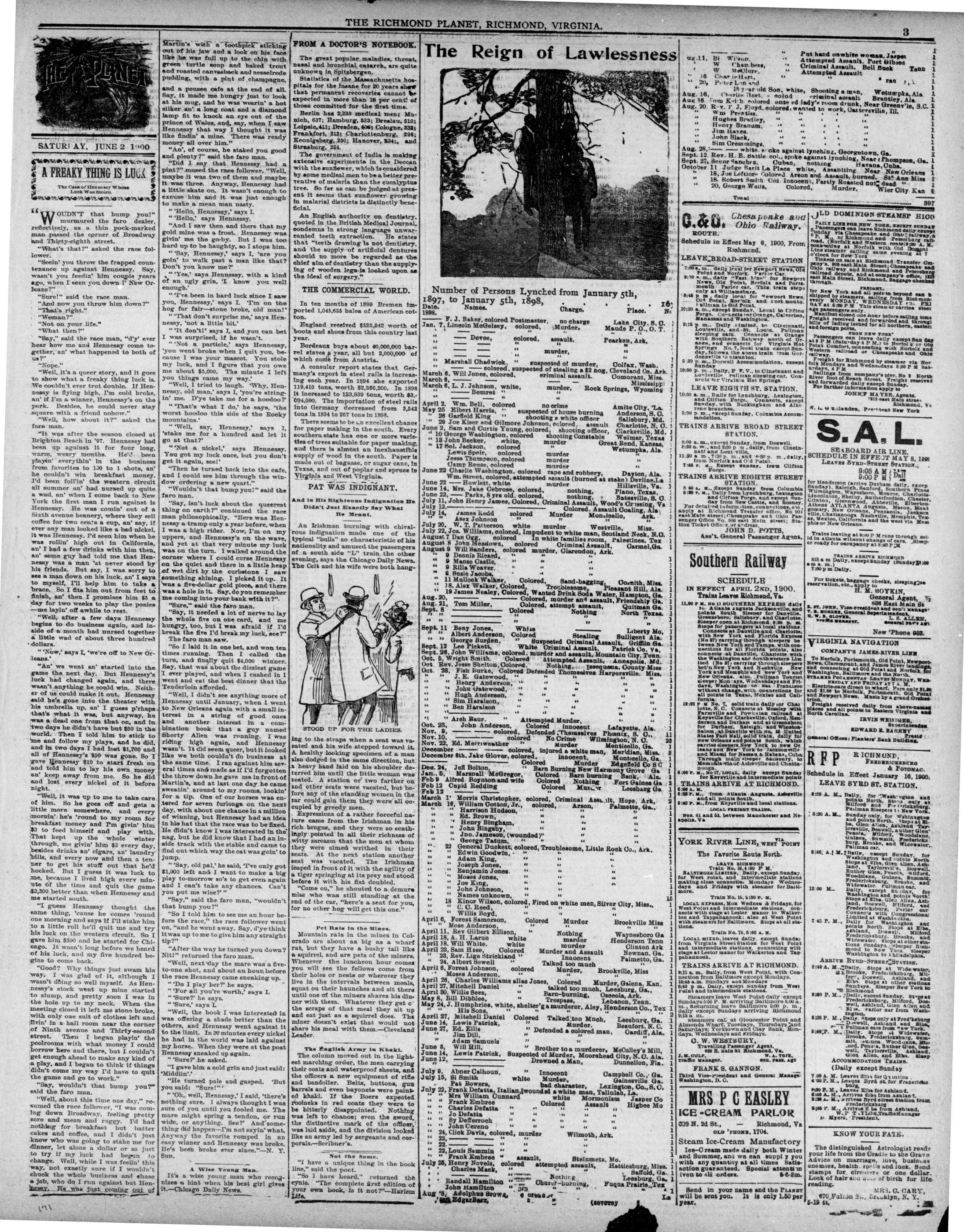
Number of Persons Lyncked from January 5th,
1897, to January sth, 1898, . . . . + x6
Date. ‘Names, Oharge, Place. Wi
+> FJ. Baker, colored Postmaster, no charge Lake Oity, 8,0.
Jan, 7, Lineoln MeGelsey, eolored, ' :Murder, Maude P. 9.,0. T.
“= Devoe, colored, assault, Poarken, Ark,
ese a Seer? a
«Marshall Ohsdwiok, “suspected of murder, Oolfax, Wash.
og Ti Fa Solored, suspected of stealing a $2 hog, Cleveland Ue Ark.
March 8, Will Jones, colored, criminal assault. Comorant, Mise.
March 6, ——— — Mississipp:
March 6, L. J. Johnson, white, murder, Rook Springs, Wyoming
{ '—Bemret * Gi
April 2, Wm. Bell, colored no crime Amite City, La.
Moy 25 Elbert Hatris, ‘’ suspected of house burning Andersos,S-0.
«28 Garfisld King“ shooting white officer’ “Salisbury, Ma,
* g22 Joe Kiser and Gilmore Johnson, colored, assault Oharlotts,N. 0.
Jape 2 Sam and Curtis Young, golored; shooting officer, Clarksville, Ma,
1c 10 George Washington, colored — shooting Constable” Weimar, Toxas’
“18 John Becker, white, murder Great Bend, Kansas,
“17 8ol. Jackson, colored *. ‘Wetumpka, Als.
Lewis Speir, colored murder f
Jonse Thompacn, eolored murder “
‘Ozmp Reese, colored murder "
June 22 Charlie Washington, colored rape and robbery, Dayton, Ala. 1
Wim. Street, colored, attempted assault (burned at steke) Deviine.La._)
June 22 — Howlett, white murder Hillsville, Va, 1
June 14, Mrs. Jake Gebrose, colored, nothing, Plano, Texas,
June 22, — Packs, 8 yrs old. colored, nothing, + Batesville, 8. 0. |
July 11, John Henry James, Golored, Criminal Assault, Wood's Orraing, Ve
duly 12,—-———__ ______-" Colored, Assault Coaling,
July 14, James Redd solored == Murder Monicello, Ark)
oe et Auer Goapeas i eee ™ 9 ase a
Joly 2, _W.T, Patterton white murder Westville, Miss, 3
aly 22 Joe Williams, colored, Impadent to white man, Sootland Neek, HO. |
August 7 Dan Ogg, | ‘colored ’ In white tamilies room, Falestines, ‘Tex’ |
August 8 John Meadows, colored Criminal Assault, Oarmel,Ga. |
August ® Will Sanders, ‘colored murder, Gisrendon, Ark,
9 Dennis Ricard, - = ’
@ Manso Castle, = - #
“ 9 RillaWeaver, — * “ “
= AERP Wh, quent, setaneee, conse
“ 08 5 5 1 ith, Misa,
‘| 18, Alex Walker, Oolored, "Trocolesomer” “Pleasant Hill, Als.
“18 James Nealey, Colored, Wanted Drink Soda Water, Hampton, Ga
Aug.20, ———-_ Colored, marder an? assault, Friendship’ Ga,
Aug. 21, Tom Miller, Colored, attempt assault, ‘Gaiman Ga. |
Sept. 8° ————._ Dolored Nothing forth Texas.
et an eae ays ” > 3
Sept.11 Beny Jones, White et Liberty Mo, |
PEs) ATbert Anderson, Cclared Stealing _Sulligent Ala.”
non Barden, pn emrected Criminal Assault, Griffin Ge. .
Sept, 12 ‘Lee Picket White Oriminal Assault, Patrick Oo. Va,
Sept. 26. John Williams, colored. murdet and assault, Mountain City, Senn.
Oct) Bev. dee Shelton, Colored “Nemgpiet Amuaalty -Annepoli, i.
Oct. iv. Jesse Shelton, a ‘ol fg juena, ia ee
Oct, 28, Fish burke, ‘Colored Defended Thomealves Herperselie’ Mine
« &” 5.8. Gatewood, a # os wa OF
© “Haney aplioeseal . * « ele
“ 4 John Gatewood,“ = “ * Ce
“ Bagh Andersen, < : = age
«teen “ « . Son
oe Sees “ . “ « nat
werk Sets. “ . « “|
A Se
Oct. 28, lerson, innosent tte, -
Nov. 9, ——- —- colored, Defended :Thomselves Phonix 8 On” 1
Nov.10, —-—-—— _—golored NoOrime Wilmingtou,'N.O.”
Nov. 22, Ed. Merriweather” Marder Monticello, Ga. 1
December ——— ——— colored, injured a white man, Meridiac, Mien £
December 6th, Jake Glover, eolared, innocent, Mi Ga.)
Dee: ¥, Jel Botton, Pa Burning Nee Marae eC BS
Dee, 24, « jew Harmon 8
Jan.. 5, “Marsnall ‘MéeGregor, Geloted | Mam teins book, tale,
Feb ‘Altred Boyntonand wife Golored Nothing" Fort Ginee Ga .
Fob 12 Cupid Redding Colored “Mace — Leosharg Ga
Fel teen
March 1° Morris Christopher, colored, Criminal Avssslt, Hope, Ark,
March 18, William Cotton, Jr., olored,. Arson, Palmetto,Ga, 1
«Harrison Hadson, 5 - *
“4 EE Bren, “ « *
ee him, “ . .
| a See Jann Biome “ “ « 1
_ “ — & ‘Jno, Jameaon} (wounded )* _ ¥ 1
» © Gecage Tata ete “ “ j
{+ 22 General Duckett, colored, Troublesome, Little Rock Uo. Ark, |
« ““ Edwin Goodwia,- > x :
= 4 Aaaeveee a “ “
os Some demas « “ ‘“
“Benjamin Jones. + « *
“ “* Moses Jones, ve “ “
“x Joe Ring « wi -
“ “John Johnson, > i"
“Nemes unknown, “ u
{| 18: Kinor Wilson, colored, Fired on white men, Silver City, Miss, 1
« Ot OCRed: a ey =
“4 Willis Bora, “ “ «
April 6, Forest Samerson, Colored. = Murder Brookville Misa
Rte Moss waderseor ot e . .
April 11, Rev Gilbert Ellison, Nothin, Waynesboro Ga
April 18, A. H. Larue white marder Slenderson Tenn
April 18, Will White, white murder Clinton Ark
April 28, Sam Hose, Colored © Murder and Assault. © Newnan, Ge,
wt 38; Rev. Lige Stziokland ** Innocent Palmetto, Ga,
“ 24, albert Sewell“ Talked too mach x
April 8, Forest Johnson, —_eolored Murder, Brookville, Miss
“* “Moses Anderson, “ “ :
April 26, Charles Williams alias Jones, Colored Murder, Gsiens, Kan.
April 27, Mitchell Daniel" ‘talked too much, Leesburg, Ga,,
April 80, Willis Sees, = Barn-burning, Osceola, Ark.
May 8, Bill Dibbiee, ‘Trespass, Lebanon, Tenn.
May %4,J, Humphries, white, shelter’g a murderer, Aley, Henderson Oo., Tex ;
wt bho we % : 2 pete |
April 27, Mitehell Daniel Colored Talked'too Much, Leesburg, Ga.
Tune 14, Lewis Patrick, ” siurder, Beaufort, N.C.
June 7, Ed. Ellis .” Defended a colored man, — Oardiff, Ala.
ot DL ” :
» Adam Samuels fe * ” :
Jone 5, Will Hil, ” Brother to murderer, MeCalley’s Mill,
Jane 14, Lewis Patrick, Suspected of Murder, Moorehead Uity, NO. Ald,
Jung 12, ———__—_ Drowned a Man, Dunnellon, Fla. |
Joly 9, Abner Calhoun, ” Innocent Campbell Co., Ga.
July 15, i Smith white Murdes. Galan a.
_ THE COMMERCIAL WORLD.
In ten months of 1899 Bremen {m-
ported 1,045,635 bales of American cot-
ton.
|, England received $525,242 worth of
‘boots and shoes from this country last
year.
Bordeaux buys about 40,000,000 bar-
el staves @ year, all but 2,000,000 of
which ch from Austria.
A consular report states that Ger-
‘many's export in steel rails is increas-
ing each year, In 1894 she exported
129,410 tons, worth $2,356,200. In 1898
At inoreased to 123,839 tons, worth §3,-
"094,000. The importation of steel rails
imto Germany decreased from 3,542
‘tons in 1894 to 267 tons in 1808.
‘There seems to be i.n excellent chance
for paper making in the south. Every
southern state has one or more varie-
ties of trees suitable for paper making
aad there is almost an Inexhaustfble
supply of wood In the south. Paper is
made out of bagasse, or sugar cane, in
Texaa, and out of poplar and spruce in
‘Virginia and West Virginia.
PAT WAS INDIGNANT.
And in His Righteous Indignation He
Didn't Just Exactly Say Waat
iin eee
An Irishman burning with chival-
fous indignation made one of the
typical “bulls” so charaeteristic of his
nationality and amused the passengers
of @ south side “L” train the other
evening, says the Chicago Daily News.
‘The Celt and his wife were both hang-
\ Wy
CW pe
ae i
£5 f <s
aH)
iif \
Ap \
Wn util
Hh NU Ga
if vY \ fl
i
(Vk. sim
is TA
” (TAN
STOOD UP -FOR THE LADice.
ing to the straps when a seat was va-
sated and his wife stepped toward it
A healthy looking specimen of « man
also dodged in the same direction, but
a heavy hand Taid on his shoulder de-
terred him until the little woman was
keated. A station or two farther on
and other seats were vacated, but be-
fore any of the standing women in the
tar could gain them they, were all oc-
cupied by greedy men.
Expressions of a rather forceful na-
ture came from the Irishman in his
tich brogue, and they were so scath-
Ingly pointed in all their richness of
witty sarcasm that the men at whom
they were simed writhed in their
Beats, At the next station another
seat was vacated. The Irishman
leaped in front of it with the agility of
a tiger springing at its prey and stood
before it with his fist doubled.
“Come on,” he shouted to a demure
miss who was still standing at the
end of the car, “here's a seat for you,
for no other hog will get this one.”
Ua eee
. Mountain rats in the mines in Col-
erado are about as big as a whart
‘rat, but they have a bushy tail like
‘ squirrel, and are pets of the miners,
Whenever the luncheon hour comes
you will see the fellows come from
their holes or nests or wherever they
live in the intervals between meals,
‘squat on their haunches and sit there
until one of the miners shares his dine
ner with them. Whatever they get o'
the scraps of that meal they sit up
end eat just as a squirrel does. The
miner doesn't exist that would not
share his meal with them.—Cleveland
Leader.
‘The Bastich Army in Khaki. |
‘The column moved out in the light
est marching order, the men carrying
thelr coats and wsterproof sheets, and
the officera a new equipment of rifte
and bandoller. Belts, buttons, gun
barrels and even bayonets were paint
ed khaki, If the Boers expected
Fooineks in red coats they were to
be bitterly disappointed. Nothing
was left to chance; even the aword,
the distinctive mark of the officer,
was laid aside, and the division looked
lke an army led by sergeants and cor-
porals.—Seribner's.
“Not the Same,
“I have a unique thing in the book
line,” said the poet. :
“So I have heard,” returned the
eynie, “The éomplete Grst edition of
your own book, is {t not?"—Harlem
—- — “Put hand onwhite woman, Jasper
tell, Bi Wilton, “!, Attempted Assault. Port Gibsos j
» W Chambers, “| Criminal Assault, Bell Buck Tenn |
‘ & MaOlure, “Attempted Assault ,
58 Char ietigrt, > = ray)
“20, Peter Lon and 1
“ is Sar old Som, white, Shooting aman, Wetumpka, Als |
Aug. 16, Chariin Tart. « eclod criminel aseeul: Brantley, Ale. 1
Aug 16 Som Keih solored ente +d Iady’s room drunk, Near Greeny’le, 3.0. 3
Aug; 20, Rov. 1" J. Floyd, colored, wanted to work, Uatierevilie, LiL q
a” wea Prati ee Oe ne "
“ Gughes Bradiny, “+ eee i 1
“ Heory Branam, -* < ett - I
2 eae i es “ i
deka ek, aE aa eer «
++ gins Oremetgas es “
Ang, 28,'—— —— white. s-oke against lynching, Georgetown, Ga. 3
Sept. 12. Rev. H. B. Battle. co!., spoke against lynching, Neac tPhompson, Ga. |
Sept. 27, Senor Sanches, Cuban, nothing Havana, Ouba. i
October 11 Judge Barit La Place ’ white, Aprantting Near’ Now Orleans 1
«18; Joe Lettior» Colored. Arson and Assault, burned, t= Aum Ming 1
“18. Robart Smith. Col. Tonoeen, Partly Roasted nots dead. * 1
“20, Grorge Wels, Colored, urder, ier Oity Kan 4
Teest pea N kt Sk SAN LS a
The Reign of Lawlessness
C20, oe
Schedule in Effect May 6, 1900, From.
Richmond.
LEAVE BROAD-STREET STATION
“nT er ia Feel tor port Nev
Polak saduosion Parker Ose hor
00 5 daily Seat une fos Siewpor
Rees OW Pott Matoi had Fone
Benth adorete ike ain ete
(nes AES eewport Rows
014 Point, Norvolk and tort mouts,
Patimaa'ts dia rete.
0 Sorus crtteeneatbeaee: Oaisetoe
EaBaas ted Wbaigaae oor
26 p ma Dally LMmivedt to Ciroinnat,
Rostavitie and ae Leia Patent
steeping alt Canasta Sauune
ise BSaGeata, tounaey potty Oe
Eine. ced cecum’ te? Sirens aor;
Sete Ne ices Wasa Sean ase
days eliewe ths etees ata tase Sor
Seceeahsra coe stee
a0 Jimi Deval ovotinodation, excep
10:80 p.m. Daily, PF. V., to Cinainaatt and
Tontavante ventas cesomamaaen sn
stots wr vieclue Bay Spas
LEAVE EIGHTH ST, STATION.
1090 a.m. Dally for Lynchurg, Lezingvon
And Giifton Forge. Connects, except
Stnday. tur Wckingtan aha Aine
ti00 pias: sutept Sunday, Colma Ascom-
Eim.rsacept Sanday, Colambia Accom
TRAINS ARRIVE BROAD STREET
STATION.
0 a.m. oxerps Sunday, rom Dorwell
EROS ee et,
SeotaneteentPie
1130 Sn Fone mT a8 90». mm. dally,
from Norfalt and O'd Point.
T46 e. Ge et Sunday, trem Clifton
TRAINS ARRIVE EIGHTH STREET
ie STATION, ‘haan
eee free
$8 Sue om tracaaere, Susgeon
and Ulitos Rape eaateaee ne
fag frees Bow Geta Boe.
roe aanakied inter aceaeanceseate
arity Sabicea weenicr bate ol
settles aneet heer nes Ouse poe
Seager Guce es aos eee ania Be Bee:
SER NOme ee stares
JOHN D. POTTS,
Ans’t. General Passenger Agant,
Southern Railway
‘Trains Leaves Richmond, Va.
11.00 F a. no 1) MOUTHERN EXPRESS @atly
te Atlanta augusta Jacksonville, and
Folate Boaih Bleenar for Banyile.
‘Greensboro. Galisvary, and Charloue,
Biceper onea at Richmond 2:0 De as”
Bigpe or pasmsngert mt tocalstalfons
with Row Fork’ and Florige eerees
[Roleh cicrging thrpogn slerpere be
freee Woy Work and tmp wits coe:
Bectlous for ait Florida points: thes
Soanealg at Danriliey Chavon uth
Ske Washington ane Socthwesters Liss
Kies caring through sleeper
betta Wey York ang Neshvile » Rew
‘York asd Memphisssnd “New York and
Kew Onioeaa. alte. Pullen Toop
Sleeper Non “ays, Weduendaysand Fit
days, Washington "© Sas Francisco
sito hase is connections. fr
Tii'pouma in Meas, Mexies and’ Call
twa ra No, %, solld trata day wor Chay
Tote, G: Connects at Monsley “with
Farsivlile and Fowistan ealssad’ at
Keyaville for Clarvevilie, Oxford, Sew
Seton aba’Darham nad at Greatanore
Seem Davies Raleigh tod
Seiom pat Daal wtih vor tg. ntteg
States Wor Hall soll teaia, ‘ally’ £0
Rew Orleans audpotmta. Souths whieh
Saris lonpern New York, We Hew OF
fScneaua New! Yor to Jacksonvalle
urvuge inaia sineper samaoatye ts
AESME wisul Aibevinotad Cosi
ooga.
6:00 F. H. woty att Sanday
“far Kevevilie and intermediate pains
-TRAIN ARBIVE AT RICHMOND.
oF, trom Auanta Augusta, Ashevitic
sia te gout
g:40 r. ans froui ikeyarilie bud local stations,
LOCAL PREIOK® THAR.
mos. 62 and 6a, between Manchester and Ne-
apelin. Va
ra
Yor River Link, wast “bors
The Favorite Route North.
LEave sicumoxD
sgn ho, ESO
Baurruous Luntz, Dally. exept Sunday
for West roint, and intermediate stations
making close ogansotion Mondays” Weancs
are ‘and Fridays with steamer for Bait-
‘Train No. 16, 4:20 F. at,
1ooat nxranas, Mom Wednes & Fridays, fo
West Poiutand intermediate sistious.” con:
Roots with sage at Lester. manor to. Walker:
ton and Tappahgusock: also at Weat Point
with steamers fot Baltimore, Stope at all ate
Mona:
‘Train No. 76, 6:00 4. x.
Locas mixx jeaves dally. exoopt Gunde;
trom Virginia Street Station for Weat Point
and intermediate stations connecting witt
age at Lestor manor for Waikertou and Tep-
pasaamook,
TRAINS ARRIVE AT RICHMOND.
#15 =. m, Daily, from West Point, with Con-
Hecdlon rym Waitimore except Moudays.
ios aan. Sundays sua Mowdaya
Gio" pm, Daily exseps Sanday trom Won
Foint and intermediate stations. =
Steamers leavo West Point daily exoopt
nrngcturing leave. Baldmore 6:80 p.m
Returning lea tn
daily cxoupt Bunday® arriving ‘lchinond
‘Steainers cal: at Gloucestor Point and
Almonds Wharf, Tuesdays. are
Saturdays; Yorktownand Clay Bank, Mon-
days, Wednesdays aud Fridays.
O.W. WSTBURY,
Ung Paseongas’ Agent
$0 K. Nain St Michmend. Va.
d.xounr, fweasrark,
Traffic waaager. ‘oon: Fass. 4g
FRANK 8, GANNON. ote
Third Vioe-rresideat and General Manse!
Washington, D.C.
ICE-CREAM PARLOR
009N.2dS8t. — Richmond, Va
OLD ’ruoms, 1704.
Steam Ice-Cream Manufactory
Iee-C ream made daily both Winter
and Sommer, and we ean suppl y you
with any quantity af all times Satis.
action guaran: |. Special attenti ww
iven to all orders. 6e-8m.
Send in your name and the Puaxsr
ear be sent you, it is only 1.50 per
‘8
alain ete eh ee
JED DOMINION STEAMSP Hiog
silz tcanida pitt sone oes ee
PAGE Ten tr. SORE, sarary omway
cnt Wa heen and uz ita
road, (itorfalk nad Weatere penetanrs, "a
Shatter
SasarieetaMiy same evening tT
Beans uanehal tighmand. trenater om,
Seiipe riser hens
railroad depots, 1d at company's office,
Shit Nats Skreet, Richmond’ Bazeugeunsesee
cnr aay
ibe ney turn nad TR
seetyy aan alae ee at
Daves $:00 FM This steam ercarrien toe
wealth es
eee
venient Teavred meiot tla mains tae
Sadiorerapaiaees orl norbor, eit
a ca
Feel soe coun
feet Ganmeecenne Somes Oe
Renee ticcg sett ie wert So
mores
Phil season cone cee
clr Wonnles Ryan My steunes ip Bor
Bes trom com: repier.No 2 Korth
af gs Sr compen Sas
pier ashe, Fees
“yelper a aay gece Gand
JOH MATER, Agente,
7 a, Ve
(1-1 6 wudnndon, Protaras eee
Ss . A 8 L.
SEABOARD AIR LINE,
SCHEDULE IN EFFE JT MAY 8, lea
Leaves Brap-Staeer Station, .
9:05 AM) t8
8:00 P Mf Dal
for Monderson (arrive Durham daily, excep
Stadays. maleieh' Genegite Guy, Sonn,
‘Wileeitgeon, Waseetore aortas, binee
Hncointon, Sheltyr Ruhetartin eae
Glintoa, » Grenmwasds “avuteliie™ gman
Athens “ATLANTA amu’ Mec Mach
fomary, Now Oricnane ettaattet}, Mont
Tile Chattanooga Nasnetiies Ses oteeses,
tas Mexteo, Uaitfornte aagans Mom euln fe
Dhiaor Now Oueaae!
igiginyaring ata aren mae, a
trreadybroscupaney eee SP
5am Bay. ceprGadday” Gunaar ne
a
“Toop ni Datty.
A So were
_seedins B
; tad tea’! ueuseer
Statatttree mee,
New ’Phons 922.
Viren NAVIGATION
COMPA 2x nIVER rm
To Nertolk, Portamouth, Old Point,
ipsa Foreman out
irene nau Maer eee
aren Pocaowsas Leaves Monza, Waa.
Remote dee eae oe ten
sala Ss Conan
ii bepress waaere oa ae
Rica rere aan
piss Re RNUNG.s slang
IRVIN WEIS GER,
ee
SDWARD B. BARNBY
Getecet Omincs Hens asec ee
RICHMOND,
FRepanicessena
& Potomac,
‘Schedule in Effect January 16, 1900,
LEAVE BYRD gt, STATION,
ish. Bagy,: ano “walsh, ie
Bg sera gees ae
ie Marie. Beye
Fania Sisto’ 1 Ree
$0 4.my Suaderoly ht ita
setae Ret Sere
Boayia® Retell author Glen
Reasia® Biel ues gta
Siesta ees
Pees
4; AL feat Seeagy
1 Hang toeett ARENT fot
Slope cMfeitaratee the, ae
Midler ERG, Seared
Woedsia: “Guines,
Rec, Guitany, Sema
Wiaereas meek.
wee. BTS poe
Wael in gto and points Norte:
Some RS Ag ola Norte
feet Santee og alee am
Somme CHE charge,
peru, Bho eee
a, Baegae Weenies
Tents orga at
Bethea, Biase Selig
Frederichsbarg. “Brooke, and
wiserenebsGt,wigatty tea
Toes age eh roteg tae
ota tgteere gastos tion,
Wanless fs Teeaaeee
Aznive Brap-SraeeeiSration,
nek me site” sheet ere
fra ME Salty, pre, at Wisewaee,
for-, Doswell, Ashisad, snd
fins Uoarals, Aaland, ena
Sanit nee Bee Tees
tue 7. eee cnc gence
prin tg Bat
gkteare, Mord os
+ eee ee
Mel Soe onty ars
Mabibeta y-eine rier wire Td
eg
borates ON MLS
Be ne oy
ord, Peno'a, Ruther ‘Gies Dee
Glou allen, and ithe less
AcoomMODATION Taains.
(Daily except Sunday
mea 3 towrib SVEN Guta
Sk meena ‘Byrd at for Fredertous
ose 30s, areal mahi sihaane,
Stee af Arrives ioe tron ng,
Siti ans aaa beeaeeet
vu, AoE dahiena
Oe ey ATT Loa temelenetes
wy mye Baas
XNOW YOUR FATE.
‘The distinguished Actrologist rexds
yous life trom the Oradls to the Grave
Advice on marriage, iove, business
enemies, health. ¢p=iis aod luck. Sead
stamps for. cirovi-rs or one dollar.
Look of hair ava o..c of birth tor life
reading.
MRS. 0. CARY,
670 Fulion 3i., Drovklyn, N.Y,
5-19 4t, . iz
HE PLANET
Published every Saturday by John Mitche
Jr., at 811 North Fourth Street.
Published every Saturday by John Mitche
Jr., at 811 North Fourth Street.
JOHN MITCHELL, JR., EDITOR.
All communications intended for publica-
tion should be sent as to reach us by
email: jmitchell@northfourthstreet.com
TERMS IN ADVANCE
One Copy, one year.....41.50
One Copy, eight months.....1.00
One Copy, six months.....1.00
One Copy, four months.....50
One Copy, three months.....40
Magic Copy.....90
ADVERTISING RATES
For one inch, one insertion.....$ 50
For one inch each subsequent insertion.....$ 50
For two inches, three months.....6 00
For two inches, nine months.....14 00
For two inches, twelve months.....20 00
Hairriage and funeral notices.....8 00
Blanding and transit notices per line.....14
POSTAGE STAMPS OF A D IN MINIMATION
HIGHER THAN TWO CENTS NOT RECEIVED
ON SUBSCRIPTIONS.
THE PLANET is issued weekly. The subscription price is $1.50 a year, in advance. If you buy a mail or mail risk-in... Post Office Money Order; by Bank Check or Draft, or an Express Money Order, and when none of these can be registered Letter.
MONEY ORDERS. Not can pay a Money Order at your Post-Office, payable at the Richmond Post-Office, and we will be responsible for its sale arrival. Express Money Orders can be obtained by calling the United States Express Co., and the Wells Sands and Co.'s Express Company. We will be responsible for the money sent by any of these companies. The Post Office can facilitate and convenient way for forwarding money.
REGISTERED LETTER.—If a Money Order Post Office or an Express Office is not within your town, you wish to send your letter to the register ten cents before. If the letter is lost or stolen, it can be traced. You can send money in this manner a few times in any other way than one of the four ways mentioned above. If you send your money in any other way, you must do it at your own renewals, etc. If you do not want the PLAN con-tinued or another year after your sub-scription has run out, you then notify us by mail. If you are interested that subscribers to newspapers who order their paper discontinued at the expiration time for which it has been paid are liable for the payment of the subscription up to date when they order the paper discontinued.
COMMUNICATION:—When writing to us, renew your subscription or to discontinue your subscription. In full, otherwise we cannot find you name on our books.
CHANGE OF ADDRESS:—In order to change the address of a subscriber we must be sent the former as well as the present address.
Entered in the Post-Office at Richmond, Va., second class matter.
SATURDAY JUNE 2, 1900.
Colored men, let us practice politeness, and cultivate good feeling.
We are American citizens and insist upon having all of our rights under the law.
Let us buy land and improve our condition, mentally, morally and religiously.
When we read some of the things said against us, it is enough to make a church-member "cuss."
We should not get ciscouraged even though everybody is discussing us. They'll get tired after a while.
LET us "keep in the middle of the road." God is for us, and if we will be for ourselves, all will be well.
JUDSON BROWN of Co. H, 48th Infantry and ALVIN B. WINTERS of the same company died in the Philippines.
THERE are thousands of white people who are as much opposed to this Negro agitation as are we. Let us not forget this.
LET us not be insulting to white people or to colored ones. Let us cultivate true gentility. We will win friends by this.
It is now stated that serious charges have been brought against the white American officials connected with the Paris Exposition.
The Cuban frauds seem to have been traced to white men only, and we have heard no one charge that they were neapable of self-government.
Oh, if the race could see the future before it as we see it. The clouds of trouble will pass by and the thunder of disapproval will go away forever.
The turbulent, low-bred classes amongst us are among our greatest draw-backs. We must do missionary work to the extent of showing them that they injure not only us but themselves as well.
COLORDON men, if you will read history, both ancient medieval and modern, and understand what you sad, you will not be hopeless. You will not be discouraged, but will realize that we are undergoing the crucial test, which will result in making us a great people.
Let us struggle onward.
It is announced that a constitution- al convention has been ordered. The vote in favor of it is said to be about thirty-one thousand, and against it about thirteen thousand,—making a total of about forty-four thousand. According to the election returns of 1866, the total vote polled in Virginia
was 292.206 It will be seen then that but 15 per cent of the total vote was polled and of this less than two-thirds was registered in favor of this constitutional convention.
This is a most unfortunate showing and is indicative of future trouble. The Negro-haters will have an opportunity to vent their spleen and put forth their venom. Men in Virginia will soon find that the calling of this convention was for other purposes than that of distranchising the Negro.
We were about to remark that ere it is all over, it will be found that the citizen of color was least hurt by its drastic provisions.
OAN WE GET JUSTICE?
There is now a question confronting most of the people in Jackson Ward. It relates to the election, which took place Thursday, May 24th. Despite the fact that 518 colored voters rallied to the support of the regular Republican ticker,—men who could mark their own ballots, and only 318 white voters, the Democratic Counting Machine returned a majority of over 500 against us.
There was a split in the Democratic vote, too, for Mr. JAMES I. SMITH, the alleged independent Democratic candidate was g ven 172 votes, which according to the number of Democratic white men who voted was really a majority of the white votes cast.
The illiterate colored men were so advised and did stay away from the poils. The question is asked, Can you people get justice even in the courts? Will a judge of Democratic persuasion weigh the evidence for and against you and if you have made out your case, decide the issue in your favor? To such an extent has this question been discussed, that it has necessitated a plain, unequivocal answer. The very fact that we have retained able couu and prepared the evidence demonstrates our faith in the judiciary of this state.
We know what juries will do, but the able, learned decisions hauled down from the bench in this commonwealth, in the cases of colored as well as white man have led us to confidently believe that our mother state has not fallen so low in the mire of partisan politics as to have its judiciary corrupted by the disgraceful actions of ring politicians. Our readers have not forgotten the decision of a Democratic Chancery Court Judge in the case of BETTIE THOMAS LEWIS, suing for, the estate on her white father. They have not forgotten the action of the Democratic Supreme Court of Appeals in the Lunenburg Case.
But let us go back further: the action of Hon. A.R.A.D. WATKINS of Farmville and Judge J. M. CRUTE of the same city when they together saved the lives of two colored people, for whose blood the lowest elements of Lunenburg were clamoring is fresh in the minds of the colored and white people of Virginia,
What must we say of that prince of Virginia Judges, Hon. B. R. WELLFORD, JR., a Democratic Virginian of the old school who seeks only the light of justices and fair-play and is guided thereby.
Where is Hon. CHARLES T. O'FERRBALL of Virginia? Not a judge, but a Governor,—a man who fought in the open, but who scorned to violate his oath of office or to do a mean thing.
No, no, colored people of Virginia, we are not ready to believe that all of the white men of Virginia are on a level with those who robbed us. There are thousands, who occupy positions in our mother state, who no matter how much their party friends so desire will not violate their oaths of office. We do not despair. Let us not forget the opinion of Attorney-General MONTAGUE, a democrat of democrats. There was no desire on his part to rule in our favor, but he had to be guided by the unerring decrees of the law. He put his stamp of disapproval upon forgery and fraud and told the Electoral Board of Rishmond City that it could take notice and correct this flagrant violation of the law.
When his advice was unheeded, that eminent jurist and unswerving Democrat of the old school, Judge B. R. WELFORD, JR., ordered them to remove the forged names from the list of bona fide candidates and restrained them from placing the same upon the official ballots.
Oh, no, colored men of Jackson Ward, God is not dead, and neither have all of the justice-loving white men departed from the preinets of the living.
We shall not only appeal to the law, but to the better class of white men of this community. We shall appeal to the Christian population of our native city believing that, we who were born and reared here, will be accorded a hearing and given that justice for which our Christian mothers prayed and our gray-headed fathers wept in days long past and gone.
The contest is on. Our contention is just and those who have taken away from us all that the law decreed we should have must answer for it before a fearless jurist and an uncompromising judge.
DR. HODGES UTTERANOES.
It seems strange that every white man who desires to attract attention to himself takes for his theme the Negro.
With this evident idea, Dr. J. ALLISON HODGES, a gentleman of this city saw fit to deliver an address before the
THE RICHMOND PLANET, RICHMOND, VIRGINIA
Biological Assoc. Wednesday
colored man.
but the measurer freedom.
during slavery.
are deplorable
that he lack mammy.
en led him
in return for
the attempts to
tie to her.
but are ndt many
, thank God,
loss has done,
address as
the more we
he was both
the forest.
But Negro-haters are constantly expecting impossibilities.
He speaks of the increase of insanity among the Negroes, where it was at most unknown. Well, what else could he expect? It is only to be wondered that all of us did not go crazy. From a condition of serene irresponsibility to one of absolute responsibility it is to be surprised that the insanity rate did not increase to an alarming extent.
As the matter now stands, there is one lunatic asylum in this state for colored people and two for white without counting the many private institutions throughout the commonwealth. If freedom brought insanity to the Negro, Dr. Honors, what has it doze for the white man?
tance which from time on us. We know and the insane asylums are the grave-yards are characters as Dr. Honors as he is to recoil and political equality fore the law, his distribt jury and his phillippie, a lost soul.
On with your deeds us! For two hundred we have struggled on a Many a night with b troubled heart we have good old hymn:
"Through many dan snare
I have already come,
Twas God who broug
He says:
"Dr. Drewry recently stated that 'the ratio of insanity in the whites is slightly larger in Virginia than in the Neges, though in recent years insanity has increased more rapidly among the latter than the former, and that there are now 870 Negro insane under hospital treatment in Virginia; and that during the past two years 170 insane have died in jail or at their homes waiting for room to occur at the Central Hospital. He very significantly remarks that the above figures do not cover all the Negro insane in this State."
He concedes the point that we had previously made and we can truthfully say that "the above figures do not cover all the white insane in this sta to." It is evident that Dr. Hodges realized that he had over-stepped the mark, for he made the following apolytical statement:
"In many of the public discussions of late there has been too much of sentiment, too little of scientific truth; and what I shall say applies to the race as a mass and not to individuals, and is spoken in no carping and sensuous spirit, but in a sense of fairness and justice to all concerned. I am not yet old enough to have forgotten the companionship of other days, the black boy who was raised by my side, nor the comradely sympaty of my old black mammy, now dead and gone to rest, who soothed me with her crouching lullabies and led me smiling into sleep; nor have I forgotten the true soul of the trusty slave, keeping a faith which had no parallel in history."
This then, is the only complimentary remark which this "child of a black mammy" could find to say concerning her and her offspring. He then makes the following reference to the Negro's origin:
"If science thus demonstrates the Negro's mental inferiority, certainly history, dating as far back as to the time of Pei, of the VI Dynasty of Egypt, 2500 years B. C., proves his phylogeny to have been of an inferior type, and that the general characteristics of the Negro of that date were the same as those of the Negro of equatorial Africa to-day."
And again:
"From the time of Genesis and the curses of Canaan: 'A servant of servants shall then be to thy brethren,' the Negro has belonged to a subordinate race, and ancient history has left no records of his achievements as warrior, king or counselor, but along its whole pathway he has plod in servitude, even from the day when the Oryphenian was laid hold upon and made to bear the cross of the fainting Christ." This is drastic language, as unfortunate as it is unsure. The Negro's origin is traceable to HAM and the Hamitic races were the pioneers of civilization. —to them is traceable science, literature and art. According to Dr. Hopkins, ability is synonymous with white, and no matter how black a race may be, if it has ability, it is white or has an Anglo-Saxon ancestry.
To prove this, he wouid rob us of the manly qualities of even the Negroes of Africa. Here is what he says:
"This 'new issue' of the race, essentially ignorant and superstitious, vicious and impulsive, idle and improvident, mentaly never more than a half-grown chihuah, without self-confidence or ambition, without originality or persistence of purpose; descended from the most inferior and degraded race of West Coast Africans, not at all equal to the Kaffres or Zalus of Southern Africa or the Soudanese of Northern Africa—this type of the second generation, which to-day confronts our Southern civilization, is to any unbiased mind worse than the first."
He concludes his remarks as follows:
"No, the Negro will remain with us in the South, if he will but give up his aspirations to full citizenship and confide his education and government to the whites, who, in times past, have proved their love for him—remain in peace, remain to fill the offices for which God and nature designed him, remain to be the white man's servant, 'hewers of wood and drawers of water.'"
We did not know that such a type of a white man as Dr. Hodges lived in Richmond. Freedom of the Negro has sourced his temperament and clouded his judgment. He lives in the past and broods upon the money which came to him and his as the result of the Negroes unrequited toil.
Owning nothing at the close of the war, we now pay taxes upon $500,000,000 worth of property in this country and over $850,000 in Richmond city and over $12,000,000 worth in the state of Virginia. Our homesteads dot every hill-side and our places of business may be seen in every city. We have established our own schools, built our own churehes, run our own savings banks, published our own school-books, written our own histories, graduated our own theologians.
We have teachers, lawyers, physicians, editors, real-estate agents, authors, scientists, dentists, statesmen, bank presidents, insurance officers, and men in all of the avenues of life. We are improving our condition both mentally, morally and religiously and have in our control some of the most powerful organizations in this country. We are buying land and we are saving money from the miserable pif-
American Medico-Psychological Association at the Jefferson, Wednesday night, 28rd inst.
He did not defend the colored man. He did not seek to find out the measure of his attainments under freedom. He spoke of his worth during slavery. The case is all the more deplorable because Dr. Hodgz confessed that he has been reared by a black mammy, whom he confesses of en led him "emiling into sleep." In return for this kindness, viper-like he attempts to do deadly injury, not only to her, but to her offspring. There are ndt many white men in this section, thank God, who would do as Dr. Hodgz has done. The more we read his address as quoted in the newspapers, the more we became convinced that he was both prejudiced and ignorant with reference to the true condition of our people.
He discussed "The Effect of Free dom Upon the Physical and Psychological Development of the Negro." Now, why he should have chosen the subject can be based upon no other ground than that he thought it was popular and like our poor Dr. P. B. BARRINGER of the University of Virginia, he wanted to 'make a hit.' He proceeded to discuss the Negro of 1620 and declared us to be 'a nation literally born in a day. He asks the following question: "Has the Negro since emancipation the critical and epocal period of his history, improved his physical health and mental and moral condition, or has he retraced both physically and mentally?"
He then discusses the health of the Negro, and seems surprised to know that he has not improved. He declares that during slavery he was practically free from disease. He might have remarked that he was subject to butchery. If this be true, then he enjoyed better health than his white master. Why did not the latter swap places with him or pursue a similar course of living?
Dr. Hodges remarked:
"Under these environments the Negro had no thoughts for the morrow; nor did the claim of family and household press upon him to worry and effect his mind; neither did awaricious dreams nor amitious hopes as to the possibilities of the future sur his brain, but secluded from the madding crowd's ignoble scrite, he spent his quiet and peaceful days, an humble life in an humble home, with a master to care for every want of self and family, and in health and in sickness."
This fact has been the source of all of our woes. It is to-day the cause of all of our thriftlessness. The masses have trusted white men to do the thinking for them, rather than exercise their mental faculties in doing it for themselves. We have been blamed more for this one trait of character than for all the others and Dr. Honors concedes that he and his are responsible for it. So far, so good.
He describes conditions in plain language when he says:
"The Negroes unadulterated with alien blood, had no heredity of disease, and to some extent were considered immune to the climatic diseases of the South, and thus under the restraining and inhibitory influences of the institution of slavery, they developed into magnificent specimens of physical manhood."
But what about this adulteration with alien blood, Dr. Hodges? Did the Negroes go after the white men, or did the white men come after the Negroes?
Do you mean to say, sir, that the octo-roons, quadroons and the mulattoes spoken of in the Virginia statutes previous to 1849 and afterwards did not relate to persons of mixed Negro blood?
Do you mean to say, sir, that the cohabiting of the white and colored races was a twin companion of freedom and not of slavery? Speak out plainly, sir, Tell the whole truth, Dr. Hodges, tell the whole truth.
Were white men fathers of the mulatto Negroes who were spread from one section of the Southland to the other? If they were, why do you endeavor to disguise the fact in a paper delivered before such learned audience as the one which a blemished at the Jefferson Hotel in oblivia.
But I. Business speaks truly when he reveres.
"I depend upon of thought and action with what was more theoretical the truth; they were accustomed to believe that dictates of their owners, those dictates may have been invation and want—those frequent causes of degeneracy—were unknown to them; their environment, it is true, was narrow, but a marvelous attachment to the families of their masters prevailed, because of a general sense of obigation to the latter for their sustenance. These conditions of life, and the resultant traits of character that were formed, were largely the conservators of that healthfulness of mind and body which characterized the Negro slave."
He admits that the white men were responsible for the lack of indepen dence on the part of the Negro. Then why are we blamed?
He then speaks of the diseases from which the colored people suffer, and declares that as a result of freedom they no longer enjoy immunity from insanity, consumption and other maladies.
We presumed that Dr. Hongxs knew that out-door life was more a preventive of these diseases than anything else and that white men subject to similar conditions would enjoy the same immunity as that vouchesafed the Negro.
He should have known that freedom brought with it responsibility and low wages. You might as well have kept a bird eaged for ten years, and expect it, upon being released from bondage to measure up in its ability to obtain food alongside its mother songs of
tance which from time to time is given us. We know and God knows that the insane asylums are registering and the grave-jards are receiving such characters as Dr. Hodges.
S worn as he isto recognize the civil and political equality of all men before the law, his distribe savors of perjury and his phillippic, the wallings of a lost soul.
On with your declarations against us! For two hundred and fifty years we have struggled on and prayed.
Many a night with bated breath and troubled heart we have hummed that good old hymn:
"Through many dangers, toils and snare
I have already come,
'Twas God who brought me safe thus far,
And he will lead me home."
Oh, yes, Dr. Hodges, we will pray for you, and thereby "heap coals of fire upon your head."
It wont be always winter with us. The tide will set in our way, bye and bye, and the misery of men of your stripe can best be understood by the perusal of DANTE'S LAFERNO.
Colored men, go forward! Our white friends are not all dead, neither are they swayed by the rantings of these men who are candidates for notoriety.
We have received the COSMOPOLITAN for June. The following are its contents:
"Frontispiece, Drunken with Rosses, Charles Laudlede; On the Road with the "Big Show," illustrated, Charles Theodore Murray; Beauties of Bloody Royal, illustrated, Marquis de Fountenay; The Modern Charles, illustrated, John Gilmer Speed; The Great Boortrek, Stephen Crane; Biprah Hunt's Journey Through the Inferno II. depicted by Arthur Young, The Science of Astronomy in the Year 1900, illustrated, Camille Flammarion; The Story of Anno Laelis, illustrate by B. West, Clinestist, Francis Willing Wharton; The Conscious Amanda, illustrated by O'Neill Latham Frank Rstockton; The Last Jobe to Bed. poem Edwin S. Potter; How Presidents Are Nominated, illustrated, John M thurston; A Black Rapids Love Story, Frank H. Spearman; What Kind of a coverign is Queen Vic or? illustrated, Wm T. Stead; Apparition, poem Howard Chandler Robbins; My Crank Client, Warren B. Hutchison; Great Events: Humor and Satire, by the world's Most Famous Cartoonists.
GEN. DE GALLIEFFET RESIGNS
Seeded by General Andre.
Paris, May 30—General the Marquis de Galliflet, minister of war, has resigned. It is officially announced that his successor is General Andre. In his letter to M. Waldeck-Rousseau, the premier, De Galliflet says: "I am very unwell, and my health prevents me resisting all emotions of the moment." After deciding upon General Andre as the most suitable successor the premier telegrambed to him at Nemours, where was taking part in the maneuvers, General Andre left immediately, arriving in Paris last evening.
Whatever the true explanation, General De Galliflet's retirement is regarded with considerable regret. Under his direction the army has benefited by quite a number of reforms, the most recent of which was his prohibition of the sale of harmful intoxicants.
More Evidence Against Stirling
More Evidence Against Stirling.
Philadelphia, May 30.—Amos Stirling, the negro who was arrested at Trenton, N. J., charged with being implicated in the murder of Professor Roy Wilson White, the young law instructor at the University of Pennsylvania, who was killed by highwaymen on the night of May 19, was last night accused by two of his negro companions with having struck the blows which resulted in Professor White's death. Charles Perry, who was arrested Monday, and to whom the possession of Professor White's watch was traced, and Henry Ivory, arrested last week, both admitted their presence when the attack was made on Professor White and both declare that Stirling struck the fatal blows.
Admiral Dewey's Western Tour:
Washington, May 30.—Admiral Dewey has arranged to leave Washington on June 5 for a trip that will carry him as far as Grand Rapids, Mich. It is a purely social trip, in response to invitations issued some months ago by the citizens of three western cities, which Admiral Dewey had accepted before the announcement of his candidacy for the presidency. The trip has no political significance. There will be no rear platform speeches nor anything else appertaining to a stumping tour. The party will visit Columbus, Detroit and Grand Rapids.
A Mile in Forty-six Seconds
Pittsburg, May 30.—On the trial trip yesterday of the new fast train on the Pittsburgh and Lake Erie road between Pittsburgh and New Castle the distance, 52.9 miles, was covered at a rate of speed which, allowing for required slow ups, was never less than 60 miles an hour. A speed of 67 miles an hour was maintained for several minutes on more than one occasion, and one mile was made in 47 seconds, or at the rate of 76 miles an hour.
After Neely's Printing Plant
Indianapolis, May 30—United States District Attorney Wishard, on behalf of the government, yesterday brought suit against Charles F. W. Neely, to attach all the property belonging to the latter that may be found in this state. The suit was brought under orders from Attorney General Griggs. It is the intention of the government to levy upon the Neely Printing company's plant at Muncie.
'Frisco's Chinatown Quarantined. San Francisco, May 30.—The board of health has ordered Chinatown quarantined, and Captain Sullivan has posted policemen at every point of ingress or egress to prevent any one not provided with a certificate from entering or leaving that district.
Ex-Queen Lil Honclezaly Ill
San Francisco, May 30.—Ex-Queen Lilinokahani sailed for Honolulu yesterday on the steamer City of Pekin and is said to be hopelessly ill. She was under medical care in the east, and it is said that as soon as she became aware of the serious nature of her malady she decided to hasten home to die with her own people.
ST. LOUIS STRIKE RIOTS
Tuesday the Worst Day of the Three Weeks' Conflict.
THREE PERHAPS FATALLY SHOT.
Fusillades of Bullets Met the Rioters at Several Places, and It Is a Miracle That Many Were Not Instantly Killed.
St. Louis, May 30—In a rioting sense yesterday's developments were the worst experienced since the strike on the lines of the St. Louis Transit company was inaugurated, over three weeks ago. The rioting was confined entirely to three places in the southern section of the city, and by nightfall the police records showed that fully a dozen persons had either received bullet wounds or been hurt by flying missiles. Three of those hit by bullets received what are presumably mortal wounds, and that one was killed outright seems miraculous, considering the great number of shots exchanged by the employees of the company, the strike sympathizers and the strikers themselves.
The fatally injured are: Herman Pestchke, shot in the back; John T. Rice, shot through the chest; R. H. Stilson, Cleveland, shot through the chest. Ten others were shot and a number of others suffered injury from missiles thrown and in other ways incidental to the riotous developments of the day.
The first disturbance occurred at the intersection of Broadway and Miller street. Bonfires had been started during the night and the tracks were found encumbered with the debris by the crew of the first car out. A big crowd of men, women and children gathered at the corner and hooted and guyed the crew as it attempted to remove the obstructions. Almost immediately shooting commenced from the car. First a single shot rang out and then a perfect fusillade. The crowd scattered in every direction, and in the greatest confusion.
A schoolgirl named Dollie Mitchell screamed and fell to the sidewalk. She was borne to a place of safety and on examination it was found that she was shot through the arm and was not seriously hurt. William Grannemann, who was standing some distance from the scene of the shooting, was struck in the left knee and seriously wounded. James McCalley, who was also some distance from the crowd when the firing began, received a ball in the left leg, just above the knee. Both Grannemann's and McCalley's injuries may necessitate amputation.
The second riot occurred at Broadway and Pestalozzi street. At the time a large crowd was gathered at the alley through which the railroad switch of the Anheuser-Busch brewery runs. As a car passed the point the crowd first commenced to jeer at the crew and then began to pelt the car with rocks and other missiles. As soon as the car was thus assaulted the firing began. In all 25 or 36 shots were fired. The crowd began to run up the alley just as soon as the firing started. Herman Peschke, a boy employed in the bottling department of the brewery, was the first to fall, with a bullet in the small of the back. His spine is injured, causing total paralysis below the point of injury, and his recovery is thought impossible.
A few moments later George Lacosten, a man employed at the brewery, and Albert Wackwitz, a painter, fell to the ground, the former being hit by a bullet in the left arm, and the latter receiving one in the head, above the right temple.
As soon as the trouble began a riot call was rung in and 25 men were hurried to the scene. Edward J. Breser, the conductor on the car, was arrested and locked up charged with shooting Peschke.
The worst of the riotous disturbances occurred near the intersection of California avenue and Keokuk street. In this affray a non-union motorman and another employee on a car of the Transit company were probably fatally shot. The battle while it raged was fierce and in view of the large number of shots fired, estimated at 200, it is remarkable that there were not more injured. Motorman R. H. Stilson, a man imported from Cleveland, and John T. Rice, a road agent, are the dangerously wounded.
Another affair took place at the intersection of Graviois avenue and Victor street and during its progress Martin Burke, a striker, was shot in the left hip by Elmer Simmons, who was acting as guard on a Cherokee line car. A crowd of strike sympathizers at once surrounded Simmons and gave him an unmerciful beating, which might have terminated fatally had not a detachment of police arrived on the scene.
Four New Bishops Consecrated.
Chicago, May 28.—By the laying on of the hands of 12 bishops and in the presence of 3,000 persons at the Auditorium, four new bishops of the Methodist Episcopal church were consecrated yesterday afternoon. The newly consecrated bishops are: David Moore, assigned to the Shanghai district; John W. Hamilton, assigned to the San Francisco district; Edwin W. Parker and Frank W. Warne, missionary bishops, assigned to India and Malaysia. The ceremonies were brief and simple. The delegates to the conference and hundreds of their friends came forward when the services were at an end, and crowded the stage to congratulate the four new bishops.
The Army of Inquisitors.
Washington, May 30.—After 15 months of preparation the preliminary work in connection with taking the twelfth census is practically over, the actual field work commencing on June 1. The work incident to the commencement of the enumeration proper has been of considerable magnitude. Nearly 300 supervisors have been selected, 52,600 enumerators, something over 2,000 special agents, a clerical force is now at work numbering over 1,000, and examinations are in force that will provide some 2,200 more. The cost of the census will be between $15,000,000 and $16,000,000. Robert E. Llee, alias Curry, was sentenced at Cheyenne, Wyo., to ten years imprisonment for train robbery at Wilcox, June 3, 1899.
Inxanity Saved His NeoR
Washington, May 30.—Olaf Pallesen, a Swede, who several months ago murdered his wife and a 2-year-old neighbor's child, Julia Henggesbach, was yesterday found guilty, the jury fixing the penalty at imprisonment for life. Insanity was the plea set up by the defense.
A WEEK'S NEWS CONDENSED
Thursday, May 24.
The Methodist general conference, at Chicago, abolished the five-year limit for pastors;
The Reading railway management has practically decided to abandon the Mahanoy Planes mines.
Congressman George B. McClellan, of New York, is strongly urged as Democratic candidate for vice president.
A joint resolution reappointing Mr. Andrew D. White a regent of the Smithsonian Institution passed the national senate.
The secretary of war has directed Lieut.-Col. Webb C. Hayes, upon his arrival at San Francisco, to proceed to his home at Cleveland for honorable discharge from the service.
Friday, May 25.
After three years of married life Mrs. Lina Rogers, 74 years old, sues for divorce at St. Louis. The Presbyterian general assembly, in session at St. Louis, voted to meet in Philadelphia next year. Both the Methodist conference and the Presbyterian assembly urge a constitutional amendment declaring polygamy a crime. Governor Mount declares that Kentucky fugitives charged with complicity in the Goebel murder cannot be extradited from Indiana. The Chicago Record says Mayor Carter Harrison's name may be presented at the Democratic convention for the presidential nomination. Karl Dallman, John Welsh and John Nollin were sentenced to life imprisonment at Welland, Ont., for trying to wreck a Welland canal lock with dynamite.
Saturday, May 26.
German capitalists have $2,800,000 invested in various parts of the world.
The Countess Castellane (nee Anna Gould) has just paid $280,000 for two wardrobes, which were made for Louis XV.
Congressman Grosvenor, of Ohio, strongly urges Congressman J. P. Dolliver, of Iowa, as Republican candidate for vice president.
The Marquette Monument association, of Chicago, will build a $25,000 memorial to Father Marquette, on the island of Mackinae.
August Belmont has presented $200,000 to the Episcopal Cathedral of St John the Divine, in New York, to build a memorial chapel in memory of his wife.
Charles Litchman, of Massachusetts, former secretary-treasurer of the Knights of Labor, will probably succeed M. D. Ratchford on the industrial commission.
Monday, May 28.
The United States supreme court adjourned for the term yesterday and will not sit again until next October.
Judge John P. Rea, commander-in-chief of the G. A. R. in 1887-88, died at Minneapolis, aged 69.
Eddie Teabout, commander-puglist, was killed in a bout at Bridgeport, Conn., by William Forsyth, who is in jail.
Over 3,000 men are idle owing to a fire in No. 2 Hecla shaft of the Calumet and Hecla mine at Calumet, Mich.
August Croft, aged 80, and Miss Kate Putnam, 88, were married at South Bloomfield, O. They were lovers 65 years ago.
Sheriff Taylor, of Grand county, Tex., and Sam Jenkins, a cattle owner, were killed by two outlaws they were pursuing. The murders escaped.
Tuesday, May 29.
Scientists are jubilant over the favorable conditions for observing yesterday's total eclipse of the sun.
United States supreme court decided against Admiral Dewey's claim for increased bounty for the Manila bay battle.
Safe crackers stole $4,000 from the officeffice at Marshall, N. C., Saturday night. Two men have been arrested on suspicion.
Fifteen laborers in a foundry at Juenkerath, Germany, were deluged with liquid hot iron yesterday. Seven died and the survivors were horribly burned.
An Keng Su, a former cabinet minister of Korea, who was suspected of being involved in the murder of the queen in 1895, has been put to death by torture.
The Methodist general conference at Chicago adjourned today without criticizing President McKinley on the anticanteen law and leaving the discipline unchanged.
Wednesday, May 30.
The senate has agreed to an appropriation of $5,000,000 for the St. Louis exposition.
The amount of bonds so far exchanged at the treasury for the new 2 per cent consols is $284,213,050.
A terrific thunder and hall storm at Peoria, Ills., last night did considerable damage by floods. Two bridges were wrecked.
A Berlin court refused citizenship to a native who had become a citizen of the United States and wanted to renew German citizenship.
Fred R. Luce, secretary of the Luce Furniture company at Grand Rapids, Mich., shot and killed himself in a fit of temporary insanity.
Fatal Collapse of Traveling Crane.
Pittsburgh, May 30—One man was killed outright, two were fatally hurt and five others badly injured last night by the collapse of a traveling crane at the plant of the Totten & Hogg iron and steel foundry. The dead man is Joseph Kwatka, and George Bodson and George Knox will die with fractured skulls.
Rathbone Was Kind to Himself.
Havana, May 30—Acting Director General of Pos's Bristow yesterday reduced the expenses of the department $1,500 by discharging three servants of Mr. Rathbone, whose wages had been carried on the official list, a coachman at $600 a year, a gardener at $360 and a laborer at $240.
London, May 29.—A rumor was current in the lobbies of the house of parliament today, and which was said to have originated at the Carlton club, that the Marquis of Salisbury will retire from politics at the next general election.
The Malmed Confederate Veterans.
Atlanta, May 30.—Two hundred malmed veterans, each of whom lost either a leg, an arm or an eye in the civil war, left here yesterday for the annual Confederate reunion at Louisville. The disfigured veterans were loudly cheered as they left the city.
A Successful Operation.
New York, May 30.—William Rockefeller was operated upon Monday for appendicitis. The operation was in every respect successful and Mr. Rockefeller is recovering.
THE PLANET
SATURDAY, JUNE 2 19
GENERAL CASTRO'S VICTORY.
Bernandez Captured and Peace Is Now Assured in Venezuela.
New York, May 20.—Gonzales Eslaven, Venezuelan consul in this city, yesterday received a dispatch from Castro announcing the capture of Hernandez, and adding "peace assured."
General Castro is not yet president of Venezuela, but, according to the consul, has become such a great favorite with the people that he will be elected president.
General Castro assumed charge of affairs last October, after Andrade fled
GENERAL CASTRO
from the country. Castro wished to take General Hernandez as a minister into his cabinet, but Hernandez said he would not accept anything short of the presidency. Owing to their disagreement Castro imprisoned Hernandez. At the end of four months Hernandez was liberated. He at once gathered a thousand men around him and defied Castro. With his son Hernandez took to the mountains and began a war. On May 27 he was taken prisoner.
LORD SALISBURY'S FORECAST.
"Not a Shred of the Former Independence Shall Remain."
London, May 30—Lord Salisbury, who was entertained at dinner last evening by the city of London Conservative association, made an important announcement regarding the government's South African policy. He said: "We were forced into war by the action of our opponents. To say that because we repudiated the greed of territory we therefore bound ourselves never to annex any territory is a most ridiculous misconstruction. I dwell on this point because this matter of annexation is about to become a burning question. We have made a tremendous sacrifice of blood and treasure in this conflict, and the only certainty of preventing a recurrence of this fearful war is to insure that never again shall such occur accumulations of armaments occur, and that not a shred of the former independence of the republic shall remain. We are not yet at the end of the war, but I shall venture to lay it down as a primary condition of any future settlement that precautions will be taken of such a character that such a war will never occur again. It will also be our duty to protect those native races who have been so sorely afflicted, and at the same time so to conduct their policy that, so far as possible, there shall be a reconciliation and that every one shall be a happy member of the British empire."
Phoenix Park Murderers Barred.
New York, May 28—James Fitzharris, alias "Skin the Goat," and Joseph Mullett, the Irish invincibles, who were recently released from prison in Ireland, where they were sentenced for complicity in the Phoenix Park murders in 1882, were yesterday ordered excluded by the board of special inquiry at the immigration station and ordered deported. The exclusion was made under the interpretation of the law which forbids any one being admitted to this country who has been adjudged guilty of a "felony, crime, infamous crime, or misdemeanor involving moral turpitude."
GOVERNOR ALLEN INAUGURATED
An Impressive Ceremony, But Porto
Ricana Lacked Enthusiasm.
Rheans Lacked Enthusiasm.
San Juan de Puerto Rico, May 2.—
The inauguration of Charles Herbert
Allen, formerly assistant secretary of
the United States navy, as first Amer-
ican civil governor of the Island of
Puerto Rico, took place yesterday. The
cermony was most impressive.
Some of the Americans who looked on commented upon an apparent lack of enthusiasm on the part of the Porto Ricans. This was probably more apparent than real. In any event the lack of demonstrativeness should be attributed to their training for four centuries under an oppressive regime, which held them in restraint and did not allow them a free expression of emotion. Only now are they beginning to realize the changed order of things and this only a small degree. A city of 20,000 might have been expected to turn out a larger crowd, especially as all the business houses were closed. There was a display of national colors from a number of private houses, but nothing that would compare, for instance, with the displays of holidays and Sundays 12 months ago, when a Spanish flag floated over every house,
Gunmaker Krupp's Big Profits.
Washington, May 2.—Consul General Guenstor, at Frankfort, has furnished the state department some facts obtained with reference to the enormous profits made by Krupp in his contracts for guns and ammunition with the German government. The consul is informed that some time ago Krupp furnished the government field guns at $1,145 each. Competitors afterward received orders of the same kind for $464 each. Krupp thereupon reduced his price to $452. Schrapnels for which Krupp receives $2 each his competitors can furnish for a little over a dollar.
REBELS STILL ACTIVE
They Keep Philippines Troops Busy Despite Heavy Losses.
PAWIN BURNED TO THE GROUND.
It Was a Rebel Stronghold and Was the Headquarters of Insurgent Gen. Callies—A Surrendered Rebel Major Inducing Comrades to Surrender Manila, May 30.—Major Henry T. Allen, of the Forty-third infantry, while scouting from Catbalogam, island of Samar, May 9, drove a party of insurgents from the valleys. Four Americans were killed, including Lieutenant W. H. Evans, who was slain while gallantly leading a charge against the entrenchments. Eleven of the enemy were killed and four were wounded.
The town of Caterman, Island of Samor, was attacked at midnight on April 30 by a thousand rebels, who entrenched themselves near the town ever night. Captain John Cooke, of the Forty-third regiment, fought the Fillipinos for six hours and afterwards buried 150 of the enemy. One American was killed and one wounded.
The hamlet of Pawin, in the province of Laguna, Island of Luzon, the headquarters of General Callies, was surrounded May 26 by three detachments of the Forty-second regiment. Thirty-seventh regiment and Eleventh cavalry. Only a few of the enemy were encountered, Callies having departed the day before. Pawin, which was manifestly a stronghold, was burned to the ground.
Captain Nordon's scouts and two companies of the Eighteenth regiment, while scouting May 12 in Western Panay, surprised a number of the enemy near Valderama and killed 35 of them. There were no casualties among the Americans, but some of them suffered from sunstroke.
The official reports announce scouting and small engagements in Panay and Cebu islands and Tayabas, Laguna, Zambales and Pangasinan provinces, resulting in 14 of the enemy being killed and many wounded. The Americans also captured 60 rifles, a Nordenfeld gun and supplies of ammunition and destroyed a powder factory.
A rebel major who surrendered at Liscum last week has been persuading others to follow his example. Yesterday he effected the surrender of 46 men, with 55 rifles, at Tarlac, and hopes to influence more of his countrymen to do the same.
THE REBELLION IN CHINA
Guards of Foreign Legations to Resist Murderous Boxers.
After the Fight Host of the Regular Soldiers Joined the Rebels, and They Are Harshing Side by Side. The Missionaries in Extreme Peril. Shanghai, May 30.—The rebellion continues to grow in intensity, and the gravest fears are entertained of its ultimate extent. The foreign envoys at Pekin, fearing a massacre within the capital, have decided to bring up the guards of the legations. The rebels are now massing outside of Pekin, and their numbers are reported to be constantly augmenting. Fresh contigents of armed malcontents are coming up almost hourly from the north. The imperial troops who were sent to disperse the rebels found themselves hopelessly outnumbered. Several hundreds were killed, and two guns and many rifles were captured, after which the most of the remaining troops went over to the rebels. They are now marching side by side.
The Belgian minister, escorted by a strong bodyguard, has gone to obtain an audience of the tsung-il-yamen, a number of his countrymen, with their families, having been cut off by the rebels at Chang-Hsin-Tien.
It is believed that Russia is about to land troops at Taku from Port Arthur, where 20,000 are in readiness. The Chinese are reported to be sending large masses of troops overland from Hu-Nan and Klang, but the generalissimo refuses to assume control on the plea of sickness.
The "Boxers" assert that they are confident of receiving support from the dowager empress, Princess Kang-Y1 and Ching-Tuan and the entire Manchu army. Throughout the north the "Boxers" are enlisting hordes of desperadoes. They are intent upon expelling everything foreign.
The position of the missionaries is one of extreme peril unless aid is speedily forthcoming. It is feared that they will meet with the same fate as their fortunate converts, whom the "Boxers" are ruthlessly murdering. One relief party has returned to Pekin from Chang-tsin-tien, bringing 25 persons, including several women and children. A dispatch from Pekin says: The foreign guards have been summoned by the legations and will arrive immediately. This decision was well taken. The opinion is widespread that the powers should compel China to defray the cost of a measure which the apathy of the Chinese government necessitates. All the French engineers and their families are reported safe.
LORD ROBERTS AT JOHANNESBURG
The British Army May Reach Pretoria by Friday Next.
London, May 30.—Lord Roberts made a victorious entry into Johannesburg at noon today, the Boers having fled during the night.
Lord Roberts' cavalry have flowed on beyond Johannesburg. A portion is understood to be at Zuurfontein, seven miles north of Johannesburg, and within 20 miles of Pretoria. Lord Roberts, although with a broken bridge at Vereeniging and a wrecked railway behind him, has somehow managed to get forward sufficient supplies for his large force.
As he has been able to do so much, it is considered possible that he will be outside of Pretoria Friday.
The Boers, who were expected to fight along the line of hills known as Kilipriviersberg, abandoned the eastern end of the range, near Lord Roberts' advance line, but they stood their ground on the extreme right near Van Wyck's Rust, where they met General French's turning movement. The fight continued all day, and the result is as yet mere conjecture. Probably the Boer rear guard succeeded in keeping General French off and is now in the Nills northwest of Johannesburg.
THE RICHMOND PLANET, RICHMOND, VIRGINIA
GENERAL SOUTHERN NEWS.
Richmond, May 28.—The latest summary of the returns from the election of Thursday is that the constitutional convention proposition failed in the First. Fifth and Ninth districts, but carried in the others, and was carried in the state by a safe majority.
Wheeling, W. Va., May 24.—The Central Glass works, of Wheeling, and the Fostoria Glass works, of Moundsville, W. Va., will, it is claimed, shortly amalgamate and expand by building another factory at Clarksburg, W. Va. It is proposed to manufacture all lines of table and decorated ware, and to operate in competition with the tableware combine.
Charlotte, N. C., May 28.—J. L. O'Dell, boss of the weave room of the Southern Cotton mills, at Bessemer City, was stabbed and almost instantly killed yesterday by Hope Davis, a discharged operative. Davis persisted in returning to the mill and was ordered out by O'Dell, whereupon he drew a knife and stabbed O'Dell in the throat, severing the jugular vein. Davis was captured.
Hopkinsville, Ky., May 25—As a crowd of negroes left the circus tent Thursday midnight at Bolivar, Ky., numerous persons began shooting pistols. A fusillade followed, about 75 shots being fired. Mary Bell and Frank Rives were probably fatally wounded and Zordie Wills and "Buster" Davies severely injured in the panic which ensued. Several children were hurt.
Richmond, May 25.—The Peninsula Bank of Williamsburg was entered by robbers Wednesday night, the safe blown open and about $10,000 in money taken. There is no clew to the robbers. There were six explosions, which awakened a number of citizens. W. D. Powell, of New York, was captured and bound by the robbers. Other citizens surrounded the bank, but the gang escaped in the darkness.
Augusta, Ga., May 24.—D. B. Dyer, as president of the Augusta Railway and Electric company, and E. C. Jefferson, the conductor in charge of the car upon which Alex Whitney, a white man, was killed by a negro ten days ago, and for which the negro was subsequently lynched, have been indicted by the grand jury of Richmond county for alleged violation of the state law requiring the separation of races on public conveyances.
Fredericksburg, Ga., May 26.—On the very, ground over which the old Fifth corps charged at Fredericksburg President McKinley, his cabinet and Gen. Miles yesterday witnessed the laying of the corner stone in a shaft which will perpetuate in bronze and granite the heroism of the army of the Potomac. It was an impressive ceremony, and rendered the more so by the fact that among the hundreds who witnessed the event were noted leaders of both the federal and the Confederate forces.
Knoxville, Tenn., May 24.—The 450 miners at the Coal Creek company's mines, near this city, returned to work yesterday after reaching an agreement with the company to submit their grievances to the arbitration of President McKinley. The men went on a strike April 10 because four union miners were discharged. President McKinley will be asked to say whether the four union men should or should not have been discharged, and in any event each side is to submit to his decision.
Wheeling, W. V., May 28.—Yesterday's baseball game was remarkable not only for its length, but for sensational plays in nearly every inning and the excitement caused by the attempt to arrest the players by the church federation people. A constable who tried to arrest the men was seized by the bleacherites and thrown over the fence. His warrants were torn up and he was finally placed under arrest himself for disorderly conduct. Wheeling won in the 18th inning. Score: Wheeling, 3; Mansfield, 2.
Raleigh, N. C., May 24.—Twenty-two miners, ten white men and twelve negroes, lost their lives in an explosion at Cumnock coal mines, Chatham county, N. C., Tuesday afternoon. The explosion is supposed to have been caused by a broken gauze in a safety lamp. The accident was in what is known as the east heading, and between 40 and 50 men were in the mine at the time. Five were brought out alive from the east heading, while none of the men in the other parts of the mine were injured.
Louisville, May 28.—The tenth annual reunion of the United Confederate Veterans will begin in this city Wednesday. It is expected, considered numerically, that the tenth annual reunion will surpass any of the reunions previously held, and a conservative estimate is that 150,000 visitors will be in Louisville during the week. Every arrangement has been made for entertaining such a crowd. The city is handsomely draped in bunting, the red and white of the Confederacy being most prominent, while the portraits of Confederate generals are suspended from many buildings.
Columbia, May 28—State officials have just brought to light individual vouchers which they say show that the national government is largely indebted to this state for supplies and transportation furnished state troops in the several wars of this country. The claim on account of the revolutionary war is $316,947, to which is to be added interest for over a hundred years, which, with the 1812 war claims ($202,-$60), including interest up to 1858, the Seminole claim ($20,000) and the Mexican war claims ($32,162), with no interest, will make a total aggregating nearly $2,000,000 at 5 per cent interest.
Washington, May 26—The Virginia naval militia is the last to fall out of line. Notice was received at the navy department yesterday from the adjutant general of the state that the state naval militia would not be able to make its regular cruise this year on board the United States steamship Prairie. The excuse assigned is that the organization finds its resources fully taxed by the necessity of manning and maneuvering the converted yacht Siren, which was loaned by the government. The wholesale defections among the naval militia are expected to leave the navy department to renew its efforts to secure from congress legislation for the creation of a national naval reserve, which can be relied on.
Fell to Death With an Embankment
Chester, Pa., May 30.—By the falling of the embankment, of a subway at the House of Refuge at Glen Mills yesterday Ball, a boy, aged 10 years, an inmate of the institution, residing at Ashbourne, Pa., was instantly killed and Charles Crane, another boy, had his leg broken. A number of boys were watching the operation in the construction of a new tunnel, when the embankment suddenly fell.
QUEEN OF MEDIUM
Madam Zantille's Divine Gift Conquers All Secrets.
Joy, happiness and success are the three great blessings of this life, and all three may be obtained through knowledge of one's self. She holds the key to every hidden mystery and is not only the OLDEST PRACTICING MEDIUM IN THE WORLD, but is also one of the few reliable ones, being over sixty years of age. Her experience and knowledge of life is broad, deep and profound, and when united with her most marvelous powers of mediumship it makes of her all that she claims to be. The earth reveals unto this medium the hidden treasures buried in her bosom. She gives advice on business, love, courtship, marriage, everything. Madame Zantille wishes to state that she does not use a globe, nor inspect the hand or head, nor tell by astrology or palmistry, but reveals the past, tells the present and predicts the future by Her CLAIREVOYANT SIGHT AND FRANCE MEDIUMHIP. Houra—8 a.m. to 9 p. m. daily. White and colored invited.
Love, Marriage, Divorce. -Mismaized is the cause of so much trouble, therefore consult this powerful medium at once, as now is the time. Don't forget the name and number.
MADAME ZANTILLE,
Permanent Home and Office,
318.N. 2nd Street.
A CALL FOR HELP!
Will You Give to God? Or Will You Give to a Servant of God?
Dear Reader:
I want to raise a public collection from friends in order to publish a little book containing a special V. G. address to all the colored ministers of all the Negro race and of the Negro denominations of the colored Americans. I am not able to print the book and give it away, but those who give 12c. or 29c. to help print the book I will give each of them a copy of the book in obedience to God.
I must write the things I have written to these men before I go before the tribunal bar of God. In this address in this book I will show why the evil has existed that does exist now and prevail in this N-gro-rae of people, which evil will finally destroy the peace and happiness of other races as well as the Negro people, if it is not stopped. I will show in this book how to remove the cause of the evil and then how to exterminate or stop the evil.
I will show in there how to bring about peace and harmony between our race and other people and I will show how to set aside the race question and solve the race problem. I will show in this book how to capitalize the Negro race. I shall also make points in the book the greatest facts of consideration along the line of church state government, race or nationality, and the book will prove to be worth its weight a thousand times in gold to the wise and prudent, no matter who they may be that get it.
So as many people as will give a free will offering in God's name to the printing fund of the little book it will be a gift to God, which they have given to a servant of God; and I will write their names down and addresses and send them each a copy of the book as soon as they are printed.
4t Justus J. Evans, Author.
Good News for the Unemployed.
I live right her in the north. I am in touch with those who need help, can find out who is unreasonable and unjust. I have a steady demand for good women as cooks, chambermaids and general servants, and often for good indoor and outdoor men servants. I pay yeu fare to which is added a reasonable amount for expenses and fees. I take no orders under any circumstances from disreputable houses and hells of that kind, and the best protection is afforded the respectable girl who respects herself.
Send one stamp for information to
F. Z. S PEREGRINO,
Albany, N. Y.
In care of the "Spectator."
"Henry Clay" is a fine family flour;
at Reformer's store, 6th and Clay Ss.
5-26-8s
Mr. and Mrs. John Langhorn of
Washington, D. C., called on us.
(Formerly of 807 N. 1st St.) Has Rem- oded his ed
16 West Broad St.,
All Kinds of mixed drinks served at
the table. Lunches served to order
Special accommodation.
"I do not write poetry for vulgar consideration or peonily reward," said the young man, haughtily. "I see," said Miss Cayenne. "It's not a business with you; merely a habit." —Washington Star.
A Necessary Monstrosity.
Nephew—Aunt Minerva, do you believe in the new woman?
Aunt Minerva—Indeed I do. You can't regulate some men at all unless you scare 'em to death.—Indianapolis Journal.
Missed His Interview.
St. Peter—What's all that row I hear up in the city?
Passing Cherub—That "eminent divine" who arrived last night has just found out that we have no newspapers. —Puck.
Grandma—And weren't you homestick, Ethel, when you were sailing far away across the wide ocean? Ethel—No, ma'ma; I didn't get homestick, but my stomach did—Philadelphia Inquirer.
Washington, May 28.—The Boer envoys expect to leave here tomorrow for Boston, to attend a reception there on Thursday. From Boston they proceed west for Chicago, where they are to be on June 5 and 6, stopping en route at Cleveland or Buffalo. They will be in St. Paul on June 7 and in Philadelphia on the 15th. Other intermediate cities may be included in their stopping places. It seems likely that the envoys may spend a day in Baltimore. The delegates may or may not return to Washington after their visit to Philadelphia.
Mr. Sherretti's Protest
Havana, May 29.—Mgr. Sbarretti, bishop of Havana, yesterday protested to General Wood against the confiscation of church property by a number of municipalities. General Wood replied that this was a matter for the courts to decide, and that he did not feel he had a right to make a military order en an ex parte statement.
Wholesale Arrests in Russia.
Kleff, Russia, May 30.—Seventy-six arrests have been made in Odessa at the instance of the secret political police, 18 in Kleff and 29 in Warsaw. There is much mystery involved, but the arrests appear to be connected with the same charges of sedition which, two months ago, led to 200 arrests in St. Petersburg and to 100 in Warsaw.
GENERAL MARKETS
Philadelphia, May 29.—Flour slow; winter superfine, $19.95; Pennsylvania roller, clear, $13.95; $19.25; city mills, extra, $4.20; $16.95. Rye flour dull, but steady, at $13.10; $3.20 per barrel. Wheat steady, but quail; No. 2 red, spot, in elevator, $70.10. Cerm firm; No. 2 mixed, spot, in elevator, $41.45; $14.95; No. 2 yellow, for local cakes; No. 2 white, quail; No. 2 white, elipped, $29; $29; grades, $28; $28.2c. Hay dull; choice timothy, $40.2c. large bales. Beef steady; beef hams, $30; $15.0. Pork quiet; family, $14; $14.50; mess, $11.75; $12.50. Lard weak; western steamed, $7.10. Butter steady; western creamery, $18; $20; $14; do. factory, $14; $16; imitation creamery, $15; $18; New York dairy, $16; $19; do. oreamery, $18; $20; $14; fancy Pennsylvania prints jobbing at $28; $30; do. wholesale, $1c. Live poultry quoted for, for choice western fowls and $17; for choice western fowls and to quality. Dressed poultry (fresh killers), choice western fowls, $10; old roosters, $19; near broiling chickens, $20; $20; near western roasting chickens, $11; $10
Dr. Humphreys'
Sold by druggist, or sent on receipt of prose
by druggist Med. Col. Cor. William & John Sis-
now. Now pay.
JamesH. Baker
JamesH. Baker
606 W. Leigh Street.
CONFECTIONARIES, ICE
CREAM, CIGARS AND
TOBACCO.
At the lowest city prices. Large and
small orders promptly attended to.
Remember. 608 W. Leigh St., JAMES
H. BAKER.
WILLIAM D. SMITH.
Composer and Publisher of ORIGINAL MUSIO, 1728 North Oamaru St., Philadelphia, Pa. 50% discount to any one who can sell 100 copies, or more of "LOYAL COMRADES" of the G A. R. or any of my publications. Correspondence solicited from any wide-awake persons who will grasp a good opportunity to make money. "Decoration Day" is near at hand, do not delay.
Incorporated, March, 1897
OFFICE: - - 502 W. Leigh St.
Authorized Capital, $5,000.
Claims promptly paid as soon as satisfactory notice of sickness or death is placed in home office.
OFFICERS:
Louisa E. Williams, - President
Kate Holmes, - Vice-President
Bettie Brown, - Treasurer
Mildred Cooke Jones, Sec. & Bus. Man.
BOARD OF DIRECTORS:
Louisa E. Williams, Kate Holmes,
Mattie F. Johnson, Ann M Johnson.
Bettie Brown, Mildred O. Jones.
TWENTY-FIFTH ANNIVERSARY JUBILEE, June 11 and 12' :
Addresses by prominent Educators South and North, including President W. H. Councill of Huntsville, Dr. E. L. Parks of Gammon Theological Seminary, Rev. G. W. Mood of Fisk University, Dr. W. H. Mewillan, of Allegany, Ps., Governor Benton McMillan and others.
Reduced rates on the certificate plan of one and a third from all points in Tennessee, Kentucky, Georgia and Alabama.
Total expense for the year of board fuel, light. furnished room, etc. $88 COMMENEUMENT EXERCISES June 18th.
ROBT. FORRESTER FLORIST.
I am prepared to furnish the public with plants of all kinds. Cut flowers, funeral designs, etc. I will be delighted to see you.
will be pleased to have the pat-
nage of the public.
Be your own Boss: Earn $100 months
all the year round; no capital required.
Send stamps for particulars.
Elite Co., Fleet Place,
Brooklyn, N. Y.
DON'T
SPOIL
you A. by using cheap
boughts. When it straight
will be built with the origina
Ozonized O. Marrow and
FEEL SAFE.
DON'T
you. A lot of using cheap
operation. Because it straight
beautiful with the original
SPOIL
Ozonized O. Marrow and
FEEL SAFE.
separation that has smeet the
test of time and never fails to give perfect
satisfaction. It tenders the hair soft, pleas
and glossy and makes it grow. Sold over
40 years and used by thousands.
Warranted harmless. Festive.
on request. Only 50 cents. Sold by de-
liers or send us $1.40 Postal or Express
Money Order for three bottles, express paid.
Write your name and address plainly to
OZONIZED OX MARROW CO.,
26 Wabash Ave., Chicago, IL.
S. W. Robinson,
23 N. 18TH ST.
Dealer In Fine Wines,
LIQUORS, CIGARS, &c.
All Stock Sold as Guaranteed.
PROMPT ATTENTION.
Your Patronage is Respectfully Solicited.
Tonsorial Artist.
Little Billy's Place,
20 W. Leigh St., Richmond, Va.
First-Class Shaving and Hair Cutting.
Our styles are the LATEST and cannot be easily imitated. Your patronage respectfully solicited.
apl-28-jy-28.
The 'Economy'
803 N. 3RD STREET.
W. O. TURNER, Prop.
PRACTICAL CUTTER AND FITTER.
Gents' Fine Garments. The public is invited to call and inspect our line of new Imported Spring and Summer Goods.
CLEANING, DYEING AND REPAIRING & SPECIALTY.
Goods called for and delivered promptly. Old 'Phone 1188.
National Employment Agency.
27 N. Juniper St., Philadelphia, Pa.
I can place any number of young house work girls. Good wages. Write or 6.24
M. L Campbell.
318 E. Broad St.
MillinerY
LADIES HATS DRESSED IN THE LATEST STYLES. PATTERNS KEOEIVED WEEKLY. Satisfaction guaranteed.
318 E. Broad Street,
Between 3rd and 4th. sp128-3m
CONFIDENCE
A Perfect Pen at a Popular Price, and the Best Pen at any Price.
Your Choice of these
$3.00
Laughlin Fountain Pens
FOR: ONLY $1
If not suited, we buy it back and offer you $1.10 for it. A Profitable Proposition any way you figure it. Don't miss this Opportunity of a Lifetime to secure the best Pen made. Hard Rubber Reservoir for fourtable parts. Finest Quality. The Point 14k Gold Pen and the only Positively Perfect ink feeding device known to the science of fountain pen making.
# Any desired flexibility in fine, medium or stub.
One Pen only to one address on this offer.
By mail, postpaid, upon receipt of $1. If you desire pen sent by registered mail, send 10 cents additional.
HEFERENCE: Any Bank or Express Company to Detroit.
Address—
LAUGHLIN MFG. Co.
DETROIT, MICH.
We guarantee the above offer.
5
Dr. Shea, Marvelous Medium
Gives the names of dead and living friends tell who and when you will marry, also of business journeys, lawsuits, absentee friends, health or anything you know, no matter what. Give the names of friends and show them to you. Can make them rap it around the room. He asks no questions don't ask you to write names for parties, but tells you to run in any way, but tells you to run in any way, dorsed by leading spiritualists everywhere, received from them a gold medal and speeches to practice his wonderful powers created by God. He teaches thousands of references to both white and colored patrons. Twenty-five years practice—seven in Brooklyn—will show you that he is the best business is best for you and where, how to win speedy marriage with the one you love. How to be successful in all your doings in business is best for you and where all others fall. Positive satisfaction pays. Call and see. You will find it lucky to consult this Christian gentleman. He has medicine that will cure drunkenness, cad be given knowing it. Thousands through him are now.
RICH, HAPPY AND SUCCESSFUL. those with their undertakings, while those who neglect his advice are still favoring against him. In chemistry, he can impart to you a secret that will overcome your enemies and win your favor. In love affairs, the result has always been the curring of speedy and happy marriages and all your wishes. In love affairs he never fails. He has the secret of winning the actions of the opposite sex. It is the curse of the opposite sex that you are a class of men and women who claim powers they do not possess. They have powers they do not possess. They have powers they do not possess. Surely the colored people nor references in sense as to throw their time and money away on such. Dr. Shea refers to the Hon. Cleveland Ave. and Arthur Sewell, Shipport, in New York. All have known the ten years. He gives a lecture in New Orleans, St. Louis, Memphis, Louisville; understands strongly in classes, spells or influences he subjects to, and always d a large patronage from them.
PLEASE READ THE FOLLOWING:
MRS. MARY MILLER,
South Plainfield, N. J.
A SENSATION IN BROOKLYN-A MINER
TER'S STATEMENT.
I wish to state that one of my parishioners was sick and in trouble for a long time, Mrs. J. W. H. She was a kind and hard-working her case. She had several doctors, but none of them seemed to know what was the matter. None could do her any good. It was hard to tell. She was a kind and hard-working her case. Hearing of the wonderful work being done by Dr. Shea the last few years, it thought I would call and see him myself. I found her to be a kind and hard-working me a wonderful test of his powers; told me to send him a lock of patient's hair, which I did by her daughter. That was the matter and in a short time cured her sound and well. Her family had seemingly been u. ders a cloud. Now all is changed. All are well and healthy. I went to mend Dr Shea to all those in sickness or distress of any kind, Rev. Will. am Johnson, Pastor Lebanon Church, Brooklyn.
DR. SHEA
has been carefully educated in the Homopathic and Eclectic Schools of Medicine. His success is worth in coming paralysis, Cancer, Bones, Cancers, Constipation, Ague, Dyspepsia, Tape Worms, Liver Complaints, Deafness, Heart Disease, Prolapse, Neurology, Debilitary Heart Disease, Compaction, Dislocation, women and children, Fiss, Kidney Disease, and all strange mysterious diseases which occur when what is not known but honorable treatment. He can and will honestly tell you if you can be cured. Has all new experience in public hospitals and private clinics. No trilining with human life. Call at once. Not delay. Diplomas hang in parlors. Is a registered physician. A new remedy for Rheumatism just discovered, not a ilament. Hopeless cases and those that other physicians cannot handle. All letters must contain $1.00, two stamps, age, lock of hair. For consultation, advice and diagnosis. No postal cards. Charges for medical treatment only. Not available.
651 FULPON STREET,
BROOKLYN, N. Y.
Persons desiring to open an account may do so by paying 50s. down and 50s. weekly. Every thing made to order; fit guaranteed. Out of town customers send 10s. for samples and particulars.
Custom Tailor,
24 W. 87th St. New York City.
Dr. Humphreys' Specifics for Children.
Dr. Humphreys' Specific Manual contains a special chapter on the diseases of children. Welcome to any mother. Sent free on request.
You can dress your hair in the latest fashion style easy and safely with the Ozonized Ox Marrow (copyrighted) as it is perfectly harmless and never fails to make kinky hair straight, pliable and beautiful. Imitations won't do it. Be sure you get the genuine Sold over forty years. If your dealer cannot supply you send us fifty cents and we will ship you a bottle. Ozonized Ox Marrow Co., 78 Wabash Ave., Chicago, Illinois. 2-20-38.
LE PLATIT
THEGITHER STILL
Are you and I thegither still,
We're left now a' oor lane,
To help lik ther doon the hill;
To but mea complain.
Or age's snaws are ill fast,
Oo'n we stortered far;
What sud we care for storm and blast,
Syne we thegither are?
It seems, guld wife, but just yestrean
When we foregathered hame,
What annals change fu' lie between,
But we are still the same.
Ah, then you were my bonnie bride,
Wi' hair a' aburn-brown;
We didna care for things o' pride
That crazed the neebrim' town.
Oor household altar we set up,
Ill-furnished but an' ben;
At drinktin' frae the self-same cup,
What mattered poorth then?
When the thief I' pleughed,
You pled hand at the loom.
Let blast come doo, we closer stood
And gled the stranger room.
THE FUNNY MAN
By Kennett F. Harris.
"I WOULD have been disappointed if you had told me that you had a previous engagement," said the man who dealt in grain through the medium of tapes and yellow bullets to the chronic dyspeptic with the sad expression of countenance. "I wouldn't have been the only one appointed, either; the madam would have gone into mourning. She thinks you are about the whole thing when it comes to entertaining a miscellaneous crowd that never heard you before."
"That's good," said the dyspeptic, gratefully, as he seated himself at the lunch counter. "I like to hear that. It makes me think that I have not lived entirely in vain."
"Don't mention it," said the grain man. "I thought it would please you, so as it happened to be truth I said it. It wasn't any particular exertion to say it, and I don't really deserve much credit. She told me once that she thought you were awfully funny, but she don't know how funny you really are."
"At the same time," continued the dyspeptic, "I would rather have been invited for my more sterling and solid qualities. I thought that your wife knew and appreciated them. It galls when I am as good as told that it is the mere brilliancy—the meretricious brilliancy. I might say—of my conversational and anecdotal powers that has got me the bid."
"I wouldn't eat any more of those doughnuts if I were you," suggested the grain man. "You'll suffer for it later on and your family will suffer more or less, too. Honest, though, and not with any intention of stringing you, I'd like to know how you got it."
"I in the legitimate way of business," replied the dyspeptic.
"I'm referring to that coruscating grab of yours."
"I'm glad to notice that you don't call into the popular error of thinking it comes naturally. I got it as all geniuses get their acquirements, by hard work. As a kid I was diffident and reserved."
"You have got bravely over it."
"Certainly I have; but that was the way I started out. I was that kind of a kid that when I was on a visit to my Uncle George's I only opened my mouth once, except to put food into it, in the three weeks that I was there. Of course you understand that I said 'Yes' and 'No' and 'Thank you, I believe I will take another piece,' but I didn't attempt anything in the conversational way."
"Except the once?"
"Except the once. The way that happened was that there was a married cousin at dinner that day and she had brought her baby along.
"We were about half way through the dinner and they were all talking about the baby. After awhile there was a let-up and I raised my eyes from the tablecloth and saw my married cousin was looking at me. I looked at her, too. She was not at all a bad-looking woman, but that wasn't why, exactly. I guess I just looked at her because I happened to and I hadn't the grit to break away. I felt that my face was getting hot. She smiled at me sort of encouragingly, but it didn't have a cooling effect. I realized that it was up to me to say something, so I said it. Even then I was not the boy to shirk a responsibility. I asked her: 'Is it a boy or a girl?'
"The effect was something tremendous. My Uncle George let the carving knife drop on the floor, and my Cousin Caroline, who was rather an idiotic kind of a girl, sputtered on a glass of water she was drinking. The rest of them didn't say anything they just laughed. Say! "And my Uncle George wiped his eyes with his napkin and he remarked in a choky kind of a voice: 'Why William, you're getting quite conversational.' Wouldn't that frost you?" "I think," said the grain man, with an air of thoughtful consideration, "I think that it would have nipped me about the edges, so that I think I'd have wilted and turned black in places after the sun got up."
1. "I should imagine it would," said
the dyspeptic. "Anyway, I consider that was the beginning of my career as a prandial and postprandial speaker."
"It just sort of took out the cork."
"Well, you can put it that way if you want to, but I should say it rather fired my ambition. If you are thinking about pie I can recommend that huckleberry; it's better than it looks.
"No, I realized for the first time how easily folks could be amused. My Uncle George never struck me as being a very funny man, although looking back from this distance I feel in my heart that if he appeared on a Chicago vaudelle stage with those whiskers of his the audience would have 17 different kinds of mirthful fits. But we were all used to his whiskers, of course, and there wasn't anybody in our simple little community that seemed to consider them particularly remarkable."
"I haven't a hobby," said the grain man, musingly. "I never had time, but if I had time to devote myself seriously I would love to make a collection of the remarkable whiskers I have met from day to day. But you were going to say—"
"I was going to say that I made up my mind that the next time I went to see my Uncle George I would make him look and feel like 30 cents when it came to setting the table in a roar. So as soon as I got home I sent for a jest book.
"It was a jest book in primrose paper covers, and it cost me one dime in silver. It was dirt cheap. One of the jests was this—I remember it well, having memorized it at the time, with about 50 others. I used to go out into the barn and recite them, and I practiced facial expression before a broken bit of looking glass that the hired man used when he shaved on Sundays. Yes, I remember that little jeu d'esprit mighty well: 'A man left a bony steed in the street, and coming back a short time afterward discovered that a funny youth had placed a card against the fleshless ribs bearing the notice: "Oats wanted Inquire within."'
"Was that the joke?" inquired the grain man.
"That was the joke. There were others, but that was the one that I settled on for my maiden effort. There, was another one that I thought was nearly as good, about a woman who rang her own doorbell three times before she roused the servant, who excused herself on the plea that she only heard the third ring. I thought that joke was a corker, but not quite up to the one about oats.
"I told the oat story to a venerable and kindly old jay named Baldwin. Everybody called him 'Uncle' Jerry Baldwin--you know the kind. He was sitting on a bucket turned upside down in the doorway of the livery stable. When I tackled him I said:
"I WOULDN'T EAT ANY MORE OF
THOSE DOUGHNUTS."
'Uncle Jerry, I've got something to tell you--it's a joke.' And he said: 'Go ahead, sonny bug; I guess I can stand it.' And I told him.
"He drew down his jaw and scratched the hollow under his cheekbone. When I got through he didn't laugh, although I expected him to any minute. All he did was to look carefully around and then reach out and grab me. He carried me into the office under his arm and then sat down so that he could do it easy and basted me with the back of a currycomb until he couldn't baste me any longer. Then he shook me. Finally he said: 'That'll learn you, by George, you young cub, and let me go.'"
"Didn't he explain himself more fully?" asked the grain merchant.
"I didn't ask him for any explanation just then," replied the dyspeptic, "but I kind of understood Uncle Jerry's feelings when I saw his team as he drove out of town. I don't blame him for thinking I meant something personal."
The dyspeptic rose and brushed the crumbs from his waistcoat and the grain merchant did likewise. As they went out the dyspeptic said: "Do you know what is the difference between photography and whooping cough? Of course you don't. One makes facsimiles and the other makes sick families."
The grain merchant groaned heavily.—Chicago Daily Record.
Conjugating-a Verb.
A United States consul recently returned here gives the following account of how English is taught in the French schools: "Jean, you will stand up," said the master to his brightest pupil upon the occasion of the consul's visit. "Now conjugate the verb 'I have a gold mine.'" "I have a gold mine," responded the bright pupil, with scarcely an accent, "thou hast a gold thine, he has a gold hisen, we have a gold ourn, you have a gold yourn, they have a gold theirn."
Self-Deception
"What is self-deception?" asked the boy.
"Well," replied the old gentleman, thoughtfully, "it is self-deception when I try to convince myself that your mother believes my story of being detained at the office by business."—Chicago Post.
Rats Used as Scavengers.
Rats are used by a Marquette (Mich.) mining company as underground scavengers to eat the scraps and fragments left from the minars' dinners.
THE RICHMOND PLANET, RICHMOND, VIRGINIA
WANTED WEEKLY 100 COOKS.
Housemaids, and Waitresses for New York and other Northern Cities, wages from $8.00 to $5.00 per week. Transportation furnished, also 50 farm hands for Maryland.
B. W. ELSON,
tf
417 E. Broad St.
W. S. Selden,
FUNERAL DIRECTOR
& EMBALMER
permanently straightens Knotty, Knappy pricocity is life. This comb in connection hair Restorative," the great hair grower grow long and straight. This great elects marvelous magnetic powers gives new effect is seen at once. The hair comraight as soon as the use of the comb is AT THE BUG! This is a Hair germ invisible to the naked eye, but under the microscope the above picture is what they am burrows at the roots of the hair, hunf them, destroying the life of the hair and also causes all forms of scalp diseases.uff or any Scalp disease, if your hair brittle, bald or thin on the top or on the falling out, it is caused by this germ. and Electrical Hair Restorative kills unabling the hair to become long, straight, beautiful. Two boxes of the hair grower, restorative" are sent with this comb, Price: securely sealed to any address on receipt.
NOTICE!!
Produce this great invention, we have de- header of the PLANET this grand op- this advertisement and mail to us with we will mail you at once prepaid the Two Boxes of Electrical Hair Restora- money and express orders payable to dent. Register your letters; it protects orders to
1308 E. Leigh St., Richmond, Va
Old Phone 1484
Pure and Fresh Medicines only will
enure you then purchase your
Drug and Medicine from
Leonard
Reliable Prescription Drug Store
724 North Second Street.
Found a
THE MAGNES
Positively and permanent Kinky Hair. Electricity is life with "Electrical Hair Restorative" causes the hair to grow long a trical invention by its marvelous life to the hair. The effect is imences to grow straight as commenced. LOOK AT THE parasite. They are invisible t rays of a powerful microscope look like, this germ burrow dreds & thousands of them, de-causing it to drop out also cause If you have dandruff or any is short, harsh and brittle, bal temples or if it is falling The Magnetic Comb and Elect these germs, thus enabling the silky, soft and beautiful. T "Electrical Hair Restorative" $5.00 and mailed securely sea of price, $5.00.
NOT
To quickly introduce this cided to give every reader of portunity. Cut out this adver ONE DOLLAR and we will Magnet Comb and Two Box tive. Make all money and R. Gathright, President. Req you. Address all orders to
Found at Last
THE MAGNETIC COMB.
Positively and permanently straighens Knotty, Knappy Kinky Hair. Electricity is life. This comb in connection with "Electrical Hair Restorative," the great hair grower causes the hair to grow long and straight. This great electrical invention by its marvelous magnetic powers gives new life to the hair. The effect is seen at once. The hair commences to grow straight as soon as the use of the comb is commenced. LOOK AT THE BUG! This is a Hair germ parasite. They are invisible to the naked eye, but under the rays of a powerful microscope the above picture is what they look like, this germ burrows at the roots of the hair, hundreds & thousands of them, destroying the life of the hair and causing it to drop out also causes all forms of scalp diseases. If you have dandruff or any Scalp disease, if your hair is short, harsh and brittle, bald or thin on the top or on the temples or if it is falling out, it is caused by this germ. The Magnetic Comb and Electrical Hair Restorative kills these germs, thus enabling the hair to become long, straight, silky, soft and beautiful. Two boxes of the hair grower, "Electrical Hair Restorative" are sent with this comb, Price: $5.00 and mailed securely sealed to any address on receipt of price, $5.00.
To quickly introduce this great invention, we have decided to give every reader of the PLANET this grand opportunity. Cut out this advertisement and mail to us with ONE DOLLAR and we will mail you at once prepaid the Magnet Comb and Two Boxes of Electrical Hair Restora tive. Make all money and express orders payable to R. Gathright, President. Register your letters; it protects you. Address all orders to MAGNETIC COMB CO.;
Take Notice. There being a decry every honest article a he repudiate all such evil mines guaranteeing that we will REF of dissatisfaction. This is a re no advertisement from a disho
here being so many skeptical people who article a humbug, we take this method to evil minded slanderers, by absolutely we will REFUND the money for every case This is a reputable paper and would take from a dishonest firm.
Take Notice. There being so many skeptical people who decry every honest article a humbug, we take this method to repudiate all such evil minded slanders, by absolutely guaranteeing that we will REFUND the money for every case of dissatisfaction. This is a reputable paper and would take no advertisement from a dishonest firm.
FAMILY
A lady living at Lawrence, Mass., describes an interesting condition of affairs in her household. When she first heard of Ripans Tabules she was having an awful spell with her stomach. She had had them off and on all her life and had swallowed enough medicines to stock up a drug store. "I was losing flush every day," said she. "Some days I was so weak I couldn't get out of bed. I know if I hadn't get relief I wouldn't be here now." Two dollars' worth of Ripans Tabules was all she ever used and they made her a woman. Her husband she looks better than he ever did. She made him the Tabules for illness and they just as well in his own regular stand-by in family now.
1508 East Broad Street,
RESIDENCE
JUSTICE
Will organize in every state of this Union.
Agents wanted in every Huffman, Huffman, ., Spring neeld, O Liberty, Justice, and Protection. Write Huffman for circular giving fall particulars
NOTICE!!
Box No. 5, Station B,
RICHMOND, VA.
MORROLE HHT
MRS. MARTIN, the world renowned and highly celebrated business and test Medium reveals everything. No imposition. Can be consulted upon all affairs of life, business, love and marriage a speciality. Every mystery revealed, also of absent, deceased and living friends. Removes all troubles and estrangements, challenges any Medium who can exceed her in startling revelations of the past, present and future events of one's life. Remember she will not for any price flatter you; you may rest assured you will gain facts without nonsense. She can be consulted upon all affairs of Life, Love, Courtship, Marriage, Friends, etc., with description of future companion. She is very accurate in describing missing friends, enemies etc. Her advice upon sickness, change of business, law suits, journeys, contested wills, divorce and speculation is valuable and reliable. She reads your destiny—good or bad; she withholds nothing.
MRS. MARTH tells your entire life past, present and future in a DEAD TRANSE, has the power of any two Mediums you ever met. In tests she tells your mother's full name before marriage, the names of all your family their ages and description, the name and business of your present husband the name of your next if you are to have one, the name of the young man who new calls on you, the name of your future husband, and the day, month and year of your marriage, how many hidren you have or will have; whether your present sweetheart will be true to you and if he will marry you; if you have no sweetheart she will tell you when you will marry your name, business and date of acquaintance, your future will be told is an honest clear and plain manner and in a dead trance. Mothers should know the success of their husbands and children young ladies should know everything about their sweethearts or intended husband. Do not keep; company, marry or go into business until you know all, do not let silly religious scruples prevent your consulting.
Madame is the only one in the world who can tell you the FULL NAME of your future husband, with age and date of marriage, and tells whether the one you love is true or false.
There are some persons who believe that there is no truth to be gained from consulting a Medium, but such beliefs are contrary to the truth. It is only from the lack of discrimination that such a conclusion can be reached. It is not every one who placards himself or herself as a medium that can stand a test of what he or she claims.
And a person of an enquiring mind may ask the reason why. It is simply
it these advisers do not take the ability to study human an nature. They do not spend their thoughts for a moment with acquiring the art of phaseology and kindred branches that will have a tendency to make the pathway to the road of the business clear and devoid of all obstacles.
It is an undeniable fact that persons will come for advice in full knowledge of what they want to know, and yet as soon as they confront a Medium they try their utmost endeavor to dispel from their minds what they know so as to hear if it will be rehearsed by the Medium. To get the secret out or a petition is the art used by many unprincipled mediums, but to take hold of the head and gain control of the mind thereby is a matter of impossibility to most of them. And yet this can be done and by consulting Mrs. Marth the seeming mystery becomes a realization.
This subject has received no little attention by eminent men and even college professors. So it proves conclusively that although there are infringers in our midst with oily tongues perhaps the gates of wisdom have not been closed to the entire profession. It takes a great deal of study to become an accomplished medium and by a continuous and untiring effort, the key to the well of apparently unfathom able mysteries has been secured by MRS. MARTH for the benefit of humanity.
Wrn. Tennant.
9 E. Duval St. Richmond, Va.
—Dealer in—
Goods 1stly First-class and delivered free
N & RY. W Norfolk AND Western
Nov. 10, 1899.
LEAVE RICHMOND, BYRD STREET STATION.
8:00 A.M., M. Daily—Richmond and Norfolk Vestibule limited. Arrives Norfolk
Lakefront, Norfolk, Norfolk, Norfolk,
Waverley and Suffolk. Second
tickets not accepted on this train.
8:06 A.M., Dally, "The Chicago Express" for
Lynchburg, Ronoke, Columbus,
and Charleston. Oke to Columbus; also for Bristol
Knoxville, and Chattanooga Pull
man sleeper Ronoke to Knoxville.
8:48 P.M. Daily for Norfolk, Suffolk and
the Charleston. arrives at Norfolk
at 10:40 P.M.
9:00 P. M., Daily, for Lynchburg and Roanoke
Connects at Roanoke with Washington
Pennsylvania, Sleeps at Antanacoga Limited.
Memphis, Sleeps at New Orleans, Cafe
Parlor and Observation Cars Radd-
ford to Attails, Als Pullman Sleep-
e at Sweetwater, Roanoke, Roanoke
burg, and berth ready for occu-
pancy at 9:00 P. M. Also Pullman
Sleeper Petersburg to Roanoke.
train arrives at Roanoke and the West
wally, 8:15 a.m., and at 8:56 p.m
from Norfolk and the East 11:36 a.m and
vestibulated Limited 7:00 p.m Office; 888 Main Sh.
Opens in magnificent new Granite Buildings the first Wednesday in October at 8:45 A. M. Examination and Classification of new students the same hour of the preceding day. EXCEEDINGLY STRONG FACULTY.
THEOLOGICAL COURSE, Scholarly, Sound, Evangelical,
COLLEGE COURSE, Modern, Broad, Thorough,
COLLEGE PREPARATORY COURSE, to fit students for College.
ACADEMIC OR NORMAL COURSE, to prepare students for teaching, or for living wise, useful and noble lives.
Unexcelled advantages for those who wish to take common School or College studies in connection with Theological. A talented young man can find no better school if he wants the best preparation for a life of wide usefulness and deserved respect.
For further information, apply to
VIRGINIA UNION UNIVERSITY, Rchmond, Va
Knights of Columbus of the World
TO WHOM IT MAY CONGERN:
This organization has been chartered and legally situated under the laws and statute of the State New York, for the purposes of uniting together acceptable men on the Broad Bases of Charity—B to promote the Social and Moral condition of humanary and uniform ranks will secure for this organ ranks of all sacred institutions of modern active men. Deputies wanted in all section of the c Kindly address.
This organization has been chartered and legally instituted under the laws and statute of the State of New York, for the purposes of unifying together all as ceptable men on the Broad Basee of Charity—Beneficial and Fraternal and to promote the Social and Moral condition of humanity. Its two distinct military and uniform ranks will secum for this organization ya a place in the front ranks of all sacred institutions of modern events, a ndop portunity for active men. Deputies wanted in all section of the coun- Kindly address.
G. W. ALLN, Supreme Voyager,
834 W. 583rd Street, New York O
IF YOU HAVE
NOT WHAT YOU EARN
THAT MAKE YOU RICH
KEL SAVINGS BANK
North 30th St., Richmond, Va.
President. R. J. Bass, Vice-Pr
E. A. Washington, Cashier
BANK--PLANET BUILDING
311 North Fourth Street.
Save your money and remember "A de-
nied." Four percent interest allowed on
fund through the National Bank of Virg
DIRECTORS.
Anderson Evans, Henry Jones, Lewis L. Bax
Charles West, Benjamin Smitb.
601 North 30th St., Richmond, Va.
R. F. Tancil, M. D. President.
R. J. Bass, Vice President.
E. A. Washington, Cashier
BRANCH BANK--PLANET BUILDING
311 North Fourth Street.
Its never too late to save your money and remember "A dollar saved is a dollar earned." Four percent interest allowed on deposits. Checks cleared through the National Bank of Virginia. Loans negotiated.
DIRECTORS.
Rev. A. Ferguson Anderson Bvans, Henry Jones, Lewis L. Banks,
Charles West, Benjamin Smith.
A. D. PRICE,
Funeral Director Embalmer and Liveryman
All orders prom tly filled at short notice by telegraph or telepho Halls rented for meeting and nice ente rtainments. Plenty of room with all necessary conveniences. Large picnic or band wagons for hire at reasonable rates and nothing, but first class carriages, buggies, etc. Keeps constantly on hand fine Funeral Supplies.
HEADQUARTERS for House Furnishing Goods. We deal with every one alike. All prices marked in plain figures. We have a nice line of CHAMBE AND PARLOR SUITS, HALL RACKS, WARDROBES, IRON BEDS, COOK STOVES, RANGES of the Best Make. All we ask is give us a call. We guarantee satisfaction in prices and quality. CASH OR ON CREDIT. 4.7-6m.
ED ARD A. JOHNSON, Author of the Famous "School History of the Negro Race."
CONTAINS—Pen pictures of the Daring Charges made by Negro Soldiers at San Juan, B Canaan and Amarillo, and the bravery of Negro Soldiers—General Morrison, the African American man Gus Gus Gus and the Cuban Women Gavryll. The Negro Paymasters in the Army—the Negro Post, Paul Laurence Dunbar—"Eddie" savoy, the colored man who outwited the diplomacy of the Spanish minister who had to sign Uncle Sam's money make it good.
OVER 200 PAGES
Every Page brimful of New and Interesting Reading
With about fifty full tone and line engravings of soldiers, officers, and scenes of the late Spanish-American War, with a fine picture of AGUINALDO, his headquarters, a Filipino lady of Manila, and a brief sketch of the Philippines and their civilization. Full sketch of the HANDSOME PICTURE of GEN. NELSON MILES, the Major General in command of all the American Army who said the fighting of the colored soldiers around Santiago was without a parallel in the history of the world.
All for $1.00 "Much in Little." Matled Free, AGENTS WANTED—Big Percentage—Send for copy of book and agents' terms
THEOLOGICAL SEMINARY.
Opens in magnificent new day in October at 8:45 A.M. New students the same hour EXCEEDINGLY STRONG BEAUTIFUL AND FINEST O LARGE THEOLOGICAL COURSE COLLEGE COURSE COLLEGE PREPA College. ACADEMIC OR students for teaching. or for life Unexcelled advantages School or College studies im ented young man can find preparation for a life of wide For further info VIRGINIA UNION
Knight
TO WHEN
This o
stituted
New Yo
eceptable
Social and Fraternal and to promote
Its two distinct military and
to a p place in the front ranks
ndop portunity for active men
organize lodges.
G. W.
V. P. & F. K. of W.
RN:
chartered and legally in-
dust statute of the State of
of uniting together all as
bases of Charity—Benefi-
cial condition of humanity-
security for this organisat-
tions of modern events, a
in all section of the coun-
U EARN
WE YOU RICH
GS BANK
d, Va.
Bass, Vice-Pr (scient
er
BUILDING
t:
remember "A dollar
interest allowed on de-
nal Bank of Virginia.
ones, Lewis L. Banks,
itb.
New Phone, 1133 CE, and Liveryman
se : a
SATURDA : JUNE 2, 1900.
MADAM OR TAR IVE
ee ad eee ae
nit hé do so? And how could Madam
do less than receive her? Whatever
she has done in the past, only a woman
bereft of the commonest humanity
could visit the result of former in-
iquities upon her now or hold her re-
sponsible in her present condition.
And Madam has the soul of an angel,
‘She would not dream of excluding that
poor ebild from her natural asylum.”
Mayberry turned aer streaming eyes
upon me with a look of weak scorn for
the opinion of one so ignorant as L.
“You don't know what you are talke
ing about,” she cried. “Madam has the
soul of an angel, it is true; but an angel
‘would not forgive my wretched girl the
misery she has caused. She shail
never, never go back to that home she
has ruined. She has made her bed;
let hee lie on it. She has sown a crop
of thorns in many lives; let her live as
she may upon the fruit they have borne
in her own.”
‘The look she turned upon poor Alice
was so fierce and resentful that the girl
shrank back, and crouched coweringly
down against the wall. I was about
to interpose between them and confine
myself wholly to the daughter wlien
1 was restrained by the sound of ad-
‘wancing footsteps, and turning towards
the door I discovered, to my infinite
relief, that Darracott had returned; nor
had he returned alone. Beside him,
distinguished from the enshrouding
gloom by tife rays from a second lan-
tern which he carried aloft in his hand,
appeared the stately, commanding
figure of my dear lady, enveloped in
heavy wraps, her unseelng progress be-
ing guided by the careful ‘agalujance of
ec son, upon whose arm she leant.
yp habitnal expression of calm resi
nadhon aol gente endarance tna see
ished from her face: a a of stern
suffering and anguish rigidly suppress-
‘ed gave to it the semblance of a mask
of Nemesis. I could not wonder at the
eprecating cry that burst from May-
derry’s lips as her eyes rested upon
That tragie countenance, But Madam
frowned as she heard the sound, and,
Jeaving the support of her son's arm,
‘Advanced into the room, with one firm
White hand outstretched to guard her
Pewon from harm. $
lush, woman!” she commanded, In
tones such as I had never heard issue
from her lips. “What words are those
you utter? Is it not of your own child
Jou are speaking?"
Mayberry sprang forward and threw
herself, In her favorite attitude, before
Madam, clutching her skirts with {m-
Ploring working fingers as she cried
out: +
“Oh, Madam, Madam! she Is no long-
er my child. Have 1 not cast her off?
‘Did I not break the tle between us that
accursed day when—”
Madam interrupted the wretched
creature with magnificent scorn. She
drew herself away from the clinging
fingers, and her sightless eyes were
ablaze with indignation and tho fires
‘of passionate, unquenchable retrospec-
tion.
“No longer your child!” she repeated.
“and how can that be, since you both
stil exist? Have you not borne her?
‘Have you not suffered for her—pursed,
tended, petted and caressedher? Have
you not felt her’arms about your neck?
Have you not rocked her on your bos-
om, and heard her voice calling you
by ‘the dearest name on earth? Have
you not longed, as only we mother’s
can, to hear the sound of that name
‘once: more? Have you not hungered
and thirsted for Jt? And now that it
has come to you, now that your heart's
yearningdesireis granted, do youstop
to consider her faults and turn away
from her in her hour of need? Good
God! It is not possible! Why, woman,
know that if I could once more hope
to hear my lost boy’s voice utterii
that name, T wobld go to him, though
iy toad lay ‘through the vilest, most
terrible paths that this world can show,
assured that my mission would sancz-
ify the way.”
[To be continued.]
| JEFFERSON DAVIS’ CAPTOR.
framing of General Miazy: Marken
and Mis Long War
mucera
Gen. Henry Harnden, department
commander of the G. A. R., who died
recently in Madison, Wis., had a bril-
Nant military record, and commanded
the detachment thut effected the eap-
ture of Jeff Davis.
Gen. Harnden was born in Wilming-
ton, Mass, March 4, 1823, of parents de-
scended from the earliest Puritan col-
onists of that state. He received a com-
mon schoo! educatien, but found the
New England mill life, to which it was
intended to apprentice him, altogether
too tame for one of his spirit, and at the
age of 18 he ran away to sea ona vessel
bound for the coast of Africa. He re-
mained on the sea several years, during
which time he doubled Cape Horn twice
and visited the present site of San
Francisco in 1839, before the gold dis-
soveries that Inter made that region fa-
mons,
By the captain selling the vessel he
‘was left practically stranded in Peru,
but finally succeeded in shipping home,
after an absence of five yeara On his
return he found the Mexican war on
and promptly started for the front, and
was in the transport service for a time,
helping to bring back the American
wounded from the battle of Palo Alto,
‘but being obliged to return home on
account of failing health. In 1650 he
made an overland trip to California,
replete with many adventures, and en-
gaged in gold mining until 1862, when
he returned to Massachusetts.
He had been married to Mary A.
Lightner, of his native town, previous
to his California trip, and in 1852 they
moved to Wisconsin, settling in the
town of Sullivan, Jefferson county, on 4
farm. He next moved to Ripon, Wis.
where he was operating a sawmill when
‘the civil war broke out.
_ “At Lincoln's call for troops Harudes
“walled his hands together and_ told
ys
tended to enlist, and advised them to,
which they did to a man. He enlisted
48 a private in the First Wisconsin cav-
alry July 16, 1861, was promoted to
sergeant January 1, 1862, then captain,
‘which rank he held when the regiment
went to Benton Barracks, Mo., where
it wasfirstaent. He participated in the
campaigns in Missouri, Arkansas, Ten-
nessee and Georgia, and participated
in many battles and skimrishes. In
January, 1865, he was made ‘major,
then lieutenant eolonel, and March 15,
1865, brigadier general.
In a cavalry fight at Dallas, Ga., his
horse was killed and Col. Harndon was
shot in the shoulder and had his right
arm broken. He partictpated in the
fight at Duck Creek bridge, Tennessee,
whea the bridge fell down, letting a
portion of the regiment into the icy cold
‘water. Col, Haraden’s horse was
ME
y x
e
ZN thes
, Wey S
wi SS
vs SS
\ y
: fo
Gunna bie
Crowned and he was carried down
stream two miles before being rescued.
At the storming of Fort Tyler, Ga., he
‘was wounded by arifle ball.
In May, 1865, he was selected by Gen.
Wilson to take a detachment of the
First Wisconsin cavalry and cross the
country towards Savannah and head
off Jef Davis, who was reported to be
making his way south through South
Carolina and Georgia. Gen. Harnden
Tose from a sick bed and performed hia
duty so well that it resulted in the cap-
ture of the confederate chief at Irwin-
ville, Ga. At the capture of Davie an
unfortunate collision occurred in the
darkness between Harnden's men and
those of the Fourth Michigan cavalry,
which resulted in the death of two
men. A congressional investigation
exonerated Gen. Harnden from any
blame in the affair. On July 10, 1865,
while at Edgefield, Tenn., Gen. Harn,
den’s horse fell and rolled, breaking his
rider's leg. Gen. Harnden was mus-
tered out on July 19, 1868.
On his return home ho was imme-
diately elected to the Wisconsin legis-
lature from Jefferson county. In 1866
Goy. Fairchild appointed him a trustee
of the soldiers’ orphans’ home. In 1873
he was appointed internal revenue cok
lector, which office he held for ten
years. He then followed farming for a
number of years and later removed to
Madison. in 1809 he was elected de-
partment commander of the grand
army for Wisconsin—Chicago Trib;
wna.
‘The Shortest General's Long Titles.
“Bobs,” who is sometimes known as
Lord Roberts, has, next to the royal
family, the longest list of titles in
Great Britain, Here is his official
designation: Baron Roberts, of Kan-
duhar and Waterford, P.C, K.P,
GCB, C82, GCLE., VC, DCL,
LLD. And yet he is the shortest
General in tho service. Should he be
trfwmphant in South Africa he may
count on a few more letters to his
name.—Colller’s Weekly.
And She Used Smokeless Powder.
‘He—That’s a peenliar ring you are
wearing. Has it a history?
She—Yes, it's a war relic. S
“Indeed! Tell me about it, pray.”
“Oh, there isn't anuch to tell. Iwon
it in my first engagement."—Chicago
Evening News.
GLEANINGS.
An Edinburgh professor says it is
the “morning dram” which is the
curse of the country. 7
‘The saloon keepers are ex-officio
criminals. Not one in ten obeys the
laws.—National Advocate.
A novel scheme hag just been adopt-
ed by the Sharon (Pa.) liquor deal-
ers. Each week they secure from the
local magistrates # list of persons ar-
rested for drunkenness, and ‘then re-
fuse such ones drinks at the bar.
It is the moderate use of alcohol as
a beverage under conditions of re-
spectability that constitutes the
temptation so powerful with young
men and plunges fresh streams of
manhood over the Niagara of vice—
Rev. Charles Herr.
“Lent affects the saloon business,”
says a Philadelphia saloon keeper
“In some of the large cafes and ho-
tel bars the force of bartenders is
sometimes cut down during Lent,
Lots of then who are steady drinkers
knock off entirely, and others limit
themselves as an act of penance.”
ie nee ae ere
‘The Mlinois Citizenship league has
put to test a new method of anti-license
work in saloon towns, and found it
very successful in creating sentiment,
It is called a “temperance revival,”
and consists of a series of meetings, at
least four, and a children’s meeting.
At these meetings the people are asked
to come forward and sign a pledge to
the effect that they will do all in their
power to prevent the sale of intoxi-
cating and malt liquor in their owa
town, except for medicinal and me-
chanical purposes. On each signer a
bit of red ribbon is pinned; also on the
children at their meeting when they
Promise to help. spe
‘Too Trae.
Some men'we know have taking wars,
But, Ot alas! alackt
‘There are but few we know of who
Have ways of bringing back.
—Philadeiphia Press.
Interrupte’ Enjoyment.
“Did you enjyy your vacation™
asked the congressman's friend.
“Not much,” answered the member
from Cowtrack Crossing. “It’s kind
©’ hard to hear all the folks saying that
‘Yacattons are good things for the coun-
Say, ‘couse when we're home fhe poe
Tie can be sure we ain't doing any
“age.”"—Washington Star, Mi
THE RICHMOND PLANET RICHMOND. VIRGINIA
pivevvevevververetvvevvws| Styruasund facia ees Oona
E The Yellow Tomatocs | nis rhe merging etree marsay ei
PAAAAAAAAAAAAAAASAAAAAAAA 7ST Be gaa ae
les and blue eyes. Her name was Ber-
te Manderson, which was a difficult
name for Dominicus to remember.
But it was not af all hard for him to
rememisr the dew little girl with
freckles.. She wore tiny black tassels
at the top of her shoes, and white
aprons, ruffled and tied upon the shoul-
‘ders with large, airy-looking bows, and
‘the ends of her smooth braids were
‘tied with ribbons now the color of the
violet and now the color of the rose.
Dominicus said to himself that in
Amsterdam he had never known any
little girl so freckled and so dear.
“I wish she would look st me,”
thought little Domfaicus Van Brunt:
But he thought it in Duteh, although
when he spoke aloud he managed to
‘make himself understood in English,
‘It must be confessed that little Amer-
‘ican children are too egotistical to be
polite. Thinking as they do'that they
are molded cn the right pattern, they
are inclined to regard all children dif-
fering from them as curiosities. They
considered the round faced Dutch boy,
with his shy ways and deferential man-
ner to the teacher, a strange little fish
indeed. And no one in all the school
was more amused than the dainty
Bertha, who looked at him covertly out
of her gray-blue eyes. However, she
did not laugh at him. So Dominicus,
who did not know that she was amused,
and who perceived oniy her aspect of
gravity, thought her kinder than the
rest and was grateful. If only she
would have spoken to him, or looked
at him as if she were his friend, he
would have had nothing more to ask—
hé could even have been patient with
that terrible English language which
everyone around him was jabbering.
He determined to do something to
call the attention of his freckled
hearts-own to himself, and one day he
hurried into the schoolroom the first
minute tke doors were opened and laid
three pear-shaped yellow tomatoes on
her desk. The scholars came, saw the
pretty vegetables and had little trouble
in deciding from what source the trib-
ute came. For who else in a fashion-
able suburb would have yellow to-
matoes, except the son of the Dutch
gardener? The school indulged in un-
restrained giggling, but Bertha, in-
stead of participating, sot defiance
from her gray-blue eyes, and, turning
with an @dorable smile toward Domin-
fous, carefully fitted one of the yellow
tomatoes into her red mouth, and de-
youred it in the same spirit in which a
loyal subject drinks to his king. It
was evident that Dominicus had been
right. Bertha was different from the
others. His happiness stained the
boy's amiable face scariet, and while
the other boys jeered at him a number
of them felt a distinct pang of jealousy.
‘They were quite alive to the extraor-
@inary favor which had been shown
him.
From that day on Bertha, the daugh-
ter of a prosperous lawyer and a little
maid distinctly conscious of her social
opportunities, and Dominicus, the son
of the man who raised garden truck,
were friends. There came a day when
Bertha, having reached the proud age
of ten, gave a birthday party on her
father's lawn, and insisted on having
Dominicus among her guests—n fa-
mous day for Dominicus, in which he
saw his princess in all the glory of her
dest white frock, with her hair crimped
down her back, and had the rapture
of eating cream tarts in her company!
‘But there was yet a prouder day in
which Dominicus was permitted to re-
turn this social attention, and was al-
lowed to invite Bertha and three other
friends to the snowy kitchen of his
home back of the garden, where the
mother of Dominicus sang beautiful
songs to them in a language they could
‘mot understand, and fed them with
erullers and grape juice. Bertha
thought she had never'seen any room
so charming as this kitchen, with its
racks of blue plates, its shining pans,
and its illuminated mottos upon the
wal
Bertha was not more than 12 when
she was sent to a private school, and
as the years went by she saw people
of quite a different sort from Domin-
icus and his father ané mother, and
ought, probably, to have forgotten all
about them. But it is an undeniable
fact—though it may have shown some
evidences of vulgarity in her nature—
that all the years that she was occu-
pied with other matters, such as
boarding school and summer resorts,
and “coming out,” and the gayeties of
# winter in the city, she remembered
‘that curious kitchen, and the people
who lived in it, and \ondered where
they had gone. For it happened that
one autumn, after returning from the
seashore, Bertha had discovered that
‘the house back of the garden wus
empty. It had been a ead moment for
“her. She had felt the tears come to
ber eyes as she looked at the untidy
piece of ground where the exquisitely
kept garden of Jacob Van Brunt had
been; and the windows, from which the
round face of her friend had often
smiled at her, repulsed her now with
their bareness,
It happened that in course of time
Bertha had a notion to go abroad, and,
having the consciousness of her cer-
tificate of eraduation in hertrunk «he
néss, ag ebe sat apart, Ter
Deauty unnoticed by the
people who were paying their respects
to her aunt and her second cousin.
“I have delayed for a moment for an-
other guest,” Mrs. Truax said. “I
“wished to present to your niece, Miss
“Manderson,” she said, addressing
“Bertha’s aunt, “a young man who is
half an American. Ab, there is the
“bell now!”
‘The man at the door announced a
moment later:
“Herr Van Brunt.”
Bertha turned with an anticipation
which she endeavored to subdue. It
‘was not likely that the son of a
gardener would be at the home of
Mrs, Truax. But in the young man
who entered Bertha saw with unmis-
takable recognition the amiable, soft
eyes, the round face and high brow,
and the quiet, kindly manners of her
old friend, borne with the assurance
and ease that come of self-confidence.
‘The hostess managed to whisper to
Bertha’s nunt—and of course Bertha
overheard:
“This young man has distinguished
himself in landscape gardening. He
has just laid out @ park for Prince
Zagenwell, and is much thought of
both in Holland and Germany. I hear
that the duke of York is likely to send
for him for bis new place in Scotland.”
Dominicus Van Brunt ealuted his
hostess with a profound bow—how
‘well Bertha remembered that quaint
reverence of manner! He was pre-
Ud | [ees
La an — ils
De bk eg
Ni cose ae
ay SY ihn
hs - yi Ri
wef nit 4
Lae Lorine yj
hewitt oe
sented to the guests, and at last was
led up to Bertha, who suddenly felt
as if she were in short frocks, with
freckles on her face and braids down
her back. He started and flushed, and
then held out his hand in the good
American way, regardless of cere-
mony.
“What, you are acquainted!” cried
the hostess. They explained. The
hostess turned in some perplexity to
the spinster aunt. She wondered if she
had unintentionally committed an ine
discretion. But there was no annoy-
ance in the face of the elder Miss Man-
derson, and the hostess felt at liberty
to permit the two young people to go
down to dinner together. ¥
‘The conversation at dinner would
not be particularly interesting to re-
count. But Bertha remembered every
word of it, Perhaps Dominicus Van
Brunt did too—but it has been im-
possible to secure his confidence. It
fe a certain thing, however, that the
next day a basket came for the young
American lady containing a dozen yel-
low tomatoes, dropped like eggs in a
nest of white daisies. Which was, sure
dy, @ curious gift!
Now it is undeniable that Bertha
Manderson found Amsterdam interest-
ing, yet for some reason best under-
stood by her sex she remained in it
but a short time, hastening away to
other points of interset. It is also
certain that about the time of her de-
Parture a young landscape gardener
Fan to yews and weeping willows in
“his designs, and accepted with alacrity
the opportunity of designing a ceme-
tery for some now American town.
But he recovered from his gloom when
there reached him from the shores of
the Baltio a trinket fashioned of lucent
amber, shaped like a yellow tomato.
It occurred to him that he ought also
to visit the storied beaches of the
Baltic, and he did so without an hour's
unnecessary delay. <
‘And the consequence was, as the
children say when they play the old
game, that when Miss Bertha Mander-
son returned to America she wore for
an engagement ring a tomato-shaped
topaz on her third finger—Chicago
‘Tribune.
> Fine Intentions.
“Tam determined,” said the man who
is proud of his boy, “that this young.
ster shall acquire correct habits of
speech.”
“The best. way to do that is to see
that he has good examples.”
“Of course, And that’s what I’m go-
ing to do, I don’t intend to let him
say ‘don't,’ and I ain't going to toler-
ate the use of that vulgarism ‘ain't.’ ”
—Washington Star.
‘The Force of Habit.
Bho “clerked” somewhere down-towa all
ay $
They did some sighing, and
Her mother, “x.og entled away,
He took hr little hand,
He held it in hus "wn awhile,
And then he set tt fall—
‘Bho anifled ~. sickly sort of smite,
And murmured: “Is dhat all?”
~Chi¢ago Times-Herald.
HER SECOND HUSBAND WoUtD.
gy | idl
is Oy Se)
eae Aue Ses
ee ese ee)
| 2} ( jh¥
Picea, <i
Ue AVY p
v=} IDS,
> te
SES ee
°o¢g o
‘Heupeck—After I'm dead I want you
Yo marry again.
Wife—Why?
Henpeck—Then I'll feel sure that
there will be at least one person whe
Bewar: of Oinsments ‘or Oatarrh that
Contain Mercury,
sa meroury will surely destroy the
tense of smell and completely derange
the whole syatem when entering it
through the ‘mucous surfaces, Such
articles shonld never be used except
on preveriptions from reputable plyai
cians, a8 the damage they. will do is
tea fold to the, good yon saa ‘possibly
derive trom them. ” Hall's Omtarz
urs, manufactured by F.J. Cheney
& Oo, Toledo, 0., contains no mereu
ry, anid ig taken fateroally, acting di-
restiy upon the blood and muccas sur-
tages of the system. In buring Hall's
Ostarrh Oure be sure you get the gen-
faine, it is token igtervally sud
mada in Toledo, Ohio, by F. J. Cheney
& Co. Testimonals free.
© @-Soid by Deuggists, prise The.
per bottle.
all’s Family Pitla are the best.
JOHN Mf. HIGGINS
DEALERIN -
Cholee Groceries Wines
Liquors & Cigars.
PURE Goons, FULL. VALUE FOR
1610 E, Franklin, St.}
inlet
The Custale House,
* 702 B, BROAD ST.
Having remodeled my bar, and hay-
saccade
Choice Wines, Liquors and
FIRST tile estate,
Meals At All Hours,
New ’Phone. 1261. Wm. Oustalo, Prop
H. F. Jonathan,
Fish Oysters & Produce
120 N. 17th St., Richmond, Va
> nee ea eaives prompt sttention
porn et Guia Wmaresee
A. Hayes,
“Ofice ana ‘Ware-Reoms
727 North Second St,
Residence : 725 N. 2nd St,
decuivion| Timer
bodies whenthe family have not « suit-
able place. All Oountry orders are
pase ory Rey ep od
Ste esi
New ’Phone 1198.
oOo K SKIN REMOVER
3s A
=
an
2
s
S
Ss corrncerea
S
_ BerORe, APTERS
Awonvenrut FACE BLEACH.
= :
HAIR STRAIGHTENER, wee
take any ono persen’s hair grow long Sad asent
A WONDERFUL FACE BLEACH.
A PEAGIELIER complexion obintnea (fused as
eutociod. Willtaen Wbeninore oinse Sees
Berson fous oe Ae shade ghia ana a eat
ne ‘ ‘orircigat hae
Miedo oF two lighter will be motieeabie, isis
{ee bor ot tit propetation ie il nee ted
ae bo .
e'eand an irecicd the Mkia rearalaine Westie
felyithou: contin ts.” Wil remore wrinkles,
freckles, dc anots, ‘pimples aod Siashnees
tog li, and vr pra wthoat nae
{the akth, "When you get the color sou mak
Hop iin ihe epi Tha aed rd
Pecparation wii! te gent tony porasn Yor St. 00s
Ereend Post Omics Money Oneness
Geller, Regatorad Latino we will end 1C.0.,
reoetvern nn oe “tog. 8. OUANES
12236 W. Broad St, Bichmond, Va,
= "To Repatr
Broken A’ 4
i 4 le
& Majoi’s
Seen, clic
/ Remember
Be is,
|
N WINSTON
CONFECTIONER,
Uhnice Tobacco and
Cigars of the latest brands
SODA AND
MINERAL WATERS,
Hot and Cold Drinks
always on band,
NOTIONS,
School Supplice &e.
Nelsoa Winston, 637 BrookjAve
MWANTED—Numos and sddress of
5000 reanectable colored girls tor high
clees domoatio asrvies im ths North. as
cooks, chambermaids, @hild nurses,
lnundrasses.ant yeneral house-w ork
Address, 5
Dav'p Gimsow,
Garlington Emp*y Agency,
8-24-1m0. Barsington, N. J
NDERFUL
Curly ir Made Straight By
wu a
ErORS AND APEEN FRCATHORNE,
OZONIZED OX MARROW
ate genet te gate iste, gul
Warranted harmfcee "Fostimoniaie eres a8 pe
Seaipettaay Haar tevtescoce eae
aia
Pecan fee oy
ticks with orery bottle. "Only" G0 conta: Bold by
OZONIZED OX MARROW CO.,
“~ _76 Wabash Ave., Chicago, Mi.
SINNER’S DREAM at
OR Tig—
SEVEN SEALS
in sold at 1536s asch, aad vay 919 da
siting to bs aa scsas tie cvs asa
80 by paying 10s, ear and tnis will al
low them Sstsoa 9431 D195, O15 da!
Jar will bay ten, Give this a trial. Al!
amounts mast d3 paid io advance,
Books sent foe of postage. Adress.
LANA MEM Y ares
Lamssewiie Pu. N
ba
ha
Waser Sane
gree fa thle aad’ clgee by couatieg Bate
Bona do. ho'mere nol or malary. ta ios
Say town AE Nalmainiy eis work conduct:
Sd stecaped envelope cee Sows Seas
Pane, Dept Onieazo.
Sh eee eee NA
Benevolent Investment |
And Relfe? Aancctattan
(OF VIRGINIA. ai
Chartered by Legislature of Virginia.
Mam Orrioe: 84 W. Lures Sr,
RIOHMOND, VA.
Sick and Death Benefits Paid. Those
who sae sere s Pe Seep
count, pl is Associ:
takes ite place. are . -
MONEY LOANED to members or
PERIONAL AND RBAL Bs TATE SE
CURITIBS on small weskly payments
interest Paid on all Daposits, For
further information ‘spply at the main
office, @W™scanrs waxtap.
Rev. G. O. Coleman, President
ProtJ. H, Blackwell, See'y & Manager
See ee
SBDENTISTRY
PAINLESS EXTRACTION
Fi iit is possible, only wit:
fing sastecial Tockisee’ "a, it
rect form with infinite care anc
skill, Nore, recere = = Den
t ate of Interem
ofwen fore lifetime, Thee
estie beautifal Teeth, Uomtor
Pleasure and Health.
Orion Hours: From § 4. M.to 6P,M
Sereeatremh§ £:28;10
Old Phone, 816
Dice. BS Ramsey,
sea W. Leigh St., Richmond, Va.
IN THE FRONT RANK.
Sscurrry, Inpustrar Mu
TuAL Ar SocmtTy
Has deen « great benen ito shsis
sick members, sleo their death bene
tshave nelpsd “aay.
Hustling and polite agents wanted
Masonic Hall, 611 Bast ‘Glay 81,
Wx. Iss Jomnson, President,
TBS a
piven sees,
&.T, Juvxivs, Treasurer,
Oscin N, Brows Manager
ee eee ee re eee ee eee
BEFORE
MAKING ~~
ee
J Your purchase you would do wall
toeall atchs moa estiniafarnitacs
house in thecity and see the fine
line of <
0 Refrigerators,
Mattings, Oil-Cioths,
R And in fact everything that is need-
ed in house furnishings.
G RUGS AND CARPETS,
Of every description ; aiso the lat-
Best destens in ROOKIEKS and epee.
ial OHAIRS. Our goods are ‘the
N os i price the price iv
J,
;| 6. G. Jurgen’s Son
421 EaST BROADST.,
LM betmegnlithand 5th Street
a
See eet
Sees
mre can secuen patent is lege aap he eee,
ape
Site SoRetoL Ua ae
voces
Pampuucr, “How 2 Patent’
sane In ue
SE ET han
C.A.SNOW& CO
en otnee ecsnsoeieres
7 '?
PLANST pEror.
amu? oan be found at the fal—
ivy janes every Saturday:
Bravwowr, Taxa
‘Wm. Arohibaid,
by Wy my Vas
A ys
Sunctar, Va,
Nario Kiddioh
Bogtox, Mass.
ie ‘AnnOvitiee at 4 Morkeeeee at
‘Edward Jee. bt Nortiamnrton be
3D teawin, 208 Kienmond, Be,
ier Rae
W. L. Johnaon,
OaMBaipeR, Mins,
‘Jaa. O. Oreedie, 78 Presanae Se,
Ouartox Foren, Va,
W 8 Thomas,
Duxororis, Va.
John We Anderson,
Puur08, V,
‘Thomas Page, State 82,
Pace, V,
PB Hairston,
Gaamanrown, Pa,
W.M. Byrds ive w, Priee 56 }
Gavan Mase
Mra A Bailey, 36 Dudiey a6
@aurron, Va.
Solomen Philips
Urxomsuna, Va.
"Ohas, Morgan. 703 Taylor oo
Miz. Horn, W. Va.
&.H. Thomas,
Sohroux, Va.,
John De Bona, a36 Obureh Be,
Nuwrort xews V;
Lu Brown 231 Madison 8,
Wayne Crudup, 222 Sist oe
New Ye N.Y..
Frederick J. Brown, 4078 Park Ave
W 4, Allen, 142 Columbas Aronae
Geo HB. Washington, 458 7th, a
Joke Wiltsae wos $e SY on
W. A. Kenney, 1780 Sn) ang
OxaNNa, ALA,
Ed. Vv. Nearing
CMILADELPMmA Pa.
James Acsove, 206 &. 9th Se,
BP Mackena, 1116 Pine 83
James 5 »arwick, 2543 Lith oe
Mara Rio- 1218 Pine at
ve Kobler, 1040 vise St.
A: Stokes, Broad « Fisewater So;
Tiasian Stssoed Img Eodman co
o 4 & Laandey Bieyals
~ Lh Strees 7 ®
Jon i Align Poaet Se,
oer - NY
Nels douse, Marker 3
PaLwrive, Taree.
HB sarrets,
coaeese Pk ‘i
. Evans, Mais © A
La Jharies, 05 canes v
erm. ¥.0
Lenox Gaylora,
RiexmoxD, Va.,
W. H, white, 601 W. Leigh de,
Dumaxa, Va.
W. D. Harrie
aI@tOx, NW. 0,
‘2 H. Moore, 8 Mulbery Ss,
‘aco Taran.
Southern Herald.
Wuxerom, NC,
Samuel Toliver
Waantncrow, D
B SUooper BORA vee
Atlantic Goast Line
oe uutle tn Bieot January 14, 1909
CRAINS LEAVE SICHMOND-BYRD sTaEee
Station
Am, valty a
Sm AM aT, Quite Panbare, ga
Bidets Vos. Weveity ame
Om Ae Mu Bally, rcizoe ine i
pupdnle setts Guatis
Sra setae ane
Jscesonville Ts 4 as
Timee Care ee Ao beat
Mice “wernt gee Comeate at
Seto tale. sf enemas
fae Phileas Mingo
Fore ier.cauee
Us) A.M. Dally 2xoept Sanday. Arrives
Esterebarg’ 12:06 Pic, =
Cont and Chester on
coe bag Tis Be yAteteee, Pee
sme. x. Duby cpl sua tay. ‘anaes
bg este. Aties
irl ete ee
Ela: mites ai nena
=
CP. MD a r
rE oa ean
a aead
sgommecua ite a RE ty 4
Stations bevwees iattcrt sey
iYeneuile Vinee se
Grodan rg ual
oot He aty seme
Soeanin G0 a irae
Slopes ae Son io" wimtae
sree, ne
icnsiuns eee
. ; sin
Oe eM PAD ealatcns Toeeabars wn
Toon "atone Sieoeee Hig hae
end Walaa tna compete
Poe, i
a ‘st’ Emparta for
Danville. Ven ativeeeay
Faltnes’ wiper "ite sna
PLM, Da eee t Sunday. NEW
mee Mn ic AS otto EW
Hes Surcose natdege
Sree saree a
ene eneee Pi,
Ls P.M, Pauly. Arrives Petersburg 1:30
‘Trains Arrive Richmond.
(Dally, trom Jacksonte,
eet aa Chariantsn feats, Soon
TA. M. Dally, exept Monde trom Bp,
Balecd Gaariecten se S88
SiS a. M, Datly, exoovt Saaday, from ay
tneplorashburg sna ies west
SBT. ML, Oatiy"cxtoph Suaday.” Petare
S04.M., Buuday Oaly, from Attamn,
Aihond, ° Ralaigh Swecaeenee
ume a,x, Bulg, eastpt senaay” tite Gotan
” Roel Sodom am Gea
orfolk ana witout,
Has A aay cal. na Nortot, Bat
15 F. M. Dally, except Sunday from Pe-
teravieg
655 2.M., Dally. “From Norfolk, Suffelx
and Poser
tas a, Daly. rom Kat, Port Fam.
BRartentens Wit 2 aoe
Boret and ait pointe Soach
S862 M.. Daly From Petersburg, ine
burg and west
T,X, EMERSOK,
J. R. KBNGY, * nae ‘Manager.
ma nasuscn
ON Qeaorni Passenger: Agent,
pe a ene ea
.G W. LEWIS,
Attorney-st-Law ant Pablfe.
Abstract of Title Offive, Fives to
perty carefully examined. Special
Biseation given to saiteand other mat.
ters in relation to properey.
Sti W, 2th St; Ee
Free To All.
Until further notice, I will give away absolutely free 2 Boxes of my great Hair Grower and Hair Straightener, Electrical Hair Restorative to every purchaser of a Bottle of Imperial Whitener.
I want to make an honest statement through this paper, the "Planet." want you to read what I say with the full belief that I speak the truth, and I will prove to you that I do speak the truth. For the rest of my life I have been trying to perfect a face bleach that would WHITEN BLACK SKIN I have spent thousands of dollars and the better part of my life but I have succeeded, and to-day I say with all truth and sincerity that
Imperial Whitener
to day the one great and honest remedy that will whiten the human skin. Up to a short while ago, (although I had perfected) this great BLEACH, it was not possible for me to put it on the market, because it cost me over $5.00 a bottle to manufacture it, and I knew that the great majority of the people could not afford to pay the large price that I would have to ask; but, only recently through the merest accident, I have discovered a way to reduce the cost of production and I am able to sell it at the price of $2.00 per bottle.
This may seem a high price to many of you, but I assure you that my profit is so small that I have long hesitated upon selling it at this figure of $2.00 a bottle, because the returns will hardly pay me for the expensive advertisements which I have to pay for, not counting the enormous cost of production.
LOOK ON THIS SIDE—
THEN ON THIS.
The effect produced by using my Imperial Whitener and Electrical Hair Resorative.
The Price is $2.00. No more, no less.
and I cannot sell it for less money. The amount that the bottle holds is a COMPLETE TREATMENT. One bottle is all that is necessary. The use of IMPERIAL WHITENER does not have to be kept up. After the skin is whitened it stays white forever.
Now I want you to understand that I guarantee every bottle to do just exactly what I state it will do, and I am to-day the only advertiser who sends a written guarantee with my preparation and I refund money without question, if the Whitener is not just as stated by me.
I live in the city of Richmond, Va., where I have lived for nearly 88 years and I stand well in my community as an honest man and as a gentleman, and you can write to any friend you may have and they will tell you that I can be relied upon as a Point of this paper will tell you that I am strict and faithful to my business obligation.
You can send me your money in all safety, but I advise you to either send a Money Order (which you can buy at your post-office) or you can register your letter, and if you will do either of these, I will hold myself responsible for the money.
It is to-day the only Guaranteed Bleach on the market. It is absolutely harmless. It could not hurt a two-day-old baby. Its effects are seen at once. It bleaches in from 10 days to 8 weeks. It will make black skin five shades lighter, turns brown skin nearly white and makes the skin of bright persons entirely white. It does not bleach in portions, but bleaches evenly all over the body. One bottle completes the treatment and the skin remains white forever and you do not have to keep up the use.
It will also cure every form of skin disease, Itch, Tetter, Eczema, Pimples and Black heads. It will permanently remove Sears, Liver Spots, Moth patches, Unsightly Spots and every form of facial blemishes. Small-pox pits are in most cases completely eliminated and in every instance lessened. Freckles, Sun-burn, Tan and Wrinkles disappear like magic.
Full directions are printed on every bottle. The price to each and every one is $2.00 a Fottle and I cannot sell it for less. I give a written guarantee with every bottle, that my Bleach will do all that is claimed for it or I will refund the money. I can do no more. I believe you to be honest and you have as much at stake as I have, if you need my Bleach My terms are cash with orders, and I will not send O.D. D., unless you send one-half of the money or $1.00 as an evidence of good faith.
I ship all orders the same day I receive them. I will answer all reasonable questions if you will enclose a 2-cent stamp with your letter, but I have told you just what my Bleach will do. I end all packages in plain, sea-ed wrapper and no one can tell what the contents contain.
Send all orders to
RILAS GATHRIGHT,
BOX 5, STATION B,
Established, 1865. S:S. McKENNEY, Manager,
---
RICHMOND, VA.
THE BICHMOND PLANET, RICHMOND, VIRGINIA
OZONO SAVES YOUR HAIR
---
BALDNESS ECZEMA TETTER
DANDRUFF DANDRUFF
TETTER ECZEMA
Be Not Deceived !!
To the eColored Peopleof America.
RECOGNIZING the Fact that there are many so called hair growers and straighteners now being offered on the market, and knowing to a certainty that most of these are frauds pure and simple, we wish to make a straight forward statement to the colored people of America through its best paper, the Planet.
In the year 1871, our present Secretary through a fortunate circumstance acquired the receipt for OZONO. It was not offered for sale or pushed to any extent until 1875, when it was put upon the market and met with marked success. After a thorough test by the leading colored people of that time, it was pronounced an honest, legitimate remedy. True to all we claimed for it and worthy in every respect of the confidence and attention of every member of the colored race. Because they found it to cause the hair to GROW LONG AND STRAIGHT, soft and fine and as beautiful as an April morning. It also cures all forms of itching, humiliating scalp diseases, stops the hair from falling out, and causes a new growth to grow on the baldest heal. Now, whenever a genuine article appears on the market, there are always a lot of people who imitate and make capital out of the merits of other people's goods. Seeing our marked success numerous re-called hair growers and hair straighteners were put on the market. Of course the colored people had no way to tell that they were being fooled and bought most of them to their sorrow.
Now we ask you a plain question. Would we absolutely agree to refund you your money provided you not satisfied with the preparations we manufacture if our goods were not true to all we claim for them? We assert right here
$ 400 PAID.
This is to certify that I have received from John Mitchell, Jr., Grand Chancellor of the Gran Lodge of Virginia One Hundred and Fifty Dollars ($150.00) in payment of the death claim of Sir Henry w. Monzaro, who was a member of Empire Lodge, No. 7, Knights of Pythias, N. A., S. A., E. A., A, and A.
Signed: EMMA L. MONZARO.
Witnesses:
Charles Cowling,
Thos. B. Steward,
R. E. Kindred.
This is to certify that I have received from John Mitchell, Jr., Grand Chancellor of the Grand Lodge of Virginia. One Hundred and Fifty Dollars ($150.00) in payment of the death claim of Sir M. A. Loyan, who was a member of Pythias Lodge, No. 21, Knights of Pythias, N. A., S. A., E. A., A. and A.
His
Signed: ISAELAH X WILKINS.
mark.
Witnesses:
Chas. Cowling,
Thos. R. Steward,
R. E. Kindred.
RICHMOND, VA., May 28, 1900.
This is to certify that I have received from John Mitchell, Jr., Grand Worthy Counsellor of the Grand Court of Virginia One Hundred Dollars ($100.00) in payment of the death claim of Mrs. Susan Mabrey, who was a member of Pure Gold Court, No. 59, Independent Order of Calanthe.
Signed: HARRIET x WILKINS. mark.
B. P. Vandervall,
A. J. Smith,
J. R. Griffin, Jr.
The Odd Fellows Celebrate.
The showing made by the 1st Patriarchie Regiment embracing patriarchies from Wilmington, Del., and Washington, D. C., on Wednesday last was the finest ever witnessed in this city. The parade was all that could be desired and the public was loud in its praises. The committee of arrangements deserve much credit. Price's Hall was engaged as headquarters.
OZONO SAVES YOUR HAIR
There is a legend of a drowning sailor whose life was saved by the luxuriant hair of a beautiful maiden. This story is hardly true, but one fact is true now always and forever, OZONO saves your hair from falling out, keeps your scalp clean and free from dandruff and all scalp diseases and causes the hair to grow long and straight.
OZONO is the only guaranteed hair remedy on the market.
The Variety Company.
It was a curious and well mixed audience that witnessed the Dixie Variety Company at True Reformers' Hall last Wednesday night and so disgusting were some of the performers this audience objected to many of the pieces; in fact, it was the most vulgar play that has ever been on that stage. The orchestra that attempted to furnish for the occasion had all kinds of trouble in trying to connect their "rags." Among the songsters were Clarence E. Robinson and Mory (Totie) Bowles who were the stars, but neither of them got the bouquet of flowers that was passed and back about six different times. Of course jubilee finally ended with a grand cake walk.
The Woodward Concert.
The Woodward concert in which Sidney Woodward, the great colored tenor singer of universal fame from Boston, flirted quite prominent under the management of Beethoven Musical Association at True Reformers' Hall last night. It was not only a financial success, but the affair exceeded all former efforts ever attempted by home talent.
The entertainment draw an interested none other than true lovers of classical productions, therefore the audience was one of much fashion with many opera parties in evidence.
On account of the recent death of his mother, Mr. Joseph T. Hill did not appear much to the regret of many; but the audience was not disappointed for Mr. Julius Young, the great baritone songer from Atlanta, Ga., filled the vacancy.
WANTED-A fireman for a 8 horse power boiler. Must come well recommended.
Mr. Harvey G. Lewis of North 3d street gave a box party last Monday night to a few of his friends. Things were quite lively and refreshments were served at intervals.
Robert Patterson, colored, from Chula, Va., was taken very ill in the streets at Seventh and Cary about midnight, Saturday.
We sell "Henry Clay" flour. Reformer's Store, 6th and Clay streets. 5-26-2t
OZONO
See-
ighten-
to tell
refund
mufae-
t here
Sunday School Union Changed.
Owing to a previous arrangement to have an annual address delivered at the their church, the Second Baptist Church cannot entertain the Sunday School Union of the city to-morrow.
All arrangements have been made with the First Baptist Church, the pastor, Rev. J. H. Holmes. D. D., concurring, to have the Union meet there on to morrow, Sunday, June 3rd, at 3: 30 J'oelck p. m.
A fine programme is to be rendered. The Fifth Street Baptist Church Sunday School will furnish some choice music. A rare treat will be the solo by Mr. Geo. Herndon. Pass the news along; tell all you see that the Union will be at the First Baptist Church, Broad and College Sts.
R. H. THURSTON, Pres
E. A. WASHINGTON, Gov. Sec.
—Mr. J. J. Bailey of Alton, Va., who is the leading colored man engaged in the straightening rails department at Sparks Point, Md., left his position on the 26th ult. and is now doing business for the Y. U. S. at North Point, building forts for its protection. He is one of the leading colored men engaged in the work.
YOUR ATTENTION, PLEASE
THE UNION BLOOM OF YOUTH
BENEFICIAL CLUB, NO. 1, of Richmond, Virginia, was chartered October 18, 1899, is known to be one of the finest and most charitable clubs in this state. Pays weekly Sick Benefits, Birth Benefits and Death Benefits.
Weekly Prem.
Stick Benefit.
Birth Benefit.
Death Benefit.
05. $ 1 50. $ $ 15 00.
10. 3 50. 6 00. 35 00.
15. 4 00. 6 00. 45 00.
20. 4 50. 6 00. 50 00.
30. 6 00. 7 00. 60 00.
35. 6 00. 7 00. 80 00.
40. 7 00. 7 00. 90 00.
45. 6 00. 7 00. 100 00.
50. 10 00. 7 00. 110 00.
Our Agents will call on you at any time and will be glad to write your application for membership at any time. Principal office, No. 1705 East Broad Street, Richmond, Va. Office hours: from 9 A. M. to 5 P. M.
A. C. HINNS, Pres.,
JNO. H. H. JOHNSON, Sec.,
J, H, BINFORD, Gen. Mang.
5-15-8m.
BEFORE. AFTER.
we have advertised for nearly 24 years, offering to return the money for every case in which Ozono did not give satisfaction and we have never yet had to refund the money. Ozono will positively take the Kinks out of Knotty, Kinky, Curly, Refractory Hair. It will make short, harsh hair, long and straight. It will cure your head of all itching, worrying, running scalp diseases, Eczema, Pimples, Dandruff, Itch, &c.
BEFORE.
AFTER.
It will stop your hair from falling out. It will restore gray hair to its natural color, making the hair Long and Soft, Fine and Silky and as beautiful as an April morning. 10,000 people are to-day using Ozono and not one complaint. We have thousands of testimonials. We have not space to publish, Rev. B. Hertz an eminent Colored Divine of the Church write: I have found your Ozono to prove satisfactory in every particular.
Kate W. Page. Blacksburg, Va., writes:—Your preparation has proven true to all you claim for it.
The price of Ozono is 50c. a box. It takes from 3 to 4 boxes to acco mplis the treatment. We make this liberal offer for a limited time only. Cut out this Coupon and send to us with $1.00, and we will forward to you 4 boxes of Ozono and one bottle of Electrical Skin Refiner which makes black skin bright rough skin soft and plant ard cures all skin diseases. We will also include one fancy jar of our Electrical Skin Food—nature's great b autifier, removes Wrinkles, Moth-patches, freckles and all facial blemishes, and to prove our liberality we will add to this one Package of Anti-Odor. A positive cure for Sore Throat, all forms of Womb Diseases, Chilblains, Sore and Frosted Feet, also Removes all smells and Odors arising from the human body such as Feet, 4m Pits, &c.
Remember we will refund the money if you are not pleased with the goods and positively this offer is not good but for a limited time only. Cut out and mail this Coupon to us with One Dollar and get this Grand Combination Offer; as this opportunity will not occur again.
Boston Chemical Company,
HOUSE-FURNISHING GOODS IN GRANITE, TIN AND WOOD.
528 N. Adams St. Near Leigh St. Night Calls and Orders by 'Phoneromptly Executed. Residence Upnita
411, 23d Street
I enclose you $1.00 (One Dollar)
the following goods at once:
4(four) LARGE BOXES "OZONO" HAIR GRO
1(one) LARGE BOTTLE ELECTRICAL SKIN R
(one) LARGE JAR ELECTRICAL SKIN FOOD,
(one) LARGE PACKAGE ANTI-ODOR.
MY NAME IS
Name.....
House No....Street.
...Co....
New Store
LOW P
We save you from
cent if you do
HOUSE-FURNISHING GO
AND W
Barbers will find a first-class
selection of Razors, Shears,
Handmade Combs.
Bicycle men will buy the best made Sundries at Prices ever known before.
Established 1868.
[Name]
ccb'A. Cooke.
Funeral Dirctors, Embal
OFFICE, WARERCO
528 N. Adams St.
New Stock.
PRICES
from 15 to 5 per
deal wth us.
GOODS IN GRANITE, TIN
WOOD.
We have Fancy Goods but
not Fancy Prices.
J. S. Liebert,
322 E. Broad St., Richmond
Old 'Phone 143
C. J.
OKE
to
Cooke,
Corneltu. Cooke
Lmers and Liverymen
MS & STABLES;